History of the World According to the Movies: Part 64 – World War II: Nazi Germany

Image

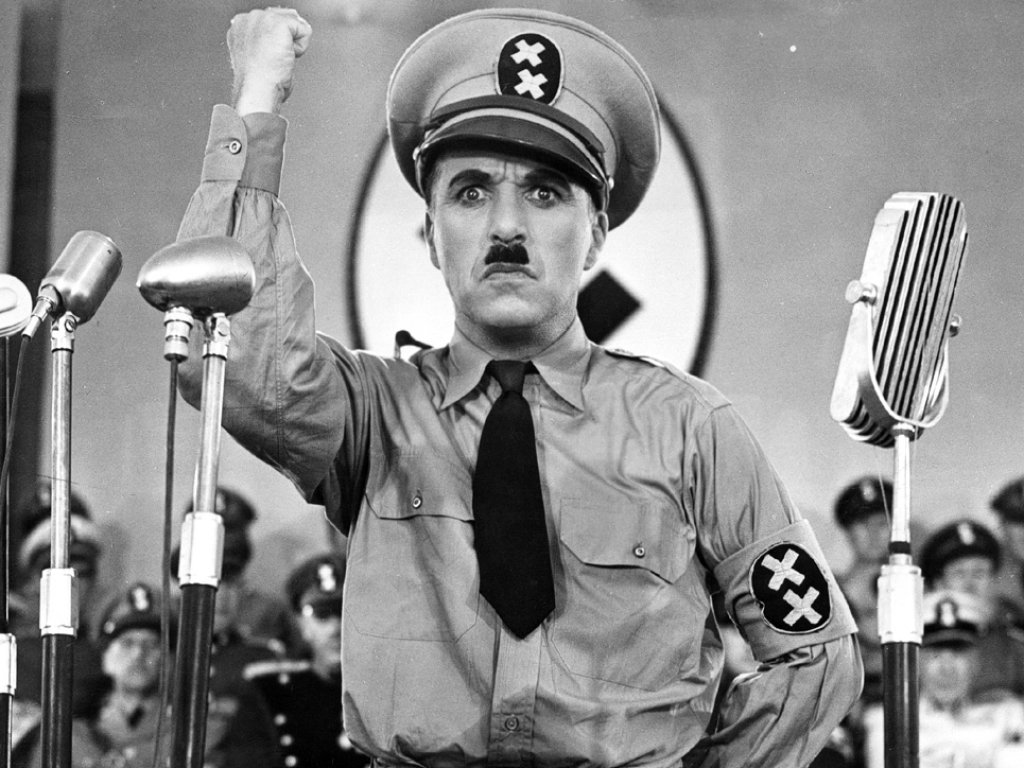
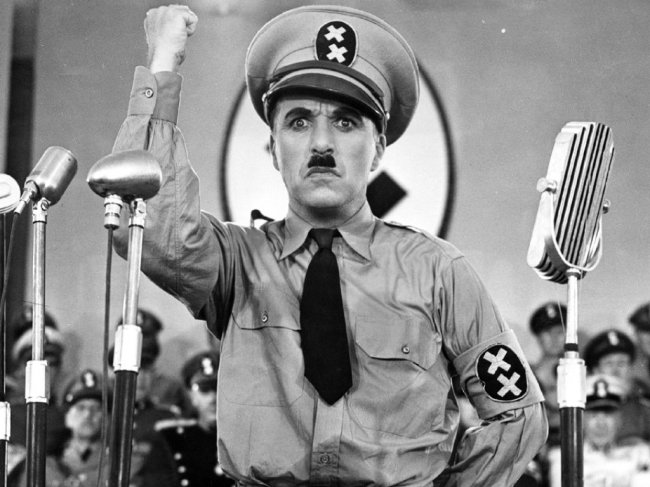
Charlie Chaplin’s 1940 film The Great Dictator is a not so thinly veiled satire on Nazi Germany filmed while war was raging in Europe. Here Chaplin plays Adolf Hitler expy Adenoid Hynkel of Tomainia who’s a power hungry totalitarian despot with dreams of world domination. Chaplin hated the Nazis and made this movie specifically to reduce Hitler and his regime down to size. He also played on any similarities he had with Hitler such as the mustache as well as did thorough research for this comedy. For instance, Hitler actually did have a globe in his office and his public speech sequence looks like it was a parodied scene from Triumph of the Will. Though it was banned in Nazi Germany, it’s said that Hitler actually saw it twice. Chaplin would’ve given anything to know what Hitler thought of it. Still, this is truly one of the greats.

World War II is a common topic in a lot of historical films, wait a minute, more like a whole film genre. Not to mention, it’s such a popular history topic that most of what you saw on The History Channel consisted of World War II stuff during its Hitler Channel days, which will be sorely missed. Of course, it is one of those times in history that people most fondly remember. Many of us know and/or related to people who served in it and there are plenty of veterans still alive today though they’re dying off as we speak. Still, unless you live in Germany or Japan it’s a war many people remember fondly since it’s a time when we were fighting countries who either attacked us or that one of our enemies was a truly evil dictator known for committing great crimes against humanity. Nevertheless, many World War II movies usually have themes that pertain to love of country, courage, camaraderie, and all the things of how war can bring the best in us. They also show  awesome weaponry.

Of course, you couldn’t talk about World War II with Nazi Germany which lasted from 1933 to 1945. During this time Germany was ruled by a totalitarian dictator and the closest thing to the Anti-Christ Adolf Hitler and his Nazi Party best known for being so fanatically racist that they’d commit genocide for it as well as having ambitions for world domination. Since they started things like World War II and the Holocaust, there could be not doubt that they were the bad guys and have been portrayed as convenient enemies in fiction. They are also known for their stylish uniforms, advanced weaponry, and other things. Yet, much of the bad things that happened in Nazi Germany at the time continue to haunt the German people to this day. Nevertheless, many WWII movies tend to have some misconceptions of Nazi Germany which I shall list accordingly.

Adolf Hitler:

Hitler had very good vision. (He was extremely far sighted that he couldn’t read without his glasses unless the text was very large. Yet, in most movies, he’s not wearing any when he’s in his headquarters.)

Hitler wore civilian clothes during World War II. (He actually didn’t wear civilian clothes during the war unless you count his pajamas. Also, it would’ve been unthinkable for him to receive an officer or approve a military plan while not in uniform.)

Adolf Hitler was an evil genius. (He was kind of an asshole who was kind of shitty at everything yet somehow unbelievably successful kind of like his Charlie Chaplin expy in The Great Dictator or if Forrest Gump was used as a Bond villain. Not to mention, he receives too much credit made by people around him and a lot of his own contributions to the German war effort {besides starting it} were failures. In short, he was an evil bastard with more luck than brains.)

Nazi Party:

All Germans were Nazis. (There were plenty of German civilians and soldiers who didn’t agree with Hitler and his policies, especially if they were Jewish or knew someone who was like Oskar Schindler. Most of the kids in the Hitler Youth had little choice of whether to join or not and much of the military consisted of conscripts as well.)

German aristocrats supported the Nazis. (Some did but a lot of them didn’t. Sure there were German noblemen who supported the Nazis like Herman Goering and there were sympathizers outside the country {like Charles Lindbergh before the war}. Many aristocrats in Germany weren’t too keen on the Nazi equality approach and sometimes saw the Nazis as a bunch of lower-class hicks since Nazism was a populist grassroots movement despite being anti-democratic and racist. Many aristocrats were also officers in the German army and Hitler hated officers. Also, some German nobles were sent to concentration camps themselves, many were involved in Hitler’s assassination plot, and some noble families were even notable for their Nazi opposition like the Hapsburgs. Still, you think noblemen would make ideal Nazi supporters but it really wasn’t the case. In fact, Anti-Nazi noblemen were disproportionately more common than the arrogant Nazi aristocrat you see in films.)

The SS and Gestapo were utterly evil.

The swastika has always been a symbol of racial and ethnic superiority. (This is only because the Nazis made the swastika their logo. It’s actually an ancient symbol from India and has a very different meaning. In Japan, a swastika is used to denote a Buddhist temple.)

Most Nazis had blond hair and blue eyes.

The Nazis had rediscovered the lost city of Tanis in 1936. (It was never lost in the first place and there have been numerous archaeological digs before the Nazis ever took power. Also, it was under British control.)

Nazi Germany had an efficiently run government and had a decent economy. (Actually the Nazi government was as inefficient as you’d expect most governments to be as well as full of internal corruption and egotistical rivalries. Also, prior to the war, the German economy was on the verge of collapse and might have been the reason why the Nazi Germany took Austria and Czechoslovakia before military conquest was the only thing to prevent economic meltdown because there weren’t free targets left to exploit.)

The Knights Cross was a Nazi decoration for actions in the Spanish Civil War. (It’s a World War II decoration.)

Popularity of the Nazi party was driven by racial superiority and the idea of a strong military. (Actually most of the core of the Nazi political machinery was the urban lower class consisting of impoverished skilled workers, intellectuals, and nationalistic military men. Your typical Nazi supporter would’ve been a recent lower class arrival particularly someone who was used to being relatively well-off and respected but had fallen on hard times as a result of the Depression. Mostly these people were angry for being “robbed of their rightful place” in the high status parts of society and wanted to get back up there to form a new ruling elite. Popularity of the Nazi party was driven more or less by envy, resentment, and fears of inferiority. You can see why the Nazis weren’t well liked by the Prussian aristocracy, the bourgeoisie, and the intellectuals of the Weimar Republic.

On the day of the July 20 plot, Otto Remer arrived at Josef Goebbels place unannounced. Goebbels placed a cyanide capsule in this mouth and handed the phone to Remer hoping he’d speak to Hitler to confirm that his Fuhrer was still alive. (Contrary to Valkyrie, the scene with Remer and Goebbels didn’t happen that way. From Imdb: “Remer issued the orders to secure Berlin as per the implementation of Operation Valkyrie but realized that something was wrong. Remer immediately telephoned Goebbels and discussed the matter with him. He was then invited to visit Goebbels whereupon Goebbels arranged telephone contact with the Wolfs Lair and Remer was allowed to confirm that Hitler was still alive.”)

The Wehrmacht:

The German Wehrmacht was capable of taking over most of Europe despite being rubbish shots.

German soldiers greeted each other by using the Hitler salute. (Actually the Wehrmacht only used the Hitler salute when they were greeted by Der Fuhrer himself. Yet, you see German officers Heil Hitlering each other in World War II movies all the time regardless of whether they’re in the Wehrmacht or the SS.)

The Wehrmacht was a much nobler than the SS. (Well, yes, but that doesn’t mean it was clean because it wasn’t. The rank and file of the German military was just as susceptible of Hitler’s race-hating propaganda as the rest of Germany. It also ran brutal POW camps for Soviet prisoners, enforced illegal Commissar and Commando Orders {instructions to enforce Soviet commissars and British special operations troops out of hand}, and helped the understaffed SS Einsatzgruppen transport and massacre Jews. By 1939, despite that their personnel weren’t technically Nazis {party membership was banned in the German military} the Wehrmacht was basically like any other branch of government in Nazi Germany, highly politicized, and constantly competing for Hitler’s attention and patronage. Besides, the Wehrmacht’s increasing politicization came at the expense of its military professionalism. By 1941, its operational plans had become seriously divorced from the reality as they based more of their planning upon racist assumptions about their enemies, which they didn’t attempt to redress. Still, the deeply perception of a “clean Wehrmacht” was promoted by the self-serving memoirs of the German brass who escaped execution after the war. The truth is that while the Wehrmacht wasn’t as evil as the SS, they still had a deep commitment to Nazism as well as a depressing litany of war crimes.)

The German officers who tried to kill Hitler were liberals who actually cared about the Jewish people as well as wished to close the concentration camps holding them. (While Valkyrie portrays the conspirators as democrats who believed in equality, most of the plotters were aristocrats who were primarily monarchist and extremely conservative with anti-Semitic and classist views. Their objections ranged from Hitler being too murderous toward the “gutter races,” to empowering the lower and middle classes or because he was simply losing the war. Many of them also had every intention of fighting on against the Soviet Union as well. Still, it would’ve been difficult for an audience to get behind protagonists who only disagreed with 40% of Hitler’s ideals.)

The Germans lost the Battle of the Bulge because they were running out of fuel. (They were running out of other supplies. Also, Eisenhower denounced this in a press conference.)

German weaponry was rather high tech. (Most German soldiers were armed with a Mauser bolt-action rifle, the Karabiner 98 Kurz which was a slight modernization of a weapon their grandfathers would’ve been familiar with, later they used any gun they could find. However, the Nazis did create a lot of military technology many armed forces still use today, particularly in the machine gun category. Still, their greatest wartime innovation actually isn’t a weapon at all but a “jerry can” that could be opened and closed without tools, was self-sealing without additional parts, included a spout rather than required a funnel, couldn’t be overfilled as a fail-safe against heat and vapor expansion, and was still cheap to manufacture despite being much more sturdy. It’s been used by both military and civilians to this day {so you’ve probably seen one or even own one} but you wouldn’t see it as part of the best in Nazi military technology. Sure a “jerry can” is just a container you may use to carry gas for your mower but it would something your Allied soldiers would’ve loved to get their hands on.)

German soldiers dropped leaflets to African Free French soldiers that they’d be treated well if they surrendered. (German soldiers may have stuck to the Geneva Convention when they captured British and French soldiers, but they’d occasionally massacre African prisoners of war.)

Germany conquered Turkey and Switzerland by 1942. (Does the person who made Enemy at the Gates know that these countries remained neutral and independent during World War II? Also, if Switzerland was already conquered by Germany at this point in the war, then why would Allied prisoners desperately want to escape there? )

German soldiers were allowed to wear beards. (German regulations prohibited the wearing of beards except in the front lines and in other situations shaving was impossible. Having German soldiers wearing beards in Stalingrad would make sense. Yet, a desk sergeant in Berlin wouldn’t have one.)

German vehicles were emblazoned with Nazi Party swastikas. (They were emblazoned with the Balkenkreuz a straight armed cross which was the emblem of the Wehrmacht.)

All German soldiers had buzz-cuts. (Most Wehrmacht haircuts were about 1-2 inches long.)

The Heer (German Army):

German panzer tanks closely resembled Sherman tanks with the exception of Nazi decoration.

The MP-40 sub-machine gun was a common weapon for the German military. (You see this German gun a lot in movies but it really wasn’t a very common weapon in real life and was only really useful in short range fire fights like in Stalingrad. It was issued to paratroopers, tank crews as well as platoon and squad leaders.)

Halftracks were the primary transport vehicles for the German Army. (Actually these vehicles you usually see in World War II movies only moved the heaviest German artillery pieces. Most German supplies including the majority of light and medium artillery was pulled by horse drawn limbers. Many suggest that the Germans didn’t resort to chemical warfare during World War II was due to their reliance on horse powered transport to support their mobile style of maneuver warfare. Still, if anyone saw a WWII movie in which most of the German Army’s supplies was moved by horses, they would probably complain that the filmmakers didn’t do their research {except maybe WWII veterans}. And yet, the German Army actually did rely on horse transport that many would consider obsolete by the 1940s.)

The Heer was composed mostly of panzer units. (Actually it was mostly composed of infantry units. In the German Army, pure infantry divisions outnumbered panzer divisions by at least 5 to 1.)

Most German Army units had mechanized equipment. (Actually the vast majority of mechanized equipment went to the panzer divisions while infantry divisions marched everywhere on foot relying almost exclusively on horses for logistical support. WWII Heer infantry divisions were almost identical to those in WWI in this respect. Still, even at the height of German motorization, it’s said that only 20% of German Army divisions were fully motorized. Rommel’s Army in North Africa was one of them yet only it was impossible to rely on horses in the desert. Yet, you wouldn’t know it from watching World War II films.)

Panzer tanks were reliable weapons. (I know that German tanks are seen as a marvel in military technology but Nazi tank technology wasn’t very good. Not to mention, German manufacturing wasn’t cranking out as many tanks as the US and Russia were. Until partway to the German campaign in Russia, the Germans were building fast and relatively light tanks, which were good against people but terrible against other tanks. Even Rommel could admit this. A single Russian KV-2 tank held up the elements of the 6th Panzer division for over a day. And in the ambush at Krasnogvardeysk, 5 KV-1 tanks destroyed 43 German tanks with no losses whatsoever. Their most reliable tank was the medium Panzer IV which had an equal armament and armor as a Sherman tank and the Russian T-34, which would soon outnumber the German tanks significantly. Besides, it was an infantry tank designed not to engage in armor but it was easy to accessorize. Then you have the late war heavy Tiger and Panther tanks which were fearsome opponents on paper but they also suffered from rushed development and were never as reliable in service as their American and Russian counterparts. They also couldn’t stay out in the open very long since they made easy targets for Allied planes. So much for German tank technology.)

The Panzerfaust was a rocket launcher. (It was a anti-tank weapon with a huge gun but it didn’t shoot up rockets.)

Field Marshal Gerd von Rundstedt:

Field Marshal Gerd von Rundstedt was a good friend to Erwin Rommel and supported the July 20 plot. (Unlike what The Desert Fox implies, Runstedt wasn’t the genial old man the movie makes him to be. In fact, Runstedt and Rommel had a contentious relationship at best. His disagreements with Hitler were purely tactical and he had no sympathy at all for the July 20 plotters in which he called their efforts, “base, bare-faced treachery.”)

Field Marshal Erwin Rommel:

Erwin Rommel was disgusted by Adolf Hitler’s command of the war. (He eventually did but not at first. He disagreed with Hitler’s tactics and brutality but he did fight for Hitler whether you like it or not. Yet, he was never a Nazi and there’s very little evidence he ever personally held any anti-Semitic beliefs. Still, while The Desert Fox doesn’t show it, Rommel sincerely admired Hitler and remained on good terms with him personally at least until the Second Battle of El Alamein when Hitler ordered “victory or death,” after Rommel requested permission to retreat and resupply. It was an order he’d promptly ignore with his faith in Der Fuhrer broken. As for looks, he bores a much closer resemblance to Daniel Craig than James Mason.)

When ordered to commit suicide, Erwin Rommel couldn’t bear to tell his fifteen-year-old son that he was being taken away to die. (Moving scene in The Desert Fox but it’s wrong. As his son Manfred remembers, Rommel just promptly told him, “I shall be dead in a quarter of an hour.”)

Erwin Rommel was involved with Claus von Stauffenberg’s plot to assassinate Hitler with a bomb planted in Der Fuhrer’s briefcase. (Well, it’s actually a bit complicated. Rommel did want peaceful negotiations with the Allies as well as Hitler removed and certainly knew about Stauffenberg’s plot as well as lent his support, but most historians doubt that he was involved with the July 20 plot. He just didn’t think assassinating him first was a good idea since he believed it would spark a civil war between Germany and Austria as well as make Hitler a martyr for a lasting cause. Instead, he wanted Hitler arrested and tried for his crimes, then executed like Saddam Hussein was. Still, evidence shows he couldn’t believe that Der Fuhrer was responsible for the Nazi regime’s crimes and ascribed the blame to various subordinates.)

Erwin Rommel had one child. (He actually had two. Aside from his son Manfred, he had a “niece” named Gertrud Stemmer he sired in an illicit affair with a local fruit seller named Wallburga {this happened before Rommel met his wife}. He continued to support her from the time she was 15 and they remained close for the rest of his life. He’d also wear a plaid scarf his daughter made for him during his African campaign. Gertrud was 30 when her “uncle” committed suicide.)

Erwin Rommel was in perfect health during the Normandy breakout. (He had his staff car shot up by R. A. F. fighter bombers over a week before Operation Cobra started that left him badly wounded. At the time of the Normandy breakout, he was in a French hospital.)

Erwin Rommel was a Field Marshal during the North Africa campaign. (He wouldn’t be promoted to Field Marshal until the war shifted to Western Europe. In North Africa, he was still a Lieutenant General.)

Colonel Count von Stauffenberg:

Count von Stauffenberg lost his right eye in North Africa. (He actually lost his left eye as well as his right hand, and two fingers on his left hand. He’d later joke that he never really knew what to do with so many fingers when he still had all of them.  He also had been treated for his wounds without morphine or any other anesthetic. Still, Stauffenberg did look a little bit like Tom Cruise, except that he was almost a head taller than the actor who portrayed him in Valkyrie.)

Count von Stauffenberg approached Erwin Rommel when the Allied armies were sweeping across the Rhine. (The Germans were still containing the Allies at Normandy at this time. The Allies wouldn’t break out until after the assassination attempt.)

Count von Stauffenberg was a fan of Richard Wagner. (He hated Wagner.)

Count von Stauffenberg was a decorated World War I veteran. (He would’ve been too young fight in that war.)

Count von Stauffenberg placed the briefcase bomb on a peg table leg during the July 20 plot. (Contrary to Valkyrie, Stauffenberg placed the bomb on a block table leg, which proved crucial in saving Hitler’s life. This is because a guy named Colonel Brandt moved the briefcase bomb to the other side of the block away from Hitler because he was trying to get a better view of the map. The blast blew away from Hitler and towards Brandt, ironically killing the latter.)

Captain Wilm Hosenfield:

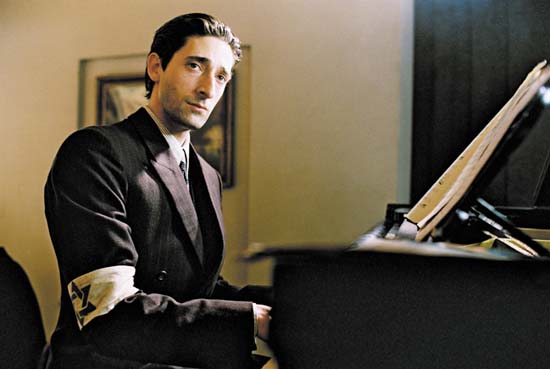
Wilm Hosenfield was a high ranking senior combat officer in the German Army. (Contrary to The Pianist, He was only a captain and served as a “sports and culture officer” {activities director} in Warsaw.)

Wilm Hosenfield rescued Wladyslaw Szpilman on a personal whim. (Though suggested in The Pianist, Szpilman wasn’t the only one he rescued nor was his kindness towards him not on a whim {though the movie was told in his point of view so Hosenfield’s kindness would seem this way}. Hosenfield had used his position to save numerous Jews and Poles from death as far back as September of 1939. He even worshiped in the local Catholic churches as well as made an effort to learn Polish so he could talk to those he befriended. Unfortunately, he’d later die in a Soviet prison camp in 1952.)

General Henning von Tresckow:

During the attempt to blow up Hitler’s plane, General Henning von Tresckow delivered the bomb to Colonel Brandt at the aircraft and later retrieved it from Berlin. (Contrary to Valkyrie, Tresckow’s deputy Fabian von Schlabrendorff did both in real life in March of 1943 before Count von Stauffenberg was crippled in the P-40 attack that April. Oh, and he was still a Colonel at the time and wouldn’t be promoted until June 1944.)

General Karl Matzer:

General Karl Matzer was an impulsive and hardcore Nazi. (Contrary to Massacre in Rome, he was a reserved officer who was cautious in implementing harsh policies.)

General Ludwig Beck:

Ludwig Beck was in his civilian clothes during the July 20 plot and managed to commit suicide afterwards. (The day of the Hitler death attempt with the suitcase bomb was the first time Beck wore his military uniform in 6 years contrary to Valkyrie. Also, he failed to kill himself twice that another officer ended up finishing him off.)

The Kriegsmarine (German Navy):

German U-boats usually shot defenseless young sailors who were stranded from sunken enemy fleets. (Actually, though Hitler ordered them to do so, most German U-boat crews usually assisted the survivors of ships they sunk usually because the captain could be interrogated, used as a bargaining chip, or convinced to switch sides. Some stories have German U-boat crews giving survivors navigation aids and supplies. Most German U-boat captains were also afraid of how their crew would be treated in the event of captured so many conveniently ignored Hitler’s orders. The Allies, on the other hand, would attack German U-boats on sight regardless of whether or not there were rescued merchant men inside.)

In the spring of 1942, the U-571 was captured by an American submarine in which the crew went on board to steal its Enigma machine. (This is part of the plot to the movie U-571, which is seen as one of the most historically inaccurate movies of all time and for good reason. First, the real U-571 was never captured but was actually sunk by an Australian plane off the coast of Ireland in 1944. Second, by 1942 the Allies had several Enigma machines already many of them in England’s Bletchley Park. Not only that, but the Enigma had already been deciphered by this point, like 7 months before the US entered the war. Thus, such mission by an American submarine crew would’ve been an unnecessary waste of tax dollars by this point, just saying. Not to mention, Tony Blair actually condemned U-571 in Parliament as an insult to the Royal Navy {who basically captured the Enigma machines with no help from the US}. Even worse, the U-571’s director managed to dedicate the film to the real sailors who captured the Enigma machines whose memories he just desecrated in the most tasteless gesture a filmmaker could ever make. It would be as if the British made a movie about their soldiers defeating the Japanese at the Battle of Midway. Still, this movie was inspired by a real story of the U-110’s capture by the HMS Bulldog back in 1941. Yet, the Bulldog’s crew was just after the codebooks.)

Schnellboots were referred to as “E-boats” by the Germans. (The Germans referred to them as “S-boats.” “E-boat” is an Allied designation.)

Very few sailors on a German U-boat crew believed in Nazism. (The German Navy may have been the least political of the Wehrmacht services. Yet, the number of true believers among U-boat crews was among the highest at least later on in the war since U-boat crews experienced staggering casualties {30,000-40,000 U-boat sailors died in the war}. Not to mention, most military recruits by then would’ve come straight out of the Hitler Youth either heavily indoctrinated or more entrenched in Nazi ideology. Still, you wouldn’t know it from Das Boot which takes place early in the war.)

Admiral Lutjens was a fanatical Nazi supporter. (He’s depicted this way in Sink the Bismarck!, but his support was far from enthusiastic in real life. He greeted everyone up to and including Hitler himself with the traditional German naval salute instead of “Heil Hitler.” He’d also wear his Imperial navy dagger on his Kriegsmarine uniform. His crew weren’t diehard Nazis either.)

The Luftwaffe (German Air Force):

The Luftwaffe was a formidable foe against Allied planes in World War II. (Yes, they’re seen as a formidable foe in World War II but they mostly were committed to a tactical bombing role and their strength as a fighting force was significantly damaged by the Battle of Britain. Though Hitler ordered the Luftwaffe to strategically bomb major cities, it wasn’t equipped to do this. Yet, it was the first Air Force to use paratroopers, which greatly impressed the Allies that they built their own airborne divisions for Normandy.)

Herman Goering was late to the conference with Hitler that took place before the July 20 assassination attempt. (Goering wasn’t at the conference at all that day.)

Messerschmitts had British engines. (They had German engines made by Daimler-Benz unlike in Valkyrie.)

German paratroopers descended with a kit bag attached by a line to one leg. (This is an an American and British technique, not used by the Germans.)

The SS:

The Waffen SS was an elite Special Forces organization. (The only extra training the SS received was purely ideological and functioned more like the Secret Service than the Green Berets and thought of as a little more than thugs, not front line soldiers, at least before they started to push their recruitment as front line units which was in 1943. Not to mention, it was said that some SS divisions received worse combat training and equipment as non-SS divisions. No Waffen-SS unit ever achieved a better kill ratio than the Heer’s best troops.)

The Waffen SS was the unit that massacred Jews during the Holocaust. (It was the Einsatzgruppen-SS that were death squads and they consisted of 15,000 members in 6 groups with 2 never seeing any action. Still, they were responsible for the death of more than 1.3 million people. Their most infamous was the massacre of 33, 771 near Babi Yar, a ditch near the capital of Ukraine.)

The Waffen SS consisted of only German members. (It was a mostly volunteer organization that consisted of many recruits across Europe ranging from Germans, Austrians, White Russians to French, Scandinavians to even Muslim Bosniaks and Indians. It was kind of like a Nazi French Foreign Legion that had around a million personnel at its height. The reason being that while the German Army could only recruit German citizens, the Waffen-SS didn’t have such restriction.)

The SS wore black uniforms. (A common mistake in many World War II movies. From Imdb: “The Black SS uniforms were discontinued at the start of the war in 1939 and replaced by the green/gray uniform. Only Waffen SS tank crews wore black uniforms in combat. This was not, however, the all-black uniform worn by the pre-war SS, but rather a short, black waist-cut coat similar in style to that worn by tank crews in the Wehrmacht. “)

Amon Goeth:

Amon Goeth was a recipient of the 2nd class Iron Cross, the Sudetenland Medal, and the Silesian Eagle. (He never actually won any of these. Also, his importance in the political machinery of the Holocaust is overplayed in Schindler’s List. He was never promoted above the rank of Captain and never had any sort of political or military power.)

Amon Goeth was a very sadistic Nazi commandant who loved murdering people during the Holocaust. (Some people criticized the Spielberg for including such a “blatantly evil” villain like Goeth in Schindler’s List, claiming Ralph Fiennes’ portrayal of him was too pointlessly cruel to be believable. However, unbeknownst to many viewers, Spielberg actually toned down the kind of monster Goeth was. Goeth was a guy who regularly tortured people in a special dungeon built under his villa for this specific purpose, fed prisoners alive to his starved dogs, shot playing children with his sniper rifle. He’s also believed to have personally murdered 500 people {amounting for a quarter of deaths that occurred in his camp} and much more. His camp had the highest death rate by far that didn’t include a gas chamber. And, yes, there are tons of evidence and documentation as well as countless witnesses for all of it. Not only that, but in September of 1944, Goeth would be relieved of his position as commandant at Kraków-Płaszów concentration camp as well as charged by the SS for failure to provide adequate food for prisoners under his charge, violation of concentration camp regulations regarding the treatment and punishment of prisoners, and others. However, the SS would commit him to a mental institution but would later be found by Polish and Amercian soldiers and executed not far from the site of his camp. Still, even toned down, he’s considered by AFI as the highest ranked non-fictional villain in movie history.)

The Gestapo:

The Gestapo wore those snazzy black outfits. (First, it was the SS who wore those. Second, since they were the secret police of the Third Reich, the Gestapo would either be wearing gray police uniforms or more often no uniforms at all. Actually, in Nazi Germany, you wouldn’t be able to recognize a member of the Gestapo.)

The Gestapo was ruthlessly efficient political police force in Nazi Germany. (They were also constantly understaffed and overworked and only counted on helpful German citizens or paid informers of occupied countries. Anne Frank and her family were turned in by an informer who worked for the Gestapo. Gestapo officers were selected primarily for their political reliability, rather than their professionalism {though there were effective agents who served there}. Yet, they weren’t as skillful with other espionage agencies as they were with sowing terror. The Third Reich’s truly scary counter-espionage agency had been the SD {security department within the SS} that were always driven to do their best, but even they weren’t that very effective. )

Gestapo Chief Herbert Kappler was a tired worn out man who’s disillusioned by the Nazi cause and thought that the fall of Nazi Germany was imminent. (Contrary to his Richard Burton portrayal in Massacre in Rome he was a zealous Nazi and was sent to Rome exactly for this reason. There, he organized round-ups of thousands of innocent victims, oversaw raids on Jewish homes for looted valuables, and was a key figure for transporting Italian Jews to Nazi death camps. Also, he was 37 years old. Oh, and the massacre was ordered by the SS and his superior was SS Captain Karl Wolff.)

The Hindenburg:

14 year old Werner Franz was doused with water once he escaped from the burning Hindenburg. (According to Wikipedia Franz: “escaped the flames after a water ballast tank overhead burst open and soaked him with water. He then made his way to the hatch and turned around and ran the other way, because the flames were being pushed by the wind towards the starboard side.” As of 2012, he’s still alive along with Werner Doehner who was 8 at the time.)

Circus performer Joseph Späh escaped by grabbing a landing rope from the Hindenburg. (There was no landing rope on the Hindenburg. According to Wikipedia he escaped by “smashing a window with his home movie camera (the film survived the disaster), and held on to the side of the window, jumping to the ground when the ship was low enough, surviving with only a broken ankle.”)
The Blutner baby grand piano was in the Hindenburg during its final season. (It was aboard during its 1936 season but not on its final flight in 1937.)

The Hindenburg’s crew repaired a tear in its cover as it drifted lower and lower in the Atlantic. (This happened but it was on the Great Zeppelin, not the Hindenburg.)

Captain Ernest Lehman and Dr. Hugo Eckener were very wary of the Nazi Party. (Contrary to the 1975 Hindenburg film, these two guys didn’t see eye to eye as far as the Nazis were concerned. Eckener hated the Nazis and made absolutely no secret about it while Lehman was very accommodating to the powers in Berlin to advance his career and the fortunes of the Zeppelin Company. Though the 1975 film has Lehman protesting using a ship to drop propaganda leaflets in 1936, he was perfectly eager to do this to the extent that he launched the ship in a dangerous wind condition, bashing its tail. Eckener actually lashed out against Lehman for endangering the ship to please the Nazis. Because of Propaganda Minister Joseph Goebbels blacklisted Eckener in the press forever after despite him being a national {or international} hero.)

There was a conspiracy to destroy the Hindenburg airship. (Nope, the 1975 film gets this wrong. It was more or less due to a series of preventable events with the ignition coming out of nowhere.)

Miscellaneous:

No male spectator removed his hat and no military personnel saluted while a German national anthem was played by a military band. (This would simply not happen in Nazi Germany.)

Admiral Wilhelm Canaris was behind the plot to assassinate Winston Churchill. (This is the plot in The Eagle has Landed but the guy was a member of the German Resistance who was involved in several plots to kill Hitler and shared information with British intelligence. It’s very unlikely that he’d sign off on a plot particularly under orders from Heinrich Himmler and would’ve at least done something to sabotage it. He chose his agents on their Anti-Nazism as much as their competence. Still, there actually was an attempt to kill Churchill {which included assassinating FDR and Stalin as well}. Yet, it was headed by Otto Skorzeny, the man who rescued Mussolini but the plan foiled before they could get anywhere near the leaders. Also, they knew that Churchill was away at Tehran at the time and the assassins were sent there.)

Banners in Nazi Germany had inscriptions in Gothic type during World War II. (Hitler actually banned all Gothic types in 1941, saying that they were of Jewish origin.)

Urban German churches in World War II had stain glass windows in place. (Priests, nuns, and other clergymen had removed the stained glass windows from the churches and buried them outside the cities so they wouldn’t be destroyed if the Allies bombed Germany.)

The SA stormtroopers were around in 1936. (The Brown shirts ceased to exist after The Night of the Long Knives in 1934. Though they lingered, it was significantly weakened, almost pointless since the SS had taken over most of their duties by this point.)

The Germans used Scopolamine during their interrogations. (It wasn’t tested as a truth drug until the 1950s.)

Admiral Wilhelm Canaris and Henrich Himmler got a long great with each other. (They detested each other.)

Nazis enjoyed listening to Gustave Mahler. (Mahler’s music was banned in Nazi Germany because he was Jewish.)

Germany stood a chance of winning World War II. (Let’s just say Hitler was never really so close to winning World War II mostly because of his attempt to invade Russia. Let’s just say he should’ve learned from Napoleon that invading that country is never a good idea. Still, this resulted not only in utter disaster but also with Josef Stalin joining the Allies as he was going to be in the winner’s corner of the war no matter what.)

History of the World According to the Movies: Part 63 – Life in 1930s Europe

Image

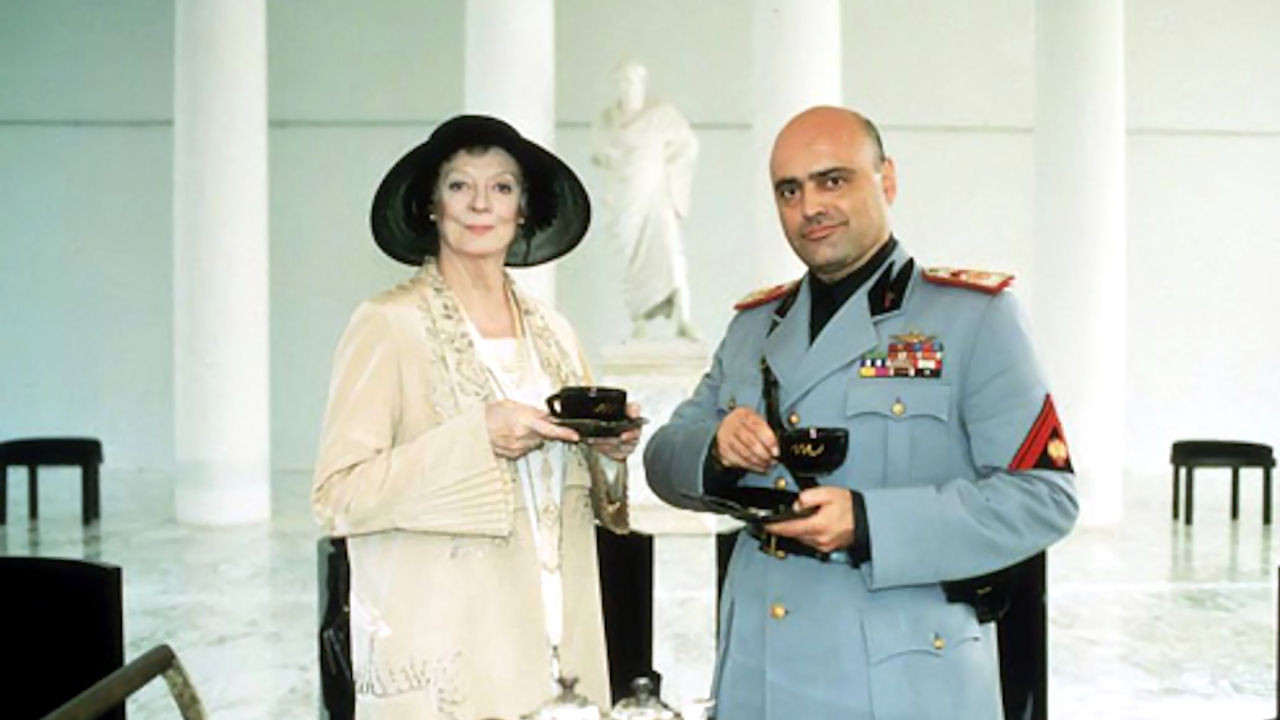
Tea with Mussolini is a 1999 film by Franco Zeffirelli which is loosely based on his childhood. The Scorpioni was a real group of English women in Florence (but there were no Americans) but I’m not sure if one of the members had tea with Il Duce. Still, what Zeffirelli said about the leader of the group greatly explains why Maggie Smith was so perfectly cast. Though she’s called Lady Hester Random in the movie, he said, “I don’t remember if she was called Hester, but I remember this terrible, fantastic woman. She was the dowager of the community. I remember the many outrageous things she did because she could afford to be arrogant and bossy.”

1930s wasn’t a great place to live since tough economic times had brought political troubles along with it since several authoritarian regimes emerged in many European countries like Italy and Germany but they weren’t the only ones. Mussolini and Hitler were just the most memorable because their delusions of grandeur led them to invade countries like Ethiopia and Poland. Then there’s Russia which is ruled by the iron fist of Josef Stalin but we don’t see 1930s Russia in movies because we have some idea the guy’s either starving his people, staging purges, sending people to gulags, and other atrocities. Yes, Stalin was a paranoid beyond all doubt except that one time when he signed a non-aggression pact with that guy from Germany but I’ll get to that later. Then there’s the matter with Spain in which a simmering of a decades long ideological conflict in the nation had exploded into a civil war between the Nationalists led by Generalissmo Franco, which was backed by both Italy and Germany and the Republican Loyalists backed by the Soviet Union. Of course, we remember this war for many of the people who signed up to fight there like Ernest Hemingway and George Orwell as well as for Pablo Picasso’s heart-wrenching Guernica. It was a nasty war but Franco won and managed to rule Spain until the 1970s. Still, there are plenty of things the movies would get wrong about Europe in the 1930s which I shall take time to list accordingly.

France:

Georges Melies didn’t receive much recognition for his film work until 1931. (His prestige in the film world started to grow in the late 1920s and in December 1929, there was a gala retrospective of his works at the Salle Pleyel. He was made Chevalier de la Légion d’Honneur and received a medal by fellow filmmaker Louis Lumiere {of the Lumiere brothers}. However, none of the enormous praise he received helped his livelihood or decreased his poverty. Still, his renewed recognition had nothing to do with a young orphan boy rediscovering his automaton.)

Georges Melies lived with his granddaughter Isabelle during his later years. (His granddaughter’s name was Madeleine Malthête-Méliès. However, she wasn’t technically Mama Jeanne’s granddaughter though but you wouldn’t know that from watching Hugo. Also, by the time Hugo takes place, Melies had only been married to Jeanne for five years as his second wife, though she was his longtime mistress before then but you can’t include that fact in a movie catered for kids.)

The Spanish Civil War:

The Republican Loyalists were the good guys in the Spanish Civil War. (Sure the Franco Nationalists weren’t the good guys in this conflict and were allied by Fascist Italy and Nazi Germany. But this doesn’t mean the Republican Loyalists were exactly nice guys either. Both sides committed atrocities and the Republicans were backed by Stalin.)

The Republican Loyalists believed in democracy. (Some of them did as did many people outside Spain who fought on their side. However, the Loyalist side also included Stalinists, Trotskyists, and Anarchists who you could hardly call democratic supporters. You could say that the Republican side was united in that they didn’t want Franco to rule.)

Francisco Franco was a Fascist. (He claimed he was and undoubtedly had Fascist support, but many historians think he was just after power and just wanted to introduce his own brand of totalitarianism.)

American volunteers in the Spanish Civil War received Purple Hearts for their service there. (Though you wouldn’t know it from My Dog Skip, there were no military personnel in that war, only volunteers who didn’t receive military awards of any kind. So Willie’s dad was probably lying.)

Fascist Italy:

Benito Mussolini was friends with Adolf Hitler. (They were more like frenemies, which The Great Dictator pretty much sums it up perfectly. Mussolini was jealous of Germany’s military strength that he made many stupid mistakes as well as things way above his pay grade in order to keep up with Hitler. As TTI says, “Despite their similar ideologies, Mussolini always had a fractious relationship with Hitler. In 1935 he threatened to intervene during the Nazis’ first attempt to occupy Austria, and signed the Stresa Front with Britain and France to block further Nazi aggression. It wasn’t until the Spanish Civil War that Il Duce and Der Fuhrer found themselves on the same side. Even during the war, Mussolini and Hitler distrusted each other so much that they often didn’t make the other privy to major military operations {Mussolini didn’t tell Hitler about his plans to invade Greece, for example}.”)

Benito Mussolini had a popular following in Italy. (He was never especially popular in Italy {as shown by what his own people did to him and his mistress in World War II}. However, he was initially and surprisingly admired abroad, not just by fascists like Hitler and Franco, but many British and American politicians, journalists, and intellectuals viewed Il Duce’s outwardly efficient and well-organized regime as a potential role model. That is, until Mussolini’s invasion of Ethiopia.)

Benito Mussolini made the trains run on time. (He claimed to have done this but some observers called Il Duce out on this.)

Poland:

Poland was a free country before Hitler invade it. (It had been under a military dictatorship since the 1920s but you wouldn’t be able to tell from the movies. Still, at least it was a dictator from their own country and not some other nation like Germany or Russia.)

Stalinist Russia:

The Moscow Trials between 1936 and 1938 were fair. (They are seen this way in Mission to Moscow {which is a Hollywood movie made in 1943}, but the actual Moscow Trials were nothing more than for show in which Stalin used to rubber stamp the executions of his old Bolshevik comrades. The charges against these people were basically trumped up and the defendants were tortured into confessing. The trials are often considered a part of Stalin’s Great Purge. Yeah, they were totally fair, not.)

The notion of Stalinist Russia being a backwards tyranny was just a silly prejudice. (Stalinist Russia may not have been considered a 3rd world country but it was still very much a tyranny under the rule of a very brutal man who went to great lengths to establish absolute power in Russia. No wonder Mission to Moscow’s screenwriter was blacklisted after World War II.)

Stalinist Russia was a plucky place working toward the day when it would be a democracy, which was a day just around the corner. (Really, Mission to Moscow? Democracy just around the corner in Stalinist Russia, a corner of a Siberian prison cell or gulag that is. Besides, under Stalin, the prospect of Russia being a democracy was at its nadir at this point. I mean Russia was more likely to become a democracy under the Czars than this guy.)

Madame Molotova still had her swanky perfume works at this time. (She actually had her business confiscated and nationalized by the Bolsheviks and in Stalinist Russia, produced only one scent Red Moscow.)

Austria:

Austria had been a free country before the country fell to the Third Reich. (Before the Anschluss, Austria had been under a fascist dictatorship for four years. Yet, you wouldn’t know it from watching The Sound of Music.)

The Von Trapp Family:

The von Trapp family escaped Salzburg by going through the Alps to Switzerland. (They actually didn’t go through the Alps which would put them at Hitler’s springtime retreat at Berchtesgaden in Germany. So the Alpine trek was out of the question. In fact, the von Trapp family just took a train to Italy since the dad was born in an area that used to be part of Austria prior to World War I. Thus, they could claim Italian citizenship but who wants a beloved singing family to escape to another country held by a fascist dictator?)

Captain Georg von Trapp was a strict disciplinarian as well as a humorless and emotionally distant father. (Actually contrary to his Christopher Plummer portrayal, the actual George von Trapp was a kind man who greatly enjoyed musical activities with his kids and even rocked the violin during family concerts. He’d also make handmade gifts for his kids in his workshop. Also, the reason why he used a whistle to call his kids was that he had a weak voice as well as about half-dozen kids on a large estate. His family was greatly annoyed but this portrayal because he was the cool dad, while Maria von Trapp was the strict one and was said to have a terrible temper. But having Julie Andrews playing the strict parent would be unthinkable! Besides, having Georg as the strict disciplinarian allowed Christopher Plummer to be as miserable as he wanted. However, the real Maria did like Christopher Plummer even if the guy couldn’t care less doing The Sound of Music, which made him a star.)

Captain Georg and Maria von Trapp were married right before the Nazis moved into Austria. (Uh, by the time the Nazis moved into Austria, Georg and Maria were married for nearly 10 years with a couple of kids. Also, while Christopher Plummer was 35 when he played Georg, the real guy was 47. The real Maria was 22 so I don’t blame the casting agency.)

Captain Georg von Trapp had no trouble turning down the Nazis when they offered him a post in the Kriegsmarine when they moved into Austria since Georg had anti-Nazi beliefs {but so did most of the Austrian nobility}. (Though it’s true that Georg didn’t like Nazis, he was offered a job in the German Navy before the Anschluss. The Nazis wanted to recruit him because of his extensive experience with submarines and Germany wanted to expand its U-Boat fleet. Still, unlike in The Sound of Music where Georg tells the Nazis where they could shove it, the real Georg seriously considered taking their offer since his family was in desperate financial straits and he had no marketable skills other than his training as a naval officer. He decided that he couldn’t serve the Nazi regime but the Nazis continued to woo him.)

The von Trapp family had to flee Austria because the Nazis had threatened to arrest Georg. (Georg was never in serious danger of being arrested by the Nazis since he turned down the Nazis’ offer before they took over the country. They couldn’t arrest him even if they wanted to. Also, after the von Trapps left in 1938, he and his family returned for a stay for several months in 1939 before departing for good without incident.)

The von Trapp family had to flee Austria after the Salzburg Music Festival before the borders closed. (Actually Hitler took over Austria in March of 1938 while the Salzburg Music Festival is in June. The von Trapp family couldn’t do both.)

Max Detweiler was the von Trapp family’s music director who gave up his life to save them. (Max is a fictional character. Their music director was their priest Reverend Franz Wasner who acted as such for over 20 years and accompanied them when they left Austria.)

Maria Kutschera gave up her dream of becoming a nun when she fell in love with Georg von Trapp. (Actually, she fell in love with the man after their marriage, though she did like him and his kids a lot. Still, she had to be pressured by the Mother Superior to accept his proposal for she wanted to get her out of the convent anyway. Their marriage was more about practicality.)

George von Trapp was a baron. (His hereditary title was “Ritter” which means “knight” in German and is an equivalent for baronet. Also, in 1919, the nobility was abolished in Austria so his legal name was “Georg Trapp” yet he continually used the von as a particle of courtesy.)

The villa at Aigen in Salzburg, Austria was the von Trapp family’s ancestral home. (The von Trapp ancestral home was in Pola which is in present-day Croatia, which they were forced to abandon due to World War I. Besides, by this point, they had lived in homes in Zell Am See and Klosterneuburg. The von Trapps moved to their Salzburg home in 1922 after the death of Georg’s first wife. Also, the home wasn’t as grand as depicted in The Sound of Music.)

The von Trapp family became the Von Trapp family singers before they went to America. (The whole Von Trapp Family Singers thing started because they lost their life savings thanks to the Nazis damaging the Austrian economy as well as Georg’s poor business decisions that left the family virtually bankrupt. Since they were in need of funds, they entered a music competition which was Maria’s idea {she was a very resourceful lady}. Yet, entering the music business caused Georg a lot of embarrassment.)

While a convent novice, Maria Kutschera was hired as a governess for Captain Georg von Trapp’s children. (She was hired as a tutor to the young Maria Franziska {a. k. a. Louisa} who had come down with scarlet fever and needed her lessons at home.)

Miscellaneous:

Upper-class dinner parties in the 1930s had men and women seated separately. (Actually most upper-class dinner parties in the 1930s were seated on a boy-girl-boy-girl basis. And it wasn’t unusual for people to sit next to someone of the opposite sex who wasn’t their spouse.)

Catholic clergymen wore the poncho style chasuble in the 1930s. (Actually they wore the “fiddle back” style at the time. Poncho style chasubles are modern.)

Flapper and sheik clothing was popular in 1931. (These styles were popular from 1925-1928. By 1931, they’d be considered outdated. Yet, this is the Great Depression so those outfits were probably some of the good ones some people had at the time to go to the club.)

It wasn’t unusual for barber shops to be open on Sundays during the 1930s. (Depends on the location but certainly not in the American South.)

Measles vaccines were in existence at this time. (They weren’t until at least the 1970s or later.)

Most European countries at this time were relatively free. (Unless you live in Britain, France, Scandinavia, Switzerland, or the Low Countries, you were probably living under a dictatorship by 1939 either run by Fascists or made use by them. Yet, you wouldn’t know it from movies set at the time.)

1930s straitjackets had buckles on them. (Straitjackets wouldn’t have buckles until the 1980s, before then, they were laced with eyelets.)
Radios played almost immediately after turned on. (Before the radio transistor, all radios used tubes which took many seconds to warm up before providing any sound.)

History of the World According to the Movies: Part 62 – 1930s Great Britain

Image

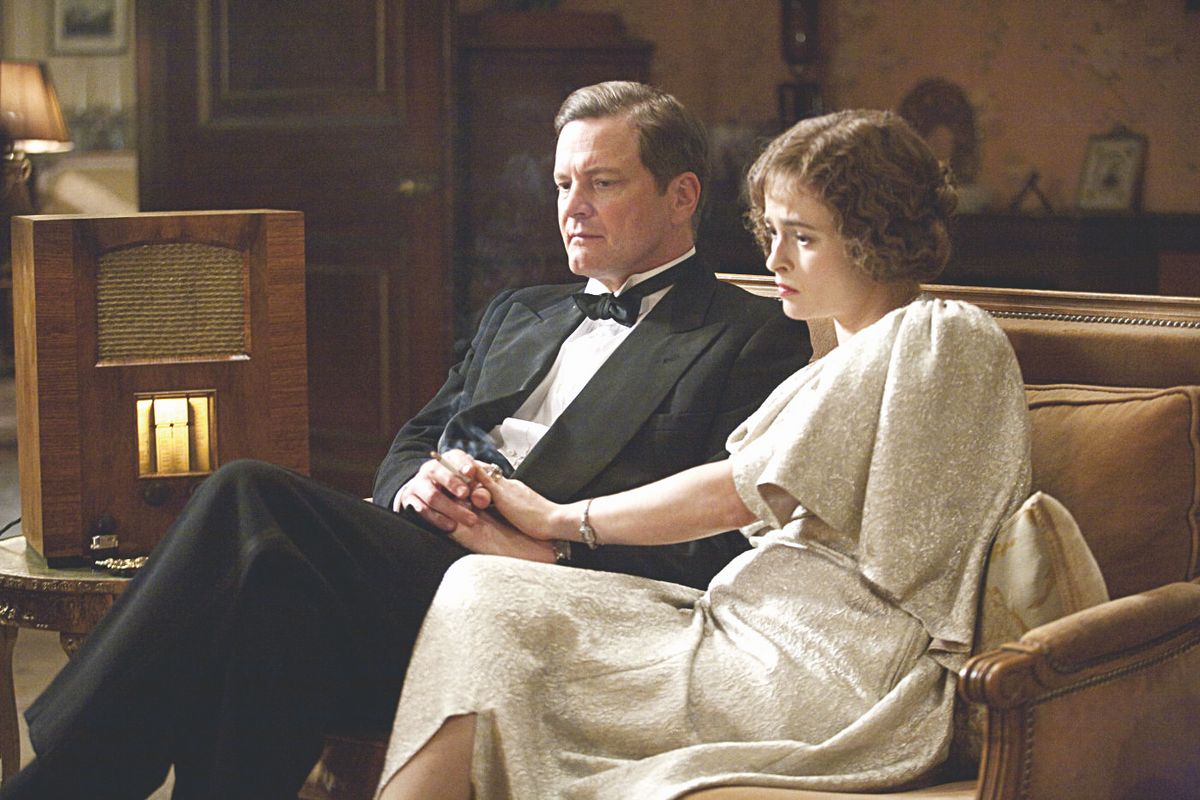
Tom Hooper’s 2010 Academy Award winning film The King’s Speech is perhaps the most famous movie about Great Britain in the 1930s apart from all the murder mysteries. Here Colin Firth stars as the stammering Bertie (King George VI) and his private struggle with public life as a member of the royal family and later as a constitutional monarch. His supportive wife Elizabeth (the future Queen Mother) is played by Helena Bonham Carter. Is it 100% accurate? No, since you have Winston Churchill supporting Edward VIII’s abdication when he actually opposed it in reality but no one wants to see that. Still, this is a very good film about what it’s like to be a monarch in the modern world.

Great Britain is particularly memorable in the 1930s mainly due to the fact that many an Agatha Christie murder mystery tends to be set at this time. Even if the work isn’t set in the 1930s originally, it somehow becomes the default template. Still, in movies, 1930s Great Britain is one of the more ideal times for having a good murder mystery at someone’s country estate. But 1930s Great Britain isn’t just a period filled with murder and mayhem since it’s also the the time when you have Fascist leader Oswald Moseley who was the inspiration for Roderick Spode in P. G. Wodehouse’s Jeeves and Wooster series.There were also plenty of rich Brits who also had some sympathy for the totalitarian type like Miss Jean Brodie, most of the Mitford family, and others. Yet, there are two great events in the 1930s that are particularly memorable to Britain in this decade. First, there’s the abdication of Edward VIII who is said to give up the throne for a twice divorced American which leads to the ascension of his stammering younger brother. Second, there’s World War II. Nevertheless, movies don’t tend to get all the facts right and I shall list the inaccuracies for you.

Winston Churchill:

Winston Churchill dined with Josef Stalin in 1939. (No, he didn’t until 1942 when Great Britain and the USSR were allies in World War II.)

Winston Churchill supported George VI’s ascent to the throne. (He actually one of Edward VIII’s fiercest supporters during the abdication crisis and advised him: “Retire to Windsor Castle! Summon the Beefeaters! Raise the drawbridge! Close the gates! And dare Baldwin to drag you out!” He even rewrote some of Edward VIII’s abdication speech. George VI wasn’t exactly fond of Winston Churchill being appointed prime minister during World War II. However, they weren’t friends until they had to confide in each other on the war and the governance of Britain. Still, you have to have Churchill supporting Bertie in The King’s Speech because Edward VIII was a Nazi supporting dickhead. I mean Churchill might’ve thought appeasement was a bad idea but he wasn’t endowed with 20/20 hindsight to see that George VI would’ve made a better king than his older brother, especially in what was to come. Nevertheless, Churchill’s mistake over Edward VIII’s abdication was one of the reasons Britain ignored his warnings about appeasement in the first place.)

Winston Churchill was fat at this time. (He wouldn’t be overweight until later in his life yet, he’s seen as chunky in most portrayals of him during the 1930s and WWII.)

King George V:

King George V preferred his son Bertie (George VI) on the throne over his brother David (Edward VIII). (Actually by the time he died he not only preferred Bertie but also his 9 year old daughter Elizabeth over Edward on the throne. He most famously said, “I pray to God that my eldest son [Edward] will never marry and have children, and that nothing will come between Bertie and Lilibet and the throne.”)

Queen Mary of Teck:

Queen Mary of Teck had a guttural German accent. (Recordings reveal she didn’t. Also, she was born and raised in Britain, which is why Queen Victoria thought she’d make a suitable bride for her grandson. Yet, this grandson was actually George V’s brother Albert Victor who died so George married her instead.)

Queen Mary of Teck was a cold and heartless mother. (Actually she wasn’t but she did keep a stiff upper lip. Also, she was a kleptomaniac and fanatic jewelry collector.)

King Edward VIII:

Edward VIII was pressured to give up the throne for love. (Actually, he abdicated because of his Nazi sympathies. Wallis Simpson was just an excuse.)

Edward VIII’s trip on a Mediterranean cruise with Wallis Simpson was exposed to the British press as a “Royal Scandal!” (Actually the British papers famously covered it up thanks to the king’s friend Lord Beaverbrook who convinced all his fellow newspapermen to agree to complete discretion. All that was printed out on that paparazzi moment from Britain was a passenger list with Wallis’ name on it. British censors even snipped out even more lurid reports out of foreign newspapers at customs.  Most people in Great Britain didn’t have any idea about Edward VIII’s affair with Wallis Simpson until December of 1936.)

Most of the allegations about Edward VIII and Wallis Simpson having sympathies for the Nazis was just based on rumors. (Except that it’s not for there’s plenty of evidence. According the Guardian’s column on reel history has this snippet, “a 1933 report by the Austrian ambassador that Edward said to him: “I hope and believe we will never fight another war but if we do, we must be on the winning side and that will be Germany, not the French”. A public speech to the British Legion in 1935 in which he advised his audience to “stretch forth the hand of friendship to the Germans”. A 1936 letter from the German ambassador to Adolf Hitler saying “King Edward, quite generally, feels warm sympathy for Germany”. British Foreign Office papers suggesting that a Nazi plot to put Edward back on the throne when they invaded Britain was cooked up with Wallis’s involvement. Wallis’s notoriously dazzling smile on meeting Adolf Hitler in Germany in 1937. Edward’s frequent Nazi salutes during that trip, and cheerful fraternisation with the likes of Josef Goebbels, Hermann Goering and Rudolf Hess. Edward’s own admission in an article he wrote for the New York Daily News in 1966 that “along with too many other well-meaning people, I let my admiration for the good side of the German character dim what was being done to it by the bad”.” As his cousin Prince Ferdinand of Prussia said that Edward, “was quite pro-Hitler, said it was no business of ours to interfere in Germany’s internal affairs either re Jews or anything else, and added that the dictators were very popular these days and we might want one in England before long.” Let’s just say that having an affair with a twice divorced 40 year old American wasn’t the most scandalous thing about King Edward VIII despite it causing a constitutional crisis. It’s more likely he gave up the throne due to overwhelming evidence that he had vocal Nazi sympathies, which the Duke of Windsor {Edward VIII} would air in public until at least the 1960s. Still, even after his abdication, the British Government would send the former king to govern the Bahamas since his willingness to enter an alliance with Germany was seen as a threat.)

Edward VIII was called “Edward” by his family. (His family and friends called him, “David.”)

Edward VIII was a brooding hunk who gave up the throne because he couldn’t be the best king without the help and support of the woman he loved. (Edward VIII was pathologically hated by quite a number of people largely due to his being by all accounts, both selfish and an absolute jerk. Also, his abdication wasn’t a big sacrifice to him since he didn’t want to be king in the first place. After all, he didn’t want opening Parliament and christening ships get in the way of his jetting around the world to party and leave his stammering little brother do all the king stuff {which he dreaded and never got used to}. His relationship with Wallis was not what you’d call a great love story and more of what you’d see on a sleazy reality show on TLC. He’s said to be a whiny and needy husband while Wallis was kind of a nagging shrew though at best it would’ve been a relationship you’d call, shall we say dysfunctional. According to the Guardian: “One close friend, Mrs. Humphrey Butler, recalled a scene at a dinner party when the then Prince of Wales asked Wallis for a light. “Have you done your duty?” Wallis asked. “Little man gets on his haunches, puts up his hands and begs like a dog,” remembered Mrs. Butler. “She then lights his cigarette. Horrible to see.”” Not to mention, Wallis didn’t really want Edward to abdicate or marry him but she was sick of him by then. She may have given in if there was a crown involved, but she knew she was trapped by the time of Edward VIII’s abdication. They may have stayed together until Edward’s death but their married life consisted of the couple indulging in their hobbies of throwing house parties where they screamed at each other in front of guests, having affairs, and talking about how great Hitler even well into the 1960s. Seriously, Madonna, why make a movie about this romance which really wasn’t that great?)

Edward VIII wanted children. (If he wanted kids, he wouldn’t have married Wallis Simpson who was like 40 by their wedding. To suggest that he wanted to have children is untrue.)

Edward VIII was drunk during the abdication crisis. (He was actually sober throughout the whole ordeal for which his friend Stanley Baldwin gave him credit for. Still, abdicating the throne for his brother was probably the best thing he ever did and Britain was so much better off because of it.)

Edward VIII was the first British monarch to abdicate. (Richard II, Lady Jane Grey, and James II gave up the throne in their lifetimes, though they probably didn’t have much of a choice. Edward VIII was the first British monarch to do it without having someone trying to overthrow him.)

Edward VIII put Benzedrine into champagne at a cocktail party. (Actually his friend MP Chips Channon did this.)

King George VI:

George VI started working with his speech therapist Lionel Logue a few years before the abdication crisis. (He had actually been working together before his daughters were born back in the 1926 and they both hit it off immediately. Still, George VI’s relationship with Logue in The King’s Speech was long considered vastly overstated though recently discovered letters from the future Queen Mother to Logue and Logue’s diaries tell a different story. Also, as early as 1927, he was seen as a decent orator thanks to Logue’s help that he managed to give a speech opening the Australian Parliament almost free from error. By 1934, he had rarely visited Logue since his speech had improved but he turned to his therapist again after his brother’s abdication.)

To help his stuttering, George VI used to have his mouth stuffed with marbles. (That’s straight out of My Fair Lady {but a rather common treatment since the time of Demosthenes} though Charles I used to correct his speech by stuffing his mouth full of pebbles and talking to himself. I guess neither did the trick saving his head. Also, George VI’s stammering manifested itself when he was 8 not 4 and it was relatively mild compared to what’s portrayed in The King’s Speech. Still, this doesn’t mean it was less of a problem to him because it certainly was.)

George VI was against Neville Chamberlain’s appeasement policy. (It may be heavily implied in The King’s Speech but Bertie actually supported Neville Chamberlain’s policy and endorsed it by breaching protocol before the sitting of the House of Commons. Still, though it may not have been a good move, most people in Britain supported it at the time, which would make sense since the country was still recovering from the devastation of World War I. Edward VIII supported appeasement as well but for very different reasons.)

King George VI was crowned in Westminster Abbey during Lent. (Lent is usually around February to April depending on the year. George VI was crowned in May, which would mean that the Altar frontal at Westminster Abbey would’ve been white not purple as it is in The King’s Speech. Still, that coronation scene was probably filmed at the time and it’s not easy to change the vestments.)

King George VI retained a presence of dignity during his ascension to the throne. (He actually spent an hour sobbing in his mother’s presence because he really didn’t want to be king. Still, Bertie never got used to the gig.)

King George VI and Queen consort Elizabeth were greeted by the Roosevelts during their arrival at Hyde Park in June of 1939. (Actually the royal couple had accompanied FDR and Eleanor to Hyde Park several after days in Washington D. C. They arrived to the place with the Roosevelts.)

King George VI and his wife didn’t know how an elevator door worked. (Actually, Bertie served in the navy during World War I and had mastered far more complex machinery than an elevator door. Also, Elizabeth Bowes-Lyon wasn’t born royal.)

Bertie chose his regal name George VI because his given name Albert seemed too German. (He actually chose George as his regal name out of respect for his father.)

Queen Elizabeth Bowes-Lyon (a. k. a. the future Queen Mother):

Elizabeth Bowes-Lyon believed that Edward VIII was destined for greatness. (She actually believed the opposite based on what she was writing and saying at the time. Also, it was her popularity that won her husband’s favor to the throne.)

Queen consort Elizabeth wore her Balmoral hats in the 1930s. (She didn’t start wearing them until World War II.)

Lionel Logue:

Lionel Logue always referred George VI as “Bertie.” (Yes, they were friends but Logue never called George VI by his nickname or swore in his presence, as an exercise in proper decorum.)

Myrtle Logue had no idea that her husband was treating George VI until she saw Queen consort Elizabeth help herself some tea in her parlor. (She knew all about her husband’s most famous patient by George VI’s ascension. She and her husband were even presented at court to Bertie’s parents in a show of gratitude for Lionel’s work. Myrtle even wrote about the experience in an Australian newspaper. Still, you need a scene like that in The King’s Speech.)

Stanley Baldwin:

Prime Minister Stanley Baldwin resigned over misjudging Hitler. (Actually this wasn’t the case. He resigned because he just wanted to retire after 15 years as Conservative Party leader. Also, in 1937, Hitler hadn’t even begun his invasion and treaty breaking yet.)

Stanley Baldwin invited Edward VIII and Wallis Simpson to a dinner party at his house before the abdication crisis. (Actually Baldwin only met Wallis Simpson once in May of 1936 at a dinner party hosted by Edward VIII but didn’t realize her significance until months afterward.)

Neville Chamberlain:

Neville Chamberlain was an idiot and a stupid coward for appeasing Hitler and hijacking his own country at the Munich Accord prior to World War II. (As much as movies would rip on Chamberlain for letting Hitler take Austria and Czechoslovakia, more recent historians have said that he knew full well what he was getting into before the negotiations took place. For one, he was already quietly preparing his nation for war so he didn’t expect the peace to hold but didn’t think his country was ready to take on Hitler yet. Many say that Chamberlain made peace with Hitler just to stall for time. He also promised to defend Poland’s independence if it were attacked, which made Britain one of the first nations to enter the war. Second, Britain lost about a million lives in the last war with Germany so any option short of war would have looked good if the alternative was going through that again. Third, there were many British conservatives who were at least passively pro-Nazi who at least viewed Hitler as preferable to the USSR if not outright admirable, even in Chamberlain’s own party and among the royal family like King Edward VIII. Not to mention, despite the later historical notoriety, Chamberlain’s actions were popular among the British at the time and somehow made better sense if you know the context since appeasement just seemed as the only politically acceptable option back in the 1930s. Fourth, Chamberlain knew that the British and the French wouldn’t support war if he had been seen to reject diplomacy. Chamberlain’s action may have looked like a stupid decision but he had thought the whole thing through.)

Archbishop of Canterbury Cosmo Lang:

Bishop Cosmo Lang breathlessly revealed to King George VI that Lionel Logue wasn’t a doctor. (Everyone already knew that by the time George VI became king. Also, Bertie always referred to his speech therapist either as “Logue” or “Mr. Logue.”)

Wallis Simpson:

Wallis Simpson’s second marriage was filled with domestic abuse. (Sorry, Madonna, but I could find no evidence that Wallis Simpson’s second marriage was an abusive relationship since they remained friends after they divorced. Still, Ernest Simpson did cheat on her childhood friend whom he later married.)

R. J. Mitchell:

R. J. Mitchell worked himself to death on the creation of the Spitfire. (He did work despite the pain of his illness tweaking and perfecting his design up until his death. However, designer Joseph Smith had already taken over the primary design work by the time of the first flight of the Spitfire prototype.)

R. J. Mitchell suffered from tuberculosis during the 1930s while working on the Spitfire. (It’s implied in his Leslie Howard portrayal in the 1942 First of the Few, but his real illness was rectal cancer. He had a colostomy in 1933.)

R. J. Mitchell’s meeting with Willy Messerschmitt during his visit in Germany during the late 1930s convinced him to design the Spitfire. (Mitchell had never visited Germany or met Willy Messerschmitt. Also, he had been already working on the Spitfire since 1931.)

R. J. Mitchell died as the first Spitfire prototype took to the skies. (He actually lived over 15 months after the first flight which was in 1936. Oh, and he actually saw his creation take to the skies. Mitchell would die in 1937.)

Douglas Bader:

In 1930, Douglas Bader attempted doing low-level aerobatics when he was goaded into a disparaging remark to do just that. (He actually attempted to do this on a dare. But like in Reach for the Sky, he ended up crashing which resulted in having both of his legs amputated.)

Miscellaneous:

People at rich estates were especially prone to getting murdered at social gatherings during this time. (A lot of murder mysteries tend to take place in 1930s Great Britain, don’t ask. Not to mention, 1930s Great Britain is a typical setting for most movies based on Agatha Christie novels.)

Dora Carrington successfully committed suicide shortly after Lytton Strachey died in 1932. (She did shoot herself but she did it 2 months after Strachey’s death. She died half a day later after being found by a gardener.)

Princesses Elizabeth and Margaret were always called by their respective names when they were home with their parents. (They were always called by “Lilibet” and “Margo” respectively when they were at home with their parents. Still, Princesses Elizabeth and Margaret were undeniably 13 and 9 respectively in 1939, they don’t seem to age a day over the course of The King’s Speech. Guess Hooper didn’t want to hire more child actresses in order to save money.)

Winston Churchill, Bishop Cosmo Lang, and Neville Chamberlain turned up to Buckingham Palace to witness King George VI’s war broadcast in September of 1939. (They had better things to do. Also, a large crowd didn’t gather outside Buckingham Palace that day to congratulate George VI on overcoming his stammer.)

History of the World According to the Movies: Part 61 – Depression Era Outlaws

Image

I couldn’t have a post dedicated to Depression Era outlaws in the movies without using a picture from the 1967 Bonnie and Clyde. Sure this is a very entertaining movie with all the violence and sex any box office smash could ask for starring the sexy Warren Beatty and the sultry Faye Dunaway who have great chemistry. However, remember that this movie doesn’t tell the real story of Bonnie and Clyde who were no more than a couple of ruthless thugs that didn’t rob from the rich to give to the poor. Nor were they that stylish and good looking either.

You’d think that the repeal to Prohibition would lead to less crime now that alcohol was legal again. However, since this was the time of the Great Depression, you’d be dead wrong. Thanks to the Great Depression and the fact that people back then didn’t have the modern conveniences we have now, 1930s America had a new generation of outlaw legends whose exploits were read in the papers or heard on the radio. Sure they weren’t nice people but many of these outlaws seemed to emanate a sense of romanticism during difficult times. People didn’t mind that they robbed banks, killed people, or held people hostage because their adventures provided some sort of escape from the normal hard life of the general population since these guys didn’t let the law stop them. Didn’t hurt that they dressed well, too. Still, many of these Depression outlaws had celebrity status such as John Dillinger, Pretty Boy Floyd, Machine Gun Kelly, Bonnie and Clyde, and the Barker gang. And, yes, the 1930s is a rather popular setting for gangster films as well as movies dealing with crime. Nevertheless, there are some liberties Hollywood tends to take with the facts on many of them which I shall list accordingly.

Outlaws and Gangsters:

Henry Young:

Henry Young was convicted of stealing $5 to save his sister from destitution. (This is from a film called Murder in the First Degree that stars Kevin Bacon which seems so sweet but it’s bullshit. The real Henry Young was a hardened bank robber who had taken a hostage at least on one occasion and committed a murder in 1933. In the 1930s, he had been incarcerated in at least 2 state prisons before landing in Alcatraz. Also, he killed Rufus McCain a year after his return in the general prison population, was only in solitary confinement for a few months {not 3 years and certainly not kept in a dungeon}, and didn’t die at Alcatraz in the early 1940s. In fact, he left Alcatraz in 1948 for the US Medical Center for Federal Prisoners and was transferred to the Washington State Penitentiary in 1954. In 1972, he’d be released, jump parole, and disappear. His whereabouts and fate remain unknown to this day.)

Machine Gun Kelly:

Machine Gun Kelly’s girlfriend was Flo Becker. (Her name as Kathryn Thorne and she was his wife.)

Bonnie and Clyde:

Bonnie Parker pressured Clyde Barrow into robbing banks along with pulling big time heists and the two had sympathy for the dispossessed. (Clyde was already a confirmed criminal who had spent time in jail and killed a man by the time he met Bonnie, who also had a husband in prison {who was an abusive drunk no less}. Clyde more or less wore the pants in the relationship and they may not have been as much in love with each other as the movie implies. Also, neither displayed any sympathies or motives for the unfortunate. Not to mention, Clyde was a careless and remorseless killer in pursuit of small stakes, hardly a sympathetic figure at all. He also had a series of love affairs before he met Bonnie and his strongest commitments to women were to his mother and older sister. Bonnie was more of a criminal groupie more than anything and was depicted as a cigar smoking moll. Besides, they didn’t look anything like Warren Beatty and Faye Dunaway and certainly wouldn’t be dressing in those kind of clothes {which resemble designer outfits than anything either of them would actually wear}. Actually their real life counterparts more or less resemble a couple of hicks though Clyde’s brother and sister-in-law were much better looking than Gene Hackman and Estelle Parsons who play them in the film {with the real Blanche Barrow saying about Bonnie and Clyde, “That movie made me look like a screaming horse’s ass.”}. The story of Kathryn Thorne and George Kelly Barnes might have been a better tale to film as a kind of relationship where a woman led a man astray and inflated his criminal ambitions. And as a Robin Hood figure who conducted big time heists and tried to avoid killing, John Dillinger.)

Bonnie Parker smoked cigars. (She didn’t despite the photo. She and Clyde smoked cigarettes. She did drink whiskey though.)

Bonnie Parker and Clyde Barrow broke the bonds of convention and became a threat to the status quo who didn’t fear cops and lived a life of glamorous luxury outrunning them. (Bonnie and Clyde were sometimes incompetent and often careless crooks who lived a hard life punctuated by narrow escapes, bungled robberies, injury, and murder. Oh, and they became one of the first outlaw media stars when police found photos of them fooling around with guns.)

Bonnie Parker and Clyde Barrow robbed rich people and banks to give to the poor. (Most of their victims were small town store owners and farmers’ savings banks. During the Depression, they basically robbed from ordinary hard working Americans to give to themselves. What a couple of heroes, yeah right.)

Bonnie Parker and Clyde Barrow often robbed banks together. (Actually they robbed less than 15 banks during their life of crime, some more than once. Also, they usually got away with very little like $80 in one incident, but. In the more successful robberies, Clyde mostly committed them with a criminal associate named Raymond Hamilton. Bonnie would sometimes drive the getaway car but she’d usually stay a hideout while the rest of the gang robbed the bank. Not to mention, unlike in the 1967 film, Bonnie and Clyde would rarely attempt bank jobs on their own and more commonly robbed grocery stores and gas stations that usually had a low take that they had to commit more robberies just to get by. The frequency of these crimes made the couple easier to track.)

Bonnie Parker fired a gun many times during her crime spree with Clyde Barrow. (There’s been controversy over the shooting of Bonnie who may never have fired a gun and seemed not to have been charged with any capital offense.)

The exploits of Bonnie and Clyde were part of one daring crime spree. (Actually Clyde and Bonnie were imprisoned for stints during their career together. Also, the movie about them leaves out a near-fatal car accident that left Bonnie so badly burned down one leg that she was left permanently disabled as well as the fact they made frequent visits to their families.)

Bonnie Parker and Clyde Barrow were two criminals in love. (Like I said, Bonnie was kind of a criminal groupie who may have had a mental disorder that made her attracted to seriously violent men. This is a sexual fetish called hybristophilia, or “Bonnie and Clyde Syndrome,” which you see with a lot of women who are attracted to convicted murderers or death row inmates with the most famous example being Carol Anne Boone marrying serial killer, Ted Bundy. So the entire romance between Bonnie and Clyde may have had less to do with love and more to do with her disturbing paraphilia. Not only that, while Bonnie was killed at 23, she had been married to another man for seven years and she was wearing her wedding ring when she died.)

Bonnie and Clyde were hunted down by Frank Hamer who was a bounty hunter. (Hamer was actually hired by the Texas prison system administrator to hunt down Bonnie and Clyde but not as a bounty hunter. He was actually an ex-Texas Ranger called out of retirement. Also, unlike in Bonnie and Clyde, he wasn’t an idiot and had never personally interacted with them before the 1934 shoot-out. Thus, he wouldn’t be kidnapped and embarrassed by the Barrow gang. Still, Hamer’s surviving family were so outraged at the man’s depiction that they filed a defamation lawsuit against Warner Brothers which the movie studio settled out of court.)

Bonnie and Clyde were the crime media darlings of their day. (They were around the same time as John Dillinger who the public actually had more sympathy for. Still, when Bonnie and Clyde came out, newspaper columnist Mike Royko printed a number of angry letters from many of the Barrow Gang’s real-life victims. One said: “They got my father. They did him with machine guns. He lived for three days.” Besides, while Dillinger dominated headlines in the United States, Bonnie and Clyde rarely received any newspaper attention outside the Dallas area.)

The Barrow gang sent photos and poetry to the press. (The photos and poetry were found by police who sent them for publication. They took the photos for their own amusement.)

Clyde Barrow died outside the car while Bonnie Parker died in. (Clyde died in the car with Bonnie.)

Bonnie Parker and Clyde Barrow met when Clyde was at Bonnie’s trying to steal her mother’s car. (According to Bonnie’s mother the two met over a mug of hot chocolate at a friend’s house not during a stick-up. Also, they didn’t go on their crime spree until two years into their relationship. Oh, and Bonnie was unemployed at the time.)

Clyde Barrow was impotent. (He wasn’t. His impotence was invented for the film. Still, he did kill a guy in prison for sexually abusing him though.)

Dillinger and Associates:

Dillinger’s gang was responsible for killing a lot of people. (They were responsible for the deaths of a dozen people. Public Enemies just takes it to the nth power.)

Little Bohemia served as a hideout for the Dillinger gang after a disastrous robbery at Sioux Falls. (Actually this wasn’t the case as depicted in Public Enemies since a lot happened between Sioux Falls and Little Bohemia. The film skips over events like the bank robbery in Mason City, Iowa on March 13, 1934, Dillinger, Billie, and Van Meter’s narrow escape from police in St. Paul on April 1st, and a visit to Red Hamilton’s sister Anna Steve a few days before Little Bohemia.)

The Dillinger Gang expected more than what they got during the Sioux Falls robbery. (Though the gang managed to get $46,000 in the Sioux Falls robbery, unlike in Public Enemies, they expected to net at least six figures at the First National Bank in Mason City, Iowa not Sioux Falls. They knew that there was about $250,000 in the bank’s vault but only netted 1/5th of the money because Red Hamilton got stalled by an intelligent bank manager.)

John Dillinger:

John Dillinger died after Pretty Boy Floyd, Homer Van Meter, and Baby Face Nelson. (He actually got killed before all of them. Dillinger was killed in Chicago on July 22, 1934 while Van Meter was shot to death that August by police in St. Paul. Floyd was gunned down in East Liverpool, Ohio on October 22, 1934 and Baby Face Nelson died in a shootout on November 27, 1934 in Barrington, Illinois. And, no, Melvin Purvis didn’t gun down all of them unlike in Public Enemies save maybe Pretty Boy Floyd.)

John Dillinger said, “Why? I have absolutely nothing I want to do in Indiana.” (He would never say this because he would never have dismissed his home state.)

John Dillinger took 3 people prisoner with a wooden gun during a prison escape. (He took 17 possibly 20. Still, while legend says that he used a gun made out of soap and shoe polish, Dillinger always claimed to have used a wooden gun and there are photos to prove it.)

John Dillinger was present at the Indiana State Prison break that took place on September 26, 1933. (He was imprisoned in Lima, Ohio at the time though he did smuggle guns in the place for his associates while robbing banks during that June but we’re not sure how. Nevertheless, the breakout didn’t happen like in Public Enemies as TTI quotes: “According to Bryan Borrough’s book, the escapees took the guards hostage with the guns, then paraded them into the administration building, while fooling the tower guards into thinking that the prisoners were just being escorted by the day captain. Four of them escaped by taking a visiting sheriff hostage in his car, while Pete Pierpont and his group stole a car from a gas station across the street. Only a clerk was injured, shot in the leg. There was none of the mass bloodshed shown in the movie.” As to John “Red” Hamilton, he was there but he was one of the inmates who escaped {as well as the only one to get recaptured before his death in April of 1934} not just outside the prison helping Dillinger with the breakout. Still, except to Indiana Police Officer Matt Leach, Dillinger was relatively unknown before the mass breakout and was first presumably known to many after he broke out of jail in Lima.)

John Dillinger shot down three people consisting of two detectives during the Racine robbery and a police officer during the Sioux Falls robbery. (Dillinger killed nobody during these robberies. In fact, the only person he’s believed to have actually shot and killed was police officer William O’Malley when Dillinger and Red Hamilton held up the First National Bank in East Chicago, Illinois {allegedly when Dillinger lost his temper}. It was this officer’s murder that Dillinger was standing trial for in Indiana.)

John Dillinger was Public Enemy #1 in 1933. (He didn’t become Public Enemy #1 until his 31st birthday on June 22, 1934.)

John Dillinger was shot in the shoulder during the Sioux Falls robbery. (He was shot a week after that during the robbery of the First National Bank in Mason City, Iowa.)

John Dillinger had a brief conversation with Melvin Purvis during the former’s incarceration. (They may have come close to seeing each other shortly before Dillinger died but they didn’t exchange words. However, Dillinger had multiple in-prison encounters with his original pursuer Indiana State Police detective Matt Leach, who was actually more competent than the FBI in pursuing him.)

John Dillinger died within seconds after being shot by Winstead. (He lived a few minutes before taking his last breath. However, he didn’t say “Bye, bye, blackbird” though.)

John Dillinger was a ruthless gangster that regularly killed innocent people. (He’s only said to have killed one police officer during his entire life and it’s questionable whether he actually did it. Still, he was a blue collar crook who planned his bank robberies around not killing people. He robbed for the money, the thrill, and as revenge against a corrupt system he felt betrayed the common man like himself. He despised cold-blooded killers and Baby Face Nelson because he knew he was a criminal and that the people after him were just doing their jobs. He hated being forced to work with Baby Face Nelson and never even bothered trying to hide it. He even threatened to kill Nelson if he shot anyone needlessly despite that Nelson helped Dillinger escape from Crown Point Prison. The resentment was mutual since Nelson hated how Dillinger got all the attention and how the press was drooling over him with all his sightings making the front page. Those who were killed during his robberies were usually shot either by Baby Face Nelson or Homer Van Meter. Nevertheless, many movies portray Dillinger as a remorseless killer with Public Enemies being no exception.)

John Dillinger’s pocket watch had Billie Frechette’s photo inside. (The photo inside was Polly Hamilton’s not Billie’s.)

John Dillinger drove away from the Crown Point jail in Sheriff Holley’s Ford V8. (Deputy Sheriff Ernest Blunk was the actual driver in the escape and Dillinger didn’t get behind the wheel until after Blunk and Saager were set free outside of Peotone, Illinois.)

John Dillinger was recommended Louis Piquett by Alvin Carpis during his incarceration at Crown Point Prison. (It was prison trusty Sam Cahoon who recommended Piquett, which was arranged by the East Chicago mob.)

John Dillinger was shot from behind outside Chicago’s Biograph Theater while strolling with two women. (He actually pulled a gun and tried to get away after he noticed Melvin Purvis standing aside. The agents opened fire and Dillinger was shot three times with bystanders being injured by bullets and debris. Yet, Public Enemies shows him dying without putting a fight though he was accompanied by Polly Hamilton and Anna Sage {who tipped off the authorities}.)

John Dillinger and Anna Sage were friends before she informed on him. (They were not nor did they know each other long before she tipped the authorities on him, and she mainly did it because she was threatened with deportation. She was just Polly Hamilton’s madam and Dillinger knew her after Little Bohemia.)

John Dillinger walked into police headquarters during his own investigation. (No, but he actually walked into another police station and this was after he received plastic surgery which he thought would make him unrecognizable in public. He just didn’t count on his plastic surgeon reaching out to the FBI.)

John Dillinger didn’t alter his appearance in the final months before his death. (He actually had plastic surgery a month and a half before his death including a fingerprint removal/alteration that his family didn’t recognize him when they saw his corpse. Yet, they managed to identify him because he had a scar on his thigh which he received from a barbed wire fence during a watermelon raid years prior. And no, he didn’t look like Johnny Depp. Still, all movies about him don’t have Dillinger alter his appearance for practical reasons. Yet, playwright Joseph Kesselring would take Dillinger’s plastic surgery bit and run with it in Arsenic and Old Lace. Oh, and like Jonathan Brewster, Dillinger had an alcoholic doctor, too {who was an inspiration for Dr. Einstein in the play}.)

John Dillinger was betrayed since he was making too many waves. (Dillinger had a $15,000 reward on him which would’ve been an irresistible sum to anyone during the Depression. Also, Anna Sage was being threatened with deportation while his plastic surgeon was reaching out to the FBI. Also, Dillinger was getting careless since his plastic surgery that he started appearing in public venues thinking that his altered looks would keep him safe. It was only a matter of time.)

John Dillinger was in rigorous health when he died. (Actually he had a heart condition according to a 1938 book by a physician from the Indiana State Prison.)

John Dillinger saw himself in the PSAs when he was at the movies. (There’s no proof he did but it’s possible.)

Billie Frechette:

Billie Frechette was arrested after the shootout at the Little Bohemia Lodge. (She was arrested before that. Her arrest was partly why Dillinger and his gang went to Little Bohemia so Dillinger could take his mind off his girlfriend. Also, Dillinger was in the same car during Billie’s arrest yet Purvis didn’t take notice until after it drove away.)

Billie Frechette was John Dillinger’s true love. (Yes, he loved her but he had many girlfriends. Still, when Billie got arrested, Dillinger was so distraught that the rest of the gang {even Nelson} had to discourage him from attempting to rescue her. Nevertheless, he moved on to Polly Hamilton two months later.)

Billie Frechette was a sweet and fragile innocent. (Actually she had worked in nudie nightclubs for awhile and had developed an affinity for the wrong kind of men. Oh, and she and Dillinger were only together for six months.)

Billie Frechette was slapped around during her interrogation. (The FBI treated her badly like handcuffing to a chair under bright lights as well as interrogating her relentlessly for 24 hours straight, when she begged to be allowed to sleep. Yet, there seemed to be no slapping but it was enough for Purvis’ secretary to say something about it.)

Anna Sage:

Anna Sage wore red on the day John Dillinger was killed. (She wore orange, not red. Yet, she’s known as “the Woman in Red.” Oh, and she contacted the Chicago police on Dillinger’s whereabouts not the FBI.)

Homer van Meter:

Homer van Meter was shot dead 20 or more times at Little Bohemia by FBI agents. (Contrary to Public Enemies, was killed after Dillinger and managed to escape from Little Bohemia. He was killed by the St. Paul Police Department who shot him 52 times with some of his fingers shot off as well. His death was a lot uglier than portrayed in the film.)

Homer van Meter escaped from Michigan City Prison during the September 26, 1933 breakout. (He had been paroled by that time.)

John “Red” Hamilton:

John “Red” Hamilton had all his digits. (One of his nicknames was “Three Finger Jack” by the authorities because he was missing two fingers from his right hand and would later lose a third during the East Chicago bank job. Still, Public Enemies probably didn’t have the budget to do CGI on the guys hand.)

Red Hamilton was killed at Little Bohemia. (He died from a wound he received during a shootout at a roadblock during the escape from Little Bohemia.)

Pretty Boy Floyd:

Pretty Boy Floyd was shot near an apple orchard. (He was shot in an open field outside a farm house and by a sniper at great distance. Still, he’s alleged to have died unarmed though I highly doubt it. Nevertheless, his funeral was attended by about 20,000 to 40,000 people, the largest in Oklahoma history.)

Pretty Boy Floyd started out as a boxer who fought under his nickname. (This is in a biopic about him but it’s not true. Floyd never had a career as a professional boxer and actually received his nickname from a robbery. It was a nickname he despised.)

Pretty Boy Floyd’s last words were “You have killed me, you can rot in hell.” (Actually it’s said his last words were, “Fuck you. I’m through. You have got me twice.”)

Baby Face Nelson:

Baby Face Nelson was executed by the electric chair 1937. (Contrary to O Brother, Where Art Thou?, he died in a 1934 shootout so his death in the electric chair didn’t happen and he never stepped foot in Mississippi. His death in Barrington, Illinois happened like something you’d see in a Quentin Tarantino movie according to TTI: “In his real shootout on November 27, 1934 in Barrington, Illinois against Agents Samuel P. Cowley and Herman Hollis (both of whom were mortally wounded), Nelson refused to fall despite having been struck a total of seventeen times (Hollis shot him ten times in his legs with a shotgun, and Cowley shot him seven times with a submachine gun). This is attributed to adrenaline surging through his body – which kept Nelson alive for approximately three hours before he succumbed to his wounds. And the bullets that felled Cowley and Hollis were fired after Nelson had been really shot up.” Man, why isn’t this scene in Public Enemies?)

Baby Face Nelson and Tommy Carroll escaped from the Sherone Apartments building when police tried to arrest them. (A bungled up attempt to arrest a criminal did happen at this building but the guy was Verne Miller, who was wanted for the Kansas City Massacre in June 1933. Yet, the Dillinger gang did have a shooting in an apartment building but it was at the Lincoln Court Apartments in St. Paul, Minnesota, which involved Dillinger, Billie Frechette, and Homer van Meter. Basically it consisted of Dillinger and Billie getting away while van Meter fired at the agents.)

Baby Face Nelson and several others were killed when FBI agents raided Dillinger’s hideout. (Though this is Nelson’s death scene in Public Enemies, in reality, it was his most famous escape with every single criminal getting away unharmed. The only casualties were a civilian killed by FBI agents and an Fed killed by Baby Face Nelson himself. Nelson also shot another agent and a police officer there, too. Only three of the gang’s women were taken into custody that consisted of Nelson and Tommy Carroll’s wives and Homer van Meter’s girlfriend. So like Public Enemies the raid at Little Bohemia was a disaster, but for the FBI.)

During the Sioux Falls Robbery, a boy jumped on Baby Face Nelson’s back and struggled with him a few moments before Nelson threw him off shattering a window. (This incident did happen to Nelson but this was during a robbery Merchants National Bank in South Bend, Indiana on June 30, 1934.)

Baby Face Nelson’s real name was George Nelson. (Actually George Nelson was a pseudonym and he hated his nickname “Baby Face Nelson.” His real name was Lester Joseph Gillis. Still, he was a homicidal maniac known for killing more FBI agents in the line of duty than any other person.)

Law Enforcement:

The FBI used enhanced interrogation techniques on Dillinger gang members called the “third degree.” (Though it’s shown in Public Enemies, it’s very unlikely enhanced interrogation techniques were used on Dillinger gang members, though it’s alleged to have happened to other prisoners. Still, agents who tried using physical torture got very little information for the pain they inflicted on prisoners. The senior men got agents who attempted this back in line. Nevertheless, they more likely had these people in the room for hours to wear them down like most law enforcement do but no one wants to see that. Also, when Dillinger heard rumors about an interrogator had done something like this to Billie Frechette, it’s said Dillinger considered assassinating the guy.)

The failure at Little Bohemia was due to poor FBI judgment. (It was also due to J. Edgar Hoover wanting all the credit and glory for his own organization and made it a policy to cooperate as little as possible with other law enforcement agencies. One of the reasons why Purvis didn’t rely on local authorities when he should’ve was because he was worried about what his boss may think. Still, in Little Bohemia, Purvis was basically screwed either way.)

Melvin Purvis:

Melvin Purvis and the FBI were after John Dillinger from the very beginning. (Contrary to Public Enemies, the early hunt for John Dillinger was actually primarily led by the Indiana State Police. In that period, the most the FBI did to get involved in the Dillinger manhunt was attending a number of conferences and offering to help in fingerprinting. After the death of Sheriff Sarber, J. Edgar Hoover actually ignored pleas from then Indiana Governor Paul McNutt for the FBI’s help until Dillinger drove a stolen car over state lines during his escape at Crown Point Prison {because before then, Dillinger hadn’t committed a federal crime}. As for Purvis, he had been SAC of the Chicago field office for several months when Dillinger first began robbing banks.)

Melvin Purvis was assigned to lead the hunt for John Dillinger. (He was the head of the FBI’s Chicago office but the person leading the Dillinger investigation in the final months before Dillinger’s death was fellow agent Samuel P. Cowley. Hoover actually thought Purvis to be quite inept {though he might’ve just said that out of jealousy of Purvis getting all the media attention}.)

Melvin Purvis shot himself with the gun he killed John Dillinger with. (The gun he shot himself with in 1961 was given to him by his colleagues as a retirement gift when he left the FBI in 1935. Dillinger was gunned down in 1934, and not by Purvis. Also, guns make terrible retirement gifts, really.)

The death of Pretty Boy Floyd helped Melvin Purvis land the Dillinger case. (Actually Floyd’s death happened after Dillinger was killed though Purvis was there, but he and his agents had help. It had more to do with Dillinger’s escape from Crown Point prison in which Dillinger drove a stolen sheriff’s car between the Indiana and Illinois state border.)

Melvin Purvis was an experienced FBI agent who was dragged down by well-meaning but raw agents. (He was just as inexperienced as his co-workers. According to Brian Burroughs, “He once “forgot” to arrest George “Machine Gun” Kelly, despite iron-clad intelligence from other FBI agents of a meeting Kelly had planned at a Chicago tavern. And under his leadership, the Dillinger manhunt became a comedy of errors. For months, Purvis inexplicably neglected to order a watch kept on the homes of Dillinger’s family and associates, allowing the outlaw to hide out in ease. Purvis ordered raids on the wrong houses, and arrests of the wrong people. And he and his men lost Dillinger’s trail countless times.  They were finally able to corner him only because an informant, Anna Sage (the fabled ‘woman in red;’ though she actually wore orange, as the film shows’) contacted the Chicago police with information on Dillinger’s whereabouts.” Also, he never threatened to resign unless J. Edgar Hoover obtained experienced law enforcement officials skilled with guns and he wasn’t a fearless man of action.)

J. Edgar Hoover:

J. Edgar Hoover and Agent Melvin Purvis killed John Dillinger. (Dillinger was gunned down by agents Charles Hurt, Charles Winstead, and Herman Hollis. Most historical accounts usually name Winstead as the guy who delivered the fatal shot to the back of Dillinger’s head. J. Edgar Hoover even sent Winstead a letter of commendation for it.)

J. Edgar Hoover was a cross-dressing homosexual momma’s boy. (Well, he and Clyde Tolson were very good friends who spent a lot of time together and were buried side by side. Tolson also inherited the bulk of Hoover’s estate when he died. Still, whether to say Hoover and Tolson were lovers is anyone’s guess {though there were rumors}. However, as to whether he was a cross dresser, we’re pretty sure that this is a myth, though many wish it was true. As for his mother, he actually spied on her. Still, the fact he lived with his mother until her death wasn’t unusual for Hoover’s generation. He was, however, a Freemason and a highly commended one at that.)

The Lindbergh Kidnapping:

The notion of the crime laboratory in the FBI originated with the kidnapping of the Lindbergh baby. (The crime lab had been around much earlier according to the FBI’s website. Also, it was actually the New Jersey police headed by Superintendent Norman Schwartzkopf Sr. {father and namesake of the future commander of Desert Storm} that did the work on the Lindbergh kidnapping, including the forensics that led to the mill where the kidnapper was employed. The Treasury Department was also involved with cracking the case with Frank J. Wilson able to incriminate Bruno Hauptmann through the serial numbers on the money that was found at his place.)

The Lindbergh baby kidnapping was a watershed moment in J. Edgar Hoover’s career. (The Lindbergh case actually merits a little more than a couple of pages in any Hoover biography. He wasn’t at the center of the investigation or the subsequent trial.)

History of the World According to the Movies: Part 60 – The Great Depression

Image

Though more of a contemporary movie than a historical one, nevertheless, John Ford’s 1940 adaptation of John Steinbeck’s The Grapes of Wrath has become the definitive film about the Great Depression. It’s also famous for making Henry Fonda a star in his iconic role as ex-convict Tom Joad. It’s a saga about the Joad family who are forced off their farm in Oklahoma and become migrant workers in California. The Joads’ bleak economic condition and displacement leads to the disintegration of their family as well as puts them in worse shape than ever before. Yet, this movie demonstrates the strength of the idea of community in the face of hard times held by women like Ma Joad who endure just about any obstacle that might hit them.

Unfortunately the bad economic practices of the 1920s soon caught up with everyone that by the 1930s much of the world was engulfed in the greatest economic crisis in history. It began with the Wall Street Crash of 1929 with its effects lasting for over a decade. Banks failed, businesses closed, jobs were lost, homes were foreclosed, fortunes were lost overnight, and so on. Millions of people had lost everything and struggled to make enough to survive. In Europe, while the Depression wasn’t as bad as it may seem in the United States, but some countries were dominated by totalitarianism like Nazi Germany and many of these ruthless dictators had a following of fans outside their borders. And later in the decade, Europe would become engulfed in power struggles that would eventually lead to all out violence in conflicts like the Spanish Civil War as well as World War II. This isn’t seen as a happy time in movies and no wonder yet sometimes films seem rather optimistic of what was going to happen compared to what was yet to come.

In the United States, the Great Depression is a period known for its widespread poverty, mass unemployment, folk singing hobos, and the Dust Bowl. During this time, a third of the nation went to bed hungry. Radical politics was common place with an intensity and popularity perhaps unprecedented in American history. Yet, this is also the decade of the New Deal which was instituted by Franklin Delano Roosevelt with programs like Social Security, public works projects, banking reforms, labor relations, labor standards, and others. While it’s still debated whether the New Deal programs had any effect in the positive sense, what can’t be denied is that many of these programs are still around which have been credited for preventing another horrible economic catastrophe from happening since and for overseeing a relatively stable economy most of the time. But in the 1930s, you also have the beginnings of the Golden Age of Hollywood with musicals, screwball comedies, gangster films, and other masterpieces. Still, while movies set in this time get some things about the Great Depression right, there are plenty they get wrong, which I shall list.

Franklin Delano Roosevelt:

FDR had no qualms for appearing in a wheelchair as president. (Though the image of FDR in a wheelchair is well-known today, FDR went through great lengths to hide his polio-induced disability since he thought that being seen like this would ruin his credibility. Many people had no idea he spent a lot of time in a wheelchair until close to his death. Still, there are a few photographs that exist of him in one.)

FDR said, “So, first of all, let me assert my firm belief that the only thing we have to fear is fear itself” in 1932. (He said this in his first inaugural address which was in 1933. Of course, Scout was only six at the time and probably got things mixed up.)

Sports:

Trainer James “Sunny” Fitzsimmons had an Irish brogue. (He had Irish ancestry but he was born in Brooklyn.)

Bobby Jones and Walter Hagen were fictional characters. (Unlike what The Legend of Bagger Vance tells you, these two guys were legendary golfers as well as real people.)

Babe Ruth left the Yankees in 1935. (He left the Yankees for the Boston Braves in 1934.)

Red Pollard:

Red Pollard’s mother’s name was Agnes. (Her name was Edith. His wife’s name was Agnes.)

Red Pollard was single during his final days with Seabiscuit. (Actually, he had a wife named Agnes who was his nurse when he injured his leg and they were married at Charles Howard’s ranch and had a daughter in 1940 as well as a son several years later. Also, she was the one who gave him the Saint Christopher medal. Still, she’s absent from Seabiscuit.)

Red Pollard was born in the United States and his family fell on hard times during the Great Depression. (Contrary to Seabiscuit, he was born in Edmonton, which is in Canada. Also, his family lost their brick factory business because of a flood and the insurance didn’t cover enough of the damages in 1915. Thus, Pollard went to the United States with a friend of a family who abandoned him at a race track in Montana in 1922.)

Seabiscuit:

Seabiscuit started dead last in the race during his 1940 Santa Anita Handicap win. (Charts show that Seabiscuit was running no worse than fourth at any point during the race.)

Seabiscuit was shorter than War Admiral. (They were both about the same height, with some sources saying that Seabiscuit was the heavier of the two. Also, they were of similar breeding and descended from Man O’War. In fact, War Admiral was technically Seabiscuit’s uncle.)

Jim Braddock:

Jim Braddock’s wife begged him not to fight Max Baer. (Contrary to Cinderella Man, she was thrilled to see him fight Baer since he’d get substantial money out of the fight regardless of outcome, yet she did worry about him and didn’t watch his fights in person since 1930s boxing was a brutal sport.)

Max Baer:

Boxer Max Baer was a brutal thug who boasted about killing two of his opponents in the ring. (He only killed one of his opponents in the ring and the incident haunted him for the rest of his life. He also regularly gave money to the man’s widow and paid for his children’s education. As for the other guy who died weeks after facing Baer, well, he already had meningitis and the flu and even his family said that Baer had nothing to do with his death. Still, Baer was remembered for his lighthearted personality and was celebrated as an American hero for his defeat of Nazi Germany’s champion Max Schmeling while wearing a Star of David on his trunks. Not to mention, he had a son who’d play Jethro in The Beverly Hillbillies. His family was not happy with his depiction in Cinderella Man.)

Lou Gehrig:

Lou Gehrig’s 1939 retirement speech at Yankee Stadium went like this:

“I have been walking onto ball fields for sixteen years, and I’ve never received anything but kindness and encouragement from you fans. I have had the great honor to have played with these great veteran ballplayers on my left – Murderers’ Row, our championship team of 1927. I have had the further honor of living with and playing with these men on my right – the Bronx Bombers, the Yankees of today.

“I have been given fame and undeserved praise by the boys up there behind the wire in the press box, my friends, the sportswriters. I have worked under the two greatest managers of all time, Miller Huggins and Joe McCarthy.

“I have a mother and father who fought to give me health and a solid background in my youth. I have a wife, a companion for life, who has shown me more courage than I ever knew.

“People all say that I’ve had a bad break. But today … today, I consider myself the luckiest man on the face of the Earth.” (This is his speech delivered by Gary Cooper in Pride of the Yankees. The actual speech went like this:

“Fans, for the past two weeks you have been reading about a bad break. Yet today I consider myself the luckiest man on the face of the Earth. I have been in ballparks for seventeen years and have never received anything but kindness and encouragement from you fans.

“Look at these grand men. Which of you wouldn’t consider it the highlight of his career just to associate with them for even one day? Sure, I’m lucky. Who wouldn’t consider it an honor to have known Jacob Ruppert? Also, the builder of baseball’s greatest empire, Ed Barrow? To have spent six years with that wonderful little fellow, Miller Huggins? Then to have spent the next nine years with that outstanding leader, that smart student of psychology, the best manager in baseball today, Joe McCarthy? Sure, I’m lucky.

“When the New York Giants, a team you would give your right arm to beat, and vice versa, sends you a gift – that’s something. When everybody down to the groundskeepers and those boys in white coats remember you with trophies — that’s something. When you have a wonderful mother-in-law who takes sides with you in squabbles with her own daughter — that’s something. When you have a father and a mother who work all their lives so you can have an education and build your body — it’s a blessing. When you have a wife who has been a tower of strength and shown more courage than you dreamed existed – that’s the finest I know.

“So I close in saying that I might have been given a bad break, but I’ve got an awful lot to live for.”)

Lou Gehrig was given a very tragic diagnosis of ALS, dismal prognosis, and brief life expectancy from his doctors at the Scripps Institute. (He was diagnosed with ALS at the Mayo Clinic. Lou knew that his days were numbered and wrote to his wife about it but the Mayo Clinic doctors painted an unrealistically optimistic of Gehrig’s condition and prospects than what’s seen in Pride of the Yankees. Among other things Lou said he was given “a 50–50 chance of keeping me as I am” for the foreseeable future, and was told that he “…may need a cane in 10 or 15 years.” However, this would’ve been a realistic diagnosis if you were talking about Stephen Hawking who has had ALS since his college days and is still alive in his seventies {as of 2014}. Gehrig lived for about two years. Deliberate concealment of bad news to patients, especially when it concerned cancer or an incurable degenerative disease was common practice at the time. Still, because of Lou Gehrig’s unfortunately contracting ALS, this incurable degenerative illness is now known as Lou Gehrig’s Disease.)

Lou Gehrig won the American League Triple Crown on the same day as his wedding. (Lou married Eleanor in September of 1933 while he won the American League Triple Crown in the 1934 season.)

Lou Gehrig’s streak started when he first took first base. (Almost everyone believes this but according to records, his streak started the previous day as Gehrig pinch-hit for shortstop Pee Wee Wanninger. The GM put Gehrig to play first base the following day.)

Hollywood:

Shirley Temple was famous in 1933. (She wouldn’t achieve fame until 1934.)

Camille came out in 1933. (It came out in 1936.)

Charlie Chaplin:

Charlie Chaplin was married to Paulette Goddard during the 1930s. (Well, they lived together but we’re not sure if they were technically married because there’s no record of them having done so.)

Jean Harlow:

Jean Harlow was married once. (She was married 3 times.)

Jean Harlow was a horrible sexy person. (Despite the 1965 Harlow movie and other adaptations, Harlow was said to be sweet and funny and was called “Baby” by her friends. Not to mention, she wasn’t as naïve as many movies said she was.)

Jean Harlow died of pneumonia in 1937. (She died of renal failure at 26 perhaps of uremic poisoning.)

Katharine Hepburn:

Katharine Hepburn dumped Howard Hughes for Spencer Tracy. (She and Hughes were done long before Hepburn ever met Tracy. Still, Katharine more or less dumped Howard Hughes because Hughes’ interest in Kate had more to do with her being a famous actress than her personality. Hughes liked the image of being a Hollywood playboy and was more obsessed with collecting women than loving them.)

Katharine Hepburn’s older brother committed suicide when she was a star. (Her brother killed himself when Katharine was a child.)

Cole Porter:

Cole Porter’s riding accident happened in his back yard on a stormy afternoon that sent the horse into a frenzy. Cole was thrown from his horse when lightning struck a tree branch and was soundly trampled. (Though the accident is depicted like this in Night and Day, it actually happened in 1938 on a clear day on a Long Island Estate of Countess Edith de Zoppola and the horse wasn’t his. In fact, attendants tried to discourage Cole from riding a skittish horse to begin with. It happened on the top of the hill when the horse shied at a clump of bushes and reared. Cole failed to kick the stirrups free and the horse crushed his legs. He’d later have several surgeries but would never regain the use of his legs.)

Monty Woolley heard about Cole Porter’s riding accident while making The Man Who Came to Dinner. Yet, he promised Cole not to tell Linda about it. (Monty would make The Man Who Came to Dinner in 1941 and Cole’s accident happened in 1938. Besides he probably knew about Cole’s accident in the papers like everyone else did and there was no way he could’ve kept the whole thing secret from Linda. As for Linda, she immediately rushed to Cole’s side from Europe demanding that no decision about the amputation be made until she got there. She would never leave Cole’s side again and did everything possible to aid his recovery like closing their house in Paris and shipping all her furniture to their California home though she hated the place.)

Billie Holiday:

Billie Holiday was arrested for using drugs in 1936. (Her drug arrest was in 1946 and she always claimed that she didn’t start using drugs until the 1940s. However, I’m pretty sure Billie said this because she wasn’t caught using drugs before then but it’s very likely she used drugs way before then. I mean she worked as a prostitute during her teens and drug usage wasn’t unusual at all among 1930s jazz performers. In fact, drugs like heroin, booze, and marijuana were part of that culture.)

Billie Holiday’s mother was a saint. (Sadie Harris wasn’t a saintly woman who basically left Billie in the care of others during the first 10 years of her life. Like Billie, Sadie was also a prostitute in Harlem and they were both arrested when Billie was 15.)

Billie Holiday recorded “Love Me or Leave Me” in 1934. (She recorded the song in 1941.)

Billie Holiday was inspired to sing “Strange Fruit” after she stumbled upon seeing a young black man get lynched by the KKK. (The song was based on a poem about lynching by a Jewish school teacher in the Bronx named Abel Meeropol {he’d later be the guy who adopted Julius and Ethel Rosenberg’s two sons} and had been previously played in teachers’ union meetings. Billie was introduced to the song by a Greenwich Village club owner but she almost didn’t perform it since she said it reminded her of her father’s death {who was a jazz musician named Clarence Holiday who was denied treatment for a fatal lung disorder because of racial prejudice}.)

Billie Holiday knew her husband Louis McKay during the beginnings of her singing career. (She probably didn’t know Mafia enforcer Louis McKay until later for she married him in 1952 and he was her third husband. Though Lady Sings the Blues was correct that McKay tried to get Billie off drugs, he was no less abusive than her other two husbands as well as an opportunist who eventually left her. Billie certainly would’ve divorced him had she not died in 1959 from liver cirrhosis. In the biopic with Diana Ross, he’s played by Lando Calrisian. However, McKay wasn’t the only man in Billie’s life as a jazz singer but her life was the opposite of a happy Hollywood story.)

Woody Guthrie:

Woody Guthrie’s singing partner at LA’s KFVD was Memphis Sue. (Unlike in the film Bound for Glory, her name was Maxine Crissman known as “Lefty Lou” because she shared Guthrie’s politics and was just as outspoken.)

Woody Guthrie was fired from KFVD in Los Angeles in 1939 because of his left wing politics. (Yes, and no. Unlike in Bound for Glory, Guthrie was never pressed to stop singing union-organizing songs because station owner Frank Burke was a populist New Dealer who agreed with him. The real reason that Guthrie was fired from KFVD was due to World War II when the Soviet Union signed a non-aggression pact with Nazi Germany. Guthrie would start singing songs that mirrored the Communist Party line and denounced the war as capitalist fraud. He’d later change his mind once Germany invaded Stalingrad though.)

Glenn Miller:

Glenn Miller and his wife had adopted two children by 1938. (Their kids were adopted in 1943 and 1944 and it’s likely Glenn may have only saw his son once and never met his daughter. Also, unlike his Jimmy Stewart portrayal, he was only 40 when he died.)

“Tuxedo Junction” was recorded after the sequence was filmed. (Actually it was recorded before the dance sequence was filmed.)

Ray Charles:

Ray Charles did nothing to help his younger brother George from drowning in their mother’s washtub because he thought the boy was joking. (Actually contrary to Ray, according to his autobiography, Ray Charles said he tried to pull his brother out of the tub after realizing he was actually drowning but was unable to save him.)

Malcolm X:

Malcolm X’s father was a race leader willing to brave opposition to promote Marcus Garvey’s Universal Negro Improvement Association. (Yes, his dad was an activist as well as a Baptist lay preacher but the elder Little is somewhat idealized in the Spike Lee film Malcolm X. The real Malcolm X remembered him as an abusive husband and father though Spike Lee was right that he was most probably murdered {despite police saying Earl Little’s death was an accident and the life insurance company saying it was a suicide}. Still, after his father’s death, his family fell apart.)

Howard Hughes:

Howard Hughes reshot Hell’s Angels for sound. (He just reshot the dialogue sequences only, tweaked the plot, and replaced Greta Nissen with Jean Harlow.)

Howard Hughes was a self-made man. (While this is implied The Aviator, we have to accept that if Howard Hughes didn’t have wealthy parents who died when he was a teenager, he wouldn’t be the guy we know today.)

Howard Hughes referred to Katharine Hepburn as “country mouse” while Hepburn called him “city mouse.” (It’s actually the other way around according to telegrams since Hughes lived in suburban Los Angeles and Hepburn was a regular in New York.)

Howard Hughes was left handed. (According to photos he was right handed.)

Howard Hughes’ first film Hell’s Angels was the most expensive film ever made at that time. (Actually the 1925 Ben Hur: A Tale of Christ was but Hell’s Angels wasn’t far behind.)

Howard Hughes’ germ phobia originated with his mother. (Somewhat since his mother did get hysterical about germs and coddled her only child excessively. Yet, Howard Hughes’ aversion to shaking hands wasn’t since that probably began when he contracted syphilis {this isn’t shown in The Aviator}, which revealed itself in the form of tiny blisters forming on his hands. After receiving medical treatment, Hughes’ doctor recommended him not to shake hands for a while. Hughes would follow that for the rest of his life. Oh, and unlike what The Aviator implies, Hughes liked African Americans as much as he liked germs.)

Most of Howard Hughes business deals were spur of the moment decisions. (Actually, they were complex business deals that were arranged well in advance.)

Howard Hughes burned all his clothes as a response for Katharine Hepburn dumping him. (Go ahead, Martin Scorsese, blame the women in his life for making Howard Hughes do crazy things. However, the real Howard Hughes didn’t burn all his clothes just because Katharine Hepburn dumped him. The clothes burning had more to do with Hughes’ overreacting to his syphilis diagnosis by ordering every piece of clothing and bed linen in his home destroyed.)

Amelia Earhart:

Amelia Earhart was an annoying brat. (She was said to be charming and rather soft-spoken.)

The romance between Amelia Earhart and George Putnam didn’t attract scandal. (Actually it did because he was married with a kid when they hooked up.)

George Putnam was old enough to be Amelia Earhart’s father. (He was actually only 10 years older than her, but Richard Gere is 25 years older than Hillary Swank which makes it kind of look creepy in Amelia. Still, when it comes to sexual chemistry, let’s say you’re better off reading about the real thing.)

Amelia Earhart had an affair with Gene Vidal. (They knew each other but it’s highly unlikely they had an affair. By the way, Gene Vidal was Gore Vidal’s dad.)

Miscellaneous:

Prohibition was repealed early in 1933. (It was repealed in December of that year.)

Hopping onto moving trains was perfectly safe. (No, it’s not.)

Members of the Klu Klux Klan were ardently racist. (Many of them, absolutely. However, there were people like Hugo Black who mainly joined the KKK just to get into politics because he was from Alabama and thought that he needed to do so to enhance his political career. However, he admitted that joining was a mistake. Still, between the world wars, the Klan was a powerful organization in this period. And the Second KKK was more of a nationwide organization with Indiana being the most dominated Klan state in the 1920s.)

The stock market crash was the direct cause of The Great Depression. (What caused the Great Depression wasn’t just the 1929 Stock Market Crash but also other shady business practices like an unregulated finance system, lack of economic transparency, too many people making bad stock investments like buying on margin, living beyond means, and others that had culminated in over a decade. Also, the Great Crash was part of a string of worsening economic conditions.)

Swing music was around in 1933. (Actually the earliest swing music wouldn’t be recorded until late in 1935.)

It wasn’t unusual in the South to have mixed black and white prisoners in the prison population and in the chain gang. (This wouldn’t have happened in the 1930s but we see integrated prisons and chain gangs in a lot of films, including those made in the 1930s like in I Am a Fugitive from a Chain Gang.)

In 1935, prisoners were executed in Louisiana by the electric chair in the state prison. (Sorry, Stephen King, but Louisiana executions in the 1930s were carried out in local courthouses. The state wouldn’t start electrocuting prisoners until 1940 and they wouldn’t be conducted in state prisons until 1957. Also, it’s unlikely that a 1930s Louisiana radio station give any airplay to a Billie Holiday record.)

“You Are My Sunshine” was a popular song in 1937. (It was written in 1939 and recorded and released in 1940.)

The Stock Market Crash happened in 1928. (It occurred in 1929.)

Lots of stock brokers jumped out of windows during the 1929 Crash. (Few did, if any. Yet, about 23,000 did kill themselves in its first year though.)

The Great Depression started with the Crash of 1929. (Actually as to when the Depression began depends on locations. Sure the Crash of 1929 might have set the Depression in motion and banking system collapsed in 1932-1933. And in the South, the Great Depression was well on its way due to cotton boom of the previous century and its traumatic ending.)

Starvation was rife during the Great Depression. (Though people starved, most were able to survive through resourcefulness and charity. Not to mention, virtually no one starved to death during the Great Depression.)

The people of Sallisaw, Oklahoma were driven from their land due to eviction and the Dust Bowl. (Actually Sallisaw is in the Eastern part of the state and is considered green country. The Dust Bowl never happened there but rather in the western part of Oklahoma. The Joads more likely fled their home due to eviction.)

The Lone Ranger was a popular character in 1931. (Michael Sullivan’s kids wouldn’t be reading books by him at this time because the Lone Ranger was created for radio in 1933 while the books came later.)

Hoboes were just harmless old drifters full of tall tales and song just wanting to see the world.

The Klu Klux Klan used the Confederate Battle flag in their rallies. (Only the US flag was used in KKK rallies during the 1920s and 1930s. The KKK wouldn’t use the “rebel” flag in their rallies until the Civil Rights conflict of the 1960s. This is why we associate the “rebel” flag with racism today and why it’s absolutely not OK to have it on public display even if you are a redneck or Lynard Skynard fan. It’s the same reason why wearing KKK robes and using blackface are never OK.)

You could easily buy alcohol in Mississippi in 1937. (Actually though Prohibition would be repealed in 1933, Mississippi still prohibited the sale of alcohol until 1966.)

W. Lee “Pappy” O’Daniel was a two term governor of Mississippi. (Yes, he did exist and wasn’t made up by the Coen Brothers. Yet, he had no political presence in Mississippi and until 1975, incumbent governors in Mississippi weren’t allowed to run for reelection. The real Pappy was a Texas flour salesman who became a radio personality {as host of broadcasts of Bob Wills and the Light Crust Doughboys}, then used that as a platform to launch himself into Texas politics, becoming governor, and later Senator.)

1930s radio programs had recording sessions. (Recording sessions didn’t exist in radio until the late 1940s. All radio broadcasting at this time was live, with national shows produced twice for the East and West coast.)

The FDIC was created in 1933. (It was created in 1934.)

John D. Rockefeller and Andrew Carnegie were alive and well in 1933. (Carnegie had been dead for 14 years by this point while Rockefeller was 94 years old.)

Hobos always carried their belongings in bindle sticks.

History of the World According to the Movies: Part 59 – Life in 1920s Europe

Image

No movie defines 1920s life in Paris like Woody Allen’s 2011 film Midnight in Paris in which Owen Wilson’s character meets 1920s luminaries in the city of lights and falls for artist model played by Marion Cotillard. Though it’s a romanticized portrayal, it sort of serves a purpose as the subject matter pertains to nostalgia. Yet, while everything may seem glamorous in Paris in that era, things weren’t much fun elsewhere in Europe.

Europe in the 1920s doesn’t appear much in movies for some reason, but that doesn’t mean that there was nothing going on at the time. Of course, Paris was a haven of culture and expatriate artists and authors like Picasso, F. Scott Fitzgerald, and Ernest Hemingway, as well as the home of Gertrude Stein. You also had the bohemian Bloomsbury group in Great Britain as well as Agatha Christie writing her mystery novels but there’s really not much happening there outside fiction. Yet, there are some places in Europe not having a fun time. For instance, Italy came under Fascism in 1922 under the forces of Benito Mussolini and his Blackshirts. Let’s just say living in Italy under Ill Duce was not a fun time, especially with Blackshirt thugs and secret police around. 1920s Germany was under the Weimar Republic which was of political corruption and instability, economic hardship {their whole currency collapse}, and the rise of political movements like Nazism, all of which would pave the way for the creation of Nazi Germany in 1933. However, 1920s Germany did experience great cultural growth in this period like cabaret culture which helped start Marlene Dietrich’s career, Dadaism, Bauhaus architecture, German Expressionism, and lots of writers and intellectuals. Nevertheless, while there aren’t a lot of movies set in 1920s Europe but I’ll list the historical inaccuracies nonetheless.

Weimar Germany:

Adolf Hitler was friends with a Jewish art dealer named Max Rothman during the 1920s. (There’s a movie about the whole thing but I’m sure Hitler didn’t have any Jewish friends at any point in his life that we know of. Still, anti-Semitism was rife in Europe during that time in history.)

Adolf Hitler was a vegetarian in the 1920s. (He didn’t become a vegetarian until 1931mostly due to health reasons.)

The NSDAP was around in in 1918. (It was known as the DAP then before Hitler changed the name to NSDAP in 1920. Still, we know this party as the Nazi Party which is just a rather violent political party at this point.)

During and immediately after World War I, Adolf Hitler sported his trademark “comb” mustache. (He actually had a traditional handlebar mustache at this time, yet he adopted the “comb” mustache we know him by today shortly thereafter.)

Great Britain:

Leonard Woolf did the typesetting for his wife Virginia’s novels at Hogarth Press. (Leonard’s hands shook so he couldn’t set type. It was actually Virginia Woolf who would do the typesetting, which she said felt calming and that it shaped her feel for words on the page, influencing her approach to writing.)

In 1926, Agatha Christie spent her 12 day disappearance at the Harrogate Hotel under the name of a relative of her husband Archie’s lover. She spent her time there planning to commit suicide as a way to frame her husband and his mistress for her “murder” but was stopped by a smitten American journalist. (Well, this is a theory which forms the plot in a movie called Agatha but we’re not sure what she did during that time. Still, her heirs fought two unsuccessful lawsuits in the US to prevent the film from being distributed. Also, she was missing for 10 days not 12 and may have been in a fit of amnesia at the time. Not to mention, she and Archie divorced in 1928 and her second husband was a British archaeologist so it’s unlikely she’d have a romance with an American reporter.)

Harold Abrahams was the first person to compete the Great Court Run through Trinity College in 1919. (This is just all smoke and mirrors nonsense from Chariots of Fire. The first person to compete in the Great Court Run was Lord David Burghley in 1927. Abrahams never competed in one.)

Harold Abrahams fell in love with Sybil Gordon during her performance in The Mikado who kissed him goodbye before the 1924 Paris Olympics. (She was a real person but Harold didn’t fall in love with her. However, he did end up dating and eventually marrying a woman named Sibyl Evers who was a singer in the same D’Oyly Carte Opera Company around the interwar period. Yet, he didn’t meet her until the 1930s. But neither of them played the lead female role in The Mikado. Still, Abrahams was a fan of Gilbert and Sullivan.)

Aubrey Montague was a student at Cambridge University. (He was a student of Oxford but Chariots of Fire takes place at Cambridge. Still, oddly Montague’s daily letters about Oxford he sent to his mother serve as narration for the film. Also, Montague died 30 years before Harold Abrahams yet in Chariots of Fire, he’s seen attending Abrahams’ funeral in 1978.)

Harold Abrahams first sought Sam Mussabini as he saw Eric Liddell race. (Eric Liddell introduced the two of them.)

Harold Abrahams lost the 200 meter run before winning the 100 meters. (He did both of these but he won the 100 meters before losing the 200. Still, Chariots of Fire is a sports move so a character’s losses have to go before his or her victories.)

During the international athletic meeting between Scotland and France, Eric Liddell was tripped up by a Frenchman in the 400 meter event, recovered, made up the 20 meter deficit, and won. (This actually happened but it was during the 440 yard race at the 1923 Triangular meet between England, Ireland, and Scotland. His achievement was remarkable because he also won the 100 yard and 220 yard races that day.)

Lord David Burghley had his butler place champagne glasses on hurdles at the grounds of his country estate so he didn’t catch them with his feet. (Actually he used matchboxes not champagne glasses. I’m sure the household staff wouldn’t let him use the glasses for his athletics. However, he wasn’t a contemporary of Harold Abrahams. Also, the Burghley expy of Lord Lindsay was created for Chariots of Fire because Douglas Lowe a a real gold medalist in the 1924 Olympics refused to get involved.)

Eric Liddell agonized over having to run the 100 meters race on a Sunday since he was a devout Christian raised by missionaries in China to respect the sabbath and his sister gave him hell for him enjoying himself on account of insulting God. (Jennie Liddell actually supported her brother’s running. Besides, it’s very common for sports competitions to fall on weekends at colleges anyway, even at those with a religious affiliation {this coming from someone who spent four years at a Catholic school}. Besides, don’t people usually spend Sundays watching sports anyway? Chariots of Fire just takes the religion idea too far.)

The Prince of Wales and Lord Birkenhead tried to convince Eric Liddell to run on the Sunday 100 meter competition. (Yes, Liddell did refuse to run on a Sunday yet he had the race schedule well in advance so he had plenty of time to swap events and train for the 400 meters. He didn’t have to switch places with anybody at short notice.)

Lord Burghley won a medal for the 400 meter hurdles during the 1924 Paris Olympics. (He actually went out in the first round in the 110 hurdles of the 1924 Olympics but he won medals in the 400 meter hurdles in the 1928 Olympics and the 1932.)

France:

Coco Chanel had an affair with Igor Stravinksy. (Well, both of them knew each other and had several affairs with other people, we’re not sure whether they had an affair with each other.)

Pablo Picasso had a lot of mistresses. (Yes, he was married twice, had affairs, and was famous for his love life. However, he was quite constant with his mistresses for he was with two of them for at least eight years {though he wasn’t necessarily faithful to them either}.)

After World War I destroyed his studio, Georges Melies burned his props and sold his films. (He actually burned his films and sold his props. Also, the costumes and sets for his movies were in shades of gray, not in their natural colors as depicted in Hugo.)

The Lost Generation:

F. Scott Fitzgerald was the co-dependent in his relationship with Zelda. (Yes, Zelda had problems but unlike in Midnight in Paris, but the Fitzgeralds’ marriage was nowhere near as harmonious as depicted in the film. Sure they loved each other but their marriage was plagued with financial difficulties {one of the reasons why Scott ended up moving to Hollywood}, infidelity {she cheated on him with a French pilot according to Hemingway}, her mental illness {schizophrenia and was later institutionalized}, and his alcoholism {since his college days}. Also, their relationship was quite stormy especially in their later years when Scott was having a long affair with dancer Sheila Graham. And during the 1930s, they became estranged. Not to mention, they had a daughter whose existence goes unmentioned in Midnight in Paris. Still, while Zelda is free to have her problems, Scott seems to be perfectly normal in the film.)

Zelda Fitzgerald was blond. (Maybe, but she was more of a dirty blonde or brownish blond than bleached.)

Ernest Hemingway was the ultimate literary man’s man. (Yet, we forget that he drank a lot, had affairs {which was one of the reasons he was married 4 times}, was subject to depression in the 1940s as he saw his many of his friends die, experienced all kinds of health problems due to his lifestyle {like severe headaches, high blood pressure, weight problems, and diabetes as well as had all kinds of injuries}, and eventually committed suicide.)

Miscellaneous:

The Roaring 1920s was a decade of great economic prosperity. (It was also a decade of great debt and there were burgeoning problems that only created the illusion of prosperity. Ditto, the notion of the unregulated consumer economy. Besides, there were plenty of people who weren’t doing that great during the decade, even before the Great Depression. For instance, in 1920s America, 60% of the population lived below the poverty line.)

The virus responsible for Spanish flu pandemic came from Spain. (The first outbreak of Spanish flu came from a military training facility in Kansas. The fact that it infected troops was a major factor in its spread.)

Flappers wore sleek bobs, fringe dresses, and feathered headbands. (Not always. Earlier flappers wore wide brimmed hats but longer and narrower skirts but still had that loose silhouette. Yet, as the decade progressed with the help of prominent women like Coco Chanel, hats became tighter and narrower while silhouettes became more streamlined and skirts became shorter.)

All men in the 1920s treated women with the same level of respect as other men. (Sometimes, but if Gertrude Stein didn’t have influence with or access to publishers and booksellers {or wasn’t able to get struggling writers published}, then she wouldn’t have received the respect she got. Also, if you were just an artist model or girlfriend in 1920s Paris, then your opinions were more easily dismissed. Not to mention, Hemingway doesn’t really treat his heroines well in his fiction. Not to mention, it’s a time when women were called, “broads,” “bunnies,” “dames,” and “dolls.” A woman who could sing was called a “canary” while one who was sexually promiscuous was called a “chatty girl.”)

Filtered cigarettes were available at this time. (Actually they wouldn’t be around until the mid-1950s.)

Elevators had push buttons at this time. (Actually push button elevators wouldn’t come around until the 1950s. Until then you had elevator operators.)

Pants in the 1920s had zipper closures. (Zippers on men’s pants wouldn’t be around until the 1930s.)

Lobotomies were a medical procedure at this time. (This nightmarish surgery wasn’t around until 1935.)

Cognitive dissonance theory of attitude was around during the 1920s. (This notion was first formulated in the late 1950s.)

Sliced bread was around before 1927. (Sliced bread was invented in 1928 and it was the best thing ever.)

Chocolate chip cookies were around in 1928. (They were invented in 1933.)

All 1920s films were silent and in black and white. (Many films did have sequences in color but this was painstaking work and didn’t happen that often. Also, 1927 had The Jazz Singer which paved the way for movies with sound.)

Exit signs were around in the 1920s. (They weren’t invented yet.)

Crop dusters were around in 1923. (The first commercial crop dusting company began operation in 1924.)

Parties were always awesome in the 1920s. (Except if you were a member of Gatsby’s staff who had to clean up after his parties. I don’t think that would be fun. Gatsby must pay them generously for all the work they did.)

History of the World According to the Movies: Part 58 – Prohibition

Image

Of course, I couldn’t do a post about Prohibition without having a picture from the 1987 film The Untouchables with Kevin Costner as Elliot Ness and Sean Connery who does one of the worst Irish accents ever and still wins an Oscar for Best Supporting Actor. Still, while the Brian De Palma film does capture the popular image of Prohibition, it gets the whole story wrong when it came to Al Capone. Elliot Ness didn’t take down Al Capone nor ever met the guy. Nor was Frank J. Wilson a gun toting accountant. He was an IRS agent who spent his time in Chicago gathering information about Capone’s money because tax evasion was the only charge that stuck to him. Also, there were 12 Untouchables, not 4 and none of them died. Neither did Frank Nitti who was Al Capone’s No. 2.

Of course, we can’t talk about 1920s America without discussing Prohibition, which has been one of the default settings for many gangster films since the 1930s which made a fortune in Warner Brothers. From 1920 to 1933 alcohol was illegal in the United States under the 18th Amendment, which was in place thanks to the advocacy of Temperance organizations (though you have to admit, alcoholism was a big problem for much of US history which hurt a lot of families which explains why many people in the movement were also feminists). Still, this didn’t mean that alcohol’s ban was going to stop people from drinking because it wasn’t. Rather it was the reason that people kept on drinking that led to gin being made in bathtubs or by moonshiners, smuggled by organized crime syndicates as well as the likes of men like Al Capone, and served only in hole-in-the-wall bars known as speakeasies that could be highly prone to raids by stolid, humorless cops, or an ambush by Prohibition agents. Still, while Prohibition seemed like a good idea at the time, it actually did more harm than good such as leading to the rise of organized crime and violence in cities, alcoholism among women, people getting seriously ill or possibly dying from drink which you didn’t know what was in it, moon shining, and others. Nevertheless, movies set in this time tend to get a few things wrong, which I shall list accordingly.

Gangsters:

Only Italian led organized crime syndicates got involved in Prohibition. (Actually practically a lot of ethnic groups had their own organized crime syndicate involved during Prohibition, not just the Italians. You had Irish guys like Bugs Moran, Jews like Meyer Lansky, black guys like Bumpy Johnson, and others. Yet, when people think of the mafia, they think of The Godfather for some reason. Oh, and not all Italian gangsters were Sicilian either. For example, Al Capone was Neapolitan.)

Gangster Peter Gusenberg was born in 1898. (He was born in 1888.)

Tommy guns were popular and reliable weapons for gangsters. (What Prohibition Era gangster wouldn’t be without his trusted tommy gun blowing everything around him to bits and killing everyone in sight nicknamed the “Chicago Typewriter”? Actually tommy guns weren’t as popular in Prohibition Era gangland as movies led you to believe since they were subject to frequent jams, which is one of the many problems it had. Nevertheless, its place as one of the first fully automatic weapons and association with gangsters during Prohibition was the inspiration for one of America’s first federal gun control laws, which required to register them.)

Al Capone:

Al Capone saw Enrico Caruso perform at the Chicago opera house while Elliot Ness was investigating him. (Elliot Ness started to investigate Capone in 1929. Enrico Caruso died in 1921, before Capone was just a relative unknown gangster working for Chicago Outfit head Johnny Torrio. Capone would become head of the Chicago Outfit in 1925.)

The jury in Al Capone’s trial was switched to the jury next door after the discovery that the first one had been bribed. (Something like this really happened but not in the way it’s depicted in The Untouchables. In real life, the jury was switched much earlier in the trial according to TTI, “the pool of jurors both sides could select or veto was switched; switching it when they did in the film, even if it had been allowed, would have meant that the new jury was handicapped by having missed the presentation of key evidence.” And no, it wouldn’t be switched with a jury in a divorce case in the next courtroom since divorces are covered by state law and Al Capone was charged with federal tax evasion, cases which wouldn’t be held in the same courthouse.)

Al Capone’s lawyer attempted to enter a plea without his client’s consent. (He never did this because this is a good way to have a mistrial, an overturned conviction, and an attorney disbarment. Al Capone’s lawyer wouldn’t have attempted this because such action would’ve not only cause him to lose his case {which happened anyway} but also to lose his job. For a lawyer to enter a plea without his or her client’s consent falls under Legal Stupidity 101, even in the 1920s.)

When found guilty Al Capone became violently angry over the verdict and punched his attorney. (Capone actually accepted his verdict calmly while meekly proclaiming to the press that he was innocent. He may have often been violent and unpleasant with his competitors and those inside his organization, he was very protective of his public image as a genial, “misunderstood benefactor” of Chicago and took great pains while in public {and dealing with the press} to remain refined, polite, and well mannered. He would’ve never made a public outburst in front of a courtroom, especially in front of the press. Yes, he was prone to temper tantrums but he knew how to behave himself in public.)

Al Capone’s wife was a Chicago single mom named Maureen Flannery with a daughter. (Her name was Mae Josephine Coughlin. She was an Irish American girl from Capone’s native Brooklyn who gave birth to his son before they were married.)

Al Capone last saw Frank Nitti in 1946. (Nitti had killed himself in 1943 so such reunion would’ve been impossible.)

Al Capone beat one of his associates to death with a baseball in front of British journalists at a party. (Yes, Capone is said to have personally attacked people with a baseball bat on at least three occasions but only when he was on the job. He would’ve never acted like that in front of the press or at a public party since he didn’t want people to think he was a violent sociopath.)

Al Capone was born in Italy but raised in a Brooklyn slum. (He was born in Brooklyn in 1899.)

Al Capone was indicted for tax evasion three months after the St. Valentine’s Day Massacre of 1929. (He was indicted and convicted of tax evasion in 1931.)

Al Capone killed Joe Aiello on a train in 1929. (Aiello was killed in a drive by shooting in 1930.)

Al Capone’s scar was caused from broken glass from a window. (It was actually a knife wound he received during an knife fight  he had between Frank Gallucio over a remark he made at the latter’s sister Lena at the Harvard Inn on Coney Island in 1917. Despite having the nickname of “Scarface” Capone was actually his scars which he would come to great lengths to hide in photographs and claim they were war wounds {though he never actually served in the military}.)

Al Capone was faithful to his wife. (Remember he died from syphilis so where did he contract that from? Then again, his son Albert Francis Capone was born with congenital syphilis due to this and that was a month before he married the boy’s mother. Still, it’s been proposed that his ruthless and raging personality was caused by him suffering third stage syphilis though which he probably contracted by the time he was 20 and possibly from his wife. Still, it’s a tough call.)

Al Capone moved to Chicago because he wanted to get in the liquor business there. (That and the fact he left Brooklyn because he was being investigated for murder.)

Frank Nitti:

Frank Nitti was killed by Elliot Ness after taunting him about murdering his partner. (Nitti actually killed himself in 1943 mostly because he had been indicted for extorting the Hollywood film industry and didn’t want to go to prison. It was also rumored he was suffering from terminal cancer. Also, he was a much smarter man that he’s depicted in The Untouchables because he took the reins of Capone’s organization and diversified the Chicago Outfit’s interest after Prohibition ended.)

Frank Nitti was one of Al Capone’s bodyguards. (He was Capone’s second-in-command as well as main enforcer. At least Road to Perdition gets his role right.)

Dutch Schultz:

Dutch Schultz had an unrequited love for a policeman’s wife during Prohibition. (This probably never happened. Also, he was married, sort of though not technically {it’s kind of complicated but he at least had romantic relations with at least two women, possibly having children with one of them}. Still, there’s a movie about his love for a policeman’s wife called Portrait of a Mobster with Vic Morrow.)

Dutch Schultz worked for Legs Diamond and his gang when he started up as a racketeer. (His first boss was named Joe Noe who initially hired him to tend a speakeasy but would make him his partner when Shultz earned a reputation for brutality and having a nasty temper. Also, before Noe hired him, Schultz was just a feeder and pressman for various trucking companies as well as a small time crook who’d already served prison time. Diamond was one of his competitors he had a gang war with.)

Dutch Schultz was shot by his friend Bo Wetzel by mistake, despite betraying him and already had a hit on him. (Actually he was done in by the Mafia Commission {the New York organized crime syndicate}, when he asked them for permission to kill U. S. Attorney Thomas Dewey {who was after him for two tax evasion. Also, he’s the same guy from “Dewey Defeats Truman”} in an attempt to avert his conviction. The Commission unanimously refused {for good reason} but he made an outburst and attempted to kill Dewey anyway. The Commission would later order Schultz’s murder just to save Dewey’s life. He was shot in the men’s room {either peeing or washing his hands} at his Newark, New Jersey headquarters by two hitmen from Murder Inc. Nevertheless, Schultz’s fatal flaw was his own selfish idiocy.)

Law Enforcement:

There were four members of the Untouchables and two of them died. (The Untouchables did exist and were led by Elliot Ness but they consisted of just 12 people and they all survived Prohibition. Oh, and they mostly raided stills and breweries. Also, the Treasury Department didn’t have a single casualty from Prohibition either.)

The Untouchables worked for the Treasury Department. (They were Prohibition agents who weren’t under Treasury Department jurisdiction.)

Law enforcement agents during Prohibition were always clean cut guys who usually didn’t drink. (There was a lot of corrupt law enforcement during Prohibition, since such corruption led many organized crime syndicates prosper and many agents did drink. Elliot Ness was an alcoholic.)

Frank J. Wilson:

Frank J. Wilson was an Untouchable as well as a gun toting accountant. (He wasn’t nor was he a gun toting accountant. He was an IRS agent who took down Al Capone, and he did it without a gun but by gathering information about his finances that revealed millions of dollars the crime boss made during Prohibition. This guy was totally screwed in The Untouchables but he actually ended up having a better life than Ness. He was also an investigator in the Lindbergh kidnapping case and would head the Secret Service before taking a long and comfortable retirement until his death in 1970.)

Elliot Ness:

There was a rooftop chase during Al Capone’s trial when Elliot Ness to the stand. (No there wasn’t but it’s in The Untouchables.)

Elliot Ness took down Al Capone. (The IRS did for Capone was put in prison for tax evasion, specifically by Franklin J. Wilson, though Ness did try to root out corruption in Chicago’s law enforcement while applying pressure to Al Capone’s organization but his raids in illegal breweries were intended as diversions. And no, Capone wasn’t taken down with Ness giving a big gun to a geeky looking accountant on Ness’ team because Ness had absolutely nothing to do with it. Capone wasn’t taken down by guns; he was taken down by some Treasury Department agent investigating the crime lord’s finances for three years, like tracking down his accountants and bookkeepers, that sort of thing. And Al Capone knew this and hired five guys to murder him for it but ended up canceling the hit after urgings from former mentor Johnny Torrio. Seems to me, Al Capone was more scared of some guy from the Treasury Department disguised as a tourist gathering dirt on his finances than the “great” Elliot Ness. It’s pretty funny thinking about it.)

Elliot Ness’ resolve to get Al Capone was only strengthened when Capone and Nitti threatened his loving wife and daughter. (For one, when Ness was assigned to Capone he was a young bachelor still living with his parents though he’d get married later on but his first marriage was a failure. Second, since Ness was a law enforcement officer, to threaten him or any members of his family would’ve been unthinkable for any gangster in the Chicago Outfit. Third, Al Capone wasn’t really scared of him as he was of IRS agent Frank J. Wilson who wanted to know more about his finances though he did underestimate the IRS.)

Elliot Ness once smashed a crate of pretty green parasols from Canada as well as participated on a horseback raid in Montana as well as a shootout in a station. (Ness never did these things. I’m sure anyone writing the screenplay to Brian De Palma’s The Untouchables, just made these things up.)

Elliot Ness was a clean cut law enforcement officer who didn’t drink or fool around. (He used political/family connections to get his Chicago assignment as a Prohibition agent. Also, he was an inveterate philanderer and an alcoholic like Jimmy McNulty, but more of a hypocrite. Not to mention, he was divorced twice by the 1940s, which really said something and the rest of his life was plagued by business failures.)

Miscellaneous:

Al Capone and Elliot Ness met face to face. (They never did.)

Prohibition just consisted of G-Men vs. gangsters. (Actually there were other people involved in Prohibition like moonshiners in the Appalachians, rum runners, speakeasy workers, and such. It wasn’t all gangsters and law enforcement.)

Bootleg alcoholic drinks were safe to drink. (This isn’t always the case and a lot of people died from bad booze during this time.)

History of the World According to the Movies: Part 57 – 1920s America

Image

You may realize that a lot of the movies I have pictures for related to the 20th century thus far are screen adaptations from literature. However, I think Baz Luhrman’s 2013 adaptation of F. Scott Fitzgerald’s The Great Gatsby which stars Leonardo DiCaprio as the title character pretty much sums up the decadence of 1920s America among the upper class though with the Jay-Z music aside. Still, Luhrman is absolutely spot on with the glitziness and decadence of the era that has shaped much of our perception with its exquisite Art Deco set design. Yet, Leo’s Gatsby is a tragic hero in an age of lavish parties and lifestyles of excess who was driven to make his fortune on an idealized but unattainable dream which eventually costs him dearly and through illegal means. Despite that he managed to rise from poverty to great wealth, he dedicated his endless talent and ambition to become part of a society that cared nothing for him. No wonder they make us read the book in high school though I have much more appreciation for F. Scott Fitzgerald’s work now than I did back in the day.

After World War I and Spanish flu, the 1920s was a time of great change with people embracing a new modernism and casting away the old fashioned trappings of 19th century life for good. Film had become the new artistic medium with the great silent films made all over the world. Jazz and blues have become all the rage in music with new dances like the Charleston, the Shimmy, the Tango, the Baltimore Buzz, and the Black Bottom. Yet, in movies, this is seen as the decade of parties, prosperity, and hedonism. It was the time of the flapper, a 1920s party girl who liked to drink, smoke, spoke in slang and swearing, had sex where and whenever she wanted, and enjoying other delights the Roaring Twenties had to offer. She had short bobbed hair tucked under her swanky cloche hat, wore knee length skirts and short and loose low-waisted evening gowns with turned up silk-stockings, and covered her face with powder and rouge. And the men didn’t look too badly either with their great colorful tailored suits capped with an array of hats. Gangsters especially had fashion sense and style. It was a decade of rebellion and tension whether it was Prohibition in the US that contributed to organized crime and violence or economic problems contributing to the rise of Nazism in Weimar Germany. You also see a lot of cool cars on the road not just limited to the Ford Model T and a lot of electric powered labor saving devices we associate with middle-class living (though many people in even the industrialized world wouldn’t have much access to it.) If you think the 1960s were a radical decade, the 1920s gives that era stiff competition yet with much more glamor and much more honest rebellious hedonism.

1920s America is an excited period in movie history which depicts scenes of parties, bootleg gin, jazz, lively dancing, and flappers in a gorgeous Art Deco interiors and architecture. Of course, this is the decade when US women got the right to vote though this didn’t necessarily mean that women though unfortunately the notion that women should be housewives once they got married remained a popular notion of the day though some women did try getting around it or having some fulfillment in their lives (though many had their choices limited just due to plain old socioeconomics). African Americans also had it better since this the time of the Harlem Renaissance with authors like Zora Neal Hurston and Langston Hughes, jazz artists like Louis Armstrong and Duke Ellington, and intellectuals like W. E. B. DuBois who helped plant the seeds of the Civil Rights Movement. Yet, it was a time when blackface was common in the entertainment industry, racial segregation was a fact of life, the Klu Klux Klan was a major organization with over 5 million members and had a 50,000 march in Washington D. C., and lynchings and hate crimes were still an all too common occurrence nationwide (especially in the South). It was a time of Prohibition when alcohol was illegal and thus rebellion against the 18th Amendment became common and cool, yet led to organized crime and violence. Yet, it was a time of the Scopes Monkey trial and religious fundamentalism. Finally, it was a time of big business and prosperity, but laissez-faire politics would make an unpredictable and unregulated stock market with high-risk practices like buying on margin which would lead to the Great Stock Market Crash of 1929 and put an end to the Roaring Twenties for good. Of course, there are plenty of things movies in America during the 1920s get wrong which I shall list with key precision.

Sports:

The NFL in the1920s had an annual college draft. (The ideal of an annual college draft was proposed to the NFL in 1935 and wasn’t put into effect until 1936. Leatherheads is a whole decade off on this and probably should’ve taken place in the 1930s since its plot revolves around this.)

Lou Gehrig hit a home run through a window of the Columbia University athletic building. (The athletic building is nowhere near Columbia’s baseball field. Ironically, while Lou Gehrig did attend Columbia on a football scholarship, but dropped out after a couple of years when he went to play for the Yankees.)

The “Hail Mary” pass was a 1920s football term for a long last-second pass down field. (It wasn’t coined until after the Dallas Cowboys beat the Minnesota Vikings in the NFC championship game in 1975. In some ways a “Hail Mary” is a newer term than “the Immaculate Reception” which was something only people raised in Steeler country would understand. It’s hard to explain.)

The NFL league president in the 1920s was appointed by Congress. (The NFL is a private corporation and has never had a league president appointed by Congress. Though the NFL did have a president at this time named Joe Carr, he was probably appointed by a board of directors just like every NFL president since. Also, he wouldn’t have had the power to deal with the media as he did in Leatherheads.)

Archibald “Moonlight” Graham played his lone game at the end of the 1922 baseball season. (He played his only game in June of 1905. Yet, like his Burt Lancaster portrayal in Field of Dreams, he actually did go on to be a doctor and practiced in Chisholm, Minnesota {but he was actually born in Fayetteville, North Carolina}. Oh, and he died in 1965 not 1972. Not to mention, he batted left-handed not right handed.)

Pitcher Shoeless Joe Jackson batted right-handed and threw left-handed. (He batted left-handed and threw right-handed.)

One of the banned players of the 1919 Chicago White Sox was a catcher. (None of the three catchers of the 1919 White Sox were among the eight players banned from that team.)

Babe Ruth was sold to the Yankees because Red Sox owner Harry Frazee’s latest Broadway offering had flopped. (This is a popular myth but it’s really not the case. The real story according to Imdb is: “the sale came about due to the fact that Frazee hadn’t been hand-picked by American League president Ban Johnson to own a team, hence, Frazee was unwilling to do Johnson’s bidding. When Carl Mays jumped the Red Sox, Frazee sold him to the Yankees, ignoring Johnson’s order to suspend Mays. Meanwhile, Ruth was out of control, repeatedly breaking curfew, and jumping the team several times. The final straw came when Ruth was a no-show for the final game of the 1919 season, then held out for $20,000, despite the fact that Frazee had given Ruth bonuses. With the White Sox’ reputation in tatters following the Black Sox Scandal, and Johnson pressuring the Cleveland Indians, the Detroit Tigers, the Philadelphia Athletics, the St. Louis Browns, and the Washington Senators not to deal with Frazee, Frazee had little choice but to deal with the Yankees.”)

Lou Gehrig hit a ball out of Yankee Stadium during the 1925 season. (Actually this isn’t true since no player has done this.)

Lou Gehrig and Babe Ruth were enemies from the start. (They were actually good friends until after Lou married Eleanor Twitchell in 1933.)

Babe Ruth and his first wife Helen divorced after Babe was sold to the Yankees. (Actually they never divorced since they were both Roman Catholics but they did separate by then. In fact, Babe didn’t marry his second wife Claire {who he met at a Yankees vs. Senators game} until a few months after Helen died in a house fire.)

Babe Ruth hit a home run at his first bat in the majors. (He didn’t because he was primarily a pitcher and rarely batted. In fact, he didn’t hit his first home run until his second season.)

Claire Ruth was Babe’s only wife. (She was his second, Helen was his first.)

William Randolph Hearst:

William Randolph Hearst shot movie producer Thomas H. Ince in the head by mistake on the former’s Oneida yacht in 1924 during the latter’s 42nd birthday. (His autopsies indicated he suffered a heart attack of indigestion on there. Still, he was taken ashore by water taxi accompanied by Dr. Charles Goodman and died at a San Diego hotel two days later. Yet, there were rumors that Hearst shot him which is probably bullshit but it was the subject of a lot of rumors.)

Charlie Chaplin:

Charlie Chaplin divorced his first wife Mildred Harris after he found out that she lied to him about a miscarriage. (She did lie to him about being pregnant to get Chaplin to marry her but they did stay together when he found the truth. However, Harris was pregnant to Chaplin a month or two after their wedding but the baby survived just three days. Chaplin and Harris divorced the following year.)

Charlie Chaplin had an affair with Marion Davies. (While there have been rumors, there’s no evidence they had. Also, a lot of Chaplin’s love interests were much younger than he was and his first two wives were both under 18. I think it’s more likely him and Davies were just friends. Besides, Chaplin’s sex life had gotten him into quite a bit of trouble during his life and 1924 was the year he knocked up Lita Grey who was about 16. Not to mention, unlike in Cat’s Meow, Chaplin wasn’t on the Oneida during the Thomas Ince incident but did visit him afterwards and attended his funeral, according to his autobiography. Still, we’re not sure how much of Cat’s Meow is accurate because there’s not much evidence to support such events depicted.)

Harry Houdini:

In 1926, Harry Houdini died of a ruptured appendix during his first attempt to escape from the Chinese Water Torture Cell. (This is how Houdini died in the Tony Curtis film, which does a terrible job telling the guy’s life story. For one, Houdini had developed his water torture escape 14 years before his death and performed it hundreds of times. Second, while he did die of a ruptured appendix it was during his 1926 tour and took much longer. In Montreal, he exhibited his strength by letting a medical student strike him in the abdomen. Yet, the blows came before Houdini could prepare himself and his appendix was ruptured. However, he fiercely disregarded his own physical ailments {didn’t seek medical attention} but continued the tour for 9 days until he collapsed and subsequently died of peritonitis in a Detroit hospital on Halloween of 1926. So Houdini’s death had less to do with his escape hijinks he’s so famous for and more to do with him having a severe medical complaint and refusing to seek proper medical attention. No dark forces here.)

Harry Houdini was alive in 1928. (He died in 1926.)

Gypsy Rose Lee:

Gypsy Rose Lee and June Havoc had the ultimate stage mother. (Yes, their mother was one to the max. Yet, Gypsy leaves out that Rose Hovick had a violent temper, ran a lesbian boarding house, and might’ve shot her lover dead for making a pass at Gypsy that was covered up as a suicide. She never stopped demanding money from either of her daughters.)

Cole Porter:

Cole Porter’s original version of “Let’s Do It (Let’s Fall in Love)” was written in the 1920s contained nothing objectionable by today’s standards. (Allow me to show you a sample from the original lyrics in the first chorus: “Chinks do it, Japs do it, up in Lapland little Laps do it…”. You could see why recent renditions of the song don’t include this. Also, contrary to Midnight in Paris, it was written in the 1940s.)

“Let’s Misbehave” was a popular song in 1922. (Cole Porter wrote it in 1927.)

Linda Lee was a young woman when she met Cole Porter in 1919. (Contrary to Night and Day, her name was Linda Lee Thomas who was a 36 years old divorcee when she met Cole in Paris during 1919 who was widely considered one of the world’s most beautiful women. Cole was about 28 at the time. Their relationship was highly intimate but never romantic since Linda didn’t desire sex after an abusive first marriage and Porter was gay {and she knew what she was getting into}. Still, she fiercely supported his musical career and never left him in the 1920s. They were briefly estranged in 1937 though but it was over her wanting him to give up Hollywood and return to Broadway. Also, they spent a lot of the 1920s traveling Europe.)

Cole Porter was straight. (Uh, unlike his Cary Grant portrayal in Night and Day {though Grant batted on both teams if you know what I mean}, Cole Porter liked men. You hear me, all you old people out here who listen to his music, he was gay and by “gay” I don’t mean happy either.)

Franklin Delano Roosevelt:

FDR walked to the podium on crutches when he addressed the 1924 Democratic Convention. (He didn’t walk on crutches. Rather, he was supported by his son James on one side and he supported himself with a cane with the on the other. To the observer, this gave more of an appearance of walking.)

FDR’s crutches were so short that he’d have to lean over and use them to walk on all fours. (No competent orthopedist would ever give FDR crutches that were that short but Ralph Bellamy does this in Sunrise at Campobello. According to Imdb: “Crutches should be long enough so that the user can stand up straight, support his weight on them and propel himself forward with his shoulder muscles.”)

FDR was faithful to Eleanor Roosevelt who was undeniably straight. (Actually FDR and Eleanor weren’t sleeping together by the time FDR contracted polio mostly because Eleanor discovered him having an affair with her social secretary Lucy Mercer. He dumped her and she married someone else, but they did get back together without Eleanor’s knowledge since Lucy was with him when he died. He’s also said to have two other mistresses such as his private secretary Missy LeHand and Daisy Suckley who gave him Fala. Their marriage was actually more of a political partnership than anything resembling an intimate relationship between husband and wife. Despite giving birth to six kids, Eleanor is said to have disliked sex {at least with him} which may lead some to speculate whether she was gay for she did develop rather close relationships with a few female friends {she was even plagued by gay rumors as First Lady}. )

FDR’s polio brought him and Eleanor closer together. (It actually drove them further apart.)

FDR and Eleanor spent a lot of time together after he contracted polio. (They actually spent a lot more time apart in their own lives. They weren’t a conventionally married couple. In fact, FDR’s polio led Eleanor to involve herself more in Democratic politics.)

Charles Lindbergh:

Charles Lindbergh was an upstanding American hero and role model. (Despite the fact that he believed in eugenics, was a Nazi sympathizer before Pearl Harbor, and fathered thirteen children with three or four different women. Kind of puts him in competition of today’s athletes in the anti-role model department despite being played by Jimmy Stewart.)

Charles Lindbergh was a Colonel in the National Guard during his famous flight from New York to Paris. (He was a Captain. He would be promoted to Colonel after he returned.)

Robert Stroud:

Robert Stroud was a vicious killer but his behavior improved once he got into ornithology. (Contemporary inmates resented Burt Lancaster’s portrayal of the guy in Birdman of Alcatraz and said Stroud was far more sinister and unpleasant than he was in the film. Oh, and one of the reasons why he was sent to Alcatraz was that some of the equipment Stroud had requested for his Leavenworth lab was being used as a home made distillery. Also, he was diagnosed as a psychopath during his time at Alcatraz.)

Rudolph Valentino:

Rudolph Valentino worked as a boxer and giggolo. (Contrary to Valentino, he was neither.)

Rudolph Valentino’s early death was caused by an alcohol perforated ulcer. (Contrary to Valentino, the ulcer was caused by stress and his refusal to see a doctor, not booze. Also, he was said to have suffered from peritonitis and other health problems.)

Eugene Allen:

Eugene Allen’s mother was raped by a plantation owner who shot his dad dead. (Contrary to The Butler, there’s nothing to suggest that Eugene’s parents ended up like this. Also, he grew up in Virginia, not Georgia. Still, unlike his film expy Cecil Gaines, Eugene probably had a pretty mundane childhood you’d usually expect of a black kid living in the Jim Crow Era.)

The Matewan Massacre:

The 1921 Matewan Massacre was an isolated incident in 1920s West Virginia. (It was actually part of a prolonged struggle for unionization of West Virginia miners which lasted for decades since the state was dominated with people who were dominated by the special interests in the coal companies that even the authority of sympathetic local officials was often overridden. In 1907, the state experienced the worst coal mine disaster in US history and by 1921 mine safety laws were notoriously unenforced, child labor laws were weak and systematically ignored including educational requirements, coal mine operators didn’t have to pay compensation for workplace injuries, and so on. By this time in history, West Virginia had the highest death rate of any coal mining state with the proportion of miners dying in accidents exceeding that of any European country.)

The Matewan coal mining community needed outside influence to unionize. (They didn’t for the miners had been struggling to form a union for quite some time.)

The Scopes Monkey Trial:

John T. Scopes was engaged to a minister’s daughter. (He wasn’t nor did he have a girlfriend. The Browns in Inherit the Wind were fictional characters with no real-life counterparts. Also, he’d eventually marry a Catholic and convert.)

John T. Scopes’ teaching of evolution was frowned upon in the community where he taught. (Scopes’ trial wasn’t brought forth by some crazy Bible-thumping minister who didn’t want him to date his daughter. In fact, he wasn’t even arrested nor did he issue a plea for empathy. The town of Dayton actually persuaded Scopes to teach the theory of evolution since it was suffering an economic slump after Tennessee had banned such subject from the curriculum. Though initially reluctant, Scopes was planned to be indicted under the ban so the town could have a big publicity trial to bring in the tourists {so they weren’t hostile to people who came there to see the trial}. Also, attorney Clarence Darrow publicly announced he’d defend anyone arrested for teaching Evolution before the trial actually happened and the case was financed by the ACLU who wanted someone to challenge the constitutionality of the Tennessee evolution ban. The plan worked perfectly.)

William Jennings Bryan didn’t offer to pay Scopes fine if he was convicted. (Bryan actually did do this.)

William Jennings Bryan died of a heart attack right after the Scopes Monkey Trial collapsing at mid-speech. (He actually died five days later in his sleep. And, no, he didn’t collapse at mid-speech or had to be dragged out the courtroom while strangely speaking on being inaugurated as President.)

There were no Christian speakers who endorsed evolution during the Scopes Monkey Trial. (There were plenty that said Christians could believe in Evolution, too {a view endorsed by Darwin himself so would Scopes who’d later convert to Catholicism when he got married}, and such arguments are in the original transcripts. But such complexity beyond “us vs. them” simple message is a little inconvenient for Inherit the Wind {though it was intended as a criticism of McCarthyism so there’s not much middle ground there compared to the debate of creationism vs. evolution debate}. Other than what I listed, the trial went as much as it did in the play and later film.)

John T. Scopes was arrested for teaching evolution. (He claimed that he was teaching evolution in his school but nobody could prove that he actually taught it. Still, he did use a textbook with evolution in it, but all science teachers did at the time, even in Tennessee.)

The evolution ban was enforced in Tennessee. (Unlike in Inherit the Wind, Scopes was the only person tried under the law. Despite that the law against teaching evolution would remain in the books for at least over a decade, it was seldom enforced to the point where even college professors in the state taught it without further incident.)

William Jennings Bryan was totally and willfully ignorant of Darwin’s book and evolution in general. (In the actual case, he quoted from Darwin’s book in memory though completely out of context but definitely not of total ignorance.)

The 1925 Serum Run to Nome:

Balto was a gray wolfdog hybrid. (He was a trained purebred Siberian husky {or Malamute} and was mostly black with a white belly and front legs. You can actually see him in the Cleveland Museum of National History. Also, he was actually born in a kennel owned by the famous musher Leonhard Seppala and wasn’t a conceived during a random hookup between a Siberian husky and a wild white wolf. The 1995 Balto children’s cartoon lied. Besides if Balto was a wolfdog that spent most of his life in the wild, he probably wouldn’t have been seen as a viable sled dog, let alone be able to reproduce if domesticated.)

The serum run to Nome, Alaska was a race with Balto being the leader of the first team to carry the medicine to Nome in which he had to travel the longest and most hazardous distance. (Actually the 1925 serum run depicted in Balto was a relay. Balto was the leader of the last team to carry the medicine to Nome. The longest and most hazardous distance was traveled by the team led by Togo whose accomplishments went greatly under appreciated in the cartoon. Many mushers today would consider Togo the real hero of the sled run who actually did have an amazing story worth making into a children’s cartoon. Even his owner thought Togo was neglected by the press commenting in dismay, “it was almost more than I could bear when the newspaper dog Balto received a statue for his ‘glorious achievements'”. Still, he and Balto had the same owner, though Balto was pulled by one of Seppala’s workers.)

During the 1925 Serum Run to Nome, Balto took over the sled run once the musher was incapacitated. (No mushers were incapacitated during the sled run and the medicine was never driven by dogs alone. God almighty, is it just me who thinks Balto is kind of fucked up, here?)

After the 1925 Serum Run to Nome, Balto managed to father a litter of pups. (Balto actually had been neutered at a young age which would make his pups in the sequels be impossible to exist. What actually happened to Balto is pretty grim. Since he was never destined for stardom in the breeding shed, Balto was relegated to being neglected on the vaudeville circuit with his team. Balto and his fellow teammates would later be sold to the company who sponsored his tour. This led to the dogs being chained in a small area in a novelty and freak show museum in Los Angeles. That is, until a Cleveland businessman named George Kimble discovered to his shock how badly these animals and thus worked with a local newspaper to bring Balto and his six companions to his hometown. Balto and his fellow teammates would receive a hero’s welcome in 1927 and spent the rest of their lives in Cleveland’s Brookside Zoo. Of course, this would’ve made a terrible sequel to the 1995 kiddie cartoon.)

Bush planes in 1920s Alaska were used in the 1925 Serum Run to Nome. (Bush planes in the 1920s weren’t used for deliveries, medicine, or mail. Rather they were used for surveys and firefighting and were popularized after World War II. Also, bush planes at this time were concentrated in Canada and weren’t used commercially in Alaska until the 1940s.)

Miscellaneous:

The FRC and the Office of Censorship were around in 1925. (The FRC was founded in 1926 {soon to become the FCC in the 1930s} while the Office of Censor was established shortly after Pearl Harbor in 1941.)

Auto entrepreneur and later horse owner Charles S. Howard’s son Frankie, was a fan of Flash Gordon comics. (This is shown in Seabiscuit but it’s wrong. His son died in 1926 when Flash Gordon came out in 1934. Also, Frankie died in a truck accident at 15 not 10 as the film implies. Not to mention, the elder Howard had three other sons besides him. Not only that, but his second wife Marcela was his daughter-in-law’s older sister. So yeah, he became a brother-in-law to one of his sons.)

The Chrysler Building and the Empire State Building were under construction in 1922. (The Chrysler Building’s construction began in 1928. The Empire State Building’s construction began in 1930.)

The Charleston was a popular dance in 1922. (It would originate in 1923 for a Broadway show and would gain popularity in mid-1926.)

Dr. Spock’s book on childcare came out in 1929. (It was published in 1939.)

It wasn’t unusual for American jails to have black prison matrons. (There’s no way an African-American in 1920s America would’ve been allowed to hold a position of authority over white people. Yet, Queen Latifah plays one in Chicago.)

New York City was a town filled with skyscrapers in the 1920s. (The recent Great Gatsby adaptation exaggerates the number of skyscrapers actually in New York by this time.)

Julius W. “Nicky” Arnstein was Fanny Brice’s first husband. (He was actually her second. Still, he was a professional gambler and con artist as well as already married when Brice met him. He served two prison sentences during their relationship and it was for swindling as well as conspiracy to carry stolen Wall Street securities {worth $5 million} into the District of Columbia, not for embezzlement. He was also kind of a jerk who disappeared from Brice’s life {as well as their kids’ lives who aren’t mentioned in the movie} after his 1927 release. And though Funny Girl said that Arnstein turned to crime because his pride wouldn’t allow him to live off of Fanny, in reality he eagerly sponged off her even before their marriage. And instead of turning himself in as in the movie, he actually went into hiding and didn’t plead guilty when caught. He even used his wife’s money to fight the charges. As for Fanny herself, she didn’t come of modest means for her parents were relatively well-off saloon owners.)

Illinois had its first woman executed I the 1920s. (The first time Illinois executed a woman was in 1845.)

The Teapot Dome scandal was made public in January of 1922. (It was made public in latter half of 1923.)

“Rhapsody in Blue” was a hit in 1922. (George Gershwin wrote it in 1924.)

It wasn’t unusual to see a black rich guy have a white chauffeur at this time. (Well, this was unusual but F. Scott Fitzgerald included such instance in The Great Gatsby so it’s not that it didn’t happen.)

History of the World According to the Movies: Part 56 – Radicalism and Agitation in the Early 20th Century

Image

Neil Jordan’s 1996 film Michael Collins is a movie about the Irish independence movement as well as the most successful Irish produced movie ever made. Of course, this movie does take liberties with the truth, but not to Braveheart levels. Not to mention, many of the actors including Liam Neeson’s title portrayal are much older than the characters. Still, perhaps the worst thing about this movie is probably Julia Roberts attempting to do an Irish accent or playing Michael Collins’ girlfriend for she kind of sucked. And no, Liam Neeson’s Michael Collins isn’t giving his rousing speech on his particular set of skills. Still, as bad of treatment that Eamon De Valera got in this film at least he’s played by the great Alan Rickman.

Yet, Russia wasn’t the only country where there was radical politics and agitation in the early 20th century. In the United States left wing movements weren’t uncommon among the masses, especially in organizations like labor unions which many businesses refused to recognize. You had activists like Eugene Debs and Emma Goldman as well as muckraking journalists like Upton Sinclair, Lincoln Steffens, and Jack Reed. Sure some of them may have been Reds but they did write stories about American life that needed to be told, especially when it came to things like mental institutions, the meat packing industry, and lynchings. In Europe, you have people like Rosa Luxemburg and her Spartacist movement in Germany. Yet, while some agitation was caused by radical politics in response to social problems in some countries, there were other areas also experiencing agitation for other reasons. In some places in the world it was to protest European imperial presence. In others it was to gain independence from a colonial power. But one of the most famous in this time was in Ireland in which Irish rebels would stage an all out revolt against their British overlords who had ruled them for centuries. And this time they would finally succeed, well, sort of. Of course, this aspect of history has its share of movies made containing a share of historical inaccuracies which I list.

Left Wing Politics in the United States:

Eugene O’Neill seduced Louise Bryant while Jack Reed was away. (Actually Louise Bryant seduced Eugene O’Neill, telling him untruthfully that Jack Reed was seriously ill and that they weren’t interested in a sexual relationship. Nevertheless, like in Reds, O’Neill did fall hopelessly in love with Bryant but unlike her Diane Keaton portrayal she was no ingénue. Still, while Jack Nicholson was practically playing himself in Reds, it really doesn’t make much difference in his Eugene O’Neill portrayal since the American playwright was a pretty quick witted but very messed up guy anyway. Still, I have to tell you that the witnesses seen in Reds as supposedly participating in the activities depicted on the film actually weren’t very reliable because most of them had nothing to do with Bryant and Reed, Greenwich Village, or the Lyrical Left. Only Bryant’s lover Andrew Dasburg comes anywhere close she had an affair with shortly before following Reed to Moscow.)

Jack Reed was a very attractive guy. (Uh, sorry but his photo reveals that he did not look like Warren Beatty. Nor did Louise Bryant look anywhere like Diane Keaton.)

Jack Reed was faithful to Louise Bryant during his time in the Soviet Union despite that communication between them was impossible. (Except that Reed had an affair with a Russian woman over there while he was corresponding with Bryant {though she wasn’t exactly faithful to him either}. Furthermore, when Bryant went to see him in the Soviet Union, he knew she was coming.)

Radical Europe:

Rosa Luxemburg was very supportive of the Russian Revolution. (Yes, but she turned against it when Vladimir Lenin and his Bolsheviks took over. She may have been a Communist but she was no fan of totalitarianism in any way, shape, or form. Her posthumous pamphlet of the Russian Revolution contained some of the most pungent criticisms of Communist Party dictatorship which was violently attacked by all Russian Communists. However, a lot of self-proclaimed Communists at the time would’ve agreed with her. Still, her devastating critique of Lenin’s theory of party dictatorship is one of the reasons why she’s so famous as a conscience of any revolution made in the name of freedom. Yet, her attack on Lenin goes unmentioned in the movie about her.)

The Irish War of Independence:

Irish soldiers did their drilling in English. (They do it in Irish, not English.)

1920’s Bloody Sunday at Croagh Park was a massacre with British firing machine guns from their armored tanks. (For one, only 14 civilians died at Croagh Park on Bloody Sunday. Second, the British and the Black and Tans did most of the shooting by hand with rifles. Third, there were never armored cars there firing machine guns or the body count would’ve been much higher {the armored cars were parked outside Croagh Park during the massacre}. Still, it’s greatly exaggerated on Michael Collins, perhaps to Michael Bay looneyness.)

John O’Reilly was with Michael Collins at Beal na mBlath on August 22, 1922 upon Michael Collins’ assassination. (He wasn’t there to cradle his dead leader.)

Thomas MacDonagh surrendered at the General Post Office garrison after the Easter Rising. (He surrendered at Jacob’s Factory and wasn’t present with GPO leaders Pearse, Clarke or Connolly when they surrendered at 16 Moore Street.)

Ned Broy was tortured and killed during the Irish Revolution. (He actually ended up as a Commissioner of the Garda Síochána {Irish police force} between 1933 and 1938. He died in 1972 at 85. Nevertheless, in Michael Collins, he’s a composite of the real Broy and Dick McKee who actually never got caught but was said to get shot at Dublin Castle while attempting to escape custody after his capture on Bloody Sunday.)

The British were nothing but thugs during Ireland’s fight for independence. (Yes, they did many horrendous things there but there were a few sympathetic British who were probably there just to get out of the trenches and a handsome paycheck. And the cold blooded executions of Irish rebels did push quite a few British people to sympathize with the Irish Republican cause. Still, both the Royal Irish Constabulary and the Dublin Metropolitan Police saw several defections to the IRA.)

Michael Collins:

Michael Collins was in his forties during the Easter Rising of 1916. (He was only 25 and was assassinated at 31. Yet, he’s played by a 44 year old Liam Neeson in Michael Collins, which makes him seem more like a behind-the-scenes manipulator than a fellow fighter. Still, his photographs make him look like an old timey gangster. Also, unlike her Julia Robert’s 30ish portrayal, his girlfriend Kitty Kiernan was between the ages of 23 to 29 when the events in the film took place. Eamon De Valera was in his between 33 and 39 at this time as well but he’s played by a much older Alan Rickman. Still, according to standards of the Irish rebels, Valera was considered an old man for many of his comrades were remarkably young.)

Michael Collins was clean shaven in 1921. (There’s a photograph of him sporting a mustache from that time.)

Michal Collins was a lieutenant in the Irish Volunteers during the Easter Rising. (He was a captain but Michael Collins shows him in a lieutenant uniform. Also, he was serving as an aid de camp to Joseph Plunkett who’s absent from the film.)

Michael Collins served in the Irish government as Minister of Intelligence. (He was actually Minister of Finance. However, he was the IRA’s Director of Intelligence.)

Eamon De Valera:

Eamon De Valera was behind Michael Collins’ assassination. (De Valera may have fought against Collins in the Irish Civil War that followed after Irish independence but he actually wanted to negotiate with him. Not to mention, he wasn’t involved in the ambush that killed him, he tried to stop it. However, though De Valera is heavily implied as being involved Collins’ assassination in the 1996 film, there’s overwhelming evidence he really had nothing to do with it and to suggest it insults the man. Still, great performance by Alan Rickman.)

Eamon De Valera was held prisoner at England’s Lincoln County jail and was rescued by Harry Boland and Michael Collins. (He was actually released so Boland and Collins’ efforts were probably unnecessary.)

Eamon De Valera surrendered with the General Post Office garrison after the Easter Rising. (He was actually the Commandant of the garrison at Bolland’s Mills which surrendered after the GPO upon receiving orders to stand downs. He was never at the GPO during the Rising.)

Eamon De Valera said that “only pure blood Irish” should be able participate in the Irish Republic. (He never said this nor believed it since his father was a Spanish Cuban, he was born in New York City, and knew that his political opponents would’ve used it against him if he did.)

Eamon De Valera was a dithering, manipulative, and despicable leader whose grandstanding led to decades of unnecessary bloodshed in and over Ireland. (De Valera’s family should sue for slander. Still, De Valera was in Irish politics for more than 50 years, which may attract critics but few would’ve said he was a weak man.)

Eamon De Valera wasn’t shot by a British firing squad because he was American. (Yes, but it wasn’t because the US was allied with Great Britain in World War I. It had more to do with Great Britain wanting the US to enter the war on their side.)

Harry Boland:

Harry Boland was shot by a British sentry while trying to swim the Liffey River. (He was actually shot in a skirmish with Irish Free State soldiers in the Grand Hotel at Skerries during the Battle of Dublin. However, when they filmed Michael Collins, the Grand Hotel had been demolished.)

Harry Boland was in Dublin when Michael Collins returned from the infamous treaty negotiations. (He was in the US at this time.)

The IRA:

The IRA existed in 1913. (It didn’t exist until 1919.)

The IRA used car bombs during the Irish War of Independence. (It wouldn’t use car bombs until the 1970s.)

IRA guerrillas killed with great reluctance and for very good reasons. (In their minds at least but this wasn’t always the case.)

IRA guerrillas killed their British adversaries in a fair fight. (Sometimes they’d just finish off their opponents after they’d surrender or lay wounded. In fact, most of their killings were straightforward assassinations of helpless, unarmed people.)

The IRA would attack police stations only to warn them to stop ill treating prisoners and would only kill informers if they were sure of their guilt yet they were allowed to bargain for their lives. (Actually the IRA killed hundreds of policemen, alleged spies, and suspected informers. Most of the time, there was no warning, no “trial,” and no attempt for the victims to bargain for their lives. Very few “informers” it seems, were guilty of anything at all. Other key IRA victims were vagrants, homeless men, supposed sexual deviants, and perhaps most disturbingly local Protestants.)

IRA members hesitated on those rare occasions when it came to “killing our own” which prompted profound soul searching. (The IRA had no problem killing fellow Irishmen and women since they made the the majority of their victims. It seems to me that The Wind that Shakes the Barley seems to be a love letter to the IRA doesn’t it?)

Irish Civil War:

Those who supported the Irish treaty for independence were traitors, social reactionaries, and all the people who shout. Those who were against it were true nationalists and socialists who believed in social justice. (The treaty schism that broke out the Irish Civil War was far more complex than what is shown in The Wind that Shakes the Barley. Sure there might’ve been a few Socialists in the Irish nationalist movement but they didn’t make up the majority. Yet, most people who were anti-treaty had little ideology behind what derived from a romantic, culturalist, separatist, and sometimes necrophiliac brand of nationalism. Also, those who were pro-treaty weren’t necessarily social reactionaries either nor were exactly happy with the partition. Rather, many of them were just plain sick of division and didn’t want a civil war in the first place until Eamon De Valera rejected it and walked out of the Irish Parliament. Still, it when it came to the Irish Civil War, it was the pro-treaty people who were the reluctant ones. Also, the Catholic Church in Ireland didn’t equate opposing the treaty with Communism because most of the Irish who opposed the treaty weren’t {also, Eamon De Valera was a devout Catholic who tried to cooperate with the Church}. If the Catholic Church in Ireland supported the treaty in any way, it was out of pacifism and probably saw the anti-treaty Irish nationalists as violent agitators stirring up trouble that’s going to get innocent people killed. The Catholic hierarchy in Rome had also opposed World War I out of a pacifist stance as well, which was a conflict many left-wing radicals didn’t like either. Also, most radical Socialists at the time didn’t care for nationalism anyway save maybe in Russia.)

History of the World According to the Movies: Part 55 – The Russian Revolution

Image

Perhaps no movie defines our perception of the Russian Revolution as David Lean’s 1965 adaptation of the Boris Pasternak novel Dr. Zhivago starring Omar Sharif and Julie Christie. Russia was never a pleasant place to live throughout most of history and not because of the Russian winter either. Still, this movie deals with how the Russian Revolution in many ways made way for a regime just as oppressive as the one that came before. It was just that the new overlords called themselves Bolshevik Communists. Still, Yuri Zhivago is a very tragic figure who loses almost everything he held dear that he ends up a very broken man. Lara doesn’t fare much better.

The twentieth century didn’t begin so well in Russia where life had been hard for many and not because of the Russian winter and the chances of going to Siberia either. Still, in the beginning of the 20th century, the country was a massive empire home to 165 million people of many religions, languages, and cultures. For centuries, it had been ruled by autocratic rulers known as the Czar under a militaristic and bureaucratic absolute monarchy with no legislative representative bodies, no elections, and no political parties allowed. For years, Russia had been a country where the vast majority of illiterate peasants have been dominated, exploited, and oppressed by a small landowning elite. Free expression was very limited and Imperial Secret Police frequently suppressed dissent with executions, censorship, or exile in Siberia. And it wasn’t unusual for ethnic and religious minorities to be the designated scapegoats of angry citizens. Unsurprisingly, desires for political reform and opposition to the Czarist regime among the population was rising, sometimes in extreme and violent ways. Yet, while there have been Czars who managed to stabilized the increasing unrest in Russia, but Czar Nicholas II wasn’t one of them whose reign was a complete disaster from the start not only due to his own incompetence but also because he didn’t want bow to his people’s whims if it meant giving up his power as the autocratic leader he was. These factors combined with losing a war with the Japanese led to the 1905 Revolution that consisted of a series of demonstrations ranging from peaceful protests to acts of terrorism taking Czar Nicholas by surprise and forced him to agree to political and economic reforms which established a governing body called the Duma which the Czar would later go to great lengths to get rid of. However, what really helped set off the Russian Revolutions of 1917 was Russia entering World War I, a conflict the country was dreadfully unprepared for and it was a total disaster for the country. The Russian Army suffered defeat after defeat by the Germans and experienced high casualty rates while the Russian economy suffered with rising food prices and inflation putting the country on the road to economic collapse. Both civilian and military morale was low. By 1917, most Russians were fed up with their Czar that they formed a provisional government and forced Nicholas II to abdicate that March, which marked the end of Czarist Russia. In November of that year, Vladimir Lenin and the Bolsheviks and allies would overthrow the Provisional Government and seize power through any means necessary even if it provoked a four year civil war. While Russia had attempted democratic rule in 1917, by 1918, all such attempts were over once Lenin closed down the elected Constituent Assembly after his group didn’t win. Thus, Russia’s Communistic regime had begun. Nevertheless, movies about the Russian Revolution do contain their share of inaccuracies which I shall list accordingly.

Pre-Revolutionary Russia:

The 1905 mutiny on the battleship Potemkin was over eating rotten meat, which led to a massacre by Russian troops. (Though immortalized in a movie and though such revolt was brought down by Russian troops that day, the massacre didn’t happen contrary to The Battleship Potemkin, which is actually full-blown Soviet propaganda. According to TTI: “The Guards fired warning shots over the heads of the crowd in front of them… and hit a few people BEHIND the crowd in front of them. However, the Czarist troops did later prevent people from leaving the port after several buildings caught fire, indirectly leading to dozens of deaths. The Black Sea Mutiny was complicated. A more straightforward example would be when the Potemkin fired on Odessa. In the movie, they destroy the Czarist headquarters, in reality someone in fire control disagreed with the mutiny and gave them the wrong coordinates causing them to level a few blocks of tenements full of innocent people instead.” As for what caused the revolt, it was about more than just rotten meat.)

Post-Soviet Cryllic was used at this time. (They wouldn’t be using that kind of writing in Czarist Russia in 1905, but it’s in Doctor Zhivago.)

The statue of Yuri Dolgoruky was erected in Moscow by this time. (The statue was placed there in 1947 as a commemoration of the 800th anniversary of the city’s founding by the man depicted in the statue. Yet, it’s there when Yuri arrives in Moscow before the First World War.)

Kropotkin Street existed in Czarist Russia at this time. (At the time it was named Prechistenka Street. Also Kropotkin was an anarchist and would’ve never had a street named after him in Czarist Russia.)

During the revolt of the Potemkin, a bunch of sailors were rounded up to be shot as well as had the tarp pulled over them. (This did happen but there wasn’t any tarp unlike what The Battleship Potemkin shows. Interestingly, one of the sailors of the group said he was under the tarp but this says more about the hypnotic quality of the film.)

Artillery Quartermaster Grigory Meketovich Vakulinchuk was the leader of the Potemkin revolt. (He was actually some guy who got caught up in the fighting and got killed. Also, he called for a boycott, not a full scale revolt. The real leader of the mutiny was a sailor named Afanasy Nikolayevich Matushenko who went to Romania with the ship long with the other sailors in which they handed it to the Romanian government and further on to Europe. TTI says he settled in Dublin where he opened a fish and chips shop while Wikipedia says he returned to Russia in 1907 and was executed by hanging that October.)

Prime Minister Pyotr Stolypin was alive during the Romanov tercentenary of 1913. (He was assassinated in 1911 while watching Rimsky-Korsakov’s “The Tale of Tsar Saltan” at the Kiev Opera House in the presence of Czar Nicholas II and his family. Also, the Romanovs 300th anniversary was in 1913, not 1916.)

Rasputin hypnotized Czarina Alexandra’s lady-in-waiting Sonia to leave Czarevitch Alexei on a bridge in order to demonstrate his healing powers. (The woman’s name in real life was Anna Vyrubova who was said to be Rasputin’s lover {some also speculated Empress Alexandra which isn’t true at all}. Still, he did have a lot of girlfriends despite looking like someone from an old-timey mental institution. However, Rasputin’s first contact with Alexei may have been when he “cured” the hemophiliac boy’s insomnia. He advised against using aspirin on Alexei, which was a common way to treat hemophilia but one of the worst things to give to one since it’s a potent blood thinner. Nevertheless, Rasputin would’ve done no such thing to Alexei since he was a staunch ally of the Romanovs.)

Rasputin was killed by a mysterious person named Ivan Keznikov. (He was actually assassinated by a group of aristocrats led a cross dressing party boy named Count Felix Yusupov who was still alive when the movie Rasputin the Mad Monk was made in 1966. Also, Yusupov sued filmmakers who tried to tell his story despite publishing his own memoirs. Still, while Rasputin is shown guzzling cyanide laced cakes with booze, it’s said he also endured being shot four times, beaten, castrated, wrapped in a linen sheet, stabbed, and thrown from a bridge into the River Neva allegedly drowning or dying of hypothermia. This would’ve been a golden opportunity for any slasher movie with the monster keep coming back to life, but Rasputin the Mad Monk just didn’t have it. Must’ve been a budget issue. Nevertheless, Yusupov would sometimes change his account on how he helped assassinate Rasputin whenever he was short on funds. Still, in reality, Rasputin died with a shot in the head which killed him instantly {according to his autopsy}. Oh, and it was by a .455 Webley revolver which at the time was issued to British intelligence officers, so there may have been British involvement in his assassination.)

Rasputin made advances toward Czar Nicholas II’s daughters. (There have never been any accusations of him having designs on the grand duchesses, let alone Empress Alexandra.)

Czar Nicholas II was a progressive who wanted a Duma while Rasputin was against it. (Nicholas II was an autocrat who distrusted any attempt to give the people more of a say in their government and basically tried to disband the Duma whenever he could. In fact, this is one of the reasons why the Russian Revolution broke out in the first place. His grandfather Alexander II was the more progressive monarch than him.)

Rasputin urged Nicholas II to enter World War I. (He actually advised Czar Nicholas II against it but the autocrat didn’t listen. Still, Rasputin’s influence in the Russian royal family tends to be exaggerated.)

Rasputin was a monk. (He was actually more of a lay preacher in the Russian Orthodox Church and was never ordained either as a cleric or a monk in that matter {and had a lot of enemies in the Church as well}. Not to mention, he was married and had at least three kids before he sought a religious occupation {there’s even photographic evidence}. He might have also been a member of some wacky para-Christian cult in Russia as well though there’s not a lot of evidence for this. Still, he did use religion to justify him being Russia’s greatest love machine, though his sex life is very much speculated upon.)

Rasputin was an old man during his association with the Romanovs. (He died at 47.)

Czarevitch Alexei was born during the winter. (He was born in August when there’s no snow in Russia even in the northern regions.)

Grand Duchess Anastasia was called “sunshine” by her father. (Czarevitch Alexei was called that.)

Grand Duchess Tatiana flashed her breasts at a guard. (Contrary to Nicholas and Alexandra, there are no reports or statements that Tatiana did such thing. Besides, if she did, we would’ve known.)

Josef Stalin was around in 1907. (Yes, he was certainly alive then but he didn’t go by that name until 1912. Still, he knew Lenin at the time and was referred to as Ioseb Besarionis dze Jughashvili. Then again, considering the name, maybe it’s better to have him go by Stalin anyway.)

St. Petersburg was known by its name during World War I. (It was called Petrograd then since St. Petersburg was considered too German. It would be called Petrograd until 1924 when it became known as Leningrad until it reverted back to St. Petersburg in the 1990s. Still, in almost every movie about the last days of the Romanovs and the Russian Revolution, it’s always referred to as St. Petersburg throughout in Anastasia when the city was referred to as Leningrad.)

The Russian Revolution:

The Russian Revolution started in 1916. (It began in 1917 on both Western and Russian calendars.)

Grand Duchess Anastasia Romanov survived the Russian Revolution. (She was killed along with the rest of her family. Sorry Anastasia fans!)

The grand duchesses had long hair when they were shot by the revolutionaries. (They actually had their heads shaved while they were imprisoned due to illness. By the time they were shot in 1918, their hair had grown to the napes of their necks, which meant that they would’ve died with short hair.)

The Romanovs were shot outside a courtyard. (They were shot in a closed, dinghy cellar of the house they were imprisoned in. Besides them, their doctor and three of their servants were shot as well. Oh, and their bodies were dragged into the woods, lit on fire, doused in sulfuric acid, and buried in a mine shaft. And according to the murderers, the Czar’s family were shot, beaten, bludgeoned, and bayoneted to death.)

Grand Duchess Anastasia Romanov was 7 during the Russian Revolution. (She was 15 and was 17 when she died. Yet, though she didn’t survive, her grandmother the Dowager Empress did, yet unlike the cartoon, she was a Danish princess named Dagmar {though she went byMarie Feodorovna} and actually went back to Denmark via London and the Crimea, though somehow “Together in Copenhagen” doesn’t seem to have the same ring to it. Not only that but the Danish king at the time was her brother and her sister was Queen Alexandra of Great

Britain. Also, the Czar’s daughters weren’t referred to as princesses but as grand duchesses.)

The Romanovs were exiled to a log cabin during the winter of 1918 by the Bolsheviks. (Actually they were exiled to a Governor’s Mansion and were in the custody of Kerensky’s Provisional Government, which was before the Bolsheviks took over.)

Yakov Yurovski was in his sixties when he held the Romanov family in custody and participated in their execution. (He was 39.)

Dowager Empress Marie Feodorovna was in England during the winter of 1918. (She didn’t go to England until 1919, the year after the Romanovs were all killed. In 1918, she was still in Russia. Also, she wasn’t the sole survivor of the Romanov family either. Not to mention, Czar Nicholas II’s children weren’t particularly close to her who saw her as someone to be respected and feared above anything else. And another thing, she never entertained Anastasia impostors. Her daughter Grand Duchess Olga Alexandrovna would meet one by the name of Anna Anderson in person and become her most famous detractor.)

Rasputin was an undead evil sorcerer who sold his soul for a demon powered reliquary and sparked the Russian Revolution to kill the Romanovs. (Rasputin was charismatic religious eccentric but he was a staunch ally of the Romanovs and is revered in Russia to this day. He was also summoned by the Czarist court because he was believed to be capable of alleviating the czarevitch’s severe hemophilia. Even though he wasn’t a saint, he always considered himself a Christian and never indulged in any occult practices with his only claims on magical abilities being on divination and healing which were perfectly within the Orthodox Christian paradigm. Sure he took advantage of a sick child and his desperate mother to bring himself power, riches, and affluence as well as drank and whored {possibly sexually assaulting more than one woman} but he would never have willingly plotted the Romanovs’ destruction since he depended on them. Besides, he was dead when the Russian Revolution broke out due to assassination by a few Russian aristocrats resentful of his influence toward the Imperial family. Reason for his bad reputation stems from the fact that Rasputin often took one for the team whenever Nicholas II made a bad decision for the Czar couldn’t be criticized directly.)

The White Russian Army were all united and believed in the same things. (Actually the only thing they believed in was that they didn’t like the Bolsheviks. Politically ideologically speaking, they ranged from social democrats to full blown monarchists. There were also other factions like the village communitarian {according to TTI: “They supported Russia’s centuries-long tradition of village-based communes against the Reds who were an urban-based faction that kept trying to kill their ‘oppressive kulak overlords’, and the Whites whom they associated with the Imperial Government that had always tried to interfere in their affairs and taken far too much of their money in tax and too many of their young men as conscripts.”}, the nationalist “Greens” that were local militias protecting their villages from marauders of both sides, the anarchist “Blacks,” the Mensheviks the Social Revolutionaries known as the Soviets, foreign interventionists from the Allied and Central powers, ethnic nationalists, and people just trying to fight their way out.)

The Bolsheviks had secret police that cracked down on spies and dissidents as well as censored works of literature in 1917. (In 1917, the Bolsheviks were way too busy to hunt dreamy dissidents like Dr. Yuri Zhivago so he could publish his poetry without persecution at least at first. Sure the Bolsheviks were fanatics but there was adequate freedom of the press at the time of Dr. Zhivago. Still, while Dr. Zhivago is set in the Russian Revolution, it’s actually more about the Stalinist Revolution when you could be shot, tortured, or imprisoned for having the wrong attitude. Rather it’s more about the terror author Boris Pasternak experienced {with personal phone calls by Josef Stalin himself} as well as the loss of his friends to firing squads and gulags. So while early 1917 Russia was no day at the beach, it wasn’t as bad a place as it would become later on. Still, millions of people in Russia were killed at this time so the was a shithole nonetheless.)

The Bolsheviks overthrew Czar Nicholas II and his family. (For God’s sake, the Bolsheviks didn’t overthrow the Romanovs and actually opposed the 1905 revolts and the February Revolution of 1917 because they weren’t in charge of either. Furthermore, Vladimir Lenin wasn’t even in Russia when Czar Nicholas II stepped down. The Russian royal family was overthrown by the Provisional Government headed by moderate socialist Prime Minister Alexander Kerensky. Still, the abdication of Nicholas II was the only thing the factions of the Russian Revolution could agree upon and it was inevitable since there have been anti-czarist movements for years by this point. The Bolsheviks would take over later with overthrowing the provisional government without firing a shot in the Red October with their Left Socialist Revolutionaries and anarchist allies igniting civil war, and basically shut down anything that was democratic or opposing them. After the Socialist Revolutionaries won the most seats in the Constituent Assembly election that December, the Bolsheviks shut it down by force when the Assembly attempted to meet in Petrograd in January of 1918. However, it was the Bolsheviks who were responsible for killing the Romanovs though.)

The Bolsheviks were the most popular political faction in Russia during the Revolution. (Early on, they were a minor party with modest popularity. Yet, their clear opposition to the Provisional Government and their unambiguous support in the aims of the soldiers, workers, and peasants gave them a viable power base in which they could usurp the PG. And they were the only significant party to take such position. Not to mention, the political unity among its own members also played a factor in their success.)

The Russian revolutionaries were in agreement with each other and supported the desires of the people. (Actually there were a lot of political factions during the Russian Revolution, except when it came to forcing Czar Nicholas II to resign. Sometimes faction members couldn’t agree within their own parties. Using cinema as propaganda and going out of their way to convince the general public they were the good guys also helped considerably. As for public interests, many of them had their own ideas that may nor may not have been in the people’s best interests. But movies tend to imply this.)

The Bolsheviks were the only Socialist party during the Russian Revolution. (No, they weren’t but they were the most successful. You also had the Mensheviks, the Right Socialist Revolutionaries, and the Left Socialist Revolutionaries which were their allies yet once they won the majority of seats in the Constituent Assembly and 60% of the vote followed by the Bolsheviks’ 24%, the Bolshevik Red Guard closed down the Constituent Assembly by force when it attempted to meet in January 1918. And no, not all Russian Socialist were alike or believed in the same things.)

The Bolsheviks supported the desires of the people. (Sometimes but it wasn’t always the case. Nevertheless, what the Bolsheviks wanted was as much as opposed to the real desires of the people as had been the policies of the previous regimes. Still, when the popular movement and the Bolsheviks came into conflict, the Bolsheviks were utterly ruthless in imposing their will by force. Vladimir Lenin ensured that the Bolshevik party would resort to dictatorship rather than bow to the will of the Russian people. This is why Communist Russia was so authoritarian and repressive as it was.)

Leon Trotsky played a very miniscule role in the October 1917 Revolution. (Of course, so says Soviet propaganda films from the 1920s until the 1950s since Josef Stalin was in charge then. A good example would be in the Sergei Eisenstein film October: Ten Days that Shook the World, in which Trotsky was shown briefly in a couple of scenes since he was exiled during the filming with all his other scenes going to the cutting room floor. In reality, Trotsky was Vladimir Lenin’s right hand man who actually planned the military strategic takeover in Petrograd during the October 1917 Revolution as well as helped win the Russian Civil War for the Bolsheviks. Yet, after Trotsky was exiled, Stalin tried to expunge him from the Soviet records, even to the point of eliminating him in photographs. Nevertheless, Socialist reporter Jack Reed did include Trotsky’s involvement in his book.)

The Russian Revolution happened in the same way as the French one. (Well, they do have parallels but there are plenty of differences between the two.)

The Soviet Twenties:

The Winter Palace was almost intact in 1927. (Russian Revolutionaries had already stormed and looted the place in 1917, taking everything valuable, slashing all the paintings, and used the façade as target practice. Furthermore, by 1927, the Palace was rebuilt and served as a seat to the Hermitage museum.)