A Series of Unfortunate Events: The Musical – “Master of the House”

asoue1

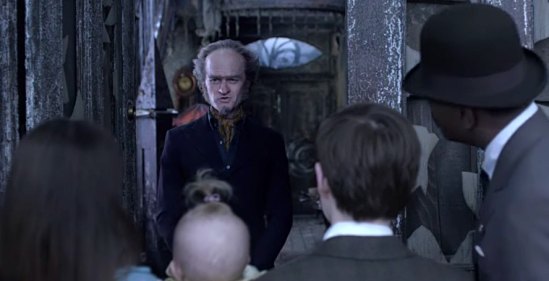
In addition to being one of the most infamous literary villains in recent times, Count Olaf has a theater troupe of nefarious henchmen. There’s the Hook-Handed man who’s featured prominently in the books with his hooks at the end of his upper appendages. God only knows how he lost them. Then you have the Bald Man with the Long Nose who plays a key role in the books and can be downright nasty. In the show, he’s more of a dumb muscle who likes to paint. After that is the Person of Indeterminate Gender whose very fat in the books, mostly speaks in grunts, and is seen as one of the scariest members to Klaus. In the Netflix show, they’re kind of dim but can occasionally say some insightful things about gender roles. Next, the two White-Faced Women who usually don’t have much characterization. But whether they resemble geishas or old grannies, you never see one without the other. And finally, we have the Wart-Faced Man who shows up in The Bad Beginning but we don’t know what happened to him since.

th3

I think a good introduction to them would be in a song like “Master of the House” from Les Miserables. The original version features the innkeeper Thenardier singing of how much of a sleazy bastard he is. In the movie, you may see him having a good old time stealing money and valuables from his patrons. In this version, I have Count Olaf welcoming and entertaining his henchmen as the Baudelaires make dinner. Yet, I gave Mrs. Thenardier’s lines to the Hook-Handed Man since he’s Count Olaf’s most prominent featured crony in the series.


“Master of the House” (ASOUE Version)

Sung by Count Olaf and his Troup

Count Olaf:

Welcome, my friends, sit yourself down
To the best house of the best actor in town
As for the rest, all of ’em crooks:
Rooking their guests and cooking the books
Seldom do you see
Honest men like me
A gent of good intent
Who’s content to be

Master of the house, doling out the charm
Ready with a handshake and an open palm
Tells a saucy tale, makes a little stir
Fellow guests appreciate a bon-viveur
Glad to do a friend a favor
Doesn’t cost me to be nice
But nothing gets you nothing
Everything has got a little price!

Master of the house, keeper of the troupe
Ready to relieve kids of their cash or two
Take them in their care making them do chores
Having them make dinner that only we will gorge
Everybody loves an actor
Everybody’s bosom friend
I do whatever pleases
Jesus! Won’t I bleed ’em in the end!

Count Olaf & Troupe:
Master of the house, quick to catch yer eye
Never wants a trust fund to pass him by
Handsome to a fault, genius on the stage
Comforter, philosopher, and lifelong mate!
Everybody’s boon companion
Everybody’s chaperone

Count Olaf:
But lock up your valises
Jesus! Won’t I skin you to the bone!

Enter Monsieur, we have a scheme
Perhaps we can talk it over roast beef
Don’t mind the kids, they’re cooking now
What we talk won’t interest them anyhow
Care for some fine wine
As we sit and dine
And nothing’s overlooked
Till I’m satisfied

Food beyond compare. Food beyond belief
I’m sure the kids are busy cooking the roast beef
Hope they won’t take long, surely we’re all starved
Scheming on an empty stomach can only go so far
Theater friends are more than welcome
Downstairs bathroom’s on the right
Yes, the toilet’s dirty
But you should check the nearby dive’s!

Never mind the rats, never mind the mice
I’m sure the Baudelaires will make this place look nice
Here’s a little glass, take a little wine
I have enough to pass out after dinner time
When it comes to entertaining
There are a lot of tricks I know
Got to see these three kids chopping wood
Jesus! It’s just as hilarious as it goes!

Count Olaf & Troupe:
Master of the house, quick to catch yer eye
Never wants a trust fund to pass him by
Handsome to a fault, genius on the stage
Comforter, philosopher, and lifelong mate!
Everybody’s boon companion
Gives ’em everything he’s got

Count Olaf:
Dirty bunch of geezers
Jesus! What a sorry little lot!

Hook Handed Man:
I used to dream that I’d be filthy rich
But God Almighty, have you seen what’s happened since?

Master of the house? Isn’t worth my spit!
`Comforter, philosopher’ and lifelong shit!
Cunning little brain, regular Voltaire
Thinks he’s quite a genius but there’s not much there
What a cruel trick of nature landed me with such a louse
God knows how I’ve lasted working for this bastard in the house!

Count Olaf & Troupe:
Master of the house!

Hook Handed Man:
Master and a half!

Count Olaf & Troupe:
Comforter, philosopher

Hook Handed Man:
Ah, don’t make me laugh!

Count Olaf & Troupe:
Handsome to a fault, genius on the stage

Hook Handed Man:
Hypocrite and con man and inebriate!

Count Olaf & Troupe:
Everybody bless the actor!
Everybody bless his friends!

Count Olaf:
Everybody raise a glass

Hook Handed Man:
Raise it up the master’s arse

All:
Everybody raise a glass to the Master of the House!

A Series of Unfortunate Events: The Musical – “Poor, Poor Orphans”

bad beginning5

Under Count Olaf’s guardianship, the Baudelaire children were forced to do a series of endless and difficult chores. However, one day Olaf asks the kids to make a dinner for him and his theater troupe despite that they don’t know how to cook. So they go to their neighbor, Justice Strauss’s place and make use of her vast library. The find a recipe for pasta puttanesca, buy the ingredients, and cook it to serve as a meal. But will Olaf and his troupe be pleased with their efforts? Only time will tell.

a-second-season-of-a-series-of-unfortunate-events-is-officially-happening.png

For this song I chose the “Poor, Poor Joseph” song from Joseph and His Amazing Technicolor Dreamcoat. It’s an upbeat song that in the original version depicts Joseph’s jealous older brothers abducting him and throwing him in a well. Before selling him off to slavery where he ends up in Egypt. On the bright side, it leads to a hilarious cowboy number where his brothers try to explain the situation to their father Jacob. Compared to that, the ASOUE version is strangely light-hearted since it pertains to making dinner. Even if it’s for one of the most despicable villains in literature.


“Poor, Poor Orphans”

Lemony Snicket:

One day, early morn,
The Count left the poor kids a note

Told them to cook a meal
For ten in his theater troupe

Had to be ready by seven and serve it
Clean it up and stay out of Olaf’s way

Violet:
How do we accomplish this?
We don’t even know how to cook

Klaus:
We just need a cookbook
Which we really have to find
Except Count Olaf has no books of any kind

Violet:
We need one now! Else dinner won’t be made.

Lemony Snicket:
Poor, poor orphans, what’cha gonna do?
Things look bad for you, hey, what’cha gonna do?
Poor, poor orphans, what’cha gonna do?
Things look bad for you, hey, what’cha gonna do?

Justice Strauss:
Hi, kids, how you’ve been?
Is there anything you need?
Just hear to check on you
See how you’re handling your new life

Violet:
Olaf’s bringing home some friends
Wants us to make a meal we can’t

Justice Strauss:
Well, come to my house,
I’ll give you what you need
Borrow my cookbook and pay for groceries
Feel free to come by anytime

Klaus:
Thanks, for saving our asses just in time

Lemony Snicket:
There they spent the day
Preparing the Puttanesca sauce
Served it on pasta
Along with instant pudding for dessert
They meal was made by the designated time
Hopefully, Count Olaf won’t bitch and whine

Here he now comes with his freakish troupe
What a sordid group, hey, how low can he stoop?
Poor, poor children, will he be impressed?
Situation’s grave, though afraid what will be next?

A Series of Unfortunate Events: The Musical – “If I Were a Rich Man”

Count-Olaf

It’s no question that Count Olaf is a greedy and selfish man who cares only for obtaining wealth and power as well as will go to great lengths to get what he wants. But why he goes after Baudelaire fortune when he could’ve just robbed a bank is never explained, yet he pursues them with dogged obsession. Nonetheless, once these three precocious orphans end up in his care, he wastes no time making their lives miserable by making them do a list of endless and difficult chores for his entertainment. Tall, rail thin, with a unibrow, wheezy voice, gleaming eyes, horrendously bad hygiene, and an eye on his left ankle, he is a treacherous criminal mastermind who can make the Baudelaires’ lives hell despite how they constantly thwart his plans. Still, while he may seem quite overdramatic in his portrayals by Jim Carrey and Neil Patrick Harris, do not underestimate him. Because despite being not as bright and cultured as the Baudelaires, Count Olaf is a very intelligent man who can stay ahead of the authorities and know what they’ll do in order to hunt him. In fact, he can fool even the most intelligent person around him, including their subsequent guardians. And as the series goes on, he only gets much worse.

c3a1fabadf76e59dc819e703bf20d390

A good song for him in The Bad Beginning would be “If I Were a Rich Man” from Fiddler on the Roof. In the original version, protagonist Tevye sings of how his life would be like if he was rich and complains to God about why he’s stuck to being a poor milkman with 5 daughters. However, Tevye just wants a better life where he wouldn’t have to work hard he tries to be a good Jew. Sure his aspirations are unrealistic and he knows it. But we’ve all been there. In the ASOUE version,  I have Count Olaf wish more sinister ides on how he’d spend the lavish Baudelaire fortune.


“If I Were a Rich Man” (ASOUE Version)

Sung by Count Olaf

Dear God, three rich orphans are in my care.
I realize, of course, that it’s no shame to be in debt.
But it’s no great honor either!
So, what would have been so terrible if I had these brats’ fortune?

If I were a rich man,
Ya ha deedle deedle, bubba bubba deedle deedle dum.
All day long I’d biddy biddy bum.
If I were a wealthy man.
I wouldn’t have to work hard.
Ya ha deedle deedle, bubba bubba deedle deedle dum.
If I were a biddy biddy rich,
Yidle-diddle-didle-didle man.

I’d build a big tall house with rooms by the dozen,
Right in the middle of the town.
A fine tin roof with real wooden floors below.
There would be one long staircase just going up,
And one even longer coming down,
And one more leading nowhere, just for show.

I’d fill my yard with shrubs and busts made in my likeness
For everyone in town to see.
And each one would make me look like a marvel
While seen as a great work or masterpiece
As if to say “Here lives a wealthy man.”

If I were a rich man,
Ya ha deedle deedle, bubba bubba deedle deedle dum.
All day long I’d biddy biddy bum.
If I were a wealthy man.
I wouldn’t have to work hard.
Ya ha deedle deedle, bubba bubba deedle deedle dum.
If I were a biddy biddy rich,
Yidle-diddle-didle-didle man.

I’ll wear some fine clothes when I leave from the theater
With a hot girl at each arm.
Enjoying nightlife to my heart’s delight.
I will be putting on airs and strutting like a peacock.
Oy, what a happy mood I’d be.
Screaming at the servants, day and night.

The most important men in town would come to fawn on me!
They would ask me to advise them,
Like a Sullivan the Wise.
“If you please, Count Olaf…”
“Pardon me, Count Olaf…”
Posing problems that would cross a lawyer’s eyes!
And it won’t make one bit of difference if I answer right or wrong.
When you’re rich, they think you really know!

If I were rich, I’d have the time that I lack
To trash any critics of my plays.
And maybe scheme a plot that would kill them all.
And I’d throw grand parties with wine for my backers, several hours in a day.
That would be the sweetest thing of all.

If I were a rich man,
Ya ha deedle deedle, bubba bubba deedle deedle dum.
All day long I’d biddy biddy bum.
If I were a wealthy man.
I wouldn’t have to work hard.
Ya ha deedle deedle, bubba bubba deedle deedle dum.
Now I need to come up with a plan,
To get these brats’ money in my hands.
And prevent them spoiling my scams? So I’d be a wealthy man…

A Series of Unfortunate Events: The Musical – “Consider Yourself”

series-of-unfortunate-events-trailer-netflix

A Series of Unfortunate Events often get its name due to all the sadness, misfortune, misery, and woe the Baudelaire children put up with in their lives since their parents died in a fire. But most of the terrible things happen to them are thanks to the actions of one man, Count Olaf. Soon after losing their parents and home, they’re sent to live with this guy as their guardian. Since their parents’ will stipulated that the kids be sent to their closest geographically living relative and Count Olaf is their third or fourth cousin 3-4 times removed. Then again, that could be a lie. I really don’t know how Mr. Poe chooses Baudelaire guardians in the books. On paper, he’s an actor with his own theater troupe. But despite having a noble title, his house is a dump, decorated with eye pictures on the walls, and has a tower the kids aren’t allowed to enter. They find Olaf himself as an unpleasant man, easily angered, and refers to the kids as “orphans” or “brats.” He only provides them with one room with one bed and makes them do pointless and difficult chores for his entertainment. And he gets worse from there.

2004_unfortunate_events_037

Perhaps a good song for their first encounter could be “Consider Yourself” straight out of the 1960s musical Oliver!, which is based on the Charles Dickens novel Oliver Twist. In the original version, the Artful Dodger befriends Oliver and welcomes him into their gang of petty criminals that’s headed by a creepy man named Fagin. Sure Oliver isn’t up for a great experience with these guys. But at least it beats the workhouse in Victorian England. And the song seems quite upbeat since Oliver has no idea what he signed up for. This ASOUE version is much grimmer though we don’t get the full scope of Count Olaf’s villainy just yet.


“Consider Yourself” (ASOUE Version)

Sung by Count Olaf and the Baudelaire Orphans

Count Olaf:
Consider yourself at home
Consider yourself one of the household staff
I’ve made a long list of chores
Here’s your toothbrushes to clean the floor
Consider yourself, well in
Consider yourself a part of the furniture
There isn’t a lot to spare
Who cares?..I’ve got a bedroom upstairs!

There’s a chance you’ll see
When you clean
Some larger rats
Really nasty gnats
And mouse
While I’ll use your fortune
As a way
To foot the bill
While I have you clean my house!
Consider yourself my charge
I don’t want to have no fuss,
For after some consideration, I can state
Consider yourself
Pretty fucked.

Consider yourself…

Violet:
At home?

Count Olaf:
Consider yourself…

Klaus:
One of the cleaning staff

Count Olaf:
I’ve made a long list

Violet and Klaus:
Of chores

Count Olaf:
It’s clear…you’re…

Violet and Klaus:
Going to clean the floor

Count Olaf:
Consider yourself…

Sunny:
(subtitled baby talk) Well screwed!

Count Olaf:
Consider yourself…

Violet:
Part of the furniture

Count Olaf:
There isn’t a lot to spare

Klaus:
Who cares?
We’ve got to get out of here

Count Olaf:
Don’t ever try to be la-di-da or uppity-
Put or shut up, that’s all

Violet:
Though I can be rather handy with a rolling pin
When the landlord comes to call!

Count Olaf:
Consider yourself
My charge.
I don’t want to have no fuss

ALL:
For after some consideration we can state

Count Olaf:
Consider yourself

Baudelaires:
No!

ALL:
Pretty fucked!

Violet:
Consider ourselves at home…
Mr. Poe’s gotten it all so wrong
Consider ourselves done in…
There’s only one bed to spare

Klaus:
There’s a chance at hand
Olaf’s bad
Such a nasty man
And this shithole—
Of a house
Wish we’d live nearby
Justice Strauss
With all her books
All shelved up in her clean house!

Violet:
Consider ourselves enslaved.
He’ll always give us fuss
For after some consideration, we can state…
Consider ourselves…
Really fucked!

Violet:
Consider yourself

Sunny:
(Subtitled babble) At home.

Klaus:
He’s taken to us

Sunny:
(Subtitled babble) Like slaves

Violet:
Consider yourself

Klaus:
Done in.
He’s making us do these chores.
He wants us to go outside chopping wood
Despite that this is only June
And to repair a broken window he could’ve fixed
Oh, my God, he’s such a loon!

Violet:
Consider ourselves his slaves
We don’t want to have no fuss
For after some consideration we can state
Consider ourselves
Really fucked.

Klaus:
For after some consideration we can state
Consider ourselves…
Really fucked!

If this house should be
Right into our old neighborhood
They’d condemn it
To a lot
And he makes us to maintain
This God awful hellhole place
With the smallest brush he’s got.

Violet:
Consider ourselves at home.
Consider ourselves living with parasites.
This room only has us one bed.
And it’s infested with fleas instead.
Consider ourselves done in.
Consider ourselves with the bad furniture.
There isn’t much to spare.
Who cares?
Whatever we’ve got we share.

If it should chance to be
We should see some harder days,
With Count Olaf,
In this house
Always a chance we’ll see
Somebody to help us out.
Let’s just hope it’s Justice Strauss.

Consider ourselves his slaves.
We don’t want to have no fuss
For after some consideration we can state
Consider yourself…
Really fucked!!

A Series of Unfortunate Events: The Musical – “When I Was a Lad”

thM5Z058J1

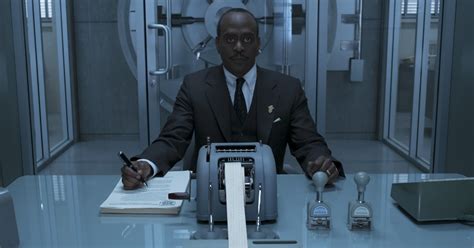
In A Series of Unfortunate Events, the Baudelaires encounter plenty of adults you might consider as idiots, a word which here means, “if they’re not affiliated with the villainous Count Olaf or guaranteed to die for being too good for this sinful earth, they’re most likely incompetent or unable to help the Baudelaires in any meaningful way.” But there is no adult in this series who’s as utterly useless and idiotic as Mulctuary Money Management’s most famous banker, Mr. Arthur Poe. In the ASOUE books, Mr. Poe is the guy who’s in charge of managing the vast Baudelaire fortune the kids are set to inherit when Violet turns 18. Yet, he’s also the guy who sends the Baudelaire orphans to their respective guardians and is the last guy you’d want associated with child services. Seriously, Mr. Poe doesn’t know the meaning of the word, “background check.” Still, throughout the series, he is blatantly ignorant, easily gullible when he shouldn’t be, and never listens to the Baudelaires. This despite that he should know better. Furthermore, he thinks the kids will be safe wherever they end up despite the Count Olaf always finds them. Sure he might mean well, but he always proves so unhelpful to the orphans that Lemony Snicket thinks a jar of mustard would be better equipped to keep them out of danger. And I don’t think I can disagree since he seems the most useless adult in the Snicketverse, which is no small feat considering the stiff competition.

Timothy-Spall_Lemony-Snickets-A-Series-of-Unfortunate-Events_2004-900x505

As for musical numbers, a great song to characterize him would be “When I Was a Lad” from the Gilbert and Sullivan operetta HMS Pinafore. In the play, this is the introductory song of First Lord of Admiralty Sir Joseph K. Porter who describes his rise through law and politics to become head of the Queen’s Navy. Despite that he has absolutely no experience with any sort of naval command or ship. Kind of like how Donald Trump has no experience in government but 60 million people voted him to be president and now we’re stuck with him in the White House. Anyway, what’s interesting about Admiral Porter is that he’s based on a real guy named W.H. Smith who became First Lord of Admiralty despite having no navy background whatsoever. The joke with Porter in this song was more about the massive corruption involved as he recounts his rise through law, politics, and eventually his current position almost entirely thanks to nepotism. Smith’s reputation never recovered because the 19th century Brits never let him live it down. Seriously, the Band of Royal Marines greeted him with this song during his visit to Portsmouth. And Benjamin Disraeli often privately referred to him as “Pinafore Smith.” Though my ASOUE version of this song gives Mr. Poe plenty of relevant experience, I do add a stinger on why you wouldn’t want to entrust him with your kids.


“When I Was a Lad” (ASOUE Version)

Sung by Mr. Poe

Mr. Poe:
When I was a lad I served a term
As office boy to this financial firm.
I cleaned the windows and I swept the floor,
And I polished up the handle of the big front door.

Chorus:
He polished up the handle of the big front door.

Mr. Poe:
I polished up that handle so carefullee
That now I am an executive at Mulctuary!

Chorus.
He polished up that handle so carefullee,
That now he is an executive at Mulctuary!

Mr. Poe:
As office boy I made such a mark
That they gave me the post of a junior clerk.
I served the statements with a smile so bland,
And I copied all the letters in a big round hand.

Chorus:
He copied all the letters in a big round hand.

Mr. Poe:
I copied all the letters in a hand so free,
That now I am an executive at Mulctuary!

Chorus:
He copied all the letters in a hand so free,
That now he is an executive at Mulctuary!

Mr. Poe:
In serving statements I made such a name
That an articled clerk I soon became;
I wore clean collars and a brand-new suit
For the pass examination at the Institute.

Chorus:
For the pass examination at the Institute.

Mr. Poe:
That pass examination did so well for me,
That now I am an executive at Mulctuary!

Chorus:
That pass examination did so well for he,
That now he is an executive at Mulctuary!

Mr. Poe:
Of financial knowledge I acquired such a grip
That they took me into the management.
And that junior management, I began,
As executor of various wealthy families.

Chorus:
As executor of various wealthy families.

Mr. Poe:
The Baudelaires and Quagmires most famously,
That now I am an executive at Mulctuary!

Chorus:
The Baudelaires and Quagmires most famously,
That now I am an executive at Mulctuary!

Mr. Poe:
I grew so rich that I was sent
Promoted to senior management.
I always heeded at my bank’s call,
And I never thought of thinking for myself at all.

Chorus:
He never thought of thinking for himself at all.

Mr. Poe:
I thought so little, they rewarded me
By making me an executive at Mulctuary!

Chorus:
He thought so little, they rewarded he
By making him an executive at Mulctuary!

Mr. Poe:
Now young clerks all, whoever you may be,
If you want to rise to the top of the tree,
If your soul isn’t fettered to an office stool,
Be careful to be guided by this golden rule.

Chorus:
Be careful to be guided by this golden rule.

Mr. Poe:
Stick close to your desks and never see your kids,
And you all may be executives at Mulctuary!

Chorus:
Stick close to your desks and never see your kids,
And you all may be executives at Mulctuary!

A Series of Unfortunate Events: The Musical – “Deacon Blues”

a-series-of-unfortunate-events-netflix

Of course, A Series of Unfortunate Events wouldn’t be the memorable young adult series we know and love without its remarkable narrator Lemony Snicket. In real life, he’s merely a pseudonym for the books’ real author, Daniel Handler who also uses it to write children’s books. But in the ASOUE books and the prequel series All the Wrong Questions, he’s also a character. Though in public, it’s said that Handler is publicly alleged to be Snicket’s “legal literary and social representative.” In A Series of Unfortunate Events, he’s a wanted fugitive who’s charged himself with chronicling the lives of the Baudelaire orphans. He’s a very depressed man who’s mourning for his deceased love Beatrice whom he dedicates every book to along with his previous life being framed for a series of crimes he didn’t commit. His outlook on life is darkly humorous. In his narration, he can be brutally honest and sometimes savage. His constantly definition of words and sometimes condescending and patronizing way of speaking is likely a parody and satire of how kids’ books are dumbed down and treat readers like idiots. In the books, you never see his face in his About the Author blurb photograph. Though you can see him in full view on the TV show as portrayed by Patrick Warburton.

litparksnicket

As an introductory song for him, I thought Steely Dan’s “Deacon Blues” would be more appropriate. It’s a jazzy but sad tune about an aspiring jazz musician struggling to make it big characterized by the late Walter Becker as a “loser” as the subject was meant to reflect, “… a broken dream of a broken man living a broken life.” In A Series of Unfortunate Events, Lemony Snicket is certainly a broken man living a broken life. He’s a wanted man who has to constantly go on the lam for crimes he didn’t do. While he still carries a torch for the love of his life who he could’ve and should’ve married. But she ended up with another man and later died. Perhaps he sees researching and writing about the Baudelaires as a way to redeem himself or perhaps honor the memory of an ex-girlfriend he never really got over. Nonetheless, this is a song that’s perfect for a man like Lemony Snicket.


“Deacon Blues” (ASOUE Version)

Sung by Lemony Snicket

This is the tale by the expanding man
That shape is my shade
There where I used to stand
It seems like only yesterday
I gazed through the glass
At ramblers, wild gamblers
That’s all in the past

You call me a fool
You say it’s a crazy scheme
This task is sad
But I’m already on the team
So useless to ask me why
Throw a kiss and say goodbye
I’ll find out this time
I’m ready to cross that fine line

Chronicle the Baudelaires
I’ll find just what I need
Conduct research all day long
And cry myself to sleep
They got a name for the winners in the world
I want a name when I lose
They call Alabama the Crimson Tide
Call me Deacon Blues

My back to the wall
A victim of laughing chance
This is for me
The essence of failed romance
Sharing the things I know and love
With those of my kind
Libations
Sensations
That stagger the mind

I play my accordion
Through each depressing scene
Fantasize about Beatrice
Of what our lives could’ve been
I leave when the sun goes down
Avoiding every cop in town
I’m now on my own
I’ll drive these kids’ story home

Chronicle the Baudelaires
I’ll find just what I need
Conduct research all day long
And cry myself to sleep
They got a name for the winners in the world
I want a name when I lose
They call Alabama the Crimson Tide
Call me Deacon Blues

This is the tale by the expanding man
I take one last drag
As I go on the lam
I cry when I write these books
Sue me if I get it wrong
There’s so much to see
You’ll probably not see me

I chronicle the Baudelaires
I’ll find just what I need
Conduct research all day long
And cry myself to sleep
They got a name for the winners in the world
I want a name when I lose
They call Alabama the Crimson Tide
Call me Deacon Blues

A Series of Unfortunate Events: The Musical – “Briny Beach”

6WNvzHhMmd3x

Dear Viewer,

The musical you’re about to view is extremely unpleasant. It tells an unhappy tale of three unlucky children. Despite being charming and clever, the Baudelaire siblings lead lives filled with misery and woe. From this very post when the children are on Briny Beach and receive terrible news, continuing through the entire story, disaster lurks on every corner. One might think they’re magnets for misfortune. 

Throughout this musical, the three youngsters encounter a greedy and repulsive villain, disastrous fires, paper-thin disguises, plots to steal their fortune, and numerous dreadful pop song parodies from musicals and rock albums. 

It is my sad duty to chronicle this series of unfortunate events, but there’s nothing preventing you from clicking on any ads or looking from some happier post on this blog. Or even looking for something happy, if that’s what you prefer. Like the Hunger Games parody songs.

With all due respect,

Lemony Snicket

the-bad-beginning-violet-klaus-and-sunny-baudelaire-28090293-1400-932

Alongside the Harry Potter books, A Series of Unfortunate Events was among my favorite books during my adolescence. Like The Hunger Games series, it doesn’t revolve around nice stuff. But at least it doesn’t involve teenagers fighting to the death in live television. But it does pertain to a serial killer who pursues and wreaks havoc on three precocious orphaned children for their money as they move from guardian to guardian. Filled with dark humor, literary and cultural allusions, sarcastic story-telling as well as a lot of content you wouldn’t deem appropriate for children like gory death scenes, this 13-book coming-of-age series isn’t the kind of story you’d think would make a good light-hearted musical. But now that its second season has been adapted for a Netflix series, it doesn’t hurt to try. Especially if the show stars Neil Patrick Harris as Count Olaf and how the setting is entrenched in a world that’s very unlike our own. Besides, A Series of Unfortunate Events is a very dark series which can be a little fun with crazy costumes, eccentric characters, and dystopic feel taken to existential absurdity.

69117d4ac9437af38b9ef664c558ef89

Note: These songs are parodies. And no, I don’t have permission. But screw them since I think it’s funny. But feel free to make videos of these if you wish, but for God’s sake just give me credit. Some of the lyrics might not be original since I usually copy and paste them before I add my own additions. And I sometimes leave them in if I think it might go well with the song. Nevertheless, the songs chronology may conform to the books at first. But I’ll also add other songs as I go along which won’t conform to the sequence in later additions. So don’t be surprised if these are out of order.

a-series-of-unfortunate-events-700x300

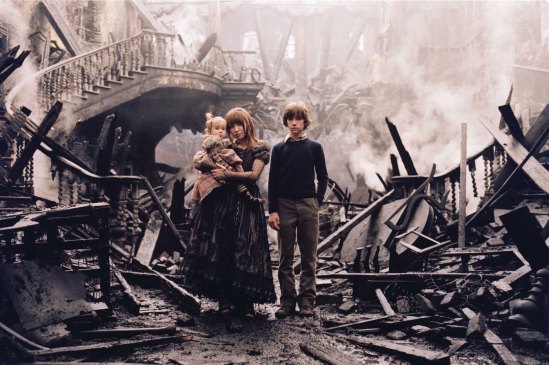
Anyway, this number is set in the first book where Mr. Poe arrives at Briny Beach to tell the Baudelaires orphans that their parents have died in a fire at their mansion. I thought the appropriate song to parody here could be “Coat of Many Colors” from Joseph and his Technicolor Dreamcoat. Now this is a rather upbeat musical from the 1970s that’s often performed in high schools around the US today. But keep in mind it’s about a young man whose jealous brothers basically abduct him and sold him to slavery like the original Bible story. Also, it has a lot of adult content like the sexual harassment scene with Popitar’s wife. But in this song, Joseph receives his fancy coat and is unaware of what his older brothers will do to him. And by this point, while the Baudelaire children may be sad about their parents and their house, they don’t know all the unfortunate events that’ll await them by this point.


“Briny Beach”

Lemony Snicket:
What you’re seeing is an incredibly depressing play
Of three unlucky kids with lives of great malaise
So go see something with more uplift
Perhaps Les Miserables

Violet the eldest, had a great inventor’s mind
Klaus the middle, loved to read in his spare time
And baby Sunny, she loved to bite
The three young Baudelaires-

Their lives started out as sweet
Till that day at Briny Beach

From a visit from a banker named Mr. Poe

Mr. Poe:
Sorry, kids, but what you need to know is

Afraid your house burned in a fire
Where your parents soon expired
Not sure if they could’ve seen the danger
I could not imagine any danger
But they perished in that fiery blaze at home.
As family executor, you will stay with me tonight
Don’t you worry for I’ve already called my wife
But only for the next few days
Until we find you a better place to live

You’ll live with nearby kin
The next four years
Your family’s fortune safe
Till Violet comes of age
Don’t worry for we’ll soon find
A new guardian for you

Lemony Snicket:
And from that day on
The kids knew their carefree days were gone
But they didn’t imagine any danger
Or that Mr. Poe can’t screen any stranger

He took them to their home
Or what’s left of it I suppose
Such a sorry wreckage of a mansion
You can’t even employ a restoration
There were burned books, singed hooks, cinder,
And ash
Their whole house was
Reduced to wreckage from the fire

Violet and Klaus:
There was not much left
For us to take
It’s time to go
To Mr. Poe’s
Our life is so unfair

Lemony Snicket:
The orphans missed their mom and dad
But Poe’s sons were spoiled brats
Made a pair of really shitty roommates

Violet and Klaus:
Asked us whether we killed our own parents

Lemony Snicket:
But things will soon get worse
You’d think these kids were cursed
Shortly they’re fostered by Count Olaf
Some cousin these orphans never heard of

Lemony Snicket, Violet and Klaus, Ensemble & Children
They lost their parents, their home, their books,
Their beds, their clothes, their furniture,
Their photos, their toys, their board games,
Their contraptions, their china, their jewelry,
Their suitcases, their utensils, their stove,
Their dressers, their desks, their pencils,
Their crayons, their chew toys, their manuals,
Their purses, their antiques, their tables,
Their chairs, their counters, their electronics,
Their vacuums, their trash cans, their laundry
Their ribbons, their cribs, their cabinets,
Their hooks, their lamps, their files,
Their papers, their cleaners, their doors,
Their windows, their blankets, their sheets,
And roof

Of Guns and the Holocaust

gun-control_dictators

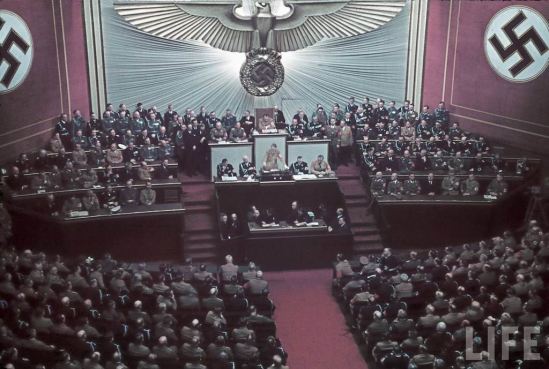
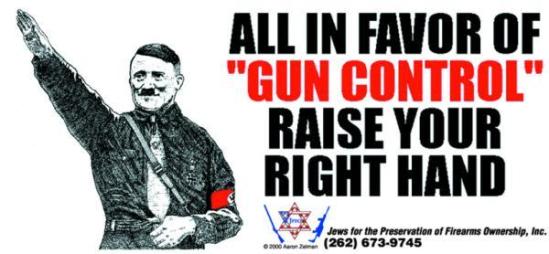
An ongoing argument among pro-gun activists I’ve often heard is the Nazi Gun Control Argument, which claims that Third Reich gun regulations rendered victims of the Holocaust weaker to such an extent that they could’ve effectively resisted oppression if they had been armed or better armed. Gun rights proponents and organizations like the National Rifle Association use this notion as part of its “security against tyranny” argument. They’ve also cited other authoritarian regimes that committed atrocities like Khmer Rouge, Stalinist Russia, and whatever totalitarian regime. Since the Parkland students have called for gun control legislation after 17 of their classmates were killed, the argument that a “well-armed populace is the best defense against tyranny” has been proliferated with a vengeance. During a debate shortly after the February shooting, Alaska’s Rep. Don Young said, “How many millions were shot and killed because they were unarmed? Fifty million in Russia because their citizens were unarmed. How many Jews were put in ovens because they were unarmed?” During a Florida Senate debate over an assault weapons ban, Sen. David Simmons claimed, “Adolf Hitler confiscated all the weapons-took all the weapons, had a registry for everybody,” before murdering his political opponents. This week, Iowa Rep. Steve King posted a meme noting Parkland survivor Emma Gonzalez’s Cuban heritage and attacking her for ignoring “the fact that your ancestors fled the island when the dictatorship turned Cuba into a prison camp, after removing all weapons from its citizens; hence, the right to self-defense.”

hitler-gun-control

Sorry, but Adolf Hitler and his Nazi friends weren’t exactly gun control fans. In fact, they loved their guns. They encouraged children as young as five to march with them and told them nursery rhymes that glorified weaponry. To them, as long as you were a member of the German Master Race, you can stockpile as many firearms as you wanted in order to terrorize all the undesirables at your pleasure. Wikipedia lists the Nazi gun control argument as counterfactual history because most scholars believe that the disarming and killing of Jews had nothing to do with Nazi gun control policy.

However, the very notion that a widespread genocide, totalitarian regime, and other human rights atrocities could’ve been prevented by more private gun ownership is completely wrong. Even today, there is little evidence to suggest that widespread private gun ownership leads to more to more democratic societies. According to the Small Arms Survey rankings from 2007, while the US leads the world in civilian gun ownership (88.8 firearms per 100), but it’s followed by Yemen (54.8). You can argue its well-armed population overthrew an authoritarian leader, but civil war and humanitarian catastrophe following that undermine the case. While Switzerland (45.7) and Finland (45.3) also make the top 10. But also does Saudi Arabia (35), the world’s largest absolute monarchy with rules derived from Wahabist Islamic fundamentalism. And, until recently, famously prohibited women from driving. Iraq is also up there (34.2) which had a well-established gun culture under Saddam Hussein’s rule, which didn’t prevent him from committing genocide and mass murder. Yet, it did contribute to the chaos that ensued after the US overthrew him. Another country with a high rate of gun ownership is Bahrain (24.8) which didn’t help the failed uprising against its autocratic government in 2011. Nor did high gun ownership rates prevent a string of military coups in Thailand (15.6) or keep Venezuela (10.7) from descending into authoritarianism and economic chaos. By contrast, while North Korea virtually has no guns in private hands, neither do South Korea and Japan. Then there’s the sub-Saharan Ghana, one of Africa’s most peaceful and democratic countries which has one of the lowest rates of gun ownership. Another is Tunisia who not only overthrew its dictator in 2011 (with military assistance), but is the only one of the Arab Spring countries that has remained relatively democratic and stable since then. From what the data shows, countries with lots of guns consist of democracies and dictatorships, peacefully orderly societies, and failed states. Same goes for nations with few guns. It shouldn’t even be a debate talking point.

Stroop_Report_-_Warsaw_Ghetto_Uprising_06b

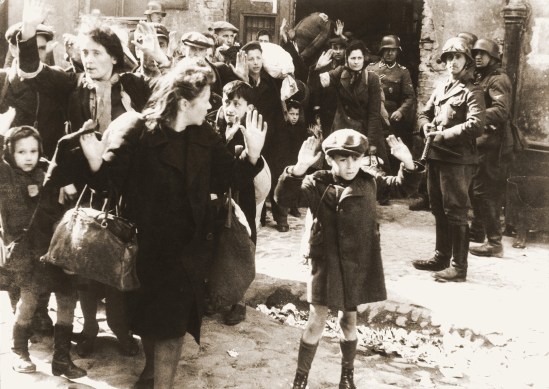
Here’s a picture from the Stroop Report during the Warsaw Ghetto Uprising. Notice the Nazis basically forcing these people to put their hands up. Yes, it’s simply horrifying.

Furthermore, claiming that the Holocaust could’ve been prevented if more people were armed is misleading and offensive. Just ask the Jewish groups, Holocaust scholars, and the US Holocaust Memorial Museum who have all repeatedly called for Nazi analogies to stay out of the gun control debate. Because no serious scholarship of the Holocaust points to the lack of guns as a serious factor. First, it ignores the Jews taking part in armed resistance efforts like the 1943 Warsaw Ghetto Uprising and Jewish partisans creating their own units after escaping the camps. In fact, the US Holocaust Museum has an entire page dedicated to other examples of armed resistance to the Holocaust while Wikipedia lists over 100 of them. But all had little chance of stopping the mass slaughter carried out by a major industrialized power like Nazi Germany since the odds were overwhelmingly. In the Warsaw Ghetto Uprising, after the massive deportations to forced-labor camps and killing centers, people remaining in the ghetto organized and resisted with pistols, grenades, rifles, and automatic weapons. It was the largest Jewish armed revolt during WWII yet only managed to kill from 20 Germans. The Nazis quashed it in less than a month which resulted in 13,000 Jews killed and the remaining 50,000 sent off to concentration camps. Mostly because it was profound mismatch of manpower, the difficulties of smuggling weapons in the Ghetto confines, and a shortage of arms in Poland in general.

warsaw-ghetto-uprising-001

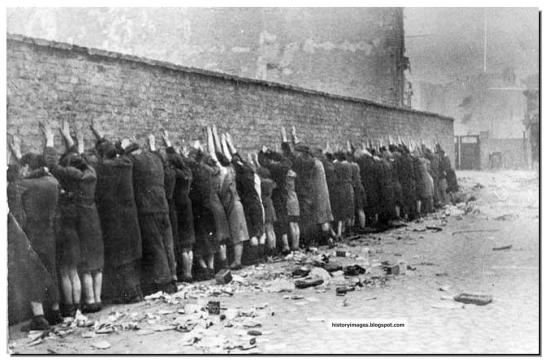
And here’s what happened to some of the Polish Jews who took arms against the Nazis during the Warsaw Ghetto Uprising. Notice how they’ll soon be shot at.

The German public was already disarmed in 1919 at the behest of Great Britain, France, and the United States due to a provision in the Treaty of Versailles which severely limited private firearm ownership to reduce Germany’s ability to re-arm itself. Though post-World War I Germany was awash with weapons. Many in the hands of the wrong people. Far-Right militias called the Freikorps stashed thousands of rifles and machine guns under the Allied Control Commission’s noses and used them in repeat armed attempts to overthrow the democratic Weimar Republic. And while mainstream scholars agree that a German gun registry law that created a permit system to own and sell firearms, it was established in 1928 under the Weimar. There were provisions that exempted “officials of the central government, the states, as well as the German Railways Company” and “community officials to whom the highest government authority has permitted acquisition without an acquisition permit.” This law was an attempt by the Weimar regime to disarm nascent private armies like the Nazi SA (a.k.a. Brownshirts) as an attempt to bring some stability to German society and politics. At the time, violent extremist movements were actively attacking the young and very fragile democratic state with the most prolific being the violent Beer Hall Putsch. So according to Dresden Technical University’s Dagmar Ellerbrock, “this order was followed quite rarely, so that largely, only newly bought weapons became registered. At that time, most men, and many women, still owned the weapons they acquired before or during the first World War.” A government that can’t maintain some degree of public order couldn’t sustain its legitimacy. Nor were the German people well-grounded in Constitutional, republican government as evidenced in their ballot box choices. Gun control wasn’t initiated to benefit the Nazis, but to prevent them and others of the same ilk from executing a revolution against a lawful government. In the strictest sense, the law succeeded since the Nazis didn’t stage a coup. But the 1928 provisions didn’t weaken the existing SA that pervaded German political life at the time. Ultimately, the Nazis ignored them with near impunity, engaging in terrorism on the streets as they expanded their political support. Eventually, they got elected in 1933 on promises to end economic poverty, reconquer “lost territories,” and end political paralysis at the Reichstag.

Reichsgesetz_1938

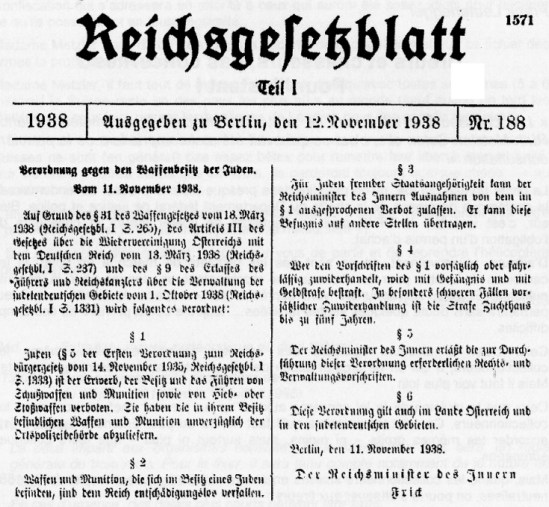
Here are the 1938 Nazi gun laws, which actually expanded gun ownership to most Germans. As long as they weren’t foreign, Jewish, gay, gypsy, disabled, or left-wing, of course. Because the Nazis wanted them dead.

When Adolf Hitler came to power in 1933, the Nazis used whatever gun records they had to seize weapons from perceived enemies of the state like Jews, Communists, Social Democrats, union members, or anyone else refusing to affiliate with the Nazi Party. Because the Nazis were intent on killing them and used the existing gun laws and regulations to further the genocide. As SUNY-Cortland professor Robert Spitzer told Mother Jones, gun policy, “wasn’t the defining moment that marked the beginning of the end for Jewish people in Germany. It was because they were persecuted, were deprived of all of their rights, and they were a minority group.” Yet, according to Ellerbrock, the files included very few guns in circulation and the registry was so incomplete that many Jews kept their guns well into the late 1930s. However, they also introduced a collective gun license for Nazi organization members whose main beneficiaries were the thuggish Brownshirts. After the German Parliament, the Reichstag gave Adolf Hitler emergency powers, he had a free hand. As Ellerbrock noted, “Under totalitarian rule, it took just a few weeks to drastically increase the number of Germans who held private weapons.” In other words, these looser gun rules were meant to encourage citizens to terrorize Nazi opponents and oppress minorities like Jews, gypsies, and gays. In 1938, the Nazis adopted a new law that loosened gun ownership rules by deregulating the buying and selling of shotguns, rifles, and ammunition. It made handguns easier to own by allowing anyone with a hunting license to buy, sell, or carry one at a time. Also, it extended the permit period from a year to 3, lowered the legal purchase age to 18, and gave local officials more discretion in letting people under 18 get a gun. Of course, there were exceptions such as Jews who weren’t allowed to own guns at all along with other dangerous weapons. But for everyone else, Hitler made it easier to get guns and used mass gun ownership for “Aryan” Germans to trash Jewish-owned businesses, rough up Jewish pedestrians on the street, and engage in what were called pogroms in Russia. As Ellerbrock told Politifact, “The gun policy of the Nazis can hardly be compared to the democratic procedures of gun regulations by law. It was a kind of special administrative practice (Sonderrecht), which treated people in different ways according to their political opinion or according to ‘racial identity’ in Nazi terms.” Therefore, disarming and killing Jews had nothing to do with Nazi gun control policy. Thus, during the Third Reich gun registration was spotty, confiscation was selective, and Nazis found it easier to get guns.

580154311901088490376no

Even if Germany’s Jews were well-armed, they couldn’t have stopped the Holocaust. Since they made up of less than 1% of its population and subject to systematic persecution implemented by a modern bureaucracy, enforced by police state, and supported by most of the population. In fact, armed revolt would’ve made the situation worse for Germany’s Jews by validating all the bad stuff the Nazis said about them. At least as far as its propaganda machine was concerned.

But if Germany’s Jews were well-armed, could they have stopped the Holocaust? The fact they constituted less than 1% of the country’s population makes it ridiculous to argue that private firearm possession would’ve enabled them to mount resistance against a systematic persecution program implemented by a modern bureaucracy, enforced by a well-armed police state, and either supported or tolerated by most of the German population. Its highly unlikely that armed Jews (or any other target group) would’ve weakened Nazi rule, let alone a full scale popular rebellion. In fact, it seems more likely to strengthen the Nazi support they already had. For such actions would’ve substantiated any foul Nazi lies about Jewish perfidy as well as hasten Jewish demise. The German Jews detained and deported after 1938 tended to be older and less well-off since most Jews with any resources left Germany much earlier. And the deportation took place with the open or tacit approval and complicity of most of the German people. Any act of armed resistance would’ve been completely futile.

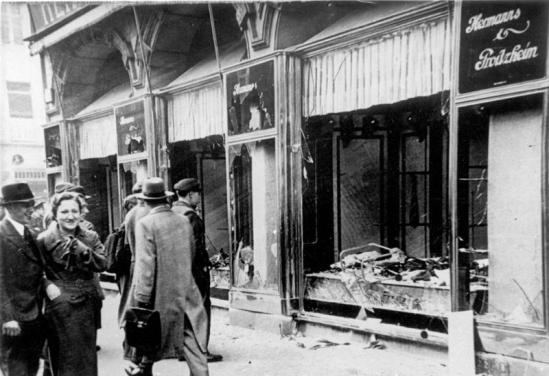
Kristallnacht-Magdeburg-Germany-November-1938

Here’s a Jewish business smashed on Kristallnacht, or “Night of the Broken Glass” from November 9-10, 1938 where Brownshirts and German civilians terrorized Jewish buildings, businesses, and synagogues while authorities looked on. It’s estimated that 91 Jews were murdered that night, though the death rate was much higher. Also, 30,000 Jewish men were arrested and sent to concentration camps. Still, Germany’s Jews were in no way prepared for what awaited them. Nor could they imagine taking arms against their own country’s soldiers and police officers.

Even so, hypotheticals aside, gun ownership wasn’t widespread enough in Germany for a serious civilian resistance to the Nazis. Nor were Germans, particularly Jews, predisposed to violent resistance to their government. Anti-Semitism wasn’t new in Germany or anywhere else since they had been persecuted throughout history for centuries. Jews had survived previous pogroms before but not without suffering. They’d expect the barrage of anti-Jewish discrimination and violence would eventually subside and permit a return to normalcy like those in the past. Still, they considered themselves “patriotic Germans” for their World War I service who remained good citizens of the state they trusted beyond Hitler’s power seizure in 1933. As an overwhelmingly professional, urban and middle class, and strong in professions like law, medicine, and the arts, the notion these conscientiously law-abiding people would or could’ve taken to the streets and shoot down Hitler’s thugs is ludicrous. Those who didn’t flee into exile faced escalating barrage of discriminatory laws and were systematically dehumanized for years. Yet almost all obeyed to the letter. Even after their businesses, homes, schools, and hospitals were trashed and synagogues torched during Kristallnacht, and even when facing deportation and death, most Jews obediently reported to the holding centers with their suitcases as instructed, and were taken from there to the cattle trucks that hurried them to their deaths. They didn’t know the true horrors that awaited them in the concentration camps. In fact, as bad as things were for them in Nazi Germany, most Jews couldn’t imagine their fellow countrymen establishing an industrialized and scarily efficient mass murder system to kill them. The Nazis also used deception by telling their Jewish captives would be “resettled” for forced labor in the East. The death camp stops on railroads were disguised with signs showing they were regular train stations. The gas stations were referred to as “showers.” If they knew their fate, they probably wouldn’t have resisted. Since they’d be unable to bring themselves to fire upon their own nation’s soldiers or police officers. And what could they do about it. Though most of the 6 million Jews killed during the Holocaust came from Poland, the Soviet Union, and other conquered territories in Eastern and Central Europe. Yet, all were surrounded by an indifferent, hostile, or terrorized population. Other than a few exceptions, there was no place to run or hide.

69485

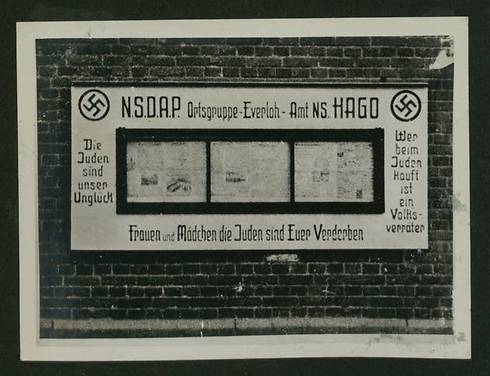
In Nazi Germany, propaganda was everywhere. Also, despite that they’d be forever remembered for committing genocide as a totalitarian regime, Adolf Hitler and his Nazis were genuinely popular among the German people. And that’s truly scary.

Besides, the Nazis controlled the media during the Third Reich, they could censor and spin the news at their discretion. They were masters of propaganda which saturated every level of their society at every age stratum. Not surprisingly, the Jews were a primary target who were systemically demonized. If most German citizens didn’t come to Jewish defense to fight off Nazi tyranny, it was because they didn’t want to. For they had been persuaded that what was happening was best for their country, and that the Jews deserved what they got. Or at least didn’t want to lose their privilege, alienate their friends and family, or be carted off to a prison camp and executed. Because the Communists tried to assassinate Adolf Hitler several times before the Nazis stamped them out. Even if Europe’s Jews fought back, which they did several times over, it would’ve been almost impossible for them to attract the rest of the world’s attention, let alone draw sympathetic reinforcement that could’ve toppled Hitler. But the Jews didn’t need guns to draw attention or sympathy from people in other countries were concerned what was going on with them. After all, many Jewish Americans were refugees or had relatives in Europe at the time. And Kristallnacht sent shockwaves around the world with the British Times writing, “No foreign propagandist bent upon blackening Germany before the world could outdo the tale of burnings and beatings, of blackguardly assaults on defenseless and innocent people, which disgraced that country yesterday.” Yet, the Nazis also had financial or rhetorical support from numerous American tycoons and businesses like Henry Ford, William Randolph Hearst, Kodak, Coca Cola, Standard Oil, Chase Bank, Dow Chemical, Woolworth, Alcoa, Brown Brothers Harriman, General Motors, and IBM. Let us not forget the Nazi sympathizers on the America First Committee like Charles Lindbergh who didn’t want the US to welcome Jewish refugees. Across the pond, Britain’s Duke and Duchess of Windsor were also in the Hitler fan club along with Unity and Diana Mitford. French fashion designer Coco Chanel lived with a Nazi officer while WWI hero Marshal Philippe Petain led the collaborationist Vichy government during WWII. Norwegian politician Vidkun Quisling seized power in his country through a Nazi-backed coup and his regime contributed to the Final Solution. Let’s just say you had a lot of influential people outside Germany who didn’t want their countries to do anything about what was going on there.

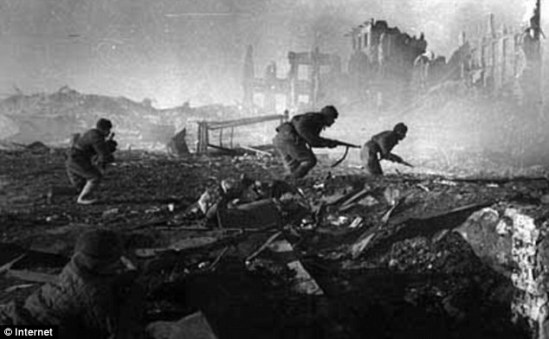
article-2007072-06CBF210000005DC-431_634x392

We must keep in mind that Nazi Germany managed to defeat armies from Poland, the Netherlands, Belgium, Denmark, and France. And though they didn’t fare so well in Russia, they managed mow down 7 million Red Army soldiers.

As Warsaw Uprising illustrates, the notion that the Jews could’ve used rifles and handguns to stop the SS from herding them like cattle to their deaths is offensive. Inside Germany, only the army possessed the physical force necessary for defying and overthrowing the Nazis. But the generals already threw their support for Adolf Hitler early on. The Nazi Germany war machine was one of the most powerful military systems ever constructed, especially prior to and during the early years of World War II. The Nazi regime had managed to conquer all of France, the Netherlands, Denmark, Norway, and Poland, along with huge swaths of the Soviet Union and northern Africa in the face of determined resistance by large, properly trained militaries equipped not just with handguns but also tanks, warships, airplanes, and other heavy superweapons. The Red Army lost 7 million fighting the Wehrmacht despite its tanks, planes, and artillery. Adolf Hitler deployed military-trained units to destroy Europe’s Jews so handguns and rifles wouldn’t have made a dent. Suggesting it would implies that the Jews had a path to resist the Nazis’ Final Solution when they didn’t. Arming every European Jew wouldn’t have made any difference.

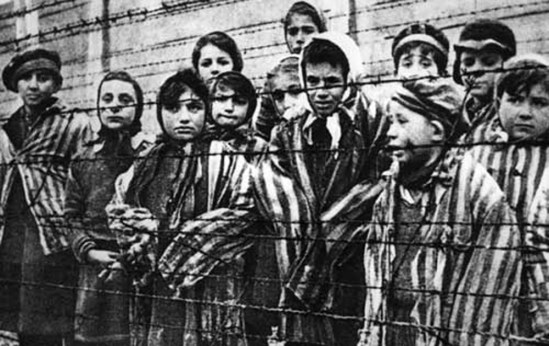
holocaust01-full

We must understand that atrocities like the Holocaust have happened not because of gun control or lack of guns. But when a large swath of the population doesn’t see them as a dealbreaker and are willing to embrace a totalitarian strongman in order to get what they want. The Holocaust was caused by anti-Semitism along with moral failure and indifference. To think it could’ve been avoided if people have been armed is a very offensive way to remember this unimaginable tragedy.

It’s all too easy to forget the allure that fascism presented to those in the West during times of social and economic upheaval. The Nazis were master manipulators of popular emotion and sentiment while disdainful of people thinking for themselves. Adolf Hitler and the Nazis came to power not through force of arms, but through success at the ballot box, propaganda, illegal violence, and Hitler’s political cunning. They didn’t just rise to power by intimidation and imposing totalitarianism, the Nazis were genuinely popular with enough of the population to prevent a coup. Nor did they need gun control to retain supreme and unlimited power. Shortly after being granted emergency powers, Hitler issued the Reichstag Fire Decree which suspended civil rights, banned the left-wing press, and authorized the mass arrest of Communists and Socialists (a move allowing Nazis to take seats of the arrested delegates and assume a Nazi majority). A month later, the Nazi majority Reichstag passed the Enabling Act, giving Hitler and the German Cabinet the power to enact laws without its involvement. These 2 acts transformed Hitler’s government into a legal dictatorship within 2 months. Within the next 6 months, the Nazis banned Jews, non-Germans, and political opponents from public service, outlawed trade unions, and barred all political parties aside from the Nazi Party. The success of Nazi programs like restoring the economy and dispelling socio-political chaos and the misappropriation of justice through terror assured the German people’s compliance. Else, they wouldn’t have loosened gun restrictions in 1938 as an effect a façade of legalism around exercising naked power like most of their actions. The 1938 weapons law wasn’t a part of normal governance since the Third Reich had demolished the rule of law. And while Jews were prohibited from owning guns, they weren’t allowed to many other things. They couldn’t vote, work in professions, attend school, go to the movies or theater, visit public parks or “Aryan” areas. In fact, Jews weren’t considered citizens of Nazi Germany or even human beings. To focus exclusively on gun control is to lose sight of the bigger picture. And suggesting that the only thing keeping Hitler in power was gun control only exonerates the many Germans who supported him.

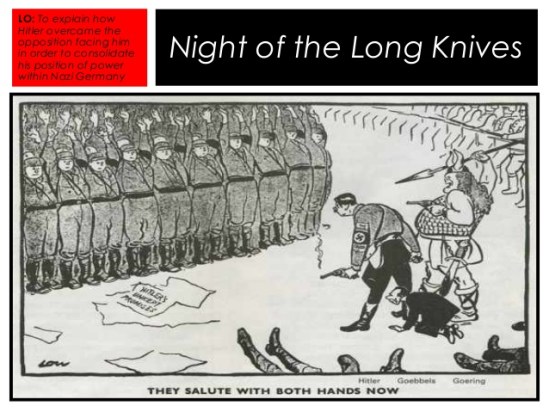
the-night-of-the-long-knives-3-638

Here’s a cartoon depicting the Night of Long Knives where the Nazi regime killed their most prominent political enemies. Most were Brownshirt leaders. And yes, they were armed and the Nazis knew it. Most gave up without a fight.

Despite that while the Nazis confiscated weapons from people they didn’t like, Adolf Hitler didn’t need to seize weapons to get rid of perceived political enemies. Their gun laws weren’t the major part of the process to suppress political dissidents and round up German Jews for extermination. Take the Night of the Long Knives, for instance, which involved a series of extrajudicial executions to consolidate Hitler’s absolute hold on German power. Paramilitary organizations were part of the Nazi organization from its earliest days in the mid-1920s. A founding Nazi street fighting group were the Sturmabteilung or Brownshirts who were known for street violence tactics. Its leader Ernst Rohm was one of Hitler’s oldest allies and comrades. Another outfit called the Schutzstaffel or SS protected Nazi officials as they moved around the country. After Hitler won office, the SS under Henrich Himmler became part of Der Fuhrer’s inner circle. But Rohm was eager to consolidate his power, setting him on a collision course with established German military leaders and Hitler’s top advisers. They persuaded Der Fuhrer that the Brownshirts were difficult to control so he and that Rohm was plotting a coup. From June 30-July 2, 1934, the SS and Gestapo killed at least 85-200 Brownshirt leaders and other perceived enemies. Though the final death toll could be as many as 700-1,000 along with thousands of arrests. Most but not all were associated with Rohm. The incident had more to do with infighting among the Nazi community than with going after disarmed citizens. Quite the opposite for the Nazis knew full well they were going against a group with plenty of weapons. Hitler himself oversaw the Rohm’s arrest, which went down in the middle of the night with a truckload of armed Brownshirt troops driving up to a hotel. Not a shot was fired and Rohm complied. He was executed 3 days later. Those at the German Historical Institute wrote that with this operation, Hitler had managed to “legitimize outright murder on a large scale – without any legal proceedings whatsoever – and that the country largely accepted the Nazi propaganda that presented this strike as necessary.”

reichstag01

Dictators don’t rise to power by taking away people’s guns. But rather through popular support and public purges to send a message to anyone who disagrees with them. If soldiers come to your door to kill you or take you away for speaking out against a Dear Leader, your private arsenal will not save you. In fact, it might even condemn you.

Nonetheless, the notion that if Jews were armed and could’ve prevented the Holocaust is ridiculous is an old claim the NRA and other gun rights people push to show that who are trying to show that when a civilian population is armed, it can prevent tyranny and that tyrants begin their rise to power by disarming the population. However, the fundamental problem with these claims is that they have no idea how and why dictators like Hitler and the Nazis come to power. Dictators come to power through a more gradual process aided by large swaths of citizens eagerly supporting the strongmen in charge and public purges of dissenters to send a message anyone still supporting the regime. By the time soldiers come marching to your door to kill or drag you away, it’s because they’ve been chosen and groomed for this task. And you’ve been demonized as a traitor who must be punished. Keeping a weapons stockpile will only be used to justify overwhelming force or murder. There’s a very long historical record of regimes hell-bent on crushing dissent seeing them as little more than nuisances which won’t even be recorded once the dark deed is done. If a military coup is involved, then it would’ve been made possible with the wide availability of guns along with widespread support for the insurgents from the people as was the case with the Communist takeovers of the Soviet Union, China, and Cuba. Tens of millions of people became victims in the 20th century because they were members of groups targeted for eradication over ethnicity, religion, or ideology by ruthless military dictatorships. While these massacres had concurrent efforts to disarm targeted populations thanks to gun registration requirements, to say those millions died because of gun control is bad history. It’s nothing short of delusional to think that small groups of untrained civilians could defeat some of the most powerful armies in the world. History shows that civilians are often powerless to militarily resist an oppressive dictator. We can only prevent genocide by strengthening democracy as well as supporting a free press and non-government organizations. Thinking gun control in the United States will lead to genocide abandons reality for a fantasy world.

20130111-hitler-guns

Blaming the Holocaust on the lack of guns allows people to ignore the real causes of the genocide like Nazism, Anti-Semitism, moral failing, and indifference. And it allows people to ignore how the Nazis stripped the Jews of more basic rights. Not to mention, it misrepresents history which isn’t just intellectually dishonest but also dangerous.

Blaming the Holocaust on the lack of guns allows people to ignore the Nazism and anti-Semitism along with the humanity’s moral failure and indifference that made its atrocities possible in the first place. The fact that gun culture considers the Jews’ lack of guns of more consequence than their lack of more basic rights says a great deal more about America’s gun culture than it does about the Nazis or the Jews. And even if they get it right about what the German gun laws did, they misrepresent the significance and consequences from those laws. Misreading history to suit one’s views is as intellectually dishonest as it’s dangerous. As Brown University historian Omer Bartov told Salon in 2013, “Their assertion that they need these guns to protect themselves from the government — as supposedly the Jews would have done against the Hitler regime — means not only that they are innocent of any knowledge and understanding of the past, but also that they are consciously or not imbued with the type of fascist or Bolshevik thinking that they can turn against a democratically elected government, indeed turn their guns on it, just because they don’t like its policies, its ideology, or the color, race and origin of its leaders.”

The Strange Matter of Stock Buybacks

buyhighselllow.jpg

Within the last 40 years as economic power shifted from workers to owners, corporate profits take of the US economy has more than doubled. Yet, despite corporate profits at an all-time high, job growth remains anemic, wages are flat, and the country can’t even afford its basic needs. A $3.6 trillion budget shortfall has left many roads, bridges, dams, and other public infrastructure in disrepair. Federal spending on economically crucial research has plummeted by 40%. Public college tuition has more than doubled since the 1980s, burying recent graduates under $1.2 trillion in student debt. Not to mention, many public schools along with police and fire departments are dangerously underfunded. So where did all the money go? After all, public companies have nearly $2 trillion in cash just sitting on their balance sheets. So Corporate America has the resources to deploy a lot of money, invest in new technologies to draw growth, give workers a much-needed raise across the board, hire and train employees, build new facilities, pay off loans, pay shareholders, and pay taxes to the government.
untitled1

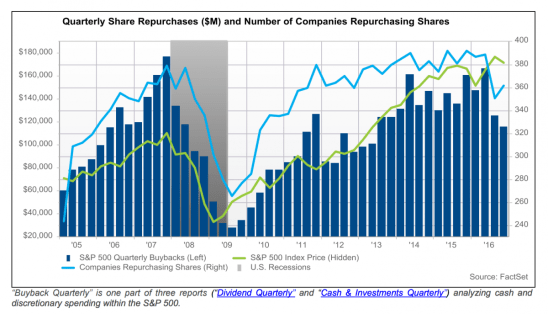
Since the 1980s, stock buybacks have grown in popularity on Wall Street as this graph shows. As Sen. Elizabeth Warren told The Boston Globe, “stock buybacks create a sugar high for the corporations. It boosts prices in the short run, but the real way to boost the value of a corporation is to invest in the future, and they are not doing that.”

But no. Instead, companies keep spending more and more money on stock buybacks. Once illegal and considered insider trading until 1982, stock buybacks have become increasingly popular especially since the 2008 recession. Today, these buybacks have become one of the biggest trends in the post-financial-crisis stock market and the largest source of net demand since 2009. Since 2010, 1,900 companies have spent money on buybacks and dividends with a combined return of capital to shareholders for them equaling 113% of capital spending. So much that a growing number of companies are borrowing money to fund the buybacks. Thanks to Donald Trump’s massive corporate tax cuts, American companies have lavished Wall Street with $171 billion of stock buyback announcements this year, a record high. All in all, Corporate America has pledged 30 times more buying back its own stock than investing in its workforces. Thus, the money these companies make through their financial manipulations drives record-level profits.

Proponents say they reward these long-term shareholders by effectively increasing their company ownership and help boost a stock’s value by raising its earnings per share. When there’s no other compelling use for a company’s cash, this is a better alternative than risky spending or other big investments. But its critics think that buybacks only make things look better than they seem. Indeed, the EPS rise but not because earnings are growing. In other words, they just exist to make shareholders feel better but nothing really changes. Even some of their fiercest proponents claim they’re overused. And in recent years, evidence shows that buybacks haven’t helped boost stock values at all. Other critics argue that buybacks result in companies acting more like banks that hold assets and earn interests and less like a business making money off selling goods and services. Or invest their profits in their workforce and other productive ventures. According to the Academic-Industry Network’s William Lazonick, “Buybacks are not beneficial or necessary to household savers with diversified investments. The only ones who benefit are those who dump shares and are strictly in the business of timing.”

What are stock buybacks?

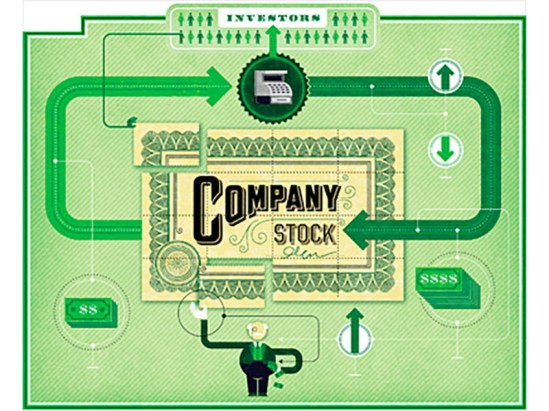
Also known as a “share repurchase,” is a company’s buying back its shares from the marketplace. Think of it as a company investing it itself or using its cash to buy its own shares. The concept is simple: because a company can’t be its own shareholder, it absorbs repurchased shares and reduces the number of outstanding shares on the market. When this happens, each investor’s relative ownership stake increases on the company’s earnings.

How are stock buybacks carried out?

They’re made in 2 ways:

1. Tender Offer– company may present shareholders with a portion of all their shares within a certain time frame. This will stipulate both the share number the company wants to repurchase and the price range they’re willing to pay (almost always at a premium to a market price). When investors take up the offer, they’ll state how many shares they want to tender along with the price they’re willing to accept. Once the company has received all the offers, it’ll find the right mix to buy the shares at the lowest cost. Tender offers can be a way for executives with substantial ownership stakes and care about a company’s long-term competitiveness to take advantage of the low stock price and concentrate ownership in their own hands. This can free them from Wall Street’s pressure to maximize short-term profits and allow them to invest in the business. But they should only be made when the share price is below the company’s intrinsic value of its productive capabilities and the company is profitable enough to repurchase the shares without impeding its real investment plans.

2. Open Market– company buys shares on the open market just like an individual investor would at market price. It’s important to know that when a company announces a buyback, the market usually perceives it as a positive thing, causing the stock price to shoot up. 95% of buybacks are these. Yet, they often come at the expense of investment in productive capabilities and aren’t good for long-term shareholders. When I discuss stock buybacks, I’m usually referring to the open market variety which used to be illegal and considered insider trading until 1982.

3. Dutch Auction– an alternative form of tender offer which specifies a price range within which the shares will be bought. Shareholders are invited to tender their stock if they wish at any price within it. The firm then compiles the responses, creating a demand curve for the stock. The purchase price is the lowest price allowing the firm to buy shares sought in the offer. And the firm pays that price to all investors who tendered at or below that price. If the share number exceeds the number sought, the company buys less than all shares at or below the purchase price on a pro rata basis to all tendering at these rates. If too few shares are tendered, the firm either cancels the offer or buys back all the tendered shares at the maximum price.

Why would a company want to use buybacks?

A firm’s management may tell you that a buyback is the best use of capital at a time since their goal is to maximize returns for shareholders. Buybacks generally increase shareholder value, at least on the surface. The prototypical line in a buyback press release is “we don’t see any better investment than in ourselves.” This can sometimes be the case but it’s not always true. Nonetheless, there are still sound motives driving companies to buy back shares. Management might think the market has discounted its share price too deeply due to weaker-than-expected-earning results, an accounting scandal, or a poor overall economic climate. Thus, when a company spends millions of dollars buying up its own shares, it means management believes the market has gone too far discounting its shares. More importantly, share buybacks can be a fairly low-risk approach to use extra cash since reinvesting money into R&D or a new product can be very risky. If these hard-earned investments don’t pay off, then that hard-earned cash goes down the drain. Using cash to pay for acquisitions can also be perilous. Mergers hardly live up to their expectations.

Another reason is that companies don’t want to just sit on money, much for the same reason that investors don’t like holding piles of cash either: inflation erodes cash value, so putting it to work makes sense. During periods of economic growth, it’s better to allocate profits to capital (like a factory) or labor as an investment to the firm’s future. But it’s also risky because the economy could worsen. Though I’m not sure if I actually agree with this since I think stagnant wages are part of why the economy isn’t getting any better. So in periods of economic uncertainty, companies choose to give the cash to their shareholders, which should’ve went to their workers. As the head of S&P Investment Services Mike Thompson told Business Insider in 2016, “In an environment like this return cash to shareholders keeps them pleased with the short-term gains while not committing to large investments that could hurt performance.”

Increased Shareholder Value– there are many ways to value a profitable company but the most common measurements is Earnings Per Share (EPS). If earnings are flat but the number of outstanding shares decreases.

Increased Float– as the number of outstanding shares decreases, the remaining shares represent the float’s largest percentage. Increased demand and less supply means a potentially higher stock price.

Excess Cash– buybacks are usually financed with a company’s excess cash, demonstrating that it doesn’t have a cash flow problem. More importantly, it signals that executives feel that cash re-invested will get a better return than alternative investments.

Improving Financial Ratios– or improving metrics upon which the market seems heavily focused on, which is questionable. If reducing shares isn’t done to create more value for shareholders but rather make financial ratios look better, the management likely has a problem. However, if a company’s motive for initiating a buyback program is sound, its financial ratio improvement in the process might be the result of a good corporate decision. For one, share buybacks reduce outstanding shares. Once a company buys these, it often cancels them or keeps them as treasury shares. They also reduce assets on the balance sheet and increase return on assets and equity. They also improve a company’s price-earnings ratio as the market often thinks lower is better.

Dilution– another reason for a buyback may be a company’s wish to reduce the dilution often caused by generous employee stock option plans. Bull markets and strong economies often create a very competitive labor market. So companies have to compete to retain personnel and ESOPs which comprise of many compensation packages. Stock options increase the share number when exercised, which weakens a company’s financial disposition.

Price Support– companies with buyback programs in place use market weakness to buy back shares more aggressively during market pullbacks. This reflects confidence that a company has and alerts investors that it believes the stock is cheap. Often a company will buy back its stock after taking a hit, which is an overt action to take advantage of discount prices on its shares. This lends support to the stock’s price and ultimately provides security for long-term investors for rough times.

Higher Stock Prices– an increased in EPS will often alert investors that a stock is undervalued or has the potential for increasing in value. The most common result is an increase in demand and an upward movement in the stock’s price.

Tax Benefit– while a buyback is similar to a dividend in many ways, it has a major advantage over dividends of a lower capital gains tax rate. Whereas dividends are taxed at ordinary income tax rates.

Does that mean stock buybacks are good?

Not necessarily. Sometimes buybacks can be a great thing if a stock truly is undervalued and represents the best possible investment for a company. But a company must meet certain specific conditions:

1. The stock should be trading at price to economic book value below 1, meaning that the company is buying back shares for cents on the dollar.

2. The company’s balance sheet and free cash flow should be strong enough to support a buyback without jeopardizing future liquidity or investment opportunities.

3. The company should have more cash than it does profitable investment opportunities.

One company meeting all three criteria is Oracle who bought back $8.1 billion in stock (5% of its market cap), reducing outstanding shares by 120 million. Its shares currently trade at a PEBV of 0.9, meaning it’s buying back shares at a 10% discount rate to their zero-growth value. With $50 billion in excess cash on its balance sheet and $9 billion in annual free cash flow, Oracle has more than enough cash on hand to support its buyback program, and more than it could reasonably hope to profitably invest in the near term as of 2016. Oracle’s buybacks don’t just serve their shareholders’ interests, they also benefit the overall economy. When a company with excess cash and few investment opportunities buys back its stock, it puts that cash back in the marketplace for individual investors to distribute to companies needing capital. In buying back billions of dollars in its own stock, Oracle cheaply retired its shares without comprising its ability to invest in future growth.

While there are buybacks that make sense from a capital allocation standpoint and serve the investors’ best interests like in Oracle’s case, these are normally the exception rather than the rule. In fact most companies buying back stock aren’t in Oracle’s situation. If a company merely uses buybacks to prop up ratios, provide short-term relief to an ailing stock price, or get out from under excess dilution, watch out. Oftentimes, they can be a downright bad idea and can hurt shareholders. This can happen when buybacks are done in the following situations:

1. When Shares Are Overvalued– companies should only pursue buybacks when their shares are undervalued. A company that buys overvalued stock destroys shareholder value and would be better off paying that cash out as a dividend, so that investors can more effectively invest it. As Warren Buffett said to Berkshire Hathaway shareholders in 1999, “Buying dollar bills for $1.10 is not good business for those who stick around.”

2. To Boost Earnings Per Share– since buybacks can boost EPS, a company stock buyback in the market reduces outstanding share count. This means earnings are distributed among fewer shares, raising EPS. Thus, many investors applaud share buybacks since they see increasing EPS as a surefire approach to raising share value. However, contrary to popular belief, increasing EPS doesn’t raise fundamental value. Companies must spend cash to buy these shares. In turn, investors must adjust their valuations to reflect reductions in both cash and shares. Sooner or later this cancels out any EPS impact. In other words, lowering cash earnings divided between fewer shares won’t produce any net change to EPS. Of course, a major buyback announcement generates plenty of excitement since a prospect of even short-term EPS can give share prices a pop-up. But unless the buyback is wise, the only gains go to those investors selling their shares on the news. There’s little if any benefit for long-term shareholders.

3. To Benefit Executives– many executives get the bulk of their compensations from stock options. As a result, buybacks can serve a goal: while stock options are exercised, buyback programs absorb the excess stock and offset dilution of existing share values and any potential reduction in EPS. By mopping up extra stock and keeping EPS, buybacks are a convenient way for executives to maximize their own wealth as well as maintain share value and options. Some executives may even be tempted to pursue share buybacks to boost share buybacks to boost the share price in the short-term and sell their shares. In addition, big bonuses that CEOs receive are often linked to share price gains and increased EPS. Thus, they have an incentive to pursue buybacks even when there are many ways to spend the cash or when their shares are overvalued.

4. Buybacks Using Borrowed Money– the temptation using debt to finance EPS can be hard to resist for executives. The company might believe that the cash flow it uses to pay off the debt will keep growing, bringing shareholder funds back into line with borrowings in due course. If they’re right, they’ll look smart. If they’re wrong, investors will get hurt. Moreover, managers assume that their companies’ shares are undervalued regardless of the price. When done with borrowing, share buybacks can hurt credit ratings, since they drain cash reserves that can serve as a cushion when times get tough. One of the reasons given for taking on increased debt to fund a share buyback is that it’s more efficient since the debt’s interest is tax deductible. However, all debts must be repaid at some time. Because what gets a company into financial difficulties isn’t lack of profits but lack of cash. With debt, buybacks become more complicated which doubles the risk since a firm’s leverage levels may cause financial distress in the future and harm shareholders in the long-term.

5. To Fend Off an Aquirer– in some cases, a leveraged buyback can be used as a means to fend off a hostile bidder. The company takes on significant additional to repurchases stocks through a buyback program. Such leveraged buybacks can be successful in thwarting hostile bids by both raising the share value and adding a great deal of unwanted debt to the company’s balance sheet.

6. There Is Nowhere Else to Put the Money– it’s very hard to imagine a scenario where buybacks are a good idea, except when a company feels like its share price is far too low. But if the company’s right about undervalued shares, they’ll probably recover anyway. Thus, companies buying back shares are, in effect, admitting that they can’t invest their spare cash flow effectively. Even the most generous buyback program is worth little for shareholder if it’s done in the midst of poor financial performance, a difficult business environment, or a decline in the company’s profitability. By giving EPS a temporary lift, share buybacks can soften the blow. But they can’t reverse things when a company is in trouble.

Why do companies actually use buybacks?

In theory, corporations should have a distinct advantage over the rest of the market when buying back shares. After all, executives know their industry, the company’s challenges, and their strategic plans better than anyone else. This should enable them to buy their stock when it’s cheap and not when it’s overvalued.

But most companies carry out buybacks for reasons that have nothing to do with maximizing shareholder value. Pressure to hit short-term earnings targets and executive compensation plans often incentivize the wrong metrics which often push companies to buy back stock when it’s most expensive and the money could be better used elsewhere. This is what the Harvard Business Review calls “The Overvaluation Trap.” Data shows that companies buy back more stock during booms and sell them during market crashes. In this way, less like the knowledgeable executives and more like panicky and underperforming investors.
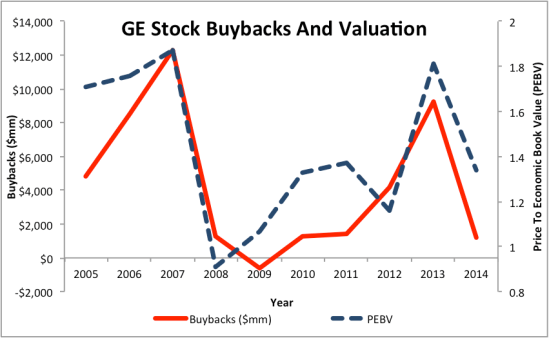
untitled

This 2016 Forbes graph of GE stock buybacks and its valuation. You can see that instead taking the traditional investor advice of “buy low, sell high,” they actually have bought high and sold low. As a result, their stock has lost value.

A graph from Forbes shows this value-destroying behavior for General Electric by comparing between the amount of money spent buying back shares and the price to economic book value, a measure of growth expectations embedded in the stock price. As this graph illustrates, GE bought back an incredible $12.3 billion worth of stock in 2007, just before the market crashed. At the start of the bull market in 2009, the company sold off $600 million worth of its own stock. Throughout the last decade, you can see a high correlation between how expensive GE’s stock is versus current cash flows and how much stock the company buys back. Overall, in the last decade, GE bought back $44 billion of its own shares (17% of its market cap). Yet, its stock fell by 15% over that same time. By inefficiently utilizing valuable capital to buy back stock at inflated prices, GE destroyed value for long-term shareholders. When a company’s equity is overvalued, its executives have to scramble to justify that expensive price. One way to do that is by artificially boosting the EPS through share buybacks. As this Forbes graph above shows, GE does this effectively as the company managed to hit or beat EPS in 15 out of past 16 quarters.
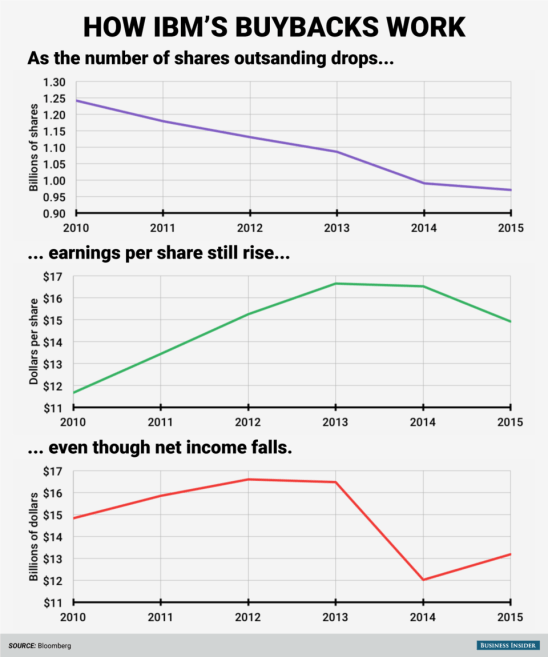
575f22fe910584145c8c891c-960-1150

Business Insider’s graph on IBM also shows how buybacks might make the EPS look good as the number of outstanding shares drops. Despite that the net income has fallen, which isn’t a good sign in most businesses.

Another case is IBM who spent $4.6 billion in 2015 and $125 billion in the decade prior as of 2016. According to a Business Insider graph, from 2010 to 2015, its total share count was down by about a fifth while earnings per share rose 15%. Yet, in that same period, IBM’s actual income went down 11% as sales fell, too. As a result, IBM has lost about $50 billion in market value since 2013, or about 30%.
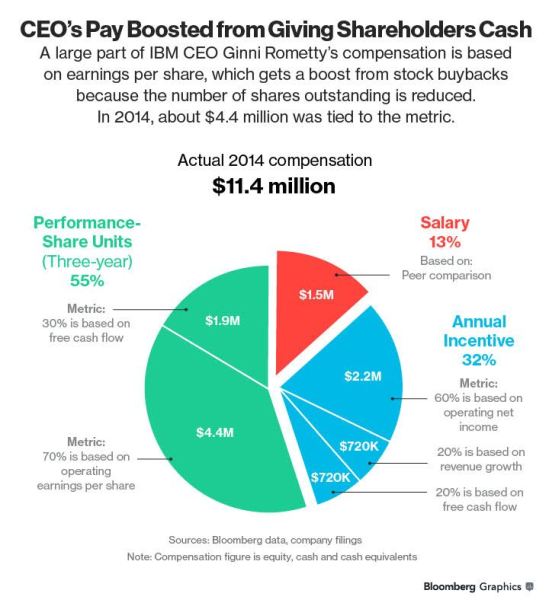
ceo-pay

Since executive pay is often tied to stock compensation, top Wall Street execs have often been pressured to do buybacks to increase their coffers. Even if it makes no strategic financial sense. It’s part of a phenomenon called greed. This is a Bloomberg graph of IBM’s CEO compensation.

Also, many companies have executive compensation packages incentivizing excessive share buybacks, either directly or indirectly. In GE’s case, a percentage of its bonuses depends on the company returning a certain amount of cash to shareholders. In 2014, executives had to make sure combined dividends and buybacks hit at least $10 billion to get their full bonus, even if that decision made no strategic sense. But it makes perfect sense in regards to greed. Because when share prices go up, CEOs reap a bonanza so the value of their pay also rises in what amounts to a retroactive and off the books pay increase on top of their already humongous compensation packages. As a result, the very people we rely on to make investments in the productive capabilities that will increase our shared prosperity are squandering most of their companies’ profits for their own prosperity. The Academic-Industry Network’s William Lazonick told The American Prospect, “All of those trillions of dollars flowing out of companies are being used to build the war chests of hedge-fund activists for further buybacks or [giving them more] money to play around with on derivatives. When you connect the dots, it’s part of bigger process. This is really a long-run problem that helps to explain concentration of income at top because it’s getting made off the stock market.

Other companies incentivize share buybacks through emphasizing metrics that can be easily manipulated and have little impact on shareholder value. For example, Cisco executives are judge in part on their ability to grow adjusting operating income, adjusted EPS, and operating cash flow. That term “adjusted” is crucial since Cisco uses metrics for judging executive performance exclude share-based compensation. Meaning that executives can pay employees (and themselves) with stock instead of cash, buy back shares to offset dilution, and increase these adjusted metrics to improve real operating performance. In 2015, Cisco bought back 155 million shares. But after effects of employee stock compensation, it only reduced the total outstanding shares by 38 million. So all those buybacks are just trickery executives use to boost their own bonuses.

And it’s not just GE, IBM, and Cisco. According to FactSet data by Andrew Birstingal, the performance of companies engaging in buybacks has been disappointing. “In the past year, companies repurchasing shares saw an excess weighted cumulative return of -1.9% relative to the benchmark, while companies not repurchasing shares saw a return of 9.8% relative to the benchmark,” he said in 2016. On a three-year horizon, those companies buying back shares ended up with a -2.9% return against 11.5% gain for those not buying back stock. A study found that companies completing buybacks outperformed their benchmark before 2001. Yet, those who completed buybacks between 2002 and 2006 didn’t generate better returns since that time than those who didn’t. Based on this research, buybacks aren’t helping share prices in either short- or long-term.

However, the cost of buybacks doesn’t just come from overpriced stock losses, but also from missed opportunities to invest growth and innovation. Over the past decade, AT&T bought back $50 billion in stock which could’ve been used to improve its wireless network quality and catch up with Verizon which doesn’t buy back stock. All those buybacks didn’t keep AT&T from underperforming versus Verizon and the broader market. We tend to think of buybacks as a sign of success proving a company has plenty of cash to throw around. In reality, they amount to admission of failure for a company buying back stock signals the market that it lacks profitable investment opportunities.

So what’s the deal with stock buybacks and the economy?
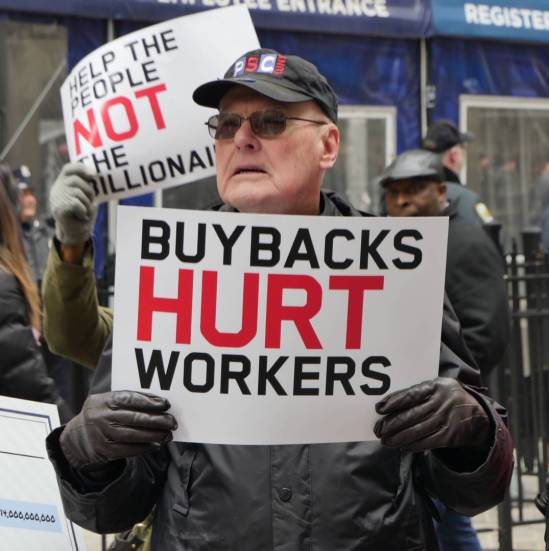
StockTax4

Stock buybacks don’t give any incentives for companies to use profits in improving their enterprise and raising workers’ wages. The frequency of buybacks have led to increased economic inequality and more money going to the 1%.

Before the Security and Exchange Commission loosened regulations that gave companies an ability to repurchase stock without facing charges of stock manipulation and a shift toward stock-based compensation toward top executives, corporate money flowed through the broader economy in the form of higher wages or increased investments in plants and equipment. But today, these stock buybacks drain millions of dollars of windfall profits out of the real economy and into a paper-asset bubble. This inflates share prices while producing nothing of tangible value. Corporate managers have always been pressured to grow earnings per share, but where once the only option was the hard work of actually growing earnings by selling better products and services, they can now simply manipulate their EPS by reducing the number of outstanding shares. As a result, it has become a gigantic game of “keep away” with CEOs and shareholders tossing a $700 billion ball back and forth over American workers, whose wages as a share of GDP have fallen in almost exact proportion to profits’ raise. Since buybacks give firms no incentives to share their profits with the workers who truly invest in these companies, pouring their lives into them each day for pay increases and stable opportunities. Or the taxpayers who have an interest in whether a corporation that uses government funding can turn a profit that allow it to pay taxes. As the Academic-Industry Network’s William Lazonick told The American Prospect, “The issue is what are they not doing when they do stock buybacks. What they’re not doing is keeping people employed longer, paying them more, and giving them more benefits. There’s a direct connection between the decline of those norms and the rise of buybacks and the legitimized ideology of ‘Shareholder First.’” Over the last decade, 94% of company profits have gone to shareholders through buybacks and dividends.

This practice isn’t just unfair to Americans, but also to individual harmful to both companies and the American economy. A 40-year obsession with “shareholder value maximization” stock buybacks and excessive dividends have reduced business investment and boosted inequality. Now almost all firms carry out investment through retained earnings. Thus, diverting cash flow to stock buybacks has inevitably resulted in lower rates of business investment. And since the 1980s, corporations have bought back more equity than they’ve issued, representing a net negative equity flow. In other words, shareholders aren’t providing capital to the corporate sector like they should. They’re extracting it. Meanwhile the shift to stock-based compensation helped drive the 1%’s rise by inflating the ratio of CEO-to-worker compensation from 20 to 1 in 1965 to 300 to 1 today. Labor’s steady falling share of GDP has depressed consumer demand, resulting in slower economic growth. It’s mathematically impossible to make the public- and private- sector investments necessary to sustain America’s global economic competitiveness while flushing away 4% of its GDP year after year. If the US is to achieve growth distributing income equitably and providing stable employment, government and business must take steps bringing stock buybacks and executive pay under control. The nation’s economic health depends on it.

What should be done about stock buybacks?

The federal government must reorient its policies from promoting personal enrichment to enhancing national growth. Such policies should limit stock buybacks and raise the marginal rate on dividends while providing real incentives to boost R&D investment, worker training, and business expansion.

According to a 2014 Harvard Business Review, a good first step would be an extensive SEC study of the possible damage that open market buybacks have done to capital formation, industrial corporations, and the US economy over the past 3 decades. For instance, during the amount of stock taken out of the market has exceeded the amount issued in almost every year. From 2004-2013, this net withdrawal averaged $316 billion a year. Overall, the stock market isn’t functioning as a funding source for corporate investment.

Another measure we need to do is reining in stock-based pay which should be very limited. Many studies have shown that large companies usually use the same set of consultants to benchmark executive compensation and that each consultant recommends that the client pay its CEO well above average (which is what CEOs want to hear). Thus, compensation inevitably ratchets up over time. They also show that even declines in stock price increase executive pay. So when a company’s stock price falls, the board stuff even more options and stock awards into top executives’ packages, claiming that it must ensure they won’t jump ship and will do whatever necessary to get the stock price up. A 1991 SEC decision allowing top executives to keep gains from immediately selling stock acquired from options only reinforces their overriding personal interest to boost stock prices. Because corporations aren’t required to disclose daily buyback activity, it gives executives the opportunity to trade to trade undetected on inside information about when buybacks are in progress. The SEC at least should stop allowing executives to sell stock immediately after options are exercised. And incentive compensation should be subject to performance criteria reflecting investment in innovative capabilities, not stock performance.

But more importantly, we must transform boards determining other executive compensation. Boards are currently dominated by other CEOs with strong bias toward ratifying higher pay packages for years. When approving enormous distributions to shareholders and stock-based pay for top executives, these executives believe they’re acting in shareholders’ interests. And that’s a big part of the problem. The vast majority of shareholders are simply investors in outstanding shares who can easily sell their stock when they want to lock up gains or minimize losses. Since taxpayers and workers are the people truly investing in the productive capabilities of corporations, they need to have seats on boards of directors. Their representatives would have the insights and incentives to ensure that executives allocate resources to investments in capabilities most likely to generate innovations and value.

If business leaders want to maintain broad support for business, they must acknowledge that a corporation’s purpose isn’t to enrich the few, but to benefit many. Once America’s CEOs refocus on growing their companies over their share prices, shareholder value will take care of itself and all Americans will share in the economy’s benefits. The corporate allocation process is America’s source of economic security or insecurity whether its people like it or not. If Americans want an economy in which corporate profits result in its shared prosperity, the buyback and executive compensation binges will have to end. Sure executives will complain like whiny babies. But the best executives might actual get satisfaction being paid a reasonable salary allocating resources in ways sustaining the enterprise, providing higher standards of living to the workers who make it succeed, and produce tax revenues for the governments providing it with crucial perks.

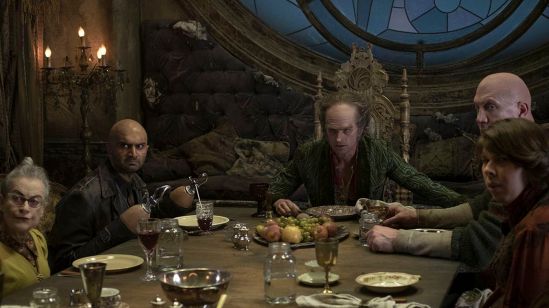
The Threat of White Supremacy in Law Enforcement

a-tale-of-two-hoodies

In 2006, the FBI issued a bulletin detailing the threat of white supremacists infiltrating police in order to disrupt investigations against fellow members and recruit other white nationalists. It was released during a scandalous period for many law enforcement agencies throughout the country, including a Neo-Nazi gang formed by members of the Los Angeles Sheriff’s Department who harassed black and Latino communities. Similar investigations revealed officers and entire agencies with hate group ties in Illinois, Ohio, and Texas. The FBI identified white supremacists in law enforcement as a concern because their access to both, “restricted areas vulnerable to sabotage” and elected officials or people who could be seen as “potential targets for violence.” Not to mention, such infiltration, “can lead to investigative breaches and can jeopardize the safety of law enforcement sources or personnel.” The report also warned of “goat skins,” which are hate groups who don’t overtly display their beliefs to “blend into society and covertly advance white supremacist causes.” And in at least one case, the FBI learned of a skinhead group encouraging ghost skins seeking employment with law enforcement agencies to warn crews of any investigations.

American policing has always had racial implications. The earliest form of organized law enforcement in the country can be traced to slave patrols that tracked down escaped slaves and overseers assigned to guard settler communities from Native Americans. In the centuries since, many law enforcement agencies have directly participated in antagonizing communities of color or provided a shield for others who did. But since the FBI’s 2006 report came out, little has changed. Though several agencies nationwide have launched internal investigations into personnel who may not be formal hate group members, but face allegations of racial misconduct. While social media has made it easier to expose white supremacists in law enforcement. Yet, none of the over 18,000 law enforcement agencies have established systems for vetting potential supremacist links, many of which have deep historical connections to racist ideologies.

fatherland

This is the cop who was caught with a Neo-Nazi tattoo at the Democratic National Convention. And he was sent to patrol a Black Lives Matter protest. See the problem here?

But since the FBI’s report, problems with white supremacists in law enforcement have surfaced since then. In 2013, the Southern Poverty Law Center exposed an Alabama officer as a member of the white nationalist League of the South after speaking at a national conference. In 2014, 2 Florida officers, including a deputy police chief, were fired after an FBI informant outed them as Klu Klux Klan members. In September 2015, a North Carolina police officer was fired after a picture of him giving the Nazi salute appeared on Facebook. That same year a Baton Rouge police officer resigned after being linked to racist text messages. Another instance has an Oklahoma sheriff resigned after his name was connected to a white supremacist website. And in August 2016, the Philadelphia Police Department launched an internal investigation after attendees at Black Lives Matter rally outside the Democratic National Convention spotted an officer in charge of crowd control with a Nazi emblem tattoo on his forearm and posted the image on Instagram.

With the rise of white supremacist violence during the Trump era, we need to treat this threat very seriously. Shortly after Barack Obama’s election to the presidency in 2008, a 2009 Department of Homeland Security study written in coordination with the FBI warned of a “resurgence” of right-wing extremism. The report noted, “Right-wing extremists have capitalized on the election of the first African-American president, and are focusing their efforts to recruit new members, mobilize existing supporters, and broaden their scope and appeal through propaganda.” Since then, white supremacist violence and right-wing terror has been on the rise along with the increased presence of the alt-right.

In November 2016, Donald Trump was elected to the presidency, a man endorsed and celebrated by the KKK since he’s been reluctant to disassociate himself from anyone espousing white supremacist views. In turn, he has appointed key administration advisers with ties to the radical right like Steve Bannon, Steve Miller, and Sebastian Gorka. His policy initiatives like revving up the nation’s deportation machine and curtailing civil rights enforcement thrilled white supremacists. Trump and his Attorney General Jeff Sessions have shown deference to law enforcement and retreated from federal oversight of police departments with a history of civil rights violations, brutality, and racial violence. As a result, the latest incarnation of white supremacy broke through the firewall that for decades kept overt racists largely out of the political and media mainstream. Reinvigorated white supremacists staged their largest rally in a decade at the demonstration in Charlottesville, Virginia, that left an anti-racist counter-protester dead and Trump equivocating over condemning racism. Former KKK Grand Wizard David Duke called the rally a “turning point” and vowed that white supremacists would “fulfill the promises of Donald Trump” to “take our country back.” White supremacists also stepped up their college campus recruiting drives. White nationalist leader Richard Spencer held a rally at the Lincoln Memorial and appeared at colleges. The Southern Poverty Law Center documented some 300 incidents of racist flyers distributed on over 200 college campuses.

Why should we worry about white supremacists in law enforcement?

In a country where 74% of extremist killings and attacks over the past decade were by right-wing extremists, particularly white supremacists, it’s a serious problem when police are among the terrorists. As Chicago’s John Marshall School of Law professor Samuel Jones told PBS in 2016, “Many people in these communities of color feel they have been the subject of police violence for decades. And when an officer engages in conduct that adds or enhances that divide, they are ultimately jeopardizing the integrity of their agencies and putting their fellow officers in danger.” Jones also told The Intercept in 2017, “When somebody holds a belief that indicates that they do not see all Americans are worthy of equal protection under the law, it compromises their ability to be a police officer.”

White supremacists come from all walks of life. They can be your neighbors, co-workers, employers, friends, and even relatives. They can be teachers, professors, cashiers, doctors, lawyers, clerics, drivers, waitstaff, accountants, firefighters, garbage collectors, mail carriers, programmers, and just about anyone else you can think of, including police. But if you have a white supremacist in a public service position like a teacher or cop, the problem isn’t that they subscribe to a radical belief system. Rather, it’s that their beliefs encourage bigoted and sometimes violent behavior that are inappropriate for anyone involved in public service, particularly those with authority over others. White supremacists also create a toxic work environment and poison relations with the public.

Many white supremacists maintain positions and jobs within mainstream society while acting with plausible deniability on behalf of their racist beliefs. They do this through paying “lip service” to normal diversity standards and playing what’s called “a dog and pony show” when it came time to public proclamations. But then acting every other regard as a white nationalist ideologue would: discriminating against minorities in their choices and actions, believing them to be innately inferior, presuming that liberals and Jews are conspiring to harm them, etc. You can see this kind of strategy on full display on Breitbart and Fox News.

If you have these white supremacists in positions of authority like law enforcement, it’s very scary notion for minorities, especially black people. Since police kill black people 2.5 more frequently than whites and unarmed black people at 5 times the rate of whites. The fact, white supremacist infiltration in law enforcement provides context to the scourge of racial police violence against black people which is often downplayed if not denied by segments of society and an administration endorsed by the Fraternal Order of Police. While racism in the police is nothing new, the idea that white supremacists might be your friendly neighborhood police can add a layer of fear and distrust for communities of color.

27843308312_3ebe233ec3_k

At a 2016 Neo-Nazi rally in Sacramento, California, the California Highway Patrol was found to aid the alt-right. They arrested 3 counter-protestors despite that the anti-fascist activists bore the brunt of the violence.

There is also evidence that police departments have asked for and accepted help from far-right protestors during tense rallies and counter-protests where violence isn’t infrequent. The relationship works both ways: Police get help and the alt-right demonstrators are seemingly put above the law in return. As a result, militia members working for alt-right events carry out policing activities with impunity under the gaze of actual law enforcement. In 2011, police bused Neo-Nazis to a rally in Trenton, New Jersey to maintain order. In 2014, Chattanooga cops arranged parking for white nationalists along with a route for them to march safely to a protest site. In June 2016, violence broke out at a Sacramento neo-Nazi rally between neo-Nazis and anti-fascist protestors at the California State Capitol. 10 people were injured, 5 of them stabbed. Despite footage showing that neo-Nazis were responsible for most of the violence, especially the stabbings, Sacramento police arrested 3 counter-protestors who were charged with felonies despite claiming self-defense. One was a Berkeley teacher and anti-fascist organizer named Yvette Felarca who was charged with assault and rioting after a neo-Nazi stabbed her and bludgeoned her in the head. Later court documents reveal that California police investigating the white nationalist event worked with white supremacists in to identify counter-protestors and sought the prosecution of activists with “anti-racist” beliefs. The records also showed police officers expressing sympathy with white supremacists and trying to protect a neo-Nazi organizer’s identity. In June 2017, police allowed members of a right-wing militia style group help police arrest anti-fascist activists at an alt-right event in Portland, Oregon. Former FBI agent and Brennan Center fellow Michael German told the Huffington Post, “That is extremely dangerous. To give these groups the idea that their violence is sanctioned by the state will make them far more violent and far more dangerous in the long run. Not to mention the failing to police these running street battles will encourage them to come to the next protest prepared.” On the other hand, the police weren’t so accommodating to peaceful, unarmed Black Lives Matter demonstrators protesting police brutality and racism in Baltimore or Ferguson, Missouri or nonviolent Standing Rock Indian activists in North Dakota who were trying to protect their water from the Dakota Access Pipeline. I mean police were in full riot gear with military equipment on all those occasions, especially at Standing Rock. Nor did they seem doing their jobs protecting counter-protestors in Charlottesville since they appeared to disappear when the violence got really ugly.

Gen-Zero-water-650-1505160215

By the way, in case you forget, here’s what police in North Dakota did to the Indian protestors trying to protect their land and water. Yeah, doesn’t seem like these cops care what happens to them.

But it’s not just people of color or left-wing protestors who have to worry about white supremacists in law enforcement. Right-wing extremists are systematically more anti-government/anti-cop than any other group. Since 1990 they have been responsible for 45 police killings. It also doesn’t help that law enforcement are more likely to encounter dangerous extremists than virtually any other segment of American society and those confrontations are, tragically, sometimes fatal. The fact white supremacists are often armed to the teeth during their alt-right rallies can be enough to put police in a state of fear and inability of what to do, especially in states with loose gun laws like the open-carry state of Virginia. But law enforcement doing nothing just enables these white supremacist whack jobs inflict violence. The lack of a police response to the Charlottesville violence in August 2017 led one chat user write that the Virginia State Police, “will be focused on antifa [anti-fascists] not us … especially if we kiss some ass with a few blue lives matter chants …. Be nice to cops and they will be nice to you.”

How long has white supremacy in law enforcement been a problem?

Black-lynching-1-1200x716

You can guess that white supremacist cops had something to do with white people getting away with this during segregation. This was from the 1920s, by the way.

This has been around for a very long time. In fact, infiltrating law enforcement is considered a long-standings strategy for white supremacists, which has long influenced law enforcement agencies at the local and state levels. As former skinhead Christian Picciolini told 60 Minutes, “We encouraged people to get jobs in law enforcement, to go to the military and get training and to recruit there.” But it’s only in recent years that we fully acknowledged it as a problem. As sociologist Peter Simi told The Intercept, “If you look at the history of law enforcement in the United States, it is a history of white supremacy, to put it bluntly,” citing origins in the slave patrols of the 18th and 19th centuries. “More recently, just going back 50 years, law enforcement, particularly in the South, was filled with Klan members.” A KKK chapter and a county sheriff’s office were involved in the 1964 arrest, abduction, and murder of 3 civil rights workers named Andrew Goodman, James Chaney, and Michael Schwerner in Philadelphia, Mississippi. Though the FBI has acknowledged it has a problem in 2006, it has only been after a series of scandals involving local police and sheriff’s departments.

murder_fbiposter_700.jpg__700x617_q85_crop_subsampling-2_upscale-1-300x264

The 1964 arrest, kidnapping, and murder of 3 Civil Rights activists in Mississippi was orchestrated by a Klu Klux Klan chapter and a county sheriff’s department. During the Civil Rights Movement, it wasn’t uncommon for local law enforcement in the South to belong to the Klu Klux Klan.

In 1991, a US District Court judge in Los Angeles found that members of a local sheriff’s department had formed a neo-Nazi gang and habitually terrorized black and Latino residents.

In 2008, a Chicago police detective and rumored KKK member John Burge was fired and prosecuted over charges relating to torture of at least 120 black men during his decades-long career. Burge notoriously referred to an electric shock device he used during interrogations as the “nigger box.”

In Cleveland, officials found that a number of police officers have scrawled “racist or Nazi graffiti” throughout their department’s locker rooms.

In Texas, 2 police officers were fired upon discovery they were Klansmen. One of them said he tried boosting the organization’s membership by giving an application to a fellow officer he thought shared his, “white, Christian, heterosexual values.”

How widespread is this problem?

It’s practically nationwide as you can see from my examples above. However, according to a report from the Root, this current infiltration has everything to do with the racist social climate, the Trump administration, and the long-standing history of racism amongst law enforcement and black people. Many law enforcement agencies have deep historical ties to racist ideologies. Since no centralized recruitment process or set of national standards exists for the 18,000 law enforcement, state and local police as well as sheriff’s departments present ample opportunities for white supremacists and other right-wing extremists looking to expand their power base.

Without available training for identifying and acting on extremist infiltration thanks to Napolitano’s actions over the right-wing fallout on the 2009 DHS report, groups like the Oath Keepers, the Peace Officers Association, the Three Percenters, and the Constitutional Sheriffs took advantage of the security vacuum to recruit and metastasize, like ISIS and Al Qaeda do in other parts of the world. These efforts in large part targeted active and retired law enforcement officers. Right-wing extremists don’t just recruit from the law enforcement community, they also infiltrate their ranks. As Picciolini told Fairfax Media, “Many people from my crew went on to be Chicago police officers, they went on to be prison guards, and they certainly took their ideology with them. A lot of people that I know ended up enlisting in the military to recruit [racists] and to get weapons and combat training.”
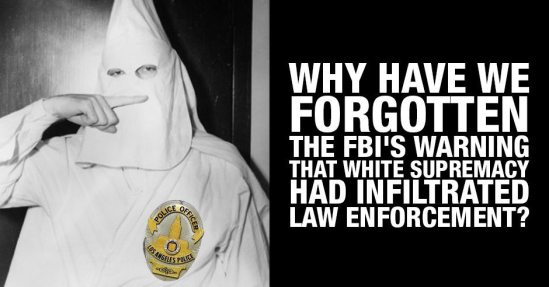
Why would white supremacists want to be cops?

The answer is simple, so they can get away with shit. It’s technically legal for a law enforcement officer to espouse hateful, racist views or belong to a hate group. And though it’s a federal crime to provide material support to a foreign terrorist group, there’s no such law supporting a white supremacist one. As an 2015 FBI counter-terrorism guide reads, “domestic terrorism investigations focused on militia extremists, white supremacist extremists, and sovereign citizen extremists often have identified active links to law enforcement officers.” A link to law enforcement gives white supremacists some legitimacy and leeway to do all the horrible things they want while still appearing respectable to the community. One white supremacist chat board user wrote, “Be me in my Criminal investigation class. We’re doing introductions and it gets to me. They ask me what kind of police officer I wanted to be and I responded with ‘Riot Police Officer.’ They asked why and I instantly responded with ‘I like curb stomping protestors who cause a riot.’ I think the professor likes me.”

Are cops prone to becoming white supremacists?

Yes, since non-radical police officers are common targets for white supremacist recruiters. As Picciolini told Democracy Now!, “Police officers and law enforcement officers and military people are constantly, every day, in difficult situations. And over time, people become jaded, especially after you’ve … worked in crime-ridden neighborhoods for 20 years, and you’ve had to deal with sometimes the worst of the worst people. Well, recruiters know this. Recruiters know that they become jaded, and they become prejudiced towards these people.” One white supremacist chat board user wrote, “I have several cops in my family, most white cops are sympathetic to us.” They added, “I’m not too worried about the cops as long as we act like whites …. Get to know more cops [in real life] No one hates niggers more than white cops.”

How many cops are white supremacists?

There aren’t many statistics, but we’re talking about a small number. But even though they’re outliers, they can inflict plenty of damage in their wake. But fortunately, white supremacy in the police force isn’t as much of a problem as it used to be. Mostly because white supremacy and racism has become significantly less acceptable in society in general. That doesn’t mean we have problems with either in the police. Because we certainly do.

If the FBI and DHS knew about white supremacy in law enforcement for years, why don’t we hear it addressed?

The FBI and DHS had. But federal investigators have been reluctant to publicly address the growing threat of right-wing extremists or point out the movement’s longstanding strategy of infiltrating the law enforcement community. Since the 2009 DHS report was released just ahead of the nationwide Tea Party protests, it caused an uproar among conservatives who were particularly pissed over the suggestion that veterans might be implicated and how the report seemed to depict the range of right-wing groups. Faced with mounting criticism, DHS Secretary Janet Napolitano disavowed the document and apologized to veterans. Despite that this document was researched, compiled, and written by officials in the George W. Bush administration. And despite that the document singled out “disgruntled military veterans” as targets of recruitment by right-wing extremists to “exploit their skills and knowledge derived from military training and combat.” Because the military has long been a hotbed for white supremacist recruiting activity and many well-known white supremacist terrorists were former servicemen like some of the alt-right leaders in Charlottesville. The agency’s unit investigating right-wing extremism was largely dismantled and the reports lead investigator was pushed out. Heidi Berich from the SPLC told The Intercept, “They stopped doing intel on that, and that was that. The FBI in theory investigates right-wing terrorism and right-wing extremism, but they have limited resources. The loss of that unit was a loss for a lot of people who did this kind of work.”

It’s widely said that the backlash following the 2009 DHS report hindered further action against the growing white supremacist threat and that it was largely ignored because the issue was so politically controversial. Samuel Jones told The Intercept, “I believe that because that report was so denounced by conservatives, it sort of closed the door on whatever the FBI may have been considering doing with respect to combating infiltration of law enforcement by white supremacists. Because after the 2006 FBI report, we simply cannot find anything by local law enforcement or the federal government that addresses this issue.” Chapman University sociologist Peter Simi agreed, “The report underscores the problem of even discussing this issue. It underscores how difficult this issue is to get any traction on, because a lot of people don’t want to discuss this, let alone actually do something about it.”

DT Analytics’s Daryl Johnson was the lead researcher on the DHS report told The Intercept, “Federal law enforcement agencies in general — the FBI, the Marshals, the ATF — are aware that extremists have infiltrated state and local law enforcement agencies and that there are people in law enforcement agencies that may be sympathetic to these groups.” And according to him, the problem has since gotten “a lot more troublesome.” Because local police departments don’t seem to do anything to address the issue. “There’s not even any training now to make state and local police aware of these groups and how they could infiltrate their ranks.” As Samuel Jones told The Intercept, “For some reason, we have stepped away from the threat of domestic terrorism and right-wing extremism. The only way we can reconcile this kind of behavior is if we accept the possibility that the ideology that permeates white nationalists and white supremacists is something that many in our federal and law enforcement communities understand and may be in sympathy with.”

How do we combat the problem of white supremacists in law enforcement?

Stricter screenings for bias and white supremacist ties is a start. After a series of investigations uncovered substantial numbers of extremists in the military, the Department of Defense moved to impose stricter screenings, including monitoring recruits’ tattoos for white supremacist symbols and discharged those found to espouse racist views. As the SPLC’s Beirich told The Intercept, “The military has completely reformed its process on this front. I don’t know why it wouldn’t be the same for police officers; we can’t have people with guns having crazy ideas or ideas that threaten certain populations.” However, the clean-cut khaki-wearing racists are less detectible as military recruits so having white supremacists in the military is still a very serious problem. An Army Times survey of 1,000 active-duty troops found that 1 in 4 respondents had witnessed concrete instances of white nationalism among fellow troops and around 5% wrote comments disparaging the poll’s methodology and complaining that groups like Black Lives Matter weren’t included as an example of encroaching extremist threat.
But reforming police is a lot harder than the military due to the way decentralized way thousands of police departments across the country operate, the historical affinity of certain police departments with the same racial ideologies espoused by extremists, and an even broader reluctance to do much about it. Seattle former police chief Norm Stamper told The Intercept, “There are police agencies throughout the South and beyond that come from that tradition. To think that that kind of thinking has dissolved somehow is myopic at best.” Though he admitted to firing officers expressing racist views, he added, “It’s not likely to happen in most police departments, because many of those departments come from a tradition of saying the officer is entitled to his or her opinions.”

First Amendment issues relating to freedoms of association and expression can also get in the way. Long as it’s for legal of activity, it’s technically legal for anyone in law enforcement or public office to join a hate group. But according to the 2006 FBI memo, the government can limit opportunities of members “when their memberships would interfere with their duties.” John Marshall School of Law’s Samuel Jones thinks it’s problematic. “I cannot imagine that the FBI today could issue a report concerning any kind of threat without people being alarmed and wanting immediate action,” he told PBS. “But in this case there seems to be almost an acceptance of it. The thought is ‘it’s just ideology and they have a right to believe this.’” Nonetheless, whether the First Amendment protects an officer’s right to express racist, white supremacist views or associate with organizations that endorse them remains a subject of debate. As Stamper told The Intercept, “You can fire someone. Whether the termination will stand up under review is the real question.”

Although police officers have been fired for expressing hateful views, they’re sometimes rehired by other departments as happens regularly when officers are accused of misconduct. But some officers have also challenged those dismissals in court. For instance, 18-year veteran of the Nebraska State Patrol Robert Henderson was fired when his Klan membership was discovered. He sued on First Amendment grounds and appealed all the way to the US Supreme Court, which declined to hear the case. In 2016, 14 San Francisco police officers were caught exchanging racist and homophobic texts including several references to “white power” and messages such as “all niggers must fucking hang.” Most of them remain on the force after an attempt to fire several of them was blocked by a judge, saying that the statute of limitations had expired.
Jones had been tracking similar incidents following the 2006 report and believes many more get buried the code of silence often dominating police departments. “All agencies, if they want to, can curtail this problem — the problem is that many do not.”

How are we combating the problem now?

According to the FBI Counter Terrorism Policy Guide, the FBI has the option to mark a watchlisted police officer as a “silent hit,” thus preventing queries to the National Crime Information Center from returning a record that identifies the officer as having been flagged as a known or suspected terrorist. The document states that a “specific, narrowly defined, and legitimate operational justification” must be given to mark a Known or Suspected Terrorist (KST) as a silent hit. The suspect’s membership or affiliation with law enforcement or military agency is one of the justifications listed, implying that extremist infiltration is enough of a concern that the FBI has built-in protocols to prevent domestic terror investigations from being obstructed by members of law enforcement. However, the counterterrorism guide doesn’t specify the conditions under which the FBI will notify local law enforcement whose members may be under surveillance as silent hits. A former agent who specialized in domestic terror investigations told The Intercept that such alerts are handled on a, “case-by-case basis,” adding, “Typically, if someone in the police department is suspect, unless it’s an extreme case of leadership, professional courtesy requires some sort of notification.”

What can we do about white supremacists in law enforcement?

If you think a police officer in your local neighborhood is a white supremacist, say something about it by either posting a picture or video on social media. If you can trust them, you might want to discuss it with your local and state police department. You can also notify the feds or the Southern Poverty Law Center. Here’s a link:

https://www.splcenter.org/what-we-do/fighting-hate/law-enforcement-resources

If you’re a law enforcement officer and want to do something about white supremacists in your community, I believe the Southern Law Center has you covered. But if you know a colleague associated with white supremacy, either tell your superior, notify the feds, or the SLPC.

But more importantly, we need to address white supremacist violence as a serious problem in this country and need to demand better ways to prevent it and combat it. Rooting out white supremacists in the police force through better screenings should be a major priority. Yet, more importantly we need to demand our law enforcement treat white supremacists at demonstrations as the security risks and danger they are, especially in the mainstream. Unless police are properly trained to handle hate crimes, white supremacists, and right-wing terror, then white supremacists will have little reason to fear the authorities, especially if their fellow members are on the force.

policewhitesupremacy