Not in My Name: Why I Oppose Capital Punishment

state-death-penalty-image-yes-no

For much of our history capital punishment has been seen as method to execute criminals (especially in Texas). However, as flawed as our justice system is, many support the death penalty for certain criminals since many of them committed such heinous crimes (or were accused of them), then they must pay. Some argue that it provides closure for the families of murder victims in a way that justice has been served. Some say it deters crime since most people fear capital punishment anyway as well as keep the costs of prison down. However, while the death penalty has been one of the oldest forms of legal punishment in history I have always harbored significant doubts on its morality as well as its effectiveness against deterring crime (yet it’s still legal in Pennsylvania as well as the US). Sure plenty of people fear death and would go out of their way to avoid the ultimate penalty, but are death sentences really worth it? It has already been abolished or ceased practice in 139 countries and in most democratic nations it is applied in only the rarest of cases. And recently, many US states have either abolished the death penalty or taken steps to do so even in red states like West Virginia or Alaska. Yet, many people of both parties remain convinced that capital punishment is a viable form of justice on some certain level. And while the EU has staged an embargo on the drug used for legal injections, some states have tried to find cheaper and more efficient alternatives like a firing squad. Here is a list on why I oppose the death penalty.

1. Support in death penalty is culturally based. Believe it or not, most people who support the death penalty do so because they were raised with the idea as a viable form of punishment. Since capital punishment has been around in nearly every civilization for thousands of years, but just because it’s always been around doesn’t necessarily make it right. However, old ideas don’t always die when you want them to and there are people who still believe that cold-blooded killers deserve to die and our culture gleefully promotes this concept since this is what usually happens to bad guys. To these people seeing a convicted criminal executed is proof that the system works regardless of other implications so much so that they would say anything to justify why capital punishment should remain.Thus, belief in capital punishment has much more to do with one’s culture than systematic effectiveness overall.

2. The death penalty fails to recognize a guilty person’s potential to change and denies an opportunity for them to rejoin society. While society has always looked down on criminals, death row inmates are especially prone of being judged irredeemable because the crimes they committed lead to a death sentence. Sure there are plenty of death row inmates who aren’t sorry for their crimes but many do have the capacity to change and/or amount to some benefit to society.  Let’s face it, humans are complicated and unpredictable creatures. Not to mention, contrary to popular belief, criminal convictions don’t define someone as a bad person incapable of rejoining society. It just means they’re guilty (though to be fair, death row inmates aren’t nice people to begin with). For instance, take Robert Stroud (of Birdman of Alcatraz fame) who reared and sold birds during his solitary confinement in Leavenworth Prison as well as became a self-taught ornithologist and author. Yet, before his birding days, Stroud was sentenced to death at one time in his life for stabbing a prison guard, though the sentence was eventually commuted to life imprisonment which not only led him to keeping birds but also finding a cure for a family of avian diseases. It would be hard to imagine what farmers and ornithologist would’ve missed if this man was executed between 1916 and 1920. Yet, unlike the favorable Burt Lancaster portrayal (who changed from a violent anti-social thug to intellectual and soft-spoken pacifist), the real life Stroud was a diagnosed psychopath widely disliked and distrusted by the jailers and inmates who knew him as extremely difficult and demented as well as a vicious killer. Nevertheless, his story illustrates even bad guys like him can do some very good things if given the chance and that a person’s crimes shouldn’t define one as a human being. Saying that certain criminals deserve death is determining them irredeemable, which in many ways denies their humanity.
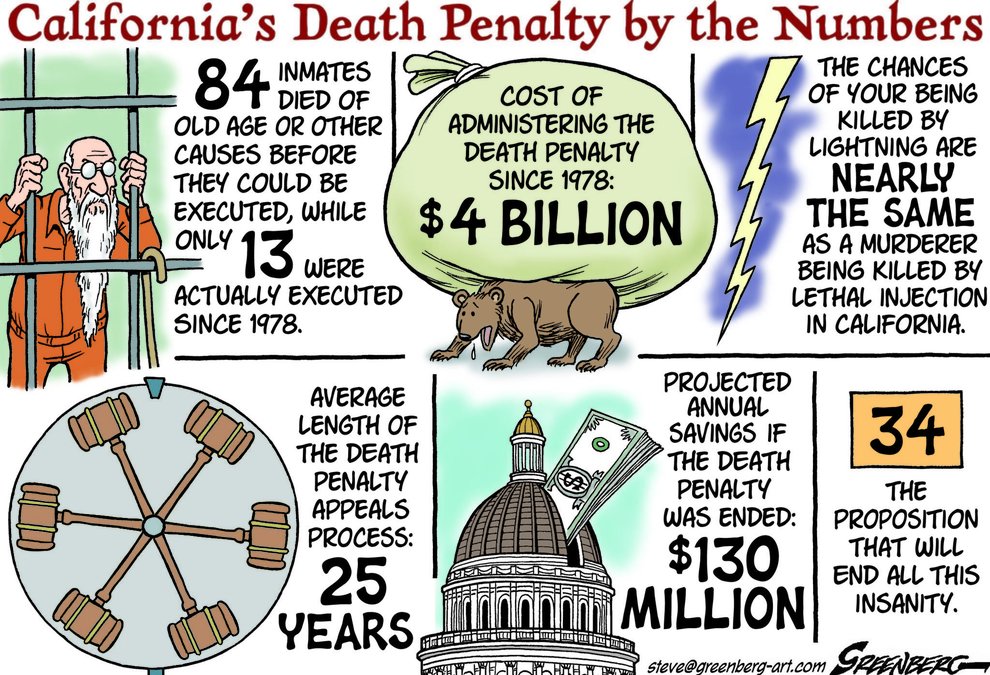
This cartoon shows a quick look at the death penalty in California, a state known for its horrible prison situation. Since 1978, to execute someone in this state costs $4 billion with the legal process taking 25 years. And it only managed to execute 13 people. Yeah, it's pretty much a ripoff.

This cartoon shows a quick look at the death penalty in California, a state known for its horrible prison situation. Since 1978, to execute someone in this state costs $4 billion with the legal process taking 25 years. And it only managed to execute 13 people. Perhaps prison overcrowding isn’t so bad at least when it comes to taxpayer dollars spent per prisoner.

3. Executions cost more than a lifetime in prison. While the prison system may have their own problems, they keep some of the worst criminals off the streets who are now serving a life sentence without parole. Of course many proponents argue that capital punishment helps relieve the costs of caring for condemned criminals. Cases resulting in life in prison usually cost approximately $500,000 on average from arrest to incarceration and once it’s delivered, the case is usually closed for now. Cases involving the death penalty by contrast, can cost to as much as $1-3 million, sometimes even $7 million in taxpayer money and they usually involve a lengthy and complex appeals process sometimes lasting a decade on average all because someone’s life is on the line. Thus, death penalty cases involve more lawyers, more witnesses, more experts, longer jury selection process, more pre-trial motions,  an entirely separate trial for sentencing, and countless other expenses that could rack up costly expenses before a single appeal is filed. Add to that the fact most death penalty trials are found to be significantly flawed and must be re-done, sometimes more than once. Even in most cases in which the death penalty is sought, it’s almost never imposed. And when it is imposed, it’s rarely carried out. Still, the costs of all this regardless of outcome is paid by the taxpayers. These proceedings divert resources which could be better used for more positive endeavors like helping homicide survivors, education and social programs, scholarships for orphans, libraries, hiring more police officers, and other things. Not only that, but money may be the main reason why more states have decided to abandon capital punishment in the first place. As much as caring for condemned criminals costs taxpayers, it’s much cheaper than trying to execute them.
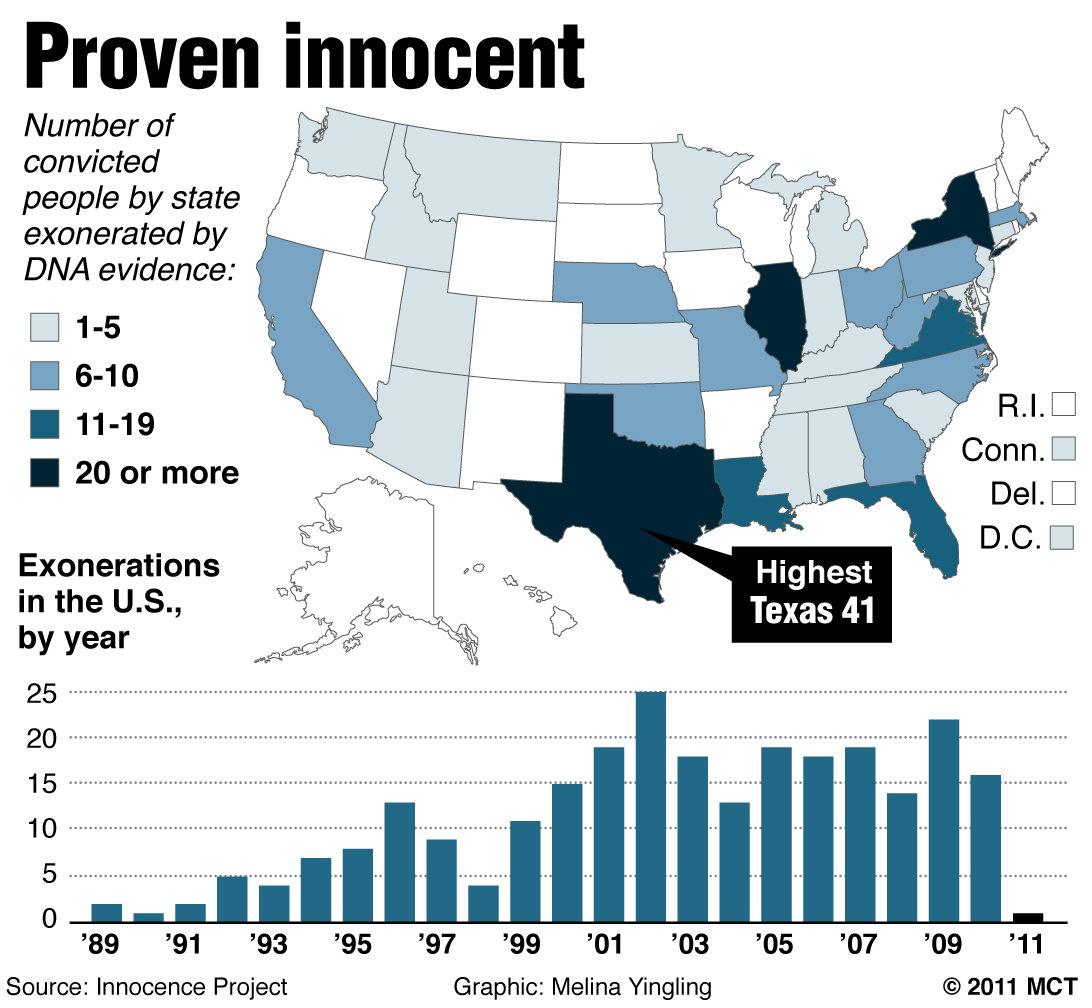
In recent years, wrongful convictions have become more apparent in the American legal system in recent years. Recent years have seen more exonerations by DNA evidence. And this has gone up for death row inmates as well. Thus, it's apparent that capital punishment kills innocent people. As to how many, it will never be known.

In recent years, wrongful convictions have become more apparent in the American legal system in recent years. Recent years have seen more exonerations by DNA evidence. And this has gone up for death row inmates as well. Thus, it’s apparent that capital punishment kills innocent people. As to how many, it will never be known.

4. You can’t remedy a wrongful execution. In the criminal justice system, there is always a potential for error whether it be the acquittal of a known murderer or the conviction of someone completely innocent. Of course, if there’s a miscarriage of justice, the system should be able to correct it in due time. Sure some murderers may be free to kill another day but that doesn’t mean they’d necessarily be lucky the next time. And innocent people serving time in prison can always be exonerated via DNA evidence. However, whenever the system sentences someone to death, one of the reasons why the death penalty legal process is so long and complicated is just to ensure that innocent people aren’t wrongfully executed. Yet, even with these protections, there’s still a risk of carrying out a wrongful execution which can’t be taken back. In the US, since the 1973 around 143 death row inmates have been exonerated and most simply because of the weak cases against them and nine times more frequently than others convicted of murder. Some haven’t been so lucky and it’s very difficult to determine how many innocent people were executed there’s often insufficient motivation once an execution occurs. Still, whenever someone is accused of a serious crime, there are plenty of factors that can result in wrongful conviction like inadequate legal representation, government misconduct, eyewitness error and perjured testimony, junk science, racism, snitch testimony, false confessions, suppression and/or misinterpretation of evidence, and social pressure to solve a case. Our criminal justice system is far from perfect and can’t be right 100% of the time. Yet, in capital cases, a wrongful conviction can be deadly and you can’t take back a human life.
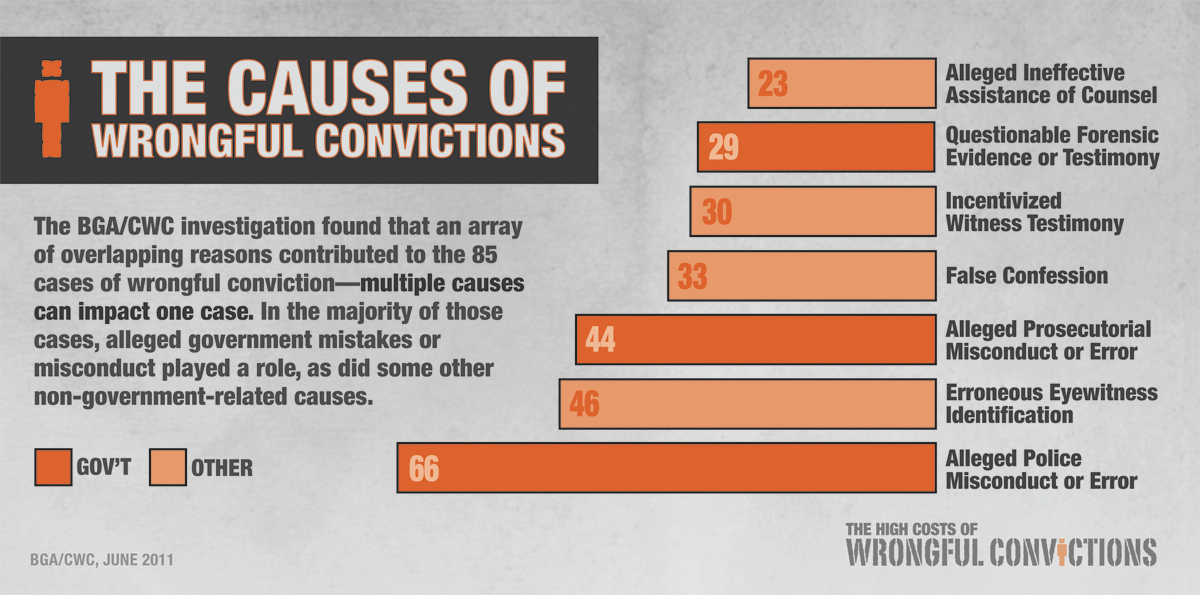
This is a chart depicting the causes of wrongful convictions. A lot of this involves government misconduct. But this can also include erroneous eyewitness testimony, false confessions, bad legal representation, informants, and others. And each case can have multiple causes.

This is a chart depicting the causes of wrongful convictions. A lot of this involves government misconduct. But this can also include erroneous eyewitness testimony, false confessions, bad legal representation, informants, and others. And each case can have multiple causes.

5. Most death row inmates were convicted while being defended by court-appointed attorneys who are often the worst paid, most-inexperienced, and least-skillful lawyers. The quality of legal representation provided plays a determining factor whether a defendant will face execution. Since most defendants in capital cases are too poor to afford a lawyer, the job defending the accused will usually fall to public defenders. Yet, these court appointed attorneys are often overworked, underpaid, or lack the experience to take on death penalty cases that they are inadequate providing a good defense. There are some instances where defense attorneys have arrived to court drunk, slept through the proceedings or failed to do any work in preparation for the sentencing phase. Also, whenever a capital case is set aside by a federal court, it mostly because the defense attorney’s incompetence that the accused’s constitutional right to effective counsel was violated. And it’s not uncommon for the defense attorney to be disbarred or disciplined for unethical or criminal behavior. Alabama has been notorious for providing especially shoddy counsel to defendants in capital cases. It has the distinction as the only state with no statewide public defender system though its death row inmates are overwhelmingly poor. In the US, we expect everyone to have a right to a fair trial, especially if a person’s life is at stake. Yet, if defendants in capital cases are given inadequate legal representation, how can they receive a fair trial?

6. Capital punishment doesn’t deter crime. Many proponents would argue that capital punishment by saying that it’s the ultimate warning against all crimes and sets an example to other would be criminals. Yet, while many people fear a death sentence, fear is hardly a good teaching tool and capital punishment’s effectiveness in deterring crime is questionable. In fact, there is no reliable evidence whether the death penalty has any effect on homicide rates at all as most criminologists believe. Some may argue that using the death penalty may brutalize society and lead to more murders and most proponents no longer consider deterrence as a serious justification for its continued use. The threat of execution may dissuade some from committing premeditated murder and so does getting caught. Not to mention, many murders are committed in moments of passion, anger, or by criminal substance abusers or acting impulsively. Those who commit first degree murder, either don’t expect to get caught or don’t weigh the consequences. Sometimes the legal consequences don’t even matter since some criminals may see life in prison as a fate worse than death anyway. Not to mention, consider the fact capital punishment has existed for thousands of years, yet people still commit murder regardless of the ultimate penalty.

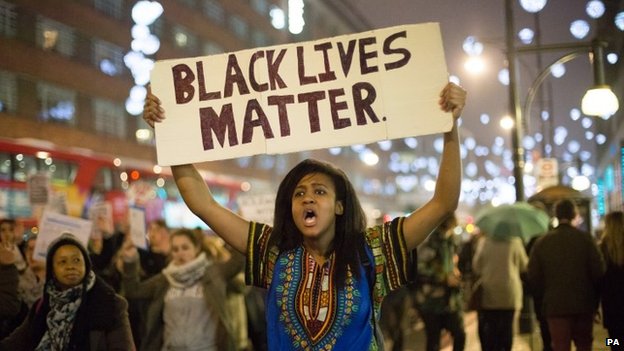
Racial disparities are endemic in our criminal justice system. In capital cases, while a significant portion involve a black or Hispanic defendant, the overwhelming majority involve white victims. Looking at these disparities, I can't blame the people at Black Lives Matter for stating their case. These states are just despicable.

Racial disparities are endemic in our criminal justice system. In capital cases, while a significant portion involve a black or Hispanic defendant, the overwhelming majority involve white victims. Looking at these disparities, I can’t blame the people at Black Lives Matter for stating their case.

7. Race and socioeconomics of both defendant and victim play determining roles on who lives and who dies. Discrimination by socioeconomics and race have always been a problem in the criminal justice system and it is no different in capital cases. In our criminal justice system, it’s not unusual for poor black and Hispanic defendants to receive harsh sentences, especially if the victim was a white person. Death sentences are issued and/or sought by a prosecutor were more likely involve a black or Hispanic defendant killing a white person than white defendant killing a person of color. This is the case especially in the South given its legacy for racial discrimination as well as its tendency to apply the death penalty more than any other part of the country. And most of the time the defendant is poor so they won’t have an adequate defense. Not to mention, out of all the 143 death row inmates exonerated for innocence, most of them were either black or Hispanic as well. The racial and socioeconomic disparity regarding the death penalty can’t be ignored because it seems to be a statement that the lives of impoverished minorities are less important than whites and that killing a white person can mean the harshest of penalties. In short, most of those executed consists of those with the fewest resources to defend themselves as well as the color of their skin. We shouldn’t have that.
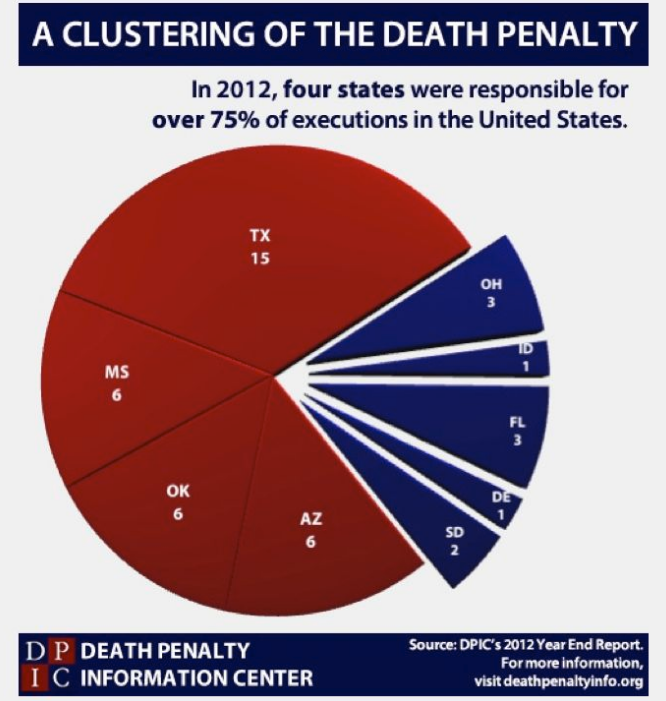
The lottery determining who gets the death penalty in America vastly depends on location. Defendants who live in Texas, Mississippi, Oklahoma, and Arizona are the most likely to get executed in the country. Texas is notorious for carrying out the death penalty that I'm surprised it executed only 15 people in 2012.

The lottery determining who gets the death penalty in America vastly depends on location. Defendants who live in Texas, Mississippi, Oklahoma, and Arizona are the most likely to get executed in the country. Texas is notorious for carrying out the death penalty that I’m surprised it executed only 15 people in 2012.

8. Jurisdiction politics play major roles in capital cases than the facts of the crime itself and is applied at random. Another major factor in capital cases pertains to the makeup of juries which can also determine whether the defendant will receive a death sentence. A juror’s race, religion, and attitude toward the death penalty can influence how they cast the first vote during the jury’s penalty phase. White Southern Baptist males are more likely to support the death penalty than any other group and thus are more likely to cast first for death as well as be selected for these juries. Jury selection in these cases could be rife with discrimination which tend to ensue juries to be disproportionately prone to handing down guilty verdicts and death sentences. Many are said to have decided a defendant’s guilt and sentence before the trial even began and have a tendency to not understand their own duties such as considering mitigating evidence. Juries in capital trials are even said to deliberate less thoroughly and less accurate than juries that better represent the whole population. Also, give into account that most executions take place in the South and that significantly more death sentences are sought than carried out creates a lethal lottery in the criminal justice system. So it’s possible that a convenience store armed robber can receive death while a methodical serial killer gets prison.

9. Capital punishment doesn’t relieve suffering from the victims’ loved ones. While proponents claim that capital punishment brings closure to victims’ loved ones, they tend to overlook the long and complex legal process as well as the heightened media coverage. These factors can make the death penalty process for victims’ families for many years (average capital cases usually take about a decade sometimes even longer), often requiring them to relive the pain and suffering with the endless reopening of old wounds. Media coverage on death penalty cases will usually focus on the legal consequences instead of the human ones where it belongs and attention is more often centered on the accused. Not to mention, hundreds of millions of dollars are spent on the death penalty each year which could be better spent on violence-prevention efforts, victims’ services, or solving unsolved cases. A life sentence without parole can provide certain punishment without putting murderers in the headlines, which may allow grieving families some time to heal since their loved one’s case doesn’t have to be revisited again.
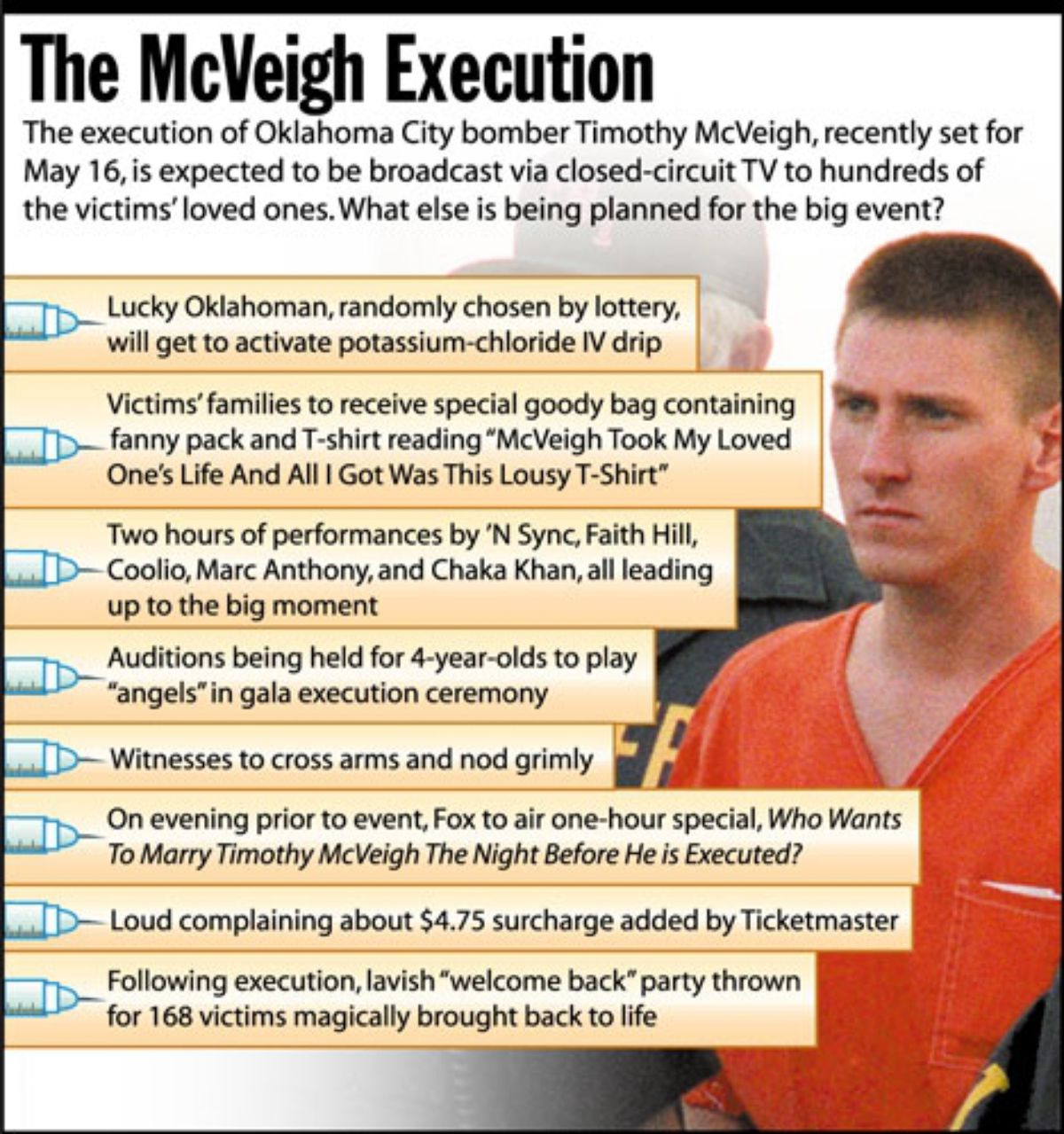
Now this Timothy McVeigh graphic was taken from a satirical newspaper called The Onion. But it demonstrates how guys like the Oklahoma City bomber got tons of publicity in the days leading up to his execution. Now McVeigh was a terrorist who killed about 168 people and injured over 680. Had this guy gotten life in prison, we would've not heard about him again until his death in obscurity from natural causes. He didn't deserve the publicity or have his execution be front page news.

Now this Timothy McVeigh graphic was taken from a satirical newspaper called The Onion. But it demonstrates how guys like the Oklahoma City bomber got tons of publicity in the days leading up to his execution. Now McVeigh was a terrorist who killed about 168 people and injured over 680. Had this guy gotten life in prison, we would’ve not heard about him again until his death in obscurity from natural causes. And you’ll only hear about it in the obituary section. This was the death he deserved.

10. The death penalty gives some of the worst offenders undeserving publicity. Capital cases bring more media coverage and public interest than those pertaining to any other sentence. It’s not uncommon for death row inmates to receive reams of publicity as their date of execution nears which gives them a chance to expound their ideas and become media celebrities. The media attention placed on death row inmates not only can give families more grief but also may encourage others to commit violent acts, especially unstable people attracted to media immortality. Since death row inmates have their days numbered, they don’t really learn from their crimes and may not even regret them. On the other hand, violent offenders who receive life in prison without parole will face a lifetime of obscurity and regret, which may make the path to violence far less glamorous for many. Perhaps maybe be sentenced to hard labor to pay reparations for the victims’ families. If there is anyone who doesn’t deserve media coverage, it’s a murderer. While a death row inmate’s execution gets front page news, a notorious killer sentenced with life in prison won’t be remembered until his or her name appears in the obituary section.
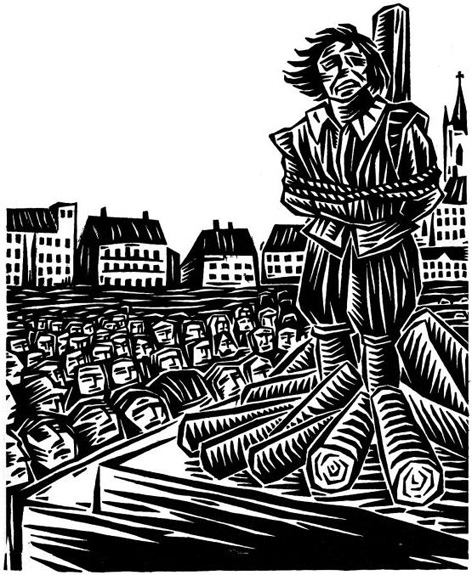
For a long time in history, people watched public executions as a form of entertainment. Today executions are usually covered by the press leaving details of the prisoner's last moments. Nevertheless, executions teach that killing is always a viable solution even though it isn't.

For a long time in history, people watched public executions as a form of entertainment. Today executions are usually covered by the press leaving details of the prisoner’s last moments. Nevertheless, executions teach that killing is always a viable solution even though it isn’t.

11. Executions have a corrupting effect on the public. Public executions have been seen as a form of entertainment throughout much of history since many people didn’t really have access to all the mass media outlets we have today like books, TV, or internet. Yet, given the amount of media attention placed on death row inmates, there is probably no doubt that executions attract some degree of excitement in the public. TV crews don’t hesitate to give details of the prisoner given a stay of execution during the appeals process in the execution chamber. And then there are the last visits from family, the last meal, the last walk, and the last words. Many times this could turn into one big dramatic soap opera with people wanting to see a criminal die. Of course, The Hunger Games may argue that the public likes to see almost anyone die, which kind gives insight about capital punishment’s fucked up entertainment value. And there were even people entertained by the brutality in that series while missing the point the trilogy tried to make. Yet, sometimes such spectacles of executions may teach the public that killing is a viable solution even though it isn’t.

12. The death penalty is incompatible with human rights and human dignity. The notion of the state taking another’s life without questioning the mitigating circumstances is perhaps one of the main reasons why capital punishment faces plenty of opposition from religious groups, especially during recent times. When it comes to right to life, many people believe this also extends to the lives of convicted criminals and that capital punishment essentially dehumanizes people and society. If life is considered an inherent human right, then capital punishment must be a human rights abuse, especially since its also attached to a bunch of other forms of injustice. Many believe such abuses to be unacceptable, especially if such actions are illegal among the general public. Some may claim that it’s impossible for anyone to determine who deserves to die or be spared. It also violates a person’s right not to be tortured or be subject to any form of cruel and unusual punishment since there is no humane way to kill. Many religious groups oppose capital punishment for these reasons. Yet, since the US continues retaining the death penalty which denies a person’s right to life, then it can deny other rights that go along with it. And it doesn’t help that most countries that still have the death penalty are notorious human rights abusers like Iran, North Korea, Saudi Arabia, and China.

13. The death penalty promotes revenge. When someone is murdered, it is only natural for people to want something done to his or her killer. A lot of times many grieving families do wish that the murderer be put to death and while the emotional impulse for “an eye for an eye” is strong, it’s not always right, even if it does appear often in movies. Revenge should never be a sufficient justification for capital punishment in a mature society, especially one that should show much more respect for life even that of murderer. Encouraging revenge through execution only continues the chain of violence as well as increases the risks of angering the condemned’s families, especially if they were later found to be innocent. Besides, even with capital punishment, our society has never endorsed “an eye for an eye” since we don’t torture torturers or even rape rapists since those actions are inhumane anyway. For victims’ families, reconciliation and forgiveness are better alternatives.

14. Capital punishment forces families of executed criminals to suffer in unimaginable ways. Families of criminals never have it easy in any society and tend to suffer not only for the crime but also by the system that tries them. In any murder case, there will always be at least two families who suffer on opposite sides. While the victim’s family has to deal with losing a loved one, the murderer’s family has to deal with a lot of emotional turmoil as well since no one wants to see a loved one convicted. In a capital case, this is especially  true since the killer’s life is at stake and no matter how terrible a murderer is, he or she still has people who care about them and would certainly miss them. Yet, unlike families of murder victims, families of executed criminals have to live with their loved one’s crimes even if he or she doesn’t. And many of them will have to mourn for their executed loved one in isolation while receiving little sympathy for their plight. They run the risks of being vilified and shunned by the community simply because of their association. Sometimes they may even lose jobs, be threatened, or have their homes vandalized. Some ran the risks of experiencing PTSD when seeing a loved one’s execution. Not to mention, many children of executed criminals may not understand what happened or be able to handle it. And many of these families aren’t well off. Proponents may say that criminals cause their own families to suffer but while that may be true, their lives may be so much easier if their convicted loved one didn’t have to die.
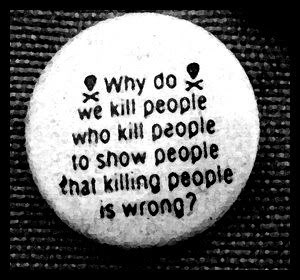
The notion that the death penalty involves killing murderers to show that killing is wrong is a glaring hypocrisy. Besides, all an eye for an eye amounts to is just revenge. And revenge is something we don't need.

The notion that the death penalty involves killing murderers to show that killing is wrong is a glaring hypocrisy. Besides, all an eye for an eye amounts to is just revenge. And revenge is something we don’t need.

15. Capital punishment sends a message in a most hypocritical way possible. When we’re young, we’re told that killing is wrong, yet Americans live in a country which still condemns killers to death to teach that no one has the right to kill. Though killing may sometimes be necessary when it can’t be avoided, it’s seldom justified. Yet, if a nation executes people for murder, then perhaps the country is no better than the crooks it condemns. Maybe even more so if those executed are innocent people. Yet, giving some of the circumstances of death row inmates and victims  in the US, it can also be used to show that some lives are worth more than others, which is a very terrible lesson to teach. It’s hypocritical enough if it’s Ted Bundy getting executed but what does it say about this country if it tries to teach that killing is wrong by issuing a death sentence to people of color too poor to defend themselves? Some may argue that an entity saying who lives or dies is equivalent to playing God.

Barbara Graham was a prostitute, drug addict, and a thief. However, her murder case involving the killing of Mabel Monohan shows how complicated a murder case could be. There are conflicting accounts by two of her associates in the crime. So it's hard to say whether she did it but she was convicted and executed of the crime anyway.

Barbara Graham was a prostitute, drug addict, and a thief. However, her murder case involving the killing of Mabel Monohan shows how complicated a murder case could be. There are conflicting accounts by two of her associates in the crime. So it’s hard to say whether she did it but she was convicted and executed of the crime anyway. Probably should’ve been sentenced to life.

16. Life in prison is a much better solution in difficult cases. Even when a defendant in a capital case is guilty and sentence to death, you can’t really determine whether capital punishment is ever justly applied. While some proponents may think capital punishment should only apply to those convicted of the worst crimes, many get executed on serious crimes that are hardly seen as remarkable. Death row inmates are almost always too poor to defend themselves while socially marginalized people of color are especially vulnerable to receiving a death sentence and they usually are represented by court appointed attorneys who hardly put up an adequate defense. And sometimes local politics can play a major role on who gets to be on the penalty phase jury. Not to mention, there’s a good chance that many prisoners on death row may have an undiagnosed mental illness or experienced some form of trauma during their lives, have experienced substance abuse, and may have killed out of anger or impulsively. Murder cases can be very complicated and capital cases can take years to sort out whether the murderer should be executed. However, in cases with the penalties being life in prison, the defendant just needs to be convicted and the decision can be reversed if needed. Besides, sentencing criminals to prison usually falls to the judge, not jury so local politics play little influence in it. Also, most guilty lifers usually fade into prison life obscurity shortly after they leave the courtroom. When it comes to difficult case, life in prison provides a more swift and certain punishment while capital punishment provides neither.

17. Capital punishment hurts other prisoners, too. While proponents may say that capital punishment is a good bargaining chip for murderers to serve life without parole since everyone fears a death sentence. Yet, there is no correlation whether the death penalty does just that. What a death sentence threat can do, however, is increase the likelihood of some defendants more willing to accept a given plea bargaining offer or even taking responsibility for a crime they didn’t commit. After all, many defendants don’t have adequate legal representation anyways and a threat of execution may give them more reason to give up their constitutional right to a trial to save their lives. Scaring defendants into confessing things isn’t a reliable form of interrogation and can even ruin people’s lives. Sometimes execution threats can result in more cases going to trial, which I have already discussed what could happen there. Still, using the death penalty as a plea bargaining chip may increase the risk of wrongful convictions and may do little to deter wrongful executions.

Yes, this is a funny cartoon from Bizarro, a favorite comic of mine. However, being an executioner isn't a nice job since they tend to suffer from PTSD from having to kill. So there's no reason why any correction worker should risk their mental health over revenge.

Yes, this is a funny cartoon from Bizarro, a favorite comic of mine. However, being an executioner isn’t a nice job since they tend to suffer from PTSD from having to kill. So there’s no reason why any correction worker should risk their mental health over revenge.

18. No civilian’s job description should include killing another person. Despite how they appear in movies, the occupation or executioner was often an undesirable job that it was performed by people who’d otherwise be executed. These people were often unskilled in their work as well as suffered from a lot of mental anguish over it. And it wasn’t uncommon for many to commit suicide. Of course, we don’t have executioners anymore in the Western World since many countries have abolished capital punishment or in America’s case, aren’t carried out very often. But when they are, executions now are performed by corrections officers and medical doctors. And these people don’t have benefit of having heard all the evidence presented to them at the trial, which might make some doubt the defendant’s guilt. Like the executioners of old, they’re involved with executions and frequently suffer from PTSD from having to kill. Prisoners pose no threat to our society once in custody. So there’s no reason why correction workers should risk their mental health simply to pursue vengeance.

Supporters who think the death penalty as a cheaper alternative to life in prison often forget the complex appeals process involved in arranging an execution. In California, this usually takes 25 years. That time could be better spent in the court system.

Supporters who think the death penalty as a cheaper alternative to life in prison often forget the complex appeals process involved in arranging an execution. In California, this usually takes 25 years. That time could be better spent in the court system.

19. Capital cases involve endless appeals processes and required additional procedures that clog our court system. Now the US criminal justice system is already overloaded with more cases than it can deal with. And despite what you see on TV or movies, legal procedures aren’t short affairs. It can take years for a case to go to court and there have to be so many legal procedures to take place before a trial could begin. Most lawyers usually try to avoid trials. The criminal justice system is no exception, which is why most criminal defendants take plea bargains. In death penalty cases, trials aren’t optional. If the defendant is convicted and sentenced to death, there are countless appeals processes and other legal procedures that cost not just taxpayer money, but also time and space. And the US court system tends to go to great lengths to see the death sentence carried out. Thus, all the appeals, motions, hearings, briefs, etc. monopolize much of the time of judges, attorneys, and other court employees as well as use up courtrooms and facilities. Nationally on average it’s said that the process takes 8-10 years. Such time and space could be used for other unresolved matters. Meanwhile, you have people in jail for years simply waiting for their day in court. And most defendants are encouraged to take a plea bargain simply because the US court system is tremendously backed up. Getting rid of the death penalty may help move things along.

20. High profile death penalty cases attract top talent lawyers for little or no cost due its publicity and their personal beliefs against capital punishment, increasing the chances of a technicality or a manipulated jury will release a guilty person. While most death penalty cases usually involve terrible legal representation, ones that attract an excessive amount of publicity tend to attract top lawyers who desperately want attention and can manipulate the system through any means necessary in order to get someone off without punishment. And besides, defending someone accused of a horrendous crime garners much more sympathy than representing a crooked Wall Street executive. This is especially true if the defendant is a young white woman who’s fairly attractive like Barbara Graham or Casey Anthony. There are entire organizations that sprung up to fight death penalty cases and often provide funding to legal defenses. And many lawyers have made stomping out capital punishment a lifetime crusade.
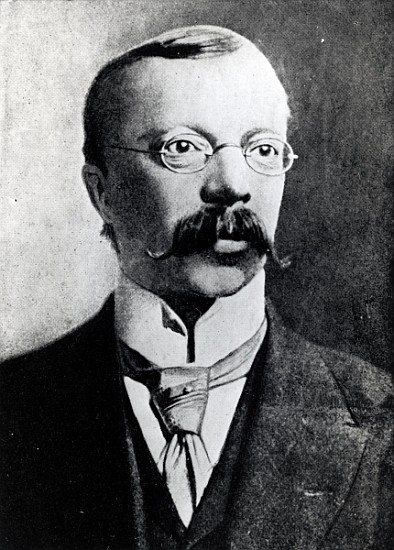
Dr. Hawley Harvey Crippen was a homeopathic physician and outright quack who was charged with brutally murdering his wife Cora at their London home in 1910. He was tried, convicted, and executed. At the time everyone saw him as guilty. However, it's apparent that the body parts found in his basement were planted by Scotland Yard who were under tremendous pressure to solve a heinous crime. Besides, recent DNA evidence has revealed that the body parts found not only weren't Cora's but also belonged to a dude.

Dr. Hawley Harvey Crippen was a homeopathic physician and outright quack who was charged with brutally murdering his wife Cora at their London home in 1910. He was tried, convicted, and executed. At the time everyone saw him as guilty. However, it’s apparent that the body parts found in his basement were planted by Scotland Yard who were under tremendous pressure to solve a heinous crime. Besides, recent DNA evidence has revealed that the body parts found not only weren’t Cora’s but also belonged to a dude.

21. High profile death penalty cases put enormous pressure on the prosecution and police that they encourage misconduct. Since death penalty cases attract media coverage, law enforcement and prosecutors are under pressure to show that justice in their mind has been done. And they tend to do all they can to ensure a conviction, sentence, and execution. And pressure tends to lead to some degree of misconduct which can result in a wrongful conviction. Hell, even in non-death penalty cases there’s still a lot of pressure and fuck ups. Failure to catch Jack the Ripper put British police and Scotland Yard under intense public pressure to solve the case of Cora Crippen’s disappearance in 1910 in which friends suspected that her husband, homeopathic physician and outright quack, Dr. Hawley Harvey Crippen had something to do with it. I mean he and his wife didn’t get along before she disappear without a trace and was openly living with his girlfriend shortly after (who was wearing Cora’s clothes and jewelry) as well as selling some of his wife’s stuff. And when they found a set of grisly remains under the Crippens’ basement floor (suggesting she was brutally murdered), the guy was arrested on a transatlantic cruise ship while trying to flee to Canada with his girlfriend (both disguised as a father and son). He was tried, convicted, and executed. At the time the Crippen ordeal seemed like an open and shut case while everyone thought him as obviously guilty as hell (ditto the fact it received an obscene amount of media coverage in 1910).  However, despite how he was about as convicted by public opinion like Casey Anthony but utterly lacked her great fortune, Crippen was almost certainly innocent of killing his wife (well, as far as we know. Then again, we have absolutely no idea what happened to her after her disappearance). We know this for these reasons:

  1. Modern DNA test results show that the remains found in his basement not only weren’t Cora’s but also belonged to a man. (This based on mitochondrial DNA tests from the torso against that of Cora’s great-nieces and one DNA test method that’s highly sensitive to the Y chromosome {which was done several times}. However, the DNA stuff has been contested).
  2. Cora Crippen disappeared in January of that year while Dr. Crippen was arrested in July, which was around the time the remains were found. Thus, this would mean the remains would’ve been sitting in the Crippens’ basement for almost 6 months. During this time Scotland Yard had searched the Crippens’ home a total of 5 times.
  3. The remains were found under the Crippens’ basement floor in an area that was under the dining room. As someone who’s seen dead critters decompose on the side of the road, I’m well aware that decaying flesh gives off an odor that is strong and foul. And even the stench of a dead possum can be smelled from several feet away. If Dr. Crippen killed his wife and disposed her remains in his basement, then the police should’ve been able to find Cora’s body parts on their first search. Not on their fifth within a 6 month period. Large areas in the house should’ve carried a stench that there was a dead body in there.
  4. The remains were said to be placed in quicklime to be destroyed. While dry lime can disintegrate stuff in no time, the dirt underneath the Crippens’ basement floor was wet. And when lime meets water, it becomes slaked lime which is a preservative. The cops should’ve found more body parts.
  5. The remains included no head, limbs, and skeleton. In fact, they mostly consisted of soft tissue such as skin, hair, organs, and muscle. Anyone who’s worked with dead bodies can tell you that soft tissue usually decomposes before bones. So why the police were able to find soft tissue in Crippen’s basement and not bones? Even Raymond Chandler thought it was unbelievable that this guy can dispose his wife’s limbs, head, and skeleton successfully but bury the torso under the cellar floor of his home. And the way the authorities try to justify how Crippen disposed the other body parts pertain to methods you see on Breaking Bad or Dexter.
  6. Police reports state that the victim had been poisoned and then mutilated and dismembered. Most poisoners usually try to cover up their murders by doing all they could to make it look like an accident. Such sick acts like mutilation are extremely rare among poisoners and are things we associate with serial killers like Jack the Ripper. In fact, this is the only poisoning case involving dismemberment most poison experts are aware of. Besides, such acts seem such an unnecessary step for someone who wants to quickly dispose a body.
  7. The so-called scar tissue found that was interpreted as consistent with one Cora was known to have due to the hair follicles, which convinced the jury that the remains found at the Crippen house were hers. Scars don’t have hair follicles, a fact so obvious in 1910 that Dr. Crippen’s defense pointed it out.
  8. The circumstances surrounding how the remains were discovered gives me the impression that someone put them at the scene with the intention to be found and to make Crippen seem like very sick individual. Remains suggesting a horrifically grisly murder would be guaranteed to make headlines. And the case didn’t go public until after the remains were found. The fact Scotland Yard was under tremendous pressure to arrest someone for a heinous crime gives me reason to think that the remains were planted during the final search.

It’s obvious that Crippen was a victim of police misconduct of planting evidence, which not only got him convicted of murder but also got him hanged. I’m not sure how much the death penalty influenced this case in 1910 since it was applied far more often, but a high profile case like Crippen’s does fall prey to errors by the prosecution whether it be police brutality, planting evidence, mistaking the evidence, politics, racial profiling, or what not.
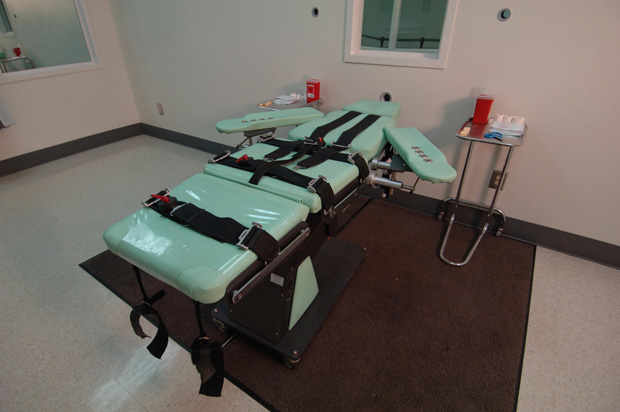
No, this isn't a bed from Christian Grey's sex dungeon. This is a bed they use to restrain a prisoner for lethal injection, the most popular method and

No, this isn’t a bed from Christian Grey’s sex dungeon. This is a bed they use to restrain a prisoner for lethal injection, the most popular method and “humane” execution method in America. This involves strapping a person to this thing, knocking them out, and injecting a bunch of poisons in them. Sounds like a humane way to execute someone? Didn’t think so.

22. There is no such thing as a humane execution. For a long time in history, executions happened all the time and nobody gave a shit whether the methods were humane or not, at least until recent times. In fact, in the olden days, executions were supposed to be agonizing, slow, and cause much suffering as possible. Think of Jesus’s crucifixion and how he suffered a horrifying and tortuous death on a cross. Yes, it’s brutal but that was how most people before recently, thought how executions should be. And they were done in public to scare people straight as well as provide entertainment for the community. The idea that punishment shouldn’t be cruel and unusual is a recent invention. But nowadays, we tend to struggle with not having cruel and unusual punishment when it comes to the death penalty since it involves killing someone. Since the idea that capital punishment hast to be “humane” there have been execution methods consisting of hanging, electrocution, gas chambers, firing squad, lethal injection, and what not. Now we’re well aware that the gas chambers were used by the Nazis to kill Jews in their concentration camps. Still, when you see some of these methods on TV or movies, they don’t seem anywhere near humane. I mean does being shot by firing squad seem like a quick and painless way to die? Not how I see it. Or what about having a ton of volts pumped into your head? Me neither. Or what about being injected with poison? Didn’t think so. Besides, it’s said that most lethal injections tend to be botched at a higher rate than most 19th century methods.

Another popular execution method in the US is the electric chair where a prisoner is strapped to a chair like this and is electrocuted. Let's just say if the electric chair doesn't seem humane on The Green Mile, then it's probably not in real life.

Another popular execution method in the US is the electric chair where a prisoner is strapped to a chair like this and is electrocuted. Let’s just say if the electric chair doesn’t seem humane on The Green Mile, then it’s probably not in real life.

23.  The death penalty expresses the absolute power of the state; abolition of this penalty is a much-needed limit on governmental power. Governments may not be perfect and the criminal justice system may make mistakes as well as commit their share of injustices. In some ways giving governments the power to kill somebody is too much. And it doesn’t help that many governments have and still do abuse this. Many of these governments are dictatorships that have executed people for dissent and who knows what else. But not even liberal democracies are exempt from this either. The US criminal justice system struggles with issues pertaining to incompetence, perjury, police brutality, and wrongful convictions. Do you want a government like that to decide whether a person lives or dies? The US constitution doesn’t forbid the death penalty nor does it mandate its use either. Congress is free to abolish it at the federal level and so would the states.

Although most Americans still support the death penalty, support has considerably declined in recent years while opposition has grown. At the government level, more states have voted to abolish it due to costs. Not only that, but most violent criminals are usually sentenced to life in prison anyway.

Although most Americans still support the death penalty, support has considerably declined in recent years while opposition has grown. At the government level, more states have voted to abolish it due to costs. Not only that, but most violent criminals are usually sentenced to life in prison anyway.

24. The death penalty has recently fallen out of favor, even in the United States. For a long time in history, the capital punishment was usually the only punishment for violent crimes. But as our societies evolved and realized that we could just imprison violent criminals instead of killing them, the death penalty has been applied less and less (except in dictatorships). Not only that, but as many as 139 countries have abolished it throughout the world. In the US, a death penalty case happens so seldom that one is bound to grab headlines, which adds to many violent criminals gaining undeserved publicity. Not to mention, while most Americans still support capital punishment, opposition has increased and as of 2015, 18 states have now abolished it. 6 of them have abolished it within the last decade. Out of the states that do, some haven’t had anybody executed in years. Hell, I can’t remember the last time Pennsylvania had anyone executed. Besides, most death row inmates usually die of natural causes before their execution date.

25. The severity of the crime plays no role in determining whether a defendant gets executed. Many supporters argue that the death penalty is supposed to be only applied to the worst crimes and the most vile offenders. However, most death sentences are determined on location, politics, socioeconomics, race, jury make up, quality of legal counsel, and whether or not the prosecutor decides to pursue it. Yes, I’m aware that death row inmates are generally not nice people. However, we should be aware that some of the most heinous murders don’t result in death sentences while some less heinous crimes are punished by death with co-defendants charged with the same and consistently receiving disparate sentences. Some of the worst of the worst like serial killers, gang kingpins and the like, are often spared the death penalty since prosecutors rely on their cooperation to help law enforcement close related cases. Nevertheless, such structures and biases in our society can make it impossible to limit the death penalty to some of the most heinous crimes by the most hardened criminals.
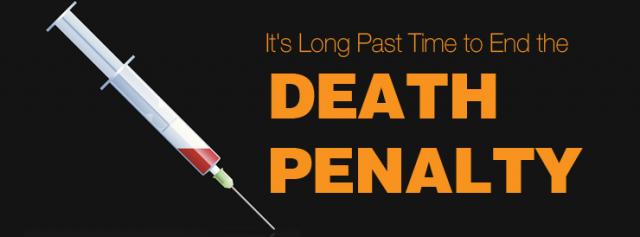
Yes, it's long past due to end the death penalty. And I have to agree that capital punishment doesn't help crime, doesn't prevent prison overcrowding, is expensive, and can never be humane. Let's just say the United States would be better off if we got rid of it. And no, I don't give a shit about what the people in Texas think about it.

Yes, it’s long past due to end the death penalty. And I have to agree that capital punishment doesn’t help crime, doesn’t prevent prison overcrowding, is expensive, and can never be humane. Let’s just say the United States would be better off if we got rid of it. And no, I don’t give a shit about what the people in Texas think about it.
Worst Arguments for Not Enacting Gun Control

gun_control_means_nothing_to_my_students

Disclaimer: The following might contain a lot of highly controversial political views about an issue that many Americans have strong opinions about. It runs a high risk of inciting outrage, anger, trolling, and hostile retaliation. Viewer discretion is advised.

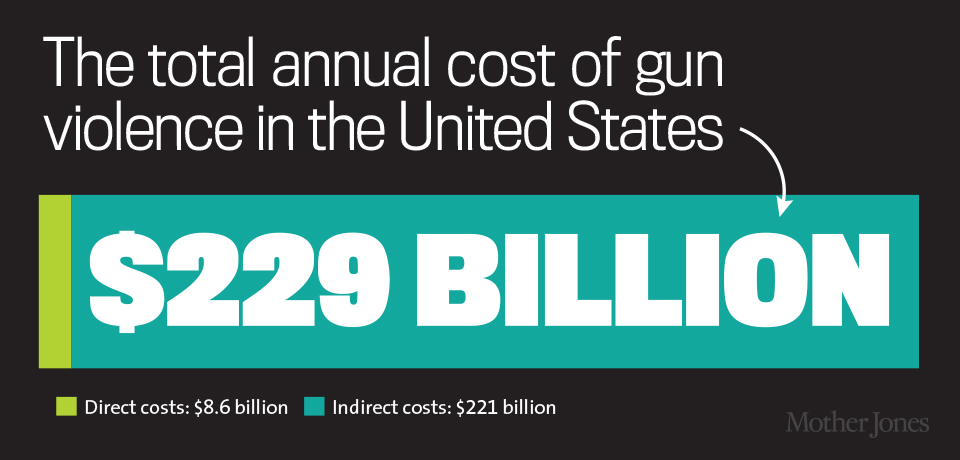
As a Catholic liberal, I’ve been a long advocate for gun control. I’ve was nine years old during Columbine which was one of many mass shootings in the United States I’ve seen on the news. Not to mention, the fact so many people have been killed, injured, or scarred for life due to gun violence has cost taxpayers at least $100 billion annually as well as become a major public health concern. So I’m fully aware that certain gun control measures are badly needed and a lot of Americans would agree with me. And it’s not just liberals since we have to remember that the late James Brady was an official for the Reagan administration. Yes, the late great conservative Ronald Reagan whose fiscal conservative policies led him to raise taxes, had something to do with the Iran Contra scandal,  as well as had an openly gay son whom he freely accepted. But despite the urgent need for gun control I should not have to remind anyone about, GOP and NRA interests have made sure that their Second Amendment rights are protected at all costs. Even if it leads to a lot of innocent lives being slaughtered, high health costs, full emergency rooms, and an overworked criminal justice system. Not only that, but many states have passed gun laws that Americans don’t need, but also make this problem worse. Yes, I know that gun control is a highly contentious issue. But come on, do I really give a shit about gun rights? Now I’m fine with people owning guns as long as they’re law abiding citizens who don’t have personal issues that might endanger others. But do I think anyone has the right to own an AK-47 with a 30 round magazine? Absolutely not. Why? Because I can’t think of any reason why a civilian might need it save maybe in an event of an alien or zombie invasion. Here I list many of the arguments gun rights advocates make when it comes to doing nothing to necessary gun control.

  1. “Guns don’t kill people, people kill people.” – This is the most common argument gun rights people make in regards to gun violence. It basically says that people are responsible for their own actions and what they do with guns doesn’t mean that we have to enact any gun control. Yes, people kill people. However, guns are weapons specifically made to kill people with firearms technology designing weapons to kill as many people as possible. Thus, when it comes to killing people, guns are usually the weapon of choice. And most criminals will use other weapons when they can’t get a gun. Firearms were intended to kill people from the very beginning. To make a gun that doesn’t kill would be like removing a gun’s reason to exist. Yes, people kill people. But guns kill since it’s their point. Besides, when a gun is used incorrectly, someone or something doesn’t get shot. Let’s just say that we can’t talk about gun violence without acknowledging what guns are actually used for.
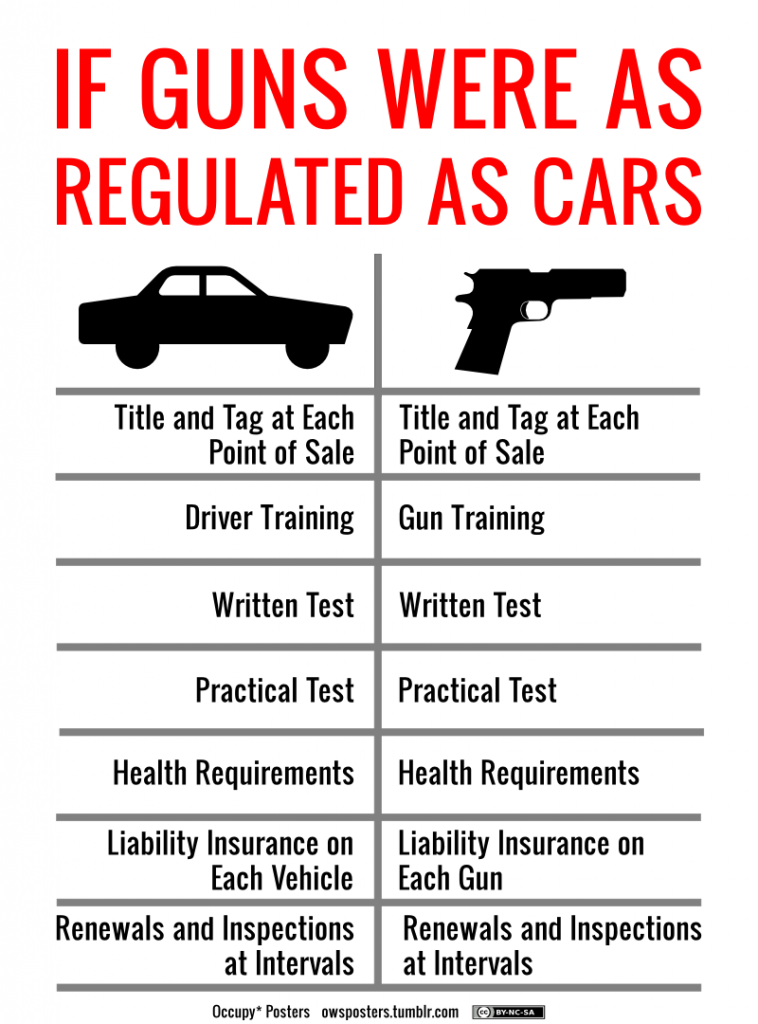
This is a diagram stating how gun laws would be if they were regulated like cars. Not that in the US it's harder to get a driver's license than it is to buy a gun depending on your jurisdiction.

This is a diagram stating how gun laws would be if they were regulated like cars. Not that in the US it’s harder to get a driver’s license than it is to buy a gun depending on your jurisdiction.

2. “________ kill people, too. You want to outlaw that?” – Gun rights activists love to point out how so many other things tend to kill people as well. Cars and alcohol are usually the most prominent examples. I’m well aware that cars kill more people than guns each year. However, in the US, it’s said to be more difficult to obtain a driver’s license than a firearm. Besides, we have a lot of regulations on cars like seat belts, speed limits, license and insurance requirements, and bans on drunk driving. If you cause an accident resulting in fatalities, you might do time for manslaughter. If you’re caught driving drunk, you might spend time in jail or lose your license. Besides, most people use cars for transportation, not to kill people. We also have regulations on alcohol and tobacco. Not only that, but there are plenty of things that could kill people but also fulfill other purposes like chainsaws and knives for instance. Guns, on the other hand, exist for one function which is to kill. And firearms technology has advanced in order to kill more efficiently, particularly people. I mean why was the AK-47 even invented in the first place? As for outlawing them, it’s highly unlikely that would even happen. Oh, by the way, the US has more gun stores than grocery stores, which is incredibly disturbing if you ask me.

3. “Guns save lives.” – Now there are plenty of stories pertaining to defensive gun uses. However, most of these usually exist in the mind of Hollywood screenwriters hired to write an R-rated action movie. A study in 1993 determined that there were 2.5 million defensive gun uses every year. This involved calling 4,977 people across the country, asking them a few gun questions and adjusting the number to fit the population of the whole nation. Now the 2.5 million number is highly cited and highly disputed. However, this number doesn’t translate to “lives saved thanks to guns.” In fact, they refer to guns being involved in the presumed person or thing’s protection. This can apply to life-threatening situations pertaining to people who were in actual danger as well as to people like George Zimmerman. So to say whether guns save lives is a mixed bag. Sometimes gun use might kill a criminal or stop a crime. Other times, gun use will fuck up everything. Nevertheless, there’s nothing defensive about gun use since it’s meant to attack and always will. Defense is protection such as a security system, mace, or a bullet proof vest. But whether guns save lives, it’s fairly hard to say at least when it involves civilian gun owners.

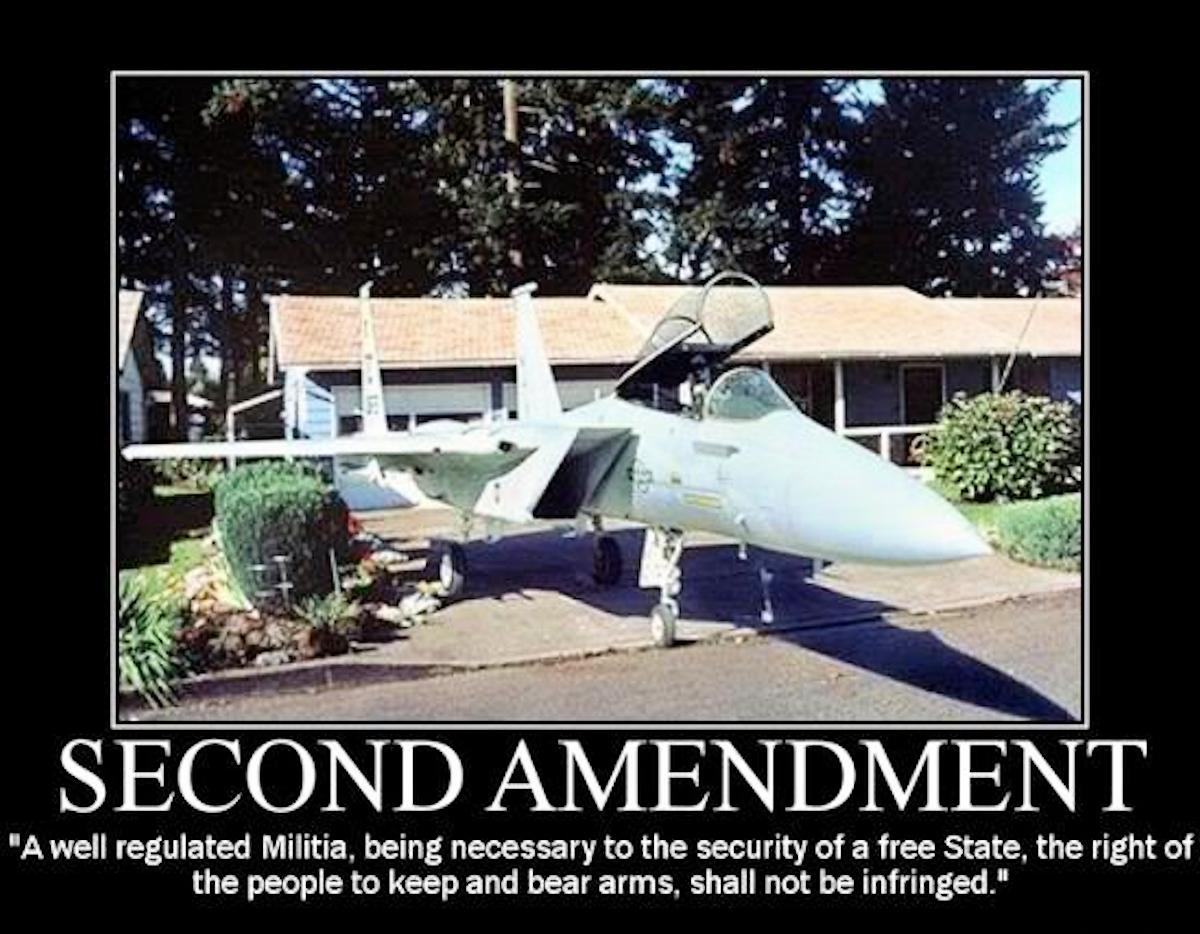
4. “Well, the Second Amendment says……” – Gun rights activists love to cite the Second Amendment which actually says, “A well regulated militia being necessary to the security of a free State, the right of the People to keep and bear arms shall not be infringed.” Now there’s a lot of debate about what it actually means. Some people think it pertains to individual gun ownership. Others think it refers to people in a militia. Still, either way, asking the Founding Fathers their opinion of contemporary American gun culture would be like asking Pope Francis on what he thinks about NFL football (then again he probably knows it’s not “football” as he knows it but not much else). To the Founding Fathers, the only guns available were single shot muskets which had a more complex loading process and weren’t very accurate. I mean the American Revolution gave rise to the term “minuteman” meaning a Continental soldier who was ready to fire at a minute’s notice. Then you have the saying “don’t fire until you see the whites of their eyes,” meaning “don’t shoot until they’re close enough for a sure hit.” Weapons that fire multiple times without reloading didn’t come until the mid-19th century with the American Civil War. Besides, we all know that some of the Founding Fathers also thought slavery was an economic necessity and they weren’t right about that. So maybe relying on them for gun issues isn’t the best idea.

While gun rights activists continually say that

While gun rights activists continually say that “an armed society is a polite society,” we should all learn from the impact of “Stand Your Ground” laws that this isn’t the case at all. I mean look what happened to Trayvon Martin. He was just a teenager minding his own business but gets shot anyway. So much for a polite society.

5. “An armed society is a polite society.” – Gun rights activists like to use this argument which states that people with guns encourage others not to mess with them. Sort of like a “scared straight” approach in which a lethal threat or fear of untimely death can be used to keep people in line, deterring prospective criminals. And through such, an armed society will ensure lasting peace and security within a community. However, this notion ignores a lot of things about human nature, especially when it pertains to gun violence. For one, you never know what can set somebody off to view you with suspicion as a possible threat to their lives despite all evidence to the contrary. In other words, the trigger could be just about anything. Second, some people are easier to piss off than others and for very trivial reasons. Yes, an armed society might scare people from insulting or offending gun owners. However, you can easily insult or offend somebody even if you have no intention to. Third, people have been killed for very stupid reasons, especially in states under “Stand Your Ground” laws. Trayvon Martin was just an unarmed teenager minding his own business when George Zimmerman picked a fight with before shooting him dead. A retired cop shot a unarmed man in a movie theater for allegedly throwing popcorn in his face. Another guy shot a bunch of unarmed teenagers for playing their music too loud near a gas station (and after they turned down the music as he requested). Fourth, armed societies don’t protect or respect the rights of non-gun owners as well as vulnerable populations that might be viewed with suspicion. And these “Stand Your Ground” laws demonstrate this, especially since Florida’s mostly benefits white gun owners charged with shooting racial minority victims. Finally, sometimes the consequences don’t discourage people from committing crimes. In fact, some criminals might be fully aware of implications but choose to break the law anyway. For instance, an armed society wouldn’t deter anyone in the drug gangs on The Wire, because they practically live in one as a business environment. They know they’re criminals and commit their crimes fully knowing what’ll happen to them if they piss off their superiors or their enemies. And it could pertain to almost anything. Such notions give me serious doubts on whether an armed society is a polite one after all. To me, living in an armed society is more of a “walking on eggshells society” in which you have to be in public every day of your life afraid of committing the slightest offense that might give a stranger a reason to shoot you. This is not the kind of society I want to live in because scaring people straight by threatening their lives is no recipe for lasting peace and security and more of constant tense and tenuous standoff between warring parties. I’d prefer to live in a gun-free zone any day.

6. “Guns aren’t the problem. Our poor mental health system is the problem.” – Yes, our mental health system needs reform. But many gun rights activists think that reforming our mental health system might make all out mass shooting problems go away. However, they overlook two major things. First, like the general population, most mentally ill people are harmless. Second, while some mass shooters might have a mental illness, most do not. Third, they fail to take into account other factors play into the gun violence issue besides a poor mental health system like poverty, drugs, and gang activity in bad neighborhoods. In many ways, guns give people a sense of power and in the wrong hands it’s a deadly combination. Thus, even if the US mental health system is reformed and improved, there are other factors pertaining to gun violence that we have to deal with. Even if better mental health systems do prevent mass shootings, gun violence will still be a problem. Besides, as gun violence is concerned, mass shootings are only the tip of the iceberg since it’s a multifaceted problem with multifaceted solutions. And part of the solution is tighter enforcement and tighter regulation.

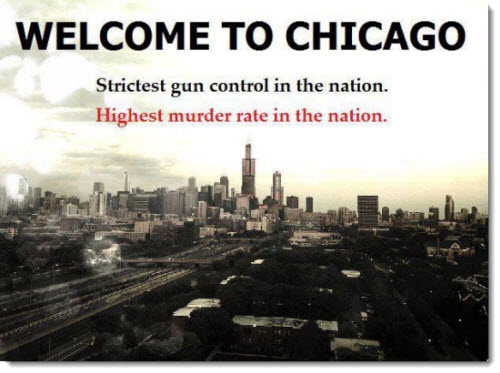
Opponents of gun control love to point out how Chicago has a very bad problem with violence despite its tight gun laws. However, little do they know that Chicago's gun problems have more to do with its laws being at city level, lack of stronger national gun laws, and geography. Besides, it was later found out that most firearms involved in Chicago gun crimes were legally bought in Indiana.

Opponents of gun control love to point out how Chicago has a very bad problem with violence despite its tight gun laws. However, little do they know that Chicago’s gun problems have more to do with its laws being at city level, lack of stronger national gun laws, and geography. Besides, it was later found out that most firearms involved in Chicago gun crimes were legally bought in Indiana.

7. “But gun control won’t stop criminals from getting guns and committing crimes.” – Yes, but that’s like saying that enacting laws isn’t worth it because they won’t stop people from committing crimes. But such laws against crimes help ensure people’s safety or they wouldn’t be on the books in the first place. Nor would we have punishments for breaking them either. So yes, they’re worth it. Then there’s the matter with how gun rights activists point out how Chicago has more violent crimes than Houston. Now since Chicago has tight gun laws and Houston doesn’t, then gun control isn’t very effective. However, they don’t note how US gun laws aren’t uniform between or within states and are rather inadequate at the national level. Take Chicago’s problems with gun violence for instance. Now while the city itself might have tight gun laws, the rest of Illinois does not and neither does Indiana. It was later found that many of Chicago’s guns come from surrounding areas like Indiana. Why? Because lack of a uniform gun laws allows firearms to travel from loose law areas to tight law areas. Weak national gun laws make it inadequate to crack down on illegal firearms circulation with most gun violence occurring with such weapons. Such weak national laws undermine attempts at gun control everywhere. Thus, any form of gun control Chicago implements will be ineffective not because of the laws themselves, but because Chicago has no legal authority to regulate firearm circulation outside its limits.

8. “Guns aren’t the problem. Exposure to violent entertainment is the problem.” – I’m well aware that violence in entertainment is endemic in our culture whether it be movies, TV, video games, and other media. However, while violence in the media might make viewers somewhat less sensitive to what goes on in real life, most of the time it doesn’t lead people into committing violent crimes. Yes, the US has a lot of violence in the media which appeals to a wide range of people. But most industrialized countries also consume a lot of violent media as well. Yes, I know that they watch and play the same violent stuff Americans do. But they also produce a lot of violent stuff of their own. Japan is known to produce a lot of violent movies and video games. Audition and Battle Royale are Japanese movies famous for their gore. But they have a lot movies featuring samurai and Godzilla. Oh, and they’re home to Nintendo and Sony, by the way. Great Britain produces a lot of murder mysteries and crime shows. Of course, you’d expect that in a country which produced Arthur Conan Doyle and Agatha Christie. But many recent British crime shows have death counts of 1-4 victims per episode. A British show called Midsomer Murders has a higher body count than The Wire. Sweden brought us series like The Girl with the Dragon Tattoo and Wallander both of which are disturbingly dark, violent, and gory. And then there is the Spanish Pan’s Labyrinth which has some cold blooded torture scenes that would make Jack Bauer wet his pants. Now if violent entertainment led to violent crime, these four countries would be in very deep shit. However, none of them have the level of gun violence prevalent in the United States. So the argument that exposure to violent entertainment encourages violent behavior is weak. Well, Britain may have a higher violent crime rate than the US but its gun crime rate is low. But even so, Britain still experiences far less murders than its crime shows depict, particularly the ridiculously violent Midsomer Murders.

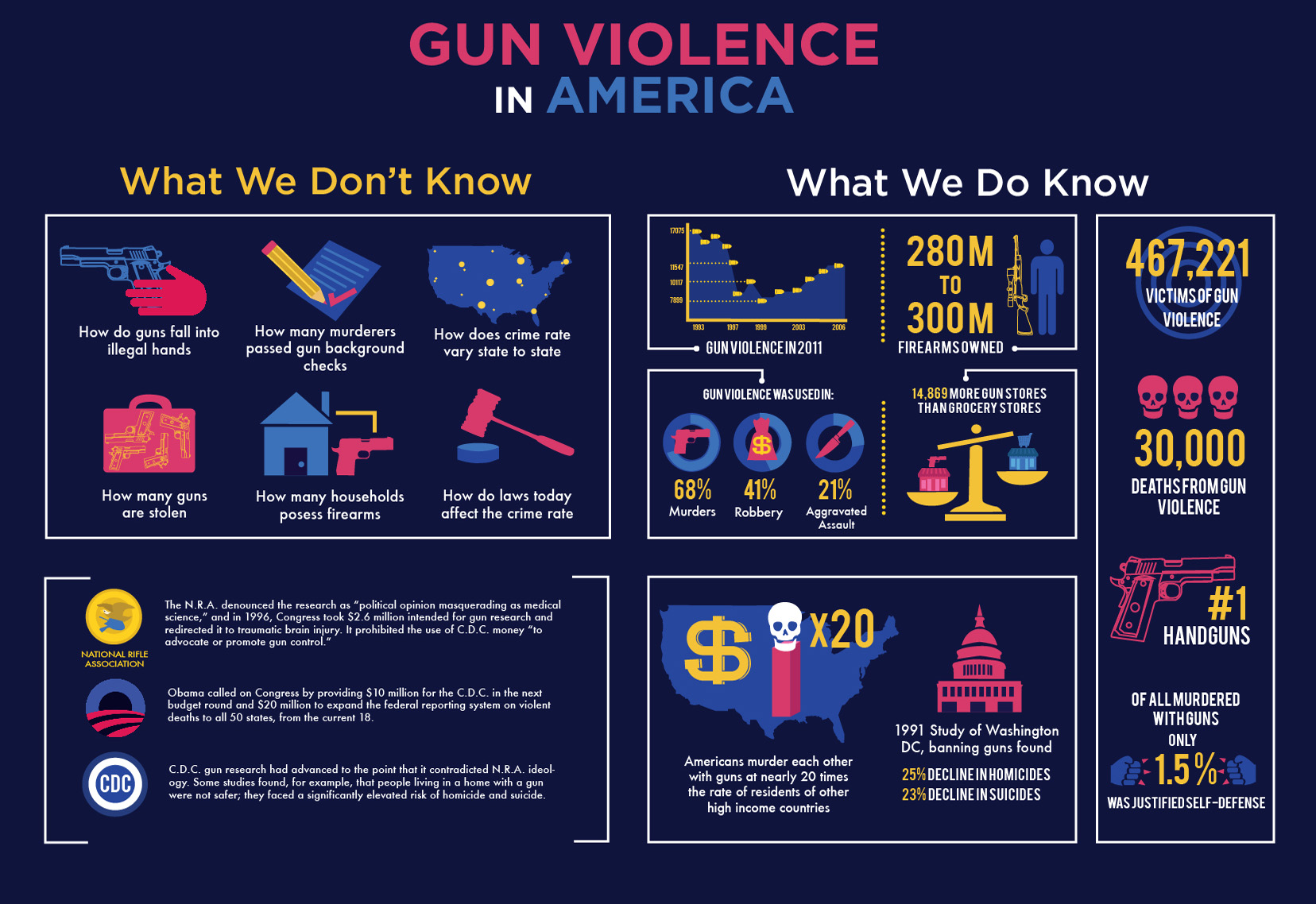
This is a handy infographic explaining the nature of gun violence. And yes, it goes to great lengths to say that it's definitely about the guns. Yes, it's a cultural thing but we can't really dismiss guns from the equation.

This is a handy infographic explaining the nature of gun violence. And yes, it goes to great lengths to say that it’s definitely about the guns. Yes, it’s a cultural thing but we can’t really dismiss guns from the equation.

9. “Other weapons are just as bad.” – Yes, I get that guns aren’t the only weapons that kill people. I’m aware that people die of stab wounds, strangling, bludgeoning, poisoning, or what not. And I know that terrorists could make their own bombs. However, these methods usually take a certain amount of effort to kill somebody. Stabbing, strangling, bludgeoning, and other physical means usually take a certain amount of physical effort and sometimes knowledge of the anatomy. And many of them aren’t always lethal, especially if victims seek proper medical treatment as soon as possible. Poisoning somebody tends to take some degree of planning and preparation as well as has a great potential to backfire in many ways. Murders via poisoning are almost always considered premeditated, especially when the poison can be traced to the source. As for making a bomb, well, you have to pose some degree of knowledge in explosives and chemistry as well as produce it without attracting suspicion. And let’s just say building a bomb without attracting suspicion is a very difficult thing to do if you live within civilization. Besides, even making a bomb would lead to a quick arrest and a long jail sentence. When it comes to killing somebody with a gun, all you have to do is aim and pull the trigger. And even if shooting doesn’t always kill, it will at least send the victim to the emergency room with wounds that might not be easily treatable. The fact guns are deadly weapons even idiots can operate explains why so many people get killed by them.

10. “The only thing that can stop a bad guy with a gun is a good guy with a gun.” – Just because such concept works in Hollywood doesn’t mean it’ll work in real life. But after the Sandy Hook shooting, there was a call by gun rights activists for armed guards in schools as well as possibly arming the teachers. However, they didn’t consider the fact that Columbine High School had an armed guard in 1999 and Virginia Tech has its own campus police force. And we know that neither case had these good guys stopping the shooter. And during the mass shooting in Tucson, Arizona, an armed man nearly shot the unarmed individual who disarmed Jared Loughner when he was reloading. Not to mention, shouting “fire” in a crowded theater is a classic example of endangering others and it’s possible that more people would’ve been killed in that movie theater in Aurora if more people had guns. We should understand that the gun lobby has a vigilante mentality and their supporters usually view the “good guy with a gun” as themselves. But despite what you see in the media, vigilantes might take the law in their own hands on how they interpret it (which might depend on their own agenda). And they may claim to justify their actions as a fulfillment to the community’s wishes. But this doesn’t make vigilantes good people you’d want around during a mass shooting. In fact, it’s understandable why law enforcement loathes vigilantism and why it’s illegal under most circumstances.

11. “Gun control hurts law abiding gun owners.” – Of course, you hear this argument all the time from the pro-gun lobby. However, most gun control measures hardly ever apply to law abiding citizens. And even so, the worst thing law abiding gun owners would be subjected to under tougher gun laws would consist of a background checks and other bureaucratic inconveniences. But other than that, as long as gun owners obey the law and don’t pose a danger to others, it’s very unlikely that gun control will hurt their rights. Under gun control, the people most likely to have their guns taken away are criminals. Besides, gun violence hurts victims, their families, and survivors every day of their lives. Don’t their lives matter, too?

In recent years, the belief that widespread gun ownership as a defense against a tyrannical government has been an alluring idea among Americans. However, this has led to some right wing loons to form citizen militias to defend themselves against government intrusion. As if they'd even have a chance if they'd really have a chance of staging a successful uprising (not).

In recent years, the belief that widespread gun ownership as a defense against a tyrannical government has been an alluring idea among Americans. However, this has led to some right wing loons to form citizen militias to defend themselves against government intrusion. As if they’d even have a chance if they’d really have a chance of staging a successful uprising (not).

12. “But we need guns to protect ourselves against a tyrannical government.” – Government corruption is nothing new that even the Founding Fathers understood it that they came up with checks and balances. Competition between branches in the bureaucracy has assured that no one person or group became powerful. Now the US government has a total of 456 reported federal agencies, all with their own bureaucracy. Despite what small government minded Republicans might say, the size of the government is actually a check rather than a sign of it. And as government grows, so do the regulations and bureaucracy. More bureaucracy means more people. More people means more competition. And competition within government means security. We also have to account that the American political culture is deeply rooted in a 200 year tradition with democracy. And Americans tend to be extremely wary of government infringing on individual liberty which is traced back to the American Revolution. So as far as the US is concerned, there is absolutely no way in our system for one person or party to consolidate power. Now the paranoia that the government’s going to take people’s guns away and the president becoming a tyrant is said to be reminiscent of the Republican Party’s Southern Strategy. In other words, it’s simply right-wing propaganda meant to instill fear. Such paranoia has increased since Barack Obama’s election even though Obama isn’t the first president to support gun control measures (despite having the strongest excuse to do so) and is only different from his predecessors in one superficial way (being black).

The open carry movement is one where people openly carry guns into public places as a way of

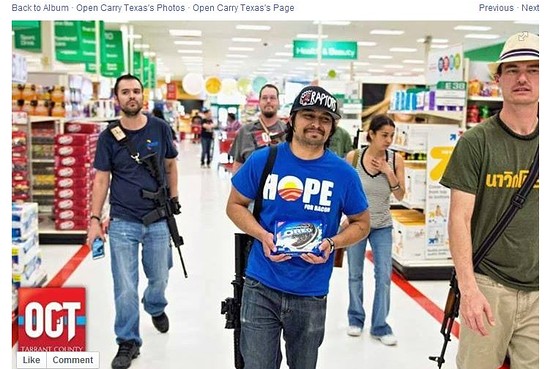
The open carry movement is one where people openly carry guns into public places as a way of “exercising their rights.” Of course, they also manage to scare the hell of reasonable people. Yes, they’re probably loons.

13. “Carrying a gun makes you safe.” – Well, it’s possible that carrying a gun might make you feel safe, but that doesn’t mean other people will. Unless you wear a badge or in a uniform, then carrying a gun in public will make people suspect that you’re a dangerous criminal, an outright loon, or both. If you’re a young man who’s black, Latino, or of Middle Eastern/South Asian descent, then carrying a gun in public will make people suspect the former and possibly call the cops on you due to widespread racial profiling in the US. Seriously, if it was Trayvon Martin shooting George Zimmerman, “Stand Your Ground” would’ve not have gotten him out of a prison sentence. Many gun rights activists think carrying a gun around will make them able to defend themselves and others (a vigilante complex if you will). However, there is no credible evidence that the carrying loaded weapons decreases crime. And studies supporting this notion have been frequently debunked by a range of academic researchers. But that doesn’t stop states from implementing “Stand Your Ground” laws in recent years, which state that civilians can shoot without a duty to retreat, even in public places. Those in the gun lobby states that such laws are needed to decrease crime. But these laws are mostly based on the gun lobby’s vigilante mentality. Researchers at Texas A&M say otherwise.

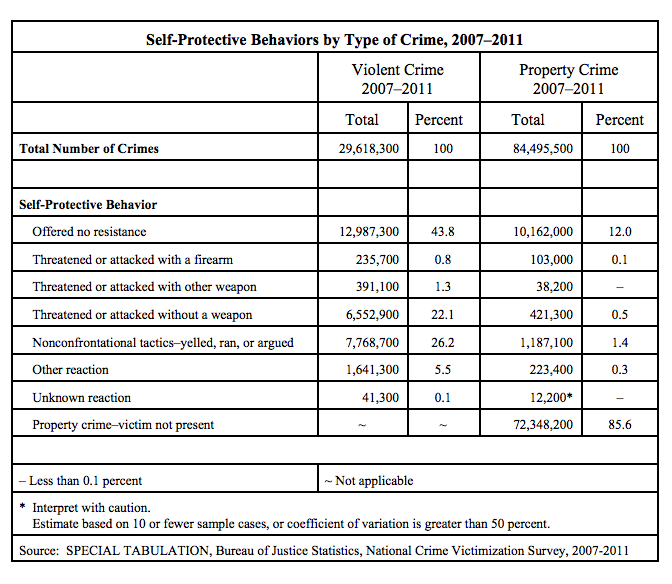
Contrary to what the gun lobby says, self-defense is rare during crimes. And it's especially less common for a person to defend oneself with a gun. Not only that, but this chart from the Bureau of Statistics and the National Crime Victimization Society reveal that most property crime victims weren't even present at the time.

Contrary to what the gun lobby says, self-defense is rare during crimes. And it’s especially less common for a person to defend oneself with a gun. Not only that, but this chart from the Bureau of Statistics and the National Crime Victimization Society reveal that most property crime victims weren’t even present at the time.

14. “Having a gun at home makes you safe.” – Studies show that a gun in the home is more likely to be used to commit suicide or to threaten and/or kill an intimate than to defend against an attacker. There’s also a chance for accidents which most gun owners are familiar with. Not to mention, leaving a loaded gun out in the open is one of the most irresponsible things a gun owner can do. It’s a recipe for disaster. This is especially true in a home with small children. There’s a reason why you find stuff on gun safety. But you hear a lot from the gun lobby stating how having a gun might help protect you and your family during a home invasion. However, what they get wrong is that home invasions are rare and usually occur when the either residents aren’t home or sleeping. Because they’re mostly robberies. Now a home invasion might be a traumatic experience but the chances of one resulting in homicide are rare. Why? Because burglars want to avoid contact during home break-ins and try to steal stuff as quickly and quietly as possible. Make any noise to wake up the family or the neighborhood and they’re screwed. Still, most people are usually killed or attacked by somebody they know which is why most home homicides usually pertain to family disputes or domestic violence.

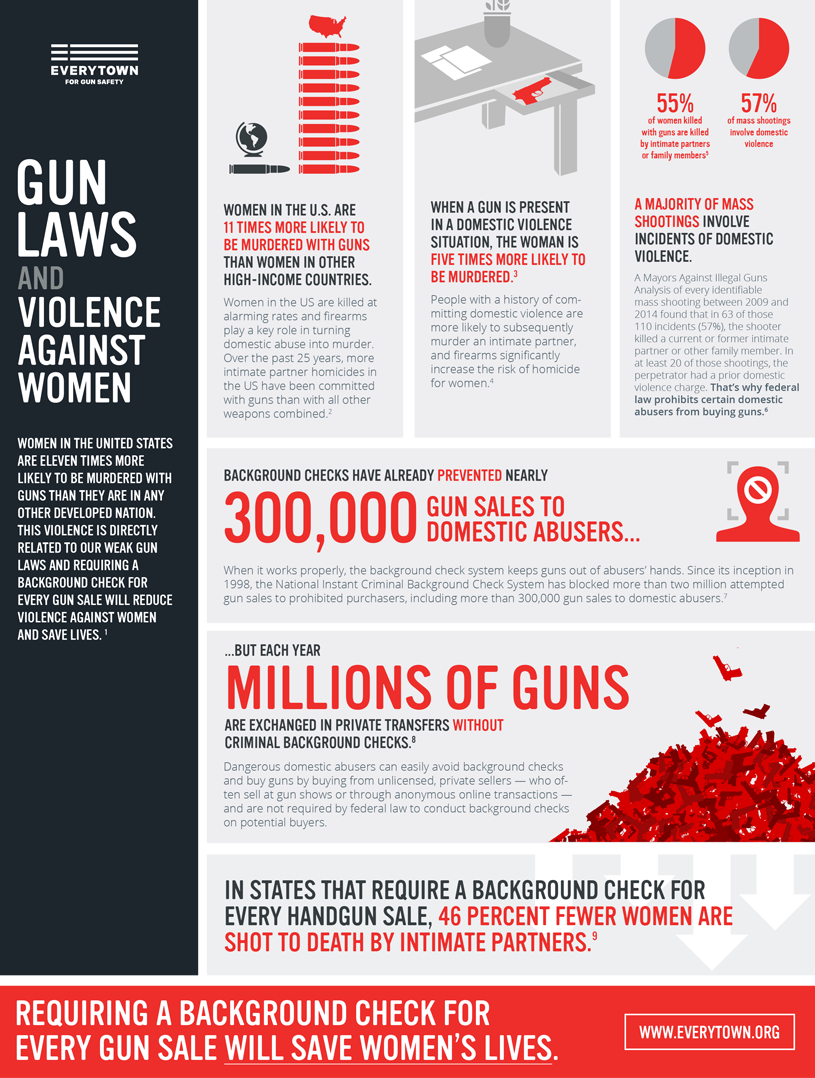
In the United States, women are more likely to be killed by someone they know, particularly a current or ex-significant other. A woman runs an even greater risk of being killed if she's in an abusive relationship with an intimate partner, especially if there's a gun in the house. Therefore, most of the time having a gun for self-defense will not help her.

In the United States, women are more likely to be killed by someone they know, particularly a current or ex-significant other. A woman runs an even greater risk of being killed if she’s in an abusive relationship with an intimate partner, especially if there’s a gun in the house. Therefore, most of the time having a gun for self-defense will not help her.

15. “Guns make women safe.” – I know there are plenty of gun rights activists who say this since women aren’t as physically strong as men. However, a woman’s safety has less to do with whether or not she has a gun in the house than the quality of her relationships. This is especially true when it pertains to intimate partners such as husbands, boyfriends, fiances, and what not. Besides, when gun rights supporters say this, they’re usually referring to women being attacked and/or killed by strangers. But most violent crimes involving women usually pertain to people they know whether they be victims or perpetrators, especially intimate partners. And they’re almost always linked to domestic abuse. Now it’s one thing for a woman to have gun to protect herself on the street against a possible violent stranger. But if you’re a woman living with an abusive partner, owning a gun won’t help your case because that person will try to control you through any means necessary. Besides, when you’re living with someone, it’s much more difficult to keep certain things to yourself, especially if you’re in an intimate relationship with them. Guns are among these things. Your abuser will find that gun and will somehow gain access to it. And there’s a strong chance that they might use it to kill you. After all, in 2010, women were 6 times more likely to be shot by their husbands, boyfriends, and ex-partners than by male strangers. And if a woman’s domestic abuser has access to a gun, she’s more than 5 times likely to be killed by them. It should surprise nobody that there have been calls for implementing gun laws restricting firearms access to spousal abusers. Not to mention, even if a woman successfully shoots her abuser in an effort to defend herself, this doesn’t mean that she’s out of the woods yet. We have to be remember that there are plenty of women in prison for killing their abusers, too, especially if they’re poor women of color. So if you have a little girl, you should probably spend less time teaching her how to shoot and perhaps teach her how to spot a potential domestic abuser and how to get out of it before it gets more serious. Because she’ll be more safe if she’s willing to dump a guy who’s been nasty to the waiter.

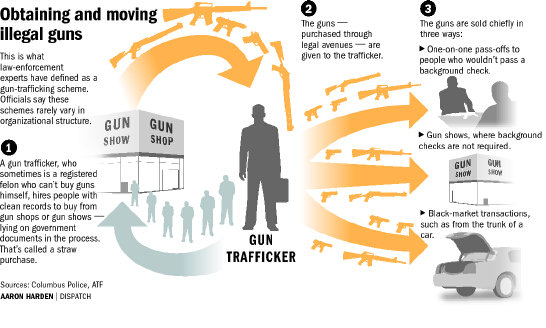
This is a diagram on how gun trafficking works in the United States. Because 40% of all gun transfers don't require background check, this allows criminals to legally purchase weapons through hiring people with clean records to buy the guns for them, one-on-one pass offs, gun shows, and black market transactions. Not to mention, it's not unusual for some criminals to buy guns in areas with looser gun restrictions as well.

This is a diagram on how gun trafficking works in the United States. Because 40% of all gun transfers don’t require background check, this allows criminals to legally purchase weapons through hiring people with clean records to buy the guns for them, one-on-one pass offs, gun shows, and black market transactions. Not to mention, it’s not unusual for some criminals to buy guns in areas with looser gun restrictions as well.

16. “We don’t need more gun laws. We just need to enforce the ones we have.” – Yes, we do need to enforce the laws we already have and even law enforcement agrees. But even law enforcement believes that stronger enforcement without stronger gun laws isn’t enough. Remember that most mass shooting victims were killed with legally purchased weapons such as military style assault weapons with high capacity magazines. Many existing gun laws at the federal level are riddled with loopholes and gaps. And federal enforcement action has been constantly hampered thanks to gun lobby efforts that the Bureau of Alcohol, Tobacco, Firearms, and Explosives is now under-funded and without permanent leadership. Not to mention, 40% of all legal gun transfers don’t require background checks.

17. “Gun control won’t stop gun violence.” – I’m very well aware of that. However, while there have been more mass shootings than there used to be, they’re still relatively rare and very unlikely to happen in most American neighborhoods. Nevertheless, while gun control measures may not be 100% effective, that doesn’t mean they don’t work. Take gun-free zones, for instance. Yes, I know they’ve been sites of plenty mass shootings, but they don’t happen every day. But gun-free zones are everywhere and have rather wide appeal not just among public and civil establishments as well as churches, but also among businesses. Why? Because most people generally don’t like being around guns in public since they don’t feel safe around civilians carrying firearms (law enforcement is a different story at least in the US since they are supposed to know what they’re doing). Guns in public make people very uncomfortable, sometimes to the point of calling the police. Why? Because most people are fully aware that guns are dangerous and can kill people. A stranger with a deadly weapon is often feared, especially civilians whose natures may be unpredictable. And all the mass shootings, armed robberies, and other armed incidents on the news kind of reinforce that fear. So instead of trying to determine which civilians can openly carry a gun, it’s much easier to ban all civilians from carrying guns on the public premises. And even when guns aren’t banned, the gun-free zone mentality still manifests in our social mores. So any open carry activist “exercising their rights” will be viewed as threat no matter whether the establishment permits guns or not. While they might not work all the time, gun-free zones are very effective policy since it prevents an unsafe situation involving lots of people with loaded guns. Besides, unarmed civilians have survived mass shootings and other incidents involving gun violence. The point is that despite gun-free zones being scenes of mass shootings, the practice of banning guns in public places isn’t going away because it’s a policy that’s effective, popular, and smart.

This is a chart from a Catholic magazine from Philadelphia. But though it doesn't have the same poll results I wrote down, it does show that a sizable chunk of the American public support some gun control. Not to mention most Americans don't want guns in school, church, or in government buildings.

This is a chart from a Catholic magazine from Philadelphia. But though it doesn’t have the same poll results I wrote down, it does show that a sizable chunk of the American public support some gun control. Not to mention most Americans don’t want guns in school, church, or in government buildings.

18. “Americans don’t want meaningful gun reform.” – Here in America, you’d be surprised how many issues people viciously fight about that they secretly agree on. Now gun control is a highly contentious issue in American politics as well as polarized among party lines (mostly because the NRA bankrolls a lot of Republican politicians. Not to mention, that the gun lobby tends to run propaganda with an appeal to fear). However, the Joyce Foundation has noted that various public opinion polls show that Americans overwhelmingly support specific gun policy solutions. 92% of Americans support requiring universal background checks on all potential gun buyers while 63% support banning assault weapons. 74% of NRA members also support universal background checks as well.

19. “Guns are essential for self-defense.” – Reports on mass shootings and other violent crimes have led many to believe that fighting crime requires to fight fire with fire. However, according to the Violence Policy Center (based on data by the FBI and the Bureau of Statistics), there were only 258 justifiable homicides involving civilian gun use in 2012. Compare this to 8,342 criminal homicides and 22,000 suicides and accidental shootings. In 2011, nearly 10 times more people were shot and killed during arguments than by civilians trying to stop a crime. Sorry, but the numbers don’t lie. I also hear from many that a mass shooting would’ve been prevented if somebody had a gun on them. However, they forget that whenever you’re in a mass shooting situation, armed civilian confrontation with the shooter is generally not recommended. Rather it’s best advised that you call the cops and let them confront the perpetrator. In the meantime, you’re better off either trying to escape, hiding, or playing dead until the cops show up. Trying to confront the shooter is a quick way to get shot (as well as should only be done as a last resort). And if you use a gun, you might risk endangering others in the process.

Many people think that trained armed guards would be able to prevent mass shootings since many take place in gun-free zones. However, they tend to forget about the mass shooting at Fort Hood. Still, gun-free zones may not prevent another tragedy, but I'll take my chances with them than in an armed society.

Many people think that trained armed guards would be able to prevent mass shootings since many take place in gun-free zones. However, they tend to forget about the mass shooting at Fort Hood. Still, gun-free zones may not prevent another tragedy, but I’ll take my chances with them than in an armed society.

20. “Switzerland and Israel seem to do okay without gun control.” – Gun rights advocates like to think that Switzerland and Israel to prove that gun control doesn’t make much difference. However, while both countries have a tradition of military service, they also limit firearm ownership and require a permit renewal 1-4 times annually. That may not be as restrictive as other countries, but it’s still gun control. So saying they do okay without gun control resoundingly false.

21. “Other countries are different.” – Yes, US history may differ from those of other countries. And yes, the US might contain American cultural exceptionalism, pioneer spirit, and a history of racial tension. However, having a violent national history is actually the norm among most nation states. Seriously, you’d be hard pressed to find a country that hasn’t experienced some degree of conflict or civil unrest in its past. And there are plenty of countries that have existed in the world longer than the US. Far longer, in fact. Let’s just say world history has no shortage of violent incidents and that people would kill each other on just about anything. And just because many industrialized nations have strict gun laws, doesn’t mean violent crime is non-existent. It just that their violent criminals are less likely to use guns, which results in less people getting killed.

Many people who think American gun violence has to do with illegal immigration are dead wrong. In fact, most of the guns used by Mexican drug cartels were American made. So it's American guns being trafficked into Mexico.

Many people who think American gun violence has to do with illegal immigration are dead wrong. In fact, most of the guns used by Mexican drug cartels were American made. So it’s American guns being trafficked into Mexico.

22. “US borders are too open.” – For God’s sake, undocumented immigrants aren’t the problem in the gun debate. Besides, it’s hard to imagine it would be easy for criminals to obtain weapons that had to be smuggled through ports, airports, or across the Mexican border. Besides, most illegal gun trafficking in the US is within the country itself that most American criminals wouldn’t see the need for importing guns from Mexico. Why would a Chicago gangster go through the trouble of smuggling guns through the Mexican border when he could easily buy one legally in Indiana? It’s just within driving distance and inspections by US Customs are virtually nonexistent. It’s also significantly cheaper. Besides, a lot violence in the world is conducted by American weapons. Seriously, think of all the guns the US has sold to the Middle East and look what happened there. So it wouldn’t make much sense for any American criminals would smuggle guns into the US, especially since Texas lies along most of the Rio Grande. If anything, it would more likely be Latin American drug cartels smuggling weapon across the Mexican border from Texas, which contributes to another problem entirely. Well, at least as far as the US is concerned.

23. “School shootings are a national epidemic.” – I’m aware that a lot of famous mass shootings have taken place in schools like Columbine, Virginia Tech, and Sandy Hook being the most famous. And I’m well aware that the gun lobby has called for school teachers to carry guns, which I think is insane. However, according to FBI crime statistics, the odds of a school shooting in your neck of the woods are statistically rare. More homicides occur in homes, especially if they involve multiple victims. Not to mention, more mass shootings happen in restaurants than in schools. But nobody’s asking the wait staff to carry guns. In fact, it’s said that children are almost 100 times more likely to be murdered outside of school than at school (with odds being 1 in a million). So child gun homicides are more likely attributed to severe family dysfunction (like abuse) than having a classmate who’s a homicidal nutjob. This makes massive school spending on building security seem like a waste in taxpayer money.

This is a good cartoon from Facebook highlighting the ways people can fall victims of gun violence. Many gun rights activists tend to believe that more guns lead to less crime. However, there's a positive correlation between gun crimes and gun ownership rates.

This is a good cartoon from Facebook highlighting the ways people can fall victims of gun violence. Many gun rights activists tend to believe that more guns lead to less crime. However, there’s a positive correlation between gun crimes and gun ownership rates.

24. “More guns equal less crime.” – This is a very common argument by gun rights activists, which was given rise by a controversial book by John Lott Jr. called More Guns, Less Crime. It has been debunked by peer review since its publication and Lott has also come under scrutiny for ethics violations regarding his research. Other studies arguing about high rates of gun usage in self defense have also come under scrutiny. The Harvard Injury Control Research Center has determined a positive correlation between gun ownership and violence (especially in impoverished neighborhoods). Since the 1970s both have been in decline though there’s been an uptick in recent years. Nevertheless, since the US has one of the highest gun ownership rates, it’s no surprise that 15 of the 25 worst mass shootings in the last 50 years have happened here. Not only that, but the American South is the most violent region in the country as well as has the highest prevalence of gun carrying. Furthermore, The Johns Hopkins Center For Gun Policy and Research have found that expanding concealed carry laws increase aggravated assaults. So contrary to what the gun lobby says, more guns lead to more crime.

25. “Dictators take away guns from their people and look what they do.” – Gun rights activists love to talk about how dictators like Hitler and Stalin took guns away from their own people before they began committing genocide. However, the notion of Hitler and Stalin taking people’s guns away is historically inaccurate. And if Hitler took any guns from people, they were from groups he wanted to exterminate anyway like Jews and Gypsies. As with everyone else, he actually expanded private gun ownership. But you hear many pro-gun activists say that if the Jews and the Gypsies were armed, there would be no Holocaust. But there is no historical basis of this. If anything, arming them might’ve “hastened their demise” according to SUNY political science chair Robert Spitzer. So how did Hitler gain control and remained in power? Well, we have to concede that prior to World War II, Hitler was extremely popular among the German people and throughout the world. I mean he had to be popular enough to be appointed chancellor by President von Hindenburg in 1932, shortly before the Nazi propaganda machine gained full steam. Of course, he also had Brownshirts beating people up but that’s beside the point. Suggesting that the only thing keeping Hitler in charge was the control of guns exonerates many who truly supported him and helped him gain power in the first place. It’s also very bad history that teaches us a terrible lesson. Same goes for the Bolsheviks in Soviet Russia and the idea that an armed populace would’ve stopped them or Stalin is nothing but a fantasy. Ask any White Russian who knows. Stalin was also extremely popular in his country as well. Nevertheless, we should understand that dictators don’t gain control through taking people’s guns away. They do it through propaganda and ruthlessly suppressing dissent in order to secure lifelong popularity. Besides, there are plenty of Third World dictatorships that break into civil war with both sides carrying AK-47s.

Many gun rights activists may say that legal gun owners don't commit crimes. However, many criminals buy their weapons at gun shows because they don't require background checks. So what does that tell you?

Many gun rights activists may say that legal gun owners don’t commit crimes. However, many criminals buy their weapons at gun shows because they don’t require background checks. So what does that tell you?

26. “Legal gun owners don’t commit crimes.” – Yes, most gun crimes are committed with illegal guns but that’s because in the US, a legally bought gun in Indiana can easily become illegal when sold on the Chicago black market. And federal gun laws are so weak that such acts can go off without a hitch. But even then, the number of legal guns increases and so does the likelihood of a gun falling into the wrong hands. Besides, Mother Jones found that most mass shootings involved legally purchased guns. Also, 40% of legal gun transfers don’t require background checks which makes it easy for criminals legally obtain weapons through hiring people with clean records to buy the guns for them, passing them off one-by-one, gun shows, and black market transactions. Sometimes they can even legally purchase weapons in places with less gun restrictions. Not to mention, there’s a movement to prevent domestic abusers from accessing firearms. And domestic violence is not just a crime, but can also lead to murder, especially if guns are in the picture. So what does that tell you?

27. “Assault weapons aren’t frequently used in crimes.” – Yes, assault weapons aren’t used a lot in crimes since most gun violence is perpetuated by handguns. But whenever an assault weapon is used in an attack, there are 54% more deaths. It’s no surprise that most of the deadliest mass shootings in the US have involved assault weapons like an AR-15. Many tend to use high capacity magazines which allow for higher casualties. Since the 1994 Assault Weapons Ban expired, mass shootings have been on the rise, particularly since 2007.

So if the Second Amendment is absolute, that means I can have my very own fighter jet, right? I mean the gun lobby says Americans have a right to bear arms which shall never be infringed. But they never say anything about my right to own a fighter jet.

So if the Second Amendment is absolute, that means I can have my very own fighter jet, right? I mean the gun lobby says Americans have a right to bear arms which shall never be infringed. But they never say anything about my right to own a fighter jet.

28. “The Second Amendment is absolute.” – Really? Well, let me put it to you, constitutional rights aren’t always absolute either. Take the Second Amendment for instance, which gun rights activists say that it gives people a right to own a gun under any circumstance which must be protected. However, “the right to bear arms” can also pertain to owning a weapon. So if Second Amendment rights were absolute, then I should be able to own a tank, a bazooka, a bomber plane, a fighter jet, a hand grenade, a howitzer, an anti-aircraft gun, and all those cool military weapons that I’m sure are illegal for civilian ownership or use. And I’m sure that the Founding Fathers never intended the Second Amendment to give civilians the right to own a cannon either. Strange that gun rights activists don’t campaign for that because authorizing such weapons for civilians would be downright insane (as you can see how the military put an anti-aircraft gun in a civilian’s back yard in 1941). Still, the fact that even law abiding American citizens can’t privately own these weapons for civilian use should demonstrate that gun control is constitutional. Hell, even Supreme Court Justice Antonin Scalia said so himself in Heller v. DC“Like most rights, the right secured by the Second Amendment is not unlimited…nothing in our opinion should be taken to cast doubt on longstanding prohibitions on the possession of firearms by felons and the mentally ill, or laws forbidding the carrying of firearms in sensitive places such as schools and government buildings, or laws imposing conditions and qualifications on the commercial sale of arms.”

This is a billboard in Illinois that highlights the convoluted ideas of American cultural heritage. One of these is an assault rifle which is a weapon of choice among mass shooters. This is appalling.

This is a billboard in Illinois that highlights the convoluted ideas of American cultural heritage. One of these is an assault rifle which is a weapon of choice among mass shooters. This is appalling.

29. “Guns are a part of America’s heritage. Gun control is not.” – You tend to see American history in movies as quite violent. But the as gun possession is as old as the country, then so is gun control. During the time of the Founding Fathers, state and federal governments conducted several arms censuses (like officials going door to door to ask now many guns you had and whether they worked). Besides, contrary to what the western movies depict, establishments in the Old West did practice some degree of gun control. For instance, guns were often banned in saloons for very good reason. Not to mention, Tombstone had far stricter gun control during the gunfight at the O.K. Corral than it does today (deterring the number of Old West saloon shootouts which is a very common feature in westerns). Also the US implemented gun control policies to crack down on mob violence during the 1920s, particularly when it came to confiscating Tommy Guns. Thus, to not implement gun control because it’s not part of the American heritage is absurd.

30. “Background checks don’t work.” – Actually background checks do. Since its inception the National Instant Criminal Background Check System (NICS) has blocked more than 1.9 million permit applications and gun sales to felons, the seriously mentally ill, drug abusers, and other dangerous people prohibited by federal law from possessing firearms. However, because 40% of gun transfers occur without background checks, more comprehensive gun background checks are needed to curb gun violence and trafficking. Besides, people disobey speed limits all the time. Does that mean we shouldn’t have them?

31. “Gun laws don’t work.” – Actually aside from background checks, other gun control measures work as well. The 1994-2004 Assault Weapons Ban, while riddled with loopholes allowing gun manufacturers to evade, led to a decrease in gun seizures with high capacity magazines by Virginia law enforcement. Seizures spiked after it expired. And mass shootings have been on the rise since assault weapons equipped with high capacity magazines have become the weapons of choice in mass shootings. So despite its faults, the Assault Weapons Ban worked. Not only that, but state laws designed to regulate gun dealers, including regular compliance inspections have been effective in reducing gun trafficking within their jurisdiction.

32. “Gun ownership is on the rise.” – Gun ownership is actually in decline in the US and has been since the 1970s. A vast majority of Americans don’t own firearms. However, those who own guns, own more of them.

33. “It’s more dangerous now than it used to be.” – Of course, crimes stories have a high tendency to get on the news which might make one think that there’s more crime out there than there used to be. And the prevalence of mass shootings has also reinforced that notion. However, since the 1970s, American crime has steadily declined. Gun violence has declined as well. But this doesn’t mean it’s not less of a problem or a public health concern since it kills 30,000 per year.

This is a pro-gun picture depicting how gun-free zones don't prevent mass shootings and how police don't stop massacres. However, if you're in a mass shooting situation, it's generally recommended you don't try to confront the shooter with firearms. It's best advised that you leave the defensive shooting to the police in these circumstances.

This is a pro-gun picture depicting how gun-free zones don’t prevent mass shootings and how police don’t stop massacres. However, if you’re in a mass shooting situation, it’s generally recommended you don’t try to confront the shooter with firearms. It’s best advised that you leave the defensive shooting to the police in these circumstances.

34. “Police don’t show up on time and don’t stop massacres.” – A lot of gun rights activists tend to have a dim view of society and claim that every second counts so it’s better to act now. After all, the shooter could kill, escape taking something, or what not. However, while it takes time for police to get to the scene of a crime when called, this doesn’t mean self-defense is the best option. For instance, for civilians, using a gun to confront a mass shooter is generally seen as a very stupid idea. Besides, when it comes to subduing criminals, the police are professionals who’ve been rigorously trained to stop active shooters. Stopping a mass shooter requires extraordinary skills honed under acute duress which most law enforcement officials have. Most civilian gun owners don’t possess such skills, which most gun rights activists like to ignore and think anyone with a gun can stop a mass shooting. However, that’s really not the case since police can stop massacres and do. It’s the civilians who can’t. So if you’re in a mass shooting situation, it’s better to leave the shooting to law enforcement.

35. “To prevent violence we must be able to predict it.” – Now this argument is tied with the idea we can prevent mass shootings if we provide adequate mental health services to high risk individuals. Sorry, but mentally ill people are no more at risk for violent behavior than anyone else. Besides, prevention by prediction isn’t 100% effective because predictions aren’t always accurate. Seriously, just watch your local weather forecast on the news. Chances are the weatherman has been wrong at least some of the time. Same can be said about gun violence, which many people see as a public health issue. Public health programs have dramatically reduced problems like smoking-related deaths and car accidents. Approaching gun violence the same way should be a no brainer. In fact, numerous studies report that school-based counseling and violence prevention programs are very effective at teaching students how to resolve conflict and problems without escalating to violence. Community mental health services oriented toward prevention are also helpful, especially when it pertains to helping larger populations of people in distress.

These are stats on American gun violence I obtained from an infographic. Despite that gun crimes have gone down, only 10% of non-fatal wounds involved guns. And gun suicides are at an all time high.

These are stats on American gun violence I obtained from an infographic. Despite that gun crimes have gone down, only 10% of non-fatal wounds involved guns. And gun suicides are at an all time high.

36. “The NRA represents freedom.” – Sorry, but living in an armed society isn’t my idea of freedom. The big problem with discussing American gun culture these days is that ideology tends to cloud the facts. The NRA spends large amounts of money to skew the debate by telling everyone that the government is coming for your guns (bullshit). And it doesn’t help that the NRA doesn’t represent the interests of most gun owners these days, even their own members. I mean the NRA is famous for opposing all gun legislation while the most of the people it’s supposed to represent support tighter gun laws. And it has supported gun control measures in the past. So why is that? Well, it turns out that the NRA  these days represents gun manufacturers on its board of directors’ nominating committee.

37. “Gun control can’t prevent suicides.” – Nearly 2 out of 3 gun deaths are suicides which is a harrowing statistic for most but this helps gun rights activists argue that mental illness is the problem, not guns. However, while restricting gun access can’t stop people from choosing to kill themselves, keeping guns away from mentally ill people can be rather effective. In fact, it’s said that firearms suicide rates are closely correlated with gun ownership as well as gun crimes. So gun control might not prevent suicides, but it might help prevent suicides with guns.

38. “Shooting and hunting are important American cultural activities.” – Yes, I know people use guns for hunting and target practice at gun ranges. However, people don’t use AK-47s and AR-15s to hunt deer and can just as easily shoot a box full of holes with a handgun. Why? Because using a military style assault weapons to hunt is just stupid. Gun control measures don’t necessarily mean outright gun bans altogether. Nor does it mean an end to sports shooting either.

39. “Gun violence is a city problem.” – Gun violence takes many forms. Gun homicides on the streets might account for a lot of city homicides. But there are plenty of gun violence incidents in rural areas as well like gun injuries, suicides, and homicides stemming from family disputes and domestic violence. There’s also a higher rate of gun ownership in rural areas, by the way.

This chart illustrate how much gun violence costs American taxpayers every year. We should also count the fact that many gun victims are poor. Yeah, I really think Second Amendment rights are getting kind of expensive.

This chart illustrate how much gun violence costs American taxpayers every year. We should also count the fact that many gun victims are poor. Yeah, I really think Second Amendment rights are getting kind of expensive.

40. “Gun control is expensive.” – It’s no surprise that many gun rights activists tend to equate gun control with big government and high spending. However, loose gun laws aren’t as cheap as you make them out to be since they tend to cost billions of taxpayer money each year on medical and legal costs. And it doesn’t help that most gun violence victims and perpetrators tend to live below the poverty line as well as are either uninsured or on public assistance. From how I view it, gun control as a means to prevent violence is probably much cheaper.

Many pro-gun activists say that so many mass shootings happen in gun-free zones because it makes victims defenseless. But the real story is that public venues most likely tend to be gun-free zones. Besides, the Fort Hood shooting has told us that mass shooters don't give a shit about a public facility's gun policy anyway.

Many pro-gun activists say that so many mass shootings happen in gun-free zones because it makes victims defenseless. But the real story is that public venues most likely tend to be gun-free zones. Besides, the Fort Hood shooting has told us that mass shooters don’t give a shit about a public facility’s gun policy anyway.

41. “Local restrictions attract mass shooters.” – You hear this a lot from gun rights activists since many famous mass shootings have taken place in gun-free zones and leaving victims defenseless. However, as I said before, gun-free zones are very effective policy regardless of whether they attract mass shootings or not. Besides, we should be aware that most gun-free zones are public venues used by a lot of people, which attract violence and crime. Because buildings open to the public normally do that explaining why we have gun-free zones in the first place as a safety measure. It’s just an obvious fact. Not only that, but the fact 43 people were shot during the Fort Hood shooting shows that mass shooters don’t give a shit about firearms policy. Seriously, Fort Hood’s status as a military base makes it far from a gun-free zone. I mean the place would have guns everywhere and people trained to use them, including armed guards. But that didn’t prevent 13 people from being killed in the shooting. Mass shooters’ choices of location usually involve other motives, especially if there’s a chance they’ll know any potential victims. For instance, the Fort Hood shooter was a disturbed army psychiatrist who worked there. The shooters at Columbine, Virginia Tech, and Sandy Hook were students there at some point in their lives. We should also account for the fact that most mass shootings involve legally purchased weapons. Besides, despite how pro-gun activists complain about gun-free zones, confronting a mass shooter with a loaded gun is actually a very stupid idea, anyway. Not to mention,  just because a place with loose gun laws doesn’t experience a lot of gun violence doesn’t mean it’s not contributing to the problem. After all, look how loose gun laws in Indiana are contributing to gun violence in Chicago.

42. “Now isn’t the time to talk about guns.” – You tend to hear this in the event of almost every mass shooting or major tragedy involving guns. Yes, I know discussing politics isn’t appropriate after a major tragedy. But mass shootings have been on the rise since 2007 and most experts agree that gun violence is a major public health issue that kills 30,000 a year. Furthermore, gun control measures tend to have a lot of support from law enforcement as well as health care workers who specialize in emergency medical care. Besides, we must remember that Aurora and Newtown happened during the same year. A year before that, a US House Representative was shot in the head in Tuscon. So if now’s not the time to talk about gun control, when is?

43. “Criminals won’t consent to background checks.” – Yes, criminals hate background checks because they limit their ability to buy a gun. However, many of them go through them anyway and get blocked just the same. Nevertheless, if a criminal doesn’t want to consent to a background check then they won’t be allowed to buy guns legally. Thus, by closing legal avenues for them to buy guns, they’ll be forced to risk buying illegal weapons, which police can arrest them for. And if a criminal can’t legally buy a gun in one area, they’ll buy it in another with less gun restrictions.

This is former Democratic US Congresswoman Gabrielle Giffords and her husband astronaut Mark Kelly. In 2011, Giffords was shot in the head by Jared Loughner in her district of Tucson, Arizona. She had to resign her seat to recover from her injuries. She and her husband are now advocates for gun control, not surprisingly.

This is former Democratic US Congresswoman Gabrielle Giffords and her husband astronaut Mark Kelly. In 2011, Giffords was shot in the head by Jared Loughner in her district of Tucson, Arizona. She had to resign her seat to recover from her injuries. She and her husband are now advocates for gun control, not surprisingly.

44. “But politicians send their children to school with armed guards.” – Fox News likes to point out this one to make many politicians who support gun control look like hypocrites. However, we should note that politicians are public officials and their name recognition makes them assassination targets along with their families. Threats against politicians and their children can disrupt public policy and are a very real threat. This is why we have the Secret Service protecting the President of the United States at all times. Besides, the US has had 4 presidents assassinated. We’ve also had a US congresswoman shot in the head in Tucson not too long ago. There’s nothing hypocritical or elitist about having gun-free zones while our leaders have armed guard protection. I mean not everyone can have their own Secret Service protection, so gun-free zones are the next best thing.

45. “Regulations in gun sales are ineffective because there are so many guns out there.” – The reason why there are so many guns out there is because the US has lax gun regulations at the national level. Besides, despite the number of guns in our society, there’s no reason to make the problem worse than it already is. Guns are so plentiful today that criminals don’t keep their guns long since guns used in crimes can be evidently linked to shootings. So criminals just dispose and replace them with clean weapons. Most criminals don’t have a hard time obtaining clean guns if they know where they can buy one. Regulating gun sales at the national level will eventually lead to criminals having to either hold on to their dirty weapons and risk arrest or spend a ton of money to buy a new gun.

Perhaps these lines from Bob Dylan's

Perhaps these lines from Bob Dylan’s “Blowin’ in the Wind” say it best. However, despite what many might say, we need gun control at a national level now. If we don’t act, then more lives will be lost or ruined.

For More:

The Brady has a handy website on state gun laws called Crimm Advisor. Helps explain the illegal gun trafficking situation within the country and why national action is needed. Crimadvisor

Law Center to Prevent Gun Violence: Law Center to Prevent Gun Violence – Gun Law Information Experts

Money Is Not Speech: Why We Must Get Rid of Citizens United

220px-adbusters_flag1

As it’s become apparent that the 2016 US presidential election campaigns are in full swing, I would like to devote a post to the issue of campaign finance. As 2016 draws upon us, we should expect to see more political ads in the media featuring candidates asking us to cast their votes. Now discussing campaign campaign finance may not be as interesting as other issues the media and the populace like to talk about. But in our day in age, it’s apparent that money has a profound influence in political policy in the United States. Wait a minute, money has a profound influence in pretty much everything. It’s just money has a higher influence in politics than most walks of life. While political candidates may act like prima donnas now and then, we need to note that it’s through elections that we choose our government leaders. Whoever’s in government usually shapes social policy. And social policies affect our lives in more ways that we’d like to admit. So yes, money does play a crucial role in politics, especially when it pertains to who’s giving it.

Yes, elections are decided by voters. But if you want to run for office, you will need to promote yourself and convince voters to go for you. That costs money. So this is where campaign financing comes in.

Yes, elections are decided by voters. But if you want to run for office, you will need to promote yourself and convince voters to go for you. That costs money. So this is where campaign financing, fundraising, and donations come in.

But aren’t elections decided by votes? Absolutely. And doesn’t everyone have only one vote? Sure. However, if you want to run for elected office, you need to promote yourself as a candidate in your constituency. To do that, you need to tell voters who you are and why they should choose you some time before the election actually takes place. In our mass media culture, it’s best you start early. Now candidates promote themselves in a variety of different ways like personal appearances, endorsements, and advertising through signs, mailings, social media, newspapers, radio, television, the works. All that costs money. So how will get it? From anyone willing to give it to you which is the reason why candidates hold fundraisers as well as have mass mailings to solicit donations.

This chart shows who received the most campaign funds in the 2010 midterm elections. Since donors tend to have some relationship with elected officials, it's no surprise that most donations go to incumbents. And it's no wonder that incumbents usually win. Even in Congress which has a 90% reelection rate.

This chart shows who received the most campaign funds in the 2010 midterm elections. Since donors tend to have some relationship with elected officials, it’s no surprise that most donations go to incumbents. And it’s no wonder that incumbents usually win. Even in Congress which has a 90% reelection rate.

However, although every US voter is equal in electoral value, they are not all equal financially nor as willing to give money to a political candidate. In fact, more than 90% voters don’t since well, they either can’t afford to or don’t have much interest to. Giving money to a political candidate isn’t like giving to a church, charity, PBS station, non-profit, college, or cultural establishment. You aren’t giving money because you have an affinity for it or want to do something good. No, people give money to political candidates because they want them to win so they can put forth social policy that they want. Still, even among those who contribute to political campaigns, most will contribute no more than $200, while some will donate hundreds or thousands. If you’re a political candidate, chances are you’re going to actively seek political donations from the entities who contribute the most campaign cash. In 2010, small donors only contributed to 13% to congressional candidate funds (which doesn’t include PACs that make up 23%). Large donors contributed to 48% of campaign donations. But here’s the thing, most big money donors won’t just hand you a large chunk of cash right off the bat. No, for before they give you the money, they want to know where you stand on the issues and what you’d be willing to do for their interests. And you’ll have to curry to their good graces by promising them that you will do everything you can to please them once elected. If you think it’s a form of bribery, you’re probably right. Yet, as far as I know it’s perfectly legal. Nevertheless, the more big money donations you have, the more you can spend on campaign advertising. And the more you can spend on advertising, the more likely people will vote for you. So everything’s fine, right?

Here's an infographic on the 2012 presidential election between Barack Obama and Mitt Romney showing where the money came from in their campaigns. However, while Romney managed to raise more money, Obama still won reelection.

Here’s an infographic on the 2012 presidential election between Barack Obama and Mitt Romney showing where the money came from in their campaigns. However, while Romney managed to raise more money, Obama still won reelection.

Well, not really. While government officials are elected to represent the people and fulfill campaign promises, we all know all too well that it’s not exactly the case. Yes, candidates make promises on the trail to get them to vote for you. But that doesn’t mean all will be fulfilled, given the realities of the political landscape. But since these rich donors give money to these candidates, then they believe in the issues they stand for, right? Actually it depends on the contributor. Sure there are donors who do contribute money to those who share their views or party affiliation. But there are plenty of other donors who just want to gain political influence and will contribute to any candidates regardless of party or issue stance (even in the same race). All they care about is having friendly access the candidate so they could support measures they want, even if their wishes contradict the campaign promises and party platform. They may even contribute money because you oppose their interests and just want you to keep quiet. Hell, they don’t care if their wishes works against the candidate’s conscience or their constituents. And sometimes not even the laws. Of course, while this may put some politicians in a dilemma, many tend to follow the wishes of these big contributors to keep their cash flowing. After all, they need the money for reelection and don’t want the other guy to have more influence and capital than them. But do these political money deals benefit the American people?

During the 2010 elections, the biggest sources of campaign funds came from large individual donations consisting of 48%. Small donations from individuals only consisted of 13% of funds. PACs contributed 23%.

During the 2010 elections, the biggest sources of campaign funds came from large individual donations consisting of 48%. Small donations from individuals only consisted of 13% of funds. PACs contributed 23%.

Actually no. The fact that politicians are more likely to listen to large donors than their constituents suggests that there’s something very wrong in our political system. Yes, people elect their government officials but since they depend on campaign contributions to promote themselves, they usually tend to side with their backers who tend to have their very own lobbyists. After all, most incumbents usually get reelected so those voters aren’t going anywhere. Besides, the biggest incumbent supporters are usually long term donors they’ve had a relationship with every election year. To them, giving is a way of life and a cost of doing business all for the sake of having access to a politician, which leads to more power and influence on policy. But some of these donors can be fickle and might shift their money to the politicians in the majority party whenever the balance of power changes. And it doesn’t help that the fundraising never stops since an successful US Congressional campaign costs $1.4 million on average. But US Congressmen are elected every 2 years so it’s a rather short time window. And US Senate campaigns cost more than 6 times as much. But as money becomes more important in politics, the politicians seem more like a lackey to their rich overlords than the constituents who they’re supposed to represent. This leads to most of the American people having a considerable less political influence in politics, less access to lawmakers, and less of a chance of having their interests heard. More often than not, they become nothing but mere pawns who tend to cast their vote against candidates who may not represent their best interests for various reasons. But it’s mostly because they either know the guy, party line, or that they have no other choice. Thus, as big donors tend to have more access to politicians, American citizens lose out.

While the Federal Election Commission is supposed to oversee campaign regulations, it was designed as an ineffective organization from day one. The fact our system can't create agencies without congressional approval kind of explains why. Because  Congressman have to be elected.

While the Federal Election Commission is supposed to oversee campaign regulations, it was designed as an ineffective organization from day one. The fact our system can’t create agencies without congressional approval kind of explains why. Because Congressman have to be elected.

But don’t they have rules and regulations on campaign finance? We have a Federal Election Commission (FEC) that’s supposed to enforce and oversee campaign finance laws, it’s notoriously ineffective. However, as an organization that’s supposed to monitor lawmaker behavior, it’s no surprise that it was designed this way even if it was created in response to Watergate. And being the elected politicians they were, lawmakers made sure that the campaign watchdog would have a very tight leash and interfere as little in their campaigns as possible. I mean they set the FEC up as a 6 member body so no ruling can go into effect without a 4 vote majority. This is often impossible since the FEC is evenly split with 3 Republican as well as 3 Democratic commissioners, each nominated by their respective parties. Tie votes are often commonplace on some of the most important campaign finance issues which make the system riddled with loopholes. Because of this, the agency often takes years to resolve complaints and political operatives have learned that they can live on the edge of the law with little fear or interference from the FEC. And judging by the political culture these days, I’m sure the people behind the FEC knew what they were doing.

In 2010, the Supreme Court ruled in favor of Citizens United which stated since money is speech, then corporations and unions should contribute as much as they want to political campaigns. Unfortunately, not everyone has money and such notions basically keep many Americans from having a political voice. And it's apparent that most Americans don't like it.

In 2010, the Supreme Court ruled in favor of Citizens United which stated since money is speech, then corporations and unions should contribute as much as they want to political campaigns. Unfortunately, not everyone has money and such notions basically keep many Americans from having a political voice. And it’s apparent that most Americans don’t like it.

Still, despite it’s reputation, the FEC is quite effective with improving disclosure for campaign contributions for the most part. But even this has its limitations. And then there’s the matter with the Citizens United Supreme Court case in 2010, which did away with many campaign finance laws already on the books as well as opened up unlimited spending by corporations, unions, and other independent groups. This led to the 2010 elections seeing an unprecedented flood of outside money flowing into congressional races all over the country. Tens of millions of dollars came from secret donors whose identities will never be known. Much of this campaign spending goes to funding political advertisements to elect (or defeat) candidates running for office. However, the money in question can only be used for independent expenditures (not direct contributions to the candidates’ campaigns). And whatever ads are produced can’t be coordinated with the candidates. Of course, it’s no small stretch to say that such measures aren’t always enforced. Thus, rich donors didn’t particularly give a shit since they want to contribute as much money as they want with little or no consequence. However, they didn’t win when it came to disclosing political contributions on account that their right to privacy isn’t as important as the public’s right to know who’s funding who if amount is over $200. The Supreme Court has also said that disclosing campaign contributions is the best way to guard against political corruption. Of course, this brings me to the outside political organizations created to raise campaign funds for elections:

This is the logo for a realtors' political action committee or PAC. It's supposed to pool contributions from members to contribute to political purposes. According to federal law, an organization becomes a PAC when it receives or spends more than $2,600.

This is the logo for a realtors’ political action committee or PAC. It’s supposed to pool contributions from members to contribute to political purposes. According to federal law, an organization becomes a PAC when it receives or spends more than $2,600.

PAC (political action committee)- an organization designed to specifically pool campaign contributions from members to donate for political purposes whether it’s to campaigns for or against a candidates, ballot initiatives, or legislation. According to the Federal Election Campaign Act (FECA), at the US federal level, an organization becomes a PAC when it receives or spends more than $2,600 for the purpose of influencing a federal election. As for state level, the money pertaining to state elections in PAC designation varies. There are many types depending on political purposes and how each one spends their money. Still, you’d see at least one in almost every type of political advocacy organization you could think of. However, PACs have to follow certain criteria which includes:

  1. Though corporations and labor unions may sponsor a PAC as well as provide financial support through administration and fundraising, they can’t contribute through their own treasuries.
  2. Union-affiliated PACs may only solicit contributions from members.
  3. Independent PACs may solicit contributions from the general public and must pay their own costs from those funds.
  4. Federal multi-candidate PACs may contribute to candidates as follows:
  • $5,000 to a candidate committee for each election (primary and general elections count as separate elections)
  • $15,000 to a political party per year
  • $5,000 to another PAC per year
  • PACs may makes unlimited expenditures independently of a candidate or political party

The types of PACs consist of the following:

This is the United Steelworkers PAC which is an example of a connected PAC. These are sponsored by corporations and unions. These can only raise money from a

This is the United Steelworkers PAC which is an example of a connected PAC. These are sponsored by corporations and unions. These can only raise money from a “restricted class” of donors though the entities can pay for the administrative costs and fundraisers. For instance since the United Steelworkers is a union, it can only receive money from its own members.

Connected PACs- designated as “separate segregated fund” (SSF), these are sponsored by labor unions and corporations. These PACs may only raise money from a “restricted class” generally consisting of managers and shareholders for corporations and members for unions and other interest groups. Sponsor may not contribute to the PAC directly but can absorb costs of administrative operations and soliciting contributions. As of 2009, there were 1,598 registered corporate PACs, 272 related to labor unions, and 995 to trade organizations.

This Free Enterprise PAC from Idaho is an example of a non-connected PAC, used by politicians, parties, and ideology groups. Unlike connected PACs, they must pay their administrative expenses through donations but may accept funds by anybody. It's one of the fastest growing categories in campaign finance.

This Free Enterprise PAC from Idaho is an example of a non-connected PAC, used by politicians, parties, and ideology groups. Unlike connected PACs, they must pay their administrative expenses through donations but may accept funds by anybody. It’s one of the fastest growing categories in campaign finance.

Non-Connected PACs- basically financially independent PACs that must pay for its own administrative expenses with contributions it raises. May be financially supported by an organization but such expenditures are considered PAC money which are subject to the dollar limits and other requirements of FECA. May accept funds from any individual, connected PAC, or organization. Used by members of Congress, political leaders, ideology, and single-issue groups. As of 2009, there were 1,594 registered, the fastest growing category.

Now this is CAPAC which is a PAC for Asian and Pacific Islander Americans in Congress. This is an example of a leadership PAC sponsored by political parties and elected officials. Now these can't be used to fund an official's own campaign but they can fund other expenses.

Now this is CAPAC which is a PAC for Asian and Pacific Islander Americans in Congress. This is an example of a leadership PAC sponsored by political parties and elected officials. Now these can’t be used to fund an official’s own campaign but they can fund other expenses.

Leadership PACs- non-connected PACs sponsored by elected officials and political parties with independent expenditures, which isn’t limited (as long as it isn’t coordinated with the other candidate). Nor can they be used to support the official’s own campaign. Set up since elected officials and political parties can’t give more than the federal limit directly to candidates. Can fund travel, administrative expenses, consultants, polling, and other non-campaign expenses. Used by dominant parties to capture seats from other parties. Between 2008 to 2009, these have raised more than $47 million.

Of course, this is Stephen Colbert's Super PAC, which started appearing after the Citizens United ruling. Now these may not contribute or coordinate directly to candidates or campaigns. But there is no legal limit on contributions it can receive. As of August 2012, these have raised over $349 million with 60% from just 100 donors.

Of course, this is Stephen Colbert’s Super PAC, which started appearing after the Citizens United ruling. Now these may not contribute or coordinate directly to candidates or campaigns. But there is no legal limit on contributions it can receive. As of August 2012, these have raised over $349 million with 60% from just 100 donors.

Super PACs- Citizens United gave rise to this new kind of PAC designated as “independent-expenditure only committees,” because they may not make contributions to campaigns or parties directly but can generate any political spending independently of the campaigns. Unlike other PACs, there is no legal limit on funds they can raise from individuals, corporations, unions and other groups, provided they are operated correctly. As of August 2012, 797 of these have raised $349 million, with 60% of that money coming from just 100 donors, according to the Center of Responsive Politics. Also, Stephen Colbert started his own Super PAC for his show to inform his viewers how it’s done (but he donated all the money he raised to charity).

Aside from the PACs, there are some other organizations and entities also known to raise money for political campaigns as I list below:

Crossroads GPS is one of many 501(c)(4)s that have appeared after the Citizens United ruling. Considered

Crossroads GPS is one of many 501(c)(4)s that have appeared after the Citizens United ruling. Considered “social welfare” organizations under the IRS, they can only use 49.9% of their contributions for political purposes. Can accept unlimited contributions as well as aren’t required to disclose their donors. In 2012, Crossroads GPS and Americans for Prosperity raised more money into the presidential campaigns than all of the Super PACs combined.

501(c)(4) Organizations- defined by the IRS as “social welfare” non-profit and tax-exempt organizations but may also participate in political campaigns and elections. That is, as long as its “primary purpose” it promoting social welfare and not political advocacy (50.1% of their spending efforts much go to “social welfare” activities or “promoting in some way the common good and general welfare of the people of the community.”) Like Super PACs they can accept unlimited amounts of money from corporations, unions, or other interest groups. However, they are not required to disclose spending on their political activity or information on their donors unless they give for the express purpose of political advocacy. Traditionally these have been civic leagues promoting social welfare or local associations of employees with limited memberships to a designated company or a municipality or neighborhood. And often these net earnings went exclusively to charitable, educational, or recreational purposes. Groups like Planned Parenthood, the National Rifle Association, the NAACP, the National Organization for Marriage, the Sierra Club, and the League of Conservation Voters have been active in lobbying and have long held 501(c)(4) status before 2010. Citizens United has seen a dramatic rise of these organizations that contributed to a sharp increase in outside campaign spending from undisclosed sources from a bit more than 1% ($700,000) in 2006 to 44% ($1.27 million) in 2010. In 2012, that number was more than $308 million. And as far as we know much of this anonymous donor money went to Republican organizations and candidates since it helped topple the Democrats in Congress that year. And as of August 2012, two of the biggest 501(c)(4) organizations (Crossroads GPS and Americans for Prosperity) put more money into the presidential campaign than all the Super PACs combined, according to Pro Publica. However, these two groups were much less successful in that year’s presidential election (because Obama still won). Along with Super PACs, it’s also said that these organizations tend to coordinate among themselves and each other. Nevertheless, almost every advocacy organization has one. Also, Stephen Colbert talked about these on his show as well.

MoveOn.org is a famous example of a 527 organization. These are tax-exempt and not regulated under federal and state election laws. Mostly because they don't

MoveOn.org is a famous example of a 527 organization. These are tax-exempt and not regulated under federal and state election laws. Mostly because they don’t “expressly advise” whether to elect or defeat a candidate or party (officially). Can receive unlimited donations from anyone and there are no limits. However, they are required to file with the IRS and report independent expenditures.

527 Organizations- tax-exempt organizations which aren’t regulated under state and federal campaign finance laws because they do not “expressly advocate” the election or defeat of a particular candidate or party. When operated within the law, there are no limits on contributions to these groups or restrictions on who may contribute. Nor are they subject to spending limits either. However, they must register with the IRS, disclose their donors, and file periodic reports of contributions and expenditures.

Political Parties- while they may do more than just raise campaign cash, national and state party committees may contribute funds directly to candidates and make additional “coordinated expenditures” for their nominees in general elections. But these are subject to FECA limits. However, national party committees may make unlimited “independent expenditures” to support or oppose federal candidates. Nevertheless, since 2002, national party committees have been prohibited from accepting any funds outside FECA limits.

Here's an infographic on the bundler contributions in the presidential elections. These are individuals who raise money from other contributions and present the sum to the campaign.  However, while disclosing them isn't required, they are likely to be appointed to posts in presidential administrations.

Here’s an infographic on the bundler contributions in the presidential elections. These are individuals who raise money from other contributions and present the sum to the campaign. However, while disclosing them isn’t required, they are likely to be appointed to posts in presidential administrations.

Bundlers- actually these are individuals who can gather contributions from many individuals in an organization or community and present that sum to the campaign. They’re often recognized with honorary titles and sometimes exclusive events featuring the candidate. It has evolved into a more structured form in the 2000s and we know that all high profile candidates use them. However, there’s currently no law requiring disclosure of campaign bundlers as long as they’re not active, federally registered lobbyists. Nevertheless, the amount raised by bundlers has grown significantly with each election year with average contributions to winning presidential candidates reaching $186.5 million in 2012. We should also note that bundlers are more likely to be appointed to administration posts. In the Obama administration, it’s apparent that 80% of those collecting over $500,000 took key administration posts. George W. Bush appointed about 200 bundlers to posts in his administration.

I know writing about this campaign finance stuff might seem boring and meaningless to you in our political process. But it’s not. In fact, knowing about such organizations can explain how campaign donations for elections shapes the political landscape. Besides, noting how campaign finance works tends to explain a lot about what’s going on in this country. The rise in political activity pertaining to 501(c)(4)s was what led to the IRS scandal in 2013 as employees tried to create ways to weed out organizations that applied for 501(c)(4) status for being overly political. Their methods might not have been specifically appropriate but you really couldn’t blame the IRS for suspecting certain applicants of being overly political, particularly if they support conservative or Tea Party policies. This is especially the case if the recent 501(c)(4)s like Karl Rove’s Crossroads GPS and the Koch Brothers’ Americans Prosperity which many people seem to believe as having little to do with promoting the social welfare whatsoever. Following the money in Washington also explains other recent events as well. Powerful healthcare lobbies help explain why it was so difficult for Democrats to pass the Affordable Care Act despite a Democratic presidential administration and significant control of both congressional houses. The significant influence of the Koch Brothers and industry on Washington help explain the pervasive influence of climate change denial among Republican politicians and why so many polluters shift clean up costs to taxpayers during environmental disasters. And the NRA’s influence helps explain why no gun control legislation has ever been passed in either congressional house, despite the prevalence of mass shootings in recent years.

Open Secrets.org has this diagram of how much campaign cash each sector contributes between 1990-2010. The fact the financial sector contributes the most money offers a great explanation why almost no one involved in the Wall Street collapse in 2008 was prosecuted.

Open Secrets.org has this diagram of how much campaign cash each sector contributes between 1990-2010. The fact the financial sector contributes the most money offers a great explanation why almost no one involved in the Wall Street collapse in 2008 was prosecuted.

But what the nature of campaign finance really helps explain is the relationship between Washington and Wall Street. The fact that the financial sector tends to be the largest contributor to federal office candidates and parties explains why the federal government has been so reluctant to prosecute Wall Street after the 2008 recession. It helps explain why many Republicans have vociferously opposed raising taxes and instilling regulation but supported bailouts. Yet, the financial sector also contributes money to Democrats which doesn’t make passing financial reform on Capitol Hill any easier. Just so you know, the financial sector contributed $468.8 million to federal campaigns and candidates in 2008 alone (80% more than in 2006) and has spent more on K Street lobbying than any other sector. As of 2014, the financial sector has spent nearly $500 on lobbying as well reports 855 clients and 2,358 lobbyists. Thus, it’s a very powerful influence in Washington as well as a very corrupting one. Wall Street’s dubious practices basically led to an economic collapse and recession in 2008 as well as put so many people in financial ruin, possibly for the rest of their lives. But because of the financial sector’s hold on Washington, the federal government walks a fine line between its obligation to the general public and the desires of powerful backers many of them committed actions that should’ve put them in jail.

This is an infographic from the Center for Media and Democracy explaining how ALEC works. Now it calls itself a nonprofit and nonpartisan organization. However, it's really a business friendly conservative bill mill. Let's just say, even if you disagree with my politics, this is a very powerful lobby whose activities should concern you.

This is an infographic from the Center for Media and Democracy explaining how ALEC works. Now it calls itself a nonprofit and nonpartisan organization. However, it’s really a business friendly conservative bill mill. Let’s just say, even if you disagree with my politics, this is a very powerful lobby whose activities should concern you.

Still, while this post appears to focus on the nature of campaign finance in Washington, the corrupting influence of the political money culture doesn’t just affect the federal government alone. State governments have their officials supported by the same kind individuals and organizations with the same agendas and in very much the same way. Of course, what’s different at the state level is voters can elect more people to office like high court justices and cabinet positions. However, there’s a special nonprofit organization founded in the 1970s called the American Legislative Exchange Council (ALEC) consisting of state legislators and private sector representatives. Now according to ProPublica, ALEC is said to produce model legislation that is heavily influenced by big business and industry as well as “works to advance the fundamental principles of free-market enterprise, limited government, and federalism at the state level through a nonpartisan public-private partnership of America’s state legislators, members of the private sector and the general public.” Each year almost 1,000 bills based on ALEC’s “model” legislation are introduced in state houses across the country of which about 200 become law. Now these ALEC sponsored bills advocate a wide range of measures like reducing corporate regulation and taxation, combating illegal immigration, loosening environmental regulations, preventing Medicaid expansions and other state-related Obamacare policies, reducing pensions for public employees, retaining the minimum wage, privatizing prisons as well as enacting harsh sentencing laws, deregulating the telecom industry, privatizing public education, tightening voter identification rules, weakening labor unions, and promoting gun rights. It also acts as a networking tool among Republican state legislators, allowing them to research conservative policies implemented in other states. Not to mention, it’s funded almost exclusively by big business.As of 2013, ALEC’s membership consists of 1,810 state legislators representing nearly a quarter of legislative seats in the US as well as 300 corporate, foundation, and private-sector members.

Now this is a rough diagram explaining how ALEC works and its appeal among corporations and politicians. Now ALEC helps give each entity what they want on an expense paid vacations and parties. Corporations get legislation tailored to their interests and access to politicians. And politicians gain access to campaign funds and private sector jobs.

Now this is a rough diagram explaining how ALEC works and its appeal among corporations and politicians. Now ALEC helps give each entity what they want on an expense paid vacations and parties. Corporations get legislation tailored to their interests and access to politicians. And politicians gain access to campaign funds and private sector jobs.

Now it’s very simple to explain why politicians and private entities would want to join this organization if you know a anything about campaign finance. ALEC allows state legislators to be acquainted with potential campaign backers while it helps corporations gain access to and form long term relationships with politicians.They also hold meetings on all expense paid trips in cities across the country that are said to resemble vacations (sometimes funded by taxpayer money by the way). Another way to explain its appeal was how it helps draft model bills through task forces during their meetings. Public and private sector members make up each of their task forces with the later typically being corporate or think tank representatives (who have veto power over drafted model bills). These task forces generate model bills that members can customize an introduce for debate in their own state houses after being approved by their board of directors who comprise of all legislators. In your 2016 Republican lineup, ALEC-related contributions have gone to Marco Rubio, Bobby Jindal, John Kasich, Lindsey Graham, Rick Perry, and Scott Walker as well as held some considerable influence in Chris Christie’s gubernatorial administration in New Jersey. Nevertheless, it’s a hugely influential lobbying organization in the states which it has always denied to keep its tax-exempt status. Yet, what it does can be seen by most Americans as nothing but the very definition of lobbying. But media scrutiny has grown after being publicized by liberal groups and news outlets like The New York Times and Bloomberg Businessweek since 2011 and for a good reason.

As a conservative bill mill, ALEC produces model bills through the collaboration between state legislators, right wing special interests, and corporations. So far, it's apparent that ALEC's model bills have done absolutely nothing to benefit the public. In fact, they've impacted a considerable degree of harm.

As a conservative bill mill, ALEC produces model bills through the collaboration between state legislators, right wing special interests, and corporations. So far, it’s apparent that ALEC’s model bills have done absolutely nothing to benefit the public. In fact, they’ve impacted a considerable degree of harm.

However, while I might pick on ALEC for supporting measures I think hurt this country, I think all Americans should be very concerned about this organization regardless of their politics. Because if their politics doesn’t trouble you, its conduct should since this conservative bill mill is well known for its lack of transparency. Since the 2000s many news organizations have found that ALEC hasn’t been friendly to reporters much and usually doesn’t grant interviews. They may open policy seminars to reporters and other nonmembers but they will receive public conference agendas that don’t include names of presenters, the lists of legislative and private-sector board chairs, or the meetings’ corporate sponsors. Task-force meetings and bill-drafting sessions are held behind closed doors mostly taking place at high end hotels in American cities, which resulted in reporters being turned away. ALEC doesn’t disclose membership lists or the origins of its model bills. Instead lawmakers generally propose ALEC-drafted bills without disclosing authorship as an newspaper found out in 2012 after analyzing 100 bills proposed by the Christie administration in New Jersey.

Besides being a conservative bill mill producing

Besides being a conservative bill mill producing “model legislation” for state lawmakers to pass into law, ALEC’s reputation for lack of transparency should also concern you. Such activities are undemocratic as well as possibly unconstitutional. Sure ALEC may give corporations a voice and a vote, but it also goes to great lengths to deny a say to anyone who potentially disagrees with them. All it cares about is promoting its own agenda.

Now it’s one thing for businesses to lobby for business friendly legislation drafted in the state house committee. But a lobbying organization drafting model bills behind closed doors for lawmakers to introduce and adopt them without disclosure seems like a violation of the democratic process, if not then the US Constitution. In fact, I’m not sure if the idea of a political organization drafting a model bill in secrecy is even legal or ethical, especially if it promotes legislation benefiting big business at the public expense. It also excludes not just Democratic legislators but also the American people from having a say in drafting legislation, which ALEC puts in highly partisan politicians and private sector hands. And in many ways, I see ALEC’s methods of secrecy as as a way for corporations and politicians to put their legislative ideas forward and avoid public scrutiny by opposing forces like liberals, the media, or the American public. But while public scrutiny can be annoying and disruptive, it’s an essential component in our democracy which should never by taken away even by some private and right-wing lobbying organization. While ALEC claims that their organization is supposed to give corporations a voice and a vote, they also want to make sure to deny a voice to anyone who potentially disagrees with them. It also shows that this organization only cares about enacting its own agenda and would do so through any means necessary. It doesn’t care whether its proposed legislation works at the public interest’s expense to enhance corporate profits. Not only that, but this organization has existed for over 40 years and prior to 2011, almost nobody knew it existed outside its membership until investigative reporters blew the whistle on it. And as of 2015, there are still people who’ve never heard of this organization. Now people have talked about certain shadow government organizations as the stuff of conspiracy theories such as the Illuminati. But ALEC is a real organization that functions exactly like one that reflects the relationship between money and politics at its worst. However, thanks to investigative reporting exposing the organization, ALEC has become a toxic brand as well as experienced an exodus of politicians and corporations.

In recent years, the influence of money in politics has made elections much more expensive. This chart shows the increase shows the rising costs of beating an incumbent in Congress. Really disturbing, I know.

In recent years, the influence of money in politics has made elections much more expensive. This chart shows the increase shows the rising costs of beating an incumbent in Congress. Really disturbing, I know.

Now I understand that American campaigns will always be tied to money and special interests to a certain extent even if I may not always like it. However, we need to understand that corporations are not people and money isn’t speech. Nor should political access and influence be a pay to play field. Yes, money buys influence and influence buys votes. But sometimes political money games prevent a substantial number of citizens from having a political voice in their governments all because they don’t contribute thousands of dollars to their representatives. And I mean at the state and federal level. Sure I know that liberals aren’t above these political shenanigans either as I’m well aware of it. But we have to understand that most big money contributors are more likely to support Republican policies, especially since most campaign donations come from big business. And since 2010, those who’ve benefited from Citizens United and its impact have been Republican politicians. Besides, as far as I know, the Democratic Party doesn’t have its own shadow government organization generating model bills for them. Or at least one as powerful or influential as ALEC. Thus, my focus on contributions and lobbies in Republican campaigns is based on more than my liberal political biases here. But the growing influence of money in politics hasn’t been good to our democracy its created a system where incumbents almost always win, the races are not even competitive, politicians are at the mercy of big donors and their lobbyists, and a significant chunk of Americans feeling like they don’t matter in the political system.

Since incumbents usually have more connections to donors and name recognition, this makes it difficult for anyone to challenge them. This chart shows how most 2010 congressional races usually have one candidate outspending their opponents 10 to 1.

Since incumbents usually have more connections to donors and name recognition, this makes it difficult for anyone to challenge them. This chart shows how most 2010 congressional races usually have one candidate outspending their opponents more than 10 to 1.

Now I know politicians don’t want to implement campaign finance reform since it hurts their self-interests. But since money tends to talk, we need regulations to keep those with the big money at bay. Or else such influence might make us wonder whether our political representatives work for the voters who elected them or the donors who bankroll them that consist of a wealthy few. Yes, I know that some people don’t like regulations they think infringes on their rights. But regulations also protect the rights of those who may otherwise be sidelined by the rich and powerful special interests. And powerful special interests care more about themselves and don’t care if the public has to suffer for policies they want passed. Besides, we want our elections to be fair while big money tends to offset the balance, especially in races involving incumbents who have access to considerable financial resources. Our country was founded on freedom of the people, by the people, and for the people with a government to promote the general welfare and secure the blessings of liberty, for ourselves and posterity. And if we want that, we need to acknowledge and do what we can to keep big money from undermining these ideals. Yes, I know that money is necessary for everything, but it doesn’t have to be the bottom line in politics or how representatives conduct their business. We can start with overturning Citizens United so we can set limits on campaign spending by corporations because we need to.

To learn more:

OpenSecrets.org: The Center for Responsive Politics OpenSecrets.org: Money in Politics — See Who’s Giving & Who’s Getting

ALEC Exposed from the Center for Media and Democracy ALEC Exposed

Worst Excuses for Keeping a Confederate Flag

Confederate_Rebel_Flag.svg

Disclaimer: While I am not apologetic in my stance on the Confederate Flag issue and wish for its removal, I understand this post may feature some material bound to offend a significant part of the US population, particularly in the South. And while the Confederate Flag has been taken down at the South Carolina state house, plenty of such flags remain in the area such as in Mississippi. Seriously, the Confederate Flag only belongs in museums, historical sites, Civil War media, and cemeteries. No where else. Nevertheless, I’ve done my research on this. So don’t say that I don’t know my history if the flag offends me. Because I know my history and can completely understand why that flag offends people. Also, anyone offended by the picture should know that I’m not praising the Confederate Flag in any way. In fact, this is an article on me debunking excuses people make on keeping it.

Now in my “Thoughts on Charleston” post, I discussed how the Charleston Church shooting was racially motivated and why it was a problem. I also discussed a bit on why the Confederate Flag needs to be removed. However, while the South Carolina state house agreed to remove the flag from its state legislature, there was a substantial number of white people who weren’t happy about it. In fact, they were quite angry. And this led to a spat between the Klu Klux Klan and the Black Panthers nearby over last weekend. Others may think that we should worry about bigger things other than removing a flag, especially when it comes to stopping terror. However, many of these people either have no idea what this flag really stands for or conveniently ignore that fact. Many tend to keep Confederate Flags just to express their southern pride or love for Southern Rock groups. Some may keep a Confederate Flag thinking it’s a cool symbol of rebelling against authority. And many are quick to defend that the Confederate Flag is a symbol of heritage, not hate. Not to mention, in states like Georgia, Florida, Louisiana, Mississippi, South Carolina have laws banning the public mutilation, defilement, and cast of contempt on this flag. But such laws were overruled by the US Supreme Court in 1989 and aren’t enforceable anyway. But I’m sure they’re still on the books. However, hate to let ya’ll down, but the Confederate Flag is nothing more than a symbol of white supremacy and history shows this. Always has been, always will be. It’s not hard to figure out the American Civil War was over slavery and a lot of powerful white Southerners were really big fans of it. Nevertheless, I present to you many of worst excuses that people make about keeping the Confederate Flag.
  1. “The Confederate Flag is a symbol of Southern heritage and pride.”
While the Confederate Flag is a symbol of Southern heritage, it's one that embodies some of the worst aspects in the history of the American South. Basically it represents a region that split with the country in the name of preserving and expanding an institution where blacks were coerced into a lifetime of involuntary servitude with no rights or compensation. Here is an engraving of a slave auction in Virginia where this mother and daughter are unlikely to see each other again.

While the Confederate Flag is a symbol of Southern heritage, it’s one that embodies some of the worst aspects in the history of the American South. Basically it represents a region that split with the country in the name of preserving and expanding an institution where blacks were coerced into a lifetime of involuntary servitude with no rights or compensation. Here is an engraving of a slave auction in Virginia where this mother and daughter are unlikely to see each other again.

Well, if you feel that a Confederate Flag is a symbol of Southern pride, then I think you might want to find yourself a better way to express that. But while I agree that the Confederate Flag is a symbol of Southern heritage, but in a way that reflects the worst of what it represents. By this, I mean a time in which the South was run by a wealthy elite who owned large plantations manned by a large underclass of blacks who either were or among descendants of kidnap victims and subjugated under a lifetime of involuntary servitude, which they depended on. And they tend to use a rationale that blacks were lazy and inferior simpletons in order to justify it. Now many of the Northern states on the other hand, had outlawed this notorious institution and was a realm of many anti-slavery activities that these Southern aristocrats didn’t like. This was especially the case since the cotton gin led to an economic boom in the region which made these rich guys even more dependent to keep blacks in a lifetime state of involuntary servitude. Of course, it also explains why Mississippi was home to the most millionaires in 1860. So tensions build up over the years which result in a bunch of political dysfunction and sporadic moments of violence. It soon got to the point that these wealthy elites became so distressed about the North being no fan of enslaving black people, that they decided to split from the country to form their own so they never have to worry about such encroachment again. Of course, the North didn’t like them leaving the country and so commences a bloody 4-year war, which the North won by the way. And the white Southerners were very bitter that this war helped outlaw such practices so they went to great lengths to make sure that blacks could never gain any social, political, or economic power. Of course, they managed to get away with such practices for decades until blacks started demonstrating during the 1950s and 1960s. But it doesn’t stop the white Southerners from romanticizing the days when wealthy plantation owners forced black people to work for them so they didn’t have to abide to certain whitey hiring regulations other than perhaps the occasional overseer. They don’t want to think about the highly unethical implications and human rights violations pertaining to forced black labor as well as other anti-black policies so they conveniently choose to forget that. But still, you get the idea what the Confederate Flag sort of represents.

  1. “The Confederate Flag is a symbol of freedom and states’ rights.”
While Confederate Flag supporters often say that the American Civil War was about states' rights, moments like the Fugitive Slave Act and the Dred Scott Decision show this wasn't the case. Sure the South wanted to preserve slavery and their way of life. But they also wanted to expand it into the territories and force the North to return runaway slaves. Since Northern states had banned slavery for quite some time, it didn't want to comply. Now this is a poster warning free blacks in Boston to be wary of slave catchers and kidnappers who might want to enslave them.

While Confederate Flag supporters often say that the American Civil War was about states’ rights, moments like the Fugitive Slave Act and the Dred Scott Decision show this wasn’t the case. Sure the South wanted to preserve slavery and their way of life. But they also wanted to expand it into the territories and force the North to return runaway slaves. Since Northern states had banned slavery for quite some time, it didn’t want to comply. Now this is a poster warning free blacks in Boston to be wary of slave catchers and kidnappers who might want to enslave them.

Yes, but this flag represents the Confederacy which split from the Union in 1860-1861, but the “freedom” and “states’ rights” in this pertained to the idea that a white person was free to own slaves who were usually black. Besides, those who think the American Civil War was fought over states’ rights should really look up the Fugitive Slave Act of 1850, which required that all escaped slaves were to be returned to their masters upon capture and that citizens and officials had to cooperate, even in free states. Then there’s the Dred Scott Decision that centered on a black man who tried to sue for his and his family’s freedom on account that his master had died in a free territory. But the Supreme Court denied that request in which Chief Justice Roger Taney said that blacks were, “beings of an inferior order, and altogether unfit to associate with the white race, either in social or political relations, and so far inferior that they had no rights which the white man was bound to respect.” You should also take into account that thanks to the 3/5ths Compromise in the Constitution, the Southern states had a lot of political influence and representation in Congress, but industrialization, urbanization, and immigration would give the North much more political power. Now both the Fugitive Slave Act and the Dred Scott Decision took place before 1860 and were heavily favorable to slave owners in the South. But they also both reveal that the South didn’t just want to keep slavery within their borders (and they were in no position to abandon it either). They wanted to expand it to the territories and force the North to support that institution against their will. Abraham Lincoln and his fellow Republicans opposed both these measures in 1860 which led to the South seceding from the Union after Lincoln’s election to president in 1860. So much for states’ rights.

Dred Scott was a slave who tried to sue the government for his and his family's freedom on account that he spent time in a free territory. However, the Supreme Court ruled against him on account that blacks weren't considered US citizens and had no right to sue. Also, the Missouri Compromise of 1850 was declared unconstitutional which carried a designation of free territories in the first place. It has been known as the worst US Supreme court ruling in history. And it's no surprise that a few of the justices at the time were slave owners.

Dred Scott was a slave who tried to sue the government for his and his family’s freedom on account that he spent time in a free territory. However, the Supreme Court ruled against him on account that blacks weren’t considered US citizens and had no right to sue. Also, the Missouri Compromise of 1850 was declared unconstitutional which carried a designation of free territories in the first place. It has been known as the worst US Supreme court ruling in history. And it’s no surprise that a few of the justices at the time were slave owners.

We should also take into account that documents pertaining to the South’s split from the union because they refused to be in a country that was turning them into second-class citizens and refused to honor one of their most cherished beliefs, that slavery was beneficial to the negro. And it’s very clear that the Confederates weren’t in any way shy about this since the right to own slaves was written into their constitution. Besides, Confederate Vice President Alexander Stephens said it himself in his “Cornerstone” speech, “Our new government is founded upon exactly the opposite idea; its foundations are laid, its corner- stone rests, upon the great truth that the negro is not equal to the white man; that slavery subordination to the superior race is his natural and normal condition. This, our new government, is the first, in the history of the world, based upon this great physical, philosophical, and moral truth…” And in Texas’s secession declaration, slavery is mentioned at a whopping 21 times as well as said that governments and states of the nation were established, “exclusively by the white race, for themselves and their posterity,” and this didn’t apply to black people. So to say that the Confederate Flag was a symbol any other freedom than for whites to treat African Americans as property as well as force them to work for them against their will and with no compensation, then that argument is relatively weak. Besides, most historians think that the South played the states’ rights card only when they disagreed with federal policy and only when the rights in question applied to their states.

  1. “My ancestors fought under that flag.”
Southern Unionism was widespread throughout the Confederacy during the American Civil War. Southern Unionists comprised of 25% of Union Forces including my 3rd great-grandfather from East Tennessee and at least 3 of his brothers. This is an engraving of Southern Unionist refugees from Georgia in East Tennessee, a hotbed for Union sympathizers.

Southern Unionism was widespread throughout the Confederacy during the American Civil War. Southern Unionists comprised of 25% of Union Forces including my 3rd great-grandfather from East Tennessee and at least 3 of his brothers. This is an engraving of Southern Unionist refugees from Georgia in East Tennessee, a hotbed for Union sympathizers. However, in the “Lost Cause” myth, these people tend to be totally erased.

Are you sure about that? The National Park Service has a database listing American Civil War soldiers and sailors so you can look up your ancestors there. But even if your Civil War ancestors were white and resided in the Confederacy, there’s a substantial chance that they might not have fought for the side you previously thought. Unionism was widespread in the Confederacy during the Civil War (explaining the existence of West Virginia) and 25% of Union soldiers also resided in a secessionist state. So perhaps flying a Confederate Flag at your front porch may not actually be your way to honor the memory of your ancestors than possibly giving them the finger on the cause and country they fought for. This is especially the case if you find out that your 3rd great-grandfather from Arkansas actually fought for the Army of the Tennessee instead of the Army of Tennessee according to family legend.

Southern Unionists were often targets of violence by Confederates during the American Civil War. This is an engraving of a mass hanging of Southern Unionists in Gainesville, Texas.

Southern Unionists were often targets of violence by Confederates during the American Civil War (mostly for resisting draft laws but many were arrested as well). This is an engraving of a mass hanging of Southern Unionists in Gainesville, Texas. Like black troops, Southern Unionists who also fought for the Union also risked execution upon capture. Sometimes this would lead their families consigned to the not-so-tender mercies of their often unforgiving neighbors. After the Civil War, many Southern Unionists continued to be persecuted for their wartime beliefs after Reconstruction as well as targets of the Klu Klux Klan.

Nevertheless, there are plenty of descendants of Confederate veterans who don’t want anything to do with the Confederate Flag. Of course, many of these sons of Confederate veterans tend to be black and would want no part in honoring what their ancestors fought for. Not surprisingly, these guys were white and most likely owned slaves as well.

These are the official and military flags used by the Confederacy during the American Civil War. Though never used in any official capacity, the Confederate Battle Flag was used as an unofficial emblem of the Confederacy. This was because it was a very recognizable design from long distances.

These are the official and military flags used by the Confederacy during the American Civil War. Though never used in any official capacity, the Confederate Battle Flag was used as an unofficial emblem of the Confederacy. This was because it was a very recognizable design from long distances.

Even so, the Confederate Flag we know today was actually used as the Battle Flag for the Army of Northern Virginia but the design wouldn’t be incorporated in the official Confederate Flag design until 1863 with the “Stainless Banner” flag as well as in the “Blood-Stained Banner” in 1865. But both these flags have the Confederate Battle insignia in the upper left corner. But before these two flags, there was the “Stars and Bars” flag which had 3 stripes in red and white as well as a blue square with 13 stars. But this would later be disowned since it was too similar to the Union Flag and caused confusion during the 1st Battle of Bull Run (especially at long distances). So let’s just say if your Confederate ancestors fought under that flag, it was more or less on an unofficial basis. So it’s no surprise why the Confederate Battle Flag has become a widely recognized symbol of the American South since it was the Confederacy’s most recognized flag during most of the war. And the later flag designs both show this. But as far as we know the Confederate Flag was never adopted by the Confederate Congress, was never officially used for Confederate veterans groups, and never flew over state capitols during the Confederacy. So for the descendants of Confederate veterans, I’ll rule this as partially true.

  1. “Even if it is racist, the meaning of words and symbols is relative to the individual.”
The swastika is a good example of how symbols can be interpreted in many different ways. In Jainism, Hinduism, and Buddhism, it's a sacred and auspicious symbol as well as a good luck charm. But try to explain that to Westerns who link it with Nazism, Anti-Semitism, totalitarianism, racism,  hate, and mass slaughter.

The swastika is a good example of how symbols can be interpreted in many different ways. In Jainism, Hinduism, and Buddhism, it’s a sacred and auspicious symbol as well as a good luck charm. But try to explain that to Westerns who link it with Nazism, Anti-Semitism, totalitarianism, racism, hate, and mass slaughter. Of course, the Nazi swastika is turned, but still. Nevertheless, unlike Americans with the Confederate Flag, Asians can still play the culture card for the swastika because they’ve used it way long before it became associated with Nazism.

Yes, words and symbols can mean a variety of different things depending on the individual. But even though you may fly a Confederate Flag showing your love for Lynyrd Skynyrd doesn’t mean that your neighbors would interpret it that way. But most of the time words and symbols carry meanings that stand independently of any individual’s subjective interpretation. Such that it might lead your passionate but non-racist Rebel Flag waving Lynyrd Skynyrd fan to be mistaken for racist  or believing that any pursuit of white supremacy isn’t wrong and may be worthy of celebration. This is especially true when a symbol or term has very negative connotations for a certain group of people explaining why many people want the Washington Redskins to change their name. It also explains why nobody in the West no longer uses swastikas for decoration.

  1. “Taking down the Confederate Flag will rewrite history.”
Whenever Confederate Flag supporters complain how removing this banner would rewrite history, what they really mean is that it will change the American Civil War history as they remember it. Of course, it's no surprise that many of these Confederate Flag supporters believe in the myth of the "Lost Cause" which is a virulently racist and very distorting pseudo-history viewpoint. Of course, Birth of a Nation basically shows the worst of the "Lost Cause" myth and the ideology it supports.

Whenever Confederate Flag supporters complain how removing this banner would rewrite history, what they really mean is that it will change the American Civil War history as they remember it. Of course, it’s no surprise that many of these Confederate Flag supporters believe in the myth of the “Lost Cause” which is a virulently racist and very distorting pseudo-history viewpoint. Of course, Birth of a Nation basically shows the worst of the “Lost Cause” myth and the ideology it supports.

Actually, when we’re talking about taking down the Confederate Flag, it will still be used in a historic capacity such as being displayed in museums and historic sites, Civil War media, and Civil War reenactments. Not sure if displaying them on Confederate Civil War memorials and monuments is acceptable, but I’ll leave it. Let’s just say Confederate Flag removal will only apply to places like government buildings, state and national parks (save Civil War battlefields), public schools and colleges, and other public places. Still, taking down the Confederate Flag may not rewrite history but it will help put the Neo-Confederate “Lost Cause” myth to rest since it was only made up to justify the oppression of African Americans in the South with Jim Crow laws and extralegal violence. I think removing the Confederate Flag might help Americans come to terms with an ugly part of their history, which many tend to ignore. So removing it might rewrite history to an extent, but only in a way that brings down the “Lost Cause” myth which continues to be influential in media and in schools despite that it’s a major distortion of history used to serve a very racist political agenda. And sometimes historic distortions need to be corrected by removing symbols of hate from where they don’t belong.

  1. “Even if it is racist, meanings of words and symbols can change over time.”
It's illegal in Germany to wave a Nazi flag. But it's a perfect illustration of how once symbols acquire a negative interpretation to them, it usually stays that way. And the fact people still make excuses of keeping the Confederate Flag just makes it more disturbing. Nevertheless, an American keeping a Confederate Flag is certainly equivalent to a German keeping a Nazi one.

It’s illegal in Germany to wave a Nazi flag. But it’s a perfect illustration of how once symbols acquire a negative interpretation to them, it usually stays that way. And the fact people still make excuses of keeping the Confederate Flag just makes it more disturbing. Nevertheless, an American keeping a Confederate Flag is certainly equivalent to a German keeping a Nazi one.

They may but if a symbol acquires a highly negative meaning, it tends to stay that way. And at its most benign, it’s been used by the historically-ignorant without being fully cognizant of its implications. But whether it represented a defunct government whose reason for existence was to preserve slavery or as a symbolic embodiment of the so-called “Lost Cause” myth, you can’t take pride in such a flag without tacitly endorsing a racist view or being remarkably clueless. Even if your ancestors fought for the Confederacy. And since the American Civil War, Southern whites tended to use the Neo-Confederate “Lost Cause” myth as their history just to enact Jim Crow laws as well as keep black people from any form of social, political, or economic power. The Confederate Flag is an artifact from that history as the “Lost Cause” myth continues to be propagated by Sons of the Confederate Veterans as well as United Daughters of the Confederacy. However, these two organizations as well as other historical societies tend to be among the more mild offenders.

FILE - "In this April 14, 1964 black-and-white file photo, a man holds a Confederate flag at right, as demonstrators, including one carrying a sign saying: "More than 300,000 Negroes are Denied Vote in Ala", demonstrate in front of an Indianapolis hotel where then-Alabama Governor George Wallace was staying." The Confederate Flag enjoyed a resurgence of popularity after World War II, particularly to white supremacists who saw the rising Civil Rights Movement as a threat. Let's just say white segregationists' use of the Confederate Flag was no accident.

FILE – “In this April 14, 1964 black-and-white file photo, a man holds a Confederate flag at right, as demonstrators, including one carrying a sign saying: “More than 300,000 Negroes are Denied Vote in Ala”, demonstrate in front of an Indianapolis hotel where then-Alabama Governor George Wallace was staying.” The Confederate Flag enjoyed a resurgence of popularity after World War II, particularly to white supremacists who saw the rising Civil Rights Movement as a threat. Let’s just say white segregationists’ use of the Confederate Flag was no accident.

Yet, after World War II, the Confederate Flag enjoyed a resurgence of popularity in the South used by segregationist whites to protest integration especially with the ruling of Brown v. Board of Education which declared school segregation unconstitutional. Southern states tended to use the Confederate Flag in their public pageantry during the Civil Rights Movement with the South Carolina raising flag at their state capitol in 1961. Two notable groups who used this as a symbol were the Dixiecrats and the Klu Klux Klan, both noted for white supremacy and opposition to the Civil Rights Movement. As Southern historian Gordon Rhea said: “It is no accident that Confederate symbols have been the mainstay of white supremacist organizations, from the Ku Klux Klan to the skinheads. They did not appropriate the Confederate battle flag simply because it was pretty. They picked it because it was the flag of a nation dedicated to their ideals: ‘that the negro is not equal to the white man’. The Confederate flag, we are told, represents heritage, not hate. But why should we celebrate a heritage grounded in hate, a heritage whose self-avowed reason for existence was the exploitation and debasement of a sizeable segment of its population?”

  1. “Just because I keep a Confederate Flag doesn’t mean I’m racist.”
I'm not saying that Confederate Flag supporters are racists. It's just that I find it a hard time to consider them not to be when I see them waving a flag that's clearly a symbol for white supremacy by any means necessary. Seriously, this flag has been used to justify racist policies in the South, opposition to the Civil Rights Movement, and extralegal violence against African Americans. So I don't think Confederate Flag supporters are helping their case.

I’m not saying that Confederate Flag supporters are racists. It’s just that I find it a hard time to consider them not to be when I see them waving a flag that’s clearly a symbol for white supremacy by any means necessary. Seriously, this flag has been used to justify racist policies in the South, opposition to the Civil Rights Movement, and extralegal violence against African Americans. So I don’t think Confederate Flag supporters are helping their case.

Maybe, but as I said time words and symbols carry meanings that stand independently of any individual’s subjective interpretation. Just ask any Asian Hindu and Buddhist who’s denied Anti-Semitism while wearing a swastika T-shirt. You may not see yourself as a racist, but try convincing your cringing black neighbors that whenever they see the Confederate Flag flying outside your porch. Sure you might fly it in the name of southern pride or that you’re a fan of Lynyrd Skynyrd. But most of the African American community and others identify it as a symbol of white supremacy, as well as political repression and violence against blacks. Many people also identify it as a symbol of treason in which a power elite of rich white guys seceded from the union in order to preserve a way of life that benefited no one but themselves as well as subjugated 40% the region’s population to a lifetime of involuntary servitude and a legal designation of property.

  1. “The Confederate Flag has nothing to do with racism.”
Uh, yes, the Confederate Flag has everything to do with racism. In fact, it's been always used as a symbol of racism from the moment of its inception. In fact, the guy who designed it said it himself and he certainly wasn't in the closet about his white supremacy.

Uh, yes, the Confederate Flag has everything to do with racism. In fact, it’s been always used as a symbol of racism from the moment of its inception. In fact, the guy who designed it said it himself and he certainly wasn’t in the closet about his white supremacy.

Really? But even in the antebellum American South, most Southern whites didn’t own slaves either. But most of them supported slavery anyway and a lot of them fought for the Confederacy. In the Antebellum South, white supremacy was accepted by almost all white Southerners of all classes which made slavery seem natural, legitimate, and essential for a civilized society. The whole Old South had a system of preserving slavery with elaborate codes of speech, behavior, or practices illustrating the subordination of blacks to whites. Southern whites serving on “slave patrols” and “overseers” were offered positions of power and honor. Such positions gave poor white Southerners the authority to stop, search, whip, maim, and even kill any slave traveling outside their plantation. “Slave patrols” were institutions bringing Southern whites of all classes in support of the prevailing economic and racial order. Oh, and policing and punishing slaves who transgressed the regimentation of slave society at the time was seen as community service. Not to mention, there was a constant fear of free blacks threatening law and order in the Old South as well. Also, there was no secret ballot so a poorer white guy voting against the wishes of the establishment ran the chance of facing social ostracism. Many Southern whites were linked to extensive kinship networks and/or depended on white Southern planters economically. Then there’s the fact many non-slaveholders perceived the possibility of owning slaves one day with the opening of the territories and how slavery gave poor whites some sense that they weren’t at the bottom of the Southern plantation society. So how could the Confederate Flag have nothing to do with racism, then how could it represent a society built around the idea of white supremacy?

  1. “The Confederate Flag doesn’t represent hate and violence.”
For over a century, the Confederate Flag has has stood for the idea that African Americans are less-than-equal members of the political community and that using any illegal violence against their interest is justified and that it’s noble to fight and die for the purpose of enslaving black people even if it means betraying the country. White supremacist organizations like the Klu Klux Klan have been known to use these flags as their symbols. Since it has inspired acts of violence such as lynchings and terrorism toward African Americans, its use is no accident. Still, if the Confederate Flag isn't a symbol of hate and violence, then I don't know what is.

For over a century, the Confederate Flag has has stood for the idea that African Americans are less-than-equal members of the political community and that using any illegal violence against their interest is justified and that it’s noble to fight and die for the purpose of enslaving black people even if it means betraying the country. White supremacist organizations like the Klu Klux Klan have been known to use these flags as their symbols. Since it has inspired acts of violence such as lynchings and terrorism toward African Americans, its use is no accident. Still, if the Confederate Flag isn’t a symbol of hate and violence, then I don’t know what is.

Seriously? Uh, for over a century it has inspired Southern whites to systematically discriminate and commit violence against African Americans. In fact, Southern whites split from the country and started a war because they so strongly viewed that blacks were inferior to human beings and should be put in their place through any means necessary (even though a significant number of white Southerners wanted no such thing like my Tennessee ancestors). For over a century, the Confederate Flag has stood for the idea that African Americans are less-than-equal members of the political community and that using any illegal violence against their interest is justified and that it’s noble to fight and die for the purpose of enslaving black people even if it means betraying the country. Such violence has involved hate crimes like lynchings and acts of terror by groups like the Klu Klux Klan and white supremacist groups. And for a long time Southern whites got away with it because the legal system always ruled in favor of white interests that African Americans would be put in jail for even the most trivial offenses. Nevertheless, if the Confederate Flag doesn’t represent hate and violence, then I don’t know what does.

  1. “The Confederate Flag is a symbol of the proud, distinctive heritage and gentility of the Old South.”
Contrary to the images of  elegant plantations, happy slaves, proper Southern gentlemen, and beautiful Southern belles, life in the Old South wasn't the kind of society people imagine it. The Old South consisted of a society built on white supremacy, slavery, and rule of a rich wealthy elite wanting to preserve a way of life that benefitted no one but themselves.

Contrary to the images of elegant plantations, happy slaves, proper Southern gentlemen, and beautiful Southern belles, life in the Old South wasn’t the kind of society people imagine it. The Old South consisted of a society built on white supremacy, slavery, and rule of a rich wealthy elite wanting to preserve a way of life that benefited no one but themselves. Anyone who wasn’t rich or white meant politically nothing.

Really? What the Confederate Flag symbolizes of the Old South is a heritage that’s distinctive all right. But it’s not genteel in any way and not something for Southerners to be proud of. The heritage the Confederate Flag symbolizes is an ugly one in which society is controlled by a wealthy slave owning elite with whites of all classes united under a doctrine of white supremacy and economic dependency. It represents the idea of blacks being inferior and should be kept in their place by any means necessary. It represents poorer whites who accepted the status quo that was against their own interests under the threat of social ostracism. Not to mention, education was only available to those who could afford it and many poor whites made less than their Northern counterparts. But they embraced racism since their skin color gave them more rights and opportunities than even the most well-off free blacks who had no civil rights (and it didn’t help that most free blacks were very poor and marginalized). Not to mention, the unrealistic prospect that they can be part of the white Southern elite if they can work hard enough. But nevertheless, the Old South was a society that worked mainly in the interests of the white rich guys who ran it. And by the eve of the Civil War, that wealth would be more concentrated. Thus, the kind of society of the Old South was based on the notion of slaves and land being status symbols, concentration of wealth and power at the hands of a few rich white guys, the idea that blacks were property and inferior to whites, and that unless you were a rich white guy who owned a plantation, you meant politically nothing.

  1. “The cry to take the Confederate Flag down is unjustified.”
During the Jim Crow Era, it wasn't uncommon for blacks to be targets for lynchings, especially in the South. These were meant to keep black people in their place as an act of terror and intimidation. And yes, the Confederate Flag was used to justify this since it was seen as the emblem for the notoriously racist myth of the "Lost Cause." If this horrific scene doesn't justify calls to remove the Confederate Flag, then I don't know what does.

During the Jim Crow Era, it wasn’t uncommon for blacks to be targets for lynchings, especially in the South. These were meant to keep black people in their place as an act of terror and intimidation. And yes, the Confederate Flag was used to justify this since it was seen as the emblem for the notoriously racist myth of the “Lost Cause.” If this horrific scene doesn’t justify calls to remove the Confederate Flag, then I don’t know what does.

Seriously? Sure many whites think the Confederate flag is a symbol of Southern pride and heritage, which has been hijacked by white supremacist groups. But as history tells us, there was never a time in which the Confederate flag was used to represent anything other than the right for whites to subjugate black people and perpetuate slavery. And when slavery was outlawed, it was used as a banner for white supremacy through any means whether it meant instilling Jim Crow laws, acts of extralegal terror, or opposing the Civil Rights Movement. It’s no wonder why so many people think it’s a racist symbol, particularly most African Americans who’ve seen it as nothing but a symbol of oppression and terror. The sheer presence and endorsement of such a flag by state governments promotes the idea that black lives don’t matter under any circumstance. And it doesn’t help that many Southern states have enacted laws that work against the best interests of the poor and minorities, particularly Voter ID laws, regressive taxes, welfare drug tests, right to work laws, and Stand Your Ground. So I’m sure that there’s nothing unjustified about removing a symbol that has denoted nothing more than white supremacy. This is especially if such ideas kept you from exercising your constitutional rights or in a system in which the odds of receiving justice weren’t in your favor.

  1. “If the Confederate Flag was used as a national flag, then how could it represent slavery and racism?”
In his "Cornerstone Speech," Confederate Vice President Alexander Stephens declared that African slavery was the "immediate cause" of secession and that the Confederate Constitution had put to rest, "agitating questions" as to the "proper status of the negro in our form of civilization." Naturally the Article 1 Section 9 (4) in the Confederate Constitution says: "No bill of attainder, ex post facto law, or law denying or impairing the right of property in negro slaves shall be passed." So the chief and immediate cause of the American Civil War was slavery. As Alex Stephens said it himself. Ironically, he was also friends with a little-known Illinois politician named Abraham Lincoln.

In his “Cornerstone Speech,” Confederate Vice President Alexander Stephens declared that African slavery was the “immediate cause” of secession and that the Confederate Constitution had put to rest, “agitating questions” as to the “proper status of the negro in our form of civilization.” Naturally the Article 1 Section 9 (4) in the Confederate Constitution says: “No bill of attainder, ex post facto law, or law denying or impairing the right of property in negro slaves shall be passed.” So the chief and immediate cause of the American Civil War was slavery. As Alex Stephens said it himself. Ironically, he was also friends with a little-known Illinois politician named Abraham Lincoln.

First off, the Confederate Flag we know was officially used as a Battle flag and was only a national flag in an unofficial capacity. Secondly, preservation and expansion of slavery was the most important reason why the South seceded from the Union to form the Confederacy in the first place. Slavery was even called “the cornerstone of the Confederacy” for God’s sake. And obviously, you can’t enslave blacks without having some justification that it’s perfectly fine to do so. Thus, that’s where racism and white supremacy kick in, especially when it comes to getting poorer whites to accept and defend the status quo even if it’s not in their best interests to do so.

  1. “The Confederate Flag is a quaint historical artifact and a memorial to those who’ve fought gallantly and bravely (even in a service of a cause no longer considered virtuous).”
Had the Confederate Flag been confined to be used for educational, historical, and memorial purposes, it would've remained a quaint artifact of history. Unfortunately, white Southerners who supported the Confederate cause never got over racism or losing the Civil War. So instead they made the Confederate Flag an emblem for the "Lost Cause" myth which they used to justify the systematic discrimination and violence against African Americans for decades.

Had the Confederate Flag been confined to be used for educational, historical, and memorial purposes, it would’ve remained a quaint artifact of history. Unfortunately, white Southerners who supported the Confederate cause never got over racism or losing the Civil War. So instead they made the Confederate Flag an emblem for the “Lost Cause” myth which they used to justify the systematic discrimination and violence against African Americans for decades.

Now I am not against anyone honoring their ancestors for their gallantry and bravery, even if it wasn’t on the right side or in service of a cause I wouldn’t consider virtuous. However, if the Confederate Flag was just used as a quaint historical artifact and memorial only shown in museums, historical societies, soldiers’ reunions, or soldiers’ graves, then I’d have little to no problem with it. Unfortunately, people don’t always learn their lessons and even when slavery was outlawed in the US, the virulent ideas of white supremacy remained, especially in the South. We know this because many Southern whites were so vehemently opposed to Reconstruction policies that they’d commit acts of terror to make sure African Americans didn’t exercise their rights. And when these guys returned to power, they passed significant legislation to segregate, disenfranchise, as well as deny them any kind of opportunity for advancement. They also justified such actions through an ideology known as the “Lost Cause” which painted blacks as loyal, benevolent, and subservient slaves to their masters as well as claimed that the American Civil War was fought over states’ rights, not slavery. It also reinforced notions that Jim Crow laws were a proper solution to Reconstruction racial tensions, Confederate soldiers were good, Union soldiers were bad, the Klu Klux Klan were heroic vigilantes, Robert E. Lee was an infallible icon, African American freedom and political power was bad, and any violence committed against blacks was justified no matter how illegal. The Confederate Flag was often seen as a symbol for the “Lost Cause” which promoted such ideas as well as remained an influential narrative of the Civil War for years since it was a history that many white Southerners were comfortable with. Plus, most textbook companies usually cater to Texas anyway. But the “Lost Cause” mythology’s key characteristic was the use of white supremacy as a means to an end. So while the Confederate Flag may be seen as historic artifact by some to honor Confederate soldiers, it’s also been used for far more sinister purposes such as oppressing black people for decades.

  1. “Slavery and racism wasn’t just limited to the Old South.”
Yes, slavery existed in the North as well as the South during the Colonial and Revolutionary Eras. And I'm aware racism in the North has existed as well. However, between 1777 to 1804, Northern states have taken steps to outlaw the practice, though most took gradual steps.

Yes, slavery existed in the North as well as the South during the Colonial and Revolutionary Eras. And I’m aware racism in the North has existed as well. However, between 1777 to 1804, Northern states have taken steps to outlaw the practice, though most took gradual steps.

Yes, I’m well aware that slavery and racism have existed in the North as well as still does to a certain extent. And yes, I know that doesn’t get much attention in the history books as it should (but you can say the same for a lot of stuff in American history, unfortunately). But most of the racism in the North had more to do with economics, political representation, and housing combined with the fact that they were viewed as inferior because they looked different from everyone else. But the racism was nonetheless destructive, systematic, and pervasive as anyone would know from the life of Malcolm X. And yes, white supremacy terrorism, lynchings, and other extralegal violence did take place there, too. Still, while the North had segregation, too, African Americans had more political rights and economic opportunities than they would’ve in the South (for instance, the right to vote). You can also say the same for the West as well (where the African American population has been way underrepresented in western movies).

While slavery was practiced in the North during the Colonial Era and the American Revolution, it was never as widely practiced or seen as anything economically important as in the South. This chart shows the right and restrictions of Northern slaves.

While slavery was practiced in the North during the Colonial Era and the American Revolution, it was never as widely practiced or seen as anything economically important as in the South. This chart shows the right and restrictions of Northern slaves.

However, while the North isn’t completely innocent of racial injustices either (as I can testify), it was never to the extent that they saw slavery as a cornerstone to the social order which must be preserved by any means necessary. In fact, between 1777 to 1804, every state north of the Ohio River and the Mason-Dixon Line have passed anti-slavery laws and constitutions though for many it was a gradual process. But this didn’t mean the North didn’t have any economic interests in slavery or that Northern free blacks were treated equal to whites prior to the Civil War, which was certainly not the case. Nor did it mean that all of the abolitionists weren’t racist for that wasn’t the case either (with a notable exceptions of Frederick Douglass and John Brown). It wasn’t uncommon for Northerners to oppose slavery due to the view that it was incompatible with free labor.

John C. Calhoun was an influential politician during the Antebellum Era as well as one of the most terrible who ever lived. His most important contributions are ideas that states can declare federal laws null and void that they believed unconstitutional as well as the notion of slavery being a positive good. Such views would be influential in South's escalating threats of and eventual secession.

John C. Calhoun was an influential politician during the Antebellum Era as well as one of the most terrible who ever lived. His most important contributions are ideas that states can declare federal laws null and void that they believed unconstitutional as well as the notion of slavery being a positive good. Such views would be influential in South’s escalating threats of and eventual secession.

The South, on the other hand, had an economic system that depended on slavery that they developed a militant pro-slavery ideology that Southerners responded waged vitriolic responses to political change in the North, especially when it came to slavery in the territories and runaways in the North. The fact Abraham Lincoln came from a party opposed to slavery expansion led several southern states to secede from the Union. When slavery was outlawed, white Southerners weren’t at all happy that they did whatever it took to return to power and do whatever it took to make sure African Americans didn’t exercise their political or economic rights. When African Americans tried to defy them, Southern whites responded with terrorism and violence as long as they could get away with it. And despite the strides blacks took during the Civil Rights Movement, it’s still the case in many ways but in a different form. Yes, the North isn’t above committing racial injustices. But racism was never so ingrained or central in Northern society that it would be willing to divide the country over the right to subjugate a group of people into a lifetime of involuntary servitude due to the color of their skin.

  1. “But slavery existed in America long before the Confederate Flag.”
Yes, the US had slavery long before the Confederate Flag. But the United States was founded on the ideas of life, liberty, equality, and the pursuit of happiness. And it was these ideas that helped influence the Abolitionist Movement dedicated to outlaw slavery throughout the Union during the Antebellum years. Did they think black people were equal? No, but that's beside the point.

Yes, the US had slavery long before the Confederate Flag. But the United States was founded on the ideas of life, liberty, equality, and the pursuit of happiness. And it was these ideas that helped influence the Abolitionist Movement dedicated to outlaw slavery throughout the Union during the Antebellum years. Did they think black people were equal? No, but that’s beside the point.

Yes, but the United States wasn’t founded on the idea of preserving or expanding an institution dedicated to subjugating black people to a lifetime of involuntary servitude. Sure many of the Founding Fathers owned slaves and held racist views. But as any school child knows, the US was founded as nation based on the ideas of life, liberty, and the pursuit of happiness as well as that “all men are created equal.” Many of our Founding Fathers may not have believed it in the strictest sense but such ideas have inspired a spirit present in movements related to abolitionism, feminism, civil rights, organized labor, LGBT rights, and other social reforms. Sure there may be Americans who have funny ideas about liberty but in some ways, these ideals have inspired a lot of positive things in this country. And it’s these ideals that have helped made the US flag such a sacred symbol of our nation that embodies them. On the other hand, the Confederacy was founded on preserving and expanding an institution that denied blacks any recognition of humanity and justified even illegal violence to keep it that way.

  1. “But the Confederate Flag is on the state flag of Mississippi.”
This is the state flag of Mississippi. The Confederate Flag square on the top left represents states longing for a time in their history when they were the state with the most millionaires. Of course, knowing Mississippi you can guess why. Not surprisingly, it has been this state's flag since 1894 so it was adopted by an all-white legislature bent on making sure that blacks have no economic or political power.

This is the state flag of Mississippi. The Confederate Flag square on the top left represents states longing for a time in their history when they were the state with the most millionaires. Of course, knowing Mississippi you can guess why. Not surprisingly, it has been this state’s flag since 1894 so it was adopted by an all-white legislature bent on making sure that blacks have no economic or political power.

Yes, but that’s a problem for the state government of Mississippi to sort out. But if you want to show your love for Mississippi then I see no reason for you to fly it (but I recommend that you put on a disclaimer). Just remember that the Confederate Battle Flag was put on it in 1894 at a time when the state’s black residents were denied political rights and economic opportunities thanks to white supremacists politicians.

  1. “The Confederate Flag is a symbol of resistance against an oppressive authority.”
While Confederate Flag supporters tend to argue that the South seceded due to Northern economic and cultural aggression, it's really not the case. In fact, it had more to do with the fact that the North didn't want to cooperate or expand slavery and had successfully retaliated by electing Abraham Lincoln as president in 1860. This shows the caning of Massachusetts US Senator Charles Sumner by South Carolina US Congressman Preston Brooks in the Senate chamber. Yes, the South was usually the aggressor when it came to the years leading up to the American Civil War.

While Confederate Flag supporters tend to argue that the South seceded due to Northern economic and cultural aggression, it’s really not the case. In fact, it had more to do with the fact that the North didn’t want to cooperate or expand slavery and had successfully retaliated by electing Abraham Lincoln as president in 1860. This shows the caning of Massachusetts US Senator Charles Sumner by South Carolina US Congressman Preston Brooks in the Senate chamber. Yes, the South was usually the aggressor when it came to the years leading up to the American Civil War.

People tend to use the Confederate Flag thinking it a symbol of rebellion and sticking it to the man, thanks to the “Lost Cause” ideology that painted the North as an oppressive authority that just steamrolled them with superior resources and manpower (even though these weren’t the only reasons the North beat the South). And that the South split from the Union over Northern economic and cultural aggression over the Southern way of life. But contrary to popular belief, both North and South supported states’ rights only when it was convenient to do so. This is especially true with slavery an institution they not only wanted to protect but also expand and didn’t give a shit what the North thought about it as long as the area didn’t become powerful enough to overtake their influence on the federal government. As Brooks Adams noted: “Between the slave power and states’ rights there was no necessary connection. The slave power, when in control, was a centralizing influence, and all the most considerable encroachments on states’ rights were its acts. The acquisition and admission of Louisiana; the Embargo; the War of 1812; the annexation of Texas “by joint resolution” [rather than treaty]; the war with Mexico, declared by the mere announcement of President Polk; the Fugitive Slave Law; the Dred Scott decision — all triumphs of the slave power — did far more than either tariffs or internal improvements, which in their origin were also southern measures, to destroy the very memory of states’ rights as they existed in 1789. Whenever a question arose of extending or protecting slavery, the slaveholders became friends of centralized power, and used that dangerous weapon with a kind of frenzy. Slavery in fact required centralization in order to maintain and protect itself, but it required to control the centralized machine; it needed despotic principles of government, but it needed them exclusively for its own use. Thus, in truth, states’ rights were the protection of the free states, and as a matter of fact, during the domination of the slave power, Massachusetts appealed to this protecting principle as often and almost as loudly as South Carolina.”

Whenever it came to states' rights in the years leading up to the American Civil War, it was only Southern states' rights that the South really cared about. To them, infringing their northern neighbors' rights not to support slavery was fair game to them. This was demonstrated with their support for the Fugitive Slave Act and the Dred Scott Decision. As with any states' rights proponent, Southerners only supported states' rights when it suited them.

Whenever it came to states’ rights in the years leading up to the American Civil War, it was only Southern states’ rights that the South really cared about. To them, infringing their northern neighbors’ rights not to support slavery was fair game to them. This was demonstrated with their support for the Fugitive Slave Act and the Dred Scott Decision. As with any states’ rights proponent, Southerners only supported states’ rights when it suited them, particularly on policies they didn’t like.

Historian William C. Davis explained the Confederate Constitution’s protection at the national level as: “To the old Union they had said that the Federal power had no authority to interfere with slavery issues in a state. To their new nation they would declare that the state had no power to interfere with a federal protection of slavery. Of all the many testimonials to the fact that slavery, and not states’ rights, really lay at the heart of their movement, this was the most eloquent of all.” So the kind of “economic and cultural aggression” the South was rebelling against was that the North simply didn’t want the Southern way of life encroaching on their states’ rights. In fact, the South wanted to remain dominant in the federal government in order to protect and expand slavery. When they failed to maintain dominance of the federal government through democratic means (as demonstrated by Abraham Lincoln’s election as president), they sought other means such as military aggression by right of force and coercion. Thus, the Civil War occurred. Nevertheless, who was the aggressor in the Civil War is very hard to say, but in the decades leading up to it, I’m certain it wasn’t the North.

  1. “But you see many black people with a Confederate Flag. So how can it be racist?”
Now Confederate Flag defenders love to show black people with the banner they love to prove it's not racist. However, symbols and words can carry a different meaning than what the individual intends. Such actions don't disprove the Confederate Flag as a racist symbol regardless of the individual's race or ethnicity. In fact, most African Americans view the Confederate Flag as racist. So sorry, Kanye West.

Now Confederate Flag defenders love to show black people with the banner they love to prove it’s not racist. However, symbols and words can carry a different meaning than what the individual intends. Such actions don’t disprove the Confederate Flag as a racist symbol regardless of the individual’s race or ethnicity. In fact, most African Americans view the Confederate Flag as racist. So sorry, Kanye West.

Like I said, symbols and words can carry meanings that stand independently of any individual’s subjective interpretation. There may be African Americans who may not think the Confederate Flag is a racist symbol. But this doesn’t mean that all blacks share this view. In fact, most blacks usually link the Confederate Flag to white supremacy as well as anti-black suppression and terrorism. And history shows that they have a compelling reason to believe this since the “Lost Cause” myth as well as its use by politicians

  1. “But various Southern Rock groups used the Confederate Flag like Lynyrd Skynyrd.”
Since the 1960s and 1970s, many Southern Rock bands have used Confederate Flag imagery. Lynyrd Skynyrd is the most famous among them. However, since 2012, the band has stopped using the flag on their albums and promotional materials  due to racist connotations. Same goes for Wal Mart and NASCAR in recent years.

Since the 1960s and 1970s, many Southern Rock bands have used Confederate Flag imagery. Lynyrd Skynyrd is the most famous among them. However, since 2012, the band has stopped using the flag on their albums and promotional materials due to racist connotations. Same goes for Wal Mart and NASCAR in recent years.

Yes, but Lynyrd Skynyrd has distanced themselves from that symbol since 2012 and has stopped using the flag on their albums and promotional materials. This was over the racist connotations. And since the Charleston shooting, it has been dropped by various retailers, flag manufacturers, and NASCAR.

  1. “The Civil War’s been over for 150 years so why waste our time over arguing about the Confederate Flag?”
As long as people revere and celebrate the Confederate Flag, then they shall carry the banner of a heritage that embodies nothing but the worst of their history. The Confederate Flag is nothing but a white supremacist symbol that advocates racism, hate, and violence against African Americans. It always has been and always will. We need to take it down for good.

As long as people revere and celebrate the Confederate Flag, then they shall carry the banner of a heritage that embodies nothing but the worst of their history. The Confederate Flag is nothing but a white supremacist symbol that advocates racism, hate, and violence against African Americans. It always has been and always will. We need to take it down for good.

Yes, slavery may be over. But the racism is still alive and well which affects those victimized by it whether it be through violence or the system. Blacks still find themselves discriminated against, undervalued, and negatively stereotyped, especially in the South. And whenever African Americans demonstrated in Ferguson and Baltimore over unlawful police killings saying “Black Lives Matter,” there were plenty of whites who saw them as nothing but disrespectful thugs (which may be true for some but that’s beside the point). White supremacy groups still remain in this country and they still do terrible things. Even though many may not be violent or perhaps racist, many still display the Confederate Flag believing it represents something that it doesn’t. And we still have Americans still expressing reverence for the “Lost Cause” myth which is still taught in American schools, especially since textbook companies still cater to Texas. But if we didn’t have slavery, the Civil War, and Martin Luther King Day, then I’m sure that much of African American history would be ignored in the classroom. Not to mention, when it comes to antebellum slavery, schoolchildren are more likely to read Uncle Tom’s Cabin than The Autobiography of Frederick Douglass: American Slave. Not only that, but the “Lost Cause” myth also distorts the American Civil War that paints a picture of the conflict which had nothing to do with the reality.

Thoughts on Charleston

061815-ap-charleston-church-shooting-03

On the night of Wednesday June 17, 2015 at 9:05 p.m., a 21-year-old white gunman named Dylann Storm Roof fired upon a Bible Study group at Emmanuel African Methodist Episcopal Church in Charleston, South Carolina. All the victims were black which included 9 killed, particularly senior black pastor Clementa C. Pinckney who’s also a Democratic state senator as well as a one wounded but survived. And they were all black. It was the deadliest attack on an American place of worship since the 1991 mass murder of Wat Promkunaram Buddhist temple in Waddell, Arizona in which nine people also died. And it was the largest American mass shooting since the 2013 Washington Navy Yard shooting. My thoughts, condolences, heart, and prayers goes out to the survivors as well as members of Emmanuel A. M. E. Church, the victims’ families, and the African American community.

What happened in Charleston was a senseless act of terror resulting in 9 senseless deaths and an entire community engulfed in tragedy. What’s even uglier about this tragedy is that it was motivated by racial hatred which was born out of the sad American legacy of slavery that gave rise to white supremacy as an ideology. Even today, though racism is no longer seen as acceptable, it still remains embedded in our systems and institutions as well as in the minds of many of America’s citizens. It’s a toxic ideology that has plagued so much of our culture that as much as I try to fight what I see as hatred plain as day, sometimes even I feel that I’m not above the destructive influence of our infectious racist climate. I am aware of white privilege and probably have benefited from it, even though I may not even know it. But whatever racist thoughts I may have, I am well aware of how unjustifiable they are. Just because I may have it better than some blacks due to the color of my skin does not mean that I am any better or worse than any other black person. And that blacks should be considered as human beings and able to enjoy the same rights as any American citizen. Unfortunately, too many whites don’t seem to see it that way, especially in South Carolina and that’s a problem.

Founded in 1816, Emanuel African Methodist Episcopal Church is one of the oldest black churches in the United States as well as a key hotspot for African American activism during the Civil Rights Movement. It was also marred by racial violence in its early years not at all helped by the fact one of its founders was linked to a slave revolt in 1822.

Founded in 1816, Emanuel African Methodist Episcopal Church is one of the oldest black churches in the United States as well as a key hotspot for African American activism during the Civil Rights Movement. It was also marred by racial violence in its early years not at all helped by the fact one of its founders was linked to a slave revolt in 1822.

This is not the first time Emanuel A.M.E Church has experienced racially motivated violence and I’m certain it won’t be the last. From its founding in 1816, it had seen a long share of violence in the name of white supremacist hate. It began as an illegal church at a time when black churches were outlawed in Charleston and South Carolina prohibited black literacy. It was subject to raids by city officials in 1818, 1820, and 1821. In 1822, one of the church’s founders named Denmark Vessey was implicated in an alleged slave revolt, was arrested and subject to a secret trial along with five other alleged organizers, and executed. The original building was then burned to the ground by white supremacists. By the time it was rebuilt, Charleston had already banned all black churches compelling the congregants to meet in secret until the end of the Civil War in 1865. And as far as black churches go, Emanuel wasn’t the only one subject to white supremacist terrorism either since other black churches have had their share, especially in the South where they have been pillars among the African American communities they served. Many black churches were involved in the Civil Rights Movement as well as acted as sanctuaries from racism and for civil rights rallies. Churches were prime targets by white supremacists terrorists. One of the most famous is the 1963 Klu Klux Klan bombing of the 16th Street Baptist Church in Birmingham, Alabama which killed 4 young girls and called by Dr. Martin Luther King Jr. as “one of the most vicious and tragic crimes ever perpetrated against humanity.” Add this to the fact that many blacks were victims of white supremacist violence during the Civil Rights Era mainly because they simply dared to demand equal rights, which many whites didn’t want to happen. White supremacist terrorism was seen as a way to punish black communities and maintain control by creating a climate of terror and fear that would make black political organizing of demonstrations, sit-ins, and other forms of protest impossible.

For much of American history, black churches have played significant roles in the African American community, especially since they were often hubs for political organization during the Civil Rights Movement. This made such places key targets for white supremacist violence. Shown here is Birmingham, Alabama's 16th Street Baptist Church which was subject to a Klu Klux Klan bombing in September 16, 1963 which killed 4 young girls and wounded 22.

For much of American history, black churches have played significant roles in the African American community, especially since they were often hubs for political organization during the Civil Rights Movement. This made such places key targets for white supremacist violence. Shown here is Birmingham, Alabama’s 16th Street Baptist Church which was subject to a Klu Klux Klan bombing in September 16, 1963 which killed 4 young girls and wounded 22.

It should be obvious to everyone that what happened in Charleston was nothing but a premeditated white supremacist terrorism, which every citizen in this country should take very seriously and part of a long and painful history of politically motivated white violence against blacks. Even if you’re a foreigner who knows absolutely nothing about American History, the mere details in this case should entail that Roof’s nefarious deed was a hate crime. For one, Roof was in the church an hour before he started shooting and reloaded his gun five times. This indicates that he came prepared. Second, one survivor recalled one of the victims asking Roof why he’s doing this in which he reportedly replied, “I have to do it. You rape our women and you’re taking over our country. And you have to go.” Anyone who understands race relations in the southern US should know that the image of a black man raping a white woman is a very pervasive one that had been used as an excuse for whites to systematically justify their racism against blacks, especially when it involves the worst forms violence such as lynchings. But this image is seen in Birth of a Nation in which the scene of the Klu Klux Klan lynching a black man is seen as a noble act of heroism (of course, the racism in this movie is extremely vile). And it’s also unfortunate that it led to a KKK revival explaining why its membership numbered to 6 million in 1925 despite being highly racist even by the standards of 1915). It’s present in the minds of the whites of Depression era Maycomb County, Alabama in To Kill a Mockingbird despite the fact that Tom Robinson was 100% innocent of doing anything to hurt Mayella Ewell besides being too nice to her for his own good but is wrongfully convicted by an all-white jury anyway. Not only that, but Roof was said to be shouting racist epithets while gunning down each of the victims and those who managed to survive played dead. Roof might’ve intended at least one person to survive and tell the tale, but I’m not exactly sure. Third, Roof’s Facebook page contains pictures of him with very white supremacist imagery such as the flags of Apartheid-era South Africa and Rhodesia (now Zimbabwe) as well as a Confederate flag license plate. Fourth, even the people who knew Roof can recall how he expressed his support for racial segregation, his intention to start another civil war, his claim that, “blacks were taking over the world,” and his intentions to kill people, including a plot to attack the College of Charleston. He also had a criminal record prior to the incident as well. All this establishes the fact that Roof was a bonafide racist and his crimes were racially motivated. We should never think otherwise. If the Klu Klux Klan’s racial violence against racial, ethnic, and/or religious minorities should be considered terrorism, then so should Dylann Roof’s as well as anyone else who does the same. The motivation on the Emanuel A.M.E. Church shooting was to terrorize black people.

Despite that the shooting at Emanuel A.M.E. was certainly a deliberate act of white supremacist terrorism,  South Carolina's State Capitol continues to fly the Confederate flag at full mast. This is very disrespectful  to the black victims, their families, and the Charleston black community. This banner has been used to legitimize widespread racism even if such acts were violent, illegal, and dehumanizing.

Despite that the shooting at Emanuel A.M.E. was certainly a deliberate act of white supremacist terrorism, South Carolina’s State Capitol continues to fly the Confederate flag at full mast. This is very disrespectful to the black victims, their families, and the Charleston black community. This banner has been used to legitimize widespread racism even if such acts were violent, illegal, and dehumanizing.

However, as far as American racism is concerned, the Charleston shooting is just the tip of the iceberg. Even today, the discrimination and injustices against African Americans are just too innumerable for me to describe in detail. And even if I could, then I’m sure whatever I say about them can never do justice for so many African Americans who have been harmed by them. But all too often I’ve heard of how blacks have been disproportionately and negatively affected buy such things as mass incarceration, Stand Your Ground laws, police misconduct and brutality, redlining, environmental discrimination, voter ID laws, misconduct by the criminal justice system, racial profiling, gerrymandering, the War on Drugs, destructive stereotypes aimed at poor blacks, rap artists being called out on promoting violence, sex, and butchering the English language (as well as having their songs being marketed like that), a lot of forms of workplace and education discrimination, having their accomplishments downplayed or outright ignored in the American history books, being depicted as either violent brutes or unable to save themselves without white intervention in Hollywood movies, being underrepresented in all spheres of American life, gentrification,  being subject to police intervention and media derision even in their most legitimate protests, inadequate public schooling, and the list goes on. Now the American South isn’t the only place in the country where blacks have experienced racism and injustice by hateful whites, but it’s basically the worst offender, especially South Carolina. It’s well known that slavery treated blacks less than people whose only purpose was to serve their masters without expecting much in return and no prospect of being freed. And we all know that the South seceded from the Union and formed the Confederacy so most of the African American population can be considered property, not people, which resulted in a bloody 4-year war over it (a lost cause that was never in any way honorable). It’s also well known that racial segregation and Jim Crow laws were put in place so that blacks would be kept separate from whites and not have any political or any other power to assert themselves. They were also terrorized and lynched by white supremacists in the South if they ever dared to vote, demand their rights, purchased land, or owned successful businesses. Sure, racism might not be as blatant or acceptable as it once was, especially when we have a democratically elected black president, but that doesn’t mean it’s not there and that it’s not a problem. Because if the Charleston shooting has taught us anything, it’s that racism still exists and that it’s a problem. And in the South, it’s particularly bad.

D. W. Griffith's epic 1915 groundbreaking film The Birth of a Nation is the most racist film in American history, even by the standards of the time. The anti-black sentiment in this film is extremely vile in which the African Americans are played by white actors in blackface and the Klu Klux Klan members are seen as the heroic saviors of white Southern honor. Unsurprisingly, it managed to get enough fans that it's attributed to a KKK revival which peaked at 6 million members in 1925. But please, unless you're a film student, I'd strongly encourage that you avoid this disasterpiece of film.

D. W. Griffith’s epic 1915 groundbreaking film The Birth of a Nation is the most racist film in American history, even by the standards of the time. The anti-black sentiment in this film is extremely vile in which the African Americans are played by white actors in blackface and the Klu Klux Klan members are seen as the heroic saviors of white Southern honor. Unsurprisingly, it managed to get enough fans that it’s attributed to a KKK revival which peaked at 6 million members in 1925. But please, unless you’re a film student, I’d strongly encourage that you avoid this disasterpiece of film.

How do I know this? Because the United States is suffused with perverse symbolism that legitimizes anti-black violence and no place in the country is more notorious for this than the American South. This being because it’s the area most likely to embrace the nostalgia of the antebellum Old South and the ideology of the Neo-Confederate “Lost Cause” which portrays the Confederate struggle against the Union as noble one that had absolutely nothing to do with slavery (despite evidence to the contrary). Thus, this leads to white Southerners glorifying and possibly revering their American past as well as perpetuating racist ideas, instead of actually learning that subjugating an entire group of people into involuntary servitude on the basis color is inherently wrong. Sure your average redneck might not mean any harm if he puts a Confederate flag on his pickup truck, other than perhaps showing his love for Lynyrd Skynyrd. And of course, he may not even intend to send a message to impressionable or perhaps disturbed young white men like Dylann Roof that African Americans are less-than-equal members of the political community and that using illegal violence against their interests is justified or that it’s noble to fight and die for the purpose of enslaving black people even if it means betraying your country. In fact, he might not be racist against black people at all (or so he says). But your average redneck might not know that like words, symbols carry meanings that stand independently of any individual’s subjective intentions, which can lead to even the most non-racist but nevertheless passionate Lynyrd Skynyrd fan be mistaken for a racist or believing that lawless pursuit of white supremacy is not necessarily wrong and may at times be worthy of celebration.

Among Southern whites, Nathan Bedford Forrest is a very popular figure, especially in Tennessee where he has several stuff named after him, 32 historical markers dedicated to him, and his own state holiday in July. However, Forrest was a former slave trader best know n for allegedly being the first Grand Wizard of the Klu Klux Klan and accused of war crimes for allowing his men to massacre hundreds of Union black and white Southern Unionist  POWs after the Battle of Fort Pillow. Not someone you'd want to have a state holiday for.

Among Southern whites, Nathan Bedford Forrest is a very popular figure, especially in Tennessee where he has several stuff named after him, 32 historical markers dedicated to him, and his own state holiday in July. However, Forrest was a former slave trader best know n for allegedly being the first Grand Wizard of the Klu Klux Klan and accused of war crimes for allowing his men to massacre hundreds of Union black and white Southern Unionist POWs after the Battle of Fort Pillow on February 12, 1864. Not someone you’d want to have a state holiday for.

But it’s not just Lynyrd Skynyrd fans who have a problem with white supremacist symbolism or even ideas. To this day, South Carolina continues to fly a Confederate flag on the grounds of its state capitol. In the city of Charleston itself, you will find Emanuel A.M.E. is on Calhoun Street, named after antebellum politician and political theorist John C. Calhoun, best known for defending slavery as something positive, distrusting majoritarianism, championing the idea of nullification which states that individual states have a right to declare federal laws null and void if they viewed them unconstitutional, and helping to escalate Southern threats of secession in the face of mounting Northern abolitionist sentiment. Not exactly a guy you’d want to name a street after but despite dying 11 years before the Civil War, he’s fairly influential in American politics, mostly for the worse. A mile and the half of Emanuel A.M.E. is a public park featuring a monument “to the Confederate Defenders of Charleston” commemorating, you know, a bunch of guys who broke off from their country as well as fought and died to keep blacks under involuntary servitude. In Tennessee, you have no less than a high school, a state park, and a university ROTC building named after Confederate General Nathan Bedford Forrest best known for allegedly being the first Grand Wizard of the Klu Klux Klan (a fact even namesake Forrest Gump admits) as well as being accused of war crimes for allowing forces under his command to massacre hundreds of black Union Army and white Southern Unionist POWs, an incident surrounded in controversy to this day. Prior to the war, he was slave trader. But even this doesn’t keep Tennesseans from putting his bust at the State Capitol in Nashville, dedicating 32 historical markers linked to him (more than resident US presidents Andrew Jackson, James K. Polk, and Andrew Johnson), and celebrating July 13 as “Nathan Bedford Forrest Day” which is an official state holiday. Confederate President Jefferson Davis has not only a statue in the US Capitol Rotunda, but also a highway in Northern Virginia as well as counties in Mississippi, Louisiana, Georgia, and Texas named after him. And this guy owned a Mississippi cotton plantation of over 100 slaves, believed every state was sovereign and had an unquestionable right to secede from the Union (and continue to do so for the rest of his life), did a terrible job as president of the Confederacy and was highly unpopular, fled the country for a time after a two year imprisonment on the charge of treason, and flushed his own shit into the street of his Richmond home (not exactly relevant or his fault, but true). Davis was no hero and defended the South’s actions until the day he died as well as believed in a Southern social order, according to historian William Cooper, “a democratic white polity based firmly on dominance of a controlled and excluded black caste.” And that doesn’t even bring me to discuss the more than dozen public schools named after Confederate General Robert E. Lee and others save maybe James Longstreet who became a Republican, led an African American regiment against white supremacists during Reconstruction in 1874, and supported civil rights for blacks (but he’s not among the South’s most liked Confederate generals and is usually the one whom most Southerners blame for the Confederate loss at Gettysburg, possibly the war). Or the streets of Charleston being named after Confederate generals as well with the exception of James Longstreet if his name is even on a street sign.

As first and only president of the Confederacy, Jefferson Davis proved to be a weak and ineffective leader as well as very unpopular by Civil War's end in 1865. He's seen as a hero by many Southern whites today because his writings after the war which contributed to the

As first and only president of the Confederacy, Jefferson Davis proved to be a weak and ineffective leader as well as very unpopular by Civil War’s end in 1865. He’s seen as a hero by many Southern whites today because his writings after the war which contributed to the “Lost Cause” myth, which was used to perpetuate widespread violence and discrimination against African Americans for decades. He saw absolutely nothing wrong with controlling blacks and excluding them from any political decision making. And he was never sorry for betraying his country. Yet, he has a highway named after him in Virginia. And you don’t want to know where his bodily waste went in Richmond.

Unfortunately, despite that the Charleston church shooting was 100% racially motivated terrorism, some whites Americans go to great lengths to say why this isn’t the case for various reasons. For one, much of the Republicans’ success depends on a lot of support from conservative Southern whites, many of whom are either believers of the “Lost Cause” narrative or at least tend to have a nodding appreciation for the Confederate side of the American Civil War. For a Republican to say that this tragedy was an act of white supremacist terrorism would be to alienate a considerable portion of the electorate who don’t want to be seen responsible for it. Sure Dylann Roof might’ve been a nutjob but he wasn’t an island onto himself and any mental illness he may have doesn’t excuse his actions. Besides, it’s as clear as day that he was a white supremacist who flaunted it (though he was probably influenced by his family and the culture he grew up in). Secondly, the white South doesn’t want to change or own up to anything pertaining to periods of race relations they’d rather nostalgize and romanticize. And even Southern whites who may not have anything against blacks might feel that taking down a Confederate flag or a name like Calhoun or of a Confederate Civil War general would be an affront to Southern pride and Southern culture. But such nostalgia on the “Lost Cause” and the Old South is very toxic when it comes to a group of people who were once subjugated to one of the worst human rights abuses in history during that same time.

The

The “Lost Cause” myth in American history is a mix of Confederate nostalgia and romanticism that paints the South secession as legitimate, noble, and totally not about slavery. Further, it gives the impression that slaves were happy to be working under involuntary servitude with absolutely no rights of their own. Such idea has a very pervasive influence in American history which has led to widespread discrimination as well as violence against African Americans. Unfortunately, this is the kind of fictitious nonsense that’s very likely taught in Texas public schools.

So conservatives tend to say that the church shooting was an Anti-Christian terrorist attack while trying to appeal to the Fundamentalist Christian persecution complex. Sure the shooting took place at a church, but it was at this historic black church known for its involvement in the Civil Rights Movement as well as associated with a man implicated in a slave revolt. If Dylann Roof really hated Christianity, he could’ve just fired upon any Christian place of worship he wished and I’m sure he didn’t have to be too picky on potential Christian victims, especially in South Carolina. Race is the heart of what went on in Charleston and it’s very clear that Roof’s a white supremacist who probably sees blacks as no more than dirt. While persecution of Christians isn’t unknown in American history, it usually applied to a particular denomination like Catholics, Quakers, Jehovah Witnesses, or Mormons among the most targeted groups since their religious practices didn’t conform to the White Anglo-Saxon Protestant ideal to the dismay of some Americans, not Christianity in the general sense of the term. Besides, when it came to attacks on black churches, the white attackers were probably as faithful churchgoing Christians as their black victims despite having a funny way of showing it (and used their faith to justify why blacks were inferior). So no, the Charleston shooting had absolutely nothing to do with religion.

The

The “Black Lives Matter” protests of Ferguson, Missouri and Baltimore were formed to address the systematic discrimination and violence against blacks by the criminal justice system. However, it’s been met with a lot of backlash from Fox News and their white allies, pointing to how most black people are killed by other blacks. While this statistic may be true, it doesn’t address why blacks victimized by whites and/or authority figures don’t seem to receive any justice whatsoever. For instance, in Florida, whites were more likely to be acquitted under Stand Your Ground laws if the victim was black than vice versa. This is why the case with George Zimmerman shooting Trayvon Martin was a judicial travesty. So if you were a black living in Florida who shot a white guy in self-defense, I’m afraid Stand Your Ground won’t help you.

But what I think can be even more toxic in the United States is the idea of racial apathy. A lot of white Americans may have racist attitudes because they benefit so much from white privilege and were never subject to racism themselves. Thus, these white Americans are more likely to deny that racism still exists and consider it a thing of the past. But this also leaves them vulnerable to believing a lot of highly racist things and negative stereotypes whether told by Fox News, the mainstream media, Hollywood, family members, the education system, or other areas. Because racism infects the people in ways they wouldn’t recognize. So when a racially motivated act of violence makes front page news, these whites either go out of their way to argue why it wasn’t about race or will simply be peeved when somebody addresses race as a factor. Sometimes they’d simply wouldn’t care and view what went on in Baltimore as nothing more than a meaningless riot or just get sick of the words, “Black Lives Matter.”  To them, racism isn’t currently a problem because it’s not their problem. But many of them would be willing to play the reverse discrimination card whenever a person of color is luckier than them (such as super entitles whites suing over affirmative action because they didn’t get into a particular college they wanted) or if racial minority person is either more successful than or promoted over them. Sometimes when they themselves are called out for their racist comments (if their response isn’t that a certain negative racial caricature is grounded in fact). And if a person of color is elevated to a high position of power or leadership, well, these people would unconditionally hate them for absolutely no reason other than the color of their skin. I know people like this and I’m appalled at they believe in such ideas as well as sometimes feel guilty of not calling them out on it to avoid making a scene. But such racial apathy doesn’t solve anything and gives a silent license to ignore problems and continue the systematic and institutional discrimination blacks and other persons of color experience every day of their lives.

I'm sorry but the Confederate flag isn't a symbol of Southern pride or an emblem that shows love for Lynyrd Skynyrd. It's a symbol of racism and one that has been used to justify lynchings and countless violent crimes in the name of white supremacy. Many of which were never brought to justice. And it was mostly done to terrorize blacks through fear if they ever dared to exercise or demand equal rights as well as purchased land or had a successful business. It had nothing to do with preserving any form of sacred honor despite what you might've heard otherwise.

I’m sorry but the Confederate flag isn’t a symbol of Southern pride or an emblem that shows love for Lynyrd Skynyrd. It’s a symbol of racism and one that has been used to justify lynchings and countless violent crimes in the name of white supremacy. Many of which were never brought to justice. And it was mostly done to terrorize blacks through fear if they ever dared to exercise or demand equal rights as well as purchased land or had a successful business. It had nothing to do with preserving any form of sacred honor despite what you might’ve heard otherwise.

But I believe white Americans can fight racism not but not by being white saviors that Hollywood thinks. The Civil Rights Movement was primarily one led by black activists and organizations while antislavery movements wouldn’t have the kind of legitimacy they did unless the voices of former slaves and free blacks were heard. However, if whites should stand up to racism, then they must acknowledge our racism filled past for what it is and dispose all notions of nostalgia and romanticism of times when racial minorities were subject to systematic and institutional discrimination. We must also acknowledge the racism entrenched in our society as well as how it’s a serious problem in our country that needs addressed. And we must acknowledge and fight any racists attitudes we harbor within ourselves. Now none of this will be easy but I can’t exaggerate the urgency necessity of such actions, especially when a guy not much younger can me can open fire on a church filled with black people. We can’t turn out backs on that and say that racism isn’t a problem just because it doesn’t affect us. Thus, we’d be not much better than the white supremacists who carry out the violence themselves or how our culture gives racial minorities the short end of the stick. As long as whites continue to glorify and celebrate the Old South and the “Lost Cause,” racism will continue in very nasty ways. As long as whites don’t acknowledge that displaying a Confederate flag at your house is a very, very bad way to show your love for Lynyrd Skynyrd, there will be some nuts there interpreting such symbols at their worst connotations as well as committing violent acts of terror against African Americans. And as long as whites side with white perpetrators on behalf of “Stand Your Ground,” instead of their innocent unarmed victims as well as feel that the mantra, “Black Lives Matter,” and protests against systematic racial injustice is a meaningless waste of time, then there will be another Charleston. We can’t let this go on and we can’t let white people not to care.

Black people may not have the same problems white people do. But we should care about the racial discrimination African Americans encounter every day because such actions are unjustifiable by any means, especially if they pertain to white on black violence. As Jesus said,

Black people may not have the same problems white people do. But we should care about the racial discrimination African Americans encounter every day because such actions are unjustifiable by any means, especially if they pertain to white on black violence. As Jesus said, “”The King will answer and say to them, ‘Truly I say to you, to the extent that you did it to one of these brothers of Mine, even the least of them, you did it to Me.'” –Matthew 25:40 NASB

And the fight against racism can start when we pressure South Carolina to take down that racist Confederate flag for it’s a symbol of white supremacy, not a symbol of pride. Any white person wishing to express Southern pride or love for Lynyrd Skynyrd should use something else.

Our Moral Obligation to the Environment

mother-earth-pubdom-pixabay

Now though I’m a weekly churchgoing Catholic leftist, I rarely talk about religious matters that don’t concern holidays or tacky religious art because I really don’t want to offend anyone. But this month Pope Francis plans to deliver an encyclical on the environment as well as accepted climate change as a legitimate threat caused by human activity which has riled a lot of people on the American Catholic Right. Now the American Catholic Right believes that “true” Catholics like them should accept everything of Catholic Church says about the things they agree with like the Church’s stance on sex and reproductive issues that most American Catholics tend to either not take seriously or be major hypocrites about (and it doesn’t help that the biggest Catholic voices in this country come from people on the Catholic Right who are mostly concerned about the issues. However, I should tell my readers that the Catholic Right basically consists of the biggest jerks affiliated with the Roman Catholic Church in America who represent little of what the Roman Catholic Church stands for and not at all of what most American Catholics believe in.) However, when it comes to issues the Catholic Church and the American Catholic Right disagree with, then the latter tends to downplay the seriousness of the matters at hand whether they be internet neutrality, universal healthcare, affordable childcare, social welfare for the poor, capital punishment, unionism, penal reform, economic justice, immigration reform, torture, war, gun control, capitalism and consumerism, social justice for minorities, police reform, ending homelessness, and of course, environmental protection. If being a born and raised progressive Catholic ever taught me anything it’s that these conservatives have absolutely no legitimate credence to say who’s a good Catholic and who’s not since they’re no more faithful to church doctrine in their politics than their liberal counterparts (possibly even less). It’s just that American Catholic conservatives tend to call fellow liberals out on this more frequently for not conforming to their own personal vision of Catholicism. But in personal preference, I just try to be as good a Catholic as I can be even if the Church and I might disagree with some issues on sex and reproduction. Besides, I tend to state that the Catholic Church is one of the reasons I’m a true blue liberal today, a fact which I’m proud of. And I will remain a practicing Catholic in my own way whether the Catholic Right likes it or not.

Now the American Catholic Right is filled with climate change deniers like any good contingent of the Republican Party and many of them don’t like how Pope Francis is taking climate change and environmental very seriously. A good example is when Rick Santorum stated that Pope Francis should leave climate change to the scientists since it’s a “controversial theory,” despite that Pope Francis agrees with 97% of climate scientists and Santorum doesn’t. And even if Pope Francis didn’t work as a chemist before entering the priesthood or have any scientific background whatsoever, is he wrong to talk about environmental problems and caring for creation? No way in hell. In fact, I’d think it should be part of his job.

Now Pope Francis’s encyclical is supposed to reflect the moral obligations in protecting the environment, which is something that I totally agree with and applaud him for it. This is especially since for decades, environment protection has been seen as a leftist cause championed by tree hugging hippies, vegetarians, and nature worshippers. Sure the Pope hasn’t seen any TV since the year I was born, but even so, he doesn’t really need much access to the mass media to know the effects of environmental degradation. I mean he’s spent most of his life in South America, which is no stranger to ecological damage in the least.  Nevertheless, despite how the United States tends to politicize social justice issues, Pope Francis treats environmental protection as a high moral priority it should be, which should have nothing political or leftist about it. But before he does his encyclical on the 18th, I’d like to go over a few things explaining why protecting the environment should be a moral obligation.
Saint Francis of Assisi is the Roman Catholic patron saint of environmentalism and ecology who preached that all men have a duty to protect and enjoy nature as stewards of God's creation and as creatures ourselves. There are plenty of legends and tales about him that center on his great love for animals and the environment. And prominent conservative Catholics complain that Pope Francis's eco encyclical is a break from Church tradition. Sorry, but it ain't.

Saint Francis of Assisi is the Roman Catholic patron saint of environmentalism and ecology who preached that all men have a duty to protect and enjoy nature as stewards of God’s creation and as creatures ourselves. There are plenty of legends and tales about him that center on his great love for animals and the environment. And prominent conservative Catholics complain that Pope Francis’s eco encyclical is a break from Church tradition. Sorry, guys, but it ain’t.

  1. The earth and all its creatures were created by God who entrusted us with caring for creation. – Pardon me with the religious sentiment here, but we should all recognize that we need to believe that nature is sacred. Besides, the Abrahamic tradition explains it better than almost anything else since it doesn’t involve nature spirits. Even though God certainly didn’t create the earth like in Genesis (at least in the literal sense), even that illustrates the point that humans owe their existence to a living world that we share with all other species great and small. We owe this world a living chance to perpetuate the life-creating processes of natural selection, population dynamics, and exchange cycles. While most of what the first chapters of Genesis shouldn’t be taught in a science classroom (since they were never meant to be literally true to begin with), it at least gets the moral obligation right and attributes the creation to God. God didn’t create this world so humanity can dominate it or exploit its resources for all its worth in order to satisfy one’s greed. He wanted humanity to take responsibility for caring for creation, not exploit it. And I’m sure He didn’t just create plants and animals simply for human consumption or domestication either. Rather He created the Earth to last for countless generations over billions of years as well as sustain life for every living creature. As evolution and biological diversity show us, God didn’t create us separate from nature nor did He create this world just for ourselves since all forms of life are dependent on each other’s survival. Sure it may not involve all the animals existing in harmony but each living thing on earth fulfills an essential purpose as God intended. Thus, as God created the earth so we can live on it, shouldn’t trying to protect our natural environment be our sacred duty? And shouldn’t it be our sacred duty to ensure the survival of all of God’s creatures? But if we continue exploit God’s creation that the earth is no longer fit to sustain life, we don’t just put nature in danger, but also violate our covenant with the Almighty. Seriously, if God went through all the trouble creating the earth over billions of years for everyone’s own benefit, protecting our environment is the least we can do.
This Reuters infographic illustrates the impact on air pollution and human health over the last 20 years from a report by the World Health Organization. According to WHO, air pollution caused 7 million deaths in 2012. mostly to respiratory problems and cardiovascular disease.

This Reuters infographic illustrates the impact on air pollution and human health over the last 20 years from a report by the World Health Organization. According to WHO, air pollution caused 7 million deaths in 2012. mostly to respiratory problems and cardiovascular disease.

  1. Environmental problems hurt human health. – Despite how conservatives think that protecting the environment hurts human interests, the health of the natural environment is certainly linked to humanity’s quality of life. Like with every creature on earth, clean air and water are essential for human health as well as well as farms with uncontaminated arable land. Exposure to toxic pollutants can cause serious health problems, birth defects, disease, or early death. This is especially the case with blue collar industrial workers who are most likely to develop or die from serious work-related illnesses. Land contamination can lead to dead crops as well as starvation and famine as well as make an entire area uninhabitable, resulting in mass migrations. Unsustainable agricultural practices can lead to loss of fertile land while use of agricultural chemicals can lead to loss of key pollinators such as honeybees (which is happening now as we speak). Water shortages can lead to dehydration and drought, which can also result in starvation. As theology, philosophy, and science tell us, humans weren’t created as separate from nature and are just as dependent to the same optimal conditions on earth as any living organism. The reason why the environmental movement took rise in the 1960s which led to the founding of the Environmental Protection Agency had little to do with a few nature loving hippies and more to do with the fact this nation’s environmental problems were affecting people. The same goes for whenever the EPA designates a specific area as a Superfund site. So thus, anything that could make animals sick or kill plants, could make us sick and kill us as well.
In the United States, there's a phenomenon known as

In the United States, there’s a phenomenon known as “environmental racism” that consists of polluters setting shop near neighborhoods with racial minorities and/or economically disadvantaged residents at an institutionalized and systematic scale. This results in poor and minority communities disproportionately affected by environmental hazards and least likely to benefit from environmental policy or community cleaning efforts. Of course, since US environmentalism tends to be dominated by white people, environmental racism doesn’t get the attention it should since it’s basically one of the worst examples of racial injustice and white privilege.

  1. Environmental degradation hurts the poor.-The poor will not always be the biggest offenders in environmental degradation, but they will suffer the consequences more than anyone else. Since environmental conditions determine land value, poor people tend to reside in some of the most polluted and contaminated areas, especially in industrialized cities. High poverty areas are more prone to have toxic industries successfully move in since the residents because the residents don’t have the power and influence to defend themselves, while more wealthier and influential communities would answer with mass protests and lawsuits over the mantra, “Not In My Back Yard” when it comes to high polluting industry. In the US this is why many urban landfills, toxic waste dumps, and industrial facilities tend to be placed near minority or economically disadvantaged neighborhoods. Because poor people are most likely to live in proximity to environmental wastelands, they are most likely to suffer from environmental degradation more than anyone else. Not to mention, they are most likely to work in jobs, which put them at high risk for pollutant exposure or danger. Sometimes this results in environmental blackmail in which poor people are forced to choose between their dirty and dangerous jobs and their environmental standards. Their neighborhoods are also least likely to be environmentally maintained as well. Because they lack the necessary resources, they are less likely to do anything about it either ending up trapped or displaced with nowhere else to go, especially in an event of a natural or environmental disaster. And in environmental disasters, their neck of the woods is less likely to receive an adequate response. In developing countries, they are the least likely to afford food as food prices soar. Not to mention, environmental problems also widen the gap between rich and poor. So as the rich get richer from their polluting industries, the poor get poorer as their neighborhoods are turned into toxic wastelands, local job opportunities disappear resulting in long commutes to other low wage jobs, and local crime and civil unrest ensue. And if they live in the US, they are most likely to be uninsured and least likely to be treated for environmental illnesses that could take their lives. I’m sure Pope Francis will touch on this point in his encyclical.
Family farmers especially suffer from environmental degradation since they don't have nearly as many resources as their large agribusiness counterparts. In the United States, family farmers have it especially bad with the  presence of the agricultural industrial complex as well as going broke while trying to compete with it. In the Marcellus Shale natural gas boom, these farmers were particular targets as potential lessees for the companies. The fact much of the gas is extracted from farmland puts crops and livestock at risk for chemical contamination through fracking.

Family farmers especially suffer from environmental degradation since they don’t have nearly as many resources as their large agribusiness counterparts. In the United States, family farmers have it especially bad with the presence of the agricultural industrial complex as well as going broke while trying to compete with it. In the Marcellus Shale natural gas boom, these farmers were particular targets as potential lessees for the companies. The fact much of the gas is extracted from farmland puts crops and livestock at risk for chemical contamination through fracking.

  1. Environmental degradation harms the food supply.-Living near small rural farms, I can guess that if environmental degradation can affect the quality of our health, then it can also affect the quality of our food. Rachel Carson often talked about how agricultural pesticides and other chemicals harmed wildlife and humans alike, which is endemic among the large industrial farm complexes throughout the United States and the world. And it’s unfortunate that many of them tend to set agricultural industry standards that result in a lot of environmental and financial harm among smaller farms trying to compete. California’s agricultural industry is one of the main reasons why the western United States is currently dealing with water shortages and drought. But this has more to do with the fact that Southern California’s agricultural economy has more to do with manmade improvements built during the early 20th century that created its lush artificial environment than its natural desert environment. When the Spanish landed in what is now San Francisco, they saw absolutely no trees which makes the notion of California’s agricultural industry a very stupid idea. Now I know industrial agriculture isn’t the most environmentally sustainable practice or the most profitable. However, GMOs, Monsanto, monoculture hybridized seeds, fertilizer runoff, and livestock factory farming aside, despite the ecological and social damage they do (of which there’s a long list), they aren’t the biggest problems in the agricultural world. That, my friend, is the exploitative nature of big agribusiness itself where the agricultural industrial complexes make the rules and are the biggest bullies while small farmers are the biggest victims, especially in Latin America, India, and much of the developing world. Now I’m very aware that a lot of farmers in the US tend to have trouble paying their debts that Willie Nelson, John Mellencamp, and Neil Young got together in the 1980s and organized an annual benefit concert for the farmers in danger of losing their homesteads. Nevertheless, despite contaminating the land with some of the worst chemicals known to man, most American farmers depend on optimal conditions while raising their crops and livestock that millions of people depend on to survive. But since farmers have trouble paying their bills, they’re a particular vulnerable lot. So it’s no surprise why these people would be willing to allow energy companies extract resources from their land, thinking it would help them economically as well as create jobs in the area. Most of the time these practices aren’t safe or sustainable and tend to create lasting environmental damage. It’s possible that they could contaminate water crops and livestock depend on as well as pollute the sky leading to acid rain. And then there’s climate change which not only is detrimental to agricultural production, but can also lead to natural disasters from flooding, drought, or infestation, which leads to starvation. Loss of arable land and water can create food shortages which will lead to food prices soaring. And it doesn’t help that we have a thing like bottled water either. If we want to protect our environment and combat hunger, then industrial agriculture must be more sustainable (like not farming in Southern California).
This is an infographic from Russia showing the observation and forecasts relating to global warming (or climate change). The graphs show how average global temperatures and sea levels have risen as well as how snow levels have fallen. Also, notice how global warming is likely to lead to more frequent and destructive natural disasters on the side.

This is an infographic from Russia showing the observation and forecasts relating to global warming (or climate change). The graphs show how average global temperatures and sea levels have risen as well as how snow levels have fallen. Also, notice how global warming is likely to lead to more frequent and destructive natural disasters on the side.

  1. Environmental degradation makes people more vulnerable to natural disasters.-Now despite how some of the most powerful Americans are climate change deniers with big bank accounts, it’s real, it’s manmade, it’s happening, and it’s a problem we need to be aware of. Sure it may not seem like the earth’s warming up, but even a small rise in average global temperatures can create a very significant impact on global climates. But even if climate change was just a hoax (which it’s not), we can’t ignore that humans can contribute to climate change within their surroundings. In fact, it’s already happened in history. Unsustainable agricultural practices led to catastrophic dust storms in the American heartland during the 1930s, which led to mass hunger, respiratory illness, and migration. And the only way it died down was implementing better farming methods like contour farming as well as leaving grass and foliage between the fields to prevent soil erosion. I’m sure climate change can be a factor in plenty of natural disasters in recent years. Oh, wait, it already has as Al Gore lists a variety of examples in his documentary An Inconvenient Truth. Nevertheless, while natural disasters are part of the natural order of things, climate change can make them even more catastrophic which can consist of severe heat waves, droughts, destructive hurricanes and severe storms, devastating wildfires, intense downpours and flooding, polar vortex blizzards and snowstorms, supertornadoes, and more. And these disasters tend to occur more frequently, which results in all kinds of hell breaking loose such as disease outbreaks, violence, displacement, starvation, widespread destruction, and other terrible calamities. Extreme weather conditions can make life hell for farmers who invest so much in their crops and livestock as well as depend on a stable environment to support their way of life. One major natural disaster could ruin everything, especially for subsistence farmers in Third World countries.
This is a picture of an explosion of an oil train derailment in West Virginia back in February of 2015. Now West Virginia is a prime area for environmental disasters since it's economy and government is basically owned by polluting industries as well as a large  population of poor people who can't say no regardless of political affiliation. As of 2015, the state is now a dumping ground for the American energy industry. Now for the people of this state, the debate over green energy may be a matter of life and death. And as long as polluting industry remains profitable, West Virginians are basically screwed. Seriously, it's very bad there.

This is a picture of an explosion of an oil train derailment in West Virginia back in February of 2015. Now West Virginia is a prime area for environmental disasters since it’s economy and government is basically owned by polluting industries as well as a large population of poor people who can’t say no regardless of political affiliation. As of 2015, the state is now a dumping ground for the American energy industry. Now for the people of this state, the debate over green energy may be a matter of life and death. And as long as polluting industry remains profitable, West Virginians are basically screwed. Seriously, it’s very bad there.

  1. Environmental disasters lead to more widespread and long lasting damage than natural disasters.-While more frequent and severe natural disasters can be a symptom of climate change, extreme weather doesn’t produce the worst disasters out there. This brings me to environmental disasters which are certainly manmade as well as have widespread and long-lasting ecological consequences, especially if the cause was human error. This was the case with Chernobyl, a disaster that released 400 times more radioactive material than the US bombing of Hiroshima as well as significantly contaminated 100,000 square kilometers of land with the worst hit regions among Belarus, Ukraine, and Russia. And the only reason why people outside the Soviet Union knew about it at the time was because a major release radioactive material was detected in Sweden. Now some environmental disasters can just be fallouts from any natural catastrophe such as the tsunami induced nuclear meltdown at Fukashima. But most of these are usually the result of Murphy’s Law that if anything can go wrong, it will. Not to mention, some of these can also result in the long term effects of pollution such as smog attacks. And these environmental disasters could range from invasive species, loss of biodiversity, industrial accidents, nuclear meltdowns, pollution, and what not. However the case may be, these can cause more damage than your typical natural disasters and are very difficult to clean up, if they could. Not to mention, environmentally-related illnesses are much harder to detect and treat as well as can be much more serious and fatal. Industrial accidents could make a whole town sick, poison the water supply, and then some. They’re a main reason why government needs to step in when it comes to environmental protection. Whenever a polluting industry comes into town, a whole community’s life can be held a risk and once something goes wrong, it can be a catastrophe.
Here's an infographic based from the UN Panel report on climate change illustrating how businesses impact climate and how the climate impacts business. All too often environmental health tends to be sacrificed for short term profit without any concern for the long term consequences ahead.

Here’s an infographic based from the UN Panel report on climate change illustrating how businesses impact climate and how the climate impacts business. All too often environmental health tends to be sacrificed for short term profit without any concern for the long term consequences ahead.

  1. Environmental degradation hurts the economy.-Conservatives love to discredit environmentalists by talking about how environmentalism hurts the economy and costs jobs. However, we have to understand that so many people depend on a clean environment for their livelihoods such as small businesses, farmers, service workers, fishermen, and people involved with the tourist industry. Environmental problems tend to hurt them in the process. Nevertheless, it’s very common for industries to ignore the long term consequences for short term profit with Dr. Seuss’s The Lorax being a perfect example of the harmful environmental effects of corporate greed. Sure the Once-ler got rich and created jobs, but he basically destroyed an entire ecosystem in the process by chopping down the Truffula trees for Thneeds. But the Once-ler still kept making money, right? Actually because the Once-ler didn’t practice sustainable lumber methods, he runs out of Truffula trees to cut down and sees his business empire crumble, his family headed for the hills, his company broke as well as his factory and city abandoned that he’s soon alone in a polluted wasteland regretting what he’s done. Not a happy story, but while the profits and jobs may be fleeting, the environmental damage remains and those who remain will have to put up with it in generations to come. And that’s not all. For instance, environmentally related illnesses can cause more employee absenteeism while disasters can result in property and infrastructure damage and mass migration. But both can lead to lost productivity and economic devastation. Not to mention, environmental disasters cost a fortune to clean up and it’s no surprise why companies don’t like paying for environmental damage (which is why so the cleanup bills for Exxon Valdez are paid by US taxpayers). A community does not have to sacrifice a pristine environment to benefit economically. An industry doesn’t cease to be profitable if it practices sustainable methods and observes EPA regulations.
John Steinbeck's The Grapes of Wrath is a classic novel about a Depression-Era Oklahoma family of tenant farmers forced off their home due to adverse environmental conditions, economic hardship, and big agribusiness. They set out for California seeking a future only to find themselves doomed to a life as migrant farm workers. Sadly, this story really reflects many of the trials and tribulations many environmental refugees face all over the world. Made into a movie with Henry Fonda.

John Steinbeck’s The Grapes of Wrath is a classic novel about a Depression-Era Oklahoma family of tenant farmers forced off their home due to adverse environmental conditions, economic hardship, and big agribusiness. They set out for California seeking a future only to find themselves doomed to a life as migrant farm workers. Sadly, this story really reflects many of the trials and tribulations many environmental refugees face all over the world. Made into a movie with Henry Fonda.

  1. Environmental degradation leads to displacement and homelessness.-When a land ceases become habitable and economically viable, people will leave, sometimes in droves. However, there are times in environmental devastation when evacuation wasn’t an option like in the event of a nuclear meltdown, industrial accident, land and water contamination, and other disasters. For instance, irresponsible waste disposal practices caused widespread contamination at Love Canal, New York that everyone had to leave the town over 800 families in all. And it was one of hundreds of such incidences, some of which will never be known. The nuclear disaster at Chernobyl also resulted in mass evacuation that consisted of over 53,000 people, many of who were probably exposed to radiation and probably died of the effects. But when environmental problems cause displacement, there will always be those who have nowhere else to go possibly due to lack of relatives or wealth. And as a result, these displaced will either stay where they are regardless of what happens (which will make them poorer and sicker) or become homeless nomads wondering from place to place. Some might find a place to settle down but many will not which will result in many being either homeless or migrant workers. This is what happened to the Joads in John Steinbeck’s The Grapes of Wrath who didn’t have the EPA to reimburse them for the Dust Bowl. And many people who suffer from environmental displacement around the world won’t have that kind of reimbursement either and will have very difficult time starting a new life.
Environmental problems and natural resource depletion is a growing concern in the developing world with the unstable political systems they have as well as reside in places with a lot of endangered ecosystems and species. Environmental degradation may not be a sole source of conflict, but it can exacerbate it as well as make struggling for a lasting peace very difficult. And it doesn't help that these countries have a high poverty rate and very few opportunities available.

Environmental problems and natural resource depletion is a growing concern in the developing world with the unstable political systems they have as well as reside in places with a lot of endangered ecosystems and species. Environmental degradation may not be a sole source of conflict, but it can exacerbate it as well as make struggling for a lasting peace very difficult. And it doesn’t help that these countries have a high poverty rate and very few opportunities available.

  1. Environmental degradation can lead to war, civil unrest, and societal breakdown.-Social relations are a complex subject but there’s a reason why Al Gore was awarded the Nobel Peace Prize along with a UN panel on climate change. But the notion of climate change and the potential for conflict is a key concern in the developing world of political instability and the works. Environmental problems by themselves may rarely, if ever be the sole cause of violence. But natural resources and environmental factors are linked to violent conflicts and in a lot of ways obscured by more visible issues like ethnic tension and power politics. And this link doubles the risk of a conflict relapse in the first 5 years. Persistent poverty and weak resource management can also exacerbate security threats, especially in regions of political instability. Many of the conflicts in the Middle East are perfect examples of this since much of the areas are desert which make perfect areas for people scrambling over the few resources they have. Since 1990, exploitation of natural resources is said to fuel at least 18 conflicts. There are even theories that environmental factors like deforestation and unsustainable farming practices brought down great civilizations and empires. Environmental migrants and refugees may not always be welcome by their new neighbors either and are more susceptible for being victims of crime, especially if they don’t abide by any of the local customs.
God may have created the Earth for our benefit as well as other worlds with intelligent life. But even though it's very possible intelligent life may exist on other planets, they'd still be many lightyears away. So instead of hoping for an planetary savior we can live on, we should focus on caring for the planet we have.

God may have created the Earth for our benefit as well as other worlds with intelligent life. But even though it’s very possible intelligent life may exist on other planets, they’d still be many lightyears away. So instead of hoping for an planetary savior we can live on, we should focus on caring for the planet we have.

  1. The Earth is our only home.-Sure there may be intelligent life on other planets, but we haven’t contacted them yet. As far as we know, the nearest sight of intelligent life could be light years away. And I don’t think NASA necessarily has the funds to develop that technology but I don’t think it will be accessible for everyone. Of course, we could try terraforming Mars but I’m not sure how that will go. So let’s just say we need to protect the environment because earth is the only home we got and if it becomes uninhabitable, then we’re all doomed.
While conservatives and libertarians think it's perfectly all right to cut down a forest to make room for a chemical plant, they don't seem to get how future generations will have to deal with the ecological consequences even when the industry goes bust. There are much more important things than economic prosperity and jobs. And if I had a choice between the economy and the environment, I'd pick the environment every time. You don't need to pollute to make a buck. So why risk it?

While conservatives and libertarians think it’s perfectly all right to cut down a forest to make room for a chemical plant, they don’t seem to get how future generations will have to deal with the ecological consequences even when the industry goes bust. There are much more important things than economic prosperity and jobs. And if I had a choice between the economy and the environment, I’d pick the environment every time. You don’t need to pollute to make a buck. So why risk it?

  1. Environmental degradation does no favors for future generations.-Since earth is our only home, we have an obligation to protect the environment so that future generations may continue to live. Sure preserving the environment will not make you as rich as a big oil executive and may not create a lot of jobs. But, a lot of environmental degradation creates long term consequences which future generations have to live with whether it be a polluted river, a sky filled with smog, or contaminated land. It’s not right for one generation to leave their children a barren wasteland after they milked the land for all its worth especially if the area is uninhabitable or prone to harm them. Unsustainable extraction and use of our natural resources can set up future generations for ruin or a possible post apocalyptic future. Besides, if we’re willing to squander our children’s future for some short term profit, what does it say about us? Besides, think of the example we’re setting such as pursuing short term economic gains without any care for the long term environmental consequences. If we have to explain why letting polluting industry in our neighborhoods would help the economy despite what it did, I don’t think future generations would understand. Because if you can’t farm the land, drink the water, or breathe air, will economic benefit matter? Of course not for they’ll have bigger things to worry about. As US President Theodore Roosevelt said, “I recognize the right and duty of this generation to develop and use our natural resources, but I do not recognize the right to waste them, or rob by wasteful use, the generations that come after us.”
While West Virginia's people aren't being subject to the notable environmental disaster, their state is losing its natural Appalachian Mountain heritage due to the coal companies' practice of mountaintop removal.  These lofty mountains inspired the John Denver hit,

While West Virginia’s people aren’t being subject to the notable environmental disaster, their state is losing its natural Appalachian Mountain heritage due to the coal companies’ practice of mountaintop removal. These lofty mountains inspired the John Denver hit, “Take Me Home, Country Roads,” which has been recently made West Virginia’s state song last year. It’s very sad that these iconic majesties have to be reduced in the name of short term profit for energy industries.

  1. Environmental degradation ruins creation’s natural beauty.-While nature is supposed to support life and provide resources for all the earth’s creatures, countless generations have enjoyed the natural beauty that wilderness had to offer. And there are many sacred traditions who view their lands as sacred to their culture such as the Native Americans. So much so in America that the National Park Service was set up to preserve natural areas that would’ve otherwise been lost to industrial development. The loss of Hetch Hetchy to a dam development was a result of this, to John Muir’s dismay as he called it “God’s Golden Temple.” And recently, an Apache holy site in the American Southwest was sold to a British Australian mining company. Not to mention, a lot of the Appalachian Mountains in West Virginia are being destroyed by the coal mining companies’ use of mountaintop removal, which pisses off many people in that state with more than its fair share of environmental problems. Sometime they could also lose their beauty as people use the site for tourist traps. As protected wilderness areas, these national parks can be enjoyed by everyone. However, this doesn’t save them from possible environmental threats such as climate change, loss of biodiversity, and other problems. Nevertheless, many of these areas are still seen as part of the American heritage and most believe they should have government protection so future generations can enjoy them as their parents have admired for their beauty and magnificence. If they are lost, then they’re lost forever. You can restoring a forest but it will never be the same, especially if some of the original species become extinct. Sure economic libertarians tend think that whatever’s useful and profitable is beneficial to society, but that mindset tends to lead to a lot of destruction of so many natural wonders as well as places of cultural and historic significance.
This is an infographic on greenhouse gas emissions that cause climate change, derived from the International Panel on Climate Change's assessment report of 2010. Seems the highest carbon offenders tend to be from energy, industry, and transportation. It's no surprise that executives of American and multinational energy and industry companies tend to be the most vocal deniers of climate change as well as most environmental problems in general.

This is an infographic on greenhouse gas emissions that cause climate change, derived from the International Panel on Climate Change’s assessment report of 2010. Seems the highest carbon offenders tend to be from energy, industry, and transportation. It’s no surprise that executives of American and multinational energy and industry companies tend to be the most vocal deniers of climate change as well as most environmental problems in general.

  1. Those who deny the significance of environmental issues usually do so out of political or financial self-interest.– Let’s face it, most people who don’t see environmental issues as a major problem has more to do with political or financial self-interest. And when it comes to the companies of these free market worshiping libertarian conservatives, they’re more likely to be responsible for environmental disasters as well as not take any responsibility for them. Now the Koch brothers are a perfect example of these climate denying Rich Uncle Pennybags types because they own large multinational corporations that contribute a lot of pollution. And these selfish bastards will call their army of lawyers so they won’t pay for the damages. They also are lobbying for governments to loosen their environmental regulations so they can get away with polluting more as well as go to great lengths to justify their actions. It also doesn’t help that many of them have operations in foreign and poorer countries, which cause even more devastation on communities. Take Shell’s business in Nigeria for instance. In the US, these rich guys’ influence is so powerful that so many Americans deny climate change, especially on the American Right and on the extremist Fox News Channel, a news network that makes pay per view porn look like something off of PBS. And it’s because Congress is so jammed packed with Republican climate change denying nuts that any meaningful environmental protection can’t be passed at the federal level. Denial and refusing to take responsibility on environmental problems is a problem that needs to be eliminated by any means necessary. Sure we should leave the science to the scientists, but whenever there’s a consensus of scientists who state that there’s an environmental crisis, we should take it very seriously. Unfortunately, scientists don’t run governments nor do they have loads of cash to contribute, which explains a lot about American politics on the matter. This isn’t just a liberal issue or even a political issue. It’s a moral issue and one that affects people’s lives in very big ways. The fact environmental issues have been politicized and seen controversial over the years has to end. Because if both political factions can’t come to a consensus that environmental problems matter and need action, nothing will ever be solved. I know ratting on the rich may not be a cool thing to do in the United States but we need to understand that the heads of polluting industries like the Koch brothers are part of the problem, especially since the Citizens United ruling in 2009.
This is from an infographic from 2013 that shows the kinds of species that are threatened with extinction as well as the loss of genetic diversity in our fisheries and farms. Let's just say this is pretty disheartening when it comes to the world's turtles and other creatures. Loss of species and biodiversity is one environmental problem that can't be remedied. And sometimes the loss of one species can doom a whole ecosystem.

This is from an infographic from 2013 that shows the kinds of species that are threatened with extinction as well as the loss of genetic diversity in our fisheries and farms. Let’s just say this is pretty disheartening when it comes to the world’s turtles and other creatures. Loss of species and biodiversity is one environmental problem that can’t be remedied. And sometimes the loss of one species can doom a whole ecosystem.

  1. We have no concept of the strength of Mother Nature.-Sure nature can be quite resilient if need be but ecosystems can be fragile things at the same time. Sometimes when you remove or introduce one species, you can basically wreck the whole system and possibly change the landscape. Take the wolves out of Yellowstone National Park and the elk population will be sick and all the flora will be consumed. Bring the wolves back and the park will be restored again to its former beauty since wolves tend to prey the sick, weak, very young, or very old. Sure predators may eat other animals, but they’re essential to ecosystems as well as benefit people in some cases. Playing with nature has unintended consequences, many of which aren’t beneficial either to humans or other living things. For instance, all those dam projects during the 1930s might’ve brought a lot of electricity, water, and prosperity to millions. But it also hurt entire ecosystems, dried up rivers, and created water shortages. Now combined with climate change, these projects are now coming to bite the American West in the ass.

Why This “All Muslims Are Terrorists” Mantra Needs to Stop

image6787631x

Now I may not do a serious post very often but I think a post on anti-Muslim bias and Islamophobia in the United States is long overdue. I know this post will anger some people and possibly cause controversy. But as a practicing Catholic, liberal, and American, I think whatever I put on this post needs to be addressed even if results in a lot of trolling and angry comments. Sure I know very well that Muslim terrorists orchestrated 9/11 and killed Americans in the Middle East and you all have a right to be upset about it. After all, we all were. It’s all right to condemn Islamic radicalism, fundamentalism, and terrorism as well as the injustice wreaked upon by Muslim nations in the name of Allah. And I see absolutely no problem with condemning Islamic terrorist attacks on anyone whether they be American, Israeli, French, Japanese, or anything else. Neither do I see anything wrong with criticizing dictatorships and corruption, whether they be theocratic like Iran, Iraq, and Saudi Arabia or not like Egypt or Syria (as far as I know). In fact, I encourage people to condemn terrorism and injustice anywhere and I have not qualms against any outrage over people mistreating one another in the name of God, Allah, profit, patriotism, politics, or whatever.
This is a handy cartoon of how Islamophobia affects people's perception of Muslims. Here we have a Muslim in the same pose as a white person in similar garb. But they are seen as totally different things.

This is a handy cartoon of how Islamophobia affects people’s perception of Muslims. Here we have a Muslim in the same pose as a white person in similar garb. But they are seen as totally different things.

However, just keep in mind that any Islamic violence or injustice in the Middle East and abroad gives you absolutely no excuse to stereotype all Muslims as terrorists, irrational, anti-American, anti-western, fanatical, sexist, bigoted, anti-democratic, homophobic, Anti-Semitic, culturally backward or what not. Whenever you equate Islam with all these wretched things, you not only insult and unfairly discriminate 1.6 billion people or 23% of the world’s population as well as make up the majority in 57 countries around the world, you also do the same to 2-7 million of your fellow Americans, whether you see them as such or not. Despite what we all see in the news media, we need to acknowledge that despite the public knowledge of Muslim leaders and terrorists committing crimes against humanity, they don’t represent the majority of the Muslim population, which is made up of different denominations as well as consists of followers as diverse in culture, opinion, and religious practice. Yes, there are a few violent extremists out there but they aren’t representative of the Islamic faith in any way, shape, or form. Sure Islam might have some alien elements in it than we’re used to, but in many ways it’s no so different than the religions we practice or the ideas we hold. And while Muslims themselves may dress differently, talk differently, look differently, or whatever, when you actually get to know some of them, you realize that they’re not so different from ourselves, even in places like Iran.

This 2011 chart illustrates Americans' attitudes toward religion and American Muslims. But while Most Americans believe in religious freedom, a sizeable number of them aren't comfortable around Muslims and hold Anti-Muslim views. Hypocrites.

This 2011 chart illustrates Americans’ attitudes toward religion and American Muslims. But while Most Americans believe in religious freedom, a sizeable number of them aren’t comfortable around Muslims and hold Anti-Muslim views. Hypocrites.

Unfortunately, thanks to sensationalist media and Fox News, many Americans don’t see Muslims or Islam this way and this is a problem, especially if they’re Arab or live in the Middle East and North Africa. Since 9/11, Islamophobia in America has been on the rise and it doesn’t help that the Boston Marathon bombers were Muslim and so were the groups ISIS and Boko Haram. What’s even worse is that Anti-Islamic bigotry isn’t just limited to those on the Christian and political right but has been systematically nurtured in America for quite some time, especially during the last 14 years. Yes, you get a lot of Anti-Islamic sentiment from the hate filled Fox News, Republican politicians, and the megachurch Evangelical preachers in the Bible Belt. But you also see a lot of Anti-Islamic bigotry (implied and otherwise) from new age atheists movements on the far left, on TV shows and programs like Live with Bill Maher, Hollywood movies, and even in the news where acts of Islamic violence and injustice are regularly reported. But incidences of nonviolent Muslims living ordinary lives within their local communities are not. And while there are films that portray Muslims as human beings like The Devil’s Double, Slumdog Millionaire, Syriana, Babel, The Kite Runner, Crash, Salmon Fishing in Yemen, and A Most Wanted Man but these films are quickly overshadowed in the US box office by movies like 300, Zero Dark Thirty, the Taken Trilogy, and American Sniper. These 4 successful box office franchises make the stereotyped Arab caricatures you see on Lawrence of Arabia seem respectable in comparison. As for TV, you have shows like 24 and Homeland casting Muslims as Islamic terrorist villains.

Here is a pie chart from the ICNA that shows the components of Islamic Sharia law. Note that it mostly consists of rituals of worship as well as personal, economic, and family laws. The bad stuff that you hear most about Sharia Law only consists of a small fraction.

Here is a pie chart from the ICNA that shows the components of Islamic Sharia law. Note that it mostly consists of rituals of worship as well as personal, economic, and family laws. The bad stuff that you hear most about Sharia Law only consists of a small fraction.

Today Islamophobia operates on a network including funders, organizations, media outlets, propagandists, activists, and political players busy on creating a climate of fear, hate, and suspicion of Muslims in America and abroad. Now I understand that we Americans value our First Amendment rights guaranteeing freedom of religion and expression. We cherish or right to practice our faith however we please and express our opinions. But American Muslims continue to attract anger from all sides of the political spectrum whether it pertains to a student reciting “The Pledge of Allegiance” in Arabic as part of a Foreign Languages Week, taking the oath of office on a Koran, praying to Allah for scoring a touchdown, a university allowing Muslim students to sound their call of prayer from their facilities, or expressing a desire to build a Mosque or an Islamic center in their local municipality whether it be 2 miles from Ground Zero or Murfeesboro, Tennessee. Such actions are only those of a people who only wish to express and worship freely just like their fellow Americans who came before them. They desire to commit no violence against the United States, only to be recognized as American as their fellow countrymen. But too many Americans see Islam at odds with American values and erroneously portray extremism of the Muslim world as representative of the Muslim faith.

Here is a screenshot I took from a Muslim American infographic survey from the Pew Research Center. This pertains to how American Muslims view the US compared to what the general public thinks of them.

Here is a screenshot I took from a Muslim American infographic survey from the Pew Research Center. This pertains to how American Muslims view the US compared to what the general public thinks of them.

Islamophobia has become so socially acceptable that many see little qualms about being public of the fact. Too many believe that American Muslims are working to subvert the US Constitution. Many go so far as to believe that Muslims shouldn’t be eligible to run for high electoral office, sit as judges, be eligible for citizenship, or be required to swear loyalty oaths. Many Muslim Americans have also been discriminated on their jobs and consist of a fifth of religion charges as reported by the Equal Employment Opportunity Commission in 2011. Across the country, Muslims have to put up with hate speech linking their religious identity to terrorism, whether it be flyers threatening mass murder, angry protests, anti-Muslim ads on buses, anti-Islamic jabs by the media and powers that be, Koran burnings, or being viewed with suspicion by non-Muslim members in their communities. Many American Muslims have been chastised for not being sorry for the 9/11 attacks or sensitive enough for the victims’ families, as if they’re guilty by association. And when some Muslim community wants to build a mosque, you can bet there will be considerable opposition. Sometimes when Islamophobia is brought up, many people will go out of their way to deny it exists citing how the Koran advocates violence, slavery, intolerance of unbelievers, mistreatment of women, etc. But they are just trying to rationalize their hatred about something they don’t completely understand. However, denying Islamophobia exists just makes things worse. Sure I’m with people criticizing religion and how it’s practiced in some parts of the world, but I’m staunchly against it when people criticize a faith in a way that it’s disrespectful to those who observe it as well as outright religious hate speech. And sometimes anti-Muslim sentiment can turn into action.

This map from the Center of American Islamic Relations or (CAIR) that depicts the status of Anti-Muslim legislation in 2011. By this time 5 states have passed Anti-Muslim legislation while bills were active in the Carolinas.

This map from the Council of American Islamic Relations or (CAIR) that depicts the status of Anti-Muslim legislation in 2011. By this time 5 states have passed Anti-Muslim legislation while bills were active in the Carolinas.

Sometimes Islamophobia can result in discriminatory legislation and social policy. Since 9/11, the federal government has implemented policies targeting Muslim communities as well as reinforcing the notion they’re worthy of suspicion. Sure the government should be concerned about national security but it seems that during the Bush and Obama administrations, Muslim radicalization seems like the main concern. Under George W. Bush, people from Middle Eastern and South Asian countries were required to register with immigration authorities resulting in detaining and deporting 13,000 of them. Under Barack Obama, the FBI continues engaging in pointed surveillance and information gathering in Muslim communities, which the Department of Justice tried to justify. But Muslim profiling doesn’t stop at the federal level for the New York Police Department does the same thing. A few years ago, Oklahoma enacted a constitutional amendment that banned state judges from considering Islamic Sharia Law which would in practice prohibit a judge from probating an Islamic will. And Oklahoma’s situation isn’t unique for there have been 78 bills or amendments designed to vilify Islamic religious practices introduced in legislatures in 29 states. As of 2013, Anti-Islam bills have become law in 7 states.

Here is an American Islamic center vandalized with words telling them to

Here is an American Islamic center vandalized with words telling them to “Go Home,” “9/11,” “(Rah) You Idol Worshipir,” and “Murderer.” Note that many Mideast Muslims who arrive in America are refugees fleeing violence who feel they have nowhere else to go.

And sometimes Islamophobia can descend into all out violence. Since 2001, anti-Muslim violence has skyrocketed in the United States with Muslim establishments being vandalized and desecrated. It has also resulted in people committing hate crimes against Muslim individuals that range from property destruction, robbery, assault, stalking, intimidation, and even murder. Last month, a new atheist militant shot 3 young Muslims over a “parking dispute” near the University of North Carolina at Chapel Hill (which we all know was definitely a hate crime). Later this was followed by an arson attack against a Houston Islamic community center which led to a fireman post on his social media page, “Let it burn…block the fire hydrant.” In Austin, a man was arrested for making a bomb threat against a Muslim community center. In Rhode Island, a Muslim day school was vandalized with the words, “Now this is a hate crime” and “pigs,” as well as expletives referring to the Islamic faith. And in December at Kansas City, Missouri, a 15 year old Muslim boy was killed when a driver plowed into him, almost severing his legs outside the Somali Center. All this is just part of a long list of crimes directed against American Muslims since September 11, which I can’t list on them for there’s so many. But whenever someone voices anti-Islamic views in the mass media, it only takes one lunatic hearing them to act on them.

Muslims aren't the only religious group affected by Islamophobia. This graffiti was found on a Hindu Temple in Washington State, which was mistaken for a mosque. Yet, it's just as bad.

Muslims aren’t the only religious group affected by Islamophobia. This graffiti was found on a Hindu Temple in Washington State, which was mistaken for a mosque. Many Americas have no idea that there’s a lot of religious diversity in South Asia so even those who are just presumed Muslim can be targets for hate crimes.

Islamophobia doesn’t affect just Muslims either. Groups also affected are non-Muslims from the Middle East and North Africa, South Asians, Hindus, and Sikhs. These people may not be Muslims but since many people tend to link Islam with certain aspects like turbans, Asian architecture, veils, Middle Eastern and South Asian features, etc. This leads many to suspect those of Middle Eastern and South Asian descent as being from Muslim communities making them targets of violence as well. In 2012, a white supremacist killed 6 Sikhs at their place of worship in Oak Creek, Wisconsin. How do I know it was probably motivated by Islamlophobia? Because a lot of Americans have no idea what a Sikh is and that male Sikhs are religiously mandated to wear turbans. That December, a Hindu businessman was shoved into the path of a train at a New York subway station by a 31 year old Hispanic woman named Erika Menendez, which resulted in him getting struck and killed. When asked by police why she did it, she said, “I pushed a Muslim off the train tracks because I hate Hindus and Muslims… Ever since 2001 when they put down the Twin Towers, I’ve been beating them up.” And recently a Hindu temple and a nearby school in Washington State were spray painted with a swastika and the words, “Muslims, Get Out.” So even though Islamophobia may chiefly target Muslims, this doesn’t mean that individuals other faiths are exempt from injustice, especially if they fit a person’s perception of one.

This pie chart illustrates the ethnicity make up of Muslims in the United States. The majority of Muslims are either of Mideastern or South Asian descent. This also makes non-Muslims from these two areas likely targets to Islamophobia.

This pie chart illustrates the ethnicity make up of Muslims in the United States. The majority of Muslims are either of Mideastern or South Asian descent. This also makes non-Muslims from these two areas likely targets to Islamophobia.

Still, the sad irony is that many immigrant Muslims seek refuge in America just to flee violence or political repression from their homes. Sometimes they have been driven off and tend to have nowhere else to go. Sure Islamic extremists may pose a threat to national security. But no matter how we see it, the biggest victims of Islamic extremism in the Middle East and abroad are Muslims themselves. Hundreds of thousands of them had died in the hands of terrorist groups in Pakistan, Syria, Iraq, Afghanistan, and Nigeria. To identify their faith with those of their killers isn’t just insulting but like defining other other religions with their worst members. And it makes things worse that these people have to be viewed with suspicion and fear by their new neighbors as they go through the most difficult transition of their lives. Most of these Muslims came to the US just to spend the rest of their lives in peace and without fear of persecution. They may have lost everything they had back in their home country or possibly lost someone they knew to the very extremists that some Americans view them in cahoots with. Making these terror victims guilty by association instead of reaching out to them in compassion does us no favors and may possibly compromise national security since Islamophobia might just give Islamic terrorists more excuses to hate the West as well as make many immigrant Muslim Americans more prone to radicalization by terror groups.

Here's a list of everyday activities many American Muslims do compared to the general public according to the Pew Research Center survey. Note the glaring absence of anything pertaining to terrorist activities proclaiming

Here’s a list of everyday activities many American Muslims do compared to the general public according to the Pew Research Center survey. Note the glaring absence of anything pertaining to terrorist activities or proclaiming “Death to America.”

Perhaps the root of Islamophobia in the United States is that most Americans have no idea about Islam and its culture  and don’t know any Muslims firsthand (I’ve known two who were both Pakistani immigrants). Not to mention, they learn about Islam from non-Muslim sources like news outlets such as Fox News, which has hardly reliable information about anything. And what they do know is that Islamic culture is different from ours and that a few members are prone to commit acts of terror and violence against their own people in the Middle East. Thus, many see them as “the Other” and tend to fear them. These people my think they know everything they need about Islam being a violent religion that oppresses anyone who doesn’t subscribe to 100% of its doctrine. But what they don’t know is that Islam is no monolith and that it has been responsive to change since its founding in the 7th century. They also don’t know how a lot of Muslims ignore the bad stuff in the Islamic texts or Sharia Law just like Christians do when it comes to the Bible (as well as come from the same Abrahamic tradition as Judaism and that a lot of Islam’s values are not much different from ours). Not to mention, they don’t have any idea that Islamic practices vary among Muslims as a whole. And while Islamophobes claim that Islam is a violent and intolerant religion, many forget that most Muslims don’t see it that way and would feel that concepts like violent Jihad, apostasy laws, theocratic rule, and honor killings as abhorrent.

Here's another screenshot of an infographic from the Pew Research Center that show how Muslim Americans are holding up since 9/11. The majority of them day it's more difficult being a Muslim in the US and that many report negative experiences.

Here’s another screenshot of an infographic from the Pew Research Center that show how Muslim Americans are holding up since 9/11. The majority of them say it’s more difficult being a Muslim in the US and that many report negative experiences.

Now I’m not a Muslim and I may not understand Islam as well as I should. But I know well enough that terrorists can be of any religion and that they aren’t at all representative of their faith and every religion harbors extremist fringe of some sort. Islam is no different. But while it’s perfectly fine to fear Islamic extremists terrorists attacking our country, it’s not okay to associate all Muslims as guilty of association or view them with suspicion and disgust when you have no reason to. Muslims are human beings who deserve a chance of fair judgement based on individual communication, just like everyone else. Throughout our history, Muslim Americans have contributed a great deal to this country socially and economically. Some of them have even served in our Armed Forces and even died for this country fighting for our freedom. And like the rest of us, most American Muslims are well integrated in our society, support our values, and are very concerned about extremist violence in the United States. To associate them as guilty of terrorist activity because they have the same religion as the Islamic terrorists you see in the media is simply Un-American and goes against everything our country stands for. It also ignores history, too. Not only does it exclude and marginalize Muslim Americans from mainstream society and politics, but also makes them more vulnerable to hate crimes.

This infographic from Religion Link reports that though Islam is practiced worldwide by 1 in 5 people, most Americans know nothing or little about it. The fact many Americans don't know much about Islam is a main driver in Islamophobia.

This infographic from Religion Link reports that though Islam is practiced worldwide by 1 in 5 people, most Americans know nothing or little about it. The fact many Americans don’t know much about Islam is a main driver in Islamophobia.

I know there may be those viewing this who’d decry that Islamophobia is a myth and that I’m full of shit. But I tell you that a key symptom of any widespread prejudice or hatred is denying that it exists. So those denying the very existence of Islamophobia are Islamophobes themselves and thus, not to be trusted in Islamic affairs. It’s not Islamophobic to hate Muslim terrorists for being the dangerous criminals and extremists they are. But it’s Islamophobic to use Islamic terrorism to hate Islam and Muslims in general, especially when they have absolutely no inclination for terrorism in the first place. Whether it be by negative media portrayals, discrimination, or hate crime, Islamophobia is real, it’s happening, and it’s a problem for all of us. Yes, there are bad Muslims out there as well as Muslim nations that do very terrible things, sometimes in the name of their religion and sometimes not. But none of that proves that Islam is an evil faith or that all Muslims are terrorists, which is simply not true. Those who say Islamophobia is bogus not only makes it acceptable to scapegoat Muslims but also puts people’s lives at risk, especially when it pertains to hate crime. As a nation, we can’t tolerate such denial which leads to hatred of a people and culture many of us know nothing about and can’t fully understand, even if they just happen to practice the faith of our enemies. Call me a coward trying to manipulate morons, but to me Islamophobia has existed for a very long time in our history which has arisen from the forces of hate, fear, and ignorance toward Muslims. And I see no reason why it should continue.

Still not convinced? Here are some links:

From The American Muslim: http://theamericanmuslim.org/tam.php/features/articles/islamophobia_incidents/0013129

From Council of American Islamic Relations: http://www.islamophobia.org/

From Islamophobia Today: http://www.islamophobiatoday.com/

From IAM: Islamophobia Awareness Month: http://iamonth.org/

Reasons to Support Universal Healthcare in the United States

aca.png

The cause of universal healthcare is one that’s close to my heart and one that’s subject to so much controversy in the United States. I mean whenever Obamacare was still in the bill phase, it was under such intense opposition that it formed the Tea Party. Now Obamacare doesn’t provide universal healthcare nor was it intended to. Yet, I supported the legislation anyway because I felt that it offered the kind of healthcare reform my country greatly needed despite that I didn’t think the ACA went far enough. Nevertheless, it disgusts me that there are some people in the United States who vehemently oppose universal healthcare so much that they go to great lengths to extinguish any attempt to reform an already broken healthcare system that comes on the congressional docket. So far, Obamacare is now the subject of another Supreme Court case, this time on federal subsidies to states on the federal exchange. Of course, hearing the ads on federal subsidies from the UPMC commercials on the radio, I think it’s very unlikely that the libertarian lawyers of King v. Burwell will have their way, but I could be wrong. Not only that, but since Republicans have taken control of Congress in 2011, the US House has tried to repeal Obamacare over 40 times, which I think is a shame.

I know that a lot of Americans think about universal healthcare and I don’t expect anyone to change their minds. I know that this post will be filled with points that may spark outrage or perhaps inflammatory comments but I think they need to be said nonetheless. Yet, understand that what I mean by “universal healthcare” I mean a non-profit healthcare system providing quality affordable service to all Americans. Now I don’t think a universal healthcare will solve all the US health system’s problems (and there are lots), but I think it would be a system the American people would be much happier with than the one we have now. While the number of uninsured has declined from 50 million since the late 2000s, I still think that even one uninsured American is far too many. However, here I list several of the reasons why I support universal healthcare in the United States. I insist that anybody who reads this take a lot of thought into these points to see why I believe in what I do and that my support for universal healthcare doesn’t just stand on my liberal ideology alone.

1. Healthcare is a basic human right and there’s no reason why medical treatment should be denied to anyone too poor to pay for it– to me the issue of universal healthcare isn’t about giving social entitlements to poor people. Rather it’s a moral issue of human rights and I’ve always believed that a for-profit healthcare system doesn’t adhere to this and has a history of discriminating against the poor and ill. I believe that every American should have a right to healthcare even if they are lazy unemployed moochers on welfare or undocumented immigrants because it’s the simply right thing to do. No sick person deserves to be turned away from medical treatment for any reason. Even though the US doesn’t recognize healthcare as a human right, the international community does and so do most religious groups. So yes, I do believe I’m entitled to healthcare just because I’m a human being as well as to everyone else.

This is a 2011 infographic from Amnesty International pertaining to the maternity care situation in the United States, especially when it comes to infant and maternal mortality. Now if there's any reason why someone who's pro-life should support universal healthcare, it's this. The findings are disturbing.

This is a 2011 infographic from Amnesty International pertaining to the maternity care situation in the United States, especially when it comes to infant and maternal mortality. Now if there’s any reason why someone who’s pro-life should support universal healthcare, it’s this. The findings are disturbing.

2. The Abortion Issue– now as a Catholic feminist, I may not consider myself as wholly pro-life or pro-choice (though this position is consistent with most Americans if you really think about it, but let’s not go there). However, whether you believe in an unborn child’s right to life or a woman’s right to choose whether to terminate a pregnancy, we should all get on board with the idea that all pregnant women who choose life should have access to pre-natal care regardless of their ability to pay as I fervently do. There is nothing pro-life or pro-choice about denying pregnant women access to affordable healthcare, especially it could save her unborn child’s life as well as prevent her from seeking an abortion in the first place. The fact many pro-lifers tend to be conservatives who’ve been fighting to deny pregnant women access to affordable healthcare which is completely inexcusable (and the fact pro-choicers tend to be less vocal about it as well). Whenever a pregnant woman is denied access to affordable pre-natal care due to being too poor or uninsured, her unborn child’s right to life is denied as well. When a woman seeks an abortion because she can’t afford to seek medical treatment for possible life-threatening complications also denies her right to choose as well. In many ways, denying affordable healthcare access is simply an unforgivable crime against humanity that should never be acceptable and perhaps even less justifiable than abortion. Add to that the fact that the US has a high infant and maternal mortality rate compared to other First World nations while nations with universal healthcare have lower abortion rates. Thus, whatever side you’re on in the abortion issue, guaranteed healthcare access to all should be non-negotiable.

3. Getting a job with employee based health insurance is no longer a guarantee– say what you want about Obamacare, but this is a good reason why it’s worth protecting. Since the Recession, the chances of someone finding a job with employee based health benefits is no longer a guarantee, especially if you’re a Millennial whose chances of getting a job with health benefits by 26 are slim (as well as the fact that most people uninsured usually live in a situation in which they or a member of their families have a job that either offer no health benefits or aren’t eligible for their employee plan). This can never be more apparent since the future of work is in the service sector which mostly consist of low-income jobs that don’t offer healthcare benefits or at least an adequate healthcare package. And even if you do have a job with benefits, this doesn’t mean you’re quite out of the woods. After all,  losing your job might result in you losing your health insurance. This can happen more often than you think since it’s very likely you’ll need to switch jobs more than a few times in your adult life. And you don’t always know how long it would before you can get another job. At least Obamacare provides a viable option for affordable healthcare for those facing an unpredictable economic future like myself since it stays with you after you sign up (or it’s supposed to). As a Millennial, living without health insurance is one of my deepest fears. I pray to God that the Supreme Court at least has the decency to rule in favor of the federal subsidies for King v. Burwell since I live in a state that doesn’t have a state exchange nor a Medicaid expansion as far as I know as of 2015. And, yes, I do plan to sign up for Obamacare when I reach that age since the federal exchange is now my only option for affordable healthcare once I reach my 26th birthday.

Here are some statistics from the National Research Center detailing what services the uninsured do without because of the cost whether it's getting a test, skipping a prescription, or putting off a doctor's visit.

Here are some statistics from the National Research Center detailing what services the uninsured do without because of the cost whether it’s getting a test, skipping a prescription, or putting off a doctor’s visit.

4. Everyone needs healthcare and being uninsured has devastating consequences– since we’re all human beings, we all need healthcare since we’re not invincible and you never know when you’ll be facing a medical emergency. Being uninsured can lead to a lot of devastating consequences individuals and families alike, which nobody wants to face. When uninsured, people are just one serious illness or injury away from losing their homes, their life savings and income, as well as their lives. Uninsurance also leads to high medical bills as well as possible denial of treatment, too. Thus, having an individual mandate should be a no brainer.

Here are some statistics from the US Department of Health and Human Services measuring healthcare spending from 2009. The pie on the left shows where the money comes from while the pie on the right shows where the money goes.

Here are some statistics from the US Department of Health and Human Services measuring healthcare spending from 2009. The pie on the left shows where the money comes from while the pie on the right shows where the money goes.

5. Conditions in the healthcare system were complete hell before Obamacare– Whether you love or hate Obamacare, most Americans would agree that our healthcare system may not be ideal, but it’s still better than under the Bush Administration. We should all remember that before Obamacare, it wasn’t uncommon for people to be denied health insurance because of a preexisting condition (at least legally). It was also common for people to lose their insurance (and/or job) when faced with a medical emergency or at least be faced with paying an exorbitant amount of money. And it’s just the tip of the iceberg. Let’s just say, while Americans may not see eye to eye on Obamacare, most wouldn’t want to return to the US healthcare system under the Bush years.

This is a graph from that National Business Group on Health explaining the rate of medical cost increases from 1999 to 2014. Note how it's dropped at its lowest rate in 15 years.

This is a graph from that National Business Group on Health explaining the rate of medical cost increases from 1999 to 2014. Note how it’s dropped at its lowest rate in 15 years.

6. Like education, individuals with healthcare are able to contribute more productively to the workforce than those who don’t– there may be a lot of complaints from conservatives that universal healthcare will only make the hardworking rich pay for the lazy poor on welfare. However, like education, individuals with healthcare contribute more productively to the workforce because they’re more likely to lead healthier lives and miss work much less. Besides, in the event of an injury or illness, the sooner a person receives medical treatment the more likely he or she will be able to work again. If an illness or injury goes untreated, the more likely a person will end up disabled with a chronic health condition or untimely dead. Those who are poor and disabled usually seek out public assistance because nobody’s going to hire them anytime soon. The fact the vast majority of people on welfare are either disabled or under 18 should illustrate this. Not only that, but their chronic condition could also limit their ability to lead a healthier lifestyle. Thus, while healthy individuals with health insurance usually can find work, unhealthy people without insurance are usually stuck in poverty because their chronic health conditions simply make them unemployable.

Here's an infographic from Atlanta Health showing the costs of the uninsured to hospitals, doctors, and other providers in 2012 according to state.

Here’s an infographic from Atlanta Health showing the costs of the uninsured to hospitals, doctors, and other providers in 2012 according to state.

7. Taxpayers spend a lot of money on treating the poor already– while those living in poverty are more likely to be uninsured, they’re also more prone to adverse life threatening health conditions or injuries, seek medical treatment when it’s too late, and receive care in the emergency room when things go from bad to worse. Whenever an uninsured person is treated in the ER, it’s likely to cause healthcare costs and premiums to rise for the insured as well by $922 for families (this before Obamacare). Not to mention, poorer people are more likely to work jobs in adverse conditions as well as have worse health habits and be victims of gun violence. And when it comes to gun violence, taxpayers shoulder about 80% of the medical costs mostly because victims are more likely to be from a group that’s heavily uninsured or on Medicaid. This amounts to billions of dollars. Still, while critics say that universal healthcare will lead to poor people mooching off taxpayers, Americans are basically paying for poor people’s medical treatment now as we speak. And the fact that many of them don’t have insurance is part of the reason. Oh, and when these people go on Medicare, taxpayers pay the bill for those who may be suffering a lot of chronic health conditions brought by illness and injury that could’ve been treated years ago.

This is from a 2011 infographic on the consequences of being uninsured in the United States and shows what could happen to those people such as an undetected serious condition, disability, and early death.

This is from a 2011 infographic on the consequences of being uninsured in the United States and shows what could happen to those people such as an undetected serious condition, disability, and early death.

8. If a poor homeless bum can be uninsured, then so can you– whether it’s being unable to afford insurance, dropped coverage from the insurance company, or job loss, if a poor person is uninsured, then it affects your access to affordable healthcare. This is especially true, when poor people visit the emergency room because it’s the only place in the hospital that would take them. And it’s usually the insured who pay for their treatment as well as contributes to high healthcare costs since emergency care is extremely expensive and with unpredictable cost. The higher healthcare prices rise, the more likely people are going to end up uninsured. If the healthcare system treated the poor in the way it treats the insured (like regular checkups, follow-up visits, etc.), healthcare costs may not have gotten this bad.

Here are even some more statistics from the 2011 infographic on the costs of being uninsured in America such as early death, multiple ER visits, and unpaid medical bills.

Here are even some more statistics from the 2011 infographic on the costs of being uninsured in America such as early death, multiple ER visits, and unpaid medical bills.

9. Treating the poor in the Emergency Room makes hospitals less likely to adequately treat patients in truly emergency situations– all too often in the United States, Emergency Rooms usually serve as places that treat the uninsured since they can’t turn anyone away. Most of the time when the uninsured have a serious condition, they will simply not seek any medical attention until it gets substantially worse. Not to mention, there are some patients who aren’t experiencing actual emergencies and those who’d be better served in a non-acute setting. These patients are usually there because they’re uninsured. This leaves ERs basically overused, overcrowded, and with an overstressed staff which would inhibit their effectiveness in treating ER patients with real life threatening conditions, insured or not. Thus, when uninsured flood the emergency room, quality emergency care is compromised.

This is a chart from Forbes magazine comparing the quality of US healthcare to that of 10 other countries as well as the costs. By the way, the US is the only country on this chart that doesn't have Universal Healthcare. Not to mention, this magazine isn't run by liberals.

This is a chart from Forbes magazine comparing the quality of US healthcare to that of 10 other countries as well as the costs. By the way, the US is the only country on this chart that doesn’t have Universal Healthcare. Not to mention, this magazine isn’t run by liberals.

10. A lot of other industrialized countries have Universal Healthcare, most of which have better health systems than the United States– the US doesn’t have the best healthcare system in the world and one of the few industrialized countries that doesn’t have a universal healthcare system. Meanwhile, other countries have managed to have ways to guarantee universal affordable health care to all their citizens and their people are much healthier (though their systems may have their share of unique problems and challenges). The British have a National Health Service which is a point of national pride in the UK and spend half as much on healthcare as we do. While Japan is known for a high cost of living, their health services are comparatively cheap and you always know what you’re paying for. Taiwan and Canada have government run health systems while France, Germany, and Switzerland don’t (though their systems are non-profit while Switzerland’s healthcare plan is modeled after Hillary Clinton’s 1994 healthcare plan that didn’t pass Congress). Still, even the most conservative people in those countries are much more satisfied with their healthcare system than even Obamacare’s harshest critics are with ours. The United States spends more on healthcare than any other industrialized nation and affordable access is still denied. When tourists get sick in the country, they often find themselves getting medical bills that cost an extraordinary amount of money such as the Canadian woman slapped with a million dollars for having a child in Hawaii. This is unacceptable.

11. The United States provides a lot of taxpayer funded services– these include free public education, highways, fire department, police, national parks, historical preservation, national defense, public libraries, banking protections, postal service, water utilities, mass transit, emergency services in environmental and national disasters, and so many more. So why should paying for healthcare be any different? Thus, there should be no reason why universal healthcare isn’t unconstitutional.

This graph is from the Huffington Post pertaining to how much health care costs have increased since the 1960s, which they say is a staggering 818% while the GDP and wages not so much. This might be biased but it helps show why the US health system was in dire need of reform by Obamacare.

This graph is from the Huffington Post pertaining to how much health care costs have increased since the 1960s, which they say is a staggering 818% while the GDP and wages not so much. This might be biased but it helps show why the US health system was in dire need of reform by Obamacare.

12. For-profit healthcare isn’t what it’s cracked up to be– sure you may hear libertarians say that an unregulated free market helps everyone. However, while health insurance companies may give some people choice in their own health plans, it only extends to those who are able to afford it or the wealthy. Those who aren’t rich may be compelled to choose a different plan which doesn’t allow them good access to services as well as charges exorbitantly high premiums. Before Obamacare, many health insurance companies dropped sick people or denied sick people insurance due to preexisting conditions. Those insured would have to pick the providers from those the insurance company would cover and would accept your policy (this is still the case, by the way). Those with employee health insurance plans usually have to go with the option the employer provides and are usually one lay off away from losing it. Then there’s the lifetime and annual limits insurance companies would impose on people as well as charging women more than men. Not what I call consumer choice.

13. Nobody wants to get rid of Medicare and Tricare– Tricare and Medicare are single payer healthcare programs that provide services for people over 65 and military veterans. And though both may have their problems, we have to understand that they are very popular. Even people who don’t believe in universal healthcare would admit that government should take care of our veterans and elderly. In fact, many of Obamacare’s opponents might even be on them.

This pie chart from the Kaiser Family Foundation shows why some uninsured adults in America go without health insurance with not being able to afford it the main reason at 32%.

This pie chart from the Kaiser Family Foundation shows why some uninsured adults in America go without health insurance with not being able to afford it the main reason at 32%.

14. For-profit healthcare is discriminatory, costly, and unsustainable– we need to face that a for-profit health care not only costs Americans and the government billions, but also excludes a lot of Americans from accessing healthcare as well as makes it unaffordable for even those with insurance. The very fact that healthcare has become so expensive has led to most personal bankruptcies as well as is leading more companies to drop their employee healthcare plans. Furthermore, it’s also the main reason why it’s so hard to start a business and why small businesses have a hard time hiring workers. And while for-profit healthcare may have competition, it’s now the main reason for higher health prices because the insurance companies are focused on higher short term profits and administrative costs. Thus, for-profit healthcare is economically unsustainable.

15. Opposition to universal healthcare is mostly on ideological grounds– now while there is tremendous opposition against universal healthcare in the United States, it has absolutely nothing to do with how they feel about the healthcare system nor how they feel about services like Medicare and Tricare. I did a poll once on the US healthcare system for my high school civics class and found out that even those who opposed universal healthcare were just as likely to be unsatisfied with the US healthcare system as those who supported it (this, back in 2008). People who oppose universal healthcare usually try to make the issue about social entitlements to the poor as well as an issue of free market capitalism, equating it with “socialized medicine,” and big government “nanny state.” However, if you ask whether the government should provide healthcare to our veterans and senior citizens, even the most hardened conservatives would find it difficult to say no. This is especially true if you consider the fact a lot of senior citizens and veterans make up the conservative base and watch Fox News. So most of the opposition against universal healthcare is strictly ideological.

16. Money driven medicine doesn’t equal good quality care-In the United States, the healthcare system is arranged in a “fee for service” model which doctors get paid for providing services regardless of treatment outcome. It’s not unusual in the United States for doctors to prescribe treatments to patients that could possibly do nothing or be harmful and could hurt their quality of life. We need to understand that what makes a good business model doesn’t always translate into the quality a business has to offer, especially if it pertains to a business that’s supposed to save lives. Sure the insurance company makes money from treatments but so do the drug companies, hospitals, as well as those who make medical instruments and devices. But the fact medical malpractice in America is so common that medical errors kill more Americans per year than car wrecks that it’s big business as well. The people who the healthcare industry makes the most money off of isn’t the richest patients, but the sickest ones, which is why many seniors suffer greatly as they approach the end of their lives. In fact, said that 30,000 Americans die due to “overtreatment” each year as well. Add to that Americans spend more on healthcare than anyone else in the world on a system that discriminates the poor, you can see why nobody in the United States is satisfied with the healthcare they receive.

17. Free market economics don’t lead to greater cost control and effectiveness– despite what many universal healthcare opponents, conservatives, and libertarians may say, free market economics doesn’t necessarily make goods and services any cheaper. Now the healthcare system is driven by two market forces known as demand and the need to make greater profits than the previous year. This is the main reason why healthcare prices increase in the first place. Despite the economic recession that took hold in 2008, health insurance companies increased their profits by 56% in 2009 alone while between 2000-2006 as workers’ wages increased 3.8%, healthcare premiums rose 87%. In 2009, the top 5 health insurance companies in America ended up with a combined profit of $12.2 billion with their executives receiving as much as $200 million in total compensation. While the healthcare system operates on profit motives and competition, we still have people uninsured and costs are out of control as we speak. So much for free market economics.

18. The ER and medical services designed to help the poor are no substitute for having a PCP– a common myth about healthcare in America cited by many universal healthcare opponents is that being uninsured doesn’t mean they can’t receive healthcare for they can go to the ER and that there are plenty of government and private medical practices helping the uninsured. Sure it may be illegal to turn away people from the ER but such care doesn’t provide adequate care to most serious conditions, especially if they were previously undiagnosed. If the uninsured are unable to pay for care in full (which is 2.5 times more than what people with insurance pay), they’re often turned away when they seek follow-up care for urgent medical conditions. Treating a chronic condition requires much more medical care than an Emergency Room visit and lack of follow-ups attributed to being uninsured can delay detection of certain cancers that lead to adverse outcomes. As for the medical providers who do treat the uninsured, how in the hell is an uninsured person supposed to find them? In the US, the term “non-profit hospital” is basically a joke. Besides, free and discounted health services aren’t a common thing. In the US, if you can’t afford a regular source of healthcare like a PCP, then you’re medically screwed.

A 2013 survey from the Kaiser Family Foundation show that 2/3 of Americans regardless of coverage status are worried about being unable to pay their medical bills in the event of a serious accident/illness. Even being insured doesn't provide that security from medical bill troubles.

A 2013 survey from the Kaiser Family Foundation show that 2/3 of Americans regardless of coverage status are worried about being unable to pay their medical bills in the event of a serious accident/illness. Even being insured doesn’t provide that security from medical bill troubles.

19. There’s nothing more stressful in America as unpaid medical bills-in the United States, being concerned with how much you’ll have to pay for medical treatments for serious illnesses, injuries, and/or childbirth isn’t an unusual thing, even if you have health insurance. Since uninsured patients are charged 2.5 times more for care than their insured counterparts, it’s particularly scary for them to think that they’re once serious illness away from death, disability, or financial ruin. Most uninsured usually postpone needed care because they’re simply not confident they could pay for it. 2004 statistics say that they’re over twice as likely to report problems paying medical bills and are almost 3 times as likely to be contacted by a collection agency about them. Even if you have insurance, there’s no guarantee that your coverage will cover the costs that your medical bills demand, even if you’re on an employee-based plan. The fact that more Americans are becoming, “underinsured” really shows that healthcare is becoming less affordable by the year. No sick person in America should worry about paying medical bills once they get better. Add to the fact that more personal bankruptcies in America are caused by medical bills.

A 2014 stat by Vox that says about 201,000 Americans are killed every year due to medical errors that most healthcare providers try to avoid.

A 2014 stat by Vox that says about 201,000 Americans are killed every year due to medical errors that most healthcare providers try to avoid.

20. Medical treatment is more focused on insurance procedures and malpractice liability– as a for-profit system insurance procedures and malpractice liability have a lot of influence on how doctors treat patients. Forbes has reported that 92% of clinicians admit to making some medical decisions based on avoiding lawsuits, as opposed to the best interests of their patients. Patients put a lot of trust in their doctors for a lot of understandable reasons. Most patients want to feel that doctors will think of their best interests and make recommendations to their well-being accordingly. In money driven medicine (a.k.a. for-profit healthcare), you can’t always be sure that caregivers and patients will decide what’s best for the patient’s health. Sometimes decisions are made due to insurance procedures and perhaps on avoiding malpractice lawsuits, which cost lots of money as well as could possibly lead to a doctor losing his or her medical license. Sometimes doctors suggests the treatment that would get the most money, not what the patient needs. In fact, much of the healthcare industry makes its money by having patients spend exorbitant amounts on tests and scans they don’t actually need. Regardless of what doctors think about universal healthcare, most would rather just treat people without having to worry about interference from the medical billing department or the insurance company.

A 2012 infographic from NPR shows that while 56% of Americans have health insurance through their employers, 1 in 3 Americans are in a family that has trouble paying medical bills. Let that sink in.

A 2012 infographic from NPR shows that while 56% of Americans have health insurance through their employers, 1 in 3 Americans are in a family that has trouble paying medical bills. Let that sink in.

21. Most Americans are unsatisfied with the US healthcare system– despite what many people on Fox News may tell you, even the most diehard opponents of Obamacare can admit that the US healthcare system isn’t the best in the world. There are tons of healthcare horror stories in America such as people being charged high bills for cancer treatment, people meeting untimely ends due to not having insurance or the insurance not paying for treatment, dying due to receiving too much treatment, being denied for a preexisting condition, and so much more. About all the documentaries on the US healthcare system I’ve seen, Michael Moore’s Sicko was about the easiest to watch while the Bill Moyers Journal feature of “Money Driven Medicine” during the Obamacare debates was about the hardest. Now these documentaries may have varying degrees of accuracy but there are many Americans have or know someone who’s been screwed the US healthcare system which may range from frustrating to downright devastating. While there may be great contention on whether to have universal healthcare or reform healthcare at all, most Americans can agree that the for-profit healthcare system right now simply isn’t working.

22. Even healthy people can develop serious problems that need treatment– another argument against universal healthcare is that it would make healthy people who take care of themselves pay for burden of those with unhealthy lifestyles. However, while a healthy lifestyle can add years to your life, it’s no guarantee that you’ll live a long and healthy life, which may have more to do with family history and environmental hazards neither of which people have control over. You might also get injured in an accident or get shot at, which also needs serious medical attention. And even some people’s unhealthy lifestyles might also have a lot to do with factors beyond their control like having to work more than one job, occupational hazards, living in a poor neighborhood without a grocery store, bad upbringing, poverty, inadequate education, genetics, and others. Also, there are plenty of children who have serious health conditions as well as disabilities that need medical attention. Should they be denied? Not to mention, seniors and veterans aren’t the healthiest individuals in American society, so should we not pay taxes for their healthcare? I know this may be a bit extreme but we need to understand that there are times when bad health has very little to do with bad lifestyle choices alone. We try not to let natural disasters ruin people’s lives. Why should healthcare be any different?

23. We pay more of a price for not treating people when they should be– I know plenty of people complain about the healthcare system and think that we’ll pay more if we let poor people receive adequate medical treatment. For the uninsured the only outlet of medical care is basically the ER and a visit there is much more expensive than a routine visit to the PCP. Yet, since most PCPs only take insured patients, most uninsured don’t have this option and will postpone necessary treatment for serious illnesses because they simply can’t afford it. As a result, uninsured patients are more likely to be admitted into the ER with an undiagnosed late stage illness than an insured person would. Since an uninsured patient will probably be turned down for follow up, he or she will likely end up readmitted into the Emergency Room multiple times until they die prematurely. The costs add up as well as passed to consumers and insurance companies to foot. People who see a regular care provider are more likely to have any serious illness detected in the early stages as well as be treated for it as soon as possible. When it comes to serious illnesses or injuries, having a regular care provider can result in fewer hospital stays as well as Emergency Room visits, which can save a lot of money in the long term. In addition, providing preventative care to all Americans also saves a lot of costs down the line as well.

24. Most Americans support universal healthcare-despite how vocal Obamacare opponents could get, two thirds of Americans support a universal healthcare system while 90% at least believe that our healthcare system should be reformed. While it’s seen as a mostly Democratic issue, it has support among health care officials, religious leaders, and other major organizations. So this is an issue with a large amount of popular support. The fact that the United States is one of the few industrialized countries without universal healthcare is more due to party politics, healthcare being a multi-billion dollar business, and special interest lobbying. Still, if that’s not a reason for universal healthcare, then I don’t know what is.

Graph on hospital openings and closures between 2000 to 2012. Of course, these numbers only pertain to those participating in Medicare. But then again, most US hospitals do anyway.

Graph on hospital openings and closures between 2000 to 2012. Of course, these numbers only pertain to those participating in Medicare. But then again, most US hospitals do anyway. Yet, while they still happen not that it was a much bigger problem before Obamacare as this graph shows.

25. High medical costs have led to hospitals being shut down and less services to access-Now  I know that hospitals are big players in the healthcare system. Yet, in recent years, the rise of healthcare costs and uninsured during the Bush years has led to a lot of medical establishments being shut down since they can’t measure up to their competitors or couldn’t get enough patients. This has not only created less available healthcare services, it’s also led to job loss and economically devastated communities, especially if it’s the establishment that keeps the town going. This results in people having to travel further for services and longer lines. A for-profit healthcare system may seem like a good business plan in theory, but it also gives hospitals more of an incentive to make profits, which shouldn’t be its main priority. This is why medical costs rise, which makes healthcare less affordable. When healthcare is less affordable, then hospitals receive less patients. This leads many hospitals into a financial loss and eventual shut down. What’s even worse is that many hospital shutdowns happen in the poorest communities with the sickest patients, which is a terrible shame. When there are less services, it’s another reason for high health care costs and more limited availability.

I’m Sorry, Marcellus Shale, but Fracking Just Isn’t Safe

gaswell_greeneco

It’s been a long time since I posted anything that had anything remotely to do with politics and social issues, but I think this would be just as a good time as any, especially since this relates to an issue close to my home. As a lifelong resident of Southwestern Pennsylvania, I’m all too familiar about natural gas drilling of the Marcellus Shale. In fact, I still remember when the leasing and gas drilling began in my area around my senior year in high school. Yet, the issue regarding the drilling of Marcellus Shale didn’t come to the forefront until my later years in college. While natural gas companies and a lot of government figures swear by every word that the drilling for natural gas in Pennsylvania has benefited the state economy and created jobs for people in this state. Furthermore, they say that natural gas gives us energy independence from foreign oil.

However, I have yet to see any economic progress or at least the growth that benefits my area or my life. While there’s been a lot of drilling in my area, I can’t say that anyone who’s leased has become in any way rich. Not to mention, as of 2014, Pennsylvania is the only state in the entire country not to enact a tax on natural gas. Sure nobody likes taxes but I see a a lot of unfairness with gas companies being free to lease land and drill on Pennsylvania land at no cost to them. This was particularly true when the constant weight of large gas trucks caused small creek bridge to collapse on my road. It wasn’t repaired until a little over a year later, which is no surprise to me since my road isn’t on PenDOT’s high priority list. Now Western Pennsylvania is no stranger to adverse road conditions due to rugged terrain, temperate climate, and high precipitation rates. Yet, there’s no doubt in my mind that the gas trucks were responsible for a bridge collapse on my road. But, all the repair costs were paid by Pennsylvania taxpayers who are required to do so, not the tax-exempted gas companies. Now I’ve heard that a Marcellus gas tax would threaten the industry in the area. Yet, I think Pennsylvania should tax the gas companies on the basic premise that if a company wants to use state land and infrastructure, then it should pay a tax like everyone else in Pennsylvania. As for jobs, while I know many people in the area who’ve leased their land for drilling, I don’t know anyone in my neck of the woods who works the drilling sites. And it’s said that many employees are from out of state.

Yet, my biggest gripe with the Marcellus Shale drilling in my neck of the woods is the process of hydraulic fracturing, especially through horizontal drilling. Now fracking is a well stimulation technique in which gallons of highly pressurized fluids (usually a mix between water and chemicals) are pumped into a well to fracture deep rock formations. This process allows oil and gas flow more freely. And when pressure is removed, small grains of fracking proppants hold the fractures open once the deep rock stabilize so the well’s contents can be extracted indefinitely.

Here's a graphic illustration on how hydraulic fracturing works.

Here’s a graphic illustration on how hydraulic fracturing works in the Marcellus Shale drilling scheme.

Now fracking is a highly controversial practice, no less so in Pennsylvania. Sure it may allow more accessible hydrocarbons which is good for the economy but at what cost? Gas companies may reap the royalties but people still have to live near where these wells are drilled. Not only that, but a lot of drilling takes place on agricultural land, which I can personally attest to since I live near a few farms. Thus, as someone who lives near a few drill sites, I don’t see any reason why I shouldn’t be environmentally concerned. After all, even when the wells run dry, I still have to live in the area. And if I decide to move out, then so would my parents and grandparents. So yes, I think I do have the right to know whether fracking is safe or not. But do I believe fracking is safe? Absolutely not.

Since drilling on the Marcellus Shale began in the later 2000s, there have been a lot environmental concerns such as water contamination, fresh water depletion, air quality degradation, earthquake risks, noise pollution, surface pollution, and other possible impacts on wildlife and human health. Not to mention, I’m familiar with at least the noise pollution aspect since shale drilling typically goes on 24/7 and yes, it’s noisy as hell. Not to mention, each site has bright lights during the night, which may cause light pollution as well. And I can verify the bit about that fracking uses 1-8 million gallons of water per operation (plus thousands of gallons containing chemical additives), which would create the need for 400 tanker trucks to transport it. Thus, leading to a lot of road damage and a collapsed bridge that won’t be repaired until the following year. Since tanker trucks use a lot of diesel, how I could occasionally smell the gas during some of my morning walks, the occasional sight of burning flame on a drilling tower, and the fact a lot of gas well explosions were reported on the news, I might want to add air pollution (though it’s unclear to what extent) and global warming from carbon emissions. Not to mention, I’d like to include deforestation to the impact list as well since I’ve witnessed a large chunk of trees cut down to make way for a drilling pad and other infrastructure like pipelines and compressor stations. As far as I know, gas drilling causes all these things, which may lead to wildlife devastation and a toll on human health.

Then there’s the water contamination factor, which is the biggest concern of all. We know well that fracking uses a lot of water that’s mixed with chemical proppants injected deep within the earth’s surface. Yet, there’s considerable debate on these chemical additives are and whether they’re harmful, whether the flowback waste water could be properly disposed or treated, and whether the fluid or methane is contaminating sources of fresh drinking water. Not to mention, there’s the question of whether a frack conducted in the optimal situation can pose potential harm to the water sources. And do these gas companies perform these fracking operations with health and safety in mind? If not, then how often do these bad practices occur? There have been a lot of reports and studies pertaining to groundwater contamination due to fracking. Yet, we’re not sure if such contamination is due to drilling near old industrial developments, normal drilling side affects, or just bad business practices. However, the reason there’s so many unreliable research studies on this is because they’re funded by agencies that are trying to make people see the situation their own way. Those who say that fracking is safe are most likely funded by the companies themselves. Others that don’t say it’s safe may possibly be funded by environmental groups.

Here's a photo of what a typical natural gas drill pad looks like. Now drilling and fracking operations have the tendency to take days at a time.

Here’s a photo of what a typical natural gas drill pad looks like during a drilling and fracking operation. Now drilling and fracking operations have the tendency to take days at a time.

However, I can tell you one thing. When it comes to believing either the gas companies and environmentalists, I’m more likely to side with the latter. Sure gas companies may say that fracking is safe and will go through great lengths to prove it. Yet, since they tend to make money off gas drilling, they’ll tell you that fracking is safe even if there’s irrefutable evidence to the contrary. In other words, you can’t trust them. And in the United States, it doesn’t help that fracking fluid recipes are allowed to be treated as trade secrets by the companies who use them. Now this doesn’t increase my confidence, especially if the environment and health at stake. Though some companies have disclosed, not all of them have. And those who have may not be the most reliable. Yet, a congressional committee report from 2011 states that fracking fluid contains 2,500 proppants with more than 650 of them listed as either known or possible carcinogens under the Safe Drinking Water Act or hazardous air pollutants.

Even if fracking is safe under optimal conditions, there are many things that could go wrong in the natural gas drilling pad during the process. And one small mistake can spell environmental disaster for the community. A well can allow natural gas migrate up and out of the rock into water or basements. While leaking methane is potent greenhouse gas, it’s also a potential safety hazard. Then there’s the casing factor (or cement sheath that surrounds the newly drilled well). Casings improperly made could cause the gas migrating along the outside or possibly leave cracks in the sheath. According to the Pennsylvania Department of Environmental Protection (DEP), 6,466 wells were issued 219 violations notices from 2008 to 2013, accounting for roughly 3% of all wells. Still, the DEP still didn’t find any evidence of groundwater contamination from methane leaks. Of course, knowing it came from 2013, I’m not surprised that they’d say this since the department head was a Tom Corbett appointee (and Corbett was known to receive $1 million from the gas companies for his 2010 gubernatorial campaign). However, the 2009 Dimock incident has demonstrated that it certainly can, especially if it leads to someone’s water well exploding. Not to mention, the other 209 times oil and gas operations damaged water supplies from that same time period according to a DEP account reported in the Pittsburgh Post-Gazette. Yet, since Pennsylvania isn’t the most environmentally friendly state, to say that fracking causes groundwater contamination is difficult to say, from a scientific standpoint anyway. This is because baseline data for groundwater conditions before drilling isn’t publicly available (and mostly collected by the gas companies themselves). Not only that, but some states like Pennsylvania, don’t have good groundwater monitoring because it’s not required by law.

If it’s not the groundwater contamination through methane leakage and explosions, then it’s through the fracking fluid itself. Now mixing a lot of chemicals in millions of water gallons isn’t a great environmental practice, especially if the proppants are toxic. However, not all fracking fluid comes in exactly flows out with estimates varying between 5-90% of fluid remaining in the ground. While much of the tainted water is found far beneath the Marcellus Shale and groundwater supplies (as far as we know), there have been reports of contaminated groundwater at shallow well sites in West Virginia and Wyoming. Water that does come back (called, “flowback”) is stored on these large pits until it can be transported through a waste water facility or disposed of at an EPA-licensed disposal well. It’s said that less than 10% of the water is evaporated, reused, used for irrigation, or discharged to surface streams through an NPDES permit. Most Marcellus Shale wells are said to absorb most of the water pumped into them. But an article from Scientific American predicts that these wells will soon begin to produce water carrying toxic and possibly radioactive contaminants leached from surrounding rock as well as lots of salt. This is already happening in Pennsylvania’s waterways and if the state decides to evaporate this water, then it would have to deal with how to get rid of 10 million tons of salt left over.
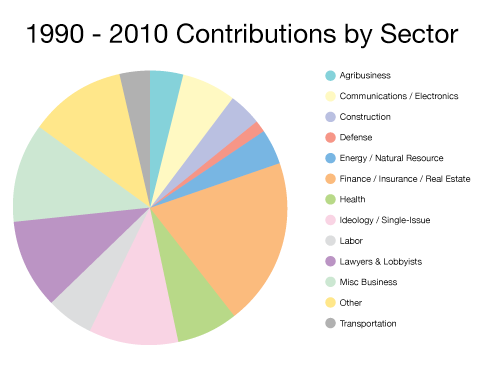
This is what a typical natural gas drilling site under fracking operations looks like at night. Now such operations go on 24/7 until completion so that means locals have to deal with blaring bright lights and noise all through the night.

This is what a typical natural gas drilling site under fracking operations looks like at night. Now such operations go on 24/7 until completion so that means locals have to deal with blaring bright lights and noise all through the night.

Nevertheless, the waste pits on drill sites usually store flowback water in the open air where it can poison unsuspecting wildlife or evaporate into the atmosphere untreated, possibly leading to acid rain. These can be as large as football fields. Now these can also be prone to accidental spillage with its contents possibly finding their way to a nearby stream or perhaps seeping into the groundwater. And it doesn’t help that most drilling takes place on farms which can lead to poor soil and damaged crops. There was even a case in Pennsylvania in which cows had to be quarantined over waste water leak on a farm as well a leak that contaminated a community’s drinking water in Washington County. Luckily, waste water pits aren’t always present every drill pad you see.

The most dominant method of fracking flowback disposal in all areas but Pennsylvania is underground injection, which is basically dumping the water back where it came from. In Pennsylvania, this isn’t possible due to geology and regulations so the water is treated and reused. Yet, it’s said this won’t last forever. Not to mention, there have been instances illegal flowback dumping reported in Ohio, Virginia, and California that might also contaminate local waterways and drinking supplies as well. And while some fracking flowback gets treated and reused (mostly in Pennsylvania), the EPA says that most water treatment works in the country aren’t set up to treat it. In Pennsylvania, such method is common practice for years but the volume greatly expanded with the Marcellus Shale boom. Some treatment plants may not even be equipped to handle some of the fracking fluid’s more toxic components. And when water treatment plants may treat some of the fracking water, it can’t always treat it all. Thus, this leads to some of the water being discharged to rivers, lakes, streams, and drinking supply.

Here's a rough diagram from Gasland on how fracking can affect the environment. This can pertain to chemicals getting into the water supply in particular.

Here’s a rough diagram from Gasland on how fracking can affect the environment. This can pertain to chemicals getting into the water supply in particular.

I know that environmentalists have their own agendas and sometimes exaggerate their claims. But despite some inaccuracies, there are some things that even the noted anti-fracking film Gasland can’t make up. Even though a fracking disaster may happen on one of those rare occasions, that doesn’t mean it won’t happen in your neck of the woods. Not only that, and just because the gas drilling companies may take every precaution to ensure their fracking operations do any harm, doesn’t mean that mistakes can be made or something can (or will) go terribly wrong. Even if those disasters only happen less than 10% of the time, that doesn’t me we shouldn’t worry about them. And when it does, the environmental consequences are devastating. Now even if fracking doesn’t cause water contamination doesn’t mean it’s perfectly safe since the process can at least affect the air quality during the operations, which is a fact we can’t ignore.

Let’s face it, natural gas may be a cleaner fuel than coal but that doesn’t mean that it’s a eco friendly. In fact, it’s a fossil fuel just like any form of energy you get from the ground and emits carbon emissions that contribute to global warming. Nor can we say that it’s extraction process is environmentally safe either since fracking still pollutes and can still do considerable harm on local wildlife and human health. And though the gas companies may say fracking is perfectly safe, this doesn’t mean that they’re willing to share information on what’s in their fracking fluid or any baseline data on groundwater conditions before drilling ever took place. Thus, you just simply can’t take their word for it. Well, I don’t know about anyone else, but from what I’ve seen, heard, wrote, and read, I just have no confidence that fracking is safe under any circumstances. I know fracking is here to stay and there’s nothing I can do about for now. And despite that I’ve heard how Marcellus Shale drilling helps Pennsylvania, I just don’t think the risk contaminating millions of gallons of fresh water all for extracting natural gas is worth it. If there was a greener way, I would probably be more compliant but until there is, I can’t see any way I can support such measures. So sorry, Marcellus Shale, but I just don’t see it.

Why We Can’t End the Fed

Marriner_S._Eccles_Federal_Reserve_Board_Building

I haven’t written on anything political on this blog for a long time but I think a post on the Federal Reserve is a worthy topic of discussion since it’s not much understood even if what I have to say isn’t what people want to hear. I know this isn’t a favorite institution among Americans who sometimes think that it’s corrupt or doesn’t have much transparency. Some like to think that it’s been involved in a lot of conspiracies such as the Kennedy assassination (which it certainly wasn’t, nor has the CIA). Many view the Fed There are libertarians like Ron Paul and his son Rand who want to end the Fed thinking that it’s unconstitutional and that there’s no need for such system since they believe the economy could regulate itself on its own (I’ll get to this later). Then you have people in the Occupy movement who think that the Federal Reserve exists as a private corporation with too much power in the federal government and only serves the interests of large corporations led by people with too much power and too much money already (it’s actually an amalgamation of a government agency-corporation but with 12 privately owned district banks, yet all profits and central authority belongs to the federal government). However, while many of the anti-Fed movement don’t realize (or ignore) is that the Federal Reserve plays an essential role in the American economy which most Americans take for granted. And while it’s not a perfect system or one a lot of people like, we need to understand that to abolish the Federal Reserve would be absolutely insane.

Now you don’t have to be a financial genius to know that abolishing the Federal Reserve would be a catastrophically stupid idea. In the United States the Federal Reserve functions as a central bank to manage the nation’s money supply through monetary policy, deter bank panics, providing financial services for the government as well as private banks (particularly as a lender of last resort),  strike a balance between privatization and government involvement, and create a stable economic environment for businesses, investors, and consumers alike. All these are extremely important for a national economy as well as in our daily lives. Still, while many do blame the Fed for the country’s economic woes, many don’t understand that if the Fed wasn’t around in the first place, the US would’ve been in much worse economic shape than it has been since its creation in 1913. Yet, even Founding Father Alexander Hamilton knew that establishing a centralized national bank was necessary to stabilize and improve the nation’s credit as well as to improve handling of the US government’s financial business. While this idea was controversial for years (even in his own time), history would later vindicate Hamilton’s views on finance, particularly that of a centralized national bank and the Federal Reserve is living proof of this from its inception to its 100 year existence.

When it comes to understanding why we need the Federal Reserve, we need to remember that the Fed was created in 1913 after the US had spent 76 years without a central bank (giving us a good window into what would happen if we actually ended the Fed.) Now unlike what many free-market libertarians would want you to believe and Ron Paul’s gold standard nostalgia,  these weren’t great economic times to be honest. Of course, the reason why the US went through a period with no centralized banking system during this time had to do with a few factors. For one, the First and Second Banks of the United States were privately owned (and had foreigners share in the profits), shared only 20% of the nation’s currency supply while state banks accounted for the rest, and ran on 20 year charters which both expired before they could be renewed (all based on Hamilton’s ideas by the way save for the expiring bit). Nevertheless, the fatal flaw with Hamilton’s central banking system was that it provided a way for business interest and greed to usurp power from the federal government and common citizens. Second, a lot of Americans didn’t like a centralized banking system which they saw as undemocratic, corrupt, and favoring the interests of big business. They particularly distrusted centralized financial authority which undermined both banks, which was particularly personified in Andre Jackson who was more than happy to help the Second Bank of the United States along its demise in 1836 even to the point of vetoing congressional attempts to renew its charter to usher an era of laissez faire economics and de-centralized American banking. Unfortunately financial anarchy didn’t go so well.

Of course, running a country without a central bank empowered to issue paper money led to more than a few problems, well, more like large systematic financial fuck ups between 1837 and 1913. During this time the dollar supply was tied to private banks’ holdings and government bonds, which would’ve been fine if the need for dollars was fixed over time. Unfortunately it wasn’t the case. Since there was no central, government-backed bank able to create money on demand, the American banking couldn’t provide it nor was there a for a bank’s money supply to adjust with demand either. When people would try to withdraw more money from one bank that it had available, the bank would fail leading to other people trying to withdraw their funds from other banks. Such activities would create a vicious cycle later snowballing into widespread bank failures and contraction of lending across the economy resulting in economic depression. This happened every few years. Another reason for bank failures being so common before 1913 was the tendency of huge fluctuations in the money supply. Often the US economy would alternate between too much money in circulation and not enough causing all sorts of economic chaos.

The American banking system was particularly unstable during the Free Banking Era between 1837 and 1862 when banks had no federal oversight whatsoever. During this time, banks were short lived with an average lifespan of 5 years with half of them would failing (due to fraud, incompetence, or bad economic conditions) and a third going out of business because they couldn’t redeem their notes. You also have a practice called wildcat banking in which many banks would issue nearly worthless currency backed by questionable security (like bonds or mortgages) since the institution’s real value would often be lower than its face value. Some bank currency was more valuable than others depending on the bank you received the banknote and the quality of its assets, your state’s banking regulations, the quality of your state’s bonds if your state required such banknotes to be backed by them, and the likelihood of fraud. Not only that, but there was no transparency at all so you couldn’t tell whether your neighborhood bank’s assets were wildcat money. And if that weren’t enough, you had to deal with the fact that there were over 30,000 different currencies floating around in the United States at this period, which could be issued by almost anyone even drug stores and steakhouses. A lot of problems also stemmed from this including the fact that some currencies were worth more than others whether backed by silver, gold, or government bonds. Then you have the Panic of 1837 that caused a major recession that lasted until the mid-1840s, eight states either wholly or partially unable to pay their debts, and 343 of the nation’s 850 banks closing their doors resulting in a shock from which the system of state banks would never recover.

The National Bank Era of 1863-1913 was not much better. Though it did establish a uniform US banking policy, established a series of national banks with higher standards than many state ones,  created a national currency, and basically helped put an end to the wildcat banking practices. National banks were required to use government issued bills and back them with US government issued bonds as well as accept each other’s currency at par value. The federal government’s 1865 issue of a 10% tax on state bank bills would not only give rise to a uniform national currency by forcing all non-federal issued currency out of circulation but also the creation of checking accounts by the state banks which became the primary source for most banks’ revenue by the 1880s. Yet, despite the reforms, a lot of problems still remained. For one, while the US finally had a uniform currency, it was required to be backed up by treasuries. When such treasuries fluctuated in value, banks had to either recall loans or borrow from other banks or clearinghouses. Second the banking system of the National Bank Era created seasonal liquidity spikes particularly in rural areas during planting season when demand for funds was the highest. When the combined liquidity demands were too big, the bank would again have to find a lender of last resort to borrow from so it could pay its depositors and escape from financial ruin. Unfortunately, the responsibility would usually fall to other banks and financial institutions yet they weren’t always willing to bail out a troubled entity since doing so could put them in financial risk. This led to a string of financial panics which caused serious economic damage. Because there was a chance that you wouldn’t be able to access your bank account during an economic meltdown, Americans didn’t have much faith in their banking system.

The worst of the financial meltdowns to occur during the National Bank Era that helped facilitate the creation of the Federal Reserve was the series of events that helped lead to the Panic of 1907, the period’s worst. Now there are a variety of factors that contributed to this financial crisis that happened to converge all it once. It all began with the devastating San Francisco Earthquake of April 1906 not only developing an urgent need for cash to fund the recovery efforts and contributing to market instability but also made the survivors unable to access their cash for weeks mainly because it had been locked in bank vaults so hot from broken gas line fires that opening them would’ve caused their money to burst into flames. Not only that, 1906 was also a bumper year for crops which brewed a possible economic boom so companies nationwide wanted more cash to invest in new ventures like rebuilding San Francisco. Both of these events made dollar demand uncommonly high at a time when the money supply couldn’t increase much resulting in rising interest rates and withdrawals. Before long, the high number of withdrawals would soon put banks across the country on the brink of failure. In October of 1907, a copper miner turned banker F. Augustus Heinze and his stockbroker brother Otto tried to take over the United Copper Company’s market by buying up its shares. They failed and United Copper’s stock price tumbled causing investors to rush to pull any deposits out of any bank even remotely associated to F. Augustus Heinze. Banks and financial institutions began to fail, particularly the huge Knickerbocker Trust Company, the third largest trust in New York, which had its depositors withdrawing $8 million of its funds in less than 3 hours. Knickerbocker’s failure led banks and financial institutions nationwide to hoard their cash unwilling to lend to other banks, especially in New York. Though undisputed Wall Street king J. P. Morgan managed to bail out some of the troubled banks due to his immense wealth and his ability to get rich guys and bankers to do what he wished, he was unable to solve the systemic failures of the US finance system caused the crisis in the first place.  The Panic of 1907 would spark one of the worst recessions in US history as well as similar crises in much of the world as well as would lead to the creation of the Federal Reserve four years later.

Of course, the Federal Reserve doesn’t prevent bank panics it just serves as a better tool to deal with them as a lender of last resort as well as regulating money supply. Thanks to the Fed, the United States has experienced fewer major financial panics and the money supply is mostly under control with huge fluctuations being few and far between. Because of the Federal Reserve, the United States has become a much more stable economy which has helped create a better climate for capitalist enterprise than any US banking system has ever had in its existence. Sure the Federal Reserve isn’t a perfect institution and has problems that need corrected. Yet,  we need to understand that when the US tried to do without centralized banking, the economy was much less stable and much more unpredictable while banks weren’t always places you could put your money in. No American wants to live at the time when they’d have to worry whether their bank ran out of money, loan their money to someone else who didn’t pay them back, or issued currency notes of questionable value. Nor do Americans want to live at a time of dramatic fluctuations in the money supply either or frequent bank panics and financial meltdowns. Sure there have been accusations that the Fed serves the interests of wealthy bankers and corporations but it also serves in the best interests of all Americans by making sure that the public retained confidence in the nation’s money and where it’s held. It also helps keep our economy system moving and minimize financial disturbances threatening economic stability. Our ancestors in the 19th century didn’t have such system nor did they have as much trust in the American financial system as we do nowadays. While there were plenty of financial institution running to Washington for bailouts during the 2008 meltdown, there were very few Americans running to the banks to withdraw their life savings before they ran out of money. Thus, while the Federal Reserve may have its flaws and critics, at least it’s a viable system that has worked quite well in its 100 year existence playing a crucial role in the US economy and performing services the American people just can’t live without. So perhaps when people talk about possibly ending the Fed, you might want to remind them that our financial system before the Federal Reserve was much worse and much less accountable. Nevertheless, to say that the Fed does more harm than good is simply not the case at all.