Family Unfriendly Board Games: Part 2 – Tressy Girl Career Game to Landlord

687474703a2f2f696d6735322e696d616765736861636b2e75732f696d6735322f353136362f636875746573616e64626c6164646572732e6a7067

Note: The opening images in this series aren’t of real games by the way. They’re just photoshopped pictures I’ve obtained through various websites. But they kind of emphasize that these games I’m featuring aren’t meant for families for various reasons.

So we’re off to a good start. You might’ve noticed that many of the first bunch were quite controversial and very family unfriendly at that. Well, let’s just say that a lot of these tend to have some crazy history behind them and perhaps are made with an agenda. Of course, with quite a few, you can guess the creator’s politics on those. Nevertheless, board games may not be the kind of innocent entertainment as you may see. Many of these featured will also tend to be very old as well as made at a time when gaming companies could get away with a lot more shit than they do now. Mostly it’s because they have to cater to families. And if they’re not, it’s usually to geeks, fratboys, preteens, and partiers. It also explains why some of them might tend to not age well, particularly if they were targeted to preteen to teenage girls. So without further adieu, here is my second installment to my series of family unfriendly board games.

11. Tressy Girl Career Game

It wasn't uncommon for companies in the 1960s to release career girl games to give young girls options beyond the traditional housewife. Unfortunately, these options tend to center around caregivers, assistants, or sex objects. Kind of makes the early James Bond movies look feminist in comparison but not too much.

It wasn’t uncommon for companies in the 1960s to release career girl games to give young girls options beyond the traditional housewife. Unfortunately, these options tend to center around caregivers, assistants, or sex objects. Kind of makes the early James Bond movies look feminist in comparison but not too much.

Category: Educational

Players: 2-4

Contents: board, dice, player tokens, cards

Object: Players navigate a path to become a successful “career girl” by becoming a nurse, secretary, teacher, model, dancer or actress.

Why they thought it was a good idea: Maybe because the creator thought girls needed to learn about their career options outside marriage and housewife.

Why it’s not: Unfortunately, those were basically the only acceptable positions available to most women at the time, assuming that she came from a less enlightened neighborhood in 1960. Nevertheless, it’s basically built on a sexist presence that women either have to be assistants, caregivers, or pretty things to look at. Same goes for a lot of girl career games from the era.

Available?: Let’s hope not, for feminism’s sake. However, it’s not the only one.

12. Beat the Border
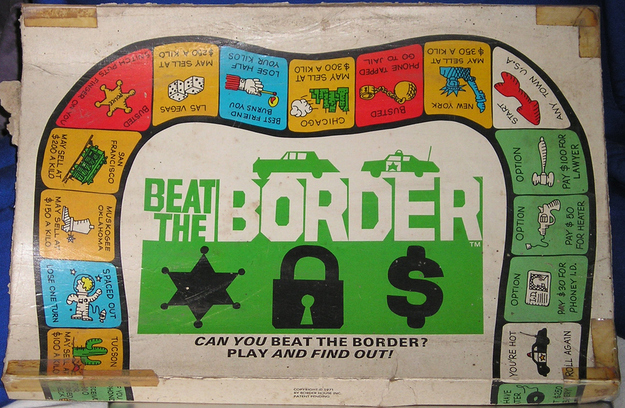
Game about the drug trade at the US-Mexican border where players represent drug mules. Dealers are named Eduardo, Renaldo, and Jose. Hopefully nothing racist about that. Oh, wait a minute, yes there is. Yes there is.  The kind of game less offensive to Mexicans than the Frito Bandito.

Game about the drug trade at the US-Mexican border where players represent drug mules. Dealers are named Eduardo, Renaldo, and Jose. Hopefully nothing racist about that. Oh, wait a minute, yes there is. Yes there is. The kind of game more offensive to Mexicans than the Frito Bandito.

Category: Economic, Humor

Players: 2-4

Contents: board, money, player pieces, scorecard, dice

Object: Players start with $1000 and spend the game crossing the US-Mexican border as a drug mule risking possible arrest by US authorities. Player who makes the preset money goal wins.

Why they thought it was a good idea: This game was released in the early 1970s. Guess it pertains to drugs? Hey, don’t ask me.

Why it’s not: Well, the guys you buy drugs at the border are named Eduardo, Renaldo, and Jose. You know, Mexicans. You can guess the negative Hispanic stereotype in play here.

Available?: Most likely not.

13. Jews Out!

Now you can orchestrate your own Holocaust with this Jews Out! board game. Actually, just kidding because you can't. In fact, there are only 2 remaining copies of this game still known to exist. And that's a good thing.

Now you can orchestrate your own Holocaust with this Jews Out! board game. Actually, just kidding because you can’t. In fact, there are only 2 remaining copies of this game still known to exist. And that’s a good thing nobody could play this game. Because reviving it would be very bad.

Category: Cross and Circle

Players: 2-6

Contents: a pair of dice, a game board, tokens, and several game piece figurines with large pointed hats meant to represent Jews

Object: Players role dice, move token to Jewish homes to collect Jews. They must then escort these Jews to a “collection point” so they can be banished from the city (to a special place where they’ll be subject to forced labor, starvation, disease, and poisonous showers). First player to expel 6 Jews wins.

Why they thought it was a good idea: It was viewed as a tool for Nazi propaganda, particularly when it came to the Nuremburg laws and the Kristallnacht. Didn’t stop the Nazi government from saying it trivialized their Anti-Semitic policies and was commercially unsuccessful.

Why it’s not: Uh, do I really need to explain that is a game about the Holocaust? I mean you know, the time when millions of people (namely Jews) were rounded up and sent to concentration camps where they either were forced to work with and succumb to adverse conditions, subject to inhuman experimentation, or simply exterminated. Seriously, that’s just fucking insane!

Available?: Hopefully, only the 2 remaining copies were sent to a museum while the rest were burned.

14. Adultery
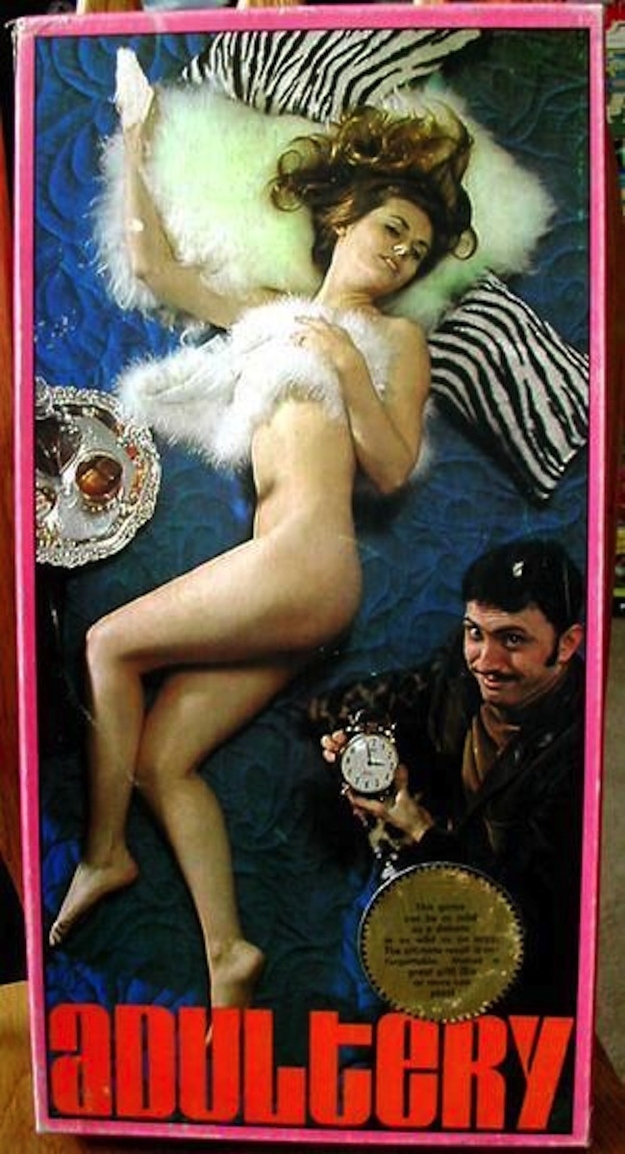
If you're married and attend an office party, you might hope that your boss doesn't force you to play this game. Then again, if you are, make sure you threaten a sexual harassment suit against your sleazy ass supervisor.

If you’re married and attend an office party, you might hope that your boss doesn’t force you to play this game. Then again, if you are, make sure you threaten a sexual harassment suit against your sleazy ass supervisor.

Category: Mature/Adult, Party

Players: At least 3

Contents: board, player tokens, game, tokens

Object: Players must hook up with at least 2 people in real life. I know the publisher doesn’t say it that way. It’s like a 1960s board game version of Tinder.

Why they thought it was a good idea: The makers wanted to appeal to the swingers demographic or make a great game for swingers’ parties.

Why it’s not: Uh, can’t you see the title basically means, “cheat on your spouse?” Guess this board game led to a lot of divorce cases and daytime talk show paternity disputes. Pull this one out of an office Christmas party gift exchange, you might expect to spend 5 minutes with your boss, if you aren’t savvy enough to threaten a sexual harassment suit first.

Available?: Oh, please, no.

15. Blacks & Whites

Basically this is a Monopoly type game which was supposed to spread awareness of institutionalized racism. But ends up highlighting it in the most inappropriate way possible. Was originally designed so the black players can't win, which is the point.  Let's just say illustrating the evils of racism doesn't work with board games.

Basically this is a Monopoly type game which was supposed to spread awareness of institutionalized racism. But ends up highlighting it in the most inappropriate way possible. Was originally designed so the black players can’t win, which is the point. Let’s just say illustrating the evils of racism doesn’t work with board games.

Category: Economic, Educational, Negotiation

Players: 3-9

Contents: board, 5 white tokens, 4 black tokens, 2 dice, several flat black bars, property cards, as well as cards for blacks and whites.

Object: It’s kind of like Monopoly save the fact that white players start with $1 million while black players begin with $10,000. First player to get 100 status points wins.

Why they thought it was a good idea: Psychology Today thought publishing a game like this would help teach people why institutional racism against African Americans and other people of color is bad. Or as they call it, “the absurdities of living in different worlds while playing on the same board.”

Why it’s not: Basically this game highlights the evils of racism in the most inappropriate way possible as well as shows why the board game depiction pertaining to certain social problems like institutionalized racism doesn’t work. Originally it was designed so the black players can’t win since they have limited property options such as “inner ghetto,” “outer ghetto,” “lower integrated,” “upper integrated,” “newer estates,” and “older estates.” But the game was later redesigned or the rules were simply ignored. Seriously, this game basically creates an unequal competitive advantage and is unwinnable by design for certain players, which doesn’t work well in board games. Or any game as a matter of fact.

Available?: It’s been out of print for years, thank God.

16. Project Porn Star
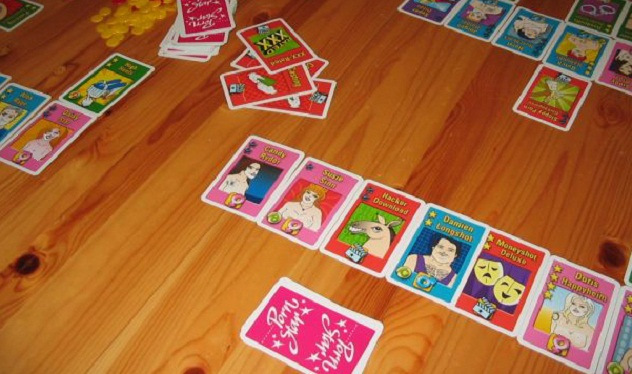
Now this is a game that puts players in world where movie directors lack the creative imagination to make wonderful movies and the budgets awarded to Michael Bay. For perverts who see nothing wrong with exploiting women for their sex appeal in showbiz.

Now this is a game that puts players in world where movie directors lack the creative imagination to make wonderful movies and the budgets awarded to Michael Bay. For perverts who see nothing wrong with exploiting women for their sex appeal in showbiz.

Category: Card, Humor, Mature/Adult

Players: 2-5

Contents: Sets of cards

Object: Players are cast as porn directors to navigate their way through the porn business with cards representing actors, objects, and actions. But beware of thieves, hackers, ugly actors, and moralistic directors. Great way to exploit women, waste celluloid, and create films with absolutely no storyline.

Why they thought it was a good idea: I have no idea. Seriously, I wasn’t consulted. Guess it was a way to appeal to frat boys and encourage them to use their imaginations.

Why it’s not: Let’s not kid ourselves, the porn industry is a terrible business known to exploit and objectify women as well as is bereft of any artistic value of any kind.

Available?: Probably at some adult sex shop.

17. Five Little Ni***r Boys

Hmm...a game about killing 5 black boys in cold blood? Then again, it was made in 1950 in Britain. But still, it's obscenely racist it's not even funny. I mean we had black people killed in the US for no reason on the time, especially under "Stand Your Ground" in Florida.

Hmm…a game about killing 5 black boys in cold blood? Then again, it was made in 1950 in Britain. But still, it’s obscenely racist it’s not even funny. I mean we had black people killed in the US for no reason on the time, especially under “Stand Your Ground” in Florida.

Category: First Person Shooter

Players: 2-4

Contents: a box with 5 black boys, a pop gun firing corks, and a “Watermelon Coon” target

Object: Players try to shoot the 5 little black boys in cold blood. The one who guns down the most wins but loses their conscience.

Why they thought it was a good idea: This was made in Britain in 1950 perhaps with the idea of cashing in on white supremacists in the American South.

Why it’s not: Seriously, do I really need to explain? I mean this whole game is about killing black people for absolutely no reason for God’s sake!

Available?: Hopefully, not.

18. Kablamo
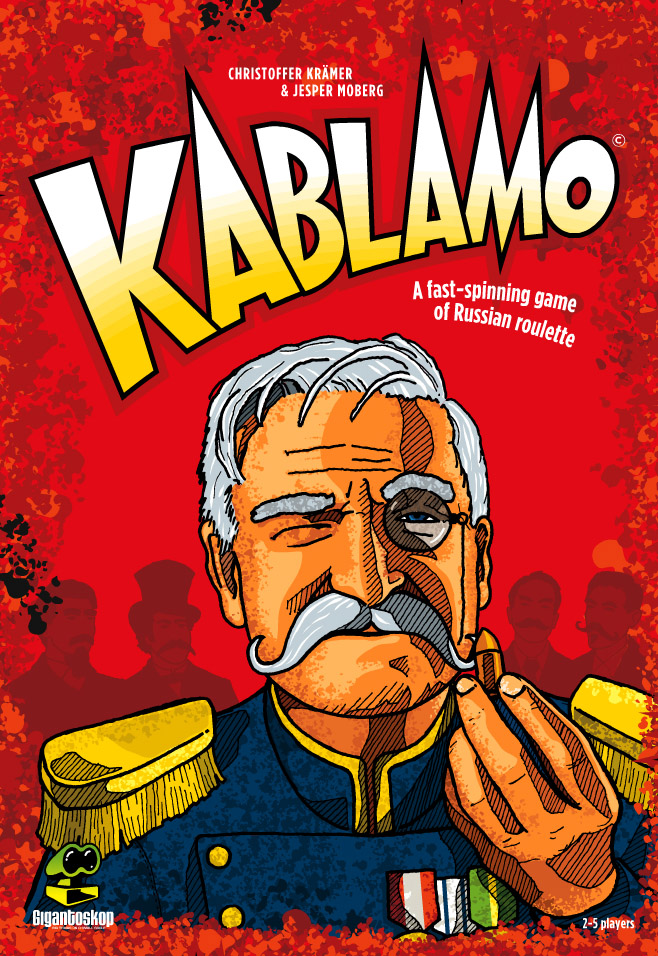
It's like Russian Roulette: The Board Game. Well, except that unlike the real thing, nobody dies, except maybe on paper. Really disturbing if you think about.

It’s like Russian Roulette: The Board Game. Well, except that unlike the real thing, nobody dies, except maybe on paper. Really disturbing if you think about.

Category: Fighting, Humor, Memory

Players: 2-5

Contents: 5 boards depicting a barrel of a gun with six spaces as well as playing counters representing bullets.

Object: Similar to “Russian Roulette” in which each gun is loaded with playing counters on the spaces. Bullets come in various types with some killing you when fired, others allowing you to change bullet position (either in your gun or someone else’s) or modify bullet behavior. Each turn consists of with all players simultaneously firing their “gun” with rotating the barrel with the top bullet. But players can randomly reload by drawing new counters and playing them on empty spaces. Still, guess the only surviving player wins.

Why they thought it was a good idea: Your guess is as good as mine. Then again, it’s supposed to be for ages 12 and up.

Why it’s not: Do I really need to explain? I mean it’s basically a non-deadly board game version of “Russian Roulette.” That kind of sums up the reason why it’s not a good idea.

Available?: Well, there’s one in stock on Amazon.

19. Pimps and Hos
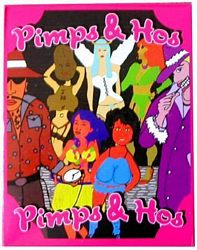
Pimps & Hos: The game about procuring girls into prostitution. Yeah, I know it's an adult game but I'm not sure if it's appropriate one to play know how prostitutes tend to be expendable on crime shows.

Pimps & Hos: The game about procuring girls into prostitution. Yeah, I know it’s an adult game but I’m not sure if it’s appropriate one to play know how prostitutes tend to be expendable on crime shows.

Category: Card, Mature/Adult

Players: 3-6

Contents: Deck of cards

Object: A game on prostitution. Players play “John” cards on their girls to make money. First player to earn $1500 wins the game. But it’s not that simple since other players could send each other’s girls to jail and have to be bailed out. Also, if a girl fails a health exam, she’s off the street. The girls can also switch pimps, by the way.

Why they thought it was a good idea: Beats me, but it’s certainly not for kids.

Why it’s not: This is a game that mocks prostitution, which is an exploitative business for women in more ways than one. And it doesn’t help that prostitutes are often targets of violent crime since they’re less likely to call law enforcement who’d most likely put them in jail (since most inmates in women’s prisons tend to be in for prostitution. Not to mention, this also explains why a lot of prostitutes tend to be murder victims in the media). Also, they tend to be abused and many tend to have drug addictions. And there’s the fact a lot of prostitutes tend to be victims of sex trafficking, especially if they’re from poorer countries.

Available?: Hopefully not.

20. Landlord

In this game players can build apartments, rent to paying tenants, collect rent, kick out poor tenants, and blow up buildings. Basically has a more glamorous take on the ugly stuff that landlords actually do.

In this game players can build apartments, rent to paying tenants, collect rent, kick out poor tenants, and blow up buildings. Basically has a more glamorous take on the ugly stuff that landlords actually do.

Category: Card, Humor

Players: 2-6

Contents: Deck of cards

Object: Build apartments, rent them to tenants, and collect rent. Each card has an apartment on one side as well as tenants, roofs, renovations, and special actions on the other. Players can put wealthy tenants into their apartments and put deadbeats into their opponents.’ They can even bomb buildings as long as they don’t get caught since jail awaits the careless.

Why they thought it was a good idea: Well, it’s for teens. It’s an apartment management game. Other than that, I’m not sure.

Why it’s not: Let’s just say landlord isn’t a glamorous profession and this game sort of perpetuates a lot of negative stereotypes about them. Especially when it comes to bombing their own buildings or sending deadbeats to other places.

Available?: Not sure but hopefully not.

Family Unfriendly Board Games: Part 1 – Hunger Games District 12 to The Sinking of the Titanic Game

687474703a2f2f696d6734332e696d616765736861636b2e75732f696d6734332f313137362f6465616c6e6f6465616c2e6a7067

Note: The opening images in this series aren’t of real games by the way. They’re just photoshopped pictures I’ve obtained through various websites. But they kind of emphasize that these games I’m featuring aren’t meant for families for various reasons.

For 5000 years, people have played board games to amuse themselves with others. Of course, in the age of the Internet, they tend to be played during camping trips or power outages for the most part. But even today, they tend to be a part of many people’s lives. Just look at Kickstarter. In fact, I have a friend from high school who has started his own Kickstarter campaign for a trading card game called, “Sky Royals,” I think but I can’t be exactly sure. Sure to think it’s “Sky” something but I could be wrong. Still, we tend to associate board games with the notion of family game night in which parents and kids gather around to play these as a family. It’s usually associated with the weekend or Friday, save maybe during the high school football season for obvious reasons. Nevertheless, though we tend to associate board games for kids, this isn’t always the case such as you see with Dungeons & Dragons fans. But it got me thinking of which games I wouldn’t see as appropriate for a families to play or ones families wouldn’t find fun. Some may be offensive and inappropriate. Others might be boring and dumb. Some may even have complicated rules or unfortunate implications. Still, I wouldn’t recommend them for any family on a Friday night. So for your summer reading pleasure (especially if you live in Southwestern Pennsylvania), here is my first installment of some very family unfriendly board games.

  1. Hunger Games District 12
Let's just say the Hunger Games movie franchise really doesn't understand the idea of misaimed marketing. Seriously, I think this game was created by people who have no idea what the books are about.

Let’s just say the Hunger Games movie franchise really doesn’t understand the idea of misaimed marketing. Seriously, I think this game was created by people who have no idea what the books are about.

Category: Strategy

Players: 2-4

Contents: Game board, 55 resource cards, 9 special deck cards, 44 reaping cards, 4 player tokens, 1 round token, 1 first action token and 6 cover tokens

Object: Avoid the Reaping by using your wits to acquire food, clothing, medicine, and fuel before being chosen. Players also try to avoid taking Tesserae which will increase their chances on Reaping Day.

Why they thought it was a good idea: Well, The Hunger Games Trilogy are popular books and the movies are box office hits. Not to mention, the franchise is aimed toward teens and young adults.

Why it’s not: Because the story centers around certain concepts that aren’t so nice like violence, poverty, and political repression. Also, most Panem teenagers avoid the Reaping with sheer dumb luck, even though the reaping system is basically rigged and the poorest kids are the most likely chosen, especially from the poorest districts like District 12.

Available?: Yes, through all major retailers.

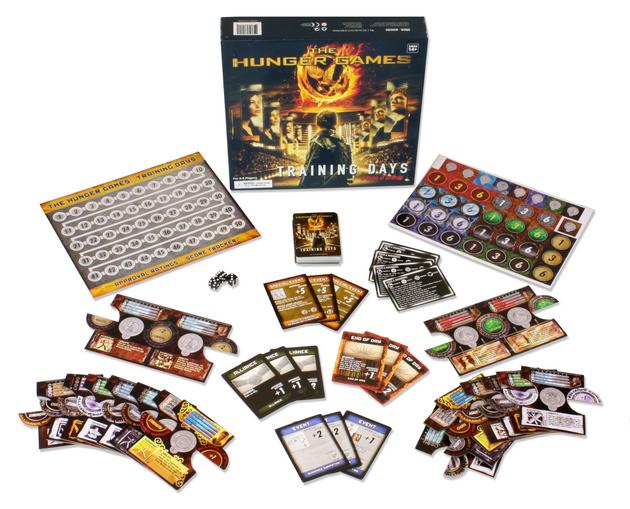
  1. Hunger Games: Training Days Strategy Game
Based on the popular young adult trilogy about forcing a bunch of post-apocalyptic teenagers into a duel to the death on national television. And this is a game pertaining to their training before they all kill each other. Misaimed merchandising indeed.

Based on the popular young adult trilogy about a dystopian society forcing a bunch of post-apocalyptic teenagers into a duel to the death on national television. And this is a game pertaining to their training before they all kill each other. Misaimed merchandising indeed.

Category: Strategy, Auction/Bidding

Players: 2-6

Contents: 18 Tribute cards representing the boy and girl Tributes from 9 Districts (1-4,7,8,10-12), 3 Effort tokens for each District (1,3,6), Deck of 45 Challenge cards: 3 End of Day cards, 24 Event cards, 8 Special Event cards, 10 Alliance cards, 9 District markers, Approval Rating score board, 3 dice

Object: Players choose tributes and challenge each other to matches on wits and skills as well as other attributes.

Why they thought it was a good idea: Once again, The Hunger Games Trilogy is a best-selling series and box office franchise hit. It also caters toward teens and young adults.

Why it’s not: The game basically glamorizes a competition in which 24 teenagers are chosen throughout a dystopian country to fight each other to the death on national television. The Hunger Games are hateful and deplorable as well as ruin the victors’ psychologically. In fact, the whole series is viciously anti-war and the Hunger Games basically symbolize how horrible, life destroying, and how evil humanity can be. Or in short, a dehumanizing death match.

Available?: Yes, through all major retailers.

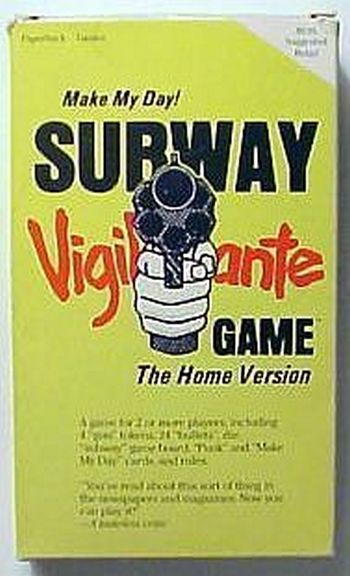
  1. Subway Vigilante
In the 1970s, this was one of the ways you can live your life as a vigilante action hero on the morning commute. Of course, in real life, vigilante violence leads to collateral damage, jail time, and everyone hating you.

In the 1970s, this was one of the ways you can live your life as a vigilante action hero on the morning commute. Of course, in real life, vigilante violence leads to collateral damage, jail time, and everyone hating you.

Category: Adventure, Humor

Players: 1-4

Contents: 1 game board, Rule Sheet, 4 gun tokens, 24 bullet tokens, 30 “Make My Day” Cards, 30 “Punk” cards

Object: Armed with a handgun and 6 bullets, each player must survive a commute between Brooklyn and the Bronx with a subway filled with punks as well as obstacles like car derailments, shoving matches, nosy security guards, overworked policemen, and botched subway transfers. Includes a round table discussion at the end of the game.

Why they thought it was a good idea: I don’t know, the popularity of Dirty Harry and Death Wish during the 1970s?

Why it’s not: For one, it glamorizes vigilante violence which is a very terrible thing and downright illegal. Second, it makes New York look like a crime ridden death trap, Third, let’s say that gunplay in a subway can lead to significant collateral damage.

Available?: I’m not sure. Probably not.

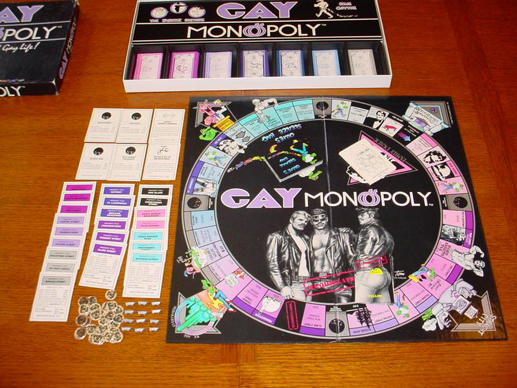
  1. Gay Monopoly
Gay Monopoly: A kind of game that perpetuates so many gay male stereotypes that it should go back into the closet where it belongs. Seriously,  it doesn't portray an accurate picture of gay life which isn't much different from straight life anyway.

Gay Monopoly: A kind of game that perpetuates so many gay male stereotypes that it should go back into the closet where it belongs. Seriously, it doesn’t portray an accurate picture of gay life which isn’t much different from straight life anyway.

Category: Economic, Humor, Negotiation

Players: 2-6

Contents: game board, instructions, paper money, 2 dice, bathtubs, bar tokens, and 6 original playing tokens (jeep, leather cap, high-heeled pump, handcuffs, hairdryer, and teddy bear), 28 property cards, 21 Family Pride cards, 16 Manipulation cards, 31 Ollie’s Sleaze Bag cards

Object: It’s like Monopoly but instead of buying streets and placing homes and hotels, players buy gay locales where they put bars and bathhouses. Also, you sometimes have to act out gay stereotypes to get more money.

Why they thought it was a good idea: Its original purpose is to celebrate the “gay lifestyle” coinciding with the rise of the Gay Rights Movement of the 1970s.

Why it’s not: Basically the game goes with every type of gay man stereotype you can think of. Not to mention, it doesn’t include lesbians. Still, when it come to the “gay lifestyle,” the only way it’s distinguished from their straight counterparts is fact they prefer to have sex with members of their own gender (that doesn’t result in children). That is all. Yeah, quite offensive and not reflective of the gay community’s diversity.

Available?: Not really, for it’s out of print thanks to a Parker Brothers copyright lawsuit.

  1. Ghettopoly
Ghettopoly is like Monopoly depicting the life of urban poor blacks according to what white people perceive through Hip Hop and rap lyrics. Was subject to a very real NAACP lawsuit.

Ghettopoly is like Monopoly depicting the life of urban poor blacks according to what white people perceive through Hip Hop and rap lyrics. But it is totally absent of any dignity and respect you see on The Wire. Was subject to a very real NAACP lawsuit and has been banned.

Category: Economic, Mature/Adult, Roll/Spin and Move

Players: 2-7

Contents: Game Board, Loan Shark Tray, 40 Crack Houses, 17 Projects, Pink Slip Cards, Ghetto Stash and Hustle Cards, 7 Game pieces (Pimp, Hoe, 40 oz, Machine Gun, Marijuana Leaf, Basket Ball and Crack), Counterfeit Money, 2 Dice

Object: It’s very much like Monopoly except that players buy stolen properties, pimp hoes, build crack houses and projects, pay protection fees, borrow from loansharks, and get carjacked. Railroads are replaced with liquor stores while some properties consist of a massage parlor, peep show, and pawn shop. Taxation squares are replaced by carjacking and police shakedown squares.

Why they thought it was a good idea: It’s actually a parody of the urban poor black lifestyle allegedly celebrated in Hip Hop and Rap lyrics.

Why it’s not: If this was a tribute to The Wire, it would be much more understandable. Then again, probably not. Seriously, this game is incredibly racist and derogatory toward black people that it sparked controversy since its release in 2003. Also, just because Hip Hop lyrics contain specific references doesn’t exactly mean these rappers specifically intended them to be celebrated or glamorized as this game does.

Available?: No, because it was subject to a lawsuit by the NAACP and Hasbro as well as been banned on various websites.

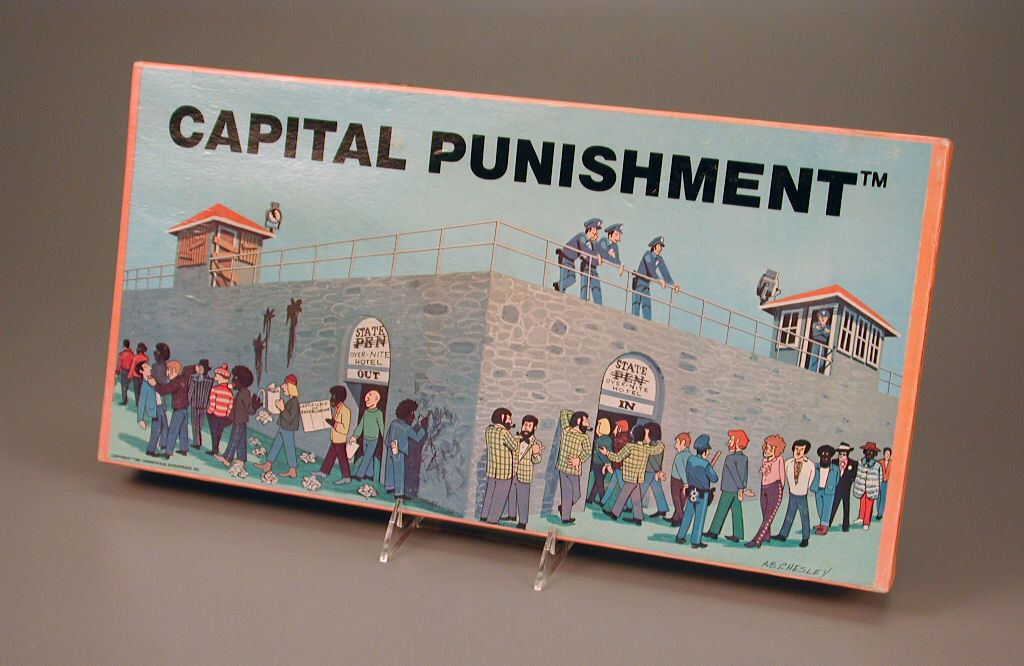
  1. Capital Punishment
Basically a game which shows people why the US needs the death penalty and why liberals are soft on crime. Also, gets the real situation on capital punishment totally wrong such as media coverage, appeals process, large costs, proven innocence through DNA evidence, and the number of years it takes for someone to actually be executed.

Basically a game which shows people why the US needs the death penalty and why liberals are soft on crime. Also, gets the real situation on capital punishment totally wrong such as media coverage, appeals process, large costs, proven innocence through DNA evidence, and the number of years it takes for someone to actually be executed.

Category: Political, Strategy

Players: 2-4

Contents: 1 game board, 4 sets of four capital criminal playing pieces (murderer, rapist, arsonist and kidnapper) in four colors, 4 sets of two liberal playing pieces in four colors, 60 innocent citizen cards (15 for each player), 2 standard six sided dice, 3 spare innocent citizen cards.

Object: Players try to get their criminals into a combination of life imprisonment, death row, or the electric chair. But can also use Liberals to get a criminal back on the streets, angling for a second victory condition of killing all 15 of your opponents’ citizens and sending them to Heaven.

Why they thought it was a good idea: Let’s not kid ourselves, the designer’s intention was to convince people why the death penalty is a good idea.

Why it’s not: For one, this game basically states that the death penalty deters crime and that liberals are soft on crime. Not to mention, it tends to dismiss the fact that there are good reasons to be against capital punishment or criticize the criminal justice system. Nor does it provide an accurate description of criminal justice system such as racial profiling, class disparities, the ambiguity of innocence, and how life in prison without parole for the most serious crimes is a better alternative to a death sentence. Also, it leaves out how the legal process makes capital punishment insanely expensive as well as the fact that death row inmates could spend decades in prison before they’re executed. And then there’s the fact that death row inmates receive a lot of media coverage in the days before their execution as well as offers no closure to the victims. Then there’s the fact that more states have abolished capital punishment in recent years, most notably Nebraska, which isn’t a liberal state by any stretch of the imagination.

Available?: Hopefully not.

  1. Life as a Black Man
A game that shows a picture of institutionalized racism in America through the most offensive and stereotypical way possible. Obviously wasn't created by African Americans.

A game that shows a picture of institutionalized racism in America through the most offensive and stereotypical way possible. Obviously wasn’t created by African Americans.

Category: Role-Playing, Simulation

Players: 2-6

Contents: 1 24″ x 24″ game board, 1 9″ x 12″ Prison Platform, 1 4-sided die, 1 6-sided die, 6 game pawns, 12 decks of Action Cards: 25 GlamourWood cards, 25 Black University cards, 25 Military cards, 30 Ghetto cards, 25 Corporate America cards, 20 Church cards, 25 Prison cards, 25 Life cards, 50 Career cards, 25 Racism cards, 25 Crime cards, 25 Police cards, 18 Character Type Cards: 6 Creative, 6 Intellectual, 6 Athletic, 14 Transportation Cards: 5 “No Car” cards, 3 “Bucket” cards, 2 “Used Mid-Size” cards, 2 “New Sub-Compact” cards, 2 “New SUV” cards, 3 Debt cards, a pack of BlackMan money

Object: Players start as an 18 year old black male high school graduate and make moral choices throughout the game possibly finding themselves at Black University, the military, the ghetto, or “GlamourWood.” First player to reach the “Freedom” space wins. It’s kind of like the Game of Life, except possibly worse.

Why they thought it was a good idea: It’s original intention was to show how tough life is for a young black man and how it’s not easy.

Why it’s not: Unfortunately, this board attempts to simplify a very complex problem by involving a parade of stereotypes which blurs the lines between satire and actual racism. Players are also giving numerous opportunities to commit crimes which will earn more money but make them more likely to land in prison. Those with enough money can hire the “Dream Team” lawyers and get off without punishment, which is an obvious reference to O. J. Simpson. However, there could be worse, right?

Available?: Might be out of print for all we know.  Nevertheless, it’s now an app.

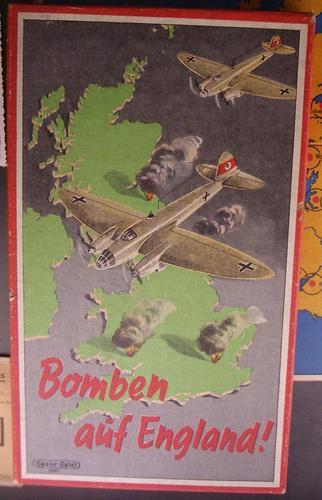
  1. Bombing of England
Now this game was created by the Nazis to commemorate their bombing of England during WWII. Luckily the Germans didn't win in real life. Also, the British have a game called Duel in the Dark which pertains to bombing Germany.

Now this game was created by the Nazis to commemorate their bombing of England during WWII. Luckily the Germans didn’t win in real life. Also, the British have a game called Duel in the Dark which pertains to bombing Germany.

Category: War, Pinball

Players: 2-4

Contents: a holed map of Great Britain as well as several spring driven balls.

Object: Players fire spring-loaded balls over a map that contains Great Britain and parts of Northern Europe. Players score points for each target the ball settles on and loses points if they hit a Nazi occupation or ally. Player who scores the most wins.

Why they thought it was a good idea: This game was created by Nazi Germany in 1939 as a propaganda piece.

Why it’s not: Uh, it’s basically a family board game celebrating the Battle of Britain in the most anti-British way possible. Seriously, it’s basically making light of cities being bombed, civilians getting killed, children having to be evacuated to the countryside, homes being destroyed, sleepless nights, and all the other crap the British had to deal with. Still, there’s one bombing German cities called Duel in the Dark.

Available?: Oh, God please no.

  1. Public Assistance: Why Bother Working for a Living
Also known as, "The Game that Demonizes Poor People, Particularly if They're Black." Really paints a very degrading and terrible picture on how people live on welfare (many of whom are already working for a living but aren't earning enough due to greedy corporate executives who want all the money for themselves). Another game the NAACP didn't like and for good reason.

Also known as, “The Game that Demonizes Poor People, Particularly if They’re Black.” Really paints a very degrading and terrible picture on how people live on welfare (many of whom are already working for a living but aren’t earning enough due to greedy corporate executives who want all the money for themselves). Another game the NAACP didn’t like and for good reason.

Category: Economic, Political

Players: 2-4

Contents: 63 Paper Baby ‘counters’, 54 Welfare Benefit cards, 54 Working Person’s Burden cards

8 plastic pawns in 4 colors, 3 dice, Money, Board

Object: Players move around the board in 2 different tracks “working person’s rut” and “able-bodied welfare recipient’s promenade.” The goal is to collect the most money after taxes once a pre-determined circuits around the board have been achieved. Spaces on the board contain various instructions on where to move your piece or how much money to receive or pay out. Players also collect “welfare benefit” and “working person’s burden” cards as they progress around the board.

Why they thought it was a good idea: Of course, this game’s creator intended to satirize the welfare system and why it’s unfair that hard earned taxpayer money has to go to lazy, poor, drug addled, delinquent, and baby popping bums.

Why it’s not: This is a very derogatory game toward poor people, especially blacks in which they’re portrayed as lazy, drug addled, delinquent, and baby popping bums who won’t go work for a living. Not to mention, it really paints an inaccurate and terrible picture of people on welfare as well as the system itself as a nanny state. It also fails to show the horrific realities of people in poverty who might have a good reason to be on welfare such as being under 18, disabled, having no health insurance, working multiple dead end jobs on minimum wage, homelessness, minimum job security, racial profiling, corruption of law enforcement, and living in a shitty neighborhood with high crime and crappy schools as well as lack of job opportunities. Nevertheless, being on welfare doesn’t relieve anyone from poverty or any of that. Seriously, why do people have to be such assholes when it comes to poor people?

Available?: Hopefully, the first edition is out of print since the NAACP tried to keep it off the shelves. But they recently re-released the game as “Obozo’s America.”

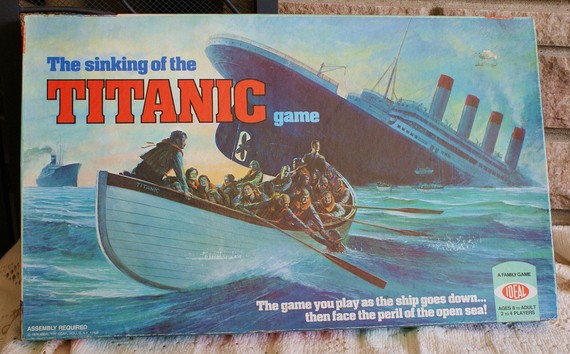
  1. The Sinking of the Titanic Game
Though it's marketed as an educational game The Sinking of the Titanic should really be labeled as "misinformational" at best. Seriously, not only is it an insensitive board game topic, it also gets the aftermath wrong. I mean they have the survivors scavenging for supplies in the islands with residing baboons. Playing this game might make you owe James Cameron an apology.

Though it’s marketed as an educational game The Sinking of the Titanic should really be labeled as “misinformational” at best. Seriously, not only is it an insensitive board game topic, it also gets the aftermath wrong. I mean they have the survivors scavenging for supplies in the islands with residing baboons. Playing this game might make you owe James Cameron an apology if you thought the 1997 movie was very historically inaccurate. Well, not compared to this.

Category: Nautical, Educational

Players: 2-4

Contents: game boards, retainer clips, 24 passenger cards, 18 sea adventure cards, 18 island adventure cards, 6 lifeboats, 20 food tokens (five of each color), 20 water tokens (five of each color), 4 ship’s officers, 2 dice, metal binder screw and post

Object: As the Titanic is sinking, players must race around and rescue passengers from their state rooms and rush them to the life boats before the ship goes under. After the ship sinks, they must get enough food and water by visiting islands and/or drawing cards to stay alive until rescue boats appear. The first one to make there wins the game while everyone else dies. Oh, and there’s a thing about gathering supplies and racing to the islands.

Why they thought it was a good idea: Well, this game was released in 1975 so it’s certainly not a tie-in to the 1997 James Cameron movie with Leonardo DiCaprio. So I’m probably going with the educational standpoint.

Why it’s not: You have to wonder where Milton Bradley’s conscience was during this game’s development. Now trying to educate people about certain historic events is one thing. But to make a board game about the greatest maritime disaster in history that left over 1500 dead? Well, you’re doing it wrong! Also, the racing to islands thing to gather food and supplies for the survivors, uh, that didn’t happen in real life. Not to mention the Titanic sank in the north Atlantic and I’m sure the survivors didn’t encounter baboons. Seriously, capitalizing on a disaster? You got to be kidding me.

Available?: It caused such an outrage in the UK that it was renamed Abandon Ship with the iceberg being switched to a coral reef. The premise was changed to saving the most passengers, too.

Vintage Underwear Advertising Through the Ages

nrm_1408653783-cos-09-fruit-of-the-loom

Now underwear is a complex product in the advertising world. Sure most of us wear it and can’t live without it. Some wear it for comfort. Others for support or figure control. And some athletes wear it for protection. Actually we all wear it for protection as well as for comfort. Still, for a long time in history, there have been people who went without it because it simply wasn’t available or at least as we know it. But that doesn’t mean getting people to buy it is any less awkward. For instance, men might have a good time flipping through a Victoria’s Secret catalog but this doesn’t mean they’re willing to step inside an actual store, even if it’s to buy something for their girlfriend or wife. Still, when it comes to getting underwear for men, it’s usually safe to go with the tidy whitey option than go with anything too fancy. Just ask my father. Also, it’s preferable to shop for underwear for yourself or the kids if you have any. Nevertheless, while your conventional underwear ad usually had a model in the company’s undergarments, this wasn’t always the case. Now I can go on and on with all the great vintage underwear ads out there, but this would be a very boring post and I will never hear the end of it. So instead, I’ll show you some vintage underwear ads that seem a little more creative than they should be. Then again, some of them might’ve been designed by a guy who was deep in a Madison Avenue closet. So for your reading pleasure, here are some old timey underwear ads that might make you scratch your head or perhaps give you nightmares.

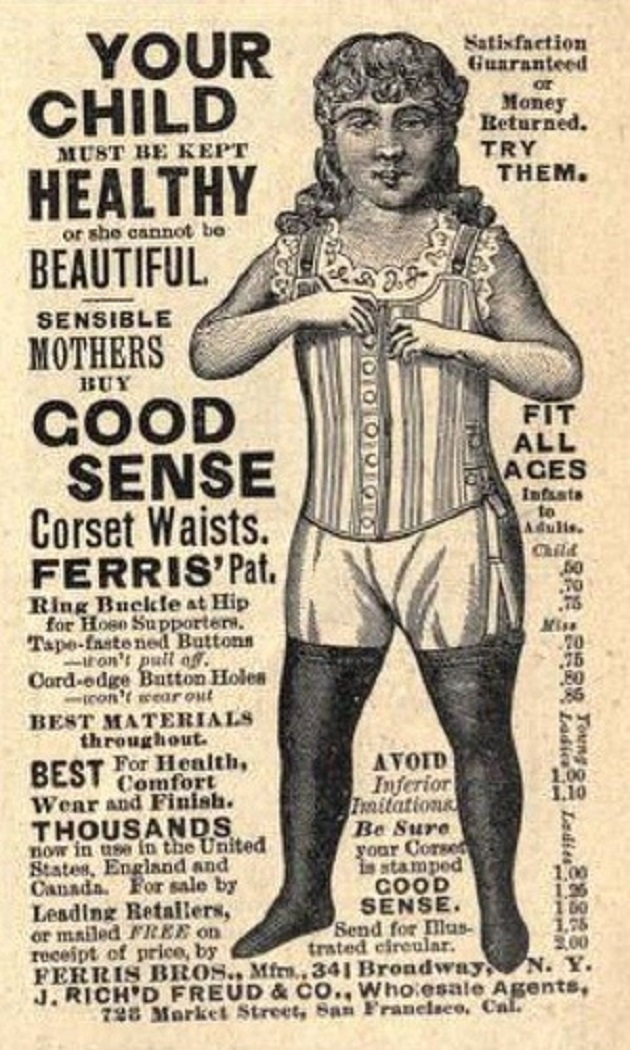
1. Moms, keep your child healthy and beautiful by buying them their very own corset.

Yeah, because internal organ damage as well as digestion and respiratory difficulties shouldn't just be reserved for adult women. Also, men wore them, too by the way. Seriously, while the ideal waist was 18 inches, these constricting garments left precious little room for such necessities as internal organs. And that's in adults. So perhaps corsets aren't good for kids.

Yeah, because internal organ damage as well as digestion and respiratory difficulties shouldn’t just be reserved for adult women. Also, men wore them, too by the way. Seriously, while the ideal waist was 18 inches, these constricting garments left precious little room for such necessities as internal organs. And that’s in adults. So perhaps corsets aren’t good for kids.

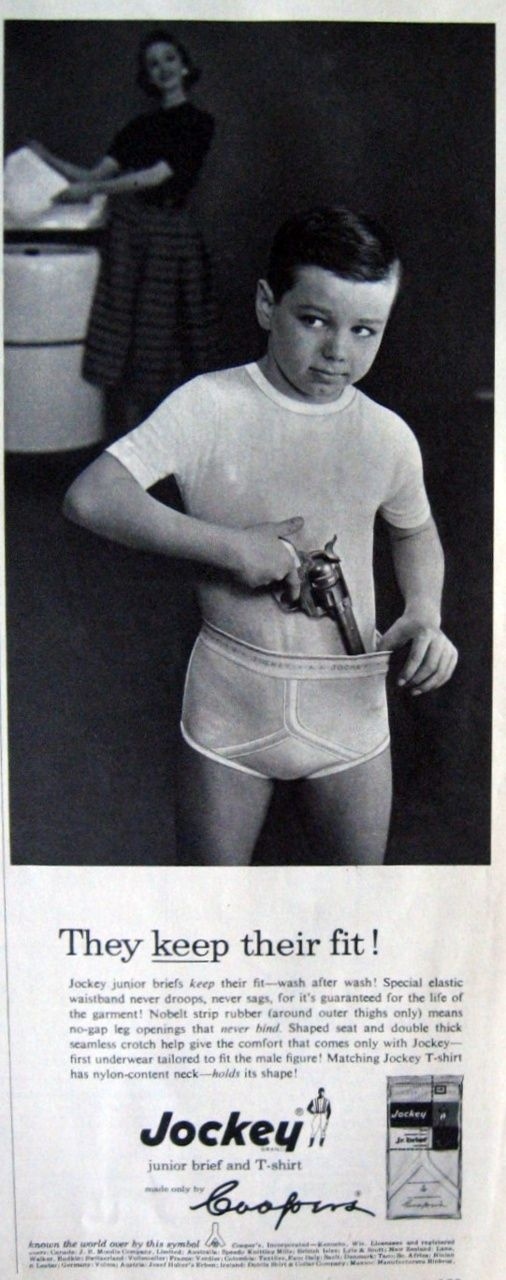
2. Jockey Junior Briefs have a nice comfy waistline that your kid and hold a gun in them.

Okay, say what you want about Plaxico Burress but at least he taught us that holding a firearm under an elastic waistband is a very bad idea. Of course, Plaxico Burress learned the hard way. Still, that boy has a very good chance of accidentally shooting himself in the thigh.

Okay, say what you want about Plaxico Burress but at least he taught us that holding a firearm under an elastic waistband is a very bad idea. Of course, Plaxico Burress learned the hard way. Still, that boy has a very good chance of accidentally shooting himself in the thigh.

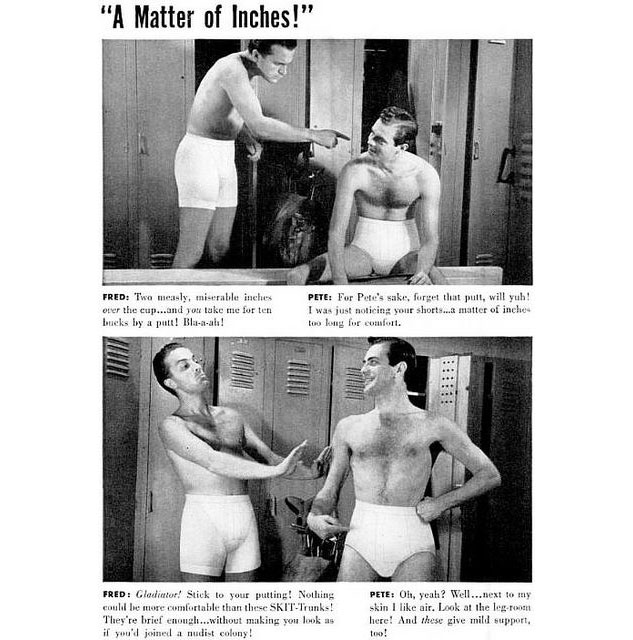
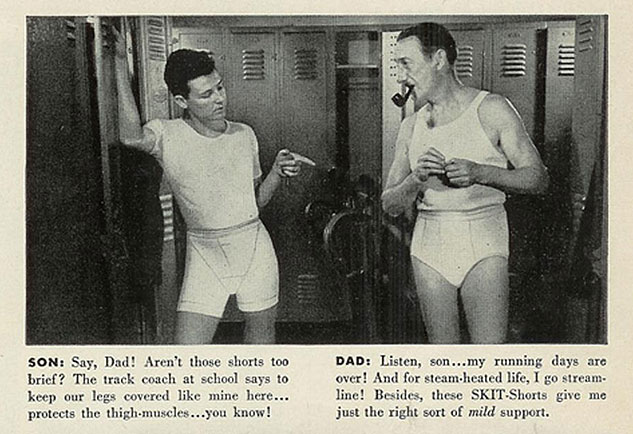
3. Hmmm….I wonder what Fred and Pete could be arguing about in the men’s locker room in their underwear.

Oh, they're arguing about underwear. Still, for the many awkward situations in the men's locker room, I'm not sure if this is quite realistic. Seriously, most guys would either be stripping down for showers or getting dressed. Not sure about the socializing in their briefs or tidy whiteys.

Oh, they’re arguing about underwear. Still, for the many awkward situations in the men’s locker room, I’m not sure if this is quite realistic. Seriously, most guys would either be stripping down for showers or getting dressed. Not sure about the socializing in their briefs or tidy whiteys. If so, they wouldn’t be talking about underwear.

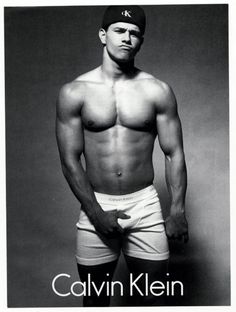
4. Back in the 1990s, Mark Wahlberg used to model for Calvin Klein. Here’s one of his underwear ads.

And it seems that Mark Wahlberg is just standing their clutching his junk. I'm sure he doesn't want his kids to see this on the Internet. But I'm not so sure why. Still, the crotch area shouldn't be held in any form of advertising, especially an underwear ad.

And it seems that Mark Wahlberg is just standing their clutching his junk. I’m sure he doesn’t want his kids to see this on the Internet. But I’m not so sure why. Still, the crotch area shouldn’t be held in any form of advertising, especially in an underwear ad.

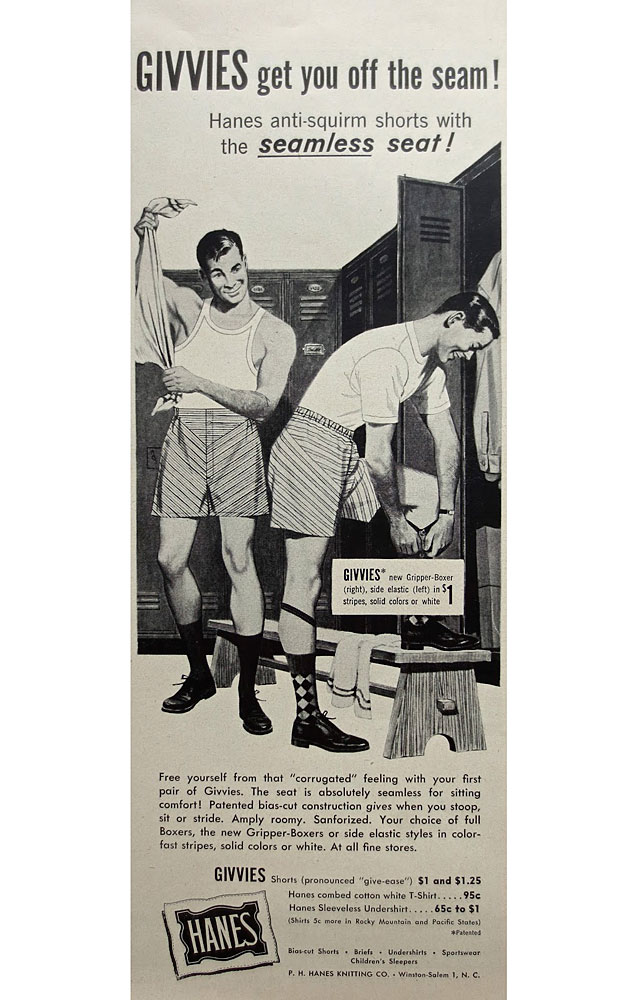
5. Givvies boxer shorts get you off the seam! Even as you accidentally put on your shoes before putting on your pants in the men’s locker room.

Now I'm sure Bobby is just drying off the sweat after today's golf tournament. But I wouldn't be surprised if he's about to snap the towel on Dave's ass in order to engage in some unintentionally homoerotic horseplay.

Now I’m sure Bobby is just drying off the sweat after today’s golf tournament. But I wouldn’t be surprised if he’s about to snap the towel on Dave’s ass in order to engage in some unintentionally homoerotic horseplay.

6. As this 1950s ad implies, whatever went on in the men’s locker room stayed in the men’s locker room.

Hmm.. seems like Danny loves to see Gary dress after a practice or the big game during their wholesome conversation. Of course, they are probably talking all the manly stuff like sports, hunting, fishing, and chicks. Not sure about the last part.

Hmm.. seems like Danny loves to see Gary dress after a practice or the big game during their wholesome conversation. Of course, they are probably talking all the manly stuff like sports, hunting, fishing, and chicks. Not sure about the last part.

7. During the 1950s, it was considered manly for two male roommates to engage in a good old fashioned pillow fight.

Yes, Bill and Henry are just roommates letting off steam by swiping pillows at each other. Nothing homoerotic about that. Just two guys getting at it in their underwear with some nice wholesome fun.

Yes, Bill and Henry are just roommates letting off steam by swiping pillows at each other. Nothing homoerotic about that. Just two guys getting at it in their underwear with some nice wholesome fun.

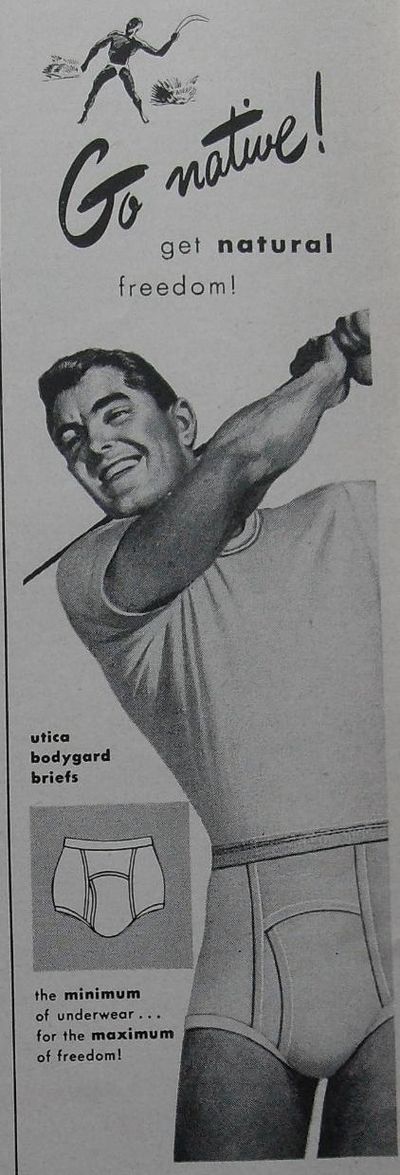
8. Wear Utica Bodyguard Briefs for the Annual Men’s Tidy Whiteys Golf Tournament of 1957.

If I saw a guy outside practicing his golf game in his underwear, I'd have to wonder about him. And that goes for men of all shapes and sizes whether they wear tidy whiteys or boxer shorts. Seriously, underwear ads tend to throw realism out the window.

If I saw a guy outside practicing his golf game in his underwear, I’d have to wonder about him. And that goes for men of all shapes and sizes whether they wear tidy whiteys or boxer shorts. Seriously, underwear ads tend to throw realism out the window.

9. Now with Munsingwear, even the most manly man can do the gardening in his tidy whiteys.

I'm sure this guy is digging in his tidy whiteys because he's either too lazy to change into some proper attire like coveralls or cargo pants. Or he's simply the neighborhood nudist who was recently told to take it down a notch.

I’m sure this guy is digging in his tidy whiteys because he’s either too lazy to change into some proper attire like coveralls or cargo pants. Or he’s simply the neighborhood nudist who was recently told to take it down a notch.

10. Reis Scandals: So comfy that even an Army guy will publicly disrobe to show them off to his buddies at camp.

Let's just say when servicemen spend lots of time together, privacy ceases to become an issue. Also, note the guy showering in the background. Yeah, sometimes what happens at the base, stays at the base.

Let’s just say when servicemen spend lots of time together, privacy ceases to become an issue. Also, note the guy showering in the background. Yeah, sometimes what happens at the base, stays at the base.

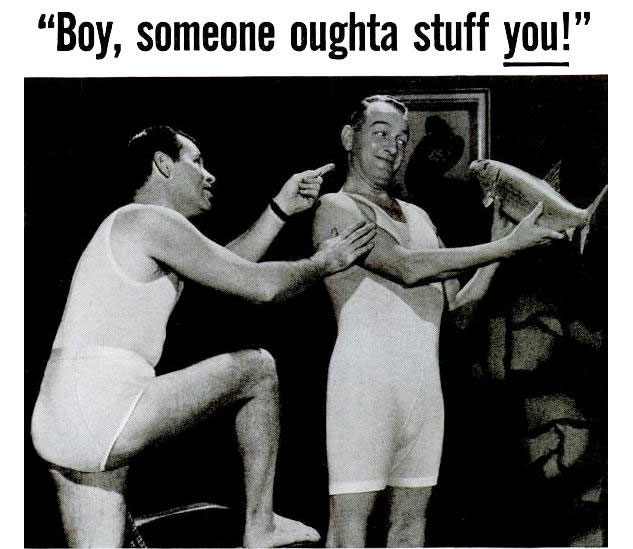
11. In the olden days, it wasn’t unusual for men to talk of hunting and fishing while in their undershirts and briefs.

I don't know about you, but I'm not sure if I want to find out what they're going to do with that fish. Also, they almost seem like they're touching each other.

I don’t know about you, but I’m not sure if I want to find out what they’re going to do with that fish. Also, they almost seem like they’re touching each other.

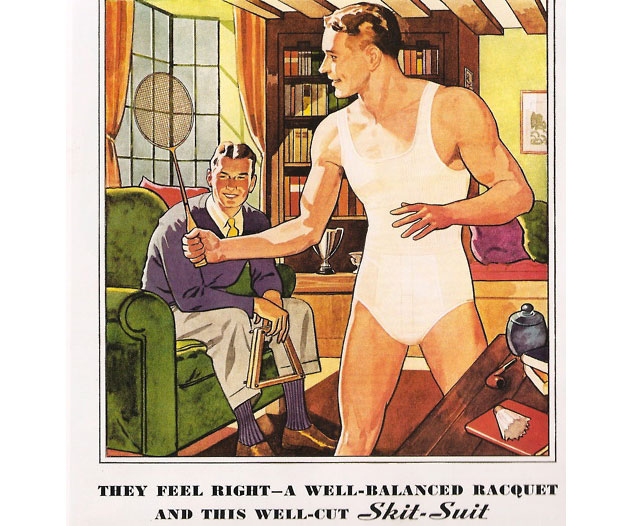
12. Of course, during the 1920s, it wasn’t unusual for men to hangout together for pool and strip badminton.

I don't know about you but to me, it seems like a cross between The Great Gatsby and Foxcatcher. Must be the 1920s opulent settings and the unintentional homoeroticism.

I don’t know about you but to me, it seems like a cross between The Great Gatsby and Foxcatcher. Must be the 1920s opulent settings and the unintentional homoeroticism.

13. Reis Scandals: So comfy that men would often disrobe themselves to show them off to their friends, even on a cruise ship.

Now men disrobing at the military camp is one thing. That I can understand with the lack of privacy in that situation. I'm not sure about the cruise ship. I don't know it's just that I find the idea of men showing off each other's underwear as a bit gay so to speak.

Now men disrobing at the military camp is one thing. That I can understand with the lack of privacy in that situation. I’m not sure about the cruise ship. I don’t know it’s just that I find the idea of men showing off each other’s underwear as a bit gay so to speak.

14. During the 1950s, it wasn’t unusual for fathers and sons to engage in male bonding activities like having tea parties in their tidy whiteys and undershirts.

Okay, my dad and his brother were kids during the 1950s. And I'm sure that father-son bonding activities didn't consist of tidy whitey tea parties. Seriously, who the hell thought this would be a great idea? It's crazy.

Okay, my dad and his brother were kids during the 1950s. And I’m sure that father-son bonding activities didn’t consist of tidy whitey tea parties. Seriously, who the hell thought this would be a great idea? It’s crazy.

15. Before the 1920s, it was fairly common for a bunch of guys to build human pyramids in their union suits.

At first, it doesn't seem that weird since it seems like they're in their pajamas. Then you realize that men actually wore these outfits as underwear. And you can't help thinking such scene is hilarious.

At first, it doesn’t seem that weird since it seems like they’re in their pajamas. Then you realize that men actually wore these outfits as underwear. And you can’t help thinking such scene is hilarious.

16. 1950’s men’s locker rooms would sometimes become places of very awkward father and son conversations.

"So let me get this straight, Dad. Now after you and Mom got married, you put your who's it in her what's it, which was how I came about. Is that right?"

“So let me get this straight, Dad. Now after you and Mom got married, you put your who’s it in her what’s it, which was how I came about. Is that right?”

17. In France, men who wore blue speedo underwear would’ve been certainly bound to be noticed.

Of course, I'm sure the people looking at him don't seem to be outraged at all. In fact, after he and his girlfriend leave the restaurant, they'll all probably burst into shits and giggles.

Of course, I’m sure the people looking at him don’t seem to be outraged at all. In fact, after he and his girlfriend leave the restaurant, they’ll all probably burst into shits and giggles.

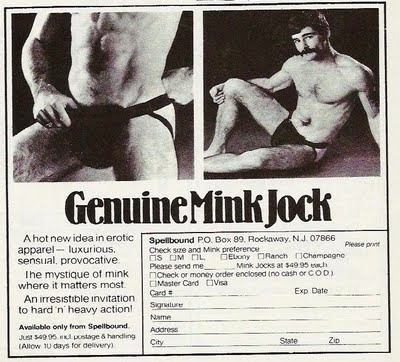
18. For any man wanting to enhance their carpet of virility during the 1970s, there was the genuine mink jock.

Now I know that this jock pair is marked as "erotic apparel." But I seem to find it anything but. In fact, I think it's disgusting. Yeah, let's assume that whoever came up with this was probably on some heavy brown acid.

Now I know that this jock pair is marked as “erotic apparel.” But I seem to find it anything but. In fact, I think it’s disgusting. Yeah, let’s assume that whoever came up with this was probably on some heavy brown acid.

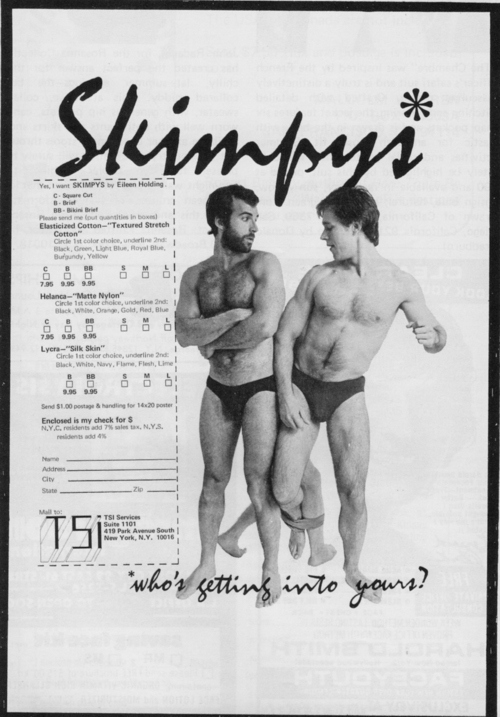
19. For those awkward men’s three-legged races, try Skimpys.

Of course, these guys are just friends participating in a wholesome three legged race. And they just happen to be in their underwear. Nothing gay about that (sarcasm).

Of course, these guys are just friends participating in a wholesome three legged race. And they just happen to be in their underwear. Nothing gay about that (sarcasm). Also, there’s got to be another guy in this ad and it’s kind of terrifying that we don’t see anything else than his leg.

20. “Back off, Jimmy, those are my striped boxers!” “No, Hank, but you can take my striped boxers if you can pry them from my cold dead hands.”

Still, I have to admit, these guys really seem to enjoy fighting over underwear while wearing their boxers. Not sure which one will get the upper hand or what they'll do afterwards. Not sure where this is going.

Still, I have to admit, these guys really seem to enjoy fighting over underwear while wearing their boxers. Not sure which one will get the upper hand or what they’ll do afterwards. Not sure where this is going.

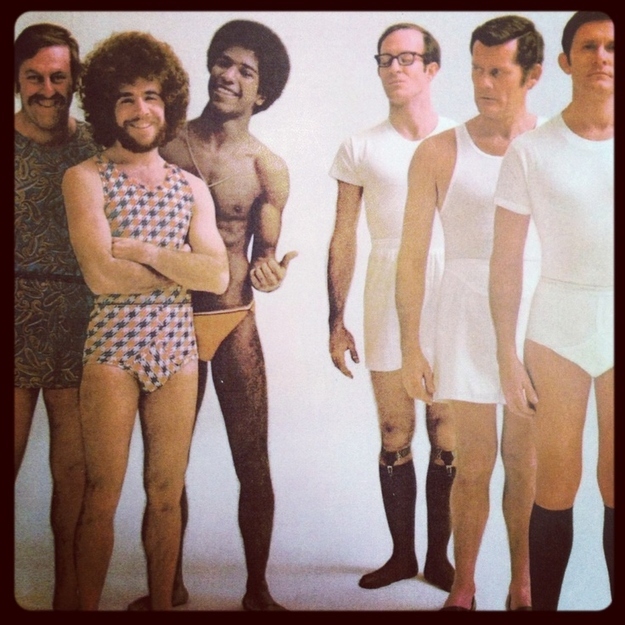
21. Men who wear Munsingwears always have other men checking them out. But there’s nothing gay about it. Really, they just admire the comfort and stretchiness.

Now I don't know about you, but I kind of have an idea where this is going. Seriously, I'm sure there's no way these two guys are "just friends" or that they're exclusively straight.

Now I don’t know about you, but I kind of have an idea where this is going. Seriously, I’m sure there’s no way these two guys are “just friends” or that they’re exclusively straight.

22. Be a new man with the Testosterone Radium Energizer and Suspensory.

Now that I know this is a type of underwear for men. But whether it's for kinky sex or cold blooded torture, I haven't the slightest idea. And I'm not sure what kind of guy would wear it.

Now that I know this is a type of underwear for men. But whether it’s for kinky sex or cold blooded torture, I haven’t the slightest idea. And I’m not sure what kind of guy would wear it.

23. “What do you mean I’m compensating for something, Larry?”

From The Advocate: "Boys! Boys! The only way this dispute can be settled is with a wrestling mat and some Wesson Oil!" Of course, I think that's where this is going.

From The Advocate: “Boys! Boys! The only way this dispute can be settled is with a wrestling mat and some Wesson Oil!” Of course, I think that’s where this is going.

24. Nothing makes sexier underwear than a matching yellow mesh set of a T-shirt and briefs.

I don't know about you but I don't think many men would go for fancy underwear like that. Seriously, men don't really care how they look inside. Also, that kind of fancy underwear makes these guys look as if they've just walked out of a San Francisco gay bar.

I don’t know about you but I don’t think many men would go for fancy underwear like that. Seriously, men don’t really care how they look inside. Also, that kind of fancy underwear makes these guys look as if they’ve just walked out of a San Francisco gay bar.

25. For a black man in the 1970s, there should be no reason why your underwear shouldn’t be funky and colorful.

Now these patterns are simply hideous. Seriously,  these have to be the work of a men's underwear designer going great lengths trying to justify his own job existence.

Now these patterns are simply hideous. Seriously, these have to be the work of a men’s underwear designer going great lengths trying to justify his own job existence.

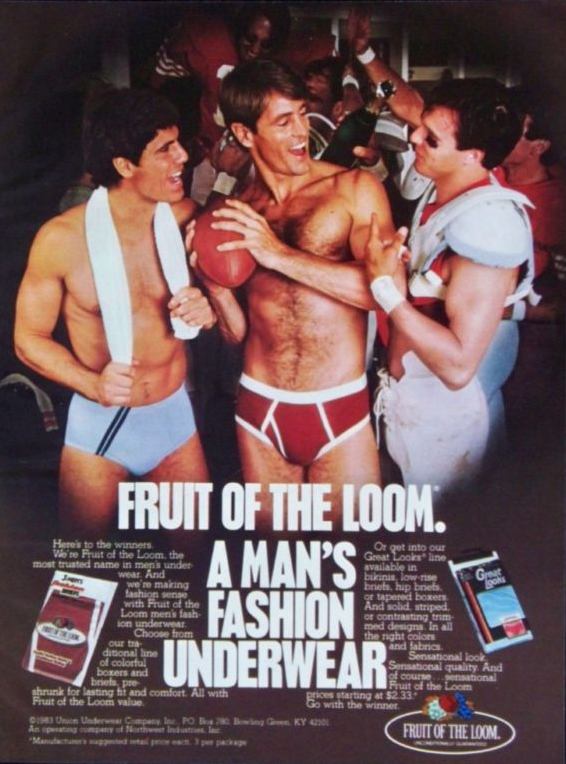
26. At Fruit of the Loom, all their men’s briefs come in a variety of fashionable colors you’d see in any football locker room.

I can imagine the black guy saying, "Dudes, why don't you get some clothes on? I mean you two white dudes socializing while eating ice cream in your undies? That can't be right."

I can imagine the black guy saying, “Dudes, why don’t you get some clothes on? I mean you two white dudes socializing while eating ice cream in your undies? That can’t be right. Not saying that’s gay or anything but…”

27. Jockey: as easy to wash as her stockings. Not sure if washing them in the bathroom is a great idea.

From The Advocate: "Sometimes I like to light up a cigar and wash my underwear at night. I try to be in the moment." But I'm not sure if it was normal for a man to do such a thing. Besides, I'm sure the majority of men's underwear out there is machine washable. So perhaps such scene isn't really necessary.

From The Advocate: “Sometimes I like to light up a cigar and wash my underwear at night. I try to be in the moment.” But I’m not sure if it was normal for a man to do such a thing. Besides, I’m sure the majority of men’s underwear out there is machine washable. So perhaps such scene isn’t really necessary.

28. “Hey, Roger, do you want to play a game of flag football in the locker room?”

I can imagine the football player saying, "Hey, guys, I might run across the field wearing tight pants and monstrous shoulder pads. But I sure look way less ridiculous than either of you do now socializing in your underwear."

I can imagine the football player saying, “Hey, guys, I might run across the field wearing tight pants and monstrous shoulder pads. But I sure look way less ridiculous than either of you do now socializing in your underwear.”

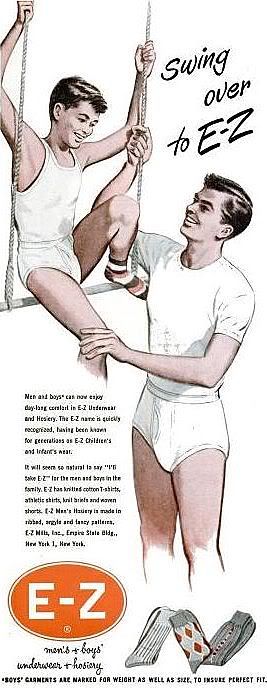
29. Nothing consists of quality father-son time like spending a day at the playground in their tidy whiteys.

I'm sure this ad is supposed to represent a wholesome father and son moment. However, in real life, it might result in the dad possibly being put in jail or on a sex offenders list. Yeah, fathers and sons don't participate in male bonding activities in their underwear, especially outside.

I’m sure this ad is supposed to represent a wholesome father and son moment. However, in real life, it might result in the dad possibly being put in jail or on a sex offenders list. Yeah, fathers and sons don’t participate in male bonding activities in their underwear, especially outside.

30. At summer weddings, it wasn’t uncommon for men and boys to show up in their boxers and briefs.

Funny, I expected men and boys of that era to dress a bit more formal for such occasions. Still, they seem to have a lot of fun taking the decorations off the car and playing with a dog.

Funny, I expected men and boys of that era to dress a bit more formal for such occasions. Still, they seem to have a lot of fun taking the decorations off the car and playing with a dog.

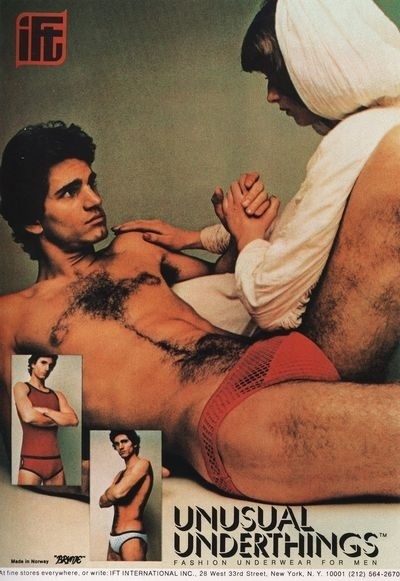
31. I’m sure this guy’s chest hair is actually a Rorschach test.

And for a moment, I thought that guy was Ted Danson from Cheers in the 1970s. Of course, you have to start somewhere. Still, not sure what to make about the chest hair.

And for a moment, I thought that guy was Ted Danson from Cheers in the 1970s. Of course, you have to start somewhere. Still, not sure what to make about the chest hair.

32. Of course, there seems to be a fight about to break out between the tidy whiteys and the funky undies.

Then again, the funky undies crowd seems pretty chill. And the tidy whiteys guys really don't want anything to do with the funky undies. Either way. I'd certainly wouldn't want to associate with either team.

Then again, the funky undies crowd seems pretty chill. And the tidy whiteys guys really don’t want anything to do with the funky undies. Either way. I’d certainly wouldn’t want to associate with either team.

33. Now nothing brings young men together in a pool men’s locker room than a pair of swimming flippers.

Not only are these guys in obnoxiously tacky boxers, but I'm sure they'll engage in an orgy with the flippers anytime soon. Oh, I'm sure we all experimented at that point in our lives.

Not only are these guys in obnoxiously tacky boxers, but I’m sure they’ll engage in an orgy with the flippers anytime soon. Oh, I’m sure we all experimented at that point in our lives.

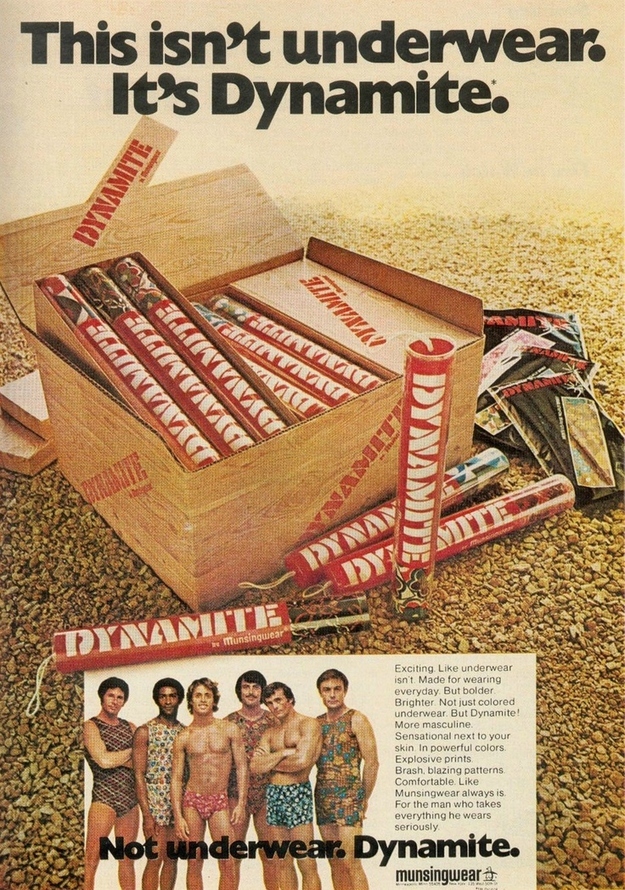
34. Underwear in a tube! Well, that’s dynamite for you!

Actually "Dynamite" is a horrible name for an underwear brand. Seriously, no one wants to imagine exploding private parts. Doesn't help that their underwear is rolled into a stick with a string. And is stored in a box.

Actually “Dynamite” is a horrible name for an underwear brand. Seriously, no one wants to imagine exploding private parts. Doesn’t help that their underwear is rolled into a stick with a string. And is stored in a box.

35. Introducing the semi-brief.

Still, too be fair, there are some things that Judd Hirsch might want to keep private about his pre-Taxi days. This ad might be one of them. But the underwear he was wearing was so ridiculous, I couldn't pass this up.

Still, too be fair, there are some things that Judd Hirsch might want to keep private about his pre-Taxi days. This ad might be one of them. But the underwear he was wearing was so ridiculous, I couldn’t pass this up.

36. I’m sure an ad like this was intended to appeal to every man’s fantasy.

Because how else could you expect 3 neatly combed blond women on the beach with nothing but their underwear on? Seriously, folks, this seems way unrealistic and more or less in the realm of action movies or porn.

Because how else could you expect 3 neatly combed blond women on the beach with nothing but their underwear on? Seriously, folks, this seems way unrealistic and more or less in the realm of action movies or porn.

37. “With my new bra, I can put flowers in my hair and grab a bull by the horns.”

Yes, but just because you can doesn't mean you should. Besides, I think this bull might getting a bit angry. So it's probably best that she run for the hills.

Yes, but just because you can doesn’t mean you should. Besides, I think this bull might getting a bit angry. So it’s probably best that she run for the hills. Now.

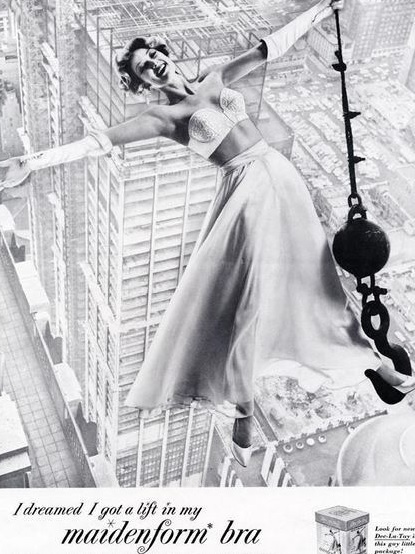
38. “I came in like a wrecking ball!”

Hate to break it to you, lady, but I don't think it's a good idea to swing by on a crane without wearing the proper safety equipment. This is especially the case if the crane has the potential to run into that building behind you.

Hate to break it to you, lady, but I don’t think it’s a good idea to swing by on a crane without wearing the proper safety equipment. This is especially the case if the crane has the potential to run into that building behind you.

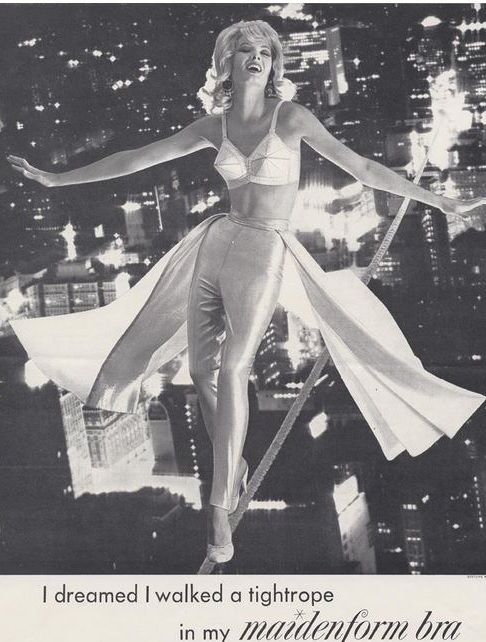
39. “With my Maidenform bra, I can walk on a tightrope through the city at night.”

And I sense that this woman is well on her way to winning a Darwin Award. Seriously, does she have any idea how dangerous walking a tightrope over the city is? She would have better survival odds at the circus.

And I sense that this woman is well on her way to winning a Darwin Award. Seriously, does she have any idea how dangerous walking a tightrope over the city is? She would have better survival odds at the circus.

40. Back in the day, it was common for many women to get together for a masquerade, while wearing only a bra for the top.

Now I don't know about you. But I kind of find the dancing masked bra ladies in the background to be quite terrifying. Of course, it's one of the few instances where scantily clad women become the stuff of nightmares.

Now I don’t know about you. But I kind of find the dancing masked bra ladies in the background to be quite terrifying. Of course, it’s one of the few instances where scantily clad women become the stuff of nightmares.

41. Be a wanted sexy gunfighter with your Maidenform bra.

Now I guess her name is "Sexy Sadie" Stripper. And I'm sure that she's wanted for the G-String murders who allegedly forced her to dance on a table. She said the victims deserved it, however. I'm not so sure.

Now I guess her name is “Sexy Sadie” Stripper. And I’m sure that she’s wanted for the G-String murders who allegedly forced her to dance on a table. She said the victims deserved it, however. I’m not so sure.

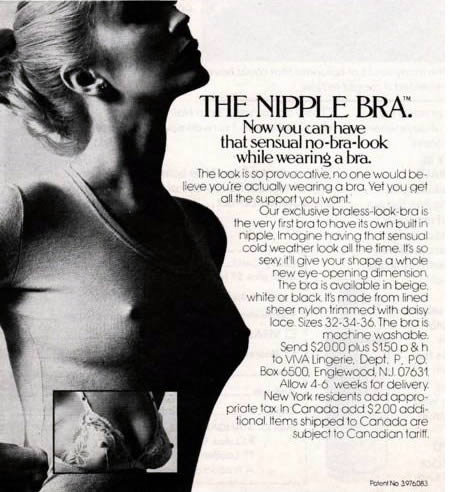
42. Get the natural support you need with the “nipple” bra.

Jesus Christ, if I wanted nipples showing through my shirt when I'm out and about, I'd just go with a cheaper option. Not wearing a bra. Seriously, why did this thing ever exist in the first place?

Jesus Christ, if I wanted nipples showing through my shirt when I’m out and about, I’d just go with a cheaper option. Not wearing a bra. Seriously, why did this thing ever exist in the first place?

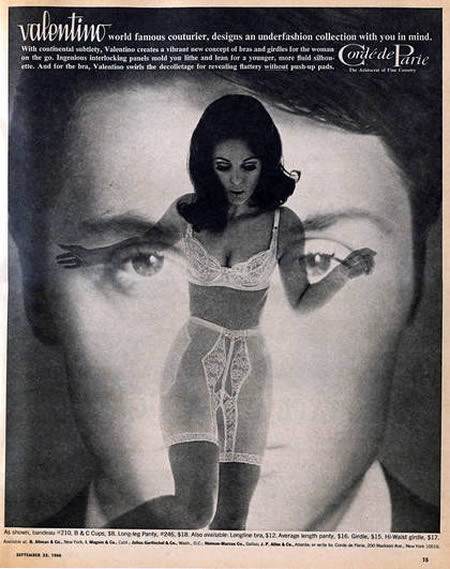
43. It’s said that a woman wearing Valentino lingerie becomes an object of her man’s desire.

Then again, there are some women who may become targets of stalkers. And some of those stalkers might be homicidal maniacs. I'm sure I wouldn't want to be that woman the scary guy has eyes on. Really creeps me out.

Then again, there are some women who may become targets of stalkers. And some of those stalkers might be homicidal maniacs. I’m sure I wouldn’t want to be that woman the scary guy has eyes on. Really creeps me out.

44. For generations, Loveable has been selling comfort to women and girls of all ages.

Yes, but does that statement have to be surmised in perhaps one of the most awkward family photos ever. Seriously, there's no way in hell I'd want have a picture with my mom and grandma in their underwear. I mean how could they think this was a good idea?

Yes, but does that statement have to be surmised in perhaps one of the most awkward family photos ever. Seriously, there’s no way in hell I’d want have a picture with my mom and grandma in their underwear. I mean how could they think this was a good idea?

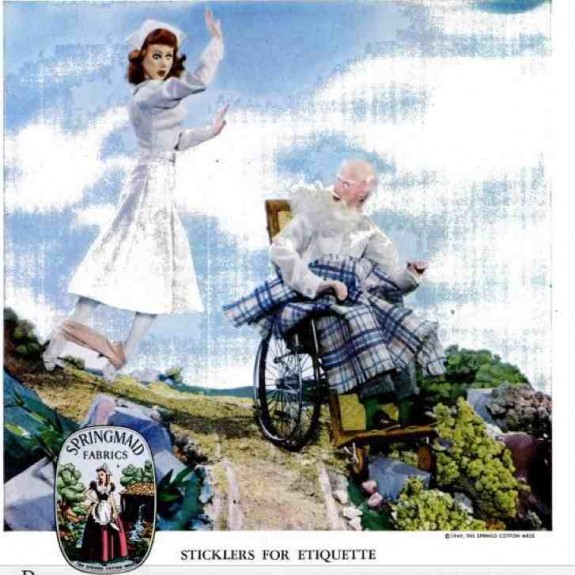
45. Nothing upsets the retirement home like seeing a nurse having her panties accidentally fall off.

Of course, this wheelchaired bound old man now can't wait to tell his buddies about what he just witnessed. Yes, he's a dirty old bastard but what can you do? Then again, some men can have a heart attack and die if such a sight excites them too much.

Of course, this wheelchaired bound old man now can’t wait to tell his buddies about what he just witnessed. Yes, he’s a dirty old bastard but what can you do? Then again, some men can have a heart attack and die if such a sight excites them too much.

46. A padded bra helps distinguish a civilized white woman from a native tribal girl in the Pacific Isles.

Of course, it should be apparent to all of us that lingerie ads tend to be pretty racist. This especially goes for the past. Still, how they managed to get a topless woman on there I can't explain.

Of course, it should be apparent to all of us that lingerie ads tend to be pretty racist. This especially goes for the past. Still, how they managed to get a topless woman on there I can’t explain.

47. There’s nothing more relaxing for a woman than frolicking in the forest with her friends wearing pink lingerie.

Of course, they're trying emphasize that lingerie is comfortable. Maybe, but that doesn't mean I'd frolic in the woods in that. And that doesn't mean you should either. Might want to go with a sports bra for outdoor activities.

Of course, they’re trying emphasize that lingerie is comfortable. Maybe, but that doesn’t mean I’d frolic in the woods in that. And that doesn’t mean you should either. Might want to go with a sports bra for outdoor activities.

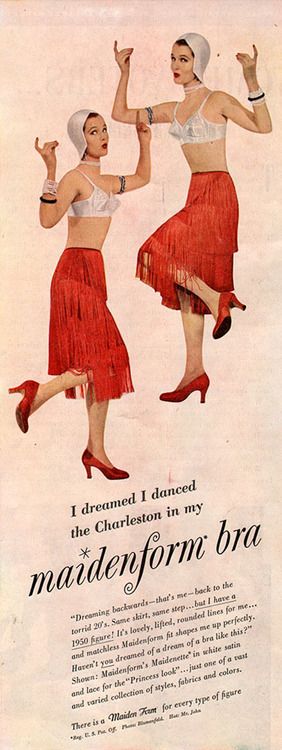
48. Wear your Maidenform bra so you can dance the Charleston.

Unless I'm drunk off my ass in Paris in the middle of the night, how the hell would I be able to dance the Charleston in that outfit? Seriously, the Charleston is a 1920s dance. And I'm sure these women posing for it weren't around then.

Unless I’m drunk off my ass in Paris in the middle of the night, how the hell would I be able to dance the Charleston in that outfit? Seriously, the Charleston is a 1920s dance. And I’m sure these women posing for it weren’t around then.

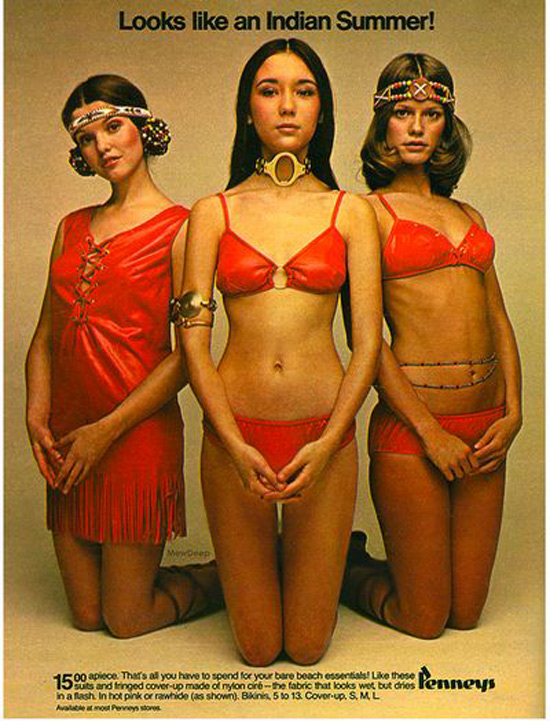
49. Here’s some lingerie to help you look forward to Indian summer.

Of course, cultural appropriation is also prevalent in lingerie ads. And let's just say we don't want to offend Native Americans, shall we? Seriously, we don't want to perpetuate the nubile savage girl, shall we?

Of course, cultural appropriation is also prevalent in lingerie ads. And let’s just say we don’t want to offend Native Americans, shall we? Seriously, we don’t want to perpetuate the nubile savage girl, shall we?

50. When it comes to lingerie, cone bras and big hair are all the rage.

Of course, what baffles me about this ad is the fact how Cousin Itt managed to knock up a supermodel. Then again, he might give credit to the famous Burt Reynolds Cosmo centerfold.

Of course, what baffles me about this ad is the fact how Cousin Itt managed to knock up a supermodel. Then again, he might give credit to the famous Burt Reynolds Cosmo centerfold.

51. Vassarette: The lingerie choice for sluts.

Basically, this ad states: "Ladies, if you wear our lingerie, you will get lucky or you're a whore." Note that you will never see such message on men's underwear ads. Well, maybe not in that context.

Basically, this ad states: “Ladies, if you wear our lingerie, you will get lucky or you’re a whore.” Note that you will never see such message on men’s underwear ads. Well, maybe not in that context.

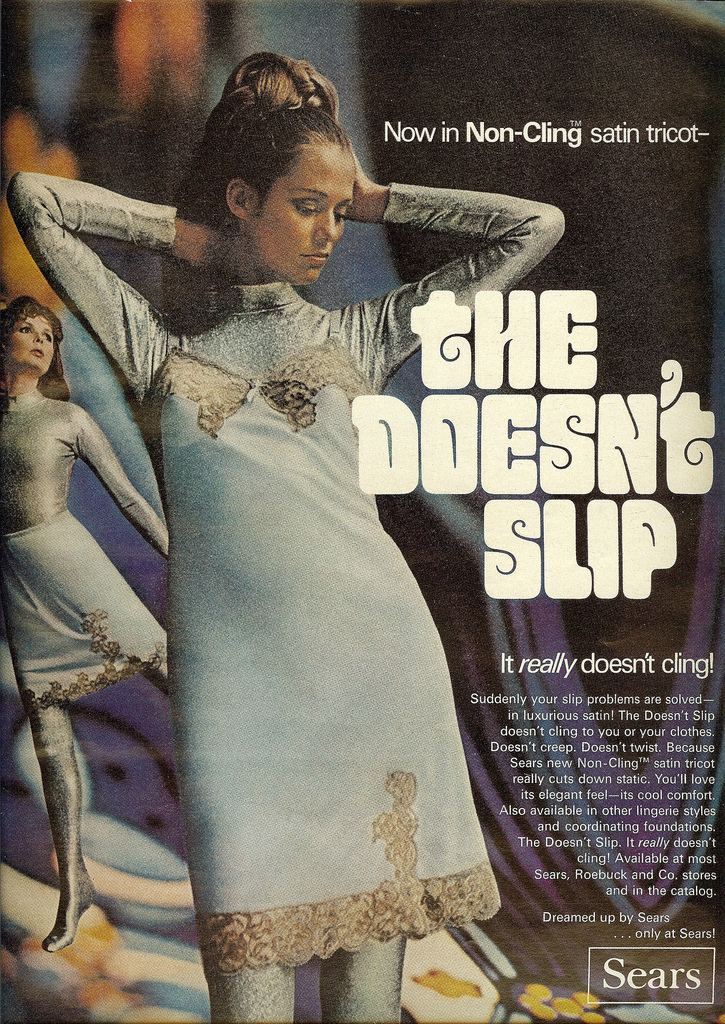
52. Introducing the “don’t slip” slip.

Of course, this is the kind of slip women wear over their shimmering space age suits. I'm not sure why but that's what the ad shows.

Of course, this is the kind of slip women wear over their shimmering space age suits. I’m not sure why but that’s what the ad shows.

53. Apparently, back in the day, you can work out in your lingerie at the gym.

Hmmm...not sure if I agree with this ad here. Then again, they could be wearing a sports bra with an athletic girdle and garter belt with them. Not sure if the latter ever existed though.

Hmmm…not sure if I agree with this ad here. Then again, they could be wearing a sports bra with an athletic girdle and garter belt with them. Not sure if the latter ever existed though.

54. After Vicky was kidnapped, she soon found herself forced to play DJ in her lingerie for the giant lady’s party.

Of course, if Vicky put on music that the giant lady and her guests didn't like, then she'd suffer a most agonizing death by being cooked in a meat pie, ground up.

Of course, if Vicky put on music that the giant lady and her guests didn’t like, then she’d suffer a most agonizing death by being cooked in a meat pie, ground up. Still, at least they let her eat donuts.

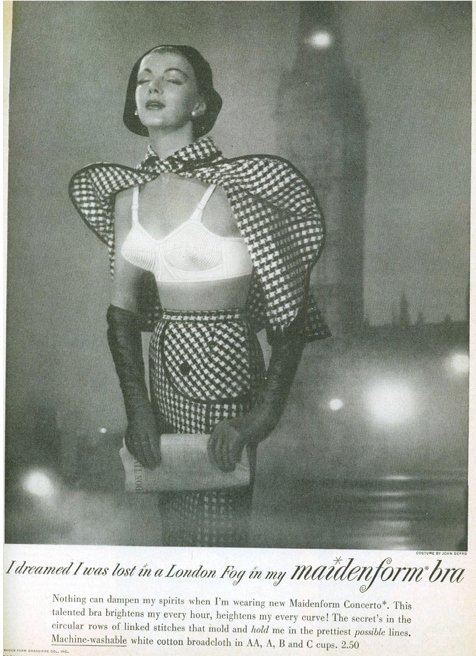
55. Now Liddy loves to feel the air on her breasts in the London fog.

Of course, she only has a limited time until some British policeman in a funny hat arrests her for indecent exposure. That, or distracting drivers into an accident at some intersection.

Of course, she only has a limited time until some British policeman in a funny hat arrests her for indecent exposure. That, or distracting drivers into an accident at some intersection.

56. In the 1940s, nothing sold Formfit Life Bras than mutantly proportioned minxes uttering stupid not-too-dirty limericks.

Too bad Little Boy Blue is missing the chance for a real life dream. Yeah, you don't get a mutantly-proportioned beauty in her lingerie like that every day, buddy. Too bad Little Boy Blue is too sleepy to notice.

Too bad Little Boy Blue is missing the chance for a real life dream. Yeah, you don’t get a mutantly-proportioned beauty in her lingerie like that every day, buddy. Too bad Little Boy Blue is too sleepy to notice.

57. Wearing a Maidenform bra gives you a great chance for women to engage in kinky private eye antics.

Yes, with her Maidenform Bra, handcuffs and hole punctured newspaper, Julia is ready to solve a mystery. Too bad the case at hand pertains to woman suspecting her middle aged and overweight husband cheating on her.

Yes, with her Maidenform Bra, handcuffs and hole punctured newspaper, Julia is ready to solve a mystery. Too bad the case at hand pertains to woman suspecting her middle aged and overweight husband cheating on her.

58. Since Beryl started wearing her Maidenform Bra, chess is now an elegant evening pastime.

My, what a big King there. Also, wonder where you can get those matching mermaid evening skirts with that bra. Still, seems like these women get their kicks above the waistline, sunshine.

My, what a big King there. Also, wonder where you can get those matching mermaid evening skirts with that bra. Still, seems like these women get their kicks above the waistline, sunshine.

59. In the 1950s, women were expected to turn a bold shoulder to summer in their lingerie.

What you see here was a rare ritual of 1950s sun worship in the sacred rite of the Stepfordian religion. Of course, they never tell you about such things. Still, the Stepfordian religion died down rather quick anyway.

What you see here was a rare ritual of 1950s sun worship in the sacred rite of the Stepfordian religion. Of course, they never tell you about such things. Still, the Stepfordian religion died down rather quick anyway.

60. When it’s spring, the tulips sprout as well as the tulip beauties that spring from them.

You may not know from this, but it's well known that the mutant tulip women ate their husbands. Yes, they're literal maneaters who are willing to kill again.

You may not know from this, but it’s well known that the mutant tulip women ate their husbands. Yes, they’re literal maneaters who are willing to kill again.

61. “Is every Movie Star this beautiful?”

My question: "Does every Movie Star even wear super conservative lingerie?" Of course, that one has an obvious answer: "No." And I'm sure this ad wasn't issued in the 1950s to say the least.

My question: “Does every Movie Star even wear super conservative lingerie?” Of course, that one has an obvious answer: “No.” And I’m sure this ad wasn’t issued in the 1950s to say the least.

62. In your Maidenform Bra, you can ski down the Alps with your Saint Bernard.

Of course, she has no idea that the mountain weather can be quite chilly and unpredictable. Still, she's certainly not dressed for the occasion by any stretch of the imagination.

Of course, she has no idea that the mountain weather can be quite chilly and unpredictable. Still, she’s certainly not dressed for the occasion by any stretch of the imagination.

63. In her Maidenform Bra, Henrietta was able to face the pool sharks who brutally beat her up and sent her to the emergency room.

Now she's quite the hussy for a pool hustler. Of course, she tends to use her bra as a tactic against her male competitors who may be distracted by the sexy.

Now she’s quite the hussy for a pool hustler. Of course, she tends to use her bra as a tactic against her male competitors who may be distracted by the sexy.

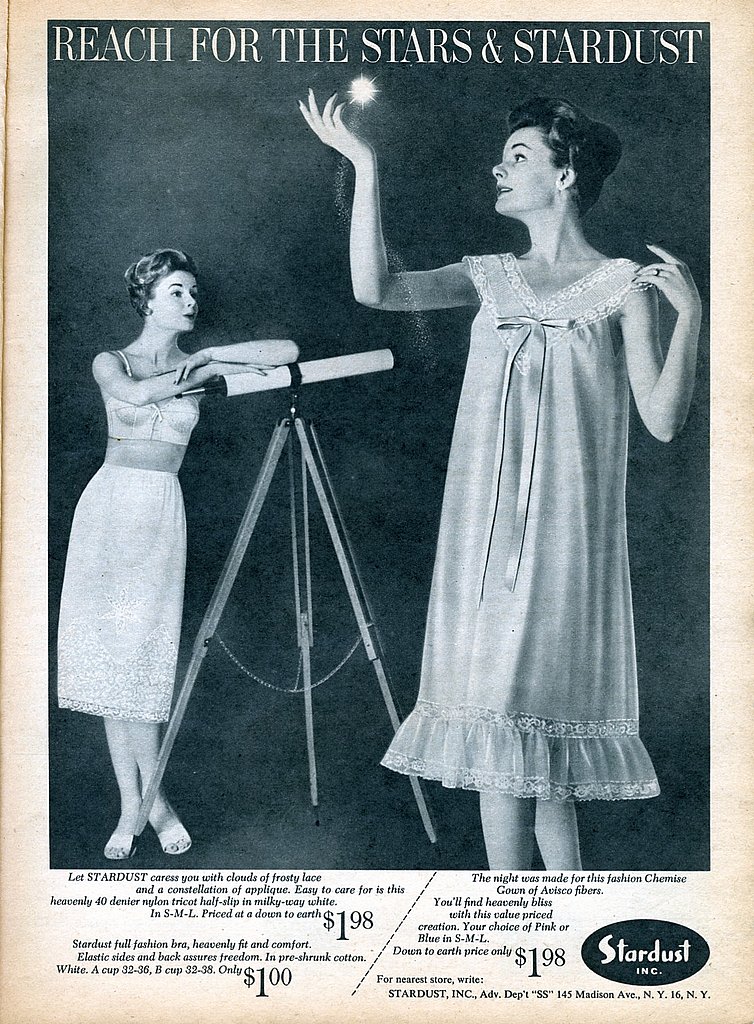
64. Remember, ladies, you can’t go stargazing if you don’t have the right kind of lingerie.

Since when do you need lingerie to go stargazing. I'm sure not having a nightie, girdle, or bra didn't stop Dr. Neil Degrasse Tyson from becoming an astrophysicist. Of course, I don't think he's the kind of guy I'd want to see in lingerie.

Since when do you need lingerie to go stargazing. I’m sure not having a nightie, girdle, or bra didn’t stop Dr. Neil Degrasse Tyson from becoming an astrophysicist. Of course, I don’t think he’s the kind of guy I’d want to see in lingerie.

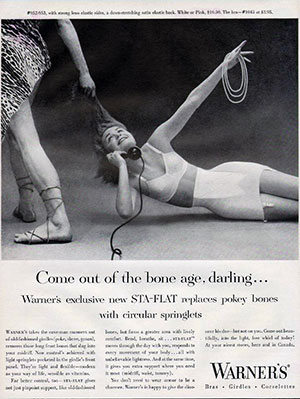
65. “Oh, yes, Og, I enjoy being dragged by the hair by you. Please abuse me.”

From Buzzfeed: "Obvious cringeworthy sexism aside, shouldn’t the caveman be barefooted? What is he, a Roman caveman?" Well, yeah, because I'm not sure if they had any sandals in the Stone Age. Of course, The Flinstones isn't a reliable source for Prehistory, but like early man, they also went barefoot as well.

From Buzzfeed: “Obvious cringeworthy sexism aside, shouldn’t the caveman be barefooted? What is he, a Roman caveman?” Well, yeah, because I’m not sure if they had any sandals in the Stone Age. Of course, The Flinstones isn’t a reliable source for Prehistory, but like early man, they also went barefoot as well.

66. Girls, buy a set of 6 panties and get a free record.

Of course, it's just a lousy single that only plays a couple of songs on it. Yet, at least your granny panties will all be different colors that will match with your pastel outfits.

Of course, it’s just a lousy single that only plays a couple of songs on it. Yet, at least your granny panties will all be different colors that will match with your pastel outfits. Guess they’ll do anything to sell to teenage girls.

67. “Remember, ladies, always wear a pretty pair of panties. Because you’ll never know when you’ll get hit by a car.”

Okay, so how is a pretty pair of panties going to help you if you're involved in an accident? Of course, it won't. Seriously, this is just sexist on so many levels. Nobody ever tells guys to put a handsome pair of briefs in an event of these things.

Okay, so how is a pretty pair of panties going to help you if you’re involved in an accident? Of course, it won’t. Seriously, this is just sexist on so many levels. Nobody ever tells guys to put a handsome pair of briefs in an event of these things.

68. Of course, the lady editor wearing a Maidenform Bra tends to be quite kinky with the phone.

Of course, how she won't get tangled in the phone wire I have no idea. Still, if you look at the hats, you find out that her job has something to do with fashion. Still, kind of disappoints me as an example of female stereotyping.

Of course, how she won’t get tangled in the phone wire I have no idea. Still, if you look at the hats, you find out that her job has something to do with fashion. Still, kind of disappoints me as an example of female stereotyping.

69. Just a mother and daughter spending quality female bonding time together in their underwear.

Not sure what to make of this, but it's probably not as awkward with the father-son equivalent. Then again, it seems like these two have no sense of privacy whatsoever. Also, my mother would always make sure I was dressed (or covered) before she did anything with my hair.

Not sure what to make of this, but it’s probably not as awkward with the father-son equivalent. Then again, it seems like these two have no sense of privacy whatsoever. Also, my mother would always make sure I was dressed (or covered) before she did anything with my hair.

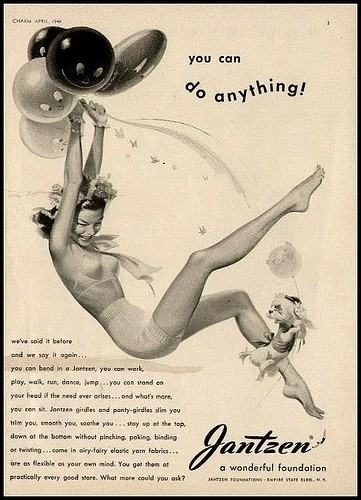
70. With Jantzen lingerie, women can do anything.

However, girls, remember that you can be carried away by balloons while just wearing lingerie. So perhaps you might want to cover up first. Oh, and it seems that the dog's carrying one, too.

However, girls, remember that you can be carried away by balloons while just wearing lingerie. So perhaps you might want to cover up first. Oh, and it seems that the dog’s carrying one, too.

The Wonderful World of Album Covers (Third Edition)

51u2wmy0jsL

Now summer is a big season for music since it’s a time of year when musical artists are touring the country as well as the summer music festivals. So it’s no wonder why I decided to do yet another edition of vintage album covers you’d love to laugh at. For those who don’t know, the cover above is of Billy Joel’s 1980s album The Nylon Curtain which isn’t one of his best known albums but its cover does have a unique simplistic style a neighborhood at sunset in true minimalist fashion. Luckily, Billy Joel was such a noted artist in the early 1980s that his record company would certainly sent the best cover artist around even while the artist was dating models, going to parties, and drunkenly crashing cars into houses. Unfortunately, for those who relish in great album art like this, this post isn’t for you. So perhaps you should go to some website like Amazon or Ebay and look for the great album covers there. This is for crappy vintage covers that might’ve seemed like a good idea at a time, but are either dated or are a source of some unfortunate implications. Some might give you an idea that the cover artist was basically drunk or high on some mind altering drugs. Not sure if they had meth back then though. So without further adieu, here are some crappy album covers you and/or your parents might’ve forgotten about.

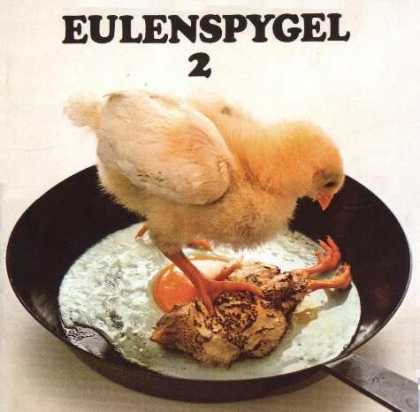
1. Eulenspygel 2

Well, looks like PeeWee wanted all the attention by himself so he made sure that his siblings would meet their gruesome deaths in the frying pan. Yes, that is one sick bird.

Well, looks like PeeWee wanted all the attention by himself so he made sure that his siblings would meet their gruesome deaths in the frying pan. Yes, that is one sick bird.

Hmmm….seems like farm chicks aren’t the innocent balls of fluff that we initially thought.

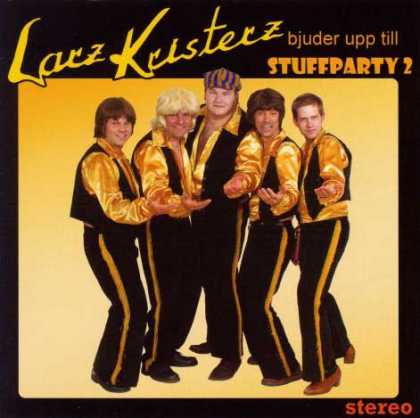
2. Larz Kelsterz Stuffparty 2

Seems like the music on this album appears to be inspired by Saturday Night Fever and ABBA. Of course, I can't take this cover seriously with those garish golden polyester suits.

Seems like the music on this album appears to be inspired by Saturday Night Fever and ABBA. Of course, I can’t take this cover seriously with those garish golden polyester suits.

Possibly one of the pioneering albums in West German Eurodisco.

3. Black Sabbath Sabotage

The only positives about this is how one guy is wearing red tights and another is wearing a dress. Said to be one of the worst album covers in rock history. It's said that the photo sessions of this cover were rushed and that it had become a victim of sabotage itself. Of course, it's kind of fitting in a way.

The only positives about this is how one guy is wearing red tights and another is wearing a dress. Said to be one of the worst album covers in rock history. It’s said that the photo sessions of this cover were rushed and that it had become a victim of sabotage itself. Of course, it’s kind of fitting in a way.

Kind of makes me bummed seeing Ozzy Osbourne in what’s nothing more than a boring photoshoot. “Crazy Train” this ain’t.

4. Dave Stephens Organ Fascination

And not only any naked girl, one that seems like she really wants to get the photo shoot over with. Kind of like how a hooker wants to get it over with so she can take her cash and leave. Wonder if this album includes religious music, which would be all the more ironic.

And not only any naked girl, one that seems like she really wants to get the photo shoot over with. Kind of like how a hooker wants to get it over with so she can take her cash and leave. Wonder if this album includes religious music, which would be all the more ironic.

Seems like the guy is so desperate to sell his organ music album that he put a naked girl on the cover.

5. Norberto de Freitas Trapalhadas do Balbino

Man, that guy on the cover really needs to see a dentist. Of course, some in America may swear they've seen a man like that on the Subway.

Man, that guy on the cover really needs to see a dentist. Of course, some in America may swear they’ve seen a man like that on the Subway.

Didn’t know that Italians would be into hobo music. Then again, it might be opera hobo music.

6. Alison Angrim As Amy Carter Heeere’s Amy!

Sure she might be a sweet nerdy girl you might want to take home to mama. But, gentlemen, be warned that she can strangle you with her bare hands. If you're a man who likes erotic asphyxiation, you have been warned.

Sure she might be a sweet nerdy girl you might want to take home to mama. But, gentlemen, be warned that she can strangle you with her bare hands. If you’re a man who likes erotic asphyxiation, you have been warned.

There doesn’t seem to be anything sweet behind those oversized nerd girl glasses.

7. Music to Make Housework Easier

Okay, let's get this straight. This woman is obviously not a housewife in any way, shape, or form. No real housewife would spend all day sweeping and ironing in business attire, even in the 1950s. It's more like it that she's a part-time working mom who's taking a small smoking break who's rushing to get everything done before her husband and kids come home.

Okay, let’s get this straight. This woman is obviously not a housewife in any way, shape, or form. No real housewife would spend all day sweeping and ironing in business attire, even in the 1950s. It’s more likely that she’s a part-time working mom who’s taking a small smoking break who’s rushing to get everything done before her husband and kids come home.

Seems like she’s on her smoking break after she spent hours sweeping and ironing in her blouse, skirt, nylons, and high heels.

8. Heavy Load Stronger than Evil

Besides, I swear that Boromir almost looked just like that near the end of the first Lord of the Rings movie. Also, what's with the face?

Besides, I swear that Boromir almost looked just like that near the end of the first Lord of the Rings movie. Also, what’s with the face?

Either he’s not or good has a tendency to inflict a lot of collateral damage.

9. Battleaxe Burn This Town

Seriously, I think there have been more couch burnings in Morgantown, West Virginia with more bad ass flames than this. Wonder if this album art was done by a family member of the band. Because I find cover design hard to take seriously.

Seriously, I think there have been more couch burnings in Morgantown, West Virginia with more bad ass flames than this. Wonder if this album art was done by a family member of the band. Because I find cover design hard to take seriously.

Sorry, but I don’t think that’s a very lame attempt for a scorched earth policy.

10. The Handsome Beasts Bestiality

Now I might not like a naked fat guy on the cover, but that's not my issue here. My issue here is that they put a naked fat guy on the cover with a pig on an album titled Bestiality. Seriously, I think I have an idea of what's going on and think it's depraved.

Now I might not like a naked fat guy on the cover, but that’s not my issue here. My issue here is that they put a naked fat guy on the cover with a pig on an album titled Bestiality. Seriously, I think I have an idea of what’s going on and think it’s depraved.

Okay, I have a very bad feeling where this is going.

11. Nelson Because They Can

Now two guys in long blond wigs is one thing. But two dogs in long blond wigs like that? Now that's just freaking hilarious. But to the dogs, it must be humiliating.

Now two guys in long blond wigs is one thing. But two dogs in long blond wigs like that? Now that’s just freaking hilarious. But to the dogs, it must be humiliating.

Possibly the most honest album cover I’ve seen for a long time.

12. Ethel Merman The Ethel Merman Disco Album

For those who don't know who Ethel Merman is, she's an early 20th century singer best known for singing show tunes and appearing on Broadway musicals. Why she did a disco album is anyone's guess. Then again both Broadway and disco tend to have a gay fanbase.

For those who don’t know who Ethel Merman is, she’s an early 20th century singer best known for singing show tunes and appearing on Broadway musicals. Why she did a disco album is anyone’s guess. Then again both Broadway and disco tend to have a gay fanbase.

Seems like your grandparents’ artists will do anything to stay relevant or appeal to a new generation.

13. Jonah Jones I Dig Chicks!

Of course, as to why they had all those girls on the back hoe without any proper safety equipment, I have no idea. Seriously, this cover photoshoot seems to use the same amount of safety procedures as Miley Cyrus's "Wrecking Ball" video.

Of course, as to why they had all those girls on the back hoe without any proper safety equipment, I have no idea. Seriously, this cover photoshoot seems to use the same amount of safety procedures as Miley Cyrus’s “Wrecking Ball” video.

Interesting way how your put the gay rumors to rest.

14. Scorpions Animal Magnetism

I'm sorry, but whenever I see a guy standing towards a kneeling woman looking up at him, I tend to imagine something I really can't mention at the moment. And the dog seems anticipating this. Still, not sure if the beach is the best place for that. Might need a change of venue.

I’m sorry, but whenever I see a guy standing towards a kneeling woman looking up at him, I tend to imagine something I really can’t mention at the moment. And the dog seems anticipating this. Still, not sure if the beach is the best place for that. Might need a change of venue.

Was this band even warned that their album art might not be suitable for PG audiences?

15. Fireballet Two, Too…

Now guys in leotards and tights is one thing. But hairy guys in tutus from the 1970s? Now that's crazy. Guess the guy who thought this up must've been on some powerful hallucinogens.

Now guys in leotards and tights is one thing. But hairy guys in tutus from the 1970s? Now that’s crazy. Guess the guy who thought this up must’ve been on some powerful hallucinogens.

Just a bunch of hairy men in the 1970s getting in touch with their feminine side. Despite the fact real male ballet dancers don’t wear tutus.

16. Alix Dobkin Living with Lesbians

Either the people in this photo are very butch lesbians in very but clothing, which might perpetuate obvious stereotypes. Or they're all men, since it doesn't seem apparent to me that any of them have boobs.

Either the people in this photo are very butch lesbians in very but clothing, which might perpetuate obvious stereotypes. Or they’re all men, since it doesn’t seem apparent to me that any of them have boobs.

As a heterosexual woman, I don’t often say this, but I think the women shouldn’t be wearing such loose clothing, if they’re women at all.

17. Jose Angel Madre Soy Christiano Homosexual

Still, stereotypically speaking, he more or less resembles a guy you'd see at a Jimmy Buffett concert in Florida. But yeah, the coming out bit to his mom via album cover is pretty funny. Perhaps he's better off telling her face to face. Then again, she probably knew anyway for years.

Still, stereotypically speaking, he more or less resembles a guy you’d see at a Jimmy Buffett concert in Florida. But yeah, the coming out bit to his mom via album cover is pretty funny. Perhaps he’s better off telling her face to face. Then again, she probably knew anyway for years.

Translated as: “Mom, I’m a Christian Homosexual.”

18. Millie Jackson Back to the S**t!

Then again, she was just back from her Tijuana vacation with the runs shortly before the album's release. Perhaps the bathroom shot was the best they can do at the moment. Still, it's very much in poor taste. Really, I don't anybody wants to see that.

Then again, she was just back from her Tijuana vacation with the runs shortly before the album’s release. Perhaps the bathroom shot was the best they can do at the moment. Still, it’s very much in poor taste. Really, I don’t anybody wants to see that.

As to why you’d want to promote your album with a glimpse of the most private moments of your life, I have no idea.

19. Butch Yelton and Upbound Swing that Gospel Axe

Okay, now if that guy swings that ax, he's bound to inflict bodily injury on somebody in this photo. Other than that, seems to resemble more of a folk rock album from the 1970s, than anything featuring Christian music.

Okay, now if that guy swings that ax, he’s bound to inflict bodily injury on somebody in this photo. Other than that, seems to resemble more of a folk rock album from the 1970s, than anything featuring Christian music. Are these people trying to make themselves look like the Christianized ripoff to CCR?

For the love of God, no way in Hell! Seriously, you may hurt somebody.

20. The Murk Family Love for All Seasons

Now I like flowers as much as the next person. But I have to admit, that floral pattern is hideous. Let's just say that there are some moments of 1970s fashion that nobody wants to repeat.

Now I like flowers as much as the next person. But I have to admit, that floral pattern is hideous. Let’s just say that there are some moments of 1970s fashion that nobody wants to repeat.

Of course, it was mandatory that everyone match for this photoshoot. So Mom decided to make outfits with the family tablecloth.

21. Elsie Brooks Elsie Brooks

This was Elsie's idea for her album cover. She wanted to get closer to her roots while she was a struggling stripclub dancer at The Gaylord Club. She often wore the feather boa outfit in her act as well as danced with streamers.

This was Elsie’s idea for her album cover. She wanted to get closer to her roots while she was a struggling stripclub dancer at The Gaylord Club. She often wore the feather boa outfit in her act as well as danced with streamers.

Seems like she’s doing some dirty dancing with the typography.

22. Mike Terry Live at the Pavilion Theatre – Glasgow Vol. 2

Seems like Liberace was such a success in the United States that the Brits wanted a flamboyantly gay concert pianist of their own. Seems like Mike Terry happened to be it in his sparkly attire.

Seems like Liberace was such a success in the United States that the Brits wanted a flamboyantly gay concert pianist of their own. Seems like Mike Terry happened to be it in his sparkly attire.

And I thought there was no gayer concert pianist than Liberace.

23. The Glitter Band Hey!

What's even funnier is that I've actually played a song by Gary Glitter in high school and college band. Of course, their song "Rock and Roll Part 2" has been played at American sporting events for time immemorial. However, it's said that Gary Glitter himself has been convicted of sexual abuse and child pornography since the 1990s.

What’s even funnier is that I’ve actually played a song by Gary Glitter in high school and college band. Of course, their song “Rock and Roll Part 2” has been played at American sporting events for time immemorial. However, it’s said that Gary Glitter himself has been convicted of sexual abuse and child pornography since the 1990s.

Of course, I have to apologize that these guys are definitely not from the future or outer space. They’re from the 1970s.

24. Les Baxter Space Escapade

Still, you have to hand it to them that these guys aren't prejudiced. I mean they'll take yellow girls, pink girls, purple girls, etc. Also, wonder what's inside those pots. Then again, maybe I don't want to know.

Still, you have to hand it to them that these guys aren’t prejudiced. I mean they’ll take yellow girls, pink girls, purple girls, etc. Also, wonder what’s inside those pots. Then again, maybe I don’t want to know.

Seems like Captain Kirk isn’t the only human space horndog in the galaxy.

25. The Peacemakers My Faith Still Holds

Of course, this Christian group would've gone with "The Police" but it was already taken. Still, not sure why the men are wearing police uniforms and the woman is clad in Cruella De Vil's summer dress.

Of course, this Christian group would’ve gone with “The Police” but it was already taken. Still, not sure why the men are wearing police uniforms and the woman is clad in Cruella De Vil’s summer dress.

Your faith might still hold but I’m not sure if you can get out of jail for this one.

26. Colonel Sanders Colonel Sanders’ Tijuana Picnic

Seriously, if this is supposed to be a Tijuana picnic, then shouldn't the family be eating Mexican food instead of KFC? Then again, the Colonel would probably lose some business to Taco Bell. Still, this is just a case of blatant product placement and geographical inaccuracy.

Seriously, if this is supposed to be a Tijuana picnic, then shouldn’t the family be eating Mexican food instead of KFC? Then again, the Colonel would probably lose some business to Taco Bell. Still, this is just a case of blatant product placement and geographical inaccuracy.

Seems more like a Kentucky Fried picnic to me as the Colonel intended.

27. Mike Adkins Thank You for the Dove

Now Mike Adkins is the kind of guy who once had a great career, a loving family, and was a hit at a party spouting tall tales and jokes galore. Then tragedy struck that he became a shell of himself. Of course, the dove is the best thing that's ever happened to him since....the accident. So perhaps we should cut the guy some slack for once.

Now Mike Adkins is the kind of guy who once had a great career, a loving family, and was a hit at a party spouting tall tales and jokes galore. Then tragedy struck that he became a shell of himself. Of course, the dove is the best thing that’s ever happened to him since….the accident. So perhaps we should cut the guy some slack for once.

I’m sure his hand will soon be covered in birdshit as soon as the white dove can fly.

28. The Singing Postman The Best of the Singing Postman

Seems friendly enough. But of course, he probably had to turn to music since he was said to sleep with every woman in town. But I'm not sure if that's for being a mailman or a musician.

Seems friendly enough. But of course, he probably had to turn to music since he was said to sleep with every woman in town. But I’m not sure if that’s for being a mailman or a musician.

Or as some people call it, “Music to Irritate Your Dog.”

29. Tino Por Primera Vez

Still, don't know what to make of that short shorts and polo outfit. Or the pose where he's spreading his legs. Kind of disturbing if I look at it. Still, album is probably aimed at teenage girls.

Still, don’t know what to make of that short shorts and polo outfit. Or the pose where he’s spreading his legs. Kind of disturbing if I look at it. Still, album is probably aimed at teenage girls.

Guess this boy must’ve been the Justin Bieber of his day in Latin America.

30. Francisco y Fernando Vamos a la Playa

Well, it's translated "Come to the Beach" even though neither have chests you want to write home about. But they seem to give each other the male gaze so to speak. Not sure if they're "just friends" or have a love that dare not speak its name. Not that there's anything wrong with that.

Well, it’s translated “Come to the Beach” even though neither have chests you want to write home about. But they seem to give each other the male gaze so to speak. Not sure if they’re “just friends” or have a love that dare not speak its name. Not that there’s anything wrong with that.

Hmmm….two shirtless guys at the beach with their backpacks. Wonder what can go on there.

31. The Celebration Road Show Amazing Grace

Now having a cute little kid juxtaposed with the homeless old guy with a bottle in his and sitting near an empty pit. Wonder what those two images have in common. And what the hell is the drunken old guy doing on a Christian album?

Now having a cute little kid juxtaposed with the homeless old guy with a bottle in his and sitting near an empty pit. Wonder what those two images have in common. And what the hell is the drunken old guy doing on a Christian album?

They decided to go with the cute kid in hopes that nobody would notice the old drunken homeless man.

32. Dan Betzer and Louie Dan Betzer and Louie Tell the Bible Classics Vol. III

Wonder if this album includes the story of David and Bathsheba or the Song of Solomon. Then of course, it's probably catered to children. So no double entendres or David raping another man's wife and having her husband killed.

Wonder if this album includes the story of David and Bathsheba or the Song of Solomon. Then of course, it’s probably catered to children. So no double entendres or David raping another man’s wife and having her husband killed.

Because nothing makes Sunday school more fun than listening to Bible stories told by some Middle Eastern clad ventriloquist shepherd and his shepherd dummy.

33. Music to Paint By

Still, I don't think either one of them is in appropriate housepainting attire, which is crap clothes you can throw away. Also, I'm sure dancing isn't a good idea when you're holding paintbrushes either. I mean paint can really get in your clothes.

Still, I don’t think either one of them is in appropriate housepainting attire, which is crap clothes you can throw away. Also, I’m sure dancing isn’t a good idea when you’re holding paintbrushes either. I mean paint can really get in your clothes.

Now there’s an album you can listen to as you and your spouse put another coat on the living room walls.

34. Man with a Horn

Not sure if this woman wants to blow him or his trumpet. Of course, he usually blows out of his own trumpet anyway. Then again, maybe we should leave it up to the imagination.

Not sure if this woman wants to blow him or his trumpet. Of course, he usually blows out of his own trumpet anyway. Then again, maybe we should leave it up to the imagination.

Kind of like Fifty Shades of Grey but with more blowing action and a jazzy soundtrack.

35. Lenny Dee Down South

Of course, it seems like he's distracted by the ballerina on a water surfboard. Still, for those who've seen my vintage postcards, it should be obvious he's in Florida.

Of course, it seems like he’s distracted by the ballerina on a water surfboard. Still, for those who’ve seen my vintage postcards, it should be obvious he’s in Florida. Either that or just on acid.

A motorized raft for your piano? Now I’ve never seen that before.

36. The Phineas Newborn Trio “I Love a Piano”

Of course, she's likely to hump a a leg that's mahogany with a fine varnish and great curves. Still, I'm sure cuddling up with this kind of hard wood is sure to cause splinters.

Of course, she’s likely to hump a a leg that’s mahogany with a fine varnish and great curves. Still, I’m sure cuddling up with this kind of hard wood is sure to cause splinters.

While she does love legs, she prefers them as sturdy as they are graceful.

37. Music for Your Plants

Okay, now this is just ridiculous that it makes an album for your pets seem normal. Seriously, do plants even listen to music? Can they even hear at all? Nevertheless, I think hiring an orchestra for your ivy and ferns is just beyond crazy.

Okay, now this is just ridiculous that it makes an album for your pets seem normal. Seriously, do plants even listen to music? Can they even hear at all? Nevertheless, I think hiring an orchestra for your ivy and ferns is just beyond crazy.

Now there’s even an album for your houseplants to listen to.

38. Cees Verschoor Dutch Sax

Hate to inflict some political correctness, but I think the outfit is a bit stereotypical. If not, then anachronistic or possibly more appropriate for a polka album. Still, at least she's in high heels and nylons. But for God's sake Dutch people don't dress like that. Never have.

Hate to inflict some political correctness, but I think the outfit is a bit stereotypical. If not, then anachronistic or possibly more appropriate for a polka album. Still, at least she’s in high heels and nylons. But for God’s sake Dutch people don’t dress like that. Never have.

Didn’t know people in the Netherlands even listened to jazz music, let alone saxophone.

39. The Ventures Walk Don’t Run

Not only that, but the lead female singer was so much in rehearsal mode that she absolutely no idea what was going on. Of course, all the male members had to go to the hospital and the tour was cancelled.

Not only that, but the lead female singer was so much in rehearsal mode that she absolutely no idea what was going on. Of course, all the male members had to go to the hospital and the tour was cancelled.

Seems like the band experienced a little accident due to all the male members fighting over the pretty lead singer.

40. Smethin’ Smith and the Redheads Crazy People

Then again, all three could be reenacting their favorite sexual fantasy on the cover. Besides, those nurse outfits look like they're straight from Mindy's Sex Shop than any hospital.

Then again, all three could be reenacting their favorite sexual fantasy on the cover. Besides, those nurse outfits look like they’re straight from Mindy’s Sex Shop than any hospital.

I’m sure these guys don’t mind being in straitjackets at the funny farm with all those sexy nurses taking care of their needs.

41. Bert Kaempfert and His Orchestra If I Had You

Don't look now but I think she's giving the kind of face that says, "Ask me for a drink again and I'll plan to file a restraining order against you." Basically if a woman gives you a look like that at a bar, then she's obviously not that into you.

Don’t look now but I think she’s giving the kind of face that says, “Ask me for a drink again and I’ll plan to file a restraining order against you.” Basically if a woman gives you a look like that at a bar, then she’s obviously not that into you.

Or as I call it, “Love Songs for the Singles Bar.”

42. David Carroll and His Orchestra Contrasts

Okay, now this guy is either in an old timey bathing suit or his pajamas. But we're all sure he's certainly distracted by the sexy. Still, why they thought an image like this was a good idea, don't ask me. Oh, wait it was the girl in a bikini part.

Okay, now this guy is either in an old timey bathing suit or his pajamas. But we’re all sure he’s certainly distracted by the sexy. Still, why they thought an image like this was a good idea, don’t ask me. Oh, wait it was the girl in a bikini part.

Seems like old timey bathing suit guy really has a thing for the girl in the striped bikini.

43. Les Compagnons de la Chanson

Well, I guess this was probably the only place available for an album photo shoot. Still, I'm not sure a junk yard is an appropriate photo op destination for an album I definitely know doesn't consist of rock music. Also, I think the tuxedos make the guys look a bit out of place.

Well, I guess this was probably the only place available for an album photo shoot. Still, I’m not sure a junk yard is an appropriate photo op destination for an album I definitely know doesn’t consist of rock music. Also, I think the tuxedos make the guys look a bit out of place.

For some reason, these guys don’t strike me as a garage band. Must be the tuxedos.

44. And God Gave Me a Fix: The John 3:16 Cook Story

Now I know this is a Christian album, pertaining to how Jesus saved a guy from a heroin addiction. But still what's with the big hand inserting a crucifix into a guy with a hypodermic needle. Seriously, if this is about a guy finding God and overcoming a heroin addiction, I'm not sure if you want to use motifs pertaining to drug use.

Now I know this is a Christian album, pertaining to how Jesus saved a guy from a heroin addiction. But still what’s with the big hand inserting a crucifix into a guy with a hypodermic needle. Seriously, if this is about a guy finding God and overcoming a heroin addiction, I’m not sure if you want to use motifs pertaining to drug use. Talk about being high on Christ. Good God.

Love the tagline “From Junk to Jesus.”

45. Oral Roberts We Are Partners

Hate to offend anyone, but Oral Roberts in this reminds me of the kind of businessman who'd swindle his company of millions before heading to the Mexican border while he sets up his partner as the fall guy. That, or some Wall Street banker who was born with the character flaw of having no conscience that he robs millions through his own Ponzi scheme. Definitely not someone I'd want to shake hands with.

Hate to offend anyone, but Oral Roberts in this reminds me of the kind of businessman who’d swindle his company of millions before heading to the Mexican border while he sets up his partner as the fall guy. That, or some Wall Street banker who was born with the character flaw of having no conscience that he robs millions through his own Ponzi scheme. Definitely not someone I’d want to shake hands with.

Oral Roberts wants you to embrace the true spirit of Jesus and shake his hand.

46. Joe “Fingers” Carr Honky Tonk

Sorry, fellas, but I'm sure your typical Old West prostitute never looked as pretty or clean as this woman. And I'm not sure if she wore a black silky outfit with fishnet stockings either.

Sorry, fellas, but I’m sure your typical Old West prostitute never looked as pretty or clean as this woman. And I’m not sure if she wore a black silky outfit with fishnet stockings either. But yes, she might cater to the BDSM crowd. Can play either dom or sub.

Because nothing brings in the spirit of the Old West like a saloon floozie reclining on the piano.

47. Hugo and Luigi with Their Family Singers When Good Fellows Get Together

For now let's hope for the best that these guys aren't just fresh out of their AA meeting. Still, I guess this will result in at least one guy falling over or at least messing up with the lyrics. Yeah, drinking isn't always the best activity between friends.

For now let’s hope for the best that these guys aren’t just fresh out of their AA meeting. Still, I guess this will result in at least one guy falling over or at least messing up with the lyrics. Yeah, drinking isn’t always the best activity between friends.

Because when good fellows get together, they all sing and hug each other while getting drunk.

48. Don Elliot and His Orchestra Music for the Sensational Sixties

Seriously, who the hell thought this would make a great album cover? It's utterly ridiculous in my opinion, especially with the motorcycle and space bit. I'm sure what he has on that album won't remind anyone of the 1960s anytime soon.

Seriously, who the hell thought this would make a great album cover? It’s utterly ridiculous in my opinion, especially with the motorcycle and space bit. I’m sure what he has on that album won’t remind anyone of the 1960s anytime soon.

Nothing makes a great futuristic album than having a French horn player riding in a motorcycle in outer space.

49. Dr. Murray Banks How to Live with Yourself…Or…What to Do Until the Psychiatrist Comes

Seems like the waiting room at a psychiatrist's office has the potential to be a rather interesting place. Then again, maybe you should go see a therapist after being in a room full of nuts like these.

Seems like the waiting room at a psychiatrist’s office has the potential to be a rather interesting place. Then again, maybe you should go see a therapist after being in a room full of nuts like these.

Guess if you buy this guy’s album, you’re probably questioning your sanity by this point.

50. Les Feres Jacques Es Fessey

Now I'm not sure what distresses me about the French. The fact that Jerry Lewis has a considerable French fanbase or this album cover. I mean all these guys seem to want to spread their cape out and garner all the attention. Not sure why.

Now I’m not sure what distresses me about the French. The fact that Jerry Lewis has a considerable French fanbase or this album cover. I mean all these guys seem to want to spread their cape out and garner all the attention. Not sure why. Still, pretty ridiculous to say the least.

Guess everyone has to be the guy in the top hat and cape, do they?

The Wonderful World of Regatta Floats

100831-beer-float-hmed-1p.grid-7x2

Every year on the 4th of July the city Pittsburgh hosts an annual Three Rivers Regatta. Well, they had it this year except they didn’t feature the boat stuff since it had rained a lot lately and the water was too high. Besides, there was a lot of debris floating in the rivers anyway. But they kept the other stuff in. Still, technically a regatta is supposed to be a series of boat races usually pertaining to sail and row boats. It’s usually a competition among amateurs. But it’s a formally structured event with comprehensive rules describing the schedule and procedures. Nevertheless, most of them are done for fun. Still, take the boats out of the Three Rivers Regatta, and it’s not really a regatta at all. It’s just a 4th of July festival. Nevertheless, there all kinds of regattas depending on the type of boat or particular area with most taking place in the summer. You might have a regatta organized by the rich snooty yacht club consisting entitled Ivy League prep school brats on their row boats. But these I’ll show will pertain to boats that have a more creative or humorous spin to them. So without further adieu, here are some lovely regatta floats you might want to see.

1. Well, at least we know that the giant whale didn’t swallow anybody.

Still, I think this float looks quite awkward with  this boat not having the cover down the middle. Reminds me of a fish skeleton of some sort.

Still, I think this float looks quite awkward with this boat not having the cover down the middle. Reminds me of a fish skeleton of some sort.

2. So is this for the regatta or the air show?

Probably regatta because  highly doubt that this plane could fly. But whether it will float, I'll have to see for myself.

Probably regatta because highly doubt that this plane could fly. But whether it will float, I’ll have to see for myself. Hope it doesn’t get too wet.

3. All these people wanted was a nice raft with a cottage house covered with ivy.

“People navigate along the Lielupe river as they participate in the milk carton boat regatta in Jelgava August 30, 2014. Thirty eight teams used about 40,000 empty milk tetra packs to build rafts as part of the XIV International festival of milk, bread and honey.” from Reuters. Still, I wonder if that structure or the people on it will cause some accident of sorts.

4. All you need for a regatta float are a couple of barrels and a bathtub.

And I see they gave the bathtub a paint job. Not sure if that will help. Also, hope there's nothing in the barrels.

And I see they gave the bathtub a paint job. Not sure if that will help. Also, hope there’s nothing in the barrels.

5. Guess Cinderella has to leave the pirate ship party by midnight.

Hope Cinderella doesn't share a dance with Captain Morgan. Heard that guy really has a drinking problem. Then again, most Golden Age pirates were former sailors impressed while drunk at a tavern. Seriously, it's no wonder they loved their rum.

Hope Cinderella doesn’t share a dance with Captain Morgan. Heard that guy really has a drinking problem. Then again, most Golden Age pirates were former sailors impressed while drunk at a tavern. Seriously, it’s no wonder they loved their rum.

6. Seems like we have a man overboard with the large truck on a raft.

Well, at least he has a life jacket on so I hope he lands in the water. Didn't know they had a Sweet & Low upholstery service.

Well, at least he has a life jacket on so I hope he lands in the water. Didn’t know they had a Sweet & Low upholstery service.

7. For a regatta float: If you don’t have cardboard, then barrels and a trampoline will do.

Well, I'm not sure if bouncing on a trampoline is a good idea in a body of water. Of course, they're wise to have some safety procedures.

Well, I’m not sure if bouncing on a trampoline is a good idea in a body of water. Of course, they’re wise to have some safety procedures.

8. Got a swing set in your yard? Why not build a boat out of it?

And for a patriotic touch, they painted it red, white, and blue. Sure wonder whether they're using the swings.

And for a patriotic touch, they painted it red, white, and blue. Sure wonder whether they’re using the swings.

9. Now this is a manly kind of float that’s included with studio wrestling.

I don't know about you, but I'm not sure if engaging in WWE antics will help win the boat race. Perhaps these two should just spend more time rowing than fighting.

I don’t know about you, but I’m not sure if engaging in WWE antics will help win the boat race. Perhaps these two should just spend more time rowing than fighting.

10. Sure you can make a regatta float, but you can’t make one that might also serve as a tiki bar.

Of course, I wouldn't be surprised if this float was built in Hawaii. But, hey, at least these people have a roof over their heads. I just want to know the maximum weight.

Of course, I wouldn’t be surprised if this float was built in Hawaii. But, hey, at least these people have a roof over their heads. I just want to know the maximum weight.

11. Nothing makes a better regatta float than one of a rat over raisins.

Okay, now this is quite disturbing. Not sure why anyone would want a rat float. Rats are disgusting vermin. And a giant one is the stuff of nightmares.

Okay, now this is quite disturbing. Not sure why anyone would want a rat float. Rats are disgusting vermin. And a giant one is the stuff of nightmares.

12. Looks like it’s a job for the water caterpillar.

Unlike real caterpillars, I'm sure this one helps with landscaping and construction in Atlantis. Then again, if it did, it would've been a submarine.

Unlike real caterpillars, I’m sure this one helps with landscaping and construction in Atlantis. Then again, if it did, it would’ve been a submarine.

13. There are regattas that have races for sail boats. Yet, some tend to go on with a ship.

Seems like a boat like this can go with sails and rows. Wonder why they have rope ladders to the masts.

Seems like a boat like this can go with sails and rows. Wonder why they have rope ladders to the masts.

14. Introducing team log jammer.

Wonder if they'll get to see their photos of themselves as they go down the waterfall portion. Like they have at Splash Mountain or Kennywood in my neck of the woods.

Wonder if they’ll get to see their photos of themselves as they go down the waterfall portion. Like they have at Splash Mountain or Kennywood in my neck of the woods.

15. You heard of the Batmobile. Well, prepare to meet the Batcanoe.

I'm sure the real Batcanoe would be far more impressive. But this kid looks quite cute rowing it.

I’m sure the real Batcanoe would be far more impressive. But this kid looks quite cute rowing it and it’ll probably stand a better chance of floating, too.

16. At the regatta, it helps if you spruce up your amphibious vehicle with an umbrella and flowers to give it a nice cozy feel.

Of course, with the color scheme, I would've sworn it was more suited as a construction vehicle. And find the flowers and umbrella a very odd decorating scheme, indeed.

Of course, with the color scheme, I would’ve sworn it was more suited as a construction vehicle. And find the flowers and umbrella a very odd decorating scheme, indeed.

17. Ahoy, mateys! Get on board the ol’ pumpkinship.

I think there's an actual regatta with pumpkin boats as far as I've seen on Google Images. Still, how they managed to find pumpkins this big to carve out, I'll never know.

I think there’s an actual regatta with pumpkin boats as far as I’ve seen on Google Images. Still, how they managed to find pumpkins this big to carve out, I’ll never know.

18. Of course, even a giant pencil can make a great canoe if you put in the effort.

Hope it doesn't run into the writing paper raft. Because any marks it leaves will leave to smudges if they're ever erased. Well, in some pencil boats anyway.

Hope it doesn’t run into the writing paper raft. Because any marks it leaves will leave to smudges if they’re ever erased. Well, in some pencil boats anyway.

19. You can always build a float out of barrels and piping if you set your mind to it.

Now I wonder who the hell thought of adding a canopy like that. Just seems quite alien to me. Then again, maybe it was designed by someone from another planet or galaxy.

Now I wonder who the hell thought of adding a canopy like that. Just seems quite alien to me. Then again, maybe it was designed by someone from another planet or galaxy.

20. When it comes to regatta floats, you can always decorate it as a 1950s hangout.

Let's hope nobody falls overboard during the sock hop. Because that certainly won't be cool, especially if it's a woman wearing a poodle skirt.

Let’s hope nobody falls overboard during the sock hop. Because that certainly won’t be cool, especially if it’s a woman wearing a poodle skirt. Love the LP decorations though and the pink.

21. Yes, your boat may be cool, but does it have its own waterslide?

Okay, not this looks like fun. Sure it's not a great photo since it's shown at a distance. But sometimes you have to take what you can get.

Okay, not this looks like fun. Sure it’s not a great photo since it’s shown at a distance. But sometimes you have to take what you can get.

22. It’s been said that beer cans tend to be the best material for boats for those who want to build one.

This might be from a beer can regatta in Australia which takes place around the Christmas season or before March. Still, if I saw that many beer cans to build a boat here, I'd wonder if any of the crew members have a drinking problem.

This might be from a beer can regatta in Australia which takes place around the Christmas season or before March. Still, if I saw that many beer cans to build a boat here, I’d wonder if any of the crew members have a drinking problem.

23. Oh, look there’s a shark and it wants to eat us!

Now I know this is a regatta float with a Jaws theme and I'm sure the shark isn't real. Still, I'm wondering if these kids are going need a bigger boat.

Now I know this is a regatta float with a Jaws theme and I’m sure the shark isn’t real. Still, I’m wondering if these kids are going need a bigger boat.

24. Now this regatta float theme is, a tribute to Captain Chesley “Sully” Sullenberger.

Yes, a regatta float tribute to a great pilot of great competence and know how who became a hero of the Hudson. Still, I'm sure this won't fly though but who cares? It's the thought that counts.

Yes, a regatta float tribute to a great pilot of great competence and know how who became a hero of the Hudson. Still, I’m sure this won’t fly though but who cares? It’s the thought that counts.

25. We all live in a yellow submarine, yellow submarine, yellow submarine.

Of course, in a regatta float post like this, you should know that a yellow submarine float was coming. Still, I'd really would want a yellow submarine float picture from a different angle than this.

Of course, in a regatta float post like this, you should know that a yellow submarine float was coming. Still, I’d really would want a yellow submarine float picture from a different angle than this.

26. Now this regatta float was made possible by your neighborhood crazy cat ladies.

Let me guess, this float is manned by a bunch of middle aged to elderly women who are either lesbians or terminally single that they see cats like their own children. Then again, they could just be a bunch of cat hoarders who take in any feral feline they can find which is very much ill-advised.

Let me guess, this float is manned by a bunch of middle aged to elderly women who are either lesbians or terminally single that they see cats like their own children. Then again, they could just be a bunch of cat hoarders who take in any feral feline they can find which is very much ill-advised. But I really don’t want to be stereotypical here.

27. Like the ill-fated 1912 ship, this Titanic float seems headed for disaster.

But unlike the real disaster, there will probably be no major fatalities from this sinking. Of course, you have to be careful with cardboard, especially if you're on a boat made from that stuff.

But unlike the real disaster, there will probably be no major fatalities from this sinking. Of course, you have to be careful with cardboard, especially if you’re on a boat made from that stuff.

28. Of course, at any regatta event, you’re eventually bound to run into a pirate ship.

Of course, it's probably as an accurate rendition to a  Golden Age pirate ship as you see in the movies. Still, because of pirate movies, I'm sure these people have no idea what real Golden Age pirates actually did.

Of course, it’s probably as an accurate rendition to a Golden Age pirate ship as you see in the movies. Still, because of pirate movies, I’m sure these people have no idea what real Golden Age pirates actually did.

29. When it comes to river transportation, you can’t do better than double decker bus.

What's surprising about this float is that it's in a Canadian competition. Which is strange to me since I always associate red double decker buses with Great Britain. Then again Canada was once a British colony.

What’s surprising about this float is that it’s in a Canadian competition. Which is strange to me since I always associate red double decker buses with Great Britain. Then again Canada was once a British colony.

30. Now your regatta rowboat always needs an intimidating figure head. I’m not sure if this one cuts it.

Reminds me of a cartoon sketch in which a Viking is trying to buy a boat with a gruesome figurehead only to find that all the boats have cute little animals on them. However, unlike that sketch, I really think this duck head was intentional.

Reminds me of a cartoon sketch in which a Viking is trying to buy a boat with a gruesome figurehead only to find that all the boats have cute little animals on them. However, unlike that sketch, I really think this duck head was intentional.

31. These two pilots seem to be flying high in the open water.

Of course, while duct tape does make a great adhesive, it's also great for decoration on floats like these. Still, wish I can see the whole thing but photos can only fit so much.

Of course, while duct tape does make a great adhesive, it’s also great for decoration on floats like these. Still, wish I can see the whole thing but photos can only fit so much.

32. Big wheel, keep on turnin.’ Proud Mary keep on burnin.’ Rollin,’ rollin,’ rollin’ on the river.

And boy, what a big wheel it is that it seems so vastly out of proportion to the boat it's attached to. Seriously, look at the thing. It's freaking huge!

And boy, what a big wheel it is that it seems so vastly out of proportion to the boat it’s attached to. Seriously, look at the thing. It’s freaking huge!

33. Well, at least during the regatta, there will be an ambulance standing by in case of a boating accident.

Of course, I'm sure this float is too small for any real medical emergencies. Still, it's pretty clever. Not sure if it's from Great Britain though. Probably not.
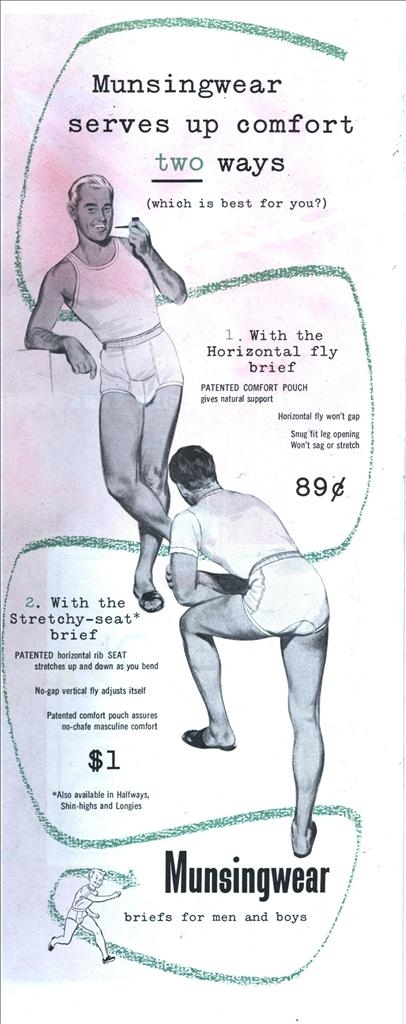
Of course, I’m sure this float is too small for any real medical emergencies. Still, it’s pretty clever. Not sure if it’s from Great Britain though. Probably not.

34. Show your patriotic spirit at the regatta with this American flag raft.

Whoever did a raft like this has way better drawing and painting skills than I do. Still, at least they used crates and barrels.

Whoever did a raft like this has way better drawing and painting skills than I do. Still, at least they used crates and barrels.

35. Hate to know what’s coming out of that funky trailer truck smokestack.

Now this float is said to be sponsored by the local food bank. However, I think it's just a front for Willy Wonka. Seriously, no semi discharges smoke like that. Not in a million years.

Now this float is said to be sponsored by the local food bank. However, I think it’s just a front for Willy Wonka. Seriously, no trailer truck discharges smoke like that. Not in a million years.

36. Play the guitar? How about a guitar raft?

Yeah, I think this guitar really isn't for playing since it's derived from cardboard. But it's a pretty accurate rendition, artistically speaking, that is.

Yeah, I think this guitar really isn’t for playing since it’s derived from cardboard. But it’s a pretty accurate rendition, artistically speaking, that is.

37. For their regatta float, these people decided to take their whole house with them.

Of course, this is too small to be a real house as well as much prettier than what many people could afford (as a real house, that is). Still, this team must have a very good designer or architect.

Of course, this is too small to be a real house as well as much prettier than what many people could afford (as a real house, that is). Still, this team must have a very good designer or architect.

38. Look out, here comes two girl rowers on an aircraft carrier.

Now I wonder if this event is just a regatta or some weird form of Battleship. Seems like it's made from Styrofoam which I highly advise against as a packing material.

Now I wonder if this event is just a regatta or some weird form of Battleship. Seems like it’s made from Styrofoam which I highly advise against as a packing material.

39. Well, at least the people on this float have a place for their private business.

Sure it's nice to go with the whole rustic Texas theme. But I'm not sure if it's a good idea to perpetuate possible stereotypes about yourselves.

Sure it’s nice to go with the whole rustic Texas theme. But I’m not sure if it’s a good idea to perpetuate possible stereotypes about yourselves. You don’t want people to get the wrong idea about you.

40. For your regatta float, you can’t go wrong with the turtle.

Now this is definitely a pumpkin float if you look inside. And I'm sure it's only made for one person. Still, wherever this guy lives, I'm sure the pumpkins there have some kind of abnormality that makes the grow excessively huge.

Now this is definitely a pumpkin float if you look inside. And I’m sure it’s only made for one person. Still, wherever this guy lives, I’m sure the pumpkins there have some kind of abnormality that makes the grow excessively huge.

41. Hey, look, is that the Scooby Doo Mystery Machine?

Just for the record, Scooby Doo is a horribly written mystery cartoon about a group of teenagers who travel in a hippie van with their oversized dog. Oh, and the villains are usually people in monster masks. Seriously, couldn't they just have the villains not wear the masks sometimes? Like real murder mysteries akin to Agatha Christie, Dashiell Hammet, Raymond Chandler, or Arthur Conan Doyle?

Just for the record, Scooby Doo is a horribly written mystery cartoon about a group of teenagers who travel in a hippie van with their oversized dog. Oh, and the villains are usually people in monster masks. Seriously, couldn’t they just have the villains not wear the masks sometimes? Like real murder mysteries akin to Agatha Christie, Dashiell Hammet, Raymond Chandler, or Arthur Conan Doyle?

42. Nothing makes a regatta float than one of a dead possum covered in duct tape.

For those familiar with Canadian Television or PBS several years ago might get this reference. For those who don't, well, it's pretty hard for me to explain.

For those familiar with Canadian Television or PBS several years ago might get this reference. For those who don’t, well, it’s pretty hard for me to explain.

43. Remember, a couch may be comfy to sit on. But it also makes a rather handy flotation device.

Of course, I have to make a special discretion for those at West Virginia University. Remember,  you can do more with couches than just burn them in the event of a victory party at your sporting events. Seriously, couch burning is illegal in Morgantown. In fact, it's illegal anywhere, especially if the couch in question is not yours.

Of course, I have to make a special discretion for those at West Virginia University. Remember, you can do more with couches than just burn them in the event of a victory party at your sporting events. Seriously, couch burning is illegal in Morgantown. In fact, it’s illegal anywhere, especially if the couch in question is not yours.

44. For those hard to reach spots, a crane truck can do just fine.

Not sure if it actually works. But it seems to do quite well in the water and really stand out.

Not sure if it actually works. But it seems to do quite well in the water and really stand out. Got to appreciate the magic of cardboard.

45. Seems like this pirate ship has too many people rocking the boat.

Looks like they have to throw a man or two overboard before they could get ship shape. Either that or at least perhaps try to give the boat an equal weight distribution.

Looks like they have to throw a man or two overboard before they could get ship shape. Either that or at least perhaps try to give the boat an equal weight distribution.

46. Of course, what’s a regatta if you don’t have an old timey riverboat there?

Nevertheless, from what I've read, real steamboats weren't the safest things and were very prone to catching fire. So this cardboard cut out is probably much safer than the real thing.

Nevertheless, from what I’ve read, real steamboats weren’t the safest things and were very prone to catching fire. So this cardboard cut out is probably much safer than the real thing.

47. Introducing the one and only water dragon.

Not sure how they manage to keep this one together before it was in the water. Oh, yes, ropes. But still, will it be in one piece at the finish line? I'm not so sure.

Not sure how they manage to keep this one together before it was in the water. Oh, yes, ropes. But still, will it be in one piece at the finish line? I’m not so sure.

48. Of course, when it comes to regattas, even Disney fans want to cash in on the action.

And it seems that these people are avid fans of Aladdin. I mean they have a Genie float after plans for a magic carpet raft fell through.

And it seems that these people are avid fans of Aladdin. I mean they have a Genie float after plans for a magic carpet raft fell through.

49. Want to decorate your float but don’t want it to sink? Remember, that pool toys are just as good decorations as any.

Not sure if I share these girls' taste in decorating. In fact, I actually think this float is kind of tacky. But I'm sure it'll probably not sink as long as it's not carrying more than its capacity.

Not sure if I share these girls’ taste in decorating. In fact, I actually think this float is kind of tacky. But I’m sure it’ll probably not sink as long as it’s not carrying more than its capacity.

50. In ancient times, it wasn’t uncommon for people to build sail boats out of aluminum beer cans.

Actually, I'm just kidding about that. This is probably for a beer can regatta in Australia. But still, it kind of gives you an impression that it was used during an ancient civilization.

Actually, I’m just kidding about that. This is probably for a beer can regatta in Australia. But still, it kind of gives you an impression that it was used during an ancient civilization.

51. Now a float like this can take any spectator into the Prehistoric Era.

Well, if you imagine the Prehistoric Era akin to what you see on The Flinstones or in some stupid Creationist museum in Kentucky. Still, that T-Rex seems to come straight from some cheap theme park, not Jurassic Park.

Well, if you imagine the Prehistoric Era akin to what you see on The Flinstones or in some stupid Creationist museum in Kentucky. Still, that T-Rex seems to come straight from some cheap theme park, not Jurassic Park.

52. See the Pharaoh being rowed on his Nile River cruise by his royal attendants.

Now I don't have an issue with the boat here even if the side is in hieroglyphics. What my problem is with the guys in red hats. Seriously, those are Pharaoh hats for Lower Egypt. I'm not sure if there should be 2 of them.

Now I don’t have an issue with the boat here even if the side is in hieroglyphics. What my problem is with the guys in red hats. Seriously, those are Pharaoh hats for Lower Egypt. I’m not sure if there should be 2 of them.

53. I’m sure this Viking boat will make a grand addition at Valhalla.

Now these guys may like Vikings. But I'm not sure if they know a lot about them. For instance, real Vikings didn't wear horned helmets. Seriously, it wouldn't be practical in the heat of battle.

Now these guys may like Vikings. But I’m not sure if they know a lot about them. For instance, real Vikings didn’t wear horned helmets. Seriously, it wouldn’t be practical in the heat of battle.

54. While some race on the regatta by boat, some just take the shuttle.

And by "shuttle" I mean space shuttle. Of course, it may not take these girls to space. But it just as well might take them to the finish line, which is just as well.

And by “shuttle” I mean space shuttle. Of course, it may not take these girls to space. But it just as well might take them to the finish line, which is just as well.

55. Of course, if you’re entering a regatta with your Sunday school class, you’d probably do a float of Noah’s Ark.

Now this doesn't look like a good rendition of Noah's Ark. And believe me, I saw the Darren Aronofsky movie. Then again, these people were on a tight budget so their cardboard ark is understandable. Darren Aronofsky though.....

Now this doesn’t look like a good rendition of Noah’s Ark. And believe me, I saw the Darren Aronofsky movie. Then again, these people were on a tight budget so their cardboard ark is understandable. Darren Aronofsky on the other hand…..

56. Of course, nothing at the regatta makes your team look fierce than having a pink dragon boat.

Now I get the dragon. But I'm not sure about the pink other than to really stand out. On the other hand, there whole scheme might be about raising breast cancer awareness.

Now I get the dragon. But I’m not sure about the pink other than to really stand out. On the other hand, there whole scheme might be about raising breast cancer awareness.

57. Oh, my God, it’s the cops. Quick, let’s get out of here before they make us pull over.

My mistake, it's just a couple of people having a good time in a float that happens to be of a police car. Yeah, sorry for the false alarm here.

My mistake, it’s just a couple of people having a good time in a float that happens to be of a police car. Yeah, sorry for the false alarm here.

58. Not I’m sure this team has a real shot at winning one of the regatta races.

Now I don't know about you but sometimes a float of a hypodermic needle can be a fine line between clever and intimidating. I mean my dad squirms when he sees needles being injected onscreen.

Now I don’t know about you but sometimes a float of a hypodermic needle can be a fine line between clever and intimidating. I mean my dad squirms when he sees needles being injected onscreen.

59. Nothing makes a regatta worthwhile than having a float with a brightly colored macaw on it.

Of course, this macaw seems like a rather happy camper to many. Still, quite colorful to say the least.

Of course, this macaw seems like a rather happy camper to many. Still, quite colorful to say the least.

60. Of course, this barrel monster is sure to strike terror in the souls of competitors.

Of course, this sea monster might not be anywhere near intimidating. But I'm sure the plastic barrels will do just fine in regards to flotation.

Of course, this sea monster might not be anywhere near intimidating. But I’m sure the plastic barrels will do just fine in regards to flotation.

61. If they row any faster, I wonder if this boat will fly.

Of course, it won't fly even with the propellers spinning. But you got to hand it to them, it sure pays to be in the shade.

Of course, it won’t fly even with the propellers spinning. But you got to hand it to them, it sure pays to be in the shade.

62. When it comes to regattas, everyone should be able to float their own tree houses.

I'm not sure if anyone could fit in that house. But these kids really seem to be proud of it.

I’m not sure if anyone could fit in that house. But these kids really seem to be proud of it even if it’s made from cardboard.

63. Seems like someone wants to really hammer in the competition.

I know this is for Australia's Darwin Beer Can Regatta. Still, I can't help but wonder whether the owners may be cheating.

I know this is for Australia’s Darwin Beer Can Regatta. Still, I can’t help but wonder whether the owners may be cheating.

64. Ladies and gentlemen, I bring you the Ill Eagle.

Now this might be a play on words here. But I'm sure this is from an American team where the bald eagle is its national symbol.

Now this might be a play on words here. But I’m sure this is from an American team where the bald eagle is its national symbol.

65. Hmmm….not sure if I’d want fries with that or not.

Still, you have to question whether this might add on to the obesity crisis in America and abroad. Seriously, let's just say that fast food isn't for me. Nor will it ever be.

Still, you have to question whether this might add on to the obesity crisis in America and abroad. Seriously, let’s just say that fast food isn’t for me. Nor will it ever be.

66. Nothing makes a regatta like a float of a pink jeep.

Now I'm not sure whether it looks badass, clever, or tacky. May be a combination of all 3 for all I know.

Now I’m not sure whether it looks badass, clever, or tacky. May be a combination of all 3 for all I know.

67. For all I know, this Energizer Bunny float can just keep going and going.

Wait a minute, is that really an Energizer Bunny float or just a pig with sunglasses? If so, then where the hell is its drum? If not, then I'll put it on here.

Wait a minute, is that really an Energizer Bunny float or just a pig with sunglasses? If so, then where the hell is its drum? If not, then I’ll put it on here.

68. Of course, in case of a fire, we have a firetruck and other emergency vehicles standing by.

Sure it might be a bit redundant having a fire truck on the water. But still, the water could be contaminated with flammable chemicals for all we know like fracking fluid. So it pays to stay on the safe side.

Sure it might be a bit redundant having a fire truck on the water. But still, the water could be contaminated with flammable chemicals for all we know like fracking fluid. So it pays to stay on the safe side.

69. Have a duck float and pretty soon everyone is going around making duck faces.

Then again, it may be a swan or a goose for all I know. The bill doesn't seem ducklike to me for some reason. But the costumes certainly do.

Then again, it may be a swan or a goose for all I know. The bill doesn’t seem ducklike to me for some reason. But the costumes certainly do.

70. Now this hotdog float is bound to give the $5 foot long a whole new meaning.

Okay, maybe not since the $5 foot long is from Subway. But I'm sure that you wouldn't want ketchup or mustard on this thing in the very least.

Okay, maybe not since the $5 foot long is from Subway. But I’m sure that you wouldn’t want ketchup or mustard on this thing in the very least.

71. Now by Thor’s hammer, this is a Viking ship well fitting for any regatta.

Now something tells me that the crew will be wearing horned Viking helmets. I'm sure this will give the Mighty Thor and Loki a facepalm.

Now something tells me that the crew will be wearing horned Viking helmets. I’m sure this will give the Mighty Thor and Loki a facepalm.

72. For those who like motorcycles, now you can ride one on the water.

I'm sure whoever designed this float must either be in a midlife crisis or compensating for something. I'm not sure what else. Seriously, motorcycles are called by a different name in the medical field for a reason.

I’m sure whoever designed this float must either be in a midlife crisis or compensating for something. I’m not sure what else. Seriously, motorcycles are called by a different name in the medical field for a reason.

73. Seems like this guy wants to take up a foot in regards to the competition.

Now I'm sure we all wear sneakers. But how many of us have a sneaker boat? I'm sure there could only be one.

Now I’m sure we all wear sneakers. But how many of us have a sneaker boat? I’m sure there could only be one.

74. Of course, you can always seem to hop to it at the regatta with this froggie float.

Now this may not look like Kermit. Then again, it appears pretty demented as if it has no soul to speak of. Still, its tongue seems to be in the water.

Now this may not look like Kermit. Then again, it appears pretty demented as if it has no soul to speak of. Still, its tongue seems to be in the water.

75. For those who look forward to Shark Week, a float like this might be for you.

Now Jaws begins when a shark devours a woman swimming on the beach. In this case the woman is using the shark as a rowboat. Reminds us of how far we've come.

Now Jaws begins when a shark devours a woman swimming on the beach. In this case the woman is using the shark as a rowboat. Reminds us of how far we’ve come.

76. Got a rusty old farm truck? Perhaps you should make a float for it with some rusty barrels.

Now I'm sure this is probably a Deere if it's in an American regatta. Of course, at least it's carrying an appropriate load.

Now I’m sure this is probably a Deere if it’s in an American regatta. Of course, at least it’s carrying an appropriate load.

77. Now there’s nothing better than having a regatta boat of a bunny or mouse.

Okay, that's definitely a mouse. But at least these people seem to make the whole regatta sort of a family affair. Even if it's subjecting the kid to wearing mouse ears.

Okay, that’s definitely a mouse. Then again, it may be a bunny. But at least these people seem to make the whole regatta sort of a family affair. Even if it’s subjecting the kid to wearing bunny ears.

78. Why use oars to move around when you already have water wheels on each side?

Not sure if it does away with oars completely. But even if it doesn't, it still looks pretty cool. Wouldn't mind having one of those myself.

Not sure if it does away with oars completely. But even if it doesn’t, it still looks pretty cool. Wouldn’t mind having one of those myself.

79. Only at a regatta could you make a caterpillar out of a bathtub.

Now the picture in the window is obviously photoshopped. Still, you have to hand it to these ladies for their creative spirit.

Now the picture in the window is obviously photoshopped. Still, you have to hand it to these ladies for their creative spirit.

80. Well, if anyone needs a snack, there’s always Dunkin’ Donuts.

Still, you don't want to have too many if you want to look good in a swimsuit. And this goes for women and men here. Or if you don't want diabetes or other health problems like obesity.

Still, you don’t want to have too many if you want to look good in a swimsuit. And this goes for women and men here. Or if you don’t want diabetes or other health problems like obesity.

Know Your Signers: Part 7 – John Penn to George Walton

revolutionary-war

So we’re on the final segment of my post series about the signers of the Declaration of Independence. Of course, I hope you enjoy reading it as I relished in spending a week compiling research from various websites and using Google Images for pictures. At least the portraits are public domain as far as I’m concerned. Still, all too often we tend to model the Founding Fathers in our own image. One group might say that the Founding Fathers were strong Christians and founded this country on Christian principles while another group might say that they were Deist secularists who founded this country on Enlightenment principles. However, as a progressive Catholic history buff, I have to say that the truth is that while all the Founding Fathers were Christians at least in the nominal sense, their practices and devotion varied among individuals as it always has among Christian Americans. Jefferson and Franklin may not have been fans of organized religion while Samuel Adams was a staunch Puritan, Charles Carroll of Carrollton had to be a strong Catholic to put up with religious discrimination in Maryland, Benjamin Rush thought all kids should learn Christianity in schools, and John Witherspoon was a clergyman (but he also diversified Princeton’s curriculum considerably and purchased scientific equipment). But as far as religion and science are concerned, it’s pretty clear that most of them didn’t see much of a conflict or at least tried to see a way both can coexist. But, let’s just say in terms of what they believed about medicine and sanitation, you might not want to know. In this final installment, we wrap up the North Carolina signer delegation with John Penn as well as cover those of South Carolina and Georgia. First, there’s John Penn who was instrumental in opening communications between North Carolina and Nathaniel Green. Second, it’s off to South Carolina with Edward Rutledge who was the youngest signer of the lot as well as brother of a crazy Supreme Court Justice followed by Thomas Heyward Jr. After them comes Thomas Lynch Jr. who was sent to the Continental Congress to replace his ailing father but later went off on a seafaring voyage and never returned. Rounding out the South Carolina delegation is Arthur Middleton a scion of a patriot family who liked fine art, classical literature, music, and traveling Europe. Finally it’s off to Georgia with Button Gwinnett who got killed in a duel by a political rival, Lyman Hall a failed minister turned physician, and George Walton who got in trouble over the Gwinnett duel. So for your flag waving reading delights, we come to the final set of our signers who declared this country’s independence.

49. John Penn

Though he didn't have much formal education, John Penn managed to establish communications between Nathaniel Greene and the North Carolina Board of War.  Mostly retired to his law practice after the war though.

Though he didn’t have much formal education, John Penn managed to establish communications between Nathaniel Greene and the North Carolina Board of War. Mostly retired to his law practice after the war though.

Lived: (1741-1788) He was 35 at the signing and 47 at his death.

Family: Son of Moses Penn and Catherine Taylor. Was an only child. Married Susannah Lyme in 1763 and had 2 children.

State: North Carolina

Occupation: Lawyer

Early Life: Born in Port Royal, Virginia. Attended a common school for 2 years because his dad didn’t think education was important. At 18, he started studying law with his uncle and entered the bar in 1762. Moved to Williamsborough, North Carolina where he practiced law (possibly over being brought to court for some malicious slander against British policy). Was elected to the North Carolina Provincial Congress in 1774 who sent him to the Continental Congress that same year.

Significant Roles: Signed the Articles of Confederation and served on the Board of War. Also signed the Halifax Resolves (which was North Carolina’s constitution). Might’ve been challenged to a duel with Henry Laurens but the two ended up buddies in 1777-1778. On the North Carolina Board of War (where he was the only guy doing anything as his two colleagues were incompetent), he established effective communication with General Nathaniel Greene in Hillsborough in 1780 where they raised recruits, found funding for the military, provided transportation and supplies, disarmed Tories, and generally spurred the people into action.

Ultimate Fate: After the war, he retired to practice law though he had a stint as a receiver of taxes in 1784. Currently buried at Guildford Courthouse.

Trivia: Has a ship named after him. An historical highway marker honoring him was the first one erected by the State of North Carolina (January 10, 1936). Was a proponent for free speech.

50. Edward Rutledge

Though you wouldn't tell by this picture, Edward Rutledge was actually the youngest Declaration of Independence signer. He was also a notable politician in South Carolina though he didn't live long.

Though you wouldn’t tell by this picture, Edward Rutledge was actually the youngest Declaration of Independence signer. He was also a notable politician in South Carolina though he didn’t live long.

Lived: (1749-1800) He was 26 at the signing and 50 at his death.

Family: Son of Dr. John Rutledge and Sarah Hext. Father was a Scots-Irish physician. Youngest of 7 children. Married Henrietta Middleton and Mary Shubrick Eveleigh and had 3 children.

State: South Carolina

Occupation: Lawyer, planter, soldier, and landowner

Early Life: Born in Charleston. Followed his brothers John and Hugh into studying law in London and was admitted to the Middle Temple in 1772, before returning to Charleston to practice with his partner Charles Cotesworth Pinckney. Owned more than 50 slaves. Along with brother John he was elected to the Continental Congress in 1774.

Significant Roles: Worked to have African Americans expelled from the Continental Army (but was unsuccessful). Voted how he was instructed to, (explaining why Adams thought him a waste of political space). Was elected to the South Carolina General Assembly in 1776. Served as captain in the South Carolina militia where he fought the Battle of Beaufort in 1779. Was captured by the British in the fall of Charleston and held prisoner in Florida until 1781.

Ultimate Fate: After his release, he returned to the state assembly and served until 1796. Was known as an active legislator and an advocate for the confiscation of Loyalist property. Was opposed to the African slave trade. Served in the state senate for 2 years and was elected governor in 1798. While attending an important meeting in Columbia, he was sent home due to gout. He died before the end of his term, presumably of apoplexy resulting from hearing the news of George Washington’s death. Buried at Saint Philip’s Episcopal Church Cemetery in Charleston.

Trivia: Youngest delegate to sign the Declaration of Independence. Brother of Supreme Court Justice John Rutledge who went nuts. Brother-in-law of Thomas Lynch Jr. and Arthur Middleton. Said to be an uncommonly benevolent guy except if you were a Loyalist or black.

51. Thomas Heyward Jr.

Aside to being a signer of the Declaration of Independence, Thomas Heyward Jr. was also involved in defending Charleston from the British. And he was taken prisoner in St. Augustine, Florida until 1781.

Aside to being a signer of the Declaration of Independence, Thomas Heyward Jr. was also involved in defending Charleston from the British. And he was taken prisoner in St. Augustine, Florida until 1781.

Lived: (1746-1809) He was 29 at the signing and 62 at his death.

Family: Son of Daniel Heyward and Maria Miles. Married Elizabeth Matthews and Elizabeth Savage (later Parker) and had 9 children with 4 surviving to adulthood.

State: South Carolina

Occupation: Lawyer, soldier, planter, and landowner

Early Life: Born in what is now Jasper County, South Carolina. Educated at home and studied law in England where he was a member of the Honorable Society of the Middle Temple. But saw that the Brits looked down on Americans though. Established his White Hall sugar plantation in 1772. Elected to the South Carolina General Assembly the same year. Elected to the Continental Congress in 1775.

Significant Roles: Was a signer for the Articles of Confederation. Returned to South Carolina in 1778 to serve as a judge and command a militia force. Taken prisoner by the British during the siege of Charleston where his plantation was burned and his 130 slaves were taken to Jamaica. Held in Florida until 1781.

Ultimate Fate: Continued to serve as judge after the war and retired in 1798. Buried at Old House Plantation.

Trivia: Named after his older brother so not a “Jr.” in the strictest sense. Ancestor of Dubose Heyward whose play “Porgy” was adapted into “Porgy and Bess.”

52. Thomas Lynch Jr.

Thomas Lynch Jr. was selected for the Continental Congress to replace his ailing father. But ailing himself, he and his wife decided to go on a Caribbean vacation but were caught in a storm after setting sail. They were never seen again.

Thomas Lynch Jr. was selected for the Continental Congress to replace his ailing father. But ailing himself, he and his wife decided to go on a Caribbean vacation but were caught in a storm after setting sail. They were never seen again.

Lived: (1749-1779) He was 26 at the signing and 29-30 at his death (most definitely).

Family: Son of Thomas Lynch and Elizabeth Allston (later Moultrie). Was the 3rd Thomas Lynch in his line so he should be Thomas Lynch III. Married Elizabeth Shubrick and had no children.

State: South Carolina

Occupation: Planter, landowner, soldier, and lawyer

Early Life: Born in what is now Georgetown, South Carolina, where he was educated at the Indigo Society School. Attended Eton and graduated from Cambridge University in England. Studied law in London’s Middle Temple before returning to America in 1772. Elected to the South Carolina Provincial Congress in 1774. Was a company commander of the 1st South Carolina regiment in 1775 and elected to the Continental Congress to replace his father who had recently died from a stroke.

Significant Roles: Became severely ill from malaria and would become a semi-invalid for the rest of his life.  In 1779, he and his wife set out on an ocean voyage to St. Eustatius to improve his health. But the ship disappeared in a storm and they were never seen again. Plantation Hopseewee still stands though.

Ultimate Fate: Lynch most likely didn’t survive the American Revolution.

Trivia: Before the voyage prior to disappearance, he made a will, stipulating that heirs of his female relatives must change their surname to Lynch in order to inherit the family estate, a rice plantation (an apparently, one of his nephews actually did). He and his dad were the only father and son pair to serve at the same time in the Continental Congress. Youngest signer of the Declaration of Independence to die. Brother-in-law to Edward Rutledge.

53. Arthur Middleton

Now this picture of Arthur Middleton is taken from a family portrait with his wife and first child during their 3 year tour of Europe. Nevertheless, he was a more radical thinker than his dad and would soon be a trustee of Charleston College.

Now this picture of Arthur Middleton is taken from a family portrait with his wife and first child during their 3 year tour of Europe. Nevertheless, he was a more radical thinker than his dad and would soon be a trustee of Charleston College.

Lived: (1742-1787) He was 34 at the signing and 44 at his death.

Family: Son of Henry Middleton and Mary Baker Williams. Father owned approximately 20 plantations consisting in all of 50,000 acres and 800 slaves. He was also a leader of British opposition in South Carolina as well. Married Mary Izard in 1764 and had 9 children. Eldest son Henry would become a US Representative, an ambassador to Russia, and Governor of South Carolina.

State: South Carolina

Occupation: Planter, landowner, soldier, lawyer, and college trustee

Early Life: Born in Charleston. Educated in England at the Harrow School and graduated from Cambridge University in 1760. Studied law at the Middle Temple and traveled across Europe before returning to America in 1764 to get married (they’d later go on a 3 year tour of Europe in 1770). Was a leader of the American Party in South Carolina and one of the boldest members of the Council of Safety and its Secret Committee. Elected to the South Carolina General Assembly in 1765. As a Patriot, he was more of a radical thinker than his dad and his attitude toward Loyalists was said to be ruthless (and yes, he did think tarring and feathering them was a good idea). In 1776, he was elected to succeed his dad in the Continental Congress.

Significant Roles: After signing the Declaration of Independence, he became an officer in the local militia that participated in the defense of Charleston and was taken prisoner during the siege by the British. Held in St. Augustine, Florida until 1781. Plantation Middleton Place was plundered and devastated. Was appointed to the State Senate in 1782.

Ultimate Fate: Was one of the original trustees of Charleston College. Buried in his family mausoleum at Middleton Place in his beloved 18th century garden. Home is a National Historic Landmark.

Trivia: Died on New Year’s Day. 3rd great nephew was Baldur von Schirach, a onetime leader of the Hitler Youth who was governor of the Reichsgau Vienna and was convicted of “crimes against humanity” during the Nuremberg trials. Has a ship named after him. Had a refined taste in music, literature, music, and art. Brother-in-law of Edward Rutledge.

54. Button Gwinnett

Button Gwinnett has the distinction of being the Declaration of Independence signer with the most valuable signature. Of course, he was a rather obscure guy before the Revolution and got himself killed in a duel with longtime rival Lachlan McIntosh not long after. And it was mostly his fault since he challenged the guy. Yeah, kids, dueling isn't a good idea.

Button Gwinnett has the distinction of being the Declaration of Independence signer with the most valuable signature. Of course, he was a rather obscure guy before the Revolution and got himself killed in a duel with longtime rival Lachlan McIntosh not long after. And it was mostly his fault since he challenged the guy. Yeah, kids, dueling isn’t a good idea.

Lived: (1735-1777) He was 40-41 at the signing and 41-42 at his death.

Family: Son of the Reverend Samuel Gwinnett and Anne Eames. Was third of 7 children. Married Anne Bourne in 1757 and had 4 daughters but none of them left any descendants.

State: Georgia

Occupation: Merchant, planter, shopkeeper, businessman and landowner

Early Life: Born in England. Not much is known about his life there except that he became a merchant and got married. Came to America in 1762 and arrived in Georgia in 1765. There, he abandoned his mercantile pursuits and bought a tract of land to start a plantation where he prospered. Was elected to the Georgia Provincial Assembly in 1769, where he met Lyman Hall one of his closest allies and Lachlan McIntosh one of his most bitter enemies. Wasn’t a strong advocate for colonial rights until 1775 when St. John’s Parish, which encompassed his lands, threatened to secede from Georgia due to the colony’s conservative response to the events of the times.

Significant Roles: After voting for independence, he accompanied Carter Braxton to as far as Virginia carrying a proposed state constitution drawn up by John Adams. Was a candidate for Brigadier General in the 1st Regiment in the Continental Army during his time in the Continental Congress, but he lost out to Lachlan McIntosh which made him super pissed. Later in 1776, he returned to Georgia to serve in the state legislature where he wrote the original draft to Georgia’s first state constitution. He later became Georgia Assembly Speaker and later Governor. However, his rivalry with Lachlan McIntosh would soon get nasty when he ordered the latter to arrest his own brother for treason in irons as well as lead in what turned out to be a poorly planned and poorly led military expedition in East Florida. In May 1, 1777, McIntosh would denounce Gwinnett in front of the state legislature in the harshest of terms, calling him “a scoundrel and a lying rascal.” Gwinnett called on McIntosh and demanded an apology but the latter refused so he challenged the guy to a duel. So just outside of Savannah in Sir James Wright’s pasture, the two shot each other, fell wounded, and Gwinnett died from a gangrene infection a few days later. Though McIntosh would be acquitted with his murder, he was ordered by George Washington to Continental Army headquarters where he spent the winter in Valley Forge. Buried in Savannah’s Colonial Park Cemetery (though we don’t know where) and has a large monument in its downtown cemetery.

Ultimate Fate: Gwinnett didn’t survive the Revolution (and it was mostly his fault).

Trivia: Has the most sought after signature by autograph collectors wishing to gather a complete set of the 56 signers (and people have paid as much as $250,000 for it). 51 examples are known to exist since he was so obscure prior to the signing and died shortly afterward. Only 10 of those are in private hands. Has a county named after him in Georgia.

55. Lyman Hall

Dr. Lyman Hall was a failed minister turned physician who helped made sure that his little community in Georgia would be represented in the Continental Congress. So they had them send him.

Dr. Lyman Hall was a failed minister turned physician who helped made sure that his little community in Georgia would be represented in the Continental Congress. So they had them send him.

Lived: (1724-1790) He was 52 at the signing and 66 at his death.

Family: Son of John Hall and Mary Street. Married Abigail Burr and Mary Osbourne and had a son who died without issue.

State: Georgia

Occupation: Minister, teacher, physician, planter, and landowner

Early Life: Born in Wallingford, Connecticut. Graduated from Yale in 1747 and was called to the pulpit of present day Bridgeport in 1749 but the congregation hated him so much that he was fired in 1751 on charges against his moral character. Though he’d continue preaching for 2 more years, he decided to become a doctor instead. In 1757, he moved to Dorcester, South Carolina to establish himself as a physician, which was community founded by Congregationalist migrants from Massachusetts decades earlier. And when these settlers moved to what is now Liberty County, Georgia, he went with them and became a leading citizen of the newly formed town of Sunbury as well as operated a rice plantation. Now this place was in St. John’s Parish which was a radical hotbed in predominantly loyalist Georgia in the years leading up to the Revolution. Still, Georgia wasn’t represented at all in the First Continental Congress but through Hall’s influence, he got St. John’s Parish to send a delegate to the Second Continental Congress, himself.

Significant Roles: Well, his efforts in the Continental Congress led Georgia to send its own delegation. In 1779, Sunbury was burned by the British which led him and his family to head north until the British evacuation in 1782. But his home, plantation, and slaves were confiscated. For Hall, this resulted in great financial loss.

Ultimate Fate: After the war, he returned to Georgia where he settled in Savannah. In 1783, he was elected Governor of Georgia in which he advocated the chartering a state university since he believed that education, particularly religious education would result in a more virtuous citizenry. This would lead to the chartering of the University of Georgia in 1785 which was one of the first state universities in the nation. When his term was up, he resumed his medical practice and bought a plantation in Burke County, where he died and is currently buried.

Trivia: Has a county named after him in Georgia.

56. George Walton

Though apprenticed as a carpenter, George Walton decided to pursue law as soon as he was legally able. He would soon damage his political career for his clashes with Button Gwinnett as result in his expulsion and indictment for various criminal activities. But he also helped defend Savannah and was held as a POW by the British for 2 years.

Though apprenticed as a carpenter, George Walton decided to pursue law as soon as he was legally able. He would soon damage his political career for his clashes with Button Gwinnett as result in his expulsion and indictment for various criminal activities. But he also helped defend Savannah and was held as a POW by the British for 2 years.

Lived: (ca. 1749-1804) He was at least 26-27 at the signing and at least 54-55 at his death. We’re actually not sure when he was born since his birth year has been listed to as early as 1740.

Family: Son of Robert Walton and Mary Hughes. Was orphaned by the time he was 12 and raised by his uncle. Brother John also served in the Continental Congress. Married Dorothy Camber in 1778 and had 2 sons. But since his great-grandson’s death in 1925, he currently has no living descendants.

State: Georgia

Occupation: Carpenter, lawyer, soldier, and college trustee

Early Life: Born in Cumberland County, Virginia. Was apprenticed to his carpenter uncle at 12 who thought his nephew’s reading would contribute to laziness. Thus, it’s no surprise that he left his uncle as soon as he could as well as far away as possibly like Savannah, Georgia in 1769. There he studied law and was admitted to the bar in 1774. Was elected Secretary to the Provincial Congress and president of the Council of Safety. Elected to the Continental Congress in 1776-1778.

Significant Roles: His passionate political battles with Button Gwinnett would lead to his expulsion from office and indictment for various criminal activities. He would also be censured over his involvement the Gwinnett and McIntosh duel. Was commissioned Colonel of the 1st Regiment of the Georgia militia and in the Battalion of General Robert Howe. Fought in the Battle of Savannah where he was wounded by a cannonball in the leg while he was on his horse as well as captured by the British. He was held captive for 2 years and exchanged in 1779 for a British naval officer. Later he was appointed Governor of Georgia that same year and would only serve 2 months since he was just there to fill a vacancy until someone else was elected.

Ultimate Fate: In 1783-1789, he would become Chief Justice of Georgia before being elected governor in 1789 helping to set up a state government in Augusta and making peace with the Creek Indians. In 1795, he became a US Senator but retired after a year. In 1799 he was appointed to Georgia’s Superior Court where he’d serve for the rest of his life. Died at College Hill in Augusta after long bouts with gout. Currently buried in the Signers Monument in Augusta.

Trivia: Has a county in Georgia named after him (ironically near Gwinnett since the two men hated each other). Was a trustee for the University of Georgia and Richmond Academy.

Know Your Signers: Part 6 – Richard Henry Lee to Joseph Hewes

Writing_the_Declaration_of_Independence_1776_cph.3g09904

Other than the number slaves, as you go further along the list of Declaration of Independence signers, you start to notice how they keep getting younger. Most the northern delegates seem to be middle aged or elderly while many of the southern delegates tend to be either in their 30s or younger. Of course, this isn’t hard to explain why. After all, a significant majority of signatories south of the Mason-Dixon Line grew up plantations owned by notable and wealthy families. Many of them tend to be sent to best schools, sometimes abroad and have been groomed for political office and southern aristocracy from day one. Besides, the southern delegates have all the slaves on their plantation to do all the fieldwork and other manual labor for them. On the other hand, the delegates from New England had to work for a living to actually get anywhere or wait until the old man dies to inherit their property (possibly a combination of the two). Many of them also seemed to have longer political careers. Add to the fact that the New England colonies had been settled longer than say, places like North Carolina and Georgia. Then again, it could also be due to the fact that the older southern politicians simply didn’t feel like making the journey to Philadelphia while the northern politicians wanted to send their most notable guys in the legislatures. In this section, it’s on to the other 6 delegates of Virginia as well as two of the delegates from North Carolina. First, of the gentlemen from Virginia sans George Wythe, there’s Richard Henry Lee who was an early advocate for independence as who put forth the motion to declare independence from Great Britain. Second, you have Thomas Jefferson who wrote the Declaration of Independence as well as became a US president. Following him is Benjamin Harrison V who’s better known for being an ancestor of 2 US Presidents, one of them being his son William Henry who caught pneumonia at his inauguration and was dead within a month. After him is Thomas Nelson Jr. who personally led the Virginia Militia at the Battle of Yorktown as well as Francis Lightfoot Lee who was Richard Henry Lee’s brother. Rounding up the Virginia delegation is Carter Braxton a planter and merchant who also invested heavily in the Revolutionary War effort. Finally, from the North Carolina delegation, you have William Hooper and Joseph Hewes. So for your Founders nostalgia pleasure, here are some more Declaration of Independence signers to get acquainted with.

41. Richard Henry Lee

Richard Henry Lee is best known for his motion during the Second Continental Congress calling for the colonies' to declare their independence from Great Britain. His famous Lee Resolution helped moved the 13 colonies toward independence.  He also led the movement to oppose the US Constitution, however.

Richard Henry Lee is best known for his motion during the Second Continental Congress calling for the colonies’ to declare their independence from Great Britain. His famous Lee Resolution helped moved the 13 colonies toward independence. He also led the movement to oppose the US Constitution, however.

Lived: (1732-1794) He was 44 at the signing and 62 at his death.

Family: Son of Thomas Lee and Hannah Harrison Ludwell. Came from a line of military officers, diplomats, and legislators. Father was Governor of Virginia before his death in 1750. Married Anne Aylett and Anne Gaskins Pinckard and had 13 children. Daughter married a nephew of George Washington.

State: Virginia

Occupation: Planter, lawyer, soldier, and landowner

Early Life: Born in Westmoreland County, Virginia and spent most of his childhood at his parents’ Stratford Hall. Was groomed for a political career by his dad from day one who sent him to neighboring planters to associate him with neighboring men of prominence (a very common practice at the time). In 1748, he attended the Queen Elizabeth Grammar School in England but had to return in 1753 to settle his family estate because his parents died 3 years earlier. Formed and led a militia in the French and Indian War and marched them to Alexandria to join General Edward Braddock but were rebuffed. Was appointed justice of the peace in 1757 and elected to the Virginia House of Burgesses the next year. Was an early advocate of independence and helped create one of the early Committees of Correspondence among many independence-minded Americans in various colonies. Is credited with authoring the Westmoreland Resolution which was publicly signed by prominent landowners including four brothers of George Washington as well as threatened “danger and disgrace” to those who paid the stamp tax. Was chosen as a delegate for the Continental Congress in 1774.

Significant Roles: Was an early advocate for independence and it was he put forth the motion to declare independence from Great Britain. Didn’t vote during the adoption of the Declaration of Independence but signed it anyway when he returned from Virginia.

Ultimate Fate: In 1784, he was elected President of the Congress under the Articles of Confederation. In 1785, he was very active in passing numerous legislation such as the establishment of the US Dollar for the national currency but wasn’t a fan of federal taxes and supported the Ordinances of 1784 and 1785 so the US government can have revenue from land sales. Opposed the Constitution and was a proponent on states’ rights. In 1789, he was elected a US Senator and served as President pro tempore in 1792. Was one of the strongest advocates for the Bill of Rights. Died at his Chantilly Plantation. Buried at Burnt House Fields.

Trivia: Brother of Francis Lightfoot Lee which makes them the only pair of brothers to sign the Declaration of Independence. Home Chantilly is now a National Historic Site and an archaeological dig. Was known for his great oratory skills as well as his fiery, rebellious spirit, which brought him many enemies.

42. Thomas Jefferson

It's always been Thomas Jefferson's words that appear on the Declaration of Independence. And while he's certainly a major American icon of republicanism,  liberty, and democracy, he's not a man without controversy. Sure he's a highly rated president but his term wasn't all bed and roses. And then there's him owning hundreds of slaves and fathering children with one of them.

It’s always been Thomas Jefferson’s words that appear on the Declaration of Independence. And while he’s certainly a major American icon of republicanism, liberty, and democracy, he’s not a man without controversy. Sure he’s a highly rated president but his term wasn’t all bed and roses. And then there’s him owning hundreds of slaves and fathering children with one of them.

Lived: (1743-1826) Was 33 at the signing and 83 at his death.

Family: Son of Peter Jefferson and Jane Randolph. Father was a planter, estate manager, and surveyor who died when he was 14. Was the 3rd of 10 children. Married Martha Wayles Skelton (his third cousin as well as in a lavish ceremony that lasted for several days at her family home) in 1772 and had 6 children with only 2 daughters surviving to adulthood. Was so distraught over his wife’s death that he shut himself in his room for 3 weeks pacing back and forth nearly exhausted. He would never remarry. Had at least one child with his slave Sally Hemings (which was confirmed by DNA evidence).

State: Virginia

Occupation: Planter, landowner, inventor, farmer, philosopher, diplomat, author, lawyer, architect, musician, political theorist, and polymath

Early Life: Born in Shadwell near Charlottesville and the Virginia Wilderness. Grew up in Tuckahoe Plantation with his maternal relatives. Inherited Monticello at 21, 7 years after his father’s death, which consisted of 5,000 acres and 150 slaves (he’d later inherit 11,000 acres from his father-in-law as well as 135 slaves and considerable debts, which would contribute to his financial problems {along with a lack of interest in economics}). Entered the College of William and Mary at 16 and studied under law professor George Wythe as well as graduated in 1762. Studied law and worked as a law clerk for Wythe before being admitted to the Virginia bar in 1767 as well as practicing law as a circuit lawyer (for many of Virginia’s elite families). Began construction of Monticello in 1768 (which he will never finish). Elected to the Virginia House of Burgesses in 1769. Elected to the Continental Congress in 1775.

Significant Roles: In 1776, he was appointed to the Committee of Five along with John Adams, Robert R. Livingston, Roger Sherman, and Benjamin Franklin. Wrote the first draft of the Declaration of Independence in 17 days drawing from his own proposed draft of the Virginia Constitution and George Mason’s draft of the Virginia Declaration of Rights as well as other sources. Final draft was presented in June 28, 1776. It would be considered one of his major achievements. After the colonies declared their independence, he returned to Virginia where he was elected to the Virginia House of Delegates, often helping to write laws for the new state. He was especially proud of the Bill for Establishing Religious Freedom. In 1779, he was elected Governor of Virginia in which he transferred the state capital from Williamsburg to Richmond. In 1780, he prepared Richmond for attack by moving all military supplies to a foundry located 5 miles out of town, which was captured by Benedict Arnold in 1781. He was then forced to evacuate the city as the British burned the new fledgling capital. That June, General Cornwallis sent Banastre Tarleton to capture him at Monticello but he escaped to Poplar Forest after being warned. The General Assembly considered an inquiry of his actions, thinking he had failed as governor and thus, wasn’t reelected. Started writing Notes on the State of Virginia in 1780 (which would be first published in 1785).

Ultimate Fate: In 1783, he was selected as a delegate to the Confederation Congress where he recommended that American currency should be based on the decimal system. He also played a central role and advancing policy for the settlement of western territories as well as the principal author of the Land Ordinance of 1784. Later that year he was sent as a minister of France to join Benjamin Franklin and John Adams. He’d also become a companion to the Marquis de Layfayette and allowed him to use his residence as a meeting place with other republicans. Was in France at the start of the French Revolution, including the storming of the Bastille, but got the hell out in the nick of time. When he returned to the US, he was appointed Secretary of State by George Washington where he repeatedly with Alexander Hamilton, which led to the political two party system. His political actions to form a party and efforts to undermine Hamilton led Washington to dismiss him but he resigned voluntarily in 1793. Washington never forgave him for his actions and never spoke to him again. However, the two did compromise when it came to designating a capital in Washington D.C. In 1796, he was elected vice-president to John Adams. He had a more hands-off approach but he wrote a manual called his Parliamentary Pocket Book. During this time, he advocated nullification and drafted a threat for Kentucky to secede. It’s said that had his actions been known, he might’ve been impeached for treason. But these actions made Washington appalled, but influenced the idea of states’ rights up to the Civil War and beyond. He also attacked Adams in private, predicted he’d only serve one term, and encouraged France to invade England. Was elected president in 1800 after being chosen by the House of Representatives when he and Aaron Burr were in a tie (thankfully Hamilton hated Burr more than him). His administration saw the First Barbary War, the Louisiana Purchase, the Lewis and Clark Expedition (which was a huge success with only one unpreventable fatality), and the establishment of West Point. However, his Indian policy consisted forcibly moving Cherokee and Shawnee tribes to lands west of the Mississippi which violated a treaty between the US Government and the Cherokee Nation. He refused to recognize Haiti, calling it a “slave republic.” Tried to get Secretary of State James Madison to remove John Adams’ “midnight judges” which resulted in the case Marbury vs. Madison. Also tried to annex Florida. During his second term, there was the embargo against Britain. Oh, and he segregated the US postal system which didn’t allow blacks to carry mail. Retired from the presidency in 1809 and founded the University of Virginia in 1819, which was the first public college in America (if not, the world). Was visited by Lafayette in 1824. Final years and days were plagued by health problems and financial difficulties and died thousands of dollars in debt (explaining why he never freed many of his slaves). Had a quiet funeral as he wanted and is buried at Monticello.

Trivia: As a lifelong bibliophile, his library would soon extend to over 6,500 books by 1815 which he offered to sell 6,000 for $23,950 to the government after the British burned the Library of Congress in 1814 (he’d buy more books though). Had an on-again, off-again friendship with John Adams that would last for the rest of their lives. Was a very close friend and mentor of James Madison. Was accomplished on the violin and cello. Was a member of the American Philosophical Society for 35 years and served as its president in 1797. Was also a member of the American Academy of Arts and Sciences in 1787 and the American Antiquarian Society in 1814. Died on the 50th Anniversary of the Declaration of Independence on the same day as John Adams. Invented the dumbwaiter, revolving book stand, cipher wheel, “Great Clock,” and swivel chair. Believed in universal white male suffrage as well as public education but hated central banks (until the Louisiana Purchase). Was a strong supporter of the French Revolution (except its bloodier and violent aspects). Was a Christian Deist and cut and pasted his Bible (though he was also a practicing Episcopalian). Was a big time slave owner and slavery apologist (owned over 300 slaves in his lifetime. But to be fair, he also handled a number of freedom suits for slaves as well. No wonder this guy was conflicted). As president, he’s said to greet dignitaries at the White House in his bathrobe and slippers (then again, he had a tendency to greet visitors while still in his pajamas). Spoke numerous languages. Is commended on Mount Rushmore and the Jefferson Memorial in Washington D.C. Received an honorary doctorate in law from Harvard University. Initiated a program at the Federal Armories to develop interchangeable parts for firearms. Wrote the Declaration of Independence on the first swivel chair. Had his whole family inoculated with smallpox and publicly ate a tomato to prove it wasn’t poisonous. Had a slave trained as a French chef. Believed that Indians should give up their own cultures, religions, and lifestyles to assimilate into Western European-style agriculture. Designed the buildings for the University of Virginia as well as planned its curriculum and served as its first rector. Said to write over 18,000 letters during his life. Despite his volume of writings, he was said to be socially awkward and a poor public speaker who had difficulty maintaining close personal relationships (which is probably why he got along so well with John Adams and James Madison as well as said to be on the autism spectrum). Had a reputation for wearing wacky, mismatched outfits. Said not to like being president. Had red hair.

43. Benjamin Harrison V

Benjamin Harrison V was a Chairman of the Committee of the Whole during the independence debates of 1776. He'd also have a son and a great-grandson who'd later become US Presidents.

Benjamin Harrison V was a Chairman of the Committee of the Whole during the independence debates of 1776. He’d also have a son and a great-grandson who’d later become US Presidents. This miniature is the only surviving life portrait of him that exists.

Lived: (1726-1791) He was 50 at the signing and 65 at his death.

Family: Son of Benjamin Harrison IV and Ann Carter. First Benjamin might have arrived to Virginia in 1630. One of 10 children (well, white children as far as we know since there were a number of mixed race slaves on the plantation by the time Benny V inherited the estate). Youngest brother Charles was a Brigadier General in the Continental Army. Father and 2 of his sisters were killed in 1745 after being struck by lightning while trying to shut a window. Married Elizabeth Bassett in 1748 and had 8 children including US President William Henry Harrison.

State: Virginia

Occupation: Planter, landowner, and merchant

Early Life: Born on Berkeley Plantation and inherited the bulk of the estate at his father’s death in 1745. Was a graduate of William and Mary. Was elected to the Virginia House of Burgesses in 1756 as well as served as a county justice. Participated in a boycott with other colony lawmakers in 1770 over the British tax on tea. Also co-sponsored a bill that declared certain laws passed by Parliament affecting Virginia to be illegal without the consent of colonists in Virginia. Selected for the Continental Congress in 1774.

Significant Roles: Served as Chairman of the Committee of the Whole which presided over the final debates on the independence resolution presented by Richard Henry Lee as well as amended and adopted the final form of the Declaration of Independence on July 2, 1776. He also delivered the final reading of the Declaration to the Continental Congress. Later in 1776, he joined some delegates to meet with George Washington in Cambridge Massachusetts to plan the continuing, supporting, and regulating the Continental Army. Returned to Virginia in 1777 and was Speaker of the House of Burgesses until 1780. In 1781, he relocated his family from Berkeley Plantation before heading to Philadelphia to rally for military support due to the threat of Benedict Arnold’s position at the James River with 1,600 men. He succeeded in getting increased gunpowder, supplies, and troops but only on a delayed basis. Though he and his family avoided capture in Arnold’s January 1781 raid, most of his house and possessions were destroyed. Still, he managed to rebuild his home, correspond with Washington, and continued rallying for support for the war effort on behalf of the southern states. Was elected Governor of Virginia around the time of Yorktown.

Ultimate Fate: Since Virginia’s financial resources were drained when he assumed governorship, he opposed any offensive action toward Native Americans and tried to retain diplomatic relations with the Cherokee, Chickasaw, and the Creek tribes. He also had to deal with Continental Army mutinies as well as the release of British POWs. But he was never able to relieve the state debts. In 1788, he was a member of the Virginia Ratifying Convention for the US Constitution which he opposed on the absence of a Bill of Rights. Remained in the Virginia legislature until his death after a dinner party celebrating his final electoral success. Buried at Berkeley Plantation.

Trivia: Father William Henry Harrison and great-grandfather (and namesake) of Benjamin Harrison. Was defeated in an electoral race by a man named John Tyler Sr. (father of his son’s running mate who’d declare himself president after his boss died of pneumonia after 30 days in office). Was a well-known enemy of John Adams (which was mostly due to their lifestyles and personalities. Adams called him, “another Sir John Falstaff”). Known for his sense of humor as well as rotund that he told Elbridge Gerry after the signing: “I shall have a great advantage over you, Mr. Gerry, when we are all hung for what we are now doing. From the size and weight of my body I shall die in a few minutes and be with the angels, but from the lightness of your body you will dance in the air an hour or two before you are dead.” Was 6ft 4in and weighed 240 lbs. Wife was a niece of Martha Washington.

44. Thomas Nelson Jr.

Aside from signing the Declaration of Independence, Thomas Nelson Jr. was an active revolutionary in Yorktown where he staged a

Aside from signing the Declaration of Independence, Thomas Nelson Jr. was an active revolutionary in Yorktown where he staged a “tea party” and led the Virginia Militia during the siege and battle. It’s said he ordered artillery to fire at the house occupied by Charles Cornwallis. Yet, there are 3 cannonballs lodged inside the house’s outer walls.

Lived: (1738-1789) He was 37 at the signing and 50 at his death.

Family: Son of William Nelson and Elizabeth Burwell. But was named after his grandfather Thomas “Scotch Tom” Nelson who was from England. Married Lucy Grymes in 1762 and had 11 children including a son Hugh who’d become a US Congressman.

State: Virginia

Occupation: Planter, landowner, and soldier

Early Life: Born in Yorktown and was educated in England, attending Newcome’s School, Eton, and graduating from Cambridge University in 1760. Was elected to the Virginia House of Burgesses in 1761. In 1774, he spent some of his personal fortune to send needed supplies to Boston after its port was closed, arranged a Yorktown tea party, and threw 2 half-chests into the York River. Was appointed Colonel of a Virginia infantry regiment in 1775 but he resigned to serve in the Second Continental Congress in 1776.

Significant Roles: Left the Continental Congress in 1777 after experiencing a severe bout with asthma. Was elected Governor of Virginia in 1781. In October of that year, he personally led the Virginia Militia in the siege and battle of Yorktown and was said to order his artillery to fire on a house occupied by General Cornwallis (as well as offering five guineas to the first man who hit the house). This house still has 3 cannonballs lodged in its outer walls.

Ultimate Fate: Ill health forced him to resign the governorship after Yorktown and his personal fortune was ruined. Despite raising a substantial amount of money for the French fleet on his own credit, he was never compensated, even his personal loan of $2 million. Had to move into his son’s home “Mont Air” in Hanover County due to living on the edge of poverty with asthma, where he died. Buried at Grace churchyard in Yorktown. However, he was given a beautiful eulogy at his funeral by his friend Colonel Innes. Still, when asked on whether he felt embittered about his treatment, he said, “I would do it all over again.” Though his home experienced damage during Yorktown, it still stands to this day.

Trivia: Has a county named after him in Virginia and Kentucky. Named after his uncle Thomas and wasn’t really a “Jr.” in the strictest sense.

45. Francis Lightfoot Lee

Like any plantation son, Francis Lightfoot Lee was groomed for politics. But unlike his brother, he saw public office as nothing more than a duty. But he was the Chairman of a Committee charged with supporting the Continental Army at Valley Forge.

Like any plantation son, Francis Lightfoot Lee was groomed for politics. But unlike his brother, he saw public office as nothing more than a duty. But he was the Chairman of a Committee charged with supporting the Continental Army at Valley Forge.

Lived: (1734-1797) He was 31 at the signing and 62 at his death.

Family: Son of Thomas Lee and Hannah Harrison Ludwell. Came from a line of military officers, diplomats, and legislators. Father was Governor of Virginia before his death in 1750. Parents died when he was 16. Married Rebecca Plater Tayloe in 1769 and had no children.

State: Virginia

Occupation: Activist, planter, and landowner

Early Life: Born in Westmoreland County, Virginia and spent most of his childhood at his parents’ Stratford Hall. Was mostly educated at home and spent a lot time studying in his parents’ library, unlike his brothers. Formal education ended at 16 when his parents died and his oldest brother Philip assumed guardianship. He was elected to the Virginia House of Burgesses in 1758 but never saw politics as anything more than a duty. And basically preferred library discussions and back-room strategy to public debate. Was an active protestor of the Stamp Act. Wrote the Virginia Resolutions in 1766. Joined Virginia’s Committee of Correspondence in 1773. In 1775, he was elected as a delegate to the Continental Congress where he served until 1779.

Significant Roles: Served in the Virginia State Senate in 1778-1782. Signed the Articles of Confederation. Said to be chair on a special committee to support the Continental Army at Valley Forge.

Ultimate Fate: Retired to his Richmond County, Menokin estate to raise his infirm brother William’s daughters, which he willed to his nephew. He and wife died 10 days apart. Buried with his in-laws at Mount Airy Plantation. Not as well-known as his brother.

Trivia: Brother of Richard Henry Lee, which makes them the only pair of brothers to sign the Declaration of Independence. Was friends with Thomas Jefferson and Patrick Henry.

46. Carter Braxton

As a Virginia planter and merchant, Carter Braxton  was one of the richest men in the colony said to own as many as 12,000 acres and 165 slaves by the 1760s. He's also said to father as many as 16 children and may be the signer with the most descendants with some of them being black.

As a Virginia planter and merchant, Carter Braxton was one of the richest men in the colony said to own as many as 12,000 acres and 165 slaves by the 1760s. He’s also said to father as many as 16 children and may be the signer with the most descendants with some of them being black.

Lived: (1736-1797) He was 39 at the signing and 61 at his death.

Family: Son of George Braxton Jr. and Mary Carter. Grandfather Robert “King” Carter was one of the wealthiest and most powerful landowners and slave owners in Virginia. Father died when he was 17. Married Judith Robinson and Elizabeth Corbin (both heiresses) and may have had as many as 18 children. May have had children with slaves since most people with the name of Carter Braxton since the Civil War have been African American.

State: Virginia

Occupation: Merchant, planter, soldier, and landowner

Early Life: Born on Newington Plantation in King and Queen County, Virginia. Attended the College of William and Mary. After his second marriage, he bought a boat and turned his energies to trade in the West Indies and American colonies establishing relations with various firms including Willing & Morris of Philadelphia. Was elected to the House of Burgesses in 1761. Also served as sheriff of King and Queen County, colonel of its militia, and vestryman at his church. Though a more right of center guy, he signed the First Virginia Association to protest the Townshend duties as well as the fourth one which authorized local committees of safety as well as a volunteer militia. In 1774, when the colony’s gunpowder and flintlocks were seized, he negotiated a compromise between Patrick Henry and his own father-in-law and averted a crisis. Was elected to the Continental Congress in 1775 after the death of Peyton Randolph.

Significant Roles: Though he initially opposed the Declaration of Independence as premature, but eventually signed it. Attracted criticism from the revolutionaries with his pamphlet, Address to the Convention, which was a reply to John Adams’s Thoughts on Government. His Chericoke House would burn down in 1776 shortly before Christmas and would move to the Grove House of West Point, Virginia. Invested a great deal of his wealth in the American Revolution such as loaning money as well as funding shipping and privateering (losing about half of his 14 ships). Was censured in 1777 for the Phoenix Affair in which one of his ships seized a neutral Portuguese vessel from Brazil. Sold corned meat and tobacco for weapons, ammunition, salt, wheat, cloth, and other trade goods. Had some of his plantations destroyed by the British during the war. In addition to the debts of his brother and father as well as through his poor agricultural business practices, he also accumulated war debts from the Continental Congress as well as Robert Morris.

Ultimate Fate: In 1786, he sold his plantation and settled in a smaller house in Richmond. Sued Robert Morris for 28,257 pounds in 1787 (which he won, but wouldn’t get the payout as we know about the land speculating Robert Morris). In 1791, he purchased Strawberry Hill for his wife which he conveyed to his sons. Served 2 terms in Virginia’s Council of State in 1785 and 1793. Died at his Richmond Home. May have been buried in Chericoke.

Trivia: Owned at least 12,000 acres and 165 slaves by the 1760s. Has a county in West Virginia named after him. May be the signer with the most descendants. Great-grandson was a Governor of Kentucky, US Senator, and president of the American Bar Association.

47. William Hooper

As a Declaration of Independence signer, William Hooper had the makings of an unlikely patriot since he once worked as an attorney for the colonial government and was dragged in the streets by an angry mob. But as a patriot, he went through a lot since the British burned his homes in Wilmington and Finian which led him to depend on friends for food, shelter, and medical care, especially after contracting malaria.

As a Declaration of Independence signer, William Hooper had the makings of an unlikely patriot since he once worked as an attorney for the colonial government and was dragged in the streets by an angry mob. But as a patriot, he went through a lot since the British burned his homes in Wilmington and Finian which led him to depend on friends for food, shelter, and medical care, especially after contracting malaria.

Lived: (1742-1790) He was 34 at the signing and 48 at his death.

Family: Son of the Reverend William Hooper and Mary Dennie. Father was a Scottish minister. Married Anne Clark in 1767 and had 3 children.

State: North Carolina

Occupation: Lawyer, planter, and landowner

Early Life: Born in Boston. Educated in the Boston Latin School and Harvard University where he graduated with honors in 1760. Studied law under James Otis and was admitted to the bar in 1764. Decided to move to Wilmington, North Carolina because Massachusetts had too many lawyers. Once he was there, he worked as a circuit lawyer for Cape Fear and built a highly respected reputation among the wealthy farmers and fellow lawyers in the area. Represented the colonial government in several cases. In 1770, he was appointed the Deputy Attorney General of North Carolina. Initially supported the British colonial government as well as worked with the colonial governor to suppress a rebellious group known as the Regulators. It was reported that these guys dragged him through the streets of Hillsborough during a riot in 1770. He then advised to send as much force as necessary to stamp out the rebels and eve accompanied the troops at the Battle of Alamance in 1771. But soon his support for the colonial government began to erode even though the Patriots found him harder to accept and even called him a Loyalist. In 1773, he was elected to the North Carolina General Assembly where he became an opponent to colonial attempts to pass laws regulating the provincial courts. In 1774, he was appointed to North Carolina’s Committee of Correspondence. That same year, he was appointed delegate to the Continental Congress.

Significant Roles: Though he missed the vote for independence divvying his time between Philadelphia and setting up a new government in North Carolina, he signed the Declaration of Independence anyway. While the British attempted to capture him during the Revolution, he and his family moved to Wilmington since his estate at Finian was vulnerable to attacks. However, in 1781, the British captured Wilmington where General Cornwallis and his troops fell back after the Battle of Guilford Courthouse. Hooper found himself separated from his family. In addition, the British burned down both of his estates and he was forced to rely on friends for food and shelter as well as being nursed back to health after contracting malaria. When reunited, he settled with his family in Hillsborough.

Ultimate Fate: After the Revolution, he returned to his law practice but lost favor in politics due to his Federalist stance due to his influential connections, his mistrust of the lower class, and his widely criticized soft dealings with Loyalists. Appointed federal judge in 1786 to mediate a border dispute between New York and Massachusetts. In 1787-1788, he campaigned heavily for North Carolina to ratify the US Constitution but he became quite ill. Currently interred at Guilford Courthouse National Military Ground. Hillsborough home still stands as a National Historic Site.

Trivia: Has an impressive 19 ft monument with his own statue at his final resting place.

48. Joseph Hewes

A Quaker merchant who didn't mind war and owned slaves, Joseph Hewes also contributed significantly to the Continental Navy where he lent his fleet of ships that he outfitted as well as recruited the captains. John Paul Jones was one of his picks.

A Quaker merchant who didn’t mind war and owned slaves, Joseph Hewes also contributed significantly to the Continental Navy where he lent his fleet of ships that he outfitted as well as recruited the captains. John Paul Jones was one of his picks.

Lived: (1730-1779) He was 46 at the signing and 49 at his death.

Family: Son of Aaron Hewes and Providence Worth Hewes. Parents were Quakers who immigrated to New Jersey. Never married or had any children because his fiancée died days before their wedding and wrote that he was a sad and lonely man who never wanted to remain a bachelor.

State: North Carolina

Occupation: Merchant

Early Life: Born in Princeton, New Jersey. Though he attended what is now Princeton there is no evidence he graduated. But he did apprentice under a merchant as well as became a successful one with a good name and strong reputation. Moved to Edenton, North Carolina at 30 and quickly won over the populace with his charm and honorable businesslike character. Elected to the North Carolina General Assembly in 1763. Was elected to the Continental Congress in 1774 because of his activism for the cause of American independence, which he had to be talked into by his constituents. Consequently, his state was among the early independence supporters.

Significant Roles: Though he knew that the majority of North Carolina wanted independence, he found it hard to convey his opinion in Congress without being laughed or scolded at. He was also constantly interrupted by those who disagreed with him, especially in the days leading up to the American Revolution. In 1776, he was appointed Secretary of the Naval Affairs Committee where John Adams said he, “laid the foundation, the cornerstone of the American Navy.” He also provided his extensive fleet of ships, outfitted them, and chose the most capable captains with John Paul Jones being one of them. In 1779, he retreated to New Jersey due to ailing health. Everyone in the Continental Congress attended his funeral and is buried in Philadelphia’s Christ Church Burial Ground.

Ultimate Fate: Hewes didn’t survive the Revolution.

Trivia: Kept a diary the last few years of his life. Despite not quite conforming to his Quaker beliefs (like advocating war and owning slaves), he still maintained a relationship with his family. In fact, he left sizable requests to his folks as well as to several Quaker institutions.

Know Your Signers: Part 5 – George Read to George Wythe

MP900446427

Heading out of Pennsylvania, we now cross the Mason-Dixon line which would soon separate the slave states from the free states. Of course, while slavery was endemic in the South (I mean they had those big plantations and ignited a war by seceding from the union over this), the North wasn’t completely slavery free either. They just didn’t practice it as much. But even in the American Revolution, it was entirely legal throughout all of the 13 colonies so it shouldn’t be a surprise that even a significant number of delegates from as far as New England owned slaves. They just didn’t own as many as their southern counterparts. However, this didn’t mean they were exactly comfortable about the whole slavery thing (or at least in a way John C. Calhoun was since he absolutely had no shame about subjugating black people for a lifetime of involuntary servitude). In fact, many of the slave delegates themselves were rather uncomfortable about it but they tend to rationalize why it shouldn’t be abolished. And it doesn’t help at all that some of the slaves they owned were their own children (again, I’m talking to you, Jefferson). But even in the most benevolent plantations, slavery was still a dehumanizing institution which treated people as property, divided families, and gave rise to the pervasive racism against African Americans that plagues our white citizens, systems, and institutions to this day. However, compared to how American slaves had it in the South during the antebellum years, slaves living during the American Revolution didn’t have it so bad (because the cotton gin wasn’t invented yet, which basically triggered a demand for slavery in the cotton industry, especially in the Deep South). In this section, we’ll cover the delegates from Delaware and Maryland as well as George Wythe of Virginia. First, from Delaware there’s George Read who actually voted against independence but decided to put his old John Hancock there anyway. Second, you have Caesar Rodney who rode 70 miles on horseback through a thunderstorm to cast his vote for American independence in order to break a tie between Read and our next guy Thomas McKean. Then it’s on to Maryland with Samuel Chase a fiery orator who’d be best known for ruining his career in the Continental Congress by insider trading and being the only Supreme Court Justice in history to be impeached. After him is his friend William Paca, a gentle giant who’d write speeches for him as well as become a federal judge. Next is Thomas Stone who would later quit his political career after his wife fell ill while visiting him in Philadelphia. And rounding out the Maryland delegation is Charles Carroll of Carrollton who spent most of his pre-Revolutionary life barred from practicing law, voting, or public office because of his Catholicism. Finally, you have Virginia’s George Wythe who was a well noted law professor at William and Mary whose pupils included Henry Clay, John Marshall and Thomas Jefferson. So to satisfy your patriotic fever this 4th of July weekend, here are more of your Declaration of Independence signers.

33. George Read

While George Read actually voted against independence, he was no Loyalist by any means. Because if he was, he wouldn't have signed the Declaration of Independence in the first place. Was also a proponent of the New Jersey Plan, by the way.

While George Read actually voted against independence, he was no Loyalist by any means. Because if he was, he wouldn’t have signed the Declaration of Independence in the first place. Was also a proponent of the New Jersey Plan, by the way.

Lived: (1733-1798) He was 43 at the signing and 65 at his death.

Family: Son of John Read and Mary Howell. Father was a founder of Charlestown, Maryland and an original proprietor of that city. Had 2 brothers who were officers in the Continental Army and Navy. Had a sister who married a Governor of Delaware. Married his pastor’s daughter, Gertrude Ross Till in 1753 and had 5 children including a son who served as the first US Attorney in Delaware and another son who was a prominent lawyer and banker in Philadelphia. Great-granddaughter was a sister-in-law to Franklin Pierce.

State: Delaware

Occupation: Lawyer

Early Life: Born in Cecil County, Maryland but family moved to New Castle, Delaware while he was still an infant, settling near the village of Christiana. Attended the Reverend Francis Allison’s Academy in New London, Pennsylvania. Studied law in Philadelphia with John Moland and admitted to the Pennsylvania Bar in 1753. He then returned to Delaware to establish a practice. Appointed Crown Attorney General for Delaware in 1763 as well as served 12 years in the Delaware Assembly. During the 1760s, he was very much in favor of reconciling differences with Great Britain but led the Delaware Committee of Correspondence. Elected to the Continental Congress in 1774.

Significant Roles: When Congress actually voted for the Declaration of Independence, he surprised many by voting against it compelling Caesar Rodney to ride overnight to break the deadlock between Delaware’s delegation. But once he signed it anyway, he was committed to the cause (at least technically). Was president of the Delaware Constitutional Convention in 1776. In 1777, he narrowly escaped capture while returning home from Philadelphia during British occupation. But in light of the Delaware governor’s capture, he assumed office that year serving until March 1778 which left him completely exhausted. During these months, he tried mostly in vain to recruit additional soldiers and protect the state from raiders from Philadelphia and off ships in the Delaware River. This led the Delaware Assembly being moved to Dover and one county wasn’t seated due to a disruption at the polls negating the results. After being replaced by Caesar Rodney, he returned to the Assembly. In 1782, he would be appointed Judge of the Court of Appeals in Cases of Capture.

Ultimate Fate: Represented Delaware in the 1786 Annapolis Convention and the 1787 Constitutional Convention. Was a proponent of the New Jersey Plan as well as giving Congress the right to vote state laws, and electing senators to 9 year terms or during good behavior. Oh, and he threatened to leave the Delaware delegation if the rights of small states weren’t guaranteed by the Constitution. Yet, once they were assured, he led the ratification movement and as a result of his efforts, Delaware became the first state. In 1789, he was elected a US Senator where he’d serve until 1793 to accept an appointment as Chief Justice of the Delaware Supreme Court (as well as his seat vacant for 2 years). Is buried in the Immanuel Episcopal Church Cemetery. Home is now an historic landmark.

Trivia: Brother-in-law to George Ross. Neighbor to Thomas McKean. Was described by a delegate at the Constitutional Convention as “his legal abilities are said to be very great, but his powers of oratory are fatiguing and tiresome to the last degree; his voice is feeble and his articulation so bad that few can have patience to attend him.”

34. Caesar Rodney

Because he was missing half his face due to skin cancer and bad 18th century medicine, no contemporary portraits of Caesar Rodney exist. But even dying of skin cancer didn't stop him from traveling 70 miles overnight on horseback during a thunderstorm. It's even more impressive that he lived for 8 more years.

Because he was missing half his face due to skin cancer and bad 18th century medicine, no contemporary portraits of Caesar Rodney exist. But even dying of skin cancer didn’t stop him from traveling 70 miles overnight on horseback during a thunderstorm. It’s even more impressive that he lived for 8 more years.

Lived: (1728-1784) He was 47 at the signing and 55 at his death.

Family: Son of Caesar Rodney and Elizabeth Crawford. Lost his dad at 17 and was placed under a guardian. Grandfather William Rodney was speaker of Delaware’s Colonial Assembly. Never married.

State: Delaware

Occupation: Lawyer, landowner, and soldier

Early Life: Born on his family’s 800 acre “Byfield” farm in Kent County, Delaware. Orphaned at 17 and taken in by a man named Nicholas Ridgely. In 1755, he was elected Kent County sheriff and served the maximum 3 years. After this post, he was appointed to a series of positions including Register of Wills, Recorder of Deeds, Clerk of the Orphan’s Court, Justice of the Peace, and judge in the lower courts. Commissioned as Captain in the Dover Hundred Company of Colonel John Vining’s Delaware militia during the French and Indian War but never saw combat service. Served in the Delaware Assembly in 1761-1776, serving as speaker several times. In 1769-1777, he was Associate Supreme Court Justice of the Lower Counties. Was a Stamp Act delegate in 1765 and a leader in the Delaware Committee of Correspondence. In June 15, 1775, he and Thomas McKean led the effort for the Assembly to sever ties with Britain and the King. Served in the Continental Congress 1774-1776.

Significant Roles: For his military experience, he was named Brigadier General of the Delaware militia where he was frequently charged with suppress Loyalist insurrections with some being arrested or jailed. And he was on the lookout for Loyalist activity in Dover when he received word from Thomas McKean that he and George Read were deadlocked on the vote for independence. To break it, he rode 70 miles on horseback through a thunderstorm on the night of July 1, 1776, arriving in Philadelphia “in his boots and spurs” the next morning (all while suffering skin cancer with literally half his face missing. Seriously, I’m sure as hell not making this up). However, after he signed it, he suffered electoral defeat in the Delaware Constitutional Convention and in the Delaware Assembly. After hearing about a friend’s death in the Battle of Princeton, he went to join General George Washington in 1777 but Washington soon returned him to Delaware as a Major General of the Delaware militia. There he protected the state from British military intrusions and controlled continued Loyalist activity. Later that year, he was reelected back in the Delaware Assembly. In 1778, with one governor in captivity and another one exhausted, he assumed the governorship of Delaware which didn’t have as much power as a modern governor does today but he was really popular among the Delaware Assembly which was the real power as well as with the Delaware militia. During his time he scoured the state for money, supplies, and soldiers to support the national war effort with the Delaware Continentals fighting well in the Battle of Long Island and the Battle of Monmouth. But the regiment was nearly destroyed that the remnant can only fight with a Maryland regiment for the remainder of the war and he had done much to stabilize the situation. But ill health forced him to resign in 1781, just after Yorktown.

Ultimate Fate: Returned to the Delaware Assembly where he was sent to the US Congress under the Articles of Confederation. He was then elected to the Legislative Council and elected him Speaker as well as met in his home as his health rapidly declined. Buried at the Christ Church Cemetery in Dover.

Trivia: Said to have a great sense of humor and be quite witty. No contemporary portrait of him exists because half of his face was scarred by skin cancer and primitive cauterization/surgery techniques (which would later kill him). Usually kept the afflicted area hidden under a green kerchief wrapped around his head.

35. Thomas McKean

Thomas McKean was an outspoken advocate for American independence who was instrumental in persuading others to vote for a split from Great Britain. He was also well over 6ft tall, wore a cocked hat, walked with a gold headed cane but had a quick temper and vigorous personality. His time as Governor of Pennsylvania was frequently the center of controversy, however.

Thomas McKean was an outspoken advocate for American independence who was instrumental in persuading others to vote for a split from Great Britain. He was also well over 6ft tall, wore a cocked hat, walked with a gold headed cane but had a quick temper and vigorous personality. His time as Governor of Pennsylvania was frequently the center of controversy, however.

Lived: (1734-1817) He was 42 at the signing and 83 at his death.

Family: Son of William McKean and Letitia Finney. Father was a tavern-keeper. Married Mary Borden and Sarah Armitage and had 10 children. Daughter married a Spanish diplomat.

State: Delaware

Occupation: Lawyer, soldier, investor, and civil servant

Early Life: Born in New London Township, Delaware. Attended Reverend Francis Allison’s school. At 16, he began studying law under his cousin David Finney and was admitted to the Bar of the Lower Counties in 1755. The next year he was appointed deputy Attorney General for Sussex County (a colonial equivalent to an Assistant District Attorney). In 1762-1776, he was a member of the Delaware Assembly, serving as speaker in 1772-1773. In 1765, he was appointed judge to Court of Common Pleas as well as became a customs collector in New Castle in 1771. Represented Delaware in the Stamp Act Congress in 1765, proposing the voting procedure that the Continental Congress later adopted in which each colony should have one vote regardless of size (which would later be adopted in the Articles of Confederation). This led him to be among the Stamp Act Congress’s most influential members and was also on the committee to up the memorial rights and grievances. When the president of the body refused to sign, well, McKean really let him have it. Despite his primary residence being in Philadelphia, he’d represent Delaware in the First and Second Continental Congress in 1774-1776.

Significant Roles: Was an outspoken advocate for independence and was a key voice in persuading others to split with Great Britain. And it was he who insisted that Caesar Rodney ride all night to break the tie between him and George Read. After the voting for independence, he left Congress to serve as colonel in command of the Fourth Battalion of the Pennsylvania Associators who joined George Washington’s defense of New York City at Perth Amboy, New Jersey. But he returned to Delaware when elected to the special convention to draft a new state constitution, making a long ride from Philadelphia to Dover in a single day and drafting the document virtually by himself. Returned to the Continental Congress in 1777 where he served until 1783. He would also help draft the Articles of Confederation. In 1781, he was elected President of the Continental Congress after Samuel Huntington resigned due to ill health. And he would be in this post during the Battle of Yorktown (as well as Governor of Delaware). Oh, and from 1777 to 1799, he also served as Chief Justice of Pennsylvania where he largely set up the rules of justice in that state (as well as helped set precedent of how the US judicial system operates in the US Supreme Court).

Ultimate Fate: Was a member of the convention of Pennsylvania which ratified the US Constitution. Played a key role in the Whiskey Rebellion, arguing to Washington and his Cabinet that it should be left up to the courts to prosecute and punish the rebels. Later, he and General William Irvine also wrote to Governor Thomas Mifflin where they discussed the mission of federal committees to negotiate with the rebels but both felt that government must suppress the insurrection in order to prevent it from spreading to nearby counties. In 1799, he was elected Governor of Pennsylvania serving until 1808. First thing he’s said to do was kicking Federalist employees from state government positions becoming the father of the spoils system (he’d do the same with his fellow Democratic-Republicans when they disagreed with him). He also filed a partially successful libel suit against a newspaper calling for his impeachment in which he was by the US House of Representatives in 1807, but his friends intervened. Still, he wasn’t all bad since he was for protecting defendants, penal reform, and expanding free education to all. When he was 80, he led a Philadelphia citizens group to organize a strong defense in Philadelphia during the War of 1812. Spent his retirement in Pennsylvania writing, discussing politics, and enjoying the considerable wealth he had earned through investments and real estate. Currently buried in Philadelphia’s Laurel Hill Cemetery.

Trivia: Neighbor to George Read. Received an honorary L.L.D. from Dartmouth, Princeton, and the University of Pennsylvania. Was over 6ft tall. Frequently wore a large cocked hat and carried a gold-headed cane. Was known for his quick temper and vigorous personality. Has a county in Pennsylvania named after him. May have signed the Declaration of Independence as late as 1781.

36. Samuel Chase

While the men signing the Declaration of Independence pledged their lives, fortunes, and sacred honor, Samuel Chase used his position in the Continental Congress to corner the flour market through insider trading. This greatly damaged his reputation. Also became the only US Supreme Court Justice in history to be impeached.

While the men signing the Declaration of Independence pledged their lives, fortunes, and sacred honor, Samuel Chase used his position in the Continental Congress to corner the flour market through insider trading. This greatly damaged his reputation. Also became the only US Supreme Court Justice in history to be impeached.

Lived: (1741-1811) He was 35 at the signing and 70 at his death.

Family: Son of the Reverend Thomas Chase and Matilda Walker. Was an only child. Married Ann Baldwin and Hannah Kilty and had 9 children.

State: Maryland

Occupation: Lawyer

Early Life: Born near Princess Anne, Maryland and educated at home. At 18, he left for Annapolis to study law under John Hall. Admitted to the bar in 1761 and started his own law practice in Annapolis. In 1764, he was elected to the Maryland General Assembly, an office he’d hold for 20 years. In 1766, he became embroiled in a war with words against loyalist members of the Maryland political establishment who thought him “a busy, reckless incendiary, a ringleader of mobs, a foul-mouthed and inflaming son of discord and faction, a common disturber of the public tranquility.” And he in turn though they were brought into power by “proprietary influence, court favour, and the wealth and influence of the tools and favourites who infest this city.” Helped co-found the Anne Arundel Sons of Liberty chapter with William Paca in opposition to the Stamp Act. In 1769, he began construction on his mansion of what would become known as the Chase-Lloyd House (which is a National Historic Landmark), which he sold in 1771. Was a member of the Continental Congress in 1774-1778.

Significant Roles: Was a states rights, “firebrand” revolutionary. Remained in the Continental Congress until 1778 when he was found involved in an attempt to corner the flour market using inside information gained through his position in Congress. This resulted in him not returning the next year and damaging his reputation (hey, I didn’t necessarily say that these signers had to be saints).

Ultimate Fate: Moved to Baltimore in 1786 which remained his home for the rest of his life. In 1788-1796, he was Chief justice of the District Criminal Court in Baltimore. In 1791-1796, he was Chief Justice of the Maryland General Court. Appointed as an associate justice on the Supreme Court by George Washington in 1796 where he served until his death. However, in 1804-1805, he was impeached for allegedly letting his partisan leanings affect his court decisions. Though acquitted (on bipartisan margins), his trial raised constitutional questions over the nature of the judiciary and was at the end of a series of efforts to define the appropriate extent of judicial independence under the Constitution. Also set limits on impeachment power, fixed the concept that the judiciary was prohibited from engaging in partisan politics, defined the role of a judge in a criminal jury, and clarified jurisprudence. Died of a heart attack in Washington D.C. and is buried in what is now Old Saint Paul’s Cemetery.

Trivia: Was nicknamed “Old Bacon Face.” In 1762, he was expelled from the Forensic Club, an Annapolis debating society for, “extremely irregular and indecent” behavior. Has been the only US Supreme Court Justice to be impeached.

37. William Paca

This is a 7 and a half foot portrait of William Paca who was well over 6ft tall by any stretch of the imagination. Of course, he was said to be rather refined and cultured. He also knew how to dress.

This is a 7 and a half foot portrait of William Paca who was well over 6ft tall by any stretch of the imagination. Of course, he was said to be rather refined and cultured. He also knew how to dress.

Lived: (1740-1799) He was 35 at the signing and 58 at his death.

Family: Son of John Paca and Elizabeth Smith. Father was a wealthy planter. Was the second son and had 5 sisters. Married Mary Chew and Anne Harrison had 4 legitimate children but only son John Philemon would survive into adulthood. Both wives would die before they’d reach 40. Also had 2 daughters outside marriage (one who was black) and acknowledged them both.

State: Maryland

Occupation: Lawyer, planter, pundit, and landowner

Early Life: Born in Abington, Maryland. Attended the Philadelphia Academy and Charity School and what is now the University of Pennsylvania graduating in 1759 and earning a master’s degree in 1762. Studied law under Stephen Bordley in Annapolis and entered the bar in 1761. After that, he established a practice in Annapolis. In 1765, he and Samuel Chase would establish the Anne Arundel chapter of the Sons of Liberty in opposition to the Stamp Act. He’d also write a lot of Chase’s speeches as well. Elected to the Maryland General Assembly in 1771 where he served until 1779. Elected to the Continental Congress in 1774-1779.

Significant Roles: Wrote letters and newspaper articles supporting independence. In 1779, he became Chief Justice of the state of Maryland. In 1780, he was elected to serve as a federal judge on the Court of Appeals in Cases of Capture. In 1782, he was elected Governor of Maryland serving for 3 years.

Ultimate Fate: Was an author and complier of several provisions of what became the Bill of Rights. In 1789, he was appointed by George Washington as a federal judge on the United States District Court for the District of Maryland. His opinion on the Betsey case was the first District Court opinion to be published. Died on his estate at Wye Hall where he’s buried in the family cemetery. It is now a National Historic Site. House was destroyed in 1879 along with his papers and diaries. So we don’t really have a lot to go on about him.

Trivia: Born on Halloween. Older brother’s name was Aquila. Despite being a classic well-mannered introvert who preferred to write, he was over 6 feet tall and was portly built.

38. Thomas Stone

Though he signed the Declaration of Independence, Thomas Stone was initially a pacifist who would favor reconciliation with Britain than start a gruesome war. However, while working on the committee that formed the Articles of Confederation, his wife fell ill with smallpox while visiting him during a smallpox epidemic. He later gave up public life to take care of his wife and kids. It's said he died of a broken heart over what followed.

Though he signed the Declaration of Independence, Thomas Stone was initially a pacifist who would favor reconciliation with Britain than start a gruesome war. However, while working on the committee that formed the Articles of Confederation, his wife fell ill with smallpox while visiting him during a smallpox epidemic. He later gave up public life to take care of his wife and kids. It’s said he died of a broken heart over her death.

Lived: (1743-1787) He was 32-33 at the signing and 43-44 at his death.

Family: Son of David Stone and Elizabeth Jenifer (who were probably cousins). Came from a prominent and was the second son in a large family. Brothers Michael and John also had important political careers. Married Margaret Brown in 1768 and had 3 children.

State: Maryland

Occupation: Planter, lawyer, and landowner

Early Life: Born at Poynton Manor in Charles County, Maryland. Studied law under Thomas Johnson in Annapolis and was admitted to the bar in 1764. Established a practice in Frederick Maryland. During the 1760s, he joined the Committee of Correspondence for Charles County and was a member of the Annapolis Convention in 1774-1776 where he was sent to the Continental Congress.

Significant Roles: Though he voted in favor of drafting a declaration of independence in 1776, he was previously a pacifist in favor of opening diplomatic relations with Britain as well as reluctant to start a gruesome war. Was assigned to the committee that drafted the Articles of Confederation. But was beset by tragedy when his wife fell ill from smallpox after an inoculation gone wrong and her health would continue for the rest of her life. After signing, he took her home and declined any future appointment to Congress except in 1784 when the meetings were in Annapolis.

Ultimate Fate: Though he accepted election to the Maryland Senate in 1779-1785, he gave up his law practice to take care of Margaret and their kids. And as her health continued to decline, he gradually withdrew from public life. When she died in 1787, he became depressed and died less than 4 months later in Alexandria, Virginia, reportedly of a “broken heart.” Buried at his plantation home which remained in his family for 5 generations until it was sold privately in 1936.

Trivia: Purchased 400 acres from his brother-in-law and built an estate called Habre de Venture, in which the construction was overseen by his brother Michael. It still stands today as a National Historic Site.

39. Charles Carroll of Carrollton

Though trained as a lawyer, Charles Carroll of Carrollton could not vote, run for office, or practice law in Maryland due to his Catholicism. Nevertheless, he managed to become one of the wealthiest men in the colony, engage in debates with Loyalists through newspapers, and managed to outlive all his fellow signers as well as die at the ripe old age of 95.

Though trained as a lawyer, Charles Carroll of Carrollton could not vote, run for office, or practice law in Maryland due to his Catholicism. Nevertheless, he managed to become one of the wealthiest men in the colony, engage in debates with Loyalists through newspapers, breaking the Catholic ban through getting elected to Maryland’s Provincial Congress, and managed to outlive all his fellow signers as well as die at the ripe old age of 95.

Lived: (1737-1832) He was 38 at the signing and 95 at his death.

Family: Son of Charles Carroll of Annapolis and Elizabeth Brooke. Grandfather came from Ireland and served as Attorney General to the 3rd Lord Baltimore. Was the only child and born when his parents weren’t married until he was about 20. Was one of several Carroll family members named Charles. Married Mary Darnall and had 7 children with 3 surviving to adulthood.

State: Maryland

Occupation: Planter, lawyer, pundit, activist, businessman, investor, diplomat, and landowner

Early Life: Born in Annapolis. Educated in Jesuit preparatory schools such as Bohemian Manor in Cecil County and the College of St. Omer in Belgium. He’d later graduate from the Lycee Louis-le-Grand in Paris in 1755. Studied law in London before returning to Annapolis in 1755. Because Roman Catholics had been barred from voting, political office, or practicing law in Maryland since 1704, he focused on being a landed aristocrat instead particularly after he inherited Carrollton Manor. He would soon own extensive agricultural estates like Doughoregan and its large manor, Hockley Forge and Mill as well as financing new enterprises on Maryland’s Western Shore. All these would soon make him one of the wealthiest men in the colonies. As the dispute between the colonies and the Crown intensified, he engaged in a debate with loyalist lawyer and politician Daniel Dulany the Younger through a series of anonymous newspaper letters maintaining the right of the colonies to control their own taxation. In these debates, he argued that the government of Maryland had long been the monopoly of four families, the Ogles, the Taskers, the Bladens and the Dulanys. Eventually word spread of their true identities as his fame and his notoriety grew. Dulany soon attacked him personally but he answered each one in statesmanlike fashion and considerable restraint, arguing when Dulany engaged in “virulent invective and illiberal abuse, we may fairly presume, that arguments are either wanting, or that ignorance or incapacity know not how to apply them.” Was a leading opponent of British rule and served on various committees of correspondence. Played an important role in the burning of the Annapolis harbor of the Peggy Stewart which was destroyed in 1774. Also believed that only violence could break the impasse with Great Britain. Was a member of the Annapolis Convention of 1774-1776 as well as the Continental Congress in 1776-1778.

Significant Roles: In 1776, he went on a 3 man mission to Canada in order to seek French Canadian assistance in the war with Britain (since he was a Catholic who spoke French). Though he was joined by Samuel Chase, Benjamin Franklin, and his cousin Father John Carroll, the commission failed to accomplish anything due to a failed invasion in Canada by the Continental Army. Was an early and strong supporter for independence but arrived too late for the Declaration of Independence vote (but he still signed). Returned to Maryland in 1778 to assist the formation of a new state government there. Elected to the Maryland State Senate in 1781 where he served until 1800. In 1779, he was against the confiscation of Loyalist property feeling it unjust, but such measures passed anyway.

Ultimate Fate: Was elected to the first US Senate in 1789. But in 1792 he resigned to stay in the Maryland Senate when a law prohibited anyone from serving in the state and national legislatures at the same time. Retired from public life in 1801 and wasn’t sympathetic to the War of 1812. Came out of retirement to help create the Baltimore and Ohio Railroad in 1827 with his last public act laying the cornerstone. In may 1832, he was asked to appear at the Democratic National Convention but declined due to ill health. Funeral was held at what is now the Basilica of the National Shrine of the Assumption of the Blessed Virgin Mary. Buried at his Doughoregan Manor Chapel at Ellicott City, Maryland. Home is still owned and lived in by his descendants to this day and is a National Historic Landmark.

Trivia: Only Roman Catholic to sign the Declaration of Independence. He was also the longest lived and the last surviving signer as well. Funded Homewood House as a wedding present for his alcoholic son which is now the main campus for Johns Hopkins University. Cousin John Carroll was the first American Catholic Bishop. Has a university in Wisconsin named after him as well as counties in various states. Great-grandson was Governor of Maryland. Contrary to popular legend, he always signed his name as “Charles Carroll of Carrollton” to distinguish himself from his father and grandfather (seriously, other signers had very commonplace names). Was a slave owner and slavery apologist. Fluent in French. Has a statue in the crypt of the US Capitol. His Baltimore mansion was the largest and most expensive house in town at the time.

40. George Wythe

George Wythe was a noted classics scholar and judge who as a law professor at William and Mary be a mentor to a lot of America's future leaders. The most famous being Thomas Jefferson whom he willed his whole library to at his death.

George Wythe was a noted classics scholar and judge who as a law professor at William and Mary be a mentor to a lot of America’s future leaders. The most famous being Thomas Jefferson whom he willed his whole library to at his death.

Lived: (1726-1806) He was 49-50 at the signing and 79-80 at his death.

Family: Son of Thomas Wythe and Margaret Walker. Plantation was owned and operated by family for 3 generations prior. Father died when he was a kid. Married Ann Lewis and Elizabeth Taliafererro. Had no surviving children.

State: Virginia

Occupation: Lawyer, professor, planter, civil servant, and landowner

Early Life: Born on his family’s plantation Chesterville. Probably attended grammar school in Williamsburg before studying law in his uncle’s office. Was admitted to the bar in 1746 and moved to Spotsylvania County to start his legal practice but returned to Williamsburg after his wife Ann suddenly died 8 months after their Christmas season marriage. There, he’d make law and scholarship his life. Secured his first government job in 1748 as a clerk for 2 committees for the Virginia House of Burgesses. In 1750, he was elected an alderman of Williamsburg and served as the king’s attorney general in 1754-1755. Was elected to the Virginia House of Burgesses in 1754 and inherited Chesterville from his deceased yet childless older brother in 1755. In 1761, he began his teaching career at William and Mary where he taught students and legal apprentices alike (and would be the first US law professor in 1779). This career would span for nearly 30 years. Though known for his modesty and quiet dignity, he’d soon gain a radical reputation for his opposition to the Stamp Act in 1765 (and did a lot of stuff in the 1760s and 1770s that I can’t even describe save that he was trying to stave off the colonial governors and their clerks). In 1774, he witnessed Patrick Henry’s speech at St. John’s Episcopal Church. In 1775, he was elected to the Continental Congress as a delegate to replace George Washington who was off serving as commander of Continental forces. Also served in various courts and became a high profile judge.

Significant Roles: During the Revolution, he was a respected member of the Continental Congress and held to such esteem that the Virginia delegates basically left the first space open for him when he signed the Declaration of Independence (even John Adams liked him). He then hurried back to Virginia to help establish its new state government in which he helped establish a new state court system. However, when he returned to Virginia, he found out that the guy he leased his Chesterville plantation to was a British spy who invited British raiding parties to not just damage neighboring plantations but also Williamsburg and other settlements along the James River. In 1777, he was appointed to the High Court of Chancery, a post he’d hold for the rest of his life. In 1780, he was said to scare a British raiding party back in a ship while hunting partridge.  But when neighbors attacked his overseer at Hog Island, he was forced to flee to Chesterville and ultimately to New York and England. French allies used his Williamsburg home with Count Rochambeau occupying it during the Yorktown Campaign. As law professor, he introduced a lecture system based on the Commentaries published by William Blackstone, as well as Matthew Bacon’s New Abridgement of the Law, and Acts of Virginia’s Assembly. He also developed experiential tools, including moot courts and mock legislative sessions, which are still used today.

Ultimate Fate: In 1787, he became a delegate to the Constitutional Convention who was considered “one of the most learned legal Characters of the present age” and known for his “exemplary life,” but “no great politician” because he had “too favorable opinion of Men.” But he left early to tend to his ailing wife Elizabeth who was dying. In 1788, he was elected to the Virginia Ratifying Convention which he spoke in favor. That same year he resigned as law professor of William and Mary and moved to Richmond to concentrate more on his judicial duties. Was probably poisoned by his dissolute great-nephew when he tried to deny him an inheritance (since he had been stealing money from him) in favor of his free biracial personal assistant. But the guy was acquitted because the only eyewitness was black and barred from testimony. Buried at Saint John’s Episcopal Church in Richmond. Is very well known in Virginia and American legal circles but not much anywhere else.

Trivia: Was Thomas Jefferson’s law professor and political mentor at William and Mary. Also taught Henry Clay and John Marshall. Was a prominent opponent on slavery (though he owned slaves). Known for his outdated Quaker dress as well as gentle manner which would cause even a surly dog to “unbend and wag his tail.” Left his large book collection to Thomas Jefferson (with whom he was the closest). Has a university in Utah named after him. Motto was “Secundis dubiisque rectus”, translated as “Upright in prosperity and perils.” His 1782 decision in Commonwealth v. Caton would become a predecessor in John Marshall’s decision in Marbury v. Madison years later.

Know Your Signers: Part 4 – Benjamin Rush to George Ross

founding+fathers+3

As I now approach the midpoint of this series, you might’ve noticed how many of these signers tend to hold more than one political office at the same time. All I have to say is that this practice wasn’t uncommon at the time for many reasons. For one, politics in the 1700s was more a civic duty for the landed upper and middle classes which didn’t consist of a high number. Not to mention, we should understand that suffrage and electoral eligibility was restricted to mostly white male property owners in the colonies who were over 21. In some cases, the eligibility guidelines went even further such as religious tests disqualifying Catholics, Jews, and Quakers and even property owners can be ineligible if they didn’t make the colony’s property requirements. And we’ll meet at least one Declaration of Independence signer who was unable to participate in colonial politics prior to the Revolution simply due to provincial voting restrictions. Still, such small franchises would leave relatively few eligible voters to participate in elections so it’s not unusual that you might have guys holding more than one political office since most of them would’ve been fairly well off. Not to mention, many highborn colonists considered political office as more of a civic duty than a career. Also, many of the colonial public offices weren’t technically full time jobs either and legislatures usually met a few times each year. Then there’s the fact that most of the elected higher offices usually came from the legislature as well. In this section, we’ll cover the rest of the Pennsylvania delegation since 9 of its signers came from there. Unfortunately for me, none of them came from where I live since Western Pennsylvania very much frontier country at the time with small towns and farmland. Pittsburgh might’ve been a city but it wasn’t much of one by any stretch of the imagination (it will have its own university in the 1780s though). So in 1776 Pennsylvania, almost everything revolves around Philadelphia, which was the bustling colonial American metropolis and a halfway point between the 13 colonies. This is why the Continental Congress typically met there and Pennsylvania is called “the Keystone State.” I mean you couldn’t have an American Revolution without it. But all the Pennsylvania signers usually resided in either Philadelphia or somewhere in the eastern part of the state. First, you have noted physician Benjamin Rush who was a noted Enlightenment thinker you probably haven’t heard of. But despite that he had some great ideas, you wouldn’t really want him as your doctor. Second, there’s Benjamin Franklin a man so famous in American history that he needs no introduction. Third, you have John Morton whose family came to the colonies from Finland and is the first signer to die. After that is George Clymer, perhaps the only guy in this bunch who actually had any connection to my local region. Next is James Smith who doesn’t have much significance among this lot followed by George Taylor, a former indentured servant turned businessman who almost gets screwed over. Then there’s James Wilson, a Founding Father who later became a Supreme Court Justice but doesn’t get the recognition he deserves in the history books. Finally, there’s George Ross who presided over a case that would spark a states’ rights controversy. So for your American history reading pleasure, I bring you the rest of the Pennsylvania delegation among the Declaration of Independence signers, sans Robert Morris of course.

25. Benjamin Rush

Dr. Benjamin Rush was a leading physician in early America whose ideas had a major impact on the medical profession and prepare the way for later medical research. Unfortunately, he was a firm proponent of certain medical practices like bloodletting and purging, seen as outdated even in his own day. Then again, even the best medicine in the 18th century wasn't anything to write home about. And let's just leave it at that.

Dr. Benjamin Rush was a leading physician in early America whose ideas had a major impact on the medical profession and prepare the way for later medical research. Unfortunately, he was a firm proponent of certain medical practices like bloodletting and purging, seen as outdated even in his own day. Then again, even the best medicine in the 18th century wasn’t anything to write home about. And let’s just leave it at that.

Lived: (1746-1813) He was 30 at the signing and 67 at his death.

Family: Son of John Rush and Susanna Hall. Fourth of 7 children. Lost his dad when he was six. Mother ran a country store. Was a remote relative of William Penn. Married Julia Stockton in 1776 and had 13 children. Son John suffered from depression after serving a tour of duty in the US Navy and was placed in a mental ward for 30 years. Son Richard served the cabinets of James Madison and James Monroe.

State: Pennsylvania

Occupation: Physician, social reformer, educator, professor, scientist, writer, and humanitarian

Early Life: Born just outside Philadelphia on his family’s plantation. Was sent to live with an aunt and uncle in Philadelphia at 8, to receive a more proper education. Attended the Reverend Samuel Findley’s academy in Maryland. Graduated from what is now Princeton in 1760. Apprenticed under Dr. John Redman in Philadelphia before furthering his studies at the University of Edinburgh where he earned his M.D. in 1768. A year later, he returned to colonies and set up his practice in Philadelphia as well as became professor of chemistry in what is now the University of Pennsylvania. Was active in the Sons of Liberty as well as sent to the Continental Congress.

Significant Roles: Represented Philadelphia during Pennsylvania’s own Constitutional Convention in 1776 and got into trouble when he criticized the final product. Besides serving on the medical committee, he accompanied the Philadelphia militia during the British occupations of Philadelphia and New Jersey, specifically the Battle of Princeton. Soon became the Continental Army Surgeon General until 1778 over reporting some other doctor’s misappropriation of food and wine supplies. Also known for bashing George Washington.

Ultimate Fate: After the war, he was appointed to the staff of Pennsylvania Hospital in 1783 where he remained until his death. Was a delegate for the Pennsylvania delegation that adopted the US Constitution. Elected Fellow of the American Academy of Arts and Sciences in 1788. Appointed treasurer of the US Mint 1797-1813. Later became professor of medical practice and clinical theory at the University of Pennsylvania in 1791, though the quality of his medicine was quite primitive, even for the time. Supplied the Corps of Discovery with medicine during the Lewis and Clark Expedition (of course, they had these mercury containing laxatives known as “Rush’s Thunderbolts” but they didn’t kill anybody during the trip and provided an excellent tracer for archaeologists. As for fatalities, Lewis and Clark only lost one guy to Peritonitis was couldn’t be treated with even the most advanced medicine at the time). Died of typhus and is buried in the Christ Church Burial Ground in Philadelphia.

Trivia: Son-in-law to Richard Stockton. Founded Dickinson College. Thought all youth should be instructed in the Christian religion. Christian Universalists deem him their religion’s founder (though Rush was a very religious man, he was Presbyterian). Opposed slavery and was friends with the Reverend Richard Allen and helped him found the African Methodist Episcopal Church (though he was pretty racist and though that blackness was a skin disease and discouraged interracial marriage. Oh, and he owned a slave even when he joined the Pennsylvania Abolition Society in 1784). Helped reconcile the friendship between John Adams and Thomas Jefferson in 1812. Formulated the idea of Republican motherhood and thought that women should be educated in singing, dances, sciences, bookkeeping, history, and moral philosophy (but not metaphysics, mathematics, logic, or advanced science). But he was instrumental in founding the Young Ladies’ Academy of Philadelphia which was the city’s first women’s college (but he opposed to coeducational classrooms). Opposed capital punishment except in first-degree murder and wasn’t a fan of public punishments either. Educated over 3000 medical students. Has a medical school in Chicago named after him. Called, “The Father of American Psychiatry” for his advocacy that the mentally ill should be treated like human beings. Established a public dispensary for low income patients as well as a public works associating with draining and rerouting Dock Creek, which kept the mosquitoes out of Philadelphia. While he actively sought new explanations and new approaches to treatment, he was very much a doctor of his time who advocated bloodletting and purges as well as was accused of killing more patients than he had saved. Fluent in French, Italian, and Spanish. Published the first American chemistry textbook as well as wrote several volumes on medical education and influential patriotic essays. Thomas Paine consulted him when writing Common Sense. Elected a foreign member of the Royal Swedish Academy of Sciences in 1794. Was a founding member for what is now the

26. Benjamin Franklin

Benjamin Franklin is one of the most famous and influential Founding Fathers to date as well as the closest thing America has to a Renaissance man. Even before the American Revolution, he was considered an international celebrity as well as prolific self-made man. Nevertheless, his own set of accomplishments didn't stop John Adams from resenting him.

Benjamin Franklin is one of the most famous and influential Founding Fathers to date as well as the closest thing America has to a Renaissance man. Even before the American Revolution, he was considered an international celebrity as well as prolific self-made man. Nevertheless, his own set of accomplishments didn’t stop John Adams from resenting him for his dissolute ways, even in France.

Lived: (1706-1790) Was 70 at the signing and 84 at his death.

Family: Son of Josiah Franklin and his second wife Abiah Folger. Father was a candle maker and businessman. Came from a family of 17 children and was the youngest son. Brother James founded The New England Courant which was the first truly independent newspaper in the colonies. Had a common law marriage with Deborah Read and had 3 children. Son William was a prominent Loyalist and the last governor of New Jersey (whom Franklin raised his illegitimate son).

State: Pennsylvania

Occupation: Author, candle maker, printer, composer, political theorist, editor, journalist, bookseller, postmaster, publisher, accountant, businessman, scientist, inventor, civic activist, diplomat, newspaperman, satirist, and pundit

Early Life: Born in Boston. Father wanted him to be a clergyman but could only send him to the Boston Latin School for 2 years and his schooling ended at 10. But he was a voracious reader who continued his education. At 12 after spending 2 years working with his father before being apprenticed to his older brother James, a printer. When denied a chance to write a letter to his brother’s paper for publication, he wrote a series of letters under the name “Silence Dogood” which became a subject of conversation around town with his brother and the paper unaware of the ruse (for a time). Ran the Courant when his brother was in jail for 3 weeks in 1722 for publishing unflattering material about the governor. Became a fugitive by leaving James’s apprenticeship without permission and ran away to Philadelphia at 17. After working at various printer shops in Philadelphia and London, he worked for a merchant as a shopkeeper, clerk, and bookkeeper. When his boss died, he returned to his former trade and founded a newspaper called The Pennsylvania Gazette, which was a very unique newspaper of its time which contributed to a broader culture in Pennsylvania. Saw the press as a public service duty, but he was already writing for papers long before setting up his own and continued to contribute to other publications. In 1733-1758, he published Poor Richard’s Almanack which sold about 10,000 copies per year. Began his autobiography in 1771. Wrote The Way to Wealth in 1758. Retired from printing in 1747 and created a partnership with his foreman. In 1751, he was elected to the Pennsylvania Assembly and was later appointed postmaster-general (his most notable reform in domestic politics with mail sent out every week). Headed the Pennsylvania delegation to the Albany Congress in 1754 and proposed a Plan of Union for the colonies (which wasn’t adopted). In 1756, he organized the Pennsylvania Militia where he was elected “Colonel” but declined the honor. Became a member of the Royal Society of the Arts the same year (which instituted the Benjamin Franklin Medal in 1956). In 1757, he was sent to Great Britain for 5 years by the Pennsylvania Assembly as a colonial agent to protest the influence of the Penn family where he became involved in radical politics. When he returned, he was made Pennsylvania Assembly Speaker but soon lost his seat. He spent most of the 1760s and early 1770s traveling around Europe and engaging resisting British policies, often acting as a spokesman of American interests in England and writing popular essays on behalf of the colonies as well as hobnobbed with various great minds and celebrities of the day like Joseph Priestly, David Hume, Erasmus Darwin, Josiah Wedgewood, James Watt, and more. In 1773, he obtained letters between Massachusetts Governor Thomas Hutchinson and tax collector Andrew Oliver which led to the British regarding him as a fomenter of serious trouble. In 1774, his sympathies for the rebel cause led to his dismissal as a colonial postmaster general.

Significant Roles: Well, he provided an early response to British surveillance through his own network of counter-surveillance and manipulation. After returning to Philadelphia in 1775, he was chosen unanimously as a Pennsylvania delegate to the Second Continental Congress. He was also chosen as the Unite States Postmaster General in the newly formed United States Postal Office. In June 1776, he was appointed as a member to the Committee of Five with John Adams, Thomas Jefferson, Robert R. Livingston, and Roger Sherman. Though he didn’t attend most of the meetings due to gout, he’s said to make several small but important changes to the Declaration of Independence, of which he was the oldest delegate to sign. In December that year, he was dispatched to France as a commissioner for the United States where he helped secure an alliance with the French, led to King Louis XVI to sign an edict for religious tolerance, and helped negotiate the Treaty of Paris in 1783.

Ultimate Fate: Was elected a Fellow of the American Academy of Arts and Sciences in 1781. When he returned home, he occupied a position as the champion of American independence second to only George Washington. From 1785-1788, he was governor of Pennsylvania. In 1787, he was a delegate to the Constitutional Convention where he mostly held an honorable position. Plagued with gout and obesity since middle age, his health worsened. And after signing the US Constitution in 1787, he was rarely appeared in public until his death. Died of pleurisy attack at his Philadelphia home. Approximately 20,000 people attended his funeral. Buried at Christ Church burial ground. Will specifically lists no less than nine houses, over ten thousand pounds of specific distributions of cash and cash-denominated assets (worth in excess of a million pounds in today’s money, taking inflation into account), three thousand acres of land he was granted in Georgia, additional land holdings near the Ohio river and in Philadelphia, and two different businesses (both a printshop adjacent to his home and a type foundry elsewhere). A giant statue of him was erected in Philadelphia in 1976. Still, his lasting fame is inconsequential and is perhaps the first international celebrity from America.

Trivia: Was an advocate of free speech since he was a teenager. Developed a phonetic alphabet that didn’t take. Employed one of the colonial era’s first woman printers. Discovered that lightning was electricity, was a pioneer in population studies, and studied Atlantic Ocean currents. Other disciplines include meteorology, thermodynamics, and oceanography. Invented bifocals, the Franklin stove, glass armonica, newspaper chain, catheter, volunteer fire department, anti-counterfeiting techniques on currency (which he printed for New Jersey), the monthly news magazine, and lightning rod. Help found the Library Company of Philadelphia and hired the first American librarian (it was also headquartered at Independence Hall and is now a major scholarly and research library with 500,000 rare books, pamphlets, and broadsides, 160,000 manuscripts, and 75,000 graphic items). Facilitated many civic organizations including Philadelphia’s fire department and played a major role in establishing the University of Pennsylvania as well as Pennsylvania Hospital. Help set up a new model for higher education during the 1750s such a college focusing on the professions with courses taught in English by professors as well as no religious test for admissions. Set up the first national communication network. Elected first president of the American Philosophical Society. Called, “The First American.” Defined the American ethos as a as a marriage of the practical values of thrift, hard work, education, community spirit, self-governing institutions, and opposition to authoritarianism both political and religious, with the scientific and tolerant values of the Enlightenment. Printed for the Moravians at Bethlehem, Pennsylvania where he visited many times. Was a ladies’ man and prolific adulterer as well as wrote about everything from having sex with older women to farting. Freed his own slaves toward the end of his life and became a prominent abolitionist. Is on the $100 bill. Things named after him include warships, towns, counties, educational institutions, and corporations. Pen names include Silence Dogood and Richard Saunders. Said to play the harp and the violin as well as composed music. Was an avid chess player. Took “air baths” which makes him a nudist or perhaps exhibitionist. Awarded honorary degrees from Harvard and Yale in 1753, an honorary Doctor of Law degree from the University of Saint Andrews in 1759, and an honorary doctorate in scientific accomplishments at Oxford University in 1762. Bequeathed $4,400 to Boston and Philadelphia in hopes to gather interest for 200 years (which resulted in $2,000,000 for Philadelphia and $5,000,000 for Boston). Witnessed the world’s first hydrogen balloon flight. Known to take naps during meetings and often came late to meetings. Had 50 different epithets for being drunk (so yes, he really loved to party which is no surprise). And when he went out drinking during the Revolution, he always had a platoon of soldiers to guard him because the other Founding Father’s were afraid that he’d leak out military secrets while on a binge. Had a wicked sense of humor. Never patented any of his inventions so people can use them for free. Was a Deist who doubted the divinity of Christ and wasn’t much of a fan of organized religion.

27. John Morton

It's popularly said that Pennsylvania wouldn't be the "Keystone State" if it wasn't for John Morton being the swing vote delegate for American Independence. Was also in charge of drafting the Articles of Confederation. But he would die from tuberculosis.

It’s popularly said that Pennsylvania wouldn’t be the “Keystone State” if it wasn’t for John Morton being the swing vote delegate for American Independence. Was also in charge of drafting the Articles of Confederation. But he would die from tuberculosis.

Lived: (1725-1777) He was 48-49 at the signing and 51-52 at his death.

Family: Son of John Morton Sr. and Mary Archer, both of Finnish descent. Great-grandfather immigrated to New Sweden in 1654. Father died before he was born and mother remarried a guy named Sketchley when he was 7. Married Ann Justis in 1748 and had 9 children. Son was a surgeon who died on a British ship as a prisoner of war.

State: Pennsylvania

Occupation: Farmer and surveyor

Early Life: Born in Ridley Township, Pennsylvania. Educated by his stepfather. Elected to the Pennsylvania Provincial Assembly in 1756 and was appointed justice of the peace the next year which he held until 1764.  Resigned from the Assembly in 1766 to become sheriff of Chester County but returned as Speaker in 1769. Appointed as an associate justice of the Supreme Court of Pennsylvania in 1774. Elected to the First Continental Congress in 1774 and the Second Continental Congress in 1775.

Significant Roles: In 1776, he was the swing delegate that allowed Pennsylvania to vote in favor of the Declaration of Independence. But he opposed the radical Pennsylvania Constitution of 1776 as well. Chaired the committee that wrote the Articles of Confederation but died (presumably of tuberculosis) before they were ratified. Buried in St. Paul’s Burial Ground in Chester, Pennsylvania. Was the first Declaration of Independence signer to die. His wife Anne had to flee Philadelphia to New Jersey during the Battle of Brandywine a year later which resulted in much of his papers being destroyed. So we don’t know much about him.

Ultimate Fate: Morton didn’t survive the Revolution.

Trivia: Original family name was Märtensson.

28. George Clymer

George Clymer was an early advocate for independence as well as was one of the few Continental Congress delegates to remain in Philadelphia in the interest of maintaining congressional business. Was also a delegate to the Constitutional Convention. Became a noted philanthropist later in life who donated the land that would become Indiana  Pennsylvania.

George Clymer was an early advocate for independence as well as was one of the few Continental Congress delegates to remain in Philadelphia in the interest of maintaining congressional business. Was also a delegate to the Constitutional Convention. Became a noted philanthropist later in life who donated the land that would become Indiana Pennsylvania.

Lived: (1739-1813) He was 37 at the signing and 73 at his death.

Family: Was orphaned when he was only a year old so he was by his maternal aunt and uncle Hannah and William Coleman. Grandfather was one of the original settlers of the Penn colony. Married Elizabeth Meredith in 1765 and had 9 children with only 5 surviving infancy. Son John Meredith died in 1787 at 18.

State: Pennsylvania

Occupation: Merchant, businessman, diplomat, pundit, and philanthropist

Early Life: Born in Philadelphia. Was orphaned at only a year old and raised by his maternal aunt and uncle. Uncle apprenticed him as a merchant. Was a patriot and leader in the Philadelphia demonstrations resulting from the Stamp Act and Tea Act. Member of the Continental Congress in 1776-1780.

Significant Roles: Was one of the first patriots to advocate complete independence from Great Britain. Served as a treasurer in the Continental Congress. Was sent with Sampson Matthews to inspect the northern army on behalf of Congress in 1776. Stayed with Robert Morris and George Walton in Philadelphia during British occupation while the British vandalized his home (but his family managed to hide in the woods nearby). Was instrumental in chartering a bank to raise money for supplies for the Continental Army, which is said to save it from dissolution. In 1779-1780 he and son engaged in a lucrative trade deal with the island of St. Eustatius. In 1780, was elected to the Pennsylvania State Legislature. Wrote many political letters and articles.

Ultimate Fate: In 1782, he was sent on the tour of the southern states in a vain attempt to get the legislatures to pay their subscriptions due to the central government. Represented his state in the Constitutional Convention in 1787 and elected to the first US Congress in 1789. Was first president of the Philadelphia Bank and the Pennsylvania Academy of Fine Arts as well as vice-president of the Philadelphia Agricultural Society. Was in charge with enforcing the excise tax in Pennsylvania which gave rise to the Whiskey Rebellion. Was one of the commissioners to negotiate a treaty with the Creek Indian confederacy in Coleraine, Georgia. Buried in Trenton, New Jersey’s Friends Burying Ground. Summerseat, his Morrisville home still stands.

Trivia: Had at least one other child before his marriage that has previously gone unnoticed by previous historians (well, at least one that he knew about which he wrote in a letter to the rector of Christ Church, his pastor, but it also hints to the possibility of more). So Clymer wasn’t exactly the most wholesome Founding Father out there. Donated the property for Indiana, Pennsylvania county seat and is considered the borough’s benefactor. Has a ship named after him. Believed in rights for all people.

29. James Smith

Prior to signing the Declaration of Independence, James Smith raised the first volunteer revolutionary militia in 1774. Other than that, he doesn't really seem to lead an exciting life. Also, most of his papers were destroyed in an office fire so we don't know much about him.

Prior to signing the Declaration of Independence, James Smith raised the first volunteer revolutionary militia in 1774. Other than that, he doesn’t really seem to lead an exciting life. Also, most of his papers were destroyed in an office fire so we don’t know much about him.

Lived: (ca. 1720 – 1806) He was about 55-56 at the signing and about 85-86 at his death.

Family: Son of John Smith. Married Eleanor Armor and had 5 children. Has no living descendants.

State: Pennsylvania

Occupation: Lawyer, businessman, surveyor, and soldier

Early Life: Born in Ulster, Ireland. Immigrated to Chester County, Pennsylvania as a boy. Practiced law in Shippensburg and York, where he was a militia captain. Went into the ironmaking business in the 1760s but lost a small fortune. Raised the first revolutionary volunteer militia company in 1774, but deferred to the younger men. Appointed to the Provincial convention in Philadelphia and elected to the Continental Congress in 1776-1778.

Significant Roles: Actively supported the cause for American independence. Attended the Pennsylvania Constitutional Convention in 1776.  Elected to the Pennsylvania General Assembly in 1780. Became a brigadier general in the state militia.

Ultimate Fate: Declined political office in 1785 due to advanced age and resumed practicing law until he was 80. In 1805, it’s said a fire occurred in his office which destroyed most of his papers so there’s little about him we know. Buried in York, Pennsylvania.

Trivia: Has a dorm named after him at the University of Delaware. Said to be quite a prankster and loved having people guess his exact age.

30. George Taylor

Though he started out as a former indentured servant, George Taylor be greatly involved in the production of artillery ammunition for the Continental Army during the American Revolution. Unfortunately the ironworks was sitting on land owned by Loyalist Joseph Galloway. So let's just say that things didn't turn out well for him after Galloway fled Philadelphia.

Though he started out as a former indentured servant, George Taylor be greatly involved in the production of artillery ammunition for the Continental Army during the American Revolution. Unfortunately the ironworks was sitting on land owned by Loyalist Joseph Galloway. So let’s just say that things didn’t turn out well for him after Galloway fled Philadelphia.

Lived: (1716-1781) He was 59-60 at the signing and 64-65 at his death.

Family: Father was said to be a Protestant clergyman. Married Ann Taylor Savage in 1742 who was his master’s widow (a typical practice in those days) and had 2 children neither of whom survived him (but son did marry and have 5 children). Also had 5 kids with his housekeeper Naomi Smith.

State: Pennsylvania

Occupation: Indentured servant, laborer, ironmaster, bookkeeper, tavernkeeper, businessman, landowner, and soldier

Early Life: Born in Ireland and immigrated at 20 where he landed in Philadelphia. Was indentured to Samuel Savage, Jr. Ironmaster at Warwick furnace and started as a laborer. But Savage discovered he had some degree of education so he promoted him to bookkeeper. After Savage’s death, he married his widow and managed his two ironworks for the next 10 years until his stepson came of legal age in 1752. In 1755, he formed a partnership to lease the Durham Furnace in Upper Bucks County. Served as Bucks County justice of the peace in 1757-1763. Moved to Easton, Pennsylvania after the Durham lease expired and where he obtained Bachmann’s Tavern (now the Easton House in 1761. In 1764, he became the justice of the peace in Northampton County and was elected to the Pennsylvania Provincial Assembly. During this time he purchased 331 acres of land near Allentown’s Biery Port where he built an impression two-story stone Georgian mansion on a bluff overlooking the Lehigh River, which was completed in 1768 (now known as the George Taylor House and is now a National Historic Landmark). He leased half the property to farming and sold the estate in 1776, 2 years after moving back to Durham. There in 1774, he arranged to lease the Durham Iron Works which was acquired by Joseph Galloway who later resigned from the First Continental Congress when his plan to avert a break from England. In 1775, he was commissioned as colonel in the Third Battalion of the Pennsylvania militia.

Significant Roles: His Durham Iron Works was one of the first in Pennsylvania to supply cannon shot and shells the Continental Army. Was elected to the Second Continental Congress late in 1776, which was an appointment that lasted over 7 months. In 1777, he was appointed to Pennsylvania’s Supreme Executive Council but later retired due to ill health. During the war, he continued to oversee production of cannon shot and shells for the Continental Army and Navy. But when the Loyalist Joseph Galloway fled Philadelphia, the Durham mill was seized. Taylor filed an appeal but the Durham Furnace was sold to a new owner but was able to continue production (even though he sold some of his estates). He then leased the Greenwich Forge in what is today Warren County and moved back to Easton in 1780, where he died.

Ultimate Fate: Currently buried in the Easton Cemetery and the final house he lived in is considered the city’s oldest surviving house. Though he wanted his estate to be divided equally between his love children and grandchildren, this request was denied. He was engulfed in financial difficulties and legal entanglements over the Durham Furnace and Greenwich Forge which dragged out until 1799. But at that point, his estate was insolvent. Still, outside of Lehigh County who basically adore the man, he’s seldom known anywhere else.

Trivia: Only ironmaster and indentured servant to sign the Declaration of Independence.

31. James Wilson

Though a firm advocate for independence, James Wilson didn't cast his vote until he was given the go ahead by his constituents. Also had his home besieged by a drunken mob in 1779, an event known as the Fort Wilson Riot. He was also a prominent legal theorist who was quite active in the Constitutional Convention and later became a Supreme Court Justice. Unfortunately, he's barely remembered today.

Though a firm advocate for independence, James Wilson didn’t cast his vote until he was given the go ahead by his constituents. Also had his home besieged by a drunken mob in 1779, an event known as the Fort Wilson Riot. He was also a prominent legal theorist who was quite active in the Constitutional Convention and later became a Supreme Court Justice. Unfortunately, he’s barely remembered today.
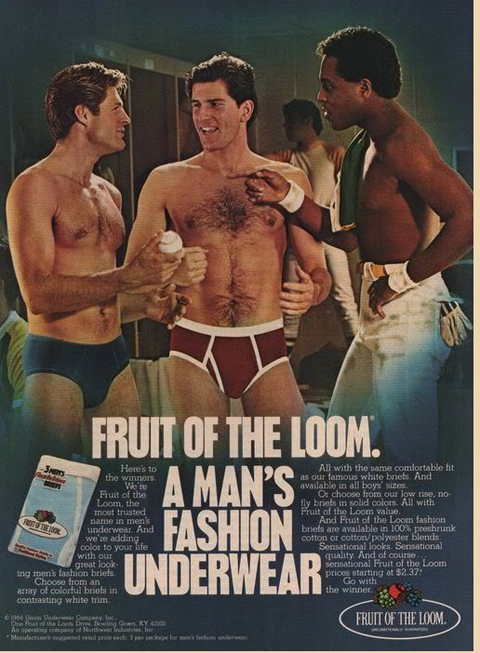
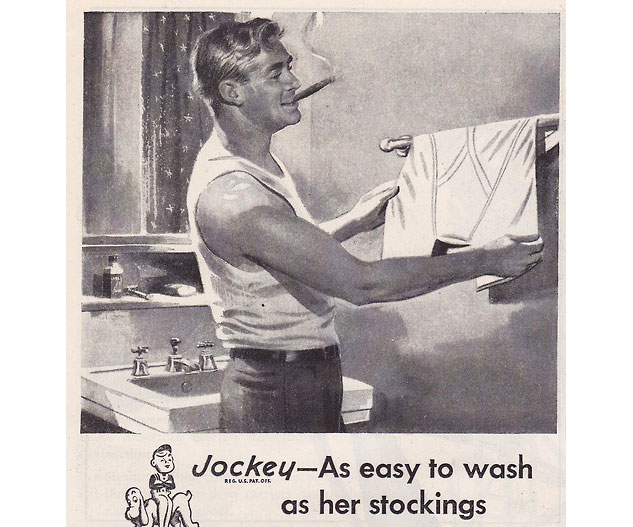
Lived: (1742-1798) He was 33 at the signing and 55 at his death.

Family: Son of William Wilson and Alison Landall. Father was a Scottish farmer. Married Rachel Bird and Hannah Gray (later Bartlett) and had 7 children.

State: Pennsylvania

Occupation: Professor, legal theorist, lawyer, businessman, investor, soldier, and college trustee

Early Life: Born in Scotland and studied at the Universities of St. Andrews, Edinburgh, and Glasgow but never obtained a degree, though he was influenced by the leading Scottish Enlightenment figures of the day. This led him to move to Philadelphia in 1766 where he began teaching and tutoring at what is now the University of Pennsylvania where he earned an honorary Master of Arts. Studied law under James Dickinson for 2 years before the bar. After that, he set up a successful practice in Reading as well as had a small farm in Carlisle. Published  “Considerations on the Nature and Extent of the Legislative Authority of the British Parliament” in 1774 (but wrote in 1768), which argued that Parliament had no authority to tax the colonies because they had no representation in Parliament. Also presented his views that power came from the people. Was commissioned Colonel of the 4th Cumberland County Battalion and would soon rise to the rank of Brigadier General in the Pennsylvania State Militia.
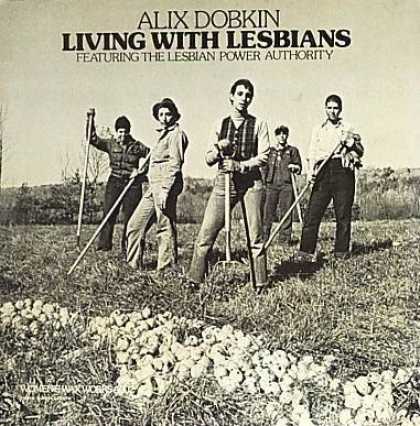
Significant Roles: As a member of the Continental Congress of 1776, he was a firm advocate for independence but refused to vote until he heard back to see if it was okay with his constituents. He was also one of the leaders in the formation of French policy. He also served on the Committee of Spies where he helped define treason. After defending 23 from property seizure and exile in 1779, he and 35 colleagues were forced to barricade their homes from a drunken angry mob before being rescued by soldiers. Called “the Fort Wilson Riot” this resulted in 6 killed as well as 17-19 wounded. Engaged in land speculation and investing.

Ultimate Fate: As a delegate at the 1787 Constitutional Convention, he was one of the most learned Framers of the Constitution. Was on the committee that produced the first draft of the US Constitution as well as proposed the 3/5ths Compromise as well as understood the implications of dual sovereignty. Addressed the convention 168 times. And at the ratification convention, he stumped hard which lead Pennsylvania to become the second state in the Union. His 1787 “speech in the statehouse yard” was second in influence to The Federalist Papers, which was printed and widely distributed. In 1789, he was appointed by George Washington as one of the 6 original members of the United States Supreme Court. Was first professor of law at what is now the University of Pennsylvania in 1790 and delivered a couple series of lectures some of which were later compiled by his son Bird for an edition in 1804.  Final years were marked by financial failures which resulted in a brief imprisonment at a debtor’s prison in New Jersey while his debt was paid off by his son.  He then escaped to North Carolina to escape other creditors but was again briefly imprisoned.  Died after suffering malaria and a stroke while visiting a friend in Edenton, North Carolina. Currently buried at Christ Churchyard in Philadelphia.

Trivia: Was a founding trustee of Dickinson College. Considered one of the most underrated Founding Fathers by American legal scholars. Supported the popular election of senators. Viewed legal study as a branch of general cultured education.

32. George Ross

Though George Ross spent 12 years as a Crown prosecutor, he would later side with the patriots and help draft Pennsylvania's constitution in 1776. Presided on a case that would cause a states' rights controversy just before his early death.

Though George Ross spent 12 years as a Crown prosecutor, he would later side with the patriots and help draft Pennsylvania’s constitution in 1776. Presided on a case that would cause a states’ rights controversy just before his early death.

Lived: (1730-1779) He was 46 at the signing and 49 at his death.

Family: Son of a Scottish Anglican clergyman. Had at least a half-brother John and a sister named Gertrude. Possibly oldest son of his dad’s second wife. Married Anne Lawler in 1751 and had 2 sons and a daughter.

State: Pennsylvania

Occupation: Lawyer and soldier

Early Life: Born in New Castle, Delaware and educated at home. Studied law at his half-brother John’s office and was admitted to the Pennsylvania Bar in Philadelphia in 1750. In addition to being a member of the Pennsylvania Provincial Assembly in 1768, he was also a Tory Crown Prosecutor for 12 years. But he later changed his mind and became a delegate to the Continental Congress in 1774-1777.  Was Colonel in the Pennsylvania militia in 1775-1776.

Significant Roles: Was the last of the Pennsylvania delegation to sign the Declaration of Independence. Though reelected to the Continental Congress in 1777, he resigned due to poor health. Was vice president at the Pennsylvania Constitutional Convention in 1776 and appointed Judge of the Admiralty Court in Pennsylvania in shortly after. One of his cases during this time sparked the states’ rights controversy which wouldn’t be resolved until 1809. Died in office. Buried in Christ Church Burial Ground in Philadelphia.

Ultimate Fate: Ross didn’t survive the American Revolution.

Trivia: Brother-in-law to George Read.

Know Your Signers: Part 3 – Francis Lewis to Robert Morris

download

Now while the second group of guys aren’t nearly as interesting as the first bunch, you wouldn’t say the same with these men. You might not know some of these people but quite of few of them made some significant contributions to the American Revolution as well as the nation. In many ways, this kind of makes since because many of the Declaration of Independence signers were sent to Philadelphia by their legislators and were notable men in their communities. A lot of them also had land as well as plenty of disposable income. In this section, I wrap up the rest of the New York signatory delegation, the 5 signers from New Jersey a bunch I really found interesting, and Robert Morris of Pennsylvania who I know because he has a Division II university named after him in Pittsburgh. First, you have the last 2 New York signatories Francis Lewis and Lewis Morris (no relation to Robert but he was the half-brother to Gouveneur Morris, who played a key role in the Constitutional Convention). Second, it’s on to New Jersey with a delegation, I call the 5 Revolutionary Jersey Boys who were selected to replace the entire New Jersey delegation from the First Continental Congress who opposed it. There’s Richard Stockton who would later be taken prisoner by the British in the dead of night, be subject to torture, irons, and other inhumane conditions, and lost almost everything, including his beloved library (known to be among the finest in the colonies). Then there’s the Reverend John Witherspoon a Scottish Presbyterian minister who became the president of what is now Princeton and would achieve great things in American higher education. Next up is Francis Hopkinson who contrary to the stupid Betsy Ross bullshit, actually designed the first American flag as well as was involved in the design of the Great Seal of the United States. After that is John Hart who left land to some Baptists so they could build a church as well as let the Continental Army camp on his farm and had lunch with General George Washington prior to the Battle of Monmouth. Then there’s Abraham Clark a poor man’s lawyer whose sons were captured by the British as well as treated appallingly as prisoners of war. Finally, there’s Robert Morris of Pennsylvania best known for being a major source of funds for the American Revolution and whose financial contributions were crucial to the Continental Army’s success. However, he wasn’t the best authority when it came to spending his own money. Now for all you fans of 1776 and everything pertaining to men in tights and fluffy wigs, here are some more profiles of the Declaration of Independence signers.

17. Francis Lewis

Sure he was a man of reasonable means, but it would certainly suck to be Francis Lewis. I mean he was taken as a POW for 7 years while serving as a contractor in the French and Indian War. During the Revolution, his home was Long Island home burned to the ground by the British, his wife was taken prisoner and kept in appalling conditions for 2 years until she got sick and died, and his daughter married a British Naval Officer, moved to England, and basically disowned her parents. Didn't help that he spent most of his life savings on  supplying the Continental Army.

Sure he was a man of reasonable means, but it would certainly suck to be Francis Lewis. I mean he was taken as a POW for 7 years while serving as a contractor in the French and Indian War. During the Revolution, his home was Long Island home burned to the ground by the British, his wife was taken prisoner and kept in appalling conditions for 2 years until she got sick and died, and his daughter married a British Naval Officer, moved to England, and basically disowned her parents. Didn’t help that he spent most of his life savings on supplying the Continental Army.

Lived: (1713-1802) Was 63 at the signing and 89 at his death.

Family: Son of Morgan Lewis and Anne Pettingale. Married Elizabeth Annesley and had 7 children with 3 surviving infancy. Son Morgan Lewis served in the army during the Revolutionary War and eventually became governor.

State: New York

Occupation: Merchant, farmer, landowner, and mercantile agent

Early Life: Born in Wales. Educated in Scotland and attended the Westminster School in London, before entering into the mercantile business. Moved to Whitestone, New York in 1734. In 1756, he was taken prisoner and shipped in a box to France while serving as a British mercantile agent while a clothing contractor at Fort Oswego. In 1763, he returned and was granted 5,000 acres to compensate for the 7 lost years of his life. Was a member of the Committee of Sixty and the New York Provincial Congress. Was a delegate of the Continental Congress in 1775.

Significant Roles: Signed the Articles of Confederation in 1778 as well as served as Chairman of the Continental Board of Admiralty. Home in Whitestone was burned to the ground during the American Revolution by British soldiers and his wife spent 2 years in captivity denied a change of clothes or adequate food as well as in dirty, damp, and cold conditions. She’d eventually get sick and die, unsurprisingly. Even worse his only daughter would marry a British Naval Officer and move to England, refusing to see or correspond with her parents. Would spend almost all his life savings purchasing supplies for the Continental Army.

Ultimate Fate: Basically retired from public service after the Revolution and resided with his 2 sons for the rest of his life. Buried at Trinity Church Cemetery.

Trivia: Ancestor of Hollywood director William Wellman. Has many descendants stretching all the way to Idaho. Died on New Year’s Eve. Had a great-grandson who died in the Battle of Gettysburg.

18. Lewis Morris

While Lewis Morris was a strong supporter of American Independence, he's paid the price with his beloved family home Morrisania burned and looted by the British during the occupation of New York. But compared to Francis Lewis and Richard Stockton, he got off easy. Still, can't help but wonder whether he's an ancestor to the late Tim Russert. Wonder why.

While Lewis Morris was a strong supporter of American Independence, he’s paid the price with his beloved family home Morrisania burned and looted by the British during the occupation of New York. But compared to Francis Lewis and Richard Stockton, he got off easy. Still, can’t help but wonder whether he’s an ancestor to the late Tim Russert. Seriously, the guy looks as if he could be the guy’s 4th or 5th great-grandfather.

Lived: (1726-1798) He was 50 at the signing and 71 at his death.

Family: Son of Lewis Morris and Catherine Staats. He was the third guy to be named Lewis (there’s a very interesting story about his family but I won’t divulge). Married Mary Walton in 1749 and had 10 children. His 3 eldest sons served in the Revolutionary War with distinction.

State: New York

Occupation: Landowner and developer

Early Life: Born on his family estate of Morrisania, (now a neighborhood in the Bronx). Inherited the estate upon his father’s death in 1762. Appointed judge of the colony’s Admiralty Court in 1760 and elected to the New York Assembly in 1769 but resigned in 1774. Member of the New York Provincial Congress 1775-1777 and was sent to the Continental Congress these same years.

Significant Roles: He was an active supporter for independence that it’s said when his half-brother Gouveneur allegedly warned him about what he was doing, he stated, “Damn the consequences. Give me the pen.” Served two nonconsecutive times in the New York State Senate (1777-1781 and 1783-1790). Home was looted and burned by the British during the occupation of New York.

Ultimate Fate: Aside from politics, Morris spent some time after the Revolution to rebuild his family estate. Was a delegate for the New York Convention to ratify the US Constitution in 1788. In 1790, he offered Morrisania as the site of the US capital (which was refused). Died on his estate and is buried in the family vault beneath St. Ann’s Church in the Bronx.

Trivia: Half-brother of Gouverneur Morris. Great-grandson was a pioneering astrophotographer. Aside from the US, has descendants in Australia and the Netherlands.

19. Richard Stockton

Few signers had more tragic stories than New Jersey's Richard Stockton. Months after signing the Declaration of Independence, he was kidnapped by a band of Loyalists as well as placed in a complete hell of a prison for 5 weeks, and emerged on parole with his health so destroyed that he never recovered. He also had his furniture, belongings, crops, and livestock either taken or destroyed. His estate was occupied by General Cornwallis. And his library, one of the finest in the colonies was burned. But he never lost his faith and he refused to take any loyalty oath to his British captors that would've given him a pardon from General Howe. Which is why he has a statue in the US Capitol today.

Few signers had more tragic stories than New Jersey’s Richard Stockton. Months after signing the Declaration of Independence, he was kidnapped by a band of Loyalists as well as placed in a complete hell of a prison for 5 weeks, and emerged on parole with his health so destroyed that he never recovered. He also had his furniture, belongings, crops, and livestock either taken or destroyed. His estate was occupied by General Cornwallis. And his library, one of the finest in the colonies was burned. But he never lost his faith and he refused to take any loyalty oath to his British captors that would’ve given him a pardon from General Howe. Which is why he has a statue in the US Capitol today.

Lived: (1730-1781) He was 45 at the signing and 50 at his death.

Family: Son of John Stockton and Abigail Philips who were first cousins. Father was a wealthy landowner who donated some property for what is now known as Princeton University. Married Annis Boudinot and had 6 children, including a son who became an eminent lawyer and Federalist leader.

State: New Jersey

Occupation: Lawyer, landowner, and college trustee

Early Life: Born at the family home in Princeton called Morven. Attended Samuel Finley’s Academy in Nottingham and graduated from Princeton in 1748. Studied law in Newark under David Ogden and admitted to the bar in 1748 rising to great distinction. Received the degree of sergeant at law in 1763 (highest degree at the time). Was a trustee of Princeton for 26 years. In 1766 to 1767, he gave up his law practice to travel to England, Scotland, and Ireland, personally presenting King George III an address from the Princeton trustees, acknowledging the repeal of the Stamp Act. In Scotland, his and Benjamin Rush’s personal efforts resulted in the Princeton presidency by the Reverend John Witherspoon. After he returned to America, he was elevated to the New Jersey Provincial Council in 1768 and appointed to the Provincial Supreme Court in 1774. He was more of the moderate on the colonial troubles with Great Britain and drafted a Commonwealth approach to the colonial secretary which was rejected. Was elected to the Second Continental Congress in 1776.

Significant Roles: He was the first person from New Jersey to sign the Declaration of Independence. Sent by Congress with George Clymer on an exhausting 2 month journey to Fort Ticonderoga, Saratoga, and Albany to assist the Continental Army during the American Revolution. When he returned to Princeton, he traveled 30 miles east to the home of a friend named John Covenhoven, to evacuate his family to safety and away from the British Army. But they were captured in the middle of the night, dragged from their beds by Loyalists, stripped of their property, and marched to Perth Amboy to be turned in by the British. Though General William Howe offered him a pardon if he remained in peaceable obedience with the King, but he never did. So he was put in irons and brutally treated as a common criminal. He was then moved to Provost Prison in New York, where he was intentionally starved and subjected to the freezing cold weather. He was released on parole 5 weeks later on January 13, 1777 and his health was ruined. He found Morven occupied by General Cornwallis as well as his furniture, household belongings, as well as crops and livestock confiscated and destroyed. His library, one of the finest in the colonies was burned.  But his treatment in the New York prison prompted the Continental Congress to pass a resolution directing General Washington to inquire into the circumstances. However, though he took an oath swearing loyalty to the United States, he had to resign Congress due to a promise he made not to meddle in American affairs during the war. Though there were rumors that he recanted, there was nothing written about doubts of Stockton’s loyalty in any of the papers of members of Congress or in any books or newspapers at the time. Nor did he deliver any protection papers which he would’ve done if Howe gave him a pardon.

Ultimate Fate: Stockton would try to rebuild his life by reopening his law practice and teaching new students. However, he developed cancer of the lip that spread to his throat. He was never free of pain until he died at Morven. He had a large funeral on the campus of Princeton University with a large audience of citizens, friends, and students of the college were in attendance. Buried in Princeton’s Stony Brook Meeting House Cemetery. Is barely remembered by anyone outside of New Jersey which is kind of a shame.

Trivia: Father-in-law to Benjamin Rush. Wife was one of America’s first published female poets. Was a close friend of George Washington. Grandson was a hero in the War of 1812, Military Governor of California, and US Senator from New Jersey. Has a university named after him and a statue in the US Capitol (one of 6 to be so honored).

20. John Witherspoon

The Reverend John Witherspoon was a Scottish Presbyterian minister who arrived to America to become the president of what is now Princeton University. There, he transformed a broke and ill-equipped college whose purpose was to train ministers to an Ivy League and intellectual powerhouse akin to Harvard and Yale. However, he was also a staunch Protestant and nationalist who formulated a type of Protestant American Exceptionalism, embraced by a number conservative Evangelicals in the Bible Belt.

The Reverend John Witherspoon was a Scottish Presbyterian minister who arrived to America to become the president of what is now Princeton University. There, he transformed a broke and ill-equipped college whose purpose was to train ministers to an Ivy League and intellectual powerhouse akin to Harvard and Yale. However, he was also a staunch Protestant and nationalist who formulated a type of Protestant American Exceptionalism, embraced by a number of conservative Evangelical Christians in the Bible Belt today.

Lived: (1723-1794) Was 53 at the signing and 71 at his death.

Family: Son of the Reverend James Witherspoon and Anne Walker. Married Elizabeth Montgomery and Anne Marshal Dill and had a total of 12 children.

State: New Jersey

Occupation: Minister, theologian, professor, philosopher, and college president

Early Life: Born in Scotland. Attended Haddington Grammar School and graduated from the University of Edinburgh in 1739 but remained to study divinity. Was awarded an honorary doctorate from the University of Saint Andrews in 1764. Was a staunch Protestant, nationalist, and supporter of republicanism who basically formulated an early form of American Protestant exceptionalism. Was naturally opposed to the Catholic Legitimist Jacobite Rising of 1745-1746 and was briefly imprisoned at Doune Castle after the Battle of Falkirk, which has long term effects on his health. After 2 pastorates as a Presbyterian minister and three well-known works on theology, he was recruited by Richard Stockton and Benjamin Rush to become president and head professor of what is now known as Princeton University. Though he initially turned them down, he eventually accepted, leaving Scotland for New Jersey in 1768. Upon his arrival, he found the school in debt with weak instruction and a library collection which clearly failed to meet the students’ needs. He immediately began fundraising both there and his native Scotland, added 300 of his own books to the library, and purchased science equipment. He also instituted a number of reforms like modeling a syllabus and university structure that used the University of Edinburgh and other Scottish universities, firmed up entrance requirements, helping the school compete with Yale and Harvard. Personally taught courses in Eloquence, Chronology (history), Divinity, and Moral Philosophy. All in all, he transformed a college designed to predominantly train clergymen into a school that would equip the leaders of a new nation. Also helped organize the Nassau Presbyterian Church. A staunch critic of British policies, he embraced his new home, joined New Jersey’s Committee of Correspondence, gave a high profile sermon, and was elected to the Continental Congress serving from 1776-1782.

Significant Roles: Well, he was appointed the Congressional Chaplain by John Hancock and voted to adopt the Virginia Resolution for Independence. He was also one of the most influential members as well, serving in 100 committees. Helped draft the Articles of Confederation, helped organize executive departments, played a major role in shaping foreign policy, and drew up instructions for peace commissioners. Lost as son in the Battle of Germantown. Had to close and evacuate the college in 1778 which resulted in the main building Nassau Hall being badly damaged and his papers and personal notes lost. He was responsible for Nassau’s rebuilding after the war.

Ultimate Fate: Served twice in the New Jersey State Legislature and strongly supported the adoption of the US Constitution during the New Jersey ratification debates. Went blind in 1792. Died at his home and is buried in the Princeton Cemetery. Has a statue at Princeton University as well as in his native Scotland. Still, outside Princeton and New Jersey, most Americans don’t seem to remember him.

Trivia: Only college president and clergyman to sign the Declaration of Independence (well, working clergyman anyway). Has a think tank, a lay religious society, and a college in South Dakota named after him. Former students consisted of James Madison, Aaron Burr, Hugh Henry Brackenridge (who founded the University of Pittsburgh), 37 judges (including 3 Supreme Court justices), 10 cabinet members, 12 members of the Continental Congress, 28 US Senators, and 49 US Congressmen. Early life was subject to a Scottish documentary.

21. Francis Hopkinson

Aside from signing the Declaration of Independence, Francis Hopkinson is also known for designing the first American flag, a claim which is supported by the journals of the Continental Congress. He also assisted in the design of the Great Seal of the United States as well as was an amateur author and songwriter. Most of his stuff revolved around popular airs and political satire. Not only that but he was also said to be a rather talented musician on the harpsicord and invented the Bellarmonic.

Aside from signing the Declaration of Independence, Francis Hopkinson is also known for designing the first American flag, a claim which is supported by the journals of the Continental Congress. He also assisted in the design of the Great Seal of the United States as well as was an amateur author and songwriter. Most of his stuff revolved around popular airs and political satire. Not only that but he was also said to be a rather talented musician on the harpsicord and invented the Bellarmonic.

Lived: (1737-1791) He was 38 at the signing and 53 at his death.

Family: Son of Thomas Hopkinson and Mary Johnson. Married Ann Borden in 1768 and had 5 children. Son Joseph was a US Congressman and federal judge.

State: New Jersey

Occupation: Lawyer, diplomat, civil servant, businessman, author, songwriter, composer, musician, and satirist

Early Life: Born in Philadelphia. Member of the first class of what is now known as the University of Pennsylvania where he graduated in 1757, received his master’s degree in 1760, and an honorary doctorate of laws in 1790. Was secretary to a Provincial Council of Pennsylvania Indian commission in 1761 that made a treaty with the Delaware and several Iroquois tribes. In 1763, he was appointed customs collector for Salem, New Jersey. Spent from May 1766 to August 1767 in England in hopes of becoming commissioner of customs for North America but was unsuccessful. In 1768, he returned to Philadelphia to run a dry goods business. Was appointed customs collector of New Castle, Delaware in 1772. Moved to Bordentown, New Jersey in 1774 and became a member of the New Jersey Provincial council while he resigned his crown-appointed position in 1776.

Significant Roles: Although you’ve heard the story of Betsy Ross (which was cooked up by her grandson), it was definitely him who designed the first American flag and the Continental Congress journals support this. And though he asked for cask of wine and some cash for these, he received absolutely no compensation (and it sucks even more that so many people accept the bogus Betsy Ross legend as historical fact). He also helped design the Great Seal of the United States. He departed Congress in November of 1776 to serve on the Navy Board of Philadelphia and later became its chairman. In 1778, he was treasurer of the Continental Loan Office. In 1779, he was appointed judge of the Admiralty Court, a position he’d hold in 1780 and 1787.

Ultimate Fate: In 1789, he was nominated and confirmed as a federal judge in Philadelphia. However, a few years in, he suddenly died of an apoplectic seizure. He’s buried in Christ Church Burial Ground in Philadelphia.

Trivia: As an amateur author, he wrote popular airs and political satires in the form of poems and pamphlets (some which were widely circulated). Started playing harpsicord at 17 while he hand-copied arias, songs, and instrumental pieces by many European composers. Also, said to be the first American born composer to commit a composition to paper. Was an organist at Philadelphia’s Christ Church where he composed and edited a number of hymns and psalms. Invented the Bellarmonic (a glass harmonica combined with a keyboard). In 1788, he published a collection of 8 songs which he dedicated to his friend George Washington as well as his daughter.

22. John Hart

Though he had little formal education, John Hart was a successful farmer and businessman. Had George Washington and his Continental Army camp on his land and had lunch with the commander himself, prior to the Battle of Monmouth. Also donated land to a group of Baptists to build a church where he's buried. And the thing is, he wasn't even a Baptist.

Though he had little formal education, John Hart was a successful farmer and businessman. Had George Washington and his Continental Army camp on his land and had lunch with the commander himself, prior to the Battle of Monmouth. Also donated land to a group of Baptists to build a church where he’s buried. And the thing is, he wasn’t even a Baptist.

Lived: (bt. 1706 and 1713-1779) He was around 67-70 at the signing and about 70-73 at his death (we’re not sure when he was born).

Family: Son of Captain Edward Hart who was a farmer, public assessor, justice of the peace, and leader of a local militia unit during the French and Indian War. Grandfather was a carpenter from New York. Married Deborah Scudder in 1741 and had 13 children.

State: New Jersey

Occupation: Landowner, farmer, businessman, and philanthropist

Early Life: Either born in Stonington Connecticut or Hopewell Township, New Jersey. Had very little formal education and was mostly self-taught. In 1747, he donated a piece of his land to local Baptists who had been seeking a place to build their church which became the Old Baptist Meeting House. Was elected to the Hunterdon Board of Chosen Freeholders in 1750 and to the New Jersey Colonial Assembly in 1761 where he served until 1771. In 1773, he’d buy a substantial mill enterprise with his son-in-law John Polhemus. Was a Court of Common Pleas Judge and on New Jersey’s Committee of Correspondence. Elected to the Second Continental Congress in 1776.

Significant Roles: However, Hart was only in the Continental Congress until August of that year because he had return to New Jersey to be speaker of its General Assembly. He’d also take on additional duties. In 1776, he was obliged to escape and hide for a short time in the nearby Sourland Mountains as his farm was raided by British and Hessian troops who damaged but didn’t completely destroy the property (this after his wife just died that October. His mills were destroyed though). He only returned home after Washington crossed the Delaware to capture Trenton as well as the Battle of Princeton.  But having to survive the winter weather in the wilderness ruined his health. In June 22-24 1778, he invited the Continental Army to camp on his farm (numbering 12,000) and had lunch with George Washington. Left for Hopewell from Trenton that November due to his kidney stone affliction which killed him 6 months later in a slow and painful death.

Ultimate Fate: Hart didn’t survive the American Revolution. But he’s buried at the church he helped make possible.

Trivia: Often called, “Honest John.” Son-in-law was an officer in the Continental Army. Owned 4 slaves. Said to ride 30 miles to see his wife while they were dating.

23. Abraham Clark

Though we think about the signers as a bunch of rich guys in powered wigs and ruffles, Abraham Clark  didn't fit the mold since he equated such fashion statements with extravagant wealth. He also didn't believe in using public office for personal favors. But he made an exception when he mentioned his sons being held in a British prison ship under appalling conditions. Though the British offered their release if he recanted, he refused.

Though we think about the signers as a bunch of rich guys in powered wigs and ruffles, Abraham Clark didn’t fit the mold since he equated such fashion statements with extravagant wealth. Known as “the poor man’s counselor” because he gave advice for little or no fee. He also didn’t believe in using public office for personal favors. But he made an exception when he mentioned his sons being held in a British prison ship under appalling conditions. Though the British offered their release if he recanted, he refused.

Lived: (1726-1794) He was 50 at the signing and 68 at his death.

Family: Son of Thomas Clark and Hannah Winans. Said to be an only child. Married Sarah Hatfield in 1748 and had 10 children. Two of his sons were officers in the Continental Army.

State: New Jersey

Occupation: Surveyor and lawyer

Early Life: Born in Elizabethtown, New Jersey. Showed an aptitude in mathematics at a young age that his dad hired a tutor to teach him surveying. Too frail for heavy farm work, he taught himself law while working as a surveyor before going into practice (we’re not sure if he was admitted to the bar but it probably didn’t matter as much then). As a lawyer he became quite popular and became known as the “poor man’s lawyer” since he offered to defend the poor if they couldn’t afford one. Entered politics as a clerk in the New Jersey Provincial Assembly and later became High Sheriff of Essex County.

Significant Roles: Was a highly vocal advocate for independence, he was appointed to the Continental Congress in 1776. Refused to speak of his 2 sons in Congress even after they were both captured, tortured, and beaten. But he did bring them up when they were put on a prison ship called the Jersey, known for its brutality.  One was thrown into a dungeon and given no food except what could be pushed through a keyhole as well as lay in his own blood, urine, and feces. However, the British offered the lives of his sons in exchange for him to recant but he refused. Remained in Congress until 1778 where he was elected to the New Jersey Legislative Council but he served two more terms. Buried at Rahway Cemetery.

Ultimate Fate: Served in the US House of Representatives from 1791-1794. Retired before New Jersey’s Constitutional Convention in 1794. Died of sunstroke at home.

Trivia: Has a township and high school named after him. Never wore a wig or ruffles because he hated elitism. Nor did he believe in using political office for personal favors. It’s popularly said that he was the signer who was probably closest to the typical American citizen. Said to own 3 slaves. Would rather have the words, “liberty” on American currency than a portrait of a US President.

24. Robert Morris

As "Financier of the American Revolution" Robert Morris's played a very pivotal role in the American war for independence that can in no way be overstated. Without his financial backing, George Washington could not effectively rage war against the British. Without his fleet of ships, there would be no Continental Navy to speak of. He also had a lot of good ideas about economics which were taken by his disciple Alexander Hamilton. However, his habit of land speculation would soon catch up on him and he'd be put in a debtor's prison. This led Congress to make the first bankruptcy laws just to get him out of there.

As “Financier of the American Revolution” Robert Morris’s played a very pivotal role in the American war for independence that can in no way be overstated. Without his financial backing, George Washington could not effectively rage war against the British. Without his fleet of ships, there would be no Continental Navy to speak of. He also had a lot of good ideas about economics which were taken by his disciple Alexander Hamilton. However, his habit of land speculation would soon catch up on him and he’d be put in a debtor’s prison. This led Congress to make the first bankruptcy laws just to get him out of there.

Lived: (1734-1806) He was 42 at the signing and 72 at his death.

Family: Son of Robert Morris Sr. and Elizabeth Murphet. Father would become a tobacco agent in Maryland and died by being accidentally hit by a ship’s gun when his son was a teenager. Married Mary White in 1769 and had 7 children.

State: Pennsylvania

Occupation: Merchant, financier, banker, businessman, relator, philanthropist, and investor

Early Life: Born in Liverpool, England. Immigrated to Oxford, Maryland to join his father at 13. Educated by a private tutor and was a quick learner. Later in his teens, he was sent to Philadelphia to study as well as stay with a family friend who arranged that him to become an apprentice to a shipping and banking firm of Charles Willing. When he died, Morris entered a partnership with his son Thomas called Willing, Morris, & Co. which would last until 1779. Their firm’s interests consisted of shipping, real estate, and other lines of business like slave trading (even though they both supported non-importation agreements as well as free trade). Their ships traded with places like India, the Levant, the West Indies, Cuba, Spain, and Italy and quickly became one of the most prosperous businesses in Pennsylvania. Began his public career in 1765 by serving on a local committee of merchants organized to protest the Stamp Act mostly as a mediator between the protestors and the British agents. He would later serve in the Pennsylvania Committee of Correspondence and the Provincial Assembly. Served as a delegate to the Second Continental Congress from 1775-1778.

Significant Roles: In 1775, the Continental Congress contracted with his company to work with the Secret Committee of Trade. Devised a system to smuggle war supplies from France the same year as well as handling much of the financial transactions. Served with John Adams on the committee that wrote the Model Treaty which incorporated his long held belief of free trade and acted the basis of the 1778 treaty with France. Gave his best ship The Black Prince to the Continental Congress. Used his extensive international trading network as a spy network and gathered intelligence on British troop movements. Actually voted against independence yet abstained the following day (which was said to be pivotal) and signed anyway saying, “I am not one of those politicians that run testy when my own plans are not adopted. I think it is the duty of a good citizen to follow when he cannot lead.” Personally paid £10,000 to pay the Continental Army which kept it together since US currency had no value but his “Morris Notes” did. Owned privateers that stole cargo from English ships and engaged in profiteering. Supplied 80% of the Continental bullets fired and almost 75% of the revenue for all other expenses of the fledgling government. Served in the Pennsylvania State Legislature from 1776-1781 in which he worked on the state constitution to restore checks and balances as well as overturn religious test laws that disenfranchised 40% of the male citizenry. Was called to restore the Pennsylvania economy in 1780 when it went bankrupt. From 1781-1784, he was appointed Superintendent of Finance of the United States where he proposed to establish a national bank and chartered the Bank of North America in which he personally contributed $74 million during the war and immediately thereafter while the citizens contributed $800,000. Instituted a lot of reforms like reducing the civil lists, using competitive bidding for contracts, tightening accounting procedures, and demanding the federal government’s full share of support from the states. With Gouveneur Morris (no relation), he also proposed a national economic system in a document called, “On Public Credit as well as managed to make the US currency a decimal currency, a very progressive idea at the time. Took an active role to help move Washington and his army from New York to Yorktown, Virginia where he acted as quartermaster and supplied over $14 million of his own credit as well as coordinated with the French Navy. In 1782, he proposed and presented to Congress to recommend the establishment of a national mint and decimal coinage, which wasn’t fulfilled until a decade later.

Ultimate Fate: In 1781, he purchased a home which he rebuilt. He would later have John Adams and George Washington occupy the house during their presidencies. It would also be the place where Washington would stay during the Constitutional Convention. In 1787, he was elected as a delegate to the Constitutional Convention and arranged to have Gouveneur Morris appointed as well.  Though he had a lot of influence behind the scenes his most significant role was nominating George Washington as president. Though he declined to be Secretary of the Treasury, he did recommend Alexander Hamilton who was his economic disciple. Served as a US Senator from 1789-1795 and supported not just Hamilton’s economic system but internal improvements as well. Founded several canal companies and a steam engine company. Invested in a considerable portion of Western New York real estate in 1791 and soon became deeply involved in land speculation that he overextended himself financially. Due to the French Revolution, Napoleonic Wars, and Panic of 1796-1797, Morris would be left “land rich but cash poor” since he owned large tracts of land but didn’t have money to pay the collectors. He also tried to avoid creditors and was sued by a former business partner who had been in a debtor’s prison for fraud. Morris would later be arrested and imprisoned for debt as well as hurt US economy and the fortunes of many prominent Federalists. But this led to the US Congress to pass its first bankruptcy legislation in 1800 just to get him out of prison. After his release, he spent the rest of his life in retirement in poor health and assisted by his saintly wife. He’s buried in the family vault of his brother-in-law Bishop William White at Christ Church. Has a monument in Philadelphia.

Trivia: Called, “the Financier of the American Revolution” and was considered the second most powerful man in America next to George Washington. Has a university named after him in Pittsburgh and in Illinois. Brother-in-law was an Episcopalian bishop. Underwrote the Empress of China voyage which was the first American ship to visit the Chinese mainland. During the American Revolution, he had one of the largest private navies in the world (saying that his firm had 250 ships). Was the first American to use the dollar sign on official documents and in official communication. Launched a hot air balloon from his garden. His icehouse was the model of one Washington installed at Mount Vernon. Backed the Chestnut Street Theater. Buddies with Gouveneur Morris.