The Indigenous Peoples of North America: Part 7 – The Southwest

130514145417-classic-us-pueblo-horizontal-large-gallery

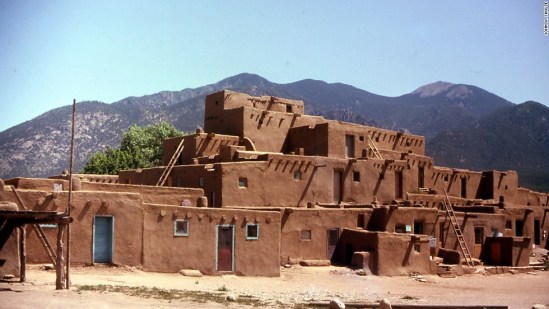
The most distinguishing feature of this region has to be the Pueblo adobe apartment complexes with multiple stories and numerous rooms. These were built with baked bricks of clay and straw and were not held together by mortar. This complex is in Taos, New Mexico.

We now come to one of the more familiar Native American cultural areas in my series with the Southwest. You’ve probably seen stuff from this region since it’s been depicted in westerns and that you’ve might’ve seen an adobe house or a Hopi woman with traditional Padme Amidala buns. Then there are the Apache leader Geronimo who you’ve probably heard of. Like their Great Basin neighbors, the native peoples of the Southwest lived in a land that was dominated by a rocky desert. Yet, unlike the Great Basin, many of these people usually led sedentary lives and even farmed. Not that it was easy, because it wasn’t, especially without irrigation. But we know a lot about these pre-contact Native Americans better than those in other regions because they left an extensive amount of archaeology, particularly the adobe houses and villages which still stand. Not only that, but despite being among the first Native Americans groups to deal with European influence (such as the Spanish in the 1500s), but have shown a remarkable tenacity to retain their land, religion, institutions, languages, and aesthetic traditions while facing vigorous efforts over the centuries to eradicate indigenous culture as well as the people themselves. Today Southwest Indian identity remains relatively strong perhaps to a greater degree than Native Americans in most regions (like California). Today, much of the Native American population in the US is concentrated in this area with one of today’s most populous tribes being the Navajo. Of course, the fact that many Indians in the region were farmers and among the more settled probably worked in their favor as well as the fact that these cultures managed to integrate European innovations within their culture like domestic animals, silversmithing, wool and textiles, wheat and other crops, metal tools, and firearms. That and the fact the Pueblos managed to kick the Spanish out of the region for 12 years starting in 1680, leading them to moderate their demands. By the way, these Indians were also under a mission system during Spanish rule like their California counterparts. But that doesn’t change the fact that initial Spanish contact in the region wiped out 75-80% of the Southwest pre-contact population by the mid-17th century (mostly be European diseases). Or the fact Southwest saw more conflict between Native Americans and the US government than any other Indian region. The famous among them being the Apache Wars which spanned from 1849-1886 and is best remembered for numerous raids in both US and Mexico being led by Geronimo. Another famous Apache was Cochise who led a small warrior band that terrorized anyone who entered their territory as well as fought a bloody war with the US. Oh, and the fact, Native American archaeology and antiquities tend to face a lot of ethical dilemmas in general. So this isn’t a region to trifle with.
de5927ba7d37f2b9ef3f8e7b22bd0a42

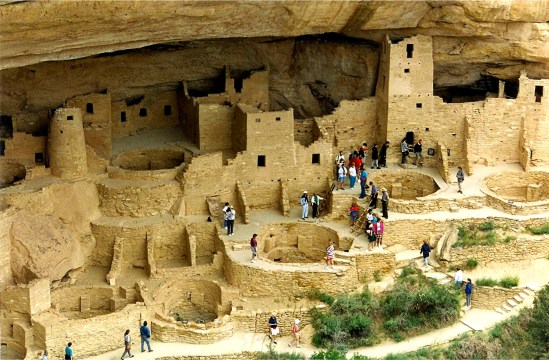
The Ancestral Pueblo peoples are known for their cliff dwelling villages like the famous Cliff Palace of Mesa Verde National Park in Colorado. This part of the Mesa Verde was built and inhabited between at about the 12th-13th centuries with as many as 22,000 living there. However, while they’re said to disappear by the late 13th century, it’s more likely that they simply made a mass exodus to Arizona and New Mexico due to environmental instability as well as economic and social unrest (as evidence of violence and cannibalism have been documented). Their descendants still live there today as the Pueblo.

Location: Spans from the American Southwest to northern Mexico covering Arizona, New Mexico, and western Texas as well as Mexican states Chihuahua, California, and Sonora.

First Peoples: Outside Mesoamerica, it’s one of the longest continuous inhabited region on the continent. The first people are said to come to the area between 23,000 B.C.E. and 10,000 B.C.E. and were originally hunter gatherers before gradually making the transition to agriculture at around 4,000 years ago to 500. The region would be dominated by 5 major groups such as the sandstone cliff dwelling Ancestral Pueblo of Mesa Verde and Chaco Canyon, the Mongollon of the Colorado Plateau known for using irrigation and some of the best pottery north of Mexico, the Hohokam known for their extensive irrigation canal system as well as large villages and towns, the Hakataya known for their semi-nomadic villages and small scale agriculture, and the Southern Athapaskans (early Apache) who settled abandoned Anasazi and Mongollon villages between 1200 and 1500.

Environment: Mostly hot and arid desert with dry, rocky land and cactus with canyons, bluffs, rock formations, caves, and plateaus. Has some forests, grasslands, and few river valleys at higher elevations. Experiences little rain but mild to cool winters.
i11

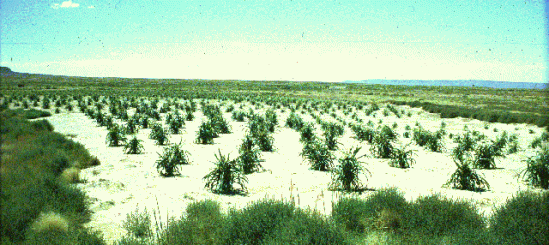
Unlike a lot of Native American cultures, the Pueblo primarily survived on an agricultural subsistence. Yet, this wouldn’t be possible in a desert environment without some kind of water management, particularly irrigation. Nevertheless, unlike how corn is grown today, the Southwest Native Americans grew theirs in clumps instead of the standard rows.

Subsistence: Primarily agricultural subsistence with techniques including canal irrigation, trincheras, lithic much, and floodplain cultivation. Though some tribes like the Apache hunter-gatherers while the Navajo was somewhere in between. Crops planted consisted of corn, squash, beans, pumpkins, fruit, melons, and sunflower seeds. People living near rivers also fished. Gathered cacti, mescal, screwbeans, mesquite, and grasses. Hunted deer, mountain sheep, buffalo, wild turkey, pronghorn, and small mammals. Those with limited food access usually raided, traded, or received agricultural products as gifts
OLYMPUS DIGITAL CAMERA

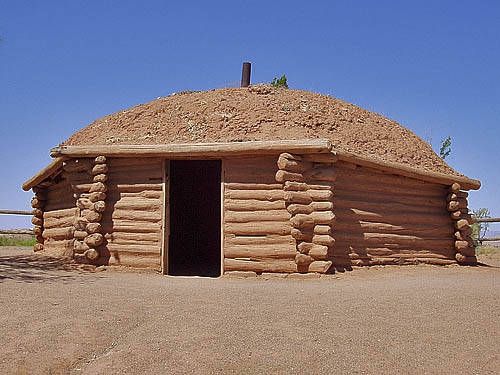
While the Pueblo lived in massive adobe complexes, the Navajo lived in clay houses called hogans that could be round, conical, multi-sided, or square. They could also have internal posts as well as be covered in stone or wood such as this one.

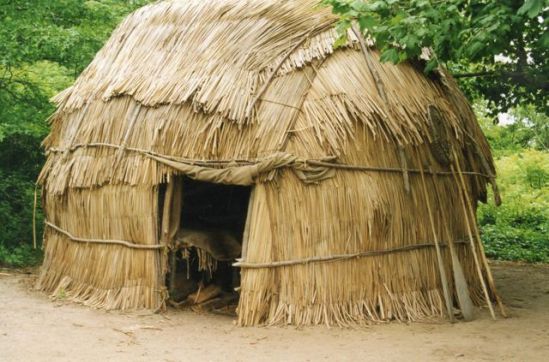
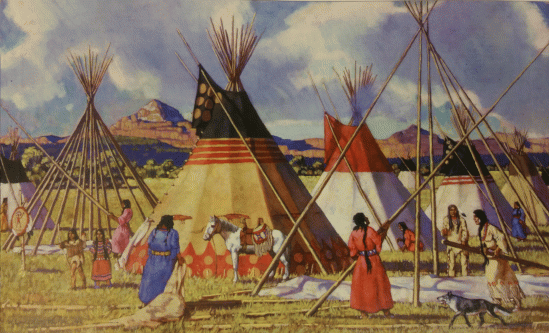
Housing: Depended on availability of natural resources in a location, the tribe, and whether the dwelling was temporary or permanent. Farming tribes lived in houses with numerous rooms and stories made from adobe brick (made from clay and straw) and stone that could be built next to each other in villages often at strategic defense positions. These also had flat roofs. Used bone and wood ladders to reach higher buildings or rooms. Also constructed canals, aqueducts, reservoirs, dikes, and dams. They also had ceremonial pits that were called kivas as well as water wells. The Navajo built clay roundhouses sometimes outfitted by logs called hogans as well as underground homes, summer shelters, sweat houses. Brush shelters, teepees, and wickiups were commonly used among the Apache.

800px-Hopi_mealing_trough

There’s probably nothing that distinguishes the Hopi more from the other Southwest Pueblo than the trademark “squash blossom” buns worn by their unmarried women indicating their eligibility for courtship. Since the Hopi live in a matrilineal clan system, this practice is understandable. Still, Padme Amidala wore this hairstyle in at least one of the Star Wars prequels.

Clothing: Due to the climate, the Pueblo usually didn’t wear much. Though some tribes often made woven cotton clothes for colder weather. Men wore breechcloths, leggings, and ponchos while women wore blanket dresses and robes in these communities. Clothing can be decorated with flowers or feathers. Adorned themselves with turquoise jewelry believed to promote prosperity, health, and happiness. Often wore their hair long. All wore moccasins, however. Apaches usually wore clothing made from animal skins (particularly bison) or whatever else they could get their hands on.
apaches

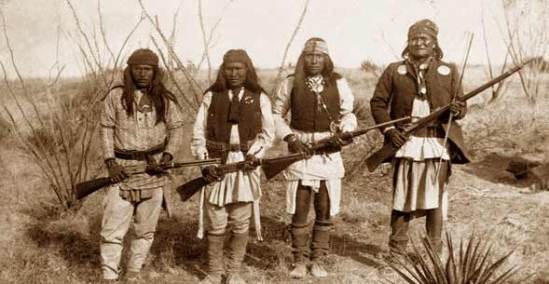
Even before contact with the Europeans, the Apaches had already established themselves in the Southwest region as traders and raiders. After European contact, they gained a reputation as one of the most hostile groups in the region. Seen here is the legendary leader Geronimo with his half-brother, brother-in-law, and son.

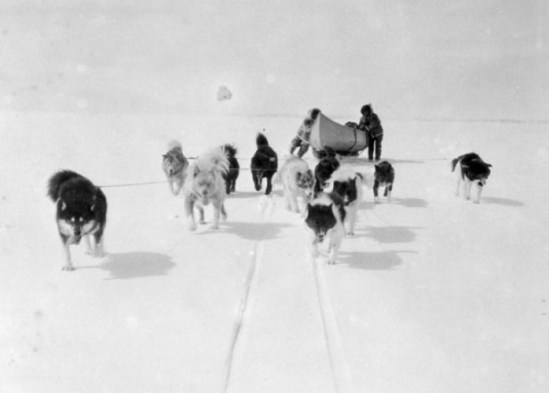
Transportation: The Apaches used dogs to carry their stuff on travois (according to Francisco Coronado in 1541). Recent estimates state that these dogs may have pulled loads up to 50 pounds on long trips at rates as high as 2 or 3 miles per hour.

Society: Primarily sedentary save for tribes like the nomadic Apache and Navajo. Yet, even among the farming Pueblo tribes, there was a certain degree of mobility since growing food often required using many different environmental niches. Was a place of large scale trade between Pueblo, Navajo, and Apache groups. Devised complex systems of exchange to ensure, without risk to their independence and basic egalitarianism that each community received. Though localized raiding and plundering was a common occurrence (by the Apache raiding Pueblo villages), there were few organized wars. Of course, Apache raiding was done by small parties with specific economic targets while wars with large parties were usually to achieve retribution (but both could be quite violent on their victims). Pueblo villages had specialized offices for unique responsibilities required by their lifestyle and environment. One tribe had a chief, a war priest, and hunting chief. Some even had specialized shamans. Pueblo communities also held lands in common with village decisions requiring unanimous consent of all adult men (though women held an influential voice, too). They also had planned villages composed of large terraced buildings with many rooms. The largest of these is said to contain 700 rooms in 5 stories and may have housed as many as 1000 people. Apaches and Navajos resided in extended family units usually consisting of parents, unmarried children, their married daughters, and their families as well as relied on kinship networks. Local Apache groups and bands were headed by a male chief who was chosen due to his effectiveness and influence. He was only as strong as he was evaluated to be, no one was obligated to follow him, and his office wasn’t hereditary.
fj1jrSahXfzJnVv6UPVXPQrQ

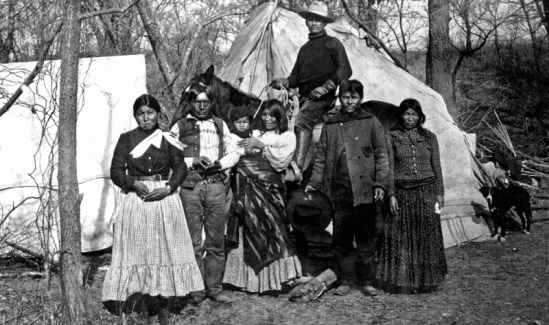
While Pueblo marriage and lineage patterns differed among various tribes, this was not the same with the Apache. Apache women lived within the same clan their entire lives as well as inherited the family property.

Family Structure: Pueblo tribes had differing marriage practices as well as lines of descent. Apaches and Navajo practiced matrilineal descent and matrilocal, exogamous marriages. Apache men practiced varying degrees of avoidance of his wife’s close relatives while women generally inherited and owned property. Men generally hunted, fished, fought, and farmed while women took care children, kept house, made clothes, and cooked. A Hopi baby would be named until 20 days after it was born when being held from a cliff by the women at their father’s clan at dawn (like in the Lion King). Though they’d also bear gifts. A Hopi child could be given over 40 names though it’s up to the parents to decide which one to use. They can also change their names if they decide to become members of the Kachina society or after a major life event.
HomeDanceRaymondNajaMed

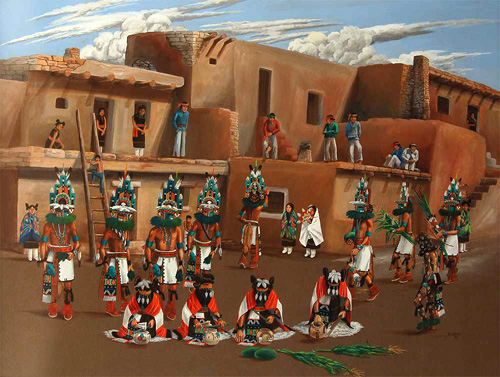
Another major aspect of Pueblo Native American culture are the Kachina dancers during their religious ceremonies, particularly among the Hopi and the Zuni. These dancers are masked men meant to represent spiritual beings. The Hopi also have Kachina clowns, too.

Practices: Basketry, Kachina dolls, animism, shamanism, prayer sticks, ceramics, dancing, music, sandpaintings, katsina dances, masks, textile weaving, tobacco, murals, beadwork, storytelling, pictographs, lunar calendars, and intricate blankets.

Tools and Weapons: Bows and arrows, spears, knives, grinding stone and receptacle, spindles and looms, hoes and rakes, pump drills, axes, clubs, dibble sticks, and adzes.

Notable Tribes: Pueblo, Apache, Navajo, Pima, Mojave, Tewa, Tiwa, Towa, Zuni, Quechan, Manso, La Junta, Coahuiltecan, Comecrudo, Cocopa, Karankawa, Maricopa, Mamulique, Hopi, Yavapapi, Solano, Toboso, Quems, Tamique, Tompiro, Walalpai, Yaqui, Papagos, Solano, O’odham, Mayo, Opata, Seri, Taos, and Keres.
The Indigenous Peoples of North America: Part 6 – California

the-mission-of-santa-barbara

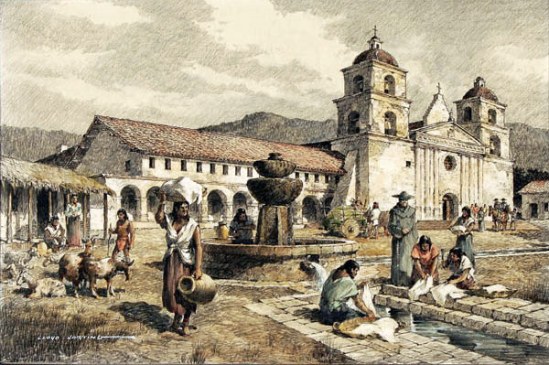
The California mission system was one in which the Spanish used to colonize the Native Americans under their control. Whatever Father Junipero Serra’s intentions, the California mission system ended up to be one of forced labor, exploitation, disease, fatalities, and cultural genocide. However, they weren’t the only agents responsible with the mass genocide pertaining to the California tribes in the 19th century in which 90% of them were wiped out. But what you can’t dispute is that they had pretty nice architecture which became popular with the publication of Helen Hunt Jackson’s Ramona (which was intended to expose the cultural genocide).

Before the contact of Europeans and Saint Junipero Serra’s Spanish missionary system of forced indigenous labor, assimilation, and cultural genocide, California was home to the largest population of Native Americans and the most distinct tribes of any US state and the highest population density north of Mexico. Over 150 of them are said to have US federal recognition to date. They even had 500 distinct sub-tribes or groups on top of that. And before European contact, native Californians spoke 300 dialects of approximately 100 distinct languages. Of course, when the Spanish came with their missionary system, all the ecological disruption, forced labor exploitation, and introduction of Spanish diseases took care of all that that population was reduced by 90% during the 19th century from 200,000 to 15,000. Still, most of the havoc was unintentional save for the assimilation and forced labor part. But those Spanish missions started a tradition by which we know California today, one in which white people cause a lot of ecological disruption as well as exploit minorities even when they think they’re helping. Also, displacing people who’ve resided in their hometown longer than you have with either guns, germs, or steel or simply raising their property values. Nevertheless, the most common language of the Native Californians was Valley Girl speak as well as took part in rituals like surfing, playing Beach Boys music, and disrupting the private lives of celebrities. Okay, I’m kidding about that. In reality, California’s diversity in climate, topography, and wildlife was part of why these Native American communities thrived in this place. Now even the state’s ecology is under threat due to climate change, drought, wildfires, earthquakes, and what not. Basically if an area in California isn’t made a state or national park, there’s not much protection going for it before it’s turned into some shopping mall. Yet, despite all the bad things that have happened to these California tribes, their descendants still live in the state today. Just don’t mention the canonization of Father Junipero Serra as a good idea. Just don’t.

1-b

Pre-contact California had a diverse environment including the coastal beach communities, the tall redwood forests, high mountain ranges, and southern deserts. Yet, most of these people were hunter-gatherers as well as had acorns as their primary food.

Location: Most of the state of California.

First Peoples: Evidence of human occupation in this region dates to 17,000 B.C.E. Early Southern California peoples include the La Jolla and Pauma Complexes each dating 6050 B.C.E. to 1000 B.C.E. The earliest inhabitants hunted with darts powered by throwing sticks at large game and resided in either open air dwellings or caves. Yet, from 9000 B.C.E., people from this region gradually started to depend on seed collection for food as well. Around 3000 B.C.E., the Windmiller culture flourished in the Sacramento Valley where they were known for fine craftsmanship, charmstones, and burying their dead face down facing west.

Environment: Has a wide variety of climates and geographical features, rivaling any other area of comparable dimensions. Mostly a mild temperate climate with coastline, rivers, and lakes. Features range from high mountain ranges, oak and conifer forests, mixed forest grasslands, vast grasslands, coastal plains, to long semiarid deserts in southern region. Precipitation is higher in the north than the south while forests can be susceptible to wild fires. Earthquakes and floods also occur.
food

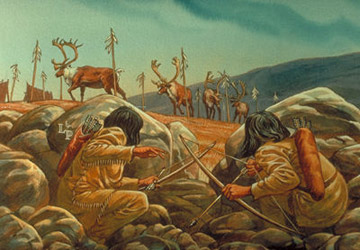
Despite that California had a region of great abundance, a lot of the Native Americans in the area mostly lived in a hunter-gatherer existence. Here are some Native Californians who just caught a deer.

Subsistence: Mainly hunter, gatherer, and fisher subsistence since there was a local abundance of food. Yet, some did practice a form of low density “wild” agriculture and “fire stick” farming. And it’s known that these Indians practiced various forms of forest gardening. Hunted animals like deer, elk, rabbits, sheep, squirrels, chipmunks, quail, mountain sheep, and bear as well as seals and sea otters. Fished for trout, salmon, mollusks, and shellfish. Occasionally ate insects as well as gathered mushrooms, roots, nuts, and seaweed. Acorns were said to be a main staple of food there as well as ground into flour to make mush or bread.

bef33278f2db98ca234311549110f2b0

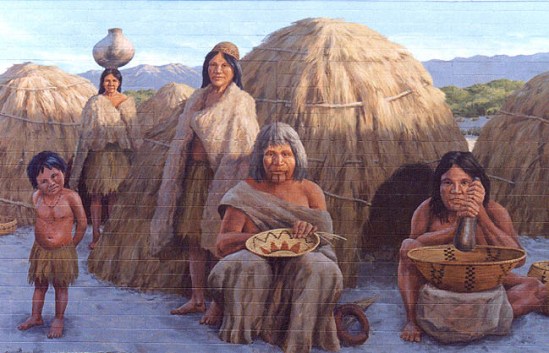
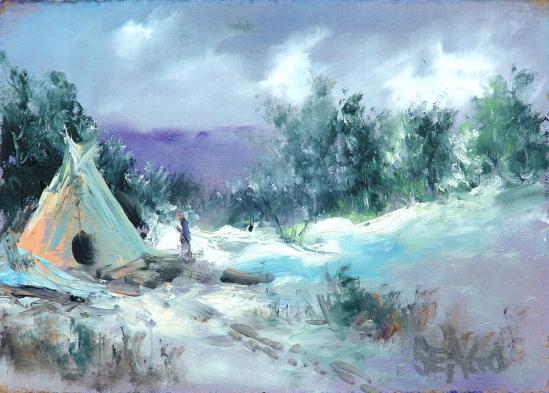
California native housing depended on location, season, climate, available resources, and whether it was for temporary or permanent use. This straw wigwam house is known as a kicha.

Housing: Depends on the location, season, available resources, climate, and whether it was for temporary or permanent use. Ocean area tribes tended to build grass mat houses. Those in the northwest forest areas built cedar or redwood plank houses. Central tribes lived in subterranean round pit houses. Southern tribes could build conical homes of tule or croton and whalebone structures on the coast.
1e4aa2152cdc6f732caaf67c2ffd5a82

Since it was mostly warm and mild, the Native Californians typically wore very little clothing, save in winter in the colder areas. These women and girls are wearing grass and bead skirts with basket hats and lots of jewelry over their bras (the only article not part of the traditional outfit but necessary).

Clothing: People in this region mostly wore very little. Yet, those who lived in colder areas would wear skins and furs during the winter.

dac7422aba288a19c1b1b23ab0517123

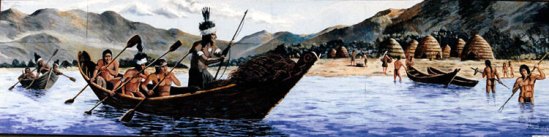
The coastal Native California tribes fished from redwood dugout and plank canoes. Southern tribes had double paddled oars called “tomols” which were made by a secretive craftsman guild. These could hold up to a dozen people and hundreds of pounds to trade goods.

Transportation: Northwestern tribes used dugout canoes from redwoods for fishing. Southern tribes had gracefully planked canoes with double paddle oars called “tomols” and made by a secretive craftsmen guild. These could carry hundreds of pounds in trade goods and up to a dozen passengers.

trading1000

The California cultural region had an extensive trail system though trading was limited to friendly visits and religious ceremonies. Yet, some tribes had relatively rigid class systems perpetuated by custom and marriage as well as based on wealth and private property.

Society: Before European contact, this region had the highest Native American density north of present-day Mexico. It’s estimated that approximately 300,000 Indians might’ve lived there. Yet, these people tended to live a rather isolated existence due to the landscape. Lifestyle tends to vary according to climate and topography but it’s best that the vast majority of these Indians were semi-nomadic at best. Most common form of political organization was the tribelet which was a cluster of satellite villages around one or more permanent villages. It’s said that 500 of these groups existed where they shared a language, culture, and history. Each one could contain from 50-500 people on average and most were related through the male line. Now the tribelet was presided by a chief controlling economic resources and activity, settling conflicts, and organizing events. The chief was generally very wealthy and greatly respected. Some of these tribelets also had specialized occupations like craftspeople as well as minor officials like assistant chief, messenger, and dance manager. Some tribes had a relatively rigid closed class system perpetuated by marriage and custom as well as based on wealth and private property. Sometimes they even kept slaves. More nomadic groups tended to have greater social and gender equality. An extensive and continuous trail system in the region made trading in the region possible usually on friendly visits and ceremonies. Organized warfare was rare. Reasons for conflict ranged from physical offenses such as murder and rape to trespassing, sorcery, or a simple insult. Surprise attacks were preferred in regards to fighting while pitched battles were generally avoided and casualty rates were low. Also armed conflicts were relatively brief and quickly resolved as well as both parties being compensated.

cahuilla_village_detail_2

Unlike a lot of the native cultural regions, most California native family structures were mostly patrilineal. Nevertheless, polygyny was said to be practiced among chiefs, shamans, and other wealthy men who could afford more than one wife, which was less unusual.

Family Structure: Mostly patrilineal descent. Marriages usually took place when the couple was at least in their late teens or early 20s. Northern group chiefs, shamans, and other wealthy men could have more than one wife. Men usually hunted and fished while women cooked, gathered, did housework, and looked after children.

snjose-05-Ohlone-indians-dancing

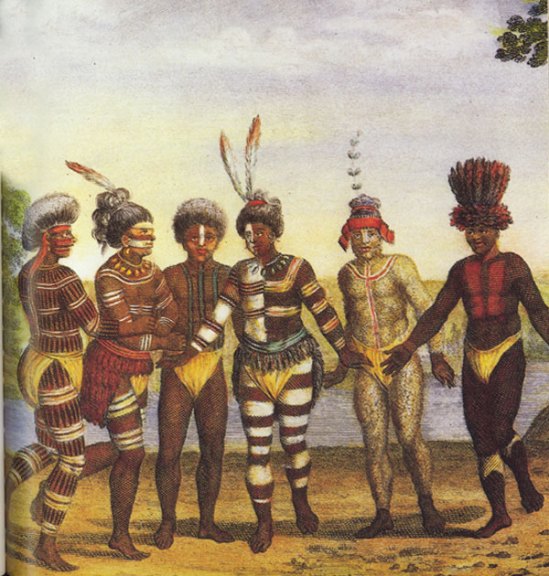
Of course, we’re all too familiar with the fact that so many Native American tribes have their own dance rituals and the California region is no exception. Here is a picture of Ohlone Indians from the Mission of San Jose dancing in ceremonial regalia. Perhaps these images tell us that maybe the missionaries weren’t as much bent on cultural genocide as we thought, at least as long as they do such rituals to commemorate saint days or Christian holidays. Then again, the Spanish missions were pretty horrific and did result in cultural genocide in California.

Practices: Controlled burning, sophisticated forest gardening, basketry, animism, shamanism, psychoactive drugs, pottery, bead work, rock art, secret religious societies, tobacco, hoop and pole, hand game, cat’s cradle, music, dance, lacrosse, dice, athletic contests, and storytelling.

Tools and Weapons: Milling stones, bows and arrows, elkhorn wedges, spears, knives, nets, weirs, scrapers, hammers, and fish hooks and line. Normally made of stone, bone, obsidian, wood, grass, shell, and other materials.

Notable Tribes: Shasta, Maidu, Miwok, Mojave, Pomo, Chumash, Serrano, Wappo, Yurok, Karok, Hupa, Wintu, Yana, Kato, Wiyot, Cocopah, Juaneno, Chemehuevi, Yuki, Wailaki, Salinan, Sinkyone, Tolowa, Tataviam, Whilkut, Quechan, Modoc, Nisenan, Nomlaki, Panamint, Patwin, Mattole, Luiseno, Kawaiisu, Kitanemuk, Konkow, Klamath, Chilula, Cahuilla, Ohlone, Cupeno, Diegueno, Esselen, Kashaya, Atsuegewi, Achumawi, Shoshoni, and Nongatl.

The Indigenous Peoples of North America: Part 5 – The Great Basin

BIGsacagewea

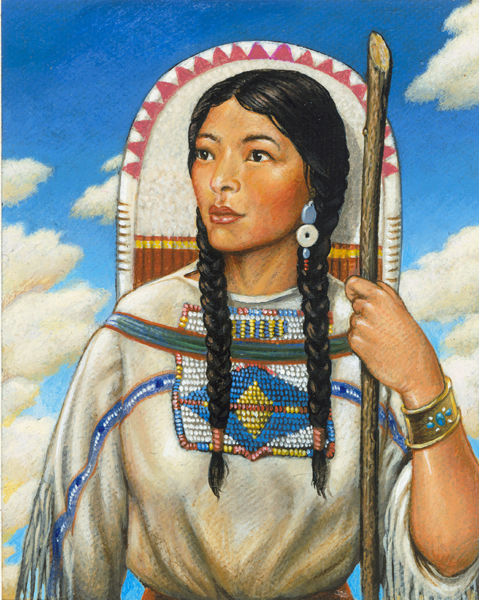
One of the more famous Native Americans from the Great Basin is none other than the Shoshone Sacagawea herself. Between 1804 to 1806, she served as a guide and interpreter for the Lewis and Clark Expedition where she traveled thousands of miles to the Pacific Ocean along with her husband Toussaint Charbonneau and their infant son Jean Baptiste. She is said to have died from an illness in 1812.

Between the Rocky Mountains and the Sierra Nevada is an area known as the Great Basin which is mostly a high and rocky desert land encompassing states like Nevada, Idaho, Montana, Wyoming, Colorado, California, Arizona, Utah, Oregon, and New Mexico. However, since they lived in a region that was so inhospitable, they were among the last groups to encounter European influence due to nobody wanting to live there. Sure there was Sacagawea, but she wouldn’t have served as a guide for Lewis and Clark if she wasn’t kidnapped by Hidasta Indians first. Nevertheless, the first white people who settled in this area were the Mormons in Utah starting in 1847 since there were no other white people around. Notice how I put emphasis on the word “white.” Since the Great Basin tribes didn’t have to worry much about white people displacing them until Mormon arrival, they have maintained stronger cultural and linguistic ties to their heritage than a lot of Native Americans in the lower 48. During the 19th century, they were leading proponents of cultural and religious renewals such as the Ghost Dance as well as introducing peyote to the world (to the glory of stoners everywhere for that “Rocky Mountain High”). You might see these people in westerns, by the way even though you might not be aware of it.

gbp

Most of the Great Basin consists primarily of high arid desert though few rivers and bountiful lakes do exist (but are dependent on mountain snow for water). It’s a very inhospitable environment, which explains why these Native Americans in this region were among the last to deal with white settlers. Ironically, this is where Las Vegas is located.

Location: Between the Rocky Mountains and Sierra Nevada covering southern Oregon and Idaho, part of Montana, Nevada, eastern California, western Wyoming and Colorado, and most of Utah.

First Peoples: Original peoples might’ve arrived as early as 12,000 years ago possibly arriving from the south. Great Basin Desert Archaic Period was between 9000 B.C.E. to 400 while the Fremont Culture came around 1-1300 who were hunter gatherers as well as agriculturalists. Numic speakers were said to arrive as early as the 11th century and are the ancestors of the Western Shosone as well as the Northern and Southern Paiute tribes. Aside from the Fremont culture, very little of their lifestyle has changed (from a pre-contact standpoint).

Environment: Mostly high elevation consisting high mountains, deep canyons as well as bountiful lakes along with few rivers and streams dependent on mountain snow (which is a major reason this area is threatened by climate change and has experienced drought). And most of these rivers in the region usually disappear into the sand. Lowest valleys are 3,000-6,000 feet above sea level while the mountain ranges can be about 8,000-12,000 feet. Climate is variable with summers with temperatures rising over 100 degrees Fahrenheit and winters with temperatures falling to 20 below zero. Rainfall can vary dramatically from year to year. But at lower elevations, evaporation is generally high while precipitation is generally low. Can be a barren wasteland of desert, salt flats, and brackish lakes. Definitely not a place hospitable to human habitation and it’s no wonder that it was the last part of the US lower 48 to be explored and settled by whites.

rice-gatherers-eastman

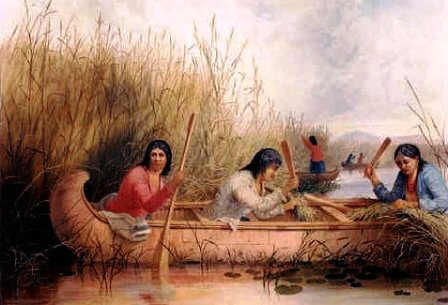
Despite mostly living in the desert with little precipitation, Native Americans in the Great Basin had a more plant based diet. Here we see a group of Great Basin women gathering wild rice from their canoes.

Subsistence: Mostly hunter-gatherer subsistence though some do engage in agriculture yet not to viable level of subsistence. Lived on roots, nuts, seeds, cactus, berries, wild rice, insects, as well as small game and birds. Hunted bison, deer, elk, antelope, and sheep as well as fished. Some groups grew corn, beans, and squash but only in a limited capacity and not without irrigation. Had a mostly plant based diet.

Bishop_paiute_women_1940

The standard winter dwelling for the Great Basin Native Americans was the wikiup. This was a conical 10 feet high and 10-15 feet in diameter house made from brush, bark, grass and/or tule over pinion and/or juniper pole frames. Sometimes these were covered in skins.

Housing: Season and location often determined type of shelter. Brush windbreaks were commonly built during the warm weather. Winter houses were typically conical wikiups at about 10 feet high and 10-15 feet in diameter as well as built of brush, bark, grass, and/or tule over pinion and/or juniper pole frames. Some northern groups covered these houses with skins. Doorways generally faced east. Caves were also used along with log and earthen hogans and even teepees.

Shoshone Indian Tribes

While the Great Basin Native Americans wore buckskin outfits during the winter, they wore very little or next to nothing during the summer. Mostly because even high desert summers could be unbearably hot.

Clothing: People in this region usually wore very little except in the coldest weather. In winter, men and women wore fur or twined bark breechcloths, moccasins, and leggings. Women often wore twined sagebrush bark or willow hats and long gowns. Clothing also included fur robes and rabbit skin blankets worn as capes.

Transportation: I guess these people usually walked. Though some tribes might’ve made canoes from animal skins and other materials.

Society: Mostly nomadic with mostly decentralized social and economic organization. Largest estimated population is said to be about 50,000-60,000. Basic unit was the camp or extended family that was autonomous and self-governing by consensus with the oldest male being the most influential. Bands tended to be small with the largest desert bands having no more than 30 and other areas with up to 100. And they were usually near water sources as well as have fluid membership. Yet, they’d also have links through blood relationships, marriage relationships, adoptions, and friendships. In regions of greater productivity, some related family clusters would form semipermanent winter villages where they could share information about resources, observe ceremonies, share mythological tales, and trade. Headmen usually presided over these winter villages where they delivered speeches on and coordinated subsistence activities. But such authority was tenuous among the egalitarian Shoshone. Trade was frequently practiced that the first regional trade routes appeared as early as 5000 B.C.E. and the region was part of a major network.

Utes_chief_Severo_and_family,_1899

Unlike many Native American culture areas, there was no set family or marriage structure among the Great Basin peoples. Post marital residence simply depended on the available food supplies and divorce usually happened with one partner returning to their parents (which happened frequently). Polygamy, cousin marriage, and marrying a dead spouse’s siblings for recently widowed also existed. Not to mention, children were put to work as soon as they were old enough while elderly who couldn’t keep up with the group were simply put to pasture.

Family Structure: Family camps usually consisted of parents, children, grandparents, aunts, uncles, or cousins. Men mainly hunted while women cooked, gathered plants, made clothes, and looked after children. However, men and women were seen as equals and were free to engage in sexual exploration leading to a trial marriage. There was instruction on abortion and contraception. And divorce was simply a matter of one partner returning to their parental camp (which happened frequently). Northern Paiute and Shoshone tribes practiced fraternal polyandry where a woman would marry set of brothers. Yet, there were some instances of polyandry involving male cousins or men not related to each other at all. Sororal polygyny also existed. Cross cousin marriages weren’t uncommon among these people either as well as the practice of widows and widowers marrying their dead spouse’s sibling. There was no set pattern for postmarital residence with availability of food supplies being the determining factor. Children were put to work as soon as they were old enough to help. As for death rites, this might either consist of the individual being buried with their possessions or the possessions destroyed. Old people who couldn’t keep up with the group or could no longer produce their share of the food supply were occasionally abandoned.

chemheuvi-group-6x4image copy

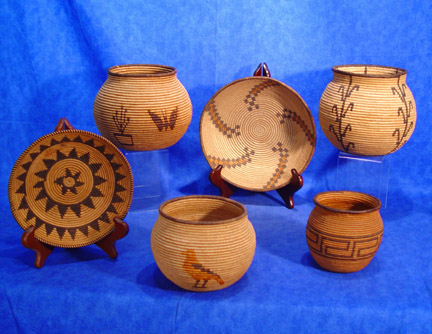
Great Basin basketry is one of the best known out of the North American indigenous. One Nevada Washoe woman named Dat So La Lee would become celebrated for her craftmanship during the “basket craze” of the early 20th century.

Practices: Animism, shamanism, dance, music, Ghost Dance, Bear Dance, peyote, basketry, pruning, controlled burning, pottery, storytelling, rock art, Sun Dance, and petroglyphs.

Tools and Weapons: Nets, traps, snares, flaked stone knives, bows and arrows, fish hook and line, basket traps, harpoons, weirs, digging sticks, drills, clubs, seed grinding slabs and handstones, and spears.

Notable Tribes: Paiute, Shoshone, Ute, Bannock, Coso, Kawaiisu, Mono, Goshute, Timbisha, and Washo.

The Indigenous Peoples of North America: Part 4 – The Northwest Plateau

4b9a99fbc75b96cb5dab0fa732f29933

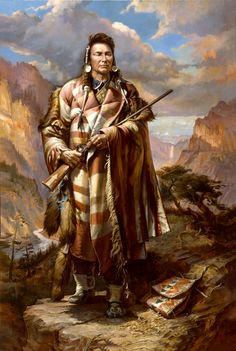
Known as “Hin-mah-too-yah-lat-kekt” in his native Nez Perce tongue, Chief Joseph led his Wallowa Nez Perce band during their most tumultuous period in their contemporary history. Basically, they were forcibly removed from their ancestral lands in the Wallowa Valley and relocated to the significantly reduced reservation in Lapwai, Idaho by the US federal government. The usual series of events culminated in episodes of violence led by Ned Perce resisting removal, including Joseph’s band and their Palouse tribe allies who attempted to seek political asylum in Canada. The US Army pursued them for over 1170 miles fighting retreat which would become known as the Nez Perce War. Though such resistance won him great fame and admiration, Chief Joseph would later surrender after a devastating 5 day battle in freezing conditions with no food or blankets as well as leaving the major Nez Perce leaders dead. By this time, 150 of his followers were either dead or wounded.

Between the Subarctic and Northwest Coast regions, you’ll find a small interior cultural area known as the Northwest Plateau. This region is situated in the interior of British Columbia as well as the non-coastal ranges of Washington state and Oregon with some of Idaho, Montana, and California. Topographically, you’ll find it between the Cascades and the Rockies. Nevertheless, this is an area with a very cold but semiarid climate which makes it nowhere near suitable for agriculture. However, it’s also home to 5 major volcanoes as well as 27 known to be active, which may good for soil content but not a place you’d want to live. Still, you don’t really hear much about this region except maybe when it comes to Chief Joseph and the Nez Perce. But it’s not a happy tale to tell. Yet, famed Native American author Sherman Alexie also hails from this region, too, and he’s perhaps the best known native literary figure to date. Not surprisingly these Northwest Plateau tribes tended to move around a lot following various food sources. But they also lived in a prime trading location and often exchanged goods with other tribes. Oh, and they also were prolific basket weavers, relying on many local fibrous plants to make them.

dFoUaUN9GbYWRcfVhhnYsmQx

The Northwest Plateau may have its share of plants and waterways. But its generally rough terrain, high elevation, and semiarid but cold climate don’t make it ideal for a sedentary agricultural lifestyle. Is also home to a lot of volcanoes, including Mount Saint Helens.

Location: Area between the Cascade, Sierra Nevada, and Rocky Mountains that covers central and southern British Columbia, northern Idaho, western Montana, eastern Washington state, eastern Oregon, and northeastern California.

First Peoples: Region has been continuously inhabited for 10,000 years and save for the grinding stone and the bow and arrow, way of life remained mostly unchanged until the 18th century.

Environment: Consists of rivers, lakes, mountainous evergreen forests, and grassy valleys in the Canadian area with heavy rainfall. The US area is semiarid. Though summers are hot, winters are long and cold. Elevation ranges from 5,000 feet to 14,000 feet and is home to 27 active volcanoes as well as Mount St. Helens.

f7d6acb66b494224c4c4d98934e0dccb

Like their Pacific Northwest neighbors, salmon consisted of a major part of the Northwest Plateau peoples’ diet. In eh summer, Pacific salmon would swim up river, leading the men to trap the fish. Once caught the salmon would be smoked on a fire, stored underground, or boiled in hot water for oil.

Subsistence: Hunter, gatherer, and fisher subsistence. Fish were a main staple in their diets (particularly salmon) along with roots and berries. Also hunted deer, elk, caribou, antelope, mountain sheep, bear, rabbit, squirrels, marmot, beaver, raccoon, porcupine, and other small game. Another major staple were Camas lily bulbs which were dug up (though the white ones are known to be poisonous).

Pit-House

The primary winter dwelling for the Northwest Plateau people was the pit house. These would consist of hole being dug into the ground with an earthen roof over a wooden frame. Entrance way was through a wooden ladder.

Housing: Pit houses were primary winter residences that were mostly built below ground with an entry via ladder on the roof that could either be flat or domed shaped. Several families lived in these houses while the chief’s could be twice as large. And these pit houses during the winter could sometimes be connected with tunnels. For summer shelter, some would reside in teepees, especially if they lived near the Plains. But unlike their Plains neighbors, they mostly used bulrush reed mat floors. Another shelter was the Tule mat lodge that were essentially large, oblong shaped teepees and constructed with the same materials. Lean-tos would also be constructed from poles and tule brush mats and were very temporary. Sweat lodges were built from grass and earth covering a wooden frame. Those who lived around the Lower Columbia lived in plank longhouses that could be 20-60 feet long and 14-20 feet wide (with each village there consisting about 5-20). These were built over a pit that was 4-5 feet deep and roughly the same size as the dwelling.

Edward S. Curtis - Wishham child

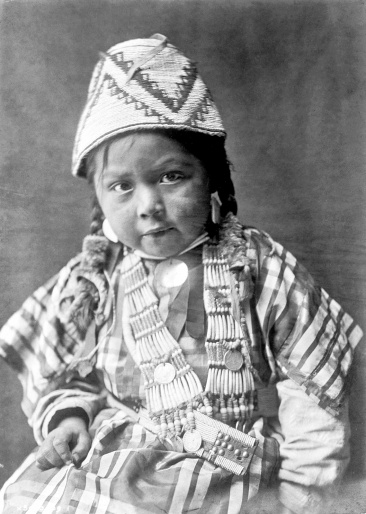
While clothing among the Northwest Plateau Native Americans can consist of the standard buckskin, braids, and beads you’d associate with native culture, the women were also known to wear the distinguishing basket hats. Also, both sexes had braided pigtails (or at least the women).

Clothing: Generally made from bark, grass, animal skins, and fur. Men and women wore breechcloth aprons, ponchos, and moccasins. Men wore shirts while women donned dresses or skirts. Men donned fur leggings in winter while women’s were of hemp. Ornaments were made from shell and bone while beads were derived from soapstone. Clothes were also painted. Headdresses were used to represent a person’s status within the community with the most elaborate being made from feathers and beads. Women were also well known for wearing basket hats. Sometimes the leaders wore feather headdresses. Both sexes left their hair long, sometimes in two braids.

800px-Kutenai_woman_1910

Pre-contact Northwest Plateau transportation was mainly by canoe if not on foot. These would be made from bark, dugout wood, or animal skins. Once horses were introduce, people in this region would use them, too.

Transportation: Water transport consisted of dugout, animal skin, and bark canoes.

Society: Largest estimated pre-contact population is said to be around 50,000. Primarily nomadic with most groups following regular migratory routes to obtain foods at their greatest productivity to both meet immediate need, build surplus for winter, and trade (the largest being at the Dalles and Celilo Falls, at the head of the Columbian Gorge). Villages were politically autonomous and village chief authority lay more in their ability to persuade and adjudicate than in their power to make rules and enforce decisions. Both men and women can be chiefs of many bands though family chiefdoms were usually inherited. Specialized leaders like salmon and war chiefs only exercised leadership on special occasions. Only the far western groups practiced hereditary slavery and a caste system like the Chinook with the upper castes practicing social isolation. However, there was always a reluctance to engage in warfare.

98459-004-991FEA5D

Plateau area Chinook tribes were known to head bind their own children’s heads to create a pointed appearance. However, contrary to popular belief, the Flatheads were called such by their neighbors because they didn’t practice this.

Family Structure: Most people married outside their own village and many of these marriage networks survived after a spouse’s death as widows and widowers often married their spouse’s sibling afterwards. Men hunted, fished, as well as had a greater voice in politics, diplomacy, and military affairs. Women, meanwhile cooked, gathered plants, and tended to young children. However, both men and women were considered socially and economically equal in every way. Some Chinook Indians in the area were known for subjecting their kids to cranial deformation. Lower Columbia tribes buried their dead in raised canoes with all their worldly possessions and never spoke of the deceased again by name for fear of summoning a ghost. Boys from 5-10 were subject to a whipping ceremony in order to prevent sickness during the winter months.

plateau-beadwork

The Northwest Plateau is well known of their art in fine beadwork, carvings, quillwork, and basketry. Like Native Americans from other cultural areas, such art was part of their every day lives.

Practices: Grass baskets, animism, shamanism, bone carving, controlled burning, vision quests, music, dance, rock painting, weaving, quillwork, and beadwork.

Tools and Weapons: Cordage, nets, bow and arrow, spears, clubs, rawhide and wooden slat armor, weirs, deadfall traps, slings, fish hooks and lines, pestles, snowshoes, a variety of knives, and mauls. Tule bulrush was used by these people for almost everything from mats, bedding, nets, rope, house coverings, flooring, and corpse shrouds. Coiled baskets of spruce and cedar root were used for household utensils, water and burden containers, cooking vessels, drinking cups, cradles, and numerous other purposes.

Notable Tribes: Chinook, Interior Salish, Nez Perce, Walla Walla, Yakama, Cayuse, Spokane, Kalapuya, Flathead, Kalispel, Nicola, Nlaka’pamux, Methow, Molala, Palus, Upper Cowlitz, Umatilla, Okanagan, Sanpoli, Wenatchi, Kutenai, Tenino, Fort Klamath, Chelan, Entiat, and Coeur d’Alene.

The Indigenous Peoples of North America: Part 3 – The Pacific Northwest Coast

neel_totemstanleyw

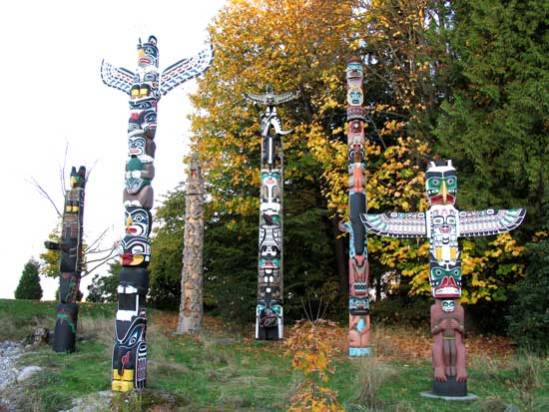
The Native Americans of the Pacific Northwest Coast could just as well be called the “totem pole people” due to their best known art form. However, these monumental structures were said to symbolize or commemorate cultural beliefs recounting familiar legends, clan lineages, or notable events. They may have also served as welcome signs for village visitors, mortuary vessels for deceased ancestors, or as a means to ridicule someone. The complexity and symbolic meanings of totem poles, their placement and importance lies in the observer’s knowledge and connection to these figures’ meanings.

Though the Pacific Northwest Coast is only a narrow stretch from southern Alaska all the way to the northern reaches of California, it’s a region with and abundance of natural resources that these hunter-gatherer tribes usually stayed in one place. It’s no wonder that it was the most densely populated cultural area in Canada before European contact. Nevertheless, the Pacific Northwest Coast is best known for their totem poles and their distinctive art that you might instantly recognize. Their art is also seen on almost everything, including their large cedar plank houses. Because since these people lived in a temperate coastal rainforest, they didn’t need to spend a lot of time like other native peoples did, searching for food so they won’t starve to death. And since they lived in one place all the time, they had plenty of leisure time to kill. These Native Americans also had rather sophisticated societies based on clans and class systems as well as a special centrality on salmon. But it’s not the only food they eat, yet it received a special ceremony when it’s in season that continues today. Then there’s the tradition of potlatch which was a highly complex event of social, ceremonial, and economic importance. There a chief would bestow highly elaborate gifts to visiting peoples in order to establish his power and prestige and by accepting these gifts, visitors conveyed their approval of the chief. There were also great displays of conspicuous consumption such as burning articles or throwing things into the sea, purely as displays of the chief’s great wealth. You’d even have dancers put on elaborate dances and ceremonies which was considered an honor to watch. Still, these events were held on special occasions like the confirmation of a new chief, coming of age, tattooing or piercing ceremonies, initiation of a secret society, marriages, a chief’s funeral, or battle victories.

Indian+houses+of+the+Northwest+Described

Because of the dense resource rich waters and rainforests along with a pleasant climate, the people of the Pacific Northwest Coast had an easier time than Native Americans in other regions. After all, most of them were hunter-gatherer tribes who usually stayed put.

Location: Along the coast starting from southern Alaska through British Columbia, Washington state, Oregon, and northern California.

First Peoples: First humans are said to enter the region at least 10,000 years ago via the Columbia River in the US Pacific Northwest. Evidence in southern Alaska and British Columbia suggests the early inhabitants existed at a basic subsistence level for 5,000 years until 3000 B.C.E. Earliest sedentary villages appeared in 700 B.C.E. with social ranking, woodworking, and regional art shortly thereafter. However, some areas in the US Pacific Coast along Washington state and Oregon continued in basic subsistence mode until possibly as late as 500.

Environment: Consists of dense temperate zone rainforests, rivers, islands, and oceans with abundant natural resources all year long. Climate is mild and rainfall is heavy that includes fierce winter storms and heavy fog. Trees are unusually tall and thick. Springs and glaciers usually flow into rivers that run to the coast.

ehp.121-a334.g004

While Pacific Northwest Coast Native Americans had a varied diet, there was no food source more central to them than salmon. When salmon travel up rivers to spawn, they would literally catch thousands of them that could feed their families for a year.

Subsistence: Primarily hunter, gatherer, or fisher subsistence. Salmon was the most important food for the Indians in this region. However, they also consumed halibut, eulachon (candlefish), smelt, herring, and sturgeon as well as shellfish, seals, and whales. They also hunted elk, bear, deer, mountain goat, turtles, and some land mammals as well as gathered berries and roots. Food was generally eaten fresh, grilled, or boiled in a basket with hot rocks or steamed or baked over a pit oven.

'Ksan_Historical_Village_2010

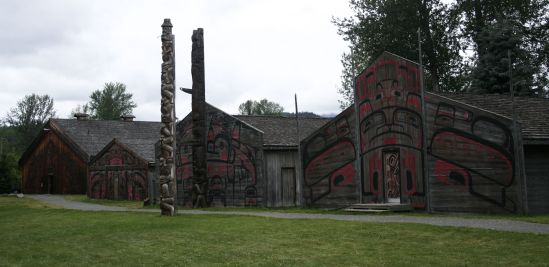
Your standard Pacific Northwest Coast dwelling was the cedar plank house w which could be up to 50-150 feet long and 20-60 feet wide. Each plank house could be home to as many as 30 people.

Housing: Mostly lived in plank long houses of red cedar that was said to be 50-150 feet long and 20-60 feet wide. Each plank house was held together by wooden peg nails, had a large hole in a low roof for smoke ventilation, as well as consisted of a front door to keep heat in. Plank houses were furnished with simple furniture including bunk beds against the wall, storage areas, fire pits, and open shelves as well as dug holes for storing and cooling food. Your typical plank house would be home to several families, perhaps as many as 30 people. They were also commonly painted, often with a family crest. Individuals who built the longhouse usually resided there with their families and their kids would be assigned as space inside upon reaching maturity. But if the village built the plank house together, then it was the chief’s responsibility to assign living spaces to each family. And when the plank house owner died, it was either given away or burned to the ground. Because it was believed if the family stayed, then the dead person’s ghost would haunt the place. Also built temporary shelters made from mats, planks from the main house, or bark.

tlingit_daniel_fox_06

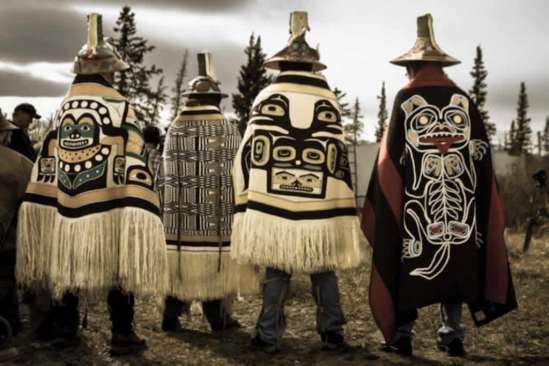
While people of the Pacific Northwest Coast usually wore very little under temperate conditions, they tend to be known for wearing their chillkat blankets and decorative woven hats. And yes, these can be highly decorated as well.

Clothing: Usually wore very little clothing except when it was cold or special occasions. In the warmer months, men would go naked while women only wore bark skirts. Clothing was mostly made from softened cedar wood or bark, animal leather, and wool. Bark capes and spruce hats were used as protection against the rain. High ranking class members would usually don chillkat blankets, dance aprons, leggings, and moccasins on special occasions. Adorned themselves with piercings and tattoos.

Haida_conoe

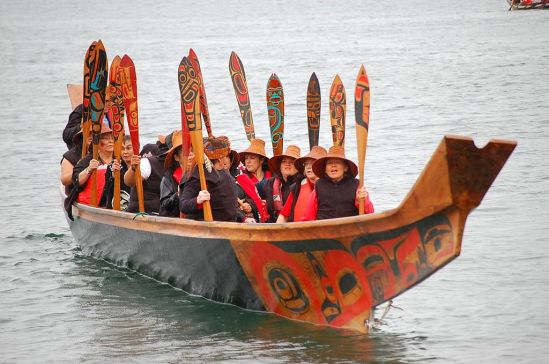
The Pacific Northwest Coast had several different types of canoes, mainly made from red cedar. They can be 50 feet long and 8 feet wide while holding up 2-50 people and up to 10,000 pounds of cargo. Of course, passengers have to bring their own oars.

Transportation: Built canoes of red cedar of several different types. They were usually 50 feet long and 8 feet wide as well as can hold up to 2-50 people and 10,000 pounds of cargo. Also had smaller boats for families and short outings. Also had dog pulled sleds for overland transport.

Potlatch-Klallam_people_at_Port_Townsend

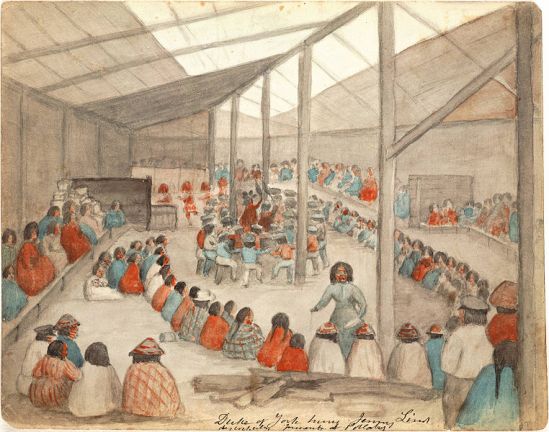
Potlatch was a major event for Native Americans residing in the Pacific Northwest Coast as a means to reflect wealth and perpetuate social inequality within a village. These were held during a major event as well as hosted by aristocrats. At each potlatch, the host would display their wealth through distributing goods to visitors and others whether they be chillkat blankets, animal skins, or even slaves.

Society: Year round access to food allowed people to live sedentary lives in permanent settlements. Estimates state that as many as 250,000 could have lived in this region at one time. Houses were always grouped together side by side and facing towards the water in small villages, each marked by totem poles. Some even had as many as 1,000 living in only 30 homes. However, some groups had one or more small permanent, semipermanent, or seasonal villages or camping sites as well. Nevertheless, people in this region lived in a society based on hereditary status and the ceremonial winter potlatch was both as a means to reflect and perpetuate this social inequality. These consisted of the nobility, upper class free, lower class free, and slaves (actually not members of society at all). Each individual would also be ranked within their respective groups as well. Since this system was based on inheritance, the classes were fairly immutable though some transfer was possible through acquiring (by trade, purchase, marriage, and war) some inherited rights. Such rights and privileges were owned by the identified group which included songs, dances, performances, and control of subsistence areas identified by crests or design patterns. These patterns could reflect real and mythical family lines and associated incidents, animals, or spirits. The village chief always was always the head of the wealthiest and most powerful family and was a nominal war commanders, often undertaking political and ritual preparations before fighting. Though intragroup conflict was minimal, clan incest and witchcraft were considered capital offenses. Intergroup conflict took place within the framework of feuds and wars. Feuds entailed conflict for legalistic purposes while wars were waged solely for material gain (as in land, booty, and slaves). Northern tribes saw more regular conflict than their southern counterparts. Night raids were preferred strategy and victims’ heads were often displayed on poles as proof of fighting prowess. Also practiced intergroup trade where prices were negotiated.

tlingit_daniel_fox_16

In a Pacific Northwest Coast extended family, one’s social rank and wealth intake were usually determined by their relationship to the family chief. Of course, since this was a matrilineal clan that practiced exogamous marriage, this only applied to the people on his mother’s side. Family chiefs were usually the wealthiest and oldest member of the clan.

Family Structure: Primarily matrilineal descent. In extended families, family chiefs were usually the oldest and highest ranking individuals while everyone else’s rank was determined by their relationship with the chief.  Family chiefs were primarily responsible for distributing wealth according to social status. Men practiced hunting, building, carving, and fishing while women did housework, raised kids, cooked, wove, made clothes, and dug for shellfish. Marriages were always conducted between people of different clans. When a man decided to marry a woman, he paid her dad an agreed amount before the wedding took place. This amount would be paid back when after the birth of the couple’s first child. After the payment, the wife was no longer obligated to be with her husband (so she could stay or leave him after that point).

obj13219geo6879pg73p12

Aside from totem poles, the Pacific Northwest Coastal peoples are also well known for their elaborate ceremonies and their distinctive stylized art. Works of art could range from practical objects such as clothes, tools, transportation, houses, weapons, and what not to the purely ceremonial and aesthetic.

Practices: Totem poles, potlatch, music, dancing, shamanism, animism, storytelling, intricate crafts and sculpture, weaving, basketry, woodworking, masks, bentwood boxes, chillkat blankets, spirit quests, and heraldic art.

Tools and Weapons: Stone axes, adzes, spears, nets, traps, chisels, hammers, drills, knives, wedges, harpoons, traps, seal clubs, sledgehammers, deadfalls, fish line and hooks, and wooden crockery. Coast Salish practiced weaving on a full loom. Blades were made from rock, shell, horn, bone, and a small amount of iron.

Notable Tribes: Tlingit, Nisga’a, Haida, Tsimshian, Gitxsan, Haisla, Heiltsuk, Nuxalk, Wuikinuxv, Kwakwaka’wakw, Nuu-chah-nulth, Coast Salish, Chinook, Chimakum, Quileute, Willapa, Nootka, and Tillamook.

The Indigenous Peoples of North America: Part 2 – The Subarctic

c001917k

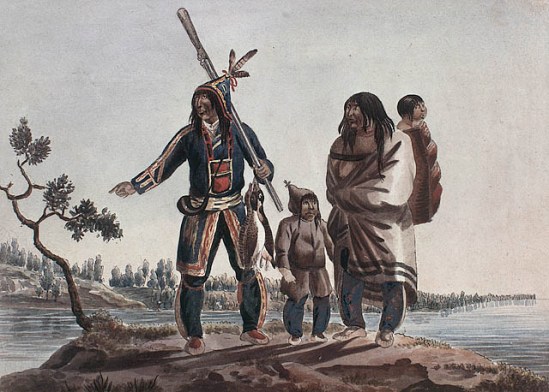
Here’s a Subarctic Cree family from early Canada. While the mother and kids are dressed in drab, the father has quite a colorful costume and a gun. He also traps animals and trades their skins and feathers.

Our second stop in my Native American series is the Subarctic region. Now this isn’t as snowy and icy as the Arctic, it’s a pretty forbidding region despite it being a mostly boreal forest region. But it’s a very vast region starting from central interior of Alaska, covering the Canadian Shield, surrounding much of Hudson Bay and the northern Rockies, and ending in eastern Canada and as south as Lake Superior. In fact, it covers most of Canada. Nevertheless, despite that the Subarctic is a huge area, you really don’t see it in movies or on TV much (at least in the US, though in Canada, that may not be the case). Or if you did, you might know have known that they were from the Subarctic region. That, or the movie or show was Canadian made. Yet, many of these people tend to speak Athabaskan languages (though some also speak Algonquin in the east). Whatever the case, the Subarctic region is home to a population known to speak over 30 languages. And this area didn’t have a large population of hunter-gathers either. But what a lot of these peoples have in common is their teepee and wigwam shelters and their dependence on the caribou. Also, many of them wore parkas, too. At any rate, it’s kind of what you get if you put cultural aspects of the Plains, the Arctic, and the Northeastern Woodlands together. But it’s in a way that it makes perfect sense because while it may not get as much snow as the Arctic, it’s nowhere near pleasant enough to support agriculture at all. Not only that, but many of these hunter-gatherer groups dealt with regular periods of starvation as food availability can vary from place to place. So while the Subarctic might have great scenery to put on a postcard (since it’s home to Denali), it’s not a pleasant place to live. Still, since European contact in 1500 with Basques, Bretons, and other Europeans fishing at the Gulf of Saint Lawrence, non-native diseases, STDs, malnutrition and alcoholism would reduce native Subarctic population by 90-100% in some regional locations while some didn’t see a white person until the mid 19th century.

subarctic

While the Subarctic environment isn’t nearly as harsh as the frigid Arctic, it’s quite a forbidding place. Its rugged terrain, long cold winters, short summers, and generally low precipitation in rain, it’s a very hard place to live.

Location: Most of Canada as well as most of interior, western, and south central Alaska. Stretches from Alaska to east of the Rocky Mountains, and the northern Great Lakes.

First Peoples: The first people of the region possibly entered the region at least 12,000 years ago or even as long as 25,000 years ago. Athabaskan speakers descend from a Northern Archaic culture that existed at least 9,000 years ago. The Shield culture was predominant in Labrador before diverging. The Taltheilei tradition existed 6,000 years ago from Great Bear Lake to Lake Athabaska and the Churchill River. The Laurel culture of Manitoba and northern Ontario lasted from 1000 B.C.E. to 800 and known for their ceramic pottery along with the Selkirk and the Blackduck Cree.

Environment: Mountainous and boreal forest with thousands of streams and waterlogged tundra. East has low hills and rock outcroppings. West has high mountains, glaciers, and plains. Climate is characterized by short, mild to hot summers and long, bitterly cold winters. Precipitation is generally low save in some mountainous areas and coastal Alaska and falls mainly as snow. Short springs experience plagues of mosquitoes, black flies, and other insects as well as ice break up and snow melt. Travel can also be limited at that time as well as the fall freeze up. Soil was often poor and often swampy, making agricultural development impossible.

caribouhunters

Central to the Subarctic tribal existence was the caribou for which they depended on for food, clothing, shelter, and tools. Here is a painting of a caribou hunt.

Subsistence: Primarily hunter, gatherer, and fisher subsistence. Moose and caribou were a major part of diets for many tribes, with some groups regularly suffering from hunger or even starvation during shortages. Yet, smaller animals like hare, marmot, beaver, porcupine, and muskrat were also consumed along with fish, roots, and berries. Coastal groups relied on sea mammals and shellfish while western groups even hunted buffalo. Musk ox, bear, lynx, wolf, coyote, fox, mink, weasel, otter, wolverine, wapiti and elk were also hunted where available.

tmp518475493264064514

Teepees and wigwams may not have been the only housing in the Subarctic region. But they were among the most common. Most of these would be covered in caribou or moose hides along with bark.

Housing: Most tribal groups resided in domed and conical lodges consisting of poles covered with skins, boughs, or birch bark. Or in other words, wigwams and teepees but not what you’d see on the Plains or the Northeast. Groups closest to the Northwest Coast tribes built plank houses while some built frame houses partially below the earth as well as bark covered rectangular houses at fishing camps. Some groups built shelters with a double A-ridgepole framework and containing multiple fires as well as sod pit houses. Structures like drying racks, sweat houses, caches, menstrual houses, and others were also commonly built.

Nelson-Family-Athabasan-Clothing-Portrait

This Athabaskan family portrait shows a variety of what native peoples in the Subarctic would’ve worn. In winter, they would’ve worn parkas, snowsuits, and other winter items. In the spring and summer, they’d go with tanned leather clothing of caribou and moose.

Clothing: Most clothing usually came from moose and caribou as well as hare and other skins with trim from beaver or other fur. Hides were often tanned and dehaired so they wouldn’t weigh down except winter items like parkas, hats, and mittens. Many people wore leggings with moccasins. Clothing can be decorated with fringe, paint, quills, claws, or down. Women wore dresses while men wore shirts, jackets, and snowsuits. Mothers often carried their babies on their backs with cradle boards. Adornments consisted of noseplugs, earrings, and tattooing.

Transportation: Overland travel was usually preferred and many used sleds, sledges, and toboggans (sometimes pulled by dogs though not always). Though people did build lightweight birch bark canoes and moose hide boats.

thanadelthur1

Like most nomadic tribes, Subarctic Indian society wasn’t very authoritarian, formal, or centralized. Extended families usually lived in groups though once in awhile bands would get together to socialize, hunt, and trade.

Society: This was a sparsely populated area with no more than 100,000 living in the region at any one time. So most cultures were nomadic. The basic unit was a local group consisting of 10-20 related people but could be up to 75. Membership was fluid and nonbinding, in deference to autonomy values and need for flexibility in a difficult environment. Leadership was extremely informal and nonauthoritarian, except for the groups most influenced by the Northwest Coast. When conditions permitted (possibly not quite every summer), local groups might come together as loosely constructed regional bands of several hundred people to socialize and renew family ties. Kinship names were used in most tribes as a general term. For instance, elders were addressed “Grandmother” or “Grandfather” whether they were blood related or not. Some groups might conduct memorial potlach with chiefs being recognized as among the clan leaders in the Cordillera. Warfare was mostly a local matter though while some groups seeking women, most people fought over revenge for trespass or prior blood transgression. Yet, warfare was more developed in the far west than in other areas. However, there were no regional groups conducting full scale wars. Trade was widely practiced with goods and services being exchanged as a peaceful reason for travel and human interaction while bands frequently shared resources with each other.

Woman_of_the_Snake_tribe_and_woman_of_the_Cree_tribe_0066v

Though Subarctic tribes mostly practiced matrilineal descent, the treatment of women varied from tribe. Some women were treated as no more than mere pack animals while others maintained relative autonomy and even assumed positions of authority and power.

Family Structure: Primarily matrilineal descent, though not always. Women mostly made clothes, prepared food, and looked after children while men hunted the big game. However, it wasn’t uncommon for women to snare hare or fish. Women’s status varied according to local custom with some being treated as essentially pack animals with little to eat and others existing in relative autonomy as well as attaining both authority and power. Female infanticide wasn’t unknown through much of the region while menstrual taboos could be quite rigorous. Yet, both men and women were usually married by 13 or 14 and had some decision power in the bands. Newly married men were required to live with their in-laws for at least a year before establishing their own households (yet, sometimes they could have more than one wife). Exogamy and cross cousin marriage were usually encouraged. Since infant mortality was common, babies were usually not named until it was certain they would survive. Cremation was standard funerary practice.

e5c1c5980b5f6f958ee62180390418c9

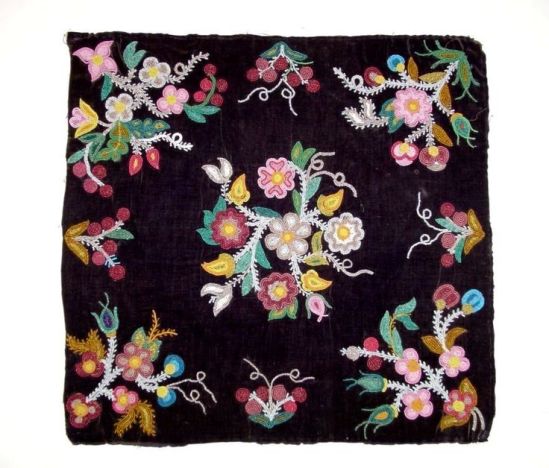
The Subarctic tribes were well known for their intricate beadwork and embroidery. After they made contact with the Europeans, these Indians took to using glass beads and sewn floral designs.

Practices: Animism, shamanism, reincarnation, ceramics, storytelling, controlled burning, music, lacrosse, wooden dolls, basket weaving, dance, embroidery, beadwork, and scapulimancy.

Tools and Weapons: Antler clubs soaked in grease, armor, spears, hide containers for holding water, tumplines for carrying, snowshoes, bow and arrow, net traps, gaffs, fish hooks, snares, and weirs. Raw materials usually consisted of bark, wood, root, stone, and sometimes copper. Yet, many groups also liberally borrowed from their neighbors.

Notable Tribes: Cree, Ojibwa, Gwich’in, Dena’ina, Beothuk, Beaver, Mountain, Hare, Han, Tanacross, Yelloknife, Innu, Chipewyan, Eyak, Kuskokwim, Holikachunk, Sekani, Tagish, Ingalik, Ahtna, Babine-Wet’suwet’en, Dogrib, Tutchone, Carrier, Chilcotin, Attikamek, Tanana, Bearlake, Koyukon, Naskapi, Slavey, Tlicho, and Kaska.

The Indigenous Peoples of North America: Part 1 – The Arctic


800px-Nordamerikanische_Kulturareale_en

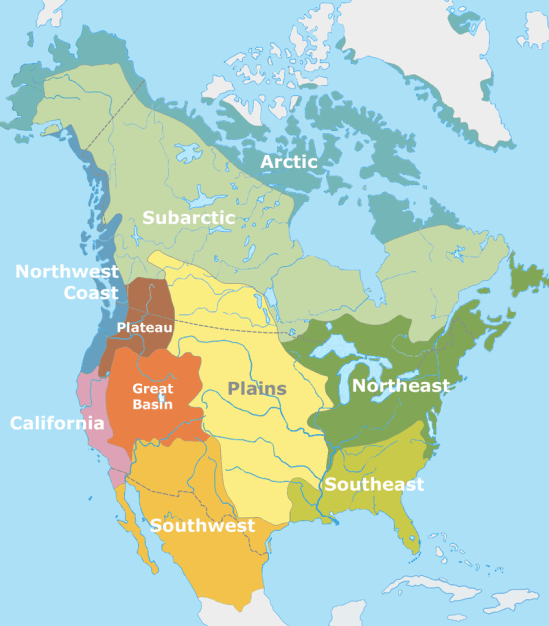
As we have been taught in our history classes, before Europeans arrived to North America, the continent was inhabited by a people called the Native Americans. Of course, those who’ve taken courses in American history in school will probably know that our education doesn’t really touch on these people very much (other than that they later got killed by European disease and relocated to reservations so white people can take their lands). Mostly because an average US history class can only cover so much within 180 days or less. Thus, with the exception of those who took Native American Studies in college or read books about them, most of us tend to learn about the Indians through the media and pop culture. Now your average Native American on TV or in the movies will most likely have long black hair (either free flowing, single thick braid, or loose pigtails) or a Mohawk. Not mention, your average media Native American would have a feather stuck in their hair as an ornament or an elaborate feather headdress (like a war bonnet). If your Indian is a guy, he’ll have on leather pants often lined with fringe along with an age dependent upper wardrobe. Older Indian men usually wear leather tunics and vests while the younger guys have other options of going with just the vest or a bare chest. If he’s shirtless, then expect him to wear some degree of body paint. Yet at any rate, he’ll certainly get his war paint on at the climatic battle scene. If your Indian is a woman, she’ll often wear a single piece leather slip and leave her legs bare. Either way, your average media Native American will wear beaded jewelry as well as soft leather moccasins if they’re not barefoot.

o-SCAR-570

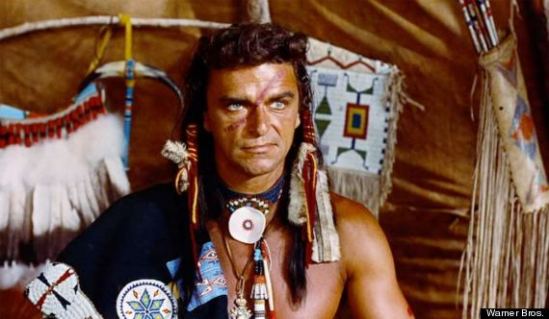
And it doesn’t help that many Native Americans depicted in classic westerns are played by white guys with blue eyes. Yeah, really makes a convincing Indian (sorry, but the heavy dark makeup isn’t fooling me).

Now is this an accurate representation of Native Americans? Well, some of the time. However, pop culture tends to get the idea of representing Native North Americans with a one-size-fits-all approach of beads, buckskins, and braids. Did all Native North Americans dress this way before Europeans? No. Because North America is a big place with a great deal of variation between Native cultures, especially since the continent has a variety of environments. An Indian from New Mexico did not dress the same way as one from North Dakota. And occasionally, you might see indigenous people in Peru wearing buckskin outfits which is another matter entirely (especially if you account for the llama wool). Nevertheless, such Native North American portrayal doesn’t capture the wide variety while many tribes’ traditional outfits look nothing like the stereotype.

playmobil-native-american-camp-with-totem-pole-b253aa2d1e61f0e224ecb936cab349e2

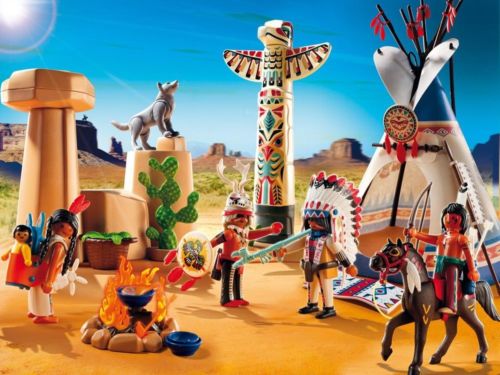
Yet, they still depict teepees and totem poles on the Playmobil Indian camp play set. Sure it looks cute. But it’s seriously wrong and perpetuates cultural inaccuracies. Seriously, you might as well have a play set of the Norse gods with a Grecian temple.

Then there are the aspects of Native North American culture that you see in the media. Of course, there’s the offensive denigration of Indians as savages but this stereotype has been done to death so I won’t bother to talk about it. Then there’s the magical nature worshipping Native Americans who are just misunderstood because a bunch of selfish white guys want their land. Either way, they’re not going to speak English like a normal person. But that’s beside the point. Anyway, you might see Native American tribes depicted doing things and using stuff that belongs to a myriad of different tribes. A good example of this would be the Indian tribe in Peter Pan which juxtaposes Great Plains teepees and Pacific Northwest totem poles. At a cultural and historical perspective, this is as jarring as it’s inaccurate as portraying Vikings with Grecian temples. Also, you might find a lot of Indians wearing mohawks and war bonnets even when they’re not supposed to. In reality, Native North Americans were and are a diverse group ranging from nomadic hunter-gatherers to agricultural civilizations. And they have adapted to a variety of environmental conditions.

5fc534dc2e1de63211ee5a51623af165

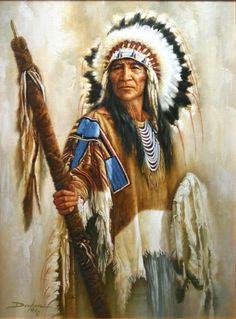
Type Indian or Native American on any search engine, you’re bound to get results like this. Now while this certainly is a Native American portrait, the guy is most likely a leader of the Plains tribes. And he only wears the war bonnet on ceremonial occasions.

In this series, I plan on showing my readers a rough view on how Native North Americans really lived. However, I’m not going to go with a tribe on tribe basis because that would take too long (since there are over 500 of them). So instead I’ll go according to cultural area. Yet, note that whatever I say about this series will only apply chiefly to Native North Americans before European contact. So if you want to know about Plains horse culture or Navajo sheep herding and silversmithing, this series isn’t for you (though I will show pictures). Not only that, but understand that a one-size-fits-all approach may not apply to all the Indians living in that particular cultural region, even within a recognized tribe or tribal group. I just have it written in because it applies to some of the Indians living there. Also, some tribes might go in more than one region.

Inupiat Family from Noatak, Alaska, 1929, Edward S. Curtis

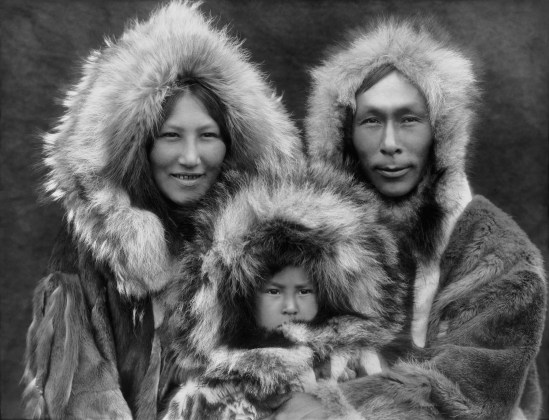
A family photo of an Inupiat Eskimo mother, father, and son, photographed in Noatak, Alaska, by Edward Sheriff Curtis circa 1929. It’s certainly plausible that they’d be wearing their parkas in every day life. But most of the Inuit have adopted to modern lifestyles. Yet, that didn’t stop Robert Flaherty drom doing Nanook of the North.

Our first North American region is the Arctic, which is often exempt from most Native American depictions. Mostly because the Arctic is a very frigid place of ice and snow. Arctic Native Americans tend to be depicted more accurately as wearing parkas, living in igloos, hunting seals, riding kayaks, and running on the ice in dog sleds. But it’s not quite right. Since not all Arctic Native Americans lived in igloos (and even those who did didn’t live in them all the time). Plant life does exist there and the ice does thaw (and keeps thawing due to climate change). While these Native Americans resided near polar bears, they didn’t live anywhere near penguins (which actually live in the Southern Hemisphere). And yes, they do take off their parkas once in awhile. Sure they may spend their days dogsledding, ice fishing, and seal hunting, but they also hunt whales, walruses, and other animals, too. Oh, and they didn’t always leave their grandmas to die on ice floes. Nor did they just eat blubber. Nevertheless, while the Arctic can be a rather inhospitable place, these people have managed to survive its harsh climate for thousands of years and continue to do so. Most of them reside in the farthest reaches of Alaska, northern Canada, and Greenland. Yet, they don’t necessarily have a lifestyle that 100% akin to Nanook of the North (which is kind of a documentary of the Inuit showing how they lived when they were 12). Because they do know about modern technology, actually take advantage of it, and think the idea of pining for the good old days is utterly insane (even among those who grew up in the traditional lifestyle). However, you might want to avoid calling them Eskimos because some of them see the term as derogatory. Also, a lot of them don’t like being called Indians either which is partly why we tend to refer to indigenous people in North America as Native Americans.

1950.405_Dorset_Figure_Cropped

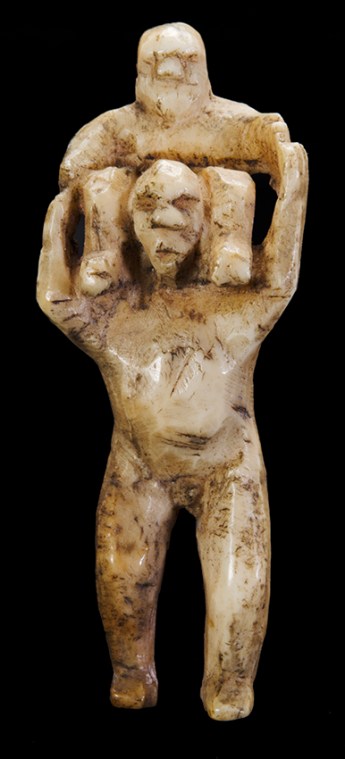
This is a figurine from the Paleo-Eskimo Dorset culture who were among the first people in the Arctic region. The Paleo-Eskimos inhabited the area from 6,000 years ago before mysteriously disappearing at around 1500 at the latest. DNA evidence has proven that they were not the ancestors of the modern Inuit, a fact that I hardly believe (mostly because if the Thule and Dorset culture coexisted, you’d expect that they’d be having sex with each other. Because that’s what normally happens).

Location: Near the Arctic Circle, encompassing northern and western regions of Alaska, northern Canada, and Greenland.

First Peoples: Assuming that the earliest Native Americans arrived to the continent through the Bering land bridge, the Arctic region was only used as nothing more than an area to pass through before venturing into greener pastures. The first groups who inhabited this region didn’t arrive until 6,000 years ago and in at least 2 migrations from Siberia and it was the last area in North America to be populated. The Paleo-Eskimo cultures first developed by 2500 BCE and consists of the Arctic Small Tool Tradition (who lived in tent camps while chasing seals and caribou 4000 years ago), the Dorsets (walrus hunters from 500 BCE-1500), and the Thule (who sailed in large skin boats and hunted whales who are said to arrive in 200 BCE-1600). Only the Thule have any biological, cultural and linguistic connection the modern Inuit and are often considered their ancestors. However, it is known that the Dorsets and Thule had no genetic connection and barely interacted with each other (at least favorably. However, the lack of genetic connection is highly unusual since these two groups existed around the same time. But even if under the most hostile relations, you’d still expect that members of both groups would have sex with each other. How can these people coexist without having sex with each other? I don’t get it). And the Dorset would mysteriously disappear by the 1500s. Some evidence suggests that the Thule and Dorsets had contact with the Vikings.
NanookoftheNorth_landscape

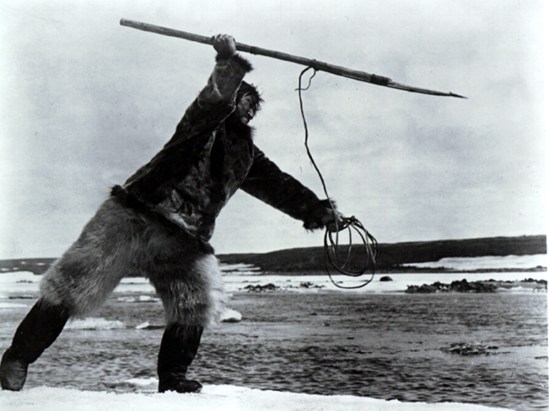
Here’s a scene of Nanook hunting seal from the 1922 Robert Flaherty “documentary” Nanook of the North. The harsh tundra climate and terrain led the Arctic people to hunt sea mammals including seal and whale. By the way, hunting for such animals in the Arctic was a highly difficult and dangerous task that took hours.

Environment: Tundra, which can be better said as a desert of snow that’s cold, flat, and treeless (though Arctic plants do exist). Snow, ice, and freezing temperatures all year round (along with the increasing threat of global warming). Can sometimes experience a white night and midnight sun come summer as well as 24 hours of darkness in winter. But the Aurora Borealis is pretty. One of the harshest environments on earth.

Subsistence: Hunter, gatherer, and fisher subsistence. Diet was mostly meat based consisting of ringed and bearded seals, walrus, narwhal, and whales. On land, caribou were by far the most important source of food (and other raw materials) along with musk ox, wolf, fox, wolverine, and squirrel. Also consumed ptarmigan, duck, geese, and their eggs. Fishing was mostly a 3 season activity. Some areas even had people gather berries. Almost every part of the hunted animals were used.
Eskimo_family_and_their_igloo_cph.3c36050

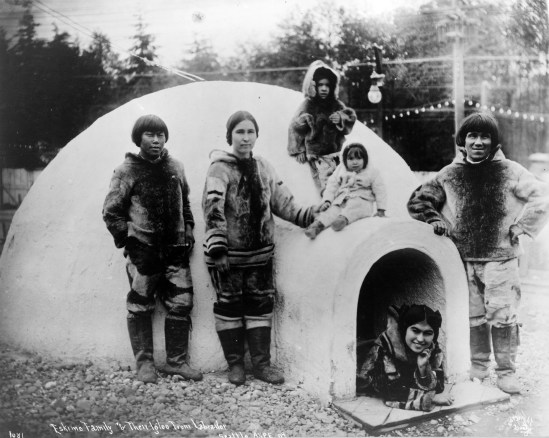
As you might know, the Inuit are well known for building igloos made of snow and ice. Yet, contrary to what you see in the media, igloos were only used as temporary shelter. Sometimes they could be built close together and connected by tunnels.

Housing: Different types depended on materials available and whether the home wasp permanent or temporary. In the central Arctic region, domed shaped snow igloos were the rule among the Inuit. Many of these would often be built attached to each other for added warmth and sociability. And they even had snow furniture in them, too. But some Inuit tribes built sod houses which consisted of a dug rectangular pit with walls made from sod and rocks as well as wood pieces and whalebone for the roof called a shuswap. Aleut housing consisted of a partially underground house covered with logs, whalebone, or poles before being covered by earth, snow, or moss. This was called a Barabara. Temporary housing included a large men’s ceremonial house called a kashim and its female counterpart called an ena along with summer tents of seal and caribou skin over bone or wooden frames.

ff872219eb1feb6253530e623bb03e56

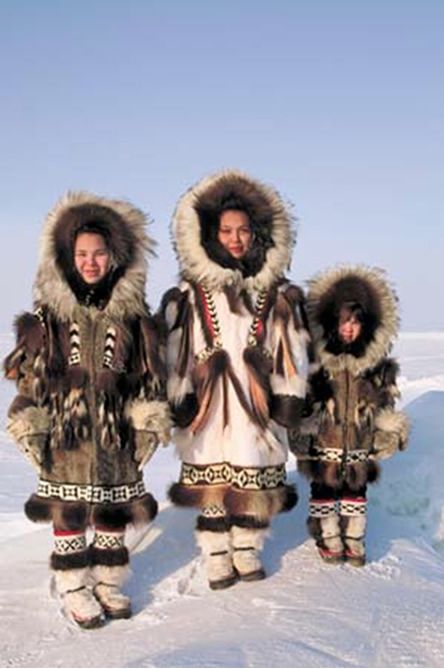
Unlike a lot of Native American cultures, Arctic tribes like the Inuit sometimes still wear their traditional parkas, a lot of times made from caribou fur for added insulation.

Clothing: Most clothing was made from caribou skin though polar bear, seal, wolverine, squirrel, bird, and fish skins were also used. And it was primarily fashioned for insulation from freezing temperatures and wind. In winter, people wore inner (fur side in) and outer fur side garments (fur side out). But only the inner garment was worn during the summer fur side out. The winter outer garment was a heavy hooded jacket, often lined with fur known as a parka. A mother might wear an extra-large parka to shelter babies. Both sexes wore pants, stockings, mittens, seal skin boots, or low shoes. Raincoats were sewn with waterproof gut. Clothes were often decorated with colored furs or fringe. Men wore snowshoes and snow goggles while hunting in the winter. Adornments consisted of labrets (lip plugs), ear pendants, nose rings, and tattoos. Sothern tribes wore close fitting shits and pants. While Aleut women wore seal or otter skin parkas, Aleut men wore parkas of bird skin where the feathers turned in and out depending on the weather. Aleut children wore down parkas with tanned bird skin caps.

Sled-dogs-archives-e1312915857730

Sleds pulled by dogs and kayaks were the primary modes of transportation among the Arctic Native Americans. Dog sleds for land and kayaks for water. Luckily I found a picture that had both a kayak and sled dogs.

Transportation: Kayaks were closed boats made for one man and used for hunting. Larger open umiaks made from wooden frames and sewn skins for water navigation. Umiaks were employed for either whale hunting or general travel (in the latter case, they’d be paddled and/or rowed by women). Wood and rawhide sleds were pulled by either dogs or people and were used for winter travel.

Society: This was a sparsely populated area that could have consisted as many as 80,000 pre-European contact. Lived a mostly nomadic culture where group members saw themselves tied to the land. Members lived in an isolated existence and would organize into bands on a seasonal basis. Leadership was generally underdeveloped. When strong leaders emerged, there was little formal structure and usually for a temporary situation like whaling expeditions. Leaders were usually older, experienced men who might be leading household heads and probably owned an umiak. Also had a very bloody history of intertribal warfare.

502232021_640

Another scene from Nanook of the North. This one depicts Nanook’s wife Nyla with their baby playing with the husky puppies. Arctic nuclear families normally consisted of 5 to 6 people at a time. And Arctic family life wasn’t always as happy as what you see in this 1922 film. Still, this moment is so filled with cuteness.

Family Structure: Nuclear families usually consisted of 5 to 6 people. Hunting sea mammals was the primary occupation of most men because it could be highly dangerous and/or extremely demanding. Women sewed up skins, cooked food, tended lamps, and looked after children. Both men and women took part in igloo construction. Descent was generally bilateral. Kinship was of such primary importance so much that “strangers” (those who couldn’t immediately document kin affiliations) were perceived as potentially hostile and might be summarily killed. Other groups subject to willful death were infants (especially girls) and old people. Cannibalism and suicide weren’t uncommon, but only in extreme cases of need. Prospective husbands often served the bride’s parents for a period of time (bride service). Wife stealing (committed in the overall competition of supremacy) might result in death as possibly other conflicts. Murders were subject to revenge. Corpses were generally wrapped in skins and left on the ground. Southwest Inuit and Aleuts practiced mummification. Yupik parents tend to name their children after the last person in the community to have died.

07032

While the Inuit mostly dominate the Arctic cultural Native American landscape, the Aleut and the Yupik also reside there. These are Aleuts who reside in the Alaskan Aleutian Islands while the Yupik live in western Alaska. Both groups also live in part of Siberia as well.

Practices: Bone, antler, and ivory figurines, amulets, and toys. Wooden ceremonial and dance masks. Basket weaving, animism, shamanism, music, acrobatics, kickball, string games, and storytelling.

Tools and Weapons: Harpoon, bow and arrow, needle, thimble, knife, adze, ax, drill, scraper, spear, and shovel, primarily from bone and antler as well as chipped stone (for points, blades, scrapers, and pots). Other tools include baleen boxes, soapstone pottery, oil and blubber burning lamps with moss wicks, movement indicators (for breathing-hole sealing), throwers, various types of harpoons (with detachable heads), seal nets, clubs, bird bolas, three pronged spears, fish hooks, stone fish weirs, as well as animal traps and snares.

Notable Tribes: Inuit, Aleut, and Yupik. Some of the Aleut and Yupik are known to reside in Siberia.

In Defense of Labor Unions

image-20150324-17672-1azzmd0

Though unions have greatly shaped the United States throughout much of the 20th century but have fallen out of favor in recent years. While in the 1950s about 1 in 4 workers were unionized, today only 1 in 10 and that number is declining fast. Unions have lost a lot of their power due to things like outsourcing, right to work laws, negative economic conditions, special interests, companies prohibiting them, or other factors. Not to mention, there isn’t a very favorable attitude toward them either for they’ve been blamed for taking away jobs, hurting the economy, or inconveniencing the populace. Some say that unions have served their purpose and aren’t needed anymore. However, as we all remember Scott Walker’s attempt to strip public sector workers of their collective bargaining rights and fast food worker strikes, many Americans don’t really want to see them go away. In fact, perhaps labor unions are still as relevant as ever today and actually do help this country.

Here's a German painting of a bunch of guys working in a foundry during the 19th century. Notice how there's no attention being paid to workplace safety. Also, imagine doing this work 6 days a week at 16 hours a day for less than minimum wage.

Here’s a German painting of a bunch of guys working in a foundry during the 19th century. Notice how there’s no attention being paid to workplace safety. Also, imagine doing this work 6 days a week at 16 hours a day for less than minimum wage.

1. Unions help create better jobs.

Regardless of what detractors may say, unions don’t really take away jobs since mass unemployment is one of the things unions always seek to avoid. It’s usually business management who does since they usually make the decisions whether it’s in the name of profits or power. Sure unions were probably part of the reason why many American industries moved operations overseas for cheaper labor, but not all jobs can be outsourced, especially service jobs. Even so, most jobs in today’s market aren’t unionized but many aren’t very desirable either with long hours, low wages, no room for advancement, not much safety or benefits, and are held for a rather short time. Of course, while businesses may like cheap and expendable workforces, but job seekers and workers do not. Workers don’t like such labor because it gives them little control over their lives and keeps them on the brink of economic instability. Job seekers don’t like them because it gives them more competition in an uncertain job market where obtaining a job can be more trouble than it’s worth. Recent college graduates have it the worst since many job listings have certain specifications that they may not be able to fulfill. However, this doesn’t mean that young people don’t have the skills to be productive citizens, it’s because the pool of job seekers is too big and employers are a very picky bunch and want an employee who’s already tailor made as well as with job experience. Still, though I’m not sure organized labor may make job seekers’ lives any easier, they do create better jobs and history proves it. Unions have helped make many crummy low wage, hazardous, and long hour jobs into decently paid eight-hour a day jobs with workplace safety, overtime pay, health benefits, personal leave, holidays, pensions, and workman’s comp. Jobs like these are very desirable and reduce turnovers and layoffs which may help reduce competition among job seekers since not many people are as desperate to find one. A job is only low wage not because the work is easier but because low wages are only arbitrary values set by employers. We should also understand that Costco employees work the same jobs as anyone else in the retail sector, yet they are treated much better than other retail workers. Thus, low wages often reflect not what the job entails, but the values of the employer.

In the early 20th century, the US experienced some of the deadliest industrial disasters in history. On March 25, 1911, a scrap bin fire at New York City's Triangle Shirtwaist Factory would lead to the deaths of 146 people because the owners locked the doors to the stairwells and exits to prevent theft. This would lead to growth in unionization for garment workers as well as improved safety standards.

In the early 20th century, the US experienced some of the deadliest industrial disasters in history. On March 25, 1911, a scrap bin fire at New York City’s Triangle Shirtwaist Factory would lead to the deaths of 146 people because the owners locked the doors to the stairwells and exits to prevent theft. This would lead to growth in unionization for garment workers as well as improved safety standards.

2. Unions help check and hold employers accountable.

While unions help improve workers’ lives, they also help check and hold employers accountable as well as serve as a middle man in workplace and labor relations. A unionized workplace gives employers incentive to treat their workers decently, helps set workplace standards, limit unfair labor practices, and does all it can to ensure that workers receive a fair deal. As a political lobby, they call for legal incentives in order to assure worker’s rights are recognized by law and that employers should observe them. Without unions, many employers would simply get away with treating workers like crap as well as run his or her business with little account to them. And for many years, workers have suffered in the name of profit. Sure there may be companies like Costco who provide their employees with a living wage and benefits, but they’re not the norm in the service industry or any non-unionized industry. Before many blue collar work places had unions like the coal mines and steel industry, it wasn’t unusual for workers to be paid shitty wages and treated like crap. And when these workers finally got the salary, hours, and benefits they wanted, it wasn’t because the management was trying to be nice to them. Then there’s the fact low income workers in non-unionized workplaces are especially prone to becoming victims of wage theft (especially undocumented immigrants), in which employers deny their workers their wages and benefits rightfully owed like minimum wage violations, overtime pay, employee miscalculation, illegal deductions, working off the clock, or not being paid at all. In the US, wage theft is very severe, widespread, and costs the country $40-$60 billion each year which is more than how much money the country loses due to robbery ($340 million), burglary ($1.4 billion), larceny ($5.3 billion), and auto theft ($3.8 billion) as of 2012. This is a crime but because these workers aren’t allowed to form unions due to company policy, a lot of wage theft goes undetected and laws against it aren’t often enforced. And even if workers do win their cases on wage theft, they usually don’t receive a dime of what they’re owed by the employers. Unions can be effective in deterring wage theft since they tend to go on strike over such incidences.

Here's a rough list of what labor unions have done for American workers. Sure unions may represent special interests, yet their interests tend to benefit practically everyone.

Here’s a rough list of what labor unions have done for American workers. Sure unions may represent special interests, yet their interests tend to benefit practically everyone.

3. Unions help promote the democratic process as and 1st Amendment rights.

While unions may be corrupt, they nevertheless serve as a powerful lobbying voice for a major demographic that couldn’t afford a lobbyist otherwise. For years labor unions have always provided a political voice to the common man as well as helped lobby for legislation in favor of ordinary people. In fact, worker’s rights has always been a special interest to unions, which affects most Americans. In the workplace, unions give workers a voice in major workplace decisions as well as protects workers’ 1st Amendment rights relating to their professional lives. If workers feel they’re being treated unfairly they can talk to each other, address their grievances, negotiate a compromise, or go on strike if employers still won’t listen. In many ways, unions help promote the democratic process in both government and in the business world since they stand for a worker’s right to be treated with dignity and respect. Not to mention, they also lobby for a worker’s right to self-govern which is a very American value indeed. Besides, while unions may be identified to the political left, they are probably the closest thing in the K Street lobbying world that best represents the interests of most Americans, especially after Citizens United when most lobbies and corporations don’t. This goes to even non-union members as well as those who oppose them and that’s why having non-union members pay dues in a unionized workplace makes sense. In fact, a lot of their campaigns might pertain to measures like raising the minimum wage, protecting migrant farm workers, mandated paid leave, and other policies designed to help even the lowest earning workers. They even campaigned for policies advancing civil rights for women and minorities as well as protecting the environment. And within companies, unions area powerful, sophisticated player concerned with more than just the next quarters profits at shareholders’ meetings.

Famed union organizer Walter Reuther understood the value unions had in the American economy. When asked how he'd planned to get his men to pay union dues while being shown automated production lines at Ford, Reuther replied, "How do you plan to get them to buy your cars?"

Famed union organizer Walter Reuther understood the value unions had in the American economy. When asked how he’d planned to get his men to pay union dues while being shown automated production lines at Ford, Reuther replied, “How do you plan to get them to buy your cars?”

4. Unions greatly contribute to the economy equality and promote economic activity.

Since unions help create and expand the middle class, they also help decrease income inequality and generate activity in the modern consumer economy. Unionized workers earn more money than their non-union counterparts as well as likely to spend more. The middle class has always played a critical role in a nation’s economy and the US is no exception. Higher earning workers make good consumers since they have more disposable income as well as a great demand for products. And the bigger the middle class, the more consumers there are, the more money businesses make, and the better the economy. Also, higher incomes provide governments with more tax revenues.

As far as non-union workplaces go, Wal Mart has become the poster child of workplace violations as well as paying its employees poverty level wages. It's said that Wal Mart's low wages cost US taxpayers about $1.5 billion a year since the retail giant has a lot of workers on public assistance.

As far as non-union workplaces go, Wal Mart has become the poster child of workplace violations as well as paying its employees poverty level wages. It’s said that Wal Mart’s low wages cost US taxpayers about $1.5 billion a year since the retail giant has a lot of workers on public assistance.

5. Unions save taxpayer money.

Of course, in 21st century America social programs are a mainstay, yet many on government assistance have also been bashed as lazy unemployed freeloaders or drug addicts (personally I’d rather have my tax dollars go to some worthless bum’s government assistance payment than corporate subsidies.) Sure there maybe a few freeloaders among welfare recipients but the public assistance pool is pretty diverse group including the disabled, children, veterans, mentally ill, elderly, chronically ill, and even the working poor. Such public assistance is greatly limited and only provides short term aid. Now the working poor are a pretty unlucky bunch who are probably more likely to end up on public assistance than anyone else in the workforce. They are also more likely to work for an employer prohibiting unionization like Wal Mart as well as have a low paying job with terrible conditions and awful labor practices. Though many conservatives don’t like public assistance programs or unionism, many fail to realize that bad labor practices can cost taxpayers millions, especially if there’s no labor union to challenge them. Low wage workers aren’t just least likely to support themselves and families, they are also more prone to on the job injuries resulting in disability or death, develop work-related health problems which may become serious if left untreated, unemployment, and other things. In many ways the working poor are either welfare cases or welfare cases waiting to happen (including those with dependents). And to some workers, government assistance may be the only option since employers may not listen to demands or maybe even fire someone for whatever reason, especially when it comes to forming a union. A company like Wal Mart is notorious for shifting it’s labor burdens on the taxpayer which isn’t fair for anyone. Since unions help clamp down on bad labor practices, they also help save taxpayer money.

Here is a diagram on the difference being part of a union makes at work. Since union workers are protected under legal contract, they aren't liable to as many workplace abuses as their non-union counterparts. Whereas if a non-union worker is unfairly treated, there is nothing they can do.

Here is a diagram on the difference being part of a union makes at work. Since union workers are protected under legal contract, they aren’t liable to as many workplace abuses as their non-union counterparts. Whereas if a non-union worker is unfairly treated, there is nothing they can do.

6. Unions give workers more control of their lives.

Not only do unions help create a middle class as well as provides a voice for workers, they also allow workers better control of their lives even beyond the confines of their job. Bad labor practices can hurt families and ruin a person’s life. And it’s not unusual for a low wage earner to take more than one job which can result in more time away from home, coming in sick, sending sick kids to school, or leaving them unsupervised from hours on end. Low wage jobs don’t give workers enough to live on or even any room for social mobility. In fact, many of low wage workers live in poverty as well as have their kids suffer the same fate. In many respects, bad labor practices can have long term consequences for not only workers but workers’ families. And in many respects, unionization has helped many kids from working families go to college. Not only that, but since unions give workers leverage against their employer, workers not only can collectively bargain for higher wages as well as know how much each worker owns, but also go to their managers with safety concerns or ideas to improve efficiency and know that they’ll not only get a hearing, but also be protected from possible reprisals.

Wal Mart is notorious non-union workplace which is known to face class action lawsuits every year amounting to millions of dollars. This has given them a very infamous reputation in the field of labor relations. This is especially when the retail giant decided to open on Thanksgiving. And since it's the leading retailer, many stores ended following suit.

Wal Mart is notorious non-union workplace which is known to face class action lawsuits every year amounting to millions of dollars. This has given them a very infamous reputation in the field of labor relations. This is especially when the retail giant decided to open on Thanksgiving. And since it’s the leading retailer, many stores ended following suit.

7. Unions help companies and businesses.

Since unions crack down on bad labor practices, they also help their workplaces in many ways. For one, they make the workplace a much cleaner and safer environment for both workers and consumers alike. Paid sick leave can help keep a worker’s illness from infecting not only their peers but also customers. And paid sick leave for a sick child can prevent other kids from getting sick as well. Unions also help employers by not just giving them consumers but also save money on fighting lawsuits as well as gives them a better reputation. A business with good labor standards not only makes consumers more willing to buy from them, but also makes employees happier working for them, may be even proud. I mean look at Costco’s reputation is much better than Wal Mart’s for this reason. Of course, Costco doesn’t have unions either but it certainly wouldn’t be the company it is if unions never existed.

This is New England Patriots quarterback Tom Brady. Some time ago, Brady was implicated in Deflategate and the NFL charged him with a 4 game suspension. Brady appealed to the NFLPA (which is the players' union) and got that suspension removed by order from a federal court. Yes, I know this is a terrible example of unions at work. However, if people think unions are either outdated or bad, then why do unions for people like Tom Brady exist?

This is New England Patriots quarterback Tom Brady. Some time ago, Brady was implicated in Deflategate and the NFL charged him with a 4 game suspension. Brady appealed to the NFLPA (which is the players’ union) and got that suspension removed by order from a federal court. Yes, I know this is a terrible example of unions at work. However, if people think unions are either outdated or bad, then why do unions for people like Tom Brady exist?

8. Professional athletes and movie stars have unions.

I know that many people associate unionism with teachers and blue collar workers. However, we should understand that unionism isn’t just confined to the public sector or blue collar jobs that don’t earn a lot of money. For instance, professional athletes have their own union like the NFLPA that helped New England Patriots quarterback Tom Brady get out of a 4 game suspension after he implicated in the Deflategate scandal. People in show business also have unions like the Screen Actors Guild whose most famous president was Ronald Reagan at one point. Now neither group is economically in dire straits, but they have union representation nevertheless. That’s because no matter how rich you are, if you’re working for someone, sometimes policies won’t be in your favor. So if rich people feel they need unions, maybe their poorer counterparts feel the same way. Besides, even the most conservative union members wouldn’t want to get rid of theirs.

Here's a satirical cartoon making fun of union opposition. However, it makes a good point on how business don't like certain policies that unions advocate. Then there's the fact that companies don't want to pay extra costs to protect and make them happy or deal with strikes.

Here’s a satirical cartoon making fun of union opposition. However, it makes a good point on how business don’t like certain policies that unions advocate. Then there’s the fact that companies don’t want to pay extra costs to protect and make them happy or deal with strikes.

9. Anti-Unionism is all about big business wanting more power and control over their labor force.

In recent years, Unionism has been on the decline for 2 reasons. First, a lot of blue collar paying jobs were lost during the 1980s, many of which had union representation. Second, many people in the private sector work for big corporations that simply won’t allow them. It’s very well known that big business doesn’t like unions and calls them obstructionists. Yes, unions may have their faults and might inconvenience people. However, I always think that the reason why many workplaces in the country prohibit workers from unionizing has more to do with them wanting more power and control over their workforce than anything else. And if it’s not the workplaces, then it’s free market conservatives who think that corporations having free reign is best for the economy (when in reality, it’s not). For instance, a Volkswagen plant in Tennessee was prevented from unionizing by the state legislature, not management. Sure they want to hire and fire whoever they want. But they also want to control their employees’ hours and only want to pay them as much as it takes to keep them there. Passage of so-called “right to work” laws aimed at curbing union influence, have led to decreased wages and increased poverty rates in several US states. And it’s clear that these laws weren’t aimed to benefit workers but large corporations seeking more power and control of their labor force.

Nearly have the states in the US have "Right to Work" laws in which non-union members don't have to pay union dues in a unionized workplace. Yet, these laws minimize union power as well as lead to devastating consequences such as lower wages, higher uninsurance rates, higher poverty rates, and more workplace fatalities.

Nearly have the states in the US have “Right to Work” laws in which non-union members don’t have to pay union dues in a unionized workplace. Yet, these laws minimize union power as well as lead to devastating consequences such as lower wages, higher health uninsurance rates, higher poverty rates, and more workplace fatalities. Such factors can have devastating consequences not only for the workers, but also for their families (especially children) and communities.

10. The benefits of unions extend to workers’ families and improve society.

While unions may have their faults, we have to acknowledge the fact that they’ve helped not just the workers themselves but also their families, their descendants, and society as a whole. For instance, before many of these blue collar jobs were unionized, it wasn’t unusual for workers to begin their jobs as children after dropping out of school. In fact, it was a very common thing, especially with the Industrial Revolution in the 19th century. Just ask none other than Charles Dickens who wrote extensively on child labor and why it was a really terrible thing. Why? Because even though their parents might work 12-16 hour days, they could never earn enough money to support their family. Not to mention, a lot of these jobs were dangerous and could put a family in economic disaster because there was no compensation or safety standards. Even when public education was available, it wasn’t always compulsory and a lot of poor kids tended to drop out if their parents’ paychecks couldn’t cover the rent or in the event of a family emergency. And it was because these children were put to work at an early age, they were denied a basic education and the economic opportunities that came with it. So they ended suffering the same fate as their parents. Unions have been very instrumental in curbing child labor in blue collar industries since they gave adult workers leverage so their workplaces would provide them a fair wage, benefits, an 8-hour day, workman’s comp, and medical leave as well as observe workplace safety standards. Such measures not only made workers’ lives easier, but they also allowed children to go to school and stay there as well as focus on their schoolwork so they’d excel and perhaps get into a good college so they can have better opportunities. Now this didn’t necessarily happen overnight. But it’s a major reason why cities like Pittsburgh managed to bounce back after what happened to the steel industry in the 1980s (though I admit that some industrial areas in the Rust Belt haven’t been so lucky like Detroit. But even in those places, things could’ve been worse). Still, when you’re in such cities like Pittsburgh, you’ll find a lot of professionals like doctors, lawyers, teachers, and what not who had ancestors who were coal miners, mill workers, and factory workers. Sure they may say that some of them achieved success by hard work which certainly fits into the equation. However, if their blue collar ancestors didn’t pressure their bosses to unionize they would not be where they are today. Yet, though unions have made the world a decent, that doesn’t mean they’re no longer needed. In the US, we should be reminded time and time again that a parent’s life at work has a profound effect on a child’s progress in school, the quality of their education, life in their neighborhood, and even their health. That is still very much the reality today as it was back in the Gilded Age since a lot of service industry parents work minimum wage jobs, sometimes more than one. A child whose parents work at Sam’s Club is never going to have the same opportunities and quality life than one whose parents work at Costco, despite that both sets have the same job with the same responsibilities. However, we must understand that the Costcos in this world are a rarity and most companies have never been so accommodating to their workers. If most workers in the service industry want those Costco benefits so their kids could have better lives, then unionization might be the only thing possible for them to accomplish that.

Here's a picture of children working at a factory back in the day mostly because their parents work starvation wages and long hours. Since unions helped curbed child labor, be glad you don't have this. Or at least at Gilded Age capacity.

Here’s a picture of children working at a factory back in the day mostly because their parents work starvation wages and long hours. Since unions helped curbed child labor, be glad you don’t have this. Or at least at Gilded Age capacity.

The Tiled World of Mosaics

Vichten-Big-02

While stained glass has been around for over 1000, mosaics have existed even longer. Much longer. The first known mosaics date to the 3rd millennium BCE in Ancient Mesopotamia. They have been found in Ancient Greece and Rome as well as in early and medieval Christian churches around the Mediterranean. Not only that, but they have been used in early mosques in the Middle East during the early days of Islam as well as in medieval synagogues. And they have decked floors, walls, and ceilings. While stained glass only uses colored glass to create pictures, mosaics can use anything from stone, glass, ceramic, or other materials. But these are usually carved into very small pieces and different colors known as tesserae (a term you might’ve heard regarding welfare supplements in the Hunger Games which families receive in exchange for their kids entering their name into the Reaping multiple times). And while the default use of mosaics was mostly floor decoration, they can also be used on walls and ceilings. Hell, they can even be on 3-dimensional objects, too. But I’m sure this isn’t a craft for patient minds or hands. Yet, it’s not uncommon for people to do mosaics with photographs as well. However, in this post photo mosaics aren’t really the focus here. So for your reading pleasure, I give you a look into the world of mosaic art.


  1. We’ll start with a bouquet of roses.
Well, a ceramic image of roses to be exact. Seems like all these pieces are cut in just the right way.

Well, a ceramic image of roses to be exact. Seems like all these pieces are cut in just the right way.

2. Looks like someone is surrounded by butterflies.

However, I wonder how her hair is up like that. Or whether the butterflies are getting in her hair.

However, I wonder how her hair is up like that. Or whether the butterflies are getting in her hair.

3. Guess this garden shovel isn’t for digging.

Sure it's only for a decorative purpose. But it surely looks grand even if you can't use it.

Sure it’s only for a decorative purpose. But it surely looks grand even if you can’t use it.

4. Whoever said that mosaics were only for floors, walls, and ceilings?

Guess mosaic art can be successfully applied to lawn fixtures. However, I'm sure the mosaic bird baths won't retain their colorful splendor for long.

Guess mosaic art can be successfully applied to lawn fixtures. However, I’m sure the mosaic bird baths won’t retain their colorful splendor for long.

5. This mosaic bluebird only sends love.

I think there's an artist who does mosaics like this. But at any rate, the bird is pretty.

I think there’s an artist who does mosaics like this. But at any rate, the bird is pretty.

6. A white shelf can contain a pink floral pattern on its walls.

Wonder how long it took to get this mosaic done. Still, goes well with the shelf.

Wonder how long it took to get this mosaic done. Still, goes well with the shelf.

7. By applying shiny tiles on old bottles, who knows how they’ll turn out.

These look like bottles you'd see in some bazaar in Aladdin. Didn't know you could make bottles look this good before.

These look like bottles you’d see in some bazaar in Aladdin. Didn’t know you could make bottles look this good before.

8. Broken china plates can always be reused to decorate a chair.

However, this doesn't mean I'd want to sit on it. Because I'd be afraid of messing something like that up.

However, this doesn’t mean I’d want to sit on it. Because I’d be afraid of messing something like that up.

9. A floral table always goes well in any living room.

Doesn't hurt if such mosaic uses bright colors either. However, you might want to place coasters on it before you set your drink.

Doesn’t hurt if such mosaic uses bright colors either. However, you might want to place coasters on it before you set your drink.

10. If you don’t like stringing beads, make a picture from them.

This sure looks pretty. Love the bright colors. Not sure what it's supposed to look like.

This sure looks pretty. Love the bright colors. Not sure what it’s supposed to look like.

11. Never seen a tree against a sky of glass.

Well, it's actually a tiled tree against a mirror background. But it seems to go well with the style.

Well, it’s actually a tiled tree against a mirror background. But it seems to go well with the style.

12. Looks like some of these flowers are larger than others.

This one uses some of those glass stones and flower pieces. All in all, makes a great tile display.

This one uses some of those glass stones and flower pieces. All in all, makes a great tile display.

13. Nothing makes your patio great like a floral tiled table.

Not sure if I'd want a mosaic table exposed outdoors. But I really love the colors on this one, especially the purple.

Not sure if I’d want a mosaic table exposed outdoors. But I really love the colors on this one, especially the purple.

14. Out of the stonework, purple flowers bloom.

Yes, the flowers might seem like they're real or pressed. But they're not. They're made from ceramic tile.

Yes, the flowers might seem like they’re real or pressed. But they’re not. They’re made from ceramic tile.

15. Even sacred art can be depicted in tiny stone pieces.

This one is of the Maddonna and Child. However, while there are a lot of early Christian mosaics, a lot of them also have pieces missing.

This one is of the Madonna and Child. However, while there are a lot of early Christian mosaics, a lot of them also have pieces missing.

16. Nothing’s more amazing than seeing a bright red flower on the floor.

Sure it's not the whole artwork. But that red flower surely looks brilliant in ceramic tile.

Sure it’s not the whole artwork. But that red flower surely looks brilliant in glass tile.

17. Sometimes there’s nothing more quaint than a lovely town sunset.

This almost resembles a painting with the artistic detail. But it's only a painting of tile. And a very good painting at that.

This almost resembles a painting with the artistic detail. But it’s only a painting of tile. And a very good painting at that.

18. How about a purple pansy on your patio table?

Well, here's a large pansy of mosaic tile. All in its spring glory, in fact. Love it.

Well, here’s a large pansy of mosaic tile. All in its spring glory, in fact. Love it.

19. With tile, you can decorate almost anything with no limits.

This one has a mosaic, wall and stairs. You might notice how they use shells, in this as well. Stunning.

This one has a mosaic, wall and stairs. You might notice how they use shells, in this as well. Stunning.

20. You’ve seen flowers through a window. How about flowers in a window?

This one uses glass pieces inside an old window frame. And I'm sure you'll be in awe of these glass flowers.

This one uses glass pieces inside an old window frame. And I’m sure you’ll be in awe of these glass flowers.

21. You’ve heard of a heart of glass. How about a heart of ceramic?

It's all made in a bunch of tiny pieces, too. Also has a golden touch to it.

It’s all made in a bunch of tiny pieces, too. Also has a golden touch to it.

22. While all hearts beat alike, they don’t always look the same.

You can say the same about these hearts in this window. Each one is made up of different pieces.

You can say the same about these hearts in this window. Each one is made up of different pieces.

23. How about a view of inside looking out.

This one seems to depict someone inside looking out into a seaside town. You can almost think it's a painting.

This one seems to depict someone inside looking out into a seaside town. You can almost think it’s a painting.

24. Sometimes mosaic work can make wonderful door decor.

Both sides seem to have different themes to it. Yet both seem to be so artistically well done.

Both sides seem to have different themes to it. Yet both seem to be so artistically well done.

25. Sometimes an owl may appear more fearsome close up.

Yes, this is an owl mosaic close up. Yet, those bright yellow eyes seem so intimidating.

Yes, this is an owl mosaic close up. Yet, those bright yellow eyes seem so intimidating.

26. This mosaic frame gives a real homey touch.

Yes, mosaic picture frames do exist. However, I especially like the little cups on this one. So clever.

Yes, mosaic picture frames do exist. However, I especially like the little cups on this one. So clever.

27. The mirror reflects only on a small pool where the water’s supposed to be.

Mirror frames can also have mosaics on them. Hut this one has only a small one.

Mirror frames can also have mosaics on them. Hut this one has only a small one.

28. Perhaps you’ve never seen anything as magnificent as a mosaic tiger.

Well, I've never seen such an ornate tiger like that before. And in multiple colored stripes, too.

Well, I’ve never seen such an ornate tiger like that before. And in multiple colored stripes, too.

29. Here we come across a green haired girl with a golden streak.

Well, she has her hair multiple colors. But mainly green. The gold strand stands out though.

Well, she has her hair multiple colors. But mainly green. The gold strand stands out though.

30. How about some poppies among a scene of black?

Of course, you don't want to come across a cultivated poppy field in Afghanistan. Because you should know what those poppies are for.

Of course, you don’t want to come across a cultivated poppy field in Afghanistan. Because you should know what those poppies are for.

31. Have you ever came across a funky colored chair like this?

Yes, it's another mosaic chair. But this is in a very different style than the last one. And it has a few hearts to it.

Yes, it’s another mosaic chair. But this is in a very different style than the last one. And it has a few hearts to it.

32. A circle surface should take a circular design.

Of course, a lot of mosaics use geometric designs like the stained glass windows. But I like this one especially due to the purple center.

Of course, a lot of mosaics use geometric designs like the stained glass windows. But I like this one especially due to the purple center.

33. It’s not every day you come across a blue tiled shell.

This one is covered in ceramic tiles and beads. At any rate, it must be either a large shell or one that has very small pieces.

This one is covered in ceramic tiles and beads. At any rate, it must be either a large shell or one that has very small pieces.

34. This bottle seems rather reflective.

Mostly because it's covered in mirrors. But I wouldn't mind having that in my house.

Mostly because it’s covered in mirrors. But I wouldn’t mind having that in my house.

35. Never seen a peacock column like that before.

I really like this one since the mosaic has so many tiles with very bright colors. Also how it reflects off the light.

I really like this one since the mosaic has so many tiles with very bright colors. Also how it reflects off the light.

36. Sometimes it helps that you go with a table that matches the carpet.

And this one seems to go with the decor quite nicely. Kind of seems more like an antique than it actually is. But has a certain something to it.

And this one seems to go with the decor quite nicely. Kind of seems more like an antique than it actually is. But has a certain something to it.

37. Nothing seems more breathtaking to some than an ocean sunset.

As with stained glass, you see a lot of ocean mosaics on Pinterest. This one is one of the better ones.

As with stained glass, you see a lot of ocean mosaics on Pinterest. This one is one of the better ones.

38. This bottle surely has a rather festive disposition.

Well, this one surely has a lot of loud colors to it. But the shapes sure seem stunning.

Well, this one surely has a lot of loud colors to it. But the shapes sure seem stunning.

39. These blue parrots surely know what love means.

Of course, parrots might mate for life. Yet, you have to like the brilliant blue shades on this, too.

Of course, parrots might mate for life. Yet, you have to like the brilliant blue shades on this, too.

40. Remember to keep your ceramic birds all in rows.

These are very lovely. Like how they're all the same size. But each of them has a different color to them.

These are very lovely. Like how they’re all the same size. But each of them has a different color to them.

41. On this bottle, a shadow shows a ray of sunshine.

Now this bottle mosaic has to be made from stained glass. Yet, uses a sunset color scheme.

Now this bottle mosaic has to be made from stained glass. Yet, uses a sunset color scheme.

42. These blue flowers sure look pretty encased in stone.

Well, these certainly look stunning. The blue flowers almost look either real or painted on.

Well, these certainly look stunning. The blue flowers almost look either real or painted on.

43. Nothing looks lovely in stone like a bare tree in the night.

Or during a sunset, anyway. Like how the tree is encased in the clay lines among the tiles.

Or during a sunset, anyway. Like how the tree is encased in the clay lines among the tiles.

44. Well, this mosaic seems familiar to me for some reason.

Had a poster that looked just like this in college. However, it wasn't in the best shape when I tried taking it down though.

Had a poster that looked just like this in college. However, it wasn’t in the best shape when I tried taking it down from my dorm room though.

45. The sun shines brightly in this window.

Well, this sun was made with a window frame, anyway. Still, not sure about the background.

Well, this sun was made with a window frame, anyway. Still, not sure about the background.

46. The fox and the bird seem to get along well.

Never mind that the fox would probably eat the bird in real life. Yeah, interspecies relationships seem quite rosy.

Never mind that the fox would probably eat the bird in real life. Yeah, interspecies relationships seem quite rosy.

47. Now this gives a whole new meaning to the word, “flower pot.”

After all, it's a pot decorated with flowers. Hopefully someone plants flowers in it.

After all, it’s a pot decorated with flowers. Hopefully someone plants flowers in it.

48. Here is a mother owl keeping her owlet under her wings.

You get the impression that there are a lot of mosaics depicting birds. And this one won't be the last. But it's cute.

You get the impression that there are a lot of mosaics depicting birds. And this one won’t be the last. But it’s cute.

49. Looks like this bird is on a lonely perch.

This bird almost looks like one you'd see from your window. But it's in ceramic tile.

This bird almost looks like one you’d see from your window. But it’s in ceramic tile.

50. Guess these boots were made for planting.

Yet, they also have lovely mosaic decoration on them. Also like the flowers in them. Yes, these are boot planters.

Yet, they also have lovely mosaic decoration on them. Also like the flowers in them. Yes, these are boot planters.

51. There are a few things as magical as a white tiger in tile.

At least this one doesn't have pink stripes like the one in stained glass. Almost looks like a photograph.

At least this one doesn’t have pink stripes like the one in stained glass. Almost looks like a photograph.

52. In this pane, it’s a flower per window.

Well, not quite. But you have to admire how pretty these flowers are as well as the craftsmanship.

Well, not quite. But you have to admire how pretty these flowers are as well as the craftsmanship.

53. This art nouveau mosaic is surely a beauty.

Not sure if it's from the 19th century or made to look like it. At any rate, it's stunning.

Not sure if it’s from the 19th century or made to look like it. At any rate, it’s stunning.

54. This blue green cross has a lot of metal on the surface.

Yes, this a cross mosaic. And yes, it says, "Believe" on it. But it's still quite lovely.

Yes, this a cross mosaic. And yes, it says, “Believe” on it. But it’s still quite lovely.

55. Even when you look closer, it’s hard to tell what’s going on in this window.

Yeah, it's kind of hard for me to tell what's going on in here. Then again, it might be an abstract piece.

Yeah, it’s kind of hard for me to tell what’s going on in here. Then again, it might be an abstract piece.

56. For some, there’s nothing like seeing an orca jumping out of the ocean.

And in the setting sun, no doubt. Yes, that's simply a mosaic that's wondrous to look at.

And in the setting sun, no doubt. Yes, that’s simply a mosaic that’s wondrous to look at.

57. Not sure if this planter outshines its plant.

Sure you might find a lot of mosaic outdoor decor for some reason. Maybe because people prefer a tiled patio look. I'm just guessing here.

Sure you might find a lot of mosaic outdoor decor for some reason. Maybe because people prefer a tiled patio look. I’m just guessing here.

58. You’d almost think these flowers came from your garden.

Well, some of them seem to come from the gardens in my house. Save for maybe the blue ones.

Well, some of them seem to come from the gardens in my house. Save for maybe the blue ones.

59. Not sure what to say about a heart on a rock.

Well, I tend to find a lot of these on Pinterest. However, this one seems to stand out since the rock appears quite large. Like door stop large.

Well, I tend to find a lot of these on Pinterest. However, this one seems to stand out since the rock appears quite large. Like door stop large.

60. There’s nothing like a heron in the deep blue—uh, lake.

Well, there are probably some herons that live near saltwater. But the herons in my area are usually freshwater birds.

Well, there are probably some herons that live near saltwater. But the herons in my area are usually freshwater birds.

61. These bright flowers show brilliantly in white.

Well, they may have the same daisy shape. But each is in a different color. Like the blue one.

Well, they may have the same daisy shape. But each is in a different color. Like the blue one.

62. This barn owl surely looks majestic in the night.

This almost looks like the real thing from a far angle. Nevertheless, I think it's a hoot.

This almost looks like the real thing from a far angle. Nevertheless, I think it’s a hoot.

63. Who knows how many flowers are on this circle.

I guess this might be for a table. But at any rate, the flowers surely look stunning.

I guess this might be for a table. But at any rate, the flowers surely look stunning.

64. A tiled rose can almost seem so fantastic to be real.

This rose surely looks fairly 3-dimensional. However, in art, it's hard to tell whether something is at a certain point.

This rose surely looks fairly 3-dimensional. However, in art, it’s hard to tell whether something is at a certain point.

65. A mosaic like this must’ve been inspired by old Paris.

And it almost seems like you're seeing a photo of the city itself. Well, at least the Eiffel Tower.

And it almost seems like you’re seeing a photo of the city itself. Well, at least the Eiffel Tower.

66. Guess she’s what is known as a real flower girl.

Yes, this is a mosaic on a nude statue. But in the world of art, nudity isn't bound to offend anyone.

Yes, this is a mosaic on a nude statue. But in the world of art, nudity isn’t bound to offend anyone.

67. Looks like this cat has been up to no good.

Well, it seems to have a frightened expression. Yet, it seems quite lifelike.

Well, it seems to have a frightened expression. Yet, it seems quite lifelike.

68. Now that’s a very colorful butterfly.

This one has quite a few designs on its wings. Not to mention, it's meant to be put on display in a lawn.

This one has quite a few designs on its wings. Not to mention, it’s meant to be put on display in a lawn.

69. This mosaic seems rather fishy.

Well, it depicts 3 fishes on it. So saying it's fishy shouldn't be very far fetched.

Well, it depicts 3 fishes on it. So saying it’s fishy shouldn’t be very far fetched.

70. Never seen a blue tree before save in Dr. Seuss.

Almost seems like an embroidery sampler. However, it's probably made from glass and tile as I can see.

Almost seems like an embroidery sampler. However, it’s probably made from glass and tile as I can see.

71. Now this is the kind of sculpture that reflects in the sunlight.

Not sure what this is supposed to be. But I like it. I especially like the fact it's purple.

Not sure what this is supposed to be. But I like it. I especially like the fact it’s purple.

72. In some ways, this mirror needs a rainbow frame.

Well, it's not exactly rainbow but close. However, I think it's more suited for a bedroom than a bathroom. Just a thought.

Well, it’s not exactly rainbow but close. However, I think it’s more suited for a bedroom than a bathroom. Just a thought.

73. Bet you’ve never seen a lawn flamingo like this.

Yes, this is the a mosaic version of the tacky lawn decoration we know and love. Bet this was made in Florida.

Yes, this is the a mosaic version of the tacky lawn decoration we know and love. Bet this was made in Florida.

74. Guess this birdbath has an ocean theme.

Well, as far as I'm concerned. Still, despite what you see in the garden store, birdbaths are disgusting.

Well, as far as I’m concerned. Still, despite what you see in the garden store, birdbaths are disgusting.

75. Each of these turtles has a unique shell.

Yes, these are lawn turtles with mosaic shells. And yes, each is a unique work of art in its own way.

Yes, these are lawn turtles with mosaic shells. And yes, each is a unique work of art in its own way.

76. This peacock surely has a lovely feather train.

I guess peacocks are popular to depict in mosaics as well. Nevertheless, looks like a fine bird.

I guess peacocks are popular to depict in mosaics as well. Nevertheless, looks like a fine bird.

77. This blue elephant has a very ornate face.

Well, it's in an Indian art style. But let's say that despite their depictions as gentle giants, elephants aren't animals you should mess with.

Well, it’s in an Indian art style. But let’s say that despite their depictions as gentle giants, elephants aren’t animals you should mess with.

78. Guess this seems like a stroll in an quaint little village.

I think this might be copied from a painting. But I'm not sure. Yet, it looks kind of familiar.

I think this might be copied from a painting. But I’m not sure. Yet, it looks kind of familiar.

79. Well, that’s a highly decorated armchair.

However, I don't think it's comfortable to sit in. But I'll put it in my mosaics post since it's rather unique.

However, I don’t think it’s comfortable to sit in. But I’ll put it in my mosaics post since it’s rather unique.

80. This mosaic really gives a great view of the ocean.

There are a lot of beach scene mosaics on Pinterest. But I think this is probably the best one.

There are a lot of beach scene mosaics on Pinterest. But I think this is probably the best one.

81. Of course, a mosaic mirror must have reflecting pieces.

Well, at least on the frame. Nevertheless, this is a very lovely design.

Well, at least on the frame. Nevertheless, this is a very lovely design.

82. This stunning ceramic red fox appears to be from a painting.

And what a stunning red fox it is. I think I might've saw one while on my walks years ago. But not sure when.

And what a stunning red fox it is. I think I might’ve saw one while on my walks years ago. But not sure when.

83. Of course, you probably don’t have a bathroom counter as colorful as this one.

Then again, ceramic tiles tend to be in most bathrooms. Yet, this mosaic counter is probably not cheap in the least.

Then again, ceramic tiles tend to be in most bathrooms. Yet, this mosaic counter is probably not cheap in the least.

84. This mirror seems to reflect images all over the place.

Well, this is rather interesting. And it seems so finely made with very little color. Just mirror tiles.

Well, this is rather interesting. And it seems so finely made with very little color. Just mirror tiles.

85. This rainbow watering can pours like a charm.

Interesting how it always seems to be stuck like that. Then again, it's a mosaic sculpture so it's kind of intentional.

Interesting how it always seems to be stuck like that. Then again, it’s a mosaic sculpture so it’s kind of intentional.

86. Well, that’s just a picture of a small old barn.

Well, a mosaic picture. However, it surely seems lifelike or from a painting. Not sure if that's dead grass or wheat. Probably the latter.

Well, a mosaic picture. However, it surely seems lifelike or from a painting. Not sure if that’s dead grass or wheat. Probably the latter.

87. A koi pond birdbath isn’t what you see every day.

Even more so if it contains rocks as an artistic touch. By the way, koi aren't small fish at all.

Even more so if it contains rocks as an artistic touch. By the way, koi aren’t small fish at all.

88. I’m sure nobody can resist this rainbow flower.

Well, it's a rainbow flower design. Each petal is a different color. Lovely.

Well, it’s a rainbow flower design. Each petal is a different color. Lovely.

89. This mosaic takes a view from the street.

Surely it's a street scene mosaic. But it also seems like a painting to me, too. Wonder if it's based off anything.

Surely it’s a street scene mosaic. But it also seems like a painting to me, too. Wonder if it’s based off anything.

90. Ever wish you could have window flowers like these?

These are very lovely flowers. And you can have them all year round.

These are very lovely flowers. And you can have them all year round.

91. This bathroom seems to take an undersea ocean theme.

Now I know it's not uncommon for bathrooms to have ocean themed decor. But this takes it to a new level, especially in mosaics.

Now I know it’s not uncommon for bathrooms to have ocean themed decor. But this takes it to a new level, especially in mosaics.

92. The moon and the stars are on the stairs.

Like how the mosaic on here accentuates the moon and the colors. So stunning.

Like how the mosaic on here accentuates the moon and the colors. So stunning.

93. Those who’ve lived prior to 2001 should know what this mosaic depicts.

Yes, this is a mosaic of the NYC World Trade Center Towers in the sunset. Of course, a lot of us know what happened to them.

Yes, this is a mosaic of the NYC World Trade Center Towers in the sunset. Of course, a lot of us know what happened to them.

94. I’m afraid this design is no flash in the pan.

Because if it was, the tiles wouldn't be sticking. And I'm sure it's not something you'd want to cook with.

Because if it was, the tiles wouldn’t be sticking. And I’m sure it’s not something you’d want to cook with.

95. The sun shines bright in this ocean view.

And in a sunset scene, too. Like how the sun is reflecting on the water. So lovely.

And in a sunset scene, too. Like how the sun is reflecting on the water. So lovely.

96. Now that’s the most colorful kiln I’ve ever seen.

This one has a lot of swirly colors. Wonder what pottery and ceramics get baked there.

This one has a lot of swirly colors. Wonder what pottery and ceramics get baked there.

97. Of course, you might want to get a view underwater.

This one seems like you're right in the coral reef. However, fish might want to be careful around those dolphins.

This one seems like you’re right in the coral reef. However, fish might want to be careful around those dolphins.

98. May this mosaic make you think of peace.

Well, This peace sign surely stands out. Like how it's emanated like the sun.

Well, This peace sign surely stands out. Like how it’s emanated like the sun.

99. This clock is finely tiled for any fireplace mantle.

Normally I wouldn't say maroon and teal go together. But I think both colors give a distinctive feel on this clock.

Normally I wouldn’t say maroon and teal go together. But I think both colors give a distinctive feel on this clock.

100. Just saw a trail of butterflies in this window.

Sure it's a stained glass mosaic. But I said the two tend to go together. Also, you have to admire the butterflies on this.

Sure it’s a stained glass mosaic. But I said the two tend to go together. Also, you have to admire the butterflies on this.

The Sacred World of Stained Glass

the-full-stained-glass-window

Stained glass has had a 1,000 year history though throughout most of it, it was used for windows in churches (like the awesome medieval Gothic cathedrals in Europe that still stand to this day), mosques, and other significant buildings. In many ways, this makes a lot of sense since before the days of sheet glass production, glass was expensive as hell since it took a long time to make. Many buildings usually went without them. In fact, during American colonization, it was very common for many families to take their glass windows with them on the boat. Not to mention, it’s not an easy material to transport since it’s quite breakable. So you imagine how Washington and Jefferson had it when they’re building Mount Vernon and Monticello. Nevertheless, many of these large stained glass windows you see in medieval cathedrals have withstood the test of time as a form of pictoral art. Contrary to what you see in movies on the Middle Ages, walk into a Gothic cathedral during the day and you’ll find yourself in a very illuminated place with color. After all, medieval folks didn’t have access to great lighting so these magnificent cathedrals were built with large windows so it can be the brightest indoor space around. Stained glass designs can feature either abstract or figurative themes such as figures and scenes from the Bible or literature, representations of saints, or symbolic motifs. Stained glass windows within a building may also be thematic such as a church depicting scenes of the life of Christ, a mosque depicting geometrics, constituencies’ shields in a parliamentary building, figures representing the arts and sciences within a college, or images of flora, fauna, and landscapes within a home. Today, while windows continue to be the dominant work of stained glass, it can also be seen as decoration as well as as 3 dimensional objects like lamps. In fact, Charles Tiffany became very rich and famous for his stained glass lamps from the Art Nouveau period. So much so that when you look at such a lamp, you’d almost think it’s designed by him. It’s also widely used as a craft as I’ve seen a lot of stained glass panels on Pinterest or Etsy. Then you’ve seen a lot of stained glass integrated in wind chimes and suncatchers for good reason. So for your reading pleasure, I give you a treasure trove of stained glass art.


  1. A heron always looks great near the front door.
I know this isn't a Great Blue Heron since it has dark blue feathers. Not sure when this was made either because it seems quite stylized.

I know this isn’t a Great Blue Heron since it has dark blue feathers. Not sure when this was made either because it seems quite stylized.

2. How about a lovely forest scene outside?

This one depicts a stream with flowers and trees. And in a rather abstract style, too.

This one depicts a stream with flowers and trees. And in a rather abstract style, too.

3. A glass star looks great with blue.

Yes, you're going to see more like these, too. Love the glass star and the blue swirls.

Yes, you’re going to see more like these, too. Love the glass star and the blue swirls.

4. Flowers near your window? How about flowers on your window?

At least these flowers won't wilt after a couple of weeks. Still, these are so beautiful.

At least these flowers won’t wilt after a couple of weeks. Still, these are so beautiful.

5. Perhaps a landscape may cheer you up.

Here's another stained glass landscape. This depicts a mountain scene. Love the blue lake and sky.

Here’s another stained glass landscape. This depicts a mountain scene. Love the blue lake and sky.

6. Snoopy always dances with delight in stained glass.

4ead08749ea0800634598de5faaa60a2

Okay, he seems like he’s skating. But he’s quite endearing as always.

7. If you love penguins, then this glass panel answers your prayers.

Seems like it could depict a scene from March of the Penguins. With the Morgan Freeman voiceover, this would be perfect.

Seems like it could depict a scene from March of the Penguins. With the Morgan Freeman voiceover, this would be perfect.

8. As a practicing Catholic, I tend to be a sucker for stained glass religious imagery.

Well, I have to put some religious stuff on here. This window depicts Christ on the cross. And it's an example of a stained glass masterpiece.

Well, I have to put some religious stuff on here. This window depicts Christ on the cross. And it’s an example of a stained glass masterpiece.

9. Never seen such a colored swordfish before.

You tend to see a lot of sea stuff on these windows as well. But the marlin jumping out of the water is sure a majestic sight.

You tend to see a lot of sea stuff on these windows as well. But the marlin jumping out of the water is sure a majestic sight.

10. This one has a Spanish church on the seashore.

I guess the Spanish church is on here because it looks great in the scene. Like the sun in this.

I guess the Spanish church is on here because it looks great in the scene. Like the sun in this.

11. Looks like a couple of bears are roasting marshmallows at the campfire.

I know Smokey the Bear might not approve of this. But I think it's cute, especially since it has an adult bear and cub.

I know Smokey the Bear might not approve of this. But I think it’s cute, especially since it has an adult bear and cub.

12. A stained glass sculpture can always stand out in the sun.

This looks pretty huge. Look closer and you can see a face in the details.

This looks pretty huge. Look closer and you can see a face in the details.

13. Guess this one has a lovely decorated skull.

This seems like a Southwestern or Mexican stained glass panel. Possibly for Dia de la Muertos.

This seems like a Southwestern or Mexican stained glass panel. Possibly for Dia de los Muertos.

14. Sometimes all you need are flowers and butterflies.

This is one a little 3-dimensional since the butterflies have raised wings. Love the flowers, too.

This is one a little 3-dimensional since the butterflies have raised wings. Love the flowers, too.

15. There’s nothing like seeing the hummingbirds pollinate the flowers.

Sure some people may have hummingbird feeders (like my mom). But these hummingbirds drinking nectar as nature intended.

Sure some people may have hummingbird feeders (like my mom). But these hummingbirds drinking nectar as nature intended.

16. With this stained glass panel, you can look under the sea.

I think the fish should be wary of the dolphin. But this is a beautiful work of art. Love the blue sea.

I think the fish should be wary of the dolphin. But this is a beautiful work of art. Love the blue sea.

17. On this panel, you’ll come across a magnificent dark horse.

This seems to take a more mosaic look. But it's nevertheless lovely.

This seems to take a more mosaic look. But it’s nevertheless lovely.

18. How about a some windows like your bookshelf?

I have to admit, this is very ingenious. Like how the books are different colors.

I have to admit, this is very ingenious. Like how the books are different colors.

19. This white tiger really looks magnificent.

Not sure about the stripes being pink. And I don't think the tiger looks very happy.

Not sure about the stripes being pink. And I don’t think the tiger looks very happy.

20. How about some flowers around your mirror?

Yes, these are stained glass flowers. And they only have a decorative purpose in this case.

Yes, these are stained glass flowers. And they only have a decorative purpose in this case.

21. This killer whale would certainly shine in a circle.

Like I said, stained glass ocean scenes are a thing. And orcas sure are popular.

Like I said, stained glass ocean scenes are a thing. And orcas sure are popular.

22. Just a little blue jay admiring the flowers.

Seems like the blue jay is only a small part of this panel. But the flowers are pretty.

Seems like the blue jay is only a small part of this panel. But the flowers are pretty.

23. It’s always lovely to see a cardinal on the ledge.

Like ocean life, birds are another popular stained glass motif. The northern cardinal and other backyard birds especially.

Like ocean life, birds are another popular stained glass motif. The northern cardinal and other backyard birds especially.

24. This stained glass panel is always, “Semper Fi.”

Yes, this is one for the US Marine Corps. Not sure if there are ones for the other military branches. Probably.

Yes, this is one for the US Marine Corps. Not sure if there are ones for the other military branches. Probably.

25. Get a load of this flowery lamp.

Yes, that's a stained glass lamp all right. And on a stained glass table, too. Not sure if it's a Tiffany though.

Yes, that’s a stained glass lamp all right. And on a stained glass table, too. Not sure if it’s a Tiffany though.

26. Some blue violets for the window?

I guess the owners don't use the fireplace very often. Wouldn't want to see anything happen to this. Because it's so lovely.

The flowers on this are certainly exquisite. Guess this is for decorative purposes only though.

27. How about something more geometric?

Geometric designs are also popular for stained glass windows. They're also not as difficult to produce either.

Geometric designs are also popular for stained glass windows. They’re also not as difficult to produce either.

28. This heart of butterflies is something you’re bound to love.

And here this woman stands proud at her creation, I guess. Still, this is so pretty.

And here this woman stands proud at her creation, I guess. Still, this is so pretty.

29. These 3 panels boast really colorful flowers.

I'm sure this is used as porch decoration. But the flowers stand out in bright colors.

I’m sure this is used as porch decoration. But the flowers stand out in bright colors.

30. Sometimes you can use some blue glass lighting.

Well, the style seems a bit unconventional. But you can't go wrong with the color.

Well, the style seems a bit unconventional. But you can’t go wrong with the color.

31. A glass totem will look great anywhere.

I guess this is the kind of art that comes from the Pacific Northwest. Not sure if like the color scheme though.

I guess this is the kind of art that comes from the Pacific Northwest. Not sure if like the color scheme though.

32. I’m sure a peacock has a beauty beyond compare.

Because peacocks have a large flower train display they use to attract mates. Like the flowers on here, too.

Because peacocks have a large flower train display they use to attract mates. Like the flowers on here, too.

33. I call this one “Loon on a Snowshoe.”

Didn't know they made stained glass displays in snowshoes. Guess they're for decoration, then.

Didn’t know they made stained glass displays in snowshoes. Guess they’re for decoration, then.

34. You’ve seen stained glass windows in church. But have you seen a stained glass nativity scene?

Yes, they have stained glass nativity scenes, too. May seem abstract but it does look lovely.

Yes, they have stained glass nativity scenes, too. May seem abstract but it does look lovely.

35. Never seen glass raccoons in a tree before.

I guess this is inlaid into a tree trunk slice. Still, the raccoons are so adorable.

I guess this is inlaid into a tree trunk slice. Still, the raccoons are so adorable.

36. On this tree, it’s always autumn.

Well, autumn leaves are pretty on the trees. But the autumn display doesn't last long though.

Well, autumn leaves are pretty on the trees. But the autumn display doesn’t last long though.

37. Guess you call that a rainbow surrounding a black center.

Wonder if that's supposed to be a solar eclipse or something. Might make some sense.

Wonder if that’s supposed to be a solar eclipse or something. Might make some sense.

38. This panel seems to be bursting with flowers.

Now this is certainly the kind of Art Nouveau style you might see on old mansions. This one has a spring theme.

Now this is certainly the kind of Art Nouveau style you might see on old mansions. This one has a spring theme.

39. Wonder what this is supposed to be.

This is art based on Northwest Coast Native American legend. Not something from Lovecraft, but I see your point.

This is art based on Northwest Coast Native American legend. Not something from Lovecraft, but I see your point.

40. This stained glass lamp sports radiant purple flowers.

Now this is an example of what you might see in a Tiffany lamp. However, I'm not completely sure if this is one. But I have a good idea.

Now this is an example of what you might see in a Tiffany lamp. However, I’m not completely sure if this is one. But I have a good idea.

41. What you see through this window is pure fantasy.

I guess I was right with that. Still, you'll have to look closer to get the idea. Beautiful though.

I guess I was right with that. Still, you’ll have to look closer to get the idea. Beautiful though.

42. Seems like the shepherds have a couple unexpected visitors.

This one depicts angels appearing to the shepherds and announcing the birth of Christ. It's in Luke's Gospel. But I don't think this window was used for a church.

This one depicts angels appearing to the shepherds and announcing the birth of Christ. It’s in Luke’s Gospel. But I don’t think this window was used for a church.

43. This geometric panel has a cross in the center.

Not sure on what to make out of these geometric ones. On one hand, they look cool. But on the other hand, they just consist of a bunch of shapes.

Not sure on what to make out of these geometric ones. On one hand, they look cool. But on the other hand, they just consist of a bunch of shapes.

44. Take a look at this stained glass bison from the open range.

In North America, they're also seen as "buffalo" by the way. However, you have to love this bison's expression.

In North America, they’re also seen as “buffalo” by the way. However, you have to love this bison’s expression.

45. Never came across a white palm tree in the sand.

Beach scenes are fairly common stained glass motifs for some reason. Not sure why.

Beach scenes are fairly common stained glass motifs for some reason. Not sure why.

46. This panel seems to depict a big arrowhead.

I think this style might be Southwest inspired. But I'm not sure. But I do love the colors on this.

I think this style might be Southwest inspired. But I’m not sure. But I do love the colors on this.

47. This penguin family will melt your heart.

I know this is my second penguin one on this post. But I know people will find this irresistibly adorable.

I know this is my second penguin one on this post. But I know people will find this irresistibly adorable.

48. This night scene surely has the moon shining bright.

Sure this might be a mosaic piece. But a lot of mosaics use glass for obvious reasons.

Sure this might be a mosaic piece. But a lot of mosaics use glass for obvious reasons.

49. From window, you can see 4 kinds of birds.

Consists of a Northern Bluebird, a Chickadee, a Goldfinch, and a Northern Cardinal. All these are North American birds.

Consists of a Northern Bluebird, a Chickadee, a Goldfinch, and a Northern Cardinal. All these are North American birds.

50. Have to admire the purple flowers and the chickadees.

I guess this might be fore a door. Yet, I do love the flowers on these, especially since they're purple.

I guess this might be for a door. Yet, I do love the flowers on these, especially since they’re purple.

51. A cactus flower blooming is a glorious sight.

However, you don't want to touch a cactus though. You know, because of the needles.

However, you don’t want to touch a cactus though. You know, because of the needles.

52. Does this panel depict a star or a snowflake?

Either way, it sure goes well with the winter scenery. This must've been made with a lot of care and patience.

Either way, it sure goes well with the winter scenery. This must’ve been made with a lot of care and patience.

53. Here I give you a horse close up.

And that seems to really capture one up close. Must be made by a really good artist.

And that seems to really capture one up close. Must be made by a really good artist.

54. Here we have Mary and Jesus seated and adored by all.

Here's another church window. But this one seems to be made in the Renaissance at least. But you have to appreciate the detail.

Here’s another church window. But this one seems to be made in the Renaissance at least. But you have to appreciate the detail.

55. These 4 flowers always bloom bright at any season.

Mostly because they're encased in stained glass. Love the colors though.

Mostly because they’re encased in stained glass. Love the colors though.

56. Of course, I couldn’t forget a stained glass representation of the Madonna and Child.

Because a lot of these are depicted in Catholic churches. Yet, not this well though.

Because a lot of these are depicted in Catholic churches. Yet, not this well though.

57. Bet you’ve never seen a globe in glass.

This one even looks great in the light. Of course, I don't think this was easy to pull off. But it's worth seeing.

This one even looks great in the light. Of course, I don’t think this was easy to pull off. But it’s worth seeing.

58. This view of the stream is simply breathtaking.

This one seems to have brighter colors than some of the landscapes on here. I especially like the purple flowers.

This one seems to have brighter colors than some of the landscapes on here. I especially like the purple flowers.

59. Ever had a forest inlaid in a cabinet?

Well, look no further than these cabinet doors. And yes, they'll probably put your furniture to shame.

Well, look no further than these cabinet doors. And yes, they’ll probably put your furniture to shame.

60. Never came across a vase of purple flowers in the window.

I bet this was for someone's front door. But the flowers are so lovely, too.

I bet this was for someone’s front door. But the flowers are so lovely, too.

61. How about this rose lamp for your kitchen?

This lamp of roses is for the overhead. However, not sure if it fits in a kitchen though. Dining room, maybe.

This lamp of roses is for the overhead. However, not sure if it fits in a kitchen though. Dining room, maybe.

62. This panel reminds you of an ocean breeze.

Well, this is a lovely view of the beach. Like the palm trees that seem to be gently blowing.

Well, this is a lovely view of the beach. Like the palm trees that seem to be gently blowing.

63. Here’s a scene of a night in the mountains.

You have to admire the colors on this one. Seems to use a lot of blues and whites for a snow capped look.

You have to admire the colors on this one. Seems to use a lot of blues and whites for a snow capped look.

64. Perhaps you’ve never seen a mountain view like this before.

Wonder what this mountain range is supposed to be. Looks kind of familiar for some reason.

Wonder what this mountain range is supposed to be. Looks kind of familiar for some reason.

65. Have you ever seen a stained glass guitar lamp?

I don't think these guitars are for playing since they light up and are made of glass. But I couldn't pass these up.

I don’t think these guitars are for playing since they light up and are made of glass. But I couldn’t pass these up.

66. This church window really brings out brilliant colors.

Some church windows might have a lot of abstract imagery like this one. However, the symbols on this one are hard to see from this photo.

Some church windows might have a lot of abstract imagery like this one. However, the symbols on this one are hard to see from this photo.

67. This stained glass room divider has a rather abstract feel.

Wonder if this is Art Nouveau or Art Deco. Sometimes it can be very hard to tell.

Wonder if this is Art Nouveau or Art Deco. Sometimes it can be very hard to tell.

68. Behold, the beauty of the snowy owl.

Of course, you might see one in places like Alaska and Canada. Or in Harry Potter since Hedwig is this.

Of course, you might see one in places like Alaska and Canada. Or in Harry Potter since Hedwig is this.

69. I’m sure you might want to take a look at this woman in green.

Now this has to be Art Nouveau for obvious reasons. However, wonder what room this was used for.

Now this has to be Art Nouveau for obvious reasons. However, wonder what room this was used for.

70. This glass panel comes with wings.

You see windows in that kind of style, too. However, this is just a pair of white wings.

You see windows in that kind of style, too. However, this is just a pair of white wings.

71. I’m sure anyone would find this scene of Jesus and the children very endearing.

Well, this is a very well known biblical scene in the gospels. Still, I know this wasn't made for a medieval cathedral.

Well, this is a very well known biblical scene in the gospels. Still, I know this wasn’t made for a medieval cathedral.

72. Some doors open to trees. Some doors have trees on them.

Yes, this is another forest scene. But this one makes you feel like you're in the forest. That's different.

Yes, this is another forest scene. But this one makes you feel like you’re in the forest. That’s different.

73. Here we come across the Queen of the Nile, Cleopatra.

Because who else is depicted like she's way too overdressed for Ancient Egypt? Also, there might be a pyramid in the background.

Because who else is depicted like she’s way too overdressed for Ancient Egypt? Also, there might be a pyramid in the background.

74. This dove has come across a grapevine.

Christian symbolism might be at work there. However, what's with the ivy leaves? Because I don't know if grape leaves look like that.

Christian symbolism might be at work there. However, what’s with the ivy leaves? Because I don’t know if grape leaves look like that.

75. In these folding doors you’ll find a tree.

And there's the tree encased in stained glass. Seems to be very wide.

And there’s the tree encased in stained glass. Seems to be very wide.

76. Nothing like a mountain view on a country road.

With an orange sky, this has to be a mountain sunset. And I see a fence near the dirt path, too.

With an orange sky, this has to be a mountain sunset. And I see a fence near the dirt path, too.

77. Some might appreciate a view of a sunset on the beach.

Yes, a stained glass sunset on the beach. Notice how the sky is in yellow, orange, and purple.

Yes, a stained glass sunset on the beach. Notice how the sky is in yellow, orange, and purple.

78. So many birds, so many branches.

Not sure if these birds would hang out together in real life. But this makes a nice window to look at.

Not sure if these birds would hang out together in real life. But this makes a nice window to look at.

79. Didn’t know there were so many different color daffodils.

Because they usually come in yellow and white. Then again, these may not be daffodils.

Because they usually come in yellow and white. Then again, these may not be daffodils.

80. These flowers look wondrous on a trellis.

I think this might be a rocky seashore scene. But the flowers on the vine get more attention and add to the color.

I think this might be a rocky seashore scene. But the flowers on the vine get more attention and add to the color.

81. Here we come to some trees on an island.

Well, within a body of water, of course. Hope they have enough soil to spare.

Well, within a body of water, of course. Hope they have enough soil to spare.

82. This panel shows the splendor of a winter night.

Because the trees are covered in snow. Then again, it might just be another night scene.

Because the trees are covered in snow. Then again, it might just be another night scene.

83. From a mountain, out sprouts a stream.

Yes, that's a view of a mountain stream. And it's somewhat seems like a painting for some reason.

Yes, that’s a view of a mountain stream. And it’s somewhat seems like a painting for some reason.

84. Now she must be a fine beauty in the spring.

Wonder if she's a nymph or something. Because I wouldn't be surprised at all.

Wonder if she’s a nymph or something. Because I wouldn’t be surprised at all.

85. This lamp is covered with branches and chickadees.

Well, this is a tall lamp that has stained glass on it. But it's a cool lamp nonetheless.

Well, this is a tall lamp that has stained glass on it. But it’s a cool lamp nonetheless.

86. If you like the American Southwest, this panel is for you.

This depicts a longhorn with Indian feathers on a desert scene. You can't get more Southwest than that.

This depicts a longhorn with Indian feathers on a desert scene. You can’t get more Southwest than that.

87. For homey types, this winter house near a bridge is perfect.

Or is it a barn. Because it looks pretty big. Then again, I don't think it matters.

Or is it a barn? Because it looks pretty big. Then again, I don’t think it matters.

88. In this window, you’ll see a great colossus.

This is definitely something you'll find in some rich person's house. That's for sure. Have to admire the detail.

This is definitely something you’ll find in some rich person’s house. That’s for sure. Have to admire the detail.

89. These two dolphins will greet you at the door.

Well they're in the door. But they're sure to delight visitors. So cute.

Well they’re in the door. But they’re sure to delight visitors. So cute.

90. These stained glass flowers look perfect in any window.

And you don't have worry about watering them or wilting after a few weeks. Because they're made of glass. But be careful around them, though.

And you don’t have worry about watering them or wilting after a few weeks. Because they’re made of glass. But be careful around them, though.

91. As they say, geese mate for life.

But there are some people who wish Canadian geese won't mate at all. Because they can be a nuisance.

But there are some people who wish Canadian geese won’t mate at all. Because they can be a nuisance.

92. Guess, this one is from the Pacific Northwest.

Because the totem pole on this is a dead giveaway. Because it's from the Northwest Coast.

Because the totem pole on this is a dead giveaway. Because it’s from the Northwest Coast.

93. A peacock surely has a beautiful tail.

Yes, this is my second peacock stained glass panel. But this one has a more vivid tail. Love the feathers.

Yes, this is my second peacock stained glass panel. But this one has a more vivid tail. Love the feathers.

94. You’d think there was something geometric going on with this lantern.

0d467841c3d95e96d412e07a9dd1a9b1

This one uses a light to denote the mailbox number, which is 147. I won’t say where though.

95. A moose in the woods is a magnificent sight.

A moose on the road, on the other hand, is a traffic hazard to avoid. Because moose are said to kill more people than bears.

A moose on the road, on the other hand, is a traffic hazard to avoid. Because moose are said to kill more people than bears.

96. For yuletide joy, this snowman lamp is a delight.

I know it's a Christmas one. But the snowmen on this are so adorable. And most stained glass lamps usually have flowers and shapes on them.

I know it’s a Christmas one. But the snowmen on this are so adorable. And most stained glass lamps usually have flowers and shapes on them.

97. Now that’s one great buck.

Okay, it's an elk. But elk are technically deer but bigger. And no, they're not like Bambi. Neither are deer.

Okay, it’s an elk. But elk are technically deer but bigger. And no, they’re not like Bambi. Neither are deer.

98. These windows have a lovely view of a violet field.

I think this might be for a mausoleum. But the light really shines through this. Like it.

I think this might be for a mausoleum. But the light really shines through this. Like it.

99. Here this woman in red ventures to a river.

This woman seems to be in medieval dress. Or what the Victorians saw medieval dress as. Yet, it really stands out.

This woman seems to be in medieval dress. Or what the Victorians saw medieval dress as. Yet, it really stands out.

100. The woodpecker is on the shade while the lamp is its tree.

Another lamp I like. Love how the trunk is made to resemble wood. Wouldn't mind owning this.

Another lamp I like. Love how the trunk is made to resemble wood. Wouldn’t mind owning this.