Beyond Future Imperfect – Part 6: Arts and Entertainment No One’s Going to Be Interested

We’re down to the final installment as we speak. Luckily, for us this is the fun post in this series since it pertains to the arts and entertainment, which is a pretty big range. You have sports and games, which is a rather unpredictable realm since people tend to bet on sports. And you never know which game is going to be popular. You have media like newspaper and magazines as well as radio, TV, and Internet. You have TV which is used for news, shows, and seeing the world as your heart desires without leaving your living room. You have literature and books that have shaped the course of generations. You have movies that are among the most popular forms of entertainment for generations which explains why TCM appeals to multiple demographics. And finally, you have music which always existed but with the Edison phonograph, it’s huge business. Nevertheless, these art forms always had their critics and people who thought such breakthroughs were fads that’ll be gone in a short time. But they were wrong. So for the last time this series, I bring you my final installment of Beyond Future Imperfect.

Sports? You’ve Been Hit in the Head Too Many Times

March_Madness_Bracket_SCREENSHOT

Yes, basketball is just another new game. Of course, never mind that it’s one of the most popular sports in the world with professional leagues. And the fact that people do brackets on March Madness every year.

“Poor build. Very skinny and narrow. Ended the ’99 season weighing 195 pounds and still looks like a rail at 211. Looks a little frail and lacks great physical stature and strength. Can get pushed down more easily than you’d like. Lacks mobility and ability to avoid the rush. Lacks a really strong arm. Can’t drive the ball down the field and does not throw a really tight spiral. System-type player who can get exposed if he must ad-lib and do things on his own.” — Tom Brady’s scouting report for the 2000 NFL Draft (Guess who helped the Patriots win 4 Super Bowls. Nevertheless, he’s still a jerk.)

“Possesses minimal football knowledge and lacks motivation.” – early scouting report on NFL coach Vince Lombardi. (Today the Super Bowl trophy is named after him.)

“Taking the best left-handed pitcher in baseball and converting him into a right fielder is one of the dumbest things I ever heard.” — Tris Speaker, baseball hall of famer, talking about Babe Ruth, 1919. (Apparently, Babe Ruth’s batting record made him a larger than life figure in the 1920s. And his record stood for 34 years until broken by Hank Aaron.)

“Huh. Another new game.”—-Frank Mahan, upon hearing of Basketball (You mean a game that will become one of the most popular sports on the entire planet?)

“Just so-so in center field.” – New York Daily News, after the premiere of Willie Mays, 1951. (Willie Mays is one of the best baseball players of all time.)

Games? Got No Time for That

“Why would anyone want to play a game that has no winner?” –Publisher who rejected Dungeons & Dragons (which is a rather popular game among fantasy nerds.)

“People won’t want to play these electronic games for more than a week, not once we start selling pinball machines for the home,” – Gus Bally, Arcade Inc., 1979. (Uh, newsflash, video games are now a multi-billion dollar industry in the 21st century.)

Print Media? Who Cares?

“A short-lived satirical pulp.”– TIME, writing off MAD magazine in 1956. (MAD Magazine is still around and is about half a century old.)

“Come on, Stan, people hate spiders. They’re creepy. And everybody knows that teenagers are sidekicks, not superheroes. This Spider-Man idea just won’t sell.” — Martin Goodman, founder of Marvel Comics (paraphrased by Stan Lee), 1962. (Spiderman would become one of the most famous and popular Marvel superheroes ever. Cue 54 years later, and he’s still enormously popular around the world.)

Web Media? Seriously, There’s an App for That?

“The subscription model of buying music is bankrupt. I think you could make available the Second Coming in a subscription model and it might not be successful.” Steve Jobs — Rolling Stone, Dec. 3, 2003 (Uh, Steve, have you ever heard of Netflix? So maybe the subscription model doesn’t work for music.)

“Think about it: You cannot pay the rent posting videos on YouTube.” — Viacom chairman Sumner Redstone, 2007. (Maybe not, but it’s made a shitload of money for advertisers.)

Books? Who Reads Them?

Harry-Potter-1940x1212

Seems like children weren’t very into witches and wizards. So how JK Rowling managed to publish a series of books about a kid in a wizarding school that attracted a generation of fans is beyond me. Actually it’s not.

“If you believe it is a work of genius, then you may lose a thousand pounds.” — Stanley Unwin, giving permission to publish a work that everyone in the publishing house feared would lose money. (His son believed the same thing but wanted to publish it anyway. The work was Lord of the Rings.)

“Children just aren’t interested in witches and wizards anymore.”-an anonymous publishing executive to J.K. Rowling in 1996. (Yeah, despite that what this executive just turned down is the first book in the Harry Potter series. A series which consisted of 7 books, 8 movies, and millions of merchandise and royalties.)

“The style of his tale is in places disfigured by mad (rather than bad) English; and its catastrophe is hastily, weakly, and obscurely managed…We have little more to say in reprobation or in recommendation of this absurd book…Mr. Melville has to thank himself only if his horrors and his heroics are flung aside by the general reader, as so much trash belonging to the worst school of Bedlam literature — since he seems not so much unable to learn as disdainful of learning the craft of an artist.”— Henry F. Chorley, reviewing Moby-Dick (Boy, did this guy underestimate one of the greatest works in American literature.)

“I’m sorry, Mr Kipling, but you just don’t know how to use the English language.” – The San Francisco Examiner, rejecting a submission by Rudyard Kipling in 1889. (Kipling is one of the most famous authors of the English language of all with works like The Jungle Book, Kim, “Gunga Din,” “Rikki Tikki Tavi,” and The Man Who Would be King.)

“You’ll never make any money out of children’s books” – Advice to JK Rowling from Barry Cunningham, editor at Bloomsbury Books, 1996. (She made a shitload of money off Harry Potter.)

Television? Just a Box of Plywood and a Screen

LCD HDTV

Some said that television was impossible. Others said it was only a fad that wouldn’t last. So how did we get from those old fashioned TVs to this then? My point.

“While theoretically and technically television may be feasible, commercially and financially I consider it an impossibility, a development of which we need waste little time dreaming.” — Lee DeForest, inventor. (Commercially and financially it’s the ultimate juggernaut.)

“Television won’t last because people will soon get tired of staring at a plywood box every night.” – -Darryl Zanuck, movie producer, 20th Century Fox, 1946 (Today TV is very much alive and well as we all see.)

“TV will never be a serious competitor for radio because people must sit and keep their eyes glued on a screen; the average American family hasn’t time for it.” from the New York Times, 1939. (Logical, but completely wrong.)

“Television won’t last. It’s a flash in the pan.” — Mary Somerville, pioneer of radio educational broadcasts, 1948. (Uh, some flash in the pan television turned out to be since it’s still around.)

“Television? The word is half Latin and half Greek. No good can come of it.” C. P. Scott. (Oh, yes it can.)

“I will believe in the 500-channel world only when I see it.” – Sumner Redstone, Chairman, Viacom and CBS, 1994. (Man, does he have any idea on how many channels there are nowadays?)

Movies? Just a Fad
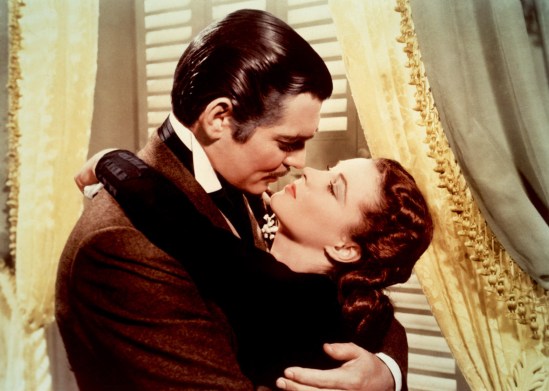
MSDGOWI EC001

Sure Gary Cooper is happy that Clark Gable got the lead in Gone With the Wind and not him. Still, why MGM didn’t ask Gable to play Rhett Butler first is my question since he was born to play that role. Nevertheless, this film earned millions at the box office, won several Oscars, and is seen as movie classic people still watch multiple times. You have to love this movie.

“Who the hell wants to hear actors talk?” — H. M. Warner, Warner Brothers, 1927. (Ironically, Warner Brothers was the company that released The Jazz Singer later that year, which changed the motion picture industry forever. Sound movies have been made ever since. Nevertheless, the transition wasn’t as easy as most people think it is.)

“I’m just glad it’ll be Clark Gable who’s falling on his face and not Gary Cooper.” — Gary Cooper on his decision not to take the leading role in “Gone With the Wind.” (To be fair, Cooper was right to turn down the role of Rhett Butler but not for the reasons he thought at the time. Most people agree Clark Gable was essentially born to play Rhett Butler, a role of a lifetime that gave him everlasting fame that he’s still remembered to this day. As for Gone With the Wind, well, it’s one of the most successful and critically acclaimed movies of all time that continues to be adored by people all over the world over generations.)

“Can’t sing, can’t act, slightly bald – can dance a little.” – Talent agent on Fred Astaire. (Astaire had that guy’s report framed and put over a fireplace in his mansion. Yes, he became an iconic song and dance man as well as one of Hollywood’s biggest stars.)

“While Daniel’s reportedly making close to three hundred thousand dollars for the first movie, it’s been speculated that he’ll rake in close to fifteen million dollars, if the sequels are successful.” – Katie Couric on Daniel Radcliffe’s earnings on the Harry Potter franchise. (Keep in mind that Radcliffe made $53 million on the last two movies alone.)

“Time travel movies don’t work. They just don’t work.” – Executive who passed on Back to the Future (which is a 1980s classic, by the way.)

“No Civil War movie ever made a nickel!” — Louis B. Mayer to David O. Selznick on Gone with the Wind. (Boy, was Mayer wrong, especially since he was alive when Birth of a Nation came out {which was a huge hit, but it’s a racist piece of shit}.)

“You better get secretarial work or get married.” –Emmeline Snively, advising would-be model Marilyn Monroe in 1944. (Later she’d be an actress and the first woman to pose nude for Playboy. Today she’s an American cultural icon.)

“Movies are a fad. Audiences really want to see live actors on a stage.”—Charlie Chaplin (Pretty good guess for what would become an incredibly important medium of entertainment for generations to come as well as an industry earning millions of dollars. And yes, you helped create that.)

“If we put out a screen machine, there will be a use for maybe about ten of them in the whole United States. With that many screen machines, you could show the pictures to everyone in the country — and then it would be done. Let’s not kill the goose that lays the golden egg.” — Thomas Edison on movie projectors (At the time, Edison had a thriving business making viewing devices called Kinetoscopes, which showed movies to one person at a time. Other people will improve this invention and would soon make full fledged movies.)

“I wouldn’t give a dime for all the possibilities of [motion pictures with sound]. The public will never accept it.” — Kodak founder George Eastman (Oh, yes, the public will. And they did.)

“…[S]ound is a passing fancy. It won’t last.”— MGM exec Irving Thalberg, after seeing “The Jazz Singer” in 1927. (They’re still with us in 2016. In fact, most movies made are talkies that sound departments are now the most underrated people in Hollywood. Some passing fancy that turned out to be.)

“I do not believe that black and white will disappear entirely. It will still be the ideal medium for certain subjects, not merely for newsreels and shorts, but for full-length pictures.”— Rouben Mamoulian, director of one of the first three-strip Technicolor movies, “Becky Sharp” (Nowadays most movies are in color because it’s cheaper. However, some films are made in black and white for artistic purposes.)

“Films made expressly for theatrical distribution should not be funneled into television, nor should big-name personalities be encouraged to appear too frequently on video, because the public will tire of seeing them and thus their pictures will suffer at the box office.” — A group of thirty Hollywood producers and cinema owners, 1951. (Turns out that putting celebs on Leno, Letterman, or Conan actually helps ticket sales. And then there’s the teleplay that was later made into a movie called Marty that won a slew of Academy Awards. Not to mention, nowadays, they even have movie networks like TCM which is fairly popular. Also, a movie has to be out on home media long enough to be broadcast on TV where it’s edited for commercials and censorship {save on TCM, PBS, and Premium Cable}.)

“I say to you that the VCR is to the American film producer and the American public as the Boston strangler is to the woman home alone.” — Jack Valenti, 1982. (Within a decade of that statement, studios were making more money from home video than from movie ticket sales. So if your indie film didn’t do well at the box office. Just hope it comes out on DVD.)

“…[W]ithout even knowing what’s happening, audiences might gradually absorb that the digital images they’re watching in theaters are no different than what they see at home, that they’re actually just watching TV with more people. And that could be the end of movies as we know them.” — Variety film critic Todd McCarthy, writing about digital projection in 1999. (Nowadays, everything’s digital).

“…Digital technologies can enable a level of piracy that would undermine our capacity to produce films and entertainment, undermine deployment of broadband networks, undermine the digital television transition, and ultimately result in fewer choices and options for American consumers.”— Disney chairman Michael Eisner, speaking to Congress in 2002.(Eisner neglected to note that digital technologies can also radically reduce Disney’s costs of distributing content to consumers and to theaters. Also: at the time, Disney movies were not available legally on the Internet, and today, most of the Disney catalog is still available only on DVD. Who exactly is presenting consumers with fewer choices and options? Hint: It’s not Disney.)

“There are great cinematographers who’ll shoot on film for the next twenty years.” — Bob Beitcher, chief executive of Panavision, 2006.  (Though Panavision has been a pioneer of digital cinematography with cameras like the Genesis, its bigger business is renting high-end film cameras.)

Music? That’s Not Going to Last

the-beatles

So Decca turned down these 4 Liverpudlian mop tops because they hated their music and guitar stuff was on the way out. Meanwhile these guys signed with 2 other companies, produced a shitload of albums and songs, appeared in 3 movies and Ed Sullivan, and experienced a dramatic break up.

“We don’t like their sound, and guitar music is on the way out.” — Decca Recording Co. rejecting the Beatles, 1962. (This is probably the worst business decision Decca ever made, which certainly went back to bite them in the ass. Columbia and Apple were I bet the person who made the decision was fired over this.)

“It’ll be gone by June.” – Variety Magazine on Rock n’ Roll, 1955 (Sorry, but Rock n’ Roll is here to stay and shows no signs of fading out anytime soon.)

“The phonograph is not of any commercial value.”— Thomas Alva Edison, 1880 (Edison has no idea what he just invented like a way to record sound that can be listened to later. This would lead to all kinds of developments as well as the birth of the recording industry.)

“Far too noisy, my dear Mozart. Far too many notes.”— Emperor Ferdinand of Austria, 1786 (Obviously, he knew nothing about music.)

“”Weird Al” Yankovic, your fifteen minutes are up.” – a review of UHF, 1980s. (Nevertheless, Weird Al is one of the most enduring and popular musical artists because he continues to parody music. He’s never went anywhere.)

“Stick to driving a truck, because you’ll never make it as a singer.” – Eddie Bond rejecting Elvis Presley, 1954. (Elvis would release his first few hits a month later.)

“Guitar is a good hobby, John, but you’ll never make a living of it.”—John Lennon’s Aunt Mimi when he was a teenager. (In 1964, a group of fans had that quote on a plaque and sent to her.)

“He’s not going to go far, is he? He’s just not star material.” – Rock journalist Judy Willis on David Bowie. (I’m sure she eventually underestimated the power of Ziggy Stardust and Major Tom.)

“Male vocal in the 1968 feeling—thin, piercing voice with no emotional appeal…dreary songs…one-key singer…pretentious material.” — A panel review of a BBC audition in 1968 of Sir Elton John to promote his first single, “Lady Samantha.” (He’d get much better after a few years.)

“I’ve heard they have beautiful lights but they don’t sound like nothing.” – Jimi Hendrix on Pink Floyd. (Boy, would he be wrong about them. I mean the group’s The Wall and Dark Side of the Moon have become iconic albums in their own right.)

“Home Taping Is Killing Music” — A 1980s campaign by the BPI, claiming that people recording music off the radio onto cassette would destroy the music industry. (No, it wouldn’t since it’s kind of impossible since the music changes so often. My parents just recorded stuff on cassette from records and CDs during the 1980s and 1990s.)

“The singer [Mick Jagger] will have to go; the BBC won’t like him.”— First Rolling Stones manager Eric Easton to his partner after watching them perform. (Sorry, but Mick Jagger is still the lead singer for the Rolling Stones and shows no sign of slowing down.)

“The Beatles have no future in show business.”— Dick Rowe, Decca Records executive, rejecting The Beatles (Makes me wonder whether he ended up fired sometime after this. I mean he’s basically made one of the worst decisions in music history.)

“Next Christmas the iPod will be dead, finished, gone, kaput.” – Sir Alan Sugar, 2005. (It’s still around and was a massive success.)

Beyond Future Imperfect – Part 5: Politics, War, and Medicine What Are They Good For? Absolutely Nothing

We now move on to politics, war, and medicine which kind of go together in regard to subject matter. For one, politics is essential in governing a nation, especially when it pertains to starting or preventing a war. In fact, most conflicts in history usually have economic or political causes, if not all. And since wars usually have a shitload of people killed or injured, medicine will be essential. Not to mention, it’s usually the part of the government to decide whether a nation should have universal healthcare. If you live in the United States, then the answer is no which is so fucking unfair because healthcare is a basic human right and nobody should be denied medical treatment for being poor. Call it Socialism but I call universal healthcare a basic human decency and morally non-negotiable. Healthcare is not a commodity, America. Okay, sorry about that, but I have very strong opinions on this subject. Same with war and guns which I hate because they tend to inflict carnage that preventable and unnecessary. Anyway, without further adieu, I give you my fifth installment of predictions that never came true in the realm of governing, war, and health.

Politics? Quit Your Whining

Official_portrait_of_Barack_Obama

And they said this guy wouldn’t win a single primary against Hillary in 2008. Man, that guy must be quite a long shot, whatever happened to him? Oh, wait, he became President.

“It will be years — not in my time — before a woman will become Prime Minister.” — Margaret Thatcher, 1974. (Thatcher would become Britain’s first and only female prime minister 5 years later and would remain so until 1990.)

“Reagan doesn’t have that presidential look.” – United Artists executive after rejecting Reagan as lead in the 1964 film The Best Man (Apparently, the Republican party and legions of voters thought otherwise in 1980.)

“Democracy will be dead by 1950.”–John Langdon-Davies, A Short History of The Future, 1936. (Democracy still exists though it exists with a lot corruption. But it’s here.)

“Our country has deliberately undertaken a great social and economic experiment, noble in motive and far reaching in purpose.” -– Herbert Hoover, on Prohibition, 1928. (Yes, noble in motive. But far reaching in purpose, not so much. Besides, Prohibition was an economic heyday for moonshiners, bootleggers, speakeasies, and organized crime. Also led to an explosion of alcoholism in women, which wasn’t a big problem before Prohibition since women then were mostly social drinkers.)

“Read my lips: NO NEW TAXES.” –George H. W. Bush, 1988. (Of course, he later had to do the fiscal conservative thing for a war that he had to raise taxes. At least he was sensible.)
“This is the second time in our history that there has come back from Germany to Downing Street peace with honor. I believe it is peace for our time.” -– Neville Chamberlain, British Prime Minister, September 30th, 1938. (To be fair, Chamberlain knew what he was getting into and that peace between Britain and Germany wasn’t going to last since he started planning for war {on Baldwin’s advice}, just to stay on the safe side. And he certainly didn’t underestimate Hitler {and knew he was a danger since 1935}. It was the public who did and they didn’t want to go to war. He just went for appeasement in order to buy more time, look good for the media, as well as the fact it was the only acceptable political option. This was more or less a speech for the cameras and he knew it. But he also knew if he wanted to sell the war later, he couldn’t reject diplomacy. The Brits fell for it.)

“Sensible and responsible women do not want to vote.” –Grover Cleveland, U.S. President, 1905. (Uh, yes, they do you sexist prig who married a trophy wife you raised, which is incredibly creepy. Yes, sensible and responsible women do want the vote. That’s why Wyoming granted universal suffrage in the 1880s.)

“Anyone who thinks it is going to run the government of South Africa lives in cloud-cuckoo land.”- Margaret Thatcher on the African National Congress, 1987. (This party has run the South African government since the 1990s.)

“When the president does it ,that means it is not illegal.”— Richard Nixon, 1977 (Nixon, you still haven’t learned from Watergate, have you?)

“Left-handed incumbents have never been re-elected…so look for a one-term Clinton Presidency.” – TIME, 1992. (Clinton served two terms and so did Obama. So your argument is invalid.)

“If [Hillary Clinton] gets a race against John Edwards and Barack Obama, she’s going to be the nominee. Gore is the only threat to her, then. Barack Obama is not going to beat Hillary Clinton in a single Democratic primary. I’ll predict that right now.” – William Kristol, Fox News, Dec. 17, 2006. (Okay, for one, Gore didn’t run for president in 2008. Second, Barack Obama was elected president that year, which I think explains how that Democratic primary turned out.)

War? Please, Stop Overreacting

AtomicBomb2

Apparently, some expert in explosives says that the atom bomb will never go off. Excuse can anyone tell me why an image of this scares the hell out of people? Should we tell him what happened at Hiroshima and Nagasaki?

“The bomb will never go off. I speak as an expert in explosives.” — Admiral William Leahy, U.S. Atomic Bomb Project. (Guess this guy spoke too soon, didn’t he? Because the atomic bombs did go off in Hiroshima and Nagasaki and it basically annihilated them in the process. This is nuclear war is so scary. Some expert in explosives Admiral Leahy turned out to be.)

“Airplanes are interesting toys but of no military value.” — Marechal Ferdinand Foch, Professor of Strategy, Ecole Superieure de Guerre. (Tell that to the Red Baron and all the other WWI pilots in their Fokkers and Sopwith Camels.)

“No, it will make war impossible.” – -Hiram Maxim, inventor of the machine gun, in response to the question “Will this gun not make war more terrible?” from Havelock Ellis, an English scientist, 1893 (Havelock Ellis was right because machine guns have made war much more horrific. Hiram Maxim had no idea what his invention would entail.)

“The idea that cavalry will be replaced by these iron coaches is absurd. It is little short of treasonous.” — Comment of Aide-de-camp to Field Marshal Haig, at tank demonstration, 1916 (Modern militaries no longer use cavalry which were already on their way out after the American Civil War.)

“Four or five frigates will do the business without any military force.”-– British prime minister Lord North, on dealing with the rebellious American colonies, 1774. (Uh, I think you might need some more frigates and a military force.)

“They couldn’t hit an elephant at this dist-“ — Last words of Gen. John Sedgwick, spoken as he looked out over the parapet at enemy lines during the Battle of Spotsylvania in 1864. (Spoke too soon, didn’t you?)

“You will be home before the leaves have fallen from the trees.” -– Kaiser Wilhelm, to the German troops, August 1914. (Seems like the Kaiser was way off since WWI lasted for 4 years. Then again, he didn’t say which year.)

“The Americans are good about making fancy cars and refrigerators, but that doesn’t mean they are any good at making aircraft. They are bluffing. They are excellent at bluffing.”–Hermann Goering, Commander-in-Chief of the Luftwaffe, 1942. (Uh, Goering, you might want to take that back.)

“There is no doubt that the regime of Saddam Hussein possesses weapons of mass destruction. As this operation continues, those weapons will be identified, found, along with the people who have produced them and who guard them.” –General Tommy Franks, March 22nd, 2003. (This one never gets old. Seriously, there were no weapons of mass destruction. And the US came into Iraq and overthrow Saddam Hussein for nothing.)

“Has there ever been danger of war between Germany and ourselves, members of the same Teutonic race? Never has it even been imagined.”— Andrew Carnegie, 1913 (Guess who the US went to war with 4 years later. Also, in 1941.)

“War between Japan and the United States is not within the realm of reasonable possibility. …A Japanese attack on Pearl Harbor is a strategic impossibility.”— Major George Fielding Eliot, 1938 (Thanks, you just gave Admiral Yamamoto a way to bomb Pearl Harbor 3 years later.)

“The machine gun is a much overrated weapon; two per battalion is more than sufficient.”— General Douglas Haig, 1915 (Two machine guns per battalion isn’t enough for WWI.)

“I do not consider Hitler to be as bad as he is depicted. He is showing an ability that is amazing and he seems to be gaining his victories without much bloodshed.”— Mahatma Gandhi, 1940 (Uh, Gandhi, we don’t consider Hitler that bad because he gains victories without much bloodshed. It has more to do with the rounding up of millions of Jews and other undesirables to concentration camps and having them killed for no reason. You know, genocide.)

“I also lay aside all ideas of any new works or engines of war, the invention of which long-ago reached its limit, and in which I see no hope for further improvement…-“- Sextus Julius Frontinus, governor of Britania, 84 C.E. (I see plenty since I no longer live at a time where most people fight with swords, spears, and shields.)

“…transport by railroad car would result in the emasculation of our troops and would deprive them of the option of the great marches which have played such an important role in the triumph of our armies.”– Dominique Francois Arago (1786-1853) (As we found out in the American Civil War, railroads actually made moving supplies and troops much easier.)

“I do not myself think that any civilized nation will torpedo unarmed and defenceless merchant ships.”–Charles Cooper Penrose-Fitzgerald, Admiral Royal Navy, Strand Magazine, July, 1914, page 20. (Guess what happened in both world wars. Also see what happened to the HMS Lusitania.)

“Atomic energy might be as good as our present-day explosives, but it is unlikely to produce anything very much more dangerous.” Winston Churchill, 1939. (Uh, Winston, you might be shitting your pants upon seeing a mushroom cloud in the movie newsreels 6 years later.)

“No matter what happens, the U.S. Navy is not going to be caught napping.” – U.S. Secretary of Navy, December 4, 1941. (So what were you doing at Pearl Harbor 3 days later? You know, before the Japanese surprised you by bombing it?)

“Simply stated, there is no doubt that Saddam Hussein now has weapons of mass destruction.” – Dick Cheney August 26, 2002. (Really, Cheney? Because US Intelligence never found any. Iraq was a mistake.)

“[The Joint Intelligence Committee] concludes that Iraq has chemical and biological weapons, that Saddam has continued to produce them, that he has existing and active military plans for the use of chemical and biological weapons, which could be activated within 45 minutes, including against his own Shia population, and that he is actively trying to acquire nuclear weapons capability.” – Tony Blair, 2002. (For one, Saddam had no weapons of mass destruction by then. Second, how could he have plans to use them if he didn’t have them in the first place?)

Medicine? Sorry, There’s Nothing We Can Do About That

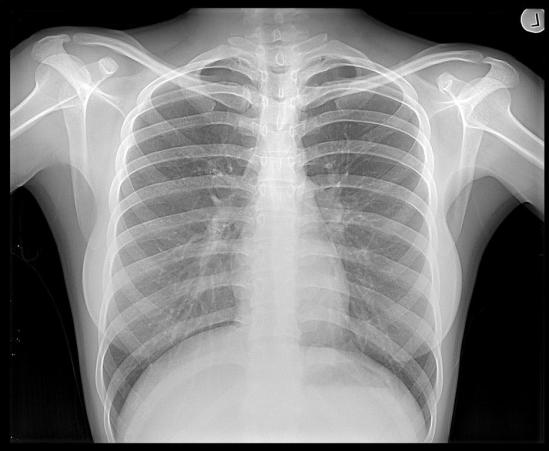
X-ray

So, Lord Kelvin, you tell me that X-Rays are a hoax. Nevertheless, can you tell me what this is and how it was produced? I think x-rays have something to do with it but I’m not sure.

“Louis Pasteur’s theory of germs is ridiculous fiction.” — Pierre Pachet, Professor of Physiology at Toulouse, 1872. (Someone get this guy a microscope. Because Pasteur’s theories on germs are scientific gospel.)

“The abdomen, the chest, and the brain will forever be shut from the intrusion of the wise and humane surgeon.” — Sir John Eric Ericksen, British surgeon, appointed Surgeon-Extraordinary to Queen Victoria 1873. (Obviously, he had no idea that 20th century would see development in chest splitting and brain surgery that we have a board game based on it.)

“If excessive smoking actually plays a role in the production of lung cancer, it seems to be a minor one.” – -W.C. Heuper, National Cancer Institute, 1954 (“Minor” in that smoking is the #1 cause of lung cancer that has killed millions of people. Nevertheless, tobacco is known to kill a third of its users each year.)

“That virus is a pussycat.” -– Dr. Peter Duesberg, molecular-biology professor at U.C. Berkeley, on HIV, 1988. (HIV is the farthest thing from a pussycat as we speak since it destroys your immune system before it kills you.)

“The abolishment of pain in surgery is a chimera. It is absurd to go on seeking it today.”—Dr. Alfred Velpeau, surgeon professor, Paris Faculty of Medicine, 1837 (Obviously, hasn’t seen the development of anesthesia and my Uncle Marty’s profession, anesthesiologist.)

“X-rays will prove to be a hoax.” — Lord Kelvin, President of the Royal Society, 1883. (Apparently, some scientists didn’t think so and they were right.)

“A certain Liquor which they call Coffee…which will soon intoxicate the brain.” — G. W. Parry (1601) (Coffee is a caffeinated drink. It’s not a liquor. Unless you’re talking about Four Loko which has alcohol and caffeine.)

Beyond Future Imperfect – Part 4: Society, Travel, Business and Economics? Seriously, You Got to Be Kidding Me

Now we’re halfway through. So while my previous posts focused on science and technology, in this installment, we move away from that. Rather, in this edition we’ll focus more on the social development in our history. In many ways, our society is always changing even if it can be hard for some people and institutions to accept it. For instance, in 2007, many people thought that Americans would never elect a black guy as their president. Given that African Americans were treated as slaves and second class citizens who were segregated to the crap parts of town. And the enduring racism in this country that’s embedded in the American culture. But in 2008, that’s exactly what happened with the election of Barack Obama. Another thing Americans didn’t imagine in 2007 was the nationwide legalization of gay marriage. The Republican dominated Supreme Court did just that 8 years later and there was much rejoicing. Nevertheless, gay marriage has become substantially less controversial in recent years and it’s a relatively easy issue to get behind. Then you have travel which pertains to places that some thought were of little tourist value like the Grand Canyon and the Effiel Tower. Finally, we have business and economics which people tend to get the wrong idea about that it’s often been politicized. Seriously, back in August of 2014, I wrote a blog post on the Federal Reserve to explain why Ron Paul’s call to “End the Fed” was an incredibly stupid idea. So without further adieu, here is my next installment of Beyond Future Imperfect for your reading pleasure.

Society? Sorry, Never Gonna Change

women_large

Yes, I’m sure women have been traditionally seen as housewives and stay-at-home moms. But I’m positive that women have made plenty of contributions outside the home, since, well, ever. Nevertheless, at least feminism helped make that much more acceptable by the 1970s. Still, look at this WWII poster for yourselves. Doesn’t look like a housewife to me.

“I see no good reasons why the views given in this volume should shock the religious sensibilities of anyone.” — Charles Darwin, The Origin Of Species, 1869. (Well, he wasn’t totally wrong as I do believe God did play a role in the evolution of life through the process of natural selection, which was probably His divine intention anyway. Besides, there’s the story of Jacob breeding goats so he could trick his father-in-law into giving him the greater share of the flock. Not to mention, Christians have long considered the Genesis creation story as an allegory long before Darwin even developed his theory of evolution. For instance, Saint Augustine believed that everything was created by God in the same instant and not in 6 days as Genesis would require. Also, there’s the fact that many people lived on farms at the time who are familiar breeding livestock and crops. However, Darwin wasn’t counting the notion of Biblical literalists who believe in the Young Earth Creationism.)

“If anything remains more or less unchanged, it will be the role of women.” –David Riesman, conservative American social scientist, 1967. (Well, as far as sexual reproduction is concerned. Other than that…women’s roles will certainly change and be beyond the role of housewife.)

“The multitude of books is a great evil. There is no limit to this fever for writing; every one must be an author; some out of vanity, to acquire celebrity and raise up a name, others for the sake of mere gain.”–Martin Luther, German Reformation leader, Table Talk, 1530s(?). (Sorry, Martin Luther, but books are a great good. And no, not everyone writes to become a celebrity.)

“Not one man I have spoken to likes a woman in mini skirts.” – Coco Chanel, 1969. (Coco has obviously not been around the right kind of men. Of course, men like women in miniskirts. Well, a lot of them anyway.)

“Visionaries see a future of telecommuting workers, interactive libraries and multimedia classrooms. They speak of electronic town meetings and virtual communities. Commerce and business will shift from offices and malls to networks and modems. And the freedom of digital networks will make government more democratic. Baloney.”– Clifford Stoll in “Newsweek”, 1995. (This is happening now as we speak.)

“Assuming then my postulata as granted, I say, that the power of population is indefinitely greater than the power in the earth to produce subsistence for man. Population, when unchecked, increases in a geometrical ratio.” – Thomas Malthus, who, in 1798, argued that population growth would outpace agricultural production. (Today we have agricultural industrial complex which can feed way more people than whatever Malthus’s world had in the 1790s.)

Travel? Nobody’s Going to See That

The-Beautiful-Grand-Canyon-by-Michael-Matti

Yeah, I’m sure this majestic natural wonder is certainly a “profitless locality.” Never mind that it’s the #1 reason why people flock from all over the world to visit Arizona. Why the hell is it called “The Grand Canyon State” then?

“Ours has been the first, and doubtless to be the last, to visit this profitless locality.” — Lt. Joseph Ives, after visiting the Grand Canyon in 1861. (Too bad this guy knew nothing about tourism. Today, the Grand Canyon is the #1 tourist destination in Arizona as well as a national icon for the state. Hell, they don’t call Arizona, “the Grand Canyon” state for nothing.)

“And for the tourist who really wants to get away from it all, safaris in Vietnam” – -Newsweek, predicting popular holidays for the late 1960s. (Thanks but no thanks, Newsweek, but I’d stay the hell out of Vietnam, especially in the late 1960s when it’s a complete hellscape thanks to the Viet Cong and American GIs. Sorry, but safaris in Vietnam in the late 1960s aren’t going to happen.)

“We, writers, painters, sculptors, architects and passionate devotees of the hitherto untouched beauty of Paris, protest with all our strength, with all our indignation in the name of slighted French taste, against the erection … of this useless and monstrous Eiffel Tower … To bring our arguments home, imagine for a moment a giddy, ridiculous tower dominating Paris like a gigantic black smokestack, crushing under its barbaric bulk Notre Dame, the Tour Saint-Jacques, the Louvre, the Dome of les Invalides, the Arc de Triomphe, all of our humiliated monuments will disappear in this ghastly dream. And for twenty years … we shall see stretching like a blot of ink the hateful shadow of the hateful column of bolted sheet metal.” – excerpt of a protest letter on the Eiffel Tower sent to Charles Alpand who was Minister of Works and Commissioner of the 1889 World’s Fair. (They had no idea that the Eiffel Tower would become the symbol of Paris and would attract a lot of tourism from all over the world.)

“The world will little note, nor long remember what we say here…”—Abraham Lincoln, “The Gettysburg Address” (the most famous speech in American history) (Yeah, really underestimated that one, especially since people know “The Gettysburg Address” by heart.)

Business and Economics? That Won’t Pay Off

fedex_trucks_plane_logos_630_flickr

Let’s just say, whoever started this company shouldn’t have gotten a C on his term paper proposing an overnight delivery service. Because all this shows that it was a very good idea.

“The concept is interesting and well-formed, but in order to earn better than a ‘C’, the idea must be feasible.” — A Yale University management professor in response to Fred Smith’s paper proposing reliable overnight delivery service. (Smith went on to found Federal Express Corp. We can now determine that the ‘C’ he got from his Yale management professor was undeserved.)

“A cookie store is a bad idea. Besides, the market research reports say America likes crispy cookies, not soft and chewy cookies like you make.” — Response to Debbi Fields’ idea of starting Mrs. Fields’ Cookies. (Thankfully, Mrs. Fields had the business sense to ignore this response and found a company that survives to this day.)

“Stocks have reached what looks like a permanently high plateau.” — Irving Fisher, Professor of Economics, Yale University, 1929. (Come October and Irving Fisher would be eating his own words when the stock market crashed and the Great Depression later ensued.)

“Remote shopping, while entirely feasible, will flop – because women like to get out of the house, like to handle merchandise, like to be able to change their minds.”–TIME, 1966, in one sentence writing off e-commerce long before anyone had ever heard of it. (TIME really had no idea what it was talking about. Because online shopping is incredibly popular right now.)

“We will bury you.” –Nikita Krushchev, Soviet Premier, predicting Soviet communism will win over U.S. capitalism, 1958. (Sorry, Kruschev, but US capitalism would win over the Soviet Union instead. Yet, I’m not so sure about US democracy would win over whatever Russia has though. Because Putin has been in power there for a very long time.)

“In all likelihood world inflation is over.”–International Monetary Fund CEO, 1959. (Inflation is still going on and is happening all the time.)

“This antitrust thing will blow over.”–Bill Gates, founder of Microsoft. (No, it won’t, Bill, but it will drag on until 2001.)

“Capitalist production begets, with the inexorability of a law of nature, its own negation.”-Karl Marx. (Sorry, Karl, but capitalism is still alive and well thanks to government regulations, trade unions, and consumerism.)

“Your cigar-ettes will never become popular.”— F. G. Alton (cigar maker, turning down Mr. John Player), 1870 (Yes, they did, unfortunately. And there’s a lot of lung cancer to prove it.)

“By the year 1982 the graduated income tax will have practically abolished major differences in wealth.” – Irwin Edman, professor of philosophy Columbia University, 1932. (The graduated income tax is still around and has never abolish major differences in wealth.)

Crime, Law, and Order? What’s That a Show?

“The case is a loser.” -– Johnnie Cochran, on soon-to-be client O.J.’s chances of winning, 1994. (It should’ve been, but thanks to Johnnie Cochran’s thing about the glove, it wasn’t.)

Environment? C’mon, This is Nonsense

“By 1985, air pollution will have reduced the amount of sunlight reaching earth by one half … ” – Life magazine, 1970. (Not really, except maybe in China. Not to mention, this didn’t take climate change into account.)

“(The world will be) 11 degrees colder in the year 2000.” – Kenneth Watt, 1970. (Sorry, but it was warmer by the 2000s as I recall. Because you know, climate change.)

Disasters? Dream On

“The deliverance of the saints must take place some time before 1914.”— Charles Taze Russell (founder of Jehovah’s Witnesses), 1914 (Apocalypse predictions always never come true.)

“The deliverance of the saints must take place some time after 1914.”— Charles Taze Russell (founder of Jehovah’s Witnesses), 1923 (Now that’s a little better.)

” … civilization will end within 15 or 30 years unless immediate action is taken against problems facing mankind,” George Wald, Harvard University, 1970 (As of 2016, it’s still going strong. Still, Apocalyptic prophecies never come true.)

“The death rate will increase until at least 100-200 million people per year will be starving to death during the next ten years.” – Paul Ralph Ehrlich, 1970. (46 years later and that many people isn’t dying of starvation.)

Beyond Future Imperfect – Part 3: Science, Technology, and Space Travel? You’re Crazy

As you’ve seen so far, you notice that a lot of a lot of these bad predictions pertain to science and technology. After all such ideas tend to shape our lives. Yet, back when scientific theory was being formulated, there were many critics who dismissed such ideas. Sure some of it had to do with religion which usually gets blamed nowadays, particularly when we talk about certain Christian groups not wanting their kids to be taught about evolution in public schools (though as a practicing Catholic, I do believe in evolution through natural processes and divine intervention. Not sure what role God played in this, but then again, the Lord works in mysterious ways.) However, when it comes to criticizing science, it’s not always about religion. Rather it might be the fact that the theory in question seems so crazy to some people that it absolutely makes no sense to them whatsoever. Technology is also changing as well and you’ve seen a lot of how people dismissed big breakthroughs as flops, fads, or failures. One of these breakthroughs in science and technology was space travel that was originally seen as something straight out of Jules Verne. So for your reading pleasure, I now bring you my third installment of Beyond Future Imperfect.

Science? You Mean Bullshit

512275631

Yes, I know that Galileo’s condemnation by the Catholic Church tends to serves as an example of how science and religion don’t tend to get along. However, we tend to forget that the a lot of scholars secular and otherwise didn’t think heliocentrism made a lot of sense. Mostly because they couldn’t wrap their heads around the idea of an earth in motion while everything in their world remained in place. After all, if the earth moves, you should be able to feel it.

“I am tired of all this sort of thing called science here… We have spent millions in that sort of thing for the last few years, and it is time it should be stopped.”–Simon Cameron, U.S. Senator, on the Smithsonian Institute, 1901. (And you thought the Republicans’ war on science was a new thing since so many of them deny climate change as a manmade thing that’s happening as we speak.)

“People give ear to an upstart astrologer who strove to show that the earth revolves, not the heavens or the firmament, the sun and the moon… Whoever wishes to appear clever must devise some new system, which of all systems is of course the very best. This fool wishes to reverse the entire science of astronomy; but the sacred scripture tells us that Joshua commanded the sun to stand still, not the earth.”— Martin Luther, 1540 (Seems like he wasn’t a big fan of Copernicus, a Polish priest who was proven right about heliocentrism by the way.)

“I can accept the theory of relativity as little as I can accept the existence of atoms and other such dogma.”— Professor Ernst Mach (as in speed-of-sound measurement), 1913 (So how is this guy a scientist? I can understand Einstein’s relativity theory with him. But atoms?)

“The most important fundamental laws and facts of physical science have all been discovered, and these are now so firmly established that the possibility of their ever being supplemented by new discoveries is exceedingly remote.”— Forest Ray Moulton, Astronomer, 1935 (There’s still more to be discovered, man. Just watch PBS on Wednesday night.)

“Mathematics is inadequate to describe the universe, since mathematics is an abstraction from natural phenomena. Also, mathematics may predict things which don’t exist, or are impossible in nature.”- Ludovico delle Colombe, 1633 (Uh, you might want to reconsider.)

“Animals, which move, have limbs and muscles. The earth does not have limbs and muscles; therefore it does not move.”- Scipio Chiaramonti [Professor of philosophy and mathematics at University of Pisa, arguing against the heliocentrc system, 1633] (Uh, just because something doesn’t have limbs and muscles doesn’t mean it doesn’t move. For instance, the earth moves around the sun by invisible forces like gravity. Reminds me of the witch sketch from Monty Python and the Holy Grail.)

“Just as in the microcosm there are seven `windows’ in the head (two nostrils, two eyes, two ears, and a mouth), so in the macrocosm God has placed two beneficent stars (Jupiter, Venus), two maleficent stars (Mars, Saturn), two luminaries (sun and moon), and one indifferent star (Mercury). The seven days of the week follow from these. Finally, since ancient times the alchemists had made each of the seven metals correspond to one of the planets; gold to the sun, silver to the moon, copper to Venus, quicksilver to Mercury, iron to Mars, tin to Jupiter, lead to Saturn.

From these and many other similar phenomena of nature such as the seven metals, etc., which it were tedious to enumerate, we gather that the number of planets is necessarily seven… Besides, the Jews and other ancient nations as well as modern Europeans, have adopted the division of the week into seven days, and have named them from the seven planets; now if we increase the number of planets, this whole system falls to the ground… Moreover, the satellites are invisible to the naked eye and therefore can have no influence on the earth, and therefore would be useless, and therefore do not exist.”– Francesco Sizzi, astronomer at Florence. [Arguing against Galileo’s 1610 announcement of his discovery of four moons of Jupiter.] (Someone get this guy a telescope. Because that’s how Galileo discovered them. Also, there are way more than 7 metals.)

“It is difficult to deal with an author whose mind is filled with a medium of so fickle and vibratory a nature…; We now dismiss…the feeble lucubrations of this author, in which we have searched without success for some traces of learning, acuteness, and ingenuity, that might compensate his evident deficiency in the powers of solid thinking…”- Henry Brougham. [Criticizing Thomas Young’s wave theory of light.] (Let me guess who’s right here. Uh, Thomas Young.)

“Buildings and the earth itself would fly off with such a rapid motion that men would have to be provided with claws like cats to enable them to hold fast to the earth’s surface.” — Libertus Fromundus, Anti-Aristarchus, 1631 (I don’t think this guy understands how planetary motion works.)

“If we concede the motion of the earth, why is it that an arrow shot into the air falls back to the same spot, while the earth and all the things on it have in the meantime moved very rapidly toward the east? Who does not see that great confusion would result from this motion?” — Polacco, Anticopernicus Catholicus, 1644 (Uh, how about gravity?)

“There is nothing new to be discovered in physics now; All that remains is more and more precise measurement.” – Lord Kelvin, 1900. (Einstein’s Theory of Relativity is a start as far as he’s concerned.)

Technology? That’s Science Fiction

xerox-copiers

And IBM thought the founders of Xerox could only sell 5,000 of these things. Today, the word Xerox is now synonymous for “photocopier.” So the joke’s on IBM.

“If I had thought about it, I wouldn’t have done the experiment. The literature was full of examples that said you can’t do this.” — Spencer Silver on the work that led to the unique adhesives for 3-M “Post-It” Notepads. (Boy, this guy didn’t know what he just accomplished with “Post-It” Notepads.)

“You want to have consistent and uniform muscle development across all of your muscles? It can’t be done. It’s just a fact of life. You just have to accept inconsistent muscle development as an unalterable condition of weight training.” — Response to Arthur Jones, who solved the “unsolvable” problem by inventing Nautilus. (And people have been using that ever since.)

“Drill for oil? You mean drill into the ground to try and find oil? You’re crazy.” — Workers whom Edwin L. Drake tried to enlist to his project to drill for oil in 1859. (Apparently, drilling for oil ended up becoming one of the most profitable enterprises ever. Hell, this world basically runs on oil drilling which isn’t helping our fossil fuel dependency.)

“The world potential market for copying machines is 5000 at most.” — IBM, to the eventual founders of Xerox, saying the photocopier had no market large enough to justify production, 1959 (Today, these are at almost every office building, school, or business you can think of. And Xerox is now synonymous with photocopier.)

“Inventions reached their limit long ago and I see no hope for further development.”— Julius Sextus Frontinus, prominent Roman engineer (c. 40-103 AD) (I can see plenty after the first century AD, thank you very much.)

“In my own time there have been inventions of this sort, transparent windows, tubes for diffusing warmth equally through all parts of a building, short-hand which has been carried to such a pitch of perfection that a writer can keep pace with the most rapid speaker. But the inventing of such things is drudgery for the lowest slaves; philosophy lies deeper…”- Roman poet Lucius Annaeus Seneca (4 B.C.E.-65 C.E.) (Seems like the Romans weren’t fans of scientific innovations.)

“There is a young madman proposing to light the streets of London—with what do you suppose—with smoke!”– Sir Walter Scott (1771-1832) [On a proposal to light cities with gaslight.] (Gas would be the dominant source of lighting throughout the late 19th and early 20th century.)

“Theological: It is an intervention in God’s order, which makes nights dark…

Medical: It will be easier for people to be in the streets at night, afflicting them with colds…

Philosophical-moral: Morality deteriorates through street lighting. Artificial lighting drives out fear of the dark, which keeps the weak from sinning.” –The Kölonische Zeitung [Köln, Germany, 28 March 1819] on why there shouldn’t be street lighting. (I can give you plenty of good reasons for it. For one, it keeps you safe. Second, it helps you navigate through the area. Third, it helps you determine where to avoid the horseshit.)

“Given a compact power source…the house of the future would have no roots tying it to the ground. Gone would be water pipes, drains, power lines; the autonomous home could therefore move, or be moved, to anywhere on earth at the owner’s whim. The time may come, therefore, when whole communities may migrate south in the winter, or move to new lands whenever they feel the need for a change of scenery.” Arthur C. Clarke describing 2001 in 1966. (Nice way to picture the future which didn’t happen yet, especially in 2001.)

“Printed books will never be the equivalent of handwritten codices, especially since printed books are often deficient in spelling and appearance.” – Trithemius in his treatise, “In Praise of Copying.” (Actually printed books are better in appearance and spelling, thanks to Johannes Gutenberg in the 1400s.)

Space Travel? Seriously, You’re Delusional

Apollo-11-moon-landing-4

And there were so many people who didn’t think this moment on July 20, 1969 wouldn’t be possible. But it happened and Buzz Aldrin is still alive to tell the tale. There were 5 other landings after that with 9 other men on the moon ever since. Unfortunately, despite it being televised, many people believed that the moon landing was faked in Arizona.

“That Professor Goddard with his ‘chair’ in Clark College and the countenancing of the Smithsonian Institution does not know the relation of action to reaction, and of the need to have something better than a vacuum against which to react–to say that would be absurd. Of course, he only seems to lack the knowledge ladled out daily in high schools.” — 1921 New York Times editorial about Robert Goddard’s revolutionary rocket work. The remark was retracted in the July 17, 1969 issue. (Yeah, I can see where the New York Times would regret that one. Because rockets have been sent to space since the 1950s.)

“A rocket will never be able to leave the Earth’s atmosphere.” — New York Times, 1936 (Man, it seems like the NYT is really stuck with the impossibility of rockets in space thing. Wonder how that worked out.)

“There is practically no chance communications space satellites will be used to provide better telephone, telegraph, television, or radio service inside the United States.” — T. Craven, FCC Commissioner, in 1961 (the first commercial communications satellite went into service in 1965). (Boy, that’s sure going to bite him in the ass 4 years later. And yes, we do use commercial satellites nowadays.)

“To place a man in a multi-stage rocket and project him into the controlling gravitational field of the moon where the passengers can make scientific observations, perhaps land alive, and then return to earth – all that constitutes a wild dream worthy of Jules Verne. I am bold enough to say that such a man-made voyage will never occur regardless of all future advances.” — Lee DeForest, American radio pioneer and inventor of the vacuum tube, in 1926 (Note: This was how Apollo 11 pulled it off the moon landing in 1969.)

“There has been a great deal said about a 3000 miles high angle rocket. In my opinion such a thing is impossible for many years. The people who have been writing these things that annoy me have been talking about a 3000 mile high-angle rocket shot from one continent to another, carrying an atomic bomb and so directed as to be a precise weapon which would land exactly on a certain target, such as a city.

“This foolish idea of shooting at the moon is an example of the absurd length to which vicious specialization will carry scientists working in thought-tight compartments. Let us critically examine the proposal. For a projectile entirely to escape the gravitation of earth, it needs a velocity of 7 miles a second. The thermal energy of a gramme at this speed is 15,180 calories… The energy of our most violent explosive–nitroglycerine–is less than 1,500 calories per gramme. Consequently, even had the explosive nothing to carry, it has only one-tenth of the energy necessary to escape the earth… Hence the proposition appears to be basically impossible.”– W. A. Bickerton, Professor of Physics and Chemistry at Canterbury College (Christchurch, New Zealand), 1926. (Yet, somehow NASA seemed to pull this off in 1969.)

“There is not in sight any source of energy that would be a fair start toward that which would be necessary to get us beyond the gravitative control of the earth.”– Forest Ray Moulton (1872-1952), astronomer, 1935. (How about a fancy type of gasoline called rocket fuel?)

“Space travel is utter bilge.”– Dr. Richard van der Reit Wooley, Astronomer Royal, space advisor to the British government, 1956. (Apparently, Sputnik would orbit the following year. I’d like to see his reaction.)

Beyond Future Imperfect – Part 2: Energy, Computers, and Communication, How Absurd

So we’re off to a good start. As you may see, sometimes the future is never what we imagine it. And sometimes what we think was impossible is made possible. And none of that can be emphasized than in this post. In this edition of Beyond Future Imperfect, we go over what people initially surmised about energy, computers, and communication. To people who lived before these caught on, they would’ve thought such things were the stuff of science fiction. For instance, before the late 1800s, nobody would imagine lights being powered by electricity. Then the light bulb was invented and it took a savvy inventor named Thomas Edison to popularize it. And before WWII, nobody thought nuclear power was possible, even Albert Einstein. Yes, that Einstein. Then there’s the development of computers which people in your grandparents’ generation wouldn’t dream of having due to them being incredibly expensive and the tendency to take up a whole room. But the development of the microchip changed all that which led to the rise of Silicon Valley as well as the emergence of Bill Gates, Steve Jobs, and the Internet. And there’s communication which before the Industrial Revolution, hadn’t seen much development since Johannes Gutenberg invented the printing press and movable type in the 1400s. Yet, messages were still delivered through horse, coach, and messenger. But the Industrial Revolution saw the development of the telegraph which led to the telephone. Later on, you then had the invention of radio and television. And in the 1980s and 1990s, you had the Internet, whose development for the massses was funded by the US government in a bill passed through Congress that was sponsored by a little known Senator named Al Gore. So without further adieu, I now bring you my second post in the series of Beyond Future Imperfect.

Electricity? Just a Phase

19444-004-2A2305FA

Sure Edison didn’t really invent the light bulb and he knew it. But it was his light bulb that turned out more practical, long lasting, and commercially viable among the masses. And they said electricity was just a phase. Well, his idea of direct current, that is.

“Everyone acquainted with the subject will recognize it as a conspicuous failure.” – -Henry Morton, president of the Stevens Institute of Technology, on Edison’s light bulb, 1880 (Boy, he had no idea that Edison’s lightbulb would help bring electricity into people’s homes and that it’s still around to this day. Some failure that turned out to be.)

“When the Paris Exhibition [of 1878] closes, electric light will close with it and no more will be heard of it.” – Oxford professor Erasmus Wilson (Seems like Professor Wilson is sorely mistaken, since everyone in industrialized world uses electric lights to this day.)

“There is no plea which will justify the use of high-tension and alternating currents, either in a scientific or a commercial sense.”— Thomas Alva Edison, 1889 (We still use the alternating current today. Direct current, on the other hand….)

“Such startling announcements as these should be deprecated as being unworthy of science and mischievous to its true progress.”— Sir William Siemens (on Edison’s announcement of light bulb), 1880 (Clearly this guy has no idea how the light bulb will change the world.)

“Do not bother to sell your gas shares. The electric light has no future.” —Professor John Henry Pepper, Victorian-era celebrity scientist, sometime in the 1870s (Yes, it has a future like you wouldn’t believe. Seriously, we still use it in the 21st century.)

Nuclear Power? Forget It

Nuclear.power.plant.Dukovany

And Einstein thought this wouldn’t be possible in the 1930s. Guess that’s one of the few things he was definitely wrong about. Nevertheless, would I say it’s safe? No freaking way.

“There is not the slightest indication that nuclear energy will ever be obtainable. It would mean that the atom would have to be shattered at will.” — Albert Einstein, 1932. (This is probably one of the few instances in the history of science where Einstein is wrong. Seriously, splitting the atom was done in his own lifetime for God’s sake. And yes, nuclear energy does exist for that.)

“There is no likelihood man can ever tap the power of the atom. The glib supposition of utilizing atomic energy when our coal has run out is a completely unscientific Utopian dream, a childish bug-a-boo. Nature has introduced a few fool-proof devices into the great majority of elements that constitute the bulk of the world, and they have no energy to give up in the process of disintegration.”— Robert Millikan, Nobel Prize winner in physics, 1920 (Man, he’s going to be in for a shock come the 1940s.)

“All the waste in a year from a nuclear power plant can be stored under a desk.”— Ronald Reagan, 1980 (Seriously, can someone please school Ronald Reagan on how nuclear energy works. Tell him how much waste a nuclear plant generates a year. It’s a matter of tons.)

“The energy produced by the breaking down of the atom is a very poor kind of thing. Anyone who looks for a source of power in the transformation of the atom is talking moonshine.”— Ernest Rutherford, 1936 (He won’t be saying this by 1945.)

Nuclear-powered vacuum cleaners will probably be a reality in 10 years.” -– Alex Lewyt, president of vacuum cleaner company Lewyt Corp., in the New York Times in 1955. (Thank the Lord this didn’t happen. Noisy vacuum cleaners are bad enough. Radioactive vacuum cleaners are the stuff of nightmares.)

“There is little doubt that the most significant event affecting energy is the advent of nuclear power…a few decades hence, energy may be free—just like the unmetered air….-“- John von Neumann, scientist and member of the Atomic Energy Commission, 1955. (Uh, no, it won’t. Seriously, people receive electric bills. Also, nuclear power isn’t what it’s cracked up to be.)

Computers? You Mean These Useless Magic Machines?

computersandlaptops

Back in the day, it was said that computers in the future would weight 1.5 tons and that there would be a market for 5 of them. Guess they weren’t betting on the invention of the microchip.

“I think there is a world market for maybe five computers.” — Thomas Watson, chairman of IBM, 1943. (Today there’s a market for countless computers.)

“Where a calculator on the ENIAC is equipped with 18,000 vacuum tubes and weighs 30 tons, computers in the future may have only 1,000 vacuum tubes and weigh only 1.5 tons.” — Popular Mechanics, 1949.  (Today’s computers are made with no vacuum tubes and can fit on a desk, lap, or palm in your hand.)

“I have traveled the length and breadth of this country and talked with the best people, and I can assure you that data processing is a fad that won’t last out the year.” — The editor in charge of business books for Prentice Hall, 1957. (Well, data processing is alive and well because it’s used in practically everything.)

But what…is it good for?” — Engineer at the Advanced Computing Systems Division of IBM, 1968, commenting on the microchip. (Well, for making computers more accessible, affordable, smaller, more useful, and more powerful. And basically changing computers as we know them.)

“There is no reason anyone would want a computer in their home.” — Ken Olson, president, chairman and founder of Digital Equipment Corp., 1977. (Yes, this is as Bill Gates and Steve Jobs showed them and got rich over it.)

“Get your feet off my desk. Get out of here. You stink. And we’re not going to buy your product.”—Joe Keenan, President of Atari, responding to Steve Jobs’ offer to sell him the rights to Apple (Atari just made a very dumb mistake.)

“It would appear that we have reached the limits of what is possible to achieve with computer technology, although one should be careful with such statements, as they tend to sound pretty silly in five years.”— John von Neumann, computer inventor, 1949

“We have reached the limits of what is possible with computers.”— John Von Neumann, 1949 (Just wait until the microchip is invented.)

“We will never make a 32 bit operating system.” — Bill Gates (Oh, yes, you will, Bill. Yes, you will.)

“The whole conception is flawed at the top because people don’t read anymore.”—Steve Jobs discussing the Kindle (Newsflash: they do.)

“I’m sorry… but really? This is really what you think the iPad will cause? What we have now with this tablet craze is a trend, like Pogs. (…) I don’t know how anyone can possibly think that the iPad will be some sort of paradigm shift.”— moocat commenting on this Gizmodo article about the iPad being the future. (Sorry, but the he iPad is a hit that they’ve made other computer tablets as well. In fact, I have an LG Tablet from Verizon which I got for Christmas.)

“For the most part, the portable computer is a dream machine for the few … On the whole, people don’t want to lug a computer with them to the beach or on a train to while away hours they would rather spend reading the sports or business section of the newspaper.” – Erik Sandberg-Diment, The New York Times, 1985. (Clearly this guy has never foreseen laptops, Kindles, or iPads.)

Communication? Come Back to Reality

telephone_tall_c1940_dbloc_sa

Wonder why Western Union turned down Alexander Graham Bell’s offer of $100,000 for his telephone company? Seriously, isn’t transmitting voices better than Morse Code? Oh, well, their loss.

“This ‘telephone’ has too many shortcomings to be seriously considered as a means of communication. The device is inherently of no value to us.” — Western Union internal memo, 1876. (Of course, telephones made wire communication much easier due to a speaker and receiver you can talk into and hear through. Sure beats Morse code. Phones are still around to this day. Western Union, on the other hand is not.)

“The Americans have need of the telephone, but we do not. We have plenty of messenger boys.” — Sir William Preece, chief engineer of the British Post Office, 1876. (I’m sure messenger boys aren’t as efficient as communicating through wires.)

“The wireless music box has no imaginable commercial value. Who would pay for a message sent to nobody in particular?” — David Sarnoff’s associates in response to his urgings for investment in the radio in the 1920s. (Uh, a lot of people since David Sarnoff knew what he was doing and he got rich on it.)

“The radio craze…will die out in time.”— Thomas Alva Edison, 1922 (No, it won’t, Mr. Edison.)

“The Internet will catastrophically collapse in 1996.”— Robert Metcalfe, internet inventor (date unknown) (The Internet is still around and it’s 20 years after 1996.)

“The Internet? We are not interested in it.” –Bill Gates, 1993. (Really, Bill? Think you’d better start.)

“It is impossible to transmit the human voice over wires as may be done with dots and dashes of Morse code, and that, were it possible to do so, the thing would be of no practical value.” – Boston newspaper, 1865. (Guess what happened within the next decade.)

“Radio has no future.”– Lord Kelvin (1824-1907), British mathematician and physicist, ca. 1897. (Once again, Lord Kelvin is wrong. Dead wrong.)

“What use could this company make of an electrical toy?”— William Orton, Western Union President, turning down Alexander Graham Bell’s offer to sell his telephone company for $100,000 (As a matter of fact, the $100,000 for that electric toy was worth it.)

“[Apple’s iPhone] is the most expensive phone in the world and it doesn’t appeal to business customers because it doesn’t have a keyboard which makes it not a very good e-mail machine…”–Steve Ballmer, Microsoft’s CEO, 2007. (Meanwhile, Steve Jobs just earned Apple millions of dollars and is laughing his way to the bank.)

“The telephone is a curious device that might fairly find place in the magic of Arabian Tales. Of what use is such an invention?”—A newspaper reporter, 1876. (Uh, talking to people over long distances.)

“The coming of the wireless era will make war impossible, because it will make war ridiculous.”–Guglielmo Marconi, pioneer of radio, Technical World Magazine, October, 1912, page 145. (Just because something makes war ridiculous doesn’t make it impossible. Also, guess what happens 2 years later.)

“The truth is no online database will replace your daily newspaper, no CD-ROM can take the place of a competent teacher and no computer network will change the way government works.” – Clifford Stoll, 1995. (Maybe not, but the Internet is changing everything as we speak. Ever heard of Amazon?)

Beyond Future Imperfect – Part 1: Transporation? You’re Not Going Anywhere

Foresight is never 20/20. Anyone who’s seen the weatherman get the forecast wrong on the news would know that. But that doesn’t stop people from guessing what the future would be like. And people in the past were no different. And it’s not expected to get these predictions wrong as you may well know from weather forecasts. However, when it comes to the weather, the predictions usually center on the immediate future like this week or the next 24 hours. And the weatherman’s predictions usually make some sense even if they turn out to be wrong. But this isn’t a series for weather predictions because they’re boring. This a series about the stuff people predicted about the future and getting it horribly wrong. In this edition, I’ll cover transportation which really has changed a lot in since the Industrial Revolution. For a long time in history, the primary modes of transportation were by foot, by horse, and by wooden ship. But the Industrial Revolution changed all that with railways and steamships as well as paved the way for cars, aviation, submarines, an more. But not everyone imagined it this way, as you can see. Thus, for your reading pleasure, here are some bad predictions about transportation.

Aviation? Nah, That Won’t Fly

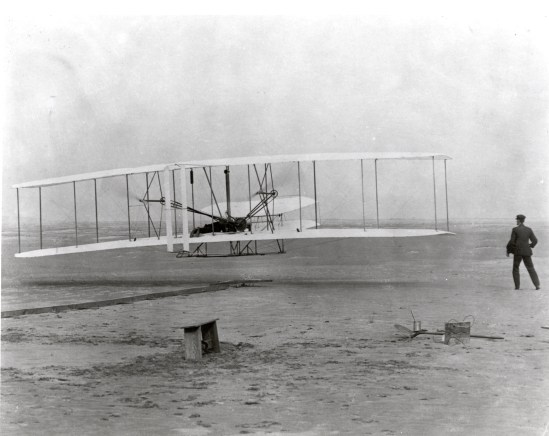
Wright-Brothers

And they said that manned flight was impractical or impossible. Seems like somebody forgot to tell these two bicycle shop owning brothers from Dayton, Ohio. And just look what they did on December 17, 1903 near Kitty Hawk, North Carolina.

“There will never be a bigger plane built.” — A Boeing engineer, after the first flight of the 247, a twin engine plane that holds ten people. (I guess this guy would later be fired. Because planes today hold way more than 10 people.)

“Man will not fly for 50 years.” –Wilbur Wright, American aviation pioneer, to brother Orville, after a disappointing flying experiment, 1901 (their first successful flight was in 1903). (Guess Wilbur was off by 48 years.)

“I have not the smallest molecule of faith in aerial navigation other than ballooning.”— Lord Kelvin, President of Royal Society, 1890 (Guess what happened in 1903.)

“Flight by machines heavier than air is impractical and insignificant, if not utterly impossible.”— Simon Newcomb, astronomer, 1902 (Guess what happened the next year.)

“…no possible combination of known substances, known forms of machinery, and known forms of force, can be united in a practical machine by which man shall fly long distances through the air…”- Simon Newcomb (1835-1909), astronomer, head of the U. S. Naval Observatory (Somehow the Wright brothers managed to pull this off in 1903.)

“If man were meant to fly, God would have given him wings.” – Bishop Milton Wright, father of the Wright brothers. (The brothers who, you know, would be the first to fly their own plane at Kitty Hawk. Yes, that was their father.)

“Heavier-than-air flying machines are impossible.” — Lord Kelvin, British mathematician and physicist, president of the British Royal Society, 1895. (Apparently, two brothers in Dayton, Ohio didn’t think so. And look what they did in North Carolina 5 years later.)

“Hence, if it requires, say, a thousand years to fit for easy flight a bird which started with rudimentary wings, or ten thousand for one which started with no wings at all and had to sprout them ab initio, it might be assumed that the flying machine which will really fly might be evolved by the combined and continuous efforts of mathematicians and mechanicians in from one million to ten million years–provided, of course, we can meanwhile eliminate such little drawbacks and embarrassments as the existing relation between weight and strength in inorganic materials.” The New York Times, Oct 9, 1903, p. 6. (Guess what two guys from Dayton did in North Carolina that year.)

“It would fill the world with innumerable immoralities and give such occasion for intrigues as people can not meet with. You would have a couple of lovers make a midnight assignation upon the top of the monument and see the cupola of St. Paul’s covered with both sexes like the outside of a pigeon house. Nothing would be more frequent than to see a beau flying in at a garret window or a gallant giving chase to his mistress like a hawk after a lark.”- Joseph Addison. [Concerns about where manned flight might lead (1713)] (What the hell does he imagine the future being like? Aladdin? Seriously, there’s a reason flying contraptions aren’t as available for consumers as skateboards.)

“Before Man reaches the moon, mail will be delivered within hours from New York to California, to Britain, to India or Australia by guided missiles. We stand on the threshold of rocket Science.”—George Summerfiled (Yes, that sounds awesome. But the US landed on the moon in 1969 and we still don’t have rocket mail. We have drones and Internet instead, which is so much better.)

“Automobiles will start to decline almost as soon as the last shot is fired in World War II. The name of Igor Sikorsky will be as well known as Henry Ford’s, for his helicopter will all but replace the horseless carriage as the new means of popular transportation. Instead of a car in every garage, there will be a helicopter…. These ‘copters’ will be so safe and will cost so little to produce that small models will be made for teenage youngsters. These tiny ‘copters, when school lets out, will fill the sky as the bicycles of our youth filled the prewar roads.”– Harry Bruno, aviation publicist, 1943. (I’m sure every family had their own helicopter after WWII. Not really. Seriously, there are no such things as privately owned helicopters unless one is stinking rich. I guess the brown acid was around in the 1940s.)

Cars? Are You Nuts?

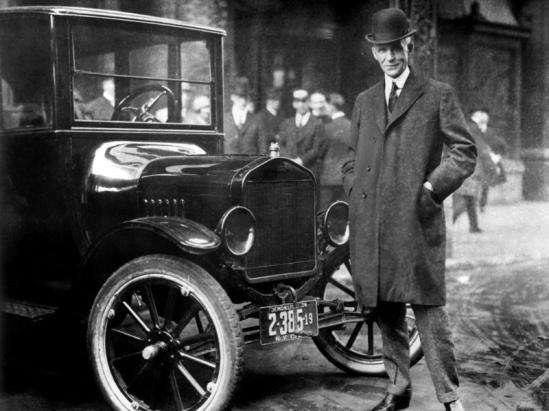
1375732275161

And they thought this wouldn’t replace the horse. Well, guess they didn’t bet on Henry Ford’s Model T assembly line in Detroit. Did they? Available only in black.

“With over 50 foreign cars already on sale here, the Japanese auto industry isn’t likely to carve out a big slice of the U.S. market.” — Business Week, August 2, 1968. (Businessweek severely underestimated how well the Japanese made cars that are affordable and reliable with Honda, Toyota, Mazda, Isuzu, Nissan, Mitsubishi, and Subaru.)

“The horse is here to stay but the automobile is only a novelty—a fad.” – -The president of the Michigan Savings Bank advising Henry Ford’s lawyer not to invest in the Ford Motor Co., 1903 (Obviously, Michigan Savings Bank had no idea what they were dealing with. Nowadays, cars are everywhere and horses are no longer seen as a mode of transportation.)

“It is an idle dream to imagine that automobiles will take the place of railways in the long distance movement of passengers.”— American Railroad Congress, 1913 (But it did happen as we know now because Amtrak isn’t doing so well these days.)

“The Edsel is here to stay.”— Henry Ford II, 1957 (Sorry, but the Edsel was one of the biggest flops in automotive history.)

“That the automobile has practically reached the limit of its development is suggested by the fact that during the past year no improvements of a radical nature have been introduced.”–Scientific American, January 2, 1909. (I’m sure there are plenty of ways to improve a car. Because nobody drives a Model T these days.)

“A new source of power… called gasoline has been produced by a Boston engineer. Instead of burning the fuel under a boiler, it is exploded inside the cylinder of an engine.

The dangers are obvious. Stores of gasoline in the hands of people interested primarily in profit would constitute a fire and explosive hazard of the first rank. Horseless carriages propelled by gasoline might attain speeds of 14 or even 20 miles per hour. The menace to our people of vehicles of this type hurtling through our streets and along our roads and poisoning the atmosphere would call for prompt legislative action even if the military and economic implications were not so overwhelming… [T]he cost of producing [gasoline] is far beyond the financial capacity of private industry… In addition the development of this new power may displace the use of horses, which would wreck our agriculture.”– U. S. Congressional Record, 1875. (Yeah, right. Nowadays, because of gas, the oil industry is one of the most important and most profitable. Also, gasoline didn’t wreck our agriculture.)

“Within the next few decades, autos will have folding wings that can be spread when on a straight stretch of road so that the machine can take to the air.” — Eddie Rickenbacker, ‘Popular Science,’ July 1924 (Yeah, I can see that but only in Chitty Chitty Bang Bang.)

Railroads? That Train Ain’t Gonna Come

EarlyPassenger

And they thought nobody would pay to travel by rail if they already had a horse. Yet, this soon became a dominant mode of transportation by the end of the 19th century.

“Rail travel at high speed is not possible because passengers, unable to breathe, would die of asphyxia.” – Dr. Dionysius Lardner, 1830 (I’ve been on a high speed rail at Disney World and suffered no such problems.)

“No one will pay good money to get from Berlin to Potsdam in one hour when he can ride his horse there in one day for free.” – King William I of Prussia, on trains, 1864 (Oh, yes, they will because it would be cheaper and easier. Also, had no idea why liveries existed in the first place. Or what it takes to care for a horse.)

“I should say that no railway locomotive ought to exceed 40 miles per hour on the most favorable gradient, but on a curved line the speed ought not to exceed 24 or 25 miles per hour.”— George Stephenson, 1841 (They go more that 40 mph now.)

“Dear Mr. President: The canal system of this country is being threatened by a new form of transportation known as ‘railroads’ … As you may well know, Mr. President, ‘railroad’ carriages are pulled at the enormous speed of 15 miles per hour by ‘engines’ which, in addition to endangering life and limb of passengers, roar and snort their way through the countryside, setting fire to crops, scaring the livestock and frightening women and children. The Almighty certainly never intended that people should travel at such breakneck speed.” — Martin Van Buren, Governor of New York, 1830(?). (Well, railroads were dangerous since they killed more people than some wars. However, 15 mph is certainly breakneck speed, for a turtle.)

“What can be more palpably absurd than the prospect held out of locomotives traveling twice as fast as stagecoaches?”–The Quarterly Review, March, 1825. (I can name a lot of things but not that. Actually, trains may travel more than twice as fast as stagecoaches.)

Maritime? That Ship Ain’t Gonna Sail

steam-technology-8

Ships powered by steam? Such nonsense! How’s that going to catch on? Oh, wait, it did. In fact, Mark Twain worked on one of these.

“How, sir, would you make a ship sail against the wind and currents by lighting a bonfire under her deck? I pray you, excuse me, I have not the time to listen to such nonsense.” — Napoleon Bonaparte, when told of Robert Fulton’s steamboat, 1800s (Seems like Napoleon had no idea on how a steam engine worked. Too bad for him.)

“I must confess that my imagination refuses to see any sort of submarine doing anything but suffocating its crew and floundering at sea.” — HG Wells, British novelist, in 1901 (Thankfully, Jules Verne thought otherwise since 20,000 Leagues Under the Sea features nuclear subs. Still, he has no idea how submarines work.)

“The Titanic is well able to withstand almost any exterior damage and could keep afloat indefinitely after being struck.”— P. Franklin, Vice President, White Star Line, April 15th 1912 (Does 3 hours after hitting an iceberg count?)

”I cannot conceive of any vital disaster happening to this vessel. Modern shipbuilding has gone beyond that.”—Captain Edward J. Smith of the Titanic before its maiden voyage in 1912. (How about sinking for 3 hours after being hit by an iceberg?)

”There is no danger that Titanic will sink. The boat is unsinkable and nothing but inconvenience will be suffered by the passengers.”– P. Franklin, Vice President, White Star Line, April 15th 1912 (Inconvenience? I think the passengers suffered more than inconvenience when it sank after hitting an iceberg. That’s putting it mildly.)

“I. A Voyage to Asia would require three years.

II. The western Ocean is infinite and perhaps unnavigable.

III. If he reached the Antipodes he could not get back.

IV. There are no Antipodes because the greater part of the globe is covered with water, and because St. Augustine said so.

V. Of the five zones, only three are habitable.

VI. So many centuries after the Creation, it is unlikely that anyone could find hitherto unknown lands of any value.”– Report of the committee organized in 1486 by King Ferdinand and Queen Isabella of Spain to study Columbus’ plans to find a shorter route to India. (Well, they were right about the impossibility or a shorter route to India. They were wrong about the other points but the first one for the time.)

“Men might as well project a voyage to the Moon as attempt to employ steam navigation against the stormy North Atlantic Ocean.”– Dr. Dionysus Lardner (1793-1859), Professor of Natural Philosophy and Astronomy at University College, London. (Later on, humanity accomplishes both.)

The Nobility and Aristocracy of Downton Abbey

p18hif5ud6s7hia1f8d1fs21pv94

Downtown Abbey: The estate of the Earls of Grantham and their family through generations. But has seen hard times since the Earl only has daughters and his closest two heirs had gone down with the RMS Titanic. Luckily the new heir is a handsome young lawyer who has a shine to his oldest daughter.

Though Americans may adore Downton Abbey, there are plenty of viewers on my side of the Atlantic Ocean may be somewhat confused about the British Title System within its centuries old aristocracy which traces its origins to the Middle Ages and the feudal system. Yes, there are kings and queens as well as princes and princesses. However, there are other kinds of nobles as well and there’s even a hierarchy of peerage. As Americans might see them, these are incredibly rich nobles who live in some castle or big fancy house. Nevertheless, getting titles and styles correct for someone who’s not “to the manner born,” which of course, is the point. In fact, the complexities of the honor system served to weed out posers, fraudsters, and plain old liars. Of course, as you see on Downton Abbey, you tend to see broke aristocrats as well as rich and successful commoners. And some of these incredibly rich commoners can get titles, too. But they’re usually knighted, but they can receive higher honors, especially if they do something of incredible significance. So the title system can get very complicated to say the least in the United Kingdom. However, I’ll try my best to explain the kinds of nobles you see on Downton Abbey as simply as I could. It may not be as exact because there’s so much to discuss. But it’ll just be the basics. But before we go on, I’ll give you a heads up on some of the types first:

Royalty: A class and law unto themselves. Even now there are those who consider everyone not born into it (like dukes, duchesses, the Queen Mother, and Princess Kate) little better than commoners.

Nobility: Peers of the realm, each of whom passes on his title –or as often, package of titles-to his oldest son (if he has one). Originally the whole business had to do with ownership of land, discharge of feudal obligations, and the wielding of actual power rather than with mere wealth and privilege. However, in the last few centuries, though, it’s only that such hereditary peers (who come in 5 strengths), together with few “life” peers (who come in only one and whose titles ae not bequeathable) and Church of England bigwigs, sit together in the House of Lords and continue, with their wives and children, to provide England with her lords and ladies-and her much-debated class system. Note: Most of the female counterparts here are more often the wives. However, if the woman is the oldest daughter in the family with no male heirs, she becomes a titled noble in her own right (so Lady Mary could’ve become Countess of Grantham, if it weren’t for Matthew being in the picture). Wives of male peers can share their husband’s social rank like the Countess of Grantham but husbands of female peers do not (mostly because they didn’t want their husbands to be mistaken for being their wives’ subordinates instead of their lords and masters. Clearly, no red-blooded man in those days would tolerate that. However, this wasn’t the case prior to the Tudor era since husbands of female peers could assume titles through marriage and exercise their wives’ authority. Because in the Middle Ages, marrying a peeress was a ticket to living in a castle and becoming lord of the manor so they absolutely didn’t give as shit). However, until 1963, women who held a peerage in their own right couldn’t sit on the House of Lords. By the way the hierarchy of peerage from highest to lowest consists of duke, marquess, earl, viscount, and baron.

Lesser Nobility: Depending on your point of view, titled commoners. Come in 2 sizes: baronet and knight. Don’t look for either in the House of Lords. One title is hereditary, the other is not.

The Gentry: They can be of birth as high and breeding and fine as the nobility. In fact, many of them are the descendants of that nobility’s younger sons and daughters (like Matthew Crawley who had a direct ancestor as the Earl of Grantham along somewhere). But as intimidating as their manners and as awesome as their fortunes may be, what they lack is in titles. As the people of Burke’s Peerage point out, the English gentry are the only untitled aristocracy in the world.

So now that’s cleared up, I give you a list of the British upper crust to help you sort some questions out when you’re watching Downton Abbey.

  1. King

Female Counterpart: Queen. A reigning king’s wife is referred to as Queen Consort (or Princess Consort as Camilla will be when Prince Charles becomes king). A reigning queen’s husband is referred to as Prince Consort (as with Prince Philip though it’s not official with him and he’s technically the royal Duke of Edenborough. However, it was with Prince Albert, but not until he was married to Victoria for 17 years and he was only called that by the British Elite because of their barely concealed xenophobia and that he had no other British title, so as a backhanded compliment in the sense of, “okay, you’re a prince who happens to be married to a queen so we’ll call you that.”).

Type: Royalty

Description: The reigning sovereign monarch. Mostly inaccessible, but easy to distinguish. Usually inherited by the oldest surviving child of the predecessor (normally the oldest son but there’s a way of succession if one shouldn’t be available. Then it would go to that heir’s children {if they exist} and then to monarch’s other children and their kids. Queen Victoria ascension is an example to this since she became queen after her uncle King William IV died {who was the 3rd son of King George III and succeeded his brother King George IV}. Her father was the 4th son of King George III. And 3 of his sons were still alive at the time. However, before Victoria was born, King George III had only one legitimate heir named Princess Charlotte, daughter of the future King George IV and Caroline of Brunswick {who hated each other so her conception was a miracle}. At 21, Charlotte died after giving birth to a stillborn son which set off tremendous morning among the British as well as kicked off a major succession crisis. This led to King George III’s younger unmarried sons to ditch their mistresses, marry, and procreate. Edward, Duke of Kent would be the first one to do so successfully 18 months later with Victoria’s birth).

Way of Address: Upon meeting the monarch, bow or curtsy-depending on your gender- and say “your majesty.” Say “sir” or “ma’am” thereafter.

On Downton Abbey this is: Why King George V and his wife Queen Consort Mary of Teck. However, Prince Edward of Wales and Prince Albert Duke of York would both become Kings Edward VIII and George VI respectively. King George was seen as a stolid, conservative, and reliable monarch. Queen Mary was an icy cold bitch who compulsively stole jewelry. Both carried an image of dignity and were highly popular.


  1. Prince
o-DOWNTON-ABBEY-570

Prince of Wales: The heir apparent to the English throne who everyone’s dreading the day he becomes king. Likes to party and have affairs with married women. Seems polite and courteous who is willing to dance with a debutante whose family helped recover some incriminating love letters. However, they basically helped covering up an affair that almost everyone in Britain knows about as well as the fact he’s a royal pain in the ass. Destined to give up the throne in favor of his stammering little brother within the next decade.

Female Counterpart: Princess, either as consort or in her own right.

Type: Royalty

Description: This one is a bit complicated. They’re usually the offspring of the reigning monarch or their predecessors. They could also be the grandchildren of the sovereign through a sovereign’s or their predecessor’s sons. This might also apply to the grandchildren of the heir presumptive as well in the case of Prince George and Princess Charlotte. Also, a reigning queen’s husband is technically a prince, too like Prince Albert or Prince Philip (though the latter doesn’t seem to mind as much as the former did). On the continent of Europe, the title of prince doesn’t necessarily pertain to royalty. In France, princes usually rank below dukes. Russian princes are usually not direct members of the royal family either. Czarist children were known as Grand Dukes or Grand Duchesses.

Way of Address: Upon meeting one, bow or curtsy and say “your royal highness.” Refer to them as “sir” or ma’am” thereafter.

On Downton Abbey this is: Prince Edward of Wales and Prince Albert, Duke of York. Still, while Prince Edward is seen as rather courteous and polite on the show, keep in mind that in real life he was an insufferable, selfish, and absolute jerk who liked to party and chase skirts. His tryst with Freda Dudley Ward was public knowledge as well as his relationship with Wallis Simpson later on. Even his family thought he was a royal pain in the ass that his old man hoped he’d never have kids so Bertie and the future Elizabeth II could take the throne after him. The public couldn’t care less for him either as if “that guy is going to succeed King George.” Oh, and he thought Hitler was awesome. Let’s just say abdicating the throne in favor of his little brother with a speech impediment was the best thing he ever did for his country.


  1. Duke
25063_matthew-crawley-cena-en-downton-abbey

Duke: An aristocrat of the highest peerage grade who comes to Downton looking for a rich heiress to marry. Knowing the estate an entail of significant assets, he’s willing to flirt with the oldest daughter. But renounces her after her daddy told her he has no intention to contest the entail. Also serves to show that the designated bad boy of the staff bats for the other team (but views him as a disposable play-thing).

Female Counterpart: Duchess, either as a consort or in her own right.

Type: Nobility

Description: Highest degree of British peerage. First English dukedom was created in 1337, and are usually a rare and much deferred to breed so they have a couple dozen in number. While the monarch’s sons can be referred to as dukes, but they’re “royal dukes” and relatives to the sovereign, but it’s more of a title such as the Duke of York. Also serves as a reward for military such as the Duke of Marlborough (an ancestor of Winston Churchill) or Wellington (for defeating Napoleon). In Europe, dukes controlled vast areas like Bavaria and Normandy and pretty much called their own shots. Hell, in countries like France (and sometimes Russia), they could’ve even outranked princes. In some areas, they even ruled domains to their own like monarchs called duchies (such as in Luxembourg today). By the way, in England, royal dukedoms become non-royal after the second generation.

Way of Address: Upon meeting, say “your grace.” Same goes for his wife.

On Downton Abbey this is: There’s a few such as the Duke of Crowborough and the Duchess of Yeovil.


  1. Marquess
DAS3E7_Shrimpy1

Marquess: An aristocrat of the second highest British peerage grade, who is a cousin by marriage to the Earl of Grantham who serves as a reliable government contact whenever they’re in need of someone to pull strings. Hosted a great event at his Scottish Duneagle castle in which he announces that he’s broke, is planning to sell up, and is taking a job. Leaves his bratty teenage daughter for the Earl and his family to babysit in the meantime. Wife is a real bitch to everyone and he’s planning to divorce her by Season 5.

Female Counterpart: Marchioness, either as consort or in her own right.

Type: Nobility

Description: Second highest British peerage, which is the least familiar to Americans (though we’re familiar with the French “marquis” but that’s because of Puss and Boots). Also, it’s pronounced “MAR-kwiss” and “MAR-shuness” and it comes from the old word “march” meaning border territory. Of course, it helps to explain that the first marquesses who were lords granted lands along the borders of Scotland and Wales. And they were considered important because they were guarding the realm from dangerous foreigners. It wasn’t well received at first since the first two honorees complained but eventually, with Tudor persistence, it gained acceptance. Was used as a reward to viceroys of India upon their return home, and in 1917, a compensation for George V’s relatives when he made them give up their obviously inappropriate German titles. There are almost as few marquesses around as dukes.

Way of Address: Upon meeting one, say “my lord.” Address his wife as, “madam.”

On Downton Abbey this is: The Marquess and Marchioness of Flintshire (also known as the MacClares).


  1. Earl
pbs-masterpiece-earl-of-grantham

Earl: An aristocrat of the Middle British Peerage grade who’s the lord and master of Downton Abbey. Is a likeable man as well as a wonderful boss, husband, father, and benefactor but has his moments of noble douchery whenever those close to him reject the good old ways he always he takes pride in. That and whenever they try to challenge his power to save the estate. Is a complete idiot when it comes to economics and financial management. Don’t be rude to diss the aristocracy or try to get in his wife’s pants. Also, don’t mess with his mom who’s a real force to be reckoned with.

Female Counterpart: Countess, either as consort or in her own right.

Type: Nobility

Description: Third rung of the peerage system. As the marquess title is the English equivalent of a marquis, the earl is the English equivalent to a count. This is a very old and uniquely English title that has been around since Saxon times when it was the English equivalent to a European duke. Tough William the Conqueror tried to replace it with “count” the English people wouldn’t buy it mostly because to them at the time, the word had the aural similarity to a certain word for an undignified part of the body. Besides, it was the only hereditary title around at the time and it very damn well should have a native flavor (though lack of female equivalent led to women having to accept the title “countess.”)Comes from the Old English word “eorl” meaning “man of position.” Today there are 200 earldoms. Can be a reward for particularly effective prime ministers when they retire like Disraeli, the Earl of Beaconsfield, and Anthony Eden, Earl of Avon.

Way of Address: Upon meeting one, say “my lord.” Address his wife as, “madam.”

On Downton Abbey this is: Why, the Earl of Grantham of course. You also have the Countess and Dowager Countess of Grantham as well. The Lord Chamberlain of the Household (his name was

Rowland Thomas Baring 2nd Earl of Cromer. He was also a diplomat. Served as a subaltern of the Grenadier Guards in WWI).


  1. Viscount
246b7bc09e0b9f213600ebf2a692076c

Viscount: An aristocrat of the second lowest grade of the British Peerage, who dumps his fiancee when a girl he’s had a crush on when he was young suddenly becomes available. Yet, after they spend a sex-filled weekend together, he becomes a real entitled jerk when she decides to dump his ass. Valet is a known serial rapist who gets his ultimate comeuppance. But not without causing a major inconvenience on some of Downton’s staff.

Female Counterpart: Viscountess, either as consort or in her own right.

Type: Nobility

Description: Second lowest on the British title system. Pronounced “VYE-count” and “VYE-countess.” Originally designated as the guy who stood in for the count or in England, the earl (think of the “vis-“ in “viscount” being like “vice” in “vice president” and you’ll see what I mean.” The most recent of the 5 grades of peerage which was in 1440. An accepted way to say thank you to a good speaker to the House of Commons.

Way of Address: Upon meeting one, say “my lord.” Address his wife as, “madam.”

On Downton Abbey this is: Viscount Gillingham. You know, the guy who Mary had sex with in Season 5 before she dumped him and he became a real dick to her. Also, had a valet whose a serial rapist and brutally raped Anna during that recital by Dame Nellie Melba.


  1. Baron
da-s5-characters-slidenumber-merton-1-hires-crop-648x327

Baron: An aristocrat at the lowest grade of peerage, who romances a middle class widow after her son tragically died in a tragic accident with his sports car. A sweet, genial man with an interest in medicine, he’s a perfect gentlemen. Unfortunately for him, his two sons are absolute pricks.

Female Counterpart: Baroness, either as consort or in her own right.

Type: Nobility

Description: Lowest rank on the peerage totem pole. Originally took in Englishmen whose ancestors had fought during the Middle Ages in Wales, Scotland, or France, and more recently a number of industrialists and trade union leaders (who are generally given this title only for life). As demonstration for their lack of precedence, barons are never referred to by their title, merely as Lord So-and-So. His wife is always Lady So-and-So, never the baroness. Sometimes a given name sneaks in as with Alfred, Lord Tennyson. In the Middle Ages, they were the King’s tenants in chief and giving the owner, whether by inheritance or by acquisition, a bundle of land, minerals, and other rights including those of public justice and privilege. In the 13th century, some were among the first Parliamentarians. Then there are life barons, given by writ that might you a seat in the House of Lords but can’t be inherited. Before recent times, a lot of these life peerages were granted to women, such as the ennobled mistresses of King Charles II.

Way of Address: Upon meeting one, say “my lord.” Address his wife as, “madam.”

On Downton Abbey this is: There’s a bunch like Baron Hepworth, Baron and Baroness Sinderby, Baron Merton, and Baron Aysgarth.


  1. Baronet
Sir_Anthony

Baronet: A lesser nobleman who’s friends with the earl and strikes a romance with his middle daughter who’s 30 years younger. After his war injury, it becomes abundantly clear that he’d rather dump the poor girl at the altar than rob the cradle.

Female Counterpart: Baronetess, either as a consort or in her own right (though there have only been 4 of them and they’re usually addressed as “Dame”).

Type: Lesser nobility

Description: Title means, “little baron.” It’s said that in 1611, King James I, needing capital, instigated, “a new designate between barons and knights,” open to anyone whose paternal grandfather bore arms, who possessed an annual income of at least £1,000, and who was willing to make a £1,095 down payment. While these guys were not, under any circumstances, to see themselves as noble, they were encouraged to adopt the style of Sir Joe Schmo, Bt., and they could pass on to their oldest son.

Way of Address: Upon meeting one, say “Sir” and his first name. Address his wife as “Lady” and her last name.

On Downton Abbey this is: Sir Anthony Strallan, one of Lord Robert’s friends as well as the guy who left Edith at the altar. Another is Sir John Bullock who’s a drunken upper class twit.


  1. Knight
2cqi51y

Knight: A lesser noble who an Earl’s daughter hooks up with whenever her one true love is unavailable and doesn’t want the public know about how she lost her virginity. A ruthless newspaperman with a vicious streak a mile wide and a network of informants to give him scoops. Is willing to use blackmail when he notices that the earl’s daughter clearly interested in her one true love. Gets a wonderful thrashing at the end of Season 2.

Female Counterpart: Dame, but only in their own right. A knight’s consort is always addressed as, “Lady.” A dame’s consort gets no special distinction whatsoever. Same goes for male spouses of knights (like husbands of Sir Elton John, Sir Ian McKellen, and Sir Derek Jacobi).

Type: Lesser, nobility

Description: In the Middle Ages, the knight was the most significant figure in the feudal system, a mounted horseman who fought for his liege and lord (but more often for himself) and defended the honor of his lady (well, a noble lady who he’s supposed to be with, anyway). For some time, it’s been the most frequently conferred “dignity” in England by far for a male recipient. Guaranteed for one lifetime and one lifetime only.

Way of Address: Upon meeting one, say “Sir.” Address his wife as “Lady.” As for dames, just address her as, “Dame” and her first name.

On Downton Abbey this is: Sir Richard Carlisle and Sir Philip Tapsell. Neither of them are nice guys. For the dames, we have Dame Nellie Melba (Helen “Nellie” Porter Mitchell) who was the first successfully Australian to achieve international recognition as a classical musician. Off-screen, there’s Dame Maggie Smith who portrays the Dowager Countess.


  1. Esquire
f3f27ac23b9fc6a9edb9fb4e1d77e373

Esquire: The designation you give to a Manchester lawyer who’s just become Downton Abbey’s new heir as well as the destined love interest for the Earl of Grantham’s oldest daughter, thanks to a couple of guys dying on the Titanic. Despite ups and downs as well as belligerent sexual tension, they eventually manage to get married and produce a kid. And in the meantime, he also helps save Downton with his professional savvy in finance law and his inheritance from his ex-fiancee’s dad. Can recover from paralysis in record time. Fated to be crushed by his own fancy sports car after seeing the birth of his son at the end of Season 3.

Female Counterpart: Not sure if there is one, since this is usually reserved for regular guys in line to nobility on the show.

Type: Gentry

Description: In the Middle Ages, the esquire (or squire) attended the knight and carried his gear. Once the Middle Ages were over, it was later used to apply to, “the sons of peers, the sons of baronets, the sons of knights, the eldest sons of the younger sons of peers, the eldest son of the eldest son of a knight, his sons in perpetuity, the king of arms, the herald of a knight, officers of the Army or Navy of the rank of captain and upward, sheriffs of counties for life, J.P’s of counties whilst in commission, serjeant-at-arms, Queen’s counsel…” well, you get the picture. It’s basically a catchall with connotations of both rank and real estate, and a way of appeasing any number of people who would otherwise risk seeming, in the eyes of the world, no better than their neighbors. It didn’t really work out. Because when the Victorians reserved “esquire” for the landed gentry and withheld it from commercial and industrial types, the word had lost-through careless usage-almost all of its distinction. Today the entire male population of Britain and Ireland can regularly be addressed as “Esq.” (after their name taking the place of “Mr.” before it, of course) by mail-order houses and book clubs. As for squires who were the big country landowners who exercised authority and financial leverage over their districts and villages, spoke in provincial dialect, and rode hounds, they were extinguished by the 19th century by the increasing taxes and creeping urbanism of the industrial revolution. Besides, it wasn’t much of an honor or even a slot in the hierarchy as a way of life, anyway. Good luck finding those guys at Downton Abbey.

Way of Address: There’s no official way to address them.

On Downton Abbey this is: Matthew Crawley and Charles Blake. George Crawley counts as well since his dad was smashed by his sports car during a collision.


  1. Gentleman

Female Counterpart: Uh, gentlewoman?

Type: Gentry

Description: Historically, being of “gentle” birth, entitled to bear arms, owning at least 300 acres of land, but lacking the larger distinction of being an esquire, let alone a knight or better. For more than a century now the word has almost no agreed-upon meaning at all. However, in Jane Austen’s day, it was still something to keep in mind. For instance, Mr. Collins would qualify as a gentlemen and an appropriate suitor for Elizabeth Bennett despite being a fool, a clergyman, and her cousin. Not only that, but her best friend Charlotte Lucas who’s a knight’s daughter no less, was happy to land him. Then again, she was 27 and probably looking for a guy to settle down with. Seriously, I’m sure Mr. Collins wasn’t her first choice.

Way of Address: There’s no official way to address them.

On Downton Abbey this is: Matthew Crawley and Charles Blake might qualify at another time. But you’ll have a better time finding one in Austen.


  1. Yeoman

Female Counterpart: Uh, yeowoman?

Type: Rural Middle Class

Description: These are small, independent farmers who like squires, would be forced out of existence by the pressurized ways of 19th century life. Yet, until their demise, they had a reputation for being sturdy, hardworking, sometimes even educated, and possessed the kind of integrity that England is always tapping on your shoulder to tell you it has. Respectable, landowning, and can even vote. However, in the world of Austen, these guys aren’t as marriageable to women of good means.

Way of Address: No official way to address them.

On Downton Abbey this is: These guys were gone before the show even started. Most of the farmers you see on there are tenants on some aristocrat’s land.

downtonabbey1

Noble Daughter: While lovely in her own way due to a lifetime of privilege and fancy clothes, is basically as an inheritor to her daddy’s estate due to being born without a penile appendage. Oldest is usually used to set up with male heirs who are most likely her cousins. Fortunately, there’s an attractive attorney from Manchester set to inherit the estate. And he’s taken a shine to Lady Mary. Nevertheless, each girl tends to stir up trouble and cause scandal in their own way whether through wearing dungarees and running off with a politically radical chauffeur, losing her virginity to a Turkish envoy who suddenly died in her bed, or falling pregnant out of wedlock to a married newspaperman who ends up killed by Nazis.

As for the nobleman’s kids: In general, only the oldest son comes out on top, but not until the old man croaks. In the meantime, when Daddy is still the duke, marquess, or earl, the son is awarded a “courtesy title.” For instance, had Matthew Crawley managed to outlive his father-in-law and distant cousin, the Earl of Grantham, then his son George would’ve been addressed as “Viscount Downton” until the major title came free. But since Matthew got smashed in a collision with a truck, then George just be regular “Mr. George Crawley” until his granddaddy joins the choir invisible. As for eldest sons of barons and viscounts: well, they’ll just have to wait. They, and everyone else in the second generation, make do-most of them for life-with what’s called a courtesy style. If you’re lucky (supposing daddy is a duke or marquess), you’re “Lord” or “Lady” like Lady Rose MacClare or Lord Joe So-and-So.  Also, if you’re a daughter of an earl, you get “Lady” put before your name, too like Lady Mary Crawley. If you’re not so lucky, you get a simple, “The Hon.” (read: “The Honourable”) to put before your name. Think Lord Merton’s asshole kids like the The Hon. Larry Grey as well as The Hon. Madeleine Allsop. If the Earl of Grantham had boys, then his sons would be referred to as “the Honourable,” too, save for the eldest who’d naturally be “Viscount of Downton” and be referred to as “Lord” (so it probably was better that Lord Grantham only had girls). As for the grandchildren, unless they belong to the oldest son, they’re on their own. A key example would be Winston Churchill who despite being of noble birth and the oldest son, had to make it on his own because his dad Lord Randolph Churchill was the 3rd son of the 7th Duke of Marlborough. As for any illegitimate noble spawn, well, little T. E. Lawrence is certainly not going to inherit his daddy Sir John Chapman’s baronetcy since he’s was the second oldest son of the guy and his daughters’ governess. Oh, and the guy was married to another woman at the time.

In These Haunted United States – Part 5: South Dakota to Wyoming

So we’ve come to the end. Hope you had a good time reading these as I have had writing them. Now throughout the series, we’ve seen haunted houses, haunted hotels, hallowed battlefields, paranormal prisons, creepy mental asylums, and what have you. Of course, some of you might go for the ghostly legends that might make it hard for you to sleep at night. But if you’re like me, you’re probably reading this series on haunted places as an excuse to read something about history at around Halloween. Yes, ghost stories are interesting and some people might really believe them. But while I’m a churchgoing Catholic with politically liberal views, I’m not a believer in the paranormal such as the ghost and monster stuff. I’m not much of a fan of horror movies either, especially the recent slasher ones advertised on TV that seem to suck. But I do love history and I do like talking about places that have some sort of interesting past, ghost stories or not. And I know that a place’s reputation for being haunted might somehow lead to someone wanting to preserve it to attract tourist. Well, unless there’s an Amityville Horror situation involved where the residents want nothing to do with the publicity. Still, in this post, I bring you my final installment of haunted American places. These consist of a hotel in South Dakota owned by a guy you might know from Deadwood, a plantation house in Tennessee owned by a famous country singer, a famous fortress in Texas, a liberal arts college in Utah, a large state university in Vermont, a very old plantation house in Virginia, a hotel in Washington state, a former state penitentiary in West Virginia, an abandoned mansion in Wisconsin, and a former state prison in Wyoming. So for your reading pleasure, here is my last post in my haunted America series.

41. South Dakota

The Bullock Hotel is the oldest one in Deadwood, South Dakota. However, what's even more interesting about it is the man who owned it and is said to still haunt the place. If you're a fan of Deadwood, you might know something about Captain Seth Bullock.

The Bullock Hotel is the oldest one in Deadwood, South Dakota. However, what’s even more interesting about it is the man who owned it and is said to still haunt the place. If you’re a fan of Deadwood, you might know something about Captain Seth Bullock.

Most Haunted Place: Bullock Hotel in Deadwood

History: Opened 1895 by Captain Seth Bullock and it’s the oldest hotel in the city, which he built from a converted warehouse. This after a fire swept Deadwood the previous year and destroyed much of the town and the original 2 story building. Bought by the Ayres family in 1976 who converted it to a hardware store. However, in 1991, was sold to Bullock Properties who restored and converted the place back to a hotel as much as modern safety standards would allow.

Present Use: It’s still a hotel but it only has 28 of its original 63 rooms. However, it also has a casino and restaurant named Bully’s after Bullock’s friend Teddy Roosevelt. Still, unlike the original structure each room has it’s own bathroom. More expensive rooms are said to contain a Jacuzzi.

Sightings: Well, many have reported hearing voices, seeing apparitions and orbs, and being tapped.

Anyone Famous?: Well, Captain Seth Bullock himself  who was known in life as a lawman, marshal, frontiersman, store owner, horse breeder, hotel owner, and investor. He was also a Rough Rider during the Spanish American War. He’s actually said to do most of the haunting according to guests, workers, and employees. He’s mostly amiable and acts like he owns the place but is said to shatter plates and glasses when he’s displeased. Still, he actually died there of colon cancer by the way. Nevertheless, he and his wife Martha are best known as characters from the HBO show Deadwood.

Open to Tourists?: Yes. So if you’re a fan of ghosts and Deadwood, this is your ideal Halloween destination. Also hold ghost tours regularly.

Other Haunts: Alex Johnson Hotel, Mount Marty College, Northern State University, Pine Ridge Old Hospital, Sioux San Hospital, 1880 Hill City Train, Firesteel Coal Mines, Mount Rushmore Brewing Company, Isabel Post Office, Old Keystone Cemetery, Jackpot Bingo Hall, Rock Creek Day School

42. Tennessee

Loretta Lynn still owns this house as well as the town of Hurricane Mills. However, it's still said to be haunted by the ghost of the previous owners as well as Confederate soldiers and slaves.

Loretta Lynn still owns this house as well as the town of Hurricane Mills. However, it’s still said to be haunted by the ghost of the previous owners as well as Confederate soldiers and slaves.

Most Haunted Place: Loretta Lynn Plantation House in Hurricane Mills

History: Built in 1876 by James Anderson who also built the new mill in town. In 1966, Loretta Lynn and her husband Doolittle fell in love with the place where they not just bought the plantation, but also the entire town. Apparently, despite that she swears there were ghosts there, Lynn doesn’t seem to mind so much.

Present Use: The plantation house is more of a museum than anything. Lynn now lives in the house she built behind it, realizing that it would be better used for tourism.

Sightings: It’s said to be haunted by the original owner, a woman in white, as well as ghosts of Confederate soldiers and slaves.

Anyone Famous?: No.

Open to Tourists?: Yes.

Other Haunts: Hurricane Mills itself, Bell Witch Cave, Carnton Mansion, Hales Bar Dam, Isaac Franklin Plantation, Gatlinburg Mysterious Mansion, Orpheum Theatre, Sheraton Read Hotel, Tennessee State Prison, Woodruff-Fontaine House, Chickamauga Battlefield, Stones River Battlefield, Ryman Auditorium, East Tennessee University, Tennessee State Capitol, Rotherwood Mansion

43. Texas

The Alamo is a symbol of Texas as well as the site of the famous battle fought there. However, I'm not sure if you'll find the ghosts of Davy Crockett, Jim Bowie, or William Travis. Didn't really look that up.

The Alamo is a symbol of Texas as well as the site of the famous battle fought there. However, I’m not sure if you’ll find the ghosts of Davy Crockett, Jim Bowie, or William Travis there. Didn’t really look that up.

Most Haunted Place: The Alamo in San Antonio

History: Built in 1744 as the Mission San Antonio de Valero which functioned as a Roman Catholic mission to convert and acculturate Native Americans. But in 1793, the mission was secularized and abandoned. A decade later, it became a military fortress with its unit giving the place its present name. During the Texas Revolution, Mexican General Martin Perfecto de Cos surrendered the fort to the Texian Army in December 1835, following the Siege of Bexar. A small number of Texian soldiers occupied the place for months but were soundly defeated at the Battle of the Alamo in March of 1836. When the Mexican Army retreated from Texas, they tore down many of the Alamo’s walls and burned some its buildings. For subsequent years, the Alamo buildings would be used as a fortress for soldiers, a quarter master’s depot, and even a wholesale grocery store. Thanks to the efforts of the Daughters of the Republic of Texas, particularly Adina Emilia de Zavala and Clara Driscoll, the place was restored.

Present Use: It’s now a UNESCO World Heritage Site, a National Park, and a symbol of Texas. Receives over 4 million visitors each year.

Sightings: Site is reportedly haunted by the people who died there defending the place. Many claimed to have seen apparitions either coming straight through walls or walking along the roof.

Anyone Famous?: Good luck trying to find ghosts of Davy Crockett, Jim Bowie, and William Travis.

Open to Tourists?: Yes. In fact, it’s a huge tourist destination. And they do give ghost tours.

Other Haunts: Devil’s Backbone, Jefferson Davis Hospital in Houston, Houston Zoo, Miss Molly’s Bed and Breakfast, Presidio La Bahia, Catfish Plantation Restaurant, The Grove in Jefferson, Littlefield House, University of Texas in Brownsville, Baker Hotel, Haunted Hill House, La Carafe, Spaghetti Warehouse, Jefferson Hotel, Hotel Galvez, Granbury Opera House, Emily Morgan Hotel, Bragg Road, Elder Street Artist Lofts, Driskill Hotel, White Sanitarium

44. Utah

Originally built by Protestant missionaries to convert the Mormon children, Salt Lake City's Westminster College has been trying to shed its religious past. But it's said to have 7 known ghosts.

Originally built by Protestant missionaries to convert the Mormon children, Salt Lake City’s Westminster College has been trying to shed its religious past. But it’s said to have 7 known ghosts.

Most Haunted Place: Westminster College in Salt Lake City

History: A private liberal arts college established in 1875 and the only accredited one in Utah. Built at a time when Protestants flocked to Utah in order to try converting Mormons so they built private and secondary schools where they offered free tuition. Westminster belonged to the Presbyterian Church until the school officially severed its denominational ties in 1974 and it’s no longer antagonistic to the state’s Mormon establishment. Its campus is known for its natural beauty and elegant architecture. Its mascot is the griffin and its colors are blue and gold. Notable alumni include Olympic skier Maddie Bowman.

Present Use: It’s still a liberal arts college and one of the few in the Intermountain West with no denomination.

Sightings: Said to be haunted by at least 7 known ghosts, spread out over several buildings as well as known for appearing at random, making odd noises, and sometimes touching passersby.

Anyone Famous?: No.

Open to Tourists?: I think it might. You might want to check.

Other Haunts: American Fork Canyon, Clearfield Job Corps Center, Gray Cliff Lodge Restaurant, Kiwanis Park, Roy High School, Voo Doo Caves of Beaver Dam, Forest Farm House at Old Deseret, McCune Mansion, Dove Creek Camp, Southern Utah University, Latuda, Winter Quarters Mine

45. Vermont

The University of Vermont is one of the oldest American public colleges and alma mater to a lot of celebrities including a First Lady. It's also had a colorful history and is said to be a haunt of a lot of ghosts.

The University of Vermont is one of the oldest American public colleges and alma mater to a lot of celebrities including a First Lady. It’s also had a colorful history and is said to be a haunt of a lot of ghosts. Don’t mention the racist winter celebrations though.

Most Haunted Place: University of Vermont in Burlington

History: Established in 1791 and became the state’s sole land grant university in 1862, it’s one of the first public colleges in the country as well as one of the first to admit women and African Americans. However, this didn’t stop them from using the Kakewalk and blackface in their winter celebrations, which was abolished in 1969. They also have a naked bike run at the end of the year. Its mascot is the Catamounts in NCAA Div. I sports. It’s also said to have one of the most selective medical schools in the country. Its first edifice was destroyed by a fire in 1824 and the citizens paid for a replacement with the Marquis de Lafayette laying the cornerstone on what’s now “Old Mill.” In 1924, it held the first radio broadcast in the state. Also has a long history of environmental sustainability. Notable alumni include attorney Consuelo Northup Bailey (first female lawyer to practice before the U.S. Supreme Court), Boston Red Sox pitcher Ray Collins, First Lady Grace Coolidge, philosopher and educator John Dewey, Phish bass player Mike Gordon, Phish guitarist Trey Anastasio, Olympic gold medalist Albert Gutterson, serial killer H. H. Holmes, doctor and American Legion founder Horatio Nelson Jackson, Pulitzer Prize winning author E. Annie Proulx, New York Times co-founder Henry Jarvis Raymond, author and cook Jessica Seinfeld (or Mrs. Jerry Seinfeld), 3-time Stanley Cup champion Patrick Sharp, Nobel Peace Prize Laureate Jody Williams and missionary Samuel Worcester.

Present Use: It’s still a public university to this day.

Sightings: Events reported are poltergeist activity, apparitions, voices, and windows and doors slamming.

Anyone Famous?: No, but there’s a hall named after Grace Coolidge which is said to have few ghosts in it.

Open to Tourists?: Yes.

Other Haunts: Averill Stand Bed and Breakfast, Bennington College, Carbur’s Restaurant, Gold Brook Covered Bridge, White House Inn, Hayden House, Lake Bomoseen, Brattleboro Retreat Tower, Green Mountain Inn, Golden Stage Inn, Shelburne Museum

46. Virginia

Since its establishment, the Ferry Plantation House has been on property that's served as a plantation, courthouse, school, and post office. Was a place of a famous witch trial in 1703 which is honored each year.

Since its establishment, the Ferry Plantation House has been on property that’s served as a plantation, courthouse, school, and post office. Was a place of a famous witch trial in 1703 which is honored each year.

Most Haunted Place: Ferry Plantation House in Virginia Beach

History: Got its name from the ferry service that ran through the Lynnhaven waterway. Current house built in 1830 by slaves of George and Elizabeth McIntosh as well as on a property that’s been used as a plantation, courthouse, school, and post office. It’s said that a woman named Grace Sherwood “the Witch of Pungo” was tried by ducking there in 1703 and it’s now commemorated with a festival in her honor. She was the last person in Virginia to be convicted of witchcraft (but she didn’t die until 1740) All the bricks were from the ruins of the previous mansion built there which was burned two years earlier.

Present Use: It’s now a museum and educational center. It even has a history summer camp to educate youth about 18th and 19th century life.

Sightings: It’s reported to contain no less than 11 spirits reputed to be former owners, children, slaves, people who drowned, and other lost souls. It’s also reported that the lights go on during the night while unoccupied and strange balls of light are seen dancing on the roof.

Anyone Famous?: Artist and General Thomas H. Williamson is said to haunt while wearing a dirty shirt. Alleged witch Grace Sherwood is also said to haunt the premises.

Open to Tourists?: Yes.

Other Haunts: Aquia Church, Ball’s Bluff, Bremo Recess, Manassas National Battlefield, Monticello, Rosewell, Swannanoa Palace, Fort Magruder Hotel, Staunton Train Depot, Paxton Manor, Salubria Manor, Boxwood Inn Bed and Breakfast, Cold Harbor Battlefield, Major Graham’s Mansion, Historic Avenel, Weems-Botts Museum, Historic Jordan Springs, Henricus Historical Park, Exchange Hotel Civil War Hospital Museum, St. Albans Sanatorium

47. Washington

Port Townsend's Palace Hotel is said to house an Egyptian theater, Northern Pacific offices, a grocery store, a state liquor store, a florist shop, and several restaurants. But it's said that its haunted activity stems from it being used as a brothel.

Port Townsend’s Palace Hotel is said to house an Egyptian theater, Northern Pacific offices, a grocery store, a state liquor store, a florist shop, and several restaurants. But it’s said that its haunted activity stems from it being used as a brothel.

Most Haunted Place: The Palace Hotel in Port Townsend

History: Constructed in 1889 by retired sea captain Henry L. Tibbals. Over the years it housed an Egyptian theater, the Northern Pacific offices, a grocery store, a state liquor store, a florist shop, and several restaurants. Its current shape was achieved between 1925 and 1933 and it was operated as a brothel and hotel at the time. Has 19 rooms and suites, each bearing the names of one of the prostitutes who occupied the hotel during Prohibition. It was restored and renovated in 1977-1984.

Present Use: It’s still being used as a hotel but all the rooms have private bathrooms though. First floor is home to a restaurant and bar.

Sightings: Several female apparitions have been reported, some believed to be prostitutes. People also report being touched and having their things moved. Other spirits include a priest, a boy, an Indian woman, and a housekeeper.

Anyone Famous?: Well, Captain Tibbals himself who was one of the area’s most colorful residents. Notable exploits include carrying cargo of railroad iron across the Isthmus of Panama and testing the first US diving bell, using it to retrieve $68,000 of silver from a sunken Spanish frigate in the Gulf of Mexico. Also built Union Wharf in the city as well as served as sheriff, postmaster, and county commissioner.

Open to Tourists?: Yes.

Other Haunts: Cascade Job Corp, Butterworth Building, Manresa Castle, Montgomery House Bed and Breakfast, Point Defiance Park, Starvation Heights Sanitarium, Black Diamond Cemetery, Tacoma Old City Hall, Oxford Saloon, Spokane Campbell House, Hotel de Haro, Mount Baker Theater, Lewis County Historical Museum, University Heights, Rucker Mansion, Meeker Mansion, Tokeland Hotel, Northern State Mental Hospital

48. West Virginia

The  Old West Virginia State Penitentiary was one of the most violent in the country, mostly due to overcrowding. Said to experience a lot of riots and 36 murders. Famously featured in both book and movie The Night of the Hunter.

The Old West Virginia State Penitentiary was one of the most violent in the country, mostly due to overcrowding. Said to experience a lot of riots and 36 murders. Famously featured in both book and movie The Night of the Hunter.

Most Haunted Place: West Virginia State Penitentiary in Moundsville

History: Prison that operated from 1876-1995. Original state penitentiary in West Virginia (since it used to be part of Virginia before it split from the state to join the Union in 1863). The place was built by convicts and it was said to be virtually self-sufficient and said to save state taxpayers $14,000 a year. While conditions were good around the turn of the century, they would later worsen during the years that it would be among the most violent prisons in the country. One of the more infamous locations was the recreation room known as, “The Sugar Shack” which experienced incidences of gambling, fighting, and raping. It’s said that a total of 36 homicides took place in its walls as well as 94 executions from 1899-1959 either by hanging or the electric chair. A noteworthy incident involved an inmate being butchered by 3 prisoners with dull shivs for snitching. Played a key role in Dave Grubb’s book (and better known movie) The Night of the Hunter. Had a peak population of 2000 in the 1960s but it had problems with overcrowding and small cells. Saw a mass escape in 1979 and a riot in 1986. After it closed its doors, the Moundsville Economic Development Council obtained a 25 year lease on the complex. Notable prisoners are Socialist Party Leader Eugene V. Debs.

Present Use: It’s now maintained as a tourist attraction and training facility for law enforcement and corrections practitioners. Is also used as a film location.

Sightings: It’s one of the most haunted prisons in the US with ghost stories originating as early as the 1930s. Legends include the prison occupying the site of a Native American graveyard and former guards seeing phantom prisoners and a “shadowman” wandering the premises as well as unexplained noises, voices, and cold spots.

Anyone Famous?: No.

Open to Tourists?: Yes, even has a Halloween “Dungeon of Horrors.” They also have tours.

Other Haunts: Blennerhassett Hotel, Booth House at Harpers Ferry, Trans-Allegheny Lunatic Asylum, Lake Shawnee, Camden Park, Darkish Knob, Grave Creek Indian Burial Mound, Morgantown, Historic Harpers Ferry

49. Wisconsin

Summerwind is a mysterious place believed to have been built in the early 20th century as a fishing lodge. Said to be notoriously haunted from the time it was owned by Robert Lamont. However, most of the place was destroyed by a lightning fire in 1988. Only the foundation and chimney remain.

Summerwind is a mysterious place believed to have been built in the early 20th century as a fishing lodge. Said to be notoriously haunted from the time it was owned by Robert Lamont. However, most of the place was destroyed by a lightning fire in 1988. Only the foundation and chimney remain.

Most Haunted Place: Summerwind Mansion in West Bay Lake

History: According to popular legend, this place was built in the early 20th century. Originally used as a fishing lodge, it was bought in 1916 by a guy named Robert Lamont who renovated it into his summer home. Said to be haunted right from the time he moved in because it’s reported that he and his family left in the 1930s (though this was about the time that Lamont was appointed Secretary of Commerce under Herbert Hoover). Another set of owners in the 1970s are said to leave after a few months because the hauntings drove them insane. In 1988, it was struck by lightning and burned to the ground, leaving only the foundation and chimney.

Present Use: Currently none and it’s considered private land. Might be rebuilt into a bed and breakfast someday.

Sightings: It’s been reportedly haunted for years. Lamont is reported to shoot a ghost with a pistol twice and sent it back to the cellar. When the Hinshaws lived there in the 1970s, renovators reported electrical problems, disappearing tools, and windows opening and closing by themselves. In the 1980s, it’s reported that people saw furniture appearing at random, room dimensions suddenly changing, and even dark shadows in full view.

Anyone Famous?: According to Raymond Bober, the house might be haunted by the ghost of 18th century British explorer Jonathan Carver. He basically explored and mapped much of the Midwest areas but he also thought he discovered the Northwest Passage. He didn’t. However, Bober said that Carver was searching the place for a deed sealed in the foundation that gave him rights to a third of Wisconsin.

Open to Tourists?: No, but there might be plans to restore and reopen the place as a bed and breakfast.

Other Haunts: The Rave/Eagles Club, Modjeska Youth Theater Company, Rinehart Theater, Saint Killian’s Catholic Cemetery, Scott Mansion, Pfister Hotel, Nelsen’s Hall, Elk Lake Dam, Appleton Riverside Cemetery, Brumder Mansion, Bloody Bride Bridge, Bodega Brew Pub, Plainfield Cemetery, Siren Bridge, Boy Scout Lane, Oshkosh Grand Opera House, Marquette University, Ripon Witch Road, Dartford Cemetery, Ripon College, Hotel Hell

50. Wyoming

The Wyoming Frontier Prison is said to have housed 13,500 prisoners in its operation. But it was infamous for its disciplinary measures like handcuffing prisoners to poles and whipping them with hoses. Was a film site for an early Viggo Mortensen movie.

The Wyoming Frontier Prison is said to have housed 13,500 prisoners in its operation. But it was infamous for its disciplinary measures like handcuffing prisoners to poles and whipping them with hoses. Was a film site for an early Viggo Mortensen movie.

Most Haunted Place: Wyoming Frontier Prison in Rawlins

History: Prison that operated from 1901-1981. Incarcerated 13,500 prisoners in its lifetime, including 11 women, all before 1909. Contained several different means of disciplining inmates such as a dungeon, several variations of solitary confinement, and a “punishment pole” to which men were handcuffed and whipped with rubber hoses. They also used different execution methods like hanging and gas chamber. 14 were executed.  Had a broom factory in 1901-1917 but it was burned down in a riot. After it closed, it was abandoned until 1987 when it was used for a low-budget film starring a little known actor named Viggo Mortensen. The next year, it was restored and established as a museum.

Present Use: It’s now a museum that offers tours to 15,000 tourists annually.

Sightings: It’s reported that apparitions and voices are common, as is a malevolent entity that responds with hostility to many people who try to explore certain areas of the prison.

Anyone Famous?: No.

Open to Tourists?: Yes, and they even have Halloween tours and a Christmas bazaar.

Other Haunts: Old Faithful Inn, Shoshone Bar, Historic Plains Hotel, Irma Hotel, Platte River, Meeteetse Cowboy Bar, Occidental Hotel, Frances E. Warren Air Force Base, Heart Mountain Relocation Center, Kane Cemetery, Cheyenne St. Mark’s Episcopal Church

In These Haunted United States – Part 4: New Mexico to South Carolina

Of course, it’s well known that many of these haunted places attract tourists, especially in the Halloween season and the summer. Some of these places might have some historical or artistic significance. Some were built to receive tourists from the get go. And others might welcome tourists because it’s a highly profitable enterprise that provides funding to restoration and historical preservation. In fact, a lot of these places that I’ve covered might not be around today if it wasn’t for tourism and highly encourage it. And it so happens that many of them have reputations for being haunted, which provides a unique Halloween opportunity on its own. However, we should remember that not all haunted places are open to visitors and for various reasons. Some may be privately owned and still in use like private residences such as the Sallie House. Some might be abandoned for a very good reason and may not be open to the public due to safety concerns such as some of the mental institutions. And some of them might not be open to the public because the people in the area think all the horror stories surrounding the location are just a big hoax and that visitors are just disturbing the peace. An example of this is the Amityville Horror House I’ll talk about in this post. In this fourth installment, I’ll bring you 10 more haunted places from the land of the free. These consist of a deadly highway in New Mexico, a house in New York that’s been a subject of horror movies and controversy, a mountain known for mysterious lights in North Carolina, a memorial building in North Dakota that’s now home to its state library, a mental institution in Ohio that’s now part of a college, a hotel in Oklahoma, a hotel and bar in Oregon, a famous battlefield in Pennsylvania, a mental institution in Rhode Island, and a old jail in South Carolina. So for your reading pleasure here are some more noteworthy places from haunted America.

31. New Mexico

In New Mexico, the aptly named US Highway 666 has had a reputation for accidents and fatalities. Though some people blame it on paranormal road rage, experts think the rate had more to do with inadequate design for traffic loads at the time.

In New Mexico, the aptly named US Highway 666 has had a reputation for accidents and fatalities. Though some people blame it on paranormal road rage, experts think the rate had more to do with inadequate design for traffic loads at the time.

Most Haunted Place: US Highway 666 (Now 491)

History: A highway that ran from Arizona, New Mexico, Colorado, and Utah and was the only highway to pass through each of the Four Corners States. Started as part of the Old Spanish Trail and was upgraded to 666 with the US highway system. The New Mexico portion of this highway had a reputation for being statistically dangerous since it was a sight for a lot of accidents and fatalities. However, this had more to do with inadequate design for traffic loads at the time than the numbering itself. Still, let’s just say that

Present Use: It’s now a highway but it’s been renamed US 491 due to its designation as “The Devil’s Highway,” a reputation for fatalities, renumbering changes, and persistent sign theft. The Arizona portion has been renamed US 191. Nevertheless, the renumbering drew quite a bit of controversy.

Sightings: Reported incidents include a flaming truck that attempts to run people over, a charging black sedan, a very fast semi driven by a ghost with road rage, two tailgating black cars, a hitchhiking girl in a white gown, spirits of skinwalkers, vicious hellhounds running after cars, and ghosts that show up in the backseats.

Anyone Famous?: No.

Open to Tourists?: Yes, but more as a place to drive on.

Other Haunts: Boyd’s Sanitarium, Chino Mines Creek, Holy Cross Sanatorium, Albuquerque Insane Asylum, New Mexico Military Institute, KIMO Theatre, Luna Mansion, Hotel Parq Central, Miss Gail’s Inn, Carrie Tingley Children’s Hospital, Church Street Café in Old Albuquerque, Albuquerque Arroyo, Rancho de Corrales, San Pedro Library

32. New York

I decided to post an old picture of the Amityville Horror House out of respect that the community and owners have been  unhappy with the house's publicity. The believe what happened to the Lutz family in there after the DeFeo murders was a hoax. So if you like the Amityville Horror movies, for the love of God, keep the fuck out of there!

I decided to post an old picture of the Amityville Horror House out of respect that the community and owners have been unhappy with the house’s publicity. The believe what happened to the Lutz family in there after the DeFeo murders was a hoax. So if you like the Amityville Horror movies, for the love of God, keep the fuck out of there!

Most Haunted Place: The Amityville Horror House in Amityville, a Long Island Suburb

History: A Dutch Colonial house built in 1927 with original owners being John and Catherine Moynahan. When they died, their daughter moved in with her family and lived there until the 1960. Between 1960 and 1965, it would be owned by the Rileys but they divorced and sold the house to the DeFeos (who lived there for 9 years). It’s best known as the site of the 1974 DeFeo murders when oldest son Ronald Jr. shot and killed his entire family while they slept. After the murders, George and Kathleen Lutz bought the home for $80,000 – a steal in New York real estate. But they lived there for 28 days that they didn’t make payment on the $60,000 mortgage on the house. Their time was when the haunting stuff is said to have happened. Later owners reported no problems while living there, save maybe the price and horror movie fans. The Cromartys who lived in the home after the Lutzes have even sued. Nevertheless, Peter O’Neill lived in the house for 10 years (1987-1997) and would later die on 9/11.

Present Use: Well, it’s still a private residence owned by a retired math teacher and his wife. They bought it in 2010 at $950,000.

Sightings: This is the country’s most infamous haunted house which has inspired books, movies, and documentaries. The Lutz family is said to experience hauntings such as moving objects, attacks, levitation, and demonic apparitions.

Anyone Famous?: No.

Open to Tourists?: No, and the residents of Amityville are unhappy about the house’s publicity and have declined requests to discuss the matter. In fact, they believe it’s a hoax and so does the Catholic Diocese of Rockville. The Amityville Historical Society even makes no mention of the DeFeo murders or the time the Lutz family lived. Not only that, but the house has been renovated and had its address changed to discourage people from visiting it. Hell, they didn’t even want a film crew in their sleepy community and denied shooting permits. So, Amityville Horror fans, for the love of God, show some courtesy and keep the fuck out of Amityville! Seriously, for Christ’s sake, Amityville doesn’t want you in their town, so leave them alone!

Other Haunts: Big Moose Lake, Cherry Hill Estate, New York State Capitol, Smith-Ely Mansion, Letchworth Village, Durand-Eastman Park, Irvington Church of St. Barnabas, Farnam Mansion, Former Plattsburgh Air Force Base, Sailor’s Snug Harbor, Onondaga County Criminal Courthouse, Brooklyn Most Holy Trinity Church, Raynham Hall, Otesaga Hotel,  Rolling Hills Asylum, Utica Lunatic Asylum, Blithewood Mansion, Fiddler’s Bridge, Dewittville Poor House Cemetery, Dupree House, Belhurst Castle, Revelatory Hero’s Cemetery, Loudon Cottage, Marcellus, Old Spook Rock Road, Dakota Apartment Building, One If By Land, Two If By Sea Restaurant, New Amsterdam Thatre

33. North Carolina

Brown Mountain is known to experience the mysterious illuminations called "The Brown Mountain Lights" for perhaps centuries as there were hundreds of eyewitness accounts. It's even merited 2 investigations by the United States Geological Society. But as of today, the lights are still a mystery.

Brown Mountain is known to experience the mysterious illuminations called “The Brown Mountain Lights” for perhaps centuries as there were hundreds of eyewitness accounts. It’s even merited 2 investigations by the United States Geological Society. But as of today, the lights are still a mystery.

Most Haunted Place: Brown Mountain in Burke and Caldwell Counties

History: It’s a low lying mountain range in the Pisgah National Forest within the Appalachians.

Present Use: It’s still a mountain and will remain so.

Sightings: There’s a mysterious illumination known as the Brown Mountain Lights consisting of small balls that appear irregularly all over the mountain, which has appeared for maybe hundreds of years. Residents are said to see them since the 19th century while the Cherokee might’ve been seeing them since the 13th. There are hundreds of eyewitness accounts on this that it’s merited 2 investigations by the United States Geological Society. Said to be seen as far away as Blowing Rock. It’s widely believe these lights are the ghosts of Native Americans.

Anyone Famous?: No.

Open to Tourists?: Yes.

Other Haunts: Devil’s Tramping Ground, Sandford House, Carolina Theatre, Lydia’s Bridge, Ashe County Hospital, Museum of Ashe County History, Attmore-Oliver House, Harvey Mansion Historical Inn and Restaurant, Tar River, The Bitmore Estate, The Great Dismal Swamp, Orcacoke Island, Paint Rock, French Broad River, Grove Park Inn, Winston-Salem Single Brothers House, Chimney Rock, Teach’s Hole

34. North Dakota

Originally built for additional government office space, the Liberty Memorial Building is now home to North Dakota's state library. However, it's said to be haunted by an entity known as the Stack Monster.

Originally built for additional government office space, the Liberty Memorial Building is now home to North Dakota’s state library. However, it’s said to be haunted by an entity known as the Stack Monster.

Most Haunted Place: Liberty Memorial Building in Bismarck

History: Completed in 1924, this was originally intended to provide additional office space for state agencies and to mark the end of WWI. It’s the oldest building standing on the capitol grounds.

Present Use: It’s now home to the North Dakota State Library and dedicated to the memory of those in the state who served in WWI.

Sightings: It’s been the reported haunting of the Stack Monster, who apparently calls out the names of employees when no one else is present, has been seen repeatedly, and opens doors at random.

Anyone Famous?: No.

Open to Tourists?: Yes.

Other Haunts: Apple Creek Country Club, Chateau de Mores, North Dakota State University (which is in Fargo), Old Luger Hotel, Saint Joseph’s Hospital and Health Center, Sage Hill Bed and Breakfast, University of North Dakota, San Haven Sanatorium, Children’s Museum at Yunker Farm, Harvey Public Library, Fort Abraham Lincoln Custer House, Williston Old Armory, Totten Trail Historic Inn, Medora Fudge and Ice Cream Depot

35. Ohio

Before it was called The Ridges, this was the Athens Lunatic Asylum which had an infamous reputation as a mental institution. And its real history is even scarier than the ghosts said to haunt there. It's now a part of Ohio University.

Before it was called The Ridges, this was the Athens Lunatic Asylum which had an infamous reputation as a mental institution. And its real history is even scarier than the ghosts said to haunt there. It’s now a part of Ohio University.

Most Haunted Place: The Ridges (Athens Lunatic Asylum) in Athens

History: Operated as a mental institution from 1874-1993 and provided services to a variety of patients including American Civil War veterans, children, and violent criminals suffering from various mental disabilities. It’s said to be Ohio’s largest employer for many years and a large percentage of the work it took to maintain the facility was carried out by the patients. This is because the doctors thought it was not just therapeutic but also free. But it’s infamously well known for the use of lobotomy, hydrotherapy, electroshock therapy, psychotropic drugs, as well as neglect and abuse. Oh, and most of the causes of insanity listed (according to my words based on their mostly outdated medical interpretations) consisted of masturbation, alcoholism, menopause, post-partum depression, PMS, general ill health, self-abuse, tuberculosis and epilepsy. Also housed elderly and rebellious teenagers who were dumped by their families, while homeless people would frequent there for shelter. At its height, it held over 2000 patients. Over 2000 people are said to be buried there.

Present Use: It’s now part of Ohio University and houses the Kennedy Museum of Art, an auditorium, and many offices, classrooms, and storage facilities. However, the TB Ward doesn’t remain because it had to be demolished due to its walls being lined with asbestos and college students breaking into the building.

Sightings: Most well-known reported event is of a woman who died there and left a stain in the outline of her body. The cemetery is said to be haunted as well.

Anyone Famous?: No.

Open to Tourists?: Yes, and they even have walking tours.

Other Haunts: Ohio University, Cincinnati Music Hall, Spring House Gazebo (or the place in Cincinnati where George Remus killed his wife), Ohio State Reformatory, Twin City Opera House, Old Licking County Jail, Prospect Place, Emmitt House, Franklin Castle, Stately Road, Akron Civic Theater, Dayton Woodlawn Cemetery, Lafayette Hotel, Fudge Road Bridge, Chillicothe Majestic Theatre, Kenyon College, Mudhouse Mansion

36. Oklahoma

The Skirvin Hotel is said to be the oldest in Oklahoma City and has paid host to Harry Truman and various NBA teams. Said to be home of a rather promiscuous female ghost.

The Skirvin Hotel is said to be the oldest in Oklahoma City and has paid host to Harry Truman and various NBA teams. Said to be home of a rather promiscuous female ghost.

Most Haunted Place: Skirvin Hotel in Oklahoma City

History: Opened in 1911, it’s the city’s oldest hotel. Original owner William Balser “Bill” Skirvin whose daughter was ambassador to Luxembourg under Harry Truman. Said to be a popular speakeasy during Prohibition. Was closed in 1988 and remained abandoned for 19 years until it was renovated and reopened as part of the Hilton chain of hotels in 2007.

Present Use: Well, it’s still a hotel and it’s been used by NBA teams whenever they play the Oklahoma City Thunder.

Sightings: Reported incidents include a female ghost who climbs into bed with male guests, maids’ carts moving down the halls on their own, and a baby crying. NBA players tend to report other hauntings as well. It’s said that an owner had an affair with a maid, knocked her up, locked her into a room, which drove her to the edge even after the baby was born. She was said to commit suicide with the baby in tow.

Anyone Famous?: No.

Open to Tourists?: Yes, if you can afford it.

Other Haunts: Labadie Mansion, Timberidge Cemetery, Fort Washita, McBride House, Vinita Cry Baby Bridge, Dead Women Crossing, Belvidere Mansion, Blanchard Cemetery, Bird Creek School, Brady Theatre, Blue Belle Saloon, Cherokee Strip Museum, Cushing First Christian Church, Fort Reno, Cain’s Ballroom, Kiamachi Kitchen, Mohawk Park and Golf Course, Langston’s Western Wear, Stone Lion Inn, Veteran’s Lake, Witch’s Grave in Hillside Cemetery, Wheelock Mission

37. Oregon

Originally a pub for Polish immigrants, Portland's White Eagle also included services like gambling and prostitution. It's now been a rock'n roll place since the 1970s with live music shows.

Originally a pub for Polish immigrants, Portland’s White Eagle also included services like gambling and prostitution. It’s now been a rock’n roll place since the 1970s with live music shows.

Most Haunted Place: White Eagle Saloon and Hotel in Portland

History: Opened in 1905 which was originally a hub for Polish immigrants but later became popular among sailors. But wasn’t a place with a great reputation since its services included gambling and prostitution. Was known for a lot of incidents such as a prostitute being killed by her jealous lover, drunken patrons being shanghaied through a basement tunnel, fierce and frequent brawls, and other events.

Present Use: It’s still used as a bar and hotel. However, it’s more like a rock n’ roll place with live music shows since the 1970s.

Sightings: It’s been reported that many people feel someone touch them or find it physically impossible to get out of their beds, while others report being shoved down the stairs.

Anyone Famous?: No.

Open to Tourists?: Yes.

Other Haunts: Bagdad Theater, Pittock Mansion, Roseland Theater, Geiser Grand Hotel, Granite, Hot Lake Hotel, Ashael Bush House, Dammasch State Hospital, Multnomah County Poor Farm, Multnomah Falls, Rhododendron Village, South Eugene High School, Benson Hotel, Cathedral Park, Heathman Hotel, Hollywood Theatre, Lotus Isle, North Portland Library, Oaks Amusement Park, Old Town Pizza, Reed College, Rimsky-Korsakoffee House, Roseland Theater, Portland shanghai tunnels, Tryon Creek, Villa St. Rose, Lithia Park, Southern Oregon University, Wolf Creek Inn, Malheur Butte, Oregon Caves Chateau, Astor Building, Coos Bay Egyptian Theatre, Fort Stevens, Heceta Head Lighthouse, Siletz Bay

38. Pennsylvania

The Battle of Gettysburg was perhaps the bloodiest incident on North American soil that left nearly 50,000 dead. Still, while it's said that most of the ghosts are harmless, they're willing to inflict deadly force to those who think building a casino in Gettysburg is a good idea. Actually I made that up, but let's just say a casino in Gettysburg is just sacrilege, in my opinion.

The Battle of Gettysburg was perhaps the bloodiest incident on North American soil that left nearly 50,000 dead. Still, while it’s said that most of the ghosts are harmless, they’re willing to inflict deadly force to those who think building a casino in Gettysburg is a good idea. Actually I made that up, but let’s just say a casino in Gettysburg is just sacrilege, in my opinion.

Most Haunted Place: Gettysburg Battlefield in Gettysburg

History: Site of the Battle of Gettysburg which lasted from July 1-3, 1863. It was the last attempt at a northern invasion by Confederate General Robert E. Lee but it resulted in a critical Union victory and a turning point in the war. It was the bloodiest battle of the American Civil War as well as on North American soil resulting nearly 50,000 dead. Also the site where President Abraham Lincoln gave his Gettysburg Address.

Present Use: It’s now a National Battlefield, historic landmark, memorial, and military cemetery. It’s one of the most visited national parks each year.

Sightings: It’s one of the most haunted places in the country. Ghosts include phantom soldiers, a headless horseman, a soldier smelling of sulfur, sharpshooters, a ragged soldier from Texas, a woman in white who committed suicide in 1880, and others. Some swear that they still hear babies crying and music.

Anyone Famous?: Well, there’s Confederate Brigadier General William Barksdale who was killed during the battle.

Open to Tourists?: Yes. In fact, I’ve been there twice. Didn’t see any ghosts though. Nevertheless, even if you don’t believe in ghosts, I highly recommend the trip. Seriously, it’s worth it.

Other Haunts: The town of Gettysburg, Saint Vincent College, Mayview, Baleroy Mansion, Bishop White House, Philadelphia City Tavern, Cliveden Manor, Eastern State Penitentiary, First Bank of the United States, Fort Mifflin, Grumblethorpe, Philadelphia Library Hall, Pennsylvania Hospital, Physick Mansion, Powel House, Philadelphia St. Peter’s Episcopal Church, USS Olympia, Philadelphia Washington Square, Welles House, Bolton Mansion, Brandywine River, Brinton Lodge, Albertus L. Meyers Bridge, Dixmont State Hospital, Fairfield Inn, General Warren Inn, General Wayne Inn, Growden Mansion, Harrisburg State Hospital, Hill View Manor, Keith House, Lebanon Valley College, Knickerbocker Hotel, Logan Inn, Mishler Theatre, Pen Ryn Mansion, Pennhurst State School and Hospital, Phillips’ Rangers Monument, Valley Forge, US Route 322, Heilbron Manor

39. Rhode Island

Though officially built to serve train the mentally disabled for jobs, it spent much of its history as a eugenics penal colony.  So it's no wonder why so much of this place has been demolished.

Though officially built to serve train the mentally disabled for jobs, it spent much of its history as a eugenics penal colony. So it’s no wonder why so much of this place has been demolished.

Most Haunted Place: The Dr. Joseph Ladd School in Exeter

History: Operated from 1908-1993 as a state institution constructed to serve the needs of the mentally disabled. 5,000 are said to have lived and died there. Though its official purpose was to train young people with disabilities for farm work and mechanical trades, the ideology behind an institution like this was formulated by a prominent eugenicist named Dr. Walter Fernald whose doctrine was to remove the “feeble-minded” from society in order to cleanse the population of inferior and “defective” genes. That doctor’s protégé, Dr. Joseph Ladd, was the institution’s first superintendent, but he would soon gain a reputation for mistreatment as his students grew and the place would become notorious for overcrowding and terrible living conditions. During its existence under Ladd, it more or less resembled a penal colony detaining people as a means of segregating them from free society either until menopause or natural death (because in Rhode Island, forced sterilization was illegal. However, there were a few women who were though). And during the 1920s-1940s,  it wasn’t just the mentally disabled who were confined there, but also women accused of immoral practices like prostitution, sodomy, extramarital sex, or being pregnant out of wedlock as well as other individuals who either committed petty crimes or no crimes at all. In 1947, Ladd discharged a third of the inmates due to money problems and redirected its mission to institutionalizing only those with severe disabilities. But after a long time resident was implicated in a murder of a disabled child in 1955, Ladd resigned. Things were better in its later years but the place would come under more scrutiny. Closed down for good in 1993.

Present Use: As of 2013, most of the place has been demolished. But the grounds are still private and are still being watched.

Sightings: Since its abandonment, many have reported hearing moaning, phantom footsteps or shuffling, voices, and crying. Some have claimed to see doors open, close, and/or lock with no explanation.

Anyone Famous?: No.

Open to Tourists?: No.

Other Haunts: Belcourt Castle, Crescent Park, Rhode Island School of Design, Biltmore Hotel, Conjuring House, Chestnut Hill Cemetery, The Barn at Roger Williams University, Providence City Hall, Block Island, Providence Athenaeum

40. South Carolina

The Old Charleston Jail has had a long history that it has housed prisoners ranging from criminals, unruly slaves, pirates, and Union POWs. It's best known for executing a woman named Lavinia Fisher said to be America's first female serial killer.

The Old Charleston Jail has had a long history that it has housed prisoners ranging from criminals, unruly slaves, pirates, and Union POWs. It’s best known for executing a woman named Lavinia Fisher said to be America’s first female serial killer.

Most Haunted Place: Old Charleston Jail in Charleston

History: A prison that operated from 1802-1939 which housed Charleston’s notorious criminals and served as its county jail. Prisoners include career criminals like John and Lavinia Fisher, unruly slaves like Denmark Vessey (who planned a slave revolt), high sea pirates, and American Civil War POWs. It also held black seamen there while they were in port during the antebellum years. In 1886, part of the complex was badly damaged by an earthquake.

Present Use: Today it’s been owned by the American College of the Building Arts since 2000 who have also helped restore it. Not only that, but it also serves as a laboratory and classroom for students.

Sightings: Said to be haunted by the spirits of the deceased prisoners who died in jail. It’s been reported that apparitions, voices, as well as moving and disappearing objects are the norm.

Anyone Famous?: Well, there’s Lavinia Fisher who might’ve been America’s first female serial killer but we’re not sure if she killed anyone. However, her and her husband were active members of a large gang outside the city and owned an inn that was used as a hiding place. Publicly executed at the jail for highway robbery, which was then a capital offense in 1820.

Open to Tourists?: Yes. They also have walking and ghost tours, too.

Other Haunts: Legare Street House, Pawley’s Island, Redcliffe Plantation, St. Helena Parish Chapel of Ease Ruins, South Carolina Lunatic Asylum, Charelston Naval Base Admiral’s House, Baynard Plantation, Anderson Cry Baby Bridge, Cypress Garden Ruins, Hell’s Gate/Oakwood Cemetery, Abandoned Mansion in Santee, Montrose Cemetery, Smoaks Old Train Building and Trestle, Salem Black River Church, Greenville Tuberculosis Hospital, White Point Gardens, Seven Devil’s Bridge, The Hermitage, Rose Hill Plantation

In These Haunted United States – Part 3: Massachusetts to New Jersey

Now we’re in the middle of my haunted series on the United States. You might notice that many of these haunted places include hotels. Well, there are some reasons why. For one, hotels tend to have long histories with many still being used today. And let’s just say that something which has been around for a very long time is bound to carry some baggage. In the hotel realm, a checkered past might give rise to ghost stories like some maid committing suicide over an affair. Second, hotels tend to but hubs with a lot of people in them whether they be employees, visitors, owners, and what not. So a lot people can lead to a lot of ghost stories. And third, they tend to be places where you see people from different classes, races, and creeds such as the poorer employees as well as the richer patrons and management. And yes, in America, you’re bound to see plenty of employees to be African American, Latino, or immigrants as you would see in the country’s service industry. But such mingling at another time can lead to some tragic consequences. In this section, I bring you a third installment of some of the most haunted American places. These will include a Massachusetts house that was a scene of a notorious murder, mansions in Michigan, Minnesota, Mississippi, and Missouri, a major college in Montana, the Nebraska State Capitol, a ghost town in Nevada, a cemetery in New Hampshire, and a house in New Jersey that inspired legends. So for your reading pleasure, here are some more haunted places in these United States.

21. Massachusetts

Legend has it that in this Fall River House, Lizzie Borden brutally murdered her father and stepmother in 1892. But she was found not guilty despite what public opinion thought of her. However, if Lizzie did killed her parents, it was most likely out of a family dispute.

Legend has it that in this Fall River House, Lizzie Borden brutally murdered her father and stepmother in 1892. But she was found not guilty despite what public opinion thought of her. However, if Lizzie did killed her parents, it was most likely out of a family dispute.

Most Haunted Place: The Lizzie Borden House in Fall River

History: Built in 1845, it was the 19th century home of Lizzie Borden and her family. This was the site of the axe murders of her father and stepmother in 1892, widely believed to be committed by Lizzie herself despite being found not guilty. However, if she did kill her parents, it would’ve been over a family dispute. Has been sold in 1918 and 1948.

Present Use: Now a bed and breakfast as well as museum.

Sightings: Apparitions and voices of the Borden family members, servants, and pets are said to be experience throughout the house. Ghosts of 2 young children have also been reported.

Anyone Famous?: It’s said that Lizzie Borden herself has been seen in the basement.

Open to Tourists?: Yes.

Other Haunts: Boston Athenaeum, Houghton Mansion, Joshua Ward House, Witch House, USS Salem, Taunton State Hospital, Leicester Quaker Cemetery, Cape Cod Orleans Inn, Waltham Metropolitan State Hospital, Fort Revere, Danvers State Mental Hospital, Lincoln Mill, Cutler Majestic Theater at Emerson College

22. Michigan

Henderson Castle was originally owned by one of the most successful businessmen in Kalamazoo. It's now a bed and breakfast with a restaurant and spa.

Henderson Castle was originally owned by one of the most successful businessmen in Kalamazoo. It’s now a bed and breakfast with a restaurant and spa.

Most Haunted Place: Henderson Castle in Kalamazoo

History: Built in 1895 and originally owned by Mary and Frank Henderson who was one of Kalamazoo’s most successful businessmen as well as owner and president of the Henderson-Ames Uniform Company (which designed uniforms for secret societies, organizations, and the military). However, Frank would die 4 years after construction while his wife died in 1907. The Henderson children sold the place in 1919 and has since passed hands 10 times until the current owners bought it in 2011.

Present Use: Currently a bed and breakfast. It even has a restaurant and spa.

Sightings: Said to be haunted by the original owners and a soldier as well as al little girl and a dog. Many people report being tapped, having radios blare even when unplugged, and seeing apparitions.

Anyone Famous?: Well, Frank Henderson but only in a local capacity.

Open to Tourists?: Yes.

Other Haunts: Big Bay Point Light, Fort Wayne, Holy Family Orphanage, Eloise Asylum, Murphy’s Lamplight Inn, Traverse City State Hospital, Detroit Masonic Temple, Felt Mansion, Michigan Bell Telephone Company in Grand Rapids, River Raisin National Battlefield Park, Pere Cheney, Mackinac Island, Bone Head’s BBQ

23. Minnesota

The Forepaugh Mansion was home to a successful dry goods businessman in St. Paul. However, he's said to have an affair with a maid who later committed suicide. Forepaugh and his family didn't live in there long soon after that.

The Forepaugh Mansion was home to a successful dry goods businessman in St. Paul. However, he’s said to have an affair with a maid who later committed suicide. Forepaugh and his family didn’t live in there long soon after that.

Most Haunted Place: Joseph Forepaugh Mansion in St. Paul

History: Built in 19th century, it was the mansion of entrepreneur Joseph Forepaugh who made his fortune in the dry goods business and was Senior Partner in the J.L. Forepaugh and Company. He lived there with his wife Mary and their two daughters. However, he made the mistake of cheating on his wife with a young maid named Molly. When Mary caught him in bed with Molly, she asked Joseph to end it and he did. Unfortunately, Molly found out she was pregnant and committed suicide by hanging from a window. The Forepaughs sold the place to retired Civil War General Henry Hammond and moved to Europe. However, Forepaugh would later commit suicide in 1892, most likely to escape a financial crash.

Present Use: It’s now an upscale French restaurant with reception/banquet space. It’s also a museum as well.

Sightings: It’s said the Molly’s ghost apparently bangs on walls, causes glasses to explode, and can sometimes be seen.

Anyone Famous?: Customers are said to see a solid form of Joseph Forepaugh himself, apparently pleased with the restoration and renovation efforts of the current owners. He’s also said to act like he owns the place.

Open to Tourists?: Yes.

Other Haunts: Greyhound Bus Museum, Minneapolis City Hall, Palmer House Hotel, Winona State University, Lake Julia Sanitarium, Dead Man’s Trail, Janesville Doll House, Lake View Cemetery, Mantorville Opera House, Washington Street Bridge in Minneapolis, Concordia College, St. Olaf College, Griggs Mansion

24. Mississippi

Cedar Grove Mansion was home to the Kleins who used their home as a hospital during the Battle of Vicksburg when it was attacked by cannon. The family would reside there until 1919.

Cedar Grove Mansion was home to the Kleins who used their home as a hospital during the Battle of Vicksburg when it was attacked by cannon. The family would reside there until 1919.

Most Haunted Place: Cedar Grove Mansion in Vicksburg

History: Built in 1852 and was owned by planter and businessman Joseph Alexander Klein as well as his wife Elizabeth where they’d have 10 children. During the Civil War, they used their home as a Union hospital, particularly during the Battle of Vicksburg. However, it didn’t prevent the mansion from being attacked by cannon nor did Elizabeth’s family ties to General William Tecumseh Sherman. The Klein family would reside there until 1919.

Present Use: Now a bed and breakfast. Said to be among the most elegant in the South.

Sightings: Reported manifestations of the house include house’s original family, various apparitions (including soldiers), laughter, and footsteps.

Anyone Famous?: Well, it’s said the John Klein still keeps an eye on the staff and is apparently not quite trusting of the living’s judgement. His wife is said to be there, too.

Open to Tourists?: Yes.

Other Haunts: Cold Spring Plantation, Kessler Air Force Base, Longfellow Place, Rowan Oak, Mississippi State Capitol, Vicksburg National Military Park, Waverly Plantation, Chapel of the Cross, Corinth Battlefield, Dunleith Plantation, Meridian Grand Opera House, Natchez King’s Tavern, Linden Plantation, Merrehope Plantation, Monmouth Plantation, Springfield Plantation

25. Missouri

In their heyday, the Lemp family dominated the beer business in Missouri until Prohibition. Unfortunately, the family was rocked by tragedy, scandal, and dysfunction with 4 members committing suicide. 3 of them in this house.

In their heyday, the Lemp family dominated the beer business in Missouri until Prohibition. Unfortunately, the family was rocked by tragedy, scandal, and dysfunction with 4 members committing suicide. 3 of them in this St. Louis house.

Most Haunted Place: Lemp Mansion in St. Louis

History: Built in 1868 and home of the Lemp Family, whose brewing company dominated the St. Louis beer market before Prohibition. They lived in this house until 1949. Nevertheless, the family was besieged by tragedy and dysfunction. Four members of the family committed suicide including original owner William Lemp Sr. and 3 of his children.

Present Use: It’s now a restaurant and inn owned by the Pointer family. It’s even a venue for murder mystery dinner theater and Halloween parties.

Sightings: During restoration efforts in the 1970s, it’s been workers reported being harassed by slamming doors, ghostly noise, and experiencing an uncomfortable feeling due to the oppressive atmosphere of the mansion and the “burning sensation” of staring eyes. It’s said a monkey-face boy haunts the attic, looking for love and attention, who is believed to be an illegitimate son of William Lemp Jr. and was said to have Down Syndrome. Not to mention, there have been reports of apparitions of the family members as well.

Anyone Famous?: If you count the Lemp family, then yes, in a local capacity.

Open to Tourists?: Yes.

Other Haunts: Avilla, St. Louis City Museum, Epperson House, Henderson Mansion, Kemper Arena, Missouri State Penitentiary, Pythian Castle, Vaile Mansion, Kansas City Union Station, Knob Noster, Jesse James Farm, Jefferson Barracks and Cemetery, Ravenswood, Missouri Governor’s Mansion, Boonville Thespian Hall

26. Montana

Since its 1893 founding the University of Montana has been the alma mater of an Oscar winning actor, a member of Pearl Jam, a prominent TV star, and this country's first US Congresswoman. However, it's been reported to have an entire lecture attended by ghosts.

Since its 1893 founding the University of Montana has been the alma mater of an Oscar winning actor, a member of Pearl Jam, a prominent TV star, and this country’s first US Congresswoman. However, it’s been reported to have an entire lecture attended by ghosts.

Most Haunted Place: The University of Montana in Missoula

History: Founded in 1893. Said to be a city within a city that has its own post office, medical facilities, police department, banking, restaurants, and ZIP code. Houses the earliest authorized edition of the Lewis and Clark Journals. Mascot is Monte the Grizzly Bear. Notable alumni include Oscar winning actor and Farmer’s Insurance spokesman J. K. Simmons, Pearl Jam’s James Ament, All in the Family’s Carroll O’Connor (best known as Archie Bunker), and US Congresswoman Jeannette Rankin.

Present Use: It’s still used as a public university and is a flagship campus of the UM system.

Sightings: Reports range from the ghost of a girl who committed suicide, a ghost of a dog, and other apparitions and emotional sensations. It’s said at Rankin Hall, there’s an entire lecture attended by ghosts.

Anyone Famous?: Not from what I have heard. However, Rankin Hall is named after famous alum Jeannette Rankin who was the first US Congresswoman.

Open to Tourists?: Well, on a seasonal basis. But they do give haunted tours to the public.

Other Haunts: Bannack, Carroll College, Copper King Mansion, Garnet, Little Bighorn National Battlefield, Montana State Prison Museum, Virginia City, Belton Chalet, Chico Hot Springs, Dumas Brothel, Paris Gibson Square Museum, Reeder’s Alley

27. Nebraska

Besides being home to the country's only unicameral state legislature, the State Capitol of Nebraska is said to be haunted by accident victims who are said to fall from its large tower. On a lighter note, it's been praised for its architecture.

Besides being home to the country’s only unicameral state legislature, the State Capitol of Nebraska is said to be haunted by accident victims who are said to fall from its large tower. On a lighter note, it’s been praised for its architecture.

Most Haunted Place: Nebraska State Capitol in Lincoln

History: Completed in 1932, this is the primary government headquarters of the Nebraska state government. Its style is a mix of Art Deco, Neo-Byzantine, and Gothic Revival. Seriously, Wikipedia’s entry is devoted to the place’s architecture. Several deaths are said to occur there, including 2 people falling to their deaths from the 12th floor and 2 which took place in the central tower stairwell.

Present Use: It’s steal the seat of government in Nebraska.

Sightings: Reports are said to include screams and crying, as well as mist that is seen falling through the stairwell. Ghosts include, an inmate, a workman, a female employee, and a visitor.

Anyone Famous?: Not that I can name off hand.

Open to Tourists?: Yes.

Other Haunts: Brother Sebastian’s Restaurant, Centennial Hall, Hummel Park, Nebraska Wesleyan University, Alliance Theater, Antelope Park, Ball Cemetery, Barnard Park, Blackbird Hill, Bailey House Museum, Devil’s Canyon, Fort Sidney Museum, Hastings College, Logan Creek Bridge, Neville Center for the Performing Arts, Platte County Historical Society and Museum, Seven Sisters Road, Holdrege Speakeasy, Warbonnet Creek Battlefield, Wayne State College

28. Nevada

In its heyday, Virginia City, Nevada was a boom town known for its rich silver deposits. Today it's almost entirely abandoned and relies almost entirely on tourism. And their ghost stories that have sprung up.

In its heyday, Virginia City, Nevada was a boom town known for its rich silver deposits. Today it’s almost entirely abandoned and relies almost entirely on tourism. And their ghost stories that have sprung up.

Most Haunted Place: Virginia City, Nevada

History: Sprang up as a boom town in 1859 due to the discovery of the Comstock Lode, the first major silver deposit discovery in the US. Had over 25,000 residents at its peak in 1862 and was called America’s richest city. One of its famous residents at the time was a young reporter for the local paper named Samuel Clemens. You know him as Mark Twain and he’d later write a novel named Roughing it set in the city. Was also a place of many fires, including a Great Fire in 1875. But as the mines’ output declined after 1878, the city declined. Its most recent population is estimated at 855.

Present Use: Well, it’s mostly a tourist town now, with its historic district drawing 2 million visitors a year.

Sightings: Well, since we’re talking about an entire town, there’s just so many reported haunting incidents to put in this. Some of the ghosts include a woman who killed her own baby before committing suicide, a bunch of dead miners who were killed in fire, a lady waving from a balcony, an Indian killed in saloon fight, a little girl run over by a wagon and her mother, a young woman in lavender, a smoking old man scowling, a schoolteacher, and a woman who died penniless and held séances to contact with her dead husband. Reported incidents include a pieces of metal and rock thrown at visitors, a moving gravestone, and a glowing gravestone.

Anyone Famous?: Not that I can name off hand.

Open to Tourists?: Yes, and supported by tourists, too.

Other Haunts: Abraham Curry House, Goldfield Hotel, Madame Tussaud’s Las Vegas Wax Museum, Zappos Building, Mustang Ranch, La Palazza Mansion, Bonnie Springs Ranch, Mizpah Hotel, Redd Foxx’s Las Vegas House, Nevada Governor’s Mansion, Boulder Dam Hotel, Whiskey Pete’s Hotel and Casino

29. New Hampshire

Pine Hill Cemetery was founded in 1769 on land donated by a man who had to sell his farm. It's said to have family that's been murdered in the 1800s but records don't hold that story up.

Pine Hill Cemetery was founded in 1769 on land donated by a man who had to sell his farm. It’s said to have family that’s been murdered in the 1800s but records don’t hold that story up.

Most Haunted Place: Pine Hill Cemetery in Hollis

History: Founded in 1769 on the land donated by Benjamin Parker Jr. who had to sell his farm. About 300 people are said to be buried there. Many of them in graves that are now currently unmarked.

Present Use: As far as I know, it’s still said to function as a cemetery.

Sightings: It’s said to be the most haunted cemetery of New England. Called “Blood Cemetery” because it’s alleged that the ghost of Abel Blood is said to roam the place as well as various members of his family (they were alleged to be murdered in the 1800s. However, records don’t support this since he and his family died at different times and different places, many of natural causes). A ghost of a little boy was said to try flagging down cars for some reason. Still, reported incidents include ghosts sitting on their own tombstones as well as one tombstone that appears to glow in the dark at night.

Anyone Famous?: No.

Open to Tourists?: Yes, but not at night like most cemeteries. And it’s heavily patrolled by police.

Other Haunts: Gibson Road Cemetery, Isles of Shoals, Mount Washington Hotel, Three Chimneys Inn, Alton Town Hall, Amos J. Blake House Museum, Dover Mills, University of New Hampshire, Toll Hill, Philbrick House, Meetinghouse Green Memorial Park, Nutmeg Inn, MacDowell Colony, Point of Graves Burial Ground, Rockingham Hotel

30. New Jersey

The Seabrook-Wilson House in Port Monmouth is one of the oldest homes in New Jersey and is subject to many legends. However, according to historians, it's more likely that this house had a long but unremarkable existence. And that much of the stories surrounding it might've been made up by a previous curator to save it.

The Seabrook-Wilson House in Port Monmouth is one of the oldest homes in New Jersey and is subject to many legends. However, according to historians, it’s more likely that this house had a long but unremarkable existence. And that much of the stories surrounding it might’ve been made up by a previous curator to save it.

Most Haunted Place: Seabrook-Wilson House in Port Monmouth

History: Built in 1663 by Thomas Whitlock where he lived with his family. The second family, the Seabrooks owned the place for 250 years. And its current structure was built in 1892 by Reverend William V. Wilson and his wife, Martha. From 1910-1970s it was said to operate as a hotel. And up to the 2000s, it served as a historical museum. But since the early 2000s, it’s been closed to the public until 2012.

Present Use: It still functions as a museum but only the first floor is open.

Sightings: Up to 22 ghosts are said to haunt this house including a woman in white, a minister alleged to privately practice Satanism, a bearded sea captain, and a young boy. It’s even alleged to be a spy house and tavern during the American Revolution.

Anyone Famous?: There are legends surrounding that Captain Morgan was known to hide treasure and conduct tortures in the house’s basement that had underground tunnels. And his ghost is said to threaten children visitors in the museum. However, the notion of Captain Morgan’s ghost frequenting a place in New Jersey just doesn’t make sense since he spent most of his life in the Caribbean and died as governor of Jamaica.

Open to Tourists?: Since 2012, only the first floor is opened to the public.

Other Haunts: Shades of Death Road, Burnt Mill Road, Cape May, Red Mill Museum Village, Flemington Union Hotel, Lakehurst Hangar No. 1, Leeds Point, The Devil’s Tree, Burlington County Prison, Proprietary House, Ringwood Manor, Essex County Hospital Center, Clinton Road, The Devil’s Tower in Alpine, Clifton Gates of Hell, Blairsden Mansion, Flanders Hotel