The Indigenous Peoples of North America: Part 5 – The Great Basin

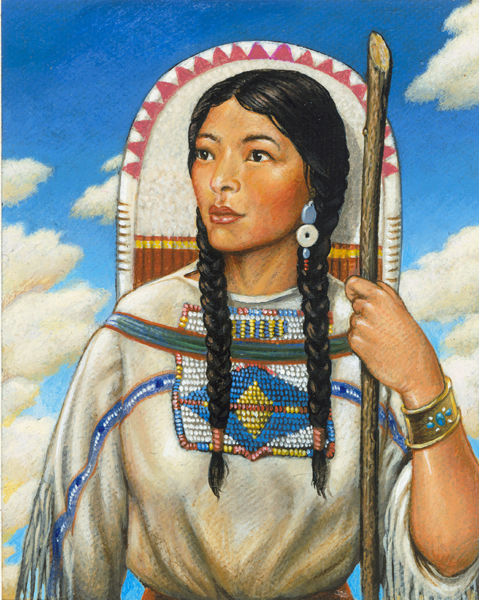
BIGsacagewea

One of the more famous Native Americans from the Great Basin is none other than the Shoshone Sacagawea herself. Between 1804 to 1806, she served as a guide and interpreter for the Lewis and Clark Expedition where she traveled thousands of miles to the Pacific Ocean along with her husband Toussaint Charbonneau and their infant son Jean Baptiste. She is said to have died from an illness in 1812.

Between the Rocky Mountains and the Sierra Nevada is an area known as the Great Basin which is mostly a high and rocky desert land encompassing states like Nevada, Idaho, Montana, Wyoming, Colorado, California, Arizona, Utah, Oregon, and New Mexico. However, since they lived in a region that was so inhospitable, they were among the last groups to encounter European influence due to nobody wanting to live there. Sure there was Sacagawea, but she wouldn’t have served as a guide for Lewis and Clark if she wasn’t kidnapped by Hidasta Indians first. Nevertheless, the first white people who settled in this area were the Mormons in Utah starting in 1847 since there were no other white people around. Notice how I put emphasis on the word “white.” Since the Great Basin tribes didn’t have to worry much about white people displacing them until Mormon arrival, they have maintained stronger cultural and linguistic ties to their heritage than a lot of Native Americans in the lower 48. During the 19th century, they were leading proponents of cultural and religious renewals such as the Ghost Dance as well as introducing peyote to the world (to the glory of stoners everywhere for that “Rocky Mountain High”). You might see these people in westerns, by the way even though you might not be aware of it.

gbp

Most of the Great Basin consists primarily of high arid desert though few rivers and bountiful lakes do exist (but are dependent on mountain snow for water). It’s a very inhospitable environment, which explains why these Native Americans in this region were among the last to deal with white settlers. Ironically, this is where Las Vegas is located.

Location: Between the Rocky Mountains and Sierra Nevada covering southern Oregon and Idaho, part of Montana, Nevada, eastern California, western Wyoming and Colorado, and most of Utah.

First Peoples: Original peoples might’ve arrived as early as 12,000 years ago possibly arriving from the south. Great Basin Desert Archaic Period was between 9000 B.C.E. to 400 while the Fremont Culture came around 1-1300 who were hunter gatherers as well as agriculturalists. Numic speakers were said to arrive as early as the 11th century and are the ancestors of the Western Shosone as well as the Northern and Southern Paiute tribes. Aside from the Fremont culture, very little of their lifestyle has changed (from a pre-contact standpoint).

Environment: Mostly high elevation consisting high mountains, deep canyons as well as bountiful lakes along with few rivers and streams dependent on mountain snow (which is a major reason this area is threatened by climate change and has experienced drought). And most of these rivers in the region usually disappear into the sand. Lowest valleys are 3,000-6,000 feet above sea level while the mountain ranges can be about 8,000-12,000 feet. Climate is variable with summers with temperatures rising over 100 degrees Fahrenheit and winters with temperatures falling to 20 below zero. Rainfall can vary dramatically from year to year. But at lower elevations, evaporation is generally high while precipitation is generally low. Can be a barren wasteland of desert, salt flats, and brackish lakes. Definitely not a place hospitable to human habitation and it’s no wonder that it was the last part of the US lower 48 to be explored and settled by whites.

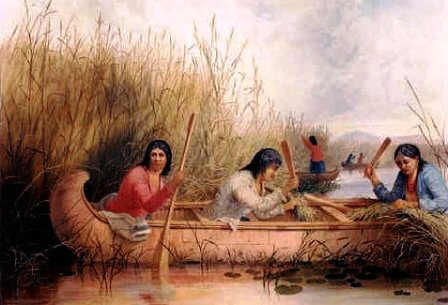
rice-gatherers-eastman

Despite mostly living in the desert with little precipitation, Native Americans in the Great Basin had a more plant based diet. Here we see a group of Great Basin women gathering wild rice from their canoes.

Subsistence: Mostly hunter-gatherer subsistence though some do engage in agriculture yet not to viable level of subsistence. Lived on roots, nuts, seeds, cactus, berries, wild rice, insects, as well as small game and birds. Hunted bison, deer, elk, antelope, and sheep as well as fished. Some groups grew corn, beans, and squash but only in a limited capacity and not without irrigation. Had a mostly plant based diet.

Bishop_paiute_women_1940

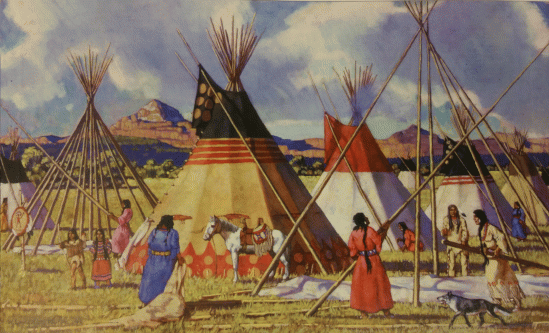
The standard winter dwelling for the Great Basin Native Americans was the wikiup. This was a conical 10 feet high and 10-15 feet in diameter house made from brush, bark, grass and/or tule over pinion and/or juniper pole frames. Sometimes these were covered in skins.

Housing: Season and location often determined type of shelter. Brush windbreaks were commonly built during the warm weather. Winter houses were typically conical wikiups at about 10 feet high and 10-15 feet in diameter as well as built of brush, bark, grass, and/or tule over pinion and/or juniper pole frames. Some northern groups covered these houses with skins. Doorways generally faced east. Caves were also used along with log and earthen hogans and even teepees.

Shoshone Indian Tribes

While the Great Basin Native Americans wore buckskin outfits during the winter, they wore very little or next to nothing during the summer. Mostly because even high desert summers could be unbearably hot.

Clothing: People in this region usually wore very little except in the coldest weather. In winter, men and women wore fur or twined bark breechcloths, moccasins, and leggings. Women often wore twined sagebrush bark or willow hats and long gowns. Clothing also included fur robes and rabbit skin blankets worn as capes.

Transportation: I guess these people usually walked. Though some tribes might’ve made canoes from animal skins and other materials.

Society: Mostly nomadic with mostly decentralized social and economic organization. Largest estimated population is said to be about 50,000-60,000. Basic unit was the camp or extended family that was autonomous and self-governing by consensus with the oldest male being the most influential. Bands tended to be small with the largest desert bands having no more than 30 and other areas with up to 100. And they were usually near water sources as well as have fluid membership. Yet, they’d also have links through blood relationships, marriage relationships, adoptions, and friendships. In regions of greater productivity, some related family clusters would form semipermanent winter villages where they could share information about resources, observe ceremonies, share mythological tales, and trade. Headmen usually presided over these winter villages where they delivered speeches on and coordinated subsistence activities. But such authority was tenuous among the egalitarian Shoshone. Trade was frequently practiced that the first regional trade routes appeared as early as 5000 B.C.E. and the region was part of a major network.

Utes_chief_Severo_and_family,_1899

Unlike many Native American culture areas, there was no set family or marriage structure among the Great Basin peoples. Post marital residence simply depended on the available food supplies and divorce usually happened with one partner returning to their parents (which happened frequently). Polygamy, cousin marriage, and marrying a dead spouse’s siblings for recently widowed also existed. Not to mention, children were put to work as soon as they were old enough while elderly who couldn’t keep up with the group were simply put to pasture.

Family Structure: Family camps usually consisted of parents, children, grandparents, aunts, uncles, or cousins. Men mainly hunted while women cooked, gathered plants, made clothes, and looked after children. However, men and women were seen as equals and were free to engage in sexual exploration leading to a trial marriage. There was instruction on abortion and contraception. And divorce was simply a matter of one partner returning to their parental camp (which happened frequently). Northern Paiute and Shoshone tribes practiced fraternal polyandry where a woman would marry set of brothers. Yet, there were some instances of polyandry involving male cousins or men not related to each other at all. Sororal polygyny also existed. Cross cousin marriages weren’t uncommon among these people either as well as the practice of widows and widowers marrying their dead spouse’s sibling. There was no set pattern for postmarital residence with availability of food supplies being the determining factor. Children were put to work as soon as they were old enough to help. As for death rites, this might either consist of the individual being buried with their possessions or the possessions destroyed. Old people who couldn’t keep up with the group or could no longer produce their share of the food supply were occasionally abandoned.

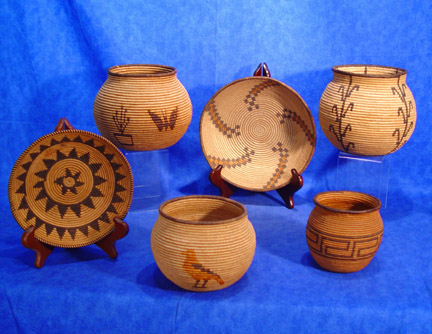
chemheuvi-group-6x4image copy

Great Basin basketry is one of the best known out of the North American indigenous. One Nevada Washoe woman named Dat So La Lee would become celebrated for her craftmanship during the “basket craze” of the early 20th century.

Practices: Animism, shamanism, dance, music, Ghost Dance, Bear Dance, peyote, basketry, pruning, controlled burning, pottery, storytelling, rock art, Sun Dance, and petroglyphs.

Tools and Weapons: Nets, traps, snares, flaked stone knives, bows and arrows, fish hook and line, basket traps, harpoons, weirs, digging sticks, drills, clubs, seed grinding slabs and handstones, and spears.

Notable Tribes: Paiute, Shoshone, Ute, Bannock, Coso, Kawaiisu, Mono, Goshute, Timbisha, and Washo.

The Indigenous Peoples of North America: Part 4 – The Northwest Plateau

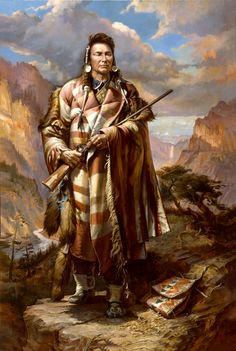
4b9a99fbc75b96cb5dab0fa732f29933

Known as “Hin-mah-too-yah-lat-kekt” in his native Nez Perce tongue, Chief Joseph led his Wallowa Nez Perce band during their most tumultuous period in their contemporary history. Basically, they were forcibly removed from their ancestral lands in the Wallowa Valley and relocated to the significantly reduced reservation in Lapwai, Idaho by the US federal government. The usual series of events culminated in episodes of violence led by Ned Perce resisting removal, including Joseph’s band and their Palouse tribe allies who attempted to seek political asylum in Canada. The US Army pursued them for over 1170 miles fighting retreat which would become known as the Nez Perce War. Though such resistance won him great fame and admiration, Chief Joseph would later surrender after a devastating 5 day battle in freezing conditions with no food or blankets as well as leaving the major Nez Perce leaders dead. By this time, 150 of his followers were either dead or wounded.

Between the Subarctic and Northwest Coast regions, you’ll find a small interior cultural area known as the Northwest Plateau. This region is situated in the interior of British Columbia as well as the non-coastal ranges of Washington state and Oregon with some of Idaho, Montana, and California. Topographically, you’ll find it between the Cascades and the Rockies. Nevertheless, this is an area with a very cold but semiarid climate which makes it nowhere near suitable for agriculture. However, it’s also home to 5 major volcanoes as well as 27 known to be active, which may good for soil content but not a place you’d want to live. Still, you don’t really hear much about this region except maybe when it comes to Chief Joseph and the Nez Perce. But it’s not a happy tale to tell. Yet, famed Native American author Sherman Alexie also hails from this region, too, and he’s perhaps the best known native literary figure to date. Not surprisingly these Northwest Plateau tribes tended to move around a lot following various food sources. But they also lived in a prime trading location and often exchanged goods with other tribes. Oh, and they also were prolific basket weavers, relying on many local fibrous plants to make them.

dFoUaUN9GbYWRcfVhhnYsmQx

The Northwest Plateau may have its share of plants and waterways. But its generally rough terrain, high elevation, and semiarid but cold climate don’t make it ideal for a sedentary agricultural lifestyle. Is also home to a lot of volcanoes, including Mount Saint Helens.

Location: Area between the Cascade, Sierra Nevada, and Rocky Mountains that covers central and southern British Columbia, northern Idaho, western Montana, eastern Washington state, eastern Oregon, and northeastern California.

First Peoples: Region has been continuously inhabited for 10,000 years and save for the grinding stone and the bow and arrow, way of life remained mostly unchanged until the 18th century.

Environment: Consists of rivers, lakes, mountainous evergreen forests, and grassy valleys in the Canadian area with heavy rainfall. The US area is semiarid. Though summers are hot, winters are long and cold. Elevation ranges from 5,000 feet to 14,000 feet and is home to 27 active volcanoes as well as Mount St. Helens.

f7d6acb66b494224c4c4d98934e0dccb

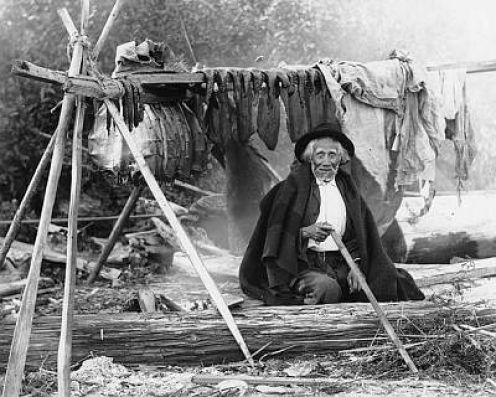
Like their Pacific Northwest neighbors, salmon consisted of a major part of the Northwest Plateau peoples’ diet. In eh summer, Pacific salmon would swim up river, leading the men to trap the fish. Once caught the salmon would be smoked on a fire, stored underground, or boiled in hot water for oil.

Subsistence: Hunter, gatherer, and fisher subsistence. Fish were a main staple in their diets (particularly salmon) along with roots and berries. Also hunted deer, elk, caribou, antelope, mountain sheep, bear, rabbit, squirrels, marmot, beaver, raccoon, porcupine, and other small game. Another major staple were Camas lily bulbs which were dug up (though the white ones are known to be poisonous).

Pit-House

The primary winter dwelling for the Northwest Plateau people was the pit house. These would consist of hole being dug into the ground with an earthen roof over a wooden frame. Entrance way was through a wooden ladder.

Housing: Pit houses were primary winter residences that were mostly built below ground with an entry via ladder on the roof that could either be flat or domed shaped. Several families lived in these houses while the chief’s could be twice as large. And these pit houses during the winter could sometimes be connected with tunnels. For summer shelter, some would reside in teepees, especially if they lived near the Plains. But unlike their Plains neighbors, they mostly used bulrush reed mat floors. Another shelter was the Tule mat lodge that were essentially large, oblong shaped teepees and constructed with the same materials. Lean-tos would also be constructed from poles and tule brush mats and were very temporary. Sweat lodges were built from grass and earth covering a wooden frame. Those who lived around the Lower Columbia lived in plank longhouses that could be 20-60 feet long and 14-20 feet wide (with each village there consisting about 5-20). These were built over a pit that was 4-5 feet deep and roughly the same size as the dwelling.

Edward S. Curtis - Wishham child

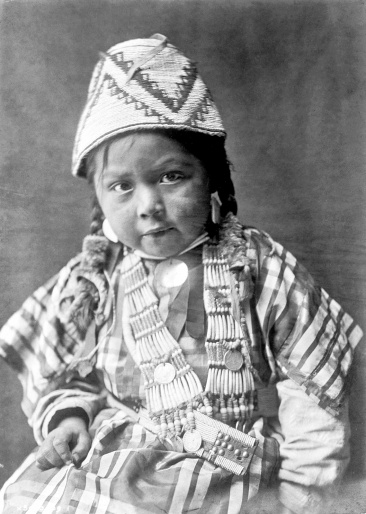
While clothing among the Northwest Plateau Native Americans can consist of the standard buckskin, braids, and beads you’d associate with native culture, the women were also known to wear the distinguishing basket hats. Also, both sexes had braided pigtails (or at least the women).

Clothing: Generally made from bark, grass, animal skins, and fur. Men and women wore breechcloth aprons, ponchos, and moccasins. Men wore shirts while women donned dresses or skirts. Men donned fur leggings in winter while women’s were of hemp. Ornaments were made from shell and bone while beads were derived from soapstone. Clothes were also painted. Headdresses were used to represent a person’s status within the community with the most elaborate being made from feathers and beads. Women were also well known for wearing basket hats. Sometimes the leaders wore feather headdresses. Both sexes left their hair long, sometimes in two braids.

800px-Kutenai_woman_1910

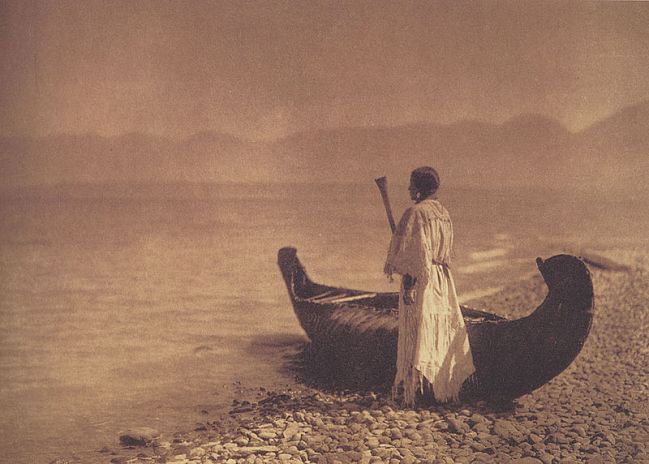
Pre-contact Northwest Plateau transportation was mainly by canoe if not on foot. These would be made from bark, dugout wood, or animal skins. Once horses were introduce, people in this region would use them, too.

Transportation: Water transport consisted of dugout, animal skin, and bark canoes.

Society: Largest estimated pre-contact population is said to be around 50,000. Primarily nomadic with most groups following regular migratory routes to obtain foods at their greatest productivity to both meet immediate need, build surplus for winter, and trade (the largest being at the Dalles and Celilo Falls, at the head of the Columbian Gorge). Villages were politically autonomous and village chief authority lay more in their ability to persuade and adjudicate than in their power to make rules and enforce decisions. Both men and women can be chiefs of many bands though family chiefdoms were usually inherited. Specialized leaders like salmon and war chiefs only exercised leadership on special occasions. Only the far western groups practiced hereditary slavery and a caste system like the Chinook with the upper castes practicing social isolation. However, there was always a reluctance to engage in warfare.

98459-004-991FEA5D

Plateau area Chinook tribes were known to head bind their own children’s heads to create a pointed appearance. However, contrary to popular belief, the Flatheads were called such by their neighbors because they didn’t practice this.

Family Structure: Most people married outside their own village and many of these marriage networks survived after a spouse’s death as widows and widowers often married their spouse’s sibling afterwards. Men hunted, fished, as well as had a greater voice in politics, diplomacy, and military affairs. Women, meanwhile cooked, gathered plants, and tended to young children. However, both men and women were considered socially and economically equal in every way. Some Chinook Indians in the area were known for subjecting their kids to cranial deformation. Lower Columbia tribes buried their dead in raised canoes with all their worldly possessions and never spoke of the deceased again by name for fear of summoning a ghost. Boys from 5-10 were subject to a whipping ceremony in order to prevent sickness during the winter months.

plateau-beadwork

The Northwest Plateau is well known of their art in fine beadwork, carvings, quillwork, and basketry. Like Native Americans from other cultural areas, such art was part of their every day lives.

Practices: Grass baskets, animism, shamanism, bone carving, controlled burning, vision quests, music, dance, rock painting, weaving, quillwork, and beadwork.

Tools and Weapons: Cordage, nets, bow and arrow, spears, clubs, rawhide and wooden slat armor, weirs, deadfall traps, slings, fish hooks and lines, pestles, snowshoes, a variety of knives, and mauls. Tule bulrush was used by these people for almost everything from mats, bedding, nets, rope, house coverings, flooring, and corpse shrouds. Coiled baskets of spruce and cedar root were used for household utensils, water and burden containers, cooking vessels, drinking cups, cradles, and numerous other purposes.

Notable Tribes: Chinook, Interior Salish, Nez Perce, Walla Walla, Yakama, Cayuse, Spokane, Kalapuya, Flathead, Kalispel, Nicola, Nlaka’pamux, Methow, Molala, Palus, Upper Cowlitz, Umatilla, Okanagan, Sanpoli, Wenatchi, Kutenai, Tenino, Fort Klamath, Chelan, Entiat, and Coeur d’Alene.

The Indigenous Peoples of North America: Part 3 – The Pacific Northwest Coast

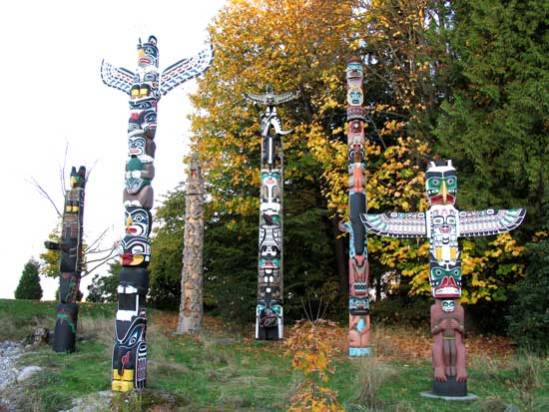
neel_totemstanleyw

The Native Americans of the Pacific Northwest Coast could just as well be called the “totem pole people” due to their best known art form. However, these monumental structures were said to symbolize or commemorate cultural beliefs recounting familiar legends, clan lineages, or notable events. They may have also served as welcome signs for village visitors, mortuary vessels for deceased ancestors, or as a means to ridicule someone. The complexity and symbolic meanings of totem poles, their placement and importance lies in the observer’s knowledge and connection to these figures’ meanings.

Though the Pacific Northwest Coast is only a narrow stretch from southern Alaska all the way to the northern reaches of California, it’s a region with and abundance of natural resources that these hunter-gatherer tribes usually stayed in one place. It’s no wonder that it was the most densely populated cultural area in Canada before European contact. Nevertheless, the Pacific Northwest Coast is best known for their totem poles and their distinctive art that you might instantly recognize. Their art is also seen on almost everything, including their large cedar plank houses. Because since these people lived in a temperate coastal rainforest, they didn’t need to spend a lot of time like other native peoples did, searching for food so they won’t starve to death. And since they lived in one place all the time, they had plenty of leisure time to kill. These Native Americans also had rather sophisticated societies based on clans and class systems as well as a special centrality on salmon. But it’s not the only food they eat, yet it received a special ceremony when it’s in season that continues today. Then there’s the tradition of potlatch which was a highly complex event of social, ceremonial, and economic importance. There a chief would bestow highly elaborate gifts to visiting peoples in order to establish his power and prestige and by accepting these gifts, visitors conveyed their approval of the chief. There were also great displays of conspicuous consumption such as burning articles or throwing things into the sea, purely as displays of the chief’s great wealth. You’d even have dancers put on elaborate dances and ceremonies which was considered an honor to watch. Still, these events were held on special occasions like the confirmation of a new chief, coming of age, tattooing or piercing ceremonies, initiation of a secret society, marriages, a chief’s funeral, or battle victories.

Indian+houses+of+the+Northwest+Described

Because of the dense resource rich waters and rainforests along with a pleasant climate, the people of the Pacific Northwest Coast had an easier time than Native Americans in other regions. After all, most of them were hunter-gatherer tribes who usually stayed put.

Location: Along the coast starting from southern Alaska through British Columbia, Washington state, Oregon, and northern California.

First Peoples: First humans are said to enter the region at least 10,000 years ago via the Columbia River in the US Pacific Northwest. Evidence in southern Alaska and British Columbia suggests the early inhabitants existed at a basic subsistence level for 5,000 years until 3000 B.C.E. Earliest sedentary villages appeared in 700 B.C.E. with social ranking, woodworking, and regional art shortly thereafter. However, some areas in the US Pacific Coast along Washington state and Oregon continued in basic subsistence mode until possibly as late as 500.

Environment: Consists of dense temperate zone rainforests, rivers, islands, and oceans with abundant natural resources all year long. Climate is mild and rainfall is heavy that includes fierce winter storms and heavy fog. Trees are unusually tall and thick. Springs and glaciers usually flow into rivers that run to the coast.

ehp.121-a334.g004

While Pacific Northwest Coast Native Americans had a varied diet, there was no food source more central to them than salmon. When salmon travel up rivers to spawn, they would literally catch thousands of them that could feed their families for a year.

Subsistence: Primarily hunter, gatherer, or fisher subsistence. Salmon was the most important food for the Indians in this region. However, they also consumed halibut, eulachon (candlefish), smelt, herring, and sturgeon as well as shellfish, seals, and whales. They also hunted elk, bear, deer, mountain goat, turtles, and some land mammals as well as gathered berries and roots. Food was generally eaten fresh, grilled, or boiled in a basket with hot rocks or steamed or baked over a pit oven.

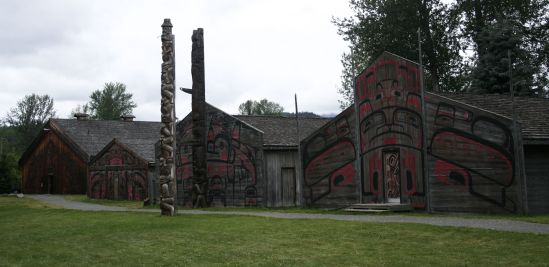
'Ksan_Historical_Village_2010

Your standard Pacific Northwest Coast dwelling was the cedar plank house w which could be up to 50-150 feet long and 20-60 feet wide. Each plank house could be home to as many as 30 people.

Housing: Mostly lived in plank long houses of red cedar that was said to be 50-150 feet long and 20-60 feet wide. Each plank house was held together by wooden peg nails, had a large hole in a low roof for smoke ventilation, as well as consisted of a front door to keep heat in. Plank houses were furnished with simple furniture including bunk beds against the wall, storage areas, fire pits, and open shelves as well as dug holes for storing and cooling food. Your typical plank house would be home to several families, perhaps as many as 30 people. They were also commonly painted, often with a family crest. Individuals who built the longhouse usually resided there with their families and their kids would be assigned as space inside upon reaching maturity. But if the village built the plank house together, then it was the chief’s responsibility to assign living spaces to each family. And when the plank house owner died, it was either given away or burned to the ground. Because it was believed if the family stayed, then the dead person’s ghost would haunt the place. Also built temporary shelters made from mats, planks from the main house, or bark.

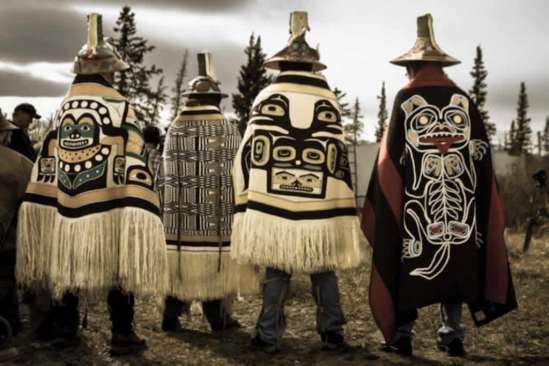
tlingit_daniel_fox_06

While people of the Pacific Northwest Coast usually wore very little under temperate conditions, they tend to be known for wearing their chillkat blankets and decorative woven hats. And yes, these can be highly decorated as well.

Clothing: Usually wore very little clothing except when it was cold or special occasions. In the warmer months, men would go naked while women only wore bark skirts. Clothing was mostly made from softened cedar wood or bark, animal leather, and wool. Bark capes and spruce hats were used as protection against the rain. High ranking class members would usually don chillkat blankets, dance aprons, leggings, and moccasins on special occasions. Adorned themselves with piercings and tattoos.

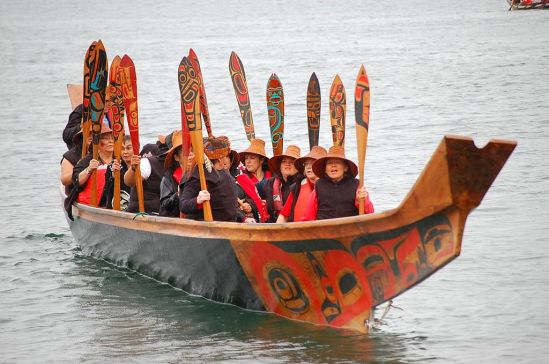
Haida_conoe

The Pacific Northwest Coast had several different types of canoes, mainly made from red cedar. They can be 50 feet long and 8 feet wide while holding up 2-50 people and up to 10,000 pounds of cargo. Of course, passengers have to bring their own oars.

Transportation: Built canoes of red cedar of several different types. They were usually 50 feet long and 8 feet wide as well as can hold up to 2-50 people and 10,000 pounds of cargo. Also had smaller boats for families and short outings. Also had dog pulled sleds for overland transport.

Potlatch-Klallam_people_at_Port_Townsend

Potlatch was a major event for Native Americans residing in the Pacific Northwest Coast as a means to reflect wealth and perpetuate social inequality within a village. These were held during a major event as well as hosted by aristocrats. At each potlatch, the host would display their wealth through distributing goods to visitors and others whether they be chillkat blankets, animal skins, or even slaves.

Society: Year round access to food allowed people to live sedentary lives in permanent settlements. Estimates state that as many as 250,000 could have lived in this region at one time. Houses were always grouped together side by side and facing towards the water in small villages, each marked by totem poles. Some even had as many as 1,000 living in only 30 homes. However, some groups had one or more small permanent, semipermanent, or seasonal villages or camping sites as well. Nevertheless, people in this region lived in a society based on hereditary status and the ceremonial winter potlatch was both as a means to reflect and perpetuate this social inequality. These consisted of the nobility, upper class free, lower class free, and slaves (actually not members of society at all). Each individual would also be ranked within their respective groups as well. Since this system was based on inheritance, the classes were fairly immutable though some transfer was possible through acquiring (by trade, purchase, marriage, and war) some inherited rights. Such rights and privileges were owned by the identified group which included songs, dances, performances, and control of subsistence areas identified by crests or design patterns. These patterns could reflect real and mythical family lines and associated incidents, animals, or spirits. The village chief always was always the head of the wealthiest and most powerful family and was a nominal war commanders, often undertaking political and ritual preparations before fighting. Though intragroup conflict was minimal, clan incest and witchcraft were considered capital offenses. Intergroup conflict took place within the framework of feuds and wars. Feuds entailed conflict for legalistic purposes while wars were waged solely for material gain (as in land, booty, and slaves). Northern tribes saw more regular conflict than their southern counterparts. Night raids were preferred strategy and victims’ heads were often displayed on poles as proof of fighting prowess. Also practiced intergroup trade where prices were negotiated.

tlingit_daniel_fox_16

In a Pacific Northwest Coast extended family, one’s social rank and wealth intake were usually determined by their relationship to the family chief. Of course, since this was a matrilineal clan that practiced exogamous marriage, this only applied to the people on his mother’s side. Family chiefs were usually the wealthiest and oldest member of the clan.

Family Structure: Primarily matrilineal descent. In extended families, family chiefs were usually the oldest and highest ranking individuals while everyone else’s rank was determined by their relationship with the chief.  Family chiefs were primarily responsible for distributing wealth according to social status. Men practiced hunting, building, carving, and fishing while women did housework, raised kids, cooked, wove, made clothes, and dug for shellfish. Marriages were always conducted between people of different clans. When a man decided to marry a woman, he paid her dad an agreed amount before the wedding took place. This amount would be paid back when after the birth of the couple’s first child. After the payment, the wife was no longer obligated to be with her husband (so she could stay or leave him after that point).

obj13219geo6879pg73p12

Aside from totem poles, the Pacific Northwest Coastal peoples are also well known for their elaborate ceremonies and their distinctive stylized art. Works of art could range from practical objects such as clothes, tools, transportation, houses, weapons, and what not to the purely ceremonial and aesthetic.

Practices: Totem poles, potlatch, music, dancing, shamanism, animism, storytelling, intricate crafts and sculpture, weaving, basketry, woodworking, masks, bentwood boxes, chillkat blankets, spirit quests, and heraldic art.

Tools and Weapons: Stone axes, adzes, spears, nets, traps, chisels, hammers, drills, knives, wedges, harpoons, traps, seal clubs, sledgehammers, deadfalls, fish line and hooks, and wooden crockery. Coast Salish practiced weaving on a full loom. Blades were made from rock, shell, horn, bone, and a small amount of iron.

Notable Tribes: Tlingit, Nisga’a, Haida, Tsimshian, Gitxsan, Haisla, Heiltsuk, Nuxalk, Wuikinuxv, Kwakwaka’wakw, Nuu-chah-nulth, Coast Salish, Chinook, Chimakum, Quileute, Willapa, Nootka, and Tillamook.

The Indigenous Peoples of North America: Part 2 – The Subarctic

c001917k

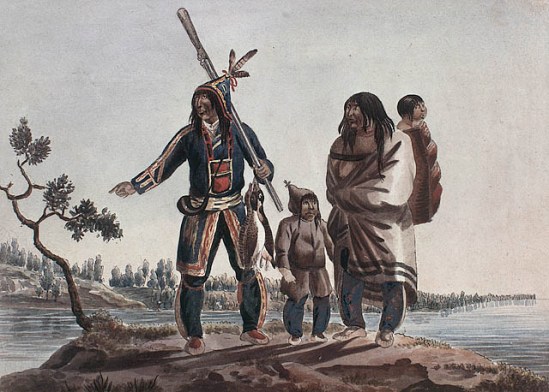
Here’s a Subarctic Cree family from early Canada. While the mother and kids are dressed in drab, the father has quite a colorful costume and a gun. He also traps animals and trades their skins and feathers.

Our second stop in my Native American series is the Subarctic region. Now this isn’t as snowy and icy as the Arctic, it’s a pretty forbidding region despite it being a mostly boreal forest region. But it’s a very vast region starting from central interior of Alaska, covering the Canadian Shield, surrounding much of Hudson Bay and the northern Rockies, and ending in eastern Canada and as south as Lake Superior. In fact, it covers most of Canada. Nevertheless, despite that the Subarctic is a huge area, you really don’t see it in movies or on TV much (at least in the US, though in Canada, that may not be the case). Or if you did, you might know have known that they were from the Subarctic region. That, or the movie or show was Canadian made. Yet, many of these people tend to speak Athabaskan languages (though some also speak Algonquin in the east). Whatever the case, the Subarctic region is home to a population known to speak over 30 languages. And this area didn’t have a large population of hunter-gathers either. But what a lot of these peoples have in common is their teepee and wigwam shelters and their dependence on the caribou. Also, many of them wore parkas, too. At any rate, it’s kind of what you get if you put cultural aspects of the Plains, the Arctic, and the Northeastern Woodlands together. But it’s in a way that it makes perfect sense because while it may not get as much snow as the Arctic, it’s nowhere near pleasant enough to support agriculture at all. Not only that, but many of these hunter-gatherer groups dealt with regular periods of starvation as food availability can vary from place to place. So while the Subarctic might have great scenery to put on a postcard (since it’s home to Denali), it’s not a pleasant place to live. Still, since European contact in 1500 with Basques, Bretons, and other Europeans fishing at the Gulf of Saint Lawrence, non-native diseases, STDs, malnutrition and alcoholism would reduce native Subarctic population by 90-100% in some regional locations while some didn’t see a white person until the mid 19th century.

subarctic

While the Subarctic environment isn’t nearly as harsh as the frigid Arctic, it’s quite a forbidding place. Its rugged terrain, long cold winters, short summers, and generally low precipitation in rain, it’s a very hard place to live.

Location: Most of Canada as well as most of interior, western, and south central Alaska. Stretches from Alaska to east of the Rocky Mountains, and the northern Great Lakes.

First Peoples: The first people of the region possibly entered the region at least 12,000 years ago or even as long as 25,000 years ago. Athabaskan speakers descend from a Northern Archaic culture that existed at least 9,000 years ago. The Shield culture was predominant in Labrador before diverging. The Taltheilei tradition existed 6,000 years ago from Great Bear Lake to Lake Athabaska and the Churchill River. The Laurel culture of Manitoba and northern Ontario lasted from 1000 B.C.E. to 800 and known for their ceramic pottery along with the Selkirk and the Blackduck Cree.

Environment: Mountainous and boreal forest with thousands of streams and waterlogged tundra. East has low hills and rock outcroppings. West has high mountains, glaciers, and plains. Climate is characterized by short, mild to hot summers and long, bitterly cold winters. Precipitation is generally low save in some mountainous areas and coastal Alaska and falls mainly as snow. Short springs experience plagues of mosquitoes, black flies, and other insects as well as ice break up and snow melt. Travel can also be limited at that time as well as the fall freeze up. Soil was often poor and often swampy, making agricultural development impossible.

caribouhunters

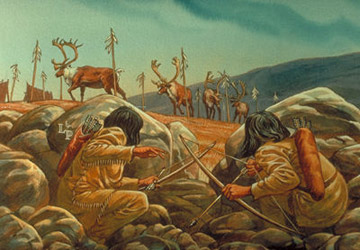
Central to the Subarctic tribal existence was the caribou for which they depended on for food, clothing, shelter, and tools. Here is a painting of a caribou hunt.

Subsistence: Primarily hunter, gatherer, and fisher subsistence. Moose and caribou were a major part of diets for many tribes, with some groups regularly suffering from hunger or even starvation during shortages. Yet, smaller animals like hare, marmot, beaver, porcupine, and muskrat were also consumed along with fish, roots, and berries. Coastal groups relied on sea mammals and shellfish while western groups even hunted buffalo. Musk ox, bear, lynx, wolf, coyote, fox, mink, weasel, otter, wolverine, wapiti and elk were also hunted where available.

tmp518475493264064514

Teepees and wigwams may not have been the only housing in the Subarctic region. But they were among the most common. Most of these would be covered in caribou or moose hides along with bark.

Housing: Most tribal groups resided in domed and conical lodges consisting of poles covered with skins, boughs, or birch bark. Or in other words, wigwams and teepees but not what you’d see on the Plains or the Northeast. Groups closest to the Northwest Coast tribes built plank houses while some built frame houses partially below the earth as well as bark covered rectangular houses at fishing camps. Some groups built shelters with a double A-ridgepole framework and containing multiple fires as well as sod pit houses. Structures like drying racks, sweat houses, caches, menstrual houses, and others were also commonly built.

Nelson-Family-Athabasan-Clothing-Portrait

This Athabaskan family portrait shows a variety of what native peoples in the Subarctic would’ve worn. In winter, they would’ve worn parkas, snowsuits, and other winter items. In the spring and summer, they’d go with tanned leather clothing of caribou and moose.

Clothing: Most clothing usually came from moose and caribou as well as hare and other skins with trim from beaver or other fur. Hides were often tanned and dehaired so they wouldn’t weigh down except winter items like parkas, hats, and mittens. Many people wore leggings with moccasins. Clothing can be decorated with fringe, paint, quills, claws, or down. Women wore dresses while men wore shirts, jackets, and snowsuits. Mothers often carried their babies on their backs with cradle boards. Adornments consisted of noseplugs, earrings, and tattooing.

Transportation: Overland travel was usually preferred and many used sleds, sledges, and toboggans (sometimes pulled by dogs though not always). Though people did build lightweight birch bark canoes and moose hide boats.

thanadelthur1

Like most nomadic tribes, Subarctic Indian society wasn’t very authoritarian, formal, or centralized. Extended families usually lived in groups though once in awhile bands would get together to socialize, hunt, and trade.

Society: This was a sparsely populated area with no more than 100,000 living in the region at any one time. So most cultures were nomadic. The basic unit was a local group consisting of 10-20 related people but could be up to 75. Membership was fluid and nonbinding, in deference to autonomy values and need for flexibility in a difficult environment. Leadership was extremely informal and nonauthoritarian, except for the groups most influenced by the Northwest Coast. When conditions permitted (possibly not quite every summer), local groups might come together as loosely constructed regional bands of several hundred people to socialize and renew family ties. Kinship names were used in most tribes as a general term. For instance, elders were addressed “Grandmother” or “Grandfather” whether they were blood related or not. Some groups might conduct memorial potlach with chiefs being recognized as among the clan leaders in the Cordillera. Warfare was mostly a local matter though while some groups seeking women, most people fought over revenge for trespass or prior blood transgression. Yet, warfare was more developed in the far west than in other areas. However, there were no regional groups conducting full scale wars. Trade was widely practiced with goods and services being exchanged as a peaceful reason for travel and human interaction while bands frequently shared resources with each other.

Woman_of_the_Snake_tribe_and_woman_of_the_Cree_tribe_0066v

Though Subarctic tribes mostly practiced matrilineal descent, the treatment of women varied from tribe. Some women were treated as no more than mere pack animals while others maintained relative autonomy and even assumed positions of authority and power.

Family Structure: Primarily matrilineal descent, though not always. Women mostly made clothes, prepared food, and looked after children while men hunted the big game. However, it wasn’t uncommon for women to snare hare or fish. Women’s status varied according to local custom with some being treated as essentially pack animals with little to eat and others existing in relative autonomy as well as attaining both authority and power. Female infanticide wasn’t unknown through much of the region while menstrual taboos could be quite rigorous. Yet, both men and women were usually married by 13 or 14 and had some decision power in the bands. Newly married men were required to live with their in-laws for at least a year before establishing their own households (yet, sometimes they could have more than one wife). Exogamy and cross cousin marriage were usually encouraged. Since infant mortality was common, babies were usually not named until it was certain they would survive. Cremation was standard funerary practice.

e5c1c5980b5f6f958ee62180390418c9

The Subarctic tribes were well known for their intricate beadwork and embroidery. After they made contact with the Europeans, these Indians took to using glass beads and sewn floral designs.

Practices: Animism, shamanism, reincarnation, ceramics, storytelling, controlled burning, music, lacrosse, wooden dolls, basket weaving, dance, embroidery, beadwork, and scapulimancy.

Tools and Weapons: Antler clubs soaked in grease, armor, spears, hide containers for holding water, tumplines for carrying, snowshoes, bow and arrow, net traps, gaffs, fish hooks, snares, and weirs. Raw materials usually consisted of bark, wood, root, stone, and sometimes copper. Yet, many groups also liberally borrowed from their neighbors.

Notable Tribes: Cree, Ojibwa, Gwich’in, Dena’ina, Beothuk, Beaver, Mountain, Hare, Han, Tanacross, Yelloknife, Innu, Chipewyan, Eyak, Kuskokwim, Holikachunk, Sekani, Tagish, Ingalik, Ahtna, Babine-Wet’suwet’en, Dogrib, Tutchone, Carrier, Chilcotin, Attikamek, Tanana, Bearlake, Koyukon, Naskapi, Slavey, Tlicho, and Kaska.

The Indigenous Peoples of North America: Part 1 – The Arctic


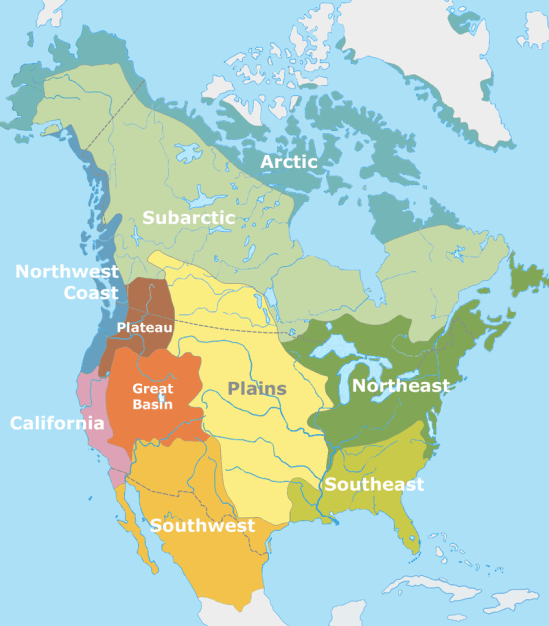
800px-Nordamerikanische_Kulturareale_en

As we have been taught in our history classes, before Europeans arrived to North America, the continent was inhabited by a people called the Native Americans. Of course, those who’ve taken courses in American history in school will probably know that our education doesn’t really touch on these people very much (other than that they later got killed by European disease and relocated to reservations so white people can take their lands). Mostly because an average US history class can only cover so much within 180 days or less. Thus, with the exception of those who took Native American Studies in college or read books about them, most of us tend to learn about the Indians through the media and pop culture. Now your average Native American on TV or in the movies will most likely have long black hair (either free flowing, single thick braid, or loose pigtails) or a Mohawk. Not mention, your average media Native American would have a feather stuck in their hair as an ornament or an elaborate feather headdress (like a war bonnet). If your Indian is a guy, he’ll have on leather pants often lined with fringe along with an age dependent upper wardrobe. Older Indian men usually wear leather tunics and vests while the younger guys have other options of going with just the vest or a bare chest. If he’s shirtless, then expect him to wear some degree of body paint. Yet at any rate, he’ll certainly get his war paint on at the climatic battle scene. If your Indian is a woman, she’ll often wear a single piece leather slip and leave her legs bare. Either way, your average media Native American will wear beaded jewelry as well as soft leather moccasins if they’re not barefoot.

o-SCAR-570

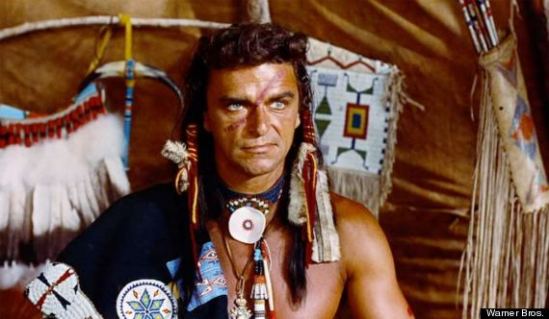
And it doesn’t help that many Native Americans depicted in classic westerns are played by white guys with blue eyes. Yeah, really makes a convincing Indian (sorry, but the heavy dark makeup isn’t fooling me).

Now is this an accurate representation of Native Americans? Well, some of the time. However, pop culture tends to get the idea of representing Native North Americans with a one-size-fits-all approach of beads, buckskins, and braids. Did all Native North Americans dress this way before Europeans? No. Because North America is a big place with a great deal of variation between Native cultures, especially since the continent has a variety of environments. An Indian from New Mexico did not dress the same way as one from North Dakota. And occasionally, you might see indigenous people in Peru wearing buckskin outfits which is another matter entirely (especially if you account for the llama wool). Nevertheless, such Native North American portrayal doesn’t capture the wide variety while many tribes’ traditional outfits look nothing like the stereotype.

playmobil-native-american-camp-with-totem-pole-b253aa2d1e61f0e224ecb936cab349e2

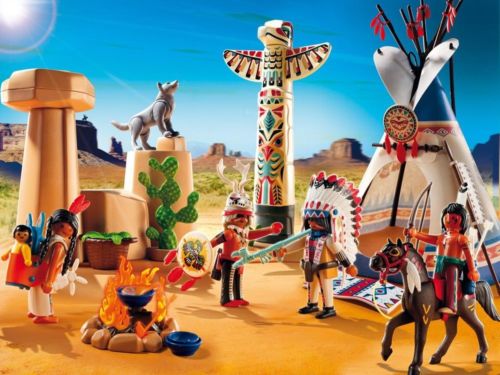
Yet, they still depict teepees and totem poles on the Playmobil Indian camp play set. Sure it looks cute. But it’s seriously wrong and perpetuates cultural inaccuracies. Seriously, you might as well have a play set of the Norse gods with a Grecian temple.

Then there are the aspects of Native North American culture that you see in the media. Of course, there’s the offensive denigration of Indians as savages but this stereotype has been done to death so I won’t bother to talk about it. Then there’s the magical nature worshipping Native Americans who are just misunderstood because a bunch of selfish white guys want their land. Either way, they’re not going to speak English like a normal person. But that’s beside the point. Anyway, you might see Native American tribes depicted doing things and using stuff that belongs to a myriad of different tribes. A good example of this would be the Indian tribe in Peter Pan which juxtaposes Great Plains teepees and Pacific Northwest totem poles. At a cultural and historical perspective, this is as jarring as it’s inaccurate as portraying Vikings with Grecian temples. Also, you might find a lot of Indians wearing mohawks and war bonnets even when they’re not supposed to. In reality, Native North Americans were and are a diverse group ranging from nomadic hunter-gatherers to agricultural civilizations. And they have adapted to a variety of environmental conditions.

5fc534dc2e1de63211ee5a51623af165

Type Indian or Native American on any search engine, you’re bound to get results like this. Now while this certainly is a Native American portrait, the guy is most likely a leader of the Plains tribes. And he only wears the war bonnet on ceremonial occasions.

In this series, I plan on showing my readers a rough view on how Native North Americans really lived. However, I’m not going to go with a tribe on tribe basis because that would take too long (since there are over 500 of them). So instead I’ll go according to cultural area. Yet, note that whatever I say about this series will only apply chiefly to Native North Americans before European contact. So if you want to know about Plains horse culture or Navajo sheep herding and silversmithing, this series isn’t for you (though I will show pictures). Not only that, but understand that a one-size-fits-all approach may not apply to all the Indians living in that particular cultural region, even within a recognized tribe or tribal group. I just have it written in because it applies to some of the Indians living there. Also, some tribes might go in more than one region.

Inupiat Family from Noatak, Alaska, 1929, Edward S. Curtis

A family photo of an Inupiat Eskimo mother, father, and son, photographed in Noatak, Alaska, by Edward Sheriff Curtis circa 1929. It’s certainly plausible that they’d be wearing their parkas in every day life. But most of the Inuit have adopted to modern lifestyles. Yet, that didn’t stop Robert Flaherty drom doing Nanook of the North.

Our first North American region is the Arctic, which is often exempt from most Native American depictions. Mostly because the Arctic is a very frigid place of ice and snow. Arctic Native Americans tend to be depicted more accurately as wearing parkas, living in igloos, hunting seals, riding kayaks, and running on the ice in dog sleds. But it’s not quite right. Since not all Arctic Native Americans lived in igloos (and even those who did didn’t live in them all the time). Plant life does exist there and the ice does thaw (and keeps thawing due to climate change). While these Native Americans resided near polar bears, they didn’t live anywhere near penguins (which actually live in the Southern Hemisphere). And yes, they do take off their parkas once in awhile. Sure they may spend their days dogsledding, ice fishing, and seal hunting, but they also hunt whales, walruses, and other animals, too. Oh, and they didn’t always leave their grandmas to die on ice floes. Nor did they just eat blubber. Nevertheless, while the Arctic can be a rather inhospitable place, these people have managed to survive its harsh climate for thousands of years and continue to do so. Most of them reside in the farthest reaches of Alaska, northern Canada, and Greenland. Yet, they don’t necessarily have a lifestyle that 100% akin to Nanook of the North (which is kind of a documentary of the Inuit showing how they lived when they were 12). Because they do know about modern technology, actually take advantage of it, and think the idea of pining for the good old days is utterly insane (even among those who grew up in the traditional lifestyle). However, you might want to avoid calling them Eskimos because some of them see the term as derogatory. Also, a lot of them don’t like being called Indians either which is partly why we tend to refer to indigenous people in North America as Native Americans.

1950.405_Dorset_Figure_Cropped

This is a figurine from the Paleo-Eskimo Dorset culture who were among the first people in the Arctic region. The Paleo-Eskimos inhabited the area from 6,000 years ago before mysteriously disappearing at around 1500 at the latest. DNA evidence has proven that they were not the ancestors of the modern Inuit, a fact that I hardly believe (mostly because if the Thule and Dorset culture coexisted, you’d expect that they’d be having sex with each other. Because that’s what normally happens).

Location: Near the Arctic Circle, encompassing northern and western regions of Alaska, northern Canada, and Greenland.

First Peoples: Assuming that the earliest Native Americans arrived to the continent through the Bering land bridge, the Arctic region was only used as nothing more than an area to pass through before venturing into greener pastures. The first groups who inhabited this region didn’t arrive until 6,000 years ago and in at least 2 migrations from Siberia and it was the last area in North America to be populated. The Paleo-Eskimo cultures first developed by 2500 BCE and consists of the Arctic Small Tool Tradition (who lived in tent camps while chasing seals and caribou 4000 years ago), the Dorsets (walrus hunters from 500 BCE-1500), and the Thule (who sailed in large skin boats and hunted whales who are said to arrive in 200 BCE-1600). Only the Thule have any biological, cultural and linguistic connection the modern Inuit and are often considered their ancestors. However, it is known that the Dorsets and Thule had no genetic connection and barely interacted with each other (at least favorably. However, the lack of genetic connection is highly unusual since these two groups existed around the same time. But even if under the most hostile relations, you’d still expect that members of both groups would have sex with each other. How can these people coexist without having sex with each other? I don’t get it). And the Dorset would mysteriously disappear by the 1500s. Some evidence suggests that the Thule and Dorsets had contact with the Vikings.

NanookoftheNorth_landscape

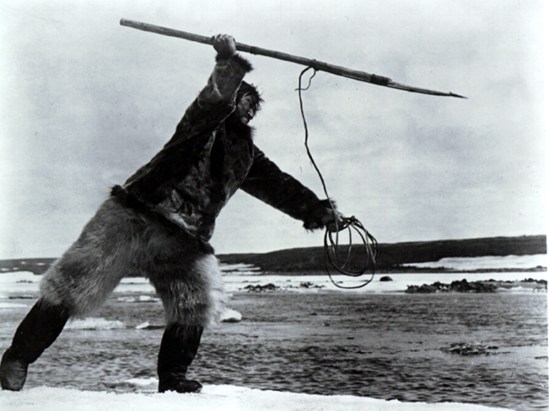
Here’s a scene of Nanook hunting seal from the 1922 Robert Flaherty “documentary” Nanook of the North. The harsh tundra climate and terrain led the Arctic people to hunt sea mammals including seal and whale. By the way, hunting for such animals in the Arctic was a highly difficult and dangerous task that took hours.

Environment: Tundra, which can be better said as a desert of snow that’s cold, flat, and treeless (though Arctic plants do exist). Snow, ice, and freezing temperatures all year round (along with the increasing threat of global warming). Can sometimes experience a white night and midnight sun come summer as well as 24 hours of darkness in winter. But the Aurora Borealis is pretty. One of the harshest environments on earth.

Subsistence: Hunter, gatherer, and fisher subsistence. Diet was mostly meat based consisting of ringed and bearded seals, walrus, narwhal, and whales. On land, caribou were by far the most important source of food (and other raw materials) along with musk ox, wolf, fox, wolverine, and squirrel. Also consumed ptarmigan, duck, geese, and their eggs. Fishing was mostly a 3 season activity. Some areas even had people gather berries. Almost every part of the hunted animals were used.

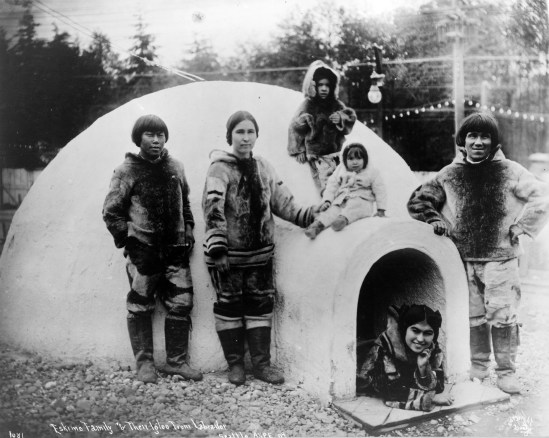
Eskimo_family_and_their_igloo_cph.3c36050

As you might know, the Inuit are well known for building igloos made of snow and ice. Yet, contrary to what you see in the media, igloos were only used as temporary shelter. Sometimes they could be built close together and connected by tunnels.

Housing: Different types depended on materials available and whether the home wasp permanent or temporary. In the central Arctic region, domed shaped snow igloos were the rule among the Inuit. Many of these would often be built attached to each other for added warmth and sociability. And they even had snow furniture in them, too. But some Inuit tribes built sod houses which consisted of a dug rectangular pit with walls made from sod and rocks as well as wood pieces and whalebone for the roof called a shuswap. Aleut housing consisted of a partially underground house covered with logs, whalebone, or poles before being covered by earth, snow, or moss. This was called a Barabara. Temporary housing included a large men’s ceremonial house called a kashim and its female counterpart called an ena along with summer tents of seal and caribou skin over bone or wooden frames.

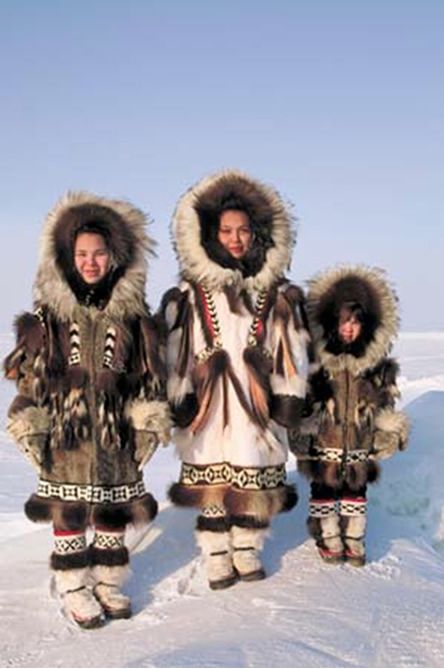
ff872219eb1feb6253530e623bb03e56

Unlike a lot of Native American cultures, Arctic tribes like the Inuit sometimes still wear their traditional parkas, a lot of times made from caribou fur for added insulation.

Clothing: Most clothing was made from caribou skin though polar bear, seal, wolverine, squirrel, bird, and fish skins were also used. And it was primarily fashioned for insulation from freezing temperatures and wind. In winter, people wore inner (fur side in) and outer fur side garments (fur side out). But only the inner garment was worn during the summer fur side out. The winter outer garment was a heavy hooded jacket, often lined with fur known as a parka. A mother might wear an extra-large parka to shelter babies. Both sexes wore pants, stockings, mittens, seal skin boots, or low shoes. Raincoats were sewn with waterproof gut. Clothes were often decorated with colored furs or fringe. Men wore snowshoes and snow goggles while hunting in the winter. Adornments consisted of labrets (lip plugs), ear pendants, nose rings, and tattoos. Sothern tribes wore close fitting shits and pants. While Aleut women wore seal or otter skin parkas, Aleut men wore parkas of bird skin where the feathers turned in and out depending on the weather. Aleut children wore down parkas with tanned bird skin caps.

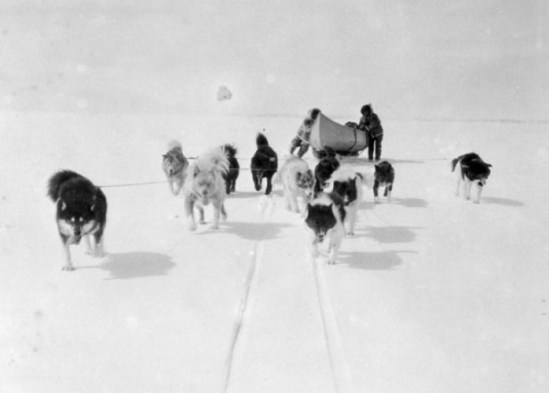
Sled-dogs-archives-e1312915857730

Sleds pulled by dogs and kayaks were the primary modes of transportation among the Arctic Native Americans. Dog sleds for land and kayaks for water. Luckily I found a picture that had both a kayak and sled dogs.

Transportation: Kayaks were closed boats made for one man and used for hunting. Larger open umiaks made from wooden frames and sewn skins for water navigation. Umiaks were employed for either whale hunting or general travel (in the latter case, they’d be paddled and/or rowed by women). Wood and rawhide sleds were pulled by either dogs or people and were used for winter travel.

Society: This was a sparsely populated area that could have consisted as many as 80,000 pre-European contact. Lived a mostly nomadic culture where group members saw themselves tied to the land. Members lived in an isolated existence and would organize into bands on a seasonal basis. Leadership was generally underdeveloped. When strong leaders emerged, there was little formal structure and usually for a temporary situation like whaling expeditions. Leaders were usually older, experienced men who might be leading household heads and probably owned an umiak. Also had a very bloody history of intertribal warfare.

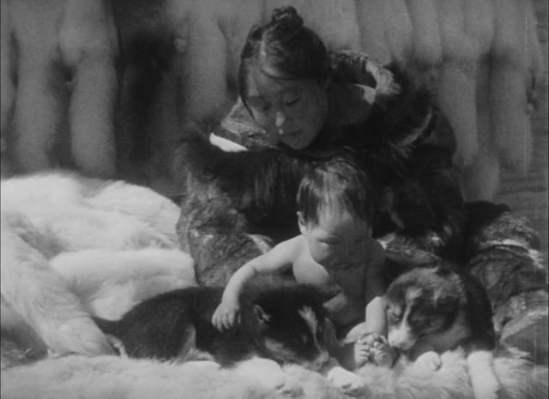
502232021_640

Another scene from Nanook of the North. This one depicts Nanook’s wife Nyla with their baby playing with the husky puppies. Arctic nuclear families normally consisted of 5 to 6 people at a time. And Arctic family life wasn’t always as happy as what you see in this 1922 film. Still, this moment is so filled with cuteness.

Family Structure: Nuclear families usually consisted of 5 to 6 people. Hunting sea mammals was the primary occupation of most men because it could be highly dangerous and/or extremely demanding. Women sewed up skins, cooked food, tended lamps, and looked after children. Both men and women took part in igloo construction. Descent was generally bilateral. Kinship was of such primary importance so much that “strangers” (those who couldn’t immediately document kin affiliations) were perceived as potentially hostile and might be summarily killed. Other groups subject to willful death were infants (especially girls) and old people. Cannibalism and suicide weren’t uncommon, but only in extreme cases of need. Prospective husbands often served the bride’s parents for a period of time (bride service). Wife stealing (committed in the overall competition of supremacy) might result in death as possibly other conflicts. Murders were subject to revenge. Corpses were generally wrapped in skins and left on the ground. Southwest Inuit and Aleuts practiced mummification. Yupik parents tend to name their children after the last person in the community to have died.

07032

While the Inuit mostly dominate the Arctic cultural Native American landscape, the Aleut and the Yupik also reside there. These are Aleuts who reside in the Alaskan Aleutian Islands while the Yupik live in western Alaska. Both groups also live in part of Siberia as well.

Practices: Bone, antler, and ivory figurines, amulets, and toys. Wooden ceremonial and dance masks. Basket weaving, animism, shamanism, music, acrobatics, kickball, string games, and storytelling.

Tools and Weapons: Harpoon, bow and arrow, needle, thimble, knife, adze, ax, drill, scraper, spear, and shovel, primarily from bone and antler as well as chipped stone (for points, blades, scrapers, and pots). Other tools include baleen boxes, soapstone pottery, oil and blubber burning lamps with moss wicks, movement indicators (for breathing-hole sealing), throwers, various types of harpoons (with detachable heads), seal nets, clubs, bird bolas, three pronged spears, fish hooks, stone fish weirs, as well as animal traps and snares.

Notable Tribes: Inuit, Aleut, and Yupik. Some of the Aleut and Yupik are known to reside in Siberia.

In Defense of Labor Unions

image-20150324-17672-1azzmd0

Though unions have greatly shaped the United States throughout much of the 20th century but have fallen out of favor in recent years. While in the 1950s about 1 in 4 workers were unionized, today only 1 in 10 and that number is declining fast. Unions have lost a lot of their power due to things like outsourcing, right to work laws, negative economic conditions, special interests, companies prohibiting them, or other factors. Not to mention, there isn’t a very favorable attitude toward them either for they’ve been blamed for taking away jobs, hurting the economy, or inconveniencing the populace. Some say that unions have served their purpose and aren’t needed anymore. However, as we all remember Scott Walker’s attempt to strip public sector workers of their collective bargaining rights and fast food worker strikes, many Americans don’t really want to see them go away. In fact, perhaps labor unions are still as relevant as ever today and actually do help this country.

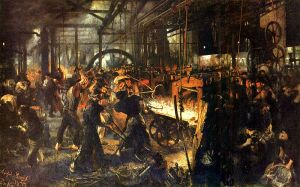
Here's a German painting of a bunch of guys working in a foundry during the 19th century. Notice how there's no attention being paid to workplace safety. Also, imagine doing this work 6 days a week at 16 hours a day for less than minimum wage.

Here’s a German painting of a bunch of guys working in a foundry during the 19th century. Notice how there’s no attention being paid to workplace safety. Also, imagine doing this work 6 days a week at 16 hours a day for less than minimum wage.

1. Unions help create better jobs.

Regardless of what detractors may say, unions don’t really take away jobs since mass unemployment is one of the things unions always seek to avoid. It’s usually business management who does since they usually make the decisions whether it’s in the name of profits or power. Sure unions were probably part of the reason why many American industries moved operations overseas for cheaper labor, but not all jobs can be outsourced, especially service jobs. Even so, most jobs in today’s market aren’t unionized but many aren’t very desirable either with long hours, low wages, no room for advancement, not much safety or benefits, and are held for a rather short time. Of course, while businesses may like cheap and expendable workforces, but job seekers and workers do not. Workers don’t like such labor because it gives them little control over their lives and keeps them on the brink of economic instability. Job seekers don’t like them because it gives them more competition in an uncertain job market where obtaining a job can be more trouble than it’s worth. Recent college graduates have it the worst since many job listings have certain specifications that they may not be able to fulfill. However, this doesn’t mean that young people don’t have the skills to be productive citizens, it’s because the pool of job seekers is too big and employers are a very picky bunch and want an employee who’s already tailor made as well as with job experience. Still, though I’m not sure organized labor may make job seekers’ lives any easier, they do create better jobs and history proves it. Unions have helped make many crummy low wage, hazardous, and long hour jobs into decently paid eight-hour a day jobs with workplace safety, overtime pay, health benefits, personal leave, holidays, pensions, and workman’s comp. Jobs like these are very desirable and reduce turnovers and layoffs which may help reduce competition among job seekers since not many people are as desperate to find one. A job is only low wage not because the work is easier but because low wages are only arbitrary values set by employers. We should also understand that Costco employees work the same jobs as anyone else in the retail sector, yet they are treated much better than other retail workers. Thus, low wages often reflect not what the job entails, but the values of the employer.

In the early 20th century, the US experienced some of the deadliest industrial disasters in history. On March 25, 1911, a scrap bin fire at New York City's Triangle Shirtwaist Factory would lead to the deaths of 146 people because the owners locked the doors to the stairwells and exits to prevent theft. This would lead to growth in unionization for garment workers as well as improved safety standards.

In the early 20th century, the US experienced some of the deadliest industrial disasters in history. On March 25, 1911, a scrap bin fire at New York City’s Triangle Shirtwaist Factory would lead to the deaths of 146 people because the owners locked the doors to the stairwells and exits to prevent theft. This would lead to growth in unionization for garment workers as well as improved safety standards.

2. Unions help check and hold employers accountable.

While unions help improve workers’ lives, they also help check and hold employers accountable as well as serve as a middle man in workplace and labor relations. A unionized workplace gives employers incentive to treat their workers decently, helps set workplace standards, limit unfair labor practices, and does all it can to ensure that workers receive a fair deal. As a political lobby, they call for legal incentives in order to assure worker’s rights are recognized by law and that employers should observe them. Without unions, many employers would simply get away with treating workers like crap as well as run his or her business with little account to them. And for many years, workers have suffered in the name of profit. Sure there may be companies like Costco who provide their employees with a living wage and benefits, but they’re not the norm in the service industry or any non-unionized industry. Before many blue collar work places had unions like the coal mines and steel industry, it wasn’t unusual for workers to be paid shitty wages and treated like crap. And when these workers finally got the salary, hours, and benefits they wanted, it wasn’t because the management was trying to be nice to them. Then there’s the fact low income workers in non-unionized workplaces are especially prone to becoming victims of wage theft (especially undocumented immigrants), in which employers deny their workers their wages and benefits rightfully owed like minimum wage violations, overtime pay, employee miscalculation, illegal deductions, working off the clock, or not being paid at all. In the US, wage theft is very severe, widespread, and costs the country $40-$60 billion each year which is more than how much money the country loses due to robbery ($340 million), burglary ($1.4 billion), larceny ($5.3 billion), and auto theft ($3.8 billion) as of 2012. This is a crime but because these workers aren’t allowed to form unions due to company policy, a lot of wage theft goes undetected and laws against it aren’t often enforced. And even if workers do win their cases on wage theft, they usually don’t receive a dime of what they’re owed by the employers. Unions can be effective in deterring wage theft since they tend to go on strike over such incidences.

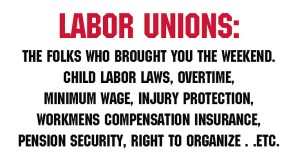
Here's a rough list of what labor unions have done for American workers. Sure unions may represent special interests, yet their interests tend to benefit practically everyone.

Here’s a rough list of what labor unions have done for American workers. Sure unions may represent special interests, yet their interests tend to benefit practically everyone.

3. Unions help promote the democratic process as and 1st Amendment rights.

While unions may be corrupt, they nevertheless serve as a powerful lobbying voice for a major demographic that couldn’t afford a lobbyist otherwise. For years labor unions have always provided a political voice to the common man as well as helped lobby for legislation in favor of ordinary people. In fact, worker’s rights has always been a special interest to unions, which affects most Americans. In the workplace, unions give workers a voice in major workplace decisions as well as protects workers’ 1st Amendment rights relating to their professional lives. If workers feel they’re being treated unfairly they can talk to each other, address their grievances, negotiate a compromise, or go on strike if employers still won’t listen. In many ways, unions help promote the democratic process in both government and in the business world since they stand for a worker’s right to be treated with dignity and respect. Not to mention, they also lobby for a worker’s right to self-govern which is a very American value indeed. Besides, while unions may be identified to the political left, they are probably the closest thing in the K Street lobbying world that best represents the interests of most Americans, especially after Citizens United when most lobbies and corporations don’t. This goes to even non-union members as well as those who oppose them and that’s why having non-union members pay dues in a unionized workplace makes sense. In fact, a lot of their campaigns might pertain to measures like raising the minimum wage, protecting migrant farm workers, mandated paid leave, and other policies designed to help even the lowest earning workers. They even campaigned for policies advancing civil rights for women and minorities as well as protecting the environment. And within companies, unions area powerful, sophisticated player concerned with more than just the next quarters profits at shareholders’ meetings.

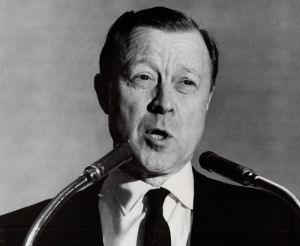
Famed union organizer Walter Reuther understood the value unions had in the American economy. When asked how he'd planned to get his men to pay union dues while being shown automated production lines at Ford, Reuther replied, "How do you plan to get them to buy your cars?"

Famed union organizer Walter Reuther understood the value unions had in the American economy. When asked how he’d planned to get his men to pay union dues while being shown automated production lines at Ford, Reuther replied, “How do you plan to get them to buy your cars?”

4. Unions greatly contribute to the economy equality and promote economic activity.

Since unions help create and expand the middle class, they also help decrease income inequality and generate activity in the modern consumer economy. Unionized workers earn more money than their non-union counterparts as well as likely to spend more. The middle class has always played a critical role in a nation’s economy and the US is no exception. Higher earning workers make good consumers since they have more disposable income as well as a great demand for products. And the bigger the middle class, the more consumers there are, the more money businesses make, and the better the economy. Also, higher incomes provide governments with more tax revenues.

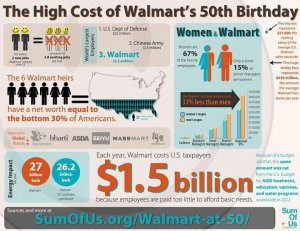
As far as non-union workplaces go, Wal Mart has become the poster child of workplace violations as well as paying its employees poverty level wages. It's said that Wal Mart's low wages cost US taxpayers about $1.5 billion a year since the retail giant has a lot of workers on public assistance.

As far as non-union workplaces go, Wal Mart has become the poster child of workplace violations as well as paying its employees poverty level wages. It’s said that Wal Mart’s low wages cost US taxpayers about $1.5 billion a year since the retail giant has a lot of workers on public assistance.

5. Unions save taxpayer money.

Of course, in 21st century America social programs are a mainstay, yet many on government assistance have also been bashed as lazy unemployed freeloaders or drug addicts (personally I’d rather have my tax dollars go to some worthless bum’s government assistance payment than corporate subsidies.) Sure there maybe a few freeloaders among welfare recipients but the public assistance pool is pretty diverse group including the disabled, children, veterans, mentally ill, elderly, chronically ill, and even the working poor. Such public assistance is greatly limited and only provides short term aid. Now the working poor are a pretty unlucky bunch who are probably more likely to end up on public assistance than anyone else in the workforce. They are also more likely to work for an employer prohibiting unionization like Wal Mart as well as have a low paying job with terrible conditions and awful labor practices. Though many conservatives don’t like public assistance programs or unionism, many fail to realize that bad labor practices can cost taxpayers millions, especially if there’s no labor union to challenge them. Low wage workers aren’t just least likely to support themselves and families, they are also more prone to on the job injuries resulting in disability or death, develop work-related health problems which may become serious if left untreated, unemployment, and other things. In many ways the working poor are either welfare cases or welfare cases waiting to happen (including those with dependents). And to some workers, government assistance may be the only option since employers may not listen to demands or maybe even fire someone for whatever reason, especially when it comes to forming a union. A company like Wal Mart is notorious for shifting it’s labor burdens on the taxpayer which isn’t fair for anyone. Since unions help clamp down on bad labor practices, they also help save taxpayer money.

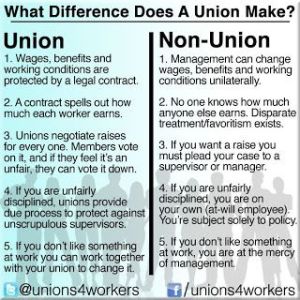
Here is a diagram on the difference being part of a union makes at work. Since union workers are protected under legal contract, they aren't liable to as many workplace abuses as their non-union counterparts. Whereas if a non-union worker is unfairly treated, there is nothing they can do.

Here is a diagram on the difference being part of a union makes at work. Since union workers are protected under legal contract, they aren’t liable to as many workplace abuses as their non-union counterparts. Whereas if a non-union worker is unfairly treated, there is nothing they can do.

6. Unions give workers more control of their lives.

Not only do unions help create a middle class as well as provides a voice for workers, they also allow workers better control of their lives even beyond the confines of their job. Bad labor practices can hurt families and ruin a person’s life. And it’s not unusual for a low wage earner to take more than one job which can result in more time away from home, coming in sick, sending sick kids to school, or leaving them unsupervised from hours on end. Low wage jobs don’t give workers enough to live on or even any room for social mobility. In fact, many of low wage workers live in poverty as well as have their kids suffer the same fate. In many respects, bad labor practices can have long term consequences for not only workers but workers’ families. And in many respects, unionization has helped many kids from working families go to college. Not only that, but since unions give workers leverage against their employer, workers not only can collectively bargain for higher wages as well as know how much each worker owns, but also go to their managers with safety concerns or ideas to improve efficiency and know that they’ll not only get a hearing, but also be protected from possible reprisals.

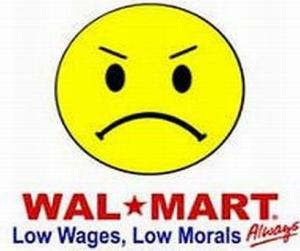
Wal Mart is notorious non-union workplace which is known to face class action lawsuits every year amounting to millions of dollars. This has given them a very infamous reputation in the field of labor relations. This is especially when the retail giant decided to open on Thanksgiving. And since it's the leading retailer, many stores ended following suit.

Wal Mart is notorious non-union workplace which is known to face class action lawsuits every year amounting to millions of dollars. This has given them a very infamous reputation in the field of labor relations. This is especially when the retail giant decided to open on Thanksgiving. And since it’s the leading retailer, many stores ended following suit.

7. Unions help companies and businesses.

Since unions crack down on bad labor practices, they also help their workplaces in many ways. For one, they make the workplace a much cleaner and safer environment for both workers and consumers alike. Paid sick leave can help keep a worker’s illness from infecting not only their peers but also customers. And paid sick leave for a sick child can prevent other kids from getting sick as well. Unions also help employers by not just giving them consumers but also save money on fighting lawsuits as well as gives them a better reputation. A business with good labor standards not only makes consumers more willing to buy from them, but also makes employees happier working for them, may be even proud. I mean look at Costco’s reputation is much better than Wal Mart’s for this reason. Of course, Costco doesn’t have unions either but it certainly wouldn’t be the company it is if unions never existed.

This is New England Patriots quarterback Tom Brady. Some time ago, Brady was implicated in Deflategate and the NFL charged him with a 4 game suspension. Brady appealed to the NFLPA (which is the players' union) and got that suspension removed by order from a federal court. Yes, I know this is a terrible example of unions at work. However, if people think unions are either outdated or bad, then why do unions for people like Tom Brady exist?

This is New England Patriots quarterback Tom Brady. Some time ago, Brady was implicated in Deflategate and the NFL charged him with a 4 game suspension. Brady appealed to the NFLPA (which is the players’ union) and got that suspension removed by order from a federal court. Yes, I know this is a terrible example of unions at work. However, if people think unions are either outdated or bad, then why do unions for people like Tom Brady exist?

8. Professional athletes and movie stars have unions.

I know that many people associate unionism with teachers and blue collar workers. However, we should understand that unionism isn’t just confined to the public sector or blue collar jobs that don’t earn a lot of money. For instance, professional athletes have their own union like the NFLPA that helped New England Patriots quarterback Tom Brady get out of a 4 game suspension after he implicated in the Deflategate scandal. People in show business also have unions like the Screen Actors Guild whose most famous president was Ronald Reagan at one point. Now neither group is economically in dire straits, but they have union representation nevertheless. That’s because no matter how rich you are, if you’re working for someone, sometimes policies won’t be in your favor. So if rich people feel they need unions, maybe their poorer counterparts feel the same way. Besides, even the most conservative union members wouldn’t want to get rid of theirs.

Here's a satirical cartoon making fun of union opposition. However, it makes a good point on how business don't like certain policies that unions advocate. Then there's the fact that companies don't want to pay extra costs to protect and make them happy or deal with strikes.

Here’s a satirical cartoon making fun of union opposition. However, it makes a good point on how business don’t like certain policies that unions advocate. Then there’s the fact that companies don’t want to pay extra costs to protect and make them happy or deal with strikes.

9. Anti-Unionism is all about big business wanting more power and control over their labor force.

In recent years, Unionism has been on the decline for 2 reasons. First, a lot of blue collar paying jobs were lost during the 1980s, many of which had union representation. Second, many people in the private sector work for big corporations that simply won’t allow them. It’s very well known that big business doesn’t like unions and calls them obstructionists. Yes, unions may have their faults and might inconvenience people. However, I always think that the reason why many workplaces in the country prohibit workers from unionizing has more to do with them wanting more power and control over their workforce than anything else. And if it’s not the workplaces, then it’s free market conservatives who think that corporations having free reign is best for the economy (when in reality, it’s not). For instance, a Volkswagen plant in Tennessee was prevented from unionizing by the state legislature, not management. Sure they want to hire and fire whoever they want. But they also want to control their employees’ hours and only want to pay them as much as it takes to keep them there. Passage of so-called “right to work” laws aimed at curbing union influence, have led to decreased wages and increased poverty rates in several US states. And it’s clear that these laws weren’t aimed to benefit workers but large corporations seeking more power and control of their labor force.

Nearly have the states in the US have "Right to Work" laws in which non-union members don't have to pay union dues in a unionized workplace. Yet, these laws minimize union power as well as lead to devastating consequences such as lower wages, higher uninsurance rates, higher poverty rates, and more workplace fatalities.

Nearly have the states in the US have “Right to Work” laws in which non-union members don’t have to pay union dues in a unionized workplace. Yet, these laws minimize union power as well as lead to devastating consequences such as lower wages, higher health uninsurance rates, higher poverty rates, and more workplace fatalities. Such factors can have devastating consequences not only for the workers, but also for their families (especially children) and communities.

10. The benefits of unions extend to workers’ families and improve society.

While unions may have their faults, we have to acknowledge the fact that they’ve helped not just the workers themselves but also their families, their descendants, and society as a whole. For instance, before many of these blue collar jobs were unionized, it wasn’t unusual for workers to begin their jobs as children after dropping out of school. In fact, it was a very common thing, especially with the Industrial Revolution in the 19th century. Just ask none other than Charles Dickens who wrote extensively on child labor and why it was a really terrible thing. Why? Because even though their parents might work 12-16 hour days, they could never earn enough money to support their family. Not to mention, a lot of these jobs were dangerous and could put a family in economic disaster because there was no compensation or safety standards. Even when public education was available, it wasn’t always compulsory and a lot of poor kids tended to drop out if their parents’ paychecks couldn’t cover the rent or in the event of a family emergency. And it was because these children were put to work at an early age, they were denied a basic education and the economic opportunities that came with it. So they ended suffering the same fate as their parents. Unions have been very instrumental in curbing child labor in blue collar industries since they gave adult workers leverage so their workplaces would provide them a fair wage, benefits, an 8-hour day, workman’s comp, and medical leave as well as observe workplace safety standards. Such measures not only made workers’ lives easier, but they also allowed children to go to school and stay there as well as focus on their schoolwork so they’d excel and perhaps get into a good college so they can have better opportunities. Now this didn’t necessarily happen overnight. But it’s a major reason why cities like Pittsburgh managed to bounce back after what happened to the steel industry in the 1980s (though I admit that some industrial areas in the Rust Belt haven’t been so lucky like Detroit. But even in those places, things could’ve been worse). Still, when you’re in such cities like Pittsburgh, you’ll find a lot of professionals like doctors, lawyers, teachers, and what not who had ancestors who were coal miners, mill workers, and factory workers. Sure they may say that some of them achieved success by hard work which certainly fits into the equation. However, if their blue collar ancestors didn’t pressure their bosses to unionize they would not be where they are today. Yet, though unions have made the world a decent, that doesn’t mean they’re no longer needed. In the US, we should be reminded time and time again that a parent’s life at work has a profound effect on a child’s progress in school, the quality of their education, life in their neighborhood, and even their health. That is still very much the reality today as it was back in the Gilded Age since a lot of service industry parents work minimum wage jobs, sometimes more than one. A child whose parents work at Sam’s Club is never going to have the same opportunities and quality life than one whose parents work at Costco, despite that both sets have the same job with the same responsibilities. However, we must understand that the Costcos in this world are a rarity and most companies have never been so accommodating to their workers. If most workers in the service industry want those Costco benefits so their kids could have better lives, then unionization might be the only thing possible for them to accomplish that.

Here's a picture of children working at a factory back in the day mostly because their parents work starvation wages and long hours. Since unions helped curbed child labor, be glad you don't have this. Or at least at Gilded Age capacity.

Here’s a picture of children working at a factory back in the day mostly because their parents work starvation wages and long hours. Since unions helped curbed child labor, be glad you don’t have this. Or at least at Gilded Age capacity.

US Vice Presidential Hall of Shame

2000px-US-VicePresident-1948Seal.svg

In the coming weeks, we have the coming national conventions for the Republican and Democratic nominees. However, before these can get off the ground, we have the veepstakes where the presumptive nominee has to choose a running mate for the ticket. Now selecting the VP has been a long tradition in American politics and history. But what does a vice president do, exactly? Well, as far the presidential campaign goes, a vice presidential candidate is supposed to balance the ticket and make the presidential candidate look good. As for the vice president, well, their job is to make the president look good, do a lot of ceremonial stuff, and be prepared to take over whenever the president can’t perform their duties. But it depends. If the president is sick or injured and is still kicking, then the VP might assume the president’s duties in an acting capacity. But if the president  dies or gets assassinated, then the VP assumes the job. This has happened 8 times, starting with President John Tyler assuming office after William Henry Harrison contracted pneumonia and died after 30 days. Since Harrison was the first president to die in office, this was much uncertainty regarding succession. But Tyler cleared this up by resolving Harrison’s death made him president and had himself sworn in. Or the VP can ascend the presidency if the president gets into some shady shenanigans that either results in their removal or resignation as in the case with Gerald Ford succeeding Richard Nixon. VPs are also said to preside over impeachment trials of federal judges and preside as President of the Senate. Other than that, the VP role can vary depending on the guy who’s in office as well as his relationship with the president. However, don’t assume that the vice presidency is a useless position because political campaigns as well as the fact 9 guys assumed the presidency from there show it’s not. Nevertheless, while our nation has had some good veeps, but a lot of vice presidents have held office and achieved little of consequence. Then there are ones who deserve special mention but not because they’re good or a nonentity. Mostly because they’re noteworthy for being really terrible veeps such as corrupt, backstabbing, useless, just plain stupid or something else. So here is a list of vice presidents that no presumptive nominee wants on their ticket.
Vanderlyn_Burr

Unlike the other VPs on this list, at least Aaron Burr gets to be depicted in a hit Broadway musical. Unfortunately, for him, it’s called Hamilton and it’s about the guy he shot in a duel.

  1. Aaron Burr

Served Under: Thomas Jefferson (1801-1805)

Why He Seemed Good at the Time: Actually while he was intended to be Jefferson’s vice president, Jefferson didn’t have much say in the actual selection. Nevertheless, this brilliant guy graduated from Princeton at 16, served as a Continental Army officer in the American Revolution (rising to the rank Lieutenant Colonel), as well as had a successful career as a lawyer and politician (he was US Senator from New York). Had a great relationship with his daughter Theodosia (and was a better father to his known illegitimate children, too, unlike Jefferson. He also supported women’s rights and opposed slavery). Not to mention, being from the north provided a great balance with Jefferson’s southern disposition.

Why He Wasn’t: He’s one of the best known US vice presidents and it’s mostly for the wrong reasons. Aside from being relentlessly horny (his second wife divorced him when he was 80 on grounds of adultery, kept detailed records on his encounters with prostitutes, fathered at least two illegitimate children, and was considered a notorious womanizer), he had a knack for making powerful enemies as well as a reputation for being a political opportunist with an unbridled ambition. Though he ran as vice president on Thomas Jefferson’s Democratic-Republican ticket, most voters tended chose both men without indicating the intended office. When he and Jefferson were tied in the election of 1800, Burr dragged out the uncertainty to manipulate it to his will which resulted in political instability and a potential constitutional crisis (which would later be corrected by the 12th Amendment establishing a separate selection process for President and Vice President). Luckily, Alexander Hamilton sorted the matter out by rallying his fellow Federalists in Congress to side with Jefferson who ended up winning the presidency, mainly because he hated Burr more. Though it did take 36 ballots. Nevertheless, since Jefferson was understandably pissed at Burr for not doing anything to stop efforts to usurp the presidency, there was understandable tension. And it was enough for Jefferson to drop Burr from the ticket in 1804. After losing the New York gubernatorial election to a dark horse candidate by one of the largest margins in that state’s history, he would be forever known in American history for challenging and killing Alexander Hamilton in a duel in New Jersey. Though indicted, he was never tried and all charges were eventually dropped. But it effectively ended his political career. Yet, despite the incident which led his name live on in infamy, he was said to be unmoved by Hamilton’s death and expressed no regret for his role in the duel.

Later Life: After his vice presidency, he’d travel west seeking both new political and economic opportunities, which led to his arrest and indictment for treason in 1807. According to accusations, he schemed to create an independent country in the center of North America and or the present day American Southwest and parts of present-day Mexico. Some claim he wanted some or all the Louisiana Purchase form himself. Burr on the other hand, claimed he intended to take possession of a 40,000 acre Texas farm leased by the Spanish Crown. He was acquitted but his schemes left him with large debts and few influential friends. Spent time in Europe to regain his fortunes before returning to New York to resume his law practice. Daughter and son-in-law would disappear in 1812-1813 at sea and it’s unknown whether they were murdered by pirates or shipwrecked in a storm. Married his second wife, wealthy widow Eliza Jumel in 1833 who kicked him out after 4 months when he tried to make off with her fortune. Suffered a stroke in 1834 and died two years later in a Staten Island boardinghouse at 80.

Trivia: Grandson of the famed Puritan fire and brimstone preacher Jonathan Edwards, best known for his sermon “Sinners in the Hands of an Angry God.” His father was also a minister and even studied theology at the time (as an attempt to join the family business). But he changed career paths when he realized that a church career wasn’t for him. Was a college classmate to James Madison and introduced him to his future wife Dolley. Befriended philosopher Jeremy Bentham while he was trying to regain his fortunes in Europe. Son John Pierre Burr was an active member of Philadelphia’s Underground Railroad, served as an agent for the abolitionist newspaper The Liberator, worked in the National Black Convention movement, and served as Chairman of the American Moral Reform Society. Grandson Frank J. Webb wrote the second African American novel The Garies and Their Friends which was published in 1857. His complex character and political self-interest perhaps made him the most controversial American Founding Fathers to date.
FC-003-ElbridgeGerry

Sure he became infamous due to his state’s redistricting map that he’ll always be known for the term “gerrymandering.” But he wasn’t Madison’s first choice. So he kind of had to take what he can get.

  1. Elbridge Gerry

Served Under: James Madison (1813-1814)

Why He Seemed Good at the Time: For one, he had a long political career from the American Revolutionary period and it didn’t hurt he resided in Massachusetts. He vocally opposed British colonial policy in the 1760s and was active in the early stages of organizing resistance in the American Revolution. Signed the Declaration of Independence and the Articles of Confederation as well attended the Constitutional Convention in 1787 (but refused to sign it since it lacked a Bill of Rights). However, he would be actively involved with drafting and passing the Bill of Rights as an inaugural member of the US Congress. Was friends with both Federalists and Democratic-Republicans. Also, since Madison was a Southerner who was a teenager and college student at the time, Gerry seemed to complement him quite well. Not to mention, he posed less of a threat to James Monroe.

Why He Wasn’t: By 1812, the guy had a shady political reputation, especially in his home state. As Governor of Massachusetts, the legislature approved new state senate districts that led him becoming the namesake of “gerrymandering” a process in which electoral districts are drawn with the aim of aiding the party in power as well as caused political gridlock across the country ever since. Not to mention, also being remembered for refusing to sign the US Constitution, which we know was based on many of Madison’s ideas. Then there’s his role in the XYZ Affair which led to an undeclared naval Quasi-War with France. He would be accused of collaborating with the French (when he wasn’t and only stayed in France after Charles Cotesworth Pinckney and John Marshall had left because Talleyrand threatened war if he left). This resulted in the negative press damaging his reputation and being burned in effigy by protesters in front of his home. The “gerrymandering” incident, support of the War of 1812, and clashes with Federalist newspapers and printers during his term as governor damaged his reputation even further led to him to lose election in 1812. When he was selected for the vice presidency, he was having financial difficulties and asked Madison for a federal position. Luckily, Madison managed to win reelection quite easily and Gerry died a year and a half after being sworn in. However, this is not the guy you want as your running mate.

Later Life: He died during his term at 70 so there’s not much about him. Though his career has been difficult to characterize.

Trivia: Only Declaration of Independence signer buried in Washington D.C. Grandson became a US Congressman from Maine.
George_Peter_Alexander_Healy_-_John_C._Calhoun_-_Google_Art_Project

While John C. Calhoun was one of the most influential American politicians in history, his ideas about slavery and states’ rights would eventually end up tearing the nation apart as well as continue to sour American race relations and the political process as we speak. While Andrew Jackson’s presidential legacy isn’t a bed of roses, at least his decisive victory in the Battle of New Orleans in 1815 led Britain to recognize the Louisiana Purchase as US territory. Calhoun’s legacy by contrast, contains nothing worth commemorating a statue for. And he makes Andrew Jackson look good by comparison.

  1. John C. Calhoun

Served Under: John Quincy Adams and Andrew Jackson (1825-1832)

Why He Seemed Good at the Time: When it came to the divisive and very ugly elections of 1824 and 1828, having him as vice president was the only thing everyone could agree upon. Not to mention, he was one of the best known politicians of his day as well as seen as a voice for the antebellum South.

Why He Wasn’t: While Calhoun was certainly one of the most influential politicians in American history, he leaves one of the worst political legacies which has fucked up this country ever since. And it doesn’t help that his ideas have had enormous influence on Southern secessionist leaders as well as other politicians. While it wasn’t unusual for many American politicians to express racist views and own slaves, Calhoun was also a staunch defender of slavery which he viewed as a positive good as well as based his claims on paternalism and white supremacy. Chief Supreme Court Justice Roger B. Taney would base his infamous Dredd Scott decision on Calhoun’s ideas, ruling that that the federal government can’t prohibit slavery and that blacks have rights no white man is bound to respect. As for having him as vice president, well, let’s just say if there was one thing John Quincy Adams and Andrew Jackson can agree on it’s that Calhoun was a complete prick. Calhoun didn’t see eye to eye with Adams on most things and worked to undermine him. So in 1828, he decided to run with Andrew Jackson thinking things would be different. After all, while Adams hated slavery, Jackson owned slaves on his Tennessee plantation. He was wrong. Mostly because Calhoun championed nullification which states that if states don’t like a federal law, they could just ignore it (laying groundwork for secession, the American Civil War, and 600,000 dead Americans). Jackson disagreed with this policy completely. The two men becoming estranged and Calhoun’s resignation, but not after the Peggy Eaton affair resulted in most of Jackson’s cabinet being fired. Jackson had also replaced him in the meantime with anti-slavery Northern diplomat Martin Van Buren with whom he was on much better terms. For the rest of his life Jackson would express regret over not executing Calhoun as a traitor, making backroom conflicts between JFK and LBJ seem trivial. And let’s just say, it’s hard to disagree with him.

Later Life: Went to the US Senate where he’d advocate for slavery, states’ rights, and agricultural interests. He’d resign in 1843 so he could run for the Democratic presidential nomination in 1844. But he gained little support and decided to quit. That same year, he was appointed by John Tyler as Secretary of State where he presided over the Oregon Boundary Dispute and the Annexation of Texas (prompting the Mexican-American War). He returned to the Senate in 1845 and opposed the Mexican-American on account that it would distort the national character by undermining republicanism in favor of empire by bringing non-white persons (also known as “Mexicans”) into the country. Vigorously opposed the Wilmot Provisio which would’ve banned slavery in the new territories and it was defeated in the Senate each time it passed the House. Also rejected the Compromise of 1850 as well as affirmed the right of the South to leave the Union in response to Northern subjugation. Died of TB in 1850 at 68.

Trivia: Calhoun’s wife Floride prompted her own scandal by shunning the War Secretary’s wife Peggy Eaton, on account that she was fooling around with future Husband #2 while Husband #1 was still alive. Since Jackson and his wife Rachel were themselves subject to such political attacks when they married while her should’ve been ex-husband failed to finalize their divorce and Eaton being a close friend of his, Jackson was massively pissed. Called the Petticoat Affair, this resulted in almost all but one of Jackson’s Cabinet members being replaced. Body was hidden during the American Civil War over concerns on desecration.  Let’s just say you’re bound to hear his name when controversy arises out of something named after him for good reason. His monument was vandalized in Charleston, South Carolina after the Charleston Shooting in 2015.
Angew in Trouble at News Conference

Caption: “Vice President Spiro Agnew points to a reporter at a news conference called to answer accusations of corruption and wrong-doing by him.” Agnew might’ve been a shitty human being. But that’s no excuse for being a shitty vice president. He’s on here because he was known for taking bribes and had to resign in disgrace.

  1. Spiro T. Agnew

Served Under: Richard M. Nixon (1969-1973)

Why He Seemed Good at the Time: Let’s see. He was a graduate of Johns Hopkins University as well as served as a US Army officer during WWJJ and Korean War. Was a prominent Greek American politician who served as Baltimore County Executive which was predominantly Democratic and Governor of Maryland. Also opposed segregation that 82,000 Democrats in that state voted for him. Not to mention, as governor, he worked with Democrats to pass tax and judicial reforms, anti-pollution laws, as well as civil rights actions like open housing and repealing anti-miscegenation. His immigrant background, moderate image, and success in a Democratic state made him an attractive running mate. And Nixon personally selected him over better known Republican names for these reasons. His career is one of the fastest political rises in American history.

Why He Wasn’t: Regardless on what you think about Gerald Ford as president, you should at least praise the Lord and rejoice that Ford just happened to be vice president when Nixon resigned. Seriously, Gerry Ford may have his faults and critics, but at least he wasn’t anything like this guy who, if he spent another 10 months in office would’ve became president instead. And let’s just say, it would’ve been very bad for the nation. Sure we don’t expect much in our vice presidents. Yes, the public was willing to overlook his habit of using terms like “fat Jap” and other denigrations to minorities. And yes, the public tended to be fine with Agnew being Nixon’s attack dog relishing in uttering phrases like “nattering nabobs of negativism” to define the White House press corps. Yet, even other VPs do such mudslinging so that’s kind of expected. However, we do kind of wish that they not take any bribes or at least pursue them openly. Unfortunately, this was too difficult for Agnew. In 1973, he was investigated by Maryland’s US Attorney Office on charges amounting to extortion, tax fraud, bribery, and conspiracy. He was charged with having accepted bribes amounting to more $147,500 while Baltimore County Executive, Governor of Maryland, and Vice President. That October, Agnew pleaded no contest to a single charge that he failed to report $29,500 of income received in 1967, on condition that he resign as VP in disgrace to avoid prison time. He was fined $10,000 as well as received 3 years probation, and disbarment. Historians widely consider him among the worst VPs in American history.

Later Life: Agnew would remain unrepentant post-resignation, insisting the money was actually campaign contributions and unsuccessfully attempted to write off the $268,462 fine on his taxes in 1983. Always maintained that the tax evasion and bribery charges were attempts by Nixon to divert attention from the growing Watergate scandal (reality, they were not). He and Nixon would never speak to each other again, though Agnew attended the latter’s funeral at his daughters’ invitation. After leaving politics, he became an international trade executive with homes in Rancho Mirage, California, as well as in Arnold and Bowie, Maryland. Briefly reentered the public spotlight calling for the US to withdraw support from Israel on its allegedly bad treatment of Christians. In 1980, he published a memoir implying that Nixon and Chief of Staff Alexander Haig had planned to assassinate him if he refused to resign. Died of leukemia in 1996 at 77.

Trivia: Wrote a novel called The Canfield Delusion about a Vice President who was “destroyed by his own ambition.” Maryland state portrait was taken down between 1979-1995.
1424101166-154351616-cheney

Dick Cheney may be one of the most qualified and powerful vice presidents to date. However, as a behind the scenes man, Cheney was seen as either the architect or shadowy puppetmaster behind the Bush Administration’s most controversial policies. He has certainly not admitted being wrong on any of them after leaving office, even defending them.

  1. Dick Cheney

Served Under: George W. Bush (2001-2009)

Why He Seemed Good at the Time: Cheney was a seasoned Republican politician and businessman who rose from congressional intern to White House Chief of Staff during the Nixon and Ford administrations. Was Wyoming US Representative from 1979-1989 and served as Defense Secretary under George H.W. Bush. Was CEO of Halliburton during the Clinton Administration where he left with a $20 million retirement package. Also, it helps that he was the head of Dubya’s own vice-presidential search committee. Then again, he did have a very impressive political resume. So he wasn’t quite wrong.

Why He Wasn’t: During his political career, Cheney was known to vote against Head Start and a resolution calling on South Africa to release Nelson Mandela (and still stands by this one). While he trumpets his success in the private sector, his primary “accomplishment” with running Haliburton was purchasing a company that eventually had to pay out $4 billion in settlements related to asbestos lawsuits. However, as VP, he’d make up for it by advocating for 2 wars and doling out no-bid contracts. Play a major role behind the scenes during the Bush Administration, particularly in its response to 9/11, the War on Terror, and Iraq (based on erroneous WMD claims), as well as defended its record on anti-terrorism. Was often criticized for such policies as well as NSA wiretapping and so-called “enhanced interrogation techniques” better known as “torture.” Oh, and he cited executive privilege over refusing to disclose documents. As one of the most powerful vice presidents in US history, Cheney was often seen as a “shadow president” and creating a “fourth branch of government” all to himself. In 2005, his office was investigated over the CIA Leak Scandal which resulted in the resignation, perjury conviction, and commutation of his chief of staff I. Lewis “Scooter” Libby. Has been compared to Darth Vader, stirred controversy as commencement speaker at Brigham Young University in 2007, and has had calls from media and advocacy groups calling for his prosecution under various anti-torture and war crime statutes. Shot his friend Harry Whittington in the face during a quail hunt in 2006 by accident with alcohol certainly being involved. Term in office was highlighted as he exceeded the authority of his office, contributed to secrecy in government, engaged in political vendettas and taken the lead in advancing unwise policies on the environment, energy, foreign affairs, budgets and taxes. By the time he left office, he was almost universally loathed by the American people.

Later Life: Since leaving the vice presidency, he has been active in defending the Bush Administration’s legacy as well as vociferously criticized the current Obama Administration. Hosted a private fundraiser for Mitt Romney in 2012 that netted $4 million. Spoke positive about the Tea Party. Written two books with his daughter Liz.

Trivia: Wife Lynne Cheney was chair of the National Endowment for the Arts from 1986-1996 and is now a public speaker, author, and fellow at the American Enterprise Institute. She also wrote a lesbian romance novel.

DA-SC-07-43800

As the elder Bush’s VP, Dan Quayle would be a cause of continual embarrassment throughout the Bush campaign and presidency for being a total idiot. Another good Quayle quote: “The other day [the President] said, I know you’ve had some rough times, and I want to do something that will show the nation what faith that I have in you, in your maturity and sense of responsibility. Would you like a puppy?”

  1. Dan Quayle

Served Under: George H.W. Bush (1989-1992)

Why He Seemed Good at the Time: Well, he was a young fresh face to the Republican Party who served in variety of political offices in Indiana, defeated an 8 term veteran in his first US congressional race, and was elected to the US Senate at 33 as well as won reelection by large margins. He came from a wealthy family (that owned a newspaper in Indiana) and wasn’t a bad looking guy. Reagan once said the man had, “energy and enthusiasm.” Apparently, the elder Bush viewed him as a great insurance policy that would help save taxpayers money on his personal security detail. Also, having Quayle around would prevent Democrats from calling for his impeachment when it came to policies they really didn’t like.

Why He Wasn’t: Let’s just say the senior Bush’s choice in a running mate cause controversy from the very beginning. On questions regarding his military service in the National Guard to evade the draft during the Vietnam War, a golf trip with Paula Parkinson in Florida, and whether he had enough experience to be president, he seemed evasive in his answers. He would later be epically shut down by Lloyd Bentsen with “You’re no Jack Kennedy” in the vice presidential debate after he compared his own public service to that of John F. Kennedy. Yet, Bush and Quayle still won. During his vice presidency, Quayle would be widely ridiculed by the media and general public as well as be seen as an idiot and generally incompetent. Had a tendency to make public statements that were either self-contradictory, confused, or impossible. Examples: “The Holocaust was an obscene period in our nation’s history. … No, not our nation’s, but in World War II. I mean, we all lived in this century. I didn’t live in this century, but in this century’s history,” “I have made good judgments in the past. I have made good judgments in the future,” “Republicans understand the importance of bondage between a mother and child,” and during his address to the United Negro College Fund whose slogan is “A mind is a terrible thing to waste”: “You take the UNCF model that what a waste it is to lose one’s mind or not to have a mind is being very wasteful. How true that is.” When asked about sending humans to Mars, Quayle said, “Mars is essentially in the same orbit [as Earth]….Mars is somewhat the same distance from the Sun, which is very important. We have seen pictures where there are canals, we believe, and water. If there is water, that means there is oxygen. If oxygen, that means we can breathe.” Also, while we may not expect much from vice presidents, we do think that they should at least be able to spell the word “potato” right. But that didn’t stop him from trying to alter a 12-year-old boy’s already correct spelling to “potatoe.” And no, I don’t care if he was relying on an errant flashcard from that elementary school. If you’re an adult, you should’ve learned how to spell potato without having to rely on flash cards!

Later Life: Declined offers to run for Governor of Indiana and the presidency and moved to Arizona. Ran for the Republican Presidential nomination in 2000, ironically saying “we do not want another candidate who needs on-the-job training” on then front-runner George W. Bush. But he quickly withdrew and backed Bush after coming 8th in an Ames straw poll. Wrote 3 books. Joined Cerberus Capital Management in 1999 where he now serves as chairman of the company’s Global Investments division. Serves in various boards of directors for corporations like the Heckmann Corporation, Azora Bank, K2 Sports, Amtran, Inc., Central Newspapers, Inc., and BTC, Inc.

Trivia: Son was a one term congressman in Arizona but was defeated in a reelection primary due to redistricting. But he’s said to be equally moronic.
20090817053612!RichardMentorJohnson

Richard Mentor Johnson’s status as a war hero for killing Tecumseh, his political career in Kentucky, and endorsement by Andrew Jackson himself should’ve made him a viable running mate for Martin Van Buren. Unfortunately, the guy was way too open about his personal life which made him a political nightmare in 1836 that the Democrats decided to run Van Buren with no VP at all.

  1. Richard Mentor Johnson

Served Under: Martin Van Buren (1837-1841)

Why He Seemed Good at the Time: Was reported to personally kill Tecumseh during the War of 1812 which he always used to exploit in his political career with glee that included time in the House and Senate. Was a campaigner against debt imprisonment and religious freedom (like abolishing the practice of “no mail on Sundays” rule). Also being from Kentucky helped balanced the ticket since Van Buren was from New York. Then there’s the slogan, “Rumpsey Dumpsey, Rumpsey Dumpsey, Colonel Johnson killed Tecumseh,” which is just great. Not to mention, he was endorsed by none other than Andrew Jackson himself for the vice presidency.

Why He Wasn’t: While he was said to dress like a farmhand and curse like a sailor, he was a antebellum political PR disaster. He publicly admitted to having a black common law wife named Julia Chinn and treating his slave daughters as legit. He also had two other slave mistresses, one of whom he tried to introduce to polite society. So what’s wrong with that? Morally nothing but politically everything, especially in the antebellum years where it earned him “the most vulgar man of all vulgar men.” Let’s just say when you’re running for a major political office and have cater to a bunch of racist slave owners as well as incredibly racist whites, it’s just completely stupid. This goes even if you’re the 19th century equivalent to the “I Killed Bin Laden Guy” like he was. Besides, this already cost him his career in the Senate. Though he had Jackson’s backing in the 1836 election (because Jackson didn’t give a shit about his personal life), the Democrats were far from united behind him and barely obtained the necessary two thirds vote at the 1835 DNC. Despite one state’s Democratic legislators refusing to vote for him, he won anyway. Unsurprisingly he proved to be a great liability in the 1836 general election. His public relationship with his slave cost a lot of Democratic votes in the South. He also failed to garner much support in the West despite his reputation as an Indian fighter and a war hero. As vice president, Johnson’s penchant for wielding his power for his own interests didn’t abate. After the Panic of 1837, he took a 9 month absence during which he returned to Kentucky to open a tavern and spa on his farm to offset his continued financial problems. Also proposed an expedition to the North Pole so Americans could drill into the center of the earth which was soundly defeated. Since he proved to be such a liability for the Democrats in 1836, they refused to renominate him for vice-president in 1840 and Van Buren campaigned without a running mate, while Jackson saw him as a “dead weight” and threw his support to James K. Polk. Undaunted Johnson continued to campaign to retain his office where he made rambling, incoherent speeches, raising his shirt to show war wounds from the Battle of the Thames, and leveling charges against William Henry Harrison that were so poorly received that they led to a riot in Cleveland.

Later Life: Returned to his Kentucky farm to oversee his tavern where he served in the state legislator and was a pallbearer for Daniel Boone at his reinternment at Frankfort Cemetery. But he never gave up on a return to public office with an unsuccessful campaign for the US Senate against John C. Crittenden in 1842 and a presidential run in 1844. Ran for Kentucky governor as an independent in 1848 but later conceded. Suffered dementia and died of a stroke at 70.

Trivia: Known for wearing a bright red vest and tie in his later life. Political prominence led to a family dynasty with 2 brothers and his nephew all being elected to the US Congress. Also had 2 other slave mistresses after his “wife” Julia Chinn died. One tried to run off with an Indian but he sold her while the other was her sister.
John_C_Breckinridge-04775-restored

As James Buchanan’s vice president, John C. Breckinridge was a rising political star and the youngest VP ever at 36. However, his views on slavery and secession alienated Buchanan and his friend Stephen Douglas as well as tore apart his party. He later got expelled from the US Senate and became a general for the Confederacy.

  1. John Breckinridge

Served Under: James Buchanan (1857-1861)

Why He Seemed Good at the Time: Well, he was only 36 at the time, making him the youngest VP in US history as well as came from a prominent Kentucky family. Was a veteran of the Mexican American War. Was a states’ rights proponent who was against the legal interference with slavery which balanced the ticket with Buchanan. And let’s just say, things in the US were getting really bad by this time. Helped that he actively campaigned for Buchanan, too.

Why He Wasn’t: Well, let’s just say Buchanan resented the fact that he supported Franklin Pierce and Stephen Douglas (though to be fair Douglas was his friend but their relationship wouldn’t last). His pro-slavery views frequently led him to clash with Buchanan and Douglas, especially over the matter with Kansas that would soon be bleeding. When elected to the Kentucky legislature during his term, he endorsed the Dredd Scott decision and cautioned that John Brown’s raid on Harper’s Ferry was evidence on either negro equality or violence. In 1860, he accepted the nomination for president from protesting Democratic delegates who didn’t like Douglas. Another group of protesting delegates formed the Constitution Union Party and nominated John Bell. Believed in the right of secession and was accused of favoring Union breakup. Though he denied it, they were right. Still, while Breckinridge won 18.1% of the popular vote and placed second in the Electoral College, such disunion in the Democratic Party would result in Abraham Lincoln swept most of the northern states and won the presidency with 180 electoral votes. After losing to Lincoln, he announced his support for slavery and secession.

Later Life: His support for slavery and secession in his return to the Senate made his term a very short one. Since 7 states had already left the Union by this time, he was almost alone in his defense. He would later be indicted for treason after enlisting in the Confederate Army as well as be declared traitor and expelled by the US Senate. He would flee behind Confederate lines where he was commissioned as a Brigadier general. Was promoted to major general after the Battle of Shiloh as well as saw action at Stone River, Missionary Ridge, and the Shenandoah Valley. In 1865, he was appointed to Confederate Secretary of War and urged Jefferson Davis to surrender at the fall of Richmond. After the war, he fled to Cuba, Britain, and Canada as well as toured Europe for 2 years. All to escape treason charges before he could return after granted amnesty. Back in Kentucky, he resumed his law practice, served as counsel for the Cincinnati Southern Railway, and resisted calls to return to politics. Suffered from a variety of health problems in his later years. Died in 1875 at 54.

Trivia: Publicly denounced the Klu Klux Klan in 1870 as well as supported passage of a state statute legalizing black testimony against whites in court. Was played by Jason Isaacs in the 2014 film Field of Lost Shoes.
William_Rufus_DeVane_King_1839_portrait

William Rufus King was a moderate Unionist Democrat and a Southerner who made a great running mate for Franklin Pierce. However, he took the oath of office in Cuba and was dead after 45 days.

  1. William Rufus King

Served Under: Franklin Pierce (1853)

Why He Seemed Good at the Time: He was a longtime politician and diplomat. As a Democrat, he was considered a Unionist as well as a moderate on issues pertaining to sectionalism, slavery, and westward expansion, all of which contributed to the American Civil War. He helped draft the Compromise of 1850.

Why He Wasn’t: Uh, he wasn’t in the best shape at the time. Because he took the VP oath of office on foreign soil in Havana, Cuba. Died 45 days into his term. Also, prior to the vice presidency, supported a gag rule in the Senate on antislavery petitions, opposed proposals to abolish slavery in Washington D.C., and was a member of one of Alabama’s largest slaveholding families with a vast cotton plantation to boot.

Later Life: He died 45 days after being sworn in from TB. So there’s nothing to say about him.

Trivia: Only vice president never to marry and resided much of his life with future president James Buchanan (who also never married, by complete coincidence. Not that there’s anything wrong with that but there has been speculation that they might’ve been more than just good friends).
Hannibal_Hamlin,_photo_portrait_seated,_c1860-65-retouched-crop

As a do nothing politician from Maine, Hannibal Hamlin was a safe choice as Abraham Lincoln’s VP in a very ugly election year. However, once he became vice president, he continued being useless that he spent most of his time in Maine anyway.

  1. Hannibal Hamlin

Served Under: Abraham Lincoln (1861-1865)

Why He Seemed Good at the Time: He was a senator, congressman, and governor from Maine mainly put on the ticket with Lincoln to provide a geographical balance in the 1860 election. That and the fact, his reputation as a do nothing politician who used his office to grant favors made him a safe choice as a running mate at a time when having a certain political agenda would lead to controversy. And since Lincoln was a highly controversial candidate for his stance against slavery expansion, having Hamlin as his running mate worked in his favor.

Why He Wasn’t: He’s a classic example of a vice president who exercised no power and no influence, even losing control of the patronage for his own state. It didn’t help that he and Lincoln never met until after the 1860 election. While Lincoln sometimes asked Hamlin for advice, his role was so limited that he often stayed in Maine, complaining about his insignificance. Also strongly supported Joseph Hooker’s appointment as commander for the Army of the Potomac that would end in failure at the Battle of Chancellorsville. He was so bored with his job that he joined the Maine Coast Guard as a cook. He was dropped from the ticket in 1864 for Andrew Johnson.

Later Life: Returned to the US Senate in 1869 where he served until 1880 due to ailing health. Served as Ambassador to Spain from 1881-1882. Died at 81 in 1891.

Trivia: Had two sons who became Civil War generals (one of them was a brevet). Son Cyrus called for enlistment of black troops and commanded a brigade of freedmen in the Mississippi River Campaign. Son Charles and daughter Sarah were present at Ford’s Theater during the Lincoln assassination. Great-granddaughter Sally was a child actress who made many spoken word for Victor Talking Machine Company in the early 20th century. Nephew was an Civil War surgeon who wrote books about Chancellorsville and Andersonville Prison.
Thomas_Riley_Marshall_headshot

While Woodrow Wilson’s VP was known for his good sense of humor, he didn’t show much enthusiasm for the job and didn’t get on with his boss. However, what puts him on the list is that when Wilson suffered from a debilitating stroke, he refused to do his job.

  1. Thomas R. Marshall

Served Under: Woodrow Wilson (1913-1921)

Why He Seemed Good at the Time: He was a prominent lawyer in Indiana as well as a politician who rose to become its governor where he proposed controversial and progressive state constitution and pressed for other progressive reforms. It also helped that Indiana was a critical swing state in 1912. Was also great at giving speeches.

Why He Wasn’t: Wilson and Marshall had an ideological rift that led Wilson limit his influence in the administration and his brand of humor led Wilson to move his office away from the White House. Still, his best known moment was when Wilson was incapacitated from a stroke in October 1919 which prompted a leadership crisis. Because of personal dislike, Edith Wilson and his advisers sought to keep Marshall uninformed about to president’s condition to prevent him from easily assuming the presidency. Yet, while many people, including cabinet officials and Congressional leaders urged Marshall to become acting president, he refused to forcibly assume the presidency for fear of setting a precedent. Well, since there was no such thing as an acting president at the time, isn’t setting a precedent for one supposed to be his fucking job? I think so. Hell, the guy was already holding cabinet meetings while Wilson was in Europe. I’m sure setting a precedent as acting president would be something he could handle. But because Marshall didn’t do his job and was too chickenshit to stick up against Edith and Wilson’s advisers, there was no strong leadership in the executive branch. And the administration’s opponents defeated the ratification of the League of Nations treaty which effectively returned the US to an isolationist foreign policy.

Later Life: Tried to run for president in 1920 but only the Indiana Democrats supported him. Opened an Indianapolis law practice, wrote several legal books and a memoir, as well as continued to travel and speak publicly. Died of a heart attack while on a trip in 1925 at 71.

Trivia: Was known for his wit and sense of humor who said, “What this country really needs is a good five-cent cigar.” Only VP to be a target of an assassination attempt.
Henry-A.-Wallace-Townsend

As FDR’s Secretary of Agriculture, Henry Wallace was almost second to none when it came to helping farmers and feeding the hungry during the Great Depression. However, as vice president, his left-wing views, crazy religious beliefs, and idiotic perception of the Soviet Union made him a source of controversy. It’s no wonder that the Democrats had FDR dump him for Harry S. Truman and the nation is better for it.

  1. Henry Wallace

Served Under: Franklin Delano Roosevelt (1941-1945)

Why He Seemed Good at the Time: Unlike John Nance Garner, he was a strong supporter of New Deal liberalism, rapid desegregation, and softer policies toward the Soviet Union. Also, had a successful career in agriculture that FDR appointed him Secretary of Agriculture when he was still a Republican (to be fair, the Roosevelts knew him a long way back). And while controversial, he was said to be really good at that job. Arthur M. Schlesinger wrote of him: “In 1933, a quarter of the American people still lived on farms, and agricultural policy was a matter of high political and economic significance. Farmers had been devastated by depression. H.A.’s ambition was to restore the farmers’ position in the national economy. He sought to give them the same opportunity to improve income by controlling output that business corporations already possessed. In time he widened his concern beyond commercial farming to subsistence farming and rural poverty. For the urban poor, he provided food stamps and school lunches. He instituted programs for land-use planning, soil conservation, and erosion control. And always he promoted research to combat plant and animal diseases, to locate drought-resistant crops and to develop hybrid seeds in order to increase productivity.”

Why He Wasn’t: Even as Secretary of Agriculture, Wallace was very controversial for his left wing views, bizarre religious beliefs (such as dabbling in mysticism and fad diets), and friendship with a Russian man said to cause a diplomatic upset while on an expedition in Asia. This guy tended to march his own unique political funky drummer. FDR’s tapping him as VP caused considerable controversy among the conservative Southern Democrats, many of whom mistrusted him, revolted during the Democratic National Convention that FDR threatened to decline the nomination while Eleanor delivered a conciliatory speech. As vice president, his tremendous naiveté about the world would prevent him from seeing the Soviet Union as a particular threat (as the tens of millions Stalin killed begged to differ). This is mostly because he saw a fully sanitized version of the Siberian slave labor camps in which the Soviets claimed the work as being done by, “volunteers.” Wallace took it hook, line, and sinker (idiot). May have had a Messiah-Complex. But his public feuds with officials caused significant controversy in the midst of WWII. During the 1944 election, the Democrats got fed up with Wallace and dropped him from the ticket in favor of Harry Truman (winning 90% of the vote) who became president had FDR died after 82 days. Had he been VP at the time, the Wallace administration would’ve been a very trippy administration. Sure Truman has received a lot of criticism from both left and right over the years, but even his staunches foes have to concede that the Berlin Airlift was a humiliating defeat for the Eastern Block. Not to mention, despite not having a college education and being unprepared for the presidency since FDR largely ignored him, Truman proved to be a way better president than this guy could’ve been.

Later Life: Served as Secretary of Commerce during FDR’s last month in office and into the Truman administration where he continued to attract controversy on his comments pertaining to the Soviet Union. This led Truman to fire him in 1946. After that, he became editor of The New Republic which he used as a platform to oppose Truman’s foreign policies and ran for president in 1948 as a Progressive Party candidate, advocating universal healthcare, desegregation and end to black disenfranchisement, and an end to the Cold War where he won 2.4% of the popular vote. Retired to New York to focus on farming. Supported the Korean War and later apologized for his former stance on the Soviet Union. Died of amyotrophic lateral sclerosis in 1965 at 77.

Trivia: George Washington Carver resided with his family as a student and later teacher at Iowa State. Wallace would accompany Carver on his nature walks. Work on plants helped introduce the concept of hybrid vigor as well as experimented with breeding high-yielding hybrid corn. Introduced econometrics to the field of agriculture. Founded the Hi-Bred Corn Company.
2896_127849027553

Before Henry Wallace was VP, FDR had conservative Texas Democrat John Nance Garner. Now first term Garner was great. But second term Garner, not so much. Hell, he even tried to run against FDR in 1940.

  1. John Nance Garner

Served Under: Franklin Delano Roosevelt (1933-1941)

Why He Seemed Good at the Time: He was a US congressman from Texas who rose to Speaker of the House. His conservative stance and Southern background made him a great balance on the FDR ticket in the 1932 election.

Why He Wasn’t: First term John Nance Garner was great since he helped sell FDR’s New Deal policy. Second term Garner, not so much. As a conservative Democrat from Texas, he opposed labor union sit down strikes and New Deal deficit spending, he sabotaged FDR’s policies (such as the court packing scheme). In 1940, he became the only sitting VP to challenge the sitting president for the party’s nomination. He lost. But by this time, a lot of Democrats didn’t find him appealing. Make way for proto-hippie Henry Wallace.

Later Life: Retired to his Uvalde, Texas home where he spent the last 26 years of his life as well as settled into a life of an elder statesman who was consulted by active Democratic politicians. Died in 1967 at 98 and is the longest lived VP to date.

Trivia: Called “Cactus Jack.” Was close to Harry S. Truman.
Schuyler_Colfax_portrait

Close to the same age as Ulysses S. Grant, Schuyler Colfax seemed to be a great running mate due to his illustrious congressional career which led to him becoming House Speaker and being a champion against slavery and nativism. However, the guy was was corrupt as hell when it was revealed in a congressional investigation that he had taken bribes from the Union Pacific Railroad. Also, kind of a backstabbler. Oh, and he should’ve been played by a younger man in Lincoln because he was a year younger than Grant.

  1. Schuyler Colfax

Served Under: Ulysses S. Grant (1869-1873)

Why He Seemed Good at the Time: Well, like Grant, he was only in his mid 40s as well as had a political career that led him to become House Speaker, which made up for Grant’s lack of political expertise. Was known for his opposition to slavery, anti-nativism, and a founder of the Republican Party. Not to mention, he had a pretty awesome name.

Why He Wasn’t: Two things. First, thinking Grant would serve one term, he attempted to garner support for his 1872 Republican presidential bid by telling friends he wouldn’t seek a second VP term. By the way, this was part of his plan. But when Grant ran again, so did he but ended up being dropped from the ticket in favor of Henry Wilson. Second, in 1873, a Congressional investigation into the Credit Mobiler Scandal named him as one of the Congressmen who likely received payments of cash and discounted stock from the Union Pacific Railroad in exchange for favorable action during construction of the First Transcontinental Railroad. It was later revealed that he had taken $1,200 gift check for 20 shares of Credit Mobiler stock, which he denied after leaving office. In addition, Congress also revealed a more damning accusation that Colfax received a $4,000 gift in 1868 from a contractor who supplied envelopes to the federal government while he was chairman of the Post Office and Road Committee. Since these incidents took place while he was a Congressman and was scheduled to leave office the following month anyway, he wasn’t censured or forced to resign.

Later Life: Never ran again for office since his political career was ruined. Spent the rest of his life working as a business executive as well as a popular lecturer and speech maker. Died in Minnesota in 1885 while changing trains as he was en route to Iowa.

Trivia: Was friends with Horace Greely.
Chas_G_Dawes-H&E

It’s no wonder that Calvin Coolidge selected Charles G. Dawes as his VP since he was a successful businessman, politician, and military general. However, the guy refused to attend cabinet meetings and napped through an appointee’s confirmation vote which cost the guy his job.

  1. Charles G. Dawes

Served Under: Calvin Coolidge (1925-1929)

Why He Seemed Good at the Time: He was a successful businessman and politician as well as served as a US Army officer during WWI rising to Brigadier general. Was also awarded a Nobel Peace Prize for his work in the Dawes Plan in 1925, was a program to enable Germany to restore and stabilize its economy after the war. Also, he was the first guy willing to take the job and was loyal to him and his campaign.

Why He Wasn’t: While there are presidents who didn’t get along with their veeps, Dawes didn’t even try. Soon after election, he sent Coolidge a letter saying that he would not attend cabinet meetings. The first time he addressed the Senate, he made a speech denouncing the way it conducted business, pissing off Coolidge. Later, he napped through a decisive vote which resulted in a Coolidge attorney general appointee losing his job. By 1929, he and Coolidge would despise each other and they’d have a feud that broke into open hostility. As for his Nobel Peace Prize win for his plan to restore German economic equilibrium, well, that worked spectacularly (it was ultimately an epic disaster since it didn’t help Germany’s economic woes nor prevent the rise of Adolf Hitler and Nazi Germany).

Later Life: Became the US ambassador to the UK and headed Herbert Hoover’s Reconstruction Finance Corporation. Returned to the banking business for nearly two decades and became chairman of the board of City National Bank and Trust Co. until his death in 1951 at 85.

Trivia: Was a self-taught pianist and composer who composed “Melody in Major” in 1912 which has been used to the lyrics “It’s All in the Game” that’s become a pop standard that’s been covered countless times. Was friends with General John Pershing. Descendant of William Dawes who accompanied Paul Revere.
220px-DTompkins

As governor of New York, he organized the state militia and invested his own money into it during the War of 1812. As James Monroe’s vice president, he was mostly drunk due to money problems and not being reimbursed for his efforts by the federal government.

  1. Daniel D. Tompkins

Served Under: James Monroe (1817-1825)

Why He Seemed Good at the Time: While a jurist by background, he was noted as one of the most enterprising governors during the War of 1812. Organized the state militia by often investing his own capital when the legislature wouldn’t approve the necessary funds. Yet, he failed to recover the loans despite massive litigation.

Why He Wasn’t: Well, the guy was already not in the best of health when he was sworn in. He fell off a horse in 1814. He also suffered money problems and slipped into alcoholism. Let’s just say he was often so drunk that he couldn’t perform simple parliamentary duties. Described by Martin Van Buren as “the most injured of men” as well as by another as a “degraded sot.” He made an especially poor presider when of the Senate while it debated the Missouri Compromise in 1820.

Later Life: His post-vice presidency was among the shortest in US history. Because he drank himself to death 3 months after leaving office at 50 in 1825.

Trivia: Has a neighborhood in Staten Island named after him.
Levi_Morton_-_Brady-Handy_portrait_-_standard_crop

While Levi Morton had enormous walrus sideburns that were fashionable at the turn of the century, he was a shitty VP to Benjamin Harrison. His failure to ensure passage of a black voting rights bill was due to his belief that he should remain impartial. Harrison, on the other hand, had other ideas.

  1. Levi P. Morton

Served Under: Benjamin Harrison (1889-1893)

Why He Seemed Good at the Time: Was a distinguished politician who was once considered to be James A. Garfield’s running mate but declined. Served as an ambassador to France and was very popular there. Also placed the first rivet in the construction of the Statue of Liberty. Besides, I guess Harrison wanted to repeat the Garfield tradition of selecting the running mate with the most awesome side burns. Since it worked before.

Why He Wasn’t: Had little noteworthy to hang his enormous sideburns on. His one “accomplishment” was doing little to support passage on a bill to enforce black voting rights in the South against a Democratic filibuster in the Senate. Harrison blamed him for the bill’s failure because he believed his role was to be impartial. Was outfoxed by parliamentary procedure and replaced by Whitelaw Reed in the election of 1892 which Harrison lost. Because that’s what happens when you’re an utterly useless vice president.

Later Life: Served as Governor of New York and retired as a real estate investor. Died on his 96th birthday in 1920.

Trivia: Had vast landholdings. His summer home in Rhode Island is now owned by Salve Regina University.
Thomas_Andrews_Hendricks

As a seasoned politician and popular Indiana governor known for defending the Democratic position during the American Civil War, Thomas A. Hendricks was a natural choice for Grover Cleveland’s running mate. Unfortunately, what made him very popular among the Democrats at the time was that he hate black people.

  1. Thomas A. Hendricks

Served Under: Grover Cleveland (1885)

Why He Seemed Good at the Time: Was a prominent politician in Indiana where he rose to become congressman, senator, and governor. Was also quite popular in the Democratic Party for defending its position during the American Civil War.

Why He Wasn’t: He was a fervent secessionist and pro-slavery supporter who opposed ratification of the 13th, 14th, and 15th, Amendments abolishing slavery as well as granting citizenship and suffrage to African Americans. Also supported segregation. Luckily he was in ill health at the time and died 8 months into his term at 66.

Later Life: He only lasted as VP for 8 months so there’s not much to write about in this section.

Trivia: There’s not anything interesting about him.

Stupid Olympic Sports

1-620x399

While the Olympics have a lot of well-known sports like gymnastics, track and field, equestrian, and others, sometimes you have sports that are kind of odd. Others might be boring to watch while some might make you asking “What the hell is that?” or “How do they call this a sport?” Over the years, the Olympics has featured all kinds of sports in its modern history. Some of them have become all-time favorites, while others not so much. As to why these sports were ever held in the Olympics, I sometimes I have no idea. Sometimes this has to do with tradition. Sometimes it might be to lobbying efforts. And sometimes, it might be due to a sport simply being popular at one part of the world. Sorry, but you’ll have people in the world who actually like sports like team handball. At any rate, the sports I present all have degrees of various levels of ridiculousness. Some of them might seem stupid while others seem boring or insane. So for your reading pleasure, here is a list of ridiculous Olympic sports I managed to compile.

synchronized-swimming-olympics-live-online

  1. Synchronized Swimming – From River Front Times: “We admit it. This sport is almost too easy to make fun of. But we’re not here to dismiss the event entirely. The team competition, in which a group of women collectively turn themselves into aquatic kaleidoscopes, is actually kind of cool. (Kind of.) No, what we find completely inane is the smaller (and less dazzling) duet competition. Sorry, ladies, but flopping around in a pool with your girlfriend is NOT a sport. And, by the way, why is it that synchronized swimming remains a female-only event when traditionally male sports such as boxing and wrestling have all added women in recent years? The Thompson Twins (from one of the best SNL skits ever) would not approve.”

storymaker-weird-olympic-sports-slideshow2-515x388

2. Trampoline- From River Front Times: “Sure, trampolines are lots of fun. And as the character Todd Flanders once noted on The Simpsons, each leap on the spring-loaded canvas “brings us closer to God.” But an Olympic sport? In 2000 the IOC agreed with young Flanders when — to the dismay of the pogo-stick and hulu-hoop lobbies — it vaulted trampoline jumping from backyard activity to the pantheon of the Olympic games.”

olympics252bday252b12252bcycling252bbmx252b7z5z7vw5bbyl

3. Cycling BMX- From River Front Times: “Let’s be frank. Some “sports” just need to remain in the “X-Games.” That’s the case with BMX, which debuted in Beijing in ’08 and was somehow invited back for 2012. C’mon, IOC. “Do the Dew” and dew not extend the same invitation for 2016.” From SBNation: “I guess the Olympics have to do something to get Doritos and Mountain Dew into the Summer Games. If more people knew about BMX being part of this prestigious event, maybe the MMA lobbyists could just have a presentation to the Olympic Committee where they just point to a picture of BMX and go, ‘C’MONNNNNNNN.’”

MP_1957387b

4. Laser Pointing (a.k.a. Modern Pentathalon)- From River Front Times: “Baron de Coubertin introduced the modern pentathalon to the 1912 Stockholm games because he believed this “sport” tested “a man’s moral qualities as much as his physical resources and skills, producing thereby a complete athlete.” The event combines fencing, horse jumping, shooting, a 3-K run and 200-meter swim. This year in a move that makes the modern pentathlon ever-more-modern (and to the great delight of video gamers who’d never considered themselves athletes before), the competition will add a twist. Instead, of firing lead pellets during the shooting event, pentathaloners will fire a laser pistol powered by a AA battery.”
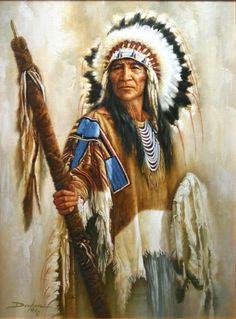
11427142-standard

5. Rhythmic Gymnastics- From River Front Times: “Like a dry-land version of synchronized swimming (only campier), rhythmic gymnastics features a team of competitors prancing around to music while waving ribbons and twirling hoops. The sport debuted in the 1984 Olympics when a real gymnast — Mary Lou Retton — was murdering it on her way to Olympic gold and a Wheaties box. Today rhythmic gymnastics is dominated by the Russians, who’ve swept gold medals at the last three Olympics and are favored to do so again in London.” Once again, this was written in 2012. However, given the Russian dope scandal, other teams might have a chance to compete if the Russian team is banned from competition in 2016.

colbert-dressage

6. Equestrian Dressage – From River Front Times: “Imagine a person sitting atop a horse as it prances, pirouettes and jumps unnaturally around a ring. Congratulations! You’ve just envisioned the dumbest “sport” of the Olympic games: dressage (pronounced like massage). We’re told that the ancient Greeks developed dressage to train horses for war, yet today’s version is a far flashier and dubious version of the original. A modern-day equivalent to dressage would be a lowrider competition in which hydraulics make Oldsmobile Cutlasses do things God (and G.M.) never intended.” From Heavy: “If I expressed earlier that any of the categories were somehow elitist, I apologize, we’ve truly found the ultimate sport of the one percent. Hire a trainer to train your horse to dance. The horse does almost all the work, the trainer does the rest, and you get to sit back and take credit for it all. Oh, and you have to own a horse. That’s why it’s no surprise that Mitt Romney (Hey, Mitt!) has a horse in the dressage competition this year. A horse named Rafalca. Oh, look, Rafalca has her own Twitter account (Hey, Rafalca! Good luck!).”During the 2012 Olympic Games in London, Stephen Colbert got a lot of comedy out of this sport, especially since Mitt Romney had a horse compete in this event.

dumb_olympics_solo_synchro_red_suit

7. Solo Synchronized Swimming (1984-1992)- From Dish Magazine: “You read that right: Solo Synchronized Swimming; the question of how, exactly, to judge how well one person can synchronize with himself was never really answered. While many other events on this list can be forgiven for being a one-time mistake, this oxymoronic stinker bored people for three consecutive Olympics.” As if synchronized swimming wasn’t stupid enough. Yeah, I don’t know how this sport is possible. Oh, it’s to music. Well, it’s as bad as it sounds.

curl1(2)

8. Curling- From Dish Magazine: “Created in Scotland, mastered in Canada, ignored everywhere else; this sport was made official again in 2006 after a brief 82 year hiatus. It involves sliding rounded stones of granite down an icy corridor to stop on a giant target. Not so weird, right? It gets better; after the stones are released two other teammates use brooms to furiously scrub the ice in front of its path like over-caffeinated high school janitors. Besides giving the ice that fresh, clean feeling, it’s supposed to help the team control the speed of the stones.” It’s said to be very popular in Canada after ice hockey. At least the Canadian obsession with ice hockey is understandable. Not sure about this. More like a version of shuffleboard with large rocks.

17u4fbdjy7nvhjpg

9. Pigeon Racing (1900)- From Dish Magazine: “Horses? Of course. Dogs even. Turtles and frogs just for fun? Whatever floats your boat. But pigeons? Never mind how you’re supposed to get a pigeon to go around a racecourse, what about the inherent hazards of letting a flock of pigeons fly over crowds of people? No mystery here as to why this wasn’t picked up for the 1904 Olympics.” I’d love to see how this sport was executed. Might be very interesting to watch (from a comic perspective). Wonder how much bird shit they had to clean up after that.

dumb_olympics_skijoring_3_dogs

10. Skijoring (1928)- From Mandatory: “Albeit a demonstration event, this one was just like dog sledding, minus the dogs and plus a horse. Competitors would strap on skis, and essentially hold on for dear life as their horses ran them through a course. The contestant to finish the course the quickest won. The sport didn’t last past its inaugural run.” How about they include sled dog racing instead? At least it doesn’t look stupid. Oh, wait, they discontinued that, too?

France's Chapuis competes with compatriots Bovolenta and Midol and Canada's Leman during men's freestyle skiing skicross finals round at 2014 Sochi Winter Olympic Games in Rosa Khutor

11. Ski Cross- From Dish Magazine: “Take a guy, put him on two skinny pieces of waxed fiberglass, give him two long sharp poles, and send him down a snowy forested hill at speeds most people don’t experience outside of the interstate. Sounds dangerous enough, right? Ok, now imagine sending four people at a time careening down the same hillside; that’s Ski-Cross.”

dumb_olympics_kabaddi_reach

12. Kabaddi (1936)- From Dish Magazine: “Many noble Olympic traditions got their start at the 1936 Berlin games: The Torch Run, the Parade of Nations, and Kabaddi. Actually, scratch that last one; Kabaddi didn’t make it past that year. Two teams, each on one side of the field, send one person at a time to tag, wrestle, and generally harass the other team’s members for points. The catch? They have to hold their breath the whole time. While teams of blue-faced men playing tag sounds entertaining to me, it wasn’t good enough for another round of Olympic glory.”

RopeClimbing1896NoNameGETTY1621921

13. Rope Climbing (1896-1932)- From Dish Magazine: “While most of us only know rope climbing as one of those things we couldn’t do in gym class, around the turn of the century being a speedy rope-a-dope could earn you a spot in Olympic history. The thigh-burning event was cancelled after the IOC caught some athletes trying to sneak out during 5th period. I think I speak for everyone who ever wriggled helplessly two feet in the air when I say ‘good riddance.’” From Mandatory: “Sure, it’s a feat of strength, but honestly, who climbs a rope unless they’re trapped down a well? This one had a pretty impressive tenure, but that didn’t stop it from getting the boot. The event was very simple but — as silly as this sounds — difficult. Competitors started in a seated position and could use only their arms to climb to the top of a rope. Form and speed were also judged since contestants didn’t always make it to the top.”

14. Greek Navy 100m Swim (1896)- From Dish Magazine: “Ah Greece, not only the country that started the ancient Olympic games, but also the epicenter of learning and culture for Western Civilization. Maybe that’s how they got away with creating an event open only to men in their Navy. Needless to say, they swept all three medals in this event. So, why was Canada’s idea for the “Canadian Mountie Long Jump” rejected for this year’s Olympics?”

170210-A-YG824-048

15. Biathlon- From Dish Magazine: “Like Skijoring, this sport started out as a Scandinavian military exercise. Unlike skijoring, it’s still around and a lot less fun to say. Biathlon, sadly, is not a triathlon for impatient people; it’s skiing and shooting in one mind-numbing combination. And if you’re picturing a James Bond-type event with athletes racing down hillsides mowing down targets with dual-fisted Uzis, you are way off. Think Dick Cheney hunting pheasant while cross country skiing. Yeah… No one’s going to accuse Biathlon of earning its Olympic cred by being exciting.”

20120104_0936-KoreaOpen2012-YVES1341-672x499

16. Badminton- From Heavy: “Otherwise known as the sport fancy ladies play while wearing fancy hats during their tea breaks. Just thinking about badminton makes me want to talk in a high-pitched voice and an English accent like a cross between a cross-dressing Monty Python sketch and a Jane Austen novel, except from a much more American perspective. “Oh, hello there, Mrs. Bigglesworth. So nice of your to join. May I interest you in a crumpet during your serve? I assure you they are quite a delight.” “I’m sorry, but I’m afraid my dear complexion simply cannot handle sugary confections without breaking out in hives.” I think I may have moved to southern lady at some point in my head there.” When my mom heard about the London Olympic badminton cheating scandal, this is what she said, “I am shocked, shocked! Badminton is in the Olympics? That’s on the level of Olympic tetherball!”

2012-London-Olympics-table-tennis-table-e1347913820784

17. Ping Pong- From Heavy: “Remember going to rec centers or after-school programs or camp and there was always one kid who was unbelievably better than everyone else at ping pong (probably because his parents were divorced so they bought him a ping pong table to buy his love, but instead he just used that table to work out all the guilt and loneliness their divorce caused him — I’m just guessing) and would take over the one ping pong table and would never relinquish it? He’d just stand there smugly daring people to play him and you had to if you wanted to play ping pong because he’d just camp out there every single day. Eventually people would just stop playing because it was no fun getting creamed by him and he was such an unremitting douche. And one day you’d get there before him and happily start playing with a friend, but then he’d show up and start critiquing the game until it wasn’t fun anymore and you just gave up the table to him.”

Olympics+Day+1+Handball+u_wGwXygQxpl

18. Handball- From Heavy: “This is the sport you were forced to play in gym class because it was really cool and you were totally going to love it. Only you didn’t and everyone broke the rules constantly because no one understood them. Good times. You play on teams and it’s very similar to playing soccer with your hands. The idea is to throw the ball into the goal. The ball is moved up the court by passing, dribbling, and walking. Players can take up to three steps without dribbling and then can take another three steps after they dribble the ball. A player with the ball who stops moving has three seconds to pass the ball. The number three is apparently rather important.” From SBNation: “Okay, this is not the thing where uncomfortably-sweaty and ripped middle-aged dudes wear a coal miner’s glove and whack a racquetball against a wall in a New York public park. This is a completely different sport, which is sort of a combination between basketball, soccer and that American Gladiators thing where you have to juke the roided guy in order to jam a four-square ball into a clear cylinder.” My dad always complains on how they once took out baseball and softball but left this sport in. Because he thinks it’s one of the stupidest sports he’s ever seen. Briefed adds, “If handball is an Olympic Sport, why isn’t dodge ball? Seriously, add dodge ball.” Exactly.
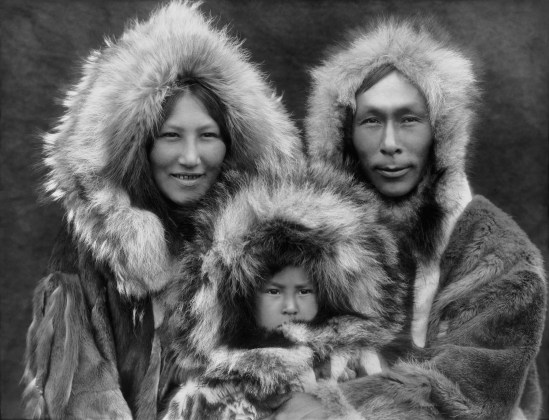
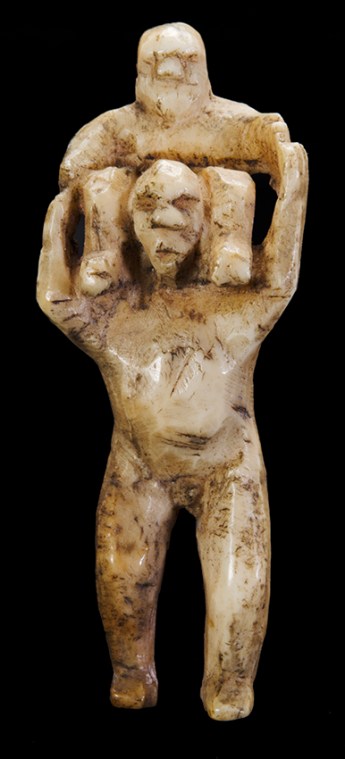
11racewalking2-span-superJumbo

19. Racewalking- From Heavy: “Racewalking is hilarious. Who knew all those mall walkers were training to be Olympians. Racewalking is hilarious because all of its participants are trying to go as fast as they can to win a race, but without running. One foot has to be on the ground at all times or the competitor is disqualified, so stride lengths are reduced. The result is a very funny looking walk. Watch the video and see for yourself. I’ll wait. Did you watch it? Hahahaha. I’m sorry, racewalkers, I know you work hard, but that doesn’t make it less funny. I honestly can’t think of any way to make fun of racewalking that’s funnier than the event itself. Okay, Olympics, you’re starting to win me over again.” According to USA Track & Field rules: “Race walking differs from running in that it requires the competitor to maintain contact with the ground and straighten their front knee when the foot makes contact with the ground, keeping it straightened until the knee passes under the body.” You mean this is a thing? How is this a thing?

Jumping fence 1

20. Equestrian Jumping- From Heavy: “Let’s just say you heard the words horse ballet and thought, “Well, I guess that’s kind of crazy, but what else you got?” How about a horse obstacle course? Yep, horse obstacle course is an Olympic sport. But that’s not all. The obstacles the horses need to steer around or jump over are out-of-their-minds ridiculous. Things like a castle or a re-creation of the planet Saturn.”

149564078

21. Equestrian Eventing- From Heavy: “So, horses jumping over ridiculous items wasn’t enough for you? Ok, how about horse triathlon? Horse triathlon. When I first heard that phrase, my brain exploded. I’m only alive today thanks to the power of duct tape. What? How is a horse triathlon a thing? I guess I should stop asking that after horse ballet and horse obstacle course, but okay. Eventing includes dressage, cross-country, and show jumping. We already know dressage is horse ballet. Cross-country is a horse obstacle course, but without the crazy obstacles. The obstacles tend to be more along the lines of logs which I guess is less crazy than Saturn. It’s an endurance test. Show jumping has the horse given a certain amount of time to, as cleanly as possible, clear the jumps of a course.” I kind of miss the good old days in Ancient Greece when you had Olympic chariot and horse racing. Sure they may be dangerous as hell but at least you got a great chariot racing scene in Ben Hur.

22. Swimming Obstacle Race (1900)- From Cracked: “First, participants had to climb up a pole and slide back down before getting into the water. Then they swam out to a barrage of boats, which they had to climb up on, and then run across to get back into the water. This was followed by more swimming, and then yet another group of boats, which they swam beneath to reach the finish line. This was presumably after they spun around a bat 10 times and passed the orange back and forth without using their hands, of course. But there’s another twist: There were no swimming pools in turn of the century France big enough to play a good game of Miscellaneous Water Bullshit, so they had to hold the event in the Seine River, which, at the time, was the outlet to the Paris sewer system overflow. Because of this “oversight,” many of the competitors also had to struggle against the current of the river, a dangerous and exhausting process for any swimmer, even when it’s not mostly comprised of Frenchman poo.”

1904_tug_of_war

23. Tug of War (1900-1912, 1920) – From Business Insider: “This grade school game consisted of teams of eight on each side of the rope. To win, one team had to pull its opposition six feet — or, if the five minute time limit had expired, the team which pulled its opponents the furthest would receive the victory. The most controversial tug of war match occurred in the 1908 games, when Great Britain took home the gold despite protests from the U.S. that the Brits wore illegal footwear.” Keep in mind that these weren’t pros competing in this and they were on 8 person times pulling a 6 feet rope. The American 1904 team was an athletic club from Milwaukee. Oh, and the British gold medal team in 1908 a London police force.

maxresdefault

24. Tandem Bicycle Sprint (1906-1972)- From Mandatory: “A favorite activity of many TV sitcom roommates, this one is the longest-running event on the list. It was quite dangerous, though, as the sprints took place on a banked track or velodrome. Since it was a timed event, the bicyclists would be moving at top speeds, so wrecks were going to hurt.”

Swing Time


25. Club Swinging (1904 and 1932)- From Business Insider: “Club swingers whirled around bowling pin-shaped clubs quickly around their body and head with routines similar to those of modern day rhythmic gymnastics. American George Roth won the gold medal during the 1932 games. From the Guardian: ‘It was the Great Depression and Roth was unemployed and hungry. Yet he won gold. Seconds after being awarded his medal in front of 60,000 spectators, he walked out of the stadium in Los Angeles and hitchhiked home.’” From MNN: “Men’s club swinging, an official discipline in the Summer Olympics gymnastics program in both 1904 and 1932, is exactly what it sounds like: a bunch of dudes in tights twirling bowling pin-shaped wooden clubs of different sizes and weights in immaculately choreographed patterns. Yessir. Club swinging, or Indian Clubs, was actually a fad-ish method of strength training back in the day before Jane Fonda and Shake Weights hit the scene. And get this: Indian swinging clubs actually served as the inspiration for the modern day juggling club (and of course, the Clubbell). Who knew? In addition to club swinging, other phased out Olympic events in the artistic gymnastics department include rope climbing (1896, 1904, 1924, 1932) and tumbling (1932).”

26. Pistol Dueling (1904 and 1912)- From Business Insider: “Rather than having competitors fire pistols at each other, though, competitors shot at frock coat-adorned mannequins with targets painted on its chests.” From Listverse: “An aristocratic sport for men of bravery and honor, right? Well not when your opponent is a mannequin, as was during the 1906 ‘intercalated’ Games. Competitors took turns shooting at a mannequin dressed in fancy clothes from 20 and 30 meters. It returned to make a brief appearance at the 1912 games, before being banished forever (hopefully).” You can see how that would go. And I guess they used mannequins as targets because using real people was out of the question as well as would’ve resulted in fatalities (as far as I’m concerned).

swim-630x421

27. Plunge For Distance (Diving) (1904)- From Business Insider: “The event basically consisted of swimmers diving into the pool and staying motionless in the water for one minute. The divers weren’t allowed to propel themselves while in the water. Whoever went the furthest through the water won the event. During the 1904 games, all five Plunge for Distance diving contestants came from the U.S. We imagine this qualifies as one of the least exciting competitions in Olympic history.” Cracked calls this, “the long jump, but with the possibility of drowning.”

28. Live Pigeon Shooting (1900)- From Business Insider: “The goal of the Live Pigeon Shooting event was quite self-explanatory: to shoot (and kill) as many pigeons as possible. Live Pigeon Shooting made its first and only Olympic showing in the 1900 Summer games in Paris. Belgian Leon de Lunden won the gold medal with 21 downed birds. A total of 300 birds were killed during the event.” Guaranteed to anger animal rights people.

1458743145-fddeec72c1e91e7a0d28c0a9888379b7-600x412

29. Jeu de Paume (1900, 1908-1920, and 1924)- From Listverse: “That’s ‘game of palm’ to us non-Francophones. This game was a precursor to real tennis, and was essentially tennis with your hands or a small paddle in lieu of rackets.” So it’s like handball?

roque

30. Roque (1904)- From Listverse: “An American variation on the French sport of croquet (on a hard surface), this was played during the 1904 St. Louis Olympics. Understandably, as the sport was virtually unknown outside of the US, all of the competitors were American. The sport was dropped after this Games and is widely believed to have been included for the sole purpose of boosting the USA’s medal count.” Still, who the hell in the US still knows what the hell this sport is?

peluquería_de_poodles_juegos_olimpicos_paris_1900

31. Poodle Clipping (1900)- From 11 Points: “For this event (which was a trial event), 128 competitors assembled at the Bois de Boulogne, a park in western Paris. A giant (for the time) crowd of 6,000-plus watched as they competed to see who could trim the most poodles’ fur in a two hour period. The gold medalist was 37-year-old Avril Lafoule from Auvergne, France, who clipped 17 poodles. After the Paris Olympics ended, poodle clipping failed to get the votes to become an official Olympic sport.” Guess poodle clipping was a very emotionally draining activity to watch. Also, how did this become an Olympic sport?

mkRtNfr

32. Firefighting (1900)- From 11 Points: “It’s not clear what exactly was involved in the firefighting event… like, did they light some random Parisian neighborhood on fire and send all the dudes over there to see who could put their designated house out the quickest? In the volunteer competition, the winner was a team from Portugal; in the professional division, the winner was a group of firefighters from Kansas City. And even though firefighting never became an official Olympic sport… I gotta feel like an Olympic gold medal in firefighting would feel a lot more prestigious than winning one for something like equestrian or rafting.” You know this is something people do as a job or as a voluntary civic duty?

33. Delivery Van Driving (1900)- From 11 Points: “The Paris Olympics featured a ton of different motor races, including delivery van driving. French “athletes” got all three medals, although their names aren’t on record. The motor racing event also included small cars, large cars, seven-seat cars, trucks and taxis. It looks like France really dominated the event — a guy from the U.S. got a bronze in the small truck division, a German got a bronze in a large car distance race, and, other than that, it was all French victories. Meaning that this was possibly the brightest moment in the history of both Peugeot and Renault.” To have it as an Olympic sport today would be like having to recognize NASCAR as a sport.

Water_skiing_on_the_yarra02

34. Water Skiing (1972)- From 11 Points: “There were three different events — slalom, figure skiing and jumping. Apparently it was pretty cool… but there was too much controversy about whether or not water skiing involved any actual athleticism… so water skiing never showed up at the Olympics again. It did become a staple at Sea Worlds, though, so it’s got that going for it.”

Opening Ceremonies

35. Hot Air Ballooning (1900)- From 11 Points: “During the Paris Olympics, they held several hot air ballooning events, including distance, duration, elevation and targeted stopping. French competitors won every single event. I think I’d like to see hot air ballooning in the Olympics today, partially because I think a bunch of hot air balloons in the sky looks cool… and partially because I know NBC would spend $80 billion on special cameras to record the event. They’d also find a way to let us know how one of the American hot air balloonists overcame a lot of adversity to get to that moment. Man I love Olympic tales of people triumphing over adversity. I hope I hear 50 tonight.”

silling-yi-olympics1

36. Air Pistol/Air Rifle- From SBNation: “A lot of people probably know that shooting is an event. It takes a lot of skill to be a good marksman. Heck, there are upwards of three reality-show competitions dedicated to how difficult it is to be a world-class sharpshooter. Archery seems legitimate, as does using live ammunition in Olympic shooting. But air pistol and air rifle? Seems a little weird. I think the weirdness is only enhanced by that air rifle sound the guns make. You expect them to be shooting at dancing metal ducks while calliope music plays. Maybe they should win a stuffed animal instead of a gold medal. After all, you can’t snuggle with a gold medal. If this can be an Olympic event, maybe I can join the U.S. Men’s National Team of ‘Get the Water in the Clown’s Mouth.’”

Germany Athletics ISTAF

37. Hammer Throw- From Briefed: “There is no way anyone with a sense of humour can watch this event and not laugh. It’s even called “Hammer Throw”! You better start practicing your “Screwdriver Stab”, which might get your into Brazil 2016.”

Basque-Pelota

38. Pelota (1900)- From Cracked: “a game played by two people with a bat on each side of a wall, throwing a ball back and forth until one competitor finally missed it. It’s basically a competitive game of catch. In addition to being generally tedious to play unless you’re a five-year-old or so high that you’re functioning on the level of a five-year-old, the game was also extremely region-specific: Pelota was a traditional Basque game, meaning it was rarely seen outside of Spain and France. In 1900, only two teams (for a total of four people) showed up to the games. The countries? Spain and France of course. A single game was played. Then, having no other competitors, everybody just kind of shrugged and walked away. The score? No one knows: No officials bothered to show up. Although the few fans who did attend said Spain won, so everybody just rolled with that.”

London 2012 - day 13

39. Underwater Swimming (1900)- From Cracked: “Pretty self-explanatory, really: competitors swam underwater for time and distance. Sound boring? It’s worse than you think: Remember that this was way before the advent of the waterproof camera, so actually watching the event consisted of staring at a river for a few minutes, and then asking your kid to stop crying or you’ll take him back to the pelota match. Luckily, for entertainment’s sake, the organizers made one big mistake: They held it in a river with a crazily strong current. Fourteen brave souls volunteered to swim in the event. Only two made it the 60 meters in under a minute.” Cracked adds, “Spectators complained about the event because they couldn’t see who was winning or how they were progressing in the murky water, and the only way to tell it was finished was when everybody either climbed out of the water to towel off, or the search and rescue teams arrived.”

b1bd6653cb8deea08464aaf02fdaf578

40. Ice Dancing- From Covers: “The IOC describes this alleged sport as “similar to ballroom dancing” and it “does not include overhead lifts or jumps”. Count me out. No lifts or jumps? No Death Spirals or Salchows? How is the average person then supposed to know what the hell is going on? Unless there are jumps, twirls or lifts that involve falls, wobbles and stumbles, we have no idea who the best is. It’s just a bunch of judges getting together with a list of favors and handshakes determining the winners over tea in January. And the dudes in this event seriously need to man up. It looks like most of them are wearing lululemon pants with blouses they stole from Cher’s closet.”

short-track-1200x545_c

41. Short Track Speed Skating- From Covers: “Is there anything more bogus in sports than that period after a short track speed skating race where the competitors have to wait to see if the judges will let them win or not? If you’re not familiar, a short track race isn’t over until the judges say it is.” From Total Pro Sports: “Just like NASCAR, short track speed skating is occasionally exciting. Sometimes, for example, two racers will swap places several times, and that is fun to watch. Also, sometimes people crash and take other racers out with them, which is also fun to watch. However, most of the time short track speed skating, like NASCAR, is just four people going around in circles with almost nothing happening. The lack of space makes it almost impossible for somebody in the back to make it to the front unless someone wipes out, which means the outcome of the race is almost pre-determined. And of course, if people do wipeout early in a race, the rest of the time you’re just watching one or two people skating in circles.”

arm-armed-dumbbell

42. One Hand Weight Lifting (1896 and 1904)- From Topend Sports: “This event, for men only, was similar to the modern snatch weight lifting event. Only one hand was allowed in lifting the weights. They had to perform lifts with each hand, with the winner determined from the combined score of both hands. The lifters were allowed three attempts. After each had lifted three times, the top three received three more attempts.”

20100823_055337109_20100805_093519170_motor_boats_19081

43. Motor Boating (1900 and 1908)- From Topend Sports: “The event, strictly for men, involved racing five laps (or 40 nautical miles) around a specific course. Speeds were not impressive by today’s standards: average speeds were around the 19mph mark. It was not a great spectator sport either, with the action taking place off Southampton, where virtually no one could see the action. Due to bad weather, six out of the nine scheduled races were canceled. No wonder we never saw this event again at the Olympic Games.” Still, putting motor boating in the Olympics again would be like putting race car driving, too. And neither involve much athleticism.
GingerCove_©ChaseHeilmanPhotography_104

44. Croquet (1900)- From Topend Sports: “There was only ever one croquet competition in Olympic Games history, held in 1900 in Paris. France won all events, which is not surprising as mostly French competitors took part. There were three women competing, but they did not win any medals. These were some of the first women to take part in the Olympic Games. This tournament was also not a success with the spectators. Only one fan watched the events – an Englishman who had traveled from Nice especially for the occasion. No wonder we have not seen this event at the Olympics again.”
meets IOC president Thomas Bach at the IOC headquarters in Lausanne

45. Golf (1900 and 1904)- From Cage Potato: ”The IOC looks to pick up golf in 2016, and these are the kinds of highlights you can look forward to. Joy? Look, as a game, golf should be played and not seen. Hell, most people can’t play golf without getting halfway-lit first, so that wandering around searching for a little white ball in the expanses of groomed wilderness and man-made constructs doesn’t become a depressing metaphor for their own accomplishments in life. If you actually seek out golf on television to watch, you are a boring human being, and no, I do not want to look at your coin collection.” Sure golf is a great sport to watch for people in a coma.

Olympic-art

46. Art Competitions (1912-1948)- From Topend Sports: “The art competitions was part of the vision of the founder of the Olympics, Pierre de Coubertin. Beginning at Stockholm in 1912, the Olympics included an arts competition. Medals were awarded in five categories: architecture, literature, music, painting, and sculpture. As medals were awarded in five categories, the competitions were also named the ‘Pentathlon of the Muses’.” This event was held between 1912 and 1948. As the majority of artists competing were professionals, and the IOC opposed professional competitions at the time, the event was removed. The founder of the modern Olympic Games, Pierre de Coubertin, won a gold medal for literature at the 1912 Games. He entered under the pseudonym “Georges Hohrod and Martin Eschbach”. Another athlete who would later become presidents of the International Olympic Committee, Avery Brundage, competed as an athlete at the 1912 Games, then entered literary works at the 1932 and 1936 Olympics.” Good point: Gives something for the less athletically inclined to win gold medals. Bad: The Olympics are an athletic competition, art competitions have no place there. What’s next Quiz Bowl and Mathletics? Wait, that might seem like a good idea.

Bandy_players

47. Bandy (1952) – From Sports Facts: “Take two favorite pastimes, soccer and hockey, smash them together, and you have one of the strangest winter games ever included in the Olympics. Bandy was a demonstration sport in the 1952 Oslo Winter Olympics and involves two teams of 11 players that compete in a 90 minute game, which is played on a rink the size of a soccer field. They took the sticks and skates from hockey and use a ball instead of a puck. Basically it’s field hockey on ice skates, but with soccer rules. The game itself isn’t necessarily strange, but why bother when you already have an Olympic event in which teams skate around whacking something with a stick? Maybe they’ll renew interest in bandy by tossing elements from football or baseball in the mix as well.”

Annika Johansson

48. Ski Ballet (1988 and 1992)- PopSugar Fitness: “A combination of figure-skating-inspired choreography plus freestyle skiing, ski ballet — also known as acroski — was a demonstration sport at the Winter Olympics in 1988 and 1992. Unfortunately, after two cycles, the IOC decided that ski ballet wasn’t worthy of being an official Olympic sport. We can’t see how this is possible.”

enhanced-21168-1421082506-31

49. Synchronized Skating- From PopSugar Fitness: “After watching a few synchronized skating routines, I’m having a hard time understanding why this is not an Olympic sport. The choreography is much like that of a freestyle skating or ice dancing routine, except there are eight to 20 people out on the ice moving in perfect unison! It’s never been featured at the Winter Games in any official or demonstrative capacity, but hopefully this will change, since the IOC has reviewed the sport for Olympic eligibility.”

JUMPING D''INZEOa

50. Long and High Jump for Horses (1900)- From Mandatory: “Call this one a twofer: two dumb sports for the price of one. These were the products of the 1900 Olympic Games, which saw some of the weirdest events to this day take place due to the fact that the World’s Fair was happening in Paris at the same time. Many of the events were considered demonstration or trial events, to be decided on officially later. No need to describe these two in any more detail, as they are exactly what you think.”

Korfbal_1928_actie

51. Korfball (1928) –From Classic Rock 106.9: “Consider Korfball the red-headed step child of our basketball. The rules are basically the same.  However, each team must be made up of 2 men and 2 women.  There is also no running or dribbling allowed.  The ball is advanced only by passing.  Also, the goal is on a pole in the middle of the court rather than each end.  In that aspect, I guess it is NOTHING like basketball.   It was only an Olympic sport in the 1920 games in Antwerp and again in 1928 in Amsterdam.  The game itself is still played all over Scandinavia to this day with championship leagues in existence….can you imagine the “Lebron James” of Korfball?”

Argentin_player_during_2007_rink_hockey_world_championship

52. Roller Hockey (1992)- From Classic Rock 106.9: “Ice hockey’s slow cousin, roller hockey was only an Olympic sport for 1 year before the powers that be decided it was just too painfully boring to watch. 12 nations competed in the first and last showing of the sport with Argentina walking away with the gold followed by host country Spain taking the silver and Italy bringing home the bronze…..Try being an Italian roller hockey player trying to pick up chicks with ‘I got a bronze medal in roller hockey.’”

ph1929glima

53. Glima (1912)- From Classic Rock 106.9: “Glima is the Icelandic sport of folk wrestling. The object was for two men to remain completely upright while trying to get any part of the other competitor’s body to touch the floor all the while circling each other.  One major rule….you had to circle the other man in a clockwise motion or else be disqualified.  Today you can still catch this sport at any number of alternative lifestyle clubs across the country.  Luckily for us, it was only at sport at the Stockholm games of 1912 before the wrestled with the notion that…..maybe, just maybe, nobody wants to see that.”

BN-JG471_finbal_P_20150706191245

54. Finnish Baseball (1952)- From Classic Rock 106.9: “Much like American Baseball except the base paths are different and instead of a pitcher, the batter throws the ball up in the air vertically before attempting to hit it. I guess in some ways its like stick ball you use to play on the street.  This Finnish version of our national past time was only an Olympic sport for 1 year in 1952 in, you guessed it, Helsinki Finland.  Nice try.  Maybe if pickling herring were a sport the Finnish would probably dominate.”

canne_baton_diagram

55. Le Canne (1924)- From Classic Rock 106.9: “Once again we venture back to the land of snails and berets, France. This is the French version of fencing, if you want to call it that.  Basically the object is to beat another person senseless with a cane.  Unfortunately, the committee no longer wanted to see feminine men beat the crap out of each other with canes and canceled the event after the 1924 games in Chamonix.” They also can’t attack each other simultaneously. If one player attacks, the other must dodge or block it. It doesn’t really make great sword fighting.

56. Alpinism (1932 and 1988)- From Business Insider: “In 1924, at the first Winter Olympic Games in Chamonix, the first medals for Alpinism, or mountain climbing, were awarded. The event was not a traditional competition held while the Games were in session, but instead, medals were awarded to the individual or group that had achieved the most notable feat in mountaineering since the previous Games. The first medals were awarded to members of the unsuccessful 1922 British expedition to Mt. Everest. This included seven posthumous medals for those who had died. After two medals were awarded in 1936, there were no further mountaineering merits until the 1988 Calgary Games, when Reinhold Messner and Jerzy Kukuczka were honored for successfully summiting each of the 14 8,000-meter peaks.”

2015-07-31T132030Z_81350430_MT1ACI13933059_RTRMADP_3_CRIC

57. Cricket (1900)- From Business Insider: “In 1900, cricket was played as an Olympic sport in Paris, with only two participating teams, Great Britain and France, playing after Belgium and the Netherlands withdrew. Great Britain fielded a team consisting mostly of members of the Devon County Wanderers’ Club, many of them part-time players who had been on a tour of France. The French team was composed of many British expatriates who lived in Paris and competed in the Olympics under the name All-Paris. The game originally was intended to be included as part of the program in the first Olympics in 1896, but was removed due to a lack of participants.” It’s like a version of baseball except that you make the rules as you go along (as far as I know). However, given the chances that the British have exported this sport throughout its empire, there’s a chance that it might be brought back.

58. Aeronautics (1936)- From Business Insider: “Switzerland’s Hermann Schreiber probably felt pretty good about his gold-medal chances before competing in aeronautics in Berlin’s 1936 Olympic Games. After all, he was the only participant. The event involved a glider being launched from a bungee. Although considered a demonstration sport and not a medal contest, the International Olympic Committee approved the event for the 1940 Olympics scheduled in Tokyo. But since World War II halted the Games, Schreiber is still the lone aeronautics participant at the Olympic Games.”

gty_germany_luge_kb_140213_16x9_992

59. Luge Relay- From Total Pro Sports: “I know nothing about luge, so while it looks like something almost any decent athlete could do, I’m inclined to assume I just don’t know what I’m talking about, and that there’s actually a lot more to it. Besides, even if it is just extreme sledding, it’s still pretty fun to watch for a little while. You know where they lost me, though? With the luge “relay.” I tuned in thinking, okay, this should be pretty interesting. Is there a baton? How do they hand it off? Then I realized, oh, this isn’t really a relay. It’s just four separate races in four disciplines, then they add up the times. What’s exciting about that? Figure out how to work a baton into the equation, then we’ll talk.”

1232653

60. Nordic Combined- From Total Pro Sports: “The nordic combined, in case you didn’t realize, combines cross-country skiing and ski jumping. And that sounds kind of okay, since ski jumping is pretty badass, and cross-country skiing can be entertaining over shorter distances. However, like all multi-discipline Olympics events, you don’t really get to see people who are the best at any one thing. You get to see people are pretty good at a couple of things. Here’s the bigger problem with nordic combined, though. The cross-country portion isn’t a sprint, which is fun to watch. It’s 10km for the individual events and 4x5km for the relays. That means, in all likelihood, those races are going to be total snooze-fests.”

61. 10,000 Meter Speed Skating- From Total Pro Sports: “What most of us cannot watch, though, is the men’s 10,000 meter race. Fourteen people compete in the event going two at a time, and each person takes somewhere between twelve and thirteen minutes. That adds up to 91 minutes of watching people skate in circles, which is pretty much insufferable.”

hi-res-150007080_crop_north

62. Beach Volleyball – From Total Pro Sports: “Yeah, I know everyone loves beach volleyball on account of the minimalist uniforms. But when you actually stop and think about the sport itself, you realize it’s pretty dumb. Why? Because it’s played on sand, which is probably the dumbest sports playing surface ever devised. It’s like someone thought, “hey, is there anyway we could take a frenetic, action-packed sport like volleyball and slow it down? Oh, I’ve got it, let’s play it on sand.” Are the athletes who play beach volleyball impressive? Sure they are. But there’s still no denying that something people used to do on the beach to work up a sweat before swimming has become an Olympic sport. What’s next? Paddle ball? Frisbee? I feel fairly confident that, if the women didn’t wear tiny bikinis, this would not be an Olympic sport.”

Bronze medalists Nicholas McCrory, front and David Boudia, rear, from the US compete during the Men's Synchronized 10 Meter Platform Diving final at the Aquatics Centre in the Olympic Park during the 2012 Summer Olympics in London, Monday, July 30, 2012. (AP Photo/Michael Sohn)

63. Synchronized Diving- From Total Pro Sports: “Synchronized diving is regular diving that is watered down. How so? Because instead of simply judging how awesome or not awesome a particular dive is, they judge how synchronized it was. Thus, if your synchronized diving partner isn’t as good as you, you can’t do the best dive you’re capable of. So the overall quality of the competition is watered down. Of course, some would say, “oh, but the synchronization is what’s so great,” to which I would say, uh, no. They don’t have synchronized javelin throwing, or synchronized balance beam, do they? No, because everyone knows that would be dumb.” Makes solo synchronized swimming seem less stupid by comparison.

london 2012 - Day 10

64. Steeplechase- From Total Pro Sports: “In case you don’t know what the steeplechase is, it’s that race at the Olympics where the runners have to leap over hurdles and puddles of water. It originated in England in the mid 1800s as a kind of cross-country race. Athletes would run from one town to the next, using the steeples of the town’s churches as guides, leaping over walls and streams along the way. When the modern Olympics were conceived, they included a track version of the event, and it’s been there ever since, even though it’s just plain stupid. (Jumping over puddles? Really?) And hey, I’m not the only one who thinks it’s stupid. The IAAF didn’t include the steeplechase in it’s World Championships until 2005. So they waited over a hundred years for this dumb event to die out before giving up.”

65. 100m Running Deer Shooting (1908-1948)- From Topend Sports: “There were two different variations of the event, single-shot and double-shot, based on the number of shots fired at the target during each run. The event consisted of a deer-shaped target which made ten 75-feet runs. Depending on the code of the event, shooters took one or two shots at the target during each run. Each run, which lasted for about 4 seconds, took place at a distance of 110 yards distant from the shooter. The target had three concentric circles. The smallest circle carried four points, three for the middle circle, and the outermost circle carried two points. A shot that hit the target outside of the circles also counted for one point as long as the hit was not on the haunch. The event was judged for a maximum of 80 possible points.” So I guess it’s supposed to be some sort of simulated deer hunting.

D'AURIOL, Sarah 470 Omar

66. Equestrian Vaulting (1920)- From Topend Sports: “Men’s Vaulting was an equestrian event contested as a part of the Summer Olympics during the 1920 games. It was called figure riding or vaulting (or in French l’epreuve de voltige, meaning the acrobatic event). Essentially it is gymnastics and dance on horseback. It was the only time the event was conducted in the Olympics after which it was discontinued. The event consisted of four legs. In the first leg, riders had to jump onto the horse from a standing position and then jump back to the ground. Athletes had to repeat the same jump and back from both the left side and the right side. The second leg was to jump over the horses. Jump over one and more horses with a salto was third. Fourth leg was to ride with a walking horse.” Horse gymnastics, really?

67. Pole Archery (1920)- From Topend Sports: “The event consisted of shooting artificial birds that were placed on cross beams suspended from a large pole. Two types of pole archery events were conducted in the 1920 Olympics, an individual event and team event. For each of the two types there were two codes of competition, small birds and large birds, depending on the size of the birds that were used as targets.” It’s like clay pigeon shooting for archers.

68. Singlesticks Fencing (1904)- From Topend Sports: “Singlestick was a type of fencing event in which a wooden stick, known as the singlestick, was used as the weapon. The rules of the fight remained the same for the singlestick as it was for the other fencing events. The sport was contested as a part of the Olympics only once in 1904 and was discontinued after that due to lack of participation. Even in 1904 games, the only time the singlestick fencing event took place in the Olympics, only three competitors took part in the event. Among the three fencers, two of them were from the United States and one was from Cuba.” So I guess this sport wasn’t very popular for competition.

12-Hour-Bicycle-Race

69. 12 Hour Bicycle Race (1896)- From Oddee: “They might have bitten off more than they could chew with this event. Seven riders got on their bikes at 5 a.m. and rode until 5 p.m. Four bikers dropped out before noon, but the winner, Adolf Schmal of Austria, managed about 180 miles. Only Schmal and one other competitor finished; Schmal won because he had lapped the other racers early on, so he was ahead by one lap.”

frederick-winters-dumbell-olympics

70. All-Around Dumbbells (1904)- From History Channel: “Purportedly designed to determine the world’s strongest man, the all-around dumbbells contest was held just once—over two days during the 1904 Games in St. Louis—and included a freestyle component. Participants performed nine lifts, including arm curls and shoulder presses. Unfortunately, crucial details about the dumbbell competition remain sketchy. Were the lifts performed multiple times with dumbbells of increasing weight, for example? It’s a key question, especially since a 1903 article in the New York Times reported that one of the events consisted of “tossing up one dumbbell from the ground to the shoulder.” This would have been an impressive sight if the strongmen were throwing 50-pound dumbbells around. The competitors also engaged in a freestyle demonstration of “original feats” of the athletes’ choice. Sadly, few photos of the event exist to help fill in the details about what these feats entailed. After this lone appearance, all-around dumbbells never again showed up on the Olympic sports roster.”

Olympic Sports from Ancient Greece

laurel-wreath

This August, athletes will gather around the world at Rio de Janeiro for the 2016 Olympic Games, well, the ones who aren’t dissuaded from coming by fears pertaining to lack first respondents at the premises, Zika virus, pollution, and all the other ugly stuff going on in Brazil at the moment. Way before we had the modern Olympic Games of today, there were those of Ancient Greece. The first recorded Olympic Games in history was held at Olympia in 776 BCE which only featured one event, a foot race across the stadium. The first Olympic Champion was a cook and baker named Koroibos of Elis and from then on, every victor was recorded and each Olympiad after them. This gave us the first accurate chronology of the Greek world. However, whether this was the first Olympic Games in history will never be known. As to how they got started is a mystery. And it doesn’t help that Greek mythology isn’t noted for its consistency. Some attribute the origins to Zeus celebrating his victory over his father Kronos. Others attribute them to Pelops in honor of his father-in-law Oinomaos. Another legend attributes their founding to the famous Greek mythological hero Heracles (or Hercules as you know him). At any rate, organized athletic competitions already existed in both the Minoan and Mycenaean civilizations even if their sporting events were originally associated with funeral rituals, particularly those who’ve fallen in battle like the games of Patrolcus in Homer’s Iliad (organized by Achilles, no doubt). Nevertheless, every 4 years, people from all over Greece and beyond would flock to the sacred city of Olympia whether they be athletes seeking a prize, spectators, trainers, officials, and what not. When a 19th century French aristocrat named Baron Pierre de Coubertin decided to found the International Olympic Committee and restore to the Olympic Games, he intended to restore the games to as close to the Greek spirit as possible but without the religious elements, banning women from watching, and nudity. Yet, de Coubertain’s view of the Ancient Greek Olympics was kind of romanticized and sometimes unfair as best seen when Jim Thorpe was stripped of his medals because he played semi-pro sports (while the athletes were supposed to be amateurs). Meanwhile, the Ancient Greeks? They didn’t even have a designation on amateur or pro in their vocabulary. Nevertheless, the Olympic Games were quite different in Ancient Greece from the ones we’re used to.

olympia18

Here’s a close visual approximation on what Ancient Olympia might’ve looked like. But during antiquity, this would be where the Olympic Games were held every 4 years to honor the king of the gods Zeus.

Differences from the modern Olympic Games in general:

  1. It is only one of the Panhellenic Games in Ancient Greece with the quadrennial Pythian as well as the biennial Nemean and Isthmian. All these were sports festivals of Ancient Greek religious significance including the Olympics. However, the Olympics would remain the most prestigious of the four and best remembered.
statue-of-zeus-at-olympia

Here’s an artist’s depiction on the Statue of Zeus in his Olympia temple. He was the chief deity of the Greek gods who threw lightning bolts whenever pissed as well as couldn’t keep it in his pants.

2. It was a sports festival to honor Zeus and always took place at the sanctuary of Zeus in Olympia from 700 BCE. And it was because of this that they were suppressed by Roman Emperor Theodosius in 394 as part of a campaign to impose Christianity as the state religion of the Roman Empire.

3. Greek city states marked this occasion with a 3 month Olympic Truce so athletes could travel to the Games in safety when there would be no war or battles and no capital punishment. Violation of that truce consisted of fines. Yet, city states would also use the Olympic Games as a political tool to assert dominance over their rivals as well as later spread Hellenic culture throughout the Mediterranean.

4. Also featured religious celebrations as well as art competitions.

P91664-BKGR-2

Here is an olive wreath. Wreaths like these would be bestowed as prizes to Olympic victors along with an etching of their name to the winners roll (except for jockeys and charioteers). Further prizes bestowed on them would depending on their city-state of origin though they’d receive a hero’s welcome and other perks.

5. Prizes were only given to victors which consisted of olive leaf wreaths or crowns as well as other rewards from their home city states (Athenian Olympic winners could have a free meal in the City Hall every day for the rest of their lives as well as a substantial amount of cash). Chariot drivers only received red woolen ribbons worn on the upper arms or around the head while the horse owner received the crown. No Olympic medals in gold, silver, or bronze.

IMG_3812

Here is a hanging of the kind of Olympic events you’d see in Ancient Greece. These included sports in the Pentathlon, Track, Combat, and Equestrian.

6. Had fewer events and lasted for 5 days during the summer at the first full moon after the summer solstice (like mid-July). There were no winter events. However, athletes had to arrive one month before the games and had to declare that they’ve been training for at least 10 months.

_60137085_60137084

Despite that women weren’t allowed to even watch the Olympic Games in Ancient Greece under penalty of being thrown off Mt. Typaion (well, at least married women anyway), here you see women in Grecian dress at the most recent Olympic torch ceremony at the ruins of Olympia. I’ll get to the torch part later.

7. Only freeborn Greek men and boys who were citizens from Greek city states were allowed to participate (as long as they had a clean record, didn’t defile any temples, or violate the Olympic Truce). Married women weren’t even allowed to watch on penalty of death via being thrown off Mt. Typaion (though they could enter their horses in the equestrian events as well as chariot teams. But they couldn’t drive the chariot themselves. But men who were foreign born and slaves could and did. Also, unmarried girls could watch as well as the Demeter Chamyne priestess). However, ladies can compete, organize, and officiate in the Hera Games as long as they weren’t married but these consists of foot races, chariot racing, wrestling, and dances.

Training

Unless they were in the hoplite races or the equestrian events, Ancient Greek Olympic athletes usually performed naked. It was part of the Olympic dress code. Yes, I know it’s kind of weird but it’s an Ancient Greek thing.

8. Athletes competed in the nude unless noted otherwise. Exceptions were hoplite racers (who competed in armor) as well as jockeys and charioteers (for obvious safety reasons). Trainers were required to be nude after an athlete’s mother tried to pass herself off as one (but wasn’t executed because she was from a prominent Olympic family).

Greek-Olympic-torch

Despite the association of lit torches with the Olympics, the Ancient Greeks had no Olympic torch relay. Other Ancient Greek sporting events did, however, including Athens.

9. There was no torch relay (though other Panhellenic Games did have torch relays in their other athletic festivals, including those at Athens).

10. Events were supervised by trained judges from Elis, the Hellanodikai (or agonothetai) who also had various assistants such as the alytai (police officers or referees). Originally these were inherited positions but they were later chosen by lot. They also had the power to disqualify, sort separate the men athletes from the boys (usually by physical appearance), and fine athletes for rule infringement. These guys wore purple cloaks and had special seats of honor in the stadium. Their decisions could never be revoked but they were subject to a council of elders and could be fined if any athlete successfully appealed.

11. Penalties for rule breaking ranged from exclusion and fines to flogging. Fines were paid to the sanctuary and the wronged athlete. But if an offender could not afford to pay the fine, then the city absorbed the penalty or else faced exclusion from the next Olympic Games.

The Greeks Played Naked for the Sake of Beauty

Just a bunch of guys training in the Olympics. Note how most of them have toned bodies like you’d see from 300. Don’t think that’s realistic. Come on.

12. First day consisted of an opening ceremony, judges and athletes taking oaths, competitor registration and scheduling, as well as sacrifice presentations to the gods. Second day consisted of the equestrian events and pentathlon before ending with honor the shrine of Pelops and a parade at the sanctuary of Zeus that included feasting and revelry. Third day had arrival of judges, ambassadors, competitors and Great Altar sacrificial animals, afternoon running races, and a public banquet at the Prytaneion. Fourth day was devoted to combat sports which ended with the hoplite race. And the fifth day was devoted to the closing ceremony.

Phidippides

While there is an Ancient Greek legend of the first marathon of a messenger running a great distance to inform the leaders of their victory there before collapsing and dying, there was no Ancient Greek Olympic Marathon. Because Ancient Greek athletes weren’t that crazy to run 26 miles.

13. Despite the name having Greek origins as well as a famous story to go with it from the Persian Wars, there was no Olympic marathon.

Ben-Hur_chariot_jumps

Sure this is from the chariot scene in the 1959 Ben Hur which takes place in Ancient Roman times and in 1st century Palestine. However, this is a very historically accurate portrayal on what ancient equestrian events were like. Ancient Greek Olympic chariot racing wouldn’t have been much different since it was a very violent sport with most races experiencing at least one crash and fatalities weren’t unheard of. Ancient chariot races would make today’s auto races seem like mere tea parties.

14. Equestrian events took place in the Hippodrome and were the province of the elite who can afford to equip and maintain horses and a chariot as well as cover the costs of trainers and the charioteer or jockey (who were usually paid servants, family members, or slaves). Only the owners received the olive wreaths and Altis statues, not the athletes. Yet, unlike the equestrian events of today, they appealed to the less than idealistic spectator instincts like “shock value TV” nowadays. Most of the fascination was predicated by their violent nature with the races being quite dangerous and sometimes fatal (think of the Ben Hur chariot race scene. Most chariot races had at least 1 crash per race). Collisions, crashes, and horse wrecks were common, especially near the critical turning post. Equestrian race lengths were grueling distances.

874c70c911ba3f95957efad32328b115

And here’s another picture from the chariot scene in Ben Hur. Notice how Judah knocked Messala off his chariot away from the spiked wheel which means he’s likely going to die sometime later. Ancient Greek Olympic chariot racing was quite similar in its violence. And the violence in these equestrian events contributed to the entertainment value. Remember these sports weren’t for wimps.

15. Athletes caught cheating had to build a statue of themselves and engrave their name on it so that the city people would know who might cheat in life. These statues were called Zanes.

BH-8

Like the Roman chariot race scene in Ben Hur, cheating was also frequent in the Ancient Greek Olympics. However, while those caught cheating had to engrave their names on a Zane statue, they were never made to forfeit their winnings. Just a bad reputation. Yeah, I know it’s pretty awful but a winner was a winner in Ancient Greece even if he was corrupt. Like Tom Brady and the New England Patriots which won 4 Super Bowls.

16. If a winner was caught cheating, he was never made to give up his winnings despite his corruption. Nevertheless, cheating was very common in these games with other participants tampering with other athletes’ equipment, bribing officials, or making them fall during a chariot race (again think of Ben Hur with Messala’s metal spike on his wheel that would basically grind into his rivals’ wheels and cause them to wreck. However, given that Messala is an aristocrat and an officer, it’s very unlikely that he’d be driving his own chariot. Chances are he’d hire someone to drive it for him).

17. No measurements were recorded of the length pertaining to a jump, discus, or javelin throw. No times were kept for the running events. But winners’ names might be recorded but they wouldn’t be considered record holders. Because breaking records wasn’t a thing.

Ancient boxing

This is probably not an Ancient Greek Olympic event depiction due to a female presence. Yet, while modern combat sports match contenders through weight classes, this wasn’t the case in Ancient Greece. During their Olympics, people were matched up according to lot, though the unluckier athletes had a chance to forfeit.

18. Combatants were matched to each other by matching lots before each round. Unlucky athletes matched up against a much stronger opponent usually had the opportunity to withdraw before it was too late to avoid serious injury.

19. Runners and horse racers were sorted into their names by lot.

olympian-zeus (2)

And here are the ruins of what’s left of the Temple of Zeus in Olympia. It’s said to be one of the 7 Wonders of the Ancient world according to Herodotus.

The events were also quite different in the Ancient Greek Olympic Games. Sure we have some of these events in our modern Olympics, but they’re not quite conducted like nowadays. Some of them are not on the modern Olympic sports roster due to obvious reasons like safety and cruelty to animals. Other events you see in the modern Olympic Games were either not known in Greece at the time or even invented.

epidaurus-stadium-02

This is what’s left of the Olympia stadium which hosted the Ancient Greek Olympics. At one time, it could hold about 45,000 spectators (and not a single woman among them, well, as far as the rules are concerned).

Greek Olympic Events:

ancient-sports-stars

Olympic victors in Ancient Greece would become instant celebrities and were celebrated like heroes in their home town. Here is a victor being bestowed an olive wreath from Nike, the Greek goddess of victory.

Track:

Ancient Greece, race illustration

Track events were a long time staple of the Ancient Greek Olympics, which hosted 4 of these. These include 3 races of varying distances as well as a hoplite race where participants were clad in armor.

  1. Stadion – From Olympic Legacy: “The “stadion” was a simple sprint from one end of the stadium to the other, a distance of 600 feet (192.27 meters). This premiere competition of the ancient Olympics was the only event for the first thirteen Olympiads and was never omitted from the program in a millennium. In addition, the stadion became part of the pentathlon when it was introduced in 708 BC.”
  2. Diaulos- From Olympic Legacy: “At 1,200 feet (384.54 meters), the “diaulos” was double the length of the stadion. This second-oldest event was run in a straight line from one end of the stadium to the other and back, rather than in an elliptical lap, as we do today.”
  3. Dolichos- From Olympic Legacy: “Although the exact distance that “dolichos” runner had to traverse is not clear, it is known that this was a lengthy race, requiring great endurance. It is possible that the length was 24 stadia, or 14, 400 feet (4,615 meters).”
unit8_b_big

The Hoplitodromos was usually the grand finale of each Ancient Greek Olympic Games. This consisted of athletes running 1,200 ft across the stadium in full hoplite armor. And yes, it was probably not comfortable to do that in mid-July, especially in Greece.

4. Hoplitodromos- From Olympic Legacy: “This theatrical event was the grand finale of each Olympiad. Participants raced the length of a diaulos (1,200 feet / 384.54 meters) with helmet, greaves (lower-leg armor), and a round shield. This militaristic closing event was a reminder that the Olympic truce was almost over.” These were the only runners who didn’t compete in the buff but this was probably not pleasant for the athletes. Think of the armor coming off loose, men tripping and falling, as well as other crowd pleasing chaos.

Pentathlon:

; I21K ; G20H; C18D; S25T

In Ancient Greece, the Pentathlon was a major spectacle that consisted of 5 events like 200m dash, javelin, long jump, discus, and wrestling. Nowadays, discus, javelin, and long jump are considered separate events. Not so in Ancient Greece.

  1. Pentathlon- From Olympic Legacy: “The pentathlon consisted of five competitions. The 200-meter dash ( [stadion] ) and [wrestling] were events in their own right, but the remaining events (long jump, discus, and javelin) were only part of the pentathlon competition. Unfortunately, little is known about the order of competition, rules, or how a winner was determined. It is certain, however, that pentathletes (who were greatly admired in antiquity) must have possessed incredible endurance in order to compete in five events in one afternoon. Although it is not known who invented it or how it originated, we do know it was a very popular event.”
reconstructed jump small

Unlike its modern counterpart, the Ancient Greek Olympic long jump was quite different. For instance, pentathlon athletes used small weights on each hand to pull this off. It wasn’t easy to accomplish.

6. Long Jump- From Olympic Legacy: “The most significant difference between the ancient long jump and its modern cousin is in the use of jumping weights called “halteres.” These small weights held in each hand were swung forward with great force as the jump was launched to propel the jumper forward as much as possible. They would then be swung back and down just before landing. This technically challenging feat was often performed to the accompaniment of flute music, which helped the athlete to maintain the necessary rhythm and spilt-second timing. The jumps took place in a rectangular sand pit in the stadium, with a small take-off ramp on one side. It is unknown whether the long-jump of antiquity was a single, double, or even triple jump.”

8477516_orig

Here’s a an Ancient Greek sculpture of an Olympic discus thrower. Unlike today’s throwers, pentathlon athletes back in Olympia probably threw no further than with a 3/4 turn. The discus itself was either made of stone or metal.

7. Discus- From Olympic Legacy: “This curious sport lives on in the modern Games. The graceful poses of ancient throwers were almost the same as those of today, except that it is likely the ancient athlete made no more than a three-quarter turn, in contrast to the full spins that are standard technique today. Very little is known about the length of throws in those days, although any figure would have little meaning without knowing the weight of the discus that was thrown. Discuses, which were made of stone or metal, were often marked with inscriptions. The terms of the ancient Olympic truce were engraved on a discus and displayed in the Altis.”

c2bd965a04a2b374c638d68269c7610f

Ancient Greek pentathlon athletes used a leather throng to fling the javelin. It helped if the athlete had military training because soldiers relied heavily on javelins as an offensive weapon.

8. Javelin- From Olympic Legacy: “This event is another example of the traditions that live on the Games of today. In ancient times, this was not a idle sport—warriors relied heavily on the javelin as an offensive weapon. The only real difference between the ancient and modern versions of this event is the use of the “anklye”—a leather thong used to fling the javelin. This strap, which was wound around the shaft and held by its free end, unwound as the spear was thrown, making the javelin spin and ensuring a steady flight.”


Combat:

referee-watches-greek-wrestlers-in-ancient-olympic-games

Here’s a painting depicting an Olympic wrestling match from Ancient Greece. I know it involves a couple of naked guys going at it which I’m aware will upset parents and Bible Belt Christians. But this is what Ancient Greek combat sports were like. I’m trying to enlighten people here.

  1. Wrestling- From Olympic Legacy: “Matches were held in an area filled with sand. Once a match began, it continued without interval until one man had thrown his opponent three times (touching the ground with the back, shoulders, or hip constituted a fall). There were no divisions by weigh, and the bigger men tended to win. Contestants were allowed to trip, but not to bite, gouge, or punch. Over the years, the variety of holds and tricks grew in number and sophistication. Wrestling became the final event of the pentathlon when it was introduced in 708 BC.”
1c41b932488b9cca567aaf66273204ff

Here’s an Ancient Greek sculpture of an Olympic boxer. Boxing was one of the most brutal sports at the time. And participants often ended up disfigured (since most boxers bashed each other’s heads). Too bad the leather straps didn’t offer much protection.

10. Boxing- From Olympic Legacy: “Although ancient boxing is similar to its modern counterpart, matches were not conducted in a roped-off ring and there were no breaks and no time limit. Victory was declared when one opponent was knocked out or conceded the contest. No wrestling or holding were allowed, but it was possible to hit a fallen opponent. Virtually all blows were directed to the head, while the body was left exposed. A series of hand straps evolved over the years, culminating in a relatively sophisticated glove. This hand-gear did not lessen the violence of this sport, and ancient boxers were very recognizable by their “cauliflower ears” and other facial disfigurements.” Serious injuries were common and fatalities weren’t unknown. It was considered to be the most violent sport in Ancient Greece.

wrestling1

Panrkation was an a very brutal, empty hand submission, and all-in type of wrestling in Ancient Greece with scarcely any rules other than no gouging eyes or biting. Basically combatants do almost whatever it takes to pummel their opponent to the ground. Used techniques or wrestling, boxing, and others. It’s the Ancient Greek equivalent to MMA.

11. Pankration- From Olympic Legacy: “This hugely popular event, which ancient poets were inspired to immortalize with numerous odes, is unlike any competition today. It was a conglomeration of elements from boxing, a form a wrestling known as “ground wrestling,” and elements quite unique to itself. Judging by what was allowed—competitors could strike with the fist, an open hand, twist arms, even break fingers!—the pankration seems very violent, yet it was considered less dangerous than boxing. Much of the struggle took place on the ground, although several upright holds were popular. In contrast to the sand-filled wrestling square, the pankration was conducted in an area where the ground was watered and somewhat muddy.” In a nutshell, this is the Ancient Greek equivalent to MMA and UFC in which the only illegal moves were eye gouging and biting. Also experienced some occasional fatalities.The famous Greek philosopher Plato was said to do extremely well in this event. Yes, that Plato. Yeah, you probably don’t imagine your Greek philosophers doing MMA stuff. But if he wasn’t, he’d be just known as Aristocles.


Equestrian:

William-Trego-xx-The-Chariot-Race-from-Ben-Hur-xx-James-A-Michener-Art-Museum

This is a 1908 painting of the Ben Hur chariot scene where Judah gets back on his chariot and eventually knocks Messala down which sends him to his eventual death. In Ancient Greek Olympics, this type of chariot racing was called Tethrippon which consisted of 4 horse chariots doing 12 laps across the track. It’s more like Ancient Greek NASCAR than contemporary harness racing while much more violent and much less safe. Seriously, people actually died in these races.

  1. Tethrippon- From Ancient History Encyclopedia: “the four-horse chariot race added in 680 BCE, run over ten or twelve circuits of the hippodrome. A version using foals over 8 circuits was added in 384 BCE.” Keep in mind that 12 circuits translates to 14 kilometers or 8.7 miles.
3984727

Ancient Greek Olympic horse racing was extremely dangerous since jockeys rode with no saddles, stirrups, horseshoes, or safety equipment. They were also riding on rough ground. So if riders were thrown off their horses, they would die.

13. Keles- From Ancient History Encyclopedia: “a horse race added in 648 BCE and run over 6 circuits. A version for foals was added in 256 BCE.” Keep in mind that 6 circuits equal 7 kilometers or 4.3 miles. Remember that horseshoes, saddles, and stirrups weren’t invented yet though whips were sometimes employed. It was especially dangerous because the ground was so rough. Riders thrown to the ground usually died. This kind of horseback riding isn’t one for wimps and perhaps the most dangerous.

14. Apene- From Ancient History Encyclopedia: “a race with chariots pulled by two mules, added in 500 BCE (dropped from 444 BCE).”

15. Kalpe- From Ancient History Encyclopedia: “a trotting horse race for mares, added in 496 BCE (dropped from 444 BCE).” FAMSF adds: “After a few laps around the track on the animals’ backs, the riders jumped off and ran the last lap alongside the galloping horse. In addition to the challenge of trying to keep up on foot with a horse, the competitors also had to avoid being trampled to death.” Wonder what the body count on this sport was. This just seems so stupid.

P0010

While the Tethrippon consisted of a chariot race pulled by 4 horses, the Synoris chariots were pulled by 2. But it’s way more dangerous than modern harness racing.

16. Synoris- From Ancient History Encyclopedia: “the two-horse chariot race run over eight circuits of the hippodrome, added in 408 BCE. A version using foals over three circuits was added in 268 BCE.”

Other:

0692fb1f2b19321579cd6cb52183ac9c

Alongside athletic events, the Ancient Greek Olympics had a contest for trumpeters. The winner would be seen as the herald of the Games.

  1. Herald and Trumpeter Competitions- From Ancient History Encyclopedia: “added in 396 BCE. This was held on the first day and the winners – those whose sound carried the furthest – were also given the honour of announcing the victors on the final day at the official prize-giving event.” At least people didn’t die in this event.

olivewreath


I Want You to View These Vintage Wartime Propaganda Posters

3ed877fe648cdd7a5bae5e9a1962adc9

Now that we’re in the patriotic swing of things for the 4th of July, perhaps we should take a look at some wartime propaganda. Of course, last year I did a series on Declaration of Independence signers which wasn’t a huge hit among the blogosphere or Google Search. But this year, I think doing a post on wartime propaganda from the two World Wars from the early 20th century might bring some flag waving fervor. Or it just might be something that I could have a lot of fun with. After all, I’ve already done the American flag. Nevertheless, these propaganda posters not only served as iconic images from governments and other agencies to do their part for the effort, but also pointed out that as a nation at war, we’re all in this together. And if you’re not doing your part or making any sacrifices, you’re being an unpatriotic dimwit who should be ashamed of yourself. Still, it’s interesting to look at these posters and see what kind of messages and images there are at the time. You’ll find Uncle Sam and Rosie the Riveter. But you’ll also find stuff on encouraging conservation, not throwing stuff away, buying bonds, men keeping it in their pants, and even carpooling. Yes, carpooling. Not only that, but a lot of these propaganda posters have been parodied over the years, even after the conflicts that made their existence. So for your reading pleasure, I want you to see a treasure trove of some historical posters encouraging you to do your part for the cause.


  1. Your friends are fighting, why aren’t you, man?
This is a recruitment poster from Canada encouraging young men to join the armed forces. And Canada certainly participated in both world wars. James Doohan was one of the most famous Canadian WWII veterans since he was Scotty from Star Trek.

This is a recruitment poster from Canada encouraging young men to join the armed forces. And Canada certainly participated in both world wars. James Doohan was one of the most famous Canadian WWII veterans since he was Scotty from Star Trek.

2. Be a Merchant Marine and help deliver the goods.

The merchant marines are among the most underrated war heroes in both world wars since transporting supplies is crucial for any war effort. However, like you see in Mr. Roberts, they don't see much action and it was very boring gig.

The merchant marines are among the most underrated war heroes in both world wars since transporting supplies is crucial for any war effort. However, like you see in Mr. Roberts, they don’t see much action and it was very boring gig.

3. Ladies, Joan of Arc saved her country, you can save yours by buying stamps.

Except that Joan of Arc saved France by being the French Army's mascot and providing divine inspiration. Lincoln's comment of Ulysses S. Grant's drinking would describe her perfectly.

Except that Joan of Arc saved France by being the French Army’s mascot and providing divine inspiration. Lincoln’s comment of Ulysses S. Grant’s drinking would describe her perfectly for those who think she had schizophrenia.

4. “My M-1 does the talking!”

There are a lot of posters encouraging people to be careful what they say or write. Because they can unintentionally help the enemy. And you don't want to do that.

There are a lot of posters encouraging people to be careful what they say or write. Because they can unintentionally help the enemy. And you don’t want to do that.

5. Remember men, disease is disguised so don’t gamble with VD.

I know this is telling men to keep it in their pants. But given double standards and realistic consequences, I think this message is necessary. Because people really need to be careful on who they screw.

I know this is telling men to keep it in their pants. But given double standards and realistic consequences, I think this message is necessary. Because people really need to be careful on who they screw.

6. “He gives 100%. You can lend 10%.”

And it looks like he's stepped on a mine and isn't long for this world. If that's not giving 100%, I don't know what is.

And it looks like he’s stepped on a mine and isn’t long for this world. If that’s not giving 100%, I don’t know what is.

7. Uncle Sam says, “Fill those empty seats!”

Because car sharing saves on gas that could be used to fuel our tanks in North Africa. And this is definitely from WWII, by the way.

Because car sharing saves on gas that could be used to fuel our tanks in North Africa. And this is definitely from WWII, by the way.

8. Housewives, save waste fats for explosives.

Because bacon grease can be used as nitro glycerin. And I'm not kidding on this.

Because bacon grease can be used as nitro glycerin. And I’m not kidding on this.

9. Remember men, self-control is self preservation.

Because screwing whores at the front leads you prone to contracting nasty STDs. So keep it in your pants, boys.

Because screwing whores at the front leads you prone to contracting nasty STDs. So keep it in your pants, boys.

10. Survive the wartime winter with coal for warmth.

Because the war effort needs oil. But you can also order wood. Love the freezing penguin in this.

Because the war effort needs oil. But you can also order wood. Love the freezing penguin in this.

11. Can this Nazi save more grease than you?

There's ammunition in this kitchen with bacon grease. And even the Nazis know that.

There’s ammunition in this kitchen with bacon grease. And even the Nazis know that.

12. Maintain your gas mask.

Because you might need it during a gas attack. So don't use it as a knapsack and pillow. Wonder what people doing with their gas masks for that poster to exist.

Because you might need it during a gas attack. So don’t use it as a knapsack and pillow. Wonder what people doing with their gas masks for that poster to exist.

13. “Let’s catch him with his ‘panzers’ down!”

I think this is a clever one for WWII. Notice how Hitler has swastikas on his underwear.

I think this is a clever one for WWII. Notice how Hitler has swastikas on his underwear.

14. Mr. Peanut goes to war.

Not even corporate advertising mascots were exempt from war service. Mr. Peanut from Planter's ought to know.

Not even corporate advertising mascots were exempt from war service. Mr. Peanut from Planter’s ought to know. Weird to see him without his top hat and monocle.

15. Saving old metal and paper puts the lid on Hitler.

Salvage saves lives and so does recycling. So save as much as you can on paper and metal.

Salvage saves lives and so does recycling. So save as much as you can on paper and metal.

16. Buying bonds and saving money will beat the devil!

And the devil here is Adolf Hitler. Here he's even red with horns and pointy ears.

And the devil here is Adolf Hitler. Here he’s even red with horns and pointy ears.

17. Join the tanks and beat em’ rough!

Wonder why they have a screaming black cat here. Sure it looks evil but it was more stupid to be on a battlefield than malicious.

Wonder why they have a screaming black cat here. Sure it looks evil but it was more stupid to be on a battlefield than malicious.

18. Civilians, if you don’t need it, don’t buy it.

Yeah, you really don't need to buy a white elephant. Of course, it's only in here as a figure of speech.

Yeah, you really don’t need to buy a white elephant. Of course, it’s only in here as a figure of speech.

19. Uncle Sam says, “Protect your nation’s honor, enlist now!”

Enlist now because your nation has just been raped, metaphorically. Of course, I think this might be from WWI.

Enlist now because your nation has just been raped, metaphorically. Of course, I think this might be from WWI though.

20. This dog’s owner died because someone wouldn’t shut up.

Yes, go with the gold star dog treatment. Because dogs are seen as loyal friends to their master and are quite adorable.

Yes, go with the gold star dog treatment. Because dogs are seen as loyal friends to their master and are quite adorable.

21. “Tell nobody-not even her!”

Because you'll never know where you'll find a Nazi spy. This is especially if she talks in a German accent.

Because you’ll never know where you’ll find a Nazi spy. This is especially if she talks in a German accent.

22. Dressing extravagantly is unpatriotic.

Because in wartime, everyone should make sacrifices. So dressing to the nines isn't just bad form, it's unpatriotic. Get it?

Because in wartime, everyone should make sacrifices. So dressing to the nines isn’t just bad form, it’s unpatriotic. Get it?

23. This man’s life is in your hands.

If I were him, I'd be more worried about throwing it too late than it being a dud. Those things can blow your freaking hand off.

If I were him, I’d be more worried about throwing it too late than it being a dud. Those things can blow your freaking hand off.

24. Remember, the Nazis burned books that Americans can still read.

Because unlike Americans, the Nazis don't believe in a free press. This is why they staged book burnings. Yes, they hate American freedom.

Because unlike Americans, the Nazis don’t believe in a free press. This is why they staged book burnings. Yes, they hate American freedom.

25. No sailor has to prove he’s a man on shore leave.

Because giving in to 1940s masculinity pressures might get you an STD. And there's no medicine for regret.

Because giving in to 1940s masculinity pressures might get you an STD. And there’s no medicine for regret.

26. Drivers, drive a truck for Uncle Sam.

I could tell this is from WWI because of the car design. And the artwork is a little bit crude, too.

I could tell this is from WWI because of the car design. And the artwork is a little bit crude, too.

27. The kitchen is the key to victory, eat less bread.

Because our men need carbs, dammit. So eat more garden veggies instead.

Because our men need carbs, dammit. So eat more garden veggies instead.

28. Remember, our men are ready to fight at any time.

However, looking at this you have to wonder how these soldiers got any sleep. Oh, wait, some of these guys didn't sleep for days.

However, looking at this you have to wonder how these soldiers got any sleep. Oh, wait, some of these guys didn’t sleep for days.

29. This woman is wanted for murder.

Because she didn't know when to shut the hell up. This cost lives overseas. Yeah, watch your mouth, ladies.

Because she didn’t know when to shut the hell up. This cost lives overseas. Yeah, watch your mouth, ladies.

30. Uncle Sam wants you to stop stealing tools!

Because combat crews need them to repair stuff with. At least this poster makes a lot of sense.

Because combat crews need them to repair stuff with. At least this poster makes a lot of sense.

31. This, soldier, is what is known as a booby trap.

Because she's loaded with boobs and STDS. Don't have sex with her. Seriously, keep it in your pants.

Because she’s loaded with boobs and STDS. Don’t have sex with her. Seriously, keep it in your pants.

32. Help China! Because China is helping us.

Well, they should be helping us. But the Nationalist and Communist factions don't like each other at all. So it's not uncommon for these Chinese factions in some areas to fight each other or side with Japan.

Well, they should be helping us. But the Nationalist and Communist factions don’t like each other at all. So it’s not uncommon for these Chinese factions in some areas to fight each other or side with Japan.

33. Don’t let the Nazi swastika touch them!

So buy bonds and keep our kiddies safe from the Nazis. This is especially if you and/or your kids are Jewish.

So buy bonds and keep our kiddies safe from the Nazis. This is especially if you and/or your kids are Jewish.

34. Careless talk took her daddy!

So be careful of what you say. You may not know when you're talking to an enemy spy in your neighborhood.

So be careful of what you say. You may not know when you’re talking to an enemy spy in your neighborhood.

35. Losing an arm at Pearl Harbor shouldn’t keep you away from patriotic duties.

After all, just because he can't be a soldier no more doesn't mean he can't help. Because you don't need two arms to hold a blow torch.

After all, just because he can’t be a soldier no more doesn’t mean he can’t help. Because you don’t need two arms to hold a blow torch.

36. Keep your mouth shut and don’t be a sucker!

Because a fish that opens its mouth is a sucker, hook, line, and sinker. Still, you have to like the artwork on this.

Because a fish that opens its mouth is a sucker, hook, line, and sinker. Still, you have to like the artwork on this.

37. For defense, give blood since it’s life.

However, this offer's not available for blacks since their blood isn't fit for white GIs, especially from the segregated South. I know it's based on dubious claims based on racism, but that's what people believed in those days.

However, this offer’s not available for blacks since their blood isn’t fit for white GIs’ veins in transfusions. I know that concept based on pseudoscientific claims as well as stupid flagrant racism, but that’s what white Americans believed in the 1940s.

38. On April 19, 1917, Wake Up America Day.

I guess this date was picked specifically as the anniversary of the American Revolution. Also the girl is wearing a cocked hat and carrying a lantern.

I guess this date was picked specifically as the anniversary of the American Revolution. Also the girl is wearing a cocked hat and carrying a lantern.

39. Plant your own garden for victory.

Both world wars encouraged people to plant their own vegetable gardens for food. This is from WWI.

Both world wars encouraged people to plant their own vegetable gardens for food. This is from WWI.

40. It’s a women’s war so join the WAVES!

This woman's face says, "This is not what I signed up for. Really hope this ship on my radio doesn't get bombed. Don't want to hear a bunch of screaming sailors going down to their deaths."

This woman’s face says, “This is not what I signed up for. Really hope this ship on my radio doesn’t get bombed. Don’t want to hear a bunch of screaming sailors going down to their deaths.”

41. Soldiers, know the risks of syphilis and gonorrhea.

To be fair, regardless of what this ad says, there's a strong chance that many of these guys didn't have a lot of sex education. And yes, STDs do kill. But yeah, it's not really nice to women.

To be fair, regardless of what this ad says, there’s a strong chance that many of these guys didn’t have a lot of sex education. And yes, STDs do kill. But yeah, it’s not really nice to women.

42. “If you talk too much, this man may die.”

Another poster that says, "loose lips, sink ships." Besides, he seems like a handsome sailor in that submarine.

Another poster that says, “loose lips, sink ships.” Besides, he seems like a handsome sailor in that submarine.

43. Destroy this mad brute of a Hun, enlist.

The funny part about this poster that it's from WWI as you can see by the Kaiser helmet. Still, you have to ask yourself whether this image inspired King Kong.

The funny part about this poster that it’s from WWI as you can see by the Kaiser helmet. Still, you have to ask yourself whether this image inspired King Kong.

44. While commuting to work, try to squeeze for one more.

Yet, I'm not sure how many people this car can take. Since it seems full to the brim already.

Yet, I’m not sure how many people this car can take. Since it seems full to the brim already.

45. Remember, war bonds are always cheaper than wooden crosses.

Or military funerals for that matter. And yes, the US military did a lot of them during both world wars.

Or military funerals for that matter. And yes, the US military did a lot of them during both world wars.

46. Like digging a foxhole, conserving’s for your own protection.

Because conservation helps save resources for the war effort. Plus, it's good for the environment in an age where one of the biggest threats is climate change.

Because conservation helps save resources for the war effort. Plus, it’s good for the environment in an age where one of the biggest threats is climate change.

47. Wake up, America, civilization calls every man, woman, and child.

And here's the lady personifying America fast asleep. Another WWI poster.

And here’s the lady personifying America fast asleep. Another WWI poster.

48. Along with gardening, wartime housewives should also take to canning.

This is a famous picture I've might've seen somewhere. Nevertheless, the girl looks a bit freaky to me.

This is a famous picture I’ve might’ve seen somewhere. Nevertheless, the girl looks a bit freaky to me.

49. Remember, every time you miss work for no reason, you stab the Statue of Liberty in the back.

Because time must not be wasted. Still, bound to make you guilty of missing work during WWII.

Because time must not be wasted. Still, bound to make you guilty of missing work during WWII.

50. Always practice good eating habits in fox holes.

Because it might make your ass a huge target for enemy gunfire. So eat wisely.

Because it might make your ass a huge target for enemy gunfire. So eat wisely.

51. This soldier needs smokes more than anything else.

What he really needs is to quit smoking. But don't bet on that because only the doctors in his day see it'll kill him if the war doesn't.

What he really needs is to quit smoking. But don’t bet on that because only the doctors in his day see it’ll kill him if the war doesn’t.

52. See action now and join the submarine service.

They do a bunch of cool stuff like shooting down U-boats. However, I don't see a sinking ship on fire as a glorious sight worthy of a recruitment poster.

They do a bunch of cool stuff like shooting down U-boats. However, I don’t see a sinking ship on fire as a glorious sight worthy of a recruitment poster.

53. Remember, the enemy is watching you.

I've seen this one parodied a few times. Those eyes are so menacing which is kind of the point.

I’ve seen this one parodied a few times. Those eyes are so menacing which is kind of the point.

54. Help military pilots by building and fixing the planes right.

He can't fix any plane problems in the air. Nor could he shoot down Nazis either. So don't screw up his chances of survival. Not that they're great anyway.

He can’t fix any plane problems in the air. Nor could he shoot down Nazis either. So don’t screw up his chances of survival. Not that they’re great anyway.

55. Remember, men, beautiful blondes aren’t always so dumb.

This one tells soldiers to be careful that you're not discussing battle plans around pretty civilian women. Because she could be a Nazi spy and you don't want anyone to die.

This one tells soldiers to be careful that you’re not discussing battle plans around pretty civilian women. Because she could be a Nazi spy and you don’t want anyone to needlessly die.

56. Donate your books for soldiers to pass the time.

Because soldiers in the trenches can be really starved for entertainment. And they can't really abandon their stations there either.

Because soldiers in the trenches can be really starved for entertainment. And they can’t really abandon their stations there either.

57. More firepower, over here!

"But please, bomb them not me. We don't need any friendly firepower here." Note that friendly fire happens in wars 10% of the time.

“But please, bomb them not me. We don’t need any friendly firepower here.” Note that friendly fire happens in wars 10% of the time.

58. Gremlins like to throw stuff in your eyes, so wear safety goggles.

Gremlins or no gremlins, wear safety goggles. Because when you're working with munitions, you're working with a lot of harmful chemicals. Duh.

Gremlins or no gremlins, wear safety goggles. Because when you’re working with munitions, you’re working with a lot of harmful chemicals. Duh.

59. Every girl is pulling for victory!

Yes, these ladies are pulling for victory with their united war work while the men are languishing in the trenches. Surely anyone with a right mind needs to believe that they should have the vote by now.

Yes, these ladies are pulling for victory with their united war work while the men are languishing in the trenches. Surely anyone with a right mind needs to believe that they should have the vote by now.

60. In wartime, have you ever considered a staycation?

After all, it saves gas and you'd probably not want to go to Europe anyway. Or Asia. Or North Africa. Or anywhere in the Pacific.

After all, it saves gas and you’d probably not want to go to Europe anyway. Or Asia. Or North Africa. Or anywhere in the Pacific.

61. Even sports figures like Joe Louis enlist to do their part.

A lot of male celebrities fought in WWII like Jimmy Stewart, Clark Gable, Tyrone Power, David Niven, Henry Fonda, and others. One major celebrity who didn't fight in WWII but could: John Wayne.

A lot of male celebrities fought in WWII like Jimmy Stewart, Clark Gable, Tyrone Power, David Niven, Henry Fonda, and others. One major celebrity who didn’t fight in WWII but could: John Wayne.

62. For war nerves, stop needless noise.

Yes, war is scary. But it helps to keep calm in the face of danger even when you're shitting your pants. Same goes when you come in contact with a bear.

Yes, war is scary. But it helps to keep calm in the face of danger even when you’re shitting your pants. Same goes when you come in contact with a bear.

63. Whose boy will die if we should fail?

That's a harrowing propaganda poster. But when in war, a lot of soldiers die. Such is life.

That’s a harrowing propaganda poster. But when in war, a lot of soldiers die. Such is life.

64. Be patriotic and save the food.

Yes, people save food because soldiers need it. Because America is begging you.

Yes, people save food because soldiers need it. Because America is begging you.

65. GIs will take care of Japan, this is how you can save money.

This poster gives you some good ideas to save money at a time of rising prices on the Home Front. Also great tips for money saving in general. At least most of them.

This poster gives you some good ideas to save money at a time of rising prices on the Home Front. Also great tips for money saving in general. At least most of them.

66. This is a Russian soldier. He is your friend.

Well, only until the war ends and the Soviet Union is engaged in an arms race with the US over nuclear weapons. So don't expect the friendship to last.

Well, only until the war ends and the Soviet Union is engaged in an arms race with the US over nuclear weapons. So don’t expect the friendship to last. Also, he doesn’t really fight for freedom because Stalinist Russia isn’t a freedom loving place. Not to mention the genocide and purges.

67. Do with less so they’ll have enough!

That's another famous WWII poster, too. And the GI just sits drinking his coffee.

That’s another famous WWII poster, too. And the GI just sits drinking his coffee.

68. Remember, take precautions during an air raid.

Sure you're going to be scared shitless during one. But this doesn't mean you have to go crazy. In fact, on the contrary.

Sure you’re going to be scared shitless during one. But this doesn’t mean you have to go crazy. In fact, on the contrary.

69. Liberty on the phone, war effort needs cash now!

Not sure how she's able to talk with that ridiculous crown on her head. But she'll manage.

Not sure how she’s able to talk with that ridiculous crown on her head. But she’ll manage.

70. For action, enlist in the air service.

Just remember that you'll have insufficient time to train and that a pilot's in flight lifespan is 20 minutes. As I've learned from Blackadder.

Just remember that you’ll have insufficient time to train and that a pilot’s in flight lifespan is 20 minutes. As I’ve learned from Blackadder.

71. Join the Navy, the service for fighting men.

And that guy has to spread his legs on a torpedo. In a Dr. Strangelove bomb pose, no less.

And that guy has to spread his legs on a torpedo. As for fighting men, it doesn’t apply to everyone. Mr. Roberts points that out brilliantly.

72. We’ll win the war, you give us the stuff.

Guy seems quite proud of himself holding up a Japanese Rising Sun flag. He'll probably hang it as a souvenir in his office someday.

Guy seems quite proud of himself holding up a Japanese Rising Sun flag. He’ll probably hang it as a souvenir in his office someday.

73. Join the Veterinary War Corps and treat horses.

Sure the guys may learn something useful. However, WWI kind of helped us all realize that the cavalry had no future in 20th century warfare.

Sure the guys may learn something useful. However, WWI kind of helped us all realize that the cavalry had no future in 20th century warfare.

74. If I was a man, I’d join the Navy.

Seems like they're really pressuring guys to join the Navy with fanservice and an appeal of masculinity. From WWI by the way.

Seems like they’re really pressuring guys to join the Navy with fanservice and an appeal of masculinity. From WWI by the way.

75. Here’s life in the US Navy and what it offers.

A sailor's life at sea is great until either a U-Boat bombs it or seasickness. Also, I'm not sure if monkeys are allowed on board.

A sailor’s life at sea is great until either a U-Boat bombs it or seasickness. Also, I’m not sure if monkeys are allowed on board. Sure beats the trenches though.

76. Guys, enlist so you won’t have to disappoint your kids.

Of course, if men didn't list during WWI, there's a chance they could be drafted. Still, this is another famous poster.

Of course, if men didn’t list during WWI, there’s a chance they could be drafted. Also, didn’t seem to factor in PTSD either. Still, this is another famous poster.

77. Don’t take a chance with prostitutes, guys, these dames are loaded.

So, soldiers, keep it in your pants and don't take your chances. Yet, as we know from human nature, such statements aren't 100% effective.

So, soldiers, keep it in your pants and don’t take your chances. Yet, as we know from human nature, such statements aren’t 100% effective.

78. Join the submarine service and learn to operate something like this.

Wonder why they chose to use a shirtless sailor with a male gaze. Seems a bit suspect, considering that women weren't allowed on subs for a very long time.

Wonder why they chose to use a shirtless sailor with a male gaze. Seems a bit suspect, considering that women weren’t allowed on subs for a very long time.

79. Rosie the Riveter says: “We can do it!”

Of course, I couldn't forget to add her. Such an icon for female empowerment during WWII to get women working in factories.

Of course, I couldn’t forget to add her. Such an icon for female empowerment during WWII to get women working in factories.

80. Even Santa Claus has gone to war.

And he's holding an automatic weapon, too. Not sure if that makes him good or bad though.

And he’s holding an automatic weapon, too. Not sure if that makes him good or bad though.

81. Prevent trench foot, clean and dry your feet, soldiers!

I'm sure this was endemic during WWI since troops spend long spans of time in the trenches. Yet, where would they be able to clean them?

I’m sure this was endemic during WWI since troops spend long spans of time in the trenches. Yet, where would they be able to clean them?

82. In the Pacific, we’re all in this together.

Everyone should know this is the Iwo Jima pose from the photo. Now it's an American iconic image from WWII.

Everyone should know this is the Iwo Jima pose from the photo. Now it’s an American iconic image from WWII.

83. Ladies, take up the jobs he left behind.

Just note, that after the war, you'll be forced to give that job back if it's still available. After that, you'll need to settle into being a wife and mother in suburbia. Because housewives are what women were made to be (sarcasm).

Just note, that after the war, you’ll be forced to give that job back if it’s still available. After that, you’ll need to settle into being a wife and mother in suburbia. Because housewives are what women were expected to be in peacetime (sarcasm).

84. Uncle Sam wants you to buy war bonds.

Here Uncle Sam comes from the sky in blazing glory. He also carries an American flag, too.

Here Uncle Sam comes from the sky in blazing glory. He also carries an American flag, too.

85. Even a dog can enlist, why not you?

Man, they really tried to put men on guilt trips during WWI. Yet, here's scruffy in his Red Cross glory. One dog in that war was even made a sergeant (no joke).

Man, they really tried to put men on guilt trips during WWI. Yet, here’s scruffy in his Red Cross glory. One dog in that war was even made a sergeant (no joke).

86. Housewives, preserve perishable food with cans and jars.

Her she is holding her tin cans. Let's hope she didn't forget to label them because that would be a problem.

Her she is holding her tin cans. Let’s hope she didn’t forget to label them because that would be a problem.

87. In war, knowledge wins.

So learn something by going to your public library. Because the Internet ain't available yet.

So learn something by going to your public library. Because the Internet ain’t available yet.

88. Even office workers do their part with their typewriters.

Is that supposed to be Miss USA? Then again, I don't pay attention to those beauty pageants anyway.

Is that supposed to be Miss USA? Then again, I don’t pay attention to those beauty pageants anyway.

89. Remember, absence makes the war last longer.

So don't sleep in and stay on the job. Yes, it's not easy doing work all day. But you want victory, dammit.

So don’t sleep in and stay on the job. Yes, it’s not easy doing work all day. But you want victory, dammit.

90. Just because she looks clean doesn’t mean she is.

Another anti-STD ad to scare men into keeping it in their pants. As if they didn't have film noir to do it for them already.

Another anti-STD ad to scare men into keeping it in their pants. As if they didn’t have film noir to do it for them already.

91. Tragically, all these soldiers now have syphilis.

Some of them will soon give their wives and sweethearts a very big surprise. And, no, they won't like it. STDs: The gift that keeps on giving whether you'd like it or not.

Some of them will soon give their wives and sweethearts a very big surprise. And, no, they won’t like it. STDs: The gift that keeps on giving whether you’d like it or not.

92. Learn while you serve: join the US Coast Guard.

Because it's the least exciting military branch there is which is great for chickenshits. You just have to watch for enemy ships all day.

Because it’s the least exciting military branch there is which is great for chickenshits. You just have to watch for enemy ships all day.

93. Don’t be a job hopper, it’s bad for the war effort.

Like how the job hopper is depicted as an insect with a hat and lunch box. So funny.

Like how the job hopper is depicted as an insect with a hat and lunch box. So funny.

94. Save your cans and help pass the ammunition.

Like how the bullet chain turns into cans. However, this is about recycling and donating scrap metal.

Like how the bullet chain turns into cans. However, this is about recycling and donating scrap metal.

95. Buy bonds so your kid won’t grow up a Nazi.

Now this is a poster that'll make any parent scared. Yeah, you don't want your kids growing up Nazi.

Now this is a poster that’ll make any parent scared. Yeah, you don’t want your kids growing up Nazi.

96. Ladies, join the Armed forces and help win the war.

Yes, women served in the military during WWII, too. And yes, they did all kinds of things there.

Yes, women served in the military during WWII, too. And yes, they did all kinds of things there.

97. Don’t wait for them to come home, be with them by being a WAC.

Because it's a women's war, too. Also, don't forget to put on lipstick before venturing out of the battlefield.

Because it’s a women’s war, too. Also, don’t forget to put on lipstick before venturing out of the battlefield.

98. Remember, when you ride alone, you let the Nazis win.

So carpool whenever you can. You don't want an invisible Hitler in the passenger seat. You really don't.

So carpool whenever you can. You don’t want an invisible Hitler in the passenger seat. You really don’t.

99. Yes, it can happen here.

Yes, keep em' firing so it doesn't happen here. However, if you live in Britain, it already has since they dealt with the Blitz.

Yes, keep em’ firing so it doesn’t happen here. However, if you live in Britain, it already has since they dealt with the Blitz.

100. Sow the seeds for victory, plant a war garden.

Doesn't hurt if there's a rainbow shining on it either. Such an uplifting image during a time of war.

Doesn’t hurt if there’s a rainbow shining on it either. Such an uplifting image during a time of war.