America Needs to Dump Trump

9RX3U5h

I know that I’ve been trying to avoid this subject for some time since it pertains to politics within an election year. But since Donald Trump is now the presumptive GOP nominee for president, I can no longer keep my mouth shut, not only as a Catholic social justice liberal but as an American citizen. I know people won’t like what I have to say about this, especially among my friends and family. Yet, I think my opinion on this situation is what Americans need to hear. Like many people, when Donald Trump announced his candidacy, I laughed it off thinking he probably won’t last very long since I found the idea simply preposterous. However, once people started taking him seriously and voting, his candidacy stopped being funny very quickly for me. In fact, he’s what John Oliver would call him as “America’s black mole,” because, “It may have seemed harmless a year ago, but now that it’s become frighteningly bigger, it’s no longer wise to ignore it.” The idea that people would vote for this clown despite being such an embarrassment and national disgrace to this country with all the nasty stuff he’s said just scares the living shit out of me. I can’t imagine anyone in their right mind ever voting for this guy and I thought the American people knew better than to vote for a guy I clearly see as nothing but a complete fraud whose support is based on spectacle and telling what people want to hear even if it means resorting to outright bigotry and denigrating the ideals this country stands for. Despite the slogan, Trump isn’t the candidate who’d make American great again. He’s a guy who’d make America anything but great and possibly have liberals like me view the George W. Bush administration with nostalgia. And that presidency was a disaster with 9/11, two wars in the Middle East, Enron, the Plame Affair, Hurricane Katrina, tax cuts for the rich, the 2008 crash, No Child Left Behind, and more. To me, Donald Trump is an electoral fungus with cotton candy hair whose campaign represents the US at its worst. He is a spoiled and selfish brat and an unapologetic bully who I have absolutely no respect for not only as a candidate for president, but also as a human being. He is a man I cannot trust. Nor is he a man I think sets a good example for our country. And it’s because of these reasons and more I don’t believe that Trump should ever be president.

1035x690-trump

Donald Trump’s rallies have attracted a considerable turnout during primary season no matter how outlandish, ridiculous, and offensive he gets. Sure he’s a celebrity and a reality show host. But even before he ran for president I thought him as a complete turd. And I don’t understand why anyone could even support a candidate who has proven time and time again to be nothing but.

As you might’ve heard, the bulk of Trump supporters include working class whites who show up to his rallies in record numbers. Many of them tend to feel ignored by the politicians in Washington as well as feel that they’re in desperate situations with downward spiraling lives. I admit that working class whites haven’t had it very good since the 1980s with outsourcing and deindustrialization causing the loss of good jobs that were replaced by new ones that barely paid the rent as well as blighted cities. Not to mention, many of the jobs that replaced the ones that went are poverty level and non-union. Yes, I feel for these people and I’m very aware that they’ve been screwed by big corporations and Wall Street. I also understand why many working class whites tend to blame the poor and minority groups, which Donald Trump greatly exploits. However, what working class whites are actually doing is shooting themselves in the foot by embracing Trump and all he stands for.
CdEHv8SWwAAi59m

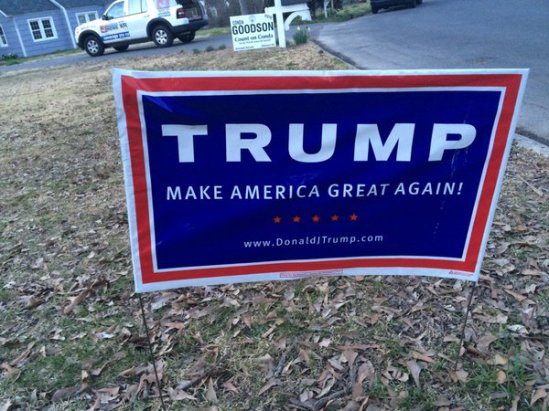
Whenever I see signs like these on people’s properties, I tend to wonder why on earth would anyone want to support this guy. I know many of Donald Trump’s supporters are working class whites, but still I keep asking myself that question. I can find nothing about this guy that suggests he’s presidential material or even a decent human being. And yet, no matter how many contemptible things he’s said, he’s somehow popular that people vote for him. This makes me sick.

Yes, I know working class whites are hurting and I feel for them. But so are minorities who are in the same situation with racism and discrimination to boot. Many of them work the degrading jobs for the same wages are just as equally unhappy with their situation as their white counterparts. Many undocumented immigrants have it just as bad, if not worse. While many people tend to criticize poor blacks for going on welfare, we should accept that there are plenty of working class whites on public assistance as well. And a lot welfare recipients white and minority alike have jobs, sometimes more than one. While there’s said to be a lot of crime and drug use in the inner cities, you can also say the same in rural Appalachia. Working class whites might see similar disadvantaged groups as “the other” as different from them and see anything that aims to support their interests as something to oppose. However, what working class whites need to realize is that these people of color aren’t much different from them, especially in their economic situations. As someone descended from working class whites, I see the poor and racial minorities as my brothers and sisters as well as support movements like Black Lives Matter and a path to citizenship for undocumented immigrants, not just because it’s right and a way to stay true to my faith. But also that a lot of policies benefiting racial minorities also help poor and working class whites. And American history is full of examples to support this. Reconstruction not only expanded suffrage to African Americans but also to Southern whites who weren’t able to vote before the Civil War. It was also a time when both blacks and whites in the South first had access to public schools as well. You have the West Virginia mine wars during the early 1900s where black and white miners alike fought for the right to unionize as well as better wages and working conditions and an end to unfair company practices. Then there’s union organizer Walter Reuther’s support for the Civil Rights Movement and his marching with Dr. Martin Luther King Jr. since both saw the causes of civil rights and economic justice as intertwined. And the fact that these two ideas are intertwined with one another should be a reason why working class whites should support Black Lives Matter and a path to citizenship for undocumented immigrants.
18595982-mmmain

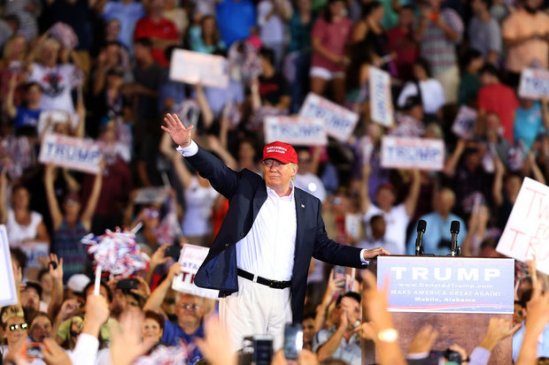
Here we have the super rich superdick at a rally in Mobile, Alabama among cheering crowds which make me cringe. Seriously, I thought the American people were better than to support a guy like Donald Trump. The guy is a complete prick and a sleaze on top of that. Why the hell could anyone seriously support this guy as president? I can’t understand this.

It’s a shame that many working class whites are willing to accept the economic status quo that’s screwing them, support men like Donald Trump, and blame their downward spiraling lives on the poor and people of color. I know it may not be something working class whites might not want to hear but even though I sympathize with their plight, the bigotry, xenophobia, and racism that many embrace has got to go. All what embracing Trump’s racist rhetoric does for working class whites is make them look like a bunch of ignorant rednecks supporting a candidate against their own best interests as well as makes the powers that be not take their concerns seriously. Yes, I know that many of these voters are unsettled by cultural and demographic change, but the US has been through this before and it’s nothing to be worried about. I know many of these people are unsettled over Obama’s ongoing transformation of the US as something no longer recognizably American. But previous generations have faced the same thing under other presidents and responded to backlash against changes the exact same way. What these people see as “recognizably American” either never really existed or was much shittier than you remember. I’m sorry but I don’t want to live through another Bush administration. Even though Obamacare isn’t Universal Healthcare and flawed, at least it’s better than what we had before and I do not want to go back to the old system. The fact that the Democratic Party supports rights for women, LGBT people, and racial minorities is not their problem. Their main problem is their tendency to compromise and downplay their sacred principles in favor of much needed campaign contributions from wealthy donors and corporations, especially thanks to Citizens United. This is especially true when it pertains to Democratic principles pertaining to labor rights, corporate regulation, health and safety, taxing the rich, and environmental protection. But I have to admit that Barack Obama has been a good president for this country and I’d hate to see him go. At least Democrats support policies like free pre-K, affordable childcare, equal pay for women, and paid leave. Not to mention, Hillary Clinton and Bernie Sanders are both viable candidates in their own right and I can see why anyone reasonable would support either of them.

560575ea1b00004b0005d58b

Many people support Trump because they think he “tells it like it is.” If so, then how come Politifact has no true statements on his file? Not only that, but they made him Liar of the Year for 2015. Kind of shows what a phony he is.

I’ve often heard that many Donald Trump supporters believe that he’s not afraid to tell it like it is or be honest. I find that hard to believe since I’ve long known him to be a spoiled rich brat who’s a shameless opportunist and self-promoter. If there is any candidate in this election who has the guts to tell it like it is, my money is on Vermont US Senator Bernie Sanders and I can understand why so many people love him for it. Sanders might be a self-described democratic socialist but he mostly believes what he says and has a pretty good idea on what he wants to do if he’s elected president with plenty of detailed policies to back it up. If I saw a herd of working class whites fill a stadium at a Bernie Sanders rally, I wouldn’t question their judgement since Sanders seems like a guy who supports policies that benefit the little guy. Of course, he’s not perfect, his policies may not be realistic, and doesn’t have a chance in hell to win the Democratic nomination, but at least his appeal to many Democrats makes a lot of sense.

920x920

This painting of Donald Trump is by someone from San Francisco. It depicts the wretched presidential candidate holding money in one hand, making a Nazi salute with the other, and having a pile of shit coming out of his mouth plopped onto the US. I think it shows the idea I’ve long suspected in that Trump is full of shit.

Donald Trump, on the other hand, is mostly speaking to people’s frustrations and anxieties by telling them what they want to hear. Telling people that the way to “make America great again” is to deport 11 million people with ease isn’t “telling them like it is.” It’s lying on multiple levels. He also talks about how his standing as a “businessman” makes him an “outsider.” So unlike traditional politicians in Washington who are bought and paid for, he “can’t be bought.” However, we have to acknowledge that Trump has been a member of the 1% his entire life who wouldn’t be the man he is today if he wasn’t born into one of the wealthiest families in the country. Sure big money in politics is a major problem and the notion of politicians being bought and paid for by wealthy donors is part of how Washington conducts business as usual. Yet, understand that Trump is a massive hypocrite who’s bought and paid for politicians himself. Despite what he claims, he’s not funding his campaign all by himself for he probably has his share of wealthy backers. So he’s very much part of the political establishment. But even if most lawmakers were controlled by their contributors, the idea Trump could somehow move our system through sheer force of un-bought will is utter crap. It constitutes much of his candidacy’s Big Lie: never mind the policy details, never mind the separation of powers, and never mind the profound disagreements between the parties. Everything will be easy and terrific. Except in politics, accomplishing anything in politics is everything but easy and terrific. He’s not telling you like it is. He’s telling you like it isn’t. When he’s telling it like it is, he’s really conning people into voting for him by telling them what they want to hear or what will entertain them. He’s playing for an audience by appealing to voters’ frustrations, insensitivities, and other unsavory emotions. He is not like you. He cares nothing about you for all Donald Trump cares about is Donald Trump. You are his potential pawn to be used to get what he wants. His candidacy is only a reality show based on the public image he’s created and cultivated for decades that’s all spectacle that satiates a bloodlust and structured insanity. But behind that façade, there’s very little substance. While most presidential candidates typically draft detailed policies that they intend to pursue if elected, Trump has released very few. All the things he said he’d do just sound like simplistic bullshit by a guy who seems completely unconcerned about the implications in order to accomplish them. All delivered with the kind of maniacal overconfidence that’s seen as almost delusional. He not only lies his ass off but doubles downs on those lies. He denies long established facts most people accept even by experts in their field such as that New Jersey Muslims weren’t cheering on 9/11, vaccines don’t cause autism, Obama was born in the US, and global warming isn’t a hoax perpetuated by China to close US factories. Furthermore, it’s widely said that Trump doesn’t understand how government operates, advisers or no advisers. His foreign policy team has been described as “a collection of charlatans.” In debates, it’s been revealed that he didn’t know what a nuclear triad was (it’s a doomsday force of land based missiles, long range bombers, and submarine-launched missiles that the President can order if the US is attacked). Nor did he know that China wasn’t a party to the Trans-Pacific Partnership which is intended to counter the country’s economic influence. Not to mention, Trump has been known to change his political views like one would change their socks. This is not what you’d want in a presidential candidate.

png;base64cffdb28d07007976

Here’s a Twitter chat between Donald Trump and Coach Clint Swan about the Boston Marathon bombers and the Central Park 5 (black and Hispanic teenage boys who were falsely accused and falsely convicted of raping and attacking a jogger along with a few others in 1989. It was a gross miscarriage of justice that was mired in racial discrimination, emotional distress, and malicious prosecution). This shows that Trump is a very insensitive jerk and his racism is nothing new. What an asshole.

As for his public image, Donald Trump has built it around a bully persona pertaining to bombast, bluntness, and offending people. Unfortunately, it turns out that a lot of primary voters are attracted to jerks as long as their vitriol is directed toward the right people, even if it means inciting violence against protestors at his rallies. His supporters cheer when he insults immigrants, Mexicans, Muslims, women, other politicos, POWs and even the occasional Fox News host (but not in a good way at all). His supporters will tell you that he doesn’t bow to political correctness. Maybe, but perhaps he should. They’d also tell you that Trump says what people wish they could say. If by “people,” you mean “racists,” since Trump isn’t afraid to call Mexicans criminals and racists, promises to kick every Muslim out of America, ridiculed a reporter for being disabled, called POWs losers for getting captured, and said of a black protestor, “Maybe he should have been roughed up because it was absolutely disgusting what he was doing.” But only those from the white supremacy and white nationalists groups who back him are willing to admit that he’s the voice they always wanted since he’s mainstreaming such bigotry throughout the race, especially when many of his supporters believe in the notion of “white racism” which doesn’t even exist. And it doesn’t help that Trump hesitated to disavow David Duke and the Klu Klux Klan. But the closet racists of the country know what they believe in is ignorant bullshit who don’t want to risk becoming pariahs for exposing their bullshit. His bully persona has also made him exceedingly popular with people who believe he represents American ideals, especially the American promise of success being represented by great wealth (I’ll get to this later), which is troubling. The fact that millions of people are seriously willing to vote for this fuckwad as president disturbs me even more. Now I don’t expect my politicians to necessarily be saints. But I do wish that they’d have some capacity for basic human decency in public appearances.

However, we have to acknowledge that Donald Trump is an exceptionally shitty human being whose capacity for basic human decency is practically non-existent. He’s a trust fund baby with an aggressive competitive drive, an ego the size of Texas, and an inability to take criticism or a joke despite that he’s a walking and talking cartoon character. He’s a bully who takes any attacks against him and jokes at his expense personally and with a vicious streak. One woman was kicked off of Last Comic Standing because she made fun of Trump’s hair. He even threw a hissy fit over some magazine talking about his tiny hands. Really? Throughout his life he has continually asserted his sense of spoiled rich kid superiority with only the barest hint of doubt. He’s a thriced-married serial philanderer who treats the women in his life as objects, is well-known to make women uncomfortable around him, and openly admitted on national TV that he wants to bang his daughter. Yes, he said this. He’s a draft dodger who called John McCain a loser for being a prisoner of war in Vietnam for 5 years. His name is synonymous with success defined by wealth and luxury that wouldn’t have been possible if he wasn’t a trust fund baby who received an Ivy League education on his family name. Though he claims to be a successful businessman, he is anything but (I’ll get to this later). He has no class and wants to beat and grind adversaries to the ground. And no matter how much offensive, divisive, and destructive his rhetoric can be, he’s never ashamed, he’s never humble, he’s never gracious, and never apologizes. As for friends, well, he’s openly praised Vladimir Putin calling him “a man so highly respected within his own country and beyond” despite that Putin is highly feared and known to leave a trail of invaded countries and dead journalists. And it doesn’t help that his penchant for being an unrepentant asshole with a goofy toupee that it’s no wonder he’s been referred by Jon Stewart as “Fuckface Von Clownstick” as well as such a complete joke of a man that comedians find him so irresistible to mock. The fact Trump’s voracious hunger for fame, wealth, and power combined with his hideous muppet hair and morally bankrupt personality just gives the comics more ammunition to mock him. In short, he’s not a guy you’d want your child to look up to since he sets a very poor example to children since he makes Richard Nixon look like a boy scout. Fuckface Von Clownstick, indeed.
Trump-the-loser

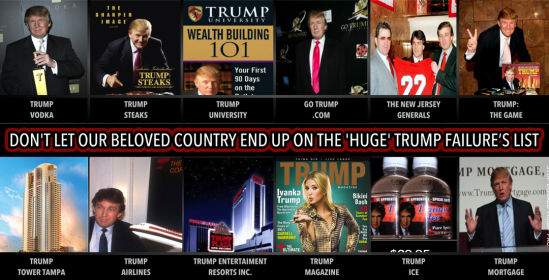
While Donald Trump often says he’s a great businessman, he’s had a string of business failures seen here. While Trump often tries to brad his name as high class, it has repeatedly come to mean shoddy work, half-baked schemes, and sketchy characters. This is from a conservative website by the way.

Another thing that you hear from Donald Trump supporters is notion that Trump would make a good president because he’s a good businessman. However, not all great businessmen make great politicians and vice versa. Besides, while the goals for business are to make money, the goals of government are far more complex so being CEO of a major corporation is nothing like being President of the United States. And contrary to his claims, Trump is not a great businessman. Yes, he wrote The Art of the Deal that doesn’t mean he’s a great businessman. After all, some people from write relationship advice despite being shitty in relationships. But deal making and promotion are only part of being a successful businessman. And I’m sure these two aspects Trump masters beautifully. But he’s not a great operator and most business usually consists of overseeing day-to-day details that require the attention. Trump usually leads the running and operating on locations to managers he hires. Day-to-day details don’t interest him. His Atlantic City casino ventures went bankrupt 4 times and was forced to sell his other businesses like Trump Airways all of which employed thousands of people (Rolling Stone lists 13 of his business failures in all). In his offices, there are 2 or 3 floors at Trump Tower that might have 40 or 50 people in them. Sure he’s wealthy now. But that’s because he inherited a lucrative family business. And he only achieved real success when he turned from real estate development to franchising his name for other developers’ projects. That and his ethically questionable business practices. His for-profit Trump University is now being investigated for fraud. His earnings may be smaller than he says they are. His name on offerings like furniture, neckties, steaks, magazines, alcohol and other beverages, air travel, board games, fragrances, telecommunications, mortgages, and more which is said to stand for high class, high quality, and high cost. But a lot of these ventures failed and Trump is partially responsible for that. Thus, in practice the Trump brand has often repeatedly stood for half-baked schemes, shoddy work, and sketchy characters. Now thanks to him calling all Mexicans rapists and criminals, Macy’s has discontinued his line of menswear that it carried for 11 years and whose ties I’ve sorted during the 2014 Christmas season for a measly $8 an hour. Despite that Trump likes to brag about his success as a businessman, he is not a self-made man nor a man you’d trust to run your business venture. If Trump has refused to release his tax returns, chances are that he’s probably not as rich and successful as he makes himself out to be. And if he’s not interested in the day-to-day details of running his business, he’s probably not going to be interested in the day-to-day details of running the US Government. At the end of the day, he’s not the successful businessman but a trust fund baby who got really lucky.

trump_casinos_bankrupt_small

Here’s a diagram from the Onion on Donald Trump’s latest casino bankruptcies listing the reasons for their failure. And yes, it acknowledges that Trump inherited most of his money.

Finally, the main reason why Donald Trump should be president has to do with the fact that most Americans who know him don’t like him even within the Republican Party and his hometown of New York City. As a celebrity, he’s more of a guy most people love to hate and make fun of as a joke. That is until he ran for president and people started taking him seriously as a candidate. As a blogger and a liberal Democrat, I am free to say what I want about Trump and not get the short end of the stick. The Donald doesn’t know who I am. And if he gets angry on what I say about him, it’s just going to make him look like an idiot since I’m just a small-time blogger with a small following. But others don’t have the same luxury. If you pay attention, you might be aware that the Bush family and Mitt Romney don’t like him at all. The Koch brothers don’t care for him either and decided not to back him for now. The National Review did a piece on why Republicans shouldn’t vote for him. Noted pundit Glenn Beck has steadfastly opposed Trump saying, “I don’t want my children to look at that man and say, ‘Yeah, he’s my President.’ I won’t have that. I will not endorse it, I will not tolerate it.” This is coming a guy who had his own show on Fox News that made him notorious for crazy antics that Jon Stewart and Stephen Colbert mercilessly mocked until he was fired from the network. Nebraska freshman Senator Bob Sasse has even written a long Facebook post explaining he’s not backing Trump as well. Radio host Erick Erickson decided not to endorse Trump, because he’d rather, “put my country before my party and decline to help the voters in this country commit national suicide.” Leon Wolf from Redstate even went further saying that while he thinks Hillary would make a terrible president, he genuinely believes that she’d be way better than Trump.
maxresdefault

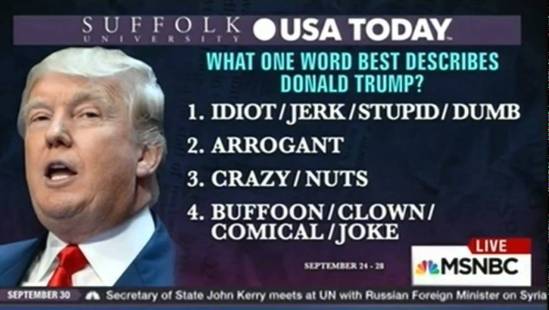
This is a poll from Suffolk University and USA Today on what words best describes Donald Trump. Despite his own delusional self-grandeur, most people think the man is a jerk. This isn’t what you want in a presidential candidate.

Politicians who’ve had decided the back Trump, have only been willing to do so for the “good of the party” since he’s the presumptive nominee. Or back in the primaries, he’s the frontrunner and probably want Trump to do something for them, don’t want to be seen supporting Hillary Clinton, or feel their jobs depend on it. Take Chris Christie for instance whom Stephen Colbert likened to “a best man at a wedding he doesn’t believe in” when he endorsed the guy. John McCain has also endorsed him despite how Trump said that he’s not a war hero because he got captured in Vietnam. McCain would go on to say that Trump owed former POWs and their families an apology because these guys have dealt with a lot of shit. But McCain’s endorsement is understandable because he’s in a tight reelection battle in Arizona. But a private recording reveals he’s not happy about it and thinks backing him will hurt his chances. New Hampshire US Senator Kelly Ayotte says she’ll support him but not endorse him since she’s also in a tight reelection battle. I’m sure this means, “I’m playing it safe because I don’t want to alienate my GOP supporters in the primary but I don’t think endorsing the guy is going to help me in November.” Nevada Governor Brian Sandoval is another guy who’s backing him but only for the good of the party. Yet, he’s clearly not a fan and doesn’t plan to attend the convention. Finally, we have South Carolina Senator Lindsey Graham who said the day when Trump won Indiana, “If we nominate Trump, we will get destroyed…….and we will deserve it.” This guy hates Trump so much that he even endorsed Ted Cruz despite previously likening the choice between the two as one between being poisoned and being shot. Recently, CNN has reported Graham has privately urged donors to unify around him though he hasn’t really endorsed him publicly yet. Guess it’s for the good of the party.

513222088.0

Here is New Jersey Governor Chris Christie behind Donald Trump after he endorsed the guy for president. Notice the look on his face. Is that a look of an enthusiastic supporter? No.

Then there are those who are undecided like Speaker Paul Ryan who I liken as a hypocrite and whose Ayn Rand inspired ideas libertarian economics are appalling, insensitive, impractical, and insane. But in this election, it’s hard not to feel sorry for him. Though he has intended to support whoever’s the GOP nominee in the past, he has admitted that he’s not prepared to back Trump-yet. “To be perfectly candid with you, I’m just not ready to that at this point. I’m not there. I hope to, and I want to,” he said on CNN. It should be apparent that Ryan is lying his ass off as if he’s a kid when his mom asks him whether he’ll support her decision to marry Mr. Douchebag. In reality, Ryan hates Trump’s guts and really doesn’t want to endorse him for president. He’s said that his party needs “a standard-bearer that bears our standards.” And it’s clear that the House Speaker doesn’t think Trump is the guy he has in mind. Otherwise, Ryan would’ve kept true to his promise once Trump clinched the nomination. But he can’t speak his mind and tell Trump to stick it because he simply can’t afford to since he’s in a tight primary congressional race with an opponent who’s already endorsed him. It doesn’t help that he’s House Speaker (a job he didn’t even want) and is the highest ranked elected GOP leader in the country. If Ryan decides to back Trump, it will be because he doesn’t want to lose his job. And he will back the man only when he absolutely has to, most likely at the Republican National Convention. Nevertheless, I can easily imagine Ryan having an effigy of Donald Trump in his office that he periodically uses as a punching bag and constantly swears at. As of now, Trump’s nomination has put him in a no-win situation where he’s stuck with either endorsing a nominee he thinks makes his party a joke at the cost of his personal integrity or possibly alienating his Republican constituents in his Wisconsin district who can vote him out of office and end his political career.

ryan-trump-575x324

Here’s House Speaker Paul Ryan from Wisconsin after meeting with Donald Trump. Ryan said the meeting went well but he’s still not ready to endorse him. In reality, Ryan despises Trump and really doesn’t want to endorse him. In the end he may not have other choice if he wants to save his career since his primary opponent is a known Trump supporter.

Look, I know that many of you may not like Hillary Clinton for various reasons. I know she’s not a likeable person. I know she has a lot of baggage as a politician and public figure. And I know that many people in this country fundamentally don’t like her. However, we have to accept the fact that despite her many faults, there’s no doubt that Clinton is qualified for the job, has realistic and coherent policy ideas, and has proven herself reasonably competent in every political position she’s had. And when it comes to listing all the US presidents on the wall at your kids’ school, you’d probably be okay with her being on it, eventually. You may not think much of her or even agree with her ideas. Even at her worst, she still looks like the better choice for president than Donald Trump. In fact, you could probably say that a spilled can of antifreeze or a steaming pile of dog shit are better choices than Donald Trump. Many might say that Clinton is corrupt, untrustworthy, inconsistent and hypocritical. But she has proven herself to be a serious presidential candidate not once, but twice. If she’s elected, chances are you won’t need to explain to your kids why most Americans voted for her even if you didn’t. Hillary may not make the best president, but I can guarantee you that if Trump’s in the White House, expect him to be an epic disaster.

55f6cc132c00003600aaf9f9

Here’s a cartoon of Donald Trump if he was at a job interview for the presidency. Note that his resume doesn’t make him seem like he’s presidential material. Doesn’t look good.

You can’t say any of that about Donald Trump. But one thing is clear, the man is a complete fraud and a conman as well as a wretched human being most people hate. He has risen to become the GOP nominee in the 2016 presidential race through soundbites filled with racism, sexism, xenophobia, turning his campaign into an empty spectacle, and inciting violence. But at the same time he has failed to show that he’s qualified or even serious about the job and what it entails. Elections aren’t reality shows. They are political events where we choose leaders and representatives to make laws and policy decisions that affect our lives. Presidential elections are serious business that our country can’t afford to elect a clown like him to the White House. If there’s any good reason why even the most conservative Republican should vote for Hillary Clinton over Donald Trump, it’s that she takes this election seriously and is more likely to exercise the presidency with the kind of decorum, respect, and dignity Americans deserve from a leader 0f the free world. And if you take this election and the politics seriously, then she is the candidate you should support regardless of what you think of her or your political ideology. I know it’s a bitter pill to swallow. But if you’re an American who loves your country and cares retaining at least a shred of dignity on the presidency after Obama leaves the White House in January, you’d have to be a complete idiot to support Donald Trump. Sure he may be entertaining and might say things you’d want to hear, but he’s not the kind of man who should be leading the country.

trumppoop

This is a mural by a guy in New York City. It’s of Donald Trump as a steaming pile of shit. I think it’s a realistic portrait, well, from a certain point of view.
Worst Arguments for Not Enacting Gun Control

gun_control_means_nothing_to_my_students

Disclaimer: The following might contain a lot of highly controversial political views about an issue that many Americans have strong opinions about. It runs a high risk of inciting outrage, anger, trolling, and hostile retaliation. Viewer discretion is advised.

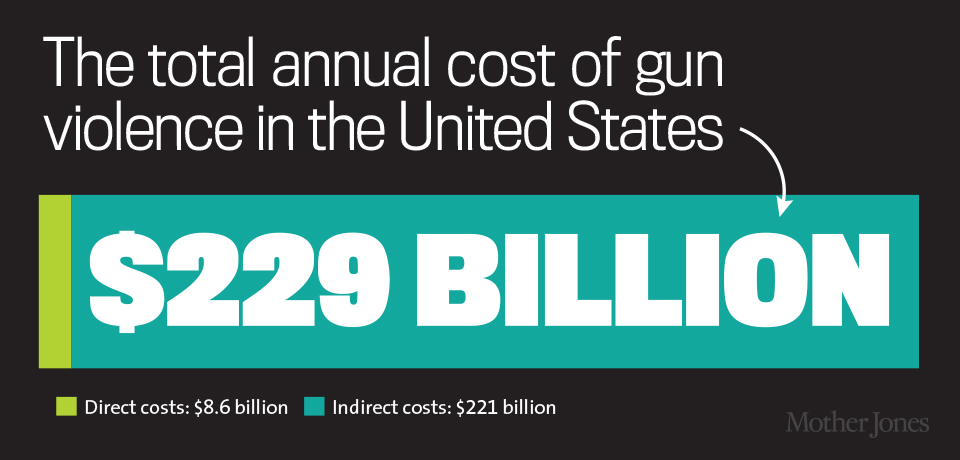
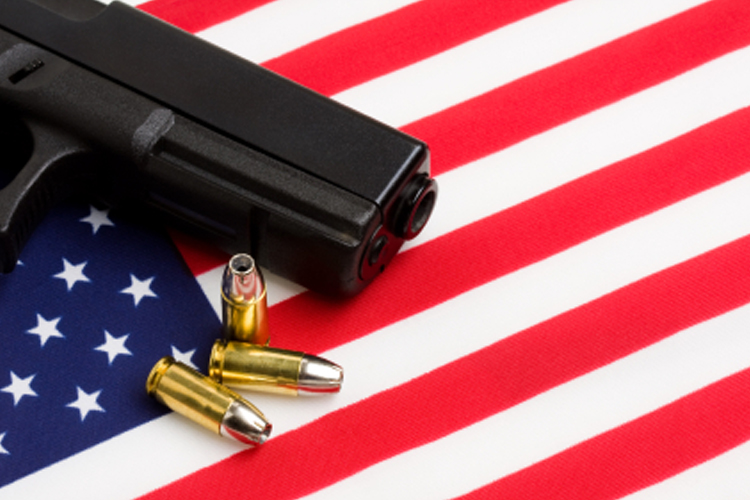
As a Catholic liberal, I’ve been a long advocate for gun control. I’ve was nine years old during Columbine which was one of many mass shootings in the United States I’ve seen on the news. Not to mention, the fact so many people have been killed, injured, or scarred for life due to gun violence has cost taxpayers at least $100 billion annually as well as become a major public health concern. So I’m fully aware that certain gun control measures are badly needed and a lot of Americans would agree with me. And it’s not just liberals since we have to remember that the late James Brady was an official for the Reagan administration. Yes, the late great conservative Ronald Reagan whose fiscal conservative policies led him to raise taxes, had something to do with the Iran Contra scandal,  as well as had an openly gay son whom he freely accepted. But despite the urgent need for gun control I should not have to remind anyone about, GOP and NRA interests have made sure that their Second Amendment rights are protected at all costs. Even if it leads to a lot of innocent lives being slaughtered, high health costs, full emergency rooms, and an overworked criminal justice system. Not only that, but many states have passed gun laws that Americans don’t need, but also make this problem worse. Yes, I know that gun control is a highly contentious issue. But come on, do I really give a shit about gun rights? Now I’m fine with people owning guns as long as they’re law abiding citizens who don’t have personal issues that might endanger others. But do I think anyone has the right to own an AK-47 with a 30 round magazine? Absolutely not. Why? Because I can’t think of any reason why a civilian might need it save maybe in an event of an alien or zombie invasion. Here I list many of the arguments gun rights advocates make when it comes to doing nothing to necessary gun control.

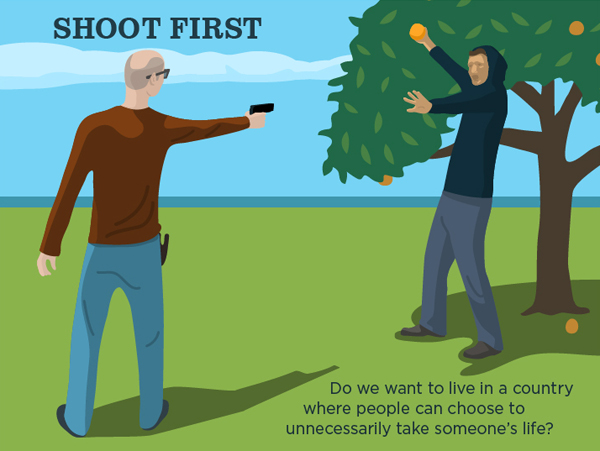
  1. “Guns don’t kill people, people kill people.” – This is the most common argument gun rights people make in regards to gun violence. It basically says that people are responsible for their own actions and what they do with guns doesn’t mean that we have to enact any gun control. Yes, people kill people. However, guns are weapons specifically made to kill people with firearms technology designing weapons to kill as many people as possible. Thus, when it comes to killing people, guns are usually the weapon of choice. And most criminals will use other weapons when they can’t get a gun. Firearms were intended to kill people from the very beginning. To make a gun that doesn’t kill would be like removing a gun’s reason to exist. Yes, people kill people. But guns kill since it’s their point. Besides, when a gun is used incorrectly, someone or something doesn’t get shot. Let’s just say that we can’t talk about gun violence without acknowledging what guns are actually used for.
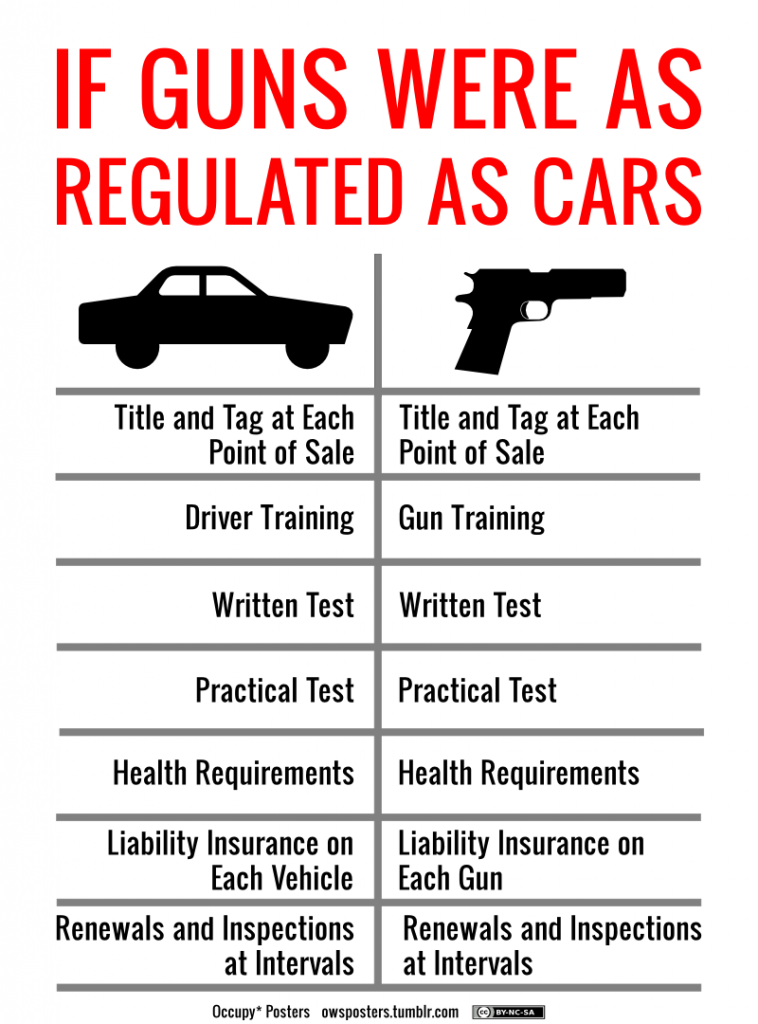
This is a diagram stating how gun laws would be if they were regulated like cars. Not that in the US it's harder to get a driver's license than it is to buy a gun depending on your jurisdiction.

This is a diagram stating how gun laws would be if they were regulated like cars. Not that in the US it’s harder to get a driver’s license than it is to buy a gun depending on your jurisdiction.

2. “________ kill people, too. You want to outlaw that?” – Gun rights activists love to point out how so many other things tend to kill people as well. Cars and alcohol are usually the most prominent examples. I’m well aware that cars kill more people than guns each year. However, in the US, it’s said to be more difficult to obtain a driver’s license than a firearm. Besides, we have a lot of regulations on cars like seat belts, speed limits, license and insurance requirements, and bans on drunk driving. If you cause an accident resulting in fatalities, you might do time for manslaughter. If you’re caught driving drunk, you might spend time in jail or lose your license. Besides, most people use cars for transportation, not to kill people. We also have regulations on alcohol and tobacco. Not only that, but there are plenty of things that could kill people but also fulfill other purposes like chainsaws and knives for instance. Guns, on the other hand, exist for one function which is to kill. And firearms technology has advanced in order to kill more efficiently, particularly people. I mean why was the AK-47 even invented in the first place? As for outlawing them, it’s highly unlikely that would even happen. Oh, by the way, the US has more gun stores than grocery stores, which is incredibly disturbing if you ask me.

3. “Guns save lives.” – Now there are plenty of stories pertaining to defensive gun uses. However, most of these usually exist in the mind of Hollywood screenwriters hired to write an R-rated action movie. A study in 1993 determined that there were 2.5 million defensive gun uses every year. This involved calling 4,977 people across the country, asking them a few gun questions and adjusting the number to fit the population of the whole nation. Now the 2.5 million number is highly cited and highly disputed. However, this number doesn’t translate to “lives saved thanks to guns.” In fact, they refer to guns being involved in the presumed person or thing’s protection. This can apply to life-threatening situations pertaining to people who were in actual danger as well as to people like George Zimmerman. So to say whether guns save lives is a mixed bag. Sometimes gun use might kill a criminal or stop a crime. Other times, gun use will fuck up everything. Nevertheless, there’s nothing defensive about gun use since it’s meant to attack and always will. Defense is protection such as a security system, mace, or a bullet proof vest. But whether guns save lives, it’s fairly hard to say at least when it involves civilian gun owners.

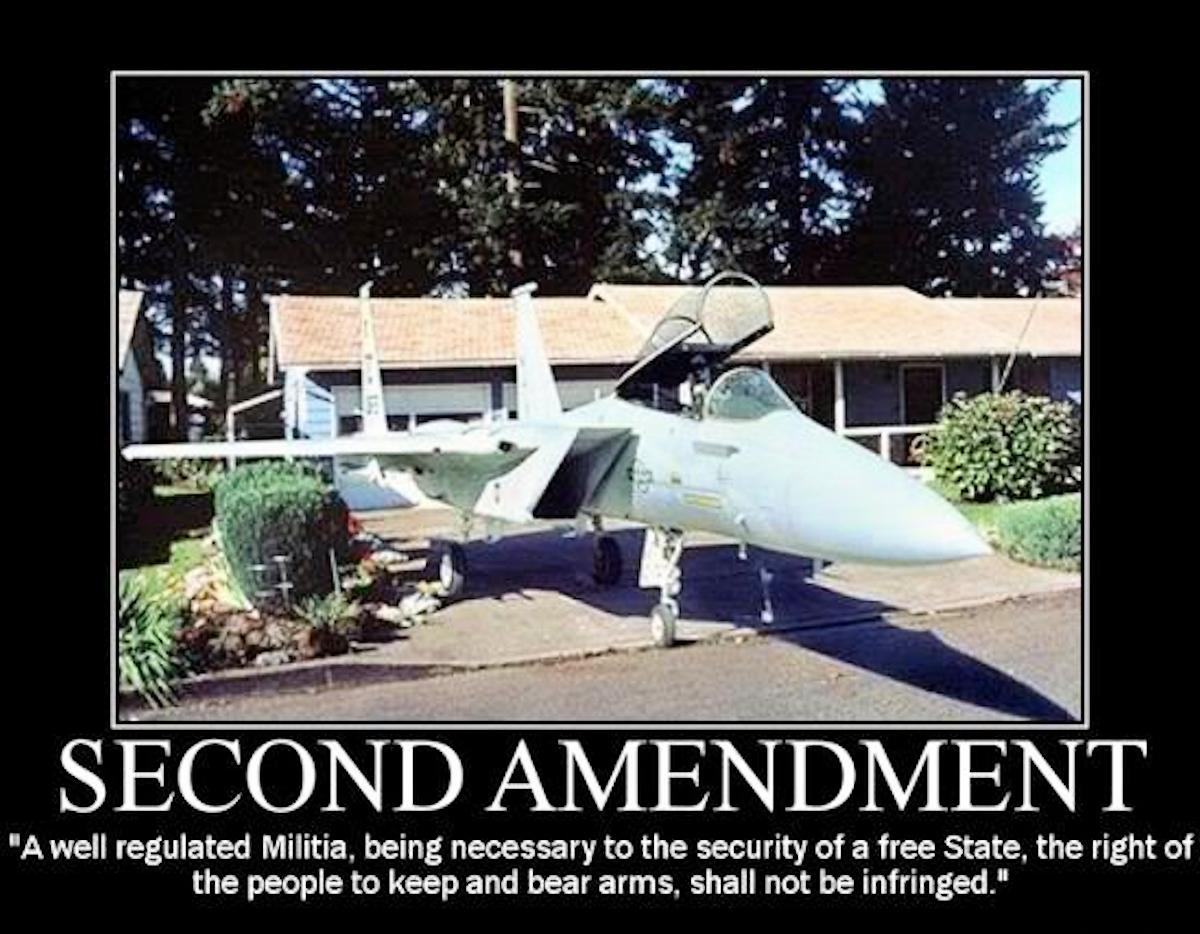
4. “Well, the Second Amendment says……” – Gun rights activists love to cite the Second Amendment which actually says, “A well regulated militia being necessary to the security of a free State, the right of the People to keep and bear arms shall not be infringed.” Now there’s a lot of debate about what it actually means. Some people think it pertains to individual gun ownership. Others think it refers to people in a militia. Still, either way, asking the Founding Fathers their opinion of contemporary American gun culture would be like asking Pope Francis on what he thinks about NFL football (then again he probably knows it’s not “football” as he knows it but not much else). To the Founding Fathers, the only guns available were single shot muskets which had a more complex loading process and weren’t very accurate. I mean the American Revolution gave rise to the term “minuteman” meaning a Continental soldier who was ready to fire at a minute’s notice. Then you have the saying “don’t fire until you see the whites of their eyes,” meaning “don’t shoot until they’re close enough for a sure hit.” Weapons that fire multiple times without reloading didn’t come until the mid-19th century with the American Civil War. Besides, we all know that some of the Founding Fathers also thought slavery was an economic necessity and they weren’t right about that. So maybe relying on them for gun issues isn’t the best idea.

While gun rights activists continually say that

While gun rights activists continually say that “an armed society is a polite society,” we should all learn from the impact of “Stand Your Ground” laws that this isn’t the case at all. I mean look what happened to Trayvon Martin. He was just a teenager minding his own business but gets shot anyway. So much for a polite society.

5. “An armed society is a polite society.” – Gun rights activists like to use this argument which states that people with guns encourage others not to mess with them. Sort of like a “scared straight” approach in which a lethal threat or fear of untimely death can be used to keep people in line, deterring prospective criminals. And through such, an armed society will ensure lasting peace and security within a community. However, this notion ignores a lot of things about human nature, especially when it pertains to gun violence. For one, you never know what can set somebody off to view you with suspicion as a possible threat to their lives despite all evidence to the contrary. In other words, the trigger could be just about anything. Second, some people are easier to piss off than others and for very trivial reasons. Yes, an armed society might scare people from insulting or offending gun owners. However, you can easily insult or offend somebody even if you have no intention to. Third, people have been killed for very stupid reasons, especially in states under “Stand Your Ground” laws. Trayvon Martin was just an unarmed teenager minding his own business when George Zimmerman picked a fight with before shooting him dead. A retired cop shot a unarmed man in a movie theater for allegedly throwing popcorn in his face. Another guy shot a bunch of unarmed teenagers for playing their music too loud near a gas station (and after they turned down the music as he requested). Fourth, armed societies don’t protect or respect the rights of non-gun owners as well as vulnerable populations that might be viewed with suspicion. And these “Stand Your Ground” laws demonstrate this, especially since Florida’s mostly benefits white gun owners charged with shooting racial minority victims. Finally, sometimes the consequences don’t discourage people from committing crimes. In fact, some criminals might be fully aware of implications but choose to break the law anyway. For instance, an armed society wouldn’t deter anyone in the drug gangs on The Wire, because they practically live in one as a business environment. They know they’re criminals and commit their crimes fully knowing what’ll happen to them if they piss off their superiors or their enemies. And it could pertain to almost anything. Such notions give me serious doubts on whether an armed society is a polite one after all. To me, living in an armed society is more of a “walking on eggshells society” in which you have to be in public every day of your life afraid of committing the slightest offense that might give a stranger a reason to shoot you. This is not the kind of society I want to live in because scaring people straight by threatening their lives is no recipe for lasting peace and security and more of constant tense and tenuous standoff between warring parties. I’d prefer to live in a gun-free zone any day.

6. “Guns aren’t the problem. Our poor mental health system is the problem.” – Yes, our mental health system needs reform. But many gun rights activists think that reforming our mental health system might make all out mass shooting problems go away. However, they overlook two major things. First, like the general population, most mentally ill people are harmless. Second, while some mass shooters might have a mental illness, most do not. Third, they fail to take into account other factors play into the gun violence issue besides a poor mental health system like poverty, drugs, and gang activity in bad neighborhoods. In many ways, guns give people a sense of power and in the wrong hands it’s a deadly combination. Thus, even if the US mental health system is reformed and improved, there are other factors pertaining to gun violence that we have to deal with. Even if better mental health systems do prevent mass shootings, gun violence will still be a problem. Besides, as gun violence is concerned, mass shootings are only the tip of the iceberg since it’s a multifaceted problem with multifaceted solutions. And part of the solution is tighter enforcement and tighter regulation.

Opponents of gun control love to point out how Chicago has a very bad problem with violence despite its tight gun laws. However, little do they know that Chicago's gun problems have more to do with its laws being at city level, lack of stronger national gun laws, and geography. Besides, it was later found out that most firearms involved in Chicago gun crimes were legally bought in Indiana.

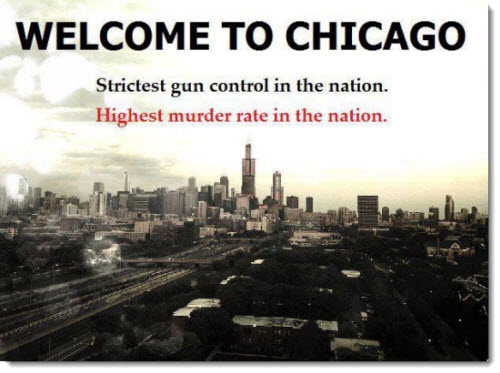
Opponents of gun control love to point out how Chicago has a very bad problem with violence despite its tight gun laws. However, little do they know that Chicago’s gun problems have more to do with its laws being at city level, lack of stronger national gun laws, and geography. Besides, it was later found out that most firearms involved in Chicago gun crimes were legally bought in Indiana.

7. “But gun control won’t stop criminals from getting guns and committing crimes.” – Yes, but that’s like saying that enacting laws isn’t worth it because they won’t stop people from committing crimes. But such laws against crimes help ensure people’s safety or they wouldn’t be on the books in the first place. Nor would we have punishments for breaking them either. So yes, they’re worth it. Then there’s the matter with how gun rights activists point out how Chicago has more violent crimes than Houston. Now since Chicago has tight gun laws and Houston doesn’t, then gun control isn’t very effective. However, they don’t note how US gun laws aren’t uniform between or within states and are rather inadequate at the national level. Take Chicago’s problems with gun violence for instance. Now while the city itself might have tight gun laws, the rest of Illinois does not and neither does Indiana. It was later found that many of Chicago’s guns come from surrounding areas like Indiana. Why? Because lack of a uniform gun laws allows firearms to travel from loose law areas to tight law areas. Weak national gun laws make it inadequate to crack down on illegal firearms circulation with most gun violence occurring with such weapons. Such weak national laws undermine attempts at gun control everywhere. Thus, any form of gun control Chicago implements will be ineffective not because of the laws themselves, but because Chicago has no legal authority to regulate firearm circulation outside its limits.

8. “Guns aren’t the problem. Exposure to violent entertainment is the problem.” – I’m well aware that violence in entertainment is endemic in our culture whether it be movies, TV, video games, and other media. However, while violence in the media might make viewers somewhat less sensitive to what goes on in real life, most of the time it doesn’t lead people into committing violent crimes. Yes, the US has a lot of violence in the media which appeals to a wide range of people. But most industrialized countries also consume a lot of violent media as well. Yes, I know that they watch and play the same violent stuff Americans do. But they also produce a lot of violent stuff of their own. Japan is known to produce a lot of violent movies and video games. Audition and Battle Royale are Japanese movies famous for their gore. But they have a lot movies featuring samurai and Godzilla. Oh, and they’re home to Nintendo and Sony, by the way. Great Britain produces a lot of murder mysteries and crime shows. Of course, you’d expect that in a country which produced Arthur Conan Doyle and Agatha Christie. But many recent British crime shows have death counts of 1-4 victims per episode. A British show called Midsomer Murders has a higher body count than The Wire. Sweden brought us series like The Girl with the Dragon Tattoo and Wallander both of which are disturbingly dark, violent, and gory. And then there is the Spanish Pan’s Labyrinth which has some cold blooded torture scenes that would make Jack Bauer wet his pants. Now if violent entertainment led to violent crime, these four countries would be in very deep shit. However, none of them have the level of gun violence prevalent in the United States. So the argument that exposure to violent entertainment encourages violent behavior is weak. Well, Britain may have a higher violent crime rate than the US but its gun crime rate is low. But even so, Britain still experiences far less murders than its crime shows depict, particularly the ridiculously violent Midsomer Murders.

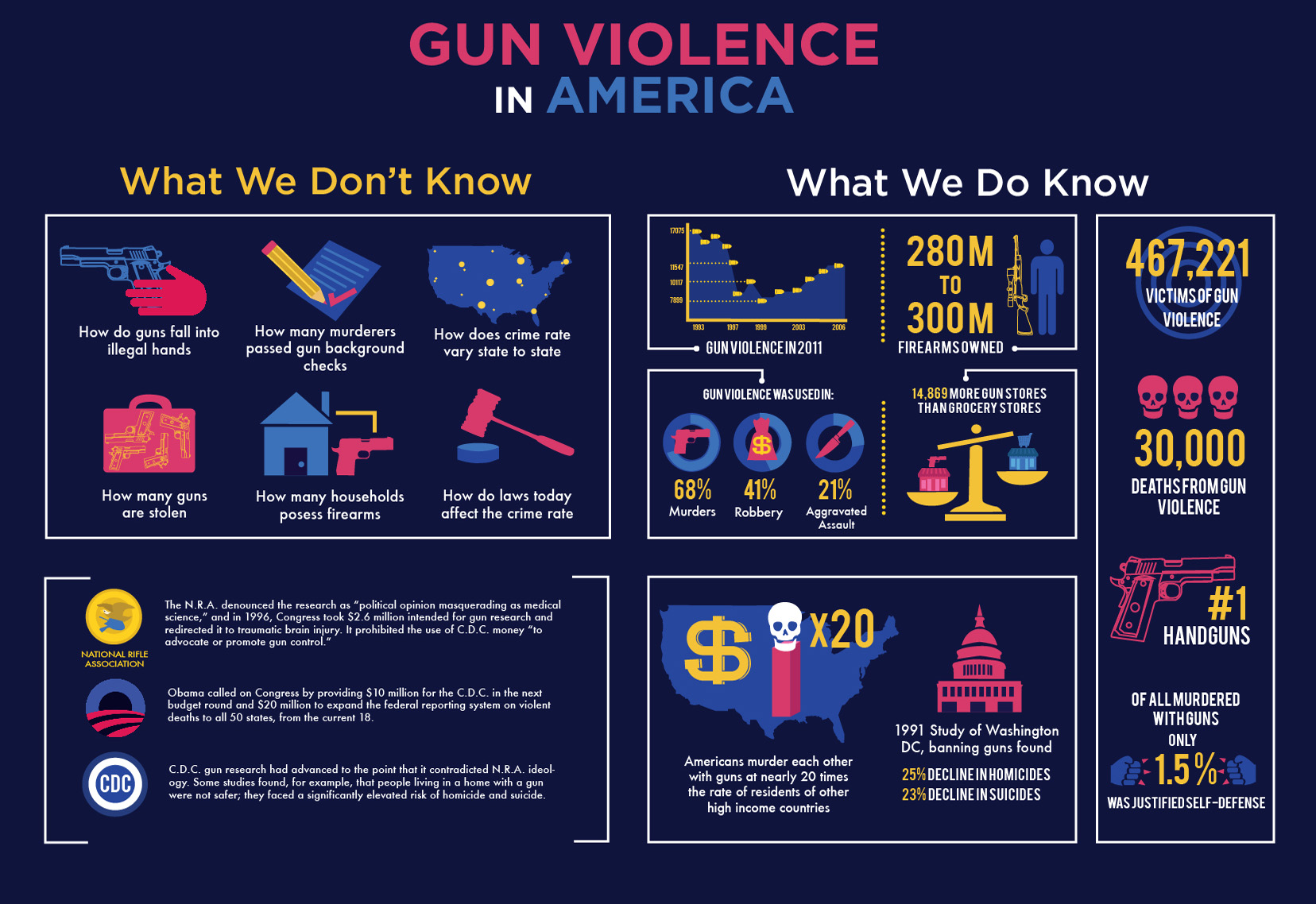
This is a handy infographic explaining the nature of gun violence. And yes, it goes to great lengths to say that it's definitely about the guns. Yes, it's a cultural thing but we can't really dismiss guns from the equation.

This is a handy infographic explaining the nature of gun violence. And yes, it goes to great lengths to say that it’s definitely about the guns. Yes, it’s a cultural thing but we can’t really dismiss guns from the equation.

9. “Other weapons are just as bad.” – Yes, I get that guns aren’t the only weapons that kill people. I’m aware that people die of stab wounds, strangling, bludgeoning, poisoning, or what not. And I know that terrorists could make their own bombs. However, these methods usually take a certain amount of effort to kill somebody. Stabbing, strangling, bludgeoning, and other physical means usually take a certain amount of physical effort and sometimes knowledge of the anatomy. And many of them aren’t always lethal, especially if victims seek proper medical treatment as soon as possible. Poisoning somebody tends to take some degree of planning and preparation as well as has a great potential to backfire in many ways. Murders via poisoning are almost always considered premeditated, especially when the poison can be traced to the source. As for making a bomb, well, you have to pose some degree of knowledge in explosives and chemistry as well as produce it without attracting suspicion. And let’s just say building a bomb without attracting suspicion is a very difficult thing to do if you live within civilization. Besides, even making a bomb would lead to a quick arrest and a long jail sentence. When it comes to killing somebody with a gun, all you have to do is aim and pull the trigger. And even if shooting doesn’t always kill, it will at least send the victim to the emergency room with wounds that might not be easily treatable. The fact guns are deadly weapons even idiots can operate explains why so many people get killed by them.

10. “The only thing that can stop a bad guy with a gun is a good guy with a gun.” – Just because such concept works in Hollywood doesn’t mean it’ll work in real life. But after the Sandy Hook shooting, there was a call by gun rights activists for armed guards in schools as well as possibly arming the teachers. However, they didn’t consider the fact that Columbine High School had an armed guard in 1999 and Virginia Tech has its own campus police force. And we know that neither case had these good guys stopping the shooter. And during the mass shooting in Tucson, Arizona, an armed man nearly shot the unarmed individual who disarmed Jared Loughner when he was reloading. Not to mention, shouting “fire” in a crowded theater is a classic example of endangering others and it’s possible that more people would’ve been killed in that movie theater in Aurora if more people had guns. We should understand that the gun lobby has a vigilante mentality and their supporters usually view the “good guy with a gun” as themselves. But despite what you see in the media, vigilantes might take the law in their own hands on how they interpret it (which might depend on their own agenda). And they may claim to justify their actions as a fulfillment to the community’s wishes. But this doesn’t make vigilantes good people you’d want around during a mass shooting. In fact, it’s understandable why law enforcement loathes vigilantism and why it’s illegal under most circumstances.

11. “Gun control hurts law abiding gun owners.” – Of course, you hear this argument all the time from the pro-gun lobby. However, most gun control measures hardly ever apply to law abiding citizens. And even so, the worst thing law abiding gun owners would be subjected to under tougher gun laws would consist of a background checks and other bureaucratic inconveniences. But other than that, as long as gun owners obey the law and don’t pose a danger to others, it’s very unlikely that gun control will hurt their rights. Under gun control, the people most likely to have their guns taken away are criminals. Besides, gun violence hurts victims, their families, and survivors every day of their lives. Don’t their lives matter, too?

In recent years, the belief that widespread gun ownership as a defense against a tyrannical government has been an alluring idea among Americans. However, this has led to some right wing loons to form citizen militias to defend themselves against government intrusion. As if they'd even have a chance if they'd really have a chance of staging a successful uprising (not).

In recent years, the belief that widespread gun ownership as a defense against a tyrannical government has been an alluring idea among Americans. However, this has led to some right wing loons to form citizen militias to defend themselves against government intrusion. As if they’d even have a chance if they’d really have a chance of staging a successful uprising (not).

12. “But we need guns to protect ourselves against a tyrannical government.” – Government corruption is nothing new that even the Founding Fathers understood it that they came up with checks and balances. Competition between branches in the bureaucracy has assured that no one person or group became powerful. Now the US government has a total of 456 reported federal agencies, all with their own bureaucracy. Despite what small government minded Republicans might say, the size of the government is actually a check rather than a sign of it. And as government grows, so do the regulations and bureaucracy. More bureaucracy means more people. More people means more competition. And competition within government means security. We also have to account that the American political culture is deeply rooted in a 200 year tradition with democracy. And Americans tend to be extremely wary of government infringing on individual liberty which is traced back to the American Revolution. So as far as the US is concerned, there is absolutely no way in our system for one person or party to consolidate power. Now the paranoia that the government’s going to take people’s guns away and the president becoming a tyrant is said to be reminiscent of the Republican Party’s Southern Strategy. In other words, it’s simply right-wing propaganda meant to instill fear. Such paranoia has increased since Barack Obama’s election even though Obama isn’t the first president to support gun control measures (despite having the strongest excuse to do so) and is only different from his predecessors in one superficial way (being black).

The open carry movement is one where people openly carry guns into public places as a way of

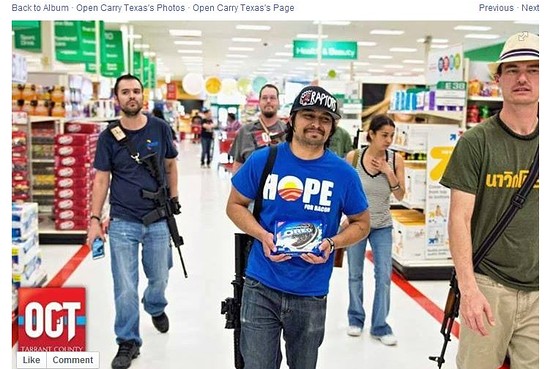
The open carry movement is one where people openly carry guns into public places as a way of “exercising their rights.” Of course, they also manage to scare the hell of reasonable people. Yes, they’re probably loons.

13. “Carrying a gun makes you safe.” – Well, it’s possible that carrying a gun might make you feel safe, but that doesn’t mean other people will. Unless you wear a badge or in a uniform, then carrying a gun in public will make people suspect that you’re a dangerous criminal, an outright loon, or both. If you’re a young man who’s black, Latino, or of Middle Eastern/South Asian descent, then carrying a gun in public will make people suspect the former and possibly call the cops on you due to widespread racial profiling in the US. Seriously, if it was Trayvon Martin shooting George Zimmerman, “Stand Your Ground” would’ve not have gotten him out of a prison sentence. Many gun rights activists think carrying a gun around will make them able to defend themselves and others (a vigilante complex if you will). However, there is no credible evidence that the carrying loaded weapons decreases crime. And studies supporting this notion have been frequently debunked by a range of academic researchers. But that doesn’t stop states from implementing “Stand Your Ground” laws in recent years, which state that civilians can shoot without a duty to retreat, even in public places. Those in the gun lobby states that such laws are needed to decrease crime. But these laws are mostly based on the gun lobby’s vigilante mentality. Researchers at Texas A&M say otherwise.

Contrary to what the gun lobby says, self-defense is rare during crimes. And it's especially less common for a person to defend oneself with a gun. Not only that, but this chart from the Bureau of Statistics and the National Crime Victimization Society reveal that most property crime victims weren't even present at the time.

Contrary to what the gun lobby says, self-defense is rare during crimes. And it’s especially less common for a person to defend oneself with a gun. Not only that, but this chart from the Bureau of Statistics and the National Crime Victimization Society reveal that most property crime victims weren’t even present at the time.

14. “Having a gun at home makes you safe.” – Studies show that a gun in the home is more likely to be used to commit suicide or to threaten and/or kill an intimate than to defend against an attacker. There’s also a chance for accidents which most gun owners are familiar with. Not to mention, leaving a loaded gun out in the open is one of the most irresponsible things a gun owner can do. It’s a recipe for disaster. This is especially true in a home with small children. There’s a reason why you find stuff on gun safety. But you hear a lot from the gun lobby stating how having a gun might help protect you and your family during a home invasion. However, what they get wrong is that home invasions are rare and usually occur when the either residents aren’t home or sleeping. Because they’re mostly robberies. Now a home invasion might be a traumatic experience but the chances of one resulting in homicide are rare. Why? Because burglars want to avoid contact during home break-ins and try to steal stuff as quickly and quietly as possible. Make any noise to wake up the family or the neighborhood and they’re screwed. Still, most people are usually killed or attacked by somebody they know which is why most home homicides usually pertain to family disputes or domestic violence.

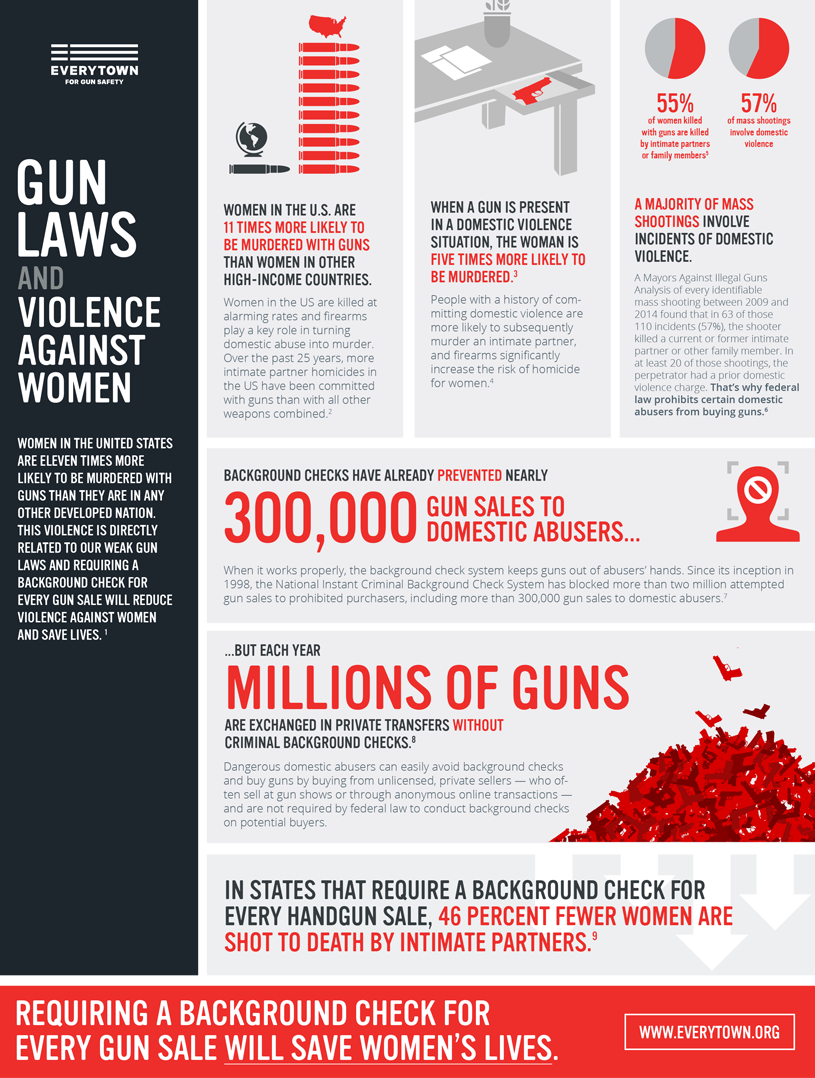
In the United States, women are more likely to be killed by someone they know, particularly a current or ex-significant other. A woman runs an even greater risk of being killed if she's in an abusive relationship with an intimate partner, especially if there's a gun in the house. Therefore, most of the time having a gun for self-defense will not help her.

In the United States, women are more likely to be killed by someone they know, particularly a current or ex-significant other. A woman runs an even greater risk of being killed if she’s in an abusive relationship with an intimate partner, especially if there’s a gun in the house. Therefore, most of the time having a gun for self-defense will not help her.

15. “Guns make women safe.” – I know there are plenty of gun rights activists who say this since women aren’t as physically strong as men. However, a woman’s safety has less to do with whether or not she has a gun in the house than the quality of her relationships. This is especially true when it pertains to intimate partners such as husbands, boyfriends, fiances, and what not. Besides, when gun rights supporters say this, they’re usually referring to women being attacked and/or killed by strangers. But most violent crimes involving women usually pertain to people they know whether they be victims or perpetrators, especially intimate partners. And they’re almost always linked to domestic abuse. Now it’s one thing for a woman to have gun to protect herself on the street against a possible violent stranger. But if you’re a woman living with an abusive partner, owning a gun won’t help your case because that person will try to control you through any means necessary. Besides, when you’re living with someone, it’s much more difficult to keep certain things to yourself, especially if you’re in an intimate relationship with them. Guns are among these things. Your abuser will find that gun and will somehow gain access to it. And there’s a strong chance that they might use it to kill you. After all, in 2010, women were 6 times more likely to be shot by their husbands, boyfriends, and ex-partners than by male strangers. And if a woman’s domestic abuser has access to a gun, she’s more than 5 times likely to be killed by them. It should surprise nobody that there have been calls for implementing gun laws restricting firearms access to spousal abusers. Not to mention, even if a woman successfully shoots her abuser in an effort to defend herself, this doesn’t mean that she’s out of the woods yet. We have to be remember that there are plenty of women in prison for killing their abusers, too, especially if they’re poor women of color. So if you have a little girl, you should probably spend less time teaching her how to shoot and perhaps teach her how to spot a potential domestic abuser and how to get out of it before it gets more serious. Because she’ll be more safe if she’s willing to dump a guy who’s been nasty to the waiter.

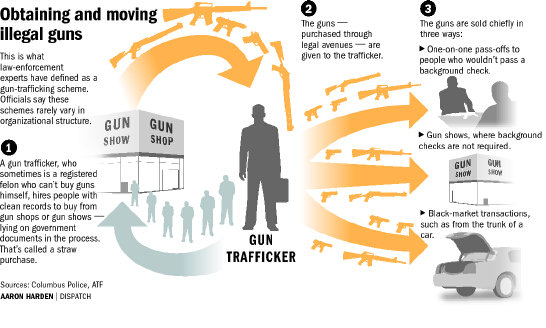
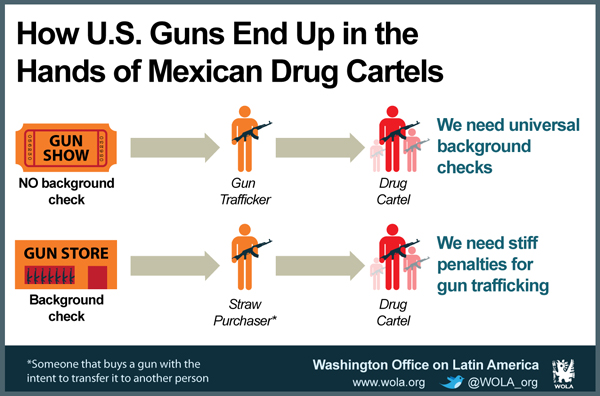
This is a diagram on how gun trafficking works in the United States. Because 40% of all gun transfers don't require background check, this allows criminals to legally purchase weapons through hiring people with clean records to buy the guns for them, one-on-one pass offs, gun shows, and black market transactions. Not to mention, it's not unusual for some criminals to buy guns in areas with looser gun restrictions as well.

This is a diagram on how gun trafficking works in the United States. Because 40% of all gun transfers don’t require background check, this allows criminals to legally purchase weapons through hiring people with clean records to buy the guns for them, one-on-one pass offs, gun shows, and black market transactions. Not to mention, it’s not unusual for some criminals to buy guns in areas with looser gun restrictions as well.

16. “We don’t need more gun laws. We just need to enforce the ones we have.” – Yes, we do need to enforce the laws we already have and even law enforcement agrees. But even law enforcement believes that stronger enforcement without stronger gun laws isn’t enough. Remember that most mass shooting victims were killed with legally purchased weapons such as military style assault weapons with high capacity magazines. Many existing gun laws at the federal level are riddled with loopholes and gaps. And federal enforcement action has been constantly hampered thanks to gun lobby efforts that the Bureau of Alcohol, Tobacco, Firearms, and Explosives is now under-funded and without permanent leadership. Not to mention, 40% of all legal gun transfers don’t require background checks.

17. “Gun control won’t stop gun violence.” – I’m very well aware of that. However, while there have been more mass shootings than there used to be, they’re still relatively rare and very unlikely to happen in most American neighborhoods. Nevertheless, while gun control measures may not be 100% effective, that doesn’t mean they don’t work. Take gun-free zones, for instance. Yes, I know they’ve been sites of plenty mass shootings, but they don’t happen every day. But gun-free zones are everywhere and have rather wide appeal not just among public and civil establishments as well as churches, but also among businesses. Why? Because most people generally don’t like being around guns in public since they don’t feel safe around civilians carrying firearms (law enforcement is a different story at least in the US since they are supposed to know what they’re doing). Guns in public make people very uncomfortable, sometimes to the point of calling the police. Why? Because most people are fully aware that guns are dangerous and can kill people. A stranger with a deadly weapon is often feared, especially civilians whose natures may be unpredictable. And all the mass shootings, armed robberies, and other armed incidents on the news kind of reinforce that fear. So instead of trying to determine which civilians can openly carry a gun, it’s much easier to ban all civilians from carrying guns on the public premises. And even when guns aren’t banned, the gun-free zone mentality still manifests in our social mores. So any open carry activist “exercising their rights” will be viewed as threat no matter whether the establishment permits guns or not. While they might not work all the time, gun-free zones are very effective policy since it prevents an unsafe situation involving lots of people with loaded guns. Besides, unarmed civilians have survived mass shootings and other incidents involving gun violence. The point is that despite gun-free zones being scenes of mass shootings, the practice of banning guns in public places isn’t going away because it’s a policy that’s effective, popular, and smart.

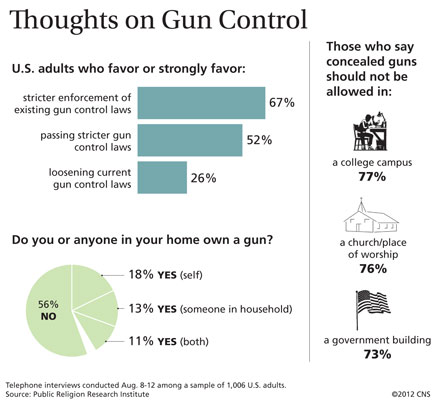
This is a chart from a Catholic magazine from Philadelphia. But though it doesn't have the same poll results I wrote down, it does show that a sizable chunk of the American public support some gun control. Not to mention most Americans don't want guns in school, church, or in government buildings.

This is a chart from a Catholic magazine from Philadelphia. But though it doesn’t have the same poll results I wrote down, it does show that a sizable chunk of the American public support some gun control. Not to mention most Americans don’t want guns in school, church, or in government buildings.

18. “Americans don’t want meaningful gun reform.” – Here in America, you’d be surprised how many issues people viciously fight about that they secretly agree on. Now gun control is a highly contentious issue in American politics as well as polarized among party lines (mostly because the NRA bankrolls a lot of Republican politicians. Not to mention, that the gun lobby tends to run propaganda with an appeal to fear). However, the Joyce Foundation has noted that various public opinion polls show that Americans overwhelmingly support specific gun policy solutions. 92% of Americans support requiring universal background checks on all potential gun buyers while 63% support banning assault weapons. 74% of NRA members also support universal background checks as well.

19. “Guns are essential for self-defense.” – Reports on mass shootings and other violent crimes have led many to believe that fighting crime requires to fight fire with fire. However, according to the Violence Policy Center (based on data by the FBI and the Bureau of Statistics), there were only 258 justifiable homicides involving civilian gun use in 2012. Compare this to 8,342 criminal homicides and 22,000 suicides and accidental shootings. In 2011, nearly 10 times more people were shot and killed during arguments than by civilians trying to stop a crime. Sorry, but the numbers don’t lie. I also hear from many that a mass shooting would’ve been prevented if somebody had a gun on them. However, they forget that whenever you’re in a mass shooting situation, armed civilian confrontation with the shooter is generally not recommended. Rather it’s best advised that you call the cops and let them confront the perpetrator. In the meantime, you’re better off either trying to escape, hiding, or playing dead until the cops show up. Trying to confront the shooter is a quick way to get shot (as well as should only be done as a last resort). And if you use a gun, you might risk endangering others in the process.

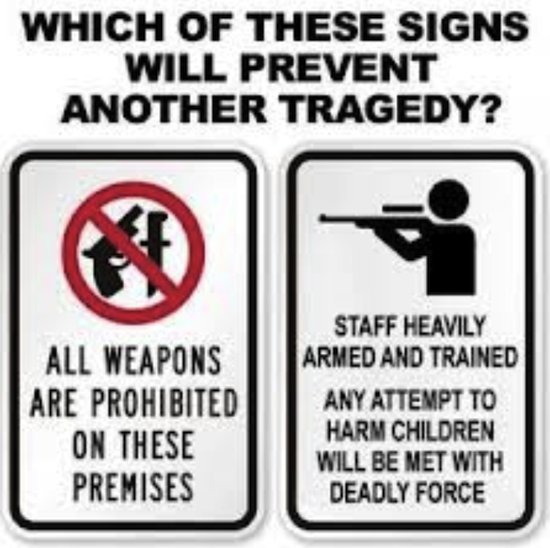
Many people think that trained armed guards would be able to prevent mass shootings since many take place in gun-free zones. However, they tend to forget about the mass shooting at Fort Hood. Still, gun-free zones may not prevent another tragedy, but I'll take my chances with them than in an armed society.

Many people think that trained armed guards would be able to prevent mass shootings since many take place in gun-free zones. However, they tend to forget about the mass shooting at Fort Hood. Still, gun-free zones may not prevent another tragedy, but I’ll take my chances with them than in an armed society.

20. “Switzerland and Israel seem to do okay without gun control.” – Gun rights advocates like to think that Switzerland and Israel to prove that gun control doesn’t make much difference. However, while both countries have a tradition of military service, they also limit firearm ownership and require a permit renewal 1-4 times annually. That may not be as restrictive as other countries, but it’s still gun control. So saying they do okay without gun control resoundingly false.

21. “Other countries are different.” – Yes, US history may differ from those of other countries. And yes, the US might contain American cultural exceptionalism, pioneer spirit, and a history of racial tension. However, having a violent national history is actually the norm among most nation states. Seriously, you’d be hard pressed to find a country that hasn’t experienced some degree of conflict or civil unrest in its past. And there are plenty of countries that have existed in the world longer than the US. Far longer, in fact. Let’s just say world history has no shortage of violent incidents and that people would kill each other on just about anything. And just because many industrialized nations have strict gun laws, doesn’t mean violent crime is non-existent. It just that their violent criminals are less likely to use guns, which results in less people getting killed.

Many people who think American gun violence has to do with illegal immigration are dead wrong. In fact, most of the guns used by Mexican drug cartels were American made. So it's American guns being trafficked into Mexico.

Many people who think American gun violence has to do with illegal immigration are dead wrong. In fact, most of the guns used by Mexican drug cartels were American made. So it’s American guns being trafficked into Mexico.

22. “US borders are too open.” – For God’s sake, undocumented immigrants aren’t the problem in the gun debate. Besides, it’s hard to imagine it would be easy for criminals to obtain weapons that had to be smuggled through ports, airports, or across the Mexican border. Besides, most illegal gun trafficking in the US is within the country itself that most American criminals wouldn’t see the need for importing guns from Mexico. Why would a Chicago gangster go through the trouble of smuggling guns through the Mexican border when he could easily buy one legally in Indiana? It’s just within driving distance and inspections by US Customs are virtually nonexistent. It’s also significantly cheaper. Besides, a lot violence in the world is conducted by American weapons. Seriously, think of all the guns the US has sold to the Middle East and look what happened there. So it wouldn’t make much sense for any American criminals would smuggle guns into the US, especially since Texas lies along most of the Rio Grande. If anything, it would more likely be Latin American drug cartels smuggling weapon across the Mexican border from Texas, which contributes to another problem entirely. Well, at least as far as the US is concerned.

23. “School shootings are a national epidemic.” – I’m aware that a lot of famous mass shootings have taken place in schools like Columbine, Virginia Tech, and Sandy Hook being the most famous. And I’m well aware that the gun lobby has called for school teachers to carry guns, which I think is insane. However, according to FBI crime statistics, the odds of a school shooting in your neck of the woods are statistically rare. More homicides occur in homes, especially if they involve multiple victims. Not to mention, more mass shootings happen in restaurants than in schools. But nobody’s asking the wait staff to carry guns. In fact, it’s said that children are almost 100 times more likely to be murdered outside of school than at school (with odds being 1 in a million). So child gun homicides are more likely attributed to severe family dysfunction (like abuse) than having a classmate who’s a homicidal nutjob. This makes massive school spending on building security seem like a waste in taxpayer money.

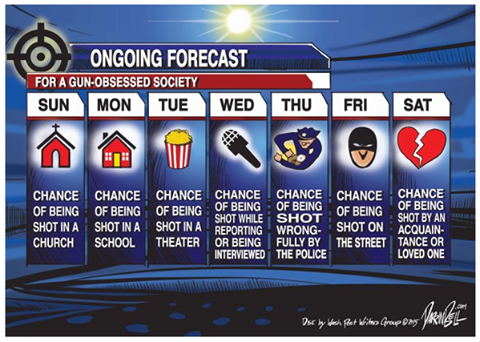
This is a good cartoon from Facebook highlighting the ways people can fall victims of gun violence. Many gun rights activists tend to believe that more guns lead to less crime. However, there's a positive correlation between gun crimes and gun ownership rates.

This is a good cartoon from Facebook highlighting the ways people can fall victims of gun violence. Many gun rights activists tend to believe that more guns lead to less crime. However, there’s a positive correlation between gun crimes and gun ownership rates.

24. “More guns equal less crime.” – This is a very common argument by gun rights activists, which was given rise by a controversial book by John Lott Jr. called More Guns, Less Crime. It has been debunked by peer review since its publication and Lott has also come under scrutiny for ethics violations regarding his research. Other studies arguing about high rates of gun usage in self defense have also come under scrutiny. The Harvard Injury Control Research Center has determined a positive correlation between gun ownership and violence (especially in impoverished neighborhoods). Since the 1970s both have been in decline though there’s been an uptick in recent years. Nevertheless, since the US has one of the highest gun ownership rates, it’s no surprise that 15 of the 25 worst mass shootings in the last 50 years have happened here. Not only that, but the American South is the most violent region in the country as well as has the highest prevalence of gun carrying. Furthermore, The Johns Hopkins Center For Gun Policy and Research have found that expanding concealed carry laws increase aggravated assaults. So contrary to what the gun lobby says, more guns lead to more crime.

25. “Dictators take away guns from their people and look what they do.” – Gun rights activists love to talk about how dictators like Hitler and Stalin took guns away from their own people before they began committing genocide. However, the notion of Hitler and Stalin taking people’s guns away is historically inaccurate. And if Hitler took any guns from people, they were from groups he wanted to exterminate anyway like Jews and Gypsies. As with everyone else, he actually expanded private gun ownership. But you hear many pro-gun activists say that if the Jews and the Gypsies were armed, there would be no Holocaust. But there is no historical basis of this. If anything, arming them might’ve “hastened their demise” according to SUNY political science chair Robert Spitzer. So how did Hitler gain control and remained in power? Well, we have to concede that prior to World War II, Hitler was extremely popular among the German people and throughout the world. I mean he had to be popular enough to be appointed chancellor by President von Hindenburg in 1932, shortly before the Nazi propaganda machine gained full steam. Of course, he also had Brownshirts beating people up but that’s beside the point. Suggesting that the only thing keeping Hitler in charge was the control of guns exonerates many who truly supported him and helped him gain power in the first place. It’s also very bad history that teaches us a terrible lesson. Same goes for the Bolsheviks in Soviet Russia and the idea that an armed populace would’ve stopped them or Stalin is nothing but a fantasy. Ask any White Russian who knows. Stalin was also extremely popular in his country as well. Nevertheless, we should understand that dictators don’t gain control through taking people’s guns away. They do it through propaganda and ruthlessly suppressing dissent in order to secure lifelong popularity. Besides, there are plenty of Third World dictatorships that break into civil war with both sides carrying AK-47s.

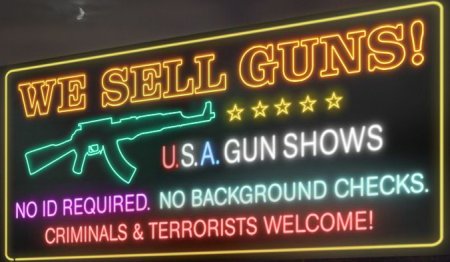
Many gun rights activists may say that legal gun owners don't commit crimes. However, many criminals buy their weapons at gun shows because they don't require background checks. So what does that tell you?

Many gun rights activists may say that legal gun owners don’t commit crimes. However, many criminals buy their weapons at gun shows because they don’t require background checks. So what does that tell you?

26. “Legal gun owners don’t commit crimes.” – Yes, most gun crimes are committed with illegal guns but that’s because in the US, a legally bought gun in Indiana can easily become illegal when sold on the Chicago black market. And federal gun laws are so weak that such acts can go off without a hitch. But even then, the number of legal guns increases and so does the likelihood of a gun falling into the wrong hands. Besides, Mother Jones found that most mass shootings involved legally purchased guns. Also, 40% of legal gun transfers don’t require background checks which makes it easy for criminals legally obtain weapons through hiring people with clean records to buy the guns for them, passing them off one-by-one, gun shows, and black market transactions. Sometimes they can even legally purchase weapons in places with less gun restrictions. Not to mention, there’s a movement to prevent domestic abusers from accessing firearms. And domestic violence is not just a crime, but can also lead to murder, especially if guns are in the picture. So what does that tell you?

27. “Assault weapons aren’t frequently used in crimes.” – Yes, assault weapons aren’t used a lot in crimes since most gun violence is perpetuated by handguns. But whenever an assault weapon is used in an attack, there are 54% more deaths. It’s no surprise that most of the deadliest mass shootings in the US have involved assault weapons like an AR-15. Many tend to use high capacity magazines which allow for higher casualties. Since the 1994 Assault Weapons Ban expired, mass shootings have been on the rise, particularly since 2007.

So if the Second Amendment is absolute, that means I can have my very own fighter jet, right? I mean the gun lobby says Americans have a right to bear arms which shall never be infringed. But they never say anything about my right to own a fighter jet.

So if the Second Amendment is absolute, that means I can have my very own fighter jet, right? I mean the gun lobby says Americans have a right to bear arms which shall never be infringed. But they never say anything about my right to own a fighter jet.

28. “The Second Amendment is absolute.” – Really? Well, let me put it to you, constitutional rights aren’t always absolute either. Take the Second Amendment for instance, which gun rights activists say that it gives people a right to own a gun under any circumstance which must be protected. However, “the right to bear arms” can also pertain to owning a weapon. So if Second Amendment rights were absolute, then I should be able to own a tank, a bazooka, a bomber plane, a fighter jet, a hand grenade, a howitzer, an anti-aircraft gun, and all those cool military weapons that I’m sure are illegal for civilian ownership or use. And I’m sure that the Founding Fathers never intended the Second Amendment to give civilians the right to own a cannon either. Strange that gun rights activists don’t campaign for that because authorizing such weapons for civilians would be downright insane (as you can see how the military put an anti-aircraft gun in a civilian’s back yard in 1941). Still, the fact that even law abiding American citizens can’t privately own these weapons for civilian use should demonstrate that gun control is constitutional. Hell, even Supreme Court Justice Antonin Scalia said so himself in Heller v. DC“Like most rights, the right secured by the Second Amendment is not unlimited…nothing in our opinion should be taken to cast doubt on longstanding prohibitions on the possession of firearms by felons and the mentally ill, or laws forbidding the carrying of firearms in sensitive places such as schools and government buildings, or laws imposing conditions and qualifications on the commercial sale of arms.”

This is a billboard in Illinois that highlights the convoluted ideas of American cultural heritage. One of these is an assault rifle which is a weapon of choice among mass shooters. This is appalling.

This is a billboard in Illinois that highlights the convoluted ideas of American cultural heritage. One of these is an assault rifle which is a weapon of choice among mass shooters. This is appalling.

29. “Guns are a part of America’s heritage. Gun control is not.” – You tend to see American history in movies as quite violent. But the as gun possession is as old as the country, then so is gun control. During the time of the Founding Fathers, state and federal governments conducted several arms censuses (like officials going door to door to ask now many guns you had and whether they worked). Besides, contrary to what the western movies depict, establishments in the Old West did practice some degree of gun control. For instance, guns were often banned in saloons for very good reason. Not to mention, Tombstone had far stricter gun control during the gunfight at the O.K. Corral than it does today (deterring the number of Old West saloon shootouts which is a very common feature in westerns). Also the US implemented gun control policies to crack down on mob violence during the 1920s, particularly when it came to confiscating Tommy Guns. Thus, to not implement gun control because it’s not part of the American heritage is absurd.

30. “Background checks don’t work.” – Actually background checks do. Since its inception the National Instant Criminal Background Check System (NICS) has blocked more than 1.9 million permit applications and gun sales to felons, the seriously mentally ill, drug abusers, and other dangerous people prohibited by federal law from possessing firearms. However, because 40% of gun transfers occur without background checks, more comprehensive gun background checks are needed to curb gun violence and trafficking. Besides, people disobey speed limits all the time. Does that mean we shouldn’t have them?

31. “Gun laws don’t work.” – Actually aside from background checks, other gun control measures work as well. The 1994-2004 Assault Weapons Ban, while riddled with loopholes allowing gun manufacturers to evade, led to a decrease in gun seizures with high capacity magazines by Virginia law enforcement. Seizures spiked after it expired. And mass shootings have been on the rise since assault weapons equipped with high capacity magazines have become the weapons of choice in mass shootings. So despite its faults, the Assault Weapons Ban worked. Not only that, but state laws designed to regulate gun dealers, including regular compliance inspections have been effective in reducing gun trafficking within their jurisdiction.

32. “Gun ownership is on the rise.” – Gun ownership is actually in decline in the US and has been since the 1970s. A vast majority of Americans don’t own firearms. However, those who own guns, own more of them.

33. “It’s more dangerous now than it used to be.” – Of course, crimes stories have a high tendency to get on the news which might make one think that there’s more crime out there than there used to be. And the prevalence of mass shootings has also reinforced that notion. However, since the 1970s, American crime has steadily declined. Gun violence has declined as well. But this doesn’t mean it’s not less of a problem or a public health concern since it kills 30,000 per year.

This is a pro-gun picture depicting how gun-free zones don't prevent mass shootings and how police don't stop massacres. However, if you're in a mass shooting situation, it's generally recommended you don't try to confront the shooter with firearms. It's best advised that you leave the defensive shooting to the police in these circumstances.

This is a pro-gun picture depicting how gun-free zones don’t prevent mass shootings and how police don’t stop massacres. However, if you’re in a mass shooting situation, it’s generally recommended you don’t try to confront the shooter with firearms. It’s best advised that you leave the defensive shooting to the police in these circumstances.

34. “Police don’t show up on time and don’t stop massacres.” – A lot of gun rights activists tend to have a dim view of society and claim that every second counts so it’s better to act now. After all, the shooter could kill, escape taking something, or what not. However, while it takes time for police to get to the scene of a crime when called, this doesn’t mean self-defense is the best option. For instance, for civilians, using a gun to confront a mass shooter is generally seen as a very stupid idea. Besides, when it comes to subduing criminals, the police are professionals who’ve been rigorously trained to stop active shooters. Stopping a mass shooter requires extraordinary skills honed under acute duress which most law enforcement officials have. Most civilian gun owners don’t possess such skills, which most gun rights activists like to ignore and think anyone with a gun can stop a mass shooting. However, that’s really not the case since police can stop massacres and do. It’s the civilians who can’t. So if you’re in a mass shooting situation, it’s better to leave the shooting to law enforcement.

35. “To prevent violence we must be able to predict it.” – Now this argument is tied with the idea we can prevent mass shootings if we provide adequate mental health services to high risk individuals. Sorry, but mentally ill people are no more at risk for violent behavior than anyone else. Besides, prevention by prediction isn’t 100% effective because predictions aren’t always accurate. Seriously, just watch your local weather forecast on the news. Chances are the weatherman has been wrong at least some of the time. Same can be said about gun violence, which many people see as a public health issue. Public health programs have dramatically reduced problems like smoking-related deaths and car accidents. Approaching gun violence the same way should be a no brainer. In fact, numerous studies report that school-based counseling and violence prevention programs are very effective at teaching students how to resolve conflict and problems without escalating to violence. Community mental health services oriented toward prevention are also helpful, especially when it pertains to helping larger populations of people in distress.

These are stats on American gun violence I obtained from an infographic. Despite that gun crimes have gone down, only 10% of non-fatal wounds involved guns. And gun suicides are at an all time high.

These are stats on American gun violence I obtained from an infographic. Despite that gun crimes have gone down, only 10% of non-fatal wounds involved guns. And gun suicides are at an all time high.

36. “The NRA represents freedom.” – Sorry, but living in an armed society isn’t my idea of freedom. The big problem with discussing American gun culture these days is that ideology tends to cloud the facts. The NRA spends large amounts of money to skew the debate by telling everyone that the government is coming for your guns (bullshit). And it doesn’t help that the NRA doesn’t represent the interests of most gun owners these days, even their own members. I mean the NRA is famous for opposing all gun legislation while the most of the people it’s supposed to represent support tighter gun laws. And it has supported gun control measures in the past. So why is that? Well, it turns out that the NRA  these days represents gun manufacturers on its board of directors’ nominating committee.

37. “Gun control can’t prevent suicides.” – Nearly 2 out of 3 gun deaths are suicides which is a harrowing statistic for most but this helps gun rights activists argue that mental illness is the problem, not guns. However, while restricting gun access can’t stop people from choosing to kill themselves, keeping guns away from mentally ill people can be rather effective. In fact, it’s said that firearms suicide rates are closely correlated with gun ownership as well as gun crimes. So gun control might not prevent suicides, but it might help prevent suicides with guns.

38. “Shooting and hunting are important American cultural activities.” – Yes, I know people use guns for hunting and target practice at gun ranges. However, people don’t use AK-47s and AR-15s to hunt deer and can just as easily shoot a box full of holes with a handgun. Why? Because using a military style assault weapons to hunt is just stupid. Gun control measures don’t necessarily mean outright gun bans altogether. Nor does it mean an end to sports shooting either.

39. “Gun violence is a city problem.” – Gun violence takes many forms. Gun homicides on the streets might account for a lot of city homicides. But there are plenty of gun violence incidents in rural areas as well like gun injuries, suicides, and homicides stemming from family disputes and domestic violence. There’s also a higher rate of gun ownership in rural areas, by the way.

This chart illustrate how much gun violence costs American taxpayers every year. We should also count the fact that many gun victims are poor. Yeah, I really think Second Amendment rights are getting kind of expensive.

This chart illustrate how much gun violence costs American taxpayers every year. We should also count the fact that many gun victims are poor. Yeah, I really think Second Amendment rights are getting kind of expensive.

40. “Gun control is expensive.” – It’s no surprise that many gun rights activists tend to equate gun control with big government and high spending. However, loose gun laws aren’t as cheap as you make them out to be since they tend to cost billions of taxpayer money each year on medical and legal costs. And it doesn’t help that most gun violence victims and perpetrators tend to live below the poverty line as well as are either uninsured or on public assistance. From how I view it, gun control as a means to prevent violence is probably much cheaper.

Many pro-gun activists say that so many mass shootings happen in gun-free zones because it makes victims defenseless. But the real story is that public venues most likely tend to be gun-free zones. Besides, the Fort Hood shooting has told us that mass shooters don't give a shit about a public facility's gun policy anyway.

Many pro-gun activists say that so many mass shootings happen in gun-free zones because it makes victims defenseless. But the real story is that public venues most likely tend to be gun-free zones. Besides, the Fort Hood shooting has told us that mass shooters don’t give a shit about a public facility’s gun policy anyway.

41. “Local restrictions attract mass shooters.” – You hear this a lot from gun rights activists since many famous mass shootings have taken place in gun-free zones and leaving victims defenseless. However, as I said before, gun-free zones are very effective policy regardless of whether they attract mass shootings or not. Besides, we should be aware that most gun-free zones are public venues used by a lot of people, which attract violence and crime. Because buildings open to the public normally do that explaining why we have gun-free zones in the first place as a safety measure. It’s just an obvious fact. Not only that, but the fact 43 people were shot during the Fort Hood shooting shows that mass shooters don’t give a shit about firearms policy. Seriously, Fort Hood’s status as a military base makes it far from a gun-free zone. I mean the place would have guns everywhere and people trained to use them, including armed guards. But that didn’t prevent 13 people from being killed in the shooting. Mass shooters’ choices of location usually involve other motives, especially if there’s a chance they’ll know any potential victims. For instance, the Fort Hood shooter was a disturbed army psychiatrist who worked there. The shooters at Columbine, Virginia Tech, and Sandy Hook were students there at some point in their lives. We should also account for the fact that most mass shootings involve legally purchased weapons. Besides, despite how pro-gun activists complain about gun-free zones, confronting a mass shooter with a loaded gun is actually a very stupid idea, anyway. Not to mention,  just because a place with loose gun laws doesn’t experience a lot of gun violence doesn’t mean it’s not contributing to the problem. After all, look how loose gun laws in Indiana are contributing to gun violence in Chicago.

42. “Now isn’t the time to talk about guns.” – You tend to hear this in the event of almost every mass shooting or major tragedy involving guns. Yes, I know discussing politics isn’t appropriate after a major tragedy. But mass shootings have been on the rise since 2007 and most experts agree that gun violence is a major public health issue that kills 30,000 a year. Furthermore, gun control measures tend to have a lot of support from law enforcement as well as health care workers who specialize in emergency medical care. Besides, we must remember that Aurora and Newtown happened during the same year. A year before that, a US House Representative was shot in the head in Tuscon. So if now’s not the time to talk about gun control, when is?

43. “Criminals won’t consent to background checks.” – Yes, criminals hate background checks because they limit their ability to buy a gun. However, many of them go through them anyway and get blocked just the same. Nevertheless, if a criminal doesn’t want to consent to a background check then they won’t be allowed to buy guns legally. Thus, by closing legal avenues for them to buy guns, they’ll be forced to risk buying illegal weapons, which police can arrest them for. And if a criminal can’t legally buy a gun in one area, they’ll buy it in another with less gun restrictions.

This is former Democratic US Congresswoman Gabrielle Giffords and her husband astronaut Mark Kelly. In 2011, Giffords was shot in the head by Jared Loughner in her district of Tucson, Arizona. She had to resign her seat to recover from her injuries. She and her husband are now advocates for gun control, not surprisingly.

This is former Democratic US Congresswoman Gabrielle Giffords and her husband astronaut Mark Kelly. In 2011, Giffords was shot in the head by Jared Loughner in her district of Tucson, Arizona. She had to resign her seat to recover from her injuries. She and her husband are now advocates for gun control, not surprisingly.

44. “But politicians send their children to school with armed guards.” – Fox News likes to point out this one to make many politicians who support gun control look like hypocrites. However, we should note that politicians are public officials and their name recognition makes them assassination targets along with their families. Threats against politicians and their children can disrupt public policy and are a very real threat. This is why we have the Secret Service protecting the President of the United States at all times. Besides, the US has had 4 presidents assassinated. We’ve also had a US congresswoman shot in the head in Tucson not too long ago. There’s nothing hypocritical or elitist about having gun-free zones while our leaders have armed guard protection. I mean not everyone can have their own Secret Service protection, so gun-free zones are the next best thing.

45. “Regulations in gun sales are ineffective because there are so many guns out there.” – The reason why there are so many guns out there is because the US has lax gun regulations at the national level. Besides, despite the number of guns in our society, there’s no reason to make the problem worse than it already is. Guns are so plentiful today that criminals don’t keep their guns long since guns used in crimes can be evidently linked to shootings. So criminals just dispose and replace them with clean weapons. Most criminals don’t have a hard time obtaining clean guns if they know where they can buy one. Regulating gun sales at the national level will eventually lead to criminals having to either hold on to their dirty weapons and risk arrest or spend a ton of money to buy a new gun.

Perhaps these lines from Bob Dylan's

Perhaps these lines from Bob Dylan’s “Blowin’ in the Wind” say it best. However, despite what many might say, we need gun control at a national level now. If we don’t act, then more lives will be lost or ruined.

For More:

The Brady has a handy website on state gun laws called Crimm Advisor. Helps explain the illegal gun trafficking situation within the country and why national action is needed. Crimadvisor

Law Center to Prevent Gun Violence: Law Center to Prevent Gun Violence – Gun Law Information Experts

Money Is Not Speech: Why We Must Get Rid of Citizens United

220px-adbusters_flag1

As it’s become apparent that the 2016 US presidential election campaigns are in full swing, I would like to devote a post to the issue of campaign finance. As 2016 draws upon us, we should expect to see more political ads in the media featuring candidates asking us to cast their votes. Now discussing campaign campaign finance may not be as interesting as other issues the media and the populace like to talk about. But in our day in age, it’s apparent that money has a profound influence in political policy in the United States. Wait a minute, money has a profound influence in pretty much everything. It’s just money has a higher influence in politics than most walks of life. While political candidates may act like prima donnas now and then, we need to note that it’s through elections that we choose our government leaders. Whoever’s in government usually shapes social policy. And social policies affect our lives in more ways that we’d like to admit. So yes, money does play a crucial role in politics, especially when it pertains to who’s giving it.

Yes, elections are decided by voters. But if you want to run for office, you will need to promote yourself and convince voters to go for you. That costs money. So this is where campaign financing comes in.

Yes, elections are decided by voters. But if you want to run for office, you will need to promote yourself and convince voters to go for you. That costs money. So this is where campaign financing, fundraising, and donations come in.

But aren’t elections decided by votes? Absolutely. And doesn’t everyone have only one vote? Sure. However, if you want to run for elected office, you need to promote yourself as a candidate in your constituency. To do that, you need to tell voters who you are and why they should choose you some time before the election actually takes place. In our mass media culture, it’s best you start early. Now candidates promote themselves in a variety of different ways like personal appearances, endorsements, and advertising through signs, mailings, social media, newspapers, radio, television, the works. All that costs money. So how will get it? From anyone willing to give it to you which is the reason why candidates hold fundraisers as well as have mass mailings to solicit donations.

This chart shows who received the most campaign funds in the 2010 midterm elections. Since donors tend to have some relationship with elected officials, it's no surprise that most donations go to incumbents. And it's no wonder that incumbents usually win. Even in Congress which has a 90% reelection rate.

This chart shows who received the most campaign funds in the 2010 midterm elections. Since donors tend to have some relationship with elected officials, it’s no surprise that most donations go to incumbents. And it’s no wonder that incumbents usually win. Even in Congress which has a 90% reelection rate.

However, although every US voter is equal in electoral value, they are not all equal financially nor as willing to give money to a political candidate. In fact, more than 90% voters don’t since well, they either can’t afford to or don’t have much interest to. Giving money to a political candidate isn’t like giving to a church, charity, PBS station, non-profit, college, or cultural establishment. You aren’t giving money because you have an affinity for it or want to do something good. No, people give money to political candidates because they want them to win so they can put forth social policy that they want. Still, even among those who contribute to political campaigns, most will contribute no more than $200, while some will donate hundreds or thousands. If you’re a political candidate, chances are you’re going to actively seek political donations from the entities who contribute the most campaign cash. In 2010, small donors only contributed to 13% to congressional candidate funds (which doesn’t include PACs that make up 23%). Large donors contributed to 48% of campaign donations. But here’s the thing, most big money donors won’t just hand you a large chunk of cash right off the bat. No, for before they give you the money, they want to know where you stand on the issues and what you’d be willing to do for their interests. And you’ll have to curry to their good graces by promising them that you will do everything you can to please them once elected. If you think it’s a form of bribery, you’re probably right. Yet, as far as I know it’s perfectly legal. Nevertheless, the more big money donations you have, the more you can spend on campaign advertising. And the more you can spend on advertising, the more likely people will vote for you. So everything’s fine, right?

Here's an infographic on the 2012 presidential election between Barack Obama and Mitt Romney showing where the money came from in their campaigns. However, while Romney managed to raise more money, Obama still won reelection.

Here’s an infographic on the 2012 presidential election between Barack Obama and Mitt Romney showing where the money came from in their campaigns. However, while Romney managed to raise more money, Obama still won reelection.

Well, not really. While government officials are elected to represent the people and fulfill campaign promises, we all know all too well that it’s not exactly the case. Yes, candidates make promises on the trail to get them to vote for you. But that doesn’t mean all will be fulfilled, given the realities of the political landscape. But since these rich donors give money to these candidates, then they believe in the issues they stand for, right? Actually it depends on the contributor. Sure there are donors who do contribute money to those who share their views or party affiliation. But there are plenty of other donors who just want to gain political influence and will contribute to any candidates regardless of party or issue stance (even in the same race). All they care about is having friendly access the candidate so they could support measures they want, even if their wishes contradict the campaign promises and party platform. They may even contribute money because you oppose their interests and just want you to keep quiet. Hell, they don’t care if their wishes works against the candidate’s conscience or their constituents. And sometimes not even the laws. Of course, while this may put some politicians in a dilemma, many tend to follow the wishes of these big contributors to keep their cash flowing. After all, they need the money for reelection and don’t want the other guy to have more influence and capital than them. But do these political money deals benefit the American people?

During the 2010 elections, the biggest sources of campaign funds came from large individual donations consisting of 48%. Small donations from individuals only consisted of 13% of funds. PACs contributed 23%.

During the 2010 elections, the biggest sources of campaign funds came from large individual donations consisting of 48%. Small donations from individuals only consisted of 13% of funds. PACs contributed 23%.

Actually no. The fact that politicians are more likely to listen to large donors than their constituents suggests that there’s something very wrong in our political system. Yes, people elect their government officials but since they depend on campaign contributions to promote themselves, they usually tend to side with their backers who tend to have their very own lobbyists. After all, most incumbents usually get reelected so those voters aren’t going anywhere. Besides, the biggest incumbent supporters are usually long term donors they’ve had a relationship with every election year. To them, giving is a way of life and a cost of doing business all for the sake of having access to a politician, which leads to more power and influence on policy. But some of these donors can be fickle and might shift their money to the politicians in the majority party whenever the balance of power changes. And it doesn’t help that the fundraising never stops since an successful US Congressional campaign costs $1.4 million on average. But US Congressmen are elected every 2 years so it’s a rather short time window. And US Senate campaigns cost more than 6 times as much. But as money becomes more important in politics, the politicians seem more like a lackey to their rich overlords than the constituents who they’re supposed to represent. This leads to most of the American people having a considerable less political influence in politics, less access to lawmakers, and less of a chance of having their interests heard. More often than not, they become nothing but mere pawns who tend to cast their vote against candidates who may not represent their best interests for various reasons. But it’s mostly because they either know the guy, party line, or that they have no other choice. Thus, as big donors tend to have more access to politicians, American citizens lose out.

While the Federal Election Commission is supposed to oversee campaign regulations, it was designed as an ineffective organization from day one. The fact our system can't create agencies without congressional approval kind of explains why. Because  Congressman have to be elected.

While the Federal Election Commission is supposed to oversee campaign regulations, it was designed as an ineffective organization from day one. The fact our system can’t create agencies without congressional approval kind of explains why. Because Congressman have to be elected.

But don’t they have rules and regulations on campaign finance? We have a Federal Election Commission (FEC) that’s supposed to enforce and oversee campaign finance laws, it’s notoriously ineffective. However, as an organization that’s supposed to monitor lawmaker behavior, it’s no surprise that it was designed this way even if it was created in response to Watergate. And being the elected politicians they were, lawmakers made sure that the campaign watchdog would have a very tight leash and interfere as little in their campaigns as possible. I mean they set the FEC up as a 6 member body so no ruling can go into effect without a 4 vote majority. This is often impossible since the FEC is evenly split with 3 Republican as well as 3 Democratic commissioners, each nominated by their respective parties. Tie votes are often commonplace on some of the most important campaign finance issues which make the system riddled with loopholes. Because of this, the agency often takes years to resolve complaints and political operatives have learned that they can live on the edge of the law with little fear or interference from the FEC. And judging by the political culture these days, I’m sure the people behind the FEC knew what they were doing.

In 2010, the Supreme Court ruled in favor of Citizens United which stated since money is speech, then corporations and unions should contribute as much as they want to political campaigns. Unfortunately, not everyone has money and such notions basically keep many Americans from having a political voice. And it's apparent that most Americans don't like it.

In 2010, the Supreme Court ruled in favor of Citizens United which stated since money is speech, then corporations and unions should contribute as much as they want to political campaigns. Unfortunately, not everyone has money and such notions basically keep many Americans from having a political voice. And it’s apparent that most Americans don’t like it.

Still, despite it’s reputation, the FEC is quite effective with improving disclosure for campaign contributions for the most part. But even this has its limitations. And then there’s the matter with the Citizens United Supreme Court case in 2010, which did away with many campaign finance laws already on the books as well as opened up unlimited spending by corporations, unions, and other independent groups. This led to the 2010 elections seeing an unprecedented flood of outside money flowing into congressional races all over the country. Tens of millions of dollars came from secret donors whose identities will never be known. Much of this campaign spending goes to funding political advertisements to elect (or defeat) candidates running for office. However, the money in question can only be used for independent expenditures (not direct contributions to the candidates’ campaigns). And whatever ads are produced can’t be coordinated with the candidates. Of course, it’s no small stretch to say that such measures aren’t always enforced. Thus, rich donors didn’t particularly give a shit since they want to contribute as much money as they want with little or no consequence. However, they didn’t win when it came to disclosing political contributions on account that their right to privacy isn’t as important as the public’s right to know who’s funding who if amount is over $200. The Supreme Court has also said that disclosing campaign contributions is the best way to guard against political corruption. Of course, this brings me to the outside political organizations created to raise campaign funds for elections:

This is the logo for a realtors' political action committee or PAC. It's supposed to pool contributions from members to contribute to political purposes. According to federal law, an organization becomes a PAC when it receives or spends more than $2,600.

This is the logo for a realtors’ political action committee or PAC. It’s supposed to pool contributions from members to contribute to political purposes. According to federal law, an organization becomes a PAC when it receives or spends more than $2,600.

PAC (political action committee)- an organization designed to specifically pool campaign contributions from members to donate for political purposes whether it’s to campaigns for or against a candidates, ballot initiatives, or legislation. According to the Federal Election Campaign Act (FECA), at the US federal level, an organization becomes a PAC when it receives or spends more than $2,600 for the purpose of influencing a federal election. As for state level, the money pertaining to state elections in PAC designation varies. There are many types depending on political purposes and how each one spends their money. Still, you’d see at least one in almost every type of political advocacy organization you could think of. However, PACs have to follow certain criteria which includes:

  1. Though corporations and labor unions may sponsor a PAC as well as provide financial support through administration and fundraising, they can’t contribute through their own treasuries.
  2. Union-affiliated PACs may only solicit contributions from members.
  3. Independent PACs may solicit contributions from the general public and must pay their own costs from those funds.
  4. Federal multi-candidate PACs may contribute to candidates as follows:
  • $5,000 to a candidate committee for each election (primary and general elections count as separate elections)
  • $15,000 to a political party per year
  • $5,000 to another PAC per year
  • PACs may makes unlimited expenditures independently of a candidate or political party

The types of PACs consist of the following:

This is the United Steelworkers PAC which is an example of a connected PAC. These are sponsored by corporations and unions. These can only raise money from a

This is the United Steelworkers PAC which is an example of a connected PAC. These are sponsored by corporations and unions. These can only raise money from a “restricted class” of donors though the entities can pay for the administrative costs and fundraisers. For instance since the United Steelworkers is a union, it can only receive money from its own members.

Connected PACs- designated as “separate segregated fund” (SSF), these are sponsored by labor unions and corporations. These PACs may only raise money from a “restricted class” generally consisting of managers and shareholders for corporations and members for unions and other interest groups. Sponsor may not contribute to the PAC directly but can absorb costs of administrative operations and soliciting contributions. As of 2009, there were 1,598 registered corporate PACs, 272 related to labor unions, and 995 to trade organizations.

This Free Enterprise PAC from Idaho is an example of a non-connected PAC, used by politicians, parties, and ideology groups. Unlike connected PACs, they must pay their administrative expenses through donations but may accept funds by anybody. It's one of the fastest growing categories in campaign finance.

This Free Enterprise PAC from Idaho is an example of a non-connected PAC, used by politicians, parties, and ideology groups. Unlike connected PACs, they must pay their administrative expenses through donations but may accept funds by anybody. It’s one of the fastest growing categories in campaign finance.

Non-Connected PACs- basically financially independent PACs that must pay for its own administrative expenses with contributions it raises. May be financially supported by an organization but such expenditures are considered PAC money which are subject to the dollar limits and other requirements of FECA. May accept funds from any individual, connected PAC, or organization. Used by members of Congress, political leaders, ideology, and single-issue groups. As of 2009, there were 1,594 registered, the fastest growing category.

Now this is CAPAC which is a PAC for Asian and Pacific Islander Americans in Congress. This is an example of a leadership PAC sponsored by political parties and elected officials. Now these can't be used to fund an official's own campaign but they can fund other expenses.

Now this is CAPAC which is a PAC for Asian and Pacific Islander Americans in Congress. This is an example of a leadership PAC sponsored by political parties and elected officials. Now these can’t be used to fund an official’s own campaign but they can fund other expenses.

Leadership PACs- non-connected PACs sponsored by elected officials and political parties with independent expenditures, which isn’t limited (as long as it isn’t coordinated with the other candidate). Nor can they be used to support the official’s own campaign. Set up since elected officials and political parties can’t give more than the federal limit directly to candidates. Can fund travel, administrative expenses, consultants, polling, and other non-campaign expenses. Used by dominant parties to capture seats from other parties. Between 2008 to 2009, these have raised more than $47 million.

Of course, this is Stephen Colbert's Super PAC, which started appearing after the Citizens United ruling. Now these may not contribute or coordinate directly to candidates or campaigns. But there is no legal limit on contributions it can receive. As of August 2012, these have raised over $349 million with 60% from just 100 donors.

Of course, this is Stephen Colbert’s Super PAC, which started appearing after the Citizens United ruling. Now these may not contribute or coordinate directly to candidates or campaigns. But there is no legal limit on contributions it can receive. As of August 2012, these have raised over $349 million with 60% from just 100 donors.

Super PACs- Citizens United gave rise to this new kind of PAC designated as “independent-expenditure only committees,” because they may not make contributions to campaigns or parties directly but can generate any political spending independently of the campaigns. Unlike other PACs, there is no legal limit on funds they can raise from individuals, corporations, unions and other groups, provided they are operated correctly. As of August 2012, 797 of these have raised $349 million, with 60% of that money coming from just 100 donors, according to the Center of Responsive Politics. Also, Stephen Colbert started his own Super PAC for his show to inform his viewers how it’s done (but he donated all the money he raised to charity).

Aside from the PACs, there are some other organizations and entities also known to raise money for political campaigns as I list below:

Crossroads GPS is one of many 501(c)(4)s that have appeared after the Citizens United ruling. Considered

Crossroads GPS is one of many 501(c)(4)s that have appeared after the Citizens United ruling. Considered “social welfare” organizations under the IRS, they can only use 49.9% of their contributions for political purposes. Can accept unlimited contributions as well as aren’t required to disclose their donors. In 2012, Crossroads GPS and Americans for Prosperity raised more money into the presidential campaigns than all of the Super PACs combined.

501(c)(4) Organizations- defined by the IRS as “social welfare” non-profit and tax-exempt organizations but may also participate in political campaigns and elections. That is, as long as its “primary purpose” it promoting social welfare and not political advocacy (50.1% of their spending efforts much go to “social welfare” activities or “promoting in some way the common good and general welfare of the people of the community.”) Like Super PACs they can accept unlimited amounts of money from corporations, unions, or other interest groups. However, they are not required to disclose spending on their political activity or information on their donors unless they give for the express purpose of political advocacy. Traditionally these have been civic leagues promoting social welfare or local associations of employees with limited memberships to a designated company or a municipality or neighborhood. And often these net earnings went exclusively to charitable, educational, or recreational purposes. Groups like Planned Parenthood, the National Rifle Association, the NAACP, the National Organization for Marriage, the Sierra Club, and the League of Conservation Voters have been active in lobbying and have long held 501(c)(4) status before 2010. Citizens United has seen a dramatic rise of these organizations that contributed to a sharp increase in outside campaign spending from undisclosed sources from a bit more than 1% ($700,000) in 2006 to 44% ($1.27 million) in 2010. In 2012, that number was more than $308 million. And as far as we know much of this anonymous donor money went to Republican organizations and candidates since it helped topple the Democrats in Congress that year. And as of August 2012, two of the biggest 501(c)(4) organizations (Crossroads GPS and Americans for Prosperity) put more money into the presidential campaign than all the Super PACs combined, according to Pro Publica. However, these two groups were much less successful in that year’s presidential election (because Obama still won). Along with Super PACs, it’s also said that these organizations tend to coordinate among themselves and each other. Nevertheless, almost every advocacy organization has one. Also, Stephen Colbert talked about these on his show as well.

MoveOn.org is a famous example of a 527 organization. These are tax-exempt and not regulated under federal and state election laws. Mostly because they don't

MoveOn.org is a famous example of a 527 organization. These are tax-exempt and not regulated under federal and state election laws. Mostly because they don’t “expressly advise” whether to elect or defeat a candidate or party (officially). Can receive unlimited donations from anyone and there are no limits. However, they are required to file with the IRS and report independent expenditures.

527 Organizations- tax-exempt organizations which aren’t regulated under state and federal campaign finance laws because they do not “expressly advocate” the election or defeat of a particular candidate or party. When operated within the law, there are no limits on contributions to these groups or restrictions on who may contribute. Nor are they subject to spending limits either. However, they must register with the IRS, disclose their donors, and file periodic reports of contributions and expenditures.

Political Parties- while they may do more than just raise campaign cash, national and state party committees may contribute funds directly to candidates and make additional “coordinated expenditures” for their nominees in general elections. But these are subject to FECA limits. However, national party committees may make unlimited “independent expenditures” to support or oppose federal candidates. Nevertheless, since 2002, national party committees have been prohibited from accepting any funds outside FECA limits.

Here's an infographic on the bundler contributions in the presidential elections. These are individuals who raise money from other contributions and present the sum to the campaign.  However, while disclosing them isn't required, they are likely to be appointed to posts in presidential administrations.

Here’s an infographic on the bundler contributions in the presidential elections. These are individuals who raise money from other contributions and present the sum to the campaign. However, while disclosing them isn’t required, they are likely to be appointed to posts in presidential administrations.

Bundlers- actually these are individuals who can gather contributions from many individuals in an organization or community and present that sum to the campaign. They’re often recognized with honorary titles and sometimes exclusive events featuring the candidate. It has evolved into a more structured form in the 2000s and we know that all high profile candidates use them. However, there’s currently no law requiring disclosure of campaign bundlers as long as they’re not active, federally registered lobbyists. Nevertheless, the amount raised by bundlers has grown significantly with each election year with average contributions to winning presidential candidates reaching $186.5 million in 2012. We should also note that bundlers are more likely to be appointed to administration posts. In the Obama administration, it’s apparent that 80% of those collecting over $500,000 took key administration posts. George W. Bush appointed about 200 bundlers to posts in his administration.

I know writing about this campaign finance stuff might seem boring and meaningless to you in our political process. But it’s not. In fact, knowing about such organizations can explain how campaign donations for elections shapes the political landscape. Besides, noting how campaign finance works tends to explain a lot about what’s going on in this country. The rise in political activity pertaining to 501(c)(4)s was what led to the IRS scandal in 2013 as employees tried to create ways to weed out organizations that applied for 501(c)(4) status for being overly political. Their methods might not have been specifically appropriate but you really couldn’t blame the IRS for suspecting certain applicants of being overly political, particularly if they support conservative or Tea Party policies. This is especially the case if the recent 501(c)(4)s like Karl Rove’s Crossroads GPS and the Koch Brothers’ Americans Prosperity which many people seem to believe as having little to do with promoting the social welfare whatsoever. Following the money in Washington also explains other recent events as well. Powerful healthcare lobbies help explain why it was so difficult for Democrats to pass the Affordable Care Act despite a Democratic presidential administration and significant control of both congressional houses. The significant influence of the Koch Brothers and industry on Washington help explain the pervasive influence of climate change denial among Republican politicians and why so many polluters shift clean up costs to taxpayers during environmental disasters. And the NRA’s influence helps explain why no gun control legislation has ever been passed in either congressional house, despite the prevalence of mass shootings in recent years.

Open Secrets.org has this diagram of how much campaign cash each sector contributes between 1990-2010. The fact the financial sector contributes the most money offers a great explanation why almost no one involved in the Wall Street collapse in 2008 was prosecuted.

Open Secrets.org has this diagram of how much campaign cash each sector contributes between 1990-2010. The fact the financial sector contributes the most money offers a great explanation why almost no one involved in the Wall Street collapse in 2008 was prosecuted.

But what the nature of campaign finance really helps explain is the relationship between Washington and Wall Street. The fact that the financial sector tends to be the largest contributor to federal office candidates and parties explains why the federal government has been so reluctant to prosecute Wall Street after the 2008 recession. It helps explain why many Republicans have vociferously opposed raising taxes and instilling regulation but supported bailouts. Yet, the financial sector also contributes money to Democrats which doesn’t make passing financial reform on Capitol Hill any easier. Just so you know, the financial sector contributed $468.8 million to federal campaigns and candidates in 2008 alone (80% more than in 2006) and has spent more on K Street lobbying than any other sector. As of 2014, the financial sector has spent nearly $500 on lobbying as well reports 855 clients and 2,358 lobbyists. Thus, it’s a very powerful influence in Washington as well as a very corrupting one. Wall Street’s dubious practices basically led to an economic collapse and recession in 2008 as well as put so many people in financial ruin, possibly for the rest of their lives. But because of the financial sector’s hold on Washington, the federal government walks a fine line between its obligation to the general public and the desires of powerful backers many of them committed actions that should’ve put them in jail.

This is an infographic from the Center for Media and Democracy explaining how ALEC works. Now it calls itself a nonprofit and nonpartisan organization. However, it's really a business friendly conservative bill mill. Let's just say, even if you disagree with my politics, this is a very powerful lobby whose activities should concern you.

This is an infographic from the Center for Media and Democracy explaining how ALEC works. Now it calls itself a nonprofit and nonpartisan organization. However, it’s really a business friendly conservative bill mill. Let’s just say, even if you disagree with my politics, this is a very powerful lobby whose activities should concern you.

Still, while this post appears to focus on the nature of campaign finance in Washington, the corrupting influence of the political money culture doesn’t just affect the federal government alone. State governments have their officials supported by the same kind individuals and organizations with the same agendas and in very much the same way. Of course, what’s different at the state level is voters can elect more people to office like high court justices and cabinet positions. However, there’s a special nonprofit organization founded in the 1970s called the American Legislative Exchange Council (ALEC) consisting of state legislators and private sector representatives. Now according to ProPublica, ALEC is said to produce model legislation that is heavily influenced by big business and industry as well as “works to advance the fundamental principles of free-market enterprise, limited government, and federalism at the state level through a nonpartisan public-private partnership of America’s state legislators, members of the private sector and the general public.” Each year almost 1,000 bills based on ALEC’s “model” legislation are introduced in state houses across the country of which about 200 become law. Now these ALEC sponsored bills advocate a wide range of measures like reducing corporate regulation and taxation, combating illegal immigration, loosening environmental regulations, preventing Medicaid expansions and other state-related Obamacare policies, reducing pensions for public employees, retaining the minimum wage, privatizing prisons as well as enacting harsh sentencing laws, deregulating the telecom industry, privatizing public education, tightening voter identification rules, weakening labor unions, and promoting gun rights. It also acts as a networking tool among Republican state legislators, allowing them to research conservative policies implemented in other states. Not to mention, it’s funded almost exclusively by big business.As of 2013, ALEC’s membership consists of 1,810 state legislators representing nearly a quarter of legislative seats in the US as well as 300 corporate, foundation, and private-sector members.

Now this is a rough diagram explaining how ALEC works and its appeal among corporations and politicians. Now ALEC helps give each entity what they want on an expense paid vacations and parties. Corporations get legislation tailored to their interests and access to politicians. And politicians gain access to campaign funds and private sector jobs.

Now this is a rough diagram explaining how ALEC works and its appeal among corporations and politicians. Now ALEC helps give each entity what they want on an expense paid vacations and parties. Corporations get legislation tailored to their interests and access to politicians. And politicians gain access to campaign funds and private sector jobs.

Now it’s very simple to explain why politicians and private entities would want to join this organization if you know a anything about campaign finance. ALEC allows state legislators to be acquainted with potential campaign backers while it helps corporations gain access to and form long term relationships with politicians.They also hold meetings on all expense paid trips in cities across the country that are said to resemble vacations (sometimes funded by taxpayer money by the way). Another way to explain its appeal was how it helps draft model bills through task forces during their meetings. Public and private sector members make up each of their task forces with the later typically being corporate or think tank representatives (who have veto power over drafted model bills). These task forces generate model bills that members can customize an introduce for debate in their own state houses after being approved by their board of directors who comprise of all legislators. In your 2016 Republican lineup, ALEC-related contributions have gone to Marco Rubio, Bobby Jindal, John Kasich, Lindsey Graham, Rick Perry, and Scott Walker as well as held some considerable influence in Chris Christie’s gubernatorial administration in New Jersey. Nevertheless, it’s a hugely influential lobbying organization in the states which it has always denied to keep its tax-exempt status. Yet, what it does can be seen by most Americans as nothing but the very definition of lobbying. But media scrutiny has grown after being publicized by liberal groups and news outlets like The New York Times and Bloomberg Businessweek since 2011 and for a good reason.

As a conservative bill mill, ALEC produces model bills through the collaboration between state legislators, right wing special interests, and corporations. So far, it's apparent that ALEC's model bills have done absolutely nothing to benefit the public. In fact, they've impacted a considerable degree of harm.

As a conservative bill mill, ALEC produces model bills through the collaboration between state legislators, right wing special interests, and corporations. So far, it’s apparent that ALEC’s model bills have done absolutely nothing to benefit the public. In fact, they’ve impacted a considerable degree of harm.

However, while I might pick on ALEC for supporting measures I think hurt this country, I think all Americans should be very concerned about this organization regardless of their politics. Because if their politics doesn’t trouble you, its conduct should since this conservative bill mill is well known for its lack of transparency. Since the 2000s many news organizations have found that ALEC hasn’t been friendly to reporters much and usually doesn’t grant interviews. They may open policy seminars to reporters and other nonmembers but they will receive public conference agendas that don’t include names of presenters, the lists of legislative and private-sector board chairs, or the meetings’ corporate sponsors. Task-force meetings and bill-drafting sessions are held behind closed doors mostly taking place at high end hotels in American cities, which resulted in reporters being turned away. ALEC doesn’t disclose membership lists or the origins of its model bills. Instead lawmakers generally propose ALEC-drafted bills without disclosing authorship as an newspaper found out in 2012 after analyzing 100 bills proposed by the Christie administration in New Jersey.

Besides being a conservative bill mill producing

Besides being a conservative bill mill producing “model legislation” for state lawmakers to pass into law, ALEC’s reputation for lack of transparency should also concern you. Such activities are undemocratic as well as possibly unconstitutional. Sure ALEC may give corporations a voice and a vote, but it also goes to great lengths to deny a say to anyone who potentially disagrees with them. All it cares about is promoting its own agenda.

Now it’s one thing for businesses to lobby for business friendly legislation drafted in the state house committee. But a lobbying organization drafting model bills behind closed doors for lawmakers to introduce and adopt them without disclosure seems like a violation of the democratic process, if not then the US Constitution. In fact, I’m not sure if the idea of a political organization drafting a model bill in secrecy is even legal or ethical, especially if it promotes legislation benefiting big business at the public expense. It also excludes not just Democratic legislators but also the American people from having a say in drafting legislation, which ALEC puts in highly partisan politicians and private sector hands. And in many ways, I see ALEC’s methods of secrecy as as a way for corporations and politicians to put their legislative ideas forward and avoid public scrutiny by opposing forces like liberals, the media, or the American public. But while public scrutiny can be annoying and disruptive, it’s an essential component in our democracy which should never by taken away even by some private and right-wing lobbying organization. While ALEC claims that their organization is supposed to give corporations a voice and a vote, they also want to make sure to deny a voice to anyone who potentially disagrees with them. It also shows that this organization only cares about enacting its own agenda and would do so through any means necessary. It doesn’t care whether its proposed legislation works at the public interest’s expense to enhance corporate profits. Not only that, but this organization has existed for over 40 years and prior to 2011, almost nobody knew it existed outside its membership until investigative reporters blew the whistle on it. And as of 2015, there are still people who’ve never heard of this organization. Now people have talked about certain shadow government organizations as the stuff of conspiracy theories such as the Illuminati. But ALEC is a real organization that functions exactly like one that reflects the relationship between money and politics at its worst. However, thanks to investigative reporting exposing the organization, ALEC has become a toxic brand as well as experienced an exodus of politicians and corporations.

In recent years, the influence of money in politics has made elections much more expensive. This chart shows the increase shows the rising costs of beating an incumbent in Congress. Really disturbing, I know.

In recent years, the influence of money in politics has made elections much more expensive. This chart shows the increase shows the rising costs of beating an incumbent in Congress. Really disturbing, I know.

Now I understand that American campaigns will always be tied to money and special interests to a certain extent even if I may not always like it. However, we need to understand that corporations are not people and money isn’t speech. Nor should political access and influence be a pay to play field. Yes, money buys influence and influence buys votes. But sometimes political money games prevent a substantial number of citizens from having a political voice in their governments all because they don’t contribute thousands of dollars to their representatives. And I mean at the state and federal level. Sure I know that liberals aren’t above these political shenanigans either as I’m well aware of it. But we have to understand that most big money contributors are more likely to support Republican policies, especially since most campaign donations come from big business. And since 2010, those who’ve benefited from Citizens United and its impact have been Republican politicians. Besides, as far as I know, the Democratic Party doesn’t have its own shadow government organization generating model bills for them. Or at least one as powerful or influential as ALEC. Thus, my focus on contributions and lobbies in Republican campaigns is based on more than my liberal political biases here. But the growing influence of money in politics hasn’t been good to our democracy its created a system where incumbents almost always win, the races are not even competitive, politicians are at the mercy of big donors and their lobbyists, and a significant chunk of Americans feeling like they don’t matter in the political system.

Since incumbents usually have more connections to donors and name recognition, this makes it difficult for anyone to challenge them. This chart shows how most 2010 congressional races usually have one candidate outspending their opponents 10 to 1.

Since incumbents usually have more connections to donors and name recognition, this makes it difficult for anyone to challenge them. This chart shows how most 2010 congressional races usually have one candidate outspending their opponents more than 10 to 1.

Now I know politicians don’t want to implement campaign finance reform since it hurts their self-interests. But since money tends to talk, we need regulations to keep those with the big money at bay. Or else such influence might make us wonder whether our political representatives work for the voters who elected them or the donors who bankroll them that consist of a wealthy few. Yes, I know that some people don’t like regulations they think infringes on their rights. But regulations also protect the rights of those who may otherwise be sidelined by the rich and powerful special interests. And powerful special interests care more about themselves and don’t care if the public has to suffer for policies they want passed. Besides, we want our elections to be fair while big money tends to offset the balance, especially in races involving incumbents who have access to considerable financial resources. Our country was founded on freedom of the people, by the people, and for the people with a government to promote the general welfare and secure the blessings of liberty, for ourselves and posterity. And if we want that, we need to acknowledge and do what we can to keep big money from undermining these ideals. Yes, I know that money is necessary for everything, but it doesn’t have to be the bottom line in politics or how representatives conduct their business. We can start with overturning Citizens United so we can set limits on campaign spending by corporations because we need to.
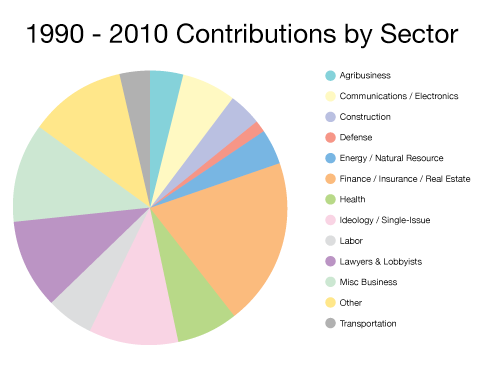
To learn more:

OpenSecrets.org: The Center for Responsive Politics OpenSecrets.org: Money in Politics — See Who’s Giving & Who’s Getting

ALEC Exposed from the Center for Media and Democracy ALEC Exposed

Why We Can’t End the Fed

Marriner_S._Eccles_Federal_Reserve_Board_Building

I haven’t written on anything political on this blog for a long time but I think a post on the Federal Reserve is a worthy topic of discussion since it’s not much understood even if what I have to say isn’t what people want to hear. I know this isn’t a favorite institution among Americans who sometimes think that it’s corrupt or doesn’t have much transparency. Some like to think that it’s been involved in a lot of conspiracies such as the Kennedy assassination (which it certainly wasn’t, nor has the CIA). Many view the Fed There are libertarians like Ron Paul and his son Rand who want to end the Fed thinking that it’s unconstitutional and that there’s no need for such system since they believe the economy could regulate itself on its own (I’ll get to this later). Then you have people in the Occupy movement who think that the Federal Reserve exists as a private corporation with too much power in the federal government and only serves the interests of large corporations led by people with too much power and too much money already (it’s actually an amalgamation of a government agency-corporation but with 12 privately owned district banks, yet all profits and central authority belongs to the federal government). However, while many of the anti-Fed movement don’t realize (or ignore) is that the Federal Reserve plays an essential role in the American economy which most Americans take for granted. And while it’s not a perfect system or one a lot of people like, we need to understand that to abolish the Federal Reserve would be absolutely insane.

Now you don’t have to be a financial genius to know that abolishing the Federal Reserve would be a catastrophically stupid idea. In the United States the Federal Reserve functions as a central bank to manage the nation’s money supply through monetary policy, deter bank panics, providing financial services for the government as well as private banks (particularly as a lender of last resort),  strike a balance between privatization and government involvement, and create a stable economic environment for businesses, investors, and consumers alike. All these are extremely important for a national economy as well as in our daily lives. Still, while many do blame the Fed for the country’s economic woes, many don’t understand that if the Fed wasn’t around in the first place, the US would’ve been in much worse economic shape than it has been since its creation in 1913. Yet, even Founding Father Alexander Hamilton knew that establishing a centralized national bank was necessary to stabilize and improve the nation’s credit as well as to improve handling of the US government’s financial business. While this idea was controversial for years (even in his own time), history would later vindicate Hamilton’s views on finance, particularly that of a centralized national bank and the Federal Reserve is living proof of this from its inception to its 100 year existence.

When it comes to understanding why we need the Federal Reserve, we need to remember that the Fed was created in 1913 after the US had spent 76 years without a central bank (giving us a good window into what would happen if we actually ended the Fed.) Now unlike what many free-market libertarians would want you to believe and Ron Paul’s gold standard nostalgia,  these weren’t great economic times to be honest. Of course, the reason why the US went through a period with no centralized banking system during this time had to do with a few factors. For one, the First and Second Banks of the United States were privately owned (and had foreigners share in the profits), shared only 20% of the nation’s currency supply while state banks accounted for the rest, and ran on 20 year charters which both expired before they could be renewed (all based on Hamilton’s ideas by the way save for the expiring bit). Nevertheless, the fatal flaw with Hamilton’s central banking system was that it provided a way for business interest and greed to usurp power from the federal government and common citizens. Second, a lot of Americans didn’t like a centralized banking system which they saw as undemocratic, corrupt, and favoring the interests of big business. They particularly distrusted centralized financial authority which undermined both banks, which was particularly personified in Andre Jackson who was more than happy to help the Second Bank of the United States along its demise in 1836 even to the point of vetoing congressional attempts to renew its charter to usher an era of laissez faire economics and de-centralized American banking. Unfortunately financial anarchy didn’t go so well.

Of course, running a country without a central bank empowered to issue paper money led to more than a few problems, well, more like large systematic financial fuck ups between 1837 and 1913. During this time the dollar supply was tied to private banks’ holdings and government bonds, which would’ve been fine if the need for dollars was fixed over time. Unfortunately it wasn’t the case. Since there was no central, government-backed bank able to create money on demand, the American banking couldn’t provide it nor was there a for a bank’s money supply to adjust with demand either. When people would try to withdraw more money from one bank that it had available, the bank would fail leading to other people trying to withdraw their funds from other banks. Such activities would create a vicious cycle later snowballing into widespread bank failures and contraction of lending across the economy resulting in economic depression. This happened every few years. Another reason for bank failures being so common before 1913 was the tendency of huge fluctuations in the money supply. Often the US economy would alternate between too much money in circulation and not enough causing all sorts of economic chaos.

The American banking system was particularly unstable during the Free Banking Era between 1837 and 1862 when banks had no federal oversight whatsoever. During this time, banks were short lived with an average lifespan of 5 years with half of them would failing (due to fraud, incompetence, or bad economic conditions) and a third going out of business because they couldn’t redeem their notes. You also have a practice called wildcat banking in which many banks would issue nearly worthless currency backed by questionable security (like bonds or mortgages) since the institution’s real value would often be lower than its face value. Some bank currency was more valuable than others depending on the bank you received the banknote and the quality of its assets, your state’s banking regulations, the quality of your state’s bonds if your state required such banknotes to be backed by them, and the likelihood of fraud. Not only that, but there was no transparency at all so you couldn’t tell whether your neighborhood bank’s assets were wildcat money. And if that weren’t enough, you had to deal with the fact that there were over 30,000 different currencies floating around in the United States at this period, which could be issued by almost anyone even drug stores and steakhouses. A lot of problems also stemmed from this including the fact that some currencies were worth more than others whether backed by silver, gold, or government bonds. Then you have the Panic of 1837 that caused a major recession that lasted until the mid-1840s, eight states either wholly or partially unable to pay their debts, and 343 of the nation’s 850 banks closing their doors resulting in a shock from which the system of state banks would never recover.

The National Bank Era of 1863-1913 was not much better. Though it did establish a uniform US banking policy, established a series of national banks with higher standards than many state ones,  created a national currency, and basically helped put an end to the wildcat banking practices. National banks were required to use government issued bills and back them with US government issued bonds as well as accept each other’s currency at par value. The federal government’s 1865 issue of a 10% tax on state bank bills would not only give rise to a uniform national currency by forcing all non-federal issued currency out of circulation but also the creation of checking accounts by the state banks which became the primary source for most banks’ revenue by the 1880s. Yet, despite the reforms, a lot of problems still remained. For one, while the US finally had a uniform currency, it was required to be backed up by treasuries. When such treasuries fluctuated in value, banks had to either recall loans or borrow from other banks or clearinghouses. Second the banking system of the National Bank Era created seasonal liquidity spikes particularly in rural areas during planting season when demand for funds was the highest. When the combined liquidity demands were too big, the bank would again have to find a lender of last resort to borrow from so it could pay its depositors and escape from financial ruin. Unfortunately, the responsibility would usually fall to other banks and financial institutions yet they weren’t always willing to bail out a troubled entity since doing so could put them in financial risk. This led to a string of financial panics which caused serious economic damage. Because there was a chance that you wouldn’t be able to access your bank account during an economic meltdown, Americans didn’t have much faith in their banking system.

The worst of the financial meltdowns to occur during the National Bank Era that helped facilitate the creation of the Federal Reserve was the series of events that helped lead to the Panic of 1907, the period’s worst. Now there are a variety of factors that contributed to this financial crisis that happened to converge all it once. It all began with the devastating San Francisco Earthquake of April 1906 not only developing an urgent need for cash to fund the recovery efforts and contributing to market instability but also made the survivors unable to access their cash for weeks mainly because it had been locked in bank vaults so hot from broken gas line fires that opening them would’ve caused their money to burst into flames. Not only that, 1906 was also a bumper year for crops which brewed a possible economic boom so companies nationwide wanted more cash to invest in new ventures like rebuilding San Francisco. Both of these events made dollar demand uncommonly high at a time when the money supply couldn’t increase much resulting in rising interest rates and withdrawals. Before long, the high number of withdrawals would soon put banks across the country on the brink of failure. In October of 1907, a copper miner turned banker F. Augustus Heinze and his stockbroker brother Otto tried to take over the United Copper Company’s market by buying up its shares. They failed and United Copper’s stock price tumbled causing investors to rush to pull any deposits out of any bank even remotely associated to F. Augustus Heinze. Banks and financial institutions began to fail, particularly the huge Knickerbocker Trust Company, the third largest trust in New York, which had its depositors withdrawing $8 million of its funds in less than 3 hours. Knickerbocker’s failure led banks and financial institutions nationwide to hoard their cash unwilling to lend to other banks, especially in New York. Though undisputed Wall Street king J. P. Morgan managed to bail out some of the troubled banks due to his immense wealth and his ability to get rich guys and bankers to do what he wished, he was unable to solve the systemic failures of the US finance system caused the crisis in the first place.  The Panic of 1907 would spark one of the worst recessions in US history as well as similar crises in much of the world as well as would lead to the creation of the Federal Reserve four years later.

Of course, the Federal Reserve doesn’t prevent bank panics it just serves as a better tool to deal with them as a lender of last resort as well as regulating money supply. Thanks to the Fed, the United States has experienced fewer major financial panics and the money supply is mostly under control with huge fluctuations being few and far between. Because of the Federal Reserve, the United States has become a much more stable economy which has helped create a better climate for capitalist enterprise than any US banking system has ever had in its existence. Sure the Federal Reserve isn’t a perfect institution and has problems that need corrected. Yet,  we need to understand that when the US tried to do without centralized banking, the economy was much less stable and much more unpredictable while banks weren’t always places you could put your money in. No American wants to live at the time when they’d have to worry whether their bank ran out of money, loan their money to someone else who didn’t pay them back, or issued currency notes of questionable value. Nor do Americans want to live at a time of dramatic fluctuations in the money supply either or frequent bank panics and financial meltdowns. Sure there have been accusations that the Fed serves the interests of wealthy bankers and corporations but it also serves in the best interests of all Americans by making sure that the public retained confidence in the nation’s money and where it’s held. It also helps keep our economy system moving and minimize financial disturbances threatening economic stability. Our ancestors in the 19th century didn’t have such system nor did they have as much trust in the American financial system as we do nowadays. While there were plenty of financial institution running to Washington for bailouts during the 2008 meltdown, there were very few Americans running to the banks to withdraw their life savings before they ran out of money. Thus, while the Federal Reserve may have its flaws and critics, at least it’s a viable system that has worked quite well in its 100 year existence playing a crucial role in the US economy and performing services the American people just can’t live without. So perhaps when people talk about possibly ending the Fed, you might want to remind them that our financial system before the Federal Reserve was much worse and much less accountable. Nevertheless, to say that the Fed does more harm than good is simply not the case at all.

Myths and Facts on Environmental Protection Policy

In my post about the US government shutdown, I used issues such as increasing national defense and environmental protection to illustrate why the GOP isn’t the political party for smaller government it says it is. For instance, national defense only increases the size of the government, especially at a time of war yet it’s a policy most Republicans like. On the other hand, laws relating to environmental protection has helped Americans save money, yet Republicans hate it. However, as a government policy, environmental policy is one of the most understood thanks to media outlets like Fox News and other conservatives who basically try to trivialize it. Here is a list of the many opponents of environmental protection tend to say with my explanations on why they’re false.

1. Myth: Environmental conditions only affect the natural world and wildlife.

Perhaps the most infamous of them all. Of course, a conservative would say this to trivialize environmental issues as “special interests.” This is even more false than saying that all environmentalists are tree hugging hippies. If this was true, then we probably shouldn’t have much to worry about when there’s an environmental catastrophe. Of course, this is bullshit since the health of the natural environment has an impact on everything, especially people. Just because humans may be responsible for much of the world’s environmental problems, they also fall victim to them. Pollution has caused a variety of health problems through the years like respiratory illnesses, cancer, birth defects, infertility (including miscarriages and stillbirths), infections, heart disease, and the list goes on. Polluted drinking water can spell a crisis in public health in any community and droughts can lead to mass starvation (think of the Dust Bowl). And in some instances, an environmental disaster can lead to a destruction of a whole community as well as  bring social problems like economic collapse, mass poverty, homelessness, and other things. You can say that if you destroy the land, you also destroy the people.

2. Myth: Environmental policy is a burden to taxpayers and contributes to big government.

Like I said in my post about the government shutdown, this is absolutely false. In fact, this is another lie by Republicans who inflict the small government argument when it comes to policies they don’t like. Sure environmental policy may cost taxpayer money but it also helps save tax dollars by tackling problems that contribute to more government spending. For instance, pollution and environmental disasters contribute much more to big government than any funding to the EPA ever has.

High pollution levels can contribute to higher health care costs as well as more government spending on health care. This is especially true when you consider senior citizens and the poor since these two groups of people receive health care through medical assistance and are most susceptible to pollution related illnesses. Senior citizens are more likely to have been exposed to higher levels of pollution and over a longer period of time than younger generations. They are more likely to have grown up in a highly polluted area, had an environmentally hazardous job, have a history of smoking (and exposure to secondhand smoke), and to have someone in their family who died of a pollution related illness at an early age. It’s no wonder why senior citizens are so prone to respiratory illnesses like lung cancer, emphysema, asthma, and others.  Of course, some may say because senior citizens are more susceptible to illness in general, yet you can’t really dismiss the environmental factor either. As for the poor, they are more likely to be exposed to high levels of pollution because many live near environmentally hazardous establishments. These can consist of toxic waste dumps, power plants, or dirty industry centers that lower property values and aren’t nice places to live. Thus, residences near these places will always consist of people below the poverty line who can’t afford to live anywhere else, especially in cities. If you live in a rural area, then the chances of an environmentally hazardous establishment moving in are very high since many of your neighbors will welcome if there’s something in it for them, most of the population won’t be willing to sue (and if they do the chances of losing are high), and for those who do object, most won’t be able to do anything about it since no one’s going to pay attention. Oh, and many of the rural poor tend to whites who vote Republican and watch Fox News (Fucked News, as I call it). Nevertheless, high pollution and high poverty go hand in hand. Thus, pollution related illnesses are a burden to the healthcare industry, communities, the nation, and the taxpayer.

Another drain on taxpayers which the EPA helps prevent are environmental disasters since they are incredibly expensive to clean up and restore. Of course, polluting industries tend to be the main cause of these environmental disasters yet the job of clean up and restoration will always fall to the state and/or federal government for various reasons. For one, federal and state governments usually do the job better than anyone else and don’t need a court order to do so. Second, an environmental disaster precipitates a state of emergency in which environmental damage must be promptly acted upon before there’s serious long term consequences. Third, in an event of environmental catastrophe, most local communities don’t have the money and resources for the necessary action so responsibility will fall on a higher power. Finally, most corporations that cause environmental disasters will go out of their way in order to avoid responsibility for environmental damages such as fighting lawsuits (the case concerning the Exxon-Valdez Oil Spill ended up at the Supreme Court but wasn’t settled since Alito had to recuse himself). So while environmental protection may cost taxpayers something, lack of environmental protection will cost taxpayers much more.

3. Myth: Environmental policy hurts the economy, hurts businesses, and kills jobs.

Republicans will use this myth all the time when it comes to rallying against environmental policy as if they are trying to justify that economic benefit is worth the environmental costs, especially in the area of dirty industry. However, how environmental protection policy actually affects the economy, is far more complicated. Of course, environmental protection is a popular scapegoat for conservatives when it comes to economic problems but there are many reasons why economies and businesses fail usually ranging from unfair competition, unethical business practices, bad economic policies, unsatisfied greed, or just simply plain ol’ fashioned bad decision making. And hardly any of them have anything to do with EPA regulations. Of course, EPA regulations may hurt smaller polluting businesses but most polluting companies can accommodate with environmental policy. However, for businesses, environmental protection is no fun since it means complying with more rules, may dip into profits, gets businesses to stop doing what’s more convenient and cost-effective to them, and compels them to be more environmentally responsible. It’s no wonder businesses don’t like environmental protection since they tend to be from a world in which success is based on short-term profit gains, fast growth, unrestrained corporate greed, and fierce competition, which is hardly a sustainable economic model.

Yet, what many pro-business people tend to ignore is that environmental protection doesn’t hurt economies as much as environmental destruction. The Lorax illustrates this to near perfection with the Oncler who builds his empire by destroying an entire forest to supply his factories. Of course, he becomes wealthy yet things fall apart for him once the last tree is cut down. His family abandons him, his factory goes to ruin, and the forest once filled with colorful trees is now a wasteland. Since the Oncler basically obtained his raw materials in a way that was most convenient to him in order to satisfy his own greed, he gets to see all he worked hard for all his life go down the drain. Of course, many corporate leaders don’t learn their lessons or suffer the consequences from all the environmental destruction they cause. Yet, many people do, those whose business is dependent upon environmental conditions and availability of natural resources. Environmental policies may not bring big profits but they might help a company stay in business since they may give reasons for businesses to adapt, encourage the development of green industry, ensure sustainability of resources and sustainable growth, and make businesses more competitive. As for consumers, more eco-friendly products might help them save money on certain products like at the pump for instance.

Thoughts of the US Government Shutdown

Image

I don’t always talk about politics but I think this government shutdown is just ridiculous and isn’t doing anyone any favors. National parks, museums, and historic sites are closed, certain social programs and policies are inactive, and thousands of government workers are furloughed until further notice. Meanwhile, Congress is stuck in the Capitol basically doing who knows what while the rest of the nation is struggling and the debt limit is ebbing ever closer to the ceiling. People are pointing fingers at the party they don’t like just to have a scapegoat, angry protestors are arriving in Washington in droves, and rants are popping up on every social media outlet while the media outlets are basically creating sensationalism as usual.

Of course, both parties are at fault since Washington D. C. is a city where no government official is completely innocent regardless of party affiliation and amount of dirty laundry. However, as the liberal I am, I have to reserve special ire on the Congressional Republicans who I can’t occupy any ounce of sympathy for. Of course, there’s no doubt they were the ones who hold most of the responsibility for putting us in this debacle in the first place over a piece of legislation they don’t like and tried almost every trick in the book to get rid of. Call it Obamacare or he Affordable Care Act but it’s a piece of legislation that’s here to stay, which most Americans like. It’s not perfect and doesn’t solve everything wrong with the healthcare system but at least it’s better than the healthcare system we had before the ACA became law (and I don’t want our country to go back to it). Still, what disgusts me that these Republican Congressmen despise this legislation so much that they’re willing to do the unthinkable and don’t seem to harbor any shame in doing so nor care who gets hurt. All they seem to care about themselves and their party’s bottom line and would risk undermining the national quality of life to make sure the government run by their party platform which must be retained at the utmost ideological purity even if such notions like protecting life and free market economics vastly contradict each other. If they don’t get their way, they usually whine and scream like a two-year-old, blame the Democrats, and go on nasty tirades on Fox News, since it’s the only news network that ever agrees with them 100% of the time. I’m sick of how they justify trying to get their own way by making life a complete hell for millions of Americans, especially those who can hardly afford to make ends meet. I’m disgusted how many of them call themselves Christian yet selfishly reject legislation that promotes Christian values using buzzwords like, “big government,” “government takeover,” “Socialism,” “amnesty,” “soft on terror,” and other terms. I have seen my youngest cousins act with much more respect, dignity, and maturity than this selfish, spoiled, bullying, and tantrum prone bunch of middle aged brats. What makes me more outraged is that how perfectly sane and sensible people can take them seriously or even vote for them.

Look, most Americans may not be 100% content with Obamacare or other government policies but none wouldn’t dare wish for a government shutdown regardless of political beliefs. No matter how much Americans complain about their government, there at least some government programs that we like, benefit from, and/or rely upon. There are even self-identified conservative Republicans who’d spat almost any anti-government tirade you could think of, but will go out of his or her way to justify why certain government programs and functions should remain for those very reasons. I know a lot of people like this personally and that Congressional Republicans are also guilty of such when they discuss a policy such as national defense spending, which conservatives will always advocate increasing regardless of whether it complies with their concept of limited government or not. Putting more money in national defense doesn’t reduce the size of the government, especially when it pertains to financing certain projects like wars. Rather such action expands government size as well as adds to the debt and burdens taxpayers in decades to come. Yet, you will never hear a Republican say this. Most of the time conservative Republicans will will inflict their beliefs on limited government is when it pertains to legislation they hate like environmental protection regardless how much money it may save in the long run. As with environmental protection, a conservative Republican will oppose any such legislation citing that such laws don’t benefit the economy and take away jobs from hard working Americans. They would call environmentalists tree-hugging hippies, say that global warming isn’t real (it is, it’s caused by human activity, and it’s serious), and view their causes as trivial and selfish. However, a lot of environmental legislation has not only helped improve our nation’s quality of life but also saved taxpayers a tremendous amount of money in the long term which would’ve been spent on treating pollution related illnesses, cleaning up environmental disaster areas, and other things. Furthermore, it has helped businesses, created new jobs, and drive up technological innovation. Yet both scenarios very much illustrate that regardless of party affiliation and ideology, we all have our own ideas about government and most of us wouldn’t want our lawmakers to get rid of certain aspects about it that we either like, benefit from, or depend upon. And that even those who believe in smaller and more limited government will make certain reservations for such government policy.

Of course, you might think that the Republicans’ support of increased defense spending but opposition to environmental legislation sort of discredits the GOP as a champion of smaller government. Indeed it does, but in their positions on both these issues make sense if you also note that the Republican Party also champions big business, corporations, and unrestrained free market economy. A higher defense budget benefits defense contractors like Haliburton, Blackwater, KBR, and Lockheed Martin as well as other companies like Boeing. To have a defense contract is to be on the government’s payroll manufacturing whatever the military needs, especially at a time of war. On the other hand, companies like Exxon Mobil, Chevron, and Shell absolutely hate any policy relating to environmental protection because they not only want to be at the top of their competition and earn a profit but also avoid any responsibility for environmental damage they might have caused (note how a Big Oil company acts after causing an oil spill or how any polluting company in any other environmental disaster). No carbon based energy industry wants to compete with a green energy upstart and certainly prefers not to adapt. As with environmental disasters, a big polluting energy company would go out of its way to avoid responsibility for the damage it caused to the affected wildlife or local community.

Still, despite that the United States is a democratically elected government in which citizens elect their leaders to represent their interests, this doesn’t mean that everyone is going to have his or her own way 100% of the time. We must remember that elections and legislative decisions are decided by majority vote. And though the Republicans still maintained a majority in the House of Representatives, Democrats still control the Senate and the presidency so they’re certainly not going to have their way all the time in Washington. Not to mention, Obama won reelection in 2012 so if it has any idea of what the country thinks of him or his policies, then it probably means Congressional Republicans should stop being the sore loser crybabies they are and start cooperating with the Democrats as well as maybe go along with a compromise or two. They may also want to pay attention to public opinion in their own district and doing what’s best for the country, instead of their own party, special interests, or themselves. Sure Democrats may have the same problems as their conservative counterparts but at least they don’t act like bullying crybabies on TV, have put up with considerable crap from their opposition as well as their own party ranks for years, don’t have their own version of Fox News, don’t respond harshly to criticism or demean disadvantaged and minority populations, and aren’t always obsessed with ideological purity. Furthermore, the Democratic Party has a platform that works for 21st century America and appeals to a large and diverse population. Thus, Republicans might want to understand that while throwing a tantrum will give you attention, it will never give you respect, especially from people like me who are absolutely fed up with your shenanigans you put the American people through. If you don’t start losing gracefully and acting like mature adults, then expect to create more enemies, lose more elections, and eventually have your party be driven into extinction. For though us Democrats may be your rivals, you Republicans are your own worst enemy. And if you’re willing to risk a government shutdown over a piece of legislation you don’t like, then there’s obviously something wrong with you.