The National Security Threat of Domestic Terrorism (Depicted by the News Media)

american-domestic-terrorism

When Americans think about terrorism, they usually imagine 9/11 and other attacks perpetuated by people who aren’t from this country and who aren’t like us. Groups like Al Qaida and ISIS usually come to mind. Yet, while foreign terrorist attacks like 9/11 are enough to make us frightened and willing to send troops to Afghanistan, there’s a national security threat more pressing that most people don’t pay much attention to. It’s called domestic terrorism which refer to terror acts carried out by US citizens or permanent residents on US soil. Domestic terrorists have committed 80% of attacks since 9/11 and killed more Americans on US soil than their foreign counterparts. Under current US law enforcement, the USA PATRIOT ACT defines acts as domestic terrorism those in which:

  • involve acts dangerous to human life that are a violation of the criminal laws of the United States or of any State;
  • appear to be intended –
    1. to intimidate or coerce a civilian population;
    2. to influence the policy of a government by intimidation or coercion;
    3. to affect the conduct of a government by mass destruction, assassination, or kidnapping;
  • occur primarily within the territorial jurisdiction of the United States.
curry_tragic_prelude

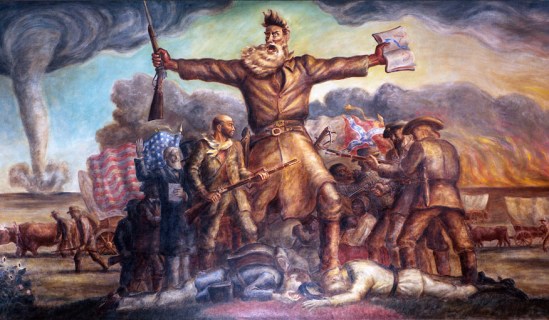
Accurately referred to as “America’s Favorite Domestic Terrorist,” legendary abolitionist John Brown has become a highly controversial figure both for his anti-slavery ideology as well as his violent tactics. But he perfectly illustrates why Americans may have a hard time recognizing domestic terror even in their American history books.

But when it comes to identifying domestic terrorism in contemporary culture, a lot of Americans struggled since the perpetrators may look like them and may share ideas that they kind of agree with. A good case in point is American abolitionist John Brown who’s known for participating in Bleeding Kansas and trying to overthrow the institution of slavery through staging an unsuccessful raid on Harper’s Ferry in 1859 that killed 7 and injured 10. Brown’s raid on a government arsenal in present day West Virginia clearly fit USA PATRIOT ACT’s definition of domestic terrorism. Brown’s raid involved acts dangerous to human life that violated US and state criminal laws, were clearly intended to intimidate civilians and influence government policy, and definitely occurred on US soil. The fact he believed himself an instrument of God’s wrath in punishing men for the sin of slavery certainly proves that his extremist beliefs had a religious dimension. But since Brown’s motivation behind his attack on Harper’s Ferry was to overthrow the institution of slavery, well, he’s rarely seen as such even by modern day academics. Mostly because Americans agree that slavery was a very terrible sin and the fact it divided the country as well as took 4 year civil war to outlaw it. So in hindsight, Brown’s idea of destroying the institution of slavery through violence isn’t really that crazy (though to a point). And it’s mainly because of Brown’s abolitionist views no matter how extreme they were that he’s often seen as a heroic martyr and visionary to many people. Nevertheless, Brown’s actions prior to the American Civil War and the tactics he chose still make him a very controversial figure today. But Brown’s life and our perception of him illustrate why a lot Americans have difficulty identifying acts of terror by our fellow countrymen in the nation. This is a problem as I explain in this post in FAQ and list format.

daily-news-terrorist-cover

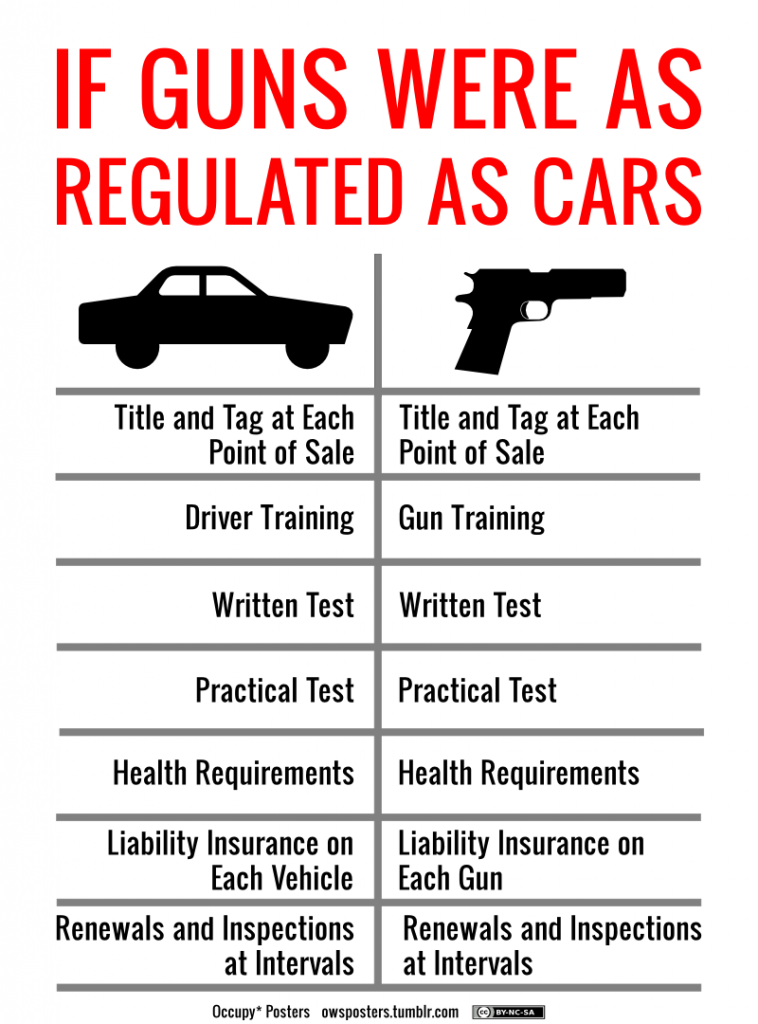
This is a photoshopped picture that advocates gun control. However, it also illustrates the problem the media has with identifying domestic terrorist attacks.

If law enforcement has a clear definition on what domestic terrorism is, why is the term used so subjectively as a media and political term?

It’s mainly because when it comes to domestic terrorism, law enforcement and the mainstream media live in two different realities and have very different motivations for identifying what constitutes one. And the latter usually has more influence on the American people. Since American law enforcement’s main priority is ensuring public safety, their criteria for identifying terrorists acts is based on criteria defined in the USA PATRIOT ACT. So when it comes to defining domestic terrorism, all law enforcement care about is whether the act was criminal and endangered human lives, whether it was intended to promote a political agenda through coercion or intimidation, and whether it was committed by someone who lived in the US on US soil. That’s it. By contrast, the media defines domestic terrorism quite differently through the following criteria:

image-20160622-7203-1az1cqu

One of the most significant factors in how the media determines whether a violent attack is domestic terrorism is the suspect’s identity. If they’re Muslim, chances are that they’ll be labeled as a terrorist is very high.

  1. Perpetrator’s Race and Cultural Identity – If the perpetrator is a Muslim American, their chances of being seen as a domestic terrorist are extremely high regardless of motivation. If it’s a non-Muslim white American with a conventional name, their chances of being seen as a domestic terrorist are usually dependent on other factors. As for the likelihood of non-Muslim blacks and Hispanics perpetrators, it’s very hard to say since both groups are often associated with criminal stereotypes though neither are widely perceived as terrorists.
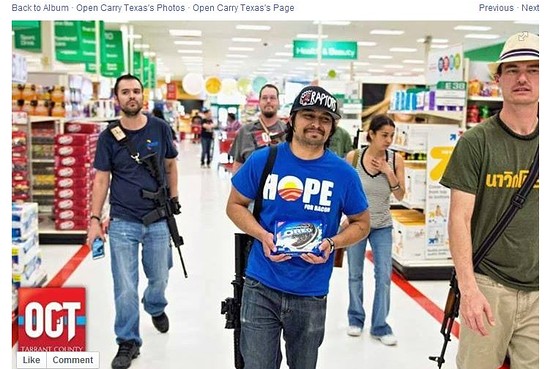
  2. Perpetrator’s Motivation– Any American Muslim perpetrator who commits an act of terror in the name of Islam will be automatically be labeled a terrorist in the media as well as linked to foreign Islamic terrorist groups like Al-Qaida or the Islamic State. Black and Hispanic perpetrators will only be identified as such if they’re connected to known terrorist groups or embrace an extremist ideology. But when it comes to non-Muslim white terrorists, it can vary considerably depending on their motivation. White violence against women, racial and religious groups, LGBT people, disabled people, and immigrants will usually be seen as hate crimes at best but not always and not without controversy (if the incident is covered at all). Yet, many hate crimes usually qualify under the USA PATRIOT ACT’s definition of domestic terrorism anyway. Anti-abortion and ecological extremists are less likely to be seen as domestic terrorists since a lot of people hold anti-abortion and environmentalist views. So like John Brown, labeling them as such is controversial though they’ll certainly be seen as nuts regardless political ideology. Then you have the anti-government perpetrators whose acts of terror may cause controversy if ever labeled domestic terrorism. This is especially the case when you’re talking about right-wing extremists or the open carry crowd (though open carry may be legal in some states, carrying a gun in public is an act of intimidation and coercion so it qualifies).
  3. Nature of the Attack– In the media, the nature of the attack matters considerably such as the method and body count. Perpetrators who stage bombings that kill lots of people will most likely be seen as domestic terrorists. So would any attacks that involve hijacking, bioweapons, mass poisoning, hostage taking, chemical weapons, kidnapping, and property destruction. Shootings may depend on whether the perpetrator is either Muslim or clearly committing a hate crime. At any rate, they have to involve violence and/or fatalities. Despite causing hundreds of millions in property damage and having a sheer volume of crimes, eco-terrorists aren’t really seen as such since a lot of their crimes don’t get people killed. Same goes for left-wing Communist and anarchist terrorists. Merely using guns to intimidate people based on political ideology may not be labeled as domestic terrorism when it clearly is. Cyberterrorism may get some attention even though it’s not considered such while paper terrorism doesn’t get much attention at all.
  4. Location– Attacks that take place in major cities are more likely to be labeled as domestic terrorism than ones in less urban areas, especially if they take place near places of great significance. In some ways, this makes sense but also ignores a lot of other terror incidents that take place around the country.
cxx2aw8wkaajtkt

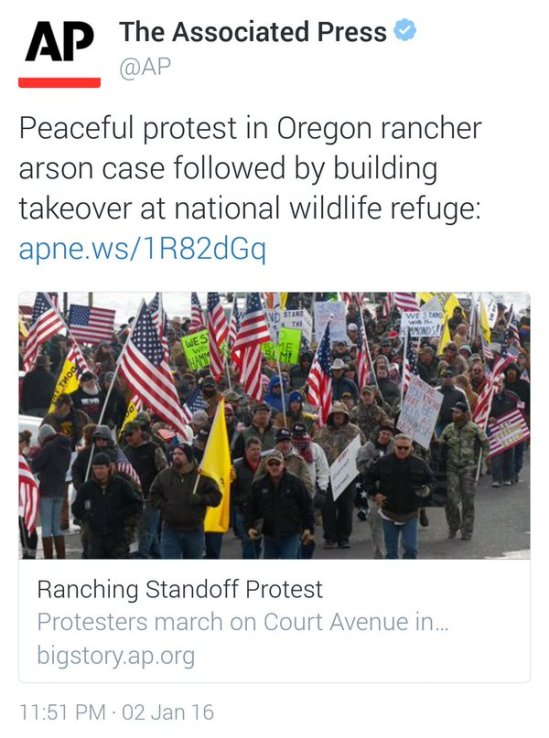
Meanwhile, if the perpetrators in question are white, right-wing, and stage a heavily armed takeover of a national wildlife refuge in Oregon, you might expect headlines like this. Since AP is held to very high journalistic standards, this headline tweet is appalling. These guys aren’t peaceful protesters. They have guns with them and they took over a national wildlife refuge in order to intimidate people and influence government conduct. It’s domestic terrorism, plain and simple.

If you watch TV news, you might get the impression the media is more likely to label a violent incident as domestic terrorism based on a biased set of criteria which gives Americans the impression that terrorists tend to be Islamic extremists. When in reality, Muslim terrorist attacks aren’t a very big threat to national security, even after 9/11. Why the media decide does this:

homegrown_terrorism

Contrary to what you might be accustomed to on the news, anti-government, racist, and other nonjihadist extremist killed nearly twice as many people as those by Islamic jihadist since 9/11. Many Americans don’t realize this, especially if they’re on a steady diet of Fox News. Maybe that’s because most nonjihadist terrorists are white.

  1. Desire to Avoid Controversy– Domestic terrorism is a loaded word. And while the mainstream media likes sensational news stories, they also take great aims to avoid offending people. This is particularly true when a terror incident involves right-wing extremists since a lot of mainstream media outlets are owned by large corporate conglomerates. Some like Fox News even have a right-wing ideology. That’s not to say leftist terrorists exist since they certainly do since Occupy Wall Street might qualify since they have a long list of property crimes, rampant drug use, rape, murder, and assaults. But when Janet Napolitano brought up the threat of right-wing domestic terrorism in 2009, Republicans were furious.
  2. Public’s Unwillingness to Identify with Terrorists– Like I said about terrorists, people are more comfortable to label a terrorist act as such if the perpetrator is different from them. And since a lot of people don’t know anyone who’s Muslim, Muslim perpetrators are more likely to be seen as terrorists than their non-Muslim counterparts. But when a terror incident involves white supremacists and other right-wing extremists, a lot of conservative politicians hesitate to declare it as such. Many of them even downplay dangers posed by right-wing extremism altogether. This is especially when Fox News glorifies a Nevada rancher who engaged in an armed standoff against the feds over grazing rights and a bunch of armed men for occupying a federal wildlife refuge in Oregon and the fact the current GOP presidential nominee has been endorsed by white supremacists. When it comes to right-wing domestic terrorism, most conservatives are like Draco Malfoy. Sure they may be totally comfortable having racist, xenophobic, homophobic, sexist, and anti-government views. And yes, they may not be happy with the political and cultural landscape these days as well as nostalgize about a past that never was. But like Draco Malfoy on Muggle-borns, most of these conservatives are neither extreme in their viewpoints nor are willing to resort to violent terrorist acts for them. On the other end, I may believe that this country should do more to protect the environment and stop climate change but that doesn’t mean I’m willing to bomb an animal testing facility because that’s crazy. But when someone commits an act of violence on behalf of their political agenda, it makes a lot of people who may share that perpetrator’s view to some extent very uncomfortable and reluctant to address it as an act of terror. So they don’t.
  3. Sensationalism– We should understand that sensationalism sells and the media does everything it could to exploit violent terror incidents. The more violent it is and the nuttier the perpetrators seem, the more attention it will get and more ratings the media outlet will have. This is especially be the case if the perpetrator is Muslim.
r20150918-topthreat_0

According to a local law enforcement survey the Triangle Center on Terrorism and Homeland Security, anti-government terrorism was seen as the top terrorist threat in their jurisdictions. And that percentage is far more than those who listed anything relating to Islamic terrorist threats. The media doesn’t really pay attention to this because most anti-government terrorists are white.

Unfortunately, the way the news covers domestic terror attacks has very negative repercussions in the country. Now it’s one thing to call a mass shooting in San Bernardino and at the Pulse nightclub in Orlando as domestic terrorism. Same goes for the Boston Marathon bombings. But it’s another when both these attacks are seen as acts of domestic terrorism while the mass shootings at Pittsburgh, Tucson, and Charleston are not. Rather as far as the media was concerned, these were attacks made by violently mentally ill white men. Sure it was an accurate assessment, but it doesn’t tell the whole story. For one, the man who fired an AK-47 at 5 cops in Pittsburgh was a white supremacist who believed Jews secretly ran everything and that Obama wanted to take away his guns. But as far as the media is concerned, he was just a crazy nutjob who killed 3 cops after his mom called police over a domestic dispute concerning a dog peeing on the carpet. Second, the Tucson shooter who tried to assassinate Congresswoman Gabby Giffords was a conspiracy theorist who believed in a New World Order to brainwash people. Third, the shooter who killed 9 people at the Emmanuel AME Church in Charleston was a white supremacist who donned a pro-apartheid jacket on his Facebook page, had a Confederate flag license plate, told racist jokes, advocated segregation, and went on a racist rant on how blacks are raping white women and taking over the world. Furthermore, he specifically chose to fire upon blacks at the church due to its long association with civil rights activism. Yet, these terror incidents were reported. Most aren’t covered by major news outlets at all. Negative repercussions of inadequate and sloppy coverage of domestic terrorism include:

deah-shaddy-barakat-family

The heavy attention on Islamic terrorism in the US media outlets had perpetuated rise and acceptability of Islamophobia as well as led to American Muslims being targets of everything from harassment to outright deadly violence. Featured here are American Muslims Yousef Abu-Salha, his brother-in-law Deah Barakat, and his sisters Yusor and Razan. Save for the Yousef, three people would later become victims of an anti-Muslim hate crime in a Chapel Hill condominium by one of their former white neighbors who was banned from the building. The man basically broke into Deah and Yusor’s condo and killed them and Razan in cold blood. Yousef would later say, “It’s a shame that you turn on a major news channel and you see a news story about ISIS and then they’ll cover our story and they do an okay job, but immediately after it will be another story about these radical groups. I think it sends US citizens a bad message that these Muslims are all the same.”

  1. Legitimizes Discrimination– The media’s coverage of Islamic terrorism since 9/11 in the US and abroad has contributed so much to Islamophobia that Muslims in American pop culture have been nastily stereotyped as fanatical Islamic terrorists who hate our country and our western values. Each terror attack since then have been filtered by the media and consumed by the public as wrongdoings of Muslims around the world. Muslims have been further vilified and dehumanized in Hollywood movies like American Sniper. Because of this, American Muslims, Middle Easterners, and South Asians have become acceptable targets for profiling, oppression, and even terrorist attacks. For many Americans, just looking like a Muslim makes them an automatic terror suspect by default as well as someone to be feared. This is a major reason why welcoming Syrian refugees in the US has been so controversial even though it shouldn’t. Around the country, mosques have been fired on, defaced, or burned. Muslims have been shot and killed execution style in their living rooms, fatally stabbed on their way home as well as been beaten in their stores, schools, and on the streets. They’ve also been kicked out of planes, egged outside Walmart, scorched with hot coffee in a park, shot in cabs, and punched while pushing their children in strollers. They’ve had clothes set on fired and their children bullied in school. They’ve been threatened by neighbors who’d burn down their house if they didn’t move away as well as had their cemeteries vandalized and Quran desecrated. They’ve been fired for wearing hijabs and for praying. A Muslim congressman has received death threats. In Irving, Texas, heavily armed right-wing gunmen blocked entrance of a mosque and held banners reading, “we are the solution to Islamic terrorism.” Other armed anti-Islam demonstrations and “Muslim-free” businesses raise deep concerns. Civil and human rights advocates are challenging the use of “domestic terrorism” believing that it’s doled out in a racially-discriminatory manner that merely exacerbates hate they and law enforcement are trying to prevent. Exacerbating hate on a group of people who just happen to have the same religion as terrorists is not a solution to Islamic terrorism and just makes it worse. The fact that 55% of Americans hold an unfavorable view of Islam makes Islamophobia not just the biggest threat to American religious freedom, but also a potential threat to national security since Muslim communities play a crucial role in alerting law enforcement to terrorist threats.
  2. Does Not Represent Reality– While the American public rightfully sees Islamic terrorists as a threat to safety, the reality of terrorism exists in all forms and that terrorists come from all racial and cultural backgrounds as well as embraced a wide range of extremist political and religious ideologies. For law enforcement officials, the biggest terrorist threats aren’t jihadists. Rather it’s far right wing extremists that have carried out well over half of the deadliest US terrorist attacks since 9/11, committing 93% of all extremist murders in the last 10 years. Most of their extremism is homegrown as well as pose a very real danger to this nation’s character such as pluralism, tolerance, and equality, which form the basis of a liberal democracy. Though jihadist terrorism is often reported on the news, the US has seen very little violent extremism by Muslims. On the other hand, white supremacists are among the most lethal since they’ve committed 83% of all right-wing extremist murders and 77% of all extremist killings in the past decade as well as were involved in 52% of shootings with police. They also regularly engage in various terrorist plots, acts, and conspiracies as well as other traditional forms of crime. Anti-government extremists, right-wing militias, and sovereign citizens are among the most common. But no matter what their ideology, right-wing extremists are also more numerous, cover a larger geographic range, and are more likely to live in your neighborhood. Not representing these groups in the media as the terrorists they are that we should condemn is very irresponsible, even if the station is Fox News.
  3. Promotes Cultural Profiling– How the media has reported domestic terrorism can also lead to real but ineffective policies that have resulted in cultural profiling, particularly of Muslims and people suspected of being one. Those charged with plotting terrorism for the Islamic State faced more severe charges than militia members, “sovereign citizens,” and other anti-government extremist who’ve been prosecuted for similar activity (even though many more terrorist attacks in the US are carried out by non-Muslims). After 9/11, many American Muslims, South Asians, and those of Middle Eastern descent found themselves being subject to harsher security checks as well as are more likely to be on a no fly list or subject to surveillance. As a result, trust between law enforcement and Muslims has been strained. In recent years, anti-Islam bills became laws in 10 states. Florida and Tennessee passed laws revising the way they approve textbooks for classroom use as a direct result of anti-Islam campaigns. Don’t get me wrong, Islamic terrorists do exist in this country and do pose a threat to national security. But profiling Muslims as suspected terrorists by default is never excusable since the vast majority of them are regular people like us who just want to live their lives in peace and mind their own business.
  4. Fails to Hold Public Figures Accountable for Their Rhetoric– The media is a huge influence in the American public but we should be aware what many public figures may say could be taken out of context by some nutjob who’d use it in a terror attack. It’s been widely suggested that political rhetoric may play a role in fueling hate crimes, especially since Donald Trump started running for president as well as said very hateful things about almost every demographic imaginable. But since he started running and calling on Muslim bans, anti-Muslim hate crimes dramatically increased to its highest levels since the aftermath of 9/11. It doesn’t help that Trump has been endorsed by white supremacist organizations whom he’s consistently failed to denounce. A lot of what’s said on Fox News has probably led to a lot of terror attacks and it doesn’t help that they have glorified anti-government terrorists like Cliven Bundy as heroes as well as inspired many nutcases to do horrible things that have killed people. Not to mention, a lot of conservative special interest groups have said similar things as well as many Republican politicians. I know there are liberal groups and Democrats who might inspire some degree of terror violence. But I single out conservatives since right-wing terrorism has become much more of a problem in recent years, according to terror experts and government organizations.And yes a lot of these radical right-wing extremists consume conservative media outlets like Fox News.
  5. Ignores Very Real Threats– While Muslim terrorism in the news stirs fear and hatred for even the most ordinary Muslim Americans, the far more serious threat of the radical right has received relatively little attention. But bring that fact up in front of Republican politicians, expect outrage and even offense as an attack to demonize the right. The media seems to be just as deft to these threats, especially if it’s Fox News. Such response leads to downplay to take such threats as seriously as they should be by the public. Radical Right-Wing terrorists present a more deadly threat given their affinity for hoarding weapons and explosives. Not paying attention to these terrorists has consequences such as emboldening these people to carry out mass casualty attacks. Americans are much more likely to live near a white supremacist or anti-government sovereign citizen than a jihadist (A nearby town in my area had its own Klu Klux Klan chapter). When we’re talking about racial and religious minorities, living near a radical right-wing terrorist can put them in very real danger.
  6. Compromises Public Safety for Vulnerable Populations– Whenever domestic terror incidents aren’t reported and treated as the heinous acts they are, people are left very vulnerable to attacks. This was very apparent in the South during segregation when countless African Americans were subject to lynchings as a way to control black communities and retain white supremacy. During the Civil Rights Movement, African Americans and other activists were frequent targets of white supremacist violence. Though white supremacy is no longer as acceptable as it was, the hateful ideology and violence hasn’t gone away. Recent incidents including a white supremacist firing on Black Lives Matter activists in Minneapolis, a NAACP building bombing in Colorado, and a black church shooting in Charleston. In every terror attack involving Muslims since 9/11, hate crimes against Muslims in America have become alarmingly high. A study from Georgetown University has reported 174 incidents of anti-Muslim violence from 2015 consisting of 12 murders, 29 physical assaults, 50 threats against people and institutions, 54 acts of vandalism, 8 arsons, and 9 shootings or bombings. Contrary to what the media might say, Muslims are far more likely to become terror victims than terror perpetrators. However, Muslims and blacks aren’t the only group in the country vulnerable to domestic terrorism in the nation even by white supremacists. White supremacist groups also target immigrants, minorities, Jews, LGBT people, and sometimes Christians. Targets for anti-government and sovereign citizens are law enforcement and other authority figures. Still, not recognizing clearly politically motivated attacks by non-Muslim perpetrators leaves many Americans especially vulnerable.
trump-kkk-endorsed

It is no secret that now GOP presidential nominee Donald Trump has been endorsed by the Klu Klux Klan over his racist remarks on Mexicans, blacks, immigrants, and Muslims. However, Trump hasn’t distanced himself from this white supremacist terrorist organization which has a long history of violence against blacks since its formation during Reconstruction. If a presidential candidate from a major party can’t denounce a terrorist endorsement, then that person isn’t fit to be president. Seriously, the KKK are beyond deplorable.

As you can see the state of how the news media depicts domestic terrorism is appalling. Excessive coverage of one group of terrorists has led to disproportionate fear, suspicion, and unjust discrimination against a religious minority and other others. But significant less attention of a far more serious homegrown terrorist threat has gone under the media radar and has neither been sufficiently challenged by our political culture nor law enforcement. Not only this disproportionate rate of media coverage lead to increased profiling and discrimination, it also makes the US less safe as a whole. Furthermore, it makes public figures less likely to take responsibility for their rhetoric that could inspire many of these nutjobs to commit heinous acts. Now while the government may be slow to act on domestic terrorism, the media doesn’t have to. In fact, if the media just got it together and report domestic terrorist attacks in a way they should, then it might actually encourage leaders to come up with policies combating it. After all, people didn’t take lynchings as serious acts of terrorism meant to intimidate black people during segregation in the South until Ida B. Wells investigated them in the 1890s and began an anti-lynching campaign to spread awareness about the atrocity. Today she is turning in her grave. If the news media should cover domestic terrorism correctly, then it must be depicted in a way that’s represents the reality. By that I mean showing that domestic terrorism can take many forms, be motivated by different ideologies, and committed by people of many different backgrounds. And that all these domestic terrorists should be treated as a national security threat to be taken seriously.

2931225700000578-3103341-image-a-64_1432954295853

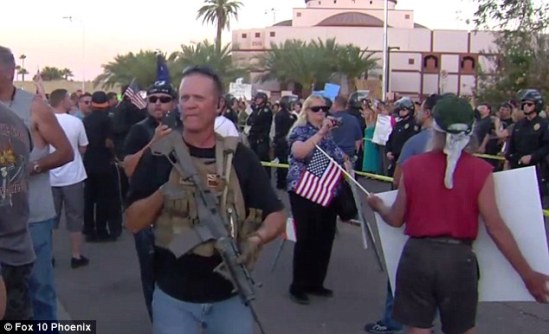
Here we come to a bunch of heavily armed open-carry activists “protesting” at a mosque in Phoenix against “Islamic Radicalism.” In reality, they’re just a bunch of armed terrorists who are using their guns to intimidate the Muslims who worship there. This isn’t peaceful protesting, it’s domestic terrorism and should be treated that way. This should neither be tolerated nor encouraged by anyone. It’s utterly disgraceful anyone there with a gun wasn’t arrested. Because the country needs to know that armed protest rallies are never ever acceptable.

Stolen Pay: Why We Need to Know About Wage Theft

Depositphotos_18442503_s-800x533

Republican presidential candidate Donald Trump often likes to cast himself as a protector of workers and jobs as well as a great businessman. However, recently he’s come under considerable scrutiny as it’s been recently revealed that he’s been involved in more than 3,500 lawsuits over the past 3 decades. A large number of these pertain to ordinary Americans who say that Trump and his companies have refused to pay them for their work. According to USA Today, these include a Florida dishwasher, a New Jersey glass company, a plumber, a carpet company, painters, 48 waiters, dozens of bartenders and other hourly workers at his resorts and clubs all over the country, real estate brokers who sold his properties, and even several law firms that once represented him in these suits and others. Trump and co. have also been cited for 24 violations under the Fair Labor Standards Act since 2005 for failing to pay overtime or minimum wage, according to the US Department of Labor data. In addition to the lawsuits, there were more than 200 mechanic’s liens filed by contractors and employees against Trump, claiming that they were owed money for their work since the 1980s. These range from a $75,000 from a Plainview, NY, heating and air conditioning company to a $1 million claim from a New York City real estate banking firm. On his Taj Mahal casino in Atlantic City, the New Jersey Casino Commission in 1990 show that at least 253 subcontractors weren’t paid in full or on time, included workers who installed chandeliers, walls, and plumbing.

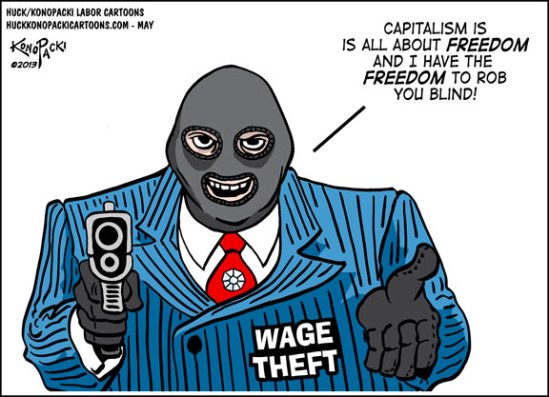
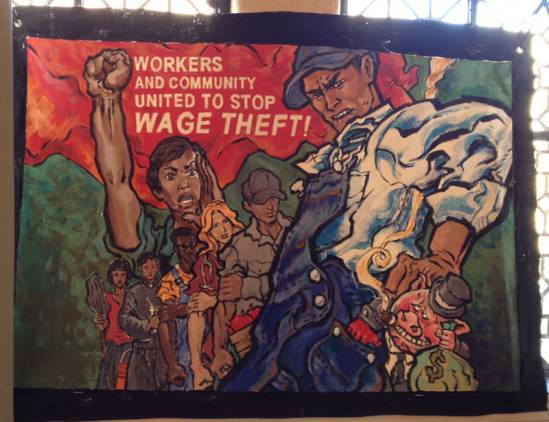
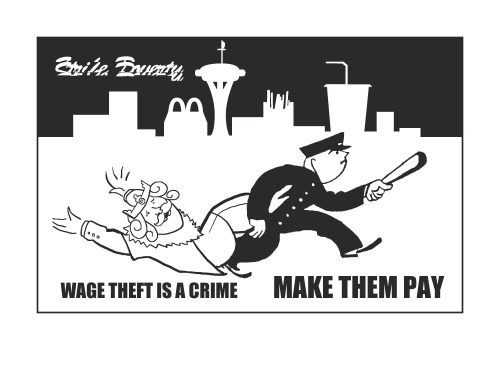
All of these actions described above paint Trump and his sprawling organization frequently failing to pay small businesses and individuals, then sometimes tying them up in court and other negotiations for years. In some cases, Trump’s team financially overpowers and outlasts much smaller opponents, sometimes draining their resources. Some just give up the fight, settle for less, end up in bankruptcy, or out of business altogether. Such actions described above are well-known cases of wage theft. Donald Trump has been a long practitioner of this but he’s hardly the only one. In recent years, workers ranging from NFL cheerleaders, Senate cafeteria workers, fast food workers, retail workers, high tech engineers, nail salon workers, and computer animators have found themselves victimized by this very real and very heinous act by their employers. Often, employees find themselves powerless to do anything about it. And if they do, they often have to act through the court system and risk losing almost everything. But since people rely on their job so much to make a living, this is a very important issue with it becoming the fastest growing crime wave in the United States. But it’s not often reported and it’s tough to see how widespread this problem is. However, at any rate, wage theft is a problem we need to discuss and need to demand action on because it affects so many people’s lives. And here I have this handy FAQ guide to show you.

main-logo-wtiac

Yes, this is what wage theft actually is. Unfortunately, Mr. Orange Nuclear Meltdown doesn’t understand this. Because he’s been a constant violator according to the lawsuits former employees subject him to.

What Is Wage Theft?

Wage theft is when an employer denies pay and/or benefits that are rightfully owed to an employee. Wage theft can be conducted through various means such as failure to pay overtime, minimum wage violations, employee misclassification, illegal deductions in pay, working off the clock, having tips stolen, or not being paid at all. In short, the boss is not paying workers for all of their work. Or not paying for the work at the rate they said they would or what the employees are entitled to by law.

Eng2

If you experience any of these at work, you might be a victim of wage theft. Because these are common signs like being paid under the table, kept working despite clocking out early, having tips stolen, and not receiving meal or rest breaks.

Types of Wage Theft:

Overtime– This is the most common form of wage theft. The US Fair Labor Standards Act dictates that employees are entitled to receive overtime pay calculated at least 1.5 the regular rate for all time worked past 40 hours a week. Some exemptions only apply to public service agencies or employees who meet certain requirements in accordance to their job duties along with no less than a $455 weekly salary (or $23,660 a year). So unless employees meet the exemption criteria, they’re usually entitled to overtime if they work over 40 hours a week period. Employers can’t change overtime laws and can’t avoid paying overtime by enacting a no-overtime policy or getting employees to agree on special deals. Unfortunately, it’s common for employers to treat overtime as a personal choice when it’s not. And despite regulations, many employees aren’t being paid overtime due to them. Common overtime violations include:

  • Improperly Calculated Overtime Pay– Employers must calculate overtime on the actual 40-hour workweek regardless of pay period whether it be weekly, bi-weekly, or monthly. Many employers are said to average hours over 2 or more weeks, not including all payments in calculating overtime pay rate, not paying employees for all hours worked over a 40 hour work week, not including time spent preparing for work (donning and doffing), and requiring employees to wort through unpaid meal breaks. Such errors may not always be accidental.
  • Comp Time Instead of Overtime Pay– Compensatory time is paid time off for extra hours worked that’s generally granted to hourly employees instead of overtime wages. It can sometimes be legal (though it’s often not due to fear of employer abuse) but employers must pay it at 150%, the same rate as overtime wages. To give employees to take compensatory time or extra paid time off in lieu of overtime pay is illegal under federal law. Furthermore, those who do take the compensatory time option aren’t always guaranteed time off whether they want it or need it.
  • Employees Not Allowed to Report Work over 40 Hours Per Week– Many employers have rules that no overtime work will be permitted or paid for unless authorized in advance. Some employers choose to ignore when hourly employees work overtime or don’t allow employees to work overtime hours. This violates overtime rules.
  • Misclassification of Employees as Exempt Workers– Exempt employees are by law workers not entitled to receive overtime pay. Whether an employee is exempt or not can be confusing. However, it has nothing to do with one’s job or job description or whether one is paid a salary or hourly. It depends on what an employee actually does on their job on a daily basis that determines whether or not they’re legally entitled to overtime pay.

Not Paying for Meals and Rest Period Pay – Meals need not be counted as work time if they are at least 30 minutes long and the employee is relieved from active duty during the meal period even if they must remain available. An employee who works through lunch is working and that time must be counted. An employee who eats a sandwich at the desk or is required to monitor a machine is working through lunch. However, many employers who have their employees work through lunch are guilty of this.

Not Paying for Off the Clock Work– Many FLSA lawsuits involve employers failing to include time spent by employees performing work activities outside their normal shifts. Some may come early and start working before the official start time of their shifts. Such time is work time and must be included in FLSA pay computations, provided only that the employer knew or should’ve known that the employee was beginning work early (and to the extent that the employee spent pre-shift time performing work activities). Pre-shift roll calls are work time. Time spent setting up equipment before the official start of a shift is work time. Some employees may similarly stay late after shifts performing works which should be counted as work time as well. Travel time and on-call time is work time. Time spent by an employee cleaning equipment after the close of a shift is work time. Post shift work time can also include time spent by an employee performing job related activities on the way home like a secretary dropping off the day’s mail at the post office or delivering some paperwork to a customer or supplier. Some employees take work home. That time may well be work time. Similarly if an employee is contacted at home by phone for work related reasons, the time spent is work time (as well as when an employee is called back to work, the time counts as work time). This is a very common wage violation by employers.

Minimum Wage– The federal minimum wage is $7.25 an hour. It’s a poverty wage that’s not able to support a family but that’s beside the point. For tipped workers, it’s $2.13 an hour as long as it’s fixed and the tips add up to be at the federal or above the federal minimum wage which I think is stupid. Some states also have legislation that sets a state minimum wage as well. Depending on the state, the employee is always entitled to the higher standard of compensation. A common form of wage theft for tipped employees is to receive no standard pay and stealing tips. The Wage and Hour Division is said to be generally contacted by 25,000 people a year in regards to concerns and violations of minimum wage pay. Paying employees less than minimum wage is a very common wage theft practice.

infographic_employee_contractor

Missclassification is a common method of wage theft in which employers try to pass their workers off as independent contractors. The difference between employee and independent contractor is in this infographic.

Misclassification– One of the more extensive and insidious forms of wage theft which leaves workers especially vulnerable. Under the FLSA, independent contractors aren’t covered by tax and wage laws that apply to regular employees. Nor do they receive the same protection as employees for certain benefits. Thus, independent contractors aren’t entitled to a minimum wage, overtime, insurance, protection, or other employee rights. Nor do employers pay Social Security, Medicare, payroll taxes, or federal unemployment insurance on contract employees. Independent contractors also have to pay payroll taxes to the IRS. The difference between the two classifications depends on the permanency of employment, opportunity for profit and loss, as well as the worker’s level of self-employment along with their degree of control. Nevertheless, employers are strongly motivated to classify regular employees as contract workers to save costs, a practice known as pay roll fraud. A 2007 study in New York state found that 704,785 workers or 10.3% of the state’s private sector workforce was misclassified each year. For industries covered in this study, average unemployment insurance taxable wages underreported due to misclassification was on average $4.3 billion for the year while the unemployment insurance tax underreported in these industries was $176 million.

Illegal Deductions– Employees are subject to forms of wage theft through this method. Trivial to sometimes fabricated workplace violations are used to validate deductions. Any deduction that brings an employee to a level of compensation less than the minimum wage is also illegal. In many states, employers are required to issue employees documentation of deductions along with earnings. Failure to issue such documentation is generally prevalent in workplaces subject to wage theft.

Full Wage Theft– Employers are legally obligated to pay employees. However, this doesn’t always happen and is the most blatant and extreme form of wage theft.

Other– These may include putting pressure on injured workers not to file for workers’ compensation, being denied time off or vacation time they have required, being denied pay for sick leave or vacation time, not paying final paycheck to workers who’ve left, delaying payments (not paying on scheduled paydays or on a timely basis), bounced paychecks, stealing and pooling tips, unpaid internships, not reimbursing expenses, not keeping or fabricating records of hours worked, not paying for training, and under staffing. These could depend on state and local jurisdictions.

Wage_theft_versus_other_property_crimes

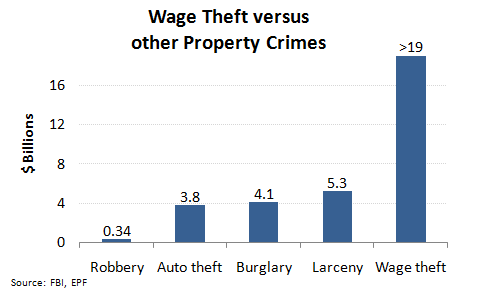
According to the FBI, more money is lost to wage theft than in any other property crimes including robbery, auto theft, burglary, and larceny. And money number is only from the reported cases.

How Common Is Wage Theft?

Wage theft is widespread in the United States existing in all professions and affecting all workers regardless of race, gender, or legal status. When it comes to ripping employees off, employers don’t discriminate. But low-income workers and immigrants tend to be the most vulnerable. Yet, this could happen to higher income employees as well such as in high tech companies. So don’t think you can’t become a victim of wage theft because you can. While no one knows exactly how big this problem is, federal and state agencies have recovered $933 million for wage theft victims in 2012 while property taken in all thefts and robberies amounted to under $341 million. Research suggests that American workers are getting screwed out of $20 billion to $50 billion annually. The odds of you becoming a victim of wage theft are likely but some workers are more vulnerable than others.

130204_VFC_UndocumentedFarmWorker.jpg.CROP.rectangle3-large

Undocumented immigrants are the most vulnerable to wage theft due to their precarious legal status that leaves them unable to speak up without risking deportation. Many employers take full advantage of this by paying them under the table and threatening to call immigration on them if they get out of line.

Who Are Most Vulnerable to Wage Theft?

Low income workers are the most vulnerable to wage theft, particularly in fields that employ women, people of color, and foreign born populations. Foreign-born women are at a much greater risk for wage violations than their male counterparts. Undocumented immigrants stood at the highest risk levels. Education, longer tenured employment, union membership, and English proficiency proved to be influential factors in reducing wage theft for the aforementioned demographics. Wage theft is more common in small businesses with less than 100 employees than larger companies. Workplaces with flat rate compensation or cash under the table payments also reported a higher instance in wage theft. We should also take into account that while low income workers are most vulnerable to wage theft, they’re the least likely to report it as well as suffer the most devastating consequences. When a worker only earns a minimum wage ($290 for a 40 hour workweek), shaving a mere half hour of the day from the paycheck could mean a loss of more than $1,400 a year, including overtime premiums. That could be nearly 10% of a minimum wage employee’s earnings which could be the difference between paying the rent and utilities or risking eviction and the loss of gas, water, or electric service.

WAGE-THEFT-GRAPHIC3

This infographic illustrates the real costs of wage theft which consist of less income, time poverty, and a poor workplace environment. Wage theft is wrong, it hurts families, it hurts people’s well being, and leads to further worker abuse.

Why Is Wage Theft Bad?

Think of it this way, if you spend several hours working your ass off and your boss doesn’t pay you the money or benefits you should be receiving, you would surely feel very upset about it. After all, you worked for it, you earned it. Therefore, your employer is required to pay you for all the work you did for them. This is how the employer-employee relationship is supposed to work. If your boss doesn’t pay what you deserve, then it’s obviously unfair. Your boss is ripping you off. Wage theft costs workers billions of dollars a year, a transfer from low income employees to business owners that worsens income inequality, hurts workers and their families, and damages the sense of fairness and justice that a democracy needs to survive. And when low wage workers are underpaid, taxpayers face the burden of supporting workers whose employers haven’t paid into Social Security taxes and other funds. Plus the millions of dollars lost in tax revenue. Not only that, but the money your average low income worker loses in unpaid wages is not reinvested in the economy. Meanwhile businesses who do pay their employees without resorting to wage theft find it hard to compete in a market with their additional employee-related expenses.

mike3may

Employers resort to wage theft because it keeps their costs down, saves them money, and easily get away with it. In other words, when it comes to profit margins, wage theft is good business despite being illegal.

Why Would Employers Commit Wage Theft?

Many businesses violate wage and hour laws for 3 reasons. First, paying employees less gives them a competitive advantage or higher profit and have little fear of getting caught or punished. If a business can get away with illegally paying its employees a below minimum wage with no overtime, it will be able to sell its products more cheaply than one who complies with the laws and pays their workers time-and-a-half for overtime work. If a business pays its “interns” nothing while its competitors all pay interns the minimum wage, it will be able to charge clients less and steal business away from its competitors. Second, even if a business doesn’t lower prices to undercut competitors, it still pockets the difference between the wage owed and the wage paid. Thus, the employee’s loss is the owner’s extra point. Third, there’s a very low chance the employer will be caught cheating on wages so most don’t usually think twice about the consequences. After all, employers usually can afford the better legal defense and the fact wage theft laws are typically weak and insufficiently enforced. As of 2014, there are only 1,000 to 1,100 federal Wage and Hour Division investigators for the whole country who are responsible for investigating over 7 million businesses and protecting over 100-135 million employees. In 2012, they only conducted fewer than 35,000 investigations and recovered about $280 million in unpaid wages to 308,000 workers. State labor departments and attorneys general combined recovered even less. Not to mention, many federal wage theft cases are thrown out because the Department of Labor couldn’t resolve them within two years. At the state and local level, it’s often even worse since few local governments have the resources to combat wage theft and several states have cut their labor department’s. Even if businesses do get caught, they’re rarely punished. Consequences for violations found are often no more than an order to pay back the wages owed or even a fraction of the total amount. This despite that the FLSA makes the employer liable for the full amount as well as additional equal amount for liquidated damages. But at any rate, the FLSA’s civil penalties for willful and repeat violations are too small to deter offenders from engaging in similar violations in the future. For instance the maximum penalty for failure to pay overtime and minimum wage being $1,100 whether the culprit be some local ice cream shop or a giant multinational corporation like Walmart. Yet, Wage and Hour failed even to seek a penalty in most of its cases for many years. And despite that the FLSA makes repeated willful pay violations a misdemeanor punishable by up to 6 months in jail, criminal penalties are rarely if ever used. At state and local levels, wage theft laws can be even weaker while enforcement is even more insufficient.

hires_720.b1c2f1eb.fill-735x490

Wage theft often goes underreported mostly because the party with the power and resources is often the perpetrator or the employer. Victims who decide to take action often face uphill battles, lost savings, lost careers, and possibly very little back pay and justice if they win. It’s a very sad situation.

Why Does No One Talk About Wage Theft?

Because unlike your typical property crimes, wage theft usually happens behind closed doors and is not easily detectable. It’s also conducted by more powerful people typically stealing from those with few resources to do anything about it. In fact, many workers may not realize their employers are stealing from them for years into their job. Or may not know that their boss may be doing anything illegal or violating their rights under the law. But if they do, they may not report the incident anyway if calling out their employer means losing their job or other forms of retaliation like shorter hours, less pay, or increased workloads. Many immigrants are often confronted with threats of calls to immigration services if they complain or seek to redress, especially if they’re undocumented. Some employees in white collar professions are even threatened with criminal prosecution or possibly blackmail to keep them from leaving. Even if they do sue and win, they often end up losing their careers and possibly their life savings to litigation fees. As for settlement, most workers who win their wage theft case usually don’t see a dime. Not to mention, it rarely makes front page news unless the case pertains to a class action lawsuit against a large corporation. So wage theft remains vastly under reported though cases filed in federal court have been on the rise.

20141218-walmart-revised-logo

In 2009-2011, warehouse workers sued Walmart for paying them less than minimum wage as well as denying the paid vacations they were promised. Walmart denied this because wage theft is one of the ways the retail giant does to ensure you save more, live better, and contribute to their profits.

What Are Effective Measures to Deter Wage Theft?

The US FSLA requires employers to keep detailed records regarding workers’ identities and hours worked for all who are protected under the minimum wage law. Most states require that employers also provide each worker with documentation every paid period detailing that worker’s hours, wages, and deductions. As of 2011, Arkansas, Florida, Louisiana, Mississippi, Nebraska, South Dakota, Tennessee and Virginia didn’t require such documentation. A 2008 survey of wage theft from workers in Illinois, New York, and California found that 57% of low wage workers didn’t receive this required documentation and that workers who were paid in cash or on a weekly rate were more likely to experience wage theft. So making employer documentation legally mandatory is an effective measure though not so much when it comes to tip theft. As for other enforcement measures, while willful violators can fines up to $10,000 upon their first conviction to jail time resulting from repeat offenses. However, since the WHD is so underfunded and so understaffed (which isn’t an accident), very few wage theft cases are investigated and fewer employers are brought to justice.

wage-theft

Most of the wage theft awareness campaigns usually tend to be localized and statewide. But wage theft is so widespread that Americans need to have a nationwide conversation about this. Wage theft is a very insidious crime that’s happening everywhere. We need to demand action to deter this behavior. We need to show that wage theft is an unacceptable way of doing business.

What Steps Can Be Done to Prevent and Stop Wage Theft?

First, wage theft needs to be addressed as a national issue in the national spotlight because there are stories that are barely heard on TV unless they pertain to Trump’s business shenanigans or NFL cheerleaders. Second, raise funding for the WHD so they could hire more staff to investigate (which should be doubled) as well as better laws that put stiffer penalties on employers. Third, protect victims filing complaints with government agencies from retaliation and allow them to access the back pay they’ve been so long denied if they decide to sue.There must be ways for wage theft victims to complain and stick up to their employers so they won’t have to worry about losing their jobs or their life savings. Fourth, fix the statute of limitations on wage claims for more than two years. Fifth, mandate that employers give workers pay stubs so they could accurately calculate their hours and have a record to prove they were cheated, which most states do anyway as well has been a proven deterrent. Sixth, have the DOL engage in targeted investigations of industries and employers where wage theft is rampant in partnership with community organizations workers trust and know who the criminal employers are. Seventh, instill stiffer penalties on wage theft violators which includes creating mandatory minimums for employers repeatedly breaking the law as well as make sure that wage theft judgments are enforced so workers could collect what they’ve been denied for years. And finally, provide resources to community organizations with the Department of Labor to eliminate wage theft and win back wages.

tumblr_mqpoufpxBF1soxlgxo1_500

Remember, wage theft can be prevented and stopped. The time is now to make unscrupulous employers pay. And I hope the Burger King goes directly to jail and isn’t allowed to collect $200.

Justice Is Not for Sale: Why the Private Prison System Must Go

shutterstock_17071270.jpg

As a practicing Catholic, I’m well aware that Lent is a penitential season for reflection and fasting. But I’m also one of those liberal Catholics concerned with social justice issues, especially ones that I think don’t receive enough focus than they should most of the time. One of these is the issue of privatized prisons, which I decide to do a blog post on since it’s been in my head for a long time and keeps up with the season of Lent. Besides, those affected by the privatized prison system are among the most vulnerable in our society since they neither have a political voice nor are innocent enough for people to demonstrate on their behalf. Yes, I know that a lot of our laws protect criminals but if you ever know how they’ve been treated by the system throughout history, it makes a lot of sense. Because while they may not be innocent or anywhere nice, criminals are human beings who deserve to be treated with dignity regardless of what they did. A lot of times, society hasn’t been very kind to them and many have been subjected to punishments that are a lot more harshly and less humane than several years in a barred cell. Sure everyone agrees that criminals should be made accountable for their actions but there are so many problems with how we treat criminals that this has led to a situations known as recidivism and prison overcrowding. Mass incarceration due to the War on Drugs has also played a key role. One of the ways, the US has tried to deal with such problems of rising prison costs is contracting privatized prison facilities. As of 2013, there are 133,000 state and federal prisoners housed in privately owned prisons in the US consisting of 8.4% of the country’s prison population. This includes 19.1% of federal prisoners and 6.8% of their state prison counterparts. And the number has been at a slow increase since the 1980s which has made the private prison industry a $5 billion dollar business enterprise with investors like Wells Fargo, Bank of America, Fidelity Investments, General Electric, and the Vanguard Group. The most prominent companies are the Corrections Corporation of America, the GEO Group, Inc., and Management and Training Corporation. Private prisons operate in 33 states. Not surprisingly, most are located in the southern and western states. However, I believe that the privatized prison industry is one that brings out the worst in our country that they should be banned. And it’s a shame that because the story of private prisons is one which nobody talks about but I think it’s one everyone should hear.

mississippi

This is from a privatized prison in Mississippi. It’s said that while minorities tend to be over represented in the general prison population, this is even more so in for-profit facilities. And they usually tend to be young and poor. This is mostly due to the notion that such inmates are cheaper to incarcerate.

  1. For-profit prisons harm minorities, the young, and the poor. – Poor and ethnic minorities have been disproportionately affected by the faults of criminal justice system (especially if they’re young men). In the US, it’s said that 1 in 3 African American men as well as 1 in 6 Latino men will spend time behind bars during their lifetime. Not only that, but black men are 20 more times likely to be arrested for marijuana possession and spend 20 more years in federal prisons than their white peers for the same crimes. And that’s just in the publicly run facilities. According to a UC Berkeley Ph. D. candidate named Christopher Petrella, the racial disparities in privatized prisons are even greater with people of color being housed at higher percentages. Not only that, but they also tend to be young. Petrella found that this was because private prisons usually seek out the youngest, healthiest, and cheapest prisoners. Add to the fact that many of them tend to be disproportionately poor, are usually convicted of nonviolent drug offenses and petty thievery, and more likely to experience recidivism. For them, such prisoners are the best kind of money making asset despite that they’ll be screwed up for life. After all, a young and poor person who’s convicted of petty thievery will end up committing more crimes in the future since ex-cons are often targets of discrimination as job candidates and educational institutions. Many nonviolent ex-cons and parolees are among the least deserving of such treatment. This should give us an idea that for-profit prison companies are in it to make money and not to protect society.
itppIryHDXO0

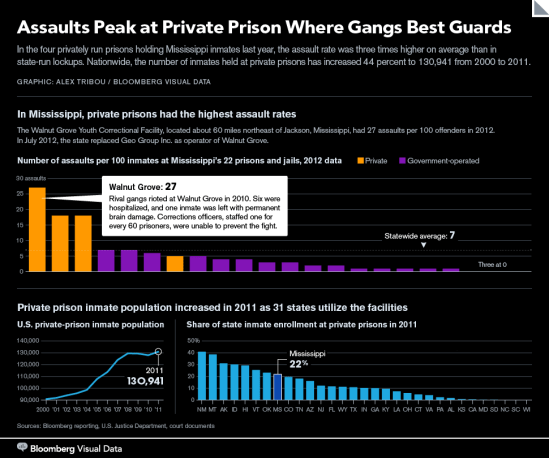
According to this infographic on prison violence in Mississippi, 3 of its 4 private prisons have experienced more assaults than any of its public pens. And unfortunately, the state’s private prison population is increasing.

2. For-profit prisons abuse prisoners.- Horror stories from the world of American privatized prisons are plentiful and appalling as profits are normally placed ahead of inmates’ care, health, and safety. Last year, the ACLU filed a lawsuit against the East Mississippi Correctional Facility (EMCF) on behalf of the inmates. Alleged abuses include rampant rapes, prisoners placed in solitary confinement for months at a time, stabbings, beatings, and other acts of violence occurring on a regular basis (whether the guards are involved or turning a blind eye). It’s also been reported that juveniles are put in jails with adults, where they’re oftentimes sexually (or otherwise) assaulted. Chronic hunger, malnourishment, rat infestations, suicides, have also been chronicled. And EMCF is not an unusual case. It’s widely reported that private prisons have much higher rates of inmate on inmate violence than their state run counterparts. 65% more frequent to be exact. And conditions are said to be even more horrific. A 2011 ACLU report on private prisons report horrifying cases of abuse that include juveniles smelling of urine and feces, racial segregation, punishment for speaking Spanish, and refusal of medical and mental health treatment. Thus, being an inmate in a private prison can be a hellish experience because private prisons have no interest in their inmates’ well being. To them, prisoners are commodities to profit from and nothing more.

detentioninfographic

This is an infographic on immigrant detention centers, many of which operate in the private prison business. A lot of these centers treat immigrants horribly where they have to live in horrid conditions and precarious circumstances as well as without legal representation. Undocumented immigrants have committed no crime whatsoever and their illegal entry is a civil violation at best. Yet, these detention centers treat them like criminals.

3. For-profit prisons victimize immigrants.– Aside from state and federal prisons, private prison ventures have been operating centers for immigrant detainees because the federal government lacks money and inclination to build anew. John Whitehead writes, “And yes, in case you were wondering, part of the investment pitch for CCA and its cohort GEO Group include the profits to be made in building “kindler, gentler” minimum-security facilities designed for detaining illegal immigrants, especially low-risk detainees like women and children. With immigration a persistent problem in the southwestern states, especially, and more than 250 such detention centers going up across the country, there is indeed money to be made. For example, GEO’s new facility in Karnes County, Texas, boasts a “608-bed facility still smelling of fresh paint and new carpet stretch[ing] across a 29-acre swath of farmland in rural South Texas. Rather than prison cells, jumpsuits, and barbed wire fencing, detainees here will sleep in eight-bed dormitory-style quarters, wearing more cozy attire like jeans and T-shirts. The facility’s high walls enclose lush green courtyards with volleyball courts, an AstroTurfed soccer field, and basketball hoops, where detainees are free to roam throughout the day.” All of this, of course, comes at taxpayer expense.” When I was in college, I’ve seen how immigrant detainees were treated on Frontline. Not sure if the facility featured was owned by ICE or by some private prison company. Either way, it was nothing like that and sort of brought me some degree of shame for my country. But at any rate, these people were all huddled together incredibly inhumane conditions such as physical abuse, inadequate healthcare, threats to physical violence, overcrowding, and squalor. Many of these detainees can’t afford to hire a lawyer and remain trapped in a seemingly endless legal process. It’s not surprising that a lot of them can be held in these centers for months, possibly over a year. They’re also used as cheap labor to maintain the facilities. Some earn a dollar a day, some earn stuff like candy bars, and some earn nothing. And it’s said perks like healthy food, outdoor activities, and mental health care are less available in private ICE facilities than their state run counterparts. Whitehead also writes how immigrants are heavily impacted with 2.5 million people being through the immigration detention system since 2003. At least half of them had been in private facilities that hold 34,000 on a daily basis as mandated by Congress. Today private prisons control 62% of the incarcerated immigrant population in the US.

990702 PAHOKEE YOUTH CENTER

This is photo is from a private juvenile center in Florida, which has privatized their juvenile prison system. As the most recent data indicates 40% of all juveniles are in private facilities where they’re being abused, neglected, and living in unsanitary conditions. All this is making their situations all the more tragic.

4. For-profit prisons harm children.- According to federal data in 2011, nearly 40% of juvenile delinquents are committed to private facilities. In Florida, private contractors have recently took control of all the state’s 3,300 youth prison beds which has produced some of the worst re-offending rates in the nation. Today, more than 40% of the state’s incarcerated youth wind up arrested and convicted of another crime within a year after their release. On the other hand, only 25% of youth offenders end up the same way in New York which has no private juvenile facilities to speak of. And privatization of Florida’s Department of Juvenile Justice continues to fail the state’s most troubled kids despite numerous allegations of abuse, neglect, violence, and unsanitary conditions. So much so that it has attracted attention from the US Department of Justice. One of the largest companies in juvenile sentencing is Youth Services International that had more than 40,000 boys and girls in 16 states go through its facilities whether they be prisons, boot camps, or detention center in over the last 20 years. Children held at YSI facilities across the country have frequently faced beatings, neglect, sexual abuse, and unsanitary food. And YSI isn’t an unusual case. Incarcerating adults in the name of profit is one thing, but doing the same to children is just beyond the pale. Many juvenile delinquents come from terrible circumstances like poverty or abuse. A lot of them are mentally ill and have substance abuse problems. Now juvenile detention centers aren’t supposed to be like Disney World. But they shouldn’t be hell houses either where kids have no adequate access to services to prepare for release like education resources, mental health counseling, or substance abuse treatment. But that’s exactly what’s happening at private juvenile facilities across the country and the reports about the conditions are shocking. It’s tragic that such conditions lead to many of these kids leading horrible lives and being trapped in a system that they can never get out of. Many kids in private juvenile detention centers will be screwed up for life as well as set up for a lifetime of incarceration as adults.

profitfrompain1

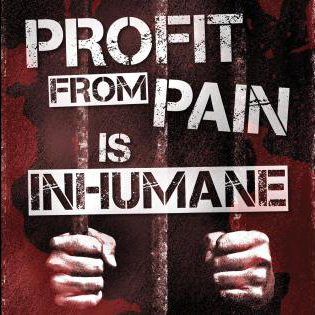
Though more abuse occurs in private prisons than their public counterparts, companies are more likely to turn a blind eye since they’re more focused on making money. And as a result, complaints are ignored while incidents aren’t even reported.

5. For-profit prisons profit from abuse, silencing, and mistreatment.– While many conservatives believe that prisoners have it easy in prison with great food, workout equipment, entertainment, and a lot of time on their hands, nothing could be further from the truth. Even the least notorious prisons are rife with inequality, dangers, and misery. And it’s not uncommon for a young first time offender to be placed right next to a career criminal. Nevertheless, public prisons don’t benefit from abuse and mistreatment of prisoners and neither does the general public. As prison corporations are lauded for their tough on crime measures, incidences of abuse, neglect, and violence are often unreported and unnoticed while communities suffer. Inmates grievances often go unread and unanswered while red flags are kept within. And thanks to Minneci v. Pollard (2012), the Supreme Court ruled that Eighth Amendment “cruel and unusual” cases can’t be brought against private prison employees, which ensues. Private prisons simply don’t care about the general welfare of their inmates than the profits they’re getting from them. And as long as private prisons profit from their inmates’ misery and squalor, they will keep their inmates’ grievances from seeing the light of day. Such actions deny any potential for outside oversight.

o-CARD-570

While JPay isn’t exactly in the private prison business, they do profit off of inmates and their loved ones with their banking service. They’ve exploited these people mercilessly with exorbitant fees. And it doesn’t help that many of them are already financially struggling and suffering.

6. For-profit prison companies exploit prison families. – It is well known that private prison companies and their affiliates do everything they can to make a buck off people in prison and their families. Prison phone companies are said to charge high rates for prisoners to talk to family and friends. If they or their loved ones can’t afford the fees, they run a higher risk of social isolation, which will not help their rehabilitation. Studies have shown that social connections are critical to a prisoner’s rehabilitation process once they’re released. Not to mention, there are 2.7 million kids who have an incarcerated parent and many of them suffer immeasurably when such unaffordable rates rob them of parental contact. And it’s bad enough that these kids come from at-risk backgrounds of poverty and have an elevated risk for drug abuse, school failure, unemployment, and mental health problems. Many of these children are likely to end up just like their parents. For children whose mothers are in jail, many of them will end up in foster care and never see them again since they have no one else who’d take care of them. That’s not forgetting the financial strains for-profit prisons and their affiliates put on families. For instance, for-profit prison banker JPay is known to prey on inmates’ families with some forgoing medical care, skipping utility bills, and limiting contact with imprisoned relatives just to make payments. Many of these prison families tend to be poor and such costs make it much more difficult for them to escape poverty as long as their loved one is in the system. And it doesn’t help that JPay is the only way to for nearly 40% of prison families to send money to a loved one which costs $6.95 for fast processing. Else, it might take forever if loved ones go with the “free option.” Private vendors can also charge prisoners and their families sky high prices essentials like clothes and hygiene products. It’s terrible enough for families should have their loved one incarcerated. But it’s devastating that they have to suffer for their loved one’s crime like this through no fault of their own.

8215347_G

In 2010, 3 inmates broke out of the Arizona State Prison in Kingman, Arizona, kidnapped and killed 2 tourists, and burned their bodies in a camper. It was later found that this prison operated by the Management and Training Corporation had inadequate patrols and prison movement, excessive false alarms, inadequate staff training., and inconsistencies with visitor screening procedures. You can see why private prisons don’t want to take in violent offenders.

7. Privatized prisons do a terrible job keeping violent offenders behind bars. – When it comes to a prison system’s effectiveness in protecting the public, you want one that’s fit to keep the most dangerous criminals behind bars. Given the problems our public prison system has, you still have maximum security facilities that have done a great job keeping the Unabomber and Charles Manson at bay. However, when it comes to security, private prisons tend to be medium at the max and often refuse to accept inmates that cost the most to house. Many of the crooks that actually pose a danger to society would fall into this category. A 2005 study found that Arizona’s public facilities were 7 times more likely to house violent criminals and 3 times more likely to house those convicted of more serious crimes. And when it comes to handling these dangerous criminals that are usually reclassified as a low security risk, private prisons have proved inept which has led to terrible consequences both in the jails and out. After all, the high frequency of unchecked violence that goes in there proves that some of these violent criminals are in there. Also, violent offenders have a tendency to be transferred to a public facility. Then there’s the question of security and keeping these crooks in. In 2010, 3 inmates escaped from a private prison in Kingman, Arizona, kidnapped two tourists, killed them both, and burned their bodies in the camper. It was later found that the prison these inmates broke out of had inadequate patrols and prison movement (the perimeter was unmonitored for 15 minutes at the start of every shift and had only one guard at the premises during the time of escape), excessive false alarms (89 during a 16 hour study period), inadequate training (1/3 of security staff had less than 3 months on the job and there was no officer training program), and inconsistencies with visitor screening procedure. To put it this way, such a system made this a very easy prison to escape and not one you’d want to put murderers in.

How Private Prisons Profit

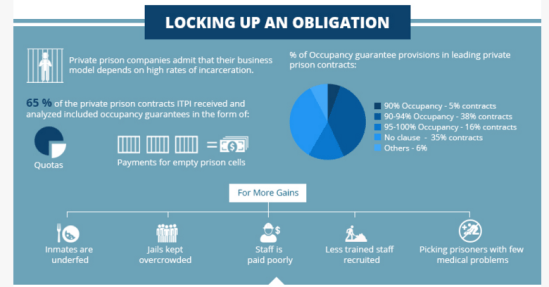
This is an infographic snip showing how private prisons profit which consists of occupancy quotas, cutting corners on costs, choosing cheap inmates, and keeping them in horrible conditions. Sure private prisons say that they’re more cost efficient than their public counterparts, but at what cost?

8. Privatized prisons aren’t cost efficient.- Private prison companies often sell the idea that they’re a cost-effective option for cash strapped states. However, there are 24 different studies on cost-effectiveness revealed that it’s either inconclusive or non-existent. Some research has even concluded that for-profit prisons might cost more than their public counterparts. It was also determined that some cost estimates might be misleading because privatize facilities often refuse to accept inmates that cost the most to house such as the disabled, the elderly, the HIV-positive, the mentally ill, those convicted of serious and violent crimes, and others. And a 2001 study concluded that many prison companies artificially inflate cost savings by sending the less expensive inmates to their facilities. Furthermore, privatized prisons are more likely to dole out twice the amount of infractions against inmates that lengthened their sentences by average 2 to 3 months, which can amount to as much as $3,000 increased cost per prisoner. Not only that, but inmates housed in private prisons were more likely to wind up back in the system after being released. And we all know recidivism contributes to prison overcrowding and isn’t fiscally responsible by any stretch of the imagination. Not to mention, these companies are paid by the state and at the taxpayer expense. If a state failed to reach an occupancy rate, it has to pay the company a reimbursement. Add to that the cost of poor quality that’s shifted to police dealing with escapees, court systems coping with prison lawsuits, and public hospitals treating inmates.

Boon to Local Economies.

Private prisons like to sell the idea that they help save taxpayer money and benefit local economies. However, several studies have found just the opposite. Here is an infographic detailing the case of Harding, Montana where the promise of a private prison never panned out and wasted the town millions.

9. Privatized prisons are a waste of taxpayer money and don’t benefit local economies.– While privatization is claimed to lead to tax savings for the public, it actually costs us more. Sure some of you might complain about your tax dollars going to public programs like welfare and other social services, but each public dollar paid through one social service will spend itself 4-8 times more elsewhere in the public sector. But once public money goes into private hands, it is gone for good. This is especially true when privatization corporations are given handsome tax breaks and “incentives” in the form of what liberals like me call, “corporate welfare” meaning we’re even less likely to see that money again even if these companies present a lower figure to do the same job. We should also remember that those who privatize are generally wealthy who tend to receive your hard earned tax dollars funneled into rich guys’ coffers for their own personal gain. Today such “corporate welfare” is justified through the notion that the “free market” is the same as democracy, an idea that assumes that if everything was privatized and ruled by the law of the dollar, then democracy will be ensured. This may be true for the rich but it’s not for everyone else. And such ideas about “the free market” are what’s screwing this country, especially since Citizens United. Nevertheless, private prisons are said to rely on government perks like subsidies as well as tax abatements and reductions. But of course, many states sign up private prison contracts since they offer a promise for jobs. However, we should note that they don’t hire a lot of staff and despite claims that state budgets can be bolstered by private prisons, studies have found just the opposite.

private-prisons-protest

While the private prison industry is certainly profitable, the concept of locking up criminals for profit is inherently unethical since it reduces them as commodities. Sure criminals aren’t innocent people but they’re also human beings. And no human being should have their freedom taken away from them in the name of profit.

10. Profiting from the imprisonment of human beings is morally wrong and constitutes as predatory practices. –As a venture, the private prison industry is a case in which a few people exploit our society’s larger problems for their own gain at a cost we all bare and get little in return. As John Whitehead writes, “No matter what the politicians or corporate heads might say, prison privatization is neither fiscally responsible nor in keeping with principles of justice. It simply encourages incarceration for the sake of profits, while causing millions of Americans, most of them minor, nonviolent criminals, to be handed over to corporations for lengthy prison sentences which do nothing to protect society or prevent recidivism. This perverse notion of how prisons should be run, that they should be full at all times, and full of minor criminals, is evil.” With the growing influence of the private prison industry, the US is, in effect, commoditizing human bodies for an industry in militant pursuit of profit. And it’s an industry that creates a system that trades money for human freedom, often at the expense of the nation’s most vulnerable populations: children, immigrants, and the poor. For such an enterprise to exist our country is morally indefensible and a national disgrace.

private_prisons_charts_foia

This is the infographic where the Freedom of Information Act is applicable to prisons. Notice how the public and private maps are of different colors. That’s because that private prisons tend to operate with little government oversight. This not acceptable.

11. Privatized prisons aren’t held accountable to the same degree their government owned counterparts. – Our taxpayer funded public prisons may be inherently flawed in many ways. But at least these prisons are operated and overseen by the state and federal governments for the benefit of the public good. Because of this, public prisons are encouraged to provide the best quality of service taxpayer money can buy. Because if public prisons fail, then everyone suffers. Privatized prisons just want to make money with their profit depending on the money they get from the state and spending as little as possible on the prisoners and the prisons. Not only that, but also housing as many inmates as possible, kept as long as possible, and housed as cheaply as possible. Meanwhile, private prison company executives receive multi-million dollar paychecks as well as profits for shareholders who will never suffer any negative consequences. And it doesn’t help that they’re receiving government subsidies and tax perks funded by the general public who suffers. Not to mention, since many states rely private prison companies to self-report, they have figured ways to make themselves look clean in the eyes of the state regardless what’s really happening at their facilities. Sure private prisons might operate under corporate oversight but as with most corporations, these companies will never voluntarily shape up unless there’s more government intervention. And so far, there has been little government oversight.

ITPI-CCAGEOProfits-Feb2016-1

While it’s very apparent that social problems and flaws in the criminal justice system lead to mass incarceration, private prisons profit from them and have no incentive to fix them. In fact, a lot of their lobbying efforts have been a major stumbling block in criminal justice reform. And it’s costing our tax dollars in the process.

12. Privatized prisons profit from existing problems in the criminal justice system and society and give no incentive to solve them. -While public prisons do carry a heavy taxpayer burden as well as are facing problems such as overcrowding and high recidivism, at least public investment and government oversight gives incentives to solve such problems in the penal system. After all, a government owned prison system that’s funded by taxpayers helps promote measures aimed at reforming prisoners and reducing crime. And that’s how it should be. However, the private prison industry is only held accountable to their investors, shareholders, and benefactors who’s only concern are profits. And the private prison industry profits by making sure that more people are put in jail. When making a pitch to potential investors, CCA is quick to point out that private prisons comprise of a unique, recession-resistant investment opportunity, with more than 90% of the market up for grabs, little competition, high recidivism, and the potential for future growth in the prison population. As CCA reported in 2014, “The demand for our facilities and services could be adversely affected by the relaxation of enforcement efforts, leniency in conviction or parole standards and sentencing practices or through the decriminalization of certain activities that are currently proscribed by our criminal laws. For instance, any changes with respect to drugs and controlled substances or illegal immigration could affect the number of persons arrested, convicted, and sentenced, thereby potentially reducing demand for correctional facilities to house them. … Legislation has been proposed in numerous jurisdictions that could lower minimum sentences for some non-violent crimes and make more inmates eligible for early release based on good behavior.” It’s no surprise that the private prison industry has no interest in reforming prisoners or reducing crime like ending ex-con job discrimination, decriminalizing marijuana, reducing the system’s racist impact on minorities, and any other policies that cut into their profits. As long as these problems persist, the private prison industry will be all too willing to exploit this country’s systematic social problems in the name of profit. What our criminal justice system needs is reform, not incentive for expansion.

Private Prison Giants and Their Activities

This infographic shows the kind of issues the private prison companies have lobbied for over the years. You might notice that none of them pertain to prisoner rehabilitation. That’s because they’re not interested in reforming prisoners because it hurts their profits. And it should be no surprise to any of us that private prisons have high recidivism rates. Their business model was constructed that way.

13. Privatized prisons have no incentive to rehabilitate prisoners.– Because public prisons are funded by taxpayers and run by governments, they always have an incentive to rehabilitate prisoners before release so they won’t wind up in jail again. And while such systems are significantly flawed and not always effective, at least public investment encourages public prisons to have more responsibility in inmate welfare, rehabilitation, and public safety. But for private prison companies, their primary responsibility is generating profits for shareholders through incarcerating as many people as possible, as long as possible, and as cheaply as possible. Under such a system, it’s very difficult or outright impossible for the private prison industry to be genuinely concerned for the welfare of inmates, let alone their rehabilitation. After all, to them, reforming a prisoner is just making them less likely to function as a future source of profit. Not to mention, private prison companies have little incentive to release an inmate early, regardless how well they’ve behaved since it would reduce their cash flow. As for providing treatment, why bother if it means losing a customer?

Walnut-Grove-Correctional-Facility-Prison

In 2010, rival gangs rioted at the Walnut Grove Youth Correctional Facility which resulted in 6 hospitalizations, including one with permanent brain damage. Since the MTC owned prison had a staff to prison ratio of 1/120, they just sat there and waited until the fight ended. In 2014, there were 2 riots that sent 18 and 4 inmates to the hospital respectively.

14. Privatized prisons have are poorly staffed with poorly trained and paid employees.– Evidence suggests that for-profit prisons are chronically understaffed, inadequately trained, and underpaid. And when you combine this with such prisons rapidly expanding, things are bound to get ugly which could put the prisoners’ and the employees’ safety in jeopardy. This is one of the reasons why privatized prisons have increased incidences of violence and escapes. A lot of times private prisons are so poorly run that they simply can’t find enough officers and other employees. Turnover rates are significantly higher. It’s not surprising since assaults on guards by inmates are 49% more frequent than in state run prisons. And it’s said that private prison employees are paid an average of 21% less than their state employed counterparts according to a 2010 report by the US Department of Labor. However, some private prisons just don’t want to spend “extra” money in order to hire enough officers and staff members to adequately run them even as these places are rapidly expanding to house more inmates. Many also spend less money on training for correctional officers as well. The Walnut Grove Youth Correctional Facility in Mississippi had a staff to prisoner ration of 1/120. When this prison experienced a riot in 2010, 6 inmates were rushed to the hospital, including one with permanent brain damage. During the riot, the staff just sat there and waited until the melee ended because there were 60 times more prisoners than staff. A lack of well trained and paid staff can also lead to corruption as there have been reports guards resorting to smuggling contraband for inmates. This could mean anything from T-shirts to cigarettes and knives or other weapons.

Quotas and Taxes

It’s very common for private prison companies to have contracts to guarantee prison occupancy rates and/or force taxpayers to pay empty beds. 90% is the most frequent occupancy requirement. Along with promoting harsher sentencing measures, private prisons are a huge contributor to mass incarceration.

15. Privatized prisons contribute to mass incarceration.-In 2012, CCA sent a letter to 48 states offering to buy their public prisons with promises that they have at least 1,000 beds and 90% occupancy for the next 20 years. In fact, nearly 2/3 of private prison contracts mandate that state and local governments maintain a certain occupancy rate usually 90% and require taxpayers to pay for empty beds. In Arizona, 3 private prisons are operating with a 100% occupancy guarantee. Such requirements by private prison companies are a common practice. Today crime rates are falling and the rate of incoming undocumented immigrants have leveled off. But today the US puts more people in prison than anywhere else on earth which is fueling a major crises. Such occupancy requirements by private prison companies only encourage this and have since the 1980s, especially since private prison inmate usually remain in jail longer. The fact these private prisons are profiting from the War on Drugs, undocumented immigration, as well as poor people being in desperate situations, ensures that mass incarceration is here to stay. And it also guarantees that the criminal justice system and public prisons will be swamped with more inmates than it would know what to do with.

unholy-alliance

The private prison lobby has enormous influence in federal and state governments across the country as well as contributed millions to political candidates of both parties. In turn, these prison companies have advocated “tough on crime” measures like “Truth and Sentencing” and “Three Strikes” laws as well as anti-immigration and pro privatization policies.

16. Private prison industry lobbying have a corrupting influence on the policy. – Private prisons are a highly profitable business due to government payments and prison laborers forced to work for pennies on behalf of corporations like Boeing and McDonald’s. And like any corporation, these corrections companies have powerful lobbies in Washington contributing millions to political candidates. They also lobbied for policies advocating free-market privatization as well as “tough on crime” laws like “Truth in Sentencing” and “Three Strikes Law.” CCA has helped financed Proposition 6 in California in 2008 which would’ve placed additional penalties for drug crimes. And GEO Group lobbied for Jessica’s Law in 2006 which pertains to the treatment of sex offenders. As a lobby, private prison companies influence legislation for tougher, longer sentences. They’ve also supported Arizona’s highly controversial anti-illegal immigration law. Both GEO and CCA have engaged in initiatives to create new crimes, particularly nonviolent offenses like failure to pay fines for misdemeanor offenses in Missouri (that go to private collection agencies) or being unable to afford bail. And they have responded to criminal justice reform and leniency to nonviolent criminals with vociferous opposition. Nevertheless, while private prisons benefit through such policies, their public counterparts and everyone else doesn’t. It turns out Florida US Senator Marco Rubio is one of the private prison industry’s biggest beneficiaries and political champions. He is closely connected with The GEO Group and has hired a former trustee as an economic consultant and a former lobbyist as his chief of staff from that company. GEO was also a top 10 contributor to Rubio’s Reclaim America PAC with his chief of staff being a senior advisor. There’s no question that Rubio opposes immigration or criminal justice reform since GEO has given him $40,000 in campaign contributions, making him its top recipient in the Senate. And opposition to criminal justice reform should render any candidate woefully inadequate to lead a nation suffering from a prison system that essentially perpetuates the oppression of its most vulnerable citizens. Yet, today the private prison industry is the biggest lobby that’s getting little scrutiny. That should change.

150812-cash-for-kids-jsw-334p_013828aebe25325b5353bdef714f14f1.nbcnews-ux-2880-1000

This is a picture of Sandy Fonzo of Wilkes-Barre, Pennsylvania confronting former Luzerne County judge Mark Ciavarella. Her son committed suicide when caught in the infamous”kids for cash” scandal where 2 judges were paid $2.8 million by Mid-Atlantic Youth Services Corporation to send over 2,000 children to it’s 2 facilities on unusually long sentences for rather petty crimes. While the judges were eventually sentence to long prison terms, hundreds of young lives were ruined in the process. And tragically, it’s said that there’s considerable evidence that private prisons have a very corrupting influence in the criminal justice system.

17. Private prisons have a corrupting influence in the criminal justice system. – While the US criminal justice system is corrupt, prison privatization simply encourages incarceration for the sake of profits which doesn’t keep with the principles of justice in any way, shape, or form. One scandal that has illustrated this is the “kids for cash” atrocity in Luzerne County, Pennsylvania. From 2003-2008, the Mid Atlantic Youth Services Corporation (a firm specializing in juvenile offenders), paid off 2 judges to jail youths and send them to their 2 private prison facilities. The 2 judges made over $2.6 million in the scam to by sending more than 2,000 kids to prison on unusually long sentences for incredibly petty crimes like stealing DVDs from Wal Mart, mocking a principal on Myspace, packing ibuprofen and trespassing in vacant buildings. Over 50% of the kids who appeared before Judge Mark Ciavarella lacked legal representation and 60% of those kids were removed from their homes. Luckily the 2 judges were sentenced to 17.5 and 28 years in federal custody but not without ruining thousands of young lives in the process. And there is evidence that private prisons tend to bribe judges at a regular basis. This kind of corruption might mean your DUI could turn into a maximum sentence if you can’t afford to hire the right lawyer. Since Florida privatized the entirety of its $183 million juvenile justice system, its Department of Juvenile Justice has been reported as effectively complicit in allowing problems to fester in its jails and is a failed system of oversight and accountability. State probes of mistreatment typically end with inconclusive evidence with only a quarter of cases ever being substantiated. And there is little incentive to crack down on contractors. Reform is also not likely to happen because so many Florida politicians have received money from juvenile prison companies that Governor Rick Scott challenged the “unsupported suggestion” that problems in Florida’s juvenile justice programs were systemic. Today Florida is failing its juvenile delinquents because it seems it doesn’t want to assume any responsibility for these troubled kids. The influence of private prisons can lead to a US criminal justice system based upon increasing the wealth and power of the corporate state, which isn’t fair when certain convictions guarantee payout. Our justice system should exist for the benefit of the public good, not for the financial benefit of a few corporations who house inmates for their bread and butter. And the fact many local and state judges are elected just makes it even worse.

prison-data-short

Recidivism is a huge problem in the prison system, especially when it leads to overcrowding. However, private prison companies see it as an asset to profit from. So they invest very little to almost nothing into a prisoner’s rehabilitation. Because why try to lose a customer?

18. Privatized prisons contribute to increased recidivism. – Despite claims that private prisons have lower recidivism rates, prisoners housed in private facilities are 40-60% more likely to return than their state run counterparts. It’s not surprising since private prisons have no incentive to rehabilitate the prisoners they house which makes them more susceptible to another prison sentence after they’re released. Across the country, recidivism is a major problem since it traps people in a vicious cycle of poverty, exploitation, and repeated offenses. Recidivism is a good reason to ban the box since convictions can prevent nonviolent ex-cons from getting a job that could keep them out of prison for good. Not to mention, recidivism leads to prison overcrowding. But for private prison companies, banning the box is bad business since their goal is to incarcerate more people in the name of profit. Other ways that private prisons encourage recidivism include limiting an inmate’s contact with family, offering a lack of educational options, and deficient rehabilitation programs. The fact that many of them charge inmates money for services like food and medical care also makes it difficult for them to get back on their feet after release.

infographic_620

Today there are 10,500 state prisoners are transferred to private prisons outside their home state, possibly as far as 450-3,000 miles. Though seen as a solution to prison overcrowding, this practice is detrimental to the criminal justice system because it impedes a prisoner’s rehabilitation and destroys families and communities.

19. Privatized prisons lead to prisoners being incarcerated outside their own jurisdictions.– If someone commits a crime, they will be tried, convicted and sentenced there. And it’s generally expected that the punishment will play out close to home. However, with the rise of privatized prisons, some states have been seeking solutions to prison overcrowding by having some of their inmates shipped to out of state locations across the country. Today there are more than 10,500 state prisoners in for-profit prisons outside their own states, approximately 450-3,000 miles from their home state. And it’s mostly without the prisoners’ consent. One example is Vermont since it has only 7 in-state correctional facilities, it has contracted with private prison companies for years, sending prisoners to out of state locations. Today there are currently hundreds of individuals being held from New York, Arizona, Michigan, and Kentucky. California, Hawaii, and Idaho that also house their inmates out of state as well. However, while this practice of transferring inmates out of their jurisdictions is detrimental to the criminal justice system because it separates inmates from their loved ones and social connections with the outside world. Furthermore, transporting prisoners to a remote location puts them in unfamiliar surroundings despite that inmates do much better in rehabilitation when they’re incarcerated near their own home and families. Not to mention, travel for family and friends is often prohibitively expensive. It also costs money and communities as well as destroys families. There are also concerns about the difficulty of oversight.

01-prisons-for-profit-500x500

This is a satirical flyer pertaining to for-profit prisons. However, while the private prison industry is profitable, it’s an unethical business that carries very high social costs. But it’s one that’s seldom talked about which is just so tragic.

20. Privatized prisons carry higher social costs. – Incarceration doesn’t really make us safer when we jail nonviolent criminals. Nevertheless, dealing with crime brings a lot of social costs that we need to talk about because they’re almost never discussed. There are the social costs such as broken families and communities of both victims and perpetrators. There are the hidden financial costs like paying for foster care for prisoners’ children (particularly if they’re single women) as well as what we’ll pay again when a prisoner emerges more desperate, addicted, uneducated, and disenfranchised than they went in. Then there’s the political costs of a society that seeks vengeance through prisons and punishment that will cost us twice the price of ensuring true equality, opportunity, and social health at the roots of our society. Private prisons will only increase such costs.

privateprisons

In conclusion, the existence of for-profit prisons only benefits the companies who own them through profiting on mass incarceration. Despite being wildly profitable, it is a business of total moral bankruptcy that hurts inmates and their families, scams communities, corrupts legal systems, and wastes taxpayer money. It is an industry that does nothing to protect the public or save money in any way. Thus, the private prison industry shouldn’t have a right to exist because its existence is a national shame.

Not in My Name: Why I Oppose Capital Punishment

state-death-penalty-image-yes-no

For much of our history capital punishment has been seen as method to execute criminals (especially in Texas). However, as flawed as our justice system is, many support the death penalty for certain criminals since many of them committed such heinous crimes (or were accused of them), then they must pay. Some argue that it provides closure for the families of murder victims in a way that justice has been served. Some say it deters crime since most people fear capital punishment anyway as well as keep the costs of prison down. However, while the death penalty has been one of the oldest forms of legal punishment in history I have always harbored significant doubts on its morality as well as its effectiveness against deterring crime (yet it’s still legal in Pennsylvania as well as the US). Sure plenty of people fear death and would go out of their way to avoid the ultimate penalty, but are death sentences really worth it? It has already been abolished or ceased practice in 139 countries and in most democratic nations it is applied in only the rarest of cases. And recently, many US states have either abolished the death penalty or taken steps to do so even in red states like West Virginia or Alaska. Yet, many people of both parties remain convinced that capital punishment is a viable form of justice on some certain level. And while the EU has staged an embargo on the drug used for legal injections, some states have tried to find cheaper and more efficient alternatives like a firing squad. Here is a list on why I oppose the death penalty.

1. Support in death penalty is culturally based. Believe it or not, most people who support the death penalty do so because they were raised with the idea as a viable form of punishment. Since capital punishment has been around in nearly every civilization for thousands of years, but just because it’s always been around doesn’t necessarily make it right. However, old ideas don’t always die when you want them to and there are people who still believe that cold-blooded killers deserve to die and our culture gleefully promotes this concept since this is what usually happens to bad guys. To these people seeing a convicted criminal executed is proof that the system works regardless of other implications so much so that they would say anything to justify why capital punishment should remain.Thus, belief in capital punishment has much more to do with one’s culture than systematic effectiveness overall.

2. The death penalty fails to recognize a guilty person’s potential to change and denies an opportunity for them to rejoin society. While society has always looked down on criminals, death row inmates are especially prone of being judged irredeemable because the crimes they committed lead to a death sentence. Sure there are plenty of death row inmates who aren’t sorry for their crimes but many do have the capacity to change and/or amount to some benefit to society.  Let’s face it, humans are complicated and unpredictable creatures. Not to mention, contrary to popular belief, criminal convictions don’t define someone as a bad person incapable of rejoining society. It just means they’re guilty (though to be fair, death row inmates aren’t nice people to begin with). For instance, take Robert Stroud (of Birdman of Alcatraz fame) who reared and sold birds during his solitary confinement in Leavenworth Prison as well as became a self-taught ornithologist and author. Yet, before his birding days, Stroud was sentenced to death at one time in his life for stabbing a prison guard, though the sentence was eventually commuted to life imprisonment which not only led him to keeping birds but also finding a cure for a family of avian diseases. It would be hard to imagine what farmers and ornithologist would’ve missed if this man was executed between 1916 and 1920. Yet, unlike the favorable Burt Lancaster portrayal (who changed from a violent anti-social thug to intellectual and soft-spoken pacifist), the real life Stroud was a diagnosed psychopath widely disliked and distrusted by the jailers and inmates who knew him as extremely difficult and demented as well as a vicious killer. Nevertheless, his story illustrates even bad guys like him can do some very good things if given the chance and that a person’s crimes shouldn’t define one as a human being. Saying that certain criminals deserve death is determining them irredeemable, which in many ways denies their humanity.

This cartoon shows a quick look at the death penalty in California, a state known for its horrible prison situation. Since 1978, to execute someone in this state costs $4 billion with the legal process taking 25 years. And it only managed to execute 13 people. Yeah, it's pretty much a ripoff.

This cartoon shows a quick look at the death penalty in California, a state known for its horrible prison situation. Since 1978, to execute someone in this state costs $4 billion with the legal process taking 25 years. And it only managed to execute 13 people. Perhaps prison overcrowding isn’t so bad at least when it comes to taxpayer dollars spent per prisoner.

3. Executions cost more than a lifetime in prison. While the prison system may have their own problems, they keep some of the worst criminals off the streets who are now serving a life sentence without parole. Of course many proponents argue that capital punishment helps relieve the costs of caring for condemned criminals. Cases resulting in life in prison usually cost approximately $500,000 on average from arrest to incarceration and once it’s delivered, the case is usually closed for now. Cases involving the death penalty by contrast, can cost to as much as $1-3 million, sometimes even $7 million in taxpayer money and they usually involve a lengthy and complex appeals process sometimes lasting a decade on average all because someone’s life is on the line. Thus, death penalty cases involve more lawyers, more witnesses, more experts, longer jury selection process, more pre-trial motions,  an entirely separate trial for sentencing, and countless other expenses that could rack up costly expenses before a single appeal is filed. Add to that the fact most death penalty trials are found to be significantly flawed and must be re-done, sometimes more than once. Even in most cases in which the death penalty is sought, it’s almost never imposed. And when it is imposed, it’s rarely carried out. Still, the costs of all this regardless of outcome is paid by the taxpayers. These proceedings divert resources which could be better used for more positive endeavors like helping homicide survivors, education and social programs, scholarships for orphans, libraries, hiring more police officers, and other things. Not only that, but money may be the main reason why more states have decided to abandon capital punishment in the first place. As much as caring for condemned criminals costs taxpayers, it’s much cheaper than trying to execute them.

In recent years, wrongful convictions have become more apparent in the American legal system in recent years. Recent years have seen more exonerations by DNA evidence. And this has gone up for death row inmates as well. Thus, it's apparent that capital punishment kills innocent people. As to how many, it will never be known.

In recent years, wrongful convictions have become more apparent in the American legal system in recent years. Recent years have seen more exonerations by DNA evidence. And this has gone up for death row inmates as well. Thus, it’s apparent that capital punishment kills innocent people. As to how many, it will never be known.

4. You can’t remedy a wrongful execution. In the criminal justice system, there is always a potential for error whether it be the acquittal of a known murderer or the conviction of someone completely innocent. Of course, if there’s a miscarriage of justice, the system should be able to correct it in due time. Sure some murderers may be free to kill another day but that doesn’t mean they’d necessarily be lucky the next time. And innocent people serving time in prison can always be exonerated via DNA evidence. However, whenever the system sentences someone to death, one of the reasons why the death penalty legal process is so long and complicated is just to ensure that innocent people aren’t wrongfully executed. Yet, even with these protections, there’s still a risk of carrying out a wrongful execution which can’t be taken back. In the US, since the 1973 around 143 death row inmates have been exonerated and most simply because of the weak cases against them and nine times more frequently than others convicted of murder. Some haven’t been so lucky and it’s very difficult to determine how many innocent people were executed there’s often insufficient motivation once an execution occurs. Still, whenever someone is accused of a serious crime, there are plenty of factors that can result in wrongful conviction like inadequate legal representation, government misconduct, eyewitness error and perjured testimony, junk science, racism, snitch testimony, false confessions, suppression and/or misinterpretation of evidence, and social pressure to solve a case. Our criminal justice system is far from perfect and can’t be right 100% of the time. Yet, in capital cases, a wrongful conviction can be deadly and you can’t take back a human life.

This is a chart depicting the causes of wrongful convictions. A lot of this involves government misconduct. But this can also include erroneous eyewitness testimony, false confessions, bad legal representation, informants, and others. And each case can have multiple causes.

This is a chart depicting the causes of wrongful convictions. A lot of this involves government misconduct. But this can also include erroneous eyewitness testimony, false confessions, bad legal representation, informants, and others. And each case can have multiple causes.

5. Most death row inmates were convicted while being defended by court-appointed attorneys who are often the worst paid, most-inexperienced, and least-skillful lawyers. The quality of legal representation provided plays a determining factor whether a defendant will face execution. Since most defendants in capital cases are too poor to afford a lawyer, the job defending the accused will usually fall to public defenders. Yet, these court appointed attorneys are often overworked, underpaid, or lack the experience to take on death penalty cases that they are inadequate providing a good defense. There are some instances where defense attorneys have arrived to court drunk, slept through the proceedings or failed to do any work in preparation for the sentencing phase. Also, whenever a capital case is set aside by a federal court, it mostly because the defense attorney’s incompetence that the accused’s constitutional right to effective counsel was violated. And it’s not uncommon for the defense attorney to be disbarred or disciplined for unethical or criminal behavior. Alabama has been notorious for providing especially shoddy counsel to defendants in capital cases. It has the distinction as the only state with no statewide public defender system though its death row inmates are overwhelmingly poor. In the US, we expect everyone to have a right to a fair trial, especially if a person’s life is at stake. Yet, if defendants in capital cases are given inadequate legal representation, how can they receive a fair trial?

6. Capital punishment doesn’t deter crime. Many proponents would argue that capital punishment by saying that it’s the ultimate warning against all crimes and sets an example to other would be criminals. Yet, while many people fear a death sentence, fear is hardly a good teaching tool and capital punishment’s effectiveness in deterring crime is questionable. In fact, there is no reliable evidence whether the death penalty has any effect on homicide rates at all as most criminologists believe. Some may argue that using the death penalty may brutalize society and lead to more murders and most proponents no longer consider deterrence as a serious justification for its continued use. The threat of execution may dissuade some from committing premeditated murder and so does getting caught. Not to mention, many murders are committed in moments of passion, anger, or by criminal substance abusers or acting impulsively. Those who commit first degree murder, either don’t expect to get caught or don’t weigh the consequences. Sometimes the legal consequences don’t even matter since some criminals may see life in prison as a fate worse than death anyway. Not to mention, consider the fact capital punishment has existed for thousands of years, yet people still commit murder regardless of the ultimate penalty.

Racial disparities are endemic in our criminal justice system. In capital cases, while a significant portion involve a black or Hispanic defendant, the overwhelming majority involve white victims. Looking at these disparities, I can't blame the people at Black Lives Matter for stating their case. These states are just despicable.

Racial disparities are endemic in our criminal justice system. In capital cases, while a significant portion involve a black or Hispanic defendant, the overwhelming majority involve white victims. Looking at these disparities, I can’t blame the people at Black Lives Matter for stating their case.

7. Race and socioeconomics of both defendant and victim play determining roles on who lives and who dies. Discrimination by socioeconomics and race have always been a problem in the criminal justice system and it is no different in capital cases. In our criminal justice system, it’s not unusual for poor black and Hispanic defendants to receive harsh sentences, especially if the victim was a white person. Death sentences are issued and/or sought by a prosecutor were more likely involve a black or Hispanic defendant killing a white person than white defendant killing a person of color. This is the case especially in the South given its legacy for racial discrimination as well as its tendency to apply the death penalty more than any other part of the country. And most of the time the defendant is poor so they won’t have an adequate defense. Not to mention, out of all the 143 death row inmates exonerated for innocence, most of them were either black or Hispanic as well. The racial and socioeconomic disparity regarding the death penalty can’t be ignored because it seems to be a statement that the lives of impoverished minorities are less important than whites and that killing a white person can mean the harshest of penalties. In short, most of those executed consists of those with the fewest resources to defend themselves as well as the color of their skin. We shouldn’t have that.

The lottery determining who gets the death penalty in America vastly depends on location. Defendants who live in Texas, Mississippi, Oklahoma, and Arizona are the most likely to get executed in the country. Texas is notorious for carrying out the death penalty that I'm surprised it executed only 15 people in 2012.

The lottery determining who gets the death penalty in America vastly depends on location. Defendants who live in Texas, Mississippi, Oklahoma, and Arizona are the most likely to get executed in the country. Texas is notorious for carrying out the death penalty that I’m surprised it executed only 15 people in 2012.

8. Jurisdiction politics play major roles in capital cases than the facts of the crime itself and is applied at random. Another major factor in capital cases pertains to the makeup of juries which can also determine whether the defendant will receive a death sentence. A juror’s race, religion, and attitude toward the death penalty can influence how they cast the first vote during the jury’s penalty phase. White Southern Baptist males are more likely to support the death penalty than any other group and thus are more likely to cast first for death as well as be selected for these juries. Jury selection in these cases could be rife with discrimination which tend to ensue juries to be disproportionately prone to handing down guilty verdicts and death sentences. Many are said to have decided a defendant’s guilt and sentence before the trial even began and have a tendency to not understand their own duties such as considering mitigating evidence. Juries in capital trials are even said to deliberate less thoroughly and less accurate than juries that better represent the whole population. Also, give into account that most executions take place in the South and that significantly more death sentences are sought than carried out creates a lethal lottery in the criminal justice system. So it’s possible that a convenience store armed robber can receive death while a methodical serial killer gets prison.

9. Capital punishment doesn’t relieve suffering from the victims’ loved ones. While proponents claim that capital punishment brings closure to victims’ loved ones, they tend to overlook the long and complex legal process as well as the heightened media coverage. These factors can make the death penalty process for victims’ families for many years (average capital cases usually take about a decade sometimes even longer), often requiring them to relive the pain and suffering with the endless reopening of old wounds. Media coverage on death penalty cases will usually focus on the legal consequences instead of the human ones where it belongs and attention is more often centered on the accused. Not to mention, hundreds of millions of dollars are spent on the death penalty each year which could be better spent on violence-prevention efforts, victims’ services, or solving unsolved cases. A life sentence without parole can provide certain punishment without putting murderers in the headlines, which may allow grieving families some time to heal since their loved one’s case doesn’t have to be revisited again.

Now this Timothy McVeigh graphic was taken from a satirical newspaper called The Onion. But it demonstrates how guys like the Oklahoma City bomber got tons of publicity in the days leading up to his execution. Now McVeigh was a terrorist who killed about 168 people and injured over 680. Had this guy gotten life in prison, we would've not heard about him again until his death in obscurity from natural causes. He didn't deserve the publicity or have his execution be front page news.

Now this Timothy McVeigh graphic was taken from a satirical newspaper called The Onion. But it demonstrates how guys like the Oklahoma City bomber got tons of publicity in the days leading up to his execution. Now McVeigh was a terrorist who killed about 168 people and injured over 680. Had this guy gotten life in prison, we would’ve not heard about him again until his death in obscurity from natural causes. And you’ll only hear about it in the obituary section. This was the death he deserved.

10. The death penalty gives some of the worst offenders undeserving publicity. Capital cases bring more media coverage and public interest than those pertaining to any other sentence. It’s not uncommon for death row inmates to receive reams of publicity as their date of execution nears which gives them a chance to expound their ideas and become media celebrities. The media attention placed on death row inmates not only can give families more grief but also may encourage others to commit violent acts, especially unstable people attracted to media immortality. Since death row inmates have their days numbered, they don’t really learn from their crimes and may not even regret them. On the other hand, violent offenders who receive life in prison without parole will face a lifetime of obscurity and regret, which may make the path to violence far less glamorous for many. Perhaps maybe be sentenced to hard labor to pay reparations for the victims’ families. If there is anyone who doesn’t deserve media coverage, it’s a murderer. While a death row inmate’s execution gets front page news, a notorious killer sentenced with life in prison won’t be remembered until his or her name appears in the obituary section.

For a long time in history, people watched public executions as a form of entertainment. Today executions are usually covered by the press leaving details of the prisoner's last moments. Nevertheless, executions teach that killing is always a viable solution even though it isn't.

For a long time in history, people watched public executions as a form of entertainment. Today executions are usually covered by the press leaving details of the prisoner’s last moments. Nevertheless, executions teach that killing is always a viable solution even though it isn’t.

11. Executions have a corrupting effect on the public. Public executions have been seen as a form of entertainment throughout much of history since many people didn’t really have access to all the mass media outlets we have today like books, TV, or internet. Yet, given the amount of media attention placed on death row inmates, there is probably no doubt that executions attract some degree of excitement in the public. TV crews don’t hesitate to give details of the prisoner given a stay of execution during the appeals process in the execution chamber. And then there are the last visits from family, the last meal, the last walk, and the last words. Many times this could turn into one big dramatic soap opera with people wanting to see a criminal die. Of course, The Hunger Games may argue that the public likes to see almost anyone die, which kind gives insight about capital punishment’s fucked up entertainment value. And there were even people entertained by the brutality in that series while missing the point the trilogy tried to make. Yet, sometimes such spectacles of executions may teach the public that killing is a viable solution even though it isn’t.

12. The death penalty is incompatible with human rights and human dignity. The notion of the state taking another’s life without questioning the mitigating circumstances is perhaps one of the main reasons why capital punishment faces plenty of opposition from religious groups, especially during recent times. When it comes to right to life, many people believe this also extends to the lives of convicted criminals and that capital punishment essentially dehumanizes people and society. If life is considered an inherent human right, then capital punishment must be a human rights abuse, especially since its also attached to a bunch of other forms of injustice. Many believe such abuses to be unacceptable, especially if such actions are illegal among the general public. Some may claim that it’s impossible for anyone to determine who deserves to die or be spared. It also violates a person’s right not to be tortured or be subject to any form of cruel and unusual punishment since there is no humane way to kill. Many religious groups oppose capital punishment for these reasons. Yet, since the US continues retaining the death penalty which denies a person’s right to life, then it can deny other rights that go along with it. And it doesn’t help that most countries that still have the death penalty are notorious human rights abusers like Iran, North Korea, Saudi Arabia, and China.

13. The death penalty promotes revenge. When someone is murdered, it is only natural for people to want something done to his or her killer. A lot of times many grieving families do wish that the murderer be put to death and while the emotional impulse for “an eye for an eye” is strong, it’s not always right, even if it does appear often in movies. Revenge should never be a sufficient justification for capital punishment in a mature society, especially one that should show much more respect for life even that of murderer. Encouraging revenge through execution only continues the chain of violence as well as increases the risks of angering the condemned’s families, especially if they were later found to be innocent. Besides, even with capital punishment, our society has never endorsed “an eye for an eye” since we don’t torture torturers or even rape rapists since those actions are inhumane anyway. For victims’ families, reconciliation and forgiveness are better alternatives.

14. Capital punishment forces families of executed criminals to suffer in unimaginable ways. Families of criminals never have it easy in any society and tend to suffer not only for the crime but also by the system that tries them. In any murder case, there will always be at least two families who suffer on opposite sides. While the victim’s family has to deal with losing a loved one, the murderer’s family has to deal with a lot of emotional turmoil as well since no one wants to see a loved one convicted. In a capital case, this is especially  true since the killer’s life is at stake and no matter how terrible a murderer is, he or she still has people who care about them and would certainly miss them. Yet, unlike families of murder victims, families of executed criminals have to live with their loved one’s crimes even if he or she doesn’t. And many of them will have to mourn for their executed loved one in isolation while receiving little sympathy for their plight. They run the risks of being vilified and shunned by the community simply because of their association. Sometimes they may even lose jobs, be threatened, or have their homes vandalized. Some ran the risks of experiencing PTSD when seeing a loved one’s execution. Not to mention, many children of executed criminals may not understand what happened or be able to handle it. And many of these families aren’t well off. Proponents may say that criminals cause their own families to suffer but while that may be true, their lives may be so much easier if their convicted loved one didn’t have to die.

The notion that the death penalty involves killing murderers to show that killing is wrong is a glaring hypocrisy. Besides, all an eye for an eye amounts to is just revenge. And revenge is something we don't need.

The notion that the death penalty involves killing murderers to show that killing is wrong is a glaring hypocrisy. Besides, all an eye for an eye amounts to is just revenge. And revenge is something we don’t need.

15. Capital punishment sends a message in a most hypocritical way possible. When we’re young, we’re told that killing is wrong, yet Americans live in a country which still condemns killers to death to teach that no one has the right to kill. Though killing may sometimes be necessary when it can’t be avoided, it’s seldom justified. Yet, if a nation executes people for murder, then perhaps the country is no better than the crooks it condemns. Maybe even more so if those executed are innocent people. Yet, giving some of the circumstances of death row inmates and victims  in the US, it can also be used to show that some lives are worth more than others, which is a very terrible lesson to teach. It’s hypocritical enough if it’s Ted Bundy getting executed but what does it say about this country if it tries to teach that killing is wrong by issuing a death sentence to people of color too poor to defend themselves? Some may argue that an entity saying who lives or dies is equivalent to playing God.

Barbara Graham was a prostitute, drug addict, and a thief. However, her murder case involving the killing of Mabel Monohan shows how complicated a murder case could be. There are conflicting accounts by two of her associates in the crime. So it's hard to say whether she did it but she was convicted and executed of the crime anyway.

Barbara Graham was a prostitute, drug addict, and a thief. However, her murder case involving the killing of Mabel Monohan shows how complicated a murder case could be. There are conflicting accounts by two of her associates in the crime. So it’s hard to say whether she did it but she was convicted and executed of the crime anyway. Probably should’ve been sentenced to life.

16. Life in prison is a much better solution in difficult cases. Even when a defendant in a capital case is guilty and sentence to death, you can’t really determine whether capital punishment is ever justly applied. While some proponents may think capital punishment should only apply to those convicted of the worst crimes, many get executed on serious crimes that are hardly seen as remarkable. Death row inmates are almost always too poor to defend themselves while socially marginalized people of color are especially vulnerable to receiving a death sentence and they usually are represented by court appointed attorneys who hardly put up an adequate defense. And sometimes local politics can play a major role on who gets to be on the penalty phase jury. Not to mention, there’s a good chance that many prisoners on death row may have an undiagnosed mental illness or experienced some form of trauma during their lives, have experienced substance abuse, and may have killed out of anger or impulsively. Murder cases can be very complicated and capital cases can take years to sort out whether the murderer should be executed. However, in cases with the penalties being life in prison, the defendant just needs to be convicted and the decision can be reversed if needed. Besides, sentencing criminals to prison usually falls to the judge, not jury so local politics play little influence in it. Also, most guilty lifers usually fade into prison life obscurity shortly after they leave the courtroom. When it comes to difficult case, life in prison provides a more swift and certain punishment while capital punishment provides neither.

17. Capital punishment hurts other prisoners, too. While proponents may say that capital punishment is a good bargaining chip for murderers to serve life without parole since everyone fears a death sentence. Yet, there is no correlation whether the death penalty does just that. What a death sentence threat can do, however, is increase the likelihood of some defendants more willing to accept a given plea bargaining offer or even taking responsibility for a crime they didn’t commit. After all, many defendants don’t have adequate legal representation anyways and a threat of execution may give them more reason to give up their constitutional right to a trial to save their lives. Scaring defendants into confessing things isn’t a reliable form of interrogation and can even ruin people’s lives. Sometimes execution threats can result in more cases going to trial, which I have already discussed what could happen there. Still, using the death penalty as a plea bargaining chip may increase the risk of wrongful convictions and may do little to deter wrongful executions.

Yes, this is a funny cartoon from Bizarro, a favorite comic of mine. However, being an executioner isn't a nice job since they tend to suffer from PTSD from having to kill. So there's no reason why any correction worker should risk their mental health over revenge.

Yes, this is a funny cartoon from Bizarro, a favorite comic of mine. However, being an executioner isn’t a nice job since they tend to suffer from PTSD from having to kill. So there’s no reason why any correction worker should risk their mental health over revenge.

18. No civilian’s job description should include killing another person. Despite how they appear in movies, the occupation or executioner was often an undesirable job that it was performed by people who’d otherwise be executed. These people were often unskilled in their work as well as suffered from a lot of mental anguish over it. And it wasn’t uncommon for many to commit suicide. Of course, we don’t have executioners anymore in the Western World since many countries have abolished capital punishment or in America’s case, aren’t carried out very often. But when they are, executions now are performed by corrections officers and medical doctors. And these people don’t have benefit of having heard all the evidence presented to them at the trial, which might make some doubt the defendant’s guilt. Like the executioners of old, they’re involved with executions and frequently suffer from PTSD from having to kill. Prisoners pose no threat to our society once in custody. So there’s no reason why correction workers should risk their mental health simply to pursue vengeance.

Supporters who think the death penalty as a cheaper alternative to life in prison often forget the complex appeals process involved in arranging an execution. In California, this usually takes 25 years. That time could be better spent in the court system.

Supporters who think the death penalty as a cheaper alternative to life in prison often forget the complex appeals process involved in arranging an execution. In California, this usually takes 25 years. That time could be better spent in the court system.

19. Capital cases involve endless appeals processes and required additional procedures that clog our court system. Now the US criminal justice system is already overloaded with more cases than it can deal with. And despite what you see on TV or movies, legal procedures aren’t short affairs. It can take years for a case to go to court and there have to be so many legal procedures to take place before a trial could begin. Most lawyers usually try to avoid trials. The criminal justice system is no exception, which is why most criminal defendants take plea bargains. In death penalty cases, trials aren’t optional. If the defendant is convicted and sentenced to death, there are countless appeals processes and other legal procedures that cost not just taxpayer money, but also time and space. And the US court system tends to go to great lengths to see the death sentence carried out. Thus, all the appeals, motions, hearings, briefs, etc. monopolize much of the time of judges, attorneys, and other court employees as well as use up courtrooms and facilities. Nationally on average it’s said that the process takes 8-10 years. Such time and space could be used for other unresolved matters. Meanwhile, you have people in jail for years simply waiting for their day in court. And most defendants are encouraged to take a plea bargain simply because the US court system is tremendously backed up. Getting rid of the death penalty may help move things along.

20. High profile death penalty cases attract top talent lawyers for little or no cost due its publicity and their personal beliefs against capital punishment, increasing the chances of a technicality or a manipulated jury will release a guilty person. While most death penalty cases usually involve terrible legal representation, ones that attract an excessive amount of publicity tend to attract top lawyers who desperately want attention and can manipulate the system through any means necessary in order to get someone off without punishment. And besides, defending someone accused of a horrendous crime garners much more sympathy than representing a crooked Wall Street executive. This is especially true if the defendant is a young white woman who’s fairly attractive like Barbara Graham or Casey Anthony. There are entire organizations that sprung up to fight death penalty cases and often provide funding to legal defenses. And many lawyers have made stomping out capital punishment a lifetime crusade.

Dr. Hawley Harvey Crippen was a homeopathic physician and outright quack who was charged with brutally murdering his wife Cora at their London home in 1910. He was tried, convicted, and executed. At the time everyone saw him as guilty. However, it's apparent that the body parts found in his basement were planted by Scotland Yard who were under tremendous pressure to solve a heinous crime. Besides, recent DNA evidence has revealed that the body parts found not only weren't Cora's but also belonged to a dude.

Dr. Hawley Harvey Crippen was a homeopathic physician and outright quack who was charged with brutally murdering his wife Cora at their London home in 1910. He was tried, convicted, and executed. At the time everyone saw him as guilty. However, it’s apparent that the body parts found in his basement were planted by Scotland Yard who were under tremendous pressure to solve a heinous crime. Besides, recent DNA evidence has revealed that the body parts found not only weren’t Cora’s but also belonged to a dude.

21. High profile death penalty cases put enormous pressure on the prosecution and police that they encourage misconduct. Since death penalty cases attract media coverage, law enforcement and prosecutors are under pressure to show that justice in their mind has been done. And they tend to do all they can to ensure a conviction, sentence, and execution. And pressure tends to lead to some degree of misconduct which can result in a wrongful conviction. Hell, even in non-death penalty cases there’s still a lot of pressure and fuck ups. Failure to catch Jack the Ripper put British police and Scotland Yard under intense public pressure to solve the case of Cora Crippen’s disappearance in 1910 in which friends suspected that her husband, homeopathic physician and outright quack, Dr. Hawley Harvey Crippen had something to do with it. I mean he and his wife didn’t get along before she disappear without a trace and was openly living with his girlfriend shortly after (who was wearing Cora’s clothes and jewelry) as well as selling some of his wife’s stuff. And when they found a set of grisly remains under the Crippens’ basement floor (suggesting she was brutally murdered), the guy was arrested on a transatlantic cruise ship while trying to flee to Canada with his girlfriend (both disguised as a father and son). He was tried, convicted, and executed. At the time the Crippen ordeal seemed like an open and shut case while everyone thought him as obviously guilty as hell (ditto the fact it received an obscene amount of media coverage in 1910).  However, despite how he was about as convicted by public opinion like Casey Anthony but utterly lacked her great fortune, Crippen was almost certainly innocent of killing his wife (well, as far as we know. Then again, we have absolutely no idea what happened to her after her disappearance). We know this for these reasons:

  1. Modern DNA test results show that the remains found in his basement not only weren’t Cora’s but also belonged to a man. (This based on mitochondrial DNA tests from the torso against that of Cora’s great-nieces and one DNA test method that’s highly sensitive to the Y chromosome {which was done several times}. However, the DNA stuff has been contested).
  2. Cora Crippen disappeared in January of that year while Dr. Crippen was arrested in July, which was around the time the remains were found. Thus, this would mean the remains would’ve been sitting in the Crippens’ basement for almost 6 months. During this time Scotland Yard had searched the Crippens’ home a total of 5 times.
  3. The remains were found under the Crippens’ basement floor in an area that was under the dining room. As someone who’s seen dead critters decompose on the side of the road, I’m well aware that decaying flesh gives off an odor that is strong and foul. And even the stench of a dead possum can be smelled from several feet away. If Dr. Crippen killed his wife and disposed her remains in his basement, then the police should’ve been able to find Cora’s body parts on their first search. Not on their fifth within a 6 month period. Large areas in the house should’ve carried a stench that there was a dead body in there.
  4. The remains were said to be placed in quicklime to be destroyed. While dry lime can disintegrate stuff in no time, the dirt underneath the Crippens’ basement floor was wet. And when lime meets water, it becomes slaked lime which is a preservative. The cops should’ve found more body parts.
  5. The remains included no head, limbs, and skeleton. In fact, they mostly consisted of soft tissue such as skin, hair, organs, and muscle. Anyone who’s worked with dead bodies can tell you that soft tissue usually decomposes before bones. So why the police were able to find soft tissue in Crippen’s basement and not bones? Even Raymond Chandler thought it was unbelievable that this guy can dispose his wife’s limbs, head, and skeleton successfully but bury the torso under the cellar floor of his home. And the way the authorities try to justify how Crippen disposed the other body parts pertain to methods you see on Breaking Bad or Dexter.
  6. Police reports state that the victim had been poisoned and then mutilated and dismembered. Most poisoners usually try to cover up their murders by doing all they could to make it look like an accident. Such sick acts like mutilation are extremely rare among poisoners and are things we associate with serial killers like Jack the Ripper. In fact, this is the only poisoning case involving dismemberment most poison experts are aware of. Besides, such acts seem such an unnecessary step for someone who wants to quickly dispose a body.
  7. The so-called scar tissue found that was interpreted as consistent with one Cora was known to have due to the hair follicles, which convinced the jury that the remains found at the Crippen house were hers. Scars don’t have hair follicles, a fact so obvious in 1910 that Dr. Crippen’s defense pointed it out.
  8. The circumstances surrounding how the remains were discovered gives me the impression that someone put them at the scene with the intention to be found and to make Crippen seem like very sick individual. Remains suggesting a horrifically grisly murder would be guaranteed to make headlines. And the case didn’t go public until after the remains were found. The fact Scotland Yard was under tremendous pressure to arrest someone for a heinous crime gives me reason to think that the remains were planted during the final search.

It’s obvious that Crippen was a victim of police misconduct of planting evidence, which not only got him convicted of murder but also got him hanged. I’m not sure how much the death penalty influenced this case in 1910 since it was applied far more often, but a high profile case like Crippen’s does fall prey to errors by the prosecution whether it be police brutality, planting evidence, mistaking the evidence, politics, racial profiling, or what not.

No, this isn't a bed from Christian Grey's sex dungeon. This is a bed they use to restrain a prisoner for lethal injection, the most popular method and

No, this isn’t a bed from Christian Grey’s sex dungeon. This is a bed they use to restrain a prisoner for lethal injection, the most popular method and “humane” execution method in America. This involves strapping a person to this thing, knocking them out, and injecting a bunch of poisons in them. Sounds like a humane way to execute someone? Didn’t think so.

22. There is no such thing as a humane execution. For a long time in history, executions happened all the time and nobody gave a shit whether the methods were humane or not, at least until recent times. In fact, in the olden days, executions were supposed to be agonizing, slow, and cause much suffering as possible. Think of Jesus’s crucifixion and how he suffered a horrifying and tortuous death on a cross. Yes, it’s brutal but that was how most people before recently, thought how executions should be. And they were done in public to scare people straight as well as provide entertainment for the community. The idea that punishment shouldn’t be cruel and unusual is a recent invention. But nowadays, we tend to struggle with not having cruel and unusual punishment when it comes to the death penalty since it involves killing someone. Since the idea that capital punishment hast to be “humane” there have been execution methods consisting of hanging, electrocution, gas chambers, firing squad, lethal injection, and what not. Now we’re well aware that the gas chambers were used by the Nazis to kill Jews in their concentration camps. Still, when you see some of these methods on TV or movies, they don’t seem anywhere near humane. I mean does being shot by firing squad seem like a quick and painless way to die? Not how I see it. Or what about having a ton of volts pumped into your head? Me neither. Or what about being injected with poison? Didn’t think so. Besides, it’s said that most lethal injections tend to be botched at a higher rate than most 19th century methods.

Another popular execution method in the US is the electric chair where a prisoner is strapped to a chair like this and is electrocuted. Let's just say if the electric chair doesn't seem humane on The Green Mile, then it's probably not in real life.

Another popular execution method in the US is the electric chair where a prisoner is strapped to a chair like this and is electrocuted. Let’s just say if the electric chair doesn’t seem humane on The Green Mile, then it’s probably not in real life.

23.  The death penalty expresses the absolute power of the state; abolition of this penalty is a much-needed limit on governmental power. Governments may not be perfect and the criminal justice system may make mistakes as well as commit their share of injustices. In some ways giving governments the power to kill somebody is too much. And it doesn’t help that many governments have and still do abuse this. Many of these governments are dictatorships that have executed people for dissent and who knows what else. But not even liberal democracies are exempt from this either. The US criminal justice system struggles with issues pertaining to incompetence, perjury, police brutality, and wrongful convictions. Do you want a government like that to decide whether a person lives or dies? The US constitution doesn’t forbid the death penalty nor does it mandate its use either. Congress is free to abolish it at the federal level and so would the states.

Although most Americans still support the death penalty, support has considerably declined in recent years while opposition has grown. At the government level, more states have voted to abolish it due to costs. Not only that, but most violent criminals are usually sentenced to life in prison anyway.

Although most Americans still support the death penalty, support has considerably declined in recent years while opposition has grown. At the government level, more states have voted to abolish it due to costs. Not only that, but most violent criminals are usually sentenced to life in prison anyway.

24. The death penalty has recently fallen out of favor, even in the United States. For a long time in history, the capital punishment was usually the only punishment for violent crimes. But as our societies evolved and realized that we could just imprison violent criminals instead of killing them, the death penalty has been applied less and less (except in dictatorships). Not only that, but as many as 139 countries have abolished it throughout the world. In the US, a death penalty case happens so seldom that one is bound to grab headlines, which adds to many violent criminals gaining undeserved publicity. Not to mention, while most Americans still support capital punishment, opposition has increased and as of 2015, 18 states have now abolished it. 6 of them have abolished it within the last decade. Out of the states that do, some haven’t had anybody executed in years. Hell, I can’t remember the last time Pennsylvania had anyone executed. Besides, most death row inmates usually die of natural causes before their execution date.

25. The severity of the crime plays no role in determining whether a defendant gets executed. Many supporters argue that the death penalty is supposed to be only applied to the worst crimes and the most vile offenders. However, most death sentences are determined on location, politics, socioeconomics, race, jury make up, quality of legal counsel, and whether or not the prosecutor decides to pursue it. Yes, I’m aware that death row inmates are generally not nice people. However, we should be aware that some of the most heinous murders don’t result in death sentences while some less heinous crimes are punished by death with co-defendants charged with the same and consistently receiving disparate sentences. Some of the worst of the worst like serial killers, gang kingpins and the like, are often spared the death penalty since prosecutors rely on their cooperation to help law enforcement close related cases. Nevertheless, such structures and biases in our society can make it impossible to limit the death penalty to some of the most heinous crimes by the most hardened criminals.

Yes, it's long past due to end the death penalty. And I have to agree that capital punishment doesn't help crime, doesn't prevent prison overcrowding, is expensive, and can never be humane. Let's just say the United States would be better off if we got rid of it. And no, I don't give a shit about what the people in Texas think about it.

Yes, it’s long past due to end the death penalty. And I have to agree that capital punishment doesn’t help crime, doesn’t prevent prison overcrowding, is expensive, and can never be humane. Let’s just say the United States would be better off if we got rid of it. And no, I don’t give a shit about what the people in Texas think about it.

Worst Arguments for Not Enacting Gun Control

gun_control_means_nothing_to_my_students

Disclaimer: The following might contain a lot of highly controversial political views about an issue that many Americans have strong opinions about. It runs a high risk of inciting outrage, anger, trolling, and hostile retaliation. Viewer discretion is advised.

As a Catholic liberal, I’ve been a long advocate for gun control. I’ve was nine years old during Columbine which was one of many mass shootings in the United States I’ve seen on the news. Not to mention, the fact so many people have been killed, injured, or scarred for life due to gun violence has cost taxpayers at least $100 billion annually as well as become a major public health concern. So I’m fully aware that certain gun control measures are badly needed and a lot of Americans would agree with me. And it’s not just liberals since we have to remember that the late James Brady was an official for the Reagan administration. Yes, the late great conservative Ronald Reagan whose fiscal conservative policies led him to raise taxes, had something to do with the Iran Contra scandal,  as well as had an openly gay son whom he freely accepted. But despite the urgent need for gun control I should not have to remind anyone about, GOP and NRA interests have made sure that their Second Amendment rights are protected at all costs. Even if it leads to a lot of innocent lives being slaughtered, high health costs, full emergency rooms, and an overworked criminal justice system. Not only that, but many states have passed gun laws that Americans don’t need, but also make this problem worse. Yes, I know that gun control is a highly contentious issue. But come on, do I really give a shit about gun rights? Now I’m fine with people owning guns as long as they’re law abiding citizens who don’t have personal issues that might endanger others. But do I think anyone has the right to own an AK-47 with a 30 round magazine? Absolutely not. Why? Because I can’t think of any reason why a civilian might need it save maybe in an event of an alien or zombie invasion. Here I list many of the arguments gun rights advocates make when it comes to doing nothing to necessary gun control.

  1. “Guns don’t kill people, people kill people.” – This is the most common argument gun rights people make in regards to gun violence. It basically says that people are responsible for their own actions and what they do with guns doesn’t mean that we have to enact any gun control. Yes, people kill people. However, guns are weapons specifically made to kill people with firearms technology designing weapons to kill as many people as possible. Thus, when it comes to killing people, guns are usually the weapon of choice. And most criminals will use other weapons when they can’t get a gun. Firearms were intended to kill people from the very beginning. To make a gun that doesn’t kill would be like removing a gun’s reason to exist. Yes, people kill people. But guns kill since it’s their point. Besides, when a gun is used incorrectly, someone or something doesn’t get shot. Let’s just say that we can’t talk about gun violence without acknowledging what guns are actually used for.
This is a diagram stating how gun laws would be if they were regulated like cars. Not that in the US it's harder to get a driver's license than it is to buy a gun depending on your jurisdiction.

This is a diagram stating how gun laws would be if they were regulated like cars. Not that in the US it’s harder to get a driver’s license than it is to buy a gun depending on your jurisdiction.

2. “________ kill people, too. You want to outlaw that?” – Gun rights activists love to point out how so many other things tend to kill people as well. Cars and alcohol are usually the most prominent examples. I’m well aware that cars kill more people than guns each year. However, in the US, it’s said to be more difficult to obtain a driver’s license than a firearm. Besides, we have a lot of regulations on cars like seat belts, speed limits, license and insurance requirements, and bans on drunk driving. If you cause an accident resulting in fatalities, you might do time for manslaughter. If you’re caught driving drunk, you might spend time in jail or lose your license. Besides, most people use cars for transportation, not to kill people. We also have regulations on alcohol and tobacco. Not only that, but there are plenty of things that could kill people but also fulfill other purposes like chainsaws and knives for instance. Guns, on the other hand, exist for one function which is to kill. And firearms technology has advanced in order to kill more efficiently, particularly people. I mean why was the AK-47 even invented in the first place? As for outlawing them, it’s highly unlikely that would even happen. Oh, by the way, the US has more gun stores than grocery stores, which is incredibly disturbing if you ask me.

3. “Guns save lives.” – Now there are plenty of stories pertaining to defensive gun uses. However, most of these usually exist in the mind of Hollywood screenwriters hired to write an R-rated action movie. A study in 1993 determined that there were 2.5 million defensive gun uses every year. This involved calling 4,977 people across the country, asking them a few gun questions and adjusting the number to fit the population of the whole nation. Now the 2.5 million number is highly cited and highly disputed. However, this number doesn’t translate to “lives saved thanks to guns.” In fact, they refer to guns being involved in the presumed person or thing’s protection. This can apply to life-threatening situations pertaining to people who were in actual danger as well as to people like George Zimmerman. So to say whether guns save lives is a mixed bag. Sometimes gun use might kill a criminal or stop a crime. Other times, gun use will fuck up everything. Nevertheless, there’s nothing defensive about gun use since it’s meant to attack and always will. Defense is protection such as a security system, mace, or a bullet proof vest. But whether guns save lives, it’s fairly hard to say at least when it involves civilian gun owners.

4. “Well, the Second Amendment says……” – Gun rights activists love to cite the Second Amendment which actually says, “A well regulated militia being necessary to the security of a free State, the right of the People to keep and bear arms shall not be infringed.” Now there’s a lot of debate about what it actually means. Some people think it pertains to individual gun ownership. Others think it refers to people in a militia. Still, either way, asking the Founding Fathers their opinion of contemporary American gun culture would be like asking Pope Francis on what he thinks about NFL football (then again he probably knows it’s not “football” as he knows it but not much else). To the Founding Fathers, the only guns available were single shot muskets which had a more complex loading process and weren’t very accurate. I mean the American Revolution gave rise to the term “minuteman” meaning a Continental soldier who was ready to fire at a minute’s notice. Then you have the saying “don’t fire until you see the whites of their eyes,” meaning “don’t shoot until they’re close enough for a sure hit.” Weapons that fire multiple times without reloading didn’t come until the mid-19th century with the American Civil War. Besides, we all know that some of the Founding Fathers also thought slavery was an economic necessity and they weren’t right about that. So maybe relying on them for gun issues isn’t the best idea.

While gun rights activists continually say that

While gun rights activists continually say that “an armed society is a polite society,” we should all learn from the impact of “Stand Your Ground” laws that this isn’t the case at all. I mean look what happened to Trayvon Martin. He was just a teenager minding his own business but gets shot anyway. So much for a polite society.

5. “An armed society is a polite society.” – Gun rights activists like to use this argument which states that people with guns encourage others not to mess with them. Sort of like a “scared straight” approach in which a lethal threat or fear of untimely death can be used to keep people in line, deterring prospective criminals. And through such, an armed society will ensure lasting peace and security within a community. However, this notion ignores a lot of things about human nature, especially when it pertains to gun violence. For one, you never know what can set somebody off to view you with suspicion as a possible threat to their lives despite all evidence to the contrary. In other words, the trigger could be just about anything. Second, some people are easier to piss off than others and for very trivial reasons. Yes, an armed society might scare people from insulting or offending gun owners. However, you can easily insult or offend somebody even if you have no intention to. Third, people have been killed for very stupid reasons, especially in states under “Stand Your Ground” laws. Trayvon Martin was just an unarmed teenager minding his own business when George Zimmerman picked a fight with before shooting him dead. A retired cop shot a unarmed man in a movie theater for allegedly throwing popcorn in his face. Another guy shot a bunch of unarmed teenagers for playing their music too loud near a gas station (and after they turned down the music as he requested). Fourth, armed societies don’t protect or respect the rights of non-gun owners as well as vulnerable populations that might be viewed with suspicion. And these “Stand Your Ground” laws demonstrate this, especially since Florida’s mostly benefits white gun owners charged with shooting racial minority victims. Finally, sometimes the consequences don’t discourage people from committing crimes. In fact, some criminals might be fully aware of implications but choose to break the law anyway. For instance, an armed society wouldn’t deter anyone in the drug gangs on The Wire, because they practically live in one as a business environment. They know they’re criminals and commit their crimes fully knowing what’ll happen to them if they piss off their superiors or their enemies. And it could pertain to almost anything. Such notions give me serious doubts on whether an armed society is a polite one after all. To me, living in an armed society is more of a “walking on eggshells society” in which you have to be in public every day of your life afraid of committing the slightest offense that might give a stranger a reason to shoot you. This is not the kind of society I want to live in because scaring people straight by threatening their lives is no recipe for lasting peace and security and more of constant tense and tenuous standoff between warring parties. I’d prefer to live in a gun-free zone any day.

6. “Guns aren’t the problem. Our poor mental health system is the problem.” – Yes, our mental health system needs reform. But many gun rights activists think that reforming our mental health system might make all out mass shooting problems go away. However, they overlook two major things. First, like the general population, most mentally ill people are harmless. Second, while some mass shooters might have a mental illness, most do not. Third, they fail to take into account other factors play into the gun violence issue besides a poor mental health system like poverty, drugs, and gang activity in bad neighborhoods. In many ways, guns give people a sense of power and in the wrong hands it’s a deadly combination. Thus, even if the US mental health system is reformed and improved, there are other factors pertaining to gun violence that we have to deal with. Even if better mental health systems do prevent mass shootings, gun violence will still be a problem. Besides, as gun violence is concerned, mass shootings are only the tip of the iceberg since it’s a multifaceted problem with multifaceted solutions. And part of the solution is tighter enforcement and tighter regulation.
Opponents of gun control love to point out how Chicago has a very bad problem with violence despite its tight gun laws. However, little do they know that Chicago's gun problems have more to do with its laws being at city level, lack of stronger national gun laws, and geography. Besides, it was later found out that most firearms involved in Chicago gun crimes were legally bought in Indiana.

Opponents of gun control love to point out how Chicago has a very bad problem with violence despite its tight gun laws. However, little do they know that Chicago’s gun problems have more to do with its laws being at city level, lack of stronger national gun laws, and geography. Besides, it was later found out that most firearms involved in Chicago gun crimes were legally bought in Indiana.

7. “But gun control won’t stop criminals from getting guns and committing crimes.” – Yes, but that’s like saying that enacting laws isn’t worth it because they won’t stop people from committing crimes. But such laws against crimes help ensure people’s safety or they wouldn’t be on the books in the first place. Nor would we have punishments for breaking them either. So yes, they’re worth it. Then there’s the matter with how gun rights activists point out how Chicago has more violent crimes than Houston. Now since Chicago has tight gun laws and Houston doesn’t, then gun control isn’t very effective. However, they don’t note how US gun laws aren’t uniform between or within states and are rather inadequate at the national level. Take Chicago’s problems with gun violence for instance. Now while the city itself might have tight gun laws, the rest of Illinois does not and neither does Indiana. It was later found that many of Chicago’s guns come from surrounding areas like Indiana. Why? Because lack of a uniform gun laws allows firearms to travel from loose law areas to tight law areas. Weak national gun laws make it inadequate to crack down on illegal firearms circulation with most gun violence occurring with such weapons. Such weak national laws undermine attempts at gun control everywhere. Thus, any form of gun control Chicago implements will be ineffective not because of the laws themselves, but because Chicago has no legal authority to regulate firearm circulation outside its limits.

8. “Guns aren’t the problem. Exposure to violent entertainment is the problem.” – I’m well aware that violence in entertainment is endemic in our culture whether it be movies, TV, video games, and other media. However, while violence in the media might make viewers somewhat less sensitive to what goes on in real life, most of the time it doesn’t lead people into committing violent crimes. Yes, the US has a lot of violence in the media which appeals to a wide range of people. But most industrialized countries also consume a lot of violent media as well. Yes, I know that they watch and play the same violent stuff Americans do. But they also produce a lot of violent stuff of their own. Japan is known to produce a lot of violent movies and video games. Audition and Battle Royale are Japanese movies famous for their gore. But they have a lot movies featuring samurai and Godzilla. Oh, and they’re home to Nintendo and Sony, by the way. Great Britain produces a lot of murder mysteries and crime shows. Of course, you’d expect that in a country which produced Arthur Conan Doyle and Agatha Christie. But many recent British crime shows have death counts of 1-4 victims per episode. A British show called Midsomer Murders has a higher body count than The Wire. Sweden brought us series like The Girl with the Dragon Tattoo and Wallander both of which are disturbingly dark, violent, and gory. And then there is the Spanish Pan’s Labyrinth which has some cold blooded torture scenes that would make Jack Bauer wet his pants. Now if violent entertainment led to violent crime, these four countries would be in very deep shit. However, none of them have the level of gun violence prevalent in the United States. So the argument that exposure to violent entertainment encourages violent behavior is weak. Well, Britain may have a higher violent crime rate than the US but its gun crime rate is low. But even so, Britain still experiences far less murders than its crime shows depict, particularly the ridiculously violent Midsomer Murders.

This is a handy infographic explaining the nature of gun violence. And yes, it goes to great lengths to say that it's definitely about the guns. Yes, it's a cultural thing but we can't really dismiss guns from the equation.

This is a handy infographic explaining the nature of gun violence. And yes, it goes to great lengths to say that it’s definitely about the guns. Yes, it’s a cultural thing but we can’t really dismiss guns from the equation.

9. “Other weapons are just as bad.” – Yes, I get that guns aren’t the only weapons that kill people. I’m aware that people die of stab wounds, strangling, bludgeoning, poisoning, or what not. And I know that terrorists could make their own bombs. However, these methods usually take a certain amount of effort to kill somebody. Stabbing, strangling, bludgeoning, and other physical means usually take a certain amount of physical effort and sometimes knowledge of the anatomy. And many of them aren’t always lethal, especially if victims seek proper medical treatment as soon as possible. Poisoning somebody tends to take some degree of planning and preparation as well as has a great potential to backfire in many ways. Murders via poisoning are almost always considered premeditated, especially when the poison can be traced to the source. As for making a bomb, well, you have to pose some degree of knowledge in explosives and chemistry as well as produce it without attracting suspicion. And let’s just say building a bomb without attracting suspicion is a very difficult thing to do if you live within civilization. Besides, even making a bomb would lead to a quick arrest and a long jail sentence. When it comes to killing somebody with a gun, all you have to do is aim and pull the trigger. And even if shooting doesn’t always kill, it will at least send the victim to the emergency room with wounds that might not be easily treatable. The fact guns are deadly weapons even idiots can operate explains why so many people get killed by them.

10. “The only thing that can stop a bad guy with a gun is a good guy with a gun.” – Just because such concept works in Hollywood doesn’t mean it’ll work in real life. But after the Sandy Hook shooting, there was a call by gun rights activists for armed guards in schools as well as possibly arming the teachers. However, they didn’t consider the fact that Columbine High School had an armed guard in 1999 and Virginia Tech has its own campus police force. And we know that neither case had these good guys stopping the shooter. And during the mass shooting in Tucson, Arizona, an armed man nearly shot the unarmed individual who disarmed Jared Loughner when he was reloading. Not to mention, shouting “fire” in a crowded theater is a classic example of endangering others and it’s possible that more people would’ve been killed in that movie theater in Aurora if more people had guns. We should understand that the gun lobby has a vigilante mentality and their supporters usually view the “good guy with a gun” as themselves. But despite what you see in the media, vigilantes might take the law in their own hands on how they interpret it (which might depend on their own agenda). And they may claim to justify their actions as a fulfillment to the community’s wishes. But this doesn’t make vigilantes good people you’d want around during a mass shooting. In fact, it’s understandable why law enforcement loathes vigilantism and why it’s illegal under most circumstances.

11. “Gun control hurts law abiding gun owners.” – Of course, you hear this argument all the time from the pro-gun lobby. However, most gun control measures hardly ever apply to law abiding citizens. And even so, the worst thing law abiding gun owners would be subjected to under tougher gun laws would consist of a background checks and other bureaucratic inconveniences. But other than that, as long as gun owners obey the law and don’t pose a danger to others, it’s very unlikely that gun control will hurt their rights. Under gun control, the people most likely to have their guns taken away are criminals. Besides, gun violence hurts victims, their families, and survivors every day of their lives. Don’t their lives matter, too?
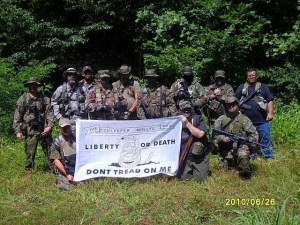
In recent years, the belief that widespread gun ownership as a defense against a tyrannical government has been an alluring idea among Americans. However, this has led to some right wing loons to form citizen militias to defend themselves against government intrusion. As if they'd even have a chance if they'd really have a chance of staging a successful uprising (not).

In recent years, the belief that widespread gun ownership as a defense against a tyrannical government has been an alluring idea among Americans. However, this has led to some right wing loons to form citizen militias to defend themselves against government intrusion. As if they’d even have a chance if they’d really have a chance of staging a successful uprising (not).

12. “But we need guns to protect ourselves against a tyrannical government.” – Government corruption is nothing new that even the Founding Fathers understood it that they came up with checks and balances. Competition between branches in the bureaucracy has assured that no one person or group became powerful. Now the US government has a total of 456 reported federal agencies, all with their own bureaucracy. Despite what small government minded Republicans might say, the size of the government is actually a check rather than a sign of it. And as government grows, so do the regulations and bureaucracy. More bureaucracy means more people. More people means more competition. And competition within government means security. We also have to account that the American political culture is deeply rooted in a 200 year tradition with democracy. And Americans tend to be extremely wary of government infringing on individual liberty which is traced back to the American Revolution. So as far as the US is concerned, there is absolutely no way in our system for one person or party to consolidate power. Now the paranoia that the government’s going to take people’s guns away and the president becoming a tyrant is said to be reminiscent of the Republican Party’s Southern Strategy. In other words, it’s simply right-wing propaganda meant to instill fear. Such paranoia has increased since Barack Obama’s election even though Obama isn’t the first president to support gun control measures (despite having the strongest excuse to do so) and is only different from his predecessors in one superficial way (being black).
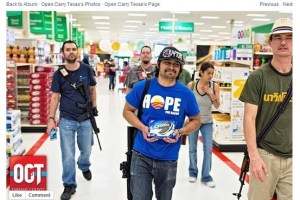
The open carry movement is one where people openly carry guns into public places as a way of

The open carry movement is one where people openly carry guns into public places as a way of “exercising their rights.” Of course, they also manage to scare the hell of reasonable people. Yes, they’re probably loons.

13. “Carrying a gun makes you safe.” – Well, it’s possible that carrying a gun might make you feel safe, but that doesn’t mean other people will. Unless you wear a badge or in a uniform, then carrying a gun in public will make people suspect that you’re a dangerous criminal, an outright loon, or both. If you’re a young man who’s black, Latino, or of Middle Eastern/South Asian descent, then carrying a gun in public will make people suspect the former and possibly call the cops on you due to widespread racial profiling in the US. Seriously, if it was Trayvon Martin shooting George Zimmerman, “Stand Your Ground” would’ve not have gotten him out of a prison sentence. Many gun rights activists think carrying a gun around will make them able to defend themselves and others (a vigilante complex if you will). However, there is no credible evidence that the carrying loaded weapons decreases crime. And studies supporting this notion have been frequently debunked by a range of academic researchers. But that doesn’t stop states from implementing “Stand Your Ground” laws in recent years, which state that civilians can shoot without a duty to retreat, even in public places. Those in the gun lobby states that such laws are needed to decrease crime. But these laws are mostly based on the gun lobby’s vigilante mentality. Researchers at Texas A&M say otherwise.

Contrary to what the gun lobby says, self-defense is rare during crimes. And it's especially less common for a person to defend oneself with a gun. Not only that, but this chart from the Bureau of Statistics and the National Crime Victimization Society reveal that most property crime victims weren't even present at the time.

Contrary to what the gun lobby says, self-defense is rare during crimes. And it’s especially less common for a person to defend oneself with a gun. Not only that, but this chart from the Bureau of Statistics and the National Crime Victimization Society reveal that most property crime victims weren’t even present at the time.

14. “Having a gun at home makes you safe.” – Studies show that a gun in the home is more likely to be used to commit suicide or to threaten and/or kill an intimate than to defend against an attacker. There’s also a chance for accidents which most gun owners are familiar with. Not to mention, leaving a loaded gun out in the open is one of the most irresponsible things a gun owner can do. It’s a recipe for disaster. This is especially true in a home with small children. There’s a reason why you find stuff on gun safety. But you hear a lot from the gun lobby stating how having a gun might help protect you and your family during a home invasion. However, what they get wrong is that home invasions are rare and usually occur when the either residents aren’t home or sleeping. Because they’re mostly robberies. Now a home invasion might be a traumatic experience but the chances of one resulting in homicide are rare. Why? Because burglars want to avoid contact during home break-ins and try to steal stuff as quickly and quietly as possible. Make any noise to wake up the family or the neighborhood and they’re screwed. Still, most people are usually killed or attacked by somebody they know which is why most home homicides usually pertain to family disputes or domestic violence.

In the United States, women are more likely to be killed by someone they know, particularly a current or ex-significant other. A woman runs an even greater risk of being killed if she's in an abusive relationship with an intimate partner, especially if there's a gun in the house. Therefore, most of the time having a gun for self-defense will not help her.

In the United States, women are more likely to be killed by someone they know, particularly a current or ex-significant other. A woman runs an even greater risk of being killed if she’s in an abusive relationship with an intimate partner, especially if there’s a gun in the house. Therefore, most of the time having a gun for self-defense will not help her.

15. “Guns make women safe.” – I know there are plenty of gun rights activists who say this since women aren’t as physically strong as men. However, a woman’s safety has less to do with whether or not she has a gun in the house than the quality of her relationships. This is especially true when it pertains to intimate partners such as husbands, boyfriends, fiances, and what not. Besides, when gun rights supporters say this, they’re usually referring to women being attacked and/or killed by strangers. But most violent crimes involving women usually pertain to people they know whether they be victims or perpetrators, especially intimate partners. And they’re almost always linked to domestic abuse. Now it’s one thing for a woman to have gun to protect herself on the street against a possible violent stranger. But if you’re a woman living with an abusive partner, owning a gun won’t help your case because that person will try to control you through any means necessary. Besides, when you’re living with someone, it’s much more difficult to keep certain things to yourself, especially if you’re in an intimate relationship with them. Guns are among these things. Your abuser will find that gun and will somehow gain access to it. And there’s a strong chance that they might use it to kill you. After all, in 2010, women were 6 times more likely to be shot by their husbands, boyfriends, and ex-partners than by male strangers. And if a woman’s domestic abuser has access to a gun, she’s more than 5 times likely to be killed by them. It should surprise nobody that there have been calls for implementing gun laws restricting firearms access to spousal abusers. Not to mention, even if a woman successfully shoots her abuser in an effort to defend herself, this doesn’t mean that she’s out of the woods yet. We have to be remember that there are plenty of women in prison for killing their abusers, too, especially if they’re poor women of color. So if you have a little girl, you should probably spend less time teaching her how to shoot and perhaps teach her how to spot a potential domestic abuser and how to get out of it before it gets more serious. Because she’ll be more safe if she’s willing to dump a guy who’s been nasty to the waiter.
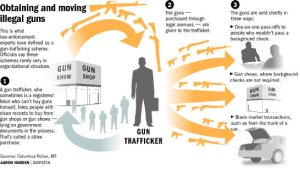
This is a diagram on how gun trafficking works in the United States. Because 40% of all gun transfers don't require background check, this allows criminals to legally purchase weapons through hiring people with clean records to buy the guns for them, one-on-one pass offs, gun shows, and black market transactions. Not to mention, it's not unusual for some criminals to buy guns in areas with looser gun restrictions as well.

This is a diagram on how gun trafficking works in the United States. Because 40% of all gun transfers don’t require background check, this allows criminals to legally purchase weapons through hiring people with clean records to buy the guns for them, one-on-one pass offs, gun shows, and black market transactions. Not to mention, it’s not unusual for some criminals to buy guns in areas with looser gun restrictions as well.

16. “We don’t need more gun laws. We just need to enforce the ones we have.” – Yes, we do need to enforce the laws we already have and even law enforcement agrees. But even law enforcement believes that stronger enforcement without stronger gun laws isn’t enough. Remember that most mass shooting victims were killed with legally purchased weapons such as military style assault weapons with high capacity magazines. Many existing gun laws at the federal level are riddled with loopholes and gaps. And federal enforcement action has been constantly hampered thanks to gun lobby efforts that the Bureau of Alcohol, Tobacco, Firearms, and Explosives is now under-funded and without permanent leadership. Not to mention, 40% of all legal gun transfers don’t require background checks.

17. “Gun control won’t stop gun violence.” – I’m very well aware of that. However, while there have been more mass shootings than there used to be, they’re still relatively rare and very unlikely to happen in most American neighborhoods. Nevertheless, while gun control measures may not be 100% effective, that doesn’t mean they don’t work. Take gun-free zones, for instance. Yes, I know they’ve been sites of plenty mass shootings, but they don’t happen every day. But gun-free zones are everywhere and have rather wide appeal not just among public and civil establishments as well as churches, but also among businesses. Why? Because most people generally don’t like being around guns in public since they don’t feel safe around civilians carrying firearms (law enforcement is a different story at least in the US since they are supposed to know what they’re doing). Guns in public make people very uncomfortable, sometimes to the point of calling the police. Why? Because most people are fully aware that guns are dangerous and can kill people. A stranger with a deadly weapon is often feared, especially civilians whose natures may be unpredictable. And all the mass shootings, armed robberies, and other armed incidents on the news kind of reinforce that fear. So instead of trying to determine which civilians can openly carry a gun, it’s much easier to ban all civilians from carrying guns on the public premises. And even when guns aren’t banned, the gun-free zone mentality still manifests in our social mores. So any open carry activist “exercising their rights” will be viewed as threat no matter whether the establishment permits guns or not. While they might not work all the time, gun-free zones are very effective policy since it prevents an unsafe situation involving lots of people with loaded guns. Besides, unarmed civilians have survived mass shootings and other incidents involving gun violence. The point is that despite gun-free zones being scenes of mass shootings, the practice of banning guns in public places isn’t going away because it’s a policy that’s effective, popular, and smart.
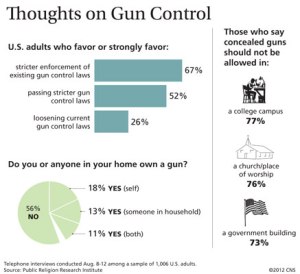
This is a chart from a Catholic magazine from Philadelphia. But though it doesn't have the same poll results I wrote down, it does show that a sizable chunk of the American public support some gun control. Not to mention most Americans don't want guns in school, church, or in government buildings.

This is a chart from a Catholic magazine from Philadelphia. But though it doesn’t have the same poll results I wrote down, it does show that a sizable chunk of the American public support some gun control. Not to mention most Americans don’t want guns in school, church, or in government buildings.

18. “Americans don’t want meaningful gun reform.” – Here in America, you’d be surprised how many issues people viciously fight about that they secretly agree on. Now gun control is a highly contentious issue in American politics as well as polarized among party lines (mostly because the NRA bankrolls a lot of Republican politicians. Not to mention, that the gun lobby tends to run propaganda with an appeal to fear). However, the Joyce Foundation has noted that various public opinion polls show that Americans overwhelmingly support specific gun policy solutions. 92% of Americans support requiring universal background checks on all potential gun buyers while 63% support banning assault weapons. 74% of NRA members also support universal background checks as well.

19. “Guns are essential for self-defense.” – Reports on mass shootings and other violent crimes have led many to believe that fighting crime requires to fight fire with fire. However, according to the Violence Policy Center (based on data by the FBI and the Bureau of Statistics), there were only 258 justifiable homicides involving civilian gun use in 2012. Compare this to 8,342 criminal homicides and 22,000 suicides and accidental shootings. In 2011, nearly 10 times more people were shot and killed during arguments than by civilians trying to stop a crime. Sorry, but the numbers don’t lie. I also hear from many that a mass shooting would’ve been prevented if somebody had a gun on them. However, they forget that whenever you’re in a mass shooting situation, armed civilian confrontation with the shooter is generally not recommended. Rather it’s best advised that you call the cops and let them confront the perpetrator. In the meantime, you’re better off either trying to escape, hiding, or playing dead until the cops show up. Trying to confront the shooter is a quick way to get shot (as well as should only be done as a last resort). And if you use a gun, you might risk endangering others in the process.

Many people think that trained armed guards would be able to prevent mass shootings since many take place in gun-free zones. However, they tend to forget about the mass shooting at Fort Hood. Still, gun-free zones may not prevent another tragedy, but I'll take my chances with them than in an armed society.

Many people think that trained armed guards would be able to prevent mass shootings since many take place in gun-free zones. However, they tend to forget about the mass shooting at Fort Hood. Still, gun-free zones may not prevent another tragedy, but I’ll take my chances with them than in an armed society.

20. “Switzerland and Israel seem to do okay without gun control.” – Gun rights advocates like to think that Switzerland and Israel to prove that gun control doesn’t make much difference. However, while both countries have a tradition of military service, they also limit firearm ownership and require a permit renewal 1-4 times annually. That may not be as restrictive as other countries, but it’s still gun control. So saying they do okay without gun control resoundingly false.

21. “Other countries are different.” – Yes, US history may differ from those of other countries. And yes, the US might contain American cultural exceptionalism, pioneer spirit, and a history of racial tension. However, having a violent national history is actually the norm among most nation states. Seriously, you’d be hard pressed to find a country that hasn’t experienced some degree of conflict or civil unrest in its past. And there are plenty of countries that have existed in the world longer than the US. Far longer, in fact. Let’s just say world history has no shortage of violent incidents and that people would kill each other on just about anything. And just because many industrialized nations have strict gun laws, doesn’t mean violent crime is non-existent. It just that their violent criminals are less likely to use guns, which results in less people getting killed.
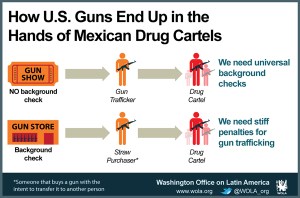
Many people who think American gun violence has to do with illegal immigration are dead wrong. In fact, most of the guns used by Mexican drug cartels were American made. So it's American guns being trafficked into Mexico.

Many people who think American gun violence has to do with illegal immigration are dead wrong. In fact, most of the guns used by Mexican drug cartels were American made. So it’s American guns being trafficked into Mexico.

22. “US borders are too open.” – For God’s sake, undocumented immigrants aren’t the problem in the gun debate. Besides, it’s hard to imagine it would be easy for criminals to obtain weapons that had to be smuggled through ports, airports, or across the Mexican border. Besides, most illegal gun trafficking in the US is within the country itself that most American criminals wouldn’t see the need for importing guns from Mexico. Why would a Chicago gangster go through the trouble of smuggling guns through the Mexican border when he could easily buy one legally in Indiana? It’s just within driving distance and inspections by US Customs are virtually nonexistent. It’s also significantly cheaper. Besides, a lot violence in the world is conducted by American weapons. Seriously, think of all the guns the US has sold to the Middle East and look what happened there. So it wouldn’t make much sense for any American criminals would smuggle guns into the US, especially since Texas lies along most of the Rio Grande. If anything, it would more likely be Latin American drug cartels smuggling weapon across the Mexican border from Texas, which contributes to another problem entirely. Well, at least as far as the US is concerned.

23. “School shootings are a national epidemic.” – I’m aware that a lot of famous mass shootings have taken place in schools like Columbine, Virginia Tech, and Sandy Hook being the most famous. And I’m well aware that the gun lobby has called for school teachers to carry guns, which I think is insane. However, according to FBI crime statistics, the odds of a school shooting in your neck of the woods are statistically rare. More homicides occur in homes, especially if they involve multiple victims. Not to mention, more mass shootings happen in restaurants than in schools. But nobody’s asking the wait staff to carry guns. In fact, it’s said that children are almost 100 times more likely to be murdered outside of school than at school (with odds being 1 in a million). So child gun homicides are more likely attributed to severe family dysfunction (like abuse) than having a classmate who’s a homicidal nutjob. This makes massive school spending on building security seem like a waste in taxpayer money.

This is a good cartoon from Facebook highlighting the ways people can fall victims of gun violence. Many gun rights activists tend to believe that more guns lead to less crime. However, there's a positive correlation between gun crimes and gun ownership rates.

This is a good cartoon from Facebook highlighting the ways people can fall victims of gun violence. Many gun rights activists tend to believe that more guns lead to less crime. However, there’s a positive correlation between gun crimes and gun ownership rates.

24. “More guns equal less crime.” – This is a very common argument by gun rights activists, which was given rise by a controversial book by John Lott Jr. called More Guns, Less Crime. It has been debunked by peer review since its publication and Lott has also come under scrutiny for ethics violations regarding his research. Other studies arguing about high rates of gun usage in self defense have also come under scrutiny. The Harvard Injury Control Research Center has determined a positive correlation between gun ownership and violence (especially in impoverished neighborhoods). Since the 1970s both have been in decline though there’s been an uptick in recent years. Nevertheless, since the US has one of the highest gun ownership rates, it’s no surprise that 15 of the 25 worst mass shootings in the last 50 years have happened here. Not only that, but the American South is the most violent region in the country as well as has the highest prevalence of gun carrying. Furthermore, The Johns Hopkins Center For Gun Policy and Research have found that expanding concealed carry laws increase aggravated assaults. So contrary to what the gun lobby says, more guns lead to more crime.

25. “Dictators take away guns from their people and look what they do.” – Gun rights activists love to talk about how dictators like Hitler and Stalin took guns away from their own people before they began committing genocide. However, the notion of Hitler and Stalin taking people’s guns away is historically inaccurate. And if Hitler took any guns from people, they were from groups he wanted to exterminate anyway like Jews and Gypsies. As with everyone else, he actually expanded private gun ownership. But you hear many pro-gun activists say that if the Jews and the Gypsies were armed, there would be no Holocaust. But there is no historical basis of this. If anything, arming them might’ve “hastened their demise” according to SUNY political science chair Robert Spitzer. So how did Hitler gain control and remained in power? Well, we have to concede that prior to World War II, Hitler was extremely popular among the German people and throughout the world. I mean he had to be popular enough to be appointed chancellor by President von Hindenburg in 1932, shortly before the Nazi propaganda machine gained full steam. Of course, he also had Brownshirts beating people up but that’s beside the point. Suggesting that the only thing keeping Hitler in charge was the control of guns exonerates many who truly supported him and helped him gain power in the first place. It’s also very bad history that teaches us a terrible lesson. Same goes for the Bolsheviks in Soviet Russia and the idea that an armed populace would’ve stopped them or Stalin is nothing but a fantasy. Ask any White Russian who knows. Stalin was also extremely popular in his country as well. Nevertheless, we should understand that dictators don’t gain control through taking people’s guns away. They do it through propaganda and ruthlessly suppressing dissent in order to secure lifelong popularity. Besides, there are plenty of Third World dictatorships that break into civil war with both sides carrying AK-47s.

Many gun rights activists may say that legal gun owners don't commit crimes. However, many criminals buy their weapons at gun shows because they don't require background checks. So what does that tell you?

Many gun rights activists may say that legal gun owners don’t commit crimes. However, many criminals buy their weapons at gun shows because they don’t require background checks. So what does that tell you?

26. “Legal gun owners don’t commit crimes.” – Yes, most gun crimes are committed with illegal guns but that’s because in the US, a legally bought gun in Indiana can easily become illegal when sold on the Chicago black market. And federal gun laws are so weak that such acts can go off without a hitch. But even then, the number of legal guns increases and so does the likelihood of a gun falling into the wrong hands. Besides, Mother Jones found that most mass shootings involved legally purchased guns. Also, 40% of legal gun transfers don’t require background checks which makes it easy for criminals legally obtain weapons through hiring people with clean records to buy the guns for them, passing them off one-by-one, gun shows, and black market transactions. Sometimes they can even legally purchase weapons in places with less gun restrictions. Not to mention, there’s a movement to prevent domestic abusers from accessing firearms. And domestic violence is not just a crime, but can also lead to murder, especially if guns are in the picture. So what does that tell you?

27. “Assault weapons aren’t frequently used in crimes.” – Yes, assault weapons aren’t used a lot in crimes since most gun violence is perpetuated by handguns. But whenever an assault weapon is used in an attack, there are 54% more deaths. It’s no surprise that most of the deadliest mass shootings in the US have involved assault weapons like an AR-15. Many tend to use high capacity magazines which allow for higher casualties. Since the 1994 Assault Weapons Ban expired, mass shootings have been on the rise, particularly since 2007.

So if the Second Amendment is absolute, that means I can have my very own fighter jet, right? I mean the gun lobby says Americans have a right to bear arms which shall never be infringed. But they never say anything about my right to own a fighter jet.

So if the Second Amendment is absolute, that means I can have my very own fighter jet, right? I mean the gun lobby says Americans have a right to bear arms which shall never be infringed. But they never say anything about my right to own a fighter jet.

28. “The Second Amendment is absolute.” – Really? Well, let me put it to you, constitutional rights aren’t always absolute either. Take the Second Amendment for instance, which gun rights activists say that it gives people a right to own a gun under any circumstance which must be protected. However, “the right to bear arms” can also pertain to owning a weapon. So if Second Amendment rights were absolute, then I should be able to own a tank, a bazooka, a bomber plane, a fighter jet, a hand grenade, a howitzer, an anti-aircraft gun, and all those cool military weapons that I’m sure are illegal for civilian ownership or use. And I’m sure that the Founding Fathers never intended the Second Amendment to give civilians the right to own a cannon either. Strange that gun rights activists don’t campaign for that because authorizing such weapons for civilians would be downright insane (as you can see how the military put an anti-aircraft gun in a civilian’s back yard in 1941). Still, the fact that even law abiding American citizens can’t privately own these weapons for civilian use should demonstrate that gun control is constitutional. Hell, even Supreme Court Justice Antonin Scalia said so himself in Heller v. DC“Like most rights, the right secured by the Second Amendment is not unlimited…nothing in our opinion should be taken to cast doubt on longstanding prohibitions on the possession of firearms by felons and the mentally ill, or laws forbidding the carrying of firearms in sensitive places such as schools and government buildings, or laws imposing conditions and qualifications on the commercial sale of arms.”

This is a billboard in Illinois that highlights the convoluted ideas of American cultural heritage. One of these is an assault rifle which is a weapon of choice among mass shooters. This is appalling.

This is a billboard in Illinois that highlights the convoluted ideas of American cultural heritage. One of these is an assault rifle which is a weapon of choice among mass shooters. This is appalling.

29. “Guns are a part of America’s heritage. Gun control is not.” – You tend to see American history in movies as quite violent. But the as gun possession is as old as the country, then so is gun control. During the time of the Founding Fathers, state and federal governments conducted several arms censuses (like officials going door to door to ask now many guns you had and whether they worked). Besides, contrary to what the western movies depict, establishments in the Old West did practice some degree of gun control. For instance, guns were often banned in saloons for very good reason. Not to mention, Tombstone had far stricter gun control during the gunfight at the O.K. Corral than it does today (deterring the number of Old West saloon shootouts which is a very common feature in westerns). Also the US implemented gun control policies to crack down on mob violence during the 1920s, particularly when it came to confiscating Tommy Guns. Thus, to not implement gun control because it’s not part of the American heritage is absurd.

30. “Background checks don’t work.” – Actually background checks do. Since its inception the National Instant Criminal Background Check System (NICS) has blocked more than 1.9 million permit applications and gun sales to felons, the seriously mentally ill, drug abusers, and other dangerous people prohibited by federal law from possessing firearms. However, because 40% of gun transfers occur without background checks, more comprehensive gun background checks are needed to curb gun violence and trafficking. Besides, people disobey speed limits all the time. Does that mean we shouldn’t have them?

31. “Gun laws don’t work.” – Actually aside from background checks, other gun control measures work as well. The 1994-2004 Assault Weapons Ban, while riddled with loopholes allowing gun manufacturers to evade, led to a decrease in gun seizures with high capacity magazines by Virginia law enforcement. Seizures spiked after it expired. And mass shootings have been on the rise since assault weapons equipped with high capacity magazines have become the weapons of choice in mass shootings. So despite its faults, the Assault Weapons Ban worked. Not only that, but state laws designed to regulate gun dealers, including regular compliance inspections have been effective in reducing gun trafficking within their jurisdiction.

32. “Gun ownership is on the rise.” – Gun ownership is actually in decline in the US and has been since the 1970s. A vast majority of Americans don’t own firearms. However, those who own guns, own more of them.

33. “It’s more dangerous now than it used to be.” – Of course, crimes stories have a high tendency to get on the news which might make one think that there’s more crime out there than there used to be. And the prevalence of mass shootings has also reinforced that notion. However, since the 1970s, American crime has steadily declined. Gun violence has declined as well. But this doesn’t mean it’s not less of a problem or a public health concern since it kills 30,000 per year.

This is a pro-gun picture depicting how gun-free zones don't prevent mass shootings and how police don't stop massacres. However, if you're in a mass shooting situation, it's generally recommended you don't try to confront the shooter with firearms. It's best advised that you leave the defensive shooting to the police in these circumstances.

This is a pro-gun picture depicting how gun-free zones don’t prevent mass shootings and how police don’t stop massacres. However, if you’re in a mass shooting situation, it’s generally recommended you don’t try to confront the shooter with firearms. It’s best advised that you leave the defensive shooting to the police in these circumstances.

34. “Police don’t show up on time and don’t stop massacres.” – A lot of gun rights activists tend to have a dim view of society and claim that every second counts so it’s better to act now. After all, the shooter could kill, escape taking something, or what not. However, while it takes time for police to get to the scene of a crime when called, this doesn’t mean self-defense is the best option. For instance, for civilians, using a gun to confront a mass shooter is generally seen as a very stupid idea. Besides, when it comes to subduing criminals, the police are professionals who’ve been rigorously trained to stop active shooters. Stopping a mass shooter requires extraordinary skills honed under acute duress which most law enforcement officials have. Most civilian gun owners don’t possess such skills, which most gun rights activists like to ignore and think anyone with a gun can stop a mass shooting. However, that’s really not the case since police can stop massacres and do. It’s the civilians who can’t. So if you’re in a mass shooting situation, it’s better to leave the shooting to law enforcement.

35. “To prevent violence we must be able to predict it.” – Now this argument is tied with the idea we can prevent mass shootings if we provide adequate mental health services to high risk individuals. Sorry, but mentally ill people are no more at risk for violent behavior than anyone else. Besides, prevention by prediction isn’t 100% effective because predictions aren’t always accurate. Seriously, just watch your local weather forecast on the news. Chances are the weatherman has been wrong at least some of the time. Same can be said about gun violence, which many people see as a public health issue. Public health programs have dramatically reduced problems like smoking-related deaths and car accidents. Approaching gun violence the same way should be a no brainer. In fact, numerous studies report that school-based counseling and violence prevention programs are very effective at teaching students how to resolve conflict and problems without escalating to violence. Community mental health services oriented toward prevention are also helpful, especially when it pertains to helping larger populations of people in distress.

These are stats on American gun violence I obtained from an infographic. Despite that gun crimes have gone down, only 10% of non-fatal wounds involved guns. And gun suicides are at an all time high.

These are stats on American gun violence I obtained from an infographic. Despite that gun crimes have gone down, only 10% of non-fatal wounds involved guns. And gun suicides are at an all time high.

36. “The NRA represents freedom.” – Sorry, but living in an armed society isn’t my idea of freedom. The big problem with discussing American gun culture these days is that ideology tends to cloud the facts. The NRA spends large amounts of money to skew the debate by telling everyone that the government is coming for your guns (bullshit). And it doesn’t help that the NRA doesn’t represent the interests of most gun owners these days, even their own members. I mean the NRA is famous for opposing all gun legislation while the most of the people it’s supposed to represent support tighter gun laws. And it has supported gun control measures in the past. So why is that? Well, it turns out that the NRA  these days represents gun manufacturers on its board of directors’ nominating committee.

37. “Gun control can’t prevent suicides.” – Nearly 2 out of 3 gun deaths are suicides which is a harrowing statistic for most but this helps gun rights activists argue that mental illness is the problem, not guns. However, while restricting gun access can’t stop people from choosing to kill themselves, keeping guns away from mentally ill people can be rather effective. In fact, it’s said that firearms suicide rates are closely correlated with gun ownership as well as gun crimes. So gun control might not prevent suicides, but it might help prevent suicides with guns.

38. “Shooting and hunting are important American cultural activities.” – Yes, I know people use guns for hunting and target practice at gun ranges. However, people don’t use AK-47s and AR-15s to hunt deer and can just as easily shoot a box full of holes with a handgun. Why? Because using a military style assault weapons to hunt is just stupid. Gun control measures don’t necessarily mean outright gun bans altogether. Nor does it mean an end to sports shooting either.

39. “Gun violence is a city problem.” – Gun violence takes many forms. Gun homicides on the streets might account for a lot of city homicides. But there are plenty of gun violence incidents in rural areas as well like gun injuries, suicides, and homicides stemming from family disputes and domestic violence. There’s also a higher rate of gun ownership in rural areas, by the way.

This chart illustrate how much gun violence costs American taxpayers every year. We should also count the fact that many gun victims are poor. Yeah, I really think Second Amendment rights are getting kind of expensive.

This chart illustrate how much gun violence costs American taxpayers every year. We should also count the fact that many gun victims are poor. Yeah, I really think Second Amendment rights are getting kind of expensive.

40. “Gun control is expensive.” – It’s no surprise that many gun rights activists tend to equate gun control with big government and high spending. However, loose gun laws aren’t as cheap as you make them out to be since they tend to cost billions of taxpayer money each year on medical and legal costs. And it doesn’t help that most gun violence victims and perpetrators tend to live below the poverty line as well as are either uninsured or on public assistance. From how I view it, gun control as a means to prevent violence is probably much cheaper.
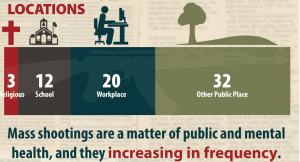
Many pro-gun activists say that so many mass shootings happen in gun-free zones because it makes victims defenseless. But the real story is that public venues most likely tend to be gun-free zones. Besides, the Fort Hood shooting has told us that mass shooters don't give a shit about a public facility's gun policy anyway.

Many pro-gun activists say that so many mass shootings happen in gun-free zones because it makes victims defenseless. But the real story is that public venues most likely tend to be gun-free zones. Besides, the Fort Hood shooting has told us that mass shooters don’t give a shit about a public facility’s gun policy anyway.

41. “Local restrictions attract mass shooters.” – You hear this a lot from gun rights activists since many famous mass shootings have taken place in gun-free zones and leaving victims defenseless. However, as I said before, gun-free zones are very effective policy regardless of whether they attract mass shootings or not. Besides, we should be aware that most gun-free zones are public venues used by a lot of people, which attract violence and crime. Because buildings open to the public normally do that explaining why we have gun-free zones in the first place as a safety measure. It’s just an obvious fact. Not only that, but the fact 43 people were shot during the Fort Hood shooting shows that mass shooters don’t give a shit about firearms policy. Seriously, Fort Hood’s status as a military base makes it far from a gun-free zone. I mean the place would have guns everywhere and people trained to use them, including armed guards. But that didn’t prevent 13 people from being killed in the shooting. Mass shooters’ choices of location usually involve other motives, especially if there’s a chance they’ll know any potential victims. For instance, the Fort Hood shooter was a disturbed army psychiatrist who worked there. The shooters at Columbine, Virginia Tech, and Sandy Hook were students there at some point in their lives. We should also account for the fact that most mass shootings involve legally purchased weapons. Besides, despite how pro-gun activists complain about gun-free zones, confronting a mass shooter with a loaded gun is actually a very stupid idea, anyway. Not to mention,  just because a place with loose gun laws doesn’t experience a lot of gun violence doesn’t mean it’s not contributing to the problem. After all, look how loose gun laws in Indiana are contributing to gun violence in Chicago.

42. “Now isn’t the time to talk about guns.” – You tend to hear this in the event of almost every mass shooting or major tragedy involving guns. Yes, I know discussing politics isn’t appropriate after a major tragedy. But mass shootings have been on the rise since 2007 and most experts agree that gun violence is a major public health issue that kills 30,000 a year. Furthermore, gun control measures tend to have a lot of support from law enforcement as well as health care workers who specialize in emergency medical care. Besides, we must remember that Aurora and Newtown happened during the same year. A year before that, a US House Representative was shot in the head in Tuscon. So if now’s not the time to talk about gun control, when is?

43. “Criminals won’t consent to background checks.” – Yes, criminals hate background checks because they limit their ability to buy a gun. However, many of them go through them anyway and get blocked just the same. Nevertheless, if a criminal doesn’t want to consent to a background check then they won’t be allowed to buy guns legally. Thus, by closing legal avenues for them to buy guns, they’ll be forced to risk buying illegal weapons, which police can arrest them for. And if a criminal can’t legally buy a gun in one area, they’ll buy it in another with less gun restrictions.

This is former Democratic US Congresswoman Gabrielle Giffords and her husband astronaut Mark Kelly. In 2011, Giffords was shot in the head by Jared Loughner in her district of Tucson, Arizona. She had to resign her seat to recover from her injuries. She and her husband are now advocates for gun control, not surprisingly.

This is former Democratic US Congresswoman Gabrielle Giffords and her husband astronaut Mark Kelly. In 2011, Giffords was shot in the head by Jared Loughner in her district of Tucson, Arizona. She had to resign her seat to recover from her injuries. She and her husband are now advocates for gun control, not surprisingly.

44. “But politicians send their children to school with armed guards.” – Fox News likes to point out this one to make many politicians who support gun control look like hypocrites. However, we should note that politicians are public officials and their name recognition makes them assassination targets along with their families. Threats against politicians and their children can disrupt public policy and are a very real threat. This is why we have the Secret Service protecting the President of the United States at all times. Besides, the US has had 4 presidents assassinated. We’ve also had a US congresswoman shot in the head in Tucson not too long ago. There’s nothing hypocritical or elitist about having gun-free zones while our leaders have armed guard protection. I mean not everyone can have their own Secret Service protection, so gun-free zones are the next best thing.

45. “Regulations in gun sales are ineffective because there are so many guns out there.” – The reason why there are so many guns out there is because the US has lax gun regulations at the national level. Besides, despite the number of guns in our society, there’s no reason to make the problem worse than it already is. Guns are so plentiful today that criminals don’t keep their guns long since guns used in crimes can be evidently linked to shootings. So criminals just dispose and replace them with clean weapons. Most criminals don’t have a hard time obtaining clean guns if they know where they can buy one. Regulating gun sales at the national level will eventually lead to criminals having to either hold on to their dirty weapons and risk arrest or spend a ton of money to buy a new gun.
Perhaps these lines from Bob Dylan's

Perhaps these lines from Bob Dylan’s “Blowin’ in the Wind” say it best. However, despite what many might say, we need gun control at a national level now. If we don’t act, then more lives will be lost or ruined.

For More:

The Brady has a handy website on state gun laws called Crimm Advisor. Helps explain the illegal gun trafficking situation within the country and why national action is needed. Crimadvisor

Law Center to Prevent Gun Violence: Law Center to Prevent Gun Violence – Gun Law Information Experts

How to Be a Good Cop (on TV)

filepicker-d6E3oRLykiuxA4XSA9K0_the_wire_wallpaper_1024x768_1

Crime shows are an ongoing staple of television since its early days and cops are often featured as the heroes solving murders, taking part of car chases, and keeping the city safe from the criminal element. Almost every network channel has one. Yes, cop shows are fun as well as filled with all kinds of action and drama keeping viewers at the edge of their seats. Of course, we all want to see the one cop helping to bring the criminals to justice every week if we could. However, like a lot of things in the media, cop aren’t the best sources of information pertaining to police procedural. In fact, there are a lot of things cops do on TV that a real life policeman wouldn’t get away with. And in light of many police shootings on unarmed victims in the United States (many of them black), we have to be aware that real cops are flawed people and certain rules exist for a reason. Besides, just because certain police actions may look cool in cop shows, doesn’t mean they should be applied in real life situations. Still, many cop shows tend to follow certain formulas that you’d recognize which is why I’m listing all the stuff cops do on TV which they wouldn’t get away with in the real world. So in the name of the law enjoy this post or else. By the way, this counts for movies and other media featuring fiction as well.

  1. Make sure you’re paired with a colleague who’s the complete opposite of your personality. (Opposites may attract and be good for drama and comedy. But this doesn’t mean that they’re compatible or will grow into a beautiful friendship. Such relationships don’t always work out like Bert and Ernie. But in many buddy cop movies and cop shows, you see such pairings all the time.)
  2. Have a shitty personal life which can involve alcoholism, philandering, smoking, divorce, estrangement, absenteeism, drug use, personal tragedy, messy finances, mental illness, personal trauma, and other not so rosy stuff like that. (As in any profession, there are a lot of cops who have shitty personal lives and bad habits. And there are some who aren’t nice people. However, almost every cop show has at least one policemen with a terrible personal life. Sometimes this might pertain to much of the cast like in Homicide: Life on the Street or The Wire. Nevertheless, a terrible personal life doesn’t always make a great cop.)
  3. Remember that everyone above your immediate supervisor is virtually incompetent and/or self-serving jerks that are corrupt as hell. (You see this on a lot of cop shows particularly on Homicide: Life on the Street and The Wire. Anyone ranking above the reasonable and kindly Lts. Al Giardello or Cedric Daniels {with the exception of Major Bunny Coleman} is either someone who’s reached their level of incompetence, a corrupt self-serving jerk, or both. Sometimes even the immediate supervisor isn’t safe either like in Foyle’s War or Pie in the Sky. I’m sure the tendency for this is exaggerated.)
  4. Detectives are real police while uniform officers are corrupt and/or incompetent stooges, redshirts, backup, muscle, or decorations. (Of course, it should be obvious that most cop shows usually focus on detectives since it’s their job to solve crimes. Uniform officer duties aren’t usually highlighted except when it comes to needing security backup or muscle. Also, they’re more likely to be bad or be killed.)
  5. Good cops are usually ineligible for promotion since they refuse to play politics, clash with superiors and coworkers, and/or don’t seem to have some affinity for workplace culture. (Most good TV cops usually don’t make it higher than Lieutenant {there are exceptions, however}. Still, you find that a lot of TV cops tend to have issues with authority and workplace culture as well as don’t let politics get in the way of their job. This might be true to some extent in real life, but probably not at that frequency.)
  6. Remember sometimes rules can be a hindrance than a help in a lot of situations. So it’s okay not to follow them when there’s a dangerous killer on the loose. (We have rules for a reason. Besides, while cops might want to keep people safe, we know all to well of many disobeying the rules as well as leading to incidents that have killed innocent people.)
  7. Got anger issues? No problem. (Police with bad tempers and anger issues don’t make effective law enforcement officers, for obvious reasons. Anger makes people destructively impulsive which is the last thing you want in a police officer. It’s one thing if a cop loses it once in a while since their job can be quite stressful. But a cop with rather destructive and chronic anger issues is perhaps one of your worst nightmares as well as results in complaints and no win situations. Better go with Jimmy McNulty than Dirty Harry. Then again, better stick with Lester Freamon who’s about as cool as they come since McNulty can be rather impulsive, too.)
  8. Using violence against suspected criminals is always justified and effective, no matter how excessive. (Now I understand that police may occasionally have to use force to prevent certain incidents that put people’s lives in danger. Sometimes this might mean fistfights, sometimes firearms. However, the fact cops tend to employ certain acts of violence when it comes to subduing suspects has led people to be blind to recent real life incidents pertaining to cops employing excessive force to unarmed blacks. Now some of them may have been criminals but that doesn’t mean you should shoot them, especially multiple times that it kills them. One shot is usually enough to subdue a suspect if it doesn’t kill them first {since gunshot wounds are always serious and need medical attention}. Tasering works, too. Shooting a suspect multiple times should only be reserved for the most dangerous criminals like Bonnie and Clyde, Baby Face Nelson, and others like them. Besides, even though criminals are bad people, they do have rights like anyone else. And there’s a reason why we have laws protecting them, particularly from physical violence like beating up suspects. You might know it as “police brutality.” So if a good cop should use force, they better have a very good reason for it.)
  9. Don’t worry about destroying property like expensive police cars. Sometimes carelessness is to be expected. (Actually destruction of police property carries costs paid by taxpayers who will complain about it. Besides, cops engaging in such acts could eventually be fired for incurring such destruction, especially when it comes to totaling expensive police cars. Collateral damage may be justified sometimes, but not if it involves destroying a house to arrest a couple of pot farmers.)
  10. Compromising your partner’s safety is to be expected. (Police work does carry an amount of personal risk and I’m sure cops can’t prevent their partners from getting shot some of the time. But when it comes to one cop’s partners always getting shot, well, let’s just say other police wouldn’t want to ride in their police car. At that point, the police officer has become a serious safety liability to their colleagues’ safety.)
  11. Breaking into people’s homes doesn’t always require a search warrant. (Actually it does most of the time like 99% of the time. Besides, you see this a lot in American cop shows despite the fact that it’s basically illegal under the Fourth Amendment in the Bill of Rights.)
  12. Stealing from a suspected criminal is a perfect way to catch them if you don’t have much evidence on their deeds but know they did it anyway. (Seriously, while criminals are defined as such for breaking the law, stealing is still stealing. I mean even if you’re a cop, you’d probably should know better than to steal stuff from a Wall Street executive if you want to put them in jail. Also, tampering with evidence should never be encouraged because such acts have either put innocent people in jail or left cases unsolved. Not to mention, such acts have left criminals go free for obvious reasons. Same goes when evidence is obtained through blackmail or bribery.)
  13. Don’t go after the wrongfully convicted guy who escapes from prison and is out to find the real murderer. Even if he commits a bunch of other crimes in the process, don’t go after him. (Actually if you’re a cop, you should since such a person is not only breaking the law, but also compromising other people’s safety.)
  14. Don’t go after vigilantes willing to put the law in their own hands when the system fails them. (Actually you should because vigilantes are criminals as well as a danger to others.’ Sure they may want justice, but it’s justice in their own minds. And “justice” to them might mean something completely different to the law of the land. They’re not people who are on neighborhood watch programs {who call the cops if something bad happens}. Cops exist for a reason and we need to respect that.)
  15. Sometimes insubordination can be perfectly justifiable. (Maybe in some cases when it pertains to detectives actually doing their jobs better than their superiors would like. Or their superiors could be corrupt as hell as well. But we have rules and bosses for a reason and sometimes one’s superiors can actually be right.)
  16. Sometimes vigilante style executions are necessary. (Now a cop might have a reason to kill someone if them or their partners are in serious danger {as well as civilians}. And yes, cops may make some mistakes as well in some situations. However, killing someone as a way of taking the law in their own hands, well, let’s just say even police aren’t exempt from that. You see a lot of this in action movies involving cops like Dirty Harry. However, whenever a cop takes any vigilante execution in real life, they could be fired, jailed, or subject to public scandal.)
  17. If you’re an attractive, heterosexual woman, keep in mind that you’ll be expected to go undercover as a stripper or prostitute. Well, anything that would require you to wear little or no clothing. (Yes, this does happen in real life. But it’s very controversial as well as legal and morally delicate. Not to mention, it has a very high chance of going spectacularly wrong and can easily turn into a case where a would-be arrestee sues either the city or state for entrapment or worse. Most real life prostitution stings usually involve the undercover female police officer doing just the absolute minimum to make it absolutely clear that the client is really buying sex. And once money changes hands, she just excuses herself while her colleagues {who’ve been monitoring the situation from a parked car} storm in and make the arrest. Thus, this stuff really isn’t as fun as you see on TV.)
  18. If you’re a woman, it pays that you’re either ridiculously attractive, young, or both. (Yes, there may be good looking and/or young female cops out there. But being a good cop doesn’t require a woman to be either. Besides, there are plenty of older and unattractive women who could be good cops as well. Still, you also see this among male cops in shows but it’s more often endemic among female police officers though.)
  19. “Good Cop/Bad Cop” routines always work well in interrogations. (Yes, real cops do this, but they only usually reserve it for naive or frightened suspects. It’s meant to imply that the “bad cop” might cause some real injury to the suspect so it be best to cooperate with the “good cop” to avoid any harm. However, cooler heads usually recognize it and find such tactics insulting. Not to mention, it’s a legally risky maneuver because of the potential for the interrogator to say something genuinely coercive.)
  20. If you’re a white guy, there’s nothing wrong with being misogynist or racist. (Actually there is since we’ve heard a bunch of stories about US cops shooting unarmed black men on the news. Not to mention, a lot of women who are in jail for murdering their abusive boyfriends/husbands. Of course, there are some misogynist and/or racist cops who try to do a good job though.)
  21. Be as worthless or antagonizing to the victims, society, and/or protagonist as possible. (You see this a lot in movies and TV shows for some reason. Nevertheless, police are human beings and try to do their job as best they can. Sometimes they can be prone to making mistakes or coming to the wrong conclusions. Still, movies and TV shows tend to exaggerate certain situations like on Dexter.)
  22. Remember that one mistake in procedure will eventually lead to the suspect going free on a technicality. (While some criminals do go free over certain circumstances {like Casey Anthony}, it happens less often than you think and not in the ways depicted. Nevertheless, such concepts in full force in Dexter since the protagonist always needs a reason to kill serial killers so the Miami Police Department becomes incredibly ineffective as a result, especially in Homicide. However, if the show conformed to real life, most of the serial killers Dexter murdered would be in jail and probably still alive. And it wouldn’t last beyond the second season since the Homicide detectives would soon catch wind of some of Dexter’s suspicious behavior according to witnesses and would soon apprehend him. Nevertheless, it would’ve been more realistic if Dexter was set before they began using DNA evidence.)
  23. Remember that if a suspect has a motive, then he or she probably didn’t do it. (On TV and movies, a suspect can be ruled out on motive. However, real life cops don’t give a shit about the motive. All that matters to them is whether the suspect could’ve committed the crime and how. They don’t care why.)
  24. Enhanced interrogation techniques are always effective on suspects. (Newsflash: They’re not. EIT qualifies as psychological torture by international law. It’s also inadmissible in court.)
  25. Interrogation through torture always works. (I know Hollywood tends to sell us this concept all the time. However, it’s illegal under international law as well as in many jurisdictions. And there’s no real proof that it works effectively or dependably. Sometimes torture would just make the suspect say anything to stop it even if it’s false. Because the torture doesn’t stop when the victim tells the truth but when they tell the perpetrator what they want to hear. For instance, when tortured into given the names of his squadron by the North Vietnamese as a POW, John McCain was able to stop his tormenters by naming players from the Green Bay Packers. The North Vietnamese thought he gave the information they wanted and fell for it. Not to mention, information obtained through torture are seen as inadmissible in court.)
  26. Be aware that only bad people call their lawyers. (You see this a lot in crime shows all the time. However, if you get arrested in real life, it’s best advised that you say nothing, write nothing, sign nothing, and do nothing except call for a lawyer and refuse to answer questions without one. This is especially good advice for anyone who’s reasonably innocent because having legal counsel doesn’t make one guilty by default. Sure an innocent person may think that they can explain the situation logically and reason it out with police, yet such actions can get them in a lot of trouble. Keep in mind police are human beings with their own cognitive biases and being accused of a violent crime would be a terrifying situation for anyone. If they have a narrative in their heads about how the crime went down, it’s very easy for them to fit an innocent person’s comments into such narrative. And no, it’s not out of maliciousness either but a simple desire to solve a case. Thus, such notions lead to most suspects never calling their lawyers regardless of guilt or innocence. Then again, most crime suspects aren’t too bright.)
  27. If you’re stumped on a suspect’s identity on trace evidence, remember almost ever police station has access to some sort of crime database. (You see this in a lot of recent cop shows. But while some of these databases exist, they’re not as impressive than what you see on CSI. For one, there must be a pre-existing compendium of all possible samples of whatever is being identified. While forensics can match samples to stuff like paint or glass down to the manufacturer or batch, they would need two samples: one from the evidence and one to compare against. Also, while you see people on crime shows using a database to find a lead into a case, real forensics usually confirms this after the police have already gotten one. Then there’s the fact that even in well established databases, there are computer scientists who dedicate their whole careers on how to combine databases from various departments and institutions. Not to mention, not all the well established databases are all in a standardized format like you see on TV. For instance, take the databases used for the Department of Defense and Veteran’s Affairs which use software that aren’t compatible with each other.)
  28. Chalk outlines are especially helpful. (Sorry, but they don’t do that in real life since it contaminates the area and makes things difficult for investigators.)
  29. You can always threaten to place a warrant or obstruction on a reluctant witness for information. (As any cop reality show will tell you, this does happen occasionally. In real life, obstruction of justice is only applied in the most blatant cases when the witness was later found to actually have something to do with the crime {and has failed to take the Fifth Amendment or local equivalent} or was found to lie to police, destroy evidence, or intentionally tried to sabotage the investigation. However, charging people with obstruction with justice is up to the prosecutor, not the police. And only the courts would bother to do so in major cases because no prosecutor is going to waste their time on someone solely because the cops complain they’re being uncooperative and might’ve witnessed something. Besides, most police and prosecutors know that many witnesses will lie that they saw nothing unless the authorities have real evidence like in Foyle’s War.)
  30. High altitude interrogations are always useful in obtaining information, particularly if the witness or suspect is involved with organized crime. (This is perhaps the single worst interrogation technique imaginable since this method pertains that the interrogator is threatening to kill the person with needed information {when they should be kept alive}. Furthermore, it might give the potential informant the impression that the interrogator may just kill them after they share the requested information, which doesn’t give them any incentive to cooperate. Besides, this puts the interrogator in a situation where he or she has to either not do it and lose all credibility and control with the situation or let their lead fall to their death and lose the information they could’ve had. Also, like any situation involving torture, it might just lead the person telling the interrogator what they want to hear. Not to mention, such techniques qualify as torture and would get a cop automatically kicked off the force, if not jailed. But in fiction, this technique has a high success rate, unfortunately.)
  31. Be aware that those in police custody are only allowed one phone call. (As long as suspects have access to legal counsel, they have no legal right to any phone calls except their lawyers. After that, it’s up to the cops to decide.)
  32. When arresting somebody, always read them their rights. (Seen a lot in crime shows and movies. However, the suspect only needs to be read their rights prior to interrogation. Miranda rights have nothing to do with arrest but questioning so they can be read to witnesses as well. Reading a person’s rights during an arrest might be a better way to get it over with.)
  33. It’s perfectly fine to continue talking to a suspect after they asked for an attorney during an interrogation. (No, the interrogation doesn’t proceed until the lawyer is present. In fact, it’s an excellent way to get evidence thrown out. Sometimes the cops may hardly bother getting a lawyer and just stop the interrogation entirely.)
  34. Make sure your interrogations are exciting and quick as possible. (Real interrogations are rarely as exciting as the ones you see in crime dramas. Real police are very careful during interrogations not to lead, badger, or abuse a suspect, and risk a good defense attorney having the testimony be suppressed as evidence. Most interrogations can last for hours, if not days, particularly in felony cases. Most are usually question and answer sessions designed to wear the suspect down over time. There’s rarely any yelling, “good cop/bad cop” routines, or other aggressive techniques unless they can be used and the police can get away with them. However, cops may be allowed to lie to suspects about certain things but not about the legal consequences of confessing to a crime.)
  35. If someone admits they plan to kill the victim only to be beaten to it, let them go. (Actually these people are confessing to attempted murder at least, which is a crime.)
  36. Remember that “consultants” are private citizens and aren’t bound by the same rules as police. (Individuals employed in the police department are considered law enforcement agents of the law for exactly this reason. So “consultants” like Monk would be bound by the same rules.)
  37. Shooting someone in the line of duty won’t interrupt your investigative duties. (Actually when a cop shoots somebody in the line of duty, there will usually be an inquiry to determine whether or not their use of force was justified {especially if the victim dies}. This will result in the cop being on administrative leave and seriously restricted to investigate anything. This is because most police departments know that there are dirty cops out there, especially those willing to commit murder who’d claim that the victim was resisting arrest, assaulting them, or trying to escape.)
  38. There are always one or two crimes happening within a few moments of each other. (Maybe in Midsomer County. But in real life, a lot of crimes can happen simultaneously as we’ve all known by watching the evening news.)
  39. Remember if there’s not enough evidence to arrest a suspects by the end of this week’s episode, then they can’t be arrested, even if you have more than enough evidence to bust them for the crimes they committed last week and just narrowly avoided capture. (In real life, the length of the statute of limitations can range from months or years. And for some crimes like murder, it never expires. So, cops, if you don’t have enough evidence to catch Carmen Sandiego for stealing the Mona Lisa this week, but have more than enough evidence that she stole the Crown Jewels last week, you can totally arrest her now. However, I’m not sure about Javert pursuing Jean Valjean violating his parole decades ago. That statute of limitations might’ve passed in 19th century France but I can’t be certain.)
  40. Anything that a criminal says to their lawyer is absolutely confidential information and can’t be used as evidence against them. (This only applies if the suspect is accused of the crime, thinks they’re guilty and wants to plead the Fifth, think they’re a suspect, or think you might be accused of a crime if you don’t cooperate with the authorities. Also pertains to any past crimes as well. However, what a suspect might say to their lawyers during an informal conversation or consultation isn’t confidential and can be used as evidence. And if the suspect talks about committing future crimes, then their lawyer is required to turn them in.)
  41. A victim of a crime is free to drop charges against a perpetrator at any time. (When the police are called, this decision may be very well out of the victim’s hands. By then it might be up to the prosecutor. Too many people learned the hard way about this in real life.)
  42. If the underage participant was willing and the sex was consensual, then it’s not statutory rape. (You see this in a lot of cop shows. But in most nations, it’s never the case since it’s the entire purpose of statutory rape laws. However, if a minor says that they were in a sexual relationship with the accused sex offender, then this pretty much seals the deal as far as the courts are concerned. The only defense against a statutory rape charge is denying that the sex ever took place to begin with. Minors aren’t seen as mentally or emotionally mature enough to make their own decisions when it comes to sex and for very good reasons. Thus, there opinions on the case have no bearing on anything.)
  43. If the underage participant lied about their age, then it’s not statutory rape. (Uh, it totally is because lack of awareness of a partner’s age is not a defense in most jurisdictions {sorry, Roman Polanski}. So if the victim was 14 and the offender was 24, then the prosecutor is perfectly justified in prosecuting the case. However, this might not apply if both partners were between 16 and 20 years old depending on jurisdiction. In most states that go lower than 18 as the age of consent, then legal marriage may be required with the permission of the minor’s parents.)
  44. Criminal informants can be immune from prosecution if they agree to testify as a witness in cases involving a bigger criminal. (Actually this only applies to the crimes they admit to in their testimonies which can’t be used as evidence against them in subsequent cases. It doesn’t mean that they’re absolved from what they’ve done because police can still build a case against them. So while Omar may admit to robbing drug dealers in his testimony, this doesn’t mean he can’t be arrested for such activities. Because he totally can. It’s just that the Baltimore Police Department can’t arrest him on evidence based on what he told Maurice Levy like, “I got the shotgun, you got the briefcase.”)
  45. There’s nothing wrong with badgering, harassing, and tricking the suspect into revealing evidence that would eventually convict them. (Sorry, Columbo, but this is highly illegal as well as breaches many various civil and ethical protections against police abuse and harassment as well as a suspect’s presumption of innocence. A lot of people have been convicted of murder because of overzealous police and prosecutors who are completely sure of their guilt.)
  46. It’s perfectly fine to tamper with evidence. (No it ain’t. Columbo also has a bad habit of this since he obtained evidence by walking around, picking something up, putting it in his pocket, and keeping it until he can show it to the murderer. Evidence obtained this way isn’t permissible in court and would cause any real forensic detectives throwing fits at him. If evidence should be permissible in court, then it should be in a plastic bag with an evidence label.)
  47. Polygraph test results are admissible in court. (Actually they aren’t because they aren’t reliable at all in lie detection. Sociopaths are well-known to beat polygraph tests very easily because they lie without shame or nervousness. Then there’s the fact that certain people fail polygraph tests despite telling the truth mainly because they’re nervous during the whole thing.)
  48. Suspect has left your jurisdiction? No problem, just chase them in hot pursuit. (Actually that’s not how hot pursuit goes. While it might allow a sheriff to pursue a suspect in adjoining counties, but not beyond that. Nor would it grant them to pursue the suspect over multiple states, which would be the job of the local authorities, the state police, or the FBI.)
  49. Remember that a suspect can always get off on insanity. (Actually those who plea insanity don’t actually get off. Most of the time they not only have to be confined to a mental institution {which might last forever}, they also have to serve their sentence as well. John Hinckley Jr. would’ve been a free man today if he didn’t plead insanity when charged with attempting to assassinate Ronald Reagan.)
  50. If you’re going undercover, then you must identify yourself when asked. (Police have no obligation to blow their cover even if asked directly, which makes perfect sense. If they did, then there could be no sting operations whatsoever.)
  51. Tracing calls usually takes a long time. (Actually it doesn’t if the number is 911 or in federal intelligence organizations like the FBI, CIA, or the NSA.)
  52. If you don’t read a suspect their Miranda rights, they will go free. (Not so, since Miranda rights are read for people about to be interrogated. And if police don’t, then that just means that the prosecutor won’t be able to use a suspect’s testimony against them in court.)
  53. Aggressive, confrontational policing is the best way to control crime. (Actually it’s said that “community policing” is better which stresses community involvement as well as solutions that don’t involve more arrests, raids, and street sweeps.So this might actually make Sheriff Andy Taylor one of the best policemen on television.)
  54. If you’re sure that a suspect is innocent, you can let them go. (Sorry, but police can’t do that in most states. It’s up for the Grand Jury or prosecutor to decide. And that person may be let go anyway because there’s are reasonable doubts of their guilt. There’s a reason why so many political and police prosecutions usually fail.)
  55. A confession is verbatim no matter what the circumstances. (Actually many have given confessions either under duress or as part of a plea bargain deal but have been found innocent due to DNA evidence later.)
  56. There is always a police code for everything. (Maybe, but that doesn’t mean all cops have it memorized, know exactly what it means, or have been trained for its eventual use. Do you think cops have been trained to handle an alien invasion? I think not.)
  57. Remember that the closer you approach mandatory retirement, the more likely your days are numbered. (In cop shows, when a police officer announces that they’re about to retire after one last case, it’s very likely they won’t make it out alive. However, such concept is greatly exaggerated in the real world.)
  58. If you’re a detective, then make sure you’re in units like Vice Squad, Homicide, Narcotics, Special Victims, or Major Crimes. (There are plenty of other units in Police Departments as well that don’t deal with violent crimes at all. Then there’s also Arson, Fugitive Squad, and Missing Persons, too. Of course, in most fictional crime stories, the crime is usually murder.)
  59. Always trust forensics, medical examiners, and crime scene investigators. (Actually the quality of a police department’s forensics, morgues, or CSI units aren’t always equipped with the latest technology that you see in crime shows where they always seem to know what they’re doing. Not to mention, in some places the coroner is elected, this doesn’t mean he or she is actually qualified to determine cause of death. Hell, some coroners may not even be doctors or not even specialize in pathology. And not everyone has the good fortune to have an ME like Cyril Wecht in their jurisdiction. Also, there are plenty of incidences where forensics, MEs, and CSI units have gotten things wrong. Such mistakes can really fuck up investigations as well as bring great distress to families. Let’s just say those involved in the autopsy of Michael Jordan’s dad really screwed up. In fact, Frontline has a documentary pertaining to forensics and post mortems which doesn’t mean such units can always be trusted.)
  60. Remember that most of your job will consist of shoot outs, long car chases, standoffs, and serial killers. (Actually, most cops lead less dangerous lives than they do on TV. Sure people get shot in the line of duty but a lot of police work usually involves identifying, arresting, and interrogating suspects along with certain amounts of paperwork {at least for detectives}. Actually it depends on the kind of police officer you are.)

The Real People of Boardwalk Empire: Part 5 – Mae Coughlin Capone to Owney Madden

boardwalk-empire-gambling

As I may have said before, before states in the Mid Atlantic started to legalize gambling and build casinos of their own in recent times, Atlantic City was renown as the Las Vegas of the Eastern Seaboard before Las Vegas with its share of casinos and gambling establishments. It was also the city that served as a model for the Parker Brothers’ game of Monopoly but that will come out during the Great Depression but it’s no coincidence why some of the areas in that city seem to remind you of it. Nevertheless, Atlantic City also began the Miss America beauty pageant which started as a way to get more tourists to their resort boom town, but has become a national beauty contest owned by Donald Trump (and whatever he has on his hair). Still, during Prohibition, it was famous for ignoring Prohibition thanks to the efforts of one Nucky Johnson who’s the inspiration for the Steve Buscemi character on Boardwalk Empire. Yet, we’ve come to the final installment but we still have more people to go over. In this final selection, we’ll look at some historical wives to famous figures like Mae Capone, First Lady Florence Harding, and Katherine Bader. We’ll also meet Al Capone’s mother Theresina and Warren G. Harding’s alleged daughter Elizabeth Ann Blaesing. Yet, we’ll also see investigators William Frank and Eliot Ness as well as Nucky Johnson’s servant Louis Kessel. And then we have famous horse trainer Max Hirsch, boxing manager Jack “Doc” Kearns, and possible Billie Kent inspiration Dorothy “Dot” King. Finally, we’ll meet gangsters Salvatore Maranzano and Owney Madden. So without further adieu, enjoy this final installment of the real people seen from Boardwalk Empire.

53. Mae Coughlin Capone (1897-1986)

Mae Capone was Al Capone's beautiful wife and mother to his son. Yet, since she was a private person, there's very little else that's known about her. Still, Al knew how to pick em' didn't he?

Mae Capone was Al Capone’s beautiful wife and mother to his son. Yet, since she was a private person, there’s very little else that’s known about her. Still, Al knew how to pick em’ didn’t he?

Known in Life as: Al Capone’s wife.
Character or Inspiration? She’s a character on the show.
Similarities: Well, she was Irish.
Differences: Born in New York and married to Al since she was 21 three weeks after their son was born. Had syphilis. Was an ardent churchgoer. Stuck with Al until the end and was reputed to be beautiful. Still, despite her husband’s infamy as perhaps the most famous American gangster who ever lived, there’s surprisingly little about her.
Ultimate Fate: Died in Miami in 1986 at 89.

54. Max Hirsch (1880-1969)
Known in Life as: American Hall of Fame Thoroughbred horse trainer. One of the most successful in history. His horses gave him 3 wins in the Kentucky Derby, 2 wins in the Preakness Stakes, and 4 wins in the Belmont Stakes. Also, trained the 1946 Triple Crown winner Bold Venture.
Character or Inspiration? He’s a character on the show.
Similarities: Well, he did condition horses for various clients but I’m not sure if Rothstein was one of them.
Differences: Born in Texas and spent his early years as a groom and jockey at the Morris Ranch. Married with at least one son named Buddy who also followed in his footsteps.
Ultimate Fate: Died in Long Island, New York in 1969 at 88.

55. Florence Harding (1860-1924)

Though we're not sure whether she was called

Though we’re not sure whether she was called “Flossie” we’re pretty sure that if Florence Harding ever had anything to do with her husband’s death it had more to do with trusting the wrong doctor than anything. I mean you shouldn’t trust homeopaths for their pseudoscientific quacks.

Known in Life as: Wife of President Warren G. Harding and First Lady of the United States from 1921-1923. Known as the brains behind her husband’s newspaper business, called “The Duchess,” and was said to give notably elegant parties.
Character or Inspiration? She’s a character on the show.
Similarities: Well, she had gray hair and glasses. Also actually consulted a fortune teller who said that her husband would become President but die in office.
Differences: Was married twice and had a son with her first husband who she divorced on grounds for gross neglect. May or may not have been called “Flossie.” Once studied to be a concert pianist and worked as a piano teacher. Helped Warren run his newspaper business where she organized circulation, improved distribution, trained newsboys, purchased equipment at keen prices, and installed the first local wire service. She also managed her husband’s finances, social life, and public image. Said to have a strong influence in Warren’s administration and held outspoken political views. Her great cause was championing the welfare of war veterans and served alcohol to guests. Though alleged by Gaston Means that she killed her husband, it’s highly unlikely though she did destroy many of his papers.
Ultimate Fate: Died of renal failure after her last public appearance on Veteran’s Day in 1924. She was 64.

56. Teresina Raiola Capone (1867-1952)

Theresina Capone with her grandson Albert Francis. I guess while she didn't seem to like her son's gangster interests, she didn't seem to disown him.

Theresina Capone with her grandson Albert Francis. I guess while she didn’t seem to like her son’s gangster interests, she didn’t seem to disown him.

Known in Life as: Al Capone’s mother.
Character or Inspiration? She’s a character on the show.
Similarities: Well, she’s Italian though I’m not sure if she went to Chicago.
Differences: Born in Naples and was a seamstress before marrying barber Gabriel Capone. Had 10 children. Came to the US in 1893.
Ultimate Fate: Died in 1952 at 85.

57. Katherine Holvick Bader (1878-1969)
Known in Life as: Edward L. Bader’s wife.
Character or Inspiration? She’s a character on the show.
Similarities: Well, she did attend dinners with her husband.
Differences: Married with 4 kids. Still, there’s really not much about her.
Ultimate Fate: Died in Atlantic City in 1969 at 91.

58. Jack “Doc” Kearns (1882-1963)

Jack

Jack “Doc” Kearns was a world renown boxing manager most famous for overseeing the career of Jack Dempsey. Still, there may be details in his autobiography that might be rather sketchy.

Known in Life as: World renowned boxing trainer and manager for Jack Dempsey during the 1920s. Also trained Mickey Walker, Joe Maxim, and Archie Moore.
Character or Inspiration? He’s a character on the show.
Similarities: Trained Jack Dempsey around the time of his upcoming fight against Georges Carpentier. May have been corrupt.
Differences: Hailed from the state of Washington and wrote his autobiography called The Million Dollar Gate that was published posthumously in 1966. Quit school at 14 and stowed away on a freighter to Alaska to stake a claim in the Klondike Gold Rush. Said he worked as a dognapper and helped smuggle Chinese laborers. Was a boxer himself in 1900 and said to take part in 60 bouts. Operated a boxing club and bar in Spokane for a time. Remained an active fight manager until his death.
Ultimate Fate: Died in 1963 at 81.

59. Salvatore Maranzano (1886-1931)

Salvatore Maranzano may look rather sharp but this is perhaps the only picture I could find him alive. Other photos depict him as brutally shot up and they're not pretty. Still, let's just say he'd start a gang war and be killed by Luciano.

Salvatore Maranzano may look rather sharp but this is perhaps the only picture I could find him alive. Other photos depict him as brutally shot up and they’re not pretty. Still, let’s just say he’d start a gang war and be killed by Luciano.

Known in Life as: Early Costa Nostra boss in the US who instigated the Castellammarese War to seize control of American Mafia operations and briefly became the Mafia’s “Bosses of Bosses.”
Character or Inspiration? He’s a character on the show.
Similarities: Was in direct competition with Masseria.
Differences: Born in Italy and once studied to be a priest yet immigrated to Brooklyn in 1919 on a Sicilian mob boss’ orders. Had a commanding presence as well as greatly respected his underworld peers. Was fascinated with Julius Caesar and the Roman Empire as well as loved discussing these subjects with his less-educated American counterparts. Though he was a legitimate real estate broker, he also had businesses in bootlegging, prostitution, and illegal narcotics smuggling. Divided his organization into squads with each soldier pledging loyalty to his squad leader.
Ultimate Fate: Shot and stabbed by 4 hitmen posing as accountants in New York on Luciano’s orders in 1931. Still, he already hired someone to kill Luciano. After his murder, Luciano abolished the “Boss of Bosses” title and his organization would become the Bonnano Crime Family since it was given to Joseph Bonnano.

60. William Frank
Known in Life as: A lawyer who led a joint IRS and FBI task force to take down Nucky Johnson.
Character or Inspiration? Inspiration for Nelson Van Alden which is rather loosely based.
Similarities: Well, they did lead an operation to take down a corrupt political boss making money on illegal activities.
Differences: His operation to take Nucky Johnson down wasn’t until 1936, which was 3 years after Prohibition. Also, he probably wasn’t a religious fanatic (if so, then he perhaps wasn’t as batshit crazy as Van Alden) and was rather successful at getting his man.
Ultimate Fate: Don’t really know what happened to him.

61. Eliot Ness (1903-1957)

I think Eliot Ness is one of the more overrated people in history mainly because his actions during Prohibition make a rather good story despite that he didn't take down Al Capone. Also, he was a womanizer and a drunk.

I think Eliot Ness is one of the more overrated people in history mainly because his actions during Prohibition make a rather good story despite that he didn’t take down Al Capone. Also, he was a womanizer and a drunk.

Known in Life as: American Prohibition agent famous for his efforts to enforce the 18th Amendment in Chicago as well as leader of a legendary team of law enforcement agents known as the Untouchables (and no, they didn’t take down Al Capone. IRS agent Frank J. Wilson did).
Character or Inspiration? He’s a character on the show.
Similarities: Well, he did publicly declare he’d take down Al Capone while still a Chicago Treasury agent (he didn’t in real life).
Differences: Born to Norwegian immigrants and attended the University of Chicago where he served as a member in Sigma Alpha Epsilon and graduated with an economics degree in 1925. Career as investigator began for the Retail Credit Company of Atlanta. Returned to college to earn a master’s degree in criminology. With his Untouchables, he staged raids against illegal stills and breweries and was said to have seized such facilities worth as much as a million bucks. Also used wiretapping. Had a close friend killed and survived assassination attempts. Was a womanizing drunk. Had one adopted son and was married 3 times (divorced twice).
Ultimate Fate: After Prohibition, his later years as a law enforcer would come to an end in the 1930s and his latter life consisted of two divorces, business failures, and alcoholism. Died of a heart attack in Coudersport, Pennsylvania at 54. ATF building is named after him.

62. Louis Kessel (1888-1944)

Louis Kessel was the inspiration for Boardwalk Empire's Eddie Kessler. A former cab driver, he worked as Nucky Johnson's valet, driver, and bodyguard and was called by his boss,

Louis Kessel was the inspiration for Boardwalk Empire’s Eddie Kessler. A former cab driver, he worked as Nucky Johnson’s valet, driver, and bodyguard and was called by his boss, “the most loyal man I ever knew.” If there was one thing, Nucky Johnson regretted in his life, it was not attending Kessel’s funeral (due to being incarcerated for tax evasion).

Known in Life as: Former cab driver and personal servant to Nucky Johnson at his Ritz-Carlton residence in Atlantic City. Johnson called him, “the most loyal man I ever knew.”
Character or Inspiration? Inspiration for Eddie Kessler.
Similarities: Well, he was German (despite being born in Russia). Also served as chauffer and bodyguard, too.
Differences: Born in Russia and was 42 in 1920. Was of stockier build than Anthony Laicura but had a similar appearance otherwise. Smoked a pipe. Stood 5’5” and weighed 260 lbs. Before he became a cab driver he was a wrestler and bartender. Could easily break down a door. Woke his boss every day at 3:00 pm and gave him a vigorous massage with wintergreen oil, answered his calls, and prepared him of the day. Was arrested in a prostitution sting. Had a wife and kids though (his granddaughter is still alive). Visited his boss in prison a few times a week with Johnson’s second wife Florence.
Ultimate Fate: Died in a broadsided limo accident during a drive to Lewisburg, Pennsylvania to see his incarcerated boss. He was 56. Nucky Johnson was upset that he couldn’t go to the funeral, and not being there haunted him for decades. Still, his boss would write a moving tribute for him.

63. Elizabeth Ann Blaesing (1919-2005)

Young Elizabeth Blaesing with her mother Nan Britton. Though alleged to be Warren G. Harding's daughter, I don't think she bears any resemblance to the President. Still, Harding was known to be philanderer but might've been sterile.

Young Elizabeth Blaesing with her mother Nan Britton. Though alleged to be Warren G. Harding’s daughter, I don’t think she bears any resemblance to the President. Still, Harding was known to be philanderer but might’ve been sterile.

Known in Life as: Alleged daughter of Warren Harding by alleged mistress Nan Britton. Her claims were never conclusively proven.
Character or Inspiration? She’s a character on the show though she won’t be known by her surname Blaesing until after she was married. Yet, since we don’t know who her father is and went by different surnames prior to her marriage, we’ll just use her maiden name.
Similarities: Well, she was definitely Nan Britton’s daughter. And Warren G. Harding’s according to DNA tests.
Differences: Born in New Jersey and lived in multiple states. Married and had at least one son. Said that Warren G. Harding was her father but has refused interviews or a DNA test (not anymore).
Ultimate Fate: Died in Oregon in 2005. She was 86.

64. Dorothy “Dot” King (1896-1923)

Dorothy

Dorothy “Dot” King was a former showgirl, model, and actress who was famously found murdered in her New York apartment in a building owned by Arnold Rothstein. Still, compared to Billie Kent, she was no saint.

Known in Life as: Ziegfield Follies chorus showgirl who lived in an apartment owned by Arnold Rothstein found famously murdered in 1923.
Character or Inspiration? Likely inspiration for Billie Kent though rather loosely.
Similarities: Well, they do have a similar taste in certain infamous men like sugar daddies, playboys, top-hatted stage-door Johnnies, and Just Plain Gigolo. Both were said to have diamonds, furs, and a bachelor girl apartment in New York.
Differences: Daughter of Irish immigrants. She wasn’t the loyal mistress Billie was to Nucky on the show (who had a sugar daddy but also a Puerto Rican con man lover) and was actually in her late 20s. Also wasn’t blown up in a nightclub. Was married once to a chauffeur but he divorced her after catching her cheating on him. Appeared in only one Broadway production for 105 performances in 1920 and worked in modeling. Yet, left both to make a living as an honest to goodness vamp who had affairs with string of wealthy and powerful men.
Ultimate Fate: Murdered in her yellow silk pajamas in her New York City apartment in 1923. She was 27. Some of her jewelry was missing from the scene as well. Killing remains unsolved and no one was tried.

65. Owney Madden (1891-1965)

Owney Madden may not look like much and may have spoken in a Yorkshire accent like you hear on Downton Abbey. Yet, he was a notorious gangster who had future movie star George Raft as his personal driver (yes, that George Raft if you know who he was. Well, if you don't, he's the head gangster in Some Like It Hot, which you should watch).

Owney Madden may not look like much and may have spoken in a Yorkshire accent like you hear on Downton Abbey. Yet, he was a notorious gangster who had future movie star George Raft as his personal driver (yes, that George Raft if you know who he was. Well, if you don’t, he’s the head gangster in Some Like It Hot, which you should watch).

Known in Life as: Leading underworld figure during Prohibition in New York, most notable for his involvement in organized crime, running the famous Cotton Club, and being a leading boxing promoter in the 1930s.
Character or Inspiration? He’s a character on the show.
Similarities: Spoke in a Northern English accent.
Differences: Born in England to Irish parents. Came to US in early 1900s and was a member of New York’s Gopher Gang where he got a notorious reputation as a fighter and killer. Lead pipe and gun were his signature weapons. Enjoyed an opulent lifestyle and was often accompanied by several women. Yet was known for his violent jealousy and shot a store clerk who asked one of his girls out while boarding a trolley. Despite several witnesses, the case was dismissed. Yet, was eventually sent to Sing Sing for 20 years for his violent behavior but only served 9. Found the Gopher Gang broke up at his 1923 release so went to be a muscle for a friend’s cab business and started running Canadian whiskey to New York. Onetime personal driver would be future movie star George Raft (I’m not making this up).
Ultimate Fate: After being responsible for the killing of Vincent “Mad Dog” Coll and being arrested for a parole violation in 1932, he would soon leave New York in 1935. Settled in Hot Springs, Arkansas where he opened the Southern Club where Luciano was arrested as well as became involved with other criminal activities like illegal gambling. Became a US citizen in 1943 and married the city postmaster’s daughter. Gave up his British passport when threatened with deportation in the 1950s. Died of emphysema in 1965 at 73.

The Real People of Boardwalk Empire: Part 4 – Nan Britton to Richard “Peg Leg” Lonergan

IF

Vaudeville was one of the dominant forms of variety show entertainment from the 1880s to the early 1930s, which was very popular in the United States and Canada during the 1920s. A typical performance was made up of a series of unrelated acts groups together on a common bill. Acts could consist of popular and classical musicians, singers, dancers, comedians, trained animals, magicians, male and female drag shows, acrobats, illustrated songs, jugglers, one-act scenes from plays, athletes, lecturing celebrities, minstrels (hopefully not to a black audience), and even movies. This kind of entertainment developed from many sources including the concert saloon, minstrelsy (unfortunately), freak shows, dime museums, and literary American burlesque. It’s no wonder it’s called “the heart of American show business,” since it brought us people like Charlie Chaplin, Cary Grant, the Marx Brothers, the Three Stooges, Eddie Cantor, Buster Keaton, Mae West, Bill “Bojangles” Robinson, Abbot and Costello, Bob Hope, Judy Garland, Sammy Davis Jr., Jack Benny, and George Burns. Still, it’s a dominant form of entertainment in Boardwalk Empire filled with many showgirls that all the gangsters can screw. Nevertheless, in this selection, we’ll meet political figures like President Warren G. Harding, Irish revolutionary and politician Eamon De Valera, New Jersey Governor Edward I. Edwards, and Atlantic City Mayor Harry Bacharach. We’ll also be introduced to Al Capone’s son Albert Francis, alleged Harding mistress Nan Britton, Arnold Rothstein’s wife Carolyn, ragtime composer James Scott, and famous criminal defense lawyer William J. Fallon. And of course, Boardwalk Empire won’t be without the gangsters in which we have in this selection Big Jim Colosimo (the mustachioned guy who was killed in the pilot), Chicago Outfit adviser and Capone Associate Jake Guzik, as well as White Hand leaders “Wild Bill” Lovett and “Peg Leg” Lonergan. So without further adieu, here are some more real life historical figures from the world of the Emmy-winning Boardwalk Empire.

40. Nan Britton (1896-1991)

Nan Britton may or may not have been Warren Harding's babymama but she did cause a sensation with her 1927 book alleging that. Still, I wonder how she got the fur stole.

Nan Britton may or may not have been Warren Harding’s babymama but she did cause a sensation with her 1927 book alleging that. Still, I wonder how she got the fur stole.

Known in Life as: Associated with the Warren G. Harding Presidency because she publicly claimed in a tell-all book in 1928 that Harding had fathered her illegitimate daughter shortly before his election as president in 1920.
Character or Inspiration? She’s a character on the show.
Similarities: Was infatuated with Harding since she was a teenager and before he started his political career (who was a friend of her dad). Also, had his love child according to DNA evidence.
Differences: Was about 24 in 1920 and worked as a secretary in New York City. Had her daughter in 1919. Also, despite that she claimed that Harding fathered her daughter, Elizabeth Ann, there’s little concrete evidence that an affair between them ever took place and might’ve just existed in her head (save maybe an occasional hook up prior to his presidency). If so, then we’re sure that Harding wasn’t her baby daddy because he was said to be sterile (though DNA evidence has rebuked this). Also wasn’t hidden away until the 1920 election to avoid political scandal because that honor went to a woman who was Harding’s mistress but for very different reasons.
Ultimate Fate: Died in Oregon of natural causes in 1991 at 94.

41. Eamon De Valera (1882-1975)

John McGarrigle may not be a surrogate for Eamon De Valera but he did share a lot of his personality and wore glasses. Nevertheless, Valera would be a dominant figure in Ireland during the 20th century until his death in 1975.

John McGarrigle may not be a surrogate for Eamon De Valera but he did share a lot of his personality and wore glasses. Nevertheless, Valera would be a dominant figure in Ireland during the 20th century until his death in 1975.

Known in Life as: One of the dominant figures of early 20th century Ireland whose political career spanned from 1917-1973 with roles from revolutionary to several terms as head of state and government. Led the introduction of the Constitution of Ireland. Was in Sinn Fein and founded Fianna Fail. Political creed evolved from militant republicanism to cultural conservatism.
Character or Inspiration? Inspiration for John McGarrigle (though not necessarily a stand-in but close).
Similarities: Well, they had similar appearances and personality. Both fund-raised for the IRA in the US.
Differences: Born in New York to a Cuban father. Was a devout Catholic man who once considered becoming a priest yet might’ve prevented doing so because of his possible illegitimate birth (out of wedlock children couldn’t enter into the secular or diocesan priesthood at the time, though he could’ve been a priest of a religious order {like Erasmus}. Still, his half-brother was a priest though). Happily married for 65 years and fathered 7 kids. Was a math professor before getting involved in Irish politics. Was never assassinated unlike McGarrigle.
Ultimate Fate: Died in Dublin of natural causes in 1975 at 92. Body lay in Dublin Castle and was given a full funeral at St. Mary Pro-Cathedral, which was broadcast on national television.

42. Warren G. Harding (1865-1923)

Warren G. Harding did make a dandy looking president in the early 1920s. Too bad that he was a horrible judge of character that Teapot Dome happened.

Warren G. Harding did make a dandy looking president in the early 1920s. Too bad that he was a horrible judge of character that Teapot Dome happened.

Known in Life as: 29th President of the United States from 1921-1923. Republican from Ohio who served in the state and US Senate but was nominated on the ballot for being an inoffensive compromise candidate and used advertising experts to publicize his presidential appearance and conservative promises like “a return to normalcy,” an end to violence and radicalism, a strong economy, and independence from European intrigues. Though appointed great minds in his cabinet like Andrew Mellon for Treasury, Herbert Hoover for Commerce, and Charles Evans Hughes for State, he also rewarded friends and contributors with powerful positions who were known as the Ohio Gang. Presidency was famous for multiple cases of corruption exposed both during and after his death, including the notorious Teapot Dome scandal which was “greatest and most sensational scandal in the history of American politics” before Watergate. Seen as one of the worst US Presidents, despite setting up what would eventually become the Department of Veterans’ Affairs.
Character or Inspiration? He’s a character on the show.
Similarities: Well, he was a womanizer and frequently cheated on his wife. Had to have a mistress hidden away during his 1920 presidential campaign. And had a love child out of wedlock to Nan Britton according to DNA evidence. But both these things didn’t apply to the same woman.
Differences: Born and spent most of his life in Ohio as well as owned a newspaper. Actual mistress who was to be hidden away wasn’t Nan Britton, but his mistress of 15 years Carrie Fulton Phillips (who he certainly did have an affair with since there are 1,000 pages of intimate letters between them which may be available online), a wife of a department store owner and a close friend. Yet, she was hidden away due to her vocal support for Germany during WWI and was deliberately blackmailed by the Republican Party with an all-expense paid vacation to East Asia. Also said to be linked to two of his wife’s friends named Susan Hodder and Grace Cross. Heavy drinker and gambler. Still, wasn’t as much a crook and more like a bad judge of character.
Ultimate Fate: Died in office under mysterious circumstances in San Francisco in 1923 at 58 (Mrs. Harding refused an autopsy. Still, even if Flossie didn’t poison her husband {and it’s highly unlikely she did}, we’re not sure what killed him. He was officially said to succumb to apoplexy and recently had a heart attack as well as food poisoning {from seafood} that led to pneumonia in Alaska but it may have been stroke, congestive heart failure, food poisoning, or heart attack. It’s also widely believed that Harding might’ve been a victim of medical malpractice since the doctor treating him when he died was a homeopath {a field of medicine that’s now considered a pseudoscience}.)

43. James “Big Jim” Colosimo (1878-1920)

Big Jim Colosimo with his lawyer. Notice that he used to wear that white suit to lure women into his prostitution cathouses. Still, you probably remember him for getting killed in the Boardwalk Empire pilot.

Big Jim Colosimo with his lawyer. Notice that he used to wear that white suit to lure women into his prostitution cathouses. Still, you probably remember him for getting killed in the Boardwalk Empire pilot.

Known in Life as: Italian American Mafia crime boss who built a criminal empire in Chicago based on prostitution, gambling, and racketeering. From 1902-1920 would lead a gang that would be known after his death as the Chicago Outfit.
Character or Inspiration? He’s a character on the show.
Similarities: Was actually a big guy with a mustache. Refused to invest in the alcohol business when Prohibition came around. Had a restaurant and night club called Colosimo’s Café (where Al Capone would work as a bouncer). Was killed in 1920 (but in May not January as in the pilot).
Differences: Born in Italy and immigrated to Chicago in 1895. Recruited Johnny Torrio from Brooklyn and made him his second in command (this would prove to be a very big mistake). Married twice and divorced once (to Torrio’s aunt whom he deserted). Frequently dressed in a white suit as well as wore diamond pins, rings, and other jewelry.
Ultimate Fate: Shot and killed in his café in Chicago in 1920 at 42. Though Torrio is the most likely suspect responsible (who may have hired Frankie Yale to do the deed), no one was ever arrested for it.

44. Albert Francis “Sonny “Capone (1918-2004)

Sonny Capone on one of his wedding days, I think. Still, basically rebelled against his dad by going to college, getting a legitimate job, and not breaking the law.

Sonny Capone on one of his wedding days, I think. Still, basically rebelled against his dad by going to college, getting a legitimate job, and not breaking the law.

Known in Life as: Al Capone’s son.
Character or Inspiration? He’s a character on the show.
Similarities: Well, he was a kid at the time (well, he was 2 in 1920). And he did have hearing problems.
Differences: Wasn’t born deaf and only went partially deaf at age 7 (due to being born with congenital syphilis and experiencing a serious mastoid infection that required brain surgery). Went to high school with Desi Arnaz Sr. from I Love Lucy and attended the University of Miami. Married 3 times and fathered at least 4 daughters. Changed his name to Albert Francis Brown in 1966 in order to distance himself from his notorious dad.
Ultimate Fate: Died in Florida of natural causes at 85 in 2004, after a lifetime as an upstanding citizen with no mob ties (except in genetics). At least a few of his daughters are still alive.

45. Jake Guzik (1886-1956)

Yes, this is a picture of Guzik from 1946 but it was one the few good ones I could find. Still, you didn't want to beat him up or his buddy Al Capone would show his famous violent tendencies in your direction.

Yes, this is a picture of Guzik from 1946 but it was one the few good ones I could find. Still, you didn’t want to beat him up or his buddy Al Capone would show his famous violent tendencies in your direction.

Known in Life as: Jewish American financial and legal advisor as well as political “greaser” for the Chicago Outfit. Had a great relationship with Al Capone.
Character or Inspiration? He’s a character on the show.
Similarities: Was involved in prostitution and protected by Al Capone (hurting him was a quick way to get Al to practically murder you).
Differences: Born in Krakow, Poland and came to the US in the early 20th century. Was incapable of using a gun or killing anyone. Served as principal bagman in payoffs to Chicago police and politicians. Capone actually came to trust and rely on his advice as well as told him to make sure his wife and kid were provided for when his health failed.
Ultimate Fate: He would also go on to work for Paul “the Waiter” Ricca and Tony Accardo. Spent a few years in prison for tax evasion. Died of a myocardial infraction in 1956 at 69. Funeral was said to put more Italians in a synagogue than ever before in history.

46. Carolyn Greene Rothstein (1888-?)

Carolyn Rothstein wasn't too happy with her husband Arnold's life choices but she stuck with him until his 1928 murder. I mean she had to put up with his gambling, stealing, marital infidelities, and having people killed.

Carolyn Rothstein wasn’t too happy with her husband Arnold’s life choices but she stuck with him until his 1928 murder. I mean she had to put up with his gambling, stealing, marital infidelities, and having people killed. Ladies, if you want to know what it’s like being a gangster’s wife, you might want to read her book if available.

Known in Life as: Arnold Rothstein’s wife.
Character or Inspiration? She’s a character on the show.
Similarities: Well, she was blond.
Differences: Was a New York showgirl before meeting her husband who interrogated her coworkers and friends after four dates. Was Irish Catholic (as well as half-Jewish) and married Arnold at 21 though he pawned all her jewelry for cash (he got it back after winning $12,000). Though remained married to Arnold until his murder, she didn’t like him being a New York gang boss and gambler. Also put up with his cheating, stealing, and killing.
Ultimate Fate: Wrote a book about her life with her husband after his murder called Now I’ll Tell You that was published in 1934. Well, she didn’t died rich if she survived Arnold by more than 10 years.

47. William J. Fallon (1886-1927)

William J. Fallon was a noted criminal defense attorney who has become the archetype of all sleazy lawyers everywhere. Still, you have to give him credit for him never losing a case pertaining to murder.

William J. Fallon was a noted criminal defense attorney who has become the archetype of all sleazy lawyers everywhere. Still, you have to give him credit for him never losing a case pertaining to murder.

Known in Life as: Criminal defense attorney in New York City who represented the city’s leading pimps, illegal narcotics dealers, embezzlers, and operators. Inspiration for Billy Flynn of Chicago as well as the archetype for the amoral criminal defense lawyer.
Character or Inspiration? He’s a character on the show.
Similarities: Well, he was known to defend a lot of famous morally dubious people. Also represented Arnold Rothstein.
Differences: Son of Irish immigrants. Graduated at the top of his class at Fordham University. Was in the New York State Assembly and was charged in 1924 for bribing a juror but acquitted. Called, “The Great Mouthpiece.” Said to be talented, vain, and flamboyant as well as drank a lot. Was very smart and eloquent but also immoral, dishonest, and self-indulgent. His 120 homicide defendants were never convicted. Married with two daughters. Wore exquisitely tailored suites, had the finest silk ties, and donned no shirt more than once. Yet, left his cobbler made shoes unshined.
Ultimate Fate: Died of heart disease at the Hotel Oxford in 1927 at 40.

48. William “Wild Bill” Lovett (1894-1923)

Yes, he may have an unremarkable appearance, but he's the famous White Hand leader known as Wild Bill Lovett who made money through dockside extortion as well had alcoholic rages that were the stuff of legend. Was shot up dead on Halloween night.

Yes, he may have an unremarkable appearance, but he’s the famous White Hand leader known as Wild Bill Lovett who made money through dockside extortion as well had alcoholic rages that were the stuff of legend. Was shot up dead on Halloween night.

Known in Life as: Irish American gangster in early 20th century New York.
Character or Inspiration? He’s a character on the show.
Similarities: Leader of the White Hand Gang and worked with “Peg Leg” Lonergan.
Differences: Spent his childhood as a juvenile delinquent in various gangs. Served in WWI and was awarded the Distinguished Service Cross for bravery. Though well-educated and articulate, was a temperamental alcoholic who made even his own men nervous. Took control of the waterfront rackets after the death of White Hand Gang leader Dinny Meehan (and was believed to have killed him). Income came from dockside extortion, burglary and other crimes. Survived a few assassination attempts such as a stabbing and 3 shots to the chest.
Ultimate Fate: Upon his 1923 marriage to Lonergan’s sister, he swore to give up criminal rackets and drinking. Turned power to his brother-in-law and was safe for 3 months, but was up to his old ways and his wife refused to take him back. Beaten and shot up near a store on Halloween night (most likely by Irish gangsters) after leaving a bar drunk. He was 29.

49. Edward I. Edwards (1863-1931)

Edward I. Edwards was governor of New Jersey during the early 1920s and US Senator from 1923-1929. Didn't have it so good after politics since he went broke and later killed himself. Nevertheless, he seems to be a rather distinguished man.

Edward I. Edwards was governor of New Jersey during the early 1920s and US Senator from 1923-1929. Didn’t have it so good after politics since he went broke and later killed himself. Nevertheless, he seems to be a rather distinguished man.

Known in Life as: Governor of New Jersey from 1920-1923 and US Senator from 1923-1929.
Character or Inspiration? He’s a character on the show.
Similarities: Frank Hague was one of his allies (they’d soon have a falling out).
Differences: Had dark hair even in the 1920s. Married with 2 kids. Studied law in his brother’s office and engaged in the banking and construction businesses. Went broke with the Wall Street crash of 1929 and was implicated in an election fraud scandal.
Ultimate Fate: Was diagnosed with skin cancer and shot himself in 1931. He was 67.

50. James Scott (1885-1938)

James Scott was one of the premiere African American ragtime composers in the early 20th century. A lot of his compositions were used as accompaniment in silent movies and his fortunes went in decline when talkies came around. Still, he has a rather nice hat and suit.

James Scott was one of the premiere African American ragtime composers in the early 20th century. A lot of his compositions were used as accompaniment in silent movies and his fortunes went in decline when talkies came around. Still, he has a rather nice hat and suit.

Known in Life as: African American ragtime composer. Regarded as one of the three most important composers of ragtime music along with Scott Joplin and Joseph Lamb.
Character or Inspiration? He’s a character on the show.
Similarities: Wearing a hat was a trademark of his.
Differences: Born in Missouri and son of former slaves. Worked in a music store in 1902 and wrote his first composition compilation in 1903. A lot of his pieces were used to accompany silent movies.
Ultimate Fate: After his wife died and the coming of sound in movies, his fortunes and health deteriorated. Published nothing after 1902. Died in Kansas City, Missouri in 1938 at 53.

51. Harry Bacharach (1873-1947)
Known in Life as: Mayor of Atlantic City for 6 months in 1912, from 1916-1920, and 1930-1935. Also served as city commissioner.
Character or Inspiration? He’s a character on the show.
Similarities: Well, he was mayor in 1920 but there’s not much on him.
Differences: Tried for election fraud in 1914 for the 1910 mayoral election. Had a Negro League Baseball team named after him called the Bacharach Giants. Him and brother Isaac founded the Betty Bacharach Home for Afflicted Children in honor of their mom in 1924 which cared for kids with polio.
Ultimate Fate: Died in Atlantic City in 1947 at 74.

52. Richard “Peg Leg” Lonegran (1900-1925)

Peg Leg Lonergan may have lost a leg in a trolley accident. Yet, he achieve distinction as the last boss of the White Hand Gang in New York as well as known to be a vicious street brawler and hater of Italians. Killed on Christmas 1925.

Peg Leg Lonergan may have lost a leg in a trolley accident. Yet, he achieve distinction as the last boss of the White Hand Gang in New York as well as known to be a vicious street brawler and hater of Italians. Killed on Christmas 1925.

Known in Life as: Irish American gangster, labor racketeer, and final leader of the White Hand Gang. Led a 2 year campaign against Frankie Yale over the New York waterfront.
Character or Inspiration? He’s a character on the show.
Similarities: Associated with the White Hand Gang and friend of Bill Lovett.
Differences: Was one 15 kids and son of a prizefighter and bare knuckle boxer named John Lonergan. Lost his right leg in a trolley car incident. Childhood friend of Bill Lovett. Believed to have been involved in at least a dozen murders during his career as well as had a reputation as a vicious street brawler. Said to hate Italians
Ultimate Fate: He and his 5 lieutenants were killed in South Brooklyn during a Christmas Day celebration at the Adonis Social Club in 1925. He was 25. Murder has been attributed to Capone but remains unsolved. White Hand Gang disappeared from the New York waterfront which allowed Frankie Yale and eventually the Five Families to take control.

The Real People of Boardwalk Empire: Part 3 – Henry Earl J. “Hymie” Weiss to Santo Trafficante Sr.

Boardwalk-Empire-Promotional-Poster-boardwalk-empire-16631443-460-647

Though once seen as the Las Vegas of the East Coast before Vegas, Atlantic City, New Jersey was also known for its beaches as well as King Neptune which is a cultural icon of the area. Of course, as someone well versed in Greek mythology, I just known him by Poseidon. Still, he was featured in an episode of Boardwalk Empire when the whiskey swept ashore but he ended up having to cut his speech short and heading to the waters to get some. Still, if Atlantic City is hurting because of other states legalizing gambling, it can sure benefit from its beaches. Nevertheless, in this selection, we’ll look at famous gangsters like Hymie Weiss, Mickey Duffy, the Lanzetta brothers, and Santo Trafficante Sr. We’ll also get to know public officials like New Jersey politician Walter E. Edge, Harding era aide who killed himself Jesse Smith, and Jersey City Mayor and Democratic political boss Frank Hague. We’ll get to boxer and heavyweight champion  sensation Jack Dempsey and renown rum runner Bill McCoy. Finally, we’ll meet some entertainers who may have a minor role but were major figures like actress and singer Edith Day, African American blues and jazz singer the Queen of Blues Mamie Smith, the musical comedic Sophie Tucker, and the magician and escape artist Theodore Hardeen best known as Harry Houdini’s younger brother. So without further adieu, let me introduce to you some real historical figures from Emmy winning HBO series Boardwalk Empire.

27. Henry Earl J. “Hymie” Weiss (1898-1926)

Not a bad looking guy here despite having the nickname of "Hymie." Still, was said to be no guy to mess with since he shot his own brother, threatened photographers, and chased after US marshals as well as sued the police over stolen shirts. Won't be North Side Gang leader for long though.

Not a bad looking guy here despite having the nickname of “Hymie.” Still, was said to be no guy to mess with since he shot his own brother, threatened photographers, and chased after US marshals as well as sued the police over stolen shirts. Won’t be North Side Gang leader for long though.

Known in Life as: American mob boss who became leader of the North Side Gang and a bitter rival of Al Capone.
Character or Inspiration? He’s a character on the show.
Similarities: Well, he’s an associate and close friend to Dean O’Banion (they knew each other as kids). Also, would take over the North Side Gang after O’Banion’s death.
Differences: Born in Poland and always carried a rosary and Bible with him to remind everyone he was Catholic despite the Jewish sounding name. Brother said he once saw him in 20 years “when he shot me.” When photographers tried to take his picture, he’d glare at them and say in a low voice, “You take a picture of me and I’ll kill you.” Once chased away a US marshal at gun point who came to arrest a friend for a Mann Act violation at a party he attended. After the marshal returned with reinforcements, arrested the friend, and confiscated a bunch of booze and weapons, Weiss would file a lawsuit to recover some silk shirts and socks he claimed the marshals had stolen. It came to nothing.
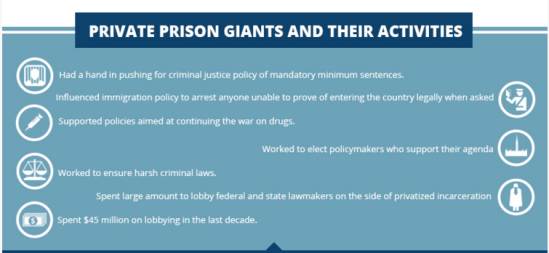
Ultimate Fate: Unfortunately, he wasn’t head of the North Side Gang for long. Was killed at O’Banion’s old flower shop in 1926 by two gunmen wielding submachine guns. He was 28.

28. Mickey Duffy (1888-1931)

Does Mickey Duffy always that glum or did he just not like getting his picture taken? Still, didn't have as much as Mickey Doyle does on Boardwalk Empire.

Does Mickey Duffy always that glum or did he just not like getting his picture taken? Still, didn’t have as much as Mickey Doyle does on Boardwalk Empire.

Known in Life as: Polish American gangster and rival Max “Boo Hoo” Huff during Prohibition. Was one of the most powerful beer bootleggers in Philadelphia.
Character or Inspiration? Inspiration for Mickey Doyle.
Similarities: Well, both were born Polish with the name Cusick (or Kuzik) yet changed to Irish sounding names (but while Duffy did it to fit in with Irish gangs in Philly and married an Irish girl, Doyle just thought the name sounded better).
Differences: Was a criminal from the time he was a child and had served time in prison in 1919 for assault and battery with intent to kill for 3 years. Got into organized crime and smuggling during Prohibition. Was one of the most dominant bootleggers in the Delaware Valley in the early 1920s with breweries in Philadelphia, Camden, and South Jersey. Despite being engaged in fights with his rivals, he owned several clubs and ran bootlegging numbers at the old Ritz-Carlton hotel. Was shot 3 times with a Thompson submachine gun and survived. Wasn’t as much of an idiot as Doyle nor as lucky either.

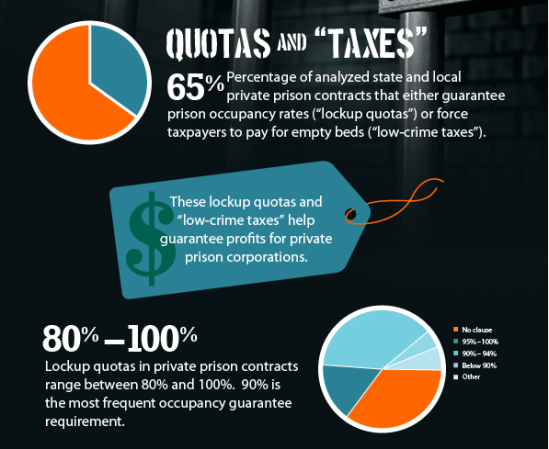
Ultimate Fate: Shot to death by unknown assailants at Atlantic City’s Ambassador Hotel in 1931. He was 31. The murder remains unsolved to this day. Thousands try to come to his funeral but were blocked by police.

29. Walter E. Edge (1873-1956)

Despite how he's depicted on Boardwalk Empire, Walter Edge wasn't an old man in the early 1920s and actually wore glasses. And no, he didn't have a construction business, he was a media guy.

Despite how he’s depicted on Boardwalk Empire, Walter Edge wasn’t an old man in the early 1920s and actually wore glasses. And no, he didn’t have a construction business, he was a media guy.

Known in Life as: New Jersey US Senator from 1921-1929 as well as governor from 1917-1919 and 1944-1947. Also served as US Ambassador to France from 1929-1933.
Character or Inspiration? He’s a character on the show.
Similarities: Campaign manager’s name was Nucky whose relationship with him would soon sour (in real life they openly broke in 1928 though). Also was on a possible shortlist to be Warren Harding’s VP (though he lost out due to a Republican Party leader holding a grudge against him because Edge wouldn’t appoint his guy to be county prosecutor).
Differences: Wore glasses and was never in the construction business but in media and publishing. Was only 47 in 1920. Education was in a 2 room school house and went only as far as 8th grade. Started a weekly newspaper devoted to social news when he was 10 which had a circulation of 100. Owned his own advertising business in Atlantic City when he was 17 which became a multi-million dollar agency with offices in numerous US and European cities. Founded two newspapers and bought another. Helped get worker’s compensation in New Jersey. As governor obtained legislation consolidating state boards, improving the civil service, imposing a franchise tax on public utilities, allowing greater home rule for cities, reforming corporation law, and improving state institutions, especially the prisons. Also reorganized the state road department and authorized a few bridge constructions. Was openly anti-Prohibition. Married twice and fathered 4 kids.
Ultimate Fate: Edge would go on to be Ambassador to France as well serve another term as governor in the 1940s. His second term as governor would be marked with numerous battles against Frank Hague. He would also restructure the civil service system, incorporate an anti-discrimination agency into the education department, and create a department of economic development. Would retire from politics for good in 1947 but would spend his later years as an elder statesman of New Jersey’s Republican Party. Owned the home of Richard Stockton for a time. Died of natural causes in 1956 at 82.

30. Jesse Smith (1871-1923)

I know he's supposed to be known for being found mysteriously shot in his green house on K Street, yet I can't help but say that Jesse Smith looked like a muppet. Seriously, he reminds me of the disgruntled customer at Grover's diner but in 1920s clothes.

I know he’s supposed to be known for being found mysteriously shot in his green house on K Street, yet I can’t help but say that Jesse Smith looked like a muppet. Seriously, he reminds me of the disgruntled customer at Grover’s diner but in 1920s clothes.

Known in Life as: Member of Warren G. Harding’s Ohio Gang as well as friend and gofer of Harry Daugherty.
Character or Inspiration? He’s a character on the show.
Similarities: Well, he’s an aide to Daugherty and wielded considerable influence in the Justice Department. His activities were said to make him become an embarrassment to Daugherty and the Harding administration. Was found dead with a gunshot wound in his home and a pistol by his side.
Differences: Though fat, he actually wore Harry Potter glasses and had a bit of a Hitler mustache. Was divorced and it’s only alleged that he sold liquor to bootleggers at his little green house on K Street. It’s said that Harding wanted Smith out of Washington before he went to Alaska while his administration was engulfed in the Teapot Dome scandal.
Ultimate Fate: Found dead at his K Street home with a gunshot wound and a pistol by his side. He was 52. Death was ruled a suicide though many authors who write about the Teapot Dome scandal and the Harding administration say he as murdered. Still, Smith’s well-timed death through gunshot wound is was during the worst of the Harding administration scandals of 1923 and the reason why he’s best remembered.

31. Theodore Hardeen (1876-1945)

Well, he sure looks like he could be Houdini's brother. Yet, Hardeen also had a good bit of talent as a magician and escape artist, tool. Also founded a union for magicians as well.

Well, he sure looks like he could be Houdini’s brother. Yet, Hardeen also had a good bit of talent as a magician and escape artist, tool. Also founded a union for magicians as well.

Known in Life as: Magician and escape artist who was the younger brother of Harry Houdini. Founder of the Magician’s Guild and first magician to escape from a submerged straitjacket in full view of the audience, rather than behind a curtain.
Character or Inspiration? He’s a character on the show.
Similarities: Well, when his brother was alive, he was the guy you got when you couldn’t get Houdini.
Differences: Born in Hungary. While he did study under his brother, he’s also said to have considerable talent of his own. He did many of his brother’s routines after the former’s death in 1926. Entertained the troops during World War II.
Ultimate Fate: Though he planned to write a book about his brother, he died from surgical complications in 1945 at 69.

32. Edith Day (1896-1971)

Edith Day in a film by Republic Pictures called Children Not Wanted. I suppose this is a comedy, right? Still, she was more of a musical gal if you know what I mean.

Edith Day in a film by Republic Pictures called Children Not Wanted. I suppose this is a comedy, right? Still, she was more of a musical gal if you know what I mean.

Known in Life as: Actress and singer best known for her roles in Edwardian musical comedies and operettas, first on Broadway and then on London’s West End.
Character or Inspiration? She’s a character on the show.
Similarities: Sang “Alice Blue Gown.”
Differences: Was born in Minnesota. Married 3 times and saw her only son die in WWII. Best known for the title role of Irene. Was part of the 1928 cast of Show Boat in which she did 350 performances. Has a cocktail named after her.
Ultimate Fate: Died in London in 1971 at 75.

33. Mamie Smith (1883-1946)

Mamie Smith was one of the first female African American singers to work in a recording studio. She was also called "Queen of the Blues" and ushered the careers of the female singers. Apparently Niki Minaj and Beyonce probably don't know who she was.

Mamie Smith was one of the first female African American singers to work in a recording studio. She was also called “Queen of the Blues” and ushered the careers of the female singers. Apparently Niki Minaj and Beyonce probably don’t know who she was despite owing their careers to her.

Known in Life as: African American Vaudeville singer, dancer, pianist, and actress who appeared in several films late in her career. Performed in a number of styles including jazz and blues. Was the first African American artist to make vocal blues recordings in 1920.
Character or Inspiration? She’s a character on the show.
Similarities: Sang “Crazy Blues.”
Differences: Born in Cincinnati. Was a successful blues artist as well as helped the recording industry see African Americans as a great market since they bought most of her records. Helped usher careers for other female blues artists like Bessie Smith and Billie Holiday as well as opened the music industry for other African Americans in other genres. Once billed, “Queen of the Blues.” Also performed on radio. Married to movie producer Jack Goldberg.
Ultimate Fate: Died in New York in 1946 at 63.

34. Sophie Tucker (1887-1966)

Despite being overweight, Sophie Tucker would enjoy a long career in show business entertaining generations around the world. Apparently comical risque songs never seem to go out of style. Still, you can't help but be creeped out seeing her holding flowers in this picture.

Despite being overweight, Sophie Tucker would enjoy a long career in show business entertaining generations around the world. Apparently comical risque songs never seem to go out of style. Still, you can’t help but be creeped out seeing her holding flowers in this picture.

Known in Life as: Jewish American singer, comedian, actress, and radio personality. Known for her stentorian delivery of comical and risqué songs, she was one of the most popular entertainers in the US for the first half of the 20th century. Known as “The Last of the Red Hot Mamas.”
Character or Inspiration? She’s a character on the show.
Similarities: Sang “Some of These Days.”
Differences: Born in Russia. Married 3 times and had at least one son. Began singing at her parents’ Connecticut restaurant for tips. Before taking orders she, “would stand up in the narrow space by the door and sing with all the drama I could put into it. At the end of the last chorus, between me and the onions there wasn’t a dry eye in the place.” Would continue to sing at cafes and beer gardens until she made her first Vaudeville appearance in 1907 but in blackface. When she lost her makeup, she just performed without it, she stunned the crowd by saying, “You all can see I’m a white girl. Well, I’ll tell you something more: I’m not Southern. I’m a Jewish girl and I just learned this Southern accent doing a blackface act for two years. And now, Mr. Leader, please play my song.” Though made fun of herself for being overweight, she didn’t see anything wrong with being chunky. Performed with the Ziegfield Follies as well as for King George V. Elected present of the American Federation of Actors in 1938. Had her own radio show and made numerous guest appearances in radio and television including The Ed Sullivan Show and The Tonight Show. Was a punchline to a Beatles joke by Paul McCartney.
Ultimate Fate: Continued to perform for the rest of her life until her death from a lung ailment and kidney failure in 1966 at the age of 79. Still, she influenced a lot of female performers including May West, Joan Rivers, Roseanne Barr, Carol Channing, Ethel Merman, “Mama” Cass Elliot, and Bette Midler.

35. Jack Dempsey (1895-1983)

Jack Dempsey would win the World Heavyweight Championship title for most of the 1920s. Still, despite being a Mormon since he was 8, he married his 3 wives one at a time.

Jack Dempsey would win the World Heavyweight Championship title for most of the 1920s. Still, despite being a Mormon since he was 8, he married his 3 wives one at a time.

Known in Life as: American professional boxer and cultural icon of the 1920s. Held World Heavyweight Championship from 1919 to 1926. His aggressive style and exceptional punching power made him one of the most popular boxers in history. Had many of his fights set financial and attendance records, including the first million dollar gate.
Character or Inspiration? He’s a character on the show.
Similarities: Well, he’s a famous boxer and his fights were frequently broadcasted on the radio.
Differences: Born in Colorado and was baptized at 8 into the LDS church with his parents in 1903. Elementary school dropout and left home at 16. Frequently traveled underneath trains and slept in hobo camps in his early years. Started his career in barroom brawls saying, “I can’t sing and I can’t dance, but I can lick any SOB in the house.” Was a part time bodyguard for John Kearns who was the son of a US Senator. Lost the World Heavyweight Championship title in 1926 to Gene Tunney coining the phrase, “Honey, I forgot to duck.” Married 3 times and had at least 3 kids.
Ultimate Fate: Retired from boxing in the 1930s and went on to other things like writing, training, and philanthropy. Assisted Joe Louis when the latter fell on hard financial times as well as made friends with former rivals Henry Wills and Gene Tunney. Was a close friend of famous Watergate judge John Sirica. Beat up a couple of muggers in 1971. Died of heart failure in New York in 1983 at 87. Influenced Bruce Lee.

36. Frank Hague (1876-1956)

Frank Hague would be Jersey City's mayor and political boss for the New Jersey Democratic Party for 30 years. Was known to be very corrupt and a chronic backstabber as well.

Frank Hague would be Jersey City’s mayor and political boss for the New Jersey Democratic Party for 30 years. Was known to be very corrupt and a chronic backstabber as well. Still, nice suit though.

Known in Life as: Mayor of Jersey City from 1917-1947 and prominent Democratic politician and political boss. Had a widely known reputation for corruption and bossism and by 1947, enjoyed palatial homes, European vacations, and a private suite in the Plaza Hotel. Said to have amassed wealth of over $10 million at the time of his death though his city salary never exceeded $8,500 annually and he had no other legitimate income. Personal influence extended to national level, especially in federal patronage and Presidential campaigns.
Character or Inspiration? He’s a character on the show.
Similarities: Was well known as a chronic backstabber (even before the 1920s). Didn’t bat an eye at doing nefarious deeds with Democrats.
Differences: Born to Irish immigrants. Expelled from school at 14 for poor attendance and unacceptable behavior. Worked as a blacksmith’s apprentice and tried to be a boxer. Won his first election at 20. Pride and joy was the Jersey City Medical Center. Had a wife and son. Was seen as a reformer who wanted to reshape the corrupt Jersey City police force and spearhead crackdowns of prostitution and narcotics trafficking. Also made improvements to the city’s fire department. Had very little tolerance for those who opposed him publically. Took a lot of kickbacks but was able to avoid state and federal investigations for years. Use of voter fraud was said to be the stuff of legend.
Ultimate Fate: Retired from politics in 1947. Died at his Park Avenue duplex in New York in 1956 at 79. Though hundreds attended his funeral only a few removed their hats while passing his coffin. One woman held an American flag and a sign reading, “God have mercy on his sinful, greedy soul.”

37. William “Bill” McCoy (1877-1948)

Of course, I could only wonder what kind of booze Bill McCoy brought to the Eastern Seaboard. Let me see, Bacardi or Captain Morgan? Oh, wait, that's rum and he transported his stash from the Bahamas.

Of course, I could only wonder what kind of booze Bill McCoy brought to the Eastern Seaboard. Let me see, Bacardi or Captain Morgan? Oh, wait, that’s rum and he transported his stash from the Bahamas.

Known in Life as: American sea captain and rum runner smuggler during Prohibition. Smuggled whiskey from the Bahamas to the Eastern Seaboard.
Character or Inspiration? He’s a character on the show.
Similarities: Retired from bootlegging after a stint in jail in late 1923.
Differences: Though seen drinking on the show on numerous occasions, he was actually a teetotaler. Viewed John Hancock as a role model and called himself, “an honest lawbreaker.” Never paid a cent for organized crime, politicians, and law enforcement for protection. Born in Syracuse and had a bricklayer father who served in the Union blockade during the American Civil War. Attended the Pennsylvania Nautical School on board the USS Saratoga and graduated first in his class. Served as mate and quarter master on various steamers. Had a reputation as a skilled yacht builder. Moved to Florida in 1900 and only went into the bootlegging business because he and his brother fell on hard financial times. Also smuggled liquor from other Caribbean islands and Canada.
Ultimate Fate: After being arrested by the US Coast Guard, he spent 9 months in a New Jersey jail. Quit bootlegging upon his release and spent the rest of his life investing in Florida real estate as well as build boats and travel down the coast. He died in 1948 at 71.

38. The Lanzetta Brothers
Known in Life as: Six gangster brothers from Philadelphia during the 1920s and 1930s. Were notorious gunmen, numbers gamblers, narcotics dealers, and liquor bootleggers. Used an “Alky Cooking” supply network by providing a contingent row of house dwellers with home sills and paying them to sell saleable liquor. Criminal career was marked by frequent arrests and brutal violence.
Character or Inspiration? Inspiration for the D’Alessio brothers, particularly Leo and Ignacius.
Similarities: Well, both clans have brothers named Ignatius, Pius, Lucien, and Leo, who was considered the leader.
Differences: Two of the brothers were named Willie and Teo and I’m not sure if they had a brother who was a dentist anywhere. May have possibly murdered Mickey Duffy. Held out for much longer than their TV counterparts (who all die by a half-faced war vet in the first season). Leo was considered the leader since he was the oldest. Pius was “the Brain.” Ignatius was always impeccably dressed. Lucian had the explosive temper. Willie was the quiet one. And Teo, “the Baby” made women swoon because of his matinee idol good looks.
Ultimate Fate: Well, a lot of them didn’t come to good ends. Leo was killed in 1925 after leaving a barbershop in an apparent retribution of the murder of rival Joseph Bruno. Pius and Willie were killed by enemy bullets in 1936 and 1939. By 1940, Teo was serving a sentence in drug trafficking and Ignatius was released by a US Supreme Court decision declaring the New Jersey “Gangster Law” unconstitutional and might’ve joined Lucian and their mother in fleeing to Detroit.

39. Santo Trafficante Sr. (1886-1954)
Known in Life as: Sicilian born American gangster based in Florida and father of notorious mobster Santo Trafficante Jr.
Character or Inspiration? Possible inspiration for Vincenzo Petrucelli yet he hasn’t actually appeared on the show, yet.
Similarities: Both had a long time alliance and friendship with Masseria. Both were based in Florida.
Differences: Married with 5 sons. Wasn’t Masseria’s cousin, though he did send Santo Jr. to New York to learn under other mobsters. Gained power as a mobster and ruled the Mafia in Tampa from the 1930s to his 1954 death. Was a well-respected boss with ties to Luciano and Thomas Lucchese.
Ultimate Fate: Died in Tampa, Florida in 1954 at 68 and left his organization to his son who was respected under the New York bosses.

The Real People of Boardwalk Empire: Part 2 – Jimmy Boyd to Frankie Yale

boardwalk-empire-babette-s-supper-club

So we’re off to a good start. Of course, there may be plenty of famous gangsters you might recognize, some you may not, and some you may think were just made up by the writers of Boardwalk Empire but weren’t. Of course, I have to open this post in this series with a poster of Babette’s Supper Club which was a real place in 1920s Atlantic City but didn’t get the name until the 1930s. Still, it’s one of the more iconic places in the Prohibition era HBO show as well as one of Nucky Thompson’s frequent hangouts with his friends, lovers, and associates. In fact, it’s his favorite restaurant. Still, in this selection, we’ll look at Atlantic City notable Jimmy Boyd who was a partial inspiration for Jimmy Darmondy but came on the scene after the 1920s. At this time, he’s just a bell boy. Yet, I’ll also introduce to you two of Al Capone’s brothers who joined him in the Chicago Outfit bootlegging business. Their names were named Ralph and Frank. Then we’ll get to know officials in government like Gaston Means (who’s a con artist), Attorney General Harry Daugherty, Treasury Secretary, banker, and Treasury notable Andrew W. Mellon, the infamous FBI director J. Edgar Hoover, and Assistant Attorney General Mabel Walker Willebrandt who’s the inspiration for Esther Randolph. We also have famous booze baron and possible inspiration for Jay Gatsby, George Remus who you remember referring to himself in 3rd person as well as the renown entertaining powerhouse Eddie Cantor you recall for telling all those stupid jokes about dumb women. Oh, yeah, almost forgot gangsters Waxey Gordon, Dean O’Banion (the mob boss with the flower shop), and Frankie Yale. So without further adieu, in this second installment, here are some more real people from Boardwalk Empire.

14. Jimmy Boyd (1906-1974)
Known in Life as: Political operative who worked closely with Nucky Johnson and Frank Farley as well as become member of the Atlantic Board of Freeholders for about 40 years as well as executive chairman of the 4th Ward Republic Club for 2 decades.
Character or Inspiration? An inspiration for Jimmy Darmondy (though maybe a bit of a stretch).
Similarities: Well, they were war veterans and have rags to riches stories. Both were married. Both did dirty work for their bosses. Yet, that’s about it.
Differences: Probably started off as a bell hop at the Ritz and worked his way up. Served in WWII. Was never a gangster nor was killed by Nucky Johnson. Certainly wasn’t the son of “the Commodore” and a teenager nor did he go to Princeton.
Ultimate Fate: Died in 1974 at 68. His widow is still alive and established a scholarship at Atlantic Cape Community College in his name.

15. Gaston Means (1879-1938)

Actually he looks quite like the guy who played him in the show. Not sure if he made Jess Smith commit suicide but I wouldn't be surprised if he did. Nevertheless, he'll go to Leavenworth after he tried to pull a con during the Lindbergh kidnapping. Bastard.

Actually he looks quite like the guy who played him in the show. Not sure if he made Jess Smith commit suicide but I wouldn’t be surprised if he did. Nevertheless, he’ll go to Leavenworth after he tried to pull a con during the Lindbergh kidnapping. Bastard.

Known in Life as: Private detective, salesman, bootlegger, forger, swindler, murder suspect, blackmailer, and con artist. Though not involved with the Teapot Dome scandal, was associated with other members of the so-called Ohio Gang that gathered around the Harding administration. Also tried to pull a con associated with the Lindbergh kidnapping.
Character or Inspiration? He’s a character on the show.
Similarities: Had a Southern accent. Was a con man and master manipulator you couldn’t trust. Was hired as an investigator for the FBI despite his dubious reputation as a detective. Wasn’t well liked by Harry Daugherty (but for the right reasons). Assisted bootleggers and was arrested for perjury.
Differences: May or may not have had anything to do with Jess Smith’s death. Wrote a book saying that Warren G. Harding was killed by his wife and later repudiated it.
Ultimate Fate: After trying to pull a con associated with the Lindbergh kidnapping, he was arrested, found guilty, and sentence to 15 years of prison. Died at Leavenworth in 1938 at 59.

16. Eddie Cantor (1892-1964)

Yes, this is Eddie Cantor during his younger years. No, this isn't Mr. Bean I'm sorry to say. Still, you have to love how he looks in that outfit.

Yes, this is Eddie Cantor during his younger years. No, this isn’t Mr. Bean I’m sorry to say. Still, you have to love how he looks in that outfit.

Known in Life as: Performer, comedian, dancer, singer, actor, and songwriter. Worked in vaudeville, Broadway, radio, movies, and early television.
Character or Inspiration? He’s a character on the show.
Similarities: Well, he was a well-known Vaudeville performer on stage.
Differences: Raised by his maternal grandmother (whose name was Kantrowitz but was shortened to Kanter by a clerk when he attended the Surprise Lake Camp). Though you might not know it on the show, he was a happily married man from 1914 to 1962 (to a woman named Ida Tobias who suggested he used Eddie as a stage name) and father of five daughters. Also was known to entertain the audience with his intimate stories and anecdotes of his wife and kids, sometimes to his children’s chagrin. Was president of the Screen Actors Guild in the 1930s and coined the term for “the March of Dimes” for the National Foundation for Infantile Paralysis and was its spokesman for its 1938 campaign.
Ultimate Fate: Though he lost his multi-millionaire status and was left deeply in debt in the 1929 Stock Market Crash, he managed to rebuild his fortune with a new bank account and a series of highly popular bestselling humorous books with cartoons. In 1935, he, Charles Tobias and Murray Melcher would write “Merrily We Roll Along” which he recorded in the 1950s but was used as a theme song for the Merrie Melodies cartoon series for Warner Brothers between 1937 to 1964. Also had a successful career in film and television despite being turned down for The Jazz Singer. Died of a heart attack at 72 in 1964.

17. Harry Daugherty (1860-1941)

Looked much different than I thought he did. Sure he's wearing a nice 3 piece suit but he's corrupt as hell and tried to say his friend killed himself after being diagnosed with diabetes. Seems suspicious.

Looked much different than I thought he did. Sure he’s wearing a nice 3 piece suit but he’s corrupt as hell and tried to say his friend killed himself after being diagnosed with diabetes. Seems suspicious.

Known in Life as: Attorney general under Warren G. Harding and Calvin Coolidge. Was an influential official behind the election of several Congressmen and US Senators and served as Harding’s campaign manager in 1920. Instrumental for winning presidential pardons for jailed anti-war dissidents including one Eugene V. Debs. “Ohio Gang” member and may have been involved in the Teapot Dome scandal. Forced to resign as attorney general after being twice subject to US government investigations in 1924.
Character or Inspiration? He’s a character on the show.
Similarities: Was massively corrupt and untrustworthy. Shared a hotel room with Jesse Smith and was close friends with him.
Differences: Let’s just say that he and Jesse Smith may have just been good friends and leave it at that. Also, was married with two kids, fat, and bald. Was about 60 in 1920.
Ultimate Fate: After indictments and his resignation, he returned to practicing law until his retirement in 1932. Wrote a book trying to clear his name pinning the Teapot Dome scandal on Albert Fall and saying that Jesse Smith killed himself because of diabetes, not a guilty conscience. He planned on writing two more. Died in his sleep in 1941 at 81 a year after he experienced two heart attacks and pneumonia that made him blind in one eye.

18. Andrew W. Mellon (1855-1937)

Now I know that Andrew Mellon exists since he's a Pittsburgh native. And the Mellon name is incredibly famous in the area with the now Bank of New York Mellon. Nevertheless, he didn't look at all like James Cromwell as you see here.

Now I know that Andrew Mellon exists since he’s a Pittsburgh native. And the Mellon name is incredibly famous in the area with the now Bank of New York Mellon. Nevertheless, he didn’t look at all like James Cromwell as you see here.

Known in Life as: Banker, businessman, industrialist, philanthropist, art collector, US Ambassador to the UK, and US Treasury Secretary under Warren G. Harding, Calvin Coolidge, and Herbert Hoover.
Character or Inspiration? He’s a character on the show.
Similarities: Well, he was Harding’s Treasury Secretary. Responsible for upholding taxes and Prohibition despite that he hated both.
Differences: Resembled nothing like James Cromwell. Had a mustache and a head full of white hair at this time period. Believed in a progressive income tax but at lower rates. We’re not sure whether he owned a distillery in the 1920s though he denied it amid rumors. Fathered two children and was divorced. Was in his 60s and early 70s during the 1920s.
Ultimate Fate: Became unpopular with the onset of the Great Depression that he was nearly impeached but resigned in 1932. Was investigated and indicted over his personal tax returns by the FDR administration though he’d later be exonerated. Died in New York in 1937 at the age of 82.

19. Waxey Gordon (1888-1952)

Let's just say that while Waxey Gordon may seem like a guy the Boardwalk Empire writers made up, he actually was a real gangster. Still, he was born Irving Wexler and the name he's best known by was made up.

Let’s just say that while Waxey Gordon may seem like a guy the Boardwalk Empire writers made up, he actually was a real gangster. Still, he was born Irving Wexler and the name he’s best known by was made up.

Known in Life as: A Jewish American crime boss in Philadelphia during Prohibition who specialized in bootlegging and illegal gambling.
Character or Inspiration? He’s a character on the show.
Similarities: Was an associate of Arnold Rothstein and helped run most of his East Coast bootlegging operation.
Differences: Real name was Irving Wexler and was born in New York. Married to a rabbi’s daughter and had a son in medical school. Was a chunky dark skinned man. Started out as a pickpocket before he became a rum-runner during the early days of Prohibition. Lived an extravagant lifestyle from his multi-million dollar empire and had mansions in New York and Philadelphia.
Ultimate Fate: After Rothstein’s death in 1928, his glory days were over. Though he made alliances with future National Crime Syndicate founders Luciano, Lansky, and Louis Buchaller, his struggles with Lansky over bootlegging and gambling interests would lead to a gang war between the two as well as the deaths of several associates (the writers missed a great opportunity there). Lansky and Luciano would later supply US Attorney Thomas E. Dewey with evidence that led to his conviction of tax evasion in 1933. After his 10 year prison sentence, he found his gang disbanded, divorced, and his East Coast empire lost. Tried to start over as a single man by moving to California, selling 10,000lbs of coupon rationed sugar during WWII, and imported illegal drugs. Was busted for selling heroin to an undercover cop in 1951. He was convicted of narcotics and trafficking and sentence to 25 years. He died of a heart attack on Alcatraz in 1952 at 64.

20. Ralph “Bottles” Capone (1894-1974)

Now he doesn't seem to resemble Herc from The Wire at all who plays him on the show. Reminds me more of Al Capone if he ever became a milkman in a newspaper cap. You can see the family resemblance there.

Now he doesn’t seem to resemble Herc from The Wire at all who plays him on the show. Reminds me more of Al Capone if he ever became a milkman in a newspaper cap. You can see the family resemblance there.

Known in Life as: Chicago gangster and brother of Al Capone. Most famous for being “Public Enemy #3.”
Character or Inspiration? He’s a character on the show.
Similarities: Got his nickname “Bottles” for running a legal bottling plant (it was for soft drinks like ginger ale as well as soda water for mixed drinks and was very profitable for the Chicago Outfit).
Differences: Was born in Italy and came to the US as a baby making him older than Al. Married three times and divorced twice. Took his son Ralph Jr. away from his wife and had his mother raise him as her youngest child. Was the dominant soft drink vendor other than Coca Cola during the 1933 World’s Fair. Had relatively little power in the Outfit and the National Crime Syndicate.
Ultimate Fate: Remained in the Outfit after his brother’s arrest as well as hosted several high-level Outfit conferences from his brother’s Palm Island, Florida residence. Managed Chicago’s Cotton Club where he was involved in syndicate gambling and vice districts. In 1932, was convicted of tax evasion and served 3 years. Purchased a home and was a silent partner in a hotel/tavern at Mercer, Wisconsin. Moved to Wisconsin after his release. Died of natural causes in Hurley, Wisconsin in 1974 at 80. His widow would marry his best friend three years later. So let’s just say that Bottles post-crime life was very good indeed.

21. Frank Capone (1895-1924)

I know this isn't much but this is the only picture I could find of Frank Capone alive. Most of the photos featured of him on Google Images show him shot up and dead. Still, probably the best looking brother in the Capone bunch as we've seen.

I know this isn’t much but this is the only picture I could find of Frank Capone alive. Most of the photos featured of him on Google Images show him shot up and dead. Still, probably the best looking brother in the Capone bunch as we’ve seen.

Known in Life as: Chicago gangster and Al Capone’s brother who participated in the attempted takeover of Cicero, Illinois for Al’s criminal organization.
Character or Inspiration? He’s a character on the show.
Similarities: Dressed in well attired clothes to project an image of a mild-mannered businessman. Was shot to death by Chicago police shooting him up on Election Day.
Differences: Older than Al but they were close. Was involved in the Five Points Gang with Johnny Torrio. Was considered more violent than his younger brother and certainly didn’t die just defending him. Actually unleashed a wave of terror during the Illinois Democratic Party that April sending Southside gang members with submachine guns and sawed-off shotguns to make sure the locals voted for Cicero city manager Joseph Z. Klenha. Those who didn’t cooperate were assaulted and blocked. Also led an attack at the opponent’s campaign headquarters ransacking the office and assaulting several campaign workers, one of whom was shot in both legs and held hostage along with 8 others until after the primary was over. CPD had to send 70 plainclothes officers over this.
Ultimate Fate: Was shot dozens of times by Chicago police during the Illinois Democratic Primary on April 1, 1924 at 28. It was considered a justifiable shooting since police said he pulled out a gun at them though some witnesses disagree. Al escaped unharmed but retaliated by murdering one official, kidnapping others, and stealing ballot boxes from the polling stations. Still Frank Capone was laid in a silver laden casket and had an extravagant funeral that costs $200,000 worth of flowers from Dean O’Banion’s florist shop as well as over 150 cars in the motorcade. Al also had gambling dens and speakeasies closed for two hours for the funeral.

22. J. Edgar Hoover (1895-1972)

Sure the young FBI director was a rabid lifelong racist but damn, did he really know how to dress. Also, didn't wear women's clothes but sure knew how to wear a suit. Probably should've considered becoming a male model and save people from decades worth of pain with him in government.

Sure the young FBI director was a rabid lifelong racist but damn, did he really know how to dress. Also, didn’t wear women’s clothes but sure knew how to wear a suit. Probably should’ve considered becoming a male model and save people from decades worth of pain with him in government.

Known in Life as: First FBI director in the United States and led the bureau from 1924 to 1972. Instrumental in founding the FBI in 1935 and is credited with building it into a large crime fighting agency and with instituting a number of modernizations to police technology such as a centralized finger print file and forensic laboratories. Was a much more controversial later in life as evidence of his secret actions became known. His critics accused him of exceeding the FBI’s jurisdiction and used the organization to suppress dissidents and activists, to amass secrets on political leaders, and collect evidence using illegal methods. Amassed a great deal of power and was in a position to intimidate and threaten sitting US Presidents.
Character or Inspiration? He’s a character on the show.
Similarities: Was only 29 in 1924. Was obsessed with bringing down Marcus Garvey as well as racist (remember he opposed the Civil Rights Movement and taped Martin Luther King Jr.). Instituted highly selective hiring standards and ruthlessly efficient investigation procedures that provided his organization to infiltrate and thoroughly investigate criminal empires during Prohibition.
Differences: Helped carry out the Palmer Raids in 1919 (hated liberals, too, as you know) and was appointed as director of the BoI when his boss was alleged to have been involved in the Teapot Dome scandal. Despite his racism and obsession with hunting down black civil rights leaders, he didn’t ignore organized crime (at least later on). Was noted to be rather capricious in his FBI leadership as well as frequently firing agents or singling out those who “looked stupid like truck drivers” or considered “pinheads.” He was even said to relocate agents who’ve displeased him to career-ending assignments and locations (Melvin Purvis is a good example of this). Was alleged to be gay as well as had a close lifelong friendship with Clyde Tolson (as we know it).
Ultimate Fate: Hoover will lead the FBI for a very long time serving as its director under every US President to Calvin Coolidge to Richard Nixon and will gain a lot of power and notoriety. Died from a heart attack at his Washington D. C. home in 1972 at 77 and his body lay in state at the Capitol Rotunda with Warren Burger and Richard Nixon. Still, Nixon’s appointment of L. Patrick Gray over Hoover’s No. 2 at the time Mark Felt would lead Felt to leak information to Bob Woodward and Carl Bernstein on the Watergate Scandal.

23. Mabel Walker Willebrant (1889-1963)

And you thought Esther Randolph was just totally made up to make the 1920s seem like a more feminist time than it was. Actually, she's based on a real Assistant Attorney General named Mabel Walker Willebrandt who actually did nail George Remus and other wrongdoers during Prohibition. Too bad she didn't get promoted to Attorney General under Herbert Hoover. Damn, and we couldn't get a woman Attorney General until the 1990s. Isn't sexism unfair?

And you thought Esther Randolph was just totally made up to make the 1920s seem like a more feminist time than it was. Actually, she’s based on a real Assistant Attorney General named Mabel Walker Willebrandt who actually did nail George Remus and other wrongdoers during Prohibition. And this is her picture here. Pretty wasn’t she? Too bad she didn’t get promoted to Attorney General under Herbert Hoover. Damn, and we couldn’t get a woman Attorney General until the 1990s. Isn’t sexism a bitch?

Known in Life as: “First Lady of Law” was US Assistant Attorney General from 1921-1929 handling cases concerning violations of the Volstead Act, federal taxation, and the Bureau of Federal Prisons.
Character or Inspiration? Inspiration for US Attorney Esther Randolph.
Similarities: Well, they’re both Assistant Attorney Generals in the 1920s who deal with the Volstead Act. Both were willing to take down bootleggers when their superiors wouldn’t. Brought down George Remus and were successful in the biggest prosecutions during Prohibition. Both showed high degrees of professionalism.
Differences: Was divorced but she probably didn’t sleep with her assistant. Wasn’t reduced to prosecuting bit time bootleggers at the D. C. night court circuit for she had other things to do. And she’d probably not ally herself with booze barons. Yet, she did get her start defending prostitutes without pay and handled 2000 cases pertaining to them. During WWI, she served as head of the Legal Advisory Board for draft cases in Los Angeles, California. Oh, and she was the second woman appointed as Assistant Attorney General but the first to serve an extended term, which made her the highest ranking woman in the federal government. Her administration the establishment for the Alderson federal prison which was the first of its kind for women. She was also an opponent to Prohibition but aggressively upheld the Volstead Act but criticized the federal government’s efforts to enforce the law in her book The Inside of Prohibition describing political interference, incompetent public officials, and public indifference. Her efforts to prosecute bootleggers were hampered by the Treasury and Justice Departments though she managed to prosecute 48,734 Prohibition-related cases from June 1924 to June 1925, of which 39,072 resulted in convictions. Submitted 278 cases of certiorari to the Supreme Court regarding defense, clarification, and enforcement of Prohibition and the Volstead Act. Also argued more than 40 cases before the Supreme Court and won several victories.
Ultimate Fate: Though she heavily campaigned for Herbert Hoover in 1928, she failed to be appointed Attorney General (not surprisingly) and resigned her post in 1929. She continued to work as an attorney having offices in Washington and Los Angeles. In 1950 she represented the Screen Actors Guild during a labor hearing as well as California Fruit Industries. Became the first woman to chair a committee of the American Bar Association on the committee of aeronautical law as well as held several honorary doctorates. Later converted to Roman Catholicism and died of natural causes in Riverside, California in 1963 at 73.

24. George Remus (1874-1952)

Cincinnati booze baron George Remus behind bars. After he gets out of prison he's going to find out his wife had an affair and basically swindled him royally. He'd then kill her in front of a lot people in broad daylight and get off on temporary insanity. Yet, George Remus won't be nearly that rich again.

Cincinnati booze baron George Remus behind bars. After he gets out of prison he’s going to find out his wife had an affair and basically swindled him royally. He’d then kill her in front of a lot people in broad daylight and get off on temporary insanity. Yet, George Remus won’t be nearly that rich again.

Known in Life as: Cincinnati lawyer and bootlegger during Prohibition. It’s been claimed that he was the inspiration for the title character in The Great Gatsby by F. Scott Fitzgerald.
Character or Inspiration? He’s a character on the show.
Similarities: Was brought down by a female Assistant Attorney General. Exploited a loophole in the Volstead Act that permitted its trade for medicinal purposes (which was why he moved to Cincinnati where 80% of the US “bonded” whiskey was located). Entered the booze business to get rich but wasn’t really violent. Was a teetotaler as well as short, fat, and bald. Actually referred to himself in the 3rd person.
Differences: Born in Germany and came to the US at 5. Supported his family by working in a pharmacy at 14 because his dad couldn’t work. Bought the pharmacy at 19 and another at 24 but became a lawyer after getting bored. Daughter was Romola Remus who played Dorothy Gale in the 1910 silent version of The Wizard of Oz when she was 8. Specialized in criminal defense and became rather famous that he was earning $50,000 annually by 1920 on his legal career alone. Married twice and divorced once. Was known as “The King of Bootleggers” for his vast booze empire as well as extravagant lifestyle and parties you’d see in The Great Gatsby including one in which he gave all the adult male guests diamond watches and their wives a brand new car. At his peak he owned 10 distilleries, employed 3,000 people, and had the most dominant bootlegging operation in the Midwest that would put Al Capone to shame. Loved fine food, art, literature, and swimming. Was well liked by the local kids as well as let them swim in his Grecian Olympic sized swimming pool. Beloved in Cincinnati and known for his generosity.
Ultimate Fate: In 1925, he was indicted for 3,000 violations under the Volstead Act and convicted by a grand jury in just 2 hours as well as received a 2 year prison sentence. While in the slammer, befriended a fellow prison inmate who turned out to be an undercover Prohibition agent named Franklin Dodge who later resigned and had an affair with his second wife Imogene. Dodge and Imogene would liquidate his assets and hide as much money as possible, strip his large Marble Palace mansion of everything of value and nail the doors shut, attempt to deport him, and even hire a hitman to murder him for $15,000. Imogene sold his Fleischmann distillery in which she gave him $100 for it and would file for divorce. In 1927, he had his driver chase his second wife and daughter through Eden Park on her way to the divorce finalization, where he fatally shot his wife in the abdomen in front of the Spring House Gazebo in front of horrified onlookers. He successfully pleaded temporary insanity in record time while acting as his own attorney with a case bringing national headlines for a month as well as prosecuted by a former president’s grandson. Was sentenced for 6 months. Upon release, tried to return to bootlegging but found it was taken over by gangsters so he moved to Covington, Kentucky where he lived a modest life for the next 20 years without incident and though he tried to regain his vast fortune, he was never successful. He died there in 1952 of natural causes at 77.

25. Dean O’Banion (1892-1924)

Dean O'Banion posing in a photo with his wife Viola holding one of his bouquets he styled himself. Too bad he'll be whacked by Frankie Yale's boys in his own flower shop.

Dean O’Banion posing in a photo with his wife Viola holding one of his bouquets he styled himself. Too bad he’ll be whacked by Frankie Yale’s boys in his own flower shop.

Known in Life as: Irish American gangster in Chicago and rival of Johnny Torrio and Al Capone during the brutal Chicago bootlegging wars of the 1920s. Led the North Side Gang until his murder by Frankie Yale, John Scalise, and Albert Anselmi in 1924.
Character or Inspiration? He’s a character on the show.
Similarities: Owned a flower shop (which was originally set up for a money laundering scheme but he found out he actually liked it). Had his men encroach others’ territory and breweries.
Differences: Was once a choir boy as a kid and sang at Chicago’s Holy Name Cathedral. Childhood buddies were Hymie Weiss, Vincent Drucci, and Bugs Moran who were in the Market Street Gang specializing in theft and robbery. Worked as a singing waiter at McGovern’s Liberty Inn and was said to have a beautiful tenor voice while his buddies picked pockets in the coatroom. Also drugged his patron’s drinks known then as “slipping a Mickey Finn.” They also inflicted violence in the 42nd and 43rd ward for political bosses. As a head of the North Side Gang, his men stole liquor from other bootleggers, hijacked trucks en route (a pioneer in that), tried to frame Torrio and Capone for a murdered, trolled the Genna brothers (a Chicago Outfit affiliated gang) for no apparent practical reason, and conned Angelo Genna out of a large sum of money. Also did flower arrangements for mob funerals and regularly attended Mass at Holy Name Cathedral. At his height he was making $1 million in the early 1920s when he and his gang eliminated the bootlegging competition. Abhorred prostitution.
Ultimate Fate: Shot up by two of Frankie Yale’s hitmen in his flower shop in 1924 at the age of 32. Was denied to be buried on consecrated ground by the Catholic Church but his funeral was presided by a priest who knew him since childhood and was quite lavish. His killing would spark a 5 year gang war between the North Side Gang and the Chicago Outfit which would culminate in the 1929 St. Valentine’s Day Massacre.

26. Frankie Yale (1893-1928)

Yes, that's Frankie Yale. Despite the Ivy League sounding name, he's actually was an Italian born gangster who didn't go to college. Still, he and Al Capone were good friends, for a while.

Yes, that’s Frankie Yale. Despite the Ivy League sounding name, he’s actually was an Italian born gangster who didn’t go to college. Still, he and Al Capone were good friends, for a while. Had a very expensive gangster funeral.

Known in Life as: Brooklyn gangster and original employer of Al Capone before the latter moved to Chicago.
Character or Inspiration? He’s a character on the show.
Similarities: Well, he was responsible for killing Dean O’Banion in his flower shop though possibly could’ve killed Colosimo (we aren’t sure on that one).
Differences: Born in Italy, came to the US at 7, and befriended Johnny Torrio as a teenager who ushered him in the Five Points Gang. Believed in putting business ahead of ego. Took over Brooklyn’s ice delivery trade by selling “protection” and creating monopolies. Opened a bar on the Seaside Walk in Coney Island with the proceeds known as Harvard Inn. It was in this place where a young waiter named Al Capone got his famous scar. His gang also engaged in Black Hand extortion activities (especially in rackets with dock workers and unions) and ran a string of brothels. Had a sideline of notorious foul-smelling cigars packaged in boxes that bore his smiling face as well as operated his own funeral home. Was one of Brooklyn’s biggest bootleggers at the beginning of Prohibition as well as known for his generosity for the less fortunate people in his neighborhood. Yet, was a violent man who didn’t hesitate to inflict pain on others and beat his younger brother so badly he wound up in the hospital. Married twice as well as fathered 3 daughters. Survived a lot of assassination attempts and supplied much of Al Capone’s whiskey imported from Canada and would oversee the transport personally.
Ultimate Fate: Unfortunately, his long friendship with Capone began to fray when his Chicago bound trucks would fall to hijacking before leaving Brooklyn. When Capone found that Yale was stealing his booze, his informant tried to kill Yale but was gunned down instead. On July 1, 1928, Yale received a cryptic call in his Sunrise Club saying that something was wrong with his wife. Yale would dash out in his brand new armored coffee-colored Lincoln coup (but lacked bullet-proof windows) and took up at New Ultrecht Avenue in which he was chased by a Buick sedan carrying four armed men (who were from Capone’s Chicago Outfit). The Buick would catch up to him and Yale was murdered in a storm of bullets that cause his car to crash into the stoop of a brownstone at No. 923. He was 35 (still, the writers missed a great opportunity here). Had one of the most impressive gangland funerals in American history which was attended by thousands of people and set a standard for opulence for American gangsters that has been seldom matched over the years. Also led to drama when two different women claimed to be his wife.