What Stormy Daniels Knows

At the surface, it seems that the Stormy Daniels saga is a salacious and pointless story distracting the public from the truly important issues in the Trump era. After all, she’s a porn star whose story involves an extramarital affair with a powerful much older man. Such incidents usually pertain to nothing of consequence. Even if they pertain to $130,000 hush money payments and non-disclosure agreements.

But if that older man is Donald Trump who’s now the president of the United States, then Daniels’s story isn’t about the tawdry details of infidelity. But one about Trump’s corruptibility as a president whose personal life and finances are shrouded in unprecedented secrecy. Back in 2016, Trump’s longtime personal attorney Michael Cohen paid Daniels $130,000 in exchange for her signing a nondisclosure agreement to keep her from saying anything about her alleged affair with Trump during the election’s final days. Recently, Daniels has filed suit to invalidate the non-disclosure agreement she signed, freeing her to speak about her relationship with Trump. Cohen has filed a private arbitration case against her and obtained a restraining order stating that she’d face penalties if she publicly discusses her affair. Her attorney has claimed she’d been threatened with physical harm if she didn’t keep quiet. Then there’s the fact Cohen has filed a suit against her for $20 million for breaching their agreement. Daniels’s attorney Michael Avenetti slammed Trump’s team for a “bullying tactic” in pursuing such an enormous sum from a private citizen over “bogus” damages in a maneuver that’s “likely unprecedented in our history.” He said their attempts to move a case from a state court in Los Angeles to a federal court is because it would increase the chances the matter will be decided in private arbitration, “thus hiding the truth from the public.” Oh, and the Trump team has tried to keep her interview with Anderson Cooper from airing on 60 Minutes on March 25.

Nonetheless, from the public’s standpoint, the key issue isn’t Daniels’s story. It’s the circumstances surrounding the payoff and how many similar deals out there. Now the payoff raises 2 big ethical and legal problems. First, it’s an attack on American’s threadbare system of campaign finance regulations thanks to Citizens United. But one of the few remaining laws on the books bans corporations from giving gifts to a candidate. Since Cohen used his Trump Organization email to arrange the deal and relayed the payment through a private Delaware-based shell company to her representative. And he did with no thought of repayment, discussion, or coordination with anyone else on the Trump team. According to Washington Post reporter, Philip Bump, “those two things together — that a Trump Organization email address was used to facilitate the payment and that the payment was linked to the campaign — would constitute a legal violation.” Of course, you could argue that a payoff made weeks before Election Day to prevent disseminating damaging information about a presidential candidate had nothing to do with the campaign. Either way, the money’s true origins and the extent of other Trump figures’ involvement in the payoff is worth taking seriously. Still, if we ignore this drama just because it involves a porn star, we might blow another enormous hole in a web of rules supposed to separate our democracy from a plutocracy. If we stop enforcing the rules about coordination, corporate contributions, and disclosure simply because Daniels’s case is tawdry, we’ll regret it.

Second, secrets worth paying over a hundred grand to keep could be powerful tools in foreign governments’ or domestic special interests’ hands. We know that Stormy Daniels isn’t the only woman Donald Trump has paid off. Former Playboy bunny Karen McDougal also had an affair with Trump around the same time as Daniels and received $150,000 from the National Enquirer for exclusive rights to her story in August 2016, which they never published. She’s also suing to invalidate her non-disclosure agreement as well. And I’m Trump has paid off other women, too. In addition, Trump has other secrets, some of which may or may not have been successfully kept from interested parties. And it’s likely someone might have leverage over him.

Donald Trump is a notorious philanderer and is subject to 18 sexual assault and other misconduct allegations that congressional Republicans don’t want to investigate. The Trump Organization has deployed aggressive nondisclosure agreements years before he became a candidate. Not to mention, he has a long history of corrupt business practices and still hasn’t released his tax returns. Taking all that into account, it’s not hard to conclude that Daniels and McDougal aren’t the only people whose silence Trump has bought. Michael Wolff’s Fire and Fury quotes Steve Bannon saying that longtime attorney Marc Kasowitz, “has gotten him out of all kinds of jams. Kasowitz on the campaign — what did we have, a hundred women? Kasowitz took care of all of them.” Bannon might’ve exaggerated. But his statement supports McDougal’s claims that Trump and his friends had a system to keep his affairs quiet. People at the National Enquirer told the New Yorker that America Media Inc.’s Chairman and CEO and Trump friend, David Pecker often bought stories to kill them. Sometimes he did it to protect the story’s subject and sometimes to hold the story as a sort of leverage over celebrities. As McDougal told Ronan Farrow, “Someone in a high position that controls our country, if they can influence him, it’s a big deal.” >

Given what we know about Donald Trump’s sex life, you may wonder how his reputation could possibly be damaged by extramarital affair revelations. Trump has no problem with naked photos and videos. He appeared on the cover of Playboy which he proudly displayed on his Trump Tower office wall. In fact, he signed copies of the magazine on the campaign trail. He had cameos in 3 Playboy videos in 2001. His wife Melania’s official White House biography even included the time she posed nude for British GQ, not her only such photo shoot. In addition, his 3 marriages and 2 divorces were New York tabloid fodder. Hell, the New York Post once ran a cover with his mistress claiming Trump was the “best sex I ever had.” He’s boasted to Howard Stern about going in contestants’ dressing rooms during his pageants. He bragged about his penis size during a presidential debate. Oh, and another porn star claimed he once offered her $10,000 for sex. And let’s not forget that he bragged about sexually assaulting women on a bus in front of Billy Bush. So Stormy Daniels telling her story of her affair with Trump won’t hurt his reputation as the total scumbag he already is.

But the fact he and his allies are willing to cut large checks to buy Daniels’s and McDougal’s silence indicates that they think these secrets are valuable. The problem with a powerful public official having valuable secrets is they can be exploited for more than just financial gain. Nobody with this kind of exposure to blackmail and manipulation by special interests or foreign intelligence agencies could get a high-end security clearance. And at least in a traditional sense, such exposure would’ve made someone ineligible for a high-level White House position (like Jared Kushner). As president, Donald Trump is exempt from the normal security procedure rules on grounds that the voters should be able to decide. Yet, that demonstrates that voters deserve to know the truth about the scope of Trump’s secrets and the lengths he’s willing to go to keep them. Based on his history, he’s at least willing to sue anyone willing to release an unflattering documentary about him, a reporter talking about his wealth, and Daniels.

A recent report from the Washington Post report that in the early days of his presidency, Donald Trump asked White House staff members to sign nondisclosure agreements vowing not to reveal confidential information, which they complied. A copy of a draft obtained by Ruth Marcus said those who violate the agreement would be subject to $10 million in penalties for each unauthorized revelation of confidential information (though she suggests that such an enormous amount didn’t make it into the final copy). It bars staff from discussing, “all nonpublic information I learn of or gain access to in the course of my official duties in the service of the United States Government on White House staff,” including, “communications . . . with members of the press” and “with employees of federal, state, and local governments.” It also forbids, “works of fiction” mentioning government operations or are based on confidential info. The agreement has no date, meaning it essentially keeps former staffers from speaking out forever. And if these were anything like the non-disclosure agreements Trump used on his campaign staff, I guess his White House staff would be prohibited from releasing anything disparaging about him, his family, or his businesses. Not to mention, ban them from citing insider material in books, memoirs, speeches, or movies. In 2016, Trump told the Washington Post, “When people are chosen by a man to go into government at high levels and then they leave government and they write a book about a man and say a lot of things that were really guarded and personal, I don’t like that.” A source told Marcus that the decision to implement the agreements came about in February or March 2017 when there was, “lots of leaking, things that just weren’t true, and a lot of things that were true and should have remained confidential.” Trump hoped to quell leaks by making sure his staff knew they could be “on the hook for some serious damages.”

Using such agreements in the White House is unprecedented and likely unconstitutional. As Marcus writes, “the notion of imposing a side agreement, supposedly enforceable even after the president leaves office, is not only oppressive but constitutionally repugnant.” Attorney Debra Katz told the Washington Post, “The idea of having some kind of economic penalty is an outrageous effort to limit and chill speech. Once again, this president believes employees owe him a personal duty of loyalty, when their duty of loyalty is to the institution.” Unlike employees in the private sector like those in the Trump Organization, White House aides have First Amendment rights under their employer, the federal government. Then there’s the conflict with federal laws like the Freedom of Information Act, which requires the preservation and public release of government information, including email communications, schedules, and other information about high-level employees.
The Presidential Records Act makes private White House communications publicly available within 12 years after a president leaves office. While federal employees can be prohibited from sharing information, that generally applies to what’s classified or otherwise sensitive. If a White House staff leaks to the press, the cure’s firing not suing. Still, if you don’t think Trump won’t try to use the NDA to silence staffers, Cohen has sued Stormy Daniels for $20 million over violating hers 20 times. Even if they don’t think they’re legally enforceable. They are meant to intimidate government employees to remain quiet or else have a good lawyer on hand if they choose to speak out against the Trump administration. After all, Trump has fired Rex Tillerson as his Secretary of State who called him a “fucking moron,” behind his back.

Nonetheless, if Donald Trump’s history is anything to go by, he has a broad discretion on what constitutes a confidentiality breach. Trump Organization employees are restricted from publicly disclosing information, “of a private, proprietary or confidential nature or that Mr. Trump insists remain private or confidential,” according to the document. They’re also required to return or destroy copies of any confidential information at Trump’s request. The company nondisclosure agreement is binding during employment “and at all times thereafter.” Trump’s confidentiality agreements stipulate that disputes be handled by the American Arbitration Association with the result it keeps legal matters out of court and information out of public view.

However, public court documents show that Donald Trump is aggressive in targeting anyone divulging information about him or his businesses. In 1992, he famously sued ex-wife Ivana for $25 million on claims she violated their divorce decree’s nondisclosure portion. The lawsuit stemmed in part from a Harry Hurt romance novel called The Lost Tycoon, which her ex-husband claimed was based on their marriage. In 1996, Trump sued New York businesswoman, Barbara Corcoran for her New York magazine comments he claimed violated a confidentiality agreement. In 1999, he withheld an alimony payment from ex-wife Marla Maples for violating a confidential agreement between them when she told a British newspaper, “If he is really serious about being president and runs in the general election next year, I will not be silent. I will feel it is my duty as an American citizen to tell the people what he is really like.” In 2002, Harper Collins shelved a volume of Maples’ tell-all, most likely because Trump blocked its release. In 2013, his Miss Universe pageant sought and won a $5 million judgement against a former contestant, accusing her of disparaging an event by claiming it was rigged. The judgement hung on the contestant contract’s fine print barring participants from doing or saying anything bringing, “public disrepute, ridicule, contempt or scandal or might otherwise reflect unfavorably” on Trump or a list of businesses associated with the pageant. In 2016, he campaign aide Sam Nunberg’s for $10 million over his non-disclosure agreement.  And this month, Trump’s lawyer threatened Steve Bannon with a lawsuit for comments he made to Michael Wolff.

While the inclination to try to stay serious and talk about guns, trade, Medicaid or drug overdoses rather than Donald Trump’s affairs with porn actresses and Playboy models is understandable. But the American people have a right to know whether Trump, his associates, and the businesses he controls violated campaign finance law. We also have the right to know whether he habitually cuts large checks to buy ex-lovers’ silence and how broadly susceptible to blackmail or other forms of manipulation he may be. A responsible Congress would investigate these matters. The fact the current Republican majority is so invested in turning a blind eye to all sorts of Trump misconduct that it doesn’t even occur to anyone that these investigations will happen. At least until midterms. But Robert Mueller is already investigating Trump’s team, but on different grounds. And there is some overlap between the Daniels’ case and the Russia investigation in terms of personnel and subject matter. Cohen is an important figure is both stories. Not to mention, the alleged “pee tape.” It would be at least reasonable for Deputy Attorney General Rod Rosenstein to formally expand Mueller’s mandate to include the campaign finance questions in the Daniels reports. Either way, Washington should stop tittering in embarrassment and recognize that there’s a serious scandal here.

Of course, I have no interest in hearing Stormy Daniels’s story about her relationship with Donald Trump. I don’t want to know more about Trump’s sex life more than I already had. Nonetheless, if Daniels wants to tell her Trump story, I believe she has every right to. Especially since Trump is now president. Yet, we shouldn’t forget about all the other Trump stories such as his rampant wage theft, his Trump University scam, his egregious business practices, his business dealings with shady figures, his fake charity, his bankruptcies and business failures, his ripping off consumers and cheating investors, his pathological lying, and other schemes. His history of corruption is mindboggling and really should be heard. The fact Trump uses nondisclosure agreements on people associated with him from employees to ex-lovers and wives should really alarm us. Especially if he’s known being aggressive targeting anyone willing to say what he wants kept under wraps. Trump is a man with plenty to hide.

While we’re at it, if a noxious figure like Donald Trump needs constant recourse to non-disclosure agreements, those in their current, virtually unlimited form should be banned. It is a shame that these NDAs have become increasingly common in employee-employer relationships, business interactions, and even in purely private matters as we see with the Stormy Daniels case. And they have become the legal workaround for rich people and corporations to prevent truthful criticism about themselves and exposure of their potential misdeeds. They represent a misuse of our justice system to legally coerce an unequal relationship between those who have money and those who don’t. Thus, they’re court-sanctioned extorting of a person’s silence that serves no public benefit. There is no question that NDAs enabled Harvey Weinstein’s serial predation and other employer abuses across the country. NDAs arising from lawsuit settlements can present a real public danger by preventing victims from ever speaking out about the wrong done to them. They allow a rich enough wrongdoer to use the justice system to buy the wronged’s silence. If the accused party be a sexual predator like Weinstein, financial fraudster like Bernie Madoff, or an employer endangering their employees’ health and safety like Don Blankenship, NDAs set up perverse incentives to continue such action for as long as the wrongdoer can buy silence from the courts. It’s ridiculous that mere “disparagement” of a boss or company should be legally actionable through an NDA. Why should somebody’s opinion about someone or something matter in a court?

State legislatures and courts need to drastically limit contractual NDAs to protection of legitimate business interests like trade secrets, unique business processes, or maintenance of client confidentiality in sensitive areas like medicine and law. Likewise, court settlement NDAs should be limited in cases whose exposure to the details serves no public benefit, or when the injured party may wish to guard their own privacy like in certain sexual harassment suits. Should an employee or outside party actually make injuriously false statements about someone, the injured party could still sue for libel. But they must prove that a statement is false and defamatory as well as stated with a reckless or knowing disregard for the truth. So US libel laws can’t be used to shut down free speech. But NDAs can and have as Trump’s history clearly demonstrates. Stormy Daniels shouldn’t have to sue to tell her story. Neither should anyone else connected to Trump.
A Firing of Spite

You may claim that New Yorkers may be liberal elitists who are out of touch with the rest of America. While most people in New York City view Donald Trump with open contempt, many in the rest of the US have absolutely no idea why. But despite their liberal leanings, their loathing for their fellow New Yorker in the White House has nothing to do with his politics, his supporters, or how they view the rest of the country. Even before he got into politics, New Yorkers hated him. Because Trump has lived in New York City his whole life and have way more experience with his cries than anyone else in the world. They know he’s a first-rate huckster who’s swindled workers, customers, contractors, and investors alike to enrich himself. He may be shrewd and cunning but with no morals, ethics, or any sense of responsibility for his egregious actions. They don’t see Trump as a great businessman he styles himself to be in his narcissistic delusion of grandeur. But rather a fraud whose life as a celebrity and real estate behemoth wouldn’t be possible without his privileged background and inherited wealth from his father. He doesn’t think the rules should apply to him or that he should suffer any consequences for anything he does. He constantly lies and harshly retaliates those who dare criticize or challenge him. And he’d lash out at anyone who’d say anything negative about him even in jest. But what I find most disturbing about Donald Trump is his propensity for spite.

On Friday, March 16, 2018, Attorney General Jeff Sessions fired FBI Deputy Director Andrew McCabe 2 days before his formal retirement which could cost him a federal pension. According to him, Justice Department Michael Horowitz found that in 2016, McCabe inappropriately allowed 2 top officials to speak to Wall Street Journal reporters on as story about FBI infighting over how to handle investigations into Hillary Clinton, particularly her email use as secretary of state and the Clinton Foundation. Specifically, McCabe authorized officials to push back against allegations that he had slowed down an investigation into the Clinton Foundation. According to the New York Times, the article states that the former deputy FBI director insisted his agents had the authority to investigate the foundation even if the Justice Department wouldn’t authorize grand jury subpoenas. Apparently, the inspector general’s report allegedly determines that McCabe lacked candor with internal investigators when asked about disclosures to the Wall Street Journal. That incident was under investigation as part of a broader look on how the FBI and Justice Department handled themselves during the 2016 presidential election. But McCabe lied about his authorization during an interview with the months-long probe, though he admits it as an honest mistake. That led to the FBI to recommend firing McCabe, which Sessions apparently accepted.

But the former deputy FBI director disputes this, writing in his searing statement: “The OIG investigation has focused on information I chose to share with a reporter through my public affairs officer and a legal counselor. As Deputy Director, I was one of only a few people who had the authority to do that. It was not a secret, it took place over several days, and others, including the Director, were aware of the interaction with the reporter. It was the same type of exchange with the media that the Deputy Director oversees several times per week. In fact, it was the same type of work that I continued to do under Director Wray, at his request. The investigation subsequently focused on who I talked to, when I talked to them, and so forth. During these inquiries, I answered questions truthfully and as accurately as I could amidst the chaos that surrounded me. And when I thought my answers were misunderstood, I contacted investigators to correct them.”
Andrew McCabe had resigned from his post as deputy FBI director after Donald Trump and other top administration officials publicly attacked him for months. He’s also stepped away from his responsibilities, hoping to wait to leave until his retirement date. If Trump wanted him gone, he didn’t need to fire him. He already accomplished that. Though there are real questions about McCabe’s performance at the FBI, there are deeper questions about Trump’s public vendetta against him, and the role Sessions played in his termination. He may not be innocent in wrongdoing. He made a questionable call about allowing a leak to the press during the 2016 campaign and apparently lying about it. But none of this was why Trump wanted him gone. Since it’s difficult to believe that the full weight of the presidency was focused on firing McCabe for improperly authorizing FBI officials to speak to the Wall Street Journal or even hiding it later.

Donald Trump wanted Andrew McCabe gone because of his role overseeing the Russia probe as well as his ties to James Comey, whom he loathes. He hasn’t hid the fact as he tweeted on St. Patrick’s Day, “Andrew McCabe FIRED, a great day for the hard working men and women of the FBI – A great day for Democracy. Sanctimonious James Comey was his boss and made McCabe look like a choirboy. He knew all about the lies and corruption going on at the highest levels of the FBI!” Trump thinks the former deputy FBI director is a James Comey-aligned Democrat who was biased against them (he’s not). And he believes his political appointees should protect him. Trump has carried out his vendetta with McCabe for months in public and in harshly personal terms. Nor did he pressure Jeff Sessions behind the scenes since the whole country witnessed his campaign. By 2018, his campaign had already worked since the then-deputy FBI director announced plans to retire. Therefore, the Trump administration fired McCabe not to remove him from government, but to deny him the pension he earned for 20+ years of government service. It was an act of punishment and spite, not personnel management.

Donald Trump’s fury over Andrew McCabe goes back to a long-running controversy over the latter’s wife’s allegedly compromising ties to Hillary Clinton. In 2015, McCabe’s wife ran for a state Senate seat in Virginia, with backing from the state Democratic Party and Clinton ally former Virginia Governor Terry McAuliffe. Trump and other Republicans have used the donations and Justice Department probe against McCabe to argue he was secretly harboring an anti-Trump agenda. Trump also made it personal by asking McCabe what it’s like to have a “loser” wife. The former deputy FBI director’s name also surfaced in a text message sent by FBI agent Peter Strzok, who was removed from Robert Mueller’s Russia probe over his anti-Trump bias. But Strzok mentioned someone named “Andy” in a text message with federal attorney Lisa Page suggesting there was a negative discussion about Trump in McCabe’s office. Conservative media jumped on this, implying that the deputy FBI director was part of a grand anti-Trump conspiracy. When Trump fired FBI Director James Comey in May 2017, McCabe became acting FBI director. Suddenly, a man Trump believed worked against him was leading the probe into his campaign’s connections to Russia.

Jeff Sessions’s explanation for the firing boils down to the “Integrity is our brand” mantra. But this comes from an attorney general who’s seemingly crossing ethical lines himself in making this decision. Sessions has recused himself in no uncertain terms from any questions related to the investigations into the Clinton campaign or Russia involvement during the 2016 election. But on March 16, Sessions fired Andrew McCabe for activities undeniably related to the Clinton investigation. Sure, he fired McCabe after public pressure from Donald Trump. But Trump is clearly angry at McCabe for activities related to the Russia investigation, which Sessions is also recused from. The attorney general has his personal and professional reasons to get rid of McCabe. His recusal pissed Trump off since it left him exposed to Mueller inquiries. In fact, Trump has publicly mocked Sessions for months in what is now a pressure campaign to get the attorney general to resign. Firing McCabe doesn’t just conflict with his recusal promise but it’s exactly what his boss wants from him. The former deputy FBI director’s firing is Sessions’s olive branch to a man who might fire him, coming at a time when Trump’s looking for administration appointees to can. Whatever damage McCabe has done to the FBI’s reputation is nothing compared what Sessions’s did to the Justice Department’s integrity.

This isn’t the first time Jeff Sessions has been accused of violating his recusal pledge. A watchdog group filed a complaint with the Justice Department in May that his participation in FBI Director James Comey’s firing was a violation of his pledge to recuse himself from matters involving Russia. They asked the department investigate the ordeal, issue a public report, and take additional action if deemed appropriate.

The Trump administration’s firing of Andrew McCabe is part of the cost of Donald Trump’s daily venality. As with Jim Comey’s firing last year, even when his administration makes a decision that might be justifiable on its own terms, the process by which that decision was made can’t be trusted and may be scandalous on its own. McCabe acted improperly enough that justifying his termination is possible. But Trump and Sessions acted so appallingly that it’s hard to trust the process leading to McCabe’s termination. Or to believe this was anything but an effort to punish and humiliate a perceived political enemy and to send a message to other who might investigate Trump that they do so at their peril. This is the problem when the White House is occupied by a vengeful man with nothing but contempt for institutional independence, rule of law, or government transparency. You can’t trust Trump to fairly and impartially carry out decisions like this one. So the decisions themselves can’t be trusted. In the broader sense, Trump’s behavior here looks and feels uncomfortably like the kind of purge authoritarian leaders use to clear the field of potential rivals, critics, and whistleblowers. He doesn’t need to frog-march adversaries off to their deaths to abuse his executive power, intimidate would-be informers, drive honest civil servants out of government, and silence anyone who might challenge him. He destroys his critics’ livelihoods and careers. He turns dissidents into enemies of the people. He uses his media access and public trust to smear them. The threat of his rule disappears with them, because few in government will want to challenge such ruthless power after seeing the consequences. In the words of Freedom House, Trump has, “deviated from established norms of ethics and transparency, verbally attacked crucial democratic institutions such as the news media and the judiciary, and made inflammatory and often inaccurate statements on a wide range of issues.”

In response to his dismissal, Andrew McCabe released a fiery statement, “I am being singled out and treated this way because of the role I played, the actions I took, and the events I witnessed in the aftermath of the firing of James Comey. The release of this report was accelerated only after my testimony to the House Intelligence Committee revealed that I would corroborate former Director Comey’s accounts of his discussions with the President. The OIG’s focus on me and this report became a part of an unprecedented effort by the Administration, driven by the President himself, to remove me from my position, destroy my reputation, and possibly strip me of a pension that I worked 21 years to earn. The accelerated release of the report, and the punitive actions taken in response, make sense only when viewed through this lens. This attack on my credibility is one part of a larger effort not just to slander me personally, but to taint the FBI, law enforcement, and intelligence professionals more generally. It is part of this Administration’s ongoing war on the FBI and the efforts of the Special Counsel investigation, which continue to this day. Their persistence in this campaign only highlights the importance of the Special Counsel’s work.”

Like his former boss, McCabe kept memos including details on his interactions with Donald Trump, Comey, and other topics. And according to the Wall Street Journal, he gave the memos to special counsel Robert Mueller. It’s not clear that McCabe was worried about Trump lying to him like his boss. But his memos might be able to support Comey’s claim that Trump pressured him to end the FBI’s probe into former National Security Adviser Michael Flynn. If he does that, it makes Mueller’s obstruction of justice case much stronger as well as give him even more insight into how Trump dealt with FBI leadership and if at any point he attempted to end the probe. Given that he issued a fiery statement, gave memos to Mueller, and lawyered up, the battle over his ouster is far from over.

Soon after the news of the McCabe memos broke, Donald Trump tweeted, “As the House Intelligence Committee has concluded, there was no collusion between Russia and the Trump Campaign. As many now are finding out, however, there was tremendous leaking, lying, and corruption at the highest levels of the FBI, Justice, & State. #Drain the Swamp.” Minutes later, her fired of another tweet about McCabe, “The Fake News is beside themselves that McCabe was caught, called out and fired. How many hundreds of thousands of dollars was given to wife’s campaign by Crooked H friend, Terry M, who was also under investigation? How many lies? How many leaks? Comey knew it all, and much more!” This is basically an unfounded conspiracy theory that’s become increasingly hard to track. He later added, “The Mueller probe should never have been started in that there was no collusion and there was no crime. It was based on fraudulent activities and a Fake Dossier paid for by Crooked Hillary and the DNC, and improperly used in FISA COURT for surveillance of my campaign. WITCH HUNT!” These are a slew of previously debunked allegations and misleading claims. He also accused Comey of lying under oath, questioned the existence and validity of McCabe’s memos, and criticized Mueller by name for allegedly filling the ranks of his team of prosecutors and investigators with Democrats. But while Trump and other Republicans complain about Mueller’s team’s political interests, it’s illegal to consider political affiliations when choosing who to hire, according to the FBI. As McCabe wrote in his statement, “The big picture is a tale of what can happen when law enforcement is politicized, public servants are attacked, and people who are supposed to cherish and protect our institutions become instruments for damaging those institutions and people.”

Nevertheless, Donald Trump’s firing of Andrew McCabe shows that his war with US law enforcement has entered a new phase and that he and his cronies feel more emboldened to attack Robert Mueller and others directly working on the Trump-Russia probe. In addition, it raises new fears that Trump would take the extreme step of firing Mueller, which both Democrats and Republicans claim would spark a constitutional crisis. Savannah Law School professor Andy Wright told Vox, “This is an escalation because it’s open warfare against the special counsel by name, and it’s capping off a 10-month effort to thwart the FBI and Mueller. I don’t know what happens next because we’re in uncharted territory.” On Saint Patrick’s Day, Trump’s lead personal lawyer John Dowd told reporters that Mueller’s probe should end, pointing to McCabe’s firing as a sign the whole investigation is tainted. Though he’s the same guy who told Axios in December that Trump “cannot obstruct justice because he is the chief executive law enforcement officer.” As if he hadn’t heard of Richard Nixon. And how presidents aren’t above the law as well as can be guilty of obstruction of justice. Still, the fallout from McCabe’s firing is deeply unsettling as Vox’s Ezra Klein argued, “McCabe’s firing shows how Trump has corroded the operations of the American government.” It may get worse in the coming days, especially if Trump warms up to try removing Mueller. But if he does, I hope as former CIA Director John Brennan tweeted, “When the full extent of your venality, moral turpitude, and political corruption becomes known, you will take your rightful place as a disgraced demagogue in the dustbin of history.”

Team of Cowards

On Monday, March 12, 2018, Republicans on the House Intelligence Committee concluded their year-long investigation into Russian interference in the 2016 election. They concluded that neither Donald Trump nor anyone involved in his campaign colluded with Russia. Texas Representative Mike Conaway told reporters, “perhaps some bad judgment, inappropriate meetings, inappropriate judgment at taking meetings,” but nothing amounting to a coordinated and deliberate effort working with Russians to win the White House. Though the committee’s Republicans agreed that Russia interfered in the 2016 election, they “disagree with the narrative that they were trying to help Trump.”
But do the House Intelligence Committee Republicans’ findings mean there wasn’t any collusion? Absolutely not. A US intelligence community’s January 2017 assessment clearly stated that Russia wanted Donald Trump to win. Then there’s Special Counsel Robert Mueller’s indictment of 13 Russians for working to help Trump win through sowing divisions via the internet. Some of pleaded guilty of lying to the FBI. George Papadopoulos, Michael Flynn, and Rick Gates have agreed to plea deals in which they’ll cooperate with Mueller’s team.

On March 15, Mueller reportedly subpoenaed Trump Organization documents, including some related to Russia. Though it’s not exactly clear what this subpoena covers or why Mueller issued one, it’s not hard to guess. Donald Trump has made a concerted effort to keep his finances secret. He has never released his tax returns and despite calling himself a billionaire, we have no idea how much money he makes. Recent reports also suggested that Mueller has turned his attention to some of Trump’s business activities, including his past attempts to build a Trump Tower in Moscow. In fact, CNN reported in February that Mueller was questioning witnesses about Trump’s 2013 trip to Moscow and asking about when he decided to run for president. Not to mention, Trump has a decades long history of corrupt business practices and shady associations with dictators and crooks.

In addition, the Mueller probe has expanded to include foreign business dealings from people within Trump’s orbit, most notably his son-in-law Jared Kushner. According to CNN, Mueller looked at Kushner’s efforts to get foreign investors for his family’s real estate company’s projects during the transition. The special counsel’s investigators have also asked witnesses about Kushner’s talks with a Chinese insurance company and a former Qatari prime minister. NBC News reported that Mueller’s team asked about Kushner’s conversations with potential investors from Russia, Turkey, and the United Arab Emirates. They were particularly interested whether these business talks “later shaped White House policies.” And they didn’t leave empty-handed either. Because Qatari officials claimed having evidence that Kushner coordinated with Gulf States to hurt Qatar, but “decided against cooperating with Mueller for now out of fear it would further strain the country’s relations with the White House.”

Furthermore, Democrats on the committee have consistently argued that Republicans had no real intention of finding out the truth. In one instance, they claimed that Republicans didn’t use the committee’s full power to subpoena documents or compel further testimony that key witnesses held from investigators. They also noted that Republicans never interviewed key witnesses like former National Security Adviser Michael Flynn, former Trump campaign chair Paul Manafort, and his associate Rick Gates, all of whom Mueller indicted. In addition, let’s not forget that California Rep. Devin Nunes chaired the House Intelligence Committee, despite being on Donald Trump’s transition team. In fact, he had to recuse himself for sharing Trump campaign investigation information with the Trump administration without letting ranking Democrat Adam Schiff know about it. Nor did the committee Republicans let Schiff know that they’ve concluded the investigation. Nunes also wrote a memo claiming the FBI illegally surveilled a low-level Trump foreign policy adviser, which Schiff rebuked. As Texas Rep. Joaquin Castro told Vox, “The premature closing of this investigation represents a betrayal of the American people and public trust. There is no possible way that this finding can be verified given the amount of outstanding subpoenas we have, leaving the Committee and Congress’ investigative and enforcement powers at stake.”

While the House Intelligence Committee’s investigation has been marred with hyperpartisan drama, we must understand that Republicans have spent the last year to protect Donald Trump to hold onto their power in Congress. They’ve tried to delegitimize the US intelligence community’s assertion that Russia tried to help Donald Trump win the White House. They’ve tried to delegitimize the Mueller investigation. They’ve even tried to paint the whole Russian investigation as a conspiracy between the Democrats and the FBI which it’s not. But all these efforts have failed. In fact, a day after the House Intelligence Committee ended their investigation with a no collusion verdict, leading GOP members of that panel have walked away from that claim and grudgingly admitted that the Kremlin worked to undermine Hillary Clinton and boost Trump. That’s basically a 180 from what they claimed before. Still, the GOP’s sudden retreat in their assertions about Russian meddling is a latest blow to the House Republicans’ investigation credibility, which the Democrats have derided as a partisan farce aimed at defending Trump from collusion accusations rather than uncovering the truth.

Now the Democrats aren’t above the trivial partisan mudslinging. But seeing how Republicans conducted themselves during the House Intelligence Committee, it’s difficult to disagree. Especially when it comes to Republicans rejecting a January 2017 report by the CIA, FBI, and NSA claiming that Russia was initially focused on harming Clinton but “developed a clear preference for President-elect Trump.” Democrats have also publicly detailed leads they claim Republicans should’ve pursued but didn’t. These range from whether the Trump campaign worked with Wikileaks to whether Donald Trump has undisclosed ties to Russia which can give them leverage over him. They say that Republicans should’ve forced tech companies like Apple, Twitter, and WhatsApp to provide access to messages to Trump’s campaign team sent to other aides and outside organizations like Wikileaks. They also wanted Republicans to make sure firms like Google, Facebook, and Snapchat turned over more information about Russia’s potential use of social media accounts to spread messages undercutting Clinton and boosted Trump.
There’s also a little-known Trump aide named Tera Dahl who held a senior role in his campaign and served as deputy chief at the National Security Council after he took office. Before becoming a formal campaign staffer, Dahl was part of the foreign advisory office the Trump campaign set up in April 2016 after Donald Trump announced a slew of advisers to his team, including George Papadopoulos and Carter Page. After the office’s establishment, Trump adviser Walid Phares suggested to the head that the campaign try to set up contact with foreign diplomats. Dahl was tasked with running the initiative with 2 other campaign staffers. According to them, that outreach was in part to try to preemptively sell Trump’s proposed “Muslim ban” to other countries’ leaders. Advisory team staff met with the Italian ambassador to the US and were scheduled to meet with Spain’s ambassador before senior Trump campaign officials shut down the outreach program after less than a month. Since resigning from the National Security Council in July, Dahl has largely remained out of the spotlight. But Democrats are interested in her because in July 2016, Carter Page sent her and another Trump adviser an email offering to report back on a planned trip from Moscow that month. Page promised he’d send “a readout soon regarding some incredible insights and outreach I’ve received from a few Russian legislators and senior members of the Presidential administration here.” Those Russian “insights” are precisely why Democrats want to hear from her and why they thought she should’ve been forced to testify. As Rep. Schiff said in his critique, “The Committee has reason to believe that Ms. Dahl would have insight into Trump campaign-related meetings and calls with foreign persons, including Russian officials or representatives.” Due to House Republicans formally closing their probe, we won’t be hearing from Dahl anytime soon, if ever. Guess it’s up to Robert Mueller to get this canary to sing.

We should also understand that Donald Trump ran a chaotic and disorganized presidential campaign like you’d expect by a political novice. His lack of organization, combined with unorthodox policies like attacks on traditional allies and kind words about traditional US adversaries, led most mainstream Republican operatives and experts to shy away. As a result, his campaign attracted a cast of incompetent, questionable, and/or pro-Russian characters. Russia saw Trump’s chaotic campaign as an irresistible target for Russian intelligence and repeatedly attempted to penetrate it. In fact, they successfully contacted several Trump campaign officials ranging from junior figures like George Papadopoulos to at least one member of Trump’s inner circle, Donald Trump Jr. Because Russia tried reaching out to the Trump team on so many occasions and through so many avenues, Mueller now has plenty of leads to investigate.

Though the notion of Russia attempting to influence American elections isn’t particularly new, what made 2016 stand out was the combined outreach to a potentially friendly presidential campaign and spreading fake news with the theft of Hillary Clinton’s private emails. It was a comprehensive campaign that would’ve never really worked without a campaign like Donald Trump’s in the field. Trump’s mercurial personality and heterodox policy ideas alienated much of the mainstream Republican Party and virtually all its foreign policy establishment. In fact, neoconservatives and other GOP Russia hawks from the George W. Bush administration and Mitt Romney’s 2012 foreign policy team were among the party’s loudest Never Trumpers. So with the top tier of talent unavailable, Trump had to draw people outside the GOP mainstream: people who had been marginalized either due to little experience and questionable views on race or for having surprisingly pro-Russian policy positions. Campaign aide Sam Nunberg had limited political experience and a history of racist Facebook posts. George Papadopoulos was 29 and listed the Model UN on his resume and lied about the extent of his involvement but still got to be a Trump foreign policy adviser. This would be like me getting a cab driver job despite having no driver’s license and lying about driving a toy car during my childhood. Paul Manafort’s sketchy decade-long work for pro-Russian Ukranian leader Viktor Yanukovych wouldn’t put him on any other GOP candidate’s shortlist for campaign manager. Steve Bannon ran Breitbart as a platform of the Alt-Right. Steve Miller is in his early 30s and was a buddy white supremacist in high school. Even the Trump advisers with the most impressive-seeming resumes like Michael Flynn and Jeff Sessions had unusually close ties or warm feelings about the Kremlin. This whole dynamic made Trump a candidate appear friendly for the Kremlin if he won along with several access points through staff they knew or inexperienced that the Russians tried to exploit. As former CIA operative John Sipher told Vox, “[When] Trump people are being positive toward Russia or even helping out, you almost have a perfect storm, where all the Russian efforts are coming together, and they’re seeing they have enough material to put together a comprehensive program.” Those appearing to have Kremlin ties tried tactic after tactic to gain access to Trump’s camp. Donald Trump Jr. was offered Russian assistance through his friend and Russian pop star Emin Agalarov. A group of Russian hackers involved with the Clinton email theft used the persona Guccifer 2.0 to exchange private Twitter messages with Trump political adviser Roger Stone. Papadopoulos met with a London-based professor claiming to have “thousands” of Clinton emails and a woman claiming to be Putin’s niece. Too bad for him the feds got wind of it when he drunkenly bragged about it to an Australian ambassador.
Of course, we don’t know the extent to which this lead to actual, intentional collusion between Russia and the Trump campaign or if such collusion happened at all. But the extent of the contacts makes it difficult to believe there wasn’t any. But what’s clear is the Trump campaign didn’t tell anyone to knock it off. In fact, roughly the opposite happened. Trump Jr. took the meeting with Agalarov’s representative, answering to the offer of Russia dirt on Clinton with the line: “If it’s what you say I love it.” When a “professor friend” offered Papadopoulos “thousands” of Clinton emails stolen by Russia, he didn’t report it to the FBI. In fact, he went around telling top Trump campaign officials that he wanted to set up an official Russian visit, writing in an email: “[I] have been receiving a lot of calls over the last month about Putin wanting to host him [Trump] and the team when the time is right.” We don’t know the extent to which Trump Jr. and Papadopoulos spoke for the overall campaign. But things in the Trump campaign were so disorganized that nobody told these 2 political neophytes to cut it out. Even if they weren’t authorized to talk to Russians, it would’ve been reasonable for the Russians to think they were. By refusing to tell the Russians to stop and creating a chaotic pro-Russian campaign, Donald Trump implicitly encouraged Vladimir Putin to intensify his attempts to interfere with the US election.

The House Republicans’ willingness to end their year-long investigation into Russian election meddling by rejecting the US intelligence community’s unanimous assessment presents the most tangible evidence to date that they’re going all in to shield Donald Trump from campaign collusion accusations. As Rep. Eric Swalwell said in a statement, “Instead of defending America from a future attack, the Republican response has been to constantly attack the police and intelligence officials charged with guarding our democracy.” The release of an upcoming report comes as Trump’s defenders inside and outside Congress step up their attacks on Mueller, pointing to a mound of “evidence” (much of it exaggerated, mischaracterized, or outright false) to justify his firing. By accepting that the Russians meddled but saying that they didn’t prefer Trump, Republicans aim to build a public case that there’s no need for the Mueller probe since there’s no actual evidence for collusion. Making that case means attacking the US intelligence and law enforcement who explicitly reported that Russia meddled in the US election to explicitly help Trump win the White House. Naturally, Trump and his allies have rejected the 2017 findings, partly because they believe they’re part of a broad attempt to delegitimize his surprise electoral win and prevent his administration from focusing on its policy agenda. There is also a faction of congressional Republicans who believe that Mueller’s probe is biased against Trump and that its leader needs to be fired. The fight has spilled into public view and grown increasingly ugly. But the Republicans’ willingness to retain power through any means necessary undermines Americans’ trust in government and democracy. Instead of honestly assessing Russian election meddling, the GOP prefer to brush the whole thing as a distraction. Because honestly assessing the whole thing might mean turning against Trump and losing elections. If they didn’t find any evidence of collusion, then it’s because they didn’t want to.
While the question of collusion between Russia and the Trump campaign remains, there is no question that Donald Trump has tried to interfere in the investigation. Trump has tried ordering counsel Doug McGahn to fire Mueller and later lie about threatening it to the public. He’s also brought up his former chief-of-staff Reince Priebus’s testimony with Mueller investigators during the latter’s December visit to the White House. These two interactions could fuel perceptions that Trump tried influencing both Mueller witnesses, putting him in further legal trouble. He’s reportedly asked Assistant Attorney General Rod Rosenstein about the Russia investigation and whether the guy was on his “team.” Hell, Mueller wasn’t involved in the Russia investigation until after Trump fired FBI Director James Comey, whose “loyalty” he requested. He’s also inquired Attorney General Jeff Sessions about who then-deputy FBI Director Andrew McCabe voted for in 2016. He’s asked Sessions about his “loyalty” after his recusal from the Russia probe. Trump has also publicly doubted increasingly clear evidence that Russia interfered in the 2016 election on Twitter, TV interviews, and rallies on numerous occasions. Mueller’s case against Trump looks incredibly damning as of 2018. The more Republicans defend Trump, the more they enable him to inflict damage on our democratic institutions. Avoiding to honestly assess the Russian meddling situation is not good for America, no matter what the reason.

The Anatomy of a Medieval Castle: Part 4 – Types and Architectural Features

monte

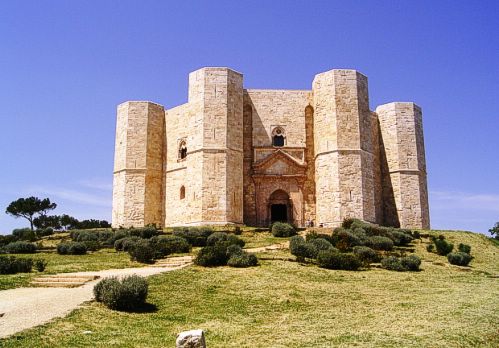
Italy’s Castel del Monte was built in the 1240s by Holy Roman Emperor Frederick II. You may not know it, but it originally had a curtain wall. Yet, it’s a unique enough castle to be recognized as a UNESCO World Heritage Site.

Finally, we get to the castle architecture. Over the 900 some years castles were built during the Middle Ages, they took on many forms with many different features. Most castles were made from wood since it was cheap, readily available, and an easy building material. However, a wooden castle was totally helpless against flaming arrows because we all know how wood catches fire, breaks, and decays over time. However, if a noble could afford it, he’d have his castle constructed from stone despite the high expense and maintenance. But stone was significantly less flammable and breakable with siege weapons and the elements. Early castles mostly consisted of simple fortifications and design. But as the medieval period went on, they became more complex with more towers, stronger gatehouses, and sturdier walls.

Castle Types

1401542002555

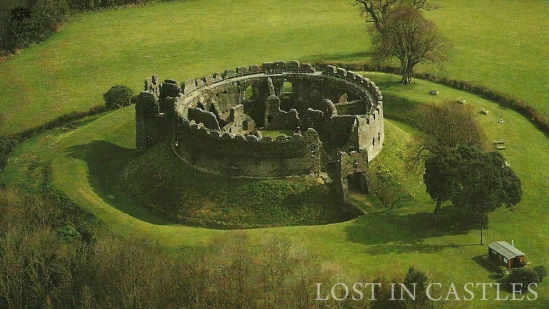
Restormel Castle in England is an example of a shell keep which was a circular stone keep, are type of castle design. Though once a luxurious residence of the Duke of Cornwall, it was in ruins by the 16th century.

Adulterine Castle- a castle built without a liege lord’s or king’s approval.

Concentric Castle- a castle with 2 or more concentric curtain walls, such that the inner curtain wall is higher than the outer and can be defended from it. Often had round towers.

Courtyard Castle- a castle type consisting of a stone curtain wall surrounding a courtyard with buildings built inside it, normally against the curtain wall.

Knight’s Castle- a castle owned by a knight.

Motte and Bailey- an early form of castle where a large mound of dirt was built up. A wooden fortification was placed on top, which were shaped like a timber fence forming a circle like a crown.

Rectangular Keep- a stone castle with a square or rectangular keep with a second-floor entrance. The castle on Monty Python and the Holy Grail is a classic example.
Shell-Keep- castle style consisting of a circular or oval wall surrounding its inner portion. Usually stores and accommodates wooden buildings inside the hollow walls.

Stone Keep Castle- the classic medieval castle with a stone keep and a thick stone wall, which can be rectangular or circular in shape.

Tower House- a small castle consisting mainly or entirely of a single tower.

Architectural Features

pierrefonds-22932-1_w500

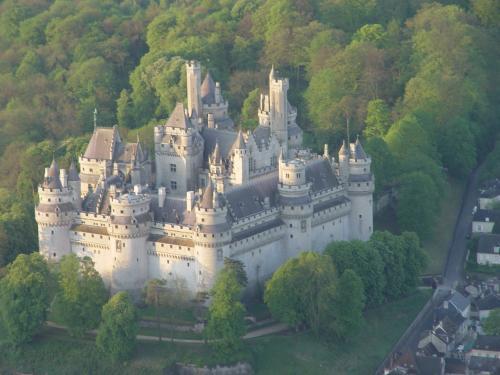
Built in the 12th century, the Château de Pierrefonds almost seems straight out of a fairy tale. Despite its 19th century restoration, it retains most of its defensive military architecture.

Aisle- space between an arcade and outer wall.

Ambulatory- aisle around an apse.

Apse- a circular or polygonal end of a tower or chapel.

Baluster- a small column.

Balustrade- a railing, as along a path or stairway.

Bar Hole- Horizontal bar for timber bar used as a door-bolt.

Barrel Vault- a cylindrical roof of stone or wood.

Base Cruck- a form of wood framed construction where the roof is supported by curved logs rising from the walls and not by aisle posts set on floor.

Bay- an internal division marked by roof principals or vaulting peers.

Blind Arcade- a line of arches on the face of a solid wall for decoration.

Bonnet- a freestanding fortification.

Boss or Keystone- a central stone in an arch or vault.

Bressumer- a beam to support a projection.

Cap House- a small chamber at the top of a spiral staircase in a tower or turret, leading to an open wall walk on the roof.

Cavalier- a raised structure containing a battery, usually sited above a bastion’s center to give better trajectory.

Cesspit- a wall opening where waste from one or more toilets were collected.

Colonnade- a range of evenly spaced columns.

Course- a level layer of stones or bricks.

Crossbar or Transom- a horizontal window division.

Cupola- a hemispherical armored roof.

Crow or Corbie Steps- a step-gabled end to a roof.

Diaphragm- a wall running up to the roof ridge.

Dog Leg- a right angle in a passageway.

Dormer- a vertically placed window in a sloping roof. Like you see on the top floors of a Cape Cod house.

Entresol or Mezzanine- a low story between 2 high ones.

Fireplace- a walled hearth used for heating a room. Most castles in the later Middle Ages had one in almost every room once they took off.

Gable- a wall covering the end of a roof ridge.

Garret- a building’s top story within a roof.

Groined- a roof with sharp edges at intersection of cross vaults.

Groin- junction of 2 curved surfaces in a vault.

Hood- an arched covering.

Impost- a wall bracket to support arch.

Jambs- side posts of an arch, door, or window.

Joists- wall-to-wall timber beans to support floor boards.

Lancet- a long, narrow window with a pointed head.

Label- a projecting weather molding above a roof or window to deflect rainwater.

Lantern- a small structure with open or window sides on top of a roof or dome to let light or air into the enclosed space below.

Lattice- Lines crossing to form a network whether on a window, fence, or gate.

Lintel- a horizontal stone or beam bridging an opening.

Loggia- a covered arcade or colonnade.

Louvre- a potter vent allowing smoke to escape from the hearth.

Meurtriere- an opening in the roof of a passage where soldiers could shoot into the room below.

Molding- masonry decoration that’s long and narrow as well as casts strong shadows.

Mullion- a vertical division of a window that’s constructed in panels.

Newel- Center post of a spiral staircase.

Nookshaft- a shaft set in a jamb or pier angle.

Pediment- a low-pitched gable over porticos, doors, and windows.

Pilaster- a shallow pier used to buttress a wall.

Piscina- a hand basin with a drain, usually set against or into a wall.

Pointed Arch- a sturdy arch that distributed the force of heavier ceilings and bulky wall. Can support much more weight than previous, simply, spindly pillars.

Rear Arch- an arch on a wall’s inner side.

Relieving Arch- an arch built up in a wall to relieve thrust on another opening.

Rib- a raised molding dividing a vault.

Roofridge- a roof’s summit line.

Soffit- an underside of an arch, hung parapet, or opening.

Spur- a triangular buttress used to strengthen a round tower’s bottom.

Spiral Staircase, Corkscrew, or Turnpike- a winding, circular staircase spiraling up clockwise which allowed added sword room for defenders. Steps were built unevenly to make it difficult for attackers to climb and fight. Said to be among the most economical and convenient method of accessing upper tower floors and easier to defend.

Squint- an observation hole in wall or room.

Traverse- a small bank or wall cutting across a covered way’s line.

Tympanum- a space between a lintel and arch over a doorway.

Vault- stone roofing.

Vaulted Ceiling- a ceiling with sturdy pointed archers and pillars that allowed ceilings to be taller than ever before. Also provided an impression of height, grandeur, and elegance. Can be built in a variety of different shapes and sizes.

Wall-Plate- a horizontal roof-timber on wall-top.
Wall-Stair- staircase built into a wall’s thickness.

The Anatomy of a Medieval Castle: Part 3 – The Keep, Bailey, and Interior

1024px-Chateau-de-Vincennes-donjon

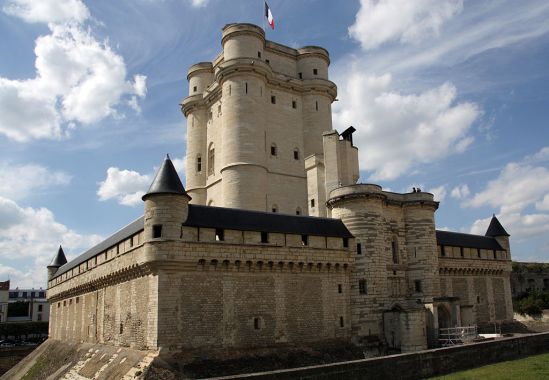
Built in the 14th century, the French Château de Vincennes boasts one of the tallest medieval fortified medieval structure in its keep. Within Paris, this castle served as the French royal residence during the 15th century. Yet, it’s had a long and colorful history with memorable moments.

Once you get through the walls, it’s on to the castle’s interior. First, we go into the courtyard with the bailey where you’d find plenty of animals grazing, gardens, and buildings. These buildings consisted of stables, workshops, barracks, water suppliers, and storage facilities. You may even see a chapel there. Yet, the central heart of the castle was the keep, which was considered the strongest area and the last place of refuge if outer defenses fell. During times of peacetime, it was the lord’s main residence where he’d conduct his business. He’d hold meetings and entertain guests in the great hall. At banquets, the kitchens would be bustling preparing lavish feasts while everyone was treated to dinner and entertainment. In some castles, the lord and his family would eat and sleep in the hall. Sometimes you might even find a chapel or dungeon, too.

The Courtyard

Scotland-2016-Aerial-Doune_Castle_(and_Castle_keeper's_cottage)

Scotland’s Doune Castle was built in the 13th century by Robert Stewart, Duke of Albany. Its 14th century reflected current ideas on what a royal castle should be. Yet, we remember this as the castle featured in Monty Python and the Holy Grail. Its courtyard isn’t particularly big in this aerial shot. Yet, it at least includes a well.

Bailey, Courtyard, Enclosure, or Ward- open space surrounded by a castle’s walls. Walls making up the bailey could be considered part of it. A castle could have several of these like an upper bailey, lower bailey, west bailey, and/or east bailey. Had room for buildings to house the Lord and his immediate followers along with space for animals and storage. During attacks, the local people could enter the bailey for safety.

Bake House- building that would’ve baked fresh bread for everyone living within the castle since bread was a dietary medieval staple.

Barmkin- a yard surrounded by a defensive wall in smaller castles.

Brewery- a building where an ale wife would’ve brewed ale and beer. Mostly because brewing beer was said to sterilize highly polluted water.

Death Hole- the space between the inner and outer curtain walls of a concentric circle that trapped attackers.

Garden- green area located in the bailey near the kitchen. Was split into several sections: fruit trees and bushes, herbs for cooking, herbs for medicine, vegetables, flowers for cooking, and flowers for medicine. There were often stairs leading up to it.

Inner Ward or Quadrangle- large inner courtyard inside a castle, usually around the keep. A focus to day-to-day residential life within the castle.

Outer Ward- large courtyard outside the inner ward but still held within the curtain wall. Was mostly reserved for livestock for grazing.

Stables- part where the horses and other livestock are kept since they’re the main medieval means of transportation, communication, and battle. Included haylofts and spaces for the grooms to live.

Workshops- separate buildings in the bailey for artisans to make objects for maintaining the building the grounds. Consists of carpenters, farriers, and blacksmiths.

The Keep

1024px-Wierschem,_Burg_Eltz,_2012-08_CN-01

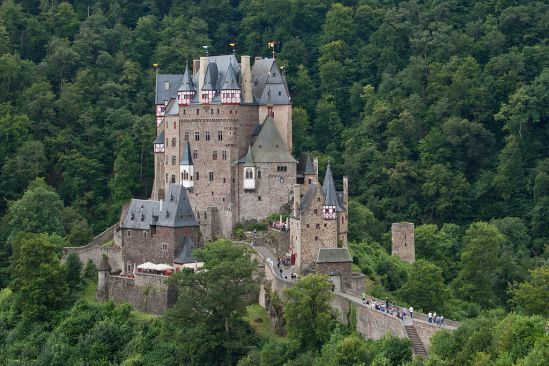
Germany’s Burg Eltz was built in the 12th century and has been own by the same family for over 33 generations. It is one of 3 castles in the country that have never been destroyed. Yet, its keep is quite imposing in the Alps.

Forebuilding- a fortified entrance to the keep. Often held a staircase and a small chapel.

Keep, Donjon, or Great Tower-generally the central main tower built in the inner ward which was the tallest and strongest structure in the castle and gave a commanding view of all fighting positions. Usually served as the ruling lord’s residence since it was the safest place. The top most part served as his and his family’s quarters. The bottom was used for storage. While the middle was used for the great hall. In warfare, it was mostly used as the last line of defense during a siege or attack. Can be square or round and comprise of several floors. Can be attached to walls or free standing. Its walls could be over 17 feet thick to prevent undermining and a built-in staircase.

The Dungeons

Dungeon

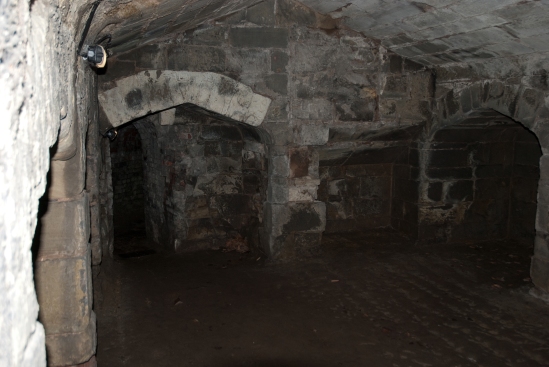
Castle dungeons were the stuff of nightmares. If you were thrown in here for a crime, you can be subject to a dark room in the castle basement with all kinds of horrifying conditions. And yes, you may be subject to torture and possibly execution. If you don’t starve to death or succumb to disease first.

Dungeon- a place to confine political prisoners. Mostly consists of a single small room with a single access from outside like a heavy door. Is generally underground and sometimes a secret passageway would lead to it. Though it could also be in the keep or under a gatehouse. Has plenty of unique torture devices for interrogation like branding irons, collar, torture rack, and others. Other enhanced interrogation techniques include whipping, boiling in water, and starvation etc. Also, employed full-time executioner who also administered torture.

Oubliette- a dark, narrow, underground, vertical tunnel-like dungeon with the only opening consisting of an iron-grilled trap door on the ceiling from the guard room floor where prisoners were left in their solitude for psychological torture. Though other torture methods may be used for interrogation or increase a prisoner’s suffering. Once a victim was thrown in the oubliette, they were considered forgotten by the outside world and left to die. Survival was nearly impossible and there was no way to escape.

The Great Hall

1084817_849d79ba

The Great Hall was the main room in the castle where the lord would conduct his business, hold meetings, and throw feasts. In early castles, the lord, his family, and staff would even eat and sleep there.

Gallery- passage built into the thickness of the walls that runs around the upper part of a keep’s hall. Windows allow light into the hall below and the passage allows for movement around the keep’s upper floors. Also provides a position where hall events can be viewed. If the hall’s captured, defenders could’ve used a gallery to shoot arrows from.

Hall or Great Hall- a major room that’s possibly the heart of the castle which served as the castle’s principal living quarters. Usually a castle’s largest room either built in the keep or a separate building. Generally, consists of an elaborate high vaulted roof and/or a gallery running around on top of it. Served as a throne room, conference center, and dining hall.

Minstrels Gallery- a raised gallery overlooking the great hall intended for the lord’s musicians. Consisted of a narrow balcony with a railing or balustrade.

Truss- a timber frame used to support the roof over the great hall.

The Chapel

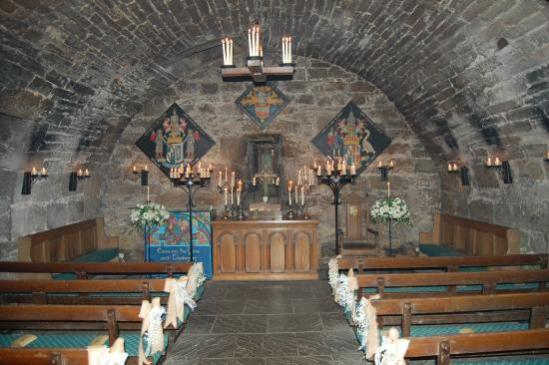
our-medieval-chapel

Since Christianity was very important to people in the Middle Ages, most castles included a chapel. These can range from a simple room like this to elaborate buildings.

Aumbry- recess to hold sacred objects, typically in a chapel.

Chancel- the space surrounding the altar.

Chapel- a place of worship usually built within the keep, near the gatehouse, or a separate building in the bailey. Can range from a simple room or an elaborate edifice that can be 2 stories high with the family sitting in the balcony and servants in the nave. May have a resident or visiting priest depending on the resident noble’s peerage rank. Great place for the lord to marry off family members to secure alliances, soldier funerals, and display of piety. Also, a great space safe since harming a priest was widely seen as the ultimate act of barbarity. For only the most fearless of castle attackers would do such a thing. Not to mention, killing anyone in a place of worship was often frowned upon in the Middle Ages.

Choir- part of a cruciform church east of the crossing where you’ll find the singers.

Narthex- a chapel’s principal hall between the nave and the main entrance.

Nave- the principal chapel hall, extending from the narthex to the chancel.

Living Quarters

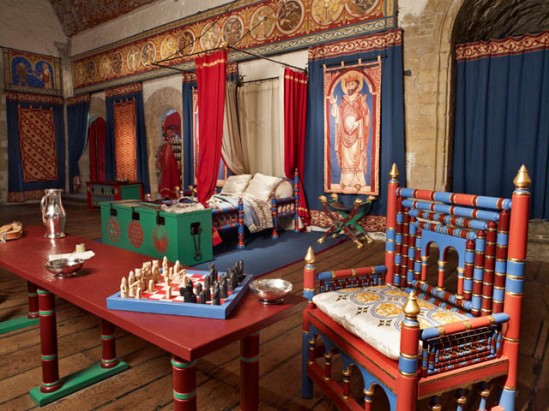
N090249

In most medieval castles, high ranking nobles rarely slept alone since many had servants there with them. Yet, they can nonetheless be colorful tableaus as you see in this one.

Apartment- a room belonging to a castle household resident like a lord’s widowed mother.

Bottlery or Buttery- a room for storing and serving beverages like wine land other expensive provisions like a castle wine cellar. Located between the great hall and the kitchen. The person who presided over this room was called the butler.

Bower- attractive private apartment intended for the Lady. Usually in a room behind the dais of the great hall but later a higher level in the keep.

Camera- a private room used for both living and sleeping that’s set apart from the more public areas of a house.

Cistern- a castle’s water source, which collected rainwater from roofs. Can be located within the keep or bailey. Some castles had rudimentary plumbing that channeled water from cisterns to sinks.

Great Chamber- the bedroom for the lord and lady located on the keep’s upper floor.

Kitchens- where food is made. In early castles, they were separate from the keep in kitchen towers due to fire risk. But moved to the keep when brick construction became more common. A castle kitchen’s size was often proportionate to castle’s intended grandeur and importance. The most elaborate kitchens were all set to cook and prepare game and fish when hunting on the grounds.

Larder- a cool area where perishable food is stored prior to use. Was usually close to the kitchen. Staffed by a larderer who was responsible for meat and fish. Often had ice to keep the food chilled along with meat hooks.

Latrine or Privy- rooms with holes in the seats used as toilets. Wastes dropped below into the bailey, the outer wall’s base, the moat, or cesspools within the tower. Usually far away from the chambers and often had double doors to reduce the smell. But as time went on, a private privy was built for people occupying important rooms. To keep out a noxious stink, privy windows had no glass, which made it freezing in the winter months. Can be fitted with a wooden or stone bench with as many as 4-6 holes in it. Hat a chute which led to a cesspit or moat. Supplemented by chamber pots.

Oratory- a private chapel with an altar used by the lord’s family for private prayer. Can also be a small cell attached to a larger chapel.

Pantry- a storage area for food, beverages, gold, and other items. Usually located in the keep’s lower levels.

Screens- wooden partitions at the kitchen end of a hall, protecting passage leading to the buttery, pantry, and kitchen.

Solar- originally a room above ground level, but commonly applied to the great chamber or a private room off the great hall. Was traditionally seen as the sleeping and private quarters of the Lord’s family. But later became their private living room. Usually above the great hall.

Wardrobe- a room used to store the lord and his family’s clothes and personal articles.

Well- a castle’s primary water source that proved important during a siege even if they had little food. Can be situated in the courtyard or keep. Or at least located near the kitchen either within the bailey or keep. Outside wells were usually protected from the elements by a wooden covering or iron grating. Yet, it was possibly the castle’s weakest point. Since invaders could poison the water supply if left unattended, which virtually guaranteed defeat.

Specialty Areas

RONNEBURG CASTLE ARMOURY

No castle could ever be without its own armory. But where it was could depend on the castle. On some it can be in the keep. In others, in the gatehouse or bailey.

Arcade or Cloister- a covered passageway with arches along one or both sides. Can also be a row of arches supported on columns, which could be free standing or attached to a wall (like a blind arcade).

Armory- a room which stored weapons, armor, and other defenses to use in war or attacks. Typically located in the keep’s upper levels.

Barracks- a building or group of buildings used to accommodate soldiers.

Blockhouse- a small square fortification, usually of timber bond overlapping arrangement of bricks in courses.

Dovecote- a building used to house pigeons and doves. Generally contained pigeon holes for birds to nest.

Guardroom- room used by on-duty guards. Can also store weapons. However, the guards wouldn’t sleep there since they’d be barracked in the gatehouse, a tower, or under the keep.

Ice House- building to store ice. Was usually built underground with a conical or rounded bottom to hold melted ice and a drain for water.

Kennel- place to keep animals, particularly hunting dogs.

Knight’s Hall- a large room or chamber within a castle where knights gathered for meetings, meals, and planning their next activities.

Knights’ Quarters- living area for resident castle knights.

Mess Hall- dining area for soldiers and servants. May include its own kitchen.

Secret Passage- secret routes in the castle that served a variety of purposes. Some were designed to pen up a distance from the castle so inhabitants could escape during an attack or get supplies in and out during a siege. Secret passages also led to secret chambers where people can hide, supplies could be kept, or a water well was dug.

The Anatomy of a Medieval Castle: Part 2 – Towers and Gates

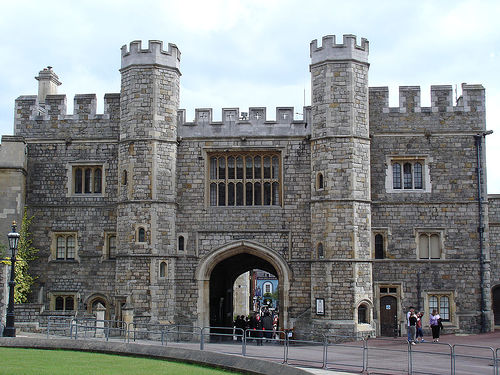
32711003_6681447261

England’s Windsor Castle was built after William the Conqueror’s invasion in the 11th century. Since then, it’s been a residence for the royal family to this day. Even if modern British monarchs just use this place for a weekend getaway. And yes, you’d almost mistake this gatehouse as the castle itself.

So we’re off to a great start. Some of the other distinguishing castle features are towers and the gates. When you look at any castle picture, you might come across an imposing entrance with the impressive gatehouse containing a drawbridge and that sliding iron wrought door of spikes. Yet, since an unsecure entrance made a castle uniquely vulnerable, the gateway was usually the first structure built in stone. A gatehouse contained a series of defenses to make a direct assault more difficult than battering down a simple gate. Yet, you’d probably wouldn’t know this in movies where vast armies storm the castle with no problem. In reality, trying to storm a castle head was a stupid way to lose an army. Another prominent castle feature are the towers, which were used for look outs and shooting arrows along with storage and imprisonment. They could be built in various locations like the walls and the gatehouse as well as come in a variety of shapes and sizes. Though early towers were mostly square shape which were said to be quite easy to topple through burrowing at the foundations. While round towers were not.

The Main Entrance

DSC_4806-for-web

The Welsh Harlech Castle was built by English King Edward I Longshanks in the 1280s. It was involved in several wars and was used as a residence and military headquarters by Welsh hero Owain Glyndwr in the early 1400s. Later, it was held by the Lancastrians during the 1460s until the Yorkist forces took it during the Wars of the Roses. And served as a Royalist stronghold during the English Civil War in the 1640s. Today it’s a UNESCO World Heritage site as one of “the finest examples of late 13th century and early 14th century military architecture in Europe.” Nonetheless, seeing this imposing gatehouse, you wouldn’t want to storm this castle.

Barbican- a stone outpost protecting the castle’s gate usually built in front of the main entrance. Construed in the form of a tower or gateway where guards could stand watch. Some may include a narrow passage allowing for a limited number of attackers forced into a confined area for defenders to shoot at them like fish in a barrel through murder holes from the ceiling. Early barbicans were built from earthworks and wooden palisades designed to add complexity to the entrance’s layout and confuse attackers. Usually acted as the outermost defense of a castle. Due to limited space, was only defended by a small number of men.

Breastwork- a heavy parapet slung between 2 gate towers. A defensive work usually situated over the portcullis.

Drawbridge- wooden bridge in front of the main gate to span the moat or ditch. In early castles, it was moved horizontally to the ground by hand or destroyed and replaced. In later castles, it was built so it can raise up in a hinged fashion thanks to pulleys, ropes, chains, and winches. Can be raised or withdrawn making crossing impossible and prevent siege weaponry being pushed toward the castle’s walls and gates.

Gatehouse- a complex of towers, bridges, and barriers built to protect the castle’s main entrance. Often had a guard house and living quarters. Usually consisted of 2 very large stone towers joined above the main gate guarded by a bridge, gates, portcullis, or a combination. But can range from a simple structure to a 2-3 story building with an impressive façade to impress royal visitors. Above the entrance were rooms to house the constable and some men to defend the building who were stationed on the first floor. While the top floor contained murder holes and storage space for weapons. Traditionally the most vulnerable part of the castle, it became one of the most secure and with an excellent defensive position. Contains a passage with all kinds of obstacles, traps, and murder holes in the vaulted ceilings. So perhaps you want to think twice before storming a castle. Usually the first part of the castle to be completed. Though a larger and circular wall castle could have more than one.

Murder Holes- holes left in the floor on a gatehouse’s upper level, used to thrust pole weapons down, or shoot down flaming arrows at attackers trapped between the inner and outer gates. Also used for dropping heavy rocks, hot tar, boiling water, and other nasty things.

Neck or Death Trap- a narrow walled passage between a barbican and the castle walls which trapped invading enemies.

Portcullis- a heavy, sliding metal or wood grate with sharp spikes that was vertically dropped just inside the castle’s main gate through ropes and pulleys. Designed to block passage and make using rams against the main gate less effective. Think about that before trying to break down a door with a battering ram. Can also be dropped on an enemy and injure multiple people. Was always in a state of readiness and the guards can drop it from its suspended position at any time. Some gatehouses could had more than one, depending on the castle’s size and number of entrances.

Turning Bridge- drawbridge pivoted in the middle and worked like a see-saw. Had a counterweight attached to the end near the gateway.

Wicket- a person-sized door set into the main gate door.

Wing-Wall- a motte’s wall downslope to protect stairway.

Yett- a portcullis of lattice wrought iron bars used for defensive purposes.

The Towers

1024px-Exterior_Alcazar_Segovia

Originally built in the early 1100s, the Alcazar of Segovia started out as a fortress, but has served as a royal palace, a state prison, a Royal Artillery college, and a military academy. Today it’s a military archives building, museum, and a UNESCO World Heritage Site. Yet, you have to admit how its towers give the place a unique look.

Bastion Tower- tower projecting from a wall face that functions as a bastion.

Bastle House- a small tower house with a living room over a cowshed.

Corner or Archer Tower- tower located on curtain wall corners used for firing arrows from slits.

Drum Tower- a large, round, low, squat tower built into a wall, usually connecting stretches of curtain wall.

Flanking or Mural Tower- tower located on the castle walls that provided effective flanking fire.

Gate Tower- tower constructed at the main entrance. May be part of the gate house.

Tower- fortification used to provide stability and additional defensive capabilities to the curtain wall. Used for firing upon enemies, lookout, storage, and keeping prisoners. Provided access to lookout points, wall walks, and sleeping points. Can be constructed in various shapes, sizes, and at various locations.

Sanitary Towers- a tower in the inner or outer walls used as a toilet. The wastes would drop into a cesspool in a pit.

Wall Tower- tower on wall that archers used for showering arrows on invading armies.

Watchtower or Look Out- a freestanding structure used to alert the castle in an enemy attack, spot returning soldiers and visitors in the distance, check whether the coast was clear before anyone left the castle, and send messages to distant people using recognized symbols. Had to be so high that areas around the castle could be watched for an impending attack or siege. Usually had a 360-degree view as well as employed a guard or watchman to see for many miles around.

Turrets

cleydael

Belgium’s 14th century Cleydael Castle seems straight out of a fairy tale on the water. However, the turrets on that one tower are quite unique.

Bartizan or Crow’s Nest- a small turret at the corner of a tower or wall. Usually at the top but not always. Usually located at one of the highest points of the castle and used as a lookout.

Belvedere- a raised turret or pavilion.

Squinch Arch- arched support for an angle turret that doesn’t reach the ground.

Turret- a small tower rising above and resting on the walls or the edge of the castle’s main towers, usually used as a lookout point. Allowed defenders to provide sheltering fire to the adjacent wall in attacks. Can contain a staircase if higher than the main tower or an extension of a tower room.

The Anatomy of a Medieval Castle: Part 1 – Around the Walls

1024px-Bodiam-castle-10My8-1197

This is Bodiam Castle in Sussex, England. Built in 1385 to defend against French invasion during the Hundred Years War, it doesn’t have a keep. But its walls and moat are impressive.

Whether you’re into Disney movies, Middle Earth, or Game of Thrones, we all seem enchanted with medieval castles. However, while we imagine them as a fairy tale palace, they were medieval house fortresses for European nobility. Though you’ll also find castles in Asia, Africa, and the Middle East. Castles originated in the 9th and 10th centuries as the fall of the Carolingian Empire resulted in individual lords and nobles dividing the territory. To control the area surrounding them, these guys built castles as both offensive and defensive structures. Castles provided a base to launch raids and protect from enemies. Though castle studies often emphasize their military origins and see castles as “a fortified private residence,” they also served as centers of administration and power. Urban castles were used to control the local populace and important travel routes. Rural features were often near features integral to life and community like mills, fertile land, or a water source. Though most medieval castles in Europe today are made from stone, many were made from wood, especially in the early Middle Ages. Due to lacking arrow slits and towers, early castles often exploited natural defenses and relied on a central keep. But as a scientific approach to castle defense emerged, leading to tower proliferation and emphasizing flanking fire. Taking inspiration from Roman forts and technology from the Crusades, you’ll find some concentric castles. Nevertheless, since all things much come to an end, castles began to decline began to decline with the introduction of gunpowder which made them uncomfortable and undesirable places to live. Though these structures still captured the imagination enough to make aristocrats want to build castle like houses, but without the key defenses.

herstmonceux castle from the air

This is Herstmonceux Catstle in England’s East Sussex. Built in the 15th century, it’s one of the most significant brick buildings in England. Though more like a palace than a fortress, its walls and moat are nonetheless impressive. By the way, from 1957-1988, it was home to the Greenwich Royal Observatory. Today it’s used by the Bader International Center of Queen’s University in Canada.

The first part of this series will focus on the outermost components like the walls and what’s outside them. As the first line of defense, such structures would have to make invasions and sieges incredibly difficult for the enemy. Before a castle was built, you’d often construct an artificial hill called a motte and a ditch filled with water called a moat. A castle’s walls had to be high enough to make scaling with ladders impossible. And they had to be thick enough to withstand bombardment from siege engines. Though sizes vary, a typical castle wall could be 10 feet thick and 39 feet tall. They’d also have stone skirts around their bases to prevent infiltration as well. Walkways on top of curtain walls allowed defenders to rain arrows on the enemies below with battlements giving them further protection.

Outside the Walls

1024px-Chateau-de-Gisors

The Chateau de Gisors in France whish was a key fortress for the Dukes of Normandy in the 11th and 12th centuries. It was built to defend the Anglo-Norman Vexin territory from the King of France. However, when Richard the Lionheart got imprisoned in Germany, the castle went into Philip Augustus’s hands. Was also known for its links to the Templars, serving as a final prison for its last Grand Master in 1314. Still, its motte is particularly notable.

Berm- a flat piece of land between the curtain wall and the moat protecting it. Intended to reduce soil erosion to keep the wall from collapsing. Also kept debris from the wall from falling into and filling the moat.

Bivalate- a pair of defensive ditches or earth embankments surrounding a mound or medieval castle.

Caponier- a covered passage within a ditch.

Caponiere- a covered passage across a ditch to an outer fortification structure like a ravelin.

Counterscarp- outer slope of a ditch.

Couvre Face- a low rampart in a ditch protecting the ravelin’s face.

Covered Way- a protected communication wall all around the ditch’s outer edge, covered by earthworks from enemy fire.

Crownwork- a freestanding fortification built in front of the main defenses.

Cunette- a trench at a ditch’s bottom.

Ditch or Fosse- a common defense dug around the castle’s outside walls and the resulting earth to create banks. Most were dry but some were filled with water to create moats. The steeper the ditch sides, the better since it made it more difficult for attackers to climb. Though ditches weren’t filled with water, rainfall would’ve created a muddy obstacle to cross. The castle’s toilets also emptied into it, giving attackers another disgusting problem.

Earthwork- fortification made of earth mounds, banks, and ditches.

Glacis- a bank sloping down from a castle which acts as a defense against invaders. Consists of broad, sloping, naked rock or earth on which the attackers are completely exposed.

Hornwork- an independent earthwork located in front but not connected to the curtain wall within its bastions’ range (so it can be defended by them). Had long parallel sides with a back shaped like a crescent moon facing the castle’s curtain wall. But was built so low so it couldn’t shelter attacking forces if overrun. Forced attackers to start their siege further away from the castle and gave defenders a better chance to destroy siege lines before they could reach the structure.

Moat- a deep, wide ditch surrounding a castle’s outer walls. Often filled with water from diverted rivers, lakes, or springs with a special dam. Mostly had an inlet and outlet of water rather than being a self-contained donut (unless the castle was built on an island in the middle of a lake). It was often around 3-30 feet deep and at least 12 feet wide. It was sometimes within the outer wall or between the outer wall and the inner wall. Its primary purpose wasn’t to stop attackers but siege weapons, siege towers, battering rams, and most importantly, tunnelers. Since tunneling a castle was an effective means of collapsing the walls or infiltrating it. A moat would cause any tunnel to collapse through flooding. Also, gave valuable time for castle defenders to form strategies for subsequent defense. Sewage was often tipped into the moat so it would smell pretty unpleasant.

Motte- a natural or artificial hill with a flat top upon which a castle was built. Was constructed from dirt and rocks to a height between 10 and 100 feet.
Neck Ditch- a ditch cutting across a neck of land to hinder an enemy’s advance.
Place of Arms- an enlarged area in a covered way where troops could assemble.
Ravelin or Demilune- a triangular earthwork located in front (but not connected to) the curtain wall, within range of the curtain wall’s bastions. The back was shaped like a crescent moon and faced the curtain wall. But built low so it couldn’t shelter attacking forces if the ravelin was overrun. The front sides also had a defensive wall of their own. Allowed defenders to fire upon attacking troops before they could reach the curtain and a better chance to destroy siege lines before they could reach the castle. Forced attackers to start their siege further away from the castle.

Revetment- a retaining wall to prevent erosion.

Scarp- a slope on a ditch’s inner side.

Tilting Yard- yard or field where jousting tournaments and combats took place. Usually situated just outside the castle’s confines.

Watergate- a gate allowing a coastal castle to be resupplied by sea, especially during a siege.

The Walls

Craigmillar_outer_court

Scotland’s Craigmillar Castle is a ruined castle in Edingburgh built in the 14th century. Mary, Queen of Scots once stopped here to convalesce after her son James’s birth. It was here some of her supporters decided to kill her godawful husband Henry Stuart, Lord Darnley. Still, the walls are amazing to look at.

Allure or Wall Walk- walkway at the top inside of the curtain wall, which allowed guards to look for enemies. Reached either from a set of stairs running up from the wall’s inside or from a built-in tower. Can also be the fighting area on a tower as well.
Bastion or Bulwark- a structure projecting at the end of the curtain wall or at the junction of 2 walls. Usually situated at each corner of a curtain wall. Though could be placed in the middle if the walls were long. Allowed the defenders to cover dead ground (blind spots where attackers can’t be seen or fired upon) and provide crossfire for the curtain wall and adjacent bastions. Can consist of a tower or turret.

Batters- a section at a castle wall’s base that’s angled in such a way to make dropped stones bounce away from the curtain wall and into the enemy. Also add strength to the wall walk’s base.

Buttresses- a rectangular masonry projections used as additional outside strength and support for walls. Become thinner towards the top. Prominently featured in Gothic cathedrals like Notre Dame.

Chemin-de-Ronde- a walk-walk extending all the way around a castle.

Chemise Wall- wall formed by a series of interlinked or overlapping semicircular bastions.

Citadel- the innermost curtain wall of a concentric castle. Had walls higher than the rest and was the last line of defense before the keep itself.

Corbel- a stone bracket projecting from a wall or corner that supports a main floor or other structure’s weight. Often used for turrets.

Cornice- a decorative projection along the top of a wall.

Counterguard- a long near-triangular free-standing fortification within the moat.
Crenels, Embrasures, or Wheelers- small openings in crenellation that’s splayed on the inside, allowing the archer to move into the arrow slit space and get a better view.

Cross-Wall- an internal dividing stone wall in the keep providing extra strength and a platform for wooden floors. Also served as a barrier at times when the keep had been invaded.

Curtain Wall or Enceinte- a surrounding outer stone wall around the castle connecting the towers and other fortifications. Was designed to protect the castle. Can be 8-20 feet wide, up to 45 feet high and 1,500 feet long.

Flying Buttresses- masonry projections used to spread and support the weight of tall walls by transferring force directly to the ground. Were often elaborately designed, appearing to dart and sweep around each building, giving a sense of movement and flight. Usually decorated with intricate carvings giving a sense of grandeur and importance.

Garderobe- a room projecting from a wall that served as a toilet the family’s clothes. A hole in the floor allow wastes to drop below. Had chutes for discharge which often led to the castle moats and had iron bars to prevent entry from attackers.

Glacis- an angling of the curtain wall along the vertical plane that allows the wall to deflect some or all the force of rocks or other missiles thrown from a siege engine or cannon balls fired from siege cannons.

Hoardings or Brattices- wooden fortifications added to the crenellations and towers to provide additional protection to the castle’s defenders. They were removable and provided overhead cover. Also provided a walkway outside the crenellations facilitating the dropping of stones and hot liquids on attackers.

Hoarding Holes- holes in the castle walls to support the hoarding.

Inner Curtain Wall- defensive wall within a castle dividing the inner area into 2 or more defensive areas.

Lunette- a fortification shaped like a half-moon or arrowhead which was similar to a bastion except that it didn’t have wings connecting to a castle’s wall and the back was generally open. Can be its own structure or connected to a curtain wall like a bastion.
Machicolations- permanent stone additions to a castle’s battlement which provided better cover for defenders inside the castle, allowing them to drop items like boiling oil, hot lead, dead animals, human excrement, and rocks on attackers. Most often located in places that would be commonly attacked like near the main entrance.

Oriel Window- a window or set of windows sticking out from a building like bay windows. Made of stone or wood. Often had corbels underneath to support them.

Orillion- an arrowhead bastion.

Palisade- a sturdy wooden fence built to enclose a site until a permanent stone wall could be constructed. Can be as high as 10 feet tall.

Pitatta Forma- a fortification structure protecting the curtain wall between 2 bastions. It’s square or rectangular in plan but takes the form of a small tetrahedral bastion.

Plinth- a wall’s projecting base.

Postern or Sally Port- a small secondary gate located in the curtain wall’s back, which mostly functioned as a backdoor entrance or exit. Was connected to a small guard room near the bailey. Was often in a concealed location which allowed occupants to come and go inconspicuously. If possible, it could be built on a cliff, only accessible by footpath. During a siege a postern could act as a secret exit for troops to pass through besiegers or send out a messenger. Was firmly barricaded during conflict and people sometimes used a password to enter. Used by tradesmen and servants during peacetime. Designed for only one unmounted person could go through at a time.

Putlog Holes- castle wall holes to support scaffolding.

Rampart- a defensive wall of stone and mounds of earth that can be built quickly for early medieval castles. Later replaced by battlements.

Rear Arch- arch on an inner wall’s side.

Relieving Arch- an arch built in a wall to relieve thrust on another opening.

Respond- a half-pier bonded into a wall to carry an arch.

Redan- a small ravelin, derived from the lunette but had shorter sides. Was often made of earthwork but could comprise of stone and other materials. Could be its own structure or connected to a curtain wall like a bastion.

Rubble Core- a filling between the outer and inner wall parts.

Shield Wall- an exceptionally thick wall protecting the castle on its most vulnerable side.
Talus- a slope on the curtain wall that inhibited an attacker’s ability to reach the wall with a siege tower. Since a tower’s ramp wasn’t enough. Also provided a strong foundation to help support a wall against undermining.

Battlements

1000px-2007-08-26-09095_GreatBritain_Warwick

England’s Warwick Castle was developed from an original built by William the Conqueror during the 12th century. During the Hundred Years War, it was refortified which resulted in one of the most recognizable examples of 14th century military architecture. After its stronghold days were over in the 17th century, it was converted in a country house. And yes, you’ll find a lot of cool battlements here.

Arrow Loops, Arrow Slits, or Loopholes- thin slots in the walls and structures used to shoot arrows through. Came in a variety of shapes and sizes, usually depending on the weapons fired from it. Low and narrow arrow slits were suited for crossbows. High and wide arrow slits were built for longbows, which can be as high as 9 feet. But common designs are key holes, vertical slits, or crosses which allow the archer to fire his weapon with a great amount of protection.

Battlement, Rampart, or Crenellation- a defensive, outside top wall that has a broad top with a walkway and a typically stone parapet. Notched wall consists of alternate crenels (openings) and merlons (square sawteeth) to give castle defenders a position to fight or fire through as well enough protection to reload.

Fausse Braie- an exterior battlement, outside and parallel to the main battlement and considerably below its level.

Finial- a slender piece of stone used to decorate the merlon tops.

Merlons- upward square sawteeth of a battlement. Often pierced with arrow slits for observation and fire. Are usually rectangular in medieval Europe but can also appear in a swallow-tail form along with other shapes. Also have a secondary decorative purpose by giving the castle a distinct castle like appearance you find in storybooks.

Oilette- a round opening at a loophole’s base to help archers to easily aim a shot.

Parados- a low wall on a main wall’s inner side.

Parapet- a barrier at the edge of a roof, terrace, walkway, or other structure. Often used to defend a castle from military attack as a low defensive wall at shoulder or head height.

The Pastel World of Easter Village Houses (Second Edition)

95d8f3c4f28a4401074bb66be5546923

Though Christmas and Halloween may be far more popular holidays, Easter has its large share of fans. So it’s no surprise that we have plenty of Easter village houses. After all, if you’re a company that sells these houses and accessories, why stop at Christmas when you can sell similarly themed items all year long? Sure these village sets can be very expensive. But they’re popular enough for me to do multiple posts on them. With Easter, you find plenty of houses in pastel colors as well as bunnies, chicks, flowers, butterflies, and sheep. And yes, there’s plenty of cuteness to go around. Though many of these houses may be made out of porcelain, some of these Easter village enthusiasts opt for the putz variety. Sometimes, they make their own putz house which you might see on Etsy. Anyway, for your reading pleasure, I give you another treasury of charming Easter houses and villages. Enjoy.

  1. An Easter putz village should always be all glitter.

Make sure you include bunnies and chicks. Oh, and that the trees have Easter eggs on them.

2. Bunnies always enjoy an Easter egg tree.

Though this more or less resembles a Charlie Brown Tree with Easter eggs. Yet, the house is quite whimsical.

3. Don’t forget to put a bunny peep on the front door.

The bunny peep even has a purple butterfly. The windows are made out of cardboard.

4. Of course, some houses might contain an addition or two.

This one even has an Easter egg tree. And the front roof has stripes.

5. How about set your spring village near a window?

Wonder if they use the same window for a Christmas village. Since it seems familiar to me.

6. A pink should always have matching flowers.

This one also has a fancy roof and tree with purple baubles. Like the silver trim.

7. A chick should always have a pink balcony.

This one has a rather gabled roof and pink stairway. Like the chick and trees.

8. You can put anything on an Easter tree.

Not sure if it’s a DIY or professionally made. But you have to love the collage of decor.

9. Even a pale blue house can have a spring renovation.

This one has bunnies in front of the house with trees. But the pink rose on the roof really stands out.

10. Two chimneys are sometimes better than one.

Helps that it’s pink. Has some berries between the roof and front door.

11. Perhaps a pale pink house can suit your Easter fancy.

It has the bunnies with eggs. Though the window edging appears to resemble seashells.

12. Bunnies and chicks delight in an Easter tree.

This one has a craft tree with pom pom chicks on it. Love the bunny in the basket.

13. Spring birdhouses could use a few flowers.

Well, one of them is supposed to be a church. Yet, both have birds at the high holes.

14. A pink roof can always use a splash of glitter.

This yellow house has blue doors and window trim. Hope the bunny doesn’t mind looking at it.

15. A small blue church makes a lovely Easter addition.

This one has a lamb in front. But you have to admire the tall steeple.

16. A white Easter house can be just as nice.

Has a string of pearls aligning the roof. The trees are decked with Easter eggs.

17. These bunnies love their flowery home.

You’d wonder if whoever made this used wall paper. Yet, certainly has a spring feel.

18. An Easter village looks lovely in the night sky.

Okay, the sky is a board with lights on it. Nonetheless, it’s quite quaint and stunning.

19. A shiny blue church should have a purple steeple.

Has a cross on top and over the doorway. A small chick is near the glitter wall.

20. Birdhouses always shine in glitter.

Well, you put birdseed in these. Yet, one of them looks more like a bird gazebo.

21. Perhaps a quaint white cottage will do.

This one seems straight out of a storybook. And home to a cute little rabbit, too.

22. A paper house should have a certain whimsy.

The house is yellow with lattice work. And it’s topped with a light blue roof.

23. Nothing brings in an Eastery spring like a yellow church.

Has pink trees at the front with a rabbit. Like the wreath near the roof though.

24. An Easter village can always shine under the sky.

This one has a blue sky with cotton ball clouds. And the towering trees are spectacular.

25. Everyone has to love a green house with polka dots.

This one has a blue roof with flowers. Even has a girl emerging from the doorway.

26. Speaking of green houses, check out this one with moss.

This one has white shutters and green and pink Easter eggs. Like the bunny.

27. A blue church should have a couple of pink trees.

This one has a green roof with fancy edging. Though the best part of this are the windows.

28. A sea green house always needs a pink butterfly.

Not sure if I care for the pill green shade. But it makes the decor stand out.

29. Don’t forget to add a chimney.

Okay, the color isn’t the most flattering. But at least it doesn’t remind me of Prozac.

30. A lavender church has a certain Easter charm.

Has a tree with yellow flowers beside it. Great for any spring village.

31. A blue church is wondrous with a silver roof.

Has a purple steeple and a silver cross on top. And yes, it’s covered in glittery splendor.

32. An Easter house can never have too many flowers.

Yes, the flowers are fake. But at least the smoke coming from the chimney is cotton.

33. A bright blue house will bring the Easter spirit.

This one has 2 chimneys and tall windows. Love the wreath and trees though.

34. Bet this is supposed to be a candy factory.

And it’s on a jar of jelly beans, too. Has 3 different colored smokestacks with stripes.

35. An Easter house can be of all kinds of colors.

This one has pink edging with pastels on the walls. If the colors were brighter, it would’ve been an eyesore.

36. Perhaps you might like a white church with flowers.

This one seems to have retro feel to it. Not sure what the angel is here though.

37. Is that carrot supposed to be a chimney?

Well, it sure looks like it. Though I’m not sure whether it goes with the pink house or trees.

38. Even an unconventional Easter house can be like a home.

Has a ridged roof with a butterfly. Yet, the bunny is happy just the same.

39. A pale yellow house can always glimmer.

Okay, I’m not too crazy about this house since it’s color is sloppy. But I do like the tree with purple flowers.

40. Anyone would be pleased to have a white bunny at their chimney.

If it weren’t for the Easter bunny and eggs, you’d almost think it’s a Christmas house. So cute.

41. A small green house is all this bunny needs.

This one even has a little door and an egg tree. Another tree has buttons.

42. Pastel houses always show an Easter spirit.

Well, the colors may seem somewhat faded. But some of these houses retain some Easter charm.

43. A green birdhouse makes a lovely church.

This one has a cross on top with a wreath. And there’s an angel coming out from the doors.

44. A pink house can never have too many flowers.

This one has flowers on the roof and ground. Not sure what to think about the windows though.

45. An Easter house should look as sweet as candy.

This one is in bright blue with peppermints near the roof. Like the door and window decorations though.

46. A pink peppermint house always brings spring in.

Doesn’t have as many candy decorations, but the bunny is adorable. Love it.

47. How about a house brimming with flowers?

Well, this one seems covered in vines. Everything seems to grow wild here.

48. Perhaps a small pink house will do well for the chicks.

This one has a silver roof and a pink flower. But the chicks appear to love it.

49. You may prefer a small blue cottage.

Sure it may not seem like much. But you have to like the bunny and Easter egg in the front.

50. Chicks would certainly dig this white Easter house.

Though I think they’re busier with a shoe at the moment. Still, this is rather quaint.

51. An Easter house like this is bound to make anyone happy.

Well, it says “happy” on the roof. Wonder if it’s part of a set. Like the bunny with a carrot.

52. Easter can’t be Easter without spring flowers.

This one has a girl in a flower dress. There are even flowers above the windows and in a basket.

53. A light blue house always endears chicks.

This one has some vibrant Easter decorations like what’s between the windows. And yes, there are the chicks in a shoe.

54. A silver bunny loves a house with pink flowers.

Let’s hope that’s not a real chocolate bunny. Because that would be a waste of valuable candy.

55. Nothing shows the Easter charm like a pink house.

It even says “Easter” above the door. Though I love the flowers and bow.

56. Flower boxes always give a nice springtime touch.

Each of these is outside the window and filled with flowers in their spring glory. Love it.

57. A purple and blue Easter house can have a whimsical touch.

This one has a rather unique design. But you have to love the flowers and bunnies. So pretty.

58. A purple house has spring in the air.

Even comes iwth a purple tree. Love the chick within the purple fence.

59. Spring is always quaint with a simple blue cottage.

Comes with a little red wagon with a flower wreath. Includes flowers, a bunny, and a basket of eggs.

60. Bunnies and chicks frolic at this purple house.

This one has images of chicks and bunnies taken from cards. Even has flowers between the windows.

61. You can make your garden grown in the early spring time.

The tree has all kinds of white berries. Includes a flower box, too.

62. A slant roof house can have Easterly flair.

Has “Happy Easter” on the roof. And it’s decked with purple bows and a string of purple pearls.

63. A blue house should come with a matching butterfly.

Its roof has blue and yellow trim on the roof. Yet, you got to love the flowers, bunnies, and tree.

64. Green flowers stand out on a yellow house.

This one has green flowers on the roof and the fence. Also comes with chicks.

65. A yellow and green house should come with purple flowers.

This one seems like you’d see in a storybook illustration. Yet, the flowers add a certain spring charm.

66. A purple house ought to have golden window trim.

This one has bunnies and a basket of eggs. Love the wreath and trees.

67. An Easter house needs to have flowers outside the windows.

This one is blue with a yellow roof and front door. Includes bunnies, chicks, and an Easter egg tree.

68. A porcelain shop should shimmer in glitter.

These are painted, by the way. One is a flower shop while the other is a café.

69. A gnome should feel cozy in this Easter trailer.

This one has flowers and a butterfly on top. Love the white tree branch.

70. A blue Easter cottage should brighten any spring day.

This one has a lovely ribbon above the windows. And there’s a little girl near the door.

71. A purple bunny will adore a purple house.

Comes with purple roses on the roof and near the Easter eggs. So pretty.

72. An Easter angel always loves a house of blue and pink.

The angel is even holding a tray of Easter eggs. Also has plenty of flowers just below the roof.

73. Chicks love an Easter house filled with flowers.

This one has daisy above the windows. Though you have to love the chicks in the flower wagon.

74. Sometimes a blue house has a quality spring simplicity.

This one has a blue butterfly and tree. Also contains white bunnies and bows.

75. An Easter egg tree should have its own stand.

This is a purple tree with pastel Easter eggs. And it’s all topped with a golden bow.

76. Bunnies always love to go to a country church.

This one is white with a blue roof. And its front is brimming with flowers.

77. Perhaps bunnies might prefer a simple cottage.

This is a plainer Easter house than most on this post. Has moss on the roof and grass on the ground.

78. A purple house should come with a green roof and flowers.

The flowers are even in boxes. Love the basket and bunny. So lovely.

79. A pink church should always come with pink flowers.

The roof is of golden paint. Comes with pink bunnies and a basket of Easter eggs.

80. A curved roof has a special spring whimsy to it.

Well, it has curved roofs on 2 stories. Yet, it’s decorated with spring flowers.

81. A blue house can make the springtime oh so pleasant.

Has flowers outside the window in boxes and outside the fence. Like the wreath and basket.

82. A pink Easter house has a unique simplicity.

Just has some white and a pink fence. The white tree particularly stands out.

83. Sometimes two roof points are better than one.

This is a pink house with green bows. Love the white deer and flowers.

84. Spring into Easter with this purple glitter house.

Well, it has “Easter” on the yellow roof. Comes with purple flowers and bunnies galore.

85. A yellow curved house always needs spring flowers.

This one has trees with eggs. Like how the flowers are around the base, roof, and chimney.

86. You’d almost think this house was an Easter neighborhood.

Each roof point has flowers on top. But only comes with one door in the middle.

87. A spring house should brim with spring flowers.

This pink house has flowers all over from base to roof. But I like the ones above the windows the best.

88. A pink house brings everything in its spring glory.

Has flowers in the windows along with a basket of eggs. And the chimneys make it especially imposing.

89. A blue house can stun with a purple roof.

This one has a flowers growing from the garden and on a wreath. So pretty.

90. Care for a plaid roof church?

Well, a plaid roof doesn’t look too bad. Also comes with an Easter egg tree.

91. If you love green, this idyllic putz house is for you.

This one even has deer to herald the coming of spring. So lovely.

92. A pink house should be atop of a pink nest.

Even has colorful streamers coming out of the chimney. Quite festive if you ask me.

93. Perhaps you might want to go with a green house with a striped roof.

Okay, that’s pretty tacky. And the striped pattern even lines the chimney. Yikes.

94. A small blue house can bring out small yellow flowers.

Comes with an array of bottle cleaner trees. Includes a girl in a raincoat.

95. It’s always spring when you’re near this yellow house.

Comes with a bejeweled butterfly on the roof. Yet, the chick and pink teddy bear are adorable.

96. A bright blue house always inspires a springtime splendor.

Includes a striped flower and pink butterfly. And you’ll find a girl near the door.

97. Of course, you can always go with a simple white house.

This one has a pink bike against the wall. Yet, I love the flower on top.

98. A small cottage should always stand out with some flowers.

Has a blue and yellow flower on the pink roof. But the bunnies seem to enjoy it.

99. A blue house stands out on Easter with pink decorations.

Has a pink butterfly and bows along with blue flowers. on the ground there are white rabbits and trees.

100. A chick would love to live in this pink coop.

Though the chick seems a bit large for the hole. Though I think it’s quite creative.

Fun with Easter Bonnets (Fourth Edition)

lady-bonnet

One of the key traditions of Easter is the Easter bonnet. Though originally worn by ladies for Easter church services in less casual times, it has somewhat fallen out of fashion in that regard. Yet, Easter bonnets have always been nonetheless elaborate since the holiday marks the end of Lent. However, in places like New York, thanks to Easter parades, Easter bonnets have risen to a whole new level. No longer are they seen as what women wear to church anymore. Or even women in general. But the kind of wacky hat to wear for a Easter parade. Some of these hats may seem straight out of a Las Vegas showgirl routine. Some may be DIY. Some may have flowers, eggs, chicks, sheep, and other Easter motifs. Some may not. So for your reading pleasure, I give you another assortment of extravagant Easter bonnets.

  1. Some girls go for a beehive while some prefer butterflies.

Then a again the woman’s hat may be meant to imitate straw. Yet, the butterflies are pretty.

2. You’d almost think she got her hat from outer space.

This an old photo of a woman wearing a hat that would rival Lady Gaga. I don’t know if any explanation is necessary.

3. You can always line your straw bunny hat with chocolate.

Though I’d say it’s a waste of chocolate. Love the flower and fuzzy bunny ears.

4. Sometimes Easter can take a prehistoric turn.

The triceratops even has fancy eggs. I guess this is meant for a boy who’s a big fan of Jurassic Park.

5. Care for a bunny on your bonnet?

This plush bunny even has its own bonnet. Yes, it’s kind of confusing. But it’s adorable.

6. Someone must be on the springy side of the Force.

Has pipe cleaners with squiggles attached to eggs. Got to like Darth Vader and a clone soldier.

7. A broad hat can leave plenty of space.

Her had includes eggs, flowers, and a basket. It even says, “Happy Easter.”

8. There are many ways to accessorize a top hat.

This one has so many Easter stuff on it that it makes Willy Wonka jealous. And all topped off with an Easter egg shell.

9. Guess you can’t get out of doing laundry all the time.

She’s wearing a clothesline and washboard. Not sure if the clothes fit her. But it’s clever.

10. This little bird flies out of its cage to freedom.

Sure it might look outrageous. But for an Easter bonnet, it’s modest.

11. An Easter bonnet can never have enough pink.

It has a nest on top and eggs and bunnies around the brim. But I love the purple butterfly the best.

12. An Easter bonnet can never have enough eggs, chicks, or feathers.

The feathers are in all kinds of colors. The eggs are sparkle. But the chicks are all yellow pom poms.

13. Wonder why the bunny’s diving in this bonnet.

Well, I guess there are some carrots in the bin. Love the creativity behind this.

14. My, that’s a large ice cream cone.

Yes, she has an giant ice cream cone on her head. But at least it has chocolate bits on the top.

15. A lamb relishes among the flowers.

This has a plush lamb on top of a hat enclosed with a fence. And yes, it’s adorable.

16. Nobody could resist this chick tower.

And to believe it, it has pom pom chicks on it. Though I like the pink decomesh ribbon trim.

17. I guess film noir gals have their own Easter bonnets.

This one has lips with a cigarette. Like you see on femme fatales in film noir movies from the 1950s.

18. It won’t be Easter without some purple Easter grass.

Has plenty of bunnies and chickies to your heart’s content. Also includes some daisies on the brim.

19. A spring windmill can always shine at an Easter parade.

It’s in pink, purple, and yellow brick. Still, I love the bunnies and flowers.

20. A sheep hat can be so fluffy.

Kind of reminds me of Shaun the Sheep. And it’s most likely made by a child.

21. An Easter bonnet should always have a pair of bunny ears.

She’s even dressed as a bunny and holding one in her hand. How much Eastery can you get?

22. This Easter bonnet seems to reach to new heights.

Well, it has a plush chick and bunny on top. Great for an Easter parade or the bunny trail.

23. An Easter bonnet can never have enough pom poms.

You have a couple of bunnies with chickies along the brim. And I guess the pom poms around the border are Easter eggs.

24. Sometimes a simple Easter bonnet will do.

Not sure what the concept behind this bonnet is about. Yet, I couldn’t resist leaving it out of this post.

25. Don’t forget to add a birdhouse.

Yes, this was made by a child. Yet, you have to like the felt flowers and chick decorations.

26. Perhaps a yellow bird at the top will impress.

This seems more for adults as I can see. Like the yellow butterflies.

27. No Easter bonnet can ever have enough flowers.

And I see Audrey Hepburn has put an entire bouquet on her head. Yet, at least she tastefully ties her hat with a bow.

28. Even boys can proudly don their Easter bonnets.

Doesn’t hurt if it includes flowers, eggs, and ladybugs. Some of which are held by clothes pins.

29. You’d almost think this is an Easter basket.

It’s a straw hat made with flowers and Easter eggs. Not sure if you could wear it though.

30. Perhaps a more naturalistic Easter bonnet may suit you.

I guess this is of the Cast Away variety. Yeah, I don’t think he can go through town without people making faces at him.

31. Someone must have sunflowers in their eyes.

Luckily, it’s so sunny that he needs a parasol. His straw hat is also covered in flowers.

32. She seems like a small basket case.

At first I thought this might be a watering can. Then I zoomed in.

33. You never know what you can do with a large straw hat.

One hat has plenty of white flowers. The other has small Easter eggs hanging from it.

34. Daffodils are usually an iconic sign for spring.

All the flowers are on top and tied together. And yellow eggs line the brim.

35. For flowers, all you need is tissue paper.

All these guys proudly show their pastel flowers. And they’re similarly dressed to match.

36. Make sure the nest has a raft of twigs.

Though make sure to touch it up with some flowers. Yet, I wonder how this woman sees through this thing.

37. Sheep always enjoy frolicking in the pasture.

These little sheep love being on the top grass. And they’re surrounded by tulips and daisies.

38. Chicks always love a fine straw nest.

You can see a chick emerging from a newly hatched egg. But there’s a large chick sitting on a couple. Not sure why.

39. A yellow Easter bonnet is great for any big game.

Seems like this is for Angry Birds. Though there’s a soccer ball on each side.

40. Bunnies enjoys camping out in the forest.

The brim has eggs around it. The top has bunnies at a camp fire near a tent and under a tree.

41. You’d swear everything here is in one basket.

This one has Easter eggs and flowers in a basket with a bunny. Got to love this one.

42. Perhaps a simple straw hat with bunny ears will suit your fancy.

These seem simple enough to make. The ears are made of felt. And each have a matching ribbon and flower.

43. Any young boy would love a straw Angry Birds hat for the Easter parade.

Well, Angry Birds seem like a common theme in Easter bonnets for boys. Its brim is made from black feathers.

44. Sometimes a few flowers will do the trick.

This one just uses a red hat with a few pink flowers. Simple but effective.

45. You’ll find this pink nest all covered with chicks.

The chicks are all made out of pom poms. Love how some of them come out of the eggs.

46. Rabbits are always happy enclosed in a fence.

This one has a plush bunny among a garden of flowers and dragon flies. So cute.

47. My, that must be a large chick.

Well, this one has a plush chick on a straw hat. It’s surrounded by eggs.

48. You have to love a pink chick that’s just hatched.

It’s just hatched from the nest. But it’s already shedding feathers.

49. A flower hat should have a few dragonflies.

This one flowers made out of tissue flowers. Yet, the glittery dragons sure are colorful.

50. Egg cartons can be great for an Easter bonnet.

Guess these are supposed to resemble rainbow roses. Easy to make and not too difficult to wear.

51. A green bonnet can always use a few flowers.

This one has flowers among the deco mesh foliage. And it’s held in place by a pink ribbon.

52. Nothing welcomes spring like a pink hydrangea.

And this girl seems to like her hydrangea hat quite nicely. Lovely.

53. This hive Easter bonnet has everyone buzzing.

Yes, this was made by a kid. But you have to admire the creativity with the beehive. So cute.

54. Even a dog can don an Easter bonnet.

This purple hat even has bunny ears. Still, not sure what the dog thinks here.

55. You’ll always look sharp in a polka dot top hat.

The brim is trimmed with pink. Includes flowers and a pink butterfly.

56. With this pirate ship, it’s chicks ahoy.

Well, it’s a ship with pirate chicks. And yes, there’s a skull and cross bones.

57. You’ll find plenty of golden eggs on this hat.

This one is brown with a nest. Yet, remember that these eggs are spray painted styrofoam. Sorry, fortune hunters.

58. On Easter, bunny ears are for the whole family.

These bonnets are quite elaborate nonetheless. Some even have Easter eggs hanging on them.

59. Don’t forget to put peonies on your Easter bonnet.

This is a vintage picture. Yet, the flowers have tulle underneath.

60. Even old time gentlemen wear their Easter bonnets.

Kind of like how these guys seem rather matter of fact about it. After a man’s Easter hat must be fancy.

61. How about a bunny in a basket?

Yes, they had wacky Easter bonnets back in the day, too. Though I’m not sure if a black and white picture does it any justice.

62. Of course, you can add some green tulle.

This one has bunnies on the grass with butterflies. So adorable if you ask me.

63. A purple Easter bonnet can have all the trimmings.

This one has plenty of bunnies and flowers. And yes, you can see at least one bunny ear on top.

64. An Angry Birds hat should include more feathers.

This one is a cowboy hat meant to resemble an Angry Bird. Like in the famous mobile game.

65. You’ll find a chick among the flowers.

This one has a chick on top with eggs on the brim. And yes, the chick is a plushie.

66. In New York City, you better attend a parade with a large hat of flowers.

This one has a wide pink brim. Yet, you’d almost mistake this hat for a garden.

67. Seems like these angry birds have too many pigs in their nests.

This one has Easter eggs painted like Angry Birds. Most of them consist of pigs though.

68. Even the cats get into the Easter fun.

Well, cat owners anyway. Not sure if this cat is enjoying itself.

69. You’ll find plenty of chicks on this minion hat.

This is a straw hat with a minion on it. If you love Despicable Me, this is for you.

70. An Easter bonnet can never have enough eggs.

Well, the Easter eggs are all on sticks. And they’re all in basket atop the bunny hat.

71. You’d almost think this hat came from the ground.

This one has flowers and grass. And here is a bunny just lounging around.

72. A canine Easter bonnet should always have flowers.

Sure it doesn’t look out of the ordinary. But the fact it’s for a bulldog is hilarious.

73. This hat has all the eggs on the top.

Helps that it’s on a pink basket. There are even some chickies among them.

74. Perhaps you may prefer a hat from a large glass.

Yet, her hand on it means she has to keep it steady. Though it does have flowers on top.

75. She finds herself in a cage with flowers.

Well, at least she’s taking the bird cage quite well. Still, the flowers are stunning.

76. Is that a live rabbit in that cage?

Sure looks like it. Yet, whether this boy enjoys carrying it on his head is another matter.

77. A large straw hat must have an air of spring.

This one has plenty of flowers and butterflies. And this girl delights wearing it.

78. How about a sequined top hat for the Easter parade?

This one has a tulle bottom and is worn like a headband. Yet, you can always do worse.

79. It helps if the egg and chicken shine in foil.

Most of what you see on this hat is wrapped in vibrant colors. Let’s hope there’s no chocolate on it.

80. Seems like someone’s a fan of Dwight D. Eisenhower.

Hey, it was the 1950s. When the US had a president who was popular and wouldn’t threaten to nuke North Korea over a slight insult. Good times.

Easter Greetings from the Days of Yesteryear (Fourth Edition)

37e067b18b1b82380f20bd38a85ad7e4

During the Easter season, you might see a lot of these Easter greeting cards. Many of them depict beautiful imagery like you see above. Some of them might have cute bunnies and chicks. Some may have colored eggs and Easter baskets. Yet, while sending Easter greeting cards isn’t very common nowadays, people would send these back in the day. But while some of these may evoke warm feelings of nostalgia, some might make you scratch your head in confusion. Or inspire laughter. Since I started doing posts on vintage Easter cards, I’ve found plenty, especially if they pertain to anthropomorphic critters like rabbits and chicks. This time is no different. So for your reading pleasure, I give you another treasury of crazy vintage Easter cards that time forgot.

  1. Sergeant Bunny’s selling some eggs and chicks.

Here he has some eggs in bags and nets and chicks in a cage. Whew, selling this stuff must be a lot of work.

2. Gather round to hear some homeless bunny street musicians.

Heard they’re a folk music band called Benny Long Ears and the Hare Hutch. And they’re basically playing for carrots.

3. Easter greetings from the egg shell hot air balloon.

While it may look cute, you have to wonder about the laws of physics in this one. Because I’m not sure if an eggshell has any wind resistance.

4. Sometimes you have to lounge around in a giant eggshell.

Because walking your rabbits is always exhausting. Oh, that’s supposed to be a wagon?

5. Hope you can make yourselves at home at a giant egg house.

Apparently, they come from a world with two kinds of rabbits. Ones that wear clothes and walk on hind legs. And ones that don’t. Also, the chicken couple doesn’t seem to mind that the a sentient rabbit is hoarding eggs.

6. Nothing says Easter like a naked child on top a lamb.

However, the sheep doesn’t seem thrilled with the kid riding on it and incessantly ringing the bell. Yes, that can be annoying.

7. Easter greetings from the chick hikers.

However, Jerry wasn’t pleased with Stanley’s habit of singing and playing accordion music. If Stan didn’t stop, Jerry swore to God he’d whack him with his cane.

8. “Who ordered the Easter eggs?”

While the Easter Bunny fills Easter baskets once a year, he mostly works as a waiter. And he mostly gets by on tips.

9. Be careful holding Easter eggs on your dress.

Because the mama and daddy chicks are out for blood. Wait, chicks have chicks? This is messed up.

10. “So, kids, you want your eggs wrapped?”

And there you see the chicks looking by as the rabbit vender sells their fellow brethren to children. And they can’t do anything about it.

11. Children always delight seeing bunny egg races.

Funny, how the bunny’s driving two other bunnies to run the chariot. Not sure how that works.

12. Since Easter opens spring, love is in the air.

Though I’m not sure if this boy knows anything about consent. Because I don’t think the girl asked for it. Boy, sexual misconduct starts young.

13. Someone seems reluctant to get out of her shell.

Though she appears annoyed, it’s her doll that terrifies me. Yeah, that thing freaks me out.

14. Of course, you need egg lamps for the Easter parade.

Didn’t know that Easter eggs could light up like that. Yet, that doesn’t explain why they’re not wearing pants.

15. Eggshell rabbit wishes you a joyous Easter.

Yet, he’s greeted by a bunny with no clothes on. And the eggshell has a few cracks.

16. This chick has some eggs to sell in his basket.

Yes, this is a chick selling Easter eggs. Not sure how to explain that. And he’s even smoking a pipe.

17. City chickens always take the flower trolley.

So this trolley is filled with chicks and chickens. And yet, the chicks are seen as adults. Not sure why.

18. Sometimes a bunny has to do what she’s got to do.

Seems like the mother bunny’s come back with a load of eggs. And she’s showing her daughter the ropes.

19. Apparently, chicks always go for the bunnies.

Well, at least the rabbit is a gentleman. While the chick band plays in the background.

20. These 3 bunnies await for a steamship to come by the docks.

One bunny is using a chick for his portable organ. Like an organ grinder uses a monkey.

21. Holding a baby chick is always precious.

Yet, this girl is like, “I’ll hug em’ and squeeze em’ and keep em’ for ever and ever.” Yeah, that chick’s not set for a happy life.

22. Hop aboard the mighty SS Eggshell.

It’s an eggshell wooden ship with sails and flowers. But it’s all manned by chicks.

23. Chicks always love to fly on an Easter basket airship.

It even has Easter egg sand bags. But let’s hope no beak goes near the blimp.

24. Easter greetings from the chicks on a jeep.
Okay, it’s an old fashioned car. And the chicks are in military hats. But you have to like the pussy willow hood ornament.
25. In America, Easter chicks always hop off the blimp with a ladder.

Yes, I know it’s kind of crazy. But at least they’re not putting their beaks at the canvas.

26. Nothing impresses like pulling a rabbit out of their hat.

Yet, the bunny doesn’t seem impressed. Hope that woman stops gloating because she might be in a world of pain.

27. Spring cherubs always spread happiness at Eastertide.

This is kind of like a version of the bunny egg chariot. But the naked children pulling the egg cart don’t seem to mind.

28. Children always like finding eggs and chasing chickens.

Luckily the rooster got his family behind the giant Easter egg. Still, if the kids piss him off, they will soon regret it. Because roosters will attack.

29. I guess nobody wants to share a small egg home with a sheep.

Don’t look now. But I think that sheep just mauled the little kid. Yes, this home isn’t big enough for the both of them.

30. Let’s stop by to the hen with the Easter eggs.

Tragically, she’s so poor that she’ll have to sell some of her own children. What a shame.

31. Sometimes the Easter Bunny may toss an egg to a child.

Let’s hope that egg doesn’t break. Or else the girl gets egg all over her face.

32. A white rabbit is always a stunning Easter sight.

Yet, a white rabbit with red eyes has a certain creepiness to it. And this one seems like it’s up to something.

33. This chick and rabbit sit on a bench on a lazy afternoon.

The chick has a basket of eggs. Yet, the chick and bunny seems kind of messed up to me.

34. Victorian ladies often found bunnies irresistible.

She keeps them in the cage she’s sitting on along with a couple of chicks. Oh, and she’s wearing a fur stole while holding one.

35. “May Easter now and ever be,/A source for pleasure pure for thee.”

Yes, I know the rabbit’s talking from the egg. But it’s the little girl who creeps me out.

36. It’s well known that the Easter Bunny often stages a raid at a chicken coop.

Yet, while dismayed, the hen gives up without a fight. The rabbits are stunned.

37. Hobo rabbits often travel on old timey bikes.

How these rabbits can climb up the bikes, I have now idea. Yet they somehow do while carrying bindle sticks.

38. Somehow this chick’s terrified of taking a swim.

Considering what swimsuit she’s wearing, I wouldn’t blame her. Those kinds of swimsuits were impractical anyway.

39. It’s always best to practice singing early in the morning.

But standing on an egg? Not the brightest idea. Though I do like how the conductor is in his robe and pajamas.

40. While on a boat ride, a guitar always comes handy.

Yet, it seems that no one wants to hear Old Cheepy play “Oh, Susannah” for the 100th time. How annoying.

41. Apparently, Johnny likes to balance a chicken and eggs on his head.

There are so many ways this can go wrong. Also, that girl looks a bit weird.

42. “So what will it be for the eggs?”

And I see the kids and the rabbit are at the haggling stage. Don’t really want to know how this goes.

43. It takes a bell to teach bunnies how to sing.

A bell conducting bunnies during a recital? Sounds like this card was envisioned during a absinthe binge.

44. “Wait, who goes there?”

Well, if you were minding your business while being intruded by a creepy guy with a hammer and chisel, you’d feel the same way. That guy is terrifying.

45. Happy Easter from a couple of egg people.

Yes, I know these two seem like they’re straight from a drunken haze. Because I don’t know how else to explain it.

46. Speaking of egg people, here’s a couple walking their bee.

Yes, this is an egg couple walking their bee. Can’t believe I just said that.

47. Occasionally, a rooster might upset the eggs from the basket.

Not sure what I find a bit freakish about this. The large rooster screaming over eggs about to break? Or its human hands?

48. Hope your Easter comes well stacked.

Though these bunnies are stacked on each other, one is worried how their tower will hold. Let’s hope it doesn’t fall.

49. These bush bunnies wish you a happy Easter.

However, these rabbits seem like they’re planning to kill someone than give eggs to children. Avoid them like the plague.

50. This bunny band always plays on the eggs.

One’s even playing on eggs with music on it. Yet, let’s hope they’re careful for eggs aren’t the most durable things.