I Want You to View These Vintage Wartime Propaganda Posters (Third Edition)

6870572757_72134d2040_b

Every year around the 4th of July (at least for the last two years), I’ve done a post of these old timey war propaganda posters which have become pop culture icons and occasionally internet memes. However, in late June I had to attend a wedding in Minnesota while a bunch of crazy stuff went on in the Trump administration, which I had to catch up on when I came back. So I’m running a little late with this. Anyway, unlike some of the propaganda outlets of today like Brietbart or Fox News, these war time posters weren’t really meant to deceive. If anything, they were more like Public Service Announcements stating that, “we’re all in this together,” especially the ones pertaining to WWII when the threat to survival was very real. At any rate, the artwork is always interesting to look at which is why they’re still in our public consciousness long after the wars they originated in have been long over. So for your reading pleasure, I give you another treasury of good old-fashioned wartime propaganda posters.

  1. He does his bit for 4 years so you buy bonds.

Since he’s Scottish, he wears a kilt in his uniform. Yes, I know it’s part of his heritage. But it’s not a great clothing choice to wear in the trenches.

2. “Hit Hard and often with the Marines!”

Apparently, this means bombing the shit out of some Japanese city. To be fair, we were at war with them at the time. But I kind of hate seeing beautiful architecture reduced to ruin though.

3. To prevent loose heads, inspect daily.

Because you don’t want a hammer to lose its head and land on your foot. Since it hurts like hell.

4. Work in construction? Join the Seabees.

These are US naval construction battalions. Yet, they seem to have among the least badass names ever.

5. Fight for Canada and stab bayonets into fire breathing vultures.

Well, I guess the black bird symbolizes Germany. Yet, while the Canadian soldier will beat the crap out of them, he’ll be polite about it.

6. “Every Time You Twist a Nut, Think of Hitler.”

I know they mean this in a mechanical sense. But you can also make an inside joke out of it, too.

7. If you’re Filipino, thank Japan for invading you.

Yes, the Philippines was a US territory at the time. And Japan is pointing out the US is playing they’re liberators from the Imperial oppressors angle. However, history shows us that this psychological tactic didn’t work.

8. Got tin cans, send them to the war effort.

Don’t forget to take off the labels and flatten them. Because you don’t want the salvage collector to reject them.

9. Serve those who served, become a VA nurse.

So you can treat soldiers who might be missing limbs and are suffering from PTSD. Yet, please don’t ask them about them watching their friends die.

10. The Army Corps of Engineers always clears the way.

So join up and you, too, could be a giant GI that would make Captain America look like a sissy. You’ll also get giant equipment, too.

11. “You’ll buy ’em, we’ll fly ’em!”

For this dead-eyed pilot needs all the ammo he needs to shoot at Messerschmitt’s. Buy bond stamps, please.

12. Join the Signal Corps where skill and courage count.

Because there needs to be some kind of communication among the burning rubble of Western Europe. Though I’m not sure what kind of horn can be heard above machine gun fire.

13. Can’t fight? Send money!
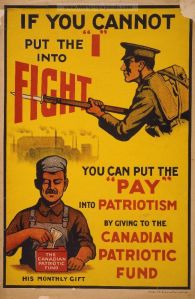
This is for the Canadian Patriotic Fund. And yes, Canada actually fought in both world wars.

14. Blot out the Hun with Liberty Bonds.

As far as propaganda posters are concerned, this was the easiest to design. Just a red hand print and typeface and voila.

15. Don’t pick up sultry ladies, soldiers, since they’re loaded with disease.

Indeed, even warnings on VD won’t stop soldiers from picking up prostitutes. Because many of them might be dead in the next fight anyway.

16. Hold up your end and send bonds!
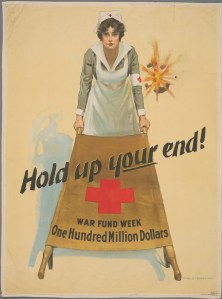
Yet, not sure if this would help the nurse holding one end of a stretcher. Also, it’s for a bond fundraiser.

17. Are you Irish and Canadian? Join up and fight for Mom!

I’m sorry, but Whistler was neither Irish or Canadian. But that didn’t stop Canadians from using his painting as a recruitment poster.

18. “Grind These Heels in Our Wheels of US Production!”

Nowadays we just use robots to make the stuff. Unless they require some technical skill and engineering.

19. Join the military police of the troops and for the troops.

If being a soldier isn’t tough enough for you, then become a military cop to make sure your fellow men aren’t killing each other on their off-hours. May or may not be able to stop officers from committing war crimes.

20. Join a Volunteer Agricultural Camp to lend a hand on the land.

However, you’re unlikely to find any hunky man on the farm who’s neither terribly disabled or suffering from PTSD. Because those guys are overseas.

21. You came to this country, now help us preserve it. Save your wheat and food.

To be fair, there ware a lot of immigrants during WWI. So the image is warranted if you think otherwise.

22. Be an American Eagle and join the Army Air Service.

Disclaimer: New pilots will only receive limited training before combat. Also, average time in the air is 20 minutes.

23. Know a trade? Build for your Navy.

Yes, this is another Seabees poster. But this one is for the yards and docks where combat opportunities are limited.

24. Support the troops, send more fish.

Because fighting the German menace is more important than thinking about overfishing. Since fish is a fighting food.

25. “Dad, I’m off to war so you buy bonds!”

Since Johnny will have to leave his elderly father sooner or later. He’ll be drafted if he doesn’t volunteer.

26. Remember to practice safe SECS.

Meaning if you’re a soldier fighting, don’t give away certain info related to your job. Because the enemy can intercept it.

27. “Do it right, make it bite!”

So make bombs the right way to shoot down the enemy planes. Kind of a disturbing message to send.

28. Keep New Orleans safe, don’t talk about ship sailings.

Because a slip of the lip can sink a ship. For you don’t know who in New Orleans can be working for the Nazis.

29. Join WAVES and work on parachute strings.

Because someone has to make the parachutes strings straight on those Navy planes. So they’ll make a woman do it.

30. Pour that molten metal on to make the planes.

For the planes can’t make themselves. Also, don’t forget to put on your safety equipment. Though shirts are optional for some reason.

31. Keep America calm and stop needless noise.

Well, that’s something I can still get behind. Yet, this poster is telling Americans not to panic when everything goes to shit.

32. See that dead soldier? Well, he’s gone because of careless talk.
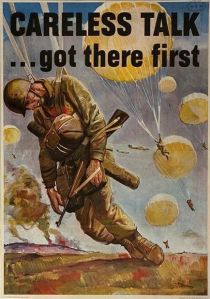
So keep your mouth shut and the next group of soldiers would be parachuting down alive. Understand?

33. Support your country, save waste paper.

Not sure what they’d use the waste paper for. But they also give instruction for packing certain types.

34. When America’s under threat, Lady Liberty draws her sword.

When Lady Liberty draws her sword, it’s really going to go down. Just look what the US did during the world wars.

35. Support the war effort and keep that lumber coming.

Since soldiers need to use all the wood they can get. Though the ones in the Pacific might be surrounded by jungle.

36. When you show up for work, you’re punching Hitler’s face.

So keep punching in every day. However, be careful with the munitions equipment that could send you to the hospital.

37. To win the war, more women must go to work.

But once the war’s over, women must leave their jobs for the men and settle down to be happy housewives. Kind of sucks if you think about it.

38. Soldiers, beware of the Juke Joint Sniper.

She’s also known as a prostitute or whore. And yes, she’s loaded with STDs.

39. Uncle Sam’s not done fighting yet.
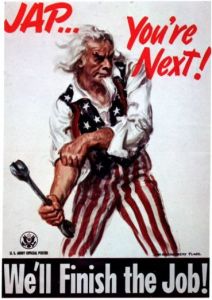
So, Japan is next. And that would mean the US will drop a couple nukes on it until the country surrenders.

40. Support your country, build bombs and buy bonds.

Let’s hope she doesn’t cause an accident. Though her face does evoke some sadistic glee akin to a serial killer.

41. Make sure you can load and unload those docks fast.

Got to get those goods for the troops quick. Else, we’ll end up with Fascism.

42. When Columbia calls, men must enlist.
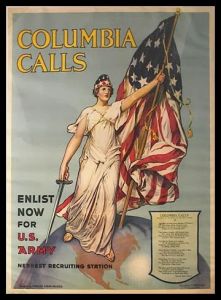
Funny, we don’t even use Columbia as Liberty anymore. Yet, she wields a flag and sword.

43. Save your country, donate your binoculars to the US Navy.

Since us looking for enemy U-boats is more important than spying on the neighbors and birdwatching. So send your binoculars, please.

44. Don’t forget to prepare for air raid protection.

Since you’ll never know whether the Germans will bomb the shit out of your hometown. Just ask the Brits.

45. Remember, that pickups might be full of STDs.

And these were meant for your grandparents’ generation. So I guess many didn’t keep it in their pants for their sweethearts back home.

46. Help us win the war so save your food.

Because all your food waste can be used to feed some hungry soldiers. And we need them well-fed to win.

47. Join the sub service to hit the Japanese where it hurts.

So join up living with a bunch of other guys like you in a cramped space to bring down Japanese aircraft carriers. Still, not exactly a nice place to be at.

48. Free speech doesn’t mean careless talk.
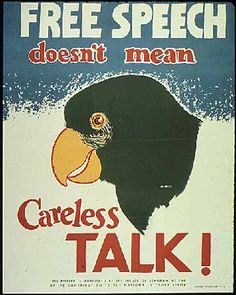
So use your freedom of speech wisely. Also, don’t talk around parrots.

49. Help win the war, invent for victory.

So if you have a more efficient idea about killing more people at a faster rate, give the US military a call. Hell, do it now.

50. We’ve just begun the fight, so join up.
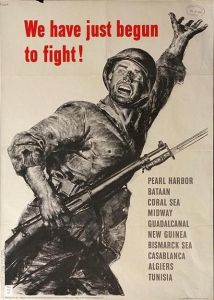
Though this guy seems kind of frightened to me. Like he’s pleading for help than leading a charge.

51. Protect yourself since STDs are everywhere.

So remember, stay away from prostitutes. Or other scarlet women for that matter.

52. Support the war effort and build more B-24s.

It’s a bomber plane by the way. Still, if you’re assigned to one of these during WWII, best you write your last will and testament. Since they have a 50% survival rate.

53. Support the war effort by finding a job that fits you best.

Offer only valid until war ends. After that, women must give up their jobs for the menfolk. Because they belong in the kitchen according to their antiquated ideas.

54. Women, help our boys win the war and buy bonds.

Or else, this sweet old lady might feed you a poisoned pie. So send money.

55. Don’t boast till it’s over. Enemies also have their production machine going, too.

So best you don’t say anything until it’s all over. Whenever that is.

56. All you British ladies, come into the factories.

Just don’t blow yourself up and know you’ll only have that job until your man comes home. So keep calm and carry on.

57. Men of Britain, best you join up and stop air raids. Else, you’ll have your house bombed.
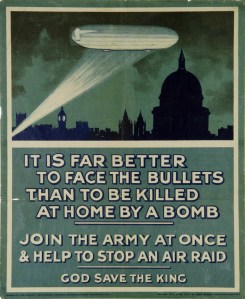
Of course, if you’re a guy during WWII, you’ll already fail miserably. Because we all know the Germans bombed the shit out of the UK. Though this one depicts a large airship for some reason.

58. In wartime, give all the help and comfort you can.

This is from the Jewish Welfare Board during WWI. But it would’ve worked just as well in WWII for obvious reasons.

59. Support your country and dig on for victory.

Since food rations for civilians can only go so far. So get on with your vegetable garden.

60. This summer of 1917, don’t forget to enlist since your country needs you.

If not, then expect Uncle Sam to look upon you in dismay. Also, you might get arrested for trying to buck the draft.

61. Your country needs you, join the Navy.

And yes, they use the woman in a naval uniform again. Despite that she won’t wear it in real life.

62. Are you a girl with a star-spangled heart? Be a WAC.

Look, ladies, you can join the Army, too. Of course, you won’t be assigned to combat duty. Because that’s men’s stuff.

63. Remember, sailors, don’t tell your date about naval operations.

After all, she could be German for all you know. Careless talk costs lives.

64. Are you a woman not doing vital work? Your country needs you now.

Because while the men are away, women need to step up. This is especially if they don’t have husbands or kids.

65. Are you playing square, soldier? Save gas.

Since the world only has a limited supply of oil. Best you save on your tank for the troops.

66. Only you can prevent forest fires and Fascism.
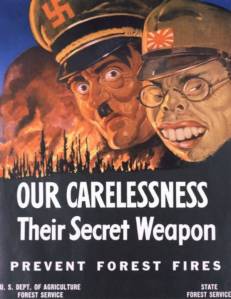
Kind of expecting Smokey the Bear to turn up at any moment. But he won’t be around till the 1950s.

67. Join the Marines to fight first in France for freedom.

Keep in mind you’ll be spending hours in some filthy trenches. Hope you don’t mind rats.

68. They have the guts, donate scrap metal.

Cause those tanks need all the scrap they could get. Not to mention, bullets are made of metal, too.

69. We can’t win the war without women.

Yes, you can’t win a war without women. But they still treated them like crap once it’s over.

70. Don’t crow or we lose the war.

And yes, there’s a giant rooster with the Axis Powers. So best keep your mouth shut and avoid careless talk.

71. Answer the call and join Pershing’s Crusaders.

But unlike their medieval counterparts, they don’t fight for their souls. And they spend more time in the trenches.

72. Support the men in the trenches. Enlist now.

Yeah, I know it’s a miserable experience with filth, disease, gunfire, and No Man’s Land. But your country needs you at the front. Still, the guy’s kind of creepy.

73. As Americans, we’ve always fought for liberty.

And it’s made no difference whether they’re Brits or Nazis. Yet, the uniforms and equipment have drastically changed.

74. Victory is always a question of stamina.
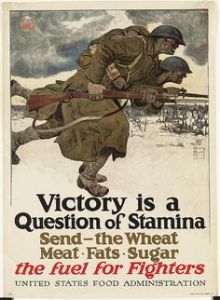
So send the troops your meats, fats, sugars, and anything laden with carbs. Since they need energy in the trenches.

75. When the empire is threatened, the lions must rise to the occasion.
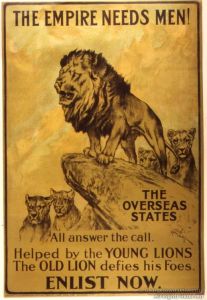
Despite that it’s the lionesses who always do everything. Men, what can you do with them?

76. Women should always respond to the call of service for their country.
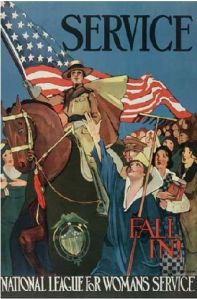
Yes, women, respond to the call of service. Your God-given right to vote can wait later. Since this is WWI poster.

77. Fight for your country, Australians, or the Germans will win.

Here they have Australia as New Germany. That should scare them into enlistment.

78. In America, free labor will always win.

Because American made weapons are top of their grade. Yet, we also have large multinational corporations willing to play both sides.

79. America beat the Germans before and we’ll beat them again.

However, this time they’re fighting for Der Fuhrer instead of the Kaiser. So it’s a bigger deal.

80. You never know who’s listening on the party line.

For it just as well could be Hitler for all you know. So no careless talk on the phone.

81. Support your country and join the Red Cross.

Sure they may be a great organization. But don’t mind its dubious reputation relating to corruption.

82. As FDR said, we must preserve hope. So buy bonds.

Not sure if this FDR image freaks me out. But he kind of reminds me of a mad scientist who’s about to experiment on some hapless trespasser in his castle.

83. This American soldier will go over the top for you.

And you see the soldier carrying the American flag. But in WWI, they’ll seldom go over the top. Since No Man’s Land is a real hell hole.

84. This woman’s husband is proud she did her part.

Well, at least he tries to be supportive. Though the expression reminds me of a man who’s struggling to feel secure with his masculinity. Yet, can’t help but feel a bit resentful over the whole thing.

85. Do your bit and get into the khaki.

Cause who else is going to fight in Gallipoli alongside a hot Mel Gibson? Sorry if I offended any Australian reading this.

86. Stop the black market. Don’t buy or sell on it.

Too bad there will always be a black market. And people will always make money on it.

87. British Empire soldiers always stand together.
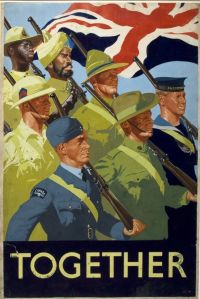
That doesn’t mean the soldiers will get independence or be treated equally. But it’s WWI so it’s a recruitment tool.

88. America needs more nurses.

Here Uncle Sam gives a new nurse her hat. Now they wear scrubs.

89. While our men are at war, serve on the home front.

This is from Pennsylvania by the way. And there are some civilian organizations you can join, too.

90. Support the war effort, conserve energy.

Just remember there were no windmills, solar panels, and geothermal energy sources. So conserving fossil fuels is the only option.

91. Always remember that Hitler wants know.
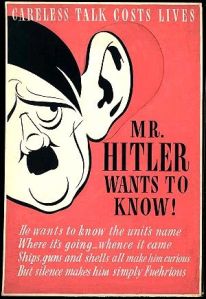
So cut with the careless talk. Or you’ll help Hitler win the war.

92. It’s best to land with the US Marines.

But keep in mind, you wouldn’t want to fight with them on the Pacific. Because it’s a very violent place during WWII.

93. At night, it’s forward to victory.

For the German planes can bomb the shit out of Britain at any time in 1940. Best have the anti-aircraft gun ready at night.

94. Save energy and turn the gas down.

Guess most stoves were powered by natural gas. Seems like they should switch to electric.

95. This soldier lets his M-1 do the talking.

So in wartime, we must be careful on what we say. Or he’ll get riddled with bullets.

96. Why stand by during a brush fire? Fight the Germans back!
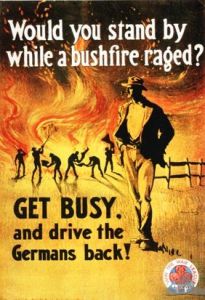
Because our effort needs all hands on deck. However, now our brushfire is the Trump administration. And too many are standing by watching our country burn thanks to Donald Trump, white supremacists, greedy corporations, and right-wing conspiracy nutjobs.

97. Save your coins, kids, and by war stamps.

And when little Jimmy turns 18, it’s straight to the trenches. But wars can’t win themselves, you know.

98. Support the troops, send money to the Red Cross.

Nowadays contributing to the Red Cross doesn’t carry as much weight as it used to. Yet, in this one, it acts like a shield for Lady Liberty.

99. Watch the ramparts, join the Army Air Forces.

And here he is holding a large bomb to be dropped in some city. But thanks to him, the skies won’t be so friendly.

100. Instead of dreaming of victory, fight for it! Buy bonds!

For soldiers can’t get on without stuff in the trenches. So send the US government money despite that they spend more on the military than anything else.


What Is Civility?

On Friday, June 22, 2018, White House Press Secretary Sarah Huckabee Sanders tried to dine at a table reserved for 8 reserved in her husband’s name at a Lexington, Virginia restaurant called the Red Hen. When she arrived, restaurant employees called co-owner Stephanie Wilkinson asking what they should do. While she drove to the place, the staff served Sanders and the rest of her party cheese boards and took their orders. But once Wilkinson arrived, the workers took a vote, she asked Sanders to come outside, told her the restaurant has “certain standards” to uphold, “such as honesty, and compassion, and cooperation,” and asked her to leave. Sanders complied along with the rest of her party who didn’t need to. They offered to pay, but Wilkinson told them it was, “on the house.”
Like many incidents these days, this episode found its way on the internet. An end-of-shift note appeared on Twitter with “86 – Sarah Huckabee Sanders” (an 86 meaning in restaurant lingo as someone who isn’t allowed to be served or an item that isn’t on the menu or in stock). A waiter wrote a Facebook post about serving Sanders “a total of 2 minutes” before the owner asked her to leave. On Saturday morning, the press secretary tweeted, “I always do my best to treat people, including those I disagree with, respectfully and will continue to do so.” Wilkinson told the Washington Post that she doesn’t regret her decision asking Sanders to leave, “We just felt there are moments in time when people need to live their convictions. This appeared to be one.”

Nonetheless, the Red Hen incident is the latest in a string of events where Trump administration officials have found themselves unwelcome in their efforts to dine out in peace. Last week, protestors confronted Secretary of Homeland Security Kirstjen Nielsen at a Washington D.C. Mexican restaurant over the administration’s family separation policy. White House adviser and Josef Goebbels lookalike Stephen Miller was called a fascist while dining at another D.C. Mexican joint. But when the Red Hen’s owner politely asked Sarah Huckabee Sanders to leave her establishment, it ignited a debate over civility, political protest, and how Trump officials should be treated in public swirled over the weekend and spilled over that Monday. It was a fight pitting self-styled defenders of civility and political norms against angry progressives arguing that the Trump administration should be resisted by any means necessary, including confronting its officials in public. In fact, the Washington Post’s editorial board criticize the decision to refuse Sanders service as signifying the breakdown of civility and basic manners in American culture. They called for Sanders, Nielsen, and Miller to “be allowed to eat dinner in peace,” writing, “Those who are insisting that we are in a special moment justifying incivility should think for a moment how many Americans might find their own special moment in which only the most zealous sign up for public service.” Others, including Democratic California Congresswoman Maxine Waters argued administration officials have forfeited their right in expecting public niceties by aligning themselves with Donald Trump in the first place. As she told MSNBC, “I have no sympathy for these people that are in this administration who know it is wrong what they’re doing.”

At any rate, this public debate around the concept of civility in the political discourse is utterly ridiculous. For one, American politics are uncivil for as long as this country existed with countless incidents of political violence with those pertaining civil and labor rights being among the most contentious. During the Civil Rights Movement, you’ll find plenty of demonstrators jailed, beat up, or killed for peacefully standing up against racial segregation. The notion of a White House press secretary being asked to leave a restaurant as signaling the breakdown in civility and basic manners in American culture is laughable in the trainwreck presidency of Donald Trump, let alone American history in general. Secondly, the incivility is mainly coming from the Trump White House since Trump and his administration have flouted the norms of political discourse far more often than their opponents. Seriously, in the 2016 presidential campaign alone, Trump called Mexicans rapists, mocked a disabled reporter, encouraged his supporters to beat up protestors, attacked a Muslim Gold Star family, attacked John McCain for being a POW, promoting a conspiracy theory alleging Ted Cruz’s father was involved in the JFK assassination, launching deeply personal attacks on Hillary Clinton during the presidential debates, humiliating Clinton by parading her husband’s ex-mistresses at one of them, pathological lying, and so much more. In fact, as far as politicians are concerned, Donald Trump, his administration, and his supporters don’t give a shit about civility. Nor does Sarah Huckabee Sanders since she’s been complicit in all of this. For God’s sake, her job requires providing cover for Trump’s most egregious lies, which undermines a vital part of public discourse in the idea of fair and open public discourse about the truth. So much so that complaining about civility after being kicked out of a restaurant seems just as hypocritical as Count Olaf telling the Baudelaires to get a shower. Third, politely kicking out a White House press secretary from a restaurant without requiring her to pay for appetizers seems rather civil compared to other uncivil acts like a Trump rally. Still, if refusing service to Sanders puts the spotlight on the notion of fair and open public discourse on the truth, it might not harm America’s political civility. Hell, it might even improve it.

According to the great 20th century American philosopher John Rawls, “incivility” in politics in the Trump era isn’t about rude tweets but lies. A major topic in his seminal work Political Liberalism revolves around the problem of disagreement or how it’s possible to have a democracy when people disagree so much among themselves. The crux of Rawls’ answer is that democracy depends on a certain set of principles that almost every reasonable person can accept like “all citizens deserve to be treated equally” and “it’s wrong to imprison people on the basis of faith.” But for the system to work, Rawls argued that public debate must be free and open for people to clearly explain how their policy convictions can be justified according to these shared beliefs at the heart of a democratic society. Rawls called the obligation to adhere to these public discourse rules, “the duty of civility.” However, if citizens in general, especially politicians, hide and confuse their arguments, then people’s ability to give their informed consent to the administration vanishes. In this respect, “civility” as akin to politeness in everyday conversation. It’s about treating those of the opposition like reasonable people. Because it seems more “civil” to honestly state disagreements with individuals, even impolitely, than to try to bamboozle them.

Of course, Rawls never really entertained with the possibility that a democratic government might make dishonesty one of its core political principles. But this is exactly what Donald Trump has done. Since he constantly and completely disregards the truth as a tactic to advance his heartless agenda and keeping his base loyal to him. And the sheer gravity of such assault is monumentally jaw-dropping. According to the Toronto Star’s Trump lies database, he’s made at least 1,726 certifiably false statements since becoming president as of 2018 at an equivalent of 3 lies a day. When the New York Times compared Trump’s lies to Barack Obama’s, they found a huge discrepancy in that in his first 10 months as president, Trump told 6 times as many lies as Obama did during his entire presidency. Maxine Waters also told MSNBC in response to her critics, “As to the Chairman’s comments about civility… let me just say that every reasonable person has concluded that the president of the United States of America has advocated violence, he has been divisive and he has been the one that has caused what we see happening today.” If there is anyone who fails to uphold any rendition of civility in today’s American political landscape, it’s Donald Trump.

Now if Stephanie Wilkinson had kicked out a run of the mill Trump supporter out of her restaurant, any public outcry on civility over the incident might’ve been well-deserved. After all, Wilkinson told the Washington Post that she has regular politically conservative customers all the time and has no problem serving them. She kicked out Sarah Huckabee Sanders out of the Red Hen because she’s a public official working for Donald Trump and playing a critical role in his administration, As White House press secretary, Sanders’ job makes her especially complicit in Trump’s egregious agenda. Because her boss constantly lies, a major part of her job is defending those lies whether covering for them, deflecting them, or lying herself to cover them. Because of Trump’s uniquely hostile approach to telling the truth, just doing her job makes Sanders uncivil according to Rawls’s terms. As the Trump administration attacks the very heart of the US democratic political system, Sanders’ repeating and defending her boss’s lies is a vital part of this scheme.

As voters, we have a responsibility to confront incivility that threatens democracy rather than prioritize letting senior government officials dine in peace. When asked why she kicked out Sarah Huckabee Sanders out of her restaurant, Red Hen owner Stephanie Wilkinson meant exactly that when she told the Washington Post, “This feels like the moment in our democracy where people have to make uncomfortable actions and decisions to uphold their morals.” In other words, Wilkinson acted to punish a political official for a specific set of severe wrongs, not to harm an average customer whose political views she happened to disagree with. Wilkinson’s actions at the Red Hen should be seen as a way to hold political elites accountable and force them to answer for their actions. For ordinary citizens rarely have the opportunity to do that. Given that the next elections are months away and the next presidential race is in 2020, Wilkinson doesn’t have much of an opportunity to punish the White House for its egregious behavior going on right now. In addition, Wilkinson had no intention to be a culture warrior and wasn’t looking to divide Americans against one another. In fact, it’s unlikely she didn’t even want this incident to go public or inspire copycats. One of her employees posted about it on Facebook and Sarah Huckabee Sanders brought the matter wider attention on Twitter. If it weren’t for these postings, nobody would’ve known. Kicking Sanders out of the Red Hen would’ve just been a modest act by a private citizen to hold a public official accountable or a way of registering dissent on how the government conducts itself. Kind of like when Rosa Parks refused to move to the back of the bus, which is consistent with Rawls’ view of civility. And it’s exactly the kind of confrontation that Maxine Waters was talking about and encouraging people to do when she said, “If you see anybody from that Cabinet in a restaurant, in a department store, at a gasoline station, you get out and you create a crowd and you push back on them and you tell them they’re not welcome anymore, anywhere.”

Like Rosa Parks’ refusal to move to the back of the bus kickstarting the Civil Rights Movement, Stephanie Wilkinson’s refusal of service to Sarah Huckabee Sanders is a political statement that could even be a way to bring about change. In fact, there’s evidence that inflicting personal punishments on political leaders does cause them to grapple with their actions and even change their behavior. Though I think it might be unlikely in Sanders’ case. One looked at fines for skipping important committee meetings that were imposed on legislators of the French National Assembly. Looking at the fines’ effects as well as the impact of it being widely publicized on a legislator skipping out, the scholars found the fines “strongly increase their committee attendance both after the private experience of sanctions and after their public exposure.” Thus, there’s reason to think that public officials in the private and public eye do mind being sanctioned. And since the United States is in the middle of a particular political emergency with the failure of America civil discourse as a democratic practice, a little impoliteness of the right kind can help restore it. Thus, in this debate over civility, Maxine Waters is correct.

Nonetheless, controversy erupted over the Red Hen incident and Maxine Waters’ comments made critics seize on how they both undermine the idea of civility. In wake of Waters’ comments, House Majority Leader Kevin McCarthy told Fox News, “The people who claim tolerance seem to be the most intolerant in this process. We need civility in this country, but the idea that you’re asking people to go forward, that becomes very dangerous and it becomes a risk inside our country as well.” House Speaker Paul Ryan asked Waters to apologize, saying that “no place for that in our public discourse,” while neglecting to critique Rep. Steve King for promoting a Neo-Nazi. Donald Trump tweeted, “Congresswoman Maxine Waters, an extraordinarily low IQ person, has become, together with Nancy Pelosi, the Face of the Democrat Party. She has just called for harm to supporters, of which there are many, of the Make America Great Again movement. Be careful what you wish for Max!” House Minority Leader Nancy Pelosi also criticized her, tweeting, “Trump’s daily lack of civility has provoked responses that are predictable but unacceptable. As we go forward, we must conduct elections in a way that achieves unity from sea to shining sea.” Former Obama adviser David Axelrod also expressed his disagreement with Waters’s tactics and called people to organize and volunteer to convey their discontent with the Trump administration. Former Obama Secretary of Education Arne Duncan argued that driving people out of different businesses is a tactic echoing historic segregation policies.

However, what Maxine Waters’s critics miss in her remarks could be said best by Congressional Black Caucus Chairman Cedric Richmond, “In exercising her constitutional right to freedom of speech at a recent rally, Congresswoman Waters did not, as she has made clear, encourage violence, like President Trump has been doing since the election. She, instead, encouraged Americans to exercise their constitutional rights to freedom of speech and peaceful assembly by letting President Trump and members of his Administration know that separating young immigrant children from their parents is not who we are as a country.” It’s quite clear that when Waters urged attendees to keep “push[ing] back” she referred to the attention-grabbing incidents where Trump administration officials were subject to public confrontation. At worst, she encouraged people to create a public nuisance heckle and protest Trump officials in public on their off-hours in an effort to hold them accountable. And since Donald Trump has gone all his life without having to grapple with any real consequences whatsoever, we need to hold him and his swamp cronies and enablers accountable in whatever way we can.

Nonetheless, such talk over “civility” among Republicans is just a masked tactic to tell anyone who dare confront, protest, or challenge Donald Trump and his administration to shut up. In other words, I don’t think their beef isn’t that Stephanie Wilkinson and Maxine Waters weren’t being civil in their words and actions, but that they were actively resisting at all. Since I remember when Colin Kaepernick took a knee during the national anthem as a way to peacefully protest police brutality and racism. He was being civil in his grievances but his actions pissed many white football fans decrying he was disrespectful to police, to the troops, and the American flag. But the true reason was that white people had a problem with black people protesting on matters that don’t affect them. Besides, Trump supporters don’t care about civility among their own ranks, since many have been terrorizing people on line and through white supremacist demonstrations like last year’s Charlottesville rally.

White Americans had the same problem with Martin Luther King Jr. in his day for protesting racial segregation since 63% of whites had a negative perception of him back in 1966. And it wasn’t just King as a person, but also his commitment to direct action, many white people frequently described as fundamentally threatening civic norms. One Chicago Tribune anti-King editorial reads, “Families ordinarily would be enjoying the chance to sit on the front porch reading the paper, to sprinkle their lawns and work in their gardens, or to go to the park or beach. Instead, they are confronted by a shuffling procession of strangers carrying signs and posing as martyrs. The spectacle is repulsive to right-thinking people.” In sum you can translate this piece as, “Can’t those rabble-rousers leave Chicagoans alone and enjoy their weekend in peace?” Of course, King understood these calls to civility for what they were as attempts to shut down or at least slow the movement for equal rights. And they served a moral cover for the immoral laws he was protesting as the civility of segregation was upheld by threats of violence. His “Letter from a Birmingham Jail,” to moderate white religious leaders in Alabama who encouraged their congregations to reject King since they saw him as an outsider disturbing the South’s peaceful atmosphere. King’s famous letter spoke directly to these calls for a more “constructive and realistic” response to oppression where he denounced “the white moderate, who is more devoted to ‘order’ than to justice; who prefers a negative peace which is the absence of tension to a positive peace which is the presence of justice.” King knew the status quo was never as peaceful as it appeared to white Americans and existed precisely was because society had created enough legal and social mechanisms to enforce inequality and oppression without obvious acts of state violence and extrajudicial terror. While civility and nonviolent resistance works as a form of protest, but only in combination with the background threat of much less civil tactics. While civility is nice idea, it should be a reward for securing a more just nation. It’s not the surest way to achieve justice and can be a method denying it. Unfortunately, those longing to return to an era of centrism, consensus, and civility usually don’t grapple with the way those ideas have historically worked to protect the powerful and sustain the status quo.

An Assault on Decency

While I was on my Minnesota vacation, everything in my country seemed like going to shit. Before I left Donald Trump signed an executive order suspending the family separation “zero tolerance” policy. Though tempting to hail such measure as a victory since overwhelming public pressure and outrage forced him to do it. But the notion that Trump has “ended” family separation is a questionable matter of law. Children are still in detention camps with no sign of seeing their parents again who now face criminal charges and deportation for illegal entry. Despite that most of these migrants’ choice to enter the country illegally is more akin to Harry Potter’s choice to cast a patronus against a Dementor attacking his cousin. Most of these families were desperately fleeing violence in Central America and have already gone through the legal channels for seeking asylum. Yet, border patrol agents either turned them away or told them to come another day. Sure, they knew they were breaking the law by crossing the border. But they didn’t have much of choice to do so. And as Harry later found out, these people were essentially tricked into doing so by spiteful authority figures who hated them. There is no established protocol to reunite families and sign that his administration plans to do so. Nor does Trump’s executive order ban the practice. Rather, it merely directs the Department of Homeland Security to detain migrant families together instead of separating them. Such policy also poses legality question as well. Should courts overturn it, it’s entirely possible that family separations can start again.

However, the “backlash works” analysis also skips a more fundamental political question. The disturbing truth is that huge number of mostly Republican Americans were willingly to back such separation policy. In fact, they’re even more excited about the underlying policy of arresting every undocumented immigrant crossing the border a la “zero tolerance” policy giving rise to family separations in the first place. What’s most telling about this dark and cruel incident isn’t Donald Trump stepping back in the face of public outrage. It’s the millions of Republicans willing to support an obviously cruel immigration policy. In turn, points to perhaps the deepest problem in American politics in the Trump era, which is the lethal conjunction of white identity politics and partisanship has made the Republican Party willing to sanction injustices that had previously been unthinkable in modern America. It’s as if politics seems to justify anything at this point for them. As long as they get what they want in the culture wars, they’ll sell their souls to supporting a sociopathic authoritarian demagogue who cares nothing for them regardless of whoever gets hurt, how much he undermines American values, or the damage he’s caused in these United States.

While most Americans strongly oppose Donald Trump’s family separation policy, Republicans generally support it by a significant margin despite there’s a substantial minority who don’t. After all, massive margins of them usually favor Trump. Yet, this still means that millions of Americans back a morally grotesque policy separating children from their parents for an unknown period of time, possibly permanently. The fact most Republicans seem to favor this unconscionable “zero tolerance” policy illustrates the degree to which Trump’s position and partisanship has shaped Republican moral thinking. What’s more depressing is that the debate over family separation policy in its relatively early stages. So there’s a good reason to believe if Trump returns with the idea, Republicans will be more likely to support it, not less. If there is a moral crisis in American politics these days, it’s that a large contingent of Americans are willing to support morally indefensible policies from a sociopathic and unrespectable man for the sake of “law and order” or “national security.” Despite that a moral repugnant “zero-tolerance” policy at the border achieve neither.

Yet, if you doubt such shift in public opinion will happen, consider Republican opinion on the infamous Muslim ban. When Donald Trump first announced his proposal for a “total and complete shutdown” on Muslim immigration in December 2015, scores of prominent Republicans including his future Vice President Mike Pence condemned the idea in roughly the same moral indignation some Republican leaders have used to discuss family separations. A poll by the Wall Street Journal and NBC found GOP primary voters evenly split on the idea. But when it became clear Trump was likely to become the GOP standard bearer in March 2016, things changed. Exit polls from 5 states comprising of Ohio, Florida, North Carolina, Missouri, and Illinois, found that Muslim ban support among 2/3 of Republican voters. When Trump actually implemented a version of the now infamous Muslim “travel” ban in January 2017, Republicans overwhelmingly backed him with 84% support according to a June 2017 poll. Hell, despite court challenges and its flagrant unconstitutionality on grounds of religious discrimination, the US Supreme Court still ruled in favor of it.

So what happened with the Muslim ban? Obviously, the clearer it became that supporting it was a core Trump position, the clearer it became that being a Trump supporter in good standing required backing the travel ban. When Donald Trump became the Republican nominee and later president, Republican partisanship became more about backing this unrespectable man. Of course, such behavior isn’t unprecedented among a president and their supporters. Since the more closely a policy is identified with the president, the more people from the president’s party are willing to support it. As Texas A&M professor George C. Edwards III told Vox, “The president’s association with a policy is an especially powerful signal to those predisposed to support his initiatives. By reinforcing his partisans’ predispositions, presidents can counter opposition party attacks and discourage his supporters from abandoning him. In addition, co-partisans appear to be resilient in returning to support after periods of bad news.” Under a normal presidential administration, this isn’t a huge deal. But when the president is a vile sociopath who only cares about enriching himself and his corporate backers while doing the minimal to convince his base that he’s on their side by enacting cruel policies that really don’t help anybody, you have a national crisis in American moral values on your hands.

Fortunately, the family separation debate didn’t actually go on for very long so far. Thus, public opinion didn’t have time to harden along partisan lines. The Trump administration sent mixed signals about what to think of it. Sometimes they claimed it’s a shame and the Democrats’ fault (despite it really wasn’t). Other times they justified it as necessary to deter more undocumented migration. Under these conditions along with the moral shock from headlines feeling fresh and some prominent Republicans like Laura Bush willing to condemn the policy, it’s easy to see why Republican voters felt comfortable opposing Donald Trump this time.

Yet, despite all that, millions of Republicans still supported this morally egregious policy of ripping children from the families and putting them in cages at a relatively significant margin. However, suppose the Trump administration resume family separations while Donald Trump provides a sustained defense in public appearances and tweets. Chances are that Republicans most likely will rally around him the same way they came to support the equally morally obscene Muslim ban. And what’s truly scary is that if Trump stayed the course on this one and allowed the media and public outrage to dissipate, he might’ve gotten away with it.

Nonetheless, if this was just a matter of partisanship and Trump support, it wouldn’t be the very assault on decency that it is. But it’s not. Rather it’s by going after overwhelmingly Latino immigrants from Central America, Donald Trump is playing on his political home turf like it’s “Mexicans are rapists” all over again. In 2015, two political scientists named Marisa Abrajano and Zoltan Hajnal published a book looking closely at the way mass Latino immigration was shifting American politics. According to Abrajano in the book’s summary, she and Hajnal concluded that the influx of Latino immigration had driven a large number of white voters into the Republican Party. This effect appears to track media coverage. When people in the news talk about the threat posed by Latino immigration such as Donald Trump talking about how Latino migrants are responsible for gang violence, Republicans benefit. Another group of researchers polled white Americans on how their view of diversity affected their likelihood of voting for Trump. They found that when whites were reminded that America was becoming an increasingly black and brown country, they were more likely to support Trump and favor immigration restrictions.

This is the crux of the moral crisis of the Trump era in a nutshell. The most Un-American and morally reprehensible parts of Donald Trump’s presidency such as his crackdown of undocumented immigrants, the Muslim ban, his shocking moral equivalence during the white supremacist rallies in Charlottesville, Virginia tap into the forces that are the most responsible for making him president. While stories of separated families in the media have wracked neutral observers’ hearts, Trump’s most hardcore supporters (like white supremacists and the Alt-Right) may very well have the opposite reaction. This intersects in a particularly dangerous way in partisanship for if Trump can maintain his hardcore base’s support enough to retain majority GOP support, he won’t need to immediately cave. And the longer and harder he fights for a policy, the more support for it will become GOP orthodoxy.

Disturbingly enough, it’s an established fact Donald Trump’s racial politics are genuinely popular with millions of white Americans who have significantly supported such vicious and morally inexcusable policies like the family separations at the border. It’s also a demonstrably and theoretically so that the GOP’s partisanship strength can enable Republican presidents to attract their party base’s support along with its political establishment. Both facts mean that despite the depravity of everything he says and does in the White House, Trump will always get the Republican Party to back his attacks on members of minority groups, given the time and effort. Indeed, ending family separation for now is a good thing and it’s understandable for liberals to pop the cork and call it a win. But the fact the separations happened at all and that millions of Americans were perfectly fine with them should trouble us all. This is especially since many of these children ripped from their parents will have to grapple with the traumatic implications for the rest of their lives.

Not surprisingly, Donald Trump has resorted to his race-baited fearmongering. During an event on Friday, June 22, 2018, he returned to his old argument about undocumented immigrants, highlighting families who lost loved ones to crimes committed by them. While losing a loved one to a crime is tragic, Trump held this emotionally charged event on “permanent separation” certain families have faced to undocumented criminals in an effort to shift the focus of the immigration conversation from family separations at the border. Granted there are undocumented immigrants who commit crimes. But that doesn’t diminish the fact that Trump’s event with these families is just a publicity stunt to capitalize on their tragedy. First of all, undocumented immigrants are less likely to commit crimes than native born Americans and more likely to be crime victims due to their lack of protected status making them unable to call the authorities. But undocumented criminals pose no more a danger to society than their counterparts with legal status. Had many of these families experienced a loved one killed by a legal immigrant or US citizen, Trump wouldn’t be parading them for his own ends to smear an entire group of people as violent criminals to justify his morally inexcusable policies against them. As he said in the event, “We’re gathered today to hear from the American victims of illegal immigration. You know, you hear the other side. You never hear this side. These are the American citizens permanently separated from their loved ones because they were killed by criminal illegal aliens. These are the families the media ignores.” I’m sure anyone who loses their loved ones to undocumented immigrants are featured on the local news and maybe a spot on a Fox News show since they devour stories revolving around nonwhite murderers killing white Americans, undocumented or otherwise. Yet, here Trump seems to paint undocumented criminals as a special kind of evil they’re not which is an effective way to dehumanize a vulnerable population.

Even worse, not only does Donald Trump often blame congressional Democrats for “weak” immigration laws, his hardline stance on immigration makes it practically impossible to even the most bipartisan legislation for comprehensive immigration reform. Hell, he’s even in complete disagreement with members of his own party on how to solve immigration problems that he created. This isn’t an accident. As the crisis at the border puts the Trump administration under fire from humanitarian groups, Democrats, and even many Republicans as the biggest story in the nation, there’s a belief among senior White House officials, including the dead-eyed longtime adviser Stephen Miller, that fostering controversy is a winning strategy for them and that it will galvanize conservatives ahead of the November elections. Trump’s actions regarding ending DACA while sabotaging any chance for Congress to pass a bill protecting Dreamers is a glaring example.

Yet, that’s not the worst of it. In the wake of the family separations outrage, Texas US Senator Ted Cruz introduced legislation that would halt family separations and double the number of immigration judges from 375 to 750 to process detention cases more efficiently as the system has been backlogged for years due to a judge shortage. . In response, Trump extensively and derisively laughed off the idea of expanding the immigration courts as part of a plan to end the crisis, asserting that asylum seekers’ lawyers coach their clients on what to say so they’ll be allowed to stay in the United States. He said, “We have to have a real border, not judges. I don’t want to try people. I don’t want people coming in.” On Sunday, June 24, 2018, he tweeted, “We cannot allow all of these people to invade our Country. When somebody comes in, we must immediately, with no Judges or Court Cases, bring them back from where they came.” Apparently, Trump doesn’t think the immigration backlog is a problem. In fact, he doesn’t believe that undocumented immigrants should have a right to present their cases to immigration judges at all.

Since the Supreme Court has repeatedly maintained the due process requirements of the 5th, 6th, and 14th Amendments apply to everyone regardless of legal status, including undocumented immigrants. Thus, theoretically, if you deny anyone due process, you deny everyone due process. Not to mention, denying due process flies in the face of America’s basic democratic and moral values. At an immigration standpoint, this means we’re all undocumented immigrants because your documents are useless if you can’t show them to a judge while being identified as a suspect is the same as being guilty. For without due process, the government has all the power while the individual, citizen or otherwise has none.

In practice, denying due process to suspected undocumented immigrants would make all Latinos living in the US subject to the kind of hell akin to what those in Maricopa County were subjected in Joe Arpaio’s sheriff days. Except that instead of corrupt sheriff deputies putting them in a horrifying tent city jail with pink underwear, they’d be arrested by ICE and sent up on a one-way ticket to the country they at least allegedly came from. Many US citizens have already been arrested and/or detained under suspicion of undocumented immigration due to racial profiling by law enforcement. Because so many Americans already associate a Latino presence in their communities with undocumented immigration, especially where there aren’t many of them. Despite that a Spanish-sounding name and brown skin mean nothing as far as legal status is concerned. Do away with due process for undocumented immigrants and Latinos caught in ICE’s crosshairs will be unable to prove their legal status to a judge to challenge that claim. Even if they’re in the US legally or are a native-born US citizen who has lived in the country their whole lives. We should also take into account that 90% of those arrested in Arpaio’s deportation raids had legal status. But that didn’t save them for being suspected for illegal entry and having their constitutional rights violated by their local sheriff because they were Latino. But thanks to due process, Arpaio’s victims were able to prove his rampant abuse with racial profiling to get him convicted.

Nonetheless, this debacle over the family separations at the border demonstrates that supporting Donald Trump means leaving your spine and conscience at the door while having the gall to defend the morally indefensible and torching anything remotely relating to decency as “weak” or “reeking with political bias.” Though there is no question that Trump is a divisive figure, I am deeply afraid of the morally reprehensible policies his supporters are willing to tolerate and even agree with. As deeply disturbed I am about their loyalty to a man who will sell them out if he hasn’t already, I really want to believe they have some semblance of a political conscience or at least principles that they’d never be willing to compromise like the basic notion of democracy, equality, liberty, and civil rights. I want to believe that as polarized our country is that I have some common agreement with these people on key American principles. Not because I am a white woman who’s been alienated by her extended family, friends, and community by jumping on the Trump Train which almost cost me my access to Medicaid last year. But because I really find it difficult to believe that millions of Americans would be willing to sell their souls to support a vile and unrespectable man who’d put US Democracy in danger just to enrich himself with the presidency. Nor do I want to believe that the United States is so broken that the very notions of basic human decency become the source of heated political contention. However, I’m not so sure of even that anymore since Trump’s acolytes seem to stand by him despite all the morally egregious things he’s said or done, even if they previously seemed virtually unthinkable. And ideas I’ve long been taught and believe as basic principles of morality and American democracy now seem politically controversial.

There is no question that having Donald Trump as president poses a grave danger to the United States and the world since he’s a narcissistic sociopath with authoritarian ambitions who has no respect for the country he leads, its values, its institutions, or its people. Yet, what I fear most is what his presidency is doing to this country’s soul since a large contingent of Americans have embraced him as their champion because he says whatever inflammatory screeds they want to hear. And no matter what inexcusable thing he says or does as president, they loyally stand by him and enable his destructive behavior and policies against those who stand to suffer the most. But his entire presidency has been an assault on decency since Trump is an unrespectable man who has absolutely none as his moral degenerate words and policies reflect. Yet, the question isn’t whether his actions and rhetoric define who we are which they sort of do and since our country isn’t innocent from human rights violations separating families. But whether he embodies what we Americans want to be as a nation, which I fervently hope isn’t the case. For while Trump projects an image of strength, business know-how, and patriotism to his supporters, I see him as a manipulative swindler, shameless fraud, spineless coward, pathological liar, and an unrepentant bully with self-delusions of grandeur who has to surround himself with sycophants to enhance his gigantic ego and viciously rage on Twitter or settle petty scores when he doesn’t get his way. To me, Trump embodies the worst of America that it’s fair to see him as the current face of evil in the modern American life. As he stages his assault on decency along with the American values we hold dear from the White House, we must resist him at every turn as citizens. We must not normalize or legitimize his presidency. Nor let his destructive words and policies that undermine democracy with each passing day drag us through the mud. Donald Trump may be president, but he must not receive the respect his office entails him. Because he’s not a man deserving of such recognition or worthy of being referred to as “President of the United States.” His morally bankrupt character makes him only worthy of our scathing contempt and criticism that we should make known wherever he goes. And we must shame his followers to remind of our disgust over their support for such an unrespectable man they think is on their side as he stabs them in the back with his empty promises.

Do We Have Any Decency?

The more we hear about the Trump administration’s immigration policies of taking children from their parents, arresting their parents, and taking the kids into custody, the more they sound too cruel to be real. And the Associated Press has acquired internal Department of Homeland Security data covering the program from May 5-June 9. During this time, 2,342 children were taken from their immigrant parents on the border. That’s an average of 65 kids per day separated from their families and often sent to foster homes or held in detention centers. This might actually be an undercount since these numbers only reflect families separated when parents were sent to criminal custody for prosecution on illegal entry. Families presenting themselves for asylum by coming to a port of entry before being separated weren’t included.

While the family separation policy may be new, it’s nonetheless building on an existing system that attention to family separation has brought more awareness to the underlying problems within the US immigration system that have been going on for some time. For the past several years, a growing number of Central Americans have been coming into the US without papers who often are families seeking asylum. Asylum seekers and families are both accorded particular protections in US and international law, which make it impossible for the government to simply send them back. They also put strict limits on the length of time, and conditions, in which children can be kept in immigration detention. When the Obama administration attempted to respond to the “crisis” of families and unaccompanied children crossing the border in the summer of 2014, it put hundreds of families in immigration detention, a practice which had basically ended several years before. But federal courts stopped the administration from holding families for months without justifying the decision to keep them in detention. So most families were eventually released while their cases were pending. In some cases, they disappeared into the US rather than showing up for their own court dates.

As we speak, the Trump administration works to detain as many immigrants arriving in the United States without papers as possible. Even if they’re seeking asylum, which they have the legal right to do. But because a decades-long court settlement requires the government to release children from immigration detention “without necessary delay” parents taking care of them would have to be released as well. However, by sending parents into Justice Department custody for criminal prosecution, the Trump administration forces itself to separate parents from their children. Because kids can’t be detained with parents in federal jail, they’re treated as “unaccompanied alien minors” as if they crossed the border alone. Thus, as their parents are languishing in federal prison awaiting trial and sentence, the children are sent into custody of the Office of Refugee Resettlement (ORR) in the Department of Health and Human Services. As far as Trump’s cronies are concerned, this is a fitting punishment.

Yet, their logic overlooks the fact that when asylum seekers try to follow the law by presenting themselves at official border crossings to ask for asylum, Border Patrol agents often tell them they can’t come in. This isn’t an accident. For at multiple ports of entry in Texas to California, the Trump administration tells asylum seekers that they don’t have room to process them today which keeps people waiting outside for days on end without any indication as to when they’ll be allowed to seek asylum legally. According to reports, some asylum seekers are being physically blocked from setting foot on US soil, which would give them the legal right to pursue an asylum claim. So what choice would that leave them but to cross the border illegally and present their asylum claim to Border Patrol instead? And even families trying to seek asylum at ports of entry can’t be assured they won’t be separated anyway. While the Trump administration claims that it only separates families entering legally if they’re concerned about the child’s safety or feel there’s insufficient evidence that the adult is their legal guardian. But it’s not clear how they make that determination and there’s no proof they’re abusing that discretion either.

However, family separation is neither sudden nor arbitrary. The Trump administration claims it’s taking extraordinary measures in response to the temporary surge it’s entirely possible that this will become the new normal. From October 2017 to May 2018, it’s reported that at least 2,700 families have been separated at the border thanks to its “zero-tolerance” immigration policy. Though it doesn’t seem like all families apprehended by Border Patrol get separated, the pace might be picking up. The Trump administration has stepped up detention of asylum seekers (and immigrants period). But because there are such strict limits on keeping children in immigration detention, it’s had to release most of the families caught. So their solution has been to prosecute large numbers of immigrants for illegal entry, including in a break from previous administrations, large numbers of asylum seekers. That allows the Trump administration to ship kids off to ORR than keep them in immigration detention.

In theory, unaccompanied immigrant children are sent to ORR within 72 hours of being apprehended. They’re kept in government facilities, or short-term foster care for days or weeks while ORR official try to identify their nearest relative in the US who can take them in while their immigration case is being resolved. But in practice, the system dealing with unaccompanied immigrant children was already overwhelmed, if not outright broken. ORR facilities were already 95% full with 11,000 children held as of June 7. And according to the New York Times, the government, “has reserved an additional 1,218 beds in various places for migrant children, including some at military bases.” In fact, the agency has been overloaded for years since its 2014 backlog precipitated the child migrant, “crisis” when Border Patrol agents had to care for kids for days. An American Civil Liberties Union report released in May documented hundreds of claims of “verbal, physical, and sexual abuse” of unaccompanied children by Border Patrol.

There are also questions about how carefully ORR vets the sponsors to whom it ultimately releases children. A PBS Frontline investigation found cases where the agency released teenagers to labor traffickers. ORR told Congress in April that of 7,000 of children it attempted to contact in fall 2017, 1,475 couldn’t, which led to allegations that the government “lost” children or that they’d been handed over to traffickers. Though for the most part, it’s more probable that the families the ORR wasn’t able to contact deliberately decided to go off the map. Unaccompanied children who came to the US mostly consisted of teenagers with close relatives here to reunite with. According to a 2014-2015 Office of Inspector General report, 60% of unaccompanied kids were sent to their parent and 99% went to close friends or relatives while 1% were put in long-term foster care.

However, this isn’t true of children coming to the US with their parents who don’t have to be old enough to make the journey on their own and are separated from them. For ORR isn’t used to changing diapers. In May, the New York Times wrote that the government put out request proposals for “shelter care providers, including group homes and transitional foster care,” to house children separated from parents. One organization is placing children with Maryland and Michigan foster families and plans to expand to several other states. Some have fostered unaccompanied children but they’re not used to children who’ve just been separated from their parents.

While some families have been reunited, the Trump administration is sending very mixed signals about how families could be reunited and whether it’s even trying to make that happen at all. According to one ACLU lawsuit over family separation and immigration detention, a DOJ official told the judge that, “once a parent is in ICE [Immigration and Customs Enforcement] custody and the child is taken into the Health and Human Services system, the government does not try to reunite them, and instead attempts to place the child with another relative in the United States — if the child has one.” But ICE and DHS claim that once parents finish their criminal sentences for illegal entry or reentry, they can reunite with their children in civil immigration detention while pursuing their asylum case. Nor do they seem to have a system to bring families back together. One flyer in Texas given to parents offered a number to call to locate their children. Yet, the number was wrong and didn’t lead to ORR. In fact, it was an ICE tip line. Even if a parent can call ORR and the agency can identify their child, they may not be able to call the parent back. Since immigrants in detention don’t have phone access (though federal judges urged the government to provide them so they can find their kids). Some parents face deportation without their children while some children are getting sent back without their parents.

In response to the outcry, Donald Trump has responded to criticisms on family separations, by claiming that a “Democratic law” requires him to do it, and that if Congress doesn’t like it, it can change the law. However, that is just Trump’s way to deflect blame and avoid responsibility since that statement is simply not true. Because there’s no law requiring immigrant family separations. The Trump administration had made the decision to charge everyone crossing the border with illegal entry and the one to charge asylum seekers in criminal court rather than waiting to see that they qualify. They’ve been asking Congress to change laws granting extra protections to families, unaccompanied children, and asylum seekers since it came into office. And they’ve blamed them for stopping Trump from securing the border the way he’d like (with a big stupid wall which won’t contribute to anything beneficial whatsoever). Furthermore, these aren’t necessarily “Democratic laws” either with a law addressing unaccompanied children passed overwhelmingly in 2008 that was signed by George W. Bush. While restriction on family detentions is the result of federal litigation. In this context, the law isn’t forcing Trump to separate families but keeping him from doing what he’d really want to do like sending families back or keeping them in detention together. So he’s resorting to Plan B.

Some Trump administration officials say they’re prosecuting immigrants and separating families to stop people from illegally coming to the US between ports of entry. This argument sounds like common sense since it allows the administration to avoid awkward legal or moral questions on trying to keep people out of the country. Yet, there’s no evidence this strategy works. While rolling out the “zero-tolerance” policy in early May, they claimed a pilot program along one border sector reduced crossings by 64% but they haven’t produced the numbers backing it up. Not to mention, as I described earlier, the Trump administration’s sending mixed signals about whether it wants people to use ports of entry to seek asylum legally. Since some asylum seekers have been separated from their kids doing just that while others were encouraged not to. Though they’ve promised to prosecute anyone who submits a “fraudulent” claim, Attorney General Jeff Sessions has made it clear that he suspects many, if not most, asylum claims are fraudulent. The statistics the Trump administration uses to back up that there’s been a “surge” since las year sometimes count both people getting caught by Border Patrol between ports o entry and those presenting themselves without papers at ports of entry for asylum. The implication is that the current crackdown will reduce both. This implies that a point of this policy is to stop families from entering the US seeking asylum, period.

If you want to know how the Trump administration is justifying family separations at a legal standpoint, they simply claim that criminal defendants don’t have a right to have their children with them in jail. But the question is whether they have the legal authority to put asylum-seeking parents in jail awaiting trial to begin with, knowing they’re splitting them from their children. Human rights organizations including the United Nations have argued that prosecuting asylum seekers as criminals violates international law. Yet, no presidential administration has agreed with that interpretation since the Obama administration prosecuted some asylum seekers as well, just not as often or with the Trumpian dedicated zeal. However, federal courts have ruled that it’s illegal to keep an immigrant in detention in hopes to deterring others, instead of making an individual assessment on whether the immigrant needs to be detained. That might pave the way for advocates to fight back against family separation or at least force the government to start helping families get reunited after their parents have been separated. In the ACLU’s lawsuit victory in June, the judge made it clear that he believed that if the allegations against the administration were true, they might very well be unconstitutional on violation of family integrity, which courts have found is implicitly part of the Fifth Amendment’s guarantee of “liberty” without due process of law. Though it has favorable odds, that doesn’t mean the case will succeed. Unless something else happens to change the policy before then, any opinion will be appealed and will likely go to the Supreme Court. Still, even if the ACLU does succeed, it won’t stop family separations at the border. The lawsuit argues that it’s unconstitutional for parents in immigration detention to be separated from their children. But not that it’s unconstitutional to charge parents with illegal entry and take them into a separate criminal court. A victory would merely obligate the federal government to reunite parents with their children once they’ve served their illegal entry sentence. Yet, whether the government can actually do that is another question. And for families, that’s less preferable than not being separated at all.

Though the Trump administration presents its crackdown as a temporary response to a temporary “surge” of illegal border crossers, it’s simply a return to normal levels of the past several years after a brief dip in 2017. To assume that the administration will be satisfied with border apprehension levels in a few months and wind down the aggressive tactics it’s started to use would be foolish. If we had a different president running a different White House, the outrage family separation has generated would result in the policy coming to a quiet end or at least curbed. Since it’s galvanizing not just progressives but also conservatives as well. But Trump’s administration rarely backs down from something because people are mad about it. More often than not, Donald Trump takes it as an indication he’s doing something right, even if he’s not. While Democrats scramble to propose bills limiting prosecution and separation, the issue isn’t inspiring the bipartisan momentum that Trump’s decision to end DACA last fall did. Thus, it’s extremely unlikely that Congress will pass a law stopping family separations at the border. And when it became clear the Trump administration was engaging in widespread family separations, White House Chief of Staff John Kelly’s vague and inaccurate comments on sending the kids to “foster care or whatever” were especially telling.

It’s possible that the Trump administration simply won’t have the resources to keep this many people in detention for so long or to keep prosecuting more and more people for a crime that’s already overwhelming federal dockets. Since ICE’s detention centers are already running out of space. Indefinite family separations will almost certainly overwhelm the already precarious system dealing with migrant children. Border Patrol and ORR won’t get the resources they need to address the new jobs they’re asked to take on by treating children separated from parents as “unaccompanied” kids. Yet, it’s also possible it’ll simply burn through the money it has and demand Congress for more in the name of protecting the US from an illegality invasion. The Trump administration knows it’s separating families and doesn’t believe it’s their job to reunite them.

Nonetheless, the cruelty of the Trump administration’s policies is almost impossible to imagine. Could you understand the parent separated from their child having no real sense of seeing them again? Could you comprehend the child stuck in a country whose language they don’t speak and in the care of strangers while their parents are gone? Such pain is incredible and traumatizing to experience. One Honduran man killed himself in his detention cell after Border Patrol took his 3-year-old son. CNN reported of Border Patrol agents ripping a breastfeeding woman’s infant daughter from her arms. A New York Times story tells of a boy who wouldn’t shower for 2 days or change his clothes after being separated from his parents and placed into foster care.

Yet, as much as the family separation crisis is about immigration policy and our country’s values, it’s also a health crisis. Separating parents and their children comes with considerable health risks. Every bit of a child’s health depends on a foundational relationship with a caring adult like their parents. When they’re separated, kids’ stress hormones start working overtime and are constantly on red alert. This causes disruption in the way that neural synapses connect with each other in their brain architecture. That can lead to developmental delay. Traumatized children develop speech slower, their motor skills don’t come along as quickly as they should, and they have difficulty creating proper attachments to other human beings. The younger the child is and the longer they’re in this kind of situation, the more difficult it is to reverse it. These experiences can have lifelong consequences like affecting a child’s ability to learn, being more susceptible to drug and alcohol abuse, and possibly could be at a higher risk of heart disease or cancer when they become adults. When a breastfeeding mother is torn from her infant, her breasts can be swollen and painful, which can develop to mastitis where the remaining milk can evolve into breast abscesses that must be removed via surgical drainage. Then there’s the fact that whatever children are telling social workers, doctors, or clinical psychologists at the border can be shared by ORR with DHS and federal immigration authorities. Under any other presidential administration this wouldn’t be a big deal since families were typically reunited during the Obama years. But under Donald Trump, the policy is increasingly used to detain or deport undocumented minors.

Donald Trump has implied that his justification for separating families seeking asylum, and his restrictionist ideology for even legal immigrants, is to prevent the United States from enduring what’s happening in Europe. For he falsely claims, immigrants there have brought with them a wave of violence that’s driving up the crime rate (except it’s not). He’s often referred to such outlandish claim as “politically incorrect” but that’s not it. Since he and key members of his administration are embracing what used to be a fringe theory held by the furthest of the far right. To these white supremacists, they argue that white people are being “systematically” erased by their inferiors, and thus require an influx of white babies and new white immigrants (at the exclusion of nonwhite immigrants) to survive. To some, white Americans and white culture, are threatened by a slow-running “genocide” via demographic replacement. Though this theory is just a bunch of racist bullshit with no historical basis whatsoever, it has adherents in the alt-right (which they evoked in Charlottesville with “You will not replace us”), across conservative media, and even in Congress and the White House. But such ideas are old, rooted in scientific racism and fears of interracial sex and babies once held by Woodrow Wilson and white supremacists alike. But now they play apart in creating government policy.

Donald Trump’s racism may be that of a 72-year-old man who thinks five nonwhite teenage boys should be executed for raping a jogger despite DNA evidence to the contrary. But his external racism is heavily influenced by adherents of an ideology that believes whiteness is the essential character of America (it isn’t), with direct and detrimental impacts on discussions regarding immigration policy. More importantly, Trump’s language and policies echo a worldview holding that whiteness is more valuable to participation in the American experiment than anything else, even a deep and abiding belief in American ideals.

While most of the GOP might not be comfortable using terminology like “white genocide” and “racial realism,” because many conservatives don’t share those views. They may see Donald Trump’s comments as elitist, unkind, divisive, and fly in the face of American values, even if racial issues aren’t on their priority list. But many on the right don’t see it that way as Jeff Sessions implements racist policies in the Department of Justice while Brietbart fans the flames of racial discord with “black crime” article labels and stories about imminent dangers posed by nonwhite immigrants. Nonetheless, Trump’s adoption of these racist views of the alt-right is at the core of the current immigration debate and has a direct impact on his immigration policy. In addition, it’s making the dealmaking process virtually impossible with Democrats and Republicans who desperately want to avoid any arguments racializing immigration policy. They want the debate about immigration to be about border security and genuine threats to American security, since it makes compromise imaginable even possible. But the debate over immigration is actually about a belief that nonwhite immigrants pose an existential danger to America and Americanness as a whole and that “demographics” require nonwhite immigrants to be expelled while white immigrants can be welcomed with open arms. You can’t negotiate with people who believe that an America letting in people from “shithole” countries isn’t the America they know and love. Despite that an America letting in people from “shithole” countries is exactly what America was built on for why else would millions Americans be here?

Keep in mind that Donald Trump’s core argument on his cruel and inhumane immigration policy is that reducing the number of foreign-born people living in the United States will leave native-born people richer and safer. This is full of crap which unfortunately many white people embrace. While Trump delivers concrete and material benefits to wealthy business executives in the form of tax cuts and industry-friendly regulations, what he’s offering to his white working-class backers is that cracking down on foreigners will solve their problems and that his willingness to suffer the condemnation by cosmopolitans is a token of dedication to their interests. In reality, it’s just a way for him to keep his working-class voters supporting him without doing anything to solve their real problems and possibly allowing his corporate allies to screw them over in the end. The kids held hostage are in large part, pawns in a game by which Trump is trying to coerce Democrats into backing sweeping reforms to legal immigration. The core of these reforms is to simultaneously switch the United States to what he calls a “merit-based” system, essentially raising the average educational attainment of legal immigrants while also cutting the overall number of immigrants. Yet, the net impact of this means reducing America’s GDP by about 0.3% in the long run while reducing overall GDP much more than that because the population is lower, meaning a more difficult time supporting the country’s retirement programs. Besides, immigrants contribute a lot to the American economy in way their native-born counterparts take for granted.

Then again, Donald Trump’s core pitch on immigration is always more about fear than economics, but here too, his politics are a disaster. While he often states how immigrants bring crime to this country, study after study shows he’s wrong. Mostly because immigrants legal and otherwise commit far fewer crimes than their native-born counterparts since they have a higher incentive to obey the law. Though gangs like MS-13 do exist, virtually everything Trump has done on immigration is counterproductive to addressing the problem of transnational organized crime. In its final years, the Obama administration ordered immigration services to lay off the vast majority of undocumented immigrants and target their efforts at apprehending violent criminals. Obama’s goal ultimately foiled by the courts and Trump’s election was to give work permits to millions and then have immigration law enforcement on the gangs Trump claims to be fighting. But immigration enforcement didn’t like the idea of being turned into some kind of auxiliary police force. They successfully stymied Obama’s efforts to concentrate on violent criminals, helped get Trump elected, and now we hear things like deporting 62-year-old permanent resident over a 20-year misdemeanor and a Kansas professor who’s lived here for over 30 years over a 2012 traffic violation instead of focusing on gang members. Even worse, by doing things like canceling Temporary Protected Status for hundreds of thousands of long-settled immigrants (like DACA), Trump is expanding the universe of nonviolent undocumented immigrants and making it that much less likely that law enforcement resources will be used against violent criminals.

Obviously, tearing children from their parents’ arms doesn’t poll well. But that doesn’t mean it can’t work for Donald Trump. His white working-class base sees a world where cultural elites have marginalized their concerns in favor of caring a lot more about the problems of immigrants and minorities because they see a zero-sum battle for attention and sympathy in which caring about immigrants’ problems means neglecting their own. Except that’s really not the case at all. Though such voters may not necessarily approve of the cruel treatment of Central American asylum seekers, but at the end of the day, the message that Trump is perhaps excessively cruel to foreigners emphasizes the notion he’s on their side. Except that he’s not because Trump knows how to deliver concrete wins to interest groups he cares about whether that’s letting health insurance companies discriminate against those with preexisting conditions, letting financial advisers deliberately give clients bad advice, letting chemical companies poison children’s brains, or delivering tax cuts that push profits to record levels. By contrast, nothing he’s doing on immigration will help anyone or anything. He’s got no answer to the rise of asylum seekers and is seeking broad policy changes that will lower wages and incomes. Anyone who knows a thing about Trump’s career, knows there’s absolutely nothing to suggest he has an aptitude for or interest in genuine problem solving. He’s a flimflam man who’s had to pay out $21 million for civil fraud in his fake university lawsuit before taking office and is now facing a new fraud lawsuit over his fake charity. This cruelty, too, is just a fraudulent branding scheme meant to make people who resent immigrants think he cares about them when he doesn’t. Immigrant kids will pay the highest price of all this deception. But in reality, nobody is going to gain, except Trump himself.

Yet, while Donald Trump and his administration may be bereft of common decency, ethics, or empathy, that doesn’t mean we have to be. While American history has incidents where non-white families have been forcibly separated, that doesn’t mean we have to put up with it. Nor do we have to tolerate immigration enforcement putting children in tent cities or cages. If we don’t want this family separation policy to define who we are as a nation, then we must speak out on this appalling cruelty and make our voices heard. Otherwise, do we have any decency?

Celebrate the Stars and Stripes Forever with These Star Spangled 4th of July Craft Projects (Third Edition)

4th-of-july-outdoor-home

Now we’re on to crafts. You might see with my opening pictures that the 4th of July is often celebrated outdoors with picnics, barbecues, and fireworks. After all, it takes place during the summer. And in some places of America, you’re bound to find towns holding parades and cities staging events like regattas if they’re near a body of water. So it’s only a given you’d see stores across the US brimming with American flag decorations in red, white, and blue galore. Yet, some people might prefer some DIY stuff they can make their own. So for your reading pleasure, I give you another assortment of ingenious and fanfare worthy crafts for the 4th of July.

  1. A few flags in your flower patch makes a great centerpiece.

Yet, I’m not sure if the flowers are real or fake. But they go well with the stripes.

2. Don’t want to ruin an American flag? Use a wooden panel instead.

Sure it may not have all the stars and stripes. But our flag is very complicated to replicate.

3. Plant your flowers in these patriotic pots.

Each one has a unique design in red, white, and blue. So feel free to plant your all-American zinnias.

4. Got some cardboard toilet paper and paper towel rolls? Make fireworks out of them.

Make sure they’re all in patriotic red, white, and blue patterns. Also, that they have tops to make them look bursting.

5. Show your love for American with this folksy hanging.

This one has the American flag in the shape of a heart. Ideal for rustic settings.

6. Make your front door star-spangled with this red, white, and blue bauble wreath.

Seems like they have these for every occasion. But this one sure is shiny.

7. Curl up on cool summer nights with this American flag quilt.

Yes, it’s all crumpled up on a couch. But you can see some of the flags and stars on the patchwork.

8. Don your hair with these watermelon clips.

As you see, they’re in red, white, and blue instead of green, pink, and black. Because it’s for a patriotic occasion.

9. This dresser is in the spirit of 1776.

Since it depicts the Betsy Ross flag. Though Betsy Ross didn’t design it since that story was made up by her grandchildren.

10. Red, white, and blue baubles can make any home festive.

These baubles are in glass jars for a display. And yes, they’re quite star-spangled.

11. There’s nothing patriotic on 4th of July like wearing a red, white, and blue tie-dye shirt.

Sure it’s not in a stars or stripes pattern. But it’s quite groovy nonetheless.

12. Show the spirit of 1776 with this American flag tutu.

Of course, this is for a young girl. But it made out of red, white, and blue tulle and ribbons.

13. Grace your front door this 4th of July with this decomesh wreath.

This one has an American flag star and ribbons. So stunning for any door.

14. Feel free to show your love for God and country.

Yes, it’s quite rustic. But at least this one seems to have 50 stars as dots.

15. Dress up your baby this Independence Day in this patriotic onesie.

Yes, the blue in this is a handprint. But it’s quite adorable, don’t you think?

16. Any little all-American girl would love this flag skirt.

Yes, this is from the back with a red bow. But what little girl in the US wouldn’t want this?

17. Rest your head on this American flag pillow.

This one consists of interesting stripes if you ask me. But it makes a great decoration.

18. Nobody can resist these star-spangled centerpieces.

Each of these boxes holds a bouquet of white and blue flowers. And they’re all on red stars.

19. Feel free to hang this all-American burlap wreath.

331933d08efbc23907b65eb0f43c2ba6

Depicts an American Flag. Even has stars near the top.

20. This patriotic cone is filled with all-American goodness.

Consists of a teddy bear and fireworks on the top. Great for any quality all-American home.

21. Kick back and relax in these 4th of July lawn chairs.

These consist of images depicting the Statue of Liberty, fireworks, and a flag. And all in red, white, and blue.

22. For a more festive fanfare, try this American flag rag wreath.

Yes, it kind of looks messy. But it’s rather fit for any homespun American home.

23. Tell time from anywhere in the US with this large American flag clock.

Indeed, this wooden clock is quite huge if you ask me. But you have to admire the craftsmanship. Though you might not want to buy it.

24. A patriotic flower basket should always include a few pinwheels.

As long as they are in American flag patterns, of course. Still, love the red and white flowers.

25. Perhaps an American flag yarn wreath might suit you.

This one has red and white stripes along a blue portion with stars. Perfect for any patriotic front door.

26. Don’t like wreaths? How about a red star in frame?

The frame is laced with American flag patterned ribbon. And yes, it seems easy to make.

27. Let the flag shine bright with these star-spangled jars.

Just put these flags on the jars, use candles, and you’re done. And yes, they do shine quite bright.

28. This American flag panel lets the eagle soar.

Okay, this panel is quite artistically brilliant. Bet it fetches a high price on Etsy.

29. Let freedom shine with this rustic American lantern.

I know it doesn’t have a light inside. But its American flag decor make it worthwhile to put on this post.

30. Perhaps you might prefer a flowery American wreath.

This one consists of red, white, and blue flowers. Includes a red star and ribbons.

31. Got an old window pane? Make an American flag out of it.

Okay, this one uses about 2 panels instead of 6. Yet, you have to admire it in any room.

32. Celebrate the nation with this wooden panel.

Depicts the United States in the American flag. And on a finely varnish wooden board, too.

33. Some may prefer celebrating America in all caps.

Well, bottle caps anyway. Because many of the Stanley Cup winning Washington Capitals are Canadian.

34. Grace your 4th of July table with this flowery wreath.

Yes, some of the flowers may not seem blue. But the wreath appears to make a fine centerpiece.

35. Show your love for America with this wooden patriotic stand.

This one has wooden blocks depicting American sentiments. And each in red, white, or blue.

36. This star-spangled banner is a real patchwork.

This one consists of red, white, and blue squares in different patterns. But it resembles the American flag nonetheless.

37. Make sure you have your stars in a row.

These are decorated in ribbons and other decorations. And yes, they’re in red, white, and blue.

38. A burlap wreath can never have enough American flags.

Indeed, they have to be small. But this goes well on any American front door since it’s quite stunning.

39. Speaking of burlap, some might prefer a patriotic wreath like this.

One side is blue with stars. The other has red and white stripes. And there’s a bow in the middle.

40. Care for a wreath of Dixie cups.

Well, this is a perfect barbecue and picnic decoration. Yet, I wonder how they can find white and blue ones.

41. You can’t celebrate the 4th of July without dear old Uncle Sam.

This one is made of wood with a rag beard. Kind of resembles Santa Claus with a fancy top hat.

42. Hope you don’t light these fireworks.

Because all of these are made out of wood and string. Yet, each one has stars and red ends. Please don’t light them up.

43. Lounge around in your star-spangled lawn chair.

This is painted like the grand old flag. Though it does have a worn out look about it.

44. Feel free to support the USA with this mailbox decoration.

This mostly consist of wooden letters and blue decomesh. Still, how do you manage to decorate a mailbox? Most people don’t bother.

45. Let your patriotic pansies grow in this flower box.

This one just consists of a pallet box painted like an American flag. But it’s perfect for plants.

46. If it’s not Christmas, it’s a patriotic American tree.

Though there are some who do celebrate Christmas in July. Still, this one has all the trimmings and decorations you can think of. Yet, it’s mostly made from cotton balls.

47. Make your 4th of July festive with this star-spangled wreath.

This one seems like an elaborate fireworks show. Yet, I love the large star the best.

48. Make your picnic a blast with these sand filled candle holders.

And yes, they use red, white, and blue sand. So you can make your barbecue all so festive.

49. Ever saw an American flag folded like this?

Okay, I’m don’t think it’s a real American flag. But it sure looks great on the mantle.

50. A star-spangled flower tin can use a few American flags.

After all, this tin has a Betsy Ross design painted on it. So it can use a few flags.

51. Got an old lawn chair? Make an American flag of it.

Though it has to be a certain type of lawn chair. Though this is quite amazing.

52. Make your home stun with this festive 4th of July hanging.

Includes an American flag, ribbons, Uncle Sam hat and other decor. But it’s quite lovely.

53. Ever heard of star trees?

These are red, white, and blue trees with stars all over them. And yes, they’re all in pots.

54. Hope these cloth stars shine bright.

Both of these are made of felt on sticks. Yet, only one is against a doily of lace.

55. This American wreath is all composed of balls.

I’m sure these are mostly either styrofoam and ping pong ones. Yet, I love the stars here.

56. These garden wind decorations blow red, white, and blue.

This one has blue with stars on top and red and white stripes on the bottom. Perfect for a garden tunnel like this.

57. This patriotic wreath is all decked in red, white, and blue.

Consists of baubles, stars, ribbons, and other decorations. Best to use if you plan to shoot fireworks.

58. You can’t go wrong with a wooden Uncle Sam hat.

Has red and white stripes on top. Consists of dotted blue on the brim. And it’s touched with a star and ribbons.

59. With these cans, you can light up the night.

Designs include USA, fireworks, and a star. And all are in red, white. and blue.

60. Show your patriotism with this pin of Old Glory.

This mostly consist of safety pins and beads. So feel free to let the flag fly.

61. Let freedom ring with this 4th of July wreath.

After all, “Freedom Is Not Free” as this wreath says.” Decorated with flags and stars, by the way.

62. You can always light up in this Uncle Sam hat.

Includes some American flags. One of which has a star cut out. Perfect for a table at a barbecue.

63. Make sure the red, white, and blue blocks have stars on them.

And the stars can’t match the blocks in color. Though I like how they used string to tie each one pairing together.

64. A patriotic princess just has to have a billowing red, white, and blue dress.

The dress is mostly made out of tulle with red, white, and blue. But it’s nonetheless adorable.

65. Perhaps this patriotic panel might suit you.

Yes, it’s an interesting piece. Sure it doesn’t resemble the flag. But I don’t mind.

66. Make sure your apothecary jars say, “USA.”

Well, each one has a letter on it with a burlap bow. Perfect for any American home.

67. Sometimes it helps if you wrap a flag around a wreath of straw.

Well, it’s quite a stunning sight to have at one’s front door. Still, love the bow.

68. Then again, your little princess might prefer a striped dress.

The stripes are in zigzag. And the blue consists of dots than stripes.

69. Set your drinks down on this American flag coffee table.

Well, it’s quite rustic looking. But it’s finely varnished with the painted surface. Love it.

70. Rest your ass on this star-spangled bench.

This one consists of red stripes and white stripes along with a blue square. Words inscribed are “My country tis of Thee.”

71. Relax on your deck in these American flag lawn chairs.

By the way, we have a matching pallet set. And yes, they sure do rock.

72. You might like the stars on this wooden flag panel.

Indeed it doesn’t have the stripes and stars as the flag. But the stars are slightly raised for effect.

73. Sometimes you can do with a bit of fencing.

This one has some fence with decorations. Includes an American flag star and blue lantern.

74. Get an Uncle Sam hat bursting with stars.

The stars on these are golden as they sit on similarly golden berries. But it’s a grand patriotic display for a table.

75. Maritime folk might prefer this American flag anchor.

It’s a curl decoration. Yet, you have to love the creative ingenuity on it.

76. Impress your guests with this wood curl American flag wreath.

I know it seems quite feathery. Yet, the wood on this appears quite delicate if you ask me.

77. A 4th of July wreath should brim with flowers.

Though I have a few flower wreaths on this post, they’re not quite vibrant as this. Includes a bow near the bottom.

78. A 4th of July wreath should include a star-spangled star.

Consists of flowers and a large star with stars on it. Also like the American flag ribbon.

79. Make your home more homespun with this American flag milk can and bucket.

Granted these are just for show. But they will certainly go well with the homestead.

80. Keep all your Americana in this Uncle Sam pouch.

Includes an American flag, fireworks, and a bald eagle. Also his hat states “1776.”

81. Stick your American flags in this spindle post.

It’s just a high column painted black. But be free to put as many flags as you want.

82. Grow your flowers in this American flag teacup flower pot.

Yes, it may appear quite small. But these flowers look lovely inside it.

83. Perhaps you might want to drape a flag over an old ladder.

Includes a candle and sunflower, too. Wouldn’t mind having this at my house.

84. Don’t like wreaths? Try a red, white, or blue star.

Each one of these is painted in the colors of Old Glory. Nonetheless, they’re quite beautiful.

85. Feel free to sit on this American flag stool.

Well, it’s a bar stool. Though despite how it’s frowned upon to sit on the flag, this stool was made for sitting.

86. Perhaps you might want 3 stars in one.

They’re all made of sticks and in red, white, and blue. Not sure if I’d want that in my house.

87. Hope you’d like to hang an Old Glory saw on the 4th of July.

It’s painted in red, white, and blue. And it comes with an “Old Glory” bow.

88. If you love majestic mountains, perhaps you’d want this American flag hanging.

Sure it may have a flag in the background. Yet, this woman seems very proud of her creation.

89. Show your love for America with this heart panel.

This one has stars in a near heart shape. Nevertheless, I love this. So pretty.

90. Any American would love this patriotic night stand.

It has a flag on top, a striped drawer, and a blue star on red and white stripes on the bottom. Perfect for any patriotic home.

91. Put your white bread inside this Betsy Ross flag bread box.

The Betsy Ross flag is on the door. And the top is decorated with 3 blue stars.

92. With these blocks are the values our country holds dear.

Well, Americans do value freedom. But some people do have a funny sense of honor.

93. Sit back and relax in this American flag easy chair.

Never thought I’d see a piece of furniture like this before. Yet, I do love the upholstery.

94. You might want to picnic on this Old Glory table.

One plank is red. One plank is blue. The flag is the table.

95. You’ll find plenty of stars on these fireworks.

Well, the stars are yellow for bursts. But the firecrackers are all red, white and blue.

96. There’s nothing more American this 4th of July than star-spangled hearts.

ec805fc98d972f8affcf1b6aeddd5290

These are in a variety of red, white, and blue configurations. Love the flowers. So pretty.

97. A grand old flower flag makes an ideal 4th of July centerpiece.

Make sure the flowers are fake and in a wooden crate first. So pretty. Love it.

98. Catch the light with this patriotic suncatcher.

This is made of stained glass with a red shield and a blue eagle. Kind of resembles a car logo.

99. A wooden star can work wonders.

5af9494e04c128d0cdd2d1ff207702f4

This one is white on the left and red on the white. But one stick is blue with white stars.

100. Care for a potted Uncle Sam?

This one has him in striped pants, a blue shirt with stars, and glasses. All in all he’s adorable sitting in a red chair.

Salute the Red, White, and Blue United States of America with These Patriotic 4th of July Treats (Fourth Edition)

080f3c6f66078a36532d51d696e8770c

Once again, I prepare for the celebration of America with my annual posts of 4th of July treats and craft decorations. Despite that the presidency of the complete monster Donald Trump has very much ruined it for me since he basically goes against everything that my country stands for. And people think he’s a patriotic American? For God’s sake, he’s a fraud who feels more a home enriching himself on the taxpayer dime, breaking political norms, disrespecting the US Constitution and undermining our image in the world without a care. He’s a narcissistic sociopath who cares about nothing but himself. And people want me to unite behind this man or respect him? Sorry, but I’d rather spit in his eye since he has no respect for the United States, its values, or its people. Anyway, I apologize for my little rant but since that unrespectable man got in the White House, patriotic holidays seem to get me railed up since he’s alienated me. Maybe I’ll just take a knee until that authoritarian demagogue fascist is out of office. At least around this time of year. Yet, 4th of July is supposed to be a time of picnics and barbeques where you’d have hotdogs and hamburgers along with some desserts like pies. So for your reading pleasure, I give you another assortment of star spangled treats for America’s birthday.

  1. An American cake should always have a bald eagle on top.

Though I don’t think the figure is edible. However, this 2-tier cake is partially covered with an American flag.

2. Grace your patriotic dessert platter with this red, white, and blue trifle.

This one contains strawberries, blueberries, and whipped cream. Since you have to have patriotic flair.

3. A 4th of July cake should always be covered with an American flag.

One side has stars. The other has stripes. Sure, it’s professionally made but no matter.

4. Honor our American heroes with this triangle flag cake.

Because when a serviceman dies, this is how the military presents the American flag to their loved ones. And yes, it has to be folded into a triangle.

5. Celebrate the 4th of July at the beach with these cookies.

After all, the 4th of July is a summer holiday. So get your red, white, and blue bikinis and star-spangled flip flops.

6. You can’t celebrate the 4th of July without this spectacularly American flag cake.

One tier has thin red stripes on white. One tier has white stars on blue. And one tier has thick red stripes with white stars on top.

7. Celebrate American with some red, white, and blue nachos in your salsa.

Sure, they’re not arranged like an American flag. Comes with a bowl of salsa and guac.

8. These pancake stacks make a quality 4th of July breakfast.

Yes, they’re considerably smaller than what you’d get at IHOP. But each has strawberries, blueberries, and banana.

9. Grace your 4th of July dessert platter with these star-spangled cookies.

Each of these has a design in stars and stripes. And yes, they’re professionally made.

10. These firework cookies are uniquely explosive.

Because Americans often shoot fireworks on the 4th of July. Except if they live near an area where there’s a high wildfire risk.

11. This mini cupcake flag is especially fruity.

Consists of blueberries, raspberries, and coconut toppings. Yet, they’re all on a tray for good measure.

12. A star cake should have 3 layers.

The layers are in red, white and blue with white icing keeping it together. And it’s covered in a strawberry syrup, I think.

13. If you’re tired or poor, you might enjoy this cake of Lady Liberty.

This especially goes if you live in New York. Since it’s a symbol of NYC. Still, Trump better watch out for her torch.

14. For healthier options, may I suggest an American flag fruit salad?

Consists of blueberries, banana, and watermelon. Yes, it’s similar to other platters but this one is all fruit.

15. Nobody would object to this star-spangled cake.

This one has a star in the American flag. And it’s covered with sprinkles on the edge.

16. Feast your eyes on these fruity red, white, and blue bites.

These consist of strawberries, blueberries, and icing. And you can pop them in your mouth, apparently.

17. These American flag cupcakes make a quality patriotic dessert.

These consist of white icing with a blue star and red stripes. So far, they seem quite doable compared to the other desserts on here.

18. You’ll have an explosive 4th of July with this American flag cake.

Since this one has firework decorations which you can’t eat. But it’s nonetheless festive.

19. For an outdoor picnic, you can’t do without these cake kabobs.

These consist of cakes, fruit, and marshmallows on sticks. Perfect for any 4th of July dessert platter.

20. This sheet cake of the United States is an all-American showstopper.

The US is in the form of an American flag. And it’s surrounded by stars and banners.

21. You’ll get stars with these fruity cheesecakes.

These consist of fruit fillings and cheesecake in jars. At least as far as I can tell.

22. No patriotic American can resist these mini red velvet flag cakes.

Topped with white icing for stripes and blueberries. But be careful as you put them on your plate.

23. You can’t enjoy the 4th of July without a star-spangled pie.

Well, it’s not the first pie flag I’ve had. Yet, it has more blueberries and stars than the others I’ve posted.

24. Nothing makes the 4th of July like an American flag of M&Ms.

The stripes are even separated by paper so they won’t mix together. The blue M&Ms are in a bowl.

25. An American flag cake should wave with fruit.

This one has blueberries on the star section and strawberry slice stripes. Only the icing is white.

26. You’d be bursting for this firework cake.

And the cake is white with red and blue fireworks. Also seems rather easy to make.

27. These pretzel flag bites make a rather patriotic snack.

All you need to make these are waffle pretzels, icing, and M&Ms. Doesn’t seem hard to make, does it?

28. Enjoy your 4th of July party with this Taco salad flag.

Yes, I posted a taco salad flag before. But this one has less stripes and lettuce in the star section. Also, the olives are sliced.

29. Treat yourself to some red, white, and blue jello treats.

These consist of jello on the bottom and fruit on top with whipped cream in between. Red has blueberries. Blue has strawberries.

30. Your beach party can’t be complete without a star-spangled beach ball cake.

Yes, this is professionally made. But it goes nicely with the swimsuit and flip flop cookies.

31. You can’t have a great 4th of July party without a patriotic American slab pie.

This one has strawberry filling in the stripes and 3 rows of stars. And yes, it’s great for any 4th of July picnic.

32. Red, white, and blue frozen bananas are a quality 4th of July treat.

Each one is covered by icing and sprinkles. Some of the sprinkles are even stars.

33. A hotdog cake is perfect for an Independence Day barbecue.

After all, hotdogs and burgers are always classic 4th of July fare. Still, it can’t be as disgusting as real hotdogs.

34. Nothing makes a great 4th of July dinner than an American flag casserole.

This one has a green banner, tomato stripes, and cheese stars. And over a layer of cheese.

35. There’s something flowery about this American flag cake.

Indeed, this is a wedding cake. Consists of buntings and American flags along with a white flower.

36. Perhaps a star American flag cake may interest you.

Yes, I know the flag is in a rectangular shape. But you have to go all yankee doodle dandy on this one.

37. How about a flag draped on a cake?

Sure the flag’s not all on the cake. But it’s draped like you’d lay one on a soldier’s coffin.

38. Any American would be tied for these patriotic cookies.

These are American flag bow cookies. The stripes are on the ends. The stars are on the top.

39. Impress your patriotic guests with this American flag snack tray.

This one has meat and cheese stripes along wit cheesy stars. And all on a wooden platter.

40. Raise a glass to these star-spangled cupcakes.

This one has M&Ms inside a glass with a cupcake on top. And the cupcakes have sprinkles.

41. You can’t go wrong with these spectacular 4th of July cookies.

Includes, flag flip flops, American flags, Statue of Liberty, buntings, and fireworks. Perfect for any picnic and barbecue.

42. With this 4th of July cake, you can support the troops.

Though soldier ribbons are usually yellow. But the flag adds an extra patriotic flair.

43. For your 4th of July lunch, munch on these tortilla stars.

These are covered in cheese and salsa. And seem quite easy to make.

44. If you enjoy beach parties, try these cookies.

Yes, I showed some beach cookies on this post before. But these include starfish and clams.

45. You can’t do wrong with a fruity cake like this.

This one is covered with blueberries and a strawberry star. And yes, it’s rather doable.

46. Care for a flower with stars and stripes?

This one has stars in the blue center and striped petals. Professionally made but creative.

47. Nobody can resist these American flag truffles.

Many of them are made of Oreo cookies. Not to mention, decorated with icing and sprinkles.

48. These red, white, and blue stars are especially cheesy.

After all, they’re cheesecake stars. And each one is decorated with blueberry and strawberry syrup.

49. For outdoor 4th of July parties, top your dessert platter with this gazebo cake.

I’m sure the gazebo isn’t edible. Yet, it’s nonetheless decorated with stars.

50. Feel free to this all-American snack platter.

This one has cheese and cracker stripes, cheese stars, and a pepperoni blue square. Perfect for a barbecue.

51. These Uncle Sam cookies are a patriotic delight.

These consist of a flower beard with hats. Still, at any rate, they’re quite adorable.

52. These treats seem to go out like fireworks.

Because they’re Rice Krispie firecrackers. And each color is separated by marshmallows.

53. Nothing makes a great 4th of a July dessert like a Patriotic Mousse Parfait.

This one has red cakes, whipped cream, blue icing on top, and white chocolate chips. And yes, they sure look tasty.

54. You can’t go wrong with these star-spangled cookies.

These have a blue border and red M&Ms on each point. And I’m sure most won’t have trouble making them.

55. Anyone can enjoy these Oreo pops.

These have red and blue stripes with similar colored stars. Yet, I’m sure anyone would love them.

56. You can let the eagle soar on this patriotic cake.

This one has a bald eagle head on top. The rest is covered with an American flag. Amazing.

57. You’ll find plenty of stars on this cake.

Of course, the stars are around the cake in an American flag fashion. Yet, you have to admire it nonetheless.

58. Anyone can delight in these jello American flags.

Not sure how you get the colors like that. But they’re quite cool to look at.

59. Nothing encapsulates America like a star-spangled baseball cake.

Still, it would’ve been more American to have a football cake. But summer is baseball season. So there.

60. Perhaps a fruity star on a sheet cake may suit you.

This one consists of blueberries and strawberries. Great for any barbecue.

61. How about a 4th of July pizza party?

This one consists of pepperoni and cheese stripes. And I’m sure there are blue chips and cheese for the square.

62. All a cake needs is a star-spangled bow.

This one has a blue bow with stars on top. Yet, most of the cake consists of stripes.

63. These cake squares seem stitched together.

Since it’s supposed to resemble an American quilt. All with stars on blue and stripes.

64. “That’s one small step for man, one giant leap for mankind.”

Yes, they have a moon landing cake. And yes, I’m putting it on my post. Because USA! USA!

65. Care for a berry tart on this 4th of July?

This consists of raspberries and blueberries in stripes. More suited for barbecues that don’t have a lot of flags.

66. Serve up some of this fruity American flag pizza.

Consists of blueberries, banana slices, and strawberries. And yes, you have blueberries on the border.

67. You’ll find the US Constitution on this cake.

Though it’s on a scroll. Still, Donald Trump thinks it’s just a piece of paper which he’s clearly not honoring. Since he’s making money on the presidency.

68. You’re bound to love this cake with red, white, and blue stars on top.

The side of it has an American flag heart. So you can show your love to America on its birthday.

69. You’ll find plenty of cheesy stars on this snack platter.

All of the stars are on top of some meat. And they’re all in different sizes and colors.

70. Make your star-spangled party splash with these bunting cookies.

These are decorations you might see on political podiums. Yet, these cookies seem easy to make though have much more polish.

71. Perhaps a patchwork cake may suit you for this 4th of July.

Well, it’s a circular quilt cake. But you have to admire the seams on the stars and stripes.

72. Celebrate your 4th of July with these American flag candy bars.

These seem more like brownies covered with M&Ms. So you can figure that out yourself.

73. Your 4th of July cake should always reach new heights.

This one has several tiers. One perhaps the words to the Declaration of Independence. Or is it the Constitution?

74. A waving American flag cake can always include star cookies.

This the star cookies are in swirls like an explosion. And the flag cake looks very stunning.

75. Wake up this 4th of July to these open face breakfast sandwiches.

Well, I’ve posted one of these before. But these have jelly on them instead of raspberries.

76. Cool yourself off this 4th of July with this patriotic jello treat.

This one has 3 layers of red, white, and blue in a glass. Still, love the glasses.

77. For healthy snacks, try this American flag veggie tray.

Consists of red pepper and cauliflower stripes. The dip is dyed blue, by the way.

78. A 4th of July cake can always use a few flowers.

As long as they’re red, white, and blue flowers of course. Though I don’t think these are edible.

79. Nothing makes people excited like 4th of July Rice Krispie firecracker treats.

These mostly consist of red, white, and blue bars. But they’re quite easy to make though.

80. Celebrate the 4th of July with these pie crust stars on your dessert platter.

Well, they’re all covered in sugar. Whether you use them as a pie or cookies, people will love them.

An Unconstitutional War on Preexisting Conditions

Since I am a Medicaid recipient due to having a pre-existing condition called Autism, the issue of healthcare is a very important to me. So much so that during the House of Representatives’ passage of the American Healthcare Act deeply troubled me that I was enraged, anxious, and inconsolable about the whole thing for a good part of 2017 summer. Anyway, one of the most important aspects in the Affordable Care Act are the protections for people with pre-existing conditions who consist of 130 million of the US population under 65. Because before the ACA’s 2010 passage, if a citizen had a pre-existing condition, insurance companies could reject them, charge them more, raise the rate once they’re enrolled, or even refuse to pay or cover for essential healthcare benefits treating that condition. And insurance companies often canceled coverage for people who became ill once the policy year ended. In fact, they often required applicants to fill out long questionnaires about their medical histories and made decisions based on people’s health and how much to charge. This led to so many Americans unable to purchase health insurance on the individual market at all. Obamacare outlawed all these practices and set limits on how much these insurers can charge.

On Thursday, June 7, 2018, the Trump administration filed a court brief arguing that Obamacare’s protections for preexisting conditions should be ruled unconstitutional. This opens another front in the White House’s crusade to roll back the law’s core insurance reforms and some of its most popular pillars. Not to mention, intensify the fight over healthcare just as mid-term elections are months away. Since Republicans and the Trump administration have been behind major efforts to sabotage the ACA, we can expect taking away protections for pre-existing conditions won’t do them any favors. For GOP ideas on healthcare have proven to be obviously and deeply unpopular among the American public. In fact, when the American Healthcare Act was up for debate last year, it faced strong opposition by the Democrats, the medical establishment, disability activists, celebrities, religious groups, civil rights organization, and most of the population in every state.

The brief was filed in a case brought by several conservative states arguing that because Republicans in Congress repealed Obamacare’s individual mandate penalty in last year’s tax bill, rendering it unconstitutional along with the rest of the ACA law. The lawsuit argued that without an actual fine for being uninsured, the mandate should be considered illegal under Chief Justice John Roberts’ rationale used to uphold the law in the 2012 lawsuit. He claimed that Congress can’t order people to buy insurance but it could imposing an uninsurance penalty fee, allowing the rest of the law to stand and take effect. Without the financial penalty, the Republican-led argued the requirement to buy insurance can’t legally stand. And since it’s so crucial to Obamacare, the whole law should be found unconstitutional, too. If you don’t understand this convoluted construct, you aren’t alone since neither do I.

Usually, a presidential administration defends the current law, but the Trump administration agreed with the states that the mandate and with it, the law’s rules prohibiting insurers from denying people health insurance or charging them higher rates should now be found unconstitutional. However, the Justice Department lawyers told the court that the rest of the law could stand, including the law’s massive expansion to millions of the nation’s poorest. Should the Trump administration’s argument prevail, insurers could once again be able to flat-out deny Americans insurance based on their health status. Since no amount of federal subsidies would protect them. Medicaid expansion will remain but the private insurance market would no longer guarantee coverage to every American willing to pay for it. Yet, according to a 2016 Kaiser Family Foundation analysis, a favorable ruling could result in 52 million Americans under 65 finding their access to health insurance at risk because of a wide range of pre-existing conditions like diabetes, cancer, autism, allergies, acne, toenail fungus, domestic violence, tonsillitis, bunions, hemorrhoids, pregnancy, and being a woman. Those who may be affected by pre-existing condition clauses may include police officers, firefighters, stunt people, test pilots, and circus workers. Striking down these provisions would be catastrophic and have dire consequences for many patients with serious illnesses. Not only would millions lose their coverage, but their ability to buy health insurance. If you have individual insurance and have suffered so much as a case of asthma, you have every right to freak out over the choices the Trump administration has made.

Of course, this argument makes absolutely no sense. When Congress adopted the individual mandate in 2010, it was an essential part of a broader scheme. But Congress is always free to amend and omit what they previously thought was essential, which is what they did when they nixed the uninsurance penalty. Sure the move was stupid since the individual mandate’s purpose is to get healthy people to buy insurance to spread the risk across a broader population and help keep prices lower for everyone. Get rid of the mandate, insurance premiums spike. But despite their idiocy to get rid of the mandate, they let the rest of the law stand. For a court to now reject that choice would be the worst kind of judicial activism. The Justice Department should’ve given an easy explanation and had a duty to do so. Since there’s a longstanding, bipartisan tradition defending acts of Congress whenever a non-frivolous argument can be made in their defense, which is certainly the case here. This brief squashes that commitment.

Nonetheless, the brief sends a strong signal that the Trump administration believes the central insurance reforms in the ACA should be totally undone. Already, the administration has taken regularly steps to undermine those rules such as expanding short-term plans that don’t have to comply with the reforms. But it’s now seeking a different avenue, outside Congress, to end them for good. Because we all know how congressional Republicans have failed to pass Obamacare repeal last year despite coming astonishingly close (only to be thwarted by 3 Republican senators). Of course, Donald Trump has promised he’d make sure all Americans get better, cheaper healthcare. Yet, he has done nothing to achieve that despite how his supporters give him credit when they benefit from ACA provisions. Still, we should know full well that Trump frequently makes promises to people to get what he wants only to frequently break them. Since he often has no intention to follow through to begin with.

Luckily, the litigation’s success is far from assured since many legal scholars have long thought the lawsuit is stupid. Because the higher courts who’ve upheld Obamacare against existential legal threats on several prior occasions won’t take it seriously. Besides, protections against pre-existing conditions remains one of ACA’s most popular provisions since 130 million Americans under 65 have them. Openly attacking them might lead to severe political backlash for Republicans during the mid-terms. Since it’s an election year Democrats already want to focus on healthcare. The Trump administration’s position doesn’t really change the legal ground much. Since the Democratic-led states had already stepped in to defend Obamacare in the case. Then there’s the fact several career federal lawyers withdrew from the case shortly before the brief was filed since they thought the Trump administration’s arguments were ridiculous. After all, they’re non-political civil servants whose job is to defend federal programs. These lawyers couldn’t sign the brief in good conscience or in consistent with their professional obligations. They defend programs they personally disagree with all the time.

Yet, health insurers are setting their Obamacare insurance rates for 2019. Some plans are already hiking premiums by 30% or more thanks to what Congressional Republicans and the Trump administration has done. This lawsuit and the administration engenders more uncertainty which won’t help. For any time there’s uncertainty about the future, insurers build an extra cushion into their premiums to make sure they get the profits while they can. In addition, removing those provisions will result in renewed uncertainty in the individual market, create a patchwork of requirements in the states, lead to higher rates for older Americans and sicker patients, and make it more difficult to introduce products and rates for next year. Some have even withdrawn from the business of selling individual insurance plans or may exit certain areas entirely. Such actions will harm millions of Americans, especially if they don’t qualify for Medicaid and don’t receive health benefits at work. Not to mention, throw the health insurance market further into chaos while eroding the massive ACA insurance gains.

Although the Affordable Care Act isn’t under immediate threat so far, the Justice Department brief represents a blow to its integrity and independence. Moreover, it also illustrates the Trump administration’s contempt for the rule of law, which isn’t surprising. Laws Congress passes and that presidents sign are the laws of the land. They’re neither negotiable or up for debate. If the Justice Department can just throw in the towel whenever a law is subject to a court challenge, it can effectively pick and choose which laws should remain on the books. That’s a flagrant violation of a president’s constitutional duty to make sure the laws are faithfully enforced. Do you want to live in a country where the Justice Department can use the flimsiest excuse to justify declining to defend or enforce a law? Sure there are cases where the DOJ has deviated from principle, they’re extremely rare.

Is there any precedent for this? I’m sure Donald Trump’s defenders will talk about the Obama administration’s decision not to defend the Defense of Marriage Act. But with DOMA, the Justice Department faced a question about the meaning of the Constitution with deep resonance for the values we share as a nation. As we no longer believe it’s constitutional to deny interracial couples the right to marry, the Justice Department concluded that we as a nation, no longer think it’s constitutionally tenable to deny equal rights to LGBT people. Whether you agree or disagree with that decision, it was rooted in the public’s evolving sense on what the Constitution meant.

However, this case with the ACA pre-existing condition protections can’t be more different from DOMA. The question isn’t whether a penalty-free mandate is unconstitutional. This is a critical question on “severability” which doesn’t represent a clash of fundamental constitutional values or defines who we are as a nation. Besides, the conservative states’ argument is laughably weak. It’s unlikely that the Supreme Court will adopt such a flimsy argument these conservative states have advanced which they pulled from their own ass. For now, nobody needs to worry about losing their health insurance since the Trump administration will keep enforcing the ACA as litigation progresses. Yet, by declining to defend that law, the Trump administration has admitted it doesn’t care about a law passed by Congress and signed by the president. In fact, it has contempt for the law and has a baseless argument for casting it aside. A rule by whim should frighten you.

In any case, regardless of what these conservative states argue in this lawsuit, I sincerely believe invalidating protections for pre-existing conditions is cruel and inexcusable. The guarantee that people should be able to buy health insurance regardless of their health history is a popular provision in the divisive ACA with considerable support throughout the political spectrum. So there’s nothing controversial about them. To say that provisions protecting people with pre-existing medical conditions like myself are unconstitutional flies in the face of logic for me. Considering they protect over 130 million Americans, it’s more likely that revoking provisions on pre-existing conditions would be unconstitutional under the 14th Amendment’s Equal Protection Clause, which provides that no state should deny any person within its jurisdiction equal protection under the law. I’m not sure if it means that insurance companies can’t discriminate against people on health status or gender. Yet, since this clause has been used to determine that businesses can’t discriminate against race or sexual identity, I don’t see why not. Because without these protections, over 130 million Americans would be uninsurable in the individual market. Thus, individual mandate or not, health insurance companies can and should be compelled to cover everyone regardless of pre-existing conditions. Again, I’m not sure if this is a sound legal argument. But since I see healthcare as a civil right the government should protect, I don’t see why attorneys shouldn’t argue that point in court. Since the federal government is supposed to protect Americans against discrimination, in which these pre-Obamacare pre-existing condition clauses certainly fall under that. I mean that’s discriminating against sick, old, and disabled people along with women and LGBT people, especially if they’re poor and unable to pay the costs out-of-pocket. And even if I can’t provide a sound legal argument, I can make a case of basic morality that no American should be denied health coverage for any reason whatsoever since I strongly believe that healthcare is a civil right the government should protect. Sure, this might mean that for-profit healthcare is a morally indefensible travesty like it does for me. But if we should determine that provisions protection those with pre-existing conditions are constitutional, shouldn’t an argument based on simple fairness and decency be enough?

The Children at the Border

Undocumented immigration has been a contentious topic in the American political landscape. But the more I know about the subject, the less I agree with current US immigration policy. At the end of May, a viral hashtag asking #WhereAreTheChildren sprang up on Twitter after the New York Times reported that the federal government hasn’t been able to make contact with 1,475 minors awaiting deportation hearings who many dub as the so-called “missing.” But despite reports to the contrary, these children aren’t really “missing.”

According to immigration experts, these children aren’t in government custody nor are they supposed to be. In fact, these are unaccompanied minors arriving at the US border without parents or adults who immigration authorities have detained and largely released into the care of parents or other close relatives. The government recently tried reaching about 7,600 of these children with a single phone call each. In 1,475 of these, the phone calls went unanswered.

But immigration advocates don’t find the 1,475 unanswered phone calls to the sponsors of unaccompanied minors particularly concerning. Because there are plenty of reasons why families might miss a phone call like boring logistics and more widespread fears of the federal government. A lot of these families have a pay-as-you-go phone number.

However, immigration advocates aren’t spending a lot of time worried about #WhereAreTheChildren. Instead, they think they worry significantly more about the Trump administration’s new policy of separating undocumented families apprehended at the US border. This policy has already led to more than 600 children being separated from their parents. And they fear it will create traumatic situations for families and overwhelm the very immigration infrastructure put in place to protect these minors.

On May 7, 2018, the Trump administration announced that it would begin separating all families apprehended at the border trying to cross into the US without documentation. An increasing share of border crossers seeking asylum come as “family units” consisting of at least one adult with one child. Though the Trump administration refers to them as “purported family units” as if to imply these people are lying about their family relationship. For it’s much harder for the government to detain whole immigrant families than it is to detain adults. Federal court rulings have set strict standards on the conditions under which families can be detained. Under the Obama administration, courts ruled that the government can’t keep families in detention for more than 20 days.

However, the Trump administration’s solution that’s now codified in policy is to stop treating them as families. This means to take the parents as adults and place the children in the custody of what Health and Human Services refers to as “unaccompanied minors.” In some cases, according to immigration lawyers, parents separated from their children have begged to withdraw their asylum applications. So they can easily reunify their families in their home countries. Attorney General Jeff Sessions has described this as a “zero tolerance” policy. As he noted, “If you cross the border unlawfully, then we will prosecute you. It’s that simple.” When pressed by NPR whether this policy was “cruel and heartless,” (which it is), White House Chief of Staff, John Kelly answered, “The children will be taken care of — put into foster care or whatever.” This is another way of saying, “we don’t give a shit what we do to them. We just want to use them as a bargaining chip to get them and their parents out of the country.”

But for families facing the prospect of “foster care or whatever,” the reality can deeply devastating. The Houston Chronicle once reported of a 28-year-old father separated from his 18-month-old son last summer at the southern border, crossing without documentation. The Guatemalan man mortgaged his land back home to fund his sick toddler’s hospital stay and needed to work in the US to pay off the loan. But border patrol agents arrested him for coming back after having been deported for a felony. They placed the toddler in a federal shelter, “somewhere in Texas” while the father was deported 3 months later. The man still doesn’t know where his child is to this day. Yet, hundreds of these situations play out as we speak for families trying to cross into the United States. The Trump administration estimates that it’s apprehended 638 undocumented adults trying to cross the border since the new separation policy began. They were traveling with 658 children. This is beyond other family separations that have happened. According to the New York Times, before the Trump administration announced the new policy, there might’ve been as many as 700 family separations. Keep in mind these people haven’t been convicted of crimes. Many are coming to the United States seeking asylum from the horrific violence in Central America, particularly in Guatemala, El Salvador, and Honduras, which has increased 16-fold since 2011, according to UN estimates.

Obviously, immigration advocates are worried about what these separations mean for the undocumented minors going into the United States. The most glaring is the trauma of losing parental contact, especially for the youngest kids. For these children in government custody, their main concern is how fast they can get to the person they see as a family member. For young children, it’s all they can think about. And these detention centers can be a tough place for children to live. Sure, they might have a bit of an education program. But even low-security facilities have barbed-wire fencing around them and monitored communication with those outside. This isn’t good for a kid. Most of the detained minors will be released into the care of a close relative as per the goal for those arriving unaccompanied and those separated from their families. Though those separated from their families might face more challenges since their parent is in government custody. According to ICE, unaccompanied children usually spend 51 days in these facilities with 93% released into a guardian’s care like parents and other close relatives.

But even then, separating families at the border could mean this group of children have a worse chance for making a case for asylum in the United States. Advocates worry about 2 distinct hurdles. First, the separation policy leads to more unaccompanied minors in the country and more children vying for limited attorney services from the pro bono firms typically taking their cases. Already, less than half of those kids get representation. That could have real effects on children since those receiving representation are 73% more likely to win in deportation hearings, compared to just 15% of those without. In addition, children are less able to defend themselves against deportation hearings when they can’t contact their parents. Because their folks likely know better why they believe their kids ought to get asylum in the US and be carrying the paperwork to back it up. Because the adults often know the full story since they’re with the kids the whole time as well as carry documents like birth certificates or police reports. But once these kids are separated, obtaining asylum is a lot harder mostly since the parents often face criminal charges in court at the same time.

Nonetheless, immigration advocates are torn on how aggressively should track unaccompanied minors like whether there’s actually a problem that there isn’t more than a phone call made to ascertain these kids’ whereabouts. On one hand, they want to make sure these unaccompanied children are getting the services and support they need like representation as they move through court proceedings on their immigration status. On the other hand, they worry about aggressive monitoring these children if the US means to use that information as a means to surveil unaccompanied minors to get info they could use against them in their deportation hearings. And because of all the other ways the Trump administration is enforcing these types of laws and policies to serve quite restrictive ends. If keeping track of these kids isn’t done with a more holistic goal of keeping these children safe and healthy (which is very likely), then we should be very disturbed by it.

Now the Trump administration didn’t start this humanitarian crisis. But it’s indeed exacerbating it. Members of the administration have framed the new policy as a way to deter families from entering the United States. As Sessions told a disturbed conservative radio host, “If people don’t want to get separated from their children, they should not bring them with them.” Donald Trump and the attorney general have erroneously leveraged the argument that “the law” is responsible for their own administration policies like family separation on the border. In reality they’re using their legal defense as a smokescreen to justify their inhumane immigration policies and to increase immigrant detention and deterrence. They assume that if they frame the policy as being, even if there’s no law requiring it, most Americans will follow.

However, legality isn’t equivalent to morality. The US has a long history of glaringly obvious xenophobic legislation and precedent. Numerous policies have excluded particular groups, most prolifically from Asia with their basic purpose to preserve a white homogenous United States. This systematic oppression and exclusion of immigrants has always been legal. Implementing a family separation policy to deter undocumented immigrants arbitrarily tears the sacred bond between parents and children. Such actions are brutal, offensive and abysmally fail to conform to notions of fairness and decency. The United Nations have formally called out the US for violating human rights standards over policy, which has attracted protestors in more than 2 dozen cities and 40 senators calling the administration out on it. With every single US policy like the Trump administration’s “zero tolerance,” we must ask ourselves: What is this policy’s real motivation? How will this affect those targeted? And is it morally just or unjust? If it’s unjust which I strongly believe, then we have a moral responsibility to counteract. And the first thing we must do is vote out whoever is responsible for creating them and their enablers. Immigration policies tearing families apart should never stand since it’s sheer cruelty. So now I ask my fellow Americans, where is your outrage?

The Clear and Present Danger of Donald Trump

In early June, the New York Times reported a 20-page memo written by Donald Trump’s legal team and delivered to Special Counsel Robert Mueller. In it, they make an unusually frank case for a tyrannical interpretation of presidential power. Its key passage is one where Trump’s lawyers argue that there wasn’t anything shady going on when their client fired then FBI Director James Comey. In fact, there isn’t even any potential shenanigans going on because the president is allowed to be as shady as he wants to be while overseeing federal law enforcement. Thus, he can fire anyone he wants as well as shut down the investigation or open up a new one. As they wrote:

“Indeed, the President not only has unfettered statutory and Constitutional authority to terminate the FBI Director, he also has Constitutional authority to direct the Justice Department to open or close an investigation, and, of course, the power to pardon any person before, during, or after an investigation and/or conviction. Put simply, the Constitution leaves no question that the President has exclusive authority over the ultimate conduct and disposition of all criminal investigations and over those executive branch officials responsible for conducting those investigations.”

Essentially all presidents sooner or later will lawyer up to draw up an expansive view of presidential power. But those lawyers usually argue that they’re not making the case for a totally unchecked executive whose existence poses a fundamental threat to American values. But Donald Trump isn’t that kind of president. Instead, they offer a particularly extreme version of the “unitary executive” doctrine that conservative scholars sometimes appeal to especially when there’s a Republican president. This draws upon the notion that the government’s executive branch, including federal police agencies and federal prosecutors are a single entity personified by the president. However, pushing this logic into such terrain not only gives Trump free rein to persecute his enemies which are many, but also nullify the idea there are any enforceable laws at all.

Of course, Richard Nixon once argued that whatever the president does isn’t illegal which is similar to Donald Trump’s legal defense, making him guilty as sin in the Russian meddling case. However, the United States was built on the very concept that nobody is above the law no matter how powerful that person may be, especially the president which is embedded in the US Constitution. So considering what happened at Watergate, I don’t think this defense will fly because that’s just contrary to American values. Yet, such decision isn’t up to me to decide. Furthermore, Trump has always thought himself above the law even before he was president or at least that the laws don’t apply to him. Call it a rich man’s entitlement, but his rationale has nothing to do with the job he currently occupies.

But should the courts think this memo correct, then there would be nothing wrong with Donald Trump setting up a booth somewhere in Washington DC where rich people can hand him checks in exchange for making any legal trouble they have go away. Think of it as a “Trump Hotel” where corrupt CEOs can check in a room with the legal impunity which has plenty of disturbingly unfortunate implications for the American people. Once Trump cuts these rich guys a check, they’ll have free rein to commit bank fraud, dump toxic waste, or whatever else they want to do at poorer Americans’ expense. A mob boss can get the feds off his case. And so could the perps of the next Enron fraud or whatever else. Since Washington DC’s criminal laws all fall under federal jurisdiction, perhaps most egregiously, Trump could have his staff murder the opposition party senators or inconvenient judges and subsequently block any investigation into what’s happening. Sounds despotic?

Of course, the memo notes to an extent that this kind of power to undermine the rule of law already exists with essentially unlimited pardon power. Such power has never been a good idea which has been abused in the past. George H.W. Bush used it to kill the Iran Contra investigation. Bill Clinton used it to win his wife votes in a New York Senate race. Donald Trump has started using the pardon power abusively and capriciously early in his time in office and in a way that’s quite disturbing. But he has yet to try to pardon his way out of the Russian investigation because this power has one crucial check. That the president has to do it in public and we know Trump doesn’t want to arouse suspicion. Thus, the only limit on his pardon power is a political check which is quite real (explaining why Clinton and George H. did their questionable pardons as lame ducks). Not to mention the theory that Trump can simply make whole investigations disappear would eliminate it.

Nonetheless, much of the argument about Donald Trump and the rule of law rather narrowly pertains to the particular case of Comey’s firing and the potential future dismissal of Robert Mueller. Indeed, these are important questions in the sense that an FBI Director is an important person and a special counsel investigation is an important matter. Yet, the memo is a reminder that they offer too specific view can be easily explained. For one, Trump has always believed that due to his wealth and fame, he can and should be able to get away with whatever he wants. As he told Billy Bush in that bus “And when you’re a star, they let you do it. You can do anything.” Sure he said this in the context of assaulting women. But he’s also carried that philosophy in regards to running his businesses. Since his list of power abuses and unethical business practices is simply mindboggling and staggering. And I’m sure he sees himself above the law in regards to the presidency as well. Thus, looking at his life, Trump doesn’t see himself above the law because he’s president, but because he’s Trump.

But more importantly, one of government’s main purposes is protecting the weak from exploitation at the hands of the strong by making certain forms of misconduct illegal. Donald Trump’s assertion that he can simply waive away investigations into misconduct over worries that they may end badly for his rich friends and family is toxic to the entire scheme. Like most presidents, Trump has plenty of rich and powerful friends and a much longer list of wealthy and influential people who’d like to be his friends. At any rate, in the most unlikely scenario, if Trump really does have the power to make anyone’s legal troubles go away when he feels like it, we’re all in deep trouble.

Blood on Shameless Hands

While most of the media was fixated on ABC canceling the Roseanne revival show over its star, on Tuesday, May 29, 2018, the New England Journal of Medicine released a study by Harvard and other institutions suggesting that Hurricane Maria’s ultimate fallout was over 4,600 “excess deaths” Between September 30 and December 31, 2017. This is twice the mortality of Hurricane Katrina and makes Maria the deadliest disaster on US soil for more than a century. The only other US disaster with a higher death toll was the Galveston, Texas hurricane which resulted in 6,000-12,000 people dead. Yet, the real tragedy here is that these deaths were largely due to delayed medical care as well as lack of necessities such as electricity, water, and cellphone service. Nevertheless, this new finding stands in stark contrast to the government official count of 64 which is a gross underestimate that has remained unchanged for months. But the new research validates previous analyses of mortality data and reports from the ground by journalists and other researchers who found the death count well above 1,000.

When Donald Trump visited Puerto Rico nearly 2 weeks after the storm hit on October 3, 2017, the official death count was just 16, compelling him to insist that Puerto Rico wasn’t a “real catastrophe” like Hurricane Katrina. As he said, “Everybody watching can really be very proud of what’s taken place in Puerto Rico.” But since then, multiple media outlets have found evidence of hurricane deaths not included in the official death count. These investigations prompted members of Congress to request an audit of the hurricane deaths and led social science researchers to take a closer look at the data. In December, they published an analysis of mortality data from the Puerto Rico Vital Statistics System to compare the historical death averages for September and October deaths that year. They found that the storm death rate was closer to 1,085 while a New York Times analysis of similar data found the death toll being 1,052.

The latest study shows that even these estimates were very low. This makes sense since these studies relied on the Puerto Rican government which provided an unreliable mortality picture in the months after Hurricane Maria. With George Washington University’s help, the government’s recount of the death toll is still in the works leaving the people of Puerto Rico a long way from closure from Hurricane Maria. Now they’re preparing for the 2018 hurricane season set to begin on June 1, even as thousands of Puerto Ricans are still without power. As disasterologist Samantha Motano tweeted, “We have the technology to see them coming. We know how to mitigate and prepare for disasters. The United States has the money to prevent these deaths. We are choosing not to act.”

To come up with this new estimate, the NEJM researchers surveyed some 3,300 randomly chosen Puerto Rican households in January and February. They asked each one about deaths in their family between September 30 and December 31, 2017 and factors that might’ve contributed to them. They also asked about damage to their homes, whether they were displaced, and if they had access to food, water, healthcare, electricity, and cellphones. The researchers then compared the results with the island’s official death statistics from 2016 and found a 62% increase in the mortality rate in 2017, which added up to an estimated 4,645 deaths linked to Hurricane Maria (ranging from 793 to 8,498 deaths). About 1/3 of these deaths were attributed to delays or interruptions of healthcare, which in many cases was due to widespread power outages across the island for weeks and months after the storm knocked out 80% of the island’s power grid. And they wrote that the total death estimate “is likely to be conservative since subsequent adjustments for survivor bias and household-size distributions increase this estimate to more than 5,000.”

Obviously, a survey like this has its limitations. There’s always some inherent bias in who volunteers to participate and who doesn’t. Not to mention, we have possible bias in people’s memories of events. But it’s certainly the most exhaustive attempts so far to quantify Hurricane Maria’s death toll. And according to Puerto Rican demographer Alexis Santos, the study’s methodology was consistent with how other scholars have tried to measure the death counts as he told Vox, “Under the level of devastation experienced following Hurricane Maria it is very difficult to separate deaths from the environmental or contextual conditions, one may even say that Hurricane Maria impacted all of the deaths that occurred during that period. That is why approaching it through the perspective of excess deaths provides a figure that excludes the deaths that would have happened under normal conditions.”

Puerto Rico’s government has stopped sharing mortality data with the public in December 2017 and refused to provide it to researchers who conducted the study without its help. But the lack of transparency is no surprise since it’s been a key factor in the inaccuracies surrounding Hurricane Maria’s deadly impact. At the same time, Governor Ricardo Rossello ordered a death recount which public health researchers at George Washington University are doing right now and is still underway. But his office did respond to the NEJM report with this statement: “As the world knows, the magnitude of this tragic disaster caused by Hurricane Maria resulted in many fatalities. We have always expected the number to be higher than what was previously reported. That is why we commissioned The George Washington University (GWU) to carry out a thorough study on the number of fatalities caused by Hurricane Maria which will be released soon. Both studies will help us better prepare for future natural disasters and prevent lives from being lost.”

Of course, suspicion will remain for years between Donald Trump’s habit of weaponizing anti-Latino hysteria as his political centerpiece and the unfolding of an essentially unprecedented human tragedy in a Spanish-speaking US territory. Sure we can’t dismiss that Trump and his team simply don’t know what they’re doing. But Hurricane Maria’s impact on Puerto Rico is the only real crisis we’ve had to see Trump wrestle with which has been a total fiasco with a high human cost.

Puerto Rico’s catastrophe has a 3-fold origin. First, the situation is objectively difficult since Hurricane. Maria was a large storm. But before then, Puerto Rico’s infrastructure was shitty and its economic conditions were unfavorable. Second, under Donald Trump’s “leadership,” the federal government wasn’t prepared for the hurricane and failed to properly place supplies and provide full use of military assets. And last, Trump was never willing to admit that the initial response went poorly and try to improve. Being the narcissistic sociopath he is, admitting wrongdoing and taking responsibility isn’t part of who Trump is. Because as far as he’s concerned, such actions are for losers. So instead, he resorted to defensiveness and counterpunching. Last fall, he wasted no time turning a disaster response into a culture war pitting heroic first responders against indolent Puerto Rican officials. On September 30, 2017, he tweeted: “The Mayor of San Juan, who was very complimentary only a few days ago, has now been told by the Democrats that you must be nasty to Trump. …Such poor leadership ability by the Mayor of San Juan, and others in Puerto Rico, who are not able to get their workers to help. They…. …want everything to be done for them when it should be a community effort. 10,000 Federal workers now on Island doing a fantastic job.”

Obviously, this didn’t convince any skeptic that Donald Trump was handling the disaster well. More like far from it, in fact. But it did accomplish what Trump is good at while cornered: driving politics back to the baseline question of how you feel about the guy overall. Soon enough, the news cycle moves on. However, this made no difference and is the wrong way to respond to a natural disaster crisis. The recovery itself didn’t move particularly quickly either. On average, Puerto Ricans went 84 days without electricity, 68 days without water, and 41 days without cellphone coverage after Maria. That long-term persistence of lethal conditions is how we ended up with thousands dead from a storm that, by the official count, killed “only” 64 people through direct damage. But that wasn’t on the TV news, so Trump didn’t care. As the study’s authors wrote on the revised death toll, “These numbers will serve as an important independent comparison to official statistics from death-registry data, which are currently being reevaluated and underscore the inattention of the U.S. government to the frail infrastructure of Puerto Rico.”

While Donald Trump and his administration aren’t entirely responsible for the Hurricane Maria disaster. But it will be difficult, perhaps impossible, to assess how much it had to do with the federal government’s indifference or ineffectiveness, how much it was the current Puerto Rican officials’ fault, and how much was the effects of long-term Puerto Rican poverty and structural conditions. In any case, Caribbean assistance and recovery weren’t going to be easy since Maria would’ve been devastating under the best of circumstances. Even so, Trump’s reaction was terrible. He picked fights with local government. And he focused more on congratulating himself than doing something worth bragging about while visiting the island. Worse, he didn’t follow up. Puerto Rico and the Virgin Islands simply vanished from his public statements and there’s no reporting to indicate anything was different behind closed doors. There’s no record of FEMA officials or anyone else being summoned to the White House and urged to do more. No evidence of high-level White House coordination of efforts from various agencies involved such as they were. In fact, even the best reporting on the government response shows it was botched from the beginning. As the government went all out to assist Houston, not Puerto Rico.

Donald Trump’s failure to act is extremely important because without presidential involvement, executive branch departments and agencies aren’t likely to mobilize despite that many people involved are professionals who care deeply about doing their jobs well. We’ve seen other times the effects on agencies when they know they have to answer to the president. If a Homeland Security secretary knows she’ll have to make a daily report to the president on what he department did about any acute problem, she’ll make sure she has an answer. And that’s exactly when bureaucrats find solutions for intractable problems. When a president declares something mission accomplished and moved on, then even a disastrous continuing situation slides down the list of priorities. This is especially true for the Puerto Rican people’s urgent needs who don’t have their own congressional representatives to put pressure on those agencies. If the impetus doesn’t come from the president, it’s not going to happen. Thus, the best long-term solution for the island probably is statehood, but that won’t help Puerto Rico right now. Though it would be a fitting consequence of the failure to help these citizens when they needed it the most.

Unlike Barack Obama, Donald Trump was lucky to inherit a stable and improving an economic system thanks to a competent, conventional Federal Reserve policymaking. There have been no domestic terrorist attack or major wars. So we should be grateful for the baseline conditions of peace and prosperity. But where Trump’s tested, he’s failed bigly. In the diplomatic crisis between Qatar and the United Arab Emirates, Donald Trump’s decision making is largely driven by his various corrupt associates’ personal financial interests. He’s left the US isolated on Iran while gaining nothing. He’s focused on the atmospherics of a potential summit with Kim Jong Un on Korea while leaving US allies baffled on who’s making decisions and why. The opioid crisis has apparently gotten worse in 2017 and shows no sign of abating.

The carnage in Puerto Rico illustrates the most severe manifestation of Donald Trump’s presidential unfitness despite being far from the only one. Yet, the media focus on Donald Trump’s various antics has the unfortunate tendency to detract from the basic reality that he doesn’t put in the time or the work to solve problems when that’s really the issue’s core. Put a telegenic demagogue in office, you’ll get some memorable demagogic moments that’ll boost news ratings. But you won’t get an adequate hurricane response, meaning a sky-high death toll as a result. For some Americans, Trump’s constant stream of invective and controversy is just another form of reality television. Except that it’s not unless you’re making comparisons to the Hunger Games, which involved people actually killing each other in a post-apocalyptic hellscape. However, frighteningly so, Trump isn’t a reality TV star anymore but an elected official with real and important responsibilities that he shirks on a regular basis. What he does or doesn’t do has huge practical consequences for all Americans, which will be negative for most of us. And sometimes those consequences are the difference between life and death as what went on with Puerto Rico in the wake of Hurricane Maria. To hear about the deaths of 4645 people in any disaster would be heartwrenching enough for any president to hear. But Trump doesn’t care and as long as he’s in office our country’s problems won’t get better and more likely exacerbate in the years to come.