Salute the Red, White, and Blue United States of America with These Patriotic 4th of July Treats (Third Edition)

4th-Dessert-Bar.3

Though now is the winter of my discontent as an American citizen, I understand that I must try to keep the patriotic fervor alive as far as the 4th of July is concerned. Celebrating America’s birthday on the 4th of July is supposed to be a festive and uproarious occasion. But since the 2016 Election, the American spirit we associate with Independence Day isn’t with me at the moment. The fact so many people I knew and cared about voted for such an unrespectable man who’s now in the White House was a profound sense of betrayal for me. It has only gotten worse since the House passed the morally indefensible American Healthcare Act and the Senate is trying to pass their healthcare plan in the most undemocratic way possible. Not to mention, the fact so many people seem to stand by and make excuses for Donald Trump no matter what he does, what longstanding rules he breaks, who he hurts, or how his presidency is becoming an utter disaster. For the first time in my life, I feel ashamed for my country as if Trump’s presidential candidacy has led millions of people to abandon our most cherished American values out racism and their own selfish reasons. But anyway, I must continue with my holiday posts though any pride or faith I have in my country is almost shattered. Well, here’s another assortment of 4th of July treats so you can celebrate your barbecue. Enjoy.

  1. This 4th of July, grace your patriotic dessert table with this sparkling cake.

It’s a cake with sparkler candles and red and blue sprinkles. Make sure the sparklers go out before serving.

2. There’s a lot of explosive energy with these cupcakes.

And since it’s the 4th of July, they have red, white, and blue icing. What can be more patriotic than that?

3. Wake up this 4th of July to an American flag waffle.

Contains strawberries, blueberries, and banana. But you may used whipped cream if you want.

4. A red, white, and blue rose iced cake is a patriotic treat.

Well, you have to admire the icing on this one. Cause I’m sure nobody but a cake decorator can pull this off.

5. Let Old Glory wave with these red, white, and blue cupcakes.

Sure it may not resemble the American flag exactly. But the stars and stripes is a hard one to replicate in food.

6. For your dessert platter, may I suggest these Rice Krispie balls?

Each one is iced with red, white, and blue sprinkles. It’s a simple but patriotic treat.

7. Nothing makes a 4th of July barbecue more American than this 7 layer dip.

Now that’s a work of artisanship here. Not sure if I’d want to dip a nacho in this. Might desecrate a sacred image. Though Trump already has.

8. Or you can go with a pepperoni, cheese, and nacho snack platter.

Though the nachos on this one are blue which is weird. Seriously, why do these things exist?

9. Feast your eyes on these star-spangled cupcakes.

This one has striped and star cupcakes. Sure they’re professionally made. But they’re perfect for an Independence Day barbecue.

10. There’s something crackling about this 4th of July cake.

Yes, it looks like a giant cupcake with a firecracker on it. But it’s one of a kind like America.

11. As we all know, it’s whether you bleed red, white, and blue on the inside that counts.

As you can see, you’ll find the colors in this cupcake. May not see it on the outside at first though.

12. No proud patriotic partier can ever resist these red, white, and blue cupcakes.

This one has red, white, and blue filling and star sprinkles. Hope this can satisfy your star-spangled urges.

13. For a fruity treat, may I suggest red, white, and blue jello?

Well, it looks similar to a previous one I showed a couple years back. But this one has more whipped cream and less cherries.

14. For a simple treat, you might want to go with some patriotic pretzel sticks.

Requires pretzel sticks, icing and sprinkles. But make sure the sprinkles are red, white, and blue.

15. Celebrate the 4th of July with some patriotic pudding pops.

Well, they’re quite small compared to popsicles. But at least they make a cool summer treat.

16. Nothing makes a 4th of July party like strawberry and blueberry trifle.

Because, you know red, white, and blue. Though they didn’t include the whipped cream.

17. For a more sweet disposition, I suppose an M&M flag cake can suit your fancy.

Don’t worry, they do have 4th of July M&Ms for this. Yet, once you bake the cake, decorating should be a breeze.

18. Ice cream cookies are always a tasty treat.

Yes, they’re scoop cookies on ice cream cones with red, white, and blue sprinkles. Say what you want, but at least they won’t melt in your hands.

19. Grace your dessert platter this 4th of July with this American flag peanut butter dip dish.

I know it’s for dessert since it’s covered with sprinkles. You don’t use sprinkles in appetizer platters.

20. For a more patriotic cake, may I recommend iced and sprinkled pretzel sticks?

Helps if you have some red, white, and blue sparkler decorations on top. Gives you a more festive atmosphere doesn’t it?

21. Firework cookies are always an explosive delight.

Sure these are made by a professional. But they’d look good on any American flag paper plate.

22. There is no more American treat than some star spangled brownies.

Well, it’s brownies configured into an American flag. But each one has a red, white, or blue star. Such a statement in chocolaty patriotic goodness.

23. No patriot party is complete without a cake to honor the US of A.

Helps that’s it’s 2 tiered and in red, white, and blue. Love the patterns on it.

24. Now this is a cake reeking of American sentiment.

However, we should say that Trump voters seem to have a funny sense of honor. After all, they elected a man who has absolutely none.

25. A loaf of cake should have layers of raspberries and blueberries.

Well, there’s icing in between along with the berries to get that red, white, and blue. I’m sure it’ll be a hit at some fancy patriotic celebration.

26. Top your 4th of July celebration with this Rice Krispie Uncle Sam hat.

Because an Uncle Sam head is far too creepy. Though it doesn’t exactly resemble his outlandish star-spangled hat. But it’ll do.

27. Red, white, and blue meringue cookies always spin for your pleasure.

Not exactly sure what meringue is. But I love the colors on these that I’ll include them in this post.

28. There’s plenty of this star spangled fruit pizza for everyone.

Toppings mostly consist of strawberries, icing, and blueberries. So decorating it shouldn’t be a problem.

29. Or perhaps a star pie may suit you.

Like the previous one, this also consist of strawberries and blueberries. Though something else poses as the filling.

30. This star spangled cake is one showing patriotic love.

This is for a wedding. But I like the star union being draped on it. A very American cake.

31. Nothing makes a quality patriotic snack like red, white, and blue pretzel bites.

You just need pretzels, icing, and 4th of July M&Ms. And you’re all set. Easy.

32. For a more festive and explosive flair, try these Rice Krispie firecrackers for size.

These consist of Rice Krispies, chocolate, licorice, and sprinkles. The rest is just decoration.

33. If you want to please, go with a flag candy bar treat.

Each one is decorated with M&Ms like some of the others on this post. Yet, all these look delicious.

34. For added fluff, try some red, white, and blue marshmallow sticks.

Yes, this is another sugary snack. But Pinterest often shows desserts for holidays anyway.

35. This patriotic cookie cake is great for fireworks celebrations.

Though this is certainly covered in candy. And why do they have white chocolate Kit Kat bars on there? That’s insane.

36. There’s nothing more patriotic at a 4th of July than this American flag pizza.

Yes, they used leafy greens for the blue. But there’s not a lot of blue food around. Still, looks tasty.

37. These red velvet cupcakes make a quality patriotic dessert.

Helps if they have white icing and blueberries on top. Still, these are pretty.

38. Celebrate your 4th of July with these red, white and blue cheesecakes.

Each layer on this is red and white with white icing and blueberries on top. Will sure make your party a hit.

39. For a more sophisticated treat, may I suggest some American flag cheesecake squares?

Each has cherry sauce and blueberries on top. Though I’m not a cheesecake fan, I assure your guests may enjoy these.

40. Hope you can find a slice of Old Glory within this cake.

I showed a similar one years ago. But this one seems to take less layers and stars.

41. You can’t have anything more star spangled at your 4th of July party like these stained glass stars.

Yes, they’re cookies with jello in the center. Not sure how it works. But they look quite tasty.

42. Feast your eyes on this star spangled patriotic pie.

Yes, it’s another American flag pie. But this one is in a neater fashion than a previous one I showed.

43. It’s not a patriotic fruit salad without stars and flags.

Well, if you can’t eke out an American flag on a watermelon, stars will do. The American flags aren’t a bad touch either.

44. Uncle Sam sends his love to the US of A.

Well, that’s a nice cookie image. But you’ll bet it’ll be eaten somehow. Like the flag though.

45. If you want a more healthy option, you might want to go with American flag fruit kabobs.

Includes strawberries, banana slices, and blueberries. Seems like you can do a lot with these 3 fruits.

46. If you like roll cakes, I suppose this red, white, and blue one will suit your fancy.

Sure it may not look remarkable on the outside. But the inside is amazing.

47. With this cake, you can show your love for the US of A.

Yes, it’s a cake of the United States. Yet, you have to love the red icing and blueberries on it.

48. These star-spangled cookies have a flowery disposition.

If you look closely at the stars, you’ll see that the tiny stars are flowers. They may be professionally made but I’ll take them.

49. Fruit tacos can always wake you up for the 4th of July.

Each consists of strawberries, blueberries, and whipped cream wrapped in a pancake. A great combination for a patriotic morning.

50. Wake up this 4th of July morning with some fruity fireworks.

This one also has strawberries and blueberries. Though to be fair, they’re less likely to kill you than the ones at IHOP.

51. Nobody could resist some American flag fruit kabobs with raspberries and marshmallows.

Though the fruit kabobs like these I showed last year were also drizzled. These are not.

52. Well, this American flag cake is certainly cherry.

Never featured an American flag cake with cherries on it before. Maybe because cherries need to get the pits out of them.

53. Hold a toast to America’s birthday with these Rice Krispie shot cups.

I guess these cups are made for adults. Don’t ask me where this Pinterest idea came from. Then again, it might depend on whether the drink has any alcohol.

54. If you think fruit kabobs should have an even distribution of red, white, and blue, these will do nice for you.

Includes strawberries, banana slices, and blueberries. And you can pick up each one on a stick.

55. For fun in the sun, these 4th of July flip flop nutter butter cookies are a tasty treat.

Now that’s an ingenious idea. Love how they each have a pair. So creative.

56. These small fruit kabobs will nicely on a watermelon shell.

Kabobs consist of strawberry, blueberry, and raspberry. And there are 2 American flags to give the platter a patriotic look.

57. This star spangled cookie pizza goes nicely on any 4th of July dessert platter.

Decorated with strawberry stripes and a blackberry union. Though I’m more impressed by the use of blackberries since you often don’t see them on such treats.

58. You’ll always have an explosive night with these firework cookies.

Helps if each one of them has red, white, and blue. Love them.

59. How about a fruit pizza of the Star-Spangled Banner?

Contains raspberries and blueberries on it. But it seems rather easy to decorate once it’s covered in icing.

60. There’s no patriotic platter like an American flag of pretzels.

Each one is dipped in some red, white, or blue chocolate. But only the blue ones have sprinkles.

61. Nothing emphasizes America like a dipped Oreo American flag.

Some of these were dipped in red and white chocolate. Some were dipped in blue chocolate and have stars on them.

62. This star-spangled cake is perfect for any 4th of July barbecue.

It’s blue with stars on the top. And it has red and white stripes on the sides. Makes a great centerpiece on a dessert platter.

63. A patriotic cake should always have a bald eagle on top.

This one was for a 90th birthday. Comes in 3 tiers with stripes on the bottom, stars in the middle, and an eagle on top.

64. You’d almost think these firework cupcakes would explode in your mouth.

I know these are fireworks but they kind of resemble bombs. Though at least they’re red and blue.

65. You can make a 4th of July cake look stunning with candy canes.

Well, candy canes do have red and white stripes. But where are you ever going to find them this time of year?

66. If you like chocolate chip cookies, may I suggest these stars?

Also, has some strawberries and blueberries on top of white icing. From a Nestle Toll House recipe.

67. Nothing entices 4th of July partygoers like shiny red, white, and blue candy apples.

Or should I say red, white, and silver? Then again, these seem professionally made.

68. As we all know red and blue orange slices bring all the fun.

However, there’s a chance they might contain alcohol. So you might want to keep out of reach of those under 21. Or at least until you consult the host.

69. For a more patriotic cheesecake, you might want to add some food coloring.

Well, red and blue coloring anyway. Though this looks absolutely stunning.

70. For a healthy 4th of July, perhaps a Captain America fruit platter may suit you.

Yes, he may not be your favorite Avenger. But he’s a patriotic superhero. So his emblematic shield on a fruit platter goes on this post.

71. Enjoy watching fireworks while chomping down on some patriotic popcorn.

Has some blue and red in it to match the bowl. Not sure how that works out.

72. There’s something fishy about these red, white, and blue goldfish pretzel bites.

Seems like red, white, and blue goldfish crackers exist. Yet, these are quite easy to make as you see.

73. These 4th of July cookies have been well put together.

Well, these are cookies of the USA. Includes some wood panel cookies as well.

74. Check out these star-spangled Oreos on a stick.

Each one is dipped in red and blue chocolate with white stars on them. Still, they must be delicious.

75. If you like frozen treats, you might want some of these patriotic ice cream sandwiches.

Each one has some strawberry and vanilla ice cream between graham crackers as well as blue icing and sprinkles. Great for any hot day.

76. There is nothing more delectable for the 4th of July than some cheesecake stars.

And they’re in red, white, and blue layers, too. Also like the whipped cream and sprinkles.

77. Hope this American flag waffle is brought to your patriotic breakfast.

Well, this is a circular waffle, anyway. But it contains strawberries, blueberries, and whipped cream.

78. Celebrate America’s birthday with these American flag cake pops.

All of them are also covered in white sprinkles. At any rate, enjoy.

79. You can never go wrong with a patriotic fruit platter like this.

This one is mostly made from watermelon. But it sure rings a patriotic show.

80. For  a real American flag pie, perhaps rectangular is best.

The stripe filling is cherry and the stars one is blueberry. But it will certainly serve everyone.

The Republicans’ War on Obamacare Must End Once and for All

screen-shot-2017-03-08-at-2-13-54-pm

As Donald Trump’s Russian investigation circus dominates the headlines and airwaves, Senate Republicans are secretly working on their bill to repeal and replace the Affordable Care Act also known as Obamacare. So far on what we heard, it’s said to be quite similar to the dreaded American Healthcare Act that passed in the US House of Representatives back in early May save for a seven-year Medicaid expansion phase out. But it’s possible that the US Senate can vote on this bill before the 4th of July recess. Though we may not know what’s in the GOP Senate bill, we need to understand that the Republicans’ vision on healthcare is fundamentally unpopular and has more to do with implementing a massive tax cut for their rich donors and their free market ideology into federal policy. They GOP establishment doesn’t think it’s the government’s job to make sure everyone has healthcare and that publicly funded healthcare expands government power. And they’re keeping their bill a secret in order to keep their healthcare vision pure. But whatever their healthcare bill is, it’s clear it would likely lead to fewer Americans having health insurance and billions being cut from Medicaid. Should the Senate GOP come to a vote in the coming weeks, then resisting such travesty can’t be more important than now. And it’s paramount that Americans speak up against the GOP effort to repeal Obamacare before it’s too late since healthcare touches all our lives.

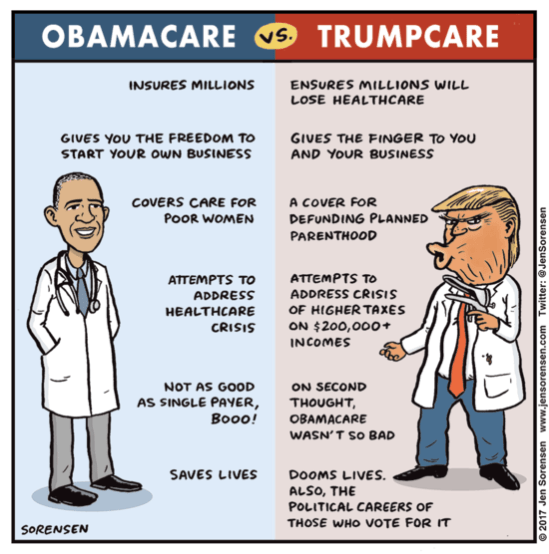
obamacare-trumpcare915

As a Catholic and a liberal, I’ve always believed that for-profit health insurance is inherently wrong since it makes money on people’s misery and discriminates against the old, sick, disabled, and poor. Nobody should be denied healthcare for any reason. I passionately believe that healthcare is a fundamental right that nobody can take away. As someone on the autism spectrum who’s on Medicaid, I consider such service a godsend and liberating. I’m not ashamed for relying on Medicaid since it government medical assistance has greatly helped me throughout my life. And I’m perfectly fine with my tax dollars paying for other people’s medical treatments, especially if they’re much more disadvantaged than me. Though finding a decent dentist who takes my plan is a pain in the ass, it at least provides the healthcare access I need so finding a job with health benefits isn’t a matter of life and death. If my job doesn’t provide health benefits, then I can purchase a subsidized plan on the individual market thanks to the Obamacare exchanges and the Medicaid expansion. And thanks to Obamacare, I won’t have to worry about lifetime caps or my autism being a preexisting condition. Still, while I don’t think Obamacare goes far enough and would prefer a single payer US healthcare policy, I strongly think that it’s a step in the right direction and improves healthcare access drastically. To repeal and replace it with a healthcare plan that takes healthcare away from people who benefit from Obamacare like myself is malicious and cruel. To me healthcare isn’t about government, money, or whether we should pay for other people’s treatment. It’s an issue of human dignity as well as a matter life and death. The idea of the GOP healthcare becoming law scares the hell out of me. And I’m very afraid I’ll lose my Medicaid and may never be able to get health insurance that’s just as good, or at all. I shouldn’t have to lose my healthcare just so some rich guy can have a massive tax cut he doesn’t even need. Nor should anyone else. I strongly wish the Republicans give up trying to repeal Obamacare once and for all because politicians, corporations, and employers shouldn’t decide who should have access to healthcare. If someone gets sick or injured, they should receive the best care they need without breaking the bank. And I don’t care who that person is, whether they can afford it or who has to pay for their treatment. Because if their life depends on receiving care, then nothing else should matter. And I think it’s an appalling shame that too many people in this country don’t agree with me on that.

eaker-gov-just-stop-being-poor-american-health-care-act-of-16012621

Here is a list of reasons why we need to stop the Republicans from repealing Obamacare and replacing it with a cruel substitute that nobody wants.


  1. The Republican Healthcare Plan to Repeal and Replace Obamacare is being comprised in secret and is being rushed to passage violates legislative due process.– Regardless of what you think about Obamacare, the process to pass the Affordable Care Act was lengthy, thorough, and transparent. In the House the ACA, received 79 hearings with 181 witnesses and 121 amendments as well as took over a year to pass. By contrast, Trumpcare has been rushed as well as negotiated in backrooms without input from experts, stakeholders, or the public. In the House, the AHCA received literally no hearings, no witnesses, and no substantive amendments and the Republicans passed it less than 2 months after revealing it. As of now, a group of 13 GOP Senators are deciding the future of the American healthcare system without following formal processes or seeking public input. Republican senators are now cutting deals on Trumpcare through informal working groups aimed at getting support for their healthcare plan from any holdouts. These working groups don’t include a single female Senator-Republican or Democrat. The Senate hasn’t held any public hearings or listening sessions on Trumpcare. Nor have they asked for feedback from any of the key stakeholders such as the public, children’s or disability rights groups providers, nor small business owners. Nevertheless, on such a major piece of legislation like Trumpcare, public debate is essential since it promotes accountability by leaving a public record of how a law came to be. And hearings give lawmakers the chance to hear from experts on what the bill would do. These GOP procedural shortcuts are the height of hypocrisy and set a dangerous precedent.
  2. The Republican Healthcare Plan to Repeal and Replace Obamacare is highly favorable to conservative free market ideology.– One of the main reasons for all the secrecy for the GOP drafting their healthcare legislation in secret is that Republicans want their plan to be as conservative ideologically pure as possible. Sure they want to scrap Obamacare but not because it doesn’t cover enough people and rising premiums. But they want to do so because they don’t believe the government should have to provide healthcare or regulate the healthcare industry. Nor do they believe that taxpayers should pay for other people’s healthcare. The GOP isn’t interested in the opinions of families or healthcare providers who will live out the consequences of their decisions every day. What most Americans want more government intervention in healthcare as well as expand coverage and access. The AHCA does the opposite of that which is what the Republicans want, which at its core is to redirect money spent to buy insurance for the poor to $600 billion tax cuts for the rich.
  3. The Republican Healthcare Plan to Repeal and Replace Obamacare is an unacceptable moral travesty.– Knowing what’s in the American Healthcare Act, it’s very clear that the GOP Senate’s healthcare plan would be no different from this one. A healthcare policy that denies health insurance to millions of Americans isn’t just horrifically unpopular and unsustainable, it’s also inherently cruel. Healthcare is a right that should never be denied to anyone in need of it. A bill that takes away healthcare from millions of people is unacceptable. Denying a poor person lifesaving medical care is not only a death sentence, but also undermines their humanity by reducing them to a financial risk. It also deprives them of a right to live or that their life doesn’t matter. Unfortunately this is the norm in the US healthcare system even with Obamacare though at a smaller scale. And if Trumpcare becomes law, expect such atrocities to happen more often. If we value human life and dignity, then we should make sure that nobody has the right to people’s access to healthcare. Whether this means more government intervention or a taxpayer funded healthcare system shouldn’t even matter.
  4. The Republican Healthcare Plan to Repeal and Replace Obamacare is wildly unpopular.– There is not a majority supporting the GOP healthcare plan in a single US state. Not one. Less than 20% of Americans Trumpcare. Most American healthcare establishment has condemned it. The reason why GOP Senators are now crafting healthcare legislation in secret is because they know the public doesn’t want it. And they know voting for such a plan could politically cost them big time come 2018. But at the same time, they don’t want to alienate their base and donors who want Obamacare repealed as soon as possible. Though it would be better for Republicans politically as well as the nation, if they just give up trying to repeal Obamacare and leave it alone.
  5. The Republican Healthcare Plan to Repeal and Replace Obamacare threatens health security for every American.– Unless you’re young, rich, and/or relatively healthy, Trumpcare could determine whether millions of Americans will have health coverage. The healthcare system touches all our lives and a GOP plan to repeal Obamacare could leave millions of Americans uninsured, which can be a matter of life or death to thousands of them. Not to mention, it’s greatly apparent that most of the American public and the healthcare industry don’t want the GOP’s healthcare plan. That doesn’t even get to the fact that the House passed the American Healthcare Act with no input from experts, stakeholders, or the public. Nor did the AHCA received any hearings, witnesses, or substantive amendments to the actual legislation accepted in committee. They tried to pass it 17 days after revealing it and were able to do so in less than 2 months. Surely any major piece of legislation that threatens at least your healthcare security shouldn’t be rushed through a very undemocratic process.
  6. The American Healthcare Act takes away healthcare from 23 million Americans.-According to nonpartisan estimates by the Congressional Budget Office (CBO). This will result in 24,000-44,000 more Americans dying every year from lack of insurance along with medical bankruptcies, lost wages, untreated illnesses, and others.
  7. The American Healthcare Act hikes deductibles by $1500 on average.– Trumpcare pushes Americans into low quality, high cost-sharing health insurance by providing meager tax credits compared to the Affordable Care Act. This is the opposite of what Trump promised in his campaign. This will have particular negative impact for those least able to pay them.
  8. The American Healthcare Act ends federal protections for people with pre-existing conditions.– TrumpCare incentivizes states to drop consumer protections, meaning insurance companies will be able to charge people with pre-existing conditions more. 130 million Americans have a pre-existing condition. Insurers in states that adopt opt-out waivers on ACA protections could charge people with pre-existing conditions 10 to 20 times more than others. And the CBO estimates that 1 in 6 people in the country would live in such a state. People could face premiums well over $100,000. Though Republicans are trying to make the case that high-risk pools will protect people with pre-existing conditions, they’ve been tried before and don’t work. And they usually have significantly higher premiums, lifetime limits, enrollment caps, waiting lists, and lock-out periods.
  9. The American Healthcare Act allows insurance companies to charge older Americans significantly more their healthcare.– A single, 64-year-old adult making 26,500 a year would have to pay between $13,600 and $16,100 in annual premiums, depending on whether they live in a state that sought a waiver from consumer protections. Compare this to the $1,700 the same person would have to pay under the current law, that’s a 950% increase.
  10. The American Healthcare Act cuts $834 billion from Medicaid, a program that more than 70 million Americans, half of which are children, rely on.– Medicaid is the largest health insurance provider in the United States and is funded by the government. Trumpcare cuts federal funding for the program which will result in states having to ration care and cut the quality of services. This could be devastating for the elderly, people with disabilities, the chronically ill, the mentally ill, addicts, children, and low income families. And many of these people would end up uninsured and unable to get health insurance anywhere else, especially if they have pre-existing conditions or if their employer doesn’t provide it. Under Trumpcare, Medicaid for kids, elderly, and the disabled is radically transformed into a system where states get fixed funding, regardless of their healthcare needs and unexpected disasters like Zika or opioid addiction spikes that drive up the cost of services. It’s estimated that under Trumpcare, 14 million will lose their Medicaid coverage.
  11. The American Healthcare Act puts lifetime and annual benefit caps on the table for even those with employer coverage.– This means a baby with a serious medical condition could use up its lifetime limits in the first month of life under Trumpcare.
  12. The American Healthcare Act makes women pay more for health insurance than men.– Because insurance companies could charge more for pre-existing conditions like breast cancer or assault survival and because pregnancy care no longer would be a required benefit, women would once again pay more for healthcare than men. The CBO estimates that woman wanting maternity care will have to add $1000 a month to her premiums.
  13. The American Healthcare Act defunds Planned Parenthood.– Nearly 3 million Americans, especially women and families receive affordable healthcare services annually at Planned Parenthood facilities. Trumpcare prohibits funding from going to these clinics.
  14. The American Healthcare Act harms children with special needs by cutting Special Education funds for schools.– Medicaid funds a large portion of education for students with a variety of disabilities. Buried in this bill is a provision that no longer recognizes schools as required Medicaid providers, on top of massive cuts to the program.
  15. Under the American Healthcare Act, health insurance companies can cover fewer essential health benefits even under employer plans.– Under Obamacare, insurance companies are required to cover a list of 10 essential health benefits including doctors’ services, inpatient and outpatient care, prescription drug coverage, pregnancy and childbirth, mental health services, and more as well as limits out of pocket costs. States under Trumpcare allows states to opt out of essential benefit requirements which will mean higher premiums and more out of pocket costs.
  16. The American Healthcare Act eliminates the employer mandate for large companies which will result in 7 million American workers losing employer coverage.– Under Obamacare, businesses with at least 50 employees are required to offer health insurance to their full time workers. Trumpcare eliminates this mandate which will result in large businesses dumping people off their employee-sponsored insurance. This will be particularly devastating to low income workers who may be able to afford purchasing healthcare on the individual market, especially if they have pre-existing conditions and higher premiums. And many will certainly not have the Medicaid expansion to fall back on.
  17. And the American Healthcare Act does all this to pay for $600 billion in tax breaks for the wealthy and corporations.– Providing a massive tax cut to the rich and corporations is no justification for denying millions of people healthcare. I don’t care what your political beliefs are. Still, if you want to finance healthcare access to people who can’t afford it, other people have to pay for it. And for rich people and corporations, that price is relatively small compared to what most Americans have to put up with if they don’t pay the bill.
  18. The American Healthcare Act will result in more abortions as well as maternal and infant deaths.– Because that’s what happens when you defund Planned Parenthood, cut $834 billion from Medicaid, no longer have pregnancy care as a required benefit, designate pregnancy and disabilities as pre-existing conditions, and cut access to healthcare entirely for millions of women. Lack of access to healthcare is a major reason why a lot of women terminate their pregnancies and why maternal deaths in the US are so high right now. Because when a pregnant woman doesn’t have healthcare access, having an abortion isn’t much of a choice. Because Texas refused to expand Medicaid and has taken great lengths to close its abortion clinics, it now has the highest maternal mortality rate in the entire developed world. Many of these women who die from pregnancy-related complications are poor and uninsured. Not to mention, before Obamacare, it’s widely noted that that insurance companies forced women to abort if their unborn babies had birth defects. A bill funding abortions on demand upholds the sanctity of human life far more than Trumpcare ever could, especially if a poor woman’s alternative is death. If we’re a society who values life and wants to save unborn babies, then ensuring that their mothers have access to healthcare is absolutely vital.
  19. The American Healthcare Act will exacerbate the opioid crisis.– Under the ACA, substance abuse treatment is considered an essential health benefit health insurance companies are required to cover. Many Americans also depend on Medicaid to pay for their substance abuse treatment as well. While the opioid crisis is devastating at epic proportions, it had existed long before Obamacare was made into law. Yet, if it wasn’t for Obamacare, the opioid crisis would’ve been much worse since many addicts would’ve not had access to treatment. This is especially the case for low income Americans who’ve suffered the most. Trumpcare could deny these people the very treatment they need to get their lives back on track which will result in more overdose deaths, family tragedies, and ravaged communities. Furthermore, under Trumpcare, insurance companies can deny or limit care to opioid addicts since substance abuse has often been seen as a pre-existing condition.
  20. The American Healthcare Act will result in more lives more deaths and disabilities from gun violence.– Another major public health crisis in the US is gun violence which kills nearly as many people as opioid addiction and costs American taxpayers $229 billion or over $700 per American annually. The total cost of gun violence amounts to more than the total cost of obesity and almost as much as the annual price tag for the entire Medicaid program. This includes at least $8.6 billion in direct expenses such as for emergency and medical care, which can include follow-ups, readmissions, disability, home medications, extended treatments like physical therapy, mental health services, and loss of work. From 2006-2014, the annual cost for initial hospitalizations for firearms injuries averaged $734.6 million per year. Medicaid paid about 1/3 of the costs, the largest proportion while insured patients accounted for over a quarter since most gun victims are young men from low income areas. For every one person who dies from a gunshot, there are 3 or 4 who usually survive. Individuals hospitalized for firearm injury were 30 times more likely to be re-hospitalized for another gun injury and 11 times more likely to die from gun violence within the next 5 years. A gunshot wound can wreck a person’s whole life if they don’t seek proper medical treatment as soon as possible. Many poor people either die or become permanently disabled from gunshot wounds, because they can’t afford the emergency room bill which amount to thousands of dollars. Yet, many suffer with long term physical, mental, and financial problems. And gunshot wounds often drive up US medical costs. Should Trumpcare become law, expect more gun victims leaving hospitals without adequate medical care and more uninsured victims. Not to mention, higher medical costs for the rest of us.
  21. The American Healthcare Act will result in more preventable deaths.– Despite what one Republican Idaho congressman might tell you, people have died because they were uninsured. Before the American Healthcare Act was passed, a 2009 study in the American Journal of Public Health found that lack of health insurance was associated with 45,000 deaths per year. The study’s author reported that lack of healthcare access contributed to one person dying every 12 minutes. If Trumpcare becomes law, it’s estimated that 22,000 – 44,000 will die a year due to lack of health insurance.
  22. The American Healthcare Act will hurt the US economy.– The Commonwealth Fund estimates that Trumpcare can cost over 1.8 million jobs. Not to mention, since it will certainly result in higher healthcare costs, expect job loss and hospital closings in the healthcare industry, especially in poor and rural areas. We should remember the healthcare industry accounts for 1/6 of the US economy, employs 19 million people. Also, high premiums, healthcare costs, and lack of affordable options might lead many people to reconsider quitting their jobs to start their own business, a concept known as “job lock.”
  23. The American Healthcare Act will hurt communities.– Since Trumpcare will make healthcare less affordable, this will leave many hospitals and medical facilities vulnerable to closing, particularly in rural and impoverished areas. Hospitals provide a critical function in local communities. A hospital closing not only costs jobs and revenue, but also cuts healthcare access to the people who live there, forcing them to seek medical care farther away. This can be especially devastating in impoverished and rural areas.
  24. The American Healthcare Act will hurt Americans’ quality of life.– While Obamacare has its faults, it at least provided millions of Americans with adequate healthcare coverage and options to meet many people’s needs and don’t break the bank. Thanks to the ACA, more people are covered and are more willing to visit a doctor. Not to mention, more people are able to depend less on employee-sponsored health benefits and are able to leave their job to start a business, raise a child, or retire early. And if you can’t find a job or lost one for reasons beyond one’s control, then it’s not the end of the world if your state has the Medicaid expansion. Trumpcare can have devastating implications on people’s lives, especially if they’re unable to get treatment for chronic pre-existing conditions. Many already employed may be forced to return to the workforce and to jobs they despise. Those who can’t find a job would be under increased pressure to find one while those who’ve lost theirs can lose their benefits. But both would be unable to find an affordable healthcare plan on the individual market, especially if they have a pre-existing condition. Same goes for those who lose their healthcare due to divorce or death of a spouse. People in abusive relationships could end up staying with their abusive partners. Those struggling with addiction and mental illness may not be able to seek treatment. Those who can’t work due to illness may end up unable to afford coverage and be forced to postpone treatment, which can make them even sicker. And it increases the possibility for people’s medical treatments driving them to bankruptcy.
  25. The American Healthcare Act is fundamentally Un-American.– If patriotism should mean anything to us, then it means sacrificing for the common good. Under the ACA, healthier and wealthier Americans pay a little more so sicker and poorer Americans don’t die. A for-profit healthcare system where people are seen to deserve the best deal they can get for themselves just doesn’t deliver that promise. Most Americans know that very well and are perfectly willing to subsidize poorer and sicker people under Obamacare, especially if it means better coverage for them. The Republican passage of the American Healthcare Act in May is a major betrayal to American values. In addition, it’s undemocratic to fast-track a major piece of legislation that would affect people’s lives every day without even consulting them, especially if it’s a policy the public doesn’t want at all.

The Shadowy World of InfoWars

1487189891794-infowars

I know many people might think I’m being biased over writing posts bashing right-wing news outlets. But though I am a liberal, I don’t just write these articles to score political points. For instance, back in October I criticized Fox News for a lot of the shit they’re being bashed for now like a culture fostering sexual harassment and peddling conspiracy theories. Months later, I attacked Breitbart for its corrosive influence on the conservative media landscape during the 2016 Election, its flagrant demonization against those Steve Bannon doesn’t like, its lack of concern for facts, and its status as the platform for the Alt-Right. Besides, in recent years, white supremacist and far right terror incidents have been on the rise, especially since the presidential election of Donald Trump. Breitbart and Fox News have certainly played a role in implicitly encouraging such attacks whether they’d want to admit it or not.

VoYDQboXvV9fkhYngYgYKxSOGt7TcjTj_lg

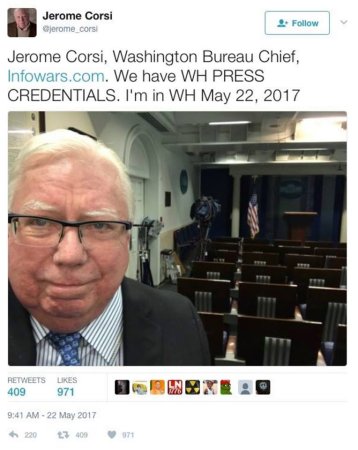
Don’t worry, InfoWars only had press credentials for one day only. By the way, like Alex Jones, Corsi has also made a living pushing conspiracy theories, including the claim of Barack Obama having a fake birth certificate.

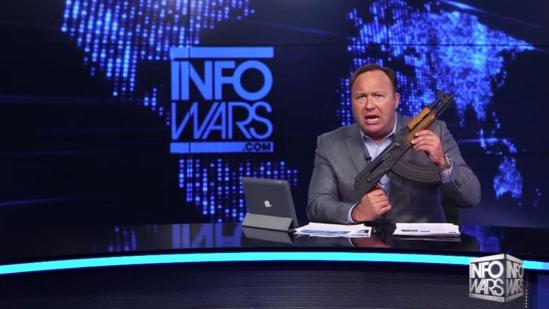
But there’s another media outlet I need to discuss with my readers and that is InfoWars, a far right conspiracy-based website created, owned, and operated by Austin, Texas-based radio host Alex Jones. In fact, type InfoWars on Wikipedia and you’ll be directed to an article on Jones. In late May, its Washington Bureau Chief Jerome Corsi broadcast from the White House briefing room after announcing they had obtained a temporary press credential. Fortunately, it was only a one-day pass that was relatively easy to get. And Jones once claimed in a video back in January he had been offered access before which the White House quickly denied. The odds of InfoWars obtaining any press credentials at all from the White House Press Office are highly unlikely or so we hope. Nevertheless, it’s very apparent that the far right website has the Trump Administration’s ear. Trump has appeared on Jones’s show multiple times during the 2016 Election and has welcomed the host’s support as well as parroted his message on numerous occasions. His adviser Roger Stone was a regular guest. During the GOP Convention last July, Stone and Jones co-hosted a pro-Trump rally. Trump campaign aides and Donald Trump Jr. have promoted InfoWars stories on social media. And Trump has often promoted a lot of Jones conspiracy theories at his rallies such as Jersey City Muslims cheering on 9/11 and California drought denial. In exchange, Jones has gained prominence since then.

alexjonestrumpinterview

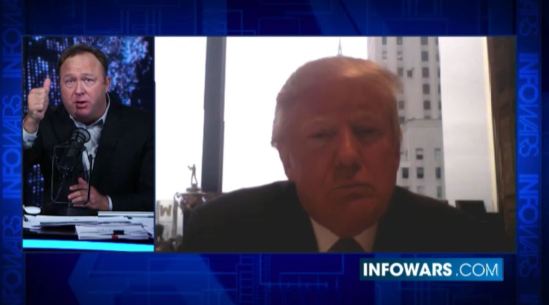
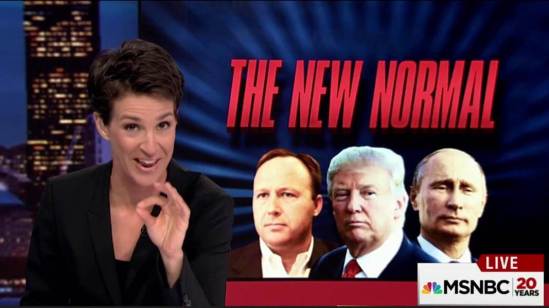
Alex Jones and his InfoWars have risen considerably since the 2016 Election thanks to Donald Trump’s candidacy. Jones has endorsed him while Trump has appeared on his show seen here. Still, Trump’s association with Jones should terrify you if you care about facts.

Of course, this article will probably speak more about Alex Jones with InfoWars only being the principal part of his multimedia empire. Aside from his infamous conspiracy-themed website, Jones also hosts a nationally broadcast radio show called “The Alex Jones Show” and runs another similar website called Prison Planet. He also peddles an extensive line of self-produced videos he refers as “documentaries” that claim to prove a whole array of his conspiracy theories. Nonetheless, despite media outlets denouncing him as a fraud for years, Jones retains considerable and widespread influence. His radio show airs on about 100 radio stations and has attracted about 2-3 million weekly listeners.  His subscription only video streaming website Prison Planet has a 3,327 Alexa rank. But his biggest media platform is InfoWars which has a 330 Alexa rank and attracts more than 8 million visitors each month who’ve viewed its pages 50 million times. The biggest of his 18 YouTube channels has 1.2 billion views and his Facebook page has millions of followers. In 2011, Rolling Stone reported that Jones had a larger online audience than Glenn Beck and Rush Limbaugh combined. For a radical right conspiracy theorist, this degree of popularity is extensive. And it was one of the key conservative news sources for the 2016 Election.

alexjonesrandpaul-jones911

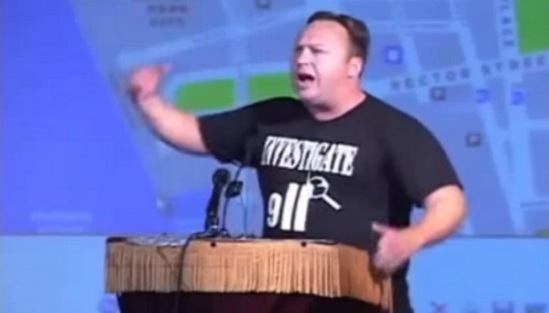
Alex Jones is one of the most prominent conspiracy theorists in the country best known for saying that 9/11 was an inside job and his “documentary” about it called Loose Change. However, you must remember that this paranoid, hate-filled man is full of some of the stinkiest bullshit you’ll ever hear. Seriously, InfoWars is a flagrant outlet of fake news.

However, we must concede that Alex Jones is a very dangerous man in the US media landscape. He is almost certainly the most prolific conspiracy theorist in contemporary America and possibly the one with the most far-reaching influence in the nation’s history. But there is a very good reason why the Southern Poverty Law Center an extremist file on him. Jones is no ordinary radio host and has lived in his own little world for the last 20 years filled with intrigue, scandals, cover ups, and conspiracies. Called by Rolling Stone as “the most paranoid man in America,” Jones is notorious for his epic rants about “New World Order” plots for world government, enforced eugenics, secret internment camps, militarized police, and behind-the-scenes control by a global corporate cabal. He is convinced that global elites have allied themselves against the United States to destroy the country. The only way to avert this dystopian future as far as he’s concerned is if true patriots resist before it’s too late. Jones is also infamous for his many predictions and never stops reminding his viewers of the one he made in July 2001 that came somewhat close to foreshadowing 9/11. Yet, not surprisingly his overall accuracy rate his infinitesimally low. In February 2010 he stated that at least 15 European nations will collapse within the next 16 months. In March 2010, he declared that there will be staged terror attacks on April 15 or 19 to coincide with anti-Tea Party documentaries releases on Fox, CNN, MSNBC, and HBO. And in May 2010, he predicted that the US dollar will be devalued by 50% within 2 years.


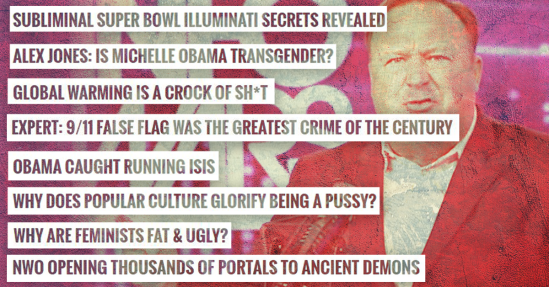
alexjones_infowars_headlines_3

Here are some InfoWars headlines to give you some insight. I’m sure you’ll find a lot of offensive bullshit to get you mad about. With fake news, there’s nothing more unreliable than Alex Jones and InfoWars.

For years, Jones has offered his own version that’s completely unsupported by evidence but often reflect his paranoid, unhinged, racist, and misogynist worldview. Time after time he’s decried terrorist attacks like 9/11, the Boston Marathon and Oklahoma City bombings, and various mass shootings such as those in Columbine, Aurora, Newtown, Tucson, Charleston, and the Washington Navy Yard as actually “false flag” operations by our government or evil “globalist” forces wanting to take over the world. He’s referred to gay marriage as a globalist conspiracy to encourage the breakdown of the family,” “to get rid of God,” and to promote pedophilia. He’s called the Sandy Hook Elementary School shooting a “hoax” created by gun control advocates as well as alleged that the victims were child actors and that nobody was killed there. Jones views himself as a libertarian and an “aggressive constitutionalist” defending individual liberties, the Bill of Rights, property rights, and the security of U.S. borders against illegal immigrant hordes being ushered in by evil forces bent on destroying our society. Because to him, illegal immigrants exist in the US to “give corporations subsidized low wages — because they can’t live on the low wages they get, so they give them the welfare, and that’s designed to give the big corporations an unfair trading advantage. They’re using poverty as a tool of control.” He’s even alleged millions of undocumented immigrants of illegally voting in the 2016 Election. Many of his theories could be seen as outright ridiculous such as the notion of the government having weapons that create artificial tornadoes.  Or that the government is poisoning our drinking water through fluoridation. Or that Lady Gaga’s Super Bowl Halftime Show was a Satanic ritual. Or that Bill Gates is a eugenicist trying to wipe out minorities. Or that Hillary Clinton is running a child sex ring at a D.C.-area pizzeria. Actually anything bad about Hillary. Or that “tap water is a gay bomb and they are putting chemicals in the water to turn the friggin’ frogs gay.” Or that Glenn Beck is a CIA operative. Or that the Social Security Administration is buying ammunition to use against the public during unrest. Or that the moon landing was fake. Other claims include claims that “chemtrails” from the backs of planes spread a deadly “weaponized flu,” that juice boxes are turning children gay and that the musician Beyoncé is a CIA plant out to stir racial violence and “literally” eat the brains of children. He’s even pushed the idea that aliens in lizard form secretly orchestrate world events.

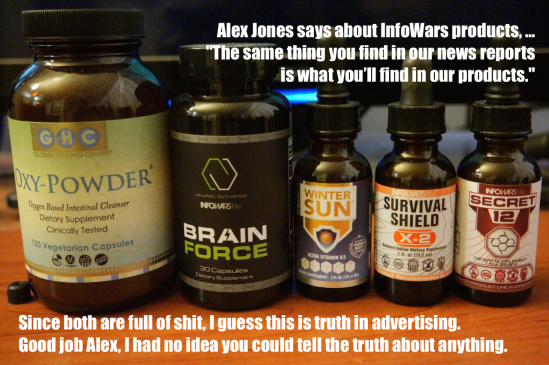
d74

Alex Jones makes a lot of his money through selling supplements like these and other products. Unfortunately, exploiting his fans’ fear and paranoia has been good business for him.

Many might view Alex Jones as a bad joke and a crazy man prone to on air meltdowns. But no matter how crazy his conspiracy theories could be, what makes him dangerous is that legions of his acolytes take him at his every word. Like any conspiracy theorist, Jones manipulates psychological fears of the vulnerable into complete acceptance of nearly anything he says- no matter how outlandish it may be. According to Der Spiegel, 2/3 of Jones’s funding comes from marketing his own products. He sells toothpaste, brain pills, bulletproof vests and guns, sleeping pills, potency supplements, and “recession-proof investments in gold coins and other precious metals offered by his syndicator-owned Midas Resources. And since InfoWars appeals to those believing Armageddon is near, business is doing well as his followers build bunkers, hoard food, and invest in precious metals. Yet, Jones’s rantings have had real impact. In 2015, he helped spark a hysterical reaction to the Jade Helm, a US military exercise designed to help soldiers train for various combat environments. Jones swore it was a cover for the beginning stages of martial law. Enough people believed him that the Army had to send surrogates to calm anxious citizens. He’s also argued that Chobani’s practice of hiring refugees has brought “migrant rapists” and tuberculosis to areas near their factories. This resulted in a boycott and Chobani filing a defamation lawsuit.

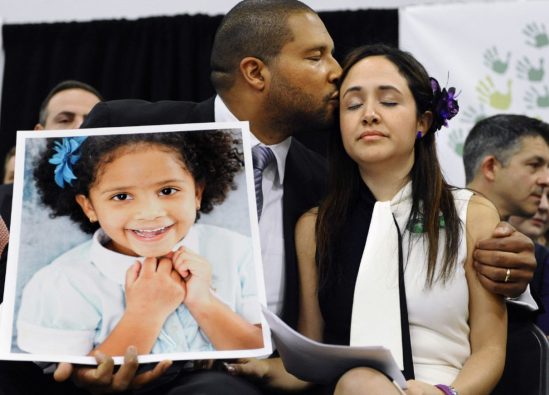
ana-grace.jpg.size.custom.crop.1086x783

One of the most egregious Alex Jones conspiracy theories was his take on the Sandy Hook shooting at Newtown being a hoax by the liberals to promote gun control. He even alleged that the dead children were child actors and that nobody actually died there. Many of the victims’ families have been harassed by some of his fans. And the Sandy Hook families were furious when they heard that Megyn Kelly would be interviewing him for her NBC Sunday show.

But some of Alex Jones’s fans don’t just buy his supplements, prepare for the apocalypse, or panic over certain stuff they don’t understand. In fact, a few of them have resorted to deadly violence. The SPLC’s Heidi Beirich has referred to Jones as a gateway drug for white supremacy with many leaders crediting his broadcasts for opening their minds to new thinking as they adopted their racist philosophy, including Daily Stormer Andrew Angling and Info Stormer Lee Rogers. The 2009 Pittsburgh cop killer Richard Poplawski was a frequent InfoWars visitor who frequently shared links from the site to others and sometimes even posted on it. The 2011 Tucson shooter Jared Lee Loughner was a fan of Jones’s film, Loose Change, a gospel source for anyone believing 9/11 was an inside job. 2014 North Las Vegas shooter Jerad Miller was an InfoWars forum member who wrote posts speculating about killing cops and avidly posted links from the site on his Facebook page. He and his wife Amanda ended up killing two cops and an armed civilian at a Cici’s Pizza and a Walmart. In October 2016, two Georgia men were arrested in connection with an alleged domestic terror plot to travel nearly 3,500 miles to a former military research facility in Alaska that they believed manipulates the weather, controls minds and traps souls. Both men had amassed an arsenal of AR-15 military-style assault rifles, four Glock handguns, a rifle and more than 2,000 rounds of ammunition, radios and flak jackets. They planned to use these weapons to attack the Alaska’s High-Frequency Active Auroral Research Program (HAARP), a large radio transmitter cited in numerous antigovernment conspiracy theories. And in December of that year a North Carolina man stormed a Washington D.C. pizza joint called Comet Ping-Pong to “self-investigate” rumors that the restaurant was the was the center of child sex-slave ring with connections to the Hillary Clinton campaign. After an FBI complaint showed that gunman Edgar Welch watched an InfoWars “documentary,” Jones scrubbed his site of most of its Pizzagate content in order to distance himself from the impact of this extremely toxic lie. That’s not even talking about all the shit the Sandy Hook victims’ families had to put up with. Nevertheless, Jones’s influence on the radical right is very widespread. Though he hasn’t instigated any attacks, he sure provides many terrorists plenty of inspiration.

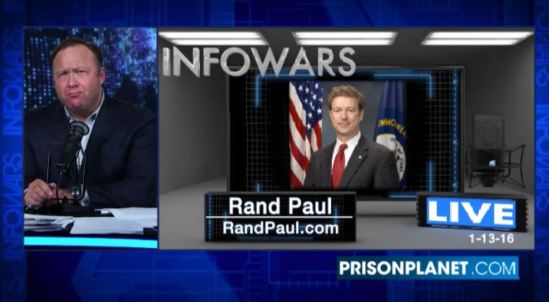
alexjonesrandpaul11316

Even before Trump, Alex Jones has somewhat been mainstreamed among the conservative media. Here he is with US Senator Rand Paul of Kentucky. Yes, you got that right.

While many people could simply write off Alex Jones as a crazy, we must keep in mind that conservative media outlets frequently aggregate and propagate InfoWars stories. In November 2016, the conspiracy website published a piece citing an unverified claim from a former Texas health deputy commissioner that 3 million non-citizens voted illegally which was later linked to the Drudge Report. 13 days later it appeared in Trump’s Twitter account. More recently, in early March an InfoWars editor tweeted an old photo of New York Senator Chuck Schumer acting chummy with Vladimir Putin. 12 hours later it appeared atop the Drudge Report and 12 hours after that, Trump had tweeted it. Even before the 2016 Election, Jones and his theories were already making rapid inroads into the mainstream mainly thanks to the Drudge Report. But Matt Drudge wasn’t the only validator. Other luminaries have appeared on Jones’s show such as Rep. Ron and Sen. Rand Paul, Fox News personalities Lou Dobbs and Andrew Napolitano, and celebrities Ted Nugent and Charlie Sheen. Fox News has aired plenty of his theories for years and he has been a guest on the network. Though the ones Fox airs often aren’t remotely related to the crazier New World Order stuff, they do serve to help promote a certain conservative worldview. And a lot of these seem to pertain to liberals and minorities. For instance, the idea that millions of undocumented immigrants voted for Hillary Clinton was all over the news. During the 2016 Election, the right wing assault on Hillary Clinton comprised of several fake news stories were daily mainstream media headlines despite not having a single shred of evidence to support them. Though to be fair, the modern conservative movement has long been afflicted with conspiracy theorists since its origins in the 1950s and 60s. Even “respectable” elements like Glenn Beck and the National Review have been very happy to manipulate far right conspiracies either to build support for typical Republicans or to make a buck. This strategy made it much easier for someone like Jones to get into the party’s foothold and come into contact with actual Republican legislators and key conservative media figures. So associating with a known right wing conspiracy theorist wasn’t much of a problem for Trump. Jones might’ve started as a fringe figure. But years of mainstreaming allowed him to build a real presence among Republican voters. And Jones’s rise helps explain why the formal GOP leadership had such a hard time disavowing him even during the primary.

Another reason that Alex Jones is dangerous is his association with Donald Trump. Trump has long been a big fan of his and a lot of his lies have come directly or indirectly from InfoWars. When he appeared on the site in December 2015, he declared Jones’s reputation “amazing” and told the internet fabulist, “I will not let you down. You will be very impressed, I hope, and I think we’ll be speaking a lot.” Jones’s support for Trump has elevated many of his fringe conspiracy theories to a mass audience. Trump’s embrace of Jones shouldn’t come as a surprise for us. After all, Trump got his start in politics by promoting “birtherism” and other racist Obama conspiracy theories. He’s a shameless opportunist with no personal ethics. Whether he believes Jones’s diatribes is beside the point. But he surely doesn’t care about the consequences. All that matters to him is that they’re receptive to an audience and give him what he wants. Through accepting Jones’s endorsement and courting the radical right, Trump helped legitimize him and his radical right fanbase. Trump has pushed some conspiracy theories Jones has originated like Hillary abusing drugs, massive voter fraud, that Justice Scalia was murdered, New Jersey Muslims celebrating 9/11, and that Rafael Cruz was involved in the Kennedy assassination. Nevertheless, since Republican leaders and media outlets were too used to conspiracy theorizing to get all worked about it. So associating with a known right wing conspiracy theorist wasn’t much of a problem for Trump. Yet, by embracing Jones, Trump also legitimizes him and all the ugly stuff his fans have done. And it doesn’t help that his administration isn’t cracking down on right wing terrorism which is a serious problem in this country.

2016-09-09t01-05-32-266z--1280x720.nbcnews-ux-1080-600

It’s one thing for Alex Jones to influence extremists to become terrorists. But it’s scary as hell that Donald Trump purveys many of his conspiracy theories to the masses. Promoting conspiracies is what dictators do in authoritarian regimes. Not democratically elected presidents.

Nevertheless, a conspiracy theorist like Alex Jones is dangerous enough that his conspiracy theories have hurt people and ruined lives. It’s bad enough that his theories have inspired terrorism and hate incidents. But it’s even worse that Jones is embraced by people in power, especially a president like Donald Trump who pushes his theories and may even make decisions based on them. To have a president like this who legitimizes Jones can undermine democracy and who knows what else. The United States was already led into a war in Iraq over a lie about weapons of mass destruction. We need to understand that when people believe in conspiracy theories in their worldview, there can be very terrible consequences. People might start questioning established facts that don’t confirm to their ideology, perhaps to the point that they may not trust institutions like government, the media, science, and even religion. Marginalized people might be demonized as freeloaders, job stealers, criminals, and even terrorists. Public figures are smeared. And anyone perceived as a scapegoat can be a targeted with violence. When leaders believe such ideas, they can implement them in policies that could undermine the public good. After all, pushing conspiracy theories to the masses is what authoritarian dictators do in order to get the public to do what they want, hate who they hate, hurt who they want hurt, and even give up their rights over perceived threats that don’t really exist. InfoWars isn’t fact-based media and there’s no reason to believe anything Alex Jones says as his dark and distorted view of the world has no basis in reality. But since he has an audience to rival mainstream outlets, plenty of believers, and fans who’ve committed illegal acts based on his claims, we must take him seriously. Because though Jones may not be a violent criminal on the streets, his influence poses a special kind of danger, especially if leaders believe his claims.

We Will Gain Nothing from This

We open the month of June to Donald Trump in the Rose Garden announcing his decision that the United States will withdraw from the Paris climate agreement. Though it comes as no surprise from a man who believes that global warming is a hoax created by the Chinese, it a deeply selfish and unpopular gamble that will hurt everyone and benefit no one. No matter who you are, where you are, and what you believe in, this egregious decision will have very negative impact on you and children. At a time we can’t afford to ignore a global crisis of our own making, Trump has gambled away our futures, our health, our prosperity, and our lives. Furthermore, he has severely damaged America’s image and credibility at home and abroad. Trump’s reckless decision to pull out is a moral outrage and insult to future generations. And it poses a catastrophe for our planet, economy, and reputation around the globe.

Despite what the right-wing skeptics may claim, the threat of global warming is very real, is caused by humans, and poses devastating consequences for the planet and possibly all life on earth as we know it. Although there are some aspects of climate change we don’t understand, 97% of all climate scientists acknowledge its existence and there is overwhelming evidence that carbon emissions are changing the earth’s climate for the worse. Climate change has already unleashed disruption on the world’s ecosystems and human communities. Effects consist of rising sea levels, excessive droughts, desertification, frequent flooding, stronger storms, unpredictable weather, disease outbreaks, famines, ocean acidification, melting ice caps, extreme weather, mass extinction, habitat destruction, and other devastation. For many parts of the world, climate change can result in scarce resources, more widespread poverty, displacement, economic instability, and full out wars. Island nations are in critical danger of being totally underwater. And it will be the world’s poorest who suffer the most. There’s never been a more imminent time to act before it’s too late. Yet, we must acknowledge that the damage is already done in some places of the world. Withdrawing from the Paris Climate Accord doesn’t excuse our responsibility for the planet. Nor does it relieve us from global warming’s catastrophic consequences. Climate change isn’t a political issue catering to special interests. It’s a moral issue and a matter of life or death.

The Paris Climate Accord is a 31-page nonbinding agreement that was hammered out over weeks of tense negotiations in a December 2015. Its purpose is to create a culture of accountability to get countries take unspecified steps in fighting climate change. The backbone of this agreement is keeping global average temperatures from rising 2 degrees Celsius by the end of the century. Beyond 2 degrees, we risk dramatic higher seas, changes in weather patterns, food and water crises, and an overall more hostile world. Though critics argue that the 2-degree mark is arbitrary, or even too low to make a difference, the goal is a starting point that before Paris, the world was on track to wildly miss. To accomplish this, the accord states that countries should strive to reach “peak emissions” as soon as possible. The agreement doesn’t detail exactly how these countries should do so. But it does provide a framework for getting momentum going on greenhouse gas reduction with some oversight and accountability. Another precept is that richer countries would send $100 billion in aid to poorer countries by 2020 with the amount increasing over time. Nevertheless, it’s an agreement with near-universal support from around the world.

Donald Trump’s decision to for US withdrawal from the Paris Climate Accord spells absolute catastrophe for the planet. He may have claimed that the agreement was unfair to the United States. He may have stated it was to protect America and its citizens. And I’m sure he probably cited such an agreement made us look weak, takes jobs away, and whatever else. However, for the US to leave the Paris Climate Accord carries nothing but disastrous implications for everyone. As the world’s largest economy and second-largest CO2 emitter, US cooperation with Paris is vital to convincing other countries to make a serious effort to meet their targets. The Obama administration understood this for they played a major role in writing the Paris agreement’s original text and shaping it such that its terms were acceptable for American interests. To pull out suggests that the US doesn’t care about climate change anymore or about the potential catastrophic consequences for the planet. Yet, it also sends a broader signal that the US considers its obligations as optional and that US leadership can no longer be trusted to honor agreements on issues of vital concern for other countries. Even when it helps set the terms for the agreement itself. America’s global strategy depends on other countries trusting the US to abide closely enough to its on-paper agreements so it won’t pose a threat to them. And for better or worse, this strategy has been in force since World War II. The US has made major commitments to other countries to agree on a certain set of rules tackling the shared crisis of climate change. But the Trump administration has decided to quit those rules and simply do whatever it wants. What’s to say that the US won’t do the same thing again on something else like abandon a NATO ally or ignore an unfavorable WTO ruling? Not to mention, what if the other countries see that the US isn’t trying? Will they abandon their commitments, too? Because the Paris Accord can’t be effective without US participation.

Trump often describes his foreign policy as “America First” and had warned against “the false song of globalism” in his most comprehensive campaign speech on the matter. Sure the Paris Climate Accord is certainly globalism but climate change is a global crisis of epic proportions. But at the same time, an international commitment to fight climate change is perfectly within US interests. Now Trump is actively hostile to the international political order and every little thing he does to signal lack of interest matters. He has repeatedly questioned NATO and refused to commit defending these allies at the organization’s recent summit. He also declared the WTO as a “disaster” and his advisers prepared a report proposing to simply ignore its unfavorable rulings. By quitting an international agreement on a serious global problem, Trump has further and severely undermined global trust in US leadership and its standing on negotiating a wide range of issues. And it doesn’t help that German Chancellor Angela Merkel specifically cited that her chats with Trump on climate change as a reason that Germany couldn’t rely on the US anymore. Nevertheless, consequences of recklessly disregarding allied opinion and international institutions may not be felt tomorrow. But in the long-term, Trump’s decisions can permanently undermine American power’s core foundations. Eventually, other countries may put less faith in US-led institutions as well as seek structures and alliances that don’t depend on US cooperation. This would by necessity limit US influence over the world’s major powers as professor Paul Musgrave calls it, “hegemonic suicide.” Thus, any further actions Trump does like quitting the Paris agreement, the weaker the US gets in the long run.

Yet, quitting the Paris Climate Accord isn’t putting “America First” either. The effects of climate change may be more catastrophic in Third World countries. But the United States has also experienced it firsthand. Today, few years go by when average global temperatures aren’t the highest on record. Coastal areas of the nation have been ravaged by stronger and more devastating hurricanes. In the west, and wildfires in Texas, California, and a few other states have scorched homes to a cinder during the summer. California and the Southwest have also endured droughts which dried up major waterways. Heavy rains can bring upon terrible floods along the Mississippi River during the spring. The Midwest and the Northeast have also experienced serious snowstorms and sub-zero temperatures during the winter thanks to the Polar Vortex. Melting Arctic ice caps and rising temperatures have disrupted Alaskan wildlife and communities. Hawaii is ever more prone to rising sea levels that could put it underwater while Florida can also suffer the same fate. And in the heartland, Americans are especially prone to more destructive tornadoes plowing through their towns. That’s not even counting all the disease outbreaks, wildlife devastation, and the like. Even in the United States, there is overwhelming evidence of climate change at work and its negative impact. There is no wonder that a majority of Americans now believe that climate change is real and that the federal government should regulate greenhouse gas emissions. Major corporations including fossil fuel companies begged Trump to stay in the Paris Climate Accord. Not to mention, there was no majority of Americans who supported pulling out of Paris in any part of the country.

Of course, Trump isn’t alone to blame in quitting the Paris Climate Accord. Though some press coverage portrays his decision driven by either Steve Bannon’s policy agenda or his own idiosyncrasies, it misses the big picture almost entirely. For years, the Republican Party has adopted a rock-solid, widespread consensus opposing any serious action aimed at the United States reducing carbon emissions, which has become the bedrock of belief in the modern GOP. And in practice their influence has indefinitely crippled much effective action on combating the problem. According to a 2016 Pew Research study, only 23% of Republican voters believed that humans were responsible for global warming. Though we can’t know if any other Republican president elected in 2016 would’ve withdrawn from Paris, many institutional actors within the GOP and conservative movement strongly support this move and have urged Trump to make it. These include members of Congress (including Senate Majority Leader Mitch McConnell), think tanks, activist groups, media outlets, and conservative donors (including many with fossil fuel wealth). Even leading Republicans who might’ve supported sticking to the deal, would’ve also backed weakening environmental regulations and taken little if any action aimed at reducing carbon emissions. Nonetheless, while talking points differ, today’s GOP simply doesn’t believe climate change is a serious problem. Some may the very idea is a liberal hoax or that humans are causing the planet to warm at all. Some may acknowledge that the science is real, but argue that even if it’s accurate the consequences may not be so bad or that action is simply too costly. But beyond a few notable exceptions, most Republicans agree that addressing climate change shouldn’t be anywhere near the top in their political agenda. And those Republican politicians who conclude that the scientific consensus on climate change is accurate and tries to work with Democrats on the issue gets slammed by passionate and well-organized conservative groups and can face serious pressure from the right. We must acknowledge the reality that one of the US’s 2 major political parties is institutionally committed at nearly every level to the same basic agenda of environmental deregulation and inaction on carbon emissions. Thus, Trump’s decision to ditch the Paris deal isn’t an odd outlier but rests on that anti-environmental foundation. As long as the Republican Party embraces anti-environmental ideas like denying climate change, inaction will only continue.

As our human civilization taxes the planet, we have a shared responsibility to take care of it. This may mean we’ll have to adapt to new technologies to ensure a sustainable future. But if we don’t act now, future generations will live with the consequences. Trump’s decision to withdraw the US from the Paris climate agreement is as unwise as it is immoral as well as sends a cruel signal to the world that America doesn’t care about environmental values. Furthermore, undermines years of research and activism that made it possible. Failure to act will not only prove catastrophic for the environment, but to make us more prone to economic devastation and civil unrest. Ecosystems could be wiped out. New diseases can wreak havoc on communities. Island nations can disappear beneath the sea. Wars can break out between factions. People can be displaced due to famine, drought, or starvation. Severe storms can destroy entire communities and economies overnight. Those who oppose environmental protection often state that it cost jobs, contributes to big government, or undermines economic prosperity. Yet, whether we like it or not, we all depend on the Earth’s resources to survive and thrive. And pulling out of the Paris deal won’t bring any coal or manufacturing jobs back. Nor will it benefit the United States in anyway. Besides, there are more important things in this world than economic gain. Our planet’s health and well-being should be one of them. And as far as we know, Earth is the only planet that can support life to our liking. Not to mention, Corporate America increasingly sees climate change as a serious threat, so why shouldn’t Trump and the Republican Party? Today to deny climate change as the global crisis for our time for whatever reason can only mean further inaction, especially if conservatives remain stuck in their anti-environmental ways. Inaction only exacerbates the problem which will lead to widespread destruction. To deny climate change even if you’re a Republican is utterly inexcusable. Now more than ever we need to stand together and fight against Trump administration’s climate change skepticism and anti-environmental policies. Because combating global warming isn’t a mere political issue embraced by liberals but a moral imperative that future generations depend on. If we want to secure a bright future for our children, then the time to act is now. The United States and the world have absolutely nothing to gain from withdrawing from the Paris Climate Accord but everyone in the world has practically everything to lose.

Shooting the Messenger

Last week, on the eve of a special congressional election in Montana, Guardian reporter Ben Jacobs pressed Republican candidate Greg Gianforte to answer questions on the American Healthcare Act. In response, Gianforte grabbed his neck, threw Jacobs to the floor, punched him, and broke his glasses. Gianforte’s team tried to blame Jacobs for the altercation and pass him as the aggressor. But the Fox News crew witnessing the incident repudiate him saying, “To be clear, at no point did any of us who witnessed this assault see Jacobs show any form of physical aggression toward Gianforte.” The audio recording clearly illustrates what they saw with the candidate shouting, “I’m sick and tired of you guys. The last time you came here you did the same thing. Get the hell out of here. Get the hell out of here. The last guy did the same thing. Are you with the Guardian?” Gianforte was later charged with an assault misdemeanor (by a sheriff who donated to his campaign, incidentally) which can result in either a $500 fine or a 6 month jail sentence if convicted. The Billings Gazette, The Missoulian, and The Helena Independent Record all rescinded their endorsements of the Republican favorite. However, he still won with 51% of the vote in the state. Though to be fair, he was already expected to win and over 2/3 of Montanans had already cast their vote before the body slamming incident. So whatever Gianforte did at the moment wouldn’t have made much of a difference. Nor does his election mean that Montanans were okay with his actions. Nevertheless, conservatives and supporters were quick to defend the now congressman-elect. Gianforte’s campaign blamed the incident on “aggressive behavior from a liberal journalist.” They alleged Jacobs, “aggressively shoved a recorder” in Gianforte’s face and refused to leave. And that “Greg attempted to grab the phone that was pushed in his face. Jacobs grabbed Greg’s wrist, and spun away from Greg, pushing them both to the ground” to defend himself against “badgering questions.” Fox News pundits explained that the Gianforte had merely given Jacobs, a taste of “Montana justice.” Geraldo Rivera remarked that Monatanans “are no strangers to the more robust way of living.” While Laura Ingraham asked, “What would most Montana men do if ‘body slammed’ for no reason by another man?” In addition, Gianforte was even able to reap over $100,000 before the vote with most of it contributed after the incident. Texas Governor Greg Abbott even joked about shooting reporters. Other Republican politicians mostly brushed it off as if his choke-slamming a reporter either didn’t occur or wasn’t a problem.

Gianforte’s assault on Jacobs isn’t the first recent incident involving physical attacks on journalists. On May 18, security guards pinned CQ Roll Call’s John M. Donnelly against a wall during an open Federal Communications Commission meeting. All what Donnelly tried to do was question a commissioner as he recalled, “I could have not been less threatening or more polite. There is no justification for using force in such a situation.” He was held until FCC Commissioner Michael O’Rielly had passed and was escorted out of the building. And on May 10, police arrested reporter Dan Heyman of Public News Service for “willful disruption of state government processes” at the West Virginia State Capitol in Charleston. What Heyman did was repeatedly ask if domestic violence would be considered a preexisting condition under the GOP healthcare bill to Health and Human Services Secretary Tom Price. Price defended the police, saying they did what was appropriate. In March, Trump supporters allegedly assaulted an OC Weekly reporter and two photographers during a rally at Huntington Beach. And in 2016, Trump campaign manager Corey Lewandowski was videotaped grabbing Breitbart’s Michelle Fields and pulling her away from the candidate while she was trying to ask Trump a question. Though prosecutors declined to pursue charges for assault. Then a day after Gianforte’s election, there was a criminal mischief shooting at the offices of the Lexington Herald-Leader in Kentucky which resulted in a window shattered and other minor damages. Not to mention, a fake bomb threat at a printing works 75 miles out of town.

It’s very clear Donald Trump has been responsible for the growing and increasingly dangerous hostility toward the press. Since he began his presidential campaign in 2015, Trump has thrived on demonizing the media as “the enemy of the people” on daily Twitter taunts whenever he can. Throughout his campaign, he’d refer to the press as “dishonest, disgusting, slime, and scum.” He called political reporters the worst human beings on earth. And at rallies, he prompted crowds and thousands of supporters “to turn without fail, to jeer and sometimes curse at the press,” according to CNN. At a rally in Harrisburg to mark his 100th day as president, Trump trashed the media saying, “Their priorities are not my priorities, and not your priorities. If the media’s job is to be honest and tell the truth, the media deserves a very, very big fat failing grade.” According to recent reports, Trump had instructed then-FBI Director James Comey to jail journalists for publishing classified leaks. Yet, the danger isn’t just that Trump speaks of the media with such hostility. Rather it’s that his supporters believe him. It doesn’t help that there’s broad skepticism of the press with recent Gallup polls showing 20% of Americans having confidence in newspapers and TV broadcasts.

We need to understand that Trump’s hostility toward the media has been well-known for years. Not because he hates the press. He doesn’t. But because he absolutely despises whenever anyone says anything undermining his brand or his ego, especially if it’s the truth. Unfortunately for him, Trump has a long history of mind boggling corruption pertaining to unethical business practices, shady ties, personal misconduct, misusing public funds, and little regard for the law when it suits his bottom line. It’s well-known Trump has gone to great lengths to avoid taking responsibility for his actions whether it be through filing or threatening lawsuits, dragging court battles against his victims, framing someone else for them, peddling conspiracy theories, paying off officials, character assassination, appealing to his well-born privilege, or what have you. The news media is no exception for they’ve reported on his misdeeds for decades. Unlike Trump, they’ve often backed their claims with evidence consisting of court transcripts, eyewitness testimony, financial records, or basic facts about him. After all, the media is charged with telling the truth. And the truth is Trump is a thoroughly despicable human being. Trump has often and viciously retaliated in response because he knows the media can turn people against him for exposing him as the kind of horrible man he really is. Or that the media tells the public that his nefarious actions shouldn’t be acceptable, which looks bad on him. Now that he’s GOP leader and president, he can delegitimize the media’s claims all he wants with his lies and people would still defend him for whatever reason. In many ways, Trump’s decrying of the media as “fake news” is a form of character assassination to discredit their reports on him. Or in other words, “shooting the messenger” because he doesn’t like what the messenger has to say. For he feels it’s the media’s job to provide him with coverage so he can dominate the airwaves to reach his fans and to make him look good with unconditional adulation. Yet, since Trump is known for his lack of transparency, lack of self-awareness, and flagrant lies, it’s better to side with the media who at least fact-checks before going on air or print. Whereas, Trump incessantly demonizes the mainstream media as “fake news” for reporting on stuff he doesn’t like. So for me, whenever it’s Trump vs. the media, the media wins every time.

Now it may be news to conservatives. But the media has no obligation to tell the public what they’re comfortable to hear. Sure they may whine about the mainstream media having a liberal bias because it doesn’t cater to their worldview like Fox News does. And while the mainstream media may not always be fair, balanced, or provide adequate coverage of what’s going on in the world, there have been countless time when liberals have been unhappy with the news. Just watch any political satire or comedy show like The Daily Show, Colbert, Last Week Tonight, or Full Frontal. Jon Stewart once devoted considerable Daily Show airtime to CNBC for their coverage on the stock market before the 2008 Recession as well as frequently attacked CNN. Also, the mainstream media has come under constant criticism for ignoring marginalized and more progressive voices like ethnic religious minorities, poor people, social justice activists, and doves. In addition, since a lot of media outlets are owned by huge corporate conglomerate, you’d be hard pressed to find broadcasts pertaining to net neutrality, profiteering in the criminal justice system, labor conditions, or wage theft. Not to mention, the sheer girth of news stories out there that leads to many important stories to fall through the cracks for whatever reason. And how media sensationalism leads many outlets to focus on less important instances for entertainment value and ratings. Or how cable news outlets unintentionally mislead the public by treating politics as a spectator sport. Or even how they endlessly speculate on certain events they don’t know much about. I was especially not happy with media coverage on the 2016 Election, which appeared to devote loads of airtime to Hillary Clinton’s e-mail scandal while barely paying attention to Trump’s far more serious scandals at all (though many major newspapers, magazines, and websites didn’t). Nor was I too thrilled about their coverage on certain domestic terror incidents like the one about a right-wing militia seizing an Oregon wildlife refuge. And don’t get me started on how local news devotes considerably more time to crime stories than local and state politics, especially on policies that affect people’s lives. Yet, despite all of that, my fellow liberals and I have never saw the press as “enemies of the people.” Nor even considered inflicting violence on journalists. Even if they come from right-wing outlets like Fox News as they call themselves. After all, the media is only a messenger to inform the public what’s going on with the world whether they want to hear it or not. Aside from several ideological outlets, it largely serves no partisan agenda but the truth and an audience.

That being said, a politician physically attacking or apprehending a journalist for merely asking a question they don’t want to answer isn’t brave or noble. In fact, it’s an act of cowardice which should never be defended or encouraged. Gianforte’s body slam on Jacobs is no exception. After all, Jacobs was just trying to do his job and was professionally obligated not to fight back. He only asked Gianforte on a cruel policy that could leave 23 million Americans without health insurance as well as result in thousands of personal bankruptcies and highly preventable deaths. In other words, a reasonable and relevant question on a policy Americans want to know where their elected officials stand since it affects their lives. Yet, Gianforte responded with unprovoked violence because he didn’t want to answer it. Whereas most candidates in his place would’ve simply answered the question. Sure they’d probably try to explain their position with dishonest spin, an irrelevant explanation, or an unconvincing argument their opponents would use in an attack ad. But that’s what political candidates have to put up with. We should understand that Gianforte didn’t take a clear public position on the deeply unpopular bill during the special election. Nor apologize to Jacobs until after he won his seat. He also threatened the news media before and spent all election day hiding from reporters. Gianforte’s attack on Jacobs was clearly motivated by fear. He’s for the AHCA and knew his position didn’t represent what most of his constituents thought of it. Since he was running a close race against Rob Quist, he didn’t want voters to know where he stood. So he pummeled a reporter who had the gall to ask about it.

Nevertheless, Gianforte’s attack on Jacobs and the troubling fallout is frightening. Part of an elected official’s job involves answering questions and dealing with journalists is part of the bargain. Even if the questions make them uncomfortable and the exchanges can occasionally be infuriating. But having elected officials take questions and give answers is fundamental to the basic practice of democracy. Only demagogues and wannabe dictators refuse to engage, dodge hard questions, and hide from the media. Using violence to quiet journalists may not make a man like Gianforte a totalitarian monster. But his attack on Jacobs reveals he doesn’t respect the basic rights of reporters or anyone else to ask questions. Nor does he believe he has any obligation to respond to them. In losing his temper, Gianforte illustrated his contempt for anyone taking it for granted that our elected officials owe us their attention and their answers. Too bad too many Montana voters learned too late that their new at-large representative isn’t fit to hold public office in a democracy. After all, most Americans do believe that the politicians they elect to represent them owe an explanation for the decisions they make and the votes they cast. And they should be held accountable for policy decisions that affect their lives. Suppose you went down to City Hall and asked your council representative whether they favor lowering taxes, building a new library, fixing the sidewalk in front of your house. Would you expect an answer or a nosebleed? Most likely an answer. Let’s say you write to your US Representative asking about well, EPA regulations or farm subsidies and they don’t like the question. Would it be okay for that rep to send goons to your house to rough you up a little in order to keep your mouth shut? Of course not.

In many ways, the relationship between the press and politicians is supposed to be adversarial. So much so that journalists should expect an occasional rhetorical attack when covering politics whether be criticism for a lousy story during a rally, shouting on the phone, or tossing off a casual insult about the media. But at the same time, no matter how tense things get, the relationship should be civil. Politicians should have a healthy respect for the press even when they’re annoyed. Or at least enough respect to not beat up reporters whenever they ask a hard question. The worst a journalist should have to fear is a politician’s dirty look or a tsk-tsk from a spouse or child. Not physical assault. After all, without the media how can politicians communicate with their constituents? And how can people know where their elected officials stand or what they’re doing?

Nevertheless, for years Republican politicians and conservatives have attacked the mainstream media for years over alleged “liberal” bias in order to smear and discredit an unflattering news story as well as its author. Casting doubt on someone’s motives whenever they’re an obstacle to your ambitions is part of the game. And yes, it can be fun for awhile. But as we’ve seen in Montana, it can be corrosive over time. The fact Gianforte’s team referred to Jacobs as a “liberal journalist” as an implicit excuse for his violent behavior suggests that the candidate struck out at an enemy instead of a reporter just doing his job. Yet, we should keep in mind that Republicans were perfectly fine with electing a president whose onetime campaign manager assaulted a reporter from a media outlet once led by his closest advisers. And like Jacobs, Fields also got assaulted for trying to ask a question yet a “liberal journalist” she definitely wasn’t. And a president according to University of Pennsylvania professor Kathleen Hall Jamieson, “has contributed to a climate of discourse consistent with assaulting a reporter for asking an inconvenient question.” If you think attacks on journalists just to those in the so-called “liberal media,” it’s not always the case. But we should understand that many media usually fill the messenger role and usually don’t have a partisan motive unless stated otherwise. Nevertheless, while conservatives have criticized the mainstream media for liberal bias for several years, Trump escalated it to full-blown antagonism with terrible consequences.

Trump’s repeated denunciations of critical press has normalized hatred for journalists and by implication even encouraged physical attacks. Though to blame Trump alone may be unfair, but he’s at least broadened acceptance on bullying tactics by embracing and even celebrating resolving differences by force, if necessary. And though Trump hasn’t personally committed violence against reporters, his rhetoric makes such acts much more acceptable to conservative voters. According to University of Maryland professor Lucy Dalglish, “Trump has created an atmosphere where it’s not only okay — it’s encouraged — to disparage and mistreat journalists,” even while journalism is “the only profession” that is “specifically covered by the First Amendment.” She went on to say, “Every time he calls out a reporter for being ‘the enemy of the people,’ he is putting a bullseye on the back of about a dozen reporters. People in oppressed countries know what a free press is. This administration does not.” Doesn’t help that other politicians like Gianforte are following suit. As legal defense director for the Reporter’s Committee for Freedom of the Press Gregg Leslie states, “It’s hard to avoid the conclusion that the demonizing rhetoric that we’ve seen since the presidential campaign began is starting to have an effect on others, whether they’re candidates, security guards or other officials.” And it can’t be more clear than in the Columbia Journalism Review’s condemnation of Gianforte’s assault writing, “Trump’s rhetoric from the White House–the largest bully pulpit in the world — has implicitly condoned such behavior. Gianforte’s words in the moment, coupled with his campaign’s response to the allegations afterward, paint an alarming picture of a venomous media climate in which the most mundane acts of journalism have been politicized.”

For much of American history, the media has played a pivotal role in informing the public on what’s going on in the nation as well as the world. It is enshrined in our American ethos that a free press is critical to ensuring a free and functioning democracy. After all, the First Amendment guarantees us the inalienable right to question officials and pursue the truth to inform the public. So the public can form opinions and participate in politics whether it be election time or grassroots activism. Press freedom isn’t just important to journalists but also to every American citizen who cares about democracy and free speech. Gianforte’s attack on a reporter for asking him a question is an assault on constitutional rights and democratic norms. In addition, a president to who consistently demonizes the press for informing the public on things he doesn’t like makes journalists more vulnerable to physical violence. When political leaders either defend, condone, or ignore incidents like Gianforte’s assault on Jacobs, they undermine our constitutional rights, democratic values and our ability to hold our elected leaders responsible for the decisions that affect our lives. And as PEN America Executive Director Suzanne Nossel remarked, “That should frighten any American, especially as these attacks could bleed into outright government censorship.  All responsible officials should step forward to reject this corrosion of American values and to defend the essential role of the media in our democracy.”

The Political Backlash Against Public Protest

22march9-superJumbo

Now that we’ve embarked on the winter of our discontent, millions of Americans find their civil liberties, health, and personal safety either severely compromised or under constant threat. Since January, the Trump administration and Republican Party’s actions have repeatedly illustrated that it has no respect for America’s democratic values or its people. Regardless of what Trump supporters believe in, these are not normal times. Supporting such an unrespectable man is inherently unacceptable. Not because I’m a liberal Democrat who doesn’t respect other people’s values or opinions I don’t agree with. Though that may be true to some extent, especially if their beliefs can be translated into policies undermining mine or anyone else’s quality of life, fundamental rights as human beings, and affordable access to basic needs and opportunities. And I am deeply convinced that Trump’s presidency as well as Republican politicians in the federal and state governments champion policies that do nothing but screw Americans’ lives in more ways than one. For many including myself, resistance to Trump and the GOP isn’t strictly due to politics nor is it in any way optional. Yet, though I have turned to blogging the occasional diatribe several times, many have staged protests such as taking to the streets numerous times. Over the past year, a historical level of protest and activism has spilled out into the nation’s parks, streets, and sidewalks. The Women’s March anchored in Washington D.C. with echoes across the nation, was perhaps the single largest day of protest in American history.

Nevertheless, since the end of 2016, a Republican lawmakers in more than 20 states have introduced wave of anti-protest bills in state legislatures. These pieces of legislation attempt to criminalize and penalize protesting in various ways such as increasing fines and jail sentences for protestors obstructing justice, tampering with or trespassing on infrastructure such as railways and pipelines, picketing, wearing masks, or refusing to leave an “unlawful protest.” Anti-protest bills in North Dakota, Tennessee, and Florida remove liability from drivers who “accidentally” hit and kill protestors. A bill in Indiana initially instructed police to clear protestors from highways by “any means necessary.” Proposed legislation in Washington and North Carolina label protests, “economic terrorism.” A bill in Minnesota charges policing costs to protestors. Bills in Michigan and North Carolina allows businesses to sue individuals protesting them. A bill in Arizona uses anti-racketeering laws to seize protestors’ assets. And a bill in Oregon would require public community colleges to expel students convicted of participating in a “violent riot.” As the ACLU’s Vera Eidelman said, “The proposed bills have been especially pervasive in states where protests flourished recently. This flood of bills represents an unprecedented level of hostility towards protesters in the 21st century. And many of these bills attack the right to speak out precisely where the Supreme Court has historically held it to be the most robust: in public parks, streets and sidewalks.” The United Nations has also decried the trend as “incompatible with US obligations under international human rights law” and that they represent “a worrying trend that could result in a detrimental impact on the rights to freedom of peaceful assembly and freedom of expression in the country.”

Despite that some media articles portray the recent increase in legislation targeting protesting due to large and almost daily demonstrations since Trump’s inauguration, this troubling trend actually began before he took office. Anti-protest bills in Washington, Minnesota, Michigan, and North Dakota were among the earliest introduced as a direct response to the labor movement lobbying to raise the minimum wage, Black Lives Matter demonstrations erupting following police killings, and resistance against the Dakota Access Pipeline by Indigenous water protectors at Standing Rock. Still, due to Trump’s 3 executive orders on policing, Republican domination of most state legislatures, the Trump administration’s pro-policing and pro-business attitude, and the rise of constant and spontaneous anti-Trump protests, you get an atmosphere where many powerful interests have stake in suppressing mass dissent. Of course, journalists, civil liberties experts, lawyers, and Democratic lawmakers have addressed that these bills criminalize peaceful protests and chill dissent. They note that penalties for these actions already exist. For instance, there isn’t a single city or county in the US that can’t already prosecute people for intentionally obstructing cars or pedestrians or for trespassing on private property. When a protest in Baton Rouge grew so large it spilled into the streets, the problem wasn’t that law enforcement couldn’t arrest anyone engaged in wrongdoing. In fact, quite the contrary since the police relied on existing trespass or obstruction laws to dramatically and unconstitutionally overcharge peaceful protestors. Not to mention, many existing laws always attempt to balance between the right to protest and the ability to drive. Also, anti-protest legislation is obviously unconstitutional since it violates the First Amendment protecting freedom of speech. Several of these bills have already been rejected such as those in Virginia, Michigan, and Arizona. But many still remain under consideration so anyone with an interest in protecting dissent must still remain vigilant and vigorously opposing those still on the table.

Yet, there are disturbing trends behind introducing such flagrantly unconstitutional legislation are false assumptions about protesting. For instance, Arizona’s anti-protest bill was explicitly based on the claim that protestors are paid to be in the streets. The “paid protestor myth has long existed as well as been codified in police training manual and Trump’s rhetoric. However, while seasoned activists mostly dismiss the paid protestor idea as a joke, the politicians introducing these anti-protest bills are deadly serious. And it’s mostly believed that liberal billionaire George Soros who usually distributes the protesting paychecks that don’t really exist. Despite his Open Society Foundation offering grants to those working on specific projects like civil liberties and criminal justice reform, there’s absolutely no evidence he’s paid people to be in the streets. Yet, that didn’t stop Washington State Senator Doug Eriksen specifically naming him and the Sierra Club as intended targets while introducing anti-protest legislation in his state. Another protest myth is behind a measure in Georgia’s pro-policing bill package which creates a new felony for protestors throwing “human or animal excreta” at police during demonstrations. Yet, though throwing literal shit at cops has often been cited in police manuals, there’s no evidence such incidents actually happened.

Additionally, another alarming trend besides punishing people with significant imprisonment and fines based on claims with no supporting evidence, anti-protest bills also attempt to redefine what a “riot” means so more actions can fall under this category and to link protesting to terrorism. Arizona’s proposal would’ve expanded the state’s anti-racketeering laws to designate rioting under organized crime. It also would’ve redefined rioting to include vandalism. Washington’s bill went a bit further to recharacterize protests as acts of “economic terrorism” like a non-violent demonstration hurting a company’s bottom line is being re-classified as a serious threat deserving severe punishment.

Of course, the recent anti-protest legislation surge isn’t the first time state legislatures tried to clamp down on effective demonstrations. In 2006, Congress passed The Animal Enterprise Terrorism Act which allegedly protects animal enterprises by defining “eco-terrorists” as animal and environmental activists who successfully pose a threat from businesses profiting from critters. This legislation tied protesting to “terrorism” that animal rights activists were imprisoned despite doing nothing more than running a website. After AETA, the conservative bill mill known as the American Legislative Exchange Council (ALEC) produced model legislation for the state level, expanding on AETA to further erode Constitutional rights and heavily punish animal rights and environmental activists. Hopefully, none of the proposed bills were passed by any state legislature.

However, we should really keep in mind that Republican lawmakers didn’t stop there. Instead, they used an incremental approach of inserting these failed bills’ key provisions into other legislation. Some of these can include using specific language like ecological terrorism or including the same penalties for a more limited number of offenses than the original legislation. So keep that lesson in mind when it comes to this round of unconstitutional and punitive legislation.

Fortunately, many of these current anti-protest bills are so obviously unconstitutional and based on outright lies that they’re unlikely to past. Already many have failed while others have been sent back to committees for revisions to make them more acceptable to lawmakers and the general public. And we should expect to see some parts of these bills introduced elsewhere should they fail in their current form. Even so, the fact so many of these anti-protest bills that have been introduced will likely have a chilling effect on dissent as well as create a climate of confusion and fear. Few people would be as willing to protest if they thought they could easily get arrested, fined, jailed, or even killed. The lack of clarity over where these bills stand in the legislative process, the low likelihood they’ll bass in their current forms, and the actual consequences if they do is enough to cast doubt among any would be protester.

Civil liberties advocates are now questioning which individuals or interest groups are behind this legislation wave targeting mass protest and the right to dissent. ALEC is most likely involved due to its anti-worker and anti-environmental platform which many of these protests are at odds with. Yet, ALEC’s model legislation strategy is commonplace and well-absorbed so it doesn’t need formal organization from above. Lawmakers could simply copy or adapt legislation from other states. Another possible organizing force behind anti-protest legislation are police unions and their coordinated efforts of law enforcement. Thanks to the Trump administration’s pro-policing stance, it’s not much of a surprise for law enforcement organizations prioritizing criminalizing protest activity.

Americans have a love-hate relationship with protesting. On one hand, it’s disruptive to normal activity as it’s supposed to be. But on the other hand, it’s an American tradition that’s helped to advance considerable progress on civil rights and improved living conditions. Many of what the US has accomplished to create a more perfect union was made possible thanks to public protests. Of course, not all of them have been peaceful such as the labor protests during the Gilded Age. Nevertheless, even without that, it’s possible I may not be able to attend college or write this blog today. Nevertheless, to criminalize peaceful protests is a flagrant violation of the First Amendment which guarantees freedom of speech, freedom of assembly, and freedom of petition. Criminalizing peaceful protest isn’t only unconstitutional, it’s un-American and unacceptable. In a representative democracy, when people come together to voice their dissent, they help create change. Today, state representatives should be celebrating that their constituents are getting out into the streets and making their voices heard. Yet, tragically, thanks to corporate campaign donors, state reps call their efforts “garbage” and are proposing bills that would criminalize protests or even put protestors’ lives in danger. Sure they won’t admit to it when promoting these bills. But that’s the ultimate aim. Legislators in states with significant protest activity should listen to those voices speaking out, especially in moments of disagreement. Not silence them.

Why We Need to Stop Likening Donald Trump to Andrew Jackson

Imacon Color Scanner

As president, Donald Trump has often been linked to Andrew Jackson in both good qualities and bad. Trump has braced the comparison since he chose to grace the Oval Office with Jackson’s portrait as well as laid a wreath at his grave at the Hermitage in Nashville, Tennessee to honor his 250th birthday. Though he doesn’t try to claim that he shares the policies and attitudes Jackson embraced, he’s proposed to be in the 21st what the seventh president was during the 19th. After all, what made Jackson so fondly remembered by some was his connection to ordinary people as well as his embodiment of populist politics. Meanwhile, detractors often note how Jackson was an unapologetic racist and slave owner whose harsh treatment of Indian tribes eventually led to the Trail of Tears. And they often remark compare it to how Trump used racism to win over the support of working class whites as a political outsider taking on the establishment and riding into Washington to return power to the people. However, though understand Americans’ need to make historical comparisons, I find the idea of likening Trump to Old Hickory deeply insulting to Andrew Jackson and his memory.

Now I understand that Andrew Jackson wouldn’t rank among many Americans’ favorite presidents for very justifiable reasons. Sure he was an unapologetic racist who defended slavery without question and his policy on Indian removal in the Southeast resulted in tragic consequences such as the Trail of Tears, destruction of tribal culture, and genocide. In addition, Jackson’s dismantling of the Bank of the United States led to the Panic of 1837 as well as decades of frequent bank failures and economic instability until the creation of the Federal Reserve. Jackson’s practice of appointing personal associates, wealthy friends, and party loyalists to federal offices as a reward for victory generated what would later be called the spoils system which led to a lot of government corruption for decades and eventually the assassination of a US president. And yes, I understand that like Trump, Jackson could be especially harsh on his enemies, violated political norms and constitutional concepts he didn’t like, had some anti-intellectual tendencies, was obsessed with the media, occasionally had little regard for the law and institutions, and was seen by his detractors as an unstable demagogue and a would-be dictator.

However, besides inspiring distrust in certain elements of political elites in their day along with some other qualities, Trump and Jackson have little in common. In fact, Andrew Jackson would’ve despised Trump and liken his sham populism to an image of William Henry Harrison drinking hard cider in front of a log cabin. Jackson certainly would’ve been greatly insulted of Trump citing him as his hero and a reflection of himself. Such notion that a draft-dodging elitist and opportunist who’d apply to his high-born privilege in order to skirt the consequences for his legion of despicable business practices and did nothing to demonstrate a commitment to public service could resemble Old Hickory basically desecrates almost everything about him and what he stood for. Whenever you see Jackson’s portrait in Trump’s Oval Office, don’t see it as being enshrined in a place of honor regardless of what you think of him. Rather think of Jackson’s presence in the Oval Office as one of great misfortune of having to see a man like Trump exploit him as nothing more than a mere prop to shamelessly project his faux populist image in order to deceive his constituents with no second thought. Only to betray his lowly supporters by using his presidential power to enrich himself along with his elitist friends, backers, allies, as well as the GOP and corporate establishment at the common people’s expense. All Jackson can do is hopelessly watch by, unable to tell the world what he was all about in his defense while Trump distorts his image and legacy for his own benefit. Jackson may not have been an exemplary role model, but he was certainly no Donald Trump. And we should see Trump’s honoring him as nothing short of disgraceful to a man who’s currently turning in his grave.

By all accounts, Andrew Jackson was a complex and fascinating man who remains one of the most studied and controversial Americans in the 19th century. Whether you love him or hate him, there are plenty of qualities about the man you have to respect as well as the impact he made. And despite all the awful stuff he did, there’s a reason why historians rate his presidency so highly. Generations of parents named their sons after Jackson, often placing both his names before their surname. Jackson’s election to the presidency comes off as a vindication of American ideals and affirms American greatness. Jackson’s unapologetic defense of slavery and infamous policy regarding Indian removal have marred his complicated legacy and for very good reason. The fact he made his fortune speculating Indian lands as well as owning (and possibly trading) slaves doesn’t help his reputation. Yet, he was a staunch believer in popular democracy (at least among white men) and believed in the sanctity of the American Union with almost religious conviction. But despite his lasting reputation as an aggressive, no nonsense, I’ll-do-things-my-way kind of guy, Jackson was far more than the one dimensional caricature he’s often depicted as. He was self-raised, self-educated, and well-read in current events (with a subscription to 17 newspapers). He conducted himself as a quintessential Southern gentleman with exquisite manners and a rather gallant attitude towards women. Though nasty and spiteful to enemies, he was generous, considerate, and loyal to his friends and a devoted husband to his wife Rachel. Though strong in his convictions and an intense partisan, he was not without moments of compromise and indecision. And he wasn’t above appointing cabinet members who disagreed with him like his closest advisor Martin Van Buren as well as Edward Livingston and Louis McLane. Nor did he always hold grudges for he welcomed Thomas Hart Benton back into the fold despite being a longtime foe. Furthermore, he considered his word his bond as well as strived to exhibit fidelity, honor, and integrity.

We need to understand that what attracted ordinary people to support Jackson was totally different than what attracted people to Trump. Though 19th century political campaigns often involved nasty mudslinging, Jackson’s appeal to the common people had much more to do with the great positive sentiment Jackson evoked in the average Americans at the time. What ordinary Americans loved most about him was that he really was one of them. His father died before he was born while his mother died in his teens. Everything Jackson achieved in life came through his own efforts. What Jackson projected is the belief that any kid can grow up to be president. If a poor kid from the Carolinas can reach the White House, then it must be the case that talent, grit, and honor could make up for the humblest beginnings. His modest background as a self-made man on the frontier who championed those of his former station cast him as an outsider from the aristocracy of Washington’s political elite. The people loved him for it and voted for him out of affinity and pride. His 1829 inauguration saw one of the largest crowds by that point as he took the oath of office at the US Capitol’s East Portico. After the ceremony, Jackson invited the public to the White House for a reception where thousands of his supporters held a raucous party, inflicting a degree of damage to the fixtures and furnishings

And Andrew Jackson had done plenty in his lifetime of public service to earn his supporters’ admiration that they were glad to cast their vote for him. He served as a courier to a local colonial militia during the American Revolution and at the Battle of Hanging Rock during his early teens. At 14, he was taken captured by the British, where he braved small pox, starvation, and being slashed by a British officer for refusing to clean his boots. When he moved to Tennessee as an adult, he spent much of that time in the service of his adopted state and the US. He helped write the state’s constitution and served as a circuit judge. He represented Tennessee in the House and the Senate. He was governor of Florida while it was a federal territory. Most famously, Jackson commanded Tennessee militia and later US Army troops during the War of 1812, earning the name “Old Hickory” for his resilience in combat and willingness to endure the same hardships as his men. He fought a war against the Creek Indians with an arm in his sling from a shoulder wound. His victory at the Battle of New Orleans was the signal triumph of the American armed forces between the Revolution and the Civil War. During that time, Jackson was broadly acclaimed as second only to George Washington among the pantheon of American military heroes. Because despite the War of 1812 being virtually over for 2 weeks thanks to the Treaty of Ghent, the British had still viewed the Louisiana Purchase as illegitimate. Had the Brits seized on New Orleans, they were prepared, treaty or no treaty, to declare the Louisiana Purchase a dead letter and redraw the political map of North America. Jackson’s victory ensured that the British wouldn’t renegotiate peace terms ending the war. Though some people questioned Jackson’s politics, nobody questioned his courage and patriotism.

We should also understand that there was much more about Andrew Jackson than this image of a wild backwoodsman initially suggests. When a young woman from South Carolina named Julia Ann Conner visited his Hermitage in 1827, she found him to be nothing like she expected. Rather she wrote him to be a “venerable, dignified, fine-looking man, perfectly easy in manner.” She noted how Jackson kept articles he received from the Washington’s family on his mantelpiece as “preserved with almost sacred veneration.” Conner even joined him in a game of chess and referred Jackson as an “excellent player” as he “frequently directed my moves—apparently much interested in the fate of the game … there were no traces of the ‘military chieftain’ as he is called!” This is a very different portrait of Jackson than what many Americans are used to. But it nonetheless explains much of his character. Though he may come off as reckless, he more often played games in politics and war with skill and patience. His enemies and much of posterity never quite understood that what was the most fundamental fact about Jackson wasn’t a problem with his temper, but more often than not, his ability to control it and harness that energy in ways that would’ve driven other politicians to ruin such as intimidating his foes or advancing his agenda. Sure he was prone to fits of rage and for getting into duels and brawls, especially as a young man. But he was self-aware enough to understand his weaknesses and took care to compensate for them. With that came a kind of self-restraint, which worked so well his closest advisor, Martin Van Buren marveled how Jackson could turn anger on and off at will. But as Conner noted, he was as at home with his chessboard as he was with charging blindly forward. Though he certainly was a powerful personality, Jackson’s rise from his humble beginnings could never be possible without his shrewdness, resourcefulness, as well as his capacity to cultivate himself while retaining an image as a fearsome and violent man of action he used to his advantage. Yet, seeing Jackson this way makes the idea of him being a reflection of Trump astoundingly laughable.

Andrew Jackson’s distrust for elites and the Washington establishment was also very different from Trump’s. A political centrist and believer in Jeffersonian principles, Jackson believed that monied and business interests would corrupt Republican values. While his defeat of the Second Bank of the United States and his opposition to federal public works projects hurt ordinary Americans, his rationale behind both reflects that sentiment. Back in the 19th century, legislatures often granted corporations charters to build infrastructure which gave them valuable privileges. State governments often shared corporate ownership with private investors. Jackson feared that public investments offered unearned advantages to insiders that would surely lead to corruption and as he put it, “destroy the purity of our government.” Nevertheless, despite vetoing the Marysville Road project, Jackson’s administration saw more federal funding on infrastructure than all his predecessors combined. And Jackson’s Marysville Road veto had more to do with it connecting two towns in Kentucky, which he viewed as nothing more than a pork barrel project for Henry Clay’s home state.

As for the Second Bank of the United States, well, it was a public-private corporation partly funded by taxpayers but controlled by private investors, some of whom were European. Despite its hold on the nation’s currency gave it immense economic powers such as destroying state banks by calling in their loans, it faced no democratic oversight. And its capital was twice the federal government’s expenditures. The Panic of 1819 was particularly devastating for ordinary Americans thanks excessive land speculation, unsecured loans, misrepresentation, and the unrestrained use of paper money. The Bank did little to relieve since it was deeply enmeshed in these inflationary practices. Jackson opposed the Bank because he considered it a privileged, monopolistic, and undemocratic corporation. He was sure the Bank made dubious loans and campaign contributions to influence politicians and editors as well as to even buy elections. When the bill to renew the charter reached his desk, Jackson vetoed it bristled with populist attacks ringing eerily familiar. He charged that “The rich and powerful too often bend the acts of government to their selfish purposes.” They sought special favors “to make the rich richer and the potent more powerful,” rightly leading “the humbler members of society—the farmers, mechanics, and laborers … to complain of the injustice of their government.” In his farewell address, Jackson warned that the people, “have little or no share in the direction of the great moneyed corporations,” and were always “in danger of losing their fair influence in the government.” Today, you’d find many of these anti-big business sentiments in a Bernie Sanders speech against the Citizens United ruling, a Supreme Court decision that Jackson would’ve certainly not enforced. Trump, on the other hand, clearly sees absolutely no problem with corporate influence on government as illustrated by his donations to various political entities including Citizens United, receiving generous campaign contributions, and appointing billionaire CEOs to cabinet positions.

Nevertheless, what’s the most outrageous about the Trump-Jackson analogy is the most basic. Regardless what you think about him, Andrew Jackson was the president who more than any other, secured the future of American democracy. For the quarter-century before Jackson, presidents were essentially aristocrats who essentially appointed their own successors with the Election of 1800 being the only exception. When he was elected to the presidency in 1828, he won with 56% of the popular vote which was 12 points more than his opponent, John Quincy Adams. By frustrating Adams’s bid for reelection, Jackson broke the mold and became president at a time when states had started abandoning their property and residency voting requirements, which he both encouraged and benefitted from. Sure Jacksonian democracy fell short of today’s model since most women and blacks couldn’t vote. But by enfranchising all white males other than property owners, it represented a huge step forward from the unabashed elitism characterizing the 18th century. That elitism was part of why many in the political establishment in Jackson’s time likened him to a dangerous demagogue as well as an unstable, would-be dictator. We should note that the Founding Fathers came up with the Electoral College and election of senators through the state legislatures because they harbored a lot of distrust toward the common people and likened democracy to mob rule. Jackson knew this and as president, had repeatedly called for a constitutional amendment to abolish it for reasons we don’t have to get into after 2016. And it was certainly why then Speaker Henry Clay encouraged the House of Representatives to choose John Quincy Adams over Jackson in 1824, which resulted in his appointment as Secretary of State. Furious Jackson supporters would call this a “corrupt bargain” because their candidate won at least 42% of the popular vote. Yet, because no candidate received a clear majority of electoral votes (due to the race consisting of 4 different guys), the decision fell to the House. Still, had Jackson succeeded in eliminating the Electoral College, Trump would’ve never become president since he lost the popular vote by the largest historical margin of anyone who’s ever won the presidency.

Moreover, Andrew Jackson’s character and worldview reflected a genuine conviction in the people’s ultimate wisdom. He came to that populism through his experience and his own humble beginnings. As a self-made man, he saw his political mission to remove what he believed to be corrupting influences such as the Second Bank of the United States, entrenched federal appointees, and money speculators. That so ordinary Americans which he called “the planter, the farmer, the mechanic, and the laborer” could rise to prosperity. In other words, Jackson believed the federal government should benefit the interests of all Americans and that political participation should be a right. And he expanded the role of the presidency from mere executive to active representative of the people. Another one of Jackson’s most central beliefs was the inviolability of the federal Union and that concepts like secession and nullification were unacceptable. The fact he was willing to go to war with South Carolina when it threatened to secede during the Nullification Crisis illustrate this. Jackson believed that popular democracy spoke most clearly when the nation spoke as the nation. Not as separate polities in individual states. And that the union must be preserved above all else. His ideas in popular democracy and devotion to the Union above all else have left an indelible mark in the American consciousness, both of which he considered as inseparable. Generations after him have built on them and expanded on and in ways even he wouldn’t have imagined. Yes, his idea of popular democracy only included all white men. But it nevertheless provided a foundation for women and minorities to campaign for their voting rights as well as inspired almost every liberal and progressive movement and policy ever since. Jacksonian democracy became a touchstone of American politics that every presidential candidate since had to possess a common touch or effectively fake it. His idea of the president being the people’s representative has helped shaped the modern American presidency as we know it. And the Jacksonian concept that the union must be saved above all else strongly influenced the Union cause during the Civil War. Jackson’s policy during the Nullification Crisis set a precedent for Abraham Lincoln to follow through by sending military force against the Confederacy.

Andrew Jackson may have done plenty of terrible things that have hurt a lot people during his lifetime as well as led to plenty of negative repercussions even after he left office. He could sometimes be woefully wrong on what he thought was best for the American people. He may have stood on the wrong side of history in regards to defending slavery and removing Native Americans from their land so his friends could build plantations. Yes, he personally profited from stealing land from the Indians during the Indian wars. Yes, he brought a new coalition to elites into power such New York politicians, Pennsylvanian businessmen, and Southern slaveholders. And yes, he tended to their special interests as any typical politician. Still, Jackson was no opportunist and didn’t use populism as a political device. He didn’t use his image as a temperamental man for mere theatrics. He wanted to accomplish things. He never ever threw his friends under the bus even it was expedient to do so. He never embarrassed foreign dignitaries nor handled diplomatic disputes with anything other than moderation and skill. Nor did he try to profit from the presidency since he asked a friend to settle his business affairs after he won the election so he could focus on being president. But regardless of how we view Jackson today, he was a military hero who served his country in combat and a politician who generally placed the nation’s interests above his own. He symbolized the democratic struggle among the great majority against unearned power and special privilege. Furthermore, he was a firm believer in American democratic values as he once said, “As long as our government is administered for the good of the people, and is regulated by their will; as long as it secures to us the rights of persons and of property, liberty of conscience, and of the press, it will be worth defending.”

As Thomas Hart Benton said of the Jackson presidency, “Great is the confidence which he has always reposed in the discernment and equity of the American people. I have been accustomed to see him for many years, and under many discouraging trials; but never saw him doubt, for an instant, the ultimate support of the people … He always said the people would stand by those who stand by them.” Andrew Jackson was a very flawed man whose life and legacy reflected the best and the worst of America in his time and all time. Yet, even the ugliest parts of his life and legacy don’t dismiss him as any less than a man who tried to be worthy of the American people’s support. After all, despite that America has viewed itself as a beacon of liberty, democracy, and prosperity, it was also built on slavery and Native American displacement and genocide. And Jackson’s attitudes and actions regarding slavery and Native Americans are so glaring that they can’t be ignored. Nor should they be. Though his grave sins keep us from viewing him as an icon of reverence, Jackson’s life should teach us that even heroic men like him are seldom pillars of perfection. Jackson knew this for though he may have been critical of the founding generation, he nonetheless appreciated those responsible for crafting and refining the systems of checks and balances on which the nation was based. Even though he didn’t always observe them as president. Not to mention, a lot of Jackson’s own supporters didn’t always agree with him including close friends and advisers. Still, if Jackson and his fellow Democrats can get things so badly wrong, then we’re forever vulnerable as well. History may well remind us that we’re always at risk of falling short in the unending search for a more perfect Union.

Nevertheless, while Jackson shouldn’t be idolized on a pedestal, he doesn’t deserve outright vilification either even if he deserves being called out for his sins. Nor should he ever be reduced to a one-dimensional caricature since there’s nothing simple about him. Such approaches do a disservice to him as the complex and fascinating man he was and how he should be remembered as. Nor should he be embraced by a president who knows nothing about him, shares none of the causes he championed, and praises him so he can depict him in his own image. Donald Trump is no Andrew Jackson nor does he even come remotely close. Unlike the 7th president, this unrespectable man has repeatedly demonstrated that he cares more about himself than the American people and what is best for this nation’s future. His praises of dictators show he has more affinity for a culture common in authoritarian systems where ruling regimes have a monopoly on truth. Though he has promoted himself as a successful businessman, he’s very much a product of inherited wealth and unearned privilege which have gotten him where he is today. And he often used his status to avoid military service, federal taxes, and taking responsibility for his despicable business practices. Nor was his success the result of his hard work and natural ability. It’s very clear that Trump’s populism is a sham. Then there’s the fact Trump has promoted his real-estate investments during his presidential campaign as well as acknowledges that he “might have” discussed his global business interests in his talks with foreign leaders since his election. Even as president Trump hasn’t separated himself from his business, which puts him in clear violation of the Emoluments Clause. It’s very clear he’s profited from both his campaign and his presidency. His business interests abroad might have an impact on American foreign policy. To equate Jackson with Trump normalizes the latter in ways that should offend us in 2017. Jackson for all his faults doesn’t deserve to be equated to this unrespectable man, regardless of his sins. Jackson may not have been a great hero to many people’s eyes for very good reasons. But what Trump embodies basically goes against almost everything that Jackson stood for as well as exemplify why Americans still admire him today.

On the Firing of FBI Director James Comey

The decision to fire Comey happened so quickly that virtually no one had any warning. Various media outlets reported that multiple senior FBI and Department of Justice officials having no knowledge of Trump’s announcement ahead of the White House’s release. In fact, one CNN reporter tweeted about FBI sources texting him on whether the Comey news was true. Congress didn’t know either. Senator Dianne Feinstein knew about Comey’s firing only 20 minutes before White House announced it. Senator John Cornyn claimed he learned about it on his iPhone during a meeting. Comey found out while trying to recruit FBI agents in Los Angeles from a TV in the background. Comey laughed in response thinking it was a prank. Nevertheless, whether you liked him or hated him, his firing has profoundly troubling implications for the United States government. Like it or not, Comey was one of the few people in the Justice Department truly independent of Trump and willing to hold him accountable for his actions. And his ousting raised serious questions on Justice Department independence and possibly the integrity of American democracy as we know it.

As a liberal Democrat, I am no fan of FBI Director James Comey. I am still mad at him for his mishandling over Hillary Clinton’s e-mails, especially when he released a statement about discovering more of them in late October. Back in July, he claimed that while her use of a private e-mail server as Secretary of State was “extremely careless” in regard to classified information, he didn’t recommend bringing any charges against her. Then in late October, he wrote a new letter to Congress saying he discovered new Clinton e-mails that could be relevant which turned out to contain no significant new information. Nonetheless, the damage was done and Comey’s rogue conduct in the run-up to the 2016 presidential election may have cost Clinton the White House. But it also gave the impression that the FBI was intervening in an election and politicizing the US legal system. Comey’s behavior certainly violated longstanding FBI norms against trying targets of an investigation in the media. It didn’t help that in March 2017, Comey announced that the FBI had been investigating into Russian interference and links to the Trump campaign and whether there had been any coordination since July 2016. So if the FBI was looking into Trump’s connections with the Russians last summer, why didn’t Comey mention it earlier? And why did he decide to say anything about investigating Hillary’s e-mails instead? So, on one hand, I can totally see why Comey’s firing was deserved.

However, Comey’s dismissal is deeply disturbing since Donald Trump fired him and why. According to Deputy Attorney General Rod Rosenstein, it was over mishandling Hillary Cinton’s e-mail investigation last year. Sure Comey’s surprise public announcement of recommending no charges brought against Clinton “was wrong” because “it is not the function of the [FBI] director to make such an announcement.” The FBI should investigate while the Justice Department should decide whether to bring charges. But as Rosentein states, Comey, “announced his own conclusions about the nation’s most sensitive criminal investigation, without the authorization of duly appointed Justice Department leaders.” Yes, Comey “laid out his version of the facts for the news media as if it were a closing argument, but without a trial,” which Rosenstein writes, “is a textbook example of what federal prosecutors and agents are taught not to do.” And yes, Comey shouldn’t have told Congress about the FBI’s discovery of new Clinton e-mails while his defense whether to “speak” or “conceal” the investigation does him no favors. As Rosenstein argued, “When federal agents and prosecutors quietly open a criminal investigation, we are not concealing anything; we are simply following the longstanding policy that we refrain from publicizing non-public information.” Now I can’t disagree with Rosenstein’s points. Yet, it’s very clear the Trump administration is lying their asses off. Because while Comey certainly did mishandle Hillary’s e-mail investigation, Democrats have made strikingly similar criticisms about his behavior for months. They’ve even argued that Comey’s decision to send the letter in October might’ve put Trump in office.

In addition, what Rosenstein wrote in the Justice Department letters completely contradicts everything Trump and his boss Attorney General Jeff Sessions have said about Comey and Hillary Clinton since the campaign. Trump repeatedly complained that Comey was too soft on Clinton and responded to his late October letter to Congress saying, “It took guts for Director Comey to make the move that he made.” And he has long maintained that the FBI director was right to release it. If he has any complaints about Comey’s behavior, it’s that he didn’t go far enough. Then Senator Jeff Sessions that Comey had “an absolute duty, in my opinion, 11 days or not, to come forward with the new information that he has.” And he defended the FBI director’s July statements on Clinton stating that Obama’s Justice Department had put him in a position so he “had” to speak for himself. Neither of these men cared whether Comey violated longstanding FBI norms against trying investigation targets to the media. And it’s obvious there’s no reason to believe either would change their minds. Because both these men benefitted significantly from what Comey did. Besides, during his first week in office, Trump had asked Comey to stay on his post and he planned to serve out the full remainder of his term. By then, everything about his actions in the Clinton investigation were well-known. What changed between now and then that would’ve led Trump or Sessions view Comey’s handling of the situation so differently, is impossible to fathom. Nor would it make any sense. Besides, a New York Times report that Sessions had been “had been working to come up with reasons” to fire Comey since at least last week.

Donald Trump is a notorious liar and has a long history of corruption. For years, he called New York tabloids using a fake name. He claimed that climate change was a Chinese hoax before alleging he never said that during a debate. He’s constantly lied about his wealth that we’re not even sure how much he makes. He’s promised to release his tax returns but still hasn’t. He denied mocking a reporter with a disability when there’s a video showing him doing just that. He said Ted Cruz’s father was involved in the JFK assassination. He denied telling America to “check out [the] sex tape” of former Miss Universe Alicia Machado. He promised to get behind a healthcare bill that covered everyone, lowered deductibles, and avoided Medicaid cuts. But he endorsed the American Healthcare Act which does the opposite on all 3 counts.  It’s widely reported that Trump lies all the time that we just assume it whenever he opens his mouth or is on his Twitter feed.

Another reason is that what’s changed between January is that in March, Comey revealed the FBI is investigating whether Trump’s campaign or associates colluded with Russia during the 2016 election. Two days after his testimony, CNN reported that “the FBI has information that indicates associates of President Donald Trump communicated with suspected Russian operatives to possibly coordinate the release of information damaging to Hillary Clinton’s campaign.” And that the information came from “human intelligence, travel, business and phone records, and accounts of in-person meetings.” Though CNN’s reporters cautioned the info “was not conclusive,” the FBI was pointing in a direction it could implicate Trump officials. Had the bureau actually found hard proof that the Trump campaign had coordinated with the Russians, it would’ve been the kind of scandal that topples a presidency. By early April, the FBI investigation into Russia had to form a special unit for it in Washington. Meanwhile, the House investigation had stalled thanks to Rep. Devin Nunes’s weird insistence on backing up Trump’s wild claims about Obama spying on him in Trump Tower. And the fact Nunes was chairing the investigative committee despite that he served on Trump’s campaign and transition team. At the same time, the Senate proceeded slowly due to being given only limited funding and staff. But it was to the point where senators publicly complained about the pace. So that left the FBI conducting the most serious investigation to Trump’s Russia ties by far. And it was one Congress or journalists couldn’t match. The bureau had money, trained investigators, and access to powerful surveillance tools. But most importantly, it had a director entirely behind the investigation. This is easily illustrated in a report from the New York Times. According to them, just days before Comey’s firing, the FBI director asked the Justice department “for a significant increase in resources for the bureau’s investigation into Russia’s interference in the presidential election, according to three officials with knowledge of his request.”

Since at least last spring, there have been ongoing allegations of Russian collusion with the Trump campaign. Vladimir Putin is no fan of western democracy and has repeatedly tried to show his people how it’s no better than any other government system. Trump has praised Putin on multiple occasions along with other authoritarian leaders. And there’s mounting evidence multiple members of Trump’s campaign and administration were in direct contact with Russian intelligence in the run up to the election. And several have lied about it. Trump’s association with Russia has been the center of a scandal he can never shake off. And his sudden decision to oust Comey ensures that the scandal will haunt the rest of Trump’s presidency and hopefully end it prematurely.

Recently a report from CNN states that the FBI’s Russia investigation is just heating up. Grand jury subpoenas were issued to associates of fired National Security Adviser Michael Flynn. They wrote, “Investigators have been looking into possible wrongdoing in how Flynn handled disclosures about payments from clients tied to foreign governments including Russia and Turkey.” We should also account that President Barack Obama and former Acting Attorney General Sally Yates had warned Trump about Flynn well in advance. We all know that Flynn was fired for lying about his contacts with Russian Ambassador Sergey Kislyak. Now Flynn has sought immunity from prosecution (which he didn’t get) as it became clear he accepted money from the Russian and Turkish governments without properly disclosing it. Trump’s son-in-law and Senior White House aide Jared Kushner also held undisclosed meetings with Kislyak during the transition period and only made them public a few months later. Even more disturbing, then Attorney General designate Jeff Sessions lying under oath during his confirmation hearings. He told lawmakers he had no interactions with the Russian government. Only it turned out he had held conversations with Kisylak so he promised to recuse himself from the FBI investigation. Well, sort of. Because Sessions recommended that Trump fire Comey.

For a president to fire the FBI director looking into him and his associates, it’s natural to question about a cover-up. Nevertheless, Trump has repeatedly denounced the Russia story as “fake news.” He was reportedly very angry when Sessions recused himself from any investigations into the 2016 election in early March. Less than 24 hours before firing Comey, he apparently called the investigation of or hearings on the subject a “taxpayer funded charade,” and asked when it would “end.” In the letter in which he fired Comey, Trump stated that: “I greatly appreciate you informing me, on three separate occasions, that I am not under investigation. I nevertheless concur with the judgment of the Department of Justice that you are not able to effectively lead the Bureau.” It’s obvious he intended to shield himself from cover-up allegations.

A report from Politico states that Trump “had grown enraged by the Russia investigation, two advisers said, frustrated by his inability to control the mushrooming narrative around Russia.” According to an adviser, Trump, “repeatedly asked aides why the Russia investigation wouldn’t disappear and demanded they speak out for him. He would sometimes scream at television clips about the probe.” Several other people familiar with the events said that Trump “had talked about the firing for more than a week, and the [Justice Department] letters were written to give him a rationale for firing Comey.” Now this makes a lot more sense than what the administration said. Jake Tapper from CNN quoted a “source close to Comey” claiming the FBI director was fired for refusing to provide Trump “with any assurance of personal loyalty,” and because the bureau’s Russia investigation wasn’t going away but “accelerating.” And two New York Times reporters stated that on the day before the firing Trump, “told people around him that he wanted Mr. Comey gone, repeatedly questioning Mr. Comey’s fitness for the job and telling aides there was ‘something wrong’ with him.”

Trump has a long history of covering stuff up. It’s easy to presume the real reason behind Comey’s firing had something to do with the ongoing Russia investigation. However, we don’t really know that. Nevertheless, over the years, despite never facing a serious criminal investigation, he’s repeatedly bumped against one. Mostly because Trump has been able to use his money, power, and celebrity to get away with stuff that would’ve landed someone else in jail. So it’s no surprise he’d use his presidential powers to obstruct and subvert justice. All his life, Trump has gone to great lengths to avoid taking responsibility for his actions. He has viciously retaliated when anyone challenges him on them. And he has often rationalized them, often by blaming the victim. He seems to have been mixed up with the Mafia. His casinos have paid civil fines for evading money laundering rules. He’s been involved in empty box tax scams. Not to mention, he may have committed criminal tax evasion with his Trump Foundation. It’s possible Comey’s firing could’ve had something to do with Russia. But the FBI could’ve easily found some totally unrelated criminal misconduct. Or that Trump’s refusal to release his tax returns has nothing to do with Russian bribes or blackmail. What we do know is that Trump appears covering something up. We’re not exactly sure what it is. But it sure seems like something big and important. Since all the evidence seems to paint a very clear picture of a president deciding to fire an FBI director to obstruct an ongoing investigation before stitching together a shaky justification for doing so. In short, Trump fired Comey out of self-preservation which is consistent with everything else he’s done all his life.

Nevertheless, Comey’s firing was among 3 instances where Trump fired major Justice Department officials who served in the Obama administration. In his first 4 months in office, President Pussygrabber has fired the acting attorney general, asked 46 US attorneys to resign, and dismissed the director of the FBI. Some of these moves don’t seem unusual, at least in isolation. But take them together and it raises the question whether Trump has been trying to impede investigations into himself or his associates through muscling out independent actors in the Justice Department. Shortly after he was sworn in Trump fired Acting Attorney General Sally Yates for refusing to defend his travel ban in court. Though this move was unusual, it was aimed at someone who’d eventually leave her post once Jeff Sessions was confirmed. Yet, Trump would call her “an Obama Administration appointee who is weak on borders and very weak on illegal immigration” who “betrayed the Department of Justice.” Not to mention, Yates had given Trump’s White House counsel Doug McGahn a disturbing briefing warning that then-National Security adviser Michael Flynn was, “potentially vulnerable to Russian blackmail.”

In March, Trump asked for resignations from 46 US attorneys held over from the Obama years. In case you don’t know, these people are powerful DOJ law enforcement officials in their states and districts with a tradition of acting mostly independently. Yet, there’s a precedent for a new president to replace all his predecessor’s appointees though Trump has yet to nominate a single person for a US attorney post. But the firing of Preet Bharara stands out because Trump had asked him to stay on several months earlier and he refused to step down. ProPublica later revealed that Bharara had been investigating Health and Human Services Secretary Tom Price’s stock trades. Even more interesting, the New York Times reported that the day before he asked the US attorneys to resign, Trump’s office placed an unusual call to Bharara’s office for a call back. According to the report, Bharara reviewed Justice Department protocol and decided it wouldn’t be appropriate to return Trump’s call. Bharara suspects something weird going on, sending cryptic sounding tweets. One of these referred to the “Moreland Commission” which New York Governor Andrew Cuomo created to investigate state politics and hastily shut down as part of a political deal. Now Bharara was unanimously confirmed by the US Senate as US attorney was one of “the nation’s most aggressive and outspoken prosecutors of public corruption and Wall Street crime.” His tenure as the US attorney for the Southern District of New York prosecuted nearly 100 Wall Street executives for insider trading and other offenses. Hell, he was even speculated as a potential candidate for attorney general. Nevertheless, Bharara has sworn that serving as US attorney was “the greatest honor of my professional life” and that “one hallmark of justice is absolute independence, and that was my touchstone every day that I served.” However, the fact he operated on Trump’s home turf and possibly angered many of his donors probably had something to do with his firing.

But Trump’s firing of Comey is different since it’s the move with the least precedent and justification. The FBI director is a nonpartisan appointee who serves a 10 year term. Recent new presidents usually keep their predecessors’ FBI directors on as Trump said he’d keep Comey on, too. The only recent firing of an FBI director was in 1993 over alleged financial misdeeds. Democrats and Republicans alike may have dealt intense criticism to him over his handling on the Hillary Clinton e-mail investigation. But by January, he seemed to have all that behind him as Trump had told him he’d keep his post. Nevertheless, Comey’s ouster calls the independence of the US’s top law enforcement institutions into serious question, which is deeply troubling. Even Democrats deeply critical of Comey’s handling of Clinton’s e-mails have reacted in horror since he was clearly independent of Trump. And like Bharara and Yates, was highly regarded for his work. With his and earlier two firings, Trump has sent an unmistakable message to the Justice Department and other law enforcement officials refusing to toe the White House line may not keep their jobs for long.

Democrats have good reason to compare the Comey firing to the biggest political scandal: Watergate. If you’re American, Watergate has a singular resonance that nearly every scandal eventually has a “-gate” added to its name. And they’re quick to call to create the position that ultimately led to Richard Nixon’s downfall: a special prosecutor with broad investigative powers and the freedom to follow evidence without needing congressional approval. Massachusetts Senator Edward Markey remarked that the Comey firing was “disturbingly reminiscent of the Saturday Night Massacre during the Watergate scandal and the national turmoil it caused.” What Markey describes is when Nixon tried to kneecap a dangerous investigation into his own wrongdoing. In October 1973, special prosecutor Archibald Cox issued a subpoena ordering Nixon to turn over copies of taped conversations in the Oval Office. Nixon refused before ordering Attorney General Elliot L. Richardson to fire him. Richardson refused and resigned in protest. Nixon then gave the same order to Deputy Attorney General William D. Ruckelshaus who refused and also quit in protest. So Nixon turned to then-Solicitor General Robert Bork who agreed to do what the other two officials would not. After Cox was out, Nixon, according to the Washington Post, “also abolished the office of the special prosecutor and turned over to the Justice Department the entire responsibility for further investigation and prosecution of suspects and defendants in Watergate and related cases.”

And that’s where it becomes all the more relevant. It’s not just that Trump fired the guy charged with leading the explosive investigation into whether his campaign colluded with the Russians as Moscow searched for ways to ensure Hillary Clinton’s defeat. It’s that Trump is putting that investigation back into the hands of a Justice Department led by Jeff Sessions. Sessions’s own ties to Russia and his own lies about them make him spectacularly unfit for any role in determining the Trump-Russia investigation’s future course or who’d be leading it. And we all know that Trump won’t let the executive branch investigate his own and his associates’ actions. By ousting Comey and putting FBI and Justice Department independence into question, Trump has given employees potential motivations to leak further in an administration already plagued by damaging anonymous leaks from intelligence agencies and law enforcement already. And those leaks could have serious consequences. After all, Bob Woodward and Carl Bernstein’s famous source Deep Throat turned out to be a high-ranking FBI agent.

Yet, when Nixon tried to curb the Watergate investigation through firing Justice Department officials, it led to bipartisan backlash. A new special prosecutor was appointed who seriously pursued the matter, a congressional investigation moved forward, and it all ended with Nixon’s resignation in order to what seemed like certain impeachment. But back then there were principled Republicans like Ruckelhaus, Richardson, John Dean, and Senator Howard Bakker who put country over party and acted with courage and honor. The political system has considerably changed since 40 years ago, especially in the Republican Party. Whether serious investigations into Trump will continue depends on a large part on how congressional Republicans act since they control the House and Senate. But now we have Republicans like Senate Majority Leader Mitch McConnell and House Speaker Paul Ryan who Trump is unfit for office but won’t act. So far for the most part, they’ve been willing and eager to try to defend Trump and shield him from potentially damaging investigations. Though several Republican senators did criticize him the night of the firing and the party can come under increased pressure to create a special bipartisan committee investigating either Comey’s ouster or the Russia scandal.

Still, despite everyone demanding for a special prosecutor and that the next FBI director be independent and impartial, it would be naïve to think that the Republican Party cared about the integrity of American government institutions to force Trump into complying with some basic ethics guidelines and undertake meaningful financial disclosures. But we should remember that this is the same party that blocked Merrick Garland’s nomination to the Supreme Court during the Obama administration because they didn’t want the highest court in the land to flip Democrat after Antonin Scalia’s sudden demise. In the Trump administration, we have Ivanka Trump hawking a book from inside the West Wing and nobody having any clue what kind of sweetheart deals corporations or foreign governments with business before the US government are striking with the Trump Organization. And in exchange for turning a blind eye towards Trump’s corruption, Republicans get a slate of conservative judges, a solid roster of business-friendly regulators, and if they’re lucky, a giant tax cut for the rich and millions cut off from Medicaid benefits and Obamacare exchanges. Nevertheless, the price is obvious. The deeper you get in bed with Trump, the more tightly your fate is intertwined with his. And keep in mind, that last week, House Republicans had a big party at the White House for passing a profoundly malicious healthcare bill nobody wanted. But whether Republicans will continue sucking up to Trump or put nation over party remains to be seen. Nevertheless, a reporter from Marketwatch has said that McConnell and Ryan won’t do their jobs out of fear that exercising their duty could rile up Trump’s supporters, which may cost them their power. And because of their fear of the mob, they enable Trump’s narcissism, incompetence, corruption, and contempt for the Constitution and the American people.

It’s clear Comey’s firing doesn’t seem to faze Senate Majority Leader Mitch McConnell who’s said he doesn’t see any need for a special prosecutor or an independent commission to review Russia’s influence on the 2016 election. He also implied that calls for another investigation were “partisan” arguing that Democrats should be in favor of Trump’s decision. Sure Dems have bemoaned how Comey handled Hillary Clinton’s e-mail probe. But not to the degree that they wanted him fired, least of all by Trump. And it’s especially the case since he was the man investigating Russian interference in the 2016 election as well as seemed to be among the few who could’ve truly held Trump accountable. Besides, several congressional Republicans are now beginning to question the timing and rationale behind Comey’s firing, too. Senator John McCain said in a statement, “I have long called for a special congressional committee to investigate Russia’s interference in the 2016 election. The president’s decision to remove the FBI director only confirms the need and the urgency of such a committee.” Senator Richard Burr tweeted, “I have found Director Comey to be a public servant of the highest order.” And that, “His dismissal further confuses an already difficult investigation by the Committee.” Not to mention, the Senate’s Trump/Russia investigation has started getting serious as the committee announced it’s issued a subpoena to former National Security adviser Flynn and demanded he turn over related documents. Committee Chair Burr and ranking member Senator Mark Warner have also declared they’d subpoena anyone else asked to produce documents but didn’t. And they’ve asked the now ousted Comey to testify. But as far as Republicans are concerned there is still a long way to go.

Yet, what’s certain is that replacing Comey with a well-qualified FBI director or continuing with existing congressional inquiries will not remedy the situation ousting him has put us in. We all know that Trump is going to replace Comey with a swamp crony and that congressional Republicans squabble amongst themselves over this for the time being. What’s needed is a separate investigation featuring sworn testimony from key players, subpoenas, and documents into why Comey was fired. But even so, it’s obviously clear Trump fired him in order to obstruct an ongoing investigation. America can’t afford to have Republican leaders protecting and defending Trump again and again. Even they know he’s a thoroughly unfit, corrupt, dangerous, and unrespectable man. Even if their party does benefit from his horrible leadership, their stance to stick by him as long as they get what they want is profoundly troubling as well as sets a terrible example for the country. And it’s especially the case if what they want is a maliciously cruel healthcare plan nobody else wants that would cut healthcare access from millions of Americans and will result in many deaths if it becomes law. For the sake of the nation, congressional Republicans need to put their country and constituents first. Or else, his erratic ways will eventually drag them down with them. Though breaking with Trump might risk riling up his supporters, they should remember he is incredibly unpopular with record low approval ratings. So it’s best they reconsider before it’s too late, even if it does cost them their careers in the long-term. If they don’t, then the American people will certainly need different lawmakers to represent them. To let Trump get away with firing the guy investigating his and his associates Russia ties is morally indefensible and an unforgivable shame.

To the Honorable United States Representative Tim Murphy of the Pennsylvania 18th District

Note: I was going to e-mail this to my congressman on his website as a way to express my righteous indignation at his voting for the monstrosity known the American Healthcare Act. But since it’s rather long and the language is so colorful and direct, I thought it would be better to publish this piece on my blog and open to the public. Of course, this is probably not a good way to treat a US Congressman. However, in my defense, he pretty much deserves to be humiliated as much as any of the 217 Republican Congress responsible for passing this morally reprehensible bill. Even more so if that particular congressman is none other than House Speaker Paul Ryan. As a citizen, I believe it is our duty to hold any Republican who supported the AHCA accountable. Since I can’t write 217 blog posts for each GOP congress member who did, then I hope my piece to Murphy sets an example. A legislator voting to deny Americans healthcare is inherently unacceptable and there is no justification for it. People’s lives are at stake depending on whether it becomes law and we cannot let that happen. The AHCA is an absolute moral disgrace and any legislator who supported it must never live it down.

Dear Congressman Murphy:

I am writing to you to express my seething moral outrage and disgust on your vote in favor of the American Healthcare Act on May 4, 2017. You claim you voted but repeal the Affordable Healthcare Act in order to save Southwestern Pennsylvania. But in reality, you voted for a bill casting tens of millions of people off their health insurance, slash hundreds of millions from Medicaid, and send premiums through the roof for older and poorer Americans. The AHCA is a bill of unspeakable cruelty as well as a policy depicting nothing but appalling disdain for the human dignity among the most vulnerable and a flagrant violation of this nation’s ideals.

Voting in favor of such morally indefensible legislation virtually destroys your credibility among your constituents as their US representative. Your support for this bill expresses that you would put the interests of your party, your donors, and your career over those of the very people you were elected to represent. It absolutely horrifying that you could even think your vote in favor of the AHCA was your way of rescuing Southwestern Pennsylvania from the ACA when the AHCA is significantly worse. The AHCA is not an important first step to fixing our nation’s broken healthcare system. But it breaks it down even further by making healthcare even more unaffordable and inaccessible for Americans. And it undoes many of the ACA regulations and consumer protections that have significantly improved and increased healthcare coverage for millions of Americans. I understand that the ACA needs fixed since it does not lower healthcare prices nor cover everyone. However, any ACA replacement bill that does away with these protections as well as deny and worsen coverage for Americans like the AHCA is absolutely unacceptable. Your vote for the AHCA did not rescue Southwestern Pennsylvania. But instead you condemned and sold out Southwestern Pennsylvania. If this bill is ever made into law, people will die and blood will be on your hands.

Looking at your website, I see headlines of articles regarding your advocacy for people suffering from disabilities, drug addiction, and the mentally ill. Under the AHCA, states can apply for waivers to opt out of ACA regulations and protections, allowing insurance companies to deny the very care these people need. They can eliminate required coverage for mental health services, substance abuse treatment, and prescription drugs. They can offer policies with annual and lifetime limits. They can deny coverage to those with preexisting conditions like mental illness and disability. It even sabotages Medicaid which a lot of the people you claim to champion depend on. It is a disgrace that the Schizophrenia & Related Disorders Alliance of America recognized you as “Exceptional Legislator.” It is an appalling shame that the National Association of Psychiatric Health Systems recognized you as “Mental Health Champion.” Your vote for the AHCA was a profound betrayal to these people since they are among the most vulnerable in society. It is deeply cruel of you to call yourself their champion but are willing to throw them under the bus. Well, you can consider yourself their champion no longer. If you truly are, you would have vehemently opposed this legislative travesty in the first place. As a “Mental Health Champion,” you should have voted against it even at the expense of your career. Twenty-one of your fellow congressional Republicans were willing to do just that. Sure you may claim that you secured $15 billion for mental health and addiction treatment in the AHCA, but that is a very empty gesture. Nor does it shield anyone suffering from addiction or mental illness from being turned away from the very treatment they need. You have lost any semblance of credibility in order to be a “Mental Health Champion.” Now you are just another lapdog for the Trump administration.

I do not care what you believe in or why you voted for the American Health Care Act. What your views makes no difference to me, especially in matters of life or death. Even as a Republican congressman, your support for the American Healthcare Act is completely inexcusable on so many levels. As a lawmaker, you were charged with representing your constituents’ interests, which the AHCA completely goes against. Most Americans do not want it especially if it puts their healthcare access in jeopardy. Practically every organization in the medical establishment condemned it. The AHCA is a vicious piece of legislation threatening people’s access to healthcare which is irresponsible, inexcusable, and dangerous. This goes especially for an “Exceptional Legislator” and a “Mental Health Champion” like you, which you completely failed to live up to when voting for that morally indefensible bill. Twenty of your colleagues from your own party understood that, including four from Pennsylvania. They may not be in good shape in 2018 but they are significantly better people than you will ever be.

Whether you like it or not, your vote for the American Healthcare Act illustrates that you advocate a healthcare vision that demeans human life and is indifferent to human suffering. May you never be allowed to forget it and may you have to live with your vote for the AHCA for the rest of your days. I sincerely hope you are held responsible for what you have done, especially if the wretched bill becomes law. Let your name be dragged through the mud wherever you go. May the disabled, addicted, and mentally ill spit on you for selling them out. And may your constituents greet you with the anger and revulsion over your betrayal that you deserve. As my congressman, I have lost all respect for you and nothing else on your record could ever change that. There is nothing you can do to redeem yourself for not even Jesus could ever forgive what you did. If you have to support legislation threatening Americans’ access to affordable healthcare, then you are not worth the blood that flows in your veins.

A Letter on the American Health Care Act

The United States House of Representatives has just passed the phenomenally unpopular American Healthcare Act which is nothing but a complete travesty and a moral disgrace. The bill in question will repeal the Affordable Care Act as well as institute a healthcare policy that would take away or worsen coverage from millions of Americans, especially those on Medicaid and/or with preexisting conditions. In addition, the AHCA would allow states to apply for a waiver to opt out most of the regulations and consumer protections Obamacare gives. Under these waivers, states could allow insurance companies to charge older people 5 times more than the young for the same policy. They can eliminate required coverage called essential health benefits such as maternity care, mental health care, emergency services, hospitalization, preventive care, substance abuse treatment, and prescription drugs. And they can charge more or deny coverage to those with preexisting conditions like cancer, diabetes, or arthritis. Not to mention, these waivers can also impact those with employer-based health insurance because they’d allow insurers to offer policies with annual and lifetime limits that the ACA bans. And some companies may choose those policies for their workers to lower their premiums. Never have I seen any form of legislation emanating such disdain for the most vulnerable suffering among us. And what horrifies me more is that these 217 Republicans would proudly cast their vote for such appalling disrespect of human dignity. This is a moral outrage and there’s absolutely no justification for it. These 217 Republicans don’t deserve any respect or recognition as decent human beings. Because no principled legislator, Democrat or Republican, would vote for a horrendous bill like this or celebrate taking healthcare away from their constituents afterwards.

For Republicans to craft such policy in the first place is nothing but monstrous cruelty. So it goes without saying that the AHCA is a bill that nobody asked for and nobody wants. The whole healthcare industry and medical establishment virtually condemned it. Countless polls show that the overwhelming majority of Americans hate it for very good reasons. Experts tore it to shreds. But 217 Republicans voted to pass this wretched AHCA anyway despite such strong objections, including from their own constituents who elected them. Congressional Republicans just moved this travesty to the floor with no Congressional Budget Office Score, no committee hearings, no studies, and very few public discussions. It was all put to the floor in secrecy and haste. And Republicans tried to sell this bill with a campaign of flat-out lies and deceit. Cheeto Head has promised to cover everyone, even those who can’t afford healthcare. Republicans repeatedly promised that the AHCA would give Americans more choice and lower premiums and deductibles. Even House Majority Leader Kevin McCarthy swore that nobody would have their Medicaid taken away from them. But they’ve opposed any specific healthcare plan that does these things and refuse to defend their policy outcome their actual position would bring about. What’s in the AHCA clearly reflects this.

I can’t think of anyone in their right mind who’d support this nightmare bill that is nothing but a disaster to all Americans. The American Healthcare Act is just a $1 trillion tax cut scheme to benefit their selfish donors who don’t want to pay for someone else’s medical treatment. But it’s a scheme that would cause tens of millions to lose coverage, slash hundreds of millions of dollars from Medicaid, and send premiums skyrocketing for older and poorer Americans. If it becomes law, the consequences will be absolutely devastating. The AHCA will kill significant numbers of Americans. Some will lose their Medicaid, won’t go to the doctor, and will wind up finding out too late that they’re sick. There will also be some whose serious conditions will put up against lifetime limits or render them unable to afford what’s on offer in the high-risk pools and suddenly can’t get treatment. Families will go bankrupt due to high medical bills. Such notions aren’t abstractions or exaggerations but the reality. To millions of Americans, whether the AHCA became law isn’t just a matter of politics or even morality. It’s a matter of life or death.

What the AHCA vote to pass it shows that 217 congressional Republicans don’t think their lives matter and are indifferent to their suffering. And it’s even worse that they celebrate their morally abominable actions with carts of booze and liquor rolling in to the chambers. Now they have blood on their hands. These people must be held to account as well their decision can and should be a career-defining vote for every member of the House. No congressman voting for such vicious legislation should ever be allowed to forget it. Angry and betrayed constituents should make their intensity and revulsion of what their representatives had done clear. And these reps should be challenged about it at every townhall meeting, at every campaign debate, in every election, and every day with letters and phone calls. Even if this malicious bill never becomes law and its potential harm averted, it still doesn’t excuse its supporters’ moral responsibility. The AHCA is one of the most critical moments of American history and an act of unspeakable cruelty that should haunt those who supported it to the end of their days.

As a Catholic, liberal, and American, I believe that healthcare is a fundamental human right that should be guaranteed for all. To me, a for-profit market healthcare system the United States currently has simply shouldn’t exist. Nobody should be denied healthcare, especially when they need it. To deny a sick person needed care for whatever reason is nothing short of discrimination at best and a human rights violation at worst. Your access to healthcare shouldn’t be determined by what job you have or whether you got one, how much money you make, whether you have a preexisting condition, whatever health plan you have, how sick you are, who your parents are, where you live, or whatever else. All Americans are entitled to seek the medical treatment they need without breaking the bank. And nobody should die for being denied a medical treatment that would’ve saved their life.

Unfortunately, much of the country doesn’t see it that way since the for-profit healthcare is what dominates the US medical system which I strongly believe is discriminatory, costly, and unsustainable. Though Obamacare has significantly expanded coverage for millions of Americans as well as achieved significant progress, there’s still a long way to go. It may not cover everyone nor is it perfect, but the fact it has improved and increased healthcare coverage for millions of Americans who’d otherwise wouldn’t have makes it worthy to uphold for the time being. If Obamacare should be repealed and replaced, then it might as well be in favor of a single payer system or at a plan that at least fixes its problems. Any healthcare plan that provides anything less is unacceptable. Any plan that takes coverage away from any Americans and makes healthcare even more unaffordable is morally reprehensible. And anyone in Congress who supports a healthcare plan like the AHCA doesn’t stand for their constituents’ interests. Sure they may not believe healthy people shouldn’t pay for sick people’s care. But such constructs are utterly indefensible when American lives are at stake. Besides, the idea of healthy people paying for the sick is how health insurance works. It’s not anyone’s fault for getting sick, injured, mentally ill, or having a disability. So why should they be punished for not pulling their weight if they can’t afford treatment? There’s no reason for it because they certainly don’t deserve to die.

As the American Healthcare Act moves to the Senate, the lives and futures of Americans are now at stake. People are deeply terrified of this bill becoming law. Regardless of party affiliation, the US Senate must do everything it can to make sure the AHCA dies and never becomes law. The fight for affordable healthcare in America isn’t a matter of political football. It’s a matter of life or death. To support the AHCA is to defend the indefensible. To threaten access to people’s healthcare is irresponsible, inexcusable, and dangerous. And it flagrantly violates our nation’s values. Clearly, Americans deserve a better healthcare plan than this utter monstrosity. And they deserve better representatives with the 217 Republicans who just sold their souls. There’s nothing decent about the AHCA and no lawmaker should ever vote for it. And its passage in the House of Representatives doesn’t reflect the will of the American people at all nor brings credit to our nation’s ideals. The last thing the United States needs right now is to return to the horrors of the pre-Obamacare system which the AHCA seeks to bring back. For the love of God, I plead to my fellow Americans to not have us go through that hell again. And if it becomes law, I will absolutely not stand for it. Enough is enough and we can’t allow this catastrophe. The AHCA must die for the sake of the nation. These are the times that try men’s souls as now is the winter of our discontent. And we do what we can until the AHCA is completely dead before it ever gets to Trump’s desk. Because if it gets there, we’re all fucked.