Get in the Festive Fat Tuesday Spirit with These Mardi Gras Treats

mardi-gras-dessert-table

When most Americans think about Mardi Gras, they think New Orleans. Yet, little do they know that this tradition has a lot of roots on in Continental Europe and Roman Catholicism, which was transplanted from French settlers in their North American colonies as well as Portuguese and Spanish settlers in Latin America. Now Mardi Gras isn’t really a religious holiday yet, it was celebrated the last chance to eat, drink, and be merry before Ash Wednesday, which marks the beginning of the 7 week penitential season which includes  6 weeks of Lent, followed Holy Week before Easter. Nevertheless, like a lot of religious holidays like Christmas and Easter, it has become somewhat secularized as another excuse to party. Of course, while Mardi Gras literally translates into “Fat Tuesday” in French, it has other names depending on the area like Carnival or the Feast of Fools like in The Hunchback of Notre Dame. The timing of the Mardi Gras celebrations can also vary but they usually culminate the day before Ash Wednesday. Of course, not everyone celebrates Mardi Gras like myself despite being Catholic but that’s because most of my ancestors came from Germany, Ireland, Sweden and the British Isles and that I live in Western Pennsylvania, though there is a celebration in Philadelphia. Yet, it’s a holiday where parades are held and people dress costumes with some adults having a little too much to drink or screw for that matter. Still, it’s a holiday that has a lot of associations with food. So for your viewing pleasure, here are some creative Mardi Gras treats for your artistic culinary indulgence. Being American, most of the fare will be New Orleans inspired of course.

1. Bring in the festive Mardi Gras spirit with these colorful cake pops.

Now these are certainly a colorful lot. And each one of them has a unique design. Of course, if professionally made, they'll be on discount starting from Ash Wednesday for those who haven't given up sweets for Lent.

Now these are certainly a colorful lot. And each one of them has a unique design. Of course, if professionally made, they’ll be on discount starting from Ash Wednesday for those who haven’t given up sweets for Lent.

2. Make your Mardi Gras special with this one of a kind King Cake cinnamon bread.

In some places, king cake is a dish pertaining to Epiphany which marks the end of the Christmas season. In New Orleans, it's a cuisine associated with Mardi Gras. Originally in France this was a dry French bread type dough with sugar on top and a been inside 300 years ago, it's now more or less a braided Danish cinnamon fried dough type with a small plastic doll underneath. Hundreds of these are consumed in New Orleans during the season and you'll see a lot of these.

In some places, king cake is a dish pertaining to Epiphany which marks the end of the Christmas season. In New Orleans, it’s a cuisine associated with Mardi Gras. Originally in France this was a dry French bread type dough with sugar on top and a bean inside 300 years ago, it’s now more or less a braided Danish cinnamon fried dough type with a small plastic doll underneath. Hundreds of these are consumed in New Orleans during the season and you’ll see a lot of these in this post.

3. For dessert, you can’t go wrong with these Mardi Gras jello shot squares.

Of course, a word of caution here. Despite these squares' bright color and fruitiness, these are most definitely not for kids. That is, if they contain alcohol which is very likely.

Of course, a word of caution here. Despite these squares’ bright color and fruitiness, these are most definitely not for kids. That is, if they contain alcohol which is very likely.

4. Serve your Mardi Gras guests this colorful pasta salad this Fat Tuesday season.

Of course, this contains red onion and corn to bring out the color. If you think gumbo is too hot for you, you might want to go with this.

Of course, this contains red onion and corn to bring out the color. If you think gumbo is too hot for you, you might want to go with this.

5. I do declare that no one should make Mardi Gras cupcakes without decorating them with beads.

Nevertheless, you should never serve these cupcakes to children under 3 years old for obvious reasons. Still, I also love the icing and the tiaras on some of them.

Nevertheless, you should never serve these cupcakes to children under 3 years old for obvious reasons. Still, I also love the icing and the tiaras on some of them.

6. For your Mardi Gras appetizers, treat your guests to this specially made Mardi Gras trail mix.

Now this contains popcorn, Chex Mix, peppermints, small plastic baby dolls, and white chocolate covered pretzels with sugar all over them. Of course, don't ask me about the plastic baby. It's a New Orleans thing.

Now this contains popcorn, Chex Mix, peppermints, small plastic baby dolls, and white chocolate covered pretzels with sugar all over them. Of course, don’t ask me about the plastic baby doll. It’s a New Orleans thing.

7. For those who don’t have any time to make gumbo, how about a Mardi Gras pizza instead?

Now this contains pepperoni, red onions, cheese, as well as green and yellow peppers which aren't as spice as I originally assumed in November. Nevertheless, this doesn't contain tomato sauce which is derived by a crop from South America.

Now this contains pepperoni, red onions, cheese, as well as green and yellow peppers which aren’t as spicy as I originally assumed in November. Nevertheless, this doesn’t contain tomato sauce which is derived by a crop from South America.

8. For your Mardi Gras lunch, chomp on these colorful lunch meat sandwiches.

These can range with salami and bolongna but I'm not sure if they're from Oscar Meyer. They also have bread dyed purple and yellow without crusts as far as I can see.

These can range with salami and bolongna but I’m not sure if they’re from Oscar Meyer. They also have bread dyed purple and yellow without crusts as far as I can see.

9. For something more festive and healthy, you can try this Mardi Gras wrap and salad.

Of course, you can tell this is a Mardi Gras dish because the mask appears carved from some vegetable dyed purple as are some of the carrots. Nevertheless, very colorful.

Of course, you can tell this is a Mardi Gras dish because the mask appears carved from some vegetable dyed purple as are some of the carrots. Nevertheless, very colorful.

10. Make your Mardi Gras party special with these specially made cupcakes.

Of course, you can tell that someone at a few of these if you see their lips with a very unnatural color like green or purple. Yet, each looks pretty in its own way.

Of course, you can tell that someone at a few of these if you see their lips with a very unnatural color like green or purple. Yet, each looks pretty in its own way.

11. Nothing makes a Mardi Gras party than a large cake with a purple mask with yellow, purple, and green feathers.

You'll see a few of these on this post for there are so many for some reason. This is certainly professionally made. Yet, you have to admire the artistry on this.

You’ll see a few of these on this post for there are so many for some reason. This is certainly professionally made. Yet, you have to admire the artistry on this.

12. Bring the festive spirit into Mardi Gras with these one of a kind cookies.
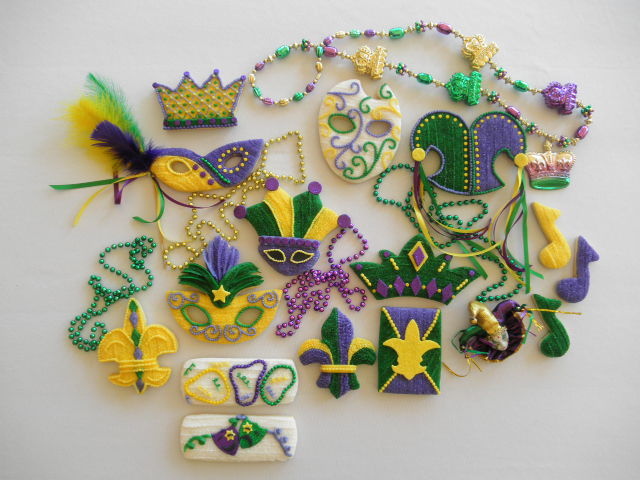
Now these come from a website called Custom Cookies.com so they're professionally made. Items include jester hats, jesters, crowns, the Fleur de Lis, beads, masks, and music notes.

Now these come from a website called Custom Cookies.com so they’re professionally made. Items include jester hats, jesters, crowns, the Fleur de Lis, beads, masks, and music notes.

13. You can’t enjoy Mardi Gras without putting some candy beads on your cupcakes.

Now I think these are made from candy. I mean they sure don't look shiny to me. Yet, you'd still wouldn't want them near kids under 3 years old for obvious reasons.

Now I think these are made from candy. I mean they sure don’t look shiny to me. Yet, you’d still wouldn’t want them near kids under 3 years old for obvious reasons.

14. Nothing says Mardi Gras than cakes of women’s bosoms with their beads on them.

Seems like while doing these posts, I seem to find how heart cookie cutters can be used for so many occasions. Yet, I'm not sure if I approve of this for families since this is reflective of the Mardi Gras party scene that might carry some unfortunate implications.

Seems like while doing these posts, I seem to find how heart cookie cutters can be used for so many occasions. Yet, I’m not sure if I approve of this for families since this is reflective of the Mardi Gras party scene that might carry some unfortunate implications.

15. So if you wear a mask this Mardi Gras then so should your cupcakes.

Of course, these purple masks and feathers are made from icing while the cupcake is covered with white icing and sugar. Guaranteed to make some people give up their New Year's Resolutions for Lent.

Of course, these purple masks and feathers are made from icing while the cupcake is covered with white icing and sugar. Guaranteed to make some people give up their New Year’s Resolutions for Lent.

16. Treat your guests this Mardi Gras with these joker cookies.

Of course, while these cookies may look cute, they may contain beads that aren't suitable for children under 3 years old. I'm just saying to all you parents out there.

Of course, while these cookies may look cute, they may contain beads that aren’t suitable for children under 3 years old. I’m just saying to all you parents out there.

17. Of course, if you live in New Orleans, you can’t have Mardi Gras without some music note and star cookies.

Because we all know that New Orleans is known for jazz music as well as Hurricane Katrina, zydeco, crime, levees, and FEMA fiascos. Also, those plastic babies near the star cookies are absolutely creepy.

Because we all know that New Orleans is known for jazz music as well as Hurricane Katrina, zydeco, crime, levees, and FEMA fiascos. Also, those plastic babies near the star cookies are absolutely creepy.

18. Celebrate your Mardi Gras with these specially made crown cookies.

What's even better about these cookies is that they were made from chocolate dough or gingerbread by what it looks like. Still, they all seem to have intricate designs.

What’s even better about these cookies is that they were made from chocolate dough or gingerbread by what it looks like. Still, they all seem to have intricate designs as if it was done by a professional or someone with too much time on their hands.

19. Top your Mardi Gras party off with a giant mask cupcake display.

Now this might be for some special event of some sort. Still, that's a lot of cupcakes and how they keep them on without the icing sliding off amazes me. Yet, the best part about this display is that all the cupcakes are chocolate.

Now this might be for some special event of some sort. Still, that’s a lot of cupcakes and how they keep them on without the icing sliding off amazes me. Yet, the best part about this display is that all the cupcakes are chocolate.

20. Bring the festivities alive with these Mardi Gras cookies on a stick.
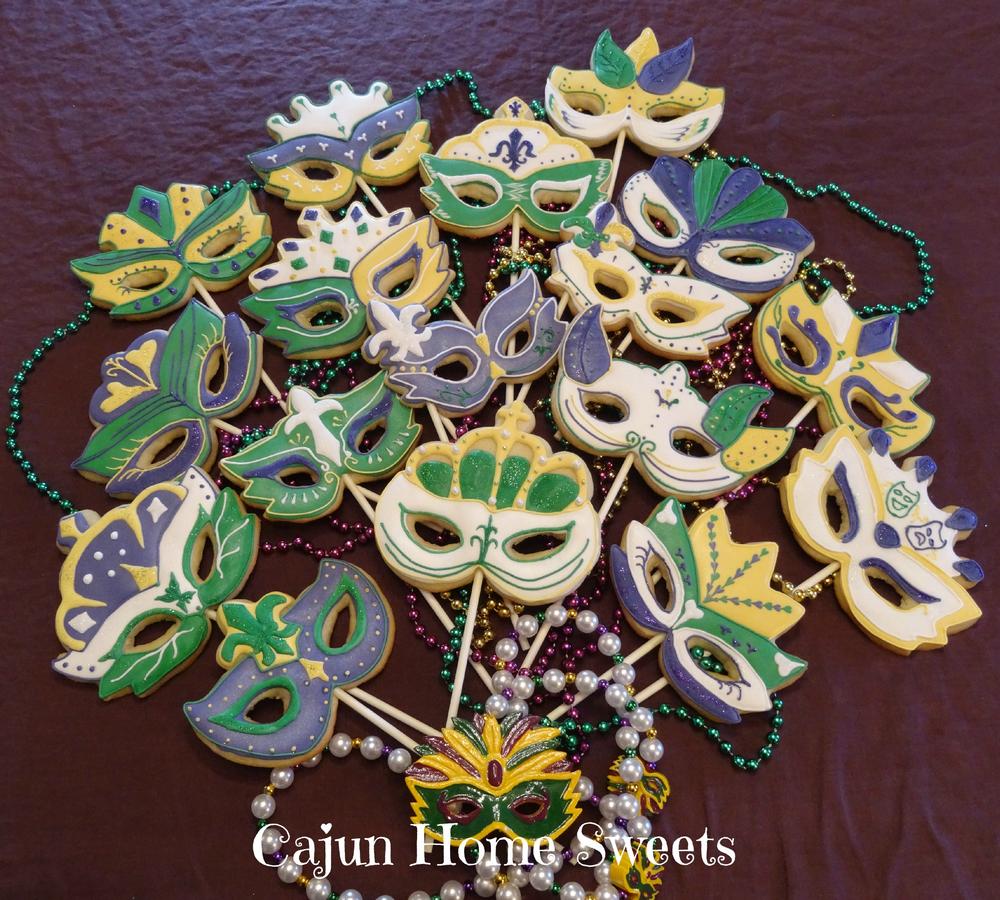
These may be from a Louisiana based startup called Cajun Home Sweets. Of course, these had to be professionally made since the mask details are all so fine and intricate.

These may be from a Louisiana based startup called Cajun Home Sweets. Of course, these had to be professionally made since the mask details are all so fine and intricate.

21. Make your Mardi Gras memborable with this lovely mask and feather cake.
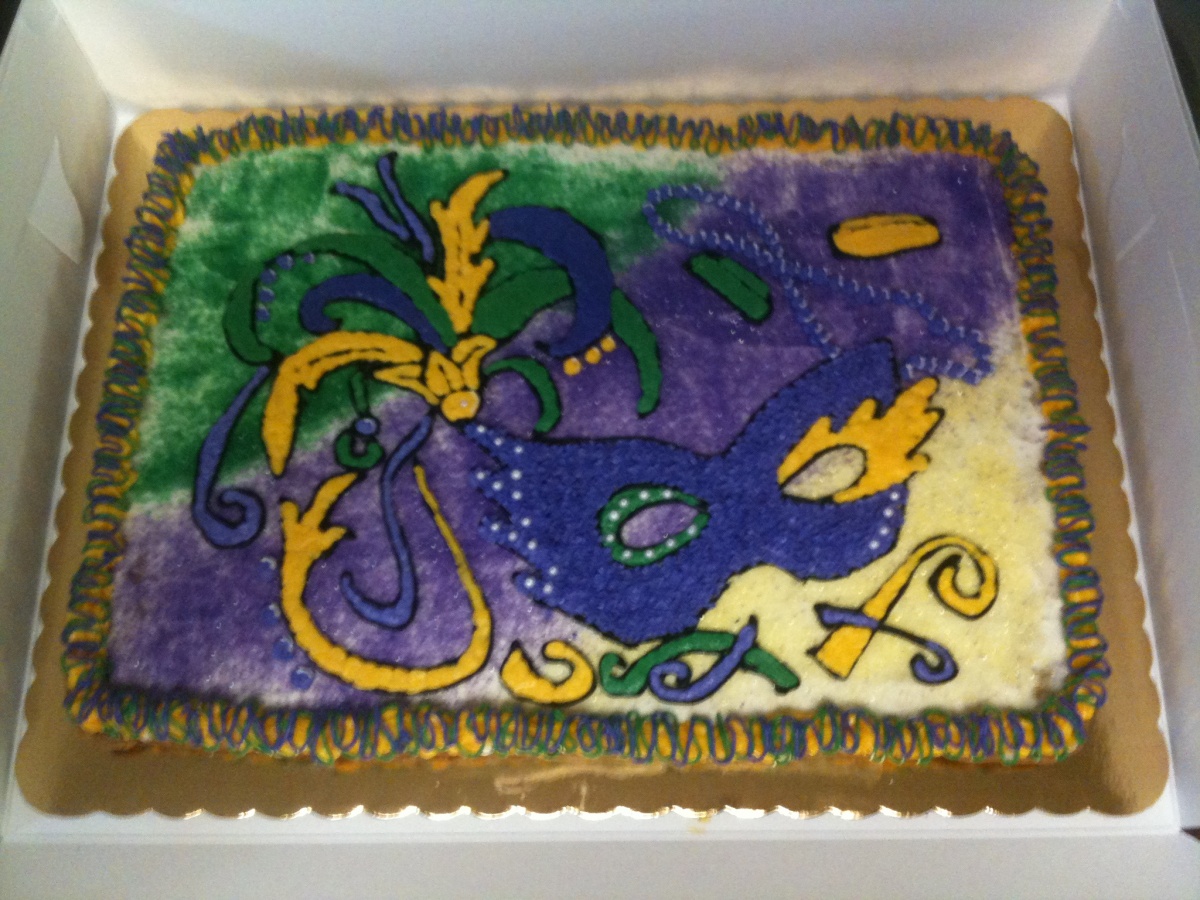
Of course, this cake has a lot of things we know of Mardi Gras like feathers, mask, confetti, Doubloons, and beads as you'd see in New Orleans. Also a background of green, purple, and yellow.

Of course, this cake has a lot of things we know of Mardi Gras like feathers, mask, confetti, Doubloons, and beads as you’d see in New Orleans. Also a background of green, purple, and yellow.

22. Of course, no New Orleans resident can forget to celebrate Mardi Gras without a king cake.

Now this is what the modern New Orleans King Cake looks like. Notice how it resembles a giant braided Danish garland? Also, the baby doll on this thing is creepy.

Now this is what the modern New Orleans King Cake looks like. Notice how it resembles a giant braided Danish garland? Also, the baby doll on this thing is creepy.

23. Make Mardi Gras a festive occasion with these lovely cupcakes.

These cupcake icing designs were probably made by: a. a professional, b. a repressed art student, c. someone who's had too much of the Mardi Gras ganja, or d. all of the above.

These cupcake icing designs were probably made by: a. a professional, b. a repressed art student, c. someone who’s had too much of the Mardi Gras ganja, or d. all of the above.

24. What doesn’t bring Mardi Gras to its roots than the Fleur de Lis?

Of course, the Fleur de Lis is a symbol of France and the French royal family in the Bourbon dynasty days. It was even on France's flag until the French Revolution. Still, these cookies look delicious.

Of course, the Fleur de Lis is a symbol of France and the French royal family in the Bourbon dynasty days. It was even on France’s flag until the French Revolution. Still, these cookies look delicious.

25. Get lucky this Mardi Gras with these specially designed fortune cookies.

Available in yellow, purple, and green at a New Orleans Asian restaurant near you. Of course, I don't know about using the green and purple food coloring but it works.

Available in yellow, purple, and green at a New Orleans Asian restaurant near you. Of course, I don’t know about using the green and purple food coloring but it works.

26. For even greater luck on Mardi Gras, try this giant fortune cookie up for size.

Now this fortune cookie is covered in yellow, purple, and green sprinkles. Don't say I didn't warn you in case you open it. Then again, it's probably made from cake.

Now this fortune cookie is covered in yellow, purple, and green sprinkles. Don’t say I didn’t warn you in case you open it. Then again, it’s probably made from cake.

27. Hope these jester cupcakes manage to put a smile on your face this Mardi Gras.

Of course, I'm not sure if the jesters are edible but all seem to have their own characteristics as individuals. Also, some of them have masks on, too.

Of course, I’m not sure if the jesters are edible but all seem to have their own characteristics as individuals. Also, some of them have masks on, too.

28. Make your kids the perfect Mardi Gras lunch with this King Rex crown sandwich.

Of course, this seems like a decent healthy lunch with a better content than whatever Nutrition Inc. makes. However, I think the purple broccoli is kind of pushing it with the Mardi Gras spirit. Seriously, purple broccoli belongs in somebody's acid trip.

Of course, this seems like a decent healthy lunch with a better content than whatever Nutrition Inc. makes. However, I think the purple broccoli is kind of pushing it with the Mardi Gras spirit. Seriously, purple broccoli belongs in somebody’s acid trip.

29. Make your Mardi Gras memorable with this set of sugar cookies.

I like how some of the cookies resembling Mardi Gras beads and how they're designed. I can never master something like that, not in a million years.

I like how some of the cookies resembling Mardi Gras beads and how they’re designed. I can never master something like that, not in a million years.

30. Wake up this Fast Tuesday to these king cake donuts.

Of course, these are the pastries most likely consumed by the New Orleans police department which is usually busy on Mardi Gras arresting topless drunk women for indecent exposure and maybe suspicion on prostitution.

Of course, these are the pastries most likely consumed by the New Orleans police department which is usually busy on Mardi Gras arresting topless drunk women for indecent exposure and maybe suspicion on prostitution.

31. Treat yourself right this Mardi Gras with this colorful Mardi Gras salad.

Now this contains carrots, kale, and red cabbage. Yet, the carrots may be heirloom and only available at Whole Foods. Still, yellow peppers may do fine.

Now this contains carrots, kale, and red cabbage. Yet, the carrots may be heirloom and only available at Whole Foods. Still, yellow peppers may do fine.

32. Give a toast this Mardi Gras with these king cake jello shots.

Yes, I know these probably contain alcohol and aren't for kids. Yet, they certainly display quite vibrant colors as you see here.

Yes, I know these probably contain alcohol and aren’t for kids. Yet, they certainly display quite vibrant colors as you see here.

33. Celebrate your Mardi Gras with these king cake cinnamon sugar cookies.

Now I know these aren't donuts because they're flat but I love the swirl icing design on these. Still, I'd eat them.

Now I know these aren’t donuts because they’re flat but I love the swirl icing design on these. Still, I’d eat them.

34. For Mardi Gras, candy coated popcorn makes a great snack.

Of course, candy coated popcorn may be festive for Mardi Gras but it's not good for you, especially for your teeth. Yet, I do like how it looks in this photo.

Of course, candy coated popcorn may be festive for Mardi Gras but it’s not good for you, especially for your teeth. Yet, I do like how it looks in this photo.

35. Send your kid with a mask pancake lunch this Mardi Gras.

Now this combines the rituals of French Mardi Gras with the traditions of British Shrove Tuesday that usually consists of pancake breakfasts. Of course, where I live Shrove Tuesday isn't celebrated there either.

Now this combines the rituals of French Mardi Gras with the traditions of British Shrove Tuesday that usually consists of pancake breakfasts. Of course, where I live Shrove Tuesday isn’t celebrated there either.

36. Of course, if your kid doesn’t like pancakes, you can always send him or her a sandwich with a Fleur de Lis.

Of course, other than the Mardi Gras imagery, there's really nothing remarkable about this lunch. Of course, Mardi Gras isn't really a children's holiday like Christmas and Easter are.

Of course, other than the Mardi Gras imagery, there’s really nothing remarkable about this lunch. Of course, Mardi Gras isn’t really a children’s holiday like Christmas and Easter are.

37. Treat your Mardi Gras party guests to this tearaway mask cupcake cake.

Now this is may not be as messy as cutting it, but I'm sure whoever took hours to work on it will be crying when he or she sees it being torn to pieces. Still, quite festive.

Now this is may not be as messy as cutting it, but I’m sure whoever took hours to work on it will be crying when he or she sees it being torn to pieces. Still, quite festive.

38. Of course, if you’re no fan of donut holes, you can always settle for king cake long johns.

I know they look like custom designed Mardi Gras twinkies covered in icing, but hey, to each his own. Of course, consumed by New Orleans cops arresting people for public intoxication and indecent exposure.

I know they look like custom designed Mardi Gras twinkies covered in icing, but hey, to each his own. Of course, consumed by New Orleans cops arresting people for public intoxication and indecent exposure.

39. For the New Orleans Francophile, here’s a nice tearaway cupcake cake of the Fleur de Lis.

Of course, the best part about this design is that it's purple. Still, since it was originally a French colony, Louisiana bases a lot of its tradition on French culture with their legal basis being the Napoleonic Code.

Of course, the best part about this design is that it’s purple. Still, since it was originally a French colony, Louisiana bases a lot of its tradition on French culture with their legal basis being the Napoleonic Code.

40. Celebrate this Mardi Gras with this vibrantly colorful king cake.

Unlike the previous 2 king cakes I've shown, this one has multi colored icing instead of sugar. Nevertheless, I find the presence of plastic baby dolls on these quite disturbing. Maybe it's the baby carrot cake from Cakewrecks or something.

Unlike the previous 2 king cakes I’ve shown, this one has multi colored icing instead of sugar. Nevertheless, I find the presence of plastic baby dolls on these quite disturbing. Maybe it’s the baby carrot cake from Cakewrecks or something.

41. No Mardi Gras party is complete without these mask cookies.

Of course, some mask cookies have holes in them and others don't. In this one, the eye holes are covered in black icing. Yet, each mask is unique in its own way.

Of course, some mask cookies have holes in them and others don’t. In this one, the eye holes are covered in black icing. Yet, each mask is unique in its own way.

42. Of course, for those who don’t like jello shots there’s always jello slices for the Mardi Gras party.

Like the jello shots, just because they're brightly colored and made from jello doesn't mean they're for children. In fact, they might contain alcohol as well. Just, giving some people cause for parental discretion.

Like the jello shots, just because they’re brightly colored and made from jello doesn’t mean they’re for children. In fact, they might contain alcohol as well. Just, giving some people cause for parental discretion.

43. No Mardi Gras party is complete without an elaborate mask cake like this.
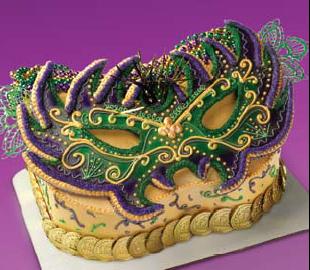
This cake is lined with some gold Spanish Doubloons that are more likely made from plastic to some Golden Age pirate's chagrin. Yet, you can tell that this was professionally made and very expensive.

This cake is lined with some gold Spanish Doubloons that are more likely made from plastic to some Golden Age pirate’s chagrin. Yet, you can tell that this was professionally made and very expensive.

44. Besides Hurricane Katrina, most people know New Orleans for 2 things: Mardi Gras and jazz music as these cookies illustrate.
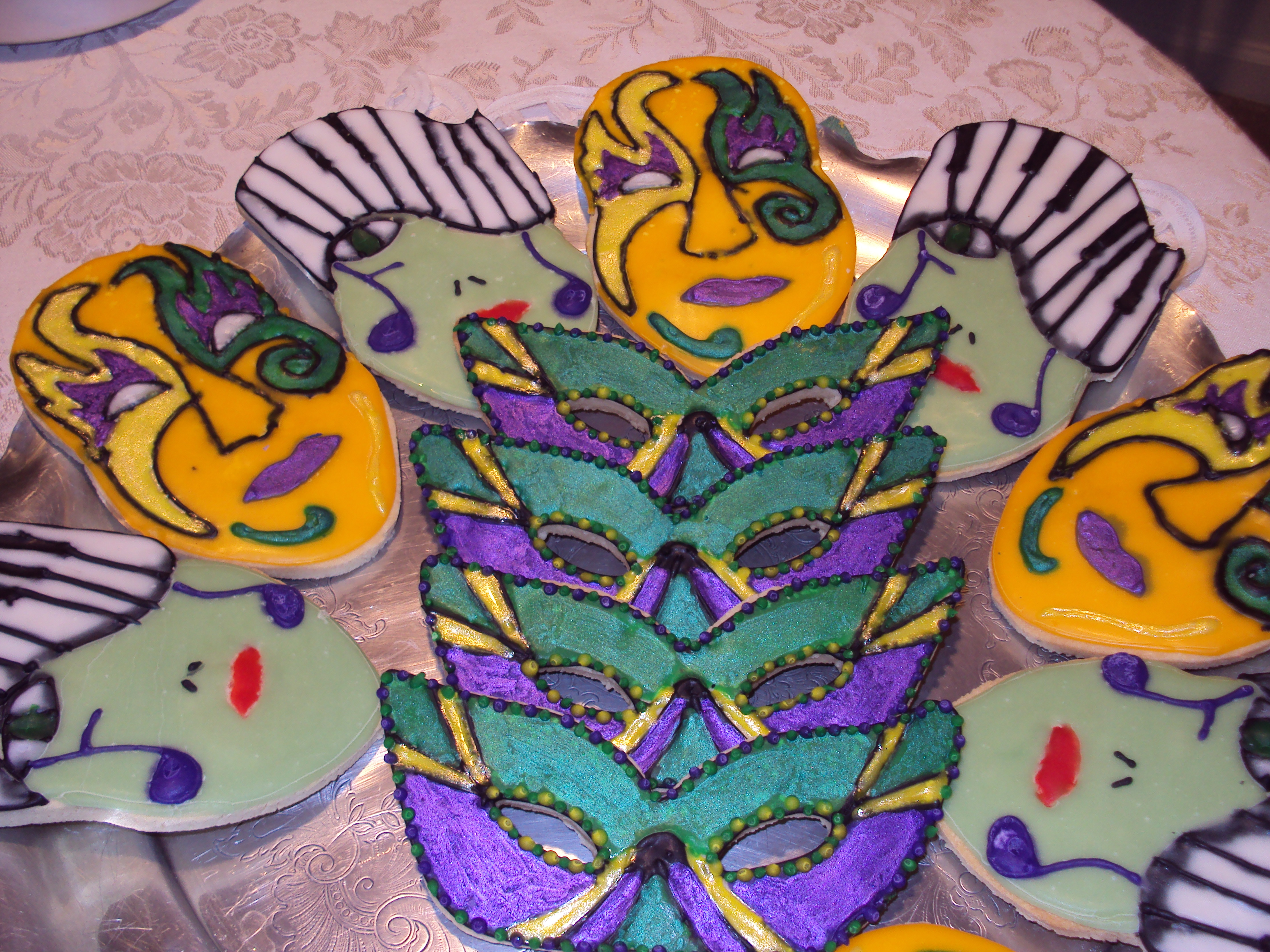
Of course, we have a couple designs of Mardi Gras masks along with a face with dangling notes and piano hair as I see it at least. Yes, these were undoubtedly made in the Big Easy.

Of course, we have a couple designs of Mardi Gras masks along with a face with dangling notes and piano hair as I see it at least. Yes, these were undoubtedly made in the Big Easy.

45. When it comes to Mardi Gras cakes, sometimes 2 tiers are better than one.

I have to admire the decorations on this like the beads, the party stuff, and the feather mask. I also like the swirls, too.

I have to admire the decorations on this like the beads, the party stuff, and the feather mask. I also like the swirls, too.

46. Now you can’t have a Mardi Gras party without including truffle chocolate beads.

Come to think of it, truffle chocolate beads must be more expensive than regular plastic Mardi Gras beads you can find at any dollar store in your area. Yet, these seem to resemble beads from some higher end store.

Come to think of it, truffle chocolate beads must be more expensive than regular plastic Mardi Gras beads you can find at any dollar store in your area. Yet, these seem to resemble beads from some higher end store.

47. For Mardi Gras, some people prefer whipped cream with sprinkles on their jello shots.

Once again, jello shots usually contain alcohol and therefore aren't for kids. Nevertheless, if any parent wants to make non-alcoholic jello shots, then be my guest.

Once again, jello shots usually contain alcohol and therefore aren’t for kids. Nevertheless, if any parent wants to make non-alcoholic jello shots, then be my guest.

48. Now these New Orleans mask cookies are bound to make any Mardi Gras party festive.

Now these masks cookies are certainly elaborate and made by professionals. There's even a jazz one, too. Nevertheless, the ribbons aren't edible but they do add some sense of artistry to them.

Now these masks cookies are certainly elaborate and made by professionals. There’s even a jazz one, too. Nevertheless, the ribbons aren’t edible but they do add some sense of artistry to them.

49. For favors, you can’t go wrong with these Mardi Gras pretzels.

Now these are covered with either white chocolate or icing and decked with sugar. Maybe it would be easier to add food coloring but I didn't make these.

Now these are covered with either white chocolate or icing and decked with sugar. Maybe it would be easier to add food coloring but I didn’t make these.

50. Start your Mardi Gras morning with some Mardi Gras pancakes.

Of course, these pancakes are yellow, purple, and green for Mardi Gras. Perhaps they should add green eggs and ham to it as well, but I'm not Dr. Seuss.

Of course, these pancakes are yellow, purple, and green for Mardi Gras. Perhaps they should add green eggs and ham to it as well, but I’m not Dr. Seuss.

51. For the vegetable in your Mardi Gras dinner go with this festive salad.

Contains quinoa, broccoli, nuts, and cauliflower dyed purple and yellow as if it's from the Green Eggs and Ham world of Dr. Seuss. Seriously, I don't know what to make about food coloring. I know it's safe but it sometimes gives the wrong impression.

Contains quinoa, broccoli, nuts, and cauliflower dyed purple and yellow as if it’s from the Green Eggs and Ham world of Dr. Seuss. Seriously, I don’t know what to make about food coloring. I know it’s safe but it sometimes gives the wrong impression.

52. Now there’s nothing more festive on Mardi Gras than this lovely 2 tiered cake.
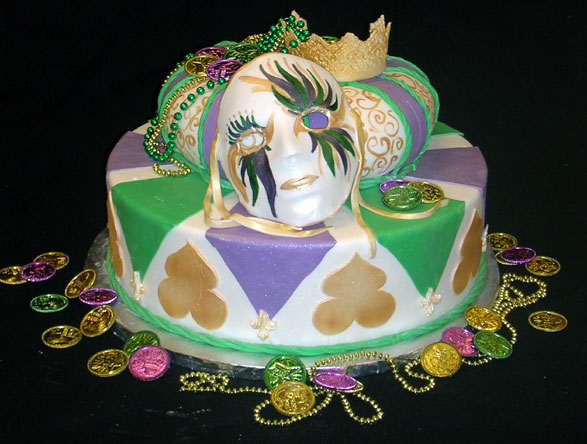
I do like the nice prop usage on this cake such as the mask, crown, Doubloons, and beads. Yet, I wonder if this cake is chocolate underneath the icing.

I do like the nice prop usage on this cake such as the mask, crown, Doubloons, and beads. Yet, I wonder if this cake is chocolate underneath the icing. But I don’t want to destroy it for now.

53. For you theater geeks out there, I think these cupcakes would be quite appropriate for your Mardi Gras celebration.

Not only do some of these cupcakes carry the traditional feathery Mardi Gras mask, they also have the tragedy and comedy masks as well. And it seems like they're edible but I can be wrong.

Not only do some of these cupcakes carry the traditional feathery Mardi Gras mask, they also have the tragedy and comedy masks as well. And it seems like they’re edible but I can be wrong.

54. Then again, you can always buy Mardi Gras cake toppers in New Orleans.

Yet, I'm not sure whether the cupcake toppers on these are edible or not. However, I do love the purple icing on them though. Hey, I love purple. I can't help it.

Yet, I’m not sure whether the cupcake toppers on these are edible or not. However, I do love the purple icing on them though. Hey, I love purple. I can’t help it.

55. For your Mardi Gras party, you can’t go wrong with icing covered star pretzels.

I'm not sure about the significance of stars on Mardi Gras but I think these pretzels are quite clever. Now where can I get pretzel stars in PA?

I’m not sure about the significance of stars on Mardi Gras but I think these pretzels are quite clever. Now where can I get pretzel stars in PA?

56. Feast your eyes on this Mardi Gras pizza for lunch.

Now these seem to contain, cheese, meat, and red onions. Yet, I'm sure the little leaf provides the green, whatever that is.

Now these seem to contain, cheese, meat, and red onions. Yet, I’m sure the little leaf provides the green, whatever that is.

57. Hope your kids will love these king cake donuts.

I'm not sure about the little face in the donuts are about. Yet, these are sure cute that your kids will certainly enjoy them, even though they may be too young to take part in the other festivities.

I’m not sure about the little face in the donuts are about. Yet, these are sure cute that your kids will certainly enjoy them, even though they may be too young to take part in the other festivities.

58. Now this cookie set will sure make your Mardi Gras worthwhile.

Now this includes cake pops with white icing and sprinkles, coins with a Fleur de Lis, and butterfly masks each unique in their own way.

Now this includes cake pops with white icing and sprinkles, coins with a Fleur de Lis, and butterfly masks each unique in their own way.

59. Now I’ve never seen a Mardi Gras mask cake like this before.
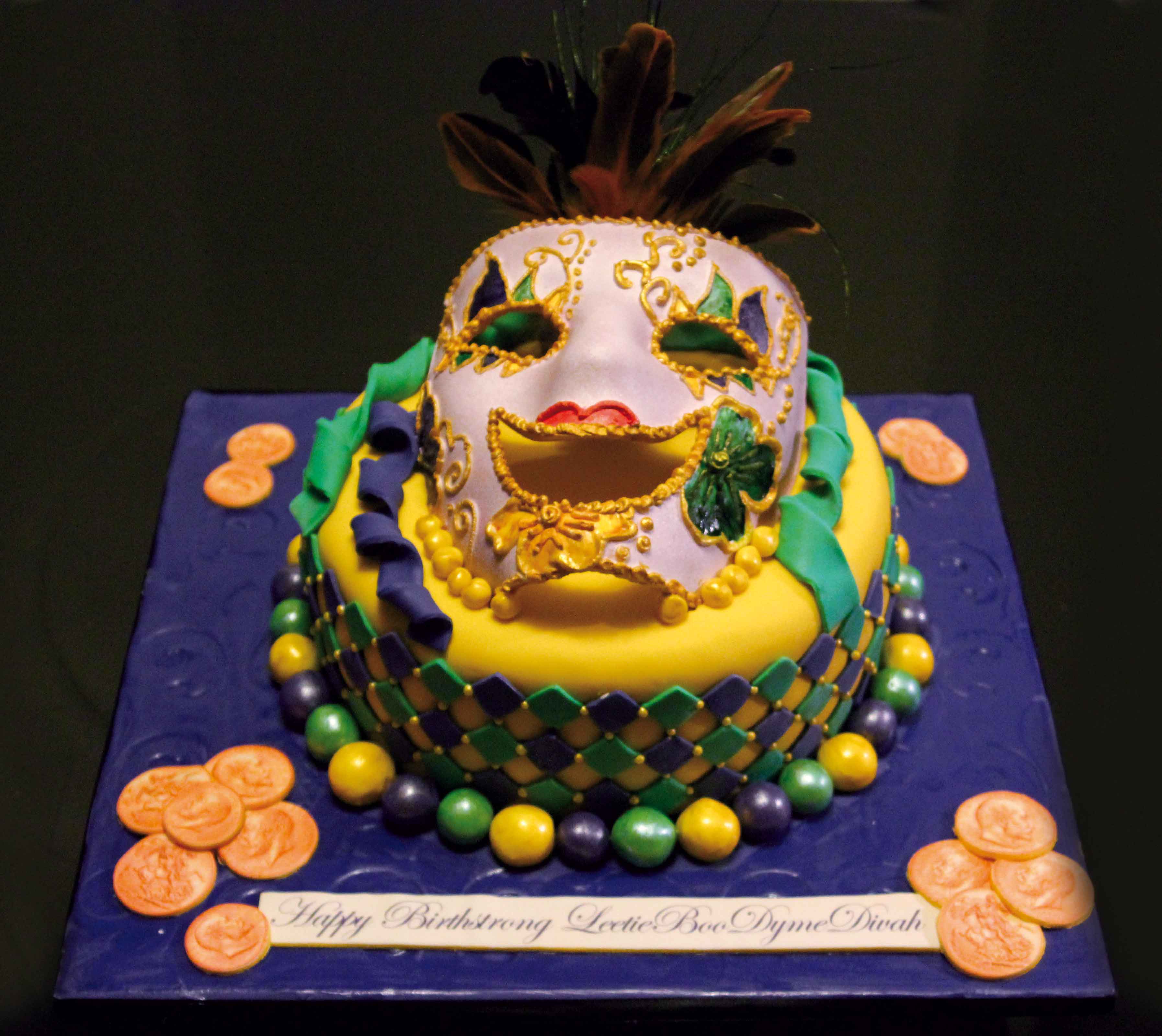
I'm not sure if that mask is made from confection or plastic. Either way, it looks very cool and quite intimidating.

I’m not sure if that mask is made from confection or plastic. Either way, it looks very cool and quite intimidating.

60. With Mardi Gras cakes, you can’t have too many tiers.

Now I love how these tiers don't seem to look the same. I especially like the mask on top with the feathers and stickers. So pretty.

Now I love how these tiers don’t seem to look the same. I especially like the mask on top with the feathers and stickers. So pretty.

61. For party favors, I can’t see anything wrong with Mardi Gras chocolate candies.

Well, except for the person being allergic to chocolate of course. Nevertheless, these look so good enough to eat and those you know me know how I like candy.

Well, except for the person being allergic to chocolate of course. Nevertheless, these look so good enough to eat and those you know me know how I like candy.

62. Celebrate Mardi Gras with these multicolored cake pops.

Now unlike the previous cake pops these were placed face down. I'll take a purple one though.

Now unlike the previous cake pops these were placed face down. I’ll take a purple one though, especially if it has chocolate inside.

63. Wake up this Mardi Gras morning with these specially made cinnamon rolls.

This person didn't have any purple sugar for the cinnabuns so he or she used black instead. I don't think it turned out very well.

This person didn’t have any purple sugar for the cinnabuns so he or she used black instead. I don’t think it turned out very well.

64. Nothing brings the festive spirit on Fat Tuesday than this jester cake.

For a jester cake, this one seems quite sad and has a lot of stuff that isn't edible. Yet, it looks pretty cool though.

For a jester cake, this one seems quite sad and has a lot of stuff that isn’t edible. Yet, it looks pretty cool though.

65. Of course, there’s nothing remarkable about these Mardi Gras cupcakes or is there?

Outside they may just be regular cupcakes with chocolate icing. Inside they have yellow, green, and purple interiors. So they're certainly festive underneath the wrapper and frosting.

Outside they may just be regular cupcakes with chocolate icing. Inside they have yellow, green, and purple interiors. So they’re certainly festive underneath the wrapper and frosting.

66. These Fleur de Lis cookies will certainly make your Mardi Gras party memorable.

Unlike the other treats, they're composed with black, white, and possibly blue. Also, they are quite nice to eat. Hope they weren't made by Saints fans. Probably were.

Unlike the other treats, they’re composed with black, white, and possibly blue. Also, they are quite nice to eat. Hope they weren’t made by Saints fans. Probably were.

67. Nothing makes a great Mardi Gras party without covering pretzels and cookies in chocolate.

I know these are Mardi Gras treats since they all have yellow, green and purple stripes on them. And that they have a mask chocolate with them.

I know these are Mardi Gras treats since they all have yellow, green and purple stripes on them. And that they have a mask chocolate with them.

68. With Mardi Gras, you can’t add too many accessories.

I like the gold party strings and the feather mask. I also like the stars on the cake as well as the yellow diamonds.

I like the gold party strings and the feather mask. I also like the stars on the cake as well as the yellow diamonds.

69. These Mardi Gras cake balls are good enough to pop in your mouth.

I also like how they have green and yellow drizzle as well as have purple wrappers on them. Still, I hope these have chocolate filling in them or I won't be happy.

I also like how they have green and yellow drizzle as well as have purple wrappers on them. Still, I hope these have chocolate filling in them or I won’t be happy.

70. For Mardi Gras, mask cupcakes are a festive sight, especially with decorations.

They may not be for children under 3 years old. Yet, they certainly look great for a party on Mardi Gras.

They may not be for children under 3 years old. Yet, they certainly look great for a party on Mardi Gras.

Our Father Who Art in Heaven, Hallowed Be Thy Religious Art

The-Last-Supper

As a lifelong practicing Catholic, art aficionado, and history buff, I always have a great appreciation for religious art, architecture, music, and movies. Well, just as long as I find them to be of great artistic quality and not something that looks like you can put it on somebody’s T-Shirt. Quality religious art has always been greatly influential in our modern culture whether it’s the great Madonna and Child paintings from the Renaissance, large intricate Gothic cathedrals from the Middle Ages, sacred hymns, and a lot of religious films of the 1950s. I mean Ben Hur might’ve starred Charlton Heston but you have to enjoy the chariot race scene. I can go on and on about the great religious masterworks but that would be a very long post since it would involve scores and scores of paintings and sculptures you’re already familiar with. Instead, I’ll focus on some of the great blunders that would make everyone wonder why God hadn’t unleashed His wrath on the artist in the first place. Yet, since this is about bad religious artworks, here are a few points to follow.

1. This isn’t a post that shows anti-religious artwork or anything that’s intentionally depicted as sacrilegious. In fact, much of the works were done by religious artists themselves but they just didn’t seem to depict the true spirit of the religious subjects that they’re either tacky or unintentionally funny. Examples include, crapsaccharine mentality, bad artistic representation, or images that in some way don’t make any sense.

2. This isn’t an anti-religious post, just a post of bad religious expression in art. Rather, as a Catholic, I don’t see anything wrong with making fun of religion as long as it’s not offensive. Since religious art plays a critical role in our culture, I see nothing wrong with mocking the tacky pieces.

3. This isn’t a post depicting religious artwork used for an amusing purpose or has the equivalent of Jesus being depicted in a Batman suit, a celebrity in an iconographic image or a dog version of The Last Supper. I know these exist but they were supposed to be funny on purpose. These works shown in this post were initially intended to be taken seriously as well as catered to an audience.

4. These aren’t artworks with religious motifs or symbolism in otherwise secular works.

5. These are mostly done by contemporary artists since I can’t bring myself to criticize the great masterpieces of religious art during the Renaissance and Baroque Era unless it’s Abraham trying to sacrifice Isaac with a blunderbuss to his head. Yet, I haven’t found this one yet.

6. Yes, most of these works derive from Christianity yet that’s because many Christian artworks tend to be the worst offenders. Basically if Christians are willing to depict Jesus in a business suit, I’ll practically run with it. I’m also willing to post Jesus with a gun.

7. Some of these would have quotes as to what the artist intended for this work to mean, which aren’t in my own words.

8. This doesn’t include bad restoration work so the lady who made Jesus look like a monkey is off the hook.

So without further adieu, here is an assortment of kitschy religious artwork.

1. Leaping Jesus on the cross talking to the women of Jerusalem.

I suppose this is for a children's Bible but even in kids' Bibles, this isn't depicted as a very happy occasion. I mean Jesus is supposed to be suffering in deathly agony carrying a huge cross. This doesn't cut it.

I suppose this is for a children’s Bible but even in kids’ Bibles, this isn’t depicted as a very happy occasion. I mean Jesus is supposed to be suffering in deathly agony carrying a huge cross. This doesn’t cut it.

2. Jesus rising out of his tomb body and spirit.

I think this moment is meant to be left to the imagination. Also, when the women approached the tomb, Jesus' body wasn't there at all. Not to mention, why does Jesus look like he's just out of a gym.

I think this moment is meant to be left to the imagination. Also, when the women approached the tomb, Jesus’ body wasn’t there at all. Not to mention, why does Jesus look like he’s just out of a gym?

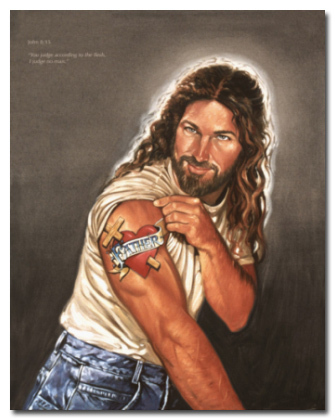
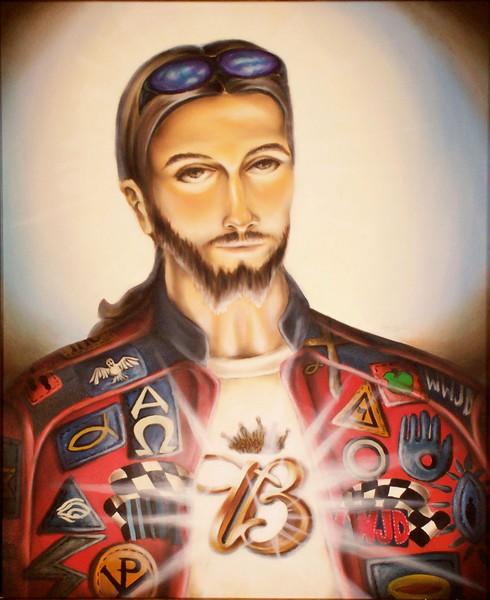
3. “It seems obvious that if Jesus were to shock the status quo in the 21st century with a tattoo that it would say ‘Father.'”

Except this could easily be some 1990s rock musician who could easily look like Jesus. Also, he probably wouldn't be looking at us with such intensity of a male stripper into his job. He's probably using his "Father" tattoo as an excuse to show off those biceps to some Christian ladies.

Except this could easily be some 1990s rock musician who could easily look like Jesus. Also, he probably wouldn’t be looking at us with such intensity of a male stripper into his job. He’s probably using his “Father” tattoo as an excuse to show off those biceps to some Christian ladies.

4. “The anguish that God experiences while His children are abused is the cumulative experience of all the abused children since the beginning of time compressed into one eternal moment.”

While the broken dolls may represent God’s children having to put up with worldly abuse, Jesus’s facial expression doesn’t seem overcome by anguish over innocent souls suffering. Rather Jesus appears in this painting like he’s doing a promo for some “Head and Shoulders” shampoo commercial. Let’s just say if a Christian artist doesn’t know the difference between the facial expressions of “upset” or “happiness during shampoo massage,” he shouldn’t be doing religious paintings.

5. Jesus during story time at school.

Seriously, I kind find this picture of Jesus sitting with the little ones during story time a bit unnerving for some reason. Just find seeing a 1st century man in his thirties at a modern day elementary school just out of place.

Seriously, I kind find this picture of Jesus sitting with the little ones during story time a bit unnerving for some reason. Just find seeing a 1st century man in his thirties at a modern day elementary school just out of place.

6. Jesus at the United Nations.

"Uh, fellas, can you please let me? I can't get through the door here. It's too tiny. Seriously, I need a bigger entrance."

“Uh, fellas, can you please let me? I can’t get through the door here. It’s too tiny. Seriously, I need a bigger entrance.”

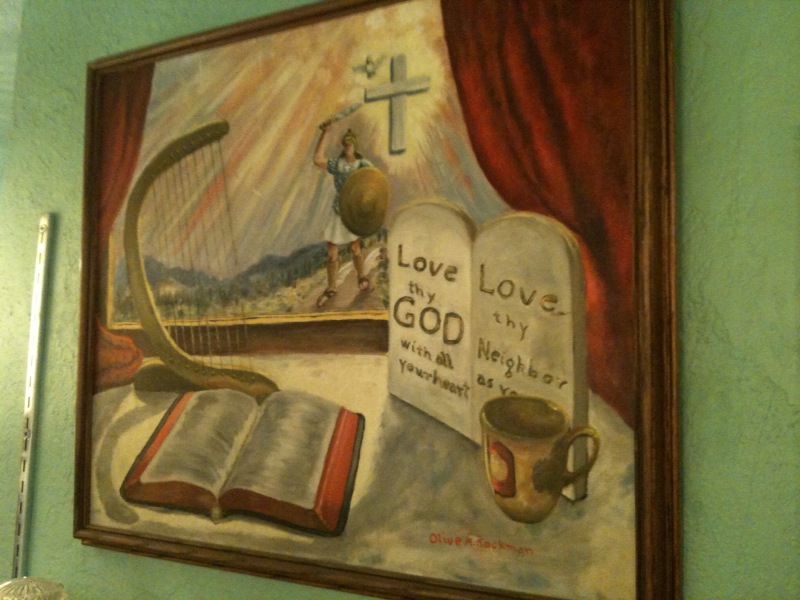
7. Just a still life of Christian imagery.

So we have cross, Holy Spirit Dove, divine light, Roman soldier, lyre, Bible, two greatest commandments, and a coffee cup? Seriously, I don’t think there were any coffee drinkers in 1st century Palestine.

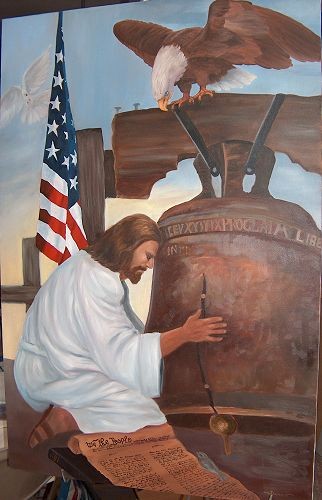
8. Jesus at the Liberty Bell.

I don't know about you but Jesus seems a little frustrated over being in a painting with lots of Americana. I mean he doesn't seem to be happy as a figure of American patriotism.

I don’t know about you but Jesus seems a little frustrated over being in a painting with lots of Americana. I mean he doesn’t seem to be happy as a figure of American patriotism.

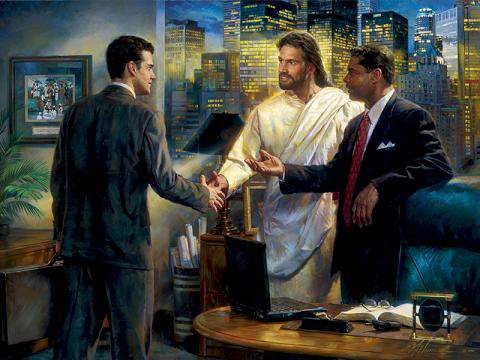
9. Jesus is always the senior business partner. “Christ’s presence is an integral part of daily life, no matter one’s profession or calling.”

I don't know about you but while I think Jesus' presence should be encouraged in business meetings, it doesn't mean everyone's going to listen to him. Also, remember that time when he's yelling and overturning tables at the temple. Man, you don't want to see him like that.

I don’t know about you but while I think Jesus’ presence should be encouraged in business meetings, it doesn’t mean everyone’s going to listen to him. Also, remember that time when he’s yelling and overturning tables at the temple. Man, you don’t want to see him like that.

10. Jesus takes up the soul of Michael Jackson wearing the King of Pop’s glittery glove.

Seriously, why have Michael Jackson in a religious painting? I mean what the hell did this ever get produced? Guess it’s someone’s fan work I guess. A Michael Jackson zombie portrait would’ve been much more appropriate.

11. A suffering Jesus with a chalice and a tiger?

Seriously what does a white tiger have to do with Jesus' suffering other than the fact the artist thought it was too awesome to leave out?

Seriously what does a white tiger have to do with Jesus’ suffering other than the fact the artist thought it was too awesome to leave out?

12. If only Jesus had taken anabolic steroids, he probably wouldn’t have suffered on the cross.

Sorry, I can’t take this painting seriously for some reason. Maybe it’s seeing Jesus with a body like Arnold Schwarzeneggar. Also, Jesus seems to have a determined expression on his face and for breaking off the wood on the cross.

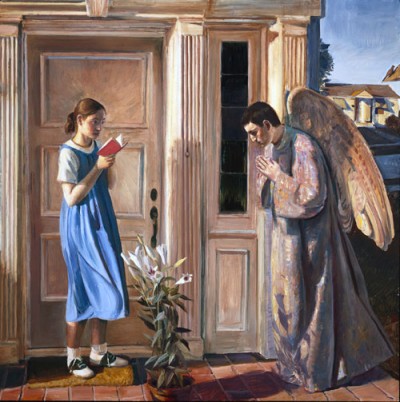
13. A modern rendition of the Annunciation.

I know the girl in blue is supposed to be the Virgin Mother dressed as her favorite Disney princess but she looks like such a kid in this it's not even funny. In fact, it's kind of creepy. The Angel Gabriel praying kind of irks me, too. I think the Annunciation should be depicted in its own time or with an older Mary for God's sake.

I know the girl in blue is supposed to be the Virgin Mother dressed as her favorite Disney princess but she looks like such a kid in this it’s not even funny. In fact, it’s kind of creepy. The Angel Gabriel praying kind of irks me, too. I think the Annunciation should be depicted in its own time or with an older Mary for God’s sake.

14. Jesus reaches for the sky.

Heard that God hated this statue of his beloved son so much that he sent a lightning bolt down to destroy it. Guess there's a limit to the level of tackiness the Almighty can tolerate.

Heard that God hated this statue of his beloved son so much that he sent a lightning bolt down to destroy it. Guess there’s a limit to the level of tackiness the Almighty can tolerate.

15. “Only God will share in the fullness of your sufferings and never forsake you.”

Also, if you shoot up heroin, Jesus also gets high so it balances out. I mean I guess assuming that Jesus and the addict share the same tattooed arm. Still, perhaps Jesus shouldn't materialize behind unsuspecting people anymore since it has lead to a lot of misunderstandings.

Also, if you shoot up heroin, Jesus also gets high so it balances out. I mean I guess assuming that Jesus and the addict share the same tattooed arm. Still, perhaps Jesus shouldn’t materialize behind unsuspecting people anymore since it has lead to a lot of misunderstandings.

16. The Most Holy Trinity.

I get the whole “Jesus is God” thing with Christianity but he’s “the Son” of the Holy Trinity, not “the Father” and “the Holy Spirit.” Let’s just say if you depict Jesus as all three persons of the Trinity, you have a problem. Also, the little angels don’t seem too happy with the Jesuses stomping on their heads.

17. Jesus riding on a dinosaur, need I say more.

Yes, this picture is as ridiculous as it sounds since Jesus is depicted in a prehistoric setting, let alone before the New Testament.

Yes, this picture is as ridiculous as it sounds since Jesus is depicted in a prehistoric setting, let alone before the New Testament.

18. Jesus Christ is the savior of truckers.

Now I don't want to insult any truckers since they perform a valuable purpose that we can't deny and I know that many of them need Jesus' protection as well. Yet, somehow I find this so tacky that I'd expect it to be seen in some rundown trailer for some reason. And the fact it's velvet.

Now I don’t want to insult any truckers since they perform a valuable purpose that we can’t deny and I know that many of them need Jesus’ protection as well. Yet, somehow I find this so tacky that I’d expect it to be seen in some rundown trailer for some reason. And the fact it’s velvet.

19. Jesus moping on the cross.

For some reason, I can't help looking at this and  not expect Jesus about to break into some Flashdance routine after he says his prayers. Also, where are his "stigmata" marks for his hands and feet seem totally bare.

For some reason, I can’t help looking at this and not expect Jesus about to break into some Flashdance routine after he says his prayers. Also, where are his “stigmata” marks for his hands and feet seem totally bare.

20. And yet another picture with Jesus and the dinosaur.

Now Jesus with a dinosaur is ridiculous enough. Jesus with a dinosaur, rainbow, and a young blond girl just takes tackiness to a whole other level. Looks like Jesus is so excited to finally see a dino after working on his new time machine or something.

Now Jesus with a dinosaur is ridiculous enough. Jesus with a dinosaur, rainbow, and a young blond girl just takes tackiness to a whole other level. Looks like Jesus is so excited to finally see a dino after working on his new time machine or something.

21. See Jesus hang out with his buddy Lord Krishna.

Of course, Jesus and Krishna are both said to be human incarnations of God or a god. Yet, outside India (where Krishna is a major icon in Hinduism), this picture would kind of border on blasphemy because of the whole one god rule in Christianity.

Of course, Jesus and Krishna are both said to be human incarnations of God or a god. Yet, outside India (where Krishna is a major icon in Hinduism), this picture would kind of border on blasphemy because of the whole one god rule in Christianity.

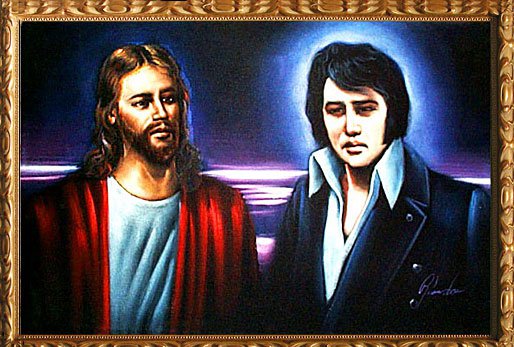
22. The King of Rock and Roll meets the King of Kings.

For some reason Elvis Presley doesn't seem thrilled meeting Jesus despite that he was a staunch Christian all his life and didn't like people calling him "King" to his face for this reason. Probably is due to the fact Elvis was disappointed about the buffet up in Heaven.

For some reason Elvis Presley doesn’t seem thrilled meeting Jesus despite that he was a staunch Christian all his life and didn’t like people calling him “King” to his face for this reason. Probably is due to the fact Elvis was disappointed about the buffet up in Heaven.

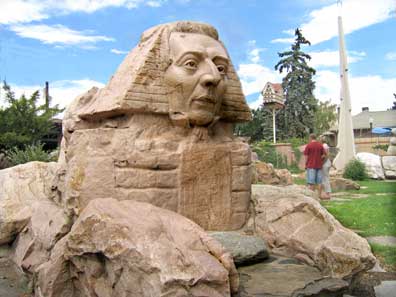
23, Here’s the Mormonism Founder Joseph Smith as a Spinx.

For a moment, I almost thought it was a tacky monument to Buster Keaton at some Los Angeles country club. My apologies to the late great silent screen star.

For a moment, I almost thought it was a tacky monument to Buster Keaton at some Los Angeles country club. My apologies to the late great silent screen star.

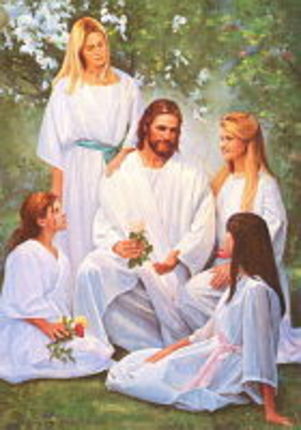
24. Of course, this art work depicts Jesus’ little known Sermon of Stepford.

This was actually done by a Mormon artist and it was alleged that this was supposed to be a picture of Jesus with his polygamous wives. Despite that many Mormons (particularly early ones) believe Jesus  had at least two wives, the artist denies this. Still, such Mormon concept makes Dan Brown's idea of Jesus and Mary Magdalene as a couple seem pretty tame.

This was actually done by a Mormon artist and it was alleged that this was supposed to be a picture of Jesus with his polygamous wives. Despite that many Mormons (particularly early ones) believe Jesus had at least two wives, the artist denies this. Still, such Mormon concept makes Dan Brown’s idea of Jesus and Mary Magdalene as a couple seem pretty tame.

25. Lucifer snared on the power lines.

So, remember kids, the main reason we have power lines is because they're the best defense against Satan. The fact they provide electricity to your house is purely coincidental.

So, remember kids, the main reason we have power lines is because they’re the best defense against Satan. The fact they provide electricity to your house is purely coincidental.

26. See Jesus walking in the woods with a huge bear.

"As my Father in Heaven proclaimed, only you can prevent forest fires." And then the bear made out with Jesus's food sack.

“As my Father in Heaven proclaimed, only you can prevent forest fires.” And then the bear made out with Jesus’s food sack.

27. C’mon, kids, let’s go to Heaven to join Jesus in the Rapture.

Man, despite all the carnage wreaking havoc during the apocalypse, these people don't seem to worry about losing everything in eternal hellfire. All that matters to them is gleefully going up to Jesus in 1950s fashions.

Man, despite all the carnage wreaking havoc during the apocalypse, these people don’t seem to worry about losing everything in eternal hellfire. All that matters to them is gleefully going up to Jesus in 1950s fashions.

28. Jesus taking all souls to Heaven while destruction wreaks havoc on earth.

Come to think about it, this picture makes a compelling case why Michael Bay should do a film on the Rapture. Think of his depiction as the Christian version of the Transformers series. Also, why are all the figures wearing white gowns in this?

Come to think about it, this picture makes a compelling case why Michael Bay should do a film on the Rapture. Think of his depiction as the Christian version of the Transformers series. Also, why are all the figures wearing white gowns in this?

29. Welcome to the Rapture, please let the angel guide you to your appropriate destination before being taken up to Heaven.

Also, why the 1950s fashions? I mean the Rapture didn't happen then. And if it were to occur sometime in the future, people would certainly not be dressed like they're from the 1950s.

Also, why the 1950s fashions? I mean the Rapture didn’t happen then. And if it were to occur sometime in the future, people would certainly not be dressed like they’re from the 1950s.

30. Jesus will help you through the raging waters of the storm.

"See that stretch of land, going there, steer thataway full speed ahead." Also, what the hell is that boat pilot wearing? Because that doesn't resemble a life jacket to me.

“See that stretch of land, going there, steer thataway full speed ahead.” Also, what the hell is that boat pilot wearing? Because that doesn’t resemble a life jacket to me.

31. Nothing brings a true expression of Christianity than a sculpture of two disembodied hands in a praying position.

This freakish statue stands in front of Oral Roberts University. Nevertheless, despite it being a religious artwork, Christian piety didn't seem to be what I had in mind upon seeing this.

This freakish statue stands in front of Oral Roberts University. Nevertheless, despite it being a religious artwork, Christian piety didn’t seem to be what I had in mind upon seeing this.

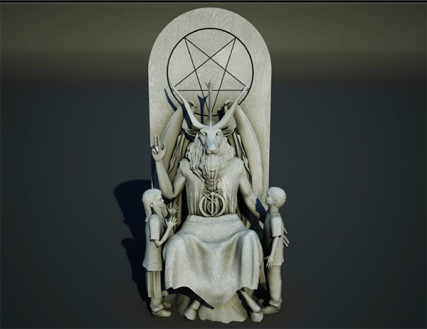
32. See the Dark Lord Satan tempting-I mean lending his evil- I mean giving wise words of wisdom to these two kids standing near him.

This is a Satanic monument for the Oklahoma State Capitol. Now I know that real Satanist are nothing like how they're depicted in Hollywood. Yet, I don't think presenting Lucifer with a goat head and seated like a mall Santa is helping their case.

This is a Satanic monument for the Oklahoma State Capitol. Now I know that real Satanist are nothing like how they’re depicted in Hollywood. Yet, I don’t think presenting Lucifer with a goat head and seated like a mall Santa is helping their case.

33. See Jesus bestowing his words of wisdom to Adam and Eve in the Garden of Eden. According to the artist: “The Introduction is a stunning portrayal of that first moment of man’s special blessing from God. A brand new world sparkles and vibrates with color and movement as Adam and Eve gaze with a wonder and tenderness to set the standard for all time.”

I don't know about you but I know that just because Christianity says, "Jesus is God" doesn't mean that Jesus should be in this  because he's "the Son" and that incarnation of the Holy Trinity doesn't show up until the New Testament. Adam and Eve are in Genesis and thus, in the Old Testament. Portraying God as the old man in the sky would've been more appropriate. Also, I'm sure that Adam and Eve aren't just gazing at each other in wonder and tenderness.

I don’t know about you but I know that just because Christianity says, “Jesus is God” doesn’t mean that Jesus should be in this because he’s “the Son” and that incarnation of the Holy Trinity doesn’t show up until the New Testament. Adam and Eve are in Genesis and thus, in the Old Testament. Portraying God as the old man in the sky would’ve been more appropriate. Also, I’m sure that Adam and Eve aren’t just gazing at each other in wonder and tenderness.

34. To suit your Holy Communion needs, here’s a wine dispenser of Jesus’ hand.

I don’t know about you but I kind of find the idea of blood spurting into the chalice from Jesus’s giant stigmatic hand kind of creepy. Kind of has the all too literal “Body and Blood of Christ” connotation to it.

35. What better Christian velvet painting to have than three Jesuses looking towards the moon.

Somehow I look at this picture and the words come to mind are, "I'm just a poor boy nobody loves me./ He's just a poor boy from a poor family./ Spare him his life from this monstrosity." Also, three Jesuses is way too many and kind of creepy.

Somehow I look at this picture and the words come to mind are, “I’m just a poor boy nobody loves me./ He’s just a poor boy from a poor family./ Spare him his life from this monstrosity.” Also, three Jesuses is way too many and kind of creepy.

36. Here’s Jesus greeting the doves from the sky after his baptism.

I don't know about you but I'm not sure this artist knows how to draw sun rays because his tend to resemble scorching flames. Hope those doves didn't get burned.

I don’t know about you but I’m not sure this artist knows how to draw sun rays because his tend to resemble scorching flames. Hope those doves didn’t get burned.

37. Don’t worry, Jesus is here to stop the storm at sea.

Think of this painting as a Christian themed version of Lost since everyone on that boat seems to be racially diverse and wearing modern day clothes. Also, why is there a wooden sailboat here? We don't use those kinds of boats anymore.

Think of this painting as a Christian themed version of Lost since everyone on that boat seems to be racially diverse and wearing modern day clothes. Also, why is there a wooden sailboat here? We don’t use those kinds of boats anymore.

38. Jesus is always online with your concerns.

However, despite the image, those who wish to chat with Jesus on the internet would be sorely disappointed because Jesus didn't mean "online" at a digital standpoint. Still, despite his hairstyle not conforming to office regulations, he sure knows how to dress for work.

However, despite the image, those who wish to chat with Jesus on the internet would be sorely disappointed because Jesus didn’t mean “online” at a digital standpoint. Still, despite his hairstyle not conforming to office regulations, he sure knows how to dress for work.

39. Jesus in Heaven with his celestial horses.

Yes, you hear me, Jesus with his stable of celestial cloud horses. Seriously, don’t tell me that even Christian artists could be on acid? Because this is messed up, man. Also, there’s a giant cloud dove in this, too.

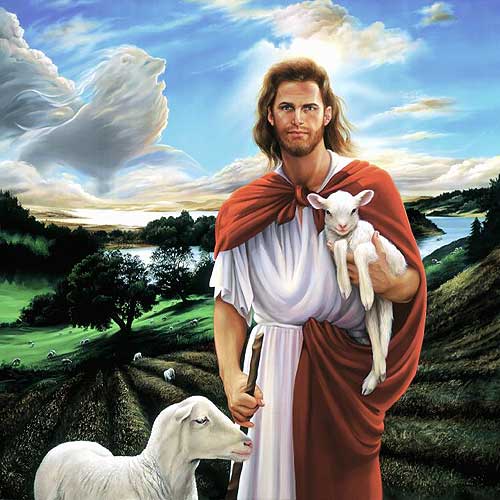
40. Jesus Christ is the Good Shepherd as well as a sexy beefcake.

Who made our Lord and Savior into a figure on a Harlequin Romance novel? Seriously, why make Jesus sexy when most Christian denominations don’t consider him to have any sexual activity? Of course, if this was for a cover of some Jesus-Mary Magdalene shipping fanfic, I’d totally understand, Dan Brown.

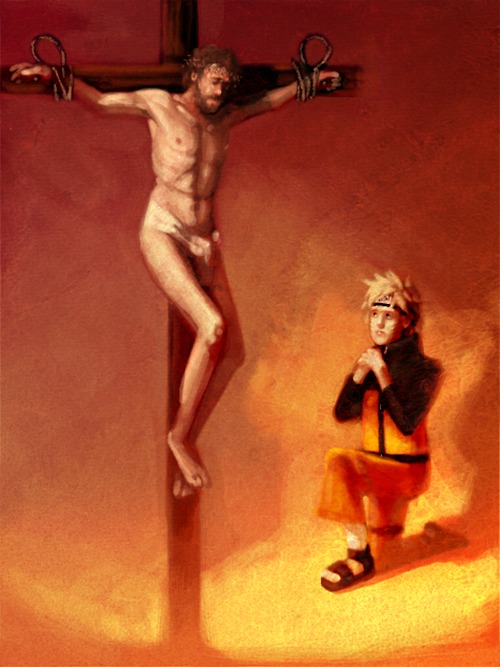
41. Goku kneels down for Jesus.

I’m sure Goku from Dragon Ball Z wasn’t at the crucifixion nor would he have been the beloved disciple. Seriously, this is pretty tacky fanart or something.

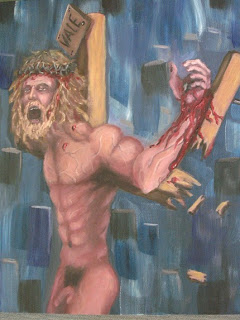
42. You don’t want to see naked crucified Jesus when he’s angry.

"Where's my clothes?" Man, Jesus may be crucified, but he can sure grow into the Incredible Hulk when he wants to. Also, exposed genitalia might be offensive to many Christians just a little FYI.

“Where’s my clothes?” Man, Jesus may be crucified, but he can sure grow into the Incredible Hulk when he wants to. Also, exposed genitalia might be offensive to many Christians just a little FYI.

43. “The man in the middle represents the modern Christian … a man who must decide whether or not he will stand up for his Christian beliefs. Many are shouting out to tell him what to do. He raises his hand to say, ‘Be silent, for I know that Jesus is the Christ!'”

Christians may be persecuted in some parts in the world but usually in countries like North Korea. However, I’m sure the white male in a business suit is surely not oppressed in Christendom not in the least. Yet, you can tell where this artist’s politics stand in this painting with making the white male suit a symbol of the modern Christian.

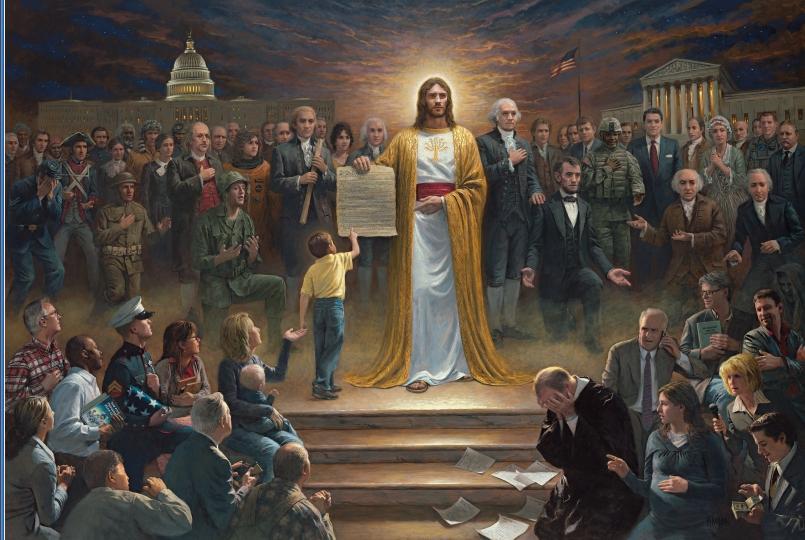
44. Jesus was the inspiration for the constitution.

Maybe Jesus was but he has to share credit with the Enlightenment figures like John Locke and Rousseau. Nevertheless, Lincoln, John Adams, and Alexander are trying to start a barbershop quartet while Washington doesn’t seem too interested. Still, this is a more blatant painting commemorating the artist’s conservative politics than it is about Jesus.

45. Here’s a painting of the biblical heroine Judith of Bethulia who beheaded a guy named Holofernes in of the extra canonical books of the Bible.

Of course, this painting seems to resemble something that would be hung on some college guy's dorm room. Yeah, a badass biblical heroine is reduced to some scantily clad chick you see in certain action movies. Pretty much a shame.

Of course, this painting seems to resemble something that would be hung on some college guy’s dorm room. Yeah, a badass biblical heroine is reduced to some scantily clad chick you see in certain action movies. Pretty much a shame.

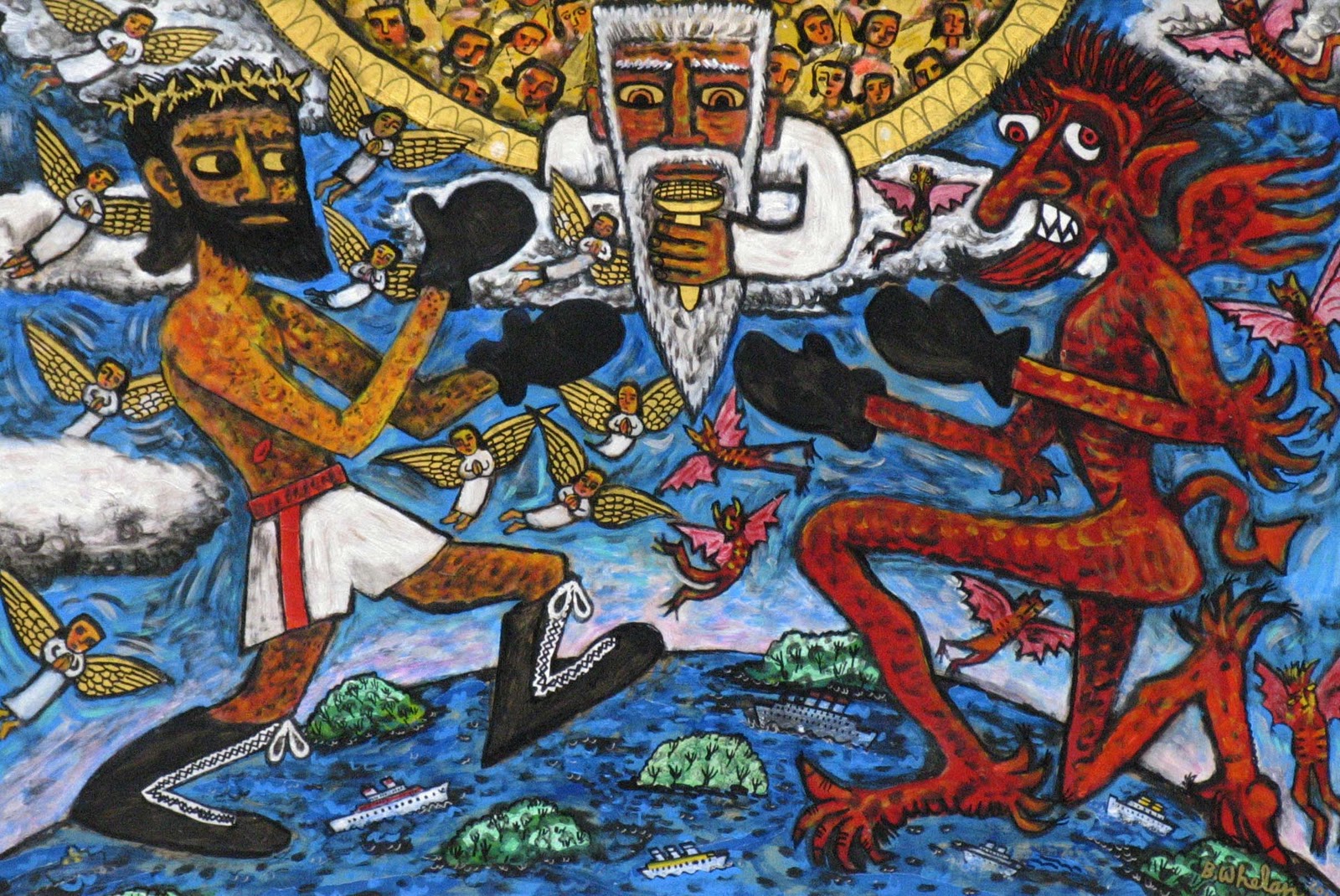
46. See Jesus and Beelzebub box each other in the ring.

Jesus and Satan boxing with oven mitts while God serves as announcer. Now I've seen everything. Still, all the angels and demons feel so excited about the match.

Jesus and Satan boxing with oven mitts while God serves as announcer. Now I’ve seen everything. Still, all the angels and demons feel so excited about the match.

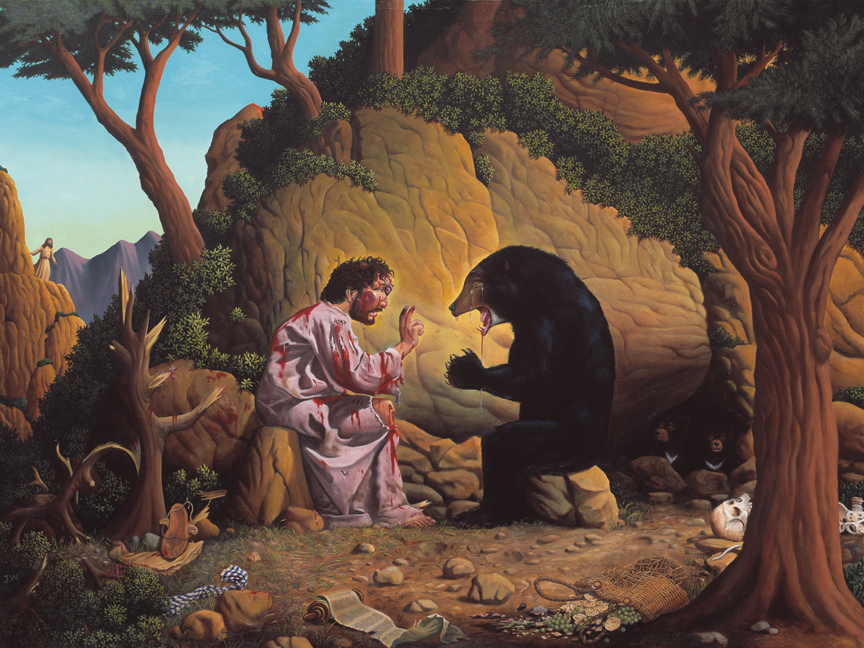
47. Jesus gets mauled by a bear and trying to confront it.

Uh, Jesus, you might want to run away because it has cubs in the background. Trying to make peace with a mama bear is never a good idea, honest to God I'm not kidding.

Uh, Jesus, you might want to run away because it has cubs in the background. Trying to make peace with a mama bear is never a good idea, honest to God I’m not kidding.

48. Accept NASCAR Jesus as your Lord and savior.

Honestly, this is one of the most redneck Jesus artworks I’ve ever seen. Hey, I didn’t know Jesus had Budweiser as a sponsor. Of course, he’s just at the track to protect racers from wrecking into each other or dying while wrecking into each other, since wrecking is basically the only interesting thing that happens during NASCAR races.

49. My, Jesus, what green eyes you have.

Kenny Loggins doesn't seem to have aged well in recent years. Nor does he seem to have grown out of that 1980s haircut of his.

Kenny Loggins doesn’t seem to have aged well in recent years. Nor does he seem to have grown out of that 1980s haircut of his.

50. Aww, what a sweet painting of Jesus watching a child sleep.

For some reason, I find this rather creepy, especially reading Jesus' expression and his trying to touch the child's head.

For some reason, I find this rather creepy, especially reading Jesus’ expression and his trying to touch the child’s head.

History of the World According to the Movies: Part 19 – The Catholic Counter-Reformation

Image

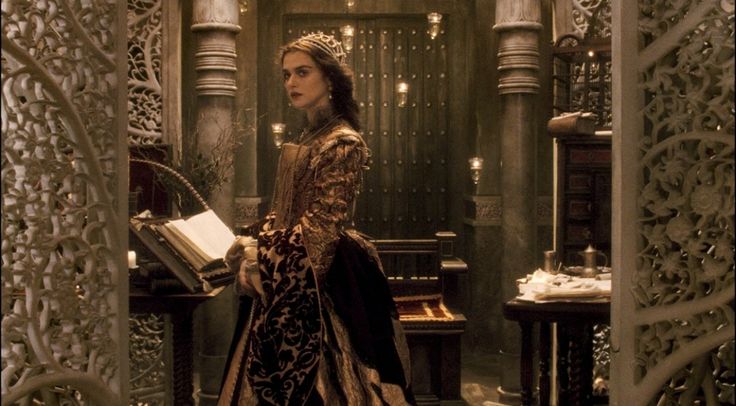
Here is Queen Isabella of Spain played by Rachel Weisz in The Fountain. I chose this picture since Queen Isabella of Spain is one of the few figures in the Catholic Counter-Reformation to be depicted in a positive light since she’s mostly seen being a patron of Christopher Columbus (and that most movies on the Inquisition are usually played for horror). However, unlike most depictions of her including this, she’s also known for starting the Spanish Inquisition we all know as the one of the fiercest villainous organizations depicted on film. Also, there’s no way in hell the Grand Inquisitor Torquemada would’ve ever wanted to assassinate her for since he knew what the penalty would be (while a Grand Inquisitor making an attempt on her life would actually seem more like karma). Also, she was not in love with a Conquistador (and was faithful to her husband King Ferdinand as well as the fact the Conquistadors weren’t around until after she was dead) and certainly didn’t look like that around middle age and seems to retain her figure all too well after ten pregnancies.

Of course, there’s also the Catholic Counter-Reformation which sought to correct certain abuses of the Catholic Church as well as bring the faith back to the people. Of course, the Counter-Reformation was a time of the Inquisitions where many of the leading clerics would round up heretics for torture and trial. The most famous was the Spanish Inquisition which tended to turn out of nowhere from time to time at a random mention uttering “Nobody expects the Spanish Inquisition!” then proceeded to torture people with dish racks, fluffy cushions, and comfy chairs (actually this isn’t the one from Monty Python, sorry). Actually the real Spanish Inquisition was a quasi – state and religious organization started by Ferdinand and Isabella that was set to unite Spain under the “new” Catholicism once and for all, which more or less pertained to expelling or persecuting the Jews and Muslims in the area, especially those who converted. Oh, and there were plenty of other Inquisitions to root out heresy as well. You also have the Jesuits under Saint Ignatius Loyola who found a new order of priests devoted to education, spiritual exercises, and total obedience to the Pope. Of course, while this movement exists today, it didn’t always get good press. Then there’s the Catholic mysticism of Saint Theresa of Avila and her order captured most famously in a statue by Bernini. And last but not least, let’s not forget the Council of Trent which helped shaped Catholicism within much of its history before Vatican II. Of course, some reforms would be unmet, but this managed to put some areas of Europe back in the Catholic Church’s hands as well as helped make the Church a more efficient and accountable religious institution. Still, Hollywood rarely touches upon this and sees the Catholic Church during the Reformation as a static and backward institution which doesn’t say the whole truth (I mean you get movies about Martin Luther but you barely have any on Ignatius Loyola or Theresa of Avila). And depictions of the Inquisitions are much worse than they were in real life by 16th century standards (this doesn’t dismiss them as bad guys but they weren’t nearly the monsters you see in the movies). So here are some cinematic inaccuracies relating to the Catholic Reformation.

Catholic Reaction:

Catholic leaders refused to debate or engage Martin Luther. (Some Catholic theologians actually did and in public like Johann Eck.)

Catejan was a cardinal during the conclave that elected Pope Leo X in 1513. (He was made a cardinal four years later.)

Girolamo Aleander was a cardinal during the Diet of Worms. (He wouldn’t become cardinal until 15 years later.)

Catholic Europe was rife with witch burning hysteria. (The real witch-burning hysteria was in Protestant northern Europe where more witches were killed. The Inquisition did their share to prevent such hysteria in Catholic areas.)

Catholic clergymen and leaders were misogynistic. (Maybe, but many Protestant sects were no better since they wanted all women to stay in the kitchen more or less. Oh, and they did raided convents as well as forced nuns to convert and marry in some situations. At least Catholic women had some choice to become nuns if they wanted to. The 16th century wasn’t a good time for women, let’s just leave it at that.)

Catholic priests were all trained assassins in the 16th century. (Yeah, I can believe it. Not really.)

Popes:

Pope Julius II wore golden armor. (He was a warrior pope who did wear armor, but it wouldn’t have been made out of gold {which is too soft for the battlefield}.)

Pope Julius II was clean shaven. (He had a beard. He also had an illegitimate daughter and was rumored to be gay, strangely.)

Pope Leo X was around in 1525. (He died well before then.)

Pope Julius II was present in Rome when Martin Luther was there. (He wasn’t.)

Pope Leo X put a bounty on Martin Luther’s head. (He actually sent orders that Luther’s safe passage was to be respected.)

The Catholic Church refused to grant King Henry VIII a divorce from Catherine of Aragon out of moral principles. (The real reason had nothing to do with moral principle as we learn from Lucrezia Borgia’s married life for but then again, her dad was the pope. Also, Henry VIII was in good graces with the Church prior to that time and was given the title “Defender of the Faith,” from Leo X long before he was petitioning for a divorce and knew the pope owed him a favor. However, the reason why the Pope Clement VII didn’t grant Henry VIII a divorce had nothing to do with the fact that he was married but who he was married to and in a loving relationship of over 20 years in fact. Not to mention, annulments were fairly common back then and if Henry VIII was married to anyone else, he probably would’ve obtained it easily. Yet, Clement VII was being held prisoner by Holy Roman Emperor Charles V, Catherine of Aragon’s nephew. Also, Henry VIII wasn’t asking for a divorce from the Pope but an annulment so he wouldn’t have his daughter Mary inherit the throne after he died. He didn’t just want to be single again, he wanted Catherine declared a whore and his daughter Mary a bastard. It’s pretty obvious why Charles V didn’t want that done to his aunt. It didn’t really work. Besides, other heirless kings have divorced their wives before. And Pope Clement VII didn’t really refused, but delayed making any decision hoping that either Henry or Charles would die in the process or just wanted Henry to take care of the matter himself, but not in the way he wanted it.)

Henry VIII’s annulment request to the Pope was unusual for its time. (Contrary to what you see in movies, trying to divorce your spouse on grounds of consanguinity was actually very common on among the royals and nobles who could afford it and the fact they married among their own kinds, leaving the marriage pool quite small to begin with. Eleanor of Acquitaine did this by saying that King Louis VII of France on grounds that they were 3rd cousins even though she basically dumped him for a man who was just as closely related to her as he was. And this was a successful case. The only thing that was unusual about Henry’s request is that Catherine of Aragon was his sister-in-law before she was his wife and that he asked for a special dispensation to marry her. And now he was using their former connection to annul their marriage which didn’t go well with her nephew Holy Roman Emperor Charles V who was keeping Pope Clement VII in prison.)

The Borgias:

Pope Alexander VI had five kids. (He’s said to have more than that. Yet, some say that he may not have fathered any kids at all. Still, he’s said to have a descendant named Francis who became a Jesuit and a saint. Also, he’s an ancestor of Brooke Shields.)

Cesare Borgia killed Lucrezia’s second husband Alfonso of Aragon. (He was primarily accused of his brother-in-law’s murder but he had a lot of other enemies, too, so we’re not sure. Also, though the Borgias had a notorious reputation for ruthlessness and murder, they were no more murderous than any other prominent Italian family at the time. They just got a bad rep for being social climbers and Spanish. Oh, and Niccolo Machiavelli’s shout-out to Cesare in The Prince certainly doesn’t help either.)

Lucrezia Borgia had sex with her male relatives. (This most likely never happened and the child born in the Borgia household in 1498 wasn’t Lucrezia’s son.)

Jesuits:

The Jesuits were assassins. (They were a priestly order set up by Saint Ignatius Loyola, which helped reinvigorate Catholicism through education and spiritual exercises. Nevertheless, the first Jesuits were ex-soldiers, by the way and called themselves “Soldiers of Christ.”)

The Inqusitions:

The Inquisition was one of the big muscles of oppression during the Counter-Reformation. (Actually the Inquisition began before that and even though it ended in the 1800s, it was off and on. It began in the 1300s, peaked in the 1500s with the Reformation and Spanish Inquisition, and died down way after that. Also, the real muscle for the Counter-Reformation were the Jesuits who helped reclaim areas of Catholicism with education and zeal. Not only that, the Protestants had their ways of oppressing others, too whether they be Catholic, Jewish, or different kind of Protestant.)

The Inquisition consisted of a bunch of witch-hunters who accused people of witchcraft. (Actually the Spanish Inquisition was more interested in condemning heretics {or whatever else the Spanish Crown wanted for sometimes the Spanish Inquisition targeted certain individuals for solely political reasons}. Even at the height of witch craziness, the official Catholic Church position on witchcraft accusations was superstitious nonsense and actually tried to suppress witch-hunts and often investigated the cases of the accused so they can acquit them and calm down the public panic. And the Church had forbidden the belief in witchcraft since the 7th century even though it became more open to it late in the Middle Ages. Not to mention, the Spanish Inquisition was more likely to go after the accusers than the accused unless they were also suspected of heresy. Also, the Spanish Inquisition only executed 12 people for witchcraft {and the inquisitors involved in those were punished}. Not only that, some of the first people to speak out against accusations of witchcraft and torture were priests based on their experiences and did so by pointing out the obvious. However, there were witch burnings in Protestant areas during the sixteenth and seventeenth centuries and witchcraft was considered a crime according to secular law.)

Veronica Franco was accused of witchcraft and was tried by the Roman Catholic Inquisition. It was only by the intervention of the Marco Venier and Venetian senate that she was dismissed of all charges. (Sure, yet even though the Inquisition tried her, they were on her side and would eventually dismiss her of all charges anyway, no matter what the people of Venice did because this was how the Inquisition normally handled witchcraft charges. Thus, she was never in any danger from them. They only arrested and tried her in order to calm down the public hysteria and prove that the notion of witchcraft was just superstitious nonsense.)

The Catholic Church largely supported the Spanish Inquisition, which tortured, persecuted, and slaughtered tens of thousands. (The Spanish Inquisition was mostly operated by the Spanish government and while the Catholic Church hierarchy supported it to a certain extent, but it was the least religiously motivated inquisition though despite its reputation. If it was ever used as a political tool of repression, it was mainly for the Spanish Crown, not the Church. And this Inquisition often focused its surveillance on cities due to limited resources and wasn’t deployed much overseas. They were also highly regulated, didn’t always use torture to extract confessions, and served primarily to educate ordinary people about the faith and how to uphold it, sort of what the Jesuits did. The Spanish Inquisition only executed about 1500-5,000 of the people it tried in its entire existence {mostly because the convict usually fled and burned in effigy}, which was less than how many people were killed executed in Europe for witchcraft at the same time estimated at 60,000. Also, the Spanish Inquisition spent most of their time correcting peasant superstitions, lapses of morality and sexual misconduct, and confronting religious ignorance. Heresy only occupied 3% of their cases, which by Hollywood standards is boring. They also introduced the presumption of innocence, provided legal counsel for the accused, considered confession without factual corroboration unfit grounds for sentence, and were forbidden to accept accusations from ex-convicts or people who could benefit from the sentence. None of that was observed by most secular courts of the period as well as were methodical for gathering and basing their cases on evidence. They also didn’t burn books either despite having a banned books list, the books were widely available. As for torture, it was considered an exceptional method up to the 18th century, just as fines and imprisonment are used today but it wasn’t to a high degree since the Inquisition was forbidden to draw blood during torture. Of course, they didn’t believe in habeas corpus either and the accused could be in prison for two years without knowing his or her accusers were. Actually the notoriety of the Spanish Inquisition was more or less formulated by anti-Catholic propaganda and that Spain was at war with Protestant nations like England and the Netherlands where there was more freedom of speech for its time and the printing press was much more available. So while the Spanish Inquisition wasn’t in any way nice and did persecute people, they were far from the ideal frothing at the mouth villains from Hollywood movies {since they wouldn’t burn people at the stake who were accused of heresy by their neighbors who just didn’t like them}.)
The Spanish Inquisition and the Papal Inquisition were one and the same. (They were completely separate organizations and happened at completely different times.)

The Catholic Church executed heretics during the Counter Reformation and Inquisition under auto da fe (act of faith). (The Church never executed anyone even for heresy since priests were and still are forbidden to shed blood. When they did convict someone, the Church handed him or her to the secular authorities who executed them. Also auto da fe was not the execution itself but the public penance of convicted heretics that occurred before the sentence was to be carried out and many were spared at the last moment if they confessed and repented.)

The Spanish Inquisition was a religious organization that handled only religious cases. (The Spanish also used it as a tool for political repression ran by the state and all cases were reported to the El Escorial first, not the pope. Actually it was mainly used as a tool for political repression and one of the least religiously motivated inquisitions to date. In fact, the very existence of the Spanish Inquisition sort of violated the separation of church and state but then again, there wasn’t much separation in Spain to begin with.)

The Spanish Inquisition was Spain’s muscle to suppress heretical ideas and enforce the old Catholicism on the population. (Actually the Spanish Inquisition was not interested in enforcing the “old” Catholicism as it was promoting the “new” Catholicism, making the country resistant to the Counter-Reformation. And it was also used to Christianize Granada or expel those who didn’t want to convert {or were practicing their old religions in secret}.)

Veronica Franco was tried once by the Inquisition. (She was tried twice for witchcraft and in both she confessed to performing sorcerous rituals to entertain her clients and insisted she didn’t believe them. The Inquisition just said her actions were inappropriate and not do them anymore in each case. Her witchcraft case against the Inquisition was no less ordinary than anyone else’s in Catholic Europe. Oh, and she was denounced by her son’s tutor over revenge since she suspected him of theft of various precious items in her house, not because she bewitched legions of men.)

History of the World According to the Movies: Part 18 – The Reformation

Image

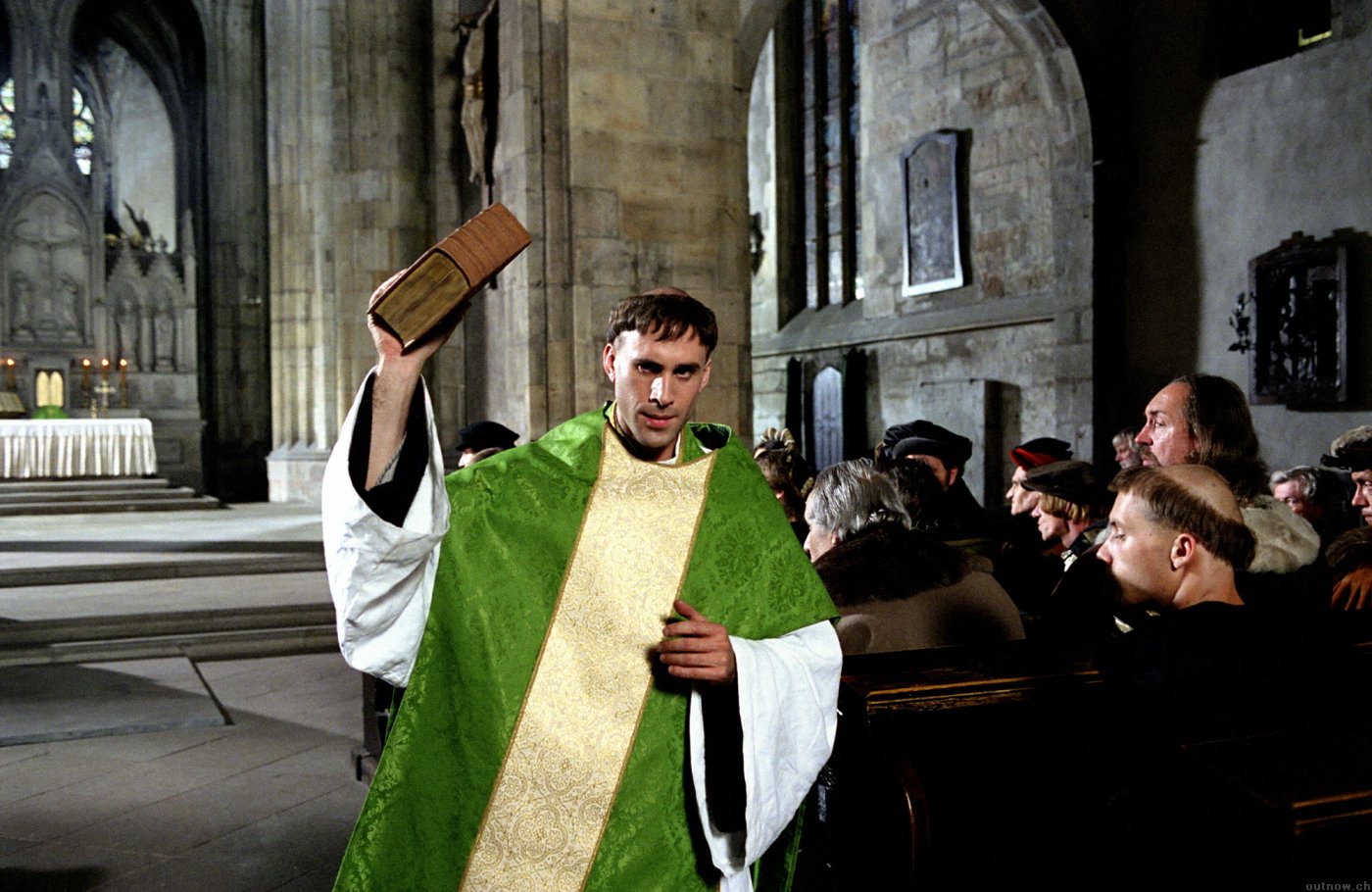
Luther: a movie starring Joseph Fiennes about one of the guys who got the Reformation started. Of course, a movie pertaining to the Protestant Reformation isn’t going to cast Catholics in a positive light (though it does more than it’s fair share to be as rabidly anti-Catholic as possible). Of course, they had to in order to make Martin Luther look good because he doesn’t seem like a likeable guy in this at all. Also, you wouldn’t have seen him in the role of a parish priest, c’mon. He was an Augustinian monk and theology professor at Wittenburg! Then again, perhaps he’s taking over for somebody. Oh, and is the congregation sitting in pews? Holy shit!

So we’re back in Europe which is now in a period of great social and cultural change called the Renaissance, a period of rebirth in the arts and sciences as well as philosophy. You have artists like Leonardo, Michelangelo, Raphael, and Donatello who created great masterpieces before becoming the Teenage Mutant Ninja Turtles (I’m just kidding on that one). You also have Giotto, Botticelli, Titian, and others even though the most famous were Italian. You have writers like Dante and Shakespeare writing works that would help shape their respective languages for generations. You have scientists like Copernicus, Galileo, Vesalius, and others who’d shape our perception of the world for later generations and pave way to men like Newton and Kepler. Then you have philosophies like Humanism, secularism, and individualism celebrating the glory of humanity and all it’s wonders. Also, you have Johannes Gutenberg whose printing press would bring this period into a new information and revolutionize communication in such a way that A&E will make him Man of the last Millennium. Of  course, I probably wouldn’t be able to write this post or anything at all if he wasn’t around because movable type made life so much easier for me.

However, this is also a time period saw the coming of what’s known as the Protestant Reformation when countries and peoples of Western Europe started breaking away from the Roman Catholic Church. There were a lot of things that led to the Protestant Reformation like indulgences, the Avignon Papacy, urbanization, proto-nationalism, popular piety, Christ-centered theology, Christian humanism, as well as fears and superstitions relating to death. Since Northern Europe was more religious than places like Spain or Italy, it was there where Protestantism took root. And because of the printing press and secular rulers wanting their own church to better control their people, you could see why Martin Luther became as successful creating his own denomination as he did. Still, even though everyone in Europe knew that the Catholic Church was corrupt as well as had their own ideas about reforming it, doesn’t mean that people were willing to break away from the Church or became Luther’s disciples, because Lutheranism only reached parts of Germany and Scandinavia. Erasmus and Thomas More might’ve had their own ideas at reforming the Catholic Church but both of them remained in the flock and greatly bashed Luther and his ideas. John Calvin would later come up with his more exportable brand with his Reformed movement in Geneva and others would follow like Zwingli, some more radical than others. However, Hollywood usually focuses on Luther since he started it all though they’re not always 100% accurate on facts and tend to have a very anti-Catholic slant on it. Of course, who could blame them since Martin Luther wasn’t the kind of guy you would’ve wanted to have a beer with. Nevertheless, here are the inaccuracies I shall list.

Martin Luther:

Martin Luther was a prudish man. (This was a guy who’d write to his friends about his bowel movements.)

Martin Luther was a timid man. (No, but he was a man forged with passion and rage nonetheless.)

Protestantism began with Martin Luther. (There were heretical movements before Martin Luther going on in Europe since the Middle Ages. Luther’s brand of Protestantism was one of the first to have any kind of staying power.)

Luther referred to Biblical passages by book, chapter, and verse while starting his reformation. (Biblical passages weren’t listed like this until 1551 and even then, the divisions weren’t ubiquitous until the Geneva Bible.)

All the nobles stood up to Charles V during the Augsburg Confession. (Only the Duke of Saxony and Louis V of Palatine did.)

Martin Luther and Spalatin went to law school together. (They didn’t meet until later in life.)

Frederick of Saxony was given a golden rose as a bribe to deliver Luther to Rome. (It was to bribe him to run for Holy Roman Emperor against Charles V.)

Martin Luther was a saintly iconoclastic hero. (He may have caused a stir with his religious views but he was basically a social conservative. Also, he hated the Jews.)

Andreas Karlstadt radically distorted Luther’s views while he was in seclusion in Wartburg and insisting on being addressed “Brother Andreas.” (Though Karlstadt actually orchestrated the reforms, they were more peaceful. Yet, they were too radical for Luther {like Mass vernacularization} and he tried to either undo them or slow them. Also, Karlstadt didn’t renounce his professor title until Luther’s return.)

Martin Luther returned to Wittenburg with modest growth of a beard and was under the name “Knight George.” (He had returned with a beard “sufficient to deceive his mother” and under the name “Junker George” {which means “Knight George.”})

Johann Tetzel was at the Augsburg Confession. (He was never at the meeting.)

Johann von Staupitz was alive in 1526. (He died in 1524.)

Martin Luther’s 1520 treatises were in print by that June when Exsurge Domine was issued. (They were not.)

Martin Luther told Karlstadt to leave Wittenburg in 1522. (He pleaded with him in Orlamunde to return after Karlstadt had voluntarily left.)

Martin Luther was in Wittenburg during the Diet of Augsburg in 1530. (He was staying in Coburg.)

Ein’ feste Burg existed in Luther’s time. (It didn’t. According to Wikipedia, “it was a product of the later Pietistic movement which found faultwith early rhythmic chorale melodies because their dance-like rhythms were too secular in nature.”)

Martin Luther spent his years in exile translating the New Testament into German, having visions of the devil, and ranting rhetorically in thin air. (Yes, but it gets weirder with Martin Luther according to the Guardian, “Luther believed poltergeists were attacking his ceiling with walnuts, and once threw a dog out of a window because he thought it was Satan. He also suffered physically. “The Lord has struck me in the rear end with terrible pain,” he complained to a friend. To another, more prosaically: “My arse has gone bad.” This does at least explain why he was so grumpy.” Oh, and he got fat.)

Martin Luther was the primary reformer of the Reformation. (Yes, but he wasn’t the only one. You had John Calvin in France who founded Calvinism and ran Geneva on it. Also, you have the radical reformers behind the peasant revolts in Germany as well as others.)

Tetzel made it to Wittenburg and Saxony. (He never made it there thanks to Frederick the Wise banning him. However, he did go to nearby border towns drawing Saxony coin to the ire of both Frederick and Luther.)

Luther succeeded by theology and faith. (His success also had more to do with politics and economics as well as the fact that some German princes were tired of their gold going to Rome. And Luther knew this.)

Martin Luther nailed his 95 Theses on the Cathedral door of Wittenburg. (He actually sent them in a letter to his superiors. He never mentioned actually nailing his 95 Theses on a cathedral door.)

Martin Luther insisted on burying someone who committed suicide in his parish cemetery. (There’s no record of this. Also, he probably would’ve never preached outside the pulpit. Also, he didn’t come to Wittenburg as a parish priest.)

Martin Luther was intense, uncertain, humorless, and generally liberal cleric with passion with fits of melancholy and depression. (He actually did have a sense of humor and also possessed  a gregarious personality. He loved beer, lively conversation, and hearty laughter. And he was no neurotic introvert by any standards as well as a social conservative.)

Martin Luther was mostly disturbed by the use of indulgences on his trip to Rome. (True, but he was also disturbed by the moral laxity he observed among the clergy as well as developed an aversion toward relics, purgatory, and prayers to the saints.)

During the Diet of Worms Martin Luther said, “Here I stand. I can do no other. God help me. Amen.” (He never said this.)

Martin Luther showed genuine remorse over the massacres during the Peasants’ Rebellion caused by their misunderstanding of him. (He may have actually been calling for the princes to show no mercy upon the uprising.)

Martin Luther’s stand on the Bible was accountable for the Peasants’ War of 1525. (It wasn’t. It was how the peasants misunderstood him and distorted his teaching.)

Martin Luther met Frederick the Wise personally. (They never did.)

Frederick the Wise lamented over the Peasants Rebellion of 1525. (He was dead and buried in Wittenburg castle by that time.)

Martin Luther never associated the Pope as the Anti-Christ. (Uh, he actually did before he published his 95 theses in 1517.)

Luther’s heart was really with the peasants. (No, it was in his own theology. He certainly didn’t like it when they revolted.)

Karlstadt advocated political egalitarianism. (He never did.)

Frederick the Wise paid Martin Luther’s salary. (He didn’t.)

Martin Luther returned to Wittenburg on Elector Frederick’s behest. (He returned very much against the ruler’s will.)

Protestants:

Northern Europeans in Protestant countries willingly broke away from the Catholic Church. (If Europeans, you mean resident nobles, then yes, but if you mean everyone else, then not really except in France. And parts of the English population remained Catholic and are to this day.)

Protestants were open to scientific thought during the Reformation. (Actually, even though it was the Catholic Church who put Galileo on house arrest, but he probably wouldn’t be safe with the Protestants either at least in the 1500s. Sometimes they were more willing to interpret scripture more literally than the Catholic Church would. Also, the pope didn’t put Galileo on house arrest, cardinals did and the Catholic Church’s motive didn’t have much to do with Galileo’s ideas than his attitude to the pope. Galileo also published another scientific book without incident after that. Not to mention, it was the secular scientists who were more critical of Galileo’s ideas. And wasn’t the Catholic Church behind the Gregorian calendar that was more scientifically accurate than the Julian calendar most of Europe had been using? And weren’t the British one of the last European nations to adopt that?)

Heretics were peaceful and/or eccentric evangelists who were just persecuted by the Catholic Church for speaking their mind. (Many heretical movements from the Middle Ages to the Reformation were anything but and also strove not only to reform religion but also secular life and some actually tried to do so quite forcefully by physical elimination of the nobility and clergy, attracting simple criminals. To compare them to fascists, Bolsheviks, or Middle East terrorists isn’t much of a stretch.)

Protestants were more tolerant of new ideas than the Catholic Church and didn’t believe in superstition. (It was the Protestants who were burning the witches.)

Protestants celebrated Christmas. (The Calvinists and the Puritans didn’t for they thought it was too Papist and pagan.)

Protestants were anti-establishment types. (Just because they were religious radicals doesn’t mean that they were social radicals either for many certainly weren’t such as the reformers who found favor with resident nobles. And those who were as much social as well as religious radicals didn’t find much favor in Europe, even in Protestant entities.)

Early Protestants were champions of conscience, freedom, and toleration. (Uh, when it came to their own ideas perhaps, but no. Protestants during the Reformation were also hostile to Catholics and other Protestants outside their denomination. Leaders in Protestant domains set up their own state churches which people had to attend and adhere to. Lutheran princes suppressed Catholic monasteries in their territories and Luther supported the expulsion of Catholics who were banned from Saxony in 1527. Also, John Calvin and his followers ran Geneva as a Protestant theocracy. Still, just because you had a group willing to break away from the Catholic Church doesn’t mean they believed in religious toleration, because they certainly didn’t.)

People unhappy with the Church joined the Protestant faith. (Many did not and actually bashed these Protestant movements like Erasmus {who also bashed the Catholic Church a lot to but remained faithful}.)

Miscellaneous:

Congregants were seated in pews during this time. (They weren’t a common fixture of churches until after the Reformation.)

Confession wasn’t necessary for those who bought indulgences. (If the buyer didn’t purchase them for oneself. Otherwise, indulgences specified that the buyer had to go to confession.)

The sale of indulgences brought upon the Reformation. (Yes, but it wasn’t the only factor.)

Pre-reformation priests lived wealthy lifestyles. (Not by our standards. Also, one of the calls for the Reformation was the abundance of uneducated priests from the ranks of the poor and peasants. The Catholic Church knew this and tried to correct this in the Counter-Reformation.)

History of the World According to the Movies: Part 7 – The Medieval Church

Image

From Kingdom of Heaven, which is probably a movie about the Crusades we’re all familiar with as well as one that says that these wars of religion weren’t as holy as many say they were. However, this picture does encapsulate the idea of the religiosity of the time period. Still, though Orlando Bloom’s character actually did exist, he wasn’t the widowed French blacksmith as depicted in the beginning at all. However, he did end up with a Queen consort of Jerusalem, just not Queen Sybilla.

While fighting is one of the many aspects of the medieval landscape, the Middle Ages would never be what it s without the Church. Sure it was a dominant force in medieval life and a very misunderstood one as Hollywood is concerned. Still, though Christianity began in ancient times, it really came into its own in the Middle Ages as an institution (as long as the Catholic Church is concerned but there were Orthodox churches in the east as well). Medieval monasteries and convents were places of great cottage industries and learning with monks being among the intellectuals of their day and churches became not only centers of devotion but also places for community. Not only that, but we also see the rise of the Gothic cathedrals which are still used for worship today (even if it’s on the decline in Europe these days). And without the Church, we wouldn’t have universities, the institution of medicine, theology, and all those ancient writings that would’ve been lost if monks didn’t spend all day copying them. Of course, because of the medieval Church, we also have antisemitism, heresy, and the Crusades which is a series of religious wars in the Middle East geared to capturing the Holy Land from the Muslims. Still, Hollywood always tends to screw up a few things about the medieval Church which I shall list here.

Medieval Christianity:

The Catholic Church was a backward institution that discouraged education and scientific research. (The Catholic Church actually saved science and is the main reason why we know anything about the Middle Ages at all even though they did lock their books but there weren’t many books in Europe anyway and were very expensive since they were all written by hand or printed from wood carvings which were tedious to make {but many monasteries and nunneries had large libraries of them full of the works of Rome and Greeks and monks spent a lot of time copying them}. Furthermore, they even set up universities all over Continental Europe, started formalized higher education with advanced degrees, and saw no problem with dissection {the Knights Hospitaller did this and the Church was fine with it}, at least in the basement anyway, which helped set the foundation of modern medicine. They started the first medical and law schools as well. They even educated children in monastic and convent schools when education became a higher demand and that was before the printing press. Not to mention, the Crusades also allowed Europeans to come into contact with Muslim ideas and Arabic numerals. And their massive cathedrals were marvels of medieval craftsmanship and engineering. Furthermore, monks were usually the most educated people in Europe of their day. Actually it would be more accurate to say that the Catholic Church was a great medieval engine of scientific progress. Not to mention, most medieval scientists were monks and/or priests as well. Still, doesn’t stop filmmakers from making movies set in the Middle Ages in which the Catholic Church is hostile to scientific inquiry which really wasn’t the case {especially with the Galileo Affair which isn’t as much a science vs. religion case as most people think}.)

Monks locked their Bibles to keep people from hearing the true word. (No way in hell. Monks locked their Bibles so churches could guarantee that people could hear the Bible on a daily basis as well as prevent it from getting stolen. A stolen Bible would’ve taken many months to replace since books at the time were copied by hand.)

Europeans were highly religious during the Middle Ages. (Despite the Crusades and the powerful presence of the Catholic Church, most people in the Middle Ages were probably just as religious as I am, observant yes, but with a more laid back approach like many Catholics today. Sure religion was important but it wasn’t the only thing in life and it wasn’t altogether incompatible to the modern notions of the day either. In other words, medieval Europeans may have went to church on Sundays but they weren’t religious fanatics, at least in general. Of course, religiosity would increase later in the Middle Ages as well as in the early Renaissance in Northern Europe since they were people who cared enough about religion to break off from the Catholic Church.)

The Catholic Church discouraged scientific research and progress. (Actually, quite the contrary. For one, most medieval scientists in Europe had a religious vocation. Second, while the Middle Ages wasn’t the best time for science {which wasn’t a big subject at the time}, it was nevertheless studied for practical reasons. The Church understood that scientific study can benefit them and help monks and nuns do their jobs better. Needing to care of the sick led to the study of medicine. The fact monks and nuns needed to schedule prayer times as well as find out when Easter is led to the study of rudimentary mathematics and the motions of the Sun and the Moon. Third, contrary to popular belief, the High Middle Ages was a really good time for science with the rise of Scholasticism and Aristotlelianism.)

Medieval cathedrals were often dark places. (Actually, they were places with large glass windows that let tons of light in. Churches were painted in bright colors. Still, today tourists tend to complain every time these places are washed because it’s too bright. Not to mention, it was inspired by Indian and Arab/Muslim building styles also from the Crusades.)

All nuns were virgins admitted into a convent as lovely, nubile waifs. (They could also be an ugly daughter of a lord or women who didn’t want to get married or have kids.)

Monks were benevolent men who devoted their lives to God. (Well, not quite for many monasteries enjoyed great wealth in the Middle Ages and many monks didn’t live too badly either {especially in the later Middle Ages}. In many ways, they were not just clergymen, but also businessmen, scribes, scientists, intellectuals, as well as some of the smartest guys around {same goes for nuns, too, for the most part}. Oh, and many monasteries had their own armies.)

Monks could hear confessions. (If they have taken holy orders since a lot of monks are priests. If not, then no.)

Monks were dissolute hypocrites who used religion to make money. (This isn’t 100% accurate either for though monks weren’t perfect human beings and the Church did have some degree of corruption, they were just as flawed like everyone else. We just tend to put them on a higher pedestal since they tend to be religious figures. Besides, every religion has their share of hypocrites and jerks as any institution and I’m sure medieval Christianity was no exception. Sure you may have a few bad and corrupt monks, but you also had a lot of cool ones as well. However, it was true enough for Henry VIII to convince the masses on why he had to dissolve the monasteries {which was to finance a war in France}, even though the actual debauchery and corruption of monks wasn’t nearly as bad as Henry made it out to be.)

Medieval Russia had no religious insignia in the 13th century. (Russia had been Orthodox Christian for quite some time and would continue to be the dominant church in the country until the Russian Revolution {though it’s still around}. Russian churches would usually have crosses on top and their banners would contain an icon of Christ {ditto priests in the army}. Of course, Eisenstein knew that the Soviet government wouldn’t accept this while filming Alexander Nevsky. Also, Nevsky is a saint in the Russian Orthodox Church.)

Clergymen were forbidden to shed blood so they didn’t fight. (Sure but there were militant churchmen as well as military religious orders like the Knights Templar, the Teutonic Knights, and the Knights Hospitallers.)

“Dies Irae” was a Christian standard hymn in the 1100s. (It was written by a Thomas of Celano who lived around 1200-1260 so, no.)

Saint Francis of Assisi was known as “Jester of the Lord.” (It was his disciple Brother Juniper.)

Saint Francis of Assisi was originally referred to as Francis. (His real name was Giovanni di Pietro Bernardone. Francis was a nickname derived from Francesco {“Frenchy”} which he obtained when he was a little kid. Actually, Francis wouldn’t be used as a legal name until after he became a saint.)

Pope Innocent III had a full beard. (He was clean shaven.)

Everyone in Europe was Catholic during the Middle Ages. (Everyone west of Poland, that is. In Russia, the main church was Russian Orthodox Christianity while the Greeks in the Eastern Roman Empire were Greek Orthodox. Not to mention, before the Mongols you also had quite a few Christian sects in the Middle East and Central Asia like the Coptics, Armenian Apostolics, the Nestorians, the Maronites, Ethiopian Orthodox Rite, and others. When you really get down to it, medieval Christianity was quite diverse.)

The Catholic Church pretty much ran everything. (Yes, it was a powerful institution, but it also got into clashes with secular rulers who wanted to make their own decisions in religious affairs. Not to mention, secular monarchs can and did appoint bishops {Henry II appointed Thomas Becket as Archbishop of Canterbury}. Sure medieval society didn’t exactly have a lot of separation between church and state. And yes, the Catholic Church did mettle in politics as well, but it wasn’t always without a secular ruler’s consent either. They also crowned kings as well as married and annulled their unions {back when marriages were a form of diplomacy}. So while there wasn’t a lot of separation between church and state but it wasn’t exactly a theocracy either. Also, there was less church and state separation in the Russian government and the Russian Orthodox Church, than in any European Catholic country.)

There was an actual Pope Joan. (She never existed.)

The Catholic Church participated in witch hunts and witch burnings. (Maybe in the 1400s but they mostly considered belief in witches as highly heretical. Still, witch hunts did happen under secular governments though and only much later {and they only took witchcraft seriously in cases of murder and treason}. However, there were actually few witch trials during the Middle Ages and many were usually nothing but simple lynches.)

Inquisition guards wore nearly full plated armor in the 1300s. (Only a century later.)

Medieval monks could enter each other’s cells freely. (For a monk entering another’s cell without permission was normally forbidden as well as grounds for excommunication.)

Monks addressed each other as “Your Grace.” (This wouldn’t be appropriate address for a monk under any circumstances but rather for nobles and high members of the Catholic Church.)

Inquisitor Bernard Gui was killed in an Italian monastery in 1327. (Yes, he was a real person and was said to have sentenced 900 people as well as executing 42 of them during his 15 years in office. However, he died in the castle of Laroux in 1331. He also doesn’t die in Eco’s original novel In the Name of the Rose.)

Medieval clergy men and religious orders were highly superstitious. (Yes, but not as much as the laypeople in their domains. Of course, they probably did believe in demon possession and that writing with the left hand was a sin. For instance, most medieval clergymen believed in a round earth from its earliest days. So did most people at the time with an education. We should also account for the fact that most medieval scientists were monks and priests.)

Pagan philosophy was considered difficult to reconcile with Christianity as well as considered borderline heretical. (There is no way that William of Baskerville would need to worry about saving a book by Aristotle because Saint Thomas Aquinas had already embraced embraced several ideas put forward by the Greek philosopher as well as said it was perfectly all right for Christians to read works by non-Christian authors {and had been influenced by the Jewish philosopher Maimonides as well as Muslim philosophers Averroes and Avicenna}. This was in the 13th century. Not only that, but most of the European mythology we know about now was recorded by clergyman themselves, which were only referred just as stories.)

Some European monasteries had African monks. (This would be highly unlikely considering the circumstances.)

The Holy Grail was of great significance in Christianity at this time. (There’s no mention of it in any canonical Christian text and wasn’t spawned until the 12th century. Also, it’s more of a product of Arthurian legend than anything.)

Pagan practices were considered anti-Christian. (Except with the worship of other deities, many pagan practices weren’t considered anti-Christian, but were commonly carried out by Christians as well as became Christianized practices. Kind of like how some people celebrate the holidays with their own personal traditions just to make themselves feel comfortable with the faith. However, this doesn’t stop some people from believing that Christianity was based on earlier religions other than Judaism, of which there is no historic proof as well as nothing in what we know of the original pagan beliefs that we can draw a respective parallel with. In other words, to say that the story of Jesus was based on the myth  of Horus would be like saying it’s based on Harry Potter. Not to mention, those who believe that Christianity was based on pagan religions don’t tend to consider that a certain culture’s mythology doesn’t have a lot of consistency and that mythological stories sometimes tend to vary with location or change over time. And it doesn’t help that the prolific people who tend to believe this are high profile atheist intellectuals, who may be smart and experts in their respective field but that doesn’t mean they’re experts in religion, religious history, or even mythology.)

The Crusades:

There was no reason at all to recommend the Crusades. (Well, there kind of sort of was, at least in some of those people’s minds but I wouldn’t call it the best solution. Still, remember medieval society was a feudal and warlike culture so if these knights weren’t killing Muslims in the Holy Land, they were probably killing each other and then some {though the first Crusade’s primary enemy was the hostile Seljuk Turks who’ve just captured Jerusalem from the Fatimids who didn’t care as long as the Christians spent their money}. Not to mention, the Crusades were called to also help out the dwindling Byzantine Empire, the last remaining Christian stronghold of the Middle East at the time {though they were Greek Orthodox, not Catholic}. Also, Pope Urban II’s predecessor was kidnapped by Normans and were wreaking havoc all over Europe by the first Crusade. Besides, “bring the Cross to Jerusalem” was a much better slogan than “Save the Greek Empire” which nobody in Europe cared about.)

Crusaders taught desert dwelling Muslims how to irrigate their land. (Actually this was the other way around. They also taught them medicine, windmills, round towers, and others even though knights did participate in civil projects during the Crusades.)

Members of the Knights Templar could marry, own land, and be crowned king. (They were forbidden from marrying or owning land. Also, no Templar would ever be crowned king.)

Renaud Chatillon and Guy Lusignan were Templars. (No, they weren’t or never have been. Lusignan was actually king of Jerusalem at the time Chatillon launched his attack. Also, King Baldwin had been dead for several years.)

Sybilla’s marriage to Guy Lusignan was an arranged one. (Her family opposed the match and it was her second marriage.)

Balian was a heroic everyman knight who embodied the best of the chivalric ethos. He was also a blacksmith and an illegitimate son of a knight. (He was raised noble and wasn’t a blacksmith so he probably wasn’t illegitimate. Not to mention, he was part of the most important families in the Kingdom of Jerusalem but of a moderate faction known as the Ibelins {and he wasn’t born illegitimate, but as a younger son}. And he wasn’t born in France but in Jerusalem as a second generation crusader nobleman and would’ve definitely know who his father was. Not to mention, his dad was Italian, not French. Also, though he is known for making the courageous decision to negotiate with Saladin, he also betrayed his oath not to fight him on more than one occasion, sold many peasants in the siege into slavery, and refused to release his Muslim prisoners if Saladin wouldn’t accept surrender. He also threatened the destruction of Muslim holy places under the threat of a repeat of the 1st Crusade capture of Jerusalem. He was ruthless but Saladin would forgive his oath breaking due to prior excellent relations and even helped mediate a peace between him and Richard the Lionheart. Still, Balian wasn’t all that bad for he did pay ransoms for thousands of poor out of his own pocket and offered himself as a hostage for all the rest. Still, he was prone to taking power whenever he could find it, sided with Chatillon, and his dynasty fathered most of the royal families of Europe.)

Guy Lusignan was a foppish, racist douchebag and ax crazy Reynald Chatillon was his dragon. (Chatillon wasn’t ax crazy but he was the worse of the two, much worse. Also, though Lusignan may have been racist, so were many of the European Christians who participated and him and Reynald hated each other {leading to the disaster at Hattin} even though he tried to get him to apologize to Saladin which didn’t work. As what TV Tropes and Idioms says about Chatillon, “Raynald once had a man tortured by smearing him in honey and putting him on top of a tower in the hot sun, simply because the man refused to fund a military expedition Raynald was plotting. Oh, and the best part — the man was the Latin Patriarch of Antioch, a religious leader of the Crusaders — and the expedition was against Cyprus, an island held by the Byzantine Empire, inhabited by Christians. Of course, Raynald had what he thought was a perfectly good reason for this—he felt they owed him money. Or pretended he felt they owed him money. It’s tough to be sure. So — a “bit of a mustache twirling supervillain” is something of an understatement.” Also, Chatillon led a pirate fleet that threatened to burn down Mecca and flayed the Patriarch of Antioch alive.)

The Catholic Patriarch of Jerusalem was a cowardly, self-absorbed jerk, blinded by his faith, and mostly spent his time spreading his prejudice against Muslims. (Actually it was he and Balian who negotiated the surrender of Jerusalem and rounded up the money to ransom the citizens who couldn’t afford to ransom themselves. They also offered themselves as ransom for those who they couldn’t afford to ransom which Saladin declined. He even stripped the silver and gold from the Church of the Holy Sepulchre to pay the city’s defenders knowing it would’ve gotten him in big trouble.)

Sybilla was a member of the moderate faction in the Kingdom of Jerusalem. (As TTI puts it, “The historical Sybilla was actually part of the extremist camp within the Haute Cour, while the film places her squarely on the moderate side. The moderates, such as the Ibelins, attempted to blunt the ambitions of Lusignan and his supporters by refusing to allow her to take the throne after the death of her son (Baldwin V) unless she first divorced him. As a concession they allowed her to marry any man of her choosing afterwards, but unfortunately neglected to add “Except Lusignan,” who she then turned around and picked as her consort. Not because she was in desperate need of his military support as the film depicts, but entirely because of her devotion to him, and because she sided with him and the other extremists politically.” So a romance between Balian and Sybilla most likely didn’t happen.)

Guy Lusignan was an utter bastard who would do anything for power and was willing to wage a war for profit. He was also a terrible King of Jerusalem. (As TTI explains, “Historically, while he may have been ambitious, he was no more so than the next noble, and his decision to go to war was less a matter of Ax Craziness and more a matter of “Saladin’s already attacking, we need to do something about it.” While he was a bad king, it was not because he was nuts and evil, but because he was incompetent: He could listen to reason, and he even did so when Tiberius cautioned him to stay near a source of water and let Saladin come to him, but he allowed himself to be swayed by the over-zealous elements among the nobles and made the decision to march across the desert, exhausting his army and causing its downfall. He was also much better to his wife than in the film: historically, he treated her well enough that when she was given the chance to keep the throne and choose any husband for herself and make him King, she went right back to Guy.”)

Teutonic knight crosses were the same on shield and coat of arms. (They were different in shape and color.)

Returning Crusaders had to face the Black Plague. (Maybe they had to face plague, but the Crusades were long over before the Plague began.)

Russians participated in the Crusades. (There were no Russians in the Crusades.)

King William of Sicily fought in the Crusades. (He sent ships but never went personally.)

Frederick Barbarossa and his son the Duke of Swabia participated in the Crusades at the same time as Richard the Lionheart. (They were both dead by Richard’s arrival. Barbossa died en route in Turkey and his son of dysentery some months before.)

The Count of Montferrat spent more considerable time plotting in the French and English courts. (He was fighting in Tyre. Also, he’s from Piedmont, not Venice.)

Queen Berengaria spent some time in Saladin’s harem. (Really? No way in hell. Besides, there’s no record of Queen Berengaria ever stepping foot anywhere further than Cyprus where she married Richard the Lionheart.)

The Crusades were mostly against the Muslims in an effort to reconquer the Holy Land. (Yes, but there were also Crusades against the Moors in Spain, the Baltic pagans, and even the Albigensian heretics {though that can be considered an Inquisition, too.})

Crusaders eagerly went to the Holy Land on behalf of their God. (They also did it out of self-interests as well such as glory, self-enrichment, and adventure.)

Both sides seemed to get along with each other during the Crusades. (Just because Muslims fought with Muslims and Christians fought with Christians doesn’t mean they liked each other.)

The Crusades consisted of Christians vs. Muslims. (It didn’t become a Christian vs. Muslim conflict until French King Louis VII took a detour in the Second Crusade where he sacked Damascus, betraying his Muslim allies out of greed. Prior to this, it wasn’t unusual for Christians to have Muslim allies or Muslims to have Christian Allies. Not to mention the “Crusaders” in the later stages were mostly just adventurers and mercenaries more interested in glory and loot than defending Christian kingdoms or recapturing holy places.)

Christian Europeans weren’t okay with Muslims controlling Jerusalem. (Actually quite the contrary since prior to the Crusades, it had been controlled by the Muslims for nearly 500 years. It’s just that until the Crusades, Jerusalem was controlled by the easygoing Fatimid Muslims who were perfectly fine with Christian visitors on pilgrimages as long as they paid. And as long as Muslims were fine with Christian visitors in Jerusalem, Christian Europe didn’t care whether the Holy Land was under Christian control or not. However, the Christians weren’t all right with the Seljuk Turks invading the city since they were more prickly and devout than their Fatimid predecessors and had been treating Christian pilgrims poorly {since they didn’t particularly care for religious minorities anyway}. Not to mention, the Seljuk Turks have been trying to take advantage of the weakening Byzantine Empire in a land grab. So the Crusades were initially less of a religious conflict with Christians against the general Muslim population and more of a conflict against more fanatical Muslims who had already proven themselves as Christendom’s enemies and showed it. However, such characteristics only apply to the general Fatimid and Seljuk populations since not all Seljuks were bad and not all Fatimids were good.)

The Crusades were no help to Muslims at all. (Having Christians kill Muslims in the name of God actually gave something that could unite the Muslim world after being locked in a period of infighting which resulted in stronger and larger Muslim states and the end of Shiism as a political force for the next 300 years {until the Safavids converted Iran}. Still, the worst thing the Crusades did for the Muslims was being a major distraction for 2 bloody centuries that neither side even paid attention to what was happening in the east during the 1200s where a little known guy Mongolian named Temujin was making a name for himself. He was also known as Genghis Khan. For the Christians though, they led to a weakening of the Byzantine Empire and a permanent division of Christianity along east and west, while the already shaky alliances of European monarchies crumbled. By 1250, the west was no longer a significant threat to the Muslim world since Europe had suffered a massive drain of manpower and resources. )

The Crusades teach the notion that “religion is bad because people kill each other over it.” (There’s a lot more to the Crusades than religion. Also, remember this is the Middle Ages so if Christians weren’t killing Muslims in the name of God, they’d probably be killing each other over something else. Not to mention, being Christian didn’t stop the Normans from sacking Rome in 1060, which gave Urban II a good reason to fear them. Besides, it’s said Pope Urban II called the First Crusade to keep Christian invaders out of his own town, which would put their aggressive impulses to more constructive use at the time. Also, the Byzantine Emperor had petitioned for help. In some way, knowing that you and your potential enemies have the same religion can help. Not to mention, the Crusades didn’t stop Christians from attacking each other in the Middle East either out of greed or when it pleased them, being the knights they were {since they also sacked Byzantine cities, too even when they weren’t allowed to}. In the Fourth Crusade, Western European Christians actually sacked Constantinople in 1204 that made the schism between Eastern and Western Christianity all but absolute. Not only that, but it massively pissed off Pope Innocent III that he excommunicated all who participated in it {well, he threatened to before to deter the Crusaders from attacking fellow Christians, but it didn’t work}.)

The Catholic Church had no qualms with Christian crusaders killing Muslims in the name of God. (Actually the Church was perfectly fine with Christians killing Muslims in the name of God as long as they were seen as enemies of Christendom {while killing fellow Christians and allies was a sin}. But despite what you might’ve heard, this didn’t mean that the Catholic Church allowed Christians to kill Muslims indiscriminately, since the Christians initially had Muslim allies like the Arab Fatimids. Thus, this only applied at least to the Seljuk Turks who weren’t nice to Christians to begin with, at least in the First Crusade {though it might apply to Fatimids, too, at least later}. But being the raping and pillaging knights they were, even the stipulations against killing allies didn’t stop them  from killing Arab and Byzantine Christians eventually. As for the Muslims, the Crusades didn’t stop them from attacking each other either, at least initially.)

The Knights Templar had a relationship with the Freemasons. (There are claims of this but it’s unlikely they existed at the same time.)

The Knights Templar existed in 1539. (They were dissolved in 1312 by King Philip IV of France and Pope Clement V mostly due to the Templars’ wealth.)

The Knights Templar were a fanatical and ruthless militant fighters. (Yes, but so were a lot of people in the Middle Ages and they were initially like this in the early days. However, they were also skilled, pious, and occasionally highly educated fighters, cavalry, and bankers. When they became wealthier, they became less involved with fighting.They were also notoriously tolerant organization that cultivated diplomatic contacts with the Muslim world, worked with Muslim architects {influencing Gothic architecture}, merchants, and even theologians as well as disapproved slaughtering enemies if they agreed to surrender. These guys also invented dual accounting, credit cards, holding companies, corporations {they might’ve been the world’s first}, insurance, travel agencies, and modern banking. Oh, and many of these points were used against them by French king Philip IV who just wanted their gold and there were persistent rumors {that still go on to this day} that the Templars were corrupt despite most evidence to the contrary. They’re actually not as bad as most Hollywood portrayals depict.)

The Templars knew that Jesus had a relationship with Mary Magdalene resulting in the Merovingian line. (This is utter Dan Brown nonsense.)

Christian crusaders only massacred Muslims during the Crusades. (They massacred every Muslim and Christian in Jerusalem in 1098. Oh, and they even sacked Byzantine cities.)

The Knights Templar used a Roman cross in the 12th century. (They used a Maltese Cross until a century later when they were forced to change to a Roman Cross.)

The Knights Templar wore a white surcoat and black cross in the 12th century. (This is the outfit of the Teutonic Knights: the arms of Saint Mary of the Germans which was founded in 1190.)

There were a lot of casualties among the defenders of Jerusalem during the siege in the Third Crusade. (There were relatively few until the final fight.)

Balian had just lost a wife and child during the Siege of Jerusalem. (He was married with two children who were with him at the time. During the siege, he was trying to get them out of the city.)

Balian and Sybilla had an affair. (There’s no way this happened. For one, Sybillia and Guy Lusignan were definitely devoted to one even though people didn’t like them being together. Second, Balian’s wife was very much alive though she was a widow to a previous king of Jerusalem. Actually they were more likely enemies since Balian supported his stepdaughter’s {who also happened to be Sybilla’s younger half-sister} claim to the throne of Jerusalem as well as got her to annul her first marriage and marry a more suitable king.)

Balian’s wife committed suicide after delivering a stillborn baby. (She was alive and with her husband in Jerusalem. Also, she managed to give birth to two kids to Balian and would later have two more {who all survived}. Oh, and she had a daughter from a previous marriage with a previous king Jerusalem no doubt. Balian’s wife Maria Kommene was actually a daughter of a Byzantine nobleman and a great-niece of Emperor who bestowed a rich dowry in her first marriage {though the Komenes were known to experience a lot of family activities such as assassinating one another}. Oh, and they were enemies of King Richard the Lionheart.)

Teutonic Knights had swastika logos on them. (They didn’t use swastikas on anything. Still, they’re used in Alexander Nevsky as stand-ins for the Nazis.)

The Knights Templar helped pass down wisdom of ancient geometry derived the Ancient Egyptians during the Crusades. (They wouldn’t have done this.)

History of the World According to the Movies: Part 5- Early Christianity

Image

Of course, I had to post a bloody Jesus picture from The Passion of the Christ directed by Mel Gibson. Though most historians agree Jesus really existed, he probably didn’t look like this at his crucifixion (save for the blood). I mean he’s just too white but I thought you already knew that. Still, this post is all about him and the religion he founded.

In my post of Ancient Rome, I deliberately left out the history of early Christianity because not only does it play a key role in Roman history and history in general (as well as one of the most prominent religion with so many sects and followers of different denominations), but it’s also a popular subject with filmmakers and one of the reasons why so many movies take place in Ancient Rome. There have been countless movies made about Jesus as well as take place in first century Palestine (including Life of Brian pictured in my last post). Heck, there are even movies about people even remotely associated with Jesus like Salome, Judah Ben Hur, Marcellus who crucified him, or Brian born down the street from Jesus. Don’t forget to see appearances of St. Peter and St. Paul (who should totally get his own movie), Pontius Pilate, the Virgin Mary, Judas Iscariot, St. Joseph, and those three kings of Orient are. Nevertheless, while Christianity began as a religion of martyrs as well as an offshoot of Judaism, it soon became the dominant and official religion of the Roman Empire (and later the one of the most dominant religions in the world). Yet, even filmmakers can get things wrong in the life of Christ as well as the early years of Christianity which I shall list as follows to make sure you understand why God may inflict his wrath on some of them over wrong information (of course, some of it was taken from the Bible and many of these movies do well at the box office but still).

The Story of Jesus:

Pontius Pilate remained neutral during the trial of Jesus and even says that he found nothing treasonable in Jesus’ actions. (Out of most of the biblical characters in the Passion narrative, I’ve always had a problem with the characterization of Pontius Pilate. In the gospels, Pilate seems all too reluctant to condemn Jesus to death, which I don’t find believable. I mean would someone in Pilate’s stature be all too reluctant to sign the death warrant of a man who has basically spoken against almost everything he and the Roman Empire stood for? I think he’d either not give a damn or be all too happy to crucify him. Perhaps his portrayal was the intent of the authors to characterize him in one of least offensive way possible but not make him seem like a good guy or maybe the whole thing was an act, at least in the Gospels anyway for perhaps the writers were playing it safe to depict Pilate that way. The Jewish perception of Pilate seems much more believable as well as their notion that Pilate didn’t last long in Jerusalem after Jesus’ crucifixion because the Romans thought he was too brutal.)

Jesus was a rather good looking man. (In the Bible, it’s best to say that he wasn’t very remarkable looking but certainly not butt ugly either. Thus, Jesus’s looks were about average that he wouldn’t stand out as far as history and the Gospels were concerned. He looked no different than what you’d expect from any Palestinian Jew in his 30s with tan skin, dark eyes, short dark hair, and a beard. Yet, most actors who portray Jesus look straight out of a fitness magazine. If he was seen as attractive, the events in the Gospels might’ve went quite differently, particularly when he greets his disciples after the resurrection.)

Mary was a teenage girl when she had Jesus. (She probably would’ve been no younger than 16, though it was possible that she would’ve been between 12-14 during her betrothal to Joseph, maybe even younger than that {like when they were kids}. St. Joseph probably would’ve been no older than 30 and most likely would’ve never married or have any kids. Thus, Jesus’s “brothers and sisters” would’ve been actually his cousins and other close relatives like aunts or uncles {this is according to my religious interpretation}.)

Herod the Great ordered the slaughter of babies in a mad quest to find the baby Jesus. (This is said in the Gospel of Matthew but there’s no record to support this. Besides, it’s fair to say it’s only included in Matthew because the author was writing for a Jewish Christian audience with his Gospel portraying Jesus as a “new Moses.” Herod slaughtering infants around Jesus’ birth was included to draw parallels with Moses’ birth birth story under the Pharaoh. However, though Herod may not have slaughtered any infants, this doesn’t mean he was a crazy or brutal king for he certainly was. In fact, he’s known for killing members of his own family out of paranoia, including a wife and 2 sons.)

Pontius Pilate was bullied by the Sanhedrin to crucify Jesus. (This is very unlikely for the Sanhedrin were only Roman puppets of the period and knew they only existed at Rome’s pleasure. Also, it would’ve been very unlikely for a Roman prefect to accept such actions. It’s probably safe to say that Jesus’ execution was one thing that he and the Sanhedrin could agree upon.)

Mary was with Jesus during most of his ministry. (Movies tend to depict this, but her appearances vary in the Gospels {in terms of certainty}. In Matthew, she’s only present in the infancy narrative. In Luke, she only appears up until Jesus is 12. However, Luke has her appear at the beginning of the Acts of the Apostles for the Ascension and Pentecost, so it’s possible she traveled with him during his ministry in his Gospel. In John, she’s at the Wedding of Cana and present at Jesus’s crucifixion {the only Gospel she’s present at this event}. However, in Mark, she’s only seen in Nazareth with other family members who were obviously not happy with what Jesus was doing. Nevertheless, having Mary with Jesus during his ministry seems to make a lot more sense.)

Salome was the voluptuous stepdaughter of Herod Antipas who had designs on John the Baptist and his refusal was the reason why he lost his head. (Of course, Salome has suffered the same fate as many women in history like Pocahontas, Cleopatra, and Catherine the Great, called the sex up, which consists of making historical figures much more physically attractive than they were in real life. Yet, unlike the characterization, the Gospels portray Salome as a young girl who probably never met John the Baptist but asks for his head on a platter at the request of her mother and she presented his head to her when the deed was done. She was her mother’s pawn and she wasn’t a sexy young woman either.)

Mary Magdalene was a prostitute. (She wasn’t but she was from a sea town which didn’t have the best reputation. And she wasn’t the woman who anointed Jesus either. She was probably the Mediterranean Jewish equivalent to the American white trash girl from a trailer park. The mentioned “harlot” in the Gospels is another woman. Also, the woman who anointed Jesus’s feet was Mary of Bethany who was the sister of Martha and Lazarus.)

Jesus was crucified with a loincloth over him. (In most crucifixions, the victim was completely naked, which was done to disgrace and humiliate the victims. I know Jesus wasn’t depicted as such in religious art but there’s probably no reason to believe he was spared of this. Still, I don’t think religious authorities should be upset at a naked depiction of Jesus on the cross for some say that shame and humiliation was an issue that Jesus dealt with as separation from God. But hey, to each his own, but I know how Hollywood has striven to make history family friendly and I would preach against depicting Jesus’ crucifixion in that historically accurate fashion for you will never hear the end of it. Yet, at least Jesus gets depicted on the cross nearly naked for whenever someone other than Jesus is crucified, he or she usually has their clothes on like Spartacus or anyone crucified in Life of Brian except Brian but that was due to cold temperatures.)

Jesus and his disciples drank out of a metal chalice during the Last Supper. (The Holy Grail is never mentioned in the Bible. Besides, I think he and his disciples probably drank out of a wooden chalice which didn’t look anything special.)

Jesus was white. (He was Jewish and had Semitic features. If you saw him at the airport in the US, it’s possible he’d be subjected to extra profiling by the TSA to see he wasn’t an Islamic terrorist.)

Jesus had long hair and a beard. (He had dark hair and beard, but most men of his day had short hair. Also, remember that Judas Iscariot had to kiss him in order to identify them. So if you were to see Jesus at the Last Supper, he’d probably look almost indistinguishable from his disciples.)

Jesus and Joseph were carpenters. (We’re not sure whether they were or just itinerant workers.)

Judas didn’t really believe Jesus was the son of God. (Who knows if he did?)

Mary didn’t want to marry Joseph. (Her view on her impending marriage to Joseph did not matter at the time, even after she became pregnant when he was the only one who took her in as his wife. Still, she could’ve done worse. Nevertheless, according to tradition, being the mother of Jesus was ultimately Mary’s decision {though she was chosen by God out of many different women}.)

Jesus spoke Aramaic which is a language that can be spoken today. (Yes, Jesus spoke Aramaic, but the “Aramaic” you hear in Mel Gibson’s holy gore fest is mostly educated guesswork on what it might’ve sounded and is probably as “authentic” as it’s going to get. However, the real pronunciations and intonations are lost to time that even linguists don’t exactly know how it sounded. Besides, the New Testament was originally written in Greek.)

Jesus celebrated the Passover with a seder of leaven bread sitting upright at a table. (It would more likely be matza or stuff made for Communion wafers. Also, a Seder is supposed to be eaten while reclining not in dining room fashion. Of course, you may have plenty of artists to blame because this is how the Last Supper is usually depicted.)

The crowd of Jews and Sanhedrin gave the order to crucify him. (Despite the Bible may tell you, there are only four death penalties permitted according to Jewish Law- beheading, stoning, burning or strangling. Crucifixion wasn’t one of them, yet it was probably more or less Pilate’s idea. Thus, no Jew would ever give the order to crucify Jesus, assuming if other execution methods were available then. Also, the Sanhedrin had no authority to execute anyone since Jesus was a kid and had to turn Jesus to Pilate to be judged by Roman law {and the Roman governor probably wouldn’t hesitate to crucify him whether the Jews wanted it or not}. Also, only the Temple security could use deadly force and only to those caught trespassing. Then the Torah says part of the death penalty was to hang a criminal’s corpse on a tree until evening after killing him so perhaps this is what the crowds and Sanhedrin chanted for instead. Then again, “Kill him and hang him to a tree!” doesn’t seem to have the same ring to it as “Crucify him!” Besides, Rome would rather save time by killing Jesus by hanging him on a tree anyway.)

Jesus was nailed to the cross with nails driven through his hands. (Nails would be driven through is wrists since palm tissue is too soft to support the weight of the victim.)

Romans and Judeans would speak to each other in their native tongues. (They’d more likely be communicating in Koine Greek to each other, the lingua franca of the Mediterranean.)

Herod Antipas was a depraved homosexual. (There’s no way of knowing this. However, according to the Gospels, he ran off and married his sister-in-law, Herodias while she was still technically married to his brother {also called Herod} and was his niece. John the Baptist was put in prison and later executed for criticizing Herod over this, {explaining why Herodias wanted Salome to ask her stepfather for his head}. Then again, Josephus says that Herod was worried that John the Baptist’s public influence would instigate a rebellion so he had him put to death. Still, he was said to have a notorious reputation for womanizing and Hellenizing royalty, which the Jews didn’t like. Also, dumping his first wife would later lead to a war between him and her dad.)

Herod Antipas only beheaded John the Baptist at the insistence of Salome as Herodias’s pawn. (Only in Mark’s Gospel he’s personally reluctant. In Matthew’s Gospel, Herod wants John the Baptist dead but worries that executing him might start an insurrection. Thus, in Matthew, Herod is reluctant to kill John the Baptist because he doesn’t think it’s good policy.)

Peter was a middle aged man with graying hair at the time of Jesus. (He’s usually depicted this way {save in The Robe} but he was probably not much older than Jesus. Also, Jesus and his disciples all looked alike, remember?)

“Christ” is Jesus’ surname. (It’s a descriptive title used by the Greeks to mean “anointed one.” Also, Jesus didn’t actually have a surname like most people of common birth at the time. Surnames were reserved for nobles.)

There were three magi. (Matthew doesn’t necessarily say how many they were, but most nativity usually go with three for gold, frankincense, and myrrh. Oh, and he says they visited him when he was two years old in a house somewhere else.)

Peter, James, and John were tempted by snakes as Jesus prayed in the Garden of Gethsemane. (They were tempted by sleep, not snakes. And yes, Peter, James, and John all fell asleep anyway. Also, Jesus wasn’t tempted at all.)

Jesus invented the dining table. (Dining tables existed before Jesus and there’s quite a lot of evidence for that.)

Early Christianity:

Christians were martyred at the Roman Coliseum. (Yes, there were possibly Christians martyred on the land before the place was built but they weren’t martyred in the building. It is said that Pope Benedict XIV made that up because he didn’t want the coliseum to be destroyed by developers who wanted to build a wool factory there. Still, he was right to say that it was a historically significant place even if he did make a few things up.)

Hypathia was a scientist and atheist. She was killed by Christians in the name of knowledge and science and because she was a woman. Her death ushered the Dark Ages. (She was a philosopher and a monotheistic pagan and she was killed as sixty-five, not young and pretty as in most depictions. I mean she believed in God in some sense, but she didn’t believe in Jesus or in the Bible. She believed in Neo-Platonism and her teachings appealed to a broad range of people whether they be Christian, Jew, or fellow pagans like herself. Also, Germanic tribes ushered in the Dark Ages since they were the ones who sacked Rome, not Christians and that happened in Hypathia’s lifetime. Besides, the ancient Christians weren’t against science either and she even had Christian students, one later becoming a bishop. Not only that, but Orestes and Socrates Scholastics were also Christians and she was known to be respected by Christians and pagans alike because of her learning, virtue, and dignity. As to the motive of death, she was killed on account of politics and revenge {or because her friend Orestes tortured and killed a monk and that Cyril of Alexandria saw her as an obstacle for reconciliation between the two of them}, not science, not philosophy, not because she was a woman, and certainly not rationalism. Not to mention, despite the fact that Cyril of Alexandria was a bishop and that she was killed by a Christian mob, religion had nothing to do with her murder since it was a feud between two prominent Christians fighting for power. Besides, everyone was horrified upon hearing her death, at least in Alexandria. As for the female part, there was another highly renowned female scientist a generation later named Aedisia who practiced science unmolested. Sorry, atheists, but Carl Sagan lied on this one. Just because he’s a scientist doesn’t mean you can believe him when it comes to history.)

The Great Library of Alexandria was destroyed by Christians and Jews. (It was more likely burned down by Julius Caesar in 48 B. C. which was way before Christianity or Hypathia. Actually the destruction of the Great Library of Alexandria was part of a long process of degradation and decline. Also, I’m not sure if the peoples of the antiquity ever cared for their libraries at all and I don’t think people in Hypathia’s time would’ve used scrolls either since books were available. However, there was a temple called the Serapeum which served as a “daughter library” at some point, but in 391, it was said to have contained only pagan idols. Also, the Christians were more interested in destroying pagan religious artifacts, not books. Nevertheless, the librarians of Alexandria weren’t said to be more like thugs concerned with securing power and prestige in Egypt than with the place being a haven of knowledge during the Ptolemic period. Whenever a ship came to port, the librarians would seize all the books on board, take them to the Library, and made rushed, cheap copies which they returned. This book-stealing stunt almost caused a war with Athens. In times of plague and famine, they would pressure book owners in exchange of food or medicine. And even then, there were repeated attempts to burn the place down.)

Christians were a single united sect during the time of the Roman Empire. (Even in the time of Saint Paul, there were different Christian sects depending on how closely it should be tied to Judaism. Paul’s original letters reflect this, particularly to the Galatians. Also, there were movements of Gnosticism, Arianism, and Nestorianism but they took storm outside the Empire and were later swallowed up by orthodox movements and Islam. Then there’s the presence of the Orthodox Church in the Byzantine Empire. Interestingly, the guys who brought upon the Reformation didn’t know this.)

The Romans persecuted Christians because they didn’t understand Christianity and acts performed by Christians. (This may be true but it’s misinterpreted. The Romans were sickened by Christians rescuing newborns not because they thought they were performing a human sacrifice, but because they believed saving exposed newborns was immoral and indecent for they saw the weak, disabled, and illegitimate as a drain on the Empire’s resources and keeping them alive was viewed as stealing food from the healthy. And they didn’t persecute Christians who refused to sacrifice because they didn’t understand the Christian viewpoint but because to a Roman, refusing to sacrifice was equivalent to an American refusing to say the Pledge of Allegiance or stand for the national anthem or flag burning {or worse as TTI says, “many Romans believed that if humans failed to perform sacrifices the gods would destroy the earth via earthquakes, volcanoes, plagues, and other disasters.” Not to mention, some Christians were persecuted because they avoided conscription and there was no such thing as Conscientious Objector status exemption then. Once Christianity became the official Roman religion, the Christians would end up persecuting the pagans. Other reasons why as TTI implies are:

     “The Romans also felt that Jews and Christians were probably the most intolerant religion ever, since they did not accept other gods as real. They could understand a god having other gods as rivals or enemies, but not one claiming to be the only God of all creation.

    Romans also believed that Christians performed brother-sister Incest because followers addressed each other as “Brother” and “Sister” and said that they loved each other, and believed that Christianity was some kind of death cult, because they used an execution platform as one of their symbols and their followers were often eager to be executed. Let’s not even get into how Jesus being his own father impacts his relationship with his mother.

       The Roman rumor mill managed to combine the Christian practice of calling their savior “the baby Jesus” (which despite popular belief isn’t a carryover from Christmas, but a reference to his child-like innocence) and their eating the “body and blood of Christ” during communion, and led Romans to think Christians ceremonially killed and ate babies.

        Which makes it all more ironic that blood libel became a very common accusation against Jews in Medieval (and early modern) Europe.

        Romans were extremely disturbed by the phrase “washed clean by the blood of Christ,” taking it to mean that Christians (as essentially a springoff of Judaism) had murdered their own god and bathed in his blood.

        This was further propagated by the Jewish tradition of having no idols, or emptiness where an idol would be. The Roman reaction ranged from horror at the implication to said belief that the Christians had killed Him.

        To Romans, religion was mostly done out in the open (or in publicly accessible temples), unless it was a mystery cult, which usually were offshoot religions that still worshiped well-known gods (Isis, Marduk, etc.). Christians only celebrated indoors, away from the public eye, and this was viewed as highly suspicious.

        Early Christians also had a tendency to require recent converts to essentially cut themselves off from their non-Christian relatives and only associate with their new Christian brothers and sisters. Today, that would be viewed as classic cult behavior.”})

St. Paul was originally known as Saul. (He had both names throughout his life. Saul was his Hebrew name while Paul was his Roman name. He was a Jewish Roman citizen by the way. As an Apostle to the Gentiles, we mostly call him Paul.)

Constantine the Great and the Council of Nicea made Christianity the official religion of the Roman Empire. (Constantine the Great only made Christianity a legal religion while the Council of Nicea decided on questions like the divinity of Christ. Emperor Theodosius would only declare Christianity the state religion 65 years later. Oh, and Constantine approached Christianity as if it was just an inclusive pagan religion.)

Peter and Paul met each other in Rome. (I don’t know whether they were in Rome at the same time or whether they did meet there. However, Peter and Paul did meet in Antioch though and it didn’t end well. It’s in St. Paul’s letter to the Galatians {which is one of the seven Pauline letters actually written by him}.)

The Roman Empire was run by the Church near its end. (Actually it was more like the Empire was running the Church. Check your religious history.)

Christianity brought on the fall of the Roman Empire. (Even if someone like Edward Gibbon said this, doesn’t mean it’s true. Also, he actually didn’t since Rome’s seeds of destruction were present before Christianity became the Empire’s official religion anyway {and Rome had been on the decline by then, too}.)

Catacombs existed in Rome during the early first century. (They didn’t exist until decades later when there was a larger Christian community. Actually would’ve been more accurate if Roman Christians met in each other’s houses.)

The first Christian persecution was under Caligula. (It was under Claudius.)

St. Peter was in Rome at the same time as Caligula. (Peter mostly spent Caligula’s reign as prisoner in Judea and wasn’t in Rome until after the guy’s reign.)

Persecution of Christians in Rome was continual. (It was intermittent and rare with periods of many decades between attacks. Well, state sponsored persecutions anyway. Hate crimes may have been a different story.)

History of the World According to the Movies: Part 2- Ancient Egypt and Near East

Image

Of course, no post on Ancient Egypt and the Near East would be complete without discussing The Ten Commandments. Of course, we may not be sure that the Exodus happened under the reign of Ramses II or Thutmose III (though Ramses II is a more plausible candidate), or if at all. Yet, we do know that Queen Nefretiri is way overdressed by Ancient Egyptan standards.

History was born with the invention of writing in Mesopotamia in which scribes would record the events taking place on behalf of the king as well as legends relating to their religion and culture. They also were known for ziggurats and The Epic of Gilgamesh one of the first works of literature. Egypt would later follow suit and would later be known as the civilization for hieroglyphics, the Nile, mummification, pharaohs, and the Pyramids. Oh, and that little thing called the Exodus. Then there are the peoples of the Near East like the Sumerians known for writing, inventing the wheel and Gilgamesh, the Phoenicians known for trade, seafaring, purple, and having the first phonetic alphabet, the Akkadians known for a major empire and possibly the Tower of Babel, Assyrians a fierce warrior culture known for their epic beards, the Hittites known for their empire in Turkey, the Philistines, the Caananites, the Old Babylonians known for the Hammurabi Law Code, and the Neo-Babylonians known holding the Jews in captivity as well as the Hanging Gardens. Of course, the two famous civilizations from the Ancient Near East were the Hebrews from the Bible, particularly the Old Testament and the Persians who amassed one of the largest empires at the time as well as are the ancestors of the modern Iranian people (who take great pride being descended from such a glorious people). Movies made in this era are usually epics in the early sword and sandal and biblical genre (at least in the Old Testament, New Testament is for another post), however, many of these films aren’t 100% accurate nor could be. Besides, most of ancient history in this setting was written when real events could be shrouded in myth so it’s difficult to surmise between fact and fiction. Also, archaeological records are incomplete and very few people knew how to read and write at the time. And those literate had to basically write under an autocratic ruler who’d basically slit their throats if they dared say anything bad about him. Nevertheless, genuine ancient historical errors do abound in movies for some reason (meaning they go against the historic record.)

Ancient Egypt:

During the reigns of Ramses II and his family, the Hebrews lived in Egypt as slaves and were forced to build the Pyramids of Giza. (In reality, this notion is false on many levels. For one, the Pyramids of Giza weren’t built by slaves, but paid volunteer workers and during the time of the Old Kingdom and perhaps around the same time as Stonehenge. Thus, it would probably be a rather ancient landmark by the time Moses came around like over a thousand years old to be exact. Second, slavery wasn’t practiced in Egypt until the time of the New Kingdom and by that time, the Egyptians were no longer building pyramids mostly because they were targets of grave robbers. Pharaohs by that time were being buried in elaborate underground tombs instead since why do you think it took over a couple thousand years to find King Tut’s tomb which was discovered like around 90 years ago?)

Ancient Egyptians used curses to punish those who break into the pharaoh’s tomb such as modern day archaeologists. (Actually, if they did, the curses didn’t seem to work. However, they did do something to deter grave robbing which was apparent in Ancient Egypt, which was to stop building pyramids.)

Egyptians resemble Northern and Western Europeans. (Yul Brynner from The Ten Commandments is perhaps the only guy who looks more like an ancient Egyptian than any other Egyptian character in the cast.)

Moses had a chance to become Pharaoh since Nefretiri was in love with him. (For one, many historians are unsure whether Moses was a real historical figure {with Jesus, it’s an entirely different story}. Still, even if he did exist, was raised in the Pharaoh’s household, and was in love with Nefretiri, Moses would’ve had no chance to be Pharaoh since he was not only adopted but also the youngest. Thus, even if Moses were to marry Nefretiri, he’d still have absolutely no chance at being Pharaoh so Ramses didn’t have much competition for the throne. And if he didn’t have any biological brothers or half-brothers to compete with as most movies about Moses imply, then Ramses wouldn’t have to marry Nefretiri because if it was him and Moses, then Ramses was going to be Pharaoh no matter what. Besides, in the Bible, Moses’ mother also lived with the Pharaoh’s family as a nursemaid so Moses grew up knowing that he was a Hebrew. Not to mention, he was most likely raised with Ramses II and we know he got the job and Nefretiri. As a side note, Ramses wasn’t an atheist and it was his granddad who ordered the killing of male Hebrew babies according to scripture.)

Ramses I ordered the killing of male newborn babies. (I highly doubt that any pharaoh would do this seeing that they needed more Hebrew men to do heavy lifting for their building projects and other jobs. Oh, and make babies with the female slaves. Perhaps he did it around the year Moses was born but the slaughter had to stop sometime for he didn’t rule too long.)

No Egyptian men wore makeup or shaved. (All Egyptian men and women wore eyeliner and shaved most of their body hair. Mostly this was done for health reasons and the environment. Also, in The Ten Commandments, it’s unlikely that Moses would have a full head of hair in the beginning as an adult and he’d certainly have eyeliner. I mean he was raised by Egyptians for God’s sake.)

Joshua was a slave in Egypt. (Joshua was Moses’ apprentice when he received The Ten Commandments. However, in the movie The Ten Commandments, Joshua and Moses are depicted at around the same age even though in the Bible, Moses is clearly much older by at least a generation. Thus, though Joshua may have been a slave in Egypt, he most definitely not been shacked up with a slave girl for he would’ve been at least a teenager, maybe even younger than that if he was born around the time. Also, depicting Joshua as a teenager around Exodus would make better sense since Moses was sort of a priest and they did take teenage apprentices {think about the story of Samuel}. Also, there have been teenage commanders in battle like King Tut and Alexander the Great.)

Female Egyptian rulers didn’t wear beards. (They wore a fake one as a symbol of their power as well as show that they were a reincarnation of Horus.)

Imotep is best known for being buried alive because he messed with a Pharaoh’s mistress. (He was an official, priest, and architect who invented the pyramid and modern medicine before Hippocrates. He was also seen as a good chancellor as well as one of the most respected Ancient Egyptians who ever lived who was deified after his death {which was only reserved for Pharaohs} and there are some theories that contend he was the biblical Joseph {the guy with the technicolor dream coat}. Of course, this might be a different Imotep depicted in The Mummy films since the historical one lived 1300 years before this one.)

Akenaten was poisoned by an assassin. (We’re really not sure what he died from. Though Pharaohs had to worry about assassination {mostly from their own relatives} and the Aten religion soon fell out of favor a few years after his death, he could’ve just as easily died from plague or other nasty diseases, which may explain why his tomb was subsequently abandoned with rapidity. However, unlike his son Tutankhamen, he looked pretty average so there’s no evidence he had anything depicted in artistic representations of him.)

Anubis was the god of evil and Ancient Egypt’s Satan. (He wasn’t, not by a long shot. He’s just a god of the dead. Seth was the evil god.)

The Book of the Dead and the Book of Amun-Ra were written on black stone tablets in gold. (Ancient Egyptians wrote their books on papyrus scrolls.)

Hamunaptra was an ancient city in Egypt and nicknamed the “City of the Dead.” (It’s actually in India as a relic of unknown civilization destroyed thousands of years ago.)

There was a mass Egyptian enslavement of Hebrews. (While the Ancient had slaves, it’s uncertain whether they enslaved Hebrews. If they did, they weren’t technically Hebrews yet but Canaanites.)

Ancient Egyptians viewed cats as terrifying demons. (They worshiped them and were among the greatest cat lovers in history.)

Egyptians domesticated camels in the Old Kingdom. (They domesticated them late in the New Kingdom.)

The Ancient Egyptians practiced ritual sacrifice at the time of the Great Pyramid. (This had faded long before the Great Pyramid was built.)

Old Kingdom Egyptians had bronze and iron weapons as well as horses. (Horses and bronze were introduced in Ancient Egypt around 1400 B. C. E. While iron was introduced by the Hittites around 1000 B. C. E.)

Amun-Ra was the Egyptian sun god during the Old Kingdom. (Amun and Ra merged during the Middle Kingdom. The Sun God was Ra during the Old Kingdom.)

Seti won the Battle of Kadesh. (Ramses II actually fought that battle.)

Potiphar was angry at Joseph (son of Jacob) for his wife’s allegations he was trying to rape her while Joseph resisted her advances. (Contrary to Joseph and his Technicolor Dream Coat, Potiphar probably knew that his wife had a habit of making advances to the servants and was kind of a bitch. He probably put Joseph in prison to get him out of the way.)

Ancient Persia:

The Persians gave lesser rights to women. (Actually they treated women rather equally even paying them more in some situations.)

The Persians dressed in Arab clothing and had Arab generals. (They dressed in Persian clothing and had Persian generals.)

The Persians kings saw themselves as gods. (They were Zorastrian and only worshiped one god so Xerxes’ god complex in the 300 movies has no basis in reality since he never saw himself as one.)

Persians had massive orgies and lesbian shows I the kings’ room. (Well, the Bible recounts Xerxes wanting his wife Vashti to show herself naked only to banish her later, but that’s about it.)

Persians beheaded their own people. (I’m not sure that they did. However, they did have very brutal form of capital punishment called scaphism, which was far worse than having your head lopped off. This is according to the Greeks.)

Immortals wore face masks and were soulless monsters. (No, they didn’t and they weren’t.)

Persian Immortals wore black ninja like outfits to battle. (Actually their outfits would’ve been wearing masks, light armor, and outfits of bright colors. They also wore jewelry. Oh, and they also had a full head of hair and funky beards.)

The Persians charged elephants and rhinos at Thermopylae. (They used horses. Seriously, the Persian Empire didn’t extend to Africa. However, it’s said they did use these animals in later battles, just not in Greece.)

Persians were dressed in scantily clad outfits, wore jewelry, shaved their bodies, and looked kind of like Cirque du Soleil rejects as well as kind of gay. They are were also debasing and immoral. (Persian men didn’t look like their representations in 300. Look on the murals. Besides, Xerxes had a full head of hair {as far as we know} and a beard like most ancient Persians did even in the Bible. He also wore a tall hat and elaborate robes, was probably not gay, and didn’t wear a lot of jewelry. He also wasn’t 9 feet tall and if he was bald, you probably wouldn’t know it. As for Persian side, it was a pretty diverse group of ethnicities from the Middle East and Egypt, with diverse religious beliefs {including Judaism}. And as with homosexuality, there was plenty of it in the Spartan army and typical Spartan bridal wear consisted of men’s clothes and a shaved head. Sparta was also known for their enslavement of Helots whose uprising were a common feature in Ancient Greece and was one of the least free city states in Greece unless you were a woman. They also practiced pederasty {yet all Greek city states did to some extent}. And in the Bible, the Persians are depicted as perhaps some of the nicest overlords the Jewish people ever had, if one read Daniel and Esther. So it’s possible that you might have a few Israelites fighting in the Persian Wars. They also didn’t have any slaves and believed in equality.)

Persian Immortals wore shiny masks to hide their horrific faces. (They actually wrapped their faces in cloth so you could see through them. Yet, their shields were only made of wicker. Still, they were called the Immortals because they always maintained the strength of 10,000 men. Whenever an Immortal was killed or wounded, there was always someone to take his place which maintained the cohesion of the unit.)

Persians sent their entire army to Thermopylae. (Xerxes would have done no such thing since he had to rule a large empire back at home. Also, I’m not sure if he would even go to Thermopylae himself though he and Leonidas certainly didn’t meet in person. Yet, he’s said to have been at the Battle of Salamis.)

A Persian weapon of choice was the Khopesh. (It was a Canaanite weapon which hadn’t been used for 1000 years up to that point. This would’ve been the equivalent of sending US paratroopers into Normandy equipped with single shot muskets.)

During the Battle of Salamis, the Persians had a large metal ship that chugs out pitch and a detachment of frogman suicide bombers. (Sorry, but there’s no mention of this in Herodotus nor has there been any archaeological finds. Yet, this makes 300: Rise of an Empire ever the more ridiculous.)

Themistocles killed King Darius at the Battle of Marathon. (King Darius probably wasn’t at Marathon but died well after that of completely natural causes {such as a long illness} four years later.)

Themistocles killed Artemisia during the Battle of Salamis. (She survived the battle and ended up as a trusted adviser to Xerxes, even caring for his illegitimate children. Also, Themistocles ended up joining the Persians, though only after he was exiled to Argos and implicated in a plot with Pausanias by Spartans who didn’t like him. The Persians were the only entity who would take him. So it wasn’t like he betrayed the Greeks, rather the Greeks betrayed him.)

Artemisia and Themistocles shared a moment of unbridled passion. (Contrary to 300: Rise of an Empire, this never happened for Artemisia knew better than to fool around with any man, let alone a Greek.)

Xerxes tried to dissuade Artemisia from pursuing the Greeks during the Battle of Salamis. (Contrary to 300: Rise of an Empire, she advised him against the battle arguing that it was a bad idea to engage the Greeks at sea and was the only one of his allies to do so. Nevertheless, though Xerxes respected her advice, he decided to go through with the naval assault anyway. Thus, it was the other way around. Of course, she was right.)

Artemisia was the Persian naval commander during the Battles of Artemisium and Salamis. (Contrary to 300: Rise of an Empire, she was only a Persian naval commander during the battles. In fact, all the authority she had just consisted of 5 ships she contributed to the Persian force. And she would never be able to command those ships if she wasn’t a queen to begin with.)

Darius invaded Athens because he was annoyed by Greek freedom. (Darius more likely just wanted to add more land to empire and that he was getting sick of the Athenian sponsored revolts in his hometown. Also, Persians didn’t have slaves, unlike the Greeks who did.)

Xerxes burned Athens to the ground. (Contrary to 300: Rise of an Empire, he had no reason to destroy a city of significant strategic value. Many historians have theorized this is just plain Greek propaganda while Herodotus said this was a Persian objective and Xerxes withdrew from the city shortly afterwards. Thus, it’s highly disputed.)

Queen Artemisia was psychotic. (She was just the queen of one of Xerxes’ satraps {provinces} who just happen to take his side during the Greco-Persian Wars. Also, she was even praised by Herodotus for her decisiveness and intelligence despite being Persian and a woman. Of course, he was also from Halicarnassus and she was a legend in his hometown that was ruled by Artemisia’s grandson {where he’d later be exiled}.)

Persian galleys were rowed by slaves. (Ancient Persia didn’t have any slaves.)

The Persians burned every enemy city they encountered. (With the possible exception of Athens, they didn’t. Rather they viewed cities as future vassals to their empire.)

Artemisia’s family was murdered by Greek hopilites and she was held as a sex slave on a Greek ship. (Contrary to 300: Rise of an Empire, she was a princess and was never held as a sex slave. She was queen of Halicarnassus as well as a mother and regent to a young son. Oh, and did I say that her mother was from Crete?)

Old Testament Times:

The Philistines were an uncivilized and an uncultured people. (They may have been the Hebrew enemies in the Bible but they weren’t uncultured by any means and it’s even said in the Bible.)

Jacob had sons by several different women. (The Bible explicitly said he had sons by 4 women with 6 by Leah, 2 by Rachel, 2 by Billah, and 2 by Zilphah. Of course, Rachel was dead by the time Joseph received his coat while Jacob’s other sons needed dance partners in the Andrew Lloyd Weber musical. Jacob also had a daughter named Dinah, too. Of course, he should’ve known that his older brothers had wives and concubines.)

Judaism was always monotheistic. (Yes, the early Jews worshiped Yahweh but they had other minor deities until the Babylonian captivity. Also, the Bible does mention that idol worship was prevalent around the time of David, Solomon, and their successors.)

Uriah was a complete asshole who abused his wife. (The Bible says that King David was the bigger asshole since he knocked up the guy’s wife, tried to get Uriah to go home in order to pass him as the kid’s father {which didn’t work}, and had him sent to the front lines where he’d surely be killed. Uriah, on the other hand, was a nice guy as well as very loyal to his king only to be screwed in the process. Not to mention, David also got a lot of other guys killed in the process who basically had nothing to do with the whole Bathsheba thing.)

Early Passover was celebrated in the seder style. (This style wasn’t celebrated until the later rabbinic tradition which was around the time of the Roman Empire. Before then, the typical Passover tradition was sacrificing a lamb.)

Delilah actually loved Samson even though she gave him the haircut of betrayal. (According to the Bible, it’s unclear whether she had any genuine feelings for him.)

Moses wrote the Torah. (Though 4 of the five Torah books are about Moses, it’s more likely they were written at least during the reign of Solomon or the Babylonian captivity.)

Carrying the Ark of the Covenant would make an army invincible. (Let’s just say the Bible says that every time the Hebrews carried it into battle, they were soundly defeated and lost the ark as well without God’s specific direction to do so. The Hebrews were probably glad to get rid of it to get the Lord to stop smiting them.)

Delilah was sent by the Philistines to seduce Samson and deceive him. (According to the Bible, she was already in a relationship with him when the Philistines approached her. Hollywood just can’t miss an opportunity of a good femme fatale love story.)

Joseph received a multi colored coat from his dad Jacob. (Actually, the chances of Joseph having a technicolor dream coat would’ve been unlikely. He probably just received a very fancy coat.)

Nathan slut shamed Bathsheba for committing adultery with King David. (Unlike what David and Bathsheba implies, the Bible doesn’t really say that Bathsheba received any divine punishment whatsoever {or at least any that wasn’t meant for David like her son dying in infancy}. Hell, the next thing we hear about her after the whole thing was that she became the mother of Solomon and later helps secure his succession. And in the Bible, Nathan doesn’t slut shame her or call her out for infidelity. This is because since David is her sovereign king, her husband’s boss, and wanted to sleep with her, Bathsheba was in absolutely no position to refuse. It didn’t matter how she felt about David or whether she was willing or not. If she refused, it might’ve meant prison or death. Or it might’ve meant prison or death for Uriah, too. Any woman in her situation would’ve done the same thing regardless of marital status. Thus, since Bathsheba couldn’t freely consent to adultery, she was not held responsible. Besides, the Bible clearly shows that whole Bathsheba incident was all David’s fault.)

Ancient Mesopotamia and the Near East:

The Akkadians had blood feuds with the Vikings before the pyramids were built. (Of course, you know that this isn’t true when I mention Vikings, especially around 5000 B. C. E.)

Iron swords were available around 5000 B. C. E. (The Iron Age didn’t begin until about 1000 B. C. E.)

Greek warlords regularly commandeered Babylonian forces. (They most likely didn’t though the Babylonians did have a warrior culture in what is now Iraq.)

The Akkadians were a race of deadly assassins. (For God’s sake, they were just people of Akkad known for amassing an empire in the Fertile Crescent created by a ruler named Sargon and his dynasty.)

Memnon was a Greek general. (We’re not sure if this guy ever existed, wherever he’s from.)

Magic black powder was used in the Middle East around 5000 B. C. E. (For God’s sake, why is that in a movie?)

The Scorpion King was a Mesopotamian ruler from 5000 B. C. E.  or an Egyptian ruler around 3000 B. C. E. (There was a real Scorpion king but he was Egyptian who preceded the Pharaoh Menes and lived around 3100 B. C. E. Still, we don’t know much about him.)

The Hittites worshiped Gozer. (Contrary to Ghostbusters, Gozer doesn’t appear on the Hittite deity lists so it’s uncertain.)

The Babylonians had elephant statues. (Elephants aren’t indigenous to the Middle East and it’s unlikely anyone from Babylon ever saw one. Also, refer to Jesus saying about how easier it was for a camel to pass through the eye of an needle than a rich man to enter the Kingdom of God. The camel was the biggest animal anyone in the the ancient Near East anyone would’ve seen.)

Away in a Manger, on the Nativity Scene

Image

Disclaimer: This is a post purely for entertainment and no more. Sure I may put on tacky nativity scenes but I do the same when it comes to any Christmas decorations. If you’re a diehard Christian and think any of the nativity displays offend you, please don’t take your offense in the comment section. I’m not trying to offend anyone’s religious affiliation since I’m a Catholic who attends regular mass as well as a political liberal who believes in separation between church and state. Besides, I don’t find humor or tackiness in any way sacrilegious and neither should anyone else.

As a practicing Catholic, I’ve always considered the nativity scene as one of the more important Christmas decorations since it depicts the birth of Christ which is one of the reasons to celebrate the holiday (though not the only one). Sure it carries religious symbolism but Christmas is a religious holiday for many people (and let’s just not have church and state politics get in the way). You have the baby Jesus, his mother Mary and stepfather Joseph (though “official father” on his birth certificate), a shepherd, the the 3 Wise Men, a donkey, some sheep, an angel, and other farm animals in the stable. Of course, the nativity scene isn’t a historical reenactment nor one as depicted in the Bible (since the shepherds appeared in Luke and the 3 Wise Men in Matthew). Yet, while some nativity scenes are works of art as the result of divine inspiration, others not so much. Whereas, some of them may avoid divine inspiration entirely. Nevertheless, even the nativity scenes of divine tackiness deserve some recognition, if not serve as something to amuse us. So without further adieu, here are some of the tackiest nativity scenes for your appreciation.

1. Nothing says “Peace on Earth” than having the Holy Family depicted as shotgun shells.

shotgun-shell-nativity-1024x732

A homemade project sponsored by the NRA.

2. A nativity scene that will bring you joy as well as clog your arteries.

a98019_manger_2-bacon2

A nativity scene most likely to give you a heart attack and kill you.

3. A great nativity set to go with your Dogs Playing Poker.

dognativity

Seriously, the Jesus pup looks a little like Joseph while Mary is a dalmatian. How does that happen when Jesus is supposed to be the Son of God?

4. A nativity scene which has risen from the dead, literally.

zombie-nativity

So does this mean Christ was born already undead?

5. The nativity scene of the modern art museum.

nativity-color

Sure looks like it. But it also could be a bunch of colored blocks.

6. Someone must’ve gotten their Bible stories mixed up to design this.

nativitycookie

Seriously, is the old guy supposed to be Joseph or Noah? Also, is that structure a stable or an ark?

7. No better way to put the “Christ” in Christmas than right above your crotch.

nativitybelt

Also, I doubt that tall evergreen trees even existed in Bethlehem during the early Roman Empire.

8. A futuristic minimalist take on the birth of Christ.

cathart2

Looks more like a gold disc lighting up EPCOT to me.

9. So whoo is born the king of Israel?

owlnativity

Well, Jesus Christ that’s whoooo!

10. Taxidermy: can make a touching scene into one much more terrifying.

50d33bd7cb7e9

So all the critters and the old lady scared all the adults away while the baby Jesus remained.

11. Glory to Gouda in the highest, and cheese to his people on Earth.

cheese_nativity_gallery_05-gt_full_width_landscape

Blessed are the cheese makers for they are the children of God.

12. Hark! the herald angels sing. Glory to the newborn…kitten?

catnativity1

Only a crazy cat person could appreciate this. I find this set purr-fectly creepy if you ask me.

13. Of course, no Irish Christmas can be complete without a visit from St. Patrick and a couple of his drinking buddies.

irishnativity

Giving him three casks of whiskey which they all drank into the night and trashed the place to an Irish jig by the Irish harp playing angels.

14. So as Christ was born in a manger he was given fleece from the shepherds, gold, frankincense, and myrrh from the magi, and a private concert from Metallica.

enhanced-buzz-11807-1355860271-2

And everyone had their eardrums blasted that they were afflicted with tinnitus the next morning which the baby Jesus cured thus performing his first miracle.

15. So Jesus was born in an igloo in Bethlehem as God’s snowman incarnation on Earth.

igloonativity

Of course, I’m still wondering how Frosty the Snowman fits into this.

16. Jesus was born before the quack of dawn.

goosenativity

Still, I wonder if the Mary and Joseph geese are taxidermy or not for they certainly look hideous.

17. A nativity scene that doubles as a set of bowling pins.

355E8720

Seriously, I wonder if God is supposed to be the bowling bowl that comes with the set. Oh, well, so we can only play 9 pins with it.

18. So Jesus came to free us from sausage and deliver us from bacon.

Pig_Nativity

Seriously, even the animals are pigs. Doesn’t look kosher at all.

19. Silent night, spooky night.

nativity-halloween

Would be the perfect nativity scene for Nightmare Before Christmas fans and can also be used as a Halloween decoration.

20. The nativity scene for stoners in which baby Jesus will grant you eternal life as a 7/11 burrito.

folk-nativity1

And I’m not sure what Mary and Joseph remind me of. Wizards’ hats?

21. O, little town of Bearthlehem.

bear-nativity-set

Of course, the three wise men brought stolen picnic baskets instead of gold, frankincense, and myrrh.

22. A moose holy night.

nativity-moose

Seriously, why does the Virgin Mary have antlers? Female moose don’t have them.

23. A nativity cookie cutter set. I wonder what could go wrong with that.

bakenativity

Reminds me of the Curb Your Enthusiasm Christmas episode when Larry David ate the cookie nativity scene, including the cookie Baby Jesus.

24. So Mary and Joseph stayed at a stable in Bethlehem Hawaii, where she gave birth to her firstborn tiki.

nativity1

For God’s sake, why does Saint Joseph have a Hawaiian shirt on?

25. Never before has the Nativity of Jesus has been so sweet as on cupcakes.

cupcake-topper-nativity

Won’t be able to resist those, no way. And they’re chocolate, too.

26. So the baby Jesus was hatched and lay in the manger on the polar ice.

penguinnativity

It’s like a nativity scene meeting March of the Penguins.

27. Let’s just face it, live nativity scenes are really for the dogs.

images1

Admit it, no matter how sacrilegious this is, you’d still see a live dog nativity scene in your neighborhood. I mean who can resist this much cuteness?

28. A nativity scene only fit for a bar.

hq-dar-28-600x450

Of course, you got to give some kudos on the creativity.

29. Glory to God, the newborn chick.

chickennativity

Joseph is probably worried about having to wake everyone up in the morning after all the clucking the angels have been doing.

30. Joy to the World, the Smore has come.

smorenativity

The marshmallow figures can also be imagined as snowmen for there are similarities.

31. Even Santa Claus bows to the manger scene in adoration.

71034

For God’s sake, I think Santa is planning to eat the Holy Family as part of his snack. Run, Mary and Joseph, run for your lives and take Jesus with you! Santa’s hungry!

32. Christ was born to absorb all the suffering from sin and redeem the world. So maybe a tampon manger scene is on to something.

nativity-tampons

Okay, I may be crossing the line there. Still, despite what a tampon is for, this doesn’t look that family unfriendly at all.

33. Rubber Duckie Nativity set: teaching the meaning of Christmas through making bath time so much fun.

images3

Seriously, rubber duckie farm animals? How crazy is that?

34. No wonder the Holy Family couldn’t get any rest.

enhanced-buzz-26472-1355786882-8

Donkey must’ve been annoying the crap out of them all night.

35. The Holy Family under the sea.

mexican-mermaid-nativity

The Holy Family as mermaids, never heard that one before.

36. If Jesus was born in a barn in Bethlehem, Texas, the Bible Belders wouldn’t shut up about it.

yeehaw1

Seriously, why do all the wise men look like ranch hands?

37. This chocolate nativity scene is good enough to eat.

chocolatenatiivty

Note to self: Must not eat until January.

38. Santa goes down on one knee to behold the Lord on the living room table.

F0195

Seriously, this Santa is giving me the creeps.

39. The baby Jesus is visited by the Wizard Gandalf and his unicorn.

funny-nativity-scenes-22

Hey, I was joking. Still, sorry Lord of the Rings fans.

40. Let this Holy Family fiber optic nativity scene bring you back to the disco years.

opticnativity

The person behind this must’ve been stoned out of his mind to design this. Probably on brown acid or something.

For more:

http://www.goingjesus.com/cavalcade.shtml

http://whyismarko.com/2012/the-42-worst-nativity-sets/

From Buzzfeed: http://www.buzzfeed.com/fjelstud/the-most-awesomely-inexplicable-nativity-scenes

http://www.holytaco.com/25-ridiculously-awesome-nativity-scenes/