The Madness of the Snowflake King

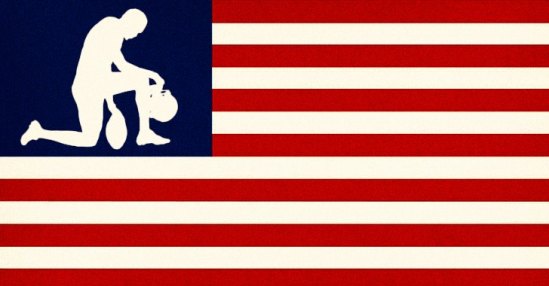
In this winter of our discontent, there is a term flying around conservative circles called “snowflake” used to describe liberal extremists who get offended by every statement and/or belief that doesn’t exactly match their own. To them, these individuals think they’re just unique as “snowflakes” when they really just have fragile feelings. To be fair, I do believe there are some liberal snowflakes who do exist. But when it comes to fragile feelings and offense by every statement and/or belief not aligning theirs, I think the “snowflake” label describes conservatives much more. For one, conservatives have an entire media ecosystem to insulate them from uncomfortable mainstream truths and assure them their views are perfectly reasonable. I mean when other networks air rather damning stuff on Donald Trump, Fox News runs stupid shit and peddles conspiracy theories. Secondly, conservatives go absolutely apeshit over race related issues such as Black Lives Matter calling attention to police brutality, NFL players taking a knee, and removing Confederate monuments. Third, those so-called “snowflakes” conservatives refer to have had to deal with all kinds of offenses and systematic injustices against them for perhaps their whole lives.

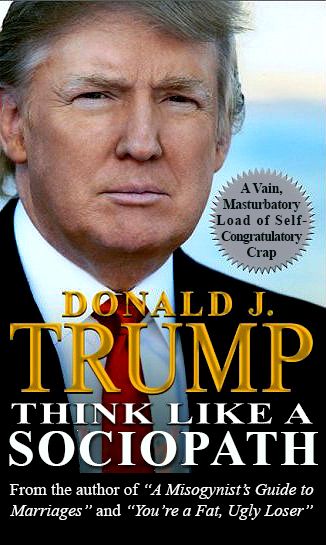
But in the United States, there is no bigger snowflake in the country than Snowflake King Donald Trump. Even before he ran for president and disastrously ended up in the White House, we all know that this guy has a massively inflated ego and self-delusions of grandeur. He sees himself as a successful and brilliant businessman despite being an outright fraud who’s shamelessly engaged in unethical practices and corruption that have ruined hundreds of people’s lives. His presidency will become legend for his incompetence, his Twitter tantrums, his lack of regard for the law, democratic principles, and norms, and his corrupt administration that’s loaded with sycophants. Still, Trump is known to burst over the slightest insult that he’s referred the mainstream media as “fake news” whenever they run a negative story about him. For a president, to discredit the media over the negative stuff about him whether it be his unethical business practices, his flagrant disregard for democratic norms, his lack of respect of democratic values, openly racist tirades, his Twitter tantrums, his incompetence and mental instability, and pathological dishonesty. Even before he became president, Trump was known to at least threatening to sue those who dare challenge him or at least said stuff about him he didn’t like. Sometimes this has resulted in real life consequences. In 1990, he threatened to sue Janney Montgomery Scott unless they fired their securities analyst Mark Roffman. His crime? Issuing a negative forecast for Trump Taj Mahal which was later proved correct. Nevertheless, Roffman lost his job and spent the next few years in a living hell. A year later, Trump threatened to sue any broadcaster or distributor who’d show an 80 minute documentary about him called Trump: What’s the Deal?, which powerfully and disturbingly portrayed him as the fraud he actually is. His effort to suppress the film proved successful.

Recently, a book has been recently published called Fire and Fury: Inside the White House which has been dominating the political cycle this January. Written by longtime New York columnist Michael Wolff, media outlets have run excerpts from it which has resulted in a furious response from Donald Trump. In fact, his lawyers sent a cease and desist letter to the book’s publisher, demanding to stop publication. Not surprisingly, it has become a bestseller as copies fly off the shelves. Still, while Fire and Fury isn’t the most factually accurate account of Trump in the White House, it nonetheless confirms a lot of the dysfunction and disorganization that has characterized the administration. Specifically, Wolff’s book depicts a deeply unprepared, incurious president surrounded by toadying advisers concerned about his ability to do his job. Knowing how willfully ignorant Trump is about how government works during the 2016 Election campaign, this isn’t surprising at all. His lack of knowledge of the US political system was a source of constant criticism. One big instance of that on display was when he promised to pick a Supreme Court Justice who’d “look very seriously” at Hillary Clinton’s e-mails. However, the Supreme Court tries laws, not people. In a primary debate in Houston, Trump referred to federal judges “signing bills” a task the president does in a federal system. As Wolff recalled in his book on how some of Trump’s closest aides spoke of him behind closed doors: “This—insulting Donald Trump’s intelligence—was both the thing you could not do and the thing—drawing there-but-for-the-grace-of-God guffaws across the senior staff—that everybody was guilty of. Everyone, in his or her own way, struggled to express the baldly obvious fact that the president did not know enough, did not know what he didn’t know, did not particularly care, and, to boot, was confident if not serene in his unquestioned certitudes. There was now a fair amount of back-of-the-classroom giggling about who had called Trump what. For Steve Mnuchin and Reince Priebus, he was an “idiot.” For Gary Cohn, he was “dumb as shit.” For H. R. McMaster he was a “dope.” The list went on.”

Now we all know that Donald Trump doesn’t like to read which is a very terrible sign. Because on any given day, a president is expected to read about as much as a college student cramming for a big exam. Thus, as Cracked reports, intelligence agencies have to keep their reports 25% shorter than Obama’s and allow no space for dissenting opinions. Policy papers are trimmed from 3-6 pages down to a single page with lots of graphics and maps. The National Security Council has taken things a step further by “strategically” including Trump’s name as often as possible since he usually keeps reading if he sees it mentioned. But a bigger problem than these oversimplified briefings is that Trump apparently doesn’t even bother to read them. This can lead Lord Cheetohead to embarrass himself in talks with foreign leaders, drafting woefully inept executive orders, or signing off on documents he doesn’t even understand. As Wolff recalls: “Here was, arguably, the central issue of the Trump presidency, informing every aspect of Trumpian policy and leadership: he didn’t process information in any conventional sense — or, in a way, he didn’t process it at all. Trump didn’t read. He didn’t really even skim. If it was print, it might as well not exist. Some believed that for all practical purposes he was no more than semiliterate.” He even quotes Gary Cohn stating, “It’s worse than you can imagine. An idiot surrounded by clowns. Trump won’t read anything — not one-page memos, not the brief policy papers; nothing. He gets up halfway through meetings with world leaders because he is bored.”

Furthermore, Wolff notes how Donald Trump doesn’t seem to understand the kind of responsibility being a president entails. Most Americans are familiar with the idea as of the president as a political and institutional concept, with an emphasis on ritual and propriety. Well, Trump isn’t most Americans since he’s prone to his ongoing Twitter tantrums over stuff that pisses him off. As Wolff writes, “Here was another peculiar Trump attribute: an inability to see his actions the way most others saw them. Or to fully appreciate how people expected him to behave. The notion of the presidency as an institutional and political concept, with an emphasis on ritual and propriety and semiotic messaging — statesmanship — was quite beyond him.”

Wolff also describes him as anti-intellectual as he noted, “For anything that smacked of a classroom or of being lectured to — “professor” was one of his bad words, and he was proud of never going to class, never buying a textbook, never taking a note — he got up and left the room. This was a problem in multiple respects — indeed, in almost all the prescribed functions of the presidency.” Such conduct is very unbecoming of a vast array of occupations, especially if they require a college degree. But if you’re the President of the United States, it’s incredibly unforgivable. Though we know that Trump’s brand contains a very anti-intellectual streak, eschews the advice of experts, doesn’t sponsor any cultural events, and doesn’t express any form of curiosity in anything. He sees no value in science, history, or education. And his campaign might be responsible for why more Republicans might have more negative opinions about colleges and professors they see as liberal elites in their ivory tower. If Trump should call himself a “stable genius” then he’d probably buckle up in the Oval Office, listen to criticism, and take notes. Despite that academics might seem to be in their own little worlds at times, a politician advocating anti-intellectualism is a very terrible thing since it encourages willful ignorance and disinterest in learning and education. And Trump’s willful ignorance and disinterest in anything but his own vanity and enrichment is rooted into his own narcissism and sociopathy since he worships no god by himself and he has no faith than in the almighty dollar.

Nor does Donald Trump seem to have the proper temperament or understand his role to lead a nation. As Wolff recalls, “What was, to many of the people who knew Trump well, much more confounding was that he had managed to win this election, and arrive at this ultimate accomplishment, wholly lacking what in some obvious sense must be the main requirement of the job, what neuroscientists would call executive function. He had somehow won the race for president, but his brain seemed incapable of performing what would be essential tasks in his new job. He had no ability to plan and organize and pay attention and switch focus; he had never been able to tailor his behavior to what the goals at hand reasonably required. On the most basic level, he simply could not link cause and effect.” Cracked has reported that American agencies are withholding an unusual amount of information from Trump. Though Trump has expressed scorn for the intelligence community (particularly when it comes to Russia). However, a bigger concern for them might be his habit of casually announcing classified information to rival governments. In May 2017, during a meeting with Russian officials, Trump reportedly boasted about the quality of intelligence he received every day. He also revealed details of a terrorist plot he’d recently been informed of. The problem with that is that revealing you know something can let someone guess fairly quickly how much you know it which can compromise the original intelligence source who may not have wanted the Russians to know about it. Though America doesn’t need to be hostile with Russia anymore, we know it has very different goals and ambitions than we do. Meaning that we need to exercise a degree of caution when dealing with them. But Trump’s carelessness with intelligence can be more than a one-time problem since in the wake of this story, an unnamed European country warned that they may stop sharing intelligence with the United States because they don’t like Trump compromising sources while trying to impress people.

Nevertheless, Donald Trump’s bizarre behavior has often compelled about his mental state long before Fire and Fury. Just last week, he unleashed a series of tweets which culminated in a nuclear threat of nuclear war with North Korea. On January 2, 2018, he tweeted, “North Korean Leader Kim Jong Un just stated that the “Nuclear Button is on his desk at all times.” Will someone from his depleted and food starved regime please inform him that I too have a Nuclear Button, but it is a much bigger & more powerful one than his, and my Button works!” In fact, the book’s very title came from a Trump speech back in 2017 over North Korea when he said, “North Korea best not make any more threats to the United States. They will be met with fire and fury like the world has never seen.” This at an event that was supposed to focus on opioids. Such statement terrified North Korean experts who worried about Trump provoking a war with another nuclear-armed power. Yet, Wolff noted such words also scared the bejesus out of Trump’s staff as they spent the next week trying to get him to stop talking about it. As Wolff wrote, “North Korea, a situation the president had consistently been advised to downplay, now became the central subject of the rest of the week — with most senior staff occupied not so much by the topic itself but by how to respond to the president, who was threatening to ‘blow’ again. Charlottesville was a mere distraction, and indeed, the staff’s goal was to keep him off North Korea.” To use Charlottesville to distract Trump from North Korea just makes me cringe. This is one of many examples illustrating that Trump is incapable of understanding the consequences of his actions. When Trump does something like fire James Comey, bomb Syria, or threaten North Korea, he does so without any sense of how human beings might be affected. As Wolff writes, “One of Trump’s deficiencies — a constant in the campaign and, so far, in the presidency — was his uncertain grasp of cause and effect. Everyone [in the White House], in his or own way, struggled to express the baldly obvious fact that the president did not know enough, did not know what he didn’t know, did not particularly care and, to boot, was confident if not serene in his unquestioned certitudes.”

But while the White House tries to write off Fire and Fury as “trashy tabloid fiction,” its fallout suggests otherwise. Already, Donald Trump has treated its revelations as gospel truth has launched a blood feud with his former strategist and campaign CEO Steve Bannon. Because on January 3, 2018, the Guardian posted excerpts from Wolff’s quoting Bannon saying some remarkable things about the Trump family. In these excerpts, Bannon called Donald Trump Jr.’s meeting with a Russian lawyer at Trump Tower “treasonous,” speculated that Trump might’ve been involved as well, and asserts that Jared Kushner is involved in some “greasy” business that could expose him to money laundering charges. These revelations not only cut into Trump’s denial of wrongdoing in the Russian scandal but also insulted his family members as well. Neither of which will put you in Trump’s good graces. Interestingly, Bannon’s Brietbart website reproduced some quotes sometime later without disputing them, giving a seeming impression of accuracy. Furious at the Bannon revelations, Trump released an infuriating statement reading, “Steve Bannon has nothing to do with me or my Presidency. When he was fired, he not only lost his job, he lost his mind. Steve doesn’t represent my base — he’s only in it for himself.” Except that Bannon’s Brietbart website is called “the platform of the Alt-Right” who mostly comprise of white supremacists which number among Trump’s most ardent supporters. Anyway, Trump goes on to minimize Bannon’s role in his 2016 victory and complain that he helped cost Republicans a Senate seat in Alabama by endorsing Roy Moore. Look, we all know that Bannon played a pivotal role in the Trump campaign or otherwise the alt-right wouldn’t be a thing. Furthermore, he also accused Bannon of constantly, leaking false information to the media to make himself seem far more important than he was” since it “is the only thing he does well.” Now Bannon is even out at Brietbart over the Trump book controversy over his comments.

It’s not hard to imagine that Donald Trump’s staff never thought he should be president. Nor is it difficult to think that Trump never wanted to be president in the first place. As Wolff frames it, “The Trump campaign had, perhaps less than inadvertently, replicated the scheme from Mel Brooks’s The Producers. In that classic, Brooks’s larcenous and dopey heroes, Max Bialystock and Leo Bloom, set out to sell more than 100 percent of the ownership stakes in the Broadway show they are producing. Since they will be found out only if the show is a hit, everything about the show is premised on its being a flop. Accordingly, they create a show so outlandish that it actually succeeds, thus dooming our heroes.” Though at least Bialystock and Bloom ended up in prison and didn’t doom a whole country. Still, Wolff believes that the Trump administration’s problems currently lie at the concept that even his staff didn’t think he’d win. Why release your tax returns if he’s going to lose? What’s the harm in sucking up to Russia’s government if he’s likelier to build a hotel in Moscow than occupy the White House? Why bother with educating the candidate on major policy issues or build a real platform when he’ll never govern? Or why worry about conflicts of interests or business entanglements if they’re never going to matter? This might explain so much. Yet, even if he was just running for president, those things will still matter.

Still, Fire and Fury paints a picture of Donald Trump through his own tweets, speeches, comments, and actions as well as the constant on- and off-the record statements from his staff. It’s similar to what reporters have heard from top staff at the White House. And similar to what I and much of the American public have long suspected. Trump is not cognitively up to the job of the presidency. He’s not just someone who doesn’t know much about policy or foreign affairs. It’s that he’s someone who doesn’t want to know about policy or foreign affairs. And he dislikes the methods by which you actually could learn about policy and foreign affairs. Thus, Trump’s ignorance isn’t an absence of knowledge. It’s closer to a personality trait and possibly even an ideology, which is even worse.

Naturally, when a man so unqualified for the presidency that his campaign wants him to lose unexpectedly wins the White House, chaos ensues. Suppose you work for Donald Trump at the White House. How would you please, placate, manage, constrain and inform a raging child king? Though the answer is embarrassing. But it’s one Trump’s staff and any foreign government wanting America’s favor know all too well: flattery and sycophancy. Trump’s staff tries to keep their boss from social media with constant praise and putting lots of media in front of him. Also, his staff worry about leaving him alone for hours at a time because he watches too much TV, gets annoyed with what he sees, and throws a Twitter tantrum. Other techniques for keeping Trump happy include hanging a map displaying his electoral victory in the West Wing, planting supporters and planting supporters in crowds as he gives a speech. One instance of the latter had him being passionately cheered while he gave a speech at the CIA headquarters by non-CIA supporters in the front rows for that specific purpose. This pissed off the CIA who consider themselves apolitical and don’t appreciate being herded into a meeting to listen to someone complain about how hard or unfair their job is. He thinks that no politician has been treated more unfairly than him despite that the TV news media has treated him much better than he deserves to be.

And how do you harness the remarkable opportunity you’ve been given to actually build something of value? The central struggle of Trump’s early months was between chief strategist Steve Bannon, Chief of Staff Reince Priebus, and chief son-in-law Jared Kushner. All of them in their proximity to power, saw the potential to build a presidency they could be proud of or at least less disgraced by. As Wolff recalled: “Each man saw the president as something of a blank page — or a scrambled one. And each, Walsh came to appreciate with increasing incredulity, had a radically different idea of how to fill or remake that page. Bannon was the alt-right militant. Kushner was the New York Democrat. And Priebus was the establishment Republican. “Steve wants to force a million people out of the country and repeal the nation’s health law and lay on a bunch of tariffs that will completely decimate how we trade, and Jared wants to deal with human trafficking and protecting Planned Parenthood.” And Priebus wanted Donald Trump to be another kind of Republican altogether … As Walsh saw it, Steve Bannon was running the Steve Bannon White House, Jared Kushner was running the Michael Bloomberg White House, and Reince Priebus was running the Paul Ryan White House.” This struggle was hardly a civil conflict ideal as Wolff records the tree factions’ endless squabbles comprising of leaks, schemes, backbiting, and the outside heavies brought in to change Trump’s mind at the last minute. But the conflict was so immense because Trump is incapable of and uninterested in resolving. Trump never gave a damn about Trumpism since he’s not sufficiently interested in policy, ideology, or ideas to direct his own presidency’s course. Thus, the course will be directed by the most firmly established interests around him like his family the congressional GOP.

Nonetheless, Michael Wolff’s Fire and Fury contains a mystery it never resolves. As he wrote, “It was obvious to everyone that if [Trump] had a north star, it was just to be liked. He was ever uncomprehending about why everyone did not like him, or why it should be so difficult to get everyone to like him.” However, it would be easy enough for Donald Trump to run a presidency that left him better-liked. He could work with the Democrats, ease up the culture war, and give some gentler speeches. There has never been a president for whom the bar is lower than for Trump. It would be so easy to clear it and he’d have people around him happily acting as guides and cheerleaders. But he didn’t do any of that and Wolff’s book doesn’t provide a satisfying answer since it’s a portrait of a man undone by the very forces he unleashed. Because Donald Trump doesn’t care about policy, politics, ideology, or coalitions. All he cares about is Trump. He wanted to put his name on buildings and in tabloids. Now he has his name on the most important building on the planet and on the front page of most every newspaper in the world. Yet, outside a few conservative outlets, the coverage he receives is horrible, the worst of any president in memory. He can’t perform his job well enough to be liked or respected. But he only wanted the job in the first place because it would force the whole world to like or respect him (except it people still don’t like or respect him, including me). And he’s driven to rage and paranoia by the resulting dissonance, disappointment, and hurt. Mostly because he doesn’t understand that running for the most powerful office in the land will not get people to like and respect you. You have to do something to earn that adoration and respect. Sure he might be a rich businessman, but his career and life have been marked by unethical business practices, baffling corruption, inflammatory statements, and other dubious deeds. Trump wants the adoration and respect for doing nothing besides being a rich businessman and TV star.

This wasn’t what Donald Trump wanted and it’s not clear whether it’s something he can bear. A more capable, competent, and stable person would by now, have either changed their behavior to receive more of the response they crave or just given up on getting that kind of attention. Yet, Trump exists in an unhappy middle ground, starting his day with morning rage tweets, spending weekends retreating to one of his golf clubs, searching for validation he craves in his Twitter feed and on Fox and Friends but never getting it from the elite taskmasters he’s always sought to impress. The pressures of the presidency are enough to break almost anyone but Trump is less suited for the work and backlash than most. The strain’s already showing as his workday’s reportedly shrunk to 11am to 6pm. Yet, the bulk of his first term remains to the detriment of us all and it can include his financial secrets being revealed to the world, his family being indicted, and a crisis he mishandles exploding into a catastrophe (like that didn’t happen already in Puerto Rico). The question now is whether Trump’s staff can keep governing around him and whether a dysfunctional president can have a semi-functional White House. And so far, I don’t really know if that’s possible with a narcissistic sociopath like Donald Trump. Because he’s a man who cares nothing about America, has no respect for democratic values, and doesn’t think the rule of law applies to him. A man like him only inspires more chaos and internal stripe which won’t end until he’s out.

A Plea for Saving the Children’s Health Insurance Program

In 1993, the late Governor Robert P. Casey Sr. signed the first Children’s Health Insurance Program into law in Pennsylvania, which later served as a model for the federal program Congress would enact a few years later. Westmoreland County’s then State Senator Allen Kukovich was instrumental in enacting this state program that he’s considered its founding father. Since 1997, the Children’s Health Insurance Program has provided matching funds to states for health insurance to children from families who can’t afford marketplace or employer insurance but earn too much to qualify for Medicaid. Sponsored by the late Senator Ted Kennedy in partnership with Senator Orrin Hatch and supported by then First Lady Hillary Rodham Clinton, it was the largest expansion of taxpayer-funded health insurance coverage for children in the United States President Lyndon B. Johnson established Medicaid in 1968. Today CHIP is a critical government program providing health insurance for nearly 9 million low-income kids as well as remains one of our nation’s most vitally important and widely supported programs. Thanks to CHIP, the United States enjoys has the highest rate of insured children in our nation’s history at over 95%.

On September 30, 2017, CHIP expired when lawmakers couldn’t agree on a 5-year reauthorization of the program. This puts millions of kids at risk of becoming uninsured, and in some cases, being denied the critical care they need to survive and thrive. Though states have remaining funds to keep their programs running for varying lengths of time, it’s an administrative nightmare for states that can’t plan ahead. But they may have to prepare for a possible shutdown of their CHIP programs well before they run out of money. As Alabama CHIP director noted, “This whole situation is causing chaos. We are causing confusion to families, stress and turmoil.” On December 15, Alabama officials were forced to announce that they’d stop taking new enrollees on New Year’s Day and the 84,000 kids (1/8 of the state’s children) currently in the program could lose coverage February 1. In my home state of Pennsylvania, the families of 174,000 children currently enrolled in CHIP are about to receive notices informing them that their insurance may be canceled while Colorado already has sent a letter back in September that their CHIP coverage will be canceled by the end of January. Utah has already submitted a request to the federal government to freeze their program’s enrollment. Some states such as Nevada, already have laws that force officials to freeze enrollment if federal funds decrease at all. By the start of 2018, more than half the states are projected to have used up their available funding. Across the country, families depending on CHIP are running out of time.

On December 21, 2017, Congress passed short-term legislation to fund CHIP until the end of March, which is said to cover an estimated 1.9 million children across 24 states and Washington D.C. which stood to lose coverage care like doctor visits and hospitalizations in January. But this temporary relief still leaves CHIP and the families who rely on it in uncertainty since as of December of 2017, there is no long-term fix in sight. As George Washington University professor Sara Rosenbaum told Bloomberg, “You can’t run an insurance program this way.” Essentially, lawmakers are forcing health officials running the program, “to go month-to-month.” Still, even with these short-term fixes, “there will be relief that the funding has been extended, but it will be combined with a lot of anxiety,” as Kaiser Family Foundation executive vice president Diane Rowland claimed.

Health coverage is critical for children to get a healthy start in life and high coverage rates mean more children have an opportunity to meet their potential. It is well understood that covering kids is an investment in our future since a child’s health, school performance, and future success are all linked. So it goes without saying that unhealthy children are at higher risk for school problems, failing, or dropping out. Children who have health insurance through CHIP or Medicaid have better access to healthcare and do better in school than their uninsured counterparts. And better school performance provides a foundation for future success in life. Thus, investing in children’s coverage programs means investing in not only children’s health, but also academic success and success later in life. CHIP is especially important to children with special health needs, children of color, children in working families, and children in rural communities. Without CHIP, there would be more uninsured children, increased healthcare costs and less access for kids with insurance, and great financial devastation for families with special needs kids. At any rate, losing CHIP will devastating to millions of families, which will mean uncertainty surrounding their children’s health, much higher healthcare costs and added financial burdens, for some, a complete loss in their children’s coverage.

There is no question that Congress must vote to continue funding CHIP or else coverage for the 9 million kids whose families depend on CHIP will be in jeopardy. Should federal CHIP funding end, states would need to adjust their budgets, either ending or significantly cutting back on existing CHIP programs. Options available to a state may depend on whether it operates a separate CHIP program or has CHIP as an expanded Medicaid one. Either way, children’s health coverage will suffer. Nevertheless, failing to fund CHIP will undo 20 years of progress as well as undermine our nation’s values. If we want our children to live and succeed in this country, then funding CHIP should be a top priority. As Americans, we have a moral, ethical obligation to take care of our children. But if we can’t protect children’s health insurance, what does it say about our values?

General Ripper Sings Like a Canary

 
In the biggest development yet in special counsel Robert Mueller’s investigation into potential collusion between the Trump campaign and Russia, former National Security Adviser Michael Flynn agreed to a plea deal with prosecutors on Friday, December 1, 2017. The legal move poses the most direct threat to the Trump presidency itself so far. Flynn pleaded guilty to a single count of lying to the FBI on or around January 24 about conversations with then-Russian Ambassador Sergey Kislyak in December 2016. However, Flynn did not admit to colluding with Russia during the 2016 presidential election. Nevertheless, Flynn’s plea deal will strengthen Mueller’s sprawling probe into the Trump team’s possible criminal acts and Russian ties.

Of course, once Paul Manafort and Rick Gates were indicted while George Papadopoulos pleaded guilty, it was only a matter of time when Michael Flynn would flip. In fact, it’s been speculated for weeks that Flynn wanted to protect himself from a more serious criminal indictment. As with Manafort, Mueller had a solid case against the retired general. Earlier this year, Flynn offered to testify in exchange for full immunity from prosecution but Mueller refused. On November 23, The New York Times reported that Flynn’s lawyers told Trump’s lawyers they could no longer share information. Four days later, ABC News reported that Flynn’s lawyers met with Mueller’s team, a strong sign a plea deal was imminent.

Michael Flynn’s plea deal is the most significant moment in Mueller’s probe to date since he is the first person who had actually served in the Trump White House to admit breaking the law. Nor was he just any old official either since Flynn’s role as national security adviser is one of the highest-level and most powerful posts in Washington. The retired three-star general temporarily had enormous influence over Donald Trump’s early policy and personnel choices. And due to his unique ties to both the Trump campaign and Trump White House, he’s particularly well-suited to answering the Mueller probe’s central questions on whether the Trump campaign knowingly colluded with Russia and if Trump obstructed justice by trying to derail the FBI’s investigation. Flynn’s plea deal gets Mueller closer to finding that out. Now Mueller gets Flynn to talk along with an admission of guilt. Obviously, this is bad news for Michael Flynn but it could be even worse news for Donald Trump. As legal expert Asha Rangappa noted, “When you flip somebody, you’re using them to go up the chain. This suggests that Mueller’s investigation is going to go into the even-tighter inner circle of the campaign and possibly the administration.”

A retired lieutenant general who served in the Army for over 30 years, Michael Flynn is a quintessential General Ripper. Hell, take General Jack D. Ripper’s line “I can no longer sit back and allow Communist infiltration, Communist indoctrination, Communist subversion and the international Communist conspiracy to sap and impurify all of our precious bodily fluids,” and replace each mention of “Communist” with “Islamic” and you basically have Flynn. And let’s just say if it weren’t for his soft spot for Russia, he’d feel right at home among the trigger happy military brass in Dr. Strangelove. Anyway, in 2012, he was named head of the Pentagon’s intelligence arm, the Defense Intelligence Agency. During this time, he clashed with other Obama administration officials who viewed him as sloppy with facts and incompetent with management. Soon he was pushed out and resigned from his post in 2014. Technically, President Barack Obama fired him but you know how they do things in Washington. Furious, Flynn began his post government public life commenting on foreign policy and military issues in the media, becoming infamous for his extreme Islamophobic rhetoric. For example in February 2016, he tweeted, “Fear of Muslims is RATIONAL.” Such language combined with his poor DIA track record made Flynn a pariah in the mainstream foreign policy community. For the Trump campaign that championed a Muslim ban, he was a perfect fit.

In fall 2015, Michael Flynn began occasionally briefing Donald Trump on foreign affairs and his involvement in the campaign gradually deepened. By late May 2016, he was mentioned as a potential vice presidential pick for Trump. In July of that year, Flynn gave a now ironic speech at the Republican National Convention in which he riled the crowd with “Lock her up.” But while Flynn advised the Trump campaign, he operated a lobbying and consulting firm called the Flynn Intel Group which importantly, also employed his son. He was also a frequent guest on the Russian government’s English-language propaganda outlet RT, where he’d often espouse the idea that Russia and the US should team up against Islamic extremism. And it’s Flynn’s lobbying and work for the Russian government which first led into dangerous legal territory. In December 2015, Flynn traveled to Moscow for a gala celebrating RT’s 10th anniversary. He sat next to Vladimir Putin and delivered a speech about his foreign policy vision. For his services, RT paid Flynn a $45,000 speaker’s fee while Russian companies him $22,500 for speeches during the same trip. Now that in itself isn’t necessary illegal. However, Flynn reportedly lied about the source of the payments in his security clearance renewal form, claiming they came from “US companies.” Lying on this form is equivalent to lying to federal investigators which is a felony and perhaps one of the reasons why Flynn took the plead deal. In August 2016, an entity called Inovo BV hired Flynn’s consulting firm. Though it claimed to be Dutch company, Inovo BV turned out to be a shell corporation for a wealthy member from the Turkish government. Flynn seems to have continued working for Turkey until November at the earliest while Ankara paid him at least $530,000. Under the Foreign Agent Registration Act, Flynn had to publicly disclose any lobbying work for the Turkish government when he started. His FARA paperwork said he worked for a Dutch company, not the Turkish government. In March 2017, Flynn filed paperwork correcting the error, admitting that Inovo really paid him to work on behalf of Turkish interests. If that’s all he did, then Michael Flynn would’ve been fine. After all, the US government typically doesn’t arrest people for filing incorrect FARA paperwork after they correct it. But if there’s more undisclosed lobbying for foreign governments like more Turkey payments or undisclosed Russian activity than he revealed in March, then he’d be in deep shit.

Still, you’d think Flynn’s legally questionable shenanigans would’ve ended in November 2016, when Donald Trump made him his national security adviser in his new administration. Though outgoing Obama officials warned the Trump transition team about appointing the guy. But if anything, it got worse. Throughout the transition, Flynn had several contacts with Kislyak. In one early December meeting at Trump Tower, he and Jared Kushner talked to the Russian ambassador about setting up a secret channel through which they can communicate. On December 29, 2016, the day Obama announced sanctions on Russia in response to the country’s hacking efforts, Flynn and Kislyak reportedly exchanged 5 phone calls. One of the discussion topics was sanctions. But Flynn reportedly told Vice President-elect Mike Pence and others on the Trump team that sanctions never came up in his calls with the Russian ambassador, spurring them to make false statements to that effect in public. This conversation between Flynn and Kislyak is part of the just-released document Mueller had sent to court.

On Donald Trump’s Inauguration Day, Michael Flynn’s former business partner allegedly bragged that he told him that Trump would quickly lift US sanctions on Russia, which would pave way for a controversial plan to build nuclear plants across the Middle East with Russian help. While this is an explosive but unverified allegation coming from a whistleblower cooperating with House Democrats, there have been reports over the last few months that Flynn continued to promote this Middle East nuclear project after the election and even as national security adviser. In the Trump presidency’s first week, Flynn was questioned by the FBI in which he denied contact with Kislyak during the transition. That same week, then acting-Attorney General Sally Yates warned the White House that intelligence showed Flynn had lied about his conversations with Kislyak and he was vulnerable to Russian blackmail. Unsurprisingly, the Trump White House did nothing about this until it leaked to the press a few weeks later, when they were spurred to fire Flynn on February 13, 2017. Then there’s an entirely separate matter of whether Flynn improperly acted on Turkey’s behalf during the transition or while in office. According to the Wall Street Journal, Mueller is investigating an “alleged plan” in which Flynn and his son would be paid as much as $15 million for forcibly removing Fethullah Gulen, a Muslim cleric living in Pennsylvania, from the United States and delivering him to Turkey. Flynn discussed this possibility with Turkish government representatives at a December meeting during the transition as incoming national security adviser.

Altogether, there’s plenty of circumstantial evidence that Michael Flynn broke the law. The plea deal where he’ll admit to lying to federal investigators confirms he did and he’s trying to get a lighter punishment. The best Flynn can do is tell Mueller everything he knows abut Trump and Russia. The next important question is whether other Trump officials aided Russian efforts to interfere with the 2016 presidential campaign. If there was collusion, Flynn most likely knows about it. This is why Mueller wanted Flynn to strike a deal. Particularly, one where Flynn agreed to a lesser sentence in exchange for giving an honest accounting of what he knows about Trump-Russia ties. Sure getting Papadopoulos to agree to cooperate with Mueller’s team was pretty awesome. But getting Flynn to flip is a much bigger prize.

And it’s possible that Flynn has more Russia ties than known since there’s already some reporting suggesting we don’t have the full Flynn and Russia story. In June, The Wall Street Journal reported that a Trump supporting GOP operative and private equity executive Peter Smith embarked on an effort to track down Hillary Clinton’s infamous 30,000 or so deleted emails during the fall of 2016 and contacted Russian hackers to ask if they had them. Smith wasn’t part of the Trump campaign. But according to sources, he told people working with him that he was coordinating with Flynn. While trying to recruit for the effort, Smith also distributed a document naming the Trump campaign as one of the 4 groups involved. Another piece of information pointing to Flynn was that US officials were aware of some intelligence that Russian hackers had at least discussed sending leaked emails to Flynn through a third party. As Shane Harris wrote for the Wall Street Journal: “Investigators have examined reports from intelligence agencies that describe Russian hackers discussing how to obtain emails from Mrs. Clinton’s server and then transmit them to Mr. Flynn via an intermediary, according to U.S. officials with knowledge of the intelligence.” Smith died this year, reportedly by his own hand and Flynn hasn’t said anything about the Journal report. Nevertheless, all this is enough to raise serious questions about just what Flynn knew about this or any other attempted outreach to Russian hackers or other Russian entities. However, we don’t know yet if this led to actual collusion implicating Flynn or anyone else on the Trump team. Perhaps Smith made his effort seem important by name dropping Flynn, rather than working closely with him. In addition, Smith’s efforts to find Clinton’s deleted emails have failed since they never surfaced. Michael Flynn’s is also central to determine whether Donald Trump obstructed justice as president, essentially by unlawfully interfering with former FBI Director James Comey’s inquiry. Since Flynn is a central character in this entire drama and fate could shape Trump’s. As Rangappa told Vox, “I think Flynn’s value to Mueller is less on the collusion part and has more to do with obstruction of justice. If Trump had any knowledge of any kind of criminal liability that Flynn may have had — and he was trying to get Comey to drop the investigation — that essentially seals Mueller’s obstruction case.” After Flynn was fired, Trump held a counterterrorism meeting with his national security officials which ended when he ordered everyone except then-Director Comey to clear the room. According to Comey’s written notes, Trump asked him to lay off the investigation into Flynn’s Russia statements. He said that Flynn “is a good guy” and urged the then-FBI director “to see your way clear to letting this go, to letting Flynn go.” Comey refused so Trump eventually fired him a few months later.

Flynn’s testimony could help answer if Trump wanted to protect him out of fear on what he might know. It’s not enough to show that Trump didn’t like where the Russia investigation was going. A prosecutor or member of Congress pushing for impeachment would need to show that Trump actually tried to cover up some kind of wrongdoing on his part to establish an obstruction case. As federal prosecutor Alex Whiting explained the specifics of Trump’s relationship with Flynn matter a great deal, noting: “Did [Trump] know that Flynn’s story was an important piece in the larger picture, one that he did not want revealed? Or did he know that the FBI’s pressure on Flynn could force him to give up other incriminating evidence? Far from simply acting to shield a former subordinate and ally, was Trump actually just trying to protect himself, and those close to him? If the answer to any of these questions is yes, then Trump’s actions will have a very different feel to them, and his potential defenses much harder, if not impossible, to swallow.” Flynn may know the answer to Whiting’s questions which Mueller will likely hear soon.

Still, former US attorney Preet Bharara isn’t convinced that Michael Flynn received “a sweetheart deal of a lifetime” in exchange for hugely important cooperation. On the latest podcast episode, the former New York prosecutor disputed that the relatively light charge against the former 3-star general clearly showed he must’ve agreed to provide especially valuable information to Mueller’s investigation. Bharara refers to his own experience supervising similar high-profile cases. He claimed, “When we had evidence against somebody and wanted them to flip, we made them plead guilty to every bad act that they had ever done. Especially if we were later gonna be alleging other people had engaged in that activity as well.” Such actions, the former prosecutor argues makes a witness like Flynn more credible in court if he has to testify against someone else. “Otherwise, the only thing the jury will know for a fact about your witness is that he is an admitted, convicted liar,” he said. What he suspects is that Mueller doesn’t’ have anything else on Flynn that might stand in court. But he also suggests that Mueller is “holding back on other charges to which Michael Flynn will plead guilty if and when they form the basis of charging some other folks.” In other words, certain potential charges against Flynn could implicate others in Trump’s team as well and that Mueller’s team just isn’t ready to make those charges yet (and may never be). Yet, this case could be different than Bharara’s own past prosecutions. For one, Mueller’s potential endgame might be impeachment referral rather than a high-profile court trial. In addition, Mueller could be concerned about Trump’s pardon power, possibly holding off some potential charges against Flynn so he could bring them later, in case of a pardon. And seeing how quickly Trump pardoned infamous former Maricopa County Sheriff Joe Arpaio, Mueller might’ve taken a cue.

On Saturday December 2, 2017, Donald Trump tweeted that he fired his former National Security Adviser Michael Flynn because he lied to the vice president and the FBI. If that’s the case, Trump knew that Flynn lied to the FBI when he asked then FBI Director James Comey to drop his inquiry into Flynn and then fired him when he failed to do so. This could play into an obstruction of justice case against him. Looking into Trump’s history which shows unparalleled disrespect for the rule of law, committing obstruction of justice shouldn’t come as a surprise. Donald Trump’s corruption is mindboggling beyond any measure that anyone could imagine. He has already abused his power as president in order to enrich himself as well as constantly lies about everything whenever he opens his mouth. But should Mueller’s team find compelling evidence if the Trump team engaged in a criminal conspiracy to help hack Hillary Clinton’s email (since stealing documents is illegal), violated campaign finance laws through soliciting foreign help like from the Russian government, or committing crimes against the investigation itself like witness intimidation, perjury, obstruction of justice, and the like, Mueller can convene a federal jury and seek a criminal indictment against the person. If the grand jury signs off, that person is then arrested and charged. Eventually Trump can be forced to make a terrible choice. He could risk a close associate or family member going to jail or possibly making a deal with federal prosecutors in return for testimony that could incriminate others. Or he could use his pardon power to shield his cronies from federal charges. Should he go the second route, expect a massive political conflict with Congress because of the obvious impropriety of President Pussygrabber pardoning family members or close associates for crimes committed to help him win the presidency in the first place.

Then there’s the question of what happens if Mueller finds evidence of criminal behavior by Donald Trump himself. Granted that Trump is a narcissistic sociopath with a history of abusing his power for his own enrichment, disrespecting the rule of law, and getting away with egregious corruption practices, this is extremely likely. As special prosecutor, Mueller has the legal authority to file charges against any Trump associates or family members. But there’s another legal debate as to whether it’s constitutional for prosecutors to indict a president on criminal charges. Because no state or federal attorney has ever indicted a president on serious criminal charges and we have no Supreme Court precedent to answer that question. Mueller would likely sidestep that whole minefield and simply make a report to the House of Representatives documenting evidence of Trump’s “high crimes and misdemeanors,” the constitutional standard of impeachment. Should Mueller’s report contain damning evidence, it would put a lot of pressure on the House to begin impeachment proceedings. In short, Mueller could take the first step toward ending Trump’s presidency. So Trump really needs to be afraid. Especially since Mueller is currently looking into his business practices and finances which contain plenty of shady stuff less wealthy people have been arrested for.
 

An Urgent Call for Action to Save Net Neutrality

7362006206_ea7fa6b6f8_z

On Wednesday, November 22, 2017, Federal Communications Commission Chairman Ajit Pai released his draft order to eliminate net neutrality. In short, this order will eradicate net neutrality rules and abandon the court-approved Title II legal framework serving the basis for the successful 2015 Open Internet Order. These regulations prevented internet service providers (ISPs) from blocking or slowing down access to websites or services as well as bans them from offering so-called fast lanes to companies willing to pay extra to reach consumers more quickly than competitors. The proposal’s most significant change is to strip the FCC’s authority to regulate broadband as a utility and shift that responsibility to the Federal Trade Commission, which can’t create the hard and fast rules ISPs must follow. But the FCC will simply require ISPs to be transparent about any blocking, throttling, or pay prioritization which they would evaluate based on whether or not the activity is anti-competitive. However, the proposal will also ban state and local governments from imposing their own net neutrality rules to replace federal regulations or lack thereof. A vote on this measure is scheduled on December 14 and it’s expected to be passed and implemented on a party line 3-2 vote. Ironically called, “The Restoring Internet Freedom Act,” is basically everything that ISPs could want. But it is a policy that will take away every safeguard we need to protect the open internet we’ve always had. Since it will give ISPs the power to kill off their competition, choke innovation, charge more for various content, suppress political dissent, and marginalize voices of racial justice advocates and others organizing for change. Essentially, Pai’s proposal is thin on substance and reasoning, cruel, willfully naïve, as well as not grounded in reality. Yet, should the FCC has its way, Pai’s plan will change how Americans experience the internet and for the worse.

Under the existing regulations the FCC passed in 2015, there are clear hardline rules forbidding telecom companies from unethical business practices. These rules are reinforced with strong but flexible safeguards that the 2015 order built in for other schemes ISPs might use now or invent in the near future to interfere with internet traffic. With the exception of scant transparency rules, Pai plans to “eliminate the conduct rules adopted in the Title II Order — including the general conduct rule and the prohibitions on paid prioritization, blocking and throttling.” This leaves internet users entirely without protections and relying on ISPs to behave and avoid exploiting their internet gatekeeper status. It’s clear in the “The Restoring Internet Freedom Act” that Pai and his fellow Republican colleagues at the FCC want to allow telecom companies to legally block and discriminate internet content. In other words, “restoring internet freedom” means restoring the ISPs’ own freedom to offer “curated services” rather than their broadband customers’ rights. Thus, Donald Trump’s FCC wants to let the most-hated and worst-rated companies in America block and edit online speech.

It shouldn’t surprise anyone that Pai wants to end net neutrality to enrich his buddies at Verizon where he worked as an attorney. But he’s often used flimsy arguments that even without oversight and prohibitions against blocking and discrimination by claiming, “transparency substantially reduces the possibility that ISPs will engage in harmful practices, and it incentivizes quick corrective measures by providers if problematic conduct is identified.” After all, he states that these large telecom companies have, “publicly committed not to block or throttle the content that consumers choose.” Except that public commitments don’t mean a damn thing to them. Besides we all know these telecom companies want to end net neutrality so they control whatever their customers say or do online. Discriminating against the content consumers to is the whole damn point. Telecom companies have the technology to scrutinize over every piece of information we send or receive online like websites, email, videos, internet phone calls, or data from games or social networks. They can program computers routing information to interfere with the data flow by slowing down or blocking traffic and communication they don’t like while speeding up traffic they do that pays them extra for the privilege. And as far as Tim Wu is concerned, “transparency” is basically a euphemism for “doing nothing.” But the FCC factsheet states that “Internet service providers didn’t block websites before the Obama Administration’s heavy-handed 2015 internet regulations and won’t after they are repealed.” However, before the 2015 order put firm rules on solid legal footing in place, ISPs blocked content, throttled websites, and used their power to rig the market in their favor. These cable and phone companies have taken every chance they could get around net neutrality laws and have already shown us exactly what they’ll do if we let them. Numerous incidents of abuse include:

  • AT&T pressuring Apple into blocking the Skype app on all iPhones, complaining that Skype was being unfair by “not operating on a level playing field,” or in other words, having a better product that AT&T couldn’t compete with. So they just blocked people from using it. And they weren’t the only ones to do so either since ISPs from around the world followed suit and most didn’t just stop at Skype either. In fact, they blocked every program you could use to make online phone calls altogether.
  • Madison River Communications blocking voice-over-internet protocol (VOIP) Vonage which filed a complaint to the FCC after hearing a slew of customer grievances. The FCC stepped in to sanction Madison River and prevent further blocking. But it lacks the authority to stop this kind of abuse today.
  • Comcast, Verizon, and Metro PCS slowing down Netflix. In 2011, Metro PCS sent out an ad boasting that anyone who signed up for their cheapest plan would receive “YouTube access.” Though it might seem good on paper, it actually meant that if you weren’t willing to pay for the expensive plan, the company will block every other video streaming site on the internet. Because they advertised users could “preview trial video content” but not actually watch it for $10 more. And if users paid $20 more, they could access 18 different video streaming websites. Verizon has also been caught slowing down Netflix users. Sure they didn’t make it impossible to watch a movie, but they made it slow enough so no one could waste bandwidth by watching a video in HD. Comcast has done it, too, which is particularly troubling since they own TV networks and have some clear reasons wanting to keep Netflix from succeeding. And they refused to slow down until Netflix paid money. So basically Comcast just blackmailed their competition by sabotaging them and refusing to stop until they paid them. And by the way, this was before net neutrality and thus perfectly legal.
  • Canadian ISP Telus blocking its customers from seeing their workers’ union website called “Voices for Change” which listed their complaints and demands during a 2005 strike. Oh, and they blocked 766 other websites hosted on the same server. In other words, Telus censored an entire section of the Internet because they didn’t like what people were saying. And since there was no net neutrality at the time, the Canadian company suffered zero consequences other than a media tongue lashing.
  • British ISP Plusnet telling charging their customers extra for playing online games. The company set up a tier of different data plans asking their customers to decide if they wanted to be able to surf the internet, stream videos, play video games, or do all 3. And if they weren’t willing to pay for the premium package, they’d be charged extra. And Plusnet didn’t just block video games in the cheaper plans either. They also blocked VPNs, forcing employees who remotely connect to their offices to pay more. And unless you were willing to pay for the most expensive plan, they slowed down peer-to-peer programs like Bit Torrent so badly they hardly worked at all.
  • AT&T censoring words from Pearl Jam’s Eddie Vedder when he sang “George Bush, leave this world alone” and “George Bush find yourself another home,” on account of preventing youth visiting the website from being exposed to “excessive profanity.” Though the song contained none. Of course, they later blamed it on an external website contractor hired to screen the performance.
  • Verizon cutting off the pro-choice group NARAL text-messaging program since they didn’t want to service programs from any group “that seeks to promote an agenda or distribute content that, in its discretion, may be seen as controversial or unsavory to any of our users.”
  • Comcast and Cox Communications blocking VPN. In 2001, these companies updated their terms of services declaring from now on that their customers had to agree not to use a VPN unless they were willing to pay for it. Since VPN lets you connect to another network, which for a lot of people means it’s a way to connect to their office from home, this resulted in a lot of people working from home being suddenly blocked off from how they made their livelihood. And when people called and complained, they didn’t receive much sympathy. Comcast basically said that anyone working from home was going to have to upgrade to their “@Home Pro Package” which started at $95 a month. Essentially, if you worked from home, you had 2 options: either start paying for the most expensive plan Comcast had or get a new job.
  • Verizon blocking Google Wallet. In 2011, Verizon developed its own digital wallet which was going to change the way people made purchases by letting people make purchases with a simple wave of their phone. And they were pretty sure they’d make a fortune, too. Except for two things. First, their product’s name was “Isis” which was about to become less marketable for reasons I need not discuss. Second, Google had already released an identical product called Google Wallet which basically doomed Verizon’s Isis from the start. So when Verizon realized they couldn’t beat Google fairly, they blocked Google Wallet on all Verizon phones, essentially making it impossible for their customers to pick their competition over them. Unsurprisingly, Verizon was accused of breaking net neutrality laws. But since they technically blocked Google’s hardware instead of its software, they got away with it. So there’s every reason to believe if Verizon could block an app that’s competing with one of their own, they’d take it.
  • Comcast deliberately blocking BitTorrent. In 2007, Comcast was caught blocking peer-to-peer programs like BitTorrent, eDonkey, and Gnutella through deep packet inspection to block file transfers from customers using these networks. As a result, any Comcast customer trying to share files from one computer to another would find that their internet connection inexplicably kept dropping. At first, Comcast denied it. However, national tests conducted by the Associated Press confirmed the company’s actions as unrelated to network congestion since blocking took place at times when there wasn’t any. Not to mention, enough people had spread proof online, Comcast couldn’t keep up the lie. Though the company wasn’t apologetic either since they claimed that blocking these peer-to-peer programs like BitTorrent was “necessary.” In their defense, Comcast blocked applications often used to trade videos like pirated content, despite that most of what they blocked on these networks was legitimate. And Comcast has strongly hinted that they’ll do it again. After all, they have promised to that they “will not block, throttle, or discriminate against lawful content” once net neutrality is repealed. But as far as they’re concerned, peer-to-peer programs like BitTorrent fall under “unlawful content.” So once net neutrality is out of the way, Comcast is shutting these programs down.
  • Verizon shutting down Wi-Fi hot spots. When the technology to turn your phone into a Wi-Fi hot spot came out, Verizon Wireless started offering it as an add-on. For an extra $20 a month, their customers could use their phone’s data plan through another device like computer. Only problem was that there wasn’t any reason to give Verizon that $20. There were already all kinds of apps available letting people turn their phones into Wi-Fi hot spots for free. So since Verizon couldn’t really compete with these apps, they just shut them down. And they put pressure on Google to remove every Wi-Fi hot spot app from the marketplace. Thus, in other words, Verizon literally shut down 11 smaller businesses because they couldn’t compete with them.
  • Windstream and Paxfire redirecting Google Searches. In 2005, Windstream Communications tried to get their own search engine on the market and compete against Google and Yahoo. However, their search engine was so awful that there was absolutely no reason anyone would really want to use it. So they set up a redirect. That way, any Windstream customer who typed something into Google would just be forcibly redirected to the Windstream search engine instead of getting Google results. And Windstream wasn’t the only company to do this. Paxfire started accepting bribes from companies to redirect Google searches. So for instance, if any Paxfire customer googled “apple,” they’d be just forcibly sent to apple.com. Didn’t matter if they were looking for information growing apples or apple pie recipes. Their users would be looking at iPhones and they couldn’t do anything about it.
  • AT&T, Verizon, T-Mobile, and others running zero-rating schemes that advantage their own content. These are sponsored data programs to third party content providers to pay ISPs to exempt their data from customers’ data caps and at less favorable terms than they offer their affiliates.
  • Verizon admitting plans on censoring the internet. While most companies trying to end net neutrality try to hide what they’re up to, Verizon has directly and unambiguously said that they want to end net neutrality so they can censor free speech. In fact, a Verizon attorney told the FCC that they believe as broadband providers, they “transmit the speech of others” and deserve the right to what they call “editorial discretion.” Because the attorney claimed, “Just as a newspaper is entitled to decide which content to publish and where, broadband providers may feature some content over others.” In other words, Verizon doesn’t give a shit that everyone has a right to express themselves on the internet. In fact, they want to decide what goes online and what gets censored. Even when the FCC pushed them and asked if they planned on blocking websites, the Verizon attorney still didn’t deny that his company planned on censoring the internet, claiming, “But for these rules, we would be exploring those types of arrangements.” And that’s what will happen if net neutrality goes away. This isn’t a paranoid fear or a worst-case scenario, it’s straight out of their mouths.

If Pai’s FCC really wanted to guarantee that ISPs can’t charge tolls to access content, prioritize certain websites and services, create fast and slow lanes, and censor political speech, then it wouldn’t repeal net neutrality. In fact, Pai’s plan to end net neutrality doesn’t even conceal this. When it comes to letting ISPs dividing the internet into fast lanes for the few who can pay an extra toll and slow lanes for everyone else, his order actually celebrates the idea. As Pai writes, “We anticipate that lifting the ban on paid prioritization will increase network innovation [because] the ban on paid prioritization agreements has had … a chilling effect on network innovation.” Only the FCC and the ISP boardrooms would call slowing down websites and apps “innovation.” As far as they’re concerned, “restoring internet freedom,” will lead to “better, faster, and cheaper broadband for consumers and give startups that need priority access (such as telehealth applications) the chance to offer new services to consumers.” Except that creating fast and slow lanes will do absolutely no such thing. Yet, this is exactly the “trust the cable company” future Pai envisions for the internet which puts a ridiculous amount of faith in ISP promises.

Since the internet was available to the American people, there have always been a need for laws protecting people’s rights on the internet. Laws protecting these rights are in what’s called Title II of the Communications Act. These were updated on an overwhelming bipartisan basis in both houses of Congress in 1996 to establish the legal definition and duties that still do and still must apply to broadband service. Broadband internet access is what the law refers as a “common-carrier transmission service.” This lets internet users transmit what information they choose to and from the points of their selection and that the ISP must transmit the content without unreasonable discrimination. This is how broadband customers see the service ISPs offer and sell them. That’s the service we all need to have any chance of connecting and communicating with each other and accessing all the internet has to offer. The Obama FCC followed the law and fulfilled its congressionally mandated duties by returning to Title II and to the proper understanding of broadband internet access as a telecom service. A Federal appeals court reviewing the agency’s reason upheld that decision twice. Pai’s draft order fails to assess the proper history as well as the FCC’s steps and missteps past which explain Congress’s true intent and meaning of the law. But the best Pai can think of are ahistorical references to Clinton-era interpretations of an internet ecosystem long since gone, along with a smattering of ISP talking points and legal arguments courts just shot down last year. Talking about how the FCC treated AOL’s dial-up internet service in 1998 and pretending that this reasoning should apply to ISPs like Comcast and AT&T that control the physical networks we use to get online today just doesn’t cut it. Nor does the ridiculous claim that just because ISPs transmit internet speech and information, the broadband access line itself must be an information service, too. Pai’s justifications are simply attempts to ignore the reality of modern broadband internet services that people depend on today. And we still need rules guarding against the ISPs’ incentive and ability to discriminate. By abandoning the Communications Act and possibly punting federal oversight of net neutrality to the FTC, Pai turns back on the FCC’s sound legal framework for preventing discrimination online as well as abdicates its responsibilities and using the worst legal arguments it can find to justify his actions.

Another major argument the Pai order offers for all this upheaval is the supposed harm that a Title II framework has hurt broadband investment, thus slowing the expansion of nationwide internet access. It’s likely that Pai just made it up that’s only backed by a handful of lobbyists and corporate shills willing to lie or concoct supposed evidence for this alleged economic downturn. However, broadband investment doesn’t run on regulation alone. It doesn’t decline because the FCC restores the same kinds of protections against discrimination that have been kept in in place continuously for a wide range of Title II voice and broadband services for the past several decades. If you take the broader view, broadband investment has already been declining before net neutrality was in place. Besides, the stories ISPs tell their investors are very different from what they tell the FCC. In fact, Securities and Exchange Commission filings reveal an increase in internet investment since 2015 according to Free Press. Even so, whether industry investment should be the dominant measure of success in internet policy is kind of irrelevant considering the larger issues at hand.

Fortunately, there has been strong opposition to Pai’s terrible plan. During the FCC comment period, 98.5% of individual comments support keeping net neutrality rules. #Net Neutrality has trended globally on Twitter and was the top trending hashtag in the United States. Redditors representing a dizzying range of political philosophies and subcultures spoke out. In fact, the most popular post in the Reddit NASCAR group’s entire history is about the need to save net neutrality. Since last Tuesday, Americans have made over 500,000 calls to Congress urging their lawmakers to condemn Pai’s plan. Now Capitol staffers feel so besieged that a few reached out and asked pro-neutrality groups to make the calls stop. And on Saturday after Thanksgiving, Maine’s Senator Susan Collins became the first GOP senator to publicly oppose Pai’s proposal, joining scores of Democratic leaders who’ve spoken up in the last few months. As of today, there are 600 protests in the works in all 50 states in cities including Atlanta, Boston, Denver, Des Moines, Miami, New York City, Salt Lake City, San Francisco, and Wichita. And since Pai once worked for Verizon (officially), people are organizing outside corporate-owned Verizon stores all across the country. On Cyber Monday, hundreds of businesses and organizations sent a letter calling on the FCC chairman to reverse course and scrap his plans to repeal net neutrality rules. They wrote, “Without these rules, internet service providers will be able to favor certain websites and e-businesses, or the platforms they use to garner new customers, over others by putting the ones that can pay in fast lanes and slowing down or even blocking others. Businesses may have to pay a toll just to reach customers. This would put small and medium-sized businesses at a disadvantage and prevent innovative new ones from even getting off the ground. An internet without net neutrality protections would be the opposite of the open market, with a few powerful cable and phone companies picking winners and losers instead of consumers. The current rules provide the protections necessary to protect net neutrality and ensure the internet remains a free and open marketplace that encourages innovation and supports robust competition.”

Yet, even if the FCC votes to kill net neutrality, a federal court challenge is inevitable given overwhelming support for a free and open internet. Even if that suit remains in the US Court of Appeals, the outcome could very well drag on for another year and a half or more. And there will certainly be numerous lawsuits filed in reaction to the “Restoring Internet Freedom” Order. While the telecom industry will undoubtedly have an army of lawyers, they don’t have a strong case. For one, allowing ISPs to practice internet censorship akin to the Chinese state by blocking its critics and promoting its own agenda is anathema to the internet’s and America’s founding spirit. In fact, you can argue such censorship is unconstitutional under the First Amendment since it violates freedom of speech. Second, the Pai’s proposal is such a drastic reversal of net neutrality policy and is based on weak evidence to support the change. Government agencies aren’t free to abruptly reverse longstanding rules which many have relied on without good reason like a change in factual circumstances. A mere shift in FCC ideology isn’t enough. Because according to the Supreme Court, a federal agency must, “examine the relevant data and articulate a satisfactory explanation for its action.” Since the 2015 net neutrality rules are a huge success by most measures, the case for killing them would need to be very strong. Except that it isn’t. It’s very clear that Pai’s rationale for eliminating the net neutrality rules is that telecom companies need to earn even more money than they do despite enjoying generous profits for years. Third, because Pai’s FCC is killing net neutrality outright, the chairman will have to explain to a court not just the shift from 2005, but also his reasoning for destroying basic bans for blocking and throttling which have been in effect since 2005 which the entire internet ecosystem has relied on. This will be a very difficult task since there is a long history of (often concealed) anticompetitive throttling and blocking that the FCC has had to stop to preserve the internet economy’s health. Pai needs to explain why we no longer have to worry about this threat and he can’t just say, “you can trust your cable company” either. Fourth, the FCC is acting contrary to public sentiment which may embolden the judiciary to oppose Pai’s plan. While telecommunications policy doesn’t always attract public attention, net neutrality does. And since 76% of Americans support it, the FCC is on the wrong side of the democratic majority. In our times, the judiciary has increasingly become a majoritarian force which can prevent narrow, self-interested factions from getting the government to serve shameful ends.

Nevertheless, net neutrality assures Americans a free and open internet which has become crucial in our everyday lives. It has overwhelming support among the American public. For the FCC to repeal net neutrality rules goes against the will of the people. Pai wants to eliminate the Title II classification of ISPs as common carriers and leave these telecom companies to run the internet as they please. Repealing net neutrality will only give ISPs power to control what users experience online such as deciding who gets heard, which sites we can visit, what connections we can make, and what communities we can create. And they can throttle access, stall opportunity, and censor content that they don’t like. Most Americans believe you should go where you want on the internet without interference from your ISP, which net neutrality guarantees. Repealing net neutrality will only benefit a few giant corporate executives and lobbyists standing to profit from it. And such action will only stand to harm internet users, consumers, and businesses who depend on internet service for their day-to-day lives. No giant telecom corporation should have the power to control what you access online. American voters deserve a free, open, and neutral internet supporting democracy and economic growth. If you depend the internet for your livelihood, you need net neutrality. If you enjoy streaming video, social media, or playing online games, thank net neutrality. If you enjoy shopping on Amazon and want businesses to have a level playing field, net neutrality is for you. If you want to freely surf the web with the same rights and privileges as everyone else, then the assault on net neutrality must be stopped once and for all. The internet is for everyone and is the most important resource in the world with our exchange of information exalted over any physical and social barrier. We must stand together and fight for it.

The Great American Tax Swindle

Last week, the United States House of Representatives passed the Tax Cuts and Jobs Act which seeks to dramatically cut corporate taxes and consolidate benefits for individuals. In addition, the legislation eliminates the alternative minimum tax and estate tax as well as pare back certain individual deduction. This bill would also offer a new tax rate for owners of “pass through” businesses like LLCs and partnerships whose income from their businesses is taxed as personal income. It’s very clear that the House Republican tax bill will disproportionately benefit wealthy Americans, who’d more likely profit from corporate tax cuts more than non-wealthy Americans and likely exploit the pass-through rate by setting up dummy corporations. According to the Tax Policy Center, the absolute richest Americans such as the top 0.1% earning at least $5 million a year, would receive an average income tax cut of 3% which can translate into $320,640. The middle fifth of taxpayers earning between $54,700 to $93,200 a year would get a 0.5% income boost which will only consist of $360. Nearly half the cut will go to the 1%. Though 61.4% of Americans would receive a tax cut by 2027, 24.2% will see their taxes rise by an average of $2,080. Nevertheless, this bill will almost certainly not become law in its current form since the current version will certainly increase the budget deficit by trillions over 10 years and beyond. But it nevertheless, reflects the Republican Party’s values and priorities which don’t translate into the kind of tax reform America needs as well as disproportionately punishes hardworking Americans and the poor for no reason. Because this isn’t a tax reform bill with ordinary Americans in mind, but major Republican donors and corporations.

Who Wins:

Corporations– Since they’re the main focus on most of the tax cuts. According to the Joint Committee on Taxation, cutting the corporate tax rate from 35% to 20% (like this bill does), costs nearly $1.5 trillion over 10 years. They also gain new, more favorable treatment of income earned abroad, which either isn’t taxed or taxed at an even lower rate than 20%.

The Wealthy, Particularly the Ultrarich– Because they tend to earn a disproportionate share of their income from capital (like stock sales and dividends) and thus benefit from cuts to the corporate tax, which is largely a tax on capital. Should the corporate tax also reduce wages (as some conservative economists allege), corporate tax cuts still disproportionately help the wealthy as huge wage shares go to high earners, not low or median-wage earners. In addition, the pass-through cut could lead some wealthy people who either own pass-throughs or create new ones to shelter some of their income from high rates. Both Tax Policy Center analysis and the Joint Committee on Taxation confirm that the richest Americans will receive the biggest cuts as a percentage of their income.

People Making Mid-to High Six-Figure Incomes– They should arguably count as wealthy or rich, too. By raising the threshold for the 39.6% rate on individual income to $1 million for couples, up from $470,000 today, those with incomes in the $600,000 to $700,000 range will receive a sizeable reduction alongside to the low-end tax cut they get because the new 12% bracket will apply to income now taxed between 15% or 25%. The Tax Policy Center finds that once you reach the 95th percentile like earning $304,600 a year or more, over 70% of them get tax cuts in 2027, with the average change amounting to 1.4-3% of their income.

Pass-Through Companies– Companies like the Trump Organization get a new very low rate. Though the bill includes some provisions meant to prevent rich individuals from using this tax break to shelter income, it only limits the benefit in many cases. Overwhelmingly rich owners of these pass-throughs will still come out ahead. We know this because Kansas entirely eliminated state taxes on pass-through companies which mainly resulted in people to simply reclassify their income to dodge taxes while not actually starting any new businesses.

Heirs and Heiresses– Because this bill first reduces the estate tax (through increasing exemption and applying it to even smaller sliver of the ultrarich) and then eliminates it entirely. Keep in mind this is on those who earn at least $5 million anyway.

Who Loses:

Blue State Residents– Since they will pay higher taxes since this legislation eliminates state and local income/sales tax deductions while somewhat curtails those for property taxes. Wealthy people benefitting from these deductions will likely see this tax hike offset by the other tax cuts in the package. Though this may leave a silver lining when you realize that many blue states are home to Wall Street, Silicon Valley, major media organizations, Hollywood, many large corporations, and high earning Americans like Donald Trump.

The Housing Sector– Since it faces a new limit on mortgage interest deduction. Though the rate cuts largely make up for this in regards to some individual taxpayers, it reduces the incentive to build and buy homes, which could affect lenders, construction workers, real estate firms, etc.

Poor Families– Though they were rumored to receive a tax cut due to change in the refundability formula for the child tax credit, that measure didn’t make it in the bill. Because that credit only goes to families with $3,000 in earnings or more and phases in slowly. Though some in Congress did push to lower the threshold to $0, they didn’t succeed. Instead, the bill includes a provision denying the child tax credit to American citizen children whose parents are undocumented immigrants. Because Republicans don’t want undocumented immigrants having anchor babies to take advantage of that tax credit. Despite that fear of deportation keeps more undocumented immigrants from seeking benefits their citizen children could desperately use. Furthermore, fees extracted by tax preparers standing between the low-income and earned income tax credit aren’t deductible under this plan.

Higher Education– The House bill eliminates student loan tax exemptions and treats graduate tuition reimbursements as income. The Senate bill contains an excise tax on earnings of big university endowments. This will increase the cost of college for many students, result in more borrowers struggling to pay their loans, grad and doctoral students in terrible financial situations, as well as hit colleges and universities hard. Not to mention, such measures will dramatically hurt the economy in the long run by undermining human capital developments and creating a less educated workforce. In addition, it might even cost lives by impeding biomedical research.

Workers– The Republican tax plan treats union dues as taxable income. Poor and middle class people will also see their taxes increase across the board, especially if they earn between $40,000 and $75,000 a year. In addition, it taxes contributions to 401 (k) plans.

Healthcare– The House bill proposes eliminating medical deduction exemptions which will devastate many middle-class families with an illness. Republican Senators are proposing to repeal Obamacare’s individual mandate which will result in 13 million people uninsured, hurt enrollment in Medicaid and Obamacare exchanges, increase premiums on those who purchase insurance, and increase preventable deaths by 15,600 people per year. Not to mention, the Senate bill cuts alcohol taxes which are effective at reducing drink driving, violent crime, and liver cirrhosis while increasing them saves thousands of lives per year. Add to that cuts to Medicaid by $18 billion by 2021 and Obamacare subsidies. All this will only make the healthcare markets worse, not better.

The Deficit– As the Joint Committee on Taxation has reportedly determined that the House Republican tax bill will cost $1.51 trillion over 10 years, which is what the House/Senate allocated for the bill. But it’s still a sizeable increase in public debt.

As you can see, this Republican tax reform effort reflects the conservative allergic reaction to progressive taxation and goes beyond undoing the most progressive gains achieved during the Obama and Clinton administrations. 3 changes stand out in this legislation. First, these taxes are far more focused on owners than workers, even by Republican standards. Second, they take advantage of the ambiguity on what counts as income. Third, it weaponizes that vagueness to help their friends and hurt their enemies. Though to be fair, I’m not sure who counts as which in this scheme. After years of pushing for a safety net that works through the tax code and keep more social democratic forms at bay, Republicans now seem willing to even demolish even those modest protections, some of which benefit many of their voters. And they make it clear that a welfare state based on tax credits and refunds, rather than universal commitments, is all too vulnerable.

The House “reform” bill illustrates that Republicans understand how the economic game’s rules are shifting toward capital and away from labor (even from the rich’s labor). Since 2000, income growth among the 1% has accrued people making their money from owning money, stock, and other financial instruments, rather than to people making money via skills and labor. As a result, corporate profits have skyrocketed since then and increased faster during the Great Recession. However, such growth hasn’t trickled down to ordinary Americans. Wages have been flat since 2000 and recession recovery featured the weakest business investment of the postwar period. This marks a genuine shift in the economy’s organization which economists still struggle to understand. But the Republican tax plan supercharges these changes which are about benefiting not just the well-off, but those well-off because they own capital.

But why? Because the Republican tax plans mainly focus on corporate income tax reductions which will largely benefit concentrated owners of stock, passive owners of pass-through businesses who don’t actively work for the firm, and those inheriting their money. We should also understand that foreigners hold about a third of US-based stock, meaning there will be a significant amount of benefits not going to US citizens. In fact, the Institute of Tax and Economic Policy estimates that foreign investors would receive benefits roughly equal to those going to the bottom 3/5 of Americans.

Much of the Republican tax plan involves changing the definition of “income” in various ways. Now most people usually think of income as whatever their salary is. But it’s more complicated than that. And Republicans are redefining different kinds of income to benefit their friends as well as harming their enemies. Under the plan, Passive owners of pass-through entities get their income redefined in a way that minimizes taxation. Those inheriting money get their inheritance redefined to hide it from taxation. And those wanting to stuff money away to send their kiddies to private school, get that savings defined as non-income, too. All these are payouts to key Republican constituencies.

But Republicans are also defining income in other ways to punish their opponents. State and local tax deductions Republicans want to repeal primarily benefits those in blue states where those taxes are higher. They also want to treat graduate education tuition reimbursements as income, hitting higher education (which is home to climate scientists and the “politically correct” anti-right) hard. Union dues would suddenly become taxable income. And fees extracted by tax preparers who stand between low-income people and the earned income tax credit aren’t deductible under their plan.

Yet, it’s not just their opponents they want to punish either. House Republicans also propose eliminating all of the medical deduction exemption which would be devastating for middle class households with an illness. And the latest Senate tax bill calls for eliminating the individual mandate which could result in 13 million uninsured. In short, not only are Republicans are using the tax code to swipe at the Affordable Care Act, they also want to do away with their own tools for making medical expenses more bearable. In the past conservatives have explicitly stated that they hoped the growing use of tax-deferred 401(k) savings plans would weaken support and possibly replace Social Security. But today’s GOP almost reduced the cap for 401(k) contributions. What about the Adoption Tax Credit that was part of the 1994 Republican Contract with America? Well, the House tax plan got rid of that, too. And what about students investing in their own educations through student loans? The bill also puts student loan tax exemptions on the chopping block. Tax exemptions, deductions, and benefits are usually considered regressive, poorly targeted, and too reliant on the market. But they do form a coherent social insurance system for middle-class and upper-middle class families. Many of them number among Republican voters. Yet, it’s this very safety net via tax code that Republicans have declared war on in their new tax bill. They could’ve crafted these various deductions into a more coherent system, they’re axing them to cut taxes on the rich. Republicans are so indebted to capital owners that they’d destroy their system in order to appease them. Even if it means proposing a tax plan whose benefit are permanent for owners yet expire for everyone else. They’ve taken the worst trends in the American economy and hit the accelerator.

Let’s not kid ourselves. Trickle down economics has been implemented in US tax policy time and time again since the 1980s and has been shown not to work. When you cut taxes for the rich, you don’t create jobs nor raise wages. If anything, the rich just become richer while corporations make higher profits. Meanwhile, wages remain stagnant while ordinary Americans increasingly find themselves less able to adequately support themselves thank to inflation and rising costs of living. But according to free market purists, market competition should ensure low prices. Except that it doesn’t, especially if it results in large corporations expanding that they either become monopolies or conglomerates. Corporate increases in profits and size don’t translate into higher wages, more jobs, or lower prices. Nor will it benefit the economy or solve any of its problems. The Republican tax plan’s regressive nature is reason enough to oppose it. Should the United States run a deficit, then it shouldn’t be to reduce taxes paid by those at the top. Given recent economic developments, it’s especially irresponsible. Corporations are flush with cash thanks to large profits and aggressively low interest rates. But they’re not investing. Thus, these large tax cuts for corporations will have very little effect on the economy and only amplify the deleterious trends we’re still trying to comprehend.

I don’t doubt that the United States needs to reform its tax code. Wealthy Americans and corporations shouldn’t be the main beneficiaries in tax legislation. If anything, the rich should be made to pay more taxes as well as be held accountable for tax evasion and other financial shenanigans like everyone else. Should we need to eliminate deductions or benefits, let it be rich stuff like any measures pertaining to private jets. After all, if you could afford a private jet, you don’t need subsidies or tax breaks. In addition, we need to tax capital gains from which the wealthy primarily earn their money. The American people deserve better than an egregious tax scam that only benefits the few at the expense of the rest.

Have You No Sense of Decency?

On Thursday, November 9, 2017, the Washington Post revealed that Alabama Republican Senate frontrunner Roy Moore had allegedly made sexual advances on or engaged in sexual activity with a number of teen girls as young as 14 while in his 30s during the late 1970s. The next day, another woman came forward alleging that Moore sexually assaulted her at 16 and showed his signature on her high school yearbook as proof. For any politician, allegations of pedophilia would’ve resulted in nothing less than widespread condemnation and an end to their political careers. In an interview with Sean Hannity, Moore has called the Washington Post story, “completely false and misleading,” he said he “didn’t dispute” that he “dated a lot of young ladies.” He noted that he “recognized the names” of at least two of the women named in the Post investigation. On CNN, former prosecutor Tessa Jones stated, “it was common knowledge that Roy dated high school girls,” and that “everyone we knew thought it was weird.” She then added, “We wondered why someone his age would hang out at high school football games and the mall.” A dozen people in Gadsen, Alabama remarked on how Moore used to frequent the mall and was reportedly banned for trying to pick up teenage girls.

Not surprisingly, politicians from both parties are calling for Roy Moore to step down from the Senate race against Democrat Doug Jones. The Republican establishment has severed all ties to Moore. But Moore still has a chance to win while many of his supporters have remained noticeably silent. Those who did speak out dismissed the allegations as a Democratic plot or smear campaign and questioned the report’s timing weeks ahead of the December special election. His brother even compared the guy to Jesus. Others implied that Moore’s acts aren’t that bad because, according to Alabama State Auditor Jim Zeigler, “Mary was a teenager and Joseph was an adult carpenter.” He then added, “There’s just nothing immoral or illegal here. Maybe just a little bit unusual.” Really? A little unusual? When Brietbart Milo Yiannopoulos earlier was caught speaking light on pedophilia, nobody remarked how it wasn’t illegal or immoral. In fact, he lost his book deal with Simon and Schuster, lost his spot at CPAC, lost speaking gigs, and had to resign from Brietbart. In short his career was ruined. But here we have Moore who’s reputed to date teenage girls and people rise to his defense.

To invoke Mary and Joseph to excuse pedophilia is absolutely disgusting on so many levels. First of all, it implies that Roy Moore’s desire and behavior toward these teenage girls was normal (even if the Alabama age of consent is 16). Except that a 30-some-year-old man’s conduct toward teen girls is not. In fact, an adult dating teenage girls is immoral and in some states illegal, especially if the girl is 14. If a grown man pursues teenage girls, it’s about control. Second, using religion to excuse such egregious behavior is nothing short of abhorrent whether it involves Mary and Joseph or not. People have used religion to justify so many horrid things like terrorism, slavery, oppression, as well as all-out war and genocide. Third, to use Mary and Joseph to explain child molestation accusations is a textbook example of blasphemy, especially among Catholics. Regardless of what you believe about these two, most Christians believe they didn’t have premarital sex. Mary was a virgin when she became pregnant with Jesus. Even if she was a teenage girl and he was an adult man, Joseph’s willingness to stay with the pregnant Mary wasn’t an endorsement of underage sex. Furthermore, Ziegler’s defensive statement totally ignores the cultural context of Mary and Joseph’s relationship.

Even without the sexual assault allegations, Roy Moore is a terrible candidate who shouldn’t have won the Republican Alabama Senate nomination in the first place. A former chief justice of the Alabama Supreme Court, he’s best known for his history of fringe views, religious extremism, and refusal to obey federal court orders. He gained national spotlight by installing a large monument of the Ten Commandments in the state’s Supreme Court building and refused to remove it despite federal court orders, which resulted in his removal from office in 2003. But he ran for his old job in 2012 and won it back. But then in 2015, he refused enforce the US Supreme Court’s decision legalizing gay marriage which resulted in his suspension from the bench again and later his resignation. And while he once called being gay as “detestable,” his extremist views don’t just denigrate the LGBT community, He’s also stated that Muslims shouldn’t be allowed to serve in Congress and that some American communities in the Midwest lived under Sharia law. He’s even a birther while his foundation has held events for Neo-Confederates that “promoted a history of the Civil War sympathetic to the Confederate cause, in which the conflict is presented as one fought over the federal government violating the South’s sovereignty as opposed to one fought chiefly over the preservation of slavery.” In 2007, he proclaimed that state involvement in early childhood education was characteristic of totalitarianism. Then there’s a campaign speech over racial divisions in which he said, “Now we have blacks and whites fighting, reds and yellows fighting, Democrats and Republicans fighting, men and women fighting. What’s going to unite us? What’s going to bring us back together? A president? A Congress? No. It’s going to be God.” Stuff like that alone should make any candidate unelectable. But since Alabama is a deeply conservative state, it’s entirely possible that conservative Alabama voters will back Roy Moore despite everything. In fact, a recent poll showed that 29% of the state’s voters say the allegations make them more likely to vote for Moore because of the sexual allegations. Whatever that means, it’s not an encouraging sign.

Still, the fact Republicans stand by Roy Moore despite the recent sexual misconduct allegations is extremely troubling. Of course, Alabama Republicans are defending him because they don’t want that Senate seat to go to a Democrat, let alone a former US Attorney who successfully prosecuted the 2 remaining KKK perpetrators of the 16th Street Baptist Church bombing which killed 4 black girls. Because that would mean weaker control of the US Senate. Since Donald Trump ran for president, the Republican Party seems to think that the ends justify the means, especially among his white evangelical supporters. During the 2016 campaign, a Public Religion Institute poll found that the percentage of white evangelicals who thought immoral personal acts should disqualify a candidate from office fell from 64% in 2011 to 49% in 2016. By this time, the culture wars have become so toxic that many evangelicals saw getting “their guy” in power is more important than ensuring that “their guy” lives up to evangelical Christian standards of sexual morality. Now this isn’t just apparent among conservative evangelicals, but these facts indicate where the Republican Party is going. Sure they may call themselves good holy Christians and indeed they may be. But their support for Moore seems like they’ve sold their souls to the Devil. You have to wonder if they have any sense of decency to dump this guy. Or are they just too keen about holding power to care.

Whether their candidates fail to denounce white supremacists, sexually assault women, steal from employees, beat up reporters, have no qualifications, run fake charities, commit rampant fraud, enlist foreign power to meddle in election campaigns, or sexually prey on teenage girls, Republican voters tend to excuse, defend, and/or vote for them. No matter how reprehensible a candidate, they’ll support that person if they believe the right things, are in their party, and give these voters what they want. Even if their candidate wasn’t the person they wanted, they’ll support them anyway since anyone is better than a Democrat. However, voting for a thoroughly despicable candidate who shouldn’t be in office will only make you seem like you’re abandoning your principles for your own selfish interests and don’t care about the consequences. Supporting a candidate like Roy Moore or Donald Trump in any capacity will only make other people think less of you, especially if they win and turn out to be as bad as people said they are or worse (like in Trump’s case). In fact, I already think less of the people I know who voted for Trump which include friends, relatives, neighbors, and others in my community because supporting that unrespectable man in any capacity is completely indefensible. Personal morality might not be everything. But if a candidate’s personal behavior pertains to neglecting responsibility or inflicting terrible harm on others, then they shouldn’t be elected to public office. And from how I see it, it would be better for the Republican Party if conservative voters in Alabama dump Roy Moore and let the Democrat win. It might not be politically expedient to do so, but at least it shows they have a shred of character that many of his vocal supporters seem to lack.

Signs of a Sociopath (with Donald Trump)

f5b80c7e02f2a97d8d607a49bfde8981

According to the Mayo Clinic, a sociopath is “a person with a psychopathic personality whose behavior is antisocial, often criminal, and who lacks a sense of moral responsibility or social conscience.” Medical studies approximate that sociopaths consist of 4% of the population. Though we like to view them as serial killers and rapists on the 6 o’clock news, most live among us. It is possible you might know someone who’s a sociopath and not even be aware of it. They can be our neighbors, co-workers, friends, family members, and even our so-called “soul mates.” Most of the time you wouldn’t know how to identify a sociopath if you saw one. Since they’re usually members of a community people would never suspect of evil deeds and who can seamlessly blend into society like the rest of us. Nevertheless, sociopaths use and abuse people around them whether they be a serial killer, criminal, CEO, or anyone else. They may seem like normal or even likeable at first. But once they gain your trust through manipulation and lies, they will be your worst nightmare. Enter a romantic relationship with one, they will abuse you, neglect you, cheat on you, gaslight you, and break your heart. Do business with them, they will screw you out of the money and leave you having to take the fall. Be their friend and they’ll take every advantage of your kindness until you’re no longer useful to them. Work for them, and they’ll rule over you like a tyrant, exploiting you as they see fit as well as abusing their power for personal enrichment. Sociopaths can’t be trusted, can’t love you, and won’t own to their mistakes.
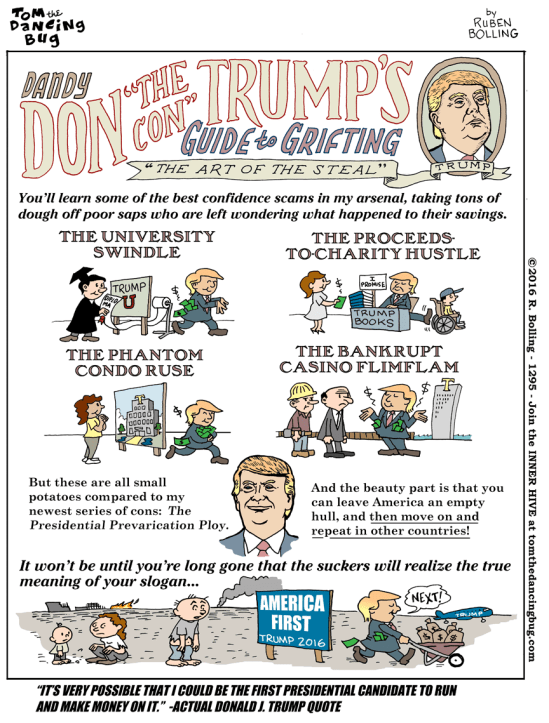
1295ckcomic-trump-con-man

Donald Trump has never been formally diagnosed as a sociopath. Nor do I have any professional credentials to make that diagnosis. Yet, he has exhibited the kind of behavior to merit such serious accusation that’s well worth considering. His Art of the Deal ghostwriter Tony Schwartz has a compelling case that Trump is this and he deeply regrets promoting his image. “I put lipstick on a pig,” he told the New Yorker in 2016. “I feel a deep sense of remorse that I contributed to presenting Trump in a way that brought him wider attention and made him more appealing than he is.” To have a president who’s a sociopath is very scary and dangerous prospect. Already he has put the United States at grave risk of involving it in a war and undermining democracy itself. So much so that Trump’s presidency presents an emergency not only allowing, but possibly requiring, psychiatrists to deviate from the Goldwater Rule, which holds that it’s unethical for shrinks to give professional opinions about public figures without examining them in person. This year, 27 psychiatrists, psychologists, and mental health professionals assessed Trump’s mental health based on his speech and behavior over the long course of his public life and conclude he’s a serious danger to the US and the world. And they argue that his mental health is affecting American people’s mental outlook. In October they released their findings in a book called The Dangerous Case of Donald Trump. Even so, I bring my compelling case to state that Donald Trump is a sociopath based on these findings. Nevertheless, Trump is a very dangerous human being who shouldn’t be trusted. Though he claims to be a successful businessman with the best brain, he’s nothing but a complete and total fraud who wouldn’t be where he is if he wasn’t rich. He is and never will be your friend. He has no conscience and has no respect for America, its democratic values, or its people. He abuses his power for his own self-enrichment. To support him is to enable his destructive behavior to wreak havoc on the US and the world. And to have him as President of the United States is morally indefensible and supporting him should never be tolerated.

1. Superficial Charm-Sociopaths know they don’t have a conscious and don’t feel the same love, empathy, and remorse “neurotypical” people do. To conceal their “strangeness” and get what they want from others, they learn how to “pass” in society. As they mimic “neurotypical” people, they become adept at charming them through “mirroring” those they meet. In other words, they get to know and use what they know about them in order to appear to have the same interests and values. Sociopaths can also mimic non-sociopaths’ facial expressions to more effectively charm them. In the beginning, being mirrored can be quite enchanting. But it’s just a mask they wear in order to get what they want from you. As you get to know them better, the superficial charm wears down as the victim starts noticing red flags such as lying and cheating. Such awareness creates a cognitive dissonance or a feeling that the image the sociopath projects doesn’t reflect their actual self. Though a sociopath’s victim might find cognitive dissonance rather confusing and disturbing. But it’s a sign of emotional abuse though victims mentally push it away. (Even I can’t doubt that Donald Trump is a very effective self-promoter who has been able to resonate with a significant legion of loyal supporters. Even before that, he was able to convince enough people to invest or work in his business projects even if they got nothing in the end. Still, whenever you hear anything bad about Trump from the media, expect Trump voters to view it as fake news. Still, those who believe and trust in Trump with running the country are enabling him to inflict his destructive tendencies on the American people, if not the world.)

2. Glibness– To be glib is to speak seemingly off the cuff but often to deceive. Sociopaths can use jokes, puns, and deflections to avoid serious discussions about real problems. Though it may seem unintentional, it’s not and it’s a sign the sociopath wants to move the conversation away from difficult issues which they don’t want to address head-on. (Donald Trump has often attacked his opponents personally or ignite some controversy to distract the media from negative press about him or his policies. Or when approached on some matter he really doesn’t want to discuss. Let’s just say glibness is Trump’s PR strategy and it’s one that works for his supporters. He may seem like he’s speaking from the heart at his rallies, but he has deceitful ends for doing so.)

3. Egoism– Sociopaths have swollen egos with narcissistic features and often see their lack of emotional depth and incapacity to love as weapons in their private (and sometimes public) wars they wage against those they want to manipulate and/or ruin. They feel an “edge” over non-sociopaths who feed into their sense of superiority. Since society often rewards those moving through life with an obvious self-love, their incredible confidence might seem exciting at first. Thanks to their sheer impact of their epic and outsized self-confidence, younger sociopaths tend to reap quite a few rewards and open a lot of doors. Signs of a narcissistic ego include bragging about their looks, vanity, bragging about positive encounters with celebrities or other VIPs, and bragging about sexual performance and/or exploits. Though the braggart might initially come across as a lovable clown, their potent egoism extends to grandiosity and indicates that something is really wrong with them. A sociopath’s sense of their own abilities and looks is insanely elevated which means they will put others on lower rungs. In other words, you will be below them and so will everyone else. You are there to be led by a puppet-master who’s chosen you as his toy. Sociopaths also enjoy belittling others and this type of bullying is indicative of egoism. Many sociopaths may give clues to who they really are, even if they frame it as a joke. If they call themselves “bad” or “evil,” they’re actually bragging what’s inside and want this darkness recognized. (Egoism is Donald Trump’s defining trait. He often notes how he’s such a good businessman or how smart he is. And yes, he’s bragged about his looks, positive encounters with celebrities, and even his sex life. Not to mention, his incessant bullying of those who challenge or criticize him is legendary. His insanely inflated ego might make comedians look forward to see him as a joke before he ran for president. But anyone who’s been on the receiving end of his attacks or exploits sees his excessive egoism as much more sinister.)

4. Grandiosity– This refers to a sustained view of oneself as better than everyone which causes the individual to view others with disdain or as inferior and sometimes reaching to delusional proportions. To spot grandiosity, look for disdain in others. A sociopath may regularly make racist statements. They may relate to individuals or creatures notorious for inflicting significant damage to humanity or God like the Devil, gangsters, or war criminals. (It’s very clear that Donald Trump has a disdain for others including people who support him. He’s made appallingly racist statements in public to the glee of white supremacists. He has spoken highly of dictators notorious for inflicting human rights abuses and suppressing civil liberties like Vladimir Putin, for instance.)

5. High Sensation Seeker– Sociopaths live in a state of constant boredom since their inner lives are virtually non-existent. Most of them seek out constant stimulation to make up for emotions they can’t feel as well as the dulled emotions they do. Since any feelings they do experience like lust, anger, irritation, envy, and fleeting happiness are usually quite weak, flickering into their consciousness before dissipating as quickly as they come. Since fleeting emotions come and go so rapidly to leave them empty, sociopaths find boredom as their biggest challenge in life. The most powerful emotion a sociopath feels is anger. Hell, they may even like to be angry since it’s better to feel something than so little (as they typically do). A sociopath may try to access sensation through creating drama and chaos on purpose and at frequent intervals. A lot of a sociopath’s bad behavior, including lawbreaking, cheating, and mind games (or worse), are related to alleviating boredom and accessing higher sensations. And since they don’t feel bad about what they do, they’re able to push things to the edge. Still, sensation-seeking can happen in many ways like juggling multiple romantic relationships, reckless driving, substance abuse, or seeking out deviant adventures in riskier locales. (Unlike many sociopaths, Donald Trump doesn’t drink {though there are rumors he uses cocaine}. However, he often creates drama and chaos through this Twitter rants over things he doesn’t like or his feuds with the media and celebrities. He’s also a sexual predator known to cheat on his wives. Not to mention, Tony Schwartz has told the New Yorker that he has a stunningly short attention span, “Trump has been written about a thousand ways from Sunday, but this fundamental aspect of who he is doesn’t seem to be fully understood. It’s implicit in a lot of what people write, but it’s never explicit—or, at least, I haven’t seen it. And that is that it’s impossible to keep him focused on any topic, other than his own self-aggrandizement, for more than a few minutes, and even then.”)

6. Frequent and Compulsive Lying– Sociopaths lie constantly to everyone in their lives, even when it’s not strictly necessary. In fact, people may begin to suspect that someone in their life is more evil than anticipated because they’ve uncovered lies. Things stop adding up because words and actions don’t agree. Once you get to know a sociopath, they often seem shady and dishonorable. A sociopath often wears a different mask customized just for the people in their lives since it’s all about manipulation and reputation management. Some lower-functioning sociopaths have great difficulty getting their lives straight and will try to rewrite history or change the subject if called out. A sociopath will lie to protect oneself to from the exposure they dread above all else. They will lie to manipulate people to give them what they want and keep them under their control. They don’t love or respect the people around them. They might like them, but they’re just simply pawns to be used to get what the sociopath wants. And they take equal advantage of everyone. Their desire to win for rewards often drive their lies. When someone believes them, the sociopath feels an addictive surge of raw power that might be seen as a pure sensation taking away the sense of “black hole” where a loving heart and conscience should be. (This is another one of Donald Trump’s defining traits. He constantly breaks promises he’s made, most of which he never intended to follow through in the first place. He peddles conspiracy theories on his Twitter feed, even if they’re blatantly ridiculous and thoroughly debunked. He propagates false, often malicious stories while using his time-honored high office to blame and squash high level public servants, judges, and his own subordinates. He constantly tries to discredit the media whenever they release negative stories about him. His dishonest in his business dealings is shocking and unprecedented as he’s been a defendant in thousands of lawsuits brought upon by service providers and vendors whom he failed to pay for services rendered to him or his business organizations. And it’s abundantly clear that failing/refusing to pay vendors is part of Trump’s business model. As Tony Schwartz said about him, “Lying is second nature to him. More than anyone else I have ever met, Trump has the ability to convince himself that whatever he is saying at any given moment is true, or sort of true, or at least ought to be true.” As of writing this in 2017, the Washington Post fact-checkers determined that Trump has chalked up 1,100 false and misleading claims in the first 10 months of his presidency. These include outrageous lies about Obama bugging his phones and his inauguration crowd size.)

7. No Guilt or Sense of Responsibility– Lacking a guilty conscience, a sociopath can move from one bad act or another without feeling any sense of moral wrongness or personal responsibility. Sociopaths can’t feel your pain unless they make a conscience effort to do so, which doesn’t happen very often. This guiltlessness is accompanied by lack of shame and no sense of responsibility. And it’s one of the primary reasons why most sociopaths seem extremely immature. It’s like they’re adults frozen in a permanent adolescence since they lack the emotional tools to learn from experience. They might claim they want to do better in the future and sound very believable saying so. But they can’t learn for their impulsiveness and desire to win at the game of life always leads them repeating the same mistakes and following the same patterns. Since guilt doesn’t touch them, they can’t mature. Sociopaths are wild creatures who only focus satisfying their base appetites and urges. In their inner lives, their absence of shame, guilt, remorse makes them dangerous individuals whether they’re violent or not. One red flag to watch for is a sociopath who tells you about morally questionable things they’ve done without a shred of guilt. A textbook example of a someone to watch out for would be a man who matter-of-factly tells you how he walked out on his family and devastated them. And he places all the blame on the spouse left behind. Because to a sociopath, anyone who has a problem with them is insane. While people who are guilty examine their own role in things and understand there are at least 2 sides, a sociopath can’t understand in emotional sense, how other people feel. Nor will they feel guilty about anything that happens. This chilling sense of “disconnect” from actions which hurt others (demonstrating a total lack of empathy) is a prime indicator of sociopathy. (This is a defining trait of Donald Trump who feels absolutely no guilt, shame, remorse, or sense of responsibility for his actions. Throughout his life, he’s done truly mindboggling and reprehensible shit that’s hurt hundreds of people over the decades such as family members he’s mistreated, employees he hasn’t paid, investors he’s swindled, and so many others. He never apologizes for any missteps or intemperate attacks and has demonstrated a remarkable lack of empathy for people he’s attacked, injured, or harmed. Nor has he taken any responsibility for all the bad stuff he’s save from settling a lawsuit to evade more serious charges. And due to his impulsiveness and desire to win, Trump has never learned from his mistakes nor cares to. As president, he’s been no different. As for talking about morally questionable things he’s done without a shred of guilt, well, check out his Access Hollywood interview with Billy Bush in which bragged about sexually assaulting women. The first part recounts how he failed to seduce Nancy O’Dell in which he said, “I moved on her, and I failed. I’ll admit it. I did try and fuck her. She was married. And I moved on her very heavily. In fact, I took her out furniture shopping. She wanted to get some furniture. I said, “I’ll show you where they have some nice furniture.” I took her out furniture—I moved on her like a bitch. But I couldn’t get there. And she was married. Then all of a sudden I see her, she’s now got the big phony tits and everything. She’s totally changed her look.” Later referring to Arianne Zucker whom he and Bush were about to meet, he told the guy, “I better use some Tic Tacs just in case I start kissing her. You know I’m automatically attracted to beautiful—I just start kissing them. It’s like a magnet. Just kiss. I don’t even wait. And when you’re a star, they let you do it. You can do anything. Grab ’em by the pussy. You can do anything.” As Americans, we must acknowledge that Trump’s unwillingness to own up to his mistakes makes him a very dangerous man in the White House.)

8. Shallow Emotions– Sociopaths do shocking and horrible acts whether leading double lives, stealing money from other’s savings account, or sabotaging others at the workplace may not be readily apparent or discovered for years. Part of the problem is that sociopaths don’t feel all emotions while the ones they do feel are fleeting. In their world, emotions don’t carry much weight save for anger and even that doesn’t last long. To illustrate this further let’s take a real ear and a cochlear implant. Now the human ear processes thousands of sounds with thousands of “channels.” Whereas a cochlear implant is only a synthetic version of an ear with only a fraction of a real ear’s channels. In regard to emotions, the sociopath is a cochlear implant while you’re (assuming you’re not a sociopath) are the real ear. Both may seem alike but they’re very different. A non-sociopath experiences emotional richness and depth. The sociopath doesn’t have it. For people to understand each other, they must be able to share one another’s emotional range. When they can’t the relationship is doomed in only a matter of time. While many sociopaths would like to feel what the rest of us feel instead of knowing they’re on the outside, most are quite happy to be sociopaths. So you shouldn’t pity them. Since they use pity to control other people and they don’t love those they control. Sociopaths don’t have the capacity for authentic love. Sure they might believe they’re in love in a romantic relationship, but their idea of love is mostly about lust, fleeting infatuation, and possessing and controlling another. That’s not love like other people feel it. (Other than anger {or possibly lust}, there are few emotions Donald Trump seems to display with any great intensity. He’s admitted that he doesn’t even cry. Nor has there ever been any evidence he’s ever been in love with anyone or even understands it himself. To say that Trump has an emotional shallowness similar Lord Voldemort isn’t much of a stretch. Nevertheless, since anyone can fake emotion to people who don’t even know them, only Trump and those closest to him know if he has any capacity for love. But I highly doubt this.)

9. Empathy-Free– Since sociopaths typically don’t even bother to put themselves in anyone’s shoes, they don’t experience a sense of humanity and oneness. Thy can’t feel sympathy for others or understand the emotional consequences of their actions. Though studies have shown they can turn empathy on and off, theirs is mostly in the default “Off” setting. Everyday con artists are all too happy to trick others into giving them things under false pretenses. Since they don’t emotionally understand how other people feel, they make false promises without feeling the pain of those they deceive. Sociopaths make lots of promises and these promises just don’t come through. Whether it’s a man who talks about marriage to his girlfriend but never manages to make it to the altar. Or a coworker who promises you credit on a big project then stabs you in a back. False promises are indicative of sociopathy. (Donald Trump’s record of false promises is absolutely staggering. He constantly makes promises often with no intention to follow through with them. As a businessman he’s hired people for his projects with no intention of paying them for their work. He’s promised to donate to charity countless times despite that he runs his Trump Foundation as a personal piggy bank with other people’s money. Then there are plenty of promises on the campaign trail he’s already broken, particularly when they pertain to healthcare, jobs, or draining the swamp. Then there’s the time when he mocked Senate Minority Leader Chuck Schumer for crying “fake tears” during his Muslim ban condemnation. Never mind that Schumer’s great-grandmother and seven of her children died during the Holocaust. A president who makes life-or-death decisions on a daily basis without comprehending the possibility of what another person might experience is a very scary thing. Trump has shown a profound lack of empathy on several occasions during his presidency, sometimes to mindboggling proportions. He has no sense of shame and spews rhetoric that’s often degrading, disingenuous, or sarcastic. He gains satisfaction from mocking people and thinks mercilessly degrading opponents makes him tough. He casually brags about forcing unwanted sexual contact on women. Sorry, Trump supporters, but your man doesn’t feel your pain or ever will.)

10. Trivial Sex Life– If you’re on a date, one thing to watch for is someone who stares at the opposite sex a lot while you’re out and about. If that person seems on the prowl, even when with a partner, they’re seeking sexual attention which is akin to narcissistic behavior. It’s called the predatory stare which is about inappropriate eye contact which can make you feel quite uncomfortable like you’re their next meal. Since sociopaths don’t have deep emotions, they may use sex to kill the boredom and in order to enjoy sensation. Combine this lack of depth with higher-than-average testosterone levels and vaulting egos, it’s no surprise that most sociopaths are promiscuous. And since they want higher and higher levels of sensation, they may become sexual deviants. This means cheating, using prostitutes, sleeping with people under the age of consent, sex tourism, and so on. Sex will be skillful yet not emotional. We should also note that promiscuity is such a common trait in sociopaths that it’s one of the factors psychiatrists look for when diagnosing the condition. (Tales of Donald Trump’s sexual exploits are the stuff of tabloid legend. He’s bragged about multiple infidelities and sexually assaulting women. Not to mention, he’s had plenty of sexual assault allegations against him, one pertaining to raping a 13-year-old girl. Oh, and let’s not forget the one about the prostitutes peeing on him at the Moscow Ritz Carlton presidential suite. Or how he liked to frequent beauty pageant contestants dressing rooms, especially if they consisted of teenage girls. Then there’s the infamous Billy Bush tape where he said “grab em’ by the pussy.”)

11. Conduct Problems Prior to Age 15– Sociopathy starts young and manifests in one way or another before age 15. Teens might be diagnosed with Conduct Disorder. Others may have no formal diagnosis, but they may have trouble following rules at school and home. They may show general disrespect for the truth, parents, siblings, and authority figures. Quite often, but not always, a juvenile delinquent is a budding sociopath. Some young sociopaths hurt animals and don’t understand why it’s wrong until they’re told. Others are violent with people. All will be rule-breakers and most will experiment alcohol and drugs, along with sexual contact long before their peers. To find an adult sociopath who wasn’t a problem child is rare. (Donald Trump has bragged about punching his music teacher in the face when he was in 2nd grade and almost got expelled over it. As he “wrote” in The Art of the Deal, “In the second grade…I punched my music teacher because I didn’t think he knew anything about music….I’m not proud of that, but it’s clear evidence that even early on I had a tendency to stand up and make my opinions known in a very forceful way.” Of course, there’s no evidence he did this since people who knew him denied the story. Childhood friends and teachers describe the young Trump falling into a crowd of boys “who pulled girls’ hair, passed notes, and talked out of turn.” In fact, he ended up in detention so often that his friends nicknamed the punishment, “D.T.” Steve Nachtigall said he once saw Trump and his friends jump off their bikes and beat up another boy. He told the Washington Post, “It’s kind of like a little video snippet that remains in my brain because I think it was so unusual and terrifying at that age.” Furthermore, his father sent him to the New York Military Academy when he was 13 to straighten him out and keep him out of the trouble he liked to get into as a boy.)

12. Sadism and Mind Games– People with empathy don’t enjoy hurting others while a sociopath does. Even those they legitimately enjoy spending time with will be subject to sadism and mind games. If you know someone who seems to enjoy hurting you like a cat with a toy mouse and you find the mind games monotonous and repetitive, it might be time to cut them off from your life if you can. Sociopaths enjoy degrading, humiliating, dominating, damaging and belittling others. (Donald Trump seems to have a certain bloodlust as long as he’s not the one getting beat up. He’s endorsed and condoned police brutality as well as denigrated football players for kneeling during the national anthem to peacefully protest it. He’s repeatedly given license to his base to inflict violence. In fact, during a presidential campaign, Trump stated that he’d pay the legal costs of a thug who attacked a black protestor. He seems to revel in producing representations of violence suggesting it as how to deal with the “fake news” media that hold him accountable for his actions and policies. His domestic policies have been designed not only to harm or kill but also to instill fear through intimidation or coercion in specific populations. Not to mention, despite calling himself pro-life, his policies emanate what Pope Francis has indicated, “an economy that kills.” Trump relishes using violence and warmongering brutality to inflict humiliation and pain on people. Then there are the mind games in which he inflicts on the populace he continuously gaslights with conspiracy theories on a regular basis whenever his team’s embroiled in scandal. All too often.)

13. Has Few Friends– Sociopaths tend to have few friends, at least not real ones anyway. As psychiatrist Ross Rosenberg noted, Sociopaths don’t want friends, unless they need them. Or all of their friends are superficially connected with them, friends by association.” We should also note that many sociopaths have many short-term marriages which might begin with them idealizing them before devaluing and ultimately discarding them for a newer and more interesting partner. Since they never truly bond with their spouses, walking away from a marriage or relationship is quite effortless. And they’ll blame the relationship’s failure on their ex. (Most of Donald Trump’s relationships appear transactional. Whenever any of his associates get into trouble, he will deny he even knew them.)

14. Shows Disregard for Societal Norms– Sociopaths break rules and laws because they don’t believe society’s rules apply to them. A run of them mill spoiled brat may eventually learn that everyone needs to follow rules to be a part of society. A sociopath never does. They do what they need to gain pleasure which remains about all that keeps them in line. Because for a sociopath, rules are for other people, not them. They may not be a problem for the law but they will seek loopholes to rise to positions of power or move to another area where their behavior is tolerated. (Donald Trump has shown this time and time again. He has skirted rules and norms whenever it’s convenient for him. He doesn’t pay his workers. He’s used his charity as a personal piggy bank with other people’s money. He’s profiting off his presidency which is a clear violation of the Emoluments Clause in the US Constitution. He’s never released his recent tax returns. As a businessman, he’s used money and attorneys to find loopholes to bail himself out of several lawsuits generated from the infamous Trump University scam. As we speak, there are investigations currently determining whether if Trump or his campaign made illegal deals with the Russian government regarding possible tampering in the 2016 campaign. Let’s just say, if Trump can get away with breaking the law or social norm, he’ll surely do so.)

15. Explosive Temper– When things don’t go the way a sociopath has planned, they react in explosive anger. Even if the ugly meltdown was over a minor sleight whether real or imaginary. Such anger stems from the fact the inner narcissist is seemingly out of control with their surroundings which doesn’t jive with their worldview. Sociopaths can get mean if they’re challenged or if someone gets in the way of their goal. With domestic violence, you’ll see verbal and physical aggression again and again. Outside of a relationship, they might have road rage or constantly get into arguments. They can turn mean but only if challenged or if someone gets in the way of their goals. A sociopath’s charm usually covers their anger tendencies. But when it’s off and targeted at you, then God help you. (Donald Trump’s explosive anger is legendary which erupts whenever things don’t go his own way as reflected on his Twitter feed. Even before his presidency, he’s been known for this. He’s sued or threatened to sue people for criticizing or challenging him. One instance has him beating up Donald Jr. in college for not wearing a suit for a baseball game. He’s exploded over people making jokes about him to ridiculous levels. The New York Times lists 382 people, places, and things Trump has insulted on Twitter.)

16. Has Major Problems with Criticism– Sociopaths are extremely hostile to criticism since they often desire approval from others and may even feel like they’re entitled to it. They exercise extreme hypersensitivity when they feel, slighted, criticized, or challenged. They can’t tolerate weakness being highlighted by anyone speaking to them in a manner implying they’re inferior. And many will attack anyone they feel committed such an infraction. Question their behavior and they will react with anger or rage. (Donald Trump can’t tolerate any form of criticism no matter how slight and he is vindictive in the extreme. He often calls negative media stories about him as “fake news.” His obvious animosity towards reporters who “fabricate” stories manifesting by his thirst for taunting them. He uses hit and run tweets to demean, embarrass, and attack all who criticize him but lacks courage to hold Q&A press conferences for fear of being challenged over his wild assertions. His staff is also afraid to criticize him. He likes to brag but usually blames his failures on others. Also, erupts in Twitter tantrums over people joking about him. Also, take note on how his cabinet seems to praise him during meetings. There’s also evidence that hasn’t been yet publicly disseminated is that Trump has misused New York City Police Department officers to retaliate against his perceived enemies in New York City and to harass and threaten his opponents’ personal safety. This is a man who doesn’t take criticism well, like at all.)

17. Induces Drama Fatigue– Sociopaths’ behavior is so strange and outrageous that you actually become desensitized to things that would otherwise deeply upset you. Essentially, your “baseline normal” begins shifting to accommodate their increasingly abnormal behavior. And that’s when they start causing the real damage. Then they will induce fear to gradually wear you down to accept their control through a cycle of emotional and possibly physical abuse. (Donald Trump has put the United States through his crazy antics since he began running for president. Whether drama fatigue has set in at this point, I’m not exactly sure. However, the Republican establishment’s “baseline normal” has significantly shifted to accommodate Trump’s increasingly abnormal behavior just to get what they want. And since they control all 3 branches of the federal government, the country has to live with it for the time being.)

18. Gaslighting– A sociopath may say or do things before blatantly denying those things ever took place. In essence, they reinvent history and blame you for “misinterpreting” them. Their gaslighting clouds your sense of reality that you soon doubt yourself. Thus, you become more vulnerable to their manipulation. (Donald Trump has been gaslighting America on a regular basis since 2015. He peddles conspiracy theories. He’s denied telling some of his own lies. Thankfully, he’s not always successful thanks to video cameras catching him in the act. But he has the right-wing media to convince his supporters to take him at his word.)

19. Polarized Reputation– Sociopaths love to turn people against each other, especially if it results in a fight over them. By turning you against people you might otherwise get along with, you start thinking in extremes. Once your thinking slips from gray to black and white, sociopaths are able to paint “enemies” as good guys and bad guys. This keeps their victims divided and distracted. Sociopaths don’t want people to like or get along with each other and will try to “divide and conquer.” (Donald Trump is very polarizing figure who never misses an opportunity to inflict his appalling racism, conspiracy theories, or inflammatory rhetoric to fuel hyper partisan political polarization. His attacks on the national anthem protests are a prime example of this. So, Democrats, even if reaching out to Trump voters gets you nowhere, you should probably make some concerted effort to do so as a way to resist him.)

20. Intentionally Provokes Reactions– Sociopaths intentionally provoke reactions in you and then blame you for reacting. Causing you to become “hysterical” or to act “crazy,” enables them to write you off as an unstable loon or worse. And they’ll do this by preying on people’s suspicions, insecurities and resentments. They’ll often play the victim after provoking you, shifting people’s focus on you, and away from their behavior. They will turn people against each other if it works in their behavior even if it means destroying families, friendships, relationships, marriages, and entire communities. A good example in this is Iago engineering brawls to ensure Cassio’s ruin and preying on Othello’s insecurities by alleging that his wife is cheating on him. Nevertheless, Shakespeare’s Othello is a perfect example of how sociopaths can bring out the absolute worst in the people around them and ruin their lives. Everything a sociopath touches will go to shit. (Donald Trump does this all the time whenever there’s a negative story about him in order to deflect or distract people from more serious matters. Hell, he became president through tapping into white people’s racial resentment and xenophobia. His tendency to provoke reactions from people is dividing the country and undermining American democracy as we speak. Like Iago, Trump’s provocations will only divide us further and eventually destroy us all.)

21. Parasitic Lifestyle– Sociopaths really can’t see the point of working hard for long hours and little pay. There are far easier ways for them to get things for free. Often they’ll see their romantic partners as their career option. As Dating a Sociopath notes, “He will give glib promises, of how he will repay you, how special you are. You are made to feel like he is doing you a huge favor. He tells lies, so that you think that he isn’t just some deadbeat loser. He will talk of business plans, or a great career, and that maybe he is just temporarily down on his luck. But he sells you a good, honest moralistic man, with great prospects (it is all a lie).” Cary Grant’s performance in Suspicion offers a perfect example of this. Sociopaths love getting anything for free. They see it as “winning” and it makes them feel good for 2 reasons. First, it shows how stupid people are (and therefore, how clever they are to fool them). Second, it enables them to have the very best in life, with very little stress, effort, responsibility, or commitment. By the way, all sociopaths do this even those who work. You can even include high functioning sociopaths like certain politicians who put in false claims for expenses and live off a great life at the taxpayers’ bill. (Despite claiming to be a successful businessman, Donald Trump has often sought plenty of government funds to build his projects for decades. Even when the money was certainly meant for someone else like small businesses in New York City after 9/11. He has profited from his own presidential campaign. As president, he’s all too happy to spend his weekends at his resorts profiting off his Secret Service protection on the taxpayers’ dime.)

22. Is Very Dramatic– Sociopaths are always dramatic. In fact, they love drama and are drawn to it like magnets. They tell big stories filled with manipulation and deceit. They appear as larger than life characters who are always charming with a story to tell. They love to be the center of attention. They don’t mind having dramas or whoever has to put up with them because they simply don’t care. You often find sociopaths either dramatically telling lies, manipulating, deceiving, being dramatic victims, or dramatically pleading that they’ll change. Whatever they do, they’ll always appear larger than life. And if there isn’t any drama, they will create some. (Donald Trump thrives on drama as anyone could see on the news or on his Twitter feed. He always has to peddle conspiracy theories pertaining to his critics and opponents.)

23. Immaturity– Sociopaths are typically immature since they can’t learn from their past, keep repeating the same mistakes. Thus, they are unable to grow up and act in a more mature way that has respect for other people. Sociopaths don’t care for the rights of others. But they may pretend to act responsible and caring if it gets them what they want. Like a bratty teen, sociopaths are demanding and very selfish. They only think about their own needs and think the entire world revolves around them. Thus, a sociopath will never put other people’s needs before their own. (Donald Trump acts incredibly immature and never learns from his mistakes. He always thinks the world revolves around him and will only act nice if it gives him what he wants. He may seem like he cares about his supporters or the United States. But though he may demand loyalty from those below him, don’t expect him to give it in return. Trump is a very selfish man who sees nothing wrong with abusing his power to get what he wants even if it means destroying people’s lives, undermining the democratic process, or emboldening white supremacists. And he is certainly abusing his presidential office to personally enrich himself.)

24. Has No Realistic Long-Term Goals– Sociopaths don’t make long term goals like everybody else since they’re so busy lying, cheating, manipulating, and scamming. Unless given an easy route to working, many think work is beneath them and treat it with contempt. Sociopaths who work can rarely hold down a job for too long as they don’t like routine or being told what to do. And often they lose their jobs or have a history of trouble in the workplace. It’s not that they don’t work hard, they do but only in scamming and cheating others for themselves. And because sociopaths are so consumed in the present drama, what’s going on the next few months doesn’t seem important. They’ll lie today and not think how it will affect them in the future. (Donald Trump doesn’t really plan ahead or think about the destructive long-term implications of his actions. As long as it gives him immediate gratification or benefit, that’s all that matters to him. He also detests being told what to do.)

25. Jealousy and Paranoia– Sociopaths are extremely jealous and paranoid. They’ll accuse you of things you haven’t done (that they often have done). And you’ll feel you often have to constantly defend yourself against false accusations. They also stalk their principal targets as well as suspect other people of being as manipulative, deceitful, and unscrupulous as themselves. They will check on their partners and keep track of where they are and who they’re with. If their significant other speaks to someone of the opposite sex, then the sociopath will ask several questions on how they know that person. If their victims don’t answer their calls, they’ll ask where they were, what they were doing, who they were talking to, etc. (Donald Trump has displayed some degree of paranoia and jealousy, especially towards Barack Obama. Trump sees Obama beneath him being the kind of racist he is {I mean he once alleged he wasn’t born in the US for years}. He can’t stand the idea that Obama is a far more loved and respected than he ever could be. So much so that he’ll try to destroy Obama’s presidential legacy out of spite. As for paranoia, well, he certainly thinks the mainstream media has it out for him.)

26. Always Blames Someone Else for Their Transgressions – Since they completely lack remorse, guilt, or shame and will never admit to their wrongdoings if caught. Instead, they will blame someone else for their actions or ignore their victims and their pain before moving on. They may experience a sociopathic, narcissistic meltdown which will make you see signs of insanity. But they will not care how you feel. Because a sociopath feels they’re never to blame, everything is someone else’s fault. (Donald Trump will always blame the news media for making up stories about him whenever they portray him in a negative light. He’ll blame Republicans for failing to pass policy that he endorsed. He’ll blame Democrats for conspiring against him. He’ll even blame his victims for getting into their terrible situations in the first place. But he’ll never own up to his mistakes or take responsibility for his actions.)

27. Unpredictability– Sociopaths can seem to change their entire personality depending on the situation. In fact, they may like a lot of change in their atmosphere which might include changing team members, jobs, opinions and relationships. They can dramatically shift from friendly neighbor to cold, dispassionate stranger. Sociopaths can alter who they seemingly are to get what they apparently want given on how well they believe that specific mask will benefit them at the time. (Donald Trump often adapts the kind of personality that will most help him at some moments, particularly when he’s on his best behavior with dignitaries.)

28. Public Contempt for Social Inferiors– A sociopath views everyone beneath them. But there are some people who they view as more inferior than others. In fact, a sociopath might see these people as so beneath them that they don’t even bother to hide their true selves to them. Normally, these public targets are poor people, ethnic minorities, those in the LGBT community, or people with disabilities, many of whom the rest of society doesn’t think much of. And if it helps him, he’ll use that bigotry to tap into people’s resentment and get what he wants. A good example of this would be a seemingly charming and likeable guy you meet at a restaurant for a date. He may seem nice talking to you. But if he epically flips out at the waiter for whatever reason, then that’s a clear red flag he’s not a good guy. Yet, since you’re receptive to his superficial charm, you might just ignore it. After all, you really like the guy who seems to have a lot in common with you. And perhaps maybe that waiter didn’t give you adequate service. Sure he might be all charm to sweep you off your feet. But if he treats that waiter like garbage, chances are he will treat you like shit somewhere down the line, too. And maybe worse. Besides, if he’s willing to inflict harm on marginalized groups, chances are he’ll put you through hell, too. (Donald Trump often talks crap on undocumented immigrants, Muslims, blacks, and other groups of people he doesn’t like. His supporters love it since his hateful screeds seem to resonate with them, while tapping into the vast reservoir of white racial resentment won him the White House. However, it’s very clear that he doesn’t think much of his supporters’ real needs and will only appeal to his base with racist screeds so he could exploit their anger and bigotry. Yet, he’ll support plutocratic policies that the GOP establishment and their donors want because that’s who’s giving him money.)

29. Isn’t Nice to the Waiter– You can tell a lot about how a person will behave in the future by how they treat others who aren’t immediately useful to them. Those who are uncaring and unethical to others will most likely also be that way to you when you no longer serve their interests. In a romantic relationship during the dating phase, the sociopath will treat a waitstaff or any other neutral person of the opposite sex the way they’ll treat you in the next 6 months. They may treat you like a prize in the honeymoon phase. But even during that time, the sociopath hasn’t forgotten how they feel actually feel about the opposite sex. They will treat waitstaff, clerks, and other neutral individuals badly. If they’re cheap, you’ll never receive anything once the honeymoon’s over. If they whine, complain, criticize, and torment, they’ll do the same to you come 6 months later. They lack consistency in their “good” behavior because for them “goodness” is only a façade. How they treat people has strictly to do with that person’s perceived use value. When people are useful to the sociopath, they will treat them (superficially) well. When they aren’t, they ignore and mistreat them. (Donald Trump is only nice to people who are useful to him and can give them what he wants. When he feels their association doesn’t benefit him, he will drop them with a drop of a hat. In fact, he will distance himself from them, pretending they weren’t very significant or denying that he knew them at all.)

30. Shows a Pattern of Misbehavior– Though we may all have road rage or fantasize about being a famous movie star or inventor, that will only happen to us once in awhile. With a sociopath, these things happen over and over again. Sociopathy is a personality disorder that manifests at work, school, with friends, while they’re young, during adolescence, and in adulthood. Unless you observe that jerk at the office in all aspects of their lives, it’s impossible to see if their attitude just might be an ill temper at work or signs of a darker issue. Sociopaths may learn how to adapt but they can never change and see no reason to. (Though since Donald Trump is a public figure, we can observe him in all aspects of work. And whenever he’s in a position of authority, he’s consistently abused his power whether he’s head of the Trump Organization or in the White House. Just look at his articles the media has written about him. You’ll find he’s basically the same person now as he was then.)

31. Plays the Victim– Sociopaths are experts at manipulating emotions and insecurities into causing you to view them as the victim. This helps lowers your guard and makes you vulnerable to future exploitation. Because when we feel sorry for someone, we can easily excuse their transgressions. Sociopaths use this manipulation tactic precisely for this reason since it lets them off the hook for egregious behavior they’ve engaged in for selfish reasons. If a person’s victim mentality is continually combined with unacceptable and evil actions, you should be wary of their real nature. Think Eric Cartman in South Park. (Donald Trump does this all the time to his supporters whenever the media reports anything negative about him. He will often try to discredit them as “fake news” who work for the liberal agenda. Even though reporting negative stuff about him just happens to be part of the mainstream media’s freaking job.)

32. Is All Take and No Give– Sociopaths are selfish people who seek constant attention and adoration, even from total strangers. If you’re in a relationship with a sociopath, your wants and desires will take a backseat, particularly after the honeymoon’s over. Your basic boundaries will not be respected. But there will be absolutely no tolerance for the reverse. Partners of sociopaths often find that when they engage in normal inquiries regarding their absence or requests to discontinue their rudeness and aggression in which the sociopath lashes out. And since they have very little tolerance for a secondary position, sociopaths will tread boundaries in most of their relationships, including professional ones. They may refer to their doctor or attorney by their first name because they want to remove any possible power differential they feel between themselves and others. (Donald Trump is a phenomenally selfish individual who has no respect for people’s needs or constitutional rights. But at the same time, he’s very secretive about his finances, particularly his tax returns. Then there’s the fact he holds rallies and has to have people shower him with praise.)

33. Exhibits Poor Self-Control– Since they live in the present, sociopaths can’t easily refrain from acting on an urge. They can’t contain their anger if provoked. They can’t resist temptation even if it pertains to skipping an immediate reward for a larger one later. They may act threatened, annoyed, and angry in normal encounters or everyday situations. And they exhibit difficulties controlling their own emotions which can lead to mood swings or irrational behavior. With a sociopath, you’ll often see irritability, annoyance, impatience, threats, aggression, verbal abuse, inadequate anger and temper control, and acting hastily. (Nothing shows Donald Trump’s poor self-control like his response to the white supremacist violence in Charlottesville or his inflammatory Twitter rants.)

34. Has a Strange Network of Enablers– Though a sociopath may not have many real friends, they do have allies who vouch for them. These can range from “consultants,” to skilled workers, to enabling co-dependents who back them up whenever they want to go after their targets. Many of the support people may have their own share of psychological problems, ulterior motives, or just like what the sociopath says. But all will be sycophants in one way or another while some may even be sociopaths themselves. (Though unpopular, Donald Trump has plenty of people who support him that they will swear by every word he says and excuse every horrible thing he does. This includes the Republican Party establishment, conservative media, and nearly a third of American voters, especially if they’re white. Not to mention, many of his close associates are also horrible people while some of his most ardent supporters are white nationalists willing to commit violent acts in his name.)

35. Flagrant Hypocrisy– Sociopaths have extremely high expectations for fidelity, respect, and adoration. But once they win you over, they will give none of this back to you. They will lie, cheat, insult, and degrade you. But you will have to remain perfect despite all the shit they make you put up with. (Donald Trump will expect people to be absolutely loyal to him under all circumstances. But once someone is no longer useful to him or gets into some kind of trouble, he’ll stab them in the back with a drop of a hat. Oh, and despite seeing no qualms to his associates using private e-mail servers for their jobs, he absolutely crucified Hillary Clinton over her e-mail habits in 2016.)

36. Sadistic Sense of Humor– Sociopaths find humor in things most people find unlawful or disgusting. While it might not seem strange at first, it evolves over time and becomes creepy or disgusting. (I’m not sure if Donald Trump has a sense of humor. But he seems to take a casual attitude toward sexual assault and nuclear annihilation. Then there is how he talks about Ivanka which is just absolutely creepy.)

37. Has an Inflated Sense of Entitlement– Sociopaths feel entitled to act the way they do. If someone slights them, they feel they have a right to retaliate. If someone fails them or if anyone says anything bad about them, they feel entitled to revenge. Or if they do something nice for you, they feel entitled to a reward. And if you don’t give them what they want, they’re entitled to punish you. Laws, ethics, and other people’s feelings don’t matter to them. Furthermore, winning is extremely important to sociopaths and typically don’t accept being in a lesser situation, regardless of how small the situation. (Donald Trump feels entitled to act the way he does. And he’ll often retaliate if someone doesn’t do what he wants or says anything terrible about him. Even if it’s just the news media trying to do their job. If he sees anyone not lavishing him with praises, he’ll certainly lash out at them. Also, he really hates to lose.)

38. Isolates Willing Victims– In nature predators isolate their prey from the rest of the herd to better attack and devour it. And that’s what sociopaths do to their targets. They isolate their partners from their friends, colleagues, and families. Sometimes it might be through overt criticism or following them around when they meet with others. Sometimes it could be through more subtle manipulation such as by covertly turning the victim against their own family and friends (and vice versa). Because sociopaths feels that their partner’s support system might influence them or offer negative opinions about their behavior. Eventually rather than face verbal punishment, interrogation, and abuse, the victim will develop the feeling that it’s better not to talk to family and friends and will withdraw from them. Yet, they also not only just isolate their partners from other people, but also narrow the range of their interests and activities. This leads their significant others to focus exclusively on them. They may give their partners money and gifts, not out of real generosity but to keep them financially and emotionally dependent on them. They may discourage their partner from working outside the home or possibly follow them everywhere to see if they’re seeing anyone of the opposite sex. This puts their partners on edge about any kind of activity or pursuit external to their relationship. (Donald Trump has done this from his supporters in regards to the mainstream media which he calls “fake news” since they report negative stories about him. Yet, he’s also broken up families, friendships, and the like.)

39. Massive Control Freak– Sociopaths need to maintain control of everything in their lives, particularly in romantic relationships. When they get bored with one partner or find a replacement, they will leave them on the spur of the moment, heartlessly and often without bothering an explanation. But they get very angry when the tables are turned and their partners leave them. Sociopaths will put down their partners not only in private, but also in public to embarrass and isolate them. Sociopaths can’t tolerate any real assertion of independence from others. They are so self-involved and self-worshipping that they think their own beliefs and opinions are absolute authority and consider others’ feelings and opinions as worthless. In the workplace, the sociopathic boss will be the tyrant who’s surrounded by sycophants and makes their employees’ lives hell. (Like anyone with authoritarian tendencies, Donald Trump is a massive control freak who has to maintain control in everything in his life, especially when it comes to his businesses and public image. Trump has attacked even fellow Republicans who speak out against him. Using dominance or intimidation to control others shows up time and time again in Trump’s history. He’s attempted to silence not just the media, but also protestors at his rallies where he’s implied support for violent retaliation and publicly suggested he’d pay legal fees for one assault subject.)

40. Has a Very Shady History– It’s said that the best indicator to predict future behavior is past behavior. There may be exceptions to this general principle since some people can improve their behavior and character with genuine and consistent effort. However, a sociopath can never be one of these people. If a man cheated on every wife he’s been with, it’s very likely he’ll cheat on the next one. Obviously the problem isn’t any of the women he’s with, but his underlying lack of character. Similarly if he’s abused previous partners, he’s very likely to abuse the next one as well. Not to mention, since sociopaths don’t see anything wrong with their harmful behavior, they’re likely to boast about it. They may tell stories of violence, aggression, being insensitive to others, rejecting others, etc… They may brag about their temper and outbursts because they don’t see anything wrong with violence and actually take pride in the “I didn’t take nothing from nobody” attitude. Best to listen to these stories since they tell you how you’ll eventually be treated and what’s coming your way. (Donald Trump’s past contains a decades long history of mindboggling corruption and abuse of power. If he abused his power to enrich himself as a businessman, then nobody should be surprised how he’s abusing his power as president. Look at his history on my blog and you’ll find unbelievable tales of corruption the world has never seen before. Believe me, did a whole post of it during the 2016 campaign. The epic tales of deceit are absolutely staggering. Trump writes off the media as “fake news” for reporting negative stories about him {which are very important to know about}, not because the media has it in for him {though I wouldn’t blame them if they did}. But because the media’s covered him for decades and knows exactly who he is. So, whenever the mainstream media reports a story casting Trump in a negative light, believe the media. For the love of God, believe them for at least they have a better track record at telling the truth than Donald Trump.)

41. Jekyll and Hyde Personality– Sociopaths are often described as two-faced. The Jekyll side is a mask they use to attract, fool, and use others. The Hyde side represents their true identity which becomes increasingly dominant over time. To buddies, a sociopath may appear easy-going, nice person. But that’s because the buddies only see one side of them, the jovial side the sociopath wanted them to see. To spouses and families or rather anyone who’s had intimate contact with them, the sociopath exposes another, much more menacing side of their personality. They may be occasionally nice to keep their partners from straying, but they will revert back to their mean, nasty selves in only a matter of time. And over time, that meanness will escalate in severity and duration while the “nice” moments become increasingly few. (When Donald Trump acts presidential, it’s just a mask and it won’t stay on for long. Because he’s a very volatile man who cares for nobody but himself and lashes out whenever he doesn’t get his way.)

42. Secretiveness– Sociopaths reveal little about themselves though they talk incessantly about various subjects. Their partners aren’t likely to meet someone important in their past or witness the sociopath’s family members visit or interact with them in any meaningful way. Some sociopaths conceal a significant portion of their lives for fear they may expose their dark past. They don’t like exposure and usually ask their lovers not to share too much about them. (Though he brands himself as incredibly rich, Donald Trump keeps his true wealth secret such as his tax returns he still hasn’t released. However, as a public figure, his past is very well known thanks to the media reporting on him for decades. Not to mention, Trump’s White House has been notoriously less transparent than previous administrations. When the facts make him look bad, Trump absolutely hates transparency and tries to discredit the media like some asshole boyfriend attempting pass his ex-girlfriend as a crazy bitch.)

43. Has a History of Financial or Occupational Instability– Sociopaths often can’t keep jobs or uphold financial commitments. Their sense of entitlement leads them to dismiss work rules like arriving on time, staying awake, or not stealing. Moreover, the reason for their termination includes insubordination since they have no respect for people with control over them, including bosses. (Donald Trump may not have occupational instability due to being born into wealth with connections. But many of the financial records we do know about don’t give us a good impression on his money managing abilities. Besides, he’s experienced bankruptcy 4 freaking times as well as multiple business failures over the years. Not to mention, his reputation for failing to repay debts was so notorious that Wall Street banks stopped lending money to him. He may brand himself as a successful businessman, but his personal and business suggests he’s a complete fraud.)

44. Lacks Basic Social Skills Despite Charm– A most jarring and easily noticeable sign of a sociopath’s behavior is a lack of basic conduct rules. Sure they may be quite social. But their lack of empty they don’t understand how to treat other people with the basics of human kindness, fairness, and respect. (Donald Trump’s conduct to Gold Star families and hurricane victims in Puerto Rico certainly illustrate how he can’t even comfort people who’ve experienced terrible tragedy.)

45. The Predatory Stare– Sociopaths have no problem maintaining uninterrupted eye contact. Failure to politely look away could be perceived as being seductive or aggressive, which can make a non-sociopath uncomfortable. There is some evidence that people experience unnerving physical sensations when present with a sociopath. They can come up close as they focus their gaze onto you. Their body language can give little space for breath. Sometimes a sociopath can look at you like you’re their next lunch. This stare may seem flattering at first but later can feel suffocating. (Donald Trump’s dinner with James Comey is a perfect example of this. Comey testified he didn’t feel comfortable alone with the guy. This coming from a man who’s 6’8.” Also note how he was standing over Hillary Clinton during the town hall debate during the 2016 campaign. When you see him, he appears to have some crazed look in eyes like a monster.)

46. Stays Eerily Calm in Spite of Circumstances– Sociopaths don’t register events the same way as non-sociopaths and may barely react in dangerous and scary situations. And they can experience highly emotional events without feeling any emotion. Studies show that sociopaths don’t demonstrate anxiety when shown images that would disturb others or when expecting to receive small electrical shocks. Meanwhile, non-sociopaths certainly register fear and anxiety in these situations. (Donald Trump doesn’t seem very anxious when it comes to scary hurricanes, white supremacist violence, and a nuclear war with North Korea.)

47. Engages in Risky Behavior at Theirs or Others’ Expense– Sociopaths engage in dangerous, risky, and self-damaging activities, unnecessarily and without regard to the consequences. They’re prone to boredom and thoughtlessly initiate activities in order to counter it. And they lack concern for their limitations and deny the reality of personal danger. (Running and becoming president aside, Donald Trump has made risky business moves for decades which resulted in so many disasters, which characterize his risk-taking abilities quite well. He could burn everything to the ground and won’t care who has to be burned in the process.)

48. Displays Authoritarian Tendencies– Sociopaths see themselves as a necessary authority and are in favor of totalitarian rule. Put them in a leadership position and they will run their charge like tyrant. They will abuse their power to their personal ends and at their underlings’ expense. They will promote sycophants to high power positions. And they will go to great lengths to quench anyone who’d hold them accountable. It’s little wonder that many of the world’s authoritarian dictators display sociopathic tendencies. (Donald Trump has difficulty getting along with senior advisers and is swift to fire those who don’t agree with him. He often makes egotistical comments such as boasting how he knows more about ISIS than the generals. He uses intimidation and fearmongering tactics to verbally attack federal judges, the FBI, the CIA, and US generals. He feels a menacing sense of confidence thinking he can alienate government experts and run the country primarily on family members’ advice. He daily attacks the media for reporting stories he doesn’t like and even threatened to deny NBC News a broadcasting license. In September, he took on the NFL in an attempt to suppress the players’ constitutional right to free speech. These are the actions of dictators, not presidents.)

49. Impulsivity– Because they lack regret and empathy, sociopaths act on the spur of the moment in response to immediate stimuli and on a momentary basis without a plan or consideration of outcomes. They have difficulty establishing and following plans. And they don’t think things through. (Donald Trump delivers immediate vicious attacks on those who criticize him. He often undermines high-level specialists by speaking without knowing the facts. And he’s shared juvenile anti-media cartoons on Twitter exhibiting an impulsive nature unbefitting of a president.)

50. Cold-Calculating Manipulation– Sociopaths have the ability and willingness to use others around them for personal gain. They will frequently use subterfuge to influence and control others through seduction, charm, glibness, or ingratiation to achieve their own ends. (Donald Trump has hundreds of lawsuits against him met with his high-priced battery of attorneys that leaves little chance for plaintiffs to prevail. In the 2016 campaign, he likely relied on his personnel to surreptitiously deal with Russian operatives. He will say or do anything to retain support of his base and generally uses Twitter to chastise and divide, rarely posting uplifting words save when praising himself.)

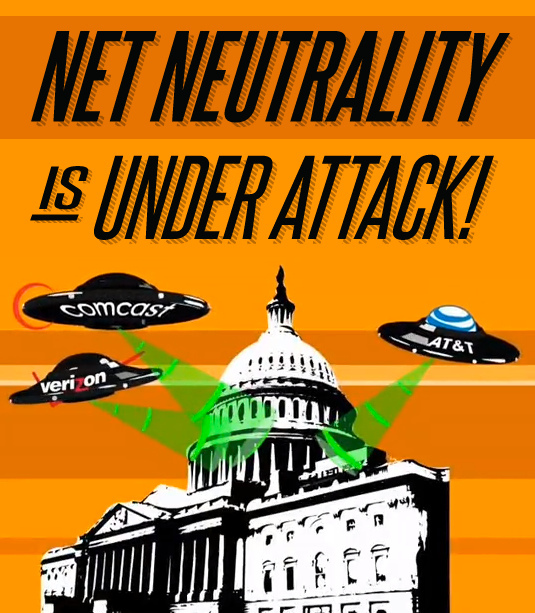
The Fall of the Low Hanging Fruit

On Monday, October 30, 2017, Donald Trump’s former presidential campaign chairman Paul Manafort and his former business associate Rick Gates were indicted as part of special counsel Robert Mueller’s Russia investigation. The two men face a total of 12 charges mostly focused on alleged money laundering, failure to disclose financial assets, and false statements regarding their work for the Ukrainian government and a Ukrainian political party. Particularly, it’s about how Manafort and Gates hid their lobbying work for the pro-Russian Ukrainian political party and used elaborate schemes to funnel more than $75 million through offshore accounts to conceal their activities and avoid paying taxes on the proceeds. Manafort’s history of pro-Russian consulting work and experience with international skullduggery make him a prime suspect for potential collusion. But the indictment actually doesn’t have anything to do with possible Russian interference in the 2016 campaign and whether Trump associates played any role in it. Instead, it’s almost entirely related to Manafort’s work for foreign interests predating the 2016 campaign which were already under FBI investigation. For months Mueller seemed to have zeroing in on Manafort. In July, the FBI raided his house for documents and there was a report he’d been wiretapped. Emails then revealed he tried to set up private briefings for a Russian billionaire while Trump’s campaign chair. It’s long been speculated that if Mueller’s team finds damaging evidence, they’re reportedly hoping they can use charges to get Manafort to give them more information on the collusion matter. In other words, they want to flip him against Trump, other Trump associates, or potentially Russians.

Paul Manafort has had a decades long career as a Republican operative and lobbyist who’s worked on several GOP presidential campaigns and representing several controversial dictators such as Ferdinand Marcos of the Philippines and Mobutu Sese Seko of the Democratic Republic of the Congo. He’s also been a longtime business partner of Roger Stone, with whom he founded a famous lobbying firm. In the mid-2000s, Manafort began focusing on business activities in Eastern Europe. Initially, he mostly advised oligarchs such as Russian aluminum magnate Oleg Deripaska and Ukrainian steel magnate Rinat Akhmetov. In 2005, he advised the Ukrainian pro-Russian Party of Regions led by Viktor Yanukovych. After Yanukovych lost a presidential election, Manafort’s team helped them formulate a comeback strategy. In 2010, Yanukovych won Ukraine’s presidency. Manafort had other dealings with wealthy people in Ukraine as well. In one instance, he tried to develop a luxury apartment with energy oligarch Dmitry Firtash, who was later charged with money laundering and bribery. Yet, these business ventures fall apart in 2014. Protests and clashes with pro-Russian policies forced President Yanukovych to flee Ukraine. Meanwhile, Manafort had a large falling out with Deripaska who claimed he cheated him out of millions in a lawsuit.
So why would Donald Trump appoint an operative who’s done so much pro-Putin work as his campaign chair? Well, consider the situation in March 2016. Back then, despite Trump winning several flashy victories in early primary elections. But Ted Cruz proved adept at locking down delegates even in states Trump won. Since delegates technically determine the nominee, Trump became convinced he needed an expert who understood the byzantine party rules actually governing delegate selection and the convention, else he could lose. Since Manafort had helped Gerald Ford lock down delegates in 1976 and managed Bob Dole’s convention 20 years later, he fit the bill. Even better, Manafort was also the former business partner of longtime Trump adviser Roger Stone. Though Stone had been pushed out of the Trump campaign some time ago, he kept informally advising Trump and to intrigue against campaign manager Corey Lewandowski whom he loathed. At first, Manafort’s job was merely leading a delegate wrangling operation. But when Lewandowski became enmeshed in scandal over grabbing Breitbart reporter Michelle Fields at a campaign event, his portfolio gradually expanded until he was effectively running the campaign. In May 2016, he was officially made campaign chair and chief strategist while Lewandowski was fired. Manafort would remain in charge through the last through GOP primary elections and the Republican National Convention. By mid-August Trump had sunk in the polls while damaging news reports about foreign worked dogged Manafort. Thus, Trump brought in Steve Bannon and Kellyanne Conway to take over while Manafort had to resign. Of course, the Trump administration has recently attempted to distance itself from the former campaign chairman with then Press Secretary Sean Spicer claiming, he “played a very limited role for a very limited amount of time.” However, it widely understood that Manafort was a linchpin in the Trump campaign. As New Gingrich told Fox News in August 2016, “Nobody should underestimate how much Paul Manafort did to really help get this [Trump] campaign to where it is right now.”

Paul Manafort’s time with the Trump campaign may have lasted less than 5 months but it was an eventful and crucial period for Trump/Russian activity. For one, the Trump campaign transitioned from the primary to the general election in which finding a way to defeat Hillary Clinton would be top priority. Second, there’s the e-mail exchange between Donald Trump Jr. and Rob Goldstone who offered to set up a meeting in which he’d receive incriminating information on Clinton “as part of Russia and its government’s support for Mr. Trump.” Trump Jr. forwarded the e-mail thread about the meeting to Manafort and Jared Kushner and invited them to it. That meeting with Russian lawyer Natalia Veselnitskaya and potential spy Rinat Akhmetshin took place on June 9, 2016 with Manafort and Kushner in attendance. Though the parties involved claimed the meeting lead nowhere, NBC News states that Manafort’s notes on the meeting included a reference to donations, “near a reference to the Republican National Convention” though the full context remains unclear. In July, Manafort oversaw the Republican National Convention. But as the Republicans assembled their platform some controversy spilled over whether Trump staffers pushed to dilute an aggressive anti-Russian amendment calling for arming Ukraine. The controversy seems somewhat exaggerated and there hasn’t been any indication that Manafort was personally involved. The existing platform wasn’t changed but a Ted Cruz supporter’s proposed amendment was modified before being added to it. Later in that same month, Wikileaks posted hundreds of hacked e-mails from the Democratic National Committee. The dumps showed certain DNC staffers saying unfriendly things about Bernie Sanders were perfectly timed to cause chaos at the Democratic National Convention the following week. US intelligence later claimed the Russian government orchestrated the DNC hack.
Nevertheless, Mueller’s indictment of Manafort was a long time coming. Even before the indictment, Manafort was already seen as astonishingly corrupt with longstanding interests in tilting the Trump campaign’s platform in a pro-Russian stance. The gist of the 12 charges against him and Gates is that they “acted as unregistered agents” of the Ukrainian government and politicians, generating “tens of millions of dollars in income” which they then “laundered” through “score of United States and foreign corporations, partnerships, and bank accounts.” In other words, taking a bunch of illegal Ukrainian money and actively lying about it to the federal government which is a criminal offense. On former front, Manafort and Gates are both charged with a “conspiracy to launder money” and separate specific charges on failing to report foreign bank and financial accounts. Together to hide their Ukrainian work, both men laundered their Ukrainian payments through a complex network of companies and bank accounts they set up in both the United States and abroad which included tax havens in Cyprus, Saint Vincent and the Grendines, and Seychelles. More than $75 million is said to flow through their offshore bank accounts. The indictment then reads: “Manafort used his hidden overseas wealth to enjoy a lavish lifestyle in the United States, without paying taxes on that income.” It then alleges that Manafort laundered over $18 million through offshore accounts, making various payments to businesses including a home improvement company, a men’s clothing store, a landscaper, and an antique rug store. In 2012, he’s said to buy a Manhattan condo for $2.85 million he rented out using Airbnb to generate cash.

Thus, it’s obvious that Mueller wants to know whether there was any follow-up to the meeting Trump Jr. set up (despite Trump Jr. claiming there wasn’t). And whether Manafort had any knowledge about the email hackings which he’s denied. There are also questions about Manafort’s emails with his Ukrainian business associate Konstantin Kilimnik about his old client Oleg Deripaska. On July 7, 2016, he e-mailed Kilimnik about the Russian aluminum oligarch saying, “If he needs private briefings we can accommodate” according to the Washington Post. Kilimnik wrote back a few weeks later, seemingly cryptically about Deripaska, claiming he met the guy in person “who gave you the biggest black caviar jar several years ago” and that it would take time to explain this “long caviar story.” He and Manafort then set up a meeting in New York that took place a few days later. By the way, he did this while chairing Trump’s campaign. And even though his Ukrainian baggage forced him to leave the Trump campaign, Manafort was known to be in contact with Trump. Mostly because investigators had been surveilling him thanks to a secret court order since September 2016.

As Mueller’s main goal is to investigate potential collusion between Trump associates and Russia, he can see charges against Manafort as a means to an end. The stronger the evidence the special counsel has against the former Trump campaign manager, the more pressure he can exert to get him to cooperate in the collusion probe. But the charges are serious enough to warrant prison time that Manafort and Gates turned themselves in to the FBI to face those charges. Thus, the men turned themselves in. Then there’s the foreign policy adviser George Papadopoulos who’s plead guilty of lying to the FBI about his conversations with a Joseph Mifsud, a professor with close ties to the Russian government who told him that the Russians had “dirt” on Hillary Clinton, including “thousands of emails.” Such disclosure confirms at least one Trump campaign adviser knew of Kremlin efforts to help Trump win the White House and was open to accepting that assistance. But whether Papadopoulos shared that information with others within the Trump campaign remains a mystery. Yet, Mueller’s team has said in a court filing that Papadopoulos “has indicated that he is willing to cooperate with the government in its ongoing investigation into Russian efforts to interfere in the 2016 presidential election.” This begs the question what kinds of information Papadopoulos has already provided to Mueller’s team. Did he wear a wire? Did he try to help the special prosecutor gather information on other Trump associates? Are other Trump team members quietly working with Mueller? Nonetheless, Mueller’s moves increase the likelihood that campaign advisers or administration staffers finding themselves in his crosshairs might want to strike plea bargains in which they trade damaging information on Trump in exchange for lesser charges. This who don’t cut a deal will be prosecuted.

Though the investigation into Donald Trump’s ties to Russia has simmered for months, it’s wasn’t clear if, or when, it would move from a political scandal to a legal one. Thanks to Mueller’s indictments on Manafort and Gates, it has. Now the question is how far Trump will go to protect himself from an investigation that threatens the future of his presidency. And whether the Congress and the courts will be up for the challenge. The time may come when Donald Trump decides he has no choice but try to protect himself by firing Mueller or issuing preemptive pardons to Manafort or others ensnared in the investigation. Either move can trigger a legal and political crisis in Watergate level proportions such as breaking decades of if not centuries of precedent for how American presidents treat the criminal justice system. Federal courts may have to decide whether to overturn any Trump pardons. Republicans could face a moment of truth about their willingness to actually stand up to Trump instead of publicly bashing him. Though a handful of GOP lawmakers have introduced legislation designed to protect Mueller from Trump firing him with bipartisan support. But such legislation has gone nowhere. So far, Robert Mueller has the upper hand but that could very literally change at a moment depending on what Trump does next. The US political and legal systems did their jobs during Watergate. But it’s profoundly depressing to ask whether they’ll do their jobs during the Trump presidency. It’s even more heart wrenching they might not.

So far the Republican Party has done nothing. Earlier in October, House Speaker Paul Ryan reputedly joked at the Al Smith Dinner, “Every morning I wake up in my office and I scroll through Twitter to see which tweets I will have to pretend I didn’t see later on.” Later, when a Wisconsin radio station asked his opinion on the Mueller indictments, he said, “I really don’t have anything to add other than nothing is going to derail what we’re doing in Congress.” There was nothing on his website even addressing the indictments. But there was a post summing up a busy month cheekily titled, “Not Another Tax Reform Post” and included photos of Ryan signing bills, handing out medals, and meeting interns. Senate Majority Leader Mitch McConnell didn’t even make himself available enough to dodge any questions. The top story on his website that time was “McConnell on IRS Targeting During Obama Administration.” There is no mention of Mueller whatsoever. Had Hillary Clinton been in this situation you’d bet Ryan and McConnell would be all over it. Instead, they’re mounting a defense of Congress’s priorities in the face of Trump and the media’s distractions. Yet, these near-daily acts of silence and cowardice abdicate Congress’s role to contain a clearly rogue, lawless, and undisciplined White House. The Founding Fathers could see Americans electing a demagogue to the White House to the White House despite that their mistrust of the popular will and Electoral College system enabled just that. But instead of ambition counteracting ambition as they intended, it’s ambition enabling ambition which wasn’t what the Founding Fathers had foreseen. Today, Ryan and McConnell’s ambition to pass tax cuts for the rich and hold the Republican base is enabling Trump’s ambition to act without proper sanction or oversight. Congress has plenty of power to check Trump, but its leaders are too nervous to use it, or even signal that they might use it in the future.

Paul Ryan and Mitch McConnell could’ve said or done so much to protect both the process and the country. They could’ve remarked how troubling Mueller’s indictments are for anyone caring about the sanctity of elections. They could’ve assured that Mueller had their full support for the investigation to run its course as well as endorse one of the bipartisan bills to safeguard his job. Even if it just in the name of self-preservation. Because Donald Trump firing Mueller will ignite a major political crisis that will be far more of a distraction from tax reform. But the GOP has come to bind and blind so effectively that congressional Republicans have lost sight that they, too, have an interest in the political system’s fundamental stability and indicating what behavior will or will not be acceptable from the president. And it’s not Ryan and McConnell who could act to safeguard Mueller’s investigation in advance. Senators John McCain, Bob Corker, and Jeff Flake have all decried Donald Trump as a threat in apocalyptic terms. They can join the Democrats to create a 51-vote majority blocking action on any bills until the protective legislation Republican Senator Tom Tillis introduced was passed. But so far, they too, have done nothing of the kind.

The Trump era is an extraordinary time in American politics that’s a test not just to our institutions but also our leaders. Republicans are failing that test. It’s well known they’re more despairing than liberals in the back rooms and background briefings. They know that Donald Trump is a dangerous and impulsive man in the White House. Those who take their conservatism seriously and believe the best for their party keenly feel the consequences of Trump’s behavior. But because they’re so afraid of his wrath, confused by their base, and somewhat hopeful that something good can arise from this crisis, they regularly talk themselves into small acts of cowardice and silence. Yet, these small acts lead to committing larger ones when the party is too invested and too culpable to change. Now like hungry gamblers deep in a losing streak, they need to win something to justify all they’ve done and excused. But like all hungry gamblers, more likely than not, they’ll just keep losing while making everything worse for themselves and the American people. For the sake of the country, Republicans need to start taking Trump as a serious threat now.

Deliberate Sabotage

Since taking office, the Trump administration has already taken aim to sabotage the Obamacare marketplaces. First, they cut the Obamacare enrollment period from 90 days to 45. Second, they’ve cut the Obamacare advertising budget by 90% and reduced funding for in-person outreach by 40%. Nevertheless, this has caused Health and Human Services regional branches abruptly pulled out of outreach events they’ve participated in over the last 4 years. Third, they’ve shut down the Healthcare.gov website for maintenance. And finally, Trump has repeatedly threatened to end subsidies to insurance companies who cover the poor. Since Republicans have spent 7 years promising to repeal Obamacare, the healthcare law has become a political football. Recently Donald Trump has signed two executive orders sabotaging the Affordable Care Act. Both these executive orders could undermine President Obama’s signature domestic achievement sending insurance premiums skyrocketing and insurance companies fleeing from the ACA’s online marketplaces.

First, he ordered the government to allow associations of small employers or other membership groups band together and offer their own insurance that wouldn’t have to provide all the essential health benefits required under the law as well as be sold across state lines. The order also directed officials to loosen rules for low-cost, short-term health insurance. Trump claims these changes give consumers cheaper options. But health insurance (and basically everyone else) fear it could shift insurance markets back to their pre-ACA days when healthy people paid less but people with preexisting conditions often found coverage unaffordable.

According to the Brookings Institute, a version of these self-insured association plans first became widespread in the 1980s but they failed in droves because many were undercapitalized. Even worse, these earlier association plans had a history of becoming what the Labor Department referred to as, “scam artists.” And it’s known that some of these low-cost plans cover virtually nothing. The Government Accountability Office reported AHPs were “bogus entities [that] have exploited employers and individuals seeking affordable coverage.” In 1992, more than two dozen states found that these early association plans had committed fraud, embezzlement, and other criminal violations. AHPs also run a greater risk for insolvency when claims unexpectedly exceed their ability to pay and have a long history of financial instability. When a long-standing AHP covering 20,000 in New Jersey became insolvent in 2002, its outstanding medical bills totaled $15 million. Though employers paid their premiums, claims made by them and their workers remained unpaid. And it doesn’t help that even these plans’ strongest proponents want guardrails placed on what groups can qualify. For many associations offer health plans to just about anyone who needs insurance, not just small business owners. You don’t need to be a farmer to join the Farm Bureau and business associations can be open anyone filing a Schedule C tax form. Some even have skimpier qualifications that they’re criticized as “air breather” associations in which the only commonality among its members is need for air for breathing.

So it’s no surprise that insurers and state-based regulators have criticized Donald Trump’s provision as a counterproductive step that could pave way for a new batch of flimsy, poor regulated health plans. states are often well positioned with broad enforcement authority to protect their residents by preventing or quickly identifying and closing down scam health insurance operators, many of whom have long used association health plans to sell fraudulent coverage to hundreds of thousands of unsuspecting consumers. However, unlike large employer plans and Obamacare, Trump’s executive order exempts AHPs from state authority. Thus, severely hurting the states’ ability to protect consumers. Instead, the US Department of Labor would primarily enforce AHPs but without the tools, resources, and culture to protect against fraud. As a result, con artists can potentially use existence of federally approved AHPs to so regulatory confusion in order to avoid state detection and shield themselves from law enforcement. So if you work for a small business that has an association plan, you may not be able to get help from your state insurance department if claims aren’t paid.
Though association plans may work great for small businesses with younger healthier workers, those with older, sicker workers will be charged higher premiums. Should one of these younger healthier employees experience a medical emergency, their insurance may not cover the care they need. In addition, small business owners might be incentivized to fire more medically costly employees to avoid premium increases. At any rate, a medical crisis could be potentially ruinous for small business employees under these plans, particularly if they become uninsured in the process. Furthermore, association plans might give small employers more incentives to reject certain applicants based on medical needs. Meanwhile, those on the Obamacare marketplaces will find their coverage less stable and secure if they have preexisting conditions since their insurance will be more expensive and consist of fewer people. Nevertheless, though association health plans may seem like affordable insurance, they’re actually poorly regulated inferior products that are only low-cost to consumers until something goes horribly wrong. But they also destabilize the insurance market which makes more viable small group and individual insurance more expensive and less accessible to those who need it the most. Such destabilization can result in higher medical costs, fewer options, and less healthcare access in the individual market.

When less regulated association health plans compete with fully regulated markets, they create an uneven playing field that can disrupt markets. People who don’t need to cover preexisting conditions or don’t want to pay community rates gravitate toward the better deals association plans offer, leaving sicker people in the regulated markets and having to pay higher costs. Thus, regulated market insurance prices increase, sometimes causing a death spiral that crashes the market and puts consumers at risk. Kentucky experienced this in the 1990s when it reformed its individual market but exempted association plans from the reforms. Association plan enrollment shot up while regulated market insurers pulled out. Within 2 years the state’s reforms were repealed. Though association plans were only a part of Kentucky’s failed market reforms, they’re still a major reason why the state’s health disaster now serves as a lesson for other states to avoid similar reforms.

Second, Donald Trump signed an executive order ordered the government to stop paying insurance subsidies that allowed low-income people to pay out-of-pocket medical expenses that could be as high as $7,150 for individuals and $14,300 for families. Known as cost-sharing reductions or CSRs, these subsidies drawn from a $7 billion fund had been embroiled in legal and political battles between President Barack Obama and congressional Republicans over whether Congress had authorized the president to pay for them. A recent poll from the Kaiser Family Foundation found that 60% of the public thought Congress should guarantee these payments continue. Most Republicans, however, consider them insurance company bailouts and wanted them to end.

Eliminating CSRs is an inherently unpopular policy does nothing but hurt people and waste money. Without subsidies, insurance markets could quickly unravel. Cutting them will result in insurers issuing premium increases as high as 20-25% by 2018-2020 for anyone using Obamacare. Furthermore, an already fragile Obamacare marketplace at greater risk of a last minute health plan exodus by those who assumed the government would pay these subsidies and feel they can’t take the significant financial losses. This can result in as many as 1 million Americans uninsured next year. As those insurance plans make double digit rate increases, the government will have to spend billions more on the other subsidies that 10 million Americans receive to purchase that coverage. According to the Congressional Budget Office, the move will ultimately cost the federal government $194 billion over the next decade. To put it this way, by eliminating CSRs, Donald Trump has enacting a policy where the government spends billions to insure fewer people. And therefore, one that helps nobody and hurts millions.

It’s very clear that Donald Trump’s presidential agenda is destroying Barack Obama’s legacy than trying to replace, fix, or improve his predecessor’s biggest accomplishments. Or perhaps help some of the very people who voted him into office. Though he and the Republicans see Obamacare as a political football, his actions will have immediate and very real consequences for Americans. Real people will be hurt by an administration that has actively decided to make a public benefits program function poorly. All these executive orders do is drain Obamacare of the resources it needs to deliver care to the many millions who’ve signed on to the program. Dividing the healthy from the sick in the name of allegedly expanding choice and driving up healthcare costs for sick people benefitting from Obamacare is an egregious idea that only ruins lives and helps nobody. Though the ACA isn’t a perfect and could use a few fixes, to let it fail simply out of spite is outright cruel.

Healthcare is a human right every American is entitled to and the federal government should guarantee access to all. Nobody should be turned away from the healthcare regardless if they can afford it or who has to pay for it. And if it’s taxpayers footing the bill, so be it. If a medical treatment should save a sick or injured person’s life, nothing else should matter. Because to deny medical care robs Americans of their dignity as well as their life, liberty, and their pursuit of happiness. The fact the United States has a for-profit healthcare system that discriminates against the poor is unconscionable for corporations, politicians, and employers shouldn’t decide who has access. It’s essentially indefensible that Donald Trump and the Republican Party not only think it’s okay to deny people medical care, but they’re also perfectly fine with throwing people off their health insurance. Furthermore, they don’t see any problem with letting the Children’s Health Insurance Program expire and jeopardizing healthcare coverage for 9 million kids. To believe only certain people should healthcare because you don’t want more government intrusion in your life and don’t want to pay for other people’s treatment is extremely selfish, degrading, and dehumanizing to the most vulnerable who need it. The fact the Republicans embrace such pathological ideology that government has no role to guarantee healthcare to its citizens is an absolute travesty. And it’s a viewpoint I find completely indefensible that I can’t respect it as an acceptable political opinion. In the United States, universal healthcare shouldn’t be controversial partisan issue but one every American should embrace wholeheartedly. After all, everyone needs healthcare and it’s the right thing to do. Because healthcare shouldn’t be about politics but people’s lives. Americans deserve a universal healthcare system that is of the people, by the people, and for the people. Not a pay to play system dominated by corporations.

A Shallow Emphasis on Patriotism

national-anthem

As president, Donald Trump constantly exacerbates cultural conflict in order to distract Americans from his destructive policies and their devastating results. Apparently, he prefers politics as a zero-sum culture war through his use of racist dog whistles to appeal to his base. He’s willing to inflict enough controversy to make sure his race-based politics dominate the public debate. During an Alabama rally in late September, Trump reignited the conflict over the NFL’s protests that San Francisco 49ers backup quarterback Colin Kaepernick started last year. Kaepernick’s refusal to stand for the national anthem in protest to police brutality and systematic racism ignited a firestorm across the nation which he eventually paid the price. Trump requested that NFL owners fire kneeling players, arguing that the protests were disrespectful to the flag and armed forces which soon resulted in a second wave of protests where the number of players kneeling exploded. Some team owners joined in as well though their support of Trump and their blacklisting of Kaepernick make me question their sincerity. On Sunday October 8, 2017, Trump reportedly sent Vice President Mike Pence to a Colts-49ers game in Indianapolis with explicit instructions to walk out just as players took a knee. Pence did what he was told and the media swarmed on this story like a dog over a dangling piece of meat. The action reeks publicity stunt to distract the public from his terrible policies and notorious scandals.

We must acknowledge that Donald Trump’s attacks on kneeling NFL players is nothing but a racist tirade wrapped in the guise of flag waving patriotism. Attacking political opponents as disrespectful to neutral patriotic symbols is a cheap but persuasive technique when pandering to white conservatives who don’t take nonconformity with patriotic rituals very well at all. Nevertheless, such patriotic grandstanding has been effective in convincing millions of Americans to support wars no matter how unjust and discredit anti-war protests without listening to what they had to say for decades. It has brought down political careers as well as cost political candidates election. Now it’s one thing to politically disagree with someone. But whenever a conservative plays the patriot card to shill a political opponent, it’s subtle character assassination. By questioning an opponent’s patriotism, they’re implying that their personal beliefs and actions are quintessentially Un-American and they’re unpatriotic for holding them. When Trump alleges kneeling NFL players for disrespecting the flag during the national anthem, he’s implying that they don’t love or respect America. Because only ungrateful Un-Americans would dare protest the national anthem. And the fact most NFL players are black while the audience is mostly white allows Trump to ignite racialized political conflicts in a perfect storm.

However, we must understand that the kneeling players’ disrespect for America and its flag, is nothing but a total and malicious lie. Most protestors never actually intend to disrespect the flag or the military whether they use patriotic symbols or not. The fact the Bill of Rights guarantees Americans freedom of speech has long established that openly disagreeing with your country’s policies, leaders, institutions, or government isn’t unpatriotic in the United States. Rather most people protest because to address problems in their country they want their fellow Americans to fix like systematic racial injustice. What Colin Kaepernick protested when he took a knee during the national anthem, he didn’t do so because he was ungrateful and hated America. But because he strongly believed that police officers shouldn’t kill unarmed people of color with impunity and that racism was wrong. His refusal to stand for the national anthem was his way of calling national attention to a cause on behalf of an underrepresented people who mostly don’t share his wealth or social standing. As he told an NFL.com reporter, “I am not going to stand up to show pride in a flag for a country that oppresses black people and people of color. To me, this is bigger than football and it would be selfish on my part to look the other way. There are bodies in the street and people getting paid leave and getting away with murder.” Besides, Kaepernick settled on taking a knee as a peaceful gesture of respect on a teammate’s advice (who was a military veteran by the way). Like what American soldiers do in reverence for a fallen comrade. Or when a fellow player gets hurt during a game. Or that you respect the flag but think the ideals it represents aren’t being realized which was exactly what Kaepernick tried to convey. Furthermore, his gesture was silent, non-disruptive, and entirely nonviolent. Judging by the fact he’s lost millions of dollars and another backup quarterback job in the foreseeable future over a cause he believes in, his actions aren’t exactly selfish for he’s gained absolutely nothing from it. Well, other than a barrage of racial slurs and death threats from Internet trolls as well as notoriety in the right-wing media machine. Nevertheless, given that the NFL mostly consists of black athletes, many of his fellow of players joined him since they like Kaepernick see their fame and success put them in a position of power to call attention to what they, their families, and those in their communities have experienced day after day.

Of course, Americans don’t like politics inserted in their sports games. Rather they would rather see sports as a respite from the partisan fray where Americans can come together to enjoy a few hours of mindless entertainment. Nor do they want any reminders that racism is still alive and well in America despite that we have Martin Luther King Day and elected a black president. Even as people of color still face horrendous systemic racial discrimination every single day of their lives that the phrase “black lives matter” incites just as much white rage as it would in the 1920s (then again, maybe not). Kaepernick knew his actions were unpopular because protests are meant to cause public discomfort to show that something is so wrong that routine American life simply can’t go on as is. Because hundreds of Black Lives Matter activists have also received the considerable backlash from the very same people who malign him. Not to mention, the cause of civil rights for racial minorities has never been a popular one in white America since it involves minorities making demands on society at large. Sure you may have white people discuss Martin Luther King Jr. in reverence on his national holiday in January. But many of these very same individuals would’ve addressed him with racial slurs, death threats, and physical violence while he was alive during the 1960s, especially in the South. In fact, King was eventually assassinated precisely for his civil rights activism he’s remembered for. Also, the FBI had wiretapped him for years because director J. Edgar Hoover was extremely racist and saw civil rights activists as Un-American communists. Oh, and police arrested and jailed him for protesting segregation multiple times. The Klu Klux Klan even burned a cross on his front lawn. We should also remember that the 1960s South also saw a spike in new Confederate memorials, Confederate flags flown at their state capitols, and numerous incidents of racially-motivated terrorism particularly by the Klu Klux Klan. Public opinion polls during that time repeatedly found that most Americans said blacks should stop the civil rights demonstrations and that the protests would ultimately hurt them. If Martin Luther King was alive today, he’d certainly take a knee for Kaepernick during the national anthem during a sporting event. After all, those who championed Jackie Robinson’s “gracious” rise said the exact same shit Kaepernick had to put up with once he started advocating for race-related causes. Mostly because he couldn’t eat at the same restaurants and stay in the same hotels as his teammates during away games.

The truth is that for many Americans, patriotism is complicated. This is especially the case with people of color who’ve endured hundreds of years of systematic racism whether it be slavery, segregation, and mass incarceration for blacks, removal and reservations for Native Americans, immigration restrictions and citizenship bans for Asians, enhanced security checks for Muslims and anyone looking like one, along with fears of undocumented immigration for Hispanics. But despite how the government and their fellow countrymen treated marginalized people, most of them still considered themselves proud Americans. Many of them fought and died for this country. And if they protested, it wasn’t out of disrespect but out of desiring the same rights, privileges, representation, and opportunities their white counterparts take for granted. In other words, they just want to be accepted as Americans as anyone else in this country. After all, it was Martin Luther King Jr. himself who said during the March on Washington in front of the Lincoln Memorial in 1963: “Let us not wallow in the valley of despair. I say to you today, my friends, that in spite of the difficulties and frustrations of the moment, I still have a dream. It is a dream deeply rooted in the American dream. I have a dream that one day this nation will rise up and live out the true meaning of its creed – we hold these truths to be self-evident: that all men are created equal.” People of color don’t protest out of disrespect for the American flag, but because they want their country to live up to the democratic ideals the American flag represents. Civil rights activists like King demonstrated on the streets were willing to endure violence, jail time, and even death for that. If that doesn’t express a love for one’s country, I don’t know what does.

However, white fragility and privilege being what it is, much of white America may be fine with racial equality but only in theory but most want to do what it takes to actually achieve it. Many don’t want to treat people of color as their social equals if it means losing their special whiteness perks. A lot of white Americans aren’t happy to see disadvantaged minorities who disproportionately benefit from social programs and policies. They believe in the idea that if people of color receive special benefits, they stand to lose what they have. Despite that plenty of white Americans would be much better off with racial equality even after losing their white privilege. If a person of a color is rich, famous, and/or successful, then many white Americans may resent them when they take a stand against racism. Since they may wonder why these non-white celebrities have the nerve to question a country that so richly rewarded them. For millions of white Americans it’s easier to believe in a glorious past that whitewashes all the racial ugliness than come to terms with seeing themselves as oppressors. Some may only acknowledge racism as a distant memory instead of a specter haunting, dividing, and corrupting Americans in insidious and divisive ways to this day. Either way, those in both camps will most likely view the Civil Rights Movement as a peaceful kumbaya fest that it wasn’t. Many white Americans either live in a bubble of ignorance or refuse to acknowledge that they generously benefit from systematic racism. Or that their white privilege comes at a terrible price to themselves, especially if they’re poor. And when people of color protest to their discomfort, many white Americans really don’t really want to understand. Because most would rather continue their life as it is than confront the ugly reality of racism that many people of color face. So they find ways to discredit troublesome protesters like inflicting the patriot card as in Colin Kaepernick’s case or alleging Black Lives Matter activists as cop killing thugs. They may criticize how racial minorities are so unwilling to acknowledge progress and express gratitude for living in a free country. In any case, many white Americans just want protesting people of color to shut up about discrimination and get over it. It’s one thing when whites wonder why people of color can’t express their dissent in an orderly law-abiding way whenever unrest erupts at their demonstrations against perceive injustice. But every time a person of color protests peacefully, the same whites angrily object to the message, the tactics, and the slogans’ purpose. Let’s just say, whenever racial minorities protest, it’s not how, why, and where that upsets whites. But the fact they’re protesting at all, let alone raising issues white people don’t want to hear.

Fortunately, now that we have a national holiday honoring the great civil rights leader Martin Luther King Jr., it’s firmly established that publicly speaking out against racism doesn’t make you unpatriotic. Expressing discontent of your country’s problems doesn’t make you disloyal. Nor does expecting your nation to live up to the ideals it celebrates and represents. The First Amendment makes this perfectly clear so protesting the national anthem is well within exercising one’s constitutional rights. Even if Donald Trump and his white conservative supporters claim otherwise. Still, Donald Trump’s use of patriotism to discredit NFL anthem protesters and called for a boycott until the NFL forces their players to stand is particularly disgusting. For one, forced patriotic reverence is basically what authoritarian dictators do and violates the constitution. Second, his attacks on NFL protests contain plenty of racist undertones on the idea that people of color should shut up. We all know that Trump sees nonstop racialized politics as a winning strategy to pander to his supporters. Besides, he’s encouraged supporters to attack minority protesters at his rallies, failed to condemn white supremacists in Charlottesville, called for an ESPN host’s firing after she called him a white supremacist, promoted birtherism, was sued for housing discrimination, called for the deaths of the Central Park Five, and pardoned Joe Arpaio.

But most importantly though he casts himself as a defender of national symbols, Donald Trump is far from an American patriot. He may proclaim he loves his country and wrap himself in the American flag. However, Trump often grandstands patriotic platitudes to exploit the country for his own personal gain. He’s used his wealth and privilege to get out of Vietnam, taxes, and accountability for his egregious business practices that have ruined countless American lives. He’s flagrantly abused his power and influence during his presidency such as violating the Emoluments Clause in the US Constitution. In his whole life, he’s made no personal sacrifices for the United States despite all the good his country has done for him. He doesn’t understand anything about the very government he leads nor does he express any interest to do so. He has no appreciation for American democratic principles that this country was built on such as a government of the people, by the people, and for the people along with the idea that all are created equal. He has no grasp of history and no interest in learning it. He sees First Amendment rights as an obstacle against silencing his critics and quell demonstrations against him. I mean the guy explodes into a Twitter fit accusing the media of “fake news” whenever they report an unflattering story about him. Not to mention, he’s either sued or threaten to sue people who’ve challenged him. Then there’s the fact he’s threatened to rescind NBC’s license after they reported on him wanting to increase our nuclear arsenal 10 times. Despite that he enjoys a lot of support from veterans, his long record of veterans bashing really shows he doesn’t respect those who’ve served in uniform. He’s called POWs losers, set up a fake veterans hotline, promised to donate $6 million to veterans with no intention of actually doing so, attacked Gold Star parents, claimed how he always wanted a Purple Heart after receiving one from a supporter, and claiming he knows more about ISIS than the generals. Trump has praised authoritarian despots like Vladimir Putin as well as done business with those who don’t support American interests like Qaddafi. Even goes as far as publicly stating that the US isn’t much better than Russia. Oh, and his presidential campaign colluded with Russia by initiating hacks and misinformation on his opponents, particularly Hillary Clinton. Then there are his speeches describing the US as a Hunger Games hellscape a la “American Carnage.”

Thus, we must understand that while we may identify patriotism with national symbols like waving the American flag, reciting the Pledge of Allegiance, or standing for the “Star Spangled Banner.” Yet, these civil rituals are only shallow expressions of love for one’s country. Patriotic grandstanding is easy. Actually making sacrifices for one’s country or the ideals it represents is extremely difficult and may not always guarantee you praises from your fellow countrymen. In fact, it might come at considerable cost that most flag waving Americans aren’t willing to pay. We may parade our veterans and servicemen as heroes to thank for their service. But many of us have a shallow understanding on what it takes to respect their sacrifice. Our country has far too many veterans on the street while many still experience homelessness, mental illness, health problems, disability, and financial difficulties. Just standing for the national anthem, reciting the Pledge of Allegiance, and thanking soldiers for their service aren’t enough. We may celebrate those who take on American society to affirm its principles at a considerable risk. But we usually forget how often they faced backlash from a hostile American public. Some have lost careers and reputations. Some have gone to prison. Some have endured threats, physical violence, terror attacks, and alienation from loved ones. Some have even died. Nevertheless, who is the real patriot here? Is it the man who grandstands with American flags to attract legions in order to ruthlessly exploit the country he claims to love for personal enrichment? Or is the man respectfully taking a knee during the national anthem because he didn’t like cops getting away with murder? Is it the man who insists athletes stand for the national anthem but disrespects our men and women in uniform and seeks assistance of a hostile foreign power to win an election? Or is it the man willing to risk a lucrative career and be the most unfairly treated player in the NFL because he was unsatisfied how our country doesn’t live up to its ideals it represents? Is it the man who claims to love America but has no appreciation for its history, values, or democracy? Or is it the man willing to endure immense hatred from millions of people for championing a cause for Americans who don’t share his good fortune? It shouldn’t be hard to decide whose love of country we should honor.