History of the World According to the Movies: Part 8- Medieval Scotland

Image

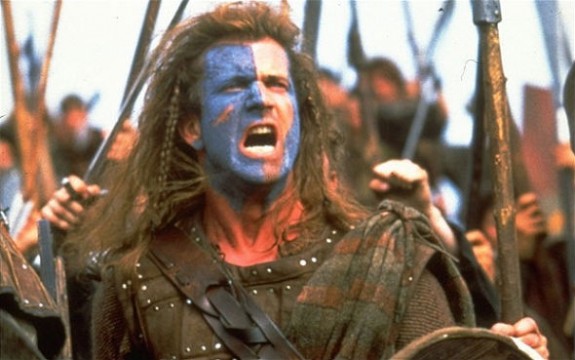
Braveheart: How Mel Gibson killed history for the sake of entertainment. Sure it has inspirational tidbits like “You can take our lands but you’ll never take our FREEEEEDDDDDOOOOMMMMMM!” Yet, it’s notoriously one of the most historically inaccurate movies ever made, which is sad considering that there aren’t a lot of movies about medieval Scotland. Yet, use any image of Mel Gibson in a kilt and blue paint, and medieval historians will scream in absolute horror. A historic travesty of 1995.

While most medieval movies usually take place in either England or France, movies on medieval Scotland deserve special mention since the most historically accurate movie on anything related to Scotland in the Middle Ages is a Disney Pixar film. Yes, you hear me. Scotland during the Middle Ages may not get much attention in movies, but when it does, they usually tend to be very historically inaccurate. Of course, most historians don’t mind when it comes to filming Macbeth because it’s a notable Shakespearean play with great literary value (though it makes Richard III look historically accurate in comparison). Besides, most people don’t know that Macbeth was a real guy. However, Macbeth was a real Scottish king who did come to power through killing his predecessor Duncan as well as ended up dead when Duncan’s son Malcolm challenged his rule. However, the historical Macbeth was never the guy depicted by Shakespeare nor were some of the characters either. Also, who knows what Lady Macbeth was like for there’s little information about her. Still, though a more historically accurate Macbeth would merit a very different story, most people don’t watch the play on its lack of historic merits anyway. Besides, Shakespeare probably had some excuse to depict such events as inaccurately as he did like James I, for instance. And then you got Braveheart which managed to win Oscars despite being one of the most historically inaccurate movies of all time that most of the errors I will list come from this very movie. And no other movie has ever made medieval historians cry in sheer anger and disgust over what Hollywood would ever consider such historical disasterpiece as something worthy of critical acclaim, let alone film awards. Many historians would think that Monty Python and the Holy Grail has more historical merits than this. And when you’re historical epic has more inaccuracies than a movie with killer rabbits, you have a problem. Sure, Gibson probably wasn’t aiming for historical accuracy and used the screenplay from a guy who claimed descent from William Wallace. However, now that this historical piece of shit may now be on its way on becoming a classic, most people unfamiliar with William Wallace and the Scottish Wars of Independence may now actually take Gibson’s vision of Scottish history seriously. Yes, unfortunately, people tend to believe things presented in historical movies regardless of the weight of inaccuracy. At least the guys making Spartacus had some concern for accuracy which is why the 1960 film is actually more historically reliable than the Howard Fast novel it’s based on. But you don’t see the concern for authenticity in Braveheart. And this it will be forever by trashed by medieval and Scottish historians as well as anyone who actually cares about history in general. I mean, I don’t expect historical movies to be 100% accurate, but not with an inaccuracy level like Braveheart. Nevertheless, here’s what Hollywood gets wrong about Scottish history.

Scottish men like William Wallace wore kilts during the Middle Ages. They also painted their faces and all armies wore uniforms in battle. (William Wallace’s men actually wore saffron shirts, not kilts for they didn’t come around until much later and so did army uniforms. Not to mention, they haven’t painted their faces since the Dark Ages.)

Prior to the 13th century, Scotland had always been subject to English rule. (Actually it had enjoyed a century of peace before Edward I tried to take it for himself when Scotland was in a messy political crisis regarding succession. The English were backstabbing encroachers, not overlords.)

Banquo and Fleance are the ancestors of the Stuart monarchs. (Shakespeare made up these guys to satisfy James I who was descended from Duncan.)

Bagpipes were outlawed in 13th century Scotland. (They weren’t and were very popular in England.)

There was no Stirling Bridge in the Battle that bears its name. (There too was a bridge, but Gibson wanted to save money. Also, Andrew Moray, the man instrumental in that battle is absent from the film.)

There were Irish conscripts at the Battle of Falkirk. (There’s no record of this.)

Most noblemen in Scotland were Gaels. (They were culturally similar to English nobles and would’ve dressed more like their English counterparts. Also, many of them were related to English royalty, spoke a Scottish dialect of English and/or Anglo-Norman French.)

The sons of Scottish knights dressed in rags. (Even poor Scots would know how to sew or at least was related to someone who did. Even poor people couldn’t afford to have their clothes disintegrate for being unhemmed.)

13th Century Scottish men had long hair they braided as well as tied bits of fur and feathers even though it was messy most of the time. (There’s no reason to think this.)

Pikes were used against the English at the Battle of Stirling Bridge. (They were at Falkirk though.)

Macbeth:

Macbeth was only King of Scotland for two years after he killed Duncan in his bed just to get his throne. (For one, Macbeth ruled Scotland for 17 years {which proves he wasn’t a weak ruler} and even spent a several month trip to receive a blessing from the Pope. He was also known as a good king known for his charity, not a bad king who slaughtered his friends {he was actually good to his friends}. As to Duncan’s death, Macbeth killed Duncan in battle because Duncan was encroaching on his territory so the motive was self-defense after a failed invasion in England. And it was Duncan who was the young, violent tyrant but Shakespeare couldn’t say that because King James I was descended by him. As for Lady Macbeth, she is almost a complete fabrication in which nothing is known about her than her name {Gruoch}, the fact she was married before, and that she had at least a son from that marriage. And that son would later succeed Macbeth before Duncan’s son Malcolm gained power and killed him mostly because he didn’t think the guy was a legitimate king.)

King Duncan was a wise old king. (Duncan was younger than Macbeth and was a worthless wastrel who the latter killed in a fair fight in battle on his land. So in reality, Duncan got what he deserved.)

King Malcolm III:

Everyone in Scotland seemed to accept Malcolm’s kingship. (He was able to seize the throne of Scotland because England was able to support him. Scotland actually resisted his rule because their standards differed considerably from England on what consists of royal legitimacy. Also, Macbeth’s stepson and friends also campaigned against Malcolm.)

King Alexander III:

King Alexander III died in 1280 without a son. (He died without a son in 1286 after falling off his horse {since the Scottish throne went to his young granddaughter Margaret of Norway [so the country was ruled by regents] until she died in 1290 on the way there} but he and his two sons were still alive by 1280. It was only after Margaret’s death in 1290 when his brother-in-law King Edward I got involved because the Scottish noblemen couldn’t trust each other and Scotland was in a political crisis as well as headed for civil war.)

William Wallace:

Scottish men like William Wallace wore kilts during the Middle Ages. They also painted their faces and all armies wore uniforms in battle. (William Wallace’s men actually wore saffron shirts, not kilts for they didn’t come around until much later and so did army uniforms. Not to mention, they haven’t painted their faces since the Dark Ages.)

William Wallace grew up as a poor man who became a great liberator and had an affair with English  Queen Isabella, which resulted in Edward III. He ended up captured by the English because of Robert Bruce’s betrayal and was hanged drawn and quartered. (Actually, William Wallace was a well-educated minor aristocrat whose dad actually fought for the English and owned land {though we don’t know who he was} and might have been a scholar or been on his way for a career in the Church. He may have used a longbow as a weapon of choice {unlike the sword he’s usually depicted with in Braveheart}. He briefly served as a Guardian of the Kingdom of Scotland {it’s kind of like being a Steward of Gondor except that they didn’t rule by themselves} until his military reputation tanked at the Battle of Falkirk. He engaged in diplomatic correspondence with Lubeck and Hamburg as well as went on a diplomatic mission to France and Rome before returning to his home after the Scottish surrender in 1302. Not to mention, he was said to be Welsh since his name either means “Welsh” or “foreigner” so the notion of growing up a Scottish highlander is out of the question. Also, he certainly didn’t have an affair with Queen Isabella of England for she was ten and wasn’t even living in England yet {and younger than that during the Battle of Falkirk}, didn’t father Edward III who was born seven years after he died, Edward II was only thirteen, and he wasn’t directly betrayed by Robert Bruce either. And as for his method of execution, Wallace was hanged, cut open, castrated, chopped to pieces, and finally beheaded. And before that, he was stripped naked and dragged by a horse carriage by a rope around his ankles and afterwards dipped in tar and put on public display.)

William Wallace had easy access to large quantities of gasoline. At the battle of Falkirk, he apparently has a tanker truck parked behind the lines, so that he can wet down a broad stretch of the front-line as a death trap for the enemy. It was then set alight by flaming arrows, to set the enemy stuntmen on fire so that they can run around screaming while the flammable stunt clothing blazes merrily over their Nomex jumpsuits. William Wallace can also generally get his hands on fire starter whenever he wants to burn English soldiers to death in a cottage. [From A Common Place Book](You should know this isn’t true at all.)

William Wallace was called Braveheart. (Actually that was a nickname of his contemporary, Robert Bruce who would become Scotland’s eventual king and he only acquired the nickname after his death when his heart was carried by a general around his neck into battle. It was Robert Bruce’s heart that led the Scots into battle not Wallace’s.)

William Wallace was the architect of Scottish independence and was an all-around nice guy. Robert Bruce is overrated. (Wallace also raped women and burnt down schools with kids and monks still inside. Not only that, but he used conscription and was willing to hang those refusing to serve. As with Robert Bruce, he’s still one of Scotland’s national heroes and was far more successful than Wallace ever could be {though he still could be brutal to his enemies and manipulative if need be as well as got excommunicated for murdering his rival in a church}. Not to mention, Bruce never personally betrayed Wallace, ever because they never met in the first place. Also, Wallace didn’t initially support Bruce’s claim to the throne and backed the exiled Scottish King John Balliol who was held prisoner in the Tower of London {and later sent to France} who Bruce and his family considered an usurper. Not to mention, Bruce was originally playing on both sides for a while {for personal reasons} until the Battle of Stirling Bridge and didn’t establish full claim to the Scottish throne until after his Carlisle governor father died in 1304.)

Malcolm Wallace had two sons named John and William in 1280 in a town of Paisley. (He had three including his eldest also named Malcolm and he wasn’t a commoner either, assuming that Sir Malcolm of Elderslie was William’s father. Then again William Wallace’s dad could be named Alan of Ayershire {yet no contemporary evidence links him to either location}. Still, William Wallace only appears on the historic record from 1297 when he killed an English sheriff in Lanark {said in order to avenge his wife’s murder} to his death in 1305. So how many kids William’s father had was anyone’s guess.)

William Wallace’s father and brother John were executed by the English when William was a boy. (William lost his father as an adult while his brother John was executed a year after him.)

William Wallace returned to Scotland in 1296 after spending his adolescence abroad. (He never stepped foot out of Scotland until his 1297 invasion of Northern England.)

William Wallace carried out large-scale raids in the north of England and killed Edward I’s nephew in York. (While he did stage long scale raids in Northern England, he didn’t make it as south as York.)

William Wallace’s wife Murron died shortly after their wedding. After this, he killed the English Sheriff by slitting his throat. (It’s said they had two sons, if he had a wife which is very likely. Yet, legend says her name was Marion Braidfrute, though there is no solid evidence if he was married. As for the Sheriff, Wallace cut him to pieces with a sword while his men proceeded to burn two houses with English guards inside of them.)

William Wallace’s best friends were Hamish and his dad Campbell as well as Stephen of Ireland. (The first two are fictional characters while the latter’s existence is questioned. Also, Andrew Moray may be a better candidate though he’s absent in Braveheart though they did join forces before the Battle of Stirling Bridge.)

William Wallace was executed around the same time Edward I died. (Edward I would live for a couple more years and would die on campaign {not in bed as depicted in Braveheart}.)

The Irish fought with William Wallace. (Most Irish fought against him and certainly didn’t switch sides at Falkirk {though the Welsh archers threatened to but only out of fear}.)

Scottish nobles deserted William Wallace. (There’s no report of this happening, well, maybe with John Comyn and his supporters who did abandon him there but there’s no solid evidence. Oh, and he was opposed to fighting at Falkirk because it didn’t offer the advantages at Stirling Bridge.)

William Wallace was captured by the English at Edinburgh after being betrayed by Noble Craig and Robert Bruce’s old man. (The old man Robert Bruce was dead by Wallace’s capture while Craig never existed. Also, he was captured near Glasgow after being betrayed by Scotsman John Menteith.)

William Wallace had no intention to fight the English to free his country until his wife was killed by them. (He was already an outlaw against the English since he refused to sign the Ragman Roll from the very beginning. The English killing his wife would’ve angered him even more. Oh, and William Wallace would’ve never whipped out a concealed nunchaku, which is from China for God’s sake!)

William Wallace was clean shaven. (He had a beard and was at least 6 feet tall. But he’s played by Mel Gibson so I’ll let this slide.)

William Wallace was knighted after Stirling Bridge. (He was knighted a few years later.)

Robert Bruce:

Robert Bruce disowned his leprosy afflicted but dominating father. (There is no evidence Bruce’s old man had ever contracted it though it’s thought that Bruce himself might’ve suffered from it. Also, there’s no evidence whether Bruce disowned his father or whether he was dominated by his dad. Still, he was quite capable of making his own decisions and choices.)

The Scots won their independence when Robert Bruce changed his mind about a peace parley. (It was at the battle of Bannockburn after an English army arrived to lift the siege at Stirling Castle, nine years after Wallace’s death while engaging in guerrilla warfare for years, though Bruce would be crowned king a year after Wallace’s execution {though he was dead by the time actual independence would be won}. Also, Scottish independence didn’t last and Edward III managed to conquer more of Scotland than his grandfather ever had.)

Robert Bruce was the 17th person with the name in his family. (He was the 7th with the name and the 7th Lord of Annandale.)

Robert Bruce was present with King Edward I at Falkirk. (It’s likely he wasn’t there or at least did nothing significant. He was more likely at home in Carrick.)

History of the World According to the Movies: Part 7 – The Medieval Church

Image

From Kingdom of Heaven, which is probably a movie about the Crusades we’re all familiar with as well as one that says that these wars of religion weren’t as holy as many say they were. However, this picture does encapsulate the idea of the religiosity of the time period. Still, though Orlando Bloom’s character actually did exist, he wasn’t the widowed French blacksmith as depicted in the beginning at all. However, he did end up with a Queen consort of Jerusalem, just not Queen Sybilla.

While fighting is one of the many aspects of the medieval landscape, the Middle Ages would never be what it s without the Church. Sure it was a dominant force in medieval life and a very misunderstood one as Hollywood is concerned. Still, though Christianity began in ancient times, it really came into its own in the Middle Ages as an institution (as long as the Catholic Church is concerned but there were Orthodox churches in the east as well). Medieval monasteries and convents were places of great cottage industries and learning with monks being among the intellectuals of their day and churches became not only centers of devotion but also places for community. Not only that, but we also see the rise of the Gothic cathedrals which are still used for worship today (even if it’s on the decline in Europe these days). And without the Church, we wouldn’t have universities, the institution of medicine, theology, and all those ancient writings that would’ve been lost if monks didn’t spend all day copying them. Of course, because of the medieval Church, we also have antisemitism, heresy, and the Crusades which is a series of religious wars in the Middle East geared to capturing the Holy Land from the Muslims. Still, Hollywood always tends to screw up a few things about the medieval Church which I shall list here.

Medieval Christianity:

The Catholic Church was a backward institution that discouraged education and scientific research. (The Catholic Church actually saved science and is the main reason why we know anything about the Middle Ages at all even though they did lock their books but there weren’t many books in Europe anyway and were very expensive since they were all written by hand or printed from wood carvings which were tedious to make {but many monasteries and nunneries had large libraries of them full of the works of Rome and Greeks and monks spent a lot of time copying them}. Furthermore, they even set up universities all over Continental Europe, started formalized higher education with advanced degrees, and saw no problem with dissection {the Knights Hospitaller did this and the Church was fine with it}, at least in the basement anyway, which helped set the foundation of modern medicine. They started the first medical and law schools as well. They even educated children in monastic and convent schools when education became a higher demand and that was before the printing press. Not to mention, the Crusades also allowed Europeans to come into contact with Muslim ideas and Arabic numerals. And their massive cathedrals were marvels of medieval craftsmanship and engineering. Furthermore, monks were usually the most educated people in Europe of their day. Actually it would be more accurate to say that the Catholic Church was a great medieval engine of scientific progress. Not to mention, most medieval scientists were monks and/or priests as well. Still, doesn’t stop filmmakers from making movies set in the Middle Ages in which the Catholic Church is hostile to scientific inquiry which really wasn’t the case {especially with the Galileo Affair which isn’t as much a science vs. religion case as most people think}.)

Monks locked their Bibles to keep people from hearing the true word. (No way in hell. Monks locked their Bibles so churches could guarantee that people could hear the Bible on a daily basis as well as prevent it from getting stolen. A stolen Bible would’ve taken many months to replace since books at the time were copied by hand.)

Europeans were highly religious during the Middle Ages. (Despite the Crusades and the powerful presence of the Catholic Church, most people in the Middle Ages were probably just as religious as I am, observant yes, but with a more laid back approach like many Catholics today. Sure religion was important but it wasn’t the only thing in life and it wasn’t altogether incompatible to the modern notions of the day either. In other words, medieval Europeans may have went to church on Sundays but they weren’t religious fanatics, at least in general. Of course, religiosity would increase later in the Middle Ages as well as in the early Renaissance in Northern Europe since they were people who cared enough about religion to break off from the Catholic Church.)

The Catholic Church discouraged scientific research and progress. (Actually, quite the contrary. For one, most medieval scientists in Europe had a religious vocation. Second, while the Middle Ages wasn’t the best time for science {which wasn’t a big subject at the time}, it was nevertheless studied for practical reasons. The Church understood that scientific study can benefit them and help monks and nuns do their jobs better. Needing to care of the sick led to the study of medicine. The fact monks and nuns needed to schedule prayer times as well as find out when Easter is led to the study of rudimentary mathematics and the motions of the Sun and the Moon. Third, contrary to popular belief, the High Middle Ages was a really good time for science with the rise of Scholasticism and Aristotlelianism.)

Medieval cathedrals were often dark places. (Actually, they were places with large glass windows that let tons of light in. Churches were painted in bright colors. Still, today tourists tend to complain every time these places are washed because it’s too bright. Not to mention, it was inspired by Indian and Arab/Muslim building styles also from the Crusades.)

All nuns were virgins admitted into a convent as lovely, nubile waifs. (They could also be an ugly daughter of a lord or women who didn’t want to get married or have kids.)

Monks were benevolent men who devoted their lives to God. (Well, not quite for many monasteries enjoyed great wealth in the Middle Ages and many monks didn’t live too badly either {especially in the later Middle Ages}. In many ways, they were not just clergymen, but also businessmen, scribes, scientists, intellectuals, as well as some of the smartest guys around {same goes for nuns, too, for the most part}. Oh, and many monasteries had their own armies.)

Monks could hear confessions. (If they have taken holy orders since a lot of monks are priests. If not, then no.)

Monks were dissolute hypocrites who used religion to make money. (This isn’t 100% accurate either for though monks weren’t perfect human beings and the Church did have some degree of corruption, they were just as flawed like everyone else. We just tend to put them on a higher pedestal since they tend to be religious figures. Besides, every religion has their share of hypocrites and jerks as any institution and I’m sure medieval Christianity was no exception. Sure you may have a few bad and corrupt monks, but you also had a lot of cool ones as well. However, it was true enough for Henry VIII to convince the masses on why he had to dissolve the monasteries {which was to finance a war in France}, even though the actual debauchery and corruption of monks wasn’t nearly as bad as Henry made it out to be.)

Medieval Russia had no religious insignia in the 13th century. (Russia had been Orthodox Christian for quite some time and would continue to be the dominant church in the country until the Russian Revolution {though it’s still around}. Russian churches would usually have crosses on top and their banners would contain an icon of Christ {ditto priests in the army}. Of course, Eisenstein knew that the Soviet government wouldn’t accept this while filming Alexander Nevsky. Also, Nevsky is a saint in the Russian Orthodox Church.)

Clergymen were forbidden to shed blood so they didn’t fight. (Sure but there were militant churchmen as well as military religious orders like the Knights Templar, the Teutonic Knights, and the Knights Hospitallers.)

“Dies Irae” was a Christian standard hymn in the 1100s. (It was written by a Thomas of Celano who lived around 1200-1260 so, no.)

Saint Francis of Assisi was known as “Jester of the Lord.” (It was his disciple Brother Juniper.)

Saint Francis of Assisi was originally referred to as Francis. (His real name was Giovanni di Pietro Bernardone. Francis was a nickname derived from Francesco {“Frenchy”} which he obtained when he was a little kid. Actually, Francis wouldn’t be used as a legal name until after he became a saint.)

Pope Innocent III had a full beard. (He was clean shaven.)

Everyone in Europe was Catholic during the Middle Ages. (Everyone west of Poland, that is. In Russia, the main church was Russian Orthodox Christianity while the Greeks in the Eastern Roman Empire were Greek Orthodox. Not to mention, before the Mongols you also had quite a few Christian sects in the Middle East and Central Asia like the Coptics, Armenian Apostolics, the Nestorians, the Maronites, Ethiopian Orthodox Rite, and others. When you really get down to it, medieval Christianity was quite diverse.)

The Catholic Church pretty much ran everything. (Yes, it was a powerful institution, but it also got into clashes with secular rulers who wanted to make their own decisions in religious affairs. Not to mention, secular monarchs can and did appoint bishops {Henry II appointed Thomas Becket as Archbishop of Canterbury}. Sure medieval society didn’t exactly have a lot of separation between church and state. And yes, the Catholic Church did mettle in politics as well, but it wasn’t always without a secular ruler’s consent either. They also crowned kings as well as married and annulled their unions {back when marriages were a form of diplomacy}. So while there wasn’t a lot of separation between church and state but it wasn’t exactly a theocracy either. Also, there was less church and state separation in the Russian government and the Russian Orthodox Church, than in any European Catholic country.)

There was an actual Pope Joan. (She never existed.)

The Catholic Church participated in witch hunts and witch burnings. (Maybe in the 1400s but they mostly considered belief in witches as highly heretical. Still, witch hunts did happen under secular governments though and only much later {and they only took witchcraft seriously in cases of murder and treason}. However, there were actually few witch trials during the Middle Ages and many were usually nothing but simple lynches.)

Inquisition guards wore nearly full plated armor in the 1300s. (Only a century later.)

Medieval monks could enter each other’s cells freely. (For a monk entering another’s cell without permission was normally forbidden as well as grounds for excommunication.)

Monks addressed each other as “Your Grace.” (This wouldn’t be appropriate address for a monk under any circumstances but rather for nobles and high members of the Catholic Church.)

Inquisitor Bernard Gui was killed in an Italian monastery in 1327. (Yes, he was a real person and was said to have sentenced 900 people as well as executing 42 of them during his 15 years in office. However, he died in the castle of Laroux in 1331. He also doesn’t die in Eco’s original novel In the Name of the Rose.)

Medieval clergy men and religious orders were highly superstitious. (Yes, but not as much as the laypeople in their domains. Of course, they probably did believe in demon possession and that writing with the left hand was a sin. For instance, most medieval clergymen believed in a round earth from its earliest days. So did most people at the time with an education. We should also account for the fact that most medieval scientists were monks and priests.)

Pagan philosophy was considered difficult to reconcile with Christianity as well as considered borderline heretical. (There is no way that William of Baskerville would need to worry about saving a book by Aristotle because Saint Thomas Aquinas had already embraced embraced several ideas put forward by the Greek philosopher as well as said it was perfectly all right for Christians to read works by non-Christian authors {and had been influenced by the Jewish philosopher Maimonides as well as Muslim philosophers Averroes and Avicenna}. This was in the 13th century. Not only that, but most of the European mythology we know about now was recorded by clergyman themselves, which were only referred just as stories.)

Some European monasteries had African monks. (This would be highly unlikely considering the circumstances.)

The Holy Grail was of great significance in Christianity at this time. (There’s no mention of it in any canonical Christian text and wasn’t spawned until the 12th century. Also, it’s more of a product of Arthurian legend than anything.)

Pagan practices were considered anti-Christian. (Except with the worship of other deities, many pagan practices weren’t considered anti-Christian, but were commonly carried out by Christians as well as became Christianized practices. Kind of like how some people celebrate the holidays with their own personal traditions just to make themselves feel comfortable with the faith. However, this doesn’t stop some people from believing that Christianity was based on earlier religions other than Judaism, of which there is no historic proof as well as nothing in what we know of the original pagan beliefs that we can draw a respective parallel with. In other words, to say that the story of Jesus was based on the myth  of Horus would be like saying it’s based on Harry Potter. Not to mention, those who believe that Christianity was based on pagan religions don’t tend to consider that a certain culture’s mythology doesn’t have a lot of consistency and that mythological stories sometimes tend to vary with location or change over time. And it doesn’t help that the prolific people who tend to believe this are high profile atheist intellectuals, who may be smart and experts in their respective field but that doesn’t mean they’re experts in religion, religious history, or even mythology.)

The Crusades:

There was no reason at all to recommend the Crusades. (Well, there kind of sort of was, at least in some of those people’s minds but I wouldn’t call it the best solution. Still, remember medieval society was a feudal and warlike culture so if these knights weren’t killing Muslims in the Holy Land, they were probably killing each other and then some {though the first Crusade’s primary enemy was the hostile Seljuk Turks who’ve just captured Jerusalem from the Fatimids who didn’t care as long as the Christians spent their money}. Not to mention, the Crusades were called to also help out the dwindling Byzantine Empire, the last remaining Christian stronghold of the Middle East at the time {though they were Greek Orthodox, not Catholic}. Also, Pope Urban II’s predecessor was kidnapped by Normans and were wreaking havoc all over Europe by the first Crusade. Besides, “bring the Cross to Jerusalem” was a much better slogan than “Save the Greek Empire” which nobody in Europe cared about.)

Crusaders taught desert dwelling Muslims how to irrigate their land. (Actually this was the other way around. They also taught them medicine, windmills, round towers, and others even though knights did participate in civil projects during the Crusades.)

Members of the Knights Templar could marry, own land, and be crowned king. (They were forbidden from marrying or owning land. Also, no Templar would ever be crowned king.)

Renaud Chatillon and Guy Lusignan were Templars. (No, they weren’t or never have been. Lusignan was actually king of Jerusalem at the time Chatillon launched his attack. Also, King Baldwin had been dead for several years.)

Sybilla’s marriage to Guy Lusignan was an arranged one. (Her family opposed the match and it was her second marriage.)

Balian was a heroic everyman knight who embodied the best of the chivalric ethos. He was also a blacksmith and an illegitimate son of a knight. (He was raised noble and wasn’t a blacksmith so he probably wasn’t illegitimate. Not to mention, he was part of the most important families in the Kingdom of Jerusalem but of a moderate faction known as the Ibelins {and he wasn’t born illegitimate, but as a younger son}. And he wasn’t born in France but in Jerusalem as a second generation crusader nobleman and would’ve definitely know who his father was. Not to mention, his dad was Italian, not French. Also, though he is known for making the courageous decision to negotiate with Saladin, he also betrayed his oath not to fight him on more than one occasion, sold many peasants in the siege into slavery, and refused to release his Muslim prisoners if Saladin wouldn’t accept surrender. He also threatened the destruction of Muslim holy places under the threat of a repeat of the 1st Crusade capture of Jerusalem. He was ruthless but Saladin would forgive his oath breaking due to prior excellent relations and even helped mediate a peace between him and Richard the Lionheart. Still, Balian wasn’t all that bad for he did pay ransoms for thousands of poor out of his own pocket and offered himself as a hostage for all the rest. Still, he was prone to taking power whenever he could find it, sided with Chatillon, and his dynasty fathered most of the royal families of Europe.)

Guy Lusignan was a foppish, racist douchebag and ax crazy Reynald Chatillon was his dragon. (Chatillon wasn’t ax crazy but he was the worse of the two, much worse. Also, though Lusignan may have been racist, so were many of the European Christians who participated and him and Reynald hated each other {leading to the disaster at Hattin} even though he tried to get him to apologize to Saladin which didn’t work. As what TV Tropes and Idioms says about Chatillon, “Raynald once had a man tortured by smearing him in honey and putting him on top of a tower in the hot sun, simply because the man refused to fund a military expedition Raynald was plotting. Oh, and the best part — the man was the Latin Patriarch of Antioch, a religious leader of the Crusaders — and the expedition was against Cyprus, an island held by the Byzantine Empire, inhabited by Christians. Of course, Raynald had what he thought was a perfectly good reason for this—he felt they owed him money. Or pretended he felt they owed him money. It’s tough to be sure. So — a “bit of a mustache twirling supervillain” is something of an understatement.” Also, Chatillon led a pirate fleet that threatened to burn down Mecca and flayed the Patriarch of Antioch alive.)

The Catholic Patriarch of Jerusalem was a cowardly, self-absorbed jerk, blinded by his faith, and mostly spent his time spreading his prejudice against Muslims. (Actually it was he and Balian who negotiated the surrender of Jerusalem and rounded up the money to ransom the citizens who couldn’t afford to ransom themselves. They also offered themselves as ransom for those who they couldn’t afford to ransom which Saladin declined. He even stripped the silver and gold from the Church of the Holy Sepulchre to pay the city’s defenders knowing it would’ve gotten him in big trouble.)

Sybilla was a member of the moderate faction in the Kingdom of Jerusalem. (As TTI puts it, “The historical Sybilla was actually part of the extremist camp within the Haute Cour, while the film places her squarely on the moderate side. The moderates, such as the Ibelins, attempted to blunt the ambitions of Lusignan and his supporters by refusing to allow her to take the throne after the death of her son (Baldwin V) unless she first divorced him. As a concession they allowed her to marry any man of her choosing afterwards, but unfortunately neglected to add “Except Lusignan,” who she then turned around and picked as her consort. Not because she was in desperate need of his military support as the film depicts, but entirely because of her devotion to him, and because she sided with him and the other extremists politically.” So a romance between Balian and Sybilla most likely didn’t happen.)

Guy Lusignan was an utter bastard who would do anything for power and was willing to wage a war for profit. He was also a terrible King of Jerusalem. (As TTI explains, “Historically, while he may have been ambitious, he was no more so than the next noble, and his decision to go to war was less a matter of Ax Craziness and more a matter of “Saladin’s already attacking, we need to do something about it.” While he was a bad king, it was not because he was nuts and evil, but because he was incompetent: He could listen to reason, and he even did so when Tiberius cautioned him to stay near a source of water and let Saladin come to him, but he allowed himself to be swayed by the over-zealous elements among the nobles and made the decision to march across the desert, exhausting his army and causing its downfall. He was also much better to his wife than in the film: historically, he treated her well enough that when she was given the chance to keep the throne and choose any husband for herself and make him King, she went right back to Guy.”)

Teutonic knight crosses were the same on shield and coat of arms. (They were different in shape and color.)

Returning Crusaders had to face the Black Plague. (Maybe they had to face plague, but the Crusades were long over before the Plague began.)

Russians participated in the Crusades. (There were no Russians in the Crusades.)

King William of Sicily fought in the Crusades. (He sent ships but never went personally.)

Frederick Barbarossa and his son the Duke of Swabia participated in the Crusades at the same time as Richard the Lionheart. (They were both dead by Richard’s arrival. Barbossa died en route in Turkey and his son of dysentery some months before.)

The Count of Montferrat spent more considerable time plotting in the French and English courts. (He was fighting in Tyre. Also, he’s from Piedmont, not Venice.)

Queen Berengaria spent some time in Saladin’s harem. (Really? No way in hell. Besides, there’s no record of Queen Berengaria ever stepping foot anywhere further than Cyprus where she married Richard the Lionheart.)

The Crusades were mostly against the Muslims in an effort to reconquer the Holy Land. (Yes, but there were also Crusades against the Moors in Spain, the Baltic pagans, and even the Albigensian heretics {though that can be considered an Inquisition, too.})

Crusaders eagerly went to the Holy Land on behalf of their God. (They also did it out of self-interests as well such as glory, self-enrichment, and adventure.)

Both sides seemed to get along with each other during the Crusades. (Just because Muslims fought with Muslims and Christians fought with Christians doesn’t mean they liked each other.)

The Crusades consisted of Christians vs. Muslims. (It didn’t become a Christian vs. Muslim conflict until French King Louis VII took a detour in the Second Crusade where he sacked Damascus, betraying his Muslim allies out of greed. Prior to this, it wasn’t unusual for Christians to have Muslim allies or Muslims to have Christian Allies. Not to mention the “Crusaders” in the later stages were mostly just adventurers and mercenaries more interested in glory and loot than defending Christian kingdoms or recapturing holy places.)

Christian Europeans weren’t okay with Muslims controlling Jerusalem. (Actually quite the contrary since prior to the Crusades, it had been controlled by the Muslims for nearly 500 years. It’s just that until the Crusades, Jerusalem was controlled by the easygoing Fatimid Muslims who were perfectly fine with Christian visitors on pilgrimages as long as they paid. And as long as Muslims were fine with Christian visitors in Jerusalem, Christian Europe didn’t care whether the Holy Land was under Christian control or not. However, the Christians weren’t all right with the Seljuk Turks invading the city since they were more prickly and devout than their Fatimid predecessors and had been treating Christian pilgrims poorly {since they didn’t particularly care for religious minorities anyway}. Not to mention, the Seljuk Turks have been trying to take advantage of the weakening Byzantine Empire in a land grab. So the Crusades were initially less of a religious conflict with Christians against the general Muslim population and more of a conflict against more fanatical Muslims who had already proven themselves as Christendom’s enemies and showed it. However, such characteristics only apply to the general Fatimid and Seljuk populations since not all Seljuks were bad and not all Fatimids were good.)

The Crusades were no help to Muslims at all. (Having Christians kill Muslims in the name of God actually gave something that could unite the Muslim world after being locked in a period of infighting which resulted in stronger and larger Muslim states and the end of Shiism as a political force for the next 300 years {until the Safavids converted Iran}. Still, the worst thing the Crusades did for the Muslims was being a major distraction for 2 bloody centuries that neither side even paid attention to what was happening in the east during the 1200s where a little known guy Mongolian named Temujin was making a name for himself. He was also known as Genghis Khan. For the Christians though, they led to a weakening of the Byzantine Empire and a permanent division of Christianity along east and west, while the already shaky alliances of European monarchies crumbled. By 1250, the west was no longer a significant threat to the Muslim world since Europe had suffered a massive drain of manpower and resources. )

The Crusades teach the notion that “religion is bad because people kill each other over it.” (There’s a lot more to the Crusades than religion. Also, remember this is the Middle Ages so if Christians weren’t killing Muslims in the name of God, they’d probably be killing each other over something else. Not to mention, being Christian didn’t stop the Normans from sacking Rome in 1060, which gave Urban II a good reason to fear them. Besides, it’s said Pope Urban II called the First Crusade to keep Christian invaders out of his own town, which would put their aggressive impulses to more constructive use at the time. Also, the Byzantine Emperor had petitioned for help. In some way, knowing that you and your potential enemies have the same religion can help. Not to mention, the Crusades didn’t stop Christians from attacking each other in the Middle East either out of greed or when it pleased them, being the knights they were {since they also sacked Byzantine cities, too even when they weren’t allowed to}. In the Fourth Crusade, Western European Christians actually sacked Constantinople in 1204 that made the schism between Eastern and Western Christianity all but absolute. Not only that, but it massively pissed off Pope Innocent III that he excommunicated all who participated in it {well, he threatened to before to deter the Crusaders from attacking fellow Christians, but it didn’t work}.)

The Catholic Church had no qualms with Christian crusaders killing Muslims in the name of God. (Actually the Church was perfectly fine with Christians killing Muslims in the name of God as long as they were seen as enemies of Christendom {while killing fellow Christians and allies was a sin}. But despite what you might’ve heard, this didn’t mean that the Catholic Church allowed Christians to kill Muslims indiscriminately, since the Christians initially had Muslim allies like the Arab Fatimids. Thus, this only applied at least to the Seljuk Turks who weren’t nice to Christians to begin with, at least in the First Crusade {though it might apply to Fatimids, too, at least later}. But being the raping and pillaging knights they were, even the stipulations against killing allies didn’t stop them  from killing Arab and Byzantine Christians eventually. As for the Muslims, the Crusades didn’t stop them from attacking each other either, at least initially.)

The Knights Templar had a relationship with the Freemasons. (There are claims of this but it’s unlikely they existed at the same time.)

The Knights Templar existed in 1539. (They were dissolved in 1312 by King Philip IV of France and Pope Clement V mostly due to the Templars’ wealth.)

The Knights Templar were a fanatical and ruthless militant fighters. (Yes, but so were a lot of people in the Middle Ages and they were initially like this in the early days. However, they were also skilled, pious, and occasionally highly educated fighters, cavalry, and bankers. When they became wealthier, they became less involved with fighting.They were also notoriously tolerant organization that cultivated diplomatic contacts with the Muslim world, worked with Muslim architects {influencing Gothic architecture}, merchants, and even theologians as well as disapproved slaughtering enemies if they agreed to surrender. These guys also invented dual accounting, credit cards, holding companies, corporations {they might’ve been the world’s first}, insurance, travel agencies, and modern banking. Oh, and many of these points were used against them by French king Philip IV who just wanted their gold and there were persistent rumors {that still go on to this day} that the Templars were corrupt despite most evidence to the contrary. They’re actually not as bad as most Hollywood portrayals depict.)

The Templars knew that Jesus had a relationship with Mary Magdalene resulting in the Merovingian line. (This is utter Dan Brown nonsense.)

Christian crusaders only massacred Muslims during the Crusades. (They massacred every Muslim and Christian in Jerusalem in 1098. Oh, and they even sacked Byzantine cities.)

The Knights Templar used a Roman cross in the 12th century. (They used a Maltese Cross until a century later when they were forced to change to a Roman Cross.)

The Knights Templar wore a white surcoat and black cross in the 12th century. (This is the outfit of the Teutonic Knights: the arms of Saint Mary of the Germans which was founded in 1190.)

There were a lot of casualties among the defenders of Jerusalem during the siege in the Third Crusade. (There were relatively few until the final fight.)

Balian had just lost a wife and child during the Siege of Jerusalem. (He was married with two children who were with him at the time. During the siege, he was trying to get them out of the city.)

Balian and Sybilla had an affair. (There’s no way this happened. For one, Sybillia and Guy Lusignan were definitely devoted to one even though people didn’t like them being together. Second, Balian’s wife was very much alive though she was a widow to a previous king of Jerusalem. Actually they were more likely enemies since Balian supported his stepdaughter’s {who also happened to be Sybilla’s younger half-sister} claim to the throne of Jerusalem as well as got her to annul her first marriage and marry a more suitable king.)

Balian’s wife committed suicide after delivering a stillborn baby. (She was alive and with her husband in Jerusalem. Also, she managed to give birth to two kids to Balian and would later have two more {who all survived}. Oh, and she had a daughter from a previous marriage with a previous king Jerusalem no doubt. Balian’s wife Maria Kommene was actually a daughter of a Byzantine nobleman and a great-niece of Emperor who bestowed a rich dowry in her first marriage {though the Komenes were known to experience a lot of family activities such as assassinating one another}. Oh, and they were enemies of King Richard the Lionheart.)

Teutonic Knights had swastika logos on them. (They didn’t use swastikas on anything. Still, they’re used in Alexander Nevsky as stand-ins for the Nazis.)

The Knights Templar helped pass down wisdom of ancient geometry derived the Ancient Egyptians during the Crusades. (They wouldn’t have done this.)

History of the World According to the Movies: Part 6- Vikings and Fighters

This is from a 1928 silent technicolor movie called The Viking which focuses on Leif Ericson. The accurate details about his life featured here are that he was the son of Eric the Red and discovered North America that we know of. Still, this picture shows a popular image of Vikings wearing horned helmets, which is not only historically inaccurate but also a stupid idea. Still, this doesn’t stop teams from having such images on their sports logos.

The Middle Ages isn’t one of the most accurately depicted times in movies. Much of how we view the medieval era isn’t shaped by actual history but by how it was viewed by later generations like in the Renaissance or the Victorian era. The Middle Ages lasted for about a thousand years or show as well as experienced lots of changes, but many medieval movies may take place in one era. Yet, they may have the people wear clothes and use weapons from a later period as well as large scale battles conducted in ways that would make most medieval military minds scratch their heads. Not to mention, some aspects of the Middle Ages are more likely to be filmed than others. Movies set in the Early Middle Ages tend to be about Vikings even though they were among many of the Germanic tribes wreaking havoc all over Dark Age Europe {mostly because few surviving writings from this era exist}. Well, that or King Arthur {who may just be a mythological figure}. Also, many of them tend to focus on fighting {like large scale epic battles} and most of them would be set in England {mostly because of Shakespeare, Robin Hood, and King Arthur} though there was plenty happening throughout Europe as well. This post will devote itself to the Vikings and the Medieval warfare inaccuracies portrayed in movies since these revolve around fighting which was common place in the Middle Ages.

No group gets more movie depictions in the Early Middle Ages than the Vikings, the fearsome Scandinavian raiders that bring any settled early medieval village to its knees. Many of these guys were pagans who worshiped the Norse Gods, wore awesome gear and carried gnarly weapons, sailed on ships with gruesome figureheads, and had long light hair and beards. Of course, this is the Hollywood depiction. Yet, the Middle Ages was a time where warfare was common place, of knighthood and chivalry, castles, battles, and tournaments. However, when it comes to Hollywood, there of plenty of things that movies get wrong which I shall list accordingly.

The Vikings:

The Vikings wore horned helmets and treated their women as objects. (The Vikings didn’t wear horned helmets, it was made up by Wagner when he did his operas on Norse and German mythology. Besides, a horned helmet wouldn’t be of any practical use whatsoever. Still, the Teutonic Knights and the samurai did though. And the women didn’t wear cone bras either. Also, Viking women held more rights than most other women did at the time.)

The Vikings were a savage people who raided and pillaged in areas all over Europe. They were also filthy as well as large and muscled. (Raiders, yes, but the Vikings weren’t uncivilized savages. They also were traders, explorers, artists, sailors, craftsmen, settlers, as well as a lot of other things. They also discovered Iceland, Greenland, and North America. And as for hygiene, evidence shows they were keen on personal hygiene unlike some European peoples. And they weren’t always hated and feared either.)

Vikings were tall, big, and blond. (Actually, though they came from Scandinavia and blond was seen as ideal, they took slaves from a great many ethnic groups who later joined them. So maybe there were Vikings who looked like Tony Curtis and Ernest Borgnine after all. Also, the average Viking man’s height was 5’ 7” which is not tall but fairly average.)

Viking was an ethnicity. (It was more of a job description derived from their method of raiding. Also, they did carry their weapons in normal life which they used for other purposes. They referred to themselves as Norsemen. All Vikings were Norsemen but not all Norsemen were Vikings. Also, most Norsemen would stay in villages all their lives.)

Vikings were clean shaven. (Male Vikings had beards.)

All Germanic tribesmen looked and dressed alike.

Viking women usually stayed home. (Many actually did accompany their husbands on invasions and sometimes fought according to recent evidence.)

Viking funerals consisted of a warrior being burned on the boat with all his possessions. (There was also a slave girl thrown in, too, but no one wants to film that.)

The Vikings were feared from all those they invaded. (Sometimes, but they weren’t bad rulers as well as accepted as traders. Also, they and the Slavs got along much nicely in what is now Russia and the former Soviet Union. It’s said Kievan Rus was founded by a man named  Rurik and his Viking band {who was a Finn raised in Swedish society} though it was already an urbanizing culture when those guys came.)

Leif Ericson fell for an English princess.( No, he didn’t. Nor did he land in Rhode Island {he landed in Canada, specifically, New Foundland or Nova Scotia}. Also, he didn’t speak Algonquin either.)

Hrothgar was a king of Denmark who met Ahmed ibn Fadlan. (Both these men existed in different eras. The Danish king mentioned lived during the 500s and wouldn’t have any contact with Muslims in the first place since Islam was founded in 622. The latter existed in 922. Of course, Vikings could’ve met Muslims though.)

The Vikings only used axes. (Vikings were all legally required to own weapons and the vast majority of Viking men and women used swords.)

The Vikings were unusually bloodthirsty and barbaric. (Well, they were living in a violent age and non-Viking armies were just as bad. However, they usually get special mention because of their willingness to destroy objects of religious value and kill churchmen, earning them a lot of hatred in a highly religious time. Also, they kind of enjoyed the reputation they had.)

Vikings were hated everywhere. (Some respected them like French king Charles the Simple who gave a Viking chief named Rollo Normandy and his daughter. In return these Vikings protected France against their wilder counterparts. Also, the Byzantine Emperors if the 11th century were protected by Swedish bodyguards in Constantinople.)

The Vikings lived only in Scandinavia and later settled in Iceland, Greenland, and the Faroe Islands. (They started settlements reaching as far as North Africa, Russia, and Constantinople.)

The Vikings used crude and unsophisticated weaponry. (They were actually very skilled weapons smiths. They could make extremely sharp and flexible swords.)

Viking funerals were solemn occasions. (Yes, but after the deceased was sent in a blazing glory, it was basically a party with feasting and fighting afterwards.)

A Viking weapon of choice was the doubled axe. (No double axe has ever been found in early medieval Europe. Also, Viking axes were light and single handed and spears are the most common weapons found on their sites.)

Viking drank from skull cups. (They drank from horns.)

Vikings were a nation. (They were a groups of warriors, explorers, and merchants headed by a chieftain.)

Viking men had tresses. (They shaved the backs of their heads like a reverse mullet.)

Barbarians:

The Huns were Asian looking. (They were from Eastern Europe or Central Asia not Mongolia. Yet, we’re not sure what the Huns looked like.)

Attila the Hun visited Rome and fell in love with Valentinian III’s  sister Honoria. (He never visited Rome nor even met the Roman princess. However, he did consent to marrying her before invading the Roman Empire after she was caught in bed with her brother’s chamberlain. Yet, this had less to do with love than wanting her brother Valentinian III dead. Oh, and instead of being exiled to a convent in Constantinople, she was forced to marry a senator.)

Attila the Hun never had a bath. (He did bathe.)

Knights and Warfare:

Knights were honorable, chivalrous, warriors who wooed damsels, were faithful to their wives, and treated their subjects with respect. (Actually, many knights usually entered into arranged marriages and many of them would hump pretty much anything that moves. Also, many of these knights raped peasant women and took their aggression on the local population which was one of the reasons why the Catholic Church called for a Crusade. Oh, and prostitution was legal because it was believed to deter rape among the general population and even the Vatican had brothels. In the Middle Ages, knights in shining armor were more the exception than the norm.)

Knights followed a specific code of chivalry which depicted unwavering pillars of justice. (Knights basically followed chivalry whenever they wanted to and only respected those above them. Most of them did whatever they wanted such as rape, looting, pillaging, and killing peasants. In fact, they looting was their right since they thought the booty was owed for their services. Hell, they’d hang out at bridges and rivers in large groups where they’d pick fights with passing knights, kill peasants, and harass women.)

Good knights treated peasants and serfs like human beings. (Knights treated serfs incredibly terrible since they were at the lowest rung of society. Serfs were usually key targets of knights since they were responsible for the upkeep of an estate. And though they might not be killed by a rival knight, they’ll likely be severely wounded or dismembered so they’d be a drain on estate. If a knight killed another lord’s serf, he’d have to pay or receive a beating.)

Armor was surprisingly useless against most forms of attacks. Whenever the plot requires, arrows and sword thrusts will punch through armor with ease. This is related to:

Braveheart Brigandine: This consists of metal plates riveted beneath a leather covering with a gap between the plates. This as flexible and easy to make, and virtually useless as protection, because any thrust will slide along the plate until it reaches the gap, slides into it, and kills the wearer. Its most perverse variant is the Braveheart Pajama Bottom of War: trousers with metal plates riveted to them with *large* gaps between them so the wearer can move. These gaps allow William Wallace to chop the wearer’s legs off with ease.  [From A Commonplace Book] (It’s unlikely that actual medieval fighters wore this.)

Studded Armor. Leather armor with decorative studs. This is designed to look like brigantine or similar armor to someone who doesn’t have a very good idea what brigantine looks like. The studs offer approximately the same protective value as loose change in the wearer’s pocket. However, the combination of metal studs and leather is very popular in bad historical movies, as well as the kind of bar where the patrons like that sort of thing. [From A Commonplace Book] (Armor wasn’t really useless in forms of attacks since many medieval soldiers used it in the form of chainmail, which was very heavy.)

For a medieval hero, a helmet is an encumbrance to be discarded as soon as possible, so that the hero’s face can be more easily seen and recognized. Unless it is desirable to wait until later to suddenly reveal that the armored figure is female, evil or somebody who we have already met. (Soldiers usually wore helmets in battle for good reason.) [From A Commonplace Book]

The Antagonists are Eeeeevil. Particularly if the protagonists are killing large number of the antagonists, having completely evil bad guys helps avoid any nasty moral ambiguity to the body count. Cardboard Cliche Villains don’t hesitate to promiscuously slaughter random civilians (Timeline), rape and kill women (Braveheart), not necessarily in that order (The Messenger) or toss babies into the fire (Alexander Nevsky) [From A Commonplace Book] (You see that many medieval movies operate on protagonist morality though both sides usually engaged in this.)

Protagonists can do no wrong. If a historical protagonist has actually made a belt from the skin of an opponent, or carried out a campaign of burning and pillage aimed at civilians, this will not appear in the movie (Braveheart)[From A Commonplace Book] (This was relatively common in the Middle Ages but this is right.)

Amazing Portable Siege Weapons. Enormous munitions siege weapons can always be deployed from somewhere else over medieval roads to where they are needed in whatever time is required by the plot (Timeline) [From A Commonplace Book] (These would take a lot of time and resources to assemble.)

Random Melee. Some modern fight choreographers like to show the chaos of battle by scattering fighters of both sides randomly about the field in a series of mostly single combats. (Braveheart, Branagh Henry V, etc, etc, etc.). (If you have gotten yourself into this kind of situation on a medieval battlefield, you, your companions, and/or commander are incompetent and will probably be dead in a few minutes. If you’re doing it right, you are standing in good formation with an ally on your left and your right, and you won’t break formation until your enemy is fleeing in rout, if then. Alexander Nevsky is one of the few movies that comes close to getting this right.) [From A Commonplace Book]

Only nobles fought battles. (Actually nobles were officers but medieval soldiers came from all backgrounds and most were drafted peasant foot soldiers.)

In a swordfight, you can always parry behind your back, and you must always find a set of stairs to fight on so that the loser can roll down them and die at the bottom. [From A Commonplace Book]

Knights could easily get up by themselves after falling off a horse. (Of course, wearing armor didn’t make this job easy.)

Knights fought in tournaments to win a lady’s favor. (It was battle practice and they weren’t fighting for girls as prizes. Sometimes there were prizes you wouldn’t expect.)

Knights never cheated in tournaments unless they were evil. (Cheating in tournaments was very common.)

Storming the castle through the front door was the best way to defeat an enemy. (In medieval warfare, this is the absolute worst thing you can do since it basically made the castle forces’ job a whole lot easier. Most medieval armies would usually surround the castle and hold it under siege until the resident lord or lady surrendered {though some did try to sneak in through the toilets which is also a dumb thing to do, which goes without saying}. This could take months or years. This is why so many nobles built castles back then because they were very effective defenses.)

Swords were a preferred weapon of choice for most of the Middle Ages. (Those living in the Early Middle Ages would rather use a spear or a battle axe {since they were easier to make and lighter than wood axes}. Besides, steel blades were rather expensive and difficult to make on swords. The Dark Age Europe weapon of choice was blade on stick, which they’d use for everything. Many Dark Age weapons were even passed down generations.)

Castles existed during the Dark Ages. (They didn’t in Britain at least until William the Conqueror. So if King Arthur existed, he wouldn’t have one.)

Early medieval knights were clad in full armor. (Knighthood as we know it didn’t exist yet in the early Middle Ages. Also, most knight armor we see came from the 13th century or later.)

Open fighting was a daily occurrence consisting of two armies on a big field. (From Medievalist: “Warfare was very common in the Middle Ages (as in pretty much every other age), but medieval strategists were too sensible to frequently attempt the type of battle we often see in the movies. Having two big armies charge each other in the field was a little too risky – the outcome could go either way. Because of this, the most common type of warfare was siege warfare: an army would attack a stronghold, and their opponents would try to withstand the attack. For some entertaining views of siege tactics, check out The Lord of the Rings trilogy (you’ll find sieges in The Two Towers and The Return of the King). While there weren’t a lot of orcs and goblins running around medieval Europe, J.R.R. Tolkien was a medievalist, so some of the tactics are borrowed from history.”)

Squires assisted the knight as a sidekick. (They also had to clean the knight’s armor as well as assist him in other ways.)

Medieval armor made knights slow. (From Writing Is Cake: “Somehow, somewhere, somebody started the idea that a fully armored knight was about as nimble as lead statue.  A lead statue high on quaaludes.  The cliche is an unhorsed knight was ‘as helpless as a turtle on its back’.  It’s not even close to true.  It is true that in the late middle ages, when tourneys were big money, specialized jousting armor was made.  These suits were designed for only one thing, riding a horse in a straight line with a lance.  They were never designed for any kind of real war (most had helmets that you couldn’t see out of)  Every other kind of armor was designed to keep a warrior alive on a field of battle and survival meant protection, mobility and vision.  Even the full plate was fully articulated and knights were expected to perform all sorts of acrobatics in them; leaping into a saddle, climbing up siege ladders with only their arms (think monkey-bars), and doing somersaults.”)

Medieval swords weighed 15 pounds. (From Writing Is Cake: “Your average sword was under four feet long and under three pounds.  A professional warriors sword would typically be more like three feet and about a pound and a half to two pounds.  The mechanics and physics of what a sword does is based on velocity.  Swords are light and balanced so the six to ten inches near the tip go as fast as possible with the least amount of effort from the end you’re holding.  Even the big two-handers like a Scot’s claymore or landsknecht’s pike breaker are much lighter than you might think.”)

There was one type of battle axes. (There were two consisting of a fighting axe for close combat and a throwing axe for distance.)

Soldiers never used guns in the Middle Ages. (They did in the later years.)

Flaming Arrows were often used in battle, particularly by those at castles. (They weren’t as often used as medieval movies claim it to be. I mean before you can set the arrows on fire, you had to wrap them in a flaming material first which may make them heavier, reduce their range, and inhibit its ability to penetrate the enemy’s skin. Also, may pose as a fire hazard. So flaming arrows wouldn’t be a handy way to kill someone and medieval soldiers didn’t use them to do so. Yet, whenever they did use flaming arrows, it was usually to frighten the enemy, letting archers know how to adjust their shots, and setting targets on fire.)

Castles were easy pickings when the adult males were away. (If you think you could easily take castles in which the resident nobles occupying it are women and children, think again. Women of noble or royal birth in the Middle Ages had sufficient knowledge of warfare and combat training for defending their turf while their men were away. Also, many tradesmen of the era had their wives helping them in their craft so women armorer is possible. So the medieval notion of damsel in distress was probably a myth unless she’s trapped in a castle and being besieged by a force significantly outnumbering her. In that case, you might want to bring reinforcements.)

Swords made a clinking sound. (From Medieval Sourcebook: “From Cathy Hanley  [Here is a myth, or rather] an inaccuracy which appears in every medieval film I’ve ever seen. Why is it that whenever anyone picks up or draws a sword the filmmakers feel obliged to add that annoying “ching” sound, even when the sword is drawn from a leather scabbard or picked up off a table? Anyone who has ever tried to draw a sword (I have several) will know that it’s almost impossible to produce this sound. The only way I’ve found is to deliberately pull the sword across the back of a mail glove, but this isn’t very authentic!I know it’s probably more dramatic, but it sounds so false and is highly annoying.”)

Armor was too heavy. (A knight in full harness weighed up to 60 to 120 pounds. All he couldn’t do in it was swim.)

Sword fights lasted a long time. (Most usually lasted a few minutes even if it didn’t result in killing or seriously injuring one’s opponent.)

Only knights used swords. (All soldiers used them in battles and these guys weren’t all knights either.)

All European swords were straight blades. (Most were but some did use scimitars from the Middle East, especially after the Crusades.)

Swords were easy to make. (It took many years for a skilled master craftsman to forge a high quality blade.)

Swordfights were always honorable affairs. (Sometimes they were just about trying to win and survive and a lot of knights wouldn’t hesitate to use dirty tactics.)

Knights were helpless without their swords. (Each knight had significant training in self-defense and martial arts from the time he was seven. Of course, he may not be as proficient or as encompassing against an Asian kung-fu master, but if he lost his sword, he’d still be formidable foe. Also, historic records and manuals of such do exist.)

Stronger swords were better swords. (They also needed to be durable and flexible.)

Swords always stayed sharp. (All blades need to be sharpened.)

Knights were highly likely to be killed in battle. (Conscripted foot soldiers could be killed if they killed a knight even he fought on the other side. Capturing one was better since they could fetch a handsome ransom. Captured foot soldiers were instantly slaughtered).

Swords cut through armor. (Chainmail was quite impervious to swords.)

Medieval armies amassed thousands of people. (Depends on the setting. Maybe in national wars but in situations between two lords, it’s more likely a few thousand at most.)

Trebuchets were very effective weapons that caused a lot of widespread damage. (They weren’t effective at long distances or at low arc {they threw projectiles at a high arc}. Also, the biggest damage they’d do to a large castle wall is creating a huge dent and a thump upon impact.)

Medieval soldiers had no problem fighting at night. (Fighting at night is what most medieval soldiers tried to avoid for obvious reasons, except in stealthy sneak attacks if possible.)

The Longbow killed the knight. (The cost of putting him on the field did. From Lonnie Colson.com: “It cost hundreds of thousands of dollars in today’s currency to field one knight along with the necessary supplies and retainers he would need. Even more importantly, he had to be extensively trained from the age of 5 to deftly wield sword and lance while wearing armour. That is in stark contrast to the small sum that it cost to put an arbequs–early firearm–in the hands of a common soldier with very little training. Thus it was that with the dawn of the age of gunpowder we saw the sun set on the age of chivalry.”)

Any man can become a knight. (The vast majority of knights were born into wealth. Unless a foot soldier did something exceptionally badass in battle like saving a lord’s life perhaps. But they were just as likely to be killed by embarrassing someone born with money.)

Battle axes and wood axes looked about the same. (Battle axes were lighter than wood axes since it took much less force to cut people’s heads off than cut down trees. Simple physics, really.)

How to Survive a War Movie

Image

While trying to survive a murder mystery comes with it’s own share a difficulties, trying to survive a war movie presents a different set of challenges that make surviving a murder mystery look like a piece of cake. In war movies, death and destruction are everywhere and serve as the norm and no matter what side, what role you play in the story, or how well you follow these tips, your survival is no guarantee. Luckily, many war movies are set in history and chances are you may be someone who actually existed which may help in he long run. Still, here are some guideline on how to survive a war movie. I’ll use the model you’ll find in most Hollywood World War II movies since they make plenty of them but I won’t focus on ships or aviation though.

1. Make sure you’re on the right side. (In Hollywood movies, the formula goes as follows: If you’re in a film set during WWII, the American Revolution, and most American wars in general before 1950, you probably want to be on whatever side the US is on. Exceptions are the US Civil War and World War I since one was fought amongst Americans and the other is usually made to portray the horrors of war in general. If you’re in a film set during the British Empire, the Elizabethan Era, or the Napoleonic Wars, you’d want to side with the Brits. If you’re in a war movie based on a Shakespearean play, stick with the English. Other wars, it mostly depends on the history or point of view.)

2. Make sure you’re based on a real person instead of a fictional creation. (Of course, this may help you or hurt you, depending on whether that person survived the incident or the war. Still, odds are pretty good if your character actually existed.)

3. Be played by a famous actor. (If your character is played by a big movie star like Tom Hanks, you will probably last a very long time.)

4. Be among the main characters. (Odds are good you’ll last a long time, especially if you’re the protagonist.)

5. If you’re the main character, make sure the narrator is either yourself or your child. (Odds are good you won’t die, especially if the narrator is either you or someone who depends on you to exist. Age of child is also a factor.)

6. Don’t show a picture of your girlfriend back home to your soldier buddies no matter how much you love her, how much you want to marry her, or how lovely or attractive she is. (Guys who show a picture of their girlfriends back home will be among the first ones to get shot even if she’s his fiancee. Death happens less often to guys showing a picture of his wife, kids, friends, or other family members.)

7. Don’t tell anyone that your tour of duty or enlistment will be up within less than a month’s time or discuss your future plans after the war. (Chances are you’re a dead man.)

8. Don’t be a spy or a traitor. (You’ll be found out and shot dead.)

9. If you’re a member of a band of brothers unit in a platoon or company, unless you’re the main character, don’t be (can be of any enlisted rank but you know the generalities):

a. Private New-Recruit-Who-Enlisted-Just-Out-Of-High-School or Private Guy-Who-Lied-About-His-Age-To-Join.

b. Private Relative-Or-Friend-Of-Major-Character

c. Private Wanting-To-See-Real-Action or Private Enthusiastically-Idealistically-Patriotic

d. Private Guy-Who-Owes-Something-To-Old-Schoolfriend

e. Private Jolly-Fat-Guy

f. Private Only-Likeable-Guy-In-Group

g. Corporal Cool-Guy-With-Ambiguities

h. Corporal Shell-Shocked-Veteran

i. Corporal Guy-With-Homosexual-Longings

j. Corporal Token-Insert-Nationality-Here (unless American or played by David Niven) or Corporal Token-Insert-Ethnicity-Here

k. Corporal Guy-With-Social-Background-Issues

l. Corporal Smartest-Guy-Here or Corporal Warrior-Poet

m. Corporal Resident-Clown

n. Corporal Nickname

o. Corporal Guy-With-Endearing-Quirk-Or-Skill

p. Corporal Pacifist-Conscript (Unless you’re the titular Sergeant York but he was real.)

q. Sergeant Oldest-Guy-In-His-Unit

r. Sergeant Best-Damn-Soldier-In-Unit

10. As for the NCO or officer to serve under make sure it’s not (can be of any NCO or officer rank):

a. Sergeant Nutso

b. Lieutenant I-Got-This-Promotion-Because-Of-Politics

c. Captain Upper-Class-Twit

d. Major Zero-Respect-For-His-Men

e. Lieutenant Colonel Incapable-Of-Fear

f. Colonel Arrogant-Prick

11. Try to avoid getting a serious injury unless it gets you sent home and doesn’t entail you to experience the medical horrors of the time period. (Survival odds from real serious injuries depend on the setting so while having a limb amputated in a WWII film will get you home, it will result in death in a US Civil War film. As in any movie involving a wooden war ship, if you survive amputation, chances are you will not get an automatic discharge. Those with less serious wounds will be patched up, given leave, and will eventually have to return to the front unless on a wooden war ship.)

12. Only accept souvenirs and tokens from beautiful young women and children you saved which will be helpful. And don’t loot anything off a slain enemy, especially if he’s already dead when you found him no matter how useful his stash is. (You will live to regret it.)

13. If you’re a prisoner of war, remain in capture of your enemies until you’re either liberated or the war is over no matter how bad the enemy’s treating you. No matter how desperate you are, make no effort to escape. (Since escaping from a POW facility will get you either killed, sent back, or commanded to return but on a dangerous mission under blackmail which will get you fragged by a former fellow inmate trying to stop you.)

14. While you’re a POW and an officer, make sure your morale boosting projects aren’t helping the enemy. (Anyone who’s seen The Bridge on the River Kwai knows why Colonel Nicholson couldn’t survive the film.)

15. If you’re serving in a non-combat unit, no matter how intolerable your commanding officer is or how bored you are, don’t ever request a transfer to combat duty. (Mr. Roberts should’ve stayed a merchant marine and be grateful for his role in the war effort.)

16. For officers, veterans, or NCOs: Don’t be a mentor to some new recruit or become some kind of father figure to your men. Also, don’t strive to be a benevolent and competent authority figure who wouldn’t risk putting his men in senseless danger. (Only a messy and disturbing death will befall you near the end. Best be a complete and incompetent jerk but not to the degree that you endanger the men for no reason.)

17. If you’re on leave or have deserted your post, don’t spend an extended time contemplating with increase resolve to return to the front. (You will be shot in the climatic battle like Montgomery Clift in From Here to Eternity.)

18. Enlisted men: Whenever your sergeant says, “I’m not making you go; anyone who wants to can bow out of this with no consequences.” Bow out. (Or else, you and everyone else in your unit will be dead by the end but your respect for your sergeant may cloud your judgement.)

19. While on leave, don’t fall in love or get married even if she’s the girl of your dreams, pregnant with your kid, or has a poor family in need. (You won’t have a future wit her even if the film’s a musical. Of course, if you knocked her up, you might want to marry her so she and your baby can benefit from your life insurance policy if you have one. One exception is if you’re a British soldier who falls for an American servicewoman while your plane crashed. In this case, love will help immensely, especially when you’re fighting for your chance to live in a celestial court.)

20. Don’t name your gun or get too attached with your weapon. (Ole’ Bess won’t save you.)

21. If you should have a pet, make sure it’s a dog or mouse and keep it with you at all times. Don’t set it free or let a friend take care of it for you under any circumstances. (You won’t see it again unless it’s a horse your family lent to the war effort who will reunite with you after a few years of being subject to different owners while you lay temporarily blind by your bed side, even if it has to get caught up in barbed wire.)

22. If you’re an officer, be a sympathetic military maverick who can get away with anything and knowing that soldiers win war for making the other poor dumb bastards die for their country. (Like Patton.)

23. Don’t retreat from battle unless everyone else does or if you plan to return with reinforcements at the last minute.

24. Avoid heartwarming and touching cultural exchanges with an enemy on the other side unless he’s about to die or if your trapped with him behind the lines and dies anyway.

25. Don’t underestimate the practical applications in the latest weapons technology even if your commanding officers do. Be sure to have all the ammunition you need for a battle and add plenty of extra magazines you can cram in your pockets for safe measure. Also, make sure your weapon is maintained so it doesn’t jam. (Well, if you can. Still, you’ll need all the ammo you can get.)

26. Don’t share a foxhole or trench with anyone braver, louder, crazier, or stupider than you.

27. Disregard any advice that goes against good common sense or your training.

28. If taken prisoner, don’t be a smart ass in front of your interrogators who may already be angry with you.

29. Don’t turn your back on anyone you’ve just shot, stabbed, or thrown from a moving vehicle. (Chances are they’re just faking and waiting to stab you in the back.)

30. Never grab a flag or standard and charge headlong at the enemy screaming no matter how inspiring or memorable it is. (You’ll be shot and dead within five minutes.)

31. If you’re in a place that sees no action, don’t talk about your good fortune. And tell your loved ones back home to refrain from such talk as well. (Remember your luck can easily change and you don’t want that to happen.)

32. Avoid love triangles at all times, especially involving your best friend or brother. (Happens in a lot of war movies. If you’re in a war movie love triangles your chances of surviving are 33-50% depending if the object of your affections is back home or a civilian you met on your tour of duty {and this usually involves two guys vying over a girl not two girls vying over a guy}. Still, at least one person in a love triangle has to die while the other remaining may not get the girl anyway and will feel bad about it.)

33. Only write letters if they can also serve as voice over narration and don’t write a letter to your mother, wife, girlfriend, or brother and put it in your top left shirt pocket. (You won’t finish it or send it, especially if your name is Sullivan Ballou during Bull Run and the recipient is your wife Sarah.)

34. Constantly openly fret about your survival and say why war is hell.

35. Don’t participate in any general’s plan to end the war by Christmas. (It’s a suicide mission and will not end the war by Christmas.)

36. Don’t reach for anything just over the trench.

37. If you witness your fellow soldiers committing a war crime, don’t say anything even if you’re morally opposed to such atrocities until you’re back at the base and with evidence. If your superior officer orders you to commit a war crime, simply pull a gun right in front of him and tell him this is unlawful before relieving him of command by force. If it’s likely the chain of command will be unsympathetic if you tell the whole truth in debriefing, frag him. (Else you’ll get killed and so will the village. Happens in a lot of movies about Vietnam.)

38. Pay attention to all safety briefings, language classes, and any area familiarity before any mission.

39. Don’t swear, make scatological or sexual references, use racially insensitive terms, or make any reference to drug use. Also, force others to do likewise especially if it’s a family movie. (Like PG-13.)

40. Refuse all good luck charms. (They won’t work.)

41. Be nice to local civilians regardless of their loyalties. (You will get killed if you don’t try to earn their respect.)

42. When given the chance to shoot a newly captured unarmed or wounded enemy, just do it until he’s dead. (It will assure you that he won’t pose a danger to you or your friends. Any guilt over this, you can tell your grandchildren or spouse in a tearful fashion years later.)

43. If you’re fighting in the desert to the last man against a force drastically outnumbering you, make sure you seek a fortress near a vast untapped water reservoir so when that’s shot off the enemy will surrender. (This is a plot to Sahara.)

44. If you’re on a wooden war ship, make sure you’re not assigned as the mast lookout or near the cannons. (They always get killed in these kind of films.)

45. If you’re American, join the navy. (Many films that feature the US Navy hardly have anyone getting killed {since they’re usually more drama or comedy oriented than action packed} but this doesn’t mean your survival is an absolute guarantee. It just means you have better odds than an army soldier or a pilot since you’re on a ship. Remember what happened in Mr. Roberts when he got transferred to a combat ship during WWII, especially in the Pacific Ocean.)

46. If you’re in the service, be a woman. (Servicewomen are less likely to get killed than servicemen in the same scenario. Compare how the American nurse and the American radio guy find love in the musical South Pacific. Guess who gets the happy ending.)

47. If you find yourself alone, don’t break into any civilian households on enemy soil. (Scarlett shoots a Union soldier doing this in Gone with the Wind. Mrs. Miniver almost does this to a German soldier but turns him to the local cops instead.)

48. If you’re a fighter pilot, make sure your nickname doesn’t sound girly or is the name of a cartoon character. Choose something cool and manly.

49. Know lots of amusing sound off songs. (Makes everyone’s survival more likely.)

50. If you’re a sniper in a sniper duel, make sure the sun isn’t in front of you. (Or you’ll be shot in the eye.)

The Cinematic Guide to War

Image

War is a very frequent occurrence in movies and present in many genres including action, science fiction, history,  fantasy, westerns, adventure, and others. I may not be a military genius, but since I studied history in college, I can say I have a better idea of battle strategy than perhaps the average person. Yet, whether I may have a better understanding than people who play video games is another matter. Still, I know a dumb mistake in war when I see one but there are plenty of people in Hollywood who portray otherwise careless tacticians into tactical masterminds (yet, given they may be considered thus in the context of their times). Also, real wars don’t happen like they do in the movies. Still, you have plenty of moments in war movies in which one side wins the battle on tactics and strategy that would otherwise slaughter them or cause a retreat and plenty of things you either see or don’t see in war that don’t conform to facts. So here is a list of battle strategies and tactics you find a lot in movies which may let the hero succeed but will get a lot of real life soldiers killed or aren’t consistent with real war at all.

1. A great move against your enemy is hiding in a giant wooden wheeled animal that you present to your foe as a token of your surrender before launching a surprise attack behind enemy lines when nobody’s looking. (To be fair, this is how the Greeks won the Trojan War in The Iliad but still, I don’t think the Trojan Horse strategy could really work in real life. I mean if my enemy presented me with a giant wooden horse, I think I’d be very suspicious and so would anyone else with any sense of rationality, especially if you’ve heard Homer’s story.)

2. A tense battle can be won with the light cavalry charging in the middle of enemy lines. (Charge of the Light Brigade, anyone? Still, if you want to charge with cavalry, you’re better off using a heavy cavalry since their attacks have the power, reach, or sheer momentum to penetrate enemy that those of light cavalry lack. Besides, light cavalry are only used for flanking. The disastrous loss of life is what makes the Charge of the Light Brigade so memorable {that and the poem by Tennyson} and why people may not even know anything about the Charge of the Heavy Brigade was successful in the Battle of Balaklava.)

3. The side with the better weapons technology usually wins. (Weapons technology isn’t everything it’s cracked up to be, though it does help considerably. However, just because your side may have the latest in military technology, doesn’t mean victory in battle. For instance, you may have guns but if your side is significantly outnumbered, your guns won’t help you. Look at Custer at little Bighorn. Besides, Europeans may have had more technologically advanced weaponry than the Indians, but they probably wouldn’t have been able to colonize so easily if it weren’t for the European diseases they brought with them. For God’s sake, Europeans used muskets while many Indian tribes used bows and arrows.)

4. Friendly fire hardly ever happens during combat. (Friendly fire happens all the time during combat, especially in battles you can’t distinguish those on your side or your enemies as well as involving gunpowder. Sure it’s dumb mistake but it happens all the time regardless of historical period. Of course, you also got “fragging” which is known as friendly fire done on purpose and yes, it can be distinguishable from plain friendly fire.)

5. The side with superior numbers wins. (Usually, yes, but numbers aren’t always everything especially when you consider tactics and strategy involved. Guerrilla warfare can be especially handy strategy when faced with superior numbers as long as your side is on defense. Still, wars have been won by sides with smaller troop counts.)

6. Fighting out of formation and dueling soldiers unsupported aren’t dumb battle mistakes if you’re not using weapons with repeating ammunition. (You see this happen all the time in movies. Look, unless your civilization is in the Bronze Age or fights with weapons with repeating ammo, fighting out of formation and dueling soldiers unsupported is usually not a good idea or serves as a sign that something has gone totally wrong. Any ancient Greek or Roman would tell you this. Not to mention, the Spartans were adamant about their soldiers having their shields with them at all times, even in death so they would certainly have fought in formation. But you wouldn’t know that from 300.)

7. Medieval wars were usually fought with flaming arrows. (Well, using flaming arrows isn’t really a bad idea but they weren’t as often used as medieval movies claim it to be. I mean before you can set the arrows on fire, you had to wrap them in a flaming material first which may make them heavier, reduce their range, and inhibit its ability to penetrate the enemy’s skin. Also, may pose as a fire hazard. So flaming arrows wouldn’t be a handy way to kill someone and medieval soldiers didn’t use them to do so. Yet, whenever they did use flaming arrows, it was usually to frighten the enemy, letting archers know how to adjust their shots, and setting targets on fire.)

8. If you’re playing offense in a medieval battle, always assault the castle first. (Not a good idea. In the medieval world of warcraft, storming a castle was usually done as a last resort, and even then, it usually resulted in a bloodbath to the invaders and would probably not be successful. Not to mention, storming the castle through the front door spelled instant slaughter for invaders {if they did enter the castle, it would usually be through the toilets which wouldn’t be safe either}. Most medieval armies just surrounded the castle and put it under siege cutting it from all avenues of reinforcement until the residents surrender. And even in the most successful of circumstances, these could take years.You could easily see why many royals and nobles built these things.)

9. Castles are usually easy pickings whenever the resident adult males are away. (If you think you could easily take castles in which the resident nobles occupying it are women and children, think again. Women of noble or royal birth in the Middle Ages had sufficient knowledge of warfare and combat training for defending their turf while their men were away. Also, many tradesmen of the era had their wives helping them in their craft so women armorer is possible. So the medieval notion of damsel in distress was probably a myth unless she’s trapped in a castle and being besieged by a force significantly outnumbering her. In that case, you might want to bring reinforcements.)

10. Open field, Napoleonic-style infantry battles will always work even with advanced weapons technology. (Part of the reason why the North had tremendous success later in the American Civil War with generals like Grant, Sherman, and Sheridan is that they deliberately ignored them while many Confederate generals didn’t. Still, regardless of battle tactics, the American Civil War is still the bloodiest one fought on American soil. And this was when Napoleonic-style open field infantry battles were the prevailing military strategy of the day. Also, this was tried at the beginning of World War I. Didn’t work. Sorry, Napoleon, but your military strategy formulas are now obsolete.)

11. Modern warfare can be fought with soldiers only carrying small arms. (No right thinking general wouldn’t even think of sending his or her army into battle without aerial or artillery support. No one would wage a war with just small arms unless they simply have nothing else).

12. Firing as much ammo as possible in the face of anti-armor or anti-air attacks is the best option, especially when firing against a single, agile target. (In the twenty-first century, a simple guided missile will do and so will any time period since its invention. In any setting with gun-wielding soldiers before the invention of the Colt pistol or repeating rifles, this is a waste of ammo.)

13. Don’t fire unless you see the whites of their eyes, even if your guns can shoot beyond visual range. (If you have a weapon that can shoot beyond visual range in a combat zone, use it. Also, if your country has weapons that aren’t beyond visual range, simply don’t fight unless at defense.)

14. It should be seen as common courtesy for the henchmen take on the hero one by one for no clearly explained reason or let the main villain take care of him or her. (Henchmen would achieve much more success if they would just gang up and attack the hero all at once, except if he or she is a wizard.)

15. Only cowardly officers retreat their forces and only cowardly soldiers run away from battle. (On many occasions, leaving a combat zone tends to make perfect sense, especially if everyone around you is getting killed. Also, when it comes to retreats, they usually mean that the officer usually cares about the lives of his or her soldiers than about the outcome of the battle especially if it’s a no-win situation. And they call that cowardice?)

16. Air and space battles are conducted like a Battleship game. (Actually are conducted in three dimensional settings with airplanes willing to hit each other at odd angles. Two dimensional air and space battles are usually portray because they are much easier to show.)

17. When making an attack, it’s always best to wait until the last minute to make a maneuver. (If you’re facing the enemy or an opponent and this isn’t a turn based strategy game, attack now because the enemy certainly will.)

18. Always put your general at your front lines. (As long as him or her fighting is a major part of your strategy or how war in your culture is waged.)

19. Best trained soldiers are those who have been through programs that actively kill, injure, or psychologically destabilize recruits. This is especially helpful if you have a sadistic drill sergeant and a scientist with a drug or technology to keep them alive. (Sorry, but though soldier training programs may be harsh by most civilian standards, they are specifically designed to break down recruits and turn them into competent disciplined soldiers. Hurling them with unnecessary abuse to the point of death, injury, or insanity does not make effective soldiers and is usually avoided. Else, cue to the Monty Python Kamikaze Scotsman sketch where practically every recruit kills himself to complete training. Also, Sparta trained their soldiers this way and their methods eventually came back to bite the Greek city-state in the end.)

20. Always count two to three seconds before throwing a grenade after pulling the needle. (Since grenade fuse could never be precise after you pull the grenade just throw it somewhere where it is least likely to cause injury or else, you may get your hand blown off if you count to two or three seconds. Better yet, make you know where you want to throw a grenade before you pull the needle.)

21. Specialized soldiers are always the best soldiers. (It’s better that you have soldiers who can use almost any weapon or operate any vehicle within the branch.)

22. Collateral damage is nothing you should be concerned about. (Oh, yes, it should be an issue because if you’re fighting in another country, any collateral damage from attacks won’t make the locals happy with you. Also, might even hurt people in your own force.)

23. Strafing is often a simple procedure with hitting ground targets. (Sorry, but it depends on the target, aircraft type, the pilot’s experience, defenses, and other targets. That’s why using military drones is controversial practice.)

24. Battles are fought with no attempt to flank or distract the enemy with covering fire. (Sorry, but real wars just don’t work that way.)

25. Sub-to-sub warfare usually ends when one submarine sinks the other while submerged. (In the long history of submarines, this has only happened once and during World War II when a British sub sunk an German U-Boat. Of course, this only a confirmed case. Most sub-to-sub warfare sinkings usually happened during surface attacks. Submerged submarines have been more likely been taken to a watery grave by either the Bermuda Triangle or sea monsters than by another submerged submarine.)

26. A skilled sniper, gunman, ragtag force, or smaller military force can wipe out a much larger one. (Yes, but to a point but eventually the smaller force will usually end up slaughtered or fighting to the last man. As for those not in a military garrison, best use guerrilla warfare and assault rifles like in Third World nations.)

27. Most war veterans don’t have hearing problems. (Hearing problems are more prevalent among war veterans than any other demographic since many of them were among very loud noises all the time mostly from gunfire.)

28. At a time of war, being a soldier in the Elite and Special Forces usually have the more glamorous jobs. (Glamorous, yes, but let me tell you, if you’re in the military on active duty and care about your life, you’re better off being an average soldier. Face it, being a military Elite has a price, especially at a time of war.)

29. In battle, it’s common for both sides to start in formation and rush at each other at the same time upon collision where any semblance of formation or military discipline vanishes with warriors engaging each other individually. (Formation and military discipline exists to prevent such scenario from happening. If it does, it’s usually a symptom of a force that’s poorly led or disciplined in the first place. Otherwise, such scene results in mass killing and more frequent friendly fire.)

30. If you can’t be seen, you can’t get shot. (In combat professions, concealment and cover are two different things. Concealment doesn’t necessarily mean you’re immune to bullets, it just means your much difficult to hit because you’re less likely to be seen. Also, cover doesn’t make you invisible.)

31. A smaller force with less armor can take a force much larger armored than itself. (Sorry, Zack Snyder, but 300 guys in speedos can’t possibly be willing to kill a force well over twice its size and would’ve been practically obliterated much, much earlier, even if they were totally ripped. Besides, even Spartans knew this and came into battle with full armor.)

32. When it seems that the good guys may not survive, a friendly military force will magically show up. (Sometimes this may happen and sometimes not depending on who you see as the good guy.)

33. Arrow wounds don’t cause serious injuries and are relatively easy to remove. (Actually it depends on what kind of armor you’re wearing whether it be metal or a long silk cape. Still, we have to consider the fact that bows and arrows were the primary range weapons for most civilizations until as late as the 17th century. So yes, an arrow wound can certainly kill you. And if you barely have any armor on you, then being shot by one may make it difficult for you to do anything. This might be because of agonizing pain or your body going into shock. Nevertheless, most of the time removing the arrow is much harder than it looks but simply pulling the shaft out may just leave the arrowhead inside the wound {since shafts and arrowheads weren’t as firmly attached as Hollywood makes them out to be}. Archers would just simply snap the shaft {which is harder than movies make it look since arrow shafts were made from the hardest woods available}, widen the wound either with the knife or wiggling it around. Also, arrow wounds had a strong tendency to be badly infected. Thus, an arrow wound was almost never just a flesh wound.)

Statistics on Veterans

Image

Now I’m not a person who believes in war as a way to solve our problems nor do I advocate the use of arms in anything other than defense and only as a last resort. However, despite my pacifist leanings, I do believe that anyone who serves our country in the armed forces deserves respect and honor for their sacrifice. These men and women have given their time, energies, and even lives for this nation and its ideals. And I think many of these veterans bring out the best of what it means to be an American since they fought in our wars at great cost to themselves as well as in a time of peace. Many of them spent long stretches away from their families so many miles from home. Some of them got wounded in the line of fire while many came home never the same again. Some came home after losing a limb while a few of their comrades did not. Some answered the call of duty willingly while others did so under conscription, sometimes against their will. Some fought in glorious wars with the country behind them while others participated conflicts in which American involvement didn’t settle well with the American public. Yet, despite everything, these veterans served our country and did what many of us would not and all for the ideals we all hold sacred.

Now who just are these brave Americans who gave so much for this country? Well, here I give these findings courtesy of Infoplease which people don’t use very much. Yet, it does have the most recent veteran census I can go by. Most statistics are dated to 2012 estimates unless otherwise stated.

As of 2012:

There are 21.2 million military veterans in the United States.

1.6 million of them are female.

11.3% are black, 5.7% are Hispanic (which could be any race), 1.3% are Asian, 0.8 are American Indian or Alaskan Native, 0.2% are Native Hawaiian or other Pacific Islander, and 79.6% non-Hispanic white. (Numbers only cover those reporting a single race.)

9.6 million of them are 65 or older while 1.8 million are younger than 35.

7.4 million of them served in Vietnam, 5.4 million served during the Gulf Wars, 1.6 served in World War II, 2.3 million served in Korea, and 5.3 million served only in peacetime.

54,117 of them served in Vietnam and in both Gulf Wars while 50,004 served in World War II, Korea, and Vietnam.

933, 315 of them served during both Gulf Wars, 307, 376 served both Gulf Wars (1990s) and in Vietnam, 209, 183 served in Korea and Vietnam, and 113, 269 served in Korea and World War II.

1.9 million of them live in California, 1.6 million live in Texas, and 1.6 million live in Florida.

They comprise of 13.6% of Alaska and 12.7% of Montana.

26.7% of them have at least a bachelors degree while 29.2% have just a high school diploma.

A veteran’s median annual income is $36, 264.

8.7 million of them are in the workforce between the ages of 18-64.

3.6 million of them have a service connected disability with 881, 981 having a rating of 70% or higher.

14.7 million voted in the 2012 presidential election (70%) while 12.4 million voted in the 2010 congressional election (57%)

Own 9% of all US businesses generating $1.2 trillion and employing 5.8 million.

It is said that 19% of them might have a traumatic brain injury and that 7% of them have that and PTSD.

As for US veterans as a whole, the rate for PTSD is unknown since the statistics are fuzzy since some may be diagnosed sooner than others. And many have struggled with PTSD for years, including veterans. Half of those with PTSD never seek treatment. Half of those who do, only get the “minimally adequate” variety. It’s estimated that 45% of veterans have experienced PTSD, 46% have experienced anxiety, and 28% have experienced depression. Nevertheless, veterans with PTSD are more likely to get divorced, have more relationship and parenting problems, and poorer family adjustment than those without it. They are also more likely to have more family violence.

It’s said that each day 22 veterans commit suicide and recent statistical studies show veteran suicide is more common than previously thought.

According to 2009 statistics, there are sometimes 529,000 to 840,000 homeless veterans sometime during the year comprising 26% of the homeless population and 33% of homeless males. 300,000 veterans are said to live on the streets or in shelters in the US on any given night. They are more likely than other Americans to become chronically homeless and women veterans are four times more at risk than their male counterparts. As of 2007, more than 1.5 million veterans are at risk of homelessness.

About 900,000 veterans are said to be unemployed, including a fifth of those aged 18-24.

As of 2007, 140,000 veterans are said to be held in state and federal prison. 127,500 for state and 12,500 for federal and reported longer sentences. 57% were said to be serving for violent crimes and 1 in 4 prison veterans is said to be a sex offender. Veteran violent offenders in state prisons were more likely to have victimized females and minors (perhaps mostly meaning their spouses and children). And a third of veterans in state prison had maximum sentences of at least 20 years, life, or the death penalty.

As of 2009, 23-29% of female veterans seeking VA medical care have reported experiences of sexual assault. 40% of homeless female veterans said they were sexually assaulted while in the military.

Because the standard policy of Don’t Ask, Don’t Tell in the US military until recently, it’s unknown as to how many US veterans are LGBT though there have been LGBT veterans throughout all of American history. Still, LGBT veterans include Rock Hudson, Harvey Milk, Gore Vidal, George Cukor, William S. Burroughs, and Frank O’Hara.

1.3 million veterans and 948,000 are said to go without health insurance or don’t use VA care.

1/6 of military veterans are said to have an active duty related disability they can’t get the VA to recognize.

It’s said that 16,000 veterans are non-citizens.

As of 2006, 1.8 million veterans met the criteria for having a substance abuse disorder. 60% of incarcerated and 75% of homeless veterans have a substance abuse problem.