A Treasury of Forgotten Fairy Tales: Part 6 – Prince Lindworm to The Six Servants

untitled2

In the last post, you’ve probably seen a few fairy tales from places like India, East Africa, and Japan. Yet, while I used pictures from Japan for Momotaro, the ones for the other 2 contain figures that look unusually white. Of course, these are illustrations appearing straight from Andrew Lang’s books. And Lang lived during the 19th century, a time when the western world was steeped in colonialism, imperialism, and racism. So it’s not hard to explain. Nonetheless, while many of these fairy tale collectors usually restricted themselves to a particular region, Lang collected tales from all over the world which he compiled into 12 fairy books. Anyway, in this installment I bring you another 10 forgotten fairy tales. First, we have 3 Norwegian tales about a dragon prince, a princess on a glass hill, and 7 foals. Second, is a story about an Italian girl who likes prunes and gets abducted by a witch. Third, are 2 tales from England about a rose tree with child murder and cannibalism and an asshole knight who goes against a preschooler. Then we have a few Grimm tales about an animal princess, 7 ravens, and 6 servants. And finally, we find a tale from Japan about a wonder dog who gets rid of demon cats.

51. Prince Lindworm
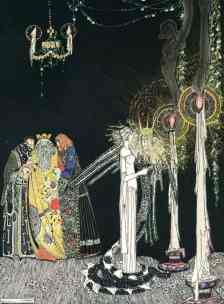
prince-lindworm-illustration-by-kay-nielsen-from-east-of-the-sun-and-west-of-the-moon

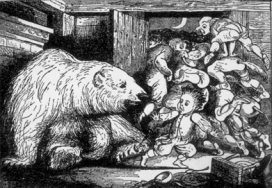
The Norwegian tale Prince Lindworm is about a prince born a dragon. When he reaches marrying age, he requests to be married before his twin. But the bride must meet 2 conditions. First, she must be a virgin. Second, she must consent to the relationship.

From: Norway
Earliest Appearance: 19th century. It’s like Beauty and the Beast with dragons and far more gore and sexual content.
Best Known Version: N/A
Synopsis: A husband and wife (usually a king and queen) can’t have a child. Following an old crone’s advice to overcome the childless situation, the queen eats 2 onions (but doesn’t peel the first one). 9 months later, she gives birth to twin boys. Unfortunately, the first twin is born a lindworm (a serpentine dragon) while the second is perfect in every way. When he grows up and sets off to find a bride, the lindworm insists that a bride be found for him before his younger brother can marry. But he set that the girl must meet 2 conditions. First, she must be a virgin. Second, she must love him willingly (or at least consent to the relationship). But none of the chosen maidens fill these conditions. So he kills each new bride they bring to him, creating a slight problem for the kingdom. Until a miller’s daughter who spoke to the same crone is brought to marry him (figuring that even if her efforts fail and the Lindworm eats her, she at least gets to be treated like a princess and live in a castle).

When the wedding day arrived, the royal chariot with 6 white horses fetch the girl and took her to the castle to be decked as a bride. Once there, she requests 10 snow-white shifts, a tub of lye, a tub of milk, and as many whips as a boy can carry in his arms. Of course, the ladies and courtiers see such demands were nothing but rubbish and nonsense peasant superstition. But the king says, “Let her have whatever she asks for.” She’s then arrayed with the loveliest of robes and looked the loveliest of brides before being led down the hall to the wedding ceremony where she saw the Lindworm for the first time coming in to stand by her side. So they’re married as a grand wedding reception is held that’s fit for a king’s son.

untitled

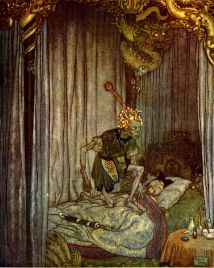
After the wedding, the newlyweds take to the prince’s bedroom. The prince asks his bride to strip. But she insists he shed his skin.

After the feast, the newlyweds are escorted to their apartment with music, torches, and a great procession. Once in the room, the lindworm tells his new wife to take off her dress, but she insists that he shed his skin for each dress she removes. So this goes until 9 Lindworm skins lay on the floor, each covered in a snow-white shift. And there’s nothing left of the Lindworm but a huge, thick mass, most horrible to see. The girl next seizes the whips, dips them in lye, and whips him as hard as she ever could. Once that’s done, she bathes him all over with fresh milk. Lastly, she drags him onto the bed and puts her arms around him before falling asleep at that moment. Very early the next morning, the king and his courtiers come peeping through the keyhole since they want to know what became of the girl. But none dare to enter the room. However, in the end, they creak the door open to see the girl all fresh and rosy while the loveliest young man lay beside her.

385492b235828eda8745270a0c421913

Here Prince Lindworm’s bride takes off her clothes as her new husband starts shedding his skin. And the dragon apparently likes what he sees.

Other Versions: Some versions include 2 roses instead of onions. Sometimes the peasant girl is a princess or omit the Lindworm’s twin brother. The soothsayer’s gender also varies. One version mentions that the Lindworm’s mom hurled the kid out the window as soon as it was born. An Indian version has the cursed prince born a monstrous fish and the girl helped by talking snakes. While some Asian variants have the girl sold to the Lindworm by her stepmother, usually in hope she gets devoured. And when she learns that her stepdaughter has married a king, she either kills herself or plots revenge.
Adaptations: Retold in comic form.
Why Forgotten: Given that the dragon prince eats some of his suitors and the fact a lot of the action takes place in a bedroom that involves a young woman getting naked with a dragon and whipping him, it’s not hard to see why this story will never have its own Disney movie.
Trivia: N/A

52. The Princess on the Glass Hill

The-Princess-on-the-Glass-Hill-Asbjoernsen-Moe

The Princess on the Glass Hill is a Norwegian fairy tale in which the king challenges guys to climb the glass hill and fetch 3 golden apples. For the next 3 days, a mysterious knight on a horse pulls it off.

From: Norway
Earliest Appearance: Collected by Peter Christen Asbjørnsen and Jorgen Moe.
Best Known Version: Asbjørnsen and Moe’s version obviously.
Synopsis: There was a farm with a field that would’ve been good for hay. Except after every St. John’s night all the grass would be eaten. For 2 years, the farmer’s 2 oldest sons stay up all night to guard the field but an earthquake scares them off. The youngest waits through 3 earthquakes and found that a horse in a brass suit of shining armor was eating the grass. He throws steel over the horse, giving him power over it. So he rides away to somewhere secret, telling his brothers that nothing had happened to him. He does it again the next year with the horse wearing silver armor and the next when its armor is gold.
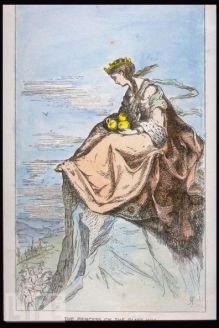
glass-hill

Here the princess holds 3 golden apples on the glass mountain. Any man who can climb up the hill and get them gets the princess and part of the kingdom.

Meanwhile, the king has his daughter sit on a glass mountain and whoever climb it and get the golden apples out of her lap would marry her. All the men who came to try it slip and slide about. But a knight in a brass armor suit rides up the third of the way and rides back. The princess throws one of the apples to encourage him, but he still rides off. The next day it happened again but a knight in silver armor rides 2/3 of the way up the hill and the princess likes him better than the other. The third day, a knight in gold armor rides all the way up and takes the apple. But rides off immediately after. The king then summons all his nobles and knights but none of them have the golden apples. So he summons everyone in the kingdom. Still, no one had the apples. So the king demands who’s missing. The older brothers admitted that their younger brother hadn’t. So he’s fetched, produces the apples, and gets married off to the princess.
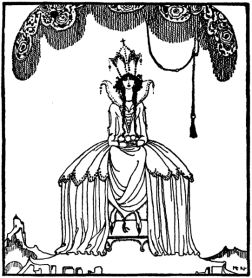
Nielsen princess_on_the_glass_hill

In this sketch, the princess wears a grand crown under a canopy. And yes, you can see the 3 golden apples in her arms.

Other Versions: Andrew Lang has a version in The Blue Fairy Book.
Adaptations: N/A
Why Forgotten: Not exactly sure. Maybe because it’s not from Grimm.
Trivia: N/A

53. Prunella
From: Italy
Earliest Appearance: Collected by Andrew Lang in The Grey Fairy Book.
Best Known Version: The Lang version, obviously.
Synopsis: A girl picks plumbs from a wild plum tree on her way to school, which earned her the name, “Prunella.” One day, a furious witch saw her and kidnaps her. The more beautiful Prunella grew, the more enraged the witch became. So she sends her with a basket to fetch water from the well. There, she meets the witch’s son Bensiabel who asks for a kiss from her in return for filling her basket. She refuses but he fills it up anyway. The next day, the witch gives her a sack of wheat with orders to make bread when she returned. Once again Bensiabel helps her despite her refusal to kiss him. The witch then sends Prunella to her sister to bring back a casket. Bensiabel gives her various things along the way before she has to take the casket and leave at once. When she does this, the witch tries getting the people on the way to stop her. But they refuse because Prunella gave them things but the witch didn’t. The witch then demands Prunella tell her what cocks crowed. Bensiabel hesitates to tell her once, in hopes of luring her to kiss him, and the witch comes to kill her. Bensiabel knocks her down the stairs, killing her. Now with her heart softened, Prunella agrees to marry him.

Other Versions: Italo Calvino’s version “Prezzemolina” has the girl get abducted over her mother’s craving of parsley and is abducted by fairies after her mom refuses to pay what she owed. While the witch is Morgan Le Fay and Bensiabel is Meme. Oh, and they both destroy the fairies before taking all their stuff and living in Morgan’s palace.
Adaptations: N/A
Why Forgotten: Not exactly sure on this one.
Trivia: N/A

54. Puddocky

464e5e8b960a7b66f558551b4acfe5d8--green-fairy-the-project

The German fairy tale Puddocky pertains to 3 princes fighting over a girl. But when she has an appetite for parsley, she turns into a frog.

From: Germany
Earliest Appearance: Collected by the Grimm Brothers as “Cherry.”
Best Known Version: Well, it’s not the Grimm version.
Synopsis: 3 brother princes fight over who might marry a girl with an unnaturally great appetite for parsley that she especially steals some from a witch who eventually turns her into a frog. The king wants to know which son will best succeed him so he sets them on some tasks. The youngest prince sets out with the least and finds a frog offering him the sort of cloth the king desires. It exceeds his brothers’ discoveries and the king sends them to find either a dog that could fit in a walnut shell or an excellent gold ring. Again, the frog provides. For the third task, the king orders them to return with a bride. A frog turns into a maiden. The king picks the youngest to succeed him and marries his frog princess.

Other Versions: Retold in French by Madame d’Aulnoy as “The White Cat.” Depending on the version the frog either turns another frog into a maiden or she herself transforms into a bride.
Adaptations: N/A
Why Forgotten: I’m not exactly sure.
Trivia: N/A

55. The Rose Tree
From: England
Earliest Appearance: Collected by Joseph Jacobs in English Fairy Tales.
Best Known Version: Well, the Jacobs version obviously.
Synopsis: A man has a daughter by his first wife and a son by his second. But the stepmother hated her stepdaughter. One day, when the girl’s bringing candles from the store a dog stole 3 times, the stepmother tricks her into letting her chop her head off. She then bakes the girl into a pie and feeds her body to her husband. Her son takes the leftovers and buries it under a rose tree. When it blooms in spring, a bird appears and sings a song so beautiful in it, a shoemaker gives her red shoes, a watchmaker a gold watch, and 3 millers a millstone. The bird flies to their home and rattles the stone on the roof. The boy runs out and she drops the shoes on his feet. She rattles again, the man runs out and she drops the watch at its feet. She then rattles a third time, the stepmother runs out and she drops the millstone so she dies.

Other Versions: N/A
Adaptations: N/A
Why Forgotten: Contains decapitation, cannibalism, and murder.
Trivia: N/A

56. Schippeitaro
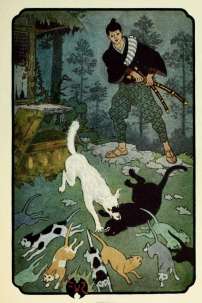
schippeitaro-full-page

The Japanese tale Schippeitaro is about a dog who fights cat demons. Though the animals may vary depending on version.

From: Japan
Earliest Appearance: Collected by Andrew Lang in The Violet Fairy Book.
Best Known Version: The Andrew Lang translation is the best known.
Synopsis: A young man sets out on an adventure, meets and fights bandits, but finds nothing to make himself famous. One day, he gets lost in a great forest and takes shelter in a small chapel. At midnight, dancing cat spirits rouse him warning each other, “Do not tell Schippeitaro!” The next day, the young man finds a village and a woman weeping over being chosen as a sacrifice to the Spirit of the Mountain. He asks of Schippeitaro and learns it’s a dog whose owner is nearby. He persuades the owner to lend him the dog and convinces the maiden’s parents to shut her up in a closet and let Schippeitaro into the cask where the sacrifice is offered. The demon cats reappear in the chapel. The biggest one opens the casket. Out Schippeitaro kills it. Afterwards, he and the young man kill many more. No more sacrifices are made ever since as the villagers rejoice over the young man and Schippeitaro.

Other Versions: Animals demons can vary by version. One features illustrations of a fox, wolf, hare, and raccoon dog.
Adaptations: N/A
Why Forgotten: It’s from Japan and involves a dog killing demon cats.
Trivia: N/A

57. The Seven Foals

216671d8ce82646943abe215d0eea699

The Seven Foals is a Norwegian fairy tale about a young man who has to tend and follow 7 horses. And I wouldn’t recommend he stop by the old lady.

From: Norway
Earliest Appearance: Collected by Peter Christen Asbjørnsen and Jorgen Moe.
Best Known Version: The Asbjørnsen and Moe version, of course.
Synopsis: A poor couple has 3 sons. The youngest just sits about poking in the ashes. When the oldest goes to the king and asks for a job, the monarch assigns him to watch his 7 foals all day. And if he could tell where they go, he’d receive the princess and half the kingdom. If he fails, the king cuts 3 red strips out of his back. He agrees. But after chasing the foals through rugged lands, an old woman calls him to stop with her and he does. She gives him water and turf, which he claimed the foals eat and drank. The king has 3 strips taken out. The next brother tries as well and comes to the same end.
The youngest goes and has a time to persuade the king since he was their brother. But unlike the others, he succeeds. When the old woman calls to him, he runs on. One of the foals then tells him to ride on his back. They ride on and come to a tree with a room inside containing a sword and flask. The foals have him try the sword and when he can’t, drink from the flask until he could. They then tell him to cut off their heads on his wedding day, which will turn them back into men. Since they’re the king’s sons.
untitled1

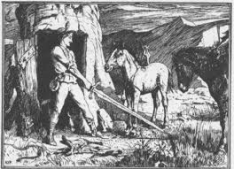
Here the foals tell the young man to wield a sword and drink from the flask if he can’t. Also, the foals are all princes.

Afterwards, they go on and cross a river leading to the chapel where they become men. A priest gives them wine and bread and the youngest son took some to show the king. When he does, the king agrees he’s triumphed and they hold a wedding. The youngest son cuts off the foals’ heads as agreed, brings them in, and there’s much rejoicing. The king then declares him his heir since his sons can now get lands of their own.

Other Versions: N/A
Adaptations: N/A
Why Forgotten: Well, having 3 strips taken out from one’s back must not be pleasant.
Trivia: N/A

58. The Seven Ravens
Raben_6_Herrfurth_500x788

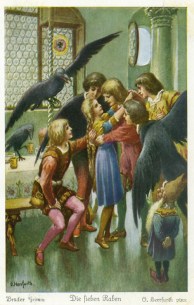
The Grimms’ tale The Seven Ravens, 7 brothers are turned into, well, ravens and fly off. Years later, their little sister goes off to find them.

From: Germany
Earliest Appearance: Collected by the Grimm Brothers.
Best Known Version: Obviously the Grimm version.
Synopsis: Desperate for a daughter, a family of 7 sons finally gets their wish. But she’s sickly. So worried for her soul, her dad sends her brothers to fetch water from a well for baptism. However, in their eagerness to obey, they accidentally drop the jug in the well. After some time passes, the dad believes they’re playing instead of cowering away from his potential wrath. So he cries out that he “wants all the boys to become ravens” (though he probably doesn’t mean it). Unbeknownst to him, the boys actually become ravens and fly into the sky. The girl eventually gets better. She grows up not knowing that she has brothers until she eventually hears people gossiping about them. Taking one of her parents’ rings, she goes out to find them. She meets the Sun and the Moon, but they both scare her off. But then she meets the kindly stars with the Northstar giving her a small bone that she’ll need and tells her brothers live in a glass mountain.
Raben_4_Herrfurth_500x791

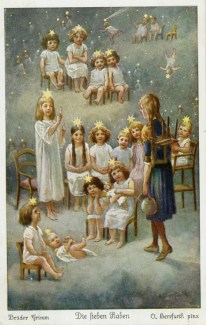
Here the girl meets to ask the stars about her brothers’ whereabouts. She’s told to follow the NorthStar.

Though the girl finds the glass mountain, she loses the bone. The mountain door is locked so she cuts off her finger to use as a key. She meets a dwarf informing her that the ravens will soon return. While she waits, she finds a dinner table set for the ravens and eats a bit from all plates. But her parents’ ring falls from the last flask she drinks from. Her brothers fly back, examine the mess she made, and fiddle with the flask. The ring falls out and the ravens recognize it. One of them prays to God that if their sister was in the mountain, they’d be saved from the curse. Hearing this and since their sister is hanging around, the curse is lifted.

Other Versions: In some versions when the girl goes to the Moon in trying to find her brothers, only to realize that the Moon eats kids. Luckily she escapes before it has a chance to feast on her.
Adaptations: Adapted into an opera.
Why Forgotten: Includes minor body mutilation.
Trivia: N/A

59. Sir Aldingar
From: England
Earliest Appearance: Child Ballad #59. Collected by Francis Child.
Best Known Version: The Child version, of course.
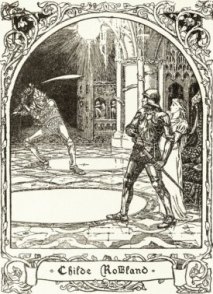
Synopsis: After a failed attempt at seducing the queen, Sir Aldingar puts a leper in her bed and accuses her of cheating to the king. The king orders them both executed. But the queen demands a trial by combat if she could get a champion. A messenger in search of one gets sent by what resembles a 4-year-old boy. Anyway, despite the overwhelming likelihood of getting his ass kicked or suffering a fate akin to Oberyn Martell, the boy mortally wounds Sir Aldingar in a fight. Aldingar confesses. The king and queen reconcile. While the leper is miraculously cured and serves as the king’s steward.

Other Versions: Some versions have the king and queen as Henry II and Eleanor of Aquitaine. Some variants have the queen’s hair unkempt and infested with mice while in prison.
Adaptations: N/A
Why Forgotten: Even the writers of Game of Thrones would find the idea of a preschooler defeating a grown man in a fight as completely ridiculous.
Trivia: N/A

60. The Six Servants

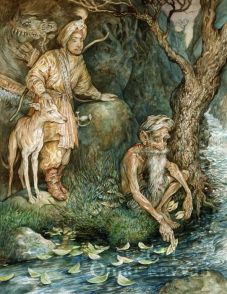
220px-Venceslav_cerny_dlouhy_siroky_a_bystrozraky

Collected by the Grimm Brothers, the story revolves around a prince with 6 superpowered servants completing impossible tasks to win a princess. Seems more like the X-Men going through a series of impossible tests so Professor X can get a fancy new car.

From: Germany
Earliest Appearance: Collected by the Grimm Brothers.
Best Known Version: The Grimm version, obviously.
Synopsis: A king and queen order a prince perform 3 impossible tasks before a deadline so he could marry a princess. He receives aid from 6 exceptionally gifted mutants he meets on his travels. These include:

Servant #1: Has a very long, stretchable neck and can see things at great distance.

Servant #2: Has large ears that can hear even tiny sounds from great distance.

Servant #3: Has eyes of such destructive power that he uses a blindfold to prevent himself from looking at things and accidentally destroying them. Except unlike Cyclops, his eyes shoot out like bullets, not lasers.

Servant #4: Is hot when it’s cold and is cold when it’s hot, basically making him a lizard man in human skin.

Servant #5: A colossal obese man who can eat lots of food.

Servant #6: Is extremely fast that he has to tie a leg behind his back to slow himself down. Basically, an ancestor of The Flash.

The first task is to recover a ring that the queen dropped in the river. Servant #1 sees the ring. Servant #5 drinks the entire river dry while Servant #6 gets the ring and brings it back to the palace. The second task involves 300 oxen and drinking 300 barrels of wine. The prince is allowed to bring one servant with him and of course, it’s Servant #5. While the third task the prince has to spend the night with the princess without falling asleep. Or at least stay up with her until midnight when the queen checks to see whether the princess is still lying in his arms. If not, he loses. Despite precautions, the prince falls asleep anyway. While the princess gets abducted and taken to a faraway hiding place. The prince and his servants eventually wake up. Servant #1 quickly discovers where the princess is kept as Servant #6 and Servant #3 rush to the location where the latter instantly destroys a rock behind where the princess is hidden. And they bring her back just in time the queen arrives to check if the princess is still in the prince’s arms.

As soon as the queen discovers what happened, she orders 300 trucks of wood lit in the flames. Only when someone can sit in the fire can the prince marry the princess. Thus, Servant #4 steps forward and manages to freeze the flames out, still feeling chilly in the process. Despite the marriage being settled at this point, the evil queen sends her troops after them, which Servant #2 pays attention to. Servant #5 blows wind through one of his nostrils, thus beating the soldiers. While Servant #3 carries on a mass slaughter. And with that, they all live happily ever after.

Other Versions: Some versions have Servant #6 fall asleep during the assignment while the others nervously wait for him. Servant #1 stretches his neck and sees him whereupon Servant #3 shoots a fly sitting on a branch of the tree Servant #6 sleeps under, waking him up and sending him to the palace. Sometimes the queen cast a spell on the prince and his servants on the third task. And sometimes Servant #5 spits out a large flood of seawater instead of blowing wind through his nostrils.
Adaptations: N/A
Why Forgotten: Well, it’s well-known in the Netherlands since Servant #1 is a theme park mascot there. Then again, a story like this seems more suitable for a comic book, not a fairy tale. Also, modern American audiences would view these servants as epic underachievers and think they should be fighting crime instead of helping their master get a princess.
Trivia: N/A

A Treasury of Forgotten Fairy Tales: Part 5 – King Thrushbeard to Pintosmalto

momotaro-and-demon

You might notice that a lot of these fairy tales revolve around royalty. Of course, this isn’t very much of a coincidence. Since back in the day, kings were usually the guys with all the power and wealth in the land. While a prince or princess was the dream spouse anyone would want since they’re probably hot as hell and come with a castle as well as large tracts of land. Of course, in reality, there was no way for an ordinary person to land a prince or princess since their daddy really wanted that alliance with France. Anyway, in this installment, I give you another 10 forgotten fairy tales. First, is a Grimm story about a king who puts a princess in her place. Second, is an Indian tale of a king who goes out of his way to keep his daughter from marrying a slave’s son, only to epically fail. Third, we come to an English fairy tale about a prince and the world’s worst personal assistant. Then we have a couple of Italian tales about finding a dream girl in an orange and creating a dream guy by oneself. Next, is a French story about 3 wishes wasted. After that is a Scottish tale of a young girl who tricks a giant into killing his whole family followed by a story of a Japanese folk hero and his animal friends. Then, we find a tale by Hans Christen Andersen about a Chinese Emperor and a bird in his garden. And lastly, we hear an African story about a young woman who gets her hand cut off.

41. King Thrushbeard

kingthrushbeard

The Grimms’ tale King Thrushbeard pertains to a bitchy princess who rejects royal suitor until her dad gets fed up and marries her off to the first guy she shows up. One of these rejects is King Thrushbeard and he’ll teach her a lesson.

From: Germany
Earliest Appearance: Collected by the Grimm Brothers.
Best Known Version: The Grimm version, obviously.
Synopsis: A king has a daughter so beautiful that available kings and princes come from miles in hopes of winning her hand in marriage. But despite her beauty, the princess is also proud, arrogant, and constantly insults and rejects her suitors. She’s particularly cruel to one young handsome young king, calling him “King Thrushbeard” because of his long thick beard. Finally, her dad loses patience with his rude daughter and declared that since she’s rejected every man who’s come to court her, he’ll marry her off to the first beggar at the gate. The next day, a clean-shaven minstrel arrives at the palace and the king likes his music so much that he marries the guy to his daughter. The princess is angry with the whole thing but doesn’t have a choice in the matter. As she and her new husband depart, they pass by lands and properties belonging to “King Thrushbeard.”

grimm_king_thrushbeard_by_monisawa-d3l864m

Here the princess is about to get married off to a minstrel arriving at the castle. Let’s say she’ll be in for a lot of crap for awhile.

The princess starts to regret rejecting him, especially when her new home turns out to be nothing more than a wooden shack. Now forced to work, the princess proves completely incompetent at household tasks like weaving and spinning. She has some success at selling pottery until a drunken soldier smashes her stall. Finally, she’s forced to work as a scullery maid in King Thrusbeard’s palace with the only benefit being that she could take home food scraps for herself and her husband. One day, the palace holds a great party to celebrate the King Thrushbeard’s engagement. The princess watches behind the curtain until King Thrushbeard discovers her himself. Despite her attempts to escape, he pulls her onto the dance floor and all the food she’s hidden in her apron spills out. Completely and utterly embarrassed, the princess tries to flee, but the king stops her. He then reveals himself as the beggar she married and the soldier who destroyed her stall. He put her through the ordeal to cure her proud ways and punish her haughtiness. With that, they marry and live happily ever after.

Other Versions: N/A
Adaptations: Retold several times and made into at least 2 movies.
Why Forgotten: It’s basically The Taming of the Shrew taken to the extreme. Seriously, King Thrushbeard makes Petruchio seem like an amateur.
Trivia: N/A

42. The King Who Would be Stronger Than Fate

a003e07875388be5505b2bfcb029731a

The Indian tale, The King Who Would Be Stronger Than Fate pertains to a king who tries to get rid of a slave’s son destined to marry his daughter. Naturally, he fails spectacularly.

From: India
Earliest Appearance: Collected by Andrew Lang for The Brown Fairy Book.
Best Known Version: The Lang version.
Synopsis: A king has a beautiful daughter and loves hunting. When chasing a white stag, he gets very lost in the woods before stumbling on a hermit. After the king presses him, the hermit tells him that his daughter’s fated to marry a slave girl’s son. He immediately treats with the king who owns her and having been given both the woman and her son, takes them to the wilderness killing the woman and abandoning the baby. However, a poor widow without a family lives in that wilderness with her goats. But she wonders what she’ll do if ill or injured. One day, her best nanny goat doesn’t yield a drop of milk. After this happens over a few days, she follows it finding a baby with his dead mom. She buries the woman and takes in the baby to help her in her old age. He grows up into a brave, handsome, and industrious young man.

ad3bf9647564d423d970defb84d7194d

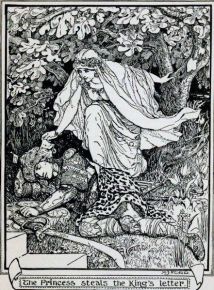
During a siesta at the governor’s mansion, the princess wanders into the garden and finds the handsome soldier. Thinking he’s hot, she reads a letter from her dad ordering his execution. She changes the message and reworks the message so that she can snag her man. Still, this image is so whitewashed.

One day, he finds the peddler’s donkey eating their cabbages. So he beats it, defending himself to his neighbor. The neighbor exaggerates, claiming he’s threatened the peddler. And the king (who’s been the peddler in disguise) has him arrested on the pretense that even a poor peddler could have justice in his lands. He realizes who he is because his adopted mother is too old. Then he tells the young man that he could receive a pardon if he joins the army since he looks like a good soldier and could use some discipline. Once in, the young man is sent on many dangerous missions, which he survives. Then the king tries having him poisoned, but a dog eats some of his food first, alerting him. Finally, the king sends him off with a message to a governor (whose wife the princess is visiting).
The young man arrives with the message. But he’s told the governor is sleeping and will receive him in the evening. He then goes to sleep in the garden. But the princess isn’t a fan of daytime siestas so she pretends to do so in order for her ladies to sleep. So she can wander as she pleases. She comes upon the young man and is so taken with his looks. She then steals the message to find it orders his execution. She alters it to say they should marry at once. Being one of the king’s most faithful servants, the governor carries out the wedding. The king is much distressed but learns to stop fighting fate. He then accepts his son-in-law, who becomes his heir after he dies.

Other Versions: N/A
Adaptations: N/A
Why Forgotten: For one, unless you live in India, you’ve probably never heard of it. Still, nonwestern folk tales don’t usually have much of a reception in the western world. Still, this would make a pretty good Disney movie. Besides, the title is misleading since the king is not stronger than fate.
Trivia: N/A

43. The Lord of Lorn and the False Steward
From: England
Earliest Appearance: First printed in 1580. Derived from the chivalric romance Roswall and Lillian.
Best Known Version: Appears as Child Ballad #21. Collected by Francis Child.
Synopsis: The young lord of Lorn is sent abroad to study languages. But the servant who went with him and sworn to keep him safe tries to murder him. But he only lets him off on the promise to never reveal the truth to any man or woman. The lord lands a job as a shepherd. Presenting himself as the lord, the steward wins the Duke of France’s daughter. She sees the lord one day and offers him a job. But the steward objects due to his lowliness. So the duke puts him in the stables. One day, after a horse kicks him, the lord rebukes it, telling it if it only knew who it was kicking. The duke’s daughter overhears it, asks him to explain. When he refuses, she has him sit down and tell it to the horse. He does. The duke’s daughter puts off the wedding and sends a letter to his dad, who arrives with great force. The steward is captured and is executed as he had sworn to be when he failed to guard the young lord (and boy, did he blow that). The young lord and daughter marry.

Other Versions: N/A
Adaptations: N/A
Why Forgotten: I’m not exactly sure.
Trivia: Played to the tune of “Greensleeves.”

44. The Love of Three Oranges
From: Italy, Portugal, Czech Republic, and France.
Earliest Appearance: Oldest version came from Italy as “The Three Citrons.” Collected by Giambattista Basile in the Pentamerone.
Best Known Version: The second Italian version since it bears the familiar title.
Synopsis: A prince is on a quest to find a wife. He finds a place where he receives 3 oranges (or citrons or other fruit). But he’s instructed not to break them open until he has some water. When he breaks them open, a beautiful woman appears and asks for water. Twice he fails, she either dies or disappears. But the third time, he finally gives her water and wins her. The prince then leaves her by a spring (or other body of water) so she can be properly brought to his father. While he’s gone, an ugly slave sees the reflection, takes it as her own, and decides she’s too pretty to be a slave. She then realizes the beautiful woman is there and tricks her into letting her transform into a bird by driving a pin into her head. When the prince returns, she claims to have been magically transformed and the prince dutifully returns with her. The bird interferes with the wedding festivities. Someone catches her and draws out the pin revealing the truth. The slave is punished and the prince marries the woman.

Other Versions: Has multiple variants such as the Portuguese “The Three Citrons of Love” and the French “The Enchanted Canary.” Also has a Czech version called “The Three Citrons.” Many versions mention the slave girl being beaten by her mistress as if it was no big deal. While most of the older versions spend a disturbing amount of time describing how disappointed everyone is by the mere fact she has black skin. Also, in Basile’s version the first 2 orange maidens are restored in the end. In other variants, the slave kills the woman and she returns as a bird ghost. While the oldest version depicts the woman with red hair.
Adaptations: Adapted into an opera by Sergei Prokofiev.
Why Forgotten: This is a widespread fairy tale in Europe with several variants. But it might have some unsettling aspects depending on version.
Trivia: N/A

45. The Ludicrous Wishes

800px-Page_facing_130_illustration_from_Fairy_tales_of_Charles_Perrault_(Clarke,_1922)

Perrault’s tale The Ludicrous Wishes revolves around a guy saving some magic creature’s life and are granted 3 wishes. Those wishes are wasted over one dinner.

From: France
Earliest Appearance: Collected by Charles Perrault.
Best Known Version: Obviously, the Perrault version.
Synopsis: A down on his luck woodcutter is granted 3 wishes by a magical entity for his help in a time of need. Anyway, the woodcutter goes home and his wife persuades him to put off wishing until the next day. But while sitting by the fire, he wishes for sausages. His wife taxed him for his folly. So he wishes for a sausage in her nose. Finally, they agree to use the last wish to take the sausage off her nose, leaving them no better off than before.

Other Versions: Magical entity can be the God Jupiter, a fish whose life he spared, or a tree spirit. Some versions use black pudding instead.
Adaptations: N/A
Why Forgotten: It’s short and doesn’t have much of a plot.
Trivia: N/A

46. Molly Whuppie

6a00e54efdf1128833017eeacb11b3970d

In the Scottish Molly Whuppie, a young girl tricks her giant captor into murdering his family. Granted she and her sisters were held hostage, but still it’s pretty disturbing.

From: Scotland
Earliest Appearance: Collected by Joseph Jacobs in his English Fairy Tales. Main inspiration was the Scottish “Maol a Chliobain” printed in 1862 in John Francis Campbell’s Popular Tales of the West Highlands.
Best Known Version: The Jacobs version.
Synopsis: Molly is the youngest and cleverest of 3 daughters who were turned out of their home because there was nothing to eat. They take shelter with a giant and his wife who initially accept them with kindness before attempting to kill them in their sleep. The quick-witted Molly arranges that the giant slay his own 3 kids instead. So that night, the girls escape to the king’s palace. Impressed by the story, the king sends Molly on 3 successive errands to steal a treasure from the giant. She’s caught on the third try, but she escapes death by her wits, causing the giant to murder his hapless wife. When the giant gives chase, he can’t cross the narrow bridge over the river and must futilely rage from the other bank. As a reward for her efforts, Molly and her older sisters marry the king’s 3 sons.

Other Versions: N/A
Adaptations: N/A
Why Forgotten: I’m not sure. Maybe the fact it involves a girl tricking a giant into killing his family.
Trivia: N/A

47. Momotaro

momotaro

The Japanese tale Momotaro revolves around a man who fights oni with his animal friends. Due to its popularity in the country, the story was often used in Japanese WWII propaganda.

From: Japan
Earliest Appearance: Appeared as early as the Edo period.
Best Known Version: It’s hard to say since there are variants by region.
Synopsis: Momotaro is born when an old woman washing clothes discovers a peach floating down the river. She takes the peach home to share with her husband but when they open it, they discover a child inside. They name him Momotaro and raise him as their son. After he grows older, Momotaro decides to fight an oni band Onigashima (Demon Island) who’ve been robbing nearby villages. His parents give him a sword and a pouch of kibi-dango (a type of sweet dumpling) for his journey. On the way, he meets 3 talking animals, a dog, a monkey, and a pheasant. In exchange for their help in fighting the oni, he gives them a kibi-dango. They reach Onigashima and attack the oni’s fortress. The oni surrender, return all the treasure they stole, and promise not to steal anymore.

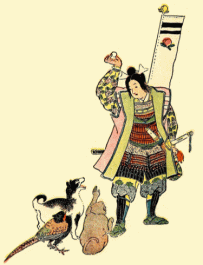
aa3bfc7e999eb4d4310d671bba22cec7

Here we have Momotaro with his animal friends kicking some oni ass. Funny how the critters are wearing kimonos.

Other Versions: In an older version the old couple eat a giant peach making them young again that they have sex to celebrate and have son named “Taro.” Another older version depicts Momotaro as lazy. These aspects were changed to make the story more publishable to children during the 19th century.
Adaptations: His story has been adapted numerous times in various media, particularly anime and manga.
Why Forgotten: It’s actually very popular in Japan that it was used in Japanese WWII propaganda in the 1940s. Not so much anywhere else.
Trivia: Depicted in Japanese propaganda during World War II. There’s even a Momotaro festival, too.

48. The Nightingale

800px-Edmund_Dulac_-_The_Nightingale_3

Written by Hans Christen Andersen, The Nightingale revolves around a Chinese Emperor and a bird who could sing so sweet in his garden. He takes the bird and puts it in a gilded cage.

From: Denmark
Earliest Appearance: Written by Hans Christian Andersen first published in 1843.
Best Known Version: There’s only one version.
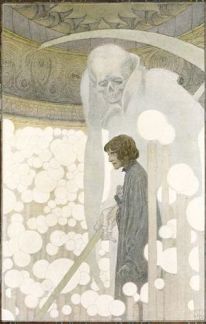
Synopsis: In Imperial China, the Emperor learns that one of the most beautiful sounds on Earth is that of the nightingale, one of which happens to live in his own gardens. Though initially put off by the plain bird’s appearance, he’s so delighted by her song that he brings her into his palace as a permanent “guest.” However, by and by, his engineers produce a bejeweled mechanical bird, quickly attracting the Emperor and court’s attention. As they play the mechanical bird nearly to the point of breakdown, the real nightingale returns to the garden. Then the Emperor falls ill, to the point where his successor his chosen and the Grim Reaper is sitting at his bedside. In despair he cries that if he could only turn the key of the mechanical bird and hear its song one more time, he’d have the strength to fight back. At that moment, the real nightingale bursts into song from his window, restoring his strength and shaming Death into departing. From then on, she tells the Emperor, she will not live as his prisoner but will still frequently return to tell him what’s happening in his empire, so he’ll be known as the wisest emperor ever to live.

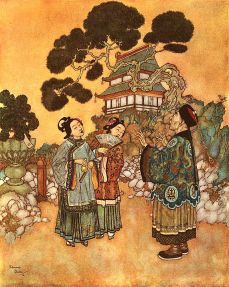
800px-Edmund_Dulac_-_The_Nightingale_5

Here the sick Emperor lies as Death comes over him. If only he could hear the song of the precious nightingale one more time.

Other Versions: N/A
Adaptations: Adapted to an opera, ballet, TV drama, and animated film.
Why Forgotten: Overshadowed by Andersen’s more famous works like The Snow Queen and The Little Mermaid. Also, no princesses or queens. Then there’s the fact it’s set in China but it’s clear that Andersen isn’t familiar with the fact that nightingales don’t live there. And let’s say the illustrations aren’t very flattering to Chinese people either.
Trivia: Also known as “The Chinese Nightingale” and “The Emperor and the Nightingale.” Believed to be inspired by Andersen’s unrequited love for Jenny Lind (who contrary to The Greatest Showman did not have an affair with P.T. Barnum).

49. The One-Handed Girl

OneHandedGirl

The One-Handed Girl is a Swahili fairy tale about a young woman continuously abused by her brother that she eventually loses her hand. She then flees into the forest and marries a prince.

From: Kenya, Uganda, Tanzania, Burundi, Rwanda, Mozambique, and the Democratic Republic of the Congo.
Earliest Appearance: Collected by Andrew Lang in The Lilac Fairy Book.
Best Known Version: The Lang version, obviously.
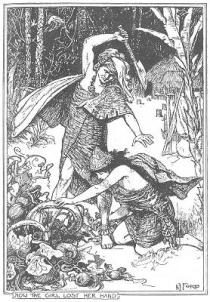
Synopsis: A dying man offers the choice between his property and his blessing. The son wants his property, the daughter his blessing. Then their mother did the same. The son let his sister only have a pot and a vessel she can clean corn in. She supported herself by letting the villagers borrow her pot and did well and even planted a pumpkin seed. Envious, her brother stole them. But the pumpkin vine did well, she sold pumpkins, and lived on that. When her sister-in-law tries buying one, the sister gave her one for nothing. But when she tried buying another the next day, they were all gone. So she told her husband that his sister had refused to sell her one. The brother cuts the vine down to punish her. She tries to protect it by throwing herself in the way, he cuts off her hand as well before selling the home she lived in.

021862c33f15f649968d747db4f411dd

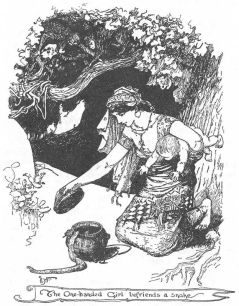
Here the One-Handed Girl befriends a snake who tells her to bathe her baby in the pool. I know these illustrations are incredibly whitewashed for an African fairy tale.

The sister flees into the forest to hide from her brother. 7 days later, a king’s son found her there, fell in love, and married her. They have a baby. Then the king’s son had to go on a journey. In the meantime, her brother hears that the prince’s bride only has one hand, and guesses it’s his sister. He tells the king and his wife that she’s a witch who killed 3 husbands, lost her hand, and had been exiled for it. The sister’s in-laws exile her again, with her baby. In the forest, she sees a snake and sits very still when it begs her to let it hide in her pot. After another snake passes by, it brings her with him and tells her to bathe her baby in the pool. She loses the baby and searches around with her hand. The snake tells her to use the other arm. She does, finding her baby and her hand being restored. Then it brought her to its parents, who keep her as a guest because she saved their son.

463f1fe35264fca73fd1f8f50476c66c

After gaining her hand, the snake invites the formerly One-Handed Girl and her son to stay with his family. Unlike many fairy tales, the snake is a benevolent figure for once.

Meanwhile, the king’s son falls ill and takes a long time to return home. When he comes back, he’s shown 2 graves as if for his wife and child. After a time, the daughter wants to return home. On the snake’s advice, she asks for its dad’s ring and its mom’s casket, which would feed and protect her from harm. Using them, she got herself a fine house. The king, his wife, and their son come to visit, bringing along her brother. The daughter recounted her tale and is reunited with her husband. The brother is exiled.

Other Versions: N/A
Adaptations: N/A
Why Forgotten: Well, it’s from Africa. Fairy Tales from there take much longer to write down. Not to mention, it’s hard to tell if the Lang’s version is somewhat sanitized or the genuine article since he lived in the 19th century.
Trivia: N/A

50. Pintosmalto

2490974d8e6bc455b32bd45213f7ead1

The Italian fairy tale Pintosmalto focuses on a young merchant’s daughter named Betta who creates her own dream guy. And then has to rescue him.

From: Italy
Earliest Appearance: Written by Giambattista Basile in Il Pentamerone from 1634. It’s basically a reverse Pygmalion and Galatea.
Best Known Version: Basile’s obviously.
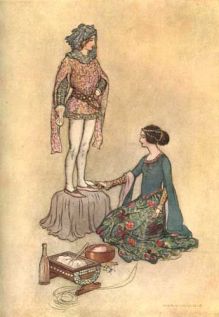
Synopsis: A merchant wants his daughter, Betta to marry. She tells him to bring her a hundredweight of Palermo sugar, a hundredweight of almonds, 4-6 bottles of scented water, a little musk and amber, 40 pearls, 2 sapphires, a few rubies and garnets, some gold thread, a trough, and a little silver trowel. When he did so, Betta used them to mold a statue of a man. She then prayed to the goddess of Love and he came to life. She named him Pintosmalto and they marry at once. However, a queen in attendance abducts him.

Betta sets out to follow. She stumbles upon an old woman who takes pity on her and teaches 3 sayings that could help her. She went on and finds the land. When she sees Pintosmalto, she tried the first. A self-moving golden coach appears, with which she bribes the queen to let her sleep the night at the door of Pintosmalto room. The queen agrees but drugs Pintosmalto so that Betta can’t speak to him. She tried again with the next saying and a golden bird that sang like a nightingale appears. But the result is the same as before. The next day, a cobbler tells Pintosmalto of all the weeping he hears So the next night, when Betta bribes her way in with scarves, he’s awake. Taking what Betta used to bribe her way and some more treasure, the couple instantly flees, leaving the queen enraged.

Other Versions: Folk variants are found in many Mediterranean countries. Italo Calvino’s version has Betta a princess who makes Pintosmalto from flour and takes 6 months for her to create him. Also, she’s aided by 3 hermits giving her nuts to crack.
Adaptations: N/A
Why Forgotten: Sexism might have something to do with it. Since men see no qualms about objectifying women and fantasizing about creating a woman for themselves. But men like Pintosmalto are female fantasy figures that may turn men off.
Trivia: N/A

A Treasury of Forgotten Fairy Tales: Part 4 – The Goose Girl to Kate Crackernuts

de1aed609a7de6310caedb31decfee08

Fairy tales have been among us for hundreds of years passing onto each generation. While it’s obvious to note that these stories are incredibly ancient, they come in several variants depending on region and culture. When it comes to fairy tales we read, the versions most familiar to us usually aren’t the ones initially written on the page. Often the earliest versions usually feature content that aren’t suited for kids. They may contain violence meant to scare the kids into behaving or sexual innuendo. In this installment, we’ll look at 10 more forgotten fairy tales. First, there are Grimm tales of a goose girl, a wild man, a hedgehog, and two star-crossed lovers. Second, we’ll look a Hungarian story about helpful animal friends. Third, we come to a Perrault tale on how a little boy tricks a giant into murdering his family. Next are 2 English stories about a giant killer and a prince who can’t stop dancing followed by a Scandinavian tale on a guy who herded rabbits. And finally, a Czech story on a guy going against some hostile witches.

31. The Goose Girl

469c1f1ce04b4cbb05b141c0b52f17f4--best-christmas-gifts-fairy-tales

The Goose Girl is a Grimm fairy tale about a young princess who gets cheated by a maid and is compelled to work as a goose girl at the palace. But not to worry, she gets to socialize with a disembodied talking horse head on the castle’s wall.

From: Germany
Earliest Appearance: Collected by the Grimm brothers.
Best Known Version: Probably the Andrew Lang translation in The Blue Fairy Book.
Synopsis: A widowed queen sends her beautiful only daughter off to marry a prince she’s engaged to. But before leaving, the mom presents her with a small token providing magical protection along with a magical talking horse named Falada. However, the maid accompanying the princess treats her like utter crap. So when circumstances cause the princess to lose her token, the maid seizes the opportunity to force her into trading places. She makes the princess switch clothes with her and tries to ride Falada. But Falada isn’t having it so the evil maid has to keep using her ordinary horse instead. And to make it stick, the maid threatens to kill the real princess unless she vows never to tell any living soul what happened.

Arriving in the prince’s kingdom, the false princess says that Falada is an ill-tempered mount and demands that he be killed (so he can’t reveal the truth). Also, she wants the true princess nowhere near her and lets the king make her any servant he pleases. Grieving for Falada’s death, the true princess manages to convince the groom to have the horse’s head mounted above one of the palace gates where she can still see it every day. Since the true princess is too lovely and delicate for hard work, they send her out with the goose boy. In the morning and evening, she sighs over her horse’s head and it responds. When she tries combing her blonde hair which the goose boy thinks it’s real gold and tries to steal some, she says a little rhyme to summon the wind to blow the boy’s cap away, making him chase it and letting the princess comb her hair in peace.

220px-Heinrich_Vogeler_-_Illustration_Die_Gänsemagd

As a goose girl, the princess has a habit of combing her long blond hair to the goose boy’s annoyance. So much so that the goose boy thinks it’s real gold and tries stealing some.

After 3 days, the goose boy complains that he won’t work with the new goose girl anymore. When the king hears word of it (who’s not at all impressed by the false princess), he seeks her out. Unfortunately, she can’t speak of her misfortunes to any living creature. So he kindly suggests she spill her guts on the stove in the palace kitchen. When she does that, the king sneaks up to the roof and listens at the chimney in order to hear the truth. Now aware of the deception, he sends the true princess to the royal household to be dressed properly before bringing her to the great banquet. Her appearance is so fine that not even the false princess recognizes her. The king then asks the guests what would be a fitting punishment for someone who’s deceived everyone around them and proceeds to describe the situation without revealing anyone’s identity. He next turns to the false princess for her opinion and she recommends an exceptionally cruel and gruesome execution. So he condemns her to that very death she suggested, introduces the true princess to his son, and the young couple are delighted with each other that they marry the next day.

Other Versions: Token can be a lock of the mother’s hair or handkerchief with 3 drops of her blood on it, depending on version. Also, some versions have the mother as a fairy or other magical being who restores all the princess’ fortunes once she’s married, including resurrecting the dead horse. Andrew Lang also has a version in The Blue Fairy Book.
Adaptations: Retold in the Books of Bayern series by Shannon Hale.
Why Forgotten: Contains a magical talking horse head. Also doesn’t portray commoners in a positive light.
Trivia: During the 13th century, the tale was attached to Bertrada of Laon, mother of Charlemagne.

32. The Grateful Beasts
From: Hungary
Earliest Appearance: Collected by Herman Kletke
Best Known Version: Probably the Andrew Lang translation in The Yellow Fairy Book.
Synopsis: A poor couple sends their 3 sons out to find their fortunes. The youngest, Ferko is exceptionally handsome that his older brothers think everyone will like him, leaving them with no chance of success anywhere. So they trick Ferko into letting them break his legs and put out his eyes before abandoning him to his fate. However, he stumbles under a gallows tree where he overhears 2 ravens talking about the medicinal properties relating to the dew falling on the hill and the lake below it. Somehow, Ferko manages to make his way to the hill and uses the dew to heal his own injuries as well as save a wolf, a mouse, and a queen bee.

Ferko then finds his way to the royal court where his brothers have entered into service. Stunned of his well-being, the cruel brothers persuade the king that Ferko is an evil magician and recommend that he demand him to complete an impossible task and kill him if he fails. The king orders Ferko to build a castle more beautiful than his own. Ferko turns to the queen bee who arranges the castle’s construction. Ferko’s brothers then persuade the king to send him on a second impossible task, against the kindhearted princess’ wishes. Since she’s fallen in love with the guy. This time he must gather all the kingdom’s harvested grain and put it into the barns. The mouse summons all the kingdom’s mice and they do it all for him. More determined to see him fail, Ferko’s brothers incite the king to demand a third impossible task, which he does. He orders Ferko to summon all the kingdom’s wolves. When the princess bursts into tears and protests this demand, he locks her up in a tower. So she’s not there when Ferko’s wolf friend calls out all the kingdom’s wolves to convene upon the court, which they do. And when they come, they’re hungry. Let’s just say the encounter between the royal court and the wolves doesn’t go well for the court. Ferko releases the princess from the tower, marries her, and becomes king.

Other Versions: N/A
Adaptations: N/A
Why Forgotten: Well, it has a bunch of people eaten by wolves in the end.
Trivia: N/A

33. Hans the Hedgehog

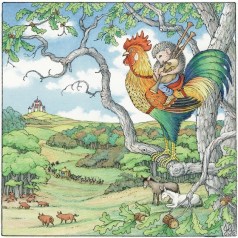
Hans-the-Hedgehog-630x631

The Grimm fairy tale Hans the Hedgehog starts out as a charming tale about a humanoid hedgehog guy who plays the bagpipes and rides a rooster. Then it gets really dark real fast when the first princess rejects him.

From: Germany
Earliest Appearance: Collected by the Grimm Brothers.
Best Known Version: The Grimm version, naturally.
Synopsis: A wealthy peasant has one grief in life that he and his wife have no child. One day, he’s had enough of the other peasants mocking him that he declares, “I will have a child, even if it be a hedgehog.” Sure enough, his wife gives birth do a hedgehog-human hybrid, leaving the parents horrified. Christened as “Hans the Hedgehog,” he can’t be nursed because of his quills and receives a small bed behind a stove where he lounges around for 8 years. Until one day, he asks his dad to bring him a set of bagpipes from the fair. Hans then tells him to have a rooster shod at the blacksmith’s, promising to leave and never come back. His dad is only too happy to do so and Hans leaves riding his rooster, taking some pigs and donkeys with him. He next spends years in the woods, tending to his growing herd and making beautiful music on his bagpipes while perched on his rooster on a tree branch.

Time passes and 2 kings find their way into the woods. They both notice Hans the Hedgehog and ask him to show them a way out of the forest to their respective kingdoms. Before doing so, Hans has each king promise that they’ll give him the first thing they meet when they come home in exchange. As it happens, each king is greeted by his daughter on returning to the royal palace. The first king tells of his encounter with Hans the Hedgehog but assures her that he’s not going to uphold his empty promise. The princess is totally okay with it for she wouldn’t want to be with a mutant hedgehog man anyway. On the other hand, the second king is dismayed but his daughter tells him if Hans comes, she’ll go to him out of her love for her dad. Hans sets off to get his reward and you really don’t want to cross him.

The first king refuses to hand over his daughter. But Hans forces him to yield her, threatening to kill them both if he doesn’t. After the king outfitted the first princess for marriage, she leaves with Hans. However, after traveling a short distance from the city, Hans has her clothes taken off, pierced her with his quills until she bled all over, and sends her back to the kingdom in disgrace. The second king agrees to the marriage and the princess fells bound by her dad’s promise so Hans marries her. On their wedding night, he tells the king to build a fire and post guards at his door. Hans then sheds his hedgehog skin and has the guards throw it in the fire. After doctors clean him up, he’s shown to be a handsome young gentleman. After several years, Hans returns home to collect his parents and they live together in the kingdom.

Other Versions: Many versions usually leave out what Hans does to the princess who rejects him.
Adaptations: Adapted into a children’s book in 2012.
Why Forgotten: Its resolution is so crude, violent, and sexist that its original plot is essentially unusable for modern children’s books. Seriously, if it weren’t for that, he’d be a stuffed animal.
Trivia: N/A

34. Hop-o’-My-Thumb

800px-Der_kleine_Daumling_(1)

The French Hop o’ My Thumb is a tale about a small boy who is way smarter for his size. Still, that doesn’t stop his parents from sending him and his brothers in the woods.

From: France
Earliest Appearance: Written down by Charles Perrault in 1697.
Best Known Version: William Godwin’s 1804 version (funny, since his daughter wrote Frankenstein).
Synopsis: A poor woodchopper and his wife decide to abandon their 7 sons in the forest because they can’t feed them. The youngest is called “Hop-o’-My-Thumb.” Despite his small size, he’s very smart. When he hears about his parents’ plans, he goes outside to collect pebbles to put in his pocket. in the middle of the night. That way, when the parents take the boys to the woods, Hop-o’-My-Thumb throws a pebble trail so they can find their way back. He does the same thing when the parents abandon the kids a second time. But the third time, they lock the door and Hop-o’-My-Thumb can’t collect pebbles so he has to resort to bread crumbs. Yet, the birds eat everything.

800px-Der_kleine_Daumling_(2)

Hop o’ My Thumb and his brothers stop by at a giant’s house where they bunk for the night. But the giant has an appetite for human children so they can’t stay long.

When all hope is lost, Hop-o’-My-Thumb and his brothers and his brothers see a light in the distance. Walking towards it, they discover a house. After they knock, a woman opens the door but warns the children that her husband is a man-eating giant. Hop-o’-My-Thumb explains their situation resulting in the woman to take pity on them so she lets the kids in. When the giant arrives home, he discovers the children and plans to devour them. His wife convinces him to wait until the next morning to which the giant agrees. The woman brings the children to a bedroom where the giant’s 7 daughters also spend the night. That night, Hop-o’-My-Thumb fears the giant might come out and get them and he switches his brothers’ hats with the crowns on the giant’s daughters’ heads. As expected, the giant gets hungry and leaves his bed to kill the kids. But in the dark, he has to find them through touch. When he feels the crowns Hop-o’-My-Thumb placed on their heads, he mistakes them for his daughters and leaves them alone. Then he goes to his daughters, feels their hats and slits their throats in their sleep. After that, he unknowingly goes back to bed, planning to eat them the next morning.

800px-Däumling

After tricking the giant into killing his kids, Hop o’ My Thumb takes off his “seven mile boots.” When all’s done, you have to feel bad for the giant’s wife.

Hop-o’-My-Thumb wakes up his brothers and they flee back into the forest. The next morning, the giant discovers he’s been tricked and starts chasing them with his magical “seven mile boots,” allowing the wearer to cross great distances within a short amount of time. Unable to find them, he decides to take a nap, right next to the tree where Hop-o’-My-Thumb and his brothers are hiding. During the giant’s rest, Hop-o’-My-Thumb tells the others to run back home while he steals the giant’s boots and runs back to the giant’s house. There, he tells the wife that robbers kidnapped her husband and that she should give Hop-o’-My-Thumb all of the giant’s treasure which he takes along with him.

Other Versions: Some accounts have Hop-o’-My-Thumb bring the treasure to the king and he serves as his messenger. Other accounts have Hop-o’-My-Thumb bringing the treasure directly to his family and everyone lives happily ever after.

Adaptations: Made into a Broadway musical and a Soviet cartoon.
Why Forgotten: It’s well known on the European continent, but not in the English-speaking world. Besides, Hop-o’-My-Thumb takes a woman’s kindness for granted, condemns 7 sleeping girls to death, steals, lies, steals some more, and leaves a poor woman to explain things when her murderous husband comes home.
Trivia: N/A

35. Iron Hans

Eisenhans_in_the_cage_by_Gordon_Browne

In the Grimms’ Iron Hans, a wild man is captured and put in a cage. Until a prince’s ball rolls into it and the wild man tricks the prince into setting him free.

From: Germany
Earliest Appearance: Collected by the Grimm Brothers.
Best Known Version: The Grimm version, obviously.
Synopsis: In a forest where no one who goes in ever comes out, a huntsman captures a wild man by draining a pool he was hiding in. The king keeps him in a cage and threatens to kill anyone who lets him out. Unfortunately, the prince’s ball falls into the cage and the wild man tricks the boy into getting the key and letting him out. He then carries him off to avoid punishment. In the forest, the wild man sets the prince to watch a well and make sure nothing falls into it, lest it become “polluted.” He fails 3 times. First, he sticks his finger in it, causing it to turn gold. Second, a hair from his head falls in, also turning into gold. Finally, he tries seeing his reflection in the water, causing his long hair to fall in and become completely gilded. The wild man sends him away, but tells him that if he calls his name “Iron Hans,” he will come to help him. Hiding his hair beneath a cap, the prince finds a menial court position. He ends up demoted from the kitchen to the garden when he claims to have a sore on his head to keep his hair concealed. One day, the princess glimpsed his hair and asks him to bring her a wreath of flowers. She then pulls of his cap and is certain it’s him.

Eisenhans_-_the_mysterious_knight_by_Robert_Leinweber

Whenever the prince is in need, he could always call on Iron Hans. When a king issues impossible tasks, he uses this promise to his advantage.

When the country is threatened with war, the prince calls upon Iron Hans who gives him a horse and a troop of soldiers. The prince secures the king’s victory but flees before he’s caught out. The king throws a feast in which his daughter will throw the golden apple in hopes that the strange knight will catch it. The prince calls upon Iron Hans, catches it on the horse he receives and rides off. This happens 3 times but he’s wounded in the third so they see his golden hair, giving away his identity as the gardener’s boy, and they bring him before the throne. After he’s revealed as a prince, he asks to marry the princess. At their wedding, a strange man appears who reveals himself as Iron Hans and an enchanted king. But the prince disenchanted him and will receive everything he owns for it.

Other Versions: N/A
Adaptations: Retold in an Anne Sexton poem.
Why Forgotten: Well, it’s well known in Europe, Africa, and Asia. But it’s not among the mainstream.
Trivia: Inspired a mythopoetic men’s movement in the 1990s.

36. Jack the Giant Killer

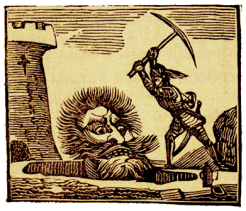
Cormoran

Based on an English chapbook, Jack the Giant Killer follows a young man who manages to slay a few giants. And yes, the old pictures look pretty graphic.

From: England
Earliest Appearance: As a chapbook printed as, “The History of Jack and the Giants” in 1711, fusing various other giant tales into one narrative (explaining why the story is longer and more episodic than a typical folktale). Might’ve appeared earlier in the History of the Kings of Britain where legendary Corineus fought giants and lent his name to Cornwall and the Cornish. Also a predecessor to “Jack and the Beanstalk” and variant of “The Brave Little Tailor.”
Best Known Version: The chapbook version.
Synopsis: Using a pick axe and a pit trap, Cornish Jack slays his first giant, gaining him a reputation amongst a nearby village. Following this, he sets off on a series of challenges, meeting a giant named Blunderbore who he strangles with a cord. His third encounter is with a Welsh giant who tries to kill Jack while he’s resting at his castle. Jack uses his invisibility coat, which he received in the giant’s first castle, to attack the third giant and his brother with impunity. The last encounter is with the giant Galligantus whom he scares with a magic trumpet blast before decapitating him and sending it to King Arthur. Arthur then rewards Jack with his daughter’s hand in marriage (wait, King Arthur has a daughter?).

Other Versions: N/A
Adaptations: Loosely adapted into a 1962 film.
Why Forgotten: Well, it’s replete with violence.
Trivia: Has little in common with Jack the Giant Slayer.

37. Jesper Who Herded the Hares
From: Scandinavia
Earliest Appearance: Collected by Andrew Lang in The Violet Fairy Book.
Best Known Version: Andrew Lang’s translation.
Synopsis: A king decided he’d marry his daughter to whoever who brought him 12 of the finest pearls he ever saw, and carried out certain tasks. Those who brought fake pearls were caught out while those who brought real ones failed. Now a fisherman had 3 sons named Peter, Paul, and Jesper who was the smartest even if the other 2 wouldn’t admit it. One day, he brought home 3 dozen oysters, each proving to have a beautiful pearl. Peter set out with a dozen and met the King of Ants, whose plea for air he scorned, and an old woman who asked what he was carrying. He told her it was cinders, which it was when he reached the castle. Paul did the same. But when Jesper set out, he helped the ants, received a promise of their aid, and then told the old woman he was carrying the pearls that would win the princess. When she asks for food, he gives her his lunch. She gives him a whistle that will bring back whatever he loses.

But when Jesper shows the pearls to the king, he’s displeased before sending him to sort a mixed heap of wheat, barley, oats, and rye. He summoned the ants to sort the grains for him. The next day, the king’s men had captured 100 hares and made it Jesper’s task to herd them all. They fled as soon as they were released, but the whistle brought them back. When news got back to the king, he sent the princess to beg one from him. He agreed if she kissed him. She did but he whistled it back. The queen came and Jesper made her walk and cackle like a hen, and whistled the hare back. The king came. Jesper made him stand on his head and whistled the hare back. The next day, the king told him he had to tell as many truths as needed to fill a tub as far as the king saw it. Jesper had told that the princess had come to him, then the queen, and finally started to tell about the king. The king declared the tub was full so Jesper and the princess married.

Other Versions: N/A
Adaptations: N/A
Why Forgotten: Herding hares doesn’t seem like a task as worthy of marrying a princess.
Trivia: N/A
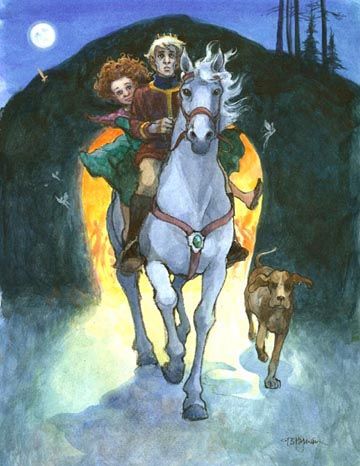
38. The Jezinkas
From: Czech Republic
Earliest Appearance: Collected by A. H. Wratislaw in his Sixty Folk-Tales from Exclusively Slavonic Sources.
Best Known Version: Wraitslaw’s version obviously.
Synopsis: An orphan named Johnny looks for work but finds none. Until he sees a man with his eyes gouged out lamenting to his goats that he can’t pasture them. Johnny takes the job. But the old man warns him that if he takes the goats to a certain hill, the Jezinkas will gouge out his eyes. Alas, Johnny goes their anyway, taking along 3 brambles. And the Jezinkas come offering him an apple, a rose, and to comb his hair. He traps the last one with a bramble. The other 2 try to free her but he traps them as well. He demands they return his master’s eyes or he’ll throw them into a river to drown. They agree, but the first 2 give Johnny the wrong eyes which sees nothing but owls (or wolves) and he drowns them. The third initially gives him the wrong set that see nothing but pike. However, she begs and pleads before giving him the right one and troubles him no more whenever he pastures the goats on the hill.

Other Versions: Goes by “Grandfather’s Eyes” and “Johnny and the Witch Maidens.”
Adaptations: N/A
Why Forgotten: Contains eye gouging and drowning.
Trivia: N/A

39. Jorinde and Joringel

220px-Heinrich_Vogeler_-_Illustration_Jorinde_und_Joringel

The Grimms’ Jorinde and Joringel is about a pair of lovers who get separated by a witch. The woman’s turned into a bird while the guy is set free for plot-related reasons. Since we can’t have a hero turn into a statue.

From: Germany
Earliest Appearance: Collected by the Grimm Brothers.
Best Known Version: The Grimm version, obviously.
Synopsis: Two young lovers, Jorinde and Joringel go for a walk in the woods. Unbeknownst to them, the woods are home to a wicked witch who turns women into birds and men into statues in her castle. Of course, the two lovebirds become the next victims. However, she decides to set Joringel free after taking away Jorinde, content that the lovers will never see each other again. Some time later, he has a strange dream about a magic flower that can break the witch’s spells. He spends 9 days looking for it before returning to the witch’s castle. He’s immune to her petrification spell. When she tries fleeing with one specific nightingale, Joringel realizes it must be Jorinde. He touches the witch with the flower, taking away the witch’s magic. Then he breaks the spell on Jorinde then the several hundred women-turned-birds and men-turned-statues. While Jorinde and Joringel live happily ever after.

Other Versions: Has an American variant called “The Flower of Dew” collected by Marie Campbell.
Adaptations: N/A
Why Forgotten: I’m not exactly sure.
Trivia: N/A

40. Kate Crackernuts

kate-crakernuts-mmwilliams

The English Kate Crackernuts is an unusual tale revolving around Kate and the weird things going around her. Like her stepsister having a sheep’s head and a prince who can’t stop dancing.

From: England
Earliest Appearance: Collected by Joseph Jacobs in English Fairy Tales.
Best Known Version: The Jacobs version.
Synopsis: Kate’s mother, who’s a queen marries Anne’s father, who’s a king. Anne is prettier than Kate so the queen consults a henwife, who after 2 tries manages to replace Anne’s head with a sheep’s one. When Kate discovers this, she wraps Anne’s head with a linen cloth and takes her by the hand to lead her as they go out to find their fortune. When they asked for lodging, they find a king’s castle where there were 2 princes. One was sick and anyone who stayed the night with him vanished. Kate took the job. The next night, the prince got up and rode off in the darkness. Kate jumped on the horse as well and when he announced who he was, she added herself. Eventually she found out it was the fairies who made him dance even when he was collapsing from exhaustion. The next 2 nights, she discovered a way to disenchant Anne and then the prince. Kate marries the prince while Anne ends up with his brother.

800px-Page_210_illustration_in_English_Fairy_Tales

Kate Crackernuts discovers the fairies behind the dancing curse on the prince. Still, Kate is an unconventional fairy tale princess since she’s proactive and gets along with her stepsister.

Other Versions: N/A
Adaptations: Adapted into a children’s novel by Katharine Mary Briggs as well as a stage play.
Why Forgotten: The fact a character has a sheep’s head for a good chunk of the story might have something to do with it. Also, “Crackernuts” might lead to unfortunate interpretations.
Trivia: N/A

A Treasury of Forgotten Fairy Tales: Part 3 – East of Sun and West of Moon to Gold Tree and Silver Tree

Finist_smirnova

As you can see, most of the forgotten fairy tales you see will come from Europe. Indeed, Eurocentrism is part of it since there are plenty of fairy tales around the world that you never hear about. However, we have to keep in mind that fairy tales have always originated through oral tradition that’s passed on to generations. And it takes a long time for someone to write these stories down. In this installment in my blog series, I bring you another 10 forgotten fairy tales. First, are two Norwegian tales with monstrous beasts and amazing supernatural elements. Second, we have an Italian story about a merchant’s son who’s too generous for his own good. Third, is an English tale of a woman who becomes a royal servant in drag. After that we have two Russian stories with magical creatures and mystical lands. Next, are 3 Grimm tales about a man who tries cheating death, a golden goose, and a golden mountain. Lastly, is a Scottish version of Snow White that ends with a threesome and contains no dwarves whatsoever.

21. East of Sun and West of Moon

Illustration_by_Kay_Nielsen_3

The Norwegian tale East of Sun West of Moon opens when a white bear offers to fix a poor family’s situation in exchange for the youngest daughter. Indeed, he has a nice castle and the girl’s got a nice life save with that awkward sleeping situation.

From: Norway
Earliest Appearance: Collected by Peter Christen Asbjørnsen and Jorgen Moe. Though this might be the Norwegian version of Eros and Psyche from Greek mythology.
Best Known Version: Obviously, the Asbjørnsen and Moe version.
Synopsis: A white bear offers to take a poor family’s youngest child to fix their situation. The parents accept and the bear takes the young girl to a castle where a man slept in the same room as her at night in the dark. As such, she can’t see who it was. When she’s homesick, he lets her go home on the condition that she can’t stay with her mom alone. Of course, the girl doesn’t listen and takes a magic candle from her mom. When she returned to the castle, she’s able to see the face of the man who’s been visiting her bed at night who was actually the bear. After he yells at her and is revealed to be a handsome prince the whole time, his troll stepmother takes him away to marry a troll princess. But before leaving, he tells her that he’ll be at a land East of Sun and West of Moon.

So the girl sets off to find him, meeting a woman and her daughter along the way. The woman gives her a golden apple and lets her borrow a horse. She meets another woman who gives her a golden carding comb. While a third woman gives her a golden spinning will and tells her that she should find the east wind who might take her to her destination. But the east wind couldn’t help her as he never blew that far and suggest she visit the west wind. After the west wind gives her the same answer, she goes to the south and finally, north wind. The girl then gives up all her golden items to a princess in exchange for a night with the prince. But she couldn’t wake him the first 2 nights.

Eventually the servants tell him about the girl and he tosses away a drink (actually a sleeping potion) from the princess that night. In the end, the girl defeats the trolls by washing out the tallow from one of the prince’s shirts because the prince refused to marry a girl who couldn’t do something so simple. The trolls explode and everyone lives happily ever after.

Other Versions: Some versions have her knowing that she’s trying to break a curse. Sometimes she’s even told not to look at him for a few more nights and is given a cure by a wise woman who turns out to be the troll stepmother. Swedish version is “Prince Hat under the Ground.” Included in Andrew Lang’s The Blue Fairy Book.
Adaptations: Novels East by Edith Pattou and Once Upon a Winter’s Night by Dennis L. McKiernan. Also, ICE by Sarah Beth Durst which inserts some Inuit imagery. There’s even an adaptation by Mercer Mayer.
Why Forgotten: It’s popular in Norway. But it’s hardly mainstream. Perhaps the weird sleeping situation has something to do with it.
Trivia: N/A

22. Fair Brow
From: Italy
Earliest Appearance: Collected by Frederick Thomas Crane in Italian Popular Tales.
Best Known Version: Probably the Crane translation.
Synopsis: A merchant sends out his son, Fair Brow with some money to trade. He blows that on paying off a dead man’s debts so he can be buried. The merchant gives him another sum, which he spends on a kidnapped slave whom he marries. Thus, since Fair Brow’s too altruistic for his dad’s bottom line, the merchant throws him out and he can’t work. Luckily his wife’s an artist who has him sell her paintings but warns him not to tell anyone who paints them. Unfortunately, some Turks recognize them as the Sultan’s daughter work, trick Fair Brow into revealing his wife’s identity, and abduct her once more. He goes east and meets an old man who asks him to go fishing with him. A storm carries them off to Turkey where they’re enslaved as the Sultan’s gardeners. His wife recognizes him and they run off with her maids and much treasure. The old man demands half share for both the gold and the wife. But Fair Brow insists he takes the larger share of the treasure instead. The old man reveals he’s the ghost of the man he buried and leaves him with all the treasure before vanishing. They return home. Fair Brow’s dad comes to live with them and dies shortly afterward after making him his heir.

Other Versions: Italo Calvino has a variant in his Italian Folk Tales.
Adaptations: N/A
Why Forgotten: It’s kind of specific to the region while it also involves bad Middle Eastern stereotypes.
Trivia: N/A

23. The Famous Flower of Serving Men

donna-traveste-paggio-230x300

In the English The Famous Flower of the Serving Men, a young woman dresses in drag and gets a job at the palace as a chamberlain. Though it’s only a matter of time when she gets the king’s attention.

From: England
Earliest Appearance: Child Ballad #106. Collected by Francis Child.
Best Known Version: Probably Child’s version.
Synopsis: A woman’s husband and child are murdered by her mother’s knights. After the funeral, she dresses herself as a man and works for the king, where she eventually becomes his chamberlain (essentially the masculine equivalent of a chambermaid). One day, the king goes hunting where a white hind leads him into the forest. The king reaches a clearing, the deer vanishes and a bird appears (the personification of the woman’s dead husband) lamenting what’s happened to his love. The king asks why and the bird tells his story. Realizing he no longer had to question his sexuality when his favorite “chamberlain” was in the room, he kisses the still dressed as a man servant in front of the assembled court to their shock. The woman’s mother is put to death and the two marry.

Other Versions: Child’s version has the woman lament her fate during the king’s hunting trip and a servant overhears it. Some have the woman’s mother her stepmother.
Adaptations: Well, it’s been covered a lot.
Why Forgotten: Though the protagonist is a woman disguised as a man, the title might drive off some who may not be comfortable with the LGBT community. Also, contains a grisly murder scene.
Trivia: N/A

24. The Feather of Finist the Falcon

Finist_Arapov

In the Russian tale, The Feather of Finist the Falcon, a merchant’s daughter is given to marry a falcon. Actually, the falcon is quite nice. But the sisters, not so much.

From: Russia
Earliest Appearance: Collected by Alexander Afanasyev in Narodnye russkie skazki.
Best Known Version: The Afanasyev version obviously.
Synopsis: Before going to the fair, a merchant asks his three daughters what they want him to bring back. The two plain, nasty, and vain older sisters asked for rich gifts. The pretty and nice youngest daughter asks for a red flower to put at her window. Twice he remembered to bring the expensive gifts but forgot about the flower. He remembered the third time but couldn’t find one anywhere at the fair. On the way home, he meets an old man who had one for the future bride of his son, Finist the Falcon. The merchant gets it only on the condition his daughter marry his son.

After her dad explains the whole situation, the daughter agrees to marry if he wooed her. That night, a falcon flew into her room and transformed into a handsome prince. He gave her a feather which would conjure whatever she wished. As her sisters went to Mass the next day in all their finery, she waited until they were gone before summoning a coach and fine attire and herself. Even her own family didn’t recognize her. But when she returned home early and sent away her treasures, she forgot to remove a diamond ornament from her hair. Her envious sisters tell their dad that she must’ve taken a secret sugar daddy. When he didn’t listen, they roofie their sister with sleeping potion and put knives in the window so the falcon is badly injured. Thinking his fiancee caused this, the falcon curses the girl, “My beautiful dearest, hast thou ceased so soon to love me? Never shalt thou see me again unless thou searchest through three times nine countries, to the thirtieth Tsardom, and thou shalt first wear through three pairs of iron shoes, and break in pieces three iron staves, and gnaw away three holy church-loaves of stone. Only then shalt thou find thy lover, Finist the Falcon!”

Ivan_Bilibin_031

After her sisters put knives in Finist the Falcon’s wings, the girl sets off to find him. Here she overlooks an immense castle.

The girl sees the blood the next morning and remembers hearing the words in her sleep. She has the shoes, staves, and bread made out and sets out to look for him. Along the way, he meets 3 of Finist’s elderly relatives, telling her he was due to marry and give her magic trinkets as a wedding gifts. Reaching the Tsardom of Finist’s new bride, the daughter finds a servant unable to wash the blood out of Finist’s shirt. But her own tears of sorrow washed it clean, attracting his bride’s attention. The daughter gets a job as a scullery maid, but even then, she couldn’t catch Finist’s eye. The cruel and greedy bride offered to trade her 3 nights to sit up by him, each bought with one of the 3 trinkets. Each night, the daughter weeps and begs over Finist’s bedside. But the bride had put an enchanted pin in Finist’s hair so he wouldn’t wake up. Despairing on the third night, she leaned over to kiss him removing the pin for fear it might him. He wakes up and is joyfully reunited with his beloved. The next day, Finist summoned all to court and asked whether he should marry the woman who bought him or the one who sold him. All agree he should be with the former so he marries the daughter.

Ivan_Bilibin_007

Reaching the castle, the girl gets a job as a scullery maid and bribes Finist’s fiancée 3 times in order to see the guy. The first 2 he’s sleeping in his bed. On the third night, she removes the pin keeping him out.

Other Versions: In some versions, the girl goes to her dad, goes to church with Finist in all her finery, and has her sisters talk about seeing a prince and princess there. The girl confesses and marries Finist.
Adaptations: Retold by Josepha Sherman as The Shining Falcon. Also made into a Russian film.
Why Forgotten: Well, it’s popular in Russia. Nonetheless, there’s a scene of violence involving knives at a window.
Trivia: N/A

25. The Fire Bird, the Horse of Power, and the Princess Vasilissa

firebird

In the Russian tale, The Firebird, the Horse of Power, and the Princess Vasilissa, a Tsar sends an archer and his wonder horse on a series of impossible tasks. Of course, the horse does all the work.

From: Russia
Earliest Appearance: Collected by Alexander Afanasyev in Narodnye russkie skazki.
Best Known Version: Probably the Afanasyev version.
Synopsis: One of the Tsar’s archers had a horse of power. One day riding through the forest, he saw a marvelous feather which he knew must’ve been shed by the legendary Firebird. Despite the horse’s warnings to not pick it up, he does so anyway, thinking the tsar would reward him. But the tsar demanded that he bring back the whole firebird or lose his head. Terrified, the archer asks the horse what to do. On its advice, he requests that 100 maize sacks be spread over a field at night. The firebird arrives at dawn as he and the horse capture it. But as soon as he arrives with his price, the king sends him on another quest to go to the world’s very edge and bring back Princess Vasilissa as his bride. At the horse’s advice, the archer asks for a silver tent with a golden roof along with food for the journey. He rides to her land, sets up a tent, and spread out the food. When the princess arrives out of curiosity, the archer invites her to eat and drink. She drank and falls asleep, he carries her off on the horse.

Despite such treatment, Vasilissa prefers the handsome young archer to the old and greedy tsar. So she refuses to marry him without her wedding dress which was still in her own country and still hidden in the sea besides. Again, the king dispatches the archer who rode to the world’s edge on his horse. On the shore, the horse waited until it could get between the enormous lobster and the sea before stepping on its tail and not letting it go until it agreed to bring up the wedding dress. After his return, Vasilissa still wouldn’t wed until the archer had been boiled alive as punishment for abducting her. Terrified, he asks to see his horse one last time, but the horse advises him to submit. The princess waves her hand over the boiling cauldron. The archer plunges in and comes out unharmed and even handsomer than before. The tsar jumps in afterwards and boils to death. After the funeral, the archer becomes tsar in his place, marries Vasilissa, and built a nice stable for his horse to show his gratitude.

Other Versions: N/A
Adaptations: Adapted into a Soviet cartoon called Ivan and His Magic Pony.
Why Forgotten: Let’s just say, the fact the princess requests the archer dive into a boiling cauldron will certainly scare the crap out of you. Luckily, he’s fine. But the Tsar should’ve really taken the Don’t Try This at Home disclaimer very seriously. Then again, that was Princess Vasilissa’s intention. Also, it’s from Russia. Not to mention Princess Vasilissa wouldn’t fit in a Disney movie as she manipulates her way to get the man she wants.
Trivia: N/A

26. The Giant Who Had No Heart in His Body

Giant-who-had-no-heart-in-his-body-illustration-by-Kay-Nielsen-Norwegian-fairy-tale

In The Giant Who Had No Heart in His Body, a young prince sets off to find his brothers after they and their new wives end up petrified. There he meets a hostage princess and they conspire to get rid of the giant.

From: Norway
Earliest Appearance: Collected by Peter Christen Asbjørnsen and Jorgen Moe.
Best Known Version: Asbjørnsen and Jorgen Moe’s version, obviously.
Synopsis: A king has 7 sons who he loves very much that he always had to keep one of them with him. One day, he sends the older 6 to find brides and directed to bring back a seventh for their little brother. The brothers met a king with 6 daughters who were so lovely that they forgot about their brother. On the way back, they pass too closely by a giant’s home. And the giant turned them all into stone. Seeing that his brothers didn’t return, the king wanted his youngest to never leave. But the prince finally persuaded him and set out. He gave his food to a raven, helped a salmon back into the river, and gave his horse to a starving wolf on the condition it help him as his steed. The wolf brought him to the giant’s house, showed him his brothers and their brides and told him where to go and do whatever the princess instructed him.

The princess warned him that the giant didn’t keep his heart in his body so he couldn’t be killed the usual way. Rather, she had him hide and begged the giant to tell him where his heart was. He claimed it was under the door sill. But when she and the prince dug there the next day, they find nothing. The princess adorned it with flowers and told the giant it was to honor the place where his heart lay. The giant told her it was in the cupboard, which was the same. And the princess strewed the flowers again. Finally, he tells her: “Far, far away in a lake lies an island; on that island stands a church; in that church is a well; in that well swims a duck; in that duck there is an egg, and in that egg there lies my heart, — you darling!” With the assistance of the wolf, salmon, and raven, the prince gets the heart. He squeezes it and demands that the giant his brothers and brides. The giant refuses. So the prince squeezes the heart in half and kills him. They all return to their dad. While the youngest prince marries the princess the giant held hostage, who was the prettiest one of all.

Other Versions: Included in Ruth Manning Sanders’ A Book of Giants. A harsher version has the prince split and eat the giant’s heart and use its head as a trophy.
Adaptations: Retold by George MacDonald as “The Giant’s Heart.”
Why Forgotten: This basically involves a guy stumbling to a house outside of town where he falls in with some other guy’s wife and they conspire to kill her husband. Granted, the giant really deserves it, but yeah it’s kind of unsettling how similar the plot is to movies like Double Indemnity and The Postman Always Rings Twice.
Trivia: Has a variant in a Mario video game.

27. Godfather Death

Godfather_Death

The Grimms’ Godfather Death is about the Grim Reaper taking a young man under his wing and helping him to become a doctor. But when he tries to cheat death is when the trouble starts.

From: Germany
Earliest Appearance: Collected by the Grimm Brothers.
Best Known Version: The Grimm Brothers’ version is the most famous.
Synopsis: A poor man has his 13th child. And since he’s already asked every suitable candidate he knows to be godparents to his other 12 kids, finding one for his newborn son is a serious problem that he’s eventually asking random strangers he meets on the road. After meeting God and the Devil and rejecting them as godfathers, the man meets a stranger claiming he’s Death and would like to be his son’s godfather. This time, the man accepts.

When the boy comes of age, Death visits and declares he’s going to make his godson a famous physician. Showing him a magic herb, he tells the young man that whenever he’ll visit a patient, he’ll see Death standing at the sick person’s head or feet. If Death stood on the head, the patient can be cured. But if he stood at the bed’s foot end, well, that one gonna die. Armed with this knowledge, the young man becomes a famous and wealthy doctor. One day, the physician is called to cure the king. But Death stands at the king’s feet. Yet, because the sick man is a king, the doctor turns the bed around so that Death could stand at the head. The trick works and the king gets better.

However, Death is super pissed for his godson tricking him. He lets it slide but only with a warning that if he does it again, he’ll take the doctor’s life. Not long after, the princess falls ill. The king promise his daughter’s hand in marriage and inheritance of the crown to the physician if he could cure her. But when the doctor sees the princess, he sees Death at her feet. Ignoring this and wanting to marry the princess and get her dad’s sweet kingdom so badly, the physician turns the bed so princess can get better. But Death grabs the doctor by the arm and drags him to a cave with millions of candles each burned to different lengths. Death explains that each candle’s length shows how much longer a person has to live. When Death shows the physician his candle, the doctor notices that It’s very short. So he doesn’t have much time left.

godfatherdeath_lefler

After reviving the princess when she should’ve died, Death brings the physician to a cave of candles. Each candle represents each person and the longer it is, the longer the person will live. Still, if you think the hero in this tale gets a happy ending, you’re sorely mistaken.

The physician pleads with his godfather to light him a new candle so he’d live a long and happy life as a king and husband to a beautiful princess. He then walks to his child’s candle and tries to make it his own. But Death says he can’t for if one must be lit, one must go out. The physician begs that he take out one candle to light a new one. Death obeys. He walks to the physician’s candle and looks at it. But just as he’s about to light a new candle, Death lifts his scythe and the boy’s candle goes out. And the physician falls dead to the ground as Death whispers, “You once looked for the most righteous one to be the godfather of your child, but at the Bed of Death you betrayed that and instead grasped for the life of another. Now sleep my unwise apprentice.”

Other Versions: A later Grimm edition has Death pretending to light the candles and failing on purpose, killing the doctor. Other cultural variants exist in Poland, Lithuania, Ireland, and Mexico.
Adaptations: Adapted into an Anne Sexton poem.
Why Forgotten: You know how many of these fairy tales where the hero marries the princess and inherits the kingdom? Well, the hero in this one doesn’t.
Trivia: N/A

28. The Golden Goose

Simpleton_finds_The_Golden_Goose_-_Project_Gutenberg_eText_15661

In The Golden Goose, an idiot villager finds a golden goose in s tree stump. However, whoever else touches it ends up stuck.

From: Germany
Earliest Appearance: Collected by the Grimm Brothers.
Best Known Version: Grimm’s version is the most famous.
Synopsis: A man has 3 sons with the youngest a “fool” who’s continually abused. One day, the older sons go out to cut wood and are rude to a little old man who asked them to their food. Both of them cut themselves so badly they had to return home. The youngest asks to go, too. Yet, unlike his older brothers, he actually shares his food. The old man points to a tree to chop down and found a goose with golden feathers down to its roots when he did. The youngest takes the goose to the inn where he stays for the night. When one of the innkeeper’s daughters tries stealing a feather and got stuck to it. Her 2 sisters tried as well and got stuck to her. The youngest set out the next day and the girls had to run to keep up to him. The parson chides them for their antics, grabbed hold, and he got stuck on it as well along with the sexton. The youngest son went to the city where a princess lived. Now she was so serious that she never laughed. So the king decreed that whoever makes her chuckle. Well, in comes the youngest son with a procession that the princess thinks is hilarious. So he marries her and inherits the kingdom.

Other Versions: N/A
Adaptations: Made into a musical.
Why Forgotten: Maybe cause the plot is so absurd.
Trivia: N/A

29. The Gold Mountain

The_fairy_tales_of_the_Brothers_Grimm_(1916)_(14596040220)

In the Grimms’ The Gold Mountain, a young boy stumbles upon a castle where he finds a princess, gets beat up, and becomes King of the Golden Mountain.

From: Germany
Earliest Appearance: Collected by the Grimm Brothers.
Best Known Version: Obviously the Grimm version.
Synopsis: A ruined merchant meets a black-haired and bearded dwarf offering 7 years of wealth and prosperity as well as success in all of his endeavors in exchange for his firstborn son. Said son grows up well acquainted with fairies. But when the day comes for the merchant to pay up, the boy draws a circle he can’t cross and spends an entire day arguing with his dad on the deal’s validity. Finally, the dwarf and the boy’s dad reach a compromise that the boy will sail off in a boat so neither will have him. In turn, the boy’s fairy friends send a squall capsizing the boat to fake the kid’s death so the dwarf won’t look for him.

The boy travels the world and sometime later stumbles upon a castle by a mountain made of gold. The castle is empty and abandoned save for a white snake claiming to be a princess under a curse that first caused her food to vanish, then her guests to leave, and finally herself transformed into a snake. To the break the curse, someone must spend 3 nights in castle. But there’s a cache. During the first night, men will come at midnight and viciously beat him. The second night will be worse. And the third night they will kill him. Should he cry out, fight back, or escape, the curse won’t be broken. Still, if he endures all 3 nights she’ll become human and resurrect him from a healing spring. He succeeds and the grateful princess marries him, making him King of the Gold Mountain. In time, they have a young son of their own.

But eventually the King’s heart grows heavy as he thinks of his parents who still assume him dead. The princess gives him a wishing ring for him to carry but begs he must never wish his wife or son from their home at Gold Mountain. He agrees and wishes himself home, changing clothes with a beggar at the city gates to get in. His dad is thrilled to find his son alive and they speak long into the night and the following day. Unfortunately, he carelessly wishes his dad could see his wife and son who are immediately brought before them by the wishing ring. The princess is furious but holds her tongue. She then takes her husband for a long walk and picnic. When he falls asleep, she immediately steals the ring and wishes herself and her son home.

When the King of the Gold Mountain wakes up, his wife, son, and wishing ring are gone. He vows to find them. Yet, he doesn’t know the way back to his former kingdom. He quests far and wide until he meets 3 quarreling giants whose dad just died and are squabbling over their inheritance consisting of an invisibility cloak, a pair of boots that can carry someone anywhere in the world, and a sword that could cut a hundred heads or fell a hundred trees with one swing. Seeing him as one of the clever “little people,” the giants ask the king to resolve their dispute. He replies that he must test them, to make sure they work as said, and the giants hand over the goods asking to promise not to use the sword against them. Instead, he flees and tells the boots to take him to the Gold Mountain.

Once home, the king sneaks in under an invisibility cloak and finds a horde of suitors vying for his wife’s hand. He hides by her and starts eating and hiding her supper, reminding her of how the curse first began. When she runs into a private chamber, she asks why this is happening again in despair. He whispers that she betrayed and left her rightful husband. As the princess breaks down crying, the king strides out in the great hall, and kills all the suitors with a magic sword.

800px-GrimmsGoblins-114-TheKingOfTheGoldenMountain

When the King of the Golden Mountain comes home, he psychologically torments his wife and beheads all her suitors with a magic sword. Now we know why they don’t read this to children.

Other Versions: N/A
Adaptations: N/A
Why Forgotten: Well, I think the mass slaughter in the great hall at the end might have something to do with it (despite it being quite similar to the end of Homer’s Odyssey). Also, contains murder, theft, and psychological torture as well as the hero coming off as a jerk once he marries the princess.
Trivia: N/A

30. Gold Tree and Silver Tree

08800

In the Scottish Gold Tree and Silver Tree, a queen relies on a fish on ego boosts. When the fish proclaims Gold Tree as prettier, Silver Tree goes on a quest to get her killed.

From: Scotland
Earliest Appearance: Collected by Joseph Jacobs in his Celtic Fairy Tales. A variation of Snow White but with no dwarves, a magic fish instead of a mirror, and basically ends with a threesome.
Best Known Version: Probably the Jacobs version.
Synopsis: Gold Tree is the daughter of a king and his wife Silver Tree. One fateful day, Silver Tree meets a magical fish telling her Gold Tree is prettier than she is. Offended and not realizing that being the prettiest isn’t everything, Silver Tree vows to kill Gold Tree. One day, she lies to her husband claiming to be very ill and that she needs Gold Tree’s liver and heart to cure her. Fortunately, a faraway prince recently proposed to Gold Tree so the king marries her off and tricks the queen with an animal’s heart and liver instead. The next year, Silver Tree consults the fish again, who informs her that Gold Tree is still alive in her new husband’s country. So the queen persuades the king to let her visit her daughter. Yet, upon learning that her mom’s coming, Gold Tree’s servants lock her away for her own safety. But the queen manages to sneak a poisoned thorn through a keyhole and into Gold Tree’s finger.

09000

After the servants lock Gold Tree in a tower to keep her from Silver Queen, the queen still manages to knock her out with a poisoned thorn. Wonder how she accomplished it.

When the prince returns, he’s horrified to see his wife dead but he can’t bury her since she’s too pretty. So he keeps Gold Tree’s remains in that room. Times passes and he marries a new woman out of royal obligation but warns her to stay out of that room. However, her curiosity gets the better of her and she discovers Gold Tree and the thorn in her finger. The new bride removes it, resurrecting Gold Tree and possibly implicating her new husband on bigamy charges. The next year, Silver Tree learns about this from the fish and sets out to kill Gold Tree again. But now the threesome know better and prepare ahead of time (apparently they seemed to work things out and give polyamory a try). When Silver Tree offers her daughter a poisoned drink, the prince’s second wife tells the queen to take the first sip to take the first sip, claiming it the land’s custom. As the queen raises the glass, the second wife forces her to actually swallow the potion. Silver Tree is dies while Gold Tree, the prince, and the second wife live happily ever after.

Other Versions: N/A
Adaptations: N/A
Why Forgotten: For God’s sake, it’s basically Snow White ending in a threesome.
Trivia: N/A

A Treasury of Forgotten Fairy Tales: Part 2 – Cap O’ Rushes to Donkeyskin

kremena-chipilova-2-donkey-skin

Well, we’re off to a good start. Nonetheless, we often associate fairy tales with children’s stories. While we often cater fairy tales to children. However, at another time, this hasn’t necessarily been the case. After all, many of these fairy tales contain content much more suitable for Game of Thrones like sex, rape, incest, nudity, and graphic violence. Hell, even some of the classic fairy tales we know and love contain stuff that’s really not suitable for children. In this installment, we’ll look at 10 more forgotten fairy tales. First, we look at 3 tales of young women who get turned out of their homes and have to resort to unconventional clothing choices. Second, is an Italian story of Catherine and her series of unfortunate events. Third, is Norwegian tale about a man and his “cat.” Next, is a Scottish story about a boy’s adventures in Elfland to save his sister. After that is an Italian fairy tale about three magical triplets followed by a legend of an Armenian war hero and a future Lord Mayor of London. And finally, we get to a French fairy tale about a princess who’s a lot smarter than she initially seems.

11. Cap O’ Rushes

cap-o-rushes1

Cap o’ Rushes revolves around a princess who gets kicked out of the castle by her dad by spouting a metaphor he doesn’t understand. So she lives in the wilderness under a coat of rushes over her finery.

From: England
Earliest Appearance: Collected by Joseph Jacobs in English Fairy Tales.
Best Known Version: The Jacobs version obviously.
Synopsis: A rich guy asks his 3 daughters how much they love him (you can see where this is going). The oldest says more than her life. The second says like the whole world. The youngest says like meat loves salt. Not understanding what the youngest daughter meant by her use of strange metaphors, the rich guy flies into a rage and throws the girl out. Wandering the wilderness, the girl makes a hooded cloak out of rushes to conceal her fine clothing.

016

Cap o’ Rushes earns her nickname since she wore clothing made out of marsh plants. Thankfully, she never had to deal with a forest fire.

Eventually, the girl finds a job scrubbing dishes at a great house. Because she didn’t give her bosses a name, she’s called “Cap O’ Rushes” due to her cloak. One night, the house holds a ball and Cap O’ Rushes sneaks into the party by removing her cloak so her full fine clothes are on display. The master’s son sees her and falls in love with her, but he couldn’t go up to her to know who she is. After meeting at 2 more balls, he gives her a ring. When he couldn’t find her, he fell ill. The sick son receives her at his bed. After Cap O’ Rushes persuades the cook to have her make the gruel for him, she puts the ring in the bowl, allowing the son to find and marry her. At the wedding party, Cap O’Rushes tells the cook to make a meal without any salt. This left all the dishes without flavor and her father starts crying since he realized what his daughter meant, fearing she’s dead. Cap O’ Rushes reveals herself as his daughter and forgives him. And they all lived happily ever after.

hatke_rushes5

Cap o’Rushes seeks employment at a great house. Though she gets a job as a scullery maid, she’s game on anything.

Other Versions: Also included in Andrew Lang’s journals.
Adaptations: Read on a BBC series.
Why Forgotten: I’m not exactly sure. Too much like Cinderella but far removed from civilization I guess.
Trivia: N/A

12. Catherine and Her Fate
From: Italy
Earliest Appearance: Collected by Thomas Crane in Italian Popular Tales.
Best Known Version: Probably the Crane version.
Synopsis: Catherine is a merchant’s beautiful daughter. One day, a woman visits and asks her whether she’d be happy when young or old. Catherine says she’d rather get it over with and be happy in old age. Called Fate, the woman vanishes. Soon, her dad loses all his money and dies. Realizing this was the unhappy part, Catherine tries getting a job but Fate ruins it for her for 7 years until she gets a servant job and keeps it. One of her tasks is bringing bread for her mistress’ Fate.

Catherine’s mistress finds out why she’s always crying and told the girl to ask her Fate whether she could be freed. She does. That Fate brought her to her own, who gives her a hank of thread. Think it useless, Catherine considers throwing it away. But her mistress convinces her to keep it. One day, a young king was to marry. But his wedding garment needed a hank of thread, and none in the kingdom had the proper color. Except the thread Catherine’s Fate had given her. And the king declared she’d be rewarded with an equal weight in gold.

But when it was put to scale, the thread always outweighed however much gold they put on the other side. After putting the entire treasury and the king’s crown, the king demands how Catherine came by this thread, she tells her story. Then a wise old court lady declared it was time for her happiness to begin and the crown showed that it was her fate to be queen. So the king declared Catherine will be his, marrying her instead of his original bride.

Other Versions: Included in Andrew Lang’s The Pink Fairy Book.
Adaptations: N/A
Why Forgotten: Not exactly sure.
Trivia: N/A

13. The Cat on the Dovretell

dovrefjell

Originating from Norway, The Cat of Dovretell is actually not about a cat but a bear. Sure it’s scary, but provides great protection against trolls.

From: Norway
Earliest Appearance: Collected by Peter Christen Asbjørnsen and Jorgen Moe. Contrary to the title, it’s actually about a bear, not a cat.
Best Known Version: The Asbjørnsen and Moe version.
Synopsis: A man was bringing a trained bear to the king, but had to stop at Dovretell. Yet, because of the trolls driving visitors out during the Christmas season, the people couldn’t offer him a place to stay. But the guy says he’d stay anyway. So they let him and all sorts of food for the trolls’ feast. The trolls come. Calling the bear, “pussy,” one of them tries baiting the bear with a sausage. But the bear turned on the trolls and chased them off. The next year, a troll asked townspeople if they still had the “cat.” The man said he did and that she had 6 “kittens” all fiercer than she was. The trolls never came back again.

Other Versions: N/A
Adaptations: Retold by Kaja Foglio in comic book form and Jan Brett as Who’s That Knocking on Christmas Eve.
Why Forgotten: The title is very misleading. Since it’s actually about a bear not a cat.
Trivia: N/A

14. Catskin

575b9c0dedaad5a9980f2f2351239eed

An English fairy tale, Catskin tells of a lord’s daughter who runs away because her dad wanted her to marry a guy she didn’t like. In the wilderness , she wears the skin of cats over her finery.

From: England
Earliest Appearance: Collected by Joseph Jacobs in More English Fairy Tales.
Best Known Version: The Jacobs version obviously.
Synopsis: A lord has a daughter when he’d rather have a son to inherit the estate. Naturally, he orders her married off as soon as she’s old enough. But she hates the groom and demands 3 fancy dresses and a catskin coat. With it, she runs off, bringing the dresses with her.

She gets a job as a scullery maid and sneaks off to a ball, winning a young lord’s heart. He manages to track her down and marry her by the 3rd ball. Later the cook jeers at the girl for being poor. After having a son, she tells her husband about her dad. The lord tracks him down to find him all alone and wishing he could see his daughter again. He brings him home and he lives with them.

Other Versions: N/A
Adaptations: N/A
Why Forgotten: I’m not exactly sure.
Trivia: N/A

15. Childe Rowland

022

Based on a Scottish ballad, Childe Rowland focuses on a boy trying to rescue his sister from the King of Elfland. Inspired Stephen King’s Dark Tower series.

From: Scotland and England
Earliest Appearance: Said to be based on a Scottish ballad.
Best Known Version: The one in Joseph Jacobs’ English Fairy Tales.
Synopsis: Four of the queen’s children consisting of 3 boys and a girl play ball near a church. When the youngest boy, Rowland kicks the ball over the church, their sister Burd Ellen goes to retrieve it. Yet, she inadvertently circles the church’s “widershins” or opposite the sun’s way, and disappears. Rowland goes to Merlin asking what happened to her. According to the wizard, the King of Elfland took her to the Dark Tower and only the boldest knight in Christendom can save her. Yet, should he venture, Merlin instructs the boy not to eat anything in Elfland and lop off every elf he meets there. Rowland’s brothers try to save their sister in Elfland but the Elf King puts them in a magical coma. Rowland goes in, decapitates 3 elves, saves his sister, evades evil elf magic with brute force and a good sword, and grants mercy to the Elf King.

ChildeRowland_JohnDicksonBatten1922_w275_2386

Childe Rowland confronting the Elf King in Elfland. Still, you have to like the gothic design.

Other Versions: N/A
Adaptations: N/A
Why Forgotten: Well, the title isn’t forgotten. But most people aren’t familiar with the story.
Trivia: Was referenced in King Lear and served as an inspiration for Stephen King’s The Dark Tower.

16. The Dancing Water, the Singing Apple, and the Speaking Bird

DancingWater_3475

In The Italian tale, The Dancing Water, 3 babies are abandoned in the forest and taken in by a deer. They then grow up with very special talents.

From: Italy
Earliest Appearance: Collected by Giuseppe Pitrè.
Best Known Version: The one in Joseph Jacobs’ European Folk and Fairy Tales.
Synopsis: Wandering the streets, a king overhears 3 sisters chatting. The oldest one said: “If I were the wife of the royal butler, I would give the whole court to drink out of one glass of water, and there would be some left.” The second one said: “If I were the wife of the keeper of the royal wardrobe, with one piece of cloth I would clothe all the attendants, and have some left.” While the youngest said: “Were I the king’s wife, I would bear him three children: two sons with apples in their hands, and a daughter with a star on her brow.”

The king takes the youngest as queen and arranges the marriages for the older sisters who do as they say. But the older sisters resent the queen. When she gives birth to the magical triplets she promised she would, they kidnap the babies for exposure to the elements and put puppies in their place. Furious and ignorant on human reproduction, the king orders his wife put on a treadmill as a slave. 3 fairies see the kids and give them a deer to raise them, a purse full of money, and a ring that changes color when one of them is in danger.

When the children were grown, the fairies tell them to go into the city. As soon as they get a house, the sisters realize these are the wonder children who could reveal what they’ve done. They try to dispose of them with impossible tasks. The older brother fetches the Dancing Water and the Singing Apple. But when sent to get the Speaking Bird, it reveals its past and startles him into speaking, turning him into stone. The next brother did the same. But the sister managed to do it and save her brothers. The king comes to see these marvelous young men and woman. The Speaking Bird reveals the truth and then, at the king’s orders, describes how their aunts and the nurse who aided them are to be executed. While the king, queen, and their kids are all reconciled.

Other Versions: Thomas Crane’s translation as “The Herb Gatherer’s Daughters” in Popular Italian Folk Tales.
Adaptations: N/A
Why Forgotten: Well, putting one’s wife on a treadmill as a slave might do it.
Trivia: N/A

17. David of Sasun

Hakob_Kojoyan._David_of_Sassoun

The Armenian tale David of Sasun is about a legendary king and his epic adventures. Based on an epic poem.

From: Armenia
Earliest Appearance: From oral tradition dating from as early as the 8th century. Part 3 of a 4-cycle epic poem called Daredevils of Sassoun. Though scholars point out the pagan elements which might make it even older. It’s said that the Egyptians are an expy of the Arab conquerors
Best Known Version: The first written version by Garegin Srvantdziantz in 1873.
Synopsis: Sasun King Lion-Mher and his wife regret they are unable to conceive a child in their old age. An angel visits and informs the king that his wife will bear a son, but in exchange they will both die. Lion-Mher agrees and 9 months later, David is born. But his parents die just in time for Egypt to invade Sasun and force its citizens to pay tribute. David is to live with Sasun ruler and his paternal uncle Big-Voiced Ohan who surrendered to Egypt. Wary that her nephew might take the throne from his uncle, Ohan’s wife ensures that nobody tell David about his past. For most of his childhood, David is sent outside where he befriends the animals and terrorizes the town by bringing them home with him. One day in the woods, he meets an old hag who tells him about his father. With this knowledge, David decides to become a warrior, take back his throne, and challenge Egypt for Sasun’s independence.

Other Versions: N/A
Adaptations: Made into an Armenian cartoon.
Why Forgotten: This is primarily from Armenia and seldom remembered anywhere else.
Trivia: N/A

18. Dick Whittington and His Cat

280px-Adventuresofwhit00newyiala_0007

Unlike most of the fairy tales on this list, the story of Dick Whittington and His Cat is based on a real person. Whittington really did rise from humble origins to become Lord Mayor of London. But his cat was just totally made up.

From: England
Earliest Appearance: This tale is based on a real Lord Mayor of London who was elected 4 times as well as served as its sheriff and Member of Parliament. During his reign, he made many beneficial changes to the city like building an unmarried mother ward at St. Thomas Hospital and prohibiting apprentices from washing animal skins in the Thames River. Started as a play, The History of Richard Whittington, of his lowe byrth, his great fortune.
Best Known Version: An 1861 play by H. J. Byron.
Synopsis: Hearing tales of the streets paved with gold, Dick Whittington leaves his home in Gloucestshire for London. When that quickly proved to be horseshit, he’s so disheartened that he’s ready to leave. But suddenly, he hears London’s bells call out, “Turn again, Whittington, Lord Mayor of London!” So he decides to stick it through. After some Tonga adventures where his cat killed all the rats in the country, he’s given 3 chests of gold and realizes his destiny.

Other Versions: N/A
Adaptations: Has been presented on TV many times.
Why Forgotten: This is kind of a specific myth about a real guy which doesn’t have much basis in fact.
Trivia: Often performed around Christmas as a pantomime.

19. The Discreet Princess

Discreet-Princess

The French tale The Discreet Princess is about a bad prince trying to get into 3 princesses pants. When he gets to the third, she pushes him down a sewer.

From: France
Earliest Appearance: In 1696 in a compilation written by Charles Perrault’s niece Marie-Jeanne L’Héritier de Villandon as L’Adroite Princesse ou les Aventures de Finette.
Best Known Version: N/A
Synopsis: A king goes on a crusade and leaves his 3 daughters locked in a tower. They’re called Nonchalante (Dronilla; the lazy one), Babillarde (The Babbler; or Pratilla), and Finette. Each receives a glass distaff designed to break apart as soon as the princess misbehaves. Oh, and an evil prince from a neighboring country with a grudge against the royal family called Riche-Cautèle (Rich-Craft) decides to make a visit. Dressed as a female beggar, he sneaks into the tower where he tricks the two older sisters into letting him and seduces them. Consequently, their distaffs break. Rich-Craft tries to do the same to Finette, but she waves with a hammer and makes a bed for “them” which is on top a sink with a large drain leading to a sewer. Rich-Craft gets on the bed and well, he goes down and ends up with shit all over him. He then has his servants kidnap her and tries to roll her down a mountain in a barrel full of blades. But she puts him in the barrel instead. She later seals her little nephews in boxes and sneaks them in Rich-Craft’s placed as “medicine” while disguised as a doctor. Now dying from being stabbed through a bunch of blades in a barrel, Rich-Craft asks his brother Bel-à-Voir marry Finette, which he does. But at consummation time, Finette uses a sheep’s bladder dummy which Bel-à-Voir stabs before having a moral meltdown. But don’t worry, he and Finette live happily ever after, anyway. Meanwhile, her two older sisters end up dead by having to toil in a garden.

Other Versions: There’s a bowlderized where the evil prince just beats up the 2 older princesses instead of seducing them.
Adaptations: N/A
Why Forgotten: Given that Finette pushed a guy in a barrel filled with blades and sent him down a mountain which resulted in his death, I don’t expect her becoming a Disney Princess anytime soon. Also contains extra-marital sex and smuggling babies.
Trivia: N/A

20. Donkeyskin

nadeshda-illarionova11

To escape her incestuous father, a princess flees the castle donning a donkeyskin. By the way, when this donkey was alive it could shit gold.

From: France and Italy
Earliest Appearance: Recorded by Charles Perrault in 1697. Though Giovanni Francesco Straparola’s Doralice might even be older, which is basically Cinderella meets Game of Thrones.
Best Known Version: The Perrault version is the best known.
Synopsis: A king loses his wife on her deathbed where she demands to promise her not to remarry except to a woman more beautiful than she is. But the king finds it impossible to find such a woman until he realizes that his daughter is the only one who surpasses her mom’s beauty. Thus, not letting the incest taboo stand in his way and being to sexist to perhaps let his daughter inherit the throne, the king decides to marry her. The despairing princess begs for her Fairy Godmother’s help who advises her to declare she won’t marry unless she’s brought 3 impossible dresses: one as blue as the sky, one that shines like the moon, and one like the sun. When the king succeeds anyway, the fairy godmother advises the princess to ask for the king’s magic donkeyskin that literally shits gold. But despite the potential money you can make from it, the king has the donkey slaughtered and presents the skin to the princess. She then decides to run away clothing herself in a donkey’s skin so no one would recognize her.

Next, she travels to a far-away kingdom, takes a menial farm job, and calls herself “Donkeyskin.” While entertaining herself by dressing in her sun golden dress in her hut, a prince passes by and is quite taken with her. In an effort to prove her identity, he requests she bake him a cake, in which he finds the princess’s ring. Then consulting the Cinderella Prince playbook, he announces that he’ll only marry the girl whose finger fits this ring and tries it on every woman in the kingdom. When the ring fits Donkeyskin’s finger, her identity is revealed and the two get married.

Other Versions: The Grimm Brothers had one called “All-Kind-of-Furs.” Some versions have the princess have 3 golden items that she hides in the prince’s soup each morning after a ball. And sometimes she doesn’t see the prince before baking the cake for him. While bowlderized versions have the king wanting his daughter to marry a guy she doesn’t like. One version from the Victorian era just has the donkey drop gold from the ears and makes the princess the king’s adopted or stepddaughter to soften the creepy incest vibe. Sometimes the king is easily forgiven and marries a hot dowager queen (who could be the prince’s widowed mom). Then there’s the primitive version called Doralice by Giovanni Francesco Straparola where the king doesn’t take his daughter’s new marriage to a foreign prince very well at all. In fact, he hides in the castle, kills his grandchildren, and blames Doralice for the crime so she’d be condemned to execution. But the nurse’s testimony exonerates her and the king gets dismembered.
Adaptations: Adapted as “Sapsorrow” in The Storyteller, Deerskin by Robin McGinley, and as a 1970 musical by Jacques Demy. Wikipedia also lists plenty of others.
Why Forgotten: For one, it bears some similarities to Cinderella. Second, a king wanting to marry is daughter is clearly incestuous.
Trivia: N/A
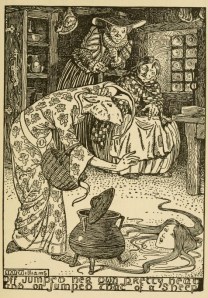
A Treasury of Forgotten Fairy Tales: Part 1 – Adalmina’s Pearl to The Brown Bear of the Green Glen

1186773_orig

Tired of the same old bedtime fairy tale stories every night? Are you a struggling screenwriter desperate for ideas but don’t want to risk a lawsuit? Or are you a producer who doesn’t want to pay for the rights of the source material? If so, then you’ll be pleased to know that there’s a treasure trove of fairy tales that have been recorded hundreds of years ago. But lately haven’t been as well remembered as the ones you often heard of. Sometimes it’s because they’re utterly messed up. Sometimes they don’t age well. Sometimes they’re from certain countries. And sometimes there’s not really a reason. They’re just overlooked. Anyway, in each installment of this series will bring you 10 of these tales for your reading pleasure. Though some take longer to summarize than others.

bremen-town-musicians

In this first installment, I’ll bring you the first 10 forgotten fairy tales you can enjoy. First, a Finnish tale spoiled rotten princess who gets her comeuppance after losing a key piece of jewelry. Second, an Armenian story about a king who’s so handsome that a queen starts a war to get him, making Gaston look seemingly rational. Third, is a Grimm tale about a man who dons a bearskin and not do anything to his hair for 7 years so the Devil doesn’t get his soul. Next, is an Irish yarn about a 3 brothers and a black knight known for his tall stories. After that, is a French story about a prince who gets turned into a bluebird when he refuses to get married when the wrong girl shows up at the altar. Then we come to a British tale about an Irishman who ventures to the Blue Mountains after meeting a princess while spending a night in a castle. Next, it’s on to a Grimm tale about a tailor who goes from killing flies to killing trolls followed by another Grimm tale about a group of geriatric animals who start a band. Then, we have an Italian story about a boy turned into a deer and a girl who falls victim to attempted murder. And finally, a story about a young man who meets a talking bear, giants, and a sleeping woman he eventually knocks up.

1. Adalmina’s Pearl

edelfelt_adalmina

Adalmina’s pearl is basically about a bratty princess who gets her comeuppance after losing a piece of jewelry that makes her hot. Don’t worry, she gets better.

From: Finland
Earliest Appearance: Collected by Sakari Topelius.
Best Known Version: The one by Topelius, obviously.
Synopsis: As the only child of a king and queen, Adalmina receives gifts from 2 fairy godmothers. One gives her a pearl that will make her prettier, smarter, and richer every day. The other promises should she lose pearl and all it gives her, she will gain a pure, loving heart in its place. Naturally, the princess grows up to be smarter, prettier, and richer than everyone else. But she is unbelievably proud, vain, selfish, and cold-hearted spoiled brat. And is generally a pain in the ass to everyone but her doting parents. As her pearl is permanently set into a crown that magically grows to always fit her permanently.

One day, Adalmina sneaks out of the castle and comes across a clear forest pond where she loses her crown while admiring her reflection. Instantly, the princess turns into a plain peasant girl in rags and forgets everything about herself. As she aimlessly wanders in the forest, and old lady finds her. Out of pity, she lets her live with her and tend goats. Now possessing a kind and loving heart, Adalmina is grateful for what little the old lady can offer her and is happy to live with her in a humble cottage.

adalmiina_maija2

Here are a couple of pictures of Adalmina after losing her pearl. In one she tends goats. In the other she sews with an old woman in her cottage.

Terrified of their daughter’s disappearance, the king and queen, they send out a message that should a prince or noble successfully find her, he will receive her hand in marriage and half of her dad’s kingdom as a reward. One prince who has heard of Adalmina’s unparalleled beauty and brains, has fallen in love with her from afar and is determined to find her. However, once he travels far and wide and finds that everyone he meets thinks she’s such a brat who should stay lost, he loses interest in the princess after finding her crown in the woods. Tired and lost, he stumbles upon an old woman’s cottage where he stays for a few days before returning to the king and queen with the crown.

adalmiina_maija

Adalmina arrives to the castle in rags and herding goats. Here you can see the shiny tiara with the magic pearl.

Overjoyed to learn about the crown, the king and queen summon every appropriately aged girl in the kingdom to the castle in order to try it on. As expected, the crown passes from head to head but fits no one. Having enough of this, the prince decides to stay until sunset if the princess isn’t found by then. Yet, just as the sun is disappearing on the horizon, a goat herder girl from the cottage shows up on the road to town. Happy to see her, the prince promises to marry her whether Adalmina is found or not. In the end, the crown fits the girl and she transforms back into the Adalmina everyone knew with all beauty, intelligence, and riches restored. But now that her heart is permanently thawed, she falls to her knees begging forgiveness for every bad thing she’s done. The people rejoice. While the prince and princess are married and live happily ever after.

Other Versions: N/A
Adaptations: Adapted into a Russian opera.
Why Forgotten: It’s well known in Finland, Russia, and Scandinavia, but nowhere else.
Trivia: N/A

2. Ara the Handsome

320px-Shamiram_ara

Ara the Handsome is about a king who’s so hot that a queen starts a war against him, which ends horribly. Despite that she should just give up and find somebody else, especially if the guy’s married.

From: Armenia
Earliest Appearance: Earliest written records were by the early Christians. Though it’s possible that the pagan Armenians worshipped Ara as a god of war and rebirth. It’s also possible that Ara might’ve been based on King Aramu, first king of Uratu, an empire from the 800-500 BCE that comprised of Turkey and Armenia. While Semiramis might’ve been based on the real life Assyrian Queen Shammuramat, his contemporary.
Best Known Version: The Christian version is the best known.
Synopsis: Hearing of King Ara’s legendary hotness, Assyrian Queen Semiramis is so obsessed with him that she’ll stop at nothing to have him. Hell, she even drove her husband away because of her infatuation. But when she asked to marry the guy, Ara turns her down. Mostly because he already had a wife named Nvard. As a result, Semiramis declares war on Armenia and orders her army to attack the country and bring back Ara alive. Except they don’t since he was killed during the war.

king-aram-with-his-child-ara-the-handsome-2014

Here’s King Ara in his procession. He raises his child with his queen. Too bad everything’s about to go to shit.

So in order to calm down the Armenian armies who want to avenge their king’s death and to satisfy her lust, Semiramis tries to use black magic to resurrect Ara. Placing his body upon her castle, she calls on hound spirits to lick his wounds clean and heal him but to no avail. Grief-stricken, Semramis instead had him buried at the mountain’s foot and dressed up one of her lovers as Ara to convince the Armenians that she resurrected him. Thus, the war ended. Aferwards, Semiramis has all but one of her sons killed for mocking her lust for the dead king. Eventually the son grows up to kill her.

Other Versions: Earlier versions have Seramis successfully resurrecting Ara.
Adaptations: Not that I know of.
Why Forgotten: Well, outside Armenia, he mostly is.
Trivia: Armenians see Ara as one of their country’s forefathers.

3. Bearskin

1911CharlesFolkardBearskin

Bearskin is a Grimm tale about a man who must wear a bearskin outfit and avoid cleanliness for 7 years. Or else the Devil gets his soul. Not surprisingly people don’t seem to like him much.

From: Germany
Earliest Appearance: Collected by the Grimm Brothers.
Best Known Version: The Grimm version, naturally.
Synopsis: After leaving the army, a soldier can’t return home or find work. Desperation drives him to make a deal with the Devil who makes a bet with him. For the next 7 years, he’ll carry a purse of gold that’s always full. But he must wear a bearskin and neither pray nor wash or cut his hair within that time. If he survives, he can keep the purse. If he dies, then the Devil has his soul.

untitled

After saving an old man from debtor’s prison, the guy offers Bearskin one of his daughters in marriage. Only the youngest one goes for it though. They fall in love but Bearskin can’t marry her until his ordeal is through.

The soldier spends several years walking the earth, giving to the poor, and asking them to pray for him. One night he rescues an old man from debtors’ prison. In exchange, the man promises the hand of one of his daughters in gratitude. The older 2 reject him, while the youngest accepts knowing that only a good guy would’ve rescued her dad. The soldier gives her half a ring and tells her to wait 3 years for his return. If he doesn’t show up by then, she’s free to marry somebody else.

091

Apparently, the old man’s daughters don’t seem to have much interest in Bearskin. After all, he wanders the earth wearing a bearskin outfit and doesn’t cut his hair.

The soldier survives to the end of his term, gains the gold purse, and cleans himself up before visiting the old man again. Everyone but the youngest daughter takes a keen interest in him, especially when he says he’s come to seek a bride. As the older girls pretty themselves up, the soldier shows the younger girl the other half of the ring. They marry and live happily ever after. But the older sisters are eaten alive with envy and kill themselves pleasing the Devil who got a 2-for-1 deal.

Other Versions: Included in Andrew Lang’s The Pink Fairy Book. Some versions have the father about to kill himself before the Bearskin guy saves him. Italian variants include Italo Calvino’s “The Devil’s Breeches” and “Don Giovanni de la Fortuna” in Laura Gonzenbach’s Sicilianische Märchen. Other variants consist of “Hell’s Gatekeeper” and “The Reward for Kindness.”
Adaptations: Adapted into an Americanized version set around the Civil War by Tom Davenport, a Russian cartoon, two operas, and a musical.
Why Forgotten: I’m not sure why it’s not made into a Disney movie. Then again, it takes place over some years.
Trivia: Said to have much in common with Beauty and the Beast.

4. The Black Thief and the Knight of the Glen

ebony-avroniev-exteriorscene

The Black Thief and Knight of the Glen is an odd tale since it’s more of a frame story pertaining to 3 guys stuck in a prison cell with the title character. It’s complicated.

From: Ireland
Earliest Appearance: Collected in Hiberian Tales.
Best Known Version: The one in Andrew Lang’s The Red Fairy Book.
Synopsis: A king promises his dying wife that their 3 sons will never be under another woman’s power. When he remarries, he hides the boys from their stepmother. But she discovers them, and with a pack of cards she got from a henwife, wins a game with the 2 older ones that puts them in her power. However, she doesn’t succeed with defeating the youngest. Yet, when she orders the older ones to return with the Knight of the Glen’s wild Steed of Bells or else lose their heads, he goes with them.

Enter the Black Thief who decides to accompany them. They try to steal a horse, but it neighs and rings its bells. So the knight catches them. He decides to boil them all. First, the boys by age and then the thief. Each time a prince is up, the Black Thief spins a yarn about how he narrowly escaped death from a greater danger. And with each tale he tells, the knight spares each prince one by one.

Yet, his third story pertains to him saving a mom and baby in the forest from a giant, which the old woman confirms as true. She then goes on to say that she was the woman and the knight was the baby. Grateful, the knight pardons the thief and gives him the horse. When they return to the kingdom, the queen is so enraged that she throws herself from a tower and dies.

Other Versions: There’s a variant by Seumas MacManus in The Donegal Wonder Book called “The Steed O’ Bells.”
Adaptations: N/A
Why Forgotten: I’m not sure why exactly.
Trivia: N/A
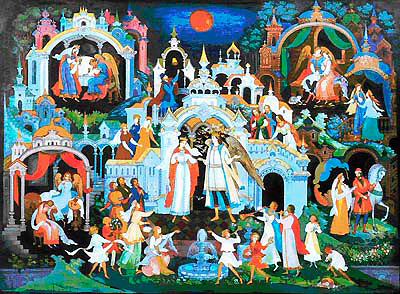
5. The Blue Bird

aa99f121c97a2237616b25c58fa98ba4

The Blue Bird is a French tale of a prince who gets turned into a bluebird because he wanted to marry a different princess than an evil queen wanted. There he meets his beloved princess locked in a tower for the next 2 years.

From: France
Earliest Appearance: Originally published in 1697 by Madame d’Aulnoy.
Best Known Version: Andrew Lang’s English translation in The Green Fairy Book.
Synopsis: A queen dies, leaving her husband and a daughter named Florine behind. The king remarries a single mom with a daughter little older than the princess named Truitonne. Florine grows up to be kind and beautiful. While Truitonne becomes an ugly and selfish bitch. This causes the Queen to become jealous of her stepdaughter and goes out of her way to make the girl miserable. One day Prince (or King) Charming of a neighboring kingdom pays a visit. Despite the Queen and Truitonne’s best efforts, it’s love at first sight between him and Florine. Enraged, the Queen and her daughter persuade the king to lock the princess up in a tower for the rest of Charming’s visit, insisting Florine is ill and needs rest. However, the Queen concedes and has Florine and Charming meet one night where he proposes to her. Or so he thinks because it’s too dark and he can’t see who the hell he’s talking to. And in reality, he’s actually proposed to Truitonne.

d7f52b8f

Here the stepsister’s fairy godmother turns the prince into a bluebird. Because the prince didn’t want to marry her and had meant to propose to a different girl.

Luckily, Charming realizes he’s been had at the altar. As a result, he and Truitonne get in an argument, with her insisting he say, “I do.” When he refuses, her fairy godmother Soussio curses Charming for the next 7 years as a bluebird. In his new form, Charming flies to the tower where Florine’s kept prisoner. Now reunited, the lovers spend the next 2 years bonding and keeping each other company through their respective misfortunes. While Charming often flew in with some sort of treasure he’d pass to Florine as a gift. Meanwhile, the Queen tries to find another husband for Truitonne, but to no avail. Frustrated by the task’s futility, she decides to let off steam at Florine in the tower, only to burst in on her and Charming singing together. She also discovers Charming’s gifts to the princess and realizes that her stepdaughter is receiving aid. The Queen recruits a servant girl to keep Florine company, but actually to spy on her and recruit back to her and Truitonne. Fearing Florine’s step-family discovering their secret, she and Charming decide not to see each other for awhile. Only to meet again when they’re sure the spy is asleep. But she isn’t and tells the Queen and her daughter about everything.

Oiseau

The bluebird visits Florine at her tower. Because the queen in this fairy tale is a bitch and her daughter has her own fairy godmother for some reason.

When Charming isn’t visiting Florine, he’s built a nest for himself in a nearby cypress tree, which the Queen had covered with knives and razors. When Charming flies over, he cuts his wings and falls to the ground. Fortunately, his old sorcerer friend finds him and helps him recover. He even finds Soussio and convinces her to transform Charming back into a man. But on the condition that he’ll only get to be himself again for a few months and he must marry Truitonne during this time. Or else he’ll be transformed back into a bird forever. Oh, and unbeknownst to him, Florine has no way of communicating with anyone outside her tower and doesn’t know of this. So she fears something bad must’ve happened to Charming. One day, the king dies, causing the people to rise against the Queen and eventually kill her. Truitonne seeks refuge with her godmother. While Florine is released from her tower and becomes the new Queen. After appointing a council to run the kingdom, she embarks on a quest to find out what happened to Charming.

Disguised as a peasant, Florine meets an old woman. Impressed by her goodness and devotion, she reveals herself as a fairy. She tells the new queen that Charming has regained true form and has returned to his kingdom. She also gives Florine 4 magical eggs on her journey. When she has to scale a steep ivory mountain, she cracks open the first egg containing good grappling irons. So Florine makes it over the mountain in no time. She then finds a village in a valley with an enormous mirror that shows you only what you want to see about yourself. To avoid giving into the same temptation and the villagers’ wrath if she harms the mirror, she uses the second egg with a dove-pulled chariot. And she uses the chariot to fly to Charming’s castle.

The guards don’t recognize Florine and turn her away. Even worse, since she doesn’t know the complete story, she hears that Charming is to marry Truitonne soon. Disguised as a peddler, Florine bribes her stepsister with the same jewels and gifts Charming had given her while he was a bird. In return, the queen is allowed to sleep in the castle, specifically the “echo room” underneath Charming’s bedroom where he can overhear every word a person says in there. Florine takes full advantage of this, crying as loudly as she could every night and asking for some explanation from her ex. Yet, she doesn’t know that Charming had been taking sleeping potions for insomnia over worrying about her.

800px-Épinal_-_L’Oiseau_bleu_14

Here Florine tries bribing her stepsister. Though it doesn’t seem to look like it since Truitonne ages quite prematurely that she appears old enough to be Florine’s mom.

Florine opens the third egg containing a mice-pulled chariot she sells for another night in the echo room but Charming can’t hear her. Fortunately, one of the servants does. She opens the last egg, containing a pie with singing birds that she gives to the servant so Charming could hear her next time. The servant keeps his promise and Charming doesn’t take the potion, causing him to hear every word. Florine and Charming finally reunite and after explaining everything that went on, affirm their love. Of course, there’s still Sussio to contend with. Luckily, the sorcerer and Florine’s fairy sponsor promise to keep her at bay. Truitonne tries to protest, but the sorcerer turns her into a pig. Free from their enemies, Charming and Florine marry and live happily ever after.

Other Versions: N/A
Adaptations: N/A
Why Forgotten: Perhaps it’s because it was first written by a French aristocratic woman. Other than that I’m not sure. Then again, the story’s pretty weird.
Trivia: A favorite of Jean Paul Sarte.

6. The Blue Mountains
From: UK or Ireland
Earliest Appearance: Collected by Andrew Lang in The Yellow Fairy Book but with no bibliographical information.
Best Known Version: The one in Andrew Lang’s The Yellow Fairy Book.
Synopsis: A Scotsman, Englishman, and Irishman, all soldiers, go AWOL together. They’re dying of hunger when the Scotsman sees a castle and goes in without telling the others. An astoundingly beautiful woman feeds him and gives him a bed where he falls asleep. The Englishman follows and gets the same. But when the Irishman comes in, he asks what it all means before eating anything. The woman reveals herself as a princess who can only be saved by a man who stays in a little room from 10:00 till midnight for 3 nights on end. When he does this, he’s severely beaten but the princess revives him.
She disappears. But the Irishman is instructed to stay awake to see her. However, a little boy sticks a pin in his coat, putting him to sleep. He spends 3 years searching for her and is ready to kill himself. Yet, when he draws his sword that she gave him, it tells him that he’d find her in the Blue Mountains. He goes onward. 2 hermits can’t tell him anything while a third commands all the birds in the world. When they arrive, only the eagle knows of the Blue Mountains but is willing to carry the Irishman there. He comes the day she’s forced to marry, gets the hen-wife to bring her to him, and they tie the knot on the spot.

Other Versions: N/A
Adaptations: N/A
Why Forgotten: Well, its origins are obscure that barely anything is known about this fairy tale.
Trivia: N/A
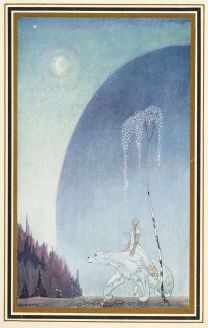
7. The Brave Little Tailor

the-brave-little-tailor-dugina-belt

A Grimm classic, The Brave Little Tailor is about a tailor who swats some flies and cultivates a fearsome reputation. He then goes off to fight giants.

From: Germany
Earliest Appearance: Collected by the Grimm Brothers.
Best Known Version: The Grimms’ version is the best known.
Synopsis: Preparing to eat some jam, a tailor kills 7 flies on it with one blow before making a belt describing the deed and setting out in the world to make his fortune. He meets a giant who thinks he’s a badass from the phrase (which is a joke) before challenging him but the tailor defeats him in his wit. The giant then takes him to other giants and makes plans to kill him in his sleep. But the plan fails as the tailor decides to sleep in a corner since he finds the guest bed too large. Discovering the tailor alive, the giants flee in fear.

the-little-brave-tailer_4

Here the tailor ventures to the land of Giants. Wonder how he’ll get out of this.

The tailor joins the royal service but the guards are afraid of him and appeal to the king to remove him. In response, the king sends him on a series of difficult quests, which involves giants, hostile unicorns, and other hazards armed only with his wit. After completion, he receives half the kingdom and the king’s daughter in marriage. Later, his wife hears him mutter in his sleep that he’s a simple tailor. Though a squire later warns him, he decides to speak of his legendary deeds.

the-little-brave-tailer_5

After defeating giants, the brave little tailor enters the King’s service and is sent on a series of impossible tasks. Armed with only his wit, he succeeds to win the King’s daughter and inherit half the kingdom.

Other Versions: An Italian version has him smacking 500-1000 flies instead of 7. Included in Joseph Jacobs’ European Fairy Tales as “Seven in One Blow,” Andrew Lang’s The Blue Fairy Book, and in Ruth Manning-Sanders’ A Book of Giants.
Adaptations: Made into a Mickey Mouse cartoon and musical suite.
Why Forgotten: Well, it’s not quite forgotten but it’s hardly well-remembered.
Trivia: Said to inspire “Jack and the Beanstalk.”

8. The Bremen Town Musicians

complete024

A Grimm classic, The Bremen Town musicians decide to retire, get a house, and start a band. Yet, let’s just say you don’t want to see them in concert.

From: Germany
Earliest Appearance: Collected by the Grimm Brothers.
Best Known Version: The one by the Grimms.
Synopsis: Since their owners want to kill them for being too old, a group of animals decide to run away and form a band. Unfortunately, unbeknownst to them, their singing is atrocious. While their first “concert” scares away its audience: a group of robbers stationed at a cottage. The animals settle into the cottage and when the robbers return by night, they accidentally repel them because of the thieves’ superstitious fears. The animals decide to stay there and live happily ever after.

complete008

They may not be good musicians. But at least they don’t need to worry about a security system anytime soon.

Other Versions: N/A
Adaptations: There’s a Soviet animated musical called The Town Musicians of Bremen, Jim Henson’s The Muppet Musicians of Bremen, the German cartoon movie The Fearless Four, the Spanish animated film and TV series Los Trotamusicos, and the Cartoon Network short The Bremen Avenue Experience. There’s even a Richard Scarry version.
Why Forgotten: It’s well-known, especially in regards to cartoons. But it’s still nowhere near mainstream. Perhaps it’s because it doesn’t have much of a plot.
Trivia: N/A

9. Brother and Sister

30f0a0f6e7b69ab157f93bfd376f2fc1

In the Grimms’ Brother and Sister, 2 kids are driven out of their home by their stepmother and forced to live in the forest. But unlike Hansel and Gretel, the brother turns into a deer.

From: Italy and Germany
Earliest Appearance: Collected by Giambattista Basile in Pentamerone around the 17th century.
Best Known Version: The one collected by the Grimm Brothers.
Synopsis: After their mother’s death, a boy and a girl are mistreated by a wicked witch stepmother that they decide to run away from home and into the forest. In turn, the stepmother enchants the forest streams so that drinking from them will turn the siblings into animals. The girl sees through the trap and talks her brother out of drinking from 2 streams that would’ve turned him into a tiger or a wolf. But when they come to the stream that turns people into deer, he’s too thirsty to care anymore. So he drinks and is turned into a roe fawn. Later, the two find a deserted cottage and decide to live there, fending for themselves in the wilderness. Years have passed when a king and court come hunting in the forest. The brother makes a game for the hunters to chase him before hiding in the cottage that evening. But he’s wounded the second time and leads the hunters to the cottage.

f3d414c8a6856ae57f196ab8991d93fb

The girl and her deer enter in a cottage. Despite that the deer is actually her brother as you can notice with the antlers.

On seeing the sister, the king falls in love with her asks her to marry him. She agrees but only if her deer brother can come, too. She’s made queen while her brother resides in the royal gardens. After a while, the sister and the king have a child. But by now, the stepmother has learned that the siblings are still alive. So driven by hate and envy, she plots to destroy their happiness. She has the sister suffocated in a bath house and replaced with her own ugly one-eyed daughter, magically made to resemble her stepsister. But the sister returns as a ghost to look after her baby. This works for awhile until the king recognizes the spirit as his true wife before she’s restored by God. The king executes the witch and the brother turns back into a man. As they all live happily ever after.

Other Versions: A Hungarian version has a much younger sister turn into a deer instead of a brother. Some versions have the brother marry the king’s sister after he turns back into a man. The Grimm version refers the brother as Rudolph and the sister as Rose (and no, I don’t think Rudolph is a red-nosed reindeer). Known as Sister “Alionushka, Brother Ivanushka,” in Alexander Afanasyev’s Narodnye russkie skazki.
Adaptations: N/A
Why Forgotten: Overshadowed by Hansel and Gretel. I guess the candy house beats boy turned to deer any day of the week. Also, the sister gets suffocated.
Trivia: Often confused with Hansel and Gretel.

10. The Brown Bear of the Green Glen
From: Scotland
Earliest Appearance: Collected by John Francis Campbell in Popular Tales of the West Highlands.
Best Known Version: Campbell’s version, obviously.
Synopsis: An Erin king sends his 2 older sons to find a cure for his blindness and lameness. Later his youngest son, John goes with them, despite being a fool. He found his brothers in the first town and went on. He meets a talking bear who tells him to stay with giants for 3 nights. While the last giant tells him how to get an eagle to carry him to the land with healing waters. When John gets there, he takes 3 bottles of water along with a bottle of brandy, a loaf of bread, and a wheel of cheese that are always the same no matter how much you ate from them. Oh, and he kisses a sleeping woman (or date rapes her if you want to interpret it). On the way back, John leaves the brandy, cheese, and bread with the giants, but on the condition they give them to his sweetheart if she came. He meets up with his brothers. They try to kill him and leave him loaded onto a rusty iron cart, making him rough skinned and bald.

Meanwhile, the woman gives birth to a baby boy. The henwife gives her a bird that would hop onto the man who’s the kid’s father. She tracks him down and gets the brandy, cheese, and bread back. Reaching the king’s court, all the men line up, but the bird doesn’t jump on them. Asking whether there are others, she’s told that a rough-skinned gillie who worked as a smith. The bird hops on his head, proving that he got the water his brothers had stolen. John marries the woman as his brothers are punished.

Other Versions: N/A
Adaptations: N/A
Why Forgotten: Well, it contains date rape, for one. Though whoever wrote this down didn’t seem to know much on how human reproduction works.
Trivia: N/A

The Final Season of Game of Thrones: Part 3 – Tossups

game-of-thrones-season-8

Finally, considering the nature of Game of Thrones, are the tossups. Given this is a show where fantasy tropes are subverted and anything can happen, you can’t be sure whether these figures will live or die in the final season. Besides, since we’re getting close to the end, main character plot armor may not be as reliable as in earlier seasons. Hell, even the characters I’ve guessed could live or die may not face their predicted fate. Seriously, who knows what will happen. Though as they say in Hamilton, you have no control who lives, who dies, who tells your story.

GameOfThrones_S07_Glamour_HBO_22aug17

Tormund Giantsbane– as the last real leader of the free folk, Tormund needs to survive to bring them into a new time of peace and prosperity and romance Brienne of Tarth. As a savagely fierce warrior, Tormund has fought tooth and nail against the wights beyond the Wall. But it’s also thoroughly fitting for Tormund to die in battle alongside Jon Snow, the man he’s chosen to follow. Since fighting’s what he knows best and there’s little for him in a ruined world. Hell, we’re not sure if he survived the Night King’s break through the Wall. Since he was last seen standing atop of it. Either way, he’s come painfully close to death plenty of times before. So it can be either way.

290731__59822.1349962692.380.500

Bronn– as his world’s Han Solo with less moral scruples, he’s a survivor who’s got a knack for picking a winning side in a fight while managing to remain likeable, it would be nice to see him get his own dream castle. However, given how Season 8 will be the show’s most dangerous, it’s a bad time to be a mercenary since a lack of loyalty on one side for money will come back to bite him. One mistake and it can be his life. But since he genuinely cares about others, he’ll be back fighting for the right side no matter how much he’d complain about it or say otherwise. Above all else, Bronn is a man who loves to fight which he’s best at. He may not get his castle (since there won’t be many left by the end), but dying with a sword in his hand seems like a good consolation prize. Nonetheless, even if he fights the wrong side, we’d like to see him live.

cq5dam.web.1200.675

Sandor “The Hound” Clegane– from child-killing Lannister lackey to stalwart defender of the living, The Hound has changed more than almost any character on Game of Thrones. Given his figurative “death” in Season 4 and all the hardships he’s suffered, it would be nice to see him enjoy a peaceful retirement. Assuming if he survives the White Walkers and his undead brother the Mountain. But now he’s weary of the battles he’s had to fight and the people he’s had to fight them for. While there are few people he genuinely cares about, it would make more sense for him to die on the battlefield. Since he may not have a purpose once his brother dies. Though it would be nice for him to have some happiness in his life.

Brienne

Brienne of Tarth– as one of the most loyal and honorable characters who will be on the front battle lines against the White Walkers, defending her charges from harm with her fighting prowess and her Valyrian steel sword. Though she’s already filled her purpose in protecting the Stark sisters. On one hand, being noble and true can get you killed on Game of Thrones. On the other hand, since Brienne is so self-sacrificing, killing her off would be a low blow. Besides letting her live will give the opportunity for Jamie Lannister to die in the arms of the woman he platonically loves. Also, I’d like to see her marry Tormund Giantsbane.

5fc6875603277c4c40c141ba9c1fc3cd

Daenerys Targaryen– as the only character with dragons, she will be an integral part of whatever plan of the living make to take down the army of the dead. Since this is Game of Thrones, the plan won’t go off without a hitch. People close to Daenerys will die and she will be in constant danger. But will the White Walkers take down the Mother of Dragons herself? Given that the show has a reputation of killing off characters who seem like heroes. After all, anyone can go away at any moment.

2017_GameofThrones_HBO_150717-920x584.jpg

Jon Snow (Aegon Targaryen)– now that he’s been revealed as Aegon Targaryen, he’ll certainly be important in the endgame. But will he get to rule the Seven Kingdoms or will he nobly die to prevent the Night King from obliterating humanity? Now it’s probably a given that he’ll marry and have a child with Daenerys. Yet, Jon has no problem throwing himself into battle, no matter who the enemy is. From the moment he joined the Night’s Watch, he’s been in dangerous situations every other minute of his life. Since he’s a tested battle commander with more experience fighting White Walkers than anyone living and knows it’s the right thing to do, Jon will lead the army of the living against the army of the dead. Given his plot armor as one of the main characters, he may survive the wars as they come. But his importance to the plot hasn’t always saved him. After all, if it weren’t for Melisandre’s magic, Jon would’ve ended up 6 feet under in Castle Black’s cemetery. And as we get close to the end, Jon’s plot armor may not be as effective as it used to be. Even if he survives the battle, there’s no guarantee he’ll survive the scramble for leadership that will follow. Even more than his uncle, Jon has always tried doing things honorably. And we know how that worked out for Ned. Then again, maybe he’ll combine his claim with Daenerys and let her handle Cersei so he won’t have to die. Of course, given that it’s Game of Thrones, we know nothing.

drogon-dany-hbo_duhiti

Drogon– since hatching from a dragon egg, Drogon has taken part in some of the most important moments of Daenerys’ journey. Since he’s shared a tender moment with Jon Snow after Viscerion’s death, he’s more than a one-dimensional death machine. Drogon and Rhaegal are Westeros’ best hopes for surviving the coming war with the White Walkers. Since things will have to get worse before they get better, one of them may have to go. And given that Drogon is Jon and Dany’s biggest weapon, odds don’t look good.

DILvT9oWsAAfcLD

Rhaegal– while Drogon got to do all the exciting stuff, Rhaegal usually played second fiddle with his brother Viscerion. If Drogon falls to the White Walkers, Rhaegal can step up to the plate and help Daenerys and Westeros in dire need. But even if he survives the war, his future in a post-Night King Westeros could be in doubt.

untitled

Ghost– sure he hasn’t been seen since the start of Season 6, but he’s implied to be alive though not at his master Jon’s side. Yes, money could be a reason but CGI dragons cost a lot while we’ve seen Arya meet up with Nymeria and her family. Though if a character isn’t on the show, can he really be killed? Let’s hope not. Still, killed or not, expect him to have at least some heroic moments on-screen.

59a46e8752c08036008b474b-750-562

Davos Seaworth– he’s been clear he’s not a fighter. He’s also an old man and doesn’t have all his digits (or at least finger ends), which makes him less likely to survive the carnage. But with the Night King and his army marching, the Onion Knight may not have a choice but to get the sword and go right at it. Sure he may enjoy Daenerys’ and Jon Snow’s protection as one of Jon’s closest advisors. But the army of the dead won’t care. Should Winterfell fall, Davos may sacrifice himself should things go south, noble soul he is. Since there will be heartbreaking deaths in the series, it’s likely his will tug at the viewers’ heartstrings. And there will be plenty of opportunities for him to bite the dust. Still, it’s possible Davos could survive since he’s lived through the deaths of the 2 men he’s chosen to follow. As the wizened adviser, if he lives, he can go on as Jon or Dany’s right-hand man.

170823-madison-Arya-Stark-tease_nb2ftt

Arya Stark– a trailblazing in the high stakes world of reparation and murder, a connoisseur of vigilante justice, and a stone-cold, blood-lusting assassin with serious moves. But more importantly, she’s a young woman with a big heart who’s suffered through more loss and pain than most people will deal with in a lifetime. Such losses have left her lost, scared, and forced to carve her own way in the world with little or no guidance from anyone who could’ve served as a nurturing influence in her life. Losing her dad Ned, her mother Catelyn, and her brother Robb have affected Arya deeply and set her on a dark, dangerous path to no return. But when faced with the choice of vengeance or return home, she went back to Winterfell. Sure, she’ll take down a few more. But her arc is about a loss of identity and by prioritizing family, she gave herself a new beginning, not an end. It seems downright foolish to kill her off when she’s got a whole new world of potential. Besides, given that she’s led a life of violence, there are 2 outcomes: either she falls by the sword or settles down to a quiet life and starts a family. As of Season 7, she seems heading toward the latter, especially given that Nymeria’s leading her own pack and that Gendry’s back. On the other hand, given that she puts herself through the most dangerous situations, she also has the least purpose in a post-war Westeros world, aside from having a family with Gendry. So if another Stark child has to die, it will probably be her.

d099756c978872c37f05f974fd0d8fc4.png

Podrick Payne– squire to the rich and famous, he’s a magical instrument of pleasure. Podrick may not be overly clever, great with a sword, or even chatty, but he must be doing something right. Since he’s made it to the final season. Lately, he’s been following Brienne while she’s smacked the crap out of him. Besides, he’s so good-natured, affable, and kind-hearted, that we can’t think of who’d want to hurt this guy. Okay, everyone. Still, chances are he’ll survive and get his knighthood, but barely. But once Brienne returns to Winterfell, he’ll be facing the army of the dead and unlike her, he won’t have a Valyrian steel sword to protect himself. So killing him off might make more sense, especially given his ineptitude on the battlefield as well as tug at fans’ emotional heartstrings.

5b91e0ef38359aca6e249d94990177af

Yara Greyjoy– since Season 7, she’s been her uncle Euron’s prisoner and is in a lot of danger. So we’ll have to hope that Theon rescues her soon (despite that he’s headed in the wrong direction and that he failed the first time he tried due to PTSD). Then again, she might be dead already since she’s a threat to Euron’s rule. Yet, seeing that seeing Euron emerge victorious is too nightmarish and that Theon seems destined for heroic sacrifice, Yara could be the one Greyjoy to make it out alive.

image

Daario Naharis– now that he’s no longer in a relationship with Daenerys, I don’t see him appearing in the show anytime soon. He’ll live since he’ll be running Meereen with the Second Sons, anyway. On the other hand, since Cersei has enlisted the help of the Golden Company from the East and the Second Sons wouldn’t let them invade Westeros unchallenged. So Daario may join the fray with his own band of mercenaries and he may not survive it.

577298fb6450a31b008b5079-750-563

Hot Pie– the only way he’ll die would be if the army of the dead ransacks the Crossroads Inn and kills everyone there. Still, he probably won’t appear in Season 8 at all. Then again, since the Crossroads Inn is along the Kingsroad in the Riverlands, he’s not really out of the woods. Besides, he doesn’t have any impact on the story anymore.

The Final Season of Game of Thrones: Part 2 – Who Dies

crypt-shoot-promo

As it’s said on Game of Thrones, all men must die. But during the show’s final season, some will bite the dust sooner than others. With the army of the dead marching towards Winterfell with an intention to wipe out humanity and Cersei trying to cement her power in the Seven Kingdoms, plenty of characters will not make it. Some will fall to the army of the dead. Minor characters will put on redshirts to show how much danger everyone’s in. Some will get killed in gruesome ways. While some will get what’s coming to them. Nonetheless, expect fans to shed tears on some of them. Because when you play the Game of Thrones, you win or you die. And even if you win, you won’t be on top for long since you’ll end up dead.

MV5BNjg3ODZlOTgtOWQ2NC00ZGMxLWE5MTAtZDAxNTkxNWM2MzFjXkEyXkFqcGdeQXVyMjk3NTUyOTc@._V1_

Gregor “The Mountain” Clegane– given that he’s a giant, intimidating, zombie killing machine who does Cersei’s bidding, he’ll have to swing his sword at someone who matters at some point. When he does, the show will milk it for all it’s worth, especially when he falls. The only question is who’ll take him down and whether he’ll take anyone down with him. Still, if he doesn’t fall to his brother the Hound at Cleganebowl (which will most likely happen since the showrunners have teased it for a couple of years), someone will get him. And it’ll be after Qyburn goes so there will be no way to resurrect him again.

fb2668a96f3ba5b514d4db5b206c110c

Ellaria Sand– given now that she was last seen headed for a Red Keep dungeon, she’s probably dead already. Sure Cersei said she wouldn’t let her die even if the guards have to force feed her. But that promise probably isn’t going to stick after she watches her daughter Tyene bite the dust to poison.

image

Cersei Lannister– now that she’s sitting pretty on the Iron Throne, she’s been setting herself for a huge fall from the jump, making nothing but enemies and the wrong kind of friends. Daenerys wants her throne and has dragons. Arya’s vowed to kill her for years. The Night King wants to kill everyone. While her brother, lover, and confidante Jamie has abandoned her. Even her allies are dangerous, like Euron who wants to marry her. Furthermore, she’s pregnant, which won’t go well with Euron. For all the evil’s she’s done, Cersei needs to go. Thus, the only question is how many more enemies she’ll have to take down before she bites the dust.

got_5.jpg

Melisandre– at 400 years old, she’s got a lot of blood on her hands. Melissandre’s blind devotion to the Lord of Light and belief that she’s saving the world has inspired her to commit terrible atrocities. But in recent seasons, she’s been wrestling with her guilt and it’s difficult to imagine a situation she’d try hard to avoid meeting her maker. Hell, she’s admitted that she’s been ready to die for many years while she’s scared the hell out of Varys by proclaiming they’d both die in Westeros. Though Melisandre is so powerful that it’s hard to picture a mere mortal taking her down, she’s made an enemy of Arya Stark for taking Gendry to Dragonstone. And while we know that Gendry is alive and well after a multi-season absence, Arya thinks Mel killed him and his death must be avenged. While the red witch has assured the two will meet again. If not, then she could sacrifice herself to the White Walkers.

macall_b._polay_-_hbo_photo_3-h_2017.jpg

Theon Greyjoy– now that Ramsay neutered him after he’s made just about every wrong decision he could possibly make, Theon’s only purpose in life is rescuing his sister Yara from his evil uncle Euron. Yet, whether he may succeed is another matter since he failed the first time due to his PTSD and he’s headed in the wrong direction. Sure his betrayal of the Starks have paved way for the Boltons taking over Winterfell, which he’s paid for dearly. Yet, he ultimately helped Sansa escape from her monstrous husband Ramsay. Nonetheless, his story may end in 2 ways. He could die saving Yara and atoning for his sins. Or he could live after Euron and Yara as the last Greyjoy leader of the Ironborn. But more likely, he seems to be on the path to a redemptive death, which will be a fitting end to the unluckiest guy in Westeros.

pnZrcRqn_400x400

Jorah Mormont– despite initially serving Daenerys in order to secure a pardon and return to Westeros, Jorah fell in love with his queen and spent the next 6 seasons by her side. Though considering he’s much older than his Dany, he knew that any romance with her wasn’t going to happen. So he stuck around as her adviser instead. Due to his grayscale things looked bleak for Jorah in Season 7, but a trip to the Citadel and Sam Tarly cured his illness. Only for him to head to the North for a suicide mission before returning to Dany’s side. As a secondary character, his place in the narrative puts him in the crossfire. Since Jorah won’t sit on the sidelines when his queen’s under threat from her many enemies, expect him to become his world’s version of Sidney Carton.

franksorryrandallsorry-Edmure-TullyHBO-6f1b2000-258c-4adb-a4da-46ea31c64402

Edmure Tully– otherwise known as the Groom from the Red Wedding, we’re not 100% if he’d make an appearance. Though with Walder Frey and his heirs dead and being the last Tully to change himself, someone has to fill the leadership vacuum in the Riverlands. Though he might be rotting in Riverrun’s prison dungeon at this point. Still, if he does show up, the show probably wouldn’t gain much from killing him since we don’t know the guy very well. On the other hand, this makes him expendable which isn’t a great thing to be when an army of zombies bears down on you. Nonetheless, the show will need someone to rule the Riverlands after the main conflict is over and Edmure is the prime candidate. Though he has a son who could fill the role. Either way, he’s not much of a fighter and doesn’t have a knack for strategy. But he’s honor-bound to fight with his Stark in-laws against the White Walkers. But unless being stuck in prison has knocked some sense into him, he’s going down.

image1

Jamie Lannister– though he started the series pushing a kid out the window, he’s slowly morphed into a character we could cheer for. After he’s spent some time with Brienne and got his hand chopped off. At the end of Season 7, Jamie’s headed north to join the fight against the army of the dead, which will be very, very dangerous for a man with one hand. If he survives, he has to deal with his sister. Jamie and Cersei both said they would leave together as they were born. Perhaps he could spend his days with Brienne or alone. But since Jamie has crimes to answer for, he probably can’t escape his fate.

varys-game-of-thrones-58bace0e5f9b58af5cb665c7

Varys-he’s an enigma who’s intent on placing a Targaryen on the Iron Throne. But we don’t know whether if he truly cares about the realm or if it’s just a self-serving desire. If he’s an all-seeing altruistic manipulator seeking a peace that will last beyond his own life, he might have a chance at a comfy retirement. But he could just as easily die in the service of it as well. Yet, if Varys is serving his own nefarious purposes, he’s sure to meet an untimely end. After all, he did very little to advance Daenerys’ cause in Seasons 2-4. And in Season 7, Dany threatened to burn the eunuch if he betrayed her. On top of that, Melisandre prophesized his death. “I have to die in this strange country, just like you.”

image2

Grey Worm– we’ve probably seen his death coming for awhile since he’s on the front lines in every engagement. But fighting the undead in the wintry North is different than what he’s used to in combat. Besides, one can only escape death so many times. But don’t feel bad since dying fighting is what he’s prepared his whole life anyway. Also, he has a beautiful love story with Missandei so you’ll be shedding tears on this one.

night-king-bright

The Night King– well, he has to die, doesn’t he? But we don’t really know much about him or his motivations. Perhaps deep down he’s a man who the Children of the Forest turned him into an ice monster against his will and he’s only knocking down the Wall to escape a prison he didn’t deserve. Then again, he could just have no feelings whatsoever. Though most likely Jon will drive Longclaw into his chest. Though it’s possible that he could be driven back or even win.

Dolorous-Edd-Tollett-701.jpg

Eddison “Dolorous Edd” Tollet– a fan favorite for his dour wit, friendship with Jon Snow, and a knack for staying alive in a show known for redshirting (killing off minor characters). As of Season 7, new Lord Commander Edd and the remnants of the Night’s Watch are holed up in Castle Black. While the White Walkers have broken through Eastwatch and are heading south. Should the Night King brings his forces to bear on the castle’s unprotected side, the acting Lord Commander and his men might as well be the redshirt army. Sure, Edd has fought wights before, but when the army of dead comes knocking at their door, it’s over. The only way he can avoid death is if anyone summons him before the White Walkers descend on Castle Black or if the army of the dead skips the place entirely.

beric-thrones.jpg.480x0_q71_crop-scale

Beric Dondarrion– now that Red Priest Thoros died in Season 7, the next time the Brotherhood Without Banners leader dies will be his last. In fact, he’s already dead in the books. A champion of the Lord of Light, Beric has been fighting the Great War against darkness since the series began. Given he’s a walking dead man who’s got nothing left but to live and die for the cause, he doesn’t stand a chance of surviving past victory. Since he’s not a big part of things.

euron-greyjoy-dragonstone

Euron Greyjoy– with Jamie’s departure and Cersei’s promise of sharing her bed and kingdom, things might be looking up for this Ironborn king. When he returns from Essos with the Golden Company, he’d want to cash in those IOUs. But with the army of the dead along with Daenerys and Jon’s forces, and Yara and Theon still around, Euron’s number coming up. Besides, Cersei doesn’t make the best ally, given what happened to the Tyrells. So it’s only a matter of when Euron will bite the dust and by whom. Since it’s difficult to see such an irredeemable villain being left alive in the end.

E1113MYC

Qyburn– he’s one of those supporting characters who’s been slipping directly under the radar for years since he’s been on the show since the beginning. In the show, he’s saved Jamie from losing his arm, brought the Mountain back to life, and helped Cersei to blow up the Great Sept of Baelor. He may be a quiet man, but he’s got tricks. Given the projected high body count in Season 8, he’s sure to have a great opportunity to examine fallen White Walkers. Still, once he’s hitched a ride to Cersei’s star, he’s destined to fall. Chances are, he’ll stand with her to the last. Maybe the Mountain can hulk out and lash out some poetic justice to his Dr. Frankenstein.

v8azNoE

“Bronze” Yohn Royce– a sturdy secondary character since Season 4, Royce is steely and no-nonsense. But we haven’t really delved into his inner thoughts and feelings. Nor has he ever been the head of his own storyline. Since a clash at Winterfell is inevitable, not every character will survive. Sure a couple major characters will die but not right away. So we must kill off some from the supporting cast and Royce is the ideal candidate. He’s a military commander so it’s all too easy for him to meet the end of a White Walker’s ice spear. Or the writers could surprise us. Since there won’t be much fallout on whether he lives or dies. But chances are good that he dies.

ice-dragon-1-970

Visceryon– now that he’s an undead ice dragon who’s broke down the Wall, his destruction has become a top priority for the good of humanity in Westeros and the known world. Chances are, either one his brothers or that giant dragon killing contraption will.

The Final Season of Game of Thrones: Part 1 – Who Lives

gameof.jpg

Of course, one of the more important questions of HBO’s Game of Thrones is who’s going to die next? Given that this show has been notorious for killing off major characters we’ve come to know and love as well despise. For God’s sake, the show began with Ned Stark as the main character. Only for King Joffrey to chop off his head just before the first season finale. The list goes on from there. Now some characters did get resurrected like Jon Snow and the Hound. While others got saved in the nick of time like Jorah Mormont. However, given that the show’s approaching the end, the stakes have been substantially raised. So it’s only fair that I make my own list on who will survive the series or who will die in the final season.

game-of-thrones-season-8-1

Note: Most of these will be guesses based on what I know about each surviving character in the show and what may happen in Season 8. So take each with a grain of salt. Also, if you haven’t made it to Season 7, there will be spoilers.

game-of-thrones


Given that Game of Thrones is infamous for killing off characters, we should expect some to make it through the series alive. After all, even as everything goes to hell, some will have to stand. The ending may not what we want, but after the White Walkers and Cersei is gone, people will have to roles to play in the Seven Kingdoms. Some have reasons to survive. While with others, there’s no way they’ll be in the thick of the action, especially against the army of the dead.

Screen-Shot-2016-05-22-at-9.54.55-PM-630x381

Jaqen H’gar– since he hasn’t been on the show since Arya left the House of Black and White to Westeros, he’ll probably live since she didn’t kill him in Braavos. Yet, remember those who live by the sword die by the sword. But he’s not likely to get it since we won’t be seeing him again.

game-of-thrones-spoils-od-war-sansa-stark-10

Sansa Stark– past the Long Night and into the future of Westeros, she’s one of the only major characters with the political savvy to lead what will be left of the Seven Kingdoms after the Great War has ripped them to shreds. Throughout Season 7, Sansa grew as a ruler demonstrating empathy, humility, and dedication to her role and her family. Along the way, she gained the respect of the Northern lords and bannermen, and the lord of the Vale. Sansa’s title as Lady of Winterfell isn’t just her birthright, but one she’s earned. This season, she was the only person in power to tackle the mundane, everyday tasks that are essential to a functioning household and kingdom. When she wasn’t busy spurning Littlefinger’s advances, Sansa was seldom seen without a ledger or other such documents in hand, showing that leadership isn’t just about battles, but also organization and community. She asked questions to the lords in order to improve her own knowledge, and made suggestions for how to better their circumstances as she prepared Winterfell for the Northerner influx she expects to host before war hits. Essentially, Sansa knows the threats surrounding all sides and she prepares accordingly. Once the Long Night is over, this is exactly the sort of leadership Westeros will need.

image

Samwell Tarly– since he doesn’t get his hands dirty, abhors violence of any kind, and would rather run from a fight if he can avoid it, he’ll certainly survive. Besides, he has a family now and will be happy to assist in the evacuation efforts before the armies clash. But more importantly, Sam needs to survive so he can tell the story of A Song of Ice and Fire. While he’s the most unlikely and perfect survivor as the intelligent, loyal, and often overlooked character who comes great in the end. Still, there’s no telling what will happen at the Citadel when the Maesters find out he stole all those books, which will be more than revoking a library card. Also, he’ll unquestionably sacrifice his life to save Gilly and Sam if need be.

image__1_.0

Gilly– all Gilly has done in this show is try to get away from her abusive family and support Sam. Yes, I know Game of Thrones may be tempted to kill her or her son off since they’re totally innocent people in a danger zone, but seeing them die would just seem callous. Besides, being Little Sam’s mother and in a relationship with Sam, she’s the link to make the show’s most functional family. One family has to endure.

image1

Bran Stark– considering that he got flung from a tower in the first episode, it’s such a feat that he’s made it to Season 8 at all (though Meera Reed should get a lot of credit for that). For the first time in years, Bran is formally ensconced in Winterfell as well as surrounded by friends and family. But given that an undead army led by a dragon-riding ice demon’s heading south, he’s not out of the woods yet. However, Bran’s foresight power could give him and the army of the living an advantage in the wars to come. He’s incredibly focused in the fight to the point where he’s tuned out all human emotion. For now, that’s a good thing. The last Three-Eyed Raven lived for an incredibly long time, Bran will likely follow suit. And at least he’ll know that it doesn’t end in the hands of the Night King.

Tyrion-Lannister-Eastwatch

Tyrion Lannister– he’s unlikely to be in the line of fire since he’s more of a battle strategist than a fighter since he won the major battle for the Lannisters during the War of the Five Kings. Furthermore, unlike in Season 2, he’s likely to be planning and organizing behind the scenes. So he’ll be safer than most. Besides, he needs to be around to advise the new regime once the Night King and Cersei are gone. And as the series wraps up, Tyrion is perfect to give the narrative weight and the God-given eloquence to give a believable speech summing everything up. Besides, he’s such a fan favorite that fans have sworn they’d stop watching the show if he’s killed off. So he needs to live.

image2
Robin Arryn– given that he’s a sickly child who usually spends most of his time in a castle up on the mountains, he’ll be fine. Though with White Walkers on the prowl, we can’t be sure of anything.

Ebrose-Profile

Archmaester Ebrose– unless the army of the dead directly threatens the Citadel or he succumbs to natural causes, Ebrose will be fine. Besides, he’ll most likely not appear in the final season at all.

68b6a374-2895-4d2d-81b0-c8d35b1437d6-2513f4b2-ba66-45dc-bf79-3f6cf0fa539f-gendry-1366x768-1

Gendry– now that he’s back fighting the White Walkers, there’s no point of killing him off. He’s the last true Baratheon (biologically speaking since he’s a bastard), it’s possible that Daenerys could legitimize him and give him a big promotion so he could marry one of the Stark girls (though more likely Arya unless she dies). It would be cruel to kill him off after returning to the show so soon. Seeing him still standing will be a nice sign of how history repeats itself and things come full circle, which are recurring themes in the show. Seriously, after all the misery we’ve seen, there needs to balance some happiness.

Nymeria-S7

Nymeria– after years in the wilderness, we finally see her meet with Arya in Season 7. But now she’s the leader of her own pack and we hope she’s too busy raising a new litter of pups to get involved in human affairs. Though it’s possible she could die saving Arya from a mortal blow.

f9de17d1e7b24293af304eaec0c765842396548b_hq

Little Sam– all little Sam has done was be a baby while we’ve seen at least one baby fall to the White Walkers already. Killing him or his mom of off would just be exploitative though killing innocents might be a way to drive home the life-or-death stakes in a war against the dead.

Profile-Missandei.png

Missandei– though she’s been in the show for years, we don’t know her very well and she hasn’t been vitally important to the ongoing plotlines. So she’s more expendable than most, which isn’t a great thing to be. Redshirting one of Daenerys’ oldest friends would emphasize out heroes’ dire circumstances. But Daenerys can still do everything she wants with or without Missandei’s help. On the other hand, the show would have to go out of its way to put Missandei into any life-threatening danger. While she’s following her queen into a war, she’s not on the front lines. So her death may come off as a shock and it would be better off not happening. She’s more likely to survive. Hell, she might be democratically elected ruler of Meereen after the war is over since she’s proven to be an intelligent, insightful, and capable leader in her own right.

lyanna-mormont-game-of-thrones-season-7-mn

Lyanna Mormont– she may only be ten, but this lady of Bear Island is the only character everyone’s afraid to cross since she possess the same might as men twice her age and her size. Nor is she afraid of being on the front lines and call everyone for battle training. But a battlefield is no place for a child and Lady Mormont might put herself in serious danger unless her Bear Islanders can protect their endearing grizzly. Nonetheless, killing this pint-sized spitfire and fan favorite would be cruel and won’t advance the plot. Besides, fans were not happy when Stannis let Melissandre burn Shireen at the stake as a sacrificial offering that went nowhere. Not to mention, there’s something quite delightful in seeing so many hardened warriors die but a plucky little girl survive.

got_2.jpg

Meera Reed– the daughter of Ned Stark’s most trusted bannerman, Howland Reed, Meera has stuck through the gravest dangers with Bran, which left her brother Jojen, Hodor, Summer, Leaf, and the Three-Eyed Raven dead. She fought off White Walkers and brought Bran to the outer reaches of Beyond the Wall, doing what no one else could all in the memory to her dead brother. Hell, Bran would’ve been dead if it weren’t for her. Fortunately, she’ll be safe at Greywater Watch which isn’t worth the trouble to try and conquer it since it’s in a swamp. So the only threat facing it are the White Walkers. Thus, Meera’s most likely fate would be staying gone without further mention. Still, she could get the Blackfish treatment of being reintroduced to be unceremoniously killed off by White Walkers, possibly offscreen. Since the series has a habit of killing off characters who’ve outlived their usefulness to the plot. Though she may have a role to play should Howland Reed show up to save the day. But that’s unlikely.

Aeron_Greyjoy_6x05_Cropped.png

Aeron Greyjoy– a Drowned Man who’s also Euron’s brother as well as Theon and Yara’s other uncle, Aeron doesn’t really involve himself much in dynastic squabbles on the Iron Islands. And since he’ll have to preside over at least 2 funerals in the final season, I’m betting he’ll most likely survive. Yet, the question is whether he’ll be the only Greyjoy standing.

Got-game-of-thrones-34775416-4256-2832

Roslin Tully– she may be the infamous Walder Frey’s daughter and the bride at the Red Wedding. But given that her niece Arya Stark murdered the men in her family and has a son to raise, she’ll probably be fine. Though she might need to find a hiding place since a lot of battles take place in the Riverlands. Besides, we’ll probably never see her again anyway.

Kitty_Frey

Kitty Frey– as Walder Frey’s last wife and a teenager, Arya Stark spared her life so she could tell others that the North remembers. Nonetheless, given that she was forced into a marriage to an old treacherous man, Kitty will most likely not seek revenge against her husband’s assassin and will certainly live. Since we’re unlikely to see her again. Besides, Arya did her a favor.

Melessa-Tarly

Melessa Tarly– as Sam’s mother, she’ll probably be in mourning for her husband and son who Daenerys had burnt to a crisp in Goldroad. Still, as long as she doesn’t leave her home at Horn Hill or the White Walkers don’t come knocking at the door, she’ll be fine.

Talla-Tarly

Talla Tarly– given that her brother and father are dragon ashes and her brother is a Maester in the Night’s Watch, she’ll be the Lady of Horn Hill and head of her family. So as long as she doesn’t leave home with an army or have any White Walkers show up, she’ll be fine.

image3

Tycho Nestoris– working for the Iron Bank of Braavos, he’ll probably not visit Westeros very often except when someone owes him money, he’ll be fine. Unless Cersei goes batshit crazy and has him put to death. Though that’s unlikely given the bank is in Braavos. What’s questionable is whether he’ll get paid.

untitled

Orell– okay, he’s got killed off before as a Wildling. But he still lives on as warg in an eagle. So he can expect to spend the rest of his life in the forest settling down with an eagle family of his own. Thus, he’s unlikely to appear in his new form.

The Geography of Game of Thrones: Part 14 – Qarth

Qarth2

Finally, we go to the eastern trading hub of Qarth, a mercantile city that boasts one of the greatest ports in the world. Separated from land-based travel from the Red Waste, the Qartheen use their strategic position to conduct brisk maritime trade with merchants of every land between Westeros and Asshai. Defended by immense stone walls and strong gates, the Qartheen tend to be kind of snobbish to travelers. Specifically, they have a reputation of barring entry to those who don’t meet their approval. And due to Qarth’s isolation entry denial often spells doom for travelers since their bones are often found around their walls. Fortunately, Daenerys isn’t one of these unwelcome visitors. Though she does lose her cool when someone steals her dragons from her at the Warlock-ruled House of the Undying.

the-thirteen-qarth-204

Location: South of the Red Waste and in a narrow strait between the 2 continents of Westeros and Essos.

Size: It’s not incredibly large.

Capital: The Hall of a Thousand Thrones

Climate: Tropical.

Environment: A coastal city oasis surrounded by desert.

Resources: It’s more of a trading center of exotic goods than anything else.

The_Thirteen_2x07

Population: It’s possibly one of the most populous cities in the world whose inhabitants call “the Greatest City that Ever Was or Will Be.”

Key Cities: N/A
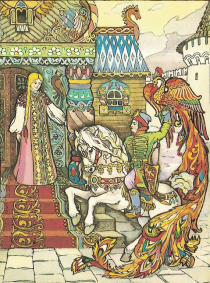
Culture: The society is built on skill of business and trade. Ruled by a council of merchants called the Thirteen. Merchants who aren’t Pureborn and The Qartheen look down on foreigners and close doors to let anyone they don’t like die in the Red Waste. People are known to wear extravagant outfits to show off their fabulous wealth.

Religion: Various religions are practiced.

hotu

Great House: N/A

Vassal Houses: N/A

History: An independent city state once ruled by the Kings of Qarth before they were deposed. Later ruled by The Thirteen, a council of Pureborn nobles and merchants. Any non-Pureborn member of the Thirteen must appear wealthy and powerful before the other members or else be quickly removed and replaced.

Daenerys-and-Pyat-Pree-in-Qarth

Current Status: All of its leaders are dead as of Season 2, which would be detrimental to its economy. We don’t know what’s happened to the city since.

Best Known for: Its port is one of the greatest in the world, which opens to trading centers further east. Defended by immense stone walls and strong gates.

Home of: Xara Xhoan Daxos, Quaithe, Pyat Pree, and The Spice King.

5f561482-d9f7-4641-83e4-9c89ad31e9ab-screen-shot-2018-04-20-at-41128-pm

Landmarks: There’s the Hall of a Thousand Thrones and the House of the Undying.

What to Avoid: Stay out of the grounds round the city called the Garden of Bones, where unfortunates are said to die. Also, don’t mess with the magic using Warlocks who sport blue lips and rely on shade of the evening.

For Those Who Want to Visit: Don’t be surprised if people close their doors to you. But you’ll probably be staying at an inn, anyway. If there’s an inn available.

tumblr_inline_p5h2z2CbST1uklhai_1280