As Told by the Bard: Part 5 – The Problem Plays

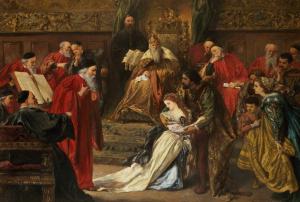
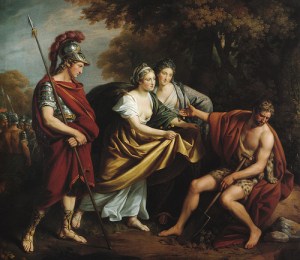
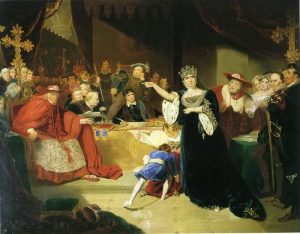
Portia_pronouncing_sentence_(Howard_c._1830-1831)

Seriously, Portia, why screw Shylock over everything. The worst thing he’s done is asking for pound of Antonio’s flesh because he treats him like shit and gets away with it. For God’s sake, this Venetian Anti-Semitism is getting of hand.

Finally, we get to Shakespeare’s problem plays. Now while some of these are considered either comedy or tragedy, they don’t fall into either. Nor do they seem to have completely happy endings. Or barely believable ones. Nevertheless, they tend to be characterized by their ambiguous tone which shifts violently between dark, psychological drama and more straightforward comic material. And in these plays, the protagonist often faces a situation put forward by the author as a representative of an instance pertaining to a contemporary social problem. Or whatever is interpreted as such like in The Merchant of Venice. However, the term can refer to the play’s subject matter or the classification “problems” with the plays themselves. These ones usually fit the bills in most cases.


34. All’s Well That Ends Well

Helena: "Great floods have flown/From simple sources; and great seas have dried,/When miracles have by the greatest been denied./Oft expectation fails, and most oft there/Where most it promises." - Act II, Scene 1

Helena: “Great floods have flown/From simple sources; and great seas have dried,/When miracles have by the greatest been denied./Oft expectation fails, and most oft there/Where most it promises.” – Act II, Scene 1

Genre: Problem Play, Late Romance, Comedy

Published: 1604 or 1605

Plot: Poor servant girl Helena has an unrequited crush on the countess’s son, Bertram who leaves to become a courtier to the ailing French King. Well, she basically stalks Bertram and promises that she can save the king since she learned some medicinal skills from her late physician father. The king is skeptical but gives her a try but reminds her that she’d be executed if she fails. But if she succeeds, she can marry any guy in his entourage. Helena cures him and the king lets her take her pick. As expected, she chooses Bertram who rejects her because she has no wealth or social status. The king will have none of it so he gives Bertram no choice. But after the ceremony, Bertram escapes to fight in Italy and sends a taunting letter to Helena bragging how he’s left her and saying that he won’t have her as his wife unless she wears his family ring and has his baby, expecting that neither is going to happen since he has no plans returning to France. Distraught but undeterred, Helena follows him all the way to Florence where she finds out that he’s set his sights on a girl named Diana who’d rather have him off her back. So Diana helps Helena by convincing Bertram to give up his family ring and letting him sleep with her in her room with the lights off.  That night, Helena sneaks in Diana’s bedroom and sleeps with Bertram instead. After that, Helena returns to France where she fakes her own death with the countess’s help, prompting Bertram to return home. Thinking he’s free of her, Bertram tries to marry someone else but Diana shows up and ruins it for him. Once everyone shows up, Helena reveals herself showing that she’s not dead, is wearing Bertram’s family ring, and is pregnant with his child. Bertram is impressed with all she’s done for him and swears his love to her.

Plot Origin: Based on a tale in Boccaccio’s The Decameron. Shakespeare might’ve read an English translation of the story in William Painter’s Palace of Pleasure.

Who Falls In Love: Helena loves Bertram who’s an utter tool while he has a thing for Diana who reasonably suspects he wants to get in her pants. Yet, by the end, Bertram appears to reciprocate but he may not have been sincere since he’s spent most of the play as a complete prick who hates her guts and only seems to change in just one line.

Who Dies: Nobody.

Reputation: This isn’t one of the best know Shakespearean plays since it wasn’t very popular in his lifetime. A lot of performances tend to play down Bertram’s assholery or portray him as emotionally immature. However, while Helena’s love for the unlovable Bertram is hard to explain on page, this could be corrected on stage by having him cast by a hot actor. Jon Hamm comes to mind for me.


35. Measure for Measure

Mariana: "I cry you mercy, sir; and well could wish/You had not found me here so musical:/Let me excuse me, and believe me so,/My mirth it much displeased, but pleased my woe." - Act IV, Scene 1

Mariana: “I cry you mercy, sir; and well could wish/You had not found me here so musical:/Let me excuse me, and believe me so,/My mirth it much displeased, but pleased my woe.” – Act IV, Scene 1

Genre: Comedy, Problem Play

Published: 1603 or 1604

Plot: Duke Vincentio is concerned that Vienna’s anti-premarital sex laws aren’t being observed in the city (for obvious reasons). So he decides to leave Vienna and leaves his assistant Angelo in charge in the meantime (when in reality, he’s just going to dress up as a friar and live among the common folks so he’d know how to better serve them as well as see Angelo handle things if he really did go away). At first, Angelo proves to be a stricter ruler and enforces the anti-premarital sex laws ruthlessly. But he allows power to go to his head as seen by him sentencing Claudio to execution for knocking up his fiancée Juliet just to serve as an example to men who can’t keep it in their pants. And Claudio is perfectly willing to marry Juliet, too. This leads to his sister, a novice nun named Isabella to visit him and plead her case with Angelo. Angelo agrees to spare Claudio’s life on the condition that Isabella sleep with him. Isabella refuses because she doesn’t want to lose her virginity and knows that no one would believe her if she accuses him of rape (which it technically is). So she just tells Claudio to get his affairs in order. Fortunately, the Duke has a scheme so Isabella won’t have to decide. Because Angelo had once agreed to marry a woman named Marianna but he reneged on her promise when her dowry was lost at sea. The Duke suggests that Marianna disguise herself as Isabella and sleep with Angelo instead. Nevertheless, after the sex, Angelo goes back on his word and orders Claudio’s execution anyway because he doesn’t want to be exposed as the hypocrite he is. The Duke then proposes that instead of Claudio’s head, they’ll just send the head of an actual guilty prisoner. Unfortunately, the only criminal up for execution is too drunk to be killed so they send the head of a pirate who died of a fever. After that, the Duke decides he’s played dress up for far too long and resumes his role as Vienna’s ruler. Isabella and Marianna complain that Angelo wronged them but he plays dumb. Angelo blames everything on the mysterious friar who’s been hanging around and he’s backed by a Lucio, a local pimp. The Duke leaves and disguises himself as a friar as Lucio accuses him of various crimes. So the Duke reveals himself to set everything in order. He forces Angelo to marry Marianna and condemns him to death. But pardons him when Marianna and Isabella plead to spare him. He then brings Claudio out alive and reunites him with Juliet. He condemns Lucio into marrying a whore who had his child but pardons his life. And finally, he proposes marriage to Isabella but the play ends before she can give an answer.

Plot Origin: Based on original is “The Story of Epitia”, a story from Cinthio’s Hecatommithi, first published in 1565 and George Whetstone’s drama Promos and Cassandra. Still, why the characters have Italian names in a city whose main language is German I have no idea. Nevertheless, to have Claudio jailed and sentenced to death for knocking up a woman he’s perfectly willing to marry would’ve been seen as ridiculously cruel, even by the standards of Shakespeare’s time. In fact, even in Shakespeare’s time, a woman being pregnant at her wedding was a fairly common thing.

Who Falls In Love: Claudio with Juliet to the point where they can’t control their hormones, Angelo with Isabella who doesn’t care for him much and it’s more like lust, Duke Vincentio with Isabella though we’re not sure about her, and Marianna with Angelo. Lucio is condemned to marry a prostitute who had his baby.

Who Dies: A pirate dies of a fever.

Reputation: This isn’t one of Shakespeare’s best known plays and one I wouldn’t recommend as appropriate for the whole family (even though in Shakespeare’s day, parents didn’t give a shit what was proper viewing for children anyway). Though general consensus has Isabella marrying the Duke, whether she does is entirely up to the director. And we’re probably better off not knowing anyway. Still, this is more of a dramedy than a comedy and it’s well known for its frankness on sex. But it has a happy ending. Made into a musical.


36. The Merchant of Venice
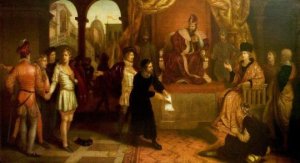
Shylock: "And what's his reason? I am a Jew! Hath not a Jew eyes? Hath not a Jew hands, organs, dimensions, senses, affections, passions; fed with the same food, hurt with the same weapons, subject to the same diseases, healed by the same means, warmed and cooled by the same winter and summer as a Christian is? If you prick us, do we not bleed? If you tickle us, do we not laugh? If you poison us, do we not die? And if you wrong us, shall we not revenge?" - Act III, Scene 1

Shylock: “And what’s his reason? I am a Jew!
Hath not a Jew eyes? Hath not a Jew hands, organs, dimensions, senses, affections, passions; fed with the same food, hurt with the same weapons, subject to the same diseases, healed by the same means, warmed and cooled by the same winter and summer as a Christian is? If you prick us, do we not bleed? If you tickle us, do we not laugh? If you poison us, do we not die? And if you wrong us, shall we not revenge?” – Act III, Scene 1

Genre: Comedy, Problem Play

Published: 1596-1598

Plot: Noble Bassanio is broke and seeks the hand of Lady Portia because she’s an heiress with wads of cash. So he approaches the merchant Antonio to borrow money because the guy’s often bailed him out in the past. But Antonio’s merchandise is out to sea and doesn’t have much money at hand even though he’s willing to give Bassanio any dough he can get. So Bassanio finds Shylock who hates Antonio, partly for being a Christian but mostly for Antonio insulting him and spitting on him for being a usurer. Shylock agrees to the loan and won’t charge interest this time. However, if Bassanio doesn’t pay back the loan, he gets a pound of Antonio’s flesh. But since Antonio’s ship will be in a full month before the money is due, Bassanio doesn’t worry and signs the bond. Bassanio goes to see Portia but since half the men in Europe want to marry her so he has to wait in line. However, her dad left a will saying that any guy wanting to marry her has to select among 3 caskets, one silver, one gold, and one lead. The princes of Morocco and Aragon choose the first 2 and go home unhappy. Bassanio chooses the lead one which was correct so he gets the girl. Later Antonio hears that his ship has gone down in a storm and is in serious trouble for he can’t give Bassanio the money to pay back the loan. And to make matters worse, Shylock’s daughter Jessica has eloped with one of Bassanio’s friends Lorenzo who’s a Christian and has taken most of Shylock’s money with her. So Shylock is even in a worse mood than previously so he has Antonio arrested and brought to court to claim a pound of his flesh. Portia and Bassanio hear about Antonio’s plight and Portia offers to pay 3 times the amount that’s owed while disguising herself as a man.  Shylock refuses because his hatred toward Antonio is personal. While Shylock does receive a pardon, he loses practically everything to his daughter who betrayed him and is forced to convert to Christianity.

Plot Origin: Based on the 14th century tale Il Pecorone by Giovanni Fiorentino, which was published in Milan in 1558 and The Orator by Alexandre Sylvane, published in translation in 1596, and “Gesta Romanorum”, from the 13th century.

Who Falls In Love: Bassanio and Portia, Jessica and Lorenzo, and Gratiano and Nerissa. Some speculate that Antonio is in love with Bassanio.

Who Dies: No one on stage. Though some adaptations have Shylock kill himself.

Reputation: This play has had a very interesting reception over the years and that’s mostly thanks to Shylock. And it’s also among Shakespeare’s most controversial, also thanks to Shylock. In fact, this play should’ve been called “The Angry Jewish Moneylender of Venice Everyone Treats Like Shit” because Shylock is usually the most coveted role and the character in the play everyone remembers. And there’s a lot of debate among scholars on whether Shylock is supposed to be an Anti-Semitic stereotype or truly sympathetic character who suffers a tragic fate. Sure Shylock is kind of an asshole and asking for a pound of a guy’s flesh is excessive, but in many ways you can totally understand where he’s coming from since Antonio treats him like shit and gets away with it. In the end, Shylock loses his daughter, his fortune, his property, and his religion. And despite wanting to kill Antonio, all the other characters treat him far worse than he treats them. As for Antonio while he might be a complete jerk, you have to admire how he’d do almost anything he could for Bassanio.  Some scholars have speculated whether Antonio sees Bassanio like a son or is gay and has an unrequited love for him. Made into a 2004 movie starring Al Pacino as Shylock and Jeremy Irons as Antonio.


37. Timon of Athens
Timon: "Why, I was writing of my epitaph; it will be seen to-morrow: my long sickness/Of health and living now begins to mend,/And nothing brings me all things. Go, live still;/Be Alcibiades your plague, you his,/And last so long enough!" - Act V, Scene 1

Timon: “Why, I was writing of my epitaph;
it will be seen to-morrow: my long sickness/Of health and living now begins to mend,/And nothing brings me all things. Go, live still;/Be Alcibiades your plague, you his,/And last so long enough!” – Act V, Scene 1

Genre: Tragedy, Problem Play

Published: 1605-1606

Plot: Timon is a beloved citizen of Athens known for his generosity. Unfortunately, he surrounds himself with flattering cronies, rewarding their flattery with lavish gifts. But they care about is when they’ll get their next payout. He holds a massive feast where he invites all his friends, many of whom he’s helped with personal problems by him throwing money at them. The only one in attendance who doesn’t suck up to him is Apemantus who’s only there to snark at him and his flatterers. Then Timon’s steward Flavius tells him he’s deeply in debt and can’t even sell his lands to recover. Timon sends servants to 3 of his closest friends by they shoot each one down. Timon is heartbroken but decides to throw another feast. This time, Timon gives his former friends an elaborate “fuck you,” serves them a “soup” of warm water, and chases them all out of the house with stones. Timon is exiled from Athens and goes to live in a cave outside its walls spending most of his time wishing plagues and disaster onto the city. He runs into Alcibiades who tells him that he’s going to sack and ruin Athens. Timon encourages him and gives him the gold he found to fuel the campaign. Alcaibiades is reluctant to be so vicious but says he’ll avenge both of them. Timon’s old friends soon hear he’s suddenly wealthy again and go to him, hoping to enjoy his generosity. But instead they’re met with disdain and vicious insults. Apemantus to deliver an “I told you so,” and the two have a comical battle of wits before Timon chases him away with stones. And the only person Timon doesn’t hate is his old servant Flavius who visits him but doesn’t ask for money. Timon gives him the rest of his gold and tells him never to be generous to anyone. Alchibiades attacks Athens but the authorities convince him not to. He agrees but receives word that Timon is dead.

Plot Origin: We’re not sure what Shakespeare based this play on.

Who Falls In Love: No one for there are no women in the cast.

Who Dies: Timon but we don’t know how. Possibly suicide.

Reputation: One of Shakespeare’s most difficult and obscure plays as well as often viewed as his “least liked.” However, Herman Melville was a noted fan. Performances of this play had been dominated by adaptations from the Restoration until well into the 20th century. It’s about to have its first film adaptation coming out at the end of this year. Does not have a sequel called Pumba of Athens. Sorry Lion King fans but this isn’t a Hakuna Matata play. Really it’s not.


38. Troilus and Cressida
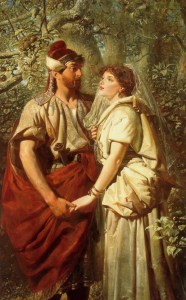
Troilus: "The Greeks are strong and skilful to their strength,/Fierce to their skill and to their fierceness valiant;/But I am weaker than a woman's tear, /Tamer than sleep, fonder than ignorance,/Less valiant than the virgin in the nigh/ And skilless as unpracticed infancy. " - Act I, Scene 1

Troilus: “The Greeks are strong and skilful to their strength,/Fierce to their skill and to their fierceness valiant;/But I am weaker than a woman’s tear, /Tamer than sleep, fonder than ignorance,/Less valiant than the virgin in the nigh/ And skilless as unpracticed infancy. ” – Act I, Scene 1

Genre: Problem Play, Tragedy

Published: 1602

Plot: Troilus is a brave Trojan warrior falls desperately in love with Cressida. She reciprocates but plays hard to get. So Troilus uses Cressida’s scatterbrained uncle Pandarus as a go-between and spends most of the play singing Troilus’s praises and making bawdy jokes. Eventually they have sex and profess their undying love. But Cressida’s father who defected to the Greeks, exchanges her for a Trojan soldier so they get separated. Trolius asks her to be faithful and gives her a sleeve to remember him by. Yet, he can bear to be apart from her so when everyone gathers in a duel, he decides to visit her. Unfortunately, he finds out that Diomedes seduces (or rapes) her. Pissed off, Troilus kills some Greeks and yells at Pandarus who wonders what he did wrong. Meanwhile, Agamemnon is upset that Achilles won’t get out of his tent to fight the Trojans. Ulysses and Nestor concoct a plan to get Achilles back into battle by sending Ajax to duel Hector instead, hoping that this will infuriate the Greek champion into fighting. And for good measure, Ajax boasts and beats up a smart ass servant. However, the due falls through though Achilles is back on the battlefield. He and Hector duel the next day yet Hector drives him off. But Achilles later catches him unarmed and orders his men to kill him.

Plot Origin: Based on Homer’s Iliad and Chaucer’s tale Troilus and Criseyde.

Who Falls In Love: Troilus with Cressida but it doesn’t last. Then there’s Cressida having sex with Diomedes (but I highly doubt this is consensual). Also, Hector and Andromache (but he dies) as well as Achilles and Patrolcus (depending on your interpretation).

Who Dies: Hector gets killed by Achilles (though this is keeping true with the source material).

Reputation: Readers and theater goers don’t know how to react to this play since neither of the main characters die as so much as breakup. Also Troilus is kind of a dick asking Cressida to be faithful to him when she’s taken as a POW as if she’s totally in control of the situation (sorry, she’s not). And though he has every right to be pissed when she’s seduced by Diomedes, he acts like it’s her fault despite that female POWS are especially vulnerable to being raped. This is especially true in the Trojan War when the Greeks took every Trojan woman as a sex slave after Troy’s fall. Also, he never really promises her to keep it in his pants or rescue her. Still, this play has never been popular and hasn’t had performances between 1734 and 1898. John Dryden had a version in which Cressida stays loyal to her Troilus throughout which I think is even worse. And it wasn’t staged in its original form until the early 20th century mostly thanks to WWI owing to its cynical depiction of immorality and disillusionment.

As Told by the Bard: Part 4 – The Late Romances

800px-Angelica_Kauffmann_007

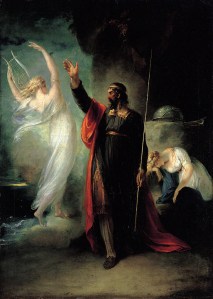
Relax, Miranda, Prospero doesn’t hate Prince Ferdinand. In fact, he’s perfectly fine with you being with him. After all, getting together with him was his idea but you wouldn’t know it.

While normally considered comedies since they have happy endings, these Late Romances are called us such for 2 reasons. First, they were written after Shakespeare’s prosperous company took over the Blackfriars Theatre in 1608 and began requiring texts different from those he’d been supplying earlier. Second, unlike the previous comedies you’ve read in my earlier posts, these tend to be more wishful, more melancholic, and more atmospheric than that preceded them. After all, the Blackfriars productions were stated at night in a closed, artificially lit environment and cost considerably more money. Not to mention, while the earlier comedies were open to pretty much everyone at the globe, the Blackfriars Theatre usually had a wealthier and better educated audience. And these people expected more emotional, heart-wrenching poetry, extravagant incident, extended suffering, and perilous escapes before the happy ending. Well, the Bard gave them what they wanted with these plays.


29. Cymbeline

Imogen: "Some jay of Italy,/Whose mother was her painting, hath betray’d him:/Poor I am stale, a garment out of fashion." - Act III, Scene 4

Imogen: “Some jay of Italy,/Whose mother was her painting, hath betray’d him:/Poor I am stale, a garment out of fashion.” – Act III, Scene 4

Genre: Tragedy, Late Romance, Comedy

Published: 1611

Plot: Despite the name, Cymbeline is a guy who’s a British king during the Roman Empire. Then again, the play should really be called Imogen since it’s more about his daughter. So Imogen falls in love and elopes with a poor nobleman named Posthumous which infuriates her daddy. So Cymbeline banishes his new son-in-law to Italy where he meets Jachimo who makes a bet that he can seduce Imogen and prove that all women are naturally unfaithful. Jachimo goes to Britain to see if Imogen would want a one night stand. She refuses so he resorts to trickery by hiding in a chest, watching her sleep while collecting details on her room, and stealing a bracelet Posthumous gave her. So when he returns to Italy, Jachimo has Posthumous fall for it hook, line, and sinker. And he tells his servant Pisanio to kill her over her infidelity. Pisanio doesn’t believe any of it and convinces her to disguise herself as a man and find her husband so she could tell him her side of the story. Meanwhile Pisanio tells Posthumous she’s dead. Yet, on her way to Italy, Imogen gets lost in Wales where she meets a nobleman and his two sons who are actually Cymbeline’s sons and her brothers that the nobleman kidnapped in revenge for being exiled. We then find out that Cymbeline’s evil queen convinced him to stop paying tribute to Rome which is about to attack. Due to crazy circumstances pertaining to killing the queen’s son, Imogen believes Posthumous is dead as Posthumous regrets murdering her. She mourns as he tries to kill himself by fighting for the Brits before switching to the Romans though Jupiter ensures he’ll protect the guy. As Posthumous is brought out as prisoner, each of the cast explains what the hell is going on and everyone lives happily ever after except the Queen who dies because she’s a bitch.

Plot Origin: Derived from part of Historia Regum Britanniae of Geoffrey of Monmouth about the real-life British monarch Cunobeline.

Who Falls In Love: Imogen and Posthumous

Who Dies: Well, the Queen and her son die but it’s not much of a tragedy.

Reputation: It was once held in high regard though not so in the 18th century since it’s kind of mishmash of plots Shakespeare used in other plays. John Keats liked it though and Harold Bloom thinks it’s more of a parody of the Bard’s own content. Made into a film in 2015.


30. Pericles, Prince of Tyre

Pericles: "I see that Time's the king of men,/For he's their parent, and he is their grave,/And gives them what he will, not what they crave." -Act II, Scene 3

Pericles: “I see that Time’s the king of men,/For he’s their parent, and he is their grave,/And gives them what he will, not what they crave.” -Act II, Scene 3

Genre: Comedy, Late Romance

Published: 1607-1608

Plot: A frame story narrated by Gower, Pericles is a virtuous adventurer who encounters many hardships on his road to happiness. Instances include getting in trouble for uncovering an incestuous relationship between a king and his daughter as well as sailing around the world to avoid assassination attempts. During his travels, he meets and marries another princess Thaisia. But on their way home she dies in as storm during childbirth that Pericles dumps her body at sea in a coffin. However, Thaisia actually survives and fearing her husband and newborn daughter are dead, she becomes a priestess in the Temple of Diana. Fearing that his daughter Marina will die before they get home, he leaves her with a family in Tarsus. Years pass and Pericles decides to retrieve her which is great because the governor and his wife in Tarsus aren’t so pleased with her being hotter than their daughter. They plan to kill her but she’s kidnapped by pirates and sold into slavery but miraculously never gets raped. She even convinces her kidnappers to leave and seek meaning in their lives as well as finds a job as a musician. But when Pericles gets to Tarsus, he’s told that his daughter is dead but luckily he finds her in Mytilene and thanks to the goddess Diana, he eventually finds his wife, too.

Plot Origin: Based on the medieval romance Apollonius of Tyre.

Who Falls In Love: Pericles with Thaisia.

Who Dies: No one we know on stage.

Reputation: Critical response of this play hasn’t been warm and ranks among one of the Bard’s least-known and least liked plays. However, it has seen a revival since 1929. Then this is Shakespeare we’re talking about so even crap like this has to be of superior literary quality.


31. The Tempest

Prospero: "Know thus far forth:/By accident most strange, bountiful Fortune —/Now my dear lady — hath mine enemies/Brought to this shore; and by my prescience/I find my zenith doth depend upon/A most auspicious star, whose influence/If now I court not, but omit, my fortunes/Will ever after droop." - Act I, Scene 2

Prospero: “Know thus far forth:/By accident most strange, bountiful Fortune —/Now my dear lady — hath mine enemies/Brought to this shore; and by my prescience/I find my zenith doth depend upon/A most auspicious star, whose influence/If now I court not, but omit, my fortunes/Will ever after droop.” – Act I, Scene 2

Genre: Comedy, Late Romance

Published: 1610-1611

Plot: Former Duke of Milan Prospero is a powerful sorcerer on an almost deserted island where he’s lived since he’s been usurped by his brother Antonio. And he rules over the island with only 2 other human beings at his command: an air spirit Ariel whom Prospero rescued from being trapped in a tree but would rather be free from service soon and the deformed son of a witch Caliban who tried to rape Miranda. When Antonio is sailing with a group that includes the King of Naples, Prospero has Ariel create a storm to shipwreck them on his island so he could have his revenge. Luckily, Miranda and Ferdinand fall in love and Prospero ends up forgiving those who wronged him. Ariel is set free and almost everyone gets off the island.

Plot Origin: It’s unknown where Shakespeare got this story from and may have been original. Well, it was partly inspired by a shipwreck in Bermuda.

Who Falls In Love: Prince Ferdinand with Miranda. However, Miranda falling in love with him at first sight is understandable since she’s lived a very sheltered life with very little human contact. Nevertheless, while Prospero pretends to hate her being with Ferdinand, he’s actually totally cool with it. In fact, it was his idea that they’d get together in the first place.

Who Dies: No one, but maybe some sailors.

Reputation: It’s said to be the last play Shakespeare ever wrote alone and considered one of his finest even to this day. However, there have been adaptations performed from the English Restoration to the mid 19th century. Though Ariel is a guy in the play, he’s sometimes played as a woman since most of the cast is male. There’s also a tradition of having Caliban played by a black guy which is kind of racist and disturbing. Is frequently performed and has been adapted to screen several times.


32. The Two Noble Kinsmen

Emilia: " It is the very emblem of a maid./For when the west wind courts her gently/How modestly she blows, and paints the sun/With her chaste blushes! When the north comes near her,/Rude and impatient, then, like chastity,/She locks her beauties in her bud again,/And leaves him to base briars." -Act II, Scene 1

Emilia: ” It is the very emblem of a maid./For when the west wind courts her gently/How modestly she blows, and paints the sun/With her chaste blushes! When the north comes near her,/Rude and impatient, then, like chastity,/She locks her beauties in her bud again,/And leaves him to base briars.” -Act II, Scene 1

Genre: Comedy, Late Romance

Published: 1613-1614

Plot: Two cousins Palamon and Arcite are captured as POWS in war. While in jail, they both fall madly in love with the fair which really drives a wedge between these almost inseparable buds. Then Theseus lets Arcite go while Palamon remains prisoner. But the jailer’s daughter has fallen for Palamon but lets him go, hoping that he’ll reciprocate. But he ignores her because he’s still obsessed with Emilia. He meets Arcite in the forest and the two decide to have a fair fight over Emilia. The jailer’s daughter meanwhile has gone mad and goes into the forest where she meets some Morris dancers as well as Theseus and Hippolyta hunting. When Theseus sees Arcite and Palamon fighting, he orders them arrested and executed. Hippolyta and Emilia intervene so Theseus decides to hold a tournament between them for Emilia’s hand with each warrior being allowed 3 companions to assist them and be executed if their champion loses. Arcite wins but falls off his horse and dies so Palamon gets Emilia.

Plot Origin: Derived from “The Knight’s Tale” in Geoffrey Chaucer’s The Canterbury Tales.

Who Falls In Love: Palamon and Arcite with Emilia and the jailer’s daughter with Palamon. Also Theseus and Hippolyta. The jailer’s daughter also has a suitor. Also, Emilia likes both Palamon and Arcite but can’t really decide which guy she wants.

Who Dies: Arcite falls off his horse.

Reputation: This play doesn’t have a lot of performances and it remains rather obscure to say the least. However, it was once referenced on The Simpsons.


33. The Winter’s Tale

Autolycus: "No, good sweet sir; no, I beseech you, sir: I have a kinsman not past three quarters of a mile hence, unto whom I was going; I shall there have money, or any thing I want: offer me no money, I pray you; that kills my heart." - Act IV, Scene 3

Autolycus: “No, good sweet sir; no, I beseech you, sir: I have a kinsman not past three quarters of a mile hence, unto whom I was going; I shall there have money, or any thing I want: offer me no money, I pray you; that kills my heart.” – Act IV, Scene 3

Genre: Comedy, Late Romance, Problem Play

Published: 1610-1611

Plot: King Leontes of Sicilia unreasonably suspects that his wife Hermione got knocked up by his best friend. So when Perdita is born, he views her as a bastard and orders his manservant Antigonus to abandon her despite Hermione’s pleading. After his son and wife both die, Leontes realizes he’s made a mistake decides to grieve for his family for the rest of his life. Meanwhile Antigonus complains about how his job sucks as he leaves Perdita in a Bohemian forest before he exits pursued by a bear. She’s found by shepherd and his son and they care for her. 16 years later, King Polixenes of Bohemia isn’t pleased that his son Forizel has fallen for Perdita so he decides to spy on the shepherds at a sheep shearing festival. Florizel and Perdita flee to Sicilia pursued by everyone. There Perdita’s heritage is revealed as she reunites with Leontes as a statue of Hermione comes to life (but her big brother Mamillius doesn’t and gets screwed). But everything gets straightened up so no worries. Sort of.

Plot Origin: Based on Robert Greene’s pastoral romance Pandosto, published in 1588. By the way, Bohemia is in the modern Czech Republic and has no coastline. Not that Will cared.

Who Falls In Love: Leontes of Sicilia with Hermione but it ends up badly (though it gets better) Palina with Camillo, and Florizel with Perdita.

Who Dies: Mamillius dies due to being separated from his mom, Hermione dies (but she gets better), and Antigonus exits pursued by a bear.

Reputation: This play has only been intermittently popular throughout the years and it hasn’t been performed in its entirety until the second half of the 20th century but to varying degrees of success. The first part tends to play like a tragedy but the second part plays more like a pastoral comedy. Unfortunately, the name Hermione has a different association in modern literature these days like Harry Potter. Then again, the original Hermione was the daughter of Helen of Troy. Made into a 1967 movie starring Laurence Harvey.

As Told by the Bard: Part 3 – The Tragedies

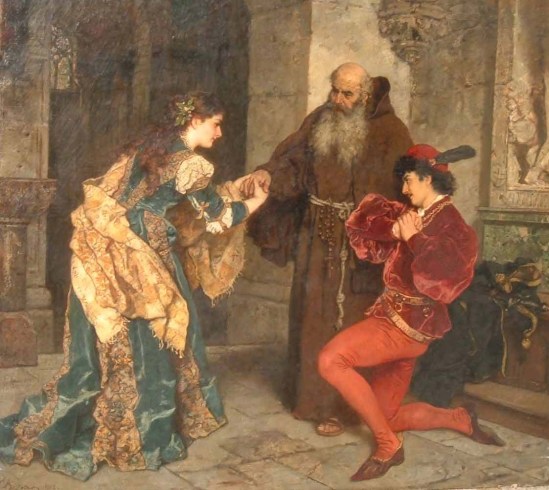
Romeo-and-Juliet-before-Father-Lawrence-Karl-Ludwig-Friedrich-Becker

Friar Lawrence, do you think marrying these teenagers is a good idea? Seriously, they’re impulsive and immature teenagers who just met a few days ago and they now think they’re in love. Really that’s not a great way to start a healthy relationship. And I’m sure they’ll probably end up killing themselves. That’s not a great love story. That’s the Wire.

We move onto the tragedies which are among Shakespeare’s better known plays. Unlike comedies, the definition of “tragedy” hasn’t really changed much since Shakespeare’s time. You have a hero with a goal and a fatal flaw. But every time the hero overcomes an obstacle, they just make the situation worse. And eventually they do something stupid or make a bunch of dumb mistakes that makes their chances of happiness impossible and most likely die. But not before suffering a stressful heightened situation, ultimate ruin, or destroying everyone or everything they love. Shakespeare’s tragedies often have heavily symbolic, multilayered plots that clearly juxtaposed good and evil. Such elements are combined with the kind of psychological complexity that only a terribly unhappy character can put across, and you can see why modern audiences tend to appreciate the tragedies more than their earlier counterparts. Still, Shakespeare’s tragic titled characters usually die and they usually don’t tend to be heroic. In fact, some of them tend to be huge jerks or worse. However, you’re probably more familiar with some of these since you probably had at least read a few of these in high school.


20. Antony and Cleopatra

Cleopatra: "Where’s my serpent of old Nile?/For so he calls me." - Act I, Scene 5

Cleopatra: “Where’s my serpent of old Nile?/For so he calls me.” – Act I, Scene 5

Genre: Historical, Tragedy, Romance

Published: 1607

Plot: Focuses on the tragic fall of Roman general and triumvirs (a joint leader after Caesar’s assassination) Mark Antony who’s seduced by the Egyptian queen Cleopatra VII. He spends much of the play ignoring his duties while living with Cleopatra in Alexandria. Meanwhile Caesar’s nephew and fellow triumvir Octavius isn’t pleased because Rome’s involved in a war with Pompey (no, not that Pompey) and could really use his help. So Antony leaves for Rome, not realizing that Octavius is jealous of his distinction and wants to get rid of him after the war is over. Meanwhile, Cleo pines and beats up a messenger who proclaims that Antony has married Octavia. The plot gets more complicated from there with a lot of stuff happening. But since this is history, I’ll cut to the chase. So anyway, Pompey is crushed and accepts a truce but later, Octavius and Lepidus break it which makes Antony pissed. Antony returns to Alexandria, proclaims he and Cleopatra rulers of Egypt and a third of the Roman Republic while Octavius imprisons Lepidus, turns on Antony, and the two fight a war. Then there’s the Battle of Actium where Cleopatra flees with 60 ships and where Octavius tells Antony to give up already. Antony loses another battle which results in his troops deserting him and him denouncing Cleopatra. Cleopatra decides to win back his love by faking a suicide and locking herself in a monument, thinking he’ll come back to her in remorse. However, her plan fails since word of her “death” leads Antony to decide that his live isn’t worth living so he stabs himself. Fortunately, he learns she’s alive and dies in her arms. After that, Octavius tries to get Cleopatra to surrender but she angrily refuses so she’s captured. So she commits suicide to retain her dignity.

Plot Origin: Based on Thomas North’s 1579 translation of Putarch’s Lives. Nevertheless, while Cleopatra died in her 30s, Mark Antony was significantly older than her.

Who Falls In Love: Well, Mark Antony and Cleopatra for starters though in real life it’s hard to say since Cleopatra’s use of sex had more to do with protecting her realm and Antony needed a strong ally. And being a Ptolemy, Cleopatra fits the bill to a tee. Still, we’re not sure if they’re really in love or they’re just giving into a passionate lust. Either way, what they have for each other is destructive.

Who Dies: Antony (bungled suicide through stabbing himself), Cleopatra (poison snake), Enobarbus who dies from despair after betraying Antony, Antony’s servant Eros who’d rather kill himself than his master and does, Sextus Pompey (for refusing to kill his enemies while they’re in a vulnerable position like drunk), Antony’s wife Fulvia (Octavius killed her before the play even starts), and a bunch of soldiers since it takes place during a war.

Reputation: You may not see it performed very often, but scholars still talk about this one since Wikipedia has tons of space dedicated to its analysis and criticism. However, they all agree that Cleopatra is by far the most complex female character in the Shakespearean canon and is portrayed as a captivating femme fatale as well as the skilled leader she really was. And the fact that a lot of the characters tend to be ambiguous. We’re not sure whether Cleo kills herself over her love for Antony or her lost power. And Octavius could be seen as either a noble ruler only wanting what’s best for Rome or a ruthless politician who only wants power for himself. Power dynamics, betrayal, and politics are other themes. Nevertheless, it’s seen as one of the better Shakespearean plays out there and perhaps one of the Bard’s most underrated. Still, there’s a 1972 movie adaptation directed and starring Charlton Heston.


21. Coriolanus

Coriolanus: "What's the matter, you dissentious rogues/That rubbing the poor itch of your opinion,/Make yourselves scabs?" - Act I, Scene 1

Coriolanus: “What’s the matter, you dissentious rogues/That rubbing the poor itch of your opinion,/Make yourselves scabs?” – Act I, Scene 1

Genre: Tragedy

Published: Between 1605 and 1608

Plot: Caius Martius is given the name Coriolanus after his more than adequate military success against various uprisings. While he is certainly brilliant, he’s arrogant and contemptuous of ordinary people that when we first meet him, he’s already being blamed for taking grain from the army which has led to food riots. As others try to calm the situation, Coriolanus that commoners aren’t worthy of grain since they haven’t done any military service. Soon after Coriolanus receives his reward, he becomes active in politics and seeks political leadership. However, not only is his temperament unsuited for the job, but two of his opponents conspire a popular uprising that gets him quickly deposed and kicked out of Rome after he made a bitter speech of how democracy sucks. In revenge Coriolanus offers his services to his old defeated enemies where they march onto Rome with the city at his mercy. But his wife and mom persuade him to spare Rome and he’s eventually murdered by Aufidius for his betrayal and that Coriolanus is much more popular than him.

Plot Origin: Largely based on the “Life of Coriolanus” in Thomas North’s 1579 translation of Plutarch’s Lives as well as other sources.

Who Falls In Love: Well, he’s married with a kid but I don’t think they get into much detail on that relationship.

Who Dies: Well, Coriolanus as well as a bunch of other soldiers and hungry poor people.

Reputation: Well, while it has been critically praised by scholars, critics, and writers, but it hasn’t been performed as often as some of the other Shakespearean plays mostly because Coriolanus is perhaps the least sympathetic Shakespearean protagonist and despite the name, isn’t a comedic figure at all. It was also banned in France during the 1930s and in Post WWII Germany. Made in to a movie with Ralph Fiennes in 2011. Nevertheless, Suzanne Collins must be familiar with this play since President Snow’s first name is Coriolanus who sees nothing wrong with exploiting his people and gets deposed by a popular uprising engineered by another power hungry politician.


22. Hamlet

Hamlet: "To be, or not to be, — that is the question: —/Whether 'tis nobler in the mind to suffer/The slings and arrows of outrageous fortune,/Or to take arms against a sea of troubles,/And by opposing end them? — To die, to sleep, -/No more; and by a sleep to say we end/The heart-ache, and the thousand natural shocks/That flesh is heir to, — 'tis a consummation/Devoutly to be wish'd. To die, to sleep; —/To sleep, perchance to dream: — ay, there's the rub;/For in that sleep of death what dreams may come,/When we have shuffled off this mortal coil,/Must give us pause: there's the respect/That makes calamity of so long life." -Act III, Scene 1

Hamlet: “To be, or not to be, — that is the question: —/Whether ’tis nobler in the mind to suffer/The slings and arrows of outrageous fortune,/Or to take arms against a sea of troubles,/And by opposing end them? — To die, to sleep, -/No more; and by a sleep to say we end/The heart-ache, and the thousand natural shocks/That flesh is heir to, — ’tis a consummation/Devoutly to be wish’d. To die, to sleep; —/To sleep, perchance to dream: — ay, there’s the rub;/For in that sleep of death what dreams may come,/When we have shuffled off this mortal coil,/Must give us pause: there’s the respect/That makes calamity of so long life.” -Act III, Scene 1

Genre: Tragedy

Published: 1602

Plot: Prince Hamlet of Denmark whose dad is dead from mysterious circumstances while his uncle Claudius has become king and his new stepfather, a fact which the young prince isn’t at all pleased. And to make matters worse, his dad’s ghost appears telling Hamlet that Claudius killed him in order to get the throne. So Hamlet decides to take revenge by taking some course of actions including staging a play depicting the murder and justifying it through faking insanity. But as the play progresses, we’re not sure if Hamlet is really faking it. Nor are we sure as to why he doesn’t just kill his uncle right after it becomes apparent that he did kill his dad which he confesses while he’s in prayer because he doesn’t want him to go to heaven. Seriously, it didn’t take much time for him to kill Polonius through a curtain. That way, it would’ve saved a lot of trouble like King Claudius trying to send Hamlet to England with a letter that the king kill him which he foiled by giving it to idiots Rosencrantz and Guildenstern. Or Claudius telling Laertes that Hamlet is solely responsible for his dad’s death and his sister’s madness (as well as her eventually suicide by drowning). Because when Hamlet comes home, Claudius puts on a banquet designed for this purpose which leads to the deaths of almost everyone who’s left.

Plot Origin: Derived from the legend of Amleth, preserved by 13th-century chronicler Saxo Grammaticus in his Gesta Danorum. But the story is a lot different with Hamlet killing his uncle and becoming king, only to die in battle shortly afterwards. Also, in that story, Gertrude was forced to marry Claudius.

Who Falls In Love: Well, Ophelia is certainly in love with Hamlet but it’s ambiguous whether he’s in love with her. Not to mention, we’re not sure about Claudius and Gertrude’s relationship either though he seems to love her even if he doesn’t care for his nephew all too much.

Who Dies: Well, Hamlet’s dad before the play starts, Polonius who Hamlet stabs through a curtain, Rozencrantz and Guildenstern through Hamlet sending a letter with them which gets them killed, Ophelia who goes mad and commits suicide via drowning herself, Gertrude through drinking a goblet of poison that was meant for Hamlet, Claudius through Hamlet stabbing him, and Laertes and Hamlet engaged in a sword fight in which they kill each other. Thus, the only characters left are Horatio and Fortinbras.

Reputation: This perhaps one of Shakespeare’s most famous plays and perhaps one of the most influential works in literature and among the most quoted works in the English language. It’s been performed on stage and adapted onscreen numerous times as well as inspired numerous authors. If there’s a work that could be seen as Shakespeare’s masterpiece, this would probably be it.


23. Julius Caesar

Mark Antony: "Friends, Romans, countrymen, lend me your ears;/I come to bury Caesar, not to praise him./The evil that men do lives after them;/The good is oft interred with their bones;/So let it be with Caesar. The noble Brutus/Hath told you Caesar was ambitious:/If it were so, it was a grievous fault;/And grievously hath Caesar answer'd it./Here, under leave of Brutus and the rest, —/For Brutus is an honorable man;/So are they all, all honorable men, —/Come I to speak in Caesar's funeral./He was my friend, faithful and just to me:/But Brutus says he was ambitious;/And Brutus is an honorable man." - Act III, Scene 2

Mark Antony: “Friends, Romans, countrymen, lend me your ears;/I come to bury Caesar, not to praise him./The evil that men do lives after them;/The good is oft interred with their bones;/So let it be with Caesar. The noble Brutus/Hath told you Caesar was ambitious:/If it were so, it was a grievous fault;/And grievously hath Caesar answer’d it./Here, under leave of Brutus and the rest, —/For Brutus is an honorable man;/So are they all, all honorable men, —/Come I to speak in Caesar’s funeral./He was my friend, faithful and just to me:/But Brutus says he was ambitious;/And Brutus is an honorable man.” – Act III, Scene 2

Genre: Historical, Tragedy

Published: 1599

Plot: This should really be called “Marcus Brutus” since he’s the main character in this anyway. Now Brutus is such a scrupulously honest, loyal, and patriotic statesman who’s nonetheless drawn by his friend Caius Cassius into a plot to assassinate increasingly powerful Julius Caesar. But poor Brutus is torn between his love for Caesar and his duty to Rome. And while other characters in the conspiracy have less spotless motivations, Brutus is only moved to act by his love for the Roman Republic. Then again, he could be a self-centered patrician whom Cassius flatters into betraying his former patron Caesar. But in either case, this is his tragedy and he’s the most sympathetic of the bunch. Sure Caesar is an ambitious decoy protagonist with kingly aspirations. But Mark Antony? Yes, he’s great at wooing the masses through his oratory skills so crowds can hand Caesar power. But when it comes to avenging his friend’s death, he really gets nasty that you think maybe he should chill out in Egypt with Cleopatra for awhile. Octavian? Oh, he’s just as ambitious like his uncle but he excels in the PR department so well that it takes knowledge of what happens historically afterwards (or in Antony and Cleopatra) to realize his villainy. Or what about Cassius? He’s resentful of Caesar’s power and just gets Brutus involved in the conspiracy he just wants to Brutus to be leader so he can control him. And he doesn’t care whether Brutus wants the job or not. In fact, the less he wants it the easier he thinks it will be. And the rest of Rome? Anyone who’s not a victim or a villain just ends up in mob stirred up by Mark Antony due to their fickle nature. So anyway, after Caesar’s assassination, Rome’s plunged into civil war and a number of characters from the first several acts die during the conflict, mostly through suicide.

Plot Origin: Based on Thomas North’s translation of Plutarch’s Lives.

Who Falls In Love: Well, Caesar seems to like Calpurnia enough (even though he had a kid to Cleopatra). And the Brutuses seem happy together for a time that Marcus is genuinely sad about Portia dying.

Who Dies: Caesar gets assassinated, Portia kills herself off-stage, poet Cinna is murdered by a mob, Cassius, Titinus, and Brutus all commit suicide.

Reputation: One of the first Shakespeare plays to be performed at the Globe Theatre and it was quite popular during the Restoration as well as the 18th century. However, this play has a tendency to be ruined as required reading in high school since teens tend to be more concerned with Julius Caesar getting killed off in the middle than anyone as noble and good as Brutus whose tragedy this really is. Also, despite it being more straightforward than most of the Bard’s work, its austerity isn’t for 16-year-olds, anyway. Still, Mark Antony’s speech is one of the highlights of the play since it reveals he’s really pissed off about Caesar’s assassination and really gets nasty. And no, he doesn’t believe that Brutus is an honorable man. Has 3 famed movie adaptations with one from 1950 starring Charlton Heston, one from 1953 starring Marlon Brando and James Mason, and one from 1970 starring Jason Robards, Charlton Heston, and John Gielgud. Opt for the one that doesn’t have Charlton Heston since it’s the most famous.


24. King Lear

Cordelia: "Unhappy that I am, I cannot heave/My heart into my mouth: I love your majesty/According to my bond; no more nor less." - Act I, Scene 1

Cordelia: “Unhappy that I am, I cannot heave/My heart into my mouth: I love your majesty/According to my bond; no more nor less.” – Act I, Scene 1

Genre: Tragedy

Published: 1605

Plot: Elderly King Lear wants to abdicate and decides to divide his kingdom among his 3 daughters Goneril, Regan, and Cordelia. But only if each one gives him a public acknowledgement of their love for him. Goneril and Regan kiss his ass while Cordelia calls this idea bullshit so she’s banished and sent to marry the King of France. But keep in mind, she’s the only one who truly loves him. So Goneril and Regan get a share while Lear retire only with conditions a hundred knights, the respect and title of a king, and free room and board at his daughters’ homes. But it doesn’t take long for Lear to wear out his welcome since his daughters, resentful and wary from the outset, quickly tire from the knights causing a ruckus as well as the lavish expense of keeping them on staff. And when Lear flips his lid once more and, rather than trying to compromise with them, he stubbornly denounces them. Thus, Goneril and Regan refuse to take in his knights and he’s caught in a thunderstorm as both his followers and family desert him. And only the Fool and the disguised Duke of Kent remain with him. Then there’s a sub-plot with the Earl of Gloucester who is tricked by his illegitimate son Edmund thinking his legitimate son Edgar is trying to kill him. Gloucester is duped so Edgar has to go on the run, disguising himself as a crazed hobo. Thankfully, he falls in with Lear. Meanwhile, Edmund can’t stop angsting about how the world hates him for being a bastard and he proceeds to bang both of Lear’s elder daughters (who are both married to other guys, by the way). A few deft moves soon makes him go from nothing to possibly becoming the most powerful guy in Britain. Thankfully, Cordelia’s new hubby sends some troops to Britain.

Plot Origin: It’s derived from a pre-Roman legend of Leir of Britain. First found in Geoffrey of Monmouh’s the Historia Regum Britanniae. But the original version doesn’t end tragically.

Who Falls In Love: Cordelia marries the King of France but this is political but at least he sends help and truly loves her for herself. The fact he proposes her during the most painful moment of her life doesn’t hurt either. Then there’s Edmund banging Goneril and Regan but there’s no love from that.

Who Dies: Duke of Cornwall gets killed by his servants over blinding the Duke of Gloucester (but that guy’s later killed by Regan), Cordelia is executed but Lear kills the executioner, Lear dies of despair and exhaustion, Edgar rightfully kills Edmund, Goneril commits suicide, Kent is implied to join Lear after the play, Regan is poisoned by Goneril, and Gloucester dies somehow.

Reputation: This play is one of the more extremely powerful in the Shakespeare canon that it was unpopular with critics and audiences alike because it made what was once a traditional happily ever after fairy tale ending massively depressing instead. It’s said that the ending was fully rewritten in 1681 so Cordelia survives and marries Edgar, which was more popular for over 100 years. The original King Lear didn’t get its current reputation until after WWII. Today it’s considered one of Shakespeare’s great tragedies. Made into a Kurosawa movie called Ran but has sons in place of daughters and Lady Kaede in the Edmund role.


25. Macbeth

Banquo: "But 'tis strange:/And oftentimes, to win us to our harm,/The instruments of darkness tell us truths,/Win us with honest trifles, to betray's/In deepest consequence." - Act I, Scene 3

Banquo: “But ’tis strange:/And oftentimes, to win us to our harm,/The instruments of darkness tell us truths,/Win us with honest trifles, to betray’s/In deepest consequence.” – Act I, Scene 3

Genre: Historical, Tragedy

Published: 1606

Plot: Fresh from putting down a rebellion against King Duncan in the Scottish Highlands, Macbeth meets 3 witches who relate a series of prophecies, one of them being that he’ll rule Scotland someday. When one of the other seemingly unlikely predictions comes true, scheming and heartless Lady Macbeth convinces her husband to commit regicide and off his heirs. Well, Macbeth does just that by inviting Duncan for dinner and killing him in his sleep. But once he becomes king, both he and Lady Macbeth are driven mad by guilt. Lady Macbeth copes with hers by sleepwalking and committing suicide, which is way less destructive than how her husband deals with it. Macbeth on the other hand, just enters into a paranoid frenzy, killing everyone in sight in order to consolidate power, especially since he thinks he’s now invincible now the witches say that “none of woman born” will slay him. Well, somehow he didn’t understand that this didn’t mean what he thinks it does. He’s then overthrown and killed by MacDuff who was born through a caesarian section when it became apparent that his mom wasn’t going to survive his birth.

Plot Origin: History as well as Raphael Holinshed’s Chronicles of England, Scotland and Ireland from 1577. However, this play really plays fast with the history. While there was a real King Macbeth of Scotland, he reigned for 17 years with his rule being rather secure since he went on a trip to Rome for a time where he was blessed by the Pope. Not to mention, he’s celebrated as a generous and decent king. He also killed King Duncan in a fair fight since the latter was encroaching on his lands after a failed conquest in England. Duncan wasn’t an old king at the time either and was a tyrant and an ineffective ruler. However, James I was descended from the guy who overthrew him (Duncan’s son Malcolm) so you get play like this. As for Lady Macbeth, she had a son from a previous marriage and her name was Gruoch. Then again, with a name like Gruoch, you can understand why she’d be so evil.

Who Falls In Love: Well, Macbeth and his lady seem to have an interesting relationship. Not sure about MacDuff and his wife.

Who Dies: Duncan gets killed by Macbeth in his sleep, Lady Macbeth kills herself off stage, Banquo and MacDuff’s family are killed by Macbeth along with a bunch of others, and Macbeth is killed by MacDuff.

Reputation: It’s one of the classic Shakespearean tragedies as well as among the shortest and most violent. There’s even a lot of superstition related to this play in the backstage world of theater who think it’s cursed. Made into several movies. Nevertheless, it’s widely performed, widely adapted, and widely popular.


26. Othello

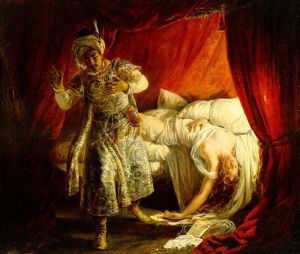
Othello: "O balmy breath, that dost almost persuade/Justice to break her sword. One more, one more!/Be thus when thou art dead, and I will kill thee,/And love thee after./One more, and that's the last!/So sweet was ne'er so fatal. I must weep,/But they are cruel tears. This sorrow's heavenly;/It strikes where it doth love. She wakes." - Act V, Scene 2

Othello: “O balmy breath, that dost almost persuade/Justice to break her sword. One more, one more!/Be thus when thou art dead, and I will kill thee,/And love thee after./One more, and that’s the last!/So sweet was ne’er so fatal. I must weep,/But they are cruel tears. This sorrow’s heavenly;/It strikes where it doth love. She wakes.” – Act V, Scene 2

Genre: Tragedy

Published: 1603

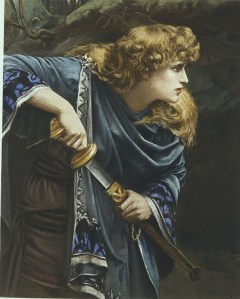
Plot: Othello is a Moorish general in the Venetian army who has just acquired 2 new enemies. Roderigo hates him for marrying Desdemona whom he was interested in. And Iago hates him for promoting a young man named Cassio over him. Now Iago convinces Roderigo in a plan to ruin Othello’s life by using Cassio as a patsy. But Roderigo has no idea how much Iago is willing to manipulate and backstab everyone to get his revenge. So Iago and Roderigo plant Desdemona’s handkerchief (obtained through Iago’s wife Emilia) in Cassio’s house. Othello sees this and he’s incredibly pissed. It doesn’t help that Iago goads Cassio into talking about his affair with a courtesan Bianca but whispers her name so quietly that Othello thinks they’re talking about his wife. Enraged and hurt, Othello makes Desdemona’s life miserable despite her protests that she didn’t cheat on him (which Emilia backs up) and eventually smothers her. Cassio fights of Roderigo which leads to Iago to cut up Cassio’s leg and kill Roderigo. However, after Othello kills his wife, Emilia comes forward to tell him that Iago cooked up the whole thing and Desdemona was innocent. Iago kills her. Othello stabs Iago but he refuses to explain his motives and vows to remain silent. And Othello commits suicide before he’s arrested. But Iago gets apprehended and sent to Cassio for punishment.
Plot Origin: Based on the story Un Capitano Moro (“A Moorish Captain”) by Cinthio from 1565. In this version, Othello doesn’t even have a name and it ends with Desdemona saying that interracial marriage is evil.

Who Falls In Love: Othello with Desdemona but it doesn’t turn out well. Not sure about Iago and Emilia since she seems unhappy with him, unsurprisingly.  I’m sure Cassio just wants to sleep with Bianca.

Who Dies: Well, Desdemona gets smothered by Othello, Iago secretly stabs Roderigo, Emilia is killed by Iago, and Othello commits suicide. Also, I don’t think Iago has much time to live after this play.

Reputation: This play has been very popular from the very start since it has a very detailed performance record and it was one of the few that’s never been adapted or changed during the Restoration or the 18th century. Due to its varied and enduring themes of racism, love, jealousy, betrayal, revenge and repentance, this play is often performed by professional and community theater groups alike. It’s also been adapted to opera and film. However, I tend to recommend any movie on Othello that was made in recent times since it was very common for the title role to be played as black by white actors. The first black guy to play Othello was Paul Robeson in 1943. However, the play never explicitly states that Othello is black but he’s always considered the Other in Venetian society so he can be played by any guy. But if you’re a white guy playing, just play him as an Arab. Or maybe you should opt for Iago who’s seen as one the best known Shakespearean villains to date and is considered the main character of this play anyway.


27. Romeo and Juliet

Juliet: "O Romeo, Romeo! wherefore art thou Romeo?/Deny thy father and refuse thy name;/Or, if thou wilt not, be but sworn my love,/And I'll no longer be a Capulet." - Act II, Scene 2

Juliet: “O Romeo, Romeo! wherefore art thou Romeo?/Deny thy father and refuse thy name;/Or, if thou wilt not, be but sworn my love,/And I’ll no longer be a Capulet.” – Act II, Scene 2

Genre: Tragedy

Published: 1591-1595

Plot: Two teenagers fall in love at first sight. But their families hate each other. So they secretly get married because Juliet’s dad wants him to marry some other guy she’s not really interested in. And besides, despite being 13, her mom’s 26. But Romeo gets into a fight where Juliet’s cousin Tybalt kills his friend Mercutio. This leads to Romeo killing Tybalt so he has to skip town. Juliet decides to run away to a grotto and fake her death. Thinking she’s dead, Romeo poisons himself. After she wakes up, Juliet finds Romeo dead so she puts her knife to her chest. Grief-stricken families reconcile.

Plot Origin: Based on an Italian tale translated into verse as The Tragical History of Romeus and Juliet by Arthur Brooke in 1562, and retold in prose in Palace of Pleasure by William Painter in 1567. But in this version Romeo and Juliet are 16 and they don’t get married until 9 months in.

Who Falls In Love: Well, Romeo and Juliet but it doesn’t turn out well.

Who Dies: Mercutio is killed by Tybalt, Tybalt is killed by Romeo, Paris is killed by Romeo, Romeo poisons himself, Juliet stabs herself, and Lady Montague dies from grief.

Reputation: This is the most famous Shakespearean play and one of the most popular and best liked. During the English Restoration and 18th century it was heavily revised with several modified scenes and removing so-called indecent material. One version omitted much of the action and added a happy ending. Performances in the 19th century restored the original text. Opinions of this play can depend on the quality of actors seen performing it or whether one accepts the notion of love at first sight at face value. If it’s in a production involving middle aged actors who don’t look at least 30ish in the title roles, then it just doesn’t make any sense. Adapted numerous times for stage, film, musical (West Side Story), and opera. Still, kind of prefer the Nurse, Benvolio, and Mercutio. Still, as TV Tropes says, “If Romeo and Juliet was intended as condemnation of hormonal teenagers who think their first relationship is true love and go to melodramatic extremes to prove that it is love rather than simply lust, it failed horribly.” Yet, they still make kids read this in their freshman year in high school. Remember kids, this play doesn’t provide a model for a good relationship.


28. Titus Andronicus

Titus Andronicus: "Is dear Lavinia, dearer than my soul./Had I but seen thy picture in this plight/It would have madded me: what shall I do/Now I behold thy lively body so?/Thou hast no hands, to wipe away thy tears: /Nor tongue, to tell me who hath martyr'd thee: /Thy husband he is dead: and for his death /Thy brothers are condemn'd, and dead by this." - Act III, Scene 1

Titus Andronicus: “Is dear Lavinia, dearer than my soul./Had I but seen thy picture in this plight/It would have madded me: what shall I do/Now I behold thy lively body so?/Thou hast no hands, to wipe away thy tears: /Nor tongue, to tell me who hath martyr’d thee: /Thy husband he is dead: and for his death /Thy brothers are condemn’d, and dead by this.” – Act III, Scene 1

Genre: Tragedy

Published: 1588-1593

Plot: Roman general Titus Andronicus returns to Rome with captives in tow consisting of Goth queen Tamora, her 3 sons, and her lover Aaron the Moor. Since he’s lost all but 4 of his 25 sons in the war with the Goths (don’t ask), he sacrifices Tamora’s eldest son to honor their spirits. Tamora needless to say, ain’t happy. Emperor Saturinus then chooses Tamora as his empress after his fiancée Lavinia dumps him for his brother and who happens to be Titus’s daughter. Though her surviving brothers help her escape so it’s 22 down, 3 to go. Unfortunately, Saturninus obviously was really stupid to marry Tamora for she has Bassainus killed and frames 2 of Titus’s sons for it. Still not satisfied, Tamora gets her two surviving sons to gang rape her as well as cut off her tongue and hands so she can’t tell anyone. After Titus’s two sons are found and incriminated, Aaron says they’ll be spared if Titus cuts his own hand. He does this but the two guys are beheaded anyway which hits him hard. His remaining son Lucius is banished for trying to bust his brothers out before the execution. He joins the Goths and attempts to attack Rome. With the revelation of Lavinia’s rape and horrific mutilation, Titus sinks into despair and goes nuts. But it turns out he’s faking it so he can go snooping. When he finds out that Tamora’s behind it he kills Tamora’s last two sons, cooks them in a giant pie a la Sweeny Todd, and serves them to Tamora without her knowing. The last scene is a bloody battle where Titus kills both Tamora and Lavinia (for her own good) before being killed by Saturinus which leads to Lucius committing regicide. Lucius becomes Emperor of Rome, a fair and wise ruler for all. Oh, and he buries Aaron up to his neck and lets him starved to death but he deserved it.

Plot Origin: We’re not sure where Shakespeare got his sources for this play.

Who Falls In Love: Well Roman Emperor Saturinus chooses Tamora as his bride we’re not sure if he’s over Lavinia running away from him. But marrying her really proves to be a dumb idea. Then there’s Aaron the Moor and Tamora being involved but Saturinus doesn’t seem to mind. Also, Bassainus runs off with Lavinia.

Who Dies: Well, 3 of Titus’s sons get killed, all 3 of Tamora’s sons are killed by Titus (2 made into pies), Aaron’s son is killed by Tamora’s 2 sons, a nurse is killed by Aaron, Lavinia is killed by Titus for her own good, Tamora is killed by Titus, Bassianus is killed by Tamora, Saturinus is killed by Lucius, and Aaron gets buried alive and starved by Lucius. A bunch of other soldiers die, too.

Reputation: This was Shakespeare’s first tragedy and his goriest play ever. However, while extremely popular in its day, it had fallen out of favor by the 17th century and was disapproved primarily because of what was considered to be a distasteful use of graphic violence. And for awhile it was Shakespeare’s most maligned play. But since the mid-20th century, its reputation has improved. As S. Clarke Hulse says, Titus Andronicus is a play with “14 killings, 9 of them on stage, 6 severed members, 1 rape (or 2 or 3, depending on how you count), 1 live burial, 1 case of insanity and 1 of cannibalism—an average of 5.2 atrocities per act, or one for every 97 lines.” Has a 70+% death rate for named characters. Also, who knew Titus made human meat pies before Mrs. Lovett? Think of it as a Shakespearean play for anyone who’s into slasher horror movies or Quentin Tarantino. Made into a movie in 2006. In fact, Quentin Tarantino, if you want to do Shakespeare and think Macbeth isn’t violent enough, this is the play for you. Not sure about casting Samuel L. Jackson as Aaron the Moor though. Definitely not for the whole family.

As Told by the Bard: Part 2 – The Comedies

maclise

Here we have Malvolio trying to impress Countess Olivia in his brand new manly tights that really accentuate his calves and make him stand out like a PennDOT worker. All he’s doing is making an ass of himself. But Maria thinks it’s so hilarious that’s she’s trying not to laugh.

Now it’s on to the Shakespearean comedies. Keep in mind, that in Shakespeare’s day, the definition of “comedy” was rather loose so I’m not putting all the ones considered as such on the post. But during the Renaissance, for a play to be considered a comedy it must have a happy ending and a generally optimistic viewpoint. Many of Shakespeare’s comedies usually revolve around temporarily troubled love affairs which made the romantic comedy his forte. However, some of his “comedies” tend to be less comedic which I’ve put down as either as his Late Romances that seem to have a more romantic or his Problem Plays that tend to be more ambiguous with endings you wouldn’t necessarily call “happy” except that no major character dies. I’ll shed a little more light on these in later posts. Nevertheless, what I’ve listed in this posts are some of the genuinely funny Shakespearean comedies everyone usually considers as such. You might some of these more enjoyable than the ones you’ve probably read in school. Still, ladies, if you’re in a Shakespearean comedy, dressing in drag will seriously mess up your dating life. Also, expect that many of these plays don’t really give great relationship advice and tend to have many characters marrying their sweethearts within a short timespan of meeting them. Then again, Much Ado About Nothing does kind of show you what not to do when you suspect that your girlfriend is cheating on you. Nevertheless, many of these plays at least have some of Shakespeare’s most endearing female characters. So if you’re a woman who’s into romantic comedies, I’m sure these plays will satisfy you except maybe Taming of the Shrew.


11. As You Like It

Jacques: "'All the world's a stage, And all the men and women merely players: They have their exits and their entrances; And one man in his time plays many parts." - Act II, Scene 7

Jacques: “‘All the world’s a stage,/And all the men and women merely players:/They have their exits and their entrances;/And one man in his time plays many parts.” – Act II, Scene 7

Genre: Comedy

Published: 1599

Plot: Duke Senior gets usurped by his brother Frederick and flees to the Forest of Arden with some servants and friends. His daughter Rosalind is permitted to stay since she’s best friends with Frederick’s daughter Celia. They meet two young noblemen named Oliver and Orlando who instantly falls in love with Rosalind. But his brother Oliver kicks him out so he’s forced to flee into the Forest of Arden. Meanwhile, Frederick gets sick of Rosalind that she escapes into the woods with Celia and Touchstone the Clown. Both women don disguises to protect themselves with Rosalind dressing as a guy named Ganymede. They meet up with some of the Duke’s supporters (which includes the melancholy Jacques) who take them in but they don’t meet him immediately like Orlando does. Yet, a lot of this play is mostly spent on the romances. Orlando writes love poems to Rosalind and hanging them on trees. “Ganymede”attracts the affections of a shepherdess named Phoebe who being crushed by a fellow shepherd named Silvius. Even Touchstone the Clown is involved in some romantic entanglement. But eventually it all gets straightened out with Oliver and Frederick mending their ways and returning power to their brothers, 4 marriages, almost everyone living happily ever after, and the melancholy Jacques and Frederick joining a monastery.
Plot Origin: Based on Thomas Lodge’s Rosalynde, Euphues Golden Legacie, written 1586-7 and first published in 1590. His is based upon “The Tale of Gamelyn.” Still, Duke Frederick is killed in the forest in the source material.

Who Falls In Love: Well, Rosalind and Orlando fall in love with each other as Oliver and Celia do later on. Yet, Rosalind and Orlando’s relationship faces obstacles like exile and her dressing as a man that she gets unwanted attention from Phoebe who’s being crushed by Silvius. But Silvius ends up with Phoebe once Rosalind reveals that she’s a girl and it’s not going to work out. Touchstone falls for a shepherdess named Audrey but has competition with another shepherd named William. But Touchstone and Audrey eventually marry.

Who Dies: The deer whose death Jacques laments over. Sometimes Adam’s death is implied.

Reputation: Scholars tend to disagree about this play’s merits. Some critics might see it as the Shakespearean equivalent to a mediocre crowd pleaser. Others see it as a work of great literary value and point to how Rosalind as one of the Bard’s greatest, most lovable, and most fully realized heroines. Not to mention, the melancholy Jacques speaks many of Shakespeare’s famous speeches. Still, despite critical disputes, it’s one of Shakespeare’s most frequently performed comedies that has several film adaptations. So whether it’s a crowd pleaser or a work of great merit, it works.


12. The Comedy of Errors

Dromio of Ephesus: "Let’s go hand in hand, not one before another." - Act V, Scene 1

Dromio of Ephesus: “Let’s go hand in hand, not one before another.” – Act V, Scene 1

Genre: Comedy

Published: Between 1589 and 1595

Plot: Follows the adventures of two sets of identical twins that were accidentally separated at birth but are given the same names. And one set acts as servants to the other set. You can bet these guys get mistaken for one another because asking for Antipholus and his valet Dromio isn’t going to cut it unless you be specific with location since one lives in Ephesus and the other in Syracuse. The story beings with their merchant dad Aegon looking for his other son and his servant and getting arrested by the Duke of Ephesus and is sentenced to death unless he pays a fine. Meanwhile, Antipholus and Dromio of Syracuse arrive at Ephesus he finds that his long lost twin brother and his servant are alive and well but also happen to share the same name. So when the Syracuse Antipholus sends his Dromio to pay for a hotel, he somehow switches places with the Dromio of Ephesus. Even funnier when the Syracuse Antipholus and Dromio arrive, everyone in Ephesus seems to know who they are. When they meet the friends and family of their twins, a series based on mistaken identities lead to wrongful beatings, a near seduction, the Antipholus of Ephesus, as well as false accusations of infidelity, demon possession, theft, and madness. But everything gets sorted out and there’s a happy ending with all brothers, parents, and lovers reunited. Though there may be confusion over their mom entering an Ephesian convent before such a facility even existed. But I’m sure Shakespeare didn’t care.

Plot Origin: Based on an English translation of the Menaechmi by Plautus which is from Ancient Rome.

Who Falls In Love: Nell the kitchen wench has it for the Dromios and the Ephesian one reciprocates. The Antipholus of Ephesus is married to Adrianna but they have a very complicated relationship (and he’s known to cheat).

Who Dies: No one.

Reputation: For centuries, scholars found little depth to this play and it wasn’t a particular favorite in the 18th century despite considering that it gave us Tom Jones, you’d think they’d go for a play like this. However, modern audiences tend to like this since it was made into a Rogers and Hammerstein musical called The Boys from Syracuse, a hip hop musical, 2 operas, and several films. So while it’s not Shakespeare’s A-list quality, it’s still popular since it’s pure sitcom that works well on the modern stage.


13. Love’s Labor’s Lost

Berowne: "For where is any author in the world,/Teaches such beauty as a woman’s eye?/Learning is but an adjunct to ourself;/And where we are, our learning likewise is." - Act IV, Scene 3

Berowne: “For where is any author in the world,/Teaches such beauty as a woman’s eye?/Learning is but an adjunct to ourself;/And where we are, our learning likewise is.” – Act IV, Scene 3

Genre: Comedy

Published: 1597

Plot: The King of Navarre and his attendant lords make a vow to devote 3 years of their lives to scholarship and keep the male hormones at bay. Unfortunately, they run into a French princess and her ladies in waiting. This script is 90% poetry and jokes and 10% plot. Ends with the French princess receiving word of her dad’s death which means that the weddings have to be delayed for a year.

Plot Origin: Doesn’t have an obvious source.

Who Falls In Love: Don Armado with Jacquenetta, King Ferdinand of Navarre with the French Princess, Berowne with Lady Rosaline, Longueville with Lady Maria, and Dumaine with Lady Katherine.

Who Dies: The King of France which means the princess has to delay getting married for a year so she could try being queen.

Reputation: It’s possibly Shakespeare’s first comedy and was probably originally catered to Elizabethan college students.  Never been among the most popular but it’s better known for its sophisticated wordplay, puns, and literary allusions and is filled with clever pastiches of contemporary poetic forms. This could be more demanding among modern theater goers. Made into a 2000 movie by Kenneth Branagh.


14. The Merry Wives of Windsor

Mistress Page: "What a taking was he in, when your husband asked what was in the basket!" - Act III, Scene 3

Mistress Page: “What a taking was he in, when your husband asked what was in the basket!” – Act III, Scene 3

Genre: Comedy

Published: 1597-1602

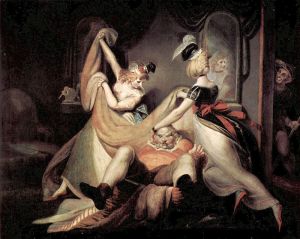
Plot: Falstaff tries to bang two married ladies named Mistress Page and Mistress Ford since he’s broke and needs cash. But since neither’s impressed by him, they conspire to subject him to a series of pranks. Then there’s Page’s daughter Anne whose parents want her to marry but can’t agree on which of her suitors she should choose. Meanwhile Anne prefers a guy neither of her parents like.

Plot Origin: Based on the 14th century tale Il Pecorone by Giovanni Fiorentino, which was published in Milan in 1558. Still, it’s possibly one of the few plays in which Shakespeare might’ve come up with an original plot.

Who Falls In Love: Well, Falstaff goes after 2 married women, but it’s for cash. But you can call it love when pertains to the Pages and the Fords. Anne with Fenton, to her parents’ dismay though Slender and Dr. Caius are among her suitors.

Who Dies: No one.

Reputation: Though popular for a long time, it’s considered one of Shakespeare’s weakest plays and was probably written quickly for a commission by one of Falstaff’s fans. The characters are all stock. The A and B plots are barely even aware of each other, the exposition is clunky, and it’s mostly formula. But at least Falstaff is very much the same though it’s not like Henry IV. And Anne’s failed suitors are complete idiots. There’s a story that it was commissioned by Queen Elizabeth I who wanted to see Falstaff in love but it’s most likely not true. But it does show that fans meddling in fictional characters’ love lives was common in the 16th century. However, Shakespeare knew better and created a plot for him that was more believable for his character. Seriously, could you see Falstaff falling in love? No. Could you see him wanting to bang two married women for cash? Probably yes. Was made into a few operas, one by Salieri and another by Verdi. With a good cast, this is a good way to kill an hour and a half.


15. A Midsummer Night’s Dream

Oberon: "What thou seest when thou dost wake,/Do it for thy true-love take,/Love and languish for his sake:/Be it ounce, or cat, or bear,/Pard, or boar with bristled hair,/In thy eye that shall appear/When thou wakest, it is thy dear:/Wake when some vile thing is near." - Act II, Scene 2

Oberon: “What thou seest when thou dost wake,/Do it for thy true-love take,/Love and languish for his sake:/Be it ounce, or cat, or bear,/Pard, or boar with bristled hair,/In thy eye that shall appear/When thou wakest, it is thy dear:/Wake when some vile thing is near.” – Act II, Scene 2

Genre: Comedy

Published: 1590-1597

Plot: Hermia and Lysander are in love. Unfortunately, Demetrius likes her, too and her father likes him better than Lysander. Fortunately, Helena is angry that Demetrius chose Hermia over her. They go to court, where Theseus rules in Egeus’ and gives Hermia the choice to marry Demetrius, be executed, or become a nun (an unusual choice in Ancient Greece. Priestess might be more like it). Hermia decides to run away with Lysander that very night but she tells Helena not to tell anyone. So naturally, Helena spills the beans to Demetrius so she could get back to his good graces. Demetrius follows Hermia and Lysander and the four get lost in the same forest. Meanwhile, the fairy royal couple Oberon and Titania are having marital problems and Oberon seeks to humiliate her so he’ll get his way with the help of magic and a love potion. But when Oberon sees Demetrius treating Helena like shit, he sends Puck to use a love potion on “a youth in Athenian garb,” traveling in the woods with a woman. However, Oberon should’ve been more specific because Puck applies the potion to Lysander instead and then Oberon applies the potion to Demetrius later after finding out that Puck really messed things up. This results in both guys being in love with Helena who thinks they’re making fun of her. Meanwhile, Oberon applies the potion to Titania’s eyes and really makes a literal ass out of a resident ham from a community theater group and leads him to Titania. Titania wakes up and ends up smitten with him and Bottom doesn’t seem to mind. Eventually, Oberon and Puck manage to straighten things up and everyone lives happily ever after. Also, Bottom and his fellow actors perform a hilariously terrible play during the wedding reception.

Plot Origin: We’re not sure where Shakespeare got his source for this story, other than in Greek mythology and some ancient and medieval stories.

Who Falls In Love: Theseus with Hippolyta, Hermia with Lysander, and Helena with Demetrius of which we can’t dispute. Oberon and Titania are married but are having problems. Titania with Bottom but she’s under a spell and he doesn’t seem to mind too much. Then there’s Lysander and Demetrius who seem to like Hermia in the beginning but then switch to Helena until they fall asleep and Puck straightens things out so no loves would intersect and everyone would live happily ever after. Well, sort of. Still, if you’re familiar with Greek mythology, it doesn’t end well with Theseus and Hippolyta.

Who Dies: Nobody.

Reputation: After the English Civil War, this play wouldn’t be performed in its entirety until the 1840s. Made into several films and had music composed by Felix Mendelsohn that’s been played at most weddings. Today it’s regarded as one of the Bard’s best and most popular comedies and is widely performed. However, this didn’t stop Samuel Pepys saying it was the most ridiculous film he’s ever seen. Bottom has been played by the likes of James Cagney and Kevin Kline. I recommend the 1999 film with Kevin Kline since you have Ally McBeal as Helena, Batman as Demetrius, Caesar Flickerman as Puck, and Jimmy McNulty as Lysander. Besides, while the 1930s version has James Cagney play a solid Bottom, Mickey Rooney’s Puck is annoying as hell. On Youtube, you can find performance of the play at the end by the Beatles.


16. Much Ado About Nothing

Benedick: "That a woman conceived me, I thank her; that she brought me up, I likewise give her most humble thanks; but that I will have a recheat winded in my forehead, or hang my bugle in an invisible baldrick, all women shall pardon me. Because I will not do them the wrong to mistrust any, I will do myself the right to trust none; and the fine is, — for the which I may go the finer, — I will live a bachelor." - Act I, Scene 1

Benedick: “That a woman conceived me, I thank her; that she brought me up, I likewise give her most humble thanks; but that I will have a recheat winded in my forehead, or hang my bugle in an invisible baldrick, all women shall pardon me. Because I will not do them the wrong to mistrust any, I will do myself the right to trust none; and the fine is, — for the which I may go the finer, — I will live a bachelor.” – Act I, Scene 1

Genre: Comedy

Published: 1598-1599

Plot: When some soldiers arrive at Leonato’s home in Messina, his daughter Hero and niece Beatrice attract the attentions of Claudio and Benedick. Claudio and Hero fall in love but are set to wed. Whereas, Beatrice and Benedick hurl witty insults at each other but everyone thinks they’d make a great couple. So other characters hatch a scheme to have Beatrice and Benedick fall in love with each other and stop arguing that proves successful. But all is not well, since for Don Pedro’s sullen and bitter illegitimate brother Don John can’t stand being unhappy with his lot. So he decides to stir trouble by having his companion Borachio make love to Hero’s servant Margaret at Hero’s window. That night he brings Don Pedro and Claudio to watch. Believing the worst, Claudio humiliates Hero, accuses her of being a slut, and jilts her at the altar. Hero’s family members decide to hide her away until the truth about her innocence comes to light. Fortunately, the night watchmen overhear Borachio about the incident and arrest him and a friend. By the time Claudio hears about Hero’s innocence, he thinks she’s dead and mourns for her. Leonato then has him punished by making Claudio tell everyone that he was wrong to suspect anything about Hero. And he also has him marry his “niece” who resembles Hero (but it’s really her). So Claudio enters the church thinking he’ll marry a woman he’s never met but he’s overwhelmed with joy when Hero reveals herself. Beatrice and Benedick decide to marry. And the four take part in a double ceremony.

Plot Origin: We’re not sure about the Bard’s original source for this play but it’s probably based on several stories.

Who Falls In Love: Claudio with Hero though they have problems and Beatrice with Benedick who initially hate each other or so it seems.

Who Dies: No one.

Reputation: This is considered one of the best Shakespearean comedies since it combines elements of robust hilarity with more serious ideas about honor, shame, and court politics. It’s said to be a forerunner of the romantic comedy as well. It was very popular in its early decades as it has been ever since. However, most of its fans usually watch it for the Beatrice and Benedick romance since it involves witty repartees and great chemistry. In fact, Charles II called this play “Benedick and Beatrice.” This makes a lot of sense Benedick doesn’t act as much of a jerk to Beatrice as Claudio does to Hero who basically accuses her of cheating on him on the altar on what was supposed to be their wedding day. And while he starts as a self-proclaimed woman hater, Benedick is virtually the only male character who doesn’t participate in Hero’s shaming (excluding the priest). Not only that, but he’s the one who calls Claudio out on it. Besides, Benedick and Beatrice seem to enjoy insulting each other even when they start off being in total denial of their feelings. Made into a movie in 1993 and 2013.


17. The Taming of the Shrew

Petruchio: "You lie, in faith; for you are call'd plain Kate,/And bonny Kate, and sometimes Kate the curst;/But Kate, the prettiest Kate in Christendom,/Kate of Kate Hall, my super-dainty Kate,/For dainties are all cates: and therefore, Kate,/Take this of me, Kate of my consolation;- /Hearing thy mildness prais'd in every town,/Thy virtues spoke of, and thy beauty sounded,/(Yet not so deeply as to thee belongs,) —/Myself am mov'd to woo thee for my wife." - Act II, Scene 1

Petruchio: “You lie, in faith; for you are call’d plain Kate,/And bonny Kate, and sometimes Kate the curst;/But Kate, the prettiest Kate in Christendom,/Kate of Kate Hall, my super-dainty Kate,/For dainties are all cates: and therefore, Kate,/Take this of me, Kate of my consolation;- /Hearing thy mildness prais’d in every town,/Thy virtues spoke of, and thy beauty sounded,/(Yet not so deeply as to thee belongs,) —/Myself am mov’d to woo thee for my wife.” – Act II, Scene 1

Genre: Comedy

Published: 1590-1594

Plot: Baptista Minola has 2 daughters. His younger daughter Bianca is kind, beautiful, and is sought by suitors everywhere. His older daughter Katerina is a complete foul-tempered bitch nobody likes but has an attractive dowry. And Baptista won’t marry Bianca off until someone marries Kate first. So gold digging Petruchio enters in and marries her over her objections since everyone wants Kate out of the way. After the wedding, Petruchio strives to tame her to his will with various methods of psychological torture. He ultimately succeeds in breaking her spirit, proving a woman’s natural need for a man and she becomes a compliant, obedient wife. When Petruchio returns to her family, they don’t believe in Kate’s new obedience and Baptista gives him a second dowry. The play ends with 3 happy marriages and a speech by Kate arguing that women should obey their husbands because they love them and only want what’s best for them (so how do you explain domestic abuse, adultery, and marital rape?).

Plot Origin: There’s no specific source for this play, though it’s based on a lot of common tales and there’s a lot of debate. But the earlier versions emphasize a woman’s inferiority and builds up string of humiliations that’s truly shocking in its violence.

Who Falls In Love: Petruchio with Katerina and Lucentio and a bunch of other guys with Bianca. Hortensio marries a rich widow but institutionalized gold digging was a thing at the time.

Who Dies: No one.

Reputation: This play has attracted considerable controversy due to some of its misogynistic elements and there are so many interpretations. Fell out of favor during the 17th century and the original wasn’t performed at all in the 18th century and won’t be until 1844. And its popularity has increased considerably during the 20th century despite the ironic rise of feminism. Now it’s one of Shakespeare’s most frequently staged plays and it’s been adapted numerous times on stage and screen and it’s as popular as it was when it was first written. Which is ironic because you’d think people from the earlier centuries would be into stuff like this but modern audiences have liked this play much more. Then again, the rise of romantic comedies might have something to do with it. The 1967 film starring Richard Burton and Elizabeth Taylor is the most famous screen version. Still, while some feminists might obviously have a problem with this play since it portrays domestic abuse in a positive light, but we have to acknowledge that a lot of romances tend to promote unhealthy behaviors. And sure Kate and Petruchio aren’t a model for a great relationship but the play has more critical acclaim than the Fifty Shades Trilogy or the Twilight Saga. And both works make this play look like a feminist drama in comparison.


18. Twelfth Night

Olivia: "O, what a deal of scorn looks beautiful/In the contempt and anger of his lip!" Act III, Scene 1

Olivia: “O, what a deal of scorn looks beautiful/In the contempt and anger of his lip!” Act III, Scene 1

Genre: Comedy

Published: 1601-1602

Plot: Twins Viola and Sebastian are separated in a shipwreck. Since Viola doesn’t have skills other than singing and playing an instrument, she decides to dress up as a boy named Cesario so she might find a job under the Duke Orsino who’s said to have a good reputation. However, she’d rather serve Countess Olivia but she’s heartbroken by the loss of her dad and brother as well as sworn off male company for the time being. So she’s probably not hiring. Anyway, after 3 days in Orsino’s service, the Duke is so charmed by “Cesario” that he sends “him” off to woo the Countess on his behalf. Olivia isn’t pleased to see “him” and has grown sick of Orsino’s wooing. But since Viola has fallen for Orsino in the meantime, she’s undeterred. As Cesario, she banters and challenges Olivia that she’s finds herself falling for the spirited “chap.” So when Sebastian shows up the fun is just getting started. Meanwhile, you have Olivia’s steward Malvolio who now looks down on her uncle who’s taking advantage of Andrew Aguecheek by convincing the poor guy that Olivia likes him. However, Olivia has no intention of the sort. Malvolio comes down hard on Sir Toby Belch so Sir Toby and a handmaid named Maria play a little trick on him. All while Feste is now charged with watching over Olivia’s uncle. But it all gets sorted out to make it happily ever after except for some people.

Plot Origin: We know that Shakespeare based this play on something, we just don’t know what.

Who Falls In Love: Viola with Duke Orsino, Olivia with “Cesario,” Orsino, Andrew Aguecheek, Malvolio, and Sebastian with Olivia, Olivia with Sebastian, Antonio for Sebastian, and Orsino with Viola.

Who Dies: No one.

Reputation: This is one of Shakespeare’s best known comedies and is often as his funniest play. Samuel Pepys called it a “silly play” but watched it 3 times anyway as a guilty pleasure. The late 17th and early 18th century saw only adaptations but the original text was revived in 1741. It’s still highly popular, often staged, and made into several adaptations in opera, stage, and film.


19. Two Gentlemen of Verona

Valentine: "And why not death, rather than living torment?/To die is to be banish'd from myself;/And Silvia is myself: banish'd from her,/Is self from self: a deadly banishment!/What light is light, if Silvia be not seen?/What joy is joy, if Silvia be not by?/Unless it be to think that she is by,/And feed upon the shadow of perfection." - Act III, Scene 1

Valentine: “And why not death, rather than living torment?/To die is to be banish’d from myself;/And Silvia is myself: banish’d from her,/Is self from self: a deadly banishment!/What light is light, if Silvia be not seen?/What joy is joy, if Silvia be not by?/Unless it be to think that she is by,/And feed upon the shadow of perfection.” – Act III, Scene 1

Genre: Comedy

Published: 1589-1593

Plot: 2 Veronan gentlemen Proteus and Valentine are sent by their dads to the court of Milan. There they fall for the duke’s daughter Sylvia. Unfortunately Proteus has a girlfriend named Julia back home. Also, Sylvia’s dad wants her to marry a rich idiot named Tyrio. But Julia decides go after Proteus dressed as a boy named Sebastian while Sylvia likes Valentine who gets exiled after falling into some thugs that she thinks he’s dead. She flees into the forest where she and a friend are kidnapped by outlaws but little do they know that Valentine is their leader. Meanwhile, Proteus tries to hook up with Sylvia who’s just not that into him while Julia tries to get her man back. So when Proteus threatens to rape Sylvia in the forest, Valentine blows his cover and intervenes. Proteus feels ashamed of himself that he broke the code of bros before hos. Valentine forgives him and lets him have Sylvia because he’d rather not ruin their friendship which causes Julia to faint and reveal herself. Proteus realizes he loves Julia and hooks up with her. Also, the Duke and Tyrio are brought as prisoners as well which gives the Duke the opportunity to see how much of an idiot Tyrio is. So he’s perfectly fine with his daughter being with Valentine and everyone lives happily ever after.

Plot Origin: Based on the Spanish prose romance Los Siete Libros de la Diana (The Seven Books of the Diana) by the Portuguese writer Jorge de Montemayor.

Who Falls In Love: Proteus and Valentine with Sylvia and Proteus with Julia. Not sure about the rich idiot Tyrio and Sylvia but she doesn’t like him. Also, Sylvia eventually chooses Valentine by the way.

Who Dies: No one.

Reputation: This is one of Shakespeare’s earliest comedies and it’s regarded as one of his weaker plays for good reason. Nevertheless, its earliest recorded performance in the original text was in 1784 whereas earlier stagings were alterations. But it’s more popular in Europe than in the English speaking world and there have been significantly few English productions. Also, Launce usually tends to steal the show by the way.

As Told by the Bard: Part 1 – The Histories

Gilbert_WShakespeares_Plays

Since William Shakespeare has brought his dramas to the Elizabethan stage, he’s still one of the most talked about authors of the English language as well as in English Literature. This year, April 23rd marked the 400th anniversary of his death. But at the time I was working on another project. Nevertheless, while many people may know a few Shakespeare’s plays, a lot don’t know what many of them are about. So this is where I come in. Nevertheless, we must know that Shakespeare most of the time didn’t always come up with original plays but he made them his own. And they’ve been subject to innumerable adaptations on stage and screen. He’s also influenced literature and entertainment for over 400 years. We may not know much about Shakespeare but let’s not get into the authorship question because we’re pretty sure he wrote them, maybe not always by himself. This series is about the plays not the man himself. Still, while his plays tend to be seen as high-brow entertainment, this wasn’t the case. In fact, these plays were meant to work on different levels. And Shakespeare is known to have a lot of bawdy humor in them. In these plays I also have listed on who falls in love and who dies. Because we tend to remember stuff like that when it comes to Shakespeare.

1henry4rain

Hotspur and his courtier from Henry IV possibly preoparing for the Battle of Shrewsbury. Hotspur better watch out for Prince Hal because he’s not coming back.

In this post, we’ll look at the histories. Many these usually focus on the Wars of the Roses when Richard II was deposed and the Houses of Lancaster and York spent much of the 15th century in civil war over the English throne. Nevertheless, as a history major, I have to remind you that these should be treated as entertainment pieces not as a history textbooks. Not to mention, with the exception of King John, these were written when at a time when they’d be considered far more recent than they are now. And I’m sure Queen Elizabeth I and James I were very keen on presenting a history of these events that would suit their interests. In other words, expect a lot of propaganda. For instance, Richard III is certainly Tudor propaganda since the real Richard III was almost nothing like the hunchbacked evil creep in the play. Also, Shakespeare’s Henry VIII isn’t the despotic king we know and love. But maybe that was for the best. A couple of these plays come out in installments. Fortunately, these plays focus on drama pertaining to some rich, ingrown, and acrimonious families, so it’s probably The Sopranos we should really be talking about. That or Game of Thrones.


  1. Henry IV Part 1
Falstaff: "There's neither honesty, manhood, nor good fellowship in thee, nor thou cam'st not of the blood royal, if thou dar'st not stand for ten shillings." - Act I, Scene 2

Falstaff: “There’s neither honesty, manhood, nor good fellowship in thee, nor thou cam’st not of the blood royal, if thou dar’st not stand for ten shillings.” – Act I, Scene 2

Genre: Historical

Published: 1597 or possibly before then.

Plot: Ever since Henry Bolingboke became Henry IV, all he wants to do is wage a crusade to cleanse himself of the sin of killing Richard II. Unfortunately, he has more pressing matters to attend to at home like some of his allies plotting to overthrow him like the Percy family whose son Harry (“Hotspur”) is one of England’s greatest warriors. Then there’s his son Hal who’s a seemingly good-for-nothing fratboy who surrounds himself with drunkards, rogues, and rejects of royal life as well as prefers to play pranks and chase women. And to make matters worse, his best friend is the old, fat, wily Sir John Falstaff who’s a bombastic drunk providing much of the play’s comedy. As Hal and Falstaff get into a number of situations, Henry IV and the Percys wage a tense political battle. Hal later reveals to the audience that he’s playing the foolish prince so people won’t expect much from him and will look much better in comparison when he finally reveals himself as the great thinker and fighter he really is. Then there’s the climatic battle of Shrewsbury where Hal joins his dad and meets Hotspur in a single combat. Hal kills him though it doesn’t stop the cowardly Falstaff profiting from draft dodgers and trying to convince Hall that he killed him. Sure it might be a happy ending but all isn’t well since the Archbishop of York and the Earl of Northumberland along with other nobles are also plotting against the king, too. Guess we’ll have to wait for the sequel.

Plot Origin: For one, history. Source material is derived from the second edition (1587) of Raphael Holinshed’s Chronicles, which in turn drew on Edward Hall’s The Union of the Two Illustrious Families of Lancaster and York. Also, Glendower isn’t a warlock but a Christian who was cheated out of his lands and declared traitor by one of Henry IV’s friends. This led him to take up arms for Welsh independence. Not to mention, the confrontation between Hal and Hotspur never happened. Also, Hotspur was actually about 3 years older than Hal’s dad, by the way. Keep in mind that Henry IV was 37 at this time and wasn’t gaunt, geriatric, or ill. So it wouldn’t make for a fair fight. Nor would Henry IV comparing Hal to Hotspur make any sense whatsoever. Henry of Monmouth would make more sense since he was 16 at the time. And his wife’s name was Elizabeth, not Kate. Oh, and Hal wasn’t as much of a scamp as he is in the play. Then there’s Hal taking an arrow that leaves a nasty scar on his face, explaining why his portraits always depict him in profile. Falstaff is a complete fabrication.

Who Falls In Love: Well, Hotspur and Lady Percy seem to be happily married until Hal intervenes. So do the Mortimers despite that the two of them not speaking the same ending.

Who Dies: Unfortunately, it’s not a happy ending for Hotspur since Hal kills him during the Battle of Shrewsbury (in real life it didn’t happen that way and Hal gets a nasty scar on his face). Still, at least Hal gives him a proper funeral eulogy which is touching. Worcester is executed. Mortimer dies shortly afterwards, too.

Reputation: From the start, this has been an extremely popular play among critics and the public. And Falstaff is probably one of the reasons for this since he’s seen as one of Shakespeare’s best characters. Hotspur has a lot of fans, too. Made into several films such as the Chimes of Midnight with Orson Welles, Age of Kings, and the Hollow Crown with Jeremy Irons and Tom Hiddleston (but no Chris Hemsworth as Hotspur, tragically).


  1. Henry IV Part 2
Falstaff: "It was always yet the trick of our English nation, if they have a good thing, to make it too common." - Act I, Scene 2

Falstaff: “It was always yet the trick of our English nation, if they have a good thing, to make it too common.” – Act I, Scene 2

Genre: Historical

Published:

Plot: Well, it opens with Falstaff bantering with his page about his pee, announcing he’s going to a whorehouse for some fun, and spending the rest of the play cracking jokes, taking bribes from draft dodgers, and drinking with his buddies. Meanwhile, it seems like victory at Shrewsbury doesn’t seem to quell Henry IV and Hal’s issues with each other as they prepare for another confrontation. Hal still hasn’t earned his dad’s trust since he’s still friends with Falstaff and his ilk. And King Henry’s mistrust deepens when Hal’s brother Prince John defeats the remaining enemies through political know-how and manipulation instead of battle which basically leaves Hal no way to get praise from his dad. Then King Henry falls ill and passes out in bed. Think his dad died, Hal swears on his dad’s “corpse” that he’ll be a great king while he takes the crown from his head. King Henry wakes up to find it stolen, berates his son for theft mostly because he thinks Hal is only waiting for him to die so he could ascend the throne. Hal gives an impassioned speech explaining why and swears he won’t let his old man down. King Henry IV dies happily and Hal becomes Henry V. In the final scene Hal and Falstaff meet again. But Falstaff’s excitement is soon thwarted when Hal rejects him by forbidding him to go anywhere near him under pain of death, proclaiming he can no longer associate with thieves and drunks. Falstaff is devastated.

Plot Origin: For one, history. Source material is derived from the second edition (1587) of Raphael Holinshed’s Chronicles, which in turn drew on Edward Hall’s The Union of the Two Illustrious Families of Lancaster and York.

Who Falls In Love: Well, it seems Mrs. Hotspur still loves her late husband since she chews out her father-in-law for sending him off to war and calling him sick.

Who Dies: King Henry IV from natural causes but at least he and Hal reconcile on his deathbed so it’s not tragic and rebel leaders after they’ve surrendered to Prince John who orders their executions.

Reputation: While it does have its moments, it’s not as successful as the first one. Yet, critics do say that Hal’s rejection of Falstaff is quite powerful onstage. But this causes many people to see Hal as a complete and utter prick because while Falstaff isn’t a shining role model, you have to love the guy. Is combined with the other parts in The Hollow Crown and Chimes at Midnight.


  1. Henry V
Henry V: "From this day to the ending of the world,/But we in it shall be rememberèd;/We few, we happy few, we band of brothers;/For he to-day that sheds his blood with me/Shall be my brother; be he ne'er so vile/This day shall gentle his condition:/And gentlemen in England, now a-bed/Shall think themselves accursed they were not here,/And hold their manhoods cheap whiles any speaks/That fought with us upon Saint Crispin's day." - Act IV, Scene 3

Henry V: “From this day to the ending of the world,/But we in it shall be rememberèd;/We few, we happy few, we band of brothers;/For he to-day that sheds his blood with me/Shall be my brother; be he ne’er so vile/This day shall gentle his condition:/And gentlemen in England, now a-bed/Shall think themselves accursed they were not here,/And hold their manhoods cheap whiles any speaks/That fought with us upon Saint Crispin’s day.” – Act IV, Scene 3

Genre: Historical

Published: 1599

Plot: Prince Hal is now King Henry V who’s shed his frat boy persona and become a mature man who now embarks on a conquest of France. This ends with him winning the Battle of Agincourt and winning the hand of a princess. But unlike in fairy tales, the fallout after the battle isn’t pretty.

Plot Origin: Well, history. And source material is derived from the second edition (1587) of Raphael Holinshed’s Chronicles, which in turn drew on Edward Hall’s The Union of the Two Illustrious Families of Lancaster and York.

Who Falls In Love: Well, Henry V and Catherine of Valois despite the fact that he conquered her country. However, in real life Henry V and Catherine of Valois wouldn’t have a language barrier to worry about.

Who Dies: A bunch of soldiers from both sides, as well as Falstaff, Mistress Quickly, and Bardolph all die off stage. Henry V dies in the epilogue.

Reputation: While not as popular as Henry IV Part 1, it’s still seen as one of the better Shakespeare plays since its plot structure has become a template for just about every war movie ever made. Not to mention when the play’s performed, expect varying interpretations since scholars debate on whether this is a pro-war, anti-war, or a character study. Also expect scholars debating on whether Henry V is a heroic boy king or a despicable manipulator who committed what we know today as “war crimes.” But do you think they gave a shit about that in the 1400s? No. Still, this play can be played on many levels. Combined with The Hollow Crown. Has 2 famous film adaptations with a 1944 one by Sir Laurence Olivier and a 1989 one by Kenneth Branagh. Then again, this might be a play that’s better on a movie screen than a stage.


  1. Henry VI Part 1
Earl of Warwick: "Between two hawks, which flies the higher pitch;/Between two dogs, which hath the deeper mouth;/Between two blades, which bears the better temper;/Between two horses, which doth bear him best;/Between two girls, which hath the merriest eye; —/I have, perhaps, some shallow spirit of judgment;/But in these nice sharp quillets of the law,/Good faith, I am no wiser than a daw." - Act II, Scene 4

Earl of Warwick: “Between two hawks, which flies the higher pitch;/Between two dogs, which hath the deeper mouth;/Between two blades, which bears the better temper;/Between two horses, which doth bear him best;/Between two girls, which hath the merriest eye; —/I have, perhaps, some shallow spirit of judgment;/But in these nice sharp quillets of the law,/Good faith, I am no wiser than a daw.” – Act II, Scene 4

Genre: Historical

Published: 1592

Plot: Begins at Henry V’s funeral after he was knocked down in his prime where we already see the English nobles feuding among themselves. Meanwhile in France, a great leader Sir John Talbot is meeting new resistance from some nobody named Joan of Arc who arrives in the Dauphin’s camp and has revitalized his flagging army. Later the young king Henry VI arrives for his coronation in France to reconcile the feuding nobles who’ve now divided themselves into 2 camps symbolized by red and white roses. And he inadvertently makes things worse for seemingly favoring the red rose party and sending the two chief rivals out at the head of his army, culminating a recipe for disaster. The Dukes of York and Somerset simply refuse to come to each other’s aid in battle which results in Sir John Talbot being killed by the French. But York defeats Joan whom he orders her executed. They also a capture the French princess Margaret of Anjou who the Earl of Suffolk plots to marry to the king.

Plot Origin: For one, history. Also, Edward Hall’s The Union of the Two Noble and Illustre Families of Lancaster and York from 1548 and Raphael Holinshed’s Chronicles of England, Scotland and Ireland from 1577. Still, this isn’t a historically accurate play since Henry VI was a baby when his dad died and was about 10 when Joan of Arc was burned at the stake. Also Joan wasn’t captured by the Duke of York but by the Burgundians who had her burned at the stake for the trumped up heresy of wearing pants.

Who Falls In Love: No one yet.

Who Dies: Sir John Talbot is killed in battle along with a lot of other English soldiers, including his own son.

Reputation: This play and its sequels was well received enough to establish Shakespeare’s reputation as a playwright. Today it’s seen by some critics as one of the Bard’s weakest works while some disagree. Still, there’s a lot written about it in Wikipedia in regards to the death of chivalry, patriotism, as well as the saintly vs. demonic. It’s also suggested that Shakespeare might’ve collaborated with others in writing this as well. The portrayal of Joan of Arc as a scheming villainess who’s inspired by demonic voices, sleeps around, and distrusted by some of the French might rub people the wrong way because while she may not be as angelic as she depicted, most of us know that she was absolutely not a Satanist whore. Combined with The Hollow Crown. It’s still performed though.


  1. Henry VI Part 2
King Henry VI: "Forbear to judge, for we are sinners all./Close up his eyes, and draw the curtain close;/And let us all to meditation." - Act III, Scene 3

King Henry VI: “Forbear to judge, for we are sinners all./Close up his eyes, and draw the curtain close;/And let us all to meditation.” – Act III, Scene 3

Genre: Historical

Published: 1591-1594

Plot: Begins at Henry VI’s wedding to Margaret of Anjou but the Earl of Suffolk’s plan to dominate the king fails thanks to the Duke of Gloucester who’s popular, honest, and trusted by the king. So in retaliation, Suffolk conspires with other courtiers to disgrace and kill Gloucester only for him to end up exiled and executed for the crime. Meanwhile the Duke of York stakes his claim to the throne since he knows it’s as good as Henry’s with the Dukes of Salisbury and Warwick pledging their support. York gets command of a Royal Army to suppress a rebellion in Ireland but not before setting up a little rebellion against the crown by enlisting Jack Cade. Cade captures London but proves to be a tyrant that Lord Clifford is able to persuade the commoners to fight in King Henry’s favor. York returns with his army and after finding out Clifford’s win in the PR wars, declares he wants to protect the king from Lord Somerset’s treachery. Henry rejects this and York tells him he just wants to take over and, supported by sons Edward and Richard, he fights and wins against Royal forces. Nobles choose sides as King Henry, Margaret, and Young Clifford flee.

Plot Origin: For one, history. Also, Edward Hall’s The Union of the Two Noble and Illustre Families of Lancaster and York from 1548 and Raphael Holinshed’s Chronicles of England, Scotland and Ireland from 1577. Nevertheless, since this takes place in the 1450s, there’s no way in hell Richard of York could enlist his sons Edward and Richard to support him because Edward was 13 and Richard was 2 around the Battle of St. Albans. Then again, Edward probably would’ve went along but he wouldn’t be leading any armies. As for Queen Margaret, she’s really not evil and her reason for stepping up had more to do with her husband’s incompetence. Jack Cade wasn’t as much of an idiot but he did take the Mortimer name yet as an expression for solidarity.

Who Falls In Love: Well, Henry VI and Margaret of Anjou get married but it’s more of a political alliance (and she has something with Suffolk on the side where they have something mutual. After all, he wooed her for Henry anyway). The Gloucesters also have an interesting relationship.

Who Dies: The Duke of Gloucester is assassinated by the Earl of Suffolk, the Earl of Suffolk is executed, a bunch of rebels and soldiers, Jack Cade is killed, Lord Clifford is killed in battle, and Cardinal Beaufort is found dead in bed.

Reputation: Well, it’s still talked about and is still performed but it’s not as popular or well-loved as some of other Shakespearean plays. Yet, along with the other Henry VI plays, it did help establish the Bard’s reputation as a playwright. Combined with The Hollow Crown.


  1. Henry VI Part 3
King Henry VI: "This battle fares like to the morning's war,/When dying clouds contend with growing light;/What time the shepherd, blowing of his nails,/Can neither call it perfect day, nor night." - Act II, Scene 5

King Henry VI: “This battle fares like to the morning’s war,/When dying clouds contend with growing light;/What time the shepherd, blowing of his nails,/Can neither call it perfect day, nor night.” – Act II, Scene 5

Genre: Historical

Published: 1591-1594

Plot: Begins with a face-off between King Henry and the Duke of York along with their respective supporters. They later make a deal that after King Henry dies, the Duke of York will have the throne. However, Margaret is disgusted by the king’s cowardice that she and her husband’s supporters continue the war on their own, defeating the Yorkists in battle. Young Clifford kills Edmund of Rutland as York is captured, taunted with his son’s death, and executed. The Earl of Warwick continues the fight on behalf of his son Edward who’s joined by both Richard and George at head of reinforcements from France. Between them, they defeat Margaret and the Lancastrians and Edward is proclaimed King Edward IV. He then outrages Warwick by marrying Elizabeth Woodville just as he was going to set him up with a French princess. Warwick and George of Clarence switch sides. And soon Edward is captured while Henry is restored. Yet, he’s soon rescued and kills Warwick in battle. In the final battle, Edward captures and kills Henry’s son and jails Margaret while Richard sneaks away and kills Henry VI to remove any further complications. So by the end, things look rosy for the House of York with Lancastrian cause seeming dead and gone. And there’s a new heir to the throne named young Edward. But Richard of Gloucester doesn’t seem too happy at the moment.

Plot Origin: For one, history. Also, Edward Hall’s The Union of the Two Noble and Illustre Families of Lancaster and York from 1548 and Raphael Holinshed’s Chronicles of England, Scotland and Ireland from 1577. Still, historically, Edmund of Rutland wasn’t Duke Richard of York’s youngest son. He was his second and was 9 years older than the future King Richard III who was actually Richard of York’s youngest son anyway. But Rutland did die at 17. Also, in 1460, George was 11 and Richard was 8. So to say that they defeated Margaret in her Lancastrians in the 1460s with their teenage older brother is a stretch. Also, when Edward IV is restored in 1471, Richard is 19 but this doesn’t really matter as much.

Who Falls In Love: Edward IV marries Elizabeth Woodville to Warwick’s outrage (since he was engaged to another woman at the time in real life).

Who Dies: Edmund of Rutland is killed by Young Clifford, Richard of York is executed, Edward IV kills the Earl of Warwick in battle as well as Edward of Westminster, Henry VI is killed by Richard of Gloucester, and a bunch of other soldiers.

Reputation: While the trilogy this play belongs is talked about and performed as well as said to establish Shakespeare’s reputation as a playwright, it’s not as popular as the other plays. In fact, the play that comes after this one is seen to be way more enjoyable than the Henry VI trilogy. It’s called Richard III. Combined with The Hollow Crown.


  1. Henry VIII
Queen Katharine of Aragon: "After my death I wish no other herald,/No other speaker of my living actions,/To keep mine honour from corruption,/But such an honest chronicler as Griffith." - Act IV, Scene 2

Queen Katharine of Aragon: “After my death I wish no other herald,/No other speaker of my living actions,/To keep mine honour from corruption,/But such an honest chronicler as Griffith.” – Act IV, Scene 2

Genre: Historical

Published: 1603-1613

Plot: Mostly focuses on the machinations of Cardinal Wolsey surrounding the Duke of Buckingham and the annulment of Henry VIII’s marriage to Katherine of Aragon. It ends with Henry’s marriage to Anne Boleyn and the subsequent birth of future Queen Elizabeth I.

Plot Origin: History and Raphael Holinshed’s Chronicles of England, Scotland and Ireland from 1577. In real life these events happened over a period of 13 years. Not to mention, Mary Tudor is carefully omitted. Also, Cardinal Wolsey is unfairly maligned while Henry is seen as a poor, misunderstood nice guy. In reality, though corrupt Cardinal Wolsey was a competent and faithful servant to King Henry VIII well into the man’s reign. It’s just that he wasn’t able to get an annulment from Rome because the Pope at the time was being held prisoner by Holy Roman Emperor Charles V who just happened to be Katherine of Aragon’s nephew. But Henry couldn’t tolerate Wolsey failing him so he fired him, took over his house, and was going to have him arrested and executed but he died of natural causes. Then there’s the fact that there was no reason to believe Elizabeth I would be queen at the time of her birth. And the fact that Katherine never meets Anne despite her being her lady-in-waiting. Still, around this time, there would’ve still been so much controversy about Henry VIII’s reign among the public that our Bill might’ve made a conscious choice to toe the party line. This also explains why you won’t find Sir Thomas More or his beheading in this either.

Who Falls In Love: Henry VIII with Anne Boleyn. Sure they seem happy at the end, but we all know how that turned out.
Who Dies: The Duke of Buckingham who gets executed and a bunch of other guys who wouldn’t agree with Henry.

Reputation: Well, a cannon during a performance of this play in 1613 caused the Globe Theatre to burn to the ground. And it’s also said that Shakespeare wrote this with a collaborator. Nevertheless, it’s one of the few plays to retain its popularity after the Restoration and into the 18th century. Recent audiences aren’t really big fans of the play since we all know that Henry VIII wasn’t a poor, misunderstood nice guy. If he was, then he wouldn’t have been so harsh about Cardinal Wolsey failing him due to factors that were beyond his control. Hell, he even had Sir Thomas Cromwell beheaded in 1540 by setting him up with Anne of Cleves (whom he later found to be unattractive while meeting her. However, Anne of Cleves wasn’t seen ugly by others. Yet, at least she was smart enough not to contest the annulment and got a generous settlement out of it). Still, if you want to see something on Henry VIII that doesn’t include Anne Boleyn’s beheading, watch A Man for All Seasons instead.


8. King John

King John: "There is no sure foundation set on blood;/No certain life achieved by others' death." - Act IV, Scene 2

King John: “There is no sure foundation set on blood;/No certain life achieved by others’ death.” – Act IV, Scene 2

Genre: Historical

Published: 1590s

Plot: King John is the anti-hero in this with the hero being Bastard Philip Falconbridge who’s the son of Richard the Lionheart. Begins with Richard the Lionheart being killed by a man named Austria. Still, John somehow gets himself in a war with Philip II because he refuses to step down in favor of his nephew Arthur whom his mom Constance wants on the throne. After all, he’s the son of John’s older brother Geoffrey (though Richard wanted John to succeed him in his will). Then there’s Hubert of Angiers who also has a claim but Philip suggest England and France unite to fight him off. Then John gets excommunicated because he appointed an archbishop without consulting the pope. Bastard Philip beheads Austria. Angiers and Arthur are captured as John forces the former to kill the latter but he refuses and lets him escape. Cardinal Pandolf manipulates Dauphin Louis into invading England so he could make a play for the English throne with the English lords throwing their support. But after Arthur dies trying to escape, King John becomes deeply remorseful and is accepted back to the Church over this. But he falls ill and becomes unable to rule so Bastard Philip assumes command with him winning over the French and English. But the Lords soon learn that once the Dauphin gets into power, all English noblemen will be beheaded. So unsurprisingly, the lords side with the English once more. Meanwhile, John gets poisoned by a monk as his son Henry watches him die. He takes the crown after Cardinal Pandolf convinces the French to leave English soil.

Plot Origin: History and Raphael Holinshed’s Chronicles of England, Scotland and Ireland from 1577. Still, while the play has John getting into a war because he wouldn’t step aside for his nephew, the reason was that Philip II wanted to capture French lands in English possession. Also, although Arthur is depicted as 8 in the play, he was actually 16 during these events. And he was executed almost as soon as John took the throne. John didn’t have any remorse over this. Oh, and Richard the Lionheart was killed by a kid with a crossbow and he was shortly killed after he died (even though Richard forgave him and asked he wouldn’t be harmed). Not to mention, King John died from dysentery, not monk poisoning. Philip Falconbridge should really be Philip of Cognac but he’s so sparsely documented that there’s really not much to go on but he’s said to slaughter Viscount Aimar V of Limoges who was the leader of a rebellion that Richard was fighting. And it was over the death of his dad. But there are no other sources to confirm this and we’re not sure what happened to Cognac after 1201. Then there’s the fact the Magna Carta isn’t even mentioned at all. However, this play does get one thing right which is the fact that Dauphin Louis (future Louis VIII of France) did invade England during King John’s reign and did have considerable English support. But he was never crowned and renounced his claim after being excommunicated and repelled that he’s now considered a Pretender more than anything.

Who Falls In Love: Dauphin Louis and Blanche get married but this is a political arrangement.

Who Dies: Richard I is killed, Eleanor of Aquitaine dies of natural causes, Prince Arthur dies falling off a wall and trying to escape, Austria is beheaded by Bastard Philip, Constance dies of grief, and John dies from monk poisoning.

Reputation: This play is so obscure that it’s not performed a lot and doesn’t seem to have a lot of commentary. Well, it was highly popular in the Victorian era that it was performed quite frequently but that’s about it. For a play on King John, stick to The Lion in Winter instead.


9. Richard II

Richard II: "For God's sake, let us sit upon the ground,/And tell sad stories of the death of kings:/How some have been depos'd, some slain in war,/Some haunted by the ghosts they have depos'd;/Some poison'd by their wives, some sleeping kill'd;/All murder'd — for within the hollow crown." - Act III, Scene 2

Richard II: “For God’s sake, let us sit upon the ground,/And tell sad stories of the death of kings:/How some have been depos’d, some slain in war,/Some haunted by the ghosts they have depos’d;/Some poison’d by their wives, some sleeping kill’d;/All murder’d — for within the hollow crown.” – Act III, Scene 2

Genre: Historical, Tragedy

Published: 1595

Plot: Henry Bolingboke and a rival challenge each other to a duel but Richard II interrupts them before they have a chance to fight and exiles them both. Sometime later John the Gaunt dies, giving Richard the idea to seize his cousin’s lands. Bolingboke decides to return as the Duke of Lancaster and he’s rightfully pissed that Richard has taken his lands and wealth. So he quickly starts a war with him to get his stuff back. But soon he ends up seizing the throne of England and forces Richard to abdicate. Richard is sent to prison angsting about losing his throne before being killed by an ambitious nobleman. Now King Henry IV regrets his death and vows to redeem himself by starting a crusade against Jerusalem. Unfortunately, parenthood, ally betrayal, and civil unrest won’t give him any time for that.

Plot Origin: History and Raphael Holinshed’s Chronicles of England, Scotland and Ireland from 1577. While the play paints Richard II as a weak, capricious, and unpopular, that’s not the whole story. Sure was unpopular…among nobles since they had been in control during the early part of Richard’s reign (since he ascended the throne as a child) and he kind of wished to rein them in. Still, he wasn’t executing and exiling nobles until the later years of his reign. And let’s just say him disinheriting and exiling Henry Bolingboke was a huge mistake. Nevertheless, while Richard II’s polices weren’t entirely unrealistic or unprecedented, the way he carried them out was unacceptable to the political which led to his downfall. Still, Henry IV would regret having him killed for the rest of his life.

Who Falls In Love: Well, Richard II really loves his queen. Then again, she’s more of composite character of his 2 wives, one of whom was still a child at the time of his death. So it’s probably for the best.

Who Dies: The Duke of Gloucester is executed, John the Gaunt dies of natural causes, and Richard II is killed by Exton in prison along with a bunch of other soldiers in battle.

Reputation: This play has an unusually detailed performance history and is still performed today. A lot of people draw parallels between Richard II in this play and Elizabeth I in the last years of her reign since it wasn’t clear at the time as to who would succeed her. And it doesn’t help that Richard II and Elizabeth I didn’t have kids. Still, while Richard II may seem like a jerk, you kind of feel bad for him once he’s overthrown. Combined with The Hollow Crown.


10. Richard III

King Richard III: "And therefore, since I cannot prove a lover/To entertain these fair well-spoken days,/I am determined to prove a villain/And hate the idle pleasures of these days." - Act I, Scene 1

King Richard III: “And therefore, since I cannot prove a lover/To entertain these fair well-spoken days,/I am determined to prove a villain/And hate the idle pleasures of these days.” – Act I, Scene 1

Genre: Historical

Published: 1591

Plot: Edward IV knows he doesn’t have a lot of time left and wants to avoid another generation of dynastic conflict that ended with his second ascension to the throne from starting up again. So he decides to call England’s powerful factions to make them shake hands and promise to be nice to each other and his young son once he croaks. They do and everyone lives happily ever after. Just kidding! It all goes downhill from there. Because Edward’s younger brother Richard of Gloucester has other ideas. With aid from Lord Hastings and the Duke of Buckingham and after a brief detour to woo the widow of a man he killed, he soon has several of the queen’s relatives arrested and executed in the Tower of London. And once, Edward IV croaks, the young princes get sent there, too. However, by this point Lord Hastings is dismayed when Richard plans to have his nephews declared illegitimate and take the throne for himself. So he refuses to go along and gets his head chopped off as a result. From there, Richard decides that the kids will be trouble and he might as well have them whacked, too which even makes Lord Buckingham getting squeamish. So he leads a failed rebellion and gets his head chopped off, too. Richard then proceeds to poison his wife so he could marry his niece. This leads almost every non-villainous character in the play band together under some guy who hasn’t even appeared. But Henry Tudor prevails since he’s assisted by the ghosts of Richard’s victims and successfully kills him in battle.

Plot Origin: For one, history. Also, Edward Hall’s The Union of the Two Noble and Illustre Families of Lancaster and York from 1548 and Raphael Holinshed’s Chronicles of England, Scotland and Ireland from 1577. Thomas More’s biography of Richard III may be another source. Still, the real Richard III wasn’t a deformed freak (well, he had scoliosis but he didn’t let that slow him down). Nor was he a terrible ruler, took the throne with illegal power (he simply ruled any nephews and nieces above the succession order as illegitimate), or had a lot of people killed. Also, Richard wouldn’t have had a hard time declaring Edward IV’s kids illegitimate because he was engaged to another woman before tying the knot with Elizabeth Woodville and was too much of a horndog for people to be shocked by it. Besides, in England, the nobles and commoners hated the non-noble Woodvilles and feared the princes would be used as Woodville pawns anyway. And they weren’t fine with the idea of child kings. So let’s just say Richard putting the kids in the Tower was an unpopular one and Parliament was happy to give him the throne. And his coronation was one of the best attended in years. We also know that Richard didn’t kill the Duke of Somerset (who died when he was 3) or George of Clarence (whose death was at Edward IV’s orders because he was an opportunistic bastard who switched sides during the Wars of the Roses. But when he murdered a servant girl, Edward just wanted George dead and had no wish to commute his sentence. Not to mention, Richard actually argued against George’s execution despite having feuds with him). Compared to other medieval kings, Richard’s body count was low but he only ruled for 2 years. His relationship and marriage to Anne Neville was a happy one (and he most certainly didn’t bump off her dad or poisoned her. As for her previous husband, he certainly took advantage of his death. But that’s because he really loved Anne and marrying her wasn’t a popular decision at the time). He never accused his mom of being an adulteress (George of Clarence did this). And he had no interest whatsoever to marry Elizabeth of York (because he was arranging marriages for both of them to marry within the Portuguese royal family. He also formally denied any intention amid rumors). Oh, and he died at 32. Edward IV died at 40 and his death came as a shock and Richard wasn’t even at court at the time. As for the princes, it’s most likely that Lord Buckingham had them killed (if not, then the Tudors but they never got their aunt Margaret who was safe in Burgundy). Buckingham’s rebellion was intended to put himself on the throne, not Henry Tudor and he was a long time adherent to the Lancastrian cause. He later transferred support to Henry Tudor when he knew that he wouldn’t get any support from any faction. And Edward IV reigned for 12 years. However, given that it was Tudor times, you can see why Richard III is depicted as evil in this one.

Who Falls In Love: Well, Richard with Lady Anne. (But contrary to the play, Richard and Anne really did love each other and had a kid who died young. And she and their son died of natural causes.)

Who Dies: Edward IV of natural causes, the princes in the tower from murder (of course), several of the Queen’s relatives get executed, George of Clarence is drowned in a massive vat of wine, Lord Hastings and Lord Buckingham get beheaded, Lady Anne gets poisoned, and Richard III goes down fighting at Bosworth Field. A lot of others get killed as well.

Reputation: A Restoration adaptation had been performed throughout the 1700s but the original Shakespearean version in a production in 1845. Though it’s still commonly performed today, it’s rarely unabridged sometimes with certain peripheral characters removed entirely mostly because not people have seen the Henry VI trilogy plays. It’s also a big reason why the Richard III Society also exists since this was one of the reasons why Richard III has had and perhaps still does have a bad historical reputation. Still, even members of the Richard III Society enjoy the play because evil Richard III is so entertaining. Made into several films with the 1955 version starring Sir Laurence Olivier being the most famous.

History of the World According to the Movies: Part 21 – The Elizabethan Age

Image

From the historic travesty Elizabeth and Elizabeth: The Golden Age where dramatic license runs wild and real history comes to die. I mean you’d be better learning real history from a Renaissance Fair than in this historic disasterpiece. Yet, like Braveheart, this got Oscar nominations nevertheless. Also, there’s no way in hell Elizabeth looked like that in her fifties.

Of course, my last post didn’t cover the whole Tudor age since Hollywood makes a lot of movies in this era since the Tudors produced both Henry VIII and Queen Elizabeth I. However, between their, Henry VIII’s other children Edward VI and Mary I also ruled England for those eleven years which were eventful but short. Nevertheless, Elizabeth I ascended the throne 1558 and would rule for over forty years which would signal the English Renaissance in its full flower. England soon became interested in settling colonies in the Americas with Roanoke (which failed), Shakespeare wrote his plays, the Church of England as we know it began to take shape, Mary, Queen of Scots lost her head, and the English defeated the Spanish Armada. Elizabeth I was an astute monarch who helped bring England onto the world stage and led a true golden age. However, she never married and died childless which meant that her throne went to the King of Scotland at the time named James VI (I’ll get to this somehow). Nevertheless, this post will be long since one Indian director made a couple of films called Elizabeth and Elizabeth: the Golden Age that offend me both as a Catholic, a film lover, and history buff, which I should list accordingly. Apparently these were very popular in Great Britain but do make me worried since I believe filmmakers should have at least some concern with facts like people’s life dates for instance. Shekhar Kapur apparently seems to take as much of a dramatic license as Mel Gibson. Still, here are some of the movie inaccuracies from the Elizabethan Age.

Edward and Mary:

Edward VI:

Edward VI was sickly child all his life. (He was said to be good in health until a teenage bout with measles which weakened his immune system.)

The Duke of Northumberland pressured a dying Edward VI to have his daughter-in-law Lady Jane Grey succeed him. (Lady Jane’s succession was Edward’s own idea dating before his final illness so he could stop the Catholic Mary from getting the throne. Yet, the marriage between Lady Jane and Guilford Dudley was the Duke of Northumberland’s idea.)

Edward VI died of tuberculosis. (He died of a chest infection but we’re not sure whether it was TB or not.)

Lady Jane Grey and Guilford Dudley:

Guilford Dudley was a virgin with a passion for social justice and he and Lady Jane actually loved each other. (In reality, he was a total asshole who had a temper tantrum when Jane refused to make him king after her coronation. They hated each other and Jane never wanted to marry Guilford in the first place. She was so repelled by him that their marriage was never consummated and she refused to see him on the night before his execution. I’m sorry, but that Lady Jane movie starring Cary Elwes and Helena Bonham Carter is just a load a crap because Guilford and Jane’s relationship was anything but a romantic love story. Rather, it was a match made in hell {and definitely their parents’ idea}. )

Lady Jane Grey and Guilford Dudley lived as man and wife in their own house. (Though they did get married, they never lived as a married couple the short time they were together {Jane was obliged to live with her in-laws and became convinced they were trying to murder her}. Jane would be crowned a month after their wedding {and would refuse Guilford to be crowned king}. Nine days later, they’d both be in prison in separate towers, never to contact each other again. Of course, their marriage would’ve been a disaster anyway.)

The Wyatt Rebellion was a plot to put Jane Grey back on the throne. (It was a plot to put Elizabeth on the throne.)

Guilford Dudley was youngest of three sons. (He was the youngest of five sons who’ve all survived to adulthood.)

Jane Grey was a precocious and talented scholar with zeal for social reform. (Yes, she was a very intelligent young lady. However, monarchs were never interested in social reform during the 1500s. In fact, those interested in social reform were commoners, who were executed trying to instill it by themselves.)

Lady Jane Grey didn’t want to marry Lord Guilford Dudley because she was in love with Edward VI. (She was actually in love with a guy named Edward Seymour, Earl of Hertford. That and the fact Dudley was a total jerk she had nothing in common with.)

Mary I:

Mary Tudor was fat. (She was said to be rail thin at least until cancer bloated her. Her and Elizabeth weren’t considered very attractive, especially toward the ends of their reigns.)

Mary I was a cruel tyrant who was worthy of her “Bloody Mary” nickname. (She executed less people than anyone else in her dynasty. She was mostly hated for marrying Philip II. Also, she was capable of inspiring great loyalty, especially to her friends and servants.)

Mary I died from a phantom pregnancy. (She died from cancer three years after experiencing a false pregnancy {which might have been a tumor that caused recurring abdominal swelling}.)

Princess Elizabeth:

Robert Dudley was with Elizabeth when she was arrested and sent to the Tower of London. (He was already in prison by this time with his four brothers since his brother Guilford was married to Lady Jane Grey. Yet, all the Dudley brothers save Guilford {who’d be executed} would all be released by 1555.)

Elizabeth was under house arrest at Hatfield for four years. (It was at Woodstock, but I doubt if there was brown acid there.)

Elizabeth was addressed as “Princess Elizabeth” during the reign of her half-sister. (She had been declared a bastard and stripped of that title.)

Princess Elizabeth’s first crush was Lord Thomas Seymour yet she was a knowing nymphet who tempted him. (Her first crush was probably her childhood friend Robert Dudley. Still, Elizabeth did live with Catherine Parr after she married Thomas Seymour who she had been in love with throughout her marriage to Henry VIII. However, her relationship with Thomas Seymour at the time bordered more on sexual abuse. I mean the guy would go into Elizabeth’s room half-naked every morning chasing her around the bed and spanking her butt {for non-disciplinary reasons} as well as even tried to kiss her at least once. Oh, and Elizabeth was 14 at the time. Nevertheless, Elizabeth tried getting up early so she would already be dressed when he turned up. Thus, she was certainly not that into him at all. Also, Catherine Parr was once seen to have held Elizabeth fast while Seymour ripped the girl’s dress apart. Still, in Young Bess, they seem to make Seymour’s attentions on her seem to be the result of Elizabeth’s tempting him, which weren’t.)

Others:

Bishop Stephen Gardiner was a Catholic fanatic who had people in his diocese executed and supported Mary I’s marriage to Philip II. (He was considered a moderate who didn’t have anyone executed and actually opposed Mary I marrying Philip II.)

The Duke of Norfolk was a Catholic conspiracy plotter who urged Mary I to kill Elizabeth before she succeeded the throne. (The Duke of Norfolk was vague about his religion and never considered himself other than Anglican and only got involved in the conspiracies against Elizabeth much later.)

John Fekenham was an old man when he tried to convert Jane Grey to Catholicism. (He was only in his thirties.)

Nicholas Ridley and Hugh Latimer were burned with an unnamed woman. (They weren’t executed with anyone else.)

Elizabethan Age:

Elizabeth I:

Elizabeth I received a marriage proposal from Henry Duke of Anjou. (He never met and never proposed to her. Also, he was married to someone else.)

Elizabeth I was a major slut. (If she was, she had a clever way of hiding it even though many reputable historians continue to assert that she was a virgin for various reasons or that she wasn’t sexually active during her reign. First, she knew if it could be proven that she wasn’t a virgin, she would lose all her power. Second, she wouldn’t have much of an opportunity to have sex since she was constantly surrounded by maids, courtiers, and other servants as well as had several bed maids so she never slept alone. Besides, she had no way of being certain which of these people were spies for one of her many enemies and could destroy her with a report of any sexual indiscretion. Not to mention, many historians said she was too politically savvy to be caught with her pants down, unlike like some politicians today. Thus, there’s pretty much a plausible historical case that Queen Bess wasn’t getting any.)

Elizabeth I met Mary, Queen of Scots. (They never met in person. Still, Mary, Queen of Scots would later have a grandson who’d suffer the same fate for different reasons.)

Elizabeth I cut her hair to show she was a virgin. (She didn’t and wore a wig to hide her thinning and graying hair as well as wore make up to conceal her smallpox scars, which she did later in her reign.)

Elizabeth I reprimanded a council member for divorcing twice. (Obtaining a divorce was almost impossible at the time {and Henry VIII knew that very well, though he wasn’t technically seeking a divorce}.)

Elizabeth I consulted with Dr. John Dee on matters around the time of the Spanish Armada. (He was abroad at the time and would return after the Spanish Armada.)

Men in Elizabeth I’s court wore long cloaks and carried swords in the Queen’s presence. (Weapons were forbidden in court {except by the Royal Guard} and Elizabeth I had banned long cloaks in case an assassin was hiding a weapon under it.)

Elizabeth I never married over her love for Robert Dudley. (Sure it’s very likely Robert Dudley was the love of her life. However, there are several explanations for this and she probably had other reasons not to marry Dudley other than him having a wife or two. Not only that, but the time when Dudley was in between marriages she chose not to. This might’ve been due to the fact that Dudley’s first wife died under suspicious circumstances which didn’t help his reputation. Also, the cult of the Virgin Queen wasn’t used to full effect until over 20 years after she became queen with her last serious marriage proposal. Thus, it was much more likely that Elizabeth I chose not to marry because staying single was good politics as well as being a Protestant queen in the 16th century didn’t provide her with a lot of options in the marriage market.)

Elizabeth I was a calculating and vicious queen. (She was actually quite intelligent and charming.)

Elizabeth I was the same age as Henri III. (She was 18 years older than him.)

Elizabeth I set up Lord Darnley with Mary, Queen of Scots. (She forbade the match since Mary and Darnley were half-cousins.)

Elizabeth I wore a suit of armor. (She never did.)

Elizabeth I’s funeral procession was led on the frozen Thames. (She died in the spring of 1603.)

The Pope excommunicated Elizabeth I early in her reign which made her a fair target for Catholic assassins. (He excommunicated her in 1570 which severed official Roman Catholic ties to England {not an act by British bishops who really had no say anyway}. Still, Elizabeth I didn’t really care about what her people believed in as long as they didn’t do anything treasonous. Her 1570 excommunication only made Elizabeth I more likely to execute Catholics only because she didn’t want them to be more loyal to the Pope than her.)

Elizabeth I was almost assassinated during the river pageant early in her reign. (This happened in 1578 but it was a salute gone wrong and no one was killed.)

Elizabeth I was a dimwitted nymphomaniac as a young woman. (She was neither since she was a very competent ruler as well as an intellectually distinguished woman of her age who knew the value of keeping it in her pants.)

Elizabeth I’s relationship with Robert Dudley was physically abusive. (Tempestuous and fascinating in power balance maybe, but it was never physically abusive.)

Elizabeth I was reluctant to see the Earl of Essex beheaded. (She was a lot more keen than she was in Elizabeth and Essex.)

Sir Robert Dudley, Earl of Leicester:

Sir Robert Dudley was a traitor, a conspirator, and a Catholic convert who was banished for being involved in a Catholic plot. (Dudley was a devoted Puritan and remained faithful to his Queen throughout his life. Oh, and he was banished because of a scandal over the mysterious death of his wife Amy who fell down the stairs under suspicious circumstances.)

Elizabeth I didn’t know that the Earl of Leicester was married. (She attended his wedding. Also, he married his first wife while Elizabeth’s dad was still king and they both knew each other since they were kids.)

Sir Robert Dudley was not present in the Tilbury camp during the Spanish Armada Crisis. (He was a Lieutenant General during the whole affair and would die shortly after. Oh, and Elizabeth I actually took his death hard.)

Robert Dudley had an affair with Lettice Knollys. (She was married to Walter Devereux and had many children with him including Robert Devereux, Earl of Essex another favorite of Queen Elizabeth I. Oh, and she married Robert Dudley in 1578.)

Sir William Cecil, Lord Burghley:

Sir William Cecil was old enough to be Elizabeth I’s dad. (He was only 13 years older than her.)

Sir William Cecil was made Lord Burghley when Elizabeth I retired him. (She ennobled him as a reward for his services 13 years into her reign and he remained her most loyal adviser until his death.)

Lord Burghley was alive around the time of the Earl of Essex’s execution in 1601. (He died in 1598.)

Sir Francis Walsingham:

Sir Francis Walsingham was a ruthless and scheming middle aged man who killed a young boy, was a proponent of torture and sexually ambiguous. (He was only a few years older than her and wasn’t much of a schemer as he’s depicted in the Cate Blanchett movie nor did he ever kill a young boy {or anyone}. Oh, and he wasn’t a key figure in English politics until after he was recalled from France since he spent his early years in court as a servant to Sir William Cecil. On a personal note, he was very religious, happily married, and had a daughter who married Sir Philip Sidney and Robert Devereux. Still, he was a proponent of torture.)

Elizabeth I visited Sir Francis Walsingham when he was dying. (She let him die in poverty and simply didn’t visit him.)

Francis Walsingham had trapped and executed the Duke of Norfolk. (Walsingham was in France when Norfolk was executed.)

Francis Walsingham locked up six bishops to guarantee passage of the Act of uniformity to secure the Queen’s act, which won by five votes. (No such action ever took place {actually Sir William Cecil got them to agree through more complex means}. According to Movie Mistakes Cecil, “effectively became the first government whip, using many techniques, the most important being a procedural device that limited debate to that which was justified by Scripture alone. The Catholic MP’s walked out in protest. The two ringleaders of the protest were taken to the Tower of London.” Also, Elizabethan bishops didn’t wear black mitres either.)

The Babington Plot:

Alvaro de la Quadra was assassinated in retaliation for the Babington Plot. (He died in 1564, 22 years before the Babington plot ever took place.)

The Babington Plot ended with Anthony Babington aiming a pistol at Elizabeth I in St. Paul’s Cathedral. (It was thwarted in the planning stages and was one of the main reasons Mary, Queen of Scots was executed.)

The Spanish Armada:

The English lost ships during their clash with the Spanish Armada. (No single ship was lost.)

The Spanish Armada battle took place off the coast of England. (It was off the coast of France.)

The English defeat of the Spanish Armada was due to the English navy efforts. (The Spanish Armada campaign was disastrously mismanaged {by the Spanish} yet they could’ve won easily as the English ran out of ammo. Yet, they were shipwrecked by powerful storms off the West coast of Ireland.)

William Shakespeare:

Shakespeare’s inspiration Viola was a woman who aspired to be an actress in one of his plays. (The romance of Shakespeare in Love never happened. Also, he may have been bisexual since his sonnets focus on a young boy and a Dark Lady.)

Macbeth was performed before Hamlet. (Hamlet was performed before Macbeth.)

Shakespeare didn’t author his plays but was given them by Edward de Vere. (There’s some debate over this but it’s plausible. Also, a PBS special argued this quite convincingly. My guess is these guys probably collaborated.)

Richard III was played on the eve of the Essex Rebellion. (It was Richard II.)

William Shakespeare wrote the King James Bible. (It’s very likely he didn’t, but if he did, he wasn’t the sole collaborator.)

Sir Walter Raleigh:

Sir Walter Raleigh was the hero of the English Campaign against the Spanish Armada. (Sir Francis Drake was since it was his moment of triumph. Raleigh was kept in Ireland at that time on special business.)

Elizabeth I knighted Sir Walter Raleigh to keep him in England and against his will. (It was a reward for his services. Also, he was knighted on a ship and not against his will.)

Sir Walter Raleigh was a pirate who was imprisoned around the time of the Spanish Armada. (Drake was the pirate. Also, Raleigh only was imprisoned by Elizabeth I several years after the Spanish Armada.)

Sir Walter Raleigh had an easily understandable accent. (His strong West Country accent made it difficult for some courtiers to understand him and made him an object of ridicule. For instance, Elizabeth I called him “Water” because of it. Also, Drake had the same accent.)

Sir Walter Raleigh had an affair with Bess Throckmorton around the time of the Spanish Armada. (This happened three years after the English defeated the fleet. Oh, and she was secretly married to him as well as had his child. Not to mention, Elizabeth I didn’t know about Raleigh’s secret marriage and family until several months after his child Damerei was born. The infant died during Raleigh’s imprisonment in the Tower of London.)

Sir Walter Raleigh introduced potatoes to Europe. (The Spanish Conquistadors did in 1570 while Raleigh was at Oxford, which were cultivated in Peru for thousands of years. Francisco Pizzaro would’ve been a better candidate.)

Sir Walter Raleigh introduced tobacco to Europe. (Maybe in England but the person who introduced tobacco to Europe was actually Christopher Columbus himself. In fact, it had already been considered a wonder drug as well as smoked when Raleigh was six years old.)

Sir Walter Raleigh discovered “Virginia” which he named after Elizabeth I. (Sure he sent a mission to establish a settlement in Roanoke Island around 1584 {which failed and is off the coast of today’s North Carolina} but he never set foot in the New World. Also “Virginia” was derived by the name of the Roanoke chief “Wingina” which was modified by Queen Elizabeth I to “Virginia.”)

Sir Walter Raleigh returned home from Virginia. (The first successful English colony in Virginia was founded as Jamestown in 1607, four years after Elizabeth I died. Seriously?)

Sir Walter Raleigh was cool, sardonic, and proud. (He was 19 years younger than Elizabeth I as well as a major suck up constantly seeking more financial rewards from the queen to finance his lavish wardrobe. Also, he had a pair of gem encrusted shoes worth £6000 at the time {and would make Imelda Marcos look like a cheapskate}. Also, he’d probably not cover mud puddles with his cloak for her since he may not have wanted to get shit all over it.)

Elizabeth I put Sir Walter Raleigh in jail for marrying one of her ladies in waiting. (Yes, but Throckmorton was forbidden to enter a relationship without the queen’s approval. Raleigh and Throckmorton were in a relationship and had a baby together before the queen knew anything about it.)

Sir Walter Raleigh and his wife spent the rest of their lives in the New World. (They remained in England for the rest of their lives. Also, even after Walter’s execution in 1618, it’s said Bess had his disembodied head embalmed and kept it in her house until she died. Sometimes it’s said she even showed it off to dinner guests.)

Robert Devereux, Earl of Essex:

The Earl of Essex and Elizabeth I had a romantic relationship. (Historians interpreted it as a mother-son relationship, grand romance, or both.)

The Earl of Essex was an advocate of freedom and democracy. (Sure he was popular, but he wouldn’t be any advocate for democracy or freedom.)

The Earl of Essex showed up with an army to take Elizabeth I’s throne. (He only came by himself and covered in mud. Also, his rebellion was more of a temper tantrum.)

Others:

Kat Astley was the same age as Elizabeth I. (She was 30 years older than her and served as her governess as well as the closest thing she had to a mom at the time.)

Robert Cecil was a supercilious counselor at Elizabeth I’s court. (He was her chief counselor whom she’d refer to as “my dwarf” since he was small and had a curved spine.)

Bishop Stephen Gardiner, the Earl of Arundel, and the Duke of Sussex were executed for plotting against Elizabeth I. (Gardiner died before Elizabeth took the throne, the Earl of Arundel was sentenced to the Tower of London and died in prison, and the Duke of Sussex was a loyal supporter of hers who was never implicated in any plots or executed.)

Sir Thomas Elyot was drowned by Ballard for being a reverse mole. (He died on his Cambridgeshire estates in 1546.)

The Duke of Norfolk was a cold, power-hungry, and calculating mastermind Catholic in his thirties trying to overthrow Queen Elizabeth. (Yes, he was involved in plots to overthrow Queen Elizabeth I which consisted of marrying Mary, Queen of Scots {without the Queen’s permission} and the Babington Plot {these happened within 14 years apart from each other}. However, he was just a naïve and gullible co-conspirator. Oh, and he was 22 year old Protestant {as we know} when Elizabeth succeeded the throne but was 36 at his execution. Interestingly, he was also Elizabeth’s first cousin through her mother’s side. As one blogger noted, “Thomas Howard, 4th Duke of Norfolk, came from a long line of men with a tendency for pissing off the monarch and getting imprisoned or executed, and decided not to break with tradition.”)

John Ballard was a co-conspirator in the Ridolfi plot with the Duke of Norfolk. (He wasn’t but he was considered an initiator in the Babington Plot and was executed for his involvement in it in 1586. Oh, and he was a Jesuit.)

Lettice Knollys died by a poison dress meant for Elizabeth I. (She outlived Elizabeth by 31 years.)

Christopher Marlowe was alive in 1598. (He died in 1593.)

Ben Jonson’s dad was a glass maker. (He was clergyman while his stepdad was a bricklayer.)

Francis Drake brought potatoes to the Old World. (The Spanish brought them from Peru.)

Men in the Elizabethan era used rapiers as a weapon of choice. (They despised it, and preferred good old long swords.)

History of the World According to the Movies: Part 20 – Tudor England

Image

I can never think of a better movie featuring Tudor England than A Man for All Seasons which is about the the story of Saint Sir Thomas More who refused to go along with his friend Henry VIII and lost his head for it. Of course, you may think that Robert Shaw’s Henry VIII is too buff but he would’ve actually looked very much like this at the time. He only got fat later in life. Still, let’s just say More wasn’t as saintly as he’s portrayed in here by Paul Scofield.

When Henry Tudor killed Richard III during the Battle of Bosworth Field, he ascended the English throne and started a new dynasty that was to last a little over a century as well as ended the Wars of the Roses. Sort of. Henry Tudor became Henry VII, married Elizabeth of York which not only was a perfectly arranged marriage producing four children but was also a good policy move securing his place on the throne, had successfully handled two pretenders to the throne, and made England in better shape than before. Unfortunately, Hollywood thinks doing a movie about his life would be very boring subject since everyone best knows him for being the father of one of more famous despots in history, Henry VIII. Now we all know that this guy was that he broke away from the Roman Catholic Church after Pope Clement VII refused to give him an annulment from his wife who failed to give him a son. Of course, many don’t know that Pope Clement was in no place to give him one anyway since Henry VIII was married to Catherine of Aragon, whose nephew Holy Roman Emperor Charles V was holding the pontiff hostage. Henry’s also best known for marrying six times (with their fates being divorced, beheaded, died, divorced, beheaded, survived) as well as beheading two of them (one of them being Queen Elizabeth’s mother whose beheading was a setup). Also, he’s dissolved monasteries to pay for his foreign wars and self-enrichment as well as executing a whole bunch of people including many of his friends who wouldn’t go along with him on some things (I’m talking to you Thomas More). Oh, and he’s known for being fat. Still, Henry VIII is a very interesting historical subject for filmmakers and there are plenty of movies taking place in his reign. However, there are things about movies set in Tudor England that contain inaccuracies, which I shall list.

Tudor England:

Everyone spelled their name and everything else the same way all the time. (There were no standard spelling system at this time.)

The Tudor Rose was an actual rose. (It was a heraldic emblem of the unification of the houses of Lancaster and York.)

English Protestants were good guys while Spanish and British Catholics were absolutely bad. (Neither side was no better than anyone else.)

Henry VIII:

Henry VIII was a fat and villainous king. (He was once a relatively kind and generous ruler as well as fairly buff and handsome until right before the end of his marriage with Anne Boleyn. Of course, his Tudor diet, leg ulcers, and jousting accident took a toll on him both physically and mentally. In fact, his jousting accident might’ve been the start of his decline into the fat bearded despot we know since Anne Boleyn miscarried and was executed after that incident on trumped charges.)

Henry VIII was an intellectual cypher, possessed with low cunning. (He was something of an intellectual with a real appreciation for high culture.)

Henry VIII’s Church of England was Protestant. (He’d execute you if you’d say that because he absolutely loathed Protestantism. Also, his church was just a separation of England from Rome and dissolved monasteries just to get cash to finance a war in France as well as land and goods.)

Henry VIII sought an annulment from the Pope just so he could divorce his wife. (He wanted to disinherit his daughter, Mary and assure that there was no way she would ever become Queen. It didn’t work.)

Saint Sir Thomas More:

Saint Sir Thomas More was witty and used clean language. (Yes, he was witty but his writings on Martin Luther have him call the guy a “pimp” or an “arse” and claimed his mouth was “a shit-pool of all shit.” He also said Luther celebrated Mass in a lavatory, and listed four type of ordure he was filled with consisting of {merda, stercus, lutum and coenum [all Latin for shit and dirt]}. In some ways, he sometimes talked as if he was a character in a 16th century version of The Wire. Still, too bad, they couldn’t include that in A Man for All Seasons since it was made in the 1960s{it would’ve been so much more entertaining}.)

Saint Sir Thomas More was a good Catholic of purity and principle who refused to recognize Henry VIII’s divorce from Catherine of Aragon and refused to break with the Catholic Church and paid it with his life. (Yes, he refused to recognize Henry’s church, divorce, and remarriage, and that’s what got him killed. Actually, as a good Catholic in his day, well, that’s difficult to determine. Loyal and faithful, yes, but he wasn’t the kind of guy who’d let his daughter marry a Protestant, for he was a vigorous opponent of Protestantism {and thought heretics should be burned at the stake}. Though he remained Catholic, he also believed that a council of bishops should be superior to the pope in authority or do without a pope altogether and was buddies with Thomas Cromwell and Erasmus of Rotterdam.)

Saint Sir Thomas More owned a yellow Labrador retriever. (The ones with the features we see today weren’t even bred yet.)

King Henry VIII needed Saint Sir Thomas More’s endorsement. (He just wanted it for the prestige since he liked people agreeing with him on these things. Cramner and Cromwell had already assured he had ample ground for annulling his marriage to Catherine of Aragon.)

Saint Sir Thomas More railed against Cardinal Wolsey. (He wasn’t anything but a docile servant to him on both public and private matters since he counted on the guy for advancement. He never did anything to offend Wolsey until after the cardinal failed to gain acceptance of the king’s annulment {in which More responded with a cruel and vindictive tirade of him during his maiden speech as Lord Chancellor in front of Parliament} and thus, fell from grace.)

Saint Sir Thomas More only had a daughter and was married once. (He had four kids as well as a stepdaughter and was married twice {and Dame Alice wasn’t the mother of his kids and her daughter wasn’t his}. Also, he had various foster kids, too. However, he did believe in giving his daughters a full formal education.)

The Duke of Norfolk conspired against Saint Sir Thomas More because he wanted his job. (Maybe, but he was also Anne Boleyn’s uncle at the time as well.)

Thomas Cromwell played an active role in Saint Sir Thomas More’s execution. (His role in executing More is unclear. Still, despite that Cromwell was a Protestant and was no fan of religious toleration either, the strongly Catholic Sir Thomas More and his family didn’t have much against him personally. William Roper was on friendly terms with Cromwell before More’s trial and remained with him afterward. Not to mention, a year after More’s death, Cromwell is said stand as godfather to William and Margaret Roper’s child and they remained Catholics for the rest of their lives. They may have been rivals and might’ve been in different religious camps, but they weren’t exactly enemies.)

Richard Rich committed vicious perjury against Saint Sir Thomas More. (It’s highly unlikely he did this maliciously since he was guy willing to bend by every wind. Also, what he said against More was much less malicious.)

William Roper:

William Roper was Protestant when he married Margaret More. (His flirtation with Lutheranism happened after he and Margaret were married. Also, Thomas More would’ve been absolutely furious if any of his kids married a guy he knew was a Protestant.)

William Roper was a model son-in-law for Thomas More, despite his religious views. (Sure he wrote a glowing biography of the man, but he also fell out with Dame Alice after More’s execution and repeatedly sued her for his lands as a quarrelsome and litigious man.)

William and Margaret Roper weren’t married prior to Sir Thomas More’s appointment as Lord Chancellor and had no kids prior to his death. (William and Margaret married in 1521, More was appointed Lord Chancellor 8 years later. Also, they had at least 3 kids by the time More died in 1535.)

Catherine of Aragon:

Catherine of Aragon and Princess Mary were able to see each other while Anne Boleyn was queen. (They were forbidden from seeing each other, thanks to Henry VIII.)

Catherine of Aragon didn’t have a sexual relationship with Prince Arthur. (Well, she claimed this, but there’s debate about this. Yet, her previous marriage to Henry VIII’s brother was one of the reasons why Henry VIII wanted to divorce her since he believed marrying his brother’s widow was the reason he wasn’t getting an heir.)

Catherine of Aragon was Spanish who had dark eyes and hair. (Yes, but she didn’t have the Mediterranean features associated with most Spanish people. Rather she was a redhead with blue eyes and alabaster skin and so were the old Spanish families. Thus, she probably looked more like Conan O’Brien than Irene Papas.)

Henry VIII was devoted to Catherine of Aragon before the Boleyn sisters. (Henry had at least one out of wedlock son to one of Catherine’s maid before Mary or Anne showed up. Also, he was known to be unfaithful to his mistresses as well as his wives.)

Mary Boleyn:

Henry VIII had a child with Anne Boleyn’s sister Mary before they got together. (Mary Boleyn probably was Henry VIII’s mistress but it’s highly unlikely that she had a child by him for Henry VIII didn’t acknowledge either of her two children. She was also married to another guy so Henry VIII may not have even known whether either of her kids were his or not. Her husband was more likely the father anyway.)

Mary Boleyn was blushing virgin who loved Henry VIII and only wanted a quiet life in the country while her sister Anne was evil and ambitious. (Actually, Mary Boleyn had a reputation as “The Great Prostitute,” and was married by the time of her alleged affair with Henry VIII. She was even allegedly a mistress to the King of France for three years. Also, she was recalled from the French court because her behavior there was scandalous to them that she was sent home in disgrace. Oh, and there’s no indication that Mary was unwilling to sleep with Henry VIII either. Anne Boleyn, on the other hand, only slept with one guy in her entire life. Still, she supported charities, sheltered Protestants, promoting artistic endeavors, and showed an unusually keen interest in Elizabeth’s upbringing. She also secured a respectable pension for her sister and sent her nephew to a Cistercian monastery for his education.)

Mary Boleyn lived happily ever after and married Sir William Stafford for love. (She died barely nine years into her marriage with him with her younger children being seven and eight. Oh, and she was banished by the English court to Rochford Hall for marrying Stafford since a common soldier was below her social station as well as got disowned by her family for good. Of course, exile was probably a blessing for her despite that she was never allowed to travel to London or France {though she wanted to return there}. )

Henry VIII trusted Mary Boleyn over her sister. (When Mary’s husband died, Henry VIII gave guardianship of her two-year-old son to Anne because he was worried about her “easy virtue.”)

Mary Boleyn was heartbroken when Henry VIII dumped her for her sister. (She and Henry VIII had been on the outs for years so she wasn’t too upset he was seeing her sister.)

Mary Boleyn pleaded for her siblings’ lives. (By this point, Mary absolutely had no influence on the king even though she tried to seek his favor for her second husband through highly placed people of court. She didn’t visit her siblings in prison nor wrote or communicated with them in any way since she had been kicked out of court for marrying a common soldier.)

Mary Boleyn was banished from her family for being a threat to Henry VIII’s affection. (Her family disowned her because she married a guy below her station.)

Mary Boleyn seized Princess Elizabeth from the palace and carried her off to raise in the countryside. (For one, Elizabeth was 2 or 3 at the time. Second, the Boleyns practically disowned her over her marrying William Stafford years ago. Third, I’m sure kidnapping the king’s daughter would’ve led to execution and she died in 1544. Fourth, we all know that Elizabeth lived in her father’s palace until his death when she was 14. After that, she went to live with Thomas Seymour and Catherine Parr, which wasn’t a happy time in her life.)

Anne Boleyn:

Anne Boleyn was obsessed with wanting Elizabeth to become queen. (She was more worried about her daughter being exiled or killed or perhaps being executed herself.)

Anne Boleyn initially rejected Henry VIII before she gave in. (Anne Boleyn would’ve done no such thing nor would any of Henry VIII’s other wives since it was a great way to improve their families’ status and gain considerable influence. Also, she wouldn’t refuse him with accusations nor criticize the king in front of his face since that could get any noble thrown out of court as well as in a lot of trouble {look at all the buddies Henry VIII beheaded like Saint Sir Thomas More}. Of course, for such behavior, Henry VIII probably would’ve punished her by having her marry some lord in Ireland as well as forcing her to move away from all the sophistication and attention she craved. Not to mention, at least two of Henry VIII’s six wives were in love with other men and still accepted his marriage proposal. A royal marriage was a goal for many noble women in the sixteenth century.)

Henry VIII and Anne Boleyn married in a public ceremony. (They married in secret because according to some people and the Catholic Church, he was still technically married to Catherine of Aragon.)

Henry VIII raped Anne Boleyn in which Elizabeth I was conceived. (Their pre-marital sexual encounter was most likely consensual though Anne was pregnant at the time of their wedding. Henry VIII may not have been a nice guy, but he’d never force himself on anyone sexually like that.)

Anne Boleyn wasn’t a virgin when she met Henry VIII. (If she wasn’t, she’d have kept that fact to herself. However, if she wasn’t, she certainly didn’t sleep with as many guys as her sister did {since she was the one who had a reputation for sluttiness}.)

Anne Boleyn forced Henry VIII to leave Catherine of Aragon. (She refused to sleep with him until he was free to marry again {though the no-sex rule may have been Henry’s decision since he was trying to make nice with the pope and didn’t want any girlfriends popping out bastards} but the idea of an annulment had been on his mind for quite some time since he was already obsessed with having a male heir.)

Anne Boleyn chose death so Elizabeth could become queen. (Elizabeth was removed from succession right after her mother’s execution. Few people in 1536 could’ve imagined she ended up queen.)

Anne Boleyn secretly married Henry Percy and was exiled to France when her parents found out. (She was secretly engaged to him since her father opposed the match yet it’s very unlikely that their relationship was ever consummated. Their relationship was broken up by Cardinal Wolsey, not Henry VIII. As for being in France, she and her sister were sent there for an education.)

Anne Boleyn didn’t love Henry VIII. (She probably did to some extent, though sometimes he didn’t seem like a loveable guy. Still, she pretty much remained faithful to him as his queen who did her best to please him despite getting screwed in the process. If that’s not love, I don’t know what is.)

Anne Boleyn was cold, vindictive, vain, ruthlessly ambitious, and given to physical violence. (Ambitious, arrogant, and short-tempered, yes, but she was highly intelligent, politically astute, bilingual, artistically gifted, loyal to her family, and generous to her friends as well as known for her charm and elegance.)

Anne Boleyn was older than her sister Mary. (Anne was younger.)

Henry VIII lost interest in Anne Boleyn at the time of their wedding. (No, he had a long seven year courtship with her, a short affair, and a three year marriage. They didn’t have sex until shortly before their wedding. He lost interest in her after her second miscarriage thinking it was Catherine of Aragon all over again. Also, shortly before her second miscarriage, he had been involved in a jousting incident that might’ve sent him on a physical and mental decline so he wasn’t in the best of health either.)

Anne Boleyn was accused of incest with her brother. (She was also accused with adultery with several men including her brother and with high treason in plotting with one of her lovers to kill the king. All were trumped up of course, for Henry VIII needed an excuse to get rid of her so he could wed Jane Seymour.)

Anne Boleyn was in 18 years old when she met Henry VIII in 1527. (She was at least in her early twenties, maybe as old as 26.)

Henry VIII visited Anne Boleyn after her arrest and offered to a deal which would’ve given her freedom. (He didn’t and her marriage was annulled anyway with Elizabeth being declared a bastard like Mary. Not to mention, she was disallowed the right to question witnesses against her. Also, she had last seen Henry a joust a day before her arrest but the king never interfered with the proceedings at Anne’s trial. Still, Henry VIII offered no alternatives for Anne since she would’ve saved her own neck when given the chance.)

Anne Boleyn pressured Henry VIII to have Saint Sir Thomas More executed. (There’s no evidence from that period that suggests this.)

The debate between Catholicism vs. Protestantism killed Anne Boleyn. (It was actually two miscarriages and being arrested and executed under trumped charges that did her in.)

Anne Boleyn and Henry VIII were publicly disappointed when Elizabeth was born. (Well, they were disappointed but they didn’t show it in public. Of course, he rationalized that if Anne could give birth to a healthy girl, then she’d have a healthy boy. Well, Anne ended up having two miscarriages.)

Sir William Carey:

Sir William Carey was a merchant. (He was a notable courtier as well as one of king’s favorite Gentlemen of the Bedchamber {I’m not kidding on this, seriously} who she married around her affair with Henry VIII. Oh, and he attended the wedding and arranged the whole marriage himself.)

Sir William Carey originally wanted to marry Anne Boleyn but settled for Mary. (Anne was never considered as a marriage candidate for him. Also, it was Henry VIII who helped arrange the match between Mary and William in the first place.)

Anne of Cleves:

Anne of Cleves was ugly. (Most of Henry VIII’s contemporaries thought she was rather pleasant looking. Also, one courtier said she was Henry’s prettiest queen. Of course, she didn’t suit Henry’s preferences at the time.)

Anne of Cleves made herself unattractive in front of Henry VIII so she could be free to marry her sweetheart as well as won her freedom at a card game on her wedding night. (She was actually rather attractive and one of Henry’s prettiest queens. Yet, she was probably repulsed by the obese Henry from the start and there’s no evidence whether she had a boyfriend. Oh, and she didn’t win her freedom through a card game but consented to the divorce, giving her respectable settlement in return.)

Jane Seymour:

Jane Seymour died shortly after giving birth to Prince Edward. (Childbirth was the main cause of her death but she would survive Edward’s birth for a couple of weeks and she there for his christening.)

Henry VIII was devastated by Jane Seymour’s death. (Well, he did consider her the love of his life after she gave him what he had to wait 27 years for. However, contemporary reports say he was mildly upset that Jane’s death had disrupted his hunting plans. Besides, their relationship wasn’t the most ideal, especially by then.)

Others:

Cardinal Wolsey died as Lord Chancellor. (He died a year after he was stripped of this office.)

Princess Elizabeth had to talk Henry VIII out of arresting Catherine Parr by spotting a French naval ship. (Yes, Henry VIII did think about arresting Catherine Parr for her religious views on the advice of Bishop Gardiner. However, Catherine managed to talk her husband out of it, saving her own life.)

Anne and Mary Boleyn spoke in English accents. (They were raised in French and would’ve spoken in French accents.)

George Boleyn was gay as well as in love with Francis Weston but had designs on his sister Anne. (There’s no evidence of him having any kind of sexual orientation, yet he certainly didn’t commit incest with his sister.)

Thomas and Elizabeth Boleyn were devoid of their affection for their daughters and willing to use them as sexual pawns. (Well, it depended on the situation.)

Sir Thomas More’s father was dead prior to his Lord Chancellor appointment. (Sir John More was very much alive and died in 1531).

Katherine Howard fell in love with Thomas Culpeper after she married Henry VIII. (She was in love with Culpeper before marrying the king. She also had an affair with Francis Dereham before she ever met Henry.)

History of the World According to the Movies: Part 9- Medieval England

Image

Of course, no post about medieval England is complete without a picture of Laurence Olivier who’s very much identified with such films of this time and place. This is him playing Richard III in his adaptation of the eponymous and highly historically inaccurate play by William Shakespeare. Sure he may look evil but he doesn’t seem to a good job being grotesque since he still looks pretty hot. Nevertheless, he may actually look closer to the real Richard III than in other portrayals though he was much older than the late king could’ve been.

If you ever see a movie set in the Middle Ages, chances are it will take place in England mostly because it will focus on Robin Hood, King Arthur, or something by William Shakespeare. Then sometimes there are movies based in the Middle Ages produced in Great Britain and most of the time, they’d like to do their own history. Yet, since Hollywood is situated in a place where there was no medieval history, then England usually has to do. Of course, there’s a lot history covered in medieval England, especially when it pertains to the royal family. There’s Henry II with his mom Empress Matilda who tried to take the throne from her cousin. Then he has a wife named Eleanor of Acquitaine who’s very much a formidable woman like himself who incited a rebellion among her sons and ended up in prison (only to be released when she outlived him but she also outlived most of her kids, too). Then you have Henry II’s sons Richard and John who were as different as night and day as well as at each other’s throats. Oh, what great family soap opera that would be. Then you got Henry II’s relationship with Thomas Becket which would later lead to his murder in Canterbury Cathedral and Philip Augustus who’s bitter about Henry stealing lands under his dad (and Eleanor’s ex-husband). After that is the post-Magna Carta era usually consisting of kings Henry III, Richard II, and the first three Edwards (many movies errors from this category will also be from Braveheart). After that, is the Wars of the Roses when England becomes engaged in civil war between the Houses of Lancaster and York after Richard II is deposed. You get kings like Henry IV, Henry V (“We happy few, we band of brothers.”), Henry VI, and Richard III (who wasn’t as evil as Shakespeare depicted him, “Now is the winter of our discontent.”). Nevertheless, historical errors will still abound in these movies, which I shall list here.

English was spoken in the same way as it is today despite the fact that you had to get version of Canterbury Tales with a translation for you didn’t understand what the hell Chaucer was saying in its original form.

English commoners were still resisting their Norman overlords at least a century or two after the Norman Conquest. (This was started by Henry V during the Hundred Years’ War as Anti-French propaganda and it was also picked up during the Reformation. Also, William the Conqueror and his fellow Normans didn’t really invade England since he had been promised the throne by the previous King Edward the Confessor who was his cousin but was passed on in favor of the late king’s brother-in-law.)

English nobles and royalty spoke English. (Between 1066 to 1453, English was considered a language for peasants. Most English nobles during that time spoke French.)

Lady Godiva rode naked through Coventry in order to get her husband Leofric to lower taxes. (Godiva was a real noblewoman but she never did this.)

Sons and daughters could inherit at the same time. (Daughters were forbidden to inherit anything unless they didn’t have legitimate brothers living.)

English marriage ceremonies were set to the Book of Common Prayer. (It would’ve been conducted in Latin.)

English kings were addressed as “Your Majesty.” (That title wouldn’t be used until the 1390s. So this is part right.)

There was an actual King Arthur of England. (Well, if you count Geoffrey of Brittany’s son Arthur as Richard’s successor maybe {who King John later had killed}, but that’s as close to an actual English King Arthur as you’re going to get. As for the Arthur of Camelot, very much a mythological figure.)

The English had no reason to start the Hundred Years’ War. (Read your history books. Many of the early English kings since 1066 were French of some sort of another. Also, The Lion in Winter would’ve been more historically accurate if you have the English royal family speaking in French. Heck, you could’ve easily called Henry II as the real king of France during his kingship because he ruled almost all of it. Not to mention, it even takes place in France.)

English civilians could freely hunt in the forests. (Hunting game in the English forests later in the Middle Ages might carry a harsh punishment.)

Henry II and Co:

Richard the Lionheart was a good king and John was a bad king. (Actually Richard was anything but a good king at least in peacetime, hated England, and saw it was only good for financing his coffers so he can go on Crusade and fight the French. John, by contrast, probably wasn’t the best king England ever had and wasn’t a nice guy but at least his interests were in running England even though he managed to piss off everyone that he ended up putting his seal on the Magna Carta. He also did good things as write many books on law and was considered a legal expert before his kingship. Oh, and he treated the Jews better than his brother. But since Richard the Lionheart was often away, the nobles had free rein, which put up resistance when King John tried to take control. Not to mention, Richard the Lionheart had a better personality and he wasn’t stupid either. Nevertheless, their dad Henry II was a far better king than either of them put together who’s remembered as England’s greatest Medieval King {as well as his portrayal by Peter O’Toole.})

Thomas Becket and Henry II had a platonic homosexual relationship prior to Becket’s appointment as Archbishop of Canterbury. (There’s no historical data that they were more than just friends. Besides, Henry II married Eleanor of Aquitaine out of love {and her lands that consisted of half of France} as well as had a succession of mistresses {though Eleanor was probably the love of his life}. Also, Becket was said to be celibate.)

Henry II slept with Richard the Lionheart’s fiancee. (There’s no definitive evidence of this though Richard later resisted marrying his fiancee on the basis of the claim.)

Thomas Becket was a Saxon and Henry II was Norman. (Becket was a Norman and Henry II was Angevin on his father’s side. However, his mother was Norman.)

As Archbishop of Canterbury, Thomas Becket didn’t desire special legal privileges for the clergy. (Many people said he did, especially if clergy members committed secular crimes, which was one of the things he and Henry II disagreed on. And Henry II was quite justified and has been known for replacing trials by combat with jury trials.)

Empress Matilda was an annoyance to Henry II. (Actually she was instrumental for shaping her son, Henry II into the fierce warrior and skilled administrator he was and was the sole parent for much of his childhood. Also, Henry II adored his mother and relied heavily on her guidance and advice until her death in 1167. Not to mention, she was the reason why Henry II was able to get the throne and is best known for her war against King Stephen after she was passed over when her father Henry I died.)

Eleanor of Aquitaine’s father was alive when she was married to Henry II. (Her dad died when she was 15 years old, which made her Duchess of Aquitaine as well as the most eligible bride of the 12th century.)

Henry II and Eleanor of Aquitaine had four children all boys. (They had eight children that included five sons and three daughters. Also, Eleanor had two daughters while married to King Louis VII and Henry II had at least eight illegitimate children to several long term mistresses.)

Richard the Lionheart died immediately from a crossbow wound from a cook. (He lived for more than a week and died from gangrene. Also, the guy responsible for shooting him was a boy with a crossbow and a frying pan whom he ordered to be set free, forgiven, and rewarded 100 shillings for a lucky shot. However, the pardon was retracted when he died by a mercenary captain and the boy was flayed alive. Jesus Christ!)

Richard the Lionheart was very fond of England. (He had no attachment to the place and only spent six months of his reign there. Most of his ten year reign was spent in either on Crusade or in France fighting Philip Augustus. Also, he forgave John for running England for him.)

Richard the Lionheart was a wise old king. (He was only 41 when he died.)

King John signed the Magna Carta early in his reign. (It was actually near the end.)

Isabella of Angoulmene was a young woman when she married King John. (She was twelve. Don’t worry; it’s very likely that he waited until she was sixteen to have sex with her which was normal in such marriages.)

King John had a title called Defender of the Holy Sepulcher.  (He was offered the title but his dad turned it down for him and sent the boy to Ireland.Also, it was the title of Godfrey de Boullion, a Christian ruler of Jerusalem who had nothing to do with England at all.)

Henry II referred to himself as Plantagenet. (The name didn’t come to use until close to the end of the dynasty and was first used by the father of Edward IV and Richard III.)

King John had brown hair. (He was a flaming redhead like his dad and brothers.)

King Henry was ten years older than the pope in 1183. (The actual pope at the time was 36 years older than him.)

Richard the Lionheart married Berengaria of Navarre for love. (He more likely married her for money and lands. It was more of a political marriage. Though they went on Crusade together and she tried to raise money for his ransom, we’re not sure whether the marriage was ever consummated. Also, Richard spent so much time away from her that the Pope had to tell him spend time with her, which he did by taking her to church. Not to mention, she was very much overlooked as Queen of England and Cyprus during Richard’s reign.)

Richard the Lionheart had an affair with Philip Augustus. (There’s little evidence supporting this though Richard might’ve went both ways. Also, he had at least one illegitimate son as well as had a reputation as a womanizer while Philip had two. Either way, he was certainly not faithful to his wife. Historians are divided over his sexuality and the gay allegations began in the 1960s. As for Philip Augustus, well, he was much closer to Geoffrey than Richard {he was bawling in Geoffrey’s funeral after he got trampled by a horse}. Not to mention, he was absolutely furious with Richard when he broke his engagement with his sister.)

King John was middle aged during Richard the Lionheart’s reign. (These two kings have been played by middle aged men in the Robin Hood films but both died in their forties {Richard died at 41 while John died at 49} and John ascended the throne at 33. At least The Lion in Winter gets their ages mostly right.)

King John and the Knights Templar were bitter rivals. (They were buddies. He exempted the Templars from all taxation and gave them extraordinary protection of property. In return, the Templars let John use their New Temple in London headquarters as a treasury.)

King Henry II married Eleanor of Aquitaine when she was young. (She was 30 at the time.)

Post-Magna Carta:

King Edward I was a brutal conquer who oppressed his subjects and was a pagan. (King Edward I was a Christian {who had been on a Crusade} and didn’t oppress his English subjects nor did he kill his son’s lover by throwing him out the window {he was said to be a great husband and father as well as a charitable man}. Edward I also set up Parliament as a permanent institution, set up a working tax system, and ushered in a more progressive system seemed radical in most European circles. Even today he’s seen as one of England’s best kings and even well thought of by Dante. Still, he was a brutal conqueror {which is why the Scots and Welsh don’t like him}, ruthless with his enemies{killed his noble prisoners at the Battle of Evesham which was taboo at the time}, and hated the Jews.)

Edward II was sickly looking and gay. (He probably went both ways {had at least one illegitimate child as well as four kids with Isabella} but he was said to be rather athletic and handsome {not a walking stereotype}. Also, during the time of William Wallace {at least at his death}, he was most likely a teenager.)

Edward I planned to cause the racial death of Scotland. (He didn’t. He just wanted to control Scotland. Also, his getting control of Scotland was partly the Scottish people’s fault since they agreed to relinquish their independence until a new king could be appointed after their designated child queen died on the way there from Norway. Yet, the divisive Scottish noble families made it difficult to select a satisfactory candidate as every option seemed to lead to civil war. And when an appropriate candidate was selected by the name of John Balliol who proved to be a weak king {as well as wouldn’t cooperate with Edward I}. He was later captured during a war with the English in 1296 as well as forced to abdicate. The Scots just didn’t bet on Edward Longshanks backstabbing them since he probably felt sick over the business end and thought the only competent candidate Scotland had available was himself though he never claimed the crown.)

Edward I was the first king to name his son Prince of Wales. (First record of this comes from the 16th century.)

Isabella of France was the first Princess of Wales. (She married Edward II when he was already king and she never met her father-in-law.)

Edward I treacherously hanged Scottish noblemen. (Never happened.)

Edward I wanted to sleep with Princess Isabella. (This would never have happened. Also, he opposed the marriage between her and the future Edward II, explaining why they tied the knot after he was dead {granted the marriage was a disaster}. Still, her conspiring to kill her husband did help bring Scottish independence.)

Edward II was unable to impregnate his wife. (Apparently he was at least able to impregnate somebody and she was able to have kids so you may figure it out {though she had a lover named John Mortimer}.)

Queen Isabella of England was ashamed of the English cruelty toward the Scots. (She had her husband King Edward II imprisoned and murdered for refusing to advocate in favor of their son and launched her own invasion of Scotland.)

Queen Isabella of England was a sweet and kindly princess. (She was called the She Wolf of France and plotted to kill her husband as well as considered invading Scotland as a nice mother and son activity.)

Edward I reinstated prima noctis in Scotland. (He never did this.)

Edmund Mortimer was Richard II’s true heir. (It’s very likely Henry IV was but he and and Richard had a massive falling out resulting in Richard being deposed and imprisoned.)

Edward the Black Prince was married to Lady Joan Holland who was kidnapped by the French. (Actually his wife’s name was Lady Joan Holland but she was also the Countess of Kent and a widow. However, she was never kidnapped by the French, and no, Edward never had to rescue her. Interestingly, he was known as Edward of Woodstock. However, he and Lady Joan did love each other for his parents opposed the match since she was once their ward.)

William Wallace killed the Duke of York. (It wasn’t a title for a younger son at the time of King Edward I.)

Edward II abdicated the throne. (He was more likely imprisoned and killed.)

Edward II was disemboweled with a red hot poker. (He more likely died from being smothered in his bed.)

The Wars of the Roses:

King Richard III was a terrible king who imprisoned and killed his nephews in the Tower of London, had his brother drowned in a vat of wine, poisoned his wife and bumped off her father and first husband, bumped off two cousins and planned to marry a third, had a crippled arm and a hunchback. And his last words were, “A horse! A horse! My kingdom for a horse!” (He actually wasn’t grotesque looking and didn’t do anything that I just mentioned {with the possible exception of imprisoning his nephews in the tower}, which was cooked up by the Tudors. The only physical deformity he had was real bad scoliosis which isn’t as recognizable. Though Prince George did drown in a vat of wine {allegedly, but it’s more likely he starved}, it was on King Edward IV’s insistence not Richard’s. And as how Richard III became king, he simply said that his nephews were illegitimate because Edward IV married his wife while engaged to another woman which was very much like being married {and since King Edward IV was such a horndog and everybody hated the Woodvilles, he could get away with it easily and Parliament would just give the crown to him}. The English were also no fans of child kings at this point as well and the prospect of having another one terrified the country. And he was already running the country anyway so he might as well take the throne while at it. Any king would’ve done the same thing. He also had George’s kids declared illegitimate as well. Also, he was said to be a rather reasonable and competent king with a reputation of bravery justified by his death in battle in which he went down fighting at thirty-two. He was probably not much cruel or ruthless than most kings of his day and was well thought of by his contemporaries. Rather, he was said to be loved by the lower orders and improved conditions in Northern England {especially York} though he didn’t make many friends among the nobility. Oh, and he liked to use an ax. Shakespeare may be one of the best writers who ever lived but he’s about as good of a historian as Mel Gibson.)

King Richard III was an unpopular king. (Not only did he have one of the best attended coronations in years, he had quite a following in York where the people mourned his death. Still, what did him in is that he was king during a civil war, reigned 2 years, and died with no surviving legitimate children).

King Henry V was a wild vagabond when he was heir to the English throne. (He was always the same, duty bound, serious man his whole life. Also, had a nasty scar on his face which explains why his portrait is usually in profile.)

King Henry V was a badass warrior king and a great hero. (He also captured enemy knights {but had some good excuse since it was Agincourt, he was heavily outnumbered, and could’ve opened the battle on two fronts resulting in a massacre of his own men}, burned proto-Protestant heretics alive {including the inspiration for Falstaff but this was done to unite Catholicism under one pope after a series of antipopes as was the case in Europe}, doomed both sides into fighting a pointless war {which was an age old war he could’ve won if he hadn’t died so early}, and had a nasty scar across his face. Still, like any medieval king, he was ruthless when he needed to be and didn’t tax his subjects to the highest bitter to pay for his conflicts. Actually he doesn’t come worse off than most kings of the time.)

Henry VII effectively ended the Wars of the Roses. (Yes, but there were still major revolts against him which he tyrannically suppressed. This made him very unpopular and many nobles were glad to see him go. Yet, he did marry Elizabeth of York which helped secure his throne as was a rather intelligent woman in her own right. Perhaps this is why Shakespeare didn’t write a play about Henry VII. Then again, any king would do the same and Henry VII was a rather competent king that England needed at the time and did whatever needed to be done. Still, despite the fact he has a small role in Richard III doesn’t mean that he was a boring guy.)

Richard III killed the Duke of Somerset. (The guy died when Richard was three.)

Hotspur was a childhood friend of King Henry V. (Actually he was three years older than his dad.)

Henry V was the kind of guy you’d want to have a beer with. (It’s said he had little charm, no sense of humor, and was truly terrifyingly convinced he was an instrument of God. Still, he really did care about his soldiers yet Shakespeare’s portrayal of him is a reasonable break from reality. It’s unlikely Princess Catherine of Valois would’ve found him entertaining. Interestingly her second husband was Owen Tudor, the keeper of the Queen’s wardrobe from Wales. Of course, we know what that family amounted to.)

The Duke of Buckingham rebelled to have Edward V on the throne. (He wanted to put himself on the throne but ultimately decided to join Henry Tudor instead. Besides, he’s suspected of having the Princes in the Tower killed to begin with and probably knew the kids were dead).

Duke George of Clarence was a doddering fool. (He was an opportunistic bastard who switched sides. There’s a reason why Edward IV had him killed).

Richard III tried to marry himself to Elizabeth of York after Lady Anne Neville died. (While marrying your niece wasn’t unusual in some royal families at the time {as in the Hapsburgs}, Richard was actually trying to arrange marriages for both himself and his niece with the Portuguese royal family. Also, he was suffering a succession crisis since Lady Anne and his son had both died during his reign).

Richard III had Lady Anne Neville’s first husband and father killed. (Her father died in battle. As for the first husband, he was either slaughtered with his army or executed on Edward IV’s orders. They were Lanscastrians and Richard marrying Lady Anne wasn’t an advantageous match since she was known as a daughter and widow of traitors. Still, he wouldn’t be trying to woo her over her dad’s corpse.)

Duke George of Clarence was drowned in a vat of wine on Richard’s orders. (He was more likely smothered on Edward IV’s orders because of his backstabbing behavior, armed rebellion, lunacy, and murdering a servant girl. In fact, despite previous feuds, Richard argued against George’s execution and left court during the verdict but Edward was simply sick of him that he wanted him dead. So you can probably say that George was the bad brother from the trio, not Richard).

Edward IV was a frail old man when he died. (He was in his early 40s and his death was unexpected).

Richard III’s wife Anne Neville reviled him. (Contrary to Shakespeare, it’s said that their marriage was a love match and they were childhood sweethearts {and he obviously didn’t kill her her dad or first husband who were most likely not executed at all}. Besides, though he had 2 illegitimate kids, he waited to marry her. Not only that, but he was said to be a man of unimpeachable moral character who shared none of Edward IV’s vices. They also had a 10 year old son by the time he was crowned. However, Richard’s sister-in-law Elizabeth Woodville despised him. Oh, and contrary to Olivier’s portrayal, he was only 5’8.”)

Richard III drove his oldest brother Edward IV to an early grave. (He was out of town when Edward IV died).

Richard III died on the field. (He had his head sliced off from the back while surrounded by soldiers in a swamp. Still, he killed a lot of Henry Tudor’s best men and almost killed the guy himself.)

Henry V spent a lot of his early life in a tavern with his drinking buddies. (It’s not very likely.)

Hotspur was killed by a single combat with Henry V at the Battle of Shrewsbury. (He was killed by a single arrow. Still, Hotspur was a traitor since he was on the side of Owen Glydwr of Wales.)

Henry IV killed Richard II. (Richard II died in prison and more likely starved, yet he may have been murdered by his cousin.)

The Earl of Richmond was the battlefield commander at Bosworth Field. (He confined himself to politicking and left the fighting to the Earl of Oxford.)