The Clear and Present Danger of Donald Trump

In early June, the New York Times reported a 20-page memo written by Donald Trump’s legal team and delivered to Special Counsel Robert Mueller. In it, they make an unusually frank case for a tyrannical interpretation of presidential power. Its key passage is one where Trump’s lawyers argue that there wasn’t anything shady going on when their client fired then FBI Director James Comey. In fact, there isn’t even any potential shenanigans going on because the president is allowed to be as shady as he wants to be while overseeing federal law enforcement. Thus, he can fire anyone he wants as well as shut down the investigation or open up a new one. As they wrote:

“Indeed, the President not only has unfettered statutory and Constitutional authority to terminate the FBI Director, he also has Constitutional authority to direct the Justice Department to open or close an investigation, and, of course, the power to pardon any person before, during, or after an investigation and/or conviction. Put simply, the Constitution leaves no question that the President has exclusive authority over the ultimate conduct and disposition of all criminal investigations and over those executive branch officials responsible for conducting those investigations.”

Essentially all presidents sooner or later will lawyer up to draw up an expansive view of presidential power. But those lawyers usually argue that they’re not making the case for a totally unchecked executive whose existence poses a fundamental threat to American values. But Donald Trump isn’t that kind of president. Instead, they offer a particularly extreme version of the “unitary executive” doctrine that conservative scholars sometimes appeal to especially when there’s a Republican president. This draws upon the notion that the government’s executive branch, including federal police agencies and federal prosecutors are a single entity personified by the president. However, pushing this logic into such terrain not only gives Trump free rein to persecute his enemies which are many, but also nullify the idea there are any enforceable laws at all.

Of course, Richard Nixon once argued that whatever the president does isn’t illegal which is similar to Donald Trump’s legal defense, making him guilty as sin in the Russian meddling case. However, the United States was built on the very concept that nobody is above the law no matter how powerful that person may be, especially the president which is embedded in the US Constitution. So considering what happened at Watergate, I don’t think this defense will fly because that’s just contrary to American values. Yet, such decision isn’t up to me to decide. Furthermore, Trump has always thought himself above the law even before he was president or at least that the laws don’t apply to him. Call it a rich man’s entitlement, but his rationale has nothing to do with the job he currently occupies.

But should the courts think this memo correct, then there would be nothing wrong with Donald Trump setting up a booth somewhere in Washington DC where rich people can hand him checks in exchange for making any legal trouble they have go away. Think of it as a “Trump Hotel” where corrupt CEOs can check in a room with the legal impunity which has plenty of disturbingly unfortunate implications for the American people. Once Trump cuts these rich guys a check, they’ll have free rein to commit bank fraud, dump toxic waste, or whatever else they want to do at poorer Americans’ expense. A mob boss can get the feds off his case. And so could the perps of the next Enron fraud or whatever else. Since Washington DC’s criminal laws all fall under federal jurisdiction, perhaps most egregiously, Trump could have his staff murder the opposition party senators or inconvenient judges and subsequently block any investigation into what’s happening. Sounds despotic?

Of course, the memo notes to an extent that this kind of power to undermine the rule of law already exists with essentially unlimited pardon power. Such power has never been a good idea which has been abused in the past. George H.W. Bush used it to kill the Iran Contra investigation. Bill Clinton used it to win his wife votes in a New York Senate race. Donald Trump has started using the pardon power abusively and capriciously early in his time in office and in a way that’s quite disturbing. But he has yet to try to pardon his way out of the Russian investigation because this power has one crucial check. That the president has to do it in public and we know Trump doesn’t want to arouse suspicion. Thus, the only limit on his pardon power is a political check which is quite real (explaining why Clinton and George H. did their questionable pardons as lame ducks). Not to mention the theory that Trump can simply make whole investigations disappear would eliminate it.

Nonetheless, much of the argument about Donald Trump and the rule of law rather narrowly pertains to the particular case of Comey’s firing and the potential future dismissal of Robert Mueller. Indeed, these are important questions in the sense that an FBI Director is an important person and a special counsel investigation is an important matter. Yet, the memo is a reminder that they offer too specific view can be easily explained. For one, Trump has always believed that due to his wealth and fame, he can and should be able to get away with whatever he wants. As he told Billy Bush in that bus “And when you’re a star, they let you do it. You can do anything.” Sure he said this in the context of assaulting women. But he’s also carried that philosophy in regards to running his businesses. Since his list of power abuses and unethical business practices is simply mindboggling and staggering. And I’m sure he sees himself above the law in regards to the presidency as well. Thus, looking at his life, Trump doesn’t see himself above the law because he’s president, but because he’s Trump.

But more importantly, one of government’s main purposes is protecting the weak from exploitation at the hands of the strong by making certain forms of misconduct illegal. Donald Trump’s assertion that he can simply waive away investigations into misconduct over worries that they may end badly for his rich friends and family is toxic to the entire scheme. Like most presidents, Trump has plenty of rich and powerful friends and a much longer list of wealthy and influential people who’d like to be his friends. At any rate, in the most unlikely scenario, if Trump really does have the power to make anyone’s legal troubles go away when he feels like it, we’re all in deep trouble.

Blood on Shameless Hands

While most of the media was fixated on ABC canceling the Roseanne revival show over its star, on Tuesday, May 29, 2018, the New England Journal of Medicine released a study by Harvard and other institutions suggesting that Hurricane Maria’s ultimate fallout was over 4,600 “excess deaths” Between September 30 and December 31, 2017. This is twice the mortality of Hurricane Katrina and makes Maria the deadliest disaster on US soil for more than a century. The only other US disaster with a higher death toll was the Galveston, Texas hurricane which resulted in 6,000-12,000 people dead. Yet, the real tragedy here is that these deaths were largely due to delayed medical care as well as lack of necessities such as electricity, water, and cellphone service. Nevertheless, this new finding stands in stark contrast to the government official count of 64 which is a gross underestimate that has remained unchanged for months. But the new research validates previous analyses of mortality data and reports from the ground by journalists and other researchers who found the death count well above 1,000.

When Donald Trump visited Puerto Rico nearly 2 weeks after the storm hit on October 3, 2017, the official death count was just 16, compelling him to insist that Puerto Rico wasn’t a “real catastrophe” like Hurricane Katrina. As he said, “Everybody watching can really be very proud of what’s taken place in Puerto Rico.” But since then, multiple media outlets have found evidence of hurricane deaths not included in the official death count. These investigations prompted members of Congress to request an audit of the hurricane deaths and led social science researchers to take a closer look at the data. In December, they published an analysis of mortality data from the Puerto Rico Vital Statistics System to compare the historical death averages for September and October deaths that year. They found that the storm death rate was closer to 1,085 while a New York Times analysis of similar data found the death toll being 1,052.

The latest study shows that even these estimates were very low. This makes sense since these studies relied on the Puerto Rican government which provided an unreliable mortality picture in the months after Hurricane Maria. With George Washington University’s help, the government’s recount of the death toll is still in the works leaving the people of Puerto Rico a long way from closure from Hurricane Maria. Now they’re preparing for the 2018 hurricane season set to begin on June 1, even as thousands of Puerto Ricans are still without power. As disasterologist Samantha Motano tweeted, “We have the technology to see them coming. We know how to mitigate and prepare for disasters. The United States has the money to prevent these deaths. We are choosing not to act.”

To come up with this new estimate, the NEJM researchers surveyed some 3,300 randomly chosen Puerto Rican households in January and February. They asked each one about deaths in their family between September 30 and December 31, 2017 and factors that might’ve contributed to them. They also asked about damage to their homes, whether they were displaced, and if they had access to food, water, healthcare, electricity, and cellphones. The researchers then compared the results with the island’s official death statistics from 2016 and found a 62% increase in the mortality rate in 2017, which added up to an estimated 4,645 deaths linked to Hurricane Maria (ranging from 793 to 8,498 deaths). About 1/3 of these deaths were attributed to delays or interruptions of healthcare, which in many cases was due to widespread power outages across the island for weeks and months after the storm knocked out 80% of the island’s power grid. And they wrote that the total death estimate “is likely to be conservative since subsequent adjustments for survivor bias and household-size distributions increase this estimate to more than 5,000.”

Obviously, a survey like this has its limitations. There’s always some inherent bias in who volunteers to participate and who doesn’t. Not to mention, we have possible bias in people’s memories of events. But it’s certainly the most exhaustive attempts so far to quantify Hurricane Maria’s death toll. And according to Puerto Rican demographer Alexis Santos, the study’s methodology was consistent with how other scholars have tried to measure the death counts as he told Vox, “Under the level of devastation experienced following Hurricane Maria it is very difficult to separate deaths from the environmental or contextual conditions, one may even say that Hurricane Maria impacted all of the deaths that occurred during that period. That is why approaching it through the perspective of excess deaths provides a figure that excludes the deaths that would have happened under normal conditions.”

Puerto Rico’s government has stopped sharing mortality data with the public in December 2017 and refused to provide it to researchers who conducted the study without its help. But the lack of transparency is no surprise since it’s been a key factor in the inaccuracies surrounding Hurricane Maria’s deadly impact. At the same time, Governor Ricardo Rossello ordered a death recount which public health researchers at George Washington University are doing right now and is still underway. But his office did respond to the NEJM report with this statement: “As the world knows, the magnitude of this tragic disaster caused by Hurricane Maria resulted in many fatalities. We have always expected the number to be higher than what was previously reported. That is why we commissioned The George Washington University (GWU) to carry out a thorough study on the number of fatalities caused by Hurricane Maria which will be released soon. Both studies will help us better prepare for future natural disasters and prevent lives from being lost.”

Of course, suspicion will remain for years between Donald Trump’s habit of weaponizing anti-Latino hysteria as his political centerpiece and the unfolding of an essentially unprecedented human tragedy in a Spanish-speaking US territory. Sure we can’t dismiss that Trump and his team simply don’t know what they’re doing. But Hurricane Maria’s impact on Puerto Rico is the only real crisis we’ve had to see Trump wrestle with which has been a total fiasco with a high human cost.

Puerto Rico’s catastrophe has a 3-fold origin. First, the situation is objectively difficult since Hurricane. Maria was a large storm. But before then, Puerto Rico’s infrastructure was shitty and its economic conditions were unfavorable. Second, under Donald Trump’s “leadership,” the federal government wasn’t prepared for the hurricane and failed to properly place supplies and provide full use of military assets. And last, Trump was never willing to admit that the initial response went poorly and try to improve. Being the narcissistic sociopath he is, admitting wrongdoing and taking responsibility isn’t part of who Trump is. Because as far as he’s concerned, such actions are for losers. So instead, he resorted to defensiveness and counterpunching. Last fall, he wasted no time turning a disaster response into a culture war pitting heroic first responders against indolent Puerto Rican officials. On September 30, 2017, he tweeted: “The Mayor of San Juan, who was very complimentary only a few days ago, has now been told by the Democrats that you must be nasty to Trump. …Such poor leadership ability by the Mayor of San Juan, and others in Puerto Rico, who are not able to get their workers to help. They…. …want everything to be done for them when it should be a community effort. 10,000 Federal workers now on Island doing a fantastic job.”

Obviously, this didn’t convince any skeptic that Donald Trump was handling the disaster well. More like far from it, in fact. But it did accomplish what Trump is good at while cornered: driving politics back to the baseline question of how you feel about the guy overall. Soon enough, the news cycle moves on. However, this made no difference and is the wrong way to respond to a natural disaster crisis. The recovery itself didn’t move particularly quickly either. On average, Puerto Ricans went 84 days without electricity, 68 days without water, and 41 days without cellphone coverage after Maria. That long-term persistence of lethal conditions is how we ended up with thousands dead from a storm that, by the official count, killed “only” 64 people through direct damage. But that wasn’t on the TV news, so Trump didn’t care. As the study’s authors wrote on the revised death toll, “These numbers will serve as an important independent comparison to official statistics from death-registry data, which are currently being reevaluated and underscore the inattention of the U.S. government to the frail infrastructure of Puerto Rico.”

While Donald Trump and his administration aren’t entirely responsible for the Hurricane Maria disaster. But it will be difficult, perhaps impossible, to assess how much it had to do with the federal government’s indifference or ineffectiveness, how much it was the current Puerto Rican officials’ fault, and how much was the effects of long-term Puerto Rican poverty and structural conditions. In any case, Caribbean assistance and recovery weren’t going to be easy since Maria would’ve been devastating under the best of circumstances. Even so, Trump’s reaction was terrible. He picked fights with local government. And he focused more on congratulating himself than doing something worth bragging about while visiting the island. Worse, he didn’t follow up. Puerto Rico and the Virgin Islands simply vanished from his public statements and there’s no reporting to indicate anything was different behind closed doors. There’s no record of FEMA officials or anyone else being summoned to the White House and urged to do more. No evidence of high-level White House coordination of efforts from various agencies involved such as they were. In fact, even the best reporting on the government response shows it was botched from the beginning. As the government went all out to assist Houston, not Puerto Rico.

Donald Trump’s failure to act is extremely important because without presidential involvement, executive branch departments and agencies aren’t likely to mobilize despite that many people involved are professionals who care deeply about doing their jobs well. We’ve seen other times the effects on agencies when they know they have to answer to the president. If a Homeland Security secretary knows she’ll have to make a daily report to the president on what he department did about any acute problem, she’ll make sure she has an answer. And that’s exactly when bureaucrats find solutions for intractable problems. When a president declares something mission accomplished and moved on, then even a disastrous continuing situation slides down the list of priorities. This is especially true for the Puerto Rican people’s urgent needs who don’t have their own congressional representatives to put pressure on those agencies. If the impetus doesn’t come from the president, it’s not going to happen. Thus, the best long-term solution for the island probably is statehood, but that won’t help Puerto Rico right now. Though it would be a fitting consequence of the failure to help these citizens when they needed it the most.

Unlike Barack Obama, Donald Trump was lucky to inherit a stable and improving an economic system thanks to a competent, conventional Federal Reserve policymaking. There have been no domestic terrorist attack or major wars. So we should be grateful for the baseline conditions of peace and prosperity. But where Trump’s tested, he’s failed bigly. In the diplomatic crisis between Qatar and the United Arab Emirates, Donald Trump’s decision making is largely driven by his various corrupt associates’ personal financial interests. He’s left the US isolated on Iran while gaining nothing. He’s focused on the atmospherics of a potential summit with Kim Jong Un on Korea while leaving US allies baffled on who’s making decisions and why. The opioid crisis has apparently gotten worse in 2017 and shows no sign of abating.

The carnage in Puerto Rico illustrates the most severe manifestation of Donald Trump’s presidential unfitness despite being far from the only one. Yet, the media focus on Donald Trump’s various antics has the unfortunate tendency to detract from the basic reality that he doesn’t put in the time or the work to solve problems when that’s really the issue’s core. Put a telegenic demagogue in office, you’ll get some memorable demagogic moments that’ll boost news ratings. But you won’t get an adequate hurricane response, meaning a sky-high death toll as a result. For some Americans, Trump’s constant stream of invective and controversy is just another form of reality television. Except that it’s not unless you’re making comparisons to the Hunger Games, which involved people actually killing each other in a post-apocalyptic hellscape. However, frighteningly so, Trump isn’t a reality TV star anymore but an elected official with real and important responsibilities that he shirks on a regular basis. What he does or doesn’t do has huge practical consequences for all Americans, which will be negative for most of us. And sometimes those consequences are the difference between life and death as what went on with Puerto Rico in the wake of Hurricane Maria. To hear about the deaths of 4645 people in any disaster would be heartwrenching enough for any president to hear. But Trump doesn’t care and as long as he’s in office our country’s problems won’t get better and more likely exacerbate in the years to come.

The Snowflake King Blows His Top

On Saturday, May 19, 2018, the New York Times published a story claiming that Donald Trump Jr. at least toyed with the idea of accepting help in his father’s presidential campaign from foreign countries other than Russia. In August 2016, Trump Jr. held a second questionable Trump Tower meeting with booster and Blackwater founder Erik Prince and business executive George Nader (who’s a convicted pedophile) along with emissaries from the United Arab Emirates and Saudi Arabia. Also present was an Israeli social media specialist named Joel Zamel who had a plan to boost Donald Trump by using thousands of fake Facebook accounts. According to the Times, Nader told Trump Jr. that the Saudi and UAE princes were “eager” to help his dad win the White House, claiming he was a strong leader who’d “fill a power vacuum” they thought President Barack Obama had left in the Middle East. It’s unclear who commissioned this proposal and whether it went forward. But Trump Jr. “responded approvingly” and Nader joined the Trump-world fold, often meeting with son-in-law Jared Kushner, former national security adviser Michael Flynn, and former strategist Steve Bannon. After the election, Nader paid Zamel as much as $2 million but we’re not sure why. Though a Philippines-based company linked to Zamel called White Night, reportedly provided Nader with an elaborate presentation on the importance of social media campaigning in Trump’s win.

There are plenty of reasons why the New York Times report matters. First, it shows that Russia wasn’t the only country offering to help with the Trump campaign in the 2016 election. Second, it raises questions about what sort of repayment Saudi Arabia and the UAE might’ve received for their assistance. And it demonstrates the Trump campaign’s cavalier, if not sinister attitude to US campaign laws. As the Times reports: “It is illegal for foreign governments or individuals to be involved in American elections, and it is unclear what — if any — direct assistance Saudi Arabia and the Emirates may have provided. But two people familiar with the meetings said that Trump campaign officials did not appear bothered by the idea of cooperation with foreigners.” Trump Jr.’s lawyer Alan Futerfas told the Times that while he “recalls” a meeting with Nader and someone who “may be” Zamel” who pitched him on a social media platform or marketing strategy, the younger Trump declined. Zamel’s lawyer Marc Mukasey denied his client was even involved in the Trump campaign. Nader’s lawyer Kathryn Ruemmler claimed the businessman has “fully cooperated” with special counsel Robert Mueller’s investigation.

Anyway, George Nader’s name has appeared multiple times in Mueller’s investigation as his interactions with Zamel, Prince, and Trump Jr. are a focus of the probe. During the 2016 campaign, Nader visited Moscow at least twice as a confidential emissary from Crown Prince Mohammed of Abu Dhabi. He helped arrange a meeting in Seychelles between Erik Prince and a Russian business executive close to Vladimir Putin that Mueller’s also probing. Zamel-tied companies also have Russian connections as well. After Donald Trump’s inauguration, Nader reportedly promoted a proposal to use private contractors for an economic sabotage against Iran that might get the country to abandon its nuclear program, which he pitched to Saudi officials last spring. And he was in talks with Erik Prince about a plan to convince Saudi Arabia to pay $2 billion to create a private army to fight against Iranian proxy forces in Yemen.

The Times’ report asks as many questions as answers but the writers do give us something to think about as they end it wondering what Nader’s, Prince’s, and Zamel’s efforts may have gotten for Saudi Arabia and the UAE. As they write, “Since entering the White House, Mr. Trump has allied himself closely with Saudi Arabia and the Emirates. His first overseas trip was to Riyadh. He strongly backed Saudi and Emirati efforts to isolate their neighbor Qatar, another American ally, even over apparent disagreement from the State and Defense Departments. This month, Mr. Trump also withdrew from an Obama administration nuclear deal with Iran that both Saudi Arabia and the United Arab Emirates had campaigned against for years, delivering them their biggest victory yet from his administration.”

On May 20, Donald Trump went on a Twitter tantrum slamming the report as “long” and “boring” while asking when special counsel Robert Mueller’s investigation will “STOP!” Because according to him, it has found “nothing” on Russia or him, so “they are now looking at the rest of the World!” And he said investigators would likely continue their work into the 2018 midterm elections, “where they can put some hurt on the Republican Party.” He also returned to many of his old talking points about Hillary Clinton and Russia. He apparently suggested that the FBI should’ve broken into the Democratic National Committee’s offices and seized its server after its emails were hacked, tweeting, “Republicans and real Americans should start getting tough on this Scam.” Trump knows that the Russia could harm Republicans in the 2018 midterms, though it’s hardly all of their problems. The GOP’s also facing a lot of Democratic enthusiasm, a high number of congressional Republican retirements, and a shitty tax bill that nobody likes. Not to mention their willingness to bend over backwards to protect and defend Trump despite everything he does or says.

Mueller’s investigation into the Russia meddling in the 2016 election and potential Trump campaign-Russia collusion has just hit its one-year anniversary. And just last week, the special counsel has reaped plenty of rotten fruit. On May 16, the Republican-led Senate Intelligence Committee tried to help Donald Trump win in 2016. The New York Times and Washington Post reported that the FBI sent an informant to talk to Trump campaign advisers George Papadopoulos, Sam Clovis, and Carter Page after finding evidence the campaign had suspicious contacts with Russia in the investigation’s early stages. And it’s been reported that the FBI has started looking into payments Trump lawyer Michael Cohen took from a South Korean aerospace company and that he had reached out to a Qatari investor asking for a $1 million in exchange for consulting services. In addition, while Mueller can’t conclusively determine whether there was collusion or obstruction of justice, there have already been multiple indictments and guilty pleas. Even Trump’s personal lawyer Cohen is under a criminal investigation.

Nonetheless, that Sunday afternoon, Donald Trump fired off two more tweets. One decried the expansion of Mueller’s probe. But in the other, he tweeted, “I hereby demand, and will do so officially tomorrow, that the Department of Justice look into whether or not the FBI/DOJ infiltrated or surveilled the Trump Campaign for Political Purposes – and if any such demands or requests were made by people within the Obama Administration!” Now Trump has the constitutional authority to make such a demand. But there are things to keep in mind. First of all, the Justice Department’s inspector general launched an investigation into how the FBI got permission to spy on Page in March, so part of what Trump is asking for is already happening. In fact, DOJ spokeswoman Sarah Isgur Flores write in an email that the department for an expansion to the ongoing review of the Page application, “include whether there was any impropriety or political motivation in how the FBI conducted its counterintelligence investigation of persons suspected of involvement with the Russian agents who interfered in the 2016 presidential election.” While it’s not clear whether anything at the FBI, DOJ, or the Obama administration did regarding the 2016 was political, Trump’s call for a probe certainly is. And as Georgetown adjunct professor Carrie Cordero tweeted that the Justice Department doesn’t do any politically motivated snitching. “There are rules. And I’m convinced there are people left in this government who will follow them, she wrote. Should he go through with it, Trump could face a showdown with the Justice Department officials expected to execute it. But at any rate, his paranoia, susceptibility to conspiracy, and desire to deter and meddle with the Mueller investigation are becoming increasingly disturbing.

Donald Trump’s tweet from May 20 appears to be a reaction from the New York Times and Washington Post reports about the FBI sending an informant to talk to the Trump campaign advisers after finding evidence of suspicious Russian contacts during the Russia investigation’s early stages. Though Trump falsely claimed that the informant was a “spy,” sent to infiltrate his campaign and said such a thing would be “bigger than Watergate,” there’s no evidence. It’s more likely the FBI sent an informant because investigators just wanted to figure out what was going on between Russia and the Trump team. As former FBI counterintelligence head Frank Figliuzzi told NBC News, “What is easier to imagine is the FBI trying to flesh out information on Russian intelligence operatives by making approaches to campaign staffers if the reasonable suspicion was there and the approvals were in place.”

As we should know by now, the Trump-Russia investigation originated in May 2016 with a drunk George Papadopoulos bragging to an Australian diplomat about a Russian-linked professor approaching him who claimed that the Kremlin had dirt on Hillary Clinton. The diplomat later tipped off the United States to Papadopoulos’s comments. Papadopoulos has since pleaded guilty to lying to the FBI as part of Mueller’s investigation into Russian meddling in the 2016 election and potential Trump-Russian collusion. The FBI legally surveilled Carter Page for almost a year due to his Russian contacts, starting in October 2016, after being on the bureau’s radar as a potential Russian agent for years. Trump campaign chair Paul Manafort had run a campaign on behalf of Russian interests in Ukraine, which he had to resign over. Michael Flynn also has plenty of ties to Putin and Erdogan.

Nonetheless, the Department of Justice meekly complied despite that Donald Trump’s latest spin is so ridiculous that even the most sycophantic Trump screeds in conservative media had trouble adjusting to this bullshit conspiracy theory. There’s no way Barack Obama ordered an investigation into Trump’s campaign for purely political reasons, especially since the fact the FBI let it remain secret until after the election. Besides, accepting foreign help in a political campaign is illegal under federal law. Not to mention, Hillary Clinton had a contentious primary challenge against Bernie Sanders. No reports on what the Obama administration did to him.

Of course, Donald Trump’s ability to comprehend objective reality is seriously cracked since he refuses to see himself as culpable for any damage he’s done in his life. Yet his confidence that the array of forces will shift to his benefit and that he may turn the tables on his enemies has a real basis in reality. In the face of widening evidence of Trump campaign culpability in the Russia investigation, Republicans have churned through a frequently changing series of ugly conspiracy theories to defend him. He’s bringing his party and the powers it commands around his warped manner of thinking. But Trump’s allies have seized on the procedural offense of the “spy.” Despite that the FBI’s probe into the Trump campaign because of its association with multiple figures with suspicious financial and political Russian connections like Carter Page, Paul Manafort, and Michael Flynn. The defense has ignored all evidence of guilt and has instead focused on why Trump was being investigated at all. Instead, his defenders assume that the level of covert Russian influence in Trump’s campaign was completely typical. The only difference is that Trump was somehow subjected to scrutiny at best. At worst, Trump’s defenders revolves around the premise that the FBI had no business snooping on Trump. And that any evidence Mueller produces is proof of an illegitimate investigation.

However, Donald Trump may be formulating an even more radical theory. According to Vanity Fair’s Gabriel Sherman, his team, “is attempting to build the case that anti-Trump forces in the F.B.I. entrapped his advisers using informants to plant evidence about Russian collusion.” In other words, Trump is accusing the FBI not only planting a spy, but evidence. As Sherman reported, “The president himself is convinced that the secret F.B.I. informant who reportedly met with several Trump campaign advisers in 2016 was not merely an informant, but an Obama political operative. One administration official told me the theory has become so widely accepted that people in the West Wing are paranoid that the F.B.I. has multiple informants working to take down Trump.” All of this sounds like you’d read in a Cold War spy novel that’s so unhinged that even Trump can’t possibly believe it. But you’d have to explain Trump’s longtime love affair with conspiracy theories he imbibes in his Fox News binge watching, where crazy conspiracy theorists are either given a guest spot, panel spot, or TV show. You might also think that Trump can’t get his party go along with his theory and dismiss all evidence of culpability as having been fabricated by a pro-Obama cabal in the FBI. Yet, you’d be ignoring how far down the Trump rabbit hole the Republican Party has gone already.

But Trump’s FBI smearing is another blatant way to deflect attention and blame away from his continuing effort to corrupt American democracy for his own benefit as well as those of his fellow oligarchs’ around the world. It’s an indisputable fact that Russia not only tried but also succeeded in influencing the 2016 election. Email transcripts show that Donald Trump Jr. was clearly eager to work with Russians to help his dad win, and it’s impossible that Trump didn’t know about it. As there have been 19 indictments and guilty pleas so far, the question for the Mueller investigation is who else may be involved, what else might’ve taken place, in that or some other criminal activities.
Intelligence and domestic law enforcement organizations like the FBI and CIA exist to protect the integrity of the nation’s political structure. Sure, much of that purpose has been invoked as tyrannical repression of domestic dissidents in the name of McCarthyite “Anti-Communism” when ordinary Americans merely trying to exercise their constitutional democratic rights were routinely subjected to government harassment, blackmail, or even straight up assassinated. Not to mention union organizers and civil rights activists have been and still are particularly targeted for egregious state violence. Yet, that doesn’t mean the purpose of intelligence and law enforcement is necessarily a sham. Many foreign governments have tried meddling with the American political structure in various ways from the Soviet Union to nominal allies like Israel. In such situations, it’s entirely right and proper for security agencies to investigate the possibility and try to prevent it beforehand or remedy the breach after that. After all, a democracy is supposed to be under the voters’ control, not other states or anyone else.

However, Russia is just one facet of the monumental corruption inside the Trump empire. Donald Trump’s whole career has had plenty of egregious and mindboggling incidents of corruption that most Americans could never get away with. In addition to the New York Times report on Donald Trump Jr. August Trump Tower meeting, the Associated Press reported that a top Trump campaign fundraiser, Elliot Broidy had worked with Nader in 2017 to push US policy towards Saudi Arabia and the UAE and away from Qatar and Iran with millions in political donations. Neither Nader nor Broidy registered under the Foreign Agents Registration Act as would almost certainly be legally required. Some of the money was funneled through the so-called Foundation for Defense of Democracies and they expected to collect millions in consulting contracts from the 2 monarchies (amounting in effect to post facto bribes). And they had just started cashing in payouts when Mueller’s FBI probe caught up with them.

In other words, Donald Trump’s business empire, campaign, and administration has been open to basically any foreign authoritarian wanting to buy the American political system. This verifies my long-held conviction that Trump and his swamp cronies have the slightest scrap of respect for American democracy or the right of the American people to honest government. Like a lot of Trump’s schemes, it’s just another rigged deal, another influence play, another institution to be looted. But this time with an unusually large number of loyal workers to be betrayed and cut out of the spoils in the end. Because if you’re an ordinary American who believes Trump and buys into his cons, you will be screwed.

The Mueller investigation and other similar efforts are an endeavor to protect the basic integrity of the American democratic state. But unlike the Cold War days, it’s not from some hostile foreign adversary but from a free-floating international cabal of oligarchs (with at least a large plurality of whom are at least technically American) tirelessly trying to make money the only axis of politics. The pre-election investigation of Trump’s corruption included the wholly legitimate use of informant just gives Donald Trump conspiracy fodder depict himself as the victim while he keeps picking the American people’s pockets.

The Snowflake King’s Consigliere

Recently, Special Counsel Robert Mueller’s Russia investigation has become red hot and getting much closer to Donald Trump. On Monday, April 9, 2018, the FBI raided the home, office, and hotel room of Trump’s longtime personal lawyer Michael Cohen as part of a fraud and campaign finance investigation. The raid was carried out by US attorney’s office of the Southern District of New York, where the US attorney in question is a Trump appointee named Geoffrey Berman. According to the New York Times, federal agents “business records, emails, and documents related to several topics,” including Cohen’s payment to Daniels, and “privileged communications” between Cohen and his clients, according to Cohen’s attorney. The raid brings the case closer to Trump’s door than any to date, touching a close confidante and possibly a speech Trump made himself. Though not responsible for the raid, Mueller’s investigation has looked into Michael Cohen and uncovered potential crimes by him during the Russia investigation. He then brought the findings to Deputy Attorney General Rod Rosenstein, which he’s mandated to if the info’s not directly connected to his investigation. Rosenstein then sent the case to the New York Office leading to a search in Cohen’s house, office, and hotel.

As you know, Michael Cohen is in the middle of the Stormy Daniels controversy, where he plays the guy who paid the porn star $130,000 days before the 2016 election as a way to get her to shut up about her 2006 affair with Donald Trump. The investigation into Cohen is tied to that payment. If he used the money to keep the affair secret and help Trump win the election, they payoff could be considered a donation violating campaign finance law. Sure he might’ve tried to help keep an embarrassing story from the press. Even so, he didn’t report the donation to the federal government, and would substantially the legal cap on donations. The FBI is also looking at whether Cohen violated any banking or wire transfer laws by using a personal bank loan to pay off Daniels. For the lawyer claimed to have drawn on his home equity line of credit from First Republic Bank of Manhattan to obtain the funds. However, while Trump has plenty of lawyers who’ll respond to lawsuits or file papers, Cohen is much more than his “personal” attorney. He’s a fixer, a deal-maker, and a wartime consigliere as well as a key link between Trump and Russia. As journalist Adam Davidson told The Week, “Michael Cohen is the most important non-Trump in the Trump business world. He oversaw nearly all the foreign deals as the Trump Org shifted its focus to sketchy third-tier overseas oligarchs.” With the possible exception of his children, no one knows about the shady stuff Trump has been involved in than this guy. Now they’re combing through Cohen’s files, papers, and phone records.

Then there’s the Steele dossier claiming that Michael Cohen secretly met with several Russian Presidential Administration (PA) Legal Department officials in Prague during the summer of 2016. Obviously, Cohen has adamantly denied taking such a trip, tweeting in January 2017, “I have never been to Prague in my life. #fakenews.” But a new McClatchy report states that special Counsel Robert Mueller has evidence that the sleazy lawyer made a Prague trip through Germany at the height of the 2016 campaign. Now their report is based on anonymous sources and we don’t know what the alleged evidence is. So it can still prove mistaken. But if the McClatchy report is accurate, it could potentially devastate the argument that there was no Trump-Russian collusion. Because there’s no reason for Cohen to try to debunk the Steele dossier by lying that he didn’t visit Prague at all if he actually did, unless he did something extremely serious that he wanted to get away with during the trip. However, if Cohen did go to Prague for innocuous reasons like a vacation, he could’ve just said so.

Nonetheless, whatever evidence federal prosecutors have collected on Michael Cohen must’ve been extraordinarily strong. Before feds could raid his home, hotel room, and office, they had to convince high-ranking Department of Justice officials and a federal judge that a search warrant was necessary for obtaining the evidence sought. As former FBI agent and senior fellow for the Foreign Policy Institute Clinton Watts told The Atlantic, “Doing a search warrant rather than a subpoena suggests the investigators thought Cohen, if given a subpoena, would possibly destroy evidence or withhold key evidence, particularly if it were incriminating.” Under normal circumstances, getting a search warrant for a federal investigation subject’s lawyer is an incredibly aggressive move. If that lawyer represents the President of the United States, the stakes can’t be higher. According to former associate special counsel in the Iran-Contra Affair and law professor at St. Johns John Q. Barrett, “These things are not anonymized, so you know you’re talking about Michael Cohen, the longtime attorney for the person who is now president of the United States, so you know you’re in very deep water. Any law-enforcement official would proceed very carefully.” Former FBI agent and a fellow at George Washington University’s Center for Cyber and Homeland Security David Gomez added, “You don’t just have to have the evidence that the documents may or may not exist, you have to show that there’s no other way to get them besides serving a warrant on the attorney, because of the sensitivity of attorney-client privilege.”

Not surprisingly, Donald Trump’s supporters in the conservative press have invoked attorney-client privilege, the legal rule saying communications between an attorney and their client are typically protected. But there are important exceptions. As Fordham University professor Bruce Green told The Atlantic, “Records of conversations between Mr. Cohen and Mr. Trump are not necessarily privileged. If the conversations do not relate to a legal representation, but Mr. Cohen was providing business assistance or other non-legal services, the privilege probably will not apply.” There’s also the crime-fraud exception to attorney-client privilege. As Barrett said, “When the communications between an attorney and client are in furtherance of criminal activity, it’s viewed as an exception to attorney-client privilege.” When an attorney’s records are seized a separate investigation team called a “taint team” will go through those records and sort out which are protected and which ones prosecutors will be allowed to use. “There are various other limitations and exceptions that could make the privilege inapplicable. If it isn’t clear whether documents are privileged, the issue may get litigated,” said Green. This might go for Cohen’s records payments to Daniels. Even if the evidence seized from Cohen is sought for another investigation, Mueller will have access to anything federal prosecutors deem worthy to the Trump-Russia investigation. Though his lawyer Stephen Ryan called the raid, “completely inappropriate and unnecessary” and pointed that attorney-client privilege may shield many of Cohen’s files from investigators. But this doesn’t apply if the lawyer is committing a crime.

Meanwhile, Mueller’s probe is looking at a $150,000 from a Ukrainian billionaire made to the Donald J. Trump Foundation, which previously admitted to violating tax law and helping Trump during the campaign. One critical question in the probe has looked into is whether foreign money flowed into Trump’s 2016 campaign. That has led Mueller’s team to a September 2016 speech Trump gave to a conference in Kiev, Ukraine. In exchange, a Ukrainian steel magnate donated $150,000 to his personal “charity” which he actually used as a personal piggy bank. Though this has nothing to do with the raid, Michael Cohen reportedly solicited the donation for Trump. The focus on the speech and donation is part of Mueller’s growing interest in overseas money and the Trump campaign. Much of his case against Paul Manafort is tied to the latter’s work in Ukraine. And in March, Mueller’s team has subpoenaed Trump’s businesses to look at his overseas deals.

Though Mueller’s team wasn’t responsible for the raid, Donald Trump has directed his fire and fury toward him. Right before a White House meeting with military leaders on Syria’s situation, he fielded a string of questions about the probe and attacked the special counsel. He told them, “It’s a real disgrace. It’s an attack on our country in a true sense. It’s an attack on what we all stand for, so when I saw this and when I heard it, I heard it like you did, I said that is really now in a whole new level of unfairness.” He repeated his claim of the investigation as a “witch hunt,” and declined to answer whether he’d fire the special counsel, with a reply, “We’ll see what happens. I think it’s disgraceful, and so do a lot of other people.” He also called the prosecutors involved “have the biggest conflicts of interest I have ever seen. Democrats—all. Either Democrats or a couple of Republicans who worked for President Obama.” Despite that all the major players involved are Republicans, some of whom Trump or his appointees hired themselves. The next day he tweeted “A TOTAL WITCH HUNT!” and “Attorney-client privilege is dead!” While several factors make firing Mueller a difficult and politically disastrous choice, Trump has toyed with the idea before. Since Mueller has just built a case against his own lawyer and is digging into Trump’s personal activities, we need to take this seriously. This speech payment brings the investigation to Trump personally. The focus on Trump’s businesses and professional colleagues might violate Trump’s previous assertions that Mueller shouldn’t look into his companies. Thus, Trump’s non-answer in regard to Mueller’s future means the special counsel has to work quickly if he wants to finish his investigation before losing his job.

The group of people Donald Trump has targeted in his angry response at the White House is wide and deep. They comprise of Special Counsel Robert Mueller, Attorney General Jeff Sessions, Deputy Attorney General Rod Rosenstein, former FBI Director James Comey, and U.S. Attorney for the Southern District of New York Geoffrey Berman. Taken together, it’s apparent that Trump isn’t just angry at individuals but also the rule of law. Each step of the way, the actions angering Trump have been by senior officials specifically following the law. In fact, the point of having a special counsel is to insulate a federal investigation from political pressure. Rosenstein appointed Mueller when he felt the tenor of Trump’s earlier comments and actions made it impossible to investigate Russian interference in the 2016 election through normal channels. While Trump hasn’t broken any laws in his comments about Mueller, he’s violated the spirit of the special counsel regulation and has attempted to pressure Mueller at all turns. Hell, he’s pissed at Sessions for recusing himself on advice by Justice Department career staff and in accordance with department guidelines. Because Trump has no regard for rules and procedures. His beef with Sessions prevents him from being in a position to politically protect his boss. Because Trump has voiced publicly and privately his belief that the attorney general’s job is to protect the president, rather than the serve as the country’s top lawyer. This is a radical departure from the standard approach. Because Trump would rather have Sessions break the rules for his benefit. He’s also angry that Hillary Clinton wasn’t prosecuted and has publicly complained about Sessions not pursuing her. As he said, “The other side, they don’t even bother looking. And the other side is where there are crimes, and those crimes are obvious. Lies, under oath, all over the place.” But not only has Clinton been subject to investigations, but Trump fails to grasp that the president can’t decide who’s committed a crime and should be prosecuted. Expect that a Saturday Night Massacre could be just around the corner.

The idea of a regimented process for charging people and that it ought to not be decided by political vendettas or a government head’s whims is central to the American project, even if the nation has at times fallen short of it. Donald Trump doesn’t care to understand or accept the idea of the rule of law. On the campaign trail, he promised to lock up Hillary Clinton and questioned the right of a federal judge overseeing a case on Trump University. His comments of the raid, including ridiculously equating a legally sanctioned FBI raid to a burglary demonstrates that Trump’s not just engaging in a political attack but is also campaigning against the rule of law and the U.S. approach to justice. He may regard due process as political correctness in regards to racial and religious minorities, leftists, immigrants, and victims of systematic police abuse. But when he or his allies are on the receiving end of justice, no proof of evidence is necessary to prove their innocence, even in the face of strong grounds against them. Whereas, any rival or enemy who dares criticize him or anyone he sees as a threat is a criminal. Such discrepancies aren’t just soundbites. They’ve guided Trump administration, causing real human suffering or abdicating the federal government’s responsibility to alleviate it. Under Trump, the White House tried to ban immigrants from 7 Muslim countries, the Justice Department has backed off its responsibility to oversee local police departments to ensure they’re respecting Americans’ constitutional rights, casualties from drone strikes have increased, and immigration authorities have become more aggressive and indiscriminate in who they seek to deport. Such rhetoric also points to how Trump wishes the laws would operate. For those outside his circle, the laws bars no cruelty, brutality, or injustice. To himself and his allies in his gilded circle, no scrupulous adherence to due process in sufficient and no crime can justify prosecution.

Nonetheless, the raid on Michael Cohen’s home, hotel, and office, shows that the Mueller probe has gone beyond Russia. This has always been the greatest danger to Donald Trump since he’s spent a lifetime skirting around both the letter and spirit of the law. It’s why he’s repeatedly stated that his business records are off limits and why he keeps his tax returns secret. Because if we knew what goes on in Trump’s businesses, we’d be appalled. Hell, what we already know about Trump’s businesses is simply mindboggling with stories of corruption that you really can’t make up. And the closer the investigation gets to Trump the more unpredictable he gets since he hasn’t handled any of it well from the beginning. Mark my words, Donald Trump is a dangerous man.

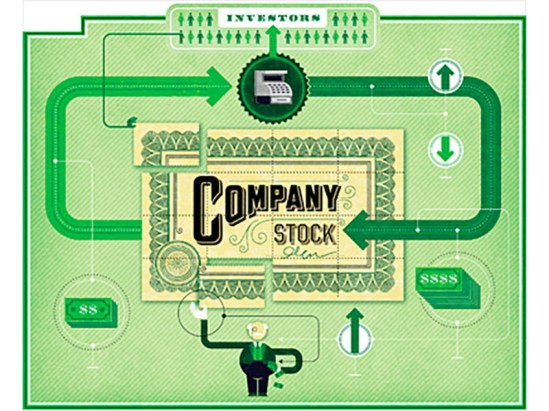
The Strange Matter of Stock Buybacks

buyhighselllow.jpg

Within the last 40 years as economic power shifted from workers to owners, corporate profits take of the US economy has more than doubled. Yet, despite corporate profits at an all-time high, job growth remains anemic, wages are flat, and the country can’t even afford its basic needs. A $3.6 trillion budget shortfall has left many roads, bridges, dams, and other public infrastructure in disrepair. Federal spending on economically crucial research has plummeted by 40%. Public college tuition has more than doubled since the 1980s, burying recent graduates under $1.2 trillion in student debt. Not to mention, many public schools along with police and fire departments are dangerously underfunded. So where did all the money go? After all, public companies have nearly $2 trillion in cash just sitting on their balance sheets. So Corporate America has the resources to deploy a lot of money, invest in new technologies to draw growth, give workers a much-needed raise across the board, hire and train employees, build new facilities, pay off loans, pay shareholders, and pay taxes to the government.
untitled1

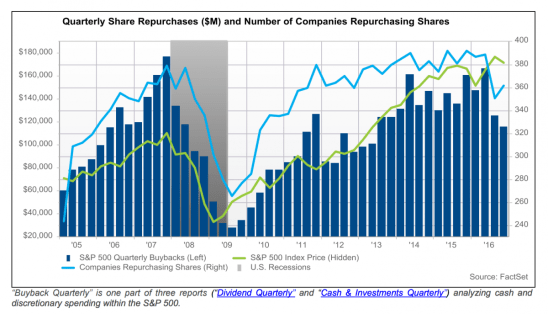
Since the 1980s, stock buybacks have grown in popularity on Wall Street as this graph shows. As Sen. Elizabeth Warren told The Boston Globe, “stock buybacks create a sugar high for the corporations. It boosts prices in the short run, but the real way to boost the value of a corporation is to invest in the future, and they are not doing that.”

But no. Instead, companies keep spending more and more money on stock buybacks. Once illegal and considered insider trading until 1982, stock buybacks have become increasingly popular especially since the 2008 recession. Today, these buybacks have become one of the biggest trends in the post-financial-crisis stock market and the largest source of net demand since 2009. Since 2010, 1,900 companies have spent money on buybacks and dividends with a combined return of capital to shareholders for them equaling 113% of capital spending. So much that a growing number of companies are borrowing money to fund the buybacks. Thanks to Donald Trump’s massive corporate tax cuts, American companies have lavished Wall Street with $171 billion of stock buyback announcements this year, a record high. All in all, Corporate America has pledged 30 times more buying back its own stock than investing in its workforces. Thus, the money these companies make through their financial manipulations drives record-level profits.

Proponents say they reward these long-term shareholders by effectively increasing their company ownership and help boost a stock’s value by raising its earnings per share. When there’s no other compelling use for a company’s cash, this is a better alternative than risky spending or other big investments. But its critics think that buybacks only make things look better than they seem. Indeed, the EPS rise but not because earnings are growing. In other words, they just exist to make shareholders feel better but nothing really changes. Even some of their fiercest proponents claim they’re overused. And in recent years, evidence shows that buybacks haven’t helped boost stock values at all. Other critics argue that buybacks result in companies acting more like banks that hold assets and earn interests and less like a business making money off selling goods and services. Or invest their profits in their workforce and other productive ventures. According to the Academic-Industry Network’s William Lazonick, “Buybacks are not beneficial or necessary to household savers with diversified investments. The only ones who benefit are those who dump shares and are strictly in the business of timing.”

What are stock buybacks?

Also known as a “share repurchase,” is a company’s buying back its shares from the marketplace. Think of it as a company investing it itself or using its cash to buy its own shares. The concept is simple: because a company can’t be its own shareholder, it absorbs repurchased shares and reduces the number of outstanding shares on the market. When this happens, each investor’s relative ownership stake increases on the company’s earnings.

How are stock buybacks carried out?

They’re made in 2 ways:

1. Tender Offer– company may present shareholders with a portion of all their shares within a certain time frame. This will stipulate both the share number the company wants to repurchase and the price range they’re willing to pay (almost always at a premium to a market price). When investors take up the offer, they’ll state how many shares they want to tender along with the price they’re willing to accept. Once the company has received all the offers, it’ll find the right mix to buy the shares at the lowest cost. Tender offers can be a way for executives with substantial ownership stakes and care about a company’s long-term competitiveness to take advantage of the low stock price and concentrate ownership in their own hands. This can free them from Wall Street’s pressure to maximize short-term profits and allow them to invest in the business. But they should only be made when the share price is below the company’s intrinsic value of its productive capabilities and the company is profitable enough to repurchase the shares without impeding its real investment plans.

2. Open Market– company buys shares on the open market just like an individual investor would at market price. It’s important to know that when a company announces a buyback, the market usually perceives it as a positive thing, causing the stock price to shoot up. 95% of buybacks are these. Yet, they often come at the expense of investment in productive capabilities and aren’t good for long-term shareholders. When I discuss stock buybacks, I’m usually referring to the open market variety which used to be illegal and considered insider trading until 1982.

3. Dutch Auction– an alternative form of tender offer which specifies a price range within which the shares will be bought. Shareholders are invited to tender their stock if they wish at any price within it. The firm then compiles the responses, creating a demand curve for the stock. The purchase price is the lowest price allowing the firm to buy shares sought in the offer. And the firm pays that price to all investors who tendered at or below that price. If the share number exceeds the number sought, the company buys less than all shares at or below the purchase price on a pro rata basis to all tendering at these rates. If too few shares are tendered, the firm either cancels the offer or buys back all the tendered shares at the maximum price.

Why would a company want to use buybacks?

A firm’s management may tell you that a buyback is the best use of capital at a time since their goal is to maximize returns for shareholders. Buybacks generally increase shareholder value, at least on the surface. The prototypical line in a buyback press release is “we don’t see any better investment than in ourselves.” This can sometimes be the case but it’s not always true. Nonetheless, there are still sound motives driving companies to buy back shares. Management might think the market has discounted its share price too deeply due to weaker-than-expected-earning results, an accounting scandal, or a poor overall economic climate. Thus, when a company spends millions of dollars buying up its own shares, it means management believes the market has gone too far discounting its shares. More importantly, share buybacks can be a fairly low-risk approach to use extra cash since reinvesting money into R&D or a new product can be very risky. If these hard-earned investments don’t pay off, then that hard-earned cash goes down the drain. Using cash to pay for acquisitions can also be perilous. Mergers hardly live up to their expectations.

Another reason is that companies don’t want to just sit on money, much for the same reason that investors don’t like holding piles of cash either: inflation erodes cash value, so putting it to work makes sense. During periods of economic growth, it’s better to allocate profits to capital (like a factory) or labor as an investment to the firm’s future. But it’s also risky because the economy could worsen. Though I’m not sure if I actually agree with this since I think stagnant wages are part of why the economy isn’t getting any better. So in periods of economic uncertainty, companies choose to give the cash to their shareholders, which should’ve went to their workers. As the head of S&P Investment Services Mike Thompson told Business Insider in 2016, “In an environment like this return cash to shareholders keeps them pleased with the short-term gains while not committing to large investments that could hurt performance.”

Increased Shareholder Value– there are many ways to value a profitable company but the most common measurements is Earnings Per Share (EPS). If earnings are flat but the number of outstanding shares decreases.

Increased Float– as the number of outstanding shares decreases, the remaining shares represent the float’s largest percentage. Increased demand and less supply means a potentially higher stock price.

Excess Cash– buybacks are usually financed with a company’s excess cash, demonstrating that it doesn’t have a cash flow problem. More importantly, it signals that executives feel that cash re-invested will get a better return than alternative investments.

Improving Financial Ratios– or improving metrics upon which the market seems heavily focused on, which is questionable. If reducing shares isn’t done to create more value for shareholders but rather make financial ratios look better, the management likely has a problem. However, if a company’s motive for initiating a buyback program is sound, its financial ratio improvement in the process might be the result of a good corporate decision. For one, share buybacks reduce outstanding shares. Once a company buys these, it often cancels them or keeps them as treasury shares. They also reduce assets on the balance sheet and increase return on assets and equity. They also improve a company’s price-earnings ratio as the market often thinks lower is better.

Dilution– another reason for a buyback may be a company’s wish to reduce the dilution often caused by generous employee stock option plans. Bull markets and strong economies often create a very competitive labor market. So companies have to compete to retain personnel and ESOPs which comprise of many compensation packages. Stock options increase the share number when exercised, which weakens a company’s financial disposition.

Price Support– companies with buyback programs in place use market weakness to buy back shares more aggressively during market pullbacks. This reflects confidence that a company has and alerts investors that it believes the stock is cheap. Often a company will buy back its stock after taking a hit, which is an overt action to take advantage of discount prices on its shares. This lends support to the stock’s price and ultimately provides security for long-term investors for rough times.

Higher Stock Prices– an increased in EPS will often alert investors that a stock is undervalued or has the potential for increasing in value. The most common result is an increase in demand and an upward movement in the stock’s price.

Tax Benefit– while a buyback is similar to a dividend in many ways, it has a major advantage over dividends of a lower capital gains tax rate. Whereas dividends are taxed at ordinary income tax rates.

Does that mean stock buybacks are good?

Not necessarily. Sometimes buybacks can be a great thing if a stock truly is undervalued and represents the best possible investment for a company. But a company must meet certain specific conditions:

1. The stock should be trading at price to economic book value below 1, meaning that the company is buying back shares for cents on the dollar.

2. The company’s balance sheet and free cash flow should be strong enough to support a buyback without jeopardizing future liquidity or investment opportunities.

3. The company should have more cash than it does profitable investment opportunities.

One company meeting all three criteria is Oracle who bought back $8.1 billion in stock (5% of its market cap), reducing outstanding shares by 120 million. Its shares currently trade at a PEBV of 0.9, meaning it’s buying back shares at a 10% discount rate to their zero-growth value. With $50 billion in excess cash on its balance sheet and $9 billion in annual free cash flow, Oracle has more than enough cash on hand to support its buyback program, and more than it could reasonably hope to profitably invest in the near term as of 2016. Oracle’s buybacks don’t just serve their shareholders’ interests, they also benefit the overall economy. When a company with excess cash and few investment opportunities buys back its stock, it puts that cash back in the marketplace for individual investors to distribute to companies needing capital. In buying back billions of dollars in its own stock, Oracle cheaply retired its shares without comprising its ability to invest in future growth.

While there are buybacks that make sense from a capital allocation standpoint and serve the investors’ best interests like in Oracle’s case, these are normally the exception rather than the rule. In fact most companies buying back stock aren’t in Oracle’s situation. If a company merely uses buybacks to prop up ratios, provide short-term relief to an ailing stock price, or get out from under excess dilution, watch out. Oftentimes, they can be a downright bad idea and can hurt shareholders. This can happen when buybacks are done in the following situations:

1. When Shares Are Overvalued– companies should only pursue buybacks when their shares are undervalued. A company that buys overvalued stock destroys shareholder value and would be better off paying that cash out as a dividend, so that investors can more effectively invest it. As Warren Buffett said to Berkshire Hathaway shareholders in 1999, “Buying dollar bills for $1.10 is not good business for those who stick around.”

2. To Boost Earnings Per Share– since buybacks can boost EPS, a company stock buyback in the market reduces outstanding share count. This means earnings are distributed among fewer shares, raising EPS. Thus, many investors applaud share buybacks since they see increasing EPS as a surefire approach to raising share value. However, contrary to popular belief, increasing EPS doesn’t raise fundamental value. Companies must spend cash to buy these shares. In turn, investors must adjust their valuations to reflect reductions in both cash and shares. Sooner or later this cancels out any EPS impact. In other words, lowering cash earnings divided between fewer shares won’t produce any net change to EPS. Of course, a major buyback announcement generates plenty of excitement since a prospect of even short-term EPS can give share prices a pop-up. But unless the buyback is wise, the only gains go to those investors selling their shares on the news. There’s little if any benefit for long-term shareholders.

3. To Benefit Executives– many executives get the bulk of their compensations from stock options. As a result, buybacks can serve a goal: while stock options are exercised, buyback programs absorb the excess stock and offset dilution of existing share values and any potential reduction in EPS. By mopping up extra stock and keeping EPS, buybacks are a convenient way for executives to maximize their own wealth as well as maintain share value and options. Some executives may even be tempted to pursue share buybacks to boost share buybacks to boost the share price in the short-term and sell their shares. In addition, big bonuses that CEOs receive are often linked to share price gains and increased EPS. Thus, they have an incentive to pursue buybacks even when there are many ways to spend the cash or when their shares are overvalued.

4. Buybacks Using Borrowed Money– the temptation using debt to finance EPS can be hard to resist for executives. The company might believe that the cash flow it uses to pay off the debt will keep growing, bringing shareholder funds back into line with borrowings in due course. If they’re right, they’ll look smart. If they’re wrong, investors will get hurt. Moreover, managers assume that their companies’ shares are undervalued regardless of the price. When done with borrowing, share buybacks can hurt credit ratings, since they drain cash reserves that can serve as a cushion when times get tough. One of the reasons given for taking on increased debt to fund a share buyback is that it’s more efficient since the debt’s interest is tax deductible. However, all debts must be repaid at some time. Because what gets a company into financial difficulties isn’t lack of profits but lack of cash. With debt, buybacks become more complicated which doubles the risk since a firm’s leverage levels may cause financial distress in the future and harm shareholders in the long-term.

5. To Fend Off an Aquirer– in some cases, a leveraged buyback can be used as a means to fend off a hostile bidder. The company takes on significant additional to repurchases stocks through a buyback program. Such leveraged buybacks can be successful in thwarting hostile bids by both raising the share value and adding a great deal of unwanted debt to the company’s balance sheet.

6. There Is Nowhere Else to Put the Money– it’s very hard to imagine a scenario where buybacks are a good idea, except when a company feels like its share price is far too low. But if the company’s right about undervalued shares, they’ll probably recover anyway. Thus, companies buying back shares are, in effect, admitting that they can’t invest their spare cash flow effectively. Even the most generous buyback program is worth little for shareholder if it’s done in the midst of poor financial performance, a difficult business environment, or a decline in the company’s profitability. By giving EPS a temporary lift, share buybacks can soften the blow. But they can’t reverse things when a company is in trouble.

Why do companies actually use buybacks?

In theory, corporations should have a distinct advantage over the rest of the market when buying back shares. After all, executives know their industry, the company’s challenges, and their strategic plans better than anyone else. This should enable them to buy their stock when it’s cheap and not when it’s overvalued.

But most companies carry out buybacks for reasons that have nothing to do with maximizing shareholder value. Pressure to hit short-term earnings targets and executive compensation plans often incentivize the wrong metrics which often push companies to buy back stock when it’s most expensive and the money could be better used elsewhere. This is what the Harvard Business Review calls “The Overvaluation Trap.” Data shows that companies buy back more stock during booms and sell them during market crashes. In this way, less like the knowledgeable executives and more like panicky and underperforming investors.
untitled

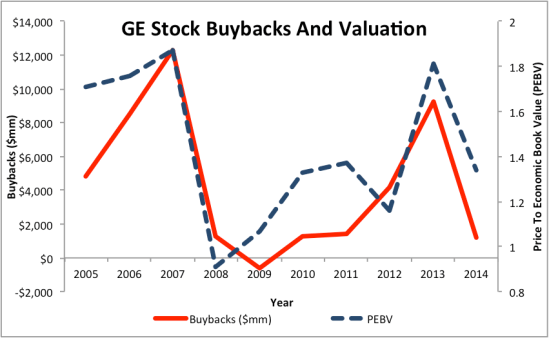
This 2016 Forbes graph of GE stock buybacks and its valuation. You can see that instead taking the traditional investor advice of “buy low, sell high,” they actually have bought high and sold low. As a result, their stock has lost value.

A graph from Forbes shows this value-destroying behavior for General Electric by comparing between the amount of money spent buying back shares and the price to economic book value, a measure of growth expectations embedded in the stock price. As this graph illustrates, GE bought back an incredible $12.3 billion worth of stock in 2007, just before the market crashed. At the start of the bull market in 2009, the company sold off $600 million worth of its own stock. Throughout the last decade, you can see a high correlation between how expensive GE’s stock is versus current cash flows and how much stock the company buys back. Overall, in the last decade, GE bought back $44 billion of its own shares (17% of its market cap). Yet, its stock fell by 15% over that same time. By inefficiently utilizing valuable capital to buy back stock at inflated prices, GE destroyed value for long-term shareholders. When a company’s equity is overvalued, its executives have to scramble to justify that expensive price. One way to do that is by artificially boosting the EPS through share buybacks. As this Forbes graph above shows, GE does this effectively as the company managed to hit or beat EPS in 15 out of past 16 quarters.
575f22fe910584145c8c891c-960-1150

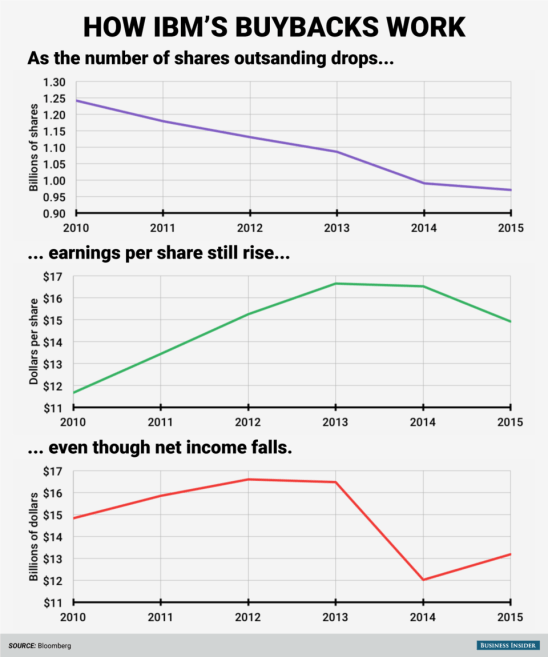
Business Insider’s graph on IBM also shows how buybacks might make the EPS look good as the number of outstanding shares drops. Despite that the net income has fallen, which isn’t a good sign in most businesses.

Another case is IBM who spent $4.6 billion in 2015 and $125 billion in the decade prior as of 2016. According to a Business Insider graph, from 2010 to 2015, its total share count was down by about a fifth while earnings per share rose 15%. Yet, in that same period, IBM’s actual income went down 11% as sales fell, too. As a result, IBM has lost about $50 billion in market value since 2013, or about 30%.
ceo-pay

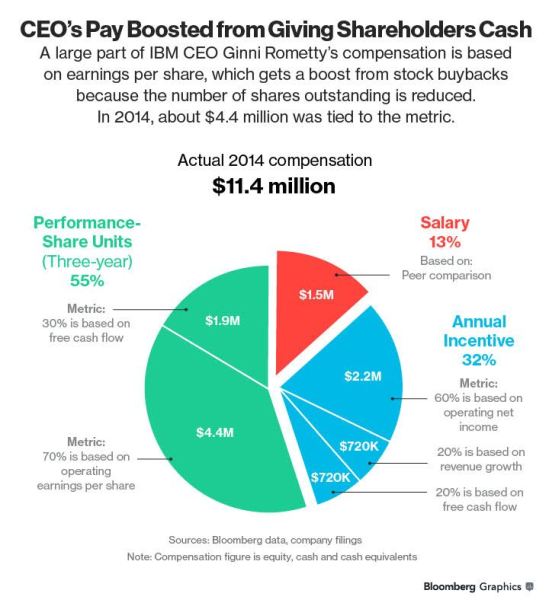
Since executive pay is often tied to stock compensation, top Wall Street execs have often been pressured to do buybacks to increase their coffers. Even if it makes no strategic financial sense. It’s part of a phenomenon called greed. This is a Bloomberg graph of IBM’s CEO compensation.

Also, many companies have executive compensation packages incentivizing excessive share buybacks, either directly or indirectly. In GE’s case, a percentage of its bonuses depends on the company returning a certain amount of cash to shareholders. In 2014, executives had to make sure combined dividends and buybacks hit at least $10 billion to get their full bonus, even if that decision made no strategic sense. But it makes perfect sense in regards to greed. Because when share prices go up, CEOs reap a bonanza so the value of their pay also rises in what amounts to a retroactive and off the books pay increase on top of their already humongous compensation packages. As a result, the very people we rely on to make investments in the productive capabilities that will increase our shared prosperity are squandering most of their companies’ profits for their own prosperity. The Academic-Industry Network’s William Lazonick told The American Prospect, “All of those trillions of dollars flowing out of companies are being used to build the war chests of hedge-fund activists for further buybacks or [giving them more] money to play around with on derivatives. When you connect the dots, it’s part of bigger process. This is really a long-run problem that helps to explain concentration of income at top because it’s getting made off the stock market.

Other companies incentivize share buybacks through emphasizing metrics that can be easily manipulated and have little impact on shareholder value. For example, Cisco executives are judge in part on their ability to grow adjusting operating income, adjusted EPS, and operating cash flow. That term “adjusted” is crucial since Cisco uses metrics for judging executive performance exclude share-based compensation. Meaning that executives can pay employees (and themselves) with stock instead of cash, buy back shares to offset dilution, and increase these adjusted metrics to improve real operating performance. In 2015, Cisco bought back 155 million shares. But after effects of employee stock compensation, it only reduced the total outstanding shares by 38 million. So all those buybacks are just trickery executives use to boost their own bonuses.

And it’s not just GE, IBM, and Cisco. According to FactSet data by Andrew Birstingal, the performance of companies engaging in buybacks has been disappointing. “In the past year, companies repurchasing shares saw an excess weighted cumulative return of -1.9% relative to the benchmark, while companies not repurchasing shares saw a return of 9.8% relative to the benchmark,” he said in 2016. On a three-year horizon, those companies buying back shares ended up with a -2.9% return against 11.5% gain for those not buying back stock. A study found that companies completing buybacks outperformed their benchmark before 2001. Yet, those who completed buybacks between 2002 and 2006 didn’t generate better returns since that time than those who didn’t. Based on this research, buybacks aren’t helping share prices in either short- or long-term.

However, the cost of buybacks doesn’t just come from overpriced stock losses, but also from missed opportunities to invest growth and innovation. Over the past decade, AT&T bought back $50 billion in stock which could’ve been used to improve its wireless network quality and catch up with Verizon which doesn’t buy back stock. All those buybacks didn’t keep AT&T from underperforming versus Verizon and the broader market. We tend to think of buybacks as a sign of success proving a company has plenty of cash to throw around. In reality, they amount to admission of failure for a company buying back stock signals the market that it lacks profitable investment opportunities.

So what’s the deal with stock buybacks and the economy?
StockTax4

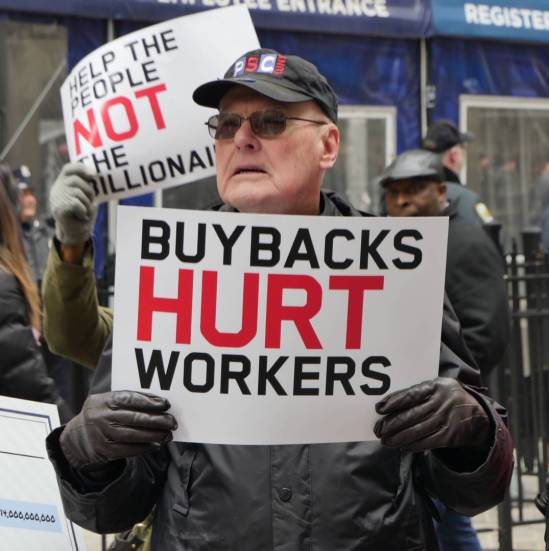
Stock buybacks don’t give any incentives for companies to use profits in improving their enterprise and raising workers’ wages. The frequency of buybacks have led to increased economic inequality and more money going to the 1%.

Before the Security and Exchange Commission loosened regulations that gave companies an ability to repurchase stock without facing charges of stock manipulation and a shift toward stock-based compensation toward top executives, corporate money flowed through the broader economy in the form of higher wages or increased investments in plants and equipment. But today, these stock buybacks drain millions of dollars of windfall profits out of the real economy and into a paper-asset bubble. This inflates share prices while producing nothing of tangible value. Corporate managers have always been pressured to grow earnings per share, but where once the only option was the hard work of actually growing earnings by selling better products and services, they can now simply manipulate their EPS by reducing the number of outstanding shares. As a result, it has become a gigantic game of “keep away” with CEOs and shareholders tossing a $700 billion ball back and forth over American workers, whose wages as a share of GDP have fallen in almost exact proportion to profits’ raise. Since buybacks give firms no incentives to share their profits with the workers who truly invest in these companies, pouring their lives into them each day for pay increases and stable opportunities. Or the taxpayers who have an interest in whether a corporation that uses government funding can turn a profit that allow it to pay taxes. As the Academic-Industry Network’s William Lazonick told The American Prospect, “The issue is what are they not doing when they do stock buybacks. What they’re not doing is keeping people employed longer, paying them more, and giving them more benefits. There’s a direct connection between the decline of those norms and the rise of buybacks and the legitimized ideology of ‘Shareholder First.’” Over the last decade, 94% of company profits have gone to shareholders through buybacks and dividends.

This practice isn’t just unfair to Americans, but also to individual harmful to both companies and the American economy. A 40-year obsession with “shareholder value maximization” stock buybacks and excessive dividends have reduced business investment and boosted inequality. Now almost all firms carry out investment through retained earnings. Thus, diverting cash flow to stock buybacks has inevitably resulted in lower rates of business investment. And since the 1980s, corporations have bought back more equity than they’ve issued, representing a net negative equity flow. In other words, shareholders aren’t providing capital to the corporate sector like they should. They’re extracting it. Meanwhile the shift to stock-based compensation helped drive the 1%’s rise by inflating the ratio of CEO-to-worker compensation from 20 to 1 in 1965 to 300 to 1 today. Labor’s steady falling share of GDP has depressed consumer demand, resulting in slower economic growth. It’s mathematically impossible to make the public- and private- sector investments necessary to sustain America’s global economic competitiveness while flushing away 4% of its GDP year after year. If the US is to achieve growth distributing income equitably and providing stable employment, government and business must take steps bringing stock buybacks and executive pay under control. The nation’s economic health depends on it.

What should be done about stock buybacks?

The federal government must reorient its policies from promoting personal enrichment to enhancing national growth. Such policies should limit stock buybacks and raise the marginal rate on dividends while providing real incentives to boost R&D investment, worker training, and business expansion.

According to a 2014 Harvard Business Review, a good first step would be an extensive SEC study of the possible damage that open market buybacks have done to capital formation, industrial corporations, and the US economy over the past 3 decades. For instance, during the amount of stock taken out of the market has exceeded the amount issued in almost every year. From 2004-2013, this net withdrawal averaged $316 billion a year. Overall, the stock market isn’t functioning as a funding source for corporate investment.

Another measure we need to do is reining in stock-based pay which should be very limited. Many studies have shown that large companies usually use the same set of consultants to benchmark executive compensation and that each consultant recommends that the client pay its CEO well above average (which is what CEOs want to hear). Thus, compensation inevitably ratchets up over time. They also show that even declines in stock price increase executive pay. So when a company’s stock price falls, the board stuff even more options and stock awards into top executives’ packages, claiming that it must ensure they won’t jump ship and will do whatever necessary to get the stock price up. A 1991 SEC decision allowing top executives to keep gains from immediately selling stock acquired from options only reinforces their overriding personal interest to boost stock prices. Because corporations aren’t required to disclose daily buyback activity, it gives executives the opportunity to trade to trade undetected on inside information about when buybacks are in progress. The SEC at least should stop allowing executives to sell stock immediately after options are exercised. And incentive compensation should be subject to performance criteria reflecting investment in innovative capabilities, not stock performance.

But more importantly, we must transform boards determining other executive compensation. Boards are currently dominated by other CEOs with strong bias toward ratifying higher pay packages for years. When approving enormous distributions to shareholders and stock-based pay for top executives, these executives believe they’re acting in shareholders’ interests. And that’s a big part of the problem. The vast majority of shareholders are simply investors in outstanding shares who can easily sell their stock when they want to lock up gains or minimize losses. Since taxpayers and workers are the people truly investing in the productive capabilities of corporations, they need to have seats on boards of directors. Their representatives would have the insights and incentives to ensure that executives allocate resources to investments in capabilities most likely to generate innovations and value.

If business leaders want to maintain broad support for business, they must acknowledge that a corporation’s purpose isn’t to enrich the few, but to benefit many. Once America’s CEOs refocus on growing their companies over their share prices, shareholder value will take care of itself and all Americans will share in the economy’s benefits. The corporate allocation process is America’s source of economic security or insecurity whether its people like it or not. If Americans want an economy in which corporate profits result in its shared prosperity, the buyback and executive compensation binges will have to end. Sure executives will complain like whiny babies. But the best executives might actual get satisfaction being paid a reasonable salary allocating resources in ways sustaining the enterprise, providing higher standards of living to the workers who make it succeed, and produce tax revenues for the governments providing it with crucial perks.

The Threat of White Supremacy in Law Enforcement

a-tale-of-two-hoodies

In 2006, the FBI issued a bulletin detailing the threat of white supremacists infiltrating police in order to disrupt investigations against fellow members and recruit other white nationalists. It was released during a scandalous period for many law enforcement agencies throughout the country, including a Neo-Nazi gang formed by members of the Los Angeles Sheriff’s Department who harassed black and Latino communities. Similar investigations revealed officers and entire agencies with hate group ties in Illinois, Ohio, and Texas. The FBI identified white supremacists in law enforcement as a concern because their access to both, “restricted areas vulnerable to sabotage” and elected officials or people who could be seen as “potential targets for violence.” Not to mention, such infiltration, “can lead to investigative breaches and can jeopardize the safety of law enforcement sources or personnel.” The report also warned of “goat skins,” which are hate groups who don’t overtly display their beliefs to “blend into society and covertly advance white supremacist causes.” And in at least one case, the FBI learned of a skinhead group encouraging ghost skins seeking employment with law enforcement agencies to warn crews of any investigations.

American policing has always had racial implications. The earliest form of organized law enforcement in the country can be traced to slave patrols that tracked down escaped slaves and overseers assigned to guard settler communities from Native Americans. In the centuries since, many law enforcement agencies have directly participated in antagonizing communities of color or provided a shield for others who did. But since the FBI’s 2006 report came out, little has changed. Though several agencies nationwide have launched internal investigations into personnel who may not be formal hate group members, but face allegations of racial misconduct. While social media has made it easier to expose white supremacists in law enforcement. Yet, none of the over 18,000 law enforcement agencies have established systems for vetting potential supremacist links, many of which have deep historical connections to racist ideologies.

fatherland

This is the cop who was caught with a Neo-Nazi tattoo at the Democratic National Convention. And he was sent to patrol a Black Lives Matter protest. See the problem here?

But since the FBI’s report, problems with white supremacists in law enforcement have surfaced since then. In 2013, the Southern Poverty Law Center exposed an Alabama officer as a member of the white nationalist League of the South after speaking at a national conference. In 2014, 2 Florida officers, including a deputy police chief, were fired after an FBI informant outed them as Klu Klux Klan members. In September 2015, a North Carolina police officer was fired after a picture of him giving the Nazi salute appeared on Facebook. That same year a Baton Rouge police officer resigned after being linked to racist text messages. Another instance has an Oklahoma sheriff resigned after his name was connected to a white supremacist website. And in August 2016, the Philadelphia Police Department launched an internal investigation after attendees at Black Lives Matter rally outside the Democratic National Convention spotted an officer in charge of crowd control with a Nazi emblem tattoo on his forearm and posted the image on Instagram.

With the rise of white supremacist violence during the Trump era, we need to treat this threat very seriously. Shortly after Barack Obama’s election to the presidency in 2008, a 2009 Department of Homeland Security study written in coordination with the FBI warned of a “resurgence” of right-wing extremism. The report noted, “Right-wing extremists have capitalized on the election of the first African-American president, and are focusing their efforts to recruit new members, mobilize existing supporters, and broaden their scope and appeal through propaganda.” Since then, white supremacist violence and right-wing terror has been on the rise along with the increased presence of the alt-right.

In November 2016, Donald Trump was elected to the presidency, a man endorsed and celebrated by the KKK since he’s been reluctant to disassociate himself from anyone espousing white supremacist views. In turn, he has appointed key administration advisers with ties to the radical right like Steve Bannon, Steve Miller, and Sebastian Gorka. His policy initiatives like revving up the nation’s deportation machine and curtailing civil rights enforcement thrilled white supremacists. Trump and his Attorney General Jeff Sessions have shown deference to law enforcement and retreated from federal oversight of police departments with a history of civil rights violations, brutality, and racial violence. As a result, the latest incarnation of white supremacy broke through the firewall that for decades kept overt racists largely out of the political and media mainstream. Reinvigorated white supremacists staged their largest rally in a decade at the demonstration in Charlottesville, Virginia, that left an anti-racist counter-protester dead and Trump equivocating over condemning racism. Former KKK Grand Wizard David Duke called the rally a “turning point” and vowed that white supremacists would “fulfill the promises of Donald Trump” to “take our country back.” White supremacists also stepped up their college campus recruiting drives. White nationalist leader Richard Spencer held a rally at the Lincoln Memorial and appeared at colleges. The Southern Poverty Law Center documented some 300 incidents of racist flyers distributed on over 200 college campuses.

Why should we worry about white supremacists in law enforcement?

In a country where 74% of extremist killings and attacks over the past decade were by right-wing extremists, particularly white supremacists, it’s a serious problem when police are among the terrorists. As Chicago’s John Marshall School of Law professor Samuel Jones told PBS in 2016, “Many people in these communities of color feel they have been the subject of police violence for decades. And when an officer engages in conduct that adds or enhances that divide, they are ultimately jeopardizing the integrity of their agencies and putting their fellow officers in danger.” Jones also told The Intercept in 2017, “When somebody holds a belief that indicates that they do not see all Americans are worthy of equal protection under the law, it compromises their ability to be a police officer.”

White supremacists come from all walks of life. They can be your neighbors, co-workers, employers, friends, and even relatives. They can be teachers, professors, cashiers, doctors, lawyers, clerics, drivers, waitstaff, accountants, firefighters, garbage collectors, mail carriers, programmers, and just about anyone else you can think of, including police. But if you have a white supremacist in a public service position like a teacher or cop, the problem isn’t that they subscribe to a radical belief system. Rather, it’s that their beliefs encourage bigoted and sometimes violent behavior that are inappropriate for anyone involved in public service, particularly those with authority over others. White supremacists also create a toxic work environment and poison relations with the public.

Many white supremacists maintain positions and jobs within mainstream society while acting with plausible deniability on behalf of their racist beliefs. They do this through paying “lip service” to normal diversity standards and playing what’s called “a dog and pony show” when it came time to public proclamations. But then acting every other regard as a white nationalist ideologue would: discriminating against minorities in their choices and actions, believing them to be innately inferior, presuming that liberals and Jews are conspiring to harm them, etc. You can see this kind of strategy on full display on Breitbart and Fox News.

If you have these white supremacists in positions of authority like law enforcement, it’s very scary notion for minorities, especially black people. Since police kill black people 2.5 more frequently than whites and unarmed black people at 5 times the rate of whites. The fact, white supremacist infiltration in law enforcement provides context to the scourge of racial police violence against black people which is often downplayed if not denied by segments of society and an administration endorsed by the Fraternal Order of Police. While racism in the police is nothing new, the idea that white supremacists might be your friendly neighborhood police can add a layer of fear and distrust for communities of color.

27843308312_3ebe233ec3_k

At a 2016 Neo-Nazi rally in Sacramento, California, the California Highway Patrol was found to aid the alt-right. They arrested 3 counter-protestors despite that the anti-fascist activists bore the brunt of the violence.

There is also evidence that police departments have asked for and accepted help from far-right protestors during tense rallies and counter-protests where violence isn’t infrequent. The relationship works both ways: Police get help and the alt-right demonstrators are seemingly put above the law in return. As a result, militia members working for alt-right events carry out policing activities with impunity under the gaze of actual law enforcement. In 2011, police bused Neo-Nazis to a rally in Trenton, New Jersey to maintain order. In 2014, Chattanooga cops arranged parking for white nationalists along with a route for them to march safely to a protest site. In June 2016, violence broke out at a Sacramento neo-Nazi rally between neo-Nazis and anti-fascist protestors at the California State Capitol. 10 people were injured, 5 of them stabbed. Despite footage showing that neo-Nazis were responsible for most of the violence, especially the stabbings, Sacramento police arrested 3 counter-protestors who were charged with felonies despite claiming self-defense. One was a Berkeley teacher and anti-fascist organizer named Yvette Felarca who was charged with assault and rioting after a neo-Nazi stabbed her and bludgeoned her in the head. Later court documents reveal that California police investigating the white nationalist event worked with white supremacists in to identify counter-protestors and sought the prosecution of activists with “anti-racist” beliefs. The records also showed police officers expressing sympathy with white supremacists and trying to protect a neo-Nazi organizer’s identity. In June 2017, police allowed members of a right-wing militia style group help police arrest anti-fascist activists at an alt-right event in Portland, Oregon. Former FBI agent and Brennan Center fellow Michael German told the Huffington Post, “That is extremely dangerous. To give these groups the idea that their violence is sanctioned by the state will make them far more violent and far more dangerous in the long run. Not to mention the failing to police these running street battles will encourage them to come to the next protest prepared.” On the other hand, the police weren’t so accommodating to peaceful, unarmed Black Lives Matter demonstrators protesting police brutality and racism in Baltimore or Ferguson, Missouri or nonviolent Standing Rock Indian activists in North Dakota who were trying to protect their water from the Dakota Access Pipeline. I mean police were in full riot gear with military equipment on all those occasions, especially at Standing Rock. Nor did they seem doing their jobs protecting counter-protestors in Charlottesville since they appeared to disappear when the violence got really ugly.

Gen-Zero-water-650-1505160215

By the way, in case you forget, here’s what police in North Dakota did to the Indian protestors trying to protect their land and water. Yeah, doesn’t seem like these cops care what happens to them.

But it’s not just people of color or left-wing protestors who have to worry about white supremacists in law enforcement. Right-wing extremists are systematically more anti-government/anti-cop than any other group. Since 1990 they have been responsible for 45 police killings. It also doesn’t help that law enforcement are more likely to encounter dangerous extremists than virtually any other segment of American society and those confrontations are, tragically, sometimes fatal. The fact white supremacists are often armed to the teeth during their alt-right rallies can be enough to put police in a state of fear and inability of what to do, especially in states with loose gun laws like the open-carry state of Virginia. But law enforcement doing nothing just enables these white supremacist whack jobs inflict violence. The lack of a police response to the Charlottesville violence in August 2017 led one chat user write that the Virginia State Police, “will be focused on antifa [anti-fascists] not us … especially if we kiss some ass with a few blue lives matter chants …. Be nice to cops and they will be nice to you.”

How long has white supremacy in law enforcement been a problem?

Black-lynching-1-1200x716

You can guess that white supremacist cops had something to do with white people getting away with this during segregation. This was from the 1920s, by the way.

This has been around for a very long time. In fact, infiltrating law enforcement is considered a long-standings strategy for white supremacists, which has long influenced law enforcement agencies at the local and state levels. As former skinhead Christian Picciolini told 60 Minutes, “We encouraged people to get jobs in law enforcement, to go to the military and get training and to recruit there.” But it’s only in recent years that we fully acknowledged it as a problem. As sociologist Peter Simi told The Intercept, “If you look at the history of law enforcement in the United States, it is a history of white supremacy, to put it bluntly,” citing origins in the slave patrols of the 18th and 19th centuries. “More recently, just going back 50 years, law enforcement, particularly in the South, was filled with Klan members.” A KKK chapter and a county sheriff’s office were involved in the 1964 arrest, abduction, and murder of 3 civil rights workers named Andrew Goodman, James Chaney, and Michael Schwerner in Philadelphia, Mississippi. Though the FBI has acknowledged it has a problem in 2006, it has only been after a series of scandals involving local police and sheriff’s departments.

murder_fbiposter_700.jpg__700x617_q85_crop_subsampling-2_upscale-1-300x264

The 1964 arrest, kidnapping, and murder of 3 Civil Rights activists in Mississippi was orchestrated by a Klu Klux Klan chapter and a county sheriff’s department. During the Civil Rights Movement, it wasn’t uncommon for local law enforcement in the South to belong to the Klu Klux Klan.

In 1991, a US District Court judge in Los Angeles found that members of a local sheriff’s department had formed a neo-Nazi gang and habitually terrorized black and Latino residents.

In 2008, a Chicago police detective and rumored KKK member John Burge was fired and prosecuted over charges relating to torture of at least 120 black men during his decades-long career. Burge notoriously referred to an electric shock device he used during interrogations as the “nigger box.”

In Cleveland, officials found that a number of police officers have scrawled “racist or Nazi graffiti” throughout their department’s locker rooms.

In Texas, 2 police officers were fired upon discovery they were Klansmen. One of them said he tried boosting the organization’s membership by giving an application to a fellow officer he thought shared his, “white, Christian, heterosexual values.”

How widespread is this problem?

It’s practically nationwide as you can see from my examples above. However, according to a report from the Root, this current infiltration has everything to do with the racist social climate, the Trump administration, and the long-standing history of racism amongst law enforcement and black people. Many law enforcement agencies have deep historical ties to racist ideologies. Since no centralized recruitment process or set of national standards exists for the 18,000 law enforcement, state and local police as well as sheriff’s departments present ample opportunities for white supremacists and other right-wing extremists looking to expand their power base.

Without available training for identifying and acting on extremist infiltration thanks to Napolitano’s actions over the right-wing fallout on the 2009 DHS report, groups like the Oath Keepers, the Peace Officers Association, the Three Percenters, and the Constitutional Sheriffs took advantage of the security vacuum to recruit and metastasize, like ISIS and Al Qaeda do in other parts of the world. These efforts in large part targeted active and retired law enforcement officers. Right-wing extremists don’t just recruit from the law enforcement community, they also infiltrate their ranks. As Picciolini told Fairfax Media, “Many people from my crew went on to be Chicago police officers, they went on to be prison guards, and they certainly took their ideology with them. A lot of people that I know ended up enlisting in the military to recruit [racists] and to get weapons and combat training.”

Why would white supremacists want to be cops?

The answer is simple, so they can get away with shit. It’s technically legal for a law enforcement officer to espouse hateful, racist views or belong to a hate group. And though it’s a federal crime to provide material support to a foreign terrorist group, there’s no such law supporting a white supremacist one. As an 2015 FBI counter-terrorism guide reads, “domestic terrorism investigations focused on militia extremists, white supremacist extremists, and sovereign citizen extremists often have identified active links to law enforcement officers.” A link to law enforcement gives white supremacists some legitimacy and leeway to do all the horrible things they want while still appearing respectable to the community. One white supremacist chat board user wrote, “Be me in my Criminal investigation class. We’re doing introductions and it gets to me. They ask me what kind of police officer I wanted to be and I responded with ‘Riot Police Officer.’ They asked why and I instantly responded with ‘I like curb stomping protestors who cause a riot.’ I think the professor likes me.”

Are cops prone to becoming white supremacists?

Yes, since non-radical police officers are common targets for white supremacist recruiters. As Picciolini told Democracy Now!, “Police officers and law enforcement officers and military people are constantly, every day, in difficult situations. And over time, people become jaded, especially after you’ve … worked in crime-ridden neighborhoods for 20 years, and you’ve had to deal with sometimes the worst of the worst people. Well, recruiters know this. Recruiters know that they become jaded, and they become prejudiced towards these people.” One white supremacist chat board user wrote, “I have several cops in my family, most white cops are sympathetic to us.” They added, “I’m not too worried about the cops as long as we act like whites …. Get to know more cops [in real life] No one hates niggers more than white cops.”

How many cops are white supremacists?

There aren’t many statistics, but we’re talking about a small number. But even though they’re outliers, they can inflict plenty of damage in their wake. But fortunately, white supremacy in the police force isn’t as much of a problem as it used to be. Mostly because white supremacy and racism has become significantly less acceptable in society in general. That doesn’t mean we have problems with either in the police. Because we certainly do.

If the FBI and DHS knew about white supremacy in law enforcement for years, why don’t we hear it addressed?

The FBI and DHS had. But federal investigators have been reluctant to publicly address the growing threat of right-wing extremists or point out the movement’s longstanding strategy of infiltrating the law enforcement community. Since the 2009 DHS report was released just ahead of the nationwide Tea Party protests, it caused an uproar among conservatives who were particularly pissed over the suggestion that veterans might be implicated and how the report seemed to depict the range of right-wing groups. Faced with mounting criticism, DHS Secretary Janet Napolitano disavowed the document and apologized to veterans. Despite that this document was researched, compiled, and written by officials in the George W. Bush administration. And despite that the document singled out “disgruntled military veterans” as targets of recruitment by right-wing extremists to “exploit their skills and knowledge derived from military training and combat.” Because the military has long been a hotbed for white supremacist recruiting activity and many well-known white supremacist terrorists were former servicemen like some of the alt-right leaders in Charlottesville. The agency’s unit investigating right-wing extremism was largely dismantled and the reports lead investigator was pushed out. Heidi Berich from the SPLC told The Intercept, “They stopped doing intel on that, and that was that. The FBI in theory investigates right-wing terrorism and right-wing extremism, but they have limited resources. The loss of that unit was a loss for a lot of people who did this kind of work.”

It’s widely said that the backlash following the 2009 DHS report hindered further action against the growing white supremacist threat and that it was largely ignored because the issue was so politically controversial. Samuel Jones told The Intercept, “I believe that because that report was so denounced by conservatives, it sort of closed the door on whatever the FBI may have been considering doing with respect to combating infiltration of law enforcement by white supremacists. Because after the 2006 FBI report, we simply cannot find anything by local law enforcement or the federal government that addresses this issue.” Chapman University sociologist Peter Simi agreed, “The report underscores the problem of even discussing this issue. It underscores how difficult this issue is to get any traction on, because a lot of people don’t want to discuss this, let alone actually do something about it.”

DT Analytics’s Daryl Johnson was the lead researcher on the DHS report told The Intercept, “Federal law enforcement agencies in general — the FBI, the Marshals, the ATF — are aware that extremists have infiltrated state and local law enforcement agencies and that there are people in law enforcement agencies that may be sympathetic to these groups.” And according to him, the problem has since gotten “a lot more troublesome.” Because local police departments don’t seem to do anything to address the issue. “There’s not even any training now to make state and local police aware of these groups and how they could infiltrate their ranks.” As Samuel Jones told The Intercept, “For some reason, we have stepped away from the threat of domestic terrorism and right-wing extremism. The only way we can reconcile this kind of behavior is if we accept the possibility that the ideology that permeates white nationalists and white supremacists is something that many in our federal and law enforcement communities understand and may be in sympathy with.”

How do we combat the problem of white supremacists in law enforcement?

Stricter screenings for bias and white supremacist ties is a start. After a series of investigations uncovered substantial numbers of extremists in the military, the Department of Defense moved to impose stricter screenings, including monitoring recruits’ tattoos for white supremacist symbols and discharged those found to espouse racist views. As the SPLC’s Beirich told The Intercept, “The military has completely reformed its process on this front. I don’t know why it wouldn’t be the same for police officers; we can’t have people with guns having crazy ideas or ideas that threaten certain populations.” However, the clean-cut khaki-wearing racists are less detectible as military recruits so having white supremacists in the military is still a very serious problem. An Army Times survey of 1,000 active-duty troops found that 1 in 4 respondents had witnessed concrete instances of white nationalism among fellow troops and around 5% wrote comments disparaging the poll’s methodology and complaining that groups like Black Lives Matter weren’t included as an example of encroaching extremist threat.
But reforming police is a lot harder than the military due to the way decentralized way thousands of police departments across the country operate, the historical affinity of certain police departments with the same racial ideologies espoused by extremists, and an even broader reluctance to do much about it. Seattle former police chief Norm Stamper told The Intercept, “There are police agencies throughout the South and beyond that come from that tradition. To think that that kind of thinking has dissolved somehow is myopic at best.” Though he admitted to firing officers expressing racist views, he added, “It’s not likely to happen in most police departments, because many of those departments come from a tradition of saying the officer is entitled to his or her opinions.”

First Amendment issues relating to freedoms of association and expression can also get in the way. Long as it’s for legal of activity, it’s technically legal for anyone in law enforcement or public office to join a hate group. But according to the 2006 FBI memo, the government can limit opportunities of members “when their memberships would interfere with their duties.” John Marshall School of Law’s Samuel Jones thinks it’s problematic. “I cannot imagine that the FBI today could issue a report concerning any kind of threat without people being alarmed and wanting immediate action,” he told PBS. “But in this case there seems to be almost an acceptance of it. The thought is ‘it’s just ideology and they have a right to believe this.’” Nonetheless, whether the First Amendment protects an officer’s right to express racist, white supremacist views or associate with organizations that endorse them remains a subject of debate. As Stamper told The Intercept, “You can fire someone. Whether the termination will stand up under review is the real question.”

Although police officers have been fired for expressing hateful views, they’re sometimes rehired by other departments as happens regularly when officers are accused of misconduct. But some officers have also challenged those dismissals in court. For instance, 18-year veteran of the Nebraska State Patrol Robert Henderson was fired when his Klan membership was discovered. He sued on First Amendment grounds and appealed all the way to the US Supreme Court, which declined to hear the case. In 2016, 14 San Francisco police officers were caught exchanging racist and homophobic texts including several references to “white power” and messages such as “all niggers must fucking hang.” Most of them remain on the force after an attempt to fire several of them was blocked by a judge, saying that the statute of limitations had expired.
Jones had been tracking similar incidents following the 2006 report and believes many more get buried the code of silence often dominating police departments. “All agencies, if they want to, can curtail this problem — the problem is that many do not.”

How are we combating the problem now?

According to the FBI Counter Terrorism Policy Guide, the FBI has the option to mark a watchlisted police officer as a “silent hit,” thus preventing queries to the National Crime Information Center from returning a record that identifies the officer as having been flagged as a known or suspected terrorist. The document states that a “specific, narrowly defined, and legitimate operational justification” must be given to mark a Known or Suspected Terrorist (KST) as a silent hit. The suspect’s membership or affiliation with law enforcement or military agency is one of the justifications listed, implying that extremist infiltration is enough of a concern that the FBI has built-in protocols to prevent domestic terror investigations from being obstructed by members of law enforcement. However, the counterterrorism guide doesn’t specify the conditions under which the FBI will notify local law enforcement whose members may be under surveillance as silent hits. A former agent who specialized in domestic terror investigations told The Intercept that such alerts are handled on a, “case-by-case basis,” adding, “Typically, if someone in the police department is suspect, unless it’s an extreme case of leadership, professional courtesy requires some sort of notification.”

What can we do about white supremacists in law enforcement?

If you think a police officer in your local neighborhood is a white supremacist, say something about it by either posting a picture or video on social media. If you can trust them, you might want to discuss it with your local and state police department. You can also notify the feds or the Southern Poverty Law Center. Here’s a link:

https://www.splcenter.org/what-we-do/fighting-hate/law-enforcement-resources

If you’re a law enforcement officer and want to do something about white supremacists in your community, I believe the Southern Law Center has you covered. But if you know a colleague associated with white supremacy, either tell your superior, notify the feds, or the SLPC.

But more importantly, we need to address white supremacist violence as a serious problem in this country and need to demand better ways to prevent it and combat it. Rooting out white supremacists in the police force through better screenings should be a major priority. Yet, more importantly we need to demand our law enforcement treat white supremacists at demonstrations as the security risks and danger they are, especially in the mainstream. Unless police are properly trained to handle hate crimes, white supremacists, and right-wing terror, then white supremacists will have little reason to fear the authorities, especially if their fellow members are on the force.

policewhitesupremacy

What Stormy Daniels Knows

At the surface, it seems that the Stormy Daniels saga is a salacious and pointless story distracting the public from the truly important issues in the Trump era. After all, she’s a porn star whose story involves an extramarital affair with a powerful much older man. Such incidents usually pertain to nothing of consequence. Even if they pertain to $130,000 hush money payments and non-disclosure agreements.

But if that older man is Donald Trump who’s now the president of the United States, then Daniels’s story isn’t about the tawdry details of infidelity. But one about Trump’s corruptibility as a president whose personal life and finances are shrouded in unprecedented secrecy. Back in 2016, Trump’s longtime personal attorney Michael Cohen paid Daniels $130,000 in exchange for her signing a nondisclosure agreement to keep her from saying anything about her alleged affair with Trump during the election’s final days. Recently, Daniels has filed suit to invalidate the non-disclosure agreement she signed, freeing her to speak about her relationship with Trump. Cohen has filed a private arbitration case against her and obtained a restraining order stating that she’d face penalties if she publicly discusses her affair. Her attorney has claimed she’d been threatened with physical harm if she didn’t keep quiet. Then there’s the fact Cohen has filed a suit against her for $20 million for breaching their agreement. Daniels’s attorney Michael Avenetti slammed Trump’s team for a “bullying tactic” in pursuing such an enormous sum from a private citizen over “bogus” damages in a maneuver that’s “likely unprecedented in our history.” He said their attempts to move a case from a state court in Los Angeles to a federal court is because it would increase the chances the matter will be decided in private arbitration, “thus hiding the truth from the public.” Oh, and the Trump team has tried to keep her interview with Anderson Cooper from airing on 60 Minutes on March 25.

Nonetheless, from the public’s standpoint, the key issue isn’t Daniels’s story. It’s the circumstances surrounding the payoff and how many similar deals out there. Now the payoff raises 2 big ethical and legal problems. First, it’s an attack on American’s threadbare system of campaign finance regulations thanks to Citizens United. But one of the few remaining laws on the books bans corporations from giving gifts to a candidate. Since Cohen used his Trump Organization email to arrange the deal and relayed the payment through a private Delaware-based shell company to her representative. And he did with no thought of repayment, discussion, or coordination with anyone else on the Trump team. According to Washington Post reporter, Philip Bump, “those two things together — that a Trump Organization email address was used to facilitate the payment and that the payment was linked to the campaign — would constitute a legal violation.” Of course, you could argue that a payoff made weeks before Election Day to prevent disseminating damaging information about a presidential candidate had nothing to do with the campaign. Either way, the money’s true origins and the extent of other Trump figures’ involvement in the payoff is worth taking seriously. Still, if we ignore this drama just because it involves a porn star, we might blow another enormous hole in a web of rules supposed to separate our democracy from a plutocracy. If we stop enforcing the rules about coordination, corporate contributions, and disclosure simply because Daniels’s case is tawdry, we’ll regret it.

Second, secrets worth paying over a hundred grand to keep could be powerful tools in foreign governments’ or domestic special interests’ hands. We know that Stormy Daniels isn’t the only woman Donald Trump has paid off. Former Playboy bunny Karen McDougal also had an affair with Trump around the same time as Daniels and received $150,000 from the National Enquirer for exclusive rights to her story in August 2016, which they never published. She’s also suing to invalidate her non-disclosure agreement as well. And I’m Trump has paid off other women, too. In addition, Trump has other secrets, some of which may or may not have been successfully kept from interested parties. And it’s likely someone might have leverage over him.

Donald Trump is a notorious philanderer and is subject to 18 sexual assault and other misconduct allegations that congressional Republicans don’t want to investigate. The Trump Organization has deployed aggressive nondisclosure agreements years before he became a candidate. Not to mention, he has a long history of corrupt business practices and still hasn’t released his tax returns. Taking all that into account, it’s not hard to conclude that Daniels and McDougal aren’t the only people whose silence Trump has bought. Michael Wolff’s Fire and Fury quotes Steve Bannon saying that longtime attorney Marc Kasowitz, “has gotten him out of all kinds of jams. Kasowitz on the campaign — what did we have, a hundred women? Kasowitz took care of all of them.” Bannon might’ve exaggerated. But his statement supports McDougal’s claims that Trump and his friends had a system to keep his affairs quiet. People at the National Enquirer told the New Yorker that America Media Inc.’s Chairman and CEO and Trump friend, David Pecker often bought stories to kill them. Sometimes he did it to protect the story’s subject and sometimes to hold the story as a sort of leverage over celebrities. As McDougal told Ronan Farrow, “Someone in a high position that controls our country, if they can influence him, it’s a big deal.” >

Given what we know about Donald Trump’s sex life, you may wonder how his reputation could possibly be damaged by extramarital affair revelations. Trump has no problem with naked photos and videos. He appeared on the cover of Playboy which he proudly displayed on his Trump Tower office wall. In fact, he signed copies of the magazine on the campaign trail. He had cameos in 3 Playboy videos in 2001. His wife Melania’s official White House biography even included the time she posed nude for British GQ, not her only such photo shoot. In addition, his 3 marriages and 2 divorces were New York tabloid fodder. Hell, the New York Post once ran a cover with his mistress claiming Trump was the “best sex I ever had.” He’s boasted to Howard Stern about going in contestants’ dressing rooms during his pageants. He bragged about his penis size during a presidential debate. Oh, and another porn star claimed he once offered her $10,000 for sex. And let’s not forget that he bragged about sexually assaulting women on a bus in front of Billy Bush. So Stormy Daniels telling her story of her affair with Trump won’t hurt his reputation as the total scumbag he already is.

But the fact he and his allies are willing to cut large checks to buy Daniels’s and McDougal’s silence indicates that they think these secrets are valuable. The problem with a powerful public official having valuable secrets is they can be exploited for more than just financial gain. Nobody with this kind of exposure to blackmail and manipulation by special interests or foreign intelligence agencies could get a high-end security clearance. And at least in a traditional sense, such exposure would’ve made someone ineligible for a high-level White House position (like Jared Kushner). As president, Donald Trump is exempt from the normal security procedure rules on grounds that the voters should be able to decide. Yet, that demonstrates that voters deserve to know the truth about the scope of Trump’s secrets and the lengths he’s willing to go to keep them. Based on his history, he’s at least willing to sue anyone willing to release an unflattering documentary about him, a reporter talking about his wealth, and Daniels.

A recent report from the Washington Post report that in the early days of his presidency, Donald Trump asked White House staff members to sign nondisclosure agreements vowing not to reveal confidential information, which they complied. A copy of a draft obtained by Ruth Marcus said those who violate the agreement would be subject to $10 million in penalties for each unauthorized revelation of confidential information (though she suggests that such an enormous amount didn’t make it into the final copy). It bars staff from discussing, “all nonpublic information I learn of or gain access to in the course of my official duties in the service of the United States Government on White House staff,” including, “communications . . . with members of the press” and “with employees of federal, state, and local governments.” It also forbids, “works of fiction” mentioning government operations or are based on confidential info. The agreement has no date, meaning it essentially keeps former staffers from speaking out forever. And if these were anything like the non-disclosure agreements Trump used on his campaign staff, I guess his White House staff would be prohibited from releasing anything disparaging about him, his family, or his businesses. Not to mention, ban them from citing insider material in books, memoirs, speeches, or movies. In 2016, Trump told the Washington Post, “When people are chosen by a man to go into government at high levels and then they leave government and they write a book about a man and say a lot of things that were really guarded and personal, I don’t like that.” A source told Marcus that the decision to implement the agreements came about in February or March 2017 when there was, “lots of leaking, things that just weren’t true, and a lot of things that were true and should have remained confidential.” Trump hoped to quell leaks by making sure his staff knew they could be “on the hook for some serious damages.”

Using such agreements in the White House is unprecedented and likely unconstitutional. As Marcus writes, “the notion of imposing a side agreement, supposedly enforceable even after the president leaves office, is not only oppressive but constitutionally repugnant.” Attorney Debra Katz told the Washington Post, “The idea of having some kind of economic penalty is an outrageous effort to limit and chill speech. Once again, this president believes employees owe him a personal duty of loyalty, when their duty of loyalty is to the institution.” Unlike employees in the private sector like those in the Trump Organization, White House aides have First Amendment rights under their employer, the federal government. Then there’s the conflict with federal laws like the Freedom of Information Act, which requires the preservation and public release of government information, including email communications, schedules, and other information about high-level employees.
The Presidential Records Act makes private White House communications publicly available within 12 years after a president leaves office. While federal employees can be prohibited from sharing information, that generally applies to what’s classified or otherwise sensitive. If a White House staff leaks to the press, the cure’s firing not suing. Still, if you don’t think Trump won’t try to use the NDA to silence staffers, Cohen has sued Stormy Daniels for $20 million over violating hers 20 times. Even if they don’t think they’re legally enforceable. They are meant to intimidate government employees to remain quiet or else have a good lawyer on hand if they choose to speak out against the Trump administration. After all, Trump has fired Rex Tillerson as his Secretary of State who called him a “fucking moron,” behind his back.

Nonetheless, if Donald Trump’s history is anything to go by, he has a broad discretion on what constitutes a confidentiality breach. Trump Organization employees are restricted from publicly disclosing information, “of a private, proprietary or confidential nature or that Mr. Trump insists remain private or confidential,” according to the document. They’re also required to return or destroy copies of any confidential information at Trump’s request. The company nondisclosure agreement is binding during employment “and at all times thereafter.” Trump’s confidentiality agreements stipulate that disputes be handled by the American Arbitration Association with the result it keeps legal matters out of court and information out of public view.

However, public court documents show that Donald Trump is aggressive in targeting anyone divulging information about him or his businesses. In 1992, he famously sued ex-wife Ivana for $25 million on claims she violated their divorce decree’s nondisclosure portion. The lawsuit stemmed in part from a Harry Hurt romance novel called The Lost Tycoon, which her ex-husband claimed was based on their marriage. In 1996, Trump sued New York businesswoman, Barbara Corcoran for her New York magazine comments he claimed violated a confidentiality agreement. In 1999, he withheld an alimony payment from ex-wife Marla Maples for violating a confidential agreement between them when she told a British newspaper, “If he is really serious about being president and runs in the general election next year, I will not be silent. I will feel it is my duty as an American citizen to tell the people what he is really like.” In 2002, Harper Collins shelved a volume of Maples’ tell-all, most likely because Trump blocked its release. In 2013, his Miss Universe pageant sought and won a $5 million judgement against a former contestant, accusing her of disparaging an event by claiming it was rigged. The judgement hung on the contestant contract’s fine print barring participants from doing or saying anything bringing, “public disrepute, ridicule, contempt or scandal or might otherwise reflect unfavorably” on Trump or a list of businesses associated with the pageant. In 2016, he campaign aide Sam Nunberg’s for $10 million over his non-disclosure agreement.  And this month, Trump’s lawyer threatened Steve Bannon with a lawsuit for comments he made to Michael Wolff.

While the inclination to try to stay serious and talk about guns, trade, Medicaid or drug overdoses rather than Donald Trump’s affairs with porn actresses and Playboy models is understandable. But the American people have a right to know whether Trump, his associates, and the businesses he controls violated campaign finance law. We also have the right to know whether he habitually cuts large checks to buy ex-lovers’ silence and how broadly susceptible to blackmail or other forms of manipulation he may be. A responsible Congress would investigate these matters. The fact the current Republican majority is so invested in turning a blind eye to all sorts of Trump misconduct that it doesn’t even occur to anyone that these investigations will happen. At least until midterms. But Robert Mueller is already investigating Trump’s team, but on different grounds. And there is some overlap between the Daniels’ case and the Russia investigation in terms of personnel and subject matter. Cohen is an important figure is both stories. Not to mention, the alleged “pee tape.” It would be at least reasonable for Deputy Attorney General Rod Rosenstein to formally expand Mueller’s mandate to include the campaign finance questions in the Daniels reports. Either way, Washington should stop tittering in embarrassment and recognize that there’s a serious scandal here.

Of course, I have no interest in hearing Stormy Daniels’s story about her relationship with Donald Trump. I don’t want to know more about Trump’s sex life more than I already had. Nonetheless, if Daniels wants to tell her Trump story, I believe she has every right to. Especially since Trump is now president. Yet, we shouldn’t forget about all the other Trump stories such as his rampant wage theft, his Trump University scam, his egregious business practices, his business dealings with shady figures, his fake charity, his bankruptcies and business failures, his ripping off consumers and cheating investors, his pathological lying, and other schemes. His history of corruption is mindboggling and really should be heard. The fact Trump uses nondisclosure agreements on people associated with him from employees to ex-lovers and wives should really alarm us. Especially if he’s known being aggressive targeting anyone willing to say what he wants kept under wraps. Trump is a man with plenty to hide.

While we’re at it, if a noxious figure like Donald Trump needs constant recourse to non-disclosure agreements, those in their current, virtually unlimited form should be banned. It is a shame that these NDAs have become increasingly common in employee-employer relationships, business interactions, and even in purely private matters as we see with the Stormy Daniels case. And they have become the legal workaround for rich people and corporations to prevent truthful criticism about themselves and exposure of their potential misdeeds. They represent a misuse of our justice system to legally coerce an unequal relationship between those who have money and those who don’t. Thus, they’re court-sanctioned extorting of a person’s silence that serves no public benefit. There is no question that NDAs enabled Harvey Weinstein’s serial predation and other employer abuses across the country. NDAs arising from lawsuit settlements can present a real public danger by preventing victims from ever speaking out about the wrong done to them. They allow a rich enough wrongdoer to use the justice system to buy the wronged’s silence. If the accused party be a sexual predator like Weinstein, financial fraudster like Bernie Madoff, or an employer endangering their employees’ health and safety like Don Blankenship, NDAs set up perverse incentives to continue such action for as long as the wrongdoer can buy silence from the courts. It’s ridiculous that mere “disparagement” of a boss or company should be legally actionable through an NDA. Why should somebody’s opinion about someone or something matter in a court?

State legislatures and courts need to drastically limit contractual NDAs to protection of legitimate business interests like trade secrets, unique business processes, or maintenance of client confidentiality in sensitive areas like medicine and law. Likewise, court settlement NDAs should be limited in cases whose exposure to the details serves no public benefit, or when the injured party may wish to guard their own privacy like in certain sexual harassment suits. Should an employee or outside party actually make injuriously false statements about someone, the injured party could still sue for libel. But they must prove that a statement is false and defamatory as well as stated with a reckless or knowing disregard for the truth. So US libel laws can’t be used to shut down free speech. But NDAs can and have as Trump’s history clearly demonstrates. Stormy Daniels shouldn’t have to sue to tell her story. Neither should anyone else connected to Trump.

A Firing of Spite

You may claim that New Yorkers may be liberal elitists who are out of touch with the rest of America. While most people in New York City view Donald Trump with open contempt, many in the rest of the US have absolutely no idea why. But despite their liberal leanings, their loathing for their fellow New Yorker in the White House has nothing to do with his politics, his supporters, or how they view the rest of the country. Even before he got into politics, New Yorkers hated him. Because Trump has lived in New York City his whole life and have way more experience with his cries than anyone else in the world. They know he’s a first-rate huckster who’s swindled workers, customers, contractors, and investors alike to enrich himself. He may be shrewd and cunning but with no morals, ethics, or any sense of responsibility for his egregious actions. They don’t see Trump as a great businessman he styles himself to be in his narcissistic delusion of grandeur. But rather a fraud whose life as a celebrity and real estate behemoth wouldn’t be possible without his privileged background and inherited wealth from his father. He doesn’t think the rules should apply to him or that he should suffer any consequences for anything he does. He constantly lies and harshly retaliates those who dare criticize or challenge him. And he’d lash out at anyone who’d say anything negative about him even in jest. But what I find most disturbing about Donald Trump is his propensity for spite.

On Friday, March 16, 2018, Attorney General Jeff Sessions fired FBI Deputy Director Andrew McCabe 2 days before his formal retirement which could cost him a federal pension. According to him, Justice Department Michael Horowitz found that in 2016, McCabe inappropriately allowed 2 top officials to speak to Wall Street Journal reporters on as story about FBI infighting over how to handle investigations into Hillary Clinton, particularly her email use as secretary of state and the Clinton Foundation. Specifically, McCabe authorized officials to push back against allegations that he had slowed down an investigation into the Clinton Foundation. According to the New York Times, the article states that the former deputy FBI director insisted his agents had the authority to investigate the foundation even if the Justice Department wouldn’t authorize grand jury subpoenas. Apparently, the inspector general’s report allegedly determines that McCabe lacked candor with internal investigators when asked about disclosures to the Wall Street Journal. That incident was under investigation as part of a broader look on how the FBI and Justice Department handled themselves during the 2016 presidential election. But McCabe lied about his authorization during an interview with the months-long probe, though he admits it as an honest mistake. That led to the FBI to recommend firing McCabe, which Sessions apparently accepted.

But the former deputy FBI director disputes this, writing in his searing statement: “The OIG investigation has focused on information I chose to share with a reporter through my public affairs officer and a legal counselor. As Deputy Director, I was one of only a few people who had the authority to do that. It was not a secret, it took place over several days, and others, including the Director, were aware of the interaction with the reporter. It was the same type of exchange with the media that the Deputy Director oversees several times per week. In fact, it was the same type of work that I continued to do under Director Wray, at his request. The investigation subsequently focused on who I talked to, when I talked to them, and so forth. During these inquiries, I answered questions truthfully and as accurately as I could amidst the chaos that surrounded me. And when I thought my answers were misunderstood, I contacted investigators to correct them.”
Andrew McCabe had resigned from his post as deputy FBI director after Donald Trump and other top administration officials publicly attacked him for months. He’s also stepped away from his responsibilities, hoping to wait to leave until his retirement date. If Trump wanted him gone, he didn’t need to fire him. He already accomplished that. Though there are real questions about McCabe’s performance at the FBI, there are deeper questions about Trump’s public vendetta against him, and the role Sessions played in his termination. He may not be innocent in wrongdoing. He made a questionable call about allowing a leak to the press during the 2016 campaign and apparently lying about it. But none of this was why Trump wanted him gone. Since it’s difficult to believe that the full weight of the presidency was focused on firing McCabe for improperly authorizing FBI officials to speak to the Wall Street Journal or even hiding it later.

Donald Trump wanted Andrew McCabe gone because of his role overseeing the Russia probe as well as his ties to James Comey, whom he loathes. He hasn’t hid the fact as he tweeted on St. Patrick’s Day, “Andrew McCabe FIRED, a great day for the hard working men and women of the FBI – A great day for Democracy. Sanctimonious James Comey was his boss and made McCabe look like a choirboy. He knew all about the lies and corruption going on at the highest levels of the FBI!” Trump thinks the former deputy FBI director is a James Comey-aligned Democrat who was biased against them (he’s not). And he believes his political appointees should protect him. Trump has carried out his vendetta with McCabe for months in public and in harshly personal terms. Nor did he pressure Jeff Sessions behind the scenes since the whole country witnessed his campaign. By 2018, his campaign had already worked since the then-deputy FBI director announced plans to retire. Therefore, the Trump administration fired McCabe not to remove him from government, but to deny him the pension he earned for 20+ years of government service. It was an act of punishment and spite, not personnel management.

Donald Trump’s fury over Andrew McCabe goes back to a long-running controversy over the latter’s wife’s allegedly compromising ties to Hillary Clinton. In 2015, McCabe’s wife ran for a state Senate seat in Virginia, with backing from the state Democratic Party and Clinton ally former Virginia Governor Terry McAuliffe. Trump and other Republicans have used the donations and Justice Department probe against McCabe to argue he was secretly harboring an anti-Trump agenda. Trump also made it personal by asking McCabe what it’s like to have a “loser” wife. The former deputy FBI director’s name also surfaced in a text message sent by FBI agent Peter Strzok, who was removed from Robert Mueller’s Russia probe over his anti-Trump bias. But Strzok mentioned someone named “Andy” in a text message with federal attorney Lisa Page suggesting there was a negative discussion about Trump in McCabe’s office. Conservative media jumped on this, implying that the deputy FBI director was part of a grand anti-Trump conspiracy. When Trump fired FBI Director James Comey in May 2017, McCabe became acting FBI director. Suddenly, a man Trump believed worked against him was leading the probe into his campaign’s connections to Russia.

Jeff Sessions’s explanation for the firing boils down to the “Integrity is our brand” mantra. But this comes from an attorney general who’s seemingly crossing ethical lines himself in making this decision. Sessions has recused himself in no uncertain terms from any questions related to the investigations into the Clinton campaign or Russia involvement during the 2016 election. But on March 16, Sessions fired Andrew McCabe for activities undeniably related to the Clinton investigation. Sure, he fired McCabe after public pressure from Donald Trump. But Trump is clearly angry at McCabe for activities related to the Russia investigation, which Sessions is also recused from. The attorney general has his personal and professional reasons to get rid of McCabe. His recusal pissed Trump off since it left him exposed to Mueller inquiries. In fact, Trump has publicly mocked Sessions for months in what is now a pressure campaign to get the attorney general to resign. Firing McCabe doesn’t just conflict with his recusal promise but it’s exactly what his boss wants from him. The former deputy FBI director’s firing is Sessions’s olive branch to a man who might fire him, coming at a time when Trump’s looking for administration appointees to can. Whatever damage McCabe has done to the FBI’s reputation is nothing compared what Sessions’s did to the Justice Department’s integrity.

This isn’t the first time Jeff Sessions has been accused of violating his recusal pledge. A watchdog group filed a complaint with the Justice Department in May that his participation in FBI Director James Comey’s firing was a violation of his pledge to recuse himself from matters involving Russia. They asked the department investigate the ordeal, issue a public report, and take additional action if deemed appropriate.

The Trump administration’s firing of Andrew McCabe is part of the cost of Donald Trump’s daily venality. As with Jim Comey’s firing last year, even when his administration makes a decision that might be justifiable on its own terms, the process by which that decision was made can’t be trusted and may be scandalous on its own. McCabe acted improperly enough that justifying his termination is possible. But Trump and Sessions acted so appallingly that it’s hard to trust the process leading to McCabe’s termination. Or to believe this was anything but an effort to punish and humiliate a perceived political enemy and to send a message to other who might investigate Trump that they do so at their peril. This is the problem when the White House is occupied by a vengeful man with nothing but contempt for institutional independence, rule of law, or government transparency. You can’t trust Trump to fairly and impartially carry out decisions like this one. So the decisions themselves can’t be trusted. In the broader sense, Trump’s behavior here looks and feels uncomfortably like the kind of purge authoritarian leaders use to clear the field of potential rivals, critics, and whistleblowers. He doesn’t need to frog-march adversaries off to their deaths to abuse his executive power, intimidate would-be informers, drive honest civil servants out of government, and silence anyone who might challenge him. He destroys his critics’ livelihoods and careers. He turns dissidents into enemies of the people. He uses his media access and public trust to smear them. The threat of his rule disappears with them, because few in government will want to challenge such ruthless power after seeing the consequences. In the words of Freedom House, Trump has, “deviated from established norms of ethics and transparency, verbally attacked crucial democratic institutions such as the news media and the judiciary, and made inflammatory and often inaccurate statements on a wide range of issues.”

In response to his dismissal, Andrew McCabe released a fiery statement, “I am being singled out and treated this way because of the role I played, the actions I took, and the events I witnessed in the aftermath of the firing of James Comey. The release of this report was accelerated only after my testimony to the House Intelligence Committee revealed that I would corroborate former Director Comey’s accounts of his discussions with the President. The OIG’s focus on me and this report became a part of an unprecedented effort by the Administration, driven by the President himself, to remove me from my position, destroy my reputation, and possibly strip me of a pension that I worked 21 years to earn. The accelerated release of the report, and the punitive actions taken in response, make sense only when viewed through this lens. This attack on my credibility is one part of a larger effort not just to slander me personally, but to taint the FBI, law enforcement, and intelligence professionals more generally. It is part of this Administration’s ongoing war on the FBI and the efforts of the Special Counsel investigation, which continue to this day. Their persistence in this campaign only highlights the importance of the Special Counsel’s work.”

Like his former boss, McCabe kept memos including details on his interactions with Donald Trump, Comey, and other topics. And according to the Wall Street Journal, he gave the memos to special counsel Robert Mueller. It’s not clear that McCabe was worried about Trump lying to him like his boss. But his memos might be able to support Comey’s claim that Trump pressured him to end the FBI’s probe into former National Security Adviser Michael Flynn. If he does that, it makes Mueller’s obstruction of justice case much stronger as well as give him even more insight into how Trump dealt with FBI leadership and if at any point he attempted to end the probe. Given that he issued a fiery statement, gave memos to Mueller, and lawyered up, the battle over his ouster is far from over.

Soon after the news of the McCabe memos broke, Donald Trump tweeted, “As the House Intelligence Committee has concluded, there was no collusion between Russia and the Trump Campaign. As many now are finding out, however, there was tremendous leaking, lying, and corruption at the highest levels of the FBI, Justice, & State. #Drain the Swamp.” Minutes later, her fired of another tweet about McCabe, “The Fake News is beside themselves that McCabe was caught, called out and fired. How many hundreds of thousands of dollars was given to wife’s campaign by Crooked H friend, Terry M, who was also under investigation? How many lies? How many leaks? Comey knew it all, and much more!” This is basically an unfounded conspiracy theory that’s become increasingly hard to track. He later added, “The Mueller probe should never have been started in that there was no collusion and there was no crime. It was based on fraudulent activities and a Fake Dossier paid for by Crooked Hillary and the DNC, and improperly used in FISA COURT for surveillance of my campaign. WITCH HUNT!” These are a slew of previously debunked allegations and misleading claims. He also accused Comey of lying under oath, questioned the existence and validity of McCabe’s memos, and criticized Mueller by name for allegedly filling the ranks of his team of prosecutors and investigators with Democrats. But while Trump and other Republicans complain about Mueller’s team’s political interests, it’s illegal to consider political affiliations when choosing who to hire, according to the FBI. As McCabe wrote in his statement, “The big picture is a tale of what can happen when law enforcement is politicized, public servants are attacked, and people who are supposed to cherish and protect our institutions become instruments for damaging those institutions and people.”

Nevertheless, Donald Trump’s firing of Andrew McCabe shows that his war with US law enforcement has entered a new phase and that he and his cronies feel more emboldened to attack Robert Mueller and others directly working on the Trump-Russia probe. In addition, it raises new fears that Trump would take the extreme step of firing Mueller, which both Democrats and Republicans claim would spark a constitutional crisis. Savannah Law School professor Andy Wright told Vox, “This is an escalation because it’s open warfare against the special counsel by name, and it’s capping off a 10-month effort to thwart the FBI and Mueller. I don’t know what happens next because we’re in uncharted territory.” On Saint Patrick’s Day, Trump’s lead personal lawyer John Dowd told reporters that Mueller’s probe should end, pointing to McCabe’s firing as a sign the whole investigation is tainted. Though he’s the same guy who told Axios in December that Trump “cannot obstruct justice because he is the chief executive law enforcement officer.” As if he hadn’t heard of Richard Nixon. And how presidents aren’t above the law as well as can be guilty of obstruction of justice. Still, the fallout from McCabe’s firing is deeply unsettling as Vox’s Ezra Klein argued, “McCabe’s firing shows how Trump has corroded the operations of the American government.” It may get worse in the coming days, especially if Trump warms up to try removing Mueller. But if he does, I hope as former CIA Director John Brennan tweeted, “When the full extent of your venality, moral turpitude, and political corruption becomes known, you will take your rightful place as a disgraced demagogue in the dustbin of history.”

Team of Cowards

On Monday, March 12, 2018, Republicans on the House Intelligence Committee concluded their year-long investigation into Russian interference in the 2016 election. They concluded that neither Donald Trump nor anyone involved in his campaign colluded with Russia. Texas Representative Mike Conaway told reporters, “perhaps some bad judgment, inappropriate meetings, inappropriate judgment at taking meetings,” but nothing amounting to a coordinated and deliberate effort working with Russians to win the White House. Though the committee’s Republicans agreed that Russia interfered in the 2016 election, they “disagree with the narrative that they were trying to help Trump.”
But do the House Intelligence Committee Republicans’ findings mean there wasn’t any collusion? Absolutely not. A US intelligence community’s January 2017 assessment clearly stated that Russia wanted Donald Trump to win. Then there’s Special Counsel Robert Mueller’s indictment of 13 Russians for working to help Trump win through sowing divisions via the internet. Some of pleaded guilty of lying to the FBI. George Papadopoulos, Michael Flynn, and Rick Gates have agreed to plea deals in which they’ll cooperate with Mueller’s team.

On March 15, Mueller reportedly subpoenaed Trump Organization documents, including some related to Russia. Though it’s not exactly clear what this subpoena covers or why Mueller issued one, it’s not hard to guess. Donald Trump has made a concerted effort to keep his finances secret. He has never released his tax returns and despite calling himself a billionaire, we have no idea how much money he makes. Recent reports also suggested that Mueller has turned his attention to some of Trump’s business activities, including his past attempts to build a Trump Tower in Moscow. In fact, CNN reported in February that Mueller was questioning witnesses about Trump’s 2013 trip to Moscow and asking about when he decided to run for president. Not to mention, Trump has a decades long history of corrupt business practices and shady associations with dictators and crooks.

In addition, the Mueller probe has expanded to include foreign business dealings from people within Trump’s orbit, most notably his son-in-law Jared Kushner. According to CNN, Mueller looked at Kushner’s efforts to get foreign investors for his family’s real estate company’s projects during the transition. The special counsel’s investigators have also asked witnesses about Kushner’s talks with a Chinese insurance company and a former Qatari prime minister. NBC News reported that Mueller’s team asked about Kushner’s conversations with potential investors from Russia, Turkey, and the United Arab Emirates. They were particularly interested whether these business talks “later shaped White House policies.” And they didn’t leave empty-handed either. Because Qatari officials claimed having evidence that Kushner coordinated with Gulf States to hurt Qatar, but “decided against cooperating with Mueller for now out of fear it would further strain the country’s relations with the White House.”

Furthermore, Democrats on the committee have consistently argued that Republicans had no real intention of finding out the truth. In one instance, they claimed that Republicans didn’t use the committee’s full power to subpoena documents or compel further testimony that key witnesses held from investigators. They also noted that Republicans never interviewed key witnesses like former National Security Adviser Michael Flynn, former Trump campaign chair Paul Manafort, and his associate Rick Gates, all of whom Mueller indicted. In addition, let’s not forget that California Rep. Devin Nunes chaired the House Intelligence Committee, despite being on Donald Trump’s transition team. In fact, he had to recuse himself for sharing Trump campaign investigation information with the Trump administration without letting ranking Democrat Adam Schiff know about it. Nor did the committee Republicans let Schiff know that they’ve concluded the investigation. Nunes also wrote a memo claiming the FBI illegally surveilled a low-level Trump foreign policy adviser, which Schiff rebuked. As Texas Rep. Joaquin Castro told Vox, “The premature closing of this investigation represents a betrayal of the American people and public trust. There is no possible way that this finding can be verified given the amount of outstanding subpoenas we have, leaving the Committee and Congress’ investigative and enforcement powers at stake.”

While the House Intelligence Committee’s investigation has been marred with hyperpartisan drama, we must understand that Republicans have spent the last year to protect Donald Trump to hold onto their power in Congress. They’ve tried to delegitimize the US intelligence community’s assertion that Russia tried to help Donald Trump win the White House. They’ve tried to delegitimize the Mueller investigation. They’ve even tried to paint the whole Russian investigation as a conspiracy between the Democrats and the FBI which it’s not. But all these efforts have failed. In fact, a day after the House Intelligence Committee ended their investigation with a no collusion verdict, leading GOP members of that panel have walked away from that claim and grudgingly admitted that the Kremlin worked to undermine Hillary Clinton and boost Trump. That’s basically a 180 from what they claimed before. Still, the GOP’s sudden retreat in their assertions about Russian meddling is a latest blow to the House Republicans’ investigation credibility, which the Democrats have derided as a partisan farce aimed at defending Trump from collusion accusations rather than uncovering the truth.

Now the Democrats aren’t above the trivial partisan mudslinging. But seeing how Republicans conducted themselves during the House Intelligence Committee, it’s difficult to disagree. Especially when it comes to Republicans rejecting a January 2017 report by the CIA, FBI, and NSA claiming that Russia was initially focused on harming Clinton but “developed a clear preference for President-elect Trump.” Democrats have also publicly detailed leads they claim Republicans should’ve pursued but didn’t. These range from whether the Trump campaign worked with Wikileaks to whether Donald Trump has undisclosed ties to Russia which can give them leverage over him. They say that Republicans should’ve forced tech companies like Apple, Twitter, and WhatsApp to provide access to messages to Trump’s campaign team sent to other aides and outside organizations like Wikileaks. They also wanted Republicans to make sure firms like Google, Facebook, and Snapchat turned over more information about Russia’s potential use of social media accounts to spread messages undercutting Clinton and boosted Trump.

There’s also a little-known Trump aide named Tera Dahl who held a senior role in his campaign and served as deputy chief at the National Security Council after he took office. Before becoming a formal campaign staffer, Dahl was part of the foreign advisory office the Trump campaign set up in April 2016 after Donald Trump announced a slew of advisers to his team, including George Papadopoulos and Carter Page. After the office’s establishment, Trump adviser Walid Phares suggested to the head that the campaign try to set up contact with foreign diplomats. Dahl was tasked with running the initiative with 2 other campaign staffers. According to them, that outreach was in part to try to preemptively sell Trump’s proposed “Muslim ban” to other countries’ leaders. Advisory team staff met with the Italian ambassador to the US and were scheduled to meet with Spain’s ambassador before senior Trump campaign officials shut down the outreach program after less than a month. Since resigning from the National Security Council in July, Dahl has largely remained out of the spotlight. But Democrats are interested in her because in July 2016, Carter Page sent her and another Trump adviser an email offering to report back on a planned trip from Moscow that month. Page promised he’d send “a readout soon regarding some incredible insights and outreach I’ve received from a few Russian legislators and senior members of the Presidential administration here.” Those Russian “insights” are precisely why Democrats want to hear from her and why they thought she should’ve been forced to testify. As Rep. Schiff said in his critique, “The Committee has reason to believe that Ms. Dahl would have insight into Trump campaign-related meetings and calls with foreign persons, including Russian officials or representatives.” Due to House Republicans formally closing their probe, we won’t be hearing from Dahl anytime soon, if ever. Guess it’s up to Robert Mueller to get this canary to sing.

We should also understand that Donald Trump ran a chaotic and disorganized presidential campaign like you’d expect by a political novice. His lack of organization, combined with unorthodox policies like attacks on traditional allies and kind words about traditional US adversaries, led most mainstream Republican operatives and experts to shy away. As a result, his campaign attracted a cast of incompetent, questionable, and/or pro-Russian characters. Russia saw Trump’s chaotic campaign as an irresistible target for Russian intelligence and repeatedly attempted to penetrate it. In fact, they successfully contacted several Trump campaign officials ranging from junior figures like George Papadopoulos to at least one member of Trump’s inner circle, Donald Trump Jr. Because Russia tried reaching out to the Trump team on so many occasions and through so many avenues, Mueller now has plenty of leads to investigate.

Though the notion of Russia attempting to influence American elections isn’t particularly new, what made 2016 stand out was the combined outreach to a potentially friendly presidential campaign and spreading fake news with the theft of Hillary Clinton’s private emails. It was a comprehensive campaign that would’ve never really worked without a campaign like Donald Trump’s in the field. Trump’s mercurial personality and heterodox policy ideas alienated much of the mainstream Republican Party and virtually all its foreign policy establishment. In fact, neoconservatives and other GOP Russia hawks from the George W. Bush administration and Mitt Romney’s 2012 foreign policy team were among the party’s loudest Never Trumpers. So with the top tier of talent unavailable, Trump had to draw people outside the GOP mainstream: people who had been marginalized either due to little experience and questionable views on race or for having surprisingly pro-Russian policy positions. Campaign aide Sam Nunberg had limited political experience and a history of racist Facebook posts. George Papadopoulos was 29 and listed the Model UN on his resume and lied about the extent of his involvement but still got to be a Trump foreign policy adviser. This would be like me getting a cab driver job despite having no driver’s license and lying about driving a toy car during my childhood. Paul Manafort’s sketchy decade-long work for pro-Russian Ukranian leader Viktor Yanukovych wouldn’t put him on any other GOP candidate’s shortlist for campaign manager. Steve Bannon ran Breitbart as a platform of the Alt-Right. Steve Miller is in his early 30s and was a buddy white supremacist in high school. Even the Trump advisers with the most impressive-seeming resumes like Michael Flynn and Jeff Sessions had unusually close ties or warm feelings about the Kremlin. This whole dynamic made Trump a candidate appear friendly for the Kremlin if he won along with several access points through staff they knew or inexperienced that the Russians tried to exploit. As former CIA operative John Sipher told Vox, “[When] Trump people are being positive toward Russia or even helping out, you almost have a perfect storm, where all the Russian efforts are coming together, and they’re seeing they have enough material to put together a comprehensive program.” Those appearing to have Kremlin ties tried tactic after tactic to gain access to Trump’s camp. Donald Trump Jr. was offered Russian assistance through his friend and Russian pop star Emin Agalarov. A group of Russian hackers involved with the Clinton email theft used the persona Guccifer 2.0 to exchange private Twitter messages with Trump political adviser Roger Stone. Papadopoulos met with a London-based professor claiming to have “thousands” of Clinton emails and a woman claiming to be Putin’s niece. Too bad for him the feds got wind of it when he drunkenly bragged about it to an Australian ambassador.

Of course, we don’t know the extent to which this lead to actual, intentional collusion between Russia and the Trump campaign or if such collusion happened at all. But the extent of the contacts makes it difficult to believe there wasn’t any. But what’s clear is the Trump campaign didn’t tell anyone to knock it off. In fact, roughly the opposite happened. Trump Jr. took the meeting with Agalarov’s representative, answering to the offer of Russia dirt on Clinton with the line: “If it’s what you say I love it.” When a “professor friend” offered Papadopoulos “thousands” of Clinton emails stolen by Russia, he didn’t report it to the FBI. In fact, he went around telling top Trump campaign officials that he wanted to set up an official Russian visit, writing in an email: “[I] have been receiving a lot of calls over the last month about Putin wanting to host him [Trump] and the team when the time is right.” We don’t know the extent to which Trump Jr. and Papadopoulos spoke for the overall campaign. But things in the Trump campaign were so disorganized that nobody told these 2 political neophytes to cut it out. Even if they weren’t authorized to talk to Russians, it would’ve been reasonable for the Russians to think they were. By refusing to tell the Russians to stop and creating a chaotic pro-Russian campaign, Donald Trump implicitly encouraged Vladimir Putin to intensify his attempts to interfere with the US election.

The House Republicans’ willingness to end their year-long investigation into Russian election meddling by rejecting the US intelligence community’s unanimous assessment presents the most tangible evidence to date that they’re going all in to shield Donald Trump from campaign collusion accusations. As Rep. Eric Swalwell said in a statement, “Instead of defending America from a future attack, the Republican response has been to constantly attack the police and intelligence officials charged with guarding our democracy.” The release of an upcoming report comes as Trump’s defenders inside and outside Congress step up their attacks on Mueller, pointing to a mound of “evidence” (much of it exaggerated, mischaracterized, or outright false) to justify his firing. By accepting that the Russians meddled but saying that they didn’t prefer Trump, Republicans aim to build a public case that there’s no need for the Mueller probe since there’s no actual evidence for collusion. Making that case means attacking the US intelligence and law enforcement who explicitly reported that Russia meddled in the US election to explicitly help Trump win the White House. Naturally, Trump and his allies have rejected the 2017 findings, partly because they believe they’re part of a broad attempt to delegitimize his surprise electoral win and prevent his administration from focusing on its policy agenda. There is also a faction of congressional Republicans who believe that Mueller’s probe is biased against Trump and that its leader needs to be fired. The fight has spilled into public view and grown increasingly ugly. But the Republicans’ willingness to retain power through any means necessary undermines Americans’ trust in government and democracy. Instead of honestly assessing Russian election meddling, the GOP prefer to brush the whole thing as a distraction. Because honestly assessing the whole thing might mean turning against Trump and losing elections. If they didn’t find any evidence of collusion, then it’s because they didn’t want to.

While the question of collusion between Russia and the Trump campaign remains, there is no question that Donald Trump has tried to interfere in the investigation. Trump has tried ordering counsel Doug McGahn to fire Mueller and later lie about threatening it to the public. He’s also brought up his former chief-of-staff Reince Priebus’s testimony with Mueller investigators during the latter’s December visit to the White House. These two interactions could fuel perceptions that Trump tried influencing both Mueller witnesses, putting him in further legal trouble. He’s reportedly asked Assistant Attorney General Rod Rosenstein about the Russia investigation and whether the guy was on his “team.” Hell, Mueller wasn’t involved in the Russia investigation until after Trump fired FBI Director James Comey, whose “loyalty” he requested. He’s also inquired Attorney General Jeff Sessions about who then-deputy FBI Director Andrew McCabe voted for in 2016. He’s asked Sessions about his “loyalty” after his recusal from the Russia probe. Trump has also publicly doubted increasingly clear evidence that Russia interfered in the 2016 election on Twitter, TV interviews, and rallies on numerous occasions. Mueller’s case against Trump looks incredibly damning as of 2018. The more Republicans defend Trump, the more they enable him to inflict damage on our democratic institutions. Avoiding to honestly assess the Russian meddling situation is not good for America, no matter what the reason.

Armed Teachers: Are you F#@king Kidding Me?

At 2:19 p.m. on Wednesday, February 14, 2018, a former student went on a shooting rampage at Marjory Stoneman Douglas High School in Parkland, Florida. When the firing subsided, 17 people were dead. 12 of the victims were found inside the school, 2 outside the building, 1 on the street, and 2 others died in the hospital. 14 others were injured and taken to local hospitals with many in critical condition. According to students, chaos ensued when a fire alarm sounded near dismissal time. The shooter started firing outside before making his way through the hallways. He wore a gas mask and used smoke grenades to start picking off people as the kids came out. One student recounted classroom windows shattering and a bullet near the shades. While hiding under a teacher’s desk, she heard 4 of her injured classmates screaming in pain. As SWAT officers escorted students out of the classroom, she saw them covered in blood. One teacher told CNN that she hid her students in a closet until law enforcement arrived. TV footage showed students running single file with their hands in the air, throwing backpacks into a large pile and huddling under trees across the street. SWAT officers entered classrooms with guns drawn and escorted shaking and crying students. Worried parents crowded around the school, frantic to know whether what happened to their child.

Arrested a short distance near a home was 19-year-old Nikolas Cruz. A former student, he’d been expelled for “disciplinary reasons” but was once a member of the school’s Junior Reserved Officers Training Corps. Some students and teachers said they knew him and that he had guns. Though a quiet kid who usually kept to himself, he was uniquely troubled since had once attended a school for emotionally and disabled students. One former classmate said Cruz would joke about shooting people or establishments. He’d talk a lot about having guns and using them in different situations. He also had some anger management issues. His math teacher told a newspaper, “We were told last year that he wasn’t allowed on campus with a backpack on him. There were problems with him last year threatening students, and I guess he was asked to leave campus.” Even the Broward Sheriff’s Office showed concerns about Cruz for more than 2 years before the incident took place. In 2016, deputies went to his home more than 3 dozen times. That September, a “peer counselor” reported that Cruz might’ve attempted suicide via gasoline, was cutting himself, and wanted to buy hunting guns. His mother Lynda said her son “wrote hate signs on his book bag and had recently talked of buying firearms.” In September 2017, his comment with his intention to become a “professional school shooter” on a YouTube video was reported to the FBI in Mississippi. After his mother’s death in November, her cousin Katherine Blaine reported that Cruz owned rifles and asked the BSO to collect them. Later that month, she called the BSO again to report him fighting with her 22-year-old son. She also shared details that Cruz, “bought a gun from Dick’s last week and is now going to pick it up.” She added that he “bought tons of ammo,” and had “used a gun against (people) before” and “put the gun to others’ heads in the past.” In January 2018, the FBI received a tip “a person close to Nikolas Cruz,” alerting them to “Cruz’s gun ownership, desire to kill people, erratic behavior, and disturbing social media posts, as well as the potential of him conducting a school shooting.”

Nikolas Cruz’s arsenal consisted of an AR-15 style rifle and countless magazines, legally purchased from a Coral Springs gun store. When arrested, he had 180 rounds of ammunition left. Given that his behavior signaled red flags and local law enforcement response, it’s clear that this guy shouldn’t be able to buy a gun like that. However, if the Trayvon Martin incident should tell us anything it’s that Florida has notoriously shitty gun laws. Martin’s killer George Zimmerman was still allowed to carry a gun despite an arrest record and a history of violence. He also got away with killing a black teenager thanks its “stand your ground” which lets a person shoot an assailant if they’re attacked in a place where they have a legal right to be and avoid criminal prosecution. Despite that Martin was an unarmed teenager minding his own business when Zimmerman went after him. Orlando Pulse nightclub shooter Omar Mateen was still able to legally purchase a Saur SIG MCX semi-automatic and a 9mm Glock handgun despite a history of domestic violence and had been investigated by the FBI twice for terrorism connections. In addition, you don’t have to be a Florida resident to get a concealed carry handgun permit from its Department of Agriculture. But you don’t need a permit or license to own a gun or even conceal carry a rifle or shotgun. Nor do you have to register a firearm either. In Florida, you can buy as many guns as you want at one time. They don’t regulate assault weapons, .50-caliber rifles, or high capacity magazines either. Hell, they don’t even require a state license for gun sellers to sell firearms. It’s easy to imagine how Cruz could get weapons from a gun store to shoot up his high school. But surely local governments can enact their own gun control rules? Actually, Florida prohibits cities and counties from doing exactly that. In fact, elected officials who dare implement new gun restrictions can be fined or removed from office by the governor.

These students experienced what will be most traumatic event in their lives. It’s no surprise that several have criticized the usual “thoughts and prayers” condolences and have urged politicians to take action to prevent more children from getting killed in shootings. Some of them have demanded stricter gun control measures, organized a group called Never Again MSD, and condemned lawmakers who’ve received contributions from the National Rifle Association. On February 17, they held a rally at Fort Lauderdale attended by hundreds. On February 20, dozens of Stoneman Douglas High School students marched to the State Capitol in Tallahassee, where they watched the Florida House of Representatives reject a bill that would’ve banned assault weapons and high capacity magazines in a 71-36 vote. More than 3,000 attended a rally at the Florida State Capitol the following day while state’s students orchestrated a mass walkout. Never Again MSD and other groups have also played in pressuring corporations into revoking their NRA sponsorships and discounts to NRA members.

But these students’ crusade has attracted considerable backlash from the NRA and its allies on the political right. Conspiracy theorists claimed they’re “crisis actors,” left-wing puppets, or just kids. Some pundits see these students’ reactions as emotional and immature, which the media is taking too seriously. As the National Review’s Ben Shapiro wrote, “What, pray tell, did these students do to earn their claim to expertise?” The NRA and its allies have also pinned mass shootings on mental health, violent media, the mainstream news, and anything else but guns. Yet, what concerns me are what the NRA and its allies propose to do to prevent mass shooting epidemic. Instead of challenging the National Rifle Association’s grip on American gun politics or an assault weapons ban, some conservatives have suggested measures like putting armed drones in schools, using Homeland security technology to create barriers against potential shooters, arming retired police and military personnel to guard classrooms, or using the same security mechanisms as airports. All these policy ideas bring the “police state” into the classroom. As someone who grew up in the wake of Columbine with transparent backpacks, metal detectors, security cameras, and morning security checks, I don’t want to encourage any of it. Some of them are utterly ridiculous, expensive and impractical. Armed drones were designed to kill, cost as much as $30,000, and would be extremely dangerous in a school setting. Even conservatives have decried the Transportation Security Administration’s ineffectiveness and heavy-handed policies (like missing 95% of weapons and explosives in 2015). Not to mention, its annual budget is $7.5 billion for 15,000 airports, let alone 98,000 public schools. Oh, according to the National Association of School Resource Officers, around 40% of public schools have at least one full-time or part-time SRO. MSD High School and every single high school in its district had one. Only 12 states have laws specifying requirements for law enforcement officials working in schools which may or may not involve preparing for mass shootings. Besides, SRO and student confrontations have increased in recent years. Metal detectors have also proved ineffective.

However, the most crackbrained idea in the NRA school of mass shooting prevention is arming teachers, which Donald Trump has endorsed even if it means paying “a little bit of bonus” to do so. Apparently, this is an extension of the “good guy with a gun” myth, which states that if more people are armed, they can stop violence before it gets worse or prevent it altogether. However, this is just a mere fantasy you see in action movies. There’s no good research on the effect of arming teachers or putting armed police or security in schools, which by itself should raise red flags. But based on the evidence we have, there’s enough to suggest that putting more guns in schools could make gun violence worse. The notion of arming teachers is so completely insane that even teachers don’t want anything to do with it.

The fundamental problem with gun violence in the United States is that there are so many guns in circulation already. As a result, it’s easier for any conflict to escalate into a form of gun violence. And that’s why the US has more shootings than its developed peers. Add more guns, you get more gun violence and more gun deaths. Sure some people have successfully defended themselves from attacks with guns. But arming more people typically does more harm than good. Apply that lesson to school, then Donald Trump’s armed teacher proposal could be downright dangerous.

The United States has way more gun deaths than other developed nations and far more guns than any other country in the world. It also has by far the highest number of privately owned guns which was 88.8 per 100 people, followed by the quasi-failed state of Yemen which had 54.8 guns per 100 people. Though mass shootings only constitute less than 2% of such deaths in 2013, the US holds 31% of global mass shooters. Of course, guns aren’t the only contributor to violence. But when researchers control other confounding variables, they’ve repeatedly found that America’s high levels of gun ownership are a major reason why the US experiences far more gun violence than its developed peers.

A 1999 Berkeley study found that the US doesn’t have more crime than other developed nations. It’s that the prevalence of guns largely drives more lethal violence. As Professors Franklin Zimring and Gordon Hawkins wrote, “A series of specific comparisons of the death rates from property crime and assault in New York City and London show how enormous differences in death risk can be explained even while general patterns are similar. A preference for crimes of personal force and the willingness and ability to use guns in robbery make similar levels of property crime 54 times as deadly in New York City as in London.” People all over the world get into arguments and fights with friends, family, and peers. But in the US, it’s much more likely that someone will get in an argument and be able to pull out a gun and kill someone. Now imagine a school scenario where some kids or teachers get into an argument while there’s a gun in class. When someone reaches for it, what may have turned into an otherwise feisty argument escalates into a fatal clash. Considering that shootings have erupted over cheeseburger and taco disputes, people can do stupid things in the heat of the moment. Americans don’t have a monopoly on arguing about stupid shit. But what it does have is an easy access to guns, making escalation much more likely. Being on the autistic spectrum, an increased presence of guns in schools is the stuff of nightmares. Arming teachers will only increase the presence of guns, which could lead to more gun violence and school shootings.

While the NRA likes to promote the idea of owning a gun as a way to defend oneself against criminals, statistics show that for every justifiable gun homicide, there were 34 criminal gun homicides, 78 gun suicides, and 2 accidental gun deaths. An FBI report on active shooter events between 2000 and 2013 found that armed civilians stopped only 3% of them. By contrast, unarmed civilians actually stopped 13% incidents. 56% of them ended on the shooter’s own initiative when they killed themselves, simply shot shooting, or fled the scene. Since there’s no good research for answers, it’s difficult to say whether more access to guns could’ve prevented these shootings. But since the US already has a lot of guns, it’s likely to make the overall gun violence problem worse, not better.

Finally, and most importantly, Donald Trump and the NRA’s comments about arming teachers suggest that this would be an easy and quick way to end mass shootings. According to a tweet last week, “History shows that a school shooting lasts, on average, 3 minutes. It takes police & first responders approximately 5 to 8 minutes to get to site of crime. Highly trained, gun adept, teachers/coaches would solve the problem instantly, before police arrive. GREAT DETERRENT!” Except that arming people doesn’t mean they can properly respond to a mass shooting. As Pennsylvania police investigator Chris Benton told ABC News, “Video games and movies, they glorify gunfights. [People] get that warped sense that this is true — this video game is exactly what I can do in real life. That’s not reality.” Multiple simulations have demonstrated that if placed in an active shooting situation while armed, most people wouldn’t be able to stop the situation. If anything, they may do little more than get themselves killed in the process. More recently, The Daily Show’s Jordan Klepper put this theory to the test in a more comedic simulated segment. As a correspondent at the time, he trained in the basics of using firearms and received a concealed carry permit valid in 30 states. He then participated in mass shooting situations to see how he’d hold up in such a scenario. He failed miserably. In his final test simulating a school shooting, he shot an unarmed civilian and was shot multiple times by active shooters and even law enforcement who mistook him for the bad guy. He never took down the active shooters. Let’s just say that he would’ve been much better off if he waited for the cops while hiding under a desk.

What gun rights activists sold on the NRA’s “good guy with a gun” fantasy ignore is that mass shootings are traumatizing, terrifying events. Without dozens to hundreds of hours in training, most people aren’t going to quickly and properly respond to mass shootings, As Advanced Law Enforcement Rapid Response Training senior instructor Cobey Briehn told Klepper, “There’s never enough training. You can never get enough.” According to an FBI analysis of active shooters between 2000 and 2013, “Law enforcement suffered casualties in 21 (46.7%) of the 45 incidents where they engaged the shooter to end the threat.” These people trained to do this kind of thing full time. Yet, nearly half of these incidents resulted in at least one officer getting wounded or killed. Teachers with limited training would fare much worse. Of course, that’s if armed personnel even respond.
Yet, Marjory Stoneman Douglas High School’s resource officer Scot Peterson was armed and trained for a mass shooter scenario. According to the NRA’s convoluted logic, this good guy with a gun should’ve been able to stop Nikolas Cruz from shooting up his school. But when Peterson heard actual gunfire, he ran towards the building but didn’t go in. Instead, he waited for 4-6 minutes until the gunshots stopped. It’s like he didn’t know whether to shit or wind his watch. That doesn’t mean that “a good guy with a gun” wouldn’t ever be able to stop a shooter. For there are high-profile cases where it’s been the case. But most findings from news organizations to The Daily Show heavily suggest that this idea often plays out very differently than what the NRA and Trump supporters envision. Sometimes that could result in more innocent people caught in the crossfire.

The research makes it perfectly clear. If the United States wants to confront gun violence, it should consider reducing the number of guns in circulation, not arming teachers. What people do with their guns at home is their business. But there is no place for guns in a public space, especially a school. While many may think that gun free zones make people defenseless in an active shooter situation, unarmed civilians have stopped 13% of mass shootings. Besides, your odds of survival in an active shooter scenario are much higher if you try to avoid getting killed like hiding in a closet or under a table. No student should have to die because some middle age white guy wants to play Rambo with a brand-new assault rifle. If he wants to play Rambo, he should buy a semi-automatic nerf gun from Toys R’ Us like his kids do. Or a super soaker. At least you won’t kill anyone with either. Oh, those guns don’t look real enough for a big, brawny tough guy? Well, use your imagination like most kids do when playing with their toys.

Arming teachers to prevent future massacres in the classroom is a ludicrously stupid idea, especially since a Georgia high school teacher blockaded his door and proceeded to shoot. According to Donald Trump and his allies, teachers should be capable of “neutralizing” “threats.” In other words, killing their students. If you’re a teacher, imagine waking up every morning knowing that you might have to take the life of a young person in your care, should the unthinkable happen. Imagine this being part of your job like assigning extra homework or detention. Should Jimmy pull a knife and you or your students feel sufficiently threatened, could you point a gun at him and shoot him until he’s dead? Even if at the risk of accidentally killing his classmates? Besides, while there are plenty of fine teachers in our nation’s public school system, you’ll also find plenty of idiots and perverts. Some white teachers may be racist who might feel threatened if a student of color acts up. Would you trust them with a gun? Some teachers may not have the eyesight or the physical capability to handle weapons. Some teachers may not be emotionally able to handle such responsibility of taking a student’s life due to nervous breakdowns. Some teachers might be irresponsible with their instruments of death that their piece might somehow end up in a student’s hands. Then what? A student getting a gun can present lots of terrible possibilities. Others may not want anything to do with guns at all. Not to mention, what if guns in the classroom keep children from attending school? There are many ways this can go horribly wrong.

It’s distressing that people in this country think putting weapons in teachers’ hands is the only way to prevent students from killing each other with guns. Yet, arming teachers is a way for these people to ensure children’s safety without making sacrifices for the greater good. And by sacrifices, I mean buying a semi-automatic they don’t need to play soldier with, give a false sense of security, and assure their toughness and masculinity. A society with armed teachers isn’t one that promotes freedom or safety. Since you’re one social faux pas or trigger away from getting your head blown off by a stranger. That is not a society I want to live in. Nor do most Americans, in that matter. Teachers shouldn’t have to pack heat knowing that they may have to kill a student in a mass shooting situation. If we want to keep students safe in school, then we need to keep guns out of the classroom.