Policing for Profit: The High Price of Low Taxation

police-profit-asset-seizure

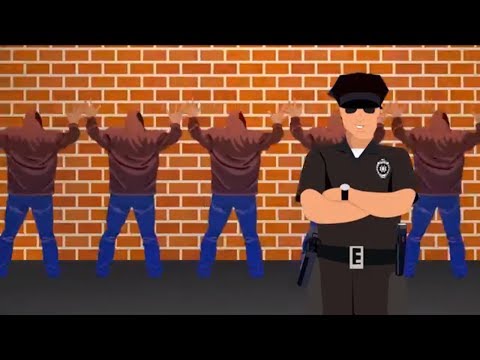
Nobody likes taxes. In fact, that’s why politicians always campaign on lowering them to lessen burdens on families. But we have to admit, if we didn’t pay them our governments couldn’t govern and provide services we need as a society. Believe me, our Founding Fathers found this out the hard way with the Articles of Confederation. The truth is, governments to raise money somehow and taxation is a fair way to do so. And I think a progressive tax system in which the rich are taxed more than the poor is sufficient since the rich earn more money. Yet, no matter what your tax bracket is, you still benefit from government services in some way. Still, if taxes are either too low or don’t provide enough revenue, then governments could be in trouble and sometimes cutting programs and staff may could lead to catastrophic results. Some local governments may find ways to enrich their coffers during times of financial pressure when other forms of revenue decline.

cops-gloating-over-loot

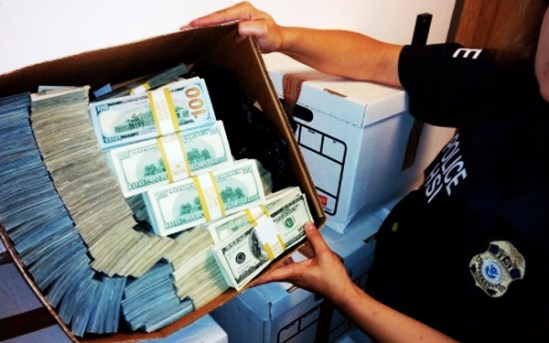
Guys, if you want to know why pot isn’t legal in California. Remember that its state police have funded efforts opposing marijuana legalization. And here we have two cops gloating over their booty.

In recent years, thousands of American cities and towns have relied on judicial fines and forfeiture to fund their governments, which is unhealthy for our democracy. Serious revenue declines, anti-tax popularity, local budget pressures have led municipalities to expand their use of revenue-generating law enforcement practices such as red light and speed cameras. However, public awareness hasn’t hit the national spotlight until the Department of Justice’s 2014 investigation into Ferguson, Missouri. We all know that the DOJ was looking into Ferguson due the police shooting of Michael Brown. But the racism and injustice in Ferguson was far worse. Between 2011 and 2013, the city collected 80% more fines and forfeitures by which point it raised 20% of its budget through this. Before the killing of Michael Brown, Ferguson anticipated that they’d collect an extra million through 2014 through police activity, raising a total of 25% through fines. This despite being home to a Fortune 500 company Edison Electric, a successfully revitalized commercial district, and an office park filled with corporate tenants that Ferguson could’ve taxed for all their worth. Well, if it weren’t for an amendment from the 1980s requiring citywide referendum approval on local tax increases, licenses, or fees. Even then, it wouldn’t be difficult since I think Ferguson’s 67% black population would’ve approved since they pay most city taxes anyway while the wealthy are barely taxed at all. Seriously, Ferguson’s tax system is incredibly unfair. Cities and their police departments may see increasing their dependence on fines as a viable strategy for funding their governments but it corrupts the justice system and brings great harm to the people it serves.

maxresdefault

So far, John Oliver has been among the only people in the mainstream media to show the problem with profit policing. This one pertains to municipal violations which can screw the poor and minorities.

  1. Profit Policing Is Not Normal nor Financially Healthy – For economically healthy municipalities, even when the absolute dollar total of fines and forfeitures may be large, they still represent a small proportion local revenue. Places like New York City, Washington D.C. and San Francisco only raise about 1-2% of their budget through civil penalties, which is about the norm. And that’s how it should be. Because most cities run on progressive tax revenue like income and property taxes. Ferguson doesn’t. In their budget, regressive taxes like sales and utilities account for almost 60% of the city’s revenue followed by municipal fines at 20%. By contrast, progressive taxes account for just under 12%. This means that Ferguson extracted more revenue from African American renters than from those owning the homes themselves. This is not how a local government should generate revenue and it’s no wonder that Ferguson has had trouble paying its bills since it incurred a debt of $3.7 trillion. And it had its credit rating downgraded to junk status by Moody’s in 2015. Even worse towns around Ferguson relied on fines for over 30% of their revenue. 3 towns in Louisiana reported collecting more from fines than from taxes with Henderson collecting $3.73 in fines for every tax dollar. Relying on fines to keep municipalities afloat isn’t normal because relying on bad behavior to balance local budgets isn’t financially viable. Making even less sense is jailing people who owe less money than it cost to incarcerate them, leading to bigger deficits as well as a cycle of dependency. As the Brennan Center’s Justice Center put it, “Having taxpayers foot a bill of $4,000 to incarcerate a man who owes the state $745 or a woman who owes a predatory lender $425 and removing them from the job force makes sense in no reasonable world.”
yt_jpdoisp-xys

When law enforcement is most concerned with creating revenue from citations, protecting and serving the community is no longer a priority. Instead, the community is exploited with very harmful results. This is why for profit policing is bad.

2. Profit Policing Undermines Justice– Fines and civil forfeitures were set as disciplinary measures, not as a municipal fundraiser. They were never meant to contribute significant revenue to local governments. But this is exactly what happened in Ferguson that the city manager and police chief discussed using tickets to meet revenue benchmarks. Not to mention, police were encouraged to issue traffic tickets who were evaluated and promoted on how much cash they could gin up. In Saint Louis County, half the judges had incentives to find people guilty and coerce payment through threat of jail. Not to mention, civil asset forfeiture becomes big which results in prosecutors and police departments to adjust budgets and tactics in order to prioritize fundraising over public safety and justice. Often this could lead to police being better trained to pursue seizures and take advantage of lax standards for the department’s benefit. It’s very clear that whenever law enforcement is a fundraising tool, the justice system is severely compromised. Because when you use law enforcement to raise funds, then it’s not about promoting safety or justice. It’s about making money through people breaking the law which can hurt the nation’s most vulnerable people.

ifj_6950-1024x683

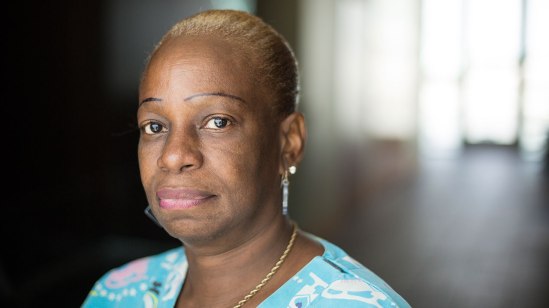
When it comes to policing for profit, racial minorities are often the victims and are disproportionately targeted. Here is Valerie Whitner from Pagedale, Missouri who along with her husband, accumulated $2,800 in fines for issues on their modest home. These include having chipping paint on a downspout, not having a screen door on the rear entrance of their home, and having weeds growing in their vegetable garden. Sometimes they were even issued fines for not having their home “up to code” without explanation. They were even threatened with demolition and were forced to take out pay day loans to keep their head above water and make mandated repairs.

3. Profit Policing Discriminates Against Minorities– While Ferguson had a cash-starved municipal government, they were hardly a poor city. Its government could’ve easily solved their money problems by taxing local businesses, one of which is a Fortune 500 company that makes $24 billion a year. The fact Ferguson relied on cops and courts to extract fines and fees to generate revenue was the result of more than a century of public policy choices designed to protect largely white business and property owners while passing the bills along to disproportionately black renters and local residents. Given Ferguson’s extraordinary climate of police harassment, you can guess who got slapped with the fines. Despite that Ferguson is only 67% black and sees plenty of white commuters, 85% of all traffic stops involved black motorists and were twice as likely to be searched and arrested than their white counterparts. This despite when searched, whites were 2/3 more likely to be caught with some sort of contraband. Municipal violations for not mowing the lawn or putting out trash in the wrong place at the wrong time were overwhelmingly issued to blacks. 95% of citations for jaywalking and 93% if arrests were issued to blacks. We should also account that Ferguson’s mayor, city manager, and police chief were white. Minorities are more likely to live below the poverty line. And it’s not just in Ferguson, but in a lot of communities with white leaders and a large minority population. You might know the case of Philando Castile who was shot by a cop in St. Anthony, Minnesota. But you may not know was that this guy had been pulled over by police 52 times within the last 14 years of his life and accrued over $6,000 in fines. Now he must’ve been an epically bad driver or racially profiled on an average of once every 3 months. It’s very clear that St. Anthony relied on Castile’s and his black neighbors’ money to balance their budget. Brennan Center estimates that 10 million people owe more than $50 billion in debt due to their involvement in the criminal justice system. 60% of this total is owed by blacks and Latinos with average totals around $7,000. That said, when police need money, it’s usually minorities who suffer.

splc-news-items-splc-lawsuit-closes-debtors-prison-in-alaba-1280x720

This woman is Harriet Cleveland who couldn’t afford to pay her $152 fine in traffic violations that she ended up spending jail time. This despite that she tried all she can to pay for it, even going without food and utilities. Her story illustrates what happens when poor people can’t afford to pay their fines right away. It’s sad and very exploitative.

4. Profit Policing Screws the Poor– Whenever cities use municipal fines and fees to generate local revenue, the poorest residents usually suffer the most. Not only are often targeted by police like in Ferguson (since many are minorities), but they’re among the least likely to afford the fines. In 2014, 75% of all Ferguson residents had active outstanding arrest warrants. Most of these involved people who couldn’t afford to pay. According to Arch City Defenders, citizens failing to appear or pay fines that were “frequently triple their monthly income” were liable to be jailed, sometimes for as long as 3 weeks. Those with outstanding warrants were rendered ineligible for most forms of public assistance and government-provided social services. This combined with public housing exclusion, often send residents out on the streets. Municipalities can also compound financial hazards for those fined by contracting with private probation collectors who can add additional, legally enforceable fees and interest to the amount the court has required. It doesn’t help those who can’t pay fines, can lose their licenses along with their jobs.

tmp616033232600694784

While running into a stop sign in California results in a $35 fine, the violator could end up paying up to $238 in Riverside County. This graph breaks it down.

5. Profit Policing Results in Higher Payments– This means that municipalities relying on fines to sustain their budgets might result in violators paying more money than originally owed. Even for a seemingly minor offense. This could happen in a number of ways:

  • Initially starting with a reasonable fine but tacking on surcharges and fees-For instance, a $35 fine for running a California stop sign can balloon into $238.00. San Diego is notorious for this since they could tack on as many as 10 surcharges with a $35 speeding ticket like a $40 state penalty assessment, $36 court penalty assessment, a $20 court construction fee, a $8 state surcharge, a $16 DNA identification, a $35 criminal conviction fee, a $40 court operations fee, a $4 emergency medical air transportation penalty, and $1 night court fee. All adding to $235.
  • Charging outrageous fines from the get go– Examples include charging $255.000 for driving over less than 25 miles over the speed limit, $500 for party noise, and $1000 on parents for juvenile graffiti. Some can consist of outrageous fines like $450 for stealing $5 of food.
  • Payment Plans– Those who can’t afford traffic tickets the first time may take this route in some states. But they can make paying off tickets more difficult and more expensive. In Illinois, people falling behind in payments can get hit with a 30% fee. And New Orleans charges $100 to start one.
  • Probation Fees– 44 states charge people various fees for being on probation. Many of these are handled by companies like Judicial Correction Services which charge a $10 set up fee and $140 per month. Those who couldn’t bring the entire amount had to report to JCS offices more frequently, sometimes multiple times a week. When people fell behind, JCS continued to collect its own fees which effectively extended their probations and guarantee the company more money. When people couldn’t pay, employees threatened to revoke their probation which resulted in jail time. It’s an unconscionable practice that should be outlawed.
  • Private Collectors– Not only they can collect on tickets but can add additional legally-enforceable fees and surcharges. They can also threaten people who don’t pay with jail. Sure they may charge the courts nothing. But they can charge people on probation a fortune.
mizz1

The town of Pagedale, Missouri is a notorious example on how profit policing can lead to ordinances allowing fines be issued for very ridiculous reasons. Its police force has aggressively targeted its citizens for harmless conditions like screen door holes, chipped paint, weeds in garden, mismatched drapes, high grass, and you name it. Let’s just say we know Pagedale issued ticketing on these ridiculous rules in order to fill its coffers. Basically its motto would be, “If you can’t ticket violations, invent them.”

6. Profit Policing Results in More Oppression and Hostility– Those who live in municipalities that depend on fines to balance budgets are more likely to be stopped by police and fined. Sometimes this could be for the usual traffic violation. But sometimes it could be for things people really shouldn’t be fined for. For instance, in Pagedale, Missouri, residents can be ticketed and fined for having mismatched curtains, walking on the left-hand side of a crosswalk, wearing pants below one’s waist, having holes in window screens, having a barbecue in front of the house, and more ridiculous ordinances that you can find in a wacky law listing. In Ferguson, 75% of its residents have outstanding arrest records. Municipalities with profit policing are more likely to have a more militarized force as well as higher police brutality against minorities.

policing-for-profit

Policing for profit often creates distrust between law enforcement and communities. Because citizens being sponged are more likely to think that the system no longer works for them. And in a way, they’re right.

7. Profit Policing Leads to More Community Distrust- While trust between law enforcement and the public may be difficult without profit-driven policing practices, using fines to fund municipal governments erodes it even further. Police are sworn to protect the public and work with local communities to solve problems pertaining to crime and disorder. It’s one thing for cops to use excessive force on unarmed black people and get away with it due to systematic racism. But it’s even more unconscionable for cops to harass residents with absurd systems of fines and penalties on mostly extremely minor offenses. Making police revenue generators for cities and towns diverts them from their traditional role of community guardians and protectors. Not to mention, people have been taught to believe that local governments and police are supposed to work for them, not the other way around. Ferguson isn’t a feudal domain where police vassals can harass the peasantry as they please. Such actions lead to a growing distrust between the police and the community, especially among poor and minority citizens. And that’s not good.

ferguson-debt

Here’s a diagram from Arch City Defenders on Ferguson’s terrible court system to its African American residents. Notice how it’s a vicious cycle and how the people in charge seem to be white. I think imprisonment for debt isn’t even legal.

8. Profit Policing May Not Be Legal– For many people below the poverty line, facing for being unable to pay a speeding ticket can be a very real possibility. Municipalities significantly funded through fines rely on judges to find people guilty and force them to pay or serve jail time. However, the federal government has already established that judges can’t send people to jail for being too poor to pay fine through a 1983 Supreme Court case. Furthermore, debtors’ prisons were outlawed nearly 200 years ago.

qukxkdg

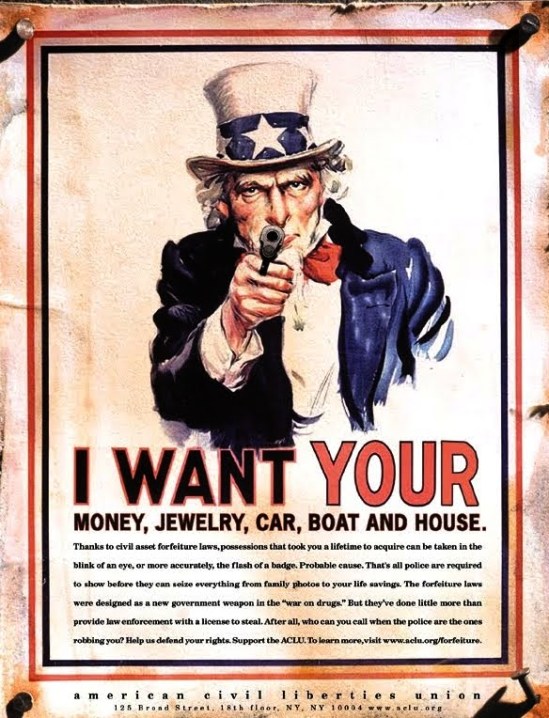
Civil asset forfeiture is when police take your stuff on suspicion that it was used in a crime, which they can do whatever the hell they want with it. Though seen as a crime fighting tool, there have been so many cases where innocent people have had their stuff taken away from them. And many had a hell of a time getting it back through the court system. Here’s how hard it is to fight civil forfeiture.

9. Profit Policing Leads to Civil Forfeiture Abuse– Civil forfeiture is when police take people’s money and property without making an arrest. Under this, police don’t have to formally charge owners with a crime, just suspect their assets are tied in some way to illicit activity. And forfeiture is mostly approved without definitive proof of alleged criminal ties. Such property can include cars, homes, and even businesses. Yet, once government takes control of the person’s property, it’s typically sold off sending proceeds back to police departments and legal offices working the case. It’s regularly touted as a crime fighting tool like targeting wealthy criminal finances who may not carry all their cash in the same car. But since there’s a lot of booty potential for cops through civil forfeiture seizures, there’s a strong incentive to pursue this process aggressively and abuse these laws and exploit innocent owners’ lack of safeguards. This is especially true when a police department’s aim is the bottom line. Sometimes they could use it as a slush fund. In 2014, the Departments of Justice and Treasury deposited more than $5 billion into forfeiture funds, up from less than a $1 billion within the last decade. There are countless horror stories of law-abiding citizens who’ve gotten hopelessly entangled in the process. In a couple Texas border towns, it wasn’t unusual for police to pull over minority drivers before seizing whatever money and valuables in their possession. After that, they’d coerce them to sign their possessions over under forfeiture laws by threatening jail on trumped up charges or taking their children. And many must go through a complex legal maze to get it back. But due to lack of transparency and public reporting there’s not a lot of data to tell exactly how lucrative or common civil asset forfeiture is in each state. This has to be fairly common in places like Ferguson. Guess who ends up being victimized by this. Still, civil forfeiture is basically state sponsored theft and should be banned.

aa-asset-forfeiture-great-one

Civil asset forfeiture has been frequently abused by police in recent years. The DOJ in 2014 lists money taken from civil asset forfeiture at $5 billion up from nearly $1 billion in 2004.

10. Profit Policing May Not Be Constitutional– The 8th Amendment bans cruel and unusual punishment as well as excessive bail and fines. Since profit policing can lead to higher fines and fees that people are unable to pay, it’s most likely unconstitutional. Since profit policing happens in minority communities, you can say it violates the Equal Protection Clause that bans discriminatory punishment as well as the Due Process Clause that requires neutral administration of criminal law. Then there’s civil forfeiture which I think is also unconstitutional under the 4th Amendment that protects citizens against unreasonable searches and seizures. So expect it in the Supreme Court.

6260874

When police departments are more directed to raising municipal revenue, law enforcement accountability goes out the window. Not only that, but leaves bad cops on the streets free to extort money from poor minority citizens as they please. Or confiscate people’s stuff if they think it’s involved in a crime. Like this guy.

11. Profit Policing Hurts Police Accountability– I am aware that police accountability hasn’t been very good lately due to how cops who use excessive force against unarmed black people get away scot free. And I know every police force has its bad apples who make the good cops look bad. However, when budgetary whims replace peacekeeping as law enforcement’s central motivation, then you can forget about police accountability altogether. Because when a police department’s main aim is profit, bad cops are more likely to get away with bad behavior. Not just “bad” as in morally corrupt and racist, but also in a job performance sense. For instance, Ferguson’s Darren Wilson who shot Michael Brown was fired from a previous job. Actually the whole police force Jennings, Missouri was disbanded for being awful. Not to mention, in Ferguson police were even encouraged to ticket and collect fines as well as were rewarded for it in career advancement. The demands were so intense that the police department had little concern with how officers did this, just that they do it a lot. Didn’t matter if their stops had little relation to public safety or questionable legal basis. Didn’t matter if the cops in question were menaces to public safety. Only cops who failed to issue an average of 28 tickets a month were disciplined. I’m sure Darren Wilson wasn’t one of them. At the same time, white police officers frequently fixed parking tickets for friends. Let’s just say it leaves so much room for corruption. After the Brown shooting, the DOJ found the Ferguson Police Department to be an abysmal failure. They reported, ““Ferguson’s law enforcement practices are shaped by the City’s focus on revenue rather than by public safety needs. This emphasis on revenue has compromised the institutional character of Ferguson’s police department, contributing to a pattern of unconstitutional policing, and has also shaped its municipal court, leading to procedures that raise due process concerns and inflict unnecessary harm on members of the Ferguson community.”

5564cbdc5d596-image

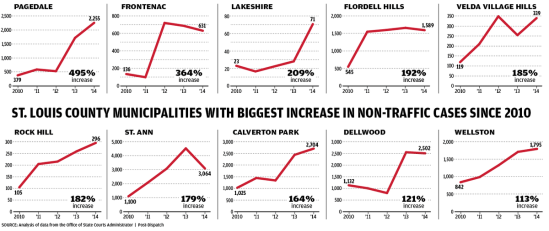
These are charts of St. Louis County municipalities with the biggest increases in non-traffic cases since 2010. Those who can’t afford to pay fines often have the system stacked against them. Meanwhile, the judges may often let their friends off easy.

12. Profit Policing Hurts Judicial Accountability– As we all know in scandals involving privatized prisons, whenever the courts’ aims is to increase revenue, the justice system is severely compromised. It is the same when it comes to municipal fines as well as “Cash for Kids.” Prior to the Michael Brown shooting, the city of Ferguson’s court system was ranged in the top 8 in Saint Louis County by generating more than $1 million in revenue during 2010. Their courts exceeded over $2 million in 2012. At the same time Ferguson Judge Ronald J. Brockmeyer owed $172,646 in back taxes and let his white friends off easy while extracting fees from Ferguson’s poor and black population. And many had the system rigged against them since they couldn’t afford a lawyer or pay a fine. Some even faced jail time. He’s had since been removed.

1200x630_289774_violence-erupts-in-ferguson-after-gran

What happened in Ferguson after Darren Wilson got off on shooting Michael Brown is a good example what could happen if a town has been under profit policing for far too long. This protest wasn’t just about police brutality they’ve put up for years but also on how often African Americans were exploited through other means. It was a disaster waiting to happen.

13. Profit Policing Hurts Public Safety– When revenue is the bottom line in profit policing, police departments focus more on issuing fines on petty offenses for municipal revenue than keeping people safe. It should surprise no one that some well-known police brutality victims were initially stopped for something preposterously minor. This illustrates how profit policing and law enforcement use of excessive force are clearly linked. North Charleston’s Walter Scott was stopped for a busted taillight before Michael Slager gunned him down. Having a busted taillight isn’t even in a crime in South Carolina. And this guy had a record for gratuitously using a taser. Sandra Bland and Samuel DuBose were stopped for minor traffic violations in Texas and Cincinnati like failing to use a turn signal or missing a front license plate. Philando Castile was also stopped for traffic violations for a whopping 53rd time. Wilson stopped Michael Brown for shoplifting and jaywalking. The thing is, when profit policing is in place, abuse is rampant while public safety is compromised. Communities distrust the police who they don’t think work for them. Some may even show a lack of respect for the law and may refuse to cooperate with police. Bad police are allowed to patrol on the streets with guns and may even get away with police brutality. Minorities and poor people are continuously screwed and preyed upon. It is no wonder that Ferguson, Missouri was one police shooting away from civil unrest. We have to accept that public safety depends on the community’s relationship with law enforcement. Municipalities can’t protect their populace if they’re using police to fleece from them since it creates a toxic environment.

0-rvslsfz3-x0lzgld

Here’s a letter from Ferguson’s mayor to one of the city’s policemen for his service. This pertains to him issuing tickets. Notice how they emphasized how he contributed to the city’s budget.

14. Profit Policing Corrupts Governments– Look, I know that many municipal governments use their police departments to enhance their coffers because they’re financially struggling and don’t want to raise taxes, especially when taxes would make more financial sense. However, when a government backs profit policing, they’re clearly not acting in the people’s best interests. This was certainly the case with Ferguson but other communities in Saint Louis County were demonstrably worse. Then there’s the fact many of these towns enacted ordinances just for the sake of generating more revenue through fines, especially if they’re unrelated to traffic and not technically illegal elsewhere. Ferguson’s were also skewed since their city manager congratulated the police chief for record citation revenue. While Ferguson’s cops held anti-black views so did their municipal employees as the DOJ found out through various e-mails mocking blacks through speech and familiar stereotypes. Most of Ferguson’s decisionmakers believed African Americans lacked personal responsibility despite that black residents made incredible efforts to pay their fines disproportionately handed out to them. White city officials meanwhile, condoned a striking lack of personal responsibility as the cause.

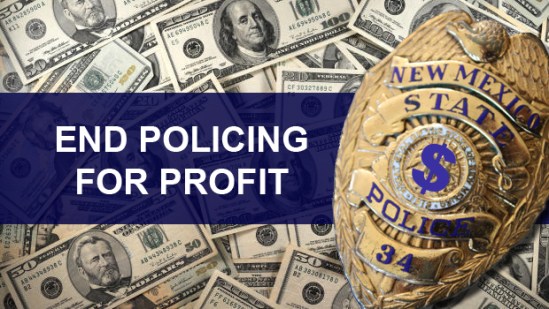
policing-for-profit-1

The National Security Threat of Domestic Terrorism (Depicted by the News Media)

american-domestic-terrorism

When Americans think about terrorism, they usually imagine 9/11 and other attacks perpetuated by people who aren’t from this country and who aren’t like us. Groups like Al Qaida and ISIS usually come to mind. Yet, while foreign terrorist attacks like 9/11 are enough to make us frightened and willing to send troops to Afghanistan, there’s a national security threat more pressing that most people don’t pay much attention to. It’s called domestic terrorism which refer to terror acts carried out by US citizens or permanent residents on US soil. Domestic terrorists have committed 80% of attacks since 9/11 and killed more Americans on US soil than their foreign counterparts. Under current US law enforcement, the USA PATRIOT ACT defines acts as domestic terrorism those in which:

  • involve acts dangerous to human life that are a violation of the criminal laws of the United States or of any State;
  • appear to be intended –
    1. to intimidate or coerce a civilian population;
    2. to influence the policy of a government by intimidation or coercion;
    3. to affect the conduct of a government by mass destruction, assassination, or kidnapping;
  • occur primarily within the territorial jurisdiction of the United States.
curry_tragic_prelude

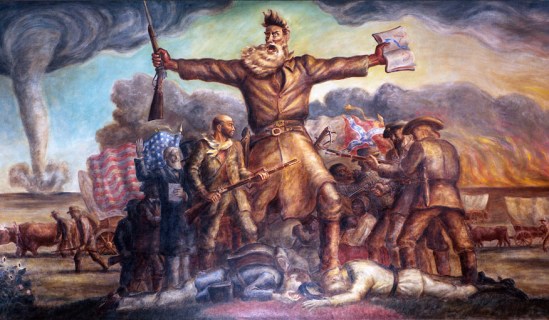
Accurately referred to as “America’s Favorite Domestic Terrorist,” legendary abolitionist John Brown has become a highly controversial figure both for his anti-slavery ideology as well as his violent tactics. But he perfectly illustrates why Americans may have a hard time recognizing domestic terror even in their American history books.

But when it comes to identifying domestic terrorism in contemporary culture, a lot of Americans struggled since the perpetrators may look like them and may share ideas that they kind of agree with. A good case in point is American abolitionist John Brown who’s known for participating in Bleeding Kansas and trying to overthrow the institution of slavery through staging an unsuccessful raid on Harper’s Ferry in 1859 that killed 7 and injured 10. Brown’s raid on a government arsenal in present day West Virginia clearly fit USA PATRIOT ACT’s definition of domestic terrorism. Brown’s raid involved acts dangerous to human life that violated US and state criminal laws, were clearly intended to intimidate civilians and influence government policy, and definitely occurred on US soil. The fact he believed himself an instrument of God’s wrath in punishing men for the sin of slavery certainly proves that his extremist beliefs had a religious dimension. But since Brown’s motivation behind his attack on Harper’s Ferry was to overthrow the institution of slavery, well, he’s rarely seen as such even by modern day academics. Mostly because Americans agree that slavery was a very terrible sin and the fact it divided the country as well as took 4 year civil war to outlaw it. So in hindsight, Brown’s idea of destroying the institution of slavery through violence isn’t really that crazy (though to a point). And it’s mainly because of Brown’s abolitionist views no matter how extreme they were that he’s often seen as a heroic martyr and visionary to many people. Nevertheless, Brown’s actions prior to the American Civil War and the tactics he chose still make him a very controversial figure today. But Brown’s life and our perception of him illustrate why a lot Americans have difficulty identifying acts of terror by our fellow countrymen in the nation. This is a problem as I explain in this post in FAQ and list format.

daily-news-terrorist-cover

This is a photoshopped picture that advocates gun control. However, it also illustrates the problem the media has with identifying domestic terrorist attacks.

If law enforcement has a clear definition on what domestic terrorism is, why is the term used so subjectively as a media and political term?

It’s mainly because when it comes to domestic terrorism, law enforcement and the mainstream media live in two different realities and have very different motivations for identifying what constitutes one. And the latter usually has more influence on the American people. Since American law enforcement’s main priority is ensuring public safety, their criteria for identifying terrorists acts is based on criteria defined in the USA PATRIOT ACT. So when it comes to defining domestic terrorism, all law enforcement care about is whether the act was criminal and endangered human lives, whether it was intended to promote a political agenda through coercion or intimidation, and whether it was committed by someone who lived in the US on US soil. That’s it. By contrast, the media defines domestic terrorism quite differently through the following criteria:

image-20160622-7203-1az1cqu

One of the most significant factors in how the media determines whether a violent attack is domestic terrorism is the suspect’s identity. If they’re Muslim, chances are that they’ll be labeled as a terrorist is very high.

  1. Perpetrator’s Race and Cultural Identity – If the perpetrator is a Muslim American, their chances of being seen as a domestic terrorist are extremely high regardless of motivation. If it’s a non-Muslim white American with a conventional name, their chances of being seen as a domestic terrorist are usually dependent on other factors. As for the likelihood of non-Muslim blacks and Hispanics perpetrators, it’s very hard to say since both groups are often associated with criminal stereotypes though neither are widely perceived as terrorists.
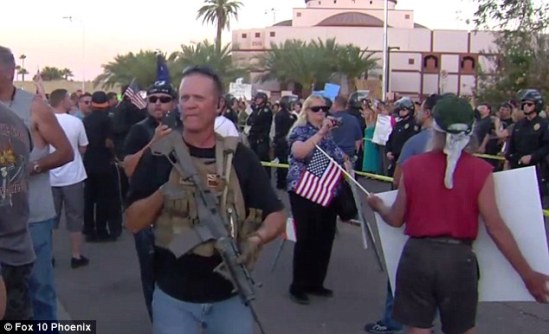
  2. Perpetrator’s Motivation– Any American Muslim perpetrator who commits an act of terror in the name of Islam will be automatically be labeled a terrorist in the media as well as linked to foreign Islamic terrorist groups like Al-Qaida or the Islamic State. Black and Hispanic perpetrators will only be identified as such if they’re connected to known terrorist groups or embrace an extremist ideology. But when it comes to non-Muslim white terrorists, it can vary considerably depending on their motivation. White violence against women, racial and religious groups, LGBT people, disabled people, and immigrants will usually be seen as hate crimes at best but not always and not without controversy (if the incident is covered at all). Yet, many hate crimes usually qualify under the USA PATRIOT ACT’s definition of domestic terrorism anyway. Anti-abortion and ecological extremists are less likely to be seen as domestic terrorists since a lot of people hold anti-abortion and environmentalist views. So like John Brown, labeling them as such is controversial though they’ll certainly be seen as nuts regardless political ideology. Then you have the anti-government perpetrators whose acts of terror may cause controversy if ever labeled domestic terrorism. This is especially the case when you’re talking about right-wing extremists or the open carry crowd (though open carry may be legal in some states, carrying a gun in public is an act of intimidation and coercion so it qualifies).
  3. Nature of the Attack– In the media, the nature of the attack matters considerably such as the method and body count. Perpetrators who stage bombings that kill lots of people will most likely be seen as domestic terrorists. So would any attacks that involve hijacking, bioweapons, mass poisoning, hostage taking, chemical weapons, kidnapping, and property destruction. Shootings may depend on whether the perpetrator is either Muslim or clearly committing a hate crime. At any rate, they have to involve violence and/or fatalities. Despite causing hundreds of millions in property damage and having a sheer volume of crimes, eco-terrorists aren’t really seen as such since a lot of their crimes don’t get people killed. Same goes for left-wing Communist and anarchist terrorists. Merely using guns to intimidate people based on political ideology may not be labeled as domestic terrorism when it clearly is. Cyberterrorism may get some attention even though it’s not considered such while paper terrorism doesn’t get much attention at all.
  4. Location– Attacks that take place in major cities are more likely to be labeled as domestic terrorism than ones in less urban areas, especially if they take place near places of great significance. In some ways, this makes sense but also ignores a lot of other terror incidents that take place around the country.
cxx2aw8wkaajtkt

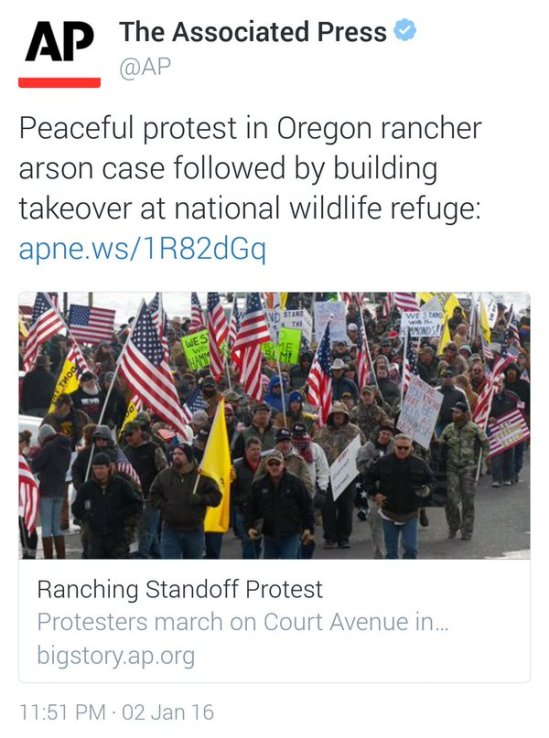
Meanwhile, if the perpetrators in question are white, right-wing, and stage a heavily armed takeover of a national wildlife refuge in Oregon, you might expect headlines like this. Since AP is held to very high journalistic standards, this headline tweet is appalling. These guys aren’t peaceful protesters. They have guns with them and they took over a national wildlife refuge in order to intimidate people and influence government conduct. It’s domestic terrorism, plain and simple.

If you watch TV news, you might get the impression the media is more likely to label a violent incident as domestic terrorism based on a biased set of criteria which gives Americans the impression that terrorists tend to be Islamic extremists. When in reality, Muslim terrorist attacks aren’t a very big threat to national security, even after 9/11. Why the media decide does this:

homegrown_terrorism

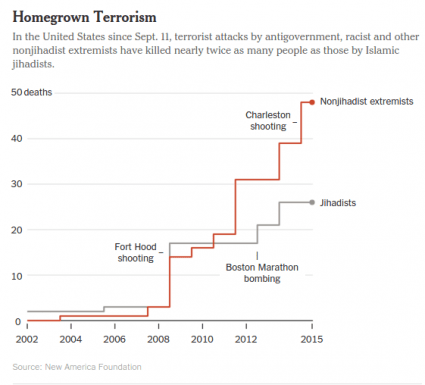
Contrary to what you might be accustomed to on the news, anti-government, racist, and other nonjihadist extremist killed nearly twice as many people as those by Islamic jihadist since 9/11. Many Americans don’t realize this, especially if they’re on a steady diet of Fox News. Maybe that’s because most nonjihadist terrorists are white.

  1. Desire to Avoid Controversy– Domestic terrorism is a loaded word. And while the mainstream media likes sensational news stories, they also take great aims to avoid offending people. This is particularly true when a terror incident involves right-wing extremists since a lot of mainstream media outlets are owned by large corporate conglomerates. Some like Fox News even have a right-wing ideology. That’s not to say leftist terrorists exist since they certainly do since Occupy Wall Street might qualify since they have a long list of property crimes, rampant drug use, rape, murder, and assaults. But when Janet Napolitano brought up the threat of right-wing domestic terrorism in 2009, Republicans were furious.
  2. Public’s Unwillingness to Identify with Terrorists– Like I said about terrorists, people are more comfortable to label a terrorist act as such if the perpetrator is different from them. And since a lot of people don’t know anyone who’s Muslim, Muslim perpetrators are more likely to be seen as terrorists than their non-Muslim counterparts. But when a terror incident involves white supremacists and other right-wing extremists, a lot of conservative politicians hesitate to declare it as such. Many of them even downplay dangers posed by right-wing extremism altogether. This is especially when Fox News glorifies a Nevada rancher who engaged in an armed standoff against the feds over grazing rights and a bunch of armed men for occupying a federal wildlife refuge in Oregon and the fact the current GOP presidential nominee has been endorsed by white supremacists. When it comes to right-wing domestic terrorism, most conservatives are like Draco Malfoy. Sure they may be totally comfortable having racist, xenophobic, homophobic, sexist, and anti-government views. And yes, they may not be happy with the political and cultural landscape these days as well as nostalgize about a past that never was. But like Draco Malfoy on Muggle-borns, most of these conservatives are neither extreme in their viewpoints nor are willing to resort to violent terrorist acts for them. On the other end, I may believe that this country should do more to protect the environment and stop climate change but that doesn’t mean I’m willing to bomb an animal testing facility because that’s crazy. But when someone commits an act of violence on behalf of their political agenda, it makes a lot of people who may share that perpetrator’s view to some extent very uncomfortable and reluctant to address it as an act of terror. So they don’t.
  3. Sensationalism– We should understand that sensationalism sells and the media does everything it could to exploit violent terror incidents. The more violent it is and the nuttier the perpetrators seem, the more attention it will get and more ratings the media outlet will have. This is especially be the case if the perpetrator is Muslim.
r20150918-topthreat_0

According to a local law enforcement survey the Triangle Center on Terrorism and Homeland Security, anti-government terrorism was seen as the top terrorist threat in their jurisdictions. And that percentage is far more than those who listed anything relating to Islamic terrorist threats. The media doesn’t really pay attention to this because most anti-government terrorists are white.

Unfortunately, the way the news covers domestic terror attacks has very negative repercussions in the country. Now it’s one thing to call a mass shooting in San Bernardino and at the Pulse nightclub in Orlando as domestic terrorism. Same goes for the Boston Marathon bombings. But it’s another when both these attacks are seen as acts of domestic terrorism while the mass shootings at Pittsburgh, Tucson, and Charleston are not. Rather as far as the media was concerned, these were attacks made by violently mentally ill white men. Sure it was an accurate assessment, but it doesn’t tell the whole story. For one, the man who fired an AK-47 at 5 cops in Pittsburgh was a white supremacist who believed Jews secretly ran everything and that Obama wanted to take away his guns. But as far as the media is concerned, he was just a crazy nutjob who killed 3 cops after his mom called police over a domestic dispute concerning a dog peeing on the carpet. Second, the Tucson shooter who tried to assassinate Congresswoman Gabby Giffords was a conspiracy theorist who believed in a New World Order to brainwash people. Third, the shooter who killed 9 people at the Emmanuel AME Church in Charleston was a white supremacist who donned a pro-apartheid jacket on his Facebook page, had a Confederate flag license plate, told racist jokes, advocated segregation, and went on a racist rant on how blacks are raping white women and taking over the world. Furthermore, he specifically chose to fire upon blacks at the church due to its long association with civil rights activism. Yet, these terror incidents were reported. Most aren’t covered by major news outlets at all. Negative repercussions of inadequate and sloppy coverage of domestic terrorism include:

deah-shaddy-barakat-family

The heavy attention on Islamic terrorism in the US media outlets had perpetuated rise and acceptability of Islamophobia as well as led to American Muslims being targets of everything from harassment to outright deadly violence. Featured here are American Muslims Yousef Abu-Salha, his brother-in-law Deah Barakat, and his sisters Yusor and Razan. Save for the Yousef, three people would later become victims of an anti-Muslim hate crime in a Chapel Hill condominium by one of their former white neighbors who was banned from the building. The man basically broke into Deah and Yusor’s condo and killed them and Razan in cold blood. Yousef would later say, “It’s a shame that you turn on a major news channel and you see a news story about ISIS and then they’ll cover our story and they do an okay job, but immediately after it will be another story about these radical groups. I think it sends US citizens a bad message that these Muslims are all the same.”

  1. Legitimizes Discrimination– The media’s coverage of Islamic terrorism since 9/11 in the US and abroad has contributed so much to Islamophobia that Muslims in American pop culture have been nastily stereotyped as fanatical Islamic terrorists who hate our country and our western values. Each terror attack since then have been filtered by the media and consumed by the public as wrongdoings of Muslims around the world. Muslims have been further vilified and dehumanized in Hollywood movies like American Sniper. Because of this, American Muslims, Middle Easterners, and South Asians have become acceptable targets for profiling, oppression, and even terrorist attacks. For many Americans, just looking like a Muslim makes them an automatic terror suspect by default as well as someone to be feared. This is a major reason why welcoming Syrian refugees in the US has been so controversial even though it shouldn’t. Around the country, mosques have been fired on, defaced, or burned. Muslims have been shot and killed execution style in their living rooms, fatally stabbed on their way home as well as been beaten in their stores, schools, and on the streets. They’ve also been kicked out of planes, egged outside Walmart, scorched with hot coffee in a park, shot in cabs, and punched while pushing their children in strollers. They’ve had clothes set on fired and their children bullied in school. They’ve been threatened by neighbors who’d burn down their house if they didn’t move away as well as had their cemeteries vandalized and Quran desecrated. They’ve been fired for wearing hijabs and for praying. A Muslim congressman has received death threats. In Irving, Texas, heavily armed right-wing gunmen blocked entrance of a mosque and held banners reading, “we are the solution to Islamic terrorism.” Other armed anti-Islam demonstrations and “Muslim-free” businesses raise deep concerns. Civil and human rights advocates are challenging the use of “domestic terrorism” believing that it’s doled out in a racially-discriminatory manner that merely exacerbates hate they and law enforcement are trying to prevent. Exacerbating hate on a group of people who just happen to have the same religion as terrorists is not a solution to Islamic terrorism and just makes it worse. The fact that 55% of Americans hold an unfavorable view of Islam makes Islamophobia not just the biggest threat to American religious freedom, but also a potential threat to national security since Muslim communities play a crucial role in alerting law enforcement to terrorist threats.
  2. Does Not Represent Reality– While the American public rightfully sees Islamic terrorists as a threat to safety, the reality of terrorism exists in all forms and that terrorists come from all racial and cultural backgrounds as well as embraced a wide range of extremist political and religious ideologies. For law enforcement officials, the biggest terrorist threats aren’t jihadists. Rather it’s far right wing extremists that have carried out well over half of the deadliest US terrorist attacks since 9/11, committing 93% of all extremist murders in the last 10 years. Most of their extremism is homegrown as well as pose a very real danger to this nation’s character such as pluralism, tolerance, and equality, which form the basis of a liberal democracy. Though jihadist terrorism is often reported on the news, the US has seen very little violent extremism by Muslims. On the other hand, white supremacists are among the most lethal since they’ve committed 83% of all right-wing extremist murders and 77% of all extremist killings in the past decade as well as were involved in 52% of shootings with police. They also regularly engage in various terrorist plots, acts, and conspiracies as well as other traditional forms of crime. Anti-government extremists, right-wing militias, and sovereign citizens are among the most common. But no matter what their ideology, right-wing extremists are also more numerous, cover a larger geographic range, and are more likely to live in your neighborhood. Not representing these groups in the media as the terrorists they are that we should condemn is very irresponsible, even if the station is Fox News.
  3. Promotes Cultural Profiling– How the media has reported domestic terrorism can also lead to real but ineffective policies that have resulted in cultural profiling, particularly of Muslims and people suspected of being one. Those charged with plotting terrorism for the Islamic State faced more severe charges than militia members, “sovereign citizens,” and other anti-government extremist who’ve been prosecuted for similar activity (even though many more terrorist attacks in the US are carried out by non-Muslims). After 9/11, many American Muslims, South Asians, and those of Middle Eastern descent found themselves being subject to harsher security checks as well as are more likely to be on a no fly list or subject to surveillance. As a result, trust between law enforcement and Muslims has been strained. In recent years, anti-Islam bills became laws in 10 states. Florida and Tennessee passed laws revising the way they approve textbooks for classroom use as a direct result of anti-Islam campaigns. Don’t get me wrong, Islamic terrorists do exist in this country and do pose a threat to national security. But profiling Muslims as suspected terrorists by default is never excusable since the vast majority of them are regular people like us who just want to live their lives in peace and mind their own business.
  4. Fails to Hold Public Figures Accountable for Their Rhetoric– The media is a huge influence in the American public but we should be aware what many public figures may say could be taken out of context by some nutjob who’d use it in a terror attack. It’s been widely suggested that political rhetoric may play a role in fueling hate crimes, especially since Donald Trump started running for president as well as said very hateful things about almost every demographic imaginable. But since he started running and calling on Muslim bans, anti-Muslim hate crimes dramatically increased to its highest levels since the aftermath of 9/11. It doesn’t help that Trump has been endorsed by white supremacist organizations whom he’s consistently failed to denounce. A lot of what’s said on Fox News has probably led to a lot of terror attacks and it doesn’t help that they have glorified anti-government terrorists like Cliven Bundy as heroes as well as inspired many nutcases to do horrible things that have killed people. Not to mention, a lot of conservative special interest groups have said similar things as well as many Republican politicians. I know there are liberal groups and Democrats who might inspire some degree of terror violence. But I single out conservatives since right-wing terrorism has become much more of a problem in recent years, according to terror experts and government organizations.And yes a lot of these radical right-wing extremists consume conservative media outlets like Fox News.
  5. Ignores Very Real Threats– While Muslim terrorism in the news stirs fear and hatred for even the most ordinary Muslim Americans, the far more serious threat of the radical right has received relatively little attention. But bring that fact up in front of Republican politicians, expect outrage and even offense as an attack to demonize the right. The media seems to be just as deft to these threats, especially if it’s Fox News. Such response leads to downplay to take such threats as seriously as they should be by the public. Radical Right-Wing terrorists present a more deadly threat given their affinity for hoarding weapons and explosives. Not paying attention to these terrorists has consequences such as emboldening these people to carry out mass casualty attacks. Americans are much more likely to live near a white supremacist or anti-government sovereign citizen than a jihadist (A nearby town in my area had its own Klu Klux Klan chapter). When we’re talking about racial and religious minorities, living near a radical right-wing terrorist can put them in very real danger.
  6. Compromises Public Safety for Vulnerable Populations– Whenever domestic terror incidents aren’t reported and treated as the heinous acts they are, people are left very vulnerable to attacks. This was very apparent in the South during segregation when countless African Americans were subject to lynchings as a way to control black communities and retain white supremacy. During the Civil Rights Movement, African Americans and other activists were frequent targets of white supremacist violence. Though white supremacy is no longer as acceptable as it was, the hateful ideology and violence hasn’t gone away. Recent incidents including a white supremacist firing on Black Lives Matter activists in Minneapolis, a NAACP building bombing in Colorado, and a black church shooting in Charleston. In every terror attack involving Muslims since 9/11, hate crimes against Muslims in America have become alarmingly high. A study from Georgetown University has reported 174 incidents of anti-Muslim violence from 2015 consisting of 12 murders, 29 physical assaults, 50 threats against people and institutions, 54 acts of vandalism, 8 arsons, and 9 shootings or bombings. Contrary to what the media might say, Muslims are far more likely to become terror victims than terror perpetrators. However, Muslims and blacks aren’t the only group in the country vulnerable to domestic terrorism in the nation even by white supremacists. White supremacist groups also target immigrants, minorities, Jews, LGBT people, and sometimes Christians. Targets for anti-government and sovereign citizens are law enforcement and other authority figures. Still, not recognizing clearly politically motivated attacks by non-Muslim perpetrators leaves many Americans especially vulnerable.
trump-kkk-endorsed

It is no secret that now GOP presidential nominee Donald Trump has been endorsed by the Klu Klux Klan over his racist remarks on Mexicans, blacks, immigrants, and Muslims. However, Trump hasn’t distanced himself from this white supremacist terrorist organization which has a long history of violence against blacks since its formation during Reconstruction. If a presidential candidate from a major party can’t denounce a terrorist endorsement, then that person isn’t fit to be president. Seriously, the KKK are beyond deplorable.

As you can see the state of how the news media depicts domestic terrorism is appalling. Excessive coverage of one group of terrorists has led to disproportionate fear, suspicion, and unjust discrimination against a religious minority and other others. But significant less attention of a far more serious homegrown terrorist threat has gone under the media radar and has neither been sufficiently challenged by our political culture nor law enforcement. Not only this disproportionate rate of media coverage lead to increased profiling and discrimination, it also makes the US less safe as a whole. Furthermore, it makes public figures less likely to take responsibility for their rhetoric that could inspire many of these nutjobs to commit heinous acts. Now while the government may be slow to act on domestic terrorism, the media doesn’t have to. In fact, if the media just got it together and report domestic terrorist attacks in a way they should, then it might actually encourage leaders to come up with policies combating it. After all, people didn’t take lynchings as serious acts of terrorism meant to intimidate black people during segregation in the South until Ida B. Wells investigated them in the 1890s and began an anti-lynching campaign to spread awareness about the atrocity. Today she is turning in her grave. If the news media should cover domestic terrorism correctly, then it must be depicted in a way that’s represents the reality. By that I mean showing that domestic terrorism can take many forms, be motivated by different ideologies, and committed by people of many different backgrounds. And that all these domestic terrorists should be treated as a national security threat to be taken seriously.

2931225700000578-3103341-image-a-64_1432954295853

Here we come to a bunch of heavily armed open-carry activists “protesting” at a mosque in Phoenix against “Islamic Radicalism.” In reality, they’re just a bunch of armed terrorists who are using their guns to intimidate the Muslims who worship there. This isn’t peaceful protesting, it’s domestic terrorism and should be treated that way. This should neither be tolerated nor encouraged by anyone. It’s utterly disgraceful anyone there with a gun wasn’t arrested. Because the country needs to know that armed protest rallies are never ever acceptable.

The Many Corruption Scandals of Donald Trump (You’re Welcome, Hillary)

trump-shell-game

Okay, I was actually not going to post this article. But since my parents found Trump presidential campaign ad on one of my articles, I feel that I have no choice but to do this. During the 2016 campaign season, the media tends to cast Donald Trump as the crazy/racist one while portraying Hillary Clinton as the politically corrupt one. However, while I don’t contest that Hillary hasn’t been a saint for the last few decades, but to say that she’s more corrupt, untrustworthy, and dishonest than Trump, well, that’s just completely wrong. I’m well aware that the news media tends to cover Hillary’s political and personal baggage on the airwaves down to the last detail while sending legions of journalists in their midst whenever she’s implicated in a government investigation. But all of what’s turned out of those findings about Hillary is just that she happens to be a flawed but normal politician. The only thing that’s abnormal about her is that she’s a former First Lady. That’s it. Yes, she has baggage but a lot of her and Bill’s cases involve suspicion and shadowy links. But all that just adds fuel for the conspiracy theorists at Fox News. Still, though I don’t have any objections to the press covering Hillary this way, especially in a presidential election year, they don’t seem to do the same to Trump. Because when Trump is implicated in anything, the media just glosses it over briefly and moves on. This is not how candidate scandals should be covered, especially if we’re talking about the scandals surrounding Trump which I think are well worth revisiting and discussing. Compared to Hillary, Trump has a long and documented history of corruption since the 1970s and his flamboyant corruption run to the very core of his identity and prospective governing choices. Hell, many of his scandals have been recorded in court cases and legal proceedings. Sure he may have a complete lack of public office experience, but his resume is far from clean unlike most novice candidates. A lot of the stuff he’s done is downright appalling as well as shown that he’s willing to risk ruining people’s lives in order to get what he wants with no second thought. So if you’re a person who disdains corruption, then your rationale for voting for Trump to elect him is nothing short of idiotic. Yes, the Clintons may be corrupt practitioners of Washington’s cash-for-access culture as well as careless and susceptible to greed. But their corruption only pertains to normal, political things. Sure that doesn’t excuse their behavior, but their deeds aren’t unprecedented. Trump on the other hand, is corrupt on a historic scale and the fact people are willing to trust him over Hillary to run the country is insane. Here I have a rough cheat sheet of Trump scandals you might want to see for yourself. Consider this a highlight reel except that the highlights tend to show Trump as awful person he is. These are not in chronological order. It’s also a long post and viewer discretion is advised.

Business Failures:

1980s: Used junk bonds to build Trump Taj Mahal in Atlantic City (despite claiming he wouldn’t) and was unable to keep up with interest payments once the casino was built. So Trump declared bankruptcy in 1991 which led him to sell his yacht, his airline, and half of his ownership in the casino.

1983-1985: Bought the USFL New Jersey Generals for $9 million but the league lost $30 million for obvious reasons regardless of how the team was doing. Lobbied to move the USFL games to the fall to compete with the NFL which commanded the TV networks. So Trump’s lawyers and the league filed a $1.69 billion antitrust and monopoly lawsuit against the NFL. Jury awarded the USFL $3 million in damages and the league later folded.

1989-1993: Acquired 17 Boeings Eastern Air Shuttle and 17 Boeing 727 that formed Trump Airlines which he aimed to make it more Trumpy luxurious for $380 million on 22 small bank loans. Customers used to Eastern Air Shuttle’s no frills service could no longer afford it and it never turned a profit. It didn’t help that Trump was more interested in revamping this airline to suit his image instead of focusing on his customers’ real needs. Not to mention, the high price of jet fuel due to the Gulf War in 1991. As Time explains, “The high debt forced Trump to default on his loans, and ownership of the company was turned over to creditors. The Trump Shuttle ceased to exist in 1992 when it was merged into a new corporation, Shuttle Inc. No word on whether the gold-plated faucets survived the merger.”

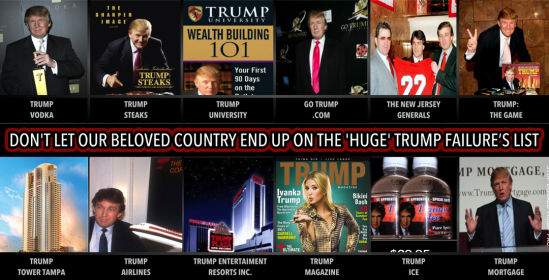
1989: Launched Trump: The Game which was a Monopoly themed board game with a lot of illegal stuff in it that failed within a year. A 2005 attempt at reviving the game via The Apprentice also failed.

1992: Declared bankruptcy when Trump Plaza went bust after losing more than $550 million.  Though he gave up his stake, Trump insulated himself from personal losses and managed to keep his CEO title. However, he surrendered any salary or role in day-to-day operations. By the time all was said and done, he was $900 million in personal debt.

1995-2004: Declared bankruptcy when Trump Hotels and Casino Resorts was $1.8 billion in debt before later emerging as Trump Entertainment Resorts. Though Trump was chairman of the new company, he no longer had a controlling stake in it. Trump Hotels and Casino Resorts had lost money every year while Trump ran it as CEO which later lost its shareholders and 90% of their money. And at the start, the company already had a $494 million in long term debt but its borrowings ballooned to $1.7 billion by the end of the next year. In the Trump Hotels and Casinos transaction to buy Trump Taj Mahal for $898 million, the company would take $817 million in junk bonds at 11.25% interest. Trump Taj Mahal was already losing money from the start because its big interest burden due to Trump financing its construction with junk bonds in the 1980s. In 1996, Trump Hotels would by Trump’s Castle for $520 million with the announced price at a staggering 18 times cash flow. It’s not even clear whether the Castle was worth its over $350 million debt load. By 2002, Trump Hotels’ debt was $2.1 billion and its leverage ratio expanded to 27, approaching levels that sank Lehman Brothers during the 2008 financial crisis. Meanwhile Trump paid himself $32 million. It was the worst performing publicly trading gaming company at the time, especially from 1995-2000 when the sector itself was going gangbusters.

1995: Lost $916 million according to his tax returns from that year.

2004: Licensed his name to Trump Signature Collection clothing line which is manufactured in China and Mexico. After accusing Mexico of sending its rapists in to the US, Macy’s dropped the line. Now the company Phillips-Van Heusen which manufactures his line said after losing its main retail outlet at Macy’s, plans to dump Trump in 2018. Not to mention, Trump has ironically threatened Apple, Carrier, and Ford to strongarm them into bringing their outsourced workers back to the US. Hell, in 2005, he even expressed support for outsourcing.

2006: Launched Trump Vodka which aspired to make “Trump and Tonic” the most ordered drink in America. Folded in 2011.

2006: Launched Trump Mortgage just when the housing bubble was reaching its bursting point and dismissed talk about it on CNBC by saying, “Who knows more about financing than me?” Apparently anyone who thinks starting a mortgage company at the time was a very bad idea. Company folded 18 months later to nobody’s surprise.

2006: Launched travel site Go.Trump which focused on luxury hotels. Failed within a year.

2007: Launched Trump Magazine which targeted affluent readers and covered luxury living. Failed within 2 years.

2007: Launched Trump Steaks which bought meat from the Sysco-owned Buckhead Beef which used the name and sold them through a New York City technology store called The Sharper Image. Company folded within a year for obvious reasons. Seriously, who the hell sells steaks at a technology store?

2009: Declared bankruptcy when Trump Entertainment Resorts fell again which led him to resign from the board though the company retained its name. In 2014, he successfully sued to take his name off the company and its casinos, one of which had already closed and the other being near closing. The Trump Plaza Casino and Hotel has closed permanently. Over the 15 years Trump served as chairman of both Trump Hotels and Resorts and Trump Entertainment Resorts, both companies posted net losses with profits being decimated by gigantic interest costs at $1.7 billion, excluding extraordinary items.

Screwing Workers:

1970s-present: As of 2016, he and his companies have been sued 20 times for mistreating female employees. These include a woman in Miami fired for getting pregnant, two women fired for complaining about co-worker sexual harassment, a female supervisor who Trump pulled aside to complain about hiring, another supervisor being threatened with punishment for not firing a female employee for being fat, a married waitress Trump subjected to unwanted flirtations, and a number of women testifying Trump repeatedly instructing managers to hire younger and prettier workers at his LA golf club.

1980: Demolished the Bonwit Teller store and its architecturally beloved Art Deco edifice (though he promised not to) in order to build Trump Tower. In order to accomplish this, the managers hired 200 undocumented Polish workers to tear it down, paying $5 an hour for backbreaking work when they were paid at all. Workers didn’t wear hard hats and often slept on site. Workers who complained about back pay were threatened with deportation. Trump claimed he was unaware that undocumented immigrants were working at the site (while testimony under oath shown by Massimo Calabresi proves that Trump was aware of undocumented workers being employed there). In 1991, a federal judge found Trump and the defendants guilty of conspiring to avoid paying Local 95 construction workers’ union pension and welfare contributions. The decision was appealed, with partial victories on both sides, and settled in 1999. Marco Rubio used this story in a debate to accuse Trump of hypocrisy in his illegal immigration stance and rightfully so.

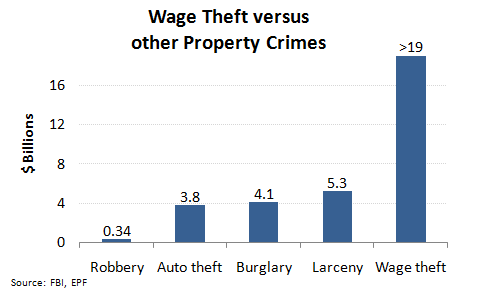
1980s-present: Has been subject to various complaints and lawsuits by contractors, waiters, dishwashers, and plumbers who have worked on his projects and claimed that his company has stiffed them for work as well as refused to pay for their services. USA Today did a lengthy review of this, finding that some of these contracts were for hundreds and thousands of dollars, many owed to small businesses that failed or struggled to continue because of unpaid bills. Not to mention that Trump was found to have improperly withheld compensation for undocumented Polish immigrant workers. In regards to these wage theft allegations, Trump has offered various excuses like shoddy workmanship. However the scale of the problem that includes hundreds of allegations makes it hard to credit. In some cases, even lawyers Trump has hired to defend him have sued him for failing to pay their fees. One Trump employee admitted in court that a painter was stiffed on account that managers had determined they had “already paid enough.” These cases are particularly damaging since they show Trump not driving a hard bargain with other businesses as well as harming ordinary, hard-working Americans. Not only that, but he’s now being sued by little girls who performed during his campaign. And it’s because he’s running for president and is subject to such scrutiny that I decided to do a blog post on wage theft. Trump’s record on stiffing workers out of their hard earned money should get long-term media attention because it shows us the kind of sociopath he is.

1980s-present: Despite his immigration stance, has hired foreign guest workers at his resorts which involves a claim that he can’t find Americans to do the work. This even when Americans applied for the same positions. Guess foreign guest workers are easier to exploit and are less likely to complain about wage theft.

1999-?: Has been subject to claims by former models at Trump Model Management that they and others worked for the agency in the US despite not having proper permits. Some worked on tourist visas, either never getting the correct permits or getting them only after working in the US illegally for months. Some models also received H-1B visas which a special type of permit for workers in specialized industries, a program Trump has criticized. In true Trump fashion, the models were kept under squalid conditions while earning almost nothing for the work they did. It’s even embarrassing that Trump has argued for much more enforced immigration laws as well as building a wall and making Mexico pay for it. There’s even scrutiny over his current wife Melania’s immigration status at the time as well.

2000s: Spent half a million dollars to a law firm in order to keep service employees from his Las Vegas hotels and resorts from unionizing. According to a 2015 lawsuit by the Culinary Workers Union, Trump Hotel Las Vegas “violated the federally protected rights of workers to participate in union activities” and engaged in “incidents of alleged physical assault, verbal abuse, intimidation, and threats by management.” That October, the owners sued the Culinary Workers Union and another, alleging they had knowingly distributed flyers falsely stating that Trump had stayed at a rival unionized hotel instead of his non-unionized establishment. Today, it’s said that the average worker at Trump’s Las Vegas hotels earns $3.33 an hour, well below the minimum wage.

2012: According to the Daily Beast, forced production employees from The Apprentice to work in the aftermath of Hurricane Sandy despite New York City being effectively shut down and in a state of dire emergency. Employees had to brave dangerous commuting conditions to get to Trump Tower. One ex-employee remembered, “We were in his building, and we fought with [a] manager, who said, ‘It’s not from me, it’s from [Donald Trump] himself.’ Ivanka [Trump] did very nicely [come down] and thank us for coming in. She really was very nice but we were all [thinking], ‘Well, it was easy for you Trumps to simply come downstairs, why are we here?’” Trump would go on to use the hurricane as a PR coup and promote birtherism.

Unfair Business Practices: 

1980s-2000s: Has been repeatedly fined for breaking rules related to his operation of his casinos. In 1990, his father Fred strolled in the already troubled Taj Mahal and bought 700 chips worth $3.5 million. Though this purchase helped the casino pay its debt due at the time, Fred Trump had no plans to gamble which led to New Jersey’s gaming commission ruling it a loan violating operating rules and fined Trump $30,000. Of course, Taj Mahal went bankrupt the following year. As noted above, New Jersey also fined Trump $200,000 for arranging to keeping black employees away from Mafioso Robert LiButti’s gambling table. And in 1991, the Casino Control Commission fined Trump’s company $450,000 for buying LiButti 9 luxury cars. In 2000, Trump was fined $250,000 for violating New York state law in lobbying to prevent an Indian casino from opening in the Catskills, fearing that it would compete against his Atlantic City casinos. Trump would admit no wrongdoing in the New York case but he’s now out of the casino business.

1986: With aims to expand his casino empire in Atlantic City, mounted a hostile takeover of Holiday and Bally by buying up stock in the companies in order to gain control. But Bally found what he was doing and sued Trump for anti-trust violations arguing, “Trump hopes to wrest control of Bally from its public shareholders without paying them the control premium they otherwise could command had they been adequately informed of Trump’s intentions.” Trump gave up in 1987 but was fined $750,000 by the Federal Trade Commission for failing to disclose his purchases of stock in the two companies, which exceeded minimum disclosure levels.

1990s: Along with his demolition contractor, was sued by Vera Coking for damage to her home during the construction of Trump Plaza and Casino. In 1997, she dropped the suit against Trump and settled with the contractor for $90,000. She refused to sell her home to Trump and won a 1998 Supreme Court decision that prevented Atlantic City from using eminent domain to condemn her property.

1990s-2000s: Had a campaign denigrating Native Americans and their casinos which led to a testimony before Congress. “If [Indian gaming] continues as a threat, it is my opinion that it will blow. It will blow sky high. It will be the biggest scandal ever or one of the biggest scandals since Al Capone. That an Indian chief is going to tell [mobster] Joey Killer to please get off his reservation is almost unbelievable to me.” His words were so incendiary that lawmakers challenged him to release information to the FBI. One said it was the most irresponsible testimony he’d ever heard. At the same time, he pursued deals with Indian casinos and even struck an arrangement with one of them. As Newsweek reported, “And in his purposeless, false and inflammatory statements before Congress, Trump alienated politicians from around the country, including some who had the power to influence construction contracts—problems that could have been avoided if he had simply read his prepared speech rather than ad-libbing.”

1994: Tried to cash in through dumping 24 million gallons of raw sewage in the Hudson River.

1994-2000s: Escaped a crippling debt load by selling the Riverside South development to a group from Hong Kong who let him keep a 30% stake in the partnership. Trump would later oversee construction of several Trump branded apartment towers and had plans for his logo to be spread over a big stretch of western Manhattan. However, in 2005, his Hong Kong partners who had a controlling stake decided to sell and use the proceeds to buy two skyscrapers without the Trump name: 1290 Avenue of the Americas in Manhattan and 555 California Street in San Francisco. Trump hated the deal and sued his partners to block it, arguing that the development bearing the Trump name was worth about $1 billion more than the price his partners had agreed on. Yet he ended up massively profiting from the transaction when Vornado Trust bought out his partners at a price valuing the two buildings at $2.6 billion. Trump remained in the partnership and saw his stake soar.

1993-1996: Opened his 290-foot Trump Princess Indiana riverboat casino in Gary, Indiana with the promise to donate 7.5% of its proceeds to charity before dumping his local minority investors. The jilted investors sued for breach of contract but he settled with 6 of them a year later for a total of more than $2.2 million. But no foundation was ever created and two investors refused to settle. Though the jury didn’t find Trump guilty of fraud (though his company liable), they awarded the remaining two investors $1.33 million. This led Trump to avoid making a charitable contribution that would’ve been worth $4.5 million to $30 million. He also cut a deal with the mayor before dumping the investors for a different foundation which Trump would run himself and wouldn’t receive any benefit from the riverboat. Trump would later win this suit against the two remaining investors on appeal. In 2005, Trump sold the Indiana riverboat for a quarter of a billion to Barden.

2004-2015: Hosted The Apprentice and later Celebrity Apprentice on NBC which made him a star. But not without controversy. There were instances Trump systematically demeaning women and discussing which ones he’d like to have sex with as well as getting input from the men. There was also a time when he made them work after Hurricane Sandy in 2012. However, while winners have been named “executive vice presidents” as well as given an “owner’s representative” title, they were actually employed as publicity spokespeople for the Trump Organization. Second season winner Kelly Perdew claimed on his first day working for Trump, he was introduced to Florida developers working on a Trump-based condo, the Trump Tower, in Tampa. He was later told he’d appear at promotional events to help encourage sales.

2005: Received $17 million in insurance for hurricane damage to his Mar-a-Lago club. The Associated Press found little evidence of such large scale damage which wasn’t backed up by club members and even Trump supporters in the Palm Beach area. One of them even talked about how Trump threw a wedding at Mar-a-Lago for his son Donald Jr. two weeks after Hurricane Wilma, which had 370 guests. And claimed that while the celebration had to be moved from the front lawn due to storm damage, the rest of the place was fine. Palm Beach County building department shows no records for construction on that scale during the storms save a $3,000 permit for repairs to storm-damaged outdoor lighting and the vacuuming of sand from the property’s beachfront pool. Trump later transferred some of the $17 million into his personal accounts. It’s likely that this is a classic case of insurance fraud.

Screwing Clients, Customers, and Tenants:

1981-1986: Bought a building in Central Park South with aspirations to build luxury condos despite that the current tenants at the time were understandably unwilling to let go of their rent-controlled apartments. Trump used every trick in the book to get them out, even trying to reverse exceptions that the previous landlord had given him such as knocking down walls and threatening eviction. Tenants complaints range from cutting off heat and hot water as well as having building management refuse to make repairs or take action on any pest infestations (leading to two swearing in court that mushrooms grew on their carpet from a leak). Trump would later place newspaper ads offering to house homeless New Yorkers in empty units since he didn’t intend to fill the units with permanent residents anyway. City officials turned him down over the idea seeming inappropriate. Trump also sued tenants for $150 million when they complained. However, Trump gave in, settling the tenants and agreeing to monitoring. The building still stands today with his son Eric owning a unit on the top floor.

2013: Is sued by members of the Trump National Golf Club of Jupiter, Florida for breach of contract. In this class action lawsuit, the members allege that after Trump bought the resort from Marriot, he unilaterally changed membership terms in ways that converted their refundable deposits ranging from $55,000-$221,000 into nonrefundable deposits. Trump and his team deny any wrongdoing and the trial was set a week before the RNC.

Discrimination:

1973-1975: The Department of Justice filed suit against him and his father for housing discrimination at 39 sites around New York on grounds that Trump Management had refused to rent or negotiate rentals to racial minorities. The DOJ also charged them requiring different rental terms and conditions due to race as well as lied to blacks that apartments were unavailable. Trump called such accusations, “absolutely ridiculous.” He even denied the charges and insisted that the government was trying to force his company to rent to welfare recipients. The Trumps would later hire former Joe McCarthy defender Roy Cohn and sue the DOJ for $100 million. In the end, they settled with the government, promised not to discriminate, and submitted to regular review by the New York Urban League. But neither would admit their guilt.

1978: The Department of Justice brings him and his father back to court on contempt of consent decree pertaining to their promise not to discriminate. According to Wayne Barrett from Trump: The Deals and the Downfall, “Cohn picked up his argument where he’d left off, branding the new case a ‘rehash’ without ‘the slightest merit,’ attributable to ‘planted malcontents .’ It all remained irrelevant to Donald. The bottom line was that two government discrimination lawsuits had had no effect on the company’s ability to make development deals, usually with the government’s help. The charges were just not a part of the world in which he operated.”

1992: Trump Plaza Hotel and Casino fined $200,000 over managers removing black card dealers at the request of a certain big-spending gambler. Trump has had a long record disparaging his black casino employees as “lazy” in vividly bigoted terms. A former employee at Trump’s Castle claimed, “When Donald and Ivana came to the casino, the bosses would order all the black people off the floor. It was the eighties, I was a teen-ager, but I remember it: they put us all in the back.” A 1991 book about Trump by former Trump Plaza and Casino John O’Donnell has Trump saying, “And isn’t it funny. I’ve got black accountants at Trump Castle and Trump Plaza. Black guys counting my money! I hate it. The only kind of people I want counting my money are short guys that wear yarmulkes every day.” O’Donnell also reported Trump saying of a black employee, “I think the guy is lazy. And it’s probably not his fault because laziness is a trait in blacks. It really is, I believe that. It’s not anything they can control.”

1996: Sued by 20 African Americans in Indiana for failing to hire mostly minority workers for a riverboat casino at Lake Michigan.

Shady Ties:

1970s-?: Has been linked to the mafia many times over the years with varying degrees of closeness. Many seem to be the sorts of interactions with mobsters that were inevitable for someone in the construction and casino business at the time. Though Trump has portrayed himself as an unwilling participant, not everyone agrees since strings of other allegations persist. For instance, Trump’s lawyer Roy Cohn also represented Genovese crime family boss Tony Salerno. Cohn would later be disbarred for fraud and other serious wrongdoing in 1986. And according to investigative journalist Wayne Barrett, Trump paid twice the market rate to a mob figure for the land under Trump Plaza in Atlantic City. Michael Isikoff reported that Trump was close to John Gotti associate Robert LiButti whom he invited on his yacht and helicopter as well as bought him 9 luxury cars in one case. Though Trump has been questioned in court over the ties, he’s never been convicted of anything. Though Trump Plaza was fined $200,000 for keeping black employees away from LiButti’s table at his behest and $450,000 for giving him the cars. Say what you want about Ted Cruz, but his suggestion that Trump’s ties with the mafia which could be more extensive than reported might be a reason why he won’t release his tax returns seems to make a lot of sense. Because Cruz had evidence to back up this claim.

1982: Dealt personally with mob-linked figures while opening his first Atlantic City Casino.  They were widely known “agent” of the Philadelphia mob’s Nicodemo “Little Nicky” Scarfo, Kenneth Shapiro and Teamster and known mobster associate Daniel Sullivan who co-owned a site Trump needed for his casino. The Wall Street Journal reports that Trump negotiated with them directly to lease the land and told a New Jersey regulatory agency that “They are not bad people from what I see.” In 1984, Shapiro testified in front of a grand jury to funneling thousands of dollars in contributions from Trump to Atlantic City mayor Michael J. Matthews who Trump was barred from contributing on his own due to his casino ownership. Trump denied the charge telling the Wall Street Journal, “I’m not interested in giving cash, OK?” Shapiro’s brother Barry claimed that Trump never reimbursed Kenneth for his illegal contributions on the former’s behalf. Now Trump refusing to pay Shapiro is believable. But Trump not being interested in giving to political candidates, no way.

1990s: Is brought to the site of the 45 story Trump Tower Philadelphia by business partner Raoul Goldberg. In 2000, Goldberg was sentenced to 46 months in prison for trying to ship tens of thousands of ecstasy pills to the US.

1992: Senate subcommittee named then Trump Taj Mahal foreign marketing vice president Danny Leung as an associate of the Hong Kong-based organized crime group 14K Triad. Leung was also said to give complimentary tickets for hotel rooms and Asian shows to numerous Asian organized crime associates and members. The report also identified 3 other triad-connected business associates or former Trump casino empire employees. Also, according to the New York Daily News in 1995, Leung “flew in 16 Italian crime figures from Canada who stole more than $1 million from the casino in a credit scam. The incident was never reported because Trump never filed charges.” Leung has denied his organized crime affiliation while his casino and junket licenses were renewed.

1998: Despite being against normalizing relations with Cuba as far back as 1999, has done business with the country during the US Embargo, which is a violation of federal law. Yes, it’s a stupid policy but the law is the law. Then again, the Castro brothers aren’t the worst business partners he’s had.

1998-2003: Rented New York office space to the Iranian Bank Melli, one of the largest state-owned banks in the world. US authorities have linked Bank Melli to terror groups and Iran’s nuclear program.

2000s-present: Went into business with Azerbaijani billionaire playboy Anar Mammadov whose father is the country’s transportation minister. The project in question was to build a Trump Tower in Baku. Mammadov’s wealth has resulted in part from his father’s political connections as well as rich oil resource boom and has mounted mounted a PR campaign to rehabilitate Azerbaijan’s kleptocratic image in the West by courting some of Washington’s most powerful politicians. Azerbaijan is considered to be one of the most corrupt countries in the world due to its intolerance of dissent and the high wealth concentration among the politically powerful and their families. The Mammadovs have been called “The Corleones of the Caspian” and US diplomats have described them as notoriously corrupt even by Azerbaijani standards. They’re also deeply in business with an Iranian-owned firm called Azarpassillo which seems like a front organization for the Iranian Revolutionary Guard. We’re not sure how much Trump, his family, or his organization knows about the Iranian Mammadov partnership. Yet, while this instance sounds like fake news, it’s not since you’ll find similar articles in mainstream press like The New Yorker. But if he has any part in it, it won’t be the first time he was involved with a money laundering scheme.

2003-?: Worked with Felix Sater who had a 1998 racketeering conviction for a $40 million Mafia-linked stock fraud scheme and who had then become an informant against the mafia. Trump’s attorney claimed that Sater worked with Trump scouting real estate opportunities but was never formally employed.

2009: Allegedly tried to raise money from the regime of Muammar el-Qaddafi as well as set up a meeting to discuss business ventures. This despite the Libyan dictator’s notorious sponsorship of terrorism that has killed scores of Americans. Trump even had Qaddafi rent his opulent Westchester estate to erect a huge traditional tent during his stay and sacrifice a live lamb while in New York for a United Nations Assembly. Qaddafi agreed to stay at Trump’s property mostly because the despised tyrant had been obviously turned down by many other venues. The town of Bedford would yank permission for the tent after a storm of publicity stoked outrage which scuttled the Libyans’ plans and forced their leader to stay in Manhattan indoors. So Qaddafi never got the chance to sleep there.

2014: In New York Magazine, said of billionaire Jeffery Epstein, “He’s a lot of fun to be with. It is even said that he likes beautiful women as much as I do, and many of them are on the younger side. No doubt about it — Jeffrey enjoys his social life.” Epstein has been named in multiple lawsuits over the last several years for statutory rape, served 13 months in jail, and is a registered sex offender for life at Level 3 (the most dangerous kind. He has settled a few of them but still faces more than a dozen from women who claim he sexually assaulted them as minors.

2016: Despite claims to get tough with China, his Trump Bay Street real estate project in Jersey City is courting investments from Chinese backers through a program called EB-5, which lets foreign investors receive visas in exchange for $500,000 in a project promising to create jobs. Department of Homeland Security says the program lacks adequate background reviews. Since applicants are sometimes cleared in less than a month, critics say that the government is essentially selling visas foreigners with no proven skills, possibly paving way for money laundering and compromising national security. Of course, despite warning about the dangers of immigrant screening, Trump doesn’t seem to use background checks. Trump Bay Street is being built by Trump’s son-in-law’s company. And it doesn’t help that Jared Kushner’s father Charles was a former rainmaker in New Jersey Democratic politics who pleaded guilty to a federal campaign finance violation and filing false tax returns as attempts to silence a witness. The elder Kushner was sentenced to jail for two years on plea deal arranged by then US Attorney Chris Christie but he remains active in the company.

Sexual Misconduct Allegations (some of these may not be proven):

1980s: Allegedly shamelessly and repeatedly tried to seduce Robert LiButti’s then 30-something daughter Edith while still married to his first wife Ivana and even gave her a Mercedes Benz for her birthday but was threatened by the New Jersey mobster with castration. This according to David Clay Johnston.

Early 1980s: Allegedly sexually assaulted Jessica Leeds during a flight. According to the New York Times, “Mr. Trump raised the armrest, moved toward her and began to grope her. Ms. Leeds said she recoiled. She quickly left the first-class cabin and returned to coach, she said.”

1989: According to a book by Harry Hurt, Trump allegedly raped his then wife Ivana after getting angry at her over a painful scalp reduction surgery. Ivana would later claim that her husband had raped her and that she “felt violated” during their divorce proceedings. Yet Ivanna would later release a statement saying: “During a deposition given by me in connection with my matrimonial case, I stated that my husband had raped me. [O]n one occasion during 1989, Mr. Trump and I had marital relations in which he behaved very differently toward me than he had during our marriage. As a woman, I felt violated, as the love and tenderness, which he normally exhibited towards me, was absent. I referred to this as a ‘rape,’ but I do not want my words to be interpreted in a literal or criminal sense.” Yet, keep in mind that Trump was having a five-year affair with future second wife Marla Maples and sought not only to publicly humiliate Ivana but also to profit from her humiliation. When The Daily Beast reported the incident, Trump’s right-hand man Michael Cohen threatened reporters and claimed-incorrectly-that a man can’t legally rape his wife. In 1992, Trump would sue Ivana for not honoring a gag clause in their divorce agreement by disclosing facts about him in her best-selling book and won. It’s one of several cases where Trump has been accused of misogyny including his comments of Megyn Kelly or his fury toward a lawyer who asked for a break to pump breast milk during a deposition in which Trump said, “You’re disgusting” and walked out.

Early 1990s: Allegedly groped aspiring model Kristen Anderson beneath the skirt in a Manhattan nightclub. Anderson related the experience to friends but hasn’t come forward until recently. She believes the incident took place at the China Club where Trump was known to pick up women.

1992: Embarked on an ill-fated effort to in running the American Dream pageant which resulted in him getting sued by George Houraney and Jill Harth. In it, they alleged that Trump kept black women out of the pageant as well as breach of contract. Harth would file another suit against Trump for alleging sexual misbehavior. According to her, Trump groped her at a party, made passes, and forced her into bedrooms. He was even said to join another model in bed, uninvited, late at night as well as calling all women bimbos and most gold diggers. “Basically he name-dropped throughout that dinner, when he wasn’t groping me under the table,” she later said in a 1996 deposition. “Let me just say, this was a very traumatic thing working for him.” This would eventually escalate in what she calls “attempted rape.” She claimed, “He pushed me up against the wall, and had his hands all over me and tried to get up my dress again … and I had to physically say: ‘What are you doing? Stop it.’” Harth would drop her suit while she and Houraney settled with Trump for an unannounced sum. Trump has denied all allegations. Later beauty pageants scandals include winning a $5 million lawsuit against a former Miss Universe contestant who claimed that the pageant was rigged and a debacle with NBC and Univision over his comments about Mexicans. In the latter, Trump bought out NBC’s share and sold the company as well as sued Univision but settled in February.

Late-1990s: Was sued by a woman in Florida for $125 million on grounds that he had sexually harassed her and pulled out of a deal when she didn’t respond to his advances in 1993. Trump has denied the claims and the case appeared to be later withdrawn.

1996-2015: Owned the Miss Universe Organization.During this time he’s been alleged to walk in to contestants’ dressing rooms while they were changing (even the teens), kissing contestants against their wishes, pitting women against each other, groping, and acts of humiliation to contestants who wouldn’t tow the line. Trump described walking in unannounced on nude or partially dressed beauty pageant contestants to Howard Stern, “You know, no men are anywhere. And I’m allowed to go in because I’m the owner of the pageant. And therefore I’m inspecting it… Is everyone OK? You know, they’re standing there with no clothes. And you see these incredible-looking women. And so I sort of get away with things like that … I’ll go backstage before a show, and everyone’s getting dressed and ready and everything else.”

1997: Allegedly sexually assaulted then Miss Utah Temple Taggart. According to her New York Times testimony, “‘He kissed me directly on the lips. I thought, ‘Oh my God, gross.’ He was married to Marla Maples at the time. I think there were a few other girls that he kissed on the mouth. I was like ‘Wow, that’s inappropriate.’”

1997: Allegedly sexually assaulted Cathy Heller at his Mar-A-Lago resort during a Mother’s Day brunch. According to the Guardian, she said that Trump, “took my hand, and grabbed me, and went for the lips” in front of her husband, children, and in-laws. She leaned back to avoid him and almost lost her balance. She claimed Trump angrily barked, “Oh, come on,” before he grabbed her again, went for the lips, and planted a kiss near her mouth after turning her head away. Heller was “angry and shaken” and didn’t know how to react. But said that Trump was “pissed” because he “couldn’t believe a woman would pass up the opportunity.”

1998: Allegedly sexually assaulted life coach and yoga instructor Karena Virginia. According to her, Trump approached her with a small group of men while commenting on her legs, grabbed her by the arm while she waited for a ride after the US Open in Queens, New York. She continued, “Then his hand touched the right side of my breast. I was in shock. I flinched. ‘Don’t you know who I am? Don’t you know who I am?’ – that’s what he said to me. I felt intimidated and I felt powerless.”

2003: Allegedly sexually assaulted Mindy McGillvray. According to the Palm Beach Post, “McGillivray, 36, said she was groped by Trump at Mar-a-Lago 13 years ago. She said she never reported it to authorities. But her companion that day, photographer Ken Davidoff, vividly remembers that McGillivray pulled him aside moments after the alleged incident and told him, ‘Donald just grabbed my ass!’”

2005: Talked to Billy Bush in a bus on Access Hollywood about aggressively kissing women, and how he, as a celebrity, can “grab them by the pussy.” He also discussed his pursuit of an unnamed married woman later revealed as the show’s former host, Nancy O’Dell. “I moved on her, and I failed. I’ll admit it. I did try and fuck her. She was married,” he told Bush. “And I moved on her very heavily. In fact, I took her out furniture shopping. She wanted to get some furniture. I said, ‘I’ll show you where they have some nice furniture.’ I moved on her like a bitch, but I couldn’t get there. And she was married. Then all of a sudden I see her, she’s now got the big phony tits and everything. She’s totally changed her look.” Trump claimed it was locker room talk but this is worthy of attention. By the way, he later tried to get O’Dell fired while she was pregnant.

2005: Allegedly sexually assaulted People Magazine writer Natasha Stoynoff when she interviewed him and his wife Melania. According to Stoynoff, while Melania changed, Trump took her into another room. “Within seconds, he was pushing me against the wall, and forcing his tongue down my throat,” she claimed. Later, he told her, “You know we’re going to have an affair, don’t you?” She told a colleague about it after the trip and thought about reporting it. But she wrote, “I was ashamed and blamed myself for his transgression. I minimized it (‘It’s not like he raped me…’); I doubted my recollection and my reaction. I was afraid that a famous, powerful, wealthy man could and would discredit and destroy me, especially if I got his coveted PEOPLE feature killed.”

2005: Allegedly sexually assaulted then Trump Tower-based real estate receptionist Rachel Crooks during an elevator ride with him. According to the New York Times, “Aware that her company did business with Mr. Trump, she turned and introduced herself. They shook hands, but Mr. Trump would not let go, she said. Instead, he began kissing her cheeks. Then, she said, he ‘kissed me directly on the mouth.’” Trump later asked for her phone number and that he wanted to give it to his modeling agency. Crooks told her then-boyfriend and sister as soon as it happened.

2006: Allegedly sexually assaulted adult film star Jessica Drake and her friends at his hotel suite at Lake Tahoe and offered her $10,000 for sex when she declined. Drake declined again.

2006: Allegedly sexually assaulted Miss Finland Ninni Laaskonen by grabbing her by the butt before the two were set to appear on David Letterman. She described,”He really grabbed my butt. I don’t think anybody saw it but I flinched and thought: “What is happening?” Someone later told her that Trump liked her because she looked like his wife Melania when she was younger.

2007: Shared a story in his book Think BIG and Kick Ass where he’s giving a speech in front of 20,000 people and is asked by an attractive woman if she could audition for The Apprentice. Trump called her up and asked if she’s ever cheated on her husband. She says she had but she’s never told him. Trump then advised her to hire a lawyer and sign a pre-nup as a divorce would likely ensue. This was featured in a chapter centering around the importance of pre-nups which Trump has some expertise in like two failed marriages and excessive adultery.

2007: Allegedly kissed, groped and thrusted against Apprentice contestant Summer Zervos. She also alleged Trump made 2 unwanted sexual advances toward her, once at a bungalow where he kissed her open mouthed, grabbed her breast, and started thrusting his genitals. Trump denies this.

2010: According to CNN anchor Erin Burnett, she claims that Trump kissed one of her female friends in a Trump Tower boardroom that year. She said, “Trump took Tic Tacs, suggested I take them also. He then leaned in, catching me off guard, and kissed me almost on lips. I was really freaked out.” Trump later invited her friend to his office where he made further advances, gave her his cell phone number, told her she was special, and asked her to call him. The woman said she, “ran the hell out of there.”

2011: Grabbed and kissed former Miss Universe Australian Jennifer Hawkins onstage in front of thousands of people. Trump was allegedly angry with Hawkins thinking she slighted him by supposedly declining to appear with him at an event in Sydney. Afterwards, he told the audience,  “Get even with people. If they screw you, screw them back 10 times as hard. I really believe that.” This was caught on tape and there is a video of it you can watch.

2013: Allegedly sexually assaulted then Miss Washington USA Cassandra Searles. In June 2016, Searles reportedly posted a photo of herself and Trump on her Facebook page saying,  “Do y’all remember that one time we had to do our onstage introductions, but this one guy treated us like cattle and made us do it again because we didn’t look him in the eyes? Do you also remember when he then proceeded to have us lined up so he could get a closer look at his property? … Oh I forgot to mention that guy will be in the running to become the next President of the United States.” She later commented, “He probably doesn’t want me telling the story about that time he continually grabbed my ass and invited me to his hotel room.”

2016: Allegedly charged in with child rape of a 13 year old girl for which there is an eyewitness and credible information to support the claim. The woman filing suit claims in 1994 she was enticed to attend parties with the promise of money and modeling jobs at the home of Jeffrey Epstein, after the man was convicted of misconduct with another underage girl. Anyway, she alleges that Trump initiated sexual contact with her on 4 separate occasions, with the 4th being “savage sexual attack” in which he had her tied to a bed and forcibly raped her while she pleaded him to stop. He threatened that she and her family would be “physically harmed if not killed” if she ever told anyone. Epstein’s party planner was an eyewitness who wrote, “I am coming forward to swear to the truthfulness of the physical and sexual abuse that I personally witnessed of minor females at the hands of Mr. Trump and Mr. Epstein . . . I swear to these facts under the penalty for perjury even though I fully understand that the life of myself and my family is now in grave danger.”

Government Money Shenanigans:

1970s-present: As of 2016, has received $885 million in New York tax breaks, subsidies, and grants for his apartment, hotel, and office developments in New York City. According to New York Magazine, Trump seems to have worked to extract as many incentives and exemptions as he could out of the New York government for his real estate projects through his and his father’s political connections. de Blasio and Giuliani administration veteran Alicia Glen characterized Trump as “probably worse than any other developer in his relentless pursuit of every single dime of taxpayer subsidies he can get his paws on.” For his first big development, the Grand Hyatt Hotel, Trump got a city record 40-year tax break for the $120 million project which has now cost the city $339 million in forgiven and uncollected taxes.

1970s-present: Structured his companies to allow him to have lucrative personal tax advantages while limiting his personal liability should the business go bad. According to the New York Times, Trump formed a partnership between himself and a corporation he wholly owned and created for this specific purpose. While many real estate had a similar structure, Trump played on a vastly different scale than most as his leverage was the stuff of legend. Once these partnerships were in place, Trump looked for financing. For instance, to purchase and finish construction on his Taj Mahal, Trump sold half a billion dollars in bonds (IOUs with interest) to individuals, companies, and banks. Yet, within its first year, Trump already started missing interest payments (as is the case since he used junk bonds). Yet, it wasn’t the only one of Trump’s businesses that hemorrhaged money. By the late 1980s, several of Trump’s casinos and properties suffered significant losses, the majority of which ended up on Trump’s tax returns. Trump turned these losses into personal gain through a Net Operating Loss or NOL in order to offset personal income losses for almost two decades. Yet, by then, his creditors stated forgiving his debt since they wanted to salvage what’s left of their investments. His forgiven debt which included the renegotiated bonds used to finance the Trump Taj Mahal which could be deducted from Trump’s personal NOL. So in order to avoid taxes on the forgiven debt and protect his NOL, Trump used a partnership equity for a debt swap that was actually closed by Congress. This was a move that even Trump’s lawyers said was legally dubious as well as made illegal in 2004.

1978, 1979, 1984, and 1995: Paid no federal income taxes. Though this doesn’t mean he paid federal income taxes in other years or has since 1995. These are the years we know he didn’t.

1980s: Cheated New York City out of nearly $2.9 million for his projects.

1980s-2000s: Sued mayoral administrations of Ed Koch, Rudy Giuliani, and Michael Bloomberg for tax breaks totaling almost $173 million. $157 million were ultimately granted to Trump Tower and Trump World Tower with condominiums among the most expensive in the city.

1995-present: Has received special tax breaks and loopholes over his business failures in order to avoid paying federal taxes possibly for 18 years.

2000s: Took $150,000 from the Empire State Development Corporation which was designed to help small businesses after 9/11 when many of them were destroyed or went under. At the time, Trump’s 40 Wall Street building had suffered economically and employed fewer than 500 people. But the last condition was controversial, according to the New York Daily News who found that the program had “ignored the federal definition of a small business and adopted a much looser standard. The ESDC used employee counts…to determine whether applicants were small businesses. Federal law requires that the size category of the types of businesses most common in lower Manhattan—finance, insurance, real estate, and law firms—be determined based on annual revenue.” Local politicians were furious that they issued an open letter demanding that Trump return the money.

2013: Received a New York tax rebate available only to those who earned less than $500,000 annually, undercutting claims that he makes hundreds of millions in income. Trump later called the rebate an error.

Charity Scams:

1980s-present: Has made numerous claims on promising to give to charity in his promotions despite that media organizations have been unable to verify his claims.

1987-present: Though often promising to give to charity, his Trump Foundation has proven rather skimpy on the gifts over the years and when it has given, the money has often come from other pockets than Trump’s, including outside donors and even NBC. Most Trump Foundation donors made only one contribution between 2001-2014 and most don’t talk about it. Most of the donors were either working with Trump or received something from him around the same time he donated. It has also collected more than $600,000 from other charities. Its case involving a $25,000 donation to Florida Attorney General Pam Bondi has been under special scrutiny since she later dropped investigations over Trump University and Trump Institute shortly afterwards. Both Trump and Bondi said there was no quid-pro-quo but the donation was illegal and the foundation was fined. A Washington liberal watchdog group called Citizens for Responsibility and Ethics charges that other laws might’ve been broken as well. Basically, it can be well established that Trump has used is charity as a personal slush fund since reporters have found no abiding cause like disease and disorder research or a particular college. The Washington Post has also found that the Trump Foundation never had any legal authorization to raise funds as a charity.

1987-2008: Has only contributed $5.4 million of his own money to the Trump Foundation. Has not given since then. It’s a known fact that most of the Trump Foundation money comes from others though Trump tends to take personal credit for the organization’s gift giving. This isn’t normally seen when it comes to a rich person’s private charity. He’s also been known to attend charity events without leaving a check.

1988: Promised to donate $2 million made from advising Mike Tyson to charity through his foundation. But the Trump Foundation never received the donation. That same year, Trump promised to donate $50,000 he made from a Pepsi commercial to charity. Once again, his foundation posts no record of that donation.

1989-present: May have deliberately directed personal income owed to him toward the Trump Foundation in possible violation of tax rules. A September 2016 report from the Washington Post reported that Trump had previously directed others to divert $2.3 million owed to his organization as income to his foundation as donations, possibly to evade personal income taxes. And old Associated Press coverage suggests he may have done this as early as 1989. IRS rules prohibit individuals from diverting taxable income toward charities if they benefit directly from them. That is, unless the individual declares the income on personal tax returns which Trump still hasn’t released. This includes $1.9 million from Richard Ebbers who had bought goods and services from him, $5,000,000 from Vince and Linda McMahon from 2007-2009 after Trump had appeared in 2 WWE events, $400,000 from Comedy Central for appearing on a celebrity roast, $150,000 from People Magazine in return for exclusive photos of his son Barron Trump, $500,000 from NBC Universal in 2012 for hosting The Apprentice, and $100,000 from Donna Clancy whose family law office rented space in the Trump Organization Wall Street building.

1995-1999: Made a $50,000 each year through Trump Foundation funds to the National Museum of Catholic Art and Library. A 2001 Village Voice report claimed that after visiting the East Harlem museum, found that the facility contained, “next to no art,” and no official connection to the Catholic Church. This despite having a 10-year track record of soliciting large-scale donations for its collection. With the Washington Post, the Voice determined that Trump may have directed the grants to the museum to curry favor with its chairman Eddie Malloy who was also head of the Building and Construction Trades Council of Greater New York. The organization worked on behalf of one of the workers’ unions who worked with Trump on construction projects.

2000s: Through Trump Foundation money, contributed at least $385,000 of grants to the Dana-Farber Cancer Institute since 2006. In response the, cancer institute has honored Trump variously as “Grand Benefactor” and “Grand Honorary Chair” at its annual fundraisers held at Trump’s Mar-a-Lago estate. He may have also earned more money on the event fees it received from the institute than the Trump Foundation paid in grants since hosting high profile charity events there can cost as much as $300,000.

2001: Made a $10,000 pledge to the Twin Towers Fund on the Howard Stern Show, which was founded by then New York City Mayor Rudolph Giuliani and later administered as part of the New York City Public and Private Initiative, “to benefit the families of firefighters and police officers who died in the attacks.” During the 2016 RNC, Giuliani claimed that Trump made “anonymous” donations after the September 11th attacks. Yet, such donations have never been identified. Giuliani also said in support of Trump’s candidacy, “Every time New York City suffered a tragedy Donald Trump was there to help,…. He’s not going to like my telling you this but he did it anonymously.” Maybe, but the New York City Comptroller’s office told the New York Daily News that it had manually reviewed “approximately 1,500 pages of donor records of the Twin Towers Fund and the related entity NYC Public/Private Initiatives Inc., containing the names of more than 110,000 individuals and entities that were collected as part of the audits” all through August 2012. According to the News, then Comptroller Scott Stringer “found that Trump and [the Trump Foundation] hadn’t donated a dime in the months after 9/11.” Yet, because the review period only covered one year after the attacks, the Comptroller’s office was “unable to conclude definitively” that Trump never gave to the fund after August 2002. Additionally, according to IRS Form 990 tax filings, the Trump Foundation made no grants to the Twin Towers Fund or to NYC Public/Private Initiative from 2002-2014. Though Trump may have personally made a donation after August 2002 which wouldn’t have shown up in the foundation’s records. He’s also made similar claims about contributing to the American Red Cross which have been unsubstantiated.

2004-2015: Despite being highly visibly praised for his generosity and frequent offers to donate to his contestants’ charities on The Apprentice and Celebrity Apprentice, he ultimately either directed the Trump Foundation to make a grant or had NBC Universal make the donation instead.

2005: Trump Foundation received $100,000 for work by Melania Trump on a Norwegian Cruise Line segment that was later included on The Apprentice.

2005-2014: Through Trump Foundation money, made various grants to other foundations without fulfilling IRS “expenditure responsibility” rules. By law, the Trump Foundation is responsible for ensuring that any grant it makes with another private foundation is strictly used for charitable purposes as well as required to attach full and detailed reports describing the grant money’s use to its IRS Form 990 tax return for each year a grant to a private foundation is made. Trump Foundation tax returns show that it failed to do this for all 20 grants it made to private foundations during this time which total to at least $488,500 and could be subject to significant fines and penalties.

2006: Contributed $1000 to the New York Rescue Workers Detoxification Fund, which is a controversial Scientology program co-founded by Tom Cruise. This charity provided a “purification rundown” for firemen and others who inhaled toxins while working near the smoldering remains of the World Trade Center.

2007: Promised to make a $250,000 donation to Friends of the Israeli Defense Forces but didn’t.

2007: Wife Melania bid $20,000 on a 6 foot portrait of him created by a “speed painter” at a breast cancer fundraiser which as at Mar-a-Lago, using Trump Foundation money. Trump kept the painting which now reportedly hangs at one of his golf courses. If so, then according to tax experts, it could violate IRS rules against self-dealing. The Trump Foundation also paid $12,000 for a football helmet and jersey signed by Tim Tebow in 2012.

2007: Trump Foundation reported a $5,000 grant to the Chicago Police Memorial Foundation before later claiming that it took the check back. The Chicago charity, however, claimed it never received the check from the Trump Foundation at all.

2007: Appeared at a Celebrity Fight Night Foundation fundraiser to benefit the Muhammad Ali Parkinson’s Center in Phoenix, Arizona. According to the Organization’s spokesperson, Trump stipulated in return for his offering a New York-based dinner for himself and his appearance, that a share of the Parkinson’s charity share the total proceeds with the Trump Foundation. The Trump Foundation’s share amounted to $150,000 of auction proceeds that would’ve otherwise have gone to the center benefiting Parkinson’s Disease research. I’m sure the Trump Foundation money went to pay off some Trump lawsuit settlement at the time.

2007-2015: Eric Trump Foundation raised over $16.3 million through his charity golf tournaments, outings, and marathons with the proceeds meant to go to St. Jude’s Children’s Research Hospital. According to two people directly involved with these events, in 2011, Trump “specifically commanded that the for-profit Trump Organization start billing hundreds of thousands of dollars to the nonprofit Eric Trump Foundation.” As CNN reports, “According to IRS tax filings, the costs for the golf invitational from 2007 to 2010 were approximately $50,000 per year. In 2011, that jumped to about $142,000. The 2012 golf invitational cost the foundation $59,000. Costs in 2013 again jumped to $230,000, and $242,000 in 2014, and $322,000 in 2015, its final year. It’s unclear why the costs went up and how much of that money went to the Trump Organization.” The Trump Organization took at least $1.2 million with part of it having no documented recipients while $500,000 of the money was donated to other charities, many of which were connected to Trump family members. It’s very clear that the Eric Trump Foundation was just another way for Trump to make money. Eric suspended operations of his foundation in 2016, by the way.

2008: Bought a $120,000 luxury trip with Trump Foundation money during a charity auction. It’s said that the Washington Post has confirmed that Trump has only donated $10,000 to charity within the last 7 years.

2010: Through Trump Foundation money, contributed $150,000 to the Palm Beach Police Foundation which led to Trump receiving the “Palm Beach Award.” Yet, money came from the New Jersey based Charles Evans Foundation and when those donations stopped, so did the Trump contributions to the police charity as well. Adding insult to injury, the Palm Beach Police Foundation has even held its “Police Ball and Auction” at Trump’s Mar-a-Lago club in Palm Beach which paid $276,463 in rental fees in 2014. The 2014 tax form also lists $44,332 in unattributed “direct expenses” paid by the police foundation for the same event as well as $36,608 in “direct expenses” for its annual “Golf Classic,” which the police foundation also holds at the Trump-owned Mar-a-Lago golf course each year. In fact, each year from 2010-2014, the police foundation’s public tax records show significant “direct expenses” incurred for bot the Police Ball and Auction  and the golf tournament, though expense categories weren’t listed in filings.

2010: Through Trump Foundation money, contributed heavily to anti-vaxxer non-profit Generation Rescue which headed by actress, former Playboy model and fucking ignoramus bitch Jenny McCarthy (I really hate this woman). The anti-vaxxer cause is a dangerous one since it has encouraged parents not to vaccinate their kids which has led to outbreaks of measles and other diseases as well as put other children at risk. It’s also based on junk science of the vaccine-autism link that doesn’t exist. Furthermore, the anti-vaxxer movement also brands those on the autism spectrum as damaged individuals like it’s something parents should fear more than measles. In reality, having a child with autism is not nearly as bad as having a child with measles. At least autism isn’t contagious and doesn’t kill children. Besides, by the time autistic children are vaccinated, it’s most likely that they already have autism from the time they were born.

2010s: Through Trump Foundation funds, paid $158,000 to the Martin Greenberg Foundation as a settlement from a lawsuit brought by Greenberg against the Trump National Golf Club Westchester at Briarcliff Manor, New York. In it, Greenberg claimed he rightfully won a $1 million prize for scoring a hole-in-one in a 2010 charity golf tournament at the club. But the club denied the award on technical grounds, arguing the hole was shorter than 150 yards. To raise the money for the settlement, the Trump Foundation auctioned a prize of lifetime membership at Trump-owned golf courses with the winning bid bringing a $157,000 donation to the foundation. It’s likely the bid was above the actual membership value and the winner might’ve believed he was donating to the foundation for charitable causes instead of a lawsuit settlement to offset a payment at another foundation. In September 2016, the Washington Post reported that the Trump Foundation’s grant to the Greenberg Foundation was directly linked to the legal settlement, likely violating IRS self-dealing rules by using charitable funds to pay Trump’s personal and business obligations.

2012-2014: Through Trump Foundation, made grants totaling at $20,000 to a high school band and choir in return for performances at his resorts. The Palm Beach Post suggests that Trump may have benefited personally from this.

2013: Made a $5,000 grant with Trump Foundation money to the non-profit DC Preservation League. According to the Washington Post, the nonprofit’s support “was helpful” to the Trump Organization in obtaining the rights to convert the old Washington D.C.’s historic Post Office Pavilion into the Trump International Hotel, which has recently opened. The Trump Foundation’s ads in the event programs promoted Trump’s hotels, in violation of IRS self-dealing rules.

2013: Through Trump Foundation, donated $10,000 to the V Foundation, a cancer fighting group founded by former basketball coach Jim Valvano in return for the V Foundation fundraiser at his Trump Winery in Virginia.

2014: Purchased a 4-feet tall painting of himself from the 1990s at a charity auction with $10,000 of Trump Foundation money. A photo of this portrait was found on a Trip Advisor review of Trump National Doral Miami and later by a reporter from Univision who went to the club and asked various staff about the painting. The reporter eventually discovered it hanging on a wall at the golf resort’s Champions Bar & Grill restaurant.

2016: Held a fundraiser in Iowa for veterans’ groups which was launched as a protest event after he refused to attend the Fox News debate and raised less than the $6 billion he initially claimed. It is unlikely that Trump contributed $1 million of his own money which the Marine Corps Law Enforcement Foundation hasn’t confirmed. Some groups have complained that they haven’t received their money yet. It’s likely that he’s committed fraud. Though he claims to be an “ardent philanthropist,” he’s actually only donated $3.7 million to his own foundation between 1990 and 2009 while WWE’s Vince and Linda McMahon have contributed $5 million to his foundation. Overall he’s said to only contribute a paltry $6.7 over the last 20 years. He ranks among the least charitable billionaires in the world.

2016: Directed $100,000 of Trump Foundation funds to the National September 11 Memorial Museum days before the 2016 New York primary where he was on the ballot, mischaracterizing foundation grant as a personal donation. May not be fraud, but it’s highly suspicious.

Lawsuits:

1970s-present: As of 2016, has been subject to numerous lawsuits including 79 branding and trademark cases, 6 campaign cases, 1,863 casino cases, 206 contract dispute cases, 130 employment cases, 61 golf club cases, 191 government and taxes cases, 13 media and defamation cases, 191 other cases, 695 personal injury cases, and 621 real estate cases. This makes 4,056 in all. USA Today has a whole article on it with graphs to show. You got that right.

1970s-present: As of 2016, has been named in 169 federal lawsuits.

1974: While being pursued by federal prosecutors for illegal housing discrimination against African Americans, admitted his company, “had been destroying their corporate records for the previous six months and had no document-retention program,” according to Newsweek.

1980s: Sued Julius and Edmond Trump who were trying to buy a chain of drug stores with their business being called, “The Trump Group.” This was mostly because they happened to be businessmen who had the same last name he did. Trump alleged that the two brothers were nothing but a pair of late arriving immigrants trying to piggyback on his good name. According to him, “Plaintiffs have used the Trump family name for 40 to 50 years in the New York area. More recently, the Trump Organization has come to stand for respectability and success across the United States. The defendants are South Africans whose recent entrance in the New York area utilizing the name ‘the Trump Group’ can only be viewed as a poorly veiled attempt at trading on the goodwill, reputation and financial credibility of the plaintiff.” This took 5 decades to resolve, it was thrown out.

1984: Sued a Chicago Tribune architecture critic for $500 billion for criticizing his plans to build a skyscraper in Lower Manhattan when he hadn’t even hired an architect yet.The case was dismissed.

1990: Named defendant in 21 lawsuits filed by different businesses and individuals, several on grounds of securities fraud and breach of contract. Most complaints stemmed from Trump’s corporation filing for bankruptcy from creditors following construction of the Taj Mahal Casino in Atlantic City. According to The New York Times, the resort was $3 billion in debt.

1990s-2000s: Has sued Palm Beach 3 different times. In 1992, he sued membership club Mar-a-Lago for $100 million. The council gave in and allowed him to make some of his property into a private club. Has sued the Palm Beach Airport for noise violations and tried to prevent them from expanding near his private club. This legal fight cost Palm Beach taxpayers at least $600,000. The latest one was in the late 2000s which was featured on the Colbert Report. In this one, Trump sued Palm Beach for $25 million on grounds that the town cited him for displaying an American flag on his property on a pole that didn’t meet its standards (it was too tall). Trump told Politico, “The town council of Palm Beach should be ashamed of itself. They’re fining me for putting up the American flag. This is probably a first in United States history.” God, I really feel bad for this community.

1993: Sued wealthy financier and Jay Pritzker for civil racketeering over his family’s management of the Grand Hyatt Hotel in New York City where they were equal partners.

1995: Trump Organization was sued by a building superintendent for false imprisonment, alleging Trump security guards assaulted his wife and child. He said he had information about financial improprieties at Trump buildings and sent his wife and 12-year-old son to pick up some relevant documents. But the lawsuit claimed the office they were in was broken into by a screwdriver: “Four men prevented Hatixbe Bajrushi and her son from leaving. Matthew Calamari, the hulking head of security, shoved the boy. Trump’s brother-in-law, James Grau, barked questions, demanding to know why they were there. Michael Nicoll, another guard, pushed them back when they tried to leave. Grau snatched her purse and passed it to Calamari, Nicoll, and Domenic Pezzo to rifle through.[…] Calamari threatened to harm the family if they spoke to police about what happened, according to the lawsuit. After 90 minutes, the police arrived and the Bajrushis were freed.” None of the security guards named in the lawsuit were charged. But FBI agents told Buzzfeed News that 2 of them were questioned as “persons of interest.”

1995-2003: Was sued by ex-wife Marla Maples’ personal assistant which was eventually dismissed. But not without accusations of nude pictures being sent to the tabloids and panty stealing.

2005-2009: Sued New York Times reporter Tim O’Brien for $5 billion over libel. This over O’Brien publishing a 2005 book Trump Nation in which he estimated Trump’s net worth at $150-$250 contrary to the billions he claimed earning ire from his subject. The suit was tossed but not without Trump saying that he estimates his wealth based on his mood on any given day, not his financial statements. Yet, O’Brien has mocked Trump’s current net worth claims while Trump has said on the campaign trail and in an interview with the Washington Post that he wants to make it easier to sue for libel. The Post combed through Trump’s deposition in the case and found 30 instances where he admitted to having lied. As of this year during the presidential campaign, Trump still hasn’t released his tax returns mostly because the public doesn’t care, according to him.

2005: Sued a casino by claiming his former co-worker had conspired against him. The defendants asked Trump’s team to turn over records if they could prove he knew about the deal before 2001, his case had no standing. Yet, despite extensive discovery requests, all that Trump’s team eventually turned over was just a small box of documents with no relevance to the lawsuit. A follow-up review found everything on any Trump company servers before 2001 had been deleted, according to Newsweek.

2006: According to USA Today, was court ordered to hand over several years’ worth of e-mails but claimed that the Trump Organization routinely erased e-mails and had no records from 1996-2001. The defendants said this amounted to destruction of evidence which was never resolved. A Trump IT director testified that Trump Tower executives relied on personal e-mail accounts through dial-up connection. Trump casino unit General Counsel Bob Pickus verified that claim saying, “Every year everything was just wiped out and deleted from pretty much everybody’s computers.” This despite that Trump launched a high-speed Internet provider in 1998 as well as announced that he’d wire his whole building with it. Another said Trump had no routine process of preserving e-mails before 2005. Judge Jeffrey Streitfeld told USA Today, “I was a bit incredulous that an organization of that significance doesn’t do email. I had heard a number of things in 24 years on the bench, but that stuck in my mind.”

2007: Sued law firm Morrison Cohen who represented him for several years over treating him as a cash cow because of fees it sought from him after it won a case where Trump claimed he’d been overcharged by a contractor for work on a golf course. Remember this is from a guy who has been reported to never pay his contractors or lawyers. The firm countersued Trump seeking an extra $470,000 in unpaid legal bills. He settled with an undisclosed sum.

2008: Sued Deutsche Bank and Fortress Investment Group, along with a long list of smaller lenders who were financing his 92-story Chicago hotel and condominium project. Earlier, Trump had personally guaranteed $40 million of Deutsche Bank’s $640 million construction loan but when the money was due, he asked for an extension citing the recession. They refused. In court documents, he condemned Deutsche Bank’s “predatory lending prices,” and partially blamed the global institution for causing the financial crisis, asking for $3 billion in damages. The bank countersued Trump for the $40 million that was promised. They reached an agreement in 2010 with the loan extended to 5 years.

2008: Sued Rancho Palos Verdes, California where he developed a golf course for $100 million in damages for allegedly violating his civil rights and defrauding him. The town’s annual budget is $20 million. The suit charges that the town had been delaying plans for adding 20 luxury grounds of Trump’s National Golf Course, while requiring stringent environmental and safety studies since the area is known to have landslides. But Trump insisted that the town has forced him to spend “millions of dollars on unnecessary, repetitive, unreasonable and unlawful geologic surveys.” He was also pissed that locals balked at renaming a highway Trump National Drive. The judge ruled against part of his claims by denying him permission to build the luxury homes, noting that such plans were never submitted to the city. But it has approved plans for another 36 homes.

2013: Sued comedian Bill Maher who offered on The Tonight Show to give Trump $5 million if he could prove that his father wasn’t an orangutan (as a spoof of Trump’s offer to give $5 million to charity if President Obama would release his records and applications for colleges and passports). Trump sent a copy of his birth certificate to Maher but the latter didn’t pay up. Trump would say, “He has not responded, and the reason he hasn’t responded is his lawyers probably tell him, ‘You’ve got yourself a problem.’” Maher would reply on his show, “Donald Trump must learn two things–what a joke is, and what a contract is.”

2013: Countersued New York Attorney General Eric Schneiderman for $100 million for malicious prosecution over bringing suit against Trump Institute and Trump University seeking $40 million in restitution for fraud and other violations. The counterclaim was dismissed 3 months later with permission to refile if Trump successfully defends himself against Schneiderman’s underlying pending suit.

Scams:

Mid-2000s: Involved in condo hotels, a pre real-estate crash fixation in which people would buy units they’d use for vacation but would be rented out as hotel rooms for the rest of the year with the developer and owner sharing a profit. For a variety of reasons, this turned out to be a terrible idea resulting in condo buyers suing over claims they were bilked. Trump’s role in the project is uncertain since he’s often sold his name rights to developers where he gets payoff and the aura of luxury the name imparts. But in some condo hotel suits, buyers complain that they bought these properties as investments because of his name only to realize he was barely involved. Trump has also been subject to complaints about his involvements in a multi-level marketing scheme. In Manhattan’s Trump SoHo, it turns out that Trump’s partners had a lengthy criminal past. Bayrock Group’s Tevfik Arif had been detained in Turkey on suspicion of running a high priced prostitution ring. This consisted of him setting up trysts between wealthy businessmen and Eastern European models, some underage aboard a $60 million yacht once used by the nation’s founder Ataturk. The police raid kind of plays like a scene from the first Taken movie. Felix Sater was a convicted stock swindler who had an associate show up in a court-ordered ankle monitor and escaped prison only by helping to convict 19 others, including 6 members of New York City’s crime families. Two associates served prison time for cocaine. Trump claimed he didn’t know this but settled the lawsuit with buyers and that the project was financed by questionable sources in Russia and Kazakhstan (though he didn’t admit to any wrongdoing). In Fort Lauderdale, Trump International Tower and Hotel went into foreclosure and Trump has sued the complex’s developer. In 2013, he settled a suit with prospective buyers who lost millions when a Baja Mexico development went under. Again, Trump blamed the developers, saying he only licensed his name.

2005-2010: Started Trump University, an online “university” to teach his real estate development secrets. Students spent up as much as $35,000, some after being suckered in by slick free “seminars” to learn how to get rich. One ad promised that they would “learn from Donald Trump’s handpicked instructors, and that participants would have access to Trump’s real estate ‘secrets.’” In reality, Trump had little to do with the curriculum or instructors while many “students” have since complained that Trump U. was a scam. Well, at one time it had some prestigious instructors but over time “the faculty” became a motley bunch of misfits. Also, it wasn’t really a “university” by any definition and would later change its name to the “Trump Entrepreneur Initiative” because the school just happened to violate New York law by operating without an educational license. The school shut down in 2010 but the litigation continues. Trump is now being sued by New York for bilking students out of $40 million and is subject to 2 class-action lawsuits in California. In the meantime, Trump has appeared to trying to intimidate plaintiffs, including countersuing one for $1 million (a favorite litigation tactic of his) and refusing to let her withdraw from the suit. While his lawyers have cited positive reviews, former students say they were pressured to give those. A set of damning internal documents were released under court order in May. And Trump decided to attack the judge, claiming that his Mexican ethnicity made him biased. Republicans would later repudiate him across the board while some have openly called him racist. There are lots of articles on this.

2005-?: While operating Trump University, franchised his name to Mike and Irene Milin who ran Trump Institute as well as were known serial operators of get-rich-quick schemes. Trump didn’t own company but instead, licensed his name, appeared in an infomercial, and promised that he would hand-pick instructors (like with Trump U). According to Jonathan Martin, Trump Institute’s course materials contained textbooks found to be plagiarized. The Milins were forced to declare bankruptcy in 2008 because of law enforcement investigations and lawsuits against their company. But Trump Institute continued on a few years afterwards. One of Trump’s aides said he was unaware of the plagiarism but claimed he stood by the curriculum.

2006-2015: Was spokesman for an investment telecommunications company called ACN where investors had to hand over a $500 sign-up fee and then build a consumer base of new investors in a pyramid scheme fashion. Obviously, the entire thing toppled over and investors lost hundreds of thousands of dollars while Trump walked away with millions. A 2011 episode of The Apprentice was devoted to hawking an ACN videophone which has since flopped. Today, ACN is regularly accused of operating a pyramid scheme by its disaffected sales associates.

2009: Franchised his name to the Trump Network which was already accused of being a multi-level marketing scheme pertaining to multivitamins while under Ideal Health. This involved customers mailing in a urine sample which would be analyzed for them in a specially formulated multivitamin package. The company fell on hard times within a few years, leaving some salespeople in tough financial straits. One single mother ended up losing her house and had her car repossessed in the middle of the night.

Suppression and Intimidation:

1990: Threatened to sue Philadelphia brokerage house Janney Montgomery Scott unless they fired gaming securities analyst Marvin Roffman over issuing a negative forecast for Trump Taj Mahal. The firm complied and fired him for “insubordination” but Roffman’s forecast was accurate. Roffman later founded a financial advisory firm the next year that ran more than $500 million by 2007 and now lives in a 40 room and 15,000 square foot mansion in Delaware. Yet, he later said, “But that doesn’t excuse the hell he subjected me to in 1990, sliming my reputation so much that I got fired and couldn’t find another job as an analyst. He acted viciously towards me because, I guess, he felt that I had personally attacked his brand. His image is all-important to him.” According to Barron’s, his life immediately after being canned was a living hell, especially when he sued his former employer for wrongful discharge and Trump for defamation and interference with his contractual relationship with his employment by threatening legal action if Roffman didn’t apologize for his Wall Street Journal remarks. He sought $2 million in punitive damages. Both cases would be settled after dragging on for months. Nevertheless, compared to a lot of Trump’s victims, Roffman was lucky.

1991: Suppressed an 80 – minute documentary called Trump: What’s the Deal? with threats of litigation to broadcasters and distributors. This is because the film painted a powerful and disturbing portrait of Trump as a financial Dorian Gray whose public image bears little resemblance to his conduct away from the cameras, including hiring actors for $50 each to applaud at his campaign announcement. While Trump presents himself as a businessman so skilled in deals as an art form, the film takes down this façade by showing him manipulating politicians and the criminal justice system, pocketing millions in taxpayer welfare, not paying people he hired, doing some of his biggest deals with mobsters, keeping a cocaine dealer as his helicopter pilot, and evidently benefitting from having his sister work in the Justice Department before being appointed as a federal judge. It even featured former advisors and employees describing furious tirades that no one, not even his family, could escape as well as how he lacks any real friends. Though Trump succeeded with suppressing the documentary, it’s now available online for those interested in watching it.

2009: An attorney named Kristopher Hansen called the FBI and reported receiving a threatening phone call from a man believed to be Trump’s bodyguard. At the time, Hansen represented a group of investors in Trump’s casino company, which was going bankrupt (potentially costing them $1.25 billion in defaulted debt). He told the local police that the caller threatened his wife and children: “My name is Carmine. I don’t know why you’re fucking with Mr. Trump but if you keep fucking with Mr. Trump, we know where you live and we’re going to your house for your wife and kids.” According to Buzzfeed’s Jason Leopold, the FBI found Hansen’s account credible enough that they gave him a portable recording device and asked him to record any other calls they got. Meanwhile, they traced the number showing up on Hansen’s BlackBerry to a Manhattan phone booth across the street from the theater that hosted The Late Show with David Letterman, where Trump taped an appearance a few hours after the call was made.

2011: Sent New York Times writer Gail Collins a copy of her column on his potential presidential run with “The Face of a Dog” written all over it.

2011: Threatened to sue rapper Mac Miller for his “Donald Trump” song with a music video that became a Youtube sensation. Between obscene lyrics, Miller vowed to “take over the world when I’m on my Donald Trump shit.” Trump wasn’t amused when the rapper sent him a wooden plaque honoring the song’s success. He tweeted to Miller “I’m now going to teach you a big boy lesson about lawsuits and finance. You ungrateful dog!” The rapper replied, “i’m not trying to put any negative energy into the world. @realDonaldTrump let’s be friends.” No suit has been filed.

2011: Threatened to sue MSNBC host Laurence O’Donnell who accused him of being worth less than $1 billion. Trump tweeted, “I heard, because his show is unwatchable, that @Lawrence has made many false statements last night about me. Maybe I should sue him?” He then went on to say he was substantially worth more than $7 billion with very low debt, great assets. O’Donnell replied that the threat was “awfully soft” for Trump and insisted, “I know his big secret, his biggest secret, and he knows that I know it: Donald Trump cannot afford to sue me.=”#45055857″>”

2011: An unnamed man approached porn star Stormy Daniels in a parking lot while she was with her infant daughter and implied she’d face bodily harm if she spoke about Donald Trump and their affair ever again: “a guy walked up on me and said to me, ‘Leave Trump alone. Forget the story.” And then he leaned around and looked at my daughter and said, ‘That’s a beautiful little girl. It’d be a shame if something happened to her mom.’ And then he was gone.”

2013: Threatened to sue Angelo Carusone, organizer of a campaign to get Macy’s to drop Trump as a celebrity spokesperson and remove Trump-branded products from its shelves. The petition claimed that Trump had “long engaged in sexist behavior” and “used his public platform to deny the reality of climate change.” In a letter, Trump’s lawyer accused Carusone of using “mob-like bullying and coercion” and informed him that if he failed to cease and desist, Trump would sue him for no less than $25 million in damages. However, he’d soon back out. But Carusone would get his wish in 2015 after Trump called Mexicans rapists and criminals.

Political Misdeeds:

1980s: According to a New York State report, Trump circumvented corporate and personal donation limits by contributing money to candidates from 18 different subsidiaries, rather than giving in his own name. Trump told investigators he did this on the advice from lawyers which wasn’t illegal. He also said the contributions were not to curry favor with business friendly candidates but to simply satisfy requests from friends. However, it’s apparent he was trying to curry favor with business friendly candidates since that’s why most business people contribute to political campaigns in the first place.

1990s: Promised an amusement park in Bridgeport, Connecticut that fell through after a bitter struggle with rival Steve Wynn, which resulted in him owing $300,000 in back taxes. This was forgiven by the mayor at the time if Trump would sell the land for $1. That mayor would later spend 7 years in prison on corruption charges.

1991: Was part of a determined and successful lobbying campaign to change several tax rules, including one that would let him use his NOL to offset all personal income. This cleared the way for Trump to avoid paying federal income taxes on ventures including The Apprentice for which Trump claims he was paid over $200 million.

2010: Donated campaign money to then Texas Attorney General Greg Abbott who was also looking in to investigating Trump University. And like Bondi, Abbott decided not to pursue it mostly due to “political reasons” according to a former Texas official.

2010: Trump Foundation made a $10,000 donation to the American Spectator Foundation which is a nonprofit group that publishes the arch-conservative magazine of the same name as well as $5,000 to the Liberty Foundation which is an advocacy group run by Supreme Court Justice Clarence Thomas’s wife.

2011: Through the Trump Foundation, made a $10,000 donation to the Palmetto Family Council, a group which opposes divorce, same-sex marriage, and abortion in South Carolina.

2012: Through the Trump Foundation coffers, made a $100,000 donation to the Billy Graham Evangelistic Association and $35,000 to Samaritan’s Purse. Both are Christian nonprofits run by Franklin Graham with the former being an advocacy group. When Trump proposed banning Muslims from entering the US late in 2015, Franklin Graham took to Facebook to defend him. Other conservative and religious groups have also been Trump Foundation grantees around the same time including the American Conservative Union, the anti-abortion group Justice for All, and the Texas-based evangelical ministry the Family Leader Foundation.

2013: Donated money to Florida Attorney General Pam Bondi’s reelection campaign while her office was deciding whether or not to pursue a fraud case against Trump Institute and Trump University. Bondi dropped the investigation 4 days after the Trump Foundation contributed $25,000 to And Justice For All, which was backing her reelection. The Trump Foundation later recorded the incorrect recipient as the gift and later had to pay a $2,500 penalty to the IRS but even then didn’t recoup the money as required. I believe the correct term describing this transaction is a bribe. After that, a liberal watchdog group filed a complaint to the IRS accusing the Trump Foundation of using the charity to benefit a group’s leader. At the same time, Trump’s family gave more to her while Trump himself hosted a fundraiser at his Mar-A-Lago in Florida, charging less than market rate and less than he charged his own campaign to host events there. When this came to light in 2016, Trump moved $25,000 from his personal account to compensate his foundation and paid a $2,500 IRS fine. Trump Foundation representatives have said the contribution was made in error (yeah right).

2013: Trump Foundation donated at least $40,000 to the Drumthwacket Foundation a charity dedicated to preserving the New Jersey governor’s mansion and whose other donors have close ties to Chris Christie.

2013: Through the Trump Foundation, granted $10,000 to the Iowa-based The Family Leader which is a conservative Christian organization whose stated mission is to, “strengthen families, by inspiring Christ-like leadership in the home, the church, and the government.” Following the grant, its leader Vader Plaats invited Trump to speak at a leadership summit. These grants may have been illegal since The Family Leader is a 501(c)(4) corporation established to “develop, advocate and support legislative agenda at the state level” and not a charity. Thus, the Trump Foundation legally can’t donate money for non-charitable purposes. Though Trump may have intended to donate to The Family Leader Foundation which is listed as a 501(c)(3).

2013: Contributed $50,000 of Trump Foundation money to the American Conservative Union’s Conservative Political Action Conference or CPAC, to which he was invited to speak. In that same year, he was also invited to speak to the Economic Club in Washington DC after the Trump Foundation made a grant there.

2014: Trump Foundation made donation to the Moran Eye Center, a Utah hospital sponsoring Kentucky US Senator Rand Paul’s annual medical trips to Central America to perform eye surgery in poor and rural communities. Trump even sponsored one such trip to Guatemala.

2014: Made a $100,000 through the Trump Foundation to Citizens United, the infamous conservative group best known for a lawsuit that resulted in the US Supreme Court striking down many limits of the kinds of campaign donations Trump has criticized during his candidacy. This 2009 case permitted corporations to spend unlimited amounts of money backing political candidates. Even better, Citizens United was engaged in a lawsuit with New York Attorney General Eric Schneiderman who was also pursuing a civil lawsuit against Trump University. Schneiderman’s office called this donation part of a vendetta by Trump while Citizens United has rejected claims between the donation and its own lawsuit against the New York attorney general. Schneiderman is currently investigating the Trump Foundation as we speak.

2015: Made a $100,000 donation through the Trump Foundation to Project Veritas, which is a charity run by conservative filmmaker James O’Keefe, infamous for his notorious character assassination of ACORN. In October 2016, O’Keefe released a video that purportedly reveals how Democrats incited violence at Trump rallies. During the third presidential debate, Trump claimed that the new videos O’Keefe produced and released that week proved that Hillary Clinton and Barack Obama “hired people” and “paid them $1,500,” to “be violent, cause fights, [and] do bad things” at Trump rallies. Since we’re talking about James O’Keefe who’s been under fire by people claiming he smeared them, we shouldn’t take his claims seriously.

Presidential Campaign:

2015-2016: Has used his entire presidential campaign as an outgrowth to build and promote his personal brand. Has devoted speeches to attacking a judge in the fraud suit against his “university,” encouraging surrogates to do the same, and promising to relaunch the enterprise if elected. Celebrated Brexit which drove down the pound’s value and proved helpful for driving his visitors to his Scottish golf course. When asked if he would put his holdings in a blind trust, Trump replied he would but defined “blind trust” to mean that his children would run his business for him, which is not what a blind trust is.

2015-2016: May have directed money from the Trump Foundation to finance his presidential campaign.

2015-2016: Has spent millions of dollars in campaign funds for his businesses which accounts for 7% of the money going to various Trump venues, an aviation company he owns, Trump Tower for office space, his corporate staff, and various other vendors. Meanwhile, he’s been paid $1.6 million by the US Secret Service to travel on a plane owned by one of Trump’s companies.

2015: Campaign launches Make America Great Again PAC, a pro-Trump Super-PAC created by Stephanie Stephanie Cegielski which is financed in part by Ivanka Trump’s mother-in-law Seryl Kushner whose husband was a convicted Democratic financier Charles who was sentence to 2 years in prison on 18 federal charges. Cegieleski now believes Trump is mentally unfit for office and the Super-PAC is now defunct after 4 months in operation (though the group’s website is said to still be in operation as of March so the Super-PAC may still be active). Though the official excuse is Trump’s disavowal of Super-PACs, it was also facing scrutiny over suspect collaboration with Trump’s campaign office.

2015: Trump Organization’s general counsel sent a cease-and-desist letter to Right to Rise PAC which was a PAC for the Jeb Bush campaign. In it they preemptively warned that aired any misleading or defamatory ads against Trump, they’d be sued. RTR said it was a leadership PAC not a Super PAC and didn’t produce TV ads. RTR also filed a complaint against Trump with the Federal Elections Commission for allegedly violating election laws by using his corporate in-house counsel for campaign purposes. Trump has denied wrongdoing. The FEC confirms the complaint but declines to comment.

2015: Is sued by 5 men who demonstrated outside a Trump presidential campaign event at Trump Tower citing that his security staff punched them. They also allege that city police advised the security guards that the men were permitted to protest there. Several people videotaped the incident.

2016: Hired Corey Lewandowski as his campaign manager despite his relatively short resume. For a time, it seemed to work well until a Brietbart reporter tried to ask Trump a question after a press conference. Lewandowski reached out and wrenched her out of the way. Though the two insisted that the incident never happened and that Fields was “delusional,” witnesses and surveillance footage acquired by Jupiter Police from Trump National clearly show otherwise. Lewandowski was arrested for battery but the prosecutor didn’t press charges. Trump has said that he could’ve been in danger, since Fields’ pen could’ve been a bomb (for the love of God, this is just bullshit).

2016: Might’ve illegally offered Ben Carson a job after he dropped out of the presidential race.

2016: Found in FEC filings by the Daily Beast that his presidential campaign had spent more than $55,000 buying his own book, Crippled America: How to Make America Great Again. Meaning that Trump used campaign donations to buy a book, sending cash back to himself. Copies were also given to delegates at the Republican National Convention. According to campaign expert Paul S. Ryan, this maneuver goes against FEC rules as he told the Beast: “It’s fine for a candidate’s book to be purchased by his committee, but it’s impermissible to receive royalties from the publisher… There’s a well established precedent from the FEC that funds from the campaign account can’t end up in your own pocket.” The Huffington Post later discovered that Trump jacked up rent for campaign offices when he stopped funding his own campaign.

2016: According to the Huffington Post, there’s not yet publicly disseminated evidence that Trump misused New York City police officers to retaliate against his perceived enemies as well as to harass and threaten his opponents’ personal safety.

2016: Hired Paul Manafort as his campaign manager who has been known to offer his services to pro-Russian Ukranian President Viktor Yanukovych and Philippines leader Ferdinand Marcos, both who were driven from power by popular revolution (with one infamously married to an avid shoe collector). Ukranian ledgers reveal that the Yanukovych regime paid Manafort $12.7 million in undisclosed cash payments. Manfort has also lobbied for Saudi Arabia, a Bahamian president suspected of narcotics trafficking, and a former Angolan rebel leader accused of torture. And he has been well compensated with his firm said to accept clients who’d pay $250,000 a year as a retainer.

2016: Recruited Roger Ailes as a campaign adviser after he was forced to resign as CEO of Fox News over sexual harassment allegations from dozens of women. According to these women, Ailes’s behavior was positively monstrous. But what you might not know is that Ailes’s abusive and predatory actions toward women were so well-known and so loathsome that the folks in the Nixon administration refused to allow him work there in 1969. This is despite playing a key role in getting Nixon elected. The Nixon administration was responsible for Watergate.

2016: Quintupled rent charged to his campaign for using Trump Tower between March and July, despite it having fewer paid staff in the latter month. It’s obvious that Trump has raised the rent once his campaign has been financed primarily by outside contributions rather than the candidate himself. The Wall Street Journal has reported that 17% of Trump’s campaign spending has gone to companies linked to himself, his children, or to reimburse their travel expenses.

2016: Is endorsed by US Representative Chris Collins who becomes his first congressional backer. Yet, a new report suggests that he only did so because state party and bigwig Trump ally, Carl Paladino blackmailed him by threatening to deploy his vast political resources against him. He also aggressively pushed and threatened Republicans on New York’s delegation to Congress and its state legislature to support Trump. Basically he did this by writing in an open letter, “This is our last request that you join ‘Trump for President’ and try to preserve what’s left of your pathetic careers in government.” In addition, he threatened Republican delegates to the 2016 RNC if they didn’t vote for Trump as pledged, “I don’t trust our entire delegation (…) I’d certainly whack them if they went off the reservation.”

2016: Received first campaign donation from Aon Corp. Newman Team CEO, Pamela Newman who has also gave money to Trump’s Super-PAC and hosted a fundraiser dinner for him. Trump’s campaign in turn paid Aon $300,000 for insurance.

2016: Ran an Op-Ed in a Northern Marianas newspaper ahead of the territory’s primary which was virtually identical to a piece Ben Carson wrote a few days prior.

2016: Threatened to sue Ted Cruz to reverse the Iowa Caucus results due to him allegedly making misstatements about Ben Carson leaving the race. He then repeatedly sued to have Cruz declared constitutionally ineligible for the presidency because he’s not a “natural born citizen.” To be fair, Cruz was born in Canada but since his mother was born in the US, he certainly qualifies.

Miscellaneous:

1989: Faked a near death experience to get front page headlines after a tragic helicopter accident kills 5 including 3 Trump executives. He claimed that he was supposed to be on that helicopter but changed his mind at the last minute.

1996: Already struggling Trump Hotels and Casinos is offered a boost from the Hard Rock chain owner the Rank Group by proposing an investment in Trump’s Castle that would’ve helped reverse declining fortunes for the company. This consisted of Rank proposing purchasing a 50% interest in as much as $350 million and valuing the property at $180 million more than what Trump paid for it. All Rank wanted was to rebrand the property simply as Hard Rock. Any sane business person in Trump’s position would take this deal. But not Trump who backed out at the last minute because he wanted his name to stay on the property and that it be renamed Hard Rock at Trump’s Marina. Rank walked and the Trump Hotel stock price continued to dive. Trump later told Fortune magazine that he remembers nothing about negotiations with Rank.

2000s: Though he did give an eloquent defense of New York’s response during 9/11, has ignored pleas to help 9/11 first responders pass the James Zadroga Act reauthorization which set up a healthcare fund for police, firefighter, and other rescue workers. Several other candidates had but Trump remained silent despite receiving multiple letters and calls from the Citizens for Extension of the James Zadroga Act, according to ABC. One of the group’s board members told the network, “I’m mortified that he can stand in front of the nation and wrap himself in a flag.”

2000: Starred in a Playboy soft-core porn. Though not illegal, it’s not something that puts him in a decent light.

2003-?: According to Newsweek, Trump Hotels wiped, “the data from everyone’s computers every year,” according to Newsweek. Lawsuits show that Trump and his companies regularly delete e-mails and other records since the very beginning.

2006: Bought an estate at Balmedie, Aberdeenshire in Scotland and built a golf course, against the wishes of locals. Trump promised the town his golf course project would create 6,000 jobs but later admitted, it only produced 200.

2007: Advised investors to buy “Subprime Mortgages At A Discount, And Repossessed Houses At Low Prices.” According to NBC, “The subprime mortgage crisis alone caused millions of Americans to lose their homes, but that same Globe and Mail piece reports Trump was ‘advising investors that there are now great deals in buying subprime mortgages at a discount, and repossessed houses at low prices.’”

2012: Despite his claims on sheltering thousands of people at Trump Tower after Hurricane Sandy, he was required by law to do so with the Trump Tower lobby having a 350 person capacity. No one has backed up his claims.

2015: Claimed in a financial statement that he’s given away $102 million worth in land but never supplied any information as to what this land is. My guess it’s probably some real estate on Middle Earth.

2015: In a financial statement, claimed an income of $362 million which was later determined as gross revenue and his actual income is likely one third of that.

2015: Claimed that he saw people jumping from the World Trade Center from his apartment even though Trump Tower is located more than 4 miles from the site. So it’s dubious at best.

2016: Though regularly boasts being worth $10 billion, a Fortune analysis estimated it’s likely between 1/3 and ½ that amount.

For more:

http://thejoshuablogs.blogspot.com/2016/08/heres-proof-of-donald-trumps-failures.html– this features a list of links from various sources such as The Washington Post, USA Today, PBS, Rolling Stone, Associated Press, The Atlantic, The New York Times, and other reputable sources. You’ll find plenty of information backing up my claims right here. Feel free to look.

http://www.usatoday.com/pages/interactives/trump-lawsuits/– Lists everything you want to know about Trump’s lawsuits.

http://www.theatlantic.com/politics/archive/2016/10/donald-trump-scandals/474726/– A rough cheat sheet from The Atlantic on Trump’s scandals. It’s one of my main sources. And yes, they have links an sources to prove it.

http://www.vox.com/2016/10/12/13265206/trump-accusations-sexual-assault – Lists all of Trump’s sexual assault allegations so I don’t have to.

The Electoral World of Campaign Merchandise

1481199896144582691

As you should know by now, 2016 is a presidential election year in which American voters will soon choose a new president since the perfectly good one we have already is about to serve out his two terms. This year our two nominees consist of a perfectly normal politician and former First Lady who a lot of people don’t seem to like for not very good reasons at times and a racist lunatic con artist whom you shouldn’t trust with running your small business, let alone the country. Seriously, there is no logical reason whatsoever to vote for Donald Trump. I mean this guy is possibly a psychopath who cares about nobody but himself and he’s a horrible businessman. Anyway, as with many election years you’re bound to find a lot of crap being sold way overpriced. You may have the conventional pins, ribbons, T-shirts, signs, and posters. But you also have other crap that might make you scratch your head. And that’s what I will show you. By the most of these will be from more recent elections.

  1. Celebrate Donald Trump’s candidacy with this Trump rally pack for 6.
On second thought, don't. Because that's celebrating the worst possible decision you'll make in your life. Seriously, Trump supporters, please don't vote for this guy.

On second thought, don’t. Because that’s celebrating the worst possible decision you’ll make in your life. Seriously, Trump supporters, please don’t vote for this guy.

2. Refresh your thirst with this Marco Rubio water bottle.

Well, that's a way to own up to an embarrassing moment on TV. Yeah, Rubio wasn't looking presidential when commenting on Obama's State of the Union.

Well, that’s a way to own up to an embarrassing moment on TV. Yeah, Rubio wasn’t looking presidential when commenting on Obama’s State of the Union.

3. This Bobby Kennedy mug looks quite trippy.

Senator Robert F. Kennedy ran for president in 1968 and could've been the Democratic nominee. But somebody had to shoot him after he won California.

Senator Robert F. Kennedy ran for president in 1968 and could’ve been the Democratic nominee. But somebody had to shoot him after he won California.

4. Don’t let relatives tread on you with this Ted Cruz ugly Christmas sweater.

And yes, it looks about as ugly as you'd expect. Then again, it might make relatives punch you in the chest where Cruz's face is.

And yes, it looks about as ugly as you’d expect. Then again, it might make relatives punch you in the chest where Cruz’s face is.

5. There will be hell toupee with this crocheted Donald Trump beanie.

Yeah, it's ugly just like Donald Trump's rug on his head. Don't know if these women are Trump supporters but I highly doubt it.

Yeah, it’s ugly just like Donald Trump’s rug on his head. Don’t know if these women are Trump supporters but I highly doubt it.

6. Show your support for Carly Fiorina with this jeweled pin.

Paid for by the dollars of all the workers Fiorina fired from Hewlett Packard before it went to shit. Yes, she was that bad.

Paid for by the dollars of all the workers Fiorina fired from Hewlett Packard before it went to shit. Yes, she was that bad.

7. Nothing makes you go for Trump than this butt plug.

Let's just say having Trump up in my ass is the last place I'd want him to be. Actually, that might be tied with in my life, in my area, or in the White House. Seriously, I really wish this guy would go away.

Let’s just say having Trump up in my ass is the last place I’d want him to be. Actually, that might be tied with in my life, in my area, or in the White House. Seriously, I really wish this guy would go away.

8. Make yourself smell nice with Gold Water or Johnson Juice.

Yes, they actually had these during the 1964 presidential campaign. I don't know why they thought it was a good idea. Or why they decided to put the stuff in cans.

Yes, they actually had these during the 1964 presidential campaign. I don’t know why they thought it was a good idea. Or why they decided to put the stuff in cans.

9. For your Jeb Bush rally, these paper plates will always come in handy.

I bet these are overpriced since they have Jeb's face on them. Too bad the White House was only a dream for him in 2016.

I bet these are overpriced since they have Jeb’s face on them. Too bad the White House was only a dream for him in 2016.

10. Show your love of Rand Paul and his hatred for drones with this “Don’t Drone Me, Bro!” T-shirt.

Yes, tell them how much you hate drones but love Kentucky Senator Rand Paul. You know the guy who's backing the libertarian principles of his dad that have no use in reality.

Yes, tell them how much you hate drones but love Kentucky Senator Rand Paul. You know the guy who’s backing the libertarian principles of his dad that have no use in reality.

11. Show your support for Hillary Clinton with these pink boy short underwear.

Or at least show these underwear to let people know that you're not an idiot when it comes to politics. And that you don't want your president to set a terrible example to your kids.

Or at least show these underwear to let people know that you’re not an idiot when it comes to politics. And that you don’t want your president to set a terrible example to your kids.

12. Let your friends remember how many times Mitt Romney changes positions with this pair of flip flops.

Still, these sandals might make you feel nostalgic for 2012. At least I'd be able to vote for Obama for reelection. Still, at least Romney didn't change his position on Trump whom he will not vote for this year.

Still, these sandals might make you feel nostalgic for 2012. At least I’d be able to vote for Obama for reelection. Still, at least Romney didn’t change his position on Trump whom he will not vote for this year.

13. With these boxers, you can be brief about your support for Marco Rubio.

Marco Rubio boxers? Seriously, this guy must've aching for campaign contributions. Still, when it comes to underwear, this is probably overpriced.

Marco Rubio boxers? Seriously, this guy must’ve aching for campaign contributions. Still, when it comes to underwear, this is probably overpriced.

14. Be able to stop traffic near New Jersey bridges with this Chris Christie crossing guard.

This is brilliant. I mean we all remember this guy from Bridgegate right? You know when he stopped all those cars in traffic to get back at politicians who wouldn't support him?

This is brilliant. I mean we all remember this guy from Bridgegate right? You know when he stopped all those cars in traffic to get back at politicians who wouldn’t support him?

15. If you’re a Christian conservative, then you’ll love this Mike Huckabee dart board.

Or if you really hate him that throwing darts at his face helps you let out your aggression. Works either way. Glad he's gone. Hope he didn't forget to slam the door on his way out.

Or if you really hate him that throwing darts at his face helps you let out your aggression. Works either way. Glad he’s gone. Hope he didn’t forget to slam the door on his way out.

16. Feel the excitement for South Carolina Senator Lindsey Graham with these boy shorts.

Hope this kind of underwear doesn't give away Graham's sexual preference. Still, I can't believe these exist.

Hope this kind of underwear doesn’t give away Graham’s sexual preference. Still, I can’t believe these exist.

17.  Fans of Rick Santorum might want to join his bandwagon with this Santorum sweater vest.

After all, Santorum is most famous for wearing them on the campaign trail. Still, remember that he's incredibly loathed in Pennsylvania that people devoted a lot of energy to replace him with Bob Casey. And Casey won by a landslide since he's way less prone to embarrassing his own state every time he opens his mouth.

After all, Santorum is most famous for wearing them on the campaign trail. Still, remember that he’s incredibly loathed in Pennsylvania that people devoted a lot of energy to replace him with Bob Casey. And Casey won by a landslide since he’s way less prone to embarrassing his own state every time he opens his mouth.

18. Make yourself seem like a hero with this Marco Rubio hero T-shirt.

Yes, I'm sure it'll make anyone look heroic until You have to debate with a fat guy from Jersey in New Hampshire. Yeah, Christie definitely caused a lot of damage to Rubio's campaign.

Yes, I’m sure it’ll make anyone look heroic until You have to debate with a fat guy from Jersey in New Hampshire. Yeah, Christie definitely caused a lot of damage to Rubio’s campaign.

19. This autographed constitution shows how much Rand Paul holds it close to his heart.

And it could be yours for $1,000 so you can use it to justify your free market fantasy. Too bad Rand ended up suspending his campaign in the end.

And it could be yours for $1,000 so you can use it to justify your free market fantasy. Too bad Rand ended up suspending his campaign in the end.

20. Send your Trump supporter friends this card for Saint Patrick’s Day.

Okay, that seems a bit mean. However, we must accept the fact that friends don't let friends vote for Donald Trump.

Okay, that seems a bit mean. However, we must accept the fact that friends don’t let friends vote for Donald Trump.

21. Hold in hope for Trump with this prayer candle.

Or just look at the outside to understand Trump's inflated sense of himself. Seriously, why would anyone light a candle for this monster?

Or just look at the outside to understand Trump’s inflated sense of himself. Seriously, why would anyone light a candle for this monster?

22. This T-shirt shows how Hillary sucks but not like Monica.

Okay, that's really sexist and very inappropriate. Still, at least Hillary doesn't suck like Trump who's way more crooked than her.

Okay, that’s really sexist and very inappropriate. Still, at least Hillary doesn’t suck like Trump who’s way more crooked than her.

23. See the revolution with this Rand Paul eye chart.

Because Rand Paul is an ophthalmologist, they have this. Too bad he didn't defeat the Washington machine.

Because Rand Paul is an ophthalmologist, they have this. Too bad he didn’t defeat the Washington machine.

24. Host your own fiesta with this Jeb Bush guacamole bowl.

Probably the most expensive dip bowl you'll ever buy. I guess this was used to cater to the Hispanic vote.

Probably the most expensive dip bowl you’ll ever buy. I guess this was used to cater to the Hispanic vote.

25. If you love Dr. Ben Carson, then you’ll love these scrubs.

Still, just because this guy could separate co-joined twins doesn't mean he'd be great at running the country. Also, remember he's now supporting Donald Trump and can be quite weird.

Still, just because this guy could separate co-joined twins doesn’t mean he’d be great at running the country. Also, remember he’s now supporting Donald Trump and can be quite weird.

26. Keep your lips from chapping with I Kiss Barack Obama chapstick.

Well, even if you put it on a pig, it's still a pig. Also, you'll lose it before your done with it. So why pay more for chapstick?

Well, even if you put it on a pig, it’s still a pig. Also, you’ll lose it before your done with it. So why pay more for chapstick?

27. Take out your anger with these Obama and McCain inflatable punching bags.

Guess this was a great way to take out one's anger issues in 2008. Still, they both seem to look badass on these.

Guess this was a great way to take out one’s anger issues in 2008. Still, they both seem to look badass on these.

28. Support William McKinley, get this soap baby.

Yes, they had campaign swag back in 1896. Don't understand why McKinley supporters would sell this because it looks really creepy.

Yes, they had campaign swag back in 1896. Don’t understand why McKinley supporters would sell this because it looks really creepy.

29. Silver bugs go to William Jennings Bryan while gold bugs go to William McKinley.

This had something to do with the Republicans supporting the Gold Standard and the Democrats supporting the silver currency model. The gold bugs won out.

This had something to do with the Republicans supporting the Gold Standard and the Democrats supporting the silver currency model. The gold bugs won out.

30. Those who like Ike should get this Dwight D. Eisenhower pot holder.

Yes, it's a potholder with Eisenhower's face on it. Yes, I know it's freaky. But it's from the 1950s.

Yes, it’s a potholder with Eisenhower’s face on it. Yes, I know it’s freaky. But it’s from the 1950s.

31. Feel the Bern with these Bernie Sanders underwear.

Because there's nothing sexier than having a picture of an old Socialist Jew on your ass. Still, I like Bernie, but this is ridiculous.

Because there’s nothing sexier than having a picture of an old Socialist Jew on your ass. Still, I like Bernie, but this is ridiculous.

32. If you support John Kaisich, you might want this cup.

Or as I call Kaisich, "the last possible sane guy to quit in the 2016 GOP primary." Then again, he kind of sucked.

Or as I call Kaisich, “the last possible sane guy to quit in the 2016 GOP primary.” Then again, he kind of sucked.

33. Be in the true American spirit with this Ted Cruz coloring book.

Apparently, the GOP voters didn't "c" Cruz for president. Yet, Cruz would later decline to support Trump at the GOP convention. What an asshole.

Apparently, the GOP voters didn’t “c” Cruz for president. Yet, Cruz would later decline to support Trump at the GOP convention. What an asshole.

34. Stand with Rand in these flip flops.

Because you have to bring libertarianism into the public shower. Yet, Rand didn't last too long in the primaries though.

Because you have to bring libertarianism into the public shower. Yet, Rand didn’t last too long in the primaries though.

35. If you support Trump then this glass brick shows how you’d want his wall one brick at a time.

Even though Trump's wall isn't going to keep people from coming into the country and will be a massive waste of money. I mean can't we just let the undocumented immigrants already here become citizens? It's the least we can do.

Even though Trump’s wall isn’t going to keep people from coming into the country and will be a massive waste of money. I mean can’t we just let the undocumented immigrants already here become citizens? It’s the least we can do.

36. Let people know who Donald Trump really is with this “Make Donald Drumpf Again” hat.

Because it's a play on "Make America Great Again," which John Oliver parodied on his show. And yes, these hats sold like wildfire.

Because it’s a play on “Make America Great Again,” which John Oliver parodied on his show. And yes, these hats sold like wildfire.

37. These Trump condoms are said to be “Yuuuuge!”

Yeah, Trump thinks he's huge all right even though his tacky style seems to suggest he's compensating for something. Still, these are funny.

Yeah, Trump thinks he’s huge all right even though his tacky style seems to suggest he’s compensating for something. Still, these are funny.

38. Your cat will enjoy hours of fun with this Donald Trump cat scratcher.

Because you probably had fantasies of setting your cat on him but know it's illegal to do so. So this is the next best thing.

Because you probably had fantasies of setting your cat on him but know it’s illegal to do so. So this is the next best thing.

39. Keep your feet snug and warm again in these Donald Trump hair slippers.

Made by Gucci which costs $1,800 which I think is way overpriced. Seems like somebody there doesn't like Donald Trump. But overpricing these is kind of fitting when it's inspired by New York's most expensive piece of garbage.

Made by Gucci which costs $1,800 which I think is way overpriced. Seems like somebody there doesn’t like Donald Trump. But overpricing these is kind of fitting when it’s inspired by New York’s most expensive piece of garbage.

40. Feel the Bern this Christmas season with this Bernie Sanders ugly sweater.

Sure he's a Democratic Socialist Jew from Vermont. But at least he always speaks his mind for the little guy.

Sure he’s a Democratic Socialist Jew from Vermont. But at least he always speaks his mind for the little guy.

41. This T-Shirt shows how much Jeb Bush admires his dad.

But when it came to his older brother George W., Jeb declined to comment. But while Dubya's presidency was a disaster, even he knows not to vote for Donald Trump.

But when it came to his older brother George W., Jeb declined to comment. But while Dubya’s presidency was a disaster, even he knows not to vote for Donald Trump.

42. If you want Richard Nixon now, wear this hat.

Yet, you might want to reconsider since Nixon's guys gave you Watergate. Then again, I'm just speaking from hindsight here.

Yet, you might want to reconsider since Nixon’s guys gave you Watergate. Then again, I’m just speaking from hindsight here.

43. If you want a tough guy from New Jersey, this Chris Christie thong is just the ticket.

It's one of the few types of underwear that could stop miles of traffic. Just ask Chris Christie.

It’s one of the few types of underwear that could stop miles of traffic. Just ask Chris Christie.

44. So will it be Trump flakes or Clinton Crunch?

Just go with the Clinton Crunch, please. The Trump Flakes contain too many nuts.

Just go with the Clinton Crunch, please. The Trump Flakes contain too many nuts.

45. If you like Dogald Trump, carry this tote to show how he wants to deport all cats.

Then again, Dogald Trump seems a better choice for president than his human counterpart. The worst thing he does is piss on the carpet everywhere.

Then again, Dogald Trump seems a better choice for president than his human counterpart. The worst thing he does is piss on the carpet everywhere.

46. Bring in the campaign spirit this year with this Donald Trump pinata.

I heard it's used by Mexicans as an anger management tool. So if you feel like beating Trump apart with a stick, this one's for you.

I heard it’s used by Mexicans as an anger management tool. So if you feel like beating Trump apart with a stick, this one’s for you.

47. Clean up after your pet with these Dump for Trump poop bags.

Sure cleaning after your dog during the day is a pain. But with these at least you can give Trump the kind of shit he deserves.

Sure cleaning after your dog during the day is a pain. But with these at least you can give Trump the kind of shit he deserves.

48. Remember, kids, Bert + Ernie = Bernie. It’s simple.

So I guess they're really feeling the Bern on Sesame Street. Guess it's understandable.

So I guess they’re really feeling the Bern on Sesame Street. Guess it’s understandable.

49. Now you can get a signed copy of Scott Walker’s Unintimidated.

Because this guy isn't intimidated by Wisconsin public workers going on strike after he threatened to take away their collective bargaining rights. Seriously, this guy is a piece of shit. But at least he didn't stay long in the GOP primary.

Because this guy isn’t intimidated by Wisconsin public workers going on strike after he threatened to take away their collective bargaining rights. Seriously, this guy is a piece of shit. But at least he didn’t stay long in the GOP primary.

50. There’s a chance this Hillary’s hard drive might contain the e-mails everyone’s talking about.

Of course, despite the news media's endless coverage, nobody cares about Hillary's damn e-mails. Besides, Trump is way more crooked than her by a long shot.

Of course, despite the news media’s endless coverage, nobody cares about Hillary’s damn e-mails. Besides, Trump is way more crooked than her by a long shot.

51. Don’t worry, blacks, Nixon shows he likes you, too. Just think how many of them are in the Nixon Administration.

Not sure if I see any high ranking cabinet members here. But on the bright side, aside from Nixon, I don't recognize anyone from Watergate.

Not sure if I see any high ranking cabinet members here. But on the bright side, aside from Nixon, I don’t recognize anyone from Watergate.

52. For those who are undecided, this T-shirt is for you.

I guess this is the kind of T-shirt that reflects what a lot of people are thinking. Like a lot of Republicans who declined to attend the GOP Convention.

I guess this is the kind of T-shirt that reflects what a lot of people are thinking. Like a lot of Republicans who declined to attend the GOP Convention.

53. This T-Shirt is a lot like Mitt Romney, 100% Reversible.

To be fair, he did help pass a comprehensive healthcare bill in Massachusetts which inspired Obamacare. But that was before he was against it.

To be fair, he did help pass a comprehensive healthcare bill in Massachusetts which inspired Obamacare. But that was before he was against it.

54. Feel the Bern in your coffee.

For some reason, this is just the thing to put on a mug. Don't mind if he calls himself a Socialist.

For some reason, this is just the thing to put on a mug. Don’t mind if he calls himself a Socialist.

55. Show your support for Tippecanoe and Tyler, Too with this log cabin.

Note that William Henry Harrison used this for his election campaign to make himself the man of the people in 1840. This despite that he was actually born on his dad's Virginia Plantation and that his dad signed the Declaration of Independence. Also, Harrison drops dead 30 days after his inauguration.

Note that William Henry Harrison used this for his election campaign to make himself the man of the people in 1840. This despite that he was actually born on his dad’s Virginia Plantation and that his dad signed the Declaration of Independence. Also, Harrison drops dead 30 days after his inauguration.

56. It’s not a party unless you have a Bill and Hillary corkscrew and nutcracker.

These days, referring Hillary as a "nutcracker" might be seen as a compliment. This especially when you have her running against Donald Trump. As for Bill, you know why he's got a corkscrew.

These days, referring Hillary as a “nutcracker” might be seen as a compliment. This especially when you have her running against Donald Trump. As for Bill, you know why he’s got a corkscrew.

57. Show your support for Hillary with this pantsuit T-shirt.

Yes, we know that it's Hillary's signature outfit. Probably not one you should wear for work.

Yes, we know that it’s Hillary’s signature outfit. Probably not one you should wear for work.

58. This T-shirt shows that Ted Cruz was the Zodiac Killer.

Just remember this is a joke during the GOP Primary. I don't think Cruz was the Zodiac Killer because he would've been a kid at the time, if he was ever around.

Just remember this is a joke during the GOP Primary. I don’t think Cruz was the Zodiac Killer because he would’ve been a kid at the time, if he was ever around.

59. If you can’t send your dad a Father’s Day e-mail, send him this.

Once again, they make fun of the e-mails. Look, Hillary may have made mistakes but there are bigger things to talk about than her e-mails like Trump not paying his workers.

Once again, they make fun of the e-mails. Look, Hillary may have made mistakes but there are bigger things to talk about than her e-mails like Trump not paying his workers.

60. This paper ornament shows the Elizabeth Warren and Bernie dream team.

Yes, I know it shows them in a disco. But they'll always be a dream because Bernie lost the Dem primary and Warren had no desire to be veep.

Yes, I know it shows them in a disco. But they’ll always be a dream because Bernie lost the Dem primary and Warren had no desire to be veep.

61. Show you feel the Bern with these Bernie Sanders earrings.

Because there's nothing more stylish than wearing earrings with an old man's face on them. Yeah, that's ridiculous.

Because there’s nothing more stylish than wearing earrings with an old man’s face on them. Yeah, that’s ridiculous.

62. This Che Guevara portrait of Bernie is especially iconic.

Then again, you might not want to compare Bernie to Che Guevara. Because Che wasn't a very nice guy. Seriously, he wasn't.

Then again, you might not want to compare Bernie to Che Guevara. Because Che wasn’t a very nice guy. Seriously, he wasn’t.

63. Cover your cat’s butt hole with this Donald Trump cover.

From Refinery29: "Does the sight of your cat's booty bother you? Stare at Donald Trump's face, instead!" On second thought, I'd rather stare at the cat's butt hole.

From Refinery29: “Does the sight of your cat’s booty bother you? Stare at Donald Trump’s face, instead!” On second thought, I’d rather stare at the cat’s butt hole.

64. What’s not to love about this Bernie Sanders mouse pad?

I mean Bernie holding a kitty in the galaxy? Who can resist that?

I mean Bernie holding a kitty in the galaxy? Who can resist that?

65. Have a Biden Christmas with this ornament.

Then be very disappointed when you find out he's not even running for president. Then again, I'm kind of glad he's not.

Then be very disappointed when you find out he’s not even running for president. Then again, I’m kind of glad he’s not.

66. Have your baby feel the Bern with this onesie.

From Refinery29: "Dress your baby in this awesome onesie and tell bedtime stories about economic and social injustice."

From Refinery29: “Dress your baby in this awesome onesie and tell bedtime stories about economic and social injustice.”

67. Show that Rubio is your bae with this T-Shirt.

From Refinery29: "Show you're a fangirl of Florida's baby-faced senator with this punny shirt." Then again, I think the word "bae" is lame and that Rubio ran a shitty campaign.

From Refinery29: “Show you’re a fangirl of Florida’s baby-faced senator with this punny shirt.” Then again, I think the word “bae” is lame and that Rubio ran a shitty campaign.

68. Make your legs great again with these Donald Trump leggings.

Actually, you might want to go with your regular legs. Having Donald Trump's face like that looks disgusting.

Actually, you might want to go with your regular legs. Having Donald Trump’s face like that looks disgusting.

69. Trump supporters in the LGBTQ community can get their campaign T-Shirt.

I'm not sure how many LGBTQ would want this, especially since Mike Pence is his running mate. But maybe there are LGBTQ people out there who can be just as clueless about politics as their straight counterparts.

I’m not sure how many LGBTQ would want this, especially since Mike Pence is his running mate. But maybe there are LGBTQ people out there who can be just as clueless about politics as their straight counterparts.

70. Women, don’t you wish you can shed your menstrual blood on Trump? Now you can with this sanitary napkin.

Even better is that this is washable. I'd especially recommend this for any women Trump has greatly insulted over the years.

Even better is that this is washable. I’d especially recommend this for any women Trump has greatly insulted over the years.

71. With this Trump cutting board, you can make cheese grate again.

That's pretty clever. Yet, I doubt that Trump would ever make America great in any capacity. In fact, his presidency would be a national nightmare.

That’s pretty clever. Yet, I doubt that Trump would ever make America great in any capacity. In fact, his presidency would be a national nightmare.

72. Those who like Marco might want to wear this polo.

Remember, "Marco" "Polo," get it? Still, he's now running for reelection for his Senate seat.

Remember, “Marco” “Polo,” get it? Still, he’s now running for reelection for his Senate seat.

73. Pay $500 so you can help Marco Rubio buy a plane ticket.

Even funnier is that you have a picture of Southwest Airlines. It's the airline that has a no-frills service and cheap tickets. Guess Rubio must be desperate for campaign money.

Even funnier is that you have a picture of Southwest Airlines. It’s the airline that has a no-frills service and cheap tickets. Guess Rubio must be desperate for campaign money.

74. As John McCain’s runningmate, Sarah Palin is a MILF on the ticket.

Well, this is from 2008 when Palin caused a sensation as the VP candidate. But a scary woman to have on the ticket who didn't have a lot of experience? You betcha.

Well, this is from 2008 when Palin caused a sensation as the VP candidate. But a scary woman to have on the ticket who didn’t have a lot of experience? You betcha.

75. Now you can grow your own Obama Chia head.

There was some scrutiny on this one for some reason. But this is pretty funny in a disturbing way.

There was some scrutiny on this one for some reason. But this is pretty funny in a disturbing way.

76. Now your dog can look to make America great again with this Donald Trump wig.

This dog understandably doesn't look happy. Well, if someone put a Trump wig on me without my consent, I would, too.

This dog understandably doesn’t look happy. Well, if someone put a Trump wig on me without my consent, I would, too.

77. Clinton supporters in Wisconsin may want to get this cheese hat.

Note that we're talking about Bill here and not Hillary. Since this is from 1996.

Note that we’re talking about Bill here and not Hillary. Since this is from 1996.

78. Keep yourself clean this campaign season with these presidential soaps.

Consists of Trump, Cruz, Bernie, and Hillary. Guess they were the only ones running in the primaries at the time.

Consists of Trump, Cruz, Bernie, and Hillary. Guess they were the only ones running in the primaries at the time.

79. Cuddle up with these 2008 presidential Cabbage Patch Kids.

Well, these are interesting. Wonder who came up with that concept. Guess the Palin one has the most outfits out of the bunch.

Well, these are interesting. Wonder who came up with that concept. Guess the Palin one has the most outfits out of the bunch.

80. This presidential campaign season, help yourself to some candidate embroidered toilet paper.

Includes Hillary, Bernie, and Trump. I'm sure the Trump one sold the most for obvious reasons.

Includes Hillary, Bernie, and Trump. I’m sure the Trump one sold the most for obvious reasons.

81. Stand with Rand with these Rand Paul car mats.

Well, you can't really stand on these when you're in the car. But it's the thought that counts.

Well, you can’t really stand on these when you’re in the car. But it’s the thought that counts.

82. If you like Rand’s dad, enjoy endless hours with these Ron Paul action figures.

Ron Paul ran for president in 2008 and 2012. He's like the GOP's Bernie except that he wants to end the Fed and other unrealistic stuff. And that nobody listened to him.

Ron Paul ran for president in 2008 and 2012. He’s like the GOP’s Bernie except that he wants to end the Fed and other unrealistic stuff. And that nobody listened to him.

83. Snuggle up this campaign season with this Bernie Sanders teddy bear.

From the Vermont Teddy Bear Company. Yes, Socialism has never looked any cuter. Nor has Bernie.

From the Vermont Teddy Bear Company. Yes, Socialism has never looked any cuter. Nor has Bernie.

84. With this Sarah Palin doll, you can have fun for hours.

Sure she's dressed up in a skimpy outfit. But she was a gimmick runningmate from the get go. And once said she could see Russia from her house.

Sure she’s dressed up in a skimpy outfit. But she was a gimmick runningmate from the get go. And once said she could see Russia from her house.

85. This poster shows that Ted Cruz is blacklisted and loving it.

Of course, he's blacklisted because he once called for a government shutdown when he couldn't get his way on the budget. This was a terrible and selfish idea. But that's Ted Cruz for you.

Of course, he’s blacklisted because he once called for a government shutdown when he couldn’t get his way on the budget. This was a terrible and selfish idea. But that’s Ted Cruz for you.

86. Let your friends choose their campaign swag with this Bernie Sanders gift card.

Warning: Doesn't work for purchasing Hillary gear or stuff from big corporations. So you'll only be stuck using it to buy crap on Etsy.

Warning: Doesn’t work for purchasing Hillary gear or stuff from big corporations. So you’ll only be stuck using it to buy crap on Etsy.

87. Keep your computer protected with this Rand Paul Spy Cam blocker.

Not sure if it actually works against the NSA or at all to tell you the truth. But sometimes it's the thought that counts.

Not sure if it actually works against the NSA or at all to tell you the truth. But sometimes it’s the thought that counts.

88. Say it in a big way with this Rand Paul greeting card.

Man, Rand Paul seems to have a lot of strange campaign stuff here. Guess that card shows how much he hates big government. Figures.

Man, Rand Paul seems to have a lot of strange campaign stuff here. Guess that card shows how much he hates big government. Figures.

89. Take a nip with this Jeb Bush hip flask.

Because chances are you'd probably use it a lot in the 2016 GOP primary race. Because Jeb didn't do well in that race.

Because chances are you’d probably use it a lot in the 2016 GOP primary race. Because Jeb didn’t do well in that race.

90. This Ted Cruz poster should inspire courageous conservatism.

But to me it shows a man with great delusions of grandeur who likes to throw in a hissy fit whenever he doesn't get his way. However, couldn't really blame him for dissing Trump at the RNC.

But to me it shows a man with great delusions of grandeur who likes to throw in a hissy fit whenever he doesn’t get his way. However, couldn’t really blame him for dissing Trump at the RNC.

91. Show your support Rick Perry with this mugshot T-Shirt.

This shirt was made when he was under indictment for abusing his gubernatorial office. The person on the back is a DA who was prosecuting him.

This shirt was made when he was under indictment for abusing his gubernatorial office. The person on the back is a DA who was prosecuting him.

92. Have lots of fun with this blow up Donald Trump sex doll.

Guess this was made to suit the sexual fantasies of gold diggers and masochists everywhere. Seriously, why?

Guess this was made to suit the sexual fantasies of gold diggers and masochists everywhere. Notice that he has no balls.

93. Seems like I knew that Ted Cruz was always a vampire, especially in this portrait.

And I thought the vampire from Nosferatu was ugly. You might want to punch this vampire in the face.

And I thought the vampire from Nosferatu was ugly. You might want to punch this vampire in the face.

94. Make coloring great again with this Trump coloring book.

And that, my friends, is how Donald Trump sees himself. Yet, I think his personality tends to resemble Lex Luthor but way dumber with more hair.

And that, my friends, is how Donald Trump sees himself. Yet, I think his personality tends to resemble Lex Luthor but way dumber with more hair.

95. Smell rich with Trump’s success perfume.

Well, it's the kind of scent where you spend a lot thinking you'll smell like success. But you'll actually smell like shit.

Well, it’s the kind of scent where you spend a lot thinking you’ll smell like success. But you’ll actually smell like shit.

96. Wear this T-Shirt to show that you’re wild for Ted Cruz.

Seems the kind of Ted Cruz shirt that Ted Cruz would make on Etsy. To get campaign money.

Seems the kind of Ted Cruz shirt that Ted Cruz would make on Etsy. To get campaign money.

97. Show your support for Thomas Dewey and Earl Warren with these granny panties.

Yes, these do exist but they weren't as popular as the Truman/Barkley ones. By the way, Earl Warren would go on to become one awesome Chief Supreme Court Justice who had his court unanimously rule against school segregation.

Yes, these do exist but they weren’t as popular as the Truman/Barkley ones. By the way, Earl Warren would go on to become one awesome Chief Supreme Court Justice who had his court unanimously rule against school segregation.

98. If it’s your birthday, then you better show Trump your birth certificate.

This especially goes if you're Latino because he'll suspect that you're not legal. Yeah, you can see why Hispanics don't like the guy.

This especially goes if you’re Latino because he’ll suspect that you’re not legal. Yeah, you can see why Hispanics don’t like the guy.

99. Calm down on your own Ted Cruz “Breathe” yoga mat.

Didn't know that Ted Cruz's campaign even sold yoga mats. Because Cruz doesn't strike me as a yoga kind of guy.

Didn’t know that Ted Cruz’s campaign even sold yoga mats. Because Cruz doesn’t strike me as a yoga kind of guy.

100. Make American Great Again by buying your own broken Trump watch.

Because if Trump didn't inherit $200 million from his daddy, he'd be selling these. You got that right. He's a trust fund baby con artist.

Because if Trump didn’t inherit $200 million from his daddy, he’d be selling these. You got that right. He’s a trust fund baby con artist.

The Matter of Voter ID Laws

1-1


Since this is a presidential election year in the United States, it’s not unusual to hear about voter ID laws which require some form of identification in order for a person to register to vote. As of 2016, 33 states have passed such laws. And since 2012, 17 states have new voter restrictions in place. The voter requirements in these states but the most popular measure in recent years is requiring citizens to show a photo ID to vote (though some may simply require a utility bill or bank statement). At the federal level, the 2002 Help America Vote Act required voter ID for all new voters in federal elections who registered by mail and who didn’t provide a driver’s license number or the last 4 digits of their Social Security number that was matched against government records. Proponents of these laws argue that voter ID laws are a common sense effort and places little burden on voters. They also have considerable support among Americans from all party lines. However, the laws have been subject to considerable controversy and various lawsuits at both state and federal levels. In 2013, the Supreme Court overturned parts of the Voting Rights Act that required approval for voter registration changes such as Voter ID laws, making it more difficult for voters to challenge them. Nevertheless, federal courts continue to rule on voter registration cases and there are sure to be more lawsuits to come. Since the right to vote has been enshrined as a fundamental right for all Americans 18 or over, I believe that voter ID laws are nothing but voter suppression tactics that should have no place in the democratic process.

J-Carolina-Jim-Crow

Since the 1870s, African Americans and other ethnic and racial minorities in the South have been known to be targets of disenfranchisement, especially under segregation. In fact, this was a main reason why we had the Civil Rights Movement in the first place. Nevertheless, many states that have voter ID laws have had a history of disenfranchising minorities as well as high levels of racial stereotyping among whites. Not only that, but many older blacks in the South may not be able to get a photo ID because they were born during segregation and don’t have birth certificates.

Voter ID laws are racist.– Anyone who knows about American history could tell you that voting restrictions have a long history with racism. In fact, since after Reconstruction in the South, white Southerners would institute a series of laws, constitutions, and practices that were deliberately used to disenfranchise black citizens from registering to vote and voting. Measures used to disenfranchise blacks consisted of poll taxes, grandfather clauses, literacy tests, eight box laws, white primaries, and others. Were they constitutional? No, because the 15th Amendment stated that voters shouldn’t be discriminated by race. Did the federal government do anything to stop it at the time? Not until after WWII. Nevertheless, many of these disenfranchisement measures in the South were a major reason why the Civil Rights Movement existed in the first place which eventually led the federal government to enact the Voting Rights Act as well as the 24th Amendment abolishing the poll tax in national elections. As 2016, as many as 25% of voting age African American citizens 20% of Asian Americans, and 19% of eligible Hispanics, don’t have government issued photo identification, compared to only 8% of their white counterparts. Native Americans have also been fighting a slew of court battles over voter ID laws as well. Not to mention, out of the 33 voter ID states which have laws to prevent voter impersonation, only 6 of them have the same standards applying to absentee voters who usually tend to be whiter and older than their in-person counterparts. Mail-in absentee voter fraud is more common than voter impersonation. African American and Latino voters are known to be disproportionately low income and may not just lack a voter ID but also not be able to procure the underlying documentation necessary to obtain one. Latinos are also among the fastest growing racial demographics in the nation. It doesn’t help that some of the states that have passed voter ID laws have had a history of discriminating against minority voters as well as the fact that many older African Americans in the South simply don’t have a birth certificate due to being born during segregation. This July, a 3 judge panel of the 4th Circuit Court of Appeals, struck down North Carolina’s voter ID law requirements, finding that the new provisions targeted African Americans with “with almost surgical precision,” and that legislators had acted with clear “discriminatory intent” in enacting strict election rules as well as shaping rules based on data about African American registration and voting patterns. There’s also a correlation that the higher the racial stereotyping in a voter ID state among whites, the stricter the voter ID laws. So to compare voter ID laws to Jim Crow is not a stretch, especially since most voter ID proponents tend to be white.

steve-frank67FAC2A7-A14C-4F72-D3C8-71613E397404

When it comes to voter ID laws, minority groups, the elderly, the young, and the poor tend to be disproportionately affected by them. This graph from the Brennan Center and Mother Jones shows this.

Voter ID laws are discriminatory against minorities, the poor, elderly, students, and the disabled.-According to the NYU Brennan Center, more than 21 million Americans (or 11% of eligible US citizens) do not have government issued photo identification and a disproportionate number of them are low-income, racial and ethnic minorities, and the elderly. 18% of Americans over 65, 18% of Americans between 18-24, and 15% of those making less than $35,000 a year don’t have voter ID. Aside from possibly disenfranchising minorities, many low income people simply can’t afford the necessary documentation to get an ID or have the time to get one (because a lot of them work long hours and have low job security). Many don’t have any education past high school so sorting out many potential agencies and requirements to get a photo ID can be challenging. Those without a driver’s license in rural areas may not have access to transportation while many senior citizens may not own a computer as well as have birth certificates with erroneous names (since a lot of mistakes were made in old birth certificates. And corrections cost money). College students are often not at their permanent residence during election times, are less likely to drive, and their student ID may not be seen as valid in states like Texas. Then you have many elderly African Americans in the South who can’t get a photo ID because they don’t have a birth certificate on record (due to being born during segregation). Homeless people can’t get an ID because they have no permanent address. Then you have voters who were born in a different state than they lived in now. Obtaining needed documents from another state costs extra money and often requires another agency in another state that the voter may not have lived in for many years. Finally, you have women who’ve changed their legal names after they’ve gotten married or divorced who may have difficulty obtaining ID in states where the name has to exactly match the voting rolls, especially if they’re low income, elderly, or minority. This goes the same for transgender people as well.

15fivethirtyeight-id-law-table-custom1

In recent years, states with strict voter ID laws tend to be championed by Republican dominated state legislatures. Nate Silver’s FiveThirtyEight has measured that such states tend to have lower voter registration as well as a higher Republican net swing. Sure this might sound biased even though I’ve checked and tried to use a graph from as reputable source as I can.

Voter ID laws are not politically neutral.-Until recently, only a handful of states required voter ID. Today 33 states do. In a recent opinion by US Circuit judge Richard Posner, a Reagan appointee, compared the laws to the poll tax implemented to stop blacks from voting in the Jim Crow Era South. To him the only reason to impose voter ID laws, “is to discourage voting by persons likely to vote against the party responsible for imposing the burdens.” Posner is probably right since many voter ID laws tend to be sponsored by Republicans and passed by Republican dominated state legislatures, especially in swing states where elections are more competitive. One of the strictest and infamous voter ID laws is in Texas where voters must show one of 7 forms of state or federal issued photo ID, with a valid expiration date: a driver’s license, a personal ID card issued by the state, a concealed handgun license, a military ID, citizenship certificate or a passport. And the name must exactly match the one on the voter rolls. So concealed weapons permit fine, but not state issued student ID cards. Clearly there’s political bias here, especially if you consider that Texas is a Republican dominated state that allows guns on college campuses while young people are more likely to vote Democrat. So are racial minorities who consist of a fast growing electorate and poor people. Meanwhile, an older black veteran who showed 3 forms of ID was turned away in 2013. Also, despite being the more common form of voter fraud, only 6 out of the 33 states have voter ID laws pertaining to absentee voters who tend to be older, whiter, and more conservative than the voters most of these laws target. Then there’s the fact Republican politicians have been heard made comments Pennsylvania’s House majority leader Mike Turzai boasting that strict new voting laws would “allow Governor Romney to win” the state in 2012 (though these laws were struck down later). At the same time, a conservative group called True the Vote claimed that Democrats routinely drop off busloads of illegal voters at polling throughout the country despite evidence to the contrary. North Carolina county precinct chairman Don Yelton told the Daily Show in 2013 that if the state’s new voter restriction “hurts a bunch of lazy blacks who just want the government to give them everything, so be it.” So there’s evidence to suggest that conservatives understand that keeping certain kinds of people away from the polls is kind of the point and voter ID laws may have helped conservatives keep liberal-leaning demographics away from the polls amid record low-turnout. Despite that voter ID laws have wide support in the US, bipartisan legislation it is not.

NA-BS309_NG_NS_20120831165103

The vast majority of voter ID laws have been put in place to deter voter impersonation. According to News21, there have only been 10 known cases of this since 2000. More people have been struck by lightning or claimed to see UFOs than commit voter impersonation, a crime you’ve have to be crazy to do.

There is no need to prevent voter fraud.– While proponents of voter ID laws tend to talk about voter fraud like it’s a major crime wave, the mere suggestion that “voter fraud is rampant” earned a “Pants on Fire” rating from Politifact. Most voter ID laws are aimed at voter impersonation of which there were only 31 documented cases in the US from 2000-2014, out of a billion ballots cast, by the way. More people have been struck by lightning or claimed to see UFOs that same period. Proponents may also alleged that registrations of dead and out of state voters as a vulnerability in the US electoral system. After all, Pew cited that there were more than 1.8 million dead voters and 3 million registered in multiple states nationwide. And voter ID supporters fear that motivated individuals could exploit registration irregularities to impersonate dead voters or former residents, casting multiple fraudulent ballots. However, most cases of alleged voter fraud involving dead people have been shown as a result of incorrect matching of voter rolls and death records as well as clerical errors. Not to mention, the basic fact it’s not unusual for multiple people to have the exact same name. Besides, such form of fraud is illogical as the risks such as a $10,000 fine or 5 years in prison far outweigh the benefits of casting an extra vote for the voter’s desired candidate. Besides, voter impersonator takes a lot of effort which according to a Wisconsin judge, “To commit voter-impersonation fraud, a person would need to know the name of another person who is registered at a particular polling place, know the address of that person, know that the person has not yet voted and also know that no one at the polls will realize that the impersonator is not the individual being impersonated.” Someone would have to be absolutely insane to commit something like that because one vote isn’t guaranteed to sway an election. Multiple studies have shown that almost all cases of in person voter fraud are the result of a voter making an honest mistake, and even these are extremely infrequent. Besides, absentee ballot fraud is more common than voter impersonation, but not by much. Then you have proponents claiming about ballot stuffing undocumented immigrants voting, too. But voter ID laws don’t prevent these things and neither are significant problems. Thus, voter fraud is anything but rampant and mostly nonexistent.

An example of a PennDOT ID.

Voter ID law proponents tend to think that getting a state photo ID is relatively easy and free. My experience with getting a photo ID in college taught me quite differently even though I was able to get a ride from my dad (since I don’t have a driver’s license), had all the documentation, and lived near a DMV that was open 5 days a week. Many people who live in voter ID states don’t have the documentation on hand, don’t live near an accessible DMV, and face other obstacles preventing them from obtaining a photo ID. So what may seem easy and free to one person is actually costly and burdensome. Then again, even under the best circumstances, obtaining a photo ID is still pretty damn hard.

Getting a state photo ID card is more difficult than it looks.– When I first got my state photo ID in college (since I don’t have a driver’s license), I was required to have my birth certificate, my Social Security card, and other documentation to show to the DMV. Unfortunately, I didn’t have my Social Security card with me at the time since my parents kept it in the fire safe so we had to go back. Luckily my parents had saved the documentation so I could get one with few problems. After all, the nearest DMV to me is only closed on Sunday, Monday, and holidays, with 8:30 am-4:15 pm for regular business hours, save Thursday when it’s open till 6. Besides, I have parents who could drive me. Still, advocates of voter ID laws make it seem that getting a photo ID is easy for anyone who’s eligible to vote when my firsthand experience tells me that it’s not necessarily the case. And for a rural resident without a driver’s license, I had it easy and under the best circumstances. For thousands of eligible citizens, obtaining a photo ID can be costly and burdensome. Though many states with strict voter ID laws offer a free, these IDs require documents like a birth certificate that can cost up to $25 in some places or possibly more. Many people in rural areas have trouble accessing ID offices, especially if they don’t have a driver’s license. A 2015 Alabama lawsuit cited a high schooler who couldn’t vote because she lacked a driver’s license. Sure she could get a state issued ID at the nearest DMV like I did. But the nearest DMV to this girl is only open one day per month and she has no access to public transportation to another DMV that’s 40 miles away round trip. But at least she doesn’t live Sauk City, Wisconsin whose DMV office is only open 4 times per year while 25% of Wisconsin’s DMVs are open less than one day per month. If you’re an African American born in the Jim Crow South before 1960, there’s a good chance you don’t have a birth certificate and may need to go to court. If you work in a low wage job, do think your boss would mind if you take several hours off work to get a government issued ID? Most of the time they’d fire you if you try. If you live in another state from the one you were born in, you might have to pay a pretty penny or travel great distance to fetch those records. And if you live in Texas, there’s a 1 in 3 chance that your county has no ID-issuing offices at all, leading some rural residents to travel 100 miles to the nearest location and only a quarter of those offices have extended hours.

graphic-map-cost_of_voter_ID

This map shows the costs on voter ID laws in each states with them at the time. Note that many of these states are strapped for cash and can use their funds for better things like education. Basically, voter ID laws cost the government more money to combat a virtually non-existent problem.

Voter ID laws cost taxpayer money.– While many courts have accepted voter ID laws, they’ve only done so as long as the states have key provisions such as making sure the voter ID is free of charge (they’re not), accessible to everyone (they’re not), and that there are public outreach and education efforts to make everyone aware of the new requirements. However, none of this is free to the taxpayer and implementation costs millions of dollars in voter ID states. $20 million on average, in fact, including the state’s price to issue free cards to avoid costly lawsuits, voter education and publicity to inform voters and ensure they aren’t turned away at the polls, and dozens of new costs for state and local officials from updating forms and websites to hiring staff to inspect IDs and handle provisional ballots on Election Day. So enacting these laws aren’t cheap. Add to that the financial costs states are spending to defend them in the courts, too.

PA-voter-id-requirements

This is a flyer on Pennsylvania’s voter ID law which was passed in 2012 and struck down by a state judge in 2014 who saw it as unconstitutional since it places an undue burden on hundreds of voters. To be fair, even if the main part of the Voter Rights Act was struck down by the Supreme Court in 2013, the constitutionality on voter ID laws is not sound.

Voter ID laws are unconstitutional.– The right to vote is protected by more constitutional amendments than any other right we enjoy in the United States along with additional federal and state statutes which guarantee and protect voting rights. Declarations by the Supreme Court state that the right to vote is fundamental because it’s protective of all our other rights and that states can’t value one person’s vote over another. Sure the Supreme Court may have struck down a critical part of the 1965 Voting Rights Act, this does not mean that voter ID laws are constitutional. While some state IDs are free (though many tend to average $22), the documentation required like passports, driver’s licenses, and birth certificates are often not. And many Americans simply can’t afford to pay for them. Could be an equivalent to a poll tax? Possibly and I know poll taxes go against the 24th Pennsylvania’s voter ID law was struck down by Commonwealth Court Judge Bernard L. McGinley in 2014 as “violative of the constitutional rights of state voters” as well as to place an undue burden on hundreds of already registered voters due to lack of infrastructure and state support for obtaining required IDs.

Rally Marks 1-Year Anniversary Of Supreme Court Decision On Voting Rights Act

Caption: “WASHINGTON, DC – JUNE 25: Activists attend a Voting Rights Amendment Act rally in Capitol Hill June 25, 2014 in Washington, DC. The rally marked the one-year anniversary of the Supreme Court decision in Shelby County v. Holder which held a section of the Voting Rights Act of 1965 is unconstitutional.” In American democracy, voting is a fundamental right and a sacred civic responsibility. Voter ID laws are unfair, disenfranchise people, as well as decrease people’s confidence in the system that some may not show up at the polls.

Voter ID laws violate civil rights and undermine the democratic process.– In democracy, nothing is more fundamental than the right to vote, which is deemed sacred since it gives people perhaps the only political voice they have in elections. Disenfranchisement is to deprive a person of that voice while voter ID essentially disenfranchises people through requirements in a discriminatory fashion and placing unreasonable requirements on individuals for registering or voting. Furthermore, it places a disproportionate burden on millions of voters on an infraction that’s only possible but highly unlikely and unproven. Voter ID laws also lead to lower turnouts since they decrease many voters’ confidence in the system since they’re seen as a way to prevent certain types of voters from casting their ballots. They are unconstitutional and illegal for they discriminate against the poor and racial minorities as well as have been implemented to influence election incomes. These states need to get rid of these oppressive laws which make voting a privilege, not a right which it is.

votingrights_230-aclu

Stolen Pay: Why We Need to Know About Wage Theft

Depositphotos_18442503_s-800x533

Republican presidential candidate Donald Trump often likes to cast himself as a protector of workers and jobs as well as a great businessman. However, recently he’s come under considerable scrutiny as it’s been recently revealed that he’s been involved in more than 3,500 lawsuits over the past 3 decades. A large number of these pertain to ordinary Americans who say that Trump and his companies have refused to pay them for their work. According to USA Today, these include a Florida dishwasher, a New Jersey glass company, a plumber, a carpet company, painters, 48 waiters, dozens of bartenders and other hourly workers at his resorts and clubs all over the country, real estate brokers who sold his properties, and even several law firms that once represented him in these suits and others. Trump and co. have also been cited for 24 violations under the Fair Labor Standards Act since 2005 for failing to pay overtime or minimum wage, according to the US Department of Labor data. In addition to the lawsuits, there were more than 200 mechanic’s liens filed by contractors and employees against Trump, claiming that they were owed money for their work since the 1980s. These range from a $75,000 from a Plainview, NY, heating and air conditioning company to a $1 million claim from a New York City real estate banking firm. On his Taj Mahal casino in Atlantic City, the New Jersey Casino Commission in 1990 show that at least 253 subcontractors weren’t paid in full or on time, included workers who installed chandeliers, walls, and plumbing.

All of these actions described above paint Trump and his sprawling organization frequently failing to pay small businesses and individuals, then sometimes tying them up in court and other negotiations for years. In some cases, Trump’s team financially overpowers and outlasts much smaller opponents, sometimes draining their resources. Some just give up the fight, settle for less, end up in bankruptcy, or out of business altogether. Such actions described above are well-known cases of wage theft. Donald Trump has been a long practitioner of this but he’s hardly the only one. In recent years, workers ranging from NFL cheerleaders, Senate cafeteria workers, fast food workers, retail workers, high tech engineers, nail salon workers, and computer animators have found themselves victimized by this very real and very heinous act by their employers. Often, employees find themselves powerless to do anything about it. And if they do, they often have to act through the court system and risk losing almost everything. But since people rely on their job so much to make a living, this is a very important issue with it becoming the fastest growing crime wave in the United States. But it’s not often reported and it’s tough to see how widespread this problem is. However, at any rate, wage theft is a problem we need to discuss and need to demand action on because it affects so many people’s lives. And here I have this handy FAQ guide to show you.

main-logo-wtiac

Yes, this is what wage theft actually is. Unfortunately, Mr. Orange Nuclear Meltdown doesn’t understand this. Because he’s been a constant violator according to the lawsuits former employees subject him to.

What Is Wage Theft?

Wage theft is when an employer denies pay and/or benefits that are rightfully owed to an employee. Wage theft can be conducted through various means such as failure to pay overtime, minimum wage violations, employee misclassification, illegal deductions in pay, working off the clock, having tips stolen, or not being paid at all. In short, the boss is not paying workers for all of their work. Or not paying for the work at the rate they said they would or what the employees are entitled to by law.

Eng2

If you experience any of these at work, you might be a victim of wage theft. Because these are common signs like being paid under the table, kept working despite clocking out early, having tips stolen, and not receiving meal or rest breaks.

Types of Wage Theft:

Overtime– This is the most common form of wage theft. The US Fair Labor Standards Act dictates that employees are entitled to receive overtime pay calculated at least 1.5 the regular rate for all time worked past 40 hours a week. Some exemptions only apply to public service agencies or employees who meet certain requirements in accordance to their job duties along with no less than a $455 weekly salary (or $23,660 a year). So unless employees meet the exemption criteria, they’re usually entitled to overtime if they work over 40 hours a week period. Employers can’t change overtime laws and can’t avoid paying overtime by enacting a no-overtime policy or getting employees to agree on special deals. Unfortunately, it’s common for employers to treat overtime as a personal choice when it’s not. And despite regulations, many employees aren’t being paid overtime due to them. Common overtime violations include:

  • Improperly Calculated Overtime Pay– Employers must calculate overtime on the actual 40-hour workweek regardless of pay period whether it be weekly, bi-weekly, or monthly. Many employers are said to average hours over 2 or more weeks, not including all payments in calculating overtime pay rate, not paying employees for all hours worked over a 40 hour work week, not including time spent preparing for work (donning and doffing), and requiring employees to wort through unpaid meal breaks. Such errors may not always be accidental.
  • Comp Time Instead of Overtime Pay– Compensatory time is paid time off for extra hours worked that’s generally granted to hourly employees instead of overtime wages. It can sometimes be legal (though it’s often not due to fear of employer abuse) but employers must pay it at 150%, the same rate as overtime wages. To give employees to take compensatory time or extra paid time off in lieu of overtime pay is illegal under federal law. Furthermore, those who do take the compensatory time option aren’t always guaranteed time off whether they want it or need it.
  • Employees Not Allowed to Report Work over 40 Hours Per Week– Many employers have rules that no overtime work will be permitted or paid for unless authorized in advance. Some employers choose to ignore when hourly employees work overtime or don’t allow employees to work overtime hours. This violates overtime rules.
  • Misclassification of Employees as Exempt Workers– Exempt employees are by law workers not entitled to receive overtime pay. Whether an employee is exempt or not can be confusing. However, it has nothing to do with one’s job or job description or whether one is paid a salary or hourly. It depends on what an employee actually does on their job on a daily basis that determines whether or not they’re legally entitled to overtime pay.

Not Paying for Meals and Rest Period Pay – Meals need not be counted as work time if they are at least 30 minutes long and the employee is relieved from active duty during the meal period even if they must remain available. An employee who works through lunch is working and that time must be counted. An employee who eats a sandwich at the desk or is required to monitor a machine is working through lunch. However, many employers who have their employees work through lunch are guilty of this.

Not Paying for Off the Clock Work– Many FLSA lawsuits involve employers failing to include time spent by employees performing work activities outside their normal shifts. Some may come early and start working before the official start time of their shifts. Such time is work time and must be included in FLSA pay computations, provided only that the employer knew or should’ve known that the employee was beginning work early (and to the extent that the employee spent pre-shift time performing work activities). Pre-shift roll calls are work time. Time spent setting up equipment before the official start of a shift is work time. Some employees may similarly stay late after shifts performing works which should be counted as work time as well. Travel time and on-call time is work time. Time spent by an employee cleaning equipment after the close of a shift is work time. Post shift work time can also include time spent by an employee performing job related activities on the way home like a secretary dropping off the day’s mail at the post office or delivering some paperwork to a customer or supplier. Some employees take work home. That time may well be work time. Similarly if an employee is contacted at home by phone for work related reasons, the time spent is work time (as well as when an employee is called back to work, the time counts as work time). This is a very common wage violation by employers.

Minimum Wage– The federal minimum wage is $7.25 an hour. It’s a poverty wage that’s not able to support a family but that’s beside the point. For tipped workers, it’s $2.13 an hour as long as it’s fixed and the tips add up to be at the federal or above the federal minimum wage which I think is stupid. Some states also have legislation that sets a state minimum wage as well. Depending on the state, the employee is always entitled to the higher standard of compensation. A common form of wage theft for tipped employees is to receive no standard pay and stealing tips. The Wage and Hour Division is said to be generally contacted by 25,000 people a year in regards to concerns and violations of minimum wage pay. Paying employees less than minimum wage is a very common wage theft practice.

infographic_employee_contractor

Missclassification is a common method of wage theft in which employers try to pass their workers off as independent contractors. The difference between employee and independent contractor is in this infographic.

Misclassification– One of the more extensive and insidious forms of wage theft which leaves workers especially vulnerable. Under the FLSA, independent contractors aren’t covered by tax and wage laws that apply to regular employees. Nor do they receive the same protection as employees for certain benefits. Thus, independent contractors aren’t entitled to a minimum wage, overtime, insurance, protection, or other employee rights. Nor do employers pay Social Security, Medicare, payroll taxes, or federal unemployment insurance on contract employees. Independent contractors also have to pay payroll taxes to the IRS. The difference between the two classifications depends on the permanency of employment, opportunity for profit and loss, as well as the worker’s level of self-employment along with their degree of control. Nevertheless, employers are strongly motivated to classify regular employees as contract workers to save costs, a practice known as pay roll fraud. A 2007 study in New York state found that 704,785 workers or 10.3% of the state’s private sector workforce was misclassified each year. For industries covered in this study, average unemployment insurance taxable wages underreported due to misclassification was on average $4.3 billion for the year while the unemployment insurance tax underreported in these industries was $176 million.

Illegal Deductions– Employees are subject to forms of wage theft through this method. Trivial to sometimes fabricated workplace violations are used to validate deductions. Any deduction that brings an employee to a level of compensation less than the minimum wage is also illegal. In many states, employers are required to issue employees documentation of deductions along with earnings. Failure to issue such documentation is generally prevalent in workplaces subject to wage theft.

Full Wage Theft– Employers are legally obligated to pay employees. However, this doesn’t always happen and is the most blatant and extreme form of wage theft.

Other– These may include putting pressure on injured workers not to file for workers’ compensation, being denied time off or vacation time they have required, being denied pay for sick leave or vacation time, not paying final paycheck to workers who’ve left, delaying payments (not paying on scheduled paydays or on a timely basis), bounced paychecks, stealing and pooling tips, unpaid internships, not reimbursing expenses, not keeping or fabricating records of hours worked, not paying for training, and under staffing. These could depend on state and local jurisdictions.

Wage_theft_versus_other_property_crimes

According to the FBI, more money is lost to wage theft than in any other property crimes including robbery, auto theft, burglary, and larceny. And money number is only from the reported cases.

How Common Is Wage Theft?

Wage theft is widespread in the United States existing in all professions and affecting all workers regardless of race, gender, or legal status. When it comes to ripping employees off, employers don’t discriminate. But low-income workers and immigrants tend to be the most vulnerable. Yet, this could happen to higher income employees as well such as in high tech companies. So don’t think you can’t become a victim of wage theft because you can. While no one knows exactly how big this problem is, federal and state agencies have recovered $933 million for wage theft victims in 2012 while property taken in all thefts and robberies amounted to under $341 million. Research suggests that American workers are getting screwed out of $20 billion to $50 billion annually. The odds of you becoming a victim of wage theft are likely but some workers are more vulnerable than others.

130204_VFC_UndocumentedFarmWorker.jpg.CROP.rectangle3-large

Undocumented immigrants are the most vulnerable to wage theft due to their precarious legal status that leaves them unable to speak up without risking deportation. Many employers take full advantage of this by paying them under the table and threatening to call immigration on them if they get out of line.

Who Are Most Vulnerable to Wage Theft?

Low income workers are the most vulnerable to wage theft, particularly in fields that employ women, people of color, and foreign born populations. Foreign-born women are at a much greater risk for wage violations than their male counterparts. Undocumented immigrants stood at the highest risk levels. Education, longer tenured employment, union membership, and English proficiency proved to be influential factors in reducing wage theft for the aforementioned demographics. Wage theft is more common in small businesses with less than 100 employees than larger companies. Workplaces with flat rate compensation or cash under the table payments also reported a higher instance in wage theft. We should also take into account that while low income workers are most vulnerable to wage theft, they’re the least likely to report it as well as suffer the most devastating consequences. When a worker only earns a minimum wage ($290 for a 40 hour workweek), shaving a mere half hour of the day from the paycheck could mean a loss of more than $1,400 a year, including overtime premiums. That could be nearly 10% of a minimum wage employee’s earnings which could be the difference between paying the rent and utilities or risking eviction and the loss of gas, water, or electric service.

WAGE-THEFT-GRAPHIC3

This infographic illustrates the real costs of wage theft which consist of less income, time poverty, and a poor workplace environment. Wage theft is wrong, it hurts families, it hurts people’s well being, and leads to further worker abuse.

Why Is Wage Theft Bad?

Think of it this way, if you spend several hours working your ass off and your boss doesn’t pay you the money or benefits you should be receiving, you would surely feel very upset about it. After all, you worked for it, you earned it. Therefore, your employer is required to pay you for all the work you did for them. This is how the employer-employee relationship is supposed to work. If your boss doesn’t pay what you deserve, then it’s obviously unfair. Your boss is ripping you off. Wage theft costs workers billions of dollars a year, a transfer from low income employees to business owners that worsens income inequality, hurts workers and their families, and damages the sense of fairness and justice that a democracy needs to survive. And when low wage workers are underpaid, taxpayers face the burden of supporting workers whose employers haven’t paid into Social Security taxes and other funds. Plus the millions of dollars lost in tax revenue. Not only that, but the money your average low income worker loses in unpaid wages is not reinvested in the economy. Meanwhile businesses who do pay their employees without resorting to wage theft find it hard to compete in a market with their additional employee-related expenses.

mike3may

Employers resort to wage theft because it keeps their costs down, saves them money, and easily get away with it. In other words, when it comes to profit margins, wage theft is good business despite being illegal.

Why Would Employers Commit Wage Theft?

Many businesses violate wage and hour laws for 3 reasons. First, paying employees less gives them a competitive advantage or higher profit and have little fear of getting caught or punished. If a business can get away with illegally paying its employees a below minimum wage with no overtime, it will be able to sell its products more cheaply than one who complies with the laws and pays their workers time-and-a-half for overtime work. If a business pays its “interns” nothing while its competitors all pay interns the minimum wage, it will be able to charge clients less and steal business away from its competitors. Second, even if a business doesn’t lower prices to undercut competitors, it still pockets the difference between the wage owed and the wage paid. Thus, the employee’s loss is the owner’s extra point. Third, there’s a very low chance the employer will be caught cheating on wages so most don’t usually think twice about the consequences. After all, employers usually can afford the better legal defense and the fact wage theft laws are typically weak and insufficiently enforced. As of 2014, there are only 1,000 to 1,100 federal Wage and Hour Division investigators for the whole country who are responsible for investigating over 7 million businesses and protecting over 100-135 million employees. In 2012, they only conducted fewer than 35,000 investigations and recovered about $280 million in unpaid wages to 308,000 workers. State labor departments and attorneys general combined recovered even less. Not to mention, many federal wage theft cases are thrown out because the Department of Labor couldn’t resolve them within two years. At the state and local level, it’s often even worse since few local governments have the resources to combat wage theft and several states have cut their labor department’s. Even if businesses do get caught, they’re rarely punished. Consequences for violations found are often no more than an order to pay back the wages owed or even a fraction of the total amount. This despite that the FLSA makes the employer liable for the full amount as well as additional equal amount for liquidated damages. But at any rate, the FLSA’s civil penalties for willful and repeat violations are too small to deter offenders from engaging in similar violations in the future. For instance the maximum penalty for failure to pay overtime and minimum wage being $1,100 whether the culprit be some local ice cream shop or a giant multinational corporation like Walmart. Yet, Wage and Hour failed even to seek a penalty in most of its cases for many years. And despite that the FLSA makes repeated willful pay violations a misdemeanor punishable by up to 6 months in jail, criminal penalties are rarely if ever used. At state and local levels, wage theft laws can be even weaker while enforcement is even more insufficient.

hires_720.b1c2f1eb.fill-735x490

Wage theft often goes underreported mostly because the party with the power and resources is often the perpetrator or the employer. Victims who decide to take action often face uphill battles, lost savings, lost careers, and possibly very little back pay and justice if they win. It’s a very sad situation.

Why Does No One Talk About Wage Theft?

Because unlike your typical property crimes, wage theft usually happens behind closed doors and is not easily detectable. It’s also conducted by more powerful people typically stealing from those with few resources to do anything about it. In fact, many workers may not realize their employers are stealing from them for years into their job. Or may not know that their boss may be doing anything illegal or violating their rights under the law. But if they do, they may not report the incident anyway if calling out their employer means losing their job or other forms of retaliation like shorter hours, less pay, or increased workloads. Many immigrants are often confronted with threats of calls to immigration services if they complain or seek to redress, especially if they’re undocumented. Some employees in white collar professions are even threatened with criminal prosecution or possibly blackmail to keep them from leaving. Even if they do sue and win, they often end up losing their careers and possibly their life savings to litigation fees. As for settlement, most workers who win their wage theft case usually don’t see a dime. Not to mention, it rarely makes front page news unless the case pertains to a class action lawsuit against a large corporation. So wage theft remains vastly under reported though cases filed in federal court have been on the rise.

20141218-walmart-revised-logo

In 2009-2011, warehouse workers sued Walmart for paying them less than minimum wage as well as denying the paid vacations they were promised. Walmart denied this because wage theft is one of the ways the retail giant does to ensure you save more, live better, and contribute to their profits.

What Are Effective Measures to Deter Wage Theft?

The US FSLA requires employers to keep detailed records regarding workers’ identities and hours worked for all who are protected under the minimum wage law. Most states require that employers also provide each worker with documentation every paid period detailing that worker’s hours, wages, and deductions. As of 2011, Arkansas, Florida, Louisiana, Mississippi, Nebraska, South Dakota, Tennessee and Virginia didn’t require such documentation. A 2008 survey of wage theft from workers in Illinois, New York, and California found that 57% of low wage workers didn’t receive this required documentation and that workers who were paid in cash or on a weekly rate were more likely to experience wage theft. So making employer documentation legally mandatory is an effective measure though not so much when it comes to tip theft. As for other enforcement measures, while willful violators can fines up to $10,000 upon their first conviction to jail time resulting from repeat offenses. However, since the WHD is so underfunded and so understaffed (which isn’t an accident), very few wage theft cases are investigated and fewer employers are brought to justice.

wage-theft

Most of the wage theft awareness campaigns usually tend to be localized and statewide. But wage theft is so widespread that Americans need to have a nationwide conversation about this. Wage theft is a very insidious crime that’s happening everywhere. We need to demand action to deter this behavior. We need to show that wage theft is an unacceptable way of doing business.

What Steps Can Be Done to Prevent and Stop Wage Theft?

First, wage theft needs to be addressed as a national issue in the national spotlight because there are stories that are barely heard on TV unless they pertain to Trump’s business shenanigans or NFL cheerleaders. Second, raise funding for the WHD so they could hire more staff to investigate (which should be doubled) as well as better laws that put stiffer penalties on employers. Third, protect victims filing complaints with government agencies from retaliation and allow them to access the back pay they’ve been so long denied if they decide to sue.There must be ways for wage theft victims to complain and stick up to their employers so they won’t have to worry about losing their jobs or their life savings. Fourth, fix the statute of limitations on wage claims for more than two years. Fifth, mandate that employers give workers pay stubs so they could accurately calculate their hours and have a record to prove they were cheated, which most states do anyway as well has been a proven deterrent. Sixth, have the DOL engage in targeted investigations of industries and employers where wage theft is rampant in partnership with community organizations workers trust and know who the criminal employers are. Seventh, instill stiffer penalties on wage theft violators which includes creating mandatory minimums for employers repeatedly breaking the law as well as make sure that wage theft judgments are enforced so workers could collect what they’ve been denied for years. And finally, provide resources to community organizations with the Department of Labor to eliminate wage theft and win back wages.

tumblr_mqpoufpxBF1soxlgxo1_500

Remember, wage theft can be prevented and stopped. The time is now to make unscrupulous employers pay. And I hope the Burger King goes directly to jail and isn’t allowed to collect $200.

What Americans Get Wrong About Undocumented Immigration

illegal-immigration-min-3-638x368

There are very few people in the United States who have been so unfairly exploited, marginalized, vilified, and scapegoated in political smear campaigns than the undocumented immigrants. These are people who have entered the country and reside there without any legal authorization. As of 2016, there are 11.3 million undocumented immigrants living among us throughout the nation. Many of them live in poverty and are vulnerable to exploitation as well as live in fear of their status being discovered, detained, and deported. Some of them came to the US as children and to them America is the only country they know. Many are parents of children who are US citizens and run a high risk of their families being torn apart. These are people whose lives are in limbo but all are human beings who deserve to be treated with dignity as well as contribute to this country. But they suffer immensely for their undocumented immigration status, are denied rights and services most Americans enjoy, have no path to legalization and citizenship, and live every day in isolated fear that the life they’ve built for themselves and families could fall apart. A key centerpiece of Donald Trump’s campaign includes a promise to build an immense wall at the Mexican border and mass deportations. He’s also called Mexicans rapists and criminals which have alienated most Hispanic voters. The fact most undocumented immigrants are Hispanic (with the vast majority being Mexican), such remarks reflect the racism and xenophobia that reflect the anti-immigration movement today. Many also believe that these people have broken the law and should be punished accordingly and deported. But the fact is our immigration system is so outdated and broken that undocumented immigrants usually enter the country illegally because no practical legal immigration channels exist for them. These people are victims of injustice since many of them have built their lives in this country, not criminals which they don’t see themselves. Here I list what Americans get wrong about undocumented immigration, why current undocumented immigration policy is unjust and dehumanizing, and why this nation most desperately needs comprehensive immigration reform that gives undocumented immigrants a path to legalization and citizenship. Sure I might get flack from people in the comments section for my views on undocumented immigration aren’t popular. But undocumented immigrants are human beings.

4cdbb96c88284920d5f149dee2103f4da2d9795c457e78f3e6e80a48f95935d7

Of course, early American colonists didn’t ask permission from those who already lived there to enter into the country. But nobody seems to talk about that. Could it be that the residents were Native Americans and the colonists were white?

  1. Undocumented immigration is a new problem.

Did the original colonists ask the Indians permission to settle their lands? I don’t think so. At any rate, it didn’t end well. Besides, in US history after the colonial era, undocumented immigration was most prevalent during the Gilded Age. Today 3.5% the US population are undocumented immigrants which is equivalent to how many Americans own a boat. Nevertheless, undocumented immigration is more of a problem pertaining to a system, not the individuals.


  1. My ancestors didn’t come here illegally.

Are you sure about that? If you’re of Asian descent and your Asian ancestors came to this country between 1880 and the 1940s, then there’s a very strong chance they came to the US illegally. Mostly because US immigration policy at the time either excluded Asians from entering (save under certain circumstances) or had very small quotas on arrivals from Asian countries. Chinese immigrants used a variety of techniques to enter the country such as changing their names or showing pictures to officials of fake relatives already living there. And even if Asian immigrants managed to enter the country legally, they were still banned from becoming citizens. Basically, the only way for an Asian to have American citizenship at the time was being born there. Also, being European descent doesn’t mean your ancestors came to this country legally either. Because there were plenty who arrived to the US as ship stowaways, used false papers like citizenship documents, hid previous criminal behavior, bribed officials and captains, forged medical records, traveled as first class passengers who were only given cursory examinations.Oh, and there were plenty of Mexicans and other folks from Latin America crossing the border. Besides, it’s very clear that restrictive immigration policies in the US were often used to keep racial and ethnic minorities from entering.

135173

Here is a chart on immigrants from the Pew Hispanic Center in 2005. Note that over half of them are either legal permanent residents or naturalized citizens.

  1. Most immigrants today are undocumented.

75% of all immigrants in the US are legal. Out of the 25% who are undocumented, 40% of them entered legally but overstayed their temporary (non-immigrant) visas without renewal.

  1. Most undocumented immigrants are border crossers.

Nearly a third to a half of all undocumented immigrants in the United States today have entered legally but overstayed their visas or failed to renew their green cards. Also, a lot of undocumented immigrants also came to this country by plane or boat.

sticker

There’s a group at the US-Mexican border called the Minutmen Militia who are a group off self-appointed and heavily armed border patrollers who are known to threaten and shoot anyone they suspect as an undocumented immigrant trying to get across. Though their numbers have been declining since their heyday in the mid-2000s, they are nativist extremists who deserve to be in prison.

  1. More US border enforcement will deter undocumented immigration.

More incentives to make it easier for immigrants to renew their visas or pursue paths to permanent residents or citizenship will be more effective. Besides, the border between the US and Mexico is almost 2,000 miles long, spanning difficult terrain that includes deserts and mountains. Add to that much of the area is private property which the government will have to buy from owners if you want to build a wall there. Many don’t want to sell their land. Also, the logistics alone in building Mr. Cheetohead’s wall are either very difficult, if not impossible. Not only that, but history has shown that people find ways to cross walls. The Great Wall of China didn’t deter Mongol invaders nor did the Berlin Wall keep East Germans from fleeing the Eastern Bloc. In the US, should Mr. Angry-Oompah Loompah’s wall be built, experts predict coyotes (human smugglers who charge migrants high rates to cross the border) to dig tunnels and create breaches. This would increase smuggling prices, making such process simply more lucrative for those who merely exploit migrants. And even if that didn’t happen, people will still come to the US wanting to seek better life. Hell, many undocumented immigrants are willing to risk their lives for that, let alone breaking the law and deportation. No wall can deter that.

  1. Undocumented immigrants don’t want to learn English.

Most immigrants usually learn English within 10 years after arrival and there is a great ESL demand for them that far exceed the supply. Many immigrants also learn some English while on the job, whether they arrived to the country legally or not. But while undocumented children usually learn English in school, most undocumented adults simply don’t have the resources.

Citizenship_chart2

Here’s a chart showing the how the rate of naturalizations per year is often outnumbered by the number of petitions for citizenship filed. And this chart pertains to the legal immigrants who can become citizens. As for undocumented immigrants, most of them do want to become citizens since the majority have lived in this country for 10-15 years. It’s just they can’t.

  1. Undocumented immigrants don’t want to become American citizens.

There are plenty of immigrants who become citizens in which they have to overcome obstacles like getting here, finding a job, language barriers, naturalization fees, a lethargic immigration bureaucracy, and a written citizenship test. These people don’t take becoming American lightly. Currently, 47% of immigrants are naturalized citizens. And let’s just say attaining citizenship isn’t easy since the naturalization process involves untenable wait times, often too few spots, and requiring expensive filing fees. In other words, the US immigration system is an outdated, expensive, and convoluted one which doesn’t help the immigrants seeking citizenship as the proportion has grown significantly. And that’s only for those lucky legal residents. Besides, there are plenty undocumented immigrants who have resided in this country for years, some nearly their whole lives. 86% of undocumented immigrants have been in the country since 2005 (while a third have lived there for 15+ years). Nearly half of them are parents of minor children while 2 million came to the country as children. So if these people aren’t citizens it’s not a matter of wanting to because most of them clearly want to stay in the country. It’s just that their immigration status doesn’t allow them. Because it’s very likely that most of these people would’ve taken advantage of that opportunity by now.

  1. Undocumented immigrants are a drain on our economy.

Most undocumented immigrants who enter the country are of prime working age and they work pretty shitty jobs. Not to mention, the only impact undocumented immigrants have on wages would be in firms that hire them as well as their documented counterparts (as well as the unscrupulous employers who hire them). There are some undocumented immigrants who even start businesses and create jobs that wouldn’t exist without them. We also forget the fact that undocumented immigrants are consumers who buy stuff in American stores that also contributes to the economy.

Illegal-Immigration-Billboard

This billboard from Arizona tends to also spread a lot of misinformation about undocumented immigrants. Contrary to this, most undocumented immigrants pay taxes and are ineligible for most government programs. Whoever erected this Arizona billboard is a complete tool.

  1. Undocumented immigrants don’t pay taxes but still get benefits such as education for their children.

Yes, there are undocumented immigrant children who do attend public schools as well as US citizen children with undocumented parents. However, undocumented immigrants do spend money in this country and most states have sales taxes. Also, many have property taxes as well whenever they rent or buy a house or apartment. And since many might need transportation for a job, many pay excise taxes when they stop for gas. In fact, the Social Security estimates that half to 3 quarters of undocumented immigrants pay federal, state, and local taxes, a lot of which go to benefits they’ll never receive. Besides, most undocumented immigrants work for employers who either don’t know they’re undocumented or don’t want to know. For instance, employers in 2009, reported paying $72.8 billion in wages to 7 million workers without legitimate Social Security numbers. Undocumented immigrants can send their children to school or receive medical care in the ER as well as public health immunizations. But since they lack essential documents, they aren’t eligible for welfare, Medicaid, Medicare, Social Security, public housing, or food stamps. And many don’t even seek them even if their children are eligible (because you know, fear of deportation). So it’s very unlikely that they’re receiving benefits at the taxpayers’ expense (though people might have to pay for their care in the ER through their insurance since they’re a lot more likely to be uninsured and ineligible for government medical benefits. Even so, they use disproportionately less medical services and contribute less to healthcare costs). Hell, there are some programs not even lawful immigrants are eligible for until they’ve been in the country for at least 5 years. Thus, it’s more likely, that undocumented immigrants pay more in taxes than they receive in benefits which many can’t even access like $80,000 more. Hell, it’s even estimated that giving all these undocumented immigrants a clear path to citizenship, tax revenues could increase by $845 million a year once fully in place just at state and local levels. Give them higher wages and ability to file income taxes like the rest of us and their net tax contribution can go up to $2.2 billion in addition to the $11 billion they already pay.

FB National Immigration Meme-thumb-850x478-1834

And here’s a graph on how much undocumented immigrants pay in state and local taxes. these include income, property, sales, and excise. Many of these will go to programs that will never benefit them. So even though undocumented immigrants aren’t living here legally, they’re not living here for free.

  1. Most undocumented immigrants are Latino.

This might be true when it comes to those crossing the border into Texas. However, there are plenty of immigrants who aren’t out of those who’ve overstayed their visas.And they come from all over the world, particularly Asia. Besides, Asian undocumented immigrants are on the rise.
screen-shot-2015-02-06-at-11-48-56-am

For a time there was a movement among Republicans for getting rid of birthright citizenship as well as the insidious notion of “anchor babies,” which has no basis in reality. Because it’s been well known that just because undocumented immigrants have US citizen children, doesn’t mean they’re less likely to be deported. Because 5,100 American children are in foster care because their parents were either deported or at some immigration detention center. Deportation tears families apart.

  1. “Anchor babies” keep their parents in the United States.

Today nearly 5 million undocumented immigrants are in families with minor children. Only 1 million of these minor children in undocumented families are undocumented themselves while 4.5. million of them are native born US citizen. This comprises of 9 million people living in mixed status families, often with one undocumented parent and at least one child born in the US. However, there have been 108,000 parents of US born citizens who were deported over the last decade. Thus, being a parent of a native born citizen doesn’t guarantee them any right to stay in the US. Besides, in order for the “anchor baby” scheme to work, the child in question must turn 21 before they can sponsor a parent for legal entry in the US using form I-130. So this would mean that undocumented immigrants would have to stay for 21 years before their “anchor baby” could keep them in the country. This assuming that they return to their home country and not personally raise their child for 10 years. And unlawful entry usually result in deportation as well as 3-10 year bars to eventually a permanent bar. So it’s not a practical solution. Most undocumented immigrants tend to be deported earlier whether their kids are American citizens or not. The fact undocumented parents of US citizens can still be deported for their immigration status is a very serious problem (if not, then outright cruel since it tears families apart). Nevertheless, despite what Mr. Hamsterhair and fellow Republicans might say, I would never advocate that the US do away with birthright citizenship because it’s a wonderful thing (as well as the rest of the Fourteenth Amendment I might add). So, yes, I do think having a child who’s a US citizen should allow their undocumented immigrant parents to stay because keeping families together is the right thing to do. It’s especially the case for infant children and their mothers or children with single parents. Unfortunately, “anchor babies” don’t prevent deportation much.

undoc21

Though Republicans like to think that undocumented immigrants come to the US to have “anchor babies,” most of them come to this country for the same reasons as their legal counterparts. In this graph on undocumented Latinos, the two biggest reasons are for better jobs and opportunities and better life for family and children.

  1. Most undocumented immigrants come to this country to have “anchor babies.”

While birthright citizenship is a wonderful thing, having an American child has no effect on a foreign parent’s immigration status whether undocumented or not. Research consistently shows that immigrants mostly come to the US for economic opportunity, build a better life for their families and kids, as well as flee violence, persecution, or poverty. Immigration trends tend to be consistent with US economic activity. Besides, if people were coming to the US to solely have children, we’d expect to see the same number of women as men. But research has shown that there are many more young men coming to the US than young women. Then there’s the fact that undocumented immigrants do not personally receive any legal benefits whatsoever for having children on American soil. In fact, they’re just as prone to deportation as any undocumented immigrants who don’t. Need proof? Ask the 5,100 American children currently in foster care because their undocumented parents had no access to adjust to a legal immigration status so they could stay in the country as well as were unlucky enough for law enforcement to find out about it. Thus, they’ve either been detained or deported.

  1. Undocumented immigrants are criminals because they didn’t enter the country through the proper legal channels.

Under federal law, undocumented immigrants aren’t considered criminals because undocumented immigration is a civil offense and tried in civil courts. The punishment is usually deportation and ban on reentry. Criminals violate serious laws and are tried in criminal courts, which usually results in imprisonment. Besides, most undocumented immigrants tend to have very legitimate reasons for not entering the country through proper legal channels. Mostly because they were simply not available to them in the first place (because the US only distributes 5,000 visas to low-skill workers each year and there’s a 4.4 million people line for that green card lottery, many who’ve waited for years or even decades). And that obtaining legal status or citizenship is impossible for them. Add to that the fear that many fear deportation as well as what would happen to their US citizen children if they’re not around. If an undocumented immigrant chose to enter the country illegally, it was mainly because illegal entry was their only viable option while the legal alternatives simply didn’t exist.

  1. There are more undocumented immigrants in the US than ever before.

There were more undocumented immigrants in the US during the Gilded Age mainly due to a large foreign born population as well as racist immigration quotas that severely restricted certain groups from entering, particularly East Asians.

FT_13.10.07_Prevalence-of-Crime

Those who are against immigration reform, often say that undocumented immigrants bring crime or are criminals. Studies have shown that immigrants are less likely to commit crimes than their native born children and other citizens, regardless of legal status. Because the realistic possibility of getting deported or obtaining citizenship brings a very high incentive to obey the law.

  1. Undocumented immigrants bring crime.

They are more likely to become victims of crimes that never get prosecuted since their undocumented status makes them especially vulnerable. After all, they’re 70% less likely to call police to report themselves as victims because they’re unwilling to risk deportation. And they’re right to fear that since 240,000 undocumented immigrants with zero prior convictions have been deported under the Obama administration compared to 200,000 who did. Still, most crime statistics over the last 70 years would point out that immigrants have lower incarceration rates than native born Americans even for the most minor offenses. Legal immigrants know that even committing the most minor offenses might can count against them when they’re going through the naturalization process. The criminality rate among immigrant families increases with each generation born in the US. So instead of bringing criminality to this country, they tend to grow into it as they become more American. Not to mention, it says a lot that 3 out of 4 people caught bringing drugs across the border are US citizens. As immigration has risen, crime rates have declined even in the poorest neighborhoods. Undocumented immigrants are usually sent through the deportation process if they’re arrested. Thus, they have a very high incentive not to break the law.

  1. Undocumented immigrants take good jobs away from Americans.

Most undocumented immigrants usually take jobs Americans don’t want like in the low-income service industry. This thanks to better education and an aging population that most native-born Americans prefer to take jobs in management, professional, sales, and office occupations. And many undocumented immigrants take certain service and menial labor jobs because they don’t have the skills or education or there are no better jobs available (I’m talking general trends but some do become managers). Nevertheless, undocumented immigrants are very prone to exploitation by unscrupulous employers and are more likely to be paid below minimum wage. They’re also prone to occupational hazards and less likely to receive benefits. Also take account they are much more likely to have their wages stolen by their employers. Still, undocumented immigrants don’t compete for the same jobs as native born Americans even in the low-income sector (like service occupations where you’ll have to be present for the customers like at a restaurant or a store). It’s also often said native born and undocumented workers tend to possess different skills that complement one another. Some may even start businesses and even create jobs that wouldn’t exist without them. We should also be aware that undocumented immigrants buy stuff in this country as consumers which also creates jobs. Besides, there are no negative effects of immigration on most native workers’ wages anyway (because negative effects on wages have more to do with greedy employers than anything).

PICT0027

Too many people like this idiot protester tend to believe that undocumented immigrants could’ve simply entered the US legally. Unfortunately, unless they’re willing to wait decades for authorization or get extremely lucky with the 5,000 low-skill worker green card lottery, most poor immigrants don’t have any legal options. Also, no programs exist for undocumented immigrants to obtain a legal status, let alone citizenship. If there was, then they’d certainly take advantage of it.

  1. There’s a way to enter the country legally for anyone who wants to get in.

Most poor people who enter have few skills to stand in and gain permanent US residency. So there’s no “line” for them. This is because gaining permission to stay in the US is limited to people who are highly trained in a skill that is in short supply here and were offered a job by a US employer, escaping political persecution, joining close family already here, or got lucky in the green card lottery (that only has 5,000 slots for low skill workers). I’m sure “anchor babies” and green card marriages aren’t desirable strategies either. While the US had an open immigration system for its first 100 years, many citizens’ immigrant ancestors arrived between 1790 and 1924 wouldn’t even be allowed to enter in today under the current policy (or even under policy then but plenty got in, anyway like Asians who were mostly low-skilled workers as well). There are many rules about who can enter the country and stay legally. Also according to the State Department, that imaginary “immigration line” is already 4.4 million people long and depending on the type of visa sought, the wait can be for years to decades long. In some countries such as the Philippines and Mexico, people have been waiting for 20 years for approval of a family-sponsored visa (which usually takes about 5-6 years). In many poor, violence ridden countries, or where parents are separated from their children, immigrants say the wait is unbearable, leaving many to resort to illegal border crossings. The journey can be dangerous. Not to mention, the US currently has no program whatsoever for undocumented immigrants to adjust to a legal status, let alone citizenship. Most of these people want nothing more than play by the rules and legalize their status but most of them have no legal way to enter or remain in the US. This is wrong, especially when we’re talking about undocumented parents with American born children.

_86640358_image003

To deport undocumented immigrants is not just impractical and economical, it’s also downright cruel. All that deportation will accomplish will be families torn apart, more American children in foster care and utterly traumatized, lost jobs, wasted tax money, and an overall humanitarian crisis.

  1. Undocumented immigrants can and should be deported from the United States.

If we got rid of all the undocumented immigrants in this country, it would be a real government and social nightmare. For one, there are approximately 11 million undocumented immigrants in the US and it would be impossible to locate and deport that many people. Then there’s the fact that they have an estimated 4.5 million children born on US soil whom the government would have to put in foster homes. Hell, at least 5,100 native born kids are in foster care now because their parents have been detained or deported. Deportation will often result in family separation which will pose serious risks to children’s immediate safety, economic security, well-being, and long-term development. Other effects include housing instability, food hardship, and adverse behavioral changes. That’s not talking about the citizen children being traumatized and vulnerable by the whole experience along with entire communities (who may also have undocumented immigrants and their US citizen children living there, too). Not to mention, it’s unlikely that native born Americans would want to do the lousy back-breaking agricultural work and other menial labor for minimum wage and no benefits that undocumented immigrants do which is said to be at 50 to 60%. Then there’s the fact mass deportation would lead to remove millions of taxpayers, consumers, and entrepreneurs as well as cost jobs in the economy.

enhanced-buzz-wide-8767-1388776752-10

Here’s a cartoon of the Holy Family being besieged by ICE feds in the stable. Undocumented immigrant families fear deportation and family separation on a daily basis. The fact deportation rips families apart should illustrate why such a practice is morally inexcuseable.

  1. Denying undocumented immigrants from obtaining a drivers’ license will solve the problem.

Almost all American workers need to drive great distances to get to work, and undocumented workers are no exception, especially if they work on a farm. Some even drive for a living. Most US citizens would agree that everyone driving on the highways should complete a driver’s course to qualify for a driver’s license would be better for public safety. Thus, not worth it.

  1. Our undocumented immigration problems would be solved if employers were required to verify the Social Security Numbers for every employee.

It could but only as long as there’s a legalization program put in place at the same time which the US doesn’t have at the moment. Thus, such a policy would create chaos in multiple sectors of the US economy, especially in the agricultural industry complex. The tourist industry would suffer as well since many undocumented immigrants are employed in low skills jobs like dishwashers, janitors, chambermaids, and others.

6-3-2015-3-51-41-PM

While comprehensive immigration reform may be a highly contentious issue that brings out a lot of racism, nativism, and xenaphobia, most Americans support it. According to pew 72% of Americans want undocumented immigrants to remain in the country with some legal status.

  1. Most Americans don’t support immigration reform.

Newsflash: most do, particularly when it comes to allowing undocumented immigrants to obtain legal status so long as they have a strong work history, don’t commit any crimes or get deported, pay taxes, learn some English, and pay fines. Because if an undocumented immigrant has lived in the US for at least 10-15 years, has a steady job, paid taxes, raised American children, observe the law, and minded their own business, then they should be able to remain in the country.

enhanced-buzz-wide-1137-1388775303-7

Those who believe that immigration restrictions will lead to a secure society have no idea of how law enforcement depends on its relationship with the community. And most police don’t want undocumented immigrants to fear deportation. Besides, history has shown that restrictions don’t deter undocumented immigration. However, Metropolis’s safety is a toss up.

  1. Restrictions to undocumented immigration will lead to a secure society.

Enforcing laws make it difficult for undocumented immigrants to contact law enforcement which can have an adverse effect on overall security in society. If immigrants fear deportation, then they’re less likely to report on criminal activities, which can interfere with creating a safe community. This is why many local areas have sanctuary cities since protecting law-abiding undocumented immigrants from deportation does keep people safe. Not only that, but rigid limits on legal entry have already fueled undocumented immigration as we speak (such as East Asian immigrants during the Gilded Age).

green_card_1990_07_g-2

Green card marriage fraud is another allegation Republicans make when pertaining to undocumented immigrants. However, since the US government and Homeland Security have been familiar with green card marriages being one of the easiest ways for foreigners to remain in the country, this is not a viable option. By the way, this is from a movie called Green Card from the 1980s starring Gerard Depardieu and Andie McDowell.

  1. Undocumented immigrants tend to gain citizenship through marriage fraud.

For one, there are a lot of undocumented immigrants who are already married and thus ineligible or unwilling to commit to an American citizen for a green card. Secondly, the US has been quite successful in deterring this for quite some time which usually result in offenders being caught and convicted with heavy penalties like deportation. Homeland Security is a pro at detecting these so most undocumented immigrants won’t even try it. And even if an undocumented immigrant does have an American spouse, this may not mean they’re safe from deportation. Or not without a tedious process that could possibly take years (despite it being in an easier position to get a green card than most undocumented immigrants). Because a lot of undocumented immigrants with American spouses do face threats of deportation even if both partners are living together.

  1. Undocumented immigrants bring diseases into the US.

Well, this was certainly true in this country’s colonial period since we know what happened to the Native Americans. However, although people claimed that undocumented immigrants have brought diseases to the US including measles, hepatitis C, HIV, tuberculosis, and even ebola, these claims aren’t supported by science or medicine. There is no evidence that immigrants have been the source of modern outbreaks in the US since 113 countries, including many in Latin America have higher vaccination rates for 1 year olds. Mexico has a 99% vaccination rate for measles while Guatemala, El Salvador, and Honduras have around a 93% vaccination rate. US vaccination rate is about 92%.

  1. Terrorists are infiltrating the US by coming across the Mexican border.

There’s no evidence that terrorists are entering the US through the Mexican border. According to the Department of Homeland Security, “the suggestion that individuals that have ties to ISIL have been apprehended at the southwest border is categorically false, and not supported by any credible intelligence or facts on the ground.” In 2015, the US Department of State, Bureau of Counterterrorism added, “there are no known international terrorist organizations operating in Mexico, despite several erroneous reports to the contrary during 2014.” In fact, the vast majority of US residents linked to terror since 2002 are US citizens. Also, those 9/11 hijackers came to the US through legal means and not through crossing the Mexican border either.

enhanced-buzz-wide-23315-1388775945-15

While there are undocumented immigrant children in American schools, they only make a small percentage of US schoolchildren. And they only constitute a minority of kids who are children of undocumented parents.

  1. US schools are overflowing with undocumented immigrants.

About 7% of all K-12 students in the US had at least one undocumented immigrant parent in according to Pew in 2012. Of these students 79% were born in the US, making them US citizens. So undocumented immigrant children are a very small segment of that population enrolled in American schools. Those with the largest shares of children with at least one undocumented immigrant parent are Nevada (18%), California (13%), Texas (13%), and Arizona (11%), all of which have less than 20%.

sanctuarycities

Along with saying that undocumented immigrants bring crime, many anti-immigration folks claim that sanctuary cities are criminal hellholes that protect the guilty. In reality, they’re anything but because a lot of sanctuary cities’ staunchest defenders are local and state law enforcement. This is mostly because sanctuary citizens protect undocumented immigrants from deportation as long as they don’t commit any crimes. Such practice allows police to build relationships with more immigrant residents as well as improve their ability to fight crime. Unfortunately, sanctuary cities aren’t very popular among the general public.

  1. Sanctuary cities are criminal hellholes.

Now sanctuary cities are places where officials have explicitly or implicitly said they won’t prosecute undocumented residents solely because of their immigration status or if they would otherwise qualify for release. Most sanctuary cities tend operate on a “don’t ask, don’t tell,” basis. Meaning that law enforcement and municipal officials can’t inquire on an individual’s immigration status and can’t share such information with Immigration and Customs Enforcement (ICE). So long as the undocumented immigrant in question minds their own business and doesn’t commit any crimes. Such policies could be in ordinances, laws, resolution, or law enforcement directive. But this doesn’t necessarily mean that these areas won’t cooperate with Homeland Security completely. Because that’s not necessarily the case. There are over 300 of such places in the US. However, what you may not know is that sanctuary city measures became law in these areas thanks to community activists and local law enforcement efforts. Why? Well, because not checking whether a person is undocumented actually makes it easier for police to do their job and helps deter crime since undocumented immigrants don’t have to worry about being deported if they report anything to the police or over a speeding ticket. Because deportation fears are the main reason why undocumented immigrants in the US are 70% less likely to report themselves as victims when something terrible happens. Such fears make it harder for law enforcement to keep their cities safe because it prevents detectives from having access to potential victims, witnesses, snitches, or neighborhood advocates. Not having that access might keep local law enforcement from catching criminals and putting them in jail, particularly since undocumented immigrants tend to be particularly vulnerable in becoming crime victims. Sanctuary city policies have allowed police build bridges with immigrant communities, earn trust from immigrant residents, and improved their ability to fight crime and protect the entire community from harm. They also spare taxpayers from the expense of arresting and holding people the feds are in no hurry to deport. The federal government isn’t a fan of sanctuary cities (since they might be illegal) and public opinion isn’t very high. Many Republicans would want to see these places punished and denied crime-fighting federal funding. But contrary to popular belief, sanctuary cities aren’t nearly the criminal hellholes anti-immigration politicians make them out to be and it’s wrong to punish them. Besides, the federal government isn’t giving sanctuary to the undocumented immigrants who clearly should have a right to stay.

enhanced-buzz-wide-16245-1388770042-7

If there’s a reason why we should leave sanctuary cities, it is because they provide mercy for a group of people whose very presence makes them susceptible to deportation. And these are people who have families as well as built their lives in this country. Besides, deportation tears families apart and is morally unconscionable. I’m sorry, but it’s just cruel.

  1. Immigration reform is another form of amnesty.

If immigration reform includes a pathway to citizenship for the 11 million undocumented immigrants already living here, it will be a rigorous path. Under the Senate’s proposed Border Security, Economic Opportunity, and Immigration Modernization Act of 2013, they would have to wait 10 years for a chance at permanent residency and 3 more for citizenship. On top of that they’d have to pay $2,000 in fines along with hundreds of dollars in fees and taxes. Not to mention, they’d also be required to learn English, pass criminal background checks, as well as prove to have lived continuously in the US and have been regularly employed during this time. Not exactly a free ride, but it gives more undocumented immigrants a way to become citizens than the current system. Also, what the hell is wrong with amnesty anyway? (Nothing).

rtr2gtzj

Arizona’s S.B. 1070 is a notorious example of anti-immigration policy at its worse. Not only does it make police officers immigration agents (which police don’t want), it also encourages racial profiling which make even Hispanics squirm regardless of legal status.

  1. An immigration law like in Arizona will solve our immigration situation.

No, it will not. For those who don’t know, there’s this law in Arizona in which requires police to determine the immigration status of someone arrested or detained when there’s a “reasonable suspicion” they aren’t in the US legally. Its passage in 2010 sparked many angry protests across the country until local and federal courts overturned parts of it. Mostly because it encourages racial profiling on Hispanics. That law in Arizona is an overreaction that can be best compared to 1942 Japanese internment camp policy. Besides at least 30% of Arizona’s citizens are Hispanic and legal. The Arizona law is vague and only invites discrimination against them. Arizona’s police chiefs opposed the measure because most police don’t want to identify non-criminal undocumented immigrants for deportation and don’t want to be seen as immigration agents. Mostly because they believe doing so would make it harder to build for them to earn the immigrant residents’ trust as well as protect the community. Treating undocumented immigrants like criminals is not the answer.

undocumented_students

This is a group of undocumented students demonstrating for the opportunity for a college education. These kids particularly have a hard time being able to do so because their immigration status makes them legally ineligible for the financial aid their legal counterparts take for granted. And even if they do graduate and/or go on for advanced degrees, they are legally barred from entering any profession that requires a license.

  1. Undocumented students have the same opportunities as their documented peers.

Sorry, but this isn’t true at all. Aside from the usual socioeconomics, fears of deportation, and ineligibility for social services, undocumented students don’t have the same opportunities as their documented peers at all. While most children of undocumented immigrants don’t graduate from high school, not all of them have the same opportunities. Of course, economics certainly plays a critical role here since most undocumented immigrants are poor and it’s certainly a reason why many of their children don’t finish high school. And I’m very aware that many of these kids who do graduate may not be college material. However, the difference becomes very apparent when pertains to children of undocumented immigrants who do graduate and are college eligible. Those who were born in the US will have access to a college education as well as all the rights they’re guaranteed as citizens. Those who weren’t, will have to face legal barriers that deny them the resources and opportunities necessary that might make a college education virtually inaccessible. Undocumented students can’t legally receive any federal funded student financial aid including loans, grants, scholarships, or work-study money (because undocumented immigrants are barred from receiving any grants and loans under federal law). Only 5 states allow instate tuition for undocumented students while most private grants, scholarships, and loans require either citizenship or permanent resident status (which they can’t get). Many of them will denied a college education because they’ll simply be unable to afford it without the financial aid they need but can’t have. Even if these undocumented students do graduate from college (or receive other vocational training), they may not be able enter certain career paths because they’re barred from receiving a professional license under federal law. This means undocumented immigrants legally can’t be doctors, lawyers, accountants, pharmacists, engineers, architects, nurses, land surveyors, cosmetologists, building contractors, therapists, electricians, and others. Sometimes this can vary by state law but it’s said that 30% of American workers need licenses to do their jobs. Thus, 30% of Americans workers are in careers that undocumented immigrants can’t pursue. To deny an undocumented child an education or other benefits and opportunities is simply discriminatory. Most of these kids didn’t choose to come here and some grew up perhaps unaware of their immigration status for most of their lives. Some may not discover their status until they’re much older. One of the reasons for the DACA and Dream Act under Obama was so most undocumented immigrant students can have legal status as well as legal access to an education all through college. Now with the Supreme Court being impasse on Obama’s immigration policy, so many undocumented children might be in limbo.

5640-eight

Here is another group of undocumented students who are demonstrating in support of the DREAM Act. Because they don’t have the kind of opportunities as their legal counterparts and it’s a real shame. After all, these students came to the US as children and are legally barred from certain opportunities due to extenuating circumstances. This isn’t right.

  1. Undocumented immigrants are lazy.

96% of undocumented immigrants are employed, exceeding the labor force participation rate of their legal counterparts as well as US citizens. Many work 2 or more jobs. Besides, it’s clear that employment is a driving force behind undocumented immigration with many industries such as restaurants, hotels, and agriculture reporting a reliance on them. Thus, most undocumented immigrants came to this country to provide for themselves and their families.

  1. Undocumented immigrants don’t contribute anything to society.

Uh, since most undocumented immigrants are employed, most of them also pay taxes as well as goods and services. Some of them even end up starting their own businesses. Many even pay rent or have their own homes. So to say that undocumented immigrants don’t contribute anything to society is absurd.

  1. Undocumented immigrants bring down wages.

Only in low-skill and low-wage jobs and this minimal. But this is mostly because they lack legal status. Undocumented workers are exploited as well as constantly threatened with the possibility of deportation. Thus, they’re often forced to put up with low pay and poor conditions as well as be most prone to wage theft (in which employers fail to pay them what’s rightfully owed). Most studies show that legalization would raise wages in these types of jobs, because workers can organize for better pay and employers cannot scare immigrants into accepting a poor deal. At least at a general legal level (because US businesses can still ban workers from joining a union like Wal Mart, unfortunately). Nevertheless, undocumented immigrants don’t bring down wages, their unscrupulous employers do.

econo-impact-infograph-web2

Here is an infographic showing the economic impact of comprehensive immigration reform. By granting undocumented immigrants a path to legalization and citizenship, more jobs would be created while incomes and revenues would increase across the war.

  1. Comprehensive immigration reform that includes a pathway to citizenship for undocumented workers would hurt the economy.

Comprehensive immigration reform including a pathway to citizenship for undocumented workers could yield at least $1.5 trillion US GDP in over 10 years. Because eliminating the undocumented underclass workers that employees use to undercut wages and drive down standards, comprehensive immigration reform will ensure that all workers have full labor rights, resulting in higher wages across the board.

princeton-new-jersey-government-pamphlet-aiding-illegal-immigrants-screengrab

This Princeton pamphlet for undocumented immigrants points out that these people have the right to remain silent, right to legal representation, and a right to make a call when they’re arrested. Their children also have a right to a free K-12 education as well.

  1. Undocumented immigrants are without rights in the United States.

Undocumented immigrants do have rights in the US under the US Constitution and federal statutes such as equal protection under the law (even non-citizens) and can’t be denied due process under the 14th Amendment including the right to remain silent and the right to an attorney as well as the right to be protected against unwarranted searches and seizures under the 4th Amendment. Undocumented children also have the right to a free, public K-12 education. Undocumented immigrants also have a right to receive emergency services from publicly funded hospitals, protection from workplace discrimination, emergency and disaster relief, and others.

  1. Employers may easily and accurately determine whether an immigrant is adequately documented.

According to US Chamber of Commerce Vice President Randel K. Johnson, “The current system has made it impossible for employers to really know who is actually authorized to work and who is not.” It is possible for employers to hire undocumented immigrants unintentionally which might happen when they present falsified documentation or when an employer fails to verify their work eligibility. Yet, since 1986, all employers have to verify identity and work eligibility for all new employees at the time they’re hired by filling out an I-9 verification form. Many employers are unaware or do it poorly or incorrectly. Completing this form requires skills and knowledge: there’s a list of acceptable documents and many exceptions, it’s difficult to know if a document is genuine, acceptable, or still valid. Moreover, employers face penalties for discriminating against well-documented immigrants even if their intention was to avoid hiring undocumented ones. In addition, the US immigration system doesn’t meet the needs of American business who must face lengthy delays before hiring foreign workers. Not only that, but there are many employers who hire undocumented workers and know it but either don’t care or use their status to exploit them.

uni_oregon_walk_license_121026_wg

The idea that undocumented immigrants prefer to remain in the US illegally have no idea that these people have no realistic alternative for legal entry. If any undocumented immigrants had any option to enter legally, they would take it.

  1. Undocumented immigrants prefer to remain in the US illegally.

Undocumented immigrants who face economic hardship, life threatening situations, or persecution believe they have no reasonable alternative to becoming undocumented either because they don’t meet the strict criteria to immigrate to the US or because they can’t afford to wait 10, 15, or 20 years to obtain a visa. Some legal immigrants who become undocumented due to visa overstays even after applying for a visa extension are only due to government processing delays. Not to mention, some undocumented immigrants are brought to the US as children and at times, grow up here not knowing of their immigration status. They have absolutely no path to become legal residents without facing as much as a 10 year ban as well as deportation despite extenuating circumstances. Then there are undocumented immigrants who have spouses and children who are US citizens. Would you say these people prefer to stay undocumented and risk being taken away from their families? Nearly all undocumented immigrants would legalize their status if they had the opportunity.

Undocumented-immigrants

This is a rough graph of undocumented immigrants living in the US. Most of them live in just 6 states and only make a small fraction of the labor force. Children of undocumented immigrants only make 7% of the school population.

  1. Undocumented immigrants are mostly single men.

Over 40% of undocumented immigrants are women and most undocumented men are either married or in families (54%). Fewer than half of undocumented immigrants are unattached and single men. There are also 267,000 undocumented immigrants who are part of the LGBT community, too.

rts85ph

While many Republicans say that most undocumented immigrant children are unauthorized, most of them are US citizens. And many of them have hard lives. This little boy is a US citizen who has to worry about the possibility of his dad being deported. If you think undocumented immigrants should be deported, then explain to him why such immigration policy should deny him a father in his life. You can’t.

  1. Most children of undocumented immigrants are unauthorized.

While undocumented children do exist, most children of undocumented immigrants are native born US citizens and members of mixed-status families. Nevertheless, these American children don’t have a great quality of life and are set up for failure. The majority of these kids don’t graduate from high school, averaging 2 fewer years than those with legal immigrant parents. Reasons for this are said to be stress, pressure to work at a younger age, poverty, and not having the economic resources needed for a higher education. They also are more likely to experience linguistic isolation, have limited English proficiency, have poor health outcomes, be uninsured, and are less likely to be enrolled in preschool. Nearly half are in households where no member over the age of 14 speaks English very well. For many of these children, their undocumented parents and relatives may be their main caretakers as well as their only means of support. If they’re aware of their parents’ immigration status, they may grow up living in fear that their someone will come in and take their parents away from them. And they live with such fears every day in their lives. 5,100 US children are now in foster care because they had nowhere else to go after ICE got a hold of their parents. While immigration reform that gives these children’s undocumented parents a path to legal status and citizenship won’t solve all their problems, it will at least give them some stability in their lives.

Estrella Manuel

Caption: “Estrella Manuel, 2, holds an American flag in her mouth during a news conference in Miami Wednesday, June 17, 2009. Roughly 150 children are suing President Barack Obama to halt the deportations of their parents until Congress overhauls U.S. immigration laws. The U.S.-born children say their constitutional rights are being violated because they, too, will likely have to leave the country if their parents are forced to leave.” Unless the US passes comprehensive immigration reform that gives undocumented immigrants a path to legalization and citizenship, these children will be condemned to live on the margins of prosperity, opportunity, and hope. Some of them also run the risk of having their parents taken away from them and possibly ending up in foster care. This is wrong.

  1. The US immigration system works and immigration laws are just.

Such notions like, “But they came here illegally!” assume the system works when the US immigration system hasn’t been reformed in decades to meet our country’s real needs as families, businesses, and workers. When you have laws that don’t match the reality, you have to change them. Besides, a lot of the immigration laws we have now don’t make any sense and our immigration system is broken since it keeps families apart, only 5,000 low-skilled visas are issued a year when there’s a 400,000 low-skilled job demand, and if they wish to enter legally, then they have to wait in line behind people that have been waiting in the legal backlog for years.  Would you say a system is just by denying countless people a right to stay in a country where they lived for decades, raised their children, obeyed the laws, paid their taxes, and just minded their own business? Would you say a system is just when it denies children the right to pursue a college education or pursue careers that require a professional license only due to extenuating circumstances? Would you say a system is just when it denies children certain rights they feel entitled to have in the only country they know such as the right to stay without fearing deportation? Would you say a system is just when 11 million people in this country have no way to pursue a path to legalization, let alone citizenship? Would you say a system is just which has torn families apart as well as put 5,100 children in foster care? Would you say a system is just when it makes legal entry for millions of people almost impossible? If you say yes to any of these questions, you must be a xenophobic racist, living in the white affluent bubble of delusion, or both. Because the US immigration system simply doesn’t work.

lead_large

This is a girl with a cross saying no more deportations and an American flag. Whether she’s undocumented or a native born US citizen of undocumented parents should be of no concern to you. But the fact her life would be drastically improved if undocumented immigrants had access to legalization and citizenship should. Please, we don’t need any more families being torn apart by deportation.

In Defense of Labor Unions

image-20150324-17672-1azzmd0

Though unions have greatly shaped the United States throughout much of the 20th century but have fallen out of favor in recent years. While in the 1950s about 1 in 4 workers were unionized, today only 1 in 10 and that number is declining fast. Unions have lost a lot of their power due to things like outsourcing, right to work laws, negative economic conditions, special interests, companies prohibiting them, or other factors. Not to mention, there isn’t a very favorable attitude toward them either for they’ve been blamed for taking away jobs, hurting the economy, or inconveniencing the populace. Some say that unions have served their purpose and aren’t needed anymore. However, as we all remember Scott Walker’s attempt to strip public sector workers of their collective bargaining rights and fast food worker strikes, many Americans don’t really want to see them go away. In fact, perhaps labor unions are still as relevant as ever today and actually do help this country.

Here's a German painting of a bunch of guys working in a foundry during the 19th century. Notice how there's no attention being paid to workplace safety. Also, imagine doing this work 6 days a week at 16 hours a day for less than minimum wage.

Here’s a German painting of a bunch of guys working in a foundry during the 19th century. Notice how there’s no attention being paid to workplace safety. Also, imagine doing this work 6 days a week at 16 hours a day for less than minimum wage.

1. Unions help create better jobs.

Regardless of what detractors may say, unions don’t really take away jobs since mass unemployment is one of the things unions always seek to avoid. It’s usually business management who does since they usually make the decisions whether it’s in the name of profits or power. Sure unions were probably part of the reason why many American industries moved operations overseas for cheaper labor, but not all jobs can be outsourced, especially service jobs. Even so, most jobs in today’s market aren’t unionized but many aren’t very desirable either with long hours, low wages, no room for advancement, not much safety or benefits, and are held for a rather short time. Of course, while businesses may like cheap and expendable workforces, but job seekers and workers do not. Workers don’t like such labor because it gives them little control over their lives and keeps them on the brink of economic instability. Job seekers don’t like them because it gives them more competition in an uncertain job market where obtaining a job can be more trouble than it’s worth. Recent college graduates have it the worst since many job listings have certain specifications that they may not be able to fulfill. However, this doesn’t mean that young people don’t have the skills to be productive citizens, it’s because the pool of job seekers is too big and employers are a very picky bunch and want an employee who’s already tailor made as well as with job experience. Still, though I’m not sure organized labor may make job seekers’ lives any easier, they do create better jobs and history proves it. Unions have helped make many crummy low wage, hazardous, and long hour jobs into decently paid eight-hour a day jobs with workplace safety, overtime pay, health benefits, personal leave, holidays, pensions, and workman’s comp. Jobs like these are very desirable and reduce turnovers and layoffs which may help reduce competition among job seekers since not many people are as desperate to find one. A job is only low wage not because the work is easier but because low wages are only arbitrary values set by employers. We should also understand that Costco employees work the same jobs as anyone else in the retail sector, yet they are treated much better than other retail workers. Thus, low wages often reflect not what the job entails, but the values of the employer.

In the early 20th century, the US experienced some of the deadliest industrial disasters in history. On March 25, 1911, a scrap bin fire at New York City's Triangle Shirtwaist Factory would lead to the deaths of 146 people because the owners locked the doors to the stairwells and exits to prevent theft. This would lead to growth in unionization for garment workers as well as improved safety standards.

In the early 20th century, the US experienced some of the deadliest industrial disasters in history. On March 25, 1911, a scrap bin fire at New York City’s Triangle Shirtwaist Factory would lead to the deaths of 146 people because the owners locked the doors to the stairwells and exits to prevent theft. This would lead to growth in unionization for garment workers as well as improved safety standards.

2. Unions help check and hold employers accountable.

While unions help improve workers’ lives, they also help check and hold employers accountable as well as serve as a middle man in workplace and labor relations. A unionized workplace gives employers incentive to treat their workers decently, helps set workplace standards, limit unfair labor practices, and does all it can to ensure that workers receive a fair deal. As a political lobby, they call for legal incentives in order to assure worker’s rights are recognized by law and that employers should observe them. Without unions, many employers would simply get away with treating workers like crap as well as run his or her business with little account to them. And for many years, workers have suffered in the name of profit. Sure there may be companies like Costco who provide their employees with a living wage and benefits, but they’re not the norm in the service industry or any non-unionized industry. Before many blue collar work places had unions like the coal mines and steel industry, it wasn’t unusual for workers to be paid shitty wages and treated like crap. And when these workers finally got the salary, hours, and benefits they wanted, it wasn’t because the management was trying to be nice to them. Then there’s the fact low income workers in non-unionized workplaces are especially prone to becoming victims of wage theft (especially undocumented immigrants), in which employers deny their workers their wages and benefits rightfully owed like minimum wage violations, overtime pay, employee miscalculation, illegal deductions, working off the clock, or not being paid at all. In the US, wage theft is very severe, widespread, and costs the country $40-$60 billion each year which is more than how much money the country loses due to robbery ($340 million), burglary ($1.4 billion), larceny ($5.3 billion), and auto theft ($3.8 billion) as of 2012. This is a crime but because these workers aren’t allowed to form unions due to company policy, a lot of wage theft goes undetected and laws against it aren’t often enforced. And even if workers do win their cases on wage theft, they usually don’t receive a dime of what they’re owed by the employers. Unions can be effective in deterring wage theft since they tend to go on strike over such incidences.

Here's a rough list of what labor unions have done for American workers. Sure unions may represent special interests, yet their interests tend to benefit practically everyone.

Here’s a rough list of what labor unions have done for American workers. Sure unions may represent special interests, yet their interests tend to benefit practically everyone.

3. Unions help promote the democratic process as and 1st Amendment rights.

While unions may be corrupt, they nevertheless serve as a powerful lobbying voice for a major demographic that couldn’t afford a lobbyist otherwise. For years labor unions have always provided a political voice to the common man as well as helped lobby for legislation in favor of ordinary people. In fact, worker’s rights has always been a special interest to unions, which affects most Americans. In the workplace, unions give workers a voice in major workplace decisions as well as protects workers’ 1st Amendment rights relating to their professional lives. If workers feel they’re being treated unfairly they can talk to each other, address their grievances, negotiate a compromise, or go on strike if employers still won’t listen. In many ways, unions help promote the democratic process in both government and in the business world since they stand for a worker’s right to be treated with dignity and respect. Not to mention, they also lobby for a worker’s right to self-govern which is a very American value indeed. Besides, while unions may be identified to the political left, they are probably the closest thing in the K Street lobbying world that best represents the interests of most Americans, especially after Citizens United when most lobbies and corporations don’t. This goes to even non-union members as well as those who oppose them and that’s why having non-union members pay dues in a unionized workplace makes sense. In fact, a lot of their campaigns might pertain to measures like raising the minimum wage, protecting migrant farm workers, mandated paid leave, and other policies designed to help even the lowest earning workers. They even campaigned for policies advancing civil rights for women and minorities as well as protecting the environment. And within companies, unions area powerful, sophisticated player concerned with more than just the next quarters profits at shareholders’ meetings.

Famed union organizer Walter Reuther understood the value unions had in the American economy. When asked how he'd planned to get his men to pay union dues while being shown automated production lines at Ford, Reuther replied, "How do you plan to get them to buy your cars?"

Famed union organizer Walter Reuther understood the value unions had in the American economy. When asked how he’d planned to get his men to pay union dues while being shown automated production lines at Ford, Reuther replied, “How do you plan to get them to buy your cars?”

4. Unions greatly contribute to the economy equality and promote economic activity.

Since unions help create and expand the middle class, they also help decrease income inequality and generate activity in the modern consumer economy. Unionized workers earn more money than their non-union counterparts as well as likely to spend more. The middle class has always played a critical role in a nation’s economy and the US is no exception. Higher earning workers make good consumers since they have more disposable income as well as a great demand for products. And the bigger the middle class, the more consumers there are, the more money businesses make, and the better the economy. Also, higher incomes provide governments with more tax revenues.

As far as non-union workplaces go, Wal Mart has become the poster child of workplace violations as well as paying its employees poverty level wages. It's said that Wal Mart's low wages cost US taxpayers about $1.5 billion a year since the retail giant has a lot of workers on public assistance.

As far as non-union workplaces go, Wal Mart has become the poster child of workplace violations as well as paying its employees poverty level wages. It’s said that Wal Mart’s low wages cost US taxpayers about $1.5 billion a year since the retail giant has a lot of workers on public assistance.

5. Unions save taxpayer money.

Of course, in 21st century America social programs are a mainstay, yet many on government assistance have also been bashed as lazy unemployed freeloaders or drug addicts (personally I’d rather have my tax dollars go to some worthless bum’s government assistance payment than corporate subsidies.) Sure there maybe a few freeloaders among welfare recipients but the public assistance pool is pretty diverse group including the disabled, children, veterans, mentally ill, elderly, chronically ill, and even the working poor. Such public assistance is greatly limited and only provides short term aid. Now the working poor are a pretty unlucky bunch who are probably more likely to end up on public assistance than anyone else in the workforce. They are also more likely to work for an employer prohibiting unionization like Wal Mart as well as have a low paying job with terrible conditions and awful labor practices. Though many conservatives don’t like public assistance programs or unionism, many fail to realize that bad labor practices can cost taxpayers millions, especially if there’s no labor union to challenge them. Low wage workers aren’t just least likely to support themselves and families, they are also more prone to on the job injuries resulting in disability or death, develop work-related health problems which may become serious if left untreated, unemployment, and other things. In many ways the working poor are either welfare cases or welfare cases waiting to happen (including those with dependents). And to some workers, government assistance may be the only option since employers may not listen to demands or maybe even fire someone for whatever reason, especially when it comes to forming a union. A company like Wal Mart is notorious for shifting it’s labor burdens on the taxpayer which isn’t fair for anyone. Since unions help clamp down on bad labor practices, they also help save taxpayer money.

Here is a diagram on the difference being part of a union makes at work. Since union workers are protected under legal contract, they aren't liable to as many workplace abuses as their non-union counterparts. Whereas if a non-union worker is unfairly treated, there is nothing they can do.

Here is a diagram on the difference being part of a union makes at work. Since union workers are protected under legal contract, they aren’t liable to as many workplace abuses as their non-union counterparts. Whereas if a non-union worker is unfairly treated, there is nothing they can do.

6. Unions give workers more control of their lives.

Not only do unions help create a middle class as well as provides a voice for workers, they also allow workers better control of their lives even beyond the confines of their job. Bad labor practices can hurt families and ruin a person’s life. And it’s not unusual for a low wage earner to take more than one job which can result in more time away from home, coming in sick, sending sick kids to school, or leaving them unsupervised from hours on end. Low wage jobs don’t give workers enough to live on or even any room for social mobility. In fact, many of low wage workers live in poverty as well as have their kids suffer the same fate. In many respects, bad labor practices can have long term consequences for not only workers but workers’ families. And in many respects, unionization has helped many kids from working families go to college. Not only that, but since unions give workers leverage against their employer, workers not only can collectively bargain for higher wages as well as know how much each worker owns, but also go to their managers with safety concerns or ideas to improve efficiency and know that they’ll not only get a hearing, but also be protected from possible reprisals.

Wal Mart is notorious non-union workplace which is known to face class action lawsuits every year amounting to millions of dollars. This has given them a very infamous reputation in the field of labor relations. This is especially when the retail giant decided to open on Thanksgiving. And since it's the leading retailer, many stores ended following suit.

Wal Mart is notorious non-union workplace which is known to face class action lawsuits every year amounting to millions of dollars. This has given them a very infamous reputation in the field of labor relations. This is especially when the retail giant decided to open on Thanksgiving. And since it’s the leading retailer, many stores ended following suit.

7. Unions help companies and businesses.

Since unions crack down on bad labor practices, they also help their workplaces in many ways. For one, they make the workplace a much cleaner and safer environment for both workers and consumers alike. Paid sick leave can help keep a worker’s illness from infecting not only their peers but also customers. And paid sick leave for a sick child can prevent other kids from getting sick as well. Unions also help employers by not just giving them consumers but also save money on fighting lawsuits as well as gives them a better reputation. A business with good labor standards not only makes consumers more willing to buy from them, but also makes employees happier working for them, may be even proud. I mean look at Costco’s reputation is much better than Wal Mart’s for this reason. Of course, Costco doesn’t have unions either but it certainly wouldn’t be the company it is if unions never existed.

This is New England Patriots quarterback Tom Brady. Some time ago, Brady was implicated in Deflategate and the NFL charged him with a 4 game suspension. Brady appealed to the NFLPA (which is the players' union) and got that suspension removed by order from a federal court. Yes, I know this is a terrible example of unions at work. However, if people think unions are either outdated or bad, then why do unions for people like Tom Brady exist?

This is New England Patriots quarterback Tom Brady. Some time ago, Brady was implicated in Deflategate and the NFL charged him with a 4 game suspension. Brady appealed to the NFLPA (which is the players’ union) and got that suspension removed by order from a federal court. Yes, I know this is a terrible example of unions at work. However, if people think unions are either outdated or bad, then why do unions for people like Tom Brady exist?

8. Professional athletes and movie stars have unions.

I know that many people associate unionism with teachers and blue collar workers. However, we should understand that unionism isn’t just confined to the public sector or blue collar jobs that don’t earn a lot of money. For instance, professional athletes have their own union like the NFLPA that helped New England Patriots quarterback Tom Brady get out of a 4 game suspension after he implicated in the Deflategate scandal. People in show business also have unions like the Screen Actors Guild whose most famous president was Ronald Reagan at one point. Now neither group is economically in dire straits, but they have union representation nevertheless. That’s because no matter how rich you are, if you’re working for someone, sometimes policies won’t be in your favor. So if rich people feel they need unions, maybe their poorer counterparts feel the same way. Besides, even the most conservative union members wouldn’t want to get rid of theirs.

Here's a satirical cartoon making fun of union opposition. However, it makes a good point on how business don't like certain policies that unions advocate. Then there's the fact that companies don't want to pay extra costs to protect and make them happy or deal with strikes.

Here’s a satirical cartoon making fun of union opposition. However, it makes a good point on how business don’t like certain policies that unions advocate. Then there’s the fact that companies don’t want to pay extra costs to protect and make them happy or deal with strikes.

9. Anti-Unionism is all about big business wanting more power and control over their labor force.

In recent years, Unionism has been on the decline for 2 reasons. First, a lot of blue collar paying jobs were lost during the 1980s, many of which had union representation. Second, many people in the private sector work for big corporations that simply won’t allow them. It’s very well known that big business doesn’t like unions and calls them obstructionists. Yes, unions may have their faults and might inconvenience people. However, I always think that the reason why many workplaces in the country prohibit workers from unionizing has more to do with them wanting more power and control over their workforce than anything else. And if it’s not the workplaces, then it’s free market conservatives who think that corporations having free reign is best for the economy (when in reality, it’s not). For instance, a Volkswagen plant in Tennessee was prevented from unionizing by the state legislature, not management. Sure they want to hire and fire whoever they want. But they also want to control their employees’ hours and only want to pay them as much as it takes to keep them there. Passage of so-called “right to work” laws aimed at curbing union influence, have led to decreased wages and increased poverty rates in several US states. And it’s clear that these laws weren’t aimed to benefit workers but large corporations seeking more power and control of their labor force.

Nearly have the states in the US have "Right to Work" laws in which non-union members don't have to pay union dues in a unionized workplace. Yet, these laws minimize union power as well as lead to devastating consequences such as lower wages, higher uninsurance rates, higher poverty rates, and more workplace fatalities.

Nearly have the states in the US have “Right to Work” laws in which non-union members don’t have to pay union dues in a unionized workplace. Yet, these laws minimize union power as well as lead to devastating consequences such as lower wages, higher health uninsurance rates, higher poverty rates, and more workplace fatalities. Such factors can have devastating consequences not only for the workers, but also for their families (especially children) and communities.

10. The benefits of unions extend to workers’ families and improve society.

While unions may have their faults, we have to acknowledge the fact that they’ve helped not just the workers themselves but also their families, their descendants, and society as a whole. For instance, before many of these blue collar jobs were unionized, it wasn’t unusual for workers to begin their jobs as children after dropping out of school. In fact, it was a very common thing, especially with the Industrial Revolution in the 19th century. Just ask none other than Charles Dickens who wrote extensively on child labor and why it was a really terrible thing. Why? Because even though their parents might work 12-16 hour days, they could never earn enough money to support their family. Not to mention, a lot of these jobs were dangerous and could put a family in economic disaster because there was no compensation or safety standards. Even when public education was available, it wasn’t always compulsory and a lot of poor kids tended to drop out if their parents’ paychecks couldn’t cover the rent or in the event of a family emergency. And it was because these children were put to work at an early age, they were denied a basic education and the economic opportunities that came with it. So they ended suffering the same fate as their parents. Unions have been very instrumental in curbing child labor in blue collar industries since they gave adult workers leverage so their workplaces would provide them a fair wage, benefits, an 8-hour day, workman’s comp, and medical leave as well as observe workplace safety standards. Such measures not only made workers’ lives easier, but they also allowed children to go to school and stay there as well as focus on their schoolwork so they’d excel and perhaps get into a good college so they can have better opportunities. Now this didn’t necessarily happen overnight. But it’s a major reason why cities like Pittsburgh managed to bounce back after what happened to the steel industry in the 1980s (though I admit that some industrial areas in the Rust Belt haven’t been so lucky like Detroit. But even in those places, things could’ve been worse). Still, when you’re in such cities like Pittsburgh, you’ll find a lot of professionals like doctors, lawyers, teachers, and what not who had ancestors who were coal miners, mill workers, and factory workers. Sure they may say that some of them achieved success by hard work which certainly fits into the equation. However, if their blue collar ancestors didn’t pressure their bosses to unionize they would not be where they are today. Yet, though unions have made the world a decent, that doesn’t mean they’re no longer needed. In the US, we should be reminded time and time again that a parent’s life at work has a profound effect on a child’s progress in school, the quality of their education, life in their neighborhood, and even their health. That is still very much the reality today as it was back in the Gilded Age since a lot of service industry parents work minimum wage jobs, sometimes more than one. A child whose parents work at Sam’s Club is never going to have the same opportunities and quality life than one whose parents work at Costco, despite that both sets have the same job with the same responsibilities. However, we must understand that the Costcos in this world are a rarity and most companies have never been so accommodating to their workers. If most workers in the service industry want those Costco benefits so their kids could have better lives, then unionization might be the only thing possible for them to accomplish that.

Here's a picture of children working at a factory back in the day mostly because their parents work starvation wages and long hours. Since unions helped curbed child labor, be glad you don't have this. Or at least at Gilded Age capacity.

Here’s a picture of children working at a factory back in the day mostly because their parents work starvation wages and long hours. Since unions helped curbed child labor, be glad you don’t have this. Or at least at Gilded Age capacity.

America Needs to Dump Trump

9RX3U5h

I know that I’ve been trying to avoid this subject for some time since it pertains to politics within an election year. But since Donald Trump is now the presumptive GOP nominee for president, I can no longer keep my mouth shut, not only as a Catholic social justice liberal but as an American citizen. I know people won’t like what I have to say about this, especially among my friends and family. Yet, I think my opinion on this situation is what Americans need to hear. Like many people, when Donald Trump announced his candidacy, I laughed it off thinking he probably won’t last very long since I found the idea simply preposterous. However, once people started taking him seriously and voting, his candidacy stopped being funny very quickly for me. In fact, he’s what John Oliver would call him as “America’s black mole,” because, “It may have seemed harmless a year ago, but now that it’s become frighteningly bigger, it’s no longer wise to ignore it.” The idea that people would vote for this clown despite being such an embarrassment and national disgrace to this country with all the nasty stuff he’s said just scares the living shit out of me. I can’t imagine anyone in their right mind ever voting for this guy and I thought the American people knew better than to vote for a guy I clearly see as nothing but a complete fraud whose support is based on spectacle and telling what people want to hear even if it means resorting to outright bigotry and denigrating the ideals this country stands for. Despite the slogan, Trump isn’t the candidate who’d make American great again. He’s a guy who’d make America anything but great and possibly have liberals like me view the George W. Bush administration with nostalgia. And that presidency was a disaster with 9/11, two wars in the Middle East, Enron, the Plame Affair, Hurricane Katrina, tax cuts for the rich, the 2008 crash, No Child Left Behind, and more. To me, Donald Trump is an electoral fungus with cotton candy hair whose campaign represents the US at its worst. He is a spoiled and selfish brat and an unapologetic bully who I have absolutely no respect for not only as a candidate for president, but also as a human being. He is a man I cannot trust. Nor is he a man I think sets a good example for our country. And it’s because of these reasons and more I don’t believe that Trump should ever be president.

1035x690-trump

Donald Trump’s rallies have attracted a considerable turnout during primary season no matter how outlandish, ridiculous, and offensive he gets. Sure he’s a celebrity and a reality show host. But even before he ran for president I thought him as a complete turd. And I don’t understand why anyone could even support a candidate who has proven time and time again to be nothing but.

As you might’ve heard, the bulk of Trump supporters include working class whites who show up to his rallies in record numbers. Many of them tend to feel ignored by the politicians in Washington as well as feel that they’re in desperate situations with downward spiraling lives. I admit that working class whites haven’t had it very good since the 1980s with outsourcing and deindustrialization causing the loss of good jobs that were replaced by new ones that barely paid the rent as well as blighted cities. Not to mention, many of the jobs that replaced the ones that went are poverty level and non-union. Yes, I feel for these people and I’m very aware that they’ve been screwed by big corporations and Wall Street. I also understand why many working class whites tend to blame the poor and minority groups, which Donald Trump greatly exploits. However, what working class whites are actually doing is shooting themselves in the foot by embracing Trump and all he stands for.

CdEHv8SWwAAi59m

Whenever I see signs like these on people’s properties, I tend to wonder why on earth would anyone want to support this guy. I know many of Donald Trump’s supporters are working class whites, but still I keep asking myself that question. I can find nothing about this guy that suggests he’s presidential material or even a decent human being. And yet, no matter how many contemptible things he’s said, he’s somehow popular that people vote for him. This makes me sick.

Yes, I know working class whites are hurting and I feel for them. But so are minorities who are in the same situation with racism and discrimination to boot. Many of them work the degrading jobs for the same wages are just as equally unhappy with their situation as their white counterparts. Many undocumented immigrants have it just as bad, if not worse. While many people tend to criticize poor blacks for going on welfare, we should accept that there are plenty of working class whites on public assistance as well. And a lot welfare recipients white and minority alike have jobs, sometimes more than one. While there’s said to be a lot of crime and drug use in the inner cities, you can also say the same in rural Appalachia. Working class whites might see similar disadvantaged groups as “the other” as different from them and see anything that aims to support their interests as something to oppose. However, what working class whites need to realize is that these people of color aren’t much different from them, especially in their economic situations. As someone descended from working class whites, I see the poor and racial minorities as my brothers and sisters as well as support movements like Black Lives Matter and a path to citizenship for undocumented immigrants, not just because it’s right and a way to stay true to my faith. But also that a lot of policies benefiting racial minorities also help poor and working class whites. And American history is full of examples to support this. Reconstruction not only expanded suffrage to African Americans but also to Southern whites who weren’t able to vote before the Civil War. It was also a time when both blacks and whites in the South first had access to public schools as well. You have the West Virginia mine wars during the early 1900s where black and white miners alike fought for the right to unionize as well as better wages and working conditions and an end to unfair company practices. Then there’s union organizer Walter Reuther’s support for the Civil Rights Movement and his marching with Dr. Martin Luther King Jr. since both saw the causes of civil rights and economic justice as intertwined. And the fact that these two ideas are intertwined with one another should be a reason why working class whites should support Black Lives Matter and a path to citizenship for undocumented immigrants.

18595982-mmmain

Here we have the super rich superdick at a rally in Mobile, Alabama among cheering crowds which make me cringe. Seriously, I thought the American people were better than to support a guy like Donald Trump. The guy is a complete prick and a sleaze on top of that. Why the hell could anyone seriously support this guy as president? I can’t understand this.

It’s a shame that many working class whites are willing to accept the economic status quo that’s screwing them, support men like Donald Trump, and blame their downward spiraling lives on the poor and people of color. I know it may not be something working class whites might not want to hear but even though I sympathize with their plight, the bigotry, xenophobia, and racism that many embrace has got to go. All what embracing Trump’s racist rhetoric does for working class whites is make them look like a bunch of ignorant rednecks supporting a candidate against their own best interests as well as makes the powers that be not take their concerns seriously. Yes, I know that many of these voters are unsettled by cultural and demographic change, but the US has been through this before and it’s nothing to be worried about. I know many of these people are unsettled over Obama’s ongoing transformation of the US as something no longer recognizably American. But previous generations have faced the same thing under other presidents and responded to backlash against changes the exact same way. What these people see as “recognizably American” either never really existed or was much shittier than you remember. I’m sorry but I don’t want to live through another Bush administration. Even though Obamacare isn’t Universal Healthcare and flawed, at least it’s better than what we had before and I do not want to go back to the old system. The fact that the Democratic Party supports rights for women, LGBT people, and racial minorities is not their problem. Their main problem is their tendency to compromise and downplay their sacred principles in favor of much needed campaign contributions from wealthy donors and corporations, especially thanks to Citizens United. This is especially true when it pertains to Democratic principles pertaining to labor rights, corporate regulation, health and safety, taxing the rich, and environmental protection. But I have to admit that Barack Obama has been a good president for this country and I’d hate to see him go. At least Democrats support policies like free pre-K, affordable childcare, equal pay for women, and paid leave. Not to mention, Hillary Clinton and Bernie Sanders are both viable candidates in their own right and I can see why anyone reasonable would support either of them.

560575ea1b00004b0005d58b

Many people support Trump because they think he “tells it like it is.” If so, then how come Politifact has no true statements on his file? Not only that, but they made him Liar of the Year for 2015. Kind of shows what a phony he is.

I’ve often heard that many Donald Trump supporters believe that he’s not afraid to tell it like it is or be honest. I find that hard to believe since I’ve long known him to be a spoiled rich brat who’s a shameless opportunist and self-promoter. If there is any candidate in this election who has the guts to tell it like it is, my money is on Vermont US Senator Bernie Sanders and I can understand why so many people love him for it. Sanders might be a self-described democratic socialist but he mostly believes what he says and has a pretty good idea on what he wants to do if he’s elected president with plenty of detailed policies to back it up. If I saw a herd of working class whites fill a stadium at a Bernie Sanders rally, I wouldn’t question their judgement since Sanders seems like a guy who supports policies that benefit the little guy. Of course, he’s not perfect, his policies may not be realistic, and doesn’t have a chance in hell to win the Democratic nomination, but at least his appeal to many Democrats makes a lot of sense.

920x920

This painting of Donald Trump is by someone from San Francisco. It depicts the wretched presidential candidate holding money in one hand, making a Nazi salute with the other, and having a pile of shit coming out of his mouth plopped onto the US. I think it shows the idea I’ve long suspected in that Trump is full of shit.

Donald Trump, on the other hand, is mostly speaking to people’s frustrations and anxieties by telling them what they want to hear. Telling people that the way to “make America great again” is to deport 11 million people with ease isn’t “telling them like it is.” It’s lying on multiple levels. He also talks about how his standing as a “businessman” makes him an “outsider.” So unlike traditional politicians in Washington who are bought and paid for, he “can’t be bought.” However, we have to acknowledge that Trump has been a member of the 1% his entire life who wouldn’t be the man he is today if he wasn’t born into one of the wealthiest families in the country. Sure big money in politics is a major problem and the notion of politicians being bought and paid for by wealthy donors is part of how Washington conducts business as usual. Yet, understand that Trump is a massive hypocrite who’s bought and paid for politicians himself. Despite what he claims, he’s not funding his campaign all by himself for he probably has his share of wealthy backers. So he’s very much part of the political establishment. But even if most lawmakers were controlled by their contributors, the idea Trump could somehow move our system through sheer force of un-bought will is utter crap. It constitutes much of his candidacy’s Big Lie: never mind the policy details, never mind the separation of powers, and never mind the profound disagreements between the parties. Everything will be easy and terrific. Except in politics, accomplishing anything in politics is everything but easy and terrific. He’s not telling you like it is. He’s telling you like it isn’t. When he’s telling it like it is, he’s really conning people into voting for him by telling them what they want to hear or what will entertain them. He’s playing for an audience by appealing to voters’ frustrations, insensitivities, and other unsavory emotions. He is not like you. He cares nothing about you for all Donald Trump cares about is Donald Trump. You are his potential pawn to be used to get what he wants. His candidacy is only a reality show based on the public image he’s created and cultivated for decades that’s all spectacle that satiates a bloodlust and structured insanity. But behind that façade, there’s very little substance. While most presidential candidates typically draft detailed policies that they intend to pursue if elected, Trump has released very few. All the things he said he’d do just sound like simplistic bullshit by a guy who seems completely unconcerned about the implications in order to accomplish them. All delivered with the kind of maniacal overconfidence that’s seen as almost delusional. He not only lies his ass off but doubles downs on those lies. He denies long established facts most people accept even by experts in their field such as that New Jersey Muslims weren’t cheering on 9/11, vaccines don’t cause autism, Obama was born in the US, and global warming isn’t a hoax perpetuated by China to close US factories. Furthermore, it’s widely said that Trump doesn’t understand how government operates, advisers or no advisers. His foreign policy team has been described as “a collection of charlatans.” In debates, it’s been revealed that he didn’t know what a nuclear triad was (it’s a doomsday force of land based missiles, long range bombers, and submarine-launched missiles that the President can order if the US is attacked). Nor did he know that China wasn’t a party to the Trans-Pacific Partnership which is intended to counter the country’s economic influence. Not to mention, Trump has been known to change his political views like one would change their socks. This is not what you’d want in a presidential candidate.

png;base64cffdb28d07007976

Here’s a Twitter chat between Donald Trump and Coach Clint Swan about the Boston Marathon bombers and the Central Park 5 (black and Hispanic teenage boys who were falsely accused and falsely convicted of raping and attacking a jogger along with a few others in 1989. It was a gross miscarriage of justice that was mired in racial discrimination, emotional distress, and malicious prosecution). This shows that Trump is a very insensitive jerk and his racism is nothing new. What an asshole.

As for his public image, Donald Trump has built it around a bully persona pertaining to bombast, bluntness, and offending people. Unfortunately, it turns out that a lot of primary voters are attracted to jerks as long as their vitriol is directed toward the right people, even if it means inciting violence against protestors at his rallies. His supporters cheer when he insults immigrants, Mexicans, Muslims, women, other politicos, POWs and even the occasional Fox News host (but not in a good way at all). His supporters will tell you that he doesn’t bow to political correctness. Maybe, but perhaps he should. They’d also tell you that Trump says what people wish they could say. If by “people,” you mean “racists,” since Trump isn’t afraid to call Mexicans criminals and racists, promises to kick every Muslim out of America, ridiculed a reporter for being disabled, called POWs losers for getting captured, and said of a black protestor, “Maybe he should have been roughed up because it was absolutely disgusting what he was doing.” But only those from the white supremacy and white nationalists groups who back him are willing to admit that he’s the voice they always wanted since he’s mainstreaming such bigotry throughout the race, especially when many of his supporters believe in the notion of “white racism” which doesn’t even exist. And it doesn’t help that Trump hesitated to disavow David Duke and the Klu Klux Klan. But the closet racists of the country know what they believe in is ignorant bullshit who don’t want to risk becoming pariahs for exposing their bullshit. His bully persona has also made him exceedingly popular with people who believe he represents American ideals, especially the American promise of success being represented by great wealth (I’ll get to this later), which is troubling. The fact that millions of people are seriously willing to vote for this fuckwad as president disturbs me even more. Now I don’t expect my politicians to necessarily be saints. But I do wish that they’d have some capacity for basic human decency in public appearances.

However, we have to acknowledge that Donald Trump is an exceptionally shitty human being whose capacity for basic human decency is practically non-existent. He’s a trust fund baby with an aggressive competitive drive, an ego the size of Texas, and an inability to take criticism or a joke despite that he’s a walking and talking cartoon character. He’s a bully who takes any attacks against him and jokes at his expense personally and with a vicious streak. One woman was kicked off of Last Comic Standing because she made fun of Trump’s hair. He even threw a hissy fit over some magazine talking about his tiny hands. Really? Throughout his life he has continually asserted his sense of spoiled rich kid superiority with only the barest hint of doubt. He’s a thriced-married serial philanderer who treats the women in his life as objects, is well-known to make women uncomfortable around him, and openly admitted on national TV that he wants to bang his daughter. Yes, he said this. He’s a draft dodger who called John McCain a loser for being a prisoner of war in Vietnam for 5 years. His name is synonymous with success defined by wealth and luxury that wouldn’t have been possible if he wasn’t a trust fund baby who received an Ivy League education on his family name. Though he claims to be a successful businessman, he is anything but (I’ll get to this later). He has no class and wants to beat and grind adversaries to the ground. And no matter how much offensive, divisive, and destructive his rhetoric can be, he’s never ashamed, he’s never humble, he’s never gracious, and never apologizes. As for friends, well, he’s openly praised Vladimir Putin calling him “a man so highly respected within his own country and beyond” despite that Putin is highly feared and known to leave a trail of invaded countries and dead journalists. And it doesn’t help that his penchant for being an unrepentant asshole with a goofy toupee that it’s no wonder he’s been referred by Jon Stewart as “Fuckface Von Clownstick” as well as such a complete joke of a man that comedians find him so irresistible to mock. The fact Trump’s voracious hunger for fame, wealth, and power combined with his hideous muppet hair and morally bankrupt personality just gives the comics more ammunition to mock him. In short, he’s not a guy you’d want your child to look up to since he sets a very poor example to children since he makes Richard Nixon look like a boy scout. Fuckface Von Clownstick, indeed.

Trump-the-loser

While Donald Trump often says he’s a great businessman, he’s had a string of business failures seen here. While Trump often tries to brad his name as high class, it has repeatedly come to mean shoddy work, half-baked schemes, and sketchy characters. This is from a conservative website by the way.

Another thing that you hear from Donald Trump supporters is notion that Trump would make a good president because he’s a good businessman. However, not all great businessmen make great politicians and vice versa. Besides, while the goals for business are to make money, the goals of government are far more complex so being CEO of a major corporation is nothing like being President of the United States. And contrary to his claims, Trump is not a great businessman. Yes, he wrote The Art of the Deal that doesn’t mean he’s a great businessman. After all, some people from write relationship advice despite being shitty in relationships. But deal making and promotion are only part of being a successful businessman. And I’m sure these two aspects Trump masters beautifully. But he’s not a great operator and most business usually consists of overseeing day-to-day details that require the attention. Trump usually leads the running and operating on locations to managers he hires. Day-to-day details don’t interest him. His Atlantic City casino ventures went bankrupt 4 times and was forced to sell his other businesses like Trump Airways all of which employed thousands of people (Rolling Stone lists 13 of his business failures in all). In his offices, there are 2 or 3 floors at Trump Tower that might have 40 or 50 people in them. Sure he’s wealthy now. But that’s because he inherited a lucrative family business. And he only achieved real success when he turned from real estate development to franchising his name for other developers’ projects. That and his ethically questionable business practices. His for-profit Trump University is now being investigated for fraud. His earnings may be smaller than he says they are. His name on offerings like furniture, neckties, steaks, magazines, alcohol and other beverages, air travel, board games, fragrances, telecommunications, mortgages, and more which is said to stand for high class, high quality, and high cost. But a lot of these ventures failed and Trump is partially responsible for that. Thus, in practice the Trump brand has often repeatedly stood for half-baked schemes, shoddy work, and sketchy characters. Now thanks to him calling all Mexicans rapists and criminals, Macy’s has discontinued his line of menswear that it carried for 11 years and whose ties I’ve sorted during the 2014 Christmas season for a measly $8 an hour. Despite that Trump likes to brag about his success as a businessman, he is not a self-made man nor a man you’d trust to run your business venture. If Trump has refused to release his tax returns, chances are that he’s probably not as rich and successful as he makes himself out to be. And if he’s not interested in the day-to-day details of running his business, he’s probably not going to be interested in the day-to-day details of running the US Government. At the end of the day, he’s not the successful businessman but a trust fund baby who got really lucky.

trump_casinos_bankrupt_small

Here’s a diagram from the Onion on Donald Trump’s latest casino bankruptcies listing the reasons for their failure. And yes, it acknowledges that Trump inherited most of his money.

Finally, the main reason why Donald Trump should be president has to do with the fact that most Americans who know him don’t like him even within the Republican Party and his hometown of New York City. As a celebrity, he’s more of a guy most people love to hate and make fun of as a joke. That is until he ran for president and people started taking him seriously as a candidate. As a blogger and a liberal Democrat, I am free to say what I want about Trump and not get the short end of the stick. The Donald doesn’t know who I am. And if he gets angry on what I say about him, it’s just going to make him look like an idiot since I’m just a small-time blogger with a small following. But others don’t have the same luxury. If you pay attention, you might be aware that the Bush family and Mitt Romney don’t like him at all. The Koch brothers don’t care for him either and decided not to back him for now. The National Review did a piece on why Republicans shouldn’t vote for him. Noted pundit Glenn Beck has steadfastly opposed Trump saying, “I don’t want my children to look at that man and say, ‘Yeah, he’s my President.’ I won’t have that. I will not endorse it, I will not tolerate it.” This is coming a guy who had his own show on Fox News that made him notorious for crazy antics that Jon Stewart and Stephen Colbert mercilessly mocked until he was fired from the network. Nebraska freshman Senator Bob Sasse has even written a long Facebook post explaining he’s not backing Trump as well. Radio host Erick Erickson decided not to endorse Trump, because he’d rather, “put my country before my party and decline to help the voters in this country commit national suicide.” Leon Wolf from Redstate even went further saying that while he thinks Hillary would make a terrible president, he genuinely believes that she’d be way better than Trump.

maxresdefault

This is a poll from Suffolk University and USA Today on what words best describes Donald Trump. Despite his own delusional self-grandeur, most people think the man is a jerk. This isn’t what you want in a presidential candidate.

Politicians who’ve had decided the back Trump, have only been willing to do so for the “good of the party” since he’s the presumptive nominee. Or back in the primaries, he’s the frontrunner and probably want Trump to do something for them, don’t want to be seen supporting Hillary Clinton, or feel their jobs depend on it. Take Chris Christie for instance whom Stephen Colbert likened to “a best man at a wedding he doesn’t believe in” when he endorsed the guy. John McCain has also endorsed him despite how Trump said that he’s not a war hero because he got captured in Vietnam. McCain would go on to say that Trump owed former POWs and their families an apology because these guys have dealt with a lot of shit. But McCain’s endorsement is understandable because he’s in a tight reelection battle in Arizona. But a private recording reveals he’s not happy about it and thinks backing him will hurt his chances. New Hampshire US Senator Kelly Ayotte says she’ll support him but not endorse him since she’s also in a tight reelection battle. I’m sure this means, “I’m playing it safe because I don’t want to alienate my GOP supporters in the primary but I don’t think endorsing the guy is going to help me in November.” Nevada Governor Brian Sandoval is another guy who’s backing him but only for the good of the party. Yet, he’s clearly not a fan and doesn’t plan to attend the convention. Finally, we have South Carolina Senator Lindsey Graham who said the day when Trump won Indiana, “If we nominate Trump, we will get destroyed…….and we will deserve it.” This guy hates Trump so much that he even endorsed Ted Cruz despite previously likening the choice between the two as one between being poisoned and being shot. Recently, CNN has reported Graham has privately urged donors to unify around him though he hasn’t really endorsed him publicly yet. Guess it’s for the good of the party.

513222088.0

Here is New Jersey Governor Chris Christie behind Donald Trump after he endorsed the guy for president. Notice the look on his face. Is that a look of an enthusiastic supporter? No.

Then there are those who are undecided like Speaker Paul Ryan who I liken as a hypocrite and whose Ayn Rand inspired ideas libertarian economics are appalling, insensitive, impractical, and insane. But in this election, it’s hard not to feel sorry for him. Though he has intended to support whoever’s the GOP nominee in the past, he has admitted that he’s not prepared to back Trump-yet. “To be perfectly candid with you, I’m just not ready to that at this point. I’m not there. I hope to, and I want to,” he said on CNN. It should be apparent that Ryan is lying his ass off as if he’s a kid when his mom asks him whether he’ll support her decision to marry Mr. Douchebag. In reality, Ryan hates Trump’s guts and really doesn’t want to endorse him for president. He’s said that his party needs “a standard-bearer that bears our standards.” And it’s clear that the House Speaker doesn’t think Trump is the guy he has in mind. Otherwise, Ryan would’ve kept true to his promise once Trump clinched the nomination. But he can’t speak his mind and tell Trump to stick it because he simply can’t afford to since he’s in a tight primary congressional race with an opponent who’s already endorsed him. It doesn’t help that he’s House Speaker (a job he didn’t even want) and is the highest ranked elected GOP leader in the country. If Ryan decides to back Trump, it will be because he doesn’t want to lose his job. And he will back the man only when he absolutely has to, most likely at the Republican National Convention. Nevertheless, I can easily imagine Ryan having an effigy of Donald Trump in his office that he periodically uses as a punching bag and constantly swears at. As of now, Trump’s nomination has put him in a no-win situation where he’s stuck with either endorsing a nominee he thinks makes his party a joke at the cost of his personal integrity or possibly alienating his Republican constituents in his Wisconsin district who can vote him out of office and end his political career.

ryan-trump-575x324

Here’s House Speaker Paul Ryan from Wisconsin after meeting with Donald Trump. Ryan said the meeting went well but he’s still not ready to endorse him. In reality, Ryan despises Trump and really doesn’t want to endorse him. In the end he may not have other choice if he wants to save his career since his primary opponent is a known Trump supporter.

Look, I know that many of you may not like Hillary Clinton for various reasons. I know she’s not a likeable person. I know she has a lot of baggage as a politician and public figure. And I know that many people in this country fundamentally don’t like her. However, we have to accept the fact that despite her many faults, there’s no doubt that Clinton is qualified for the job, has realistic and coherent policy ideas, and has proven herself reasonably competent in every political position she’s had. And when it comes to listing all the US presidents on the wall at your kids’ school, you’d probably be okay with her being on it, eventually. You may not think much of her or even agree with her ideas. Even at her worst, she still looks like the better choice for president than Donald Trump. In fact, you could probably say that a spilled can of antifreeze or a steaming pile of dog shit are better choices than Donald Trump. Many might say that Clinton is corrupt, untrustworthy, inconsistent and hypocritical. But she has proven herself to be a serious presidential candidate not once, but twice. If she’s elected, chances are you won’t need to explain to your kids why most Americans voted for her even if you didn’t. Hillary may not make the best president, but I can guarantee you that if Trump’s in the White House, expect him to be an epic disaster.

55f6cc132c00003600aaf9f9

Here’s a cartoon of Donald Trump if he was at a job interview for the presidency. Note that his resume doesn’t make him seem like he’s presidential material. Doesn’t look good.

You can’t say any of that about Donald Trump. But one thing is clear, the man is a complete fraud and a conman as well as a wretched human being most people hate. He has risen to become the GOP nominee in the 2016 presidential race through soundbites filled with racism, sexism, xenophobia, turning his campaign into an empty spectacle, and inciting violence. But at the same time he has failed to show that he’s qualified or even serious about the job and what it entails. Elections aren’t reality shows. They are political events where we choose leaders and representatives to make laws and policy decisions that affect our lives. Presidential elections are serious business that our country can’t afford to elect a clown like him to the White House. If there’s any good reason why even the most conservative Republican should vote for Hillary Clinton over Donald Trump, it’s that she takes this election seriously and is more likely to exercise the presidency with the kind of decorum, respect, and dignity Americans deserve from a leader 0f the free world. And if you take this election and the politics seriously, then she is the candidate you should support regardless of what you think of her or your political ideology. I know it’s a bitter pill to swallow. But if you’re an American who loves your country and cares retaining at least a shred of dignity on the presidency after Obama leaves the White House in January, you’d have to be a complete idiot to support Donald Trump. Sure he may be entertaining and might say things you’d want to hear, but he’s not the kind of man who should be leading the country.

trumppoop

This is a mural by a guy in New York City. It’s of Donald Trump as a steaming pile of shit. I think it’s a realistic portrait, well, from a certain point of view.

Justice Is Not for Sale: Why the Private Prison System Must Go

shutterstock_17071270.jpg

As a practicing Catholic, I’m well aware that Lent is a penitential season for reflection and fasting. But I’m also one of those liberal Catholics concerned with social justice issues, especially ones that I think don’t receive enough focus than they should most of the time. One of these is the issue of privatized prisons, which I decide to do a blog post on since it’s been in my head for a long time and keeps up with the season of Lent. Besides, those affected by the privatized prison system are among the most vulnerable in our society since they neither have a political voice nor are innocent enough for people to demonstrate on their behalf. Yes, I know that a lot of our laws protect criminals but if you ever know how they’ve been treated by the system throughout history, it makes a lot of sense. Because while they may not be innocent or anywhere nice, criminals are human beings who deserve to be treated with dignity regardless of what they did. A lot of times, society hasn’t been very kind to them and many have been subjected to punishments that are a lot more harshly and less humane than several years in a barred cell. Sure everyone agrees that criminals should be made accountable for their actions but there are so many problems with how we treat criminals that this has led to a situations known as recidivism and prison overcrowding. Mass incarceration due to the War on Drugs has also played a key role. One of the ways, the US has tried to deal with such problems of rising prison costs is contracting privatized prison facilities. As of 2013, there are 133,000 state and federal prisoners housed in privately owned prisons in the US consisting of 8.4% of the country’s prison population. This includes 19.1% of federal prisoners and 6.8% of their state prison counterparts. And the number has been at a slow increase since the 1980s which has made the private prison industry a $5 billion dollar business enterprise with investors like Wells Fargo, Bank of America, Fidelity Investments, General Electric, and the Vanguard Group. The most prominent companies are the Corrections Corporation of America, the GEO Group, Inc., and Management and Training Corporation. Private prisons operate in 33 states. Not surprisingly, most are located in the southern and western states. However, I believe that the privatized prison industry is one that brings out the worst in our country that they should be banned. And it’s a shame that because the story of private prisons is one which nobody talks about but I think it’s one everyone should hear.

mississippi

This is from a privatized prison in Mississippi. It’s said that while minorities tend to be over represented in the general prison population, this is even more so in for-profit facilities. And they usually tend to be young and poor. This is mostly due to the notion that such inmates are cheaper to incarcerate.

  1. For-profit prisons harm minorities, the young, and the poor. – Poor and ethnic minorities have been disproportionately affected by the faults of criminal justice system (especially if they’re young men). In the US, it’s said that 1 in 3 African American men as well as 1 in 6 Latino men will spend time behind bars during their lifetime. Not only that, but black men are 20 more times likely to be arrested for marijuana possession and spend 20 more years in federal prisons than their white peers for the same crimes. And that’s just in the publicly run facilities. According to a UC Berkeley Ph. D. candidate named Christopher Petrella, the racial disparities in privatized prisons are even greater with people of color being housed at higher percentages. Not only that, but they also tend to be young. Petrella found that this was because private prisons usually seek out the youngest, healthiest, and cheapest prisoners. Add to the fact that many of them tend to be disproportionately poor, are usually convicted of nonviolent drug offenses and petty thievery, and more likely to experience recidivism. For them, such prisoners are the best kind of money making asset despite that they’ll be screwed up for life. After all, a young and poor person who’s convicted of petty thievery will end up committing more crimes in the future since ex-cons are often targets of discrimination as job candidates and educational institutions. Many nonviolent ex-cons and parolees are among the least deserving of such treatment. This should give us an idea that for-profit prison companies are in it to make money and not to protect society.
itppIryHDXO0

According to this infographic on prison violence in Mississippi, 3 of its 4 private prisons have experienced more assaults than any of its public pens. And unfortunately, the state’s private prison population is increasing.

2. For-profit prisons abuse prisoners.- Horror stories from the world of American privatized prisons are plentiful and appalling as profits are normally placed ahead of inmates’ care, health, and safety. Last year, the ACLU filed a lawsuit against the East Mississippi Correctional Facility (EMCF) on behalf of the inmates. Alleged abuses include rampant rapes, prisoners placed in solitary confinement for months at a time, stabbings, beatings, and other acts of violence occurring on a regular basis (whether the guards are involved or turning a blind eye). It’s also been reported that juveniles are put in jails with adults, where they’re oftentimes sexually (or otherwise) assaulted. Chronic hunger, malnourishment, rat infestations, suicides, have also been chronicled. And EMCF is not an unusual case. It’s widely reported that private prisons have much higher rates of inmate on inmate violence than their state run counterparts. 65% more frequent to be exact. And conditions are said to be even more horrific. A 2011 ACLU report on private prisons report horrifying cases of abuse that include juveniles smelling of urine and feces, racial segregation, punishment for speaking Spanish, and refusal of medical and mental health treatment. Thus, being an inmate in a private prison can be a hellish experience because private prisons have no interest in their inmates’ well being. To them, prisoners are commodities to profit from and nothing more.

detentioninfographic

This is an infographic on immigrant detention centers, many of which operate in the private prison business. A lot of these centers treat immigrants horribly where they have to live in horrid conditions and precarious circumstances as well as without legal representation. Undocumented immigrants have committed no crime whatsoever and their illegal entry is a civil violation at best. Yet, these detention centers treat them like criminals.

3. For-profit prisons victimize immigrants.– Aside from state and federal prisons, private prison ventures have been operating centers for immigrant detainees because the federal government lacks money and inclination to build anew. John Whitehead writes, “And yes, in case you were wondering, part of the investment pitch for CCA and its cohort GEO Group include the profits to be made in building “kindler, gentler” minimum-security facilities designed for detaining illegal immigrants, especially low-risk detainees like women and children. With immigration a persistent problem in the southwestern states, especially, and more than 250 such detention centers going up across the country, there is indeed money to be made. For example, GEO’s new facility in Karnes County, Texas, boasts a “608-bed facility still smelling of fresh paint and new carpet stretch[ing] across a 29-acre swath of farmland in rural South Texas. Rather than prison cells, jumpsuits, and barbed wire fencing, detainees here will sleep in eight-bed dormitory-style quarters, wearing more cozy attire like jeans and T-shirts. The facility’s high walls enclose lush green courtyards with volleyball courts, an AstroTurfed soccer field, and basketball hoops, where detainees are free to roam throughout the day.” All of this, of course, comes at taxpayer expense.” When I was in college, I’ve seen how immigrant detainees were treated on Frontline. Not sure if the facility featured was owned by ICE or by some private prison company. Either way, it was nothing like that and sort of brought me some degree of shame for my country. But at any rate, these people were all huddled together incredibly inhumane conditions such as physical abuse, inadequate healthcare, threats to physical violence, overcrowding, and squalor. Many of these detainees can’t afford to hire a lawyer and remain trapped in a seemingly endless legal process. It’s not surprising that a lot of them can be held in these centers for months, possibly over a year. They’re also used as cheap labor to maintain the facilities. Some earn a dollar a day, some earn stuff like candy bars, and some earn nothing. And it’s said perks like healthy food, outdoor activities, and mental health care are less available in private ICE facilities than their state run counterparts. Whitehead also writes how immigrants are heavily impacted with 2.5 million people being through the immigration detention system since 2003. At least half of them had been in private facilities that hold 34,000 on a daily basis as mandated by Congress. Today private prisons control 62% of the incarcerated immigrant population in the US.

990702 PAHOKEE YOUTH CENTER

This is photo is from a private juvenile center in Florida, which has privatized their juvenile prison system. As the most recent data indicates 40% of all juveniles are in private facilities where they’re being abused, neglected, and living in unsanitary conditions. All this is making their situations all the more tragic.

4. For-profit prisons harm children.- According to federal data in 2011, nearly 40% of juvenile delinquents are committed to private facilities. In Florida, private contractors have recently took control of all the state’s 3,300 youth prison beds which has produced some of the worst re-offending rates in the nation. Today, more than 40% of the state’s incarcerated youth wind up arrested and convicted of another crime within a year after their release. On the other hand, only 25% of youth offenders end up the same way in New York which has no private juvenile facilities to speak of. And privatization of Florida’s Department of Juvenile Justice continues to fail the state’s most troubled kids despite numerous allegations of abuse, neglect, violence, and unsanitary conditions. So much so that it has attracted attention from the US Department of Justice. One of the largest companies in juvenile sentencing is Youth Services International that had more than 40,000 boys and girls in 16 states go through its facilities whether they be prisons, boot camps, or detention center in over the last 20 years. Children held at YSI facilities across the country have frequently faced beatings, neglect, sexual abuse, and unsanitary food. And YSI isn’t an unusual case. Incarcerating adults in the name of profit is one thing, but doing the same to children is just beyond the pale. Many juvenile delinquents come from terrible circumstances like poverty or abuse. A lot of them are mentally ill and have substance abuse problems. Now juvenile detention centers aren’t supposed to be like Disney World. But they shouldn’t be hell houses either where kids have no adequate access to services to prepare for release like education resources, mental health counseling, or substance abuse treatment. But that’s exactly what’s happening at private juvenile facilities across the country and the reports about the conditions are shocking. It’s tragic that such conditions lead to many of these kids leading horrible lives and being trapped in a system that they can never get out of. Many kids in private juvenile detention centers will be screwed up for life as well as set up for a lifetime of incarceration as adults.

profitfrompain1

Though more abuse occurs in private prisons than their public counterparts, companies are more likely to turn a blind eye since they’re more focused on making money. And as a result, complaints are ignored while incidents aren’t even reported.

5. For-profit prisons profit from abuse, silencing, and mistreatment.– While many conservatives believe that prisoners have it easy in prison with great food, workout equipment, entertainment, and a lot of time on their hands, nothing could be further from the truth. Even the least notorious prisons are rife with inequality, dangers, and misery. And it’s not uncommon for a young first time offender to be placed right next to a career criminal. Nevertheless, public prisons don’t benefit from abuse and mistreatment of prisoners and neither does the general public. As prison corporations are lauded for their tough on crime measures, incidences of abuse, neglect, and violence are often unreported and unnoticed while communities suffer. Inmates grievances often go unread and unanswered while red flags are kept within. And thanks to Minneci v. Pollard (2012), the Supreme Court ruled that Eighth Amendment “cruel and unusual” cases can’t be brought against private prison employees, which ensues. Private prisons simply don’t care about the general welfare of their inmates than the profits they’re getting from them. And as long as private prisons profit from their inmates’ misery and squalor, they will keep their inmates’ grievances from seeing the light of day. Such actions deny any potential for outside oversight.

o-CARD-570

While JPay isn’t exactly in the private prison business, they do profit off of inmates and their loved ones with their banking service. They’ve exploited these people mercilessly with exorbitant fees. And it doesn’t help that many of them are already financially struggling and suffering.

6. For-profit prison companies exploit prison families. – It is well known that private prison companies and their affiliates do everything they can to make a buck off people in prison and their families. Prison phone companies are said to charge high rates for prisoners to talk to family and friends. If they or their loved ones can’t afford the fees, they run a higher risk of social isolation, which will not help their rehabilitation. Studies have shown that social connections are critical to a prisoner’s rehabilitation process once they’re released. Not to mention, there are 2.7 million kids who have an incarcerated parent and many of them suffer immeasurably when such unaffordable rates rob them of parental contact. And it’s bad enough that these kids come from at-risk backgrounds of poverty and have an elevated risk for drug abuse, school failure, unemployment, and mental health problems. Many of these children are likely to end up just like their parents. For children whose mothers are in jail, many of them will end up in foster care and never see them again since they have no one else who’d take care of them. That’s not forgetting the financial strains for-profit prisons and their affiliates put on families. For instance, for-profit prison banker JPay is known to prey on inmates’ families with some forgoing medical care, skipping utility bills, and limiting contact with imprisoned relatives just to make payments. Many of these prison families tend to be poor and such costs make it much more difficult for them to escape poverty as long as their loved one is in the system. And it doesn’t help that JPay is the only way to for nearly 40% of prison families to send money to a loved one which costs $6.95 for fast processing. Else, it might take forever if loved ones go with the “free option.” Private vendors can also charge prisoners and their families sky high prices essentials like clothes and hygiene products. It’s terrible enough for families should have their loved one incarcerated. But it’s devastating that they have to suffer for their loved one’s crime like this through no fault of their own.

8215347_G

In 2010, 3 inmates broke out of the Arizona State Prison in Kingman, Arizona, kidnapped and killed 2 tourists, and burned their bodies in a camper. It was later found that this prison operated by the Management and Training Corporation had inadequate patrols and prison movement, excessive false alarms, inadequate staff training., and inconsistencies with visitor screening procedures. You can see why private prisons don’t want to take in violent offenders.

7. Privatized prisons do a terrible job keeping violent offenders behind bars. – When it comes to a prison system’s effectiveness in protecting the public, you want one that’s fit to keep the most dangerous criminals behind bars. Given the problems our public prison system has, you still have maximum security facilities that have done a great job keeping the Unabomber and Charles Manson at bay. However, when it comes to security, private prisons tend to be medium at the max and often refuse to accept inmates that cost the most to house. Many of the crooks that actually pose a danger to society would fall into this category. A 2005 study found that Arizona’s public facilities were 7 times more likely to house violent criminals and 3 times more likely to house those convicted of more serious crimes. And when it comes to handling these dangerous criminals that are usually reclassified as a low security risk, private prisons have proved inept which has led to terrible consequences both in the jails and out. After all, the high frequency of unchecked violence that goes in there proves that some of these violent criminals are in there. Also, violent offenders have a tendency to be transferred to a public facility. Then there’s the question of security and keeping these crooks in. In 2010, 3 inmates escaped from a private prison in Kingman, Arizona, kidnapped two tourists, killed them both, and burned their bodies in the camper. It was later found that the prison these inmates broke out of had inadequate patrols and prison movement (the perimeter was unmonitored for 15 minutes at the start of every shift and had only one guard at the premises during the time of escape), excessive false alarms (89 during a 16 hour study period), inadequate training (1/3 of security staff had less than 3 months on the job and there was no officer training program), and inconsistencies with visitor screening procedure. To put it this way, such a system made this a very easy prison to escape and not one you’d want to put murderers in.

How Private Prisons Profit

This is an infographic snip showing how private prisons profit which consists of occupancy quotas, cutting corners on costs, choosing cheap inmates, and keeping them in horrible conditions. Sure private prisons say that they’re more cost efficient than their public counterparts, but at what cost?

8. Privatized prisons aren’t cost efficient.- Private prison companies often sell the idea that they’re a cost-effective option for cash strapped states. However, there are 24 different studies on cost-effectiveness revealed that it’s either inconclusive or non-existent. Some research has even concluded that for-profit prisons might cost more than their public counterparts. It was also determined that some cost estimates might be misleading because privatize facilities often refuse to accept inmates that cost the most to house such as the disabled, the elderly, the HIV-positive, the mentally ill, those convicted of serious and violent crimes, and others. And a 2001 study concluded that many prison companies artificially inflate cost savings by sending the less expensive inmates to their facilities. Furthermore, privatized prisons are more likely to dole out twice the amount of infractions against inmates that lengthened their sentences by average 2 to 3 months, which can amount to as much as $3,000 increased cost per prisoner. Not only that, but inmates housed in private prisons were more likely to wind up back in the system after being released. And we all know recidivism contributes to prison overcrowding and isn’t fiscally responsible by any stretch of the imagination. Not to mention, these companies are paid by the state and at the taxpayer expense. If a state failed to reach an occupancy rate, it has to pay the company a reimbursement. Add to that the cost of poor quality that’s shifted to police dealing with escapees, court systems coping with prison lawsuits, and public hospitals treating inmates.

Boon to Local Economies.

Private prisons like to sell the idea that they help save taxpayer money and benefit local economies. However, several studies have found just the opposite. Here is an infographic detailing the case of Harding, Montana where the promise of a private prison never panned out and wasted the town millions.

9. Privatized prisons are a waste of taxpayer money and don’t benefit local economies.– While privatization is claimed to lead to tax savings for the public, it actually costs us more. Sure some of you might complain about your tax dollars going to public programs like welfare and other social services, but each public dollar paid through one social service will spend itself 4-8 times more elsewhere in the public sector. But once public money goes into private hands, it is gone for good. This is especially true when privatization corporations are given handsome tax breaks and “incentives” in the form of what liberals like me call, “corporate welfare” meaning we’re even less likely to see that money again even if these companies present a lower figure to do the same job. We should also remember that those who privatize are generally wealthy who tend to receive your hard earned tax dollars funneled into rich guys’ coffers for their own personal gain. Today such “corporate welfare” is justified through the notion that the “free market” is the same as democracy, an idea that assumes that if everything was privatized and ruled by the law of the dollar, then democracy will be ensured. This may be true for the rich but it’s not for everyone else. And such ideas about “the free market” are what’s screwing this country, especially since Citizens United. Nevertheless, private prisons are said to rely on government perks like subsidies as well as tax abatements and reductions. But of course, many states sign up private prison contracts since they offer a promise for jobs. However, we should note that they don’t hire a lot of staff and despite claims that state budgets can be bolstered by private prisons, studies have found just the opposite.

private-prisons-protest

While the private prison industry is certainly profitable, the concept of locking up criminals for profit is inherently unethical since it reduces them as commodities. Sure criminals aren’t innocent people but they’re also human beings. And no human being should have their freedom taken away from them in the name of profit.

10. Profiting from the imprisonment of human beings is morally wrong and constitutes as predatory practices. –As a venture, the private prison industry is a case in which a few people exploit our society’s larger problems for their own gain at a cost we all bare and get little in return. As John Whitehead writes, “No matter what the politicians or corporate heads might say, prison privatization is neither fiscally responsible nor in keeping with principles of justice. It simply encourages incarceration for the sake of profits, while causing millions of Americans, most of them minor, nonviolent criminals, to be handed over to corporations for lengthy prison sentences which do nothing to protect society or prevent recidivism. This perverse notion of how prisons should be run, that they should be full at all times, and full of minor criminals, is evil.” With the growing influence of the private prison industry, the US is, in effect, commoditizing human bodies for an industry in militant pursuit of profit. And it’s an industry that creates a system that trades money for human freedom, often at the expense of the nation’s most vulnerable populations: children, immigrants, and the poor. For such an enterprise to exist our country is morally indefensible and a national disgrace.

private_prisons_charts_foia

This is the infographic where the Freedom of Information Act is applicable to prisons. Notice how the public and private maps are of different colors. That’s because that private prisons tend to operate with little government oversight. This not acceptable.

11. Privatized prisons aren’t held accountable to the same degree their government owned counterparts. – Our taxpayer funded public prisons may be inherently flawed in many ways. But at least these prisons are operated and overseen by the state and federal governments for the benefit of the public good. Because of this, public prisons are encouraged to provide the best quality of service taxpayer money can buy. Because if public prisons fail, then everyone suffers. Privatized prisons just want to make money with their profit depending on the money they get from the state and spending as little as possible on the prisoners and the prisons. Not only that, but also housing as many inmates as possible, kept as long as possible, and housed as cheaply as possible. Meanwhile, private prison company executives receive multi-million dollar paychecks as well as profits for shareholders who will never suffer any negative consequences. And it doesn’t help that they’re receiving government subsidies and tax perks funded by the general public who suffers. Not to mention, since many states rely private prison companies to self-report, they have figured ways to make themselves look clean in the eyes of the state regardless what’s really happening at their facilities. Sure private prisons might operate under corporate oversight but as with most corporations, these companies will never voluntarily shape up unless there’s more government intervention. And so far, there has been little government oversight.

ITPI-CCAGEOProfits-Feb2016-1

While it’s very apparent that social problems and flaws in the criminal justice system lead to mass incarceration, private prisons profit from them and have no incentive to fix them. In fact, a lot of their lobbying efforts have been a major stumbling block in criminal justice reform. And it’s costing our tax dollars in the process.

12. Privatized prisons profit from existing problems in the criminal justice system and society and give no incentive to solve them. -While public prisons do carry a heavy taxpayer burden as well as are facing problems such as overcrowding and high recidivism, at least public investment and government oversight gives incentives to solve such problems in the penal system. After all, a government owned prison system that’s funded by taxpayers helps promote measures aimed at reforming prisoners and reducing crime. And that’s how it should be. However, the private prison industry is only held accountable to their investors, shareholders, and benefactors who’s only concern are profits. And the private prison industry profits by making sure that more people are put in jail. When making a pitch to potential investors, CCA is quick to point out that private prisons comprise of a unique, recession-resistant investment opportunity, with more than 90% of the market up for grabs, little competition, high recidivism, and the potential for future growth in the prison population. As CCA reported in 2014, “The demand for our facilities and services could be adversely affected by the relaxation of enforcement efforts, leniency in conviction or parole standards and sentencing practices or through the decriminalization of certain activities that are currently proscribed by our criminal laws. For instance, any changes with respect to drugs and controlled substances or illegal immigration could affect the number of persons arrested, convicted, and sentenced, thereby potentially reducing demand for correctional facilities to house them. … Legislation has been proposed in numerous jurisdictions that could lower minimum sentences for some non-violent crimes and make more inmates eligible for early release based on good behavior.” It’s no surprise that the private prison industry has no interest in reforming prisoners or reducing crime like ending ex-con job discrimination, decriminalizing marijuana, reducing the system’s racist impact on minorities, and any other policies that cut into their profits. As long as these problems persist, the private prison industry will be all too willing to exploit this country’s systematic social problems in the name of profit. What our criminal justice system needs is reform, not incentive for expansion.

Private Prison Giants and Their Activities

This infographic shows the kind of issues the private prison companies have lobbied for over the years. You might notice that none of them pertain to prisoner rehabilitation. That’s because they’re not interested in reforming prisoners because it hurts their profits. And it should be no surprise to any of us that private prisons have high recidivism rates. Their business model was constructed that way.

13. Privatized prisons have no incentive to rehabilitate prisoners.– Because public prisons are funded by taxpayers and run by governments, they always have an incentive to rehabilitate prisoners before release so they won’t wind up in jail again. And while such systems are significantly flawed and not always effective, at least public investment encourages public prisons to have more responsibility in inmate welfare, rehabilitation, and public safety. But for private prison companies, their primary responsibility is generating profits for shareholders through incarcerating as many people as possible, as long as possible, and as cheaply as possible. Under such a system, it’s very difficult or outright impossible for the private prison industry to be genuinely concerned for the welfare of inmates, let alone their rehabilitation. After all, to them, reforming a prisoner is just making them less likely to function as a future source of profit. Not to mention, private prison companies have little incentive to release an inmate early, regardless how well they’ve behaved since it would reduce their cash flow. As for providing treatment, why bother if it means losing a customer?

Walnut-Grove-Correctional-Facility-Prison

In 2010, rival gangs rioted at the Walnut Grove Youth Correctional Facility which resulted in 6 hospitalizations, including one with permanent brain damage. Since the MTC owned prison had a staff to prison ratio of 1/120, they just sat there and waited until the fight ended. In 2014, there were 2 riots that sent 18 and 4 inmates to the hospital respectively.

14. Privatized prisons have are poorly staffed with poorly trained and paid employees.– Evidence suggests that for-profit prisons are chronically understaffed, inadequately trained, and underpaid. And when you combine this with such prisons rapidly expanding, things are bound to get ugly which could put the prisoners’ and the employees’ safety in jeopardy. This is one of the reasons why privatized prisons have increased incidences of violence and escapes. A lot of times private prisons are so poorly run that they simply can’t find enough officers and other employees. Turnover rates are significantly higher. It’s not surprising since assaults on guards by inmates are 49% more frequent than in state run prisons. And it’s said that private prison employees are paid an average of 21% less than their state employed counterparts according to a 2010 report by the US Department of Labor. However, some private prisons just don’t want to spend “extra” money in order to hire enough officers and staff members to adequately run them even as these places are rapidly expanding to house more inmates. Many also spend less money on training for correctional officers as well. The Walnut Grove Youth Correctional Facility in Mississippi had a staff to prisoner ration of 1/120. When this prison experienced a riot in 2010, 6 inmates were rushed to the hospital, including one with permanent brain damage. During the riot, the staff just sat there and waited until the melee ended because there were 60 times more prisoners than staff. A lack of well trained and paid staff can also lead to corruption as there have been reports guards resorting to smuggling contraband for inmates. This could mean anything from T-shirts to cigarettes and knives or other weapons.

Quotas and Taxes

It’s very common for private prison companies to have contracts to guarantee prison occupancy rates and/or force taxpayers to pay empty beds. 90% is the most frequent occupancy requirement. Along with promoting harsher sentencing measures, private prisons are a huge contributor to mass incarceration.

15. Privatized prisons contribute to mass incarceration.-In 2012, CCA sent a letter to 48 states offering to buy their public prisons with promises that they have at least 1,000 beds and 90% occupancy for the next 20 years. In fact, nearly 2/3 of private prison contracts mandate that state and local governments maintain a certain occupancy rate usually 90% and require taxpayers to pay for empty beds. In Arizona, 3 private prisons are operating with a 100% occupancy guarantee. Such requirements by private prison companies are a common practice. Today crime rates are falling and the rate of incoming undocumented immigrants have leveled off. But today the US puts more people in prison than anywhere else on earth which is fueling a major crises. Such occupancy requirements by private prison companies only encourage this and have since the 1980s, especially since private prison inmate usually remain in jail longer. The fact these private prisons are profiting from the War on Drugs, undocumented immigration, as well as poor people being in desperate situations, ensures that mass incarceration is here to stay. And it also guarantees that the criminal justice system and public prisons will be swamped with more inmates than it would know what to do with.

unholy-alliance

The private prison lobby has enormous influence in federal and state governments across the country as well as contributed millions to political candidates of both parties. In turn, these prison companies have advocated “tough on crime” measures like “Truth and Sentencing” and “Three Strikes” laws as well as anti-immigration and pro privatization policies.

16. Private prison industry lobbying have a corrupting influence on the policy. – Private prisons are a highly profitable business due to government payments and prison laborers forced to work for pennies on behalf of corporations like Boeing and McDonald’s. And like any corporation, these corrections companies have powerful lobbies in Washington contributing millions to political candidates. They also lobbied for policies advocating free-market privatization as well as “tough on crime” laws like “Truth in Sentencing” and “Three Strikes Law.” CCA has helped financed Proposition 6 in California in 2008 which would’ve placed additional penalties for drug crimes. And GEO Group lobbied for Jessica’s Law in 2006 which pertains to the treatment of sex offenders. As a lobby, private prison companies influence legislation for tougher, longer sentences. They’ve also supported Arizona’s highly controversial anti-illegal immigration law. Both GEO and CCA have engaged in initiatives to create new crimes, particularly nonviolent offenses like failure to pay fines for misdemeanor offenses in Missouri (that go to private collection agencies) or being unable to afford bail. And they have responded to criminal justice reform and leniency to nonviolent criminals with vociferous opposition. Nevertheless, while private prisons benefit through such policies, their public counterparts and everyone else doesn’t. It turns out Florida US Senator Marco Rubio is one of the private prison industry’s biggest beneficiaries and political champions. He is closely connected with The GEO Group and has hired a former trustee as an economic consultant and a former lobbyist as his chief of staff from that company. GEO was also a top 10 contributor to Rubio’s Reclaim America PAC with his chief of staff being a senior advisor. There’s no question that Rubio opposes immigration or criminal justice reform since GEO has given him $40,000 in campaign contributions, making him its top recipient in the Senate. And opposition to criminal justice reform should render any candidate woefully inadequate to lead a nation suffering from a prison system that essentially perpetuates the oppression of its most vulnerable citizens. Yet, today the private prison industry is the biggest lobby that’s getting little scrutiny. That should change.

150812-cash-for-kids-jsw-334p_013828aebe25325b5353bdef714f14f1.nbcnews-ux-2880-1000

This is a picture of Sandy Fonzo of Wilkes-Barre, Pennsylvania confronting former Luzerne County judge Mark Ciavarella. Her son committed suicide when caught in the infamous”kids for cash” scandal where 2 judges were paid $2.8 million by Mid-Atlantic Youth Services Corporation to send over 2,000 children to it’s 2 facilities on unusually long sentences for rather petty crimes. While the judges were eventually sentence to long prison terms, hundreds of young lives were ruined in the process. And tragically, it’s said that there’s considerable evidence that private prisons have a very corrupting influence in the criminal justice system.

17. Private prisons have a corrupting influence in the criminal justice system. – While the US criminal justice system is corrupt, prison privatization simply encourages incarceration for the sake of profits which doesn’t keep with the principles of justice in any way, shape, or form. One scandal that has illustrated this is the “kids for cash” atrocity in Luzerne County, Pennsylvania. From 2003-2008, the Mid Atlantic Youth Services Corporation (a firm specializing in juvenile offenders), paid off 2 judges to jail youths and send them to their 2 private prison facilities. The 2 judges made over $2.6 million in the scam to by sending more than 2,000 kids to prison on unusually long sentences for incredibly petty crimes like stealing DVDs from Wal Mart, mocking a principal on Myspace, packing ibuprofen and trespassing in vacant buildings. Over 50% of the kids who appeared before Judge Mark Ciavarella lacked legal representation and 60% of those kids were removed from their homes. Luckily the 2 judges were sentenced to 17.5 and 28 years in federal custody but not without ruining thousands of young lives in the process. And there is evidence that private prisons tend to bribe judges at a regular basis. This kind of corruption might mean your DUI could turn into a maximum sentence if you can’t afford to hire the right lawyer. Since Florida privatized the entirety of its $183 million juvenile justice system, its Department of Juvenile Justice has been reported as effectively complicit in allowing problems to fester in its jails and is a failed system of oversight and accountability. State probes of mistreatment typically end with inconclusive evidence with only a quarter of cases ever being substantiated. And there is little incentive to crack down on contractors. Reform is also not likely to happen because so many Florida politicians have received money from juvenile prison companies that Governor Rick Scott challenged the “unsupported suggestion” that problems in Florida’s juvenile justice programs were systemic. Today Florida is failing its juvenile delinquents because it seems it doesn’t want to assume any responsibility for these troubled kids. The influence of private prisons can lead to a US criminal justice system based upon increasing the wealth and power of the corporate state, which isn’t fair when certain convictions guarantee payout. Our justice system should exist for the benefit of the public good, not for the financial benefit of a few corporations who house inmates for their bread and butter. And the fact many local and state judges are elected just makes it even worse.

prison-data-short

Recidivism is a huge problem in the prison system, especially when it leads to overcrowding. However, private prison companies see it as an asset to profit from. So they invest very little to almost nothing into a prisoner’s rehabilitation. Because why try to lose a customer?

18. Privatized prisons contribute to increased recidivism. – Despite claims that private prisons have lower recidivism rates, prisoners housed in private facilities are 40-60% more likely to return than their state run counterparts. It’s not surprising since private prisons have no incentive to rehabilitate the prisoners they house which makes them more susceptible to another prison sentence after they’re released. Across the country, recidivism is a major problem since it traps people in a vicious cycle of poverty, exploitation, and repeated offenses. Recidivism is a good reason to ban the box since convictions can prevent nonviolent ex-cons from getting a job that could keep them out of prison for good. Not to mention, recidivism leads to prison overcrowding. But for private prison companies, banning the box is bad business since their goal is to incarcerate more people in the name of profit. Other ways that private prisons encourage recidivism include limiting an inmate’s contact with family, offering a lack of educational options, and deficient rehabilitation programs. The fact that many of them charge inmates money for services like food and medical care also makes it difficult for them to get back on their feet after release.

infographic_620

Today there are 10,500 state prisoners are transferred to private prisons outside their home state, possibly as far as 450-3,000 miles. Though seen as a solution to prison overcrowding, this practice is detrimental to the criminal justice system because it impedes a prisoner’s rehabilitation and destroys families and communities.

19. Privatized prisons lead to prisoners being incarcerated outside their own jurisdictions.– If someone commits a crime, they will be tried, convicted and sentenced there. And it’s generally expected that the punishment will play out close to home. However, with the rise of privatized prisons, some states have been seeking solutions to prison overcrowding by having some of their inmates shipped to out of state locations across the country. Today there are more than 10,500 state prisoners in for-profit prisons outside their own states, approximately 450-3,000 miles from their home state. And it’s mostly without the prisoners’ consent. One example is Vermont since it has only 7 in-state correctional facilities, it has contracted with private prison companies for years, sending prisoners to out of state locations. Today there are currently hundreds of individuals being held from New York, Arizona, Michigan, and Kentucky. California, Hawaii, and Idaho that also house their inmates out of state as well. However, while this practice of transferring inmates out of their jurisdictions is detrimental to the criminal justice system because it separates inmates from their loved ones and social connections with the outside world. Furthermore, transporting prisoners to a remote location puts them in unfamiliar surroundings despite that inmates do much better in rehabilitation when they’re incarcerated near their own home and families. Not to mention, travel for family and friends is often prohibitively expensive. It also costs money and communities as well as destroys families. There are also concerns about the difficulty of oversight.

01-prisons-for-profit-500x500

This is a satirical flyer pertaining to for-profit prisons. However, while the private prison industry is profitable, it’s an unethical business that carries very high social costs. But it’s one that’s seldom talked about which is just so tragic.

20. Privatized prisons carry higher social costs. – Incarceration doesn’t really make us safer when we jail nonviolent criminals. Nevertheless, dealing with crime brings a lot of social costs that we need to talk about because they’re almost never discussed. There are the social costs such as broken families and communities of both victims and perpetrators. There are the hidden financial costs like paying for foster care for prisoners’ children (particularly if they’re single women) as well as what we’ll pay again when a prisoner emerges more desperate, addicted, uneducated, and disenfranchised than they went in. Then there’s the political costs of a society that seeks vengeance through prisons and punishment that will cost us twice the price of ensuring true equality, opportunity, and social health at the roots of our society. Private prisons will only increase such costs.

privateprisons

In conclusion, the existence of for-profit prisons only benefits the companies who own them through profiting on mass incarceration. Despite being wildly profitable, it is a business of total moral bankruptcy that hurts inmates and their families, scams communities, corrupts legal systems, and wastes taxpayer money. It is an industry that does nothing to protect the public or save money in any way. Thus, the private prison industry shouldn’t have a right to exist because its existence is a national shame.