History of the World According to the Movies: Part 10- Life in Medieval Europe

Image

I couldn’t post anything about medieval France without posting a picture of Maria Falconetti in The Passion of Joan of Arc of 1928 by Danish director Theodore Dreyer. This is a very historically accurate film yet also a very emotionally intense one as well. Definitely one of the last masterpieces in silent film.

Finally, the Middle Ages, I’d like to devote this post to medieval life as well as to history in other medieval countries. Whenever medieval movies, don’t take place in England, they’re usually set in France, since England has history with it. However, unlike medieval Scotland, which is presented fairly inaccurately on the screen, movies on medieval France don’t have as many historical errors on screen. Of course, Joan of Arc is a popular subject who existed in the later Middle Ages (where the medieval outfits and weaponry are depicted more accurately) and that much of the script for Joan’s trial is usually taken from the actual transcripts. Still, there’s also a movie called The Advocate which recalls the story of pig being accused of murder during the 15th century, which actually happened. In Medieval Spain (which you wouldn’t call it yet), you have the subject of El Cid, one of the great Spanish heroes played by Charlton Heston. Also, in this post, I’ll talk about the historical errors in movies on medieval life, which have been shaped by popular perceptions in the media.

Medieval France:

King Philip II Augustus was hot. (Sorry, Lion in Winter fans, but he in no way resembled Timothy Dalton. He was hunchbacked and ugly. However, unlike his handsome but ineffectual dad, he was an admirable warrior and wily politician who annexed to France most of Henry II and Eleanor of Acquitaine’s lands. In Lion in Winter, it’s correct to assume that Philip II is spending Christmas with the Plantagenet because he knows that once Henry II dies, his sons won’t measure up to him, making it the perfect time to take over their lands, which he did. Also shared a bed with Richard the Lionheart, but this doesn’t prove anything about their sexual orientation since bed sharing was a common historical occurrence.)

Giles de Rais was one of Joan of Arc’s companions, an all-around man’s man, and a successful soldier. (Yes, but he was also known as a serial rapist and killer of children which did him in at the end and was an inspiration for Bluebeard. However, some historians claim he was framed though.)

Joan of Arc was burned at the stake as a witch. (Officially she was burned at the stake for relapsed heresy like cross-dressing and even though she agreed to wear a dress, her captors stole her skirt and replaced it with pants as part of a set up. In reality, she was burned by the English {the English side, she was actually burned by the Burgundians} because she led the French to victory during the Hundred Years’ War, so the English were just looking for any excuse.)

Joan of Arc was burned at the stake by the English. (She was burned at the stake by the Burgundians. However, the heresy charges were very much trumped up.)

French King Philip Augustus tried to invade England. (Actually his goal was to retake French soil from the English. Thus, unless you count the French lands England occupied at the time, he didn’t. However, his son did when King John broke the terms of the Magna Carta.)

Notre Dame had a full flight of stairs from the square to the front entrance. (It has always been level with the square.)

Joan of Arc’s gender was her downfall. (Her downfall was political and would’ve happened whether she was male or female. Being a woman just made it easier for her enemies.)

Horseshoes were used in France in the 12th century. (They were first used in France a century later and shoeing horses didn’t become practice until the 17th century.)

Charles VII was a foppish prince who fought at Agincourt. (He actually didn’t fight in Agincourt and wasn’t really a fop or mocked by a constable of France behind his back. Also, he’s the one who enlisted Joan of Arc so he was probably doing something right.)

Joan of Arc actually fought in battle. (Yes, she served on the front lines to rally her troops to victory but she never killed anyone as well as functioned more like a mascot than anything else. Still, she did help reform the army by expelling prostitutes and mandating confession {probably the closest thing her troops will ever have to therapy} and Mass attendance, banning swearing, looting, and harassing. She also played a major role in her army’s tactical decisions as well.)

When Joan of Arc was 8, she saw English soldiers burn her village as well as raped and kill her sister. (This is in The Messenger but this incident has no basis in reality. However, Joan’s village was raided in 1425 and 1428. The raid in 1425 was carried primarily by Burgundian soldiers in which they burned a church and stole some cattle. The 1428 raid forced the d’Arc family to flee to another village. Yet, as far as we know, Joan’s family went unmolested in both incidents.)

Joan of Arc was a borderline psychotic. (Joan may have been a saint but she wasn’t known for being polite since she was known to be rude to clergy, royalty, and military commanders alike. She was a teenage peasant girl after all. Yet, unlike her depiction in The Messenger, Joan was also brave, quick-witted, and charismatic. Milla Jovovich’s portrayal doesn’t show these qualities. Still, no one in the 15th century thought she was nuts.)

Joan of Arc was a true saint. (Well, as lovely as she was Joan wasn’t above threatening her enemies with massacres and actually carried it out on one occasion with hundreds of civilians killed in the process. Also, she told at least one woman to stay in the kitchen. And one of her confidantes would later become a famous medieval serial killer. No Mr. Rogers, but Joan certainly would qualify as a living saint by 15th century standards.)

Joan of Arc was pretty. (I think the Maria Falconetti portrayal is probably the closest to what you’d expect a 15th century teenage peasant girl to look like. However, she certainly looked nothing like Ingrid Bergman for she was said to be quite short with dark hair.)

Medieval Spain:

Alfonso and Urraca were an incestuous couple. (Historians still debate that. However, their father King Ferdinand did manage to have five kids who fought each other, made Muslim allies, shagged Muslim princess, hatched world domination conspiracies, and assassinated each other. So their family life was like Game of Thrones.)

El Cid was selfless and hostile to Muslims. (The historical El Cid was said to be more self-seeking and less hostile to Muslims than his legend. Actually he was willing to work for Muslims if they paid them he enough and actually fought both sides equally. Still, he was a mercenary who was more interested in establishing his own fiefdom in Valencia as well as cared more about being paid than in anything relating to Christendom and war.)

Navarre was a poor kingdom. (It gave Richard the Lionheart an impressive dowry when he married Berengaria, which wouldn’t have happened if it was poor. Also, Richard could always use the money.)

Castile and Leon were a united kingdom in the 1180s. (They were united in the 1230s.)

El Cid called victory for Spain. (Spain didn’t exist until the 1400s, and El Cid lived in the 11th century.)

Emir Yusuf al-Mutamin of Zaragoza wanted to conquer Castile and Leon. (He didn’t attempt to because he was at war with his own half-brother. Also, he didn’t give Rodrigo Diaz the nickname of El Cid and they didn’t become close until Diaz joined Yusuf’s army as a mercenary.)

Dona Jimena hated Rodrigo Diaz for killing her father but she married him anyway. (This may not have happened but it’s in the poem about El Cid, so I’ll forgive the filmmakers for it.)

El Cid took Valencia by giving bread to its people. (Aw, that’s sweet but it’s bullshit. He actually ransacked the surrounding villages, starved the city, took it by assault, and seized all its riches. Still, he didn’t offer the crown to Alfonso but ruled the area himself.)

El Cid died in agony on the battlefield. (He died in 1099 during peacetime of some unknown cause.)

Yusuf ibn Tashufin was defeated at Valencia. (He managed to lead the Almoravids to victory at Valencia in 1102. Not bad for a 96 year old man.)

Medieval Scandinavia:

Flagellantism was prominent in Sweden during the Black Death. (It never made it there.)

Medieval Russia:

Gavrila Alexich participated in the Battle of Ice. (He was killed in 1241 while storming the fortress of Koporye.)

Alexander Nevsky refused to ally himself with Batu Khan of the Golden Horde. (He actually did enter into a controversial alliance with him, but only 10 years after the Battle of Ice. Of course, Sergei Eisenstein knew this and wanted to put it in, but the Soviet government wanted none of that.)

Alexander Nevsky clashed with the boyars over proletarian revolution and redistribution of wealth. (Yes, he did clash with the boyars but not over concepts that would be as authentic to them in the 13th century as electronics. Obviously, Soviet propaganda here.)

Holy Roman Empire:

Alberto da Giussano killed a boar just before it gored Frederick Barbarossa. (Alberto da Giussano was said to have been a great warrior of the Guelph faction leading the Lombard League to victory at the Battle of Legnano in 1176. That is, if he ever existed, which there’s no firm evidence for that.)

Frederick Barbarossa was an old man when he married his 13-year old wife. (Yes, he married a 13 year old girl but he was 34 at the time. However, in his biopic he’s played by a 65 year old man which makes the relationship much creepier than it really was.)

The Battle of Legano was a decisive battle. (It wasn’t. Frederick Barbarossa was considering a truce during it.)

During the siege of Milan Frederick Barbarossa strapped prisoners on the siege towers so the Milanese couldn’t attack him without killing their fellow citizens. (He actually did this but not at Milan. Rather it was at the siege of Crema in 1159. And he only did this because the Cremese were hacking imperial prisoners in front of his army.)

Medieval Life:

Medieval Europeans were dirty, smelly, and rarely bathed. (This is only true in towards the end of the Middle Ages when it was rumored that bathing mad e a person more susceptible to disease. Yet, for most of the Middle Ages, people usually washed their hands before and after dinner and took communal baths so they probably didn’t lead the most sanitary lifestyles but they didn’t smell like shit either.)

Life in the Middle Ages was nasty, brutish, and short and peasants worked nonstop for lords who cared nothing about them. (This only partly true considering the high child mortality, wars, and lack of medicine but if a person managed survive childhood and if other things didn’t kill him or her first, he or she could managed to live to his or her seventies. Also, peasants worked eight hour days and were off the third of the year including Sundays.)

Everyone except nobles and clergy wore rough brown clothing. (Actually, even ordinary people were skilled and knowledgeable in making clothes that some authorities had to ban certain dyes were only reserved for royalty and nobility. They were also well made, had buttons, and pockets.)

In the Middle Ages there were only two classes that consisted of nobles and royals and peasants. (The Middle Ages also saw the formation of a middle class which consisted of traders, skilled tradesmen, performers, artists, and investors.)

Women were treated as second-class citizens whose place was in the home caring for household and children as well as making babies on demand. (Though women weren’t allowed fight in battle, run for office, or become a priest, this didn’t mean that women were just baby making machines since most women did almost the same thing their husbands and fathers did and even ran estates and businesses. There was even a woman who ran England’s entire beer industry. They also became nuns which allowed them access to education that even kings didn’t have. Not to mention, they didn’t wear chastity belts either. Also, read the Wife of Bath’s Tale. Yes, people in the Middle Ages were sexist but not to the degree that is depicted in movies. Still, there was much more discrimination based on religion, ethnicity, and social class than on sex.)

People in the Middle Ages were prudes. (Actually, these were the days when a whole family would sleep naked together in one room and even little children knew where babies came from for there wasn’t much privacy at the time. Not to mention, most people would assume any couple living together was married whether that was true or not. Also, even though priests were expected to be celibate, most people wouldn’t be shocked if their priest fathered an illegitimate child with his housekeeper which was not uncommon either. Then we have Geoffrey Chaucer’s Canterbury Tales which isn’t the most family friendly literature out there. Oh, and fart jokes are some of the oldest ones in the book.)

Real Men Don’t Wear Dresses. Costume designers often fear that actual male medieval clothing looks like a dress and will confound the gender expectations of their audience. Medieval tunics and robes can end up morphed into short jackets, smoking jackets (Knight’s Tale) and dusters (Timeline). Hosen tends to turn into pants (Knight’s Tale) and trousers (Branagh Henry V) [From A Common Place Book]

Bad Hair. The modern filmmaker is really reluctant to put their characters, and particularly protagonists, in hairstyles they think their audience will find unflattering. (Thus the unmedieval bangs in Timeline and the ’30s mustaches in the Errol Flynn Robin Hood. Olivier’s Henry V and The Warlord show rare courage in putting their heroes in appropriate haircuts that look unflattering to many modern eyes.) [From A Commonplace Book]

The antagonists are Yucky. Cardboard Villains can be unattractive in other ways, to make them even less sympathetic. The Edward II in Braveheart is a weak and mincing effeminate. (The historical Edward II was physically strong, well-formed and vigorous, whatever his moral faults.)The Commodus in Gladiator was a dark, puffy faced dissolute. (His historical model was an athletic blond.) Alternatively, the Cardboard Villains can have bad teeth or other deformities. (The Messenger) [From A Commonplace Book]

Droit de Seigneur, the legal right to deflower unwilling virgins would have been a great way to be a Cardboard Villain if the institution had actually existed in the Middle Ages.  [From A Commonplace Book] (Well, if it did, it was called feudalism in which nobles and royals could do anything they wanted to the commoners. And no Lords wouldn’t claim any right to “rape” another man’s wife {saying this could mean excommunication and a peasant revolt}, they would just simply pressure the woman to have sex with them or he’d have her loved ones killed {which he could actually do}.)

The king had the right prima nocta which was the right to sleep with any man’s bride on her wedding night. (Actually, this may be true if it referred to his own right but he also had the right to screw any woman he wanted, regardless of the woman’s marital status. And women had no right to say no to him. Also, lords can do the same thing to their subjects.)

If you are a princess, you always have a favorite lady in waiting, and you always send her to warn the hero of the evil king’s intention just in time. [Movie Cliches List]

Corollary: the lady in waiting is never quite as beautiful as the princess; however, she still always catches the eye of the hero’s sidekick. [Movie Cliches List]

Horses never get winded, throw a shoe, etc., until the pursuing sheriff is right behind the hero. [Movie Cliches List]

Corollary: the wagon that breaks an axle or gets stuck in the creek is always the one carrying the king’s entire treasury, which he totes around with him every time he goes gallivanting through bandit-infested countryside. (Kings would never carry their entire treasury with them.) [Movie Cliches List]

Everyone in the Middle Ages lived in a lovely half-timbered house with two bedrooms and a stone fireplace.

Noblewomen were passive and were never taught how to fight. (Just because noblewomen were taught to stay at home didn’t mean that they were passive damsels in distress either. Noblewomen actually did learn the basics of combat and siege defense. You wouldn’t want the lady of the manor be unprepared in case the enemy attacked when the lord wasn’t around. So this means Merida and Fiona were more like real medieval princesses than Snow White and Sleeping Beauty and Eowyn only deviates from the norm because she wants to fight with the boys in battle.)

Trial by ordeal was a common judicial practice in the late Middle Ages. (Since Pope Innocent III and the Fourth Council of the Lateran had banned clergy from participating in the practice, it had been in decline since 1215 as well as been used rarer and rare in the official capacity. Compurgation or “wager of law” was more often used in which an accused would swear an oath and get at least 12 people to swear that they believed them was more or less the standard practice in the Late Middle Ages.)

The Black Death first came to Europe in the 1300s. (Actually there were plague was behind many major epidemics in ancient times. So, there probably was a plague around the time of King Arthur.)

Almost every medieval state was a monarchy. (Venice was a republic while a good chunk of Italy was ruled by the Pope.)

Everyone in the Middle Ages was an uneducated moron. (Actually the reason for the lack of education was because most people in that time were peasants and books were expensive for they were copied by hand {making universal education almost impossible}. They didn’t have extensive trade and travel infrastructure either. Also, most people during the Middle Ages were just as smart as anyone else in any other time period of history.)

The Iron Maiden was a medieval torture device. (It was invented after the Middle Ages, and there’s no record on whether it was used even though Uday Hussein had one.)

No one ever had sex outside of marriage or before marriage. Also, that all marriage ceremonies — even of peasants in small outland communities– were performed by priests in a church. (Cohabitation was common in the Middle Ages that some couples got married in a church before middle age. Also, most women didn’t have any right to refuse sex from their resident lord if he wanted it regardless of the moral standards of the time.)

The drapery not only kept the draft out of the castle but was often used for people to hide behind while eavesdropping on a conversation which was usually about them.

Medieval outlaws were generous Robin Hoods who stole from the rich and gave to the poor. (They were more or less self-serving rogues who caused a lot of trouble in their local towns and skipped trial. Still, many outlaws in England did manage to become knights. Yet, they usually came from all walks of life.)

Medieval people had no table manners. (From Medievalist: “While food was eaten with hands, spoons, and knives (forks weren’t popular in most of Europe until the seventeenth century – they were considered “too Italian” and effete), then, as now, eating was a communal activity, and (since people most often shared plates and cups) was not enjoyable if your companion had no manners. Entire treatises were written on correct etiquette, and encouraged things such as offering the best of the food on your plate to the lady, wiping your fingers on cloth, and wiping your mouth before taking a sip from your shared cup, so that you did not leave a slick of oil on top of the wine.”)

Men tried to control their women with chastity belts. (There’s no evidence chastity belts were ever made or used in the Middle Ages. Rather there’s no evidence of chastity belts until the 18th century.)

People used spices to cover up the taste of rotten food. (From Medievalist: “I suppose this might have been useful when there was very little food to be had (although, in that case, why would you have expensive spices hanging around?), but it was by no means the norm. Most people at this time were involved in agriculture – they knew when food was good and when it wasn’t. There was little point in eating food that had gone bad, since it was risking making yourself dangerously sick, or worse. It is much more likely that spices, if used for camouflage, were used to make staple foods more interesting (much like ketchup).”)

Druidism still existed in Western Europe during the 11th century. (Paganism had largely been eradicated by the 8th century there while druidism died out in Pre-Christian Imperial Rome.)

Paper was a standard medieval correspondence material in the 12th century. (It was invented in China in the 2nd century and didn’t make it to Europe until the 13th century.)

Syphillis existed during the Middle Ages. (Didn’t make its first appearance in Europe until 1494 and wasn’t coined until 1530.)

People in the Ages could accurately tell time. (Mechanical clocks weren’t around until much later.)

Condemned criminals had tomatoes thrown at them. (They didn’t exist in Europe until after Columbus.)

Some people in the Middle Ages wore glasses. (They were invented in the 16th century.)

Torches were used a lot in the Dark Ages. (From Policy Mic.com: “Torches were certainly used now and then, no doubt about that, but they were not used anywhere near as liberally as Hollywood would have you believe. First of all, most torches would not be able to be lit for more than an hour, ruling out having them lining the walls of castles to provide light. Secondly, having torches inside would be a terrible idea given the small issue of smoke.

“Most importantly, torches do not really provide much light. Movies are full of mobs carrying torches as they run through the darkness looking for someone, or people using torches to light their way. While a torch can certainly help you see the area immediately around you and cast light on large objects, it is not all that great for seeing more than a few feet ahead. If you were looking for someone outside in the dark, you would be better off ditching the torch, using the moonlight, and letting your eyes adjust to the darkness. If trying to get around your castle at night, a simple candle would suffice.”)

Medicine was mostly best on superstition. (Yes and no. Sure it was bunk, dangerous, as well as depended on humoral theory and astrology. But you also had some effective treatments and some of the first medical colleges.)

Executions were used for almost every offense imaginable. (From Policy Mic.com: “In reality, the Middle Ages typically saw the death penalty reserved for only serious offenders who committed the crimes of murder, treason, or arson. Torture was not really widespread. The most common forms of punishment included public humiliation and fines. Repeat offenders were usually exiled. The Middle Ages also maintained trials for those accused of crimes; verdicts were not strictly the decisions of kings and noblemen.”)

The most frequent form of execution was beheading. (From Policy Mic.com: “Beheadings were usually reserved for the noble classes and done in the privacy of courtyards rather than in the town square. Also, it was very rarely one swing and done; the typical beheading took 4 or 5 swings to decapitate the head. If the executioner was unable to kill the convicted by that point, the person usually just ended up bleeding to death.

“The most common form of execution in the Middle Ages was hanging. It was easy, it did not cost much, and you could let the bodies hang out for a bit as a warning to others. If a criminal was particularly hated, he would be hanged, drawn, and quartered, a very unpleasant form of punishment that popped up in 14th-century England as a penalty for high treason.”)

Turkey legs were a favored medieval dish. (People in the Middle Ages would know nothing about turkeys since they lived in North America. Diets usually consisted of eggs, bread, fish, cheese, oats, vegetables like cabbage and turnips, and ale.)

People in the Middle Ages thought the world was flat. (No one in Medieval Europe ever believed this.)

People ate off of pewter plates and threw bones to the floor. (Peasants ate from wooden plates while nobles usually ate from silver and locked since it was a good way to carry if one needed to make a hasty departure. Also, no they didn’t throw bones to the floor for the dogs to eat.)

Blacksmiths made horseshoes and swords. (Most of the time, they’d be making farming implements.)

Most people didn’t eat rats in the Middle Ages. (This was a common meat among poor people.)

Noblewomen were sent as diplomats in the 14th century. (Royal women had little privacy even under the best circumstances and would certainly not be left alone with an enemy {unless they were her relatives, but still}. Of course, they were sent as diplomats {well, as marriage partners in political alliances} usually in circumstances where they’d be related to the family. As for noblewomen, they were more or less needed to take care of the home like protecting it from invaders.)

Nobles raised their own children during their school years. (The kids would normally be sent to somewhere else for their education like another noble’s home, convent, or monastery. Fostering was very common back then.)

Courtly love was a popular theme in the Middle Ages. (Yes, but so were stories of war, religious stories, and ones that may not be suitable for children. Also, medieval women also loved their filth, too.)

Feudalism was a hierarchical and harmonious way of living. (It was anything but because royal power was rather decentralized and the nobles usually fought amongst themselves. Also, it’s not unusual to put feudalism as another reason for the Crusades.)

Skilled craftsmen can end up impoverished if unemployed. (Skilled craftsmen had guilds to help them out and usually didn’t face much poverty. And if a master craftsman died, his wife may run his business for him or one of his journeymen might marry her.)

Primogeniture was the rule in medieval society. (Only in the later Middle Ages.)

Kidnapped women were often damsels in distress. (Sometimes women would arrange their own kidnappings to get out of an arranged marriage. Sometimes they may even do the kidnapping, which is how Robert Bruce’s parents ended up together.)

All servants were peasants. (High ranking nobles had high ranking servants, especially when primogeniture was the main inheritance rule. Many of these were younger sons of nobles. Also, they were overwhelmingly male.)

People ate with forks since the 12th century. (Only for a few Italy and in the Byzantine Empire, they were teased mercilessly for it. They didn’t become more in style until the 16th century.)

Medieval men wore practical and functional clothing. (Aristocratic men’s fashion of the era could get pretty ridiculous in the later years).

Cremation was a common practice in medieval Europe. (It wasn’t and in some place it wasn’t even legal.)

Inns were public houses with big common rooms below and rooms above. (It’s more complicated than that. Some inns had bars. Some didn’t. Some had only a single room with several beds that could fit 3 people each. Only upscale places had rooms with one or two beds. You also had alehouses where you can have some drink as well but no rooms. Yet, they can function less like the fantasy inns you see and more like the Mos Eisley Cantina. But a tavern can also be someone else’s home. People can even stay at other people’s houses or at a hospital.)

Medieval castles had bare stone walls inside. (A lot of castles had murals inside since nobles wanted to impress visitors with their wealth.)

Most people stayed home during the Middle Ages. (This is true for a lot of Medieval people. However, some did go on pilgrimages and participated in war. So that counts.)
History of the World According to the Movies: Part 9- Medieval England

Image

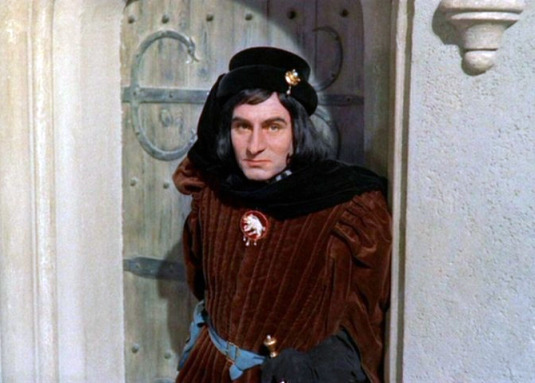
Of course, no post about medieval England is complete without a picture of Laurence Olivier who’s very much identified with such films of this time and place. This is him playing Richard III in his adaptation of the eponymous and highly historically inaccurate play by William Shakespeare. Sure he may look evil but he doesn’t seem to a good job being grotesque since he still looks pretty hot. Nevertheless, he may actually look closer to the real Richard III than in other portrayals though he was much older than the late king could’ve been.

If you ever see a movie set in the Middle Ages, chances are it will take place in England mostly because it will focus on Robin Hood, King Arthur, or something by William Shakespeare. Then sometimes there are movies based in the Middle Ages produced in Great Britain and most of the time, they’d like to do their own history. Yet, since Hollywood is situated in a place where there was no medieval history, then England usually has to do. Of course, there’s a lot history covered in medieval England, especially when it pertains to the royal family. There’s Henry II with his mom Empress Matilda who tried to take the throne from her cousin. Then he has a wife named Eleanor of Acquitaine who’s very much a formidable woman like himself who incited a rebellion among her sons and ended up in prison (only to be released when she outlived him but she also outlived most of her kids, too). Then you have Henry II’s sons Richard and John who were as different as night and day as well as at each other’s throats. Oh, what great family soap opera that would be. Then you got Henry II’s relationship with Thomas Becket which would later lead to his murder in Canterbury Cathedral and Philip Augustus who’s bitter about Henry stealing lands under his dad (and Eleanor’s ex-husband). After that is the post-Magna Carta era usually consisting of kings Henry III, Richard II, and the first three Edwards (many movies errors from this category will also be from Braveheart). After that, is the Wars of the Roses when England becomes engaged in civil war between the Houses of Lancaster and York after Richard II is deposed. You get kings like Henry IV, Henry V (“We happy few, we band of brothers.”), Henry VI, and Richard III (who wasn’t as evil as Shakespeare depicted him, “Now is the winter of our discontent.”). Nevertheless, historical errors will still abound in these movies, which I shall list here.

English was spoken in the same way as it is today despite the fact that you had to get version of Canterbury Tales with a translation for you didn’t understand what the hell Chaucer was saying in its original form.

English commoners were still resisting their Norman overlords at least a century or two after the Norman Conquest. (This was started by Henry V during the Hundred Years’ War as Anti-French propaganda and it was also picked up during the Reformation. Also, William the Conqueror and his fellow Normans didn’t really invade England since he had been promised the throne by the previous King Edward the Confessor who was his cousin but was passed on in favor of the late king’s brother-in-law.)

English nobles and royalty spoke English. (Between 1066 to 1453, English was considered a language for peasants. Most English nobles during that time spoke French.)

Lady Godiva rode naked through Coventry in order to get her husband Leofric to lower taxes. (Godiva was a real noblewoman but she never did this.)

Sons and daughters could inherit at the same time. (Daughters were forbidden to inherit anything unless they didn’t have legitimate brothers living.)

English marriage ceremonies were set to the Book of Common Prayer. (It would’ve been conducted in Latin.)

English kings were addressed as “Your Majesty.” (That title wouldn’t be used until the 1390s. So this is part right.)

There was an actual King Arthur of England. (Well, if you count Geoffrey of Brittany’s son Arthur as Richard’s successor maybe {who King John later had killed}, but that’s as close to an actual English King Arthur as you’re going to get. As for the Arthur of Camelot, very much a mythological figure.)

The English had no reason to start the Hundred Years’ War. (Read your history books. Many of the early English kings since 1066 were French of some sort of another. Also, The Lion in Winter would’ve been more historically accurate if you have the English royal family speaking in French. Heck, you could’ve easily called Henry II as the real king of France during his kingship because he ruled almost all of it. Not to mention, it even takes place in France.)

English civilians could freely hunt in the forests. (Hunting game in the English forests later in the Middle Ages might carry a harsh punishment.)

Henry II and Co:

Richard the Lionheart was a good king and John was a bad king. (Actually Richard was anything but a good king at least in peacetime, hated England, and saw it was only good for financing his coffers so he can go on Crusade and fight the French. John, by contrast, probably wasn’t the best king England ever had and wasn’t a nice guy but at least his interests were in running England even though he managed to piss off everyone that he ended up putting his seal on the Magna Carta. He also did good things as write many books on law and was considered a legal expert before his kingship. Oh, and he treated the Jews better than his brother. But since Richard the Lionheart was often away, the nobles had free rein, which put up resistance when King John tried to take control. Not to mention, Richard the Lionheart had a better personality and he wasn’t stupid either. Nevertheless, their dad Henry II was a far better king than either of them put together who’s remembered as England’s greatest Medieval King {as well as his portrayal by Peter O’Toole.})

Thomas Becket and Henry II had a platonic homosexual relationship prior to Becket’s appointment as Archbishop of Canterbury. (There’s no historical data that they were more than just friends. Besides, Henry II married Eleanor of Aquitaine out of love {and her lands that consisted of half of France} as well as had a succession of mistresses {though Eleanor was probably the love of his life}. Also, Becket was said to be celibate.)

Henry II slept with Richard the Lionheart’s fiancee. (There’s no definitive evidence of this though Richard later resisted marrying his fiancee on the basis of the claim.)

Thomas Becket was a Saxon and Henry II was Norman. (Becket was a Norman and Henry II was Angevin on his father’s side. However, his mother was Norman.)

As Archbishop of Canterbury, Thomas Becket didn’t desire special legal privileges for the clergy. (Many people said he did, especially if clergy members committed secular crimes, which was one of the things he and Henry II disagreed on. And Henry II was quite justified and has been known for replacing trials by combat with jury trials.)

Empress Matilda was an annoyance to Henry II. (Actually she was instrumental for shaping her son, Henry II into the fierce warrior and skilled administrator he was and was the sole parent for much of his childhood. Also, Henry II adored his mother and relied heavily on her guidance and advice until her death in 1167. Not to mention, she was the reason why Henry II was able to get the throne and is best known for her war against King Stephen after she was passed over when her father Henry I died.)

Eleanor of Aquitaine’s father was alive when she was married to Henry II. (Her dad died when she was 15 years old, which made her Duchess of Aquitaine as well as the most eligible bride of the 12th century.)

Henry II and Eleanor of Aquitaine had four children all boys. (They had eight children that included five sons and three daughters. Also, Eleanor had two daughters while married to King Louis VII and Henry II had at least eight illegitimate children to several long term mistresses.)

Richard the Lionheart died immediately from a crossbow wound from a cook. (He lived for more than a week and died from gangrene. Also, the guy responsible for shooting him was a boy with a crossbow and a frying pan whom he ordered to be set free, forgiven, and rewarded 100 shillings for a lucky shot. However, the pardon was retracted when he died by a mercenary captain and the boy was flayed alive. Jesus Christ!)

Richard the Lionheart was very fond of England. (He had no attachment to the place and only spent six months of his reign there. Most of his ten year reign was spent in either on Crusade or in France fighting Philip Augustus. Also, he forgave John for running England for him.)

Richard the Lionheart was a wise old king. (He was only 41 when he died.)

King John signed the Magna Carta early in his reign. (It was actually near the end.)

Isabella of Angoulmene was a young woman when she married King John. (She was twelve. Don’t worry; it’s very likely that he waited until she was sixteen to have sex with her which was normal in such marriages.)

King John had a title called Defender of the Holy Sepulcher.  (He was offered the title but his dad turned it down for him and sent the boy to Ireland.Also, it was the title of Godfrey de Boullion, a Christian ruler of Jerusalem who had nothing to do with England at all.)

Henry II referred to himself as Plantagenet. (The name didn’t come to use until close to the end of the dynasty and was first used by the father of Edward IV and Richard III.)

King John had brown hair. (He was a flaming redhead like his dad and brothers.)

King Henry was ten years older than the pope in 1183. (The actual pope at the time was 36 years older than him.)

Richard the Lionheart married Berengaria of Navarre for love. (He more likely married her for money and lands. It was more of a political marriage. Though they went on Crusade together and she tried to raise money for his ransom, we’re not sure whether the marriage was ever consummated. Also, Richard spent so much time away from her that the Pope had to tell him spend time with her, which he did by taking her to church. Not to mention, she was very much overlooked as Queen of England and Cyprus during Richard’s reign.)

Richard the Lionheart had an affair with Philip Augustus. (There’s little evidence supporting this though Richard might’ve went both ways. Also, he had at least one illegitimate son as well as had a reputation as a womanizer while Philip had two. Either way, he was certainly not faithful to his wife. Historians are divided over his sexuality and the gay allegations began in the 1960s. As for Philip Augustus, well, he was much closer to Geoffrey than Richard {he was bawling in Geoffrey’s funeral after he got trampled by a horse}. Not to mention, he was absolutely furious with Richard when he broke his engagement with his sister.)

King John was middle aged during Richard the Lionheart’s reign. (These two kings have been played by middle aged men in the Robin Hood films but both died in their forties {Richard died at 41 while John died at 49} and John ascended the throne at 33. At least The Lion in Winter gets their ages mostly right.)

King John and the Knights Templar were bitter rivals. (They were buddies. He exempted the Templars from all taxation and gave them extraordinary protection of property. In return, the Templars let John use their New Temple in London headquarters as a treasury.)

King Henry II married Eleanor of Aquitaine when she was young. (She was 30 at the time.)

Post-Magna Carta:

King Edward I was a brutal conquer who oppressed his subjects and was a pagan. (King Edward I was a Christian {who had been on a Crusade} and didn’t oppress his English subjects nor did he kill his son’s lover by throwing him out the window {he was said to be a great husband and father as well as a charitable man}. Edward I also set up Parliament as a permanent institution, set up a working tax system, and ushered in a more progressive system seemed radical in most European circles. Even today he’s seen as one of England’s best kings and even well thought of by Dante. Still, he was a brutal conqueror {which is why the Scots and Welsh don’t like him}, ruthless with his enemies{killed his noble prisoners at the Battle of Evesham which was taboo at the time}, and hated the Jews.)

Edward II was sickly looking and gay. (He probably went both ways {had at least one illegitimate child as well as four kids with Isabella} but he was said to be rather athletic and handsome {not a walking stereotype}. Also, during the time of William Wallace {at least at his death}, he was most likely a teenager.)

Edward I planned to cause the racial death of Scotland. (He didn’t. He just wanted to control Scotland. Also, his getting control of Scotland was partly the Scottish people’s fault since they agreed to relinquish their independence until a new king could be appointed after their designated child queen died on the way there from Norway. Yet, the divisive Scottish noble families made it difficult to select a satisfactory candidate as every option seemed to lead to civil war. And when an appropriate candidate was selected by the name of John Balliol who proved to be a weak king {as well as wouldn’t cooperate with Edward I}. He was later captured during a war with the English in 1296 as well as forced to abdicate. The Scots just didn’t bet on Edward Longshanks backstabbing them since he probably felt sick over the business end and thought the only competent candidate Scotland had available was himself though he never claimed the crown.)

Edward I was the first king to name his son Prince of Wales. (First record of this comes from the 16th century.)

Isabella of France was the first Princess of Wales. (She married Edward II when he was already king and she never met her father-in-law.)

Edward I treacherously hanged Scottish noblemen. (Never happened.)

Edward I wanted to sleep with Princess Isabella. (This would never have happened. Also, he opposed the marriage between her and the future Edward II, explaining why they tied the knot after he was dead {granted the marriage was a disaster}. Still, her conspiring to kill her husband did help bring Scottish independence.)

Edward II was unable to impregnate his wife. (Apparently he was at least able to impregnate somebody and she was able to have kids so you may figure it out {though she had a lover named John Mortimer}.)

Queen Isabella of England was ashamed of the English cruelty toward the Scots. (She had her husband King Edward II imprisoned and murdered for refusing to advocate in favor of their son and launched her own invasion of Scotland.)

Queen Isabella of England was a sweet and kindly princess. (She was called the She Wolf of France and plotted to kill her husband as well as considered invading Scotland as a nice mother and son activity.)

Edward I reinstated prima noctis in Scotland. (He never did this.)

Edmund Mortimer was Richard II’s true heir. (It’s very likely Henry IV was but he and and Richard had a massive falling out resulting in Richard being deposed and imprisoned.)

Edward the Black Prince was married to Lady Joan Holland who was kidnapped by the French. (Actually his wife’s name was Lady Joan Holland but she was also the Countess of Kent and a widow. However, she was never kidnapped by the French, and no, Edward never had to rescue her. Interestingly, he was known as Edward of Woodstock. However, he and Lady Joan did love each other for his parents opposed the match since she was once their ward.)

William Wallace killed the Duke of York. (It wasn’t a title for a younger son at the time of King Edward I.)

Edward II abdicated the throne. (He was more likely imprisoned and killed.)

Edward II was disemboweled with a red hot poker. (He more likely died from being smothered in his bed.)

The Wars of the Roses:

King Richard III was a terrible king who imprisoned and killed his nephews in the Tower of London, had his brother drowned in a vat of wine, poisoned his wife and bumped off her father and first husband, bumped off two cousins and planned to marry a third, had a crippled arm and a hunchback. And his last words were, “A horse! A horse! My kingdom for a horse!” (He actually wasn’t grotesque looking and didn’t do anything that I just mentioned {with the possible exception of imprisoning his nephews in the tower}, which was cooked up by the Tudors. The only physical deformity he had was real bad scoliosis which isn’t as recognizable. Though Prince George did drown in a vat of wine {allegedly, but it’s more likely he starved}, it was on King Edward IV’s insistence not Richard’s. And as how Richard III became king, he simply said that his nephews were illegitimate because Edward IV married his wife while engaged to another woman which was very much like being married {and since King Edward IV was such a horndog and everybody hated the Woodvilles, he could get away with it easily and Parliament would just give the crown to him}. The English were also no fans of child kings at this point as well and the prospect of having another one terrified the country. And he was already running the country anyway so he might as well take the throne while at it. Any king would’ve done the same thing. He also had George’s kids declared illegitimate as well. Also, he was said to be a rather reasonable and competent king with a reputation of bravery justified by his death in battle in which he went down fighting at thirty-two. He was probably not much cruel or ruthless than most kings of his day and was well thought of by his contemporaries. Rather, he was said to be loved by the lower orders and improved conditions in Northern England {especially York} though he didn’t make many friends among the nobility. Oh, and he liked to use an ax. Shakespeare may be one of the best writers who ever lived but he’s about as good of a historian as Mel Gibson.)

King Richard III was an unpopular king. (Not only did he have one of the best attended coronations in years, he had quite a following in York where the people mourned his death. Still, what did him in is that he was king during a civil war, reigned 2 years, and died with no surviving legitimate children).

King Henry V was a wild vagabond when he was heir to the English throne. (He was always the same, duty bound, serious man his whole life. Also, had a nasty scar on his face which explains why his portrait is usually in profile.)

King Henry V was a badass warrior king and a great hero. (He also captured enemy knights {but had some good excuse since it was Agincourt, he was heavily outnumbered, and could’ve opened the battle on two fronts resulting in a massacre of his own men}, burned proto-Protestant heretics alive {including the inspiration for Falstaff but this was done to unite Catholicism under one pope after a series of antipopes as was the case in Europe}, doomed both sides into fighting a pointless war {which was an age old war he could’ve won if he hadn’t died so early}, and had a nasty scar across his face. Still, like any medieval king, he was ruthless when he needed to be and didn’t tax his subjects to the highest bitter to pay for his conflicts. Actually he doesn’t come worse off than most kings of the time.)

Henry VII effectively ended the Wars of the Roses. (Yes, but there were still major revolts against him which he tyrannically suppressed. This made him very unpopular and many nobles were glad to see him go. Yet, he did marry Elizabeth of York which helped secure his throne as was a rather intelligent woman in her own right. Perhaps this is why Shakespeare didn’t write a play about Henry VII. Then again, any king would do the same and Henry VII was a rather competent king that England needed at the time and did whatever needed to be done. Still, despite the fact he has a small role in Richard III doesn’t mean that he was a boring guy.)

Richard III killed the Duke of Somerset. (The guy died when Richard was three.)

Hotspur was a childhood friend of King Henry V. (Actually he was three years older than his dad.)

Henry V was the kind of guy you’d want to have a beer with. (It’s said he had little charm, no sense of humor, and was truly terrifyingly convinced he was an instrument of God. Still, he really did care about his soldiers yet Shakespeare’s portrayal of him is a reasonable break from reality. It’s unlikely Princess Catherine of Valois would’ve found him entertaining. Interestingly her second husband was Owen Tudor, the keeper of the Queen’s wardrobe from Wales. Of course, we know what that family amounted to.)

The Duke of Buckingham rebelled to have Edward V on the throne. (He wanted to put himself on the throne but ultimately decided to join Henry Tudor instead. Besides, he’s suspected of having the Princes in the Tower killed to begin with and probably knew the kids were dead).

Duke George of Clarence was a doddering fool. (He was an opportunistic bastard who switched sides. There’s a reason why Edward IV had him killed).

Richard III tried to marry himself to Elizabeth of York after Lady Anne Neville died. (While marrying your niece wasn’t unusual in some royal families at the time {as in the Hapsburgs}, Richard was actually trying to arrange marriages for both himself and his niece with the Portuguese royal family. Also, he was suffering a succession crisis since Lady Anne and his son had both died during his reign).

Richard III had Lady Anne Neville’s first husband and father killed. (Her father died in battle. As for the first husband, he was either slaughtered with his army or executed on Edward IV’s orders. They were Lanscastrians and Richard marrying Lady Anne wasn’t an advantageous match since she was known as a daughter and widow of traitors. Still, he wouldn’t be trying to woo her over her dad’s corpse.)

Duke George of Clarence was drowned in a vat of wine on Richard’s orders. (He was more likely smothered on Edward IV’s orders because of his backstabbing behavior, armed rebellion, lunacy, and murdering a servant girl. In fact, despite previous feuds, Richard argued against George’s execution and left court during the verdict but Edward was simply sick of him that he wanted him dead. So you can probably say that George was the bad brother from the trio, not Richard).

Edward IV was a frail old man when he died. (He was in his early 40s and his death was unexpected).

Richard III’s wife Anne Neville reviled him. (Contrary to Shakespeare, it’s said that their marriage was a love match and they were childhood sweethearts {and he obviously didn’t kill her her dad or first husband who were most likely not executed at all}. Besides, though he had 2 illegitimate kids, he waited to marry her. Not only that, but he was said to be a man of unimpeachable moral character who shared none of Edward IV’s vices. They also had a 10 year old son by the time he was crowned. However, Richard’s sister-in-law Elizabeth Woodville despised him. Oh, and contrary to Olivier’s portrayal, he was only 5’8.”)

Richard III drove his oldest brother Edward IV to an early grave. (He was out of town when Edward IV died).

Richard III died on the field. (He had his head sliced off from the back while surrounded by soldiers in a swamp. Still, he killed a lot of Henry Tudor’s best men and almost killed the guy himself.)

Henry V spent a lot of his early life in a tavern with his drinking buddies. (It’s not very likely.)

Hotspur was killed by a single combat with Henry V at the Battle of Shrewsbury. (He was killed by a single arrow. Still, Hotspur was a traitor since he was on the side of Owen Glydwr of Wales.)

Henry IV killed Richard II. (Richard II died in prison and more likely starved, yet he may have been murdered by his cousin.)

The Earl of Richmond was the battlefield commander at Bosworth Field. (He confined himself to politicking and left the fighting to the Earl of Oxford.)

History of the World According to the Movies: Part 8- Medieval Scotland

Image

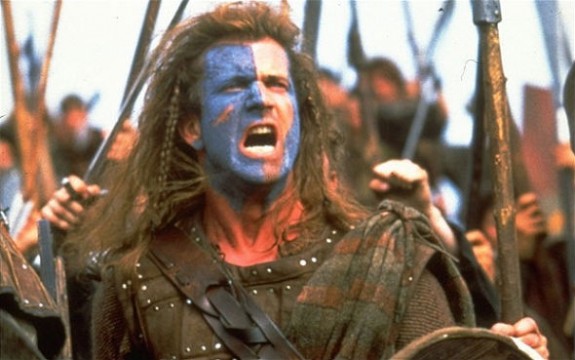
Braveheart: How Mel Gibson killed history for the sake of entertainment. Sure it has inspirational tidbits like “You can take our lands but you’ll never take our FREEEEEDDDDDOOOOMMMMMM!” Yet, it’s notoriously one of the most historically inaccurate movies ever made, which is sad considering that there aren’t a lot of movies about medieval Scotland. Yet, use any image of Mel Gibson in a kilt and blue paint, and medieval historians will scream in absolute horror. A historic travesty of 1995.

While most medieval movies usually take place in either England or France, movies on medieval Scotland deserve special mention since the most historically accurate movie on anything related to Scotland in the Middle Ages is a Disney Pixar film. Yes, you hear me. Scotland during the Middle Ages may not get much attention in movies, but when it does, they usually tend to be very historically inaccurate. Of course, most historians don’t mind when it comes to filming Macbeth because it’s a notable Shakespearean play with great literary value (though it makes Richard III look historically accurate in comparison). Besides, most people don’t know that Macbeth was a real guy. However, Macbeth was a real Scottish king who did come to power through killing his predecessor Duncan as well as ended up dead when Duncan’s son Malcolm challenged his rule. However, the historical Macbeth was never the guy depicted by Shakespeare nor were some of the characters either. Also, who knows what Lady Macbeth was like for there’s little information about her. Still, though a more historically accurate Macbeth would merit a very different story, most people don’t watch the play on its lack of historic merits anyway. Besides, Shakespeare probably had some excuse to depict such events as inaccurately as he did like James I, for instance. And then you got Braveheart which managed to win Oscars despite being one of the most historically inaccurate movies of all time that most of the errors I will list come from this very movie. And no other movie has ever made medieval historians cry in sheer anger and disgust over what Hollywood would ever consider such historical disasterpiece as something worthy of critical acclaim, let alone film awards. Many historians would think that Monty Python and the Holy Grail has more historical merits than this. And when you’re historical epic has more inaccuracies than a movie with killer rabbits, you have a problem. Sure, Gibson probably wasn’t aiming for historical accuracy and used the screenplay from a guy who claimed descent from William Wallace. However, now that this historical piece of shit may now be on its way on becoming a classic, most people unfamiliar with William Wallace and the Scottish Wars of Independence may now actually take Gibson’s vision of Scottish history seriously. Yes, unfortunately, people tend to believe things presented in historical movies regardless of the weight of inaccuracy. At least the guys making Spartacus had some concern for accuracy which is why the 1960 film is actually more historically reliable than the Howard Fast novel it’s based on. But you don’t see the concern for authenticity in Braveheart. And this it will be forever by trashed by medieval and Scottish historians as well as anyone who actually cares about history in general. I mean, I don’t expect historical movies to be 100% accurate, but not with an inaccuracy level like Braveheart. Nevertheless, here’s what Hollywood gets wrong about Scottish history.

Scottish men like William Wallace wore kilts during the Middle Ages. They also painted their faces and all armies wore uniforms in battle. (William Wallace’s men actually wore saffron shirts, not kilts for they didn’t come around until much later and so did army uniforms. Not to mention, they haven’t painted their faces since the Dark Ages.)

Prior to the 13th century, Scotland had always been subject to English rule. (Actually it had enjoyed a century of peace before Edward I tried to take it for himself when Scotland was in a messy political crisis regarding succession. The English were backstabbing encroachers, not overlords.)

Banquo and Fleance are the ancestors of the Stuart monarchs. (Shakespeare made up these guys to satisfy James I who was descended from Duncan.)

Bagpipes were outlawed in 13th century Scotland. (They weren’t and were very popular in England.)

There was no Stirling Bridge in the Battle that bears its name. (There too was a bridge, but Gibson wanted to save money. Also, Andrew Moray, the man instrumental in that battle is absent from the film.)

There were Irish conscripts at the Battle of Falkirk. (There’s no record of this.)

Most noblemen in Scotland were Gaels. (They were culturally similar to English nobles and would’ve dressed more like their English counterparts. Also, many of them were related to English royalty, spoke a Scottish dialect of English and/or Anglo-Norman French.)

The sons of Scottish knights dressed in rags. (Even poor Scots would know how to sew or at least was related to someone who did. Even poor people couldn’t afford to have their clothes disintegrate for being unhemmed.)

13th Century Scottish men had long hair they braided as well as tied bits of fur and feathers even though it was messy most of the time. (There’s no reason to think this.)

Pikes were used against the English at the Battle of Stirling Bridge. (They were at Falkirk though.)

Macbeth:

Macbeth was only King of Scotland for two years after he killed Duncan in his bed just to get his throne. (For one, Macbeth ruled Scotland for 17 years {which proves he wasn’t a weak ruler} and even spent a several month trip to receive a blessing from the Pope. He was also known as a good king known for his charity, not a bad king who slaughtered his friends {he was actually good to his friends}. As to Duncan’s death, Macbeth killed Duncan in battle because Duncan was encroaching on his territory so the motive was self-defense after a failed invasion in England. And it was Duncan who was the young, violent tyrant but Shakespeare couldn’t say that because King James I was descended by him. As for Lady Macbeth, she is almost a complete fabrication in which nothing is known about her than her name {Gruoch}, the fact she was married before, and that she had at least a son from that marriage. And that son would later succeed Macbeth before Duncan’s son Malcolm gained power and killed him mostly because he didn’t think the guy was a legitimate king.)

King Duncan was a wise old king. (Duncan was younger than Macbeth and was a worthless wastrel who the latter killed in a fair fight in battle on his land. So in reality, Duncan got what he deserved.)

King Malcolm III:

Everyone in Scotland seemed to accept Malcolm’s kingship. (He was able to seize the throne of Scotland because England was able to support him. Scotland actually resisted his rule because their standards differed considerably from England on what consists of royal legitimacy. Also, Macbeth’s stepson and friends also campaigned against Malcolm.)

King Alexander III:

King Alexander III died in 1280 without a son. (He died without a son in 1286 after falling off his horse {since the Scottish throne went to his young granddaughter Margaret of Norway [so the country was ruled by regents] until she died in 1290 on the way there} but he and his two sons were still alive by 1280. It was only after Margaret’s death in 1290 when his brother-in-law King Edward I got involved because the Scottish noblemen couldn’t trust each other and Scotland was in a political crisis as well as headed for civil war.)

William Wallace:

Scottish men like William Wallace wore kilts during the Middle Ages. They also painted their faces and all armies wore uniforms in battle. (William Wallace’s men actually wore saffron shirts, not kilts for they didn’t come around until much later and so did army uniforms. Not to mention, they haven’t painted their faces since the Dark Ages.)

William Wallace grew up as a poor man who became a great liberator and had an affair with English  Queen Isabella, which resulted in Edward III. He ended up captured by the English because of Robert Bruce’s betrayal and was hanged drawn and quartered. (Actually, William Wallace was a well-educated minor aristocrat whose dad actually fought for the English and owned land {though we don’t know who he was} and might have been a scholar or been on his way for a career in the Church. He may have used a longbow as a weapon of choice {unlike the sword he’s usually depicted with in Braveheart}. He briefly served as a Guardian of the Kingdom of Scotland {it’s kind of like being a Steward of Gondor except that they didn’t rule by themselves} until his military reputation tanked at the Battle of Falkirk. He engaged in diplomatic correspondence with Lubeck and Hamburg as well as went on a diplomatic mission to France and Rome before returning to his home after the Scottish surrender in 1302. Not to mention, he was said to be Welsh since his name either means “Welsh” or “foreigner” so the notion of growing up a Scottish highlander is out of the question. Also, he certainly didn’t have an affair with Queen Isabella of England for she was ten and wasn’t even living in England yet {and younger than that during the Battle of Falkirk}, didn’t father Edward III who was born seven years after he died, Edward II was only thirteen, and he wasn’t directly betrayed by Robert Bruce either. And as for his method of execution, Wallace was hanged, cut open, castrated, chopped to pieces, and finally beheaded. And before that, he was stripped naked and dragged by a horse carriage by a rope around his ankles and afterwards dipped in tar and put on public display.)

William Wallace had easy access to large quantities of gasoline. At the battle of Falkirk, he apparently has a tanker truck parked behind the lines, so that he can wet down a broad stretch of the front-line as a death trap for the enemy. It was then set alight by flaming arrows, to set the enemy stuntmen on fire so that they can run around screaming while the flammable stunt clothing blazes merrily over their Nomex jumpsuits. William Wallace can also generally get his hands on fire starter whenever he wants to burn English soldiers to death in a cottage. [From A Common Place Book](You should know this isn’t true at all.)

William Wallace was called Braveheart. (Actually that was a nickname of his contemporary, Robert Bruce who would become Scotland’s eventual king and he only acquired the nickname after his death when his heart was carried by a general around his neck into battle. It was Robert Bruce’s heart that led the Scots into battle not Wallace’s.)

William Wallace was the architect of Scottish independence and was an all-around nice guy. Robert Bruce is overrated. (Wallace also raped women and burnt down schools with kids and monks still inside. Not only that, but he used conscription and was willing to hang those refusing to serve. As with Robert Bruce, he’s still one of Scotland’s national heroes and was far more successful than Wallace ever could be {though he still could be brutal to his enemies and manipulative if need be as well as got excommunicated for murdering his rival in a church}. Not to mention, Bruce never personally betrayed Wallace, ever because they never met in the first place. Also, Wallace didn’t initially support Bruce’s claim to the throne and backed the exiled Scottish King John Balliol who was held prisoner in the Tower of London {and later sent to France} who Bruce and his family considered an usurper. Not to mention, Bruce was originally playing on both sides for a while {for personal reasons} until the Battle of Stirling Bridge and didn’t establish full claim to the Scottish throne until after his Carlisle governor father died in 1304.)

Malcolm Wallace had two sons named John and William in 1280 in a town of Paisley. (He had three including his eldest also named Malcolm and he wasn’t a commoner either, assuming that Sir Malcolm of Elderslie was William’s father. Then again William Wallace’s dad could be named Alan of Ayershire {yet no contemporary evidence links him to either location}. Still, William Wallace only appears on the historic record from 1297 when he killed an English sheriff in Lanark {said in order to avenge his wife’s murder} to his death in 1305. So how many kids William’s father had was anyone’s guess.)

William Wallace’s father and brother John were executed by the English when William was a boy. (William lost his father as an adult while his brother John was executed a year after him.)

William Wallace returned to Scotland in 1296 after spending his adolescence abroad. (He never stepped foot out of Scotland until his 1297 invasion of Northern England.)

William Wallace carried out large-scale raids in the north of England and killed Edward I’s nephew in York. (While he did stage long scale raids in Northern England, he didn’t make it as south as York.)

William Wallace’s wife Murron died shortly after their wedding. After this, he killed the English Sheriff by slitting his throat. (It’s said they had two sons, if he had a wife which is very likely. Yet, legend says her name was Marion Braidfrute, though there is no solid evidence if he was married. As for the Sheriff, Wallace cut him to pieces with a sword while his men proceeded to burn two houses with English guards inside of them.)

William Wallace’s best friends were Hamish and his dad Campbell as well as Stephen of Ireland. (The first two are fictional characters while the latter’s existence is questioned. Also, Andrew Moray may be a better candidate though he’s absent in Braveheart though they did join forces before the Battle of Stirling Bridge.)

William Wallace was executed around the same time Edward I died. (Edward I would live for a couple more years and would die on campaign {not in bed as depicted in Braveheart}.)

The Irish fought with William Wallace. (Most Irish fought against him and certainly didn’t switch sides at Falkirk {though the Welsh archers threatened to but only out of fear}.)

Scottish nobles deserted William Wallace. (There’s no report of this happening, well, maybe with John Comyn and his supporters who did abandon him there but there’s no solid evidence. Oh, and he was opposed to fighting at Falkirk because it didn’t offer the advantages at Stirling Bridge.)

William Wallace was captured by the English at Edinburgh after being betrayed by Noble Craig and Robert Bruce’s old man. (The old man Robert Bruce was dead by Wallace’s capture while Craig never existed. Also, he was captured near Glasgow after being betrayed by Scotsman John Menteith.)

William Wallace had no intention to fight the English to free his country until his wife was killed by them. (He was already an outlaw against the English since he refused to sign the Ragman Roll from the very beginning. The English killing his wife would’ve angered him even more. Oh, and William Wallace would’ve never whipped out a concealed nunchaku, which is from China for God’s sake!)

William Wallace was clean shaven. (He had a beard and was at least 6 feet tall. But he’s played by Mel Gibson so I’ll let this slide.)

William Wallace was knighted after Stirling Bridge. (He was knighted a few years later.)

Robert Bruce:

Robert Bruce disowned his leprosy afflicted but dominating father. (There is no evidence Bruce’s old man had ever contracted it though it’s thought that Bruce himself might’ve suffered from it. Also, there’s no evidence whether Bruce disowned his father or whether he was dominated by his dad. Still, he was quite capable of making his own decisions and choices.)

The Scots won their independence when Robert Bruce changed his mind about a peace parley. (It was at the battle of Bannockburn after an English army arrived to lift the siege at Stirling Castle, nine years after Wallace’s death while engaging in guerrilla warfare for years, though Bruce would be crowned king a year after Wallace’s execution {though he was dead by the time actual independence would be won}. Also, Scottish independence didn’t last and Edward III managed to conquer more of Scotland than his grandfather ever had.)

Robert Bruce was the 17th person with the name in his family. (He was the 7th with the name and the 7th Lord of Annandale.)

Robert Bruce was present with King Edward I at Falkirk. (It’s likely he wasn’t there or at least did nothing significant. He was more likely at home in Carrick.)

History of the World According to the Movies: Part 7 – The Medieval Church

Image

From Kingdom of Heaven, which is probably a movie about the Crusades we’re all familiar with as well as one that says that these wars of religion weren’t as holy as many say they were. However, this picture does encapsulate the idea of the religiosity of the time period. Still, though Orlando Bloom’s character actually did exist, he wasn’t the widowed French blacksmith as depicted in the beginning at all. However, he did end up with a Queen consort of Jerusalem, just not Queen Sybilla.

While fighting is one of the many aspects of the medieval landscape, the Middle Ages would never be what it s without the Church. Sure it was a dominant force in medieval life and a very misunderstood one as Hollywood is concerned. Still, though Christianity began in ancient times, it really came into its own in the Middle Ages as an institution (as long as the Catholic Church is concerned but there were Orthodox churches in the east as well). Medieval monasteries and convents were places of great cottage industries and learning with monks being among the intellectuals of their day and churches became not only centers of devotion but also places for community. Not only that, but we also see the rise of the Gothic cathedrals which are still used for worship today (even if it’s on the decline in Europe these days). And without the Church, we wouldn’t have universities, the institution of medicine, theology, and all those ancient writings that would’ve been lost if monks didn’t spend all day copying them. Of course, because of the medieval Church, we also have antisemitism, heresy, and the Crusades which is a series of religious wars in the Middle East geared to capturing the Holy Land from the Muslims. Still, Hollywood always tends to screw up a few things about the medieval Church which I shall list here.

Medieval Christianity:

The Catholic Church was a backward institution that discouraged education and scientific research. (The Catholic Church actually saved science and is the main reason why we know anything about the Middle Ages at all even though they did lock their books but there weren’t many books in Europe anyway and were very expensive since they were all written by hand or printed from wood carvings which were tedious to make {but many monasteries and nunneries had large libraries of them full of the works of Rome and Greeks and monks spent a lot of time copying them}. Furthermore, they even set up universities all over Continental Europe, started formalized higher education with advanced degrees, and saw no problem with dissection {the Knights Hospitaller did this and the Church was fine with it}, at least in the basement anyway, which helped set the foundation of modern medicine. They started the first medical and law schools as well. They even educated children in monastic and convent schools when education became a higher demand and that was before the printing press. Not to mention, the Crusades also allowed Europeans to come into contact with Muslim ideas and Arabic numerals. And their massive cathedrals were marvels of medieval craftsmanship and engineering. Furthermore, monks were usually the most educated people in Europe of their day. Actually it would be more accurate to say that the Catholic Church was a great medieval engine of scientific progress. Not to mention, most medieval scientists were monks and/or priests as well. Still, doesn’t stop filmmakers from making movies set in the Middle Ages in which the Catholic Church is hostile to scientific inquiry which really wasn’t the case {especially with the Galileo Affair which isn’t as much a science vs. religion case as most people think}.)

Monks locked their Bibles to keep people from hearing the true word. (No way in hell. Monks locked their Bibles so churches could guarantee that people could hear the Bible on a daily basis as well as prevent it from getting stolen. A stolen Bible would’ve taken many months to replace since books at the time were copied by hand.)

Europeans were highly religious during the Middle Ages. (Despite the Crusades and the powerful presence of the Catholic Church, most people in the Middle Ages were probably just as religious as I am, observant yes, but with a more laid back approach like many Catholics today. Sure religion was important but it wasn’t the only thing in life and it wasn’t altogether incompatible to the modern notions of the day either. In other words, medieval Europeans may have went to church on Sundays but they weren’t religious fanatics, at least in general. Of course, religiosity would increase later in the Middle Ages as well as in the early Renaissance in Northern Europe since they were people who cared enough about religion to break off from the Catholic Church.)

The Catholic Church discouraged scientific research and progress. (Actually, quite the contrary. For one, most medieval scientists in Europe had a religious vocation. Second, while the Middle Ages wasn’t the best time for science {which wasn’t a big subject at the time}, it was nevertheless studied for practical reasons. The Church understood that scientific study can benefit them and help monks and nuns do their jobs better. Needing to care of the sick led to the study of medicine. The fact monks and nuns needed to schedule prayer times as well as find out when Easter is led to the study of rudimentary mathematics and the motions of the Sun and the Moon. Third, contrary to popular belief, the High Middle Ages was a really good time for science with the rise of Scholasticism and Aristotlelianism.)

Medieval cathedrals were often dark places. (Actually, they were places with large glass windows that let tons of light in. Churches were painted in bright colors. Still, today tourists tend to complain every time these places are washed because it’s too bright. Not to mention, it was inspired by Indian and Arab/Muslim building styles also from the Crusades.)

All nuns were virgins admitted into a convent as lovely, nubile waifs. (They could also be an ugly daughter of a lord or women who didn’t want to get married or have kids.)

Monks were benevolent men who devoted their lives to God. (Well, not quite for many monasteries enjoyed great wealth in the Middle Ages and many monks didn’t live too badly either {especially in the later Middle Ages}. In many ways, they were not just clergymen, but also businessmen, scribes, scientists, intellectuals, as well as some of the smartest guys around {same goes for nuns, too, for the most part}. Oh, and many monasteries had their own armies.)

Monks could hear confessions. (If they have taken holy orders since a lot of monks are priests. If not, then no.)

Monks were dissolute hypocrites who used religion to make money. (This isn’t 100% accurate either for though monks weren’t perfect human beings and the Church did have some degree of corruption, they were just as flawed like everyone else. We just tend to put them on a higher pedestal since they tend to be religious figures. Besides, every religion has their share of hypocrites and jerks as any institution and I’m sure medieval Christianity was no exception. Sure you may have a few bad and corrupt monks, but you also had a lot of cool ones as well. However, it was true enough for Henry VIII to convince the masses on why he had to dissolve the monasteries {which was to finance a war in France}, even though the actual debauchery and corruption of monks wasn’t nearly as bad as Henry made it out to be.)

Medieval Russia had no religious insignia in the 13th century. (Russia had been Orthodox Christian for quite some time and would continue to be the dominant church in the country until the Russian Revolution {though it’s still around}. Russian churches would usually have crosses on top and their banners would contain an icon of Christ {ditto priests in the army}. Of course, Eisenstein knew that the Soviet government wouldn’t accept this while filming Alexander Nevsky. Also, Nevsky is a saint in the Russian Orthodox Church.)

Clergymen were forbidden to shed blood so they didn’t fight. (Sure but there were militant churchmen as well as military religious orders like the Knights Templar, the Teutonic Knights, and the Knights Hospitallers.)

“Dies Irae” was a Christian standard hymn in the 1100s. (It was written by a Thomas of Celano who lived around 1200-1260 so, no.)

Saint Francis of Assisi was known as “Jester of the Lord.” (It was his disciple Brother Juniper.)

Saint Francis of Assisi was originally referred to as Francis. (His real name was Giovanni di Pietro Bernardone. Francis was a nickname derived from Francesco {“Frenchy”} which he obtained when he was a little kid. Actually, Francis wouldn’t be used as a legal name until after he became a saint.)

Pope Innocent III had a full beard. (He was clean shaven.)

Everyone in Europe was Catholic during the Middle Ages. (Everyone west of Poland, that is. In Russia, the main church was Russian Orthodox Christianity while the Greeks in the Eastern Roman Empire were Greek Orthodox. Not to mention, before the Mongols you also had quite a few Christian sects in the Middle East and Central Asia like the Coptics, Armenian Apostolics, the Nestorians, the Maronites, Ethiopian Orthodox Rite, and others. When you really get down to it, medieval Christianity was quite diverse.)

The Catholic Church pretty much ran everything. (Yes, it was a powerful institution, but it also got into clashes with secular rulers who wanted to make their own decisions in religious affairs. Not to mention, secular monarchs can and did appoint bishops {Henry II appointed Thomas Becket as Archbishop of Canterbury}. Sure medieval society didn’t exactly have a lot of separation between church and state. And yes, the Catholic Church did mettle in politics as well, but it wasn’t always without a secular ruler’s consent either. They also crowned kings as well as married and annulled their unions {back when marriages were a form of diplomacy}. So while there wasn’t a lot of separation between church and state but it wasn’t exactly a theocracy either. Also, there was less church and state separation in the Russian government and the Russian Orthodox Church, than in any European Catholic country.)

There was an actual Pope Joan. (She never existed.)

The Catholic Church participated in witch hunts and witch burnings. (Maybe in the 1400s but they mostly considered belief in witches as highly heretical. Still, witch hunts did happen under secular governments though and only much later {and they only took witchcraft seriously in cases of murder and treason}. However, there were actually few witch trials during the Middle Ages and many were usually nothing but simple lynches.)

Inquisition guards wore nearly full plated armor in the 1300s. (Only a century later.)

Medieval monks could enter each other’s cells freely. (For a monk entering another’s cell without permission was normally forbidden as well as grounds for excommunication.)

Monks addressed each other as “Your Grace.” (This wouldn’t be appropriate address for a monk under any circumstances but rather for nobles and high members of the Catholic Church.)

Inquisitor Bernard Gui was killed in an Italian monastery in 1327. (Yes, he was a real person and was said to have sentenced 900 people as well as executing 42 of them during his 15 years in office. However, he died in the castle of Laroux in 1331. He also doesn’t die in Eco’s original novel In the Name of the Rose.)

Medieval clergy men and religious orders were highly superstitious. (Yes, but not as much as the laypeople in their domains. Of course, they probably did believe in demon possession and that writing with the left hand was a sin. For instance, most medieval clergymen believed in a round earth from its earliest days. So did most people at the time with an education. We should also account for the fact that most medieval scientists were monks and priests.)

Pagan philosophy was considered difficult to reconcile with Christianity as well as considered borderline heretical. (There is no way that William of Baskerville would need to worry about saving a book by Aristotle because Saint Thomas Aquinas had already embraced embraced several ideas put forward by the Greek philosopher as well as said it was perfectly all right for Christians to read works by non-Christian authors {and had been influenced by the Jewish philosopher Maimonides as well as Muslim philosophers Averroes and Avicenna}. This was in the 13th century. Not only that, but most of the European mythology we know about now was recorded by clergyman themselves, which were only referred just as stories.)

Some European monasteries had African monks. (This would be highly unlikely considering the circumstances.)

The Holy Grail was of great significance in Christianity at this time. (There’s no mention of it in any canonical Christian text and wasn’t spawned until the 12th century. Also, it’s more of a product of Arthurian legend than anything.)

Pagan practices were considered anti-Christian. (Except with the worship of other deities, many pagan practices weren’t considered anti-Christian, but were commonly carried out by Christians as well as became Christianized practices. Kind of like how some people celebrate the holidays with their own personal traditions just to make themselves feel comfortable with the faith. However, this doesn’t stop some people from believing that Christianity was based on earlier religions other than Judaism, of which there is no historic proof as well as nothing in what we know of the original pagan beliefs that we can draw a respective parallel with. In other words, to say that the story of Jesus was based on the myth  of Horus would be like saying it’s based on Harry Potter. Not to mention, those who believe that Christianity was based on pagan religions don’t tend to consider that a certain culture’s mythology doesn’t have a lot of consistency and that mythological stories sometimes tend to vary with location or change over time. And it doesn’t help that the prolific people who tend to believe this are high profile atheist intellectuals, who may be smart and experts in their respective field but that doesn’t mean they’re experts in religion, religious history, or even mythology.)

The Crusades:

There was no reason at all to recommend the Crusades. (Well, there kind of sort of was, at least in some of those people’s minds but I wouldn’t call it the best solution. Still, remember medieval society was a feudal and warlike culture so if these knights weren’t killing Muslims in the Holy Land, they were probably killing each other and then some {though the first Crusade’s primary enemy was the hostile Seljuk Turks who’ve just captured Jerusalem from the Fatimids who didn’t care as long as the Christians spent their money}. Not to mention, the Crusades were called to also help out the dwindling Byzantine Empire, the last remaining Christian stronghold of the Middle East at the time {though they were Greek Orthodox, not Catholic}. Also, Pope Urban II’s predecessor was kidnapped by Normans and were wreaking havoc all over Europe by the first Crusade. Besides, “bring the Cross to Jerusalem” was a much better slogan than “Save the Greek Empire” which nobody in Europe cared about.)

Crusaders taught desert dwelling Muslims how to irrigate their land. (Actually this was the other way around. They also taught them medicine, windmills, round towers, and others even though knights did participate in civil projects during the Crusades.)

Members of the Knights Templar could marry, own land, and be crowned king. (They were forbidden from marrying or owning land. Also, no Templar would ever be crowned king.)

Renaud Chatillon and Guy Lusignan were Templars. (No, they weren’t or never have been. Lusignan was actually king of Jerusalem at the time Chatillon launched his attack. Also, King Baldwin had been dead for several years.)

Sybilla’s marriage to Guy Lusignan was an arranged one. (Her family opposed the match and it was her second marriage.)

Balian was a heroic everyman knight who embodied the best of the chivalric ethos. He was also a blacksmith and an illegitimate son of a knight. (He was raised noble and wasn’t a blacksmith so he probably wasn’t illegitimate. Not to mention, he was part of the most important families in the Kingdom of Jerusalem but of a moderate faction known as the Ibelins {and he wasn’t born illegitimate, but as a younger son}. And he wasn’t born in France but in Jerusalem as a second generation crusader nobleman and would’ve definitely know who his father was. Not to mention, his dad was Italian, not French. Also, though he is known for making the courageous decision to negotiate with Saladin, he also betrayed his oath not to fight him on more than one occasion, sold many peasants in the siege into slavery, and refused to release his Muslim prisoners if Saladin wouldn’t accept surrender. He also threatened the destruction of Muslim holy places under the threat of a repeat of the 1st Crusade capture of Jerusalem. He was ruthless but Saladin would forgive his oath breaking due to prior excellent relations and even helped mediate a peace between him and Richard the Lionheart. Still, Balian wasn’t all that bad for he did pay ransoms for thousands of poor out of his own pocket and offered himself as a hostage for all the rest. Still, he was prone to taking power whenever he could find it, sided with Chatillon, and his dynasty fathered most of the royal families of Europe.)

Guy Lusignan was a foppish, racist douchebag and ax crazy Reynald Chatillon was his dragon. (Chatillon wasn’t ax crazy but he was the worse of the two, much worse. Also, though Lusignan may have been racist, so were many of the European Christians who participated and him and Reynald hated each other {leading to the disaster at Hattin} even though he tried to get him to apologize to Saladin which didn’t work. As what TV Tropes and Idioms says about Chatillon, “Raynald once had a man tortured by smearing him in honey and putting him on top of a tower in the hot sun, simply because the man refused to fund a military expedition Raynald was plotting. Oh, and the best part — the man was the Latin Patriarch of Antioch, a religious leader of the Crusaders — and the expedition was against Cyprus, an island held by the Byzantine Empire, inhabited by Christians. Of course, Raynald had what he thought was a perfectly good reason for this—he felt they owed him money. Or pretended he felt they owed him money. It’s tough to be sure. So — a “bit of a mustache twirling supervillain” is something of an understatement.” Also, Chatillon led a pirate fleet that threatened to burn down Mecca and flayed the Patriarch of Antioch alive.)

The Catholic Patriarch of Jerusalem was a cowardly, self-absorbed jerk, blinded by his faith, and mostly spent his time spreading his prejudice against Muslims. (Actually it was he and Balian who negotiated the surrender of Jerusalem and rounded up the money to ransom the citizens who couldn’t afford to ransom themselves. They also offered themselves as ransom for those who they couldn’t afford to ransom which Saladin declined. He even stripped the silver and gold from the Church of the Holy Sepulchre to pay the city’s defenders knowing it would’ve gotten him in big trouble.)

Sybilla was a member of the moderate faction in the Kingdom of Jerusalem. (As TTI puts it, “The historical Sybilla was actually part of the extremist camp within the Haute Cour, while the film places her squarely on the moderate side. The moderates, such as the Ibelins, attempted to blunt the ambitions of Lusignan and his supporters by refusing to allow her to take the throne after the death of her son (Baldwin V) unless she first divorced him. As a concession they allowed her to marry any man of her choosing afterwards, but unfortunately neglected to add “Except Lusignan,” who she then turned around and picked as her consort. Not because she was in desperate need of his military support as the film depicts, but entirely because of her devotion to him, and because she sided with him and the other extremists politically.” So a romance between Balian and Sybilla most likely didn’t happen.)

Guy Lusignan was an utter bastard who would do anything for power and was willing to wage a war for profit. He was also a terrible King of Jerusalem. (As TTI explains, “Historically, while he may have been ambitious, he was no more so than the next noble, and his decision to go to war was less a matter of Ax Craziness and more a matter of “Saladin’s already attacking, we need to do something about it.” While he was a bad king, it was not because he was nuts and evil, but because he was incompetent: He could listen to reason, and he even did so when Tiberius cautioned him to stay near a source of water and let Saladin come to him, but he allowed himself to be swayed by the over-zealous elements among the nobles and made the decision to march across the desert, exhausting his army and causing its downfall. He was also much better to his wife than in the film: historically, he treated her well enough that when she was given the chance to keep the throne and choose any husband for herself and make him King, she went right back to Guy.”)

Teutonic knight crosses were the same on shield and coat of arms. (They were different in shape and color.)

Returning Crusaders had to face the Black Plague. (Maybe they had to face plague, but the Crusades were long over before the Plague began.)

Russians participated in the Crusades. (There were no Russians in the Crusades.)

King William of Sicily fought in the Crusades. (He sent ships but never went personally.)

Frederick Barbarossa and his son the Duke of Swabia participated in the Crusades at the same time as Richard the Lionheart. (They were both dead by Richard’s arrival. Barbossa died en route in Turkey and his son of dysentery some months before.)

The Count of Montferrat spent more considerable time plotting in the French and English courts. (He was fighting in Tyre. Also, he’s from Piedmont, not Venice.)

Queen Berengaria spent some time in Saladin’s harem. (Really? No way in hell. Besides, there’s no record of Queen Berengaria ever stepping foot anywhere further than Cyprus where she married Richard the Lionheart.)

The Crusades were mostly against the Muslims in an effort to reconquer the Holy Land. (Yes, but there were also Crusades against the Moors in Spain, the Baltic pagans, and even the Albigensian heretics {though that can be considered an Inquisition, too.})

Crusaders eagerly went to the Holy Land on behalf of their God. (They also did it out of self-interests as well such as glory, self-enrichment, and adventure.)

Both sides seemed to get along with each other during the Crusades. (Just because Muslims fought with Muslims and Christians fought with Christians doesn’t mean they liked each other.)

The Crusades consisted of Christians vs. Muslims. (It didn’t become a Christian vs. Muslim conflict until French King Louis VII took a detour in the Second Crusade where he sacked Damascus, betraying his Muslim allies out of greed. Prior to this, it wasn’t unusual for Christians to have Muslim allies or Muslims to have Christian Allies. Not to mention the “Crusaders” in the later stages were mostly just adventurers and mercenaries more interested in glory and loot than defending Christian kingdoms or recapturing holy places.)

Christian Europeans weren’t okay with Muslims controlling Jerusalem. (Actually quite the contrary since prior to the Crusades, it had been controlled by the Muslims for nearly 500 years. It’s just that until the Crusades, Jerusalem was controlled by the easygoing Fatimid Muslims who were perfectly fine with Christian visitors on pilgrimages as long as they paid. And as long as Muslims were fine with Christian visitors in Jerusalem, Christian Europe didn’t care whether the Holy Land was under Christian control or not. However, the Christians weren’t all right with the Seljuk Turks invading the city since they were more prickly and devout than their Fatimid predecessors and had been treating Christian pilgrims poorly {since they didn’t particularly care for religious minorities anyway}. Not to mention, the Seljuk Turks have been trying to take advantage of the weakening Byzantine Empire in a land grab. So the Crusades were initially less of a religious conflict with Christians against the general Muslim population and more of a conflict against more fanatical Muslims who had already proven themselves as Christendom’s enemies and showed it. However, such characteristics only apply to the general Fatimid and Seljuk populations since not all Seljuks were bad and not all Fatimids were good.)

The Crusades were no help to Muslims at all. (Having Christians kill Muslims in the name of God actually gave something that could unite the Muslim world after being locked in a period of infighting which resulted in stronger and larger Muslim states and the end of Shiism as a political force for the next 300 years {until the Safavids converted Iran}. Still, the worst thing the Crusades did for the Muslims was being a major distraction for 2 bloody centuries that neither side even paid attention to what was happening in the east during the 1200s where a little known guy Mongolian named Temujin was making a name for himself. He was also known as Genghis Khan. For the Christians though, they led to a weakening of the Byzantine Empire and a permanent division of Christianity along east and west, while the already shaky alliances of European monarchies crumbled. By 1250, the west was no longer a significant threat to the Muslim world since Europe had suffered a massive drain of manpower and resources. )

The Crusades teach the notion that “religion is bad because people kill each other over it.” (There’s a lot more to the Crusades than religion. Also, remember this is the Middle Ages so if Christians weren’t killing Muslims in the name of God, they’d probably be killing each other over something else. Not to mention, being Christian didn’t stop the Normans from sacking Rome in 1060, which gave Urban II a good reason to fear them. Besides, it’s said Pope Urban II called the First Crusade to keep Christian invaders out of his own town, which would put their aggressive impulses to more constructive use at the time. Also, the Byzantine Emperor had petitioned for help. In some way, knowing that you and your potential enemies have the same religion can help. Not to mention, the Crusades didn’t stop Christians from attacking each other in the Middle East either out of greed or when it pleased them, being the knights they were {since they also sacked Byzantine cities, too even when they weren’t allowed to}. In the Fourth Crusade, Western European Christians actually sacked Constantinople in 1204 that made the schism between Eastern and Western Christianity all but absolute. Not only that, but it massively pissed off Pope Innocent III that he excommunicated all who participated in it {well, he threatened to before to deter the Crusaders from attacking fellow Christians, but it didn’t work}.)

The Catholic Church had no qualms with Christian crusaders killing Muslims in the name of God. (Actually the Church was perfectly fine with Christians killing Muslims in the name of God as long as they were seen as enemies of Christendom {while killing fellow Christians and allies was a sin}. But despite what you might’ve heard, this didn’t mean that the Catholic Church allowed Christians to kill Muslims indiscriminately, since the Christians initially had Muslim allies like the Arab Fatimids. Thus, this only applied at least to the Seljuk Turks who weren’t nice to Christians to begin with, at least in the First Crusade {though it might apply to Fatimids, too, at least later}. But being the raping and pillaging knights they were, even the stipulations against killing allies didn’t stop them  from killing Arab and Byzantine Christians eventually. As for the Muslims, the Crusades didn’t stop them from attacking each other either, at least initially.)

The Knights Templar had a relationship with the Freemasons. (There are claims of this but it’s unlikely they existed at the same time.)

The Knights Templar existed in 1539. (They were dissolved in 1312 by King Philip IV of France and Pope Clement V mostly due to the Templars’ wealth.)

The Knights Templar were a fanatical and ruthless militant fighters. (Yes, but so were a lot of people in the Middle Ages and they were initially like this in the early days. However, they were also skilled, pious, and occasionally highly educated fighters, cavalry, and bankers. When they became wealthier, they became less involved with fighting.They were also notoriously tolerant organization that cultivated diplomatic contacts with the Muslim world, worked with Muslim architects {influencing Gothic architecture}, merchants, and even theologians as well as disapproved slaughtering enemies if they agreed to surrender. These guys also invented dual accounting, credit cards, holding companies, corporations {they might’ve been the world’s first}, insurance, travel agencies, and modern banking. Oh, and many of these points were used against them by French king Philip IV who just wanted their gold and there were persistent rumors {that still go on to this day} that the Templars were corrupt despite most evidence to the contrary. They’re actually not as bad as most Hollywood portrayals depict.)

The Templars knew that Jesus had a relationship with Mary Magdalene resulting in the Merovingian line. (This is utter Dan Brown nonsense.)

Christian crusaders only massacred Muslims during the Crusades. (They massacred every Muslim and Christian in Jerusalem in 1098. Oh, and they even sacked Byzantine cities.)

The Knights Templar used a Roman cross in the 12th century. (They used a Maltese Cross until a century later when they were forced to change to a Roman Cross.)

The Knights Templar wore a white surcoat and black cross in the 12th century. (This is the outfit of the Teutonic Knights: the arms of Saint Mary of the Germans which was founded in 1190.)

There were a lot of casualties among the defenders of Jerusalem during the siege in the Third Crusade. (There were relatively few until the final fight.)

Balian had just lost a wife and child during the Siege of Jerusalem. (He was married with two children who were with him at the time. During the siege, he was trying to get them out of the city.)

Balian and Sybilla had an affair. (There’s no way this happened. For one, Sybillia and Guy Lusignan were definitely devoted to one even though people didn’t like them being together. Second, Balian’s wife was very much alive though she was a widow to a previous king of Jerusalem. Actually they were more likely enemies since Balian supported his stepdaughter’s {who also happened to be Sybilla’s younger half-sister} claim to the throne of Jerusalem as well as got her to annul her first marriage and marry a more suitable king.)

Balian’s wife committed suicide after delivering a stillborn baby. (She was alive and with her husband in Jerusalem. Also, she managed to give birth to two kids to Balian and would later have two more {who all survived}. Oh, and she had a daughter from a previous marriage with a previous king Jerusalem no doubt. Balian’s wife Maria Kommene was actually a daughter of a Byzantine nobleman and a great-niece of Emperor who bestowed a rich dowry in her first marriage {though the Komenes were known to experience a lot of family activities such as assassinating one another}. Oh, and they were enemies of King Richard the Lionheart.)

Teutonic Knights had swastika logos on them. (They didn’t use swastikas on anything. Still, they’re used in Alexander Nevsky as stand-ins for the Nazis.)

The Knights Templar helped pass down wisdom of ancient geometry derived the Ancient Egyptians during the Crusades. (They wouldn’t have done this.)

History of the World According to the Movies: Part 6- Vikings and Fighters

This is from a 1928 silent technicolor movie called The Viking which focuses on Leif Ericson. The accurate details about his life featured here are that he was the son of Eric the Red and discovered North America that we know of. Still, this picture shows a popular image of Vikings wearing horned helmets, which is not only historically inaccurate but also a stupid idea. Still, this doesn’t stop teams from having such images on their sports logos.

The Middle Ages isn’t one of the most accurately depicted times in movies. Much of how we view the medieval era isn’t shaped by actual history but by how it was viewed by later generations like in the Renaissance or the Victorian era. The Middle Ages lasted for about a thousand years or show as well as experienced lots of changes, but many medieval movies may take place in one era. Yet, they may have the people wear clothes and use weapons from a later period as well as large scale battles conducted in ways that would make most medieval military minds scratch their heads. Not to mention, some aspects of the Middle Ages are more likely to be filmed than others. Movies set in the Early Middle Ages tend to be about Vikings even though they were among many of the Germanic tribes wreaking havoc all over Dark Age Europe {mostly because few surviving writings from this era exist}. Well, that or King Arthur {who may just be a mythological figure}. Also, many of them tend to focus on fighting {like large scale epic battles} and most of them would be set in England {mostly because of Shakespeare, Robin Hood, and King Arthur} though there was plenty happening throughout Europe as well. This post will devote itself to the Vikings and the Medieval warfare inaccuracies portrayed in movies since these revolve around fighting which was common place in the Middle Ages.

No group gets more movie depictions in the Early Middle Ages than the Vikings, the fearsome Scandinavian raiders that bring any settled early medieval village to its knees. Many of these guys were pagans who worshiped the Norse Gods, wore awesome gear and carried gnarly weapons, sailed on ships with gruesome figureheads, and had long light hair and beards. Of course, this is the Hollywood depiction. Yet, the Middle Ages was a time where warfare was common place, of knighthood and chivalry, castles, battles, and tournaments. However, when it comes to Hollywood, there of plenty of things that movies get wrong which I shall list accordingly.

The Vikings:

The Vikings wore horned helmets and treated their women as objects. (The Vikings didn’t wear horned helmets, it was made up by Wagner when he did his operas on Norse and German mythology. Besides, a horned helmet wouldn’t be of any practical use whatsoever. Still, the Teutonic Knights and the samurai did though. And the women didn’t wear cone bras either. Also, Viking women held more rights than most other women did at the time.)

The Vikings were a savage people who raided and pillaged in areas all over Europe. They were also filthy as well as large and muscled. (Raiders, yes, but the Vikings weren’t uncivilized savages. They also were traders, explorers, artists, sailors, craftsmen, settlers, as well as a lot of other things. They also discovered Iceland, Greenland, and North America. And as for hygiene, evidence shows they were keen on personal hygiene unlike some European peoples. And they weren’t always hated and feared either.)

Vikings were tall, big, and blond. (Actually, though they came from Scandinavia and blond was seen as ideal, they took slaves from a great many ethnic groups who later joined them. So maybe there were Vikings who looked like Tony Curtis and Ernest Borgnine after all. Also, the average Viking man’s height was 5’ 7” which is not tall but fairly average.)

Viking was an ethnicity. (It was more of a job description derived from their method of raiding. Also, they did carry their weapons in normal life which they used for other purposes. They referred to themselves as Norsemen. All Vikings were Norsemen but not all Norsemen were Vikings. Also, most Norsemen would stay in villages all their lives.)

Vikings were clean shaven. (Male Vikings had beards.)

All Germanic tribesmen looked and dressed alike.

Viking women usually stayed home. (Many actually did accompany their husbands on invasions and sometimes fought according to recent evidence.)

Viking funerals consisted of a warrior being burned on the boat with all his possessions. (There was also a slave girl thrown in, too, but no one wants to film that.)

The Vikings were feared from all those they invaded. (Sometimes, but they weren’t bad rulers as well as accepted as traders. Also, they and the Slavs got along much nicely in what is now Russia and the former Soviet Union. It’s said Kievan Rus was founded by a man named  Rurik and his Viking band {who was a Finn raised in Swedish society} though it was already an urbanizing culture when those guys came.)

Leif Ericson fell for an English princess.( No, he didn’t. Nor did he land in Rhode Island {he landed in Canada, specifically, New Foundland or Nova Scotia}. Also, he didn’t speak Algonquin either.)

Hrothgar was a king of Denmark who met Ahmed ibn Fadlan. (Both these men existed in different eras. The Danish king mentioned lived during the 500s and wouldn’t have any contact with Muslims in the first place since Islam was founded in 622. The latter existed in 922. Of course, Vikings could’ve met Muslims though.)

The Vikings only used axes. (Vikings were all legally required to own weapons and the vast majority of Viking men and women used swords.)

The Vikings were unusually bloodthirsty and barbaric. (Well, they were living in a violent age and non-Viking armies were just as bad. However, they usually get special mention because of their willingness to destroy objects of religious value and kill churchmen, earning them a lot of hatred in a highly religious time. Also, they kind of enjoyed the reputation they had.)

Vikings were hated everywhere. (Some respected them like French king Charles the Simple who gave a Viking chief named Rollo Normandy and his daughter. In return these Vikings protected France against their wilder counterparts. Also, the Byzantine Emperors if the 11th century were protected by Swedish bodyguards in Constantinople.)

The Vikings lived only in Scandinavia and later settled in Iceland, Greenland, and the Faroe Islands. (They started settlements reaching as far as North Africa, Russia, and Constantinople.)

The Vikings used crude and unsophisticated weaponry. (They were actually very skilled weapons smiths. They could make extremely sharp and flexible swords.)

Viking funerals were solemn occasions. (Yes, but after the deceased was sent in a blazing glory, it was basically a party with feasting and fighting afterwards.)

A Viking weapon of choice was the doubled axe. (No double axe has ever been found in early medieval Europe. Also, Viking axes were light and single handed and spears are the most common weapons found on their sites.)

Viking drank from skull cups. (They drank from horns.)

Vikings were a nation. (They were a groups of warriors, explorers, and merchants headed by a chieftain.)

Viking men had tresses. (They shaved the backs of their heads like a reverse mullet.)

Barbarians:

The Huns were Asian looking. (They were from Eastern Europe or Central Asia not Mongolia. Yet, we’re not sure what the Huns looked like.)

Attila the Hun visited Rome and fell in love with Valentinian III’s  sister Honoria. (He never visited Rome nor even met the Roman princess. However, he did consent to marrying her before invading the Roman Empire after she was caught in bed with her brother’s chamberlain. Yet, this had less to do with love than wanting her brother Valentinian III dead. Oh, and instead of being exiled to a convent in Constantinople, she was forced to marry a senator.)

Attila the Hun never had a bath. (He did bathe.)

Knights and Warfare:

Knights were honorable, chivalrous, warriors who wooed damsels, were faithful to their wives, and treated their subjects with respect. (Actually, many knights usually entered into arranged marriages and many of them would hump pretty much anything that moves. Also, many of these knights raped peasant women and took their aggression on the local population which was one of the reasons why the Catholic Church called for a Crusade. Oh, and prostitution was legal because it was believed to deter rape among the general population and even the Vatican had brothels. In the Middle Ages, knights in shining armor were more the exception than the norm.)

Knights followed a specific code of chivalry which depicted unwavering pillars of justice. (Knights basically followed chivalry whenever they wanted to and only respected those above them. Most of them did whatever they wanted such as rape, looting, pillaging, and killing peasants. In fact, they looting was their right since they thought the booty was owed for their services. Hell, they’d hang out at bridges and rivers in large groups where they’d pick fights with passing knights, kill peasants, and harass women.)

Good knights treated peasants and serfs like human beings. (Knights treated serfs incredibly terrible since they were at the lowest rung of society. Serfs were usually key targets of knights since they were responsible for the upkeep of an estate. And though they might not be killed by a rival knight, they’ll likely be severely wounded or dismembered so they’d be a drain on estate. If a knight killed another lord’s serf, he’d have to pay or receive a beating.)

Armor was surprisingly useless against most forms of attacks. Whenever the plot requires, arrows and sword thrusts will punch through armor with ease. This is related to:

Braveheart Brigandine: This consists of metal plates riveted beneath a leather covering with a gap between the plates. This as flexible and easy to make, and virtually useless as protection, because any thrust will slide along the plate until it reaches the gap, slides into it, and kills the wearer. Its most perverse variant is the Braveheart Pajama Bottom of War: trousers with metal plates riveted to them with *large* gaps between them so the wearer can move. These gaps allow William Wallace to chop the wearer’s legs off with ease.  [From A Commonplace Book] (It’s unlikely that actual medieval fighters wore this.)

Studded Armor. Leather armor with decorative studs. This is designed to look like brigantine or similar armor to someone who doesn’t have a very good idea what brigantine looks like. The studs offer approximately the same protective value as loose change in the wearer’s pocket. However, the combination of metal studs and leather is very popular in bad historical movies, as well as the kind of bar where the patrons like that sort of thing. [From A Commonplace Book] (Armor wasn’t really useless in forms of attacks since many medieval soldiers used it in the form of chainmail, which was very heavy.)

For a medieval hero, a helmet is an encumbrance to be discarded as soon as possible, so that the hero’s face can be more easily seen and recognized. Unless it is desirable to wait until later to suddenly reveal that the armored figure is female, evil or somebody who we have already met. (Soldiers usually wore helmets in battle for good reason.) [From A Commonplace Book]

The Antagonists are Eeeeevil. Particularly if the protagonists are killing large number of the antagonists, having completely evil bad guys helps avoid any nasty moral ambiguity to the body count. Cardboard Cliche Villains don’t hesitate to promiscuously slaughter random civilians (Timeline), rape and kill women (Braveheart), not necessarily in that order (The Messenger) or toss babies into the fire (Alexander Nevsky) [From A Commonplace Book] (You see that many medieval movies operate on protagonist morality though both sides usually engaged in this.)

Protagonists can do no wrong. If a historical protagonist has actually made a belt from the skin of an opponent, or carried out a campaign of burning and pillage aimed at civilians, this will not appear in the movie (Braveheart)[From A Commonplace Book] (This was relatively common in the Middle Ages but this is right.)

Amazing Portable Siege Weapons. Enormous munitions siege weapons can always be deployed from somewhere else over medieval roads to where they are needed in whatever time is required by the plot (Timeline) [From A Commonplace Book] (These would take a lot of time and resources to assemble.)

Random Melee. Some modern fight choreographers like to show the chaos of battle by scattering fighters of both sides randomly about the field in a series of mostly single combats. (Braveheart, Branagh Henry V, etc, etc, etc.). (If you have gotten yourself into this kind of situation on a medieval battlefield, you, your companions, and/or commander are incompetent and will probably be dead in a few minutes. If you’re doing it right, you are standing in good formation with an ally on your left and your right, and you won’t break formation until your enemy is fleeing in rout, if then. Alexander Nevsky is one of the few movies that comes close to getting this right.) [From A Commonplace Book]

Only nobles fought battles. (Actually nobles were officers but medieval soldiers came from all backgrounds and most were drafted peasant foot soldiers.)

In a swordfight, you can always parry behind your back, and you must always find a set of stairs to fight on so that the loser can roll down them and die at the bottom. [From A Commonplace Book]

Knights could easily get up by themselves after falling off a horse. (Of course, wearing armor didn’t make this job easy.)

Knights fought in tournaments to win a lady’s favor. (It was battle practice and they weren’t fighting for girls as prizes. Sometimes there were prizes you wouldn’t expect.)

Knights never cheated in tournaments unless they were evil. (Cheating in tournaments was very common.)

Storming the castle through the front door was the best way to defeat an enemy. (In medieval warfare, this is the absolute worst thing you can do since it basically made the castle forces’ job a whole lot easier. Most medieval armies would usually surround the castle and hold it under siege until the resident lord or lady surrendered {though some did try to sneak in through the toilets which is also a dumb thing to do, which goes without saying}. This could take months or years. This is why so many nobles built castles back then because they were very effective defenses.)

Swords were a preferred weapon of choice for most of the Middle Ages. (Those living in the Early Middle Ages would rather use a spear or a battle axe {since they were easier to make and lighter than wood axes}. Besides, steel blades were rather expensive and difficult to make on swords. The Dark Age Europe weapon of choice was blade on stick, which they’d use for everything. Many Dark Age weapons were even passed down generations.)

Castles existed during the Dark Ages. (They didn’t in Britain at least until William the Conqueror. So if King Arthur existed, he wouldn’t have one.)

Early medieval knights were clad in full armor. (Knighthood as we know it didn’t exist yet in the early Middle Ages. Also, most knight armor we see came from the 13th century or later.)

Open fighting was a daily occurrence consisting of two armies on a big field. (From Medievalist: “Warfare was very common in the Middle Ages (as in pretty much every other age), but medieval strategists were too sensible to frequently attempt the type of battle we often see in the movies. Having two big armies charge each other in the field was a little too risky – the outcome could go either way. Because of this, the most common type of warfare was siege warfare: an army would attack a stronghold, and their opponents would try to withstand the attack. For some entertaining views of siege tactics, check out The Lord of the Rings trilogy (you’ll find sieges in The Two Towers and The Return of the King). While there weren’t a lot of orcs and goblins running around medieval Europe, J.R.R. Tolkien was a medievalist, so some of the tactics are borrowed from history.”)

Squires assisted the knight as a sidekick. (They also had to clean the knight’s armor as well as assist him in other ways.)

Medieval armor made knights slow. (From Writing Is Cake: “Somehow, somewhere, somebody started the idea that a fully armored knight was about as nimble as lead statue.  A lead statue high on quaaludes.  The cliche is an unhorsed knight was ‘as helpless as a turtle on its back’.  It’s not even close to true.  It is true that in the late middle ages, when tourneys were big money, specialized jousting armor was made.  These suits were designed for only one thing, riding a horse in a straight line with a lance.  They were never designed for any kind of real war (most had helmets that you couldn’t see out of)  Every other kind of armor was designed to keep a warrior alive on a field of battle and survival meant protection, mobility and vision.  Even the full plate was fully articulated and knights were expected to perform all sorts of acrobatics in them; leaping into a saddle, climbing up siege ladders with only their arms (think monkey-bars), and doing somersaults.”)

Medieval swords weighed 15 pounds. (From Writing Is Cake: “Your average sword was under four feet long and under three pounds.  A professional warriors sword would typically be more like three feet and about a pound and a half to two pounds.  The mechanics and physics of what a sword does is based on velocity.  Swords are light and balanced so the six to ten inches near the tip go as fast as possible with the least amount of effort from the end you’re holding.  Even the big two-handers like a Scot’s claymore or landsknecht’s pike breaker are much lighter than you might think.”)

There was one type of battle axes. (There were two consisting of a fighting axe for close combat and a throwing axe for distance.)

Soldiers never used guns in the Middle Ages. (They did in the later years.)

Flaming Arrows were often used in battle, particularly by those at castles. (They weren’t as often used as medieval movies claim it to be. I mean before you can set the arrows on fire, you had to wrap them in a flaming material first which may make them heavier, reduce their range, and inhibit its ability to penetrate the enemy’s skin. Also, may pose as a fire hazard. So flaming arrows wouldn’t be a handy way to kill someone and medieval soldiers didn’t use them to do so. Yet, whenever they did use flaming arrows, it was usually to frighten the enemy, letting archers know how to adjust their shots, and setting targets on fire.)

Castles were easy pickings when the adult males were away. (If you think you could easily take castles in which the resident nobles occupying it are women and children, think again. Women of noble or royal birth in the Middle Ages had sufficient knowledge of warfare and combat training for defending their turf while their men were away. Also, many tradesmen of the era had their wives helping them in their craft so women armorer is possible. So the medieval notion of damsel in distress was probably a myth unless she’s trapped in a castle and being besieged by a force significantly outnumbering her. In that case, you might want to bring reinforcements.)

Swords made a clinking sound. (From Medieval Sourcebook: “From Cathy Hanley  [Here is a myth, or rather] an inaccuracy which appears in every medieval film I’ve ever seen. Why is it that whenever anyone picks up or draws a sword the filmmakers feel obliged to add that annoying “ching” sound, even when the sword is drawn from a leather scabbard or picked up off a table? Anyone who has ever tried to draw a sword (I have several) will know that it’s almost impossible to produce this sound. The only way I’ve found is to deliberately pull the sword across the back of a mail glove, but this isn’t very authentic!I know it’s probably more dramatic, but it sounds so false and is highly annoying.”)

Armor was too heavy. (A knight in full harness weighed up to 60 to 120 pounds. All he couldn’t do in it was swim.)

Sword fights lasted a long time. (Most usually lasted a few minutes even if it didn’t result in killing or seriously injuring one’s opponent.)

Only knights used swords. (All soldiers used them in battles and these guys weren’t all knights either.)

All European swords were straight blades. (Most were but some did use scimitars from the Middle East, especially after the Crusades.)

Swords were easy to make. (It took many years for a skilled master craftsman to forge a high quality blade.)

Swordfights were always honorable affairs. (Sometimes they were just about trying to win and survive and a lot of knights wouldn’t hesitate to use dirty tactics.)

Knights were helpless without their swords. (Each knight had significant training in self-defense and martial arts from the time he was seven. Of course, he may not be as proficient or as encompassing against an Asian kung-fu master, but if he lost his sword, he’d still be formidable foe. Also, historic records and manuals of such do exist.)

Stronger swords were better swords. (They also needed to be durable and flexible.)

Swords always stayed sharp. (All blades need to be sharpened.)

Knights were highly likely to be killed in battle. (Conscripted foot soldiers could be killed if they killed a knight even he fought on the other side. Capturing one was better since they could fetch a handsome ransom. Captured foot soldiers were instantly slaughtered).

Swords cut through armor. (Chainmail was quite impervious to swords.)

Medieval armies amassed thousands of people. (Depends on the setting. Maybe in national wars but in situations between two lords, it’s more likely a few thousand at most.)

Trebuchets were very effective weapons that caused a lot of widespread damage. (They weren’t effective at long distances or at low arc {they threw projectiles at a high arc}. Also, the biggest damage they’d do to a large castle wall is creating a huge dent and a thump upon impact.)

Medieval soldiers had no problem fighting at night. (Fighting at night is what most medieval soldiers tried to avoid for obvious reasons, except in stealthy sneak attacks if possible.)

The Longbow killed the knight. (The cost of putting him on the field did. From Lonnie Colson.com: “It cost hundreds of thousands of dollars in today’s currency to field one knight along with the necessary supplies and retainers he would need. Even more importantly, he had to be extensively trained from the age of 5 to deftly wield sword and lance while wearing armour. That is in stark contrast to the small sum that it cost to put an arbequs–early firearm–in the hands of a common soldier with very little training. Thus it was that with the dawn of the age of gunpowder we saw the sun set on the age of chivalry.”)

Any man can become a knight. (The vast majority of knights were born into wealth. Unless a foot soldier did something exceptionally badass in battle like saving a lord’s life perhaps. But they were just as likely to be killed by embarrassing someone born with money.)

Battle axes and wood axes looked about the same. (Battle axes were lighter than wood axes since it took much less force to cut people’s heads off than cut down trees. Simple physics, really.)

History of the World According to the Movies: Part 5- Early Christianity

Image

Of course, I had to post a bloody Jesus picture from The Passion of the Christ directed by Mel Gibson. Though most historians agree Jesus really existed, he probably didn’t look like this at his crucifixion (save for the blood). I mean he’s just too white but I thought you already knew that. Still, this post is all about him and the religion he founded.

In my post of Ancient Rome, I deliberately left out the history of early Christianity because not only does it play a key role in Roman history and history in general (as well as one of the most prominent religion with so many sects and followers of different denominations), but it’s also a popular subject with filmmakers and one of the reasons why so many movies take place in Ancient Rome. There have been countless movies made about Jesus as well as take place in first century Palestine (including Life of Brian pictured in my last post). Heck, there are even movies about people even remotely associated with Jesus like Salome, Judah Ben Hur, Marcellus who crucified him, or Brian born down the street from Jesus. Don’t forget to see appearances of St. Peter and St. Paul (who should totally get his own movie), Pontius Pilate, the Virgin Mary, Judas Iscariot, St. Joseph, and those three kings of Orient are. Nevertheless, while Christianity began as a religion of martyrs as well as an offshoot of Judaism, it soon became the dominant and official religion of the Roman Empire (and later the one of the most dominant religions in the world). Yet, even filmmakers can get things wrong in the life of Christ as well as the early years of Christianity which I shall list as follows to make sure you understand why God may inflict his wrath on some of them over wrong information (of course, some of it was taken from the Bible and many of these movies do well at the box office but still).

The Story of Jesus:

Pontius Pilate remained neutral during the trial of Jesus and even says that he found nothing treasonable in Jesus’ actions. (Out of most of the biblical characters in the Passion narrative, I’ve always had a problem with the characterization of Pontius Pilate. In the gospels, Pilate seems all too reluctant to condemn Jesus to death, which I don’t find believable. I mean would someone in Pilate’s stature be all too reluctant to sign the death warrant of a man who has basically spoken against almost everything he and the Roman Empire stood for? I think he’d either not give a damn or be all too happy to crucify him. Perhaps his portrayal was the intent of the authors to characterize him in one of least offensive way possible but not make him seem like a good guy or maybe the whole thing was an act, at least in the Gospels anyway for perhaps the writers were playing it safe to depict Pilate that way. The Jewish perception of Pilate seems much more believable as well as their notion that Pilate didn’t last long in Jerusalem after Jesus’ crucifixion because the Romans thought he was too brutal.)

Jesus was a rather good looking man. (In the Bible, it’s best to say that he wasn’t very remarkable looking but certainly not butt ugly either. Thus, Jesus’s looks were about average that he wouldn’t stand out as far as history and the Gospels were concerned. He looked no different than what you’d expect from any Palestinian Jew in his 30s with tan skin, dark eyes, short dark hair, and a beard. Yet, most actors who portray Jesus look straight out of a fitness magazine. If he was seen as attractive, the events in the Gospels might’ve went quite differently, particularly when he greets his disciples after the resurrection.)

Mary was a teenage girl when she had Jesus. (She probably would’ve been no younger than 16, though it was possible that she would’ve been between 12-14 during her betrothal to Joseph, maybe even younger than that {like when they were kids}. St. Joseph probably would’ve been no older than 30 and most likely would’ve never married or have any kids. Thus, Jesus’s “brothers and sisters” would’ve been actually his cousins and other close relatives like aunts or uncles {this is according to my religious interpretation}.)

Herod the Great ordered the slaughter of babies in a mad quest to find the baby Jesus. (This is said in the Gospel of Matthew but there’s no record to support this. Besides, it’s fair to say it’s only included in Matthew because the author was writing for a Jewish Christian audience with his Gospel portraying Jesus as a “new Moses.” Herod slaughtering infants around Jesus’ birth was included to draw parallels with Moses’ birth birth story under the Pharaoh. However, though Herod may not have slaughtered any infants, this doesn’t mean he was a crazy or brutal king for he certainly was. In fact, he’s known for killing members of his own family out of paranoia, including a wife and 2 sons.)

Pontius Pilate was bullied by the Sanhedrin to crucify Jesus. (This is very unlikely for the Sanhedrin were only Roman puppets of the period and knew they only existed at Rome’s pleasure. Also, it would’ve been very unlikely for a Roman prefect to accept such actions. It’s probably safe to say that Jesus’ execution was one thing that he and the Sanhedrin could agree upon.)

Mary was with Jesus during most of his ministry. (Movies tend to depict this, but her appearances vary in the Gospels {in terms of certainty}. In Matthew, she’s only present in the infancy narrative. In Luke, she only appears up until Jesus is 12. However, Luke has her appear at the beginning of the Acts of the Apostles for the Ascension and Pentecost, so it’s possible she traveled with him during his ministry in his Gospel. In John, she’s at the Wedding of Cana and present at Jesus’s crucifixion {the only Gospel she’s present at this event}. However, in Mark, she’s only seen in Nazareth with other family members who were obviously not happy with what Jesus was doing. Nevertheless, having Mary with Jesus during his ministry seems to make a lot more sense.)

Salome was the voluptuous stepdaughter of Herod Antipas who had designs on John the Baptist and his refusal was the reason why he lost his head. (Of course, Salome has suffered the same fate as many women in history like Pocahontas, Cleopatra, and Catherine the Great, called the sex up, which consists of making historical figures much more physically attractive than they were in real life. Yet, unlike the characterization, the Gospels portray Salome as a young girl who probably never met John the Baptist but asks for his head on a platter at the request of her mother and she presented his head to her when the deed was done. She was her mother’s pawn and she wasn’t a sexy young woman either.)

Mary Magdalene was a prostitute. (She wasn’t but she was from a sea town which didn’t have the best reputation. And she wasn’t the woman who anointed Jesus either. She was probably the Mediterranean Jewish equivalent to the American white trash girl from a trailer park. The mentioned “harlot” in the Gospels is another woman. Also, the woman who anointed Jesus’s feet was Mary of Bethany who was the sister of Martha and Lazarus.)

Jesus was crucified with a loincloth over him. (In most crucifixions, the victim was completely naked, which was done to disgrace and humiliate the victims. I know Jesus wasn’t depicted as such in religious art but there’s probably no reason to believe he was spared of this. Still, I don’t think religious authorities should be upset at a naked depiction of Jesus on the cross for some say that shame and humiliation was an issue that Jesus dealt with as separation from God. But hey, to each his own, but I know how Hollywood has striven to make history family friendly and I would preach against depicting Jesus’ crucifixion in that historically accurate fashion for you will never hear the end of it. Yet, at least Jesus gets depicted on the cross nearly naked for whenever someone other than Jesus is crucified, he or she usually has their clothes on like Spartacus or anyone crucified in Life of Brian except Brian but that was due to cold temperatures.)

Jesus and his disciples drank out of a metal chalice during the Last Supper. (The Holy Grail is never mentioned in the Bible. Besides, I think he and his disciples probably drank out of a wooden chalice which didn’t look anything special.)

Jesus was white. (He was Jewish and had Semitic features. If you saw him at the airport in the US, it’s possible he’d be subjected to extra profiling by the TSA to see he wasn’t an Islamic terrorist.)

Jesus had long hair and a beard. (He had dark hair and beard, but most men of his day had short hair. Also, remember that Judas Iscariot had to kiss him in order to identify them. So if you were to see Jesus at the Last Supper, he’d probably look almost indistinguishable from his disciples.)

Jesus and Joseph were carpenters. (We’re not sure whether they were or just itinerant workers.)

Judas didn’t really believe Jesus was the son of God. (Who knows if he did?)

Mary didn’t want to marry Joseph. (Her view on her impending marriage to Joseph did not matter at the time, even after she became pregnant when he was the only one who took her in as his wife. Still, she could’ve done worse. Nevertheless, according to tradition, being the mother of Jesus was ultimately Mary’s decision {though she was chosen by God out of many different women}.)

Jesus spoke Aramaic which is a language that can be spoken today. (Yes, Jesus spoke Aramaic, but the “Aramaic” you hear in Mel Gibson’s holy gore fest is mostly educated guesswork on what it might’ve sounded and is probably as “authentic” as it’s going to get. However, the real pronunciations and intonations are lost to time that even linguists don’t exactly know how it sounded. Besides, the New Testament was originally written in Greek.)

Jesus celebrated the Passover with a seder of leaven bread sitting upright at a table. (It would more likely be matza or stuff made for Communion wafers. Also, a Seder is supposed to be eaten while reclining not in dining room fashion. Of course, you may have plenty of artists to blame because this is how the Last Supper is usually depicted.)

The crowd of Jews and Sanhedrin gave the order to crucify him. (Despite the Bible may tell you, there are only four death penalties permitted according to Jewish Law- beheading, stoning, burning or strangling. Crucifixion wasn’t one of them, yet it was probably more or less Pilate’s idea. Thus, no Jew would ever give the order to crucify Jesus, assuming if other execution methods were available then. Also, the Sanhedrin had no authority to execute anyone since Jesus was a kid and had to turn Jesus to Pilate to be judged by Roman law {and the Roman governor probably wouldn’t hesitate to crucify him whether the Jews wanted it or not}. Also, only the Temple security could use deadly force and only to those caught trespassing. Then the Torah says part of the death penalty was to hang a criminal’s corpse on a tree until evening after killing him so perhaps this is what the crowds and Sanhedrin chanted for instead. Then again, “Kill him and hang him to a tree!” doesn’t seem to have the same ring to it as “Crucify him!” Besides, Rome would rather save time by killing Jesus by hanging him on a tree anyway.)

Jesus was nailed to the cross with nails driven through his hands. (Nails would be driven through is wrists since palm tissue is too soft to support the weight of the victim.)

Romans and Judeans would speak to each other in their native tongues. (They’d more likely be communicating in Koine Greek to each other, the lingua franca of the Mediterranean.)

Herod Antipas was a depraved homosexual. (There’s no way of knowing this. However, according to the Gospels, he ran off and married his sister-in-law, Herodias while she was still technically married to his brother {also called Herod} and was his niece. John the Baptist was put in prison and later executed for criticizing Herod over this, {explaining why Herodias wanted Salome to ask her stepfather for his head}. Then again, Josephus says that Herod was worried that John the Baptist’s public influence would instigate a rebellion so he had him put to death. Still, he was said to have a notorious reputation for womanizing and Hellenizing royalty, which the Jews didn’t like. Also, dumping his first wife would later lead to a war between him and her dad.)

Herod Antipas only beheaded John the Baptist at the insistence of Salome as Herodias’s pawn. (Only in Mark’s Gospel he’s personally reluctant. In Matthew’s Gospel, Herod wants John the Baptist dead but worries that executing him might start an insurrection. Thus, in Matthew, Herod is reluctant to kill John the Baptist because he doesn’t think it’s good policy.)

Peter was a middle aged man with graying hair at the time of Jesus. (He’s usually depicted this way {save in The Robe} but he was probably not much older than Jesus. Also, Jesus and his disciples all looked alike, remember?)

“Christ” is Jesus’ surname. (It’s a descriptive title used by the Greeks to mean “anointed one.” Also, Jesus didn’t actually have a surname like most people of common birth at the time. Surnames were reserved for nobles.)

There were three magi. (Matthew doesn’t necessarily say how many they were, but most nativity usually go with three for gold, frankincense, and myrrh. Oh, and he says they visited him when he was two years old in a house somewhere else.)

Peter, James, and John were tempted by snakes as Jesus prayed in the Garden of Gethsemane. (They were tempted by sleep, not snakes. And yes, Peter, James, and John all fell asleep anyway. Also, Jesus wasn’t tempted at all.)

Jesus invented the dining table. (Dining tables existed before Jesus and there’s quite a lot of evidence for that.)

Early Christianity:

Christians were martyred at the Roman Coliseum. (Yes, there were possibly Christians martyred on the land before the place was built but they weren’t martyred in the building. It is said that Pope Benedict XIV made that up because he didn’t want the coliseum to be destroyed by developers who wanted to build a wool factory there. Still, he was right to say that it was a historically significant place even if he did make a few things up.)

Hypathia was a scientist and atheist. She was killed by Christians in the name of knowledge and science and because she was a woman. Her death ushered the Dark Ages. (She was a philosopher and a monotheistic pagan and she was killed as sixty-five, not young and pretty as in most depictions. I mean she believed in God in some sense, but she didn’t believe in Jesus or in the Bible. She believed in Neo-Platonism and her teachings appealed to a broad range of people whether they be Christian, Jew, or fellow pagans like herself. Also, Germanic tribes ushered in the Dark Ages since they were the ones who sacked Rome, not Christians and that happened in Hypathia’s lifetime. Besides, the ancient Christians weren’t against science either and she even had Christian students, one later becoming a bishop. Not only that, but Orestes and Socrates Scholastics were also Christians and she was known to be respected by Christians and pagans alike because of her learning, virtue, and dignity. As to the motive of death, she was killed on account of politics and revenge {or because her friend Orestes tortured and killed a monk and that Cyril of Alexandria saw her as an obstacle for reconciliation between the two of them}, not science, not philosophy, not because she was a woman, and certainly not rationalism. Not to mention, despite the fact that Cyril of Alexandria was a bishop and that she was killed by a Christian mob, religion had nothing to do with her murder since it was a feud between two prominent Christians fighting for power. Besides, everyone was horrified upon hearing her death, at least in Alexandria. As for the female part, there was another highly renowned female scientist a generation later named Aedisia who practiced science unmolested. Sorry, atheists, but Carl Sagan lied on this one. Just because he’s a scientist doesn’t mean you can believe him when it comes to history.)

The Great Library of Alexandria was destroyed by Christians and Jews. (It was more likely burned down by Julius Caesar in 48 B. C. which was way before Christianity or Hypathia. Actually the destruction of the Great Library of Alexandria was part of a long process of degradation and decline. Also, I’m not sure if the peoples of the antiquity ever cared for their libraries at all and I don’t think people in Hypathia’s time would’ve used scrolls either since books were available. However, there was a temple called the Serapeum which served as a “daughter library” at some point, but in 391, it was said to have contained only pagan idols. Also, the Christians were more interested in destroying pagan religious artifacts, not books. Nevertheless, the librarians of Alexandria weren’t said to be more like thugs concerned with securing power and prestige in Egypt than with the place being a haven of knowledge during the Ptolemic period. Whenever a ship came to port, the librarians would seize all the books on board, take them to the Library, and made rushed, cheap copies which they returned. This book-stealing stunt almost caused a war with Athens. In times of plague and famine, they would pressure book owners in exchange of food or medicine. And even then, there were repeated attempts to burn the place down.)

Christians were a single united sect during the time of the Roman Empire. (Even in the time of Saint Paul, there were different Christian sects depending on how closely it should be tied to Judaism. Paul’s original letters reflect this, particularly to the Galatians. Also, there were movements of Gnosticism, Arianism, and Nestorianism but they took storm outside the Empire and were later swallowed up by orthodox movements and Islam. Then there’s the presence of the Orthodox Church in the Byzantine Empire. Interestingly, the guys who brought upon the Reformation didn’t know this.)

The Romans persecuted Christians because they didn’t understand Christianity and acts performed by Christians. (This may be true but it’s misinterpreted. The Romans were sickened by Christians rescuing newborns not because they thought they were performing a human sacrifice, but because they believed saving exposed newborns was immoral and indecent for they saw the weak, disabled, and illegitimate as a drain on the Empire’s resources and keeping them alive was viewed as stealing food from the healthy. And they didn’t persecute Christians who refused to sacrifice because they didn’t understand the Christian viewpoint but because to a Roman, refusing to sacrifice was equivalent to an American refusing to say the Pledge of Allegiance or stand for the national anthem or flag burning {or worse as TTI says, “many Romans believed that if humans failed to perform sacrifices the gods would destroy the earth via earthquakes, volcanoes, plagues, and other disasters.” Not to mention, some Christians were persecuted because they avoided conscription and there was no such thing as Conscientious Objector status exemption then. Once Christianity became the official Roman religion, the Christians would end up persecuting the pagans. Other reasons why as TTI implies are:

     “The Romans also felt that Jews and Christians were probably the most intolerant religion ever, since they did not accept other gods as real. They could understand a god having other gods as rivals or enemies, but not one claiming to be the only God of all creation.

    Romans also believed that Christians performed brother-sister Incest because followers addressed each other as “Brother” and “Sister” and said that they loved each other, and believed that Christianity was some kind of death cult, because they used an execution platform as one of their symbols and their followers were often eager to be executed. Let’s not even get into how Jesus being his own father impacts his relationship with his mother.

       The Roman rumor mill managed to combine the Christian practice of calling their savior “the baby Jesus” (which despite popular belief isn’t a carryover from Christmas, but a reference to his child-like innocence) and their eating the “body and blood of Christ” during communion, and led Romans to think Christians ceremonially killed and ate babies.

        Which makes it all more ironic that blood libel became a very common accusation against Jews in Medieval (and early modern) Europe.

        Romans were extremely disturbed by the phrase “washed clean by the blood of Christ,” taking it to mean that Christians (as essentially a springoff of Judaism) had murdered their own god and bathed in his blood.

        This was further propagated by the Jewish tradition of having no idols, or emptiness where an idol would be. The Roman reaction ranged from horror at the implication to said belief that the Christians had killed Him.

        To Romans, religion was mostly done out in the open (or in publicly accessible temples), unless it was a mystery cult, which usually were offshoot religions that still worshiped well-known gods (Isis, Marduk, etc.). Christians only celebrated indoors, away from the public eye, and this was viewed as highly suspicious.

        Early Christians also had a tendency to require recent converts to essentially cut themselves off from their non-Christian relatives and only associate with their new Christian brothers and sisters. Today, that would be viewed as classic cult behavior.”})

St. Paul was originally known as Saul. (He had both names throughout his life. Saul was his Hebrew name while Paul was his Roman name. He was a Jewish Roman citizen by the way. As an Apostle to the Gentiles, we mostly call him Paul.)

Constantine the Great and the Council of Nicea made Christianity the official religion of the Roman Empire. (Constantine the Great only made Christianity a legal religion while the Council of Nicea decided on questions like the divinity of Christ. Emperor Theodosius would only declare Christianity the state religion 65 years later. Oh, and Constantine approached Christianity as if it was just an inclusive pagan religion.)

Peter and Paul met each other in Rome. (I don’t know whether they were in Rome at the same time or whether they did meet there. However, Peter and Paul did meet in Antioch though and it didn’t end well. It’s in St. Paul’s letter to the Galatians {which is one of the seven Pauline letters actually written by him}.)

The Roman Empire was run by the Church near its end. (Actually it was more like the Empire was running the Church. Check your religious history.)

Christianity brought on the fall of the Roman Empire. (Even if someone like Edward Gibbon said this, doesn’t mean it’s true. Also, he actually didn’t since Rome’s seeds of destruction were present before Christianity became the Empire’s official religion anyway {and Rome had been on the decline by then, too}.)

Catacombs existed in Rome during the early first century. (They didn’t exist until decades later when there was a larger Christian community. Actually would’ve been more accurate if Roman Christians met in each other’s houses.)

The first Christian persecution was under Caligula. (It was under Claudius.)

St. Peter was in Rome at the same time as Caligula. (Peter mostly spent Caligula’s reign as prisoner in Judea and wasn’t in Rome until after the guy’s reign.)

Persecution of Christians in Rome was continual. (It was intermittent and rare with periods of many decades between attacks. Well, state sponsored persecutions anyway. Hate crimes may have been a different story.)

History of the World According to the Movies: Part 4- Ancient Rome

Image

Okay, I know this is from Life of Brian which is a comedy but this movie scene nevertheless shows a lot of things you see in a movie on Ancient Rome. For instance, the soldiers are dressed in outfits similar to Greek hopilites and all the actors portraying Romans are British (justified since this is a British film and Monty Python). Nevertheless, this is a very entertaining film I really enjoy.

No series of history in the movies can be complete without mentioning one of the ancient entity everyone talks about: Rome. More movies set in ancient times usually pertain to Ancient Rome than any other. And most movies set in Ancient Rome usually focus on the Empire during the first century. Of course, there are plenty of reasons why. After all, when we think of Rome we think of things like depraved hedonistic rulers and aristocrats, Julius Caesar, gladiators, statues, Cleopatra, Pompeii and Herculaneum being covered by Mount Vesuvius’ ash, great feats of architecture, tons of fighting and intrigue, assimilation of cultures, and Jesus as well as the early Christian era (which will be in a separate post I swear.) Oh, and the fact that it lasts for a considerable long time like from 753 B. C. E. to A. D. 476 (or to 1453 if you include the Byzantine Empire but their time is more suited for The Middle Ages. Also, the fall of the Western Roman Empire usually marks the end of Ancient times anyways.) Not to mention, the Ancient Romans left so many records and remains for archaeologists to examine. While much of Roman history is drawn from archaeology (from Pompeii and Herculaneum naturally) and written records, sometimes it’s hard to which is true and which isn’t since it was mainly written by aristocrats who had biased opinions. Also, many people don’t know that Rome was originally founded as a kingdom before it became a Republic and later an Empire. Still, despite all the Roman history material we have, filmmakers still do take artistic liberties and add things in we’re sure didn’t happen, which I shall list.

The Kingdom of Rome and Roman Republic:

Spartacus was born a slave and was crucified outside the gates of Rome. (He was enslaved as a prisoner of war or an ex-Roman auxiliary {non-citizen} soldier sold to gladiator school for desertion. Oh, and he died during the battle so everything from the I Am Spartacus scene in Spartacus is mostly made up.)

Spartacus’ slave revolt led to a crisis that resulted in Crassus becoming dictator. (The Roman Republic was still alive and well at this time and when Crassus went after Spartacus, he was an relatively wealthy ex-praetor and after the revolt would later serve a term as Consul {a bit like prime minister or chairman of the board} after the war but he never was a dictator of Rome. Though ruthless and possibly bisexual {common among Roman aristocrats} he wasn’t psychotic like the Sir Laurence Olivier portrayal. Also, if it helps, he’d later lose his life in a battle with the Parthians who not only decapitated him but also used his severed head as a prop for a play.)

Rome was founded as a Republic. (It was originally founded as a kingdom, later became a “Republic” or an aristocratic oligarchy, and then an Empire.)

Spartacus had a son with a woman from Britannia. (While it’s unclear whether Spartacus had any children at all, he most certainly didn’t know anyone from Britannia, let alone sleep with someone from there. No Roman would step foot in Britain until thirty years after Spartacus’ revolt.)

Spartacus’ revolt would lead to the break up of the Roman slave system. (No chance in hell that was ever going to happen since slavery survived for another two thousand years, which was well after Rome. And no, Rome never abolished slavery and crushed every slave revolt taking place.)

Slave rebels in Spartacus’ revolt lived a harmonious existence with one another. (C’mon, there had to be some confusion of purpose among Spartacus’ followers.)

Spartacus was a gladiator who led a slave revolt as well as humane guy. (It’s said he was brutal enough to put some three hundred Roman prisoners to death in honor of a slave comrade-in-arms by the name of Crixus. Then again, this just might be Roman propaganda. Still, if he did, he might’ve had some good reason to.)

Caesar’s last words were “Et Tu Brute?” (They weren’t. What he actually said to have told Brutus was, “You too, my child?”)

Julius Caesar was stabbed by members of the Roman Senate because they thought he was becoming too much of a king as well as a danger to the Republic. (Well, yes, Caesar was well aware of his reputation as well as had megalomaniac tendencies {though he did refuse kingship in 44 B. C. E. though he was pretty much king in all but name and had declared himself dictator for life}. Yet, the senators were also worried about being able to compete for real power and that any office they held was meaningless even if it was a consulship. Oh, and it’s said he was going to depart in three days time and leave the running of Rome to his henchmen Oppius and Balbus who was a Spaniard, which the Roman nobles thought absolutely intolerable. Add to that Cleopatra had his son Caesarion {I’m not making this up} and wearing red boots {what old Roman kings used to wear}. Thus, they were more worried about their own power stakes than the form of government itself in Rome at least with the possible exception of Brutus.)

Gracchus was a politician of plebeian sensibilities and showed some sympathy for Spartacus and his followers, if only with the ultimate goal to upstage Crassus. (There were actually two revolutionary politicians named Gracchus {both brothers} but they were long dead before Spartacus’ time, like at least 50 years prior. Also, they were tribunes, not senators.)

Spartacus’ men were crucified because they refused to hand him in. (The Romans had planned on killing them all anyway to set a very clear example not to mess with Rome. So any of the slave survivors would certainly have been crucified, a fate that would’ve awaited Spartacus had he survived the battle as well {which he didn’t in real life}. The women and children would probably have been renslaved though.)

Julius Caesar participated in suppressing Spartacus’ Rebellion. (Sure he was a young officer in the legion but it’s unknown whether he did take part in it.)

The Carthage general Hannibal was white. (We’re not sure whether he was or not since he hailed from North Africa.)

Spartacus was against the gladiatorial games. (Spartacus celebrated several of his victories by holding gladiatorial games, which is strange for a freedom fighter. Makes him seem less like Katniss Everdeen and more like Alma Coin.)

Spartacus was a freedom fighter who desired to have slavery eliminated. (He may have been just trying to get out of Italy or maybe even a warlord escaped slavery through rape, pillage, and burn. He probably wasn’t the kind of freedom fighter portrayed by Kirk Douglas.)

Cicero was involved in Julius Caesar’s assassination. (He wasn’t involved in any way, though he approved of it.)

Agrippa was seated in the Curia and wore a senatorial toga. (He was a hereditary member of an equestrian order and prohibited under Republican law from non-invitational attendance to the Curia or wearing any patrician insignia.)

Julius Caesar declared himself Emperor. (He was Emperor in all but name at that point he became dictator for life.)

Julius Caesar had a full head of hair. (His family earned the name Caesar as a joke because the men were well known for pre-mature baldness. At the time it meant “hairy” until Julius Caesar showed up. Still, though depicted with a full head of hair on busts and other art, the real Caesar would’ve been bald for most of his adult life, maybe since his late teens.)

Mark Antony was a dashing, romantic hero and Rome would’ve been far better off under him than Octavian. (Between Antony and Octavian, Antony was the more violent of the two. Also, Cleopatra was well know for backstabbing and murder for hire as well, but being a Ptolemy, you can’t really hold it against her.)

Cleopatra:

Cleopatra was an Egyptian known for her beauty and was one of the most gorgeous women of her time able to win men over with her sexuality. (For one, Cleopatra was Macedonian Greek and a direct descendant through a man called Ptolemy who was a general of Alexander the Great and her capital was Alexandria founded by, well, you know who. Still, she did speak Egyptian and presented herself as a reincarnation of Isis. Second, though archaeologists have never found Cleopatra’s body, they have found bodies of some of her family and most of the women they found were no more than 5 feet tall, overweight with Venus ring necks, and sported noses comparable to the size of Adrien Brody’s, not an attractive combination at least nowadays {and certainly nothing like Elizabeth Taylor}. And even Roman historians say that she wasn’t the best looking girl around. What Cleopatra’s best assets were her strong personality, her intelligence, and her political savvy and that was how she won over Julius Caesar and Mark Antony.)

Cleopatra killed herself by poisoning herself through snakebite by an asp. (Again, this is also false but often depicted in movies because it’s in many ancient sources. Actually, historians may agree that she committed suicide to avoid capture by Octavian but the methods, well, that’s a matter of debate since the asp would cause a slow and painful death through paralysis. If Cleopatra wanted to kill herself to avoid capture, she probably wanted to do it quick so an asp bite might not have done the job.)

Cleopatra had affairs with Roman leaders out of satisfying her sexual urges. (Actually she slept with Julius Caesar and Marc Antony because it also helped her country retain political independence from Rome. She was doing it for political reasons, not for herself. It didn’t work for long as we know now.)

Caesarion was Julius Caesar’s son and heir. (Caesar never acknowledged him though he was his son. Also, in order to be Caesar’s heir, Cleopatra would have to be a Roman citizen as well, which she wasn’t. Not to mention, he made Octavian his heir anyway.)

Cleopatra was unusually brutal toward her own siblings. (Yes, Cleo killed her brothers and sisters but knocking off relatives wasn’t unusual for an Egyptian pharaoh. Not to mention, the Ptolemys were notorious for marrying and killing their relatives. There’s no wonder why that bunch is considered one of the most dysfunctional families in history.)

Cleopatra led a procession into the Roman Forum. (Foreign rulers were prohibited from crossing the Pomerium which was the sacred boundary of Rome.)

Gladiators:

In Roman gladiator matches the loser always died. (Actually the loser’s fate really depended on how well he fought for the Romans would never let a good gladiator die in a fight even if he lost as well as his popularity {emperors could suffer in popularity if they allowed a renowned gladiator get slaughtered}. It was usually convicts sentenced to the arena who were made to fight to the death, not professional gladiators who went through regular training. Besides, training gladiators was expensive and it didn’t make sense to have them slaughtered their first time out in the arena. Sure gladiators were slaves, criminals, and POWs as well as didn’t live long but the death rate among Roman gladiators was 1 out of every 4 not 1 out of every 2. Also, gladiators were treated more like many of our professional athletes as well as better than most slaves of their day.)

Gladiators had chiseled physiques. (Actually unlike you see in films, most gladiators didn’t have chiseled six packs due to the fact that they had a carb-rich diet to cultivate a protective layer of fat which would protect them from shallow slashing blows that were typical in gladiator fights. So a real gladiator may have the chance of looking like a linebacker from the NFL than the chiseled hunks in Gladiator or Spartacus. But no one wants to see that.)

The sign for wanting a gladiator finished off was thumbs down and to spare him was thumbs up. (Actually, the signal to kill the gladiator was thumbs up, while the signal to spare him was in the shape of a fist.)

Gladiators usually fought people they didn’t know. (Gladiators fought only those they trained with at their school as depicted in Spartacus.)

Gladiators fought their counterparts of different sizes. (They were usually matched by their size.)

Gladiators fought in helmets of Germanic designs. (Those in Gladiator were made after Rome fell.)

Gorillas were used in the Roman Coliseum. (They wouldn’t be known to Europeans until 15 centuries later. Same goes for alligators, which only exist in the US and China where Romans had never stepped foot.)

The Roman Empire:

When Octavian declared war on Egypt, he stabbed Cleopatra’s ambassador Sosigenes of Alexandria with a spear. (This never happened. Also, Sosigenes was an astronomer and didn’t have any place in Cleopatra’s regime.)

Nero set fire to Rome and fiddled while it fell so he could expand his palace. (Actually, Nero was in Antium when the fire broke out and had nothing to do with causing it. Rather when he heard the news, he immediately rushed back home where he help try to extinguish the blaze and assisted in the rebuilding efforts paid by his own funds. Most historians believe that the fire was caused by his political enemies. As for the fiddle, well, it wasn’t invented yet.)

Nero was a hedonistic and bloodthirsty emperor who killed his mother and two of his wives as well as other political enemies, had an Oedipus complex, and blamed the burning of Rome on the Christians. (Actually with Nero’s life, it’s difficult to separate the fact from fiction. Yes, he did kill his mother and at least his first wife and several others but so did other emperors for the chances of assassination were very real. As for his second, she might have died from a miscarriage. As for his mother, she had considerable influence on him but I don’t think he was attracted to her. And for blaming the fire on Christians, even that’s up for debate. Overall, there was no doubt that Nero was a controversial figure who inspired considerable bias from ancient historians. Not to mention, most people who wrote about him and knew him personally {except for friend Senectus} hated him though he was a great lover of the arts and loved by the commoners.)

Octavian was a pathetic, tantrum prone to a homicidal degree, and totally unfit to rule as despot. (He was one of the most competent Roman Emperors who ever lived.)

Augustus was a wide-eyed idealist who tried to do everything for the good of Rome and only did his bad things because he was forced to by his enemies. (Yes, he was a competent emperor who tried to be good to Rome but did many bad things as well such as marry his daughter off to Tiberius and exile her when he found out she was having an affair.)

Marcus Aurelius wanted a return to the old Roman Republic and didn’t trust his son Commodus. (Marcus wouldn’t have wanted to return to the Roman Republic and actually did trust his son Commodus as well as wanted him to succeed his throne. After all, it was a Roman Emperor’s dream to have a son succeed him as well as a rather wise decision. Also, Rome had been through a string of decent emperors by the reign of Marcus Aurelius and the Roman Senate’s power would later be further diminished to the point of being purely ceremonial.)

The Roman Empire and the Byzantine Empire were two different entities. (Actually the Byzantine Empire was the Roman Empire, it was the Eastern part of the Empire, even though they spoke Greek, they still used the same Roman systems and even referred to themselves as Roman long after the Byzantine Empire fell in 1453.)

Power automatically passed to Commodus after Marcus Aurelius died, even though his dad wanted someone else to succeed him. (Marcus Aurelius chose his son to succeed him. Not to mention, there was no clear emperor succession line because many of the emperors before Marcus Aurelius simply didn’t have any surviving sons to succeed them or didn’t live long enough to have them. Thus, many of these emperors would appoint a successor and legally adopt them. A strong emperor’s son wouldn’t be passed over until Constantius’ son Constantine, which sparked a civil war.)

Lucilla’s son was alive during his uncle’s reign. (Her son was already dead by the time his uncle became emperor.)

Marcus Aurelius banned the gladiatorial games. (Only in Antioch and only as a punishment. He did cause a shortage of gladiators by putting them in the army and the games actually profited from it. A Roman Emperor banning the gladiatorial games in the 2nd century? Unthinkable!)

Octavian called himself Octavian. (More like Gaius Octavius Caesar at least from the time he was adopted to the time he was emperor.)

Augustus referred to himself as Emperor. (He preferred people call him the princeps or First Citizen of Rome, not emperor.)

Caligula was a hedonistic, sadistic, depraved, and psychotic ruler with megalomaniac delusions of grandeur who referred to himself as a god, had endless extravagant orgies, liked to kill and torture for fun, had incestuous relations with his sisters, as well as other absurd antics of insanity and gore. In other words, he was a complete monster. (Well, he probably was a bad enough emperor to have himself and most of his family killed {save Claudius} by his own bodyguards {many Roman Emperors died this way}, his monstrosity during his reign is probably an exaggeration and created by noble Romans who didn’t like him. Still, he was said to be popular among the lower classes and was seen as a noble ruler the first six months of his reign. Yet, he probably did want to increase his authority which made him unpopular with the Senate as well, had several conspiracies against him, may have had an excuse for killing his great uncle Tiberius {who killed several of his family members [like his dad] leaving him as the sole male survivor}, spent extravagant sums of money on ambitious construction projects {including two aqueducts in Rome} and his luxurious dwellings, had several family members killed {typical for Roman Emperors}, and might’ve wanted the people to recognize as a god. However, he probably didn’t have sex with his sisters {though he did make one as his queen but they were married to different people}. He probably didn’t make his horse a consul or declare war on sea deity to collect shells as booty. He most likely didn’t kill Tiberius who probably died of natural causes. Also, most sources about him were written 80 years after his death so reliability is questionable. Oh, and he didn’t like being called Caligula which translates to “Bootsie” in Latin. Bad ruler, yes, but not as evil or crazy as portrayed.)

Roman Emperor Commodus killed his father Marcus Aurelius, banged his sister, and was killed in the arena. (Actually, Commodus didn’t kill his father or slept with his sister. What killed Marcus Aurelius was chicken pox or plague. Not to mention, Commodus was a highly respected statesman who was chosen by his father to succeed him after a few years as his assistant. Also, he was married and had his sister killed for trying to assassinate him in order seize the throne herself. He’s not considered well regarded because he believed himself to be Hercules and tried to rename everything in the Empire after himself, including Rome {though he’s said to be popular with the army and the people}. He was also known as a spendthrift and tactless as well as for starting Rome’s long decline. As for his death, Commodus was strangled in his bathtub at the end of his thirteen year reign even though he did fight in the arena but mostly incognito. Nevertheless, he’s known for herding women, snogging men, killing rare animals, cross-dressing, boozing, coprophagy, being afraid of hairdressers, feeding his guards poisoned figs, and forcing people to beat themselves to death with pinecones. Guess Ridley Scott didn’t do his research.)

Rome conquered Germania in the reign of Marcus Aurelius. (Sorry, Ridley Scott, but Germania was never conquered by Rome.)

Tribune was a military office during the Roman Empire. (It’s actually a political office from the Roman Republic and no, tribunes wouldn’t serve alongside the Emperor.)

Roman Emperors fought wars against the Goths. (Only near the very end, in which the Romans lost.)

Marcus Aurelius was related to Claudius. (They came from two different dynasties.)

“Caesar” was the title for a Roman Emperor. (After 180 A. D. it was then reserved for the Emperor’s heir while “Augustus” was the Emperor’s title.)

Nero had pet Arabian Salukis. (They weren’t kept as pets in Europe until the Crusades.)

Agrippa was around the same age as Julius Caesar and Octavian’s mentor. (He was the same age as Octavian as well as his best friend who did almost everything for him. Yet, Augustus did treat him well.)

The 9th Legion was massacred in Scotland. (We’re not sure what happened to the 9th Legion since they disappear from the records after 108AD in Britain. Yet, some of its officers and detachments popped up occasionally.)

Miscellaneous:

The Romans referred the Flavian Amphitheatre as the Coliseum. (Coliseum wasn’t used until way after the Roman Empire.)

Crucifixion was one of the main methods of execution during the Roman Empire. (Crucifixion was a punishment for crimes against the state, which was a serious crime and one that Jesus was crucified for {Note: Jesus of Nazareth King of the Jews}. Besides, they had other methods of punishment for criminals like gladiator school, slavery, and for the aristocrats, exile and suicide. And if you killed your father, they’d put you in a sack with an animal before throwing you into the sea.)

Ancient Rome was filled with white marble statues and buildings. (They were painted in bright colors and so were many historical monuments in ancient civilization, well, a good many of them. Same would go for the Greeks.)

Roman aristocratic men wore togas almost anywhere. (They only wore them in the forum because they were required to and avoided wearing one whenever they could.)

The Roman Senate was an elected body. (They were appointed by the Roman censor, the Emperor, the Senate itself by a vote, or won a major public office at election {except Plebian Tribuneship}, even during the Republic. There was even a Citizens’ Assembly from which Senators were excluded and any citizen can vote on the matter at hand that day. They also had significant legislative and executive power and much like Athenian democracy.)

Roman centurions had uniforms similar to Greek hoplites. (No, they looked pretty different and later ended up looking more medieval than anything you’d see from ancient Greece. Also, there’s a variation that comes with pants.)

The Romans were a hedonistic people. (They were no more hedonistic than anyone else. Well, maybe the aristocrats but your average Roman citizens, not so much. Though some surviving Roman literature puts Fifty Shades of Grey to shame.)

All Roman soldiers were known as centurions. (A centurion was a Roman Army officer or platoon leader.)

Winning chariot horses got to race another day. (They were sacrificed as offerings, but the winner got to keep the tail.)

Roman crosses were T-shaped. (They had several different shapes and weren’t standardized.)

The Romans were cruel oppressors in their conquered areas. (Well, yes, but many of their domains had as cruel and brutal criminal justice systems as they did and resistance movements spent more time squabbling amongst themselves than resisting the Romans. Not to mention, they did improve the lives of many of their subjects. Also, being seen as a Messiah isn’t as good as it’s cracked up to be {as the story of Jesus would tell you}.)

Rome was the only Empire in existence during its time. (Well, in Europe. However, there was also their rivals the Parthians {later Sassanid} and Han China.)

Roman soldiers wore the lorica segmentata armor. (They only wore this during the first century. It’s just that its the easiest and cheapest Roman armor to make for costume designers. Also, many Roman soldiers outside Rome usually wore the uniform they already had.)

Most Roman architecture was composed of marble. (It was mostly built from brick but most of the bricks either crumbled or were stolen for other buildings while the marble was left alone.)

The Ancient Romans had all out orgies of debauchery. (Orgies were seen as secret religious rituals and no, they didn’t involve lurid and debauched sex. Okay, the orgies involved plenty of lurid and debauched sex but it was nothing like Caligula. Many Roman couples usually had sex at night, in complete darkness, with their clothes on.  Of course, the wealthy did have sex in front of their servants but they were mostly seen as furniture that bring you stuff. Also, they definitely had sex with their slaves, as depicted in the notorious bathing scene in Spartacus when Sir Laurence Olivier basically tells Tony Curtis that he’s his slave and he better do what he wants. Even if it means having sex with him.)

Roman birth control was very effective. (Roman contraceptive methods were virtually useless. It wasn’t very common for Roman mothers to toss away newborn babies in the trash heap left to die. It’s widely suggestive that many Roman slaves were unwanted children.)

Roman aristocrats only had sex with adults. (Pederasty was neither uncommon nor unacceptable so long as the kid involved was a slave, of course. If he was under 12 years old.)

Roman cities contained no lewd imagery on the streets. (Archaeology has told a very different story. Pornographic imagery was everywhere from the temples, bathhouses, sculpture, mosaics, and the like. Oh, and a lot of the buildings in Pompeii contain very dirty graffiti. Then there are Roman graves with plenty of inscriptions on the dead people’s sex lives.)

Ancient Rome was a lily white society. (Actually it was a real melting pot of every nationality stretching from western Europe to the Middle East by the 3rd century. However, Spartacus’s wife was probably not British, if he ever had one.)

Roman soldiers had beards had stirrups on their horses. (Stirrups weren’t invented yet and most Roman soldiers and aristocrats were clean shaven.)

Romans spoke in modern Ecclesiastic Latin. (They spoke in the historical Classic pronunciation whenever they spoke Latin.)

The Roman streets were sandy. (They were paved with stones.)

Romans had German Shepherds as pets. (They weren’t a registered breed until 1899.)

Roman legionaries camped on open spaces. (They usually fortified their camps.)

The Roman Army treated their soldiers with decency. (You may think this, especially in movies that show heroic Roman generals but it’s not true. Trainers regularly beat up trainees, exercises were done in full armor with non-lethal weapons that still hurt and weighed more than combat ones, and they were forced to learn some engineering {because they’d build aqueducts, roads, forts, and long mile walls}. They were also made to march on wooden poles because they’d have to build, fortify, dismantle their camp on a daily basis on campaign. And this was when they were lucky. Those trainees would get trainers so harsh they’d kill more people than actual battles. Pissed-off commanders could select a tenth of their soldiers to have the rest beat to death in order to teach them a disciplinary lesson {this is a process known as decimation}. Marcus Licinius Crassus killed 4,000 of his own men this way after taking command of an army recently trashed by Spartacus.)

History of the World According to the Movies: Part 3- Ancient Greece and Other Things

Image

This is from the notorious historical disasterpiece 300. While there was a Battle of Thermopylae as well as a real King Leonidas and Queen Gorgo, they certainly didn’t dress like that. I mean Spartan warriors would fight without upper body protection while Spartan women wouldn’t wear their hair below shoulder length or don in outfits other tan a short tunic. Also, you don’t see any helots tending the fields, which they certainly would because slavery was actively enforced in Sparta. Not to mention, Leonidas’ son would have to be at the Spartan warrior school learning fighting, survival skills, and dirty tricks by now since there’s no way he looks younger than seven.

When telling the history of the western world, you can’t leave out the Greeks. Much of our vocabulary comes from them as well as the fact that they were the forerunners of a lot of things like science, medicine, theater, democracy (sort of), and other academic disciplines. Not to mention, the word “history” itself is a Greek word meaning “inquiry, knowledge acquired by investigation.” Also, they had the Olympics (but not in way we’d be familiar with since they didn’t have women’s events and competed in the nude. Not to mention, they cheated a lot.) There’s even Greek mythology with a pantheon of many complete assholes save a few like Hades. Of course, Greece was never a very united entity and consisted of an array of city states, the most famous being Athens a naval power as well as a place of culture, quasi-democracy, and rampant misogyny and Sparta a oligarchical warrior slave state where everyone lived off the land supported by helots and the only place in Greece where women had any rights. Still, there are movies made on Ancient Greece most notably the gory historic trainwreck 300 and it’s sequel 300: Rise of an Empire as well as all those movies on Greek mythology like Clash of the Titans. Nevertheless, even though it was the Greeks who came up with the concept of history (though it’s hard to distinguish history from myth sometimes in this context), filmmakers still find ways to butcher theirs (as well as other civilizations, but at least they didn’t leave any written records).

Ancient Greece:

The Greeks carved marble statues. (The marble Greek statues you see are Roman copies. Actually the Greeks cast their statues in bronze using a marble prototype. Most of the original bronze Greek statues were melted during the Middle Ages for cannons and church bells.)

Oracles had leprosy and had naked girls danced around for them. (Bullshit, but the oracles were on drugs.)

Oracles were attractive women who danced naked in a trancelike state. (Sorry, but 300 gets this wrong. They were mostly old women.)

Most Greek city states looked like Athens. (A lot of Greek city states would later get fed up with Athens and fight against them so why would they want to emulate them? Also, filmmakers usually use Athens for Ancient Greece because it’s the most familiar Greek city most people know.)

Most men of Ancient Greece were clean shaven. (Contrary to what you see in the movies, a lot of guys in Ancient Greece had beards and dark hair.)

The Greek hoplites threw doru spears. (Actually they would be too long and heavy to be thrown. Javelins would’ve been used instead.)

Ancient Greece was a progressive beacon of reason. (Actually Ancient Greece consisted of over 1,000 city states that had their own unique culture as well as more or less resembled a sectarian war zone. Also, only less than 5% of the Ancient Greek population was literate. Of course, the Greeks were willing to lynch, exile, and execute some of the brighter among them like Socrates as well as possessed no qualms to enslave their fellow man, with Athens said to have more slaves than anybody. Also, whatever achievements the ancient Greeks made, they didn’t spread too far since most Greeks were illiterate rural farmers and herders who rarely ventured beyond their own city state. And your average ancient Greek didn’t really care about logic, literature, or theater. In fact, they’d prefer the comfort of familiarity and superstition.)

Ancient Greek Olympic athletes were amateurs who just believed in fair play and peace. (Yeah right. Actually Ancient Greek Olympians were nothing of the sort and the early Olympics were rife with cheating, corruption and commercialism. They didn’t have the spirit of sportsmanship like we do today. Sure punishments for cheating ranged from flogging to death, but in Ancient Greece, the Olympics were such a big deal with the prize being instant and lasting fame as well as riches and bitches, athletes took cheating to an art form as well as bribed judges and competitors. Thus, what made their games different than our games is that they didn’t allow women to watch or compete and that they competed in the nude.)

Crete:

The Cretans participated in human sacrifice. (There’s no evidence they actually did this, though there are mythological references to it, which might have been just propaganda.)

Sparta:

Spartan warriors were all buffed out with six-pack abs and bulging muscles as well as went into battle nearly naked. (Just because Spartan men devoted their lives as warriors doesn’t mean they had the bodies of Olympic athletes. As for clothes, they were covered in bronze armor in battle not speedos. A Spartan warrior knew better than that.)

Sparta was an unstoppable military juggernaut with an army of proud warrior race guys and badass warrior kings, only stopping to deliver witty lines to philosophers for posterity’s sake. (This might be what Sparta was like in 300 or how men like Plato or Xenophon saw it. Ditto the Romans who admired Sparta’s military spirit. But the real Sparta was very much like the North Korea of its day that had secret police as well as highly discouraged contact with the outside {then again, comparing ancient Sparta to North Korea may not be accurate militarily speaking, but it does fit with the repressive closed society bit}. Visitors were usually given the Spartan Disneyland treatment of all the things in which the Spartans would glorify about themselves. However, more modern assessments state that Sparta was a Peloponnese regional power that essentially cannibalized all the non-military functions of its own state, in order to continue a bitter war with the city-state of Argos, and was able to use the ensuing victory to bully its allies into fighting for them. Spartan military supremacy lasted less than 100 years and its hegemony over Greece lasted only 10. Furthermore, the Spartan  army lost more battles than it won and its central warrior caste was decimated by the city’s town leaders to profit from their “inalienable” land holdings. Let’s just say Disney’s Hercules has a better assessment of Sparta than 300, especially when an old Theban says, “That’s it, I’m moving to Sparta.”)

300 Spartans fought against the Persians in the Battle of Thermopylae under King Leonidas. (Actually, though there were 300 Spartans present at the Battle of Thermopylae, they didn’t fight alone like 300 suggests. And unlike what 300 suggests, only a fraction of their force for they wouldn’t send their whole army that far north. Though Leonidas did command the Spartan force personally, there were 4000 other troops under him as well such as 700 Thespiae, 400 Thebans, and 900 helots to assist. And out of Leonidas’ forces, 1500 of them were involved in the last stand. Some scholars even said that the Greeks had about 7000. And they weren’t against half a million Persians, but 80,000.)

Spartan men’s only occupation they were trained for was that of a solider. (Yes, but they also learned how to sing, dance, read, write, and perform in plays. And when a Spartan man got too old to fight, he spent the rest of his life either on the council or teaching other Spartan boys to fight in the warrior school.)

Sparta was the only Greek city state with a professional army. (Well, they were the only one that required that all male citizens participate in the army and sent their boys to boot camp from the age of seven though all Greek city states had some form of conscription. Also, every Greek city state had a professional army not as dedicated, hardened, and well trained as the Spartan Army but certainly not sculptors or potters.)

Spartans had manhood rituals such as slaying a wolf. (No, they didn’t. Actually it involved living in the wild for a week and killing a slave.)

Spartans left their weak babies to die. (No archaeological evidence has been found to support this. Rather, people with disabilities were cared for in Spartan society.)

Sparta sent a naval fleet at the Battle of Salamis. (Contrary to 300: Rise of an Empire, Sparta had no navy until the Peloponnesian Wars when they need one to fight the Athenians. Ironically, their navy was given by the Persians.)

The Spartans had hundreds of ships at the Battle of Salamis and turned up at the last minute to save the day. (Nice try, 300: Rise of an Empire, but they didn’t show up at the last minute and only had 16 ships. Oh, and they weren’t led by Queen Gorgo either.)

Adultery was shameful in Sparta. (It wasn’t.)

The Spartans had disdain for the ephors and the supernatural. (They were particularly religious for Ancient Greece and were big worshipers of Ares.)

The ephors were deformed molester priests who betrayed the people of Sparta. (They actually were five Senators who ran the Spartan government and democratically elected by each village but only served a year.)

Sparta was ruled by two democratically elected “kings” who held equal power and judged by the ephors. (While Sparta did have two kings ruling the land, the positions were hereditary.)

The Spartan Gerousia consisted of men of varying ages. (Spartan men had to be at least 60 before ever being considered for the Gerousia. Of course, there is the Apella made up of representatives of the Spartan citizenry but they didn’t have much power.)

The Spartan city state was mostly populated by Spartans. (They were a minority military caste in their own city-state where the state-owned helot serfs made up 90% of the population. Also, you have the perioci from Laconia who were autonomous civilians but were never considered citizens though they were required to fight when needed to.)

Sparta was a rural  and freedom loving society. (It was far from it than what you see in 300 but rather a dictatorship by a militant elite minority who lived by and continually repressed the majority helot population basically slaves who worked the land to produce food so the Spartans could spend all their time oppressing them and fighting other wars in between. Also, during some periods a Spartan could kill a helot and never be punished for it if he wanted. Oh, and they killed diplomats, were profoundly racist, and may have practiced eugenics. Not to mention, they regularly beat up boys during warrior training and taught them to be bullies {which can be somewhat justified}.)

Queen Gorgo killed a council member named Theron. (There’s no evidence she did this.)

Spartans referred Athenians as “boy lovers.” (This might be true, but Spartan soldiers and other Greeks weren’t so above being pederasts themselves either. As Television Tropes and Idioms says: “The relationship between adult men and adolescent boys was used like in all Greek states for education of the adolescent boy. However many Spartan sources, and even some outside of Sparta, insist that the relationship was not sexual in nature as that would have been similar to a father doing it with his son. The relationships were broken by the time the older man married as he would have to concentrate on his main job in peace: procreation. In Athens however the matter was completely different due to the locking up of women in gyneceums and their general lack of rights compared to Spartan women, the main sexual relationships of men were with other men. When it came to the relationship between adult men and adolescent boys it involved a lot of competition between the older men for the affections of the teens and the whole thing resembled soap operas with the older men serenading the boys writing them love poem and stuff like that, something that would have ended with two beheaded bodies in Sparta. That might have been what Leonidas meant by “boy lovers”.”)

The Spartans had an excellent military training program. (Spartan military training was especially harsh but it didn’t put them at a better advantage against other Greek city states.)

Ephialtes was a deformed Spartan tempted to join the Persian side when Xerxes showed him a tent full of naked ladies. (According to Herodotus, he was a non-deformed non-Spartan who showed the Persians a mountain trail around Thermopylae which led them to victory.)

Queen Gorgo had long flowing hair and wore long backless dresses. (Gorgo would’ve looked like any Spartan woman of the time such as a slit up dress called pelos as well as had hair that went no further than their shoulders. In fact, Gorgo wouldn’t be allowed to have her hair that long. Also, if a Spartan woman was just married, it would be very easy to tell because she’d have a shaved head. Thus, in 300, most female Spartan characters would’ve been way overdressed.)

Sparta saved Athenian democracy. (The Peloponnesian Wars show a very different story since they kicked the crap out of Athens.)

Athens:

The Ancient Athenians had a democracy. (Actually, though it may have been a democracy it was a only a democracy for adult male citizens who have completed military training which was 20%, for the rest like women, slaves, freed slaves, resident aliens, and disqualified citizens, it wasn’t.)

Themistocles said his only family was the Athenian fleet. (According to Plutarch, he was married at least once and had as many as ten kids. Not only that, but he was also a prominent politician in Athens as well so much of his life didn’t just revolve around the Athenian navy.)

Themistocles wasn’t present at the Battle of Thermopylae. (Contrary to 300, he was and made a very significant contribution to it by preventing the Persians to sail past the Spartan army as well as outflanking them. He only retreated once the pass was taken and defending the sea became irrelevant. In some respect, he held where Leonidas failed. However, Themistocles doesn’t get any recognition for this in movies solely because he’s Athenian. So if you aren’t Sparta in Thermopylae, you basically don’t get squat.)

Themistocles devised the strategy and led the charge in the Battle of Marathon as well as killed King Darius. (While he did fight at Marathon, he was only one of many captains involved in the struggle. But he didn’t devise the strategy or lead the charge. Also, he didn’t kill King Darius who wasn’t at the battle and died a few years later of completely natural causes. Oh, and Artemisia didn’t manipulate Xerxes into becoming king {Darius was his father}, have him to reshape himself into a god {which would’ve been blasphemy}, nor did she encourage him to declare war on Greece. Nor was she a lousy commander either or obsessed with revenge.)

Athenian warriors had six pack abs and went out scantily clad. (Seriously, I’m beginning to think that the 300 franchise is catered to guys deep in the closet. Besides, hopilites would’ve been clad with armor no matter where they came from.)

Macedonia:

The Macedonians spoke in an Irish accent. (Oliver Stone cast Irish actors in Alexander to show how hickish they were compared to the Greeks though {at least in their point of view}, which was true in fact.)

Trojan War:

The Trojan War was fought over a woman named Helen. (Yes, but there were a lot of other things. For instance, Menelaus only became king by marrying Helen {who was the actual queen and much more than a pretty face} and the fact that she made off with Paris not only endangered his position but also gave the Trojans a claim to Sparta. Menelaus just couldn’t let Helen go with Paris, even if she just wasn’t that into him. Also, Paris violated sacred hospitality which is never to run off with the wife of his host.This is according to Homer. As for the real Trojan War, well, we can’t really be sure but a recent theory of a Mycenaean Allied Hittite commander from Miletus who wanted to expand his territory and had spent 35 years attacking Hittite vassal states.)

The Greeks were the aggressors in the Trojan War. (Actually, archaeology squarely puts this on the Hittites, not the Mycenaean Greeks. Also, it’s fairly established in The Illiad that Paris caused the whole war.)

Llamas were present in the city of Troy and Zeus’ symbol was a bald eagle. (These are native to the Americas so the Ancient Greeks would have no knowledge of these animals.)

The Trojan War was fought with Iron Age weapons. (Actually it was fought in the Bronze Age if it was ever fought at all {most likely it was}.)

Menelaus and Agamemnon didn’t survive the Trojan War. (According to Homer, they did and even won the Trojan War {further Menelaus gets Helen back}. Not to mention, neither of them are the disgusting middle aged guys depicted in Troy. Still, in Agamemnon’s case, it wasn’t for long.)

Paris survived the Trojan War and gets to keep Helen. (According to Homer, Paris gets killed before the war is over and he is actually blamed for starting the whole thing {he’s actually even destined to doom Troy}. Also, Helen ends up with his brother for a time before being ultimately rescued by Menelaus. Not to mention, Hector’s son doesn’t survive the war either and his wife ends up a concubine to the Greeks.)

The heroes of the Trojan War were kings. (Archaeology casts doubt on this. However, it’s possible. Still, if you weren’t a king in Greek mythology, you probably didn’t mean much in some respects.)

Hector was an all around nice guy. (While he’s nicer than most of the Illiad characters, he does do dubious things in the original poem like stealing, bragging about killing his enemies, and running away from Achilles during their final confrontation until the gods convinced him to fight.)

Achilles and Patrolcus had a close relationship because they were cousins. (As far as the Ancient Greeks are concerned, they could’ve been “cousins” in the same contexts as some of Ava Gardner’s fuck buddies in The Barefoot Contessa or even more so. But Homer also said that Achilles had a son who went on to marry Helen’s daughter Hermione. But, then again, you can’t really tell with the Greeks. He’s also said to fall in love with an Amazon after killing her. So it’s very possible that Achilles went both ways as illustrated in the Homer poem, which was very typical for the Greeks at the time. It’s also possible for Patrolcus to be older than him, too.)

Aeneas was only a teenager when he fled Troy. (According to Homer, he was the best warrior in Troy after Hector and his fate is unknown. In Virgil’s Aeneid, he’s most definitely not a teenager.)

The Trojans worshiped the Greek gods. (We’re not sure whether they did or not or whether Troy was a dependent of the Hittites {it’s said to be located in modern Turkey by the way} or Mycenae. Also, the Greek architecture should look more like Knossos as well as more or less Egyptian. Besides, we don’t know whether the Greeks worshiped their gods in the same context then either.)

Agamemnon and Menelaus had an easy time getting other Greek kings to fight for them. (According to Homer, this was made easier by Odysseus’ meddling. In actuality, getting multiple kings to fight for each other makes cat herding look easy. Oh, and Mycenean Greeks were under a more feudal society more akin to medieval Europe or Medieval and Shogunate Japan.)

The Greeks won the Trojan War with sneaking themselves in Troy with a Trojan horse. (I’m not sure if the Trojans would be that stupid or if such tactics would work. Hell, Moses parting the Red Sea is more believable than this. Still, there’s a theory that the Trojan Horse is an allegory of a timely earthquake.)

Helen of Sparta chose to marry Menelaus. (Even The Illiad doesn’t make this bogus claim. Also, Menelaus had to marry her before he could become king of Sparta anyway.)

Helen of Sparta and Paris had a loving relationship. (According to Homer, Paris was a philandering and cowardly jerk even by Trojan standards who gets his ass beat by Menelaus {who’s no way considered the best Greek warrior}. Furthermore, when Helen is accused of being a slut, Paris doesn’t defend her thinking it’s Hector’s job. Also, we’re not sure if Helen even consented on leaving Sparta with Paris, but if she did, she certainly regretted it and feels very guilty about starting the Trojan War in the first place. Still, by The Illiad, their relationship has considerably cooled and let’s say that the only Trojans Helen generally respects are Prince Hector and King Priam since they’re actually nice to her.)

Troy was destroyed in the Trojan War. (Recent archaeology says it’s possible that it held on for a few centuries. Furthermore, there may have been other cities in present day Turkey attacked by the Greeks with Troy only being one of them.)

Alexander the Great:

Alexander the Great was straight. (Historians aren’t really sure what his sexual orientation was. Let’s say he just humped anything that moves.)

Alexander the Great was tall and imposing with blond hair. (It’s said he was more or less short and stocky by Macedonian standards as well as had twisty neck and eyes of two different colors. Nothing like Colin Farrell in the least.)

Herodotus recounted the events of Alexander the Great’s life. (He died 70 years before Alexander the Great was born.)

Alexander the Great was wounded with an arrow in his chest at the Hydapses and nearly died. (He was wounded in a later siege in what is now Mutan, Pakistan. Also, he won at Hydapses but you wouldn’t know it from Alexander.)

Ancient Europe:

The Celts were uncivilized barbarians who fought naked and participated in barbaric rituals like human sacrifice. (Sure the Celts were a warrior culture headed by kings and nobles but even though they didn’t have writing, they did have civilization and their women had more rights. Not to mention, the Celtic culture wasn’t homogenous as was the case with the Greeks and the Mayans. Besides, most civilizations in the ancient world had their share of barbarity. Same goes for the Germanic tribes.)

Celts usually had red or blond hair as well as blue, gray, and green eyes. (Brown haired and brown eyed Celts also existed. Same goes for Germanic tribes.)

Pictish is Scotch Gaelic. (No record of the Pictish language exists and the Scottish people in Centurion didn’t want to speak Welsh.)

Druids worshiped Zeus. (They were Celts so they most certainly did not.)

The Picts fought the Romans in the 2nd century. (They don’t appear in the historical records until 297 AD. If they were fighting the Scots in the 2nd century, it would’ve been the Caldones.)

Carthage:

The Arab women stripped the dead soldiers of their clothing during the Punic Wars. (There were no Arabs in North Africa during the Punic Wars, and no, Carthaginian civilians didn’t scavenge dead soldiers either.)

Unclassified:

The Hebrews looked just like modern-day white Americans while the Romans resembled Englishmen and spoke in English accents.

Greeks and Romans resembled Northern and Western Europeans.

The civilizations of Greece and Rome tend to look pretty much the same as if they existed around the same time and almost every ancient Greek city looks like Athens.

Greek and Roman galleys were rowed by slaves and condemned criminals. (Galley rowers were free men for it was a highly skilled job and only relied on slaves when they couldn’t get anyone else. And to a slave, galley rowing had good benefits like the potential for freedom. As for condemned criminals, there’s no evidence to support it, even if it is depicted in Ben Hur. Rather the use of galley slaves and prisoners was used far more frequently during the Middle Ages and beyond.)

The Greeks and Romans wore white. (Actually they wore clothes of all kinds of bright colors.)

Everything in Greece and Rome was written on scrolls. (The Romans used books.)

Hospitality wasn’t a big deal in the ancient world. (Are you kidding me? Being a bad host or guest could result in death or destruction. It was deemed so sacred that Sodom and Gomorrah were both destroyed over hospitality violations. Of course, as traveling conditions could be in the ancient world, there’s a good reason why hospitality was deemed so sacred. Heck, Jesus talks about it a lot, too.)

History of the World According to the Movies: Part 2- Ancient Egypt and Near East

Image

Of course, no post on Ancient Egypt and the Near East would be complete without discussing The Ten Commandments. Of course, we may not be sure that the Exodus happened under the reign of Ramses II or Thutmose III (though Ramses II is a more plausible candidate), or if at all. Yet, we do know that Queen Nefretiri is way overdressed by Ancient Egyptan standards.

History was born with the invention of writing in Mesopotamia in which scribes would record the events taking place on behalf of the king as well as legends relating to their religion and culture. They also were known for ziggurats and The Epic of Gilgamesh one of the first works of literature. Egypt would later follow suit and would later be known as the civilization for hieroglyphics, the Nile, mummification, pharaohs, and the Pyramids. Oh, and that little thing called the Exodus. Then there are the peoples of the Near East like the Sumerians known for writing, inventing the wheel and Gilgamesh, the Phoenicians known for trade, seafaring, purple, and having the first phonetic alphabet, the Akkadians known for a major empire and possibly the Tower of Babel, Assyrians a fierce warrior culture known for their epic beards, the Hittites known for their empire in Turkey, the Philistines, the Caananites, the Old Babylonians known for the Hammurabi Law Code, and the Neo-Babylonians known holding the Jews in captivity as well as the Hanging Gardens. Of course, the two famous civilizations from the Ancient Near East were the Hebrews from the Bible, particularly the Old Testament and the Persians who amassed one of the largest empires at the time as well as are the ancestors of the modern Iranian people (who take great pride being descended from such a glorious people). Movies made in this era are usually epics in the early sword and sandal and biblical genre (at least in the Old Testament, New Testament is for another post), however, many of these films aren’t 100% accurate nor could be. Besides, most of ancient history in this setting was written when real events could be shrouded in myth so it’s difficult to surmise between fact and fiction. Also, archaeological records are incomplete and very few people knew how to read and write at the time. And those literate had to basically write under an autocratic ruler who’d basically slit their throats if they dared say anything bad about him. Nevertheless, genuine ancient historical errors do abound in movies for some reason (meaning they go against the historic record.)

Ancient Egypt:

During the reigns of Ramses II and his family, the Hebrews lived in Egypt as slaves and were forced to build the Pyramids of Giza. (In reality, this notion is false on many levels. For one, the Pyramids of Giza weren’t built by slaves, but paid volunteer workers and during the time of the Old Kingdom and perhaps around the same time as Stonehenge. Thus, it would probably be a rather ancient landmark by the time Moses came around like over a thousand years old to be exact. Second, slavery wasn’t practiced in Egypt until the time of the New Kingdom and by that time, the Egyptians were no longer building pyramids mostly because they were targets of grave robbers. Pharaohs by that time were being buried in elaborate underground tombs instead since why do you think it took over a couple thousand years to find King Tut’s tomb which was discovered like around 90 years ago?)

Ancient Egyptians used curses to punish those who break into the pharaoh’s tomb such as modern day archaeologists. (Actually, if they did, the curses didn’t seem to work. However, they did do something to deter grave robbing which was apparent in Ancient Egypt, which was to stop building pyramids.)

Egyptians resemble Northern and Western Europeans. (Yul Brynner from The Ten Commandments is perhaps the only guy who looks more like an ancient Egyptian than any other Egyptian character in the cast.)

Moses had a chance to become Pharaoh since Nefretiri was in love with him. (For one, many historians are unsure whether Moses was a real historical figure {with Jesus, it’s an entirely different story}. Still, even if he did exist, was raised in the Pharaoh’s household, and was in love with Nefretiri, Moses would’ve had no chance to be Pharaoh since he was not only adopted but also the youngest. Thus, even if Moses were to marry Nefretiri, he’d still have absolutely no chance at being Pharaoh so Ramses didn’t have much competition for the throne. And if he didn’t have any biological brothers or half-brothers to compete with as most movies about Moses imply, then Ramses wouldn’t have to marry Nefretiri because if it was him and Moses, then Ramses was going to be Pharaoh no matter what. Besides, in the Bible, Moses’ mother also lived with the Pharaoh’s family as a nursemaid so Moses grew up knowing that he was a Hebrew. Not to mention, he was most likely raised with Ramses II and we know he got the job and Nefretiri. As a side note, Ramses wasn’t an atheist and it was his granddad who ordered the killing of male Hebrew babies according to scripture.)

Ramses I ordered the killing of male newborn babies. (I highly doubt that any pharaoh would do this seeing that they needed more Hebrew men to do heavy lifting for their building projects and other jobs. Oh, and make babies with the female slaves. Perhaps he did it around the year Moses was born but the slaughter had to stop sometime for he didn’t rule too long.)

No Egyptian men wore makeup or shaved. (All Egyptian men and women wore eyeliner and shaved most of their body hair. Mostly this was done for health reasons and the environment. Also, in The Ten Commandments, it’s unlikely that Moses would have a full head of hair in the beginning as an adult and he’d certainly have eyeliner. I mean he was raised by Egyptians for God’s sake.)

Joshua was a slave in Egypt. (Joshua was Moses’ apprentice when he received The Ten Commandments. However, in the movie The Ten Commandments, Joshua and Moses are depicted at around the same age even though in the Bible, Moses is clearly much older by at least a generation. Thus, though Joshua may have been a slave in Egypt, he most definitely not been shacked up with a slave girl for he would’ve been at least a teenager, maybe even younger than that if he was born around the time. Also, depicting Joshua as a teenager around Exodus would make better sense since Moses was sort of a priest and they did take teenage apprentices {think about the story of Samuel}. Also, there have been teenage commanders in battle like King Tut and Alexander the Great.)

Female Egyptian rulers didn’t wear beards. (They wore a fake one as a symbol of their power as well as show that they were a reincarnation of Horus.)

Imotep is best known for being buried alive because he messed with a Pharaoh’s mistress. (He was an official, priest, and architect who invented the pyramid and modern medicine before Hippocrates. He was also seen as a good chancellor as well as one of the most respected Ancient Egyptians who ever lived who was deified after his death {which was only reserved for Pharaohs} and there are some theories that contend he was the biblical Joseph {the guy with the technicolor dream coat}. Of course, this might be a different Imotep depicted in The Mummy films since the historical one lived 1300 years before this one.)

Akenaten was poisoned by an assassin. (We’re really not sure what he died from. Though Pharaohs had to worry about assassination {mostly from their own relatives} and the Aten religion soon fell out of favor a few years after his death, he could’ve just as easily died from plague or other nasty diseases, which may explain why his tomb was subsequently abandoned with rapidity. However, unlike his son Tutankhamen, he looked pretty average so there’s no evidence he had anything depicted in artistic representations of him.)

Anubis was the god of evil and Ancient Egypt’s Satan. (He wasn’t, not by a long shot. He’s just a god of the dead. Seth was the evil god.)

The Book of the Dead and the Book of Amun-Ra were written on black stone tablets in gold. (Ancient Egyptians wrote their books on papyrus scrolls.)

Hamunaptra was an ancient city in Egypt and nicknamed the “City of the Dead.” (It’s actually in India as a relic of unknown civilization destroyed thousands of years ago.)

There was a mass Egyptian enslavement of Hebrews. (While the Ancient had slaves, it’s uncertain whether they enslaved Hebrews. If they did, they weren’t technically Hebrews yet but Canaanites.)

Ancient Egyptians viewed cats as terrifying demons. (They worshiped them and were among the greatest cat lovers in history.)

Egyptians domesticated camels in the Old Kingdom. (They domesticated them late in the New Kingdom.)

The Ancient Egyptians practiced ritual sacrifice at the time of the Great Pyramid. (This had faded long before the Great Pyramid was built.)

Old Kingdom Egyptians had bronze and iron weapons as well as horses. (Horses and bronze were introduced in Ancient Egypt around 1400 B. C. E. While iron was introduced by the Hittites around 1000 B. C. E.)

Amun-Ra was the Egyptian sun god during the Old Kingdom. (Amun and Ra merged during the Middle Kingdom. The Sun God was Ra during the Old Kingdom.)

Seti won the Battle of Kadesh. (Ramses II actually fought that battle.)

Potiphar was angry at Joseph (son of Jacob) for his wife’s allegations he was trying to rape her while Joseph resisted her advances. (Contrary to Joseph and his Technicolor Dream Coat, Potiphar probably knew that his wife had a habit of making advances to the servants and was kind of a bitch. He probably put Joseph in prison to get him out of the way.)

Ancient Persia:

The Persians gave lesser rights to women. (Actually they treated women rather equally even paying them more in some situations.)

The Persians dressed in Arab clothing and had Arab generals. (They dressed in Persian clothing and had Persian generals.)

The Persians kings saw themselves as gods. (They were Zorastrian and only worshiped one god so Xerxes’ god complex in the 300 movies has no basis in reality since he never saw himself as one.)

Persians had massive orgies and lesbian shows I the kings’ room. (Well, the Bible recounts Xerxes wanting his wife Vashti to show herself naked only to banish her later, but that’s about it.)

Persians beheaded their own people. (I’m not sure that they did. However, they did have very brutal form of capital punishment called scaphism, which was far worse than having your head lopped off. This is according to the Greeks.)

Immortals wore face masks and were soulless monsters. (No, they didn’t and they weren’t.)

Persian Immortals wore black ninja like outfits to battle. (Actually their outfits would’ve been wearing masks, light armor, and outfits of bright colors. They also wore jewelry. Oh, and they also had a full head of hair and funky beards.)

The Persians charged elephants and rhinos at Thermopylae. (They used horses. Seriously, the Persian Empire didn’t extend to Africa. However, it’s said they did use these animals in later battles, just not in Greece.)

Persians were dressed in scantily clad outfits, wore jewelry, shaved their bodies, and looked kind of like Cirque du Soleil rejects as well as kind of gay. They are were also debasing and immoral. (Persian men didn’t look like their representations in 300. Look on the murals. Besides, Xerxes had a full head of hair {as far as we know} and a beard like most ancient Persians did even in the Bible. He also wore a tall hat and elaborate robes, was probably not gay, and didn’t wear a lot of jewelry. He also wasn’t 9 feet tall and if he was bald, you probably wouldn’t know it. As for Persian side, it was a pretty diverse group of ethnicities from the Middle East and Egypt, with diverse religious beliefs {including Judaism}. And as with homosexuality, there was plenty of it in the Spartan army and typical Spartan bridal wear consisted of men’s clothes and a shaved head. Sparta was also known for their enslavement of Helots whose uprising were a common feature in Ancient Greece and was one of the least free city states in Greece unless you were a woman. They also practiced pederasty {yet all Greek city states did to some extent}. And in the Bible, the Persians are depicted as perhaps some of the nicest overlords the Jewish people ever had, if one read Daniel and Esther. So it’s possible that you might have a few Israelites fighting in the Persian Wars. They also didn’t have any slaves and believed in equality.)

Persian Immortals wore shiny masks to hide their horrific faces. (They actually wrapped their faces in cloth so you could see through them. Yet, their shields were only made of wicker. Still, they were called the Immortals because they always maintained the strength of 10,000 men. Whenever an Immortal was killed or wounded, there was always someone to take his place which maintained the cohesion of the unit.)

Persians sent their entire army to Thermopylae. (Xerxes would have done no such thing since he had to rule a large empire back at home. Also, I’m not sure if he would even go to Thermopylae himself though he and Leonidas certainly didn’t meet in person. Yet, he’s said to have been at the Battle of Salamis.)

A Persian weapon of choice was the Khopesh. (It was a Canaanite weapon which hadn’t been used for 1000 years up to that point. This would’ve been the equivalent of sending US paratroopers into Normandy equipped with single shot muskets.)

During the Battle of Salamis, the Persians had a large metal ship that chugs out pitch and a detachment of frogman suicide bombers. (Sorry, but there’s no mention of this in Herodotus nor has there been any archaeological finds. Yet, this makes 300: Rise of an Empire ever the more ridiculous.)

Themistocles killed King Darius at the Battle of Marathon. (King Darius probably wasn’t at Marathon but died well after that of completely natural causes {such as a long illness} four years later.)

Themistocles killed Artemisia during the Battle of Salamis. (She survived the battle and ended up as a trusted adviser to Xerxes, even caring for his illegitimate children. Also, Themistocles ended up joining the Persians, though only after he was exiled to Argos and implicated in a plot with Pausanias by Spartans who didn’t like him. The Persians were the only entity who would take him. So it wasn’t like he betrayed the Greeks, rather the Greeks betrayed him.)

Artemisia and Themistocles shared a moment of unbridled passion. (Contrary to 300: Rise of an Empire, this never happened for Artemisia knew better than to fool around with any man, let alone a Greek.)

Xerxes tried to dissuade Artemisia from pursuing the Greeks during the Battle of Salamis. (Contrary to 300: Rise of an Empire, she advised him against the battle arguing that it was a bad idea to engage the Greeks at sea and was the only one of his allies to do so. Nevertheless, though Xerxes respected her advice, he decided to go through with the naval assault anyway. Thus, it was the other way around. Of course, she was right.)

Artemisia was the Persian naval commander during the Battles of Artemisium and Salamis. (Contrary to 300: Rise of an Empire, she was only a Persian naval commander during the battles. In fact, all the authority she had just consisted of 5 ships she contributed to the Persian force. And she would never be able to command those ships if she wasn’t a queen to begin with.)

Darius invaded Athens because he was annoyed by Greek freedom. (Darius more likely just wanted to add more land to empire and that he was getting sick of the Athenian sponsored revolts in his hometown. Also, Persians didn’t have slaves, unlike the Greeks who did.)

Xerxes burned Athens to the ground. (Contrary to 300: Rise of an Empire, he had no reason to destroy a city of significant strategic value. Many historians have theorized this is just plain Greek propaganda while Herodotus said this was a Persian objective and Xerxes withdrew from the city shortly afterwards. Thus, it’s highly disputed.)

Queen Artemisia was psychotic. (She was just the queen of one of Xerxes’ satraps {provinces} who just happen to take his side during the Greco-Persian Wars. Also, she was even praised by Herodotus for her decisiveness and intelligence despite being Persian and a woman. Of course, he was also from Halicarnassus and she was a legend in his hometown that was ruled by Artemisia’s grandson {where he’d later be exiled}.)

Persian galleys were rowed by slaves. (Ancient Persia didn’t have any slaves.)

The Persians burned every enemy city they encountered. (With the possible exception of Athens, they didn’t. Rather they viewed cities as future vassals to their empire.)

Artemisia’s family was murdered by Greek hopilites and she was held as a sex slave on a Greek ship. (Contrary to 300: Rise of an Empire, she was a princess and was never held as a sex slave. She was queen of Halicarnassus as well as a mother and regent to a young son. Oh, and did I say that her mother was from Crete?)

Old Testament Times:

The Philistines were an uncivilized and an uncultured people. (They may have been the Hebrew enemies in the Bible but they weren’t uncultured by any means and it’s even said in the Bible.)

Jacob had sons by several different women. (The Bible explicitly said he had sons by 4 women with 6 by Leah, 2 by Rachel, 2 by Billah, and 2 by Zilphah. Of course, Rachel was dead by the time Joseph received his coat while Jacob’s other sons needed dance partners in the Andrew Lloyd Weber musical. Jacob also had a daughter named Dinah, too. Of course, he should’ve known that his older brothers had wives and concubines.)

Judaism was always monotheistic. (Yes, the early Jews worshiped Yahweh but they had other minor deities until the Babylonian captivity. Also, the Bible does mention that idol worship was prevalent around the time of David, Solomon, and their successors.)

Uriah was a complete asshole who abused his wife. (The Bible says that King David was the bigger asshole since he knocked up the guy’s wife, tried to get Uriah to go home in order to pass him as the kid’s father {which didn’t work}, and had him sent to the front lines where he’d surely be killed. Uriah, on the other hand, was a nice guy as well as very loyal to his king only to be screwed in the process. Not to mention, David also got a lot of other guys killed in the process who basically had nothing to do with the whole Bathsheba thing.)

Early Passover was celebrated in the seder style. (This style wasn’t celebrated until the later rabbinic tradition which was around the time of the Roman Empire. Before then, the typical Passover tradition was sacrificing a lamb.)

Delilah actually loved Samson even though she gave him the haircut of betrayal. (According to the Bible, it’s unclear whether she had any genuine feelings for him.)

Moses wrote the Torah. (Though 4 of the five Torah books are about Moses, it’s more likely they were written at least during the reign of Solomon or the Babylonian captivity.)

Carrying the Ark of the Covenant would make an army invincible. (Let’s just say the Bible says that every time the Hebrews carried it into battle, they were soundly defeated and lost the ark as well without God’s specific direction to do so. The Hebrews were probably glad to get rid of it to get the Lord to stop smiting them.)

Delilah was sent by the Philistines to seduce Samson and deceive him. (According to the Bible, she was already in a relationship with him when the Philistines approached her. Hollywood just can’t miss an opportunity of a good femme fatale love story.)

Joseph received a multi colored coat from his dad Jacob. (Actually, the chances of Joseph having a technicolor dream coat would’ve been unlikely. He probably just received a very fancy coat.)

Nathan slut shamed Bathsheba for committing adultery with King David. (Unlike what David and Bathsheba implies, the Bible doesn’t really say that Bathsheba received any divine punishment whatsoever {or at least any that wasn’t meant for David like her son dying in infancy}. Hell, the next thing we hear about her after the whole thing was that she became the mother of Solomon and later helps secure his succession. And in the Bible, Nathan doesn’t slut shame her or call her out for infidelity. This is because since David is her sovereign king, her husband’s boss, and wanted to sleep with her, Bathsheba was in absolutely no position to refuse. It didn’t matter how she felt about David or whether she was willing or not. If she refused, it might’ve meant prison or death. Or it might’ve meant prison or death for Uriah, too. Any woman in her situation would’ve done the same thing regardless of marital status. Thus, since Bathsheba couldn’t freely consent to adultery, she was not held responsible. Besides, the Bible clearly shows that whole Bathsheba incident was all David’s fault.)

Ancient Mesopotamia and the Near East:

The Akkadians had blood feuds with the Vikings before the pyramids were built. (Of course, you know that this isn’t true when I mention Vikings, especially around 5000 B. C. E.)

Iron swords were available around 5000 B. C. E. (The Iron Age didn’t begin until about 1000 B. C. E.)

Greek warlords regularly commandeered Babylonian forces. (They most likely didn’t though the Babylonians did have a warrior culture in what is now Iraq.)

The Akkadians were a race of deadly assassins. (For God’s sake, they were just people of Akkad known for amassing an empire in the Fertile Crescent created by a ruler named Sargon and his dynasty.)

Memnon was a Greek general. (We’re not sure if this guy ever existed, wherever he’s from.)

Magic black powder was used in the Middle East around 5000 B. C. E. (For God’s sake, why is that in a movie?)

The Scorpion King was a Mesopotamian ruler from 5000 B. C. E.  or an Egyptian ruler around 3000 B. C. E. (There was a real Scorpion king but he was Egyptian who preceded the Pharaoh Menes and lived around 3100 B. C. E. Still, we don’t know much about him.)

The Hittites worshiped Gozer. (Contrary to Ghostbusters, Gozer doesn’t appear on the Hittite deity lists so it’s uncertain.)

The Babylonians had elephant statues. (Elephants aren’t indigenous to the Middle East and it’s unlikely anyone from Babylon ever saw one. Also, refer to Jesus saying about how easier it was for a camel to pass through the eye of an needle than a rich man to enter the Kingdom of God. The camel was the biggest animal anyone in the the ancient Near East anyone would’ve seen.)

History of the World According to the Movies: Part 1- Introduction and Prehistory

Image

Believe it or not, as much as 10,000 BC might be criticized for inaccuracy, it’s actually true that many extinctions of these large prehistoric mammals may very well be attributed to early man hunting them. However, they probably weren’t hunting saber tooths (especially one by that size in Africa) and mammoths by 10,000 BC though and not with that weapon.

Movies are great teaching tools when it comes to history but sometimes they teach us the wrong lessons and give us an erroneous perception about the past. Though many of the events depicted in the film may have happened and the people might have existed, filmmakers often make a mistake or two. Sometimes it’s the presentation such as the costumes. Sometimes it’s history in general. And like it or not, there are people who tend to believe what they see in movies. In the next several days  I list clichés and inaccuracies present in movies that take place at another time. I’m listing things I see in movies that pertain to more serious films that are meant to shape our perception of history not movies like Monty Python and the Holy Grail, Blazing Saddles or period pieces by Quentin Tarantino because these were only made for entertainment and not meant to be taken seriously. I don’t include biopic much unless they are about someone historically significant. I also don’t include fantasy and science fiction films because most of them are told as myths and aren’t meant to conform to historic accuracy. I mean 2001: A Space Odyssey may be totally historically inaccurate but at the time it was written and made (in the 1960s) 2001 was the future. However, I do include westerns and literary adaptations, older movies set in their contemporary settings, and maybe the occasional animated flick or movies based on religion and mythology.

My first post on movie history is prehistoric times from human evolution to the invention of writing like around 2 million years ago to about 3000 B. C. E. (or before a civilization had records) because history ain’t history until it’s written down. Of course, this would include prehistoric mammals, cavemen, the Stone Age, the Bronze Age, the Iron Age as well as the invention of many things we take for granted like fire, houses, cities, architecture, agriculture, clothes, tools, art, the wheel, religion, weapons, trade, and a bunch of other things. What we know about Prehistory usually comes from archaeological and paleoantrhopological evidence, which is incomplete. In many ways, there could never be a truly historically accurate movie on Prehistoric man because we really don’t know much about them since they didn’t write things down. However, this doesn’t mean that there are glaring inaccuracies in them which would make any prehistory expert cry.

Early humans looked and acted very much like we did as well as had language and had their hair in similar styles. However, they ate their meat raw until they discovered fire. (Contrary to what Caveman says {which is a parody but still illustrates the inaccuracy}, fire was discovered by Homo erectus at least around 1 million years ago {which was way before the evolution of modern humans}, so cavemen looking like Ringo Starr would’ve been very familiar with the technology.)

Cavemen were predominantly white and existed as one species. (Well, the earliest modern humans probably weren’t Caucasian looking when they first came to Europe from Africa {which says alot about the other humans which certainly weren’t either since they came from Africa where a light skin human being without much body hair would be at an evolutionary disadvantage}. Actually, race is more a of a social construct than a scientific one so let’s leave it at that. Still, most cavemen in movies are usually portrayed by white actors. However, early homo sapiens certainly did exist with human species for awhile.)

Early humans wore animal skins as well as made jewelry out of their bones. Animal parts were used as musical instruments. The fact that they didn’t farm and wore things like that proves that they were uncivilized creatures. They also fought with each other over women that the treated as objects as well as had monosyllabic names. (Archaeological evidence suggests that cave men were anything but brutes and morons.)

A Stone Age diet usually consisted of meat and any vegetation that was gathered. And it was the hunters who contributed to most of the meal. (In reality it was the gatherers who contributed more as well as started agriculture. Oh, yeah, they also consumed grain though I’m not sure about dairy products.)

Neanderthals were hunchbacked, chinless, knuckle-draggers. (This was based on one of the first complete Neanderthal skeletons found, which was of a man over sixty years old suffering from bone wastage and arthritis. They actually looked more like us though they wouldn’t be winning any beauty contests.)

Neanderthals couldn’t speak. (They could, just not like us.)

The Iron Age had superior tools and weapons than the Bronze Age did. (Iron has some properties that make it more useful than bronze such as the grain allowed for sharpening, it was used as a poor man’s substitute for Bronze and that the collapse of the Bronze Age was due to the loss of trade routes which were their only source of tin. Also, iron was cheaper to produce. And before iron, most people used copper since bronze was expensive.)

Cavemen invented the wheel and originally used it for transportation. (The wheel was invented in Mesopotamia in 6000-3200 B.C. E. and its initial use was for grinding grain and would be it’s only use for two or three millennia. Also, by that time, humans were already out of caves and living in fixed settlements by then.)

Dinosaurs coexisted with humans. (For God’s sake, they most certainly did not. Dinosaurs were already extinct for millions of years by the time humans came in.)

Early man hunted prehistoric animals. (This is true, which may have caused extinction of several animals {yet the Dinofelis pictured wasn’t one of them having gone extinct 1.3 million years ago and the Smildon maybe, but only by Native American Indians}. However, they also hunted animals we’d be familiar with like deer. Actually they’d hunt almost anything.)

Egyptians used mammoths to build the Pyramids. (Actually they built the Pyramids closer to 2500 B. C. E. {which is in a whole different era} and the mammoths were very much extinct by then. Not to mention, mammoths were never domesticated, ever.)

Prehistoric women wore fur bikinis. (Whether this is true or not, odds are many prehistoric women certainly wouldn’t look like Raquel Welch around a million years ago. Actually many prehistoric women didn’t even bother covering their saggy breasts, especially if they were nursing babies.)

Prehistoric humans = cavemen. (This is true but only to a point. Most of the familiar imagery of prehistory usually do revolve around cavemen, but this eras spans beyond the Stone Age. Prehistoric humans would eventually move away from that kind of lifestyle in the advent of agriculture. Of course, many Prehistoric humans would have civilization of some sort, just not in 10,000 B.C.E.)

Prehistoric women had no body hair or ever cut themselves shaving their legs. (Chances are Prehistoric women would be much hairier than women today {including those who don’t shave at all}. And if Prehistoric women did shave {which I highly doubt}, they would’ve used a jagged rock.)

Prehistoric women were well made up and had perfect teeth. (Most cosmetics available were clay and crushed berries. And don’t get me started on dental care.)

Prehistoric men wore leopard skins and had bulging muscles. (For God’s sake, most Prehistoric men didn’t look like Tarzan. Nor they were scrawny looking either. I mean these guys weren’t attractive by modern beauty standards.)

Prehistoric humans were larger or just as big as their modern counterparts and stronger, too. (The vast majority were actually smaller. The degree of strength is actually debatable.)

Some Prehistoric Europeans had blue eyes and blond hair. (The genetic mutation for blue eyes existed 6-8,000 years ago at the earliest. And fair hair didn’t exist until 12,000 B. C. E.)

Prehistoric humans ate corn and chili peppers. (In the Americas maybe since they did exist in Pre-Columbian times, but not anywhere else before the 1500s.)

Prehistoric humans had horseback riding, ships, and steel around 10,000 B. C. E. (Horse domestication didn’t exist until 4000 B. C. E. {though horses were hunted and eaten} yet by 10,000 B.C.E there has been evidence of using dogs, pigs, and reindeer in a domestic atmosphere. Metalworking didn’t exist until 7500-5500 B. C. E. {with the earliest metal tools being made in copper}. Sailing didn’t exist until 4000 B. C. E.)

Prehistoric humans had cities around 10,000 B.C.E. (For God’s sake the first complex cities didn’t spring up until around 4000 B. C. E.  though Jericho might’ve existed by then but only as a hunter-gatherer settlement and there was a mammoth bone village in Ukraine from 18,000 to 12,000 years ago. Also, 10,000 B. C. E. would’ve when humans discovered agriculture.)

Humans had contact with large “terror birds.” (The birds were indigenous in the Americas and had gone extinct 1.8 million years ago.)

Prehistoric man used bows and and elaborate spear points for hunting as early as 10,000 B. C. E. (Bows and elaborate spear points weren’t used for hunting around that time {though humans had been hunting with stone tools for thousands of years prior}. Humans wouldn’t use elaborate spear points {those were ceremonial} though they may have hunted with bows and arrows {existing since 30,000 years ago} and spears.)

Cavemen walked crouched down like apes. (Prehistoric humans mostly walked upright since Homo habilis.)

Prehistoric men shaved their faces. (We really don’t know whether they did or not or whether beard styles varied from tribe to tribe.)

Prehistoric humans used telescopes and maps on papyrus in 10,000 B. C. E. (Telescopes weren’t invented until the 1600s, moron. Also, maps weren’t invented before writing and papyrus didn’t come around until 2650 B.C. E.)

Cro-Magnon hunted mammoth with a net. (They may have hunted mammoth but there’s no evidence it was with a net {they did have nets at the time}. Though absence of one doesn’t mean they didn’t.)

Cavemen lived in caves. (Well, we assume many did because they were nomadic but they had other kinds of shelter. Of course, very early man lived in trees or under them. The earliest house in archaeological record was found in the Czech Republic is dated to have been built 25,000 years ago. Rock shelters have been found in India with artwork possibly done by Homo erectus and dating between 200,000 and 50,000 years ago. Also, wooden buildings were said to have been erected in South America as early as 11,500 B. C. E. to 10,000 B. C. E. Oh, and pit residences weren’t uncommon either.)

Cavemen dragged chose their mates by bonking their chosen women on the head and dragging them by the hair. (Well, marriage by kidnapping was the norm at the time {it’s the earliest marriage ritual to be exact}. However, dragging a woman by the hair wouldn’t have been a good idea. Chances are a wife seeking caveman probably had his band helping him and possibly the familial approval of the woman in question. Heck, there may even be cavewomen who were kidnapped by their husbands on their own accord.)

Stonehenge was built in Prehistoric times. (It’s said to have been constructed around the same time as the Pyramids {at least the main part of it has}. Not to mention, there may have been some variations of it before then so it’s not 100% inaccurate but not really historically true.)

Hunter-gatherers lived a life of labor and near starvation. (Their diet was said to be healthier than ours and food was plentiful and didn’t take much work to get. Agricultural work was far more difficult and humans only became farmers because the hunter-gatherer lifestyle wasn’t able to support a large population. Agriculture also gave rise to all kinds of diseases and tooth decay as well as social inequality.)

Cavemen had to constantly worry about falling prey to a vicious Prehistoric monster. (Sometimes they had, especially in the early years of human evolution. More modern humans pretty much were the monsters for they were responsible for some extinctions of prehistoric animals.)

Neanderthals lived in what is now North Texas around 33,000 B. C. E. (Neanderthals never lived in North America. However, there may nor may not have been humans in the Americas around 35,000 years ago. However, I don’t think you’re going to find an early man in Encino, California any time soon, especially one that looks like Brendan Fraser.)