Don’t Tell Me It’s Now’s Not the Time To Talk About Guns

At around 10 pm on the night of Sunday, October 1, 2017 during a Route 91 Harvest music festival in Las Vegas, a gunman from the 32nd floor of the Mandalay Bay Resort and Casino opened gunfire on the outdoor crowd of 22,000 people below while country singer Jason Aldean performed on stage. The firing lasted for 11 minutes resulting in 59 dead and over 500 injured in what became the deadliest mass shooting in modern US history. The shooter was a 64-year-old white man named Stephen Paddock who lived in a Mesquite, Nevada retirement community. By the time police reached his room, he was found dead, having shot himself in the head shortly before. Though he acted alone, Las Vegas police couldn’t find a motive. He had no criminal record or any investigative history showing he was dangerous. But what they did find was an arsenal of 23 guns and a large quantity of ammunition in his hotel room that he had occupied since September 28. The guns consisted of a handgun and 22 rifles including AR-15s, Kalasnikovs, AR 10s, and other .308 caliber rifles. Two of the rifles were mounted with bipods and equipped with telescopic sights. Over half of the guns were modified semi-automatic weapons with bump fire stocks which can simulate full automatic fire. As for the ammunition well, there were numerous high capacity magazines holding up to 100 rounds apiece. Paddock transported all this weapon stash to his hotel suite in over 10 suitcases during his stay and installed hidden cameras inside and out to monitor others’ arrival. Along with 24 other firearms found in Verde and Mesquite, Nevada, they were legally purchased from Nevada, Utah, California, and Texas as the Bureau of Alcohol, Tobacco, Firearms, and Explosives determined. Several pounds of fertilizer was found in his car. Though we don’t know why Paddock decided to fire upon concertgoers, all the evidence screams he had meticulously planned the whole thing in advance.

Yet, this is one of several major mass shootings the United States has experienced within my own lifetime. I’ve seen the whole scheme play out too many times in the same tragic and senseless song and dance routine. First, you have a gunman fire upon unsuspecting individuals at a public venue resulting in a high death and injury count and feelings of tear jerking shock and horror. What follows is the public in grips of mourning as further details of the shooter unfold along with tributes of victims such as thoughts and prayers. You might get plenty of public figures calling out for gun control. Only for those supporting gun rights decry how it’s inappropriate to debate about gun control in a tragedy’s aftermath. As time goes on, the story starts to fade and everyone moves on. Until the next shooting occurs to start the whole cycle over again. But whether it’s a black church, a movie theater, elementary school, workplace, nightclub, military base, college, or outdoor concert venue, too many Americans refuse to learn the harsh lessons of the costs lax gun laws. In fact, many states have enacted pro-gun legislation that make guns more readily available. Whenever it comes to causes of gun violence, gun rights advocates usually find some other excuse like mental health, violent video games, moral decay, sanctuary cities, and anything else. Anything but guns. Then they say how the Second Amendment guarantees the right to bear arms which shouldn’t be infringed. And that gun control restricts freedom by giving the federal government license to seize firearms from law-abiding citizens. Such concepts are blatant lies. But they’ve resulted in devastating consequences. The Centers for Disease Control has been banned from researching gun violence since 1996. President Barack Obama’s Surgeon General received outcry for framing gun violence as a public health issue. Attempts to pass even the most minimal gun controls laws have gone nowhere in Congress.

Meanwhile, gun violence touches every segment of our society endangering Americans every day. There have been 1,500 mass shootings since the 2012 Sandy Hook Massacre. On average the United States experiences more than one mass shooting a day. Gun violence claims 31 American deaths and 151 injuries every day. For every American who dies from a gunshot wound, two others are wounded. And for each American shot, people’s lives are forever changed by their loved ones’ deaths and injuries. Annual costs for gun violence amount to at least $229 billion including $8.6 billion in direct expenses like emergency medical care. Gun violence increases likelihood of deaths in domestic violence incidents. It raises the chances of fatalities by those intending to injure others and among those attempting suicide. It places children and young people at special risk. And like most of America’s social problems, it disproportionately affects communities of color. If gun violence isn’t a public health crisis in the US, I don’t know what is.

Too many times we’ve been told after a mass shooting that discussing gun control is taboo. Too many times “thoughts and prayers” has proven too insufficient for the real action to prevent mass shootings. Too many times has the Second Amendment been viewed as a sacred cow by gun advocates and the National Rifle Association. Too many times our leaders have done nothing to prevent future mass shootings that it’s only a matter a time when the next one takes place. It’s already been way past time to talk about gun violence, especially for the hundreds of Americans who died at the pull of the trigger. Or all those who struggle with disabilities, lingering injuries, and PTSD thanks to some guy with a gun he shouldn’t even have. Whenever there’s a national problem that’s put Americans at risk, our nation has done something about it. Politicians have worked tirelessly to instill regulations to protect people from further harm and make sure those deaths and injuries don’t happen again. But somehow whenever there’s a mass shooting it’s different when it shouldn’t be.

Regardless of what Bill O’Reilly said, gun violence shouldn’t be the cost of freedom in America. Even in a country as gun obsessed as the United States, our society should never accept or normalize mass murder as a price of freedom. We should never accept the meaningless slaughter of children, loved ones, friends, and other living their peaceful lives for those who want to possess military grade weapons in the name of their personal freedom. It’s not freedom when you can’t go to a public space without worrying about how some psycho can easily buy semi-automatic weapons with high capacity magazines showering bullets to kill scores of innocents within minutes. True freedom is knowing we’re reasonably safe from such nutcases with these weapons. If more guns resulted in less gun violence, then the United States would be one of the safest nations in the world and we wouldn’t need to worry about mass shootings. Unfortunately, reality doesn’t work that way since the latest validated statistics confirms that more guns leads to more deadly violence. So the fact the US has one of the highest rates of gun violence and leads the world in mass shootings shouldn’t be a surprise. There is no legitimate reason why semi-automatic weapons with high capacity magazines and bump stocks should be available to the general public and carried around all over the place. If we want to ensure people’s true freedom and safety, we must work hard to make sure these killing machines are out of civilians’ hands. And ensure that those prone to violence don’t have access to a gun in the first place. We can prevent the next mass shooting and the tragic loss of life. The question is whether we’re willing to do so. But as far as I’m concerned, we need to discuss gun violence and implement common sense gun control measures now. Because if we don’t, then how many senseless tragedies must we have to bear before we do something?

The Catastrophe in Puerto Rico

170927141608-cracked-puerto-rico-flag-780x439

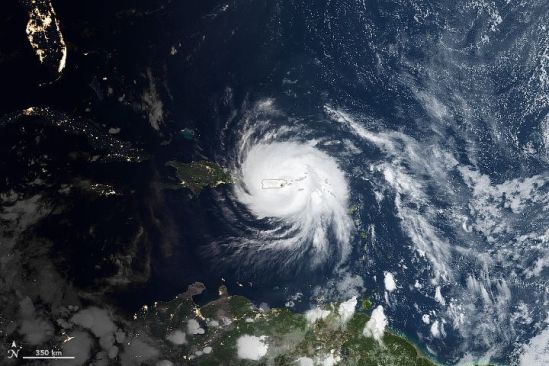
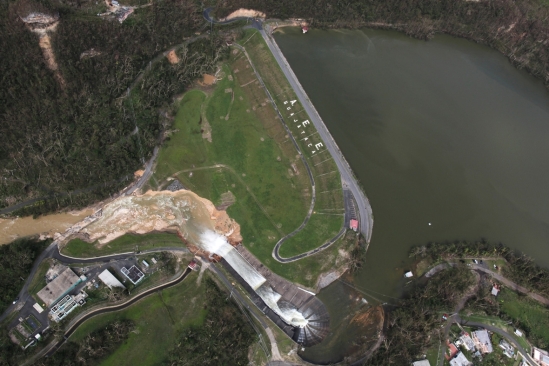
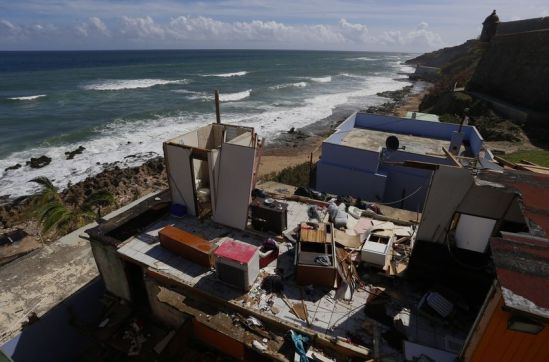
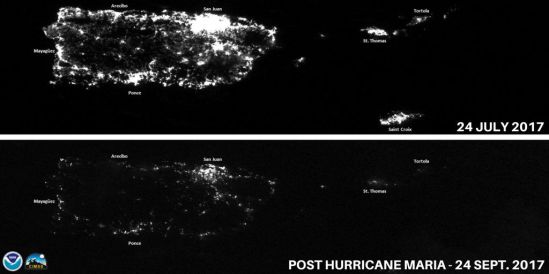
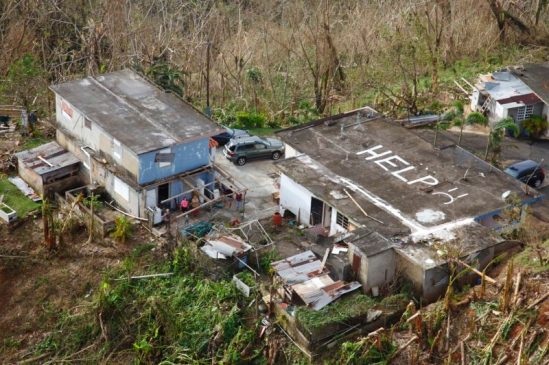
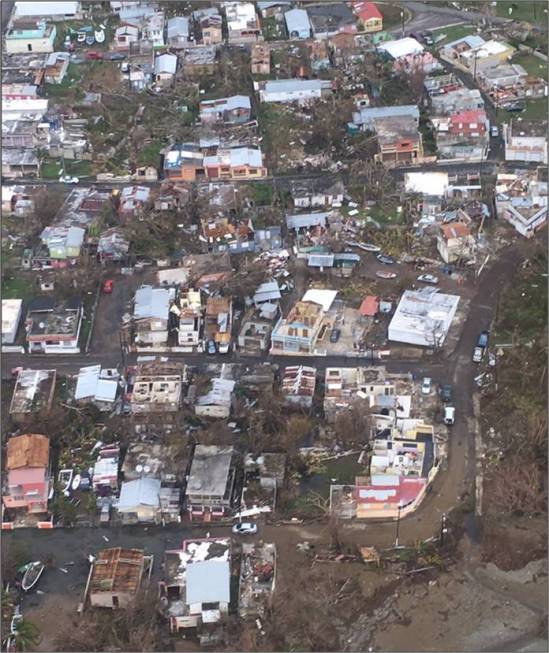
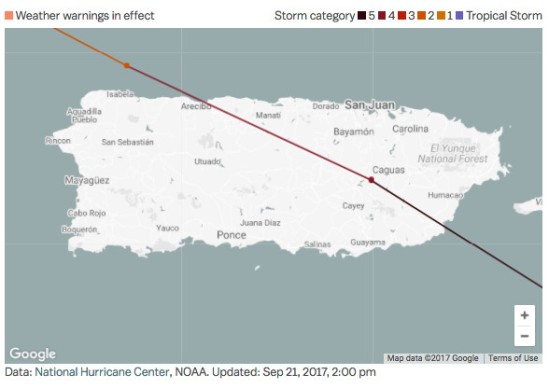
On Wednesday, September 20, 2017, the powerful Category 4 Hurricane Maria made direct landfall on Puerto Rico, ravaging the entire island with its 150 mph winds and drenching it in a few feet of rain. Save for generators powering only the highest priority buildings like hospitals. In many places there’s no fresh water you can drink, bathe, or use to flush toilets. Food, fuel, and cell service is limited. Reaching remote towns and villages takes several days for reporters and rescue workers. Due to strained communications and severe road damage, the extent of Maria’s damage on the island isn’t yet known. Though photos show who communities flooded streets, houses with torn roofs and second floors ripped apart, people waiting in long lines for clean water and fuel, and a severely crippled infrastructure. Even for Puerto Ricans living in intact houses, survival will be difficult in the weeks and months ahead. Thus, the aftermath of Hurricane Maria has been a humanitarian catastrophe. for the 3.4 million people on Puerto Rico.

Screen_Shot_2017_09_21_at_2.39.06_PM

The 2017 hurricane season has been punishing for the island. Hurricane Irma had ravaged several Caribbean islands and left 1 million Puerto Ricans without power. 60,000 on the island were still without electricity when Maria hit 20 days later. Though Maria was a slightly smaller storm, it was far more devastating charted a course directly across Puerto Rico where it hit near peak intensity and passed around 25 miles from its capital San Juan. No landmass could suffer such a direct hit without at least some damage. According to the record books, Maria was the 5th strongest storm to ever hit the US and the strongest to hit the island in 80 years.

mehta-hurricanemedia-1

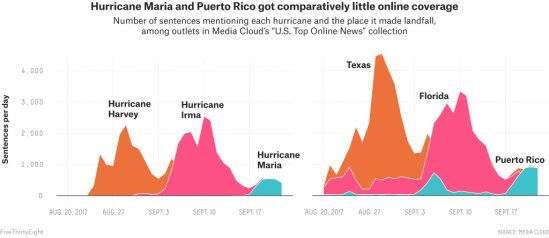
This disaster deserves more coverage and a swifter response. But so far, federal government recovery efforts have been inadequate at best. In some ways this is understandable since few major news organizations have a full-time regular presence on the island. Also lack of wi-fi and cellphone service have hurt local journalists’ ability to report the news from there. But even a communications blackout is no excuse for Puerto Rico’s virtual absence from news coverage in favor of protesting football players and Donald Trump’s latest incendiary Twitter tantrums. Nonetheless, if this kind of devastation happened in mainland United States, you’d see round the clock news coverage from all the cable news channels for days. You’d see the affected states’ congressional delegation appear on major news networks making sure the American public knows and pressuring the president, House, and Senate leaders to take immediate action.

maria_goe_2017263


As a US territory, Puerto Rico doesn’t get electoral votes in general presidential elections or representation in Congress. But Puerto Ricans have been US citizens since President Woodrow Wilson signed the Jones-Shafroth Act in 1917. They can travel to the continental United States without a passport and vote in presidential primaries. They’re also protected by the same Bill of Rights as anyone else in the United States. But more importantly in Maria’s wake, Puerto Ricans are entitled to the same federal government response as state residents should a natural disaster like Hurricane Maria arise on their soil. However, though the US has long benefitted from its island territories’ geographical reach, it has taken them for granted and denied their residents full political representation. Hurricane Maria illustrates that this two-tiered system of American citizenship is neither democratic nor tenable to territorial residents. And to make matters worse a survey from the New York Times reports that only 54% of Americans know Puerto Ricans are US citizens.

hurricane-maria-puerto-rico

Though powerful storms often devastate communities, the true catastrophe was long in the making. Puerto Rico was no different regarding Hurricane Maria. Despite a $103 billion economy, we all knew that Puerto Rico’s government is broke and can’t borrow money to fix it. In fact, the island declared bankruptcy in May and has been trying to restructure more than $70 billion in debt. Thus, even on a good day, its infrastructure is aging and in disrepair. Certain US policies have also contributed to Puerto Rico’s economic deterioration. One is the antiquated Jones Act forcing Puerto Ricans to pay nearly double for US goods through various tariffs, fees, and taxes. The act stipulates that any goods shipped from one American port to another must be on American made and operated ships. Thus, thanks to little competition among freighters, shipping to Puerto Rico is costlier. As former New York State Assembly member Nelson A. Denis noted in The New York Times, “a shakedown, a mob protection racket, with Puerto Rico a captive market.” Economic woes have also contributed to over 8% population loss from 2010. However, since the island’s per capita income is $18,000 (which is half of Mississippi’s), its cost of living is 13% higher than 325 urban areas elsewhere in the US, it’s not much of a surprise. The population drain makes it harder for Puerto Rico’s economy to recover. And as people will likely migrate due to the storm, recovery will be more difficult.

1506796842_394_10-days-after-Hurricane-Maria-Puerto-Rico-is-still-fighting-for-life

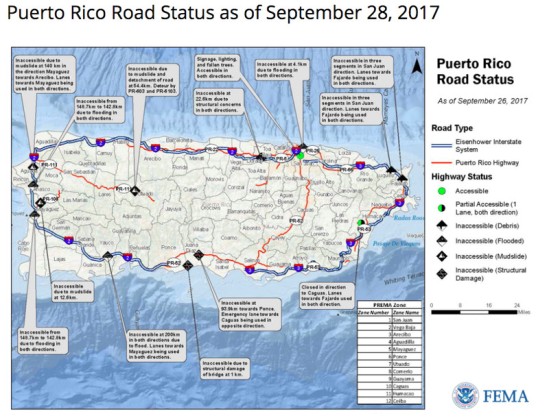
As Puerto Rico is an island, recovery efforts are more complicated since supplies has to be flown in or shipped over. Residents can’t drive to nearby states or cities for shelter to wait out the worst of it. Here’s a rundown on some of the major problems on the island.

DKlJzVnXoAEu2Pt

Electricity: The island’s electric company PREPA has a massive $9 billion in debt and defaulted on an interest payment in July. So it doesn’t have the money to modernize its electrical systems. Even without hurricanes power outages are common. To make matters worse, there aren’t enough workers on the island to fix the infrastructure. Mostly because young people have been leaving in droves since the economy tightened while older workers have retired en masse to secure their pensions.

Hurricane Maria has knocked out 80% of the island’s power transmission lines and as of yesterday, 1.57 Puerto Ricans were still without power. Though generators are being distributed most of them are prioritized to hospitals while most homes and businesses are dark. It could be 4-6 months before power is fully restored on the island. So you have Puerto Rico’s 3.4 million residents relying on generators for half a year. That means half a year that electrical pumps can’t bring running water to people’s homes. Half a year people will have to make do without air conditioning in a tropical climate. Without power, even the most basic tasks of modern life become difficult.

Taken these factors together, rebuilding Puerto Rico’s power system will be a long and difficult process. According to the New York Times, getting power back on the island “will be daunting and expensive” for “Transformers, poles and power lines snake from coastal areas across hard-to-access mountains. In some cases, the poles have to be maneuvered in place with helicopters.”

Screen_Shot_2017_09_25_at_1.26.42_PM

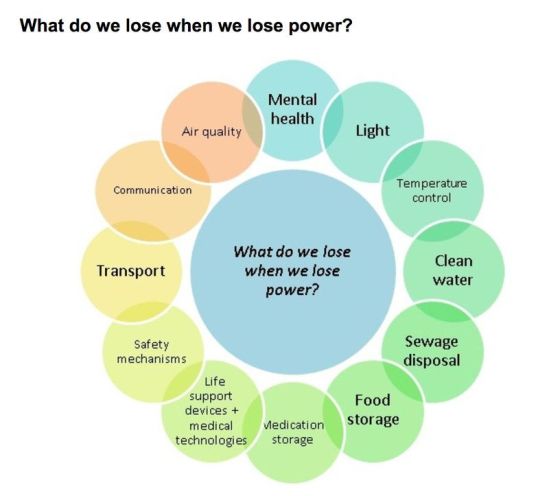
In a disaster situation, health hinges on electrical power and it’s extremely important to get it going to suppress chances of illness. Dialysis, refrigeration for insulin and other medicine, and nebulizers for people with asthma all need electricity to be useful. But electricity also provides for sanitation that prevents many illnesses like typhoid from spreading in the first place. Puerto Ricans need power to run their air conditioning systems and get clean water from the faucet. Without it, people could get sick from dirty water, can’t dispose waste, and suffer from heatstroke. Mental health can also suffer those without access to rapid opportunities for recovery with residents suffering from depression and post traumatic stress disorder.

GettyImages_853153700

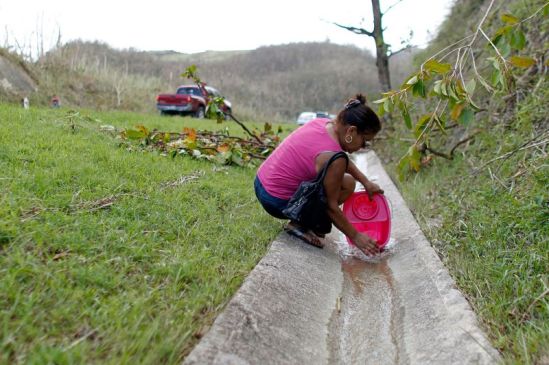
Water: No electricity means no power to pump water into homes and no water to bathe, drink, or flush toilets. According to FEMA, 42% of Puerto Ricans are without potable water. One town’s only source of fresh water was a single fire hydrant. Though rescue workers have been distributing bottled water, it’s safe to say that many people haven’t received any yet.

Fuel: Without a working electrical grid, Puerto Ricans must turn to gas-powered electric generators for energy. But it’s so difficult getting fuel on the island that people could wait over 6 hours for gas if they’re lucky. Other stations are completely out of fuel and have been for days. According to NPR, while authorities don’t believe there’s a gas shortage on the island, they’ve claimed Hurricane Maria has disrupted distributing it. But when fuel runs low, lives are endangered. In the central eastern town of Juncos, the Washington Post reported on a diabetic woman afraid that the refrigeration keeping her insulin preserved will soon run out and there won’t be fuel to restart the generator.

puerto_rico_cell_tower

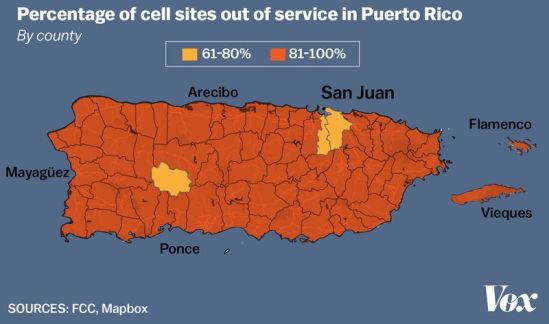
Cellphone Reception: Hurricane Maria knocked out 1,360 out of the island’s 1,600 cellphone towers, isolating many communities from the outside world for days and relying only on radios for news. National Guard members told the Daily Beast they struggled communicating on the ground, which has made their ability to respond to the disaster exceptionally hard. The cellular outage also means that a mainland or abroad Puerto Rican family can’t get in touch with those on the island to find out if they’re safe.
Weather Radar: On Monday, September 25, the National Weather Service reported that its Doppler radar station on Puerto Rico was destroyed. If you don’t know, that’s the radar that helps meteorologists see where thunderstorms and other weather systems move in real time. Without it makes future storms more hazardous.

Mountain Top Mayday

Hospitals: According to FEMA, 59 out of 69 Puerto Rican hospitals are “operational with unknown status.” Many now run on generators but there are serious issues with distributing fuel so access to X-ray machines and other diagnostic equipment remains limited. There are few open operating rooms despite an unsurprising influx of patients with storm-related injuries. San Juan’s mayor reported that two people died due to lack of diesel in the hospital they were. And San Juan is among the better places to be in Puerto Rico right now. Still, if power isn’t restored, Puerto’s health crisis will get worse. After all, electricity is involved with almost every interaction with the health system. For you need power to call a hospital, access electronic records, and running lifesaving equipment like hemodialysis and ventilators.

Farms: Agriculture only contributes 0.8% of Puerto Rico’s GDP and employs 1.6% of its labor force. But within hours Hurricane Maria wiped out 80% of its crop value which amounts to a loss of $780 million. Though the island imports 85% of its food, its agriculture sector’s destruction will increase prices and exacerbate the scary prospect of continued food shortages.

Airports: Puerto Ricans have had a difficult time getting off the island. Though San Juan’s Luis Munoz Marin International Airport reopened to commercial flights on Sunday, September 24, they can expect to wait a long time in uncomfortable conditions if they want a flight. There’s no air conditioning. Ticketing computers are out. And due to FAA radar damage, only a limited number of planes take off from San Juan each day while hundreds of flights have been canceled.

Screen_Shot_2017_09_29_at_1.47.46_PM

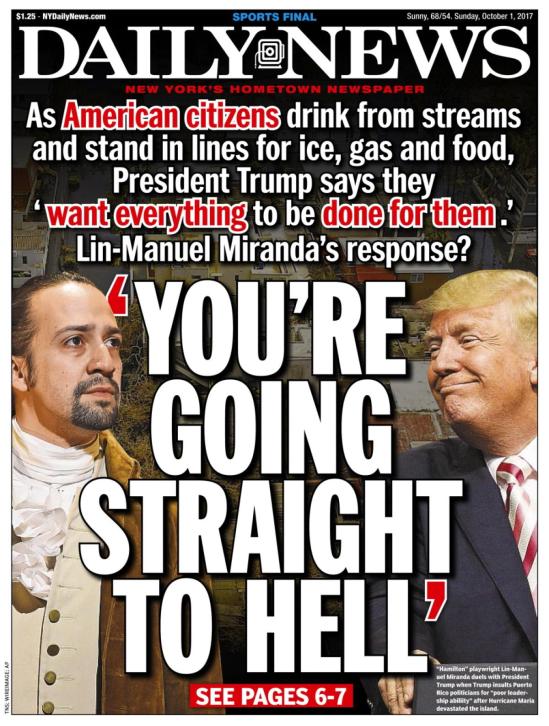
Though Puerto Rico has received government relief, response is still badly inadequate especially as relief supplies wait on the island’s shipping docks. Even as we speak, millions remain without food, water, electricity. And they have no means of getting help. However, instead of doing everything he could to help Puerto Rico, Donald Trump goes golfing in New Jersey. Only to take a tweeting break to attack San Juan Mayor Carmen Yulín Cruz on Twitter just for speaking out for her people and calling out FEMA for patting itself on the back while the island was still ravaged when Hurricane Maria hit. Disease outbreaks have begun due to murky water and packed shelters. Residents have shown signs of Zika, Dengue, conjunctivitis, cholera, hepatitis A, meningitis, and salmonella. Now Trump says that Puerto Ricans are lazy and want everything done for them. Like they should help themselves instead of asking for a handout. Local officials in Puerto Rico are doing everything they possibly can with the limited help they have. Far from showing “poor leadership” Mayor Cruz has been there for her city almost 24/7 with little to no rest, doing whatever she could. But she knows she doesn’t’ have the resources like the federal government has like FEMA under her thumb. She shouldn’t have to beg for that response for it should’ve arrived already. It’s a shame that she has to beg a man for help who is more likely to step on your hand and leave you to drown when you’re reaching to him to lift you into his yacht. Or at least give you a lifesaver to hold. Of all the things Trump has said and done, letting millions of people suffer for days without adequate response just breaks me. Mayor Cruz wasn’t asking for a handout like the welfare recipients conservatives constantly unfairly demonize. She was asking for a lifesaver because people are dying and Puerto Rico is drowning. The island’s residents are utterly helpless and without help soon, many will die if they haven’t already. But up golfing in New Jersey, Trump tells Puerto Ricans to eat cake without any second thought to their dire suffering. Even George W. Bush’s response to Katrina was better than this.

Damage-to-a-neighbourhood-in-Puerto-Rico-struck-by-Hurricane-Maria-pictured-on-Sept-23-2017.jpg

It breaks me more that people in my own family, neighborhood, and community will find some way to defend and support this unrespectable man no matter what he does which I feel is so morally indefensible as a Catholic, liberal, and American in that order. I have no capacity to respect Donald Trump as neither a person nor as an authority figure. To have him as president of the United States is absolutely humiliating for I’m deeply convinced that Trump is a narcissistic sociopath doesn’t believe in America, the Constitution, or in any concept of democracy. He is a total failure as a human being, let alone a president which doesn’t surprise me. But I find his cruelty utterly gut wrenching to the point of inhumanity. Hurricane Maria devastated Puerto Rico but Trump’s lack of interest in the island’s plight has resulted in very serious consequences. The people of Puerto Rico deserve better than what they’re receiving. So you’re Donald Trump and you’re reading this, then to quote Lin Manuel Miranda, “You’re going straight to hell.”

straight-hell-october-1-2017