
History of the World According to the Movies: Part 72 – Post-War America

Image

Joan Allen and William H. Macy are seen here in the 1998 Pleasantville about a community that lives in a 1950s TV sitcom with a plot that goes along the same lines as The Purple Rose of Cairo in reverse meets The Giver. Here are these two presented in 1950s caricatures. Joan Allen is seen here as the perfect mom who can make rice crispy treats and still look fabulous. William H. Macy is the standard 1950s dad who knows everything and always does the right thing but needs a martini after going through a typical day at the office. Yet, this kind of picture shows post war America as many would remember it with a picture of a perfect American home as a cover of burgeoning anxieties over social change.

The few posts I’m going to focus more on the post-war world between the end of World War II in 1945 to 1960. And right now I’m happy that I don’t have to do any more World War II posts anymore because I had to to eight. Many people tend to remember this time as the good old days (at least in America) with suburban houses, white picket fences, manicured lawns, wholesomeness, and fancy cars. Yet, underneath that fancy world of stability and consumerism is a deep underbelly of social anxiety. It was also a time of great change with a higher rate of consumerism, new styles of living like the suburbs of the urban sprawl, decolonization, and highway infrastructure.  And then there’s the advent of television which will find its way in the homes across the world of anyone who could afford one. It is a new media outlet for communication and entertainment as well as of great influence. Oh, and there’s the Cold War and the potential threat of nuclear annihilation that could come at any time. And they call these time the good old days and make nostalgic movies about them. Good grief.

The United States emerged from World War II with relative ease compared to other nations since it was one of the few major countries to come out of the conflict with its infrastructure intact. It was a time of great prosperity and stability with the baby boom, suburban explosion, highway expansion, and other things. However, it was also a time of great anxiety in the United States since World War II changed so much even as Americans tried to revert to what everything was supposed to be. Except it wasn’t. Dad would sometimes have PTSD induced nightmares while Mom would daydream about her days working in a munitions factory when she had a real job and nobody cared about whether she looked like crap. Uncle Arthur would sometimes come to visit from Greenwich Village with his “roommate” Rodney while Mom and Dad asked him why he’s not yet married and would try to fix him up with a nice girl he’d have absolutely no interest in. Then you have Susie who wants to be a doctor which the family doesn’t want to encourage or Elsie’s painting that’s seen as a selfish hobby. I mean after all, aren’t girls supposed to be more concerned with finding a husband than anything? Next you have Uncle Gary who’s in trouble for being a Communist Party membership in his college days and is being forced to name names and Aunt Gertrude’s “free-spirited” attitude doesn’t seem to be helping. Then there’s Little Bobby and Betty Lou who don’t understand why they can’t invite the black kids down the road to Little Mindy’s birthday party. I mean nobody else in inviting the black family to their social events for some reason. And the black family is thinking about suing the local nearby school so their kids don’t have to attend the one farther away. Nevertheless, while there are plenty of movies made in this era, there are a share of inaccuracies I shall list accordingly.

Juan Trippe:

Juan Trippe was a smarmy airline vulture plotting with meretricious politicians to take over the world’s air routes. (Yes, he was a schemer but he was as concerned with long term survival as with achieving a monopoly. He knew that Pan Am needed domestic feeder routes and that his airline would be in a competitive disadvantage if limited to overseas operations. Trippe’s attempt to use political pressure to force Howard Hughes to sell TWA was perfectly rational in a business sense. Had Trippe had gotten his way Pan Am would still be flying and 2001: A Space Odyssey wouldn’t really look so unrealistic with the Pan Am spaceships.)

Howard Hughes:

In 1947, Howard Hughes’ Hercules plane managed to fly over boats and newsreel cameras for over a minute. (The real Hercules was airborne for only 20 seconds and was never more than 70 feet above the water. Also, unlike in The Aviator Odie wasn’t with him during the flight because Hughes wanted there be no doubt that he was at the controls. Those on board with him were: Radio Operator Merle Coffee, Flight Engineer Don Smith, Flight Mechanic John Glen, James McNamara, and various reporters. Oh, and witnesses weren’t seated and separated from Hughes when he was at the controls either since newsreel footage reveals people actually standing in the cockpit with James McNamara steps away from the rich eccentric.)

Howard Hughes loaned Donald Nixon {brother of Richard Nixon} $250,000 in 1956 to secure a Pentagon contract, which would’ve brought Richard Nixon down if made public. (Contrary to The Hoax, the money was to help Donald Nixon save his restaurant chain, which was public knowledge by the 1960 presidential race. So, no, it wouldn’t have brought Nixon down.)

J. Edgar Hoover:

J. Edgar Hoover was a visionary vigilante who stood alone against the reds with all American protests movements as indicative of communism. (Hoover himself believe this but he wasn’t since his red scare targets went beyond communists and anarchists to include prominent and unprominent liberals, federal judges, senators, anyone belonging to any union, the ACLU, black nationalists like Marcus Garvey, and others. His investigation created files on more than 200,000 people and organizations.)

Eugene Allen:

Eugene Allen got the job as the White House butler by getting caught stealing cake in a hotel, getting hired as a waiter and later impressing a White House who happened to be there. (Sorry, Lee Daniels, while it makes for an interesting story, Eugene Allen became the White House butler simply by applying for the job like a normal person would.)

Chuck Yeager:

Chuck Yeager’s NF-104 flight was an unplanned, spur of the moment thing. (Contrary to The Right Stuff, it was well planned as referenced in the book and his autobiography.)

Chuck Yeager was asked to break the sound barrier on October 13, 1947. (Contrary to The Right Stuff, he wasn’t. He had been flying the Bell X-1 since August of that year and made 8 previous powered flights. When he actually did break the sound barrier, it was by accident for he was aiming at Mach .97 but at speeds just under Mach 1, a shock wave made the Machmeter read low.)

When Chuck Yeager broke the sound barrier, people thought that his plane had exploded. (Unlike in The Right Stuff, a scientist actually predicted a sonic boom would happen, which was expected.)

There were fatal accidents on the Bell X-1 before Chuck Yeager broke the sound barrier. (There weren’t any.)

Chuck Yeager’s wife was there when her husband broke the sound barrier. (Actually she wasn’t. Also, she didn’t know about the first supersonic flight until three months later because Yeager’s Bell X-1 supersonic flight was conducted in complete secrecy.)

Chuck Yeager became a major general. (He retired at brigadier.)

Bettie Page:

Bettie Page was a model in 1946. (She didn’t begin modeling until 1950.)

Bettie Page and her husband Billy didn’t attend Hume-Fogg High School in Nashville, TN. (Contrary to The Notorious Bettie Page, they did.)

Bettie Page was totally OK with her job in fetish/costume/modeling and was quite naïve as to the erotic uses of such photos of her. (Actually while The Notorious Bettie Page shows her like this, she wasn’t necessarily naive. Her attitude basically was “God made us nude, so how bad could it be?” but the more extreme fetish posing fostered sexual deviant desires. Numerous fully nude shoots she did for amateur camera clubs bears this out. Eventually she became fed up with this kind of modeling and became a born-again Christian in 1959, but I wouldn’t blame her.)

William Shawn:

New Yorker editor William Shawn arranged for Richard Avedon to take pictures of Perry Smith and Dick Hickock, arranged Truman Capote’s reading, and accompanied Capote to Kansas for the executions. (Contrary to Capote, Shawn’s sons say he didn’t do any of that and actually felt squeamish about Capote’s reading project.)

Writers:

Ayn Rand:
Ayn Rand’s original title for Atlas Shrugged was Atlas Shrugged. (It was called The Strike when she was working on it contrary to The Passion of Ayn Rand. She didn’t change it to Atlas Shrugged until her husband suggested it. Yet, it’s true she did have an affair with a man 25 years younger than her.)

Truman Capote:

Truman Capote bribed the warden in order to visit Dick Hickock and Perry Smith. (It’s more likely he engaged in a legal firm named Saffels and Hope to negotiate his access deal with the Governor of Kansas no less. So, no, he probably didn’t bribe a warden under the table as Capote implies, but what would you rather see?)

Truman Capote promised to help Dick Hickock and Perry Smith find adequate legal representation. (Contrary to Capote, the real Truman Capote never offered to find a proper lawyer for Hickock and Smith.)

Truman Capote visited Perry Smith a lot from his prison cell. (They mostly communicated by letter but you sort of need to see Truman Capote visit Perry Smith in prison in Capote since you don’t get the suspenseful effect if Capote and Smith were just pen pals.)

During his trip to Holcomb, Kansas, Truman Capote saw the bloodied mattresses during his visit to the scene of the crime at the Clutter house. (Contrary to Infamous, by the time Capote arrived at Holcomb, the mattresses, bedclothes, sofa, and other bloodstained items were burned on November 16 by four friends of Herb Clutter volunteering to clean up the house.)

Truman Capote attended the Clutter family’s viewing at the funeral home. (Contrary to Capote, he arrived in Holcomb, Kansas several days after the funeral had taken place. Also, from Imdb: “According to “In Cold Blood”, the detail about the heads of the deceased being wrapped in gauze was related to Capote by Nancy Clutter’s friend, Susan Kidwell, who visited the funeral parlor with Nancy’s boyfriend Bobby Rupp, while the caskets remained open.”)

Truman Capote witnessed Dick Hickock and Perry Smith’s hanging. (He only witnessed Dick Hickock’s hanging. He couldn’t stand the thought of watching Smith die so he left before it happened.)

Truman Capote wrote with a typewriter. (Contrary to his Philip Seymour Hoffman portrayal, he wrote everything in longhand.)

Truman Capote’s hair was parted on the right side and he wore his watch on his left wrist. (Photos of him show his hair parted on the left side and wearing his watch on his right wrist.)

Julia Child:

Julia and Paul Child had a spat with Julia’s father about Joseph McCarthy during her sister’s wedding reception. (Yes, Julia and Paul were critics of Joe McCarthy but while Dorothy McWilliams got married in 1951, McCarthy was a relative unknown outside Wisconsin and wouldn’t have the kind of pull that would send Paul for questioning in Washington. So the argument in the wedding reception of Julie & Julia is fictional. However, Mr. McWilliams was a supporter of Richard Nixon, who did have a name for himself then.)

The original boeuf bourguignon recipe included carrots. (It didn’t, yet Julia uses carrots in the stew in Julie & Julia.)

Julia and Paul Child moved to Paris in 1949. (They moved in 1948.)

Julia Child’s father didn’t approve of either of his daughters’ marriages. (Julia and Paul’s marriage, yes. Dorothy’s marriage to Ivan Cousins, there’s no evidence he did though it’s implied in Julie & Julia. Nevertheless, despite being tiny, Paul Child was kind of a badass since he was a black belt in judo while he and Julia met each other in the OSS during World War II.)

Scientists:

Dr. John Nash:

John Nash’s hallucinations were visual and auditory. (Actually, Nash was just a schizophrenic who just heard voices in his head, though since film is a visual medium, depicting his illness more accurately in A Beautiful Mind wouldn’t be very helpful to viewers {and the real Nash was perfectly fine with this}. Also, he didn’t develop schizophrenic symptoms until some years after graduate school. )

Between his years at Princeton and MIT, John Nash worked for the Pentagon. (He actually worked for the RAND Corporation as a consultant but he did do work in decoding Soviet communications. Also, he didn’t work for the Wheeler Lab while at MIT because it doesn’t exist and there’s no such pen ceremony at Princeton either.)

Through his wife’s love and devotion, John Nash was able to reduce incidence of frequent hallucinations by committing to a medication regiment and learning over time to ignore them just in time to win the Nobel Prize in Economics. (That’s a nice story, Ron Howard, but it’s full of shit. John and Alicia actually divorced in 1963 {though she did help him and they did renew their relationship when he won the Nobel Prize [which he wasn’t allowed to accept due to being off his meds as well as for fear that he’d whip out his dick and scream racial slurs at imaginary Jews] as well as remarry in 2001}. However, Alicia’s reason for divorcing John had more to do with him getting caught picking up young men at public toilets and not things like schizophrenia, fathering a kid out of wedlock and not paying child support {though this happened before he may have met his wife}, anti-Semitism, throwing his wife to the ground and placing his foot on her neck in front of his own students at a picnic, and you name it. Yeah, somehow boning dudes at men’s rooms was a deal breaker for Alicia. As for the medication, he hadn’t been on anything since 1970 and he recovered despite refusing treatment, which actually might’ve been a better decision in the long run even if he wasn’t allowed to receive his Nobel Prize out of fear of making a TMZ worthy spectacle of himself. But Ron Howard put it in anyway because he didn’t want to encourage potentially mentally ill movie goers to stop therapy, which may not have been available for Nash.)

Dr. Alfred Kinsey:

Dr. Alfred Kinsey was a skinny average looking guy. (Contrary to Kinsey, he looked less like Liam Neeson and more like a slightly overweight William H. Macy. Oh, and he was in his fifties at the time when Sexual Behavior of the Human Male was published.)

Dr. Alfred Kinsey was a passive partner during his affairs with men. (He actually wasn’t, particularly during his affair with Clyde Martin in 1939 and he wasn’t the only one.)

Those who objected to Dr. Kinsey’s research on human sexuality were either anti-sex prudes or conservatives. (Yes, there were people who objected to Kinsey’s research as in the man’s biopic. Yet, some of his methods would’ve been pretty controversial even by our standards. Kinsey was known to persuade many of the male researchers who worked with him to try gay sex, often with him and insisted he was “happily married” to avoid scandal. He also made secret films of his subjects having sex, joining in, gathering unusual data on children’s sexual responses from a pedophile, and presenting them as a product of a wider study.)

Dr. Alfred Kinsey was a professor at Indiana University. (He was a professor of the University of Indiana.)

Dr. Alfred Kinsey’s parents were still together when he was working on his sexual research books. (Actually, his parents divorced in 1931 when Kinsey was 37 and he never saw or contacted his father again after that. Yet, in Kinsey, family and friends are visiting Alfred Sr. at home after Alfred Jr.’s mother Sara was just buried.)

Albert Einstein:

Albert Einstein accepted Werner Heisenberg’s uncertainty principle as a fundamental physical law. (He never did saying, “Quantum mechanics is certainly imposing. But an inner voice tells me that it is not yet the real thing. The theory says a lot, but does not really bring us any closer to the secret of the ‘old one’. I, at any rate, am convinced that He (God)does not throw dice.” [Quantum Mechanics is based on laws of probability … hence the reference to dice.])

Albert Einstein had a niece named Catherine Boyd. (I.Q.’s plot has Einstein’s niece as a main character. However, she probably didn’t exist since Einstein had one sister who didn’t have children. Thus, he was nobody’s uncle, at least in a biological sense.)

Kurt Godel:

Kurt Godel was mischievous and gregarious. (He was famously shy and reclusive. Also, along with Boris Podolsky, he was between 17 and 30 years younger than Einstein. In I. Q. they’re about the same age.)

Sports:

The Houston Astros existed in the late 1940s. (They didn’t.)

Brooklyn Dodgers sportscaster Ray Barber broadcasted the away games for his team in Philadelphia and Cincinnati. (Contrary to 42, no team broadcaster ever went with his team during an away game. Also, at that time, away game broadcasting consisted of recreating the came back in the studio from a pitch by pitch summary transmitted over telegraph wire from the stadium where the game was played.)

Wendell Smith was the first black member of the Baseball Writers Association of America. (Contrary to 42, Sam Lacy was in 1948.)

Brooklyn Dodgers player Dixie Walker was traded for signing  a petition over Jackie Robinson. (While he certainly did sign a petition, he only did so under pressure from his teammates but he was more civil to Jackie Robinson by the end of the season and gained much respect for him. As for his trading, it had more to do with him being in his late thirties and nearing the end of his career.)

Brooklyn Dodgers GM Leo Durocher was suspended by team commissioner Happy Chandler over his affair with an Actress Larraine Day. (Though he was suspended and did have an affair with Larraine Day, Durocher was actually suspended by Chandler due to allegations of gambling.)

Pee Wee Reese put his arm around Jackie Robinson during the 1947 game between the Cincinnati Reds and the Brooklyn Dodgers. (Contrary to 42, this happened in 1948.)

Boxer Billy Fox was undefeated by November 1947. (He had lost a professional match a few months earlier in February against Gus Lesnevich.)

Jake LaMotta:

Boxer Jake LaMotta beat up his brother Joey on the vaguest suspicion that he might’ve slept with his second wife Vicki. (Contrary to Raging Bull, the victim was Jake’s friend and eventual co-author of his autobiography Peter Savage. Somehow they managed to bury the hatchet judging by hindsight but a fight scene between Robert DeNiro and Joe Pesci is probably mandatory in a Martin Scorsese film, particularly if it’s about boxing.)

Jake LaMotta would often perform Marlon Brando’s scene from On the Waterfront during his club routines in the ring. (He actually did Shakespeare, but you wouldn’t expect a famous boxer to be into him. As with the fight with Marcel Cerdan, while LaMotta said it was the happiest moment of his life, Cerdan would die 4 months later in a transatlantic plane crash after agreeing to a rematch with him. What makes it sadder is that Cerdan was on his way to see his girlfriend, the singer Edith Piaf who was devastated.)

Jackie Robinson:

Jackie Robinson proposed to his girlfriend Rachel after he signed up with the Brooklyn Dodgers in 1947. (Actually they were engaged in 1943 while he was still in the Army unlike what 42 implies. And the Dodgers spring training wasn’t held in Panama City, Panama but Havanna, Cuba, but you can understand why the makers of 42 changed that.)

Jackie Robinson broke a bat in the dugout tunnel. (He never did.)

When he was up to bat, Jackie Robinson was hit in the head by racist Pirates Pitcher Fritz Ostermueller which resulted in a fight between the two on the mound. (Actually, Ostermueller was a left handed pitcher whose pitch hit Robinson on the left wrist which he claimed was a brushback pitch without racist intent. There was no fight on the mound afterwards, though I would’ve preferred that over watching baseball.)

Jackie Robinson stole 27 bases without getting caught in his 1947 season. (The number of bases he stole during his rookie year is unknown since caught stealing wasn’t an officially recorded baseball statistic at the time and wouldn’t be until 1951.)

Jackie Robinson was the first black man to play Major League Baseball. (He wasn’t for the first one was Moses Fleetwood Walker, catcher for the Toronto Blue Stockings from 1884 to 1889, when the MLB officially erected its color barrier. Yet, Robinson was the guy who’d break the color barrier in Major League baseball in 1947.)

The Quiz Show Scandals:

Herbert Stempel’s time on Twenty-One was over when he answered On the Waterfront instead of Marty as the 1955 Oscar winner for Best Picture on the insistence of the show’s producers during his match against Charles Van Doren. (Yes, he did give the wrong answer on the Marty question despite that he watched the movie three times because he mistakenly believed that NBC would give him a TV job afterwards. However, Stempel and Van Doren would go on for another tie game before the latter won.)

Twenty-One’s host Jack Barry, Geritol, and NBC were all involved in the show’s rigging. (Contrary to Quiz Show they weren’t. Barry didn’t know anything about the rigging but covered it up when he found out. All the involvement NBC and Geritol had with the Twenty-One scandal is asking Barry and producer Dan Enright to change the show after the disastrous first episode. Without Barry’s knowledge, Enright opted to rig the show.)

Charles Van Doren was single during his time on Twenty-One and never taught again after the scandal. (According to a 2008 article, he said he had a regular girlfriend {not present in Quiz Show} and he actually did continue to teach after the scandal though is career wasn’t the same.)

Congressional lawyer Dick Goodwin met Charles Van Doren while the latter was teaching at Columbia University. (They actually met at the NBC canteen, but the outcome was the same as in Quiz Show.)

Charles Van Doren was a contestant on Twenty-One before the Soviet launch of Sputnik I. (Sputnik’s launched happened in October 1957. Van Doren was on Twenty-One from November 1956 to March 1957.)

Charles Van Doren weaseled his way out of Twenty-One by answering a question wrong live on air during the show as the game show rigging congressional investigation was underway. (Van Doren had already left the show by the time the rigging investigation began. However, Van Doren did throw a question but it was more of NBC’s choice according to him and show producer Al Freedman for they had already chosen his replacement.)

Twenty-One was the only show implicated in the quiz show scandals which lasted for a year. (It lasted for three years and Twenty-One wasn’t the only show that was implicated in rigging nor was it the first, though you wouldn’t know it from Quiz Show. Shows that were also rigged were Tic-Tac-Dough, The $64,000 Question, The $64,000 Challenge, and Dotto which actually set off the 1958 investigations. Nevertheless, the reputations of the key contestants on these shows were ruined and quiz shows virtually disappeared from prime time American TV for decades.)

Dick Goodwin played a pivotal role in the investigation of the quiz show scandals. (Though Goodwin co-produced Quiz Show, which was an adaptation of his Remembering America, he actually had relatively little to do with the investigations.)

Miscellaneous:

Homer Hickam’s dad was named John. (Contrary to October Sky, Homer was named after his father.)

The 1950s was a great wholesome time to grow up. (Despite racism, sexism, McCarthyism, homophobia, smoking and drinking, lead in paint, gasoline, and food cans, pesticides, pollution, conservatism, and threat of nuclear war.)

All adults smoked during the 1950s and had no idea it would lead to further health problems. (Actually only half of adult men in the US did as well as a third of women. Andy Rooney never smoked, for example. Also, doctors were well aware of the effects of smoking at the time.)

CBS producer Fred W. Friendly was a smoker. (Contrary to Goodnight and Good Luck, Friendly actually didn’t smoke and lived to be 82 though many of his peers did. Unfortunately, being smoke free didn’t make him as good looking as George Clooney.)

NBC’s Today Show studio was set in Studio 1A in 1958. (It wouldn’t move to its present day location until 1994 and was actually located further down but in the same building. Still, at that time, there would’ve been no windowed corner or a view of Rockefeller Plaza.)

The Reuben Sandwich was the only invented sandwich entered in a sandwich contest by Reuben Kay. (Well, some claim it was invented by a wholesale grocer named Reuben Kulakofsky at Omaha’s Blackstone Hotel in 1925. However, it was actually invented by one of Blackstone’s waitresses named Fern Snider who entered the recipe in the national sandwich competition in 1956 and won. So maybe we should just call it a Fern Sandwich then.)

Americans in the 1950s were prudes who didn’t talk about sex and didn’t experience until they were married. (Actually Americans in the 1950s enjoyed sex as much as they do now, they just didn’t talk about it nor were they as open to discussing sexual matters as later generations. And, no, unlike what you see on old sitcoms, most married couples didn’t sleep in twin beds {censorship regulations prohibited married couples in the same bed or the word “pregnant”}. Not to mention, after WWII, the Sexual Revolution was well under way with Kinsey’s books on sexual behavior {both which became bestsellers}, Masters and Johnson, the beginnings of the gay community, and the invention of the pill. As for premarital sex, it wasn’t uncommon for many women to be pregnant on their wedding day and the 1950s had the highest rate of teen pregnancy on record. Still, as for teen sex, it wasn’t very common since the prospect of a shotgun wedding was a deterrent for either gender but it did happen.)

You could buy drinks in Kansas in the 1950s. (Kansas was a dry state until the mid-1980s.)

The George Washington Bridge had 2 levels in 1952. (It just had one level then.)

Louis Bamberger was still alive in the 1950s. (He died in 1944 but he’s in I. Q. for some reason.)

Families with disabled children would often have them institutionalized because they didn’t want them to be seen. (Actually families that had a disabled child would often institutionalize them because conditions like Down Syndrome were so poorly understood and the necessary education and facilities for caring one in-home were few. A mentally disabled child simply had a better chance of getting the services he or she needed at an institution. It wasn’t that disabled kids were looked down upon, though that was true and some parents did tell their other children that the disabled kid in question had died.)

Suburban American homes often had sleek modern furniture. (Actually most of the average American family furniture in suburbia mostly consisted of heirlooms and antiques for furniture was comparatively more expensive than it is now. Not to mention, most Americans couldn’t afford to replace a lot of second-hand stuff they already had, even if they did qualify on the installment plan. Besides, there was no IKEA in the US yet.)

Laura Kinney found the Clutter family dead that fateful Sunday morning after the murder in November 1959. (It was actually Nancy Clutter’s two friends Nancy and Susan who found the Clutter family dead at their Holcomb, Kansas home.)

The 1950s era was a decade of conservatism. (Social conservatism, absolutely, especially in regards to sex and sexual orientation as well as the rights of nonsmokers. Yet, views on racial politics and gender roles varied by demographic but the status quo was largely in force in social mores and law books. However, the 1950s wasn’t a good decade for political conservatism in the modern sense, especially since it had been tarred by association by the McCarthy era early on. While we do see the 1950s as a decade of conservatism, most Americans at the time wouldn’t have approved the right wing antics of Fox News or the state of the Republican Party today, regardless of how much they would agree with them. Still, the 1950s was a decade of consensus where right-wing looneyness wouldn’t be tolerated. Both Democrats and Republicans usually elected moderate and bipartisan politicians like Eisenhower. Ironically many people on the political right today have a lot of nostalgia for this decade despite that 1950s American politics would’ve had no place for them, even among Republicans.)

Being drafted in the 1950s was an unpleasant experience. (If you were Elvis, but not everyone. The reason why the US government didn’t get rid of the draft in the 1950s America was more due to the fact many poor men saw it as a godsend, especially those who lived in areas where the only way out was a football scholarship. For a poor 18-year-old boy in the 1950s, the draft was something that gave him a guaranteed employment for 5 years with a reward for a college education under the G. I. Bill at little or no cost. Hundreds of thousands of men would’ve never had the chance to go to community college or attend good universities if it weren’t for the G. I. Bill. Many guys would sign up before they could be drafted so they could choose which branch they wanted to serve in. It was only during the Vietnam War when the draft would become unpopular enough to abolish. Yet, at this time, a military draft could be one poor boy’s ticket to the middle class and economic mobility, which was mostly true.)

Diesel locomotives went through Grand Central Station in the 1950s. (Actually Grand Central Station had only allowed electric locomotives long before then.)

Federal income taxes were due on April 15th at this time. (They were actually due on March 15th.)

Alvin Dewey learned of the arrests of Dick Hickock and Perry Smith while he was having Christmas dinner with his family. (He actually learned about the arrests on December 30, 1959.)

Perry Smith was substantially taller than Dick Hickock. (Contrary to Infamous, they were about the same height.)

TV personality Arthur Godfrey had brown hair. (He was famous for having red hair with his nickname being “Old Redhead.”)

The Interstate highway system was around in 1947. (It began in 1956.)

Americans in the 1950s were a lot more religious than they are now. (Actually while most people were members of a church, they didn’t necessarily go every Sunday. Even if they did, they were much more quiet about religion than churchgoers today and saw proselytizing as intrusive and unpleasant. Jehovah’s Witnesses weren’t well liked because of their efforts to seek more followers. Oh, and Christians did define themselves by denomination and would never have said, “just Christian.” Yet, many people on the Religious Right have nostalgia for this decade despite that most 1950s Americans would view such nuts as one notch above the KKK. Fanaticism of any kind didn’t have any place in 1950s America.)

Gay bars were quite out in the open in this time period. (They were extremely clandestine places since homophobia was rife in the US at the time.)

Frank Lucas began his life of crime when he saw his twelve year old cousin killed by the police when he was six. (This is entirely plausible as told in American Gangster but it was inspired by a story about his cousin being murdered by members of the Klu Klux Klan, which there is very little evidence to support it.)

California used an electric chair to execute criminals in the late 1940s. (It never has used the electric chair as a means of execution.)
History of the World According to the Movies: Part 71 – World War II: POWs, Resistance Fighters, and Other Things

Image

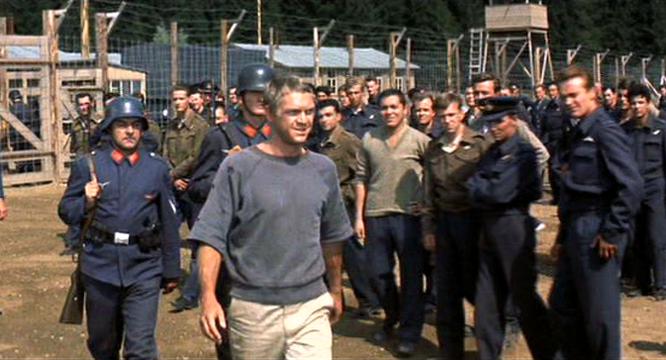
1963’s The Great Escape famous for starring Steve McQueen in that iconic motorcycle scene where he’s chasing himself. Yet, it’s also known for it’s famous depiction of a great POW camp escape in which three tunnels were dug in the prisoners’ bunkers that were named Tom, Dick, and Harry. While it kind of does take liberties with the truth, I’m sure this film will be loved by generations. Nevertheless, POW camp prisoners in Germany considered escaping as a duty and would come up with a lot of creative ways to do so, some of those not shown in film.

I mainly did my movie history blog posts around World War II based on location but there are some aspects in which it isn’t possible, yet there are plenty of movies made pertaining to them nevertheless. In some ways, World War II movies don’t just have to be war movies. You can have prison movies set in POW Camps like Bridge on the River Kwai or The Great Escape with Nazi commandants and such. A lot of times you’ll always have at least one person who wants to escape but some may not have the kind of bad luck William Holden did. You have movies with Resistance (mostly French) freedom fighters who’ve had enough with Hitler’s occupation and if Hitler was in a theater, they wouldn’t hesitate to blow it up to bits. Then you have spy stuff with internationally assembled crack teams of soldiers played by some of the most famous names in cinema also possibly trying to blow something up. Or possibly stealing some secrets from the Nazis. Either way, there would have to be a Nazi uniform change at some point in the plot. Still, while there are plenty of movies about these things, there are plenty of stuff they tend to get wrong, which I shall make note of accordingly.

Resistance Movements:

Everyone in France supported the French resistance and the Free French movement. (The truth is most French mostly remained neutral at least in the beginning up to D-Day even though they certainly didn’t like being occupied. Also, the French Resistance mostly consisted of young people.)

Else Gebel was a political anti-fascist prisoner who was sympathetic to Sophie Scholl’s plight. (Unlike the German movie Sophie Scholl, it’s plausible that Gebel was a Gestapo mole. Then again Sophie probably wouldn’t have known that.)

Resistance movements were only on the Allied side. (Actually there were people who did have resistance movements but joined the Axis powers. People like Indian Independence leader Chandra Bose for instance. You can see why he isn’t remembered. Also, you have the White Russians.)

Resistance movements were all united in a common goal and seldom fought amongst each other. (Some countries actually had more than one movement and it wasn’t unusual for them to end up fighting each other as well. According to TTI: “China had so many turncoats-turned-resistance fighters-turned-bandits that the historical community generally wrings its hands and splits it up into local and regional warlords, nationalist guerrillas, communist guerrillas and Chinese Communist Party guerrillas, with some room for overlap.”)

Norwegian “limpet mines” gave off big explosions on German ships. (Contrary to Max Manus, according to Imdb: “Such mines contained only a small amount (4 kg) of explosives and were placed on a target ship’s hull beneath the water line. In that position, even a small hole can do a lot of damage (in part due to the water pressure surrounding the hull).” But filmmakers can’t be satisfied with a small amount of explosives so if it doesn’t blow up spectacularly, it’s not worth seeing.)

Jens Christian Hauge was in the Norwegian resistance in 1940. (He joined the resistance later because he was in jail in 1940.)

The Oslo harbor was brightly lit to help Norwegian resistance members sabotage German ships. (Unlike in Max Manus, Oslo had a blackout enforced in case of long awaited Allied bombing raids. Max and his friends probably had to work in the dark.)

POW Camps:

World War II prisoners were treated in accords with the Geneva Conventions or at least had a right to. (The Japanese weren’t subject to the Geneva Convention and POWs until the 1950s and treated their prisoners horrifically {though this had more to do with them being under a fascist military dictatorship}. As for Japanese POWs, they didn’t expect to be treated as anything other than shit to begin with though the Japanese government at the time couldn’t care less about their fates. Still, treatment of them varied by country, though no Japanese POW wouldn’t want to be held in captivity by the Chinese or Soviets.

As for the Germans, while they generally kept to the Geneva Convention when it came to US, UK, French prisoners or what not until perhaps close to the end though treatment did vary from camp to camp. Yet, the Nazis didn’t believe the Geneva Convention applied to Eastern Europeans so captured Red Army soldiers usually ended up as slaves or starved in death camps at best {this is why they’re considered Holocaust victims. Also, while 5 million Soviet POWs were taken, only 2 million were liberated by the end of the war}. Those who were liberated were sent to filtration camps that were effectively high security prisons until they were cleared or condemned. Those who were cleared were cleared {consisting of more than 90% of Soviet POWs}, were freed and sometimes re-drafted. Those who were condemned could be executed, sent to a Siberian gulag, or stripped of rank and sent to a penal regiment {which was for mid-rate crimes like surrendering or retreating when fully capable to fight}. Those in penal regiments had hard, dirty, and dangerous jobs with a high death rate. This would entail penal tank crews being sent out with their hatches shut to prevent them surrendering again while penal infantries were tasked with playing a deadly game of minesweeper. Maybe the Japanese had the right idea with committing suicide as far as the Russians were concerned. Italian POWs in German custody were also treated poorly. Soviet prison camps were unsurprisingly harsh to Axis prisoners that many would try to surrender to other Allied countries like Britain or the US. Their treatment of Axis POWs consists of basically what you’d expect in Stalinist Russia. Then you have the Katyn Massacre of Poles that happened while Russia was allied with Nazi Germany.)

The three guys who got away in the great escape were from the British Commonwealth. (Contrary to The Great Escape, the guys who got away were Dutch and Norwegian. Most were killed, executed, or sent back though.)

The great escape happened during the summer months. (The actual escape actually occurred in March when there was still snow on the ground. Most of the escapees trying to run across country were forced by deep snow to leave the fields and go onto the roads as well as into the hands of German patrols. Oops!)

Escapees during the great escape were all shot in a common space at one time. (50 were shot in many different places, sometimes alone or in groups.)

Executions of great escapees were conducted by uniformed German troops using a Spandau machine gun. (Actually contrary to The Great Escape, they were conducted by Gestapo agents using pistols at close range not with a machine gun in Ramboesque fashion.)
It wasn’t unusual for Allied prisoners to assault German guards during an escape. (Contrary to The Great Escape, Allied prisoners actually avoided doing this at all costs since such actions would be tantamount for inviting execution or at least some time in a highly unpleasant German military prison like Colditz if lucky.)

Italian prisoners in Allied POW camps were considered civilians once Italy joined the Allies. (Sorry, Major Battiagila, but your country’s allegiance doesn’t exempt you from being tried for war crimes as you said in Von Ryan’s Express.)

POWs in German prison camps always wanted to escape for some reason. (Actually it was their duty to try to escape and would go through many creative ways to pull it off. Believe me, I’ve seen Nova episodes on this.)

Officers and enlisted men would be in mixed quarters in every German POW camp. (The Germans always segregated officers and enlisted men in separate POW camps.)

A group of Allied prisoners at a German POW camp formed their own soccer team that won against Germans for respect. (Well, there’s a movie about this called Victory, but there wasn’t an Allied soccer team and to my knowledge I don’t think Pele served in World War II, let alone do time at a German prison camp {seriously why?}. Yet, there was a Ukranian POW soccer team but they beat their resident Nazi captors miserably and repeatedly that they ended up arrested, tortured, and executed by the Gestapo as well as taken to work camps.)

Espionage:

Ian Fleming was a WWI vet by the time he joined the 30 Commando Unit. (Though Fleming is seen wearing ribbons of the 1914-1918 War Medal and Victory Medal in Age of Heroes, he was born in 1908 and would’ve been too young to fight since he was only 10 when the war ended.)

British spy Violette Szabo was tall blonde. (She was a brunette who was less than 5’5.” But she’s played by British actress Virginia McKenna {the woman from Born Free} in a biopic about her. She was a widow of a French soldier as well as a British spy who underwent two missions in occupied France. She was captured by the Germans on her second mission who interrogated, tortured, and deported her to a concentration camp in Germany. Still, the film Carve Her Name with Pride doesn’t show her fate in Ravensbrueck concentration camp which was execution by firing squad at the age of twenty-three but it was made in the 1950s. Her companions were gassed.)

A Polish spy at Bletchley Park passed crucial secrets to the Soviet Union during the Enigma decryption. (Actually contrary to the 2001 Enigma, the traitor was actually a guy named John Cairncross who’s British.)

The OSS was around before Pearl Harbor. (It was founded in 1942.)

MI6 was a reliable intelligence agency during WWII. (Actually in 1939, the Nazis had already exposed MI6’s networks in Europe and the Special Operations Executive took over functions in wartime. Thus, you wouldn’t want to report secrets to MI6 but the SOE.)

Ulysses Diello was a valet to the British ambassador in Turkey who passed secrets to the Germans as Agent Cicero. (Yes, there was an Agent Cicero who was a valet to the British Ambassador to Turkey and was an immensely successful spy. Yet, unlike what 5 Fingers suggests, he was actually Kosovo born Albanian Elyeza Bazna who spoke very poor English and was far from the perfect facsimile of an English gentleman as James Mason’s portrayal. Also, that part about the pursuit after Agent Cicero flees the British Ambassador’s residence is pure fiction.)

War Crimes Trials:

German soldiers were executed for the Malmedy massacre during the Battle of the Bulge. (Actually while there were Germans found guilty as well as sentenced to death, no death sentence was carried out so Marlene Dietrich wouldn’t have to worry so much in Judgment at Nuremberg.)

Wehrmacht officers would disguise themselves as SS officials during the Nuremberg trials. (Actually SS officers would try to disguise themselves as Wehrmacht officials to hide their involvement. At Nuremberg, you’d rather be an ordinary soldier than an SS official.)

Miscellaneous:

World War II soldiers lit their cigarettes with butane lighters. (Butane lighters weren’t invented until the 1950s.)

Air raid sirens always gave a continuously constant sound. (Most of the sirens were hand cranked and gave variable sound when cranked hard 5 times and slacked off 5 times.)

Nazi sympathizers were fans of Chopin’s music. (Contrary to Shining Through, most Nazi supporters would’ve detested Chopin for his Polish and French ethnicity alone.)

WWII bombing crews always stood at a good chance of surviving. (If it’s World War II and you find yourself on a bombing crew, make sure you get your affairs in order and make your peace with the Almighty because less than 50% of them managed to survive their tour.)

German soldiers used night vision scopes in World War II. (Well, not exactly though they were around in Nazi Germany at the time. Still, these infrared scopes were clumsy, very heavy, rare, and reserved for special ops. Also, it’s inconceivable any would’ve been stationed near a glorified officer’s brothel.)

Combat squads could travel in broad daylight and allow enlisted men to talk a lot. (Unlike the journey in Saving Private Ryan, squads would never be allowed to travel during the day time because they’d risk exposing themselves to the enemy. They usually would travel at night in order to go unprotected by the enemy. Also, arguing with your captain during such a mission would’ve resulted in you getting court-martialed.)

World War II military vehicles had radial tires. (Radial tires were patented in 1915 but they weren’t used on vehicles until the 1960s.)

Monopolization of the radio during combat was always a good idea. (Radio nets were shared with the entire squadron during combat and were only to be used in emergencies or by a commanding officer. To describe everything you’re doing while crowding out what others in your squadron are doing, would lead to your squad mates beating the living crap out of you back at the base.)

Aerial torpedoes were designed to attack airfields. (They were made to attack ships and were launched at low-level waters, not to attack land based targets.)

Military nurses had long flowing hairstyles during the war. (They weren’t permitted to have long flowing hair styles while in uniform. Rather the permitted length of hair had to be just above their collars. Thus, they either had to wear it up or cut it. As for makeup, they either were allowed to wear skin tone cosmetics or none at all.)

Nobody smoked during World War II. (Contrary to Pearl Harbor, most people smoked during the 1940s. The only people who didn’t smoke in 1940s movies, were those who hadn’t yet entered puberty. To have nobody smoke in a World War II film is perhaps one of the greatest historical sins a filmmaker could commit. Yes, I know smoking is bad for you, but still.)

Mistreating civilians was a violation of the Geneva Convention at this time. (No, the revision of the Geneva Convention in regard to civilians wasn’t adopted until 1949, unfortunately.)

Soldiers always wore their helmets buckled. (It was common for soldiers to leave their helmets unbuckled due to the common belief that the helmet would break a soldier’s neck when it reacted to a concussion due to a nearby explosion.)
During the war, people rode on bicycles with rubber tires. (By a certain point in the war, only wooden tires would be available, especially in Europe.)

You could easily pick out a Gestapo. (Gestapo usually wore civilian clothes so, no.)

Foreign girls always went for American GIs, particularly if he’s the white protagonist.

During special operations, an Allied soldier could always find a Nazi uniform to fit him perfectly as a disguise.

Special operations always consisted of a group of people from different countries played by big named actors so no Allied country’s participation in the war goes unrecognized.

Despite being bombed, buildings would always have electricity and running water.

History of the World According to the Movies: Part 70 – World War II: The American Home Front

Image

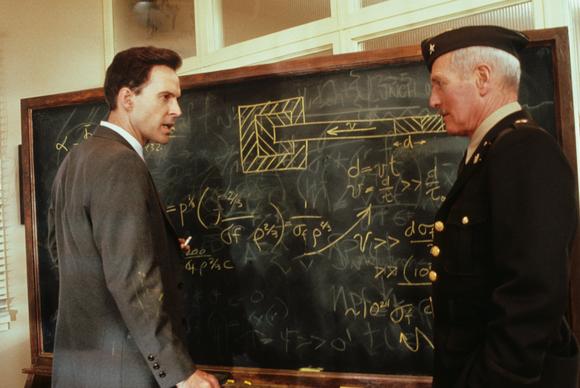
The 1989 film Fat Man and Little Boy is about the story of the Manhattan Project and the development of the Atomic Bomb. Paul Newman is seen here playing General Leslie Groves while a guy named Dwight Schultz plays the legendary Dr. J. Robert Oppenheimer. Nevertheless, while Richard Joffe does get some things right, the story is more suited for his political viewpoints and it’s far from the historic truth. For one, it was Oppenheimer’s dream job to work in the Manhattan Project (while Groves would rather be leading combat troops) and he and Groves got along famously, despite being polar opposites in personality for they both wanted the same thing. Also, Oppenheimer and many of his fellow scientists didn’t have any second thoughts about dropping the atom bombs until after they found out about the horrors of Hiroshima and Nagasaki. Also, Paul Newman was way too handsome to be General Groves.

Of course, while there wasn’t much attacking on US soil besides Pearl Harbor, it didn’t mean that there wasn’t much going on in the home front. Like the British, Americans did experience rationing, air raid drills, sending bacon grease and scrap metal to the war effort, women working in munitions factories as well as families waiting for their loved ones to come home from the war. Yet, in other ways, it was unique with WWII propaganda films as well as movies from Hollywood, the USO, the role of racial minorities, and other things. You have Japanese American internment camps that were filled with a group of people who were displaced mostly due to ethnicity, culture, and they or their ancestors came from an enemy of the US at the time. Oh, and racism as well of suspicion of disloyalty did have a lot to do with it, too. Yet, the disloyalty of Japanese Americans was somehow put to rest since 20,000 of them fought in the war. You have the Tuskegee Airmen who were an elite unit aerial African American fighters whose overcoming of racism and adversity greatly contributed to their success. Then there’s the Manhattan Project which would be famous for developing one of the most deadly weapons in human history and usher in the atomic age. Nevertheless, while there are plenty of movies made about the American home front, there are plenty of inaccuracies in them as well, which I shall list.

Japanese American Internment:

Japanese Americans were the only group in America to be rounded to internment camps. (Actually, they were the only group to be interred who were mostly American born. German and Italian Americans were also interred but these numbers were small and only pertained to first generation or legal aliens.)

Almost all Japanese Americans were placed in internment camps during World War II. (Actually you may think this is true but not really. Most of the Japanese Americans interned were living on the West Coast, particularly in California where interment was popular among white farmers who resented their Japanese American counterparts {most Japanese Americans there at the time were farmers}. Not to mention, California wasn’t a state known by its friendliness toward Japanese Americans, just the opposite. Anti-Japanese bias on the West Coast was prevalent at this time. By contrast, Hawaii only sent a very small portion of their Japanese American population to internment camps {mostly prominent politicians and community leaders} since the area had been on martial law already and the risk of sabotage and espionage by Japanese residents on the islands was low. Not to mention, 35% of their population had Japanese ancestry and they were active in almost every sector of its economy. Had Hawaii had most of their Japanese American population interred, the then-territory would’ve had its economy crippled. Over 50,000 Japanese Americans on Hawaii remained undisturbed during the course of the war mostly due to being too economically viable to evict.)

The AAGPBL:

The AAGPBL played regulation baseball. (Contrary to A League of Their Own, they actually played a baseball/softball hybrid game. In its first years it was closer to softball.)

Racine won the 1943 World Series in a 7 game series against the Rockford Peaches. (It was in a 5 game series against the Kenosha Comets.)

The Tuskegee Airmen:

Not a single Tuskegee Airman was shot down by enemy fire. (66 Tuskegee Airmen were killed in action and they didn’t have an official flying ace even though one may have had enough unregistered kills to qualify. 25 of their bombers were lost to enemy fire.)

The Tuskegee Airmen was created to prove that blacks could effectively fly a plane. (They were trained by racist instructors who washed trainees out for the smallest mistakes to prove that African Americans were unsuitable to be fighter pilots. The result was hand-picked elite that wiped the floor with everything they met as well as were provided the best protection of all US Army Air Force fighter groups in Europe. Thus, contrary to Red Tails, their status as an elite fighting unit was almost purely accidental and as a result of training from hell.)

The Manhattan Project:

Tchaikovsky’s “Dance of the Reed Flutes” was played during the countdown of the Trinity atomic test in Alamogordo, New Mexico. (Actually it was Tchaikovsky’s “Serenade of Strings” but this is a minor error in Fat Man and Little Boy.)

Frenzied nuclear weapon expansion had been driven from the outset by pigheaded militarists intimidating morally sensitive scientists into doing what they knew to be wrong. (Sorry, Richard Joffe, but this is wrong. Nuclear expansion served the best interests of the military and the Manhattan Project scientists. Maybe they knew designing the bomb was wrong, but they greatly underestimated the bomb’s potential for wiping humanity which came to haunt them after the Hiroshima and Nagasaki.)

General Leslie R. Groves was a warmongering jerk and strutting martinet. (Yes, he was a jerk as Major General Kenneth Nichols called him “the biggest son of a bitch I’ve ever met in my life. I hated his guts and so did everyone.” He was known to be arrogant, socially awkward, as well extremely sarcastic. Yet, even he said that his commander was one of the “most capable individuals” he ever met. He’s said to be an organizer without equal as well as a tireless leader who held together the far-flung elements of the Manhattan Project, which employed 125,000 workers at facilities nationwide. Not to mention, he was the guy in charge of building the Pentagon which was the reason he was picked to lead the Manhattan Project in the first place. He was also a student of MIT before transferring to West Point, where he graduated 4th in his class. Then again, his security measures weren’t the most adequate since Los Alamos employees named Klaus Fuchs and David Greenglass {brother-in-law to Julius Rosenberg} were still able to smuggle atom bomb details to the Soviets, which Fat Man and Little Boy doesn’t address.)

General Leslie Groves was happy leading the Manhattan Project. (Groves actually didn’t want to lead the Manhattan Project, which he called, “Oh, that thing” and later chafed at being a taskmaster to “the largest collection of eggheads in the world.” He had longed to lead combat troops into war but his career had languished in the corps of engineers and his leadership of the Pentagon’s construction was a success, that he was the most likely candidate. He only changed his mind about the job when he saw that the Manhattan Project was his opportunity for glory and worked unceasingly to the end.)

Dr. J. Robert Oppenheimer and his fellow scientists were against the idea of the atom bomb and felt guilty about being a part of the Manhattan Project for the rest of their lives. (Well, yes, many Manhattan Project scientists did regret their roles in the Manhattan Project but only after the horrors of Hiroshima and Nagasaki were known, unlike in Fat Man and Little Boy. He would become a vocal opponent of the development of the even more powerful H-bomb though. But during the atomic bomb’s designing phase, Oppenheimer craved a job at Los Alamos so badly that he’d even be interested in obtaining an army commission to curry favor with General Groves. Once hired in 1942, Oppenheimer worked on the Manhattan Project with appropriate martial zeal as well as gave an idea of poisoning the Germans’ food with radiation. Most of his fellow scientists supported nuking Japan as well and had a big celebration after the bombs were dropped and Japan surrendered.)

Dr. J. Robert Oppenheimer was a quiet, moralistic, and easy going man. (Actually though kind of bohemian and witty, this was a guy who stole chemicals and tried to kill his own tutor for making him attend classes on experimental physics which he hated {he preferred theoretical}. This was while he was studying for his doctorate in physics at Cambridge University.  He also betrayed his friend Haakon Chevalier, a literature professor at Berkeley, as someone who had contacted him about sharing secrets with the Russians when asked by the FBI to name names during his time at Los Alamos {though he’d later regret this and said he invented this “cock and bull” story but Chaevalier’s career was ruined because of him, though Oppenheimer might’ve named him to protect his brother who was a known Communist Party member}. Also, contrary to Fat Man and Little Boy, he was a much more outgoing man than portrayed in the film. Interestingly, the said tutor was Patrick Blackett who’d  go on to win a Nobel Prize. Oppenheimer also had a humongous ego to boot despite having a voice like Mr. Rogers. And yes, he was associated with Communist politics in the 1930s as were both his wife and ex-girlfriend. His past association with leftist politics would later hurt him during the Red Scare as he opposed the Cold War arms race.)

Dr. J. Robert Oppenheimer and General Leslie R. Groves didn’t get along. (Contrary to Fat Man and Little Boy, despite their personality differences, they got along fine because they both wanted the same thing. Groves even praised him on his work in the Manhattan Project saying, “I was reproachfully told that only a Nobel prize-winner or at least a somewhat older man would be able to exercise sufficient authority over the many ‘prima donnas’ concerned. But I stuck to Oppenheimer and his success proved that I was right. No one else could have done what that man achieved.” Groves also got along well with the other scientists save Hungarian Leo Szilard.)

Dr. J. Robert Oppenheimer came up with the idea of implosion. (It was actually fellow scientist Seth Neddermayer who proposed the theory and his formulation came gradually.)

The experiment with the two hemispheres of beryllium surrounding a core of plutonium and held apart with a screwdriver was called the “drop” experiment. (It was called “tickling the dragon’s tail” but it’s by the expy for Canadian physicist Louis Slotin from Fat Man and Little Boy. Yet, though he died from an experiment relating to radioactivity, his death didn’t provide any cautionary warning for Oppenheimer since it happened on May 30, 1946.)

General Leslie Groves was a fit man. (Actually he weighed between 250-300 pounds in contrast to Paul Newman’s fit figure in Fat Man and Little Boy. Oppenheimer by contrast, weighed 116 pounds during the Trinity Test.)

J. Robert Oppenheimer’s ex-girlfriend Dr. Jean Tatlock committed suicide on January 1945. (She killed herself in January of 1944. Interestingly, she was Oppenheimer’s first love and the first person he ever dated but she suffered from depression {he married his wife Kitty a year after he broke up with Jean}. Still, it’s said he had an affair with her during his time in the Manhattan Project while some say that he only spent the night with her once in mid-June of 1943 after he was picked as head of the laboratory in Los Alamos. It’s highly disputed. We could say that he certainly cared about her and may have felt guilty on breaking up with her despite knowing that she certainly wasn’t relationship material. Still, while we can’t really confirm whether Oppenheimer and Tatlock were romantically involved during his time at Los Alamos, he did have an extramarital affair but it was with Kitty when she was married to her third husband, a physician named Richard Harrison. And it wasn’t until Kitty found out she was pregnant to Oppenheimer when she divorced Harrison and Robert became her fourth
husband in November of 1940. Still, despite only dating two women throughout his entire earthly existence, Oppenheimer certainly had an interesting love life.)

General Leslie Groves was a recipient for the Good Conduct Ribbon. (To qualify for the Good Conduct Ribbon, a soldier must be an enlisted man for at least 36 months. Groves was a West Point graduate and thus ineligible.)

General Leslie Groves met Dr. Leo Szilard in his hotel bathroom while the latter was in a bathtub and the former was on the toilet. (They actually met at the Metallurgy Laboratory at the University of Chicago along with the rest of the scientists. They had an antagonistic relation and Groves tried to fire him.)

The Trinity explosion took 2-3 seconds. (It actually took 40 seconds.)

Kitty Oppenheimer was an adoring wife who thought her husband Robert was the greatest man who deserved anything he wants. (Oppenheimer would’ve probably wished his wife to be like this since he kind of thought he was God’s gift to humanity who deserved anything he wanted. Still, she was known to drink and make catty remarks about her husband.)

Miscellaneous:

America had the best artillery, tanks, tacticians, or generals in World War II. (America had the most money, the highest rate of productivity, and perhaps the most adaptive and self-reliant rank and file of all the fighting armies.)

USAAF bombing crews usually survived with no ill effects. (Since the USAAF bombed German targets by day, they had a monstrously high casualty rate in the bomber department. There’s a reason why the policy for USAAF airmen was “25 and out” for most of the war. Once most airmen completed 25 missions, their war was over but the average crewman only had a 1 in 4 chance of actually completing his tour of duty. Yet, as the war progressed, 25 got upped to 30 and then 35. The average bombing crew got shot down in its 20th mission. American bomber crews were known to be notoriously fatalistic, having determined that after reaching the half-way point on their tours of duty, they were living on borrowed time.)

“Little Brown Jug” was recorded after Glenn Miller’s death. (Actually contrary to The Glenn Miller Story, it was one of his first bonafide hits in 1939, but the movie makes it clear where he got it from.)

WWII was a universally supported one in the US. (The US only went into the war at around Pearl Harbor and even then there were Americans who opposed the war either because they were pacifists or Nazi sympathizers. And yes, World War II did have its share of draft dodgers even in the United States.)

A PT boat’s main function was “to harass the enemy and buy time for a navy that was still on the drawing boards.” (This is sort of accurate but as Washington lawyer and WWII veteran Leonard Nikoloric said, “Let me be honest. Motor torpedo boats were no good. You couldn’t get close to anything without being spotted. I suppose we [Squadron Three] attacked capital ships maybe forty times. I think we hit a bunch of them, but whether we sank anything is questionable. The PT brass were the greatest con artists of all time. They got everything they wanted-the cream of everything, especially the personnel. But the only thing the PTs were effective at was raising War Bonds.”)

The United States military was integrated at this time. (Actually it was still segregated and would be desegregated shortly after World War II. However, many of World War II movies were made after that time and with the assistance of the US military like The Glenn Miller Story. However, such errors could be forgiven since the war was fought by Americans of all races and creeds anyway even if they didn’t fight in integrated units.)

Female cadets were in attendance at West Point at this time. (West Point didn’t start admitting women until 1962.)

There were no gays in the US military during World War II. (Actually the US military effort during World War II was one of the reasons why the gay community became a more prominent force in later years. Sure there was a Don’t Ask, Don’t Tell policy but the war effort brought so many people away from their homes and into contact with people they wouldn’t have met otherwise, sometimes these were people like them. Also, gay US WWII vets include Rock Hudson, Gore Vidal, and others.)

The US Navy made a petty fuss about shirts. (Actually Mister Roberts is right about the US Navy’s fuss about shirts but it wasn’t out of pettiness. The navy’s medical branch actually found that shirts provide protection against burns in case of explosion.)

US soldiers would leave their sweethearts behind who faithfully waited for them to return home, while their men didn’t mess around. (This wasn’t 100% the case since there were soldiers who did cheat on their sweethearts {sometimes wives} or sometimes abandoned them altogether. Not to mention, sometimes the sweethearts weren’t so devoted either as you understand the concept of a “Dear John” letter. Then there’s the fact that 1946 saw a jump of divorces in the United States.)

“Fouled up” was a common phrase of American soldiers during World War II. (Contrary to Saving Private Ryan, I believe the correct terminology is “fucked up.” For God’s sake, Spielberg, were you aiming for a PG-13 audience? I mean what’s wrong with including swearing in a rated R movie, especially if the main reason for it is violence.)

During combat jumps, US paratroopers jumped out of planes one by one with the jumpmaster commanding, “Go! Go!” (The jumpmaster was always the first off the plane while the rest of the paratroopers immediately followed behind him exiting the plane as fast as they could in order to land as close together as possible. I know the one by one combat jump is always done in movies but paratrooping has never worked that way since it would result in the whole unit being spread out in various locations. Try locating the rest of your unit using that method.)

American soldiers used “thunder” as a challenge word to identify friendlies while “flash” was used as a response. (Contrary to Saving Private Ryan, it’s the other way around with “flash” as the challenge word and “thunder” as the response. The reason why “thunder” was chosen as a response word for identifying friendlies was because of the “th” sound which is nonexistent in German. Thus, if a German were to say, “thunder” to “flash” he wouldn’t be able to hide his accent.)

The US Army had a 113th Tank Division during this time. (There was never a US 113th Tank Division in WWII.)

The Pentagon was completed by 1942. (It wasn’t completed until 1943.)

Women factory workers in the US home front were treated decently by their bosses. (While the average US serviceman was paid $54.65 weekly, factory women were paid $31.50. Also, if they were working among men, there’s a possibility that sexual harassment was frequent in some places. I mean there were no laws against it.)

World War II was the first time when housewives took up work outside the home as their husbands went to war. (Despite the fact that women were expected to be housewives throughout most of human history, this wasn’t always the case, even in America. Even before World War II, many women worked outside the home, especially in times under financial ruin like the Great Depression or death in the family like a spouse. If you’ve seen Mildred Pierce, you know what I mean. It was just that more women were doing the more important jobs that would be normally reserved for men. Not to mention, before that time, many didn’t really consider women’s work as anything of relative importance.)

“Little Orphan Annie” was a 1940s radio show sponsored by Ovaltine. (Ovaltine dropped “Little Orphan Annie” and switched to “Captain Midnight” in 1940. That year “Little Orphan Annie” would be sponsored by Quaker Puff Wheat. Announcer Pierre Andre would also go to “Captain Midnight” in early 1940 since audiences identified him too much with Ovaltine. This detail would help set A Christmas Story to 1939 since The Wizard of Oz came out that year and there’s no mention of Pearl Harbor.)

Bing Crosby’s “Merry Christmas” album was released at around 1940. (It wasn’t released until 1945 and reissued in 1947.)

The Red Ryder BB gun had a sundial and a compass among its features. (The screenwriter for A Christmas Story confused the Red Ryder with another kind of BB gun that had these features. Thus, guns had to specially made for the film. Yet, the Red Ryder BB gun was real but it doesn’t have a sundial and compass.)

Indiana schools were integrated in 1939. (They weren’t until 1949 yet there are three black kids in Ralphie’s class.)

Window air conditioners were widely available at this time in the US. (Contrary to Lost in Yonkers, while window air conditioners were sold as early as 1938, they weren’t mass produced until after World War II.)

US Navy seamen were experienced swimmers. (US Navy seamen weren’t required to know how to swim and many didn’t during this time.)

Movies during this time were seen in a wide screen format. (Not until the 1950s.)

All American aircraft carriers had angled decks. (Not in World War II they didn’t. But there aren’t that many straight decked carriers left as attempts to preserver the USS Enterprise {most decorated warship in US history} into a museum as a museum all ended in failure.)

June Carter was 10 in 1944. (By this time, she would’ve been 14 or 15.)