History of the World According to the Movies: Part 47 – The Victorian Era

Image

Emily Blunt stars in 2009’s The Young Victoria which is known for it’s costume design yet it did take a few liberties with the truth though it shows a Queen Victoria we rarely get to see. Still, in movies, we’re used to seeing Queen Victoria as an old queen wearing black but we forget that she ascended the British throne at just 18 and didn’t start wearing black until the death of her husband Prince Albert in 1861. Not to mention, white wasn’t considered a traditional wedding color until Queen Victoria wore it at her nuptials as shown here. Still, while the Victorian Era was know for traditionalism, it also started a lot of traditions we come to know today.

Though remembered as an era of stale and frumpy traditionalism, the Victorian Era was a time of tumultuous social, cultural, and technological change in Great Britain. Victorian Britain is said to be the birthplace of the modern middle class as well as for the rapid and jarring transformation to a highly industrialized nation, the massive Expansion of the British Empire, and the high emphasis on morality and propriety that only barely masked a dark and seedy underbelly of society. However, it was also a time of many of your familiar authors like Charles Dickens, Rudyard Kipling, the Bronte sisters, the Brownings, Lewis Carroll, Robert Louis Stevenson, Oscar Wilde, Bram Stoker, and Arthur Conan Doyle. Not to mention, it was time when the English speaking world started celebrating Christmas as a major holiday with Christmas trees, Christmas cards, Christmas caroling, Christmas lights, and Christmas dinner all introduced by Queen Victoria’s beloved German husband Prince Albert. Still, no discussion of the Victorian Era would be complete without talking about Queen Victoria herself, who reigned for sixty-four years, longer than any British monarch before or since (so far). Nevertheless, there are a lot of movies set in this era since most of these authors listed above had at least one book made into one. Not to mention, Victorian Britain tends to be a common setting for period pieces though you can always tell how far along since Victorian fashions changed quite a bit as time went on. Still, as far as movies go, there quite a bit of historical inaccuracies which I shall list.

Queen Victoria:

William Lamb, 2nd Viscount Melbourne and Queen Victoria were of similar age. (He was about 40 years her senior and was the closest thing she had to a dad {her biological father Prince Edward, Duke of Kent died when she was a baby. However, he did take great pride in her, said she was going to be Queen, and brought her to a military review to the shock of his brother the future King George IV}. Interestingly, Lord Melbourne was married to the infamous Caroline Lamb known for her short affair with Lord Byron and conducted a vicious tirade of revenge against him after he dumped her, that lasted longer than the original affair as well as played a major part in ruining Byron’s reputation in England with accusations of crimes up to and including murder. Yep, Queen Victoria’s father figure was married to Lord Byron’s psycho ex.)

Queen Victoria had a crush on Lord Melbourne. (No, she didn’t have any romantic feelings toward him at all because he was her father figure nearly 40 years older than her. Their relationship was more likely paternal than romantic.)

Queen Victoria had a loving relationship with Prince Albert. (Yes, but she was rather conflicted with Albert taking over more and more of her work when her pregnancies forced her to step aside. She really appreciated him for picking up the slack but she didn’t like being robbed of her powers as queen. She was also prone to temper tantrums and hated being pregnant and breastfeeding. Not to mention, neither Albert nor Victoria were loving parents to Bertie {future Edward VII who was actually a decent and charming king but he had many affairs}. Then there’s the fact that Prince Albert wasn’t very popular in Britain until the Great Exhibition of 1851 and that he helped popularize Christmas. Nevertheless, it’s said the Victoria actually married Albert as soon as she could in order to move out of her self-centered mother’s house {even as Queen she had to live with her mom, whom she had a difficult relationship with}. Victoria and Albert’s relationship wasn’t easy but they loved each other.)

Queen Victoria was a prudish old woman with no sense of humor. (She wasn’t always an old woman as seen in The Young Victoria. Also, she never said, “We are not amused” and actually did have a sense of humor an there’s a picture of her smiling {she was even a fan of Alice in Wonderland}. It’s also said by her staff she, “was immensely amused and roared with laughter” on many occasions. Still, she and Albert managed to have nine children so make that what you will. Also, she liked to draw and collect male nude figure drawings and at least gave one to her husband as a gift.)

Queen Victoria sent a portrait to Albert with her in a white dress with a tiara and a vertical bun while they were dating. (This portrait was done two years after they were married. Furthermore, the tiara and hair style were suggested by Albert himself.)

Victoria and Albert reigned. (Except that Albert was a prince consort and had no official standing.)

Queen Victoria was British. (She was born in Britain but to a German father and a half-German mother. She even spoke German with her husband. Also, Victoria wasn’t a British name until she came to the throne. Still, she did speak English in a British accent like you’d expect.)

Queen Victoria lived to be over 85. (She died at 81 in 1901.)

Queen Victoria was right handed. (She was left handed but a lot of movies get this wrong.)

Queen Victoria was interested in Albert due to the guy’s successful wooing. (It was more on her willingness to please her uncle Leopold. Luckily he didn’t want her to marry his own son who was crazy though Victoria did comment on the younger Leopold’s industriousness after she sent him a toy steam engine {little she know that her cousin Leopold II would become one of history’s greatest villains due to the atrocities he was responsible for in the Congo Free State inspiring Joseph Conrad’s Heart of Darkness}.)

Prince Albert was present at Queen Victoria’s coronation. (Sorry, Julian Fellowes, but Prince Albert wasn’t at his future wife’s coronation ceremony. They were dating at the time though and wrote letters to each other. Also, his family wasn’t invited.)

It was love at first sight for Queen Victoria and Prince Albert. (She was repelled of him during their first meeting in 1836 since he had a tendency to be fat at the time. Still, he did lose the weight and developed a fine waist which Victoria admired so much that she married him. As for Albert, he was actually quite ambivalent about coming to Britain and marrying Victoria {unexpectedly} and wasn’t the lovesick puppy as depicted in The Young Victoria. Actually his love for her developed more or less after their marriage than before.)

Prince Albert was willing to take a bullet for Queen Victoria. (He was never forced to do such thing and was never harmed in any of her assassination attempts.)

Sir John Conroy was at court when Queen Victoria was crowned. (She had expelled Conroy from court as soon as she became queen. However, sure he was a piece of shit but he wasn’t quite the bastard depicted in The Young Victoria.)

Queen Victoria and Prince Albert were first cousins. (Well, they were supposed to be first cousins since Queen Victoria’s mother and Prince Albert’s {official} father were siblings. However, according to German historians Prince Albert was said to have resembled his mother’s boyfriend, Alexander von Hanstein who wasn’t related to any of the German royal families so it’s up for debate who his biological father really was. Nevertheless, their marriage didn’t have much to do with Victoria’s descendents having hemophilia since she became a carrier due to having a father who was in his fifties at the time she was born.)

Queen Victoria’s relationship to her servant John Brown fed a wave of republicanism to the nation at large. (Yes, Republicanism was on the rise in Great Britain but she wasn’t the sole cause. Yet, it had its roots in the Chartist movement, was stoked by a financial crisis in 1866, and the naming of the Prince of Wales in a divorce case was also a factor.)

Benjamin Disraeli shamed Queen Victoria on her relationship with her servant John Brown after the man’s death. (She was never shamed out of her admiration for Brown. She also developed an attachment to her Hindustani teacher Abdul Karim. Still, Mrs. Brown probably plays down the romance with John Brown which is probably more or less right.)

Queen Victoria ordered a Mass of Thanksgiving at St. George’s Chapel when her oldest son recovered from typhoid. (She was a devout low-church Anglican/Presbyterian in England and Scotland and would never have ordered a Mass. She actually ordered a Church of England service at St. Paul’s Cathedral to celebrate her son Edward’s recovery.)

Prince Albert and her cousin George were the only suitors Queen Victoria had to deal with. (Actually she had other suitors including Albert’s brother Edward.)

Benjamin Disraeli:

Benjamin Disraeli spoke from notes in his speeches in Parliament. (Disraeli made a point in delivering all his speeches from memory even if they were several hours long or involved complicated statistics. He also warned younger politicians against using notes as a crutch.)

Benjamin Disraeli was British Prime Minister in 1866. (He didn’t serve his first term as prime minister until 1868.)

Benjamin Disraeli was prime minister during the “Disestablishment of the Irish Church” question which was in 1867. (Disraeli didn’t start his first term as prime minister until 1868. The “Disestablishment of the Irish Church” question wasn’t raised in 1867 or under his first term either. Rather it was raised in 1869 under the prime minister ship of William Gladstone, his rival.)

Benjamin Disraeli wasn’t Jewish. (He was and his whole life was a history of struggling to overcome Anti-Semitism to be accepted in mainstream British society. Interestingly, he got his start as a romance novelist so he could get into politics but continued his writing even after he got his wish. However, though Jewish, he wasn’t a practicing Jew.)

Lord Melbourne took an active interest in Benjamin Disraeli. (Lord Melbourne was dubious about Disraeli’s future as anyone else was.)

Benjamin Disraeli knew Queen Victoria personally during her coronation. (She didn’t know much about him at the time apart from him writing some novels. Actually, she didn’t really become acquainted with him until after Prince Albert had died.)

Sir Henry Ponsonby:

Sir Henry Ponsonby was Queen Victoria’s private secretary before 1866. (He didn’t serve until after the death of his predecessor Sir Charles Grey in 1870.)

Ripper Murders:

Jack the Ripper was the most notorious serial killer of all time. (The only thing that was notorious about him was that he was never caught mostly because 19th century police investigation was very, very faulty and unreliable. Still, he only killed 5 people when many identified serial killers have killed more than that even Victorian Britain.)

Jack the Ripper murdered attractive young women. (Four of his victims were in their mid-forties and only one of them was said to be young and good looking.)

Frederick Abberline was a young man as well as psychic and an opium addict who died soon after the Ripper murders. (He was a middle-aged man in 1888 with no known opium addiction nor claim on psychic abilities. Not to mention, he would investigate other cases after Jack the Ripper. Also, he died in 1929 in his 80s at his Bournemouth villa. Yet, in a movie called From Hell, he’s played by Johnny Depp.)

All of Jack the Ripper’s victims were friends. (Well, they were professional colleagues in the oldest profession. However, there’s no evidence to support this.)

Prince Albert Victor, the Duke of Clarence was Jack the Ripper. (He’s been a candidate for Jack the Ripper but there are plenty of reasons to doubt he was. First, there’s no basis in him ever being involved with East End prostitutes, let alone siring a child by one. Second, there were rumors he was gay and he didn’t seem to show much interest in women {save maybe a couple}. Third, though it’s rumored he may have had syphilis, royal records state that he died from a bout of influenza in the pandemic of 1889-1892. Fourth, at the time of two of the Ripper murders, he was in Scotland in the presence of Queen Victoria and other family members, visiting German royalty, and a large number of staff. Furthermore, there are plenty of records that state he couldn’t have been near any of the Ripper murders at all. Fifth, he was a high profile member of the royal family as well as considered second in line to the throne, a position that would give him a lot of attention from the media of the time. So to think that Prince Albert Victor was Jack the Ripper is very much of a stretch since there’s overwhelming evidence he wasn’t.)

Jack the Ripper was dressed in a top hat and a cape as well as carried a “Gladstone bag.” (Witnesses say that he actually wore common clothes indicative of lower-middle class status {making it another reason why Prince Albert Victor couldn’t have been Jack the Ripper}. Also, while there has been a sighting of a man with a “Gladstone bag” he was later proven not to be involved in the murders. Not to mention, most true sightings of the killer showed nothing but his hands yet one may have contained a parcel of paper that may have concealed the knife.)

Jack the Ripper didn’t kill alone and didn’t kill his victims where they were found. (With one possible exception, there’s no evidence more than one person was involved in the murders or that his victims were killed anywhere other than where they were found.)

Jack the Ripper used a carriage as a mode of transportation. (For one, there’s little evidence that he had since they were loud on cobble-stoned streets and witnesses certainly would’ve noticed it. Second, he’s said to be a lower middle class guy.)

Jack the Ripper knew his victims. (He may have talked to them but there’s no evidence he knew them personally.)

Frederick Abberline was acquainted with Mary Kelly before her murder. (He didn’t know of her existence until her corpse turned up.)

The Ripper letters came from Jack the Ripper himself. (Hundreds of Ripper letters were written but historians believed few actually came from the killer himself, if at all.)

Sir William Gull was Jack the Ripper. (There’s no evidence he was. Also, though he was the royal physician, he was in his seventies during the Ripper murders and had recently suffered a stroke.)

Charles Darwin:

Charles Darwin abandoned Christianity after his voyage of the H.M.S. Beagle that led him to develop his theory of evolution. (To be fair, Charles Darwin did lose his faith but that didn’t happen until decades after his Beagle voyage and It’s pretty clear that his scientific findings had nothing to do with it. In fact, he considered his work to be proof of God’s existence as well as wrote extensively and approvingly about the religious implications {despite knowing how controversial the work would be}. The reason why Darwin lost his faith is highly debatable, one possible explanation could be the tragic and prolonged death of his daughter. Also, as a side note, there were many amateur scientists in the 19th century who were also clergymen.)

Charles Darwin was the first man to propose the theory of evolution. (Darwin was just the first guy who explained the process of evolution which could be observed and tested. The idea of evolution isn’t an new idea but has been around for a very long time, even during the Middle Ages {Saint Thomas Aquinas may have wrote something suggesting it}. Also, there were other theories of evolution out there before Darwin came along.)

Charles Darwin formulated his theory of evolution by studying finches in the Galapagos during his Beagle voyage. (He wasn’t just studying finches there but other animals of which many that tend to exist in areas they didn’t seem to fit and others that would’ve been well suited but didn’t exist.)

Charles Darwin proclaimed that humans descended from monkeys and apes. (Actually he said that humans are related to monkeys and apes as well as evolved from a common primate ancestor. He didn’t say that humans evolved from them. To add further note, Darwin was not a fan of eugenics nor believed in Social Darwinism.)

Edward VII:

King Edward VII was addressed as “Edward” while Prince of Wales. (He was actually called Albert Edward, and prior to his ascension was known as Prince Albert {after whom, by the way, the brand of pipe tobacco was named a source of Prince Albert in a can jokes. Yes, he’s that Prince Albert, not his dad}. Also, his family and close friends called him, “Bertie.” This is kind of confusing but true.)

Kaiser Wilhem II was Edward VII’s cousin. (The Kaiser was his nephew as well as Queen Victoria’s grandson.)

Oscar Wilde:

Oscar Wilde didn’t have a homosexual encounter until after he was married with kids. (A recent biographer said he had a relationship with Frank Miles in 1876 but his sex life after his marriage is much better known.)

Oscar Wilde met Lord Alfred Douglas at the premiere of Lady Windemere’s Fan in 1892. (He’s said to have met Douglas through another of Wilde’s young men at his residence on Tite Street in 1891.)

Winston Churchill:

Winston Churchill’s parents were doting and supportive of him. (Actually, with few exceptions, the portrayals of Winston Churchill’s parents in Young Winston are false and compared to them, they make any reality show parent look like a Mother or Father of the Year. His parents basically neglected him and his brother and he was one of the only kids in school not to go home for Christmas and basically spent his summers in France which was a way for his parents to get rid of him. His dad had no idea of what was going on with his kids’ lives nor he care to. He didn’t know the school he sent Winston to or how old he was. And Jennie as pretty as she was, was also selfish, shallow, and thrill-seeking type who didn’t much care for kids. She was also said to have slept with nineteen men including King Edward VII. And Winston was well aware of that and even knew one who was kinder to him than his own father. Perhaps the best things about Winston Churchill’s childhood were that he was from a wealthy family and grew up during Victorian times. If he had been growing up these days, the future prime minister’s family would’ve been featured in a reality show.)

Winston Churchill was a dutiful and obedient child at school. (He was actually known for constant misbehavior and occasional acts of unprovoked violence. Of course, it was to be expected since he had very shitty parents.)

Jennie Churchill was an angel in the house and a model of sexual propriety who didn’t understand when her husband’s doctors explained his syphilis illness. (Churchill’s mother had a reputation as a slut and after Randolph died, she married a man about the same age as Winston. When it went wrong with him, she married an even younger man after that. Still, to say she was a model of Victorian womanhood is a joke. Amazing embarrassing mother? Absolutely. By the way, Winston Churchill was listed as being born 2 months premature on his birth certificate though we’re probably sure it may have more to do with being born less than eight months after his parents were married.)

The Bronte Sisters:

Both Emily and Charlotte Bronte were in love with the same man. (Contrary to Devotion, they never were.)

Elizabeth Barrett and Robert Browning:

It was love at first sight between Elizabeth Barrett and Robert Browning. (Their courtship actually began through a correspondence of letters they exchanged before they even met in person. The first one was a fan letter sent by Robert Browning fawning over how much he liked the poems Elizabeth published in 1844. So it was probably more like love before first sight to them.)

Edward Barrett expressed incestuous tendencies toward his daughters and discouraged contact with any guys. (Actually her dad discouraged marriage between any of his children whether male or female and disinherited them for this reason {Elizabeth had eight brothers and three sisters with all but one girl surviving to adulthood}. Still, there’s no evidence that he was sexually aggressive toward any family members.)

Edward Barrett had a sex addiction and regularly raped his wife. (There’s no evidence of this. Still, Edward Barrett wasn’t an abusive father or a rapist. He was just a man of his time.)

Elizabeth Barrett Browning was disabled. (She had a lot of health problems that made it painful for her to stand or walk. More or less an invalid than disabled.)

Crimean War:

The Battle of Balaklava directly resulted in the fall of Sebastopol. (It actually left the Russians in charge of an Allied supply route.)

Lord Raglan was a stiff-upper lipped commander. (He was even stiffer than his John Gielgud portrayal in The Charge of the Light Brigade. When he had his arm amputated due to being shot in the elbow with a musket ball at Waterloo, he was stoically silent without anesthesia while the surgeon sawed off his arm. The only comment he made was when he saw his arm chucked in the basket in which he said, “Hey, bring my arm back up. There’s a ring my wife gave me on the finger.” Yes, this guy was really like this in real life.)

Captain Louis Nolan had an affair with another officer’s wife as well as ordered black Moselle wine when Lord Cardigan asked for champagne. This made Cardigan furious that he had Nolan arrested. (I’m not sure that Nolan had an affair or whether that was made up. However, the wine incident did happen but with a guy named Captain John Reynolds who was in the Indian division of the British Army, not Nolan. The real Nolan did fight in the Sikh Wars but he was born in Milan and served in the 10th Hungarian Hussars before joining the British Army.)

Fanny Duberly was a featherbrained slut trying to bed Lord Cardigan. (She was actually a tough minded adventurous woman who was endlessly faithful to her husband. She should sue for slander in her depiction in The Charge of the Light Brigade.)

It was General Airey that half-garbled the order from Lord Raglan to Lord Cardigan which prompted the Charge of the Light Brigade. (Most historians blamed Captain Nolan for garbling the order, which was then misinterpreted by Lord Lucan, and the charge was carried out by Lord Cardigan. There’s actually some dispute over who was responsible for the disastrous charge though but agree that Captain Nolan was an arrogant and hotheaded young officer who kind of got what he deserved in the end.)

The Charge of the Light Brigade was a direct plan to invade the Russian camp. (It was the result of a command mix up between Lord Cardigan and Lord Raglan. Also, the Charge of the Light Brigade was a complete and utter disaster mostly because of the incompetence of the British top brass consisted of a bunch of upper class twits. Also, during the charge, whole regiments were annihilated.)

The Battle of Balaclava resulted in the fall of Sebastopol. (It didn’t.)

The Battle of Balaclava and the Charge of the Light Brigade took place in 1856. (It took place in 1854.)

The Light Brigade regiments wore cherry color breeches. (Only the 11th Hussars wore pants of that color. Officers and troops of the other four regiments wore dark blue breeches with double yellow stripes or white stripes in the case of the 17th Lancers.)

The Crimean War was a primarily British conflict. (It was primarily between Russia and the Ottoman Empire. France and Great Britain were allies on the Turkish side since they knew the Ottoman Empire was on the decline and wanted its territories. Yes, Britain and France sided with the Muslim power this time.)

Lord Raglan was an air-headed incompetent. (While he wasn’t the best general, Lord Lucan and Cardigan were probably worse than he was. Yet, his incompetence is highly debatable.)

Lords Lucan and Cardigan hated each other for no reason. (The men were brothers-in-law and didn’t like each other. However, most historians think their enmity stemmed from Lucan mistreating Cardigan’s sister. Still, after the Charge of the Light Brigade, both guys tried to viciously smear one another over it.)

The Battle of Balaclava was an important battle in the Crimean War. (Contrary to the fact that it featured one of the greatest military blunders in history that inspired a Tennyson poem, it was actually a minor skirmish compared to larger, bloodier, and more important battles like the Alma and Inkerman, let alone the protracted siege of Sevastopol {which Leo Tolstoy participated in}. Also, the Russians and Turks fought famous battles in the Caucasus and the Balkans without French and British participation, but nobody pays attention to that.)

The Charge of the Light Brigade started in India. (It started in Russia. Unlike the depiction in the 1936 film, it was never stationed in India. Still, the 1936 Charge of the Light Brigade film almost has nothing to do with the Crimean War and more or less resembles the Siege of Cawnpore.)

Florence Nightingale was the lady with the lamp who helped clean up Crimea. (Yes, but The Lady with the Lamp ignores that she was also a mathematical genius who invented the pie chart. Also, she may have been gay.)

The Elephant Man:

The Elephant Man’s name was John Merrick. (It was Joseph Merrick.)

The Elephant Man had no control over his sideshow career. (Actually Merrick chose to exhibit himself and was treated well by the sideshow establishment as well as established an equal financial partnership with his trainer Tom Norman whose speaking to him “like a dog” was actually part of an act. During 22 months, Merrick managed to save £50 of his earnings {equivalent of what a working class family earned for a year}. So he was probably not a helpless victim but a guy who used what God gave him and was savvy enough to financially benefit from it.)

The Elephant Man was taken in by the Royal London Hospital, was kidnapped by his boss, and carried off to Belgium where he was locked in a cage with baboons. (Merrick never shared any living quarters with baboons and actually went to Belgium by choice after the tide of public taste turned against freak shows in Great Britain. Not to mention, he was robbed by his Austrian business partner there. However, Merrick was only at the Royal Hospital in London after he returned to Great Britain in a state of distress.)

Miscellaneous:

Welsh children were more content to work in the coal mines than go to school. (Actually this is the other way around. Most nineteenth century children would rather go to school even though that was no day at the beach either but at least school children didn’t have to worry about losing a limb, disfigurement, having soot all over their faces, or work-place related death.)

The upper classes of Victorian England were uptight prudes. (They tended to be anything but. However they were very good at keeping up appearances. Also, Victorian era porn would make much of the smut on the internet look like something out of a children’s book. Not to mention, many Victorians also wrote erotica.)

The Duke of Sussex was as tall as Queen Victoria and sported a mustache by the time he walked her down the aisle. (He was very tall and had shaved his mustache and wore a set of mutton chops.)

Robert Burns gave a recital of “Auld Lang Syne” at Queen Victoria’s Balmoral Castle during her reign. (The poem was written in 1788 which meant that Burns was probably long dead at that point. Also, it was published as a song in 1886.)

Anne Crook had an affair with Prince Albert Victor as well as had his child. (There’s no evidence for this nor is there evidence of her knowing any of the Ripper victims or receiving a lobotomy. Also, she’s probably a fictional character.)

Lower class Londoners had Cockney accents. (Really, gov’nuh?)

Sweet lovely virginal young women of aristocratic status and downtrodden whores could die of the same disease yet suffer it in very different ways.

Contrived coincidences abounded everywhere among the characters, especially when it concerned unknown parents.

Lord Kelvin was a sniveling, conniving, backstabber willing to stop anyone out of a little more than professional jealousy. (Of course, this is how Disney depicted him in Around the World in 80 Days. However, this guy was a noteworthy scientist who discovered the first and second laws of thermodynamics, the concept of absolute zero temperature resulting in getting a scale named after him, other things noteworthy of science. Furthermore, he was knighted for working on the Transatlantic Telegraph Cable, including several inventions on this project. Still, Disney’s Kelvin rendition kind of captures the Victorian viciousness in the scientific community perfectly.)

Charlie Chaplin was a kid around 1887. (Sorry Shanghai Knights, but Chaplin was born in 1889, around the same week as Hitler no doubt.)

History of the World According to the Movies: Part 46 – Late Georgian Great Britain

Image

The 1941 film That Hamilton Woman starring husband and wife Sir Laurence Olivier and Vivien Leigh recounts the scandalous relationship between Admiral Horatio Nelson and Lady Emma Hamilton. Of course, this movie isn’t 100% accurate due to stuff like the Hays Code and let’s say that Lord Nelson and Lady Hamilton weren’t that hot in real life at this point in their lives. Nor did Lord Nelson ever wear an eye patch. Still, at least this romance featured two historical characters who actually loved each other in real life unlike some movies.

Great Britain’s first 37 years in the 19th century were encompassed by the Late Georgian Era. Of course, the Industrial Revolution had already kicked off by this time and its effects would later lend inspiration to many Charles Dickens novels. The lives of the upper-classes and gentry, however, would become the tableau in which many novels from Jane Austen are set, especially during the Regency when King George III went permanently insane that the future George IV had to rule as regent for nine years. Not to mention, a lot of the works of the Bronte sisters take place in this period as well though you wouldn’t know it since many movies of their works usually have women in big dresses. Still, much the movies set in this period would usually pertain to either Austen novels or the Napoleonic Wars since the British were the main adversaries of the French as well as introduced heroes like the Duke of Wellington who defeated Napoleon at Waterloo and Admiral Horatio Nelson, famous for his victory at Trafalgar, having one arm and one eye, and his scandalous relationship with Lady Emma Hamilton. This would also be an era of Romantic Era poets and writers like Lord Byron, Percy Shelley, Samuel Taylor Coleridge, William Wordsworth, and Mary Shelley as well. Not to mention, this would be the time period when Britain would give the vote to Catholics and abolish slavery. Nevertheless, there are plenty of historical errors in movies set in this time period I shall list accordingly.

Napoleonic Wars:

The Battle of Waterloo was mostly a British victory. (Wellington’s army wasn’t just made up of English, Scottish, or Irish soldiers as seen in Waterloo, but also the contingents from various German states and the Kingdom of the United Netherlands {Dutch and Belgian} that consisted of 2/3 of his army. It was an international effort.)

General Ponsonby died in the same way as his father during the Napoleonic wars. (His dad was a politician who died peacefully in 1806. Ponsonby himself, according to French accounts surrendered to a French sergeant of lancers who later killed him when a group of British cavalrymen attempted to rescue him {and Ponsonby was getting ready to bolt without handing his sword or dismounting}.)

Royal Marines had child drummers during the Napoleonic Wars. (Their drummers were adults.)

Royal Navy vessels always had one man at the wheel during the Napoleonic Wars whether in battle or during a storm. (There could be as many as four or more guys on the wheel in either situation.)

ADC Lord Hay was killed at Waterloo. (He actually was killed at Quatre Bas.)

The HMS Agamemnon was a 3 decked battleship on the line. (It had 2 gun decks.)

The Santisma Trinidad burned and sank during the Battle of Trafalgar while several ships exploded. (It was captured and taken by the British as a prize after the battle. But it was lost in a storm. Also, during the Battle of Trafalgar, there only one ship that blew up, which was a French gunner called the Achilles.)

The Burke and Hare Murders:

William Burke and William Hare were childless. (Contrary to Burke & Hare, Burke had left a wife and two children in Northern Ireland. We’re not sure whether he deserted them or that his wife simply refused to join him in Scotland. Hare and his wife had a baby with whooping cough during the trial proceedings who was said to be used “as an instrument for delaying or evading whatever question it was inconvenient for her to answer.” Hare’s wife also had another kid to her first marriage.)

William Burke’s girlfriend was an actress named Ginny Hawkins he met during the murders. (Her name was Helen McDougal and they had been living together for 10 years they were assumed to be married. In fact, they had been living at the Hares’ lodging house since they arrived in Edinburgh in 1827. And Burke was well-acquainted with Hare’s wife whom he met on previous trips to the city. As for Hare’s wife, her name was Margaret Laird who did run a lodging house. But she had inherited it from her previous husband after he died. And in 1828, she had one child and was pregnant for some time during the murders. Nevertheless, Ginny Hawkins was loosely based on a real actress named Eva Le Gallienne who played the role of Hamlet.)

William Burke got involved in the murders to raise money for his girlfriend’s play. (This was a ploy for Burke & Hare to make Burke seem like a more sympathetic character. If there’s any motive it might’ve been the possibility that he was sending money to his wife and kids back home. Or that he worked in a variety of trades that either didn’t suit him or didn’t pay well. Or that selling dead bodies to Robert Knox was an easy way to make money. As for Hare, he had a pregnant wife and a stepchild to support and most of his wife’s tenants consisted of beggars and vagrants. And she ran her lodging house at a loss with her charges owing money.)

William Burke’s girlfriend knew nothing about the murders. (While there’s no direct evidence she was, Helen McDougal is widely assumed to be. However, we do know that she had seen many of their victims while they were alive and she had the clothing of one of them in her possession {though to be fair, Burke often passed victims’ clothes to others while Hare disposed them in the Union Canal}. Oh, and they killed her cousin. And that she tried to bribe a couple into keeping quiet about a dead body under a bed. But Burke claimed that she knew nothing and believed he and Hare were grave robbers. Then again, he might’ve been just trying to clear her name. Nevertheless, how much McDougal may have known of the murders and whether she was involved will never be known. Nevertheless, she got off on “not proven.”)

William Hare’s wife knew about the murders and was perfectly fine with them. (Yes, but that wasn’t all. Margaret certainly knew about the murders and there’s enough evidence to suggest that she might’ve assisted or even initiated some of them. We know this because when Burke and Hare split the money among themselves, she always got a cut “for the house.” But what role she played is unknown other than covering them up since many of the victims were her own lodgers.)

William Burke and William Hare were grave robbers before they turned to murder. (There’s no evidence to suggest they ever were. Besides, by then, grave robbing was so commonplace back then that relatives of the recently deceased were known to watch over their graves. And watchtowers were installed in cemeteries. Such developments sped the way for many grave robbers into committing anatomy murder with Burke and Hare’s being the most infamous.)

Dr. Robert Knox performed a sideshow act in America after the Burke and Hare murders. (Contrary to Burke & Hare, Knox continued to teach for many years, but his career and reputation were ruined since he’d always be known as the guy who bought bodies off of serial killers. His house would be frequently vandalized. He’d soon have to resign as curator of the museum he founded and students stopped taking his classes. He ended up working in a cancer hospital in London and writing various works. Still, I can forgive John Landis for that since the sideshow act was too good to miss.)

Dr. Robert Knox’s motivation for getting mixed up with Burke and Hare was that Dr. Monro had access to all the good cadavers and to receive a prestigious award from the King. (In reality, Knox was likely to already have an established network of body snatchers in Edinburgh as well as had agents in Glasgow, Manchester, and Dublin. All of these guys charged him the same as Burke and Hare. Yet, the bodies Burke and Hare sent were obviously in much better shape. Still, Knox was a very busy man at the time since he was aspiring to become a professor at the University of Edinburgh, was working on a research project of comparative anatomy,was Curator of the Museum of the College of Surgeons of Edinburgh, and was in the process of seeing several books through publication. Furthermore, he usually delegated responsibilities of his dissecting establishment at 10 Surgeon’s Square to his staff. This included his brother, his technician and doorkeeper, and 3 assistants. It was these guys who mostly dealt with Burke and Hare directly, not Knox. So to say that Knox was complicit in the murders other than being a paying customer who didn’t know he was getting into, is a bit of a stretch. Still, the idea of Dr. Monro hogging the cadavers makes sense since an act of 1823 saw a dramatic drop in crimes punishable by death which caused an extreme shortage of dead bodies legally available for medical schools.)

William Burke confessed to his crimes to save his friends and love. (Burke did no such thing. In fact, he was betrayed by William Hare who sold him out after they were caught. Hare agreed to testify against Burke and his girlfriend to escape persecution. This is mostly because the police had little hard evidence to convict both of them. Nevertheless, if given the chance, Burke would’ve done the same thing but he wasn’t offered. Hare was perfectly happy to do this. Nevertheless, Burke probably did try to clear his girlfriend by claiming she knew nothing about the murders, but he only confessed after knowing he was going to be hanged and there was nothing he could do about it.)

Most of Burke and Hare’s victims were men of various backgrounds. (The known victims consisted of 12 women, 3 men, and one child. All were very poor, often homeless {which doesn’t make for an entertaining black comedy}. To target men in fancy clothes, carriages, or fur coats would’ve been unthinkable to them since it would’ve led to an easy arrest {no matter how vulnerable these guys were at the time}. So like most serial killers, they preyed on Edinburgh’s poorest communities who were less likely to be missed or recognized. Nevertheless, this resulted in the two being charged with only 3 of the murders. And while Burke and Hare are said to have killed 16 people, the real total is likely to be a lot higher.)

Suspicion of Burke and Hare’s murders arose when medical  body of a local crime boss appeared at Dr. Knox’s dissection table. (The bodies that were recognized by Knox’s students were of a prostitute named Mary Paterson and a mentally challenged young man with a limp but a familiar character named James Wilson also known as “Daft Jamie.” Nevertheless, the two wouldn’t be caught until a couple lodgers called the cops after discovering the body of Mrs. Mary Docherty {or Margery Campbell} under a bed. The body was removed when the police arrived. Burke and Helen McDougal were arrested under questioning. As for the Hares, they were arrested after police were given an anonymous tip-off to Knox’s dissecting rooms where the couple who turned the guys in positively identified Docherty’s body.)

William Burke and William Hare had a genial relationship throughout the murders. (Their relationship had disintegrated towards the end as Burke became suspicious that Hare and Margaret were cutting him and Helen McDougal out of deals with Knox. When they were arrested along with their women, each gave conflicting testimony and the two guys blamed each other.)

William Hare and his wife started a funeral business in Edinburgh after William Burke’s execution. (Contrary to Burke & Hare this wasn’t true. Rather, in reality, Hare and his wife along with Helen McDougal entered into the 19th century equivalent to “witness protection.” And for awhile they had to be taken into police custody and moved since their notoriety attracted mobs and threats to their safety. For the Hares, establishing a funeral business in Edinburgh wouldn’t have been possible for they had no peace afterwards. Nevertheless, McDougal was last seen in Durham, Margaret went back to her family in Ireland, and Hare was last seen fleeing an inn after being trapped by a mob. We’re not sure what happened to him since.)

William Burke and William Hare were likeable guys. (Contrary to Burke & Hare, neither were as nice as Simon Pegg and Andy Serkis portrayed them. Hare was said to be prone to violence while drunk and might’ve killed his wife’s first husband who mysteriously disappeared, conveniently leaving a boardinghouse and him a wealthier man. Burke left a wife and two kids in Ireland. He was working as a shoemaker at the time and could read and write. Yet, he was the more likeable of the two.)

The Duke of Wellington:

The Duke of Wellington spoke in an English accent. (He was Irish. Still, as prime minister, his main accomplishment would be granting Catholic Emancipation granted in Parliament.)

Sir Arthur Wellesley was the Duke of Wellington in 1810. (He was elevated to the Peerage after the Battle of Talavera and to a Dukedom in 1814. The post of the Duke of Wellington didn’t exist yet.)

The Duke of Wellington was an old man during the Battle of Waterloo. (He was in his forties around the same age as Napoleon.)

The Duke of Wellington was opposed to the judicial killing of Field Marshall Michel Ney and saw it as a vicious action of the Duchesse d’Angouleme (Louis XVI and Marie Antoinette’s only surviving child at the time). (As a friendly observer and adviser to King Louis XVIII, Wellington had no legal standing to get involved and most likely didn’t.)

Admiral Horatio Nelson and Lady Emma Hamilton:

Lord Admiral Horatio Nelson wore an eye patch after he lost his eye. (Most of the time he didn’t and at least That Hamilton Woman gets this right even though he wears it once. However, Lord Nelson never did look as hot as Sir Laurence Olivier {who’s a rather tall man while Nelson wasn’t} and neither was Lady Hamilton as pretty as Vivien Leigh and was actually kind of chunky in her later years.)

Admiral Horatio Nelson had “A Life on the Ocean Waves,” played at a victory party. (It was composed in the 1830s when Nelson was long dead.)

Admiral Horatio Nelson was a tall man. (Contrary to his Sir Laurence Olivier portrayal in That Hamilton Woman, he was 5’4″ and weighed about 100 pounds. This would make him built like James Madison. But this guy had the habit of showing his chest as well as covering it in official regalia, which made it clear to the enemy exactly who he was. This didn’t go personally well for him at Trafalgar since he was killed by a French sniper because of this. He also flaunted his small size and disabilities as proof of his bravery. And unlike the real 5’7″ tall Napoleon Bonaparte who was really slightly above average by 19th century standards, Nelson was basically the poster child of the Napoleonic Complex that we should call it the Lord Nelson Complex. Let’s just say That Hamilton Woman would’ve made much more historical sense if they cast Claude Rains in the role instead of Sir Laurence Olivier. Then again, Hollywood has a habit of making certain historical figures taller than they actually were, particularly men.)

Horatio Nelson died at sunset during the Battle of Trafalgar when his ship was fighting the French flagship Redoubtable under heavy fog. (The flagship was the Bucenature and the battle was fought on a perfectly clear day. But yes, they were fighting the Redoubtable and the Santasima Trinidad, too. Also, Nelson is said to have died around 4:30 in the afternoon.)

Horatio Nelson was rear-admiral of the Blue in 1798. (His highest rank vice-admiral of the White Squadron.)

Lord Horatio Nelson had to wait for Sir William Hamilton to die before he could shack up with Lady Emma Hamilton and the two of them kept their relationship under wraps despite having a child together. (Yes, they did let their daughter Horatia be raised by another couple {yet they adopted her later}. Yet, they did pose as her godparents at her christening. However, by the time Emma had Horatia, Nelson was already openly living with the Hamiltons in a ménage a trois. For God’s sake, Nelson was holding Emma’s hand at her husband’s death bed. This was no secret in Great Britain but Emma’s devotion to Nelson was notoriously flamboyant {and it helped that Nelson was a such a prima donna that he made George S. Patton look meek in comparison}. Also, unlike what That Hamilton Woman depicts, Emma was doing a performance art show in which she appeared as famous women from history. Emma Hamilton wasn’t a goody-goody wifelet but a crazy freewheeling nympho who’d put Miley Cyrus to shame. Guess 1940s Hollywood was more tolerant on adultery than threesomes.)

Emma Hamilton was surprised to see Lord Horatio Nelson’s eye patch and empty sleeve. (She probably wouldn’t have been surprised by his war wounds since his exploits were known all over Europe at this point. She would’ve known he couldn’t see from his right eye and had lost most of his right arm. Also, Nelson didn’t wear an eye patch {which he doesn’t in much of That Hamilton Woman save a few scenes}. He may have actually worn a less glamorous eye shade on his hat when it was sunny on deck.)

Lord Horatio Nelson had a full set of teeth throughout his life. (It’s said he lost most of his teeth when he and Emma Hamilton were reacquainted. Yet, his time in the Napoleonic Wars had seemed to prematurely aged him and he was afflicted by coughing spells. Oh, and did I say he was around 40 at the time?)

Emma Hamilton was 18 when she arrived in Naples. (She was 21. However, unlike what That Hamilton Woman implies, Emma had quite a life before she came there. She was a spokesmodel for the Temple of Health, a dodgy London health clinic that sold infertile couples sessions on an electrified Celestial Bed in which the shocks were said to aid conception. She was a mistress to Sir Harry Featherstonehaugh and had a child by him before moving on to MP Charles Greville. Also, she was the favorite subject of the painter George Romney. This was all before she went to Naples where she met her future husband Sir William Hamilton.)

Beau Brummel:

George “Beau” Brummel was booted out of the British Army when he criticized Prince George about the uniforms for his Dragoons. (Brummel resigned his commission in the Hussars voluntarily most likely because he didn’t want to go to war. Yet, there are theories that he couldn’t abide the 10th Dragoons formal hairstyle {long and powdered with a pigtail} and wanted to wear his hair in the Roman Emperor style {short but brushed forward}. There’s probably an understanding why screenwriters would go with the uniforms.)

Beau Brummel and George IV were around the same age. (They were friends around George IV’s wedding to Caroline of Brunswick but Beau was 16 at the time while George IV was twice his age.)

Beau Brummel was bisexual. (There’s no record of him having romantic relationships with anyone, though he spent a lot of time with courtesans and it’s been suggested {and he’s said to have syphilis}. However, he and George IV probably didn’t have a mutually romantic friendship since George IV was exclusively straight and a womanizer. Then again, Elizabeth Taylor {which she is in his biopic} would make an appropriate love interest for him since she has male fans from all sexual orientations.)

Beau Brummel asked Lord Byron, “Who’s your fat friend?” as an insult to Prince Regent George. (It was said to be toward a guy named Lord Alvanley not, Byron. Still, Brummel never protested against Prince George in public speeches.)

Beau Brummel contracted tuberculosis while on exile to Calais. (His French medical records say he had syphilis, which you can’t put in a 1950s biopic. So he may not have been romantically involved with anyone but maybe he might’ve had a few flings.)

George IV and Beau Brummel bonded over the former’s impending and unwanted marriage to Caroline of Brunswick. (They were already friends by this point, though it’s pretty clear George IV didn’t want to marry Caroline of Brunswick and it was a miracle that he was able to sire a daughter from her {though Princess Charlotte’s death would send her uncles scrambling to produce heirs and make Queen Victoria’s existence and succession possible. If she didn’t die of childbirth, Victoria may not have never been born, let alone be queen}.)

King George IV and Beau Brummel had a tearful reconciliation at Brummel’s deathbed. (Actually King George IV died 10 years before Brummel did, so that wouldn’t happen. Also, there’s no record on them having met again after 1816. Not to mention, Brummel remained in France for the rest of his life.)

King William IV:

When King William IV insulted the Duchess of Kent, she sat several feet away from him, she left the room, and neither Princess Victoria nor anyone else reacted much. (The Duchess of Kent sat next to the king, she didn’t leave the room, and Princess Victoria cried in reaction to the king’s outburst, and the guests were aghast.)

Jane Austen:

Jane Austen had a romance with Tom Lefroy, who was the love of her life and a guy she almost married. (Yes, she and Tom Lefroy knew each other but there are plenty of scholars who are skeptical on whether the two were ever a couple. All that’s documented about her relationship with him was that they danced together in 3 Christmas balls. Lefroy may have said he was in love with Austen but at that time he was an old man who may have been willing to play up to his connection with the famous female novelist. Yet, he’s mentioned in only three of Austen’s letters that survive but her sister did burn most of the letters she sent so we’ll never know. Still, it may not have amounted to much contrary to what Becoming Jane implies. However, Austen did receive at least one marriage proposal but it was from a different guy named Harris Biggs-Wither who she turned down {maybe because she didn’t want to be Mrs. Biggs-Wither and a butt of many Monty Python jokes}.)

Jane Austen was a frustrated and mediocre writer until a man entered her life, introduced her to Tom Jones, and taught her about love. (I’m sure she was perfectly capable of telling her own stories without the aid of any men. Becoming Jane is probably an insult to a female writer who wrote with such genius and originality like Jane Austen did. Not to mention, she was already working on her first novel before she even met him and had already read Tom Jones, too. Still, Tom Lefroy may not have been the only man in her life and there’s some reason to believe that she may have actually chose not to get married due to how many of her family members died in childbirth at the time.)

Tom Lefroy proposed to Jane Austen. (Chances are he most likely never proposed to her because he wasn’t from a well-off family and she wouldn’t be what his folks would consider appropriate marriage material. He probably led her on during many occasion and their relationship probably never really went anywhere from a mere flirtation despite any mutual feelings for each other. He more likely never saw Jane again after leaving Hampshire the first time. Lefroy would later marry a woman with a large fortune with whom he’d have seven kids and would later become Britain’s Lord Chief Justice. Nevertheless, Jane Austen had a close relationship with his aunt who was her mentor.)

Jane Austen’s brother Henry was a guy who liked to drink, party, and screw around with prostitutes. (Actually he wasn’t like that but he was adventurous. He ended up marrying a cousin ten years older than him and became a clergyman after she died.)

Jane Austen’s parents didn’t get along. (It’s implied in their letters that they certainly loved each other. Also, while finances were tight in the Austen household, they were never in dire straits.)

Jane Austen was pretty. (There aren’t many contemporary portraits of her save probably one and she doesn’t look very flattering in that. However, we’re really not sure what she really looked like.)

King George IV:

King George IV was a well-meaning and clumsy man. (Many of the people who knew him personally would’ve said otherwise according to his eulogy, “there never was an individual less regretted by his fellow-creatures than this deceased king…If he ever had a friend – a devoted friend in any rank of life – we protest that the name of him or her never reached us.” )

William Pitt the Younger:

William Pitt the Younger was still alive after 1806. (He died that year.)

William Wilberforce’s illness caused a rift between him and William Pitt the Younger. (His illness actually strengthened their relationship.)

William Wilberforce was present at William Pitt the Younger’s deathbed. (Wilberforce didn’t make it in time.)

George Gordon, Lord Byron:

Lord Byron could walk perfectly fine on two legs. (He had a clubbed foot that plagued him throughout his life.)

Lord Byron was thin. (He wasn’t. Actually despite being a vegetarian and athletic most of his life, he was overweight since he wore several waistcoats to sweat the fat off. Still, he was an inspiration for the modern vampire. But he was no model of sexiness by our standards.)

Mary Shelley:

Mary Shelley’s only work was Frankenstein. (Wikipedia has quite a list of her works including novels, editorials, plays, short stories, and travelogues. She was a pretty busy woman. Yet, what’s she remembered for? Still, her dad was the political philosopher William Godwin and her mother was the famous philosopher and women’s rights proponent Mary Wollstonecraft. Her husband was the poet Percy Blysshe Shelley.)

Miscellaneous:

Charles Fox was known as “Lord Charles Fox.” (He was in the House of Commons until the day he died which was in 1806 so he wouldn’t have been able to make comments about Wilberforce after the abolition of the slave trade. Still, he was a younger son of a baron and known as the “Honorable Charles Fox.”)

Formal birth registrations were in place in this time. (The UK didn’t have any formal birth registrations until 1837. At this time the only formal records were baptisms from parish churches.)

The Royal Lyceum Theatre was around in 1828. (It was built in 1883.)

Greyfriars Bobbby died in the 1820s. (He was alive around 1855-1872.)

Edinburgh’s law enforcement was handled by a local militia in the 1820s. (Edinburgh was one of the first cities in Great Britain to establish a police department. But they relied on local residents to bring crimes to their attention and when they weren’t solving crimes, they were arresting poor people. This is why the Burke and Hare murders lasted for 10 months free from police inquiry until a couple of lodgers reported their discovery of Mary Docherty’s dead body.)

History of the World According to the Movies: Part 45 – 19th Century France

Image

As much as I love Les Miserables, if there’s a movie about the 19th century I should put on this post, it would have to be Gance’s 1927 silent epic Napoleon since this is seen as a very significant film chronicling the life of the French Emperor Napoleon Bonaparte played by Albert Dieudonne. And there is no person who’s more important in France during this period than this guy who tried to conquer Europe but ultimately failed at Waterloo. Nevertheless, I know how the French take their movie industry seriously as well as their history and they probably wouldn’t like it if I put a picture of a film from their history which wasn’t made by them.

Of course, America wasn’t the only place making history in the 19th century. Nor was it just a century of imperialism and colonization either. The 19th century was a very important time in our history. For one, it’s a time of the Napoleonic Wars which would wreak Europe for the first 15 years until Waterloo where one 5’7″ Corsican from seemingly nowhere sought to conquer Europe to put it under his domain. Of course, I’m talking about Napoleon Bonaparte. It was a century of rebellions, revolutions, nationalism, and unification of Germany and Italy as well as the formation of a new country called Belgium. It was a century of great scientific and technological innovation with the Industrial Revolution, modern medicine, the discovery of fossils, and other things I can’t name off the top of my head. Furthermore, it was a great century of cultural contributions of writers, composers, painters, sculptors, and others. Let’s just say the 19th century is perhaps a very trans formative century in which the world would never be the same after all these developments. Not to mention, this is a time well represented in movies since there’s so many world changing things happening here.

While the French Revolution sought to get rid of kings once and for all, the French government wouldn’t get rid of them for good until the 1870s. From this they would be ruled by three dynasties such as the Bonapartes who called themselves Emperor like Napoleon from 1804-1815 roughly and his nephew Napoleon III who ruled from 1852-1870. Both of these guys actually seized power during France’s first two republics and thus put an end to them. You have the Bourbon monarchy that once ruled France prior to the French Revolution who were restored when Napoleon was exiled with the reigns of Louis XVIII and Charles X that lasted until the 1830s. Then you have the House of Orleans a Bourbon collateral branch with the 18 year reign of Louis Philippe. He would be overthrown when the monarchy was abolished in 1848. Nevertheless, because of all this, France now has three royal pretenders to this day, which puts them in such an unenviable position. Still, other than that, France would see other rebellions such the 1832 June Rebellion seen in Les Miserables which would end very badly for Marius’ friends. You’d also have authors such as Alexandre Dumas, Victor Hugo, Gustave Flaubert, and other literary luminaries. Paris would be the place of great art movements like Impressionism and Post-Impressionism as well as others. France would also be the home of Louis Pasteur the famous scientist who would bring medicine out of it’s medieval stasis and the Curies who’d discover radium, win Nobel Prizes, and spawn a daughter who’d also win a Nobel Prize as well. Nevertheless, movies set in 19th century France have their share of inaccuracies which I shall list.

Napoleon Bonaparte:

Napoleon was a near psychotic with dreams of world domination. (He was overreachingly ambitious and ruthless, but he was nowhere in Hitler’s league.)

Napoleon Bonaparte rose to greatness through the ranks. (Yes, but he was also a part of an ancient but impoverished aristocratic family as well as educated in the foremost military academy in France.)

Napoleon spoke with a thick French accent. (He spoke French with a Corsican accent because he was from Corsica and he didn’t learn French until he was 9. Also, he actually hated France when he was growing up and never forgave his dad for submitting to French rule as well as dreamed of liberating Corsica from the French. Heck, he’d be furious to see someone play him in a French accent because for a long time, he didn’t consider himself French. Nevertheless, his support of the French Revolution would get himself and his family thrown out of Corsica for the rest of their lives.)

Napoleon was short, even by nineteenth century standards. (His height was 5’7” which is considered short by our standard but by nineteenth century standards, this was considered about average. As a side note, Admiral Horatio Nelson was 5’4.” Still, Napoleon’s nickname “The Little Corporal” was a more affectionate moniker that had more to do with his humility than his height.)

Talleyrand was present at Napoleon’s reburial in 1840. (He had died 2 years before that.)

Napoleon was able to observe an entire battlefield and beyond from where he was sitting or standing. (Part of his defeat at Waterloo was contributed by the fact he didn’t know what the hell was going on during that battle since he had hemorrhoids. During the Battle of Hougoumont, most of Wellington’s army was hidden from French view among ridges, trees, and etc. and Napoleon was unable to see that Wellington didn’t move throughout the whole time. Also, according to one report, Napoleon was unaware that there was a fortified castle behind the wood of Hougomont when the battle began {the forest was chopped in 1816}.)

Napoleon always had the habit of putting his hand in his coat pocket. (He only had his hand in his pocket while posing for portraits as most men did at the time.)

Napoleonic Wars:

The French used American made frigates during the Napoleonic Wars. (American warships didn’t have a good reputation in Europe until after the War of 1812. The possible exception would’ve been the America the US gave France after the Revolutionary War.)

Napoleon was furious when Marshall Ney delivered a captured British flag from Quatre Bras to him because Ney didn’t launch troops in pursuit of the Duke of Wellington’s army. (Ney was too busy at Quatre Bras to run such an errand on June 16, 1815 and only met Napoleon the next day with the latter arriving at Quatre Bras with part of his force from Ligny. Also, Napoleon didn’t order his top commanders to pursue the allied armies before noon on June 17th, 1815 either.)

The French Army of the North crossed the Dutch border on the evening of June 15, 1815 during the ball in Brussels. (They actually crossed the border on the morning of June 14th and Wellington received news of it 8 hours before the ball in Brussels. He delayed action because he felt he still had to be concerned about a possible French thrust further to the west of the road through Mons.)

The French Army used rifles in the Napoleonic Wars. (Napoleon had discarded these weapons as too slow to reload since their barrels had grooves inside them. Washington wasn’t too fond of these guns either.)

Colonel Cambronne died in defiance of being forced to surrender to Colonel Halkett. (He actually surrendered to Colonel Hugh William Halkett, the commander of a brigade of lowly Hanoverian Landwehr {militia}. Though wounded, he was still well enough to manage an escape when an opportunity unexpectedly presented itself moments later. He died in 1842 of a ripe old age.)

Practically all of Napoleon’s Old Guard died at the Battle of Waterloo. (C’mon, there had to be some survivors.)

The French commander at Avila threatened local peasants to tell him where the cannon was shortly after the journey to Avila with the cannon started. (Avila was too far away from the cannon heading toward the town. The peasants could’ve never known where it was or even know anything about it. Communication was very slow in those days.)

François Louis Fournier challenged Pierre Dupont to their first duel when Dupont was sent to arrest Fournier for killing the Mayor of Strasbourg’s son in 1800. (Contrary to The Duellists, they had their first duel in 1794. Also, Dupont was actually sent to tell Fournier that he had really bummed everyone out by killing his opponent and was now totally not invited to the party that night. Yes, this triggered 19 years of vicious death matches between the two men. They would duel 17 times with their final battle being in 1813 {not 1816 as the film portrays}.)

Dupont was willing to duel Fournier with pistols. (Dupont avoided fighting Fournier with pistols because the latter was known as an excellent shot famous for shooting clay pipes out of the mouths of Hussars riding past him while smoking. To fight a pistol duel with such man would’ve been a death wish. Also, pistol duels were more fatal in general as in the case of what happened to Alexander Hamilton. Yet, Andrew Jackson did manage to survive one with a bullet in his chest that remained in there for the rest of his life.)

Andoche Junoit said about not needing a sign when the artillery shells dump soil where he was painting one. (This was based on an actual incident, except that Junoit was writing a letter to Napoleon, not painting a sign.)

French troops marched in step when the moved across country. (They used a route step which put the troops in a loose formation but not in step because marching in step was too tiresome and inefficient. Of course, if they were in an American high school marching band instead of a 19th century European army, it would be a different story.)

Franco Prussian War and the Paris Commune:

Paris was a nice place to live in 1870 and 1871. (No, it wasn’t. Paris was actually under siege, battered soldiers anxiously discussed the Franco-Prussian war in the coffee shops, people ate their own pets and even elephants at the zoo just to stay alive, students manning the barricades, beggars dying of starvation in the streets, monocle German officers peering down cannons from just beyond the city limits, and after the city had fallen to the Germans, a revolutionary Commune set up ending the Communards being shot dead by firing squads. In short, this would be a scene that makes Paris in Les Miserables look pretty nice.)

The Dreyfus Affair:

The Dreyfus Affair had nothing to do with anti-Semitism. (It’s like saying that the American Civil War didn’t have anything to do with slavery. Yes, the Dreyfus Affair was one of the nastiest cases dealing with anti-Semitism in which a Jewish military officer named Alfred Dreyfus was accused and convicted of treason before being sent in a Devil’s Island prison in French Guiana. When they found out it was a different guy who committed the crime Dreyfus was accused of, there was a large scale cover-up with the real culprit being pardoned by the French government. Nevertheless, Dreyfus’ Jewishness made him an easy target.)

Alfred Dreyfus was officially exonerated when Emile Zola recently died. (He wasn’t finally exonerated of all charges by a military commission in 1906 as well as reinstated and made Knight of the Legion of Honor. Zola died in 1902. Still, despite being pardoned in 1899, he would again be convicted of treason in a second trial despite overwhelming evidence he was innocent.)

Louis Pasteur:

Louis Pasteur’s daughter Annette married a man named Matel. (Actually his daughter’s name was Marie Louise and she married a man named René Vallery-Radot. She was one of two of Pasteur’s five kids who survived into adulthood as well as his only surviving daughter. His three oldest daughters died of typhoid, which served as his prime motivation for curing infectious diseases. Still, Pasteur is a significant figure since he’s known as the father of modern medicine.)

Napoleon III and Louis Pasteur didn’t get along. (Napoleon III was his patron who built him a laboratory with all the resources he needed for his research only halting it when he became gravely ill since he didn’t want to waste money on a laboratory for a person who may soon be dead. Yet, even when Pasteur was sick, Emperor Napoleon III personally visited him and assured him that he’d get his lab. He’d even bring court members to admire Pasteur’s projects. Still, unlike in The Story of Louis Pasteur, Napoleon III wasn’t a stupid reactionary nor did he exile the scientist but a guy with an ego that got France into disastrous wars and foreign misadventures, which would get him to fall into Otto von Bismarck’s trap in the Franco Prussian War. I mean there’s a reason why Napoleon III was France’s last monarch. Louis Pasteur was Emperor Napoleon III’s favorite scientist and Pasteur’s main worry had more to do with the French Emperor seeing him as a miracle worker who could do almost anything. This led to Napoleon III assigning Pasteur tasks always outside his experience but the scientist always came through. The two would remain friends even after Napoleon III was overthrown and Pasteur would refuse to say a bad thing about the Emperor as well as remained grateful to him towards the end of his life. Nevertheless, I wonder what it would be like to have Louis Pasteur visit a hospital during the American Civil War.)

Moulin Rouge:

The Moulin Rouge was a haven for Bohemian artists animated by the chance to live out their four tenets: Truth, Beauty, Freedom, and Love. (Actually the Moulin Rouge was driven by commercial success like any other club in its day. Still, it’s commercial success has a lot to do with a dirt little dance of the time called the can-can. Nevertheless, it wasn’t really Henri Touluse-Lautrec’s favorite place in the world but they basically hired him to do posters for it and he had his own table there.)

The can-can was created at the Moulin Rouge. (It had actually been around since the 1830s but it was a far more respectable dance before the Moulin Rouge opened in 1889. It originally started as more of a rowdy as well as reckless high-spirited and high kicking working class jig which didn’t show much flashing knickers. However, the Moulin Rouge took this dance and supercharged it for all the world to see using it to help advertise their courtesan dancers {yes, most of their dancers were whores}. Still, contrary to many movies, the can-can at Moulin Rouge wasn’t a kind of dance you’d want your kids to see since it became more crude and explicit as time went on. Nevertheless, the scandalous can-can put Moulin Rouge on the map.)

Moulin Rouge’s sign read “L’amor.” (It read “Can-Can” which was what it was known for.)

Can-can dancers always danced in a line during the 1890s. (They were semi-professional solo dancers. And it didn’t become a highly choreographed dance until the early 20th century.)

Vincent van Gogh:

Vincent van Gogh went mad and sliced off his ear after a fight with Paul Gaugain. (He only sliced up a portion of his left lobe which he gave to his favorite prostitute Rachel at a local brothel in Arles. Later on 30 townspeople would make a petition to get rid of him.)

Vincent van Gogh shot himself in a wheat field while working on his last painting. (This is depicted in Lust for Life, though there weren’t any witnesses to van Gogh’s shooting so we really don’t know whether he was in a wheat field or a barn. Still, he probably wasn’t working on Wheat Field with Crows, which has been seen as his last work but it’s not since he completed at least two other paintings after it. Also, in 2011 two of his recent biographers contested whether van Gogh committed suicide due to the upbeat deposition of his paintings right before he died, his view that suicide was immoral and sinful, the fact that he traveled a mile between the wheat field and the inn after sustaining a fatal stomach wound {though he died from complications two days later}, how the bullet entered his stomach at an oblique angle {and that it was brown with a purple halo that meant the gun was fired at some distance}, and the possibility of him and the unlikelihood of him of being able to obtain a gun despite his well-known mental health problems {as well as the public knowledge of his destructive tendencies}. The authors contend that a couple village teenage boys might’ve shot him by accident and that he claimed he tried to kill himself so the kids wouldn’t get in trouble. Of course, this theory has recently stirred considerable controversy though there’s some reasonable evidence on both sides. Either way, he didn’t get shot while working on Wheat Field with Crows.)

Miscellaneous:

Alexandre Dumas was white. (He was biracial and had a black grandmother. Father was one of Napoleon’s generals who also became the highest ranked person of color in any European military and was born in Haiti to a French nobleman and his slave. Quoted as saying to a guy who insulted him because of his mixed-race, “My father was a mulatto, my grandfather was Negro, and my great-grandfather a monkey. You see, Sir, my family starts where yours ends.” Still, he’s played by Gerard Depardieu when Lenny Kravitz would’ve made a better choice {at least Kravitz is biracial despite not being French}.)

The June Rebellion of 1832 was a French Revolution. (Not like the one that took place in 1789. Yet, this was set off by the death of one General Jean-Maximilien Lamarque who was a political opponent to French King Louis Philippe. Now this should shed some light on why Marius’ friends were all killed. Still, this is a relatively small and not quite significant event in French history as well as an outright failure.)

Antoine Nicolau was deeply in love with Bernadette Soubirious and vowed to remain unmarried when she entered a convent. (No such relationship was ever said to exist between the two of them.)

Vital Dutour was an atheist who didn’t find faith until he suffered from cancer of the larynx. (He was a devout Catholic who simply thought Bernadette was hallucinating. Also, it was a different guy who suffered the cancer of the larynx in the novel The Song of Bernadette who’s probably an expy of the freethinking Emile Zola who denounced the industry that sprang up at the miraculous spring at Lourdes.)

Henri de Toulouse Lautrec’s drink of choice was cognac. (It was absinthe which was said to be an alcoholic psychoactive drug of the 1890s but it’s actually about as dangerous as any highly alcoholic and it’s psychoactive properties were highly exaggerated. So no it’s not like an 1890s LSD with booze.)

History of the World According to the Movies: Part 44 – The American West: Cowboys, Gunslingers, and the Rest

Image

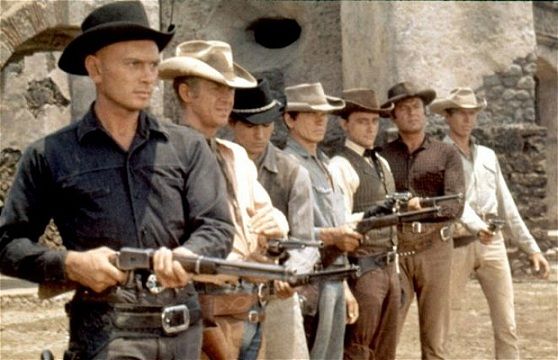
Here we have the 1960 film called The Magnificent Seven which is actually a remake of a film I posted earlier called The Seven Samurai. However, this is a rough idea how you’d expect most guys to dress in westerns though I’ll say that contrary to attire, Yul Brynner isn’t the bad guy in this. Yet, you can see how common it is for guys to dress as cowboys in these movies and how often they carry weapons. Still, this doesn’t mean that men dressed like this in real life. Nevertheless, Kurosawa was pleased with this film since the guys making it asked for his blessing.

No western characters are more iconic than the gunslinger and the cowboy. However, in Westerns it’s sometimes hard to tell which is which except perhaps in dress but Hollywood usually doesn’t care one way or the other. Heck, in the Hollywood West, almost everyone wears cowboy hats or looks like a cowboy anyway. In Hollywood, the Wild West is a violent place where robberies and shootings are common place. Saloons were places where even the smallest indiscretion could blow up in an all out gunfight and were regular hangouts for perky little prostitutes. Businessmen were ruthless and the Pinkertons were mercenary thugs. Cowboys roamed the range care free of troubles in civilization and sang songs to their doagies at the campfire. Also, in movie westerns, livestock and horses never took a dump where they weren’t supposed to and the dirt streets were always clean and dusty. Everyone wore clean cut clothes and whenever a bad guy would be terrorizing the town, there was always a lone champion to thwart the bad guys or kill them all. And everyone was white. But was it really like that? The answer is not really but you know how Hollywood tends to white wash and make shit up. Still, here are some movie western inaccuracies I will list accordingly.

Geography:

Oklahoma City was around in 1881. (It was founded in 1889.)

Dodge City was a territorial town in 1881. (It’s in Kansas which had been a state since 1861.)

Deadwood was a boom town right after the American Civil War. (It was established as one 11 years after.)

Cowboys:

All cowboys were white and native born Americans as well as straight. (Actually while there were white native born cowboys, they were all native born or even white. In fact, there were significant numbers of cowboys who were black, Mexican, and Native American. Some were even from other countries. Oh, not to mention, though cowboy culture is known to be deeply homophobic {in the same way football is}, there were plenty of cowboys who were gay like in Brokeback Mountain and were drawn to the frontier because of their sexual orientation. There were also cowboys in places outside the United States such as in Canada, Mexico, Australia, and South America as well as other countries. And most of our cowboy culture came from the Spanish equestrian tradition which they got from the Muslims.)

In the West, the term cowboy wasn’t a job description. (Actually there were cowboys who do what cowboys were said to have done which was to supervise a cattle train to Nebraska on the cattle’s journey to the Chicago slaughterhouses.)

Cowboys worked alone. (I’m sorry but the archetype of the lone cowboy just doesn’t exist because they usually traveled in groups of drovers. Also, you can’t have one cowboy on a cattle drive without cooperation of other cowboys and horses.)

Only men were cowboys. (Most of them were men. Yet, women did disguise themselves and worked as cowhands. Women who lived on ranches also worked as hard as their husbands as well as learned to rope, brand, ride as well as cook and entertain.)

Cowboys were skilled marksmen. (Typical cowboys used lariats to show the cattle who’s boss not a gun. Guns were used on rustlers, hostile Indians or farmers. Still, they didn’t carry guns a lot because they were heavy.)

Cowboys were large people. (Most of the time, they were smaller than according to legend and wouldn’t be big hunks like John Wayne because their horses would complain. Most of your actors who played cowboys wouldn’t be one in real life. Large people were too heavy to ride mustangs.)

Cowboys would ride their favorite horses all day. (They’d ride a string of horses depending on what task was at hand. Mild horses were used at night while quick horses were used for cattle and tending.)

Cowboys were always fighting Indians. (Battles between cowboys and Indians were rare. Actually, he’d more likely be working with Indians than fighting them since many of them were Indians as well. Not to mention, most Indians would let cowboys cross their lands for a fee.)

Cowboys were old fighting men and experienced wranglers. (Many of them were teenagers and young men in their early twenties who learned while on the job. Most of them weren’t married and usually quit by the time they did or by their early 30s.)

A cowboy’s life was easy. (They had a 24/7 job and earned about $25 a month. Also, they didn’t discover the west but maintained it.)

Cowboys had fine clean clothes. (They usually dressed in hand-me-downs and other scrap pieces of clothing. Also, they probably wouldn’t have the best hygiene. Still, most of them wore clothes for function, not effect.)

Cowboys were able to build their own cattle fortunes while working with generous ranch owners who may give some of his cattle and give them a different brand. (From the Carter Museum: “Cowboys actually were not working for generous ranch owners. Instead, they probably worked for a corporation or absentee owner who was back East or in Europe. Additionally, cowhands were supervised by a ranch foreman. Most owners did not allow a cowboy to carry a different brand for themselves. One foreman hung two of his companions for “mavericking” (taking the owner’s unbranded cattle).” )

Cowboys rescued maidens from bandits in their spare time. (These guys were working 10-18 hour days and their jobs were difficult, dirty, and required great physical strength. They probably more likely spent their time singing songs at the campfire, boozing and whoring at saloons, sleeping, or eating baked beans. Actually the farting scene in Blazing Saddles is a more accurate picture of what cowboys might be doing in their spare time than in a lot of westerns.)

Firearms:

There were no gun free zones in the West. (Many towns west of the Mississippi had laws against carry weapons. Most gunfighters would usually keep their weapons out of sight. Of course, most people did have guns in the West and were ready to use them.)

Gunfights were routine events. (They were very rare as well as few and far between. When they did happen several shots were usually fired and onlookers were often hit. Not to mention, no one actually knew who won the fight until several minutes after the gunshots since it took a while for the smoke to clear.)

The gunman who was fast on the trigger usually one. (It was usually the guy with the cool head and more accurate shot. Being a fast shot was rather risky and most people known for that wouldn’t get in gun fights at all. Also, it wasn’t uncommon for a gunman to shoot his opponent at the most opportune point whether if he got on a drop of his enemy, if he was unarmed, or even if it meant shooting him in the back.)

Shots fired in Westerns that do not hit a character always ricochet loudly.

A shoot out scene can last for over five to ten minutes before anyone fires a shot and that time usually consists of mostly staring at each other intently.

Shootouts and brawls could happen anywhere at any time but they usually occurred in saloons.

Saloons usually kept undocumented workers on tap to clean after the place was shot to tethers.

Gunfights in the Old West lasted for 5 to 10 minutes. (The Gunfight at the OK Corral lasted for 30 seconds.)

Pistol belts were permanently positioned with the holster on the right side. (From Imdb: “Actual gun belts of the period slipped through a loop on the back of the holster, which allowed the holster to be positioned anywhere along the belt’s length.”)

Gunfighters always got drawn into a showdown. (He’d usually wait until they odds were in his favor and then draw.)

Most shootings took place between professional gunfighters. (They were usually among cowhands, businessmen, farmers, drifters, outlaws, lawmen, or guys under the influence of alcohol and were certainly not professional gunmen. Oh, and most gunfights weren’t about noble stuff like defending a woman’s honor or their reputations. It was mostly pertaining to stuff like outlaws confronted by lawmen, range wars, or family or political feuds. If a gunfighter was challenged over reputation, then it was usually by a young gun wanting to make a name for himself.)

Gunfighters usually challenged each other in the streets. (If they tried, the law would be there to prevent them from doing so.)

Heroines:

Calamity Jane:

Calamity Jane was an attractive woman who wore a dress. (She was butch and often dressed in men’s clothing that she was often mistaken for a man. Looked more like k.d. lang than Doris Day or Jane Russell. Unlike lang, she was straight as far as I know. Still, much of Calamity Jane’s story may have been embellished.)

Calamity Jane was present at Wild Bill Hickock’s assassination. (She was being held by the military authorities at the time. Also, she was said to arrive in Deadwood with Wild Bill and Charlie Utter around 1876, other than meeting Hickock himself there.)

Annie Oakley:

Annie Oakley gave up her shooting career to marry Frank Butler. (Actually marrying Frank Butler made her career as a sharpshooter for he was the one who discovered her and lost to her in a shooting contest. He was also very supportive of her career as well as gave up his career to be her manager. She wasn’t as much of a feminist as she is portrayed to be and did needlework in her spare time. Also, it was acceptable for women to use guns in the West.)

Annie Oakley shot the cigarette out of the mouth of Kaiser Wilhelm. (She shot it from his hand. It would’ve been too dangerous to shoot it out of his mouth.)

Annie Oakley was blond. (She was brunette. Nor was she brash either.)

Belle Starr:

Belle Starr was very attractive. (Photos show her as a frumpy matron. Still, she died at 40 and was just plain vicious. Yet, she’s played by Gene Tierney and Jane Russell.)

Sam Starr was Belle Starr’s first husband. (He was her second and he wasn’t a Confederate captain either. He was probably the love of her life though.)

Belle Starr was a woman crusading against Yankee and political injustice. (She was just a crook with a long history of marrying crooks who got themselves shot. Also, she may have been killed by her own son.)

Western Life:

The Union Pacific Railroad used wood burning locomotives. (They used coal burning locomotives. The Central Pacific Railroad used wood burning locomotives.)

Western bad guys always wore black hats.

Martha Earp was a young woman in the 1860s. (She died at 10 in 1856.)

There were no African Americans in the old west. (Actually, this is pure bullshit. Of course, there were African Americans in the old west and lots of them at that like thousands, many of them ex-slaves. There were black cowboys, soldiers, farmers, Buffalo soldiers, ranch hands, railroad workers, and what not. And it was home to people like Tomahawk Beckworth, Nat Love, Cherokee Bill, John Henry, Lucy Parsons, Stagecoach Mary Fields as well as others {Bet you didn’t hear of them, me neither with the exception of John Henry}. As inaccurate as Django Unchained and Blazing Saddles are, at least both films get the concept that there were African Americans in the west that are probably the most unrepresented demographic in western movies. Also, I’d like to include classic movies like The Oxbow Incident and Duel in the Sun. Not to mention, about 5,000 to 15,000 cowboys were said to be black.)

Every Western township is immaculately clean despite a person’s sweaty, weary, and dusty appearance. (As TV Tropes and Idioms says, “Horse dung, mud and flies, patched and ragged wooden buildings, straw on the pub floors to absorb spittle and spilled drinks and occasional drunken vomit were the norm rather than exception.”)

Almost every guy dressed as a cowboy in the Old West that sometimes cowboys, ranchers, drifters, gunfighters, outlaws, gamblers, and lawmen were sometimes hard to distinguish.

Everyone in the Old West believed in traditional values and lived their lives in traditional roles. (Despite the fact that Wyoming was one of the first places in the world to give women the right to vote, also the West also gave women some other rights they didn’t have in the east such as joint property ownership. Not to mention, western women actually did tasks that went outside their gender roles both inside and outside the house. Also, not all women in the West were housewives, schoolmarms, showgirls, servants, or prostitutes either. Not to mention, many freed slaves went West to get away from the Southern sharecropping lifestyle as well.)

Everyone in the typical western town had one church and everyone belonged to that congregation or at least all the white people did. (As of today, most towns had multiple churches for multiple denominations. And as for the Catholic ones, some of them were there before any white American settler stepped foot.)

Settlers headed West carrying their belongings in Conestoga wagons. (Filmmakers usually use Conestoga wagons in movies is because they looked better. Settlers actually used prairie schooners.)

It was businessmen who announced of finding gold in the Black Hills of South Dakota, which violated the Treaty of Fort Laramie with a gold rush and provoked a Sioux War. (George Armstrong Custer did this.)

Mountain men far from civilization usually couldn’t speak in any comprehensive form of English even though everyone understood them.

Cowboy hats were common headwear for men in the West.

Saloons had swinging butterfly doors.

Wanted posters displayed pictures of criminals. (Most wanted posters in the 1860s and 1870s were just handbills with a plain verbal description.)

The Pony Express was the primary postal service in the American West. (Only between 1860 and 1861. Oh, and it only went from Saint Louis to Sacramento.)

Homesteaders always built log cabins on the plains. (Due to lack of trees and lumber, most of their houses were made out of sod and dirt. Seriously, they must’ve taken their wood with them.)

Western towns always had glass windows. (Pane glass was very expensive at the time and wouldn’t be mass produced until the 20th century.)

Most Western miners were white and usually mined gold or silver. (Many of them were Chinese or Hispanic and some blacks served as cooks. But, yes, a lot of miners were poor white men. Other metals were zinc, copper, and lead.)

The Old West was an incredibly violent place. (Well, probably more violent than your average suburban neighborhood where your chances of being killed were 41 to 1 each year. However, it’s probably the same rate as people being murdered in inner-city Baltimore or on The Wire. Not very great odds, sure, but that’s nothing compared to how many people are killed in Spaghetti westerns or Sam Peckinpah movies. Still, you were more likely to die in the West from cholera, dysentery, tuberculosis, or in an accident than by violence. Your average Western town only had 1.5 murders a year, which is a disappointing number for many Hollywood directors.)

Prostitutes were always attractive women who always had hearts of gold. (Old West prostitution was just as traumatic, degrading, and exploitative as it is today.)

Frontier prostitutes had a glamorous lifestyle and could move up in the world. (High levels of suicide, rape, addiction, and violence were common among prostitutes. Also, brothels were seen as poverty traps that forced girls into never ending competition with one another for enough scraps to eat with no hope of escape. Most of the time prostitution was a profession for women with no other options and was about as glamorous as a week in the ditch. Though there were madams who got rich off it and rose to positions of power. Yet, this wasn’t the same for most prostitutes even in the West.)

Most of the West was desert and canyons. (There are a lot of forests in the Pacific Northwest as well as in places like Colorado. There are also grass prairies and plains.)

The Old West was a violent place. (It had about the same murder rate as inner city Baltimore today. This means that a big frontier settlement could expect an average of 5 homicides per year.)

Sarsaparilla was a popular western drink. (It was used as a medicine for VD. Remember that when some cowboy orders it.)

Tumbleweed was a plant in the American West. (It’s a European plant that wasn’t recorded in the US until 1877.)

People rode on the same horse all over the frontier during long distances. (Those traveling long distance would usually try to go by train or stage coach and rent a horse in the next town. Of course, westerns aren’t the only films that do this since it’s endemic in a lot of historical films sometimes justified and sometimes not. Still, switching horses during long distance traveling was quite common in history.)

History of the World According to the Movies: Part 43 – The American West: Outlaws and Lawmen

Image

You’re probably asking me, “who are these guys?” Yet, many would remember the 1969 film Butch Cassidy and the Sundance Kid which starred Paul Newman and Robert Redford respectively. Of course, this movie isn’t the most accurate story about them but it ain’t boring and usually skips some of the dull parts about their lives anyway. Also, Newman and Redford were at the peak of hotness in their days (especially Redford since he hasn’t aged well). Still, if you want to know what happened to them, read this post but it won’t be pretty.

Of course, Indians and soldiers weren’t the only ones becoming legends in the Old West. It was a time of outlaws, gunfighters, and lawmen like Billy the Kid, Jesse James, Butch Cassidy and the Sundance Kid, and Wyatt Earp. Sure Hollywood has made movies about these legends time after time and we just can’t get enough of them. You can say they were the rock stars of their day and have somehow made it into the American folklore. Many of us have even grew up with these movies. However, in westerns, we seem to get the impression that the Old West was more crime ridden and violent than it really was. We think that banks were prime targets for robbers and that outlaws tend to terrorize towns on daily basis. We think that the local sheriff was either the muscle of law and order or just an incompetent prick. Still, the reality wasn’t so simple and sometimes lawmen and criminals weren’t the people you’d think they be. And while there was violence, it tends to be greatly exaggerated in westerns even in the Old Hollywood times (From the Waco Kid in Blazing Saddles: “I must’ve killed more men than Cecil B. de Mille.”) and it’s sometimes really exaggerated in Sam Peckinpah films (very few movie characters are known to survive his films). Nevertheless, these movies have plenty of inaccuracies which I shall list accordingly.

Outlaws:

Outlaws ruled the West and those who came to Arizona via South would have been shot on sight.

Bank robberies were common in Western towns. (Though most of them usually got caught since banks were usually not too far from the sheriff’s office. Actually stagecoaches and trains were more common targets while outlaws would consider robbing a bank a suicide mission. Butch Cassidy and his gang were among the very few successful bank robbers in the Old West but they only robbed two.)

Train robberies happened all the time and they were awesome. (They only happened for a short period of time and more often in the East than in the West. Oh, and they’d rarely get away with the crime. From History Banter: “When outlaws robbed trains in the West, they would most often board the train like any other passenger and when the train reached a designated point, they pulled out guns, demanded that passengers hand over all their valuables, and then they rode horses that their accomplices had stashed by the side of the train tracks. Outlaws would also rob trains by simply ripping up train tracks. When the train screeched to a halt, the bandits would board and go about their thieving business. There were no instances of outlaws leaping off their horses to board moving trains. It just didn’t happen.” However, soon railroad companies Pinkertons to protect train shipments which were people you didn’t want to mess with since they tend to kill train robbers in the Old West 99% of the time.)

Jack McCall:

Jack McCall worked as a hired gunman. (He worked alone. Also, his reason for killing Wild Bill Hickock is thought to be either being embarrassed by his victim paying for breakfast that morning or being paid to do it by the gamblers frightened that Hickock might become Deadwood’s sheriff.)

Jesse James:

Jesse James was the Robin Hood of the West. (All the booty he took was mostly for himself and his gang. Also, he was racist, mentally unstable, sadistic, and brutal and was said to kill seventeen men without remorse. However, as an ex-Confederate, he seems to have a Freudian excuse since many of them weren’t accepted back in American society during Reconstruction. Still, he should’ve quit when his brother thought it was a good idea. From American Experience: “A teenager when he rode off to join Confederate guerrillas in 1864, Jesse James never really stopped fighting the Civil War. Unable to accept the defeat of the secessionist cause, Jesse trained his fury on banks, trains and stagecoaches. He fancied himself a modern Robin Hood, robbing from Radical Republicans and giving to the poor. But the myth hid the darker reality of a repeat murderer whose need for attention kept him committing crimes long after the cause he championed was gone.”)

Zerelda James was killed by a bomb from federal agents. (Jesse’s younger half-brother was but she lost an arm. However, she outlived Jesse by decades and died at 92.)

Jesse James was a gunfighter. (His victims were almost always unarmed.)

Frank and Jesse James waited four years to go on a crime spree after the Civil War. (Their first crime happened on February 1866, less than a year after the war.)

Jesse James was a Wild West outlaw. (His operations usually took place in Missouri and he never really went west.)

The expansion of railroads caused Frank and Jesse James to become outlaws. (There were never plans for railroads to come any place close to the James farm or any other neighboring farm. Also, we kind of know that their reason to turn to crime was more out of vengeance for Confederate defeat in the Civil War.)

Jesse James had a relatively peaceful childhood. (From the LA Times: “The truth is that at 15 years of age he was beaten by ropes and horsewhips by the Kansas Jayhawker federal militia and watched as his stepfather was hung on the James farm, in part because they were Southern sympathizers.”)

James-Younger Gang:

Archie Clement was a member of the James-Younger Gang. (It’s alleged he was but he wasn’t. However, he never stopped raiding after the Civil War and was gunned down in 1866 by militia in Lexington, Missouri.)

Bob Younger died in the Northfield raid. (He and his brothers Cole and Jim were captured and given a life sentence. Bob died of TB in prison.)

The James and Youngers were cousins. (They weren’t related to each other. They just served in the Quantrill’s Raiders’ regiment together in the Civil War.)

The James Gang hid out in caves. (As Frank James put it, “Jesse and I never went into any place that didn’t have a back door.”)

The James Gang didn’t have a hideout in Texas. (From the L. A. Times: “In truth they did have such a hideout which they called “Peace Ranch,” known by the Texans as “James Hollow.””)

The Wild Bunch:

Butch Cassidy and the Sundance Kid were involved in the Wilcox Train Robbery of 1899 and the Tipton Train Robbery of 1900. (It’s unclear whether they were involved in either.)

Butch Cassidy and the Sundance Kid went to Bolivia straight from the US, where they continued to rob banks as before. (Actually they went to Argentina and had a ranch there before going to Bolivia where they went straight and led respectable lives. But the Pinkertons caught up with them so they went to Bolivia. They may have robbed a bank there, but we’re not sure. Still, it would’ve been more accurate in Butch Cassidy and the Sundance Kid if the two leads discussed going to Argentina, instead of Bolivia. But their lives at Argentina would be boring so Bolivia it is.)

We’re not sure what happened to Butch Cassidy and the Sundance Kid after San Vicente. (They actually opened fire from a house and were surrounded by the Bolivian army cavalry. However, it’s very likely that Butch and Sundance actually ended up killing themselves, according to a PBS documentary.)

Butch Cassidy and the Sundance Kid were members of the Hole-in-the-Wall Gang. (They were called the Wild Bunch and the Hole-in-the-Wall was a meeting place. However, The Wild Bunch is actually a title of a Sam Peckinpah kill em’ all western so we’ll let it slide.)

Butch Cassidy and the Sundance Kid killed a lot of people during their life of crime. (Butch had only killed a few people in his entire life while Sundance didn’t kill anyone.)

Charles Woodcock tried to resist the Wild Bunch twice. (Yes, he was a real guy and actually did run afoul of Butch Cassidy’s Wild Bunch. However, the second time, he just let the robbers in and abandoned his capitalist heroics.)

Marshal Joe Lefors and an Indian scout named Lord Baltimore were charged with hunting down Butch Cassidy’s Wild Bunch Gang with a long, inescapable pursuit across the west. (E. H. Harriman actually hired the Pinkerton Detective Agency to hunt down the Wild Bunch. Also, Lord Baltimore didn’t exist though Lefors was part of a posse. However, Butch Cassidy easily evaded the posse.)

Etta Place was a school teacher. (She may be Sundance’s girlfriend {or wife} who accompanied him and Butch to South America, but we’re not sure who she actually was. She may have been a school teacher, but she could’ve been a prostitute for all we know. Her name was probably Etta but Place is probably not her real surname. Still, we don’t know what happened to her since she vanishes after 1909.)

Billy the Kid:

Billy the Kid committed his first murder at 12 and went on to kill over twenty people before turning 21. (He committed his first murder at 18 and he only killed 8 men in his entire life {well, he at least killed four [mostly while escaping from jail and in self-defense] and was involved in four others}. Not to mention, Billy didn’t become an outlaw until he was in his late teens after he was arrested on charges that may have been botched. Also, he was willing to go straight whenever given the chance, was loyal to people who’ve been good to him, and only led a life of crime due to mitigating circumstances beyond his control.)

Billy the Kid’s girlfriend was white. (She was Mexican. Her name was Paulita Maxwell.)

Billy the Kid was a young raging psychopath. (Unlike many outlaws in the West or in history, he was anything but. But, yes he was violent, but most of his victims were armed. Still, he was more of a cattle rustler and horse thief when he absolutely needed to and wouldn’t really rob banks or trains.)

Billy the Kid lived in Tombstone in 1881. (He spent the last years of his life in New Mexico. Actually he spent a lot of his life in New Mexico.)

Billy the Kid was from Texas. (We’re not sure where he’s from though it said he was born in New York.)

Billy the Kid was born William Bonney. (He was born Henry McCarty yet he used William Bonny as an alias as well as Kid Antrim.)

Billy the Kid was killed by Sheriff Pat Garrett as a suicide by cop scenario. (It wasn’t a suicide by cop scenario since Billy was shot in the back and had no idea Pat Garrett was in the same area. His last words were, “Quien es? Quien es?” {Spanish for “Who’s that?”}. Also, he was perfectly fine with fame and fortune.)

Billy the Kid was left handed. (He was right handed. Yet, he’s known as The Left-Handed Gun in the movie where Paul Newman plays him.)

Billy the Kid killed Buckshot Roberts in 1880. (Roberts was killed in 1878 by Charley Bowdre a member of his gang.)

Lawmen:

Western lawmen had shiny metal badges. (Not until 1874. They also didn’t wear uniforms either.)

Western sheriffs were honest and law abiding men who brought law and order into towns. (It wasn’t unusual for 19th century law men to be former criminals. Cue to the Western town scene in Django Unchained when King Shultz shoots the sheriff and then asks for the marshal. From Balladeer’s Blog: “Lawmen were often corrupt out west, behaving more like redneck sheriffs in the south do. Hickok was no different. Wearing a badge AND owning a saloon, as Wild Bill often did,  meant you could ruthlessly enforce the laws against your competitors but overlook your own establishment’s violations. However, in general that and acceptance of bribes marked the extent of his dishonesty.” The Earps weren’t that much different either.)

Tom Cotton was sheriff in Cochise County, AZ in 1881. (Johnny Behan was the Cochise County sheriff at the time. Wyatt Earp would later steal his girlfriend Josephine Marcus. Cotton is a fictional character and so is Jimmy Bryan.)

Allen Pinkerton was involved in shootouts by the James-Younger Gang and was robbed by them. (He was never personally involved in the James-Younger shootouts nor robbed by them.)

The Earp Brothers:

Wyatt Earp followed his dad as patriarch of his family as he built the west. (Virgil was more of the patriarch than Wyatt. Wyatt was just the one who tried to get revenge on his brothers being maimed and killed.)

Wyatt Earp and Doc Holliday were the best of buds. (This is disputed since some say Doc was actually closer to Wyatt’s brother Morgan who was the same age as he was. Morgan’s death might’ve been a motivating factor for him to join Wyatt on a series of revenge killings and would explain of their separation not long after.)

Wyatt Earp first met Doc Holliday in Tombstone. (They met years earlier at Fort Griffin, Texas.)

Wyatt Earp was at the O. K. Corral gunfight all by himself. (He was with his brothers Virgil and Morgan as well as Doc Holliday. Unlike in Frontier Marshal which gets a lot of things wrong about Wyatt Earp most movies get right.)

Wyatt Earp and Doc Holliday were getting up in years by 1878. (Wyatt was 30 at the time while Doc was 27. Also, Doc died at 36. At least they got the bit about them fooling with prostitutes in Cheyenne Autumn, though they were played by Jimmy Stewart and Arthur Kennedy who were way too old to play them.)

Wyatt Earp drank whiskey on a regular basis. (According to his wife Josephine, he rarely drank alcohol.)

James Earp was the youngest Earp brother who was killed in Tombstone. (He was the oldest {if you don’t count older half-brother Newton Earp} and he wasn’t involved in any of the events pertaining to the gunfight at the O. K. Corral. He was actually a saloon keeper minding his own business who died in 1926 at the young age of 84 of totally natural causes. However, in movies, he usually gets killed at a tender young age even though he was a middle aged bald guy with a mustache and goatee at the time and married to a former prostitute and madam. Still, the only Earp brother who was killed in Tombstone was Morgan and that was after the gunfight at the O. K. Corral, which sparked the Earp Vendetta Ride where Wyatt and Warren Earp along with Doc Holliday and others would seek vengeance on the Cowboys.)

Wyatt Earp was always fond of wholesome Christian women. (Maybe but he wasn’t too picky since his second wife was a prostitute {and they lived in a common law marriage for 8 years} who accompanied Wyatt to Tombstone whom he sent away to his family in order to get her away from opiates. His third wife was a showgirl {and maybe a former prostitute} who’d been living with the Cochise County sheriff when she met him. Oh, and did I say she was Jewish? Also, there’s no wonder why hostile ranchers called the Earp brothers, “fighting pimps.” However, in movies, only Doc Holliday gets to be with his real life love interest {or at least someone of her profession like a Mexican whore in My Darling Clementine}, while Wyatt has to settle for some wholesome school teacher.)

None of the Earp brothers had mustaches. (All of the brothers had mustaches by the 1880s according to photographs. Doc Holliday had one, too. Yet, many movies the Earps and Doc are all clean shaven {well, Doc does get a mustache occasionally}.)

Wyatt Earp was the paragon of a Western lawman. (He was much shadier and self-interested than how he was mostly portrayed. He was a sometime lawman but a full time gambler, confidence man, and associate for prostitutes and pimps.)

Wyatt Earp’s wife Urilla Sutherland died of typhoid a year into their marriage during the middle stages in pregnancy. (She was ill but it’s suggested she might’ve died in childbirth.)

After losing his wife, Wyatt Earp drank up a bottle of booze on his front lawn and made the rest into a Molotov cocktail in which he threw into his own window burning his house. (He actually just sold the land he and Urilla had purchased. Also, who names their daughter Urilla?)

Wyatt Earp got the job of lawman in Wichita, Kansas by apprehending someone or in a shoot out. (It’s more likely he was recruited by the Witchita marshal who asked him nicely to join up.)

Wyatt Earp was a frontier marshal before the famous gunfight at the O. K. Corral. (In Tombstone, he had little, if any, legal authority and him and Morgan usually made their living riding shotgun in stagecoaches. Actually he was never a marshal in Tombstone period. However, his brother Virgil was the marshal though and he deputized Morgan and Wyatt minutes before the O. K. Corral gunfight.)

The Earps and Doc Holliday survived the O. K. Corral gunfight without a scratch. (Wyatt did. However, Virgil and Morgan were wounded while Doc Holliday was grazed with a bullet.)

Virgil Earp was a nice quiet family man during his time at Tombstone. (His genealogical profile states that he had a daughter in the 1860s who wasn’t in his life much until she was already married with kids in 1898 after she wrote a letter to him. His first wife had spent years thinking he was killed in the American Civil War until that time. In Tombstone, he was residing with his live-in girlfriend Allie Sullivan. He also had a legal wife but nothing is known about her. Only half-brother Newton Earp seems to be the family man of this bunch and he wasn’t even in Tombstone.)

Around the time of the O. K. Corral gunfight James Earp was a teenager, Virgil Earp was in his twenties, Wyatt Earp was thirty, and Morgan Earp was in his thirties. (Actually James was 40, Virgil was 38, Wyatt was 33, and Morgan was 30. Thus, what the hell My Darling Clementine?)

Virgil Earp was killed by being shot in the back by “Old Man” Clanton. (For one, “Old Man” Clanton was dead before the O. K. Corral gunfight. Second, while Virgil was shot in an ambush, he actually survived until 1905 but he never recovered from his wound in his left arm. Third, he died of pneumonia at 57.)

Virgil, Wyatt, and Morgan Earp all arrived in Tombstone together. (Wyatt, Virgil , and James Earp would arrive together. Morgan was on his way while youngest brother Warren would soon follow. In Tombstone, James and Warren weren’t there at all.)

Virgil and Morgan Earp were ambushed the same night. (Virgil was ambushed in December 1881 while Morgan was killed in March 1882. That’s a few month difference.)

Virgil Earp hit Ike Clanton over the head with the butt of his gun in a saloon after the latter made threats against the Earps. (This is mostly true except that it took place on a street outside and Wyatt struck Ike Clanton across the mouth with his Smith & Wesson leaving a small gouge on the lower left side of his gun barrel {presumably from one of Ike’s teeth}. Also, unlike what Tombstone says, there was no shooting in Fly’s photography studio or at a Mexican wedding. Not to mention, the Cowboys didn’t shoot up any of the Earp wives or anyone else’s.)

Doc Holliday and the Earp brothers cleaned up Tombstone. (From Baladeer’s Blog: “Doc and the Earps were also a crime faction running some gambling and prostitution in Tombstone. They were the upstarts to the established Clantons and McClaureys who also controlled rustling and political graft in the area. The Holliday- Earp faction DID win the gunfight at the OK Corral and made headlines with the gangland- style executions of several of their enemies after Morgan Earp was killed. However, the Clanton faction won in the end, with Doc and the Earps fleeing Arizona Territory. It’s fun watching how badly movies twist the facts to present Doc and company as the victors of that gang war.”)

Doc Holliday:

Doc Holliday was the only doctor in Tombstone, Arizona during the gunfight at the OK Corral. He was also from Boston. (For one, he was a Georgian dentist who had given up his practice mostly due to him having tuberculosis and a cough so bad that nobody would be his patient. And he was from Georgia not Boston. Also, he died six years after the gunfight of TB in Colorado which he had been suffering for years. Not to mention, Tombstone already had a full-time surgeon to tend to all gun-shot related needs. Too bad for the Clantons though.)

Doc Holliday was shot dead by Curly Bill Brocius right before the showdown at the O. K. Corral who in turn was killed by his girlfriend Jerry. (What the hell, Frontier Marshal? Kill a household legend just before the showdown that made him famous was about to take place? Still, Doc Holliday died in 1887 while Brocius would get gunned down by Wyatt Earp several days after the O. K. Corral gunfight. Not to mention, Brocius wasn’t at the gunfight. Also, Doc’s girlfriend was Big-Nosed Kate or Mary Katherine Horony. However, she did use Elder and Fisher as aliases.)

Doc Holliday killed Johnny Ringo. (Ringo more likely killed himself. If not, then Wyatt Earp probably did.)

Doc Holliday was a fine lawmen in the West. (According to Balladeer’s Blog: “Doc was more like a western gangster than a lawman. When Holliday was jailed for tampering with a horserace in Denver after fleeing Arizona, a newspaper war broke out over the controversial figure, who was in danger of being extradited to Arizona Territory where his old enemies could easily engineer his death in prison. Doc naturally cooperated with the anti- extradition newspapers pushing him as a heroic lawman figure against the pro- extradition newspapers depicting him as a criminal. Many myths about Doc Holliday, especially about him being a lawman, had their origin in this outrageous tabloid war. “)

Pat Garrett:

Pat Garrett was clean shaven and dressed in rags. (Photos show him as a dashing man in a mustache wearing a three piece suit.)

Pat Garrett’s middle name started with a J. (His middle name was Floyd.)

Wild Bill Hickock:

Wild Bill Hickock was killed before the Battle of Little Big Horn. (He was shot two months after the battle took place. I’m sure Dustin Hoffman seemed to have some memory problems as a 120 year old man in Little Big Man.)

Wild Bill Hickock and Calamity Jane were romantically involved. (There’s no evidence to this though Jane did claim they were married. Also, at the time of death Bill was married to a 50 year old circus proprietor.)

Wild Bill Hickock was a marshal of Dodge City. (Other Kansas locales, sure, but never Dodge City. However, Dodge City has always been the default western town for Kansas.)

Lincoln County War:

John Tunstall:

John Tunstall was a fatherly old man who was murdered in 1878. (He was killed at 25. Still, he wasn’t a father figure to his cowhands nor was he a better person than his rival Murphy. Also, it was Murphy’s partner James Dolan who probably ordered his assassination, not Murphy.)

Lawrence Murphy:

Lawrence Murphy was involved in the Lincoln County War. (He had already sold his interest in the company of his partners Dolan and Riley who renamed it as the Jas. J. Dolan & Co. Murphy and was based in Santa Fe. Murphy may have been the main instigator of the Lincoln County War but he was battling bowel cancer since 1877 and wasn’t involved in the day to day activities. He’d die in October of 1878.)

John Kinney and Lawrence Murphy died at McSween’s house. (Lawrence Murphy died of cancer in 1878 and would’ve never been present at the McSween house. John Kinney was shot in the face by Billy the Kid but he survived another 40 years after the incident. Thus, Billy the Kid could never have killed either.)

Doc Scurlock:

Doc Scurlock had a romance with Lawrence Murphy’s Chinese sex slave, Yen Sun around the time of the Lincoln County War. (He had been married for two years by this point to Maria Miguela Herrera. He’d later have 10 children with her.)

Buckshot Roberts:

Buckshot Roberts’ job was to hunt down the Regulators and boy, was he evil. (Unlike his portrayal in Young Guns, he didn’t try to hunt them down. Rather he was just in town trying to collect his dues and leave when the Regulators ambushed him. He died the day after the showdown from a gunshot wound to his chest.)

Tombstone:

Tombstone, Arizona was a rowdy cow town with a lot of new wooden buildings in 1879. (It was a mining boom town in the early stages of development with a few wooden buildings. However, these were outnumbered by many adobe ones which were outnumbered by tents.)

Tombstone was in Cochise County in 1879. (It was part of Prima County until it was gerrymandered in Cochise County in 1881.)

Gunfight at the O. K. Corral:

The gunfight at the O. K. Corral lasted for 6 minutes and a medium range, heavily armed shootout. (It was a 30 second face-to-face affair involving few firearms. It also took place at 3 in the afternoon, not at dawn.)

All six Clantons were killed in the gunfight at the O. K. Corral. (Only three people died which included Billy Clanton as well as Tom and Frank McLaury. At least one of them was killed by Doc Holliday. Ike Clanton and Billy Claiborne ran unarmed before the shooting started. Ike Clanton brought murder charges against the Earps and Doc Holliday. According to Wikipedia: “The Cowboys claimed the Earps had killed the outlaws as they attempted to surrender. During the Spicer hearing, the coroner and witnesses presented conflicting evidence about whether the Cowboys had their hands in the air or guns in their hands or were trying to draw their weapon when the fighting started.” Spicer ruled that the lawmen had acted within their authority. Ike Clanton would be killed by a detective in Springfield, AZ in 1887. )

The gunfight at the O. K. Corral took place inside the building and during a warm sunny day. (It actually took place on a vacant lot owned by CS Fly and on a cold overcast day with snow on the ground.)

Clanton Gang and Associates:

“Old Man” Clanton was killed at the O. K. Corral gunfight. (He died in August of 1881 which was before the gunfight.)

Billy Clanton was in his thirties when he participated in the O. K. Corral. (He was 19 at the time. In Tombstone, he’s played by 33 year old Thomas Haden Church. At least Dennis Hopper was a better choice in Gunfight at the O. K. Corral, though he may not have had a heart to heart conversation with Wyatt Earp.)

Fred White died the night he was shot. (He actually lived to testify against Curly Bill Boucis and died a couple days after the Iron Springs shootout. From Imdb: “it was his testimony that the shooting was accidental that led to the freeing of “Curly” Bill, not a “lack of witnesses” as Tombstone depicts.”)

Johnny Ringo was killed at the O. K. Corral gunfight. (He wasn’t. Also, it’s said he later killed himself.)

Johnny Ringo was a remorseless killer. (Contrary to his portrayal in Tombstone, historical research could only point to him committing one murder. At one point in his life, he even served as a town marshal and all accounts said he was a conscientious and efficient lawman.)

Ike and Billy Clanton had a brother named Sam. (There was never a Clanton brother named Sam. They did have a brother named Phin but he wasn’t at the O. K. Corral gunfight and died in 1905.)

Curly Bill Brocius and Johnny Ringo were the leaders of the Cowboys prior to the Earps’ arrival in Tombstone. (“Old Man” Clanton was until his death, during a rustling expedition into Mexico, about 1-1/2 years after the Earps arrived. Brocius and Ringo were just members of the Clanton gang and nothing more.)

Earp Vendetta Ride:

Texas Jack Vermillion was part of Wyatt Earp’s Vendetta Ride before Frank Stillwell was killed. (He joined up a day after.)

27 Cowboys were killed on Earp’s Vendetta Ride. (Only 4 Cowboy deaths were officially recorded with actual numbers being between 8-15 total. Still, it wasn’t a number to boast about in the newspapers.)

Big Nose Kate:

Big Nose Kate had an American accent. (She was Hungarian and didn’t come to the United States until she was ten.)

Big Nose Kate burned down a building so she could free her jailed boyfriend Doc Holliday. (This is just a legend but she does burn down something in Gunfight at the O. K. Corral.)

Other:

Billy Breckenridge was a young man in 1881. (He was 35 at the time unlike his depiction in Tombstone.)

The Iron Springs shootout between Wyatt’s posse and Curly Bill Boucis’ gang was an ambush by the latter. (Unlike Tombstone depicts, the two parties almost met by accident with Earp and his men looking for water where Bill and his guys were camping at the time.)

Mattie Blaycock Earp died shortly after leaving Tombstone. (She actually met up with Big Nose Kate and lived another eight years. Also, she was a brunette not a blonde like in Tombstone. Still, there’s no evidence whether she was addicted to opium while in Tombstone either.)

History of the World According to the Movies: Part 42 – The American West: Indian Wars

Image

Kevin Costner’s 1990 Dances with Wolves is a film showing Native Americans in a more sympathetic light than in years previously as well as shows some of the landscapes of the Plains in breathtaking view. Still, let’s just say the Lakota speaking Sioux treat this as an unintentional comedy since Kevin Costner had no idea that there are separate male and female pronunciations and styles. Still, he probably would’ve done better if he hired a male and female Lakotah translator instead of just a female one. TTI states: “The overall effect for Lakotah-speaking audiences was a bunch of Klingon warriors talking like a ladies’ Saturday afternoon tea social.” Also, Plains Indian buffalo hunts go a lot differently than shown in the film and Pawnee should really sue for slander despite being the Sioux’s enemies.

The history of the American West has been one of the most filmed eras in American history. There have been countless films pertaining to the era of the untamed wilderness, savage Indian tribes, legendary outlaws, and all types of murder and mayhem starring the likes of John Wayne and Clint Eastwood. The American frontier in the 19th century has been the inspiration of many legends and myths that have lasted into the ages. Westerns have shaped our imagination what this period was like which usually contains beautiful scenery of canyons, mountains, desert, and other national park sites as well as lots and lots of violence. In some ways, it serves as part travelogue and part gorefest if its directed by Sergio Leone or Sam Peckinpah. Still, sometimes you may have cowboys as the good guys fighting against the influences of business and banditry. Sometimes you can’t tell the difference between the good or the bad. Still, westerns have played a very influential role in American culture which we can all identify. However, westerns tend to show the mythological image of the American West than the reality.

Of course, the relations between the white settlers and the Native Americans wouldn’t be a happy one. From the 1840s on, settlers have packed up and moved out West whether it was to California, Oregon, Utah, Kansas, or New Mexico. However, one problem was that there were already people living on the frontier over generations. Actually they had been living there for thousands of years but the white people didn’t give a shit and just settled down before driving the Indians from their ancestral homes onto the reservation. Well, at least the US government did as well as committed a series of human rights abuses that most Americans would like to forget. Nevertheless, the Indian Wars would give us legends like George Armstrong Custer, Sitting Bull, Geronimo, Cochise, Kit Carson, and Crazy Horse. In movies, Indians could be portrayed as the villains, victims, forces of nature, or others. The military could be seen as heroes or villains. Still, these movies do present their array of historical inaccuracies which I shall list accordingly.

Indians:

Indian attacks were a common site on wagon trains and stagecoaches. (Indians knew better than to attack stagecoaches and wagon trains. If they were present on wagon trains, their conduct was peaceful and they served as guides and traders. Attacking whites wasn’t good business.)

Indians surrounded covered wagons and rode around and around to allow the settlers to shoot them off their pretty dappled ponies. (This wouldn’t happen a lot because most Indians would never attack settlers on covered wagons. Nevertheless, Comanches were studied in European military schools because they were known to have the finest light cavalry in the world.)

Intermarrying was very frequent between Indians and white settlers but they strangely they simply didn’t seem to get along. (I’m just to alluding to the fact Native Americans in old western movies were played by white actors.)

All western Indians wear plains style costumes and love to don on the feather bonnet headdresses. (Actually, only high ranking Plains Indians wore the outfits.)

Whenever Indians weren’t attacking white settlers, they were either smoking a peace pipe or hunting buffalo. They may have also communicated using smoke signals and sign language yet always used a bow and arrow as weapons.

Indians usually scalped white settlers or tied them to a totem pole if captured. (Yes, Indians scalped people and we can’t dispute that. However, only the Pacific Northwest tribes had totem poles and they usually used them for very different purposes like clan identification and lineages, stories, or notable events. Sometimes they can be used as welcome signs, vessels to store remains of dead ancestors, or as a way to ridicule somebody. They were not used to tie prisoners.)

The Sioux referred to themselves as the Lakota. (No, they pretty much refer to themselves as the Sioux or Dakota, well sort of. Also, not all Sioux are Lakota.)

Plains:

Pawnee Indians would attack American settlements. (They were allies for the US government.)

In white man-Indian woman relationships, the Indian woman is usually an Indian princess who marries into the white man’s culture. (Not every Indian woman who married a white man was an Indian princess, which is a strictly European concept. Nor would most Indian princesses or other Indian women assimilate into the white man’s culture but in many cases the opposite would happen, especially in French Canada {Sacajawea’s marriage is a prime example of this}. Nor would marrying an Indian woman bring civilization to her people {though there were Indians who did convert to western ways like the Cherokee}. Rather it would end up leading to mass slaughter and destruction of a culture.)

The Cheyenne were an Indian tribe in the Rocky Mountains. (They were a Plains tribe.)

Crazy Horse and George Armstrong Custer met face to face. (They never met in person. Also, given Crazy Horse’s relative anonymity, it’s unlikely he would’ve been recognized had he been captured at Little Big Horn. Heck, this guy went to great lengths never to be photographed for God’s sake. Sitting Bull may have been more appropriate.)

Crazy Horse was willing to give all Indian lands to the whites except the Black Hills. (Crazy Horse would’ve made no such deal. Still, perhaps the least offensive thing about Crazy Horse’s character in They Died with Their Boots On is that he’s played by Anthony Quinn {a lot of Hispanics have indigenous ancestry and a lot of Native Americans are part white so his portrayal isn’t as offensive as it seems. I mean the guy’s Mexican and most likely had Native ancestry}.)

Sioux Indians could bring down a stampeding buffalo with single arrow shots. (Sorry, Kevin Costner, but bow hunting doesn’t work that way. In real life, the hunters would have to track the wounded animals, sometimes for miles, until they bled to death. This could take hours or days. Let’s just say that if Dances with Wolves depicted an actual Indian bison hunt, it would be pretty boring.)

Indians mostly used bows and arrows as a weapon of choice. (They used guns, too, and there 25 types of firearms found at Little Bighorn.)

The Sioux brought down stampeding buffalo with single arrow shots. (Sorry, Kevin Costner, but bow hunting doesn’t work this way. In reality, hunters would have to track the wounded animals, sometimes for miles, until they bled out.)

The Sioux weren’t familiar with the white man prior to the American Civil War. (Yes, they were. In fact, in 1862, the Dakota Sioux had fought whites in Western Minnesota with 800 whites dead and 38 Sioux hanged. Kicking Bird would’ve known about this.)

Indians would always constantly attack settlements as well as kidnap or kill white settlers. (Sometimes this would happen but not a whole lot. However, children who were kidnapped by Indians would usually be assimilated in the tribe within a year contrary to the Natalie Wood character in The Searchers {God, I hate that movie}. Perhaps that bastard John Wayne should’ve just left her with the Indians because she would’ve been able to shake off her Indian language and habits she had acquired over the last five years. Seriously, Natalie Wood probably wouldn’t have lived happily ever after.)

Indians terrorized whites for personal gratification and blood lust. (Usually it was more due to something like building a farm on their traditional hunting ground if it pertained to settlers in the case of Cynthia Ann Parker. Still, unlike Dances with Wolves, they wouldn’t usually adopt a white man into their tribe. Nevertheless, while Indians did raid settlements they were usually small farms where they didn’t stick around very long and Indian massacres on whites were the exception rather than the rule. Besides, Indians knew that raiding heavy populated areas was just asking for trouble.)

Indians were victims of ruthless whites. (Yes, this is true but to a point but they weren’t simply victims and were just as much authors of their own destiny who dealt in American expansion the way they thought would be best for their societies. According to History Banter: “After the Civil War, the United States actually adopted a peaceful policy in dealing with Plains Indians. There were only a 100 thousand or so of them remaining in 1865, little threat to a nation that had just fielded an army of over a million soldiers. So in an attempt to foster peace, the U.S. assigned Quakers to deal with Plains’ tribes…..Quaker agents went onto Indian lands where they tried to convince local Indians not to raid American settlements. At the same time, it was the Quakers responsibility to prevent whites from attacking Indians. Many Indians realized that the Quakers were effective in this latter duty, but were not so adept at preventing their raids on American settlements. So, the Indians raided and hid behind the Quakers’ authority when angry whites came for revenge. Eventually, cries from the frontier about the Quakers reached Washington and this peaceful system was thrown out the door in favor of a more aggressive means of dealing with Plains Indians.” Still, they didn’t really need Kevin Costner to help them.)

Soldiers:

The 7th Cavalry contained only American soldiers. (There were plenty of European immigrants in that regiment.)

The 7th Cavalry charged into Little Bighorn with their swords drawn. (They didn’t have their sabers with them.)

Black and white US Army soldiers fought side by side. (As long as the black soldiers were enlisted men and white soldiers were officers.)

The story of Fort Apache unfolded like the Battle of Little Bighorn transplanted in Arizona. (Not really. Also, the fort wasn’t named Fort Apache five years until after Chief Cochise’s death contrary to the John Ford movie. Until then it was named Camp Ord or Camp Apache. Still, John Ford, you could’ve had the resident Indian chief be Geronimo or Cochise’s son Naiche who not many people know about. Oh, and the military clash happened in 1881 and not the 1870s.)

George Armstrong Custer:

George Armstrong Custer was a flamboyant, arrogant, idiotic, and bigoted coward who got what he deserved at Little Bighorn. (Custer was flamboyant and probably wasn’t the best soldier or a hero at Little Bighorn but he definitely wasn’t a coward nor a bigot either {at least by 19th century standards}. He was a hero at Gettysburg for thwarting a Confederate cavalry attack from the rear led by J. E. B. Stuart which was key to Lee’s battle plan, led to Philip Sheridan giving him and his wife the Appomattox surrender table as a gift. Still he was a glory seeker willing to sacrifice his men for his own personal glory and was very cruel to them, which is why his men didn’t like him. His units suffered high casualty rates in the Civil War {his division had the highest number of casualties in the Union Army}, sometimes to horrendous levels and he was once suspended for a year for being AWOL, misappropriation of funds meant for provisions for reservation Indians, and during his Reconstruction duty in Texas nearly escaped being fragged by his own troops {the 2nd Wisconsin Cavalry who had resented his attempts on discipline}. He also liked to promote his image, was very reckless in battle, and had greatly wished to regain his rank after having being general in the Civil War. Yet, he was a fearless and an aggressive soldier, wasn’t afraid of using unconventional means to accomplish his goals, a loving husband {though he wasn’t entirely faithful}, and he once refuse to massacre starving, exhausted, and defenseless soldiers from the Army of Northern Virginia despite Sheridan ordering him to. He was probably more of an anti-hero than anything. Still, as an officer of the US Army killing Indians was part of his job more or less. The general historical consensus has him as a colorful and capable cavalry commander who just let his ego override his judgment in attacking a force that vastly outnumbered his.)

All of George Armstrong Custer’s men died at Little Bighorn. (His battalion consisting of C, E, F, I, L companies were wiped out. However, the remaining seven companies under the charge of his subordinates Major Reno and Captain Benteen were not. Thus, out of his 586 men only 262 were killed including himself while 55 were wounded. Still, the Battle of Little Bighorn lasted an hour and “the Last Stand” wasn’t a blaze of glory either. Nevertheless, splitting his force may not have been the best thing to do but it saved many of his men’s lives.)

George Armstrong Custer was a passionate defender for Indian rights. (He was just as much willing to kick the Indians off their land as any other white man. He had also staged a massacre of Cheyenne families at the Washita as well as been fighting Indians in Kansas and in the Yellowstone Valley. However, he didn’t believe Indian genocide was a viable solution. Nevertheless, he wasn’t the only one to wage war against the Indians or commit crimes against indigenous people, attack Indian villages, or chase military glory.)

George Armstrong Custer took a break from the army after the American Civil War until he was sent to Fort Abraham Lincoln. (He never left the army and had served in Texas, Kansas, and in the Yellowstone Valley.)

George Armstrong Custer was offered $10,000 to serve as president of a railroad company. (He was actually offered $10,000 in gold {as well as requested a leave of absence} to serve as an Adjutant General in Benito Juarez’s army in Mexico.)

George Armstrong Custer drank after the American Civil War. (He had been sober since his 1862 where he made a humiliating spectacle of himself.)

Custer’s promotion to general was an administration mistake. (It wasn’t and it was 3 days before Gettysburg in the command of volunteers.)

George Armstrong Custer entered West Point as a privileged rich boy. (He grew up in an ordinary working class household and was at West Point on scholarship. Contrary to They Died with Their Boots On, it was Custer’s socioeconomic background which was the main reason why Judge Bacon didn’t want Custer to marry his daughter, not because Custer insulted him in a bar.)

George Armstrong Custer promised he would defend the Black Hills for the Sioux. (He never made this promise and actually started a gold rush to the Black Hills.)

George Armstrong Custer was killed by arrows. (Sorry, but Custer didn’t go down like Boromir. He was actually killed by Indian gunfire. Not to mention, it’s said that the Indians may have had better repeating rifles than Custer’s men did. I know most depictions have Indians only using bows and arrows. But yes, Indians did have guns which they obtained through trade with white settlers. Also, he had cut his long flowing locks before he began his last campaign so him having long hair at Little Bighorn is pure Hollywood. Oh, and he was wearing buckskins at the battle like Errol Flynn in They Died with Their Boots On instead of a blue military uniform like Richard Mulligan in Little Big Man.)

George Armstrong Custer was sent back to Washington to a congressional hearing over one of his own infractions and had to persuade Ulysses S. Grant to send him back to the 7th Cavalry. (This never happened. However, Custer did go on a trip to Washington and did sit in a congressional hearing but it was over a kickback scandal involving US Secretary of War William Belknap, Grant’s brother Orville {one of the most embarrassing presidential siblings to date}, and traders at Army posts in Indian Country who were charging troops double on what they would’ve paid for the same goods in Bismarck. His testimony led to Belknap getting impeached, which caused a media sensation. Oh, and Custer and Grant didn’t get along since not only Custer testified against his own brother and War secretary over corruption charges, he also arrested his son Frederick for drunkenness earlier, and had written magazine articles criticizing his peace policy toward the Indians. Still, Grant wouldn’t order for Custer’s arrest or removal of command until Custer left Washington without his permission {though Grant had turned him down three times for a personal meeting, following Sherman’s advice}. Oh, and he didn’t get his command back until he, General Terry, and Philip Sheridan persuaded Grant to do so. Most of the intrigue is absent from They Died with Their Boots On, which is kind of a shame.)

George Armstrong Custer received a Civil War Campaign medal. (The first of these medals were issued in 1909. Custer died in 1876. Still, he probably should’ve had one though.)

George Armstrong Custer had dark hair and was clean shaven. (He had flowing light brown hair or perhaps blond as well as sported a mustache. Yet, in The Santa Fe Trail, he’s played by Ronald Reagan of all people. Say what you want about They Died with Their Boots On but at least Australian actor Errol Flynn made a fairly decent Custer in comparison. Also, he didn’t graduate at the same time as J. E. B. Stuart who was six years older than him.)

George Armstrong Custer met his wife while a student at West Point. (He met Libby the year after he graduated in 1862 and they married two years later.)

George Armstrong Custer was a general during the Battle of Little Big Horn. (He was a lieutenant colonel and was only a brevet general during the American Civil War, which disappeared when the war was over. Still, after the war he was demoted to captain but he did rise to lieutenant colonel by his own efforts.)

Libby Custer was General Philip Sheridan’s niece. (They weren’t even related to each other and there’s no evidence that she even knew the guy independently of her husband’s association with him. Still, unlike in the movie They Died with Their Boots On, George Armstrong Custer was actually one of Sheridan’s favorite officers though.)

Scouts:

Brit Johnson was a white scout. (He was black. Still, his story was the inspiration for The Searchers, in which his character was played by John Wayne. Also, unlike the John Wayne character, Johnson wasn’t a Civil War veteran, didn’t fight for the Confederacy, or ever held racist views. Not to mention, only one child from his family was killed in the Indian attack and never rekidnapped any hostage who the Indians had adopted and married off. He was a black slave for his journey started in 1864 and ended after the Civil War was over. Also, his relations with the Indians were peaceful and managed to get his family back and others through negotiations. Still, Johnson’s story doesn’t have a good end for even though he did return home and tried to set himself up as a freed man, he and his ex-slave business partners were killed by Indians and it’s impossible to say who.)

History of the World According to the Movies: Part 41 – The American Civil War: Reconstruction and Other Things

Image

Perhaps no movie has managed to shape perceptions of Reconstruction in many people than D. W. Griffith’s 1915 Birth of a Nation, even if it was a grossly inaccurate as well as blatantly white supremacist propaganda, which made Woodrow Wilson think it was too racist (who actually was more racist even by 1915’s standards). However, despite its controversy even in its day, this is a movie that can’t be ignored when it comes to movie history. In the words of Andrew Sarris, “Classic or not, Birth of a Nation has long been one of the embarrassments of film scholarship. It can’t be ignored … and yet it was regarded as outrageously racist even at a time when racism was hardly a household word.” Still, I wouldn’t recommend anyone to watch this movie, except film students.

The American Civil War would draw to a close in April of 1865 when Robert E. Lee surrendered to Ulysses S. Grant at Appomattox Courthouse. However, barely a week later Abraham Lincoln would be assassinated by John Wilkes Booth  which would send shock waves to the nation. Still, the process of Reconstruction had begun which was said to be a time of healing factions between North and South as well as grant African Americans US citizenship and help them to carve lives of their own. Still, while the 13th, 14th, and 15th Amendments would pass, unfortunately, many Southern whites weren’t happy with blacks trying to live their lives as American citizens and tried to do all they can to ruin it through intimidation as well as violence. Eventually Reconstruction would end but though there was so much progress made in the South, many of the Southern whites would eventually reverse many of these changes or at least try to that by the rest of the 19th century, there would be a new system of discrimination called segregation, black codes, and Jim Crow in an era seen as the nadir of American race relations which would continue until at least the 1920s, if not the 1940s. Yet, despite setbacks, African Americans would continue to fight for their rights and would keep the spirit of Reconstruction on even if no one else did. Hollywood doesn’t treat this subject well, since it’s a controversial time in American history, yet nevertheless, there are plenty of movie inaccuracies I shall list accordingly.

The Lincoln Assassination:

Abraham Lincoln delivered the famous words to the Gettysburg Address and his Second Inaugural the day he was assassinated at Ford’s Theater. (No, he gave these speeches much earlier. Still, what the hell D. W. Griffith?)

John Wilkes Booth entered through the door behind Mary Todd to Abraham Lincoln’s right. (He entered through the door on Lincoln’s left and fired just below his left ear. The D. W. Griffith biopic also shows him jumping from Lincoln’s box through the far left opening {facing the right}. In reality, he actually jumped through the right opening directly in front of the president, nicking the corner of Washington’s picture with the spur of his ankle. This caused him to stumble when he fell resulting in a broken leg.)

Dr. Samuel Mudd was involved in the plot to assassinate Abraham Lincoln, hence the phrase “His name is mud.” (The saying had been around for two decades before the Lincoln Assassination. Also, it’s more likely Mudd was just a man doing his job who probably knew nothing about the conspiracy against Lincoln. His only involvement in the assassination was just patching Booth’s leg.)

Abraham Lincoln was laid on a bed to the side over the covers and clothed at the time of death. (He was laid diagonally on a bed under the covers to be kept warm {since he lingered for 10 hours} which was too small for him and he wasn’t clothed so the doctors could check for other wounds.)

Frederick Aiken was a 27-year-old Union veteran and lawyer in 1865. (He was a 33 year old Democratic activist with strong Southern sympathies {yet fought for the North anyway and achieved the rank of Colonel} who had a co-counsel named John W. Clampitt who helped him at the trial when Reverdy Johnson stepped aside.)

Edwin Stanton tried to strong arm the commission into returning a death sentence against Mary Surratt. (There’s little evidence he did this.)

The Lincoln conspirators were held in a prison situated in a barren area miles from Washington DC. (They were held at the Old Capitol Prison in the middle of the city which is now the site of the Supreme Court building.)

John Wilkes Booth still had his trademark mustache when he was trapped and killed. (He had shaved it off shortly after Lincoln’s assassination so he’d be more difficult to identify. Still, he probably shouldn’t have broken his leg.)

John Wilkes Booth caught his spur on the American flag on the Presidential box at Ford’s Theater. (He caught it on a US Treasury flag.)

Abraham Lincoln was carried out of Ford’s Theater fully dressed with suit and tie neatly in place. (According to historical accounts, Dr.Charles Leale and other doctors assisting him at Ford’s Theater cut away much of Lincoln’s coat and shirt in a frantic attempt to resuscitate him moments after the president had been shot. This was done prior to his being moved.)

Secretary of State William Seward was stabbed in his bed when his room was brightly lit. (Historical accounts state that Seward’s room was quite dark accounting for Lewis Payne’s failure to kill the Secretary of State {later known to oversee the purchase of Alaska} resulting in him missing any vital areas with his knife because he couldn’t see his target very well in a dark room. Also, the elderly Seward was very thin causing Payne’s thrusts to miss the mark.)

The room Abraham Lincoln was brought to in the Peterson Boarding House was brightly lit. (All historical accounts say that the room was very dark and dim as well as being illuminated by a small gas jet fixed to a wall.)

Abraham Lincoln was placed in the bead with his head toward the wall and his feet toward the doctors. (He was placed with his feet toward the wall and his head closest to the open side of the bed so the doctors could get to him {I mean he’d been shot in the head}. A historical photograph of Lincoln’s death bed confirms this.)

Frederick Aiken’s middle name was Sebastian. (It was Augustus.)

Reconstruction:

It was the job of the Klu Klux Klan to restore honor to the South that was lost by the Northern victory during the Civil War. (In the minds of the white racist Southerners, yes, but some people have a twisted sense of honor. Had to include this because of Birth of a Nation, mostly because it depicts the KKK as white knights, which is obviously offensively false. In reality they were terrorists who wanted the freed slaves stripped of their rights as citizens and helped usher in an era of segregation, disenfranchisement, and Jim Crow.)

African Americans were unfit to exercise their political rights. (Made up by Southern whites because they didn’t want blacks to have any political power. And as politicians, blacks were no worse or than their white counterparts. Another racist lie from Birth of a Nation.)

Northerners who came to the South during Reconstruction were carpetbaggers invading happy Southern land and conspiring with blacks. (Many helped slaves get a new start in life as well as expand opportunities {like public education} and voting rights to poor whites as well as those who also didn’t have the right to vote before the Civil War began {except women}. Still, according to David Blight: “The South dearly wanted Northern investment. It’s one of the ironies of this. Early on, they wanted Northern investment. They wanted federal investment to help them rebuild their harbors and build some railroads and rebuild towns and cities, re-establish agricultural production. Most Northerners that went South and became carpetbaggers were already there in 1865 or ’66, before the radical regimes are even created. So that idea that they all went there to exploit and establish radical Republican political organization is not exactly the case.”)

Congressman Thaddeus Stevens was fanatical, vengeful villain obsessed with further punishing, the poor, defeated South. (Actually, what Stevens was obsessed with granting newly freed blacks civil rights and suffrage, mostly because he saw them as human beings not as a way to punish the South. But Southern whites didn’t want that. This is another error from Birth of a Nation but Lincoln corrects this. Actually, almost everything in Birth of a Nation is while a significant film itself, one that is better described as a long KKK recruitment commercial than anything. It is one of the worst examples of historical films to date eschewing the facts to promote white supremacy as well as contained perhaps the most negative depiction of African Americans to date. Oh, and all the black characters in the film were played by whites wearing blackface. It has no historical credibility whatsoever.)

Andrew Johnson addressed his enemies in the Senate during his impeachment. (This didn’t happen.)

An ailing senator cast the vote against removing Andrew Johnson from office brought into the chamber at the last minute. (It was actually by a Republican senator from Kansas named Edmund Ross who thought that the impeachment articles against Johnson were trumped up political charges without merit {which they were}.)

Senator Jim Waters was the man who would’ve succeed Andrew Johnson had he been removed from office. (A senator named Ben Wade was.)

Most blacks were lynched over sexual indiscretions involving a white woman. (Well, these kinds of stories made sensational national headlines as well as used as a way to justify such hate crimes in movies like Birth of a Nation. However, according to muckraking journalist and an African American woman, the legendary Ida B. Wells, 70% of lynchings occurred when victims tried to vote, demanded their rights, purchased land, and owned successful businesses. So I guess Southerners were more worried about blacks exercising their God given rights than anything. Thus, most lynchings were simply hate crimes against blacks.)

Most black legislators were ignorant buffoons who looked ridiculous “playing government.” (Well, you can say the same thing about many legislators of any ethnicity. Still, while some black legislators were fresh from the farm, many were well-educated anti-slavery activists. Sorry, Birth of a Nation.)

Southern convicts during Reconstruction were primarily white. (They were mostly black who may have been incarcerated under dubious circumstances {but they were treated horribly nevertheless}. Yet, the convict whiteness serves a purpose in Gone with the Wind just to make Frank Kennedy and Ashley Wilkes squirm.)

Ulysses S. Grant helped robber barons with crooked land deals for the first transcontinental railroad in exchange for their influence in securing him in the 1868 presidential election. (Grant was widely recognized for his integrity and would never have done this. Also, by 1868, Grant would have no trouble getting the presidency because he was incredibly popular and would remain so for the rest of his life.)

The South was under oppressive military rule during Reconstruction. (According to Eric Foner: “The idea that the South was under military rule and military occupation is really a myth. The Union army was demobilized very, very fast at the end of the Civil War. Some people thought, too fast, because there was so much chaos and violence in the South. By 1866, there are 10,000, 12,000, maybe 15,000 soldiers left in the South. But most of them are in Texas, fighting the Indians. You could go for months and months in the South without ever seeing a federal soldier. There were small encampments of federal soldiers around. And if there were outbreaks of violence, they would sometimes be brought in to try to suppress it. Sometimes the Freedmen’s Bureau would call in a few soldiers to arrest a planter who refused to pay his workers or something like that. But no. Law and order was in the hands of governments, not of the army. And military rule was very, very brief. And the occupation was quite short-lived, really, in any practical sense.”)

The Klu Klux Klan wore white robes and conical hats during this period. (They did wear masks and hoods at this time but the white robes and conical hats started in the Klan’s second iteration, perhaps thanks to Birth of a Nation. So the first Klan more or less looked like the posse you see in Django Unchained than in the 1915 D. W. Griffith film. It’s said to have started as a social brotherhood in funny hats club for Confederate veterans but I’m not sure if I buy it.)

Miscellaneous:

J. E. B. Stuart, James Longstreet, George Pickett, Philip Sheridan, John Bell Hood, and George Armstrong Custer all graduated at West Point in 1854. (Stuart, yes, but Longstreet graduated in 1842 about a year before Grant, Pickett in 1846, Sheridan and Hood in 1853, and Custer in 1861. Yet, these guys all seem to be in the same West Point Class according to The Santa Fe Trail.)

Colonel Arthur James Lyon Freemantle was a total English fop. (He was a British observer on a self-funded trip to the Confederacy to shadow the army and see the war for himself. He was a pretty down to earth kind of guy whose book contained frequent references to his lack of dress clothes, his gray pants, and his dusty attire so he wasn’t wearing a shiny red outfit at Gettysburg. Not to mention, he wouldn’t be sipping a tea from a china cup on the freaking battlefield. Still, traveling all the way to see a war that will have lasting implications on how wars are fought in the future? Why weren’t other foreign officers doing this?)

Bananas were available in the US during the Civil War. (They were available after it, not during it.)

Both sides called the Battle of Bull Run by its well-known name. (Only Northerners referred to it as the Battle of Bull Run because of the Bull Run River. Southerners refer to it as the Battle of Manassas because it was the closest town. Many battles would be named after the closest river by the North while they’d be named after the closest town in the South.)

Americans during the Civil War sided with the side representative of the geographical location. (Yes, to a point for there were the Northern Copperheads like Clement Vallandingham who sympathized with the South and there plenty of people in the South who sided with the Union including a few generals. In fact, about 25% of Union Forces consisted of those from Confederate states {one of them being my 3rd great grandfather from Tennessee}. Richmond was rife with anti-Confederate sentiment that it spent much of the war under martial law and Confederate officials were suspect to attacks by pro-Union guerrilla bands. Arkansas had two governments that represented both sides. In Texas, Unionist support was endemic among the German and Mexican communities and various Unionist areas were harassed and/or massacred by local officials for it. When the draft was instated, many resistors in these communities were said to go into hiding or flee to Mexico with many hunted down or shot. Also, there was another demographic that was all too happy to don the blue uniform and that group was known as ex-slaves. Then there’s the existence of West Virginia which split from Virginia to rejoin the Union. Not to mention, the James brothers and their gang fought for the Confederacy, even though they were from Missouri.)

Robert E. Lee was a brilliant general and a saint while Ulysses S. Grant was a drunk who got lucky. (Actually Robert E. Lee wasn’t a nice guy and despite the fact he graduated from West Point with no demerits which still stands, he wasn’t the great general Lost Causers make him out to be. He was also a man of his time who could only think inside the box. I mean Lee was the one who decided to invade the North going through Maryland and Pennsylvania which resulted in the Union kicking his ass in Gettysburg. As for Grant, he probably wasn’t a drunk; he more likely had a low tolerance for alcohol for drinking was very commonplace in the military at the time, even to excess. It was said he usually drank when there was nothing going on or when he was separated from his wife. Still, as far as I’ve read on Grant’s drinking, his drinking habits don’t seem to fit those of an alcoholic. And despite the fact he graduated in the middle of his class at West Point, he didn’t help the North win the Civil War just because he had more disposable resources than Lee did and historians have called him one of America’s first twentieth century generals who won victories through his creative strategy that would be one of the reasons why the American Civil War was known as the first modern war.)

Civil War Enfield rifles had serial numbers. (Authentic ones don’t but reproductions do.)

The Civil War began with the Union Army firing on Fort Sumter. (It was the Confederate Army that fired the first shot.)

In the Civil War cannon shells that exploded on impact were not used. The cannon shells at Gettysburg had timed fuses so that the shells would explode in the air casting shrapnel downward to cause casualties. If a shell landed before exploding, it would just bury itself in the ground and scatter dirt harmlessly when exploding. In the movie, the cannon shots all explode when hitting the ground, not in the air, and are obviously preset charges. By the way, this is why the Confederates overshot the Union forces at Gettysburg. Their main supplier had burned down just prior to the battle and they were forced to use fuses from another source. The Confederates did not yet realize that these fuses burned slower than their previous ones so the shell would travel further before exploding. [This is untrue. ‘Percussion’ shells were used during the Civil War which would mean that shells would explode on impact.] (I got this from a site, but I don’t know which one.)

The barrage tactic was used in the Wilmington attack of 1865. (It was invented by the British in the 1880s and was first used in 1915.)

The Civil War was referred to this during the 1860s. (It would be referred to this a decade later and only by the North while it wouldn’t be referred to this in the South until the 1960s. At this time it was either “the war,” “the War of Secession,” or “the War between the States” since the South tried to form its own country. However, there were plenty of people living in the Confederacy who fought for the North such as the future state of West Virginia {Southern Unionists made a quarter of the Union forces}.)

Ulysses S. Grant and James Longstreet were buddies before the Civil War. (This is true but Longstreet also was at Grant’s wedding. Also, Julia Dent Grant was Longstreet’s cousin and Grant’s wife.)

Civil War doctors boiled their surgical instruments to prevent them from infecting patients. (Doctors wouldn’t do this until 1879. Also, I’m sure that Civil War doctors didn’t practice modern sanitation since clean hands and clean water for cleaning surgical instruments were optional. In fact, wasn’t the lack of sanitation the reason why so many soldiers died? I mean germs killed more Civil War soldiers than bullets. In the Civil War, it was safer to fight an entire battle than it was to be sent into a field hospital. Yet, in The Horse Soldiers, the doctors seem oddly concerned with cleanliness.)

Robert E. Lee and Ulysses S. Grant were famous names at the start of 1862. (Both were relative unknowns at the time. Lee wouldn’t assume command of the Army of Northern Virginia until June of that year. Grant would win his first victory at Fort Donelson that February in which he’d get the nickname “Unconditional Surrender Grant” for his generous surrender terms.)

All soldiers who participated in the Civil War lived in the modern United States. (Some 33,000-55,000 Canadians also fought in the war, but mostly on the Union side since they were more anti-slavery than many US Northerners. About 29 of them would receive the Medal of Honor. There were notable examples from other countries as well.)

The Battles of First Bull Run, Fredericksburg, and Chancellorsville were the three major battles before Gettysburg. (There’s Antietam, the Peninsular campaigns, Battle of Seven Days, and Second Bull Run. And that’s just the battles involving the Army of Northern Virginia against the Army of the Potomac. You also have Fort Donelson, Shiloh, the Vicksburg Campaign, Farragut’s capture of New Orleans, and others.)

Soldiers on both sides always stayed loyal to the entity they started in. (A lot of POWs from both sides had the tendency to switch.)

History of the World According to the Movies: Part 40 – The American Civil War: The North

Image

As far as American Civil War movies go, Spielberg’s Lincoln from 2012 is one of the best as well as brings the beloved 16th president to life in a way nobody else has ever seen before which gave Daniel Day Lewis a well deserved Oscar for his performance. Sally Field and Tommy Lee Jones performed superbly as Mary Todd Lincoln and Thaddeus Stevens as well. Sure there may be some minor inaccuracies in this but the overall spirit rings true in almost every way. Still, perhaps the biggest historic atrocity about this film is that it lost to Argo at the Academy Awards. I totally love this film which is like historical C-SPAN but fun.

The American Civil War wasn’t much better in the North at first since they had a series of terrible generals who Abraham Lincoln had to select because he couldn’t find anyone else. However, once there were generals like Grant, Sherman, Sheridan, Chamberlain, and Thomas who won battles, then he focused his attention to them. In 1861, the primary reason for the North fighting this war was to save the union through any means necessary even if it meant not freeing a single slave. But once slaves began to flock to Union troops seeing them as liberators, Lincoln would later issue his Emancipation Proclamation the next year which called for slaves in areas controlled by the Confederacy to be forever free as of 1863. Then you have the battle of Gettysburg and the Gettysburg address. In 1865, the 13th Amendment was passed which abolished slavery once and for all. Still, national unity and freeing slaves weren’t the only things that the North one on. They also had factories, a strong centralized government, large populations, a good navy, good diplomatic ties, and a strong skilled leader in President Abraham Lincoln. Of course, despite a lot of these things, sometimes the North tends to be seen as the villain in Civil War movies which kind of give many inaccurate impressions of them. Still, there are plenty of historical errors relating to the Civil War North which I shall list accordingly.

Francis Preston Blair Sr. was a nice looking old man in 1865 with a full head of hair. (Unlike the Hal Holbrook portrayal in Lincoln, the real Blair kind of resembled some undead monster you’d see in a zombie film rising from his grave. Also, he had been bald since he was a young man. I’ll forgive Spielberg on this one. Elizabeth Keckley doesn’t look like the Gloria Reuben’s portrayal in Lincoln either according to her photograph, but we’re not sure when her picture was taken.)

Union soldiers took aim by standing forward with their left foot. (They would usually step back with their right foot bringing it behind their left. Stepping forward would desecrate the line according to 19th century warfare.)

Joshua Chamberlain died at 83. (He was 85.)

Thomas Chamberlain was an everyman who fitted throughout the Confederate camps and made friends with whomever he met at Gettysburg. (There’s no historical basis of this.)

There were no black Union soldiers involved in the Battle of the Crater. (They were heavily involved in this battle.)

Union officers drank Don Perignon champagne. (This brand wasn’t around until 1921 or sold until 1936.)

Union officers used “at ease.” (This command didn’t exist in the Civil War. It would’ve been “at rest” or “in place rest.”)

Union General Charles Garrison Harker was in South Carolina at the same time as the 54th Massachusetts. (He was part of the Army of the Cumberland and was fighting in the Tullahoma Campaign in Tennessee. Also, unlike his portrayal in Glory which has him as a man in his forties, he was only 25 at the time.)

Union Army sergeant insignias were sewn onto a blue cloth backing all at once. (This is common among Civil War reenactors. Yet, during the Civil War, the stripes of the era were individual stripes which had to be sewn on one by one.)

Union volunteer cavalry at Shiloh also served at Gettysburg. (The cavalry that served in Shiloh were in the Battle of Vicksburg which was being fought around the same time as Gettysburg. Those at Gettysburg were in Virginia during the Battle of Shiloh. No volunteer cavalry could be present in both battles.)

Secretary of State William Seward was patronizing and dismissive toward Lincoln. (By 1864, he was practically in love with the man, but not in a gay way. Also, Lincoln would sometimes go to Seward’s house for dinner and an evening of laughs, songs, and wine.)

There were black Union soldiers at Fort Monroe at the arrival of the Confederate Peace Commission. (Black soldiers greeting Confederate envoys, what could possibly go wrong with that?)

The Capitol Dome was gray in 1865. (It had always been white since its completion in 1863.)

Andrew Johnson last served in the US Senate in 1861. (He last served in 1862 before being appointed as military governor of Tennessee.)

Only one Connecticut representative voted for the 13th Amendment. (All four representatives did.)

Every seat in Congress was occupied during the vote on the 13th Amendment. (At least 18 were left empty which would’ve belonged to the states that seceded.)

Copperheads were peaceful people who just didn’t like war. (Actually they were the antiwar Northern faction of the Democratic Party who wanted immediate peace with the Confederacy. While the War Democrats didn’t care for Lincoln, they supported the Union war effort anyway. The Copperhead Peace Democrats, on the other hand, were more radical in their virulent racist, hatred, and demonization of Lincoln, as well as sympathy for the Confederacy. And some of their rhetoric is just so vile with so many n-words that it’s too offensive to quote {well, you can watch the scene in Lincoln with the introduction of Fernando Wood, but it’s pretty tame. Still, he was a notorious Copperhead who called for New York City’s secession in the war’s beginning}. Sure they opposed the draft, emancipation, and suspension of habeas corpus, but they weren’t pacifists or Quakers {who were deeply anti-slavery and supported the Underground Railroad}. They were an organized political movement with political aims to chiefly undermine the Union war effort and fed off defeatism. Nobody knows how large it was. But it wasn’t uncommon for Copperheads to coordinate their operations with the Confederate government to create havoc on the Union home front. There was also Copperhead agitation behind the New York City Draft Riots in July of 1863 which was the war’s largest mob action with 120 killed, including 11 lynched black men. They also had support and funds by the Confederate government pertaining to actions and schemes like: overthrowing Lincoln, tried to stage a secession of the Midwest, organized killings of Union soldiers in southern Illinois, etc. In short, Copperheads were traitors who make modern day Tea Party Republicans look benign in comparison.)

Abolitionists staged violent insurrections against those who attacked their opinions during the war. (While mobbing was quite common before and during the Civil War, not a single instance involved abolitionists attacking individuals of opposing opinions. That was not how abolitionists behaved. Yes, there was John Brown’s raid on Harper’s Ferry but he was trying to arm blacks to rise against slave owners, which is another matter entirely. Also, no Copperhead was attacked in upstate New York during that time either. Still, abolitionists often were targets of mobs with pre-Civil War numbers as 73 in North and 19 in the South, many at abolitionist presses. Abolitionists have also been subject to numerous beatings as well as tar and featherings, and even murder, which were well known in Lincoln’s time. In fact, Lincoln’s first major political speech centered on the mob attack and murder of abolitionist editor Elijah Lovejoy in 1837.)

The dome of the US Capitol was completed by 1861. (It was finished in 1863.)

Union soldiers were flogged as punishment. (Since Colonel Shaw was a by-the-book man, no one in the 54th Massachusetts would’ve never gotten whipped {nor would Shaw order it} since flogging was banned in 1861. However, since slaves were often flogged, it kind of serves a purpose in Glory to have Private Tripp punished this way even if it was out of Shaw’s character to give such an order. Still, there were harsh punishments like being “spread eagled” on the spare wheel of an artillery limber which would’ve broken a man’s back.)

Colonel James Montgomery was a marauding racist and former slaveholder who made use of free slaves to pillage and burn towns. (Yes, he did pillage and burn but he was a staunch abolitionist in the vein of John Brown whose methods actually came from his days as an anti-slavery partisan during Bleeding Kansas. Also, he most likely didn’t own slaves at all.)

During his raid, Benjamin Grierson decided a deliberate retreat than to risk slaughtering Mississippi schoolboys. (This may not have happened. Yet, there’s a similar incident in the Battle of New Market with the Virginia Military Institute student body.)

White Union soldiers were thuggish and venal who tend to wonder why they’re in the army or why there was even a war going on. (I’m sure that many Confederate soldiers were like this, too, especially towards the end of the war when they started deserting the Army while Sherman’s Army marched to the sea. According to TTI: “Desertion was a serious problem in the South; by 1863 men were deserting faster than new recruits could be conscripted to replace them, and by war’s end over three-quarters of the Confederate army was AWOL. Entire Confederate divisions existed solely on paper, their men and command structure having walked out en masse, stealing as much equipment as they could carry. The most notable incidence of desertion was probably Confederate general Pemberton’s army, paroled after the surrender at Vicksburg. Mustered with 30,000 men, a month later fewer than 1,500 of them were left to report for duty, the rest having simply changed back into civilian clothes and gone home.”)

The Union Army had integrated regiments. (Blacks served in all black regiments but they were under the command of white officers but that’s as integrated as you’re going to get. Yet, white regiments did have black civilians working for them for a time though.)

White Union spies sometimes used blackface and pretended to be slaves in the South. (Many of them just used actual slaves mostly. Also, those posing as slaves were usually black to begin with.)

A 304th regiment existed in the Union Army. (No state assigned regimental numbers above the 100s.)

Benjamin Grierson’s raid consisted of the 1st Illinois, 1st Michigan, and the 2nd Iowa Cavalry regiments. (It was composed of the 6th and 7th Illinois and the 2nd Iowa Cavalry. Also the 1st Michigan served in the Army of the Potomac in 1863 so its presence would’ve been more appropriate for Gettysburg not Vicksburg.)

After laying mines in the Confederate trenches, Union soldiers lay in formation waiting to charge after they went off. (Union troops would’ve waited in their trenches because there would’ve been no open ground where they could lay in formation, they would’ve been hit by debris in the explosion, and the Confederates would’ve seen them getting out and lying in wait.)

The US Secret Service was around during the Civil War. (It was formed in July of 1865.)

The 116th Pennsylvania led the Irish Brigades charge at Maryes Heights. (It was the 28th Massachusetts.)

The 116th Pennsylvania had a green flag. (It was the only Irish Brigade regiment that didn’t. Theirs had the State of Pennsylvania. Also, before the Battle of Fredericksburg only the 28th Massachusetts had the famous green Irish Brigade flags. Most regiments received the green flags by General T.F. Maegher days after the battle. )

The 20th Maine charged independently at Fredericksburg. (No Union regiment charged at the Confederate position without supporting regiments around it during the battle.)

Union forces used the Gatling gun during the Civil War. (It wasn’t patented until 1865 and the US military didn’t adopt it formally until 1866.)

St. Clair Augustine Mulholland was a Lieutenant Colonel during the Battle of Fredericksburg. (He was a major and a commander of the 116th Pennsylvania which was part of Maegher’s brigade, not the brigade in total. Also, Maegher made his charge on horseback not on foot, and did not “protect the rear.”)

Brigadier General Thomas R. R. Cobb commanded an Irish regiment. (He commanded the Irish Brigade.)

Irish Union soldiers didn’t know what they were fighting for. (There are historical documents in their own eloquent words of why they as immigrants believed they ought to fight for the Union. Of course, many were drafted like Gangs of New York implies but there were plenty of Irish immigrants who did fight voluntarily as well.)

Ulysses S. Grant and William Tecumseh Sherman were warmongers who pressured Abraham Lincoln to punish Robert E. Lee and Jefferson Davis. (Actually Grant and Sherman would’ve wished nothing of the sort. Sure they got a lot of men killed and destroyed a lot of property but they considered such destruction as part of their duty as generals. Yet, once their enemies surrendered, they turned out to be very okay guys more interested in healing national ties than settling scores.)

Private Buster Kilrain was a grumpy Irishman from the 20th Maine demoted for drunkenness as well as delivered a very poignant speech at the Battle of Gettysburg. (This character from the movie Gettysburg is totally made up which is why his name isn’t on the 20th Maine monument at Little Round Top. The photo used to represent him in the opening credits was nothing more than an unknown ordinary Union soldier. However, there’s a cacophony of gullible individuals demand to know why that is on their trips to Gettysburg, which annoys the piss out of the tour guides in the process. )

Alexander H. Coffrot nervously voted for the 13th Amendment. (He was a pallbearer at Lincoln’s funeral so he was more than a simple political pawn to the White House.)

General Philip Sheridan commanded the Army of the Potomac. (He was the Commanding General of the Army of the Shenandoah. George Meade was commanded the Army of the Potomac during the last two years of the Civil War.)

Union cavalrymen always knew how to take care of their horses. (The Union Army actually lost more horses rendered unstable or even dead to sickness, exhaustion, etc. than to actual combat. While many volunteers in the first two years of the Civil War were from the farm, it wasn’t unusual for urban volunteers and  later conscripts to be assigned to cavalry units. So it’s possible that many Northern cavalrymen had no idea hot to take care of a horse because city horses were owned by commercial firms {like cabbies or wagoners} so many urbanites never learned how since horse care was left up to the professionals.)

Ulysses S. Grant:

Ulysses S. Grant was a four-star general in 1865. (He was a Lieutenant General which is a three star rank. However, many people believe that Lieutenant General is a four star rank anyway, which it’s not. Grant wouldn’t become a four-star general until 1866. Then again he was the first four star general this nation has had.)

Ulysses S. Grant swore and used firearms on a habitual basis. (He never used profanity and had an aversion to firearms {only using them when he needed to}.)

Ulysses S. Grant was a butcher who was willing to shed more lives because he could. (Though Grant’s strategy may be cold hearted, it worked and he wasn’t afraid to take advantage of having a superior numbers. Not to mention, he did feel the carnage deeply and was said to have wept after the first day of Wilderness. Then again, haven’t all generals done this even during the Civil War? At least Grant won battles and wasn’t a chickenshit unlike some of his counterparts. And by that time Lincoln was fed up with chickenshit generals.)

Ulysses S. Grant graduated at the bottom of his class. (He graduated 21st out of 39 in his class in 1843.)

Ulysses S. Grant was a short, coarse, rough man usually scowling as well as a drinker and smoker. (He was of average height in his era and “a man whose values and character often avoided the pitfalls that often face those who are given military and political blood and was painfully alive to every form of human suffering,” according to the site on his tomb. He was also a very creative strategist, a tough calm and collected leader, as well as was very nice to his adversaries who were willing to surrender. Also, he was an avid horse lover and once had a soldier beaten for mistreating one. Not to mention, he was a man of great humility as well as deeply respected by those who knew him {even by those who surrendered to him}, which was why he was so popular at the time of his death. Still, yes, he did smoke and was his tobacco habit that would kill him. As for his drinking, he probably wasn’t a drunk and more of a man who couldn’t hold his liquor.)

Ulysses S. Grant arrogantly and casually walked around the room smoking a big cigar during the surrender at Appomattox Courthouse. (Grant may not have been one of the most formal men but he treated Appomattox with the utmost dignity and sensitivity for his defeated foe. Not so in Birth of a Nation.)

William Tecumseh Sherman:

William Tecumseh Sherman was a monster who burned down Southern towns for no reason. (The reason why Sherman was burning down areas of the South had to do with the strategy of total war which meant destroying resources and bringing the war to civilians so the South would be scrambling and have low morale and arguably his strategy worked. Not to mention, Sherman didn’t take delight doing any of that. He also had a reputation for leniency and mercy, regularly permitting defeated enemies to retrieve their belongings and go home without further incident.)

William Tecumseh Sherman burned Atlanta in September in 1864 and at night. (He burned down Atlanta two months later. Yet at that time, retreating Confederate troops were torching ammunition dumps to keep the Union army from capturing them. However, the fire wouldn’t have been as spectacular as it was on Gone with the Wind.)

General Winfield Scott:

General Winfield Scott was in command at the Battle of Gettysburg. (The commander of Union forces was General George Meade. By Gettysburg, Scott had been retired from the army for over a year.)

General Winfield Scott was a buffoon over confident of a quick victory in the North. (He was one of the few people who knew the Civil War would be long, costly, and bloody. He also might’ve been taller than Lincoln at 6’ 5.” Not usually portrayed as such in movies.)

General Winfield Scott was in charge of the Union Army until after the end of the American Civil War. (He resigned in November in 1861 and was succeeded by a series of generals over the course of the war until Lincoln settled on  Ulysses S. Grant. If this were true, it might’ve saved Lincoln a lot of headache and he’d probably not appoint men like George B. McClellan, Joseph Hooker, Ambrose Burnside, Henry W. Halleck, Irvin McDowell, John Pope, and George Meade {though he was actually quite decent and won Gettysburg}. Yet, you don’t see this in They Died with Their Boots on.)

Thaddeus Stevens:

Thaddeus Stevens had a black live-in girlfriend. (He had a black housekeeper he was close to, but we’re not sure whether they were lovers or not. Still, he never married.)

Thaddeus Stevens disavowed his conviction that blacks were equal in all things in front of the House floor. (He didn’t, nor was his speech a decisive moment. Still, as far as historical inaccuracies go, Spielberg rates pretty low and actually tries to be historically correct. Also, in regards to historical accuracy in Civil War movies, Lincoln ranks pretty high on the list.)

Abraham Lincoln:

Abraham Lincoln was an unambitious man who didn’t want to get into politics, and was called Abe. (Lincoln hated to be called Abe. As a politician, Lincoln combined his policy substance and electioneering skills and knew how to play the game. Lincoln also had plenty of ambitions of his own such as to leave the log cabin and never look back, to marry a woman who could speak French and had attended finishing school, to send his son to Exeter prep school and Harvard. His law partner William Herndon called him, “a little engine that knew no rest.”)

Abraham Lincoln was wrong to suspend habeas corpus and use his war powers. (Contrary to Copperhead, Lincoln only briefly suspended habeas corpus in Maryland to prevent insurrection and secession simply because having the state go would have Washington D.C. surrounded by the Confederacy. Most arrests in the North during the war mostly consisted of  insurrectionary acts like blockade running, gun running and desertion. And mostly to protect enlistment and conscription. Newspapers were suppressed but only for a short time but reopened acting through the War Department and the Copperhead press remained more or less intact and left alone throughout the war even as they advocated for Lincoln’s assassination. Oh, and Lincoln believed that the Emancipation Proclamation was totally constitutional.)

Abraham Lincoln had a deep and sonorous baritone voice. (His voice was a high pitched nasal tenor.)

Abraham Lincoln wasn’t offended by profanity and wouldn’t be upset for people swearing in front of his kids. (Though he was all right with the occasional swear word now and then as well as cursing in extreme frustration {which he probably did a lot himself during the war}, he was known to be very offended by profanity going so far as to rebuke generals in the field for cursing in his presence. Nevertheless, it’s highly unlikely he would’ve tolerated Preston Blair’s swearing in front of Tad.)

Abraham Lincoln managed to get the 13th Amendment passed in Congress mostly by his own efforts. (It was actually due to the work of black and women activists who managed to send a 400,000 signature petition organized by the Women’s Loyal League {headed by Susan B. Anthony and Elizabeth Cady Stanton}. Also, Frederick Douglass should deserve considerable credit as well. Yet, as Lincoln notes, had Lincoln pressed Congress to pass the 13th Amendment, most of their efforts would’ve come to naught.)

William Henry Harrison’s portrait hung in Abraham Lincoln’s oval office. (It never did.)

Union soldiers could memorize the Gettysburg Address in Abraham Lincoln’s time. (The Gettysburg Address didn’t enter into the national vocabulary until the early 20th century. The chances of any Union soldier memorizing this speech, black or white, would’ve been far remote. Still, in Spielberg’s Lincoln, this is forgivable.)

Abraham Lincoln’s face was on coins during his lifetime. (It was on a $10 bill not coins. He didn’t appear on a coin until after his death with his first appearance being on a fourth series 50 cent piece.)

Abraham Lincoln was a homespun folk hero not fond of getting into fights or engaging in low brow humor. (TTI says he’s known for inventing the chokeslam as well as wrestled in his youth and nearly fought in a duel. As for low brown humor, Lincoln was notorious for these kind of jokes as seen in Lincoln. Folksy family friendly folk hero my ass.)

Mrs. Bixby’s five sons who served in the Union Army were all killed in the Civil War, which Abraham Lincoln wrote a letter for. (The Bixby legend is a myth plain and simple. Besides, Lincoln may not have written the Bixby letter himself {his secretary John Hay seems like a likely candidate}. Still, Mrs. Bixby only lost two sons in battle while her other boys survived the war with two being captured {one possibly deserting to the enemy} and one going AWOL. Bixby herself was said to be a Confederate sympathizer and had been described by her contemporaries as a madam and “untrustworthy and as bad as she could be.” It’s possible that she may have even been a con artist who exaggerated her claims for financial compensation. Still, this letter seems to have some prominence as setting up the plot in Saving Private Ryan.)

Abraham Lincoln sent an emissary to the Dakota Territory in order to negotiate a treaty with the Sioux which included a $130,000 payment for the tribe in gold. (Lincoln had bigger things to worry about than hostile Indian tribes.)

Abraham Lincoln arrived riding among piles and piles in a war torn battlefield after the fall of Petersburg and Richmond. (He was actually greeted by hundreds of ecstatic freed slaves.)

Mary Todd Lincoln:

Mary Todd Lincoln was a crazy bitch and there wasn’t much love between her and her husband. (Yes, she was feisty and had her moments as well as had a tendency to be misunderstood, but she was hardly as unpleasant as most film adaptations depict her with the exception of Spielberg’s Lincoln. The reason why she’s depicted like that is because Hollywood mostly likes to depict Abraham Lincoln as an unambitious man who had no interest in politics which is also inaccurate, thus, it’s up to Mary to push him into it so Abe could become president. As with the Lincolns’ marriage, Lincoln often said happily of her, “My wife is as handsome as when she was a girl, and I…fell in love with her; and what is more, I have never fallen out.” Sure Abe and Mary didn’t have an easy life together but their marriage was anything but loveless. And as with the craziness, her mental state began to deteriorate after Lincoln’s assassination and the death of their son Tad. Mary Lincoln may not have been the crazy bitch depicted in earlier film adaptations, but she was much misunderstood.)

Mary Todd Lincoln attended debates in the House of Representatives. (She didn’t nor would she make a scene in public. As a woman, she’d also be scorned at the time for sitting in the House Gallery.)

Mary Todd Lincoln berated Thaddeus Stevens for his investigation into her lavish expenses. (She would’ve never made a scene like that.)

Tad Lincoln:

Alexander Gardiner sent fragile one-of-a-kind plates to Tad Lincoln. (He would never do such thing since Tad had once ruined several images by locking the developer in a closet.)

Tad Lincoln was a normal 11-year-old boy in 1865. (He had a very serious speech impediment to the point that only his closest teachers and family could understand him {he also had speech therapy to overcome this as a teenager}. Based on photographs, he may have had a cleft lip or cleft palate. It’s also said he had such uneven teeth that he had such difficulty chewing food, his meals had to be specially prepared. He also didn’t attend school until after his father’s death. Still, Lincoln portrays him as a normal kid because most children with Tad’s condition have usually gone through surgery and therapy by 11 years old anyway these days. So to find a white 11 year old American child with a cleft palate and speech impediment like Tad’s would’ve been extremely difficult, if not impossible. Yet, other than that, Tad was mostly a normal kid albeit rather impulsive and unrestrained that many of his numerous tutors quit in frustration. But that had more to do with his parents not being disciplinarians.)

Tad Lincoln’s uniformed was of a Union Lieutenant Colonel. (In 1863, Edwin Stanton “commissioned” Tad as an artillery 2nd lieutenant.)

54th Massachusetts Regiment:

Colonel Robert Gould Shaw asked who would carry the colors if they should fall during the assault on Fort Wagner. (It was General Strong who asked the question and it was Shaw who volunteered to carry them.)

Most of the Massachusetts 54th consisted of ex-slaves. (Actually most of that regiment was made up of free blacks at least initially. Most of the original soldiers in the 54th Massachusetts could read and write and one of their privates was a doctor {today, he would’ve been commissioned a captain though}. Glory just used the Massachusetts 54th as a way to tell the story of black soldiers and sailors during the Civil War who were mostly ex-slaves, some even a few months or days before they joined up.)

Sergeant William H. Carney took up the flag and never let it touch the ground during the battle of Fort Wagner, a battle in which he later died in. (He survived the battle despite being wounded a few times. Not to mention, he would later become the first black recipient of the Congressional Medal of Honor for his heroic actions 37 years later in 1900. His expy Tripp in Glory doesn’t survive Fort Wagner though. But like the Denzel Washington character in the film, he was indeed a former slave.)

Colonel Robert Gould Shaw was thrown in a mass grave with everything on him minus his shoes. (According to Confederate General James Hagood, Shaw’s body was stripped and robbed before being thrown in the grave. Of course, you can’t have this in Glory.)

Colonel Robert Gould Shaw was eager to be the CO of the 54th Massachusetts. (He was actually very reluctant but he soon came to respect them as fine soldiers. Still, unlike Glory says, the pay boycott depicted was actually his idea.)

Robert Gould Shaw received the request to be Colonel of the 54th Massachusetts at a Boston party and accepted it immediately. (He didn’t receive it at a party nor did he accept it right away. He actually refused it twice since he felt himself unworthy. He eventually accepted it after his friend and future brother-in-law Charles Russell Lowell {who commanded the 2nd Massachusetts cavalry which had 5 companies of Californians} talked him into it.)

Colonel Robert Gould Shaw died falling into a parapet. (He actually made it to the top of the hill and his body fell into the fort. Other than where his body fell, his death scene in Glory is mostly accurate.)

Over half of the 54th Massachusetts regiment was lost during the assault at Fort Wagner. (Official records state that 54th sustained 272 casualties which closer to 40% of its force and of these only 116 were fatalities which is under one fifth of the men who stormed the fort. If the 156 soldiers that were captured are included {which is rather likely they didn’t survive capture since most black Union troops didn’t}, it would bring the total to over half. In any event, these heavy casualties and the regiment was widely viewed as having performed bravely indeed.)

The 54th Massachusetts was raised and trained in the fall of 1862. (It formed in March of 1863 just four months before Fort Wagner. However, they also saw action on James Island two days before the Fort Wagner attack.)

The 54th Massachusetts didn’t survive without Colonel Robert Shaw. (It actually continued to see action in Olustee, Florida in February 1864, Honey Hill, South Carolina in November 1864, and Boykin’s Mill, South Carolina in April 1865.)

Robert Gould Shaw was Governor Andrew’s first choice to lead the 54th Massachusetts. (Shaw wasn’t but he was probably the best choice.)

New York Draft Riots:

Bill the Butcher was a dangerous man who was around during the New York Draft Riots. (Actually he died eight years before the riots happened and his name was William Poole not Bill Cutting. And contrary to Gangs of New York, it’s not known killed anyone though he was murdered and owned a butcher shop. Sorry, Martin Scorsese.)

Irish immigrants were drafted into the Union Army after they just left the boat. (I’m not sure that newly arrived immigrants were draft targets at the time but it’s in Gangs of New York.)

The Chinese had their own communities and venues in 1860s New York City. (Yes, there were Chinese living in New York as early as the 1840s but significant Chinese emigration to New York didn’t begin until 1869.)

John F. Schermerhorn was alive during the New York Draft Riots. (He died in 1851.)

US Navy vessels were fired at New York City during the draft riots. (Sorry, Martin Scorsese, but this never happened.)

Working class Irish immigrants in New York City rioted in response to the draft of 1863 because they didn’t want blacks taking their jobs and social space as well as wanted no part in the war to free slaves. They also were a rather rowdy bunch who turned on each other and mostly destroyed property. (It was also because Democratic propaganda in New York City stirred their racial hatreds with antiwar and antiblack sentiments. And contrary to what Gangs of New York said, the toll was not that high. Also, there were plenty of Irish immigrants who fought for the North during the Civil War and some of the guys who tried to clamp down on the riots were Irish themselves. And there were no riots in the Five Points area of New York.)

Hell-Cat Maggie was around during the New York Draft Riots. (She was around during the 1840s. However, her character on Gangs of New York is more of a composite of other female fighters.)

George Armstrong Custer:

George Armstrong Custer was given a medal for his actions during the Civil War. (He wasn’t given any decoration though he did receive honorary brevet promotions for gallantry. Only the newly developed, “Medal of Honor” was awarded in the US at the time, which Custer never won. However, his brother Thomas was one of the only three Civil War soldiers along with 16 others since them to receive it twice. Still, despite media portrayals, Custer was no idiot. Also, the Confederacy didn’t use decoration either but only added a few names to a “roll of honor.” Not to mention, they didn’t use the Southern Cross which was a memorial recognition created by the United Daughters of the Confederacy in the 1890s.)

History of the World According to the Movies: Part 39 – The American Civil War: The South

Image

No movie perhaps shows the American Civil War in the view of the South like Gone of the Wind, or at least one that is relatively fair enough to be seen as one of the greatest films of all time. Of course, this movie does tend to be rather racist in regards to the portrayal of black people but so did many films around 1939. However, though Scarlett O’Hara and Rhett Butler are fictional characters, there were many people just like them during the Civil War with these two being featured as the flawed and relateable human beings they are as played by Vivien Leigh and Clark Gable. Not to mention, this film shows how much the South changed in the course of these critical four years. Though this is a flawed and romanticized historical interpretation of the Civil War and Reconstruction in the South, this is a classic that still flourishes and entertains.

For the next few posts in my movie history series, I’m going to cover films pertaining to the American Civil War. Two of these would feature photos of movies that I adore like Gone with the Wind and Lincoln. One will feature a movie which is historically significant in the history of film but one I sincerely despise because of its blatantly racist connotations and its message of racial hatred like Birth of a Nation. Nevertheless, the American Civil War may be a four year conflict but it’s one of the nastiest wars in American history that tore the US apart as well as families, towns, and even governments with implications that will not only have an impact on the United States as a nation (which you will get plenty of opinions on no matter where you are) but will also have ramifications worldwide, especially in how people fight wars in general (it’s not called the first modern war for nothing). The American Civil War is perhaps one of the bloodiest wars in American history in that it killed more Americans than any other war before or since as well as wiped out 2-5% of the US population at the time, and left many more impoverished, displaced, maimed, and traumatized. It was the first time waged in the battlefields and won in the factories as well as the introduction of the first military medical corps, war trenches, veterans organizations, and government involvement with the military dead. It was a war in which weapons like submarines, metal warships, repeating rifles, and others. It was also a war where many aspects like cavalry, Napoleonic battle tactics, wooden warships, cannon balls, and other things would become obsolete. However, many Civil War movies do tend to get things wrong like having soldiers using the wrong guns of the period or wearing the wrong kind of uniforms. Sometimes they tend to downplay the main cause of this conflict in the first place which was slavery.

Of course, as I said in the my post about the antebellum years, slavery was a major cause to why the American Civil War broke out or at least the expansion of it and the fact that Southern states wanted the whole country to recognize it but the North didn’t want that. Abraham Lincoln’s election of 1860 caused South Carolina to secede from the Union along with others from that time to early 1861. By 1861, these states eleven states formed the Confederacy and elected Mississippi politician Jefferson Davis as its first president. That April, the Confederates would fire upon Fort Sumter in South Carolina which kicked off the American Civil War as we know it. Of course, the South did luck out at first with good generals like Robert E. Lee, Stonewall Jackson, James Longstreet, and others. But things started taking a turn in the South such as Jefferson Davis’ propensity to pick generals he liked (instead of good ones), heavy losses that couldn’t be replaced, economic problems, limited industry, Northern blockades, and other things like Sherman’s march to the sea, Lee’s mistake at Gettysburg, and Grant’s victory at Vicksburg, the Confederacy would soon be doomed to defeat by 1865. Towards the end, the Confederacy had endured a great deal of destruction and suffered greatly in morale. Union capture of Richmond as well as Lee’s surrender would bring an end to the Confederacy as we know it. Still, there’s a lot of things movies get wrong about the Civil War in the South which I shall list accordingly.

The Southern whites during the Civil War just wanted to live in peace. (So they can continue owning slaves and expand into Latin America and the Caribbean.)

It wasn’t unusual late in the Civil war to see well-dressed Southern ladies having tea and slaves picking cotton. (This would’ve been highly unusual at this point in the war especially in 1864-1865.)

The Confederate Home Guard was a brutal organization which went around killing indiscriminately and torturing women. (Their main job was to return escaped slaves to their masters and sending deserters back to Confederate lines but they could certainly be this, especially towards the end of the war when Confederate morale was low. Still, it’s complicated.)

Confederate deserters were nice law abiding people worried about their starving families. (Many of them became mountain outlaws and some banded with Union guerrillas to plunder farms and towns.)

The Confederate flag was always used by the Confederacy during the Civil War. (Actually it was the “stars and bars” flag which looked very different. The Confederate flag came later.)

The Cherokee sided with the Confederates during the Civil War due to their mistreatment on the Trail of Tears. (Actually they fought on both sides for even though they were slave owners, many remembered they were forced out of a Southern state by a Southern president. Some volunteered to go to Oklahoma and supported the removal while others opposed it and were forced off. Even Indians weren’t that stupid to attribute the atrocities to just the North.)

Confederate soldiers wore gray uniforms. (Well, though the Union Army uniforms tend to be accurately depicted for the most part in movies, Confederate uniforms not so much. Also, early in the war there were Confederate units in blue and Union units in gray. Still, most Confederate soldiers usually wore what they had on at the time since many Confederates couldn’t produce or afford gray. And even soldiers who wore grey uniforms, each one varied considerably in hue.)

W. P Inman ditched the Confederate Army because of a serious injury in a calamitous battle. (It was actually for “cowardly desertion at his post.” Oh, and he signed an oath of allegiance to the US in December of 1864 in East Tennessee. Still, unlike what Cold Mountain says, Inman might’ve deserted multiple times.)

W. P. Inman’s wife was Ada Monroe and his daughter was named Grace. (Her name was Margaret Henson and his daughter’s name was Willie Ida. Still, Grace is a better name for your daughter.)

The South seceded from the Union over states’ rights. (Yes, if that includes the right to own slaves and treat black people as property. Yet, the South also wanted slavery to be recognized in the Northern states which opposed it. Also, until the Civil War Southern presidents and lawmakers dominated the federal government.)

Confederate soldiers were heroic and respectable men. Confederate officers were gentlemen while enlisted men were tough, had thicker accents, and were very loyal to their officers. (Yes, there were some noble Confederates, most of them would be all right as long as they weren’t against a black regiment.)

Confederate soldiers were superior to their Union counterparts in every way such as braver, more clever, more noble, and more tragic. (Ulysses S. Grant didn’t win the Battle of Vicksburg on significant numbers alone but on creative and innovative strategy. He also did a lot of things in battles that haven’t been done before as well as is sometimes referred to as a 20th century general. However, Hollywood and a lot of people tend to forget this and other battles. Still, the Confederate soldiers were no more superior than their Union counterparts, especially when it came to the treatment of blacks.)

The Confederate soldiers were nobly fighting for freedom. (Actually they were fighting for the freedom to subjugate black people under involuntary servitude under one of the most inhumane institutions known to history. I’m talking about slavery folks.)

Slavery had nothing to do with the Confederate cause. (It had everything to do with the Confederate cause and why the Southern states seceded from the Union. To quote from Confederate vice-president Alexander Stephens, “Our new government [the C.S.A.] is founded upon exactly the opposite idea; its foundations are laid, its corner- stone rests, upon the great truth that the negro is not equal to the white man; that slavery — subordination to the superior race — is his natural and normal condition. This, our new government, is the first, in the history of the world, based upon this great physical, philosophical, and moral truth.” Pretty sums the whole thing up.)

Virginia regiments fought at Little Round Top. (No Virginia regiment fought there.)

Many Irish in the South sided with the Confederacy. (The Confederacy had some company sized Irish units while the Union Army of the Potomac had an Irish brigade. Gods and Generals exaggerates the Irish Confederate presence a bit. Oh, and there was at least one ethnically European {mostly Irish} regiment from every Confederate state fighting for the Union.)

People from the Southern Appalachian Mountains were Confederate diehards. (People from this area have often been portrayed this way. However, Appalachia was strongly pro-Union during the American Civil War {so much that West Virginia formed their own state} and many of these areas suffered in retaliation from the Confederacy. The reason why Appalachia was such a pro-Union hotbed was because the mountainous topography separated them from the government seats which prevented them from using plantations as a means of income. Most of the trade and transport in Appalachia came from Northern states like Pennsylvania, Maryland, and Ohio. Thus, many areas in this region didn’t have as strong a loyalty to the state’s government as when they seceded. Because of economic and social differences, West Virginia pushed to have its own state as early 1820, yet secession just gave them an opportunity to do so. Other factors contributing to Appalachian Unionism included religious differences, class differences, and ethnic differences, which have not all been forgotten either.)

12lb Brooke guns were used as Confederate field pieces. (There’s no such thing as a 12lb Brooke gun nor were these guns ever used for field artillery. Brooke guns were used in the Confederate Navy and in some forts.)

Generals Stonewall Jackson and Robert E. Lee were bearded at the start of the Civil War. (Both grew beards later on in the war. Also, Lee didn’t get his signature look until he served as Jefferson Davis’ military adviser. Before that, he had dark hair going gray with a 1850s military style mustache. As for Jackson, he had a well-known disinterest for personal grooming and appearance but he was clean shaven at the start of the war.)

Confederate General Sibley’s units consisted entirely of infantry. (They consisted entirely of cavalry units and a single battalion of artillery. No Confederate infantry was used in the New Mexico campaign.)

Andersonville accepted prisoners in 1862. (It didn’t accept prisoners until 1864 and only took enlisted men. Yet, Libby Prison in Richmond would, which took officers.)

The Confederate 3rd Army regiment served in the 1862 invasion of New Mexico. (The Confederates deployed the 2nd, 4th, 5th, and 7th regiments of the Texas Mounted Rifles and some unnumbered territorial groups. There was no 3rd Confederate regiment of any sort there. Though there was a 3rd U. S. Cavalry on the Union side.)

The Confederate government sent agitators to the American West to incite Indian tribes against the Federal Government to draw troops away from battle in the East. (The Confederacy didn’t need to do this since the Western Indian tribes were agitated enough to fight the white guys already. Also, it probably wouldn’t have done much good since the Union Army was several times bigger than the Confederate Army throughout the Civil War. Besides, Sherman was more successful drawing Confederate troops away from battle through his March to the Sea.)

The Confederates were more Christian than those in the North. (Both sides were about equal in religious fervency.)

Virginia was one of the most pro-secessionist states in the Confederacy. (Remember that there was a group of Virginians who wanted to get out of there that they formed their own state. Also, there were so many Anti-Confederates in Richmond that the whole city was placed on martial law for a time. Not to mention, perhaps one of the only reasons why the Confederates picked Richmond as its capital was to keep halfheartedly-Confederate Virginia in the Confederacy.)

The Swangers were named Esco and Sally. (These people were real but their names were John and Margaret Steven Swanger.)

Pickett’s charge at Gettysburg was made during the morning. (It was made at 2 o’clock in the afternoon.)

Only the Confederates supported slavery. (There were many in the Union who did and there were four Union states that allowed it.)

Robert E. Lee:

Robert E. Lee’s surrender meant that the Civil War was over in Georgia as well as everywhere else. (The surrender of the Army of Northern Virginia had no effect on Georgia. In fact, Georgia State troops didn’t surrender until almost a month after Lee {due to slow communication}. The surrender of General Kirby Smith at Galveston, Texas on May 26, 1865, is considered the end of the Civil War.)

Southern Slaves:

It wasn’t unusual for a Southern slave to turn down his chance of freedom or turn against his or her master. (Actually few slaves would turn down such offers because many slaves given the chance to do either usually did {Some of Jefferson Davis’ slaves helped spy for the Union}.)

Many Southern slaves tended to remain loyal to their masters during the Civil War. (Really? So why were so many slaves willing to join the Union Army when they arrived in their neck of the woods?)

Though they did desire freedom at some future date, many slaves were genuinely happy with their lot in life as well as faithful and supportive to their beloved masters and the cause of the Confederacy. (What kind of racist bullshit is this, Hollywood? Sure there may have been some slaves who remained faithful to their masters, but this didn’t consist of the majority. Rather most slaves were so committed to gaining their own freedom that many were willing to offer their services to the Union without making a fuss. Also, many ex-slaves ended up taking arms against their own masters. Oh, and during the war, slaves were defecting from their masters in droves. At least Gone with the Wind gets the defection part right, sort of but not too much.)

A. P Hill:

A.P. Hill was a Brigadier General during the Battle of Chancellorsville. (He had been a Major General for over a year at this point.)

J. E. B. Stuart:

J. E. B. Stuart’s wife was Kit Carson Holliday. (Her name was Flora Cooke. Seriously, Hollywood, why would anyone want to name their daughter after a noted frontiersman like Kit Carson {who was real, by the way but a man}? Still, it’s in The Santa Fe Trail.)

J. E. B. Stuart’s cavalry adventure was a major impediment for Robert E. Lee at Gettysburg depriving him of information and cavalry support. (The Confederate cavalry was mainly used for raiding, not scouting. Though Lee rebuked Stuart, it wasn’t over leaving him blind in enemy country. The Confederate Army mainly relied on individual horsemen and overly-informative Union newspapers as intelligence sources. Thus, Stuart’s absence wasn’t of great importance to the battle of Gettysburg as Lee’s poor decision making was {and General James Longstreet knew it}. Still, many historians and Lost Cause advocates made Stuart’s supposed culpability a part of popular history which is why it’s in Gettysburg.)

The 5th Georgia Cavalry served with General J.E.B. Stuart. (They served exclusively in the Western Theater during the Civil War while Stuart was at Gettysburg.)

John Bell Hood:

When John Bell Hood was a Lieutenant General, he had both legs. (By the time he had this rank, he had already lost his leg at the Battle of Chickamauga and an arm at Gettysburg in 1863. Also, he never served in Louisiana during the war but lived and died in New Orleans after the war was over.)

Alexander Stephens:

Alexander Stephens was respectful to black Union soldiers. (He may have been nice the black Union soldiers as he was in Lincoln but he may not have had much choice. He’s also said to be nice to his slaves that many stayed with him as paid servants after the war {one served as his pallbearer} as well as campaigned for better treatment of slaves in general. However, he was a noted white supremacist and avid supporter of slavery {though he didn’t see it as a reason to mistreat or denigrate black people}. Even more interesting is that he was friends with Abraham Lincoln before the Civil War which Lincoln hints at when the 16th president calls him “Alex.”)

Thomas Jonathan “Stonewall” Jackson:

Stonewall Jackson favored an eventual abolition of slavery in the South. (There’s no historical evidence he believed this. Still, the first Confederate general to even consider freeing his slaves in order to have them fight against the North was Patrick Cleburne known as “the Stonewall of the West” in early 1864 when Jackson was long dead.)

Stonewall Jackson’s cook was a freed man. (He was a slave.)

General Stonewall Jackson’s men carried him on a stretcher which they dropped because of gun fire. (They dropped him because they slipped in the mud, not due to gunfire.)

Stonewall Jackson called his black cook, “Mr. Lewis.” (A lot of people in the South wouldn’t address black people this way at the time.)

Stonewall Jackson was a saint. (He was a religious man, but he had his flaws and eccentricities. However, he owned slaves, had a Christian Fundamentalist streak that contributed to his military prowess, as well as had a zealotry and causal disregard for human life, which made him so disturbing. Can’t have that in Gods and Generals.)

History of the World According to the Movies: Part 38 – The Antebellum Years

Image

2013’s 12 Years a Slave is one of the few movies out there that tells the truth about an issue which defined this era in 19th Century America. This film was based on a true story about a free northern black man named Solomon Northup who was kidnapped and forced to be a slave for twelve years. It’s Oscar for Best Picture was most deserved and I think this will be shown in schools for generations to come.

The Antebellum age in American history is one of great growth and great division. It is a time in America when the first factories, canals, and railroads were built in the North which was dominated by industry and urbanization generating great wealth for the country. In the South cotton was king thanks to the cotton gin but this also led to a demand in slave labor. By the 18th century, it was believed slavery would be on its way out but that was until industrialization which led to more slave families being divided and sold further South in the name of supplying the raw materials for the Northern factories. Slaves had been against their lot in life from the very beginning but the Antebellum years were a time when American slavery was at its worst as well as when the American economy was at its most slave dependent (and not many Americans realize this. Still, to say that slavery was on it’s way out in the 1860s is absurd). Also, before the Civil War, king cotton and slavery helped make the American South the richest and most powerful region in the United States with Mississippi having the most American millionaires. However, many Northern abolitionists started to take notice on how cruel and unusual slavery really was as well as against the very values our nation was built on. Tensions between the pro-slavery Southerners and the abolitionists would continue until things turned to a head in the 1860s with the outbreak of Civil War. Westward Expansion was also happening at this time with the US gaining it’s present geographical shape in the 1850s, thanks to a series of territorial acquisitions, Manifest Destiny, and the Mexican American War. Yet, as new states were added to the Union, the question on whether slavery should be allowed was becoming more controversial than ever before. There aren’t a lot of movies made in this era but those available still have their share of inaccuracies which I shall list.

The Old South:

A Southern aristocrat could be child of a slave and not even know it. (If you were a child of slaves, you would’ve known it and would not have been raised as a member of the Southern aristocracy. If you had a slave mother, you would’ve been raised a slave end of story. Still, if you could pass for white you’d probably figure out that your dad was a plantation owner. Yet, there’s a romantic 1957 film in which Yvonne de Carlo’s character was raised as a Southern Belle {which would never have happened nor would she have been involved in a romantic relationship with her new owner played by Clark Gable [which would’ve been anything but]}.)

Solomon Northup had two kids when he was kidnapped. (He had 3. Also, unlike 12 Years a Slave, he worked as a carpenter and was an amateur violinist not a professional. Not to mention, his family did know what happened to him since one of the barge sailors had helped Northup post a letter telling them he’d been kidnapped into slavery but didn’t know where he was. His family would spend years undergoing a complicated and legal process to get him home. Not only that, but Northup had contracted smallpox on the barge from a guy named Robert {who died en route} with his face being permanently scarred afterwards. Of course, you couldn’t have that happen so the black Steve McQueen {the black British director} had Robert stabbed instead. Still, the sailors on Northup’s barge didn’t rape anybody because that was considered vandalism and property destruction.)

William Ford was a hypocrite who contradicted his Christian sermons among his slaves’ agonizing screams. (Northup had a lot of kind words for him but said he was just a product of his environment. Then again, he did sell him to Tibeats who later sold him to Epps and these men were worse people in real life.  Still, Ford have to convince his brother-in-law Tibeats not to kill Northup saying he had nothing to gain from it. Yet, this didn’t stop Tibeats from chasing Northup with an axe on his plantation. As for Epps, well, this guy had a habit of chasing and whipping his slaves for no good reason.)

Solomon Northup cheated on his wife during his 12 years as a slave. (There’s no evidence he did though since he was a devout Christian, he didn’t mention it. Still, chances are he probably did.)

Patsey asked Solomon Northup to end her life. (No, she didn’t. It was actually Mrs. Epps who did according to his autobiography. What Patsey really wanted to do was run away and escape. Also, she didn’t talk over tea with Mrs. Shaw.)

Antebellum plantation homes were heated by cast iron stoves. (They were heated by wood burning fireplaces through chimneys at each end of the house.)

Slave owners were benevolent to their slaves. (Then why were there so many runaways and rebellions before the Civil War then? Sure there may have been some nice masters but slavery was a dehumanizing institution so the quality of one’s master shouldn’t even matter here. In America, slaves had no rights and were considered property, not people. They also worked longer days, more days, and more of their life.)

There was a genteel old South in slavery days. (Say that to Frederick Douglass and he’d be quick to tell you his life story which was anything but genteel. He should know for he grew up as a slave in Maryland.)

In early America before the 19th century, only the Southern colonies owned slaves. (People owned slaves in the North as well but not to the extent as Southern planters did. Also, until after the Revolution, slavery was legal in all the colonies.)

Plantation owners never had sex with their slaves. (Sexual relationships between slaves and their white owners were very common but most of them weren’t consensual. Also, Jefferson definitely had children with one of his slaves and there is living proof {like DNA in his black descendants}. Not to mention, Frederick Douglass always said that his father was a white man {most likely his first owner Captain Anthony} and most African Americans have at least one white ancestor in their gene pools {this is according to Dr. Henry Louis Gates}.)

Slave owners forced their slaves to fight each other in Mandingo fighting. (Slavery was a brutal institution but there’s no evidence that Mandingo fighting was ever a thing. Sorry, Quentin Tarantino.)

No slaves rebelled against their masters. (Have you ever heard about Nat Turner, Hollywood? Also, plantation owners worried constantly about their slaves rising up against them. Still, slavery resistance took many forms like day-to-day resistance, economic bargaining, running away, maroonage, and outright rebellions.)

Southern Belles were always lovely and kind women with all the traits of a proper Southern lady. (Gone with the Wind may not be right about slavery, but it certainly is about Southern belles who were more or less trained to not care about people and merely become pretty dolls devoid of personal wishes or emotion that are supposed to attract husbands. Scarlett O’Hara certainly fits this with all its implications. Yet, in movies based in the South, they’re seen as love interests.)

Plantation mistresses were saintly women whose hard work never toiled their health. (The job of plantation mistress was so rigorous and demanding that many women checked out of the process altogether opting instead for a life of smelling salts and reclining on fainting couches.)

Black slaves were child like and devoted to their masters. (This may be the case sometimes but this wasn’t characteristic of all black slaves or black people in general. However, slaves didn’t serve their masters out of loyalty but mostly out of fear. Also, slaves who had the opportunity to escape the plantation usually did.)

Most slaves were field laborers or household servants. (Much of the labor performed by slaves required high skill levels and careful, painstaking effort. Masters relied on some slaves for skilled craftsmanship as well as to manage others.)

House slaves led easier lives while field slaves bore the brunt of slavery’s brutality. (House slaves didn’t have it any easier than the other slaves nor did slaves who worked at trades.)

Masters treated their slaves like members of the family. (Oh, please, most slaves were more likely treated as objects or livestock, even if they were members of the master’s family {I’m not making this up}. Slavery was a brutal institution which kept a large group of people from being treated as the human beings they were.)

Slavery was a dying institution by the American Civil War. (It was anything but. Rather it was thriving more than ever before thanks to King Cotton as an economic system and as a means of racial control.)

There was no slavery in mountainous North Carolina. (Oh, yes, there was just not as much as in other areas.)

Abolitionism:

The 19th century abolitionists weren’t racists. (For their time, but in regards to nowadays, certainly for they consider whites superior to blacks. Of course, Frederick Douglass was one of the few abolitionist who wouldn’t be considered racist mostly because he was black, considered himself biracial, and married a white woman.)

John Brown was crazy. (As a religious fanatic and believer in the emancipation of slavery through any means, then yes. As a homicidal maniac, then probably not.)

John Quincy Adams had an African violet from West Africa in his greenhouse. (African violets were first documented in 1891 and weren’t imported until a few years later. Oh, and they’re only found around the border region of Tanzania and Kenya which is in East Africa. Most African slaves {including those from the Amistad} were from West Africa and John Quincy Adams died in 1848. Thus, neither Cinque nor Adams would’ve ever seen this flower or know anything of its existence.)

Martin Van Buren replaced Judge Judson with Judge Coglin. (He actually didn’t do this but he did write a letter to Judson asking him to send the slaves back to Cuba. He had a boat waiting to take the slaves immediately which would moot any appeal the abolitionists might’ve made. Yet, this was seen as interference with the court system and it may have been a minor reason why Van Buren lost the 1840 election to a slave owner.)

Judge Coglin ordered Ruiz and Montes arrested as part of his verdict in the Amistad case. (The abolitionist lawyers already charged them with assaulting their clients. They were eventually convicted and sentenced to prison while the main case was pending.)

Northerners weren’t racist. (Racism was pretty much universal in 19th century America for a long time. Still, just because there were people who didn’t believe in slavery didn’t mean that they wanted blacks to have equal rights or have non WASP Europeans immigrate to the country. Northern states also had their share of racist laws preventing blacks from exercising their rights as citizens as well as lynch mobs and race riots. Not to mention, its industrial economy depended on raw materials from the South which made slavery a highly contentious issue in the North. Still, when it was still legal, Northern cities earned a lot of money from the slave trade.)

John Brown had a beard during Bleeding Kansas. (He did wear one years later.)

After John Brown was hanged, a Army officer next to him said, “So perish all such enemies of the Union.” (The guy’s name was Colonel J. T. L. Preston of the Virginia Military Institute who actually said, “So perish all such enemies of Virginia, all such enemies of the Union, all such foes of the human race.”)

John Brown said his last words from the gallows. (He said nothing on the gallows but he did leave a note to the prison guard that said, “I, John Brown, am now quite certain that the crimes of this guilty land will never be purged away but with blood.” )

Texas War of Independence:

The Texans just wanted their freedom from the Mexicans. (They also wanted to continue to own slaves and the Mexican government wanted to outlaw this practice. Of course, the Mexican government wanted them to convert to Catholicism and the white Texans didn’t want to do that which is understandable. They also disagreed on civil law, education, and taxation which the American Texans also thought irreconcilable. Also, not all the Texans were whites that came from the United States either.)

The Alamo had a curved roof at the time of battle. (The roof had crumbled due to neglect and was only restored in 1912.)

The Texans in the Texas War of Independence called themselves Texans. (They called themselves Texian until Texas became independent in 1836.)

Davy Crockett wore his coonskin cap at the Alamo. (He didn’t. Oh, and his original cap was made out of wildcat fur.)

In 1836, Sam Houston arrived in San Antonio accompanied by a large entourage. (He usually traveled accompanied by just an aide. Also, he was never in San Antonio during the Texas Revolution.)

During the Battle of the Alamo, all the women and children were evacuated from the fort. (All except Suzannah and Angelina Dickinson who were the wife and daughter of Major William Barret Travis’ aide Lt. Almaron Dickinson.)

General Antonio Lopez de Santa Anna had a lot of artillery shells to spare during the siege at the Alamo. (Had he as much artillery as he did in the John Wayne film, the Alamo would’ve been reduced to rubble and the whole battle would’ve been over in minutes.)

The massacre of James Walter Fanin’s men from Goliad happened before the fall of the Alamo. (It happened three weeks after the Alamo fell.)

James Bowie was wounded and confined to a bed during part of the siege of the Alamo. (He actually spent the entire siege there suffering from typhoid or TB. Still, there have been various accounts about his death but there’s a good chance he actually was stabbed by bayonets after firing his pistols while reaching for his big ass knife. Nevertheless, there’s good evidence he was the hero at the Alamo and not Crockett.)

The Alamo had upper windows during the siege. (They weren’t installed until 15 years after the battle. Also, the Alamo didn’t have its famous hump by then either.)

William Travis and Susannah Dickenson were cousins. (They weren’t related. Also, she was 15 with black hair and had a 15 month old daughter.)

James Bowie’s wife died during the Alamo siege. (She died from cholera 2 ½ years before the battle.)

The final Battle at the Alamo took place during the day. (It started before dawn when the defenders were sleeping. It was all but finished at dawn.)

Sam Houston gave William Barrett Travis orders to hold off the Mexican army before he could build one. (Houston actually sent Bowie to the Alamo to burn it down and retreat to Gonzales, Texas. Travis was sent by Col. Neill in charge of San Antonio while he went on a 20 day furlough to be with his family. Bowie and Travis ignored his order though it was Bowie’s idea to stay and fortify the Alamo.)

Captain Seguin returned to the Alamo to bury the bodies of the Texan defenders. (General Santa Anna had all their bodies burned after the battle and their ashes were left on the pyres. It was these ashes, Seguin placed in a coffin and buried.)

Jim Bowie’s boozing and carousing caused him to lose command of the Alamo. (Yes, Bowie was known to do these things because he was never demoted for them. Also, drinking was a common thing in militaries at this time. Still, Bowie never took orders from Travis since the two of them shared command {since Bowie was elected as militia leader while Travis was head of the volunteer cavalry}. )

Lieutenant Colonel William Barrett Travis questioned Jim Bowie’s allegiance all because he married into Mexican aristocracy. (Yes, Bowie did marry into Mexican aristocracy and acquired a lot of land because of it. However, it would be ridiculous for Travis to doubt his loyalty because Bowie was one of the rebellion’s best known firebrands who had just taken San Antonio from the Mexicans.)

Lieutenant Colonel William Barrett Travis was killed while defending the gate of the Alamo with only his sword near the end of the assault. (Travis actually died early in the assault by falling backward from the wall with a bullet to the head.)

When Davy Crockett was mortally wounded at the Alamo, he managed to blow up the powder magazine. (Crockett didn’t do this. However, Alamo defender Robert Evans tried but was shot dead during his unsuccessful attempt. Also, Crockett was shot after surrendering to Santa Anna’s men {but his death is hotly debated}.)

Lieutenant Colonel William Barrett Travis was married during the siege of the Alamo. (He was divorced in 1836 due to the fact that he deserted his family.)

Davy Crockett died at the Alamo while fighting by getting impaled by a Mexican soldier. (According to Mexican accounts {if we are to believe them}, particularly the diary of Mexican officer José Enrique de la Peña, Crockett surrendered and was taken prisoner by Santa Anna. He was tortured and killed with six other prisoners though General Manuel Castrillon tried to intercede with Santa Anna to spare Crockett’s life. Santa Anna vowed to take no prisoners and executed Crockett with the other survivors. Nevertheless, Santa Anna scandalized many Mexican officers by doing this. Still, Crockett’s death is up for debate because Santa Anna would’ve boasted about executing him and they guy says he died during the action.)

Only white Texans were among the Texas rebels. (Hispanic Tejanos fought in the rebellion, too like Captain Juan Seguin who played a vital role at the Alamo.)

Davy Crockett played a key role in defending the Alamo. (Most historians say that he didn’t and may have been killed early in the battle.)

Davy Crockett died as a POW for Santa Anna. (It’s very likely he did but we’re not exactly sure how he died. Still, this scene was a reason why many people weren’t happy with the 2004 Alamo film.)

Jim Bowie invented the Bowie knife. (No, he didn’t but it helped make him a frontier legend after a celebrated fight in Mississippi where he fatally stabbed an opponent twice with it despite being twice shot and stabbed 3 times himself. In some ways, this pitch kind of puts George Foreman and his grill to shame. Still, it’s unknown whether he fought another knife duel which he didn’t need to since he already had the knife and PR.)

There were 185 defenders at the Alamo. (There were 250.)

Jim Bowie had a six barreled gun. (No, he didn’t but he did have that big ass knife that bears his name.)

Davy Crockett had a thing with Lady Flaca and went hunting with his men near the Alamo. (Neither of these happened.)

Lieutenant William Travis didn’t draw a line in the stand with a sword when he made his famous speech. (There is some first hand testimony saying he did from the two Alamo survivors. Yet, it’s very likely this is a legend.)

There were no survivors at the Alamo. (There were 17 Alamo survivors including Susannah Dickenson and her daughter, a black slave, and 14 pro-Texan Hispanics.)

Manifest Destiny:

The Confederate States and the Transcontinental Railroad were around in 1850. (Both weren’t around until the 1860s. Also, contrary to what The Legend of Zorro says, California would get its first railroad in 1856.)

The US possessed the Oregon Territory and the Louisiana Territory in 1788. (The US would receive both in the 19th century.)

Captain Harry Love was a psychotic killer. (He was actually a California Ranger and a Mexican American War veteran doing his job which was to hunt down the Five Joaquin gang that included Three Finger Jack and Joaquin Murieta, which he killed in a shootout. He took Three Finger Jack’s hand and Murieta’s head as proof the deed had been done {not as a trophy}.)

Brigham Young and Joseph Smith weren’t polygamists. (They were contrary to what the Tyrone Power biopic about Brigham Young says. Also, they didn’t have nice to things to say about black people either.)

Yuma Territorial prison was around in 1843. (Arizona was a part of Mexico then, so there was no Yuma Prison until 1876. It wouldn’t be part of the US until 1848.)

People who found gold managed to strike it rich during the California Gold Rush. (The people who actually managed to strike it rich were the people who actually mined the miners, particularly when it came to inventing something miners can use. Levi Strauss came up with blue jeans and actually made a fortune this way.)

The Santa Fe Railroad was built in the 1850s. (According to Imdb: “The original company was the Atchison and Topeka Railroad Company chartered in 1859. Although one of the original destinations of the railroad, “Santa Fe” was not added to the name of the company until 1863, well after the setting of the movie. Further, contrary to what is shown, initial track laying did not begin until 1868. “)

General Winfield Scott was a Lieutenant General during the Mexican War. (He was a major general and wouldn’t ascend to the rank until 1856 becoming the first American to do so since George Washington to hold it.)

Brigham Young and Joseph Smith claimed to be gods of the earth. (Neither of them did nor were they considered such by any of their followers.)

Brigham Young was British. (He was born in Vermont.)

The Nauvoo Expositor was torched by a mob. (It was ordered to be destroyed by a city council and it was done in a peaceful manner.)

Edgar Allan Poe:

Edgar Allan Poe had never written any sailor stories. (He wrote quite a few including “MS. Found in a Bottle,” “A Descent into the Maelstrom,” “The Murders in the Rue Morgue,” and “The Narrative of Arthur Gordon Pym,” among others (including “King Pest” and a brief sequence in “The Premature Burial”).)

Edgar Allan Poe was hunting a serial killer in Baltimore during the last days of his life. (He had been hospitalized four days before he was found dead on a Baltimore park bench on October 7, 1849. Still, alcoholism probably had nothing to do with it.)

Edgar Allan Poe was an alcoholic. (He’s said to be in his early biography, but it was written by a guy who despised him {his literary executor Rufus Griswold}, which was denounced by people who knew the guy personally {and to this day, we’re not sure what’s true about his life and what’s not, well, some of the content anyway. But it’s very well established that Poe was a posthumous victim of character assassination.}. However, his death may not have been attributed to alcoholism. Most people who knew Poe didn’t think he had any problems with substance abuse. Sure he drank during difficult times in his life, but he also could do without booze for several months. Still, possible causes of Poe’s death may be delirium tremens, heart disease, epilepsy, syphilis, meningeal inflammation, cholera, rabies, or cooping {basically being unwillingly forced to vote for a particular candidate [sometimes several times over] and being killed for not complying. I mean he was found on an Election Day}. So there were plenty of things that could kill you in the 19th century. Not to mention, he was treated at a for-profit hospital at the time of his death where he was confined to a prison like room and wasn’t allowed visitors. And that the physician attending him was the only one with him at the time, but we’re not sure if he’s even trustworthy because he kept changing his story in later years. He even altered the dates. Poe’s death certificate and medical records have also been lost.)

Edgar Allan Poe was unable to make money from writing full time. (Well, to be fair, writing certainly didn’t make Poe rich, mostly because the US didn’t have any copyright protection system at the time and that it’s tough getting published anyway. Also, lack of a central bank in the day made people’s finances very unstable. However, he was able to secure a variety of writing positions in his lifetime for various journals and magazines where he contributed a lot of articles. It also helped that Poe had a wide writing range producing poems, book reviews, short stories, and critiques. Hell, he even had his short stories released as a book collection as well as a considerable following. He also moved around a lot and while his home in Baltimore doesn’t look like much, his last residence in Philadelphia on the other hand is considerably nicer. Poe even had a cottage in Fordham section of the Bronx during his final years. So while Poe may have struggled economically, he wasn’t in the poorhouse. Of course, what hampered him economically wasn’t his personal life in as much it was the fact that Poe’s stories received a lot of negative reviews from other authors mostly because Poe basically wrote highly negative reviews about theirs. This was at a time when reviews were usually expected to be positive since they were hired to “sell” books. Poe just couldn’t stand to “sell” books he thought were bad.)

Edgar Allan Poe owned slaves. (His foster family did. But contrary to a silent film, Poe himself didn’t mainly because of his economic situation. And the fact he spent considerable time in his adult years in places where slavery was illegal. But there’s a silent film that depicts him as owning one.)

Edgar Allan Poe spent much of his life in Baltimore. (He only lived in Baltimore for 2 years in the 1830s and died there. Actually, Poe was born in Boston, grew up in Richmond, and spend a good chunk of his literary career in Philadelphia and New York.)

Abraham Lincoln:

Abraham Lincoln was a vampire hunter. (Oh, please dear God, no.)

Abraham Lincoln had a decent relationship with his dad. (He had a better relationship with his wife and in-laws than with his old man as an adult. Actually after his mother’s death, Lincoln’s relationship with his father had deteriorated {though he did continue to support and visit him as an adult}. His father wasn’t even invited to Lincoln’s own wedding or even met Mary or their kids. Nor for that matter did Lincoln attend his dad’s funeral or visit him on his death bed saying “Say to him that if we could meet now, it is doubtful whether it would not be more painful than pleasant; but that if it be his lot to go now, he will soon have a joyous meeting with many loved ones gone before; and where the rest of us, through the help of God, hope ere-long to join them.” According to biographer David Herbert Donald, “In all his published writings, and indeed, even in reports of hundreds of stories and conversations, he had not one favorable word to say about his father.” Yet, he and his dad seemed to be on rosy terms in Abe Lincoln of Illinois.)

Abraham Lincoln made his House Divided speech during the Lincoln-Douglas debates. (He actually made them when he accepted the Republican Party’s nomination for Senate from Illinois.)

The Armstrong case took place in 1837. (It took place in 1858, a few years before Lincoln would be elected president and at the time known as “the guy who debated Stephen Douglas.” He was 49 years old at the time.)

“Battle Cry of Freedom,” “Rally Around the Flag,” and “Battle Hymn of the Republic” were songs played during Lincoln’s presidential election in 1860. (They were American Civil War songs written in the 1860s.)

Abraham Lincoln met Joshua Speed in New Salem, Illinois. (They met in Springfield.)

Abraham Lincoln’s first love was Ann Rutledge. (This is widely believed but there’s no evidence to support that they were anything more than friends {but even so, he might’ve been willing to marry her}. Same goes for his relationship with his roommate Joshua Speed {for all those who think Lincoln was gay, yet understand sharing a bed was what roommates did in the 19th century regardless of sexual orientation. Besides, the Lincolns had absolutely no trouble consummating their marriage since their son Robert was born almost exactly nine months after their wedding}. Also, Ann died at 22 not 19. Still, his first love would more likely be Mary Owens but their relationship ended with a mutual breakup {yet most people have never heard of her}. Nevertheless, the Ann Rutledge story seems to be popular in Lincoln biopics since her untimely death gives an ideal Victorian death scene.)

Abraham Lincoln jilted Mary Todd at the altar. (They did call off their engagement in 1841 but there was no jilting involved. They did get back together as history shows.)

The Lincoln and Douglas debates were about an argument pertaining to secession and slavery. (It was an argument about slavery. And he was already the Republican nominee for Senate by that time.)

Joshua Speed died before Abraham Lincoln. (Speed outlived Lincoln by decades.)

Abraham Lincoln was just a simple country lawyer before his presidency. (He was a man of political ambitions as well as ably and profitably represented the Illinois Central Railroad and the Rock Island Bridge Co. {which would build the first railroad bridge over the Mississippi River}. Had he not tried to seek office or compelled to speak out against the pro-slavery Kansas-Nebraska Act in 1854 before running for the U.S. Senate, Lincoln would’ve remained a full-time lawyer and earned fame and fortune at the bar.)

Martin Van Buren:

Martin Van Buren was nominated by the Democrats for the 1840 presidential election in 1839. (Well, not in an official stance.)

Martin Van Buren was photographed during his presidency. (The earliest photo of him that exists is from 1845. Still, the first president to be photographed while in office was James K. Polk in 1849 {though William Henry Harrison may have been in 1841}.)

Davy Crockett:

Davy Crockett was the first modern American celebrity to bore everyone silly moaning about his fame. (Actually he courted fame and was a swaggering braggart, not a soft spoken wry adventurer like in the Billy Bob Thornton portrayal.)

Davy Crockett fought the British during the War of 1812. (There’s nowhere in his biographies that indicate he participated in any battles against British troops.)

Other:

Gen. Philip Sheridan was the head of West Point during Custer’s time there. (Sheridan was never head of West Point and was nine years older than Custer as well as only a first lieutenant when the Civil War began.)

The Whig Party was around in 1832. (It was formed in 1836.)

At least one Pinckney family member served in Congress during the Amistad case. (No member of the Pinckney family was holding office at the time.)

Robert E. Lee was in uniform during the capture of John Brown. (He had been on leave when he was suddenly called back to duty. Thus, during John Brown’s capture, he was in civilian clothes. Also, he  didn’t sport that Civil War signature look then either. Nevertheless, his troops at Harper’s Ferry were marines not army.)

“Beautiful Dreamer” came out in the 1850s. (It wasn’t written until 1864.)

Joseph Smith got to trial. (He was murdered by a mob of 200 people and was willing to turn himself in to prevent a battle between the mobs and the persecuted Mormons. Yet, the Mormons didn’t flee when Joseph Smith was killed and left Illinois for Utah 2 years after his death.)

West Virginia was a separate state in this era. (It would become a state in 1863 when it split from Virginia to join the Union.)

Early American congressmen and senators didn’t carry guns in the US Capitol. (They did. Also, you won’t believe how many guys in congress got into duels in Washington DC during that time.)

“In God We Trust” was on silver coins during the 1850s. (It wasn’t put on coins until 1867.)

Artillery at Harper’s Ferry was pulled by 4 horse teams. (Artillery pieces were pulled by 6 horse teams until the Civil War.)

J. E. B. Stuart’s first assignment after West Point was the 2nd Cavalry. (It was the U. S. Mounted Rifles in Texas followed by the 1st Cavalry.)

The Armory at Harper’s Ferry just consisted of an arsenal where John Brown was. (From Imdb: “The Federal Armory at Harpers Ferry was actually a complex of manufacturing, storage, and office buildings. During the fighting, John Brown’s force finally took refuge in the Fire House, one of the smallest of the buildings on the Armory grounds. The Fire House was built of brick but had three large wooden doors through which the firefighting equipment could move. “)

Stephen Foster’s wife was from the South. (She was from Pittsburgh like he was.)

Martin Van Buren was a well known politician in the 1820’s. (It would’ve been impossible for a 12 year old boy in New Hampshire to carry the name of the 8th president of the United States since during the 1820s, he was an obscure politician and a relative unknown and of no particular consequence to anyone outside New York.)

The slave trade was legal in the US by the 1850s. (It had been abolished in 1807.)