History of the World According to the Movies: Part 73 – The Post-War American West

Image

Warren Beatty and Annette Bening star in the 1991 film of Bugsy where they portray the famed gangster Bugsy Siegel and “queen of the gangster molls” Virginia Hill. While their relationship was very accurately depicted in the film, their personalities weren’t. Bugsy Siegel was a notorious hitman who enjoyed killing and torturing people but did cultivate himself as an extravagant playboy. Virginia Hill was also an experience foul-mouthed criminal who had been involved with a string of gangsters and earned her way to the top through that and blackmailing thousands of dollars. Still, while this film says that Bugsy helped found Las Vegas, he was better known for making it the city it is today as a city of tacky glamor if you know what I mean. Still, we don’t know who killed him.

The American West seems to be a popular destination of post-WWII films set in the United States but it’s mostly different from the place we were accustomed to in the 19th century. Instead of the cowboys and Indian wilderness fare you see in the Old West movies, you have a much more cosmopolitan atmosphere with skyscrapers, fancy cars, glamor, luxury, gangsters, femme fatales, private eyes, fedoras, and Hollywood celebrities. Settings in Post-War films of the American West are usually set in places like San Francisco, Los Angeles, and Las Vegas or other swanky place. And many a time they usually revolve around crime and violence which would send people to flee to the suburbs if they could afford to do so. Yet, instead of the American idealism you see in westerns, these movies more or less portray the dark side of the American Dream in many respects with very few people you could trust if any since backstabbing is a common occurrence. Oh, and almost anyone could kill or be killed. Thus, many post-war era gangster and film noir movies are set in this location. Yes, Hollywood is still up and running yet the Old Hollywood Era as we know is about to decline due to TV as well as the end of the Studio System and Hays Code that will just be around the corner in the 1960s but RKO will get bought be a tire company before the 1940s are over. You also have many East Coast mobsters on a mass exodus to LA and Vegas where they will invest in new gambling enterprises as well as ritzy buildings but there will be killing. Then you have the Los Angeles Police Department, which is infamous for its corruption and violence against minorities. Nevertheless, there are movies set in this era that contain their share of inaccuracies which I shall list accordingly.

Gangsters and Criminals:

Mickey Cohen:

Gangster Mickey Cohen was taken down by the LAPD’s Gangster Squad trying to avenge the murder of one of their beloved wire tapper, Conwell Keeler during a shootout at the crime boss’s hotel with dozens of gangsters getting mowed down. (Contrary to Gangster Squad, the real Gangster Squad had no need to avenge the death of their beloved wire tapper since he was very much alive at the time and would actually outlive Cohen as well as most of the members on the original squad. Oh, and he did not have a porn stache either. As for Mickey Cohen, his capture didn’t happen in the way and he was arrested on tax evasion. The scene of his capture actually played out with cops simply confronting Cohen on some evidence that they found while digging into his incinerator. They also asked him how he could afford $50,000 to decorate his house all while shooting bullets. Also, unlike the movie, Jack O’Mara didn’t beat up Mickey or play any part of his capture since it happened in 1961, when he was retired {though he did watch Cohen’s trial as a civilian}.)

Mickey Cohen lived in a mansion. (Contrary to Gangster Squad, he didn’t. Rather he and his wife lived in a Brentwood house despite being wiretapped by police who listened to their conversations. The Cohens didn’t notice the wires until their gardener discovered them in 1948. The Vice Squad did this to blackmail him and the scheme ended in a public messy scandal.)

Mickey Cohen organized the murder of opponent Jack Dragna. (Contrary to Gangster Squad, Dragna died of a heart attack in 1956 so there’s no evidence Mickey ever organized the guy’s murder unless it was with through a regular diet of fried chicken or something else that’s bad for the arteries.)

Mickey Cohen murdered Jack Walen at his house. (While it’s possible he killed the guy, Whalen wasn’t killed at his home. He was shot in 1959 during a dinner with Cohen and his associates. Cohen wasn’t accused or convicted of the murder himself.)

Mickey Cohen was sent to Alcatraz for murder in 1949. (He was imprisoned in 1951 in which he was sentenced for four years and 1961 both times for tax evasion. He was sent to Alcatraz on his second arrest but he was later transferred to a federal facility in Atlanta, where he’d be released in 1972.)

Mickey Cohen often fired at cops. (Most organized syndicate mobsters would never try use violence on cops or other law enforcement because they knew shooting one would mean serious trouble. Also, the Gangster Squad often harassed Cohen’s organization to make it more difficult for him to conduct business.)

Mickey Cohen was killed with a lead pipe in prison. (He was hit with one, but he died in 1976 of stomach cancer and he was out of prison by then.)

Mickey Cohen was a violent sociopath. (Contrary to Gangster Squad, Sean Penn’s portrayal makes him a cardboard cutout. The real Mickey Cohen was a far more interesting man who hung out with celebrities like Errol Flynn and Robert Mitchum. He even had Billy Graham try to convert him. He was also seen as a suave gentleman beyond reproach as well as viewed by many as a real-life celebrity with his violent tendencies seen by few {with his shooting rampage after Bugsy Siegel’s death being one of them}. Those who made Gangster Squad seemed to use video games as source material.)

Mickey Cohen was slim and wasn’t afraid to get his hands dirty. (Cohen had a great fondness for ice cream that he considered as one of the four essential food groups which he ate every meal and a pathological fear of germs. He was also rather short. A more accurate Cohen would be a short, chubby, and frowning man who was endlessly washing his hands. Definitely not Sean Penn. Perhaps Jonah Hill.)

Mickey Cohen was recruited by Bugsy Siegel after the latter saw him rip off one of his operations. (Actually contrary to Bugsy, Cohen was sent from Cleveland to help Siegel and become his #2. Yet, they did admire and respect each other. When Bugsy was murdered, Cohen was so angry he stormed to the Hotel Roosevelt where he believed the killers were staying and shot up his gun to the ceiling demanding they show themselves.)

Mickey Cohen never married and had a mistress named Grace Faraday who he was very possessive of. (Contrary to Gangster Squad, though he was a philanderer, he had been married since 1940. His wife was LaVonne Weaver who was a petite model and dance instructor who put up with his affairs. They split in 1951.)

After Mickey Cohen’s arrest, leaders of the LAPD tried to take over his operations. (While the LAPD had a notorious reputation for corruption, I highly doubt that police officers would be involved with taking over Mickey Cohen’s organization like in L. A. Confidential since they just wanted to dissolve the organization. But there was some sort of power struggle among his lieutenants that did result in a lot of violence.)

Bugsy Siegel:

Despite being a murderer and a philanderer, deep down Bugsy Siegel was a charmer, romantic, and doting dad who baked cakes for his little girl’s birthday. (Sorry, Warren Beatty, but I understand you played him this way. Yet, the philandering and murdering bit are pretty much true. Still, the real Bugsy Siegel was arrested various times for rape, drug possession, carrying concealed weapons, and a string of murders, though he usually got off. Witnesses were beaten up, and in some cases, mysteriously died. When his old pal Bo Weinberg got on Bugsy’s bad side, Bugsy pistol whipped him, stabbed him in the neck, and repeatedly stabbed him in the stomach while Weinberg was gasping his way to an agonizing death. After his death, Bugsy repeatedly punctured Weinberg’s gut before throwing him into the East River just to get rid of the intestinal gases that make human bodies float after death. Yeah, he was that kind of guy.)

Bugsy Siegel was reluctant to kill Hank Greenberg. (Contrary to Bugsy, Bugsy and Greenberg were more like colleagues of the Jewish mob hit squad Murder Inc. than friends. Also, Greenberg was a much smarter man than his Elliot Gould portrayal. Sure he would threaten to turn in fellow mobsters for cash, but he never visited Bugsy and lived in LA because he was almost killed while hiding out with his former gang in Detroit. As for his murder, the New York mob establishment had already viewed Greenberg as a stool pigeon when he sent a letter he’d narc them out unless they gave him money to survive since he had been on the lam for several months thus making him a marked man. Furthermore Bugsy killed Greenberg with 3 other mobsters including Siegel’s brother-in-law and Virginia Hill wasn’t waiting in the car. Not only that, but Bugsy was too happy to kill Greenberg that he was advised by his other posse members to stay away from the slaying. His gang was too scared of him to get him to change his mind or suggest a smarter way to kill Greenberg that the murder was sloppily handled. The ensuing trial would reveal Bugsy’s true image to the West Coast for the first time.)

When Bugsy Siegel arrived in Las Vegas, the place was just a barren strip of Nevada desert and the first guy to envision it as a resort city it is today. (Except that contrary to Bugsy, Bugsy Siegel didn’t really personally hew Las Vegas out of untouched sand. Las Vegas had been inhabited since the 1930s during the Hoover Dam construction and by the time Bugsy is set in 1946, it already had a casino as well as become a kind of tourist destination {except that it was a nuclear testing site}. As a matter of fact, Bugsy Siegel actually bought into an existing casino development headed by Bill Wilkerson, who’s not in the film. With that he brought the idea of a pampered and exclusive hotel on the Vegas strip at a time when most of the city’s lodgings had a cowboy theme. It’s through the Flamingo’s construction that Siegel laid the groundwork of some of the ritzy hotels that are seen everywhere in the Vegas strip today.)

The Mafia was reluctant to grasp Bugsy Siegel’s ideas about Las Vegas. (Contrary to Bugsy, they were happy about looking for ways to extend their gambling operations in havens like Vegas and Havanna. In fact, Bugsy had run several offshore gambling operations in California and Nevada was just an extension of that. What the Mafia wasn’t sold on was the cost. Still, even after Bugsy was killed, organized crime syndicates would move in to build several high end hotels in the 1950s. If it weren’t for the mob, Las Vegas would just consist of a bunch of cowboy joints.)

Bugsy Siegel launched a surprise attack against Chicago mob boss Joey Epstein for the latter’s comments on Virginia Hill. (Contrary to Bugsy, this didn’t happen.)

Bugsy Siegel went to California to try to claim the state’s rackets for the East Coast bosses. (Yes, but Bugsy didn’t tell you that he also went there to flee from the New York authorities who were cracking down on organized crime hard.)

Bugsy Siegel was duped by Virginia Hill for millions in the construction and running of the Flamingo. (Contrary to Bugsy, both might’ve been involved in the skimmings with Siegel controlling most of the money while Hill was his henchman. Yet, Hill might’ve informed on him to the Chicago bosses which might’ve led to Bugsy’s murder. Not to mention, construction materials weren’t cheap at the end of World War II and the hotel had opened too soon. Yet, it would make a profit but Bugsy wouldn’t be around to enjoy it.)

Bugsy Siegel was killed right after the Flamingo’s failure. (He lived on for another year but most historians say that he knew his time was coming. Yet, his death had more to do with cutting too many powerful interests {particularly those who sent him in the first place} out of his West Coast revenues. In other words, he had taken his famous cavalier attitude too far and failed to check himself. By the time of his death the mob families out east had grown tired of his losses and rebellion and sent someone to take him out.)

Bugsy Siegel met his end being shot in the chest while he was watching a showreel by himself seeing himself doing a Hollywood screen test. (Actually though Bugsy was watching showreels at the time of this death, he was in a conversation with another gangster during that time. And he wasn’t shot in the chest but in the head with such force that his eye was blown out and later found by some unfortunate person 15ft away from his body. Still, I can see why Barry Levinson would clean Bugsy’s death scene up.)

Bugsy Siegel wanted to kill Axis leaders. (Actually he wanted to sell explosives to Mussolini in order to prevent Jewish persecution. However, he didn’t meet any Nazis during his European trip. Wish he would though for he would’ve made a great Inglourious Basterd.)

Esta Siegel:

Esta Siegel was forced to stay back East while her husband set out to build his empire out West. (Actually contrary to Bugsy, she went with him and resided in their Los Angeles mansion which they rented at way more than $40,000. Also, Esta’s brother was involved in some of Bugsy’s criminal activities who was a well-known Mafia hitman in his own right, too. She probably knew more than the movie implies. She divorced Bugsy in 1946.)

Jack Dragna:

Jack Dragna was a pathetic mobster who let Bugsy intimidate him. (Actually contrary to Bugsy, he was just as scary mobster as they come and smart enough to know when he was outgunned.)

Jack Dragna was Mickey Cohen’s boss. (Contrary to Gangster Squad, they were equals in Bugsy Siegel’s organization. When Cohen succeeded Bugsy, Dragna resented it so much that he tried to have him killed several times. However, Cohen just refused to believe that Dragna wanted him dead.)

Johnny Stompanato:

Johnny Stompanato was shot in the head in 1949. (Contrary to Gangster Squad, he was stabbed with scissors in 1958 by Cheryl Crane, the daughter of his girlfriend Lana Turner. It’s said she did it due to how Stompanato was treating her mother bit the official motive was self-defense {and despite suspicion, it’s certainly not true that Cheryl had a crush on Stompanato because she’s a lesbian}. Still, Stompanato and Turner had a relationship filled with violent arguments, physical abuse, and repeated reconciliations. Stompanato also pulled a gun at Sean Connery on suspicion that the Scotsman was having an affair with Turner while they were filming a movie together in England. Connery grabbed the gun out of Stompanato’s hand and twisted the gangster’s wrist, causing the crook to run sheepishly off the set.)

Johnny Stompanato and Lana Turner dated in 1953. (They didn’t meet until 1957. But having Guy Pearce mistake Lana Turner for a Lana Turner lookalike hooker was just too funny to resist on L. A. Confidential.)

Meyer Lansky:

Meyer Lansky admired Virginia Hill. (Maybe in Bugsy, but in real life, he would’ve saw her for what she was but he may have had some respect and admired her for her ability to earn money. Still, Ben Kingsley’s portray in Bugsy is mostly accurate to the real guy.)

Virginia Hill:

Virginia Hill was a regular gangster’s moll. (Contrary to Bugsy, she was not. Rather she was an experienced criminal as well as a foul mouthed viper and it was this nature that actually drew Bugsy to her in the first place. Though she started out as a prostitute, she did move up as a co-conspirator in several Mafia operations as well as represented Chicago mob interests in Vegas. In 1951, she was known as “queen of the gangster molls.”)

Virginia Hill was linked to Chicago mob boss Joey Epstein. (Yes, but he wasn’t the only one for she was involved with several high ranked mobsters like Frank Costello, Joe Adonis and others before meeting Bugsy. In Hollywood, she took her lessons in her mobster affairs and was known to blackmail several actors for thousands of dollars under threat that she’d reveal vices that could ruin their careers. She also had enough money to rent two mansions which Bugsy frequented since his family lived in Los Angeles. Bugsy didn’t need to be her sugar daddy.)

Virginia Hill was in Las Vegas when Bugsy Siegel was murdered. (She was out of the country taking a flight to Paris four days before. Yet, Bugsy was killed at one of her mansions.)

Virginia Hill was so devastated by Bugsy Siegel’s death that she committed suicide. (Actually, while she kills herself in Bugsy, the real Virginia Hill wouldn’t do the deed until 20 years later when she was living in Austria, though it may have been under suspicious circumstances since it’s said Joe Adonis was in the same village she was. By that time, she already married and had a child. Also, she might’ve been involved in Bugsy’s murder in the first place.)

Barbara Graham:

Barbara Graham had one infant son by the time of her murder conviction. (She had 2 sons from her first marriage who aren’t seen in I Want to Live! who were at least school age. But their father had custody and she probably never saw them again. Also, her youngest son was named Tommy, not Bobby, yet his name was probably changed for legal reasons. Still, she was married 4 times.)

Barbara Graham was faithful to her husband Henry. (She had an affair with Emmet Perkins who was a bit player for Mickey Cohen. Not to mention, she was frequently associated with men with records of violent crime.)

Barbara Graham wasn’t addicted to drugs. (She was a heroin addict.)

Barbara Graham didn’t kill Mabel Monahan. (Contrary to I Want to Live!, we can never be sure because her credibility was destroyed since she offered $25,000 to a fellow inmate to pose as a friend to provide an alibi. However, she was an undercover informer who wanted to reduce her own manslaughter sentence. Not to mention, she had already served time for perjury. Jack Santo and Emmet Perkins were certainly guilty though. However, Barbara was at the Monahan house during Mabel’s murder, which we can’t dispute. Still, she may not have been completely innocent but there’s reasonable doubt on the murder charge. Nevertheless, she probably should’ve received life in prison instead because the prosecutor’s case was flimsy. The papers also failed to cover the Monahan case objectively because she was a pretty woman, opting for sensationalism and speculation over substance and significant developments. She got way more coverage than he co-defendants Jack Santo and Emmet Perkins and the media tended to assume her guilt even before the trial. You can say she was more or less convicted because her checkered past and good looks basically made her tabloid fodder and proven guilty by public opinion. Thus, this got her legally screwed over. Nevertheless, even if Graham did pistol whip Monahan, this doesn’t necessarily make her guilty of murder since Monahan’s cause of death was asphyxiation {a.k.a. strangled}. Also, she had no record of violent crime prior to the Monahan incident and there was no physical evidence linking her to Monahan’s murder.)

Barbara Graham was the last person to approach the Monahan House. (According to John True and Baxter Shorter, she was the first. But when it comes to their accounts, Shorter and True’s stories about the Mabel Monahan murder tend to diverge aside from the pistol whipping and search for valuables. For instance, in Shorter’s account Emmet Perkins and John True struck Monahan {with Perkins pistol whipping her} while Jack Santo and Perkins tied her up and dragged her into the hall closet. True’s account has Graham pistol whipping Monahan  and slipping a pillow case on her but has Santo and Perkins tying her up and fastening a strap around Monahan’s neck. Nevertheless, if you take the coroner’s report which states that Monahan was strangled and both these guys’ accounts, the filmmakers of I Want to Live! could’ve made a very convincing case of Barbara Graham’s innocence.)

John True implicated Barbara Graham for murdering Mabel Monahan. (Contrary to I Want to Live!, while it seems True would’ve done this {though legalities have his name changed to Bruce King}, he only implicated her for beating Monahan up, possibly so he won’t have to spend a day in prison. He might’ve thought Graham’s pistol whipping killed her, but Monahan didn’t die that way. So at worst, True’s account only implicates Graham of robbery and assault {or possibly attempted murder}, but not actual murder. Baxter Shorter didn’t implicate her for murder either. In fact, the last two guys Monahan’s even seen with in both their stories are Emmet Perkins and Jack Santo with both of them tying and dragging her away. Not to mention, it’s possible Shorter and True may not have seen or heard the actual murder take place {since Monahan was probably knocked out by then}. Still, it’s probably fair to say that the prosecutor screwed up somewhere.)

Barbara Graham, Emmet Perkins, and Jack Santo were caught with their clothes on. (They were all caught naked. Santo even sported an erection. Also, the guy accompanying them was John True not Bruce King. But True would later be released after he agreed to testify against Santo, Perkins, and Graham, especially after informant Baxter Shorter’s kidnapping. In short, John True was in fear of his life and quite possibly incriminated Graham to save his own ass. He also had no criminal record, prior to the Monahan episode so he made a more reliable witness. Not to mention, it took a couple of months for them to get caught for there was a reward of $5,000 for information on Mabel Monahan’s death. And they were all on the run as soon as True identified them as his crime partners.)

Barbara Graham was clothed in a scarlet outfit on her execution and a medal of Saint Jude. (According to Row Diva she wore, “a champagne wool suit with matching covered buttons, brown high-heel shoes, small, gold, drop earrings, and a crucifix around her neck, but no underwear and a stethoscope in her cleavage. It was a tight fitting suit for her slender 120 pounds body.“)

All Barbara Graham wanted was a normal life as a wife and mother. (While she might’ve wanted this, being married 4 times as well as a mother of 3 didn’t stop her from committing petty crimes and engaging in drug addiction and prostitution.Still, her husbands were probably as bad as you’d expect.)

Barbara Graham was straight. (She went both ways and might’ve been more than friends with in Donna Prow, an inmate she tried to bribe for a false alibi that she spent the night of the Monahan murder with undercover cop Sam Sirianni whom Prow was working for. Nevertheless, Sirianni played these tapes of their conversations in court but he was a cop just doing his job. Still, his was one of the most damning testimonies at Graham’s trial.)

Barbara Graham was telling the truth during her murder trial. (Actually, while she did admit to bribing Donna Prow due to desperation, she testified that she was home with her husband and son on the night of the murder, which definitely wasn’t the case. Thus, she committed perjury again. But I suspect she was probably desperate. Nevertheless, while Graham was certainly guilty of robbery, perjury, as well as breaking and entering {and possibly attempted murder or assault}, she shouldn’t have been convicted of murder.)

Edward Montgomery worked on Barbara Graham’s case before she was arrested. (He didn’t meet her until the latter part of her trial.)

Law Enforcement:

The Los Angeles Police Department Bloody Christmas incident was a short brawl. (This is seen in L. A. Confidential though the officers in the real 1951 incident had different names pertaining to the suspects and the victims {changed for legal reasons, no doubt}, but it was actually a 95 minute no holds barred beat down on seven guys {5 Hispanic, 2 white} by drunken cops during the LAPD Christmas party on Christmas Eve. And this incident wasn’t properly investigated until the LAPD was pressured to by the Mexican American community. This incident would eventually result in 8 indictments, 54 transfers, and 39 suspensions without pay. As with the indictments, only 5 were convicted and only one served more than a year in prison. Still, as many as 50 LAPD offers were said to participate in the ordeal as well were known and/or witnessed by at least 100 people. So the LAPD’s reputation for police brutality {particularly to minorities} even existed in the 1950s as well.)

The Gangster Squad:

The formation of the Gangster Squad was due to the fact that Los Angeles was a defenseless against a crime lord like Mickey Cohen. (Contrary to Gangster Squad, the main reason why the Gangster Squad was formed was because gang violence threatened LA’s image, not the city itself.)

Police officer William H. Parker was a no-nonsense Christian in his 70s. (Despite his Nick Nolte portrayal in Gangster Squad, Parker was far more controversial and was only 45 in 1949. During his tenure as chief, he faced accusations of police brutality and racial animosity toward Los Angeles’ black and Latino residents which led to the Watts riots of 1965. Yet, he did desegregate the police force during the Civil Rights movement.)

There were black and Latino members in the Gangster Squad. (Contrary to Gangster Squad, there weren’t. In fact, the LAPD isn’t known to be one of the most minority friendly organizations, to put it mildly. L. A. Confidential‘s LAPD is much closer to the norm, at least when it comes to minorities.)

Police officer William H. Parker created the Gangster Squad. (It was created by Chief Clemence B. Horrall in 1946.)

There were only 6 members of the Gangster Squad. (There were 18 but it would later expand to include 37.)

Conwell Keeler was the first to die on the Gangster Squad. (Contrary to Gangster Squad, he was the last of the original to die which was of a stroke in 2012, not shot in the line of duty. Max Kennard was the first of the squad to die.)

Max Kennard was shot in the line of duty. (Contrary to Gangster Squad, he died in a car crash in 1952 after he had retired.)

The Gangster Squad was responsible for Mickey Cohen’s arrest. (The IRS and the LAPD were since Cohen got nailed for tax evasion.)

Police officer John O’Mara had a son during his time in the Gangster Squad. (He had a daughter. Also, he died in 2003.)

Daryl Gates was Chief William Parker’s driver in 1949. (He didn’t enter the LAPD until September of that year and didn’t become Parker’s driver until many years later.)

The Black Dahlia Murder:

Everyone knew Elizabeth Short as “Betty.” (Contrary to The Black Dahlia, she was usually called “Betty” during her childhood but preferred to be called “Beth.” Nobody in LA knew her as “Betty.”)

Elizabeth Short’s organs were removed during her murder. (Contrary to The Black Dahlia, her autopsy didn’t say this.)

Elizabeth Short was a prostitute and made at least one porno movie. (Contrary to The Black Dahlia, she was an aspiring actress who was involved with quite a few men.)

Elizabeth Short dabbled in lesbianism. (I’m sure this is something Brian DePalma just made up as fetish fuel or something. Sure Short was no saint but I don’t think having her dabble in lesbianism is going a bit too far.)

Elizabeth Short was a young woman looking for trouble. (Contrary to The Black Dahlia, this probably isn’t true. She just wanted to make it into movies. Her childhood friend Mary Pacios said, “Elizabeth Short is one of the most maligned victims in the history of this country.”)

Hollywood:

Rock Hudson starred in North by Northwest. (Cary Grant did, not Rock Hudson.)

George Reeves:

All of George Reeves’ scenes were cut from the film From Here to Eternity. (Actually the finished film includes all of his scenes, contrary to Hollywoodland. You probably wouldn’t notice him though since he wasn’t part of the main cast. The test screening scene in the film was inspired by urban legend.)

George Reeves burned his costume to celebrate the cancellation of his Superman series. (He’s said to burn his costume at the end of each season contrary to Hollywoodland.)

George Reeves’ fiancée Leonore Lemmon attended the reading of his last will and testament and was shocked to get nothing. (She knew she wasn’t getting anything from him after he died and wasn’t invited to the reading contrary to Hollywoodland. Still, it’s no surprise that he left his estate to Toni who gave him his house, car, and paid many of his bills during their relationship. As to Reeves’ death, we’re not sure what happened since Leonore Lemmon proved to be an unreliable witness while most of the people there were drunk.)

George Reeves’ murder investigation was conducted by detective Louis Simo. (Adrien Brody’s character in Hollywoodland is fictional but he’s based on actual detectives Reeves’ mother hired. Yet, contrary to the film, George Reeves mother never accepted the police verdict of suicide and continued to agitate for a fuller investigation after her son’s death.)

George Reeves got the role of Superman as Eddie Mannix’s way to please his wife Toni. (Contrary to Hollywoodland, they didn’t know each other before Mole Men since they met on the set when Reeves was already playing Superman. Also, while Toni did a lot for him as a sugar mama such as buy him a house, he got the Superman job on his own.)

George Reeves dumped Toni Mannix for Leonore Lemmon. (Actually he and Toni broke up before he even met Leonore. Rather Reeves wanted Toni to leave Eddie and marry him but she refused.)

George Reeves was dissatisfied with being typecast as Superman. (Contrary to Hollywoodland, Reeves might’ve hated the job but not enough that he would take his own life over it. Also, he was said to be scheduled to do two more seasons of Superman and was given a pay raise. Also, he was scheduled to go on tour as Superman and box the former light-heavyweight champion Archie Moore which he had been excited about. Still, he may have hated the job but he loved some of the perks.)

George Reeves did all his own stunts in the Superman series. (Except he didn’t do most of them as implied by Hollywoodland. Yet, he did do a few cable aided takeoffs and did fall once.)

George Reeves was murdered before Toni and Eddie Mannix’s wedding anniversary. (Eddie and Toni were married on May 31 and George was killed on June 16.)

Toni Mannix:

Toni Mannix was pissed when George Reeves dumped her for Leonore Lemmon. (Actually contrary to Hollywoodland, she was furious that she’s said to have made constant harassing calls to his house, threatened to tell the press he was gay, and talked to friends about killing him. Even worse, she even possibly stole his beloved schnauzer and had him put to sleep. As for her husband Eddie Mannix, he was more disturbed that George deserted his wife than the whole affair and for good reason.)

Alfred Hitchcock:

Alfred Hitchcock was offered to direct The Diary of Anne Frank during the premiere of North by Northwest. (Contrary to Hitchcock, Hitch would’ve been the worst choice to direct that movie. Besides, the movie version came out four months before North by Northwest.)

Alfred Hitcock’s sign off on his show was “Good Evening.” (It was his greeting at the beginning of every episode of Alfred Hitchcock Presents. He’d always sign off with “Good Night.” Why did Hitchcock get this wrong?)

Charlie Chaplin:

While still in New York Harbor on a steamer liner, Charlie Chaplin was barred from reentering the United States during the 1950s on account of his suspect politics. (He was actually barred from reentry when he was half way across the Atlantic. Of course, Richard Attenborough wanted to show the Statue of Liberty.)

Charlie Chaplin didn’t make any movies during his exile in Switzerland. (He continued to make films though his career wasn’t the same.)

Rita Hayworth:

Rita Hayworth was pregnant in 1951. (Contrary to Hollywoodland, she wasn’t. In fact, she had her last child in 1949.)

Joan Crawford:

Joan Crawford was an abusive mother who beat her children with wire hangers. (Even Christina Crawford admitted that Joan never beaten her kids with a wire hanger ever. In fact, she hated them that she didn’t want to use them on her clothes or her kids.’ Yet, the wire hanger scene is famous in Mommie Dearest and Joan Crawford has been associated with them ever since. As for the abusive part, when Christina Crawford’s Mommie Dearest came out, it met objections from a number of people who knew her including ex-husband Douglas Fairbanks Jr., Bette Davis, Myrna Loy, Van Johnson, colleagues, friends, and even her twin daughters Cathy and Cynthia who had fond memories of their adoptive mother. Sure Joan Crawford may not have been a perfect parent but just because she didn’t have a good relationship with two of her children, doesn’t mean she was a terrible parent. It’s been suggested that Christina Crawford wrote Mommie Dearest because she either had been left out of her mom’s will or that her mother replaced Christina on a soap opera she was a regular on while undertaking major surgery.)

Joan Crawford was fired from MGM. (She wasn’t contrary to Mommie Dearest. She actually paid MGM to be released so she could work for Warner Brothers.)

Marilyn Monroe:

Marilyn Monroe was a famous actress in 1951. (She was still a small-time player then.)

Bela Lugosi:

By the time he worked for Ed Wood, Bela Lugosi hadn’t made a film in four years. (Actually the year before Wood and Lugosi had done Glen or Glenda in 1953, Bela Lugosi did the 1952 “classic” Bela Lugosi Meets a Brooklyn Gorilla. Never heard of it? Neither did I. He also did The Black Sheep in 1956. Probably never heard of that one either.)

During the time he was working for Ed Wood, Bela Lugosi had been living an isolated existence at his suburban bungalow Hollywood with his ex-wife’s two Chihuahuas. (Actually by this time, he was living with his fifth wife Hope Lininger, saw his teenage son Bela George Lugosi, and enjoyed visits by his biggest fan Frank Sinatra {yes, that Frank Sinatra}. When Lugosi entered rehab for his morphine addiction, Sinatra would send him either a $1,000 check or a lavish gift hamper {depending on the biography} with a note: “Thank you so much for many, many wonderful hours of entertainment.” Not only that, but Lugosi would die at 72.)

Bela Lugosi was prone to fits of swearing. (He wasn’t, especially in front of women.)

Bela Lugosi did his own water stunts in Bride of the Monster. (He didn’t.)

The Bela Lugosi’s scenes in Plan 9 from Outer Space were filmed outside his own house. (No, but they were filmed outside Tor Johnson’s house though.)

Ed Wood:

In order to appease his backers the Southern Baptist Church, the entire cast for Plan 9 from Outer Space was baptized at a Beverly Hills swimming pool. (Contrary to the movie Ed Wood, only Ed Wood and Swedish wrestler Tor Johnson were baptized by the Southern Baptists. 412lb Johnson crashed through the preacher’s hands and lay there at the bottom of the pool like a rock while the minister struggled vainly to heave him out. Wood would remember Johnson affectionately as “Always the showman, Tor allowed the suspense long enough for the drama to build, then swam away.” Still, at least Ed Wood looked more or less like Johnny Depp. Yet, he did get the Southern Baptist Church to fund his movie by lying them into thinking he was going to make a religious film.)

Chained Girls was made before Glen or Glenda. (It was made after Glen or Glenda, which was Wood’s first film and based on the life of one of the first transsexuals. And yes, Wood played the title role since crossdressing was one of his hobbies.)

Ed Wood was a closet alcoholic. (Everyone who worked with Wood knew he was a womanizing drunk.)

Ed Wood’s transvestite tendencies and strange friendships led to his break up with his longtime girlfriend Dolores Fuller. (Contrary to Ed Wood, his drinking did. Apparently, Dolores was perfectly fine with him putting on women’s clothing, wearing high heels, suspenders, and a bra, just not hanging around in bars.)

Ed Wood hooked up with Kathy O’Hara shortly after his break up with Dolores Fuller. (Contrary to Ed Wood, Wood had a short and impulsive first marriage to Norma McCarty in between his relationships with Fuller and O’Hara. “It only lasted for days and minutes,” remarked Kathy O’Hara, “ending as soon as he put on a nightgown.”)

Ed Wood met his idol Orson Welles. (He never met Welles, contrary to Ed Wood.)

Dolores Fuller:

Dolores Fuller was a moron who was a judgmental and wholly unpleasant person. (Burton biographer Ken Hanke criticized Sarah Jessica Parker’s portrayal of Dolores Fuller saying that she was a savvy and humorous woman. During her relationship with Ed Wood, she had regular TV jobs on programs like Queen for a Day and The Dinah Shore Show. She was also a successful songwriter for Elvis Presley. Yes, that Elvis Presley. Still, she didn’t like her depiction in Ed Wood either. Still, she was better off dumping Ed Wood since he drank himself to death at 54 and ended his career writing for porn. Not only that, but prior to his death, Wood and his wife were so poor that they were evicted from their flophouse apartment. His wife Kathy would be left destitute.)

Dolores Fuller was an unsupportive girlfriend to Ed Wood. (Contrary to Ed Wood, she did try to be supportive to Ed. For instance, in Glen or Glenda, she not only acted in the film, but also helped raise money, scout locations, and pick the wardrobe for Wood’s character {that included some of her own clothes.} And no, he didn’t make a woman hotter than her. She also adored Bela Lugosi for she was also of Hungarian descent herself and even cooked him goulash the way he liked it.)

Dolores Fuller smoked. (The real Dolores Fuller said she never did.)

History of the World According to the Movies: Part 72 – Post-War America

Image

Joan Allen and William H. Macy are seen here in the 1998 Pleasantville about a community that lives in a 1950s TV sitcom with a plot that goes along the same lines as The Purple Rose of Cairo in reverse meets The Giver. Here are these two presented in 1950s caricatures. Joan Allen is seen here as the perfect mom who can make rice crispy treats and still look fabulous. William H. Macy is the standard 1950s dad who knows everything and always does the right thing but needs a martini after going through a typical day at the office. Yet, this kind of picture shows post war America as many would remember it with a picture of a perfect American home as a cover of burgeoning anxieties over social change.

The few posts I’m going to focus more on the post-war world between the end of World War II in 1945 to 1960. And right now I’m happy that I don’t have to do any more World War II posts anymore because I had to to eight. Many people tend to remember this time as the good old days (at least in America) with suburban houses, white picket fences, manicured lawns, wholesomeness, and fancy cars. Yet, underneath that fancy world of stability and consumerism is a deep underbelly of social anxiety. It was also a time of great change with a higher rate of consumerism, new styles of living like the suburbs of the urban sprawl, decolonization, and highway infrastructure.  And then there’s the advent of television which will find its way in the homes across the world of anyone who could afford one. It is a new media outlet for communication and entertainment as well as of great influence. Oh, and there’s the Cold War and the potential threat of nuclear annihilation that could come at any time. And they call these time the good old days and make nostalgic movies about them. Good grief.

The United States emerged from World War II with relative ease compared to other nations since it was one of the few major countries to come out of the conflict with its infrastructure intact. It was a time of great prosperity and stability with the baby boom, suburban explosion, highway expansion, and other things. However, it was also a time of great anxiety in the United States since World War II changed so much even as Americans tried to revert to what everything was supposed to be. Except it wasn’t. Dad would sometimes have PTSD induced nightmares while Mom would daydream about her days working in a munitions factory when she had a real job and nobody cared about whether she looked like crap. Uncle Arthur would sometimes come to visit from Greenwich Village with his “roommate” Rodney while Mom and Dad asked him why he’s not yet married and would try to fix him up with a nice girl he’d have absolutely no interest in. Then you have Susie who wants to be a doctor which the family doesn’t want to encourage or Elsie’s painting that’s seen as a selfish hobby. I mean after all, aren’t girls supposed to be more concerned with finding a husband than anything? Next you have Uncle Gary who’s in trouble for being a Communist Party membership in his college days and is being forced to name names and Aunt Gertrude’s “free-spirited” attitude doesn’t seem to be helping. Then there’s Little Bobby and Betty Lou who don’t understand why they can’t invite the black kids down the road to Little Mindy’s birthday party. I mean nobody else in inviting the black family to their social events for some reason. And the black family is thinking about suing the local nearby school so their kids don’t have to attend the one farther away. Nevertheless, while there are plenty of movies made in this era, there are a share of inaccuracies I shall list accordingly.

Juan Trippe:

Juan Trippe was a smarmy airline vulture plotting with meretricious politicians to take over the world’s air routes. (Yes, he was a schemer but he was as concerned with long term survival as with achieving a monopoly. He knew that Pan Am needed domestic feeder routes and that his airline would be in a competitive disadvantage if limited to overseas operations. Trippe’s attempt to use political pressure to force Howard Hughes to sell TWA was perfectly rational in a business sense. Had Trippe had gotten his way Pan Am would still be flying and 2001: A Space Odyssey wouldn’t really look so unrealistic with the Pan Am spaceships.)

Howard Hughes:

In 1947, Howard Hughes’ Hercules plane managed to fly over boats and newsreel cameras for over a minute. (The real Hercules was airborne for only 20 seconds and was never more than 70 feet above the water. Also, unlike in The Aviator Odie wasn’t with him during the flight because Hughes wanted there be no doubt that he was at the controls. Those on board with him were: Radio Operator Merle Coffee, Flight Engineer Don Smith, Flight Mechanic John Glen, James McNamara, and various reporters. Oh, and witnesses weren’t seated and separated from Hughes when he was at the controls either since newsreel footage reveals people actually standing in the cockpit with James McNamara steps away from the rich eccentric.)

Howard Hughes loaned Donald Nixon {brother of Richard Nixon} $250,000 in 1956 to secure a Pentagon contract, which would’ve brought Richard Nixon down if made public. (Contrary to The Hoax, the money was to help Donald Nixon save his restaurant chain, which was public knowledge by the 1960 presidential race. So, no, it wouldn’t have brought Nixon down.)

J. Edgar Hoover:

J. Edgar Hoover was a visionary vigilante who stood alone against the reds with all American protests movements as indicative of communism. (Hoover himself believe this but he wasn’t since his red scare targets went beyond communists and anarchists to include prominent and unprominent liberals, federal judges, senators, anyone belonging to any union, the ACLU, black nationalists like Marcus Garvey, and others. His investigation created files on more than 200,000 people and organizations.)

Eugene Allen:

Eugene Allen got the job as the White House butler by getting caught stealing cake in a hotel, getting hired as a waiter and later impressing a White House who happened to be there. (Sorry, Lee Daniels, while it makes for an interesting story, Eugene Allen became the White House butler simply by applying for the job like a normal person would.)

Chuck Yeager:

Chuck Yeager’s NF-104 flight was an unplanned, spur of the moment thing. (Contrary to The Right Stuff, it was well planned as referenced in the book and his autobiography.)

Chuck Yeager was asked to break the sound barrier on October 13, 1947. (Contrary to The Right Stuff, he wasn’t. He had been flying the Bell X-1 since August of that year and made 8 previous powered flights. When he actually did break the sound barrier, it was by accident for he was aiming at Mach .97 but at speeds just under Mach 1, a shock wave made the Machmeter read low.)

When Chuck Yeager broke the sound barrier, people thought that his plane had exploded. (Unlike in The Right Stuff, a scientist actually predicted a sonic boom would happen, which was expected.)

There were fatal accidents on the Bell X-1 before Chuck Yeager broke the sound barrier. (There weren’t any.)

Chuck Yeager’s wife was there when her husband broke the sound barrier. (Actually she wasn’t. Also, she didn’t know about the first supersonic flight until three months later because Yeager’s Bell X-1 supersonic flight was conducted in complete secrecy.)

Chuck Yeager became a major general. (He retired at brigadier.)

Bettie Page:

Bettie Page was a model in 1946. (She didn’t begin modeling until 1950.)

Bettie Page and her husband Billy didn’t attend Hume-Fogg High School in Nashville, TN. (Contrary to The Notorious Bettie Page, they did.)

Bettie Page was totally OK with her job in fetish/costume/modeling and was quite naïve as to the erotic uses of such photos of her. (Actually while The Notorious Bettie Page shows her like this, she wasn’t necessarily naive. Her attitude basically was “God made us nude, so how bad could it be?” but the more extreme fetish posing fostered sexual deviant desires. Numerous fully nude shoots she did for amateur camera clubs bears this out. Eventually she became fed up with this kind of modeling and became a born-again Christian in 1959, but I wouldn’t blame her.)

William Shawn:

New Yorker editor William Shawn arranged for Richard Avedon to take pictures of Perry Smith and Dick Hickock, arranged Truman Capote’s reading, and accompanied Capote to Kansas for the executions. (Contrary to Capote, Shawn’s sons say he didn’t do any of that and actually felt squeamish about Capote’s reading project.)

Writers:

Ayn Rand:
Ayn Rand’s original title for Atlas Shrugged was Atlas Shrugged. (It was called The Strike when she was working on it contrary to The Passion of Ayn Rand. She didn’t change it to Atlas Shrugged until her husband suggested it. Yet, it’s true she did have an affair with a man 25 years younger than her.)

Truman Capote:

Truman Capote bribed the warden in order to visit Dick Hickock and Perry Smith. (It’s more likely he engaged in a legal firm named Saffels and Hope to negotiate his access deal with the Governor of Kansas no less. So, no, he probably didn’t bribe a warden under the table as Capote implies, but what would you rather see?)

Truman Capote promised to help Dick Hickock and Perry Smith find adequate legal representation. (Contrary to Capote, the real Truman Capote never offered to find a proper lawyer for Hickock and Smith.)

Truman Capote visited Perry Smith a lot from his prison cell. (They mostly communicated by letter but you sort of need to see Truman Capote visit Perry Smith in prison in Capote since you don’t get the suspenseful effect if Capote and Smith were just pen pals.)

During his trip to Holcomb, Kansas, Truman Capote saw the bloodied mattresses during his visit to the scene of the crime at the Clutter house. (Contrary to Infamous, by the time Capote arrived at Holcomb, the mattresses, bedclothes, sofa, and other bloodstained items were burned on November 16 by four friends of Herb Clutter volunteering to clean up the house.)

Truman Capote attended the Clutter family’s viewing at the funeral home. (Contrary to Capote, he arrived in Holcomb, Kansas several days after the funeral had taken place. Also, from Imdb: “According to “In Cold Blood”, the detail about the heads of the deceased being wrapped in gauze was related to Capote by Nancy Clutter’s friend, Susan Kidwell, who visited the funeral parlor with Nancy’s boyfriend Bobby Rupp, while the caskets remained open.”)

Truman Capote witnessed Dick Hickock and Perry Smith’s hanging. (He only witnessed Dick Hickock’s hanging. He couldn’t stand the thought of watching Smith die so he left before it happened.)

Truman Capote wrote with a typewriter. (Contrary to his Philip Seymour Hoffman portrayal, he wrote everything in longhand.)

Truman Capote’s hair was parted on the right side and he wore his watch on his left wrist. (Photos of him show his hair parted on the left side and wearing his watch on his right wrist.)

Julia Child:

Julia and Paul Child had a spat with Julia’s father about Joseph McCarthy during her sister’s wedding reception. (Yes, Julia and Paul were critics of Joe McCarthy but while Dorothy McWilliams got married in 1951, McCarthy was a relative unknown outside Wisconsin and wouldn’t have the kind of pull that would send Paul for questioning in Washington. So the argument in the wedding reception of Julie & Julia is fictional. However, Mr. McWilliams was a supporter of Richard Nixon, who did have a name for himself then.)

The original boeuf bourguignon recipe included carrots. (It didn’t, yet Julia uses carrots in the stew in Julie & Julia.)

Julia and Paul Child moved to Paris in 1949. (They moved in 1948.)

Julia Child’s father didn’t approve of either of his daughters’ marriages. (Julia and Paul’s marriage, yes. Dorothy’s marriage to Ivan Cousins, there’s no evidence he did though it’s implied in Julie & Julia. Nevertheless, despite being tiny, Paul Child was kind of a badass since he was a black belt in judo while he and Julia met each other in the OSS during World War II.)

Scientists:

Dr. John Nash:

John Nash’s hallucinations were visual and auditory. (Actually, Nash was just a schizophrenic who just heard voices in his head, though since film is a visual medium, depicting his illness more accurately in A Beautiful Mind wouldn’t be very helpful to viewers {and the real Nash was perfectly fine with this}. Also, he didn’t develop schizophrenic symptoms until some years after graduate school. )

Between his years at Princeton and MIT, John Nash worked for the Pentagon. (He actually worked for the RAND Corporation as a consultant but he did do work in decoding Soviet communications. Also, he didn’t work for the Wheeler Lab while at MIT because it doesn’t exist and there’s no such pen ceremony at Princeton either.)

Through his wife’s love and devotion, John Nash was able to reduce incidence of frequent hallucinations by committing to a medication regiment and learning over time to ignore them just in time to win the Nobel Prize in Economics. (That’s a nice story, Ron Howard, but it’s full of shit. John and Alicia actually divorced in 1963 {though she did help him and they did renew their relationship when he won the Nobel Prize [which he wasn’t allowed to accept due to being off his meds as well as for fear that he’d whip out his dick and scream racial slurs at imaginary Jews] as well as remarry in 2001}. However, Alicia’s reason for divorcing John had more to do with him getting caught picking up young men at public toilets and not things like schizophrenia, fathering a kid out of wedlock and not paying child support {though this happened before he may have met his wife}, anti-Semitism, throwing his wife to the ground and placing his foot on her neck in front of his own students at a picnic, and you name it. Yeah, somehow boning dudes at men’s rooms was a deal breaker for Alicia. As for the medication, he hadn’t been on anything since 1970 and he recovered despite refusing treatment, which actually might’ve been a better decision in the long run even if he wasn’t allowed to receive his Nobel Prize out of fear of making a TMZ worthy spectacle of himself. But Ron Howard put it in anyway because he didn’t want to encourage potentially mentally ill movie goers to stop therapy, which may not have been available for Nash.)

Dr. Alfred Kinsey:

Dr. Alfred Kinsey was a skinny average looking guy. (Contrary to Kinsey, he looked less like Liam Neeson and more like a slightly overweight William H. Macy. Oh, and he was in his fifties at the time when Sexual Behavior of the Human Male was published.)

Dr. Alfred Kinsey was a passive partner during his affairs with men. (He actually wasn’t, particularly during his affair with Clyde Martin in 1939 and he wasn’t the only one.)

Those who objected to Dr. Kinsey’s research on human sexuality were either anti-sex prudes or conservatives. (Yes, there were people who objected to Kinsey’s research as in the man’s biopic. Yet, some of his methods would’ve been pretty controversial even by our standards. Kinsey was known to persuade many of the male researchers who worked with him to try gay sex, often with him and insisted he was “happily married” to avoid scandal. He also made secret films of his subjects having sex, joining in, gathering unusual data on children’s sexual responses from a pedophile, and presenting them as a product of a wider study.)

Dr. Alfred Kinsey was a professor at Indiana University. (He was a professor of the University of Indiana.)

Dr. Alfred Kinsey’s parents were still together when he was working on his sexual research books. (Actually, his parents divorced in 1931 when Kinsey was 37 and he never saw or contacted his father again after that. Yet, in Kinsey, family and friends are visiting Alfred Sr. at home after Alfred Jr.’s mother Sara was just buried.)

Albert Einstein:

Albert Einstein accepted Werner Heisenberg’s uncertainty principle as a fundamental physical law. (He never did saying, “Quantum mechanics is certainly imposing. But an inner voice tells me that it is not yet the real thing. The theory says a lot, but does not really bring us any closer to the secret of the ‘old one’. I, at any rate, am convinced that He (God)does not throw dice.” [Quantum Mechanics is based on laws of probability … hence the reference to dice.])

Albert Einstein had a niece named Catherine Boyd. (I.Q.’s plot has Einstein’s niece as a main character. However, she probably didn’t exist since Einstein had one sister who didn’t have children. Thus, he was nobody’s uncle, at least in a biological sense.)

Kurt Godel:

Kurt Godel was mischievous and gregarious. (He was famously shy and reclusive. Also, along with Boris Podolsky, he was between 17 and 30 years younger than Einstein. In I. Q. they’re about the same age.)

Sports:

The Houston Astros existed in the late 1940s. (They didn’t.)

Brooklyn Dodgers sportscaster Ray Barber broadcasted the away games for his team in Philadelphia and Cincinnati. (Contrary to 42, no team broadcaster ever went with his team during an away game. Also, at that time, away game broadcasting consisted of recreating the came back in the studio from a pitch by pitch summary transmitted over telegraph wire from the stadium where the game was played.)

Wendell Smith was the first black member of the Baseball Writers Association of America. (Contrary to 42, Sam Lacy was in 1948.)

Brooklyn Dodgers player Dixie Walker was traded for signing  a petition over Jackie Robinson. (While he certainly did sign a petition, he only did so under pressure from his teammates but he was more civil to Jackie Robinson by the end of the season and gained much respect for him. As for his trading, it had more to do with him being in his late thirties and nearing the end of his career.)

Brooklyn Dodgers GM Leo Durocher was suspended by team commissioner Happy Chandler over his affair with an Actress Larraine Day. (Though he was suspended and did have an affair with Larraine Day, Durocher was actually suspended by Chandler due to allegations of gambling.)

Pee Wee Reese put his arm around Jackie Robinson during the 1947 game between the Cincinnati Reds and the Brooklyn Dodgers. (Contrary to 42, this happened in 1948.)

Boxer Billy Fox was undefeated by November 1947. (He had lost a professional match a few months earlier in February against Gus Lesnevich.)

Jake LaMotta:

Boxer Jake LaMotta beat up his brother Joey on the vaguest suspicion that he might’ve slept with his second wife Vicki. (Contrary to Raging Bull, the victim was Jake’s friend and eventual co-author of his autobiography Peter Savage. Somehow they managed to bury the hatchet judging by hindsight but a fight scene between Robert DeNiro and Joe Pesci is probably mandatory in a Martin Scorsese film, particularly if it’s about boxing.)

Jake LaMotta would often perform Marlon Brando’s scene from On the Waterfront during his club routines in the ring. (He actually did Shakespeare, but you wouldn’t expect a famous boxer to be into him. As with the fight with Marcel Cerdan, while LaMotta said it was the happiest moment of his life, Cerdan would die 4 months later in a transatlantic plane crash after agreeing to a rematch with him. What makes it sadder is that Cerdan was on his way to see his girlfriend, the singer Edith Piaf who was devastated.)

Jackie Robinson:

Jackie Robinson proposed to his girlfriend Rachel after he signed up with the Brooklyn Dodgers in 1947. (Actually they were engaged in 1943 while he was still in the Army unlike what 42 implies. And the Dodgers spring training wasn’t held in Panama City, Panama but Havanna, Cuba, but you can understand why the makers of 42 changed that.)

Jackie Robinson broke a bat in the dugout tunnel. (He never did.)

When he was up to bat, Jackie Robinson was hit in the head by racist Pirates Pitcher Fritz Ostermueller which resulted in a fight between the two on the mound. (Actually, Ostermueller was a left handed pitcher whose pitch hit Robinson on the left wrist which he claimed was a brushback pitch without racist intent. There was no fight on the mound afterwards, though I would’ve preferred that over watching baseball.)

Jackie Robinson stole 27 bases without getting caught in his 1947 season. (The number of bases he stole during his rookie year is unknown since caught stealing wasn’t an officially recorded baseball statistic at the time and wouldn’t be until 1951.)

Jackie Robinson was the first black man to play Major League Baseball. (He wasn’t for the first one was Moses Fleetwood Walker, catcher for the Toronto Blue Stockings from 1884 to 1889, when the MLB officially erected its color barrier. Yet, Robinson was the guy who’d break the color barrier in Major League baseball in 1947.)

The Quiz Show Scandals:

Herbert Stempel’s time on Twenty-One was over when he answered On the Waterfront instead of Marty as the 1955 Oscar winner for Best Picture on the insistence of the show’s producers during his match against Charles Van Doren. (Yes, he did give the wrong answer on the Marty question despite that he watched the movie three times because he mistakenly believed that NBC would give him a TV job afterwards. However, Stempel and Van Doren would go on for another tie game before the latter won.)

Twenty-One’s host Jack Barry, Geritol, and NBC were all involved in the show’s rigging. (Contrary to Quiz Show they weren’t. Barry didn’t know anything about the rigging but covered it up when he found out. All the involvement NBC and Geritol had with the Twenty-One scandal is asking Barry and producer Dan Enright to change the show after the disastrous first episode. Without Barry’s knowledge, Enright opted to rig the show.)

Charles Van Doren was single during his time on Twenty-One and never taught again after the scandal. (According to a 2008 article, he said he had a regular girlfriend {not present in Quiz Show} and he actually did continue to teach after the scandal though is career wasn’t the same.)

Congressional lawyer Dick Goodwin met Charles Van Doren while the latter was teaching at Columbia University. (They actually met at the NBC canteen, but the outcome was the same as in Quiz Show.)

Charles Van Doren was a contestant on Twenty-One before the Soviet launch of Sputnik I. (Sputnik’s launched happened in October 1957. Van Doren was on Twenty-One from November 1956 to March 1957.)

Charles Van Doren weaseled his way out of Twenty-One by answering a question wrong live on air during the show as the game show rigging congressional investigation was underway. (Van Doren had already left the show by the time the rigging investigation began. However, Van Doren did throw a question but it was more of NBC’s choice according to him and show producer Al Freedman for they had already chosen his replacement.)

Twenty-One was the only show implicated in the quiz show scandals which lasted for a year. (It lasted for three years and Twenty-One wasn’t the only show that was implicated in rigging nor was it the first, though you wouldn’t know it from Quiz Show. Shows that were also rigged were Tic-Tac-Dough, The $64,000 Question, The $64,000 Challenge, and Dotto which actually set off the 1958 investigations. Nevertheless, the reputations of the key contestants on these shows were ruined and quiz shows virtually disappeared from prime time American TV for decades.)

Dick Goodwin played a pivotal role in the investigation of the quiz show scandals. (Though Goodwin co-produced Quiz Show, which was an adaptation of his Remembering America, he actually had relatively little to do with the investigations.)

Miscellaneous:

Homer Hickam’s dad was named John. (Contrary to October Sky, Homer was named after his father.)

The 1950s was a great wholesome time to grow up. (Despite racism, sexism, McCarthyism, homophobia, smoking and drinking, lead in paint, gasoline, and food cans, pesticides, pollution, conservatism, and threat of nuclear war.)

All adults smoked during the 1950s and had no idea it would lead to further health problems. (Actually only half of adult men in the US did as well as a third of women. Andy Rooney never smoked, for example. Also, doctors were well aware of the effects of smoking at the time.)

CBS producer Fred W. Friendly was a smoker. (Contrary to Goodnight and Good Luck, Friendly actually didn’t smoke and lived to be 82 though many of his peers did. Unfortunately, being smoke free didn’t make him as good looking as George Clooney.)

NBC’s Today Show studio was set in Studio 1A in 1958. (It wouldn’t move to its present day location until 1994 and was actually located further down but in the same building. Still, at that time, there would’ve been no windowed corner or a view of Rockefeller Plaza.)

The Reuben Sandwich was the only invented sandwich entered in a sandwich contest by Reuben Kay. (Well, some claim it was invented by a wholesale grocer named Reuben Kulakofsky at Omaha’s Blackstone Hotel in 1925. However, it was actually invented by one of Blackstone’s waitresses named Fern Snider who entered the recipe in the national sandwich competition in 1956 and won. So maybe we should just call it a Fern Sandwich then.)

Americans in the 1950s were prudes who didn’t talk about sex and didn’t experience until they were married. (Actually Americans in the 1950s enjoyed sex as much as they do now, they just didn’t talk about it nor were they as open to discussing sexual matters as later generations. And, no, unlike what you see on old sitcoms, most married couples didn’t sleep in twin beds {censorship regulations prohibited married couples in the same bed or the word “pregnant”}. Not to mention, after WWII, the Sexual Revolution was well under way with Kinsey’s books on sexual behavior {both which became bestsellers}, Masters and Johnson, the beginnings of the gay community, and the invention of the pill. As for premarital sex, it wasn’t uncommon for many women to be pregnant on their wedding day and the 1950s had the highest rate of teen pregnancy on record. Still, as for teen sex, it wasn’t very common since the prospect of a shotgun wedding was a deterrent for either gender but it did happen.)

You could buy drinks in Kansas in the 1950s. (Kansas was a dry state until the mid-1980s.)

The George Washington Bridge had 2 levels in 1952. (It just had one level then.)

Louis Bamberger was still alive in the 1950s. (He died in 1944 but he’s in I. Q. for some reason.)

Families with disabled children would often have them institutionalized because they didn’t want them to be seen. (Actually families that had a disabled child would often institutionalize them because conditions like Down Syndrome were so poorly understood and the necessary education and facilities for caring one in-home were few. A mentally disabled child simply had a better chance of getting the services he or she needed at an institution. It wasn’t that disabled kids were looked down upon, though that was true and some parents did tell their other children that the disabled kid in question had died.)

Suburban American homes often had sleek modern furniture. (Actually most of the average American family furniture in suburbia mostly consisted of heirlooms and antiques for furniture was comparatively more expensive than it is now. Not to mention, most Americans couldn’t afford to replace a lot of second-hand stuff they already had, even if they did qualify on the installment plan. Besides, there was no IKEA in the US yet.)

Laura Kinney found the Clutter family dead that fateful Sunday morning after the murder in November 1959. (It was actually Nancy Clutter’s two friends Nancy and Susan who found the Clutter family dead at their Holcomb, Kansas home.)

The 1950s era was a decade of conservatism. (Social conservatism, absolutely, especially in regards to sex and sexual orientation as well as the rights of nonsmokers. Yet, views on racial politics and gender roles varied by demographic but the status quo was largely in force in social mores and law books. However, the 1950s wasn’t a good decade for political conservatism in the modern sense, especially since it had been tarred by association by the McCarthy era early on. While we do see the 1950s as a decade of conservatism, most Americans at the time wouldn’t have approved the right wing antics of Fox News or the state of the Republican Party today, regardless of how much they would agree with them. Still, the 1950s was a decade of consensus where right-wing looneyness wouldn’t be tolerated. Both Democrats and Republicans usually elected moderate and bipartisan politicians like Eisenhower. Ironically many people on the political right today have a lot of nostalgia for this decade despite that 1950s American politics would’ve had no place for them, even among Republicans.)

Being drafted in the 1950s was an unpleasant experience. (If you were Elvis, but not everyone. The reason why the US government didn’t get rid of the draft in the 1950s America was more due to the fact many poor men saw it as a godsend, especially those who lived in areas where the only way out was a football scholarship. For a poor 18-year-old boy in the 1950s, the draft was something that gave him a guaranteed employment for 5 years with a reward for a college education under the G. I. Bill at little or no cost. Hundreds of thousands of men would’ve never had the chance to go to community college or attend good universities if it weren’t for the G. I. Bill. Many guys would sign up before they could be drafted so they could choose which branch they wanted to serve in. It was only during the Vietnam War when the draft would become unpopular enough to abolish. Yet, at this time, a military draft could be one poor boy’s ticket to the middle class and economic mobility, which was mostly true.)

Diesel locomotives went through Grand Central Station in the 1950s. (Actually Grand Central Station had only allowed electric locomotives long before then.)

Federal income taxes were due on April 15th at this time. (They were actually due on March 15th.)

Alvin Dewey learned of the arrests of Dick Hickock and Perry Smith while he was having Christmas dinner with his family. (He actually learned about the arrests on December 30, 1959.)

Perry Smith was substantially taller than Dick Hickock. (Contrary to Infamous, they were about the same height.)

TV personality Arthur Godfrey had brown hair. (He was famous for having red hair with his nickname being “Old Redhead.”)

The Interstate highway system was around in 1947. (It began in 1956.)

Americans in the 1950s were a lot more religious than they are now. (Actually while most people were members of a church, they didn’t necessarily go every Sunday. Even if they did, they were much more quiet about religion than churchgoers today and saw proselytizing as intrusive and unpleasant. Jehovah’s Witnesses weren’t well liked because of their efforts to seek more followers. Oh, and Christians did define themselves by denomination and would never have said, “just Christian.” Yet, many people on the Religious Right have nostalgia for this decade despite that most 1950s Americans would view such nuts as one notch above the KKK. Fanaticism of any kind didn’t have any place in 1950s America.)

Gay bars were quite out in the open in this time period. (They were extremely clandestine places since homophobia was rife in the US at the time.)

Frank Lucas began his life of crime when he saw his twelve year old cousin killed by the police when he was six. (This is entirely plausible as told in American Gangster but it was inspired by a story about his cousin being murdered by members of the Klu Klux Klan, which there is very little evidence to support it.)

California used an electric chair to execute criminals in the late 1940s. (It never has used the electric chair as a means of execution.)

History of the World According to the Movies: Part 70 – World War II: The American Home Front

Image

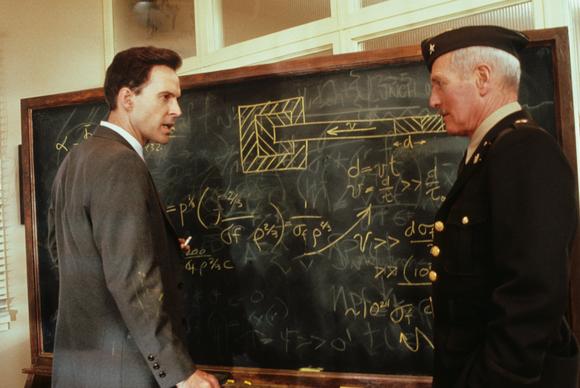
The 1989 film Fat Man and Little Boy is about the story of the Manhattan Project and the development of the Atomic Bomb. Paul Newman is seen here playing General Leslie Groves while a guy named Dwight Schultz plays the legendary Dr. J. Robert Oppenheimer. Nevertheless, while Richard Joffe does get some things right, the story is more suited for his political viewpoints and it’s far from the historic truth. For one, it was Oppenheimer’s dream job to work in the Manhattan Project (while Groves would rather be leading combat troops) and he and Groves got along famously, despite being polar opposites in personality for they both wanted the same thing. Also, Oppenheimer and many of his fellow scientists didn’t have any second thoughts about dropping the atom bombs until after they found out about the horrors of Hiroshima and Nagasaki. Also, Paul Newman was way too handsome to be General Groves.

Of course, while there wasn’t much attacking on US soil besides Pearl Harbor, it didn’t mean that there wasn’t much going on in the home front. Like the British, Americans did experience rationing, air raid drills, sending bacon grease and scrap metal to the war effort, women working in munitions factories as well as families waiting for their loved ones to come home from the war. Yet, in other ways, it was unique with WWII propaganda films as well as movies from Hollywood, the USO, the role of racial minorities, and other things. You have Japanese American internment camps that were filled with a group of people who were displaced mostly due to ethnicity, culture, and they or their ancestors came from an enemy of the US at the time. Oh, and racism as well of suspicion of disloyalty did have a lot to do with it, too. Yet, the disloyalty of Japanese Americans was somehow put to rest since 20,000 of them fought in the war. You have the Tuskegee Airmen who were an elite unit aerial African American fighters whose overcoming of racism and adversity greatly contributed to their success. Then there’s the Manhattan Project which would be famous for developing one of the most deadly weapons in human history and usher in the atomic age. Nevertheless, while there are plenty of movies made about the American home front, there are plenty of inaccuracies in them as well, which I shall list.

Japanese American Internment:

Japanese Americans were the only group in America to be rounded to internment camps. (Actually, they were the only group to be interred who were mostly American born. German and Italian Americans were also interred but these numbers were small and only pertained to first generation or legal aliens.)

Almost all Japanese Americans were placed in internment camps during World War II. (Actually you may think this is true but not really. Most of the Japanese Americans interned were living on the West Coast, particularly in California where interment was popular among white farmers who resented their Japanese American counterparts {most Japanese Americans there at the time were farmers}. Not to mention, California wasn’t a state known by its friendliness toward Japanese Americans, just the opposite. Anti-Japanese bias on the West Coast was prevalent at this time. By contrast, Hawaii only sent a very small portion of their Japanese American population to internment camps {mostly prominent politicians and community leaders} since the area had been on martial law already and the risk of sabotage and espionage by Japanese residents on the islands was low. Not to mention, 35% of their population had Japanese ancestry and they were active in almost every sector of its economy. Had Hawaii had most of their Japanese American population interred, the then-territory would’ve had its economy crippled. Over 50,000 Japanese Americans on Hawaii remained undisturbed during the course of the war mostly due to being too economically viable to evict.)

The AAGPBL:

The AAGPBL played regulation baseball. (Contrary to A League of Their Own, they actually played a baseball/softball hybrid game. In its first years it was closer to softball.)

Racine won the 1943 World Series in a 7 game series against the Rockford Peaches. (It was in a 5 game series against the Kenosha Comets.)

The Tuskegee Airmen:

Not a single Tuskegee Airman was shot down by enemy fire. (66 Tuskegee Airmen were killed in action and they didn’t have an official flying ace even though one may have had enough unregistered kills to qualify. 25 of their bombers were lost to enemy fire.)

The Tuskegee Airmen was created to prove that blacks could effectively fly a plane. (They were trained by racist instructors who washed trainees out for the smallest mistakes to prove that African Americans were unsuitable to be fighter pilots. The result was hand-picked elite that wiped the floor with everything they met as well as were provided the best protection of all US Army Air Force fighter groups in Europe. Thus, contrary to Red Tails, their status as an elite fighting unit was almost purely accidental and as a result of training from hell.)

The Manhattan Project:

Tchaikovsky’s “Dance of the Reed Flutes” was played during the countdown of the Trinity atomic test in Alamogordo, New Mexico. (Actually it was Tchaikovsky’s “Serenade of Strings” but this is a minor error in Fat Man and Little Boy.)

Frenzied nuclear weapon expansion had been driven from the outset by pigheaded militarists intimidating morally sensitive scientists into doing what they knew to be wrong. (Sorry, Richard Joffe, but this is wrong. Nuclear expansion served the best interests of the military and the Manhattan Project scientists. Maybe they knew designing the bomb was wrong, but they greatly underestimated the bomb’s potential for wiping humanity which came to haunt them after the Hiroshima and Nagasaki.)

General Leslie R. Groves was a warmongering jerk and strutting martinet. (Yes, he was a jerk as Major General Kenneth Nichols called him “the biggest son of a bitch I’ve ever met in my life. I hated his guts and so did everyone.” He was known to be arrogant, socially awkward, as well extremely sarcastic. Yet, even he said that his commander was one of the “most capable individuals” he ever met. He’s said to be an organizer without equal as well as a tireless leader who held together the far-flung elements of the Manhattan Project, which employed 125,000 workers at facilities nationwide. Not to mention, he was the guy in charge of building the Pentagon which was the reason he was picked to lead the Manhattan Project in the first place. He was also a student of MIT before transferring to West Point, where he graduated 4th in his class. Then again, his security measures weren’t the most adequate since Los Alamos employees named Klaus Fuchs and David Greenglass {brother-in-law to Julius Rosenberg} were still able to smuggle atom bomb details to the Soviets, which Fat Man and Little Boy doesn’t address.)

General Leslie Groves was happy leading the Manhattan Project. (Groves actually didn’t want to lead the Manhattan Project, which he called, “Oh, that thing” and later chafed at being a taskmaster to “the largest collection of eggheads in the world.” He had longed to lead combat troops into war but his career had languished in the corps of engineers and his leadership of the Pentagon’s construction was a success, that he was the most likely candidate. He only changed his mind about the job when he saw that the Manhattan Project was his opportunity for glory and worked unceasingly to the end.)

Dr. J. Robert Oppenheimer and his fellow scientists were against the idea of the atom bomb and felt guilty about being a part of the Manhattan Project for the rest of their lives. (Well, yes, many Manhattan Project scientists did regret their roles in the Manhattan Project but only after the horrors of Hiroshima and Nagasaki were known, unlike in Fat Man and Little Boy. He would become a vocal opponent of the development of the even more powerful H-bomb though. But during the atomic bomb’s designing phase, Oppenheimer craved a job at Los Alamos so badly that he’d even be interested in obtaining an army commission to curry favor with General Groves. Once hired in 1942, Oppenheimer worked on the Manhattan Project with appropriate martial zeal as well as gave an idea of poisoning the Germans’ food with radiation. Most of his fellow scientists supported nuking Japan as well and had a big celebration after the bombs were dropped and Japan surrendered.)

Dr. J. Robert Oppenheimer was a quiet, moralistic, and easy going man. (Actually though kind of bohemian and witty, this was a guy who stole chemicals and tried to kill his own tutor for making him attend classes on experimental physics which he hated {he preferred theoretical}. This was while he was studying for his doctorate in physics at Cambridge University.  He also betrayed his friend Haakon Chevalier, a literature professor at Berkeley, as someone who had contacted him about sharing secrets with the Russians when asked by the FBI to name names during his time at Los Alamos {though he’d later regret this and said he invented this “cock and bull” story but Chaevalier’s career was ruined because of him, though Oppenheimer might’ve named him to protect his brother who was a known Communist Party member}. Also, contrary to Fat Man and Little Boy, he was a much more outgoing man than portrayed in the film. Interestingly, the said tutor was Patrick Blackett who’d  go on to win a Nobel Prize. Oppenheimer also had a humongous ego to boot despite having a voice like Mr. Rogers. And yes, he was associated with Communist politics in the 1930s as were both his wife and ex-girlfriend. His past association with leftist politics would later hurt him during the Red Scare as he opposed the Cold War arms race.)

Dr. J. Robert Oppenheimer and General Leslie R. Groves didn’t get along. (Contrary to Fat Man and Little Boy, despite their personality differences, they got along fine because they both wanted the same thing. Groves even praised him on his work in the Manhattan Project saying, “I was reproachfully told that only a Nobel prize-winner or at least a somewhat older man would be able to exercise sufficient authority over the many ‘prima donnas’ concerned. But I stuck to Oppenheimer and his success proved that I was right. No one else could have done what that man achieved.” Groves also got along well with the other scientists save Hungarian Leo Szilard.)

Dr. J. Robert Oppenheimer came up with the idea of implosion. (It was actually fellow scientist Seth Neddermayer who proposed the theory and his formulation came gradually.)

The experiment with the two hemispheres of beryllium surrounding a core of plutonium and held apart with a screwdriver was called the “drop” experiment. (It was called “tickling the dragon’s tail” but it’s by the expy for Canadian physicist Louis Slotin from Fat Man and Little Boy. Yet, though he died from an experiment relating to radioactivity, his death didn’t provide any cautionary warning for Oppenheimer since it happened on May 30, 1946.)

General Leslie Groves was a fit man. (Actually he weighed between 250-300 pounds in contrast to Paul Newman’s fit figure in Fat Man and Little Boy. Oppenheimer by contrast, weighed 116 pounds during the Trinity Test.)

J. Robert Oppenheimer’s ex-girlfriend Dr. Jean Tatlock committed suicide on January 1945. (She killed herself in January of 1944. Interestingly, she was Oppenheimer’s first love and the first person he ever dated but she suffered from depression {he married his wife Kitty a year after he broke up with Jean}. Still, it’s said he had an affair with her during his time in the Manhattan Project while some say that he only spent the night with her once in mid-June of 1943 after he was picked as head of the laboratory in Los Alamos. It’s highly disputed. We could say that he certainly cared about her and may have felt guilty on breaking up with her despite knowing that she certainly wasn’t relationship material. Still, while we can’t really confirm whether Oppenheimer and Tatlock were romantically involved during his time at Los Alamos, he did have an extramarital affair but it was with Kitty when she was married to her third husband, a physician named Richard Harrison. And it wasn’t until Kitty found out she was pregnant to Oppenheimer when she divorced Harrison and Robert became her fourth
husband in November of 1940. Still, despite only dating two women throughout his entire earthly existence, Oppenheimer certainly had an interesting love life.)

General Leslie Groves was a recipient for the Good Conduct Ribbon. (To qualify for the Good Conduct Ribbon, a soldier must be an enlisted man for at least 36 months. Groves was a West Point graduate and thus ineligible.)

General Leslie Groves met Dr. Leo Szilard in his hotel bathroom while the latter was in a bathtub and the former was on the toilet. (They actually met at the Metallurgy Laboratory at the University of Chicago along with the rest of the scientists. They had an antagonistic relation and Groves tried to fire him.)

The Trinity explosion took 2-3 seconds. (It actually took 40 seconds.)

Kitty Oppenheimer was an adoring wife who thought her husband Robert was the greatest man who deserved anything he wants. (Oppenheimer would’ve probably wished his wife to be like this since he kind of thought he was God’s gift to humanity who deserved anything he wanted. Still, she was known to drink and make catty remarks about her husband.)

Miscellaneous:

America had the best artillery, tanks, tacticians, or generals in World War II. (America had the most money, the highest rate of productivity, and perhaps the most adaptive and self-reliant rank and file of all the fighting armies.)

USAAF bombing crews usually survived with no ill effects. (Since the USAAF bombed German targets by day, they had a monstrously high casualty rate in the bomber department. There’s a reason why the policy for USAAF airmen was “25 and out” for most of the war. Once most airmen completed 25 missions, their war was over but the average crewman only had a 1 in 4 chance of actually completing his tour of duty. Yet, as the war progressed, 25 got upped to 30 and then 35. The average bombing crew got shot down in its 20th mission. American bomber crews were known to be notoriously fatalistic, having determined that after reaching the half-way point on their tours of duty, they were living on borrowed time.)

“Little Brown Jug” was recorded after Glenn Miller’s death. (Actually contrary to The Glenn Miller Story, it was one of his first bonafide hits in 1939, but the movie makes it clear where he got it from.)

WWII was a universally supported one in the US. (The US only went into the war at around Pearl Harbor and even then there were Americans who opposed the war either because they were pacifists or Nazi sympathizers. And yes, World War II did have its share of draft dodgers even in the United States.)

A PT boat’s main function was “to harass the enemy and buy time for a navy that was still on the drawing boards.” (This is sort of accurate but as Washington lawyer and WWII veteran Leonard Nikoloric said, “Let me be honest. Motor torpedo boats were no good. You couldn’t get close to anything without being spotted. I suppose we [Squadron Three] attacked capital ships maybe forty times. I think we hit a bunch of them, but whether we sank anything is questionable. The PT brass were the greatest con artists of all time. They got everything they wanted-the cream of everything, especially the personnel. But the only thing the PTs were effective at was raising War Bonds.”)

The United States military was integrated at this time. (Actually it was still segregated and would be desegregated shortly after World War II. However, many of World War II movies were made after that time and with the assistance of the US military like The Glenn Miller Story. However, such errors could be forgiven since the war was fought by Americans of all races and creeds anyway even if they didn’t fight in integrated units.)

Female cadets were in attendance at West Point at this time. (West Point didn’t start admitting women until 1962.)

There were no gays in the US military during World War II. (Actually the US military effort during World War II was one of the reasons why the gay community became a more prominent force in later years. Sure there was a Don’t Ask, Don’t Tell policy but the war effort brought so many people away from their homes and into contact with people they wouldn’t have met otherwise, sometimes these were people like them. Also, gay US WWII vets include Rock Hudson, Gore Vidal, and others.)

The US Navy made a petty fuss about shirts. (Actually Mister Roberts is right about the US Navy’s fuss about shirts but it wasn’t out of pettiness. The navy’s medical branch actually found that shirts provide protection against burns in case of explosion.)

US soldiers would leave their sweethearts behind who faithfully waited for them to return home, while their men didn’t mess around. (This wasn’t 100% the case since there were soldiers who did cheat on their sweethearts {sometimes wives} or sometimes abandoned them altogether. Not to mention, sometimes the sweethearts weren’t so devoted either as you understand the concept of a “Dear John” letter. Then there’s the fact that 1946 saw a jump of divorces in the United States.)

“Fouled up” was a common phrase of American soldiers during World War II. (Contrary to Saving Private Ryan, I believe the correct terminology is “fucked up.” For God’s sake, Spielberg, were you aiming for a PG-13 audience? I mean what’s wrong with including swearing in a rated R movie, especially if the main reason for it is violence.)

During combat jumps, US paratroopers jumped out of planes one by one with the jumpmaster commanding, “Go! Go!” (The jumpmaster was always the first off the plane while the rest of the paratroopers immediately followed behind him exiting the plane as fast as they could in order to land as close together as possible. I know the one by one combat jump is always done in movies but paratrooping has never worked that way since it would result in the whole unit being spread out in various locations. Try locating the rest of your unit using that method.)

American soldiers used “thunder” as a challenge word to identify friendlies while “flash” was used as a response. (Contrary to Saving Private Ryan, it’s the other way around with “flash” as the challenge word and “thunder” as the response. The reason why “thunder” was chosen as a response word for identifying friendlies was because of the “th” sound which is nonexistent in German. Thus, if a German were to say, “thunder” to “flash” he wouldn’t be able to hide his accent.)

The US Army had a 113th Tank Division during this time. (There was never a US 113th Tank Division in WWII.)

The Pentagon was completed by 1942. (It wasn’t completed until 1943.)

Women factory workers in the US home front were treated decently by their bosses. (While the average US serviceman was paid $54.65 weekly, factory women were paid $31.50. Also, if they were working among men, there’s a possibility that sexual harassment was frequent in some places. I mean there were no laws against it.)

World War II was the first time when housewives took up work outside the home as their husbands went to war. (Despite the fact that women were expected to be housewives throughout most of human history, this wasn’t always the case, even in America. Even before World War II, many women worked outside the home, especially in times under financial ruin like the Great Depression or death in the family like a spouse. If you’ve seen Mildred Pierce, you know what I mean. It was just that more women were doing the more important jobs that would be normally reserved for men. Not to mention, before that time, many didn’t really consider women’s work as anything of relative importance.)

“Little Orphan Annie” was a 1940s radio show sponsored by Ovaltine. (Ovaltine dropped “Little Orphan Annie” and switched to “Captain Midnight” in 1940. That year “Little Orphan Annie” would be sponsored by Quaker Puff Wheat. Announcer Pierre Andre would also go to “Captain Midnight” in early 1940 since audiences identified him too much with Ovaltine. This detail would help set A Christmas Story to 1939 since The Wizard of Oz came out that year and there’s no mention of Pearl Harbor.)

Bing Crosby’s “Merry Christmas” album was released at around 1940. (It wasn’t released until 1945 and reissued in 1947.)

The Red Ryder BB gun had a sundial and a compass among its features. (The screenwriter for A Christmas Story confused the Red Ryder with another kind of BB gun that had these features. Thus, guns had to specially made for the film. Yet, the Red Ryder BB gun was real but it doesn’t have a sundial and compass.)

Indiana schools were integrated in 1939. (They weren’t until 1949 yet there are three black kids in Ralphie’s class.)

Window air conditioners were widely available at this time in the US. (Contrary to Lost in Yonkers, while window air conditioners were sold as early as 1938, they weren’t mass produced until after World War II.)

US Navy seamen were experienced swimmers. (US Navy seamen weren’t required to know how to swim and many didn’t during this time.)

Movies during this time were seen in a wide screen format. (Not until the 1950s.)

All American aircraft carriers had angled decks. (Not in World War II they didn’t. But there aren’t that many straight decked carriers left as attempts to preserver the USS Enterprise {most decorated warship in US history} into a museum as a museum all ended in failure.)

June Carter was 10 in 1944. (By this time, she would’ve been 14 or 15.)

History of the World According to the Movies: Part 66 – World War II: The Pacific

Image

The 1970 Tora! Tora! Tora! was a retelling of the Japanese attack on Pearl Harbor by a collaboration of American and Japanese filmmakers. This film tells the story of the events leading up to the attack through the perspectives of both sides as well as put the story of Pearl Harbor as the story instead of it being a backdrop of some fictional tale. Though a flop at the US box office and critics (it was more successful in Japan), this film has gained great stature in later years, especially compared to the 2001 Michael Bay craptackular disasterpiece, which was a retelling of the attack through the eyes of a video game addict who flunked American history in high school. Still, even if this film doesn’t use CGI visual effects, Tora! Tora! Tora! is still top notch when it comes to the Pearl Harbor attack.

Though World War II Eastern Europe was a certified shit hole, the war in the Pacific wasn’t much of a picnic either mostly because East Asia had fallen prey to the imperial ambitions of the militaristic Japanese. And between 1930 and 1945, the Japanese military was one of the most horrifying to their enemies as well as to their own people (well, they’re up there). The Japanese had invaded China in the 1930s in a conflict known as the Second Sino-Japanese War which was the largest war in Asia and perhaps one of the costliest in human history. But by 1941, Japan had joined the Axis Powers while China had joined the Allies (well, it’s more complicated since the Chinese were a factious bunch). The conflict is still a topic of fierce controversy to this day in East Asia. Still, in the movies, it’s treated as a conflict chiefly between the Japan and the United States as well as begins with the Japanese surprise attack at Pearl Harbor and ends with the US dropping two atomic bombs in Hiroshima and Nagasaki that resulted in the Japanese surrender. The War in the Pacific is shown with big naval battles, jungles, starving civilians, and the inconsistent mistreatment of non-combatants. Let’s just say if the Japanese don’t get you, then the exotic diseases and wildlife will. Except if you’re on a cargo ship in Mister Roberts, which in this case it would probably consist of spending your days on a ship in boredom thinking that your comrades on active combat duty are having a much better time in the war than you. Nevertheless, movies set in this theater do have their share of inaccuracies which I shall list accordingly.

Admiral Isoroku Yamamoto:

Admiral Isoroku Yamamoto said this in regards to Japan’s chances of war with America, “If we must, we can raise havoc with them for a year… after that, I can guarantee nothing.” (He actually said, “I can run wild for six months… after that, I have no expectation of success.”)

Admiral Isoroku Yamamoto said after Pearl Harbor, “I fear all we have done is to awaken a sleeping giant and fill him with a terrible resolve.” (There’s no record he actually said this but he’s quoted as such.)

Admiral Isoroku Yamamoto was a brilliant strategist who opposed war with the United States because he thought it was a great mistake to underestimate US fighting potential. (Yamamoto knew these consequences {after all, he went to Harvard}, but unlike in Tora! Tora! Tora!, he wouldn’t have overly admitted this. He just dutifully worked out the Pearl Harbor attack plan throughout 1941 and he was ready to execute the plan by late November when the order was confirmed.)

Admiral Isoroku Yamamoto was killed in 1942. (He died in 1943.)

Admiral Isoroku Yamamoto had all his digits by 1941. (Contrary to most of his movie portrayals, Yamamoto actually lost two fingers on his left hand during his service in the Russo-Japanese War.)

General Douglas MacArthur:

General Douglas MacArthur was adored by his men during his time in the Philippines. (Yes, MacArthur did bid an emotional farewell to his men when he left the Philippines. However, by the time he left, his men were actually fed up with him. For one, out of the 142 communiques he issued during the first period of his war service there, 109 failed to mention the bravery of any soldiers apart from himself. There was also a fuss about him accepting $500,000 as a personal reward from the Philippine president which was technically legal but ethically dubious. Yet, the 1977 MacArthur biopic can be forgiven for mentioning this since the story came out in 1979. Still, MacArthur’s patchy reputation was no secret.)

General Douglas MacArthur was ignorant of Philippine geography and proposed the attack as “Land at Leyte beach on Luzon, and then carry the fight to Manila.” (As is shown in the Gregory Peck portrayal. MacArthur may have been accused of many things, but ignorance of Philippine geography wasn’t one of them. As for his attack proposal, he did fight to retake both Leyte and Luzon but not at the same time because it would’ve been physically impossible since the islands are 500 miles apart. And MacArthur would know this.)

General Douglas MacArthur was a liberal who thought Japanese workers should’ve had a voice in the means of production. (For God’s sake, MacArthur was a Republican and wouldn’t have believed in the ideas of stripping landowners and expunging industrialists. Also, he didn’t personally direct the Japanese development after World War II since multiple documents prove that Washington set the goals and policy of the American occupation of Japan, not MacArthur.)

General Douglas MacArthur was a down to earth folksy man. (He was an ostentatious intellectual who once barged in on a subordinate catching him in a clinch with a lady. He ordered the guy, “Eject that strumpet forthwith.” Yeah, he said it like you’d expect someone from some Steampunk novel would. He was known to call his words, “those immortal heralds of thought which at the touch of genius become radiant.” And while Gregory Peck’s MacArthur says, “It’s my destiny to defeat communism, and only God or those Washington politicians will keep me from doing it,” the actual MacArthur said, “Only God or the government of the United States can keep me from the fulfillment of my mission.” In other words, he talked more like Martin Luther King Jr. than Woody Guthrie.)

General Douglas MacArthur said, “We shall return.” (He said, “I shall return” though the White House would’ve wished he did. Still, MacArthur was an arrogant blowhard.)

General Douglas MacArthur was perfectly at ease with meeting Emperor Hirohito. (Contrary to Emperor, MacArthur couldn’t stand being in the same room with him even after Hirohito apologized for Pearl Harbor. To be fair, MacArthur was a racist, even by the standards of his day.)

Admiral William Halsey Jr.:

William Halsey Jr. became a Fleet Admiral in 1942 and retired in 1945. (Contrary to his portrayal in the 1960’s The Gallant Hours, he became a Fleet Admiral in 1945 and retired in 1947. Nevertheless, due to his final rank, he remained on active duty status in the Navy until his death.)

The Second Sino-Japanese War:

Whatever the Japanese military did in Nanking was for no good reason. (It may seem so in City of Life and Death yet the military culture in Imperial Japan was particularly brutal as TTI claims: “consider that many of who were conscripted who were raised in a militarist culture who were abused or “punished” by their superior officers by being slapped or beaten or whatnot, many of which are in their late teens and early 20s, who just fought a brutal battle in and around Shanghai for months and won by a relatively close margin, who were pissed and came upon a city full of goods and people.” Yes, shit will happen.)

American Volunteer Group pilots were recruited from active or reserve US military forces in the United States. (They were actually recruited in Asia with full knowledge and approval from the White House. However, unlike the movie Flying Tigers, they were still in training by the time of Pearl Harbor. Also, until that time, they were just mercenaries but they did help FDR get around neutrality for awhile. Still, they weren’t integrated into the USAAF until late 1942. But thanks to Flying Tigers and God Is My Co-Pilot, most people don’t remember the AVG that way.)

The Chinese Communists ultimately won the Sino-Japanese War. (This is according to Chinese Communist propaganda films. In reality, the Communists actually played a small part in it. The Chinese Nationalists and their allies actually did most of the fighting though switching sides among the Chinese was common. TTI explains it best, “The Nationalists, Communists, and various warlords would alternately be fighting Japan (and getting slaughtered), fighting each other, doing nothing and hoping their enemies got taken out first, and siding with Japan.” As for weapons, the Chinese basically used anything they could get at the moment.)

Pearl Harbor:

The Japanese bombed Pearl Harbor without warning. (They actually gave the US a warning several hours before the attack. However, the US military did drastically underestimate the Japanese war machine and never thought it could conduct a surprise attack so successfully. Not only that, they also doubted that Japan even had the technology or the engineering to create such an effective assault force. Even after the attack, many prominent men in the US military thought Germany was behind it {it wasn’t}.)

The Japanese fighter planes fired down and killed civilians during Pearl Harbor. (The Japanese were specifically ordered not to do this and they didn’t deliberately target a hospital either {though one medical staff member was killed}. Nevertheless, any damage done by Japanese planes on civilians or civilian buildings were just accidental. Yet, the US planes were firing on and killing civilians in the Doolittle raid such as in Tokyo and three other industrial Japanese cities but Michael Bay doesn’t show this.)

Two American fighter planes took off to fight the Japanese at Pearl Harbor. (Contrary to some films, 6 actually did.)

Theodore Wilkinson was a Captain during the attack at Pearl Harbor. (He was a rear admiral.)

The USS Antares was a tugboat. (It was a 12,000 ton cargo ship, yet it did tow a 500 ton bridge around Pearl Harbor.)

General Short received the report of an enemy midget submarine being attacked as well as the Pearl Harbor attack as it was going on. (He didn’t receive the report about the enemy midget submarine until the bombs started falling. Also, he didn’t receive the first notification about the Pearl Harbor attack until several hours after it ended.)

Civilian aviation instructor Cornelia Fort was around 50 at the time of Pearl Harbor. (Unlike what Tora! Tora! Tora! depicts, she was actually 22 but she’s played by a middle aged actress in the film. I mean having a 22 year old female flight instructor around just wouldn’t be believable. Oh, and she flew a monoplane, not a biplane as depicted.)

The Japanese flagship at Pearl Harbor was an aircraft carrier. (It was a battleship.)

The Japanese Zero aircraft at Pearl Harbor were green. (They were gray. Green Japanese Zeros didn’t exist until 1943 and they were Japanese Army planes.)

American naval ships like the Maryland, Nevada, Tennessee, and Pennsylvania were sunk and rendered irreparable during the attack on Pearl Harbor. (These ships survived the attack without much damage though the Tennessee was trapped while the Nevada was bleached. Furthermore, the Nevada was used in Tora! Tora! Tora!.)

Admiral Husband E. Kimmel:

Admiral Husband E. Kimmel was playing golf the morning of the Pearl Harbor attack despite being notified before the attack that the Japanese embassy staff was leaving Washington D. C. (He had been planning to play golf that day but cancelled when news of the attack came in. Also, he didn’t know the Japanese embassy staff left Washington D. C. until perhaps the attack itself. Still, I’m not sure why Admiral Kimmel had the unfortunate first name.)

Admiral Husband E. Kimmel was a vigilant leader certain of an imminent attack on his base as well as did everything he could in his power to convince Washington of its inevitability. (Most historians say that he received several warnings about a possible attack on Pearl Harbor, but he felt they were too vague and tried to dismiss them. Furthermore, when he heard about the USS Ward sinking a midget Japanese sub {an hour before the attack began}, he chose not to go to general quarters due to the fact that there had been a number of false sub sightings in recent months. He also wanted to confirm the Ward’s report before acting on it.)

Dorie Miller:

Third Petty Officer Doris “Dorie” Miller served aboard the USS Arizona when it was destroyed by a bomb. (He served in the USS West Virginia, contrary to Tora! Tora! Tora!. Still, he probably would’ve never gotten the chance to act heroically enough to be the first African American to receive the Navy Cross if he was aboard the Arizona because the boat sunk immediately.)

Third Class Petty Officer Dorie Miller was carrying a tray of coffee service during the attack at Pearl Harbor. (He was carrying laundry.)

Second Class Petty Officer Dorie Miller comforted the mortally wounded Captain Mervyn S. Miller after a torpedo struck the USS West Virginia. After his death, Miller delivered the man’s last orders to the ship’s executive officer then manned a twin .50 caliber Browning anti-aircraft machine gun. (This is how the scene is set in Pearl Harbor but it’s wrong. For one, Miller was a Third Class Petty Officer as well as a ship’s cook and he was first ordered to carry injured sailors to places of greater safety and then assist the Captain. Second, the Captain refused to leave his post continuing to direct the battle until he died of his wounds just before the ship was abandoned. Third, it was Ensign Victor Delano who comforted the Captain in his final moments. Fourth, Miller was actually then ordered to help load a machine gun but assumed control of an unmanned weapon instead that Delano had to show him how to fire it, saying later that Miller “did not know how to fire a gun.” Still, pretty heroic for a black guy named Doris {I just think it’s funny such a badass guy like him had such a girly name}. Nevertheless, Pearl Harbor screwed Ensign Delano royally.)

Doolittle Raid:

Colonel Doolittle recruited single-engine fighters to fly on bombers for his famous raid in Japan. (Actually, Doolittle would’ve never taken a sniff at the two main guys in Pearl Harbor because single-engine pilots weren’t qualified to fly multi-engine bombers. Instead, he’d recruit guys who were participants from qualified bombardment squadrons. From the historical record, Doolittle actually recruited guys from the 34th Bombardment Squadron and the 17th Bombardment Group popularly known as “The Thunderbirds.”)

The Doolittle raid killed off several American fighters, including one from a Japanese anti-aircraft gun. (No American Doolittle Raiders were killed during the actual raid. There was however, one raider who died in a plane crash afterwards as well as two others who died from crash related injuries, and five perished in Japanese captivity {4 executed, 1 by malnutrition}.)

The Doolittle raid was carried out in calm weather. (It was launched on stormy seas.)

The Guadalcanal Campaign:

US Marines during the Guadalcanal Campaign wore camouflage covers on their helmets. (They wore bare M1 helmets though a few used burlap.)

Guadalcanal was a tropical paradise. (Contrary to The Thin Red Line, it was kind of the opposite, it was a jungle with dangerous animals, annoying insects, and extremely high temperatures. Yet, no soldier in that movie was seen sweating.)

Most US deaths during the Guadalcanal Campaign were combat-related. (Most of the deaths at Guadalcanal were due to poor living conditions than actual combat. But you wouldn’t know it from The Thin Red Line.)

Midway:

Kamikazes were used during the Battle of Midway. (The Battle of Midway took place in 1942 while Kamikaze pilots were never used as official policy in Japan until toward the end and would’ve been fairly rare by that time. Still, remember that the film Midway was filmed in color with a zero special effects budget in 1976. Most of the stock footage used for this battle was from Iwo Jima and Okinawa since most color footage was filmed late in the war. Also, it wasn’t unusual for planes from both sides to crash into enemy ships. Nevertheless, despite the lack of special effects and plenty of technical details later found to be inaccurate due to later findings of the ship wreckage from the battle, Midway is considered a much better film than the Michael Bay craptastrophic retelling of Pearl Harbor {which was attacked by the people who survived it}.)

Okinawa:

The Americans used tear gas during the Battle of Okinawa. (They never used tear gas in any battle during the war.)

Iwo Jima:

Japanese General Kuribayashi committed suicide. (We know he didn’t survive the battle but we don’t know how he died since no surviving witnesses ever came forward. Yet, his death in Letters from Iwo Jima is plausible.)

Lt. Colonel Nishi took his own life after being blinded during the battle. (This is based on rumor but it has never been confirmed.)

Lt. Colonel Takeichi Nishi was close friends with General Tadamichi Kuribayashi. (Contrary to Letters from Iwo Jima, it’s said their relationship was rather antagonistic.)

The Burma Railway:

During the Burma Railway’s construction, unruly POW officers were sent to a metal punishment box without water until they complied. (In real life, Col. Saito would just have Nicholson and his officers executed if they didn’t obey. In Bridge on the River Kwai, this doesn’t occur to him. Then again, the real Saito was said to be a rather benevolent prison warden.)

Only British POWs were sent to work on the Burma Railway. (Most of the people who worked on the railway were civilians, rather forced labor from Burma, the East Indies, Thailand, and Malaysia. As with POWs, they weren’t all exclusively British as Bridge on the River Kwai implies. By the way, the Burma Railway construction resulted in the deaths of 13,000 Allied POWs and 80,000 to 100,000 civilians.)

Kanchanaburi POW camp was captured by American paratroopers. (It was liberated by British and Indian infantry troops after Japan had surrendered. So unlike The Railway Man, Colin Firth had to stay longer.)

Bridge on the River Kwai:

British Lt. Col. Philip Toosey took charge of building the Bridge on the River Kwai and forced his own men to build it in order to increase their morale. (Toosey took charge of the construction in order to keep his men alive. He thought this was the better alternative to keep his soldiers safe while not giving aid to the enemy and never felt any obligation to work with the Japanese. Not to mention, he encouraged sabotage and chaos during the construction as well. He also has an honorable reputation and it was said that many of his soldiers greatly objected to the Alec Guinness expy portrayal in The Bridge on the River Kwai. Then again, Toosey wasn’t the only inspiration for Col. Nicholson. As for the William Holden character, he was actually invented for the movie to provide more action and a part for a bankable American actor.)

Col. Saito was a ruthless commandant at the POW camp during the construction of the Kwai Bridge. (He was actually a very benevolent warden and he and Toosey would become friends after the war for the rest of their lives. Oh, and he was a sergeant and second in command of the camp. Still, unlike in The Bridge on the Rive Kwai, the real Saito actually survived the war and attended Toosey’s funeral.)

The Bridge on the River Kwai was destroyed in a commando raid right after its construction. (The original wooden bridge was destroyed in a bombing raid. Yet, it was supposed to be a temporary bridge anyway. The second steel bridge was bombed as well but it was later repaired and still stands in use today. Still, both bridges had a service of two years before they were destroyed by aerial bombing raids.)

The Japanese engineers for the Kwai Bridge were terrible. (Contrary to Bridge on the Rive Kwai, the many of the Japanese engineers for the Kwai Bridge were actually graduates from the best engineering schools including American and British universities. Oddly enough despite this film being sort of denigrating to the Japanese, it was popular in Japan during its original run. Then again, conditions during the Burma Railway’s construction were much worse than depicted in the David Lean epic.)

Liberation of Burma:

The Liberation of Burma was conducted entirely by American forces. (This is the premise of Objective, Burma!. However, the majority of the Allied forces that actually liberated Burma from the Japanese were British, South African, Indian, and Chinese. The British 14th Army played a major role and was known as “The Forgotten Army” because of the part they played there. Still, at least the Americans did play a part and Merrill’s Marauders did exist. Nevertheless, Objective, Burma! Caused massive offense in Britain and among the troops of many nationalities in the China-India-Burma theater since their role was written out. During its release in 1945, Warner Bros. had to withdraw the film from British theaters after a week and re-released it in 1952 with extra documentary footage that included a fleeting hat-tip by General Wingate.)

The 503rd Parachute Regiment served in Burma. (They served in New Guinea.)

The Sullivan Brothers:

George Sullivan was in sick bay while the USS Juneau was sinking. (Contrary to The Fighting Sullivans, he and his brother Al survived the sinking. Al drowned the next day while George died 4-5 days later of dementia when he took off his uniform and swam off in search of his brothers.)

PT 109:

The crew of PT 109 rescued a group of US Marines trapped on a Japanese occupied island called Choiseul before the ramming incident. (Contrary to PT 109, this happened after the ramming incident. And it wasn’t the only boat to rescue the trapped Marines either but part of a small flotilla.)

The survival of PT 109 wasn’t anything special except that its commander was John F. Kennedy. (Well, yes, as far as the historic memory goes today, especially since it was the reason that PT 109 was made and why people today still remember it. However, back in the day, the survival of Kennedy and his crew was special enough that correspondents from the Associated Press and the United Press International hopped on the rescue PTs before they found out PT 109’s maroon skipper was Lieutenant John F. Kennedy {then known as Ambassador Joe Kennedy’s son}. That just made the story pass into national legend, especially since Kennedy would later become president.)

Miscellaneous:

World War II in the Pacific was primarily a Japanese vs. Americans ordeal. (Actually it was more like the Japanese vs. practically everyone who happened to be there and allies at this time {though there were those who collaborated with the Japanese in Asian countries particularly a few Chinese warlords}. In fact, World War II in that region may have begun as early as 1931 with the Japanese invasion of Manchuria.)

The Japanese military was exceptionally brutal since Japan had culture of cruelty. (The Imperial Japanese military was indeed this during the 1930s and in World War II. However, Japanese civilization was not always this cruel in its history, despite the myth that Japanese brutality during World War II was derived by their warrior culture is still taught in American schools. A few decades earlier, the Japanese military had troops led by gentlemen officers and treated their prisoners just as humane or better than many Western countries did. Yet, in the 1930s, Japanese society was seized by a mass frenzy of militarism that resulted in Japan being taken over by a military dictatorship that had imperialistic ambitions. Still, since most people don’t know much about Japan, it’s assumed that Japanese conduct during World War II was related to their samurai culture or the notion of fighting to the last man. However, the reality had more do with the Japanese High command’s distorted and very selective interpretation of either as well as the climate of militaristic fascist imperialism in the Japanese government {since the values that Bushido actually promotes aren’t really that different from the code of chivalry or from similar systems in other cultures}. Yes, historical Japan was a militaristic society to some degree but it also highly valued the principle of self-restraint except between 1930 and 1945 of course. Oh, and even at the height of the Japanese military junta and the cruelties committed as well as its status as an Axis power, Japan was one of the friendliest nations for Jewish refugees fleeing the Holocaust.)

Japanese soldiers valued their lives less than Americans, and that they were particularly eager to die in service to their Emperor. (Between the 1930s to the end of World War II, most Japanese soldiers were conscripted into the military consisting of people the Japanese government would view as potential troublemakers like the dispossessed, poor, unemployed, criminals, and rootless younger sons. Still, the Imperial Japanese military was no fun place to be with torture being used on a regular basis {so they could abuse others} and it was filled by people who definitely didn’t want to fight for their Emperor but did so because they had no other choice. Yet, there were patriotic Japanese soldiers who willingly fought for their country but many of them were American {20,000 Japanese Americans fought for the US in World War II and despite being targets of racism and being sent to internment camps, they were still treated better than Imperial Japanese soldiers. One Japanese American combat unit was among the most decorated}.)

Navajo code talkers were employed in the Pacific during World War II. (Yes, but while movies imply that the US had only used Native American code talkers in the Pacific, this wasn’t the first time. The US also had used Native American code talkers during World War I in Europe. But by the time World War II rolled around, Hitler already knew about the use of code talkers and sent cover agents to study Native American dialects before the US entered the war. No Indian code talkers were used in Europe because of this.)

Navajo codetalkers had bodyguards whose job was to kill them to prevent them from getting into enemy hands. (Actually the bodyguards were used to protect the Navajo code talkers from other US soldiers who’d mistake them for being Japanese. There’s no evidence that they were order to kill them to prevent their capture, yet tell that to Windtalkers.)

American P-40s and Japanese Zeros fought at wave top heights with aircraft darting various obstacles. (No, Michael Bay, they wouldn’t have because such tactics would’ve been suicidal for both participants.)

Japan was forced to enter World War II against the United States in the Pacific. (This is implied in Tora! Tora! Tora! But it’s actually wrong. Individual Japanese military personnel, yes, but Japan as a country, no. It was actually the United States that was forced to go to war with Japan in the Pacific. Part of what led to Pearl Harbor was American outrage over Japanese aggression in China and its much publicized atrocities during occupation, especially the Rape of Nanking. What led to this kind of aggression was a combination of economic problems during the Great Depression {it had been hit hard}, the rise of right wing extremists in their government that paved way for a military dictatorship, increasing militarization fueled by imperial ambitions, and radical modernization. Nevertheless, the Japanese public is still uncomfortable about acknowledging their country’s horrifying atrocities during that time. Japan hasn’t formally apologized to the nations it had formerly invaded {this doesn’t mean that it condones its past behavior. In fact, just the opposite. Rather, it’s just that the Japanese may just be too ashamed to admit their crimes in World War II}. Still, it’s said that Japanese occupation in Asia was filled with widespread cruelty, exploitation, racism, sex slavery, and genocide with millions dead, mostly consisting of civilians.)

Prior to Pearl Harbor, there was an US oil embargo against Japan. (No, there wasn’t at least in the formal sense, just a de facto prohibition of oil shipments through the denial of export licenses.)

The Japanese sought an aggressive alliance with Germany despite naval opposition for some reason. (Tora! Tora! Tora! doesn’t really get into this. However, the Japanese sought an alliance with Germany thinking that it would keep the US out of the war it would be forced to fight on two fronts {didn’t work}. Some officers in the Japanese Navy opposed a German alliance because they thought it would increase the chances of war with the United States {for which the navy wasn’t prepared for [they were right]}. Others thought that continuing the war in China would mean more money for the army and severe cutbacks for their own service. Still, Germany and Japan didn’t make good allies with each other.)

Japan sent troops to Australia. (They never set foot in it. The only attack it launched was in 1942 when the Japanese bombed Darwin and left. But they did have sub crews to go to shore on remote locations for fresh water.)

Japanese Zeros were faster than American Warhawks. (They were very maneuverable planes which got off the ground easily but were considerably slower than most American fighters.)

Japanese Zero guns had had terrible accuracy record. (They actually could decently hit American planes except in Michael Bay’s Pearl Harbor disasterpiece.)

There wasn’t much airplane fighting in the Pacific as there was in Europe. (Actually in the Pacific theater, air warfare played a bigger role than it did in Europe. I mean the Americans bombed the living shit out of Japan, even before they dropped two atomic bombs on them. Still, air warfare in the Pacific isn’t covered as much because it’s difficult to portray massive fire raids against civilians in a heroic light. And Hollywood always has to portray the Americans as good guys.)

Japanese soldiers and civilians would rather commit suicide than accept defeat. (Yes, there were a high number of suicides on the Japanese side and there could be no doubt. However, while the Japanese Imperial military establishment had a reputation for not surrendering, it didn’t always mean that all Japanese soldiers and civilians were willing to do so. However, Wikipedia does have sourced stats on the Japanese who did surrender to the Americans under its Imperial Japanese Army article. Japanese POWs did exist {estimated 19,500 to 50,000} and there are Japanese veterans from the war who are still around. Still, much of the mass suicides had more to do with Japanese propaganda showing Americans as a cruel and merciless bunch who’d rape all captured women as well as kill or torture the men.)

Japanese POW camps were subject to the rules of the Geneva Convention. (Japan wasn’t a signatory of the Geneva Convention until 1953 so Allied prisoners had no expectation of being treated in accordance with them. In fact, the Japanese treatment of POWs led to a review and update of the conventions in 1949. Still, you wouldn’t know it from Bridge on the River Kwai when Lt. Col. Nicholson gets all up in Saito’s ass about it. He also didn’t realize that under the Geneva Convention enlisted POWs can be compelled to work, but only in specific industries that don’t help the enemy’s war effort. Then again, Japan wasn’t a signatory of the Geneva Convention at the time so it’s not like Alec Guinness’ character would be court-martialed for anything worse than treason. Still, it’s amazing he lasted so long in the movie without getting fragged, which probably would’ve more likely happened to him once he tried dragging sick men out of the hospital to work on the bridge.)

Emperor Hirohito was a powerless figurehead who didn’t want war with the United States. (Well, we’re not sure what his role in World War II was and it’s been hotly debated to this day. However, for hundreds of years, while the Emperor has had a special place in a ceremonial and religious aspects, his post didn’t always grant him real power, even if tradition said otherwise. Still, he wasn’t really against the war or technically powerless but he wasn’t exactly the guy running the place either. Responsible or not, to try him for war crimes would’ve been a big mistake, though he did have to renounce his divinity and cooperate with the US.)

Being a US Merchant Marine was one of the worst jobs in the Pacific. (Sure Merchant Marines didn’t get much recognition for their actions and they spent their days doing mundane tasks and languishing in boredom on a cargo ship which isn’t a glamorous job. However, serving on a cargo ship wasn’t the worst thing that could happen to someone in the US Navy in the Pacific Ocean during World War II. Being a POW in a Japanese prison camp was.)

The Japanese military actually had an air force. (The Imperial Japanese Air Force never existed. Both the Japanese Army and Navy used planes.)

Geisha communities were still in business during this time. (They were shut down by the Japanese government during WWII.)

History of the World According to the Movies: Part 61 – Depression Era Outlaws

Image

I couldn’t have a post dedicated to Depression Era outlaws in the movies without using a picture from the 1967 Bonnie and Clyde. Sure this is a very entertaining movie with all the violence and sex any box office smash could ask for starring the sexy Warren Beatty and the sultry Faye Dunaway who have great chemistry. However, remember that this movie doesn’t tell the real story of Bonnie and Clyde who were no more than a couple of ruthless thugs that didn’t rob from the rich to give to the poor. Nor were they that stylish and good looking either.

You’d think that the repeal to Prohibition would lead to less crime now that alcohol was legal again. However, since this was the time of the Great Depression, you’d be dead wrong. Thanks to the Great Depression and the fact that people back then didn’t have the modern conveniences we have now, 1930s America had a new generation of outlaw legends whose exploits were read in the papers or heard on the radio. Sure they weren’t nice people but many of these outlaws seemed to emanate a sense of romanticism during difficult times. People didn’t mind that they robbed banks, killed people, or held people hostage because their adventures provided some sort of escape from the normal hard life of the general population since these guys didn’t let the law stop them. Didn’t hurt that they dressed well, too. Still, many of these Depression outlaws had celebrity status such as John Dillinger, Pretty Boy Floyd, Machine Gun Kelly, Bonnie and Clyde, and the Barker gang. And, yes, the 1930s is a rather popular setting for gangster films as well as movies dealing with crime. Nevertheless, there are some liberties Hollywood tends to take with the facts on many of them which I shall list accordingly.

Outlaws and Gangsters:

Henry Young:

Henry Young was convicted of stealing $5 to save his sister from destitution. (This is from a film called Murder in the First Degree that stars Kevin Bacon which seems so sweet but it’s bullshit. The real Henry Young was a hardened bank robber who had taken a hostage at least on one occasion and committed a murder in 1933. In the 1930s, he had been incarcerated in at least 2 state prisons before landing in Alcatraz. Also, he killed Rufus McCain a year after his return in the general prison population, was only in solitary confinement for a few months {not 3 years and certainly not kept in a dungeon}, and didn’t die at Alcatraz in the early 1940s. In fact, he left Alcatraz in 1948 for the US Medical Center for Federal Prisoners and was transferred to the Washington State Penitentiary in 1954. In 1972, he’d be released, jump parole, and disappear. His whereabouts and fate remain unknown to this day.)

Machine Gun Kelly:

Machine Gun Kelly’s girlfriend was Flo Becker. (Her name as Kathryn Thorne and she was his wife.)

Bonnie and Clyde:

Bonnie Parker pressured Clyde Barrow into robbing banks along with pulling big time heists and the two had sympathy for the dispossessed. (Clyde was already a confirmed criminal who had spent time in jail and killed a man by the time he met Bonnie, who also had a husband in prison {who was an abusive drunk no less}. Clyde more or less wore the pants in the relationship and they may not have been as much in love with each other as the movie implies. Also, neither displayed any sympathies or motives for the unfortunate. Not to mention, Clyde was a careless and remorseless killer in pursuit of small stakes, hardly a sympathetic figure at all. He also had a series of love affairs before he met Bonnie and his strongest commitments to women were to his mother and older sister. Bonnie was more of a criminal groupie more than anything and was depicted as a cigar smoking moll. Besides, they didn’t look anything like Warren Beatty and Faye Dunaway and certainly wouldn’t be dressing in those kind of clothes {which resemble designer outfits than anything either of them would actually wear}. Actually their real life counterparts more or less resemble a couple of hicks though Clyde’s brother and sister-in-law were much better looking than Gene Hackman and Estelle Parsons who play them in the film {with the real Blanche Barrow saying about Bonnie and Clyde, “That movie made me look like a screaming horse’s ass.”}. The story of Kathryn Thorne and George Kelly Barnes might have been a better tale to film as a kind of relationship where a woman led a man astray and inflated his criminal ambitions. And as a Robin Hood figure who conducted big time heists and tried to avoid killing, John Dillinger.)

Bonnie Parker smoked cigars. (She didn’t despite the photo. She and Clyde smoked cigarettes. She did drink whiskey though.)

Bonnie Parker and Clyde Barrow broke the bonds of convention and became a threat to the status quo who didn’t fear cops and lived a life of glamorous luxury outrunning them. (Bonnie and Clyde were sometimes incompetent and often careless crooks who lived a hard life punctuated by narrow escapes, bungled robberies, injury, and murder. Oh, and they became one of the first outlaw media stars when police found photos of them fooling around with guns.)

Bonnie Parker and Clyde Barrow robbed rich people and banks to give to the poor. (Most of their victims were small town store owners and farmers’ savings banks. During the Depression, they basically robbed from ordinary hard working Americans to give to themselves. What a couple of heroes, yeah right.)

Bonnie Parker and Clyde Barrow often robbed banks together. (Actually they robbed less than 15 banks during their life of crime, some more than once. Also, they usually got away with very little like $80 in one incident, but. In the more successful robberies, Clyde mostly committed them with a criminal associate named Raymond Hamilton. Bonnie would sometimes drive the getaway car but she’d usually stay a hideout while the rest of the gang robbed the bank. Not to mention, unlike in the 1967 film, Bonnie and Clyde would rarely attempt bank jobs on their own and more commonly robbed grocery stores and gas stations that usually had a low take that they had to commit more robberies just to get by. The frequency of these crimes made the couple easier to track.)

Bonnie Parker fired a gun many times during her crime spree with Clyde Barrow. (There’s been controversy over the shooting of Bonnie who may never have fired a gun and seemed not to have been charged with any capital offense.)

The exploits of Bonnie and Clyde were part of one daring crime spree. (Actually Clyde and Bonnie were imprisoned for stints during their career together. Also, the movie about them leaves out a near-fatal car accident that left Bonnie so badly burned down one leg that she was left permanently disabled as well as the fact they made frequent visits to their families.)

Bonnie Parker and Clyde Barrow were two criminals in love. (Like I said, Bonnie was kind of a criminal groupie who may have had a mental disorder that made her attracted to seriously violent men. This is a sexual fetish called hybristophilia, or “Bonnie and Clyde Syndrome,” which you see with a lot of women who are attracted to convicted murderers or death row inmates with the most famous example being Carol Anne Boone marrying serial killer, Ted Bundy. So the entire romance between Bonnie and Clyde may have had less to do with love and more to do with her disturbing paraphilia. Not only that, while Bonnie was killed at 23, she had been married to another man for seven years and she was wearing her wedding ring when she died.)

Bonnie and Clyde were hunted down by Frank Hamer who was a bounty hunter. (Hamer was actually hired by the Texas prison system administrator to hunt down Bonnie and Clyde but not as a bounty hunter. He was actually an ex-Texas Ranger called out of retirement. Also, unlike in Bonnie and Clyde, he wasn’t an idiot and had never personally interacted with them before the 1934 shoot-out. Thus, he wouldn’t be kidnapped and embarrassed by the Barrow gang. Still, Hamer’s surviving family were so outraged at the man’s depiction that they filed a defamation lawsuit against Warner Brothers which the movie studio settled out of court.)

Bonnie and Clyde were the crime media darlings of their day. (They were around the same time as John Dillinger who the public actually had more sympathy for. Still, when Bonnie and Clyde came out, newspaper columnist Mike Royko printed a number of angry letters from many of the Barrow Gang’s real-life victims. One said: “They got my father. They did him with machine guns. He lived for three days.” Besides, while Dillinger dominated headlines in the United States, Bonnie and Clyde rarely received any newspaper attention outside the Dallas area.)

The Barrow gang sent photos and poetry to the press. (The photos and poetry were found by police who sent them for publication. They took the photos for their own amusement.)

Clyde Barrow died outside the car while Bonnie Parker died in. (Clyde died in the car with Bonnie.)

Bonnie Parker and Clyde Barrow met when Clyde was at Bonnie’s trying to steal her mother’s car. (According to Bonnie’s mother the two met over a mug of hot chocolate at a friend’s house not during a stick-up. Also, they didn’t go on their crime spree until two years into their relationship. Oh, and Bonnie was unemployed at the time.)

Clyde Barrow was impotent. (He wasn’t. His impotence was invented for the film. Still, he did kill a guy in prison for sexually abusing him though.)

Dillinger and Associates:

Dillinger’s gang was responsible for killing a lot of people. (They were responsible for the deaths of a dozen people. Public Enemies just takes it to the nth power.)

Little Bohemia served as a hideout for the Dillinger gang after a disastrous robbery at Sioux Falls. (Actually this wasn’t the case as depicted in Public Enemies since a lot happened between Sioux Falls and Little Bohemia. The film skips over events like the bank robbery in Mason City, Iowa on March 13, 1934, Dillinger, Billie, and Van Meter’s narrow escape from police in St. Paul on April 1st, and a visit to Red Hamilton’s sister Anna Steve a few days before Little Bohemia.)

The Dillinger Gang expected more than what they got during the Sioux Falls robbery. (Though the gang managed to get $46,000 in the Sioux Falls robbery, unlike in Public Enemies, they expected to net at least six figures at the First National Bank in Mason City, Iowa not Sioux Falls. They knew that there was about $250,000 in the bank’s vault but only netted 1/5th of the money because Red Hamilton got stalled by an intelligent bank manager.)

John Dillinger:

John Dillinger died after Pretty Boy Floyd, Homer Van Meter, and Baby Face Nelson. (He actually got killed before all of them. Dillinger was killed in Chicago on July 22, 1934 while Van Meter was shot to death that August by police in St. Paul. Floyd was gunned down in East Liverpool, Ohio on October 22, 1934 and Baby Face Nelson died in a shootout on November 27, 1934 in Barrington, Illinois. And, no, Melvin Purvis didn’t gun down all of them unlike in Public Enemies save maybe Pretty Boy Floyd.)

John Dillinger said, “Why? I have absolutely nothing I want to do in Indiana.” (He would never say this because he would never have dismissed his home state.)

John Dillinger took 3 people prisoner with a wooden gun during a prison escape. (He took 17 possibly 20. Still, while legend says that he used a gun made out of soap and shoe polish, Dillinger always claimed to have used a wooden gun and there are photos to prove it.)

John Dillinger was present at the Indiana State Prison break that took place on September 26, 1933. (He was imprisoned in Lima, Ohio at the time though he did smuggle guns in the place for his associates while robbing banks during that June but we’re not sure how. Nevertheless, the breakout didn’t happen like in Public Enemies as TTI quotes: “According to Bryan Borrough’s book, the escapees took the guards hostage with the guns, then paraded them into the administration building, while fooling the tower guards into thinking that the prisoners were just being escorted by the day captain. Four of them escaped by taking a visiting sheriff hostage in his car, while Pete Pierpont and his group stole a car from a gas station across the street. Only a clerk was injured, shot in the leg. There was none of the mass bloodshed shown in the movie.” As to John “Red” Hamilton, he was there but he was one of the inmates who escaped {as well as the only one to get recaptured before his death in April of 1934} not just outside the prison helping Dillinger with the breakout. Still, except to Indiana Police Officer Matt Leach, Dillinger was relatively unknown before the mass breakout and was first presumably known to many after he broke out of jail in Lima.)

John Dillinger shot down three people consisting of two detectives during the Racine robbery and a police officer during the Sioux Falls robbery. (Dillinger killed nobody during these robberies. In fact, the only person he’s believed to have actually shot and killed was police officer William O’Malley when Dillinger and Red Hamilton held up the First National Bank in East Chicago, Illinois {allegedly when Dillinger lost his temper}. It was this officer’s murder that Dillinger was standing trial for in Indiana.)

John Dillinger was Public Enemy #1 in 1933. (He didn’t become Public Enemy #1 until his 31st birthday on June 22, 1934.)

John Dillinger was shot in the shoulder during the Sioux Falls robbery. (He was shot a week after that during the robbery of the First National Bank in Mason City, Iowa.)

John Dillinger had a brief conversation with Melvin Purvis during the former’s incarceration. (They may have come close to seeing each other shortly before Dillinger died but they didn’t exchange words. However, Dillinger had multiple in-prison encounters with his original pursuer Indiana State Police detective Matt Leach, who was actually more competent than the FBI in pursuing him.)

John Dillinger died within seconds after being shot by Winstead. (He lived a few minutes before taking his last breath. However, he didn’t say “Bye, bye, blackbird” though.)

John Dillinger was a ruthless gangster that regularly killed innocent people. (He’s only said to have killed one police officer during his entire life and it’s questionable whether he actually did it. Still, he was a blue collar crook who planned his bank robberies around not killing people. He robbed for the money, the thrill, and as revenge against a corrupt system he felt betrayed the common man like himself. He despised cold-blooded killers and Baby Face Nelson because he knew he was a criminal and that the people after him were just doing their jobs. He hated being forced to work with Baby Face Nelson and never even bothered trying to hide it. He even threatened to kill Nelson if he shot anyone needlessly despite that Nelson helped Dillinger escape from Crown Point Prison. The resentment was mutual since Nelson hated how Dillinger got all the attention and how the press was drooling over him with all his sightings making the front page. Those who were killed during his robberies were usually shot either by Baby Face Nelson or Homer Van Meter. Nevertheless, many movies portray Dillinger as a remorseless killer with Public Enemies being no exception.)

John Dillinger’s pocket watch had Billie Frechette’s photo inside. (The photo inside was Polly Hamilton’s not Billie’s.)

John Dillinger drove away from the Crown Point jail in Sheriff Holley’s Ford V8. (Deputy Sheriff Ernest Blunk was the actual driver in the escape and Dillinger didn’t get behind the wheel until after Blunk and Saager were set free outside of Peotone, Illinois.)

John Dillinger was recommended Louis Piquett by Alvin Carpis during his incarceration at Crown Point Prison. (It was prison trusty Sam Cahoon who recommended Piquett, which was arranged by the East Chicago mob.)

John Dillinger was shot from behind outside Chicago’s Biograph Theater while strolling with two women. (He actually pulled a gun and tried to get away after he noticed Melvin Purvis standing aside. The agents opened fire and Dillinger was shot three times with bystanders being injured by bullets and debris. Yet, Public Enemies shows him dying without putting a fight though he was accompanied by Polly Hamilton and Anna Sage {who tipped off the authorities}.)

John Dillinger and Anna Sage were friends before she informed on him. (They were not nor did they know each other long before she tipped the authorities on him, and she mainly did it because she was threatened with deportation. She was just Polly Hamilton’s madam and Dillinger knew her after Little Bohemia.)

John Dillinger walked into police headquarters during his own investigation. (No, but he actually walked into another police station and this was after he received plastic surgery which he thought would make him unrecognizable in public. He just didn’t count on his plastic surgeon reaching out to the FBI.)

John Dillinger didn’t alter his appearance in the final months before his death. (He actually had plastic surgery a month and a half before his death including a fingerprint removal/alteration that his family didn’t recognize him when they saw his corpse. Yet, they managed to identify him because he had a scar on his thigh which he received from a barbed wire fence during a watermelon raid years prior. And no, he didn’t look like Johnny Depp. Still, all movies about him don’t have Dillinger alter his appearance for practical reasons. Yet, playwright Joseph Kesselring would take Dillinger’s plastic surgery bit and run with it in Arsenic and Old Lace. Oh, and like Jonathan Brewster, Dillinger had an alcoholic doctor, too {who was an inspiration for Dr. Einstein in the play}.)

John Dillinger was betrayed since he was making too many waves. (Dillinger had a $15,000 reward on him which would’ve been an irresistible sum to anyone during the Depression. Also, Anna Sage was being threatened with deportation while his plastic surgeon was reaching out to the FBI. Also, Dillinger was getting careless since his plastic surgery that he started appearing in public venues thinking that his altered looks would keep him safe. It was only a matter of time.)

John Dillinger was in rigorous health when he died. (Actually he had a heart condition according to a 1938 book by a physician from the Indiana State Prison.)

John Dillinger saw himself in the PSAs when he was at the movies. (There’s no proof he did but it’s possible.)

Billie Frechette:

Billie Frechette was arrested after the shootout at the Little Bohemia Lodge. (She was arrested before that. Her arrest was partly why Dillinger and his gang went to Little Bohemia so Dillinger could take his mind off his girlfriend. Also, Dillinger was in the same car during Billie’s arrest yet Purvis didn’t take notice until after it drove away.)

Billie Frechette was John Dillinger’s true love. (Yes, he loved her but he had many girlfriends. Still, when Billie got arrested, Dillinger was so distraught that the rest of the gang {even Nelson} had to discourage him from attempting to rescue her. Nevertheless, he moved on to Polly Hamilton two months later.)

Billie Frechette was a sweet and fragile innocent. (Actually she had worked in nudie nightclubs for awhile and had developed an affinity for the wrong kind of men. Oh, and she and Dillinger were only together for six months.)

Billie Frechette was slapped around during her interrogation. (The FBI treated her badly like handcuffing to a chair under bright lights as well as interrogating her relentlessly for 24 hours straight, when she begged to be allowed to sleep. Yet, there seemed to be no slapping but it was enough for Purvis’ secretary to say something about it.)

Anna Sage:

Anna Sage wore red on the day John Dillinger was killed. (She wore orange, not red. Yet, she’s known as “the Woman in Red.” Oh, and she contacted the Chicago police on Dillinger’s whereabouts not the FBI.)

Homer van Meter:

Homer van Meter was shot dead 20 or more times at Little Bohemia by FBI agents. (Contrary to Public Enemies, was killed after Dillinger and managed to escape from Little Bohemia. He was killed by the St. Paul Police Department who shot him 52 times with some of his fingers shot off as well. His death was a lot uglier than portrayed in the film.)

Homer van Meter escaped from Michigan City Prison during the September 26, 1933 breakout. (He had been paroled by that time.)

John “Red” Hamilton:

John “Red” Hamilton had all his digits. (One of his nicknames was “Three Finger Jack” by the authorities because he was missing two fingers from his right hand and would later lose a third during the East Chicago bank job. Still, Public Enemies probably didn’t have the budget to do CGI on the guys hand.)

Red Hamilton was killed at Little Bohemia. (He died from a wound he received during a shootout at a roadblock during the escape from Little Bohemia.)

Pretty Boy Floyd:

Pretty Boy Floyd was shot near an apple orchard. (He was shot in an open field outside a farm house and by a sniper at great distance. Still, he’s alleged to have died unarmed though I highly doubt it. Nevertheless, his funeral was attended by about 20,000 to 40,000 people, the largest in Oklahoma history.)

Pretty Boy Floyd started out as a boxer who fought under his nickname. (This is in a biopic about him but it’s not true. Floyd never had a career as a professional boxer and actually received his nickname from a robbery. It was a nickname he despised.)

Pretty Boy Floyd’s last words were “You have killed me, you can rot in hell.” (Actually it’s said his last words were, “Fuck you. I’m through. You have got me twice.”)

Baby Face Nelson:

Baby Face Nelson was executed by the electric chair 1937. (Contrary to O Brother, Where Art Thou?, he died in a 1934 shootout so his death in the electric chair didn’t happen and he never stepped foot in Mississippi. His death in Barrington, Illinois happened like something you’d see in a Quentin Tarantino movie according to TTI: “In his real shootout on November 27, 1934 in Barrington, Illinois against Agents Samuel P. Cowley and Herman Hollis (both of whom were mortally wounded), Nelson refused to fall despite having been struck a total of seventeen times (Hollis shot him ten times in his legs with a shotgun, and Cowley shot him seven times with a submachine gun). This is attributed to adrenaline surging through his body – which kept Nelson alive for approximately three hours before he succumbed to his wounds. And the bullets that felled Cowley and Hollis were fired after Nelson had been really shot up.” Man, why isn’t this scene in Public Enemies?)

Baby Face Nelson and Tommy Carroll escaped from the Sherone Apartments building when police tried to arrest them. (A bungled up attempt to arrest a criminal did happen at this building but the guy was Verne Miller, who was wanted for the Kansas City Massacre in June 1933. Yet, the Dillinger gang did have a shooting in an apartment building but it was at the Lincoln Court Apartments in St. Paul, Minnesota, which involved Dillinger, Billie Frechette, and Homer van Meter. Basically it consisted of Dillinger and Billie getting away while van Meter fired at the agents.)

Baby Face Nelson and several others were killed when FBI agents raided Dillinger’s hideout. (Though this is Nelson’s death scene in Public Enemies, in reality, it was his most famous escape with every single criminal getting away unharmed. The only casualties were a civilian killed by FBI agents and an Fed killed by Baby Face Nelson himself. Nelson also shot another agent and a police officer there, too. Only three of the gang’s women were taken into custody that consisted of Nelson and Tommy Carroll’s wives and Homer van Meter’s girlfriend. So like Public Enemies the raid at Little Bohemia was a disaster, but for the FBI.)

During the Sioux Falls Robbery, a boy jumped on Baby Face Nelson’s back and struggled with him a few moments before Nelson threw him off shattering a window. (This incident did happen to Nelson but this was during a robbery Merchants National Bank in South Bend, Indiana on June 30, 1934.)

Baby Face Nelson’s real name was George Nelson. (Actually George Nelson was a pseudonym and he hated his nickname “Baby Face Nelson.” His real name was Lester Joseph Gillis. Still, he was a homicidal maniac known for killing more FBI agents in the line of duty than any other person.)

Law Enforcement:

The FBI used enhanced interrogation techniques on Dillinger gang members called the “third degree.” (Though it’s shown in Public Enemies, it’s very unlikely enhanced interrogation techniques were used on Dillinger gang members, though it’s alleged to have happened to other prisoners. Still, agents who tried using physical torture got very little information for the pain they inflicted on prisoners. The senior men got agents who attempted this back in line. Nevertheless, they more likely had these people in the room for hours to wear them down like most law enforcement do but no one wants to see that. Also, when Dillinger heard rumors about an interrogator had done something like this to Billie Frechette, it’s said Dillinger considered assassinating the guy.)

The failure at Little Bohemia was due to poor FBI judgment. (It was also due to J. Edgar Hoover wanting all the credit and glory for his own organization and made it a policy to cooperate as little as possible with other law enforcement agencies. One of the reasons why Purvis didn’t rely on local authorities when he should’ve was because he was worried about what his boss may think. Still, in Little Bohemia, Purvis was basically screwed either way.)

Melvin Purvis:

Melvin Purvis and the FBI were after John Dillinger from the very beginning. (Contrary to Public Enemies, the early hunt for John Dillinger was actually primarily led by the Indiana State Police. In that period, the most the FBI did to get involved in the Dillinger manhunt was attending a number of conferences and offering to help in fingerprinting. After the death of Sheriff Sarber, J. Edgar Hoover actually ignored pleas from then Indiana Governor Paul McNutt for the FBI’s help until Dillinger drove a stolen car over state lines during his escape at Crown Point Prison {because before then, Dillinger hadn’t committed a federal crime}. As for Purvis, he had been SAC of the Chicago field office for several months when Dillinger first began robbing banks.)

Melvin Purvis was assigned to lead the hunt for John Dillinger. (He was the head of the FBI’s Chicago office but the person leading the Dillinger investigation in the final months before Dillinger’s death was fellow agent Samuel P. Cowley. Hoover actually thought Purvis to be quite inept {though he might’ve just said that out of jealousy of Purvis getting all the media attention}.)

Melvin Purvis shot himself with the gun he killed John Dillinger with. (The gun he shot himself with in 1961 was given to him by his colleagues as a retirement gift when he left the FBI in 1935. Dillinger was gunned down in 1934, and not by Purvis. Also, guns make terrible retirement gifts, really.)

The death of Pretty Boy Floyd helped Melvin Purvis land the Dillinger case. (Actually Floyd’s death happened after Dillinger was killed though Purvis was there, but he and his agents had help. It had more to do with Dillinger’s escape from Crown Point prison in which Dillinger drove a stolen sheriff’s car between the Indiana and Illinois state border.)

Melvin Purvis was an experienced FBI agent who was dragged down by well-meaning but raw agents. (He was just as inexperienced as his co-workers. According to Brian Burroughs, “He once “forgot” to arrest George “Machine Gun” Kelly, despite iron-clad intelligence from other FBI agents of a meeting Kelly had planned at a Chicago tavern. And under his leadership, the Dillinger manhunt became a comedy of errors. For months, Purvis inexplicably neglected to order a watch kept on the homes of Dillinger’s family and associates, allowing the outlaw to hide out in ease. Purvis ordered raids on the wrong houses, and arrests of the wrong people. And he and his men lost Dillinger’s trail countless times.  They were finally able to corner him only because an informant, Anna Sage (the fabled ‘woman in red;’ though she actually wore orange, as the film shows’) contacted the Chicago police with information on Dillinger’s whereabouts.” Also, he never threatened to resign unless J. Edgar Hoover obtained experienced law enforcement officials skilled with guns and he wasn’t a fearless man of action.)

J. Edgar Hoover:

J. Edgar Hoover and Agent Melvin Purvis killed John Dillinger. (Dillinger was gunned down by agents Charles Hurt, Charles Winstead, and Herman Hollis. Most historical accounts usually name Winstead as the guy who delivered the fatal shot to the back of Dillinger’s head. J. Edgar Hoover even sent Winstead a letter of commendation for it.)

J. Edgar Hoover was a cross-dressing homosexual momma’s boy. (Well, he and Clyde Tolson were very good friends who spent a lot of time together and were buried side by side. Tolson also inherited the bulk of Hoover’s estate when he died. Still, whether to say Hoover and Tolson were lovers is anyone’s guess {though there were rumors}. However, as to whether he was a cross dresser, we’re pretty sure that this is a myth, though many wish it was true. As for his mother, he actually spied on her. Still, the fact he lived with his mother until her death wasn’t unusual for Hoover’s generation. He was, however, a Freemason and a highly commended one at that.)

The Lindbergh Kidnapping:

The notion of the crime laboratory in the FBI originated with the kidnapping of the Lindbergh baby. (The crime lab had been around much earlier according to the FBI’s website. Also, it was actually the New Jersey police headed by Superintendent Norman Schwartzkopf Sr. {father and namesake of the future commander of Desert Storm} that did the work on the Lindbergh kidnapping, including the forensics that led to the mill where the kidnapper was employed. The Treasury Department was also involved with cracking the case with Frank J. Wilson able to incriminate Bruno Hauptmann through the serial numbers on the money that was found at his place.)

The Lindbergh baby kidnapping was a watershed moment in J. Edgar Hoover’s career. (The Lindbergh case actually merits a little more than a couple of pages in any Hoover biography. He wasn’t at the center of the investigation or the subsequent trial.)

History of the World According to the Movies: Part 60 – The Great Depression

Image

Though more of a contemporary movie than a historical one, nevertheless, John Ford’s 1940 adaptation of John Steinbeck’s The Grapes of Wrath has become the definitive film about the Great Depression. It’s also famous for making Henry Fonda a star in his iconic role as ex-convict Tom Joad. It’s a saga about the Joad family who are forced off their farm in Oklahoma and become migrant workers in California. The Joads’ bleak economic condition and displacement leads to the disintegration of their family as well as puts them in worse shape than ever before. Yet, this movie demonstrates the strength of the idea of community in the face of hard times held by women like Ma Joad who endure just about any obstacle that might hit them.

Unfortunately the bad economic practices of the 1920s soon caught up with everyone that by the 1930s much of the world was engulfed in the greatest economic crisis in history. It began with the Wall Street Crash of 1929 with its effects lasting for over a decade. Banks failed, businesses closed, jobs were lost, homes were foreclosed, fortunes were lost overnight, and so on. Millions of people had lost everything and struggled to make enough to survive. In Europe, while the Depression wasn’t as bad as it may seem in the United States, but some countries were dominated by totalitarianism like Nazi Germany and many of these ruthless dictators had a following of fans outside their borders. And later in the decade, Europe would become engulfed in power struggles that would eventually lead to all out violence in conflicts like the Spanish Civil War as well as World War II. This isn’t seen as a happy time in movies and no wonder yet sometimes films seem rather optimistic of what was going to happen compared to what was yet to come.

In the United States, the Great Depression is a period known for its widespread poverty, mass unemployment, folk singing hobos, and the Dust Bowl. During this time, a third of the nation went to bed hungry. Radical politics was common place with an intensity and popularity perhaps unprecedented in American history. Yet, this is also the decade of the New Deal which was instituted by Franklin Delano Roosevelt with programs like Social Security, public works projects, banking reforms, labor relations, labor standards, and others. While it’s still debated whether the New Deal programs had any effect in the positive sense, what can’t be denied is that many of these programs are still around which have been credited for preventing another horrible economic catastrophe from happening since and for overseeing a relatively stable economy most of the time. But in the 1930s, you also have the beginnings of the Golden Age of Hollywood with musicals, screwball comedies, gangster films, and other masterpieces. Still, while movies set in this time get some things about the Great Depression right, there are plenty they get wrong, which I shall list.

Franklin Delano Roosevelt:

FDR had no qualms for appearing in a wheelchair as president. (Though the image of FDR in a wheelchair is well-known today, FDR went through great lengths to hide his polio-induced disability since he thought that being seen like this would ruin his credibility. Many people had no idea he spent a lot of time in a wheelchair until close to his death. Still, there are a few photographs that exist of him in one.)

FDR said, “So, first of all, let me assert my firm belief that the only thing we have to fear is fear itself” in 1932. (He said this in his first inaugural address which was in 1933. Of course, Scout was only six at the time and probably got things mixed up.)

Sports:

Trainer James “Sunny” Fitzsimmons had an Irish brogue. (He had Irish ancestry but he was born in Brooklyn.)

Bobby Jones and Walter Hagen were fictional characters. (Unlike what The Legend of Bagger Vance tells you, these two guys were legendary golfers as well as real people.)

Babe Ruth left the Yankees in 1935. (He left the Yankees for the Boston Braves in 1934.)

Red Pollard:

Red Pollard’s mother’s name was Agnes. (Her name was Edith. His wife’s name was Agnes.)

Red Pollard was single during his final days with Seabiscuit. (Actually, he had a wife named Agnes who was his nurse when he injured his leg and they were married at Charles Howard’s ranch and had a daughter in 1940 as well as a son several years later. Also, she was the one who gave him the Saint Christopher medal. Still, she’s absent from Seabiscuit.)

Red Pollard was born in the United States and his family fell on hard times during the Great Depression. (Contrary to Seabiscuit, he was born in Edmonton, which is in Canada. Also, his family lost their brick factory business because of a flood and the insurance didn’t cover enough of the damages in 1915. Thus, Pollard went to the United States with a friend of a family who abandoned him at a race track in Montana in 1922.)

Seabiscuit:

Seabiscuit started dead last in the race during his 1940 Santa Anita Handicap win. (Charts show that Seabiscuit was running no worse than fourth at any point during the race.)

Seabiscuit was shorter than War Admiral. (They were both about the same height, with some sources saying that Seabiscuit was the heavier of the two. Also, they were of similar breeding and descended from Man O’War. In fact, War Admiral was technically Seabiscuit’s uncle.)

Jim Braddock:

Jim Braddock’s wife begged him not to fight Max Baer. (Contrary to Cinderella Man, she was thrilled to see him fight Baer since he’d get substantial money out of the fight regardless of outcome, yet she did worry about him and didn’t watch his fights in person since 1930s boxing was a brutal sport.)

Max Baer:

Boxer Max Baer was a brutal thug who boasted about killing two of his opponents in the ring. (He only killed one of his opponents in the ring and the incident haunted him for the rest of his life. He also regularly gave money to the man’s widow and paid for his children’s education. As for the other guy who died weeks after facing Baer, well, he already had meningitis and the flu and even his family said that Baer had nothing to do with his death. Still, Baer was remembered for his lighthearted personality and was celebrated as an American hero for his defeat of Nazi Germany’s champion Max Schmeling while wearing a Star of David on his trunks. Not to mention, he had a son who’d play Jethro in The Beverly Hillbillies. His family was not happy with his depiction in Cinderella Man.)

Lou Gehrig:

Lou Gehrig’s 1939 retirement speech at Yankee Stadium went like this:

“I have been walking onto ball fields for sixteen years, and I’ve never received anything but kindness and encouragement from you fans. I have had the great honor to have played with these great veteran ballplayers on my left – Murderers’ Row, our championship team of 1927. I have had the further honor of living with and playing with these men on my right – the Bronx Bombers, the Yankees of today.

“I have been given fame and undeserved praise by the boys up there behind the wire in the press box, my friends, the sportswriters. I have worked under the two greatest managers of all time, Miller Huggins and Joe McCarthy.

“I have a mother and father who fought to give me health and a solid background in my youth. I have a wife, a companion for life, who has shown me more courage than I ever knew.

“People all say that I’ve had a bad break. But today … today, I consider myself the luckiest man on the face of the Earth.” (This is his speech delivered by Gary Cooper in Pride of the Yankees. The actual speech went like this:

“Fans, for the past two weeks you have been reading about a bad break. Yet today I consider myself the luckiest man on the face of the Earth. I have been in ballparks for seventeen years and have never received anything but kindness and encouragement from you fans.

“Look at these grand men. Which of you wouldn’t consider it the highlight of his career just to associate with them for even one day? Sure, I’m lucky. Who wouldn’t consider it an honor to have known Jacob Ruppert? Also, the builder of baseball’s greatest empire, Ed Barrow? To have spent six years with that wonderful little fellow, Miller Huggins? Then to have spent the next nine years with that outstanding leader, that smart student of psychology, the best manager in baseball today, Joe McCarthy? Sure, I’m lucky.

“When the New York Giants, a team you would give your right arm to beat, and vice versa, sends you a gift – that’s something. When everybody down to the groundskeepers and those boys in white coats remember you with trophies — that’s something. When you have a wonderful mother-in-law who takes sides with you in squabbles with her own daughter — that’s something. When you have a father and a mother who work all their lives so you can have an education and build your body — it’s a blessing. When you have a wife who has been a tower of strength and shown more courage than you dreamed existed – that’s the finest I know.

“So I close in saying that I might have been given a bad break, but I’ve got an awful lot to live for.”)

Lou Gehrig was given a very tragic diagnosis of ALS, dismal prognosis, and brief life expectancy from his doctors at the Scripps Institute. (He was diagnosed with ALS at the Mayo Clinic. Lou knew that his days were numbered and wrote to his wife about it but the Mayo Clinic doctors painted an unrealistically optimistic of Gehrig’s condition and prospects than what’s seen in Pride of the Yankees. Among other things Lou said he was given “a 50–50 chance of keeping me as I am” for the foreseeable future, and was told that he “…may need a cane in 10 or 15 years.” However, this would’ve been a realistic diagnosis if you were talking about Stephen Hawking who has had ALS since his college days and is still alive in his seventies {as of 2014}. Gehrig lived for about two years. Deliberate concealment of bad news to patients, especially when it concerned cancer or an incurable degenerative disease was common practice at the time. Still, because of Lou Gehrig’s unfortunately contracting ALS, this incurable degenerative illness is now known as Lou Gehrig’s Disease.)

Lou Gehrig won the American League Triple Crown on the same day as his wedding. (Lou married Eleanor in September of 1933 while he won the American League Triple Crown in the 1934 season.)

Lou Gehrig’s streak started when he first took first base. (Almost everyone believes this but according to records, his streak started the previous day as Gehrig pinch-hit for shortstop Pee Wee Wanninger. The GM put Gehrig to play first base the following day.)

Hollywood:

Shirley Temple was famous in 1933. (She wouldn’t achieve fame until 1934.)

Camille came out in 1933. (It came out in 1936.)

Charlie Chaplin:

Charlie Chaplin was married to Paulette Goddard during the 1930s. (Well, they lived together but we’re not sure if they were technically married because there’s no record of them having done so.)

Jean Harlow:

Jean Harlow was married once. (She was married 3 times.)

Jean Harlow was a horrible sexy person. (Despite the 1965 Harlow movie and other adaptations, Harlow was said to be sweet and funny and was called “Baby” by her friends. Not to mention, she wasn’t as naïve as many movies said she was.)

Jean Harlow died of pneumonia in 1937. (She died of renal failure at 26 perhaps of uremic poisoning.)

Katharine Hepburn:

Katharine Hepburn dumped Howard Hughes for Spencer Tracy. (She and Hughes were done long before Hepburn ever met Tracy. Still, Katharine more or less dumped Howard Hughes because Hughes’ interest in Kate had more to do with her being a famous actress than her personality. Hughes liked the image of being a Hollywood playboy and was more obsessed with collecting women than loving them.)

Katharine Hepburn’s older brother committed suicide when she was a star. (Her brother killed himself when Katharine was a child.)

Cole Porter:

Cole Porter’s riding accident happened in his back yard on a stormy afternoon that sent the horse into a frenzy. Cole was thrown from his horse when lightning struck a tree branch and was soundly trampled. (Though the accident is depicted like this in Night and Day, it actually happened in 1938 on a clear day on a Long Island Estate of Countess Edith de Zoppola and the horse wasn’t his. In fact, attendants tried to discourage Cole from riding a skittish horse to begin with. It happened on the top of the hill when the horse shied at a clump of bushes and reared. Cole failed to kick the stirrups free and the horse crushed his legs. He’d later have several surgeries but would never regain the use of his legs.)

Monty Woolley heard about Cole Porter’s riding accident while making The Man Who Came to Dinner. Yet, he promised Cole not to tell Linda about it. (Monty would make The Man Who Came to Dinner in 1941 and Cole’s accident happened in 1938. Besides he probably knew about Cole’s accident in the papers like everyone else did and there was no way he could’ve kept the whole thing secret from Linda. As for Linda, she immediately rushed to Cole’s side from Europe demanding that no decision about the amputation be made until she got there. She would never leave Cole’s side again and did everything possible to aid his recovery like closing their house in Paris and shipping all her furniture to their California home though she hated the place.)

Billie Holiday:

Billie Holiday was arrested for using drugs in 1936. (Her drug arrest was in 1946 and she always claimed that she didn’t start using drugs until the 1940s. However, I’m pretty sure Billie said this because she wasn’t caught using drugs before then but it’s very likely she used drugs way before then. I mean she worked as a prostitute during her teens and drug usage wasn’t unusual at all among 1930s jazz performers. In fact, drugs like heroin, booze, and marijuana were part of that culture.)

Billie Holiday’s mother was a saint. (Sadie Harris wasn’t a saintly woman who basically left Billie in the care of others during the first 10 years of her life. Like Billie, Sadie was also a prostitute in Harlem and they were both arrested when Billie was 15.)

Billie Holiday recorded “Love Me or Leave Me” in 1934. (She recorded the song in 1941.)

Billie Holiday was inspired to sing “Strange Fruit” after she stumbled upon seeing a young black man get lynched by the KKK. (The song was based on a poem about lynching by a Jewish school teacher in the Bronx named Abel Meeropol {he’d later be the guy who adopted Julius and Ethel Rosenberg’s two sons} and had been previously played in teachers’ union meetings. Billie was introduced to the song by a Greenwich Village club owner but she almost didn’t perform it since she said it reminded her of her father’s death {who was a jazz musician named Clarence Holiday who was denied treatment for a fatal lung disorder because of racial prejudice}.)

Billie Holiday knew her husband Louis McKay during the beginnings of her singing career. (She probably didn’t know Mafia enforcer Louis McKay until later for she married him in 1952 and he was her third husband. Though Lady Sings the Blues was correct that McKay tried to get Billie off drugs, he was no less abusive than her other two husbands as well as an opportunist who eventually left her. Billie certainly would’ve divorced him had she not died in 1959 from liver cirrhosis. In the biopic with Diana Ross, he’s played by Lando Calrisian. However, McKay wasn’t the only man in Billie’s life as a jazz singer but her life was the opposite of a happy Hollywood story.)

Woody Guthrie:

Woody Guthrie’s singing partner at LA’s KFVD was Memphis Sue. (Unlike in the film Bound for Glory, her name was Maxine Crissman known as “Lefty Lou” because she shared Guthrie’s politics and was just as outspoken.)

Woody Guthrie was fired from KFVD in Los Angeles in 1939 because of his left wing politics. (Yes, and no. Unlike in Bound for Glory, Guthrie was never pressed to stop singing union-organizing songs because station owner Frank Burke was a populist New Dealer who agreed with him. The real reason that Guthrie was fired from KFVD was due to World War II when the Soviet Union signed a non-aggression pact with Nazi Germany. Guthrie would start singing songs that mirrored the Communist Party line and denounced the war as capitalist fraud. He’d later change his mind once Germany invaded Stalingrad though.)

Glenn Miller:

Glenn Miller and his wife had adopted two children by 1938. (Their kids were adopted in 1943 and 1944 and it’s likely Glenn may have only saw his son once and never met his daughter. Also, unlike his Jimmy Stewart portrayal, he was only 40 when he died.)

“Tuxedo Junction” was recorded after the sequence was filmed. (Actually it was recorded before the dance sequence was filmed.)

Ray Charles:

Ray Charles did nothing to help his younger brother George from drowning in their mother’s washtub because he thought the boy was joking. (Actually contrary to Ray, according to his autobiography, Ray Charles said he tried to pull his brother out of the tub after realizing he was actually drowning but was unable to save him.)

Malcolm X:

Malcolm X’s father was a race leader willing to brave opposition to promote Marcus Garvey’s Universal Negro Improvement Association. (Yes, his dad was an activist as well as a Baptist lay preacher but the elder Little is somewhat idealized in the Spike Lee film Malcolm X. The real Malcolm X remembered him as an abusive husband and father though Spike Lee was right that he was most probably murdered {despite police saying Earl Little’s death was an accident and the life insurance company saying it was a suicide}. Still, after his father’s death, his family fell apart.)

Howard Hughes:

Howard Hughes reshot Hell’s Angels for sound. (He just reshot the dialogue sequences only, tweaked the plot, and replaced Greta Nissen with Jean Harlow.)

Howard Hughes was a self-made man. (While this is implied The Aviator, we have to accept that if Howard Hughes didn’t have wealthy parents who died when he was a teenager, he wouldn’t be the guy we know today.)

Howard Hughes referred to Katharine Hepburn as “country mouse” while Hepburn called him “city mouse.” (It’s actually the other way around according to telegrams since Hughes lived in suburban Los Angeles and Hepburn was a regular in New York.)

Howard Hughes was left handed. (According to photos he was right handed.)

Howard Hughes’ first film Hell’s Angels was the most expensive film ever made at that time. (Actually the 1925 Ben Hur: A Tale of Christ was but Hell’s Angels wasn’t far behind.)

Howard Hughes’ germ phobia originated with his mother. (Somewhat since his mother did get hysterical about germs and coddled her only child excessively. Yet, Howard Hughes’ aversion to shaking hands wasn’t since that probably began when he contracted syphilis {this isn’t shown in The Aviator}, which revealed itself in the form of tiny blisters forming on his hands. After receiving medical treatment, Hughes’ doctor recommended him not to shake hands for a while. Hughes would follow that for the rest of his life. Oh, and unlike what The Aviator implies, Hughes liked African Americans as much as he liked germs.)

Most of Howard Hughes business deals were spur of the moment decisions. (Actually, they were complex business deals that were arranged well in advance.)

Howard Hughes burned all his clothes as a response for Katharine Hepburn dumping him. (Go ahead, Martin Scorsese, blame the women in his life for making Howard Hughes do crazy things. However, the real Howard Hughes didn’t burn all his clothes just because Katharine Hepburn dumped him. The clothes burning had more to do with Hughes’ overreacting to his syphilis diagnosis by ordering every piece of clothing and bed linen in his home destroyed.)

Amelia Earhart:

Amelia Earhart was an annoying brat. (She was said to be charming and rather soft-spoken.)

The romance between Amelia Earhart and George Putnam didn’t attract scandal. (Actually it did because he was married with a kid when they hooked up.)

George Putnam was old enough to be Amelia Earhart’s father. (He was actually only 10 years older than her, but Richard Gere is 25 years older than Hillary Swank which makes it kind of look creepy in Amelia. Still, when it comes to sexual chemistry, let’s say you’re better off reading about the real thing.)

Amelia Earhart had an affair with Gene Vidal. (They knew each other but it’s highly unlikely they had an affair. By the way, Gene Vidal was Gore Vidal’s dad.)

Miscellaneous:

Prohibition was repealed early in 1933. (It was repealed in December of that year.)

Hopping onto moving trains was perfectly safe. (No, it’s not.)

Members of the Klu Klux Klan were ardently racist. (Many of them, absolutely. However, there were people like Hugo Black who mainly joined the KKK just to get into politics because he was from Alabama and thought that he needed to do so to enhance his political career. However, he admitted that joining was a mistake. Still, between the world wars, the Klan was a powerful organization in this period. And the Second KKK was more of a nationwide organization with Indiana being the most dominated Klan state in the 1920s.)

The stock market crash was the direct cause of The Great Depression. (What caused the Great Depression wasn’t just the 1929 Stock Market Crash but also other shady business practices like an unregulated finance system, lack of economic transparency, too many people making bad stock investments like buying on margin, living beyond means, and others that had culminated in over a decade. Also, the Great Crash was part of a string of worsening economic conditions.)

Swing music was around in 1933. (Actually the earliest swing music wouldn’t be recorded until late in 1935.)

It wasn’t unusual in the South to have mixed black and white prisoners in the prison population and in the chain gang. (This wouldn’t have happened in the 1930s but we see integrated prisons and chain gangs in a lot of films, including those made in the 1930s like in I Am a Fugitive from a Chain Gang.)

In 1935, prisoners were executed in Louisiana by the electric chair in the state prison. (Sorry, Stephen King, but Louisiana executions in the 1930s were carried out in local courthouses. The state wouldn’t start electrocuting prisoners until 1940 and they wouldn’t be conducted in state prisons until 1957. Also, it’s unlikely that a 1930s Louisiana radio station give any airplay to a Billie Holiday record.)

“You Are My Sunshine” was a popular song in 1937. (It was written in 1939 and recorded and released in 1940.)

The Stock Market Crash happened in 1928. (It occurred in 1929.)

Lots of stock brokers jumped out of windows during the 1929 Crash. (Few did, if any. Yet, about 23,000 did kill themselves in its first year though.)

The Great Depression started with the Crash of 1929. (Actually as to when the Depression began depends on locations. Sure the Crash of 1929 might have set the Depression in motion and banking system collapsed in 1932-1933. And in the South, the Great Depression was well on its way due to cotton boom of the previous century and its traumatic ending.)

Starvation was rife during the Great Depression. (Though people starved, most were able to survive through resourcefulness and charity. Not to mention, virtually no one starved to death during the Great Depression.)

The people of Sallisaw, Oklahoma were driven from their land due to eviction and the Dust Bowl. (Actually Sallisaw is in the Eastern part of the state and is considered green country. The Dust Bowl never happened there but rather in the western part of Oklahoma. The Joads more likely fled their home due to eviction.)

The Lone Ranger was a popular character in 1931. (Michael Sullivan’s kids wouldn’t be reading books by him at this time because the Lone Ranger was created for radio in 1933 while the books came later.)

Hoboes were just harmless old drifters full of tall tales and song just wanting to see the world.

The Klu Klux Klan used the Confederate Battle flag in their rallies. (Only the US flag was used in KKK rallies during the 1920s and 1930s. The KKK wouldn’t use the “rebel” flag in their rallies until the Civil Rights conflict of the 1960s. This is why we associate the “rebel” flag with racism today and why it’s absolutely not OK to have it on public display even if you are a redneck or Lynard Skynard fan. It’s the same reason why wearing KKK robes and using blackface are never OK.)

You could easily buy alcohol in Mississippi in 1937. (Actually though Prohibition would be repealed in 1933, Mississippi still prohibited the sale of alcohol until 1966.)

W. Lee “Pappy” O’Daniel was a two term governor of Mississippi. (Yes, he did exist and wasn’t made up by the Coen Brothers. Yet, he had no political presence in Mississippi and until 1975, incumbent governors in Mississippi weren’t allowed to run for reelection. The real Pappy was a Texas flour salesman who became a radio personality {as host of broadcasts of Bob Wills and the Light Crust Doughboys}, then used that as a platform to launch himself into Texas politics, becoming governor, and later Senator.)

1930s radio programs had recording sessions. (Recording sessions didn’t exist in radio until the late 1940s. All radio broadcasting at this time was live, with national shows produced twice for the East and West coast.)

The FDIC was created in 1933. (It was created in 1934.)

John D. Rockefeller and Andrew Carnegie were alive and well in 1933. (Carnegie had been dead for 14 years by this point while Rockefeller was 94 years old.)

Hobos always carried their belongings in bindle sticks.

History of the World According to the Movies: Part 58 – Prohibition

Image

Of course, I couldn’t do a post about Prohibition without having a picture from the 1987 film The Untouchables with Kevin Costner as Elliot Ness and Sean Connery who does one of the worst Irish accents ever and still wins an Oscar for Best Supporting Actor. Still, while the Brian De Palma film does capture the popular image of Prohibition, it gets the whole story wrong when it came to Al Capone. Elliot Ness didn’t take down Al Capone nor ever met the guy. Nor was Frank J. Wilson a gun toting accountant. He was an IRS agent who spent his time in Chicago gathering information about Capone’s money because tax evasion was the only charge that stuck to him. Also, there were 12 Untouchables, not 4 and none of them died. Neither did Frank Nitti who was Al Capone’s No. 2.

Of course, we can’t talk about 1920s America without discussing Prohibition, which has been one of the default settings for many gangster films since the 1930s which made a fortune in Warner Brothers. From 1920 to 1933 alcohol was illegal in the United States under the 18th Amendment, which was in place thanks to the advocacy of Temperance organizations (though you have to admit, alcoholism was a big problem for much of US history which hurt a lot of families which explains why many people in the movement were also feminists). Still, this didn’t mean that alcohol’s ban was going to stop people from drinking because it wasn’t. Rather it was the reason that people kept on drinking that led to gin being made in bathtubs or by moonshiners, smuggled by organized crime syndicates as well as the likes of men like Al Capone, and served only in hole-in-the-wall bars known as speakeasies that could be highly prone to raids by stolid, humorless cops, or an ambush by Prohibition agents. Still, while Prohibition seemed like a good idea at the time, it actually did more harm than good such as leading to the rise of organized crime and violence in cities, alcoholism among women, people getting seriously ill or possibly dying from drink which you didn’t know what was in it, moon shining, and others. Nevertheless, movies set in this time tend to get a few things wrong, which I shall list accordingly.

Gangsters:

Only Italian led organized crime syndicates got involved in Prohibition. (Actually practically a lot of ethnic groups had their own organized crime syndicate involved during Prohibition, not just the Italians. You had Irish guys like Bugs Moran, Jews like Meyer Lansky, black guys like Bumpy Johnson, and others. Yet, when people think of the mafia, they think of The Godfather for some reason. Oh, and not all Italian gangsters were Sicilian either. For example, Al Capone was Neapolitan.)

Gangster Peter Gusenberg was born in 1898. (He was born in 1888.)

Tommy guns were popular and reliable weapons for gangsters. (What Prohibition Era gangster wouldn’t be without his trusted tommy gun blowing everything around him to bits and killing everyone in sight nicknamed the “Chicago Typewriter”? Actually tommy guns weren’t as popular in Prohibition Era gangland as movies led you to believe since they were subject to frequent jams, which is one of the many problems it had. Nevertheless, its place as one of the first fully automatic weapons and association with gangsters during Prohibition was the inspiration for one of America’s first federal gun control laws, which required to register them.)

Al Capone:

Al Capone saw Enrico Caruso perform at the Chicago opera house while Elliot Ness was investigating him. (Elliot Ness started to investigate Capone in 1929. Enrico Caruso died in 1921, before Capone was just a relative unknown gangster working for Chicago Outfit head Johnny Torrio. Capone would become head of the Chicago Outfit in 1925.)

The jury in Al Capone’s trial was switched to the jury next door after the discovery that the first one had been bribed. (Something like this really happened but not in the way it’s depicted in The Untouchables. In real life, the jury was switched much earlier in the trial according to TTI, “the pool of jurors both sides could select or veto was switched; switching it when they did in the film, even if it had been allowed, would have meant that the new jury was handicapped by having missed the presentation of key evidence.” And no, it wouldn’t be switched with a jury in a divorce case in the next courtroom since divorces are covered by state law and Al Capone was charged with federal tax evasion, cases which wouldn’t be held in the same courthouse.)

Al Capone’s lawyer attempted to enter a plea without his client’s consent. (He never did this because this is a good way to have a mistrial, an overturned conviction, and an attorney disbarment. Al Capone’s lawyer wouldn’t have attempted this because such action would’ve not only cause him to lose his case {which happened anyway} but also to lose his job. For a lawyer to enter a plea without his or her client’s consent falls under Legal Stupidity 101, even in the 1920s.)

When found guilty Al Capone became violently angry over the verdict and punched his attorney. (Capone actually accepted his verdict calmly while meekly proclaiming to the press that he was innocent. He may have often been violent and unpleasant with his competitors and those inside his organization, he was very protective of his public image as a genial, “misunderstood benefactor” of Chicago and took great pains while in public {and dealing with the press} to remain refined, polite, and well mannered. He would’ve never made a public outburst in front of a courtroom, especially in front of the press. Yes, he was prone to temper tantrums but he knew how to behave himself in public.)

Al Capone’s wife was a Chicago single mom named Maureen Flannery with a daughter. (Her name was Mae Josephine Coughlin. She was an Irish American girl from Capone’s native Brooklyn who gave birth to his son before they were married.)

Al Capone last saw Frank Nitti in 1946. (Nitti had killed himself in 1943 so such reunion would’ve been impossible.)

Al Capone beat one of his associates to death with a baseball in front of British journalists at a party. (Yes, Capone is said to have personally attacked people with a baseball bat on at least three occasions but only when he was on the job. He would’ve never acted like that in front of the press or at a public party since he didn’t want people to think he was a violent sociopath.)

Al Capone was born in Italy but raised in a Brooklyn slum. (He was born in Brooklyn in 1899.)

Al Capone was indicted for tax evasion three months after the St. Valentine’s Day Massacre of 1929. (He was indicted and convicted of tax evasion in 1931.)

Al Capone killed Joe Aiello on a train in 1929. (Aiello was killed in a drive by shooting in 1930.)

Al Capone’s scar was caused from broken glass from a window. (It was actually a knife wound he received during an knife fight  he had between Frank Gallucio over a remark he made at the latter’s sister Lena at the Harvard Inn on Coney Island in 1917. Despite having the nickname of “Scarface” Capone was actually his scars which he would come to great lengths to hide in photographs and claim they were war wounds {though he never actually served in the military}.)

Al Capone was faithful to his wife. (Remember he died from syphilis so where did he contract that from? Then again, his son Albert Francis Capone was born with congenital syphilis due to this and that was a month before he married the boy’s mother. Still, it’s been proposed that his ruthless and raging personality was caused by him suffering third stage syphilis though which he probably contracted by the time he was 20 and possibly from his wife. Still, it’s a tough call.)

Al Capone moved to Chicago because he wanted to get in the liquor business there. (That and the fact he left Brooklyn because he was being investigated for murder.)

Frank Nitti:

Frank Nitti was killed by Elliot Ness after taunting him about murdering his partner. (Nitti actually killed himself in 1943 mostly because he had been indicted for extorting the Hollywood film industry and didn’t want to go to prison. It was also rumored he was suffering from terminal cancer. Also, he was a much smarter man that he’s depicted in The Untouchables because he took the reins of Capone’s organization and diversified the Chicago Outfit’s interest after Prohibition ended.)

Frank Nitti was one of Al Capone’s bodyguards. (He was Capone’s second-in-command as well as main enforcer. At least Road to Perdition gets his role right.)

Dutch Schultz:

Dutch Schultz had an unrequited love for a policeman’s wife during Prohibition. (This probably never happened. Also, he was married, sort of though not technically {it’s kind of complicated but he at least had romantic relations with at least two women, possibly having children with one of them}. Still, there’s a movie about his love for a policeman’s wife called Portrait of a Mobster with Vic Morrow.)

Dutch Schultz worked for Legs Diamond and his gang when he started up as a racketeer. (His first boss was named Joe Noe who initially hired him to tend a speakeasy but would make him his partner when Shultz earned a reputation for brutality and having a nasty temper. Also, before Noe hired him, Schultz was just a feeder and pressman for various trucking companies as well as a small time crook who’d already served prison time. Diamond was one of his competitors he had a gang war with.)

Dutch Schultz was shot by his friend Bo Wetzel by mistake, despite betraying him and already had a hit on him. (Actually he was done in by the Mafia Commission {the New York organized crime syndicate}, when he asked them for permission to kill U. S. Attorney Thomas Dewey {who was after him for two tax evasion. Also, he’s the same guy from “Dewey Defeats Truman”} in an attempt to avert his conviction. The Commission unanimously refused {for good reason} but he made an outburst and attempted to kill Dewey anyway. The Commission would later order Schultz’s murder just to save Dewey’s life. He was shot in the men’s room {either peeing or washing his hands} at his Newark, New Jersey headquarters by two hitmen from Murder Inc. Nevertheless, Schultz’s fatal flaw was his own selfish idiocy.)

Law Enforcement:

There were four members of the Untouchables and two of them died. (The Untouchables did exist and were led by Elliot Ness but they consisted of just 12 people and they all survived Prohibition. Oh, and they mostly raided stills and breweries. Also, the Treasury Department didn’t have a single casualty from Prohibition either.)

The Untouchables worked for the Treasury Department. (They were Prohibition agents who weren’t under Treasury Department jurisdiction.)

Law enforcement agents during Prohibition were always clean cut guys who usually didn’t drink. (There was a lot of corrupt law enforcement during Prohibition, since such corruption led many organized crime syndicates prosper and many agents did drink. Elliot Ness was an alcoholic.)

Frank J. Wilson:

Frank J. Wilson was an Untouchable as well as a gun toting accountant. (He wasn’t nor was he a gun toting accountant. He was an IRS agent who took down Al Capone, and he did it without a gun but by gathering information about his finances that revealed millions of dollars the crime boss made during Prohibition. This guy was totally screwed in The Untouchables but he actually ended up having a better life than Ness. He was also an investigator in the Lindbergh kidnapping case and would head the Secret Service before taking a long and comfortable retirement until his death in 1970.)

Elliot Ness:

There was a rooftop chase during Al Capone’s trial when Elliot Ness to the stand. (No there wasn’t but it’s in The Untouchables.)

Elliot Ness took down Al Capone. (The IRS did for Capone was put in prison for tax evasion, specifically by Franklin J. Wilson, though Ness did try to root out corruption in Chicago’s law enforcement while applying pressure to Al Capone’s organization but his raids in illegal breweries were intended as diversions. And no, Capone wasn’t taken down with Ness giving a big gun to a geeky looking accountant on Ness’ team because Ness had absolutely nothing to do with it. Capone wasn’t taken down by guns; he was taken down by some Treasury Department agent investigating the crime lord’s finances for three years, like tracking down his accountants and bookkeepers, that sort of thing. And Al Capone knew this and hired five guys to murder him for it but ended up canceling the hit after urgings from former mentor Johnny Torrio. Seems to me, Al Capone was more scared of some guy from the Treasury Department disguised as a tourist gathering dirt on his finances than the “great” Elliot Ness. It’s pretty funny thinking about it.)

Elliot Ness’ resolve to get Al Capone was only strengthened when Capone and Nitti threatened his loving wife and daughter. (For one, when Ness was assigned to Capone he was a young bachelor still living with his parents though he’d get married later on but his first marriage was a failure. Second, since Ness was a law enforcement officer, to threaten him or any members of his family would’ve been unthinkable for any gangster in the Chicago Outfit. Third, Al Capone wasn’t really scared of him as he was of IRS agent Frank J. Wilson who wanted to know more about his finances though he did underestimate the IRS.)

Elliot Ness once smashed a crate of pretty green parasols from Canada as well as participated on a horseback raid in Montana as well as a shootout in a station. (Ness never did these things. I’m sure anyone writing the screenplay to Brian De Palma’s The Untouchables, just made these things up.)

Elliot Ness was a clean cut law enforcement officer who didn’t drink or fool around. (He used political/family connections to get his Chicago assignment as a Prohibition agent. Also, he was an inveterate philanderer and an alcoholic like Jimmy McNulty, but more of a hypocrite. Not to mention, he was divorced twice by the 1940s, which really said something and the rest of his life was plagued by business failures.)

Miscellaneous:

Al Capone and Elliot Ness met face to face. (They never did.)

Prohibition just consisted of G-Men vs. gangsters. (Actually there were other people involved in Prohibition like moonshiners in the Appalachians, rum runners, speakeasy workers, and such. It wasn’t all gangsters and law enforcement.)

Bootleg alcoholic drinks were safe to drink. (This isn’t always the case and a lot of people died from bad booze during this time.)

History of the World According to the Movies: Part 57 – 1920s America

Image

You may realize that a lot of the movies I have pictures for related to the 20th century thus far are screen adaptations from literature. However, I think Baz Luhrman’s 2013 adaptation of F. Scott Fitzgerald’s The Great Gatsby which stars Leonardo DiCaprio as the title character pretty much sums up the decadence of 1920s America among the upper class though with the Jay-Z music aside. Still, Luhrman is absolutely spot on with the glitziness and decadence of the era that has shaped much of our perception with its exquisite Art Deco set design. Yet, Leo’s Gatsby is a tragic hero in an age of lavish parties and lifestyles of excess who was driven to make his fortune on an idealized but unattainable dream which eventually costs him dearly and through illegal means. Despite that he managed to rise from poverty to great wealth, he dedicated his endless talent and ambition to become part of a society that cared nothing for him. No wonder they make us read the book in high school though I have much more appreciation for F. Scott Fitzgerald’s work now than I did back in the day.

After World War I and Spanish flu, the 1920s was a time of great change with people embracing a new modernism and casting away the old fashioned trappings of 19th century life for good. Film had become the new artistic medium with the great silent films made all over the world. Jazz and blues have become all the rage in music with new dances like the Charleston, the Shimmy, the Tango, the Baltimore Buzz, and the Black Bottom. Yet, in movies, this is seen as the decade of parties, prosperity, and hedonism. It was the time of the flapper, a 1920s party girl who liked to drink, smoke, spoke in slang and swearing, had sex where and whenever she wanted, and enjoying other delights the Roaring Twenties had to offer. She had short bobbed hair tucked under her swanky cloche hat, wore knee length skirts and short and loose low-waisted evening gowns with turned up silk-stockings, and covered her face with powder and rouge. And the men didn’t look too badly either with their great colorful tailored suits capped with an array of hats. Gangsters especially had fashion sense and style. It was a decade of rebellion and tension whether it was Prohibition in the US that contributed to organized crime and violence or economic problems contributing to the rise of Nazism in Weimar Germany. You also see a lot of cool cars on the road not just limited to the Ford Model T and a lot of electric powered labor saving devices we associate with middle-class living (though many people in even the industrialized world wouldn’t have much access to it.) If you think the 1960s were a radical decade, the 1920s gives that era stiff competition yet with much more glamor and much more honest rebellious hedonism.

1920s America is an excited period in movie history which depicts scenes of parties, bootleg gin, jazz, lively dancing, and flappers in a gorgeous Art Deco interiors and architecture. Of course, this is the decade when US women got the right to vote though this didn’t necessarily mean that women though unfortunately the notion that women should be housewives once they got married remained a popular notion of the day though some women did try getting around it or having some fulfillment in their lives (though many had their choices limited just due to plain old socioeconomics). African Americans also had it better since this the time of the Harlem Renaissance with authors like Zora Neal Hurston and Langston Hughes, jazz artists like Louis Armstrong and Duke Ellington, and intellectuals like W. E. B. DuBois who helped plant the seeds of the Civil Rights Movement. Yet, it was a time when blackface was common in the entertainment industry, racial segregation was a fact of life, the Klu Klux Klan was a major organization with over 5 million members and had a 50,000 march in Washington D. C., and lynchings and hate crimes were still an all too common occurrence nationwide (especially in the South). It was a time of Prohibition when alcohol was illegal and thus rebellion against the 18th Amendment became common and cool, yet led to organized crime and violence. Yet, it was a time of the Scopes Monkey trial and religious fundamentalism. Finally, it was a time of big business and prosperity, but laissez-faire politics would make an unpredictable and unregulated stock market with high-risk practices like buying on margin which would lead to the Great Stock Market Crash of 1929 and put an end to the Roaring Twenties for good. Of course, there are plenty of things movies in America during the 1920s get wrong which I shall list with key precision.

Sports:

The NFL in the1920s had an annual college draft. (The ideal of an annual college draft was proposed to the NFL in 1935 and wasn’t put into effect until 1936. Leatherheads is a whole decade off on this and probably should’ve taken place in the 1930s since its plot revolves around this.)

Lou Gehrig hit a home run through a window of the Columbia University athletic building. (The athletic building is nowhere near Columbia’s baseball field. Ironically, while Lou Gehrig did attend Columbia on a football scholarship, but dropped out after a couple of years when he went to play for the Yankees.)

The “Hail Mary” pass was a 1920s football term for a long last-second pass down field. (It wasn’t coined until after the Dallas Cowboys beat the Minnesota Vikings in the NFC championship game in 1975. In some ways a “Hail Mary” is a newer term than “the Immaculate Reception” which was something only people raised in Steeler country would understand. It’s hard to explain.)

The NFL league president in the 1920s was appointed by Congress. (The NFL is a private corporation and has never had a league president appointed by Congress. Though the NFL did have a president at this time named Joe Carr, he was probably appointed by a board of directors just like every NFL president since. Also, he wouldn’t have had the power to deal with the media as he did in Leatherheads.)

Archibald “Moonlight” Graham played his lone game at the end of the 1922 baseball season. (He played his only game in June of 1905. Yet, like his Burt Lancaster portrayal in Field of Dreams, he actually did go on to be a doctor and practiced in Chisholm, Minnesota {but he was actually born in Fayetteville, North Carolina}. Oh, and he died in 1965 not 1972. Not to mention, he batted left-handed not right handed.)

Pitcher Shoeless Joe Jackson batted right-handed and threw left-handed. (He batted left-handed and threw right-handed.)

One of the banned players of the 1919 Chicago White Sox was a catcher. (None of the three catchers of the 1919 White Sox were among the eight players banned from that team.)

Babe Ruth was sold to the Yankees because Red Sox owner Harry Frazee’s latest Broadway offering had flopped. (This is a popular myth but it’s really not the case. The real story according to Imdb is: “the sale came about due to the fact that Frazee hadn’t been hand-picked by American League president Ban Johnson to own a team, hence, Frazee was unwilling to do Johnson’s bidding. When Carl Mays jumped the Red Sox, Frazee sold him to the Yankees, ignoring Johnson’s order to suspend Mays. Meanwhile, Ruth was out of control, repeatedly breaking curfew, and jumping the team several times. The final straw came when Ruth was a no-show for the final game of the 1919 season, then held out for $20,000, despite the fact that Frazee had given Ruth bonuses. With the White Sox’ reputation in tatters following the Black Sox Scandal, and Johnson pressuring the Cleveland Indians, the Detroit Tigers, the Philadelphia Athletics, the St. Louis Browns, and the Washington Senators not to deal with Frazee, Frazee had little choice but to deal with the Yankees.”)

Lou Gehrig hit a ball out of Yankee Stadium during the 1925 season. (Actually this isn’t true since no player has done this.)

Lou Gehrig and Babe Ruth were enemies from the start. (They were actually good friends until after Lou married Eleanor Twitchell in 1933.)

Babe Ruth and his first wife Helen divorced after Babe was sold to the Yankees. (Actually they never divorced since they were both Roman Catholics but they did separate by then. In fact, Babe didn’t marry his second wife Claire {who he met at a Yankees vs. Senators game} until a few months after Helen died in a house fire.)

Babe Ruth hit a home run at his first bat in the majors. (He didn’t because he was primarily a pitcher and rarely batted. In fact, he didn’t hit his first home run until his second season.)

Claire Ruth was Babe’s only wife. (She was his second, Helen was his first.)

William Randolph Hearst:

William Randolph Hearst shot movie producer Thomas H. Ince in the head by mistake on the former’s Oneida yacht in 1924 during the latter’s 42nd birthday. (His autopsies indicated he suffered a heart attack of indigestion on there. Still, he was taken ashore by water taxi accompanied by Dr. Charles Goodman and died at a San Diego hotel two days later. Yet, there were rumors that Hearst shot him which is probably bullshit but it was the subject of a lot of rumors.)

Charlie Chaplin:

Charlie Chaplin divorced his first wife Mildred Harris after he found out that she lied to him about a miscarriage. (She did lie to him about being pregnant to get Chaplin to marry her but they did stay together when he found the truth. However, Harris was pregnant to Chaplin a month or two after their wedding but the baby survived just three days. Chaplin and Harris divorced the following year.)

Charlie Chaplin had an affair with Marion Davies. (While there have been rumors, there’s no evidence they had. Also, a lot of Chaplin’s love interests were much younger than he was and his first two wives were both under 18. I think it’s more likely him and Davies were just friends. Besides, Chaplin’s sex life had gotten him into quite a bit of trouble during his life and 1924 was the year he knocked up Lita Grey who was about 16. Not to mention, unlike in Cat’s Meow, Chaplin wasn’t on the Oneida during the Thomas Ince incident but did visit him afterwards and attended his funeral, according to his autobiography. Still, we’re not sure how much of Cat’s Meow is accurate because there’s not much evidence to support such events depicted.)

Harry Houdini:

In 1926, Harry Houdini died of a ruptured appendix during his first attempt to escape from the Chinese Water Torture Cell. (This is how Houdini died in the Tony Curtis film, which does a terrible job telling the guy’s life story. For one, Houdini had developed his water torture escape 14 years before his death and performed it hundreds of times. Second, while he did die of a ruptured appendix it was during his 1926 tour and took much longer. In Montreal, he exhibited his strength by letting a medical student strike him in the abdomen. Yet, the blows came before Houdini could prepare himself and his appendix was ruptured. However, he fiercely disregarded his own physical ailments {didn’t seek medical attention} but continued the tour for 9 days until he collapsed and subsequently died of peritonitis in a Detroit hospital on Halloween of 1926. So Houdini’s death had less to do with his escape hijinks he’s so famous for and more to do with him having a severe medical complaint and refusing to seek proper medical attention. No dark forces here.)

Harry Houdini was alive in 1928. (He died in 1926.)

Gypsy Rose Lee:

Gypsy Rose Lee and June Havoc had the ultimate stage mother. (Yes, their mother was one to the max. Yet, Gypsy leaves out that Rose Hovick had a violent temper, ran a lesbian boarding house, and might’ve shot her lover dead for making a pass at Gypsy that was covered up as a suicide. She never stopped demanding money from either of her daughters.)

Cole Porter:

Cole Porter’s original version of “Let’s Do It (Let’s Fall in Love)” was written in the 1920s contained nothing objectionable by today’s standards. (Allow me to show you a sample from the original lyrics in the first chorus: “Chinks do it, Japs do it, up in Lapland little Laps do it…”. You could see why recent renditions of the song don’t include this. Also, contrary to Midnight in Paris, it was written in the 1940s.)

“Let’s Misbehave” was a popular song in 1922. (Cole Porter wrote it in 1927.)

Linda Lee was a young woman when she met Cole Porter in 1919. (Contrary to Night and Day, her name was Linda Lee Thomas who was a 36 years old divorcee when she met Cole in Paris during 1919 who was widely considered one of the world’s most beautiful women. Cole was about 28 at the time. Their relationship was highly intimate but never romantic since Linda didn’t desire sex after an abusive first marriage and Porter was gay {and she knew what she was getting into}. Still, she fiercely supported his musical career and never left him in the 1920s. They were briefly estranged in 1937 though but it was over her wanting him to give up Hollywood and return to Broadway. Also, they spent a lot of the 1920s traveling Europe.)

Cole Porter was straight. (Uh, unlike his Cary Grant portrayal in Night and Day {though Grant batted on both teams if you know what I mean}, Cole Porter liked men. You hear me, all you old people out here who listen to his music, he was gay and by “gay” I don’t mean happy either.)

Franklin Delano Roosevelt:

FDR walked to the podium on crutches when he addressed the 1924 Democratic Convention. (He didn’t walk on crutches. Rather, he was supported by his son James on one side and he supported himself with a cane with the on the other. To the observer, this gave more of an appearance of walking.)

FDR’s crutches were so short that he’d have to lean over and use them to walk on all fours. (No competent orthopedist would ever give FDR crutches that were that short but Ralph Bellamy does this in Sunrise at Campobello. According to Imdb: “Crutches should be long enough so that the user can stand up straight, support his weight on them and propel himself forward with his shoulder muscles.”)

FDR was faithful to Eleanor Roosevelt who was undeniably straight. (Actually FDR and Eleanor weren’t sleeping together by the time FDR contracted polio mostly because Eleanor discovered him having an affair with her social secretary Lucy Mercer. He dumped her and she married someone else, but they did get back together without Eleanor’s knowledge since Lucy was with him when he died. He’s also said to have two other mistresses such as his private secretary Missy LeHand and Daisy Suckley who gave him Fala. Their marriage was actually more of a political partnership than anything resembling an intimate relationship between husband and wife. Despite giving birth to six kids, Eleanor is said to have disliked sex {at least with him} which may lead some to speculate whether she was gay for she did develop rather close relationships with a few female friends {she was even plagued by gay rumors as First Lady}. )

FDR’s polio brought him and Eleanor closer together. (It actually drove them further apart.)

FDR and Eleanor spent a lot of time together after he contracted polio. (They actually spent a lot more time apart in their own lives. They weren’t a conventionally married couple. In fact, FDR’s polio led Eleanor to involve herself more in Democratic politics.)

Charles Lindbergh:

Charles Lindbergh was an upstanding American hero and role model. (Despite the fact that he believed in eugenics, was a Nazi sympathizer before Pearl Harbor, and fathered thirteen children with three or four different women. Kind of puts him in competition of today’s athletes in the anti-role model department despite being played by Jimmy Stewart.)

Charles Lindbergh was a Colonel in the National Guard during his famous flight from New York to Paris. (He was a Captain. He would be promoted to Colonel after he returned.)

Robert Stroud:

Robert Stroud was a vicious killer but his behavior improved once he got into ornithology. (Contemporary inmates resented Burt Lancaster’s portrayal of the guy in Birdman of Alcatraz and said Stroud was far more sinister and unpleasant than he was in the film. Oh, and one of the reasons why he was sent to Alcatraz was that some of the equipment Stroud had requested for his Leavenworth lab was being used as a home made distillery. Also, he was diagnosed as a psychopath during his time at Alcatraz.)

Rudolph Valentino:

Rudolph Valentino worked as a boxer and giggolo. (Contrary to Valentino, he was neither.)

Rudolph Valentino’s early death was caused by an alcohol perforated ulcer. (Contrary to Valentino, the ulcer was caused by stress and his refusal to see a doctor, not booze. Also, he was said to have suffered from peritonitis and other health problems.)

Eugene Allen:

Eugene Allen’s mother was raped by a plantation owner who shot his dad dead. (Contrary to The Butler, there’s nothing to suggest that Eugene’s parents ended up like this. Also, he grew up in Virginia, not Georgia. Still, unlike his film expy Cecil Gaines, Eugene probably had a pretty mundane childhood you’d usually expect of a black kid living in the Jim Crow Era.)

The Matewan Massacre:

The 1921 Matewan Massacre was an isolated incident in 1920s West Virginia. (It was actually part of a prolonged struggle for unionization of West Virginia miners which lasted for decades since the state was dominated with people who were dominated by the special interests in the coal companies that even the authority of sympathetic local officials was often overridden. In 1907, the state experienced the worst coal mine disaster in US history and by 1921 mine safety laws were notoriously unenforced, child labor laws were weak and systematically ignored including educational requirements, coal mine operators didn’t have to pay compensation for workplace injuries, and so on. By this time in history, West Virginia had the highest death rate of any coal mining state with the proportion of miners dying in accidents exceeding that of any European country.)

The Matewan coal mining community needed outside influence to unionize. (They didn’t for the miners had been struggling to form a union for quite some time.)

The Scopes Monkey Trial:

John T. Scopes was engaged to a minister’s daughter. (He wasn’t nor did he have a girlfriend. The Browns in Inherit the Wind were fictional characters with no real-life counterparts. Also, he’d eventually marry a Catholic and convert.)

John T. Scopes’ teaching of evolution was frowned upon in the community where he taught. (Scopes’ trial wasn’t brought forth by some crazy Bible-thumping minister who didn’t want him to date his daughter. In fact, he wasn’t even arrested nor did he issue a plea for empathy. The town of Dayton actually persuaded Scopes to teach the theory of evolution since it was suffering an economic slump after Tennessee had banned such subject from the curriculum. Though initially reluctant, Scopes was planned to be indicted under the ban so the town could have a big publicity trial to bring in the tourists {so they weren’t hostile to people who came there to see the trial}. Also, attorney Clarence Darrow publicly announced he’d defend anyone arrested for teaching Evolution before the trial actually happened and the case was financed by the ACLU who wanted someone to challenge the constitutionality of the Tennessee evolution ban. The plan worked perfectly.)

William Jennings Bryan didn’t offer to pay Scopes fine if he was convicted. (Bryan actually did do this.)

William Jennings Bryan died of a heart attack right after the Scopes Monkey Trial collapsing at mid-speech. (He actually died five days later in his sleep. And, no, he didn’t collapse at mid-speech or had to be dragged out the courtroom while strangely speaking on being inaugurated as President.)

There were no Christian speakers who endorsed evolution during the Scopes Monkey Trial. (There were plenty that said Christians could believe in Evolution, too {a view endorsed by Darwin himself so would Scopes who’d later convert to Catholicism when he got married}, and such arguments are in the original transcripts. But such complexity beyond “us vs. them” simple message is a little inconvenient for Inherit the Wind {though it was intended as a criticism of McCarthyism so there’s not much middle ground there compared to the debate of creationism vs. evolution debate}. Other than what I listed, the trial went as much as it did in the play and later film.)

John T. Scopes was arrested for teaching evolution. (He claimed that he was teaching evolution in his school but nobody could prove that he actually taught it. Still, he did use a textbook with evolution in it, but all science teachers did at the time, even in Tennessee.)

The evolution ban was enforced in Tennessee. (Unlike in Inherit the Wind, Scopes was the only person tried under the law. Despite that the law against teaching evolution would remain in the books for at least over a decade, it was seldom enforced to the point where even college professors in the state taught it without further incident.)

William Jennings Bryan was totally and willfully ignorant of Darwin’s book and evolution in general. (In the actual case, he quoted from Darwin’s book in memory though completely out of context but definitely not of total ignorance.)

The 1925 Serum Run to Nome:

Balto was a gray wolfdog hybrid. (He was a trained purebred Siberian husky {or Malamute} and was mostly black with a white belly and front legs. You can actually see him in the Cleveland Museum of National History. Also, he was actually born in a kennel owned by the famous musher Leonhard Seppala and wasn’t a conceived during a random hookup between a Siberian husky and a wild white wolf. The 1995 Balto children’s cartoon lied. Besides if Balto was a wolfdog that spent most of his life in the wild, he probably wouldn’t have been seen as a viable sled dog, let alone be able to reproduce if domesticated.)

The serum run to Nome, Alaska was a race with Balto being the leader of the first team to carry the medicine to Nome in which he had to travel the longest and most hazardous distance. (Actually the 1925 serum run depicted in Balto was a relay. Balto was the leader of the last team to carry the medicine to Nome. The longest and most hazardous distance was traveled by the team led by Togo whose accomplishments went greatly under appreciated in the cartoon. Many mushers today would consider Togo the real hero of the sled run who actually did have an amazing story worth making into a children’s cartoon. Even his owner thought Togo was neglected by the press commenting in dismay, “it was almost more than I could bear when the newspaper dog Balto received a statue for his ‘glorious achievements'”. Still, he and Balto had the same owner, though Balto was pulled by one of Seppala’s workers.)

During the 1925 Serum Run to Nome, Balto took over the sled run once the musher was incapacitated. (No mushers were incapacitated during the sled run and the medicine was never driven by dogs alone. God almighty, is it just me who thinks Balto is kind of fucked up, here?)

After the 1925 Serum Run to Nome, Balto managed to father a litter of pups. (Balto actually had been neutered at a young age which would make his pups in the sequels be impossible to exist. What actually happened to Balto is pretty grim. Since he was never destined for stardom in the breeding shed, Balto was relegated to being neglected on the vaudeville circuit with his team. Balto and his fellow teammates would later be sold to the company who sponsored his tour. This led to the dogs being chained in a small area in a novelty and freak show museum in Los Angeles. That is, until a Cleveland businessman named George Kimble discovered to his shock how badly these animals and thus worked with a local newspaper to bring Balto and his six companions to his hometown. Balto and his fellow teammates would receive a hero’s welcome in 1927 and spent the rest of their lives in Cleveland’s Brookside Zoo. Of course, this would’ve made a terrible sequel to the 1995 kiddie cartoon.)

Bush planes in 1920s Alaska were used in the 1925 Serum Run to Nome. (Bush planes in the 1920s weren’t used for deliveries, medicine, or mail. Rather they were used for surveys and firefighting and were popularized after World War II. Also, bush planes at this time were concentrated in Canada and weren’t used commercially in Alaska until the 1940s.)

Miscellaneous:

The FRC and the Office of Censorship were around in 1925. (The FRC was founded in 1926 {soon to become the FCC in the 1930s} while the Office of Censor was established shortly after Pearl Harbor in 1941.)

Auto entrepreneur and later horse owner Charles S. Howard’s son Frankie, was a fan of Flash Gordon comics. (This is shown in Seabiscuit but it’s wrong. His son died in 1926 when Flash Gordon came out in 1934. Also, Frankie died in a truck accident at 15 not 10 as the film implies. Not to mention, the elder Howard had three other sons besides him. Not only that, but his second wife Marcela was his daughter-in-law’s older sister. So yeah, he became a brother-in-law to one of his sons.)

The Chrysler Building and the Empire State Building were under construction in 1922. (The Chrysler Building’s construction began in 1928. The Empire State Building’s construction began in 1930.)

The Charleston was a popular dance in 1922. (It would originate in 1923 for a Broadway show and would gain popularity in mid-1926.)

Dr. Spock’s book on childcare came out in 1929. (It was published in 1939.)

It wasn’t unusual for American jails to have black prison matrons. (There’s no way an African-American in 1920s America would’ve been allowed to hold a position of authority over white people. Yet, Queen Latifah plays one in Chicago.)

New York City was a town filled with skyscrapers in the 1920s. (The recent Great Gatsby adaptation exaggerates the number of skyscrapers actually in New York by this time.)

Julius W. “Nicky” Arnstein was Fanny Brice’s first husband. (He was actually her second. Still, he was a professional gambler and con artist as well as already married when Brice met him. He served two prison sentences during their relationship and it was for swindling as well as conspiracy to carry stolen Wall Street securities {worth $5 million} into the District of Columbia, not for embezzlement. He was also kind of a jerk who disappeared from Brice’s life {as well as their kids’ lives who aren’t mentioned in the movie} after his 1927 release. And though Funny Girl said that Arnstein turned to crime because his pride wouldn’t allow him to live off of Fanny, in reality he eagerly sponged off her even before their marriage. And instead of turning himself in as in the movie, he actually went into hiding and didn’t plead guilty when caught. He even used his wife’s money to fight the charges. As for Fanny herself, she didn’t come of modest means for her parents were relatively well-off saloon owners.)

Illinois had its first woman executed I the 1920s. (The first time Illinois executed a woman was in 1845.)

The Teapot Dome scandal was made public in January of 1922. (It was made public in latter half of 1923.)

“Rhapsody in Blue” was a hit in 1922. (George Gershwin wrote it in 1924.)

It wasn’t unusual to see a black rich guy have a white chauffeur at this time. (Well, this was unusual but F. Scott Fitzgerald included such instance in The Great Gatsby so it’s not that it didn’t happen.)

History of the World According to the Movies: Part 51 – America at the Turn of the Century

Image

Orson Welles’ 1941 masterpiece Citizen Kane has been deemed as the best movie of all time by many film organizations like the American Film Institute. It’s thinly veiled story about William Randolph Hearst who managed to use his media savvy to get the US into a war with Spain with “Remember the Maine.” Yet, this movie also talks about the rising presence in the mass media in America about the turn of the century which men like Kane and Hearst helped engineer. While I may not think it’s the best movie of all time, I do agree that it’s a movie of great cinematic and historical value which should’ve received more contemporary recognition than it got.

My last part of the series regarding history in the movies will pertain to the 20th century since much of 21st history is too recent for everyone to agree upon since we live in a world of political bias and events of our recent past are very prone to opinionated judgements which may or may not be accurate depending on who you believe. Sometimes relatively recent history isn’t actually considered history at all but may fall around the line of current events since many of the participants are still alive, which is helpful for historians in some respect but sometimes they’d prefer talking about someone who is dead since they can’t really talk back. There may have been certain events that happened within the last 20 years or so but such incidences aren’t times that historians can adequately judge at the moment. Besides, I need to stop somewhere.

The 20th century was an even more transformative time than the one that preceded it with massive changes taking place within the span of generations and decades. In 1900, there were barely any cars on the street and by 1999, much of the western world starting to head toward the information age. Whatever progress is made in any field during the 19th century, would practically be on steroids in the 20th and then some ranging with everything from electricity, fashion, entertainment, to civil rights. Yet, the 20th century brought on its share of new challenges, new problems, and compelled us to redefine our place in the world as in a global village. Not to mention, the 20th century would be fraught by global conflicts, worldwide economic crises, pandemics, genocide, cultural unrest, and other things. Of course, these incidences are nothing new at all and have happened a lot in the past, but 20th century history implies that they are. Yet, the difference is that 20th century events in history are more likely to be recorded and depicted right where they happened and when thanks to the accessibility of information at this time. Events that occurred earlier are more likely to be forgotten until several years later. Not to mention, advances in communication have managed to make manipulating history much harder to do in many cases, though it is possible for many to use the media in their favor. But let’s say that Egyptian Pharaohs had a much easier time toppling monuments of their predecessor and expunge them from records than most of our dictators would today, since camera images can provide plenty of damning evidence than stone hieroglyphs.

Of course, I can’t begin my blog series on movies set in the 20th century until I discuss movie history in the United States around the turn of the century between the end of the American Civil War and US entry into World War I in 1917. This was a time of much excitement and contradiction. It was a time of progressive politics, science and technological innovation, expansionism, and increasing prestige. Yet, this is a time of rampant ethnic and racial discrimination, political corruption, boom and bust economic cycles, and widening divisions between the rich and poor. You have new inventions like phonographs, telephones, airplanes, and film. You have great waves of immigration from all over the world at this time seeking a new life in this country, yet at this time the American Dream has never been so far to reach due to discrimination, limited educational opportunities, child labor, monopolies, and political opposition of unionization. In 1890, the top 1% of Americans possessed more wealth than the poorest 99% combined, which is a reason why much of this period is called the Gilded Age. Still, you have plenty of movies set in this era tell how great this time was but it wasn’t. Nevertheless, there are plenty of inaccuracies I shall list accordingly.

The Statue of Liberty:

The Statue of Liberty was originally green like it is now. (It was originally brown and it took over 35 years for it to change color.)

The Statue of Liberty originally had a golden torch. (The gold leaf covered torch was installed in 1986. The original torch had portholes where it was illuminated from within.)

Industry:

Pinkerton Detective James McPharlan’s initial contact with the Molly Maguires was at Port Clinton’s Emerald House. (It was at the Sheridan House in nearby Pottsville, Pennsylvania.)

Jack Kehoe brought Detective McPharlan into the Molly Maguires. (It was “Muff” Lawler who did since he was the master of the group’s membership. Of course, Kehoe is played by Sean Connery in The Molly Maguires. Still, Kehoe was seen by the Pinkertons as the master conspirator in the Molly Maguires and was seen by Allen Pinkerton as a diabolical figure. Still, in the Molly Maguires there was plenty of private and workplace squabbles, ethnic resentment, and class grievances that gave much rise to the violence in the coal patches of Western Pennsylvania. The movie about them is more about the immigrant experience.)

James McPharlan’s relationship with Mary Raines was a tragic love story. (The woman McPharlan courted was Mary Ann Higgins who was a sister-in-law to one of the Molly Maguires, Jimmy Kerrigan. However, it was a romance that furthered the investigation into the group and nothing more.)

Inventors:

Alexander Graham Bell:

Alexander Graham Bell invented the telephone in his youth. (It was invented by Antonio Meucci in 1860 and Johann Phillip Reis in 1861 and both called it a “telephone.” Still, he invented a telephone called the Bell – telephone in the 1870s. Nevertheless, Bell would later invent a model for a wireless telephone called a Photophone, which would be precursor to fiber-optic communication. He also invented a metal detector and did experiments in hydrofoils and aeronautics.)

Alexander Graham Bell sent the first sound through a wire in the 1870s. (The first sound through a wire was made by Johann Phillip Reis in 1862.)

Mabel Hubbard fell for Alexander Graham Bell at first sight when she accidentally ran into him when he arrived to her family’s house. (Well, we’re not sure though he was definitely one of Mabel’s teachers and she was his favorite pupil. Still, they were a devoted couple until Alexander’s death in 1922.)

Alexander Graham Bell and Thomas A. Watson were clean shaven men in the 1870s. (Both had beards.)

Alexander Graham Bell was a great humanitarian for the deaf. (Despite having a deaf wife and mother, he was a shitty guy to the deaf community {though he did think he was doing the right thing}. He was a big believer in eugenics {the idea that sterilizing poor and disabled people was rad idea} and wasn’t too thrilled with having deaf teachers or deaf people marrying each other. Not to mention, his ideas on teaching deaf people to read lips really didn’t help their quality of life. So yes, Bell was a real huge jerk.)

Nikola Tesla:

Nikola Tesla was an underrated inventor who was a crazy genius but was screwed by Thomas Edison. (Edison wasn’t a nice guy and did steal inventions from some people but you can’t blame all of Tesla’s failures on him though they did have an intense rivalry. When Tesla got bored of sane science his career totally bombed. Tesla’s attempts to build a death ray and the weather control machine or whatever else he was hoping to build just didn’t work. He may have done some important work in physics as well as been the first person to file a patent of a VTOL aircraft, but neither would actually be built decades later when the actual nuts-and-bolts engineering was being done by someone else. Yet, he’s seen as an awesome underrated scientist in whatever he’s in. Yet, Marconi did still Tesla’s patent for radio while Edison didn’t.)

Nikola Tesla succeeded at building a working death ray. (He didn’t but many of his ideas were used by later inventors and scientists.)

Thomas Edison:

Thomas Edison was a ruthless, violent man who crushed his foes by sending goons to burn down their labs and run them out of town. (Edison might’ve been ruthless and played dirty enough to order a disinformation against AC involving lobbying and killing animals. He’d even briefly switch his view on the death penalty and invent an electric chair if it meant making the other guy look bad. However, Edison would never have stooped so low as to burn his rivals’ labs and run them out of town. As for inventing the electric chair, he would live to regret it.)

Thomas Edison invented the electrical power transmission. (Actually Nikola Tesla did since he was the guy who advocated alternating current. Edison was on team direct current. From Imdb: “Edison insisted on powering his lights with direct current, which could only travel sort distances from the generators that produced it. Tesla used alternating current, which could be run through transformers to increase its voltage so it could be moved over long distances, then reduced in voltage again for home use. Tesla’s alternating current, not Edison’s direct current, quickly became the standard and is what we use today.”)

Thomas Edison was married once. (He was married twice. His wife depicted in Edison the Man only lived to be 30 and died in the 1880s. He also had three kids from each marriage.)

Thomas Edison invented the light bulb. (He invented a light bulb that was more marketable. However, there were two other guys who have before him across the Atlantic Ocean.)

Dr. John Harvey Kellogg:

George Kellogg was a boozed-up vagrant who burned down his dad’s sanitarium. (He wasn’t though Dr. John Harvey Kellogg did adopt 42 children putting Angelina Jolie and Mia Farrow to shame. Oh, and George didn’t burn down his dad’s Battle Creek Sanitarium {though it did burn down in 1902 due to an accident but it had been rebuilt by the time The Road to Wellville is set which is in 1907}.)

Dr. John Harvey Kellogg’s sanitarium allowed mixed quarters among the sexes. (Men and women were segregated at his sanitarium.)

Dr. John Harvey Kellogg died attempting to demonstrate the high dive. (He actually peacefully died in his bed.)

Writers:

Mark Twain:

Samuel Clemens was in Nevada before American Civil War. (He went there after the war started and his brief stint in the Confederate Army, partly to get out of the conflict. Nevertheless, he hated slavery which is well known.)

Samuel Clemens met Henry Huttleston Rogers who told the author he could avoid bankruptcy in his publishing company if he didn’t honor his overly generous contract to publish Ulysses S. Grant’s memoirs. Clemens was willing to risk bankruptcy after seeing Grant dying and poverty stricken since the country owed him such a debt of gratitude. (Clemens’ company did publish Grant’s memoirs which were a huge success and eight years before he met Rogers. Still, like his 1944 biopic The Adventures of Mark Twain, Clemens would’ve risked bankruptcy anyway to get Grant’s memoirs published if he had to because he respected the man so much that he let Grant’s family have 75% of the royalties. However, publishing Grant’s memoirs wouldn’t have been seen as a financial risk because he was still well loved by the time of his death, especially among people who’ve actually known and served with him {which was a lot}. Not to mention, any publishing company would’ve wanted to get their hands on them. Still, Clemens’ business did go bankrupt but not because of Grant.)

Mark Twain wore his signature white suit while his wife Olivia was still alive. (He only started wearing it after he mourned his wife’s death in 1904, at which time he swore to only wear white for the rest of his life. However, knowing that his white suit is his signature look, this can be forgiven in any biopic of him.)

Tom Sawyer, Huckleberry Finn, and Jim were real people in Samuel Clemens’ childhood. (They’re fictional characters of Twain’s own creation but they were based on real people he knew when he was a kids. Still, their presence in his childhood is rather appropriate for his 1944 biopic even if those three were fictional creations. Still, at least Jim’s in it even though Twain’s hometown doesn’t include him.)

Samuel Clemens knew of his wife Olivia Langdon when he was still a river pilot on the Mississippi River. (They met in 1867 and before then he probably didn’t know she existed. Oh, and he didn’t meet her brother while he was still a river pilot. Yet, they did meet through her brother Charles and their father wasn’t really keen on the idea on their relationship. Interestingly, their first date was to a Charles Dickens reading and throughout their lives in Hartford, had Harriet Beecher Stowe as a next door neighbor.)

“Warm summer sun shine kindly here, Warm southern wind blow softly here, Green sod above, lie light, lie light – Good night, dear heart, Good night, good night,” was on Olivia Langdon Clemens’ grave. (It’s on Susy Clemens’ grave who died of spinal meningitis at twenty-four, which left her father Samuel Clemens heartbroken and her family devastated. Thirteen years later Mark Twain would later lose his youngest daughter Jean who drowned in a bathtub at twenty-nine following an heart attack triggered by epilepsy {this is widely believed but Jean did suffer from seizures throughout her life}.)

Socialites:

Molly Brown:

Molly Brown and her husband were never accepted into high Denver society until the Titanic sank. (Yes, they were even before then. Also, their Denver house was quite small with only one room having a smidgeon of red wall paper {unlike what The Unsinkable Molly Brown wants you to believe}. Yet, she did have another house called the Avoca right outside the city. Also, her parties were quite well attended. Not to mention, in 1912, she was known as “Maggie.”)

Molly and John Brown got back together after the sinking of the Titanic. (They didn’t though they did care and communicate with each other throughout their lives and his name was James Joseph Brown or “J. J. Brown.” Also, they had two kids absent from The Unsinkable Molly Brown {which gets everything wrong}. Also, she was never an orphan or an only child and she got married in a Leadville Catholic church, not at Brown’s house. Not to mention, The Unsinkable Molly Brown makes her look like a selfish immature bitch when she actually did a lot of philanthropy and activism, especially in the rights of women and workers, education, historic preservation, and others.)

Entertainers:

George M. Cohan:

George M. Cohan was born on the 4th of July. (He wasn’t for he was born on July 3rd. His dad had him listed on the 4th of July out of patriotic fervor. Also, Josie was already two years old at George’s birth {in Yankee Doodle Dandy, she’s younger than him}.)

George M. Cohan received the Congressional Medal of Honor. (He was never in the military. However, he did receive the Congressional Gold Medal. Apparently the guys who made Yankee Doodle Dandy didn’t think people would know anything about the Congressional Gold Medal.)

Jerry Cohan was the last of the 4 Cohans other than George M. Cohan himself. (He actually died in 1917 while his wife Helen died in 1928. George’s sister Josie did 1916. Still, that deathbed scene in Yankee Doodle Dandy should’ve involved George with his mother which would’ve made much historical sense. Either that, or have Helen Cohan present at Jerry Cohan’s deathbed because she outlived her husband.)

George M. Cohan’s wife was named Mary. (Actually Mary Cohan is a fictional character. Cohan was actually married twice. First to a woman named Ethel Levey whom he divorced in 1907. His second was Agnes Mary Nolan but who knows what he called her. Unlike in Yankee Doodle Dandy, Cohan also had four kids who all had careers in show biz. As for his looks, Cohan was a much better looking man than James Cagney who more or less resembled an elder Peter Sellers in his later years.)

Will Rogers:

Will Rogers was white. (He was of mixed race and just over 1/4 Cherokee. He also grew up as a member of the Cherokee Nation in Oklahoma.)

Cole Porter:

Cole Porter’s Yale “Bull Dog” song was instantly embraced as Yale’s anthem in 1914. (Actually “Bull Dog” is a fraternity smoking song and Cole Porter’s song for Yale was “Bingo! Eli Yale.” Also, he didn’t pay his way through college playing in a pit band or work at a sheet music store. Nor did he drop out of Yale either for he actually graduated. He actually switched from Harvard Law to its music school. Oh, and though he did serve in the French Army during World War I, he didn’t see combat nor was he ever injured. And unlike what Night and Day implies, Monty Woolley wasn’t his grizzled professor, he was an upperclassmen whom Cole knew socially and ended up becoming an actor {though he probably appeared as himself for he was an old grizzled bearded dude at the time}. Still, like Porter, Woolley was also gay.)

Cole Porter’s family was so happy when he decided to become a musician and quit law school. (Cole’s family wasn’t happy at all with his decision to get into music that on one occasion his mother and grandfather didn’t speak to each other or to Cole for several months. He and his grandfather never reconciled.)

The Progressive Era:

Theodore Roosevelt:

Theodore Roosevelt was nearly assassinated during his presidential campaign in 1904. (The attempt on his life was made in 1912, when he was a former president running as a candidate of the Progressive Party. Though the bullet hit him which resulted in him seeping blood, he delivered his speech as planned for a whole 90 minutes and didn’t seek medical attention until he finished. Yes, he was a medical marvel. Still, I wonder why there’s no Hollywood biopic of this man.)

Teddy Roosevelt had a deep, resonant, and bombastic voice. (His recording reveals him with a high pitched upper class New Yorker voice. However, he sounded like this because he typically used a high pitched voice that carries better in an outdoor venue, grew up with respiratory diseases like asthma, and came from an aristocratic family. Most Teddy Roosevelt portrayals sound nothing like the guy did in real life. Also, Hollywood tends to portrays him as a much older man despite the fact that he was only 42 when he became president {making him the youngest US president ever} and didn’t live past 60.)

Theodore Roosevelt was perfectly fine being called “Teddy.” (He hated being called “Teddy” since it was what his first wife Alice called him who ended up tragically dying in childbirth on the same day as his mother and in the same house. He actually preferred to be called “T. R.” Not to mention, he pronounced the name “Roosevelt” with the first part rhyming with “ruse.”)

Charles Curtis served as Vice President under Theodore Roosevelt. (He was vice-president under Herbert Hoover from 1929-1933, not under Teddy Roosevelt. In fact, in 1904, Roosevelt had no vice president since he had assumed the office after the McKinley assassination in the days before presidents in his position usually selected one. His eventual Vice-President was Charles Fairbanks, a senator from Indiana. Still, Ragtime should get its facts straight.)

Harry Houdini:

Harry Houdini jumped in the Detroit River locked in a trunk with the water turned into thick ice as well as had to conduct an excruciating underwater search for a hole in the ice directed by his dead mother’s voice. (Unlike what the movie Houdini says, while Houdini did jump in the Detroit River from Detroit’s Belle Isle Bridge, he was actually fettered in manacles and two sets of handcuffs. Of course, there were later embellishments which hadn’t been verified as depicted in the Tony Curtis film. However, hole in the ice or not, Houdini wasn’t guided by his dead mother’s voice because he performed the trick in November 27, 1906. At that time his mother was still alive.)

Harry Houdini’s mother died the same day as his Detroit River jump. (No, his mother didn’t die that day. Rather she died 7 years later but she was unquestionably the greatest loss of his life that he spent the rest of his life seeking authentic spiritual contact with her.)

Harry Houdini was an enterologist. (He was actually an escape artist contrary to the Tony Curtis film and his “Metamorphosis” trick with his wife actually had him freed and her take his place.)

Harry Houdini’s wife Bess always nagged him into seeking a normal day job a at a lock factory. (Actually their marriage was actually more boring that it was in the Tony Curtis film. Unlike most performers, Houdini had almost no problems reconciling love with his career or marriage and show business because Bess was his assistant and designed his costumes. Still, Bess may not have been able to have kids and there’s the fact that Harry’s family wouldn’t allow her to be interred with him after she died since she was raised Catholic and Harry was Jewish. Not to mention, Houdini’s work as an escape artist gave him more fame and fortune than he would’ve ever had.)

Harry Houdini’s work as an escape artist was inspired by a supernatural voice telling him to seek death at the price of fame. (Sorry, but the Tony Curtis movie has it wrong. His work as an escape artists was inspired by his psychological conflicts and teemed with elements of perverse anxieties like exhibitionism, mutilation, entrapment, insanity, and death. He was also a man who had been driven to escape his impoverished Jewish childhood, which is totally ignored in the film.)

All of Harry Houdini’s tricks were aided by a strange and hypnotic supernatural power. (He actually developed many of his acts by himself with modifications along the way. Besides, he performed many of his acts hundreds of times. Also, his escape acts took hours not minutes. Still, he was around at a time when there wasn’t a lot of venues for entertainment. Still, while Houdini did try to make a “scientific” search for the supernatural, he and his wife had briefly worked as sham mediums and they knew the tricks of the trade. He also devoted considerable energy to unmasking spiritualist charlatans with all the drama and publicity at his command, including one in which he duplicated all the effects of spirit photographs for all to see when Scientific American offered prizes for an authentic one under scientific conditions.)

Miscellaneous:

Small town America, in the past, was populated by people who were more innocent and virtuous than we are today. (Ever hear of lynchings?)

Lynchings only took place in the South. (Lynchings took place nationwide, but the South was the lynching capital of the country. It was also an event in the South where the white people would have picnics and bring their kids, yeah really. And the victims weren’t always innocent black men either as westerns were quick to point out, especially older westerns.)

More immigrants came to the US around the turn of the century than ever in American history. (Unless you are referring to European immigration, then no. Actually there have been more people coming to this country in the present day than there has ever been before thanks to the dropped quotas and bans on non-white immigrants, and even those weren’t effective. The reason why it’s mostly focused on this time period is because most Americans are descended from the people who came at the time around my parents’ generation.)

Charles Ossining invented a cola containing cocaine in the 1910s. (Coca-Cola originally had substantial quantities of cocaine until between 1891 and 1903. By the 1910s, it had virtually none due to the fact that cocaine distribution was already regulated by the Harrison Narcotics Tax Act of You914.)

The US economy boomed during this time. (Well, the economy grew but prosperity wasn’t enjoyed by everyone since this is a time of great economic and social inequality. Also, just because the US economy was big doesn’t mean it was stable, which it wasn’t and had its own share of disasters. You have the Black Friday panic on September 29, 1869, a day when the whole US economy was taken down by two speculators named James Fisk and Jay Gould whose efforts {made possible by a government tip off} to corner the gold market leading to a 30% increase in gold prices followed by large plummet when the federal government stepped in to sell some of their own holdings causing many investors to lose fortunes. You have the Panic of 1873 caused by the closing of a large and respected bank that helped the government finance during the US Civil War and the Northern Pacific Railroad called the Jay Cooke & Company leading European investors to call in their loans to American companies and the New York Stock Exchange shutting its doors for 10 days. Then you have 40% of American farmers losing their farms with many becoming tenants on land they formerly owned during the 1880s. Those who mortgaged to railroad companies found themselves foreclosed and homeless. Finally, there’s the Panic of 1893 caused by the bankruptcy of the National Cordage Company that tried to corner the rope market and was the most actively traded company on the NYSE at that point. This resulted in the failure of more than 500 banks and the closing of 15,000 businesses. Oh, it also led to a run in US gold reserves that backed the dollar that led to President Grover Cleveland having to borrow $65 million in gold from J. P. Morgan. Yet, do you hear about any of these financial disasters in movies? Not a chance.)

It was very possible for immigrants to have their surname change on a whim and without their consent. (This almost never happened unless at the immigrant’s request though this is a commonly believed myth. From Imdb: “Each immigrant had to have paperwork specifically saying their first and last name, and if something did not match, they were sent back to their home country to retrieve the correct paperwork.” Perhaps many immigrants changed their names since it would’ve been easier than having to go back to their home country to retrieve the correct paperwork.)

Immigrants at Ellis Island who were marked with an circled X were suspected as having small pox. (In history, a circled X was a sign for a mental illness, which would be entirely plausible in Vito Corleone’s case.)

History of the World According to the Movies: Part 44 – The American West: Cowboys, Gunslingers, and the Rest

Image

Here we have the 1960 film called The Magnificent Seven which is actually a remake of a film I posted earlier called The Seven Samurai. However, this is a rough idea how you’d expect most guys to dress in westerns though I’ll say that contrary to attire, Yul Brynner isn’t the bad guy in this. Yet, you can see how common it is for guys to dress as cowboys in these movies and how often they carry weapons. Still, this doesn’t mean that men dressed like this in real life. Nevertheless, Kurosawa was pleased with this film since the guys making it asked for his blessing.

No western characters are more iconic than the gunslinger and the cowboy. However, in Westerns it’s sometimes hard to tell which is which except perhaps in dress but Hollywood usually doesn’t care one way or the other. Heck, in the Hollywood West, almost everyone wears cowboy hats or looks like a cowboy anyway. In Hollywood, the Wild West is a violent place where robberies and shootings are common place. Saloons were places where even the smallest indiscretion could blow up in an all out gunfight and were regular hangouts for perky little prostitutes. Businessmen were ruthless and the Pinkertons were mercenary thugs. Cowboys roamed the range care free of troubles in civilization and sang songs to their doagies at the campfire. Also, in movie westerns, livestock and horses never took a dump where they weren’t supposed to and the dirt streets were always clean and dusty. Everyone wore clean cut clothes and whenever a bad guy would be terrorizing the town, there was always a lone champion to thwart the bad guys or kill them all. And everyone was white. But was it really like that? The answer is not really but you know how Hollywood tends to white wash and make shit up. Still, here are some movie western inaccuracies I will list accordingly.

Geography:

Oklahoma City was around in 1881. (It was founded in 1889.)

Dodge City was a territorial town in 1881. (It’s in Kansas which had been a state since 1861.)

Deadwood was a boom town right after the American Civil War. (It was established as one 11 years after.)

Cowboys:

All cowboys were white and native born Americans as well as straight. (Actually while there were white native born cowboys, they were all native born or even white. In fact, there were significant numbers of cowboys who were black, Mexican, and Native American. Some were even from other countries. Oh, not to mention, though cowboy culture is known to be deeply homophobic {in the same way football is}, there were plenty of cowboys who were gay like in Brokeback Mountain and were drawn to the frontier because of their sexual orientation. There were also cowboys in places outside the United States such as in Canada, Mexico, Australia, and South America as well as other countries. And most of our cowboy culture came from the Spanish equestrian tradition which they got from the Muslims.)

In the West, the term cowboy wasn’t a job description. (Actually there were cowboys who do what cowboys were said to have done which was to supervise a cattle train to Nebraska on the cattle’s journey to the Chicago slaughterhouses.)

Cowboys worked alone. (I’m sorry but the archetype of the lone cowboy just doesn’t exist because they usually traveled in groups of drovers. Also, you can’t have one cowboy on a cattle drive without cooperation of other cowboys and horses.)

Only men were cowboys. (Most of them were men. Yet, women did disguise themselves and worked as cowhands. Women who lived on ranches also worked as hard as their husbands as well as learned to rope, brand, ride as well as cook and entertain.)

Cowboys were skilled marksmen. (Typical cowboys used lariats to show the cattle who’s boss not a gun. Guns were used on rustlers, hostile Indians or farmers. Still, they didn’t carry guns a lot because they were heavy.)

Cowboys were large people. (Most of the time, they were smaller than according to legend and wouldn’t be big hunks like John Wayne because their horses would complain. Most of your actors who played cowboys wouldn’t be one in real life. Large people were too heavy to ride mustangs.)

Cowboys would ride their favorite horses all day. (They’d ride a string of horses depending on what task was at hand. Mild horses were used at night while quick horses were used for cattle and tending.)

Cowboys were always fighting Indians. (Battles between cowboys and Indians were rare. Actually, he’d more likely be working with Indians than fighting them since many of them were Indians as well. Not to mention, most Indians would let cowboys cross their lands for a fee.)

Cowboys were old fighting men and experienced wranglers. (Many of them were teenagers and young men in their early twenties who learned while on the job. Most of them weren’t married and usually quit by the time they did or by their early 30s.)

A cowboy’s life was easy. (They had a 24/7 job and earned about $25 a month. Also, they didn’t discover the west but maintained it.)

Cowboys had fine clean clothes. (They usually dressed in hand-me-downs and other scrap pieces of clothing. Also, they probably wouldn’t have the best hygiene. Still, most of them wore clothes for function, not effect.)

Cowboys were able to build their own cattle fortunes while working with generous ranch owners who may give some of his cattle and give them a different brand. (From the Carter Museum: “Cowboys actually were not working for generous ranch owners. Instead, they probably worked for a corporation or absentee owner who was back East or in Europe. Additionally, cowhands were supervised by a ranch foreman. Most owners did not allow a cowboy to carry a different brand for themselves. One foreman hung two of his companions for “mavericking” (taking the owner’s unbranded cattle).” )

Cowboys rescued maidens from bandits in their spare time. (These guys were working 10-18 hour days and their jobs were difficult, dirty, and required great physical strength. They probably more likely spent their time singing songs at the campfire, boozing and whoring at saloons, sleeping, or eating baked beans. Actually the farting scene in Blazing Saddles is a more accurate picture of what cowboys might be doing in their spare time than in a lot of westerns.)

Firearms:

There were no gun free zones in the West. (Many towns west of the Mississippi had laws against carry weapons. Most gunfighters would usually keep their weapons out of sight. Of course, most people did have guns in the West and were ready to use them.)

Gunfights were routine events. (They were very rare as well as few and far between. When they did happen several shots were usually fired and onlookers were often hit. Not to mention, no one actually knew who won the fight until several minutes after the gunshots since it took a while for the smoke to clear.)

The gunman who was fast on the trigger usually one. (It was usually the guy with the cool head and more accurate shot. Being a fast shot was rather risky and most people known for that wouldn’t get in gun fights at all. Also, it wasn’t uncommon for a gunman to shoot his opponent at the most opportune point whether if he got on a drop of his enemy, if he was unarmed, or even if it meant shooting him in the back.)

Shots fired in Westerns that do not hit a character always ricochet loudly.

A shoot out scene can last for over five to ten minutes before anyone fires a shot and that time usually consists of mostly staring at each other intently.

Shootouts and brawls could happen anywhere at any time but they usually occurred in saloons.

Saloons usually kept undocumented workers on tap to clean after the place was shot to tethers.

Gunfights in the Old West lasted for 5 to 10 minutes. (The Gunfight at the OK Corral lasted for 30 seconds.)

Pistol belts were permanently positioned with the holster on the right side. (From Imdb: “Actual gun belts of the period slipped through a loop on the back of the holster, which allowed the holster to be positioned anywhere along the belt’s length.”)

Gunfighters always got drawn into a showdown. (He’d usually wait until they odds were in his favor and then draw.)

Most shootings took place between professional gunfighters. (They were usually among cowhands, businessmen, farmers, drifters, outlaws, lawmen, or guys under the influence of alcohol and were certainly not professional gunmen. Oh, and most gunfights weren’t about noble stuff like defending a woman’s honor or their reputations. It was mostly pertaining to stuff like outlaws confronted by lawmen, range wars, or family or political feuds. If a gunfighter was challenged over reputation, then it was usually by a young gun wanting to make a name for himself.)

Gunfighters usually challenged each other in the streets. (If they tried, the law would be there to prevent them from doing so.)

Heroines:

Calamity Jane:

Calamity Jane was an attractive woman who wore a dress. (She was butch and often dressed in men’s clothing that she was often mistaken for a man. Looked more like k.d. lang than Doris Day or Jane Russell. Unlike lang, she was straight as far as I know. Still, much of Calamity Jane’s story may have been embellished.)

Calamity Jane was present at Wild Bill Hickock’s assassination. (She was being held by the military authorities at the time. Also, she was said to arrive in Deadwood with Wild Bill and Charlie Utter around 1876, other than meeting Hickock himself there.)

Annie Oakley:

Annie Oakley gave up her shooting career to marry Frank Butler. (Actually marrying Frank Butler made her career as a sharpshooter for he was the one who discovered her and lost to her in a shooting contest. He was also very supportive of her career as well as gave up his career to be her manager. She wasn’t as much of a feminist as she is portrayed to be and did needlework in her spare time. Also, it was acceptable for women to use guns in the West.)

Annie Oakley shot the cigarette out of the mouth of Kaiser Wilhelm. (She shot it from his hand. It would’ve been too dangerous to shoot it out of his mouth.)

Annie Oakley was blond. (She was brunette. Nor was she brash either.)

Belle Starr:

Belle Starr was very attractive. (Photos show her as a frumpy matron. Still, she died at 40 and was just plain vicious. Yet, she’s played by Gene Tierney and Jane Russell.)

Sam Starr was Belle Starr’s first husband. (He was her second and he wasn’t a Confederate captain either. He was probably the love of her life though.)

Belle Starr was a woman crusading against Yankee and political injustice. (She was just a crook with a long history of marrying crooks who got themselves shot. Also, she may have been killed by her own son.)

Western Life:

The Union Pacific Railroad used wood burning locomotives. (They used coal burning locomotives. The Central Pacific Railroad used wood burning locomotives.)

Western bad guys always wore black hats.

Martha Earp was a young woman in the 1860s. (She died at 10 in 1856.)

There were no African Americans in the old west. (Actually, this is pure bullshit. Of course, there were African Americans in the old west and lots of them at that like thousands, many of them ex-slaves. There were black cowboys, soldiers, farmers, Buffalo soldiers, ranch hands, railroad workers, and what not. And it was home to people like Tomahawk Beckworth, Nat Love, Cherokee Bill, John Henry, Lucy Parsons, Stagecoach Mary Fields as well as others {Bet you didn’t hear of them, me neither with the exception of John Henry}. As inaccurate as Django Unchained and Blazing Saddles are, at least both films get the concept that there were African Americans in the west that are probably the most unrepresented demographic in western movies. Also, I’d like to include classic movies like The Oxbow Incident and Duel in the Sun. Not to mention, about 5,000 to 15,000 cowboys were said to be black.)

Every Western township is immaculately clean despite a person’s sweaty, weary, and dusty appearance. (As TV Tropes and Idioms says, “Horse dung, mud and flies, patched and ragged wooden buildings, straw on the pub floors to absorb spittle and spilled drinks and occasional drunken vomit were the norm rather than exception.”)

Almost every guy dressed as a cowboy in the Old West that sometimes cowboys, ranchers, drifters, gunfighters, outlaws, gamblers, and lawmen were sometimes hard to distinguish.

Everyone in the Old West believed in traditional values and lived their lives in traditional roles. (Despite the fact that Wyoming was one of the first places in the world to give women the right to vote, also the West also gave women some other rights they didn’t have in the east such as joint property ownership. Not to mention, western women actually did tasks that went outside their gender roles both inside and outside the house. Also, not all women in the West were housewives, schoolmarms, showgirls, servants, or prostitutes either. Not to mention, many freed slaves went West to get away from the Southern sharecropping lifestyle as well.)

Everyone in the typical western town had one church and everyone belonged to that congregation or at least all the white people did. (As of today, most towns had multiple churches for multiple denominations. And as for the Catholic ones, some of them were there before any white American settler stepped foot.)

Settlers headed West carrying their belongings in Conestoga wagons. (Filmmakers usually use Conestoga wagons in movies is because they looked better. Settlers actually used prairie schooners.)

It was businessmen who announced of finding gold in the Black Hills of South Dakota, which violated the Treaty of Fort Laramie with a gold rush and provoked a Sioux War. (George Armstrong Custer did this.)

Mountain men far from civilization usually couldn’t speak in any comprehensive form of English even though everyone understood them.

Cowboy hats were common headwear for men in the West.

Saloons had swinging butterfly doors.

Wanted posters displayed pictures of criminals. (Most wanted posters in the 1860s and 1870s were just handbills with a plain verbal description.)

The Pony Express was the primary postal service in the American West. (Only between 1860 and 1861. Oh, and it only went from Saint Louis to Sacramento.)

Homesteaders always built log cabins on the plains. (Due to lack of trees and lumber, most of their houses were made out of sod and dirt. Seriously, they must’ve taken their wood with them.)

Western towns always had glass windows. (Pane glass was very expensive at the time and wouldn’t be mass produced until the 20th century.)

Most Western miners were white and usually mined gold or silver. (Many of them were Chinese or Hispanic and some blacks served as cooks. But, yes, a lot of miners were poor white men. Other metals were zinc, copper, and lead.)

The Old West was an incredibly violent place. (Well, probably more violent than your average suburban neighborhood where your chances of being killed were 41 to 1 each year. However, it’s probably the same rate as people being murdered in inner-city Baltimore or on The Wire. Not very great odds, sure, but that’s nothing compared to how many people are killed in Spaghetti westerns or Sam Peckinpah movies. Still, you were more likely to die in the West from cholera, dysentery, tuberculosis, or in an accident than by violence. Your average Western town only had 1.5 murders a year, which is a disappointing number for many Hollywood directors.)

Prostitutes were always attractive women who always had hearts of gold. (Old West prostitution was just as traumatic, degrading, and exploitative as it is today.)

Frontier prostitutes had a glamorous lifestyle and could move up in the world. (High levels of suicide, rape, addiction, and violence were common among prostitutes. Also, brothels were seen as poverty traps that forced girls into never ending competition with one another for enough scraps to eat with no hope of escape. Most of the time prostitution was a profession for women with no other options and was about as glamorous as a week in the ditch. Though there were madams who got rich off it and rose to positions of power. Yet, this wasn’t the same for most prostitutes even in the West.)

Most of the West was desert and canyons. (There are a lot of forests in the Pacific Northwest as well as in places like Colorado. There are also grass prairies and plains.)

The Old West was a violent place. (It had about the same murder rate as inner city Baltimore today. This means that a big frontier settlement could expect an average of 5 homicides per year.)

Sarsaparilla was a popular western drink. (It was used as a medicine for VD. Remember that when some cowboy orders it.)

Tumbleweed was a plant in the American West. (It’s a European plant that wasn’t recorded in the US until 1877.)

People rode on the same horse all over the frontier during long distances. (Those traveling long distance would usually try to go by train or stage coach and rent a horse in the next town. Of course, westerns aren’t the only films that do this since it’s endemic in a lot of historical films sometimes justified and sometimes not. Still, switching horses during long distance traveling was quite common in history.)