Don’t Tell Me It’s Now’s Not the Time To Talk About Guns

At around 10 pm on the night of Sunday, October 1, 2017 during a Route 91 Harvest music festival in Las Vegas, a gunman from the 32nd floor of the Mandalay Bay Resort and Casino opened gunfire on the outdoor crowd of 22,000 people below while country singer Jason Aldean performed on stage. The firing lasted for 11 minutes resulting in 59 dead and over 500 injured in what became the deadliest mass shooting in modern US history. The shooter was a 64-year-old white man named Stephen Paddock who lived in a Mesquite, Nevada retirement community. By the time police reached his room, he was found dead, having shot himself in the head shortly before. Though he acted alone, Las Vegas police couldn’t find a motive. He had no criminal record or any investigative history showing he was dangerous. But what they did find was an arsenal of 23 guns and a large quantity of ammunition in his hotel room that he had occupied since September 28. The guns consisted of a handgun and 22 rifles including AR-15s, Kalasnikovs, AR 10s, and other .308 caliber rifles. Two of the rifles were mounted with bipods and equipped with telescopic sights. Over half of the guns were modified semi-automatic weapons with bump fire stocks which can simulate full automatic fire. As for the ammunition well, there were numerous high capacity magazines holding up to 100 rounds apiece. Paddock transported all this weapon stash to his hotel suite in over 10 suitcases during his stay and installed hidden cameras inside and out to monitor others’ arrival. Along with 24 other firearms found in Verde and Mesquite, Nevada, they were legally purchased from Nevada, Utah, California, and Texas as the Bureau of Alcohol, Tobacco, Firearms, and Explosives determined. Several pounds of fertilizer was found in his car. Though we don’t know why Paddock decided to fire upon concertgoers, all the evidence screams he had meticulously planned the whole thing in advance.

Yet, this is one of several major mass shootings the United States has experienced within my own lifetime. I’ve seen the whole scheme play out too many times in the same tragic and senseless song and dance routine. First, you have a gunman fire upon unsuspecting individuals at a public venue resulting in a high death and injury count and feelings of tear jerking shock and horror. What follows is the public in grips of mourning as further details of the shooter unfold along with tributes of victims such as thoughts and prayers. You might get plenty of public figures calling out for gun control. Only for those supporting gun rights decry how it’s inappropriate to debate about gun control in a tragedy’s aftermath. As time goes on, the story starts to fade and everyone moves on. Until the next shooting occurs to start the whole cycle over again. But whether it’s a black church, a movie theater, elementary school, workplace, nightclub, military base, college, or outdoor concert venue, too many Americans refuse to learn the harsh lessons of the costs lax gun laws. In fact, many states have enacted pro-gun legislation that make guns more readily available. Whenever it comes to causes of gun violence, gun rights advocates usually find some other excuse like mental health, violent video games, moral decay, sanctuary cities, and anything else. Anything but guns. Then they say how the Second Amendment guarantees the right to bear arms which shouldn’t be infringed. And that gun control restricts freedom by giving the federal government license to seize firearms from law-abiding citizens. Such concepts are blatant lies. But they’ve resulted in devastating consequences. The Centers for Disease Control has been banned from researching gun violence since 1996. President Barack Obama’s Surgeon General received outcry for framing gun violence as a public health issue. Attempts to pass even the most minimal gun controls laws have gone nowhere in Congress.

Meanwhile, gun violence touches every segment of our society endangering Americans every day. There have been 1,500 mass shootings since the 2012 Sandy Hook Massacre. On average the United States experiences more than one mass shooting a day. Gun violence claims 31 American deaths and 151 injuries every day. For every American who dies from a gunshot wound, two others are wounded. And for each American shot, people’s lives are forever changed by their loved ones’ deaths and injuries. Annual costs for gun violence amount to at least $229 billion including $8.6 billion in direct expenses like emergency medical care. Gun violence increases likelihood of deaths in domestic violence incidents. It raises the chances of fatalities by those intending to injure others and among those attempting suicide. It places children and young people at special risk. And like most of America’s social problems, it disproportionately affects communities of color. If gun violence isn’t a public health crisis in the US, I don’t know what is.

Too many times we’ve been told after a mass shooting that discussing gun control is taboo. Too many times “thoughts and prayers” has proven too insufficient for the real action to prevent mass shootings. Too many times has the Second Amendment been viewed as a sacred cow by gun advocates and the National Rifle Association. Too many times our leaders have done nothing to prevent future mass shootings that it’s only a matter a time when the next one takes place. It’s already been way past time to talk about gun violence, especially for the hundreds of Americans who died at the pull of the trigger. Or all those who struggle with disabilities, lingering injuries, and PTSD thanks to some guy with a gun he shouldn’t even have. Whenever there’s a national problem that’s put Americans at risk, our nation has done something about it. Politicians have worked tirelessly to instill regulations to protect people from further harm and make sure those deaths and injuries don’t happen again. But somehow whenever there’s a mass shooting it’s different when it shouldn’t be.

Regardless of what Bill O’Reilly said, gun violence shouldn’t be the cost of freedom in America. Even in a country as gun obsessed as the United States, our society should never accept or normalize mass murder as a price of freedom. We should never accept the meaningless slaughter of children, loved ones, friends, and other living their peaceful lives for those who want to possess military grade weapons in the name of their personal freedom. It’s not freedom when you can’t go to a public space without worrying about how some psycho can easily buy semi-automatic weapons with high capacity magazines showering bullets to kill scores of innocents within minutes. True freedom is knowing we’re reasonably safe from such nutcases with these weapons. If more guns resulted in less gun violence, then the United States would be one of the safest nations in the world and we wouldn’t need to worry about mass shootings. Unfortunately, reality doesn’t work that way since the latest validated statistics confirms that more guns leads to more deadly violence. So the fact the US has one of the highest rates of gun violence and leads the world in mass shootings shouldn’t be a surprise. There is no legitimate reason why semi-automatic weapons with high capacity magazines and bump stocks should be available to the general public and carried around all over the place. If we want to ensure people’s true freedom and safety, we must work hard to make sure these killing machines are out of civilians’ hands. And ensure that those prone to violence don’t have access to a gun in the first place. We can prevent the next mass shooting and the tragic loss of life. The question is whether we’re willing to do so. But as far as I’m concerned, we need to discuss gun violence and implement common sense gun control measures now. Because if we don’t, then how many senseless tragedies must we have to bear before we do something?

The Catastrophe in Puerto Rico

170927141608-cracked-puerto-rico-flag-780x439

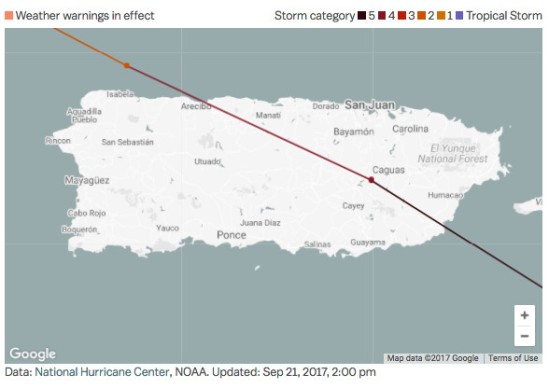
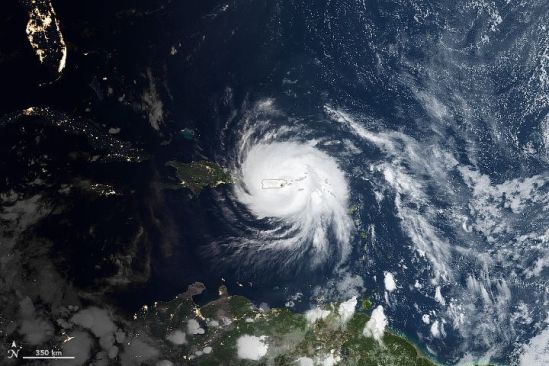
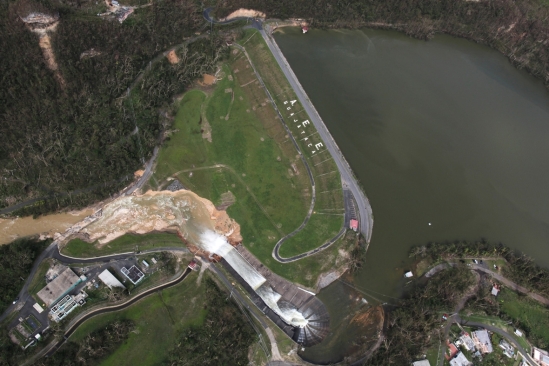
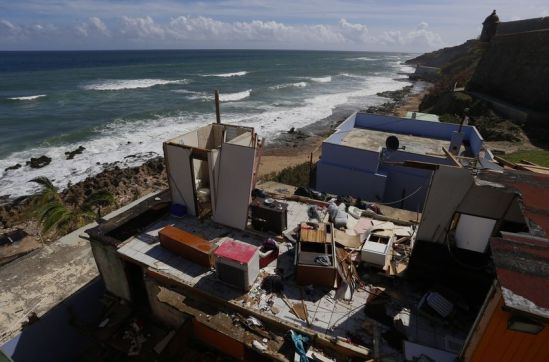
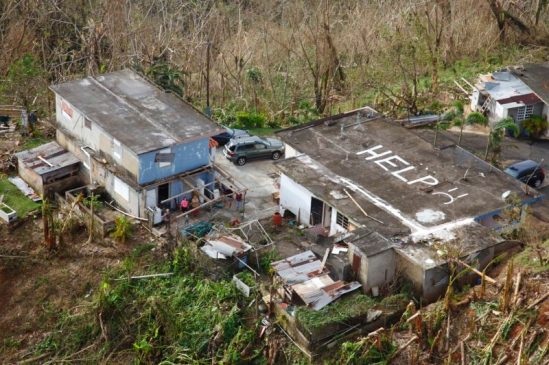
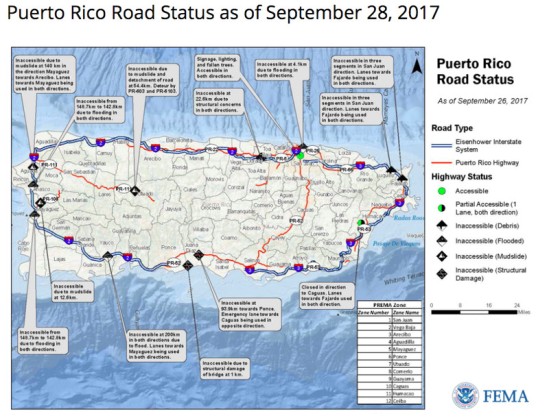
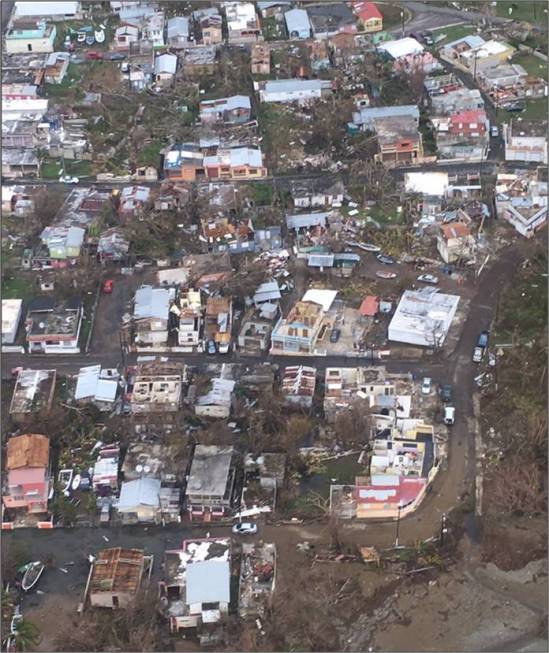
On Wednesday, September 20, 2017, the powerful Category 4 Hurricane Maria made direct landfall on Puerto Rico, ravaging the entire island with its 150 mph winds and drenching it in a few feet of rain. Save for generators powering only the highest priority buildings like hospitals. In many places there’s no fresh water you can drink, bathe, or use to flush toilets. Food, fuel, and cell service is limited. Reaching remote towns and villages takes several days for reporters and rescue workers. Due to strained communications and severe road damage, the extent of Maria’s damage on the island isn’t yet known. Though photos show who communities flooded streets, houses with torn roofs and second floors ripped apart, people waiting in long lines for clean water and fuel, and a severely crippled infrastructure. Even for Puerto Ricans living in intact houses, survival will be difficult in the weeks and months ahead. Thus, the aftermath of Hurricane Maria has been a humanitarian catastrophe. for the 3.4 million people on Puerto Rico.

Screen_Shot_2017_09_21_at_2.39.06_PM

The 2017 hurricane season has been punishing for the island. Hurricane Irma had ravaged several Caribbean islands and left 1 million Puerto Ricans without power. 60,000 on the island were still without electricity when Maria hit 20 days later. Though Maria was a slightly smaller storm, it was far more devastating charted a course directly across Puerto Rico where it hit near peak intensity and passed around 25 miles from its capital San Juan. No landmass could suffer such a direct hit without at least some damage. According to the record books, Maria was the 5th strongest storm to ever hit the US and the strongest to hit the island in 80 years.

mehta-hurricanemedia-1

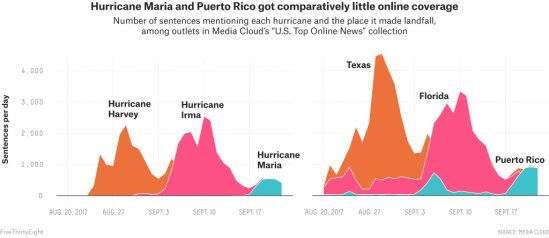
This disaster deserves more coverage and a swifter response. But so far, federal government recovery efforts have been inadequate at best. In some ways this is understandable since few major news organizations have a full-time regular presence on the island. Also lack of wi-fi and cellphone service have hurt local journalists’ ability to report the news from there. But even a communications blackout is no excuse for Puerto Rico’s virtual absence from news coverage in favor of protesting football players and Donald Trump’s latest incendiary Twitter tantrums. Nonetheless, if this kind of devastation happened in mainland United States, you’d see round the clock news coverage from all the cable news channels for days. You’d see the affected states’ congressional delegation appear on major news networks making sure the American public knows and pressuring the president, House, and Senate leaders to take immediate action.

maria_goe_2017263


As a US territory, Puerto Rico doesn’t get electoral votes in general presidential elections or representation in Congress. But Puerto Ricans have been US citizens since President Woodrow Wilson signed the Jones-Shafroth Act in 1917. They can travel to the continental United States without a passport and vote in presidential primaries. They’re also protected by the same Bill of Rights as anyone else in the United States. But more importantly in Maria’s wake, Puerto Ricans are entitled to the same federal government response as state residents should a natural disaster like Hurricane Maria arise on their soil. However, though the US has long benefitted from its island territories’ geographical reach, it has taken them for granted and denied their residents full political representation. Hurricane Maria illustrates that this two-tiered system of American citizenship is neither democratic nor tenable to territorial residents. And to make matters worse a survey from the New York Times reports that only 54% of Americans know Puerto Ricans are US citizens.

hurricane-maria-puerto-rico

Though powerful storms often devastate communities, the true catastrophe was long in the making. Puerto Rico was no different regarding Hurricane Maria. Despite a $103 billion economy, we all knew that Puerto Rico’s government is broke and can’t borrow money to fix it. In fact, the island declared bankruptcy in May and has been trying to restructure more than $70 billion in debt. Thus, even on a good day, its infrastructure is aging and in disrepair. Certain US policies have also contributed to Puerto Rico’s economic deterioration. One is the antiquated Jones Act forcing Puerto Ricans to pay nearly double for US goods through various tariffs, fees, and taxes. The act stipulates that any goods shipped from one American port to another must be on American made and operated ships. Thus, thanks to little competition among freighters, shipping to Puerto Rico is costlier. As former New York State Assembly member Nelson A. Denis noted in The New York Times, “a shakedown, a mob protection racket, with Puerto Rico a captive market.” Economic woes have also contributed to over 8% population loss from 2010. However, since the island’s per capita income is $18,000 (which is half of Mississippi’s), its cost of living is 13% higher than 325 urban areas elsewhere in the US, it’s not much of a surprise. The population drain makes it harder for Puerto Rico’s economy to recover. And as people will likely migrate due to the storm, recovery will be more difficult.

1506796842_394_10-days-after-Hurricane-Maria-Puerto-Rico-is-still-fighting-for-life

As Puerto Rico is an island, recovery efforts are more complicated since supplies has to be flown in or shipped over. Residents can’t drive to nearby states or cities for shelter to wait out the worst of it. Here’s a rundown on some of the major problems on the island.

DKlJzVnXoAEu2Pt

Electricity: The island’s electric company PREPA has a massive $9 billion in debt and defaulted on an interest payment in July. So it doesn’t have the money to modernize its electrical systems. Even without hurricanes power outages are common. To make matters worse, there aren’t enough workers on the island to fix the infrastructure. Mostly because young people have been leaving in droves since the economy tightened while older workers have retired en masse to secure their pensions.

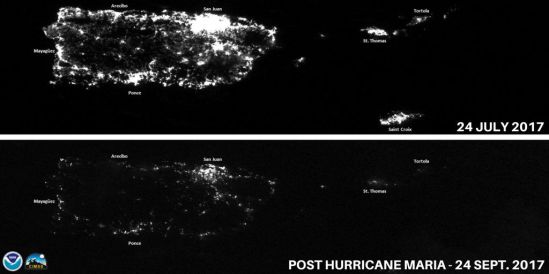
Hurricane Maria has knocked out 80% of the island’s power transmission lines and as of yesterday, 1.57 Puerto Ricans were still without power. Though generators are being distributed most of them are prioritized to hospitals while most homes and businesses are dark. It could be 4-6 months before power is fully restored on the island. So you have Puerto Rico’s 3.4 million residents relying on generators for half a year. That means half a year that electrical pumps can’t bring running water to people’s homes. Half a year people will have to make do without air conditioning in a tropical climate. Without power, even the most basic tasks of modern life become difficult.

Taken these factors together, rebuilding Puerto Rico’s power system will be a long and difficult process. According to the New York Times, getting power back on the island “will be daunting and expensive” for “Transformers, poles and power lines snake from coastal areas across hard-to-access mountains. In some cases, the poles have to be maneuvered in place with helicopters.”

Screen_Shot_2017_09_25_at_1.26.42_PM

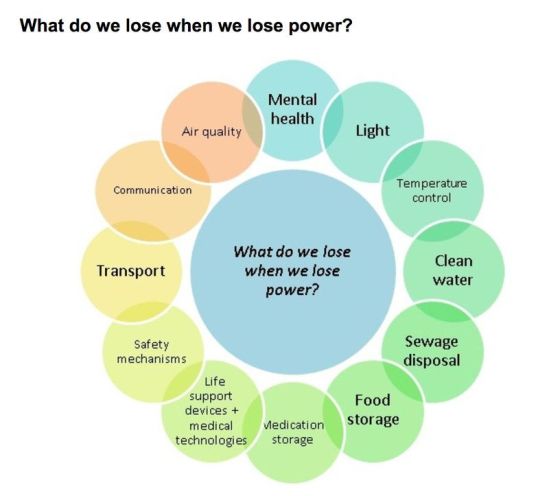
In a disaster situation, health hinges on electrical power and it’s extremely important to get it going to suppress chances of illness. Dialysis, refrigeration for insulin and other medicine, and nebulizers for people with asthma all need electricity to be useful. But electricity also provides for sanitation that prevents many illnesses like typhoid from spreading in the first place. Puerto Ricans need power to run their air conditioning systems and get clean water from the faucet. Without it, people could get sick from dirty water, can’t dispose waste, and suffer from heatstroke. Mental health can also suffer those without access to rapid opportunities for recovery with residents suffering from depression and post traumatic stress disorder.

GettyImages_853153700

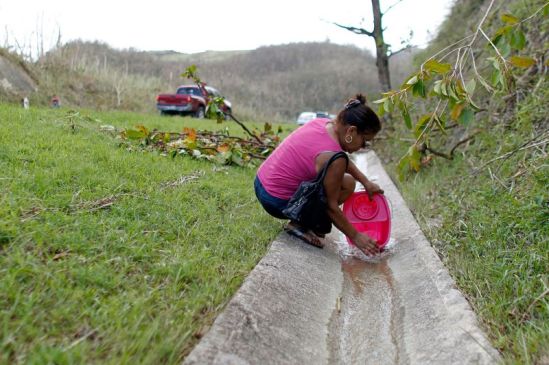
Water: No electricity means no power to pump water into homes and no water to bathe, drink, or flush toilets. According to FEMA, 42% of Puerto Ricans are without potable water. One town’s only source of fresh water was a single fire hydrant. Though rescue workers have been distributing bottled water, it’s safe to say that many people haven’t received any yet.

Fuel: Without a working electrical grid, Puerto Ricans must turn to gas-powered electric generators for energy. But it’s so difficult getting fuel on the island that people could wait over 6 hours for gas if they’re lucky. Other stations are completely out of fuel and have been for days. According to NPR, while authorities don’t believe there’s a gas shortage on the island, they’ve claimed Hurricane Maria has disrupted distributing it. But when fuel runs low, lives are endangered. In the central eastern town of Juncos, the Washington Post reported on a diabetic woman afraid that the refrigeration keeping her insulin preserved will soon run out and there won’t be fuel to restart the generator.

puerto_rico_cell_tower

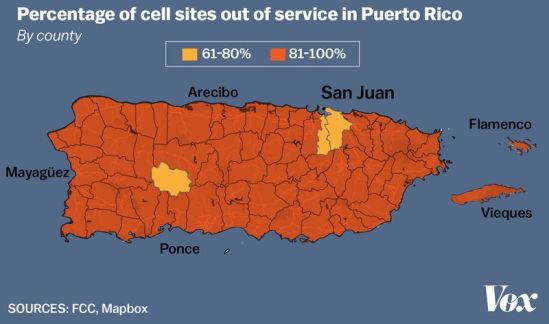
Cellphone Reception: Hurricane Maria knocked out 1,360 out of the island’s 1,600 cellphone towers, isolating many communities from the outside world for days and relying only on radios for news. National Guard members told the Daily Beast they struggled communicating on the ground, which has made their ability to respond to the disaster exceptionally hard. The cellular outage also means that a mainland or abroad Puerto Rican family can’t get in touch with those on the island to find out if they’re safe.
Weather Radar: On Monday, September 25, the National Weather Service reported that its Doppler radar station on Puerto Rico was destroyed. If you don’t know, that’s the radar that helps meteorologists see where thunderstorms and other weather systems move in real time. Without it makes future storms more hazardous.

Mountain Top Mayday

Hospitals: According to FEMA, 59 out of 69 Puerto Rican hospitals are “operational with unknown status.” Many now run on generators but there are serious issues with distributing fuel so access to X-ray machines and other diagnostic equipment remains limited. There are few open operating rooms despite an unsurprising influx of patients with storm-related injuries. San Juan’s mayor reported that two people died due to lack of diesel in the hospital they were. And San Juan is among the better places to be in Puerto Rico right now. Still, if power isn’t restored, Puerto’s health crisis will get worse. After all, electricity is involved with almost every interaction with the health system. For you need power to call a hospital, access electronic records, and running lifesaving equipment like hemodialysis and ventilators.

Farms: Agriculture only contributes 0.8% of Puerto Rico’s GDP and employs 1.6% of its labor force. But within hours Hurricane Maria wiped out 80% of its crop value which amounts to a loss of $780 million. Though the island imports 85% of its food, its agriculture sector’s destruction will increase prices and exacerbate the scary prospect of continued food shortages.

Airports: Puerto Ricans have had a difficult time getting off the island. Though San Juan’s Luis Munoz Marin International Airport reopened to commercial flights on Sunday, September 24, they can expect to wait a long time in uncomfortable conditions if they want a flight. There’s no air conditioning. Ticketing computers are out. And due to FAA radar damage, only a limited number of planes take off from San Juan each day while hundreds of flights have been canceled.

Screen_Shot_2017_09_29_at_1.47.46_PM

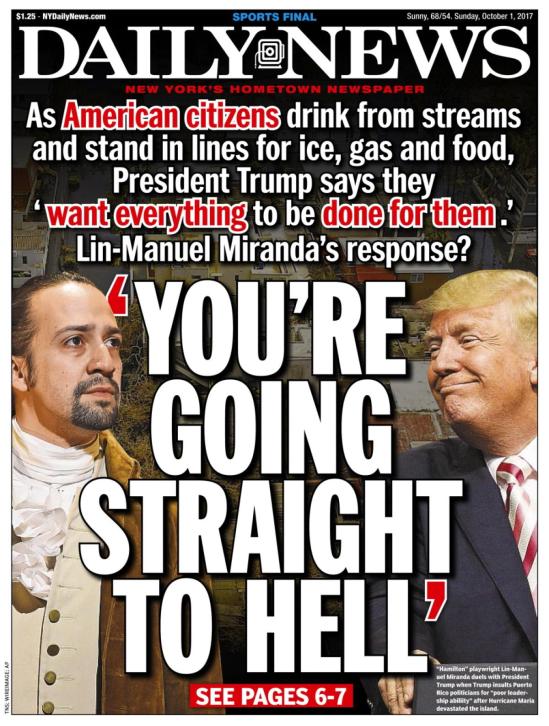
Though Puerto Rico has received government relief, response is still badly inadequate especially as relief supplies wait on the island’s shipping docks. Even as we speak, millions remain without food, water, electricity. And they have no means of getting help. However, instead of doing everything he could to help Puerto Rico, Donald Trump goes golfing in New Jersey. Only to take a tweeting break to attack San Juan Mayor Carmen Yulín Cruz on Twitter just for speaking out for her people and calling out FEMA for patting itself on the back while the island was still ravaged when Hurricane Maria hit. Disease outbreaks have begun due to murky water and packed shelters. Residents have shown signs of Zika, Dengue, conjunctivitis, cholera, hepatitis A, meningitis, and salmonella. Now Trump says that Puerto Ricans are lazy and want everything done for them. Like they should help themselves instead of asking for a handout. Local officials in Puerto Rico are doing everything they possibly can with the limited help they have. Far from showing “poor leadership” Mayor Cruz has been there for her city almost 24/7 with little to no rest, doing whatever she could. But she knows she doesn’t’ have the resources like the federal government has like FEMA under her thumb. She shouldn’t have to beg for that response for it should’ve arrived already. It’s a shame that she has to beg a man for help who is more likely to step on your hand and leave you to drown when you’re reaching to him to lift you into his yacht. Or at least give you a lifesaver to hold. Of all the things Trump has said and done, letting millions of people suffer for days without adequate response just breaks me. Mayor Cruz wasn’t asking for a handout like the welfare recipients conservatives constantly unfairly demonize. She was asking for a lifesaver because people are dying and Puerto Rico is drowning. The island’s residents are utterly helpless and without help soon, many will die if they haven’t already. But up golfing in New Jersey, Trump tells Puerto Ricans to eat cake without any second thought to their dire suffering. Even George W. Bush’s response to Katrina was better than this.

Damage-to-a-neighbourhood-in-Puerto-Rico-struck-by-Hurricane-Maria-pictured-on-Sept-23-2017.jpg

It breaks me more that people in my own family, neighborhood, and community will find some way to defend and support this unrespectable man no matter what he does which I feel is so morally indefensible as a Catholic, liberal, and American in that order. I have no capacity to respect Donald Trump as neither a person nor as an authority figure. To have him as president of the United States is absolutely humiliating for I’m deeply convinced that Trump is a narcissistic sociopath doesn’t believe in America, the Constitution, or in any concept of democracy. He is a total failure as a human being, let alone a president which doesn’t surprise me. But I find his cruelty utterly gut wrenching to the point of inhumanity. Hurricane Maria devastated Puerto Rico but Trump’s lack of interest in the island’s plight has resulted in very serious consequences. The people of Puerto Rico deserve better than what they’re receiving. So you’re Donald Trump and you’re reading this, then to quote Lin Manuel Miranda, “You’re going straight to hell.”

straight-hell-october-1-2017

The Racist History of Donald Trump

trumps-racist-quotes-black-guys-counting-money-hate-it-the-o-politics-1457136437

Early this month, ESPN co-anchor, Jemele Hill tweeted that Donald Trump is “a white supremacist whose surrounded himself with other white supremacists.” The White House cried foul and demanded that Hill be fired. But is Hill right? Trump has repeatedly claimed he’s “the least racist person you’ve encountered.” Anyone who’s heard his incendiary comments and has any idea about his policies knows that’s a pile of shit. We’ve all seen how he’s made explicitly racist and otherwise bigoted comments on the campaign trail. Memorable moments include referring Mexican immigrants as criminals and rapists, proposing a Muslim ban, suggesting a Mexican American judge should recuse himself due to his heritage, and attacking a Muslim Gold Star family. Now that trend has continued into his presidency and shows no sign of his racist antics anytime soon. After all, he’s stereotyped a black reporter, appointed white supremacists to official positions, issued a Muslim ban, and pandered to white supremacists after they held a violent rally in Charlottesville. However, many of you may not know that the very first time Trump appeared in the New York Times was because the US Department of Justice had sued him and his dad for housing discrimination. He’s repeatedly inspired similar controversies since. Nevertheless, this history is important. It’s one thing if Trump misspoke once or twice. But take his actions and comments together, there’s a clear pattern suggesting that his bigotry isn’t just mere political opportunism, but a very real element on his personality, character and career.

Blacks:
1973: Alongside his father Fred, was sued by the Department of Justice during the Nixon Administration for violating the Fair Housing Act. Federal officials uncovered evidence that Trump refused to rent to black tenants and lied to black applicants whether apartments were available, among other accusations. Trump claimed that the federal government tried getting him to rent to welfare recipients. Though he and his father signed an agreement not to discriminate against non-white renters in 1975, they never admitted guilt.
1978: Alongside his father Fred, was sued by the Department of Justice again for failing to live up to that agreement. Even that didn’t change anything either. As Salon’s Justin Elliot reports, “in 1983, a fair-housing activist cited statistics that two Trump Village developments had white majorities of at least 95 percent.”
1980s: Former Trump Castle employee Kip Brown accuses one of his businesses of discrimination. According to him, “When Donald and Ivana came to the casino, the bosses would order all the black people off the floor. It was the eighties, I was a teenager, but I remember it: They put us all in the back.”
1989: Told Brian Gumbel in an interview, “A well-educated black has a tremendous advantage over a well-educated white in terms of the job market…if I was starting off today, I would love to be a well-educated black, because I really do believe they have the actual advantage today.” All the serious studies refuted that. But his statement serves as a kind of shout-out to those ignorant about US racial dynamics.
1996: Is sued by 20 African Americans in Indiana for failing to honor a promise to hire mostly minority workers for a riverboat casino on Lake Michigan.
2004: During The Apprentice’s second season, fired black contestant Kevin Allen for being overeducated. Trump said on the show, “You’re an unbelievably talented guy in terms of education, and you haven’t done anything. At some point you have to say, ‘That’s enough.’”
2005: Publicly pitched what was essentially The Apprentice: White People vs. Black People. He claimed he “wasn’t particularly happy” with his show’s most recent season so he considered “an idea that is fairly controversial — creating a team of successful African Americans versus a team of successful whites. Whether people like that idea or not, it is somewhat reflective of our very vicious world.”
2010s-present: Has directed accusations of racism against blacks on Twitter 3 times as often as he’s done so against whites. Yet, his use of “racist” and “racism” is best understood in the context of the conservative movement that has come to believe that whites face more discrimination than blacks, despite absolutely no evidence.
2011: Played a big role pushing false rumors that President Barack Obama wasn’t born in the United States. Even sent investigators to Hawaii to look into Obama’s birth certificate, which the president released calling Trump a “carnival barker.”
2011: Also argued that Obama wasn’t a good enough student to get into Columbia or Harvard Law School and demanded he released his university transcripts. Trump claimed, “I heard he was a terrible student. Terrible. How does a bad student go to Columbia and then to Harvard?”
2011: Told Albany’s Talk 1300, “I have a great relationship with the blacks. I’ve always had a great relationship with the blacks.”
2011: Tweeted: “What a convenient mistake: @BarackObama issued a statement for Kwanza (sic) but failed to issue one for Christmas.”
2012-2013: Had a long Twitter feud with MSNBC host Toure whom he accused of being racist no fewer than 10 times. One tweet reads, “Not only is @Toure a racist (and boring), he’s a really dumb guy!” However, the feud was more evidently sparked by Toure’s tweets about Trump’s bankruptcies.
2013: Sent 6 tweets accusing HBO “Real Sports” host Bryant Gumbel of racism. One tweet reads, “In that @TimeWarner has @HBO with really dumb racist Bryant Gumbel (and I mean dumb), and no CBS (which fired Bryant), I am switching bldgs.” However, the accusations may have been linked to Gumbel’s comments on Trump’s golf courses.
2014: Tweeted: “Sadly, because president Obama has done such a poor job as president, you won’t see another black president for generations!” I’m sorry just because race relations are poor, doesn’t mean President Barack Obama was a bad president (which he wasn’t).
2015: Tweeted: “Our great African-American president hasn’t exactly had a positive impact on the thugs who are so happily and openly destroying Baltimore.” As Men’s Trait noted, “Seriously, just shut up at this point. That’s like holding Jimmy Carter accountable for all the crap white people did while he was in the Oval Office.”
2015: Tweeted: “And if you look at black and African American youth, to a point where they’ve never done more poorly. There’s no spirit.”
2015: Called President Barack Obama, “the founder of ISIS.”
2015: Said during a Florida press conference, “I think President Obama has been the most ignorant president in our history. His views of the world as he says don’t jibe and the world is a mess. President Obama — when he became president, he didn’t know anything. This guy didn’t know a thing. And honestly, today he knows less. Today, he knows less. He has done a terrible job.” He later said, “He has been a disaster as a president. He will go down as one of the worst presidents in the history of our country. It is a mess.”
2015: In September, tweeted an image of a masked black man holding a handgun in a threatening manner alongside false statistics attempting to show that blacks kill more people of all other races. One “fact” stated that blacks killed 81% of white homicide victims that year. According to the FBI, the number is closer to 15%.
2015: Condoned the beating of a Black Lives Matter protester his supporters attacked during a campaign rally in Alabama. “Get him the hell out of here, will you, please?” he told the cheering crowd. “Get him out of here. Throw him out!” Video of the incident shows the assailants kicking the man after he had fallen to the ground. The next day, Trump implied that the attackers were justified noting, “Maybe [the protester] should have been roughed up. It was absolutely disgusting what he was doing.” His dismissive attitude toward the protester is part of a larger, troubling pattern of instigating violence toward protesters at campaign events, where people of color have attracted especially violent hostility. Trump also believes that the entire Black Lives Matter movement lacks legitimate policy grievances. And he’s alluded to these views in an New York Times Magazine interview where he described Ferguson, Missouri as one of the most dangerous places in America. In reality, the small St. Louis suburb doesn’t even make it to the top 20 highest-crime municipalities in the country. But it’s notorious for its police corruption which has a long record harassing its black community for funds.
2016: Said during a June rally, “Look at my African American over here!”
2016-present: At the Republican National Convention, officially seized the mantle of the “law and order” candidate, an obvious dog whistle playing to white fears of black crime despite that US crime being at a historic low. Trump’s speeches, comments, and executive actions after he took office have continued this line of messaging.
2016: Said in a pitch to black voters, “You’re living in poverty, your schools are no good, you have no jobs, 58 percent of your youth is unemployed. What the hell do you have to lose?” Trump’s remarks show he has no appreciation for black culture or achievement but instead utters one ugly cliché after another. As Hillary Clinton noted, “In just the past week, under the guise of ‘outreach’ to African Americans, Trump has stood up in front of largely white audiences and described black communities in such insulting and ignorant terms. ‘Poverty. Rejection. Horrible education. No housing. No homes. No ownership. Crime at levels nobody has seen.’ ‘Right now,’ he said, ‘you walk down the street and get shot.’ Those are his words.” Actual Trump rallies consisted of this on a regular basis.
2016: African American Apprentice winner Randal Pinkett tells Hollywood Reporter that Trump asked him if he’d share his title with the runner up- a white woman.
2016: During a rally in Grand Rapids, Michigan, said that black voters came through for him, arguing that those who stayed home did it to help him. Except that blacks thoroughly loathe him and most black voters came out for Hillary Clinton.
2017: Stereotyped a black reporter at a February press conference. When April Ryan asked if he planned to meet and work with the Congressional Black Caucus, he repeatedly asked her to set up a meeting despite her insistence that she’s “just a reporter.”
2017: In the wake of Charlottesville over the controversy of Confederate monuments, tweeted: “Sad to see the history and culture being ripped apart with the removal of our beautiful statues and monuments.” Know that Trump was born and raised in Queens and has lived in Manhattan for most of his life. Thus, his cultural roots are far removed from those who erected those monuments. Nor has he ever shown any affinity for what’s especially popular in the South like NASCAR, church, college football, hunting, fishing, country music, barbecue, and what have you. It’s pretty clear his defense of Confederate monuments is rooted in racism.
2017: Tweeted: “ESPN is paying a really big price for its politics (and bad programming). People are dumping it in RECORD numbers. Apologize for untruth!” This in reaction to ESPN anchor Jemele Hill tweeting, “Donald Trump is a white supremacist who has largely surrounded himself w/ other white supremacists.” White House Press Secretary Sarah Huckabee Sanders called Hill’s comment a “fireable offense.”

Native Americans:
1993: Tried to open a casino in Bridgeport, Connecticut that would compete with one owned by the Mashantucket Pequot Nation, a local Native American tribe. During a House subcommittee on Native American Affairs hearing, claimed that the Pequots, “don’t look like Indians to me… They don’t look like Indians to Indians.” He then elaborated on those remarks alleging that the mafia had infiltrated Native American casinos which the FBI had immediately denied.
2000: Opposing a casino proposed by the St. Regis Mohawk tribe, which he saw as a threat to his Atlantic City casinos, secretly ran a series of ads suggesting the tribe had a “record of criminal activity [that] is well documented.”
2012-present: Has repeatedly referred to Senator Elizabeth Warren as “Pocahontas” since she said she had Cherokee ancestors and received criticism over lack of evidence to substantiate her claim. But Warren said at the time, “These are my family stories.”

Hispanics:
2015: Launched his presidential campaign calling Mexican immigrants “rapists” who are “bringing crime” and “bringing drugs” to the US. His campaign is largely built on building a wall to keep them out of the US. He even accused Latin American governments of actively sending undocumented immigrants across the border.
2015: Said in an interview with Entertainment Tonight, “I don’t have a racist bone in my body. The fact that I want a strong border and the fact that I don’t want illegal immigrants pouring into this country, that doesn’t make me a racist, it means I love this country and I want to save this country.”
2015: Tweeted: “Jeb Bush has to like the Mexican Illegals because of his wife.”
2015: Said on NBC News: “The Mexican government forces many bad people into our country. Because they’re smart. They’re smarter than our leaders.” During that same interview, he told NBC, “I’ll win the Latino vote because I’ll create jobs. I’ll create jobs and the Latinos will have jobs they didn’t have.”
2015: Said during a rally in Birch Run, Michigan: “Jeb Bush will not be able to negotiate against Mexico. Jeb Bush with Mexico said, ‘People, come in,’ they come in, it’s an act of love, OK?” Also remarked, “I’m leading in the Hispanic vote, and I’m going to win the Hispanic vote. I’m also leading in the regular vote.”
2015: Referred to two supporters beating up a homeless Latino man in Boston as “passionate.” They cited Trump’s anti-immigrant message when explaining why they did it. One of the men told police officers, “Donald Trump was right ― all these illegals need to be deported.” Trump suggested that the men were well intentioned and had simply gotten carried away. “I will say that people who are following me are very passionate,” he said. “They love this country and they want this country to be great again. They are passionate.”
2015: Addressing news of a coalition of Hispanic organizations protesting his SNL appearance, told Fox & Friends in October, “I’m leading in the polls with the Hispanics. I mean, you look at Nevada, I’m leading in the polls with the Hispanics because I produce jobs, and they know it. I have thousands of Hispanics that work for me, my relationships to Hispanics is better than those groups. Those groups are looking to fundraise; I know all about those groups.”
2015: Asked about his wall policy during an Iowa press conference by Univision’s Jorge Ramos, shouted down and had security forcibly remove the reporter. As Ramos waited to get back inside the press conference so he could do his job, a member of Trump’s entourage told him to “get out of my country.” Ramos is a US citizen.
2015: During a November GOP debate, compared his plan to deport undocumented immigrants to President Dwight D. Eisenhower’s infamous “Operation Wetback,” which deported more than 1 million Mexicans in the 1950s, resulting in many deaths.
2016: Alleged that the Rev. Rafael Cruz was involved in the Kennedy assassination, which his son Senator Ted Cruz took to great offense. “His father was with Lee Harvey Oswald prior to Oswald’s being – you know, shot. I mean, the whole thing is ridiculous. What is this, right prior to his being shot, and nobody even brings it up. They don’t even talk about that. That was reported, and nobody talks about it.”
2016: For Cinco de Mayo, tweeted a picture of himself eating a taco bowl with the tweet “Sadly, because president Obama has done such a poor job as president, you won’t see another black president for generations!”
2016: Argued that Judge Gonzalo Curiel should recuse himself from the Trump University lawsuit he was overseeing because of his Mexican heritage and membership in a Latino lawyers association. House Speaker Paul Ryan called such comments, “the textbook definition of racism.” Curiel is the son of Mexican immigrants who was born in Indiana.
2016: During an October debate with Hillary Clinton: “We have some bad hombres here, and we’re going to get them out.”
2017: Pardoned notorious ex-sheriff Joe Arpaio who for willfully violating a federal court order while sheriff by allowing racial profiling round ups of suspected undocumented immigrants. During his reign in Maricopa County, Latinos suffered widespread systemic abuse and discrimination. They were 4-9 times more likely to be pulled over for traffic stops, often for no good reason. A federal judge found Arpaio guilty of violating Hispanics’ constitutional rights and ordered him to stop detaining people based on their ethnicity. The former sheriff refused so another judge found him on criminal contempt. Nevertheless, Trump has called Arpaio “a great American patriot” as well as praised his self-styled toughness on undocumented immigration.
2017: Ordered the end of the Deferred Action for Childhood Arrivals (DACA) that’s designed to protect undocumented immigrants brought to the country by their parents from deportation.

Muslims:
2010: Publicly opposed a proposal to build a Muslim community center in Lower Manhattan during the huge national controversy over the “Ground Zero Mosque.” Trump called the project, “insensitive” and offered to buy out one of its investors. On David Letterman, he later argued, referring to Muslims, “Well, somebody’s blowing us up. Somebody’s blowing up buildings, and somebody’s doing lots of bad stuff.”
2015: When asked at a Republican debate whether he meant all 1.6 billion Muslims hate the us, responded, “I mean a lot of them. I mean a lot of them.”
2015: Called for a national database to track all Muslims and surveillance of mosques. Commented there should be many systems “beyond databases” and he’d get Muslims registered by using “good management.” When asked whether there’s a difference between requiring Muslims to register and Jews in Nazi Germany, Trump replied, “You tell me.”
2015: Alleged that thousands of American Muslims in New Jersey were cheering the 9/11 attacks.
2015-present: Called for a ban on all Muslims entering the US and later expanded it to include those from specific countries, consisting of possibly France and Germany. Once he took office, Trump issued his “Muslim ban” executive order, which banned anyone from 7 Muslim-majority countries from coming into the US for 90 days and banned nearly all refugees for 120 days.
2016: Said during a rally in March, “I think Islam hates us. There’s something there — there’s a tremendous hatred there. There’s a tremendous hatred. We have to get to the bottom of it. There is an unbelievable hatred of us.”
2016: During a South Carolina rally, told supporters about US occupation of the Philippines in the early 20th century and what General John Pershing used to fight Muslim insurgents there. He said, “They were having terrorism problems, just like we do. And he caught 50 terrorists who did tremendous damage and killed many people. And he took the 50 terrorists, and he took 50 men and he dipped 50 bullets in pigs’ blood — you heard that, right? He took 50 bullets, and he dipped them in pigs’ blood. And he had his men load his rifles, and he lined up the 50 people, and they shot 49 of those people. And the 50th person, he said: You go back to your people, and you tell them what happened. And for 25 years, there wasn’t a problem. OK? Twenty-five years, there wasn’t a problem.” This story is mostly apocryphal but Trump has repeated the story several times since.
2016: Tweeted on the Orlando nightclub massacre: “Appreciate the congrats for being right on radical Islamic terrorism, I don’t want congrats, I want toughness & vigilance. We must be smart!”
2016: Retaliated against Muslim parents of a US Army officer who sacrificed his own life for his fellow soldiers while serving in the Iraq War. During the Democratic National Convention, Khizir Khan spoke out against Trump’s bigoted rhetoric and his disregard for civil liberties. “Let me ask you, have you even read the U.S. Constitution?” he asked before pulling a copy of the document from his jacket and holding it up. “I will gladly lend you my copy.” His headscarfed wife Ghazala stood at his side but didn’t speak. Trump seized on her silence to imply she was forbidden from speaking due to the Gold Star couple’s Islamic faith. He told ABC News, “If you look at his wife, she was standing there. She had nothing to say. She probably, maybe she wasn’t allowed to have anything to say. You tell me.” Mrs. Khan responded writing a Washington Post op-ed explaining that she couldn’t speak because of her grief. “Walking onto the convention stage, with a huge picture of my son behind me, I could hardly control myself. What mother could? Donald Trump has children whom he loves. Does he really need to wonder why I did not speak?” she wrote.
2016: Appointed retired Lt. General Michael Flynn as National Security Adviser. Notorious for his claims about Islam and his tendency to disseminate fake news on social media such as a linking to a tweet claiming Hillary Clinton was “wearing hijab in solidarity with Islamic terrorists.” Also used social media to condemn the entire religion of Islam, calling it a “malignant cancer.” Once tweeting, “Arab and Persian world ‘leaders'” should “step up to the plate and declare their Islamic ideology sick.” Falsely claimed Sharia Law “is spreading in the United States,” demonstrating what the New York Times called “a loose relationship with facts.”

Asians:
1988: Spent much of his commencement speech at Lehigh University accusing countries like Japan of “stripping the United States of economic dignity.” This matches much of his current rhetoric on China.
1989: When asked to give an estimate of his total wealth, he responded, “Who the f knows? I mean, really, who knows how much the Japs will pay for Manhattan property these days?”
2012: Tweeted: “The concept of global warming was created by and for the Chinese in order to make U.S. manufacturing non-competitive.”
2015: During an August Iowa speech while boasting his ability to negotiate, especially in dealing with the Chinese, used broken English to impersonate Asian negotiators. He said, “When these people walk into the room, they don’t say, ‘Oh hello, how’s the weather? It’s so beautiful outside. How are the Yankees doing? They’re doing wonderful, that’s great.’ They say, ‘We want deal!’”

Jews:
2013: Got in a Twitter fit over Jon Stewart referring him as “Fuckface von Clownstick.” One of the tweets reads, “If Jon Stewart is so above it all & legit, why did he change his name from Jonathan Leibowitz. He should be proud of his heritage!” Another read, “Jon Stewart @TheDailyShow is a total phony-he should cherish his past-not run from it.” The Daily Show replied, “Can’t an overrated Jew have a complicated relationship with his dad without being accused of hiding his heritage? #FuckFaceVonClownstick.”
2015: During a December address to the Republican Jewish Coalition, he tried to relate to the crowd by invoking the stereotype of Jews as talented and cunning businesspeople. Touting his 1987 book, Trump: the Art of the Deal, he said, “I’m a negotiator, like you folks. Is there anyone who doesn’t renegotiate deals in this room? Perhaps more than any room I’ve spoken to.” He later implied that he had little chance of earning the Jewish Republican group’s support because his fealty couldn’t be bought with campaign donations (actually it can, but that’s beside the point). “You’re not going to support me, because I don’t want your money,” he told them (in an obvious lie). “You want to control your own politician.”
2016: Brands his nationalist foreign policy as “America First.” If you’re not familiar with American history, before Trump, the phrase of “America First” was notoriously associated with the isolationist group the America First Committee, which opposed US entry into WWII. Though it originated with a bunch of Ivy League college kids that included future President Gerald Ford, its membership soon extended to xenophobes, Anti-Semites, and even Nazi sympathizers. Charles Lindbergh’s infamous Anti-Semitic laden 1941 Des Moines speech to the America First Committee is the reason why that phrase hasn’t been echoed in decades. Even today, the phrase “America First” carries Anti-Semitic undertones.
2016: Tweeted and later deleted an image showing Hillary Clinton in front of a pile of money and by a Jewish Star of David stating, “Most Corrupt Candidate Ever!” The tweet had some very obvious anti-Semitic imagery, but Trump insisted that the star was a sheriff’s badge and said his campaign shouldn’t have deleted it. Mic later discovered that the image was actually created by white supremacists that appeared on a Neo-Nazi forum for more than a week before Trump shared it. In addition, the image’s watermark led to a Twitter account that regularly tweeted racist and sexist memes.
2017: Doesn’t mention Jews in his speech on Holocaust Remembrance Day. Written statement calls for remembering “victims, survivors, heroes” but omits mentioning Jews who were the largest ethnic group affected. Politico later reported that the State Department had drafted a version that did mention Jews but the White House blocked it.
2017: Says in news conference to a young Jewish reporter asking about an increase in anti-Semitic acts, “I am the least anti-Semitic person that you’ve ever seen.”

General:
1970s-present: Has been sued 10 times for racial discrimination and has won none of those lawsuits.
1989: During the early days of the Central Park Five case, immediately runs an full page ad in 4 local papers demanding, “BRING BACK THE DEATH PENALTY. BRING BACK OUR POLICE!” Referring to the alleged Central Park attackers and violent criminals, he wrote “They should be forced to suffer and, when they kill, they should be executed for their crimes.” The Central Park Five case was very controversial one that’s been characterized as a modern-day lynching involving four black teenagers and one Latino adolescent accused of raping a New York City jogger. Due to New York City struggling with high crime at the time, public outrage over the rape let to these teens’ wrongful convictions, which were later vacated after they spent 7-13 years in prison and the city paid a $42 million settlement. Today their case is considered a cautionary tale about a politicized criminal justice process. But despite DNA evidence proving the contrary, Trump still believe these boys are guilty and deserve to die.
1991: Criticism on black accountant quoted in a book by former Trump Plaza president John O’Donnell. According to him, Trump said, “Black guys counting my money! I hate it. The only kind of people I want counting my money are short guys that wear yarmulkes every day. … I think that the guy is lazy. And it’s probably not his fault, because laziness is a trait in blacks. It really is, I believe that. It’s not anything they can control.” Trump initially denied the remarks but later said in a 1997 Playboy interview, “the stuff O’Donnell wrote about me is probably true. The guy’s a f—-g loser. A f—-g loser. I brought the guy in to work for me; it turns out he didn’t know that much about what he was doing. I think I met the guy two or three times total. And this guy goes off and writes a book about me, like he knows me!”
1992: His Trump Plaza Hotel and Casino had to pay a $200,000 fine over transferring black and women dealers to accommodate a big-time gambler’s prejudices.
2013: During the ramp up to the George Zimmerman trial, tweeted that “the overwhelming amount of violent crime in our cities is committed by blacks and Hispanics.”
2015-present: Has been repeatedly slow to condemn white supremacists who’ve endorsed him and has regularly retweeted messages from white supremacists and neo-Nazis.
2015: Tweeted: “According to Bill O’Reilly, 80% of all the shootings in New York City are blacks — if you add Hispanics, that figure goes to 98%, 1% white.”
2015: Tweeted in June, “Sadly, the overwhelming amount of violent crime in our major cities is committed by blacks and Hispanics – a tough subject – must be discussed.”
2016: Refuses to directly denounce former KKK leader David Duke’s endorsement, claiming he knew nothing about him and contradicting years of his own statements.
2016: During a debate with Hillary Clinton, says, “African Americans and Hispanics are living in hell. You walk down the street and you get shot.”
2016: Appoints former Breitbart chief, Steve Bannon as White House Chief Strategist. His history at Breitbart published sexist, racist, and inflammatory stories. According to former editor Ben Shapiro, “under Bannon’s Leadership, Breitbart openly embraced the white supremacist alt-right … with [Breitbart editor Milo] Yiannopoulos pushing white ethno-nationalism as a legitimate response to political correctness, and the comment section turning into a cesspool for white supremacist mememakers.” In his personal life, Bannon has been accused of making racist and anti-Semitic remarks behind closed doors. His ex-wife testified during their divorce that he didn’t want their kids attending school “with Jews” because they were “whiny brats.” Another former colleague stated he “occasionally talked about the genetic superiority of some people” and suggested limiting the number of black voters by restricting voting to property owners might not be “such a bad thing.”
2016: Nominated Steve Mnuchin as Treasury Secretary. A former executive of Goldman Sachs, Mnuchin once co-founded a bank called OneWest in 2008 which he led until 2015. As of 2016, OneWest is being sued for discriminating against black and Latino customers. According to a complaint by two fair housing agencies the bank, “kept bank branches out of nonwhite neighborhoods.” And as Fortune wrote, gave nonwhite customers disproportionately fewer mortgages. Between 2012 and 2013, the California bank gave zero loans to black customers in Los Angeles.
2016: Nominated then US Senator Jeff Sessions as Attorney General who was rejected from a federal judge appointment in the 1980s after people who worked for him testified that he made racially charged remarks. Has said he thought the KKK was okay until he learned they smoked pot. Once told a black lawyer, to “be careful how you talk to white folks.” Referred to the NAACP as “Un-American.” Called a black prosecutor, “boy.” And once called a white civil rights lawyer, “a traitor to his race.” Even his own friends thought he was too racist to serve as a federal judge. Coretta Scott King wrote a letter telling the US Senate not to confirm him.
2017: Started a commission to perpetuate the myth of rampant voter fraud that’s part of a conservative scheme do deny black people and others their right to vote. Heading that commission is Kansas Secretary of State Kris Kobach who’s often called, “most racist politician in America” and the “king of voter suppression.”
2017: Repealed federal regulations against pay discrimination.
2017: Issued a law enforcement protection executive order.
2017: Created a commission to investigate affirmative action lawsuits.
2017: Gave an ugly speech to a group of police officers during which he described gang violence in a creepy, almost loving detail in an attempt to smear immigrants as violent criminals.
2017: In the week after the white supremacist riots in Charlottesville, Virginia, has repeatedly suggested that “many sides” and “both sides” were responsible for the violence. Or to put it this way, Trump painted white supremacists as morally equivalent to the counter protesters standing against them. This seemed like a dog whistle to white supremacists and many of them took it as one with white nationalist Richard Spencer praising him for “defending the truth.”

2017: Said at a rally in Alabama that NFL owners should fire players who don’t stand for the national anthem. “Wouldn’t you love to see one of these NFL owners, when somebody disrespects our flag, to say ‘get that son of a bitch off the field?’” Trump asked the roaring crowd. He went on to claim that if owners fire a player for protesting the anthem, they’d become, the most popular person in the country. Because that is a total disrespect of our heritage.” Because to him, these players are “ruining the game.” Sure, conservatives might see players taking a knee as disrespect on the American flag and for our troops. However, these players take a knee to protest police brutality and systematic racism. Thus, Trump’s rants over the NFL are just racism disguised as patriotism.

 

The Scourge of Graham-Cassidy

Democratic-Senators-Denounce-GrahamCassidy-Health-Care-Bill.jpeg.CROP.promo-xlarge2

You’d think that Republican politicians at Capitol Hill would know by now that taking people’s healthcare away for whatever reason is as morally reprehensible as it is unpopular. But as soon as Congress is back in session, a group of Republican US Senators introduce this Graham-Cassidy legislation which is seen as the last Obamacare repeal bill left standing. The US Senate has until the end of the month to vote on this bill. In many ways, Graham-Cassidy is strikingly similar to earlier Trumpcare bills. But it’s also could be the most radical plan yet, drafted in secrecy without the usual committee hearings and markups. Senators Lindsey Graham and Bill Cassidy are rushing this legislation to the floor under the special “budget reconciliation which allows the bill to advance with only 51 votes instead of the usual 60. So far, it faces long odds that some of its backers said it would be almost impossible to get a massive rewrite of the healthcare system through the Senate within that period of time. And even if it passes, it could take the Congressional Budget Office could take several weeks to estimate Graham-Cassidy’s impact. That means we may have no idea how many Americans will lose their health insurance, how much premiums would increase, how much the deficit will increase, how much it will increase costs, and other impacts on the US economy. Still, keep in mind that it took only took 3 Republican US Senators to kill Obamacare repeal in July so anything’s possible. Even worse is that US Senator John McCain is open to supporting it. And remember, he was the deciding vote to sink Trumpcare back in July. Nonetheless, Graham-Cassidy’s impact can be potentially devastating to 1/6 of the US economy as well as millions of Americans.

Regardless of you think, it is morally unconscionable to introduce legislation designed to take away people’s healthcare for any reason, especially politics. Every Republican plan to repeal and replace the Affordable Care Act has meant higher costs, millions of hard-working Americans losing their insurance, and key protections gutted with devastating consequences for anyone with pre-existing conditions. Should Graham-Cassidy be made law, millions will lose their insurance, thousands will face bankruptcy and loss in quality of life, hundreds of jobs will be lost, hospitals and medical facilities will close, costs will rise, and many will die from not getting the treatment they needed to save their lives. There will be more abortions, more maternal and infant deaths, more deaths and disabilities from gun violence, more ravaged communities, and more opioid overdose deaths. Most of all, it will threaten the health security for every American. This isn’t the kind of healthcare future most Americans want to live in and I will absolutely not stand for it.

The fact my access to Medicaid in the next decade may depend a few GOP Senators’ votes just scares the living shit out of me. It’s appalling enough that I have to live under a for-profit healthcare system I strongly believe has no moral right to exist. If I lose my Medicaid coverage, it’s very likely I may never be able to get health coverage that’s just as good or at all. Why the hell should I have my healthcare taken away from me just so some rich guy can enjoy some massive tax cut he doesn’t even need? I can’t live with that. I shouldn’t have to live with that. I shouldn’t have to lose my healthcare just so the Republican Party can satisfy their donors and voters. My healthcare shouldn’t be sacrificed to fulfill some market-based conservative vision that won’t benefit me. My autism shouldn’t reduce my own humanity to a financial risk. I’d rather pay taxes for someone else’s healthcare treatment I may not even need than be dropped from my coverage due politicians’ selfish interests.

As I’ve said before, the Republicans’ war on Obamacare must end. Graham-Cassidy is just mere malicious cruelty that robs Americans of their dignity and possibly their life, liberty, and the pursuit of happiness. Healthcare is a fundamental right the federal government should protect for all Americans. Corporations, politicians, and employers shouldn’t decide who has access to healthcare, especially Republicans on Capitol Hill. Nobody should be denied treatment if they’re sick or injured regardless of whether they can afford it or who has to pay for it. If a medical treatment can save someone’s life, then nothing else should matter. If you believe otherwise, then you can just go to hell for all I care.

graham_cassidy

What Graham-Cassidy does:

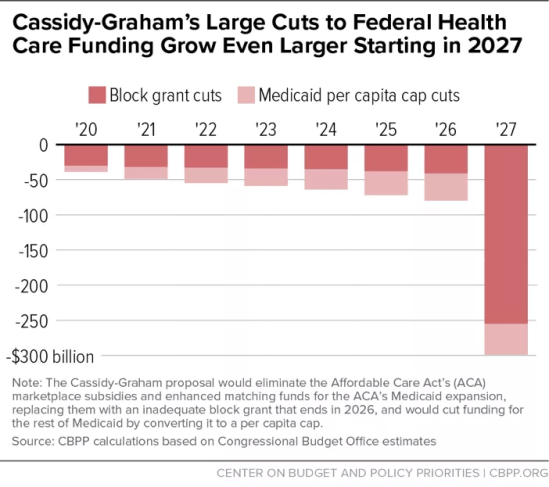
1. Shift Medicaid funding and insurance subsidies to a block grant system: Instead of determining the federal government’s share of funding for Obamacare’s Medicaid expansion and individual insurance subsidies, states would receive large chunks of money up front and determine what to do with it. For instance, they could spend it on providing insurance, fund high risk pools, or pay bills for patients with high medical needs. But there is no accountability for how this money is spent, won’t adjust based on need or higher costs, nor requires offering low and moderate income individuals coverage or financial assistance. Nevertheless, this system literally takes money from states that expanded Medicaid and gives it to states that didn’t. For those that did, their block grant funding could be anywhere from 35-60% below what they’d receive in the Medicaid expansion and/or marketplace subsidy funding under the current law. It would also would make it much more expensive for states to continue Obamacare if they like it. In fact, most states if not all would have to use the bill’s so-called “flexibility” to eliminate or cut coverage and financial assistance to low or moderate income people. Many states would likely do one or more of the following: cap enrollment; offer very limited benefits; charge unaffordable premiums, deductibles, and co-payments; redirect federal funding from providing coverage to other purposes, like reimbursing hospitals for uncompensated care; and limit assistance to fixed dollar amounts that put coverage out of reach for most low- to moderate- income people. Millions would lose coverage. Rural hospitals that receive more of their income from the ACA and Medicaid will be disproportionately hurt. In addition, to get this money, states would have to kick in some of their funds, too. And that block grant funding will end in 2026.

2. Convert Medicaid’s current federal-state partnership to a per-capita cap: This could cut Medicaid per-beneficiary funding for seniors, people with disabilities, and families with children. This could result in states having to raise taxes, cut other budget priorities like education, or make severe cuts to eligibility, benefits, and provider payments. Home- and community- based services allowing people needing long term services and supports to remain in their homes rather than move to an assisted living facilities could be cut in many states. These and other “optional” benefits to states under federal law could be at greatest risk. Moreover, the gap between federal funding under the per-capita cap and states’ actual funding needs would grow even larger if Medicaid costs grow more quickly than expected in ways the cap doesn’t account for. Over time, this will not only leave Medicaid underfunded and way less responsive to low-income people’s health needs.

3. Allow states to adjust the essential health benefits: Currently the federal government mandates that all plans sold on the Obamacare exchanges cover 10 basic types of care, including maternity care, emergency room visits, prescription drugs, mental health coverage, rehabilitative services, and substance abuse treatment. Under this proposal, states could significantly pare back their insurance coverage to cover less expensive benefits. We should not that before the ACA, 75% of all individual market plans excluded maternity coverage, 45% excluded substance abuse treatment, and 38% excluded mental health care. This could lead many people without access to the healthcare they need, especially if they have a pre-existing condition. According to the CBO, states accounting for half of the nation’s population would choose to let insurers exclude essential health benefits. People needing these services could face increased out of pocket costs that could amount to thousands of dollars per year.

4. Eliminate or weaken protections for people with pre-existing conditions by allowing states to waive the ACA’s underwriting prohibition: Underwriting allows insurance plans to charge premiums to expected health costs of a specific patient. Thus, resulting in low premiums for the young and healthy and high premiums for those sicker or older. Obamacare bans varying premiums by health status and required all individuals to be charged the same. Because before the ACA, insurers could charge unaffordable premiums to those with pre-existing conditions which effectively resulted in coverage denial. In the US, 52% of adults under 65 have a pre-existing condition. According to the CBO, states accounting for 1/6 of the nation’s population would let insurers charge higher premiums based on health status. In those states, less healthy individuals and people with pre-existing conditions would be unable to purchase comprehensive coverage with premiums close to those under the current law and might not be able to purchase coverage at all.

5. Eliminate the individual and employer mandate: People who don’t sign up for insurance won’t face a tax under the plan and companies can’t be compelled to offer coverage. This can result in hundreds of Americans losing their employee health benefits at work. Not to mention, destabilize and risk collapse of the individual market.

6. Creates a state reinsurance fund: Allocates a certain amount of money to insurers to offset greater losses from insuring a sicker pool of people. This is known as a high-risk pool which will most likely be underfunded, charge expensive coverage, and provide terrible coverage for low-income people with pre-existing conditions.

7. Bars states from reimbursing Planned Parenthood for Medicaid enrollees for a year: Thus, preventing Medicaid recipients from accessing preventative health and family planning services. This will leave millions of Americans without access to critical services, particularly low-income women. Of course, you probably saw this coming since many Republicans are staunchly anti-abortion. Still, one’s abortion stance shouldn’t prevent women from getting a pap smear, breast cancer screening, or contraceptives, especially if Planned Parenthood is the only provider in town.

8. Lifts prohibition against annual and lifetime limits on benefits: This can be particularly devastating to premature babies, those with disabilities, the rare disease community, and cancer patients.

9. Allows states to institute work requirements for Medicaid: Studies have shown instituting work requirements for benefits doesn’t alleviate poverty. In fact, work requirements exacerbated it. Stable employment among recipients subject to work requirements proved the exception, not the norm. In addition, most recipients with significant barriers to employment never found work even after participating in work programs otherwise deemed successful. This is especially the case when such programs don’t support efforts to boost beneficiaries’ efforts and skills. Nevertheless, voluntary employment programs could significantly increase employment without the negative impacts ending basic assistance for individuals unable to meet mandatory work requirements.

10. Nearly doubles maximum contributions to Health Savings Accounts: Called HSAs, these are tax advantaged accounts for those enrolled in a high deductible healthcare plan. Proponents think HSAs encourage consumers to make more cost-effective and responsible healthcare decisions. However, they may actually worsen healthcare in the US since people may hold back spending that would be covered, or spend it unnecessarily just because it has accumulated to avoid the penalty taxes for withdrawing it. Not to mention, it’s widely believed they only benefit young, healthy people with money and make healthcare more expensive for everyone else. They’re particularly bad for those with chronic health problems with predictable costs. Besides, low-income people often don’t enough to from the tax breaks HSAs offer. To make matters worse, the FDIC doesn’t insure them since HSAs are subject to market risk. And a lot of surveys found that HSAs recipients are significantly less satisfied with most of its aspects than those with more comprehensive health plans.

A Cancer on the Local News: The Insidious Nature of the Sinclair Broadcast Group

SBG-Sinclair-Broadcast-Group

You may have noticed how some of my blog posts on the media usually consist of me attacking conservative media outlets like Fox News, Breitbart, and Info Wars. However, understand that I didn’t attack these outlets solely for spouting conservative views alone. Rather, I’ve attacked them due to their stunning lack of journalistic ethics, propensity to spread misinformation, derogatory stereotypes, peddling conspiracy theories, and blatant disregard for the truth when it suits them. Not to mention, the fact these outlets have been so prolific and influential in the media landscape. However, I have to concede that these three media outlets have audiences who know what they’re getting.

SinclairTribuneMapNYT

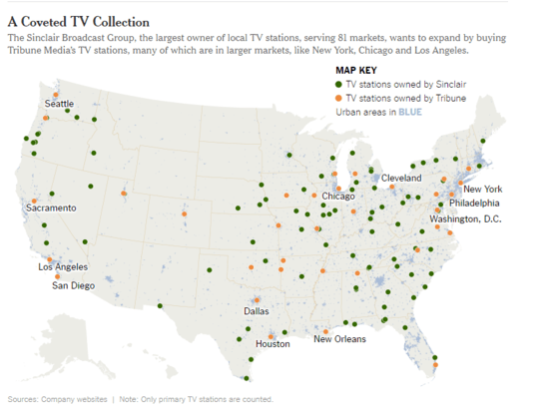
This is a map from the New York Times depicting Sinclair’s reach. The green dots represent the markets where the company has a station. The orange ones represent where Tribune owns one. If Sinclair gets its way, 233 local stations can be under its wing.

This isn’t the case with audience who watch the local news on a station owned by the Sinclair Broadcast Group. Called “the most dangerous company most Americans haven’t heard of,” Sinclair is possibly the largest TV station operator in the United States. Owning and/or operating a total of 173 stations across the country covering over 100 markets, this conglomerate reaches 40% of all American households, many of which are located in the South and Midwest along with small and medium sized cities. Thus, it had already hit the 39% cap imposed by the Federal Communications Commission which should’ve effectively barred the company from further acquisitions. But today, the Sinclair Broadcast Group is set to buy Tribune Media for $3.9 billion. The deal is expected to receive FCC approval sometime soon. If Sinclair gets its way, its media empire could cover nearly 72% of the US and an average viewership of 2.2 million households. Some of these Tribune stations are already in markets where a Sinclair one exists. At any rate, it could result in Sinclair creating a media oligarchy in the broadcast television industry with 233 stations under its wing. After all, Sinclair has expanded drastically over the last 2½ decades since it went from owning 3 stations in the early 1990s to 59 in less than a decade. By 2014, its local station ownership had tripled to 162. Still, it’s widely expected that Sinclair’s acquisition of Tribune Media will be approved thanks to FCC Chairman Ajit Pai reinstating the archaic “UHF discount” which allows broadcasters to understate their overall reach. In the meantime, the company has faced criticism over circumventing concentration in media ownership rules, particularly in using local marketing agreements and similar arrangements to take over stations on behalf of preferred third parties. It’s no surprise that so many progressive groups have expressed opposition to the sale. But so have conservative media outlets like Newsmax, The Blaze, and One America News Network perhaps fearing the competition. Though their motives may not be pure, they have a point when they speak about diversity and independence. After all, a larger Sinclair operation would chip into the market for right wing news as well as further diminish media access already dominated by a handful of players thanks to years of media consolidation.

poster_a8cf62808bde4fcbb674e925d25a7ee9

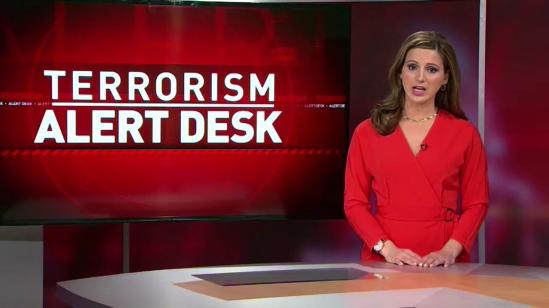
Sinclair is notorious for trying to inject right wing propaganda into their local news broadcasts. One must-run segment is “Terror Alert Desk” which is mostly devoted to demonizing Muslims than discussing terrorism. Don’t expect any commentary on Charlottesville or white supremacist violence on this segment any time soon.

The Sinclair Broadcast Group has also faced significant scrutiny over promoting its conservative agenda within a news format that’s supposed to be apolitical: local news programming. The company’s stations have been known for featuring news content and programming that promote conservative political positions and have been involved in various controversies surrounding politically motivated programming decisions. From the early 2000s, Sinclair has infected local news coverage with politically-charged programming and turning local news stations into partisan outlets. The company is also known for pushing heavy partisan commentary in the lead-up to elections, often favoring Republican candidates. And it has received plenty of criticism for critical content of Democratic candidates during each presidential election since 2004. Most recently, Sinclair made headlines for striking a deal with Jared Kushner to give positive press to the Trump campaign while heavily criticizing Hillary Clinton. Now promoting their political agenda wouldn’t be much of a problem if Sinclair confined their bias on DC-produced segments, commentary shows, or attack ads. However, what Sinclair does on local news is far more insidious. And since more Americans place high value on their local news, it has become a perfect tool for the company to inject their right-wing propaganda.

f7a96cdf-98fa-499f-9c2d-e928fbc32425-large16x9_poster_b309e68c0cc5496caa4f3c2698afd76c.png

Sinclair regularly produces conservative propaganda pieces before distributing them to their stations like this Mark Hyman’s “Behind the Headlines” commentary bit. Called “must-runs,” local stations are required to air them in their broadcasts. While they may not always feature commentary, they’re nevertheless inflammatory, misleading, and certainly inappropriate for a local newscast.

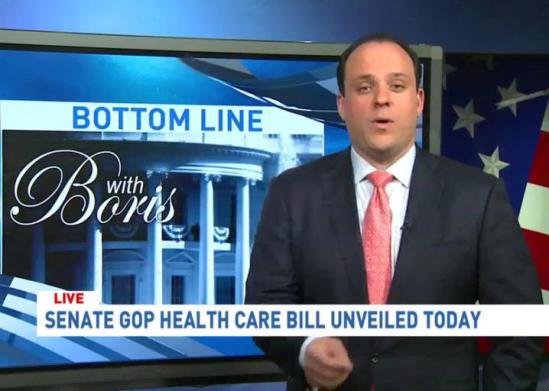
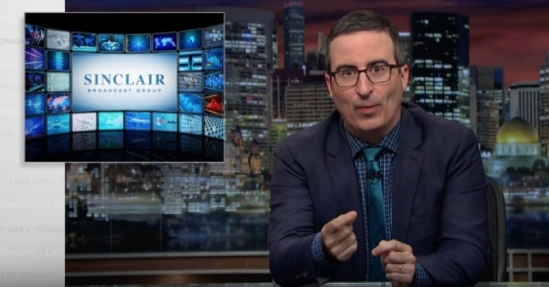
One practice that stands for are Sinclair’s infamous “must-run” segments. These segments are short pieces of political commentary Sinclair produces at their national headquarters that affiliates are required to air. Every day, Sinclair mandates its stations to air specific reports, segments, and editorials referred to as “must runs.” Sinclair produces these at its Washington DC headquarters and directs its station managers to work them into the broadcast over a period of 24 to 48 hours. And they mainly consist of conservative propaganda presented as news content. In July 2017, the HBO show Last Week Tonight had John Oliver present clips of various anchors using the exact same script describing the FBI as having a “personal vendetta” against Michael Flynn, clips of Mark Hyman editorials in which he compared multiculturalism and political correctness to a cancer epidemic and stated that marriage was a solution to domestic abuse, and joked that the “Terrorism Alert Desk” segments defined terrorism as “anything a Muslim does.” The show also aired content by former Trump adviser Boris Epstheyn alleging Obama won North Carolina due to voter fraud and a clip blaming the Democratic Party for slavery, Jim Crow, and the Klu Klux Klan. Back in the Bush administration, Sinclair required all its stations to air an editorial segment called “The Point,” which Hyman railed against the “angry left,” and “clueless academia,” dismissed peace activists as “whack jobs,” called the French “cheese-eating surrender monkeys,” and supported a host of right wing initiatives from a national sales tax to Medicare privatization. You might expect such commentary from Breitbart or Fox News that are often inflammatory and misrepresent the facts, not your local station. But this is exactly the kind of content Sinclair tells its stations to run on their local newscasts to promote its right-wing agenda. TV journalists have complained about being forced to run these overly partisan segments because as Oliver noted, “with Sinclair they’re injecting Fox-worthy content into the mouths of your local news anchors, the two people who you know, and who you trust, and whose on-screen chemistry can usually best be described as two people.” In one notable incident following the 9/11 attacks, Sinclair ordered its stations to read editorials praising President George W. Bush’s response. The WBFF staff objected, claiming the endorsement would “undermine public faith in their political objectivity.” It’s very clear Sinclair’s must run segments are a concerted effort to turn your local 6 o’clock broadcast into a little Fox News clone without disclosing it to the public. But when they put these segments into local newscasts, they degrade journalistic standards, abuse viewers’ trust, and blur the lines between news and propaganda. Furthermore, they compromise America’s right to be informed on the matters affecting their lives. Of course, Sinclair executives defend their practices citing how the mainstream media is overwhelmingly liberal and that their pieces provide a counterweight but that’s based on an intellectually dishonest interpretation of what journalism is.

body-slam-2

Remember when Montana GOP congressional candidate Greg Gianforte body slammed Guardian reporter Ben Jacobs? Well, Montana’s NBC affiliate KECI refused to air the audio recording on account that there wasn’t enough facts on the incident. Despite that the audio clearly shows Gianforte started and that 3 local Fox News reporters watched it. It was later found Sinclair had just bought the station and that its vice president and director had donated to Gianforte’s campaign. So figure it out.

Sinclair also dictates how news stations can present some of the local news and programming is presented aside from the “must run” segments and scripts. Even before the Trump administration, Sinclair had a nasty habit of skewing news stories to fit with their conservative vision, censor content, and promote disparaging and very misleading information on Democratic candidates. In 2004, the company ordered its ABC affiliates to not air an episode of Nightline where Ted Koppel listed the names of soldiers killed in the Iraq War. They argued that the broadcast, “[appeared] to be motivated by a political agenda designed to undermine the efforts of the United States in Iraq” and undermined a then-ongoing effort by its Washington bureau to report on positive “untold” stories from Iraq under occupation mainstream media outlets ignored. ABC responded stating that Koppel’s reading was meant to be “an expression of respect which seeks to honor those who have laid down their lives for this country.” And it was a gesture Arizona US Senator John McCain found “deeply offensive.” That same year, tried to air an anti-John Kerry documentary called, “Stolen Honor: Wounds That Never Heal,” alleging “that North Vietnamese captors used Kerry’s statements about atrocities committed by American troops during the conflict as an excuse to torture U.S. prisoners of war.” But the Democratic National Committee filed a legal motion with the Federal Election Commission stating it was inappropriate for a media organization to air “partisan propaganda” in the last 10 days of an election campaign. Then-Vice President of Corporate Relations Mark Hyman stated that any network refusing to air the anti-Kerry documentary were “acting like Holocaust deniers.” And when Sinclair’s Washington bureau chief Jon Leiberman called the documentary, “biased political propaganda,” he was promptly fired. As for President Barack Obama, well, Sinclair has linked him to Weather Underground founder Bill Ayers, alleged he raised campaign funds from Hamas and labeled him as a socialist extremist. In 2014, its Baltimore Fox affiliate WBFF according to The Baltimore Sun, “misleadingly edited and aired video of a protest march to make it seem as if protesters were chanting ‘kill a cop.’” In reality, the marchers actually chanted to the lead of Tawanda Jones, “We can’t stop ‘til killer cops are in cell blocks” in a non-violent protest against police brutality. Jones would eventually sue WBFF and Sinclair for defamation the next year. Because after that segment aired, she received death threats, lost community support for her protests, and had been reduced to reclusive behavior. In 2017, Montana’s NBC affiliate KECI refused to air an audio recording of GOP congressional candidate Greg Gianforte attacking Guardian reporter Ben Jacobs. The station denied Sinclair instructing them on handling the Gianforte incident and essentially framed it as an “he said/she said” situation. This despite that the audio recording covers it, Jacobs ended up in the hospital, and 3 Fox News reporters witnessed it. That and Politico later reported that Sinclair’s vice president and director had donated to Gianforte the day after he was charged with the assault. This July, Sinclair affiliate KBOI used a photo of Black Lives Matter activist DeRay McKeeson in several stories he had nothing to do with including an attempted robbery in Idaho.

170720_POL_Boris-BottomLine.jpg.CROP.promo-large

Here’s a “must run” segment of “Bottom Line with Boris.” A former investment banker who was born in Soviet Russia, Boris Ephsteyn was a Trump crony during the 2016 campaign and in the White House. On his Sinclair segment, he normally parrots Trump White House commentary which stations are required to air 9 times a week.

But Sinclair’s connection with Republican politicians and operatives doesn’t just extend to media coverage. A 2004 study found that 95% of the company’s political contributions went to Republican candidates. The Center of Public Integrity showed concern on Mark Hyman’s history of government lobbying (such as for the FCC to loosen rules regarding media ownership concentration), along with making its stations provide “anything but fair and balanced news programming.” In 2002, the company gave lots of perks like using its luxury helicopter to former congressman Bob Ehrlich during his run for governor of Maryland. Mostly because Ehrlich pressed the FCC to fast-track its request to acquire more stations. In 2007, 9 Sinclair stations aired public affairs shows without disclosing that “host Armstrong Williams had been paid by an affiliate of the Education Department to make favorable comments about the Bush administration’s ‘No Child Left Behind’ policy.” The FCC issued the company a $36,000 fine for violating “rules against ‘payola punditry.’” In December 2016, Jared Kushner said that the Trump campaign, “struck a deal with Sinclair Broadcast Group during the campaign to try and secure better media coverage” particularly in swing states. As part of that deal, “Sinclair would broadcast their Trump interviews across the country without commentary.” The Washington Post noted that the company scored 15 exclusive interviews with Donald Trump in a year while “news stories and features favorable to Trump or that challenged Clinton were distributed to Sinclair stations on a ‘must-run’ basis.” Of course, Trump would appoint Pai to head the FCC Ajit Pai pushed through a measure that would allow the Sinclair-Tribune merger to go forward. Recently, Pai has further proposed eliminating a rule requiring each TV station to have a main studio in or near the community it serves, arguing that modern technology allows community interaction without one. But critics charge the action as another handout for Sinclair as former FCC Chairman Tom Wheeler argues, “will have an open field to replace local voices with national control.” In April 2017, Sinclair hired former Trump official Boris Epshteyn as its “chief policy analyst” whose must run “Bottom Line with Boris” segments air on its local news affiliates 9 times a week. Yet, Epshteyn is a shady character. He’s pleaded guilty to assault in 2014. The House Intelligence Committee has questioned his ties to the Kremlin. In the 2016 campaign season, he dismissed Gold Star father Khizir Khan as a Democratic prop. And during his time in the Trump administration, he crafted the notorious Holocaust Remembrance Day statement that omitting any mention of Judaism. He left the White House that March amid reports that every cable news network hated him.

john_oliver_sinclair_lwt

The Sinclair Broadcast Group’s rapid expansion and promotion of conservative politics highlights serious consequences of media consolidation. And as John Oliver noted, “Should this Tribune acquisition go through, there are going to be even more good journalists having to see their hard work placed alongside terror desk nonsense, just as there’ll be even more unsuspecting audience members who will be getting a heaping dose of Sinclair’s content, possibly without realizing it.” Perhaps it’s best you google your local stations and find out who owns it. If your local market has a Sinclair station, then expect that station to carry a lot of right wing bullshit. If it’s a Tribune, then pray to God that the acquisition doesn’t go through. For the Sinclair-Tribune merger is a very bad deal for America.

It’s one thing for a news station like Fox News to deliberately mislead the public to advance its own political agenda. But it’s very disturbing for a company like Sinclair to injecting intentionally misleading political diatribes where it has no place. It’s even worse that Sinclair forces news local stations run such content they know is bullshit and undermine viewers’ trust in them. If not, then perhaps warp their minds into accepting right wing talking points as undisputable fact as Sinclair would intend. For as John Oliver said, “The problem is, there is real power in hearing your trusted local newscasters using FBI and personal vendetta in a sentence.” Because after all, most people don’t really know who really owns their local station since they’re often branded with the national network that broadcasts on them, not the real owners. Nor do they seem to critically think about these stories aired on their local station. Scaremongering and propaganda have no place in local news since it’s corrosive to our democratic process. Sinclair’s “must-run” segments and other policies rob viewers of hearing local and opposing viewpoints. Sinclair’s acquisition of Tribune would lead to less competition, threaten media localism, and harm information diversity. Thus, it would best for the country if the Sinclair and Tribune merger doesn’t go through. Sinclair is a cancer on the local news and our democracy as well as should be stopped from buying more stations. No major media company should have that much power, especially if they’re abusing the trust between the public and their local news stations in order to advance their political agenda. But it also means that we must be more careful of what we hear on the news and know who owns them.

subTribune-tmagArticle

It’s widely said that Americans trust their local TV news broadcasts than any other source. For years, Sinclair has often abused that trust and eroded journalistic standards with their conservative propaganda. Advancing a political agenda has no place in a local newsroom meant to cover actual news stories, sports, traffic, and weather.

Will There Not Be Amnesty?

From the mid-1960s to the 1980s, an estimated 36 million undocumented people entered the United States through Mexico. 86% of these entries were offset by departures, meaning that these were mostly men coming to work in the US then leaving to go back to their families. But when the US started ramping up border security in the early 1990s, many of these migrant workers decided the daily dangerous border crossings weren’t worth it. So they came to the US, often with their families and stayed. Shortly thereafter, President Bill Clinton signed a bill that made it extremely hard for them to obtain legal status. Thus naturally, those staying with families and making a life here began to skyrocket, many which had underage children. So these kids grew up in the US, were educated in the US, and integrated into American culture. By the time Barack Obama became president in 2008, many of these children were teenagers or young adults and still considered undocumented and thus, couldn’t drive, work, or in the US legally. Thus, these children who grew up in the US couldn’t make a life for themselves in the only country they knew. Many of these DREAMers didn’t achieve their academic or professional potential simply because they couldn’t see what good it would do them to succeed. Many of them “transitioned to illegality,” suffering mental health crises and often losing any desire to achieve in school because they realized the country they thought of as their own didn’t actually have opportunities for them

In June 15, 2012, President Barack Obama announced a policy known as Deferred Action for Childhood Arrivals to give legal status to undocumented children who were 16 or younger when they came to the US before June 2007. The program was designed for those who grew up as Americans and often discovered they weren’t citizens when they were getting ready to apply to college, find jobs, and figure out how to survive as an adult. Most of them haven’t lived even seen their home country since leaving for the US. As long as these undocumented youth stayed out of trouble and were enrolled in or graduated from school (or served in the military), then they qualified. This doesn’t mean everyone who qualified was approved. But for those who were, DACA not only protected them from deportation, opened the doors for things adults need to survive. Most recipients were able to get a driver’s license, a job, and attend college. Though many of them work in low-income jobs like food preparation, a good portion can leverage their work authorization and educational opportunities into white-collar jobs like sales or office administration. Other participants include college students, medical students, lawyers, and tech employees. As long as they reapply for DACA every two years, they can stay and work legally in the US. DACA doesn’t grant a pathway to citizenship nor offers permanent relief. But for these Dreamers, even a temporary reprieve is better than none. But it made these DREAMers feel American, welcomed, and normal. Today, there are about 1.9 million people potentially eligible for DACA and nearly 800,000 protected from deportation because of the program that has become a new embodiment for the American Dream.

On Tuesday, September 5, 2017, Attorney General Jeff Sessions announced Donald Trump would end DACA with a six-month delay. Those currently covered by the program will retain their protections and work permits until they expire. Those who already applied will have their applications processed normally. Yet, the government won’t accept any new applications unless their protections expire before March 5, 2018. Even in that case, they have until October 5 to renew. Unless Congress passes a bill in the next 6 months to protect the DACA recipients, hundreds of thousands of them will fall back on their unauthorized status.But given that the Trump administration has taken steps to make the legal immigration process harder and more complicated, it’s highly unlikely Congress could pass an immigration bill that could satisfy 60 senators and the White House. In the meantime, it’s fairly clear the Trump administration doesn’t think Congress could pass a bill as DACA recipients live under crushing uncertainty. Besides, DACA’s critics claim the program is an example of presidential overreach that takes jobs away from citizens and legal residents. They warn that Trump will face massive opposition if he doesn’t keep his campaign promise to end it. And even if Trump granted DACA recipients a reprieve (which he won’t), the program may not survive a court challenge.

Without DACA, its recipients susceptible to deportation. It would mean that hundreds of thousands of people who’ve gone to work legally would suddenly become “illegal workers.” Some may have to drop out of college if they can’t retain their financial aid and perhaps not know what jobs they could get with the degrees they’re working to obtain. Others might have to give up a well-paying job for another paying under the table, sometimes not sure whether they’ll be paid. Or perhaps continue working at a legal risk to themselves and their employers. If their job includes health insurance, they will certainly lose that, too. It would raise questions on whether their drivers’ licenses issued under DACA that might’ve been valid when an immigrant started the engine but possibly invalidated while the car was on the road. Not to mention, it will open the federal government to a mess of lawsuits from suddenly legally liable employers. It gives them no rest that the federal government has their names and addresses. And the Trump administration seems to go after the undocumented immigrants they can most easily track down and pick up, putting the DREAMers at substantial risk for deportation. Though DACA recipients have months to prepare for that possibility, many of them have no good options.

To end DACA is a massive betrayal on the young Americans who grew up in the only country they know but won’t accept them as legal Americans through no fault of their own. Though to be fair, most undocumented immigrants came illegally because they had no legal options available. But these DACA recipients were brought here by their parents who just wanted a better life for them. They didn’t choose to come to this country. Some arrived as newborns and toddlers who didn’t even realize they had no legal status until they needed a Social Security number for a job or documentation to prove their eligibility for their first driver’s license. Others have known from a young age and have learned to live as quasi-fugitives afraid of being questioned by law enforcement. Yet, they’ve made their lives here. Their dreams are rooted here. They have jobs here. They pay taxes. They contribute to their families, communities, and the US economy. Some of them are married and have children. Some have served in the military. To make these Dreamers no longer welcome in the land they’ve called home for most of their lives is simply inhumane since they shouldn’t be forced to pay for their parents’ choices.

DACA may not be perfect, but there is no question it should remain. Doing away with the program will rob the US of high-achieving Americans who contribute to our economy and life. Not to mention, tear families apart and rip apart our nation’s moral fabric that make our country great. These DREAMers deserve to pursue their dreams and contribute to our society without living in constant fear of deportation and the lingering anxiety and uncertainty that everything they worked for could be taken away from them in the blink of an eye. Already DACA recipients have been living under threat of revocation since Donald Trump’s election on November. They’ve seen the Trump administration attempt to deport a few DACA recipients, supposedly protected. Now they have a deadline over which they have no control but which will profoundly affect the rest of their lives.

However, the worst about ending DACA isn’t just that it threatens 800,000 undocumented immigrants by removing their deportation protections and work permits. But that it threatens America’s legacy as a melting pot and a land of opportunity. And it sends a message that growing up in the US and having ties here means less than they ever have and the papers you hold or don’t have mean more. There’s never been a time when a generation of Americans, raised and rooted here has been stripped of official recognition and pushed back into the precarity of undocumented immigrant life. Though DACA didn’t technically legalize anyone, ending it would be the biggest “illegalization” of immigrants in American history. Sure it’s unprecedented for the government to offer protection to so many people without the opportunity to receive no full legal status. But it’s an effort of politicians trying to reconcile law and reality. Besides, growing up undocumented in the US is relatively uncommon in American history. Because while it was once possible to “get legal,” without leaving the US and trying to return (through US-born family members), it no longer is since 1976. To undo DACA will widen that gulf which has been wider than ever before. As the program hangs in the balance, the US has a group of people on the verge of being socially integrated and championed but legally isolated and victimized in a we we’ve never seen before. The days before Sessions’ announcement exemplify just how embedded these DACA recipients are in civil society. Universities, churches, employers, along with local and state governments urged Trump not to rescind the program. So did members of both parties, including Speaker of the House Paul Ryan as well as Americans who don’t necessarily support widespread legalization for undocumented immigrants. In fact, 70% of Americans in an NBC News poll thought DACA should stay. But none of that mattered to Trump.

There is nothing to justify revoking protections for undocumented immigrants who came to this country through no fault of their own. None of these DACA recipients deserve to be deported from the only home they know, torn apart from their families, or robbed from the lives they’ve built for themselves. If anything, these DREAMers deserve amnesty and a path to legalization and citizenship. After all, they’ve lived and worked in the US for most of their lives without enjoying the same legal rights and privileges their peers have exercised. They see themselves as American and have contributed to our society as anyone else. They pose no threat and don’t take away anything from the rest of us. Yet, critics would decry such an idea as amnesty like it’s a moral anathema. But could there be any group of people in America more in need or deserving of amnesty? Shouldn’t these people be able to drive, work, go to college, and provide for their families without a constant fear it can all be taken away from them? Shouldn’t they be able to stay without a constant fear of deportation hanging over their shoulder? Shouldn’t they be seen as part of a nation where they were raised and rooted in? If not, then why should they be punished for the sins of their parents? Why should their lives be upended for simply being undocumented? Why should they be deported to a country they don’t know anymore? It’s bad enough for undocumented adults to live in precarity since they chose to come illegally because of unavailable legal options. But it’s particularly heartless to rescind protections from those whose undocumented status wasn’t of their own making. Most Americans agree they shouldn’t be robbed of the chance to live fully productive lives, especially if they’ve been upstanding figures who’ve earned every right to be here. To send them back to their birthplace they have no other connection to, is sheer cruelty that appeals to the worst part of who we are as Americans. Now that Congress only has 6 months to come up with an immigration reform bill, all I ask is will there not be amnesty for these DREAMers? Or will these 800,000 DACA recipients be forced to give up their hopes, dreams, and the only lives they’ve known for no good reason?

We need to understand that the Trump administration’s reason for DACA only amount to pure unbridled racism. They would tell you it’s about upholding “the rule of law” but such rationale is bullshit. First, Donald Trump pardoned ex-Sheriff Joe Arpaio who was found guilty of criminal contempt for illegally targeting Latinos during his undocumented immigration raids. Second, the Obama administration had constitutional lawyers to advise them on the DACA policy. Third, white supremacists comprise a critical part of Trump’s political base whom he’s hesitated to condemn and noted how some of them were “fine people” during his infamous Phoenix rally in regards to Charlottesville. Then there’s his long history of racist behavior which includes housing discrimination, slamming Native American casino owners, calling for the execution of the Central Park Five, and promoting birtherism during the Obama administration. Ending DACA and threatening deportation to these DREAMers is cruel, shortsighted, and unnecessary as well as undermines the heart and soul of our nation. Yet, still, all I ask for these DREAMers is will there not be amnesty?
 

A Pardon Worthy of Contempt

On the night of August 25, 2017, Donald Trump issued his first presidential pardon on former Maricopa County Sheriff Joe Arpaio for a contempt-of-court conviction over a federal court order violation meant to prevent racial profiling. The official statement from the White House read, “Sheriff Joe Arpaio is now eighty-five years old, and after more than fifty years of admirable service to our Nation, he is worthy candidate for a Presidential pardon.” But we all know that Trump promised to pardon the former Arizona sheriff at his Phoenix rally early that week. After all, to Trump and his supporters, Arpaio was just a law enforcement official convicted of only “doing his job.” Nevertheless, this presidential pardon validates the idea that promising “law and order” and protection from social disorder in the form of undocumented immigration and street crime doesn’t require adhering to the rule of law. Not to mention, it sends a powerful message to sheriffs across the country worried that cooperating with federal immigration officials could get them in trouble with the courts.


However, we must understand that Sheriff Joe Arpaio wasn’t convicted for only “doing his job.” Back in the mid to late 2000s, the federal government started escalating immigration enforcement to an unprecedented degree by relying on local law enforcement. Along with the election of a hardline anti-immigration chief prosecutor Andrew Thomas, Arpaio became the face of local law enforcement of federal immigration law. Calling himself “America’s Toughest Sheriff,” he gave celebrity tours of his infamous “Tent City” for housing undocumented immigrants whom he forced to work on chain gangs in under the sweltering desert sun, which he proudly referred to as “concentration camps.” And he often gifted guests with commemorative pairs of pink underwear he made inmates wear under their black and white uniforms. He bragged about his “sweeps” results which were local late night immigration raids to round up undocumented immigrants and hand over to Immigration and Customs Enforcement (ICE). In addition, he maintained an immigrant smuggling squad to stop cars with Latino drivers and passengers in order to check their immigration status. Despite widespread criticism by human rights groups and political leaders, Arpaio was reelected Maricopa County Sheriff 5 times thanks to a bastion of conservatives and retirees who view him as a white knight and defender of the 1950s Shangri-La they’ve sought to preserve in the largely white suburbs around Phoenix while keeping the money and political power. Yet, many of the white owners employ the undocumented immigrants Arpaio targets but he doesn’t bust them for exploiting their labor. Meanwhile soaring number of Hispanic residents comprises of a third of the county’s population which rose 47% within the last decade. After all, Maricopa County is the 4th largest county in the US and 50 miles from the Mexican border while Phoenix is a destination for undocumented immigrants and drug dealers alike. By vocally targeting undocumented immigration, Arpaio became a regular on Fox News and a hero to the Tea Party as well as a go-to media prop for conservative politicians wanting to be seen as immigration hard liners. While traveling the country to endorse these right-wing candidate, he attracts millions of dollars from political allies outside Arizona who long gave him an advantage his opponents couldn’t match. As former Phoenix police chief George Gascon told Rolling Stone, “Arpaio knows how to move the needle when it comes to appealing to the base. What he did very artfully is piggy-back on this fear of illegal immigration that was becoming so prevalent in border states like Arizona. He was able to capitalize on that and he became the hero, the only guy who would single-handedly go after it.”


But these methods raised questions on how exactly Joe Arpaio and his deputies determined who to apprehend for immigration offenses or whether they were just arresting anyone living in Maricopa County who just happened to be Latino, even in cases where the “suspects” violated no state law. His rhetoric and tactics have spread fear in Arizona’s Latino community who very understandably loathe him. Though Arpaio communicated toughness through big, theatrical stunts, his practices often violated the rights of his targets. His roadblocks to detain drivers who merely looked like undocumented immigrants was a virtual license to profile Hispanics. Reports of pull-overs with little or no discernable traffic violations became so widespread that one study showed Latinos in the northeastern part of Maricopa County as 9 times more likely to be stopped for the same infractions as other drivers. The DOJ alleged that Arpaio’s men relied on factors “such as whether passengers look ‘disheveled’ or do not speak English.” Some were justified after the fact such as an incident involving a neatly dressed group of Latinos described in a police report as “dirty.” The sheriff himself acknowledged the crackdown a “pure program to go after the illegals and not the crime first.” To make matters worse, Arpaio has frequently arrested and detained Latino US citizens, legal residents, and tourists, including children, for hours at a time without a charge or warrant. Mostly because according to Arizona State’s Charles Katz, “Illegal immigrants make up less than 10 percent of those arrested. They’re involved in less criminal activity than native-born Americans.” According to retired police officer Bill Richardson, “He’s vilified Latinos in such a way that normal people, they’re scared to death.” Such terror only makes it more difficult for police to do their jobs since it makes Latinos more afraid of law enforcement.


Groups for years have criticized the Tent City and jails over notorious minimalistic conditions as violating human and constitutional rights since the 1990s. Federal investigations on Tent City date as far back as 1995. Joe Arpaio was proud of his prison experiments as an inexpensive solution to overcrowded jails and frequently invited the media to witness each new cohort being sent to the Tent City. But what the prisoners experienced was absolutely horrific. The DOJ reported that guards referred to Latino inmates as “wetbacks,” “Mexican bitches,” “stupid Mexicans” and “fucking Mexicans.” In addition, female prisoners were forced to sleep in their own menstrual blood and were denied basic sanitary items. Officers refused to respond to inmates pleas if they made them in Spanish and sometimes put them in solitary confinement for extended periods of time if they didn’t understand English. One former inmate recounted his experience to the Washington post saying, “During the sweltering summer, the temperature could reach 115 or 120 degrees. I was in the tents when we hit 120. It was impossible to stay cool in the oppressive heat. Everyone would strip down to their underwear. There was no cold water, only water from vending machines; and eventually, the machines would run out. People would faint; some had heatstroke. That summer, ambulances came about three times. One man died in his bed. But the winter was even worse. During the winter, there were no heaters. Most jackets and heavily insulated pants weren’t allowed; they don’t want you to be comfortable.”  Holes torn into the tents let in wind and rain, drenching the beds. Prisoners would make ropes to hold tent canvases together out of black trash bags they were given as raincoats. Many inmates were forced to work in chain gangs and subjected to humiliating practices like public parades. Healthcare was substandard and often neglected as many inmates were subject to the point of extreme suffering, even death. Mentally ill detainees were especially victimized. Detention officers didn’t want to work there since it was dangerously overcrowded and understaffed. Prisoners often died with no explanation. According to attorney Michael Manning, “His entire jail operation was unconstitutionally inhumane and unconstitutionally dangerous.” To make matters worse, most of the inmates there were either low level crooks serving short sentences, suspected undocumented immigrants, or those awaiting trial. After Arpaio’s reelection defeat in 2016, the tent cities were ultimately shut down after being cited for violations against the Eighth Amendment’s prohibition against “cruel and unusual punishment” and a unanimous vote by Maricopa’s Board of Supervisors.


Joe Arpaio’s “law and order” policies weren’t successful as anti-crime measures since Maricopa County 911 response times rose dramatically during the heyday of Arpaio’s sweeps. Mostly because Arpaio had been so obsessed with the often-illusory crimes of undocumented immigrants that he’s ignored more than 400 sexual abuse cases he was responsible for investigating including assaults on children. In another incident, Arpaio staged a massive prostitution round up involving 350 deputies resulting in the Maricopa County Attorney’s Office declining 80 cases for prosecution. Meanwhile, 12 execution style murders remained unsolved. As a Phoenix resident wrote to the Arizona Republic on the incident back in the early 2010s, “If Joe Arpaio continues to spend the county’s scarce law enforcement dollars on chasing consenting adults engaged in private sexual activity, while child murders and sexual assaults remain unsolved, he should be the one to explain to the next grieving mother why her child’s killer has not been caught, prosecuted and put in prison. And the taxpayers should send him a message by electing a new sheriff who doesn’t treat public funds as his private public relations piggybank.” In addition, Arpaio was responsible for a critical and dangerous shortage of personnel on both jails and patrol because he often assigned deputies as his bodyguards and detention officers for his labor intensive, publicity producing chain gangs for TV. But the worst of his “tough on crime” publicity stunt was when he staged an assassination attempt against himself in 1999 to boost his popularity which resulted in an innocent man spending 4 years in jail waiting to clear his name.


When local political leaders criticized Arpaio’s tactics, he simply used his power to go after them. Starting in the mid-2000s, his internal affairs office was more of a task force to pursue personal grudges than an effort to keep his deputies in line. Not to mention, Arpaio had been cited for systematic abuses of power for trying to get his enemies brought up on criminal charges including local judges like Snow, members of the Maricopa County Board of Supervisors, local attorneys, county and state officials, former US Attorney General Eric Holder, municipal law enforcement, newspaper heads, and a former mayor of Phoenix. He famously investigated Barack Obama’s birth certificate which he wrote off as a forgery. In one instance, the sheriff’s office arrested a county board member who questioned the costs associated with Arpaio’s immigration crackdown and held him in jail for several hours. Another instance in 2007, led to arrests of the CEO and top editor of the Phoenix New Times for publishing an aggressive report on the sheriff’s real estate dealings and refused to comply with subpoenas for more than 2 years of the newspaper’s records on Arpaio and information on anyone who visited the website and read the stories. They were apprehended during a raid on their homes while their families looked on and were charged with violating grand-jury secrecy by reporting on the subpoenas. In 2008, Arpaio conducted a late-night raid on Mesa City Hall allegedly looking for undocumented immigrants after Police Chief George Gascon prevented him from sending officers to confront those protesting his crime sweeps over harassment and racial profiling. Gascon also hired free speech lawyers to represent the demonstrators as well. Arpaio arrested a handful of documented janitors and then raided Gascon’s police station for the workers’ computer files suspecting their papers were fake.


In the past decade hundreds of lawsuits were brought upon the Maricopa County Sheriff’s Office with charges ranging from deaths in Joe Arpaio’s jails to unlawful arrests. Far from saving money, Arpaio’s on-the-cheap Tent City has cost Maricopa County more than $50 million to defend itself against lawsuits from the sheriff’s victims. In 2007, a few Latino residents sued him for civil rights violations. The plaintiffs claimed deputies targeted them at traffic stops and sometimes detained them for hours on suspicion of being in the US without papers, apparently due to their ethnicity. The US Department of Justice investigated the Maricopa County Sheriff’s Office for 3 years and in 2011 reported that it had engaged in the worst pattern of racial profiling in US history. The DOJ subsequently filed suit against his MCSO of creating “a pervasive culture of discriminatory bias against Latinos” that “reaches the highest levels of the agency.” As a result, Judge G. Murray Snow issued an injunction preventing Arpaio from apprehending or detaining anyone purely on a suspected undocumented status or turning such people over to ICE. That same year, the US Department of Homeland Security revoked MCSO’s authority to identify and detain undocumented immigrants.


Though Joe Arpaio officially lost the civil suit in 2013, it was obvious his department hadn’t complied to Judge Snow’s 2011 injunction. The Maricopa County Sheriff’s Office kept engaging in immigration “sweeps,” turning people over to ICE (or the Border Patrol when ICE stopped accepting detainees from Arpaio’s deputies), and holding suspected undocumented immigrants in jail after they’d otherwise be released for federal agents to pick them up. After several hearings about the Maricopa County Sheriff Office’s failure to obey the 2011 order, Judge Snow cited Arpaio and some of his subordinates for civil contempt of court in 2015. The next year, Snow asked the US Attorney’s Office to charge Arpaio and 3 others with criminal contempt, which someone can only be convicted of if it’s shown that they willfully refused to obey the court order, not just failed to make sure it was obeyed. Of course, Arpaio denied deliberately disobeying Snow’s order, claiming he hadn’t properly understood it. He claimed the violations were his deputies’ fault not his. Judge Snow didn’t buy it for obvious reasons. First, witnesses testified that Arpaio and his underlings told them not to change internal policies after the court order.  Second, during his frequent media appearances, Arpaio often claimed his department was just doing what it had always done, arguing that he was simply doing the job the federal government had failed to do. He even told reporters he would “never give in to control by the federal government,” that he would not “back down” and “if they don’t like what I’m doing get the laws changed in Washington.” Third, Arpaio had attempted to dig dirt on Judge Snow himself (including having a detective investigate the federal judge’s wife). As US District Judge Susan Bolton wrote, “Not only did (Arpaio) abdicate responsibility, he announced to the world and to his subordinates that he was going to continue business as usual no matter who said otherwise. The evidence at trial proves beyond a reasonable doubt and the Court finds that Judge Snow issued a clear and definite order enjoining Defendant from detaining persons for further investigation without reasonable suspicion that a crime has been or is being committed; that Defendant knew of the order; and that Defendant willfully violated the order by failing to do anything to ensure his subordinates’ compliance and by directing them to continue to detain persons for whom no criminal charges could be filed.”


 Joe Arpaio’s July 2017 conviction for contempt of court was a predictable consequence of the way he ran his department guided by the idea that as long as law enforcement officials grabbed headlines by going after undesirable people, the public wouldn’t care how it was done. The evidence for his guilt was overwhelming and there was nothing improper about Arpaio’s trial and well-deserved conviction. Nobody contested that the former sheriff targeted and jailed Latinos in inhuman conditions on suspicion of undocumented immigration. There was no doubt he was guilty of contempt. Nobody questioned the fact he defied a court order so he could continue his race-based reign of terror that targeted innocent people on the basis of their ethnicity. He saw himself above the law and bragged about defying a court order in front of the cameras. You can’t find a clearer case of contempt of court than this. Arpaio was clearly not doing his job to enforce the law. Instead he broke it and openly disregarded it in broad daylight without a hint of remorse.


Donald Trump’s pardon of Joe Arpaio is essentially allows a government official to defy Constitutional rights with impunity. It is an endorsement of the corrupt former sheriff’s flagrant racism and birtherism. Furthermore, not only did Trump pardon Arpaio without any of the appropriate processes and procedures, but also reflects his appalling disrespect for democratic institutions. And from a moral standpoint, it is completely indefensible. Unfortunately, it shouldn’t surprise anyone that Trump would pardon such a despicable man since he shares the notorious ex-sheriff’s views such as little regard for civil rights, democracy, and the rule of law. The federal judiciary and legal system operates under the reasonable expectation that public officials like Arpaio will follow valid court orders whether they agree with them or not. Without this compliance there’s no law. Also, it reflects his priorities such as rewarding those he sees as loyal and punishing those like special prosecutor on the Russia investigation, Robert Mueller whom Trump has wanted to fire. It shouldn’t surprise no one that Arpaio is a loyal Trump supporter for years. Now in the Trump administration, when judicial norms or the rule of law threaten to limit Trump’s actions, they may be safely disregarded. As Slate’s Michael Joseph Stern writes: “Arpaio’s conviction was a test for how long and how willing Trump will be to abide judicial oversight. He flunked it. It now seems clear that many future beneficiaries of the president’s clemency will be his political allies—and that he might not wait to for them to be convicted or sentenced before issuing a pardon. Trump, in other words, may use his pardon power to stymie Robert Mueller’s investigation, as well as other inquiries into the past misdeeds of his associates.” We’d expect a crime boss or a dictator to do this but it’s the last thing we’d want from a president. In fact, such abuse on a pardon could be grounds for impeachment as James Madison explained.


On the immigration front, Donald Trump’s pardon of Joe Arpaio for aggressively enforcing immigration law in the worst way possible, it sends a very clear message to local sheriffs in public office worried about court liability. Particularly, as the administration ramps up immigration enforcement, when it comes to holding people after they’d otherwise be released from jail so ICE agents could pick them up. Since sheriffs could get in trouble with the courts for violating the Fourth Amendment. Nevertheless, Trump indicates that if they get aggressive and get in trouble with the law for it, the administration will have their back. But as Pinellas County Sheriff Bob Gualteri told the Daily Beast, “If we violate the law by doing what they ask us to do, we’re subjecting ourselves, no question, to civil liability and civil rights violations.” Some sheriffs like Gualteri feel that the Trump administration is oblivious to their concerns and for very good reason. He added that officials “are saying, ‘What are you sheriffs doing? Why aren’t you cooperating?’ when they don’t know that it is clearly a problem and that we can’t do it.” Unlike Arpaio, most local law enforcement officials aren’t interested in enforcing immigration laws since they have better things to do. As Arpaio’s case demonstrates, a local crackdown on undocumented immigration drains time and resources, hurt community relationships, and can keep law enforcement officials from doing their jobs. Maricopa County suffered an increase in violent crime because of Arpaio’s actions. Besides, Trump’s pardon power can’t shield these sheriffs from court costs and damages that their communities will have to cover. Then there are sheriffs like Arpaio who could use that pardon as an excuse to racially profile Latinos and violate their constitutional rights regardless of their immigration status and get away with abusing their power, neglecting their duties, and violating several laws. And like in Arpaio’s reign of terror, many of those victimized can’t effectively use the courts to fight back. At a time when there’s more awareness of widespread law enforcement abuse toward people of color, the Arpaios of this country are the last officials we need to enforce our laws.  


And finally, another reason why Donald Trump’s pardon of Joe Arpaio is how it emboldens white supremacists. In addition to his media savvy, Arpaio called himself a “constitutional” sheriff, emphasizing his lofty mandate to uphold the US Constitution, which is also a political dog whistle for states rights’ advocates and white supremacists with a deep-seated hatred of the federal government. And it surprised nobody that the Arizona white supremacist JT Ready had attended one of Arpaio’s rallies before shooting and killing his girlfriend, her family, and himself in 2012. Pardoning a government official who unjustly terrorized people of color could make white supremacy and white supremacist terror more acceptable. Trump has already refused to condemn white supremacists for Charlottesville for which he blamed the violence on “many sides.” In pardoning Arpaio, he essentially states that minorities’ civil rights don’t matter, especially if law enforcement is concerned. As former Justice Department Civil Rights Division head Vanita Gupta said, “If President Trump uses his power to pardon a discredited law enforcement official who persistently engaged in illegal racial profiling of the Latino community, it will not be a dog whistle to the so-called ‘alt right’ and white supremacists, but a bull horn. No amount of tweets or forced remarks read from a teleprompter could undo the damage.” Arizona Representative Raul Grjalva noted, “Pardoning Arpaio is a culmination and an added layer to what is already a very, very perilous and dangerous path in which this country is going under Trump. A path that calls for this country to marginalize some, to treat others different under the rule of law, and to essentially condone, comfort and coddle the racist and hateful organizations and individuals that are a significant part of his base.” White supremacists comprise of a key part of Trump’s base and have committed hate crimes in his name since his election. Pardoning Arpaio for just “doing his job” only empowers them further which in turn leads them to commit violence against people of color.


There is no doubt that Donald Trump’s pardon of former Sheriff Joe Arpaio was indefensible at every imaginable standpoint. It’s a smack in the face for those who worked through the judicial system to hold this man accountable and robbed people hurt by hurt by his policies of justice. And before a judge could even sentence him. It’s an insult Maricopa County’s Latino community whom Arpaio constantly victimized in his sweeps as well as its residents who bore the financial and social costs. While it might be a get-out-of-jail-free-card for county sheriffs, it can also pressure them into going against what’s best for their communities. And worst of all, it will further empower white nationalists to victimize minorities in Trump’s name. In fact, this pardon reeks of pure contempt for every American believing in justice, human dignity, and the rule of law. Arpaio may be a profile in courage for Trump, his supporters, and white supremacists who see him as a fearless force of white supremacy fighting against the brown scourge of immigration. But the sheriff’s cruel and unusual treatment of prisoners and immigrants foreshadowed the policies Trump and his allies. And Arpaios racism mirror those in the Trump administration today along with the lack of respect for legal norms and the rule of law. Though Trump’s pardon of Joe Arpaio will earn him cheers from his supporters, it is a pardon worthy of contempt.


The Disturbing Trend

Charlottesville didn’t prop up out of nowhere. The United States has a serious problem with systematic racism in our culture and society which should surprise no one. After all, the US was built on slavery, colonialism, Native American genocide, and white supremacy. Though we liken white supremacy as a fringe ideology only embraced by extremists, it remains firmly established as a cultural value that white people don’t want to acknowledge. Whenever there’s progress in achieving racial equality such as in outlawing slavery and civil rights, there’s always a fierce white resentment and backlash at every turn. Even today, calling out a white person’s racist behavior, beliefs, or any racial injustice will result in vicious defensive retaliation. Sometimes it might lead to whites developing a reverse racism persecution complex. Sometimes it might lead to blaming minorities for their problems beyond their control due to a steady diet of racist dog whistles they accept as mere facts of life. And sometimes it might lead to mainstream culture ignoring systemic problems disproportionately affecting minority communities as well as denying a possible national crisis. I understand white people would rather not talk about racism since they benefit from their white privilege whether they’re willing to admit it or not. But at the same time, many don’t see a problem with adopting disparaging views on minorities and immigrants. Nevertheless, while acknowledging systematic white supremacy in our nation can be extremely difficult for a white American to address, identifying and denouncing white supremacist terrorism shouldn’t be. In fact, it’s the easiest anti-racist thing a white person can do since it’s white supremacy in its most blatant and ugliest form.

And yet, Donald Trump still struggled to condemn the white supremacist attacks on Charlottesville, preferring to blame the violence on “many sides” instead on the white nationalists most responsible for it. However, Trump’s lackluster remarks aren’t surprising since white supremacists comprise a key part of his base he sees no problem pandering to them. He’s also had a ridiculously long and consistent history of racist behavior ranging from discriminatory rental practices during the 1970s, calling for the Central Park Five’s execution and still believing their nonexistent guilt, disparaging Native American casino owners during a congressional hearing in a series of ads, and promoting baseless Obama conspiracy theories like birtherism. Bigoted statements and actions feature heavily in Trump’s public life and career and were critical to his political rise to the presidency. As president, he’s kept up with the vulgar racist rhetoric as well as enacted inherently racist and xenophobic policies. But for a man known for viciously attacking people he doesn’t like, his responses to white supremacy have often been vague, indifferent, and uncharacteristic like he doesn’t really mean what he’s said. Trump may claim he’s “the least racist person that you’ve ever encountered” but his bigotry isn’t just mere political opportunism but a real element in his personality, character, and career. The fact Trump could win the presidency running a campaign catering to hostile sexism and racial resentment understates how widespread and insidious racism in America really is.

Another reason why Donald Trump struggled on Charlottesville is the fact he’s a self-absorbed prick who will do whatever it takes to come out on top as long as the consequences don’t affect him personally. He doesn’t care if he has to break rules, longstanding norms, or even laws to get what he wants. He doesn’t give a damn about the moral implications of his actions or any long-term damage he’s inflicted on the country. Others’ pain, suffering, or ruination don’t concern him. If Trump wanted to build a golf course on a stretch of land populated by forests and homes, he’d set fire to the whole place and let it burn to the ground if he knew he could get away with it. And it’s this unapologetic opportunism that makes him extremely dangerous. Why? Because while racism is a systematic and pervasive influence in our society, most politicians wouldn’t dare resort to virulent racist stereotypes at rallies or pander to white supremacists. Trump has no such moral compunctions. If horrific racist rhetoric and pandering to white supremacists attract voters, then Trump will keep at it regardless of how it affects America. White supremacists comprise a key part of his base and he will do absolutely anything to retain their support. He doesn’t care if it arouses their worst impulses and emboldens them to inflict violence on other Americans. It doesn’t matter to him if he undermines American values and legitimizes white nationalism. It doesn’t concern him if pandering to white supremacists leaves millions of Americans living in fear for their lives. Nor does he give a damn if it threatens other Americans’ rights to life, liberty, or the pursuit of happiness. What makes Trump particularly dangerous on matters of race isn’t just that he harbors highly racist views, but his willingness to capitalize on the building white backlash for his own personal gain without any thought of repercussions.

Donald Trump’s impromptu press conference after Charlottesville demonstrates where his sympathies truly lie. Despite reading a prepared statement like someone in a hostage situation, he doesn’t particularly feel that white nationalists were responsible for the violence that killed Heather Heyer and injured dozens. Rather he blames both sides for it, alleging that the counter-protesters and marchers bore equal responsibility. He thinks the “alt-left” charged at marchers with clubs (despite that the marchers projected a military presence and initiated most of the confrontations). He referred to a torchlit march with people performing Nazi salutes, chanting, “Sieg heil!,” and assaulting counter-protestors as a good example of people “very quietly protesting.” He believes the violence distracted from the “Unite the Right” rally’s aim to defend a Robert E. Lee statue (despite that they really marched to protect white America from the so-called scourge of “diversity” and not at all peacefully either). In all, made explicit all the darkest undertones of his gallingly weak statement on, “many sides.” He muddied the waters by what happened in Charlottesville over that weekend as well as softened his judgement on the march itself. To Trump, what happened in Charlottesville was simply a “disruption” between two factions of equal empirical and moral culpability (even though it wasn’t).

But what really disturbs me isn’t that Donald Trump is a flagrant racist but how his remarks on Charlottesville will influence his supporters. In the past, both Democrat and Republican presidents have denounced white supremacy when it wasn’t acceptable even if it didn’t politically benefit them. Because regardless of how messy our racial politics could get, most Americans agree that white supremacists and political violence shouldn’t be legitimized. A presidential denunciation on white supremacy isn’t just an affirmation on American values and ideals of “all men are created equal,” it also keeps our nation safe by relegating white supremacists to the extremist fringe. The fact Trump failed to clearly, consistently, and unequivocally condemn the white supremacist violence in Charlottesville not only undermines American values, but puts people in serious danger. His calling it a “disruption” is very irresponsible which brings comfort to any Trump supporter convinced there wouldn’t be any problems in America if “thugs” didn’t start them. When he said that removing Lee’s statue is “changing history and culture,” he not only echoes those believing the Confederacy as part of their Southern “heritage,” but also white nationalists’ fears of “diversity” and “political correctness” erasing both America’s past and future. When he compared Robert E. Lee to George Washington, he thrills those believing the Confederacy as morally right to secede from the United States and that slavery horrors are overblown at best. When Trump insisted that the torchlit march was the quiet and peaceful protest it certainly wasn’t, he’s not just wrong. But he in every way legitimized the ideologies these marchers expressed as good and orderly. As we can see, white supremacists have given him plenty of praise him, continue to enthusiastically support him, and commit hate crimes in his name. Research shows that even implied rhetorical support from mainstream political leaders can encourage violence from radical groups. A radical group’s elements draw major strength from any kind of mainstream legitimation. As political scientist Paul Staniland told Vox, “that kind of rhetoric can provide political cover to non-state armed groups to act in ways that are really dangerous. They can just say ‘Look, we’re just doing what the president or the leader says is acceptable.’” Had Trump credibly condemned white supremacy, white supremacists would’ve had more difficulty to sell themselves for potential followers and activists as a viable political movement. When extremist groups feel like they have mainstream support, they’re more likely to attract volunteers, organize new rallies, and stage more violent attacks.

Since Donald Trump was elected, white supremacists have started recruiting more openly and it’s possible his hardcore supporters are inclined to view them more positively than they did before. After all, Trump essentially told his supporters they should have some respect and pay attention to these tiki torch wielding white nationalists. Now that these white supremacists feel like Trump’s legitimized them, they’re planning a whole other wave of activity Hate crimes have also been on the rise since legitimizing white supremacy just makes them more likely to happen. However, the worst impact Donald Trump’s remarks on Charlottesville isn’t just emboldening white supremacists. Despite that Republicans on Capitol Hill rushed to disagree with Trump blaming “both sides” for the violence, Republican voters don’t seem too upset. In fact, according to a recent CBS poll, two-thirds of Republicans approve of his handling of Charlottesville. Meanwhile, his approval ratings usually bounce between the high 30s and low 40s while he retains 80% of his party’s support. Now I know most Trump voters aren’t white nationalists or completely horrible people (unlike their man in the White House). But the fact that Trump’s explicit racism and pandering to white supremacists weren’t dealbreakers for them illustrates that they’re at least racist enough to vote for him. And the violence that might result from Trump’s decision to give white supremacists a voice was a risk they were willing to take. It’s clear many of them agreed with at least some of what Trump had to say about Hispanics, blacks, Muslims, immigrants, etc. White resentment and cultural anxiety won Trump the White House while the Republican establishment has embraced him as their leader. But what’s especially worrisome is how his presidency made explicit racism more socially acceptable. Trump constantly dog whistles, uses dehumanizing language against, and stokes fears of minorities and outsiders. To say disparaging things and be rewarded for them sends a powerful sign that gives license to others to forgo norms of interpersonal civility and kindness. Since Trump’s election, school bullying against marginalized students has been on the rise with incidents including verbal harassment, use of derogatory and racial slurs, graffiti, assault on teachers and students, property damage, fights, violent threats, and displays involving swastikas, Nazi salutes, groping, and Confederate flags. Workplace bullying has also been on the rise. Aside from the breakdowns in civility, Trump’s influence might lead Republicans to tolerate more racist rhetoric or become more racist. It doesn’t help that the media does a phenomenally shitty job covering right-wing terrorism that many conservative Republicans don’t believe it’s even a problem. And as polls shows, many white Americans have become more racist in recent years. And to make matters worse, Trump won the white millennial vote, a key membership demographic for white supremacist radicalization.

At the same time, Donald Trump has never offered any form of reassurance to the millions of Americans living in fear of a resurgent white supremacism since before he was sworn in. At best, he’s told them their fear is their problem like it’s an obstacle to overcome. At worst, he’s told them that they provoked lethal violence against themselves. And that there wasn’t anything wrong going on at the Charlottesville rally until some people came “charging with clubs.” Trump may have briefly offered a gesture of protection to Americans worrying he’s encouraging hate and violence. But he’s rendered that gesture as nothing but a “fuck you” to those who now feel abandoned while offering all but ease to the marchers. White supremacists are a national security threat responsible for more attacks on US soil than ISIS which have increased within the last several years. In June the Anti-Defamation League reported that more than half of active Klu Klux Klan chapters formed within the last 3 years, and instability within the groups meant most were short-lived. The Southern Poverty Law Center showed there are 917 active hate groups in the US. Trump has decided to cut funding to curb white supremacist terror, appointed alt-righters to the White House, and basically pandered to white nationalists. So he’s made it perfectly clear that his administration will not do anything to protect vulnerable Americans from white supremacist terror. All the while he dog whistles, dehumanizes them, and stokes fears in his base. Thus, hate crimes will continue to rise while millions of Americans have no national leader who’ll protect them.

It’s very likely there will be further clashes like Charlottesville in the near future. But what form it takes greatly depends on police and politicians’ reactions. If authorities try to crack down on this and prevent these kinds of clashes, the likelihood of violence will be reduced. Research suggests that when mainstream elites are willing to at least not explicitly condemn violent fringe actors, they’re more capable of effectively mobilizing within the police system. As a result, they’re less likely to expect the cops to crack down as hard on them as they attempt to establish links within the ruling establishment to encourage a greater levels of mobilization. A study from the early 20th century showed how sanction and support from US officials influenced lynching. Lynch mobs were more likely to kill if they had support from political leaders and less likely if mainstream leaders spoke out against them. Judging by how the police handled Charlottesville and reports of law enforcement being affiliated with white supremacist groups, it doesn’t look encouraging across the country. Republicans on Capitol Hill haven’t done anything to crack down on white supremacist terror. Until our politicians, law enforcement, and the media start taking white supremacy as a serious threat and, we should expect another terror attack like Charlottesville. And that time could be sooner than we think.

The Confederate Monuments Must Come Down

CharlottesvilleRobertLeeStatue

As you may recall, during the weekend, white supremacists descended upon Charlottesville, Virginia for a “Unite the Right” rally to protest the removal of a Robert E. Lee statue in Emancipation Park. And as you know, they clashed with a group of counter-protesters which resulted in 3 people killed and at least 35 wounded. Nevertheless, since the 2015 Emmanuel AME Church shootings in Charleston, South Carolina, there has been more attention on Confederate symbols in public spaces. Two years ago, I wrote a post arguing why the Confederate flag is racist and why it should be removed. But it’s not the only Confederate symbol you see in the United States. Across the nation hundreds of Confederate memorials, plazas, and markers dot 31 states standing in public parks, courthouse squares, and state capitols. Plenty of cities, bridges, roads, parks, schools, counties, military bases, and other public areas are named after Confederate icons. And as of 2017, six states observe 9 official Confederate holidays. Since the Charleston shooting, at least 60 of these publicly funded Confederate symbols have been removed or renamed according to the Southern Poverty Law Center. However, as of 2016, the SPLC has documented that over 1,500 of them remain on public property including more than 700 monuments and statues.

Attempts at removing these monuments or renaming public spaces have generated considerable controversy and backlash. Some of these monuments like the Robert E. Lee statue in Charlottesville have become rallying points for white supremacists. Yet, opposition to Confederate monument removal isn’t just limited to the radical right fringe. Southern state lawmakers have proposed legislation banning local governments from removing these controversial landmarks and symbols. One state representative from Mississippi even called for those removing Confederate statues to be lynched. Also, most of these plaques, statues, and monuments are still up thanks to the support of local residents, town councils, and even state governments. Many critics say removing a monument or flag, renaming a public place, or ending a state holiday is tantamount “erasing history.” Proponents often state that these landmarks and emblems represent history and heritage and that efforts to remove them is just political correctness gone too far.

Yet, the “heritage not hate” rationale used to justify public Confederate displays ignores the near-universal heritage of African Americans whose ancestors were enslaved in the South. It also trivializes their pain, their history, and concerns about racism. Not to mention, the “heritage” argument conceals the true history of the Confederacy and the 7 decades of Jim Crow segregation and oppression after Reconstruction. There is no doubt that the Confederacy was founded on white supremacy and that the South fought the Civil War to preserve slavery. Its founding documents and leaders made it perfectly clear. After all it was Confederate Vice President Alexander Stephens who said in his 1861 “Cornerstone speech”, “Our new government is founded upon … the great truth that the negro is not equal to the white man; that slavery subordination to the superior race is his natural and normal condition.” And by defending slavery with gunfire and cannons, the Confederates prolonged the life of an institution which brought indescribable suffering and horror to millions. Through waging war against the Union, they betrayed the United States and killed thousands of their fellow countrymen.
However, despite that Civil War history is well-documented, legions of Southern whites still cling to the Lost Cause myth as a noble Southern endeavor fought to defend the region’s honor and its ability to govern itself in the face of Northern aggression. This is of course, bullshit but it’s a deeply rooted false narrative resulting from many decades of revisionism in the lore and even Southern textbooks seeking to create a more acceptable version of the area’s past. According to a 2011 Pew Research Center survey, 48% of Americans cited states’ rights as the reason for the Civil War despite which doesn’t hold up when you include the Fugitive Slave Act, Bleeding Kansas, and the Dred Scott Decision. Not to mention, all the pro-slavery and white supremacist sentiments in Confederate documents. Still, these Confederate monuments and symbols in the South are very much a part of that effort. Historian Thavolia Glymph noted that the Lost Cause became so endemic that it passed, “off legend as history so successfully that the legend came to be remembered as the history.” Though Southerners started honoring the Confederacy with statues and symbols almost immediately after the Civil War, most dedications of Confederate monuments and other symbols took place during the early 20th century which lasted well into the 1920s and from the early 1950s all through the 1960s. Why these periods? Well, the first spike happened during the period when states enacted Jim Crow laws to disenfranchise newly freed blacks and re-segregate society. This period also saw the dramatic resurgence of the Klu Klux Klan thanks to D.W. Griffith’s 1916 film The Birth of a Nation. The second spike in Confederate dedications happened during the civil rights movement, leading to white segregationist backlash. Even in the 21st century, these monuments keep cropping up, including 35 in North Carolina. Therefore, it’s very clear that many of these Confederate monuments and symbols exist not to honor history, heritage or the fallen but to enforce and perpetuate white supremacy through legal and even violent means.

Not only do these monuments instill white supremacy on the American landscape, they also perpetuate myths that screw up the American historical narrative known as the Lost Cause myth. When you erect a monument for someone or group, you also determine how they should be remembered as well as enshrine everything they stood for as noble and just. These Confederate monuments conjure images of resplendent generals and brave soldiers fighting for a noble but lost cause. Memorials to Confederate soldiers extol their heroism and valor or sometimes details of particular battles or local units. But some go so far as to glorify the Confederacy’s cause. One notable example is a monument in Anderson County, South Carolina reading, “The world shall yet decide, in truth’s clear, far-off light, that the soldiers who wore the gray, and died with Lee, were in the right.” But in reality, their cause was white supremacy and slavery which are anything but noble. They also conceal the economic exploitation, political oppression, and widespread violence black people faced when these monuments were built.

But while dedicating Confederate memorials for fallen soldiers is one thing, leaders are another. Many of these statues of Confederate leaders conjure a perception of them as gallant and noble heroes fighting for what was right. As an activist in Memphis told Al Jazeera, “Kids see these statues and think they’re for great people. These statues don’t say anything about the atrocities.” And they don’t usually reflect who these leaders are. Robert E. Lee is clearest example of this since he’s had more monuments and places with his name and/or likeness than any other leader in the Confederacy. And he’s certainly its most admired champion who’s continually praised as a brilliant strategist as well as a kind, benevolent figure who hated slavery and secession. But he fought for the South out of duty to the Virginia he so loved. Except that’s not the real Robert E. Lee. Lee did make some grandiose sentiments in favor of liberty on occasion. But he was not only fine with owning slaves, he fought a court case to keep his father-in-law’s slaves who’ve been promised their freedom after the old man died. He lost Documents show he was anything but the kind, benevolent man he’s portrayed as, at least as far as his family’s slaves are concerned. In fact, Lee opposed virtually any pro-emancipation cause that would’ve actually freed slaves and harshly condemned abolitionists. During his invasion into Pennsylvania, Lee’s Army of Northern Virginia would abduct free blacks for enslavement. His men also massacred black Union soldiers who tried to surrender during the Battle of Crater and paraded the survivors through the streets of Petersburg, Virginia. Lee never discouraged such behavior because he didn’t believe blacks shouldn’t be treated as human beings. And he certainly believed in white supremacy after the war since he argued against black enfranchisement, raged against Republican efforts to enforce racial equality in the South, and allowed students at Washington College to establish their own Klu Klux Klan chapter, rape black schoolgirls, and attempt lynchings. Besides, when the Civil War broke out, Lee first asked permission to sit out of the war altogether. While he did anguish whether to maintain his oath of loyalty to the US Army or fight on behalf of his state and slavery, he chose the latter. Fittingly enough, he sent a letter of resignation to the War Department via slave. Lee then wrote another letter expressing that he didn’t believe Virginia yet had full justification to secede, he knew he chose against the wishes of his wife and children (as well as several other family members). Besides, Virginians like Winfield Scott, George Henry Thomas, his own cousins Fitzgerald and  Samuel Phillips Lee, future West Virginians, and 40% of Virginia’s officers remained loyal to the Union. As for being a brilliant strategist, well, despite being an accomplished tactician and winning individual battles, many historians consider his decision to fight against a more industrialized and densely populated North as a fatal strategic error. But even if he was as great military commander, Lee was still responsible for the deaths of hundreds of thousands of people in defense of the South’s authority to own millions of black people. Lee’s elevation as hero is a key part of Lost Cause mythology designed to erase slavery as the cause of the Civil War and whitewash the Confederate cause as a noble one. Perhaps the most fitting monument to General Robert E. Lee is the national military cemetery on his lawn at Arlington. If you want a Confederate general to idolize, may I suggest James Longstreet? At least he embraced equal rights for blacks after the Civil War and took on white supremacists in New Orleans with an integrated police force. But that’s why Lost Cause folks hate his guts.

Even more disturbing is that many of these Confederate monuments aren’t just in the states that seceded from the Union. You have plenty in border states fighting for the Union, in Union states, and states that in 1861 were mere territories. One particular example is Kentucky whose government didn’t side with the Confederacy and two thirds of Kentuckians fought for the Union. But you wouldn’t know that from a state swamped in Confederate monuments. And one of these has to be a 35-story obelisk at Jefferson Davis’s birthplace in Fairview. In Arizona, the oldest Confederate Memorial was dedicated in 1943 while the newest went up in 2010. Of course, they were erected by the thousands of white Southerners who moved there and took their fondness for intimidating blacks with them. In Helena, Montana, a Confederate Memorial Fountain has sat in its Hill Park since 1916 which author James W. Loewen said, “tells that the Confederacy should be revered even as far north as Montana.” You might wonder why there are Confederate monuments outside the former Confederacy since they seem to no reason to exist there. But when you figure that segregation wasn’t just restricted to the South but stretched across a nation more concerned about unity in the face of foreign threats than rights for black people, it makes a lot more sense.

Nevertheless, these enduring tributes to white supremacy and black enslavement still stand in a nation that hasn’t moved past America’s original sin and has refused to address racism’s pernicious and ubiquitous nature. To say that these Confederate monuments only as New Orleans Mayor Mitch Landrieu has said, “immediately begs the questions, why there are no slave ship monuments, no prominent markers on public land to remember the lynchings or the slave blocks. But as the immense presence of Confederate monuments and symbols show there’s a lot of love for the losing side of an unjust cause. There should be nothing but condemnation and dishonor for those who seceded from the Union and fought for the privilege of keeping black people under involuntary servitude. Removing Confederate symbols and monuments will not erase history nor does it denigrate anyone’s Southern heritage. But the effort to topple them is about more than symbolism. Rather it’s about starting a conversation about a community’s shared values and beliefs along with our understanding as a nation. It’s about acknowledging, understanding, and reconcile past injustices as we address those of today. And lastly, it’s about us as a people being able to choose a better future for ourselves and make right what was wrong. Our historical monuments not only depict our history but also enshrine value we choose to promote. As a nation founded on the principles of liberty, equality and democracy, these Confederate monuments stand to extol values anathema to such ideas. Confederate monuments don’t belong on a pedestal in a public space. So it’s long past time to take them down.

The Tiki Torches of White Supremacy in Charlottesville

170514-charlottesville-robert-e-lee-statue-mn-1141_a2a6c4fe20de091186806cdbdd9f54c3.nbcnews-fp-1200-800

On Friday night August 11, 2017, a group of 100 white nationalists marched onto the University of Virginia campus in Charlottesville, Virginia. The marchers carried tiki torches, chanted Nazi slogans like “Sieg heil” and “blood and soil,” and gave Nazi salutes. They also chanted other slogans like “White Lives Matter,” “You will not replace us,” and alluded to the white-nationalist idea that diversity as “white genocide.” This march was a vigil for the larger planned, “Unite the Right” rally for Saturday to protest a Robert E. Lee statue removal in a local park. Alt-Right leaders were scheduled to speak before an audience comprising hundreds of far-right activists. During the rally, a fight broke out when demonstrators (nearly all white and male) surrounded some counter-protestors peacefully grouped around a statue of Thomas Jefferson in the middle of the campus. A local activist told the Guardian, “They completely surrounded us and wouldn’t let us out.” Counter-protestors reported being pepper sprayed. The police eventually intervened, declaring an “unlawful assembly” and separating the groups. But the violence persisted well into the next morning with a series of confrontations. The groups beat each other with flagpoles and bats, chanted slogans, and used chemical sprays on each other. Some even reported being doused in raw sewage. At least two people were treated for serious but non-threatening emergencies from the fights by 10:30 a.m. Police deployed tear gas against the crowd shortly before 11:30. And by noon, the group of alt-right nationalists grew to include neo-Nazis, the Klu Klux Klan, and a heavily armed militia. Police dispersed the rally minutes after its scheduled start at and were in full riot gear to clear the area. But the violence didn’t die down. As some counter-protestors started to leave, a silver Dodge Challenger plowed through them. A 32-year-old woman was killed while nine others were injured as the car fled the scene. A helicopter crash near the protests killed two police officers while twenty-five others were also treated for injuries.

As you can recall, the alt-right is a movement that strongly rejects “diversity,” “political correctness, and identity politics as well as disturbingly engages in white nationalist, fascist, and Nazi rhetoric and regalia. And I’m sure it’s clear that they’re not using white nationalist tropes just to be “ironic” as some alt-righters claim. Because you don’t just wear a swastika to a “Unite the Right” rally with irony. Nevertheless, the alt right is a key part of a broader cultural backlash that helped elect Donald Trump to the presidency. Many white Americans felt that they’re losing their ground to nonwhites or that America is losing its identity. And many believe that political, economic, and media elites are either uninterested in defending their heritage or actively trying to eradicate it. Of course, such concepts are the result of white people feeling nostalgic for an America that never existed. Members of the alt right number among Trump’s staunchest supporters with members of his administration among its ranks like Stephen Miller, Sebastian Gorka, and Steve Bannon. Thanks to Trump’s election, the alt right’s leaders have become increasingly willing to dabble in white nationalist rhetoric and tropes while trying to avoid being accused of white nationalism themselves. Sure they didn’t start out explicitly aligning themselves with white supremacists but racist rhetoric has always been a hallmark of the movement even during the 2016 Election. But Trump’s election has emboldened the alt right to come out of the white nationalist closet and show the world the kind of racist shits they actually are. Trump’s election has made racist rhetoric more acceptable among his supporters who feel they don’t need to conceal their contempt for the kinds of people they don’t like. Yet, it has also led to a resurgence of right-wing extremism with hate incidents on the rise.

But why Charlottesville? Well, many cities in the South still have public spaces and monuments celebrating key Confederate figures. Many of these weren’t erected until the 20th century with the rise of the Civil Rights Movement and Jim Crow laws coming under attack. Thus, it is clear these landmarks weren’t created to celebrate Southern “heritage” but to remind black people of their subservience to whites. In other words, the Lee statue exists in the city as a symbol of white supremacy and racism. After all, Lee’s devotion to white supremacy outshone his loyalty to his country embodying the white nationalist ethos. Since the 2015 Emmanuel AME Church shooting, there’s been a renewed push to remove Confederate monuments and rename streets and squares named after them. But wherever these campaigns succeeded, there’s often been backlash from white Southern conservatives who consider the Confederacy as part of their “heritage” and outright white nationalists. In Charlottesville, the target was a statue of Robert E. Lee in a park called Lee Park. As City Council members pointed out, Lee had no connection to Charlottesville and his commemoration was just an indirect way to celebrate the Confederacy. The city council later voted to sell the statue and rename the park as Emancipation Park (even though it’s currently still in place). This decision made the Charlottesville a target for far-right activism and shows of strength along with those keen to stand up to them and demonstrate that their ideas weren’t welcome. On July 8, 30 Klu Klux Klan members held a small rally in the city though hundreds of counter-protestors outnumbered them.

Which brings us to today. “Alt-Right” luminaries planned a large “Unite the Right” rally for Saturday. While originally intended to attract a broad coalition of “patriot” groups, it had become increasingly Nazified, some refused to sign on. Instead, explicitly fascist and white supremacist groups like the National Socialist Movement, the Klu Klux Klan, and Neo-Nazis got on board, which reflected the march’s Nazified tone. Hundreds of protestors descended upon Charlottesville for the rally which Vox called, “a belated coming-out party for an emboldened white nationalist movement in the United States.” Speakers included some alt-right personalities who’ve flirted most openly with white nationalism and self-identified white nationalists like Richard Spencer. Yet, the arc of the “Unite the Right” rally from a demonstration to bring conservative groups together to protest a controversial statue removal to a “Nazified” rally for “the pro-white movement of America,” reflects what’s been happening to the alt right as a whole.

Numerous public officials of both parties have condemned the violence along with the white supremacists who perpetuated it. However, Donald Trump tweeted 14 hours after the clashes began with, “We ALL must be united and condemn all that hate stands for. There is no place for this kind of violence in America. Lets come together as one!” He later released a statement condemning the violence “in the strongest possible terms this egregious display of hatred, bigotry and violence on many sides, on many sides.” He didn’t explicitly identify who was to blame and only used the vaguest possible terms. Trump’s response to Charlottesville is notable. After all, he didn’t wait for 14 hours to denounce Islamist terror outside the US. Nor did he let his vacation get in the way of threatening war with North Korea. Yet, Trump refused to actively condemn the white nationalists responsible for the initial violence, most of the violence and disorder, and the most serious violence in Charlottesville in the strongest possible terms. His refusal provides a misleading account of what happened as well as erroneously implies that both rally goers and counter-protestors were equally to blame. Such implication leaves it wide open for Trump supporters to assume “the left” started it. His remarks suggest that the “hate and division” are equally distributed and that the counter-protestors seeking to stand up to the rallygoers are every bit as hateful. His calling for the “swift restoration of law and order,” implies that the real problem is disrespect for police. But all Trumps statements regarding Charlottesville encourage his supporters to misinterpret the events as anyone else’s fault but the white nationalists themselves.

In context, Trump’s response to the violence in Charlottesville is an insult to Americans who’ve felt unsafe since his election and whose acknowledgement of their fears has been tepid at best. What he’s said that “many sides” must put aside their own prejudices just as much as anyone else and come together as Americans and everything will be all right. But Trump’s unwillingness to understand the rise of the “alt right,” overt racism, and street violence as anything other than a need for “both sides do it” leads him to say things that may signal white supremacists that he’s on their side, inadvertently or otherwise. When Trump calls for Americans to unite because “We love our country. We love our God. We love our flag. We’re proud of our country. We’re proud of who we are,” he’s using the same language these people use to justify trying to “protect” American “identity” from their non-white and non-Christian countrymen. When he declares “we must cherish our history” in response to a rally initially convened to protest a Robert E. Lee statue removal, he sure sounds like he’s siding with the very white supremacists wanting to keep it. Such remarks would come across as deliberate dog whistles in a more deliberate president. We all know Trump loves his base that he’s very careful about doing anything that could upset them. He also acts as if there’s any connection between the “alt-right” and Nazis. Then there’s the fact he has known white nationalists in his administration like Steve Bannon, Sebastian Gorka, and Stephen Miller. Any case where white supremacists engage in unprovoked violence against the left would do just that. Yet, it’s not clear whether Trump is deliberately sending signals to the alt-right that he’s still on their team or that thought that much about it. And that’s exactly the problem. In the last six months of his presidency, Trump has shown less concern for governing on behalf of “the haters and losers” who didn’t support him than any president in recent memory (which would include most Americans in general). Nor does he seem to care about the white supremacist threat to US citizens to understand or name it. It’s an ideology history buffs like myself are very familiar with in American history that has been used to justify slavery, segregation, lynching, hate crimes, and terrorism. And it’s one threatening not only extremist violence but American democracy as well.

It is precisely on moments like Charlottesville that an American president should speak directly on behalf of the American creed, Americans rejecting tribalism and seeking pluralism, and the idea that alt-right nationalism is antiethical to the American idea itself. At a moment when the US needs its leadership to take a unified stand against hatred, Trump’s refusal to call radical white terrorism for what it is might mark the lowest point of his presidency to date. Nevertheless, it’s not unexpected in a man like Donald Trump. Trump has a long history of racism and doesn’t see any problem with white nationalists openly supporting him or working in the White House. Nor does he see anything wrong with promoting inherently racist and xenophobic policies or running a racist, xenophobic campaign that energized the radical right. Whenever Trump has a chance to condemn white supremacists, he’s clearly and repeatedly refused to denounce them in terms that would alienate them. In fact, he continues pandering to them which very unlike what he does with nearly any people or group he dislikes (which he isn’t shy about condemning on Twitter to sabotaging their lives). His election further emboldened these white supremacists who see him as their champion. The day after Trump’s election, hate incidents soared with many carried out in his name. David Duke’s response to Charlottesville clearly reflects this noting, “This represents a turning point for the people of this country. We are determined to take our country back. We are going to fulfill the promises of Donald Trump. That’s what we believed in. That’s why we voted for Donald Trump, because he said he’s going to take our country back.” Seven months into his presidency, Trump has fostered an environment in which people who might’ve been ashamed of their shameful beliefs are now utterly unafraid to show their faces in broad daylight. And as long as white supremacists feel they can no longer hide their hate and bigotry, expect more domestic terror incidents like Charlottesville and other hate crimes.

While much of the country is confused on how the violence in Charlottesville came to be, the answer is blatantly obvious. What happened in Emancipation Park and the streets of Charlottesville didn’t just suddenly spring forth all by itself. White supremacy runs deeper than rogues in hooded robes and has always influenced politics and political violence. White supremacist policy and rhetoric is still being fostered and widely enabled. And it doesn’t take long for such mere sentiments erupt into of overt violence. When white supremacy turns violent America is less safe, especially for people of color and religious minorities. Now I know that not everyone who voted for Donald Trump is an unapologetic racist who’d gleefully march alongside fellow Neo-Nazis and Klansmen in the White Pride parade. But all Trump voters who saw him speak, heard his inflammatory rhetoric, believed in his vision for the future knew exactly what they were aligning themselves with. For millions of Americans, the fact their candidate unashamedly pandered to voters by appealing to the most despicable impulses among us wasn’t a deal-breaker. And the violence possibly resulting from Trump’s decision to give these white supremacists a voice was a risk they were willing to take. Yet, white supremacy can and will flourish when given fuel. History has shown from Reconstruction to the Civil Rights Movement that such transformations can spread like wildfire relatively fast and destroy decades of progress in flashes. All that white racial resentment toward minorities that propelled Trump to the presidency was just that. It may be easier to see white supremacists as people wearing white robes with cone hoods and swastika arm bands then a group of white men (along with some white women) with tiki torches, bad haircuts, wrinkled khakis, and a love of memes camping out in a park. Yet, keep in mind that even the most feared white supremacists during Jim Crow were just regular white men transformed from their lives as politicians, farmers, mechanics, and layabouts by sheer ideological power. White supremacist movements could often considered as “fringe” and marginal until they weren’t. So if you think that a bunch of young white guys with tiki torches aren’t capable of blood-curdling horror that destroyed countless black families, I honestly urge you to reconsider.