
History of the World According to the Movies: Part 85 – The Watergate Scandals

Image

The 1976 film All the President’s Men is perhaps the definitive film in relation to the events of the Watergate scandals. It stars Robert Redford and Dustin Hoffman as two young Washington Post reporters Bob Woodward and Carl Bernstein. Though not always true real events, this movie shows the first seven months in uncovering one of the biggest political scandals in American history that led to the fall of a US president. Yet, while it portrays the press as the hero, it was actually a group effort between journalists and government whistle blowers.

Perhaps no event in American history during the 1970s takes no more significance than the Watergate scandals of the Nixon administration. Political corruption has always existed in American politics even at the time of the founding Fathers (look it up). Yet, among all the political scandals in US history, Watergate remains the most infamous in which a midnight break-in gone wrong at the eponymous Washington DC hotel and office complex (at the Democratic National Committee headquarters, no less) would lead to a massive coverup of Richard Nixon and his administration once the burglars were found to have connections to Nixon’s reelection campaign. Watergate would then be the term that would cover an array of clandestine and often illegal activities undertaken by the Nixon administration including “dirty tricks” like bugging the offices of political opponents and people of whom Nixon or his officials were suspicious as well as ordering harassment of activists groups and political figures, using the FBI, CIA, and the IRS. When Congress discovered a conspiracy as well as multiple administration abuses, Nixon’s resistance would lead to a constitutional crisis, articles of impeachment, and Nixon resigning from the presidency leaving the office in disgrace. However, though there are some movies about the Watergate scandals, there are some things that these films get wrong which I shall list.

Richard Nixon:

Richard Nixon knew about the Watergate break-in before it happened. (Actually he didn’t until after it happened. Yet, since the burglars consisted of a CIA agent and were funded by his reelection campaign, Nixon became worried that the full extent of his illegal activities would be known. Thus, proceed with the coverup.)

Richard Nixon felt guilty about Watergate and had some regard for the law. (Nixon never felt sorry about Watergate and had little regard for the law to get what he wanted and had no qualms about covering up illegal activity. Yet, his lack of guilt had more to do with the fact that he was a power-hungry social climber all his life {with a horrible childhood to boot as well as had to make concessions in his life like going to Whittier College instead of Ivy League}. Sorry, Oliver Stone.)

At his resignation, Nixon said, “To leave office before my term is completed is abhorrent to every instinct in my body. I have never been a quitter.” (He actually said, “I have never been a quitter. To leave office before my term is completed is abhorrent to every instinct in my body.”)

Richard Nixon signed his resignation letter the day before he left office and prior to it being publicly announced. (Contrary to Nixon, he publically announced his resignation and signed the letter the next day before departing from the White House that noon.)
Robert Preston landed a helicopter on the White House Lawn the day before Richard Nixon answered with “the boil must be picked” in front of the House Judiciary Committee Subpoena for Additional Presidential Tape Recordings. (Contrary to The Assassination of Richard Nixon, these events happened a couple of months apart with the former in February and the latter in April of 1974.)

The key motive for the Watergate cover-up had a lot to do with Cold war politics and Richard Nixon’s pre-presidential involvement in the Kennedy Assassination. (Contrary to Nixon, the Watergate Scandals had nothing to do with either {and he certainly wasn’t involved with the CIA on the latter since Nixon had almost nothing political against John F. Kennedy except for beating him in a presidential race}. However, the cover up became necessary not because of anything Nixon did in the Eisenhower administration, but because his own presidential administration used government power {FBI, IRS, and CIA} illegally. Such conduct was so widespread, it was a habit. And when some of his own operatives were caught in the Watergate burglary, they were silenced before they led to what Nixon attorney general John Mitchell called, “the White House horrors.”)

The 1972 Election:

Richard M. Nixon described George McGovern as “that pansy, poet, socialist.” (Maybe, yet contrary to Nixon, the real McGovern says that “Nixon never once mentioned my name in public in the 1972 presidential campaign. He would neither debate me, nor appear on the same stage, or even in the same city. So I think my family was cheered to hear my name at long last on Mr. Nixon’s lips—courtesy of Oliver Stone and Anthony Hopkins.” Man, apart from the behind the scenes of the Nixon reelection campaign, the 1972 election must’ve been pretty boring. Also, to call McGovern a “pansy” is highly inaccurate since the guy was a freaking war hero {which he didn’t mention probably because he didn’t want Nixon’s guys to swiftboat him}.)

Bob Woodward and Carl Bernstein:

Bob Woodward and Carl Bernstein directly caused the fall of Richard Nixon. (Contrary to All the President’s Men, Bob Woodward and Carl Bernstein were just the messenger boys. The film ignores the contributions of various conscientious public servants. There’s Senator Sam Ervin whose select committee held the first congressional Watergate hearings and discovered the existence of the White House tapes. Then there’s Congressmen Peter Rodino who was chairman of the Judiciary Committee that approved 3 articles of impeachment against Nixon. Next you have the embarrassingly named Archibald Cox, the special prosecutor fired in the Saturday Night Massacre and his replacement Leon Jaworski. Finally, you have tough minded federal district court judge John Sirica who made it clear that he’d squeeze the burglars until they talked and the president until he turned over the tapes. It was collective action of the press, bureaucrats, and politicians that brought the fall of Nixon. And not all of them had pure motives to bring Nixon’s fall either as in the Mark Felt example. Of course, some of these guys are mentioned in the book but you’d understand that Bob Woodward has an ego a mile wide despite not being as attractive as Robert Redford. Carl Bernstein looks more like an emo version of Dustin Hoffman.)

The name of the lawyer who encountered Bob Woodward at the arraignment of the Watergate burglars was named “Markham.” (His name was Douglas Caddy.)

Herbert Sloan was reliable source for Carl Bernstein. (Contrary to All the President’s Men, their relationship was more complicated. The last minute conversation between Bernstein and Sloan resulted in a massive miscommunication that led to the printing that Sloan had implicated H. R. Haldeman to a Grand Jury {Sloan couldn’t verify the claims of Haldeman’s involvement in the Watergate burglary directly. Sloan’s lawyer would deny such claims}. Later the White House would denounce the Washington Post for “shabby journalism” and the newspaper’s investigation was greatly set back while it made the validity of the previous Watergate articles public. As for Woodward and Bernstein, it took them 5 weeks to regain credibility and publish another front page article.)

Bob Woodward and Carl Bernstein worked like the perfect team during their time on the Watergate story. (While it’s implied in All the President’s Men, they had a rocky relationship, often fighting and disagreeing on the details of their stories. Also, after Nixon’s resignation, they split up and while they would collaborate on The Final Days and The Secret Man together, they pretty much didn’t collaborate much.)

Bob Woodward and Carl Bernstein’s homes were bugged. (They weren’t as far as we know.)

Bob Woodward was a confident and take charge kind of guy. (Contrary to Robert Redford’s portrayal in All the President’s Men, he’s described in the book as “a registered Republican, was cautious, an awkward writer and shy interviewer.” Also, he had only been at The Washington Post for 8 months prior to Watergate and still had a lot to learn from his colleagues.)

Carl Bernstein was a shaggy chain-smoking journalist who almost seemed to stumble through his investigation at times. (Yes, he was but contrary to All the President’s Men, he’s described in the book as “brash, ready to take a chance, a polished writer and cunning interviewer.”)

Bob Woodward was blond. (His hair was as brown as a mahogany table.)

Bob Woodward and Carl Bernstein were on the Watergate story for 7 months. (Their time on the story lasted for a year and a half.)

The Washington Post:

Barry Sussman played no role in breaking in the Watergate story. (While he’s absent in All the President’s Men, he was one of the major players since he was the first person of the Washington Post to pick up the Watergate story and would continue to write and edit stories about it for the duration. He would be a major supporter for Woodward and Bernstein.)

Washington Post managing editor Howard Simons was a passive man. (Contrary to All the President’s Men, he was an aggressive and outspoken reporter who supported Woodward and Bernstein throughout their entire story.)

Katherine Graham played little role in the Watergate story. (For God’s sake, she was the publisher of the Washington Post and she’s not portrayed in All the President’s Men at all. Sure most of the Washington Post employees were male during the 1970s but she was the one who helped the paper gain power and even helped its notoriety by publishing “The Pentagon Papers.” When Woodward and Bernstein were writing about the Watergate scandals, she had to defend the newspaper from attacks by the federal government and it was because of her leadership that the company managed to survive and flourish. Also, Graham was the person at the Washington Post who made the final decision to publish the Woodward and Bernstein’s stories.)

Deep Throat:

No one knew who Deep Throat was. (Deep Throat’s identity was an open secret for years even Nixon suspected that Mark Felt was leaking information to Bob Woodward but decided not to go after him. However, Mark Felt wasn’t a saint for it’s more likely that he leaked the information out of revenge against Nixon for not promoting him to replace J. Edgar Hoover. As Woodward would say, “Felt believed he was protecting the bureau by finding a way, clandestine as it was, to push some of the information from the FBI interviews and files out to the public, to help build public and political pressure to make Nixon and his people answerable. He had nothing but contempt for the Nixon White House and their efforts to manipulate the Bureau for political reasons.” Though Deep Throat’s identity was a mystery for over 30 years, Felt was the main candidate. Still, having Hal Holbrook portray him in All the President’s Men is actually a historically accurate approximation.)

Deep Throat was two ditzy teenage girls. (This was the premise for the comedy Dick, though it’s implausible. Also, Felt’s identity as Deep Throat wasn’t much of a mystery to many in Washington.)

Deep Throat wasn’t an informant for Bob Woodward until the Watergate scandal. (Though it’s implied in All the President’s Men, Mark Felt had passed information to Woodward a month before Watergate. Woodward’s story at the time was the attempted assassination of Governor and Presidential candidate George Wallace, a case that Felt was investigating. Also, contrary to the film, Felt didn’t approach Woodward on Watergate, Woodward called Felt in his office just days after the break-in.)

Donald Segretti:

Donald Segretti seemed like a decent guy who just happened to destroy Edward Muskie’s presidential campaign. (He was also a mentor to Karl Rove. Yes, old Turd Blossom himself.)

Donald Segretti felt regret for his actions in Watergate for he didn’t know what he had gotten himself into or the full extent of repercussions. (Contrary to All the President’s Men, Segretti was recruited for these dirty tricks and knew exactly what he was doing all along. According to a blog on the movie, “On 27th October, 1972, Time Magazine published an article claiming that it had obtained information from FBI files that Dwight Chaplin had hired Segretti to disrupt the Democratic campaign. The following month Carl Bernstein interviewed Segretti who admitted that E. Howard Hunt and Gordon Liddy were behind the dirty tricks campaign against the Democratic Party {Spartacus Educational}.” Perhaps Segretti was playing Bernstein for a sap in the film, but he certainly didn’t feel any regret at least until he got caught. By then, he just ratted out his co-conspirators.)

The Frost/Nixon Interviews:

Richard Nixon apologized to David Frost about Watergate. (Contrary to Frost/Nixon, Nixon’s team prepared a confession but when it came down to the interview, Nixon couldn’t bring himself to say it until his staff had to coax him.)

Richard Nixon and David Frost discussed Watergate on the last night of the Nixon interviews. (They discussed it on the first night. Also, Frost/Nixon ignores the fact that Nixon received 20% of the ad revenue from the interviews enticing him to want to get more people to watch it. Also, the ratings for the interviews dropped dramatically after all the Watergate material had been discussed and he didn’t admit anything that wasn’t public knowledge.)

David Frost and Richard Nixon didn’t meet before the Frost/Nixon interviews of 1976. (They first met in 1968 when Nixon was running for president. Apparently, Nixon enjoyed the interview so much that after he was elected, he met Frost at the White House to discuss producing a TV special.)

David Frost thought Richard Nixon did a terrible job on the first three interviews. (Frost thought that Nixon did a great job.)

Nixon confessed to David Frost about Watergate. (He didn’t but he did apologize for disappointing the American people. Also, many people thought Nixon got the best of David Frost during the interviews.)

Richard Nixon made a late night telephone call to David Frost just before their last interview. (The late night telephone call in Frost/Nixon never happened.)

Jack Brennan was a humorless military man who had no problem bullying and threatening people in order to protect Nixon’s image. (Though he was a former Marine, he was known to be friendly and good natured person as well as quite funny. It was also said that Brennan might have been able to talk Nixon out of Watergate if he had served on his staff during the latter’s presidency.)

Miscellaneous:

TV reporter Sally Aiken claimed that Ken Clawson wrote the infamous “Canuck Letter.” (Her name was Marilyn Berger yet All the Presidents Men {the book} states that it was a female bookkeeper who isn’t named anyway so that could be forgiven.)

“The bookkeeper” wasn’t a particularly bright woman who didn’t play a vital role in uncovering the Watergate story. (While All the President’s Men downplays her role in the scandal, she was a very smart woman who played a critical role as a bookkeeper for Nixon’s reelection campaign under Maurice Stans. She had direct access to accounts and what was being done in spite of Richard Nixon. She contacted the FBI considerably earlier than her boss Herbert Sloan, informed investigators about money being disbursed to G. Gordon Liddy and others, along with the shredding of the ledgers and important documents that would incriminate the committee. Her name was Judy Hoback and Carl Bernstein probably didn’t have to speak very softly to her or use the first letters of her last name to coax verification of Nixon campaign members involved in illegal actions.)
History of the World According to the Movies: Part 78 – The Civil Rights Movement

Image

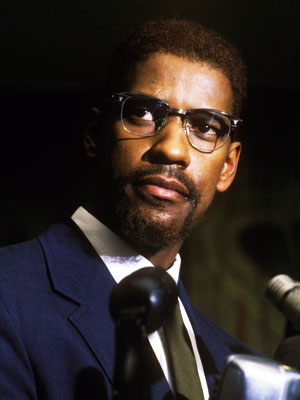
Denzel Washington portrayed Malcolm X in Spike Lee’s 1992 biopic. Sure this may not be the most accurate rendition about his interesting life, but it helps explain why he had the ideas he did. You may love him or hate him but he was much more than an angry black man whose attitude toward whites wasn’t without probable cause because he lived with racism and was greatly harmed by it at a young age. Still, at least this movie averts the idea of a white savior as well as the impression that blacks are incapable of saving themselves which is why I have a picture from the film on this post.

Another event going on in the United States during the Post-War era is the Civil Rights Movement which is seen as one of the most important events in modern American history in which African Americans across the nation stood up and pressured the government to bring progress towards racial equality under the law after nearly a century of being treated as second-class citizens with little or no rights in much of the country, especially in the South. These were laws that pertained to segregation, disenfranchisement, a ban on interracial marriage, or a black guy having a good chance of going to jail for checking out a white woman. We’re not sure when the Civil Rights Movement actually began since there have been blacks who’ve challenged the system as well as made gains in society. Yet, the first big event of the Civil Rights Movement was the 1954 Supreme Court case of Brown vs. Board of Education of Topeka in which a group of black parents sued the a Topeka school district so their kids didn’t have to travel miles to attend a crappier school. Thanks to their efforts as well as the NAACP with Thurgood Marshall representing, the Supreme Court struck down the earlier Plessy vs. Ferguson and declared that school segregation was inherently unconstitutional. The NAACP would go on challenge other discrimination laws as well. In 1955, a Montgomery woman named Rosa Parks was arrested refusing to give up her seat to a white person and move to the back of the bus. This led to the Montgomery Bus Boycott led by Rev. Martin Luther King Jr. and local NAACP head E. D. Dixon. It was a long struggle but they prevailed. Soon there were demonstrations across the nation such as the Freedom Riders, Little Rock, the March on Washington, and others. Sure there was a lot of racist resistance, but by the 1970s segregation was mostly over, the Voting Rights Act was passed, and while racism still exists in a lot of forms, it is no longer acceptable as far as the law and society goes. However, Hollywood isn’t always the right reference when it comes to the Civil Rights Movement though they could make a kind of inspirational story, yet they do have the tendency to introduce a white savior, which leads to the notion that blacks were incapable of saving themselves. Still, there are plenty of other inaccuracies seen in films set in this era which I shall list.

Malcom X:

Malcom X had dark hair. (He was a natural redhead and had lighter skin. Seriously, he was nicknamed “Red” by his friends because of his hair color. Sure people may not believe that a black person can have red hair but it does happen.)

The break between Malcolm X and Elijah Muhammad was emotionally jarring for the both of them. (Actually, Muhammad was already envious of Malcolm X for all the attention he was getting and Nation of Islam leaders saw him as a threat to Muhammad’s leadership, even before Malcolm left. When Louis Lomax wrote a book about the Nation of Islam When the Word Is Given, he used a photo of Malcolm X on the cover and reproduced five of his speeches and only one of Muhammad’s, greatly upsetting the guy. Not much love was lost between the two when Malcolm left. In some ways, the relationship between Malcolm X and Elijah Muhammad resembled less of parent-child surrogacy. Rather, it was more along the lines of Malcolm X playing Katniss Everdeen to Elijah Muhammad’s President Coin {though with the opposite outcome if you remember what happened in Mockingjay}.)

It was only after his pilgrimage to Mecca Malcolm X realized that the Nation of Islam’s bastardization of Islam was horseshit. (Actually contrary to Malcolm X, Malcolm actually made his Mecca pilgrimage after he left the Nation of Islam and became a Sunni Muslim. He already knew that the Nation of Islam’s flavor of Islam was horsehit by that time and didn’t need to go to Mecca to realize this. Yet, Spike Lee was right that it was in Saudi Arabia where he saw racial equality in action and the effect on him was very profound. Rather it made him realize that American racism wasn’t a function of whiteness per se as well as consider possible reconciliation between the races in the US. But this didn’t mean he was ready to forgive white America though.)

The attack at the Edmund Pettus Bridge in Selma, Alabama and the New Jersey Riots took place in Malcolm X’s lifetime. (Both of these incidences happened after Malcolm X was assassinated in February of 1965. One happened a month after he died and the other occurred two years later.)

Malcolm X’s family was of no particular importance on him. (Despite that his dad died under suspicious circumstances when he was six and his mother was institutionalized when he was thirteen and that he spent his teenage years in a series of foster homes, his siblings were of major importance to him. Quite a few of his siblings were members of the Nation of Islam and Malcolm’s break with it did cause some degree of drama since his brother Wilfred remained active in that organization. They also secured their mother’s release from that institution 24 years after she was confined {though Malcolm almost never talk about her for fear he’d snap if someone made the wrong remark but he did visit her}. Yet, you wouldn’t know it from Malcolm X, which leaves them out.)

Malcolm X spent weeks in solitary confinement. (He never spent any more than 24 hours in solitary contrary to the Spike Lee film. Otherwise, he wouldn’t have been moved to a lower security facility, which he was in real life.)

Malcolm X was a first-class criminal in his younger days prior to his imprisonment. (Contrary to Malcolm X, Malcolm and his gang weren’t the experts they were made out to be. They rarely made plans and none of them could pick a lock. They usually committed larceny in the early evenings at places where owners couldn’t be roused by the doorbell and had trouble selling their stolen goods which were stashed in Malcolm’s apartment. Also, Malcolm was arrested by police when he had a stolen watch repaired at a local jeweler’s who promptly reported him to the police. Oh, and he turned in all of his accomplices while in custody.)

Malcolm X grew disillusioned with the Nation of Islam when he found that it was corrupt with its leaders enjoying lavish houses, new cars, and the sexual favors of young secretaries. (While Malcolm X treats Malcolm’s break from Elijah Muhammad as a son’s disillusionment with a morally flawed surrogate father, Malcolm left the Nation of Islam for political as well as personal reasons. Even before he learned of Elijah Muhammad’s infidelities, Malcolm was already fed up with his leader’s policy of nonengagement that not only prevented members of a group from participating in civil rights protests but even forbade voting. By 1963, he knew that the policy of nonengagement was hurting his recruitment efforts in black communities, as the Civil Rights movement grew in the South. Despite attacking Martin Luther King Jr.’s approach to non-violent resistance, he eventually saw that the Nation of Islam offered no real opportunity to black activists facing vicious white racists in the South. He also knew very well that the Nation of Islam wasn’t above making deals with white people when it suited the leaders’ interests. Malcolm would even admit that while criticizing the civil rights activists working with white liberals, he negotiated a mutual noninterference agreement with the Atlanta chapter of the Klu Klux Klan on Elijah Muhammad’s orders that made him realize that his leader’s insistence that all whites were devils made it possible to justify dealing with the worst of them {such as the hate group most likely responsible for killing Malcolm’s dad}. Thus, Malcolm X’s disillusionment with the Nation of Islam had less to do with the sins of its leaders and more to do with their policies on politics and race relations, particularly the group’s refusal to campaign for civil rights.)

Malcolm X was introduced to the ideas of the Nation of Islam through his cellmate in prison. (Contrary to Malcolm X, his cellmate introduced him to literature, not religion though the two would remain friends. Malcolm actually joined the Nation of Islam at the insistence of family members notably brothers Reginald and Philbert and his half-sister Ella who wrote to him in prison. Yet, once he was a member of the Nation of Islam, he didn’t have to enlighten his friend Shorty who wasn’t transferred upstate and actually became a member himself but not for long when he disagreed with some of Elijah Muhammad’s teachings. Also, the preacher he challenged wasn’t an older man as played by Christopher Plummer but a young Harvard Seminary student who was much more wise and willing to accept that Jesus was brown.)

Malcom X was working as a train porter for the New Haven Line at the time of a boxing match between Billy Cohn and Joe Louis. (Louis and Cohn would have two boxing matches together in the 1940s. Malcolm wasn’t working for the New Haven Line at either time.)

Malcolm X was followed by CIA agents while he was in Mecca. (Contrary to Malcolm X, he was followed by Mecca’s secret service during his trip.)

Malcolm X spent his last year in foreboding the inevitable as well as receiving death threats from the Nation of Islam through telephone calls. (Actually he was quite busy during his final months. Moments include his brief meeting with Martin Luther King Jr. at the U. S. Capitol {that included a photo-op} and his “The Ballot or the Bullet” speech at the symposium sponsored by the Congress of Racial Equality. He attended a meeting of the Organization of African Unity and had talks with the leaders of Egypt, Tanzania, Nigeria, Ghana, Guinea, Kenya, and Uganda. In October 1964, he had a day-long meeting with leaders of the Student Nonviolent Coordinating Committee in Nairobi which resulted in cooperation between the SNCC and Malcolm’s newly formed Organization of Afro-American Unity. In December of 1964, he made an appearance with Fannie Lou Hamer and other Mississippi civil rights activists as Malcolm’s honored guests at an OAAU meeting in Harlem. In February of 1965, he met with Coretta Scott King in Selma where he affirmed his desire to assist King’s voting rights and explained that if whites knew he was an alternative “it might be easier for them to accept Martin’s proposals.” He even sent a telegram to the American Nazi Party saying: “I am no longer held in check from fighting white supremacists by Elijah Muhammad’s separationist Black Muslim Movement and if your present racist agitation of our people there in Alabama causes physical harm to Reverend King or any other Black Americans. . . you and your KKK friends will be met with maximum physical retaliation.” Yet, almost none of that is depicted in Malcolm X.)

White operatives might’ve been involved in Malcolm X’s assassination. (Contrary to Malcolm X, Malcolm’s independent political discourse attracted deadly enemies. Yet, Malcolm was probably more or less killed by those in The Nation of Islam than anyone else. In fact, the Nation of Islam directed nearly all its violence toward other blacks, particularly defectors. Malcolm certainly would’ve been on the top of their list.)

Betty Shabazz:

Betty Shabazz was a simpleton who was always complaining about Malcolm X’s eating habits. (Contrary to Malcolm X, she was a highly intelligent woman and one of the few Muslims with a college degree. Also, despite that Malcolm definitely wore the pants in the relationship; she wasn’t easily intimidated, not even by her husband.)

Betty Shabazz took all four of her kids to the Audubon Ballroom on February 21, 1965. (She only took three of them contrary to Malcolm X. The youngest was left with a friend.)

Freedom Summer:

The trial involving the murder of the three civil rights activists was a swift movement of justice. (Contrary to Mississippi Burning, it wasn’t for it actually took four years and numerous trials to get them sentenced to anything at all. Not to mention, though the seven convicted were sentenced more to 10 years, none of them served more than six.)

During the case of three missing civil rights activists in Mississippi, FBI agents resorted to vigilante tactics. (Sorry, Mississippi Burning, but it’s said that they paid informants with cash. Seriously, there’s no way in hell FBI agents would get away with what Gene Hackman and William Defoe did in that movie.)

The informant pertaining to the case of the civil rights activists was the sheriff’s wife. (Though depicted this way in Mississippi Burning, it was a person named Mr. X, who decided to remain anonymous but he decided to give information not out of the goodness of his heart but for the $30,000 reward.)

The disappearance and murder of the three missing Civil Rights activists in Mississippi was a police conspiracy. (Contrary to Mississippi Burning, we’re not sure what it was but the local police were certainly no help.)

The FBI was happy to oblige the investigation into the disappearance and murder of three civil rights activists. (Contrary to Mississippi Burning, J. Edgar Hoover wanted absolutely nothing to do with the Civil Rights Movement because he thought it as a load of Communist bullshit and was a racist. He only caved to send FBI agents due to the case’s national attention as well as the fact he was under heavy pressure from Lyndon B. Johnson.)

J. Edgar Hoover sent hundreds of agents to Mississippi to investigate the case of the missing civil rights activists. (Initially, he only sent 11 contrary to what Mississippi Burning depicts. It was a pretty lame effort.)

The FBI agents in Mississippi were hell bent on finding the killers of three civil rights activists and preventing further violence. (Contrary to Mississippi Burning, most of the FBI agents there couldn’t care less. It’s said that the FBI and the Justice Department would only intervene when absolutely necessary in their own point of view. In some cases, it’s said they stood by while beatings took place right in front of them.)

Miscellaneous:

The Civil Rights Movement wouldn’t have been made possible without benevolent white people who helped African Americans out with their own sense of moral responsibility. (Yes, there were whites who supported the Civil Rights Movement such as the white Freedom Riders but the Civil Rights Movement was decades in the making and mostly led by African American organizations like the NAACP as well as other organizations of color. And it was the NAACP’s Thurgood Marshall who argued for the black families involved in Brown v. Board of Education as well as thirty-one others. And out of the 32 case he argued in front of the Supreme Court, Marshall only lost 3 and would soon be seated on the Supreme Court himself as the first African American justice.)

The FBI was the honorable vanguard of civil rights protectors. (They were reluctant presence throughout the proceedings and would only investigate only under heavy pressure by President Lyndon B. Johnson. Also, J. Edgar Hoover had been spying on Martin Luther King Jr. and other civil rights leaders.)

Black Civil Rights activists trembled in the fear of whites, disbanded their conversations whenever whites approached, and retreated in mute submission. (Contrary to Mississippi Burning {which was harshly criticized by Coretta Scott King for ignoring the role of black and white activists}, most blacks in Mississippi during Freedom Summer weren’t like this. In 1963, 85,000 black Mississippians cast “freedom ballots” to show their determination and prove, contrary to white declarations that they were quite serious about voting. Despite church bombings, arrests, and murders a year later, Mississippi blacks met at local Freedom Schools all summer long. They voted for Freedom Democratic Party delegates to the Democratic National Convention in Atlantic City that year and created an autonomous social movement. These people were badasses who showed that they wouldn’t be terrorized into silence even if it costs them their lives. Eventually they prevailed. Mississippi Burning fails to show this which is a complete shame. They knew that the white establishment would retaliate with violence but they weren’t quaking illiterates unable and unwilling to stand up for themselves for they certainly did.)

The Civil Rights abuses in Birmingham took place in 1961. (They took place in 1964.)

The Nation of Islam was willing to challenge white authority but didn’t engage in militant action unless its members were threatened. (Actually, their reluctance to challenge white authority was one of the reasons why Malcolm X became disillusioned with the Nation of Islam in the first place. However, Malcolm X would never drop his militant streak and became increasingly close to militant civil rights activist late in life. Still, that Nation of Islam confrontation against white authorities in Spike Lee’s Malcolm X really did happen.)

The Black Panthers were a bunch of leather clad radical leftists. (Actually, they were more or less a community action organization during the late 1960s and 1970s who only wore guns for self-defense. Though they did acquire a shady reputation and were monitored by the FBI.)

History of the World According to the Movies: Part 56 – Radicalism and Agitation in the Early 20th Century

Image

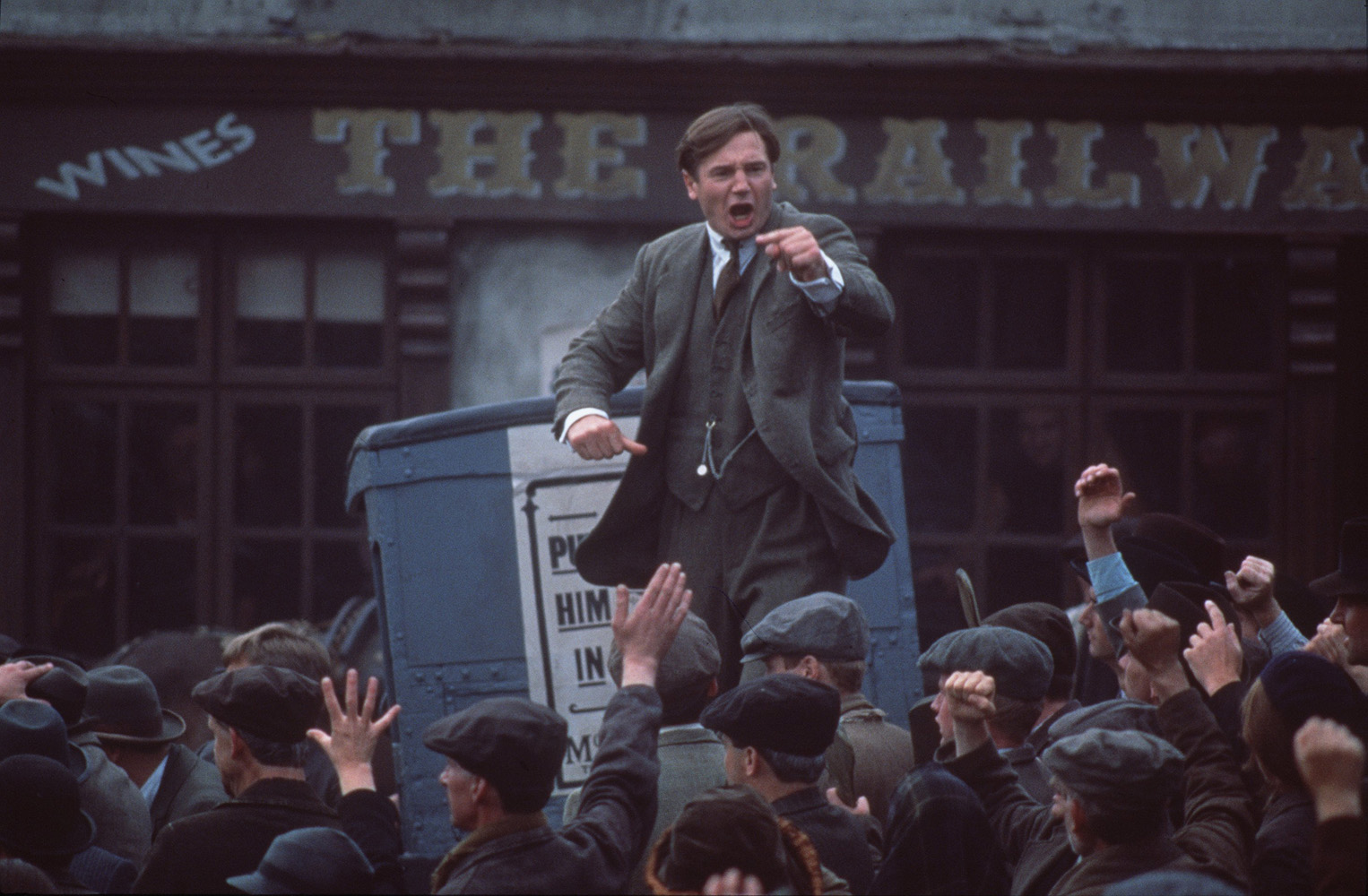
Neil Jordan’s 1996 film Michael Collins is a movie about the Irish independence movement as well as the most successful Irish produced movie ever made. Of course, this movie does take liberties with the truth, but not to Braveheart levels. Not to mention, many of the actors including Liam Neeson’s title portrayal are much older than the characters. Still, perhaps the worst thing about this movie is probably Julia Roberts attempting to do an Irish accent or playing Michael Collins’ girlfriend for she kind of sucked. And no, Liam Neeson’s Michael Collins isn’t giving his rousing speech on his particular set of skills. Still, as bad of treatment that Eamon De Valera got in this film at least he’s played by the great Alan Rickman.

Yet, Russia wasn’t the only country where there was radical politics and agitation in the early 20th century. In the United States left wing movements weren’t uncommon among the masses, especially in organizations like labor unions which many businesses refused to recognize. You had activists like Eugene Debs and Emma Goldman as well as muckraking journalists like Upton Sinclair, Lincoln Steffens, and Jack Reed. Sure some of them may have been Reds but they did write stories about American life that needed to be told, especially when it came to things like mental institutions, the meat packing industry, and lynchings. In Europe, you have people like Rosa Luxemburg and her Spartacist movement in Germany. Yet, while some agitation was caused by radical politics in response to social problems in some countries, there were other areas also experiencing agitation for other reasons. In some places in the world it was to protest European imperial presence. In others it was to gain independence from a colonial power. But one of the most famous in this time was in Ireland in which Irish rebels would stage an all out revolt against their British overlords who had ruled them for centuries. And this time they would finally succeed, well, sort of. Of course, this aspect of history has its share of movies made containing a share of historical inaccuracies which I list.

Left Wing Politics in the United States:

Eugene O’Neill seduced Louise Bryant while Jack Reed was away. (Actually Louise Bryant seduced Eugene O’Neill, telling him untruthfully that Jack Reed was seriously ill and that they weren’t interested in a sexual relationship. Nevertheless, like in Reds, O’Neill did fall hopelessly in love with Bryant but unlike her Diane Keaton portrayal she was no ingénue. Still, while Jack Nicholson was practically playing himself in Reds, it really doesn’t make much difference in his Eugene O’Neill portrayal since the American playwright was a pretty quick witted but very messed up guy anyway. Still, I have to tell you that the witnesses seen in Reds as supposedly participating in the activities depicted on the film actually weren’t very reliable because most of them had nothing to do with Bryant and Reed, Greenwich Village, or the Lyrical Left. Only Bryant’s lover Andrew Dasburg comes anywhere close she had an affair with shortly before following Reed to Moscow.)

Jack Reed was a very attractive guy. (Uh, sorry but his photo reveals that he did not look like Warren Beatty. Nor did Louise Bryant look anywhere like Diane Keaton.)

Jack Reed was faithful to Louise Bryant during his time in the Soviet Union despite that communication between them was impossible. (Except that Reed had an affair with a Russian woman over there while he was corresponding with Bryant {though she wasn’t exactly faithful to him either}. Furthermore, when Bryant went to see him in the Soviet Union, he knew she was coming.)

Radical Europe:

Rosa Luxemburg was very supportive of the Russian Revolution. (Yes, but she turned against it when Vladimir Lenin and his Bolsheviks took over. She may have been a Communist but she was no fan of totalitarianism in any way, shape, or form. Her posthumous pamphlet of the Russian Revolution contained some of the most pungent criticisms of Communist Party dictatorship which was violently attacked by all Russian Communists. However, a lot of self-proclaimed Communists at the time would’ve agreed with her. Still, her devastating critique of Lenin’s theory of party dictatorship is one of the reasons why she’s so famous as a conscience of any revolution made in the name of freedom. Yet, her attack on Lenin goes unmentioned in the movie about her.)

The Irish War of Independence:

Irish soldiers did their drilling in English. (They do it in Irish, not English.)

1920’s Bloody Sunday at Croagh Park was a massacre with British firing machine guns from their armored tanks. (For one, only 14 civilians died at Croagh Park on Bloody Sunday. Second, the British and the Black and Tans did most of the shooting by hand with rifles. Third, there were never armored cars there firing machine guns or the body count would’ve been much higher {the armored cars were parked outside Croagh Park during the massacre}. Still, it’s greatly exaggerated on Michael Collins, perhaps to Michael Bay looneyness.)

John O’Reilly was with Michael Collins at Beal na mBlath on August 22, 1922 upon Michael Collins’ assassination. (He wasn’t there to cradle his dead leader.)

Thomas MacDonagh surrendered at the General Post Office garrison after the Easter Rising. (He surrendered at Jacob’s Factory and wasn’t present with GPO leaders Pearse, Clarke or Connolly when they surrendered at 16 Moore Street.)

Ned Broy was tortured and killed during the Irish Revolution. (He actually ended up as a Commissioner of the Garda Síochána {Irish police force} between 1933 and 1938. He died in 1972 at 85. Nevertheless, in Michael Collins, he’s a composite of the real Broy and Dick McKee who actually never got caught but was said to get shot at Dublin Castle while attempting to escape custody after his capture on Bloody Sunday.)

The British were nothing but thugs during Ireland’s fight for independence. (Yes, they did many horrendous things there but there were a few sympathetic British who were probably there just to get out of the trenches and a handsome paycheck. And the cold blooded executions of Irish rebels did push quite a few British people to sympathize with the Irish Republican cause. Still, both the Royal Irish Constabulary and the Dublin Metropolitan Police saw several defections to the IRA.)

Michael Collins:

Michael Collins was in his forties during the Easter Rising of 1916. (He was only 25 and was assassinated at 31. Yet, he’s played by a 44 year old Liam Neeson in Michael Collins, which makes him seem more like a behind-the-scenes manipulator than a fellow fighter. Still, his photographs make him look like an old timey gangster. Also, unlike her Julia Robert’s 30ish portrayal, his girlfriend Kitty Kiernan was between the ages of 23 to 29 when the events in the film took place. Eamon De Valera was in his between 33 and 39 at this time as well but he’s played by a much older Alan Rickman. Still, according to standards of the Irish rebels, Valera was considered an old man for many of his comrades were remarkably young.)

Michael Collins was clean shaven in 1921. (There’s a photograph of him sporting a mustache from that time.)

Michal Collins was a lieutenant in the Irish Volunteers during the Easter Rising. (He was a captain but Michael Collins shows him in a lieutenant uniform. Also, he was serving as an aid de camp to Joseph Plunkett who’s absent from the film.)

Michael Collins served in the Irish government as Minister of Intelligence. (He was actually Minister of Finance. However, he was the IRA’s Director of Intelligence.)

Eamon De Valera:

Eamon De Valera was behind Michael Collins’ assassination. (De Valera may have fought against Collins in the Irish Civil War that followed after Irish independence but he actually wanted to negotiate with him. Not to mention, he wasn’t involved in the ambush that killed him, he tried to stop it. However, though De Valera is heavily implied as being involved Collins’ assassination in the 1996 film, there’s overwhelming evidence he really had nothing to do with it and to suggest it insults the man. Still, great performance by Alan Rickman.)

Eamon De Valera was held prisoner at England’s Lincoln County jail and was rescued by Harry Boland and Michael Collins. (He was actually released so Boland and Collins’ efforts were probably unnecessary.)

Eamon De Valera surrendered with the General Post Office garrison after the Easter Rising. (He was actually the Commandant of the garrison at Bolland’s Mills which surrendered after the GPO upon receiving orders to stand downs. He was never at the GPO during the Rising.)

Eamon De Valera said that “only pure blood Irish” should be able participate in the Irish Republic. (He never said this nor believed it since his father was a Spanish Cuban, he was born in New York City, and knew that his political opponents would’ve used it against him if he did.)

Eamon De Valera was a dithering, manipulative, and despicable leader whose grandstanding led to decades of unnecessary bloodshed in and over Ireland. (De Valera’s family should sue for slander. Still, De Valera was in Irish politics for more than 50 years, which may attract critics but few would’ve said he was a weak man.)

Eamon De Valera wasn’t shot by a British firing squad because he was American. (Yes, but it wasn’t because the US was allied with Great Britain in World War I. It had more to do with Great Britain wanting the US to enter the war on their side.)

Harry Boland:

Harry Boland was shot by a British sentry while trying to swim the Liffey River. (He was actually shot in a skirmish with Irish Free State soldiers in the Grand Hotel at Skerries during the Battle of Dublin. However, when they filmed Michael Collins, the Grand Hotel had been demolished.)

Harry Boland was in Dublin when Michael Collins returned from the infamous treaty negotiations. (He was in the US at this time.)

The IRA:

The IRA existed in 1913. (It didn’t exist until 1919.)

The IRA used car bombs during the Irish War of Independence. (It wouldn’t use car bombs until the 1970s.)

IRA guerrillas killed with great reluctance and for very good reasons. (In their minds at least but this wasn’t always the case.)

IRA guerrillas killed their British adversaries in a fair fight. (Sometimes they’d just finish off their opponents after they’d surrender or lay wounded. In fact, most of their killings were straightforward assassinations of helpless, unarmed people.)

The IRA would attack police stations only to warn them to stop ill treating prisoners and would only kill informers if they were sure of their guilt yet they were allowed to bargain for their lives. (Actually the IRA killed hundreds of policemen, alleged spies, and suspected informers. Most of the time, there was no warning, no “trial,” and no attempt for the victims to bargain for their lives. Very few “informers” it seems, were guilty of anything at all. Other key IRA victims were vagrants, homeless men, supposed sexual deviants, and perhaps most disturbingly local Protestants.)

IRA members hesitated on those rare occasions when it came to “killing our own” which prompted profound soul searching. (The IRA had no problem killing fellow Irishmen and women since they made the the majority of their victims. It seems to me that The Wind that Shakes the Barley seems to be a love letter to the IRA doesn’t it?)

Irish Civil War:

Those who supported the Irish treaty for independence were traitors, social reactionaries, and all the people who shout. Those who were against it were true nationalists and socialists who believed in social justice. (The treaty schism that broke out the Irish Civil War was far more complex than what is shown in The Wind that Shakes the Barley. Sure there might’ve been a few Socialists in the Irish nationalist movement but they didn’t make up the majority. Yet, most people who were anti-treaty had little ideology behind what derived from a romantic, culturalist, separatist, and sometimes necrophiliac brand of nationalism. Also, those who were pro-treaty weren’t necessarily social reactionaries either nor were exactly happy with the partition. Rather, many of them were just plain sick of division and didn’t want a civil war in the first place until Eamon De Valera rejected it and walked out of the Irish Parliament. Still, it when it came to the Irish Civil War, it was the pro-treaty people who were the reluctant ones. Also, the Catholic Church in Ireland didn’t equate opposing the treaty with Communism because most of the Irish who opposed the treaty weren’t {also, Eamon De Valera was a devout Catholic who tried to cooperate with the Church}. If the Catholic Church in Ireland supported the treaty in any way, it was out of pacifism and probably saw the anti-treaty Irish nationalists as violent agitators stirring up trouble that’s going to get innocent people killed. The Catholic hierarchy in Rome had also opposed World War I out of a pacifist stance as well, which was a conflict many left-wing radicals didn’t like either. Also, most radical Socialists at the time didn’t care for nationalism anyway save maybe in Russia.)

Political Dealbreakers Ever Voter Should Follow

As with relationship dealbreakers, there are plenty of ones revolving around political candidates and elected officials. I’m sure we all have our own biases since politics is a highly contested business yet perhaps we need to have a few guidelines on what candidates we shouldn’t elect in the first place. Here is a short list:

1. If he posts a picture of his private parts online to people who aren’t his spouse. (I’m talking to you Anthony Weiner, when we ask for transparency in Washington, showing photographs of your “Carlos Danger” isn’t what we had in mind.)

2. If he knocks up his mistress while his wife is fighting cancer and refuses to acknowledge the kid until almost a year later. (Remember, John Edwards?)

3. If he knocks up his maid and doesn’t acknowledge the kid until ten years later. (You know who I’m talking about, Arnold.)

4. If he suddenly disappears for a weekend without a word and claims to he was hiking the Appalachian Trail while he was really screwing his mistress in Argentina with travel expenses paid by the tax payers. (What do you mean this isn’t a dealbreaker, South Carolina? Sanford didn’t even deserve a second chance.)

5. If he campaigns as a pro-life candidate and demands his mistress have an abortion. (This coming from a state senator from Tennessee, who got reelected anyway. Seriously?)

6. If he or she doesn’t pay child support or acknowledge an existence of an illegitimate child. (Seriously, if you can run for public office over the local level, you can certainly pay child support. And I don’t care if your ex is a bitch.)

7. If his behavior on C-SPAN is akin to a spoiled child who’ll throw a major tantrum if he doesn’t get his way. (I swear my cousins are better behaved than Tea Party Congressmen.)

8. If he threatens to shut down the government if he doesn’t have his way with certain legislative policy. (Again, Tea Party Congressmen.)

9. If he cheats on two critically ill wives for a certain amount of time before sending them divorce papers. (Newt Gingrich is such a despicable man in both spheres.)

10. If he is cheating on his spouse with a teenager or having a sexual relationship with a teenager or anyone younger. (Sexual behavior toward minors is never okay.)

11. If he sends lurid text messages to teenagers. (Remember Mark Foley sending his e-mails to pages?)

12. If he has camera crews follow him around to his yacht where he’s seen in a romantic embrace with a woman who’s not his wife. (This not only proves that he’s not only an adulterer but also lacks basic common sense, like Gary Hart.)

13. If he’s a clergyman. (Seriously if he’s addressed as a Rev. or has spent his life in a religious vocation, then he will not have my vote. We need to keep the institutions of church and state separate so clergymen should never run for political office.)

14. If he makes racist or sexist comments and doesn’t see no need to apologize for them. (This cost Sen. George Allen his seat in the U.S. Senate in 2006.)

15. If he tries to go to great lengths to justify why they don’t support abortion when it comes to rape, incest, or life of the mother. (If a Republican politician is ever asked whether about abortion in cases of rape, incest, or life of the mother, he or she should just shut up because no good can come out of answering such question. Seriously, just because you may believe in such ideas, doesn’t mean you should say them. Case in point, Todd Akin’s “legitimate rape” comments.)

16. If he has several allegations of sexual harassment to his staff members. (Something tells me the mayor of San Diego isn’t going to last much longer.)

17. If he knows nothing about the kinds of policy that would be related to the job he’s running for. (Herman Cain anyone?)

18. If his favorite movie is Birth of a Nation. (As a film that promotes racism and portrays the KKK as the good guys, it’s easy to see why.)

19. If he is a member of his local KKK. (Like the gubernatorial candidate in O Brother, Where Art Thou?. Actually he was the Grand Wizard.)

20. If he’s involved a major corruption scandal which could mean jail time. (Well, this one is obvious.)

21. If he has a collection of child porn. (Another obvious one.)

22. If he used a racial or sexist slur on a reporter.

23. If he writes a book which states that women should stay at home and not give anyone sass. (Of course, this helped Rick Santorum lose to Bob Casey in 2006.)

24. If he says “well, one of my best friends is  (insert demographic here)” after saying something bigoted in order to prove he isn’t. (He’s a bigot.)

25. If his name has become eponymous to something disgusting due to his bigotry toward a certain demographic. (Again, Rick Santorum, naturally.)

26. If he is caught at a wild teen party where there was underage drinking. (This is now befalling a current attorney general of Maryland who’s probably going to lose.)

27. If he had committed perjury in a case that involved his son killing his neighbor with his father’s gun. (This happened to a local state senator in Pennsylvania.)

28. If he’s anti-gay yet is caught engaging in homosexual activity. (I mean like playing footsie in the bathroom with an undercover cop type situation or going on gay chat lines. There’s a whole bunch. Methinks they protesth too much? I think so.)

29. If he makes an ass of himself on the Daily Show. (Any news outlet can count on this one.)

30. If he is caught on tape calling half the nation a bunch of freeloaders who live off government money. (And this is why Mitt Romney never became president.)

Myths and Facts on Environmental Protection Policy

In my post about the US government shutdown, I used issues such as increasing national defense and environmental protection to illustrate why the GOP isn’t the political party for smaller government it says it is. For instance, national defense only increases the size of the government, especially at a time of war yet it’s a policy most Republicans like. On the other hand, laws relating to environmental protection has helped Americans save money, yet Republicans hate it. However, as a government policy, environmental policy is one of the most understood thanks to media outlets like Fox News and other conservatives who basically try to trivialize it. Here is a list of the many opponents of environmental protection tend to say with my explanations on why they’re false.

1. Myth: Environmental conditions only affect the natural world and wildlife.

Perhaps the most infamous of them all. Of course, a conservative would say this to trivialize environmental issues as “special interests.” This is even more false than saying that all environmentalists are tree hugging hippies. If this was true, then we probably shouldn’t have much to worry about when there’s an environmental catastrophe. Of course, this is bullshit since the health of the natural environment has an impact on everything, especially people. Just because humans may be responsible for much of the world’s environmental problems, they also fall victim to them. Pollution has caused a variety of health problems through the years like respiratory illnesses, cancer, birth defects, infertility (including miscarriages and stillbirths), infections, heart disease, and the list goes on. Polluted drinking water can spell a crisis in public health in any community and droughts can lead to mass starvation (think of the Dust Bowl). And in some instances, an environmental disaster can lead to a destruction of a whole community as well as  bring social problems like economic collapse, mass poverty, homelessness, and other things. You can say that if you destroy the land, you also destroy the people.

2. Myth: Environmental policy is a burden to taxpayers and contributes to big government.

Like I said in my post about the government shutdown, this is absolutely false. In fact, this is another lie by Republicans who inflict the small government argument when it comes to policies they don’t like. Sure environmental policy may cost taxpayer money but it also helps save tax dollars by tackling problems that contribute to more government spending. For instance, pollution and environmental disasters contribute much more to big government than any funding to the EPA ever has.

High pollution levels can contribute to higher health care costs as well as more government spending on health care. This is especially true when you consider senior citizens and the poor since these two groups of people receive health care through medical assistance and are most susceptible to pollution related illnesses. Senior citizens are more likely to have been exposed to higher levels of pollution and over a longer period of time than younger generations. They are more likely to have grown up in a highly polluted area, had an environmentally hazardous job, have a history of smoking (and exposure to secondhand smoke), and to have someone in their family who died of a pollution related illness at an early age. It’s no wonder why senior citizens are so prone to respiratory illnesses like lung cancer, emphysema, asthma, and others.  Of course, some may say because senior citizens are more susceptible to illness in general, yet you can’t really dismiss the environmental factor either. As for the poor, they are more likely to be exposed to high levels of pollution because many live near environmentally hazardous establishments. These can consist of toxic waste dumps, power plants, or dirty industry centers that lower property values and aren’t nice places to live. Thus, residences near these places will always consist of people below the poverty line who can’t afford to live anywhere else, especially in cities. If you live in a rural area, then the chances of an environmentally hazardous establishment moving in are very high since many of your neighbors will welcome if there’s something in it for them, most of the population won’t be willing to sue (and if they do the chances of losing are high), and for those who do object, most won’t be able to do anything about it since no one’s going to pay attention. Oh, and many of the rural poor tend to whites who vote Republican and watch Fox News (Fucked News, as I call it). Nevertheless, high pollution and high poverty go hand in hand. Thus, pollution related illnesses are a burden to the healthcare industry, communities, the nation, and the taxpayer.

Another drain on taxpayers which the EPA helps prevent are environmental disasters since they are incredibly expensive to clean up and restore. Of course, polluting industries tend to be the main cause of these environmental disasters yet the job of clean up and restoration will always fall to the state and/or federal government for various reasons. For one, federal and state governments usually do the job better than anyone else and don’t need a court order to do so. Second, an environmental disaster precipitates a state of emergency in which environmental damage must be promptly acted upon before there’s serious long term consequences. Third, in an event of environmental catastrophe, most local communities don’t have the money and resources for the necessary action so responsibility will fall on a higher power. Finally, most corporations that cause environmental disasters will go out of their way in order to avoid responsibility for environmental damages such as fighting lawsuits (the case concerning the Exxon-Valdez Oil Spill ended up at the Supreme Court but wasn’t settled since Alito had to recuse himself). So while environmental protection may cost taxpayers something, lack of environmental protection will cost taxpayers much more.

3. Myth: Environmental policy hurts the economy, hurts businesses, and kills jobs.

Republicans will use this myth all the time when it comes to rallying against environmental policy as if they are trying to justify that economic benefit is worth the environmental costs, especially in the area of dirty industry. However, how environmental protection policy actually affects the economy, is far more complicated. Of course, environmental protection is a popular scapegoat for conservatives when it comes to economic problems but there are many reasons why economies and businesses fail usually ranging from unfair competition, unethical business practices, bad economic policies, unsatisfied greed, or just simply plain ol’ fashioned bad decision making. And hardly any of them have anything to do with EPA regulations. Of course, EPA regulations may hurt smaller polluting businesses but most polluting companies can accommodate with environmental policy. However, for businesses, environmental protection is no fun since it means complying with more rules, may dip into profits, gets businesses to stop doing what’s more convenient and cost-effective to them, and compels them to be more environmentally responsible. It’s no wonder businesses don’t like environmental protection since they tend to be from a world in which success is based on short-term profit gains, fast growth, unrestrained corporate greed, and fierce competition, which is hardly a sustainable economic model.

Yet, what many pro-business people tend to ignore is that environmental protection doesn’t hurt economies as much as environmental destruction. The Lorax illustrates this to near perfection with the Oncler who builds his empire by destroying an entire forest to supply his factories. Of course, he becomes wealthy yet things fall apart for him once the last tree is cut down. His family abandons him, his factory goes to ruin, and the forest once filled with colorful trees is now a wasteland. Since the Oncler basically obtained his raw materials in a way that was most convenient to him in order to satisfy his own greed, he gets to see all he worked hard for all his life go down the drain. Of course, many corporate leaders don’t learn their lessons or suffer the consequences from all the environmental destruction they cause. Yet, many people do, those whose business is dependent upon environmental conditions and availability of natural resources. Environmental policies may not bring big profits but they might help a company stay in business since they may give reasons for businesses to adapt, encourage the development of green industry, ensure sustainability of resources and sustainable growth, and make businesses more competitive. As for consumers, more eco-friendly products might help them save money on certain products like at the pump for instance.

Things in American History Worse than Obamacare

In the news, I’ve been hearing things about what these Republicans in Congress are griping about how Obamacare is the worst thing that has ever happened in American History. As a former history major in college, I have to disagree big time. Obamacare may not be the best thing since sliced bread but as the worst, not even close. So here I have a list of things in American History that are much worse than Obamacare just to put people in perspective which assures me, the US is certainly going to be okay with it.

Things in American History Worse than Obamacare (Some of these might be according to my opinion):

Concepts: slavery, DDT, Birth of a Nation, Fox News (couldn’t resist), for-profit health care (yes, even the system Obamacare replaces), Blackwater, the Atom Bomb, Social Darwinism, Monsanto, racism, smallpox blankets, anti-intellectualism, abuse of laissez faire, sexism, napalm, child labor, Hays Code, blackface minstrel shows

People (Hall of Shame): Thomas Midgely (inventor of leaden fuel and CFCs), J. Edgar Hoover, Dick Cheney, Bernie Madoff, Jerry Sandusky, Lance Armstrong, Newt Gingrich (first used the government shutdown as a political ploy), Whittaker Chambers, Joseph McCarthy, Jack Abramoff, Dr. James W. Watts (helped popularized the lobotomy in the US), Roger B. Taney (said that blacks have no rights which whites are bound to respect in the Dred Scott Decision), Benedict Arnold, Henry Wirz (warden of Andersonville Prison and only person in the Civil War convicted and executed for war crimes), Nathan Bedford Forrest (responsible for the Fort Pillow Massacre and was first KKK Grand Wizard), Strom Thurmond, Richard Nixon, Anthony Comstock, Jeffrey Amherst, Anita Bryant

Groups: the KKK, the Religious Right, the Dixiecrats, robber barons, global warming deniers

Places: Andersonville Prison, Triangle Shirtwaist Factory, Indian Reservations

Events:

Wars: The Civil War, the Indian Wars, Vietnam War, Korean War,Spanish American War, Mexican Wars, WWI, Attack on Pearl Harbor, War of 1812, Iraq War, Battle of Little Bighorn, Wounded Knee Massacre, Philippine American War, Bataan Death March

Scandals: Watergate, Iran-Contra, Teapot Dome Scandal, Savings and Loans Scandal, Lewinsky Scandal, Plamegat, Enron, Chappaquiddick, Black Sox Scandal, 21 Game Show Cheating Scandal, Hollinger Scandal, Abramoff Lobbying Scandal, doping scandals

High Crimes and Attacks (non-war related): Kennedy Assassination, RFK Assassination,  Lincoln Assassination, Oklahoma City Bombings, Haymarket Riot, Kent State shooting, Virginia Tech shooting, Jonestown, Columbine, Sandy Hook, Aurora, 9/11,Valentine’s Day Massacre, O. J. Simpson Trial (1990s), Waco, MLK Assassination, the Boston Massacre, Boston Marathon Bombings, Bleeding Kansas, Trayvon Martin shooting, LA Race Riots, the Murder of Matthew Shepard, Lindbergh Baby Kidnapping, New York Draft Riots, lynchings, Tuscon shooting

Disasters: Hurricane Katrina, Hurricane Sandy, Challenger Explosion, Columbia Explosion, BP/Deepwater Horizon Oil Spill, Exxon Valdez Oil Spill, San Francisco Earthquake, Johnstown Flood, The Dust Bowl, Triangle Shirtwaist Fire, Chicago Fire, Three Mile Island.

Economic Upheaval: The Great Depression, Panic of 1837, Stock Market Crash of 1929, Wall Street Meltdown of 2008

Crises: Spanish Flu Epidemic, Cuban Missile Crisis, Iran Hostage Crisis, Secession Crisis

Others: Scopes Monkey Trial, Salem Witch Trials, slave trade

Legal Actions: Jim Crow laws, Dred Scott Decision (worst Supreme Court decision in history), Chinese Exclusion Act, Plessy vs. Ferguson, Citizens United ruling, Alien and Sedition Acts, Patriot Act, Fugitive Slave Act, the Intolerable Acts, Comstock Laws, 18th Amendment, Kelo vs. New London (government can use eminent domain for the benefit of selling it to private developers), Indian Removal Act, Death of the Voting Rights Act, Shoot First Laws (unjust when it comes to certain cases)

Bad Policies: Japanese Internment Camps, Prohibition, the Pardon of Scooter Libby, Nullification Crisis, Trail of Tears, US-Soviet Nuclear Arms Race, Cold War, Palmer Raids, spoils system, McCarthyism, voter discrimination, Imperialism, government shutdowns, death penalty, 3/5 Compromise

Of course, this is only as much as I could think of but feel free to list more in the comments section. Still, I don’t think Obamacare is in any way worse than all the things I have already listed from American History, which I can offer a decent explanation. Of course, there are certain items I didn’t list since they may be subject to controversy. Still, if the United States can survive as a country through all this, then I’m confident, it will be fine under Obamacare.

Thoughts of the US Government Shutdown

Image

I don’t always talk about politics but I think this government shutdown is just ridiculous and isn’t doing anyone any favors. National parks, museums, and historic sites are closed, certain social programs and policies are inactive, and thousands of government workers are furloughed until further notice. Meanwhile, Congress is stuck in the Capitol basically doing who knows what while the rest of the nation is struggling and the debt limit is ebbing ever closer to the ceiling. People are pointing fingers at the party they don’t like just to have a scapegoat, angry protestors are arriving in Washington in droves, and rants are popping up on every social media outlet while the media outlets are basically creating sensationalism as usual.

Of course, both parties are at fault since Washington D. C. is a city where no government official is completely innocent regardless of party affiliation and amount of dirty laundry. However, as the liberal I am, I have to reserve special ire on the Congressional Republicans who I can’t occupy any ounce of sympathy for. Of course, there’s no doubt they were the ones who hold most of the responsibility for putting us in this debacle in the first place over a piece of legislation they don’t like and tried almost every trick in the book to get rid of. Call it Obamacare or he Affordable Care Act but it’s a piece of legislation that’s here to stay, which most Americans like. It’s not perfect and doesn’t solve everything wrong with the healthcare system but at least it’s better than the healthcare system we had before the ACA became law (and I don’t want our country to go back to it). Still, what disgusts me that these Republican Congressmen despise this legislation so much that they’re willing to do the unthinkable and don’t seem to harbor any shame in doing so nor care who gets hurt. All they seem to care about themselves and their party’s bottom line and would risk undermining the national quality of life to make sure the government run by their party platform which must be retained at the utmost ideological purity even if such notions like protecting life and free market economics vastly contradict each other. If they don’t get their way, they usually whine and scream like a two-year-old, blame the Democrats, and go on nasty tirades on Fox News, since it’s the only news network that ever agrees with them 100% of the time. I’m sick of how they justify trying to get their own way by making life a complete hell for millions of Americans, especially those who can hardly afford to make ends meet. I’m disgusted how many of them call themselves Christian yet selfishly reject legislation that promotes Christian values using buzzwords like, “big government,” “government takeover,” “Socialism,” “amnesty,” “soft on terror,” and other terms. I have seen my youngest cousins act with much more respect, dignity, and maturity than this selfish, spoiled, bullying, and tantrum prone bunch of middle aged brats. What makes me more outraged is that how perfectly sane and sensible people can take them seriously or even vote for them.

Look, most Americans may not be 100% content with Obamacare or other government policies but none wouldn’t dare wish for a government shutdown regardless of political beliefs. No matter how much Americans complain about their government, there at least some government programs that we like, benefit from, and/or rely upon. There are even self-identified conservative Republicans who’d spat almost any anti-government tirade you could think of, but will go out of his or her way to justify why certain government programs and functions should remain for those very reasons. I know a lot of people like this personally and that Congressional Republicans are also guilty of such when they discuss a policy such as national defense spending, which conservatives will always advocate increasing regardless of whether it complies with their concept of limited government or not. Putting more money in national defense doesn’t reduce the size of the government, especially when it pertains to financing certain projects like wars. Rather such action expands government size as well as adds to the debt and burdens taxpayers in decades to come. Yet, you will never hear a Republican say this. Most of the time conservative Republicans will will inflict their beliefs on limited government is when it pertains to legislation they hate like environmental protection regardless how much money it may save in the long run. As with environmental protection, a conservative Republican will oppose any such legislation citing that such laws don’t benefit the economy and take away jobs from hard working Americans. They would call environmentalists tree-hugging hippies, say that global warming isn’t real (it is, it’s caused by human activity, and it’s serious), and view their causes as trivial and selfish. However, a lot of environmental legislation has not only helped improve our nation’s quality of life but also saved taxpayers a tremendous amount of money in the long term which would’ve been spent on treating pollution related illnesses, cleaning up environmental disaster areas, and other things. Furthermore, it has helped businesses, created new jobs, and drive up technological innovation. Yet both scenarios very much illustrate that regardless of party affiliation and ideology, we all have our own ideas about government and most of us wouldn’t want our lawmakers to get rid of certain aspects about it that we either like, benefit from, or depend upon. And that even those who believe in smaller and more limited government will make certain reservations for such government policy.

Of course, you might think that the Republicans’ support of increased defense spending but opposition to environmental legislation sort of discredits the GOP as a champion of smaller government. Indeed it does, but in their positions on both these issues make sense if you also note that the Republican Party also champions big business, corporations, and unrestrained free market economy. A higher defense budget benefits defense contractors like Haliburton, Blackwater, KBR, and Lockheed Martin as well as other companies like Boeing. To have a defense contract is to be on the government’s payroll manufacturing whatever the military needs, especially at a time of war. On the other hand, companies like Exxon Mobil, Chevron, and Shell absolutely hate any policy relating to environmental protection because they not only want to be at the top of their competition and earn a profit but also avoid any responsibility for environmental damage they might have caused (note how a Big Oil company acts after causing an oil spill or how any polluting company in any other environmental disaster). No carbon based energy industry wants to compete with a green energy upstart and certainly prefers not to adapt. As with environmental disasters, a big polluting energy company would go out of its way to avoid responsibility for the damage it caused to the affected wildlife or local community.

Still, despite that the United States is a democratically elected government in which citizens elect their leaders to represent their interests, this doesn’t mean that everyone is going to have his or her own way 100% of the time. We must remember that elections and legislative decisions are decided by majority vote. And though the Republicans still maintained a majority in the House of Representatives, Democrats still control the Senate and the presidency so they’re certainly not going to have their way all the time in Washington. Not to mention, Obama won reelection in 2012 so if it has any idea of what the country thinks of him or his policies, then it probably means Congressional Republicans should stop being the sore loser crybabies they are and start cooperating with the Democrats as well as maybe go along with a compromise or two. They may also want to pay attention to public opinion in their own district and doing what’s best for the country, instead of their own party, special interests, or themselves. Sure Democrats may have the same problems as their conservative counterparts but at least they don’t act like bullying crybabies on TV, have put up with considerable crap from their opposition as well as their own party ranks for years, don’t have their own version of Fox News, don’t respond harshly to criticism or demean disadvantaged and minority populations, and aren’t always obsessed with ideological purity. Furthermore, the Democratic Party has a platform that works for 21st century America and appeals to a large and diverse population. Thus, Republicans might want to understand that while throwing a tantrum will give you attention, it will never give you respect, especially from people like me who are absolutely fed up with your shenanigans you put the American people through. If you don’t start losing gracefully and acting like mature adults, then expect to create more enemies, lose more elections, and eventually have your party be driven into extinction. For though us Democrats may be your rivals, you Republicans are your own worst enemy. And if you’re willing to risk a government shutdown over a piece of legislation you don’t like, then there’s obviously something wrong with you.

A Statement on Gun Violence, Gun Culture, and Gun Control

As someone who harbors progressive political views (due to my liberal Catholic upbringing no less), I rarely try to discuss politics since I live in an area where my leftist political views based on my strong Catholic moral convictions have a great potential to offend people like friends and extended family. However, in the wake of a the Navy Stockyard shooting, I cannot in due conscience keep silent on the matter of  gun violence in this nation which I see as reaching epic proportions. I understand that gun violence is a highly controversial issue in these United States and I know full well that I may be subject to nasty comments by trolls, but I’d rather risk offending people than disobey my own conscience, especially on matters of great national urgency in which my silence could be a sin since violence of any kind is a grave injustice, especially if it costs innocent lives. I may not have been personally involved in a violent in my life nor lived in an area where violence is the norm. I may not understand what it’s like to know anyone who was exposed to gun violence or had their life taken because of it. However, that doesn’t necessarily mean that my own life hasn’t been affected by gun violence nor that I don’t have any opinions on it. Criticize me if you may but let my voice be heard.

In the United States on average about 1 in 3  know someone who has been shot while each day guns account for 32 murders, 51 suicides, 45 fatal accidents, and 140 being sent in an emergency room for a gun assault. Nearly 1 in 4 American teens has witnessed a shooting while gun violence is the second highest cause of death of American children and teens in which on an average of 8 are killed by guns per day consisting of a third of all victims. It is also the primary cause of death among African Americans from that age group which was one of the reasons the Trayvon Martin story was such a big deal in the news, especially the fact that he was shot by a white Hispanic man named George Zimmerman. While rural kids are more likely to die from a gunshot than their urban counterparts, most of them will die from gunshots caused by suicide or an unintentional shooting while urban kids will more likely die from gunshots caused by homicide, especially if they’re poor, black, or Hispanic. However, half of all gun violence victims are between 18-35 years old while many come from poor neighborhoods where gun violence is prevalent, be either black or Hispanic, or perhaps have a criminal record. Of course, most victims of gun violence are men as well as the perpetrators. And teenagers exposed to gun violence were more likely to commit more serious acts of violence themselves, especially teenage boys of color in bad neighborhoods. White males, on the other hand, are more likely to use a gun to commit suicide since they consist of 40% of all firearm suicide victims and most mass shooters tend to be young white men as well.

Every year, gun violence costs about an average of $100 billion dollars to US taxpayers including medical treatment, criminal justice proceedings, new security precautions, and reductions of quality of life in gun violence prevalent neighborhoods due to fear, which results in economic devastation. The lifetime medical costs for all gun violence victims is said to amount to $2.3 billion with almost half of that being born on US taxpayers. From these statistics derived from the Brady Campaign it’s not hard to determine that the United States has a serious problem with gun violence, which isn’t just killing our citizens or perhaps but also ruining their lives, but also becoming a drain on our taxpayers. On an international scale, Americans are about 20 times more likely to be killed by firearms than those in any other high income industrialized nation where firearms are involved in more than two thirds of homicides according to the FBI and half of all suicides according to the CDC. And in places where gun violence is prevalent, both the victims and the perpetrators are more likely to be poor as well, which makes taxpayers more likely to cover the medical bills and legal fees. Although gun violence has decreased dramatically in the past 20 years along with other reported crimes, it’s still a major problem in this country especially in the wake of events like Aurora, Newtown, and the Navy Stockyard mass shootings.

The United States has 310 million guns and which are owned by 40% of all households, a decline since the 1960s but the number of guns has considerably increased meaning that gun ownership has become more concentrated. And by a wide margin the US has the highest rate of gun ownership in the world. Unsurprisingly 80% of American gun owners are men since guns usually tend to have a great male following and associated with American masculinity and rugged individualism and are said to own 7.9 guns each. Of course the reasons for keeping firearms varies such as sport, hunting, sharpshooting, collections, and self-defense. And self-defense is usually the reason that most pro-gun activists argue that guns keep us safe as well as keeping and carrying one for self-defense, makes one safer as well as contributes to a polite society. However, recent statistics show that guns will only keep you safe only if you have the kind of firearms training given to someone in law enforcement or in the armed forces. Civilians gun owners, on the other hand, don’t have the kind of conditioning required to act quickly in the face of an assailant, be calm under fire in a hail of bullets, or take steady direct aim. So it’s no surprise that most of the civilians shooting an armed assailant on the news were either former cops or military veterans. The others were just lucky. Thus, unless you made your living shooting bad guys or putting dangerous people in prison, guns are probably not going to make you safe. And in one survey, nearly 1% of Americans reported using guns to defend themselves or their property but a closer look at their claims found that more than half of them involved using guns in an aggressive manner such as escalating an argument. If having a gun is going to do anything for you in a situation like a mass shooting, then it’s probably going to make you either a more likely target or prone to make careless and deadly mistakes such as accidentally shooting an innocent person. Not to mention, no mass shooting in the last 30 years has ever been stopped by armed civilians. Rather in 2011, people were nearly 10 times more likely to be shot and killed in arguments than by civilians trying to stop a crime and the odds of a person getting shot were 4.5 times greater if he or she owned a gun and had a 4.2 times greater chance of getting killed.

Though it is said that guns in the home are said to keep a place more secure, as Mother Jones reports for every gun used in self-defense in the home, there have been 7 assaults or murders, 11 suicide attempts, and 4 accidents involving guns in or around the home. 43% of homes with guns and children have at least one unlocked firearm which can result in a deadly accident waiting to happen, especially if a kid of any age grabs hold of an unlocked gun. There have been far too many incidents where children have been killed while playing with an unlocked gun. Also, there have been so many domestic disputes that turned violent just because a gun was in the vicinity. Still, many would say they own a gun so they could protect themselves against a home invasion in which the chances of happening depend on location yet in reality, the time when someone is most likely to break into your house is when you’re on vacation since most intruders wouldn’t want to get caught. Locking your house would be a much better defense yet in the event in a home invasion, you’re better off calling the police. Still, the person who’s most likely to shoot you or break into your house isn’t going to be an intruder but by someone you know.

As for women, they were nearly 6 times more likely to be shot by their husbands, boyfriends, and ex-partners than by any male stranger, especially if they’re in abusive relationships and try to leave. Gun advocates often argue that guns make women safer but the scenario that usually plays in the minds is the notion of being attacked by a complete male stranger on the street or who breaks into the house. In reality, women are probably least likely to be killed or violated by a guy who breaks into their house or some random guy on the street except if they’re in a dangerous neighborhood. This is because for one, most men would never even think about harming a woman in either of these scenarios. Second, most of these dangerous guys usually have a strategy to win over their target before going ahead with their dirty work and get away with it either through manipulation or roofies. As in abusive relationships, a woman’s situation gets even more complicated since she might have feelings for her abuser or even had an abusive childhood herself. Not to mention, having a gun isn’t going to help a woman defend herself from an abusive spouse because the guy usually tries to control her and will probably end up finding the gun anyway. Still, a woman’s chances of being killed by her abuser increased 7 times if he had access to a gun and two thirds of homicides involving current and ex-spouses were committed with firearms. In locations where people under restraining orders were denied weapons, female partner homicide rate decreased by 7 percent. Yet, in locations with high gun ownership rates, women were 4.9 times more likely murdered by a gun than their lower gun ownership rate counterparts.

As for the notion of an armed society being a polite society, which many gun advocates argue that having a gun makes someone less likely to mess around with you. However, in my opinion an armed society is certainly not one I’d want to live in since how can you trust anyone if everyone’s threatening you with violence? Besides, isn’t threatening people with violence not very polite in the first place? I mean it doesn’t create a good social environment either. If anything, an armed society is just an inhospitable one, especially if you don’t know what qualifies as messing with someone. Sometimes guns may be used to control others or even get away with certain things others wouldn’t normally do. Still, Mother Jones reported that drivers who carry guns are 44% more likely than unarmed drivers to make obscene gestures to other motorists and 77% more likely to follow them aggressively. And among Texans committing serious crimes, those with a concealed-handgun licenses were sentenced for threatening someone with a firearm 4.8 times more likely than those without.

And of course, we got those Stand Your Ground Laws, which allow people to shoot in self-defense without duty to retreat made famous by the murder of Trayvon Martin by George Zimmerman who got off on justifiable homicide. It is said that such policies have been linked to a 7 to 10% increase in homicides, which doesn’t surprise me. Not to mention, such Stand Your Ground Laws allowed Zimmerman be acquitted for Martin’s murder even though Martin was clearly just a 17-year-old unarmed black kid minding his own business while Zimmerman was clearly an aggressor who acted out of his own assumptions that seemed to be nothing but a classic case of racial profiling. Sure Martin threatened and punched Zimmerman but the guy was following him. Even worse, Zimmerman called the police but ignored the 911 dispatch’s instructions not to follow Martin in the first place. One study confirmed a racial disparity in the law that whites have been significantly more successful claiming self-defense when their attacker is black (found justifiable 17% of the time) than blacks fighting back against an attacker who is white (found justifiable just over 1% of the time). Still, the Trayvon Martin incident clearly demonstrates that Stand Your Ground Laws threaten public safety (especially in a state like Florida where a man who was arrested for battering a cop and once subject to a domestic restraining order was allowed to carry a concealed and loaded handgun), encourages vigilantism, and by tying the hands of law enforcement while depriving victims of remedies by providing blanket immunity from criminal prosecution and civil lawsuits to individuals who claim to be acting in self-defense (without thorough investigation).

So what do we do about the problem with gun violence? Well, gun advocates tend to say to place armed guards at schools so they could stop any potential school shooter like then next Adam Lanza. However, many poorer schools already have armed guards and they’re not a very inviting sight, especially in communities where it’s not unusual for minority students to be suspended frequently. Besides, there’s a 1 in 5 chance that a shooting at an ER involved guns taken away from guards in the first place. And as far as mass shootings go, Columbine was a school that had armed guards while Virginia Tech had a whole armed campus police force and we know that arming the good guys didn’t prevent the loss of life resulting from their mass shootings. Also, though most mass shootings happen at gun free zones, they also prevent a lot of other forms of violence from occurring, especially in high gun ownership states. So if arming guards doesn’t work to reduce gun violence, what does? Well, one of the more popular forms of gun control legislation is universal background checks in all gun transactions since most of these guns involved in mass shootings were obtained legally and around 40% of all legal gun sales involving private sellers don’t require one. Not only that but it’s said that 40% of prison inmates who used guns for their crimes, got them this way and an investigation found that 62% of online gun sellers were willing to sell to buyers who said they couldn’t pass a background check. Then there’s the case with the Navy Stockyard shooter Aaron Alexis who managed to pass a background check despite having a history of mental illness and violent behavior. Not to mention, George Zimmerman whose past included an arrest for beating up a cop and being subject to a domestic violence restraining order. Neither of these guys should’ve been able to get a hold of a gun in the first place.

Another piece of gun control legislation I’d advocate which may be controversial is an assault weapons ban as well as high capacity magazines on civilians since many of these kinds of weapons were used at the shootings in Aurora, Tuscon, Virginia Tech, and Newtown and many of these weapons were legally obtained (49 of 62 mass shootings since the 1980s involved legal weapons and half of those shootings involved the use of assault weapons with high capacity magazines). These weapons should only be used in the military for which they were made for and don’t serve much of a purpose for civilians other than perhaps defending oneself from nonexistent threats like aliens or zombies. I mean really, who needs an assault weapon? Besides, there’s not much sport in firing an assault rifle for target practice at cardboard boxes. However, whenever a mass shooting occurs, the NRA likes to promote these weapons and gun manufacturers tend to make a ton of money on them as well despite that these kinds of guns killed little children in Newtown. And while an assault weapons ban may not have much of a chance passing in Congress, about 54% percent of Americans support one while 91% support background checks. Yet, look what happened the last time gun control was introduced in the US Senate.

The NRA always asserts that in the matter of gun violence that “guns don’t kill people, people kill people.” Sure people kill people there’s no arguing that, but the NRA often uses this mantra to assert that guns aren’t the problem in instances of gun violence which doesn’t get to matter at all. People may be the problem but so are guns, especially if they are nothing but killing machines. Also, guns are most people’s killing weapon of choice since it could be used at a great distance and doesn’t call for much exertion of physical strength. Not to mention, Alfred Hitchcock once said a gun was “such an amazingly simple device. An idiot can operate it and indeed many do.” Yet, the NRA would also argue against gun control by citing the  Second Amendment with “the right to bear arms bear arms shall not be infringed.” Of course when the NRA cites this they conveniently ignore the phrase “well-regulated militia.” So basically this probably doesn’t really apply to civilians other than that most men at that time probably belonged to one. Also, it’s pretty much established that “the right to bear arms” doesn’t apply to allowing a civilian to own a grenade, tank, bazooka, or even build a bomb. I mean that would be silly wouldn’t it? Thus, I think that gun control is perfectly constitutional. Still, gun violence is a problem in this nation and the role of guns and gun culture needs to be discussed because you can’t try to prevent gun violence without talking about the guns.