History of the World According to the Movies: Part 21 – The Elizabethan Age

Image

From the historic travesty Elizabeth and Elizabeth: The Golden Age where dramatic license runs wild and real history comes to die. I mean you’d be better learning real history from a Renaissance Fair than in this historic disasterpiece. Yet, like Braveheart, this got Oscar nominations nevertheless. Also, there’s no way in hell Elizabeth looked like that in her fifties.

Of course, my last post didn’t cover the whole Tudor age since Hollywood makes a lot of movies in this era since the Tudors produced both Henry VIII and Queen Elizabeth I. However, between their, Henry VIII’s other children Edward VI and Mary I also ruled England for those eleven years which were eventful but short. Nevertheless, Elizabeth I ascended the throne 1558 and would rule for over forty years which would signal the English Renaissance in its full flower. England soon became interested in settling colonies in the Americas with Roanoke (which failed), Shakespeare wrote his plays, the Church of England as we know it began to take shape, Mary, Queen of Scots lost her head, and the English defeated the Spanish Armada. Elizabeth I was an astute monarch who helped bring England onto the world stage and led a true golden age. However, she never married and died childless which meant that her throne went to the King of Scotland at the time named James VI (I’ll get to this somehow). Nevertheless, this post will be long since one Indian director made a couple of films called Elizabeth and Elizabeth: the Golden Age that offend me both as a Catholic, a film lover, and history buff, which I should list accordingly. Apparently these were very popular in Great Britain but do make me worried since I believe filmmakers should have at least some concern with facts like people’s life dates for instance. Shekhar Kapur apparently seems to take as much of a dramatic license as Mel Gibson. Still, here are some of the movie inaccuracies from the Elizabethan Age.

Edward and Mary:

Edward VI:

Edward VI was sickly child all his life. (He was said to be good in health until a teenage bout with measles which weakened his immune system.)

The Duke of Northumberland pressured a dying Edward VI to have his daughter-in-law Lady Jane Grey succeed him. (Lady Jane’s succession was Edward’s own idea dating before his final illness so he could stop the Catholic Mary from getting the throne. Yet, the marriage between Lady Jane and Guilford Dudley was the Duke of Northumberland’s idea.)

Edward VI died of tuberculosis. (He died of a chest infection but we’re not sure whether it was TB or not.)

Lady Jane Grey and Guilford Dudley:

Guilford Dudley was a virgin with a passion for social justice and he and Lady Jane actually loved each other. (In reality, he was a total asshole who had a temper tantrum when Jane refused to make him king after her coronation. They hated each other and Jane never wanted to marry Guilford in the first place. She was so repelled by him that their marriage was never consummated and she refused to see him on the night before his execution. I’m sorry, but that Lady Jane movie starring Cary Elwes and Helena Bonham Carter is just a load a crap because Guilford and Jane’s relationship was anything but a romantic love story. Rather, it was a match made in hell {and definitely their parents’ idea}. )

Lady Jane Grey and Guilford Dudley lived as man and wife in their own house. (Though they did get married, they never lived as a married couple the short time they were together {Jane was obliged to live with her in-laws and became convinced they were trying to murder her}. Jane would be crowned a month after their wedding {and would refuse Guilford to be crowned king}. Nine days later, they’d both be in prison in separate towers, never to contact each other again. Of course, their marriage would’ve been a disaster anyway.)

The Wyatt Rebellion was a plot to put Jane Grey back on the throne. (It was a plot to put Elizabeth on the throne.)

Guilford Dudley was youngest of three sons. (He was the youngest of five sons who’ve all survived to adulthood.)

Jane Grey was a precocious and talented scholar with zeal for social reform. (Yes, she was a very intelligent young lady. However, monarchs were never interested in social reform during the 1500s. In fact, those interested in social reform were commoners, who were executed trying to instill it by themselves.)

Lady Jane Grey didn’t want to marry Lord Guilford Dudley because she was in love with Edward VI. (She was actually in love with a guy named Edward Seymour, Earl of Hertford. That and the fact Dudley was a total jerk she had nothing in common with.)

Mary I:

Mary Tudor was fat. (She was said to be rail thin at least until cancer bloated her. Her and Elizabeth weren’t considered very attractive, especially toward the ends of their reigns.)

Mary I was a cruel tyrant who was worthy of her “Bloody Mary” nickname. (She executed less people than anyone else in her dynasty. She was mostly hated for marrying Philip II. Also, she was capable of inspiring great loyalty, especially to her friends and servants.)

Mary I died from a phantom pregnancy. (She died from cancer three years after experiencing a false pregnancy {which might have been a tumor that caused recurring abdominal swelling}.)

Princess Elizabeth:

Robert Dudley was with Elizabeth when she was arrested and sent to the Tower of London. (He was already in prison by this time with his four brothers since his brother Guilford was married to Lady Jane Grey. Yet, all the Dudley brothers save Guilford {who’d be executed} would all be released by 1555.)

Elizabeth was under house arrest at Hatfield for four years. (It was at Woodstock, but I doubt if there was brown acid there.)

Elizabeth was addressed as “Princess Elizabeth” during the reign of her half-sister. (She had been declared a bastard and stripped of that title.)

Princess Elizabeth’s first crush was Lord Thomas Seymour yet she was a knowing nymphet who tempted him. (Her first crush was probably her childhood friend Robert Dudley. Still, Elizabeth did live with Catherine Parr after she married Thomas Seymour who she had been in love with throughout her marriage to Henry VIII. However, her relationship with Thomas Seymour at the time bordered more on sexual abuse. I mean the guy would go into Elizabeth’s room half-naked every morning chasing her around the bed and spanking her butt {for non-disciplinary reasons} as well as even tried to kiss her at least once. Oh, and Elizabeth was 14 at the time. Nevertheless, Elizabeth tried getting up early so she would already be dressed when he turned up. Thus, she was certainly not that into him at all. Also, Catherine Parr was once seen to have held Elizabeth fast while Seymour ripped the girl’s dress apart. Still, in Young Bess, they seem to make Seymour’s attentions on her seem to be the result of Elizabeth’s tempting him, which weren’t.)

Others:

Bishop Stephen Gardiner was a Catholic fanatic who had people in his diocese executed and supported Mary I’s marriage to Philip II. (He was considered a moderate who didn’t have anyone executed and actually opposed Mary I marrying Philip II.)

The Duke of Norfolk was a Catholic conspiracy plotter who urged Mary I to kill Elizabeth before she succeeded the throne. (The Duke of Norfolk was vague about his religion and never considered himself other than Anglican and only got involved in the conspiracies against Elizabeth much later.)

John Fekenham was an old man when he tried to convert Jane Grey to Catholicism. (He was only in his thirties.)

Nicholas Ridley and Hugh Latimer were burned with an unnamed woman. (They weren’t executed with anyone else.)

Elizabethan Age:

Elizabeth I:

Elizabeth I received a marriage proposal from Henry Duke of Anjou. (He never met and never proposed to her. Also, he was married to someone else.)

Elizabeth I was a major slut. (If she was, she had a clever way of hiding it even though many reputable historians continue to assert that she was a virgin for various reasons or that she wasn’t sexually active during her reign. First, she knew if it could be proven that she wasn’t a virgin, she would lose all her power. Second, she wouldn’t have much of an opportunity to have sex since she was constantly surrounded by maids, courtiers, and other servants as well as had several bed maids so she never slept alone. Besides, she had no way of being certain which of these people were spies for one of her many enemies and could destroy her with a report of any sexual indiscretion. Not to mention, many historians said she was too politically savvy to be caught with her pants down, unlike like some politicians today. Thus, there’s pretty much a plausible historical case that Queen Bess wasn’t getting any.)

Elizabeth I met Mary, Queen of Scots. (They never met in person. Still, Mary, Queen of Scots would later have a grandson who’d suffer the same fate for different reasons.)

Elizabeth I cut her hair to show she was a virgin. (She didn’t and wore a wig to hide her thinning and graying hair as well as wore make up to conceal her smallpox scars, which she did later in her reign.)

Elizabeth I reprimanded a council member for divorcing twice. (Obtaining a divorce was almost impossible at the time {and Henry VIII knew that very well, though he wasn’t technically seeking a divorce}.)

Elizabeth I consulted with Dr. John Dee on matters around the time of the Spanish Armada. (He was abroad at the time and would return after the Spanish Armada.)

Men in Elizabeth I’s court wore long cloaks and carried swords in the Queen’s presence. (Weapons were forbidden in court {except by the Royal Guard} and Elizabeth I had banned long cloaks in case an assassin was hiding a weapon under it.)

Elizabeth I never married over her love for Robert Dudley. (Sure it’s very likely Robert Dudley was the love of her life. However, there are several explanations for this and she probably had other reasons not to marry Dudley other than him having a wife or two. Not only that, but the time when Dudley was in between marriages she chose not to. This might’ve been due to the fact that Dudley’s first wife died under suspicious circumstances which didn’t help his reputation. Also, the cult of the Virgin Queen wasn’t used to full effect until over 20 years after she became queen with her last serious marriage proposal. Thus, it was much more likely that Elizabeth I chose not to marry because staying single was good politics as well as being a Protestant queen in the 16th century didn’t provide her with a lot of options in the marriage market.)

Elizabeth I was a calculating and vicious queen. (She was actually quite intelligent and charming.)

Elizabeth I was the same age as Henri III. (She was 18 years older than him.)

Elizabeth I set up Lord Darnley with Mary, Queen of Scots. (She forbade the match since Mary and Darnley were half-cousins.)

Elizabeth I wore a suit of armor. (She never did.)

Elizabeth I’s funeral procession was led on the frozen Thames. (She died in the spring of 1603.)

The Pope excommunicated Elizabeth I early in her reign which made her a fair target for Catholic assassins. (He excommunicated her in 1570 which severed official Roman Catholic ties to England {not an act by British bishops who really had no say anyway}. Still, Elizabeth I didn’t really care about what her people believed in as long as they didn’t do anything treasonous. Her 1570 excommunication only made Elizabeth I more likely to execute Catholics only because she didn’t want them to be more loyal to the Pope than her.)

Elizabeth I was almost assassinated during the river pageant early in her reign. (This happened in 1578 but it was a salute gone wrong and no one was killed.)

Elizabeth I was a dimwitted nymphomaniac as a young woman. (She was neither since she was a very competent ruler as well as an intellectually distinguished woman of her age who knew the value of keeping it in her pants.)

Elizabeth I’s relationship with Robert Dudley was physically abusive. (Tempestuous and fascinating in power balance maybe, but it was never physically abusive.)

Elizabeth I was reluctant to see the Earl of Essex beheaded. (She was a lot more keen than she was in Elizabeth and Essex.)

Sir Robert Dudley, Earl of Leicester:

Sir Robert Dudley was a traitor, a conspirator, and a Catholic convert who was banished for being involved in a Catholic plot. (Dudley was a devoted Puritan and remained faithful to his Queen throughout his life. Oh, and he was banished because of a scandal over the mysterious death of his wife Amy who fell down the stairs under suspicious circumstances.)

Elizabeth I didn’t know that the Earl of Leicester was married. (She attended his wedding. Also, he married his first wife while Elizabeth’s dad was still king and they both knew each other since they were kids.)

Sir Robert Dudley was not present in the Tilbury camp during the Spanish Armada Crisis. (He was a Lieutenant General during the whole affair and would die shortly after. Oh, and Elizabeth I actually took his death hard.)

Robert Dudley had an affair with Lettice Knollys. (She was married to Walter Devereux and had many children with him including Robert Devereux, Earl of Essex another favorite of Queen Elizabeth I. Oh, and she married Robert Dudley in 1578.)

Sir William Cecil, Lord Burghley:

Sir William Cecil was old enough to be Elizabeth I’s dad. (He was only 13 years older than her.)

Sir William Cecil was made Lord Burghley when Elizabeth I retired him. (She ennobled him as a reward for his services 13 years into her reign and he remained her most loyal adviser until his death.)

Lord Burghley was alive around the time of the Earl of Essex’s execution in 1601. (He died in 1598.)

Sir Francis Walsingham:

Sir Francis Walsingham was a ruthless and scheming middle aged man who killed a young boy, was a proponent of torture and sexually ambiguous. (He was only a few years older than her and wasn’t much of a schemer as he’s depicted in the Cate Blanchett movie nor did he ever kill a young boy {or anyone}. Oh, and he wasn’t a key figure in English politics until after he was recalled from France since he spent his early years in court as a servant to Sir William Cecil. On a personal note, he was very religious, happily married, and had a daughter who married Sir Philip Sidney and Robert Devereux. Still, he was a proponent of torture.)

Elizabeth I visited Sir Francis Walsingham when he was dying. (She let him die in poverty and simply didn’t visit him.)

Francis Walsingham had trapped and executed the Duke of Norfolk. (Walsingham was in France when Norfolk was executed.)

Francis Walsingham locked up six bishops to guarantee passage of the Act of uniformity to secure the Queen’s act, which won by five votes. (No such action ever took place {actually Sir William Cecil got them to agree through more complex means}. According to Movie Mistakes Cecil, “effectively became the first government whip, using many techniques, the most important being a procedural device that limited debate to that which was justified by Scripture alone. The Catholic MP’s walked out in protest. The two ringleaders of the protest were taken to the Tower of London.” Also, Elizabethan bishops didn’t wear black mitres either.)

The Babington Plot:

Alvaro de la Quadra was assassinated in retaliation for the Babington Plot. (He died in 1564, 22 years before the Babington plot ever took place.)

The Babington Plot ended with Anthony Babington aiming a pistol at Elizabeth I in St. Paul’s Cathedral. (It was thwarted in the planning stages and was one of the main reasons Mary, Queen of Scots was executed.)

The Spanish Armada:

The English lost ships during their clash with the Spanish Armada. (No single ship was lost.)

The Spanish Armada battle took place off the coast of England. (It was off the coast of France.)

The English defeat of the Spanish Armada was due to the English navy efforts. (The Spanish Armada campaign was disastrously mismanaged {by the Spanish} yet they could’ve won easily as the English ran out of ammo. Yet, they were shipwrecked by powerful storms off the West coast of Ireland.)

William Shakespeare:

Shakespeare’s inspiration Viola was a woman who aspired to be an actress in one of his plays. (The romance of Shakespeare in Love never happened. Also, he may have been bisexual since his sonnets focus on a young boy and a Dark Lady.)

Macbeth was performed before Hamlet. (Hamlet was performed before Macbeth.)

Shakespeare didn’t author his plays but was given them by Edward de Vere. (There’s some debate over this but it’s plausible. Also, a PBS special argued this quite convincingly. My guess is these guys probably collaborated.)

Richard III was played on the eve of the Essex Rebellion. (It was Richard II.)

William Shakespeare wrote the King James Bible. (It’s very likely he didn’t, but if he did, he wasn’t the sole collaborator.)

Sir Walter Raleigh:

Sir Walter Raleigh was the hero of the English Campaign against the Spanish Armada. (Sir Francis Drake was since it was his moment of triumph. Raleigh was kept in Ireland at that time on special business.)

Elizabeth I knighted Sir Walter Raleigh to keep him in England and against his will. (It was a reward for his services. Also, he was knighted on a ship and not against his will.)

Sir Walter Raleigh was a pirate who was imprisoned around the time of the Spanish Armada. (Drake was the pirate. Also, Raleigh only was imprisoned by Elizabeth I several years after the Spanish Armada.)

Sir Walter Raleigh had an easily understandable accent. (His strong West Country accent made it difficult for some courtiers to understand him and made him an object of ridicule. For instance, Elizabeth I called him “Water” because of it. Also, Drake had the same accent.)

Sir Walter Raleigh had an affair with Bess Throckmorton around the time of the Spanish Armada. (This happened three years after the English defeated the fleet. Oh, and she was secretly married to him as well as had his child. Not to mention, Elizabeth I didn’t know about Raleigh’s secret marriage and family until several months after his child Damerei was born. The infant died during Raleigh’s imprisonment in the Tower of London.)

Sir Walter Raleigh introduced potatoes to Europe. (The Spanish Conquistadors did in 1570 while Raleigh was at Oxford, which were cultivated in Peru for thousands of years. Francisco Pizzaro would’ve been a better candidate.)

Sir Walter Raleigh introduced tobacco to Europe. (Maybe in England but the person who introduced tobacco to Europe was actually Christopher Columbus himself. In fact, it had already been considered a wonder drug as well as smoked when Raleigh was six years old.)

Sir Walter Raleigh discovered “Virginia” which he named after Elizabeth I. (Sure he sent a mission to establish a settlement in Roanoke Island around 1584 {which failed and is off the coast of today’s North Carolina} but he never set foot in the New World. Also “Virginia” was derived by the name of the Roanoke chief “Wingina” which was modified by Queen Elizabeth I to “Virginia.”)

Sir Walter Raleigh returned home from Virginia. (The first successful English colony in Virginia was founded as Jamestown in 1607, four years after Elizabeth I died. Seriously?)

Sir Walter Raleigh was cool, sardonic, and proud. (He was 19 years younger than Elizabeth I as well as a major suck up constantly seeking more financial rewards from the queen to finance his lavish wardrobe. Also, he had a pair of gem encrusted shoes worth £6000 at the time {and would make Imelda Marcos look like a cheapskate}. Also, he’d probably not cover mud puddles with his cloak for her since he may not have wanted to get shit all over it.)

Elizabeth I put Sir Walter Raleigh in jail for marrying one of her ladies in waiting. (Yes, but Throckmorton was forbidden to enter a relationship without the queen’s approval. Raleigh and Throckmorton were in a relationship and had a baby together before the queen knew anything about it.)

Sir Walter Raleigh and his wife spent the rest of their lives in the New World. (They remained in England for the rest of their lives. Also, even after Walter’s execution in 1618, it’s said Bess had his disembodied head embalmed and kept it in her house until she died. Sometimes it’s said she even showed it off to dinner guests.)

Robert Devereux, Earl of Essex:

The Earl of Essex and Elizabeth I had a romantic relationship. (Historians interpreted it as a mother-son relationship, grand romance, or both.)

The Earl of Essex was an advocate of freedom and democracy. (Sure he was popular, but he wouldn’t be any advocate for democracy or freedom.)

The Earl of Essex showed up with an army to take Elizabeth I’s throne. (He only came by himself and covered in mud. Also, his rebellion was more of a temper tantrum.)

Others:

Kat Astley was the same age as Elizabeth I. (She was 30 years older than her and served as her governess as well as the closest thing she had to a mom at the time.)

Robert Cecil was a supercilious counselor at Elizabeth I’s court. (He was her chief counselor whom she’d refer to as “my dwarf” since he was small and had a curved spine.)

Bishop Stephen Gardiner, the Earl of Arundel, and the Duke of Sussex were executed for plotting against Elizabeth I. (Gardiner died before Elizabeth took the throne, the Earl of Arundel was sentenced to the Tower of London and died in prison, and the Duke of Sussex was a loyal supporter of hers who was never implicated in any plots or executed.)

Sir Thomas Elyot was drowned by Ballard for being a reverse mole. (He died on his Cambridgeshire estates in 1546.)

The Duke of Norfolk was a cold, power-hungry, and calculating mastermind Catholic in his thirties trying to overthrow Queen Elizabeth. (Yes, he was involved in plots to overthrow Queen Elizabeth I which consisted of marrying Mary, Queen of Scots {without the Queen’s permission} and the Babington Plot {these happened within 14 years apart from each other}. However, he was just a naïve and gullible co-conspirator. Oh, and he was 22 year old Protestant {as we know} when Elizabeth succeeded the throne but was 36 at his execution. Interestingly, he was also Elizabeth’s first cousin through her mother’s side. As one blogger noted, “Thomas Howard, 4th Duke of Norfolk, came from a long line of men with a tendency for pissing off the monarch and getting imprisoned or executed, and decided not to break with tradition.”)

John Ballard was a co-conspirator in the Ridolfi plot with the Duke of Norfolk. (He wasn’t but he was considered an initiator in the Babington Plot and was executed for his involvement in it in 1586. Oh, and he was a Jesuit.)

Lettice Knollys died by a poison dress meant for Elizabeth I. (She outlived Elizabeth by 31 years.)

Christopher Marlowe was alive in 1598. (He died in 1593.)

Ben Jonson’s dad was a glass maker. (He was clergyman while his stepdad was a bricklayer.)

Francis Drake brought potatoes to the Old World. (The Spanish brought them from Peru.)

Men in the Elizabethan era used rapiers as a weapon of choice. (They despised it, and preferred good old long swords.)

History of the World According to the Movies: Part 20 – Tudor England

Image

I can never think of a better movie featuring Tudor England than A Man for All Seasons which is about the the story of Saint Sir Thomas More who refused to go along with his friend Henry VIII and lost his head for it. Of course, you may think that Robert Shaw’s Henry VIII is too buff but he would’ve actually looked very much like this at the time. He only got fat later in life. Still, let’s just say More wasn’t as saintly as he’s portrayed in here by Paul Scofield.

When Henry Tudor killed Richard III during the Battle of Bosworth Field, he ascended the English throne and started a new dynasty that was to last a little over a century as well as ended the Wars of the Roses. Sort of. Henry Tudor became Henry VII, married Elizabeth of York which not only was a perfectly arranged marriage producing four children but was also a good policy move securing his place on the throne, had successfully handled two pretenders to the throne, and made England in better shape than before. Unfortunately, Hollywood thinks doing a movie about his life would be very boring subject since everyone best knows him for being the father of one of more famous despots in history, Henry VIII. Now we all know that this guy was that he broke away from the Roman Catholic Church after Pope Clement VII refused to give him an annulment from his wife who failed to give him a son. Of course, many don’t know that Pope Clement was in no place to give him one anyway since Henry VIII was married to Catherine of Aragon, whose nephew Holy Roman Emperor Charles V was holding the pontiff hostage. Henry’s also best known for marrying six times (with their fates being divorced, beheaded, died, divorced, beheaded, survived) as well as beheading two of them (one of them being Queen Elizabeth’s mother whose beheading was a setup). Also, he’s dissolved monasteries to pay for his foreign wars and self-enrichment as well as executing a whole bunch of people including many of his friends who wouldn’t go along with him on some things (I’m talking to you Thomas More). Oh, and he’s known for being fat. Still, Henry VIII is a very interesting historical subject for filmmakers and there are plenty of movies taking place in his reign. However, there are things about movies set in Tudor England that contain inaccuracies, which I shall list.

Tudor England:

Everyone spelled their name and everything else the same way all the time. (There were no standard spelling system at this time.)

The Tudor Rose was an actual rose. (It was a heraldic emblem of the unification of the houses of Lancaster and York.)

English Protestants were good guys while Spanish and British Catholics were absolutely bad. (Neither side was no better than anyone else.)

Henry VIII:

Henry VIII was a fat and villainous king. (He was once a relatively kind and generous ruler as well as fairly buff and handsome until right before the end of his marriage with Anne Boleyn. Of course, his Tudor diet, leg ulcers, and jousting accident took a toll on him both physically and mentally. In fact, his jousting accident might’ve been the start of his decline into the fat bearded despot we know since Anne Boleyn miscarried and was executed after that incident on trumped charges.)

Henry VIII was an intellectual cypher, possessed with low cunning. (He was something of an intellectual with a real appreciation for high culture.)

Henry VIII’s Church of England was Protestant. (He’d execute you if you’d say that because he absolutely loathed Protestantism. Also, his church was just a separation of England from Rome and dissolved monasteries just to get cash to finance a war in France as well as land and goods.)

Henry VIII sought an annulment from the Pope just so he could divorce his wife. (He wanted to disinherit his daughter, Mary and assure that there was no way she would ever become Queen. It didn’t work.)

Saint Sir Thomas More:

Saint Sir Thomas More was witty and used clean language. (Yes, he was witty but his writings on Martin Luther have him call the guy a “pimp” or an “arse” and claimed his mouth was “a shit-pool of all shit.” He also said Luther celebrated Mass in a lavatory, and listed four type of ordure he was filled with consisting of {merda, stercus, lutum and coenum [all Latin for shit and dirt]}. In some ways, he sometimes talked as if he was a character in a 16th century version of The Wire. Still, too bad, they couldn’t include that in A Man for All Seasons since it was made in the 1960s{it would’ve been so much more entertaining}.)

Saint Sir Thomas More was a good Catholic of purity and principle who refused to recognize Henry VIII’s divorce from Catherine of Aragon and refused to break with the Catholic Church and paid it with his life. (Yes, he refused to recognize Henry’s church, divorce, and remarriage, and that’s what got him killed. Actually, as a good Catholic in his day, well, that’s difficult to determine. Loyal and faithful, yes, but he wasn’t the kind of guy who’d let his daughter marry a Protestant, for he was a vigorous opponent of Protestantism {and thought heretics should be burned at the stake}. Though he remained Catholic, he also believed that a council of bishops should be superior to the pope in authority or do without a pope altogether and was buddies with Thomas Cromwell and Erasmus of Rotterdam.)

Saint Sir Thomas More owned a yellow Labrador retriever. (The ones with the features we see today weren’t even bred yet.)

King Henry VIII needed Saint Sir Thomas More’s endorsement. (He just wanted it for the prestige since he liked people agreeing with him on these things. Cramner and Cromwell had already assured he had ample ground for annulling his marriage to Catherine of Aragon.)

Saint Sir Thomas More railed against Cardinal Wolsey. (He wasn’t anything but a docile servant to him on both public and private matters since he counted on the guy for advancement. He never did anything to offend Wolsey until after the cardinal failed to gain acceptance of the king’s annulment {in which More responded with a cruel and vindictive tirade of him during his maiden speech as Lord Chancellor in front of Parliament} and thus, fell from grace.)

Saint Sir Thomas More only had a daughter and was married once. (He had four kids as well as a stepdaughter and was married twice {and Dame Alice wasn’t the mother of his kids and her daughter wasn’t his}. Also, he had various foster kids, too. However, he did believe in giving his daughters a full formal education.)

The Duke of Norfolk conspired against Saint Sir Thomas More because he wanted his job. (Maybe, but he was also Anne Boleyn’s uncle at the time as well.)

Thomas Cromwell played an active role in Saint Sir Thomas More’s execution. (His role in executing More is unclear. Still, despite that Cromwell was a Protestant and was no fan of religious toleration either, the strongly Catholic Sir Thomas More and his family didn’t have much against him personally. William Roper was on friendly terms with Cromwell before More’s trial and remained with him afterward. Not to mention, a year after More’s death, Cromwell is said stand as godfather to William and Margaret Roper’s child and they remained Catholics for the rest of their lives. They may have been rivals and might’ve been in different religious camps, but they weren’t exactly enemies.)

Richard Rich committed vicious perjury against Saint Sir Thomas More. (It’s highly unlikely he did this maliciously since he was guy willing to bend by every wind. Also, what he said against More was much less malicious.)

William Roper:

William Roper was Protestant when he married Margaret More. (His flirtation with Lutheranism happened after he and Margaret were married. Also, Thomas More would’ve been absolutely furious if any of his kids married a guy he knew was a Protestant.)

William Roper was a model son-in-law for Thomas More, despite his religious views. (Sure he wrote a glowing biography of the man, but he also fell out with Dame Alice after More’s execution and repeatedly sued her for his lands as a quarrelsome and litigious man.)

William and Margaret Roper weren’t married prior to Sir Thomas More’s appointment as Lord Chancellor and had no kids prior to his death. (William and Margaret married in 1521, More was appointed Lord Chancellor 8 years later. Also, they had at least 3 kids by the time More died in 1535.)

Catherine of Aragon:

Catherine of Aragon and Princess Mary were able to see each other while Anne Boleyn was queen. (They were forbidden from seeing each other, thanks to Henry VIII.)

Catherine of Aragon didn’t have a sexual relationship with Prince Arthur. (Well, she claimed this, but there’s debate about this. Yet, her previous marriage to Henry VIII’s brother was one of the reasons why Henry VIII wanted to divorce her since he believed marrying his brother’s widow was the reason he wasn’t getting an heir.)

Catherine of Aragon was Spanish who had dark eyes and hair. (Yes, but she didn’t have the Mediterranean features associated with most Spanish people. Rather she was a redhead with blue eyes and alabaster skin and so were the old Spanish families. Thus, she probably looked more like Conan O’Brien than Irene Papas.)

Henry VIII was devoted to Catherine of Aragon before the Boleyn sisters. (Henry had at least one out of wedlock son to one of Catherine’s maid before Mary or Anne showed up. Also, he was known to be unfaithful to his mistresses as well as his wives.)

Mary Boleyn:

Henry VIII had a child with Anne Boleyn’s sister Mary before they got together. (Mary Boleyn probably was Henry VIII’s mistress but it’s highly unlikely that she had a child by him for Henry VIII didn’t acknowledge either of her two children. She was also married to another guy so Henry VIII may not have even known whether either of her kids were his or not. Her husband was more likely the father anyway.)

Mary Boleyn was blushing virgin who loved Henry VIII and only wanted a quiet life in the country while her sister Anne was evil and ambitious. (Actually, Mary Boleyn had a reputation as “The Great Prostitute,” and was married by the time of her alleged affair with Henry VIII. She was even allegedly a mistress to the King of France for three years. Also, she was recalled from the French court because her behavior there was scandalous to them that she was sent home in disgrace. Oh, and there’s no indication that Mary was unwilling to sleep with Henry VIII either. Anne Boleyn, on the other hand, only slept with one guy in her entire life. Still, she supported charities, sheltered Protestants, promoting artistic endeavors, and showed an unusually keen interest in Elizabeth’s upbringing. She also secured a respectable pension for her sister and sent her nephew to a Cistercian monastery for his education.)

Mary Boleyn lived happily ever after and married Sir William Stafford for love. (She died barely nine years into her marriage with him with her younger children being seven and eight. Oh, and she was banished by the English court to Rochford Hall for marrying Stafford since a common soldier was below her social station as well as got disowned by her family for good. Of course, exile was probably a blessing for her despite that she was never allowed to travel to London or France {though she wanted to return there}. )

Henry VIII trusted Mary Boleyn over her sister. (When Mary’s husband died, Henry VIII gave guardianship of her two-year-old son to Anne because he was worried about her “easy virtue.”)

Mary Boleyn was heartbroken when Henry VIII dumped her for her sister. (She and Henry VIII had been on the outs for years so she wasn’t too upset he was seeing her sister.)

Mary Boleyn pleaded for her siblings’ lives. (By this point, Mary absolutely had no influence on the king even though she tried to seek his favor for her second husband through highly placed people of court. She didn’t visit her siblings in prison nor wrote or communicated with them in any way since she had been kicked out of court for marrying a common soldier.)

Mary Boleyn was banished from her family for being a threat to Henry VIII’s affection. (Her family disowned her because she married a guy below her station.)

Mary Boleyn seized Princess Elizabeth from the palace and carried her off to raise in the countryside. (For one, Elizabeth was 2 or 3 at the time. Second, the Boleyns practically disowned her over her marrying William Stafford years ago. Third, I’m sure kidnapping the king’s daughter would’ve led to execution and she died in 1544. Fourth, we all know that Elizabeth lived in her father’s palace until his death when she was 14. After that, she went to live with Thomas Seymour and Catherine Parr, which wasn’t a happy time in her life.)

Anne Boleyn:

Anne Boleyn was obsessed with wanting Elizabeth to become queen. (She was more worried about her daughter being exiled or killed or perhaps being executed herself.)

Anne Boleyn initially rejected Henry VIII before she gave in. (Anne Boleyn would’ve done no such thing nor would any of Henry VIII’s other wives since it was a great way to improve their families’ status and gain considerable influence. Also, she wouldn’t refuse him with accusations nor criticize the king in front of his face since that could get any noble thrown out of court as well as in a lot of trouble {look at all the buddies Henry VIII beheaded like Saint Sir Thomas More}. Of course, for such behavior, Henry VIII probably would’ve punished her by having her marry some lord in Ireland as well as forcing her to move away from all the sophistication and attention she craved. Not to mention, at least two of Henry VIII’s six wives were in love with other men and still accepted his marriage proposal. A royal marriage was a goal for many noble women in the sixteenth century.)

Henry VIII and Anne Boleyn married in a public ceremony. (They married in secret because according to some people and the Catholic Church, he was still technically married to Catherine of Aragon.)

Henry VIII raped Anne Boleyn in which Elizabeth I was conceived. (Their pre-marital sexual encounter was most likely consensual though Anne was pregnant at the time of their wedding. Henry VIII may not have been a nice guy, but he’d never force himself on anyone sexually like that.)

Anne Boleyn wasn’t a virgin when she met Henry VIII. (If she wasn’t, she’d have kept that fact to herself. However, if she wasn’t, she certainly didn’t sleep with as many guys as her sister did {since she was the one who had a reputation for sluttiness}.)

Anne Boleyn forced Henry VIII to leave Catherine of Aragon. (She refused to sleep with him until he was free to marry again {though the no-sex rule may have been Henry’s decision since he was trying to make nice with the pope and didn’t want any girlfriends popping out bastards} but the idea of an annulment had been on his mind for quite some time since he was already obsessed with having a male heir.)

Anne Boleyn chose death so Elizabeth could become queen. (Elizabeth was removed from succession right after her mother’s execution. Few people in 1536 could’ve imagined she ended up queen.)

Anne Boleyn secretly married Henry Percy and was exiled to France when her parents found out. (She was secretly engaged to him since her father opposed the match yet it’s very unlikely that their relationship was ever consummated. Their relationship was broken up by Cardinal Wolsey, not Henry VIII. As for being in France, she and her sister were sent there for an education.)

Anne Boleyn didn’t love Henry VIII. (She probably did to some extent, though sometimes he didn’t seem like a loveable guy. Still, she pretty much remained faithful to him as his queen who did her best to please him despite getting screwed in the process. If that’s not love, I don’t know what is.)

Anne Boleyn was cold, vindictive, vain, ruthlessly ambitious, and given to physical violence. (Ambitious, arrogant, and short-tempered, yes, but she was highly intelligent, politically astute, bilingual, artistically gifted, loyal to her family, and generous to her friends as well as known for her charm and elegance.)

Anne Boleyn was older than her sister Mary. (Anne was younger.)

Henry VIII lost interest in Anne Boleyn at the time of their wedding. (No, he had a long seven year courtship with her, a short affair, and a three year marriage. They didn’t have sex until shortly before their wedding. He lost interest in her after her second miscarriage thinking it was Catherine of Aragon all over again. Also, shortly before her second miscarriage, he had been involved in a jousting incident that might’ve sent him on a physical and mental decline so he wasn’t in the best of health either.)

Anne Boleyn was accused of incest with her brother. (She was also accused with adultery with several men including her brother and with high treason in plotting with one of her lovers to kill the king. All were trumped up of course, for Henry VIII needed an excuse to get rid of her so he could wed Jane Seymour.)

Anne Boleyn was in 18 years old when she met Henry VIII in 1527. (She was at least in her early twenties, maybe as old as 26.)

Henry VIII visited Anne Boleyn after her arrest and offered to a deal which would’ve given her freedom. (He didn’t and her marriage was annulled anyway with Elizabeth being declared a bastard like Mary. Not to mention, she was disallowed the right to question witnesses against her. Also, she had last seen Henry a joust a day before her arrest but the king never interfered with the proceedings at Anne’s trial. Still, Henry VIII offered no alternatives for Anne since she would’ve saved her own neck when given the chance.)

Anne Boleyn pressured Henry VIII to have Saint Sir Thomas More executed. (There’s no evidence from that period that suggests this.)

The debate between Catholicism vs. Protestantism killed Anne Boleyn. (It was actually two miscarriages and being arrested and executed under trumped charges that did her in.)

Anne Boleyn and Henry VIII were publicly disappointed when Elizabeth was born. (Well, they were disappointed but they didn’t show it in public. Of course, he rationalized that if Anne could give birth to a healthy girl, then she’d have a healthy boy. Well, Anne ended up having two miscarriages.)

Sir William Carey:

Sir William Carey was a merchant. (He was a notable courtier as well as one of king’s favorite Gentlemen of the Bedchamber {I’m not kidding on this, seriously} who she married around her affair with Henry VIII. Oh, and he attended the wedding and arranged the whole marriage himself.)

Sir William Carey originally wanted to marry Anne Boleyn but settled for Mary. (Anne was never considered as a marriage candidate for him. Also, it was Henry VIII who helped arrange the match between Mary and William in the first place.)

Anne of Cleves:

Anne of Cleves was ugly. (Most of Henry VIII’s contemporaries thought she was rather pleasant looking. Also, one courtier said she was Henry’s prettiest queen. Of course, she didn’t suit Henry’s preferences at the time.)

Anne of Cleves made herself unattractive in front of Henry VIII so she could be free to marry her sweetheart as well as won her freedom at a card game on her wedding night. (She was actually rather attractive and one of Henry’s prettiest queens. Yet, she was probably repulsed by the obese Henry from the start and there’s no evidence whether she had a boyfriend. Oh, and she didn’t win her freedom through a card game but consented to the divorce, giving her respectable settlement in return.)

Jane Seymour:

Jane Seymour died shortly after giving birth to Prince Edward. (Childbirth was the main cause of her death but she would survive Edward’s birth for a couple of weeks and she there for his christening.)

Henry VIII was devastated by Jane Seymour’s death. (Well, he did consider her the love of his life after she gave him what he had to wait 27 years for. However, contemporary reports say he was mildly upset that Jane’s death had disrupted his hunting plans. Besides, their relationship wasn’t the most ideal, especially by then.)

Others:

Cardinal Wolsey died as Lord Chancellor. (He died a year after he was stripped of this office.)

Princess Elizabeth had to talk Henry VIII out of arresting Catherine Parr by spotting a French naval ship. (Yes, Henry VIII did think about arresting Catherine Parr for her religious views on the advice of Bishop Gardiner. However, Catherine managed to talk her husband out of it, saving her own life.)

Anne and Mary Boleyn spoke in English accents. (They were raised in French and would’ve spoken in French accents.)

George Boleyn was gay as well as in love with Francis Weston but had designs on his sister Anne. (There’s no evidence of him having any kind of sexual orientation, yet he certainly didn’t commit incest with his sister.)

Thomas and Elizabeth Boleyn were devoid of their affection for their daughters and willing to use them as sexual pawns. (Well, it depended on the situation.)

Sir Thomas More’s father was dead prior to his Lord Chancellor appointment. (Sir John More was very much alive and died in 1531).

Katherine Howard fell in love with Thomas Culpeper after she married Henry VIII. (She was in love with Culpeper before marrying the king. She also had an affair with Francis Dereham before she ever met Henry.)

History of the World According to the Movies: Part 19 – The Catholic Counter-Reformation

Image

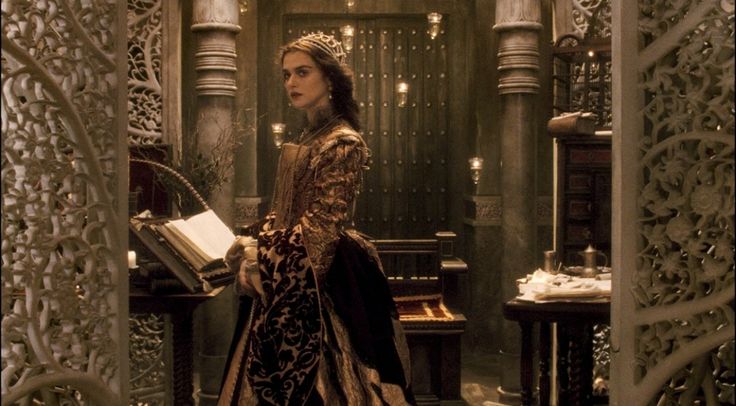
Here is Queen Isabella of Spain played by Rachel Weisz in The Fountain. I chose this picture since Queen Isabella of Spain is one of the few figures in the Catholic Counter-Reformation to be depicted in a positive light since she’s mostly seen being a patron of Christopher Columbus (and that most movies on the Inquisition are usually played for horror). However, unlike most depictions of her including this, she’s also known for starting the Spanish Inquisition we all know as the one of the fiercest villainous organizations depicted on film. Also, there’s no way in hell the Grand Inquisitor Torquemada would’ve ever wanted to assassinate her for since he knew what the penalty would be (while a Grand Inquisitor making an attempt on her life would actually seem more like karma). Also, she was not in love with a Conquistador (and was faithful to her husband King Ferdinand as well as the fact the Conquistadors weren’t around until after she was dead) and certainly didn’t look like that around middle age and seems to retain her figure all too well after ten pregnancies.

Of course, there’s also the Catholic Counter-Reformation which sought to correct certain abuses of the Catholic Church as well as bring the faith back to the people. Of course, the Counter-Reformation was a time of the Inquisitions where many of the leading clerics would round up heretics for torture and trial. The most famous was the Spanish Inquisition which tended to turn out of nowhere from time to time at a random mention uttering “Nobody expects the Spanish Inquisition!” then proceeded to torture people with dish racks, fluffy cushions, and comfy chairs (actually this isn’t the one from Monty Python, sorry). Actually the real Spanish Inquisition was a quasi – state and religious organization started by Ferdinand and Isabella that was set to unite Spain under the “new” Catholicism once and for all, which more or less pertained to expelling or persecuting the Jews and Muslims in the area, especially those who converted. Oh, and there were plenty of other Inquisitions to root out heresy as well. You also have the Jesuits under Saint Ignatius Loyola who found a new order of priests devoted to education, spiritual exercises, and total obedience to the Pope. Of course, while this movement exists today, it didn’t always get good press. Then there’s the Catholic mysticism of Saint Theresa of Avila and her order captured most famously in a statue by Bernini. And last but not least, let’s not forget the Council of Trent which helped shaped Catholicism within much of its history before Vatican II. Of course, some reforms would be unmet, but this managed to put some areas of Europe back in the Catholic Church’s hands as well as helped make the Church a more efficient and accountable religious institution. Still, Hollywood rarely touches upon this and sees the Catholic Church during the Reformation as a static and backward institution which doesn’t say the whole truth (I mean you get movies about Martin Luther but you barely have any on Ignatius Loyola or Theresa of Avila). And depictions of the Inquisitions are much worse than they were in real life by 16th century standards (this doesn’t dismiss them as bad guys but they weren’t nearly the monsters you see in the movies). So here are some cinematic inaccuracies relating to the Catholic Reformation.

Catholic Reaction:

Catholic leaders refused to debate or engage Martin Luther. (Some Catholic theologians actually did and in public like Johann Eck.)

Catejan was a cardinal during the conclave that elected Pope Leo X in 1513. (He was made a cardinal four years later.)

Girolamo Aleander was a cardinal during the Diet of Worms. (He wouldn’t become cardinal until 15 years later.)

Catholic Europe was rife with witch burning hysteria. (The real witch-burning hysteria was in Protestant northern Europe where more witches were killed. The Inquisition did their share to prevent such hysteria in Catholic areas.)

Catholic clergymen and leaders were misogynistic. (Maybe, but many Protestant sects were no better since they wanted all women to stay in the kitchen more or less. Oh, and they did raided convents as well as forced nuns to convert and marry in some situations. At least Catholic women had some choice to become nuns if they wanted to. The 16th century wasn’t a good time for women, let’s just leave it at that.)

Catholic priests were all trained assassins in the 16th century. (Yeah, I can believe it. Not really.)

Popes:

Pope Julius II wore golden armor. (He was a warrior pope who did wear armor, but it wouldn’t have been made out of gold {which is too soft for the battlefield}.)

Pope Julius II was clean shaven. (He had a beard. He also had an illegitimate daughter and was rumored to be gay, strangely.)

Pope Leo X was around in 1525. (He died well before then.)

Pope Julius II was present in Rome when Martin Luther was there. (He wasn’t.)

Pope Leo X put a bounty on Martin Luther’s head. (He actually sent orders that Luther’s safe passage was to be respected.)

The Catholic Church refused to grant King Henry VIII a divorce from Catherine of Aragon out of moral principles. (The real reason had nothing to do with moral principle as we learn from Lucrezia Borgia’s married life for but then again, her dad was the pope. Also, Henry VIII was in good graces with the Church prior to that time and was given the title “Defender of the Faith,” from Leo X long before he was petitioning for a divorce and knew the pope owed him a favor. However, the reason why the Pope Clement VII didn’t grant Henry VIII a divorce had nothing to do with the fact that he was married but who he was married to and in a loving relationship of over 20 years in fact. Not to mention, annulments were fairly common back then and if Henry VIII was married to anyone else, he probably would’ve obtained it easily. Yet, Clement VII was being held prisoner by Holy Roman Emperor Charles V, Catherine of Aragon’s nephew. Also, Henry VIII wasn’t asking for a divorce from the Pope but an annulment so he wouldn’t have his daughter Mary inherit the throne after he died. He didn’t just want to be single again, he wanted Catherine declared a whore and his daughter Mary a bastard. It’s pretty obvious why Charles V didn’t want that done to his aunt. It didn’t really work. Besides, other heirless kings have divorced their wives before. And Pope Clement VII didn’t really refused, but delayed making any decision hoping that either Henry or Charles would die in the process or just wanted Henry to take care of the matter himself, but not in the way he wanted it.)

Henry VIII’s annulment request to the Pope was unusual for its time. (Contrary to what you see in movies, trying to divorce your spouse on grounds of consanguinity was actually very common on among the royals and nobles who could afford it and the fact they married among their own kinds, leaving the marriage pool quite small to begin with. Eleanor of Acquitaine did this by saying that King Louis VII of France on grounds that they were 3rd cousins even though she basically dumped him for a man who was just as closely related to her as he was. And this was a successful case. The only thing that was unusual about Henry’s request is that Catherine of Aragon was his sister-in-law before she was his wife and that he asked for a special dispensation to marry her. And now he was using their former connection to annul their marriage which didn’t go well with her nephew Holy Roman Emperor Charles V who was keeping Pope Clement VII in prison.)

The Borgias:

Pope Alexander VI had five kids. (He’s said to have more than that. Yet, some say that he may not have fathered any kids at all. Still, he’s said to have a descendant named Francis who became a Jesuit and a saint. Also, he’s an ancestor of Brooke Shields.)

Cesare Borgia killed Lucrezia’s second husband Alfonso of Aragon. (He was primarily accused of his brother-in-law’s murder but he had a lot of other enemies, too, so we’re not sure. Also, though the Borgias had a notorious reputation for ruthlessness and murder, they were no more murderous than any other prominent Italian family at the time. They just got a bad rep for being social climbers and Spanish. Oh, and Niccolo Machiavelli’s shout-out to Cesare in The Prince certainly doesn’t help either.)

Lucrezia Borgia had sex with her male relatives. (This most likely never happened and the child born in the Borgia household in 1498 wasn’t Lucrezia’s son.)

Jesuits:

The Jesuits were assassins. (They were a priestly order set up by Saint Ignatius Loyola, which helped reinvigorate Catholicism through education and spiritual exercises. Nevertheless, the first Jesuits were ex-soldiers, by the way and called themselves “Soldiers of Christ.”)

The Inqusitions:

The Inquisition was one of the big muscles of oppression during the Counter-Reformation. (Actually the Inquisition began before that and even though it ended in the 1800s, it was off and on. It began in the 1300s, peaked in the 1500s with the Reformation and Spanish Inquisition, and died down way after that. Also, the real muscle for the Counter-Reformation were the Jesuits who helped reclaim areas of Catholicism with education and zeal. Not only that, the Protestants had their ways of oppressing others, too whether they be Catholic, Jewish, or different kind of Protestant.)

The Inquisition consisted of a bunch of witch-hunters who accused people of witchcraft. (Actually the Spanish Inquisition was more interested in condemning heretics {or whatever else the Spanish Crown wanted for sometimes the Spanish Inquisition targeted certain individuals for solely political reasons}. Even at the height of witch craziness, the official Catholic Church position on witchcraft accusations was superstitious nonsense and actually tried to suppress witch-hunts and often investigated the cases of the accused so they can acquit them and calm down the public panic. And the Church had forbidden the belief in witchcraft since the 7th century even though it became more open to it late in the Middle Ages. Not to mention, the Spanish Inquisition was more likely to go after the accusers than the accused unless they were also suspected of heresy. Also, the Spanish Inquisition only executed 12 people for witchcraft {and the inquisitors involved in those were punished}. Not only that, some of the first people to speak out against accusations of witchcraft and torture were priests based on their experiences and did so by pointing out the obvious. However, there were witch burnings in Protestant areas during the sixteenth and seventeenth centuries and witchcraft was considered a crime according to secular law.)

Veronica Franco was accused of witchcraft and was tried by the Roman Catholic Inquisition. It was only by the intervention of the Marco Venier and Venetian senate that she was dismissed of all charges. (Sure, yet even though the Inquisition tried her, they were on her side and would eventually dismiss her of all charges anyway, no matter what the people of Venice did because this was how the Inquisition normally handled witchcraft charges. Thus, she was never in any danger from them. They only arrested and tried her in order to calm down the public hysteria and prove that the notion of witchcraft was just superstitious nonsense.)

The Catholic Church largely supported the Spanish Inquisition, which tortured, persecuted, and slaughtered tens of thousands. (The Spanish Inquisition was mostly operated by the Spanish government and while the Catholic Church hierarchy supported it to a certain extent, but it was the least religiously motivated inquisition though despite its reputation. If it was ever used as a political tool of repression, it was mainly for the Spanish Crown, not the Church. And this Inquisition often focused its surveillance on cities due to limited resources and wasn’t deployed much overseas. They were also highly regulated, didn’t always use torture to extract confessions, and served primarily to educate ordinary people about the faith and how to uphold it, sort of what the Jesuits did. The Spanish Inquisition only executed about 1500-5,000 of the people it tried in its entire existence {mostly because the convict usually fled and burned in effigy}, which was less than how many people were killed executed in Europe for witchcraft at the same time estimated at 60,000. Also, the Spanish Inquisition spent most of their time correcting peasant superstitions, lapses of morality and sexual misconduct, and confronting religious ignorance. Heresy only occupied 3% of their cases, which by Hollywood standards is boring. They also introduced the presumption of innocence, provided legal counsel for the accused, considered confession without factual corroboration unfit grounds for sentence, and were forbidden to accept accusations from ex-convicts or people who could benefit from the sentence. None of that was observed by most secular courts of the period as well as were methodical for gathering and basing their cases on evidence. They also didn’t burn books either despite having a banned books list, the books were widely available. As for torture, it was considered an exceptional method up to the 18th century, just as fines and imprisonment are used today but it wasn’t to a high degree since the Inquisition was forbidden to draw blood during torture. Of course, they didn’t believe in habeas corpus either and the accused could be in prison for two years without knowing his or her accusers were. Actually the notoriety of the Spanish Inquisition was more or less formulated by anti-Catholic propaganda and that Spain was at war with Protestant nations like England and the Netherlands where there was more freedom of speech for its time and the printing press was much more available. So while the Spanish Inquisition wasn’t in any way nice and did persecute people, they were far from the ideal frothing at the mouth villains from Hollywood movies {since they wouldn’t burn people at the stake who were accused of heresy by their neighbors who just didn’t like them}.)

The Spanish Inquisition and the Papal Inquisition were one and the same. (They were completely separate organizations and happened at completely different times.)

The Catholic Church executed heretics during the Counter Reformation and Inquisition under auto da fe (act of faith). (The Church never executed anyone even for heresy since priests were and still are forbidden to shed blood. When they did convict someone, the Church handed him or her to the secular authorities who executed them. Also auto da fe was not the execution itself but the public penance of convicted heretics that occurred before the sentence was to be carried out and many were spared at the last moment if they confessed and repented.)

The Spanish Inquisition was a religious organization that handled only religious cases. (The Spanish also used it as a tool for political repression ran by the state and all cases were reported to the El Escorial first, not the pope. Actually it was mainly used as a tool for political repression and one of the least religiously motivated inquisitions to date. In fact, the very existence of the Spanish Inquisition sort of violated the separation of church and state but then again, there wasn’t much separation in Spain to begin with.)

The Spanish Inquisition was Spain’s muscle to suppress heretical ideas and enforce the old Catholicism on the population. (Actually the Spanish Inquisition was not interested in enforcing the “old” Catholicism as it was promoting the “new” Catholicism, making the country resistant to the Counter-Reformation. And it was also used to Christianize Granada or expel those who didn’t want to convert {or were practicing their old religions in secret}.)

Veronica Franco was tried once by the Inquisition. (She was tried twice for witchcraft and in both she confessed to performing sorcerous rituals to entertain her clients and insisted she didn’t believe them. The Inquisition just said her actions were inappropriate and not do them anymore in each case. Her witchcraft case against the Inquisition was no less ordinary than anyone else’s in Catholic Europe. Oh, and she was denounced by her son’s tutor over revenge since she suspected him of theft of various precious items in her house, not because she bewitched legions of men.)

History of the World According to the Movies: Part 18 – The Reformation

Image

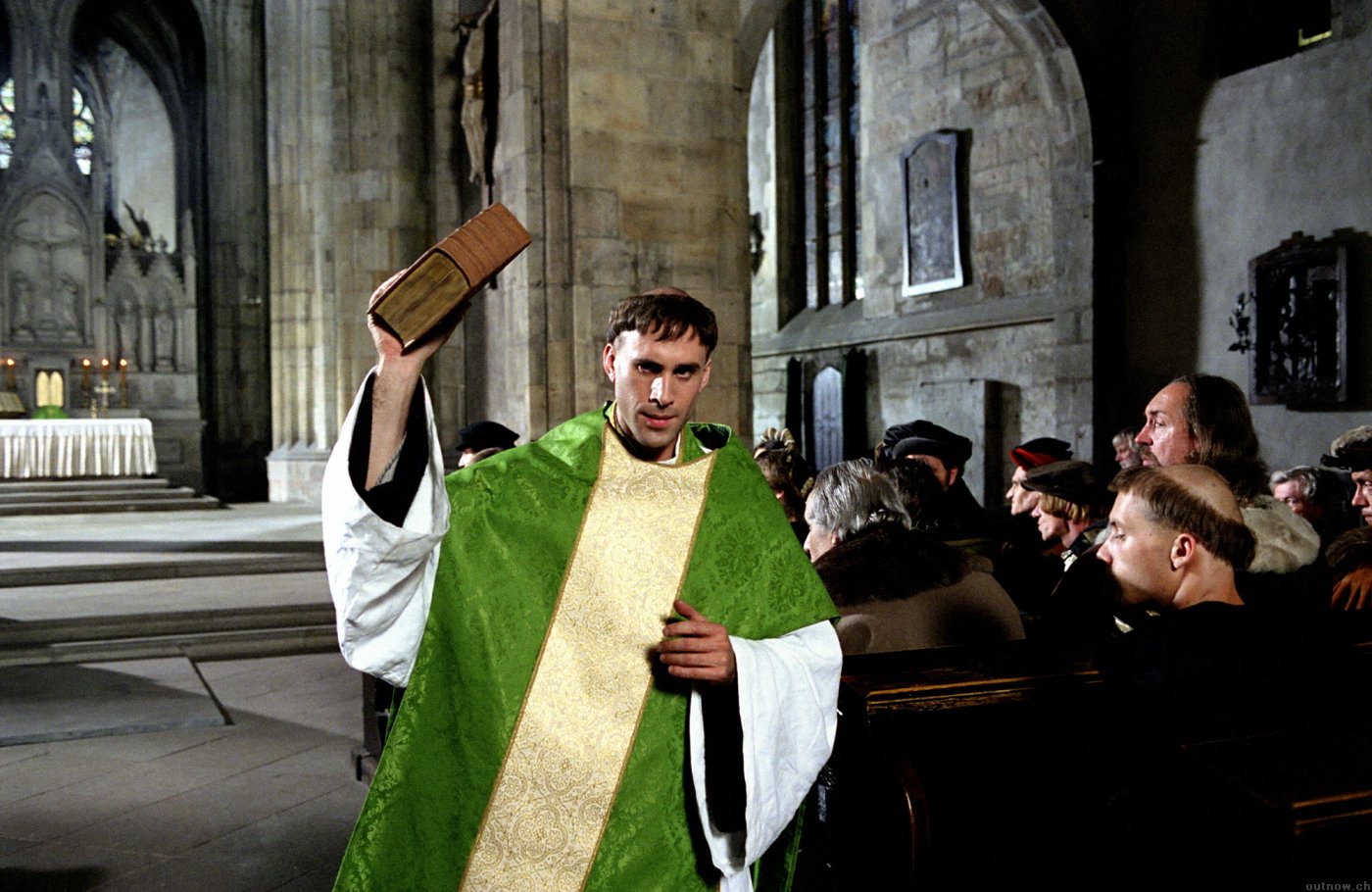
Luther: a movie starring Joseph Fiennes about one of the guys who got the Reformation started. Of course, a movie pertaining to the Protestant Reformation isn’t going to cast Catholics in a positive light (though it does more than it’s fair share to be as rabidly anti-Catholic as possible). Of course, they had to in order to make Martin Luther look good because he doesn’t seem like a likeable guy in this at all. Also, you wouldn’t have seen him in the role of a parish priest, c’mon. He was an Augustinian monk and theology professor at Wittenburg! Then again, perhaps he’s taking over for somebody. Oh, and is the congregation sitting in pews? Holy shit!

So we’re back in Europe which is now in a period of great social and cultural change called the Renaissance, a period of rebirth in the arts and sciences as well as philosophy. You have artists like Leonardo, Michelangelo, Raphael, and Donatello who created great masterpieces before becoming the Teenage Mutant Ninja Turtles (I’m just kidding on that one). You also have Giotto, Botticelli, Titian, and others even though the most famous were Italian. You have writers like Dante and Shakespeare writing works that would help shape their respective languages for generations. You have scientists like Copernicus, Galileo, Vesalius, and others who’d shape our perception of the world for later generations and pave way to men like Newton and Kepler. Then you have philosophies like Humanism, secularism, and individualism celebrating the glory of humanity and all it’s wonders. Also, you have Johannes Gutenberg whose printing press would bring this period into a new information and revolutionize communication in such a way that A&E will make him Man of the last Millennium. Of  course, I probably wouldn’t be able to write this post or anything at all if he wasn’t around because movable type made life so much easier for me.

However, this is also a time period saw the coming of what’s known as the Protestant Reformation when countries and peoples of Western Europe started breaking away from the Roman Catholic Church. There were a lot of things that led to the Protestant Reformation like indulgences, the Avignon Papacy, urbanization, proto-nationalism, popular piety, Christ-centered theology, Christian humanism, as well as fears and superstitions relating to death. Since Northern Europe was more religious than places like Spain or Italy, it was there where Protestantism took root. And because of the printing press and secular rulers wanting their own church to better control their people, you could see why Martin Luther became as successful creating his own denomination as he did. Still, even though everyone in Europe knew that the Catholic Church was corrupt as well as had their own ideas about reforming it, doesn’t mean that people were willing to break away from the Church or became Luther’s disciples, because Lutheranism only reached parts of Germany and Scandinavia. Erasmus and Thomas More might’ve had their own ideas at reforming the Catholic Church but both of them remained in the flock and greatly bashed Luther and his ideas. John Calvin would later come up with his more exportable brand with his Reformed movement in Geneva and others would follow like Zwingli, some more radical than others. However, Hollywood usually focuses on Luther since he started it all though they’re not always 100% accurate on facts and tend to have a very anti-Catholic slant on it. Of course, who could blame them since Martin Luther wasn’t the kind of guy you would’ve wanted to have a beer with. Nevertheless, here are the inaccuracies I shall list.

Martin Luther:

Martin Luther was a prudish man. (This was a guy who’d write to his friends about his bowel movements.)

Martin Luther was a timid man. (No, but he was a man forged with passion and rage nonetheless.)

Protestantism began with Martin Luther. (There were heretical movements before Martin Luther going on in Europe since the Middle Ages. Luther’s brand of Protestantism was one of the first to have any kind of staying power.)

Luther referred to Biblical passages by book, chapter, and verse while starting his reformation. (Biblical passages weren’t listed like this until 1551 and even then, the divisions weren’t ubiquitous until the Geneva Bible.)

All the nobles stood up to Charles V during the Augsburg Confession. (Only the Duke of Saxony and Louis V of Palatine did.)

Martin Luther and Spalatin went to law school together. (They didn’t meet until later in life.)

Frederick of Saxony was given a golden rose as a bribe to deliver Luther to Rome. (It was to bribe him to run for Holy Roman Emperor against Charles V.)

Martin Luther was a saintly iconoclastic hero. (He may have caused a stir with his religious views but he was basically a social conservative. Also, he hated the Jews.)

Andreas Karlstadt radically distorted Luther’s views while he was in seclusion in Wartburg and insisting on being addressed “Brother Andreas.” (Though Karlstadt actually orchestrated the reforms, they were more peaceful. Yet, they were too radical for Luther {like Mass vernacularization} and he tried to either undo them or slow them. Also, Karlstadt didn’t renounce his professor title until Luther’s return.)

Martin Luther returned to Wittenburg with modest growth of a beard and was under the name “Knight George.” (He had returned with a beard “sufficient to deceive his mother” and under the name “Junker George” {which means “Knight George.”})

Johann Tetzel was at the Augsburg Confession. (He was never at the meeting.)

Johann von Staupitz was alive in 1526. (He died in 1524.)

Martin Luther’s 1520 treatises were in print by that June when Exsurge Domine was issued. (They were not.)

Martin Luther told Karlstadt to leave Wittenburg in 1522. (He pleaded with him in Orlamunde to return after Karlstadt had voluntarily left.)

Martin Luther was in Wittenburg during the Diet of Augsburg in 1530. (He was staying in Coburg.)

Ein’ feste Burg existed in Luther’s time. (It didn’t. According to Wikipedia, “it was a product of the later Pietistic movement which found faultwith early rhythmic chorale melodies because their dance-like rhythms were too secular in nature.”)

Martin Luther spent his years in exile translating the New Testament into German, having visions of the devil, and ranting rhetorically in thin air. (Yes, but it gets weirder with Martin Luther according to the Guardian, “Luther believed poltergeists were attacking his ceiling with walnuts, and once threw a dog out of a window because he thought it was Satan. He also suffered physically. “The Lord has struck me in the rear end with terrible pain,” he complained to a friend. To another, more prosaically: “My arse has gone bad.” This does at least explain why he was so grumpy.” Oh, and he got fat.)

Martin Luther was the primary reformer of the Reformation. (Yes, but he wasn’t the only one. You had John Calvin in France who founded Calvinism and ran Geneva on it. Also, you have the radical reformers behind the peasant revolts in Germany as well as others.)

Tetzel made it to Wittenburg and Saxony. (He never made it there thanks to Frederick the Wise banning him. However, he did go to nearby border towns drawing Saxony coin to the ire of both Frederick and Luther.)

Luther succeeded by theology and faith. (His success also had more to do with politics and economics as well as the fact that some German princes were tired of their gold going to Rome. And Luther knew this.)

Martin Luther nailed his 95 Theses on the Cathedral door of Wittenburg. (He actually sent them in a letter to his superiors. He never mentioned actually nailing his 95 Theses on a cathedral door.)

Martin Luther insisted on burying someone who committed suicide in his parish cemetery. (There’s no record of this. Also, he probably would’ve never preached outside the pulpit. Also, he didn’t come to Wittenburg as a parish priest.)

Martin Luther was intense, uncertain, humorless, and generally liberal cleric with passion with fits of melancholy and depression. (He actually did have a sense of humor and also possessed  a gregarious personality. He loved beer, lively conversation, and hearty laughter. And he was no neurotic introvert by any standards as well as a social conservative.)

Martin Luther was mostly disturbed by the use of indulgences on his trip to Rome. (True, but he was also disturbed by the moral laxity he observed among the clergy as well as developed an aversion toward relics, purgatory, and prayers to the saints.)

During the Diet of Worms Martin Luther said, “Here I stand. I can do no other. God help me. Amen.” (He never said this.)

Martin Luther showed genuine remorse over the massacres during the Peasants’ Rebellion caused by their misunderstanding of him. (He may have actually been calling for the princes to show no mercy upon the uprising.)

Martin Luther’s stand on the Bible was accountable for the Peasants’ War of 1525. (It wasn’t. It was how the peasants misunderstood him and distorted his teaching.)

Martin Luther met Frederick the Wise personally. (They never did.)

Frederick the Wise lamented over the Peasants Rebellion of 1525. (He was dead and buried in Wittenburg castle by that time.)

Martin Luther never associated the Pope as the Anti-Christ. (Uh, he actually did before he published his 95 theses in 1517.)

Luther’s heart was really with the peasants. (No, it was in his own theology. He certainly didn’t like it when they revolted.)

Karlstadt advocated political egalitarianism. (He never did.)

Frederick the Wise paid Martin Luther’s salary. (He didn’t.)

Martin Luther returned to Wittenburg on Elector Frederick’s behest. (He returned very much against the ruler’s will.)

Protestants:

Northern Europeans in Protestant countries willingly broke away from the Catholic Church. (If Europeans, you mean resident nobles, then yes, but if you mean everyone else, then not really except in France. And parts of the English population remained Catholic and are to this day.)

Protestants were open to scientific thought during the Reformation. (Actually, even though it was the Catholic Church who put Galileo on house arrest, but he probably wouldn’t be safe with the Protestants either at least in the 1500s. Sometimes they were more willing to interpret scripture more literally than the Catholic Church would. Also, the pope didn’t put Galileo on house arrest, cardinals did and the Catholic Church’s motive didn’t have much to do with Galileo’s ideas than his attitude to the pope. Galileo also published another scientific book without incident after that. Not to mention, it was the secular scientists who were more critical of Galileo’s ideas. And wasn’t the Catholic Church behind the Gregorian calendar that was more scientifically accurate than the Julian calendar most of Europe had been using? And weren’t the British one of the last European nations to adopt that?)

Heretics were peaceful and/or eccentric evangelists who were just persecuted by the Catholic Church for speaking their mind. (Many heretical movements from the Middle Ages to the Reformation were anything but and also strove not only to reform religion but also secular life and some actually tried to do so quite forcefully by physical elimination of the nobility and clergy, attracting simple criminals. To compare them to fascists, Bolsheviks, or Middle East terrorists isn’t much of a stretch.)

Protestants were more tolerant of new ideas than the Catholic Church and didn’t believe in superstition. (It was the Protestants who were burning the witches.)

Protestants celebrated Christmas. (The Calvinists and the Puritans didn’t for they thought it was too Papist and pagan.)

Protestants were anti-establishment types. (Just because they were religious radicals doesn’t mean that they were social radicals either for many certainly weren’t such as the reformers who found favor with resident nobles. And those who were as much social as well as religious radicals didn’t find much favor in Europe, even in Protestant entities.)

Early Protestants were champions of conscience, freedom, and toleration. (Uh, when it came to their own ideas perhaps, but no. Protestants during the Reformation were also hostile to Catholics and other Protestants outside their denomination. Leaders in Protestant domains set up their own state churches which people had to attend and adhere to. Lutheran princes suppressed Catholic monasteries in their territories and Luther supported the expulsion of Catholics who were banned from Saxony in 1527. Also, John Calvin and his followers ran Geneva as a Protestant theocracy. Still, just because you had a group willing to break away from the Catholic Church doesn’t mean they believed in religious toleration, because they certainly didn’t.)

People unhappy with the Church joined the Protestant faith. (Many did not and actually bashed these Protestant movements like Erasmus {who also bashed the Catholic Church a lot to but remained faithful}.)

Miscellaneous:

Congregants were seated in pews during this time. (They weren’t a common fixture of churches until after the Reformation.)

Confession wasn’t necessary for those who bought indulgences. (If the buyer didn’t purchase them for oneself. Otherwise, indulgences specified that the buyer had to go to confession.)

The sale of indulgences brought upon the Reformation. (Yes, but it wasn’t the only factor.)

Pre-reformation priests lived wealthy lifestyles. (Not by our standards. Also, one of the calls for the Reformation was the abundance of uneducated priests from the ranks of the poor and peasants. The Catholic Church knew this and tried to correct this in the Counter-Reformation.)

History of the World According to the Movies: Part 17 – Pre-Columbian America

Image

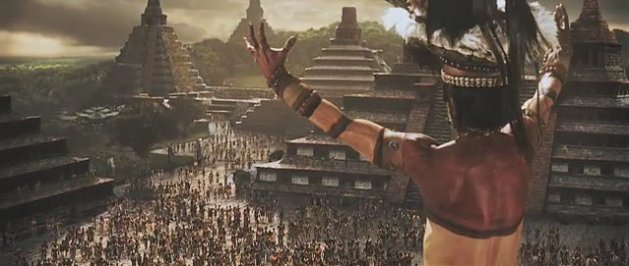
Of course, in one of Mel Gibson’s attempts to bring history to life, here’s his vision of Pre-Columbian America, specifically the Mayans. Still, though the architecture may be historically acceptable, they look pretty drab by most Mayan standards. If these buildings really looked as they did in Mayan times, they’d be painted in bright colors so they could easily be seen like most buildings in Latin America or Southern United States. Also, they Mayans were much more than a civilization that practiced human sacrifice which Mel Gibson fails to show. Not to mention, this movie also contains a heavy Eurocentric bias by including Spanish Conquistadors but that’s beside the point.

Just because the continents of North and South America had to be discovered by Europeans, doesn’t mean that there’s no history in the Americas to be told. While only few societies in the New World had a written language, the Americas had plenty of civilizations in the Pre-Columbian era nonetheless. After all, indigenous peoples had been living in North and South America for thousands of years before the arrival of Columbus explained by the presence of archaeological evidence. Of course, when it comes to movies set in Pre-Columbian America, Hollywood mostly centers on the Mayans since we know more about them than any other such civilization at this time, they had a written language which has been preserved, and that the Mayan people still survive to this day. There can’t really be a historically accurate movie on Pre-Columbian civilizations because there are things we simply don’t know about their cultures and archaeological evidence can only go so far. Still, there are plenty of historical accuracies in movies set in Pre-Columbian America that even archaeologists can say which may consist of putting the wrong buildings in the wrong locations as part of the wrong civilizations, having people speak the wrong language, or what not. Sometimes Pre-Columbian culture on film can consists of mish-mash between cultures. Still, I list some here.

The Mayans:

The Mayans ransacked a village of their own people for sacrificial victims and slaves. (Captives were taken during war and there is not much evidence that they ever did this.)

The Mayans sacrificed captives in mass quantities. (No, that was the Aztecs who did that. When it came to human sacrifice, the Mayans were into quality not quantity. Besides, to the Maya, human sacrifice was a very personal thing.)

The Mayans sacrificed almost anyone. (Again, it’s the Aztecs. The Mayans preferred to sacrifice royals and elites {preferably adversarial} taken from war, which led to a lot of wars in the process. Oh, and there were rituals pertaining to self-sacrifice involving a Mayan king having to draw blood through a barbed thread at either the tongue or his genitals. The 1960s Mayan movie with Yul Brynner is actually more accurate in its treatment of Mayan human sacrifice than the one directed by Mel Gibson since the character trying to avoid sacrifice is a chief who’d be a more likely candidate {despite that he’s the leader of a tribe from Mississippi}.)

The Mayans were a savage people with reckless sewage treatment, widespread slavery, bad rave dancing, and a real lust of human blood. (They were also very concerned with hygiene. They had remarkable astronomy with their calendar being especially good at predicting eclipses and were able to precisely measure planetary orbits. They also had advances in medicine, agronomy, and mathematics. Also, all the Mayan buildings were built by free men who participating in such projects as a civic duty. Yet, we don’t know whether these people did it because they were forced to, as a way of using labor to pay taxes, or voluntarily. Then there was the Mayan ball game which was a combination of basketball, lacrosse, and rollerball, in which either the captain of the winning or losing team was sacrificed, we’re not sure which. Oh, and they were probably one of the most sophisticated Pre-Columbian civilizations of all time, which was an ordered society of maize, kings, and gods, as well as flourished for a thousand years. Nevertheless, they were no violent than other civilizations even if they did practice human sacrifice.)

The Mayans were awed by solar eclipses. (They were accomplished astronomers and therefore, the Mayan elites would’ve known it was coming and planned a ritual all around it.)

The Mayan civilization collapsed with the arrival of the Spanish Conquistadors in the 1500s. (The Maya Civilization collapsed in 900 A. D. which was 600 years before the Spanish ever set foot when their cities were abandoned {yet it’s possible that some of the Mayan cities did survive}. Of course, Spanish disease killed many of the Mayan people, but that’s beside the point  since it took almost 200 years to subdue the people who were left from their remaining cities {while the Aztec Empire fell within a year}. Still, as to what caused the Mayan collapse, many have their own theories like drought, deforestation, disease, overpopulation, warfare, social disruption.)

Mayan villagers were hunters and gatherers in the deep jungles of Meso America. (Actually they would’ve been farmers on manicured land with a very structured social and economic system. Oh, and they had crops like cacao, tomatoes, corn, and avocados long before the Europeans did.)

The Mayans thought 2012 would be the end of the world. (The Mayans never equated the end of their calendar with the end of the world. Also, it’s 2014.)

Mesoamerican jungle people were never aware of Mayan pyramids. (They would’ve since these structures were never too far from anywhere in the Mayan world, occupied or abandoned. If you lived 6 to 12 miles outside a large Mayan community, you would’ve certainly have seen one since such structures were usually 20 kilometers away from anywhere in the Mayan world.)

Lots of Mayans wore jade. (Jade was only reserved for royalty since it was a symbol of royal power and wealth.)

The Mayans were mankind’s earliest civilization. (Actually the Mesopotamians were as far as the historic record goes. And in Meso America, the Olmecs. Also, the Olmecs and the Zapotecs had writing before the Mayans but not much of it survives.)

Mayan sacrificial victims were painted blue and were sacrificed on a column shaped stone. (The Mayans would never paint their victims blue. Rather they would adorn them with special quetzel plumed headdresses. And it’s the Aztecs who were known to sacrifice victims this way, not the Maya. Also, the Mayans used decapitation, heart excision, dismemberment, hanging, disembowelment, skin flaying, skull splitting, throwing kids in wells, and burning.)

The Mayans relished torturing their captives. (Not necessarily, but their victims were their enemies suffering a long tortuous death and being carefully disassembled. These guys were competition and a Mayan ruler may get something to add to his kingdom.)

The Mayas didn’t have libraries. (They did, but the Spanish destroyed most of their books that there are only three or four left {and one may be a fake}.)

The Mayans were tall, slim, ripped, tan, and very European looking. (The actual Mayans were shorter and stocky but I was just ripping off a 1960s movie called Kings of the Sun starring Yul Brynner.)

The Mayans visited the US Gulf Coast. (Well, it could’ve happened since the the Mississippians did grow Mesoamerican crops like corn, beans, and squash but we can’t be sure.)

Mayan kings were bystanders in human sacrifice rituals while two priests did the actual work. (He was usually the central figure who conducted rituals in front of a large audience in a major ceremonial fashion. He was not only the political leader in his Mayan city-states, but a religious one as well.)

Mayan villagers lived in stick huts in the wild jungle. (They would’ve lived in homes with stone foundations near the cleared plazas or in surrounding villages near the capital. Housing on lots were planned and intensively managed spaces where fruits, vegetables, and medicinal plants were grown and where some domesticated animals were raised.)

The Mayans were sun worshipers and called themselves “sun people.” (They had a pantheon of gods with the Maize god as the most important deity because he signified the change of the seasons.)

Some Mayan tribes used swords made out of wood or metal. (They usually used obsidian for knives which were very sharp.)

Aztecs and The Triple Alliance Empire:

The Aztecs were a homogenous people. (The Aztec Empire was run by a triple Alliance of three Nahuatl city states Tenochtitlan, Tlateloco, and Tlacopan near the islets of Lake Texcoco. Oh, and they called themselves the Mexica who may have came to Mexico during the 13th century from Arizona {oh, the irony}.)

The main Aztec city was situated in the jungle. (The Aztec Triple Alliance ran their empire from Tenochtitlan which was built upon a lake in a the middle of the Valley of Mexico. When the Spanish arrived, it looked like a Pre-Columbian Venice with a network of canals and bridges. Of course, no filmmaker has a budget to recreate this.)

The Aztecs used gold coins. (They more likely used cocoa beans as currency than gold coins. Besides, Aztec gold coins never existed in Pre-Columbian America.)

The Aztecs mummified their dead. (High-ranking Aztecs were cremated. However, the Andean peoples certainly did.)

South America:

Nazca buildings were made out of stone. They also built their tombs on hills and were mummified in a fashion depicted by Francisco de Orellana. (Nazcas built with adobe, had their tombs in the ground in flat areas, and mummified people by hunkering their knees against their chests before wrapping them.)

Peruvian coastal tribes used blowpipes with poisoned darts. (Amazon jungle tribes did.)

Meso and South America:

All Pre-Columbian cultures in Meso and South America look basically the same. (Despite the fact that many of these societies existed in different environments and have different styles of art and architecture.)

The groups of people who lived in Meso and South America were the Mayans, the Aztecs, and the Incas. (There were many other indigenous groups who lived in the same areas.)

All Pre-Columbian cultures in Meso and South America lived in the jungle. (They lived in all kinds of environments and climates such as deserts, mountains, the coasts, and other areas.)

All Meso American buildings and structures were of just plain rock. (Actually they were painted in bright colors like the works so they could be more visible.)

The Meso and South American Indians sacrificed to Quetzalcoatl more often than any other god. (He’s perhaps the only god in many of his pantheons who didn’t ask for it and abhorred the practice {making him the most bloodless and most merciful god in the pantheon whose sacrifices only comprised of birds, snakes, tortillas, and butterflies}. So it’s very unlikely that even the Aztecs would sacrifice to him. Filmmakers probably use him the most as a god to sacrifice to because his name is easier to pronounce and he’s the most famous in his pantheon anyway {he’s probably the only Mesoamerican god most people know}. Also, the Plumed Serpent is a cool nickname. As for the heart ripping out of a person’s chest and tossing the body down the pyramid stairs, that’s a festive sacrifice for the Aztec war god, Huitzilopochtli, whose name is a mouthful and is nicknamed the Left-Handed Hummingbird, yeah.)

Mesoamericans made and used crystal skulls. (Every crystal skull ever found turned out to be a fake.)

The Meso and South American Indians didn’t use metal weapons because they didn’t have the technology. (They actually did but the fact they didn’t use metal weapons was more out of personal choice because the aim of war for them was to take captives to sacrifice later, not to kill people. Also, they used metals for their figurines but they didn’t see it worth much.)

The Meso and South American Indians bound their infants’ heads with a rope to honor their gods. (It was in accordance with their beauty standards. Also, they liked elongated noses like Adrien Brody’s.)

Quecha was spoken in what is now Mexico. (It’s an Andes language spoken throughout the Inca Empire.)

Meso and South American women walked around in scantily clad bikinis or bare breasts. (No, they didn’t. Many of them simply wore a decorated cloth with holes for the head and arms. Also, many of them were shown in artwork as rather conservatively dressed with their breasts covered.)

Meso and South American Indians lusted after gold as a precious metal. (Mayas used cacao beans as currency, the Aztecs valued feathers and jade much more than gold, and the Incas only saw gold as some metal to make a drinking vessel out of. Let’s just say the Mesoamericans would be more pissed off at you eating their chocolate than melting any of their gold jewelry.)

Meso and South American Indians viewed white people as gods. (No Inca or Aztec Emperor ever mistaken a Spanish Conquistador as a god. Their giving gifts to the Spaniards was more about showing superiority and good ol’ sacred hospitality. The Spanish just assumed this.)

Meso and South American priests were always bloodthirsty men wanting to sacrifice nubile virgins to their dinosaur gods. (Sure they were the ones doing the human sacrifices most of the time. Yet, they usually viewed it as part of their job and most of their rituals do include some sort of sacrifice. They believed that such sacrifices sustained the universe and many of their stories dealt with the importance of sacrifice. Also, most Pre-Columbian sacrificial victims were men.)

Meso and South American Pre-Columbian artifacts are usually cursed. (I’m sure this isn’t the case.)

Meso and South American people could stop sacrificing people whenever. (Being sacrificed was seen as a great honor in these cultures. Besides, to them, not sacrificing people was one way to usher in the apocalypse.)

Meso and South American gods didn’t succumb to temptation. (There’s a story about Quetzalcoatl getting drunk and banging his sister. So Miguel and Tulio didn’t have to worry much about making mistakes in El Dorado.)

North America:

The Indians were noble savages who worshiped nature and cared for the environment. (This is all bullshit for there were many Native American societies that farmed and built structures like houses, temples, and monuments, even in North America.)

The New World was mostly unpopulated, with Native settlements few and far between. (Truth is, the Europeans were keen on spreading diseases they were already immune to {very successfully, I might add}. The native population was decimated by bugs like Smallpox. These sicknesses spread so fast, that when settlers moved west, they found a fraction of the population that once thrived there.)

Native Americans were a backward, childlike people who talked like Tonto. (Never mind the working economy, clearly defined values and morals, deep religion, highly developed language, and well developed justice system. Yes, Native American society was that complex, just ask the Iroquois Nations and the Cherokee.)

The Inuit always wore parkas, carved trinkets, lived in igloos, went fishing with harpoon, traveled by sled and huskies, and ate cod liver oil. They also kissed by rubbing each other’s noses together. (It might have been true at one time but not during the 1920s.)

Indian princesses were gorgeous. (There had to be ugly Indian princesses.)

Mayans and Mississippians spoke similar languages. (Their languages were from completely separate families like the Mayan and the Algonquin.)

The Mississippian peoples lived in tepees and hunted buffalo. (I don’t think this is very likely since it’s more suggestive of Plains Indians. Also, the Mississippian people were an agrarian society as far as I know. But who knows what they lived in anyway. The Mississippians were a mound building culture, however. Yet, I’m sure the Mayans didn’t build pyramids there.)

The Inuit wore metal sunglasses over their eyes. (They didn’t, yet there’s a movie poster of an Inuit who does.)

Indians planted corn in rows. (They didn’t plant corn that way.)

Indian corn ears were far larger than a human hand. (Native corn were about the size of a thumb, rarely ever bigger. Large corn was a product of seed selection and genetic research mostly done since the 1860s.)

Iroquois settled on the Ottawa River. (It was Algonquin territory.)

Indians fought during the winter. (Native war parties usually stayed home during the winter.)

Iroquois gratuitously killed their young prisoners. (They would never have killed a young prisoner who could’ve been adopted into a family to replace a fallen kinsman.)

Indian guards raped female prisoners. (Well, Mary Rowlandson did testify she was raped by one during the Indian Wars in Massachusetts, but there was a strict taboo against raping war prisoners throughout the native East. The Iroquois in particular eschewed sex with future adopted kinswomen.)

Iroquois guards were posted on a scaffold tower on cold of dead winter nights. (No Iroquois guard was.)

Most Indian captives were killed. (Indian captives were mainly adopted and kept alive.)

Indian captives were led by leather thongs around their necks and fully dressed. (They were naked when taken prisoner.)

History of the World According to the Movies: Part 16 – Africa

Image

Sure this is a movie about something that happened during the 1990s as well as centers on a real guy who’s still alive, yet Hotel Rwanda is a good movie to picture because it’s about an ordinary African man who saved so many lives at a great cost to himself. Of course, this takes place during the Rwandan genocide with AK-47s and machetes galore. Still, the reality of this event was much worse than depicted and Don Cheadle’s character paid a much bigger price for his efforts.

Africa: the cradle of humanity. For its thousands years of history, it has been home to great tribes, cultures, kingdoms, and civilizations. Not only has it been the home of Ancient Egypt but also of Carthage, Nubia in the ancient world. In the European Middle Ages, it was home to great empires and kingdoms like Mali, Aksum, Songhai, Great Zimbabwe, Asante, and so many others all a unique culture of riches, rituals, and innovations. However, if you should ever dare making a movie pertaining to this history of Africa, then a Hollywood producer will probably tell you to get a job for National Geographic. After all, Hollywood is simply not interested in the African history that doesn’t contain violence, oppression, poverty, human rights violations, disease, crazy dictators, poaching on endangered species, or Europeans (or biblical figures in that matter). I mean the only reason why Hollywood would ever do something on African history is to present people being subject to unimaginable horrors as well as make themselves look good. Of course, depictions of African history tend to be either racist, violent, or both. Nevertheless, while Africa is a continental hellhole it’s seen on film, there’s more to African history than that, much more. We also know it’s a home to a lot exotic animals, but we know everyone likes to see them on nature documentaries. Nevertheless, out of movies on African we do have, filmmakers can make a lot of use of artistic license, and here are the inaccuracies, I’ll show here.

Ethiopia:

Ethiopia has always been a heavily pagan and juju spirit believing culture. (It is also has some of the oldest churches and synagogues in Africa as well as a sizeable Muslim population. Orthodox Christianity was introduced in the 4th century and Judaism even earlier and was said to be the home of the Queen of Sheba from the King Solomon stories.)

King Solomon got together with the Queen of Sheba. (There’s no record of this, not even in the Bible.)

Zimbabwe:

Great Zimbabwe was built by a lost white race. (This is about as true as saying that Great Zimbabwe was built by aliens. This notion was debunked in 1905.)

The DRC:

The DRC was always the DRC. (It had been called Zaire for a while and had its named changed back to the DRC in 1997.)

Sierra Leone:

The De Beers company secretly hired Executive Outcome to make a fortune out of diamond mining during a civil war in Sierra Leone. Also, Executive Outcome was also a mining company and received diamond mining concessions as payment. (They were actually solely a military contract company like Blackwater hired by the government of Sierra Leone. Their main job was to retake the rebel-controlled diamond field used to raise funds {but they didn’t mine or take diamonds from the fields}, which they did. De Beers had no links to EO during the 1999 civil war in Sierra Leone.)

Somalia:

Muse had his hand sliced open in the trap of broken glass. (The trap of broken glass didn’t happen though Muse did get his hand sliced open when he was captured by the crew and he went below deck with a crew member unarmed.)

Captain Philips was held hostage by Somali pirates for a day and half. (It was actually for five days.)

The Americans were working alone in Somalia to capture Mohamed Farrah Aidid in the battle of Mogadishu. (Actually they had help from the Malaysians and the Pakistanis. Also, it was a Malaysian general who was at the command at Mogadishu. Apparently, the Malaysians’ beef with Black Hawk Down is perhaps justified.)

Captain Philips offered his life and let himself be a hostage in exchange for the pirates leaving the ship when his 2nd mate was going to be shot. (According to TTI: “In reality, Phillips never offered his life and was more the subject of a botched hostage exchange than letting himself become one, which he himself admits in interviews. Additionally, some of Phillips’ former crew feel he was responsible for the hijacking because he ignored suggestions to steer the ship farther from the coast, but Phillips countered that they would have been just as unsafe 600 miles away as they were at 300.”)

South Africa:

White South Africans were rich and racist and were either Afrikaans or Rooineks. (Actually there are plenty of white South Africans who aren’t of Dutch or British descent as well as plenty who live in the middle class alongside blacks since South Africa is the most middle class African country. And I’m sure there are some white South Africans who aren’t racist {like Alan Paton and F. W. deClerk}. There’s also a sizable Asian population, too.)

The Springboks rugby team’s winning the 1995 Rugby World Cup brought everlasting racial unity in South Africa. (Contrary to Invictus, the feeling of apparent racial unity lasted about a month. The winning team was later plagued by racism with Matt Damon’s character organizing a standoff with the South African Rugby Union and offered the other players sweet deals to sign with the World Rugby Corporation, except the token black player who got less than the others despite being one of the most popular on the team.  Another player Geo Cronje refused to share rooms or shower with his black teammates as recently as 2003. They also had a bad succession of coaches after their World Cup-winning coach had to step down due to leukemia.)

Black South African women had limited roles in the Anti-Apartheid Movement. (There was a 1956 Anti-pass march co-organized by the Federation of South African Women. So women were pretty active in the movement.)

Nelson Mandela’s political views didn’t change while he was in prison. (Except for not wanting apartheid, many of them did. For instance, he started out as a radical who favored nationalizing key industries. And he wasn’t initially in favor of adopting a multi-racial view of South Africa. Oh, and he was also a communist, which has been a South African open secret for years.)

Winnie Mandela was an irrational Lady Macbeth type woman who was the cause of the black-on-black violence in the 1980s and early 1990s South Africa. (She wasn’t. The violence was actually between the African National Congress and state-funded proxy organizations.)

Nelson Mandela was the major figure in the anti-apartheid movement. (Mandela was chosen by a committee in the ANC as the international face of the movement. Also, he was in prison much of the time. Still, the ANC’s work on social justice relied on collective and collaborative leadership. Of course, films about Mandela tend to ignore guys like Walter Sisulu, Joe Slovo and Oliver Tambo working behind the scenes. Ever heard of them? Neither did I.)

The African National Congress was a peaceful political organization. (It initially started out as a paramilitary group, which bombed public buildings in order to destabilize the South African government. In some ways, they started out no differently than some Mideast terrorist organizations.)

Prison guard James Gregory had a close relationship with Nelson Mandela while the latter was in prison. (Nelson Mandela only mentions him twice in his autobiography and they barely spoke to each other. Also, his friends were furious that the guy wrote a book about it which was later turned into a movie.)

Nelson Mandela spent his whole nearly 30 year prison sentence on Robben Island. (He only spent 17.5 years of his sentence there. He actually initially imprisoned Johannesburg then Pretoria for a year and a half during his trial then sent to Robben Island. After spending his 17.5 years there, he was sent to Pollsmoor Prison for 6 years, then to Victor Verster Prison for 2 years until his release. So though he did spend almost 30 years in prison, he didn’t spend it all in one place.)

White South Africans referred to blacks by the “k-word” during apartheid. (Even under apartheid it was illegal to use this word.)

The first meeting between white reporter Donald Woods and Stephen Biko went rather swimmingly. (Actually Biko gave a more powerful and confrontational speech saying he was trying to discourage hatred of any sort as well as liberate black people not white liberals.)

Stephen Biko was chaste, humble, and non-violent. (He was known for speaking fierly, wittingly, and colloquially  with references of “hey, man!” in his speeches. Also, he was known to be a womanizer despite having a wife and long-term mistress.)

Uganda:

Bob Astles was a Scottish physician who was a loveable rouge who helped bring down the Idi Amin regime. (Astles wasn’t Scottish nor a doctor and wasn’t a nice guy {he was called the second most hated man there as well as nicknamed “The White Rat”}. Actually he was an adviser to the regime Amin overthrew and was tortured and imprisoned for 17 weeks after the despot took power until he gave Astes a job {though Astles had been living in Uganda for 30 years and was in his 50s unlike James McAvoy’s character in The Last King of Scotland who’s his expy}. Oh, and he never fooled around with one of Amin’s wives either {though there was a doctor who did but he was African}. And he tried to flee Uganda when Amin was overthrown in 1979 but brought back to face criminal charges and prison.)

Idi Amin killed his wife for getting knocked up by doctor. (Her lover accidently killed her while giving her a botched abortion and later killed himself. Of course, Idi was probably the reason why she’d seek abortion in the first place and would’ve killed her anyway if he ever found out.)

Only one hostage was killed during the rescue operation at the Entebbe Airport. (Three were and a fourth would be killed later at a hospital by Ugandan Army officers.)

Rwanda:

The Rwandan Tutsis were victims of a savage Hutu driven genocide in Rwanda solely because they always hated each other. (The Tutsis and Hutus had been at odds with each other since Belgian rule since Belgium often appointed Tutsis as their colonial retainers in the region. Before the Belgian intrusion, they managed to at least coexist peacefully since the Tutsis were herders and the Hutus were farmers. Not to mention, Tutsi and Hutu relations in Rwanda had been strained for years and there have been incidences of anti-Tutsi violence in the country since the 1960s.)

Paul Rusesabagina was a Hutu. (Yes, but only on his father’s side. His mother was a Tutsi.)

Tatiana Rusesabagina never understood why he had to stand behind to protect people sheltering in his hotel. (She actually did if reluctantly for good reason.)

Tatiana Rusesabagina was angry about Paul putting her and their kids on a truck to escape the Hôtel des Mille Collines, which was a last minute decision on his part. (She was actually sad but nevertheless accepted the decision due to the circumstances. Also, he discussed the matter with her and the kids the night before the attempted evacuation.)

Paul Rusesabagina’s extended family managed to survive the Rwandan genocide in one piece. (Actually though Paul and his wife and kids managed to survive, many of his relatives weren’t so lucky. During the genocide though Paul did everything in his power, Tatiana lost her mother, father {who had to pay soldiers to shoot him instead of lopping off his limbs one at a time}, brother, sister-in-law, and four nieces and nephews. Paul lost four brothers. Furthermore, his actions earned him so many death threats after the genocide that he and his family had to move to Belgium. So the ending to real Hotel Rwanda wasn’t nearly as happy as it was depicted in the film {it still isn’t}. And the genocide depicted is depicted less violent in Hotel Rwanda than it really was.)

The United Nations helped save some of the Rwanadans from slaughtering each other. (Sure the UN did help some, but they never called what was happening in Rwanda a “genocide”  until years after it happened, despite evidence that the Tutsi population was being massacred. Many affected by it are still not being helped by the UN.)

Libya:

Libyan rebel leader Omar Mukhtar was brought down when his horse was shot and thrown aside. (He’s actually said to be pinned under it but the scene plays out like this in Lion of the Desert probably because being under a horse would’ve been unsafe for Anthony Quinn.)

Benito Mussolini sent Rodolfo Graziani to take over as governor of Libya in 1929. (He sent him the next year and only as vice-governor unlike what Lion of the Desert would tell you. Nevertheless, he took over a disastrous military campaign against the Libyan rebels that had been going on since 1923.)

Rodolfo Graziani graciously returned Omar Mukhtar’s glasses to him after they had been stolen from a previous battle. This happened during the rebel leader’s show trial in Benghazi. (Transcripts reveal that Mukhtar had to ask Graziani for his glasses back, which his interrogators considered outrageous.)

Miscellaneous:

African civilization has mostly been tribal and rather primitive. (Lo, they forget that Egypt is an African country and the African Kingdoms of Mali, Songhai, Nubia, Zimbabwe, and others. Of course, there are still African tribes as always but there were African kingdoms, too.)

African slavery didn’t exist until the European slave trade. (Yes, it did but not as you know it. Africans had been slaving each other for centuries, but they treated their slaves as servants or even members of the family.)

No African tribe profited from the slave trade. (Europeans befriended paid certain African tribes to get captives from their rivals. Many West African tribes made a lot of money on this.)

Africa has always been a continent full of black people with the exception of Egypt. (Even though the people in North Africa tend to be considered Arabs than black. Also, the fact that there is a sizable white population in South Africa and that the continent is home to Indians and Asians as well. Gandhi was even there once.)

All black Africans tended to resemble those from West Africa. (The reason why movies depict Africans as if they are from West and Central Africa is because it’s where many ancestors of African Americans came from. Yet, not all Africans in Africa look like that.)

Black Africans were primitive, childlike, superstitious, believed in witchcraft and voodoo, lived in huts, defended themselves with spears and shields, could be easily scared by modern technology, or be easily ripped off being sold worthless junk. (Superstitious, yes, believed in witchcraft and voodoo yes, lived in huts, sort of, defended themselves with spears and shields, perhaps, could be easily ripped off, maybe, could be easily scared by modern technology, maybe. However, primitive and childlike, hell no.)

Blacks were enslaved by kidnapping. (They were usually enslaved through war but yeah, it’s kind of accurate.)

Most of Africa has been ruled by strongmen dictators who lived like kings. (Actually besides South Africa there have been African nations that have enjoyed stable democratic rule like Kenya at least most of the time.)

Much of Africa was independent by the 1950s. (Most African countries wouldn’t gain their independence until the 1960s.)

The Zulu had mass marriage ceremonies in front of the king. (I’m not sure about that.)

History of the World According to the Movies: Part 15 – The Rest of Asia

Image

Of course, no movie can emphasize Asian history more than Mongol, which is about perhaps the most important person in its history as well as one of its most famous conquerors Genghis Khan. Though this movie shows how rough he had it from his childhood to young adulthood, it nevertheless shows a fairly accurate portrait of the man whose family would conquer Asia. Also, if you’re Asian, there’s a good chance you’re related to him.

As far as Asian movie history goes, I’ve covered China, Japan, and India. But though they may be the biggest entities with historical movies or historical movie errors, they are just three countries in a large continent that includes a variety of countries, cultures, and what not. And all these countries each have their own history. Of course, you have Mongolia, home of a man who started out as a son of a Mongolian chief who got poisoned, only to become perhaps the most legendary conqueror who ever lived. Of course, his name is Genghis Khan. In Thailand you have the kings of Siam with the most memorable these days having a musical about him and being played by one of the hottest bald guys in history. Then there’s Tibet home of the 14th Dalai Lama (well, he’s in exile now) and the best known Hollywood movie about his life stars Brad Pitt as a former Nazi. Then there are the aspects in Asian history films that show up in every movie, especially when it pertains to martial arts or Buddhism. Nevertheless, historical errors in movies on Asian history still abound which I shall list.

Mongolia:

Genghis Khan started a war Khwarzim because he thought it would be a great place to conquer the world. (He might’ve had intentions about it but it was really in revenge because the Shah killed his messengers.)

Khwarzim fell in one battle. (The Mongols conquered each city one by one.)

The Khwazim Shah died in battle. (He fled to an island in the Caspian Sea and died there.)

Genghis Khan died at Khwarzim. (He died in a hunting accident seven years after conquering it at 65. This is according to the Mongols who said he fell off his horse and died from the injuries. Some say he was killed by the Western Xia in battle.)

Jochi was Genghis Khan’s son. (Though Genghis would raise him as his own child, he was never sure if he was the boy’s father since his mother Borte was kidnapped after they were married. She was heavily pregnant with Jochi and living with another man when Genghis found her. Jochi and his descendants may have been passed over as his heirs after Genghis died for this reason {though Jochi predeceasing his dad may also have been a factor}. This had unfortunate implications in Genghis Khan’s empire).

The Mongol tribes rode on western horses. (They rode on stocky horses with short legs and large heads. Of course, the filmmakers may thought these horses were too peculiar looking to be seen.)

Genghis Khan got his start as a Mongol chief Temujin who kidnapped his wife Borte a Tartar princess. (Of course, Genghis Khan’s real name actually was Temujin, which most films about him usually get right. However there’s no evidence if Borte was a Tartar princess and I’m not sure if Genghis was a Mongol chief {his dad was before he was poisoned} yet when he married her. I mean he had a very rough childhood in which his family was under rival subjugation the entire time. Also, she was abducted after the two were married and there’s no way Genghis would’ve kidnapped her because they were engaged to each other as children.)

Borte had to rescue Temujin after he was taken in a raid. (It’s the other way around.)

Temujin was enslaved by the Tangut kingdom until Borte traveled and travailed to rescue him. (There’s no record of this. However, he was captured by enemies as a child.)

Genghis Khan had dark hair and eyes. (He’s said to be a redhead with green eyes {according to Islamic accounts} but then again, we’re really not sure what he looked like anyway. Still, dark hair and dark eyes may be a better approximate. However, there have been children with lighter hair and eyes in Mongolia though.)

Temujin was a rather young man when he started to be called Genghis Khan. (He was never called that until he was in his thirties. Oh, and he was still conquering about the time at his death at 65.)

Borte was Genghis Khan’s only wife. (She was his first wife as well as his Empress but he took other women as wives and was certainly not a faithful husband. I mean we have DNA evidence showing he left a shitload of descendants {8% of males in Asia are said to have his Y chromosome}. If you’re Asian and the place your family came from was conquered by Genghis Khan {or his immediate family}, there’s a very good chance you’re related to him.)

Genghis Khan had a Fu Manchu mustache. (That style has never been popular among the Mongols and it’s fairly unlikely he had one. Also, Mongolians mostly depict him as having a full beard.)

The Mongol Hordes were groups of barbarian raiders on horseback. (Genghis Khan actually had a well organized army like the Romans. However, their large supply of replacement horses and habits of marching in divided columns certainly gave such illusion.)

Temujin made an alliance with the Chinese Emperor and stayed at his palace. (This never happened.)

Jamuga was Temujin’s main rival for control of the Mongol tribes and enemy. (Yes, but he was also his childhood friend and helped Temujin rescue Borte from a rival chieftain who kidnapped her {or possibly impregnated her.})

Temujin killed Jamuga in a duel who mortally wounded him. (Temujin had Jamuga executed by having his men wrapped in a rug and beat to death as well as lived to be 72.)

Borte was blonde or redheaded. (It’s very likely she wasn’t either. But she is in the Genghis Khan biopic starring Omar Sharif as well as the one starring John Wayne.)

Genghis Khan was a brutal warlord as well as a conquer. (Yes, Genghis Khan was a very brutal conqueror and history shows this in great detail such as systemic slaughters of civilians. He is widely seen as a genocidal ruler to this day by Iranians, Afghans, Middle Easterners, and Eastern Europeans. However, as far as his empire was concerned, Genghis cared very little of how his subjects led their lives as long as they accepted him as their ruler. In fact, he even encouraged religious tolerance {well, to an extent} as well as created a system of meritocracy as well as adopted the Uighur script for the Mongol Empire’s writing. He also explained his policies clearly to all his soldiers. Furthermore, he brought the Silk Road under a cohesive political environment.)

Genghis Khan conquered China. (Contrary to popular belief, this is only partly true if you’re referring to territory that’s part of China today like where the Uighur live who don’t consider themselves Chinese. But China at the time, no. Nevertheless, when Genghis died, his empire extended from the Caspian Sea to the Sea of Japan. His descendants would conquer China and establish the Yuan Dynasty as well as Persia along with parts of Russia and Eastern Europe.)

Tibet:

Austrian Heinrich Harrer only took the Nazi flag reluctantly. (Well, he’d call it a youthful mistake and never actually fought for the Nazis since he left Europe before the start of the war. But he didn’t join the Nazis reluctantly and was a committed SS NCO office. Hell, he even had a photo with Adolf Hitler himself.)

The two-year-old 14th Dalai Lama met a monk disguised as a servant entering his house as part of an entourage. (The Dalai Lama himself has said that the first meeting did not take place at his house. Rather he came outside and greeted the disguised monk and his companion. His mother said that two monks came and set canes {one belonging to his predecessor} at the side of the house and that he picked the correct one. He also asked the undisguised monk why was it taken from him.)

The 14th Dalai Lama’s choice of his Second Regent was Taktra Rinpoche was spontaneous and to the man’s surprise. (He was the main candidate.)

The 14th Dalai Lama met Mao Zedong in Beijing alone. (The 10th Panchen Lama was with him.)

Austrian Heinrich Harrer was always thinking about his son during his time in Asia. (Though he did have an ex-wife and son, unlike what you see in Seven Years in Tibet, he doesn’t mention them in his book. And his contact with his son was nothing what the movie shows. Also, the kid was raised by his ex-wife’s mother while his ex-wife’s new husband died in WWII. Not only that, but Harrer said there was little to tie him to his Austrian home as one of the reasons why he stayed in Tibet in the first place).

Before the Chinese invasion, Chinese Communists negotiators arrived in Lhasa on a Tibetan constructed airfield where they held a conference with the Dalai Lama that consisted of one of them destroying a sand mandala and saying that “religion is poison.” (None of these events occurred in Harrer’s book or in any of the numerous histories that have been written about the matter. The airport in Lhasa was constructed in 1956 and the Dalai Lama used an incomplete road system for his Beijing visit with Mao Zedong in 1954. However, the scene does illustrate exactly how the Chinese Communists viewed traditional culture and religion because they destroyed a lot of places in China that were of cultural and religious significance like temples).

The Dalai Lama was enthroned after WWII. (His enthronement ceremony took place in 1940. He assumed temporal power in 1950).

Thailand:

King Mongkut of Siam was a cruel, eccentric, and indulgent monarch who opposed Westernization and was controlling of his harem of women. He also died while the American Civil War was raging in the states and was succeeded by his ten-year-old son. (True Mongkut had 32 wives and 82 kids, but he and his successors embraced modernization while retaining Siam’s culture. He released numbers of concubines so they could find their own husbands and banned certain practices like forced marriages and wife-selling. Not to mention, slavery there was not like slavery was in the West either. For instance, in Siam, slavery was sometimes voluntary and there was no racial distinction. Also, Siamese slaves couldn’t be tortured and could buy their freedom. He may have been eccentric but he wasn’t self-indulgent for he had lived as a Buddhist monk for 27 years before becoming king and probably didn’t torture or execute anybody. As for his death, Mongkut died in 1868 and by then his successor was a teenager {though he did try to send elephants to the US but he wrote the letter to James Buchanan, not Lincoln but it was Lincoln who answered}. He also died when Anna Leonowens was in England. Nevertheless, The King and I is banned in Thailand because of the film’s inaccuracies as well as its depiction of the royal family the Thai thought disrespected Mongkut and his son who are still revered as great kings to this day.)

Louis Leonowens died as a child in a riding accident. (He outlived his mother as well as married twice and had children. Also, he died in 1919 at the age of 63 most likely from Spanish Flu. And as an adult, visited Siam himself on many occasions but he would be estranged from his mother for 19 years due to debts in the US.)

King Mongkut wanted Anna Leonowens to stay in his palace for some unknown reason. (He actually didn’t want her to live in the expat community because he didn’t want her to try to convert Siamese children to Christianity like the Western missionaries have done before. Of course, Leonowens was more enlightened about religion than most whites in the 1860s {since she was part-Indian herself}.)

Anna Leonowens was a mother hen over King Mongkut’s harem. (She described these ladies as her “sisters” as well as her intellectual and moral equals or betters.)

Anna Leonowens was born in Wales around 1834 to an upper-middle class family. (She was born in Bombay in 1831 to a poor teenage mother of mixed British and Indian origin according to a recent biography, though she claimed this. Also, she spent her childhood in India knowing English, Hindi, and Marathi and she never visited Great Britain until after she left Siam. Still, she managed to reinvent herself in Singapore as an educated Welsh gentlewoman and begged for a job at the Siamese court. Sorry, but the real Anna Leonowens wasn’t exactly a person she claimed to be and more likely didn’t look like Deborah Kerr. And she’s probably lived a story similar to The Great Gatsby before Jay Gatsby.)

Anna Leonowens had one son with her husband. (She had four children but two didn’t survive infancy. Also, she had a daughter Avis at a English school at the time she went to Siam. Interestingly, she was a great aunt to Boris Karloff.)

Thailand was referred by its present name in 1936. (Until 1939, it was called Siam.)

Anna Leonowens and King Mongkut were the same age. (In reality, Mongkut was about 60 years old while Leonowens was in her late 20’s or early 30’s. But I understand someone of Mongkut’s respective age would make the movie far creepier. Yet, even Yul Brynner’s performance makes Mongkut’s sudden death in the film far more shocking than it should’ve been.)

Burma:

General Ne Win killed Aung San while he was standing. (He was sitting down and didn’t have time to stand before having 13 bullets through him. Also, his assassination plot was traced to a former prime minister U Saw back in 1947, not the guys leading Burma today.)

Aung San Suu Kyi was inspired to fight against the regime in Burma after she returned to see her sick mother, where the Burmese army cracked down on protestors weeks before she arrived. (Yes, but she also met many of the injured in the hospital her mother was staying.)

Aung San Suu Kyi’s first public speech was at Shwedagon Pagoda in Rangoon. (She had delivered one at the Rangoon hospital two days before.)

Southeast Asia:

Krakatoa was east of Java. (It’s west of Java and yet we have Krakatoa, East of Java instead.)

Singaporeans wore triangular hats. (Taiwanese do, but no one from Singapore does.)

Chinese Singaporeans spoke Cantonese. (They speak Mandarin, which is the main Chinese dialect there.)

Miscellaneous:

Anyone in East Asia knew martial arts. (Kung Fu Hustle does a spectacular job illustrating and parodying this to hilarious dimensions.)

It wasn’t unusual for Asians and whites to intermingle even though their children showed no Asian features. (I went to school with a few guys with Asian and white parents, they looked more Asian than some of the Asians I’ve seen in classic Hollywood movies, even those who were mixed. Maybe that’s because they were played by Europeans with the exception of Yul Brynner in The King and I who had Siberian ancestry. For God’s sake, they had John Wayne play Genghis Khan!)

Buddhists and Hindus were vegetarians and nonviolent. (Not all Hindus and Buddhists were vegetarians and many of them fought in wars and their kings kept armies. Yet, there were Hindu and Buddhist rulers who were more enlightened than some of the western rulers of their day. Also, Buddhism was a big religion in China and Japan and both were rather violent civilizations. There were also well documented Buddhist uprisings in much of Asian history as well. Not to mention, Buddhism was widely practiced by Mongols and samurai and was the faith most practiced by the Vietnamese, especially those who lived in the North during the Vietnam War.)

Asians never spoke crudely nor engaged in any form of bathroom humor. (Some of the writings of Chairman Mao tell a very different story. Some of his sayings would make Howard Stern blush.)

Asia mostly consisted of East Asia. (There’s more to Asia than China, Japan, Korea, Mongolia, and India. You also have Southeast Asia, the Middle East, and Central Asia.)

Central Asians were savages. (They had their own civilizations. It’s just that Europeans and Chinese kept encroaching their territory.)

History of the World According to the Movies: Part 14- India

Image

Perhaps no movie defines the history of India in the Western mind than Gandhi. Perhaps he may be portrayed too much of a saint than he really was. Perhaps this movie isn’t 100% accurate. However, there are very few movies about Indian history that aren’t based on some literature written by Kipling so this one fits. Also, this features Ben Kingsley who’s actually part Indian himself (but you wouldn’t know it.)

India is perhaps one of the oldest known places of civilization as well as home to a variety of cultures, religions, languages, and peoples. From the old planned cities of Harappa and Mojengo Daro to Mahatma Gandhi and the Nehrus, Indian history has perhaps spanned for thousands of years, with it’s state base kingdoms to it’s vassalage under empires like the Magdhas, the Mauryas, Alexander the Great, the Guptas, the Mughals, and the British. There are also plenty of other empires India was under that Wikipedia lists which I haven’t heard of. Yeah, Indian history is complicated. Still, we know India is known for yoga, Hinduism, the notion of sacred cows, saris, modern Arabic numerals, yogurt, curry, and Buddhism. There’s a lot of ugly stuff associated with India but let’s not go there. And of course, plenty of Indian animals like elephants, tigers, and monkey as any other creature featured in a Rudyard Kipling story (sure he may be some British Imperialist, but whenever a Hollywood movie is set in India, it’s usually based on one of his stories.) Still, this doesn’t mean that movies about Indian history are being made, for they certainly are since they have a big film industry known as Bollywood (which actually cranks out more movies than Hollywood). Naturally, these movies are best known by westerners for their singing and dancing routines as well as their epic love stories. Of course, many of these errors I list do come from some better known Bollywood movies as well since they tend to have the old Hollywood notion of not letting facts ruin a good story, especially if it’s a romance containing music and dancing (just like Disney, well, not really).

Mauryan Empire:

Ashoka killed his half-brother Susima in a vicious rage. (It’s said he tricked him into stepping on hot coals. Also, he probably knew his half-brother was going to kill him anyway since Susima was the designated heir to the Maurya throne. Ashoka was his main competition. Killing relatives was the norm in many ancient civilizations.)

The vengeful and violent Ashoka converted to Buddhism and became the stable and peaceful Mauryan Emperor in his later reign out of his love for the warrior princess Karuwaki after finding her alive during the Kalinga War. (It’s said it had more to do with his profound sorrow for being responsible for having to slaughter hundreds while conquering the region. It may have had nothing to do with a love for a princess there, but simply out of being horrified over his actions. Also, it’s said Karuwaki was probably a fisherman’s daughter turned mendicant Buddhist convert before she married Ashoka {according to one historian} though she was from Kalinga but she wasn’t the love of his life nor was a factor in his conversion to Buddhism {that may go to his first and most beloved wife Devi who allegedly left him before Kalinga for a Buddhist convent}. )

Devi was a rebound woman for Asoka who he married while getting over his ex Karuwaki. (She was his first and favorite wife as well as perhaps the intellectual inspiration for his conversion to Buddhism.)

Ashoka was kicked out of the Mauryan palace for being too violent and wandered through India disguised as a common soldier. (This never happened. Seemed his dad used his ferociousness to his advantage like suppressing riots.)

Mughal Empire:

Jodhaa was a Rajput princess who was married to the Mughal Emperor Akbar the Great and called Jodha Bai. (Akbar’s commissioned biography doesn’t list this, though he had a Rajput princess as his chief wife but her name was Heer Kunwari best known as Jahangir’s mother. Then again, Jodha might just have been a nickname. Also, some Rajput groups claim she was his daughter-in-law as well as Jahangir’s wife {and mother of Shah Jahan}. Historians note that Akbar’s wife was never referred to as Jodha Bai until the 18th or 19th century.)

Jodhaa was Akbar’s favorite wife. (His chief wife was his cousin Ruqaiya Sultan Begum who he married when he was fifteen.)

Akbar the Great was a great lover as well as only had one wife. (Like his predecessors and ancestors, he had a great lust for women. One of his many intentions of his wars of belligerence against several rulers was to gain their sister, daughters, and women. He’d even go after his Amirs’ wives {ordering these guys to divorce and send them to him}. He also had a harem of 34 wives {or mutah nikah meaning wives with no legitimacy or ceremony} and 300 concubines from different races and religions. So he was probably a guy women would want to avoid, not that his women had any choice. Still, he probably made Hugh Hefner look like a choir boy.)

Though Prince Salim was a heavy consumer of opium and alcohol from childhood, he was also a mischievous boy as well as a gentle and romantic hero. (He consumed a lot booze and opium from age 18, but he was a brutal drunk who would often beat servants {he beat one to death as well as castrated another}. Oh, and it’s said he had a writer flayed alive while he watched.)

Prince Salim lead a rebellion against his father Akbar the Great, tried to replace him as emperor, and had his dad’s friend Abu al-Fazl murdered in 1602 all because he wanted to marry a court dancer. (Yes, he did all that, but not because he wanted to marry a girl his dad didn’t like. As a side note, he’d later succeeded his father as Jahangir and his son would build the Taj Mahal.)

Anarkali was Akbar the Great’s court dancer and Prince Salim’s girlfriend. (She’s said to exist and may have been a dancer. Yet, she could’ve been a painter, courtesan, or one of Akbar’s wives making her Salim’s stepmother. She may possibly be the mother of Prince Daniyal. Whether the two were intimate in a relationship is based on legend, and therefore, has no basis in historical fact.)

Imperialism and The Raj:

Mangal Pandey’s prime motivation for attacking British officers in 1857 was because the new cartridges were cased in animal fat which violated religious taboos of Hindu and Muslim soldiers alike. (It also had to do with India being annexed by the British Empire and the general discontent of the sepoys. Let’s just say it was an accumulation of factors over time including one in Pandey’s regiment pertaining to a British officer attempting to convert the sepoys to Christianity.)

Mangal Pandey fought in the Anglo-Afghan War in 1853. (He joined up in 1849 as well as was part of the 34th Bengal Infantry which didn’t see action in Afghanistan and the Anglo-Afghan War ended in 1842.)

Mangal Pandey fell in love with a prostitute forced to work at a whites-only brothel. (This may not have happened though there’s a legend that Pandey had an affair with a married woman whom he rescued from committing suicide in the Ganges.)

The British East India Company was a free market. (It was a monopoly and Adam Smith was one of its staunchest critics.)

British East India Company soldiers murdered and enslaved Indian civilians in 1857. (Slavery was already banned in the British Empire by this point, for over 20 years.)

British East India Company soldiers would massacre Indian villages if they refused to grow opium. (The British East India Company was the biggest drug dealer of all time but no historical record says they did this.)

British East India Company officers issued animal fat cased cartridges to the sepoys and threatened them with a cannon unless they agreed to use them. (One historian says that they withdrew the cartridges in light of the concerns and didn’t issue them to a single sepoy. Pandey’s colonel {Colonel Mitchell from The Rising} did order artillery to surround the sepoys but only after they had looted the arsenal, which was at night not day. Yet, Mitchell wasn’t in charge of his regiment unlike in the Mangal Pandey biopic.)

Mangal Pandey’s premature mutiny was prompted by the arrival of the ships from the Rangoon regiment. (It was actually brought on by the arrival of just 50 soldiers from Calcutta when he was under the influence of opium and bhang. And unlike The Rising, it wasn’t difficult to find anyone who wanted to hang him afterwards.)

Modern:

Mohandas K. Gandhi was as much a saint in public as he was in private. (Gandhi was also difficult and demanding, a tyrannical and emotionally abusive father {he even disowned one of his sons}, obsessed with the workings of everyone’s bowels, slept naked alongside his female disciples, and subject to long bouts of depressing that he wouldn’t speak to anyone, which led to his closest associates to fight amongst themselves. He denied his wife medicine while she was dying from pneumonia because he didn’t believe in germs, thought Hitler could be redeemed, and believed rape victims weren’t “pure enough.” Not to mention, he viewed himself personally responsible for the Hindu and Muslim chaos that accompanied Independence. Also, he was killed by a Hindu extremist.)

Mohandas K. Gandhi and his wife Kasturbai had a loving relationship. (Gandhi’s autobiography tells a different story, especially pertaining to their early years.)

Mohammed Jinnah was a languid and malevolent fop. (Yet, like Gandhi he was British trained lawyer, yet he wasn’t a devout Muslim since he drank, had a non-Muslim wife, wore Savile Row suits, as well as spoke Urdu only with difficulty. However, he was all for Hindu-Islamic alliance for Indian independence and only called to form a separate nation of Pakistan in 1940. However, he thought Gandhi’s influence on the council was too dominating. Not to mention, the Congress Party committed many wartime blunders during the independence movement such as the precipitous withdrawal from the interim provincial governments {that might have led to a united Indian independence} and its demand that the British largely “Quit India” while the Japanese were closing on eastern India’s borders. Gandhi enthusiastically supported both of these which put him and the Congress Party’s leaders in prison. This left Muslim League Leader Jinnah and his fellow Muslims to whip up support for carving Pakistan.)

“Qaumi Tarana” was the original national anthem of Pakistan. (It was a different song {written by a Hindu only days prior to the independence ceremony} which only lasted for 18 months.)

Mohandas K. Gandhi and his associates were arrested and beaten by police for burning passes protesting the Pass Law in South Africa. (He was arrested but not beaten by police for doing this.)

The Indian flag was hoisted in broad daylight during the independence ceremony. (It was hoisted at midnight.)

Colonialism and imperialism were largely to blame for the Hindu and Islam hostilities following independence. (Gandhi claims this. However, it may go deeper than that. There’s considerable debate on this. However, British intrusion probably didn’t help matters.)

Mohandas K. Gandhi liberated India. (Most historians agree India’s independence was inevitable. Also, he was just one of several independence leaders and his civil disobedience was only a small part in the movement.)

Gandhi was above the social prejudices of his time and place. (He was more concerned with Indian welfare in South Africa than with the situation with the Africans, which he ignored. Also, sometimes could be paternalistic or even sexist.)

The country of Bangladesh was created in 1971 after a thirteen battle with India. (It was actually during an 8 month struggle between East Pakistan {Bangladesh} and West Pakistan {Pakistan} which cost 3 million Bangladeshi lives. India was just receiving collateral damage.)

Jinnah told Gandhi and Nehru to go to hell. (He never did that and always treated them with courtesy and respect. Also, he mourned Gandhi’s loss.)

India was independent in 1945. (It won it’s independence in 1947.)

Pakistan existed in the 1930s. (It wasn’t formed until the Partition of India in 1947.)

Miscellaneous:

Kali worship was like Satanism. (Sure she was the Goddess of destruction, but she’s not Hinduism’s Satan since her realm is time and natural change as well as righteous destruction. She never really smiled at warfare, torture, and human sacrifice. Yet, Shiva was like God in a way since he’s considered a god of creation and rebirth but Hindus have a lot of them.)

In Nair tradition, caste was and family identity was inherited from the paternal line as far as the region of Kerala was concerned. (Both of these were inherited through the maternal line in the Indian region of Kerala. In these matrilineal societies with male dominance, ruler succession would be passed from the male ruler to his brother and eventually his sisters’ sons.)

Asian Subcontinent Indians didn’t have guns until the arrival of Europeans. (Some kingdoms did since the 13th century, thanks to the Chinese and Arab traders.)

Yogis and Buddhist monks were always wise and holy men. (Yeah, well, even eastern religious leaders have their problems.)

Siddartha Gautama was either Indian or Asian looking. (His aristocratic family was of Indo-Iranian ethnicity possibly from Central Eurasia and it didn’t mixed with the lower castes so the Buddha would’ve looked like them. He more likely had wavy black or dark brown hair, light reddish skin, and a long pointed nose. An artistic rendering of him with these features makes him look surprisingly European but good luck finding him looking like that in movies, especially made in Asia.)

Indians ate monkey brains. (No, and gross.)

Subcontinental Asian Indians were dark skinned. (There are also plenty of light skin Indians as well.)

India has been a monocultural society. (It hasn’t been. Look what I said in my introduction.)

Hindu temples were all filled with thousands year old working machinery and lots of booby traps. (Of course, only as far as Indiana Jones is concerned. I highly doubt this.)

Indians were kind and obedient servants. (Really? Have you heard of the Independence Movement or the Sepoy Rebellion? Perhaps this is just a British imperialistic myth.)

History of the World According to the Movies: Part 13 – Japan

Image

No movie could be more appropriate in capturing the spirit of historical Japan than Akira Kurosawa’s The Seven Samurai. Sure it’s not as colorful as Memoirs of a Geisha but at least it was made in Japan with Japanese actors as well as gets a lot more things right about Japanese culture. Of course, in this case, it’s all about samurai. However, Toshiro Mifune’s character technically is just pretending to be one which is considered a capital offense. Nevertheless, this inspired movies like The Magnificent Seven and The Three Amigos.

Believe it or not, Japanese civilization as we know it is actually a late comer in world history. I mean the Mayans were actually a flourishing civilization while Tokyo was still a backwater fishing village. Nevertheless, it is the culture we associate with samurai, kimonos, ninja, geishas, and Pearl Harbor. For much of its history, Japan has always been ruled by an emperor seen as a living god in the eyes of the people, but was really nothing more than a figurehead and real power was usually held by an entity like the Fujiwara clan of the Heian period, the shoguns, or other government infrastructure. Of course, many Japanese movies tend to be structured like westerns usually set in the time of the samurai, especially in the films of Akira Kurosawa since he was from a samurai family. Still, it’s also a culture known for producing one of the world’s first novels called The Tale of Genji written by a lady in waiting named Murasaki Shikibu, one of history’s early female authors. Nevertheless, there are plenty of aspects of Japan that are greatly mythologized in movies with aspects not really stack up to what it was really like. Whether pertaining to samurai and ninja, geishas, or modern times, here are some things that movies pertaining to Japanese history tend to get wrong.

Medieval and Shogun Eras:

Okita Soji was a youthful looking leader of the badass samurai group called the Shinsengumi. (He was seen as a tall, dark, and thin man with high cheekbones, wide mouth, and flat face. Also though the Shinsengumi once started as shogun bodyguards, they soon transformed into a ruthless secret police force with an extremely strict code of conduct and an unflinching readiness to kill. Though they were charged with keeping the peace, they could be occasionally seen as a threat with inter-factional violence and assassinations being frequent. Yet, these guys are heroes in Japanese media.)

Odo Nobunaga was a ruthless and brutal warlord. (Yes, he was, which is why he’s been the bad guy in many Japanese films ever since even though he’s also more like a Japanese Otto von Bismarck known for his genius and cunning. However, unlike Japan’s other leaders at the time as well as the xenophobic tendencies, he was a patron of Western culture and food as well as very lenient toward Catholic Christians and gave missionaries living space to set up churches. Of course, this might’ve contributed to his reputation. Still, he also tried to modernize the Japanese military, opened borders {perhaps to hire foreign mercenaries and buy rifles from Christians}, and attempted to start a Japanese Renaissance.)

Samurai and Ninjas:

Anyone in Japan could become a samurai. (Samurai were born from samurai families, not made. However, anyone could be a ninja.)

Ronin were traveling swordsmen and mercenaries. (Some might’ve been but they were mostly bandits and pirates.)

Ronin were usually nice to peasants and willingly defended them. (Though ronin occupied one of the lowest rungs of society, they mostly treated everyone beneath them like crap and refused to work like normal people).

Being a samurai was cool in any era. (Well, maybe at a time when Japanese nobles were at each other’s throats, yet it basically sucked during the Edo of peace and prosperity since they couldn’t change jobs or earn money {especially if they were ronin with no master, but many ended up becoming bureaucrats} and could only make a living with their martial powers. Also, the possibility of death was very high. And if they were daimyos, they had to spend six months away from their families in Tokyo, who were required to live there.)

During the events of the 47 Ronin in 1701, Lord Asano Naganori was a wizened old man while Lord Kira Yoshiniaka was a young upstart power hungry noble. (It was the other way around since the power-hungry Kira was 60 and the Confucian Asano was 34.)

It was perfectly fine for a commoner to don Samurai armor and pretending to be one. (Commoners who did this were executed. Even touching a samurai was a death penalty offense.)

A half-white Japanese man participated with the 47 ronin. (Sorry Keanu Reeves, but this wouldn’t be a realistic possibility since it’s very likely his dad wouldn’t be a samurai. Oh, and there’s no way in hell he’d have a romantic interest in Asano’s daughter because he died at 34.)

Samurai wives were usually of noble birth. (Any woman in Japan could be a samurai wife which mostly consists of being a sexually available maid 24/7. But a common woman wanting to marry one had to pay.)

Ninjas dressed in black. (Ninjas did not dress in black outfits. They were spies, assassins, contract killers, and covert agents. The last thing they’d want to do is to walk around in something that reveals them instantly. Instead, they dressed up as normal people of the time- anything that’d help them blend in. On occasions when they did need to move around during the night undetected, they wore dark blue, not black, which blends better with the darkness.)

The samurai were brave and noble warriors who followed the bushido serving loyalty to one’s master, self-discipline, respect, and ethical behavior. (Many of them were brutal thugs who used their higher power and social status to oppress the weak. Also, samurai adhering to the bushido varied considerably like how European knights obeyed chivalry {and European codes also had room for honorable suicide}. Basically it was a nebulous code of rules samurai kind of followed when they felt like it. Oh, and some of them practiced “shudo” or pederasty viewed as a very high and noble form of love {in their mind anyway}. Still, Bushido as we know it might’ve originated as a mistake made by a Japanese historian Nitobe Inazo in his 1905 book and it was used as a method of social control when Japan was placed under a military dictatorship between the 1920s and WWII.)

Samurai didn’t just kill anyone. (Actually they’d kill anyone under their domain for simply insulting them or meeting them in traffic as long as they could get away with it.)

Samurai were willing to die a honorable death and happy to die in battle than surrender. (While many samurai did commit suicide, most of the time they were forced to due to disgrace. Also, many of them were willing to surrender and be taken prisoner. Not to mention, apart from the samurai, most Japanese soldiers in general were conscripted by their warlords. Sort of like medieval Europe.)

Samurai would never betray each other. (Treachery and backstabbing among samurai was commonplace even it was over money or being sore losers.)

The katana was the standard weapon of the samurai. (The weapon didn’t come out until the late Middle Ages, and before then, samurai usually used the tachi or the uchigata. Also, for the greater part of Japanese feudal society, using a sword was usually a last chance weapon for the samurai and they didn’t start carrying swords around until after the fighting was over and usually used it as a fashion accessory to show off their status. Not only that, before the sword became the symbol of the samurai, the samurai were more or less identified as mounted archers and their symbols were a sword and a bow but during the Warring states period, most samurai couldn’t afford a steed. Also, for melee, their first weapon was usually a spear or a naginata. However, to us it would be impossible to imagine a samurai without his long badass sword, even in Japan. Actually as far as weapons go, samurai used just about everything at their disposal. One was known to kill a guy with a homemade wooden oar.)

Samurai thought using firearms was dishonorable. (Samurai were more than willing to use firearms and the Satsuma rebellion was so dangerous because the place was a manufacturing center for cannons. Paintings show Takamori had plenty of guns while the Imperial forces only had swords. Also, he even had a school including weapons training and artillery {which they had since the 16th century}. Not to mention, it’s said the Japanese were designing better guns than the Europeans by the 1870s.)

Samurai and ninjas roamed Japan chopping each other with katanas and shuriken at the slightest provocation. (They were much more disciplined than that. Katana duels were rare and even frowned upon. However, didn’t stop them from fighting butcherfest battles or publicly lopping off peasant heads.)

Ninjas were members of elite government special forces. (They’re more like invisible assassins, spies, contract killers, and covert agents. Think snipers.)

Ninjas got their reputation for invisibility and infiltration because they were very good at hiding as well as possessing mysterious powers like ninjitsu. (They obtained their reputation because they were willing to dress as members of a lower class when no one else in Japan would do such a thing. Peasants were ignored, dismissed, or noticed at all by the upper classes even though they had fierce travel restrictions. Thus, the “invisibility” was psychological. They also had to be expert in survival skills, actual stealth, poisons, assassination techniques, and unorthodox tactics. Not to mention, they used anything they could get their hands on as weapons. Still, many ninjas encouraged rumors of them having magical powers.)

Ninjas originated in Japan. (They may have originated in China. And Japanese ninjas called themselves “shinobi.”)

Ninjas could catch arrows in flight. (No they couldn’t. But they could lie in carp pools all night breathing with a blowpipe before shooting their victims with a poison darts the next morning {though this probably would be in a last ditch effort} and use their sword to deflect arrows shot 30 yards away.)

Ninjas came from the lower classes and were often hired to do dirty deeds honorable samurai wouldn’t do. (Most were actually samurai or mercenaries who worked for them so apparently they would fight in any way they could. And no, they weren’t born in hidden villages and trained to obey nindo.)

Anyone in Japan could own a sword between the 16th and 19th centuries. (Only the samurai were.)

Samurai wives did not have to kill themselves if their husbands royally messed up. (They were expected to commit seppuku.)

Ninjas would jump around on rooftops in ridiculous clothing. (Real ninja would more likely infiltrate the household staff and poison a meal.)

Daimyo lords had court jesters. (Contrary to Ran, they didn’t. But Ran is a feudal Japanese version of King Lear so it’s forgivable.)

Mori Motonari’s two oldest sons were real jerks. (Well, while Ran is somewhat based on the Motonari legend, his three sons were loyal and talented in their own way. And all were unable to break the 3 arrows together. Still, Motonari was a real guy and daimyo family disputes like in Ran did happen. So Akira Kurosawa didn’t need to stray too much from historical accuracy to set Shakespeare in Japanese history.)

Ninja fighters used nunchuku as well as hidden blades and clawlike weapons. (They never used nunchucks. They only used a clawlike Neko-te but only for climbing. And no, they probably didn’t use swords taller and wider than a grown man.)

The Ninjas outlasted the samurai. (Ninjas faded away in the 1600s after existing for 200 years while the samurai were abolished in 1868.)

Ninjas fought the shogun. (The shogun was their #1 customer.)

Ninjas were a single group. (There were various clans who had their signature techniques.)

Ninjas used suriken and swords. (Samurai used the former. However, historians believe ninjas used a standard wakizashi or chokuto type swords of the period.)

By the 19th century, samurai had been “protectors of Japan” for 900 to a 1,000 years. (They originally started out as rent collectors and estate protectors for the Kyoto nobility and later evolved into an aristocracy in its own right. Also, they were only considered protectors of Japan during the two thwarted Mongol invasions. Oh, and they only became prevalent in Japanese society in the 11th century.)

Japanese people were still frightened of samurai by the 1870s and bowed to them en masse. (Urban Japanese had gotten over treating common samurai as lords for a long time.)

Modern:

In the late 19th century, the Japanese government hired American advisers to modernize their army and these consisted of Civil War veterans. (The Japanese in the late 19th century did hire foreign advisers to modernize their army, but they were mostly French and German, not American. That is because they looked to France and Prussia as their military models {though other countries did have American military advisers after the American Civil War}. Oh, and five chose to stay and participate in the Satsuma Rebellion and the inspiration of the Tom Cruise character actually didn’t surrender to the Emperor {though the Japanese government would unsuccessfully demand extradition to punish him for 12 years}.)

Saigo Takamori died from Gatling gunfire. (He committed seppuku which was ritual suicide or hari kari.)

During WWII, Japanese kamikaze pilots were ordered to use their planes as missiles because it was disgraceful to face defeat. (Actually the kamikaze pilots were ordered to run their planes into American ships during WWII because it was the first time that Japan ever used planes in war and the training the pilots received was hardly adequate. In other words, running a plane into something was just an effective way to use the plane.)

The Japanese samurai sword was easy for Americans to master. (It’s doubtful that a 40-something alcoholic Civil War vet, even one with great hair, would master chopsticks much less the samurai sword. And I’ve tried chopsticks which are very hard to master.)

The geisha coming of age in Pre-War Japan was much more of a makeover, it also involved her getting intimate with a client and wowing patrons with dancing prowess using platform shoes, fake snow, and strobe lights. (From Moviefone: “The geisha coming-of-age, called “mizuage,” was really more of a makeover, where she changed her hairstyle and clothes. It didn’t involve her getting… intimate with a client. In the climactic scene where Sayuri wows Gion patrons with her dancing prowess, her routine – which involves some platform shoes, fake snow, and a strobe light – seems more like a Studio 54 drag show than anything in pre-war Kyoto.”)

Commodore Matthew Perry was given a sword by the shogun which was stolen by Japanese isolationists. (Not a likely story.)

Samurai fought the Meiji modernization out of noble goals. (From Wikipedia: According to History professor Cathy Schultz, “Many samurai fought Meiji modernization not for altruistic reasons but because it challenged their status as the privileged warrior caste. Meiji reformers proposed the radical idea that all men essentially being equal … The film {The Last Samurai} also misses the historical reality that lots and lots of Meiji policy advisers were former samurai, who had voluntarily given up their traditional privileges to follow a course they believed would strengthen Japan.”)

The Meiji Emperor was referred as Emperor Meiji in his lifetime. (He wasn’t called Meiji until after his death. While living, he would’ve been called Emperor Mutsuhito.)

General Omura Masujiro was still alive by the 1870s. (Sure he developed a Western-style army during the Meiji Restoration, but he was killed by a conservative samurai in 1869.)

The Americans agreed to sell their guns to open trade with Japan. (This is utter fiction.)

Rebelling samurai during the Meiji Restoration would be perfectly willing to wear their own traditional armor. (They’d actually be wearing more modern style garments like western-style uniforms.)

General Bonner Fellers had to convince General Douglas MacArthur to exonerate Emperor Hiriohito. (Exonerating Hirohito and the Imperial family was originally MacArthur’s idea though it was a far more complex issue than portrayed in Emperor. Oh, and the process to investigate him took five months instead of 10 measly days.)

General Bonner Fellers had an affinity for Japanese culture and was in love with a Japanese foreign exchange student during his college years. (He was actually a commie-fearing member of the ultra-right John Birch society. There’s no evidence whether he had a romantic relationship with any foreign exchange student in college {the Japanese exchange student he met at Earlham was only a mere friend and probably a guy} but he was more of a psychological expert who designed MacArthur’s strategy to demoralize the Japanese people. Oh, and his wife accompanied him on some of his visits {who he’d been married to since 1925}. Also, his effectiveness as an intelligence officer was questioned during the American Occupation of Japan.)

Emperor Hirohito and his family were exonerated from being tried as war criminals because they were innocent. (Their exoneration had more to do with American post-war planners fearing that executing him would cause cultural and political chaos across Japan.)

General Douglas MacArthur had his photo taken with Emperor Hirohito as a diplomatic expression of Japanese-American cooperation. (It was also used as American propaganda to convince the Japanese people that the Emperor was a very small man {who many considered a god}. He also convinced Hirohito to renounce his status as a god-on-earth.)

The Meiji Emperor spoke English, had people see him without invitation, and made important political decisions at the spur of the moment. (Only the most senior advisers were allowed to see Emperor Meiji without invitation, everyone else no way. Also, he didn’t speak English nor make any important spur of the moment decisions.)

Japanese industrialists had the Emperor’s ear and Imperial advisers conducted job interviews in other countries. (Imperial advisers did no such thing. Also, industrialists had no need of the Emperor’s support since they had close ties to samurai oligarchs anyway.)

Miscellaneous:

Kimonos were easy to remove. (Modern kimonos, yes. However, many Pre-modern Japanese aristocrats would wear layers upon them. A stripper in a Heian period court kimono style would have a long time taking the whole outfit off.)

Geishas fully painted their lips in historical Japan. (They’d either paint only the top, bottom, or center of both. Fully painting of lips didn’t come into Japan until after WWII.)

Geishas were prostitutes. (Sort of but not anymore, they were primarily entertainers, hostesses, and conversationalists at teahouses where men went to unwind after a day at the office, though love affairs and sex trades did occur. Still, until Japan banned prostitution in the 1950s, it was only just one of their many services but they spent most of their working time playing music, dancing, storytelling, and reciting poetry.)

Geishas wore a beehive as their traditional hairdo. (The wrapped their hair in a bun and wore a large wig over it. Maiko wear it in a very different fashion.)

Only women were geisha. (The earliest were men.)

Carrying weapons in the Emperor’s presence was perfectly all right. (No one was allowed to bear weapons in the Emperor’s presence in historical Japan.)

Seppuku was completely voluntary and common in historical Japan. (Sometimes samurai were ordered to commit ritual suicide if  one failed miserably and brought disorder to the clan. Still, it was very rare.)

Japanese men didn’t do any housework. (Many did a great deal around the house and rarely referred themselves as a collective, particularly on cultural matters.)

Most Japanese ate fluffy white rice. (This was only a regular grain staple for the most wealthy. Rural samurai and commoners probably would’ve eaten rice gruel and other grains such as barley, millet, and buckwheat, either as porridge or noodles.)

Tokyo had its name in the 17th century. (Tokyo wouldn’t be referred by its present name until 1868. At that time, it was called Edo.)

History of the World According to the Movies: Part 12- China

Image

Perhaps no western movie encapsulates Chinese history more than the Award-Winning film, The Last Emperor, which accounts the life of the boy emperor Puyi whose life was profoundly affected by the governmental changes that embarked China in the early 20th century. Interestingly, he ended his days as a gardener under the Communist regime.

In many ways, Chinese history is about as old a civilization itself since it has existed with much of its culture intact for thousands of years though developed separate from Mesopotamia. However, this has not been the same in recent years with imperialism, the collapse of the last dynasty, the time of the republic, Communism, and whatever China has now. However, China is nevertheless consists of a rich history with dynasties, invasions, intellectuals, scandals, wars, and court intrigue. Two of China’s dynasties have been under foreign rulers such as the Yuan of Kublai Khan and the Ching under the Manchurians. China has also been credited with inventing things like paper, gunpowder, and fireworks. Still, movies about Chinese history tend to reflect that of a very large country that resides a billion people on earth. And yet, China is home to so many other cultures, traditions, and languages than what the Chinese government would like to admit. Nevertheless, many movies based in China aren’t a stickler for accuracy since they tend to be based on historic legends chronicling real life incidents (like Romance of the Three Kingdoms.) Still, even movies about a country with a glorious past still has inaccuracies which I’m willing to list.

First here’s a guide to the Dynasties to determine the time periods (and that everyone understands what I’m talking about):

Xia (c. 2100 B.C.E. – c. 1600 B. C. E.) -may be mythical but it’s inscribed in Chinese historical records.

Shang (c. 1700 B. C. E. – 1046 B. C. E.) -earliest Chinese Dynasty as far as archaeologists are concerned.

Zhou (1046 B. C. E. – 256 B. C. E.) – longest dynasty in Chinese history as well as the one where a lot of Chinese culture aspects are based. Also, Confucius, Sun Tzu, Laozi, and many of the early Chinese thinkers lived in this period. Many of their ideas would soon influence later Chinese thought in years to come.

Spring and Autumn Period (722 B. C. E. – 221 B. C. E.)- Zhou power is decentralized and wanes as feudal lords vie for local power in their own region sometimes with the king being ruler in name only.

Warring States Period (476 B. C. E. – 221 B. C. E.) – China is divided and local entities are fighting against each other. Zhou Dynasty falls, while the state of Qin eventually takes over.

Qin Dynasty (221 B. C. E. – 206 B. C. E.) – mostly encompasses the reign of Qin Shi Huangdi, first Emperor of China and builder of the first Great Wall. Fell a few years after his death.

Han Dynasty (206 B. C. E. – 220 A. D.) – one of the defining Chinese dynasties which established the Han Chinese culture. Confucianism becomes China’s official philosophy as well as saw the invention of paper and advances in metallurgy. Had a brief overthrow for 14 years but was later restored. May have had contact wit the Roman Empire. China was divided for decades after collapse.

Three Kingdoms Era (220 A. D. – 280 A. D.) – China is divided into three kingdoms and a period of feuding warlords. Romance of the Three Kingdoms covers this and is seen as a very famous time period in China.

Jin Dynasty (265 A. D. – 420 A. D.) – ruled Northern China and is famous for its decadent court, defeats by nomads, and line of incompetent emperors. Area was soon divided into sixteen kingdoms after it fell.

Southern and Northern Dynasties (420 A. D. – 589 A. D.) – a period of civil war and division but saw the development of Chinese Buddhism and pagoda. Han Chinese heavily colonized and developed the south while the north was constantly at war.

Sui Dynasty (589 A. D. – 618 A. D.) -united the country after centuries of fragmentation, set up a long lasting government system and coinage, and extended the Great Wall. Fell after two generations.

Tang Dynasty (618 A. D. – 907 A. D.) – encompasses China’s Golden Age of civilization as well as when gunpowder is discovered. Becomes a cultural influence in Korea, Vietnam, and Japan with embassies as far away as the Byzantine Empire.

Five Dynasties and Ten Kingdoms Period (907 A. D. – 960 A. D.) – another period of unrest and civil war. Former based in the north, latter in south.

Song, Liao, Jin and Western Xia Dynasties (960 A. D. – 1279 overlapping) – though one of contending dynasties, war, and eventual Mongol Conquest, was a period of great technological innovation as well as economic and cultural prosperity.

Yuan Dynasty (1271 – 1368) – basically this is Genghis Khan’s family and founded by his grandson Kublai Khan. Of course, they wanted to run China their own way so brought their own bureaucrats from the West who were mostly Muslim (though western Mongols brought Chinese administrators). Great period  for Chinese literature and drama.

Ming Dynasty (1368 – 1644) – last ethnically Chinese dynasty which built the most current Great Wall standing today. Famous for novels, porcelain, isolationism, and flourishing economy and urban life. Yet, marred by political troubles, national disasters, civil unrest and corruption by eunuchs.

Qing Dynasty (1644 – 1911) – China’s last dynasty founded by the ruling family of Manchuria. China takes it’s largest form. Early years mark great conquest and prosperity. Later years marred by European Imperialism, opium, civil unrest, delusions of nationalistic grandeur, failed policies, and other things. Still, this is the dynastic period most covered in movies since documentation was more readily available.

Dynastic Periods:

The Forbidden City stood in Beijing around the time when China was under assault by the Huns. (The Forbidden City was built during the Ming Dynasty and by that time the Huns were integrated in Chinese society. Also, Mulan existed during the Han Dynasty.)

Fireworks were used in China during the Han Dynasty. (It was during the Sui.)

China was fighting the Huns during the later Han Dynasty. (The Huns were invading Europe at the time and hailed from Russia. The “Huns” depicted in Mulan were probably Mongols who were habitual invaders anyway and they were called the Xiongnu. However, they wouldn’t take over China until the 1200s.)

Chinese Imperial horsemen rode using stirrups on their horses. (They would’ve done no such thing. The Mongols, on the other hand….)

The Chinese Imperial Army rode on Arabian horses. (Maybe but no common peasant would own one. Mulan could never have such a majestic horse like Khan.)

Gunpowder existed during the Han Dynasty. (It was invented during the Tang.)

Chinese people were free to hug the Emperor. (No one would really be permitted to hug the Emperor, since his subjects had to keep respectful distance.)

Mulan was discovered as a woman after she was wounded and was kicked out accordingly. (She’s actually said to expose her breasts willingly to her fellow soldiers who were totally cool with it. Oh, and she had been a general for a while, served in the army for 12 years gaining great respect, and had literally saved the Empire before that, too. Of course, while China has had a reputation for treating women harshly, this only comes later since the Chinese had no law to execute any woman impersonating a man to join the military, at least during the Han Dynasty.)

Marco Polo actually went to China. (There’s some debate about this. The Yuan Dynasty kept pretty meticulous records even of those of foreign visitors far less important and illustrious than the Polos, and he’s not in them. However, there were other non-Chinese explorers who went to China during the Middle Ages. Still, Polo never mentioned things like foot binding, chopsticks, tea, gunpowder, or the Great Wall {though it might’ve disintegrated by that point}. Not to mention, they said that he didn’t understand much of Mongolian or Chinese at all such as the units. Thus, he may just have been a “conman” who might’ve tried to pass the stories of other foreign travelers as his own.)

The Eight Nation Alliance put down the Boxer Rebellion which wasn’t really about imperialism. (It was so about Imperialism and though the Boxers were violent and attacked civilians, they really had something to rebel against. I mean it was imperialism that basically got much of their country hooked on opium as well as make China a ruined mess, basically.)

Those who took part in the Siege of Legations were actively chose to stay in order to make a principled stand during the Boxer Rebellion. (They were more than willing to get the hell out of there but couldn’t because the countryside was swarming with Boxers.)

Chinese men had to shave their hair in a pigtail during the Mongol invasions. (This isn’t until the Qing Dynasty. Before then, they wore their hair long and bound it together on the top of their head or under a hat.)

Marco Polo was the first European in China. (He was the first to write a detailed account of it, assuming he did visit it. Also, he’s said to have traveled with his father and uncle {who weren’t there first}. There’s said to be Roman embassies in China during the 3rd and 4th centuries, but its fuzzy. )

Marco Polo only traveled from Venice with a servant. (He traveled with is father and uncle assuming he did go to China.)

Kublai Khan was a single dad with a daughter. (He’s said to have 4 wives and 22 sons. He’s also said to have at least 2 daughters, one who became a Buddhist nun and another who married a king of Korea. Neither ran off with Marco Polo, however.)

Everyone in Song China spoke Mandarin Chinese in what is now Central and Western China even by non-Chinese. (Only in Manchuria. Mandarin Chinese wouldn’t be spoken in mainland China until the Qing Dynasty. And those living in present day Central and Western China who aren’t Chinese would speak a Turkic dialect.)

Cao Cao was a scheming chancellor who ran China with an iron fist through the young Han Emperor. (Though he’s represented in Chinese media as a cunning and deceitful man, he was said to be a brilliant ruler who did a lot of good in the realms of education and agriculture. He also wrote poetry.)

Liu Bei was a compassionate and righteous leader endowed with charismatic potency who built a state on the basis of Confucian values though he was kind of a weeping wreck. (He was actually a competent commander while some of the strategies in popular media attributed to Zhuge Liang were actually his own. Not to mention, he was warlord and more Legalist than Confucian though he came from modest means rising through the ranks. And though he’s depicted as a loyal servant to the Han Empire, he probably would never have ascended to becoming emperor of his own state without the Han collapse. Also, he’s said to make a lot of mistakes like irrationally leading a disastrous attack on Yi Ling, slamming his infant son to the ground which doomed his future empire. Nevertheless, he’s a popular folk hero in China as well as has a cult following as a deity.)

Zhuge Liang was a wise and competent administrator who can perform fantastical achievements like summoning advantageous winds and devising magical stone mazes. (Sure he was a brilliant guy but he wasn’t the supreme tactical and strategic genius he’s depicted in Chinese media. He was actually more of a top political and domestic administrator.)

Zhang Fei was a blundering drunkard with a short temper who can be of hindrance on the battlefield though still smart enough to utilize great strategies. (He was the most strategically accomplished of Liu Bei’s main generals.)

Guan Yu was a righteous and loyal warrior. (His image is perhaps one of the most altered and aggrandized in Chinese pop culture, especially in Romance of the Three Kingdoms, which is like the Chinese equivalent to the works of Homer.)

Xiao Qiao was a badass who walked right into enemy territory and had tea with Cao Cao. (We don’t know much about her and it’s very unlikely this ever happened.)

Qin Shi Huangdi was a ruthless despot who ruled China with an iron fist making the country a cyrpto-totalitarian legalistic dystopia. (Of course, this is China’s first Emperor and mostly responsible for what makes China the country it was during the later Dynastic years. However, he’s depicted as such villain in Chinese media that his would-be assassin and a concubine who conspired against him are shown in much more favorable light than he is. Still, his reputation may have to do with the fact that his dynasty was overthrown three years after his death despite the fact that archaeological findings relating to his dynasty may reveal that the Qin Emperor may not have been as brutal as previously thought. Nevertheless, his fear of assassination may be perhaps justified.)

Kung Fu broadswords and jians were often used in a lot of Chinese battles. (These swords were first made in fairly modern times. Neither were used in ancient Chinese combat.)

Guan Yu used a Gundao during the Three Kingdoms Era. (He more likely used a dagger axe since these weapons came out in the Ming era.)

Dowager Empress Cixi was a dominating and power hungry evil matriarch. (She’s certainly no saint and certainly did a lot of morally reprehensible things, there’s still debate on whether certain things about her are true or just stemmed from Chinese politics using her as as scapegoat.)

The Tang Emperors lived in the Forbidden City. (It wasn’t built until the Ming Dynasty.)

Emperors were all noble, wise, and grandfatherly. (Sometimes they were anything but.)

Big hulky brocade wearing brutes used to mow down peasants by the thousands with flashy musou attacks. (I’m not sure this is possible.)

Fair maidens were either skilled enough to kick butt in martial arts or supernatural creatures in disguise. (Hey, didn’t they have something called footbinding? I’m sure the latter is certainly not true. Still, how did some of these women managed to learn kung-fu after having their feet crushed? I mean some of these films take place after the Song Dynasty at least. Seriously, footbinding could really get in the way with a young girl’s martial arts training. And it doesn’t help that many of these martial arts wielding waif fus are from prominent families where footbinding would definitely be practiced. Of course, most Chinese families were peasants, but if a family could afford a well off lifestyle without doing manual labor, you can bet the girls would have had their feet bound.)

Tang Empress Wu Zetian imprisoned Di Renjie for eight years for opposing her rule. (She had him demoted to a province for three over another official accusing him of contempt. He later helped run the government under her, which makes him more of court favorite than anything. Of course, this guy is best known for getting his own western detective series.)

Empress Wu Zetian was a ruthless tyrannical ruler willing to off family members. (Maybe but she was probably no worse than her male counterparts. Chinese historic record tends to be biased against strong female rulers.)

Modern:

Chinese villages were ruled by wise and benevolent landlords who were loyal to their country during World War II. (Actually, they weren’t nice guys to China’s vast peasant population and exploited them whenever they could. Also, many of them did cooperate with the Japanese during World War II.)

The Ip Man was a bourgeois martial arts teacher who escaped from the mainland to flee the Japanese during the invasion as well as worked as a laborer. (He was actually a police officer who supported the Kuomintang and fled to Hong Kong to escape the Communists. Also, he never worked as a laborer before becoming Bruce Lee’s teacher. However, this doesn’t stop the Chinese from portraying him this way in the movies.)

Simplified Chinese characters came in around the 1930s. (They were introduced after the Communists came into power in order to improve literacy.)

British journalist George Hogg led 60 orphan boys through China fleeing from the Japanese secret police and nationalists who wanted to conscript some of them with an Australian nurse. (He was actually assisted by friends from New Zealand, particularly a known Communist named Renwie Alley who’s absent from a film relating to this incident.)

Puyi was a playboy and had a lot of sexual interest in women. (Evidence in his romantic interest in women is scant {to the point he was rumored to be gay} though he had five consorts which he referred to as his wives “in name only.”)

Puyi was a tragic hero, especially in his private life. (He flogged eunuchs as part of his daily routine by age eleven. During his reign in Munchukuo, he went nuts, became obsessed with consulting oracles, injected himself, and beat servants for trivial offenses.)

Traditional Chinese music was endorsed by the Red Guard during the Cultural Revolution. (Traditional Chinese music was illegal in China during the Cultural Revolution considered as one of the four “Great Olds.” Western music was considered “bourgeois.”  Actually the only music allowed in Maoist China were Socialist slogan songs. How horrible.)

Mao Zedong was depressed about his legacy as well as bored with his political life by the 1970s. Yet, he was more interested in why Henry Kissinger was such a ladies’ man. (Contrary to Nixon, he may have been more optimistic about his legacy than how it turned out, yet he had a good reason to be depressed about his legacy since so many people in China got killed under him and the fact that he left China in terrible shape. Not only that but his wife would be jailed after his death. But at least China was unified and the Chinese people had better lives so he remains a controversial figure. As for Kissinger, yeah, I’d probably wonder the same thing. Yet, we need to understand that Mao was married four times and had terrible hygiene habits like not brushing his teeth and going 25 years without taking a bath according to one account. He was also a chain smoker. Yet, he’s said to have a lot of sexual partners.)

Bruce Lee started taking martial arts lessons after having a childhood nightmare. (Contrary to Dragon: The Bruce Lee Story, he started training at 13 after being beaten up by a street gang. He would also get into a lot of fights as a teenager that his mother decided to ship him off to America. Also, he had been taking occasional acting jobs since he was a child since his dad was an actor and singer in the Cantonese Opera Company. Yes, one of the biggest martial arts stars ever had a dad who was an opera singer.)

Miscellaneous:

China has always consisted of homogenous Han Chinese. (Han Chinese usually live in the southeast of China and even they were a mixed lot before the Sinicizing Han Dynasty. China is also home to Manchurians, Muslim Uighurs, and Buddhist Tibetans. Actually China has been quite a bit multicultural than it usually makes itself out to be.)

Older and/or wealthy or noble Chinese women could walk in a normal fashion unassisted by a cane. (Since their feet were bound as children, they couldn’t without wobbling unassisted. Also, some of those women who could walk unassisted were Manchurian, not Chinese.)

Chinese traditionally wore a qipao that opened at that side. (The Manchurians did. Chinese robes open at the front. The modern qipao doesn’t look like something pre-20th century Chinese would wear at all.)

The Great Wall has always looked the same. (It was renovated several times from the Qin to Ming Dynasty.)

China has always been a unified entity. (There have been times when it hasn’t, particularly between dynasties.)

Chinese people had good hygiene and dental care. (It depended on status naturally. Since most of China has comprised of poor peasants for most of its history, this wouldn’t be the case. Also, Mao Zedong was notorious for having poor personal hygiene {he had green teeth} as well as certainly didn’t practice safe sex {most of the women he slept with got infected with STDs because of him}. Oh, and every day he used to take a swim in one of China’s major rivers {take it what you will}.)

Chinese people were very polite and courteous prudes. (Just because their Confucian ethic encourages them to be nice to others doesn’t mean the country has exercised in polite behavior in society at least by Western standards. I mean there’s a No Spitting campaign there and some of their literature can get quite spicy. Also, some of the things Chairman Mao once said can put Howard Stern to shame.)

Chinese aristocrats had Fu-Manchu mustaches. (Well, maybe some did.)

Chinese people didn’t eat any weird things. (Uh, much of what you see in a Chinese restaurant doesn’t really consist of what someone in China would eat.)

Kung-Fu fights were a common occurrence. (Of course, most of the movies set in historical China are kung-fu movies despite it being a culture of intellectuals. You were more likely to hear government officials staging Chinese philosophy debates than kick punching each other. Seriously, how often would kung-fu fights occur during that time?)

China was an isolated entity for much of its existence until Europeans arrived there. (It’s said that the West knew of China’s existence for centuries even before Marco Polo {even if he didn’t actually go there}. Sure China was isolationist at times but it also engaged in foreign policy with other entities, just not European. Then you have the Zheng He voyages during the early Ming Dynasty.)

Family and filial piety was the most important thing in Chinese society. (Yes, but apparently there were emperors who didn’t see it that way. And then there’s Dowager Cixi poisoning her nephew.)

Funerals were modest affairs in China. (Actually Chinese people spend much more on funerals for family members than most Americans spend on weddings, especially in Taiwan. Oh, and it’s not uncommon to hire strippers for those occasions either.)

China had samurai in the 19th century. (Samurai were exclusively from Japan. However, China did have ninjas though.)