The Domestic Servants of Downton Abbey: Part 4-The Maids

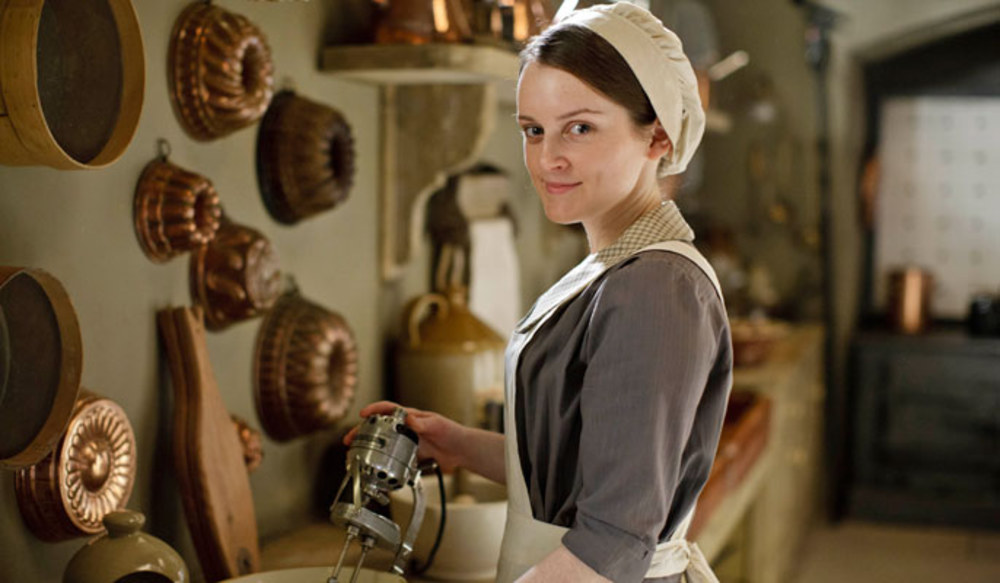
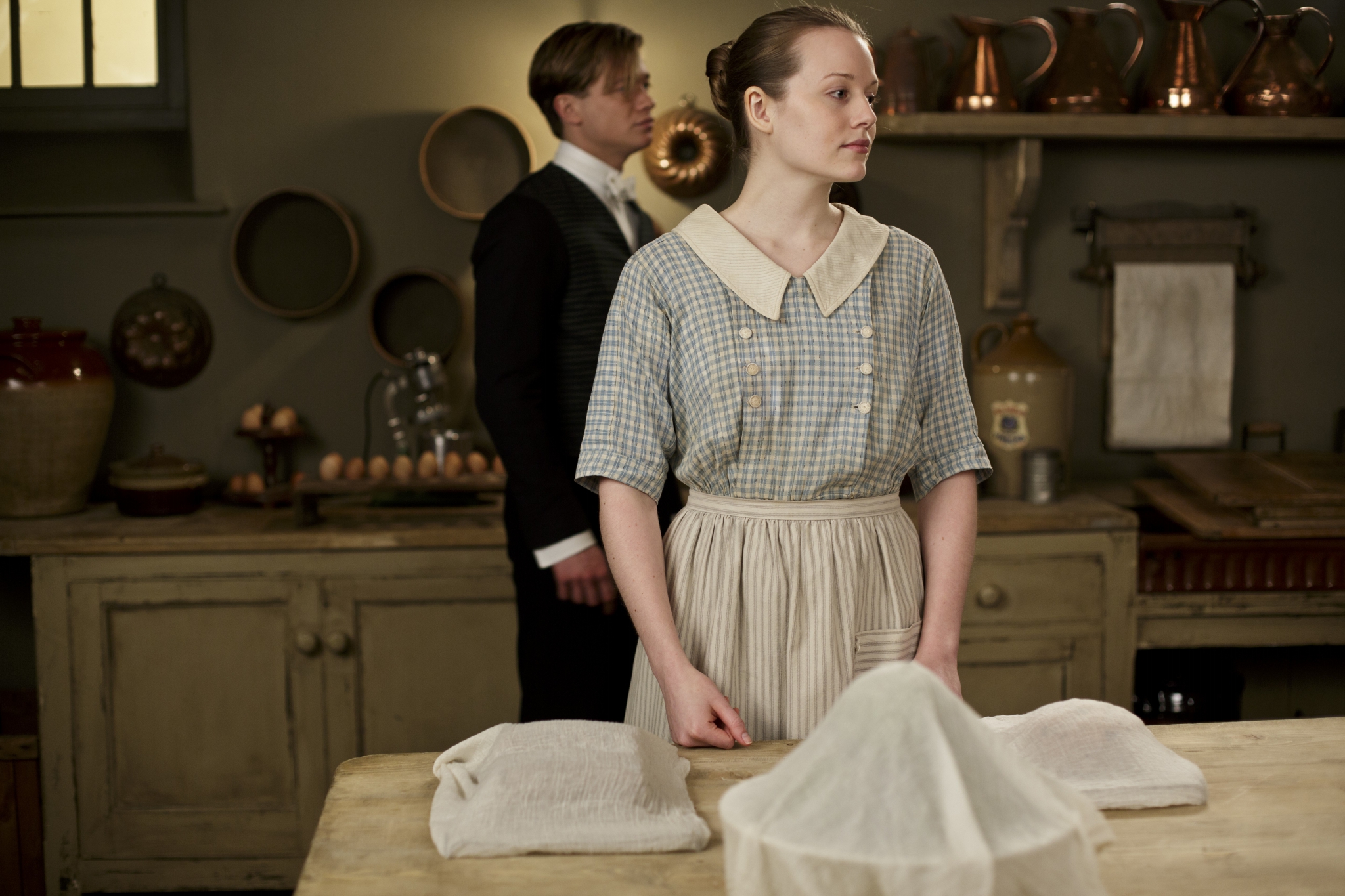
Maid: A general female domestic worker whose cheap job at Downton Abbey is to clean the interior rooms, add intrigue to the plot, and either be promoted to a better job or disappear from the show entirely. Seriously, maids don't last very long on this show for some reason.

Maid: A general female domestic worker whose cheap job at Downton Abbey is to clean the interior rooms, add intrigue to the plot, and either be promoted to a better job or disappear from the show entirely once the writers are done with them. Seriously, maids don’t last very long on this show for some reason.

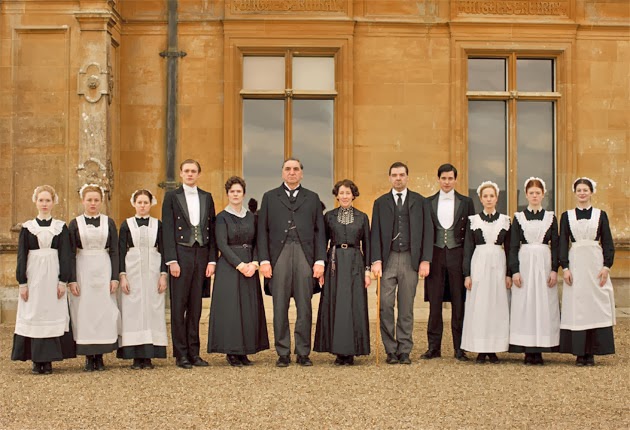
Of course, I couldn’t do a series on Downton Abbey servants without including a post about another very recognizable domestic servant in popular culture: the maid. Now with the exception of Anna, they don’t seem to last long on the show for some reason or another, whether it be getting a job as a secretary, getting knocked up by a major, being threatened to resign for getting into Branson’s pants, or getting to close to the Earl of Grantham, in a creepy non-platonic sense. And if you’re Anna, chances are you’ll hang up that white apron once Lady Mary hires you as a lady’s maid and you become the second Mrs. Bates. Nevertheless, if the script calls for a disposable female domestic worker, I’m sure a maid will fit the bill since they’re basically the Downton Abbey equivalent to Star Trek TOS redshirts (except they don’t usually die). Still, their work amount could vary from household to household. In grand estates, they were under the housekeeper’s supervision and usually charged with cleaning or doing whatever their specialization required them whether they were a chamber maid, house maid, parlor maid, still room maid, storeroom maid, or in between maid. In houses where she’s the only domestic employee, she did everything and her life would be incredibly lonely. Still, they were very prone to unwanted sexual attention sometimes sexual assault. If they got married or pregnant, then they could be out of a job without a great character reference. And in those days, to be unemployed was to be considered a bum, if you were poor. So without further adieu, here are the many kinds of maids you would’ve seen at Downton Abbey.

1. Housekeeper

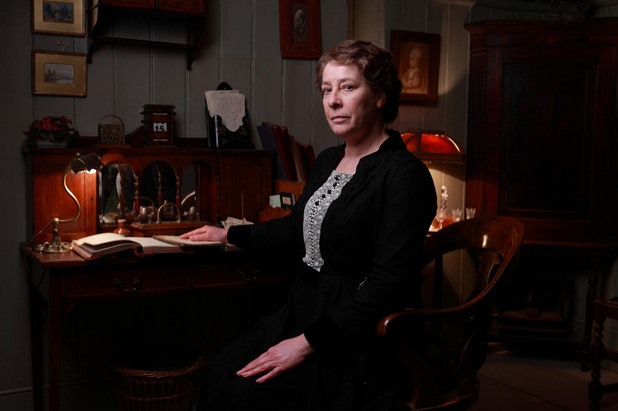
Housekeeper: At Downton Abbey, this job goes to a no nonsense, sensible, and motherly middle aged Scottish woman lower members usually tell their secrets to (even those they wouldn't tell their own spouses). Isn't afraid of rapists but if you're a maid don't have he catch you having sex or getting into Branson's pants. Should totally get together with the butler, seriously.

Housekeeper: At Downton Abbey, this job goes to a no nonsense, sensible, and motherly middle aged Scottish woman lower members usually tell their secrets to (even those they wouldn’t tell their own spouses). Isn’t afraid of rapists but if you’re a maid don’t have her catch you having sex or getting into Branson’s pants. Should totally get together with the butler, seriously. Though not a maid herself (she used to be one), she’s the boss of them.

Function: Responsible for the female staff (except for the lady’s maid, nurse, and cook) as well as maintaining the house’s furnishings. Could also share responsibilities with the House Manager and Butler in regard to buying provisions, dispensing funds as needed, and keeping household accounts. Second in command of the household staff and immediate representative of the mistress. Charged with the china closet and house linens, preparing bedrooms for visitors and their servants, and the stillroom. Makes rounds replacing supplies like candles, soap, and writing paper. Checks that rooms are clean and in order. Presides over the servants’ hall dinner. Does most of the needlework, arranges dessert, pours coffee and tea, and bottles fruit. Responsibilities vary by household and staff size.
Pay and Benefits: Annual salary of 30-55 pounds ($3,700-$5,400). Has her own room or cottage on the estate depending on marital status.
Status: Reported to mistress of the house and is only answerable to the family. Highest ranked female servant. Is always referred to as “Mrs.” regardless of marital status.
Hours: Worked 7 days a week from 5:30 am-10:00pm.
Typical Candidate: Usually a woman who’s risen through the ranks in the domestic service establishment. Again, this depends on the size of the household staff and estate. However, housekeepers among a large staff is usually not married.
Characters who had this job: Mrs. Elsie Hughes has this job at Downton and does almost everything described above relating to a housekeeper’s duties. Has been working at Downton Abbey almost as long as Carson (though doesn’t remember Lady Mary as a child. Though she might’ve started working there since Mary was a teenager).

2. Head House Maid

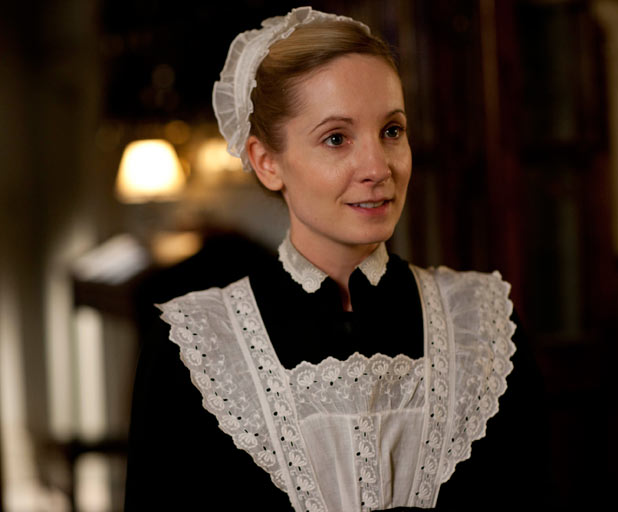
Head House Maid: At Downton Abbey, this is the job you give to the woman willing to cover up the boss's daughter's disastrous one night stand with a Turk and clear his valet of murder charges. Will be rewarded with marriage to valet and promotion to lady's maid to the boss's daughter in question.

Head House Maid: At Downton Abbey, this is the job you give to the woman willing to cover up the boss’s daughter’s disastrous one night stand with a Turk and clear his valet of murder charges (even if his first wife was a total bitch who deserved it). Will be rewarded with marriage to valet and promotion to lady’s maid to the boss’s daughter in question.

Function: The most senior house maid who supervised the maid staff. Usually on estates with at least 3 maids (an estate like Downton Abbey would’ve had at least 4-6 house maids).
Pay and Benefits: Well, annual salary of at least 20 pounds ($2,100) and room and board.
Status: Highest ranking female member of the Lower Staff. Reported directly to the Housekeeper.
Hours: Worked 7 days a week from 6:00am-11:00pm.
Typical Candidate: Young unmarried woman who’s been on the maid staff for at least some time, perhaps longer than most the maids under her care. Usually in her 20s.
Characters who had this job: Before she became the second Mrs. Bates and Lady Mary’s lady’s maid, Anna had this job during Seasons 1-3. Her successor’s identity is unknown but seeing that Downton has 3 house maids, this job must still exist. Despite being significantly younger than her husband, Anna has worked at Downton much longer and might be the same age as Thomas.

3. Chamber Maid

Chamber Maid: At Downton Abbey, this job goes to the woman who seems to be the most likely candidate for the resident Earl's "chamber" metaphorically speaking. Luckily for the Countess, this was more an emotional affair in which this maid was just trying to make a better future for her son through any methods she could.

Chamber Maid: At Downton Abbey, this job goes to the woman who seems to be the most likely candidate for the resident Earl’s “chamber” metaphorically speaking. Luckily for the Countess, this was more an emotional affair in which this maid was just trying to make a better future for her son through any methods she could.

Function: Responsible for cleaning and maintaining bedrooms. Duties include sweeping, dusting, making beds, warming beds, taking care of fires, attending dressing room, fetching hot water, and caring for windows.
Pay and Benefits: Annual salary of 20 pounds ($2,100) as well as room and board.
Status: Member of the Lower Staff and addressed by first name. Yet, have a slightly higher status than parlor maids since they’re in contact with the family. Reported to Housekeeper.
Hours: Worked 7 days a week from 6:00am-11:00pm.
Typical Candidate: Usually a young unmarried woman at least in her teens and from the lower classes.
Characters who had this job: On Downton Abbey, there’s no distinction between parlor and chamber maids (yet a place like Downton would typically have 2-3 of them).

4. Parlor Maid
Function: Responsible for cleaning and maintaining sitting rooms, drawing rooms and other rooms of public reception. Served refreshments at afternoon tea and sometimes dinner.
Pay and Benefits: Annual salary of 20 pounds a year ($2,100) as well as room and board.
Status: Member of Lower Staff and addressed by first name. Slightly lower than chamber maids since they had less contact with the family. Reported to Housekeeper.
Hours: Worked 7 days a week from 6:00am-11:00pm.
Typical Candidate: Usually a young unmarried woman at least in her teens and from the lower classes.
Characters who had this job: On Downton Abbey, there’s no distinction between parlor and chamber maids (yet a place like Downton would typically have 2-3 of them).

5. Still Room Maid
Function: Employed in the still room as well as responsible for alcohol, cosmetics, medicines, and cooking ingredients across all departments of the house.
Pay and Benefits: At least an annual salary of 15 pounds ($1,600) as well as room and board.
Status: Member of Lower Staff and addressed by first name. Reported to Cook, Butler, and Housekeeper.
Hours: Worked 7 days a week from 6:00am-11:00pm.
Typical Candidate: Usually a young unmarried woman at least in her teens who demonstrated some skill in distilling and preserving as well as from the lower classes.
Characters who had this job: This job doesn’t exist on Downton Abbey so it’s probably Daisy who has to do such duties as of Season 4.

6. Storeroom Maid
Function: Charged with supporting the housekeeper in maintaining vast stores of linens, foodstuffs, and household supplies.
Pay and Benefits: Well, probably an annual salary of 15 pounds ($1,600) as well as room and board.
Status: Member of the Lower Staff and addressed by first name. Reported to Housekeeper.
Hours: Worked 7 days a week from 6:00am-11:00pm.
Typical Candidate: Usually a young unmarried woman at least in her teens and from the lower classes.
Characters who had this job: This job doesn’t exist on Downton Abbey since it had basically disappeared by the middle of the 19th century.

7. House Maid

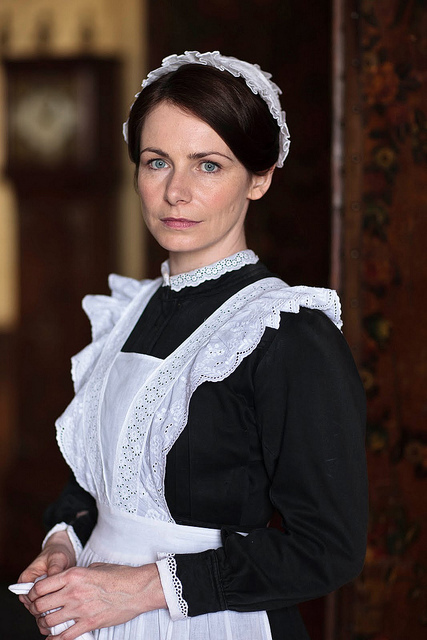
House Maid: At Downton Abbey, this is the job you give to: poor girls with secretarial ambitions, girls who can't keep their pants down for soldiers, war widows who want their kids in prestigious grammar schools, and social climbers who try to find fame and fortune through Branson's trousers.

House Maid: At Downton Abbey, this is the job you give to: poor girls with secretarial ambitions, girls who can’t keep their pants down for soldiers, war widows who want their kids in prestigious grammar schools, and social climbers who try to find fame and fortune through Branson’s trousers.

Function: A general purpose female worker whose function was chiefly upstairs, usually responsible for dusting, cleaning, making beds, caring for windows, opening windows, washing windows and stairs, lighting fires, polishing fireplaces and fixtures, tending to flower arrangements, emptying chamber pots, and serving tea but duties may vary depending on household and staff size.
Pay and Benefits: Annual salary of at least 16 pounds a year ($1,700) as well as room and board. Pay may depend on household size, staff size, and designation of responsibilities.
Status: Member of the Lower Staff and addressed by first name.
Hours: Worked 7 days a week from 6:00am-11:00pm.
Typical Candidate: Usually a young and unmarried woman at least in her teens and from the lower classes (though she may be even younger in the lower maid orders). Most housekeepers and lady’s maids usually were this before reaching their respective posts.
Characters who had this job: At Downton Abbey, Anna started out with this job in Seasons 1-3 and I guess that O’Brien, Baxter, and Mrs. Hughes worked as one before the show even started. Other notable house maids include Gwen Dawson from Season 1, Ethel Parks and Jane Moorsum from Season 2, and Edna Braithwaite from Season 3. While house maids don’t usually play a big part on the show, Downton Abbey usually has at least 3-6 of them (an estate like Downton would usually have 4-6), or as many as the plot allows.

8. Between Maid
Function: Responsible for waiting, setting the table, removing dishes, and serving meals for the servants. Worked in the house or kitchen as needed. Tidied libraries, studies, and (with footmen) answered bells for service. May even wait on the most senior staff in larger households.
Pay and Benefits: Annual salary of 15 pounds ($1,600) as well as room and board.
Status: Member of the Lower Staff and roughly equal to scullery maid. Reported to Housekeeper, Butler, and Cook. If these there didn’t like one another, her job was a difficult one. This was one of the lowest rungs in the maid world.
Hours: Worked 7 days a week from 5am to 10pm.
Typical Candidate: Usually a young unmarried girl between the ages of 12-16.
Characters who had this job: This job doesn’t exist at Downton Abbey or at least in name yet, an estate that size would at least have 2-3.

9. Maid of All Work

Maid of All Work: At Crawley House, this is the job you give a former Downton Abbey maid who was fired for banging a major and was forced into prostitution to support her son before the kid's handed to his paternal grandparents. Her mere presence will just make the longtime cook you've had quit. Is a terrible cook herself.

Maid of All Work: At Crawley House, this is the job you give a former Downton Abbey maid who was fired for banging a major and was forced into prostitution to support her son before the kid’s handed to his paternal grandparents. Her mere presence will just make the longtime cook you’ve had quit. Is a terrible cook herself.

Function: General domestic worker responsible for all the housework for a household that employed only one servant. Duties depended on the household.
Pay and Benefits: At least room and board but salary depended on the household she worked for.
Status: She isn’t of the servant hierarchy because she’s usually the only worker in the household. However, this was probably the nadir position in the maid world and one of the least desirable.
Hours: Worked 7 days a week from 6:00am-11:00pm.
Typical Candidate: Usually a young unmarried woman at least in her teens and rather inexperienced. Often someone “rescued” from the workhouse.
Characters who had this job: Ethel Parks tries to be this to Isobel Crawley in Season 3 but fails since she’s a bad cook. It’s also implied that she’s sought another position at a house near where her son lives.

The Domestic Servants of Downton Abbey: Part 3-The Kitchen

Kitchen: At Downton Abbey, this is where the food is prepared and  a lot of the downstairs drama takes place, other than in the Servant's Hall, naturally

Kitchen: At Downton Abbey, this is where the food is prepared and a lot of the downstairs drama takes place, other than in the Servant’s Hall, naturally. Serves 8 hot meals a day, which seems a bit much even by Hobbit standards.

On a large British grand estate like Downton Abbey, the kitchen is probably one of the busier rooms since it’s where all the food is prepared before arriving to the dining room to serve. As we see on Downton Abbey, you can guess that the Crawleys entertain a lot, especially during special occasions like banquets, balls, parties, weddings, holidays, or when guests arrive. And when visitors and house guests arrive, you can expect Mrs. Patmore and her kitchen staff working into overdrive just to provide the most impressive and delicious meals consisting of at least a dinner with 3 courses or more. Nevertheless, since it was a room for food preparation, it was a servant domain located either in the basement or ground floor. And before the advent of the Servant Halls and Quarters, it was where they ate, socialized, spent their free time, or sometimes even slept. But while the kitchen staff at Downton have the luxuries of tiled floors, closed gas stoves, electricity, indoor plumbing, cupboards, and other industrial conveniences, this wouldn’t have been the case if Downton Abbey took place at a time before the Industrial Revolution. In Colonial America, kitchens were either built in the back of the house or as separate buildings due to the obvious fire hazards (at a time when kitchen fires were very common, by the way). And in Tudor times, let’s just say you’d want to stay the hell out of any of their estate kitchens since it was a dirty, hot, dangerous, and miserable place in which food took hours to cook over an open fire. It also wasn’t unusual for the kitchen staff at Henry VIII’s Hampton Court to cook in the nude on many occasions just to cool off, which probably isn’t something you’d see on The Tudors for obvious reasons. And it probably didn’t help that he had to have six lavish weddings either. Nevertheless, without further adieu, I bring you a list of servants you might’ve seen on a large grand estate like Downton Abbey.

1. Clerk of the Kitchen
Function: Responsible for supervising the kitchen, including the work of the female cook and her subordinates. Ordered table provisions, negotiated with the green grocer, baker, and butcher. Disbursed funds allocated by house steward for payment of provisions to tradesmen for their services. Guardian of the pantry. Ensured meals were served on time and properly prepared this type of food preparation. Sometimes the chef held this position.
Pay and Benefits: Well, higher than most of the kitchen staff but salary depended on size of the household. Yet, he did have his own quarters.
Status: Well, at least Senior Servants.
Hours: Works a daily schedule on the estate from at least dawn to dusk.
Typical Candidate: Must be male and have a certain amount of experience in management and the kitchen.
Characters who had this job: This job doesn’t exist on Downton Abbey yet, this is more of an 18th century job anyway. However, Mrs. Patmore does most of this positions duties herself though Mrs. Hughes has the key to the pantry.

2. Chef/Man-Cook

Chef/Man-Cook: At Downton Abbey, this is the job a lady's maid's nephew aspires to be even though he's just a second footman. Still, gets his chance to train at the Ritz Hotel through hard work and sheer luck in Season 4.

Chef/Man-Cook: At Downton Abbey, this is the job a lady’s maid’s nephew aspires to be even though he’s just a second footman. Still, gets his chance to train at the Ritz Hotel through hard work and sheer luck in Season 4.

Function: In charge of kitchen staff and responsible for preparing the family’s meals and the kitchen staff.
Pay and Benefits: Varies considerably depending on the household and the male cook’s prestige (a famous chef for the royal family could be paid as much as 300 pounds {$32,000}). Always paid more than female cooks though. Had his own room or cottage depending on marital status or level of expertise.
Status: Member of the Upper Staff though rank below Butler and Housekeeper if present. Ate in the kitchen.
Hours: From early morning until evening with free time in the afternoon save on special dinners.
Typical Candidate: Well, from the 19th century onwards, most male cooks had to be familiar with French cuisine. Yet, whenever the cook is male, French guys are usually preferred (at least in Great Britain).
Characters who had this job: This job doesn’t exist on Downton Abbey (since male cooks weren’t employed on estates at the time unless they were chefs). However, Alfred Nugent does leave Downton to train as one in Season 4.

3. Cook

Cook: At Downton Abbey, this is the person responsible for cooking all the food and supervising the kitchen. This job goes to a cantankerous and no nonsense middle-aged woman who rules her kitchen with an iron rod and quick tongue. But she can make anyone with a strong anti-British culinary prejudice enjoy English food. Doesn't permit profanity unless she's doing the swearing. Also takes a lot of frustrations on her staff. Hey, what do you expect from someone who has to cook 8 hot meals a day?

Cook: At Downton Abbey, this is the person responsible for cooking all the food and supervising the kitchen. This job goes to a cantankerous and no nonsense middle-aged woman who rules her kitchen with an iron rod and quick tongue. But she can make anyone with a strong anti-British culinary prejudice enjoy English food. Yet, she’s utterly hopeless with the electric mixer. Doesn’t permit profanity unless she’s doing the swearing. Hates makeup. Also takes a lot of frustrations on her staff she treats as her own children. Hey, what do you expect from someone who has to cook 8 hot meals a day?

Function: Responsible for preparing meals and in charge of the kitchen staff. Charged with making a menu for lunch and dinner as well as orders tradespeople to serve the house while in town. Makes soup for the following day as well as that day’s pastry, jellies, creams, and entrees, all in the morning. Also has to lock doors and windows to the basement, let the kitchen fire burn low, to turn off the gas in the kitchen and hallways before going to bed. Other responsibilities depend on size of household staff.
Pay and Benefits: In a modest home, she could be paid as little as 30 pounds ($3,200) and at most more than the butler yet rank below him. Also has her own room or cottage on the estate depending on marital status.
Status: Member of the Upper Staff. Addressed as “Mrs.” regardless of marital status if female. Ranks at least below the Butler and Housekeeper and above everyone else. Is only answerable to the family. However, if female, isn’t as prestigious as a male cook though but in rank, she was second only to the housekeeper among the female staff. Ate in the kitchen.
Hours: From early morning to late at night after dinner. Always has breakfast first before proceeding to make it for everyone else. Usually free in the afternoon save for special occasions like a dinner party or guests.
Typical Candidate: If female, she’s usually a woman who’s risen through the ranks after starting as a kitchen maid. Sought after for her sophisticated and practical knowledge.
Characters who had this job: Mrs. Beryl Patmore has this job at Downton Abbey and does about everything described above. She’s well known for her craft as well as worked at Downton for over 20 years as of Season 4. Still, she’s also known for her temper, but this is typical for most cooks at the time.

4. Confectioner
Function: Responsible with preparing candies and other confections for the estate during large dinners. Also, helps preserve foodstuffs and other ingredients.
Pay and Benefits: I’m sure anyone working in this position would’ve gotten a nice compensation as well as room and board.
Status: Member of the Upper Staff. Addressed by last name and reported to Cook. Dined with kitchen staff.
Hours: Worked from early in the morning to late at night.
Typical Candidate: Usually someone who’s been trained and possesses knowledge pertaining to making confections and food preservation.
Characters who had this job: This job doesn’t exist at Downton Abbey but probably does on grander estates.

5. Baker
Function: Responsible for preparing and making bread and other baked goods.
Pay and Benefits: I’m sure anyone in this position would receive a nice compensation as well as room and board.
Status: Member of the Upper Staff, addressed by first name, and reported to Cook. Dined with kitchen staff.
Hours: Worked from early in the morning to late at night.
Typical Candidate: Usually someone who’s been trained in a bake shop for a certain number of years.
Characters who had this job: This job doesn’t exist on Downton Abbey but probably does on grander estates.

6. Pastry Cook
Function: Responsible for preparing the pastry dishes and baked goods for the family during a large banquet on special occasions.
Pay and Benefits: I’m sure a person in this position received a great compensation with room and board.
Status: Member of the Upper Staff. Addressed by last name. Reported to Cook and dined with kitchen staff.
Hours: Worked from early in the morning to late at night.
Typical Candidate: Usually someone who’s been trained and possesses a wide range of knowledge regarding pastries and other baked delights. Could be either gender.
Characters who had this job: This job doesn’t exist on Downton Abbey but it probably does on grander estates.

7. Undercook or Assistant Cook

Undercook or Assistant Cook: At Downton Abbey, this is a job you give to a young woman who's complained about being a lowly scullery/kitchen maid for a good 8 years without being promoted. Also, had to go through a deathbed marriage with a dying soldier who once served as the second footman. Though she may someday get to run her father-in-law's farm.

Undercook or Assistant Cook: At Downton Abbey, this is a job you give to a young woman who’s complained about being a lowly scullery/kitchen maid for a good 8 years without being promoted. Also, had to go through a deathbed marriage with a dying soldier who once served as the second footman. Though she may someday get to run her father-in-law’s farm.

Function: Apprentice to the cook or chef. Prepares meals for the staff. In larger households, she was the head kitchen maid as well as was responsible for much of the plain cooking.
Pay and Benefits: Annual salary of 15 pounds ($1,600) as well as room and board.
Status: Member of the Lower Staff and addressed by first name. Reported directly to Cook and ate in the kitchen.
Hours: Usually early morning to late at night. Sort of the same as the cook.
Typical Candidate: Usually a young woman who’s had experience as a kitchen maid as well as quite skilled.
Characters who had this job: Daisy Mason is promoted to Assistant Cook after serving as a kitchen maid at Downton Abbey for 8 years in by Season 3 and she managed that mostly by complaining. Yet, she’s also known as a good cook though.

8.  Kitchen Maid

Kitchen Maid: At Downton Abbey, this is the job an aspiring Assistant Cook wants filled so badly unless it's by a girl who steals  the heart of the footman of her affections. Likes to attract guys but isn't interested in anything serious. Will take the first promotion opportunity she could get, even if it means leaving the country.

Kitchen Maid: At Downton Abbey, this is the job an aspiring Assistant Cook wants filled so badly unless it’s by a girl who steals the heart of the footman of her affections. Likes to attract guys but isn’t interested in anything serious. Will take the first promotion opportunity she could get, even if it means leaving the country.

Function: Basically her job was to assist the cook in preparing the meals and overseeing everything in the kitchen such as cleanliness, efficiency, and food preparation. Also answered to dining table demands on a daily basis. In smaller households, they can prepare vegetables, game, and poultry, do dairy work, and bake bread. If there was no still room made, they also made cakes for lunch, tea, and dessert as well as rolls for breakfast.
Pay and Benefits: Annual salary of 15 pounds a year as well as room and board.
Status: Member of the Lower Staff and addressed by first name. Reported to Cook and ate in the kitchen.
Hours: Usually from early morning to late at night. Same as the cook.
Typical Candidate: Usually an unmarried young woman at least in her teens though often very skilled or having ambition to be so.
Characters who had this job: Daisy starts out with this job at Downton Abbey in Seasons 1-3. By Season 3, she’s worked as a kitchen maid for 8 years (yet, an estate like Downton would certainly have at least 2-3). Ivy Stuart has this in Seasons 3-4, but since she left to be Harold Levinson’s cook in Season 4, this position is vacant.

9. Dairy Maid
Function: Responsible for churning butter, milking cows, transporting milk, as well as preparing creams and cheeses.
Pay and Benefits: Annual salary of 15 pounds a year ($1,600) as well as room and board.
Status: Member of the Lower Staff and addressed by first name. Reported to Cook.
Hours: Usually from sunrise to late at night as far as I know.
Typical Candidate: Usually a young woman at least in her teens who had some general knowledge on dairy products (like someone who grew up on a dairy farm).
Characters who had this job: This job doesn’t exist on Downton Abbey as far as I can tell. In fact, due to large scale dairy farming, this job might’ve become obsolete by the 20th century. Mrs. Patmore probably just got her dairy products from the open market. Still, they’re best known for inadvertently helping Edward Jenner develop the small pox vaccine (since the cowpox made them immune from the virus) but this was in the 18th century.

10. Scullery Maid

Scullery Maid: At Downton Abbey, this is a job you'd give to an impressionable teenage girl with a crush on the resident asshole who witnesses the boss's wife, daughter, and Head House Maid carry a dead Turk out of the daughter's bedroom in the middle of the night. Gives rise to the Kemal Pamuk scandal.

Scullery Maid: At Downton Abbey, this is a job you’d give to an impressionable teenage girl with a crush on the resident asshole who witnesses the boss’s wife, daughter, and Head House Maid carry a dead Turk out of the daughter’s bedroom in the middle of the night. Gives rise to the Kemal Pamuk scandal. Best girl to have dying soldier marry.

Function: Responsible for cleaning and scouring the pots and pans as well as cooking utensils and stoves. She also cleaned vegetables, scrubbed scales off fish, plucked poultry, provided hot water for the house, lit fires to heat water, and cleaned away garbage and debris off floor. Duties included cleaning the servants’ hall, scullery, larders, and kitchen hallways. Might’ve cleaned and emptied chamber pots as well as assisted in watching or cooking food. Other responsibilities may vary depending on size of staff and household.
Pay and Benefits: Annual salary of 13 pounds ($1,300) as well as room and board.
Status: Member of the Lower Staff as well as often the lowest ranked female servant in the household. She wasn’t allowed to touch any luxuries like the china, silver, or glass. Reported to Cook and ate in the kitchen.
Hours: Worked 7 days a week from 5:00 am to 10:000pm.
Typical Candidate: Usually a teenage girl between 10-16 years old and maybe even younger as well as from the lower classes.
Characters who had this job: This job does not really exist on Downton Abbey, yet Daisy and Ivy Stuart fulfill duties of both this and the Kitchen Maid (an estate like Downton would’ve employed at least 2-3 of them).

11. Provision Boy
Function: Assisted the kitchen in fetching supplies.
Pay and Benefits: Besides room and board, not much pay.
Status: Member of Lowest Staff and possibly among the lowest positions. Addressed by first name. Reported to Cook and dined in kitchen.
Hours: Worked from early in the morning to late at night.
Typical Candidate: Usually a boy who could be as young as 10, maybe even younger.
Characters who had this job: This job doesn’t exist at Downton Abbey.

The Domestic Servants of Downton Abbey: Part 2-The Butler’s Pantry

Butler: At Downton Abbey, this is the guy who's in charge of the household staff as well as the post you assume on an estate after a failed showbiz career and a relationship in which your girlfriend dumped you for your Vaudeville partner. Though fatherly and stiff, can be quite amusing when trying to hopelessly interact with new technology like a phonograph or a telephone.

Butler: At Downton Abbey, this is the guy who’s in charge of the household staff as well as the post you assume on an estate after a failed showbiz career and a relationship in which your girlfriend dumped you for your Vaudeville partner. Though fatherly and stiff with a rigid code of conduct, can be quite amusing when trying to hopelessly interact with new technology like a phonograph or a telephone. Yet, suggest that a maid serve a duke in the dining room and he’ll think society collapse is inevitable.

The role of the butler is one of the more recognizable jobs in a Great House or a large estate and Downton Abbey is no exception. On Downton Abbey (and in most media in general), he’s seen as head of the household staff and sometimes attends to his every master’s need (though this is more of valet’s job description, which I’ll get to later). On one end, he can be well dressed, unfailingly polite, devoted to his employer despite being more level headed and smarter than his boss. On the other end, he could be a manipulative schemer who could kill his boss during a dinner party. However, while we usually see the Butler as the most senior employee nowadays, this wasn’t always the case in history and could sometimes depend on the household. In fact, the butler’s original purpose was to look after the wine in the cellar and was of middle rank yet later this included cheese, bread, and other basic provisions sometimes known as the butler’s pantry. Yet, from the 17th to 19th centuries, his stature slowly rose even though sometimes, he wasn’t always the servant in charge and could be outranked whether it be by the valet or Groom of the Chambers. But nevertheless, the liveried butler is still the most familiar intermediary between the upstairs world and the downstairs staff. So without further adieu, here are the jobs relating to the Butler and his retinue from the Butler’s Pantry.

1. Groom of the Chambers
Function: Responsible for announcing company, answering bells, making sure the principal seeing rooms are in proper order as well as supplied with pens, ink, candles, and paper. Also assist in decorating such as flower displays, making sure card tables have cards, and sees that rooms are in proper order. Keeps a book of invitations given to his employers to remind of their engagements as well as arranges invitations for special events. Sees that guests are properly attended. Supervised servants and specialized in furniture maintenance.
Pay and Benefits: I’m sure he receives a generous sum of money as well as room and board.
Status: Member of the Upper Staff, addressed by last name, and reported to the master or House Steward. May even outrank the butler.
Hours: Worked 7 days a week from 5:00am-10:00pm.
Typical Candidate: Usually a man who spent considerable time as a footman, butler, or other member of the male staff with leadership skills.
Characters who had this job: This job doesn’t exist at Downton Abbey but it’s likely that the estate might’ve had one. Then again, Carson performs a lot of this job’s duties anyway and might’ve went obsolete in the late 19th century.

2. Butler
Function: Highest official servant and responsible for running the house and from the 19th century onward assumed the House Manager’s responsibilities. Charged with supervising the footmen, the plate chest (making sure it’s properly cleaned before use), and affairs relating to any alcohol purchased and consumed by the household (such as keeping accounts, decanting it for lunch and dinner, and putting it away after every meal). Can even bottle wine and brew beer. Takes over valet’s duty when there’s not one in the household. Announces visitors during afternoon hours, readies rooms for use every day, as well as tidies them. Also, polishes the silver and keeps it in pristine condition. Responsibilities depend on the size of the establishment.
Pay and Benefits: Annual salary of 40-60 pounds ($4,300-$6,400). Also receives gratuity money from vendors selling goods to maintain the house. Has his own room on the estate or a cottage if married.
Status: Highest ranking of an official servant and is only answerable to the family.
Hours: Worked 7 days a week from 5am-10pm.
Typical Candidate: Usually a seasoned male veteran of the domestic service establishment who’s risen through the ranks over his career. Most butlers usually served many other positions while in the same house.
Characters who had this job: Mr. Charles Carson is Downton Abbey’s resident butler and does possibly everything described above except make alcohol and take over the valet’s duties (which Thomas does). Not surprisingly, he’s been working at Downton longer than any of the other staff or at least as early as the 1890s before the Crawley girls were born (then again, he may have been a servant before his career in Vaudeville).

3. Under Butler

Under Butler: At Downton Abbey this is the job you give to the estate's resident scheming asshole after he's caught sexually assaulting a footman in his bedroom. Sure he's worked as a footman for over 10 years, served as NCO in the war, and has experience as a valet. But, really, that incident could've landed him jail, let alone get him fired.

Under Butler: At Downton Abbey this is the job you give to the estate’s resident scheming asshole after he’s caught sexually assaulting a footman in his bedroom. Sure he’s worked as a footman for over 10 years, served as NCO in the war, and has experience as a valet. But, really, that incident could’ve landed him jail, let alone get him fired. Talk about giving a promotion to someone who doesn’t deserve it.

Function: Shares many of the butler’s duties but is only second to him among the male staff as well as takes control of staff when butler’s away. Also, takes over as a footman during special occasions. Responsibilities may vary according to household. Though not all estates have this position.
Pay and Benefits: Well, less than the butler as well as housekeeper and his own room or cottage at the estate depending on his marital status.
Status: Member of the Upper Staff and only answerable to the Butler. Addressed by last name.
Hours: Worked 7 days a week from 5am-10pm.
Typical Candidate: Again, a male veteran of the domestic service who’s worked for the household for quite some time to rise through the ranks.
Characters who had this job: Thomas Barrow has had this job at Downton Abbey since Season 3 (after an incident that would’ve gotten him jailed, let alone fired in real life. Then again, his homosexuality has been an open secret at Downton anyway. However, since he’s the resident baddie {especially after O’Brien left}, his position at Downton is relatively secure unless Rob James-Collier wants off the show). Nevertheless, Thomas has been working at Downton for over a decade.

4. First Footman

First Footman: At Downton Abbey this is the job you give to the handsome footman who's kind of a prick not above hazing his competition. Though this job may not get him laid by the kitchen maid who has a crush on him, it may make him prone to some awkward moments of unwanted sexual  attention.

First Footman: At Downton Abbey this is the job you give to the handsome footman who’s kind of a prick not above hazing his competition. Though this job may not get him laid by the kitchen maid who has a crush on him, it may make him prone to some awkward moments of unwanted sexual attention. Also has a former boss who won’t leave him alone.

Function: Next in line to replace butler (unless there’s an under butler in the household staff), with his main job to be tall, handsome, and to represent the estate’s grandeur. Aside from regular footman duties, he accompanied the lady of the house on shopping trips, served the family meals, and assisted the butler.
Pay and Benefits: Annual salary of 30 pounds a year ($3,200) as well as room and board (though he typically had to share one). However, like most footmen, the taller and handsomer he was (or the more similar he resembled the second footman), the more he got paid. Could be supplemented by 5-15 pounds annually ($500-$1,500) in tips and other gifts from the lady of the house.
Status: Highest ranking member of the Lower Staff. Addressed by first name and reported to Butler.
Hours: Worked 7 days a week from 6:00am-11:00pm.
Typical Candidate: Usually the footman who’s spent either the longest time at the estate. If not, then hotness and height.
Characters who had this job: Thomas Barrow starts out as the first footman in Seasons 1 and 3 until his promotion to under butler. Onwards, it’s been Jimmy Kent as of Season 4.

5. Second Footman

Second Footman: At Downton Abbey this is the job you give to a military age guy who's not the resident asshole or romantically pursuing the boss's daughter. Mainly exists as a nice guy to get killed off in WWI during Season 2. Because we all know that someone at Downton had to get it.

Second Footman: At Downton Abbey this is the job you give to a military age guy who’s not the resident asshole or romantically pursuing the boss’s daughter. Mainly exists as a nice guy to get killed off in WWI during Season 2, dying peacefully after his rushed death bed wedding with the kitchen maid. Because we all know that someone at Downton had to get it.

Function: Similar to the first footman but in an apprenticeship capacity.
Pay and Benefits: Annual salary of 25 pounds ($2,700) but can depend on hotness, height, and resemblance to the first footman, as well as having to share a room.
Status: Member of Lower Staff. Addressed by first name and reported to Butler.
Hours: Worked 7 days a week from 6:00am-11:00pm.
Typical Candidate: Usually the footman who’s spent a long time on at the estate. Yet, if he bore a resemblance to the first footman or was reasonably hot or tall, it was even better.
Characters who had this job: William Mason was Downton Abbey’s second footman until he joined the army in Season 2 (yet was killed in WWI so didn’t return to his post. However, since he, Thomas, and Branson were the only servants of military age on the estate, his death was no surprise.) And from Season 3 to the time he left for culinary school in London, Alfred Nugent served this post (of course, he was hired as a footman only because he was O’Brien’s nephew but he probably would’ve just gotten to work as one at Downton due to being 6’4” alone). Since then, it’s been Joseph Molesley (who probably got in since he was Matthew’s valet and aching for a job) as of Season 4.

6. Footman

Footman: At Downton Abbey, this is the job you give to men that are: complete assholes, kind-hearted cannon fodder, culinary aspiring nephews of lady's maids, guys fleeing the unwanted attentions of a female boss, and ex-valets desperate for employment after their boss suddenly died in a car accident on the way home from the hospital.

Footman: At Downton Abbey, this is the job you give to men that are: complete assholes, kind-hearted cannon fodder, culinary aspiring nephews of lady’s maids, guys fleeing the unwanted attentions of a female boss, and ex-valets desperate for employment after their boss suddenly died in a car accident on the way home from the hospital.

Function: Male staff part of the butler’s pantry department. Usual duties include laying the table, answering the door, waiting at the table, receiving and carrying packages and mail, and accompanying the family while traveling on foot, carriage, or car. Also looked after male guests who came without a valet. May even carry heavy items and move furniture for the house maids. Their roles were similar to waiters, bodyguards, busboys, and escorts.
Pay and Benefits: Annual salary of at least 20 pounds ($2,100) as well as room and board. Pay also depended on the footman’s looks such as height and hotness since they were meant to be seen by family and guests. A footman over 5’10” could earn as much as 40 pounds a year (which may be over $3,500), (Alfred could’ve earned this much money).
Status: Member of the Lower Staff. However, since they were hired to be seen, the notion of a handsome footman was the 19th century equivalent of the hot pool boy. And yes, affairs between footmen and their mistresses did occur. Addressed by first name and reported to Butler. Have expensive livery uniforms, refined mannerisms, and general appearance. Still, an estate like Downton Abbey usually had 4 of them.
Hours: Worked 7 days a week from 6:00am-11:00pm.
Typical Candidate: Well, must be an unmarried young man of great height and reasonably hot. Most were in their late teens and 20s (Moseley would’ve not been hired as a footman in real life since he’s balding and may be over 30. Yet, was made one nevertheless to keep him on the show. Yet, despite Alfred’s not being a servant before, he certainly would since he’s 6’4” tall {even if he wasn’t O’Brien’s nephew}.) Butlers usually had this position before rising to their current position.
Characters who had this job: Let’s see for there’s quite a list of footmen at Downton Abbey. Well, Season 1 has Thomas Barrow (until Season 3) and William Mason while Season 3 has Alfred Nugent and Jimmy Kent. However, since Thomas’ promotion and Alfred’s departure, it’s been Jimmy Kent and Joseph Moseley as of Season 4. Also, Carson was most likely a footman while the Crawley girls were young.

7. Page or Tea Boy
Function: Apprentice footman responsible for attending a person of distinction as well as guests. May have even served other servants in the Servants’ Hall.
Pay and Benefits: Annual salary of 8-16 pounds ($860-$1,700) depending on age, appearance, height, and abilities.
Status: Member of Lower Staff and addressed by first name.
Hours: Worked 7 days a week from 6:00am-11:00pm.
Typical Candidate: Usually a boy between 10-16 years old from the lower classes as well as shows higher ambition. A lot of footman started out this way.
Characters who had this job: This job doesn’t exist on Downton Abbey but I’m sure someone like Thomas Barrow and Carson worked as one for a time.

8. Hall Boy
Function: Assistant to the lowest footman who takes cards in the hall, polishes shoes and boots of visitors, and empties chamber pots.
Pay and Benefits: Annual salary of 13 pounds ($1,300) as well as room and board.
Status: Member of the Lower Staff and one of lowest male servant ranks. Addressed by first name.
Hours: Worked 7 days a week from 6:00am-11:00pm.
Typical Candidate: Usually a boy between 10-16 years old and from the lower classes. Many footmen, valets, and butlers started out this way.
Characters who had this job: Well, this job may or may not exist on Downton Abbey but it’s likely that men like Thomas Barrow and Carson might have worked as one.

9. Pantry Boy
Function: Responsible for maintaining the pantry as far as I know.
Pay and Benefits: Besides room and board, not much pay.
Status: Member of the Lower Staff and one of the lowest ranked male servants. Reported to Butler.
Hours: Worked 7 days a week from 6:00am-11:00pm.
Typical Candidate: Usually a young boy or a teenager at least 10, maybe even younger.
Characters who had this job: This job doesn’t exist at Downton Abbey. However, outside the show and in real life, this the job real life butler Eugene Allen started out with during his long career at the White House. So this job definitely existed somewhere.

10. Boot Boy
Function: Responsible for cleaning, polishing, and caring for the household members’ boots and shoes as well as other odd jobs.
Pay and Benefits: Besides room and board, not much pay.
Status: Member of the Lower Staff and lowest ranking male servant. Addressed by first name and reported to Butler.
Hours: Worked 7 days a week from 5:00am-10:00pm.
Typical Candidate: Usually a young boy or teenager. May be as young as 10 or even younger.
Characters who had this job: This job may or may not exist at Downton Abbey. Yet, these boys weren’t meant to be seen.

The Domestic Servants of Downton Abbey: Part 1-The Professionals

Estate Manager: On Downton, this is the job you give the Irish chauffeur after he's managed to procreate with the boss's daughter who's died in childbirth.

Estate Manager: At Downton Abbey, this is the job you give the Irish chauffeur after he’s managed to marry and procreate with the boss’s daughter who’s died in childbirth from eclampsia. Yet, despite not having a college education and being an Irish Nationalist and self-professed Anarcho-Socialist involved with terrorism, he’s perfect for the job because he’s grown up on a farm and is the father of the boss’s granddaughter by his dead daughter.  Oh, and I’m sure the boss will forgive him for leaving his pregnant wife in Ireland while on the lam, supporting the Russian Revolution, and blowing up a castle.

The British show Downton Abbey is a hit period drama (or soap opera) in both the UK and the US which tells the story of a great house during the early 20th century which kicks off when two of the male heirs of Downton and to the Earl of Grantham died aboard the R. M. S. Titanic and since the Earl only has daughters, the next in line is a lawyer in Manchester who the Granthams hadn’t met until the second episode. The show is now in its fifth season which airs on PBS during the months of January and February in the United States. Since my series on the real people from HBO’s Boardwalk Empire has met great success (I’m still getting hits on the posts since September) I figured I could do a similar series pertaining to Downton Abbey as well. However, I couldn’t do a series on the real people of Downton Abbey because there’s barely any, which would take a very small post (and most of these people appear in Season 4). Instead, I decided to do a series on an aspect the show revolves around: the servants.

For a long time in Great Britain, domestic service was a big industry, especially in the 19th century where servants were employed by almost every family that could afford one. In the 1850s it’s said that 1 in 3 women between the ages of 15-25 were servants while the other 1 in 3 were prostitutes. By 1900, British domestic servants amounted to 1.5 million of the country’s population of 36 million. Of course, unlike what you’d see from Downton Abbey and in other media portrayals, the relationship between master and servant wasn’t always of mutual respect between social boundaries. And it would be more fair to say they were treated more like appliances than people. Not only that, but servants’ lives could actually be quite miserable, degrading, exhausting, and thankless work. Some people could be forced to surrender their identities for a matching hair style and a generic name. Not to mention, servants could often be targets of abuse and could be fired for getting married, pregnant, or other reasons. Many of them worked 17 hour days for a pittance wage but the competition was fierce since servants had a roof over their heads and regular meals. Not to mention, there were worse situations to be in at the time such as in a factory or on the streets. Still, when it came to employment options a servant would rather work in a great house like Downton than a small one (which would’ve had a staff much bigger than on the show). At least working at a grand house would mean not doing as many chores and meeting people. And as far as loyalty goes, it wasn’t unusual for a employers to hire 32 maids in 34 years. However, despite the romanticized picture Downton Abbey gives, there was much more separation between the lives upstairs and downstairs and a lot of times the people downstairs didn’t have it so great (and at times their lives could totally suck since their employers couldn’t be held accountable if their bosses did anything horrible to them). Yet, what the show does get right is that servants did have their own hierarchies and were a great part to the grand house economy on the estate. Of course, I should remind you that not all the servant jobs I feature in my post pertains to the time of Downton Abbey or even the 19th century in that matter either.

In this first post, I’ll cover a group of those who worked on the estate or the Great House but weren’t actually designated “servants” since they didn’t reside in the house or at times didn’t work directly under the master and his family. Rather many of them have the designation as, “professional” employee since many of them had some degree of education and skill, yet may or may not work when called upon. Some of them may have their own house on the estate while others may just be looking for a place to apply their skills or live elsewhere. Yet, compared to most of the servants you’d see, they’re usually treated better, have much more independence or power, work shorter hours, and are more likely to be better paid. Not to mention, they don’t really belong in the other categories you’ll see later. So for your pleasure, here’s a list of jobs you’d see from an English estate under the designation of, “professional.”

1. Chamberlain
Function: Charged with the management of the living quarters of a sovereign or member of the nobility. May be in charge of receiving and distributing funds.
Pay and Benefits: Well, this is a job that allows for generous compensation as well as a private house on the estate. May have servants of his own.
Status: Highest steward of the servant hierarchy and regarded as a professional employee. Is answerable only to the master.
Hours: Depends on their duties during a specific era. Medieval chamberlains had the longest hours and most duties compared to their later successors.
Typical Candidate: Usually a member of the nobility or the royal court, particularly lower than the person they’re serving.
Characters who had this job: This job doesn’t really exist on Downton Abbey, except maybe in the King’s household with Lord Chamberlain.

2. Land Steward or Estate Manager
Function: Responsible for managing the farms, collecting rents, and undertaking all those activities associated with making the estate profitable. Other duties include leasing farms, surveying the property, settling disputes over land and farming, and detailing records of such affairs. When master isn’t present, usually supervised cultivation of land, lending his ear to tenant farmers and the sophistication of agricultural practices. Communicated with lawyers, family members, architects, suppliers, and tenants as well as saw to processing every aspect for the family and its affairs.
Pay and Benefits: Annual salary of 100-300 pounds ($11,000-$33,000) and a private house on the estate.
Status: Regarded as a professional employee with a status higher than the family lawyer. Is answerable only to the master.
Hours: Usually a regular work day with a flexible schedule or as needed.
Typical Candidate: Usually a highly educated gentleman. Lawyers preferred, especially those who have a financial and managerial background.
Characters who had this job: The Earl of Grantham and his family had Jarvis who served the estate from 1880 to 1920 until Downton Abbey was struck with financial disaster in Season 3. Since then, it’s been shared by Matthew Crawley and Tom Branson (since he grew up on a farm). Yet, after Matthew’s sudden death during the Christmas Special, it’s just been Branson.

3. House Steward or House Manager
Function: Responsible for all purchasing, hiring, firing, and paying the servant staff. Engages with the male and female servants except the family, lady’s maid, nurses, and valet. Orders goods, pays bills, and keeps books. May also act as the Land Steward as well. Usually submits books to the master for review on a monthly basis. Basically the chief servant and the estate’s accountant.
Pay and Benefits: Annual salary of 50-100 pounds ($5,500-$11,000). May have his own private house on the estate with its own sitting room.
Status: Regarded as a professional employee but he’d be the chief male domestic servant in a household. Reports to the master and does not wear a livery.
Hours: Works on a daily schedule on the estate.
Typical Candidate: Must be male as well as a certain amount of education in finance and management. Usually lower born than the Land Manager.
Characters who had this job: Downton Abbey doesn’t really have this job since the House Manager is usually employed in larger households where the accounts are too extensive for the Housekeeper to manage. However, in the show, the House Manager’s duties are usually split between Carson and Mrs. Hughes.

4. Bailiff
Function: Either a free agent or employed under the Estate Manager. Manages the farm on his master’s country estate, buys cattle and horses for the plow, and is responsible for husbandry, the breeding and raising of livestock of the estate. May assist the Estate Manager in tenant and leased land issues as well as other administrative duties. Occasionally may assist in the dining room.
Pay and Benefits: Well, may have his own house as well as a generous annual salary.
Status: Well, as far as the grounds goes, he may be either professional or servant. If servant may be Upper Staff but not share in the privileges.
Hours: Typical working hours, save maybe special occasions.
Typical Candidate: Usually a reasonably educated man, preferably someone who’s grown up on a farm.
Characters who had this job: This job doesn’t really exist on Downton Abbey though Tom Branson usually fulfills many of the duties (he grew up on a farm).

5. Family Lawyer

Family Lawyer: At Downton, this job doesn't just pertain to legal consultation or representing the family on legal matters. Not only is he the go to guy when someone needs to get out of a jam but he also exists to explain the complicated legislation driving some of the plots.

Family Lawyer: At Downton, this job doesn’t just pertain to legal consultation or representing the family on legal matters. Not only is he the go to guy when someone needs to get out of a jam but he also exists to explain the complicated legislation driving some of the plots.

Function: Assists the family with legal matters and represents them in a court of law as well as in legal transactions. Serves executor of the will and is the first one called if a family member is facing legal trouble.
Pay and Benefits: I’m sure lawyers in those days didn’t come cheap, especially those who served wealthy families.
Status: Regarded as a professional and didn’t live with the family unless he was related to them.
Hours: Came to the family as often as needed but tend to have a regular work schedule.
Typical Candidate: Usually a highly educated man from the upper or middle classes. May be part of a firm or the family even.
Characters who had this job: George Murray, QC has this job at Downton Abbey and he usually exists to explain the complicated legislation that drives the show’s plot. Tends to give sound financial advice, even if Lord Robert ignores it.

6. Librarian
Function: Basically responsible for things most librarians are such as managing the books in the estate library as well as family records and archives. Keeps a catalog of books, manuscripts, documents, and other pieces of information.
Pay and Benefits: I’m sure the librarian got a fair compensation as well as their own private house on the estate.
Status: Considered a professional and not a servant. Addressed by last name.
Hours: Regular working hours.
Typical Candidate: Usually someone from the educated middle classes with at least a college education. Could be male or female but if the latter, she was usually single.
Characters who had this job: An off-screen character named Mr. Parkison has this job on Downton Abbey as of Season 4.

7.  Secretary
Function: Personal assistant providing a variety a clerical functions such as dictation, correspondence, typing out documents, organizing, and maintaining files. May also handle bookkeeping operations, greet visitors, and make travel arrangements.
Pay and Benefits: I’m sure they received a generous compensation.
Status: Considered a professional, addressed by last name, and reported to the master.
Hours: Regular working hours or as needed.
Typical Candidate: Usually a young unmarried woman or man with some experience in clerical skills.
Characters who had this job: This job may or may not exist on Downton Abbey. However in Season 1, Gwen Dawson trains to be and becomes one for a telephone company.

8. Journeyman
Function: A craftsman who’s completed his apprenticeship but isn’t yet a master. Responsibilities may include repair of furnishings or specialist cleaning.
Pay and Benefits: Depending on the journeyman’s fee or trade.
Status: Considered Casual Staff since they don’t live on the estate.
Hours: Called on as often as needed or if they’re passing through.
Typical Candidate: Usually a man who’s completed his apprenticeship but isn’t a master.
Characters who had this job: This job doesn’t exist at Downton Abbey for many of the skilled trade jobs fell by the wayside during the Industrial Revolution.

9. Tenant Farmer

Tenant Farmer: At Downton this is a job you give to guy who's family has lived on your estate since the Napoleonic Wars, is suited for agriculture and animal husbandry, and needs to repay the boss a debt inherited from his dead father. Basically a guy who agrees to farm your land to spare you from labor and that he owes money to you. Also, willing to tend to pigs and secretly take care of any illegitimate aristocratic children.

Tenant Farmer: At Downton this is a job you give to guy who’s family has lived on your estate since the Napoleonic Wars, is suited for agriculture and animal husbandry, and needs to repay the boss a debt inherited from his dead father. Basically a guy who agrees to farm your land to spare you from labor and that he owes money to you. Also, willing to tend to pigs and secretly raise any illegitimate aristocratic children.

Function: Tending to the livestock and crops on the estate’s lands as well as paying rent in exchange for a home and compensation.
Pay and Benefits: Well, they rented land they had a private house on as well as some compensation for what they provide to the estate.
Status: Well, they were renters and partly beneficiaries so they weren’t considered servants in the usual sense. Reported to the master or estate manager.
Hours: Worked from sunrise to sundown, especially during the spring through autumn.
Typical Candidate: Usually men from tenant families who’ve resided on the estate for generations.
Characters who had this job: Downton Abbey has a lot of tenant farmers on the estate, but only a man named Timothy Drewe is named from Season 4. His family has been tenants at Downton since the reign of King George III. Has a wife and 3 sons and is in charge of the pig sty.

History of the World According to the Movies: Part 69 – World War II: The British Home Front

Image

1942’s Mrs. Miniver is perhaps one of the best known movies set in the British home front during World War II that portrays people having to deal with the conflict at home and abroad. It is part news story and part propaganda so it’s not 100% accurate. Though they didn’t have the worst of it, the British had to deal with nighttime air raids or the possibility of having their house bombed. Still, this scene with Greer Garson and the German soldier is pretty relevant for such instances probably did happen. Also, the German pilot probably wasn’t going to fight again since he ended up a POW for the rest of the war.

World War II brought war in the homes of more people than any other conflict has before or since. Sometimes this consisted of having to dodge bombs and fire or having to deal with being occupied by Germany which presents horrors in of it itself. Of course, the British didn’t have to face the latter (save those in Jersey, and no, not that Jersey) but they still had to fight a war at home with having to adjust to a lifestyle accommodating wartime standards. Everyone had to do their part for the war effort whether it be serving in the armed forces, working in a factory or farm, serving in the Home Guard or other methods. Supplies were rationed, air raid drills were a part of life, sometimes kids were evacuated to the country, and there was always the risk a family could lose everything in a blink of an eye, even their lives, especially during the Battle of Britain. Britain was never more in danger than in the Battle of Britain when the German Luftwaffe tried to invade the country but were ultimately thwarted by the RAF. Later in the war, the RAF would go on regular bombing raids to Germany along with the USAAF forces, which would also bunk in Britain as a home away from home. It was also the time of Winston Churchill who was prime minister at time many would call it’s finest hour. Nevertheless, movies set in WWII Britain do present some inaccuracies which I shall list.

Winston Churchill:

Prime Minister Winston Churchill was a universally beloved leader of the good guys. (Yes, he was a great orator and an effective cheerleader but his popularity didn’t extend beyond a psychological concept like the “rally around the flag” effect that significantly reduces criticism of a character/government post-crisis. It didn’t last since he was kicked out of office months after Germany surrendered. He was also a racist and a staunch opponent of Indian independence or any kind of Indian autonomy {you don’t want to hear what he said about Gandhi}. He also had a militarist streak comparably to an unusually avid Tom Clancy fan to keep fighting WWII as long as he felt like it which made him unpopular with the British military. After Germany surrendered, Churchill ordered the British General Staff to work out a plan to rearm the German forces and launch an invasion on Russia which his terrified subordinates named “Operation Unthinkable.” Even his closest supporters thought this was insane. He also called his Labour opponents, “Gestapo” despite some of them serving key posts in his war cabinet.)

Barnes Wallis:

Barnes Wallis faced bureaucratic opposition in the creation of the Vickers Wellington bombs. (Contrary to The Dam Busters, Wallis never said he had. Also, the targets for Vickers Wellington bombs were already selected by this time. Not to mention, contrary to the film, there’s never been any truth whether bouncing cannonballs were the idea of Admiral Nelson, yet the ideal might’ve originated in the 16th and 17th centuries as the real Wallis once mentioned.)

Barnes Wallis was the chief designer of the Vickers Wellington bombs. (Contrary to The Dam Busters, while he was heavily involved with the bomb’s design which used his geodesic construction method, he wasn’t the chief designer.)

Wing Commander Guy Gibson:

Wing Commander Guy Gibson’s entire crew at 106 Squadron volunteered to follow him at his new command when it came to the Vickers Wellington bomb. (Actually only his wireless operator Hutchinson went with him to 617 Squadron.)

Guy Gibson was congenial, friendly, and gregarious. (Contrary to the Richard Todd portrayal, air crews and ground staff who worked with Gibson said he was a loner, strict disciplinarian, and having little personality. In other words, they saw him nothing more than a pain in the ass.)

Wing Commander Guy Gibson devised a “spotlights altimeter” after visiting a theater. (This devise had been used by RAF Coastal Command aircraft for some time back in the World War II era. Also, the idea for spotlights altimeter was suggested by a guy named Benjamin Lockspeiser when Gibson requested they solve a problem.)

Douglas Bader:

Douglas Bader was a stoic and cheerful man. (Reach for the Sky leaves out that he was regularly accused of being a reactionary racist who thought he should be Prime Minister. Yet, as a man with no legs, he’s a teddy bear compared to Oscar Pistorius.)

Dylan Thomas:

During the war, while his friend William Killick was away in Greece, Dylan Thomas took up an affair with his soldier friend’s wife Vera Philips, who Thomas had known since childhood. (While The Edge of Love implies this, there’s scant evidence on whether there was an affair between Thomas and Vera. Still, Thomas had been best man in Killick’s wedding and their wives were quite close to each other so having Vera move in with the Thomases wasn’t a big deal. Also, Killick returned from the war with PTSD and probably suspected the worst. Still, Dylan Thomas was an alcoholic.)

After William Killick’s violent rampage, Vera Philips persuaded Dylan Thomas not to testify against her husband. Yet, Thomas did so anyway. (Thomas didn’t testify against William. Also, William was acquitted by the jury on the advice of the judge not in defiance of him.)

Vera Philips:

Vera Philips was a glamorous night club singer. (Contrary to The Edge of Love, she was an eccentric sculptor who was trained by Henry Moore. As the real Dylan Thomas said, “Vera lives on cocoa, and reads books about the technique of third-century brass work, and gets up only once a day to boil the cat an egg, which it detests.”)

Battle of Britain:

RAF pilots were mostly British. (Actually, some of the RAF pilots actually were American, Canadian, Polish, Australian, New Zelander, Indian, and Czech.)

British pilots were well trained and experienced. (During the Battle of Britain since Great Britain was in a life-or-death situation, the training course for RAF pilots was repeatedly shortened as constant fighting took a death toll on the squadrons. New inexperienced pilots had a reduced life expectancy.)

British pilots usually survived most of their missions. (Most pilots were considered lucky if they survived at least 5 missions. As for bombers, well, the RAF only went on night bombing missions which were very dangerous for British airmen. Out of 100 British airmen sent on bombing raids, 55 usually ended up dead on average.)

It was the fast and maneuverable British Spitfires that won the Battle of Britain. (This is a popular notion you see in movies, recent statistics say that it was actually the Hurricanes that won the Battle of Britain since they were more durable, comprised of 55% of RAF fighters {Spitfires only made up 31%}, easier to land, and simpler to maintain and repair. Despite being slower and less aesthetically pleasing, the Hurricanes managed to shoot down 656 German aircraft while Spitfires shot down 529.)

The Battle of Britain actually swung into favor for the Allies because of the skill of RAF pilots. (Actually it had more to do with German miscalculation at command level than anything. The Luftwaffe already had a disadvantage flying far from home when its pilots were already tired. Also, while British could reload on fuel and ammunition when running low on either or have pit crews to fix their planes, German pilots had to return home, which limited their capacity for engagement. They also had to fly without escort protection. Not to mention, while RAF pilots could bail out or crash land if they were hit, they didn’t have much to worry about since they could be picked up from the sea by the British Coastal Command or could walk or take a train to the airfields. This resulted in a survival rate of 60% of RAF pilots and only 443 lives lost despite 1,220 crashes. Germans had to land on enemy lands and may risk having to surrender even to British civilian housewives like in Mrs. Miniver. The RAF also had radar while the Luftwaffe didn’t. Still, this proves that having home field advantage has significant benefits in this case.)

There was an Israeli RAF pilot. (Israel wouldn’t be a country until 1947 but there was a pilot from Egypt and one from Austria as well as two from Jamaica.)

The RAF No. 188 Squadron existed during World War II. (There was never a No. 188 RAF Squadron at this time, but there has been one in WWI but it has never been re-activated.)

London was bombed in August 1940. (It was bombed in September. Also, aerial battles were often fought in the countryside away from London to stop the German bombers before they hit the city.)

Most of the Battle of Britain was conducted during the night. (It was actually conducted during the day because the planes weren’t able to navigate at night yet. Also, their most likely targets were airfields, since coastal airfields were among the most hammered sites during the Battle of Britain.)

Evacuee Children:

British evacuee children weren’t afraid of farm animals and actually enjoyed the countryside.

If sent overseas, many British evacuee children were sent to the US or Australia. (Most overseas evacuees from Britain were sent to Canada whose contribution to the Allied effort during World War II is usually ignored. Besides, the Blitz occurred during a time when the US was trying to remain neutral and Australia was farther away and near danger itself. Also, there were a lot of things in Australia that could kill you.)

All British evacuee children returned to their parents by the end of the war. (Actually 40,000 British children went unclaimed by the end of the war. It’s possible that a British child may return home and find that Mom and Dad have been killed in an air raid or upped and left. Some who reached adulthood overseas decided never to return themselves.)

The Battle of Britain saw the end of German bombing in Great Britain. (Actually no, but the German bombings were less frequent after that time.)

Miscellaneous:

The SIG stood for Special Identification Group which had German Jews serving with the British. (This is what the SIG was in Tobruk. It was a real organization in Britain but we’re not sure what this group did. In fact, we’re not sure what the initials in SIG stand for.)

US military personnel were executed by US MPs on British soil during World War II. (Yes, there were US servicemen executed on British soil yet contrary to The Dirty Dozen, US MPs weren’t legally allowed to conduct them. Yet, American servicemen could act as witnesses while executions of US servicemen were carried out by British executioners.)

Vickers Wellington bombs were highly effective weapons. (Yes, but unlike its depiction in The Dam Busters, they were almost suicidally dangerous to deploy because they not only required a heavy bomber to fly in a perfectly straight line at treetop height, which would make such planes painfully easy targets for anti-aircraft guns or passing fighters. The British were never able to develop a strong enough casing to withstand ground impact yet light enough to be carried by an aircraft like the Lancaster. Not to mention, the bombs had a nasty habit of rebounding unpredictably when used over even mildly choppy water. Thus, they were only really used for just one specific job of busting dams.)

British women put makeup on their legs when they couldn’t get any nylons. (Sometimes they used gravy.)

British houses were usually destroyed by bombs during this time. (Sometimes they were destroyed by some things like regular fires.)

Wooden “coat hanger” bomb sights were mostly successful. (Actually though the wooden “coat hanger” bomb sights were intended to enable crews to release Wellington Vickers bombs at the right distance from target, it wasn’t totally successful. Besides, while some crews used it, others came up with their own solutions, such as pieces of string in the bomb-aimer’s position and/or markings on the blister.)

The RAF had a 633 Squadron. (Contrary that there’s a movie called 633 Squadron, it didn’t exist, but there was a 613 Squadron though.)

There was a General Mountbatten. (No, but there was an Admiral Louis Mountbatten of the Royal Navy.)

History of the World According to the Movies: Part 62 – 1930s Great Britain

Image

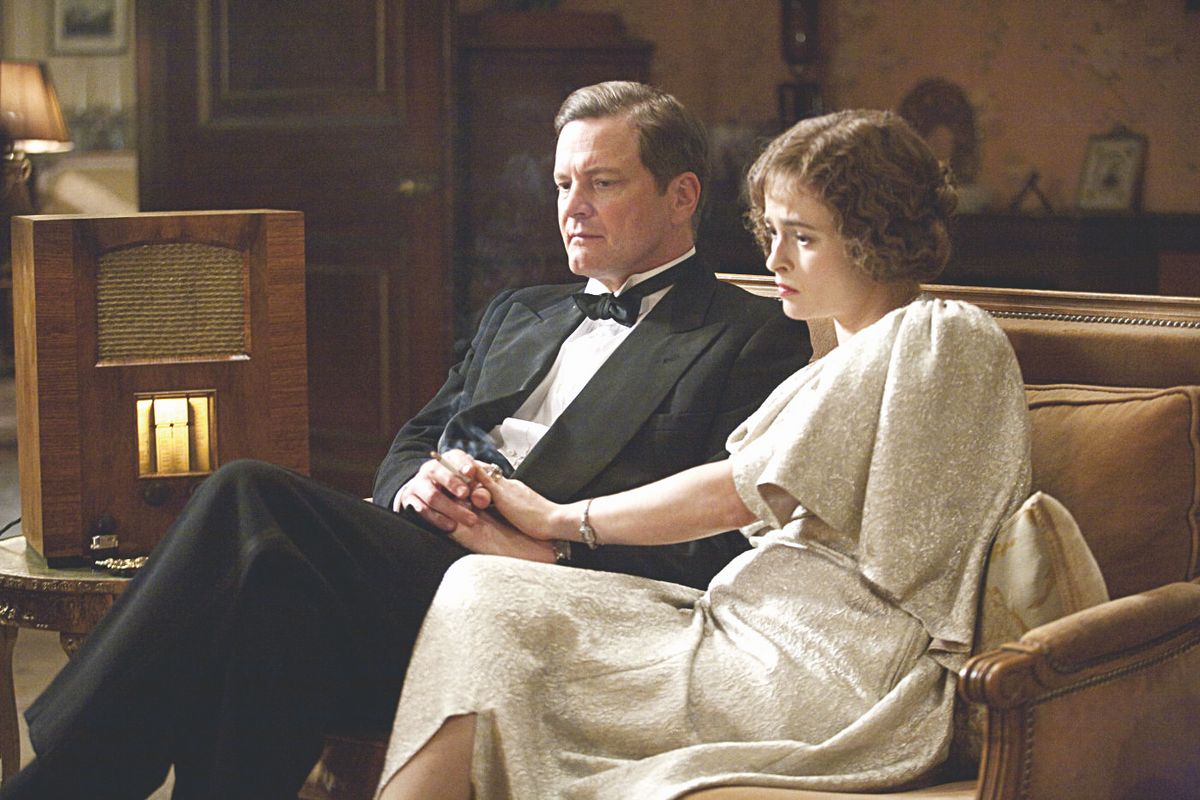
Tom Hooper’s 2010 Academy Award winning film The King’s Speech is perhaps the most famous movie about Great Britain in the 1930s apart from all the murder mysteries. Here Colin Firth stars as the stammering Bertie (King George VI) and his private struggle with public life as a member of the royal family and later as a constitutional monarch. His supportive wife Elizabeth (the future Queen Mother) is played by Helena Bonham Carter. Is it 100% accurate? No, since you have Winston Churchill supporting Edward VIII’s abdication when he actually opposed it in reality but no one wants to see that. Still, this is a very good film about what it’s like to be a monarch in the modern world.

Great Britain is particularly memorable in the 1930s mainly due to the fact that many an Agatha Christie murder mystery tends to be set at this time. Even if the work isn’t set in the 1930s originally, it somehow becomes the default template. Still, in movies, 1930s Great Britain is one of the more ideal times for having a good murder mystery at someone’s country estate. But 1930s Great Britain isn’t just a period filled with murder and mayhem since it’s also the the time when you have Fascist leader Oswald Moseley who was the inspiration for Roderick Spode in P. G. Wodehouse’s Jeeves and Wooster series.There were also plenty of rich Brits who also had some sympathy for the totalitarian type like Miss Jean Brodie, most of the Mitford family, and others. Yet, there are two great events in the 1930s that are particularly memorable to Britain in this decade. First, there’s the abdication of Edward VIII who is said to give up the throne for a twice divorced American which leads to the ascension of his stammering younger brother. Second, there’s World War II. Nevertheless, movies don’t tend to get all the facts right and I shall list the inaccuracies for you.

Winston Churchill:

Winston Churchill dined with Josef Stalin in 1939. (No, he didn’t until 1942 when Great Britain and the USSR were allies in World War II.)

Winston Churchill supported George VI’s ascent to the throne. (He actually one of Edward VIII’s fiercest supporters during the abdication crisis and advised him: “Retire to Windsor Castle! Summon the Beefeaters! Raise the drawbridge! Close the gates! And dare Baldwin to drag you out!” He even rewrote some of Edward VIII’s abdication speech. George VI wasn’t exactly fond of Winston Churchill being appointed prime minister during World War II. However, they weren’t friends until they had to confide in each other on the war and the governance of Britain. Still, you have to have Churchill supporting Bertie in The King’s Speech because Edward VIII was a Nazi supporting dickhead. I mean Churchill might’ve thought appeasement was a bad idea but he wasn’t endowed with 20/20 hindsight to see that George VI would’ve made a better king than his older brother, especially in what was to come. Nevertheless, Churchill’s mistake over Edward VIII’s abdication was one of the reasons Britain ignored his warnings about appeasement in the first place.)

Winston Churchill was fat at this time. (He wouldn’t be overweight until later in his life yet, he’s seen as chunky in most portrayals of him during the 1930s and WWII.)

King George V:

King George V preferred his son Bertie (George VI) on the throne over his brother David (Edward VIII). (Actually by the time he died he not only preferred Bertie but also his 9 year old daughter Elizabeth over Edward on the throne. He most famously said, “I pray to God that my eldest son [Edward] will never marry and have children, and that nothing will come between Bertie and Lilibet and the throne.”)

Queen Mary of Teck:

Queen Mary of Teck had a guttural German accent. (Recordings reveal she didn’t. Also, she was born and raised in Britain, which is why Queen Victoria thought she’d make a suitable bride for her grandson. Yet, this grandson was actually George V’s brother Albert Victor who died so George married her instead.)

Queen Mary of Teck was a cold and heartless mother. (Actually she wasn’t but she did keep a stiff upper lip. Also, she was a kleptomaniac and fanatic jewelry collector.)

King Edward VIII:

Edward VIII was pressured to give up the throne for love. (Actually, he abdicated because of his Nazi sympathies. Wallis Simpson was just an excuse.)

Edward VIII’s trip on a Mediterranean cruise with Wallis Simpson was exposed to the British press as a “Royal Scandal!” (Actually the British papers famously covered it up thanks to the king’s friend Lord Beaverbrook who convinced all his fellow newspapermen to agree to complete discretion. All that was printed out on that paparazzi moment from Britain was a passenger list with Wallis’ name on it. British censors even snipped out even more lurid reports out of foreign newspapers at customs.  Most people in Great Britain didn’t have any idea about Edward VIII’s affair with Wallis Simpson until December of 1936.)

Most of the allegations about Edward VIII and Wallis Simpson having sympathies for the Nazis was just based on rumors. (Except that it’s not for there’s plenty of evidence. According the Guardian’s column on reel history has this snippet, “a 1933 report by the Austrian ambassador that Edward said to him: “I hope and believe we will never fight another war but if we do, we must be on the winning side and that will be Germany, not the French”. A public speech to the British Legion in 1935 in which he advised his audience to “stretch forth the hand of friendship to the Germans”. A 1936 letter from the German ambassador to Adolf Hitler saying “King Edward, quite generally, feels warm sympathy for Germany”. British Foreign Office papers suggesting that a Nazi plot to put Edward back on the throne when they invaded Britain was cooked up with Wallis’s involvement. Wallis’s notoriously dazzling smile on meeting Adolf Hitler in Germany in 1937. Edward’s frequent Nazi salutes during that trip, and cheerful fraternisation with the likes of Josef Goebbels, Hermann Goering and Rudolf Hess. Edward’s own admission in an article he wrote for the New York Daily News in 1966 that “along with too many other well-meaning people, I let my admiration for the good side of the German character dim what was being done to it by the bad”.” As his cousin Prince Ferdinand of Prussia said that Edward, “was quite pro-Hitler, said it was no business of ours to interfere in Germany’s internal affairs either re Jews or anything else, and added that the dictators were very popular these days and we might want one in England before long.” Let’s just say that having an affair with a twice divorced 40 year old American wasn’t the most scandalous thing about King Edward VIII despite it causing a constitutional crisis. It’s more likely he gave up the throne due to overwhelming evidence that he had vocal Nazi sympathies, which the Duke of Windsor {Edward VIII} would air in public until at least the 1960s. Still, even after his abdication, the British Government would send the former king to govern the Bahamas since his willingness to enter an alliance with Germany was seen as a threat.)

Edward VIII was called “Edward” by his family. (His family and friends called him, “David.”)

Edward VIII was a brooding hunk who gave up the throne because he couldn’t be the best king without the help and support of the woman he loved. (Edward VIII was pathologically hated by quite a number of people largely due to his being by all accounts, both selfish and an absolute jerk. Also, his abdication wasn’t a big sacrifice to him since he didn’t want to be king in the first place. After all, he didn’t want opening Parliament and christening ships get in the way of his jetting around the world to party and leave his stammering little brother do all the king stuff {which he dreaded and never got used to}. His relationship with Wallis was not what you’d call a great love story and more of what you’d see on a sleazy reality show on TLC. He’s said to be a whiny and needy husband while Wallis was kind of a nagging shrew though at best it would’ve been a relationship you’d call, shall we say dysfunctional. According to the Guardian: “One close friend, Mrs. Humphrey Butler, recalled a scene at a dinner party when the then Prince of Wales asked Wallis for a light. “Have you done your duty?” Wallis asked. “Little man gets on his haunches, puts up his hands and begs like a dog,” remembered Mrs. Butler. “She then lights his cigarette. Horrible to see.”” Not to mention, Wallis didn’t really want Edward to abdicate or marry him but she was sick of him by then. She may have given in if there was a crown involved, but she knew she was trapped by the time of Edward VIII’s abdication. They may have stayed together until Edward’s death but their married life consisted of the couple indulging in their hobbies of throwing house parties where they screamed at each other in front of guests, having affairs, and talking about how great Hitler even well into the 1960s. Seriously, Madonna, why make a movie about this romance which really wasn’t that great?)

Edward VIII wanted children. (If he wanted kids, he wouldn’t have married Wallis Simpson who was like 40 by their wedding. To suggest that he wanted to have children is untrue.)

Edward VIII was drunk during the abdication crisis. (He was actually sober throughout the whole ordeal for which his friend Stanley Baldwin gave him credit for. Still, abdicating the throne for his brother was probably the best thing he ever did and Britain was so much better off because of it.)

Edward VIII was the first British monarch to abdicate. (Richard II, Lady Jane Grey, and James II gave up the throne in their lifetimes, though they probably didn’t have much of a choice. Edward VIII was the first British monarch to do it without having someone trying to overthrow him.)

Edward VIII put Benzedrine into champagne at a cocktail party. (Actually his friend MP Chips Channon did this.)

King George VI:

George VI started working with his speech therapist Lionel Logue a few years before the abdication crisis. (He had actually been working together before his daughters were born back in the 1926 and they both hit it off immediately. Still, George VI’s relationship with Logue in The King’s Speech was long considered vastly overstated though recently discovered letters from the future Queen Mother to Logue and Logue’s diaries tell a different story. Also, as early as 1927, he was seen as a decent orator thanks to Logue’s help that he managed to give a speech opening the Australian Parliament almost free from error. By 1934, he had rarely visited Logue since his speech had improved but he turned to his therapist again after his brother’s abdication.)

To help his stuttering, George VI used to have his mouth stuffed with marbles. (That’s straight out of My Fair Lady {but a rather common treatment since the time of Demosthenes} though Charles I used to correct his speech by stuffing his mouth full of pebbles and talking to himself. I guess neither did the trick saving his head. Also, George VI’s stammering manifested itself when he was 8 not 4 and it was relatively mild compared to what’s portrayed in The King’s Speech. Still, this doesn’t mean it was less of a problem to him because it certainly was.)

George VI was against Neville Chamberlain’s appeasement policy. (It may be heavily implied in The King’s Speech but Bertie actually supported Neville Chamberlain’s policy and endorsed it by breaching protocol before the sitting of the House of Commons. Still, though it may not have been a good move, most people in Britain supported it at the time, which would make sense since the country was still recovering from the devastation of World War I. Edward VIII supported appeasement as well but for very different reasons.)

King George VI was crowned in Westminster Abbey during Lent. (Lent is usually around February to April depending on the year. George VI was crowned in May, which would mean that the Altar frontal at Westminster Abbey would’ve been white not purple as it is in The King’s Speech. Still, that coronation scene was probably filmed at the time and it’s not easy to change the vestments.)

King George VI retained a presence of dignity during his ascension to the throne. (He actually spent an hour sobbing in his mother’s presence because he really didn’t want to be king. Still, Bertie never got used to the gig.)

King George VI and Queen consort Elizabeth were greeted by the Roosevelts during their arrival at Hyde Park in June of 1939. (Actually the royal couple had accompanied FDR and Eleanor to Hyde Park several after days in Washington D. C. They arrived to the place with the Roosevelts.)

King George VI and his wife didn’t know how an elevator door worked. (Actually, Bertie served in the navy during World War I and had mastered far more complex machinery than an elevator door. Also, Elizabeth Bowes-Lyon wasn’t born royal.)

Bertie chose his regal name George VI because his given name Albert seemed too German. (He actually chose George as his regal name out of respect for his father.)

Queen Elizabeth Bowes-Lyon (a. k. a. the future Queen Mother):

Elizabeth Bowes-Lyon believed that Edward VIII was destined for greatness. (She actually believed the opposite based on what she was writing and saying at the time. Also, it was her popularity that won her husband’s favor to the throne.)

Queen consort Elizabeth wore her Balmoral hats in the 1930s. (She didn’t start wearing them until World War II.)

Lionel Logue:

Lionel Logue always referred George VI as “Bertie.” (Yes, they were friends but Logue never called George VI by his nickname or swore in his presence, as an exercise in proper decorum.)

Myrtle Logue had no idea that her husband was treating George VI until she saw Queen consort Elizabeth help herself some tea in her parlor. (She knew all about her husband’s most famous patient by George VI’s ascension. She and her husband were even presented at court to Bertie’s parents in a show of gratitude for Lionel’s work. Myrtle even wrote about the experience in an Australian newspaper. Still, you need a scene like that in The King’s Speech.)

Stanley Baldwin:

Prime Minister Stanley Baldwin resigned over misjudging Hitler. (Actually this wasn’t the case. He resigned because he just wanted to retire after 15 years as Conservative Party leader. Also, in 1937, Hitler hadn’t even begun his invasion and treaty breaking yet.)

Stanley Baldwin invited Edward VIII and Wallis Simpson to a dinner party at his house before the abdication crisis. (Actually Baldwin only met Wallis Simpson once in May of 1936 at a dinner party hosted by Edward VIII but didn’t realize her significance until months afterward.)

Neville Chamberlain:

Neville Chamberlain was an idiot and a stupid coward for appeasing Hitler and hijacking his own country at the Munich Accord prior to World War II. (As much as movies would rip on Chamberlain for letting Hitler take Austria and Czechoslovakia, more recent historians have said that he knew full well what he was getting into before the negotiations took place. For one, he was already quietly preparing his nation for war so he didn’t expect the peace to hold but didn’t think his country was ready to take on Hitler yet. Many say that Chamberlain made peace with Hitler just to stall for time. He also promised to defend Poland’s independence if it were attacked, which made Britain one of the first nations to enter the war. Second, Britain lost about a million lives in the last war with Germany so any option short of war would have looked good if the alternative was going through that again. Third, there were many British conservatives who were at least passively pro-Nazi who at least viewed Hitler as preferable to the USSR if not outright admirable, even in Chamberlain’s own party and among the royal family like King Edward VIII. Not to mention, despite the later historical notoriety, Chamberlain’s actions were popular among the British at the time and somehow made better sense if you know the context since appeasement just seemed as the only politically acceptable option back in the 1930s. Fourth, Chamberlain knew that the British and the French wouldn’t support war if he had been seen to reject diplomacy. Chamberlain’s action may have looked like a stupid decision but he had thought the whole thing through.)

Archbishop of Canterbury Cosmo Lang:

Bishop Cosmo Lang breathlessly revealed to King George VI that Lionel Logue wasn’t a doctor. (Everyone already knew that by the time George VI became king. Also, Bertie always referred to his speech therapist either as “Logue” or “Mr. Logue.”)

Wallis Simpson:

Wallis Simpson’s second marriage was filled with domestic abuse. (Sorry, Madonna, but I could find no evidence that Wallis Simpson’s second marriage was an abusive relationship since they remained friends after they divorced. Still, Ernest Simpson did cheat on her childhood friend whom he later married.)

R. J. Mitchell:

R. J. Mitchell worked himself to death on the creation of the Spitfire. (He did work despite the pain of his illness tweaking and perfecting his design up until his death. However, designer Joseph Smith had already taken over the primary design work by the time of the first flight of the Spitfire prototype.)

R. J. Mitchell suffered from tuberculosis during the 1930s while working on the Spitfire. (It’s implied in his Leslie Howard portrayal in the 1942 First of the Few, but his real illness was rectal cancer. He had a colostomy in 1933.)

R. J. Mitchell’s meeting with Willy Messerschmitt during his visit in Germany during the late 1930s convinced him to design the Spitfire. (Mitchell had never visited Germany or met Willy Messerschmitt. Also, he had been already working on the Spitfire since 1931.)

R. J. Mitchell died as the first Spitfire prototype took to the skies. (He actually lived over 15 months after the first flight which was in 1936. Oh, and he actually saw his creation take to the skies. Mitchell would die in 1937.)

Douglas Bader:

In 1930, Douglas Bader attempted doing low-level aerobatics when he was goaded into a disparaging remark to do just that. (He actually attempted to do this on a dare. But like in Reach for the Sky, he ended up crashing which resulted in having both of his legs amputated.)

Miscellaneous:

People at rich estates were especially prone to getting murdered at social gatherings during this time. (A lot of murder mysteries tend to take place in 1930s Great Britain, don’t ask. Not to mention, 1930s Great Britain is a typical setting for most movies based on Agatha Christie novels.)

Dora Carrington successfully committed suicide shortly after Lytton Strachey died in 1932. (She did shoot herself but she did it 2 months after Strachey’s death. She died half a day later after being found by a gardener.)

Princesses Elizabeth and Margaret were always called by their respective names when they were home with their parents. (They were always called by “Lilibet” and “Margo” respectively when they were at home with their parents. Still, Princesses Elizabeth and Margaret were undeniably 13 and 9 respectively in 1939, they don’t seem to age a day over the course of The King’s Speech. Guess Hooper didn’t want to hire more child actresses in order to save money.)

Winston Churchill, Bishop Cosmo Lang, and Neville Chamberlain turned up to Buckingham Palace to witness King George VI’s war broadcast in September of 1939. (They had better things to do. Also, a large crowd didn’t gather outside Buckingham Palace that day to congratulate George VI on overcoming his stammer.)

History of the World According to the Movies: Part 47 – The Victorian Era

Image

Emily Blunt stars in 2009’s The Young Victoria which is known for it’s costume design yet it did take a few liberties with the truth though it shows a Queen Victoria we rarely get to see. Still, in movies, we’re used to seeing Queen Victoria as an old queen wearing black but we forget that she ascended the British throne at just 18 and didn’t start wearing black until the death of her husband Prince Albert in 1861. Not to mention, white wasn’t considered a traditional wedding color until Queen Victoria wore it at her nuptials as shown here. Still, while the Victorian Era was know for traditionalism, it also started a lot of traditions we come to know today.

Though remembered as an era of stale and frumpy traditionalism, the Victorian Era was a time of tumultuous social, cultural, and technological change in Great Britain. Victorian Britain is said to be the birthplace of the modern middle class as well as for the rapid and jarring transformation to a highly industrialized nation, the massive Expansion of the British Empire, and the high emphasis on morality and propriety that only barely masked a dark and seedy underbelly of society. However, it was also a time of many of your familiar authors like Charles Dickens, Rudyard Kipling, the Bronte sisters, the Brownings, Lewis Carroll, Robert Louis Stevenson, Oscar Wilde, Bram Stoker, and Arthur Conan Doyle. Not to mention, it was time when the English speaking world started celebrating Christmas as a major holiday with Christmas trees, Christmas cards, Christmas caroling, Christmas lights, and Christmas dinner all introduced by Queen Victoria’s beloved German husband Prince Albert. Still, no discussion of the Victorian Era would be complete without talking about Queen Victoria herself, who reigned for sixty-four years, longer than any British monarch before or since (so far). Nevertheless, there are a lot of movies set in this era since most of these authors listed above had at least one book made into one. Not to mention, Victorian Britain tends to be a common setting for period pieces though you can always tell how far along since Victorian fashions changed quite a bit as time went on. Still, as far as movies go, there quite a bit of historical inaccuracies which I shall list.

Queen Victoria:

William Lamb, 2nd Viscount Melbourne and Queen Victoria were of similar age. (He was about 40 years her senior and was the closest thing she had to a dad {her biological father Prince Edward, Duke of Kent died when she was a baby. However, he did take great pride in her, said she was going to be Queen, and brought her to a military review to the shock of his brother the future King George IV}. Interestingly, Lord Melbourne was married to the infamous Caroline Lamb known for her short affair with Lord Byron and conducted a vicious tirade of revenge against him after he dumped her, that lasted longer than the original affair as well as played a major part in ruining Byron’s reputation in England with accusations of crimes up to and including murder. Yep, Queen Victoria’s father figure was married to Lord Byron’s psycho ex.)

Queen Victoria had a crush on Lord Melbourne. (No, she didn’t have any romantic feelings toward him at all because he was her father figure nearly 40 years older than her. Their relationship was more likely paternal than romantic.)

Queen Victoria had a loving relationship with Prince Albert. (Yes, but she was rather conflicted with Albert taking over more and more of her work when her pregnancies forced her to step aside. She really appreciated him for picking up the slack but she didn’t like being robbed of her powers as queen. She was also prone to temper tantrums and hated being pregnant and breastfeeding. Not to mention, neither Albert nor Victoria were loving parents to Bertie {future Edward VII who was actually a decent and charming king but he had many affairs}. Then there’s the fact that Prince Albert wasn’t very popular in Britain until the Great Exhibition of 1851 and that he helped popularize Christmas. Nevertheless, it’s said the Victoria actually married Albert as soon as she could in order to move out of her self-centered mother’s house {even as Queen she had to live with her mom, whom she had a difficult relationship with}. Victoria and Albert’s relationship wasn’t easy but they loved each other.)

Queen Victoria was a prudish old woman with no sense of humor. (She wasn’t always an old woman as seen in The Young Victoria. Also, she never said, “We are not amused” and actually did have a sense of humor an there’s a picture of her smiling {she was even a fan of Alice in Wonderland}. It’s also said by her staff she, “was immensely amused and roared with laughter” on many occasions. Still, she and Albert managed to have nine children so make that what you will. Also, she liked to draw and collect male nude figure drawings and at least gave one to her husband as a gift.)

Queen Victoria sent a portrait to Albert with her in a white dress with a tiara and a vertical bun while they were dating. (This portrait was done two years after they were married. Furthermore, the tiara and hair style were suggested by Albert himself.)

Victoria and Albert reigned. (Except that Albert was a prince consort and had no official standing.)

Queen Victoria was British. (She was born in Britain but to a German father and a half-German mother. She even spoke German with her husband. Also, Victoria wasn’t a British name until she came to the throne. Still, she did speak English in a British accent like you’d expect.)

Queen Victoria lived to be over 85. (She died at 81 in 1901.)

Queen Victoria was right handed. (She was left handed but a lot of movies get this wrong.)

Queen Victoria was interested in Albert due to the guy’s successful wooing. (It was more on her willingness to please her uncle Leopold. Luckily he didn’t want her to marry his own son who was crazy though Victoria did comment on the younger Leopold’s industriousness after she sent him a toy steam engine {little she know that her cousin Leopold II would become one of history’s greatest villains due to the atrocities he was responsible for in the Congo Free State inspiring Joseph Conrad’s Heart of Darkness}.)

Prince Albert was present at Queen Victoria’s coronation. (Sorry, Julian Fellowes, but Prince Albert wasn’t at his future wife’s coronation ceremony. They were dating at the time though and wrote letters to each other. Also, his family wasn’t invited.)

It was love at first sight for Queen Victoria and Prince Albert. (She was repelled of him during their first meeting in 1836 since he had a tendency to be fat at the time. Still, he did lose the weight and developed a fine waist which Victoria admired so much that she married him. As for Albert, he was actually quite ambivalent about coming to Britain and marrying Victoria {unexpectedly} and wasn’t the lovesick puppy as depicted in The Young Victoria. Actually his love for her developed more or less after their marriage than before.)

Prince Albert was willing to take a bullet for Queen Victoria. (He was never forced to do such thing and was never harmed in any of her assassination attempts.)

Sir John Conroy was at court when Queen Victoria was crowned. (She had expelled Conroy from court as soon as she became queen. However, sure he was a piece of shit but he wasn’t quite the bastard depicted in The Young Victoria.)

Queen Victoria and Prince Albert were first cousins. (Well, they were supposed to be first cousins since Queen Victoria’s mother and Prince Albert’s {official} father were siblings. However, according to German historians Prince Albert was said to have resembled his mother’s boyfriend, Alexander von Hanstein who wasn’t related to any of the German royal families so it’s up for debate who his biological father really was. Nevertheless, their marriage didn’t have much to do with Victoria’s descendents having hemophilia since she became a carrier due to having a father who was in his fifties at the time she was born.)

Queen Victoria’s relationship to her servant John Brown fed a wave of republicanism to the nation at large. (Yes, Republicanism was on the rise in Great Britain but she wasn’t the sole cause. Yet, it had its roots in the Chartist movement, was stoked by a financial crisis in 1866, and the naming of the Prince of Wales in a divorce case was also a factor.)

Benjamin Disraeli shamed Queen Victoria on her relationship with her servant John Brown after the man’s death. (She was never shamed out of her admiration for Brown. She also developed an attachment to her Hindustani teacher Abdul Karim. Still, Mrs. Brown probably plays down the romance with John Brown which is probably more or less right.)

Queen Victoria ordered a Mass of Thanksgiving at St. George’s Chapel when her oldest son recovered from typhoid. (She was a devout low-church Anglican/Presbyterian in England and Scotland and would never have ordered a Mass. She actually ordered a Church of England service at St. Paul’s Cathedral to celebrate her son Edward’s recovery.)

Prince Albert and her cousin George were the only suitors Queen Victoria had to deal with. (Actually she had other suitors including Albert’s brother Edward.)

Benjamin Disraeli:

Benjamin Disraeli spoke from notes in his speeches in Parliament. (Disraeli made a point in delivering all his speeches from memory even if they were several hours long or involved complicated statistics. He also warned younger politicians against using notes as a crutch.)

Benjamin Disraeli was British Prime Minister in 1866. (He didn’t serve his first term as prime minister until 1868.)

Benjamin Disraeli was prime minister during the “Disestablishment of the Irish Church” question which was in 1867. (Disraeli didn’t start his first term as prime minister until 1868. The “Disestablishment of the Irish Church” question wasn’t raised in 1867 or under his first term either. Rather it was raised in 1869 under the prime minister ship of William Gladstone, his rival.)

Benjamin Disraeli wasn’t Jewish. (He was and his whole life was a history of struggling to overcome Anti-Semitism to be accepted in mainstream British society. Interestingly, he got his start as a romance novelist so he could get into politics but continued his writing even after he got his wish. However, though Jewish, he wasn’t a practicing Jew.)

Lord Melbourne took an active interest in Benjamin Disraeli. (Lord Melbourne was dubious about Disraeli’s future as anyone else was.)

Benjamin Disraeli knew Queen Victoria personally during her coronation. (She didn’t know much about him at the time apart from him writing some novels. Actually, she didn’t really become acquainted with him until after Prince Albert had died.)

Sir Henry Ponsonby:

Sir Henry Ponsonby was Queen Victoria’s private secretary before 1866. (He didn’t serve until after the death of his predecessor Sir Charles Grey in 1870.)

Ripper Murders:

Jack the Ripper was the most notorious serial killer of all time. (The only thing that was notorious about him was that he was never caught mostly because 19th century police investigation was very, very faulty and unreliable. Still, he only killed 5 people when many identified serial killers have killed more than that even Victorian Britain.)

Jack the Ripper murdered attractive young women. (Four of his victims were in their mid-forties and only one of them was said to be young and good looking.)

Frederick Abberline was a young man as well as psychic and an opium addict who died soon after the Ripper murders. (He was a middle-aged man in 1888 with no known opium addiction nor claim on psychic abilities. Not to mention, he would investigate other cases after Jack the Ripper. Also, he died in 1929 in his 80s at his Bournemouth villa. Yet, in a movie called From Hell, he’s played by Johnny Depp.)

All of Jack the Ripper’s victims were friends. (Well, they were professional colleagues in the oldest profession. However, there’s no evidence to support this.)

Prince Albert Victor, the Duke of Clarence was Jack the Ripper. (He’s been a candidate for Jack the Ripper but there are plenty of reasons to doubt he was. First, there’s no basis in him ever being involved with East End prostitutes, let alone siring a child by one. Second, there were rumors he was gay and he didn’t seem to show much interest in women {save maybe a couple}. Third, though it’s rumored he may have had syphilis, royal records state that he died from a bout of influenza in the pandemic of 1889-1892. Fourth, at the time of two of the Ripper murders, he was in Scotland in the presence of Queen Victoria and other family members, visiting German royalty, and a large number of staff. Furthermore, there are plenty of records that state he couldn’t have been near any of the Ripper murders at all. Fifth, he was a high profile member of the royal family as well as considered second in line to the throne, a position that would give him a lot of attention from the media of the time. So to think that Prince Albert Victor was Jack the Ripper is very much of a stretch since there’s overwhelming evidence he wasn’t.)

Jack the Ripper was dressed in a top hat and a cape as well as carried a “Gladstone bag.” (Witnesses say that he actually wore common clothes indicative of lower-middle class status {making it another reason why Prince Albert Victor couldn’t have been Jack the Ripper}. Also, while there has been a sighting of a man with a “Gladstone bag” he was later proven not to be involved in the murders. Not to mention, most true sightings of the killer showed nothing but his hands yet one may have contained a parcel of paper that may have concealed the knife.)

Jack the Ripper didn’t kill alone and didn’t kill his victims where they were found. (With one possible exception, there’s no evidence more than one person was involved in the murders or that his victims were killed anywhere other than where they were found.)

Jack the Ripper used a carriage as a mode of transportation. (For one, there’s little evidence that he had since they were loud on cobble-stoned streets and witnesses certainly would’ve noticed it. Second, he’s said to be a lower middle class guy.)

Jack the Ripper knew his victims. (He may have talked to them but there’s no evidence he knew them personally.)

Frederick Abberline was acquainted with Mary Kelly before her murder. (He didn’t know of her existence until her corpse turned up.)

The Ripper letters came from Jack the Ripper himself. (Hundreds of Ripper letters were written but historians believed few actually came from the killer himself, if at all.)

Sir William Gull was Jack the Ripper. (There’s no evidence he was. Also, though he was the royal physician, he was in his seventies during the Ripper murders and had recently suffered a stroke.)

Charles Darwin:

Charles Darwin abandoned Christianity after his voyage of the H.M.S. Beagle that led him to develop his theory of evolution. (To be fair, Charles Darwin did lose his faith but that didn’t happen until decades after his Beagle voyage and It’s pretty clear that his scientific findings had nothing to do with it. In fact, he considered his work to be proof of God’s existence as well as wrote extensively and approvingly about the religious implications {despite knowing how controversial the work would be}. The reason why Darwin lost his faith is highly debatable, one possible explanation could be the tragic and prolonged death of his daughter. Also, as a side note, there were many amateur scientists in the 19th century who were also clergymen.)

Charles Darwin was the first man to propose the theory of evolution. (Darwin was just the first guy who explained the process of evolution which could be observed and tested. The idea of evolution isn’t an new idea but has been around for a very long time, even during the Middle Ages {Saint Thomas Aquinas may have wrote something suggesting it}. Also, there were other theories of evolution out there before Darwin came along.)

Charles Darwin formulated his theory of evolution by studying finches in the Galapagos during his Beagle voyage. (He wasn’t just studying finches there but other animals of which many that tend to exist in areas they didn’t seem to fit and others that would’ve been well suited but didn’t exist.)

Charles Darwin proclaimed that humans descended from monkeys and apes. (Actually he said that humans are related to monkeys and apes as well as evolved from a common primate ancestor. He didn’t say that humans evolved from them. To add further note, Darwin was not a fan of eugenics nor believed in Social Darwinism.)

Edward VII:

King Edward VII was addressed as “Edward” while Prince of Wales. (He was actually called Albert Edward, and prior to his ascension was known as Prince Albert {after whom, by the way, the brand of pipe tobacco was named a source of Prince Albert in a can jokes. Yes, he’s that Prince Albert, not his dad}. Also, his family and close friends called him, “Bertie.” This is kind of confusing but true.)

Kaiser Wilhem II was Edward VII’s cousin. (The Kaiser was his nephew as well as Queen Victoria’s grandson.)

Oscar Wilde:

Oscar Wilde didn’t have a homosexual encounter until after he was married with kids. (A recent biographer said he had a relationship with Frank Miles in 1876 but his sex life after his marriage is much better known.)

Oscar Wilde met Lord Alfred Douglas at the premiere of Lady Windemere’s Fan in 1892. (He’s said to have met Douglas through another of Wilde’s young men at his residence on Tite Street in 1891.)

Winston Churchill:

Winston Churchill’s parents were doting and supportive of him. (Actually, with few exceptions, the portrayals of Winston Churchill’s parents in Young Winston are false and compared to them, they make any reality show parent look like a Mother or Father of the Year. His parents basically neglected him and his brother and he was one of the only kids in school not to go home for Christmas and basically spent his summers in France which was a way for his parents to get rid of him. His dad had no idea of what was going on with his kids’ lives nor he care to. He didn’t know the school he sent Winston to or how old he was. And Jennie as pretty as she was, was also selfish, shallow, and thrill-seeking type who didn’t much care for kids. She was also said to have slept with nineteen men including King Edward VII. And Winston was well aware of that and even knew one who was kinder to him than his own father. Perhaps the best things about Winston Churchill’s childhood were that he was from a wealthy family and grew up during Victorian times. If he had been growing up these days, the future prime minister’s family would’ve been featured in a reality show.)

Winston Churchill was a dutiful and obedient child at school. (He was actually known for constant misbehavior and occasional acts of unprovoked violence. Of course, it was to be expected since he had very shitty parents.)

Jennie Churchill was an angel in the house and a model of sexual propriety who didn’t understand when her husband’s doctors explained his syphilis illness. (Churchill’s mother had a reputation as a slut and after Randolph died, she married a man about the same age as Winston. When it went wrong with him, she married an even younger man after that. Still, to say she was a model of Victorian womanhood is a joke. Amazing embarrassing mother? Absolutely. By the way, Winston Churchill was listed as being born 2 months premature on his birth certificate though we’re probably sure it may have more to do with being born less than eight months after his parents were married.)

The Bronte Sisters:

Both Emily and Charlotte Bronte were in love with the same man. (Contrary to Devotion, they never were.)

Elizabeth Barrett and Robert Browning:

It was love at first sight between Elizabeth Barrett and Robert Browning. (Their courtship actually began through a correspondence of letters they exchanged before they even met in person. The first one was a fan letter sent by Robert Browning fawning over how much he liked the poems Elizabeth published in 1844. So it was probably more like love before first sight to them.)

Edward Barrett expressed incestuous tendencies toward his daughters and discouraged contact with any guys. (Actually her dad discouraged marriage between any of his children whether male or female and disinherited them for this reason {Elizabeth had eight brothers and three sisters with all but one girl surviving to adulthood}. Still, there’s no evidence that he was sexually aggressive toward any family members.)

Edward Barrett had a sex addiction and regularly raped his wife. (There’s no evidence of this. Still, Edward Barrett wasn’t an abusive father or a rapist. He was just a man of his time.)

Elizabeth Barrett Browning was disabled. (She had a lot of health problems that made it painful for her to stand or walk. More or less an invalid than disabled.)

Crimean War:

The Battle of Balaklava directly resulted in the fall of Sebastopol. (It actually left the Russians in charge of an Allied supply route.)

Lord Raglan was a stiff-upper lipped commander. (He was even stiffer than his John Gielgud portrayal in The Charge of the Light Brigade. When he had his arm amputated due to being shot in the elbow with a musket ball at Waterloo, he was stoically silent without anesthesia while the surgeon sawed off his arm. The only comment he made was when he saw his arm chucked in the basket in which he said, “Hey, bring my arm back up. There’s a ring my wife gave me on the finger.” Yes, this guy was really like this in real life.)

Captain Louis Nolan had an affair with another officer’s wife as well as ordered black Moselle wine when Lord Cardigan asked for champagne. This made Cardigan furious that he had Nolan arrested. (I’m not sure that Nolan had an affair or whether that was made up. However, the wine incident did happen but with a guy named Captain John Reynolds who was in the Indian division of the British Army, not Nolan. The real Nolan did fight in the Sikh Wars but he was born in Milan and served in the 10th Hungarian Hussars before joining the British Army.)

Fanny Duberly was a featherbrained slut trying to bed Lord Cardigan. (She was actually a tough minded adventurous woman who was endlessly faithful to her husband. She should sue for slander in her depiction in The Charge of the Light Brigade.)

It was General Airey that half-garbled the order from Lord Raglan to Lord Cardigan which prompted the Charge of the Light Brigade. (Most historians blamed Captain Nolan for garbling the order, which was then misinterpreted by Lord Lucan, and the charge was carried out by Lord Cardigan. There’s actually some dispute over who was responsible for the disastrous charge though but agree that Captain Nolan was an arrogant and hotheaded young officer who kind of got what he deserved in the end.)

The Charge of the Light Brigade was a direct plan to invade the Russian camp. (It was the result of a command mix up between Lord Cardigan and Lord Raglan. Also, the Charge of the Light Brigade was a complete and utter disaster mostly because of the incompetence of the British top brass consisted of a bunch of upper class twits. Also, during the charge, whole regiments were annihilated.)

The Battle of Balaclava resulted in the fall of Sebastopol. (It didn’t.)

The Battle of Balaclava and the Charge of the Light Brigade took place in 1856. (It took place in 1854.)

The Light Brigade regiments wore cherry color breeches. (Only the 11th Hussars wore pants of that color. Officers and troops of the other four regiments wore dark blue breeches with double yellow stripes or white stripes in the case of the 17th Lancers.)

The Crimean War was a primarily British conflict. (It was primarily between Russia and the Ottoman Empire. France and Great Britain were allies on the Turkish side since they knew the Ottoman Empire was on the decline and wanted its territories. Yes, Britain and France sided with the Muslim power this time.)

Lord Raglan was an air-headed incompetent. (While he wasn’t the best general, Lord Lucan and Cardigan were probably worse than he was. Yet, his incompetence is highly debatable.)

Lords Lucan and Cardigan hated each other for no reason. (The men were brothers-in-law and didn’t like each other. However, most historians think their enmity stemmed from Lucan mistreating Cardigan’s sister. Still, after the Charge of the Light Brigade, both guys tried to viciously smear one another over it.)

The Battle of Balaclava was an important battle in the Crimean War. (Contrary to the fact that it featured one of the greatest military blunders in history that inspired a Tennyson poem, it was actually a minor skirmish compared to larger, bloodier, and more important battles like the Alma and Inkerman, let alone the protracted siege of Sevastopol {which Leo Tolstoy participated in}. Also, the Russians and Turks fought famous battles in the Caucasus and the Balkans without French and British participation, but nobody pays attention to that.)

The Charge of the Light Brigade started in India. (It started in Russia. Unlike the depiction in the 1936 film, it was never stationed in India. Still, the 1936 Charge of the Light Brigade film almost has nothing to do with the Crimean War and more or less resembles the Siege of Cawnpore.)

Florence Nightingale was the lady with the lamp who helped clean up Crimea. (Yes, but The Lady with the Lamp ignores that she was also a mathematical genius who invented the pie chart. Also, she may have been gay.)

The Elephant Man:

The Elephant Man’s name was John Merrick. (It was Joseph Merrick.)

The Elephant Man had no control over his sideshow career. (Actually Merrick chose to exhibit himself and was treated well by the sideshow establishment as well as established an equal financial partnership with his trainer Tom Norman whose speaking to him “like a dog” was actually part of an act. During 22 months, Merrick managed to save £50 of his earnings {equivalent of what a working class family earned for a year}. So he was probably not a helpless victim but a guy who used what God gave him and was savvy enough to financially benefit from it.)

The Elephant Man was taken in by the Royal London Hospital, was kidnapped by his boss, and carried off to Belgium where he was locked in a cage with baboons. (Merrick never shared any living quarters with baboons and actually went to Belgium by choice after the tide of public taste turned against freak shows in Great Britain. Not to mention, he was robbed by his Austrian business partner there. However, Merrick was only at the Royal Hospital in London after he returned to Great Britain in a state of distress.)

Miscellaneous:

Welsh children were more content to work in the coal mines than go to school. (Actually this is the other way around. Most nineteenth century children would rather go to school even though that was no day at the beach either but at least school children didn’t have to worry about losing a limb, disfigurement, having soot all over their faces, or work-place related death.)

The upper classes of Victorian England were uptight prudes. (They tended to be anything but. However they were very good at keeping up appearances. Also, Victorian era porn would make much of the smut on the internet look like something out of a children’s book. Not to mention, many Victorians also wrote erotica.)

The Duke of Sussex was as tall as Queen Victoria and sported a mustache by the time he walked her down the aisle. (He was very tall and had shaved his mustache and wore a set of mutton chops.)

Robert Burns gave a recital of “Auld Lang Syne” at Queen Victoria’s Balmoral Castle during her reign. (The poem was written in 1788 which meant that Burns was probably long dead at that point. Also, it was published as a song in 1886.)

Anne Crook had an affair with Prince Albert Victor as well as had his child. (There’s no evidence for this nor is there evidence of her knowing any of the Ripper victims or receiving a lobotomy. Also, she’s probably a fictional character.)

Lower class Londoners had Cockney accents. (Really, gov’nuh?)

Sweet lovely virginal young women of aristocratic status and downtrodden whores could die of the same disease yet suffer it in very different ways.

Contrived coincidences abounded everywhere among the characters, especially when it concerned unknown parents.

Lord Kelvin was a sniveling, conniving, backstabber willing to stop anyone out of a little more than professional jealousy. (Of course, this is how Disney depicted him in Around the World in 80 Days. However, this guy was a noteworthy scientist who discovered the first and second laws of thermodynamics, the concept of absolute zero temperature resulting in getting a scale named after him, other things noteworthy of science. Furthermore, he was knighted for working on the Transatlantic Telegraph Cable, including several inventions on this project. Still, Disney’s Kelvin rendition kind of captures the Victorian viciousness in the scientific community perfectly.)

Charlie Chaplin was a kid around 1887. (Sorry Shanghai Knights, but Chaplin was born in 1889, around the same week as Hitler no doubt.)

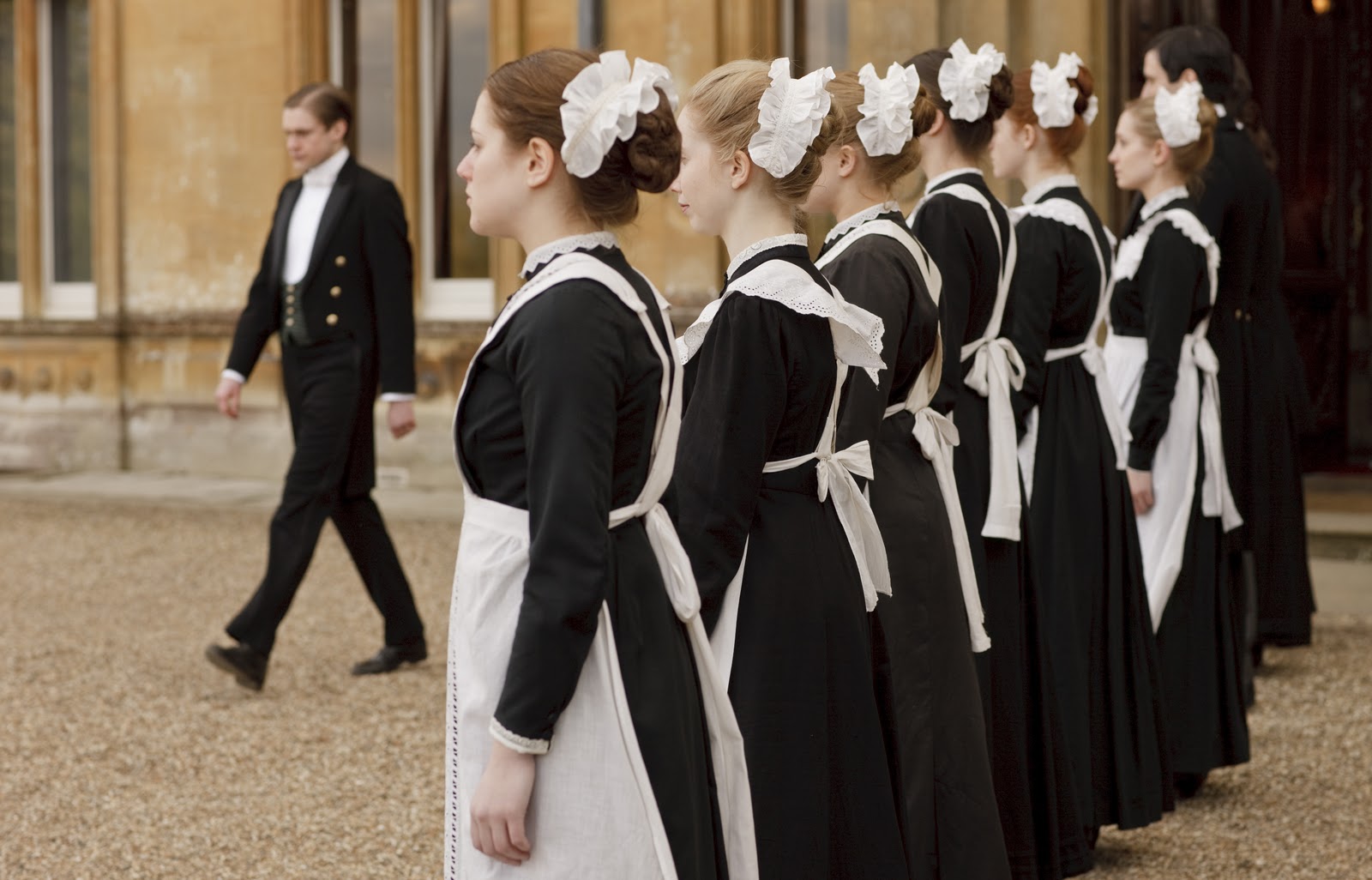
History of the World According to the Movies: Part 46 – Late Georgian Great Britain

Image

The 1941 film That Hamilton Woman starring husband and wife Sir Laurence Olivier and Vivien Leigh recounts the scandalous relationship between Admiral Horatio Nelson and Lady Emma Hamilton. Of course, this movie isn’t 100% accurate due to stuff like the Hays Code and let’s say that Lord Nelson and Lady Hamilton weren’t that hot in real life at this point in their lives. Nor did Lord Nelson ever wear an eye patch. Still, at least this romance featured two historical characters who actually loved each other in real life unlike some movies.

Great Britain’s first 37 years in the 19th century were encompassed by the Late Georgian Era. Of course, the Industrial Revolution had already kicked off by this time and its effects would later lend inspiration to many Charles Dickens novels. The lives of the upper-classes and gentry, however, would become the tableau in which many novels from Jane Austen are set, especially during the Regency when King George III went permanently insane that the future George IV had to rule as regent for nine years. Not to mention, a lot of the works of the Bronte sisters take place in this period as well though you wouldn’t know it since many movies of their works usually have women in big dresses. Still, much the movies set in this period would usually pertain to either Austen novels or the Napoleonic Wars since the British were the main adversaries of the French as well as introduced heroes like the Duke of Wellington who defeated Napoleon at Waterloo and Admiral Horatio Nelson, famous for his victory at Trafalgar, having one arm and one eye, and his scandalous relationship with Lady Emma Hamilton. This would also be an era of Romantic Era poets and writers like Lord Byron, Percy Shelley, Samuel Taylor Coleridge, William Wordsworth, and Mary Shelley as well. Not to mention, this would be the time period when Britain would give the vote to Catholics and abolish slavery. Nevertheless, there are plenty of historical errors in movies set in this time period I shall list accordingly.

Napoleonic Wars:

The Battle of Waterloo was mostly a British victory. (Wellington’s army wasn’t just made up of English, Scottish, or Irish soldiers as seen in Waterloo, but also the contingents from various German states and the Kingdom of the United Netherlands {Dutch and Belgian} that consisted of 2/3 of his army. It was an international effort.)

General Ponsonby died in the same way as his father during the Napoleonic wars. (His dad was a politician who died peacefully in 1806. Ponsonby himself, according to French accounts surrendered to a French sergeant of lancers who later killed him when a group of British cavalrymen attempted to rescue him {and Ponsonby was getting ready to bolt without handing his sword or dismounting}.)

Royal Marines had child drummers during the Napoleonic Wars. (Their drummers were adults.)

Royal Navy vessels always had one man at the wheel during the Napoleonic Wars whether in battle or during a storm. (There could be as many as four or more guys on the wheel in either situation.)

ADC Lord Hay was killed at Waterloo. (He actually was killed at Quatre Bas.)

The HMS Agamemnon was a 3 decked battleship on the line. (It had 2 gun decks.)

The Santisma Trinidad burned and sank during the Battle of Trafalgar while several ships exploded. (It was captured and taken by the British as a prize after the battle. But it was lost in a storm. Also, during the Battle of Trafalgar, there only one ship that blew up, which was a French gunner called the Achilles.)

The Burke and Hare Murders:

William Burke and William Hare were childless. (Contrary to Burke & Hare, Burke had left a wife and two children in Northern Ireland. We’re not sure whether he deserted them or that his wife simply refused to join him in Scotland. Hare and his wife had a baby with whooping cough during the trial proceedings who was said to be used “as an instrument for delaying or evading whatever question it was inconvenient for her to answer.” Hare’s wife also had another kid to her first marriage.)

William Burke’s girlfriend was an actress named Ginny Hawkins he met during the murders. (Her name was Helen McDougal and they had been living together for 10 years they were assumed to be married. In fact, they had been living at the Hares’ lodging house since they arrived in Edinburgh in 1827. And Burke was well-acquainted with Hare’s wife whom he met on previous trips to the city. As for Hare’s wife, her name was Margaret Laird who did run a lodging house. But she had inherited it from her previous husband after he died. And in 1828, she had one child and was pregnant for some time during the murders. Nevertheless, Ginny Hawkins was loosely based on a real actress named Eva Le Gallienne who played the role of Hamlet.)

William Burke got involved in the murders to raise money for his girlfriend’s play. (This was a ploy for Burke & Hare to make Burke seem like a more sympathetic character. If there’s any motive it might’ve been the possibility that he was sending money to his wife and kids back home. Or that he worked in a variety of trades that either didn’t suit him or didn’t pay well. Or that selling dead bodies to Robert Knox was an easy way to make money. As for Hare, he had a pregnant wife and a stepchild to support and most of his wife’s tenants consisted of beggars and vagrants. And she ran her lodging house at a loss with her charges owing money.)

William Burke’s girlfriend knew nothing about the murders. (While there’s no direct evidence she was, Helen McDougal is widely assumed to be. However, we do know that she had seen many of their victims while they were alive and she had the clothing of one of them in her possession {though to be fair, Burke often passed victims’ clothes to others while Hare disposed them in the Union Canal}. Oh, and they killed her cousin. And that she tried to bribe a couple into keeping quiet about a dead body under a bed. But Burke claimed that she knew nothing and believed he and Hare were grave robbers. Then again, he might’ve been just trying to clear her name. Nevertheless, how much McDougal may have known of the murders and whether she was involved will never be known. Nevertheless, she got off on “not proven.”)

William Hare’s wife knew about the murders and was perfectly fine with them. (Yes, but that wasn’t all. Margaret certainly knew about the murders and there’s enough evidence to suggest that she might’ve assisted or even initiated some of them. We know this because when Burke and Hare split the money among themselves, she always got a cut “for the house.” But what role she played is unknown other than covering them up since many of the victims were her own lodgers.)

William Burke and William Hare were grave robbers before they turned to murder. (There’s no evidence to suggest they ever were. Besides, by then, grave robbing was so commonplace back then that relatives of the recently deceased were known to watch over their graves. And watchtowers were installed in cemeteries. Such developments sped the way for many grave robbers into committing anatomy murder with Burke and Hare’s being the most infamous.)

Dr. Robert Knox performed a sideshow act in America after the Burke and Hare murders. (Contrary to Burke & Hare, Knox continued to teach for many years, but his career and reputation were ruined since he’d always be known as the guy who bought bodies off of serial killers. His house would be frequently vandalized. He’d soon have to resign as curator of the museum he founded and students stopped taking his classes. He ended up working in a cancer hospital in London and writing various works. Still, I can forgive John Landis for that since the sideshow act was too good to miss.)

Dr. Robert Knox’s motivation for getting mixed up with Burke and Hare was that Dr. Monro had access to all the good cadavers and to receive a prestigious award from the King. (In reality, Knox was likely to already have an established network of body snatchers in Edinburgh as well as had agents in Glasgow, Manchester, and Dublin. All of these guys charged him the same as Burke and Hare. Yet, the bodies Burke and Hare sent were obviously in much better shape. Still, Knox was a very busy man at the time since he was aspiring to become a professor at the University of Edinburgh, was working on a research project of comparative anatomy,was Curator of the Museum of the College of Surgeons of Edinburgh, and was in the process of seeing several books through publication. Furthermore, he usually delegated responsibilities of his dissecting establishment at 10 Surgeon’s Square to his staff. This included his brother, his technician and doorkeeper, and 3 assistants. It was these guys who mostly dealt with Burke and Hare directly, not Knox. So to say that Knox was complicit in the murders other than being a paying customer who didn’t know he was getting into, is a bit of a stretch. Still, the idea of Dr. Monro hogging the cadavers makes sense since an act of 1823 saw a dramatic drop in crimes punishable by death which caused an extreme shortage of dead bodies legally available for medical schools.)

William Burke confessed to his crimes to save his friends and love. (Burke did no such thing. In fact, he was betrayed by William Hare who sold him out after they were caught. Hare agreed to testify against Burke and his girlfriend to escape persecution. This is mostly because the police had little hard evidence to convict both of them. Nevertheless, if given the chance, Burke would’ve done the same thing but he wasn’t offered. Hare was perfectly happy to do this. Nevertheless, Burke probably did try to clear his girlfriend by claiming she knew nothing about the murders, but he only confessed after knowing he was going to be hanged and there was nothing he could do about it.)

Most of Burke and Hare’s victims were men of various backgrounds. (The known victims consisted of 12 women, 3 men, and one child. All were very poor, often homeless {which doesn’t make for an entertaining black comedy}. To target men in fancy clothes, carriages, or fur coats would’ve been unthinkable to them since it would’ve led to an easy arrest {no matter how vulnerable these guys were at the time}. So like most serial killers, they preyed on Edinburgh’s poorest communities who were less likely to be missed or recognized. Nevertheless, this resulted in the two being charged with only 3 of the murders. And while Burke and Hare are said to have killed 16 people, the real total is likely to be a lot higher.)

Suspicion of Burke and Hare’s murders arose when medical  body of a local crime boss appeared at Dr. Knox’s dissection table. (The bodies that were recognized by Knox’s students were of a prostitute named Mary Paterson and a mentally challenged young man with a limp but a familiar character named James Wilson also known as “Daft Jamie.” Nevertheless, the two wouldn’t be caught until a couple lodgers called the cops after discovering the body of Mrs. Mary Docherty {or Margery Campbell} under a bed. The body was removed when the police arrived. Burke and Helen McDougal were arrested under questioning. As for the Hares, they were arrested after police were given an anonymous tip-off to Knox’s dissecting rooms where the couple who turned the guys in positively identified Docherty’s body.)

William Burke and William Hare had a genial relationship throughout the murders. (Their relationship had disintegrated towards the end as Burke became suspicious that Hare and Margaret were cutting him and Helen McDougal out of deals with Knox. When they were arrested along with their women, each gave conflicting testimony and the two guys blamed each other.)

William Hare and his wife started a funeral business in Edinburgh after William Burke’s execution. (Contrary to Burke & Hare this wasn’t true. Rather, in reality, Hare and his wife along with Helen McDougal entered into the 19th century equivalent to “witness protection.” And for awhile they had to be taken into police custody and moved since their notoriety attracted mobs and threats to their safety. For the Hares, establishing a funeral business in Edinburgh wouldn’t have been possible for they had no peace afterwards. Nevertheless, McDougal was last seen in Durham, Margaret went back to her family in Ireland, and Hare was last seen fleeing an inn after being trapped by a mob. We’re not sure what happened to him since.)

William Burke and William Hare were likeable guys. (Contrary to Burke & Hare, neither were as nice as Simon Pegg and Andy Serkis portrayed them. Hare was said to be prone to violence while drunk and might’ve killed his wife’s first husband who mysteriously disappeared, conveniently leaving a boardinghouse and him a wealthier man. Burke left a wife and two kids in Ireland. He was working as a shoemaker at the time and could read and write. Yet, he was the more likeable of the two.)

The Duke of Wellington:

The Duke of Wellington spoke in an English accent. (He was Irish. Still, as prime minister, his main accomplishment would be granting Catholic Emancipation granted in Parliament.)

Sir Arthur Wellesley was the Duke of Wellington in 1810. (He was elevated to the Peerage after the Battle of Talavera and to a Dukedom in 1814. The post of the Duke of Wellington didn’t exist yet.)

The Duke of Wellington was an old man during the Battle of Waterloo. (He was in his forties around the same age as Napoleon.)

The Duke of Wellington was opposed to the judicial killing of Field Marshall Michel Ney and saw it as a vicious action of the Duchesse d’Angouleme (Louis XVI and Marie Antoinette’s only surviving child at the time). (As a friendly observer and adviser to King Louis XVIII, Wellington had no legal standing to get involved and most likely didn’t.)

Admiral Horatio Nelson and Lady Emma Hamilton:

Lord Admiral Horatio Nelson wore an eye patch after he lost his eye. (Most of the time he didn’t and at least That Hamilton Woman gets this right even though he wears it once. However, Lord Nelson never did look as hot as Sir Laurence Olivier {who’s a rather tall man while Nelson wasn’t} and neither was Lady Hamilton as pretty as Vivien Leigh and was actually kind of chunky in her later years.)

Admiral Horatio Nelson had “A Life on the Ocean Waves,” played at a victory party. (It was composed in the 1830s when Nelson was long dead.)

Admiral Horatio Nelson was a tall man. (Contrary to his Sir Laurence Olivier portrayal in That Hamilton Woman, he was 5’4″ and weighed about 100 pounds. This would make him built like James Madison. But this guy had the habit of showing his chest as well as covering it in official regalia, which made it clear to the enemy exactly who he was. This didn’t go personally well for him at Trafalgar since he was killed by a French sniper because of this. He also flaunted his small size and disabilities as proof of his bravery. And unlike the real 5’7″ tall Napoleon Bonaparte who was really slightly above average by 19th century standards, Nelson was basically the poster child of the Napoleonic Complex that we should call it the Lord Nelson Complex. Let’s just say That Hamilton Woman would’ve made much more historical sense if they cast Claude Rains in the role instead of Sir Laurence Olivier. Then again, Hollywood has a habit of making certain historical figures taller than they actually were, particularly men.)

Horatio Nelson died at sunset during the Battle of Trafalgar when his ship was fighting the French flagship Redoubtable under heavy fog. (The flagship was the Bucenature and the battle was fought on a perfectly clear day. But yes, they were fighting the Redoubtable and the Santasima Trinidad, too. Also, Nelson is said to have died around 4:30 in the afternoon.)

Horatio Nelson was rear-admiral of the Blue in 1798. (His highest rank vice-admiral of the White Squadron.)

Lord Horatio Nelson had to wait for Sir William Hamilton to die before he could shack up with Lady Emma Hamilton and the two of them kept their relationship under wraps despite having a child together. (Yes, they did let their daughter Horatia be raised by another couple {yet they adopted her later}. Yet, they did pose as her godparents at her christening. However, by the time Emma had Horatia, Nelson was already openly living with the Hamiltons in a ménage a trois. For God’s sake, Nelson was holding Emma’s hand at her husband’s death bed. This was no secret in Great Britain but Emma’s devotion to Nelson was notoriously flamboyant {and it helped that Nelson was a such a prima donna that he made George S. Patton look meek in comparison}. Also, unlike what That Hamilton Woman depicts, Emma was doing a performance art show in which she appeared as famous women from history. Emma Hamilton wasn’t a goody-goody wifelet but a crazy freewheeling nympho who’d put Miley Cyrus to shame. Guess 1940s Hollywood was more tolerant on adultery than threesomes.)

Emma Hamilton was surprised to see Lord Horatio Nelson’s eye patch and empty sleeve. (She probably wouldn’t have been surprised by his war wounds since his exploits were known all over Europe at this point. She would’ve known he couldn’t see from his right eye and had lost most of his right arm. Also, Nelson didn’t wear an eye patch {which he doesn’t in much of That Hamilton Woman save a few scenes}. He may have actually worn a less glamorous eye shade on his hat when it was sunny on deck.)

Lord Horatio Nelson had a full set of teeth throughout his life. (It’s said he lost most of his teeth when he and Emma Hamilton were reacquainted. Yet, his time in the Napoleonic Wars had seemed to prematurely aged him and he was afflicted by coughing spells. Oh, and did I say he was around 40 at the time?)

Emma Hamilton was 18 when she arrived in Naples. (She was 21. However, unlike what That Hamilton Woman implies, Emma had quite a life before she came there. She was a spokesmodel for the Temple of Health, a dodgy London health clinic that sold infertile couples sessions on an electrified Celestial Bed in which the shocks were said to aid conception. She was a mistress to Sir Harry Featherstonehaugh and had a child by him before moving on to MP Charles Greville. Also, she was the favorite subject of the painter George Romney. This was all before she went to Naples where she met her future husband Sir William Hamilton.)

Beau Brummel:

George “Beau” Brummel was booted out of the British Army when he criticized Prince George about the uniforms for his Dragoons. (Brummel resigned his commission in the Hussars voluntarily most likely because he didn’t want to go to war. Yet, there are theories that he couldn’t abide the 10th Dragoons formal hairstyle {long and powdered with a pigtail} and wanted to wear his hair in the Roman Emperor style {short but brushed forward}. There’s probably an understanding why screenwriters would go with the uniforms.)

Beau Brummel and George IV were around the same age. (They were friends around George IV’s wedding to Caroline of Brunswick but Beau was 16 at the time while George IV was twice his age.)

Beau Brummel was bisexual. (There’s no record of him having romantic relationships with anyone, though he spent a lot of time with courtesans and it’s been suggested {and he’s said to have syphilis}. However, he and George IV probably didn’t have a mutually romantic friendship since George IV was exclusively straight and a womanizer. Then again, Elizabeth Taylor {which she is in his biopic} would make an appropriate love interest for him since she has male fans from all sexual orientations.)

Beau Brummel asked Lord Byron, “Who’s your fat friend?” as an insult to Prince Regent George. (It was said to be toward a guy named Lord Alvanley not, Byron. Still, Brummel never protested against Prince George in public speeches.)

Beau Brummel contracted tuberculosis while on exile to Calais. (His French medical records say he had syphilis, which you can’t put in a 1950s biopic. So he may not have been romantically involved with anyone but maybe he might’ve had a few flings.)

George IV and Beau Brummel bonded over the former’s impending and unwanted marriage to Caroline of Brunswick. (They were already friends by this point, though it’s pretty clear George IV didn’t want to marry Caroline of Brunswick and it was a miracle that he was able to sire a daughter from her {though Princess Charlotte’s death would send her uncles scrambling to produce heirs and make Queen Victoria’s existence and succession possible. If she didn’t die of childbirth, Victoria may not have never been born, let alone be queen}.)

King George IV and Beau Brummel had a tearful reconciliation at Brummel’s deathbed. (Actually King George IV died 10 years before Brummel did, so that wouldn’t happen. Also, there’s no record on them having met again after 1816. Not to mention, Brummel remained in France for the rest of his life.)

King William IV:

When King William IV insulted the Duchess of Kent, she sat several feet away from him, she left the room, and neither Princess Victoria nor anyone else reacted much. (The Duchess of Kent sat next to the king, she didn’t leave the room, and Princess Victoria cried in reaction to the king’s outburst, and the guests were aghast.)

Jane Austen:

Jane Austen had a romance with Tom Lefroy, who was the love of her life and a guy she almost married. (Yes, she and Tom Lefroy knew each other but there are plenty of scholars who are skeptical on whether the two were ever a couple. All that’s documented about her relationship with him was that they danced together in 3 Christmas balls. Lefroy may have said he was in love with Austen but at that time he was an old man who may have been willing to play up to his connection with the famous female novelist. Yet, he’s mentioned in only three of Austen’s letters that survive but her sister did burn most of the letters she sent so we’ll never know. Still, it may not have amounted to much contrary to what Becoming Jane implies. However, Austen did receive at least one marriage proposal but it was from a different guy named Harris Biggs-Wither who she turned down {maybe because she didn’t want to be Mrs. Biggs-Wither and a butt of many Monty Python jokes}.)

Jane Austen was a frustrated and mediocre writer until a man entered her life, introduced her to Tom Jones, and taught her about love. (I’m sure she was perfectly capable of telling her own stories without the aid of any men. Becoming Jane is probably an insult to a female writer who wrote with such genius and originality like Jane Austen did. Not to mention, she was already working on her first novel before she even met him and had already read Tom Jones, too. Still, Tom Lefroy may not have been the only man in her life and there’s some reason to believe that she may have actually chose not to get married due to how many of her family members died in childbirth at the time.)

Tom Lefroy proposed to Jane Austen. (Chances are he most likely never proposed to her because he wasn’t from a well-off family and she wouldn’t be what his folks would consider appropriate marriage material. He probably led her on during many occasion and their relationship probably never really went anywhere from a mere flirtation despite any mutual feelings for each other. He more likely never saw Jane again after leaving Hampshire the first time. Lefroy would later marry a woman with a large fortune with whom he’d have seven kids and would later become Britain’s Lord Chief Justice. Nevertheless, Jane Austen had a close relationship with his aunt who was her mentor.)

Jane Austen’s brother Henry was a guy who liked to drink, party, and screw around with prostitutes. (Actually he wasn’t like that but he was adventurous. He ended up marrying a cousin ten years older than him and became a clergyman after she died.)

Jane Austen’s parents didn’t get along. (It’s implied in their letters that they certainly loved each other. Also, while finances were tight in the Austen household, they were never in dire straits.)

Jane Austen was pretty. (There aren’t many contemporary portraits of her save probably one and she doesn’t look very flattering in that. However, we’re really not sure what she really looked like.)

King George IV:

King George IV was a well-meaning and clumsy man. (Many of the people who knew him personally would’ve said otherwise according to his eulogy, “there never was an individual less regretted by his fellow-creatures than this deceased king…If he ever had a friend – a devoted friend in any rank of life – we protest that the name of him or her never reached us.” )

William Pitt the Younger:

William Pitt the Younger was still alive after 1806. (He died that year.)

William Wilberforce’s illness caused a rift between him and William Pitt the Younger. (His illness actually strengthened their relationship.)

William Wilberforce was present at William Pitt the Younger’s deathbed. (Wilberforce didn’t make it in time.)

George Gordon, Lord Byron:

Lord Byron could walk perfectly fine on two legs. (He had a clubbed foot that plagued him throughout his life.)

Lord Byron was thin. (He wasn’t. Actually despite being a vegetarian and athletic most of his life, he was overweight since he wore several waistcoats to sweat the fat off. Still, he was an inspiration for the modern vampire. But he was no model of sexiness by our standards.)

Mary Shelley:

Mary Shelley’s only work was Frankenstein. (Wikipedia has quite a list of her works including novels, editorials, plays, short stories, and travelogues. She was a pretty busy woman. Yet, what’s she remembered for? Still, her dad was the political philosopher William Godwin and her mother was the famous philosopher and women’s rights proponent Mary Wollstonecraft. Her husband was the poet Percy Blysshe Shelley.)

Miscellaneous:

Charles Fox was known as “Lord Charles Fox.” (He was in the House of Commons until the day he died which was in 1806 so he wouldn’t have been able to make comments about Wilberforce after the abolition of the slave trade. Still, he was a younger son of a baron and known as the “Honorable Charles Fox.”)

Formal birth registrations were in place in this time. (The UK didn’t have any formal birth registrations until 1837. At this time the only formal records were baptisms from parish churches.)

The Royal Lyceum Theatre was around in 1828. (It was built in 1883.)

Greyfriars Bobbby died in the 1820s. (He was alive around 1855-1872.)

Edinburgh’s law enforcement was handled by a local militia in the 1820s. (Edinburgh was one of the first cities in Great Britain to establish a police department. But they relied on local residents to bring crimes to their attention and when they weren’t solving crimes, they were arresting poor people. This is why the Burke and Hare murders lasted for 10 months free from police inquiry until a couple of lodgers reported their discovery of Mary Docherty’s dead body.)

History of the World According to the Movies: Part 32 – 18th Century Georgian Great Britain

Image

This is from The Madness of King George from 1994 when King George III suffered from his first bout of madness (or porphyria) from 1787 to 1788. I’ve heard this is a shining example of a film from that time period with Nigel Hawthorne and Helen Mirren. However, before she became known to Americans for playing the current Queen Elizabeth II, Helen Mirren played George III’s distressed Queen Charlotte (who has a city named after her in North Carolina). Still, this movie shows that even Kings in 18th century Georgian Great Britain didn’t always get the best medical care so you could can figure out how everyone else got treated.

On the death of Queen Anne in 1714, the House of Stuart would eventually come to an end and since 56 of the Stuart heirs were Catholic, they were ultimately disqualified and the throne went to an obscure Stuart Protestant relation named Elector George of Hanover, kicking off the Hanover Dynasty, which would end with Queen Victoria (well, as far as the name goes since practically every British Monarch from King George I is technically from this House). From 1714 to 1837, this would be known as the Georgian Era since the first four Hanover monarchs were all named George. A lot happens under this time such as the Hanover-Stuart Wars with Bonnie Prince Charlie, the French and Indian War, the American Revolution, the Napoleonic Wars, and the War of 1812. Of course other than the ones Americans participated in, the British were very much victors since the 18th century was a good time to be a Brit (well, sort of). Nevertheless, it’s around this time when Britain drastically expands its empire as well as becomes a constitutional monarchy (mainly because George I didn’t show much interest running Britain so he appointed a prime minster). In Hollywood, this is an era of men wearing tights, powdered wigs, and women donning big dresses like you like you see in movies about the American Revolution. Also, you have the gentry and aristocrats with their lovely English countryside estates. Not to mention, you even have some adaptations from Georgian literature as well. Still, there are a number of things Hollywood gets wrong of this era which I should list.

Hanover-Stuart Wars:

Rob Roy MacGregor was a heroic man of impeccable honor. (He was a murderer and a cattle thief. Also, he had an anti-Whig attitude, attacked a kirk at Arngask during a service, stealing the congregation’s bibles, and forcing its members to strip naked. Still, while Braveheart may have its historical inaccuracies, at least it manages to get good reviews, accolades, and classic status. Rob Roy gets none.)

Rob Roy MacGregor was a cuddly pacifist. (In his own words he’s quoted as saying, “never desired a more pleasant and satisfying breakfast any morning than to see a Whig’s house in flames.” Sorry, but he wasn’t like Liam Neeson portrayed him.)

Mary MacGregor was raped and impregnated by Archibald Cunningham to provoke Rob Roy. (Archibald Cunningham was a fictional character. However, there was a legend about Mary getting raped but it was by John Grahame but historians doubt that such sexual violence ever took place. Yet, if it did, she certainly didn’t get pregnant by it since she wasn’t at the time {though she would have Robin Og four years later in 1716}. So perhaps such pregnancy was possible assuming Mary MacGregor was a whale or an elephant, biologically speaking. Not to mention, Rob Roy once took Grahame prisoner but treated him well. If Grahame raped Mary, Rob Roy may not have been so friendly.)

John Grahame and Archibald Cunningham stole the £1,000 given to Rob Roy MacGregor by the Marquis de Montrose in 1712. (Montrose provided Rob Roy £1,000 annually from 1702 to 1712. As for the theft, one Rob Roy’s men may have been responsible, perhaps even Rob Roy himself despite his honest reputation.)

Bonnie Prince Charlie:

Bonnie Prince Charlie had a Scottish accent. (He grew up in France so thus, would’ve had a French accent.)

Bonnie Prince Charlie was a heroic man for Scotland. (He’s more or less seen as a hero because he was a convenient symbol for a lost cause than his actual behavior and some of his followers deserved more of a reputation than he did. He lived his life in the French court and behaved like a typical French noble. He was adulterous and drank in despair as well as was a guy who really should’ve been pitied more than anything.)

Bonnie Prince Charlie’s relationship with Clementina Walkinshaw was romantic. (Their relationship was said to be rather abusive but it’s unconfirmed, though they’d have a daughter together.)

Georgian Britain:

Dick Turpin:

Dick Turpin had a horse named Black Bess and died by a gunshot in the English countryside. (Actually he never had a horse named Black Bess and he was hung {for stealing horses} after his mailman turned him in to the authorities while he was imprisoned for stealing chickens from a farmer. Also, he was no saint by any means since he was a poacher, burglar, horse thief and murderer.)

Belle and Davinier (a mixed race couple of the 18th century between biracial daughter of an Admiral {who was the Strom Thurmond of his day} and his slave and a French servant of her uncle, made into a movie in 2013):

Dido Elizabeth Belle married John Davinier when her uncle Lord Mansfield was still alive. (She married Davinier after Lord Mansfield died and there’s no evidence that Davinier and Mansfield ever met.)

Dido Elizabeth Belle received a generous sum of money after her father Admiral Lindsay died. (Contrary to Belle, she got nothing. Her uncle left her with a substantial sum but not with the kind of money that would attract gold-diggers. Belle just makes her much richer than she would’ve been just to have gold diggers around.)

Dido Elizabeth Belle was brought up as an aristocratic lady who wasn’t allowed to dine formally with guests. (Yes, she was treated as a member of the family but unlike what Belle shows, she was also responsible for looking after the dairy and poultry.)

John Davinier was a lawyer and apprentice to Lord Mansfield. (He was described as a servant perhaps to the second Lord Mansfield around the time he married Dido. He’d later become a gentleman with Dido’s inherited income.)

Georgiana Cavendish, Duchess of Devonshire:

Duchess Georgiana of Devonshire was a small and skinny woman. (She was tall, big boned, and red hair. Also, she had rapid weight fluctuations throughout her life because of her wild living and poor eating habits. In The Duchess she’s played by Keira Knightley who’s small by comparison.)

Duchess Georgiana of Devonshire was a proper lady. (She was more of a party girl notorious for her reckless living, but she was also an enthusiast on politics as well as campaigner, fashion icon, chemist, talented author, and mineral scientist. She was a fierce intelligent woman, a genuine effective power broker, and her role in politics was no small achievement considering that women wouldn’t get the vote until over a century later. Still, she did have an out of wedlock daughter to a future British Prime Minister who’s associated with Earl Grey tea. Nevertheless, her worst vice was her gambling addiction which resulted in incredible debts that plagued her throughout her life and make even Wall Street investors blush. She would conceal or lie about them constantly as well as borrowed money from exasperated friends and rarely paid them back. )

Duchess Georgiana was outraged when she found out about her husband’s affair with her best friend. (She may have wanted a fairy tale marriage and might’ve been upset about the Duke sleeping with her best friend Bess Foster. Yet, she wasn’t naive about the existence or popularity of mistresses or extramarital affairs. To her, these things were normal since she grew up in nobility since they didn’t marry for love or companionship in those days {though Georgiana’s parents were an exception, however}. Besides, she was willing to let Lady Bess live with her because she was emotionally dependent on her. They would be in this one true threesome for twenty-five years {though no party was exactly faithful}. Yet, Keira Knightley’s Georgiana seems to have grown up under a rock somewhere. )

Duchess Georgiana took up with Charles Grey after she had been severely provoked by her husband and he was the only lover she had. (This wasn’t the case. Also, though Charles Grey was the love of Georgiana’s life, she also had other boyfriends before and after him. The Duke of Dorset, a notoriously handsome playboy was one of them.)

Charles Grey, 2nd Earl Grey:

Charles Grey was young man about to attend Cambridge in 1774 and participated in the wager among the young ladies and other young men at a foot race around that time. And this was where he met seventeen-year old Georgiana, the future Duchess of Devonshire. (Charles wouldn’t have been about to attend Cambridge in 1774 because he was ten years old. He may have been about to attend Eton instead because he was a child. So why a seventeen year old girl would be interested in a guy who’s supposed to be ten? Also, Charles and Georgiana first met each other when he was 23 and she was 30, which was after her marriage to the Duke of Devonshire and his election into Parliament.)

William Cavendish, Duke of Devonshire:

William Cavendish, Duke of Devonshire raped his wife Georgiana in which they conceived a son. (Despite how The Duchess would imply, this never happened since the Duke was never an abusive man. It’s very likely that Georgiana and the Duke conceived their son through consensual sex since she had been suffering from several miscarriages and two daughters prior. Not only that, but the Duke of Devonshire was 26 when he married 17-year-old Georgiana {giving them a nine year age difference like my parents} yet he’s played by Ralph Fiennes.)

Lady Bess Foster:

Lady Bess Foster hooked up with the Duke of Devonshire to get her kids back. (Her sons remained in Ireland during the majority of their childhood and adolescence but they did visit her and were on good terms with Georgiana’s children as well as their various legitimate and illegitimate half-siblings. Thus, there’s no evidence her sons lived at Devonshire as little children or that she took up with the Duke to gain custody.)

Lady Bess Foster was a loving and faithful mistress to the Duke of Devonshire. (True, she probably did love him but he wasn’t the only guy she slept with. She was banging all kinds of guys while she was supposed to be tutoring the Duke’s illegitimate daughter Charlotte, which led to their break up and her affair with the Duke of Richmond, hoping he’d marry her. However, it’s not until after Richmond dumped her and Georgiana’s death do she and the Duke of Devonshire get back together. Still, their short marriage did scandalize the town back in the early 1800s.)

Lady Bess Foster was a romantic, self-sacrificing woman wronged by fate who lived devoting herself to Georgiana and ultimately her true love the Duke of Devonshire. (From what Amanda Foreman says in her biography of Georgiana, Lady Bess was a calculating, affective, insincere woman who only cared about herself. She may have cared about the Duke and Duchess of Devonshire but her affections would only last as far as her financial security did {meaning she was a gold digger, folks}. Oh, and she was more or less wronged by the consequences of her own actions.)

John Thomas Foster:

John Thomas Foster beat his wife with a stick. (He was an asshole but he was never a wife beater. What John Foster did to his wife Lady Bess was take away their kids, desert her, and leave her without a penny.)

King George III:

King George III managed to mysteriously recover from his madness in 1789. (Yes, but he would later suffer madness episodes in 1804 and is said to become permanently insane by 1811 which did lead to his son becoming regent and him spending the rest of his life at Windsor Castle. It also destroyed his family. Unlike the end of The Madness of King George, the story of his madness doesn’t really have a happy ending.)

King George III suffered from mental illness. (He went nuts later in life. He might have suffered from the genetic blood disorder porphyria or just plain dementia. Still, whatever it was, his doctors weren’t much help.)

King George III was a tyrant king. (Contrary to what American Revolutionary films say, he wasn’t nor was he responsible for all those bad policies which led to the American Revolution {except maybe the military response to the Boston Tea Party}. Rather they were the work of the British Parliament who basically ran the government because George III was a constitutional monarch. But the colonists usually blamed him because he was head of state at the time and they probably didn’t know who the prime minister was anyway {making him a convenient scapegoat}. Nevertheless, the British see him as one of the country’s better monarchs since he didn’t do anything embarrassing {unlike his son George IV} and was a fundamentally decent man. Not to mention, Britain was probably better off keeping him on the throne even after he went nuts within the last decade of his life. Still, American school children seemed to be lied to about George III’s so-called tyranny to this day despite for saying this to John Adams: “I was the last person to consent to the separation [of America and Britain], but I will be the first to accept the friendship of the United States as an independent power.” He was also a great admirer of George Washington and was reputed to say after the war that if Washington retired, “he will be the greatest man in the world.”)

Queen Charlotte:

Queen Charlotte was determined to do what it took to make George III well. (She was a submissive and obedient wife who became despondent and depressed at the first signs of her husband’s illness. Still, Charlotte, North Carolina is named after her.)

King George IV:

Robert Burt married George IV and Maria Fitzherbert in secret was only paid £10 for it. (He received £500 and a never-fulfilled promise of appointment as royal chaplain. George IV’s marriage was invalid because he married without his dad’s consent and Maria was Catholic {and British royals still can’t marry Catholics to this day}.)

George IV was a dirt bag prince who was reveled in his dad’s deteriorating mental state that he did what he could to connive politicians into becoming regent and rule in his dad’s place. (Yes, he wanted to be regent as well as didn’t get along with his dad. Yet, he also had genuine concern for his father despite his ardent desire to finally exercise some real power.)

King George IV was a universally beloved if not particularly intellectual figure. (He’s actually a highly controversial figure seen as a principal liar, cad, and scoundrel by many Englishmen. Also, he wasn’t Prince Regent during the French Revolution, but between 1811-1820 contrary to what’s seen in The Scarlet Pimpernel films. Still, he wasn’t stupid. Yet, this is what a friend said about him, “A more contemptible, cowardly, selfish, unfeeling dog does not exist….There have been good and wise kings but not many of them…and this I believe to be one of the worst.” )

King William IV:

Prince William, Duke of Clarence was a member of the House of Commons. (He wouldn’t have been allowed to serve but he was a member of the House of Lords starting 1789 where he did speak against the abolition of the slave trade. Also, he was King George III’s son and would become King William IV after his father and brother had passed. However, he did threaten his dad that he’d run for the House of Commons though in order to become a duke like his brothers.)

Prince William, Duke of Clarence wagered his black coachman against William Wilberforce at a card game in 1782. (It’s unlikely he owned any domestic servants at the time since slavery was virtually eliminated in England with Somerset’s Case of 1772. Also, he was serving in the Royal Navy at the time {interestingly, George Washington had endorsed a plot to capture him in New York}.)

James Maclaine and William Plunket (highwaymen):

James Maclaine was rescued in a Knightsbridge jail by William Plunket during a robbery but they ended up in Newgate Prison in which they bought their way out with a ruby Plunkett swallowed. (Actually the two got started after Maclaine lost his fortune at a gaming table during a masquerade in which he and Plunket donned Venetian masks and held up a farmer. Before that, Irishman Maclaine only managed patchy career as a grocer while Plunket was an apothecary.)

James Maclaine was captured while trying to save a noblewoman. (He was caught while selling stolen clothes in which he accidentally gave his real name and address to the shopkeeper.)

William Plunket rode up at the last minute to save his pale James Maclaine before he was hung. (This didn’t happen since Maclaine was hanged in 1750. Also, Plunket probably knew such effort would’ve been for naught since the authorities would’ve apprehended him on the spot. Plunket was never apprehended. Of course, you can’t have Plunket leave his pal alone to hang, would you?)

Other:

William Pitt the Younger was an atheist. (He was a member of the Church of England and his affiliation wasn’t just in name only.)

Barbara Spooner was William Wilberforce’s passionate intellectual equal. (Maybe, but she was timid and a poor hostess yet Wilberforce was kind of an introvert so they were a love match despite their eighteen year age difference.)

The Earl of Rochester was a young, flamboyant, and mischievous man in the 1740s. (The Earl of Rochester at the time was Henry Hyde who was a former Tory MP in his 70s with an interest in opera. Still, he wouldn’t look like a young Alan Cumming at the time.)

Miscellaneous:

British officers toasted the King while sitting at the beginning of a meal. (They always stood to toast the king until William IV’s ascension in 1830.)

Most non-whites in 18th century London were slaves. (There was a long-established non-white presence in London during the 18th century which consisted of 3% of the city’s population with many well-integrated and free.)

18th century English aristocratic men were openly homosexual. (Some maybe, but not all of them. Also, all of the Georgian kings were exclusively straight as far as the historical record goes. Still, even if a male 18th century aristocrat was gay, he wouldn’t be open about it.)

18th century England was an idyllic place with immaculately clean homes. (It was a smelly, grubby, and uncomfortable place where even the grandest homes were not too far from squalor. Also, the people inside of them weren’t too clean themselves.)

George Fox lived in the late 18th century. (His dates are 1624-1691.)

Criminals could escape the London sewers in the 18th century. (London didn’t have a sewer system at this time.)

Early 18th century British troops used socket bayonets. (They used plug types.)

18th century Highland cattle were brown. (They would’ve been black at the time.)

British soldiers were referred to as “redcoats” during the 18th century. (They wouldn’t be referred to this until 1870.)

It wasn’t uncommon for British troops to run free-for-all across the battlefield. (The British had a highly disciplined and well trained army at this time when cohesion of troops was important. Also, a bayonet charge would consist of slowly marching toward the enemy in a double time quick step {like a jog} until a few yards away. Then they would go full speed ahead.)

Higher ranked British officers would stand in the front lines with the full battalion during battle. (Any British officer above a captain would’ve been on horseback and were definitely on the front lines during an attack.)

People in 18th century Great Britain had representation in Parliament. (Little did the colonists know that many of the British in their own country had taxation without representation {or at least adequate compared to what was laid out in the US constitution}. This is the case because there were plenty of people in the country that couldn’t vote or hold office {property owning white Protestant males} or had parliamentary districts which didn’t reflect to population changes {which is where “rotten borough” comes in}.)

Banastre Tarleton was in the House of Commons in 1782. (He was on parole after a disastrous performance in Virginia so he couldn’t have debated negotiations with Americans. Also, he entered the House of Commons in 1784. Also, Tarleton was never a lord but a baronet.)

The Duke of Cumberland was on the House of Commons. (He was a duke and a king’s son, so no.)

William Pitt the Younger and Charles Fox sided with each other after the French Revolution. (They were both Whigs but Fox supported it while Pitt was against it. Also unlike in Amazing Grace, Fox was ten years older than Pitt and was in his mid-thirties when the latter became prime minister.)

John Newton was aged blind man who confessed about his involvement to William Wilberforce shortly after the latter got married in 1797. (He had already written about it in a book published 9 years earlier.)

Maria Fitzherbert was a divorcee. (She was a widow when she met George IV. The biggest strike against her was that she was Catholic.)

William Pitt the Younger arranged the marriage between George IV and Caroline of Brunswick. (He probably helped but it was more or less the idea of George’s family.)

History of the World According to the Movies: Part 31 – Stuart Great Britain

Image

Perhaps no other movie defines the nastiness of Stuart Great Britain like 1970’s Cromwell, which pertains to the English Civil War. Plus, it’s kind of interesting to see the two leads played by guys who went on to play Albus Dumbledore and Obi Wan Kenobi. Still, for a British filmmaker to make a movie covering a war in which both sides are hardly noble will ensue in some unfortunate implications, especially one showing Cromwell in a positive light and played by an Irishman. Also, Cromwell should be wearing bright red.

While 17th century France was a playground for gallant swashbuckling cavaliers, fair noble ladies, and intellectuals, Great Britain is a very different story, especially since it was under a dynasty that started out as the royal family of Scotland after the death of Queen Elizabeth I. Sure like France, Britain was on its way up in the world with colonization, science, and what not, but the 17th century weren’t happy times for the country since it, almost had its government blown up by a group of Catholic terrorists, got embroiled in a nasty civil war between king and Parliament, beheaded its own king, went eleven years under a theocratic military dictatorship which banned Christmas, had an outbreak of plague and a great fire in London, deposed another king after he reigned for 3 years in favor of his daughter and son-in-law in the Netherlands, and that pretty much sums it up for you. Still, there’s a reason why movies set in the 17th century usually take place in France and not in Great Britain. While you can always root for the French musketeers, you couldn’t say the same about the cavaliers under King Charles I who were fighting for a king who was just after power. Nor could you root for the Puritan Roundheads under Oliver Cromwell who banned Christmas and was responsible for the deaths of thousands of Irish Catholics (explaining why he’s so reviled in Ireland to this day). Still, what movies we have on the Stuart Era do contain their share of inaccuracies which I shall list.

King James I:

King James I spoke in an English accent. (He was Scottish and his mother was Mary, Queen of Scots.)

Gunpowder Plot:

Guy Fawkes was a doomed moral victor and tragic hero who died striking a blow for freedom. (Despite what V for Vendetta told you, he was a terrorist in the Gunpowder Plot who tried to blow up Parliament because they wanted to replace the Protestant monarchy with a Catholic one and were unsuccessful. Yet, he was never a member of the core conspiracy and mainly recruited for his Catholic fervor as a mercenary in Spain as well as his explosives expertise. But he was one of the first to join despite not being the mastermind. Also, the Gunpowder Plot did more harm to English Catholics than good. Interestingly, the guy who turned him in was Catholic as well for he was told not to come to Parliament by one of his conspirators who was his brother-in-law.)

English Civil Wars:

Matthew Hopkins:

Matthew Hopkins was a Witchfinder General who was relentlessly pursued to death by Richard Marshall. (Richard Marshall was a fictional character. However, it was the gentry, the clergy, the magistrates who are said to undermine his work in the law and were in pursuit of Hopkins throughout his murderous career. Also, contrary to his Vincent Price portrayal {which is very appropriate} he was in his twenties at the time, not 56 as Price was at the time {still, I can’t blame the casting director on that choice}. Not only that but he was never even sanctioned to perform his witch hunting duties.)

Matthew Hopkins got one woman to confess to a black cat and a stoat. (He got woman to confess to having a polecat called Newes, a fat spaniel with no legs named Jarmara, a greyhound with an ox head that could turn itself into a headless 4-year-old child named Vinegar Tom, and various others including Elemanzer, Pyewacket, Grizzell and Greedigut names Hopkins claimed, “which no mortal could invent.” Obviously has never met Sarah Palin’s kids.)

Matthew Hopkins was axed to death by Richard Marshall. (He died of tuberculosis in 1647 at his Essex home but you wouldn’t want that in Witchfinder General. And he was no older than 25.)

Oliver Cromwell:

Oliver Cromwell and Henry Ireton were among the five members of Parliament who King Charles I tried to arrest when he entered the House of Commons. Cromwell stayed in his seat and defied the king. (The members who King Charles I tried to arrest were John Pym, John Hampden, Denzil Holles {great name}, William Strode, and Sir Arthur Hesilrige. Not only that, but Cromwell wasn’t present at Parliament at the time and didn’t meet Henry Ireton until two years later at the Battle of Edgehill. Also, Ireton wasn’t an MP.)

Oliver Cromwell planned to move to America in 1640. (He planned a trip to America but it was axed six years earlier.)

Oliver Cromwell suggested to Charles I that he believed England should have a democracy. (He made no such suggesting to King Charles I. Also, they only met once when King Charles I was under house arrest on the Isle of Wight in 1648 at a time when king, Parliament and army were trying in vain to hammer out a constitutional settlement. Not to mention, Cromwell disagreed with army radicals demanding universal manhood suffrage back in the 1640s and ruled Great Britain as a military dictator. Nevertheless, interestingly in the 1970 film Cromwell, they’re portrayed by Richard Harris and Sir Alec Guinness, which is kind of awesome in itself. Also kind of ironic that Richard Harris was a strong Irish Catholic, a casting decision that would make the real Oliver Cromwell roll in his grave.)

Oliver Cromwell was a colonel at the Battle of Edgehill in 1642. (He was only a captain.)

Oliver Cromwell said this soldier’s prayer, “O Lord, Thou knowest how busy I must be this day. If I forget Thee, do not forget me.” (It was said by Royalist Sir Jacob Astley. But since Richard Harris played Cromwell and has a nice voice, you can easily see why he says this in his 1970 biopic.)

Oliver Cromwell was commander-in-chief of the Parliamentary forces while Sir Thomas Fairfax was his subordinate. (Fairfax was “Lord General” {commander-in-chief} of the New Model Army during the English Civil War. Cromwell was one of the few politicians to retain a military command while the New Model Army was set up and was “Lieutenant-General” as well as commanded the cavalry. So this was the other way around.)

Oliver Cromwell personally arrested King Charles I at Oxford. (King Charles I surrendered to the Scottish army and was only handed to Parliament some time later on ransom of £400,000. He was seized by New Model Army troops led by Cornet Joyce and taken to Hampton Court Palace. There, he escaped again and ended up surrendering to the Parliamentary Governor on the Isle of Wight. It was there he struck a second deal with the Scottish and started the Second Civil War. Also, he and Cromwell only met once.)

Oliver Cromwell brought troops into the House of Commons and declared a majority. (This is reminiscent of Pride’s Purge of 1648 in which troops under Colonel Thomas Pride refused entry to those MPs he deemed unsuitable. Cromwell was away at the time and it’s unclear how much he knew about this in advance. The MPs left after the Purge were known as the Rump Parliament.)

Oliver Cromwell dismissed the idea of becoming king instantly since he thought it was absurd for what he fought for. (He was immediately reluctant to accept an offer of kingship but took the idea seriously as Parliament thought it vital. He turned it down after several weeks of negotiations since the army was opposed to it.)

After Charles I is executed and he was offered the crown, Oliver Cromwell told the Rump Parliament they had six years to form a new government. (They had four years by this time; since Cromwell was offered the crown eight years after Charles I was executed.)

Oliver Cromwell became “Lord Protector” in 1651. (He didn’t become this until 1653.)

Oliver Cromwell didn’t have warts on his face. (He did since he coined the term, “warts and all.” Yet, even he’s seen much more attractive with his Richard Harris portrayal.)

Oliver Cromwell was for the common man who believed in universal public education. (He suppressed groups who spoke out for the rights of the common man {like the Levellers and the Diggers} during the English Civil War {and some of the Levellers allied with the Royalists}. He also despised the Irish and Catholics like a lot good Puritans. Also, he was a military dictator, though he broke absolute monarchy in Great Britain, turned it into a major world power, and helped lay the foundations for modern Parliamentary Democracy though his vindication is relatively recent in Great Britain.)

Oliver Cromwell was pro-king in 1640 before he saw gold on the altar of his church. (He didn’t like King Charles I for various reasons but he was reluctant to rebel.)

Oliver Cromwell spent six years on his farm between the Second and Third English Civil War. (He was slaughtering Irish Catholics at the time.)

Oliver Cromwell and Thomas Fairfax were best friends until Fairfax worried that King Charles I wasn’t getting a fair trial. (Fairfax did step out at King Charles I’s trial but there was no falling out between him and Cromwell until the latter had Farifax’s son-in-law arrested a few weeks before Cromwell’s death. In fact he remained Lord General of the Commonwealth forces until 1650 when he didn’t want to pre-emptively attack Scotland in fear he’d get mooned. Also, Fairfax and Cromwell didn’t reconcile at the latter’s deathbed.)

Oliver Cromwell lived in Cambridge around 1640. (He lived in Ely from 1636-1647, not Cambridge.)

Oliver Cromwell presented motion in Parliament demanding the Earl of Strafford’s death for misleading the king. (The Earl of Strafford was already impeached on charges of treason with his trial lasting for seven weeks. Strafford was able to successfully defend himself against any charge presented to him in court. Also, it was John Pym who proposed a bill of attainer for Strafford’s death, not Cromwell.)

After the Battle of Edgehill, Oliver Cromwell returned to Cambridge to create his New Model Army. (He actually returned to Cambridge to develop his disciplined Ironsides cavalry. And while the New Model Army was based on many of his ideas, Sir Thomas Fairfax was actually in charge with Cromwell as his lieutenant-general.)

Oliver Cromwell was a driven and ruthless man filled with religious zeal whose conscience forced him into a course he didn’t wish when circumstances intervene. (Sure he was a ruthless man filled with religious zeal, but his character and religious views also lead him to his darker actions during the Second English Civil War and in Ireland, which is the reason as an Irish Catholic, I don’t really have much love for this man.)

Oliver Cromwell ended up creating his own military dictatorship called the Protectorate because it was forced by the incompetence and greed of the Rump Parliament which was a benevolent dictatorship providing schools and universities as well as a proud, prosperous, God-fearing nation. (Uh, his dismissal of the Rump Parliament had more to do with his growing unhappiness with the lack of progress made and dismissed it by force. However, he didn’t set up the Protectorate until after setting up a religious assembly to run the country {which failed to work together and ultimately dismissed itself}. Still, he never promised to provide schools and universities but the country was at peace and did prosper, yet it was not much of a benevolent dictatorship as Richard Harris put it in the 1970 film {just ask the Irish or anyone who knows he banned theater, sport, and Christmas}.)

Roundheads:

The Roundhead New Model Army wore black and gold hopped coats. (They wore red coats since they were the original “red coats.” British soldiers would be known as “red coats” ever since.)

The Roundheads were significantly outnumbered by the Royalists at the Battle of Naseby in June 1645. (This was the other way around with the Roundheads outnumbering Royalists 2-t0-1.)

Oliver Cromwell Jr. was killed during the Battle of Naseby in 1645. (He died of smallpox while in garrison at Newport Pagnell.)

The Rump Parliament was dissolved after Oliver Cromwell was offered the crown. (He dissolved the Rump Parliament before becoming leader of the British Protectorate, which was before he was offered the crown.)

John Pym was pronounced dead in 1646. (He died in 1643.)

Roundheads wore red sashes. (Royalists had red sashes. Roundheads had tawny or blue ones.)

Denzil Holles was Speaker of the House of Commons. (He never was.)

Sir Thomas Fairfax:

Thomas Fairfax voted in Parliament in 1647. (He became a Member of Parliament in 1654.)

Thomas Fairfax was present at King Charles I’s trial. (He wasn’t but his wife Anne was before being forcibly removed after telling the court what she thought of them.)

Thomas Fairfax was addressed as Lord Fairfax throughout the English Civil Wars. (He didn’t become a Baron until 1648. Before then, he was addressed as “Sir.”)

Henry Ireton:

Henry Ireton was among the delegation of MPs who offered Oliver Cromwell the crown. (Cromwell wasn’t offered the crown until near the end of his life in 1657. By that time, his son-in-law Ireton had been dead for six years. Not only that, but Ireton was never an MP.)

Henry Ireton was Oliver Cromwell’s cousin who was a sanctimonious Puritan bigot and a terrible general. (He was Cromwell’s son-in-law and no bigot to say the least {at least by 17th century standards}. He was also a moderate and a talented general.)

Robert Devereux, 3rd Earl of Essex (not to confuse with Elizabeth I’s boy toy who was his dad):

The Earl of Essex led the Parliamentarian forces at the Battle of Edgehill who agreed on a parley with the Royalists to start the battle at 9 am. Yet, an anxious Oliver Cromwell orders the first shot. (Essex did command the battle but it started at 3pm and it was him who gave the  order to fire. Also, Cromwell was late for the battle and only had command of 60 horsemen out of 13,000 men.)

Royalists:

The Battle of Edgehill was a Royalist victory. (The outcome was inconclusive with about 1500 combined losses, which ended on the second day.)

“Behold the head of a traitor!” was said after Charles I was beheaded. (They weren’t, especially by the executioner who wished to remain anonymous.)

Queen Henrietta Maria was a scheming Lady Macbeth type woman who was in a half-hearted struggle against her husband. (She was a French Catholic Queen of England and sister of Louis XIII who wasn’t popular with many of her Protestant subjects thinking that Charles I was trying to re-Catholicize the English church {he mostly wanted power though and refused to compromise}. Still, he really loved and accepted his wife and though Protestant, was not nearly the religious bigot Cromwell and his Puritans ended up as {at least Charles I never made bloodthirsty raids on Ireland and Scotland who hate Cromwell to this day}. Oh, he did? Crap.)

Thomas Wentworth, Earl of Strafford:

The Earl of Strafford advised King Charles I against recalling Parliament to fund a military campaign in Northern Scotland. (Strafford actually advised King Charles I to do this.)

The Earl of Strafford and Queen Henrietta Maria plead with King Charles I to arrest those in Parliament who gave Charles I  a list of grievances for the king to address in order to finance the conflict. (It’s unlikely this happened  since King Charles I didn’t arrest anyone. He just shut Parliament down. Yet, he had to recall Parliament a short time later to ask for more money after his army was defeated by the Scots.)

King Charles I:

King Charles I was brought to trial for planning another English Civil War. (The Second English Civil War was fought and he was only put on trial after his second defeat. Also, the Parliamentarians kind of expected this to happen and acted accordingly.)

King Charles I had light hair. (Portraits depict him having darker hair. Yet, like Sir Alec Guinness, he wasn’t a physically impressive man)

King Charles I was tried by the House of Commons. (He was tried by the Rump Parliament that remained after “Pride’s Purge.” )

Parliament questioned the witnesses in front of King Charles I during his trial. (King Charles I was only present during the first few days of his trial which consisted of questioning the king of the charges. He was dismissed from Court before the trial actually took place.)

King Charles I was a weak-willed and indecisive man strongly influenced by his counselors and his strong-willed wife. Furthermore, he saw himself as a man chosen by God to and driven to do anything to preserve the dignity of the position because he couldn’t compromise. (Sure this makes a sympathetic Sir Alec Guinness portrayal but it’s not the King Charles I known to history. Sure he believed God chose him to be king and that he was a polite family man of good moral character. However, this guy believed in the divine right of kings to rule and was absolutely pissed off when Parliament tried to exact more power to him in exchange for finances. He tried to work around it by levying fines himself in a very unpopular move between 1629-1640. Also, he tried to impose religious uniformity on the Scottish church causing them to rebel as well as married a French Catholic princess he faithfully loved. Not to mention, other monarchs have compromised with Parliament including his old man James I who also believed in the divine right of kings. Charles I didn’t believe he had any need to compromise and thought he was only answerable to God. Also, he’s one of those reasons why the monarch isn’t allowed to enter the House of Commons in Great Britain today. King Charles I may not have been as bad as some history books say but he was anything but weak-willed and indecisive as well as greedy for power {though unlike his dad, didn’t understand how power actually worked}.)

Sir Edward Hyde:

Sir Edward Hyde was knighted by 1641. (He wasn’t a peer until 1661.)

Sir Edward Hyde testified against King Charles I. (He turned against the king, but never gave testimony at his trial. In fact, he was out of the country at the time.)

Sir Edward Hyde notified the five members of Parliament of King Charles I’s intention to arrest them with 500 men. All but Oliver Cromwell (It was Lady Carlisle who was John Pym’s lover and Queen Henrietta Maria’s friend who notified the the members. Also, Cromwell wasn’t even one of the five MPs with an arrest warrant so he couldn’t make his stand as seen in the 1970 film. Still, King Charles I sent 400 soldiers after the five MPs not 100 and by that time they had already fled. Charles I then pursued them into the city of London but fled the capital with his family after he failed to find them.)

Restoration:

King Charles II:

Charles II was impotent. (He was anything but since he was a known womanizer who fathered at least 14 kids with seven mistresses.)

King Charles II was a fun loving and sophisticated king who brought back the good things in life after the Puritan excesses of Cromwell’s republic and the bloody civil wars. (Maybe, but he was also a diehard absolutist {though this kind of runs in his family}, amazingly unprincipled, and more willing to forsake freedom of religion than Cromwell {as per agreement with the Scots in the later civil wars}. While in actual power, he was inept in actual government and brought England to the nadir of its strength in two disastrous wars against a nation that had sheltered him in exile {France}. Also, was miserable in war and his all his attempts to get the crown back by force failed so he didn’t become king until Parliament asked him to come back. Still, he was nice to his wife and mistresses. As for Cromwell’s republic, it was more of a theocratic military dictatorship than anything.)

King Charles II loved his King Charles spaniels. (Yes, but they weren’t referred to as King Charles spaniels at the time.)

John Wilmot, Earl of Rochester:

John Wilmot, Earl of Rochester and Elizabeth Barry were lovers in an exclusive relationship. (Yes, they were lovers for five years and had a daughter together but the Earl of Rochester was also happily married with three legitimate children {though he had plenty on the side}. Barry also had affairs with other men and had another daughter with Rochester’s friend George Etheridge.)

John Wilmot, Earl of Rochester’s nose fell off as a result of syphilis. (Syphilis or not, his nose didn’t fall off. It’s generally thought he died from alcoholism and STDs though one person theorizes he suffered from Bright’s disease. However, he may not have converted to Christianity on his deathbed, since this tidbit is disputed by scholars on accuracy.)

Nell Gwynn:

Nell Gwynn became a British actress after taking up with King Charles II. (She was already a noted theater personality before she met the Merry Monarch.)

Nell Gwynn seduced Charles II into banning women roles being played by men in 1660. (She was ten years old at the time and wouldn’t meet Charles II until eight years later. Thus, there was no way this would’ve happened.)

Edward Kynaston:

Edward  Kynaston was reduced to playing bawdy songs in drag at music halls after a short career in the limelight on the stage as a female impersonator. This was because a law was passed in 1660 that forbade men from playing women’s roles. (Yes, this guy was a real female impersonator in the limelight when the days of men playing women came to an end. And yes, men couldn’t play women’s roles for a time after 1660. However, though he lost his career of playing women’s roles, he ended up becoming just as successful playing men {including Othello} as well as married and had children. So he actually didn’t become unemployable contrary to Stage Beauty {unlike some of his peers so his fall may be forgiven}. Also, I don’t think music halls came around until the 1830s.)

Edward Kynaston was a lover of the George Villiers, the Duke of Buckingham. (There were rumors and lampoons, but we’re not sure if any of that was true. Yet, he’s said to be sexually ambiguous.)

Edward Kynaston’s dresser Maria Hughes ended up becoming one of the first actresses in Great Britain under “Margaret Hughes” who he later fell in love with. (Contrary to Stage Beauty,  the only person Kynaston and Margaret Hughes may have known in real life was Margaret’s patron Sir Charles Sedley, whom she was said to be his lover {as well as rumored to be sleeping with Charles II}. However, Margaret Hughes was probably her real name and she wasn’t Kynaston’s dresser nor lover. Her great love was King Charles II’s cousin, Prince Rupert on the Rhine {known for taking his poodle into battle} and she would have a daughter by him as well as remain with him for the rest of his life.)

Elizabeth Barry:

Elizabeth Barry was a struggling an untalented actress until she met John Wilmot, Earl of Rochester who coached her. (This is a myth written by Edward Curll famous for his inaccurate biographies. She was already established actress in both comedy and tragedy and she wasn’t considered an attractive woman. Still, she did receive acting lessons from the Earl of Rochester for two years before becoming his mistress.)

King James II:

James II was a cruel tyrant. (He’s more or less seen now as a stupid, stubborn man with an exaggerated sense of his own rights. Of course, being openly Catholic and having a healthy son by his second wife didn’t help his case with the British. Also, he was in favor of religious toleration among all Christians, which was a rather progressive policy in Europe at the time but this was one of reasons why the mainstream Anglicans hated him and wanted him deposed {because they thought such policy would make England and Scotland officially Catholic}. Nevertheless, New York {city and state} was named after this guy.)

James II was king in 1690. (He had been deposed by then by his daughter and son-in-law during the Glorious Revolution.)

Other:

Saint Paul’s Cathedral was designed during the Great Plague in the 17th century. (It wasn’t built until after the Great Fire of London in 1666.)

The Earl of Essex and the Earl of Manchester sat in the House of Commons. (They sat in the House of Lords, which would prohibit them from sitting in the House of Commons.)