
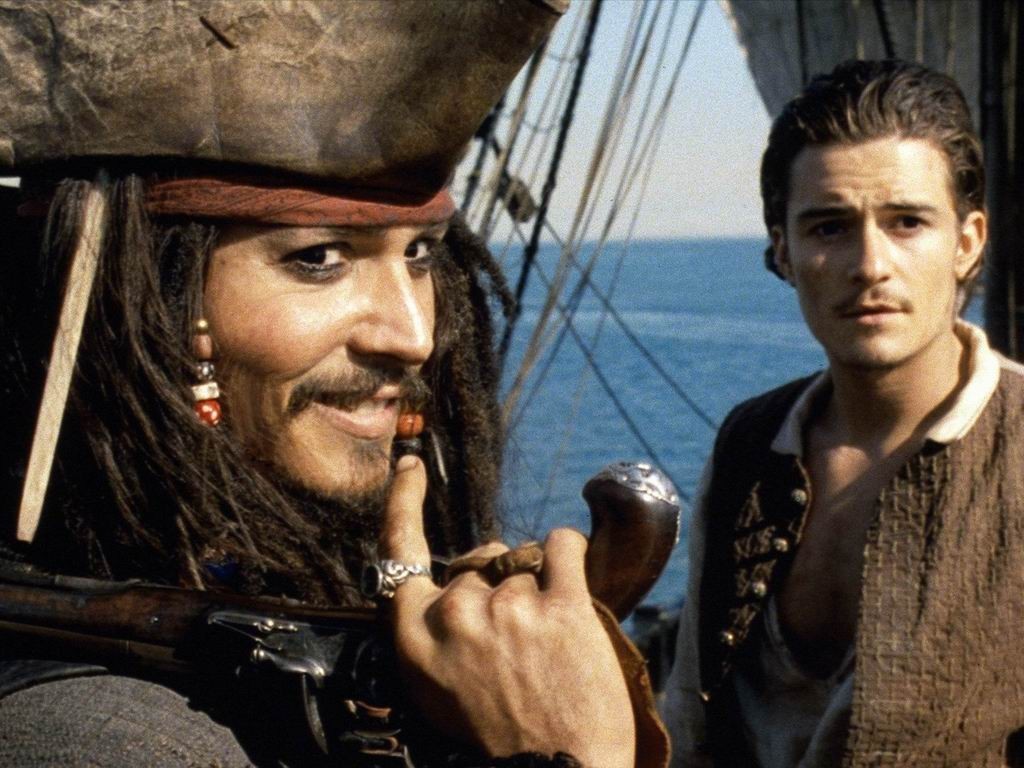
Of course, it would be very appropriate for me to show a picture from Pirates of the Caribbean series which has brought this era to a new generation. Still, these movies aren’t meant to be historically accurate but even they aren’t very good, you still can look forward to Captain Jack Sparrow. Nevertheless, Orlando Bloom perhaps may have looked more like a real Golden Age pirate than Johnny Depp would since the latter was in his forties at the time.
Ahoy, mateys! We come to the post of perhaps one of the most popular cinematic eras of all time, the Golden Age of Piracy. You may be wondering why in the hell does the Golden Age of Piracy have anything to do with Colonialism or Imperialism. Well, quite a lot actually since these pirates were the organized crime syndicates and highwaymen of the high seas with a Golden Age lasting roughly between 1650-1720. Whenever there is trading going on in history through water transportation, you’re going to have pirates. And with European colonial expansion, you have an influx of trading goods coming and going through the trade routes of the Atlantic Ocean. At first many of these European pirates were hired as privateers to cause trouble for Spain or act as a stand-in for a navy, but once England and France had a professional navy as well as the War of the Spanish Succession, the privateer tradition had died. Yet, rather than give up their privateering life to go straight, many of them opted for piracy and led the risky life of an outlaw. Nevertheless, the Golden Age of Piracy has been a subject of frequent romanticization, especially in Hollywood adventure movies and many have become legends in their own right. Nevertheless, there are plenty of things that movies get wrong about pirates in this Golden Era of lawlessness and adventure.
Anne Bonny:
Anne Bonny disguised herself as a man during her career. (She disguised herself as a boy when she was a kid, but not when she was a pirate. Her gender was public knowledge. However, Mary Read certainly did {and so did other female pirates since cross-dressing as a guy was much easier for women to do in those days}.)
Anne Bonny’s mentor was Blackbeard. (They didn’t know each other.)
Anne Bonny commanded her own ship. (She never did. She was always on Calico Jack’s ship with Mary Read. Still, she probably should’ve.)
Anne Bonny’s pirate boyfriend was French. (Her pirate boyfriend was Captain “Calico Jack” Rackam. She may have even had a couple of kids with him. Mary Read may also count as an intimate partner.)
Anne Bonny died on an islet at a sandy beach. (She more likely died in South Carolina at the age of 84 since her dad managed to ransom her while she was pregnant in jail {or so she said}. It’s said she married a respectable man and had eight children in addition to her two by Rackam. Still, we’re not sure what really happened to her.)
William Kidd:
Captain William Kidd was a pirate as well as savvy manipulative sociopath ultimately undone by the son of a man he had killed. (There’s only evidence that he was a privateer and that his fame springs from the sensational circumstances of his questioning before the English Parliament and the ensuing trial perhaps in a desperate attempt to clear his name. Also, compared to other pirates and privateers, his actual depredations on the high seas were less destructive and less lucrative than those of his contemporaries. Still, he may have been a notorious pirate or just an unjustly vilified and prosecuted privateer in an age typified by the rationalization and empire.)
William Kidd was ugly. (His portrait on Wikipedia suggests he was quite handsome. Still, he probably didn’t look anything like how Charles Laughton portrayed him.)
Blackbeard:
Henry Morgan and Blackbeard were contemporaries. (Morgan had died in 1688 when Blackbeard would’ve been at least a child if he was ever born at the time.)
Blackbeard was the pirate whom all pirates feared as well as an evil dick. (Yes, he was feared but he wasn’t evil or as violent as most pirates at the time. He tried to avoid violence whenever he could and went out of his way to take care of his men even though he did shoot and wound his first mate, it was said he did it to save the guy from dying in an upcoming battle. He commanded his ships with the permission of their crews and was seen as a more shrewd and calculating leader who relied on this fearsome image and PR more than violent force. Oh, and there are no accounts of him ever killing anyone who didn’t try to kill him first {not even those he held captive}.)
Blackbeard was short. (He was a tall and imposing man and looked almost nothing like Ian McShane. Actually, Sacha Baron Cohen would better fit his description.)
Blackbeard lived to be 70. (He was caught and killed at 40. Also, we’re pretty sure he didn’t fake his own death because he was shot no fewer than five times and cut about twenty. Oh, and there are reports that his body was thrown in an inlet while his head was suspended by a bowsprit of his Lieutenant Maynard’s sloop so he could collect the reward {but he was screwed over in the process after all he’d been through to get him}.)
Blackbeard was a pirate when the British were using privateers. (The British had outlawed privateering before Blackbeard came along.)
Blackbeard’s flag depicted a flaming skull. (It featured a devil horned skeleton spearing a heart holding an hourglass.)
Golden Age Pirate Life:
Some pirates had dads who were in the same profession. (I suppose some did, yet pirates didn’t have long careers so I’m not sure if they knew people from different generations. And even if they did, they wouldn’t know it {and neither would anyone else}. Still, it’s very unlikely that a blacksmith would go into the pirating trade since these master tradesmen had their own shops as well as a steady source of income. Having Will Turner as a Royal Navy sailor would’ve made more sense.)
There was no distinction of appearance between a pirate and a common sailor. (For God’s sake, Robert Louis Stevenson, there’s no way that anyone in the 17th century would hire a pirate crew and not even know it. I mean pirates like Long John Silver would never work for a regular captain even for buried treasure.)
Pirates wore clean clothes. (The only time their clothes were washed was in a rainstorm. They also didn’t bathe.)
Pirates were nice to African slaves who were members of their crew. (Sometimes, especially in Blackbeard’s case who had a black Quartermaster named Caesar but it depended on the ship. However, pirates sometimes resold Africans into slavery or turned them in for the reward. There are even occasions when they could be used as slaves doing menial work on board a ship. And if they were members of the crew, they may or may not be given the same shares as the rest. Yet, there were white pirates who saw them as either a commodity or less useful than “white” sailors {except marooners who’ve already proven themselves against the Spanish}.)
“Scallywag” referred to a fellow pirate. (This word wasn’t in use until after the American Civil War in which people in the Confederacy would refer to their pro-Unionist neighbors who collaborated during Reconstruction.)
Life aboard a pirate ship was unpredictably violent, chaotic, and teetering on the brink of mutiny. (Many naval ships with poorly paid sailors and autocratic captains under the thumbs of nobles or private investors were like this at the time. However, many pirate crews functioned more like organized crime families than anything. After all, they were known to be “gangsters of the sea,” than anything.)
Pirates sailed in big heavily armed wooden warships such as three masted Galleons. (Most of the time they sailed in whatever they could steal or hold on to. The average pirate ship was a small, fast, maneuverable craft that could zip around shoals larger ships wouldn’t navigate. Most of the time, they’d use single masted sloops. The heaviest pirate ships were converted merchantmen like Blackbeard’s Queen Anne’s Revenge.)
Good pirates never raided merchant ships or settlements. (This is the very definition of pirating. All pirates did this because that’s what they do.)
Pirates mostly raided ships through violent means. (Most pirates would try to cultivate an image of ruthlessness so they could just get merchant ships to surrender without a fight. But when they fought, God help you!)
Most female pirates were easy to detect and their gender was public knowledge. (Most of the time you wouldn’t be able to tell which pirates were women {except maybe those without facial hair but they could easily be teenage boys}. Still, it’s said many just dressed up as guys just to protect themselves than any other reason. Anne Bonny and Mary Read were probably the exceptions to this {but they were shagging their captain, bringing booty, and putting up a hell of a fight}. Some like Grace O’Malley even became captains. Yet, most pirates didn’t allow women on their ships since their presence was bad luck unless she was talented in bringing boatloads of booty.)
Pirates had democratic rule on their ship and treated everyone equally. (Some pirate ships were democratic havens sometimes they weren’t. And not every pirate crew treated everyone equally. Also, there’s little historical evidence of pirate democracy on the islands. Still, pirate governments probably functioned more like crime families.)
Pirate captains commanded with an iron fist. (Many times the captain was the ultimate power aboard a ship. If he didn’t like you, you were gone. Yet, the captain and his officers were more likely to listen to redress from their crew because he couldn’t rely on the support or threat of punishment from a higher authority. They usually commanded because of skill, daring, and the ability to win prize and booty. Some were elected by their crew members by a vote and only didn’t have the last say except in battle. Sometimes power was shared between the captain and quartermaster and some pirate crews were just a loose confederation of thieves. Still, it depended on the ship but a typical pirate captain usually commanded like a head of an organized crime syndicate than anything.)
Pirates kept parrots as pets. (They also kept dogs and cats aboard, too, since they were used to keep vermin down. Yet, they may have kept parrots as exotic pets or “booty” as well as taken other animals on board a ship while in town. They also took livestock on board, too. Of course, there are accounts of one pirate trying to steal a herd of cattle on his ship, but he learned to regret it that he was willing to surrender to the British authorities since the cows were all puking and spewing all over the place. The British authorities just left him alone.)
Pirates only killed foreign soldiers and officers and never sank any ship unless it wasn’t from their country. (I don’t think pirates cared about who they killed or whose ships they sank. Of course, they didn’t attack English ships when England was using privateers but that soon went out of favor once they had made peace with Spain. I’m not sure if they would have any sense of patriotism from governments wanting to hang them. Unless they were privateers of course.)
The cutlass was a pirate weapon of choice. (It was the last weapon they wanted to reach for. Their preferred weapons were firearms {which weren’t effective by our standards}.)
Pirates usually raided and robbed warships. (They usually tried to avoid warships since they were designed for combat except Spanish Galleons. Besides, merchant ships were their primary targets.)
Pirates attacked other ships by sinking them and slaughtering their crew. (Actually, they’d go great lengths to avoid either if they could scare the ship into submission. They’d actually ask the enemy crew what they thought of their captain. If he was bad, he’d be beaten and maybe executed. If he was just, then the pirates would send the group to a lesser ship and send them on their way.)
Good pirates were a rough, roguish, and jovial bunch. (They were also ruthless cutthroats, murderers, raiders, and thieves. And they weren’t people you’d want to take home to your mother and not because they hardly bathed.)
Pirates wore gold earrings during the Golden Age of Piracy. (There’s no evidence because earrings on men weren’t fashionable at about the turn of the 18th century. Though pirates may have been an exception of that.)
Pirates’ treasure consisted of mostly precious items like gold. (Pirates treasure didn’t just consist of gold and precious items but also clothes, jewelry, sugar, spices, citrus fruit, fresh water, and maps as well as almost any trade goods stolen from merchant ships {they’d take practically anything}. And I’m not sure if they’d go bury it on some remote island in the Caribbean either. Not to mention, pirates rarely ran into merchant ships carrying precious metals or jewelry in large quantities.)
Pirates forced people to join their crew against their will. (Most of the time they only did this to carpenters, doctors, and other skilled workers for obvious reasons.)
Pirates left a lot of buried treasure on islands and drew maps to find it. (Pirates lived fast and hard lives who usually spend their money on women and booze as soon as it was in their hands as well as never had enough gold worth hiding. Besides, they usually faced an uncertain future so there was little incentive to stash their savings. Also, they split their treasure amongst themselves since they won it together. Thus, they didn’t leave a lot of buried treasure around since there was always a possibility that they could be hung from a dock not far in the future. And if they did, they certainly wouldn’t have drawn a map to find it since they’d rather use maps to trace known trade routes. They would only bury it where it was the easiest for them to get and the hardest for others to find. Captain William Kidd was the only pirate to actually do this perhaps successfully.)
Most Golden Age pirates were adult men of all ages. (Actually the Golden Age pirates were a very young crowd with some being children and adolescents {and yes, the Royal Navy press gangs did kidnap children since no kid wants to be a powder monkey}. Still, most of them were in their twenties and their careers were short-lived due to things like battles, infighting, disease, or the punishment on piracy at the time. Not many pirates lived past 30 and very few lived into middle age. Yet, most movie pirates are played by actors in their 30s or older.)
Golden Age pirates mostly did their raiding in the Caribbean. (A lot of Golden Age piracy is attributed to the Caribbean, but many raided ships in other waterways as well.)
Pirates were only in existence during the seventeenth and eighteenth century and were only European. (Piracy has been as old as the invention of the boat and there are still pirates today. Also, pirates came from all over the world.)
A popular pirate punishment was walking the plank. (Almost never happened since it’s easier to throw someone overboard. They did do marooning, flogging, casting overboard, torture, keel-hauling, and more.)
Most pirates were outlaws working for themselves. (Actually, there were also pirate mercenaries called privateers who worked for someone else like a government.)
Pirate curses are real and do come true. (Most of the time pirate curses are based on superstition and usually didn’t come true. Of course, many pirate superstitions could be something Robert Louis Stevenson just made up.)
The most famous pirates were the best ones. (The most famous pirates were usually captured, brought to trial, and/or killed immediately because someone had to be there for their exploits to be written down. As with the best pirates who avoided capture, we probably don’t know their names. Then again, you had guys like Henry Morgan who ended up governor of Jamaica and knighted and Henry Every who successfully retired with all his loot and suffered almost no repercussions from his crimes.)
Pirates were marooned onto lush deserted tropical islands. (No, they were marooned on islands with very little vegetation which could get swept up with the tide. They didn’t want a Robinson Crusoe situation on their hands.)
Pirates were hanged without trial after capture. (They were usually hanged after they were put on trial since piracy certainly was a capital crime though pirates were robbers and thieves at heart as well as desperate men with nothing to lose.)
Pirates spoke in pirate accents using phrases like “shiver my timbers,” “arr,” or “Fifteen Men on a Dead Man’s Chest.” (No, they didn’t talk like the stereotypical pirates we see in the media. I’m sure Robert Louis Stevenson made that up. Also, there was no universal pirate accent since it makes no damn sense.)
All pirates had black flags with a skull and cross bones on them or a skull with crossed swords. (They also had red ones which were used in raids but meant that there was no quarter, no prisoners, kill or be killed. Black flags meant that the pirates were giving quarter like accepting terms of surrender and leave some of you alive. Also, black flag designs varied from ship to ship. Blackbeard’s had a devil horned skeleton holding an hourglass and stabbing a heart with a spear, lovely.)
Pirates had a hook hand as a prosthetic limb. (Yes, at least a couple pirates did have peg legs {though most pirates without a leg usually used crutches}, but it’s not very likely that pirates had hook hands because they wouldn’t be very practical. A pirate with a missing hand would more likely have a wooden arm if that.)
Pirates became captain by fighting the old one in a duel. (Sometimes they were elected by their crews. Duels among leaders could split a crew’s loyalties. Sometimes a default leader would emerge, be he the oldest, smartest, or most charismatic.)
Sailors became pirates to live a life of crime. (They actually ditched their jobs as sailors because being a sailor was one of the shittiest jobs ever and conditions on lawful ships were terrible. And if you were in the Royal Navy, you were likely pressed into naval service {a.k.a kidnapped by gangs of hired thugs looking for drunks with all four limbs} after getting wasted at a coastal tavern than actually sign up for it. Impressed sailors comprised half of the British navy at one point and were paid less than volunteers {if paid at all]} as well as had little or no chance of advancement. Impressed sailors were also shackled to the ships on port so they wouldn’t try to escape and were flailed for even the most minor offense in the navy handbook they probably didn’t get to read. Furthermore, 75% of impressed sailors in the Royal Navy were dead within two years. Oh, and sailors had to deal with storms, crowded quarters, and tropical diseases. Only a minority became pirates just for the enjoyment of being an outlaw. Most sailors became pirates to escape a life of certain death and constant humiliation as well as low pay and very little room for advancement.)
Golden Age pirates treated their lawful sailor prisoners like dirt. (Pirates sometimes recruited captured sailors for their crews and treated them better than their own officers or superiors. Also, Black Bart was a sailor captured by pirates and became their captain six weeks later. And his crew knew exactly where he came from and didn’t give a shit. Blackbeard’s crew is said to be 60% black so sometimes racial divisions didn’t matter.)
Pirates were the rock stars of the 18th century. (Well, it was a time when many outlaws were considered this so this could be true.)
“Good business” for pirates consisted of plotting global maritime domination and pursuing personal grudges. (They’d more likely be arranging profitable trade deals and raids merchant companies may depend on.)
Pirates towns were filled with loose women, shooting, and endless drinking. (There were pirate settlements but they were mostly havens to escape from the civil authorities. They may have joined together to form loose confederations, dispensed vigilante justice, similar to a frontier town but they didn’t have any organized government. It’s probably wiser to say that pirates were the gangsters of the high seas.)
Pirates saw themselves as cutthroats willing to kill a merchant seaman in the blink of an eye. (They saw themselves as independent businessmen. Also, they didn’t kill hapless merchant seaman since that would give them an incentive to resist {of course, those who resisted would either be handled roughly or killed}. Besides, they’d more likely give them a job offer. Still, it’s easier to understand Golden Age pirates if you see them as seafaring gangsters.)
Pirates never swore. (Uh, they were notorious for profanity.)
Pirates had a penchant for high class women. (While most love interests in pirate movies are seen as such, real pirates would usually not go for ladies like Elizabeth Swan, because such conquests would be like telling her Port Royal governor dad to arrest and hang them. They more likely slept with lower class women and whores.)
 The Lone Girl in a Crowd