The Snowflake King’s Consigliere

Recently, Special Counsel Robert Mueller’s Russia investigation has become red hot and getting much closer to Donald Trump. On Monday, April 9, 2018, the FBI raided the home, office, and hotel room of Trump’s longtime personal lawyer Michael Cohen as part of a fraud and campaign finance investigation. The raid was carried out by US attorney’s office of the Southern District of New York, where the US attorney in question is a Trump appointee named Geoffrey Berman. According to the New York Times, federal agents “business records, emails, and documents related to several topics,” including Cohen’s payment to Daniels, and “privileged communications” between Cohen and his clients, according to Cohen’s attorney. The raid brings the case closer to Trump’s door than any to date, touching a close confidante and possibly a speech Trump made himself. Though not responsible for the raid, Mueller’s investigation has looked into Michael Cohen and uncovered potential crimes by him during the Russia investigation. He then brought the findings to Deputy Attorney General Rod Rosenstein, which he’s mandated to if the info’s not directly connected to his investigation. Rosenstein then sent the case to the New York Office leading to a search in Cohen’s house, office, and hotel.

As you know, Michael Cohen is in the middle of the Stormy Daniels controversy, where he plays the guy who paid the porn star $130,000 days before the 2016 election as a way to get her to shut up about her 2006 affair with Donald Trump. The investigation into Cohen is tied to that payment. If he used the money to keep the affair secret and help Trump win the election, they payoff could be considered a donation violating campaign finance law. Sure he might’ve tried to help keep an embarrassing story from the press. Even so, he didn’t report the donation to the federal government, and would substantially the legal cap on donations. The FBI is also looking at whether Cohen violated any banking or wire transfer laws by using a personal bank loan to pay off Daniels. For the lawyer claimed to have drawn on his home equity line of credit from First Republic Bank of Manhattan to obtain the funds. However, while Trump has plenty of lawyers who’ll respond to lawsuits or file papers, Cohen is much more than his “personal” attorney. He’s a fixer, a deal-maker, and a wartime consigliere as well as a key link between Trump and Russia. As journalist Adam Davidson told The Week, “Michael Cohen is the most important non-Trump in the Trump business world. He oversaw nearly all the foreign deals as the Trump Org shifted its focus to sketchy third-tier overseas oligarchs.” With the possible exception of his children, no one knows about the shady stuff Trump has been involved in than this guy. Now they’re combing through Cohen’s files, papers, and phone records.

Then there’s the Steele dossier claiming that Michael Cohen secretly met with several Russian Presidential Administration (PA) Legal Department officials in Prague during the summer of 2016. Obviously, Cohen has adamantly denied taking such a trip, tweeting in January 2017, “I have never been to Prague in my life. #fakenews.” But a new McClatchy report states that special Counsel Robert Mueller has evidence that the sleazy lawyer made a Prague trip through Germany at the height of the 2016 campaign. Now their report is based on anonymous sources and we don’t know what the alleged evidence is. So it can still prove mistaken. But if the McClatchy report is accurate, it could potentially devastate the argument that there was no Trump-Russian collusion. Because there’s no reason for Cohen to try to debunk the Steele dossier by lying that he didn’t visit Prague at all if he actually did, unless he did something extremely serious that he wanted to get away with during the trip. However, if Cohen did go to Prague for innocuous reasons like a vacation, he could’ve just said so.

Nonetheless, whatever evidence federal prosecutors have collected on Michael Cohen must’ve been extraordinarily strong. Before feds could raid his home, hotel room, and office, they had to convince high-ranking Department of Justice officials and a federal judge that a search warrant was necessary for obtaining the evidence sought. As former FBI agent and senior fellow for the Foreign Policy Institute Clinton Watts told The Atlantic, “Doing a search warrant rather than a subpoena suggests the investigators thought Cohen, if given a subpoena, would possibly destroy evidence or withhold key evidence, particularly if it were incriminating.” Under normal circumstances, getting a search warrant for a federal investigation subject’s lawyer is an incredibly aggressive move. If that lawyer represents the President of the United States, the stakes can’t be higher. According to former associate special counsel in the Iran-Contra Affair and law professor at St. Johns John Q. Barrett, “These things are not anonymized, so you know you’re talking about Michael Cohen, the longtime attorney for the person who is now president of the United States, so you know you’re in very deep water. Any law-enforcement official would proceed very carefully.” Former FBI agent and a fellow at George Washington University’s Center for Cyber and Homeland Security David Gomez added, “You don’t just have to have the evidence that the documents may or may not exist, you have to show that there’s no other way to get them besides serving a warrant on the attorney, because of the sensitivity of attorney-client privilege.”

Not surprisingly, Donald Trump’s supporters in the conservative press have invoked attorney-client privilege, the legal rule saying communications between an attorney and their client are typically protected. But there are important exceptions. As Fordham University professor Bruce Green told The Atlantic, “Records of conversations between Mr. Cohen and Mr. Trump are not necessarily privileged. If the conversations do not relate to a legal representation, but Mr. Cohen was providing business assistance or other non-legal services, the privilege probably will not apply.” There’s also the crime-fraud exception to attorney-client privilege. As Barrett said, “When the communications between an attorney and client are in furtherance of criminal activity, it’s viewed as an exception to attorney-client privilege.” When an attorney’s records are seized a separate investigation team called a “taint team” will go through those records and sort out which are protected and which ones prosecutors will be allowed to use. “There are various other limitations and exceptions that could make the privilege inapplicable. If it isn’t clear whether documents are privileged, the issue may get litigated,” said Green. This might go for Cohen’s records payments to Daniels. Even if the evidence seized from Cohen is sought for another investigation, Mueller will have access to anything federal prosecutors deem worthy to the Trump-Russia investigation. Though his lawyer Stephen Ryan called the raid, “completely inappropriate and unnecessary” and pointed that attorney-client privilege may shield many of Cohen’s files from investigators. But this doesn’t apply if the lawyer is committing a crime.

Meanwhile, Mueller’s probe is looking at a $150,000 from a Ukrainian billionaire made to the Donald J. Trump Foundation, which previously admitted to violating tax law and helping Trump during the campaign. One critical question in the probe has looked into is whether foreign money flowed into Trump’s 2016 campaign. That has led Mueller’s team to a September 2016 speech Trump gave to a conference in Kiev, Ukraine. In exchange, a Ukrainian steel magnate donated $150,000 to his personal “charity” which he actually used as a personal piggy bank. Though this has nothing to do with the raid, Michael Cohen reportedly solicited the donation for Trump. The focus on the speech and donation is part of Mueller’s growing interest in overseas money and the Trump campaign. Much of his case against Paul Manafort is tied to the latter’s work in Ukraine. And in March, Mueller’s team has subpoenaed Trump’s businesses to look at his overseas deals.

Though Mueller’s team wasn’t responsible for the raid, Donald Trump has directed his fire and fury toward him. Right before a White House meeting with military leaders on Syria’s situation, he fielded a string of questions about the probe and attacked the special counsel. He told them, “It’s a real disgrace. It’s an attack on our country in a true sense. It’s an attack on what we all stand for, so when I saw this and when I heard it, I heard it like you did, I said that is really now in a whole new level of unfairness.” He repeated his claim of the investigation as a “witch hunt,” and declined to answer whether he’d fire the special counsel, with a reply, “We’ll see what happens. I think it’s disgraceful, and so do a lot of other people.” He also called the prosecutors involved “have the biggest conflicts of interest I have ever seen. Democrats—all. Either Democrats or a couple of Republicans who worked for President Obama.” Despite that all the major players involved are Republicans, some of whom Trump or his appointees hired themselves. The next day he tweeted “A TOTAL WITCH HUNT!” and “Attorney-client privilege is dead!” While several factors make firing Mueller a difficult and politically disastrous choice, Trump has toyed with the idea before. Since Mueller has just built a case against his own lawyer and is digging into Trump’s personal activities, we need to take this seriously. This speech payment brings the investigation to Trump personally. The focus on Trump’s businesses and professional colleagues might violate Trump’s previous assertions that Mueller shouldn’t look into his companies. Thus, Trump’s non-answer in regard to Mueller’s future means the special counsel has to work quickly if he wants to finish his investigation before losing his job.

The group of people Donald Trump has targeted in his angry response at the White House is wide and deep. They comprise of Special Counsel Robert Mueller, Attorney General Jeff Sessions, Deputy Attorney General Rod Rosenstein, former FBI Director James Comey, and U.S. Attorney for the Southern District of New York Geoffrey Berman. Taken together, it’s apparent that Trump isn’t just angry at individuals but also the rule of law. Each step of the way, the actions angering Trump have been by senior officials specifically following the law. In fact, the point of having a special counsel is to insulate a federal investigation from political pressure. Rosenstein appointed Mueller when he felt the tenor of Trump’s earlier comments and actions made it impossible to investigate Russian interference in the 2016 election through normal channels. While Trump hasn’t broken any laws in his comments about Mueller, he’s violated the spirit of the special counsel regulation and has attempted to pressure Mueller at all turns. Hell, he’s pissed at Sessions for recusing himself on advice by Justice Department career staff and in accordance with department guidelines. Because Trump has no regard for rules and procedures. His beef with Sessions prevents him from being in a position to politically protect his boss. Because Trump has voiced publicly and privately his belief that the attorney general’s job is to protect the president, rather than the serve as the country’s top lawyer. This is a radical departure from the standard approach. Because Trump would rather have Sessions break the rules for his benefit. He’s also angry that Hillary Clinton wasn’t prosecuted and has publicly complained about Sessions not pursuing her. As he said, “The other side, they don’t even bother looking. And the other side is where there are crimes, and those crimes are obvious. Lies, under oath, all over the place.” But not only has Clinton been subject to investigations, but Trump fails to grasp that the president can’t decide who’s committed a crime and should be prosecuted. Expect that a Saturday Night Massacre could be just around the corner.

The idea of a regimented process for charging people and that it ought to not be decided by political vendettas or a government head’s whims is central to the American project, even if the nation has at times fallen short of it. Donald Trump doesn’t care to understand or accept the idea of the rule of law. On the campaign trail, he promised to lock up Hillary Clinton and questioned the right of a federal judge overseeing a case on Trump University. His comments of the raid, including ridiculously equating a legally sanctioned FBI raid to a burglary demonstrates that Trump’s not just engaging in a political attack but is also campaigning against the rule of law and the U.S. approach to justice. He may regard due process as political correctness in regards to racial and religious minorities, leftists, immigrants, and victims of systematic police abuse. But when he or his allies are on the receiving end of justice, no proof of evidence is necessary to prove their innocence, even in the face of strong grounds against them. Whereas, any rival or enemy who dares criticize him or anyone he sees as a threat is a criminal. Such discrepancies aren’t just soundbites. They’ve guided Trump administration, causing real human suffering or abdicating the federal government’s responsibility to alleviate it. Under Trump, the White House tried to ban immigrants from 7 Muslim countries, the Justice Department has backed off its responsibility to oversee local police departments to ensure they’re respecting Americans’ constitutional rights, casualties from drone strikes have increased, and immigration authorities have become more aggressive and indiscriminate in who they seek to deport. Such rhetoric also points to how Trump wishes the laws would operate. For those outside his circle, the laws bars no cruelty, brutality, or injustice. To himself and his allies in his gilded circle, no scrupulous adherence to due process in sufficient and no crime can justify prosecution.

Nonetheless, the raid on Michael Cohen’s home, hotel, and office, shows that the Mueller probe has gone beyond Russia. This has always been the greatest danger to Donald Trump since he’s spent a lifetime skirting around both the letter and spirit of the law. It’s why he’s repeatedly stated that his business records are off limits and why he keeps his tax returns secret. Because if we knew what goes on in Trump’s businesses, we’d be appalled. Hell, what we already know about Trump’s businesses is simply mindboggling with stories of corruption that you really can’t make up. And the closer the investigation gets to Trump the more unpredictable he gets since he hasn’t handled any of it well from the beginning. Mark my words, Donald Trump is a dangerous man.

The Threat of White Supremacy in Law Enforcement

a-tale-of-two-hoodies

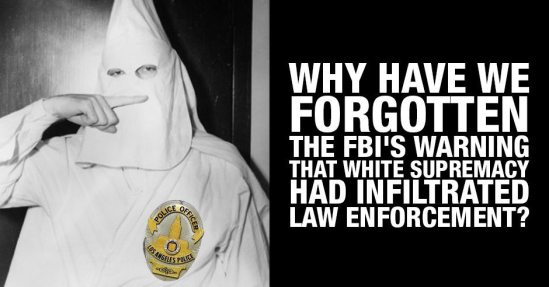
In 2006, the FBI issued a bulletin detailing the threat of white supremacists infiltrating police in order to disrupt investigations against fellow members and recruit other white nationalists. It was released during a scandalous period for many law enforcement agencies throughout the country, including a Neo-Nazi gang formed by members of the Los Angeles Sheriff’s Department who harassed black and Latino communities. Similar investigations revealed officers and entire agencies with hate group ties in Illinois, Ohio, and Texas. The FBI identified white supremacists in law enforcement as a concern because their access to both, “restricted areas vulnerable to sabotage” and elected officials or people who could be seen as “potential targets for violence.” Not to mention, such infiltration, “can lead to investigative breaches and can jeopardize the safety of law enforcement sources or personnel.” The report also warned of “goat skins,” which are hate groups who don’t overtly display their beliefs to “blend into society and covertly advance white supremacist causes.” And in at least one case, the FBI learned of a skinhead group encouraging ghost skins seeking employment with law enforcement agencies to warn crews of any investigations.

American policing has always had racial implications. The earliest form of organized law enforcement in the country can be traced to slave patrols that tracked down escaped slaves and overseers assigned to guard settler communities from Native Americans. In the centuries since, many law enforcement agencies have directly participated in antagonizing communities of color or provided a shield for others who did. But since the FBI’s 2006 report came out, little has changed. Though several agencies nationwide have launched internal investigations into personnel who may not be formal hate group members, but face allegations of racial misconduct. While social media has made it easier to expose white supremacists in law enforcement. Yet, none of the over 18,000 law enforcement agencies have established systems for vetting potential supremacist links, many of which have deep historical connections to racist ideologies.
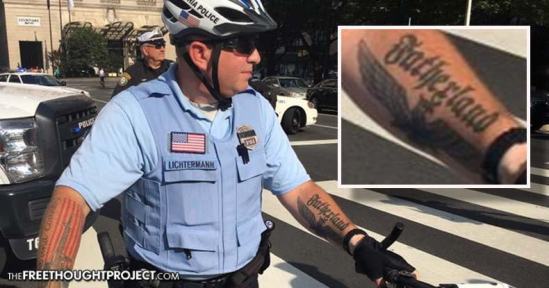
fatherland

This is the cop who was caught with a Neo-Nazi tattoo at the Democratic National Convention. And he was sent to patrol a Black Lives Matter protest. See the problem here?

But since the FBI’s report, problems with white supremacists in law enforcement have surfaced since then. In 2013, the Southern Poverty Law Center exposed an Alabama officer as a member of the white nationalist League of the South after speaking at a national conference. In 2014, 2 Florida officers, including a deputy police chief, were fired after an FBI informant outed them as Klu Klux Klan members. In September 2015, a North Carolina police officer was fired after a picture of him giving the Nazi salute appeared on Facebook. That same year a Baton Rouge police officer resigned after being linked to racist text messages. Another instance has an Oklahoma sheriff resigned after his name was connected to a white supremacist website. And in August 2016, the Philadelphia Police Department launched an internal investigation after attendees at Black Lives Matter rally outside the Democratic National Convention spotted an officer in charge of crowd control with a Nazi emblem tattoo on his forearm and posted the image on Instagram.

With the rise of white supremacist violence during the Trump era, we need to treat this threat very seriously. Shortly after Barack Obama’s election to the presidency in 2008, a 2009 Department of Homeland Security study written in coordination with the FBI warned of a “resurgence” of right-wing extremism. The report noted, “Right-wing extremists have capitalized on the election of the first African-American president, and are focusing their efforts to recruit new members, mobilize existing supporters, and broaden their scope and appeal through propaganda.” Since then, white supremacist violence and right-wing terror has been on the rise along with the increased presence of the alt-right.

In November 2016, Donald Trump was elected to the presidency, a man endorsed and celebrated by the KKK since he’s been reluctant to disassociate himself from anyone espousing white supremacist views. In turn, he has appointed key administration advisers with ties to the radical right like Steve Bannon, Steve Miller, and Sebastian Gorka. His policy initiatives like revving up the nation’s deportation machine and curtailing civil rights enforcement thrilled white supremacists. Trump and his Attorney General Jeff Sessions have shown deference to law enforcement and retreated from federal oversight of police departments with a history of civil rights violations, brutality, and racial violence. As a result, the latest incarnation of white supremacy broke through the firewall that for decades kept overt racists largely out of the political and media mainstream. Reinvigorated white supremacists staged their largest rally in a decade at the demonstration in Charlottesville, Virginia, that left an anti-racist counter-protester dead and Trump equivocating over condemning racism. Former KKK Grand Wizard David Duke called the rally a “turning point” and vowed that white supremacists would “fulfill the promises of Donald Trump” to “take our country back.” White supremacists also stepped up their college campus recruiting drives. White nationalist leader Richard Spencer held a rally at the Lincoln Memorial and appeared at colleges. The Southern Poverty Law Center documented some 300 incidents of racist flyers distributed on over 200 college campuses.

Why should we worry about white supremacists in law enforcement?

In a country where 74% of extremist killings and attacks over the past decade were by right-wing extremists, particularly white supremacists, it’s a serious problem when police are among the terrorists. As Chicago’s John Marshall School of Law professor Samuel Jones told PBS in 2016, “Many people in these communities of color feel they have been the subject of police violence for decades. And when an officer engages in conduct that adds or enhances that divide, they are ultimately jeopardizing the integrity of their agencies and putting their fellow officers in danger.” Jones also told The Intercept in 2017, “When somebody holds a belief that indicates that they do not see all Americans are worthy of equal protection under the law, it compromises their ability to be a police officer.”

White supremacists come from all walks of life. They can be your neighbors, co-workers, employers, friends, and even relatives. They can be teachers, professors, cashiers, doctors, lawyers, clerics, drivers, waitstaff, accountants, firefighters, garbage collectors, mail carriers, programmers, and just about anyone else you can think of, including police. But if you have a white supremacist in a public service position like a teacher or cop, the problem isn’t that they subscribe to a radical belief system. Rather, it’s that their beliefs encourage bigoted and sometimes violent behavior that are inappropriate for anyone involved in public service, particularly those with authority over others. White supremacists also create a toxic work environment and poison relations with the public.

Many white supremacists maintain positions and jobs within mainstream society while acting with plausible deniability on behalf of their racist beliefs. They do this through paying “lip service” to normal diversity standards and playing what’s called “a dog and pony show” when it came time to public proclamations. But then acting every other regard as a white nationalist ideologue would: discriminating against minorities in their choices and actions, believing them to be innately inferior, presuming that liberals and Jews are conspiring to harm them, etc. You can see this kind of strategy on full display on Breitbart and Fox News.

If you have these white supremacists in positions of authority like law enforcement, it’s very scary notion for minorities, especially black people. Since police kill black people 2.5 more frequently than whites and unarmed black people at 5 times the rate of whites. The fact, white supremacist infiltration in law enforcement provides context to the scourge of racial police violence against black people which is often downplayed if not denied by segments of society and an administration endorsed by the Fraternal Order of Police. While racism in the police is nothing new, the idea that white supremacists might be your friendly neighborhood police can add a layer of fear and distrust for communities of color.

27843308312_3ebe233ec3_k

At a 2016 Neo-Nazi rally in Sacramento, California, the California Highway Patrol was found to aid the alt-right. They arrested 3 counter-protestors despite that the anti-fascist activists bore the brunt of the violence.

There is also evidence that police departments have asked for and accepted help from far-right protestors during tense rallies and counter-protests where violence isn’t infrequent. The relationship works both ways: Police get help and the alt-right demonstrators are seemingly put above the law in return. As a result, militia members working for alt-right events carry out policing activities with impunity under the gaze of actual law enforcement. In 2011, police bused Neo-Nazis to a rally in Trenton, New Jersey to maintain order. In 2014, Chattanooga cops arranged parking for white nationalists along with a route for them to march safely to a protest site. In June 2016, violence broke out at a Sacramento neo-Nazi rally between neo-Nazis and anti-fascist protestors at the California State Capitol. 10 people were injured, 5 of them stabbed. Despite footage showing that neo-Nazis were responsible for most of the violence, especially the stabbings, Sacramento police arrested 3 counter-protestors who were charged with felonies despite claiming self-defense. One was a Berkeley teacher and anti-fascist organizer named Yvette Felarca who was charged with assault and rioting after a neo-Nazi stabbed her and bludgeoned her in the head. Later court documents reveal that California police investigating the white nationalist event worked with white supremacists in to identify counter-protestors and sought the prosecution of activists with “anti-racist” beliefs. The records also showed police officers expressing sympathy with white supremacists and trying to protect a neo-Nazi organizer’s identity. In June 2017, police allowed members of a right-wing militia style group help police arrest anti-fascist activists at an alt-right event in Portland, Oregon. Former FBI agent and Brennan Center fellow Michael German told the Huffington Post, “That is extremely dangerous. To give these groups the idea that their violence is sanctioned by the state will make them far more violent and far more dangerous in the long run. Not to mention the failing to police these running street battles will encourage them to come to the next protest prepared.” On the other hand, the police weren’t so accommodating to peaceful, unarmed Black Lives Matter demonstrators protesting police brutality and racism in Baltimore or Ferguson, Missouri or nonviolent Standing Rock Indian activists in North Dakota who were trying to protect their water from the Dakota Access Pipeline. I mean police were in full riot gear with military equipment on all those occasions, especially at Standing Rock. Nor did they seem doing their jobs protecting counter-protestors in Charlottesville since they appeared to disappear when the violence got really ugly.

Gen-Zero-water-650-1505160215

By the way, in case you forget, here’s what police in North Dakota did to the Indian protestors trying to protect their land and water. Yeah, doesn’t seem like these cops care what happens to them.

But it’s not just people of color or left-wing protestors who have to worry about white supremacists in law enforcement. Right-wing extremists are systematically more anti-government/anti-cop than any other group. Since 1990 they have been responsible for 45 police killings. It also doesn’t help that law enforcement are more likely to encounter dangerous extremists than virtually any other segment of American society and those confrontations are, tragically, sometimes fatal. The fact white supremacists are often armed to the teeth during their alt-right rallies can be enough to put police in a state of fear and inability of what to do, especially in states with loose gun laws like the open-carry state of Virginia. But law enforcement doing nothing just enables these white supremacist whack jobs inflict violence. The lack of a police response to the Charlottesville violence in August 2017 led one chat user write that the Virginia State Police, “will be focused on antifa [anti-fascists] not us … especially if we kiss some ass with a few blue lives matter chants …. Be nice to cops and they will be nice to you.”

How long has white supremacy in law enforcement been a problem?

Black-lynching-1-1200x716

You can guess that white supremacist cops had something to do with white people getting away with this during segregation. This was from the 1920s, by the way.

This has been around for a very long time. In fact, infiltrating law enforcement is considered a long-standings strategy for white supremacists, which has long influenced law enforcement agencies at the local and state levels. As former skinhead Christian Picciolini told 60 Minutes, “We encouraged people to get jobs in law enforcement, to go to the military and get training and to recruit there.” But it’s only in recent years that we fully acknowledged it as a problem. As sociologist Peter Simi told The Intercept, “If you look at the history of law enforcement in the United States, it is a history of white supremacy, to put it bluntly,” citing origins in the slave patrols of the 18th and 19th centuries. “More recently, just going back 50 years, law enforcement, particularly in the South, was filled with Klan members.” A KKK chapter and a county sheriff’s office were involved in the 1964 arrest, abduction, and murder of 3 civil rights workers named Andrew Goodman, James Chaney, and Michael Schwerner in Philadelphia, Mississippi. Though the FBI has acknowledged it has a problem in 2006, it has only been after a series of scandals involving local police and sheriff’s departments.
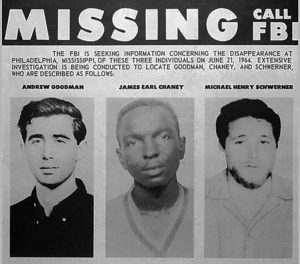
murder_fbiposter_700.jpg__700x617_q85_crop_subsampling-2_upscale-1-300x264

The 1964 arrest, kidnapping, and murder of 3 Civil Rights activists in Mississippi was orchestrated by a Klu Klux Klan chapter and a county sheriff’s department. During the Civil Rights Movement, it wasn’t uncommon for local law enforcement in the South to belong to the Klu Klux Klan.

In 1991, a US District Court judge in Los Angeles found that members of a local sheriff’s department had formed a neo-Nazi gang and habitually terrorized black and Latino residents.

In 2008, a Chicago police detective and rumored KKK member John Burge was fired and prosecuted over charges relating to torture of at least 120 black men during his decades-long career. Burge notoriously referred to an electric shock device he used during interrogations as the “nigger box.”

In Cleveland, officials found that a number of police officers have scrawled “racist or Nazi graffiti” throughout their department’s locker rooms.

In Texas, 2 police officers were fired upon discovery they were Klansmen. One of them said he tried boosting the organization’s membership by giving an application to a fellow officer he thought shared his, “white, Christian, heterosexual values.”

How widespread is this problem?

It’s practically nationwide as you can see from my examples above. However, according to a report from the Root, this current infiltration has everything to do with the racist social climate, the Trump administration, and the long-standing history of racism amongst law enforcement and black people. Many law enforcement agencies have deep historical ties to racist ideologies. Since no centralized recruitment process or set of national standards exists for the 18,000 law enforcement, state and local police as well as sheriff’s departments present ample opportunities for white supremacists and other right-wing extremists looking to expand their power base.

Without available training for identifying and acting on extremist infiltration thanks to Napolitano’s actions over the right-wing fallout on the 2009 DHS report, groups like the Oath Keepers, the Peace Officers Association, the Three Percenters, and the Constitutional Sheriffs took advantage of the security vacuum to recruit and metastasize, like ISIS and Al Qaeda do in other parts of the world. These efforts in large part targeted active and retired law enforcement officers. Right-wing extremists don’t just recruit from the law enforcement community, they also infiltrate their ranks. As Picciolini told Fairfax Media, “Many people from my crew went on to be Chicago police officers, they went on to be prison guards, and they certainly took their ideology with them. A lot of people that I know ended up enlisting in the military to recruit [racists] and to get weapons and combat training.”

Why would white supremacists want to be cops?

The answer is simple, so they can get away with shit. It’s technically legal for a law enforcement officer to espouse hateful, racist views or belong to a hate group. And though it’s a federal crime to provide material support to a foreign terrorist group, there’s no such law supporting a white supremacist one. As an 2015 FBI counter-terrorism guide reads, “domestic terrorism investigations focused on militia extremists, white supremacist extremists, and sovereign citizen extremists often have identified active links to law enforcement officers.” A link to law enforcement gives white supremacists some legitimacy and leeway to do all the horrible things they want while still appearing respectable to the community. One white supremacist chat board user wrote, “Be me in my Criminal investigation class. We’re doing introductions and it gets to me. They ask me what kind of police officer I wanted to be and I responded with ‘Riot Police Officer.’ They asked why and I instantly responded with ‘I like curb stomping protestors who cause a riot.’ I think the professor likes me.”

Are cops prone to becoming white supremacists?

Yes, since non-radical police officers are common targets for white supremacist recruiters. As Picciolini told Democracy Now!, “Police officers and law enforcement officers and military people are constantly, every day, in difficult situations. And over time, people become jaded, especially after you’ve … worked in crime-ridden neighborhoods for 20 years, and you’ve had to deal with sometimes the worst of the worst people. Well, recruiters know this. Recruiters know that they become jaded, and they become prejudiced towards these people.” One white supremacist chat board user wrote, “I have several cops in my family, most white cops are sympathetic to us.” They added, “I’m not too worried about the cops as long as we act like whites …. Get to know more cops [in real life] No one hates niggers more than white cops.”

How many cops are white supremacists?

There aren’t many statistics, but we’re talking about a small number. But even though they’re outliers, they can inflict plenty of damage in their wake. But fortunately, white supremacy in the police force isn’t as much of a problem as it used to be. Mostly because white supremacy and racism has become significantly less acceptable in society in general. That doesn’t mean we have problems with either in the police. Because we certainly do.

If the FBI and DHS knew about white supremacy in law enforcement for years, why don’t we hear it addressed?

The FBI and DHS had. But federal investigators have been reluctant to publicly address the growing threat of right-wing extremists or point out the movement’s longstanding strategy of infiltrating the law enforcement community. Since the 2009 DHS report was released just ahead of the nationwide Tea Party protests, it caused an uproar among conservatives who were particularly pissed over the suggestion that veterans might be implicated and how the report seemed to depict the range of right-wing groups. Faced with mounting criticism, DHS Secretary Janet Napolitano disavowed the document and apologized to veterans. Despite that this document was researched, compiled, and written by officials in the George W. Bush administration. And despite that the document singled out “disgruntled military veterans” as targets of recruitment by right-wing extremists to “exploit their skills and knowledge derived from military training and combat.” Because the military has long been a hotbed for white supremacist recruiting activity and many well-known white supremacist terrorists were former servicemen like some of the alt-right leaders in Charlottesville. The agency’s unit investigating right-wing extremism was largely dismantled and the reports lead investigator was pushed out. Heidi Berich from the SPLC told The Intercept, “They stopped doing intel on that, and that was that. The FBI in theory investigates right-wing terrorism and right-wing extremism, but they have limited resources. The loss of that unit was a loss for a lot of people who did this kind of work.”

It’s widely said that the backlash following the 2009 DHS report hindered further action against the growing white supremacist threat and that it was largely ignored because the issue was so politically controversial. Samuel Jones told The Intercept, “I believe that because that report was so denounced by conservatives, it sort of closed the door on whatever the FBI may have been considering doing with respect to combating infiltration of law enforcement by white supremacists. Because after the 2006 FBI report, we simply cannot find anything by local law enforcement or the federal government that addresses this issue.” Chapman University sociologist Peter Simi agreed, “The report underscores the problem of even discussing this issue. It underscores how difficult this issue is to get any traction on, because a lot of people don’t want to discuss this, let alone actually do something about it.”

DT Analytics’s Daryl Johnson was the lead researcher on the DHS report told The Intercept, “Federal law enforcement agencies in general — the FBI, the Marshals, the ATF — are aware that extremists have infiltrated state and local law enforcement agencies and that there are people in law enforcement agencies that may be sympathetic to these groups.” And according to him, the problem has since gotten “a lot more troublesome.” Because local police departments don’t seem to do anything to address the issue. “There’s not even any training now to make state and local police aware of these groups and how they could infiltrate their ranks.” As Samuel Jones told The Intercept, “For some reason, we have stepped away from the threat of domestic terrorism and right-wing extremism. The only way we can reconcile this kind of behavior is if we accept the possibility that the ideology that permeates white nationalists and white supremacists is something that many in our federal and law enforcement communities understand and may be in sympathy with.”

How do we combat the problem of white supremacists in law enforcement?

Stricter screenings for bias and white supremacist ties is a start. After a series of investigations uncovered substantial numbers of extremists in the military, the Department of Defense moved to impose stricter screenings, including monitoring recruits’ tattoos for white supremacist symbols and discharged those found to espouse racist views. As the SPLC’s Beirich told The Intercept, “The military has completely reformed its process on this front. I don’t know why it wouldn’t be the same for police officers; we can’t have people with guns having crazy ideas or ideas that threaten certain populations.” However, the clean-cut khaki-wearing racists are less detectible as military recruits so having white supremacists in the military is still a very serious problem. An Army Times survey of 1,000 active-duty troops found that 1 in 4 respondents had witnessed concrete instances of white nationalism among fellow troops and around 5% wrote comments disparaging the poll’s methodology and complaining that groups like Black Lives Matter weren’t included as an example of encroaching extremist threat.
But reforming police is a lot harder than the military due to the way decentralized way thousands of police departments across the country operate, the historical affinity of certain police departments with the same racial ideologies espoused by extremists, and an even broader reluctance to do much about it. Seattle former police chief Norm Stamper told The Intercept, “There are police agencies throughout the South and beyond that come from that tradition. To think that that kind of thinking has dissolved somehow is myopic at best.” Though he admitted to firing officers expressing racist views, he added, “It’s not likely to happen in most police departments, because many of those departments come from a tradition of saying the officer is entitled to his or her opinions.”

First Amendment issues relating to freedoms of association and expression can also get in the way. Long as it’s for legal of activity, it’s technically legal for anyone in law enforcement or public office to join a hate group. But according to the 2006 FBI memo, the government can limit opportunities of members “when their memberships would interfere with their duties.” John Marshall School of Law’s Samuel Jones thinks it’s problematic. “I cannot imagine that the FBI today could issue a report concerning any kind of threat without people being alarmed and wanting immediate action,” he told PBS. “But in this case there seems to be almost an acceptance of it. The thought is ‘it’s just ideology and they have a right to believe this.’” Nonetheless, whether the First Amendment protects an officer’s right to express racist, white supremacist views or associate with organizations that endorse them remains a subject of debate. As Stamper told The Intercept, “You can fire someone. Whether the termination will stand up under review is the real question.”

Although police officers have been fired for expressing hateful views, they’re sometimes rehired by other departments as happens regularly when officers are accused of misconduct. But some officers have also challenged those dismissals in court. For instance, 18-year veteran of the Nebraska State Patrol Robert Henderson was fired when his Klan membership was discovered. He sued on First Amendment grounds and appealed all the way to the US Supreme Court, which declined to hear the case. In 2016, 14 San Francisco police officers were caught exchanging racist and homophobic texts including several references to “white power” and messages such as “all niggers must fucking hang.” Most of them remain on the force after an attempt to fire several of them was blocked by a judge, saying that the statute of limitations had expired.
Jones had been tracking similar incidents following the 2006 report and believes many more get buried the code of silence often dominating police departments. “All agencies, if they want to, can curtail this problem — the problem is that many do not.”

How are we combating the problem now?

According to the FBI Counter Terrorism Policy Guide, the FBI has the option to mark a watchlisted police officer as a “silent hit,” thus preventing queries to the National Crime Information Center from returning a record that identifies the officer as having been flagged as a known or suspected terrorist. The document states that a “specific, narrowly defined, and legitimate operational justification” must be given to mark a Known or Suspected Terrorist (KST) as a silent hit. The suspect’s membership or affiliation with law enforcement or military agency is one of the justifications listed, implying that extremist infiltration is enough of a concern that the FBI has built-in protocols to prevent domestic terror investigations from being obstructed by members of law enforcement. However, the counterterrorism guide doesn’t specify the conditions under which the FBI will notify local law enforcement whose members may be under surveillance as silent hits. A former agent who specialized in domestic terror investigations told The Intercept that such alerts are handled on a, “case-by-case basis,” adding, “Typically, if someone in the police department is suspect, unless it’s an extreme case of leadership, professional courtesy requires some sort of notification.”

What can we do about white supremacists in law enforcement?

If you think a police officer in your local neighborhood is a white supremacist, say something about it by either posting a picture or video on social media. If you can trust them, you might want to discuss it with your local and state police department. You can also notify the feds or the Southern Poverty Law Center. Here’s a link:

https://www.splcenter.org/what-we-do/fighting-hate/law-enforcement-resources

If you’re a law enforcement officer and want to do something about white supremacists in your community, I believe the Southern Law Center has you covered. But if you know a colleague associated with white supremacy, either tell your superior, notify the feds, or the SLPC.

But more importantly, we need to address white supremacist violence as a serious problem in this country and need to demand better ways to prevent it and combat it. Rooting out white supremacists in the police force through better screenings should be a major priority. Yet, more importantly we need to demand our law enforcement treat white supremacists at demonstrations as the security risks and danger they are, especially in the mainstream. Unless police are properly trained to handle hate crimes, white supremacists, and right-wing terror, then white supremacists will have little reason to fear the authorities, especially if their fellow members are on the force.

policewhitesupremacy

Team of Cowards

On Monday, March 12, 2018, Republicans on the House Intelligence Committee concluded their year-long investigation into Russian interference in the 2016 election. They concluded that neither Donald Trump nor anyone involved in his campaign colluded with Russia. Texas Representative Mike Conaway told reporters, “perhaps some bad judgment, inappropriate meetings, inappropriate judgment at taking meetings,” but nothing amounting to a coordinated and deliberate effort working with Russians to win the White House. Though the committee’s Republicans agreed that Russia interfered in the 2016 election, they “disagree with the narrative that they were trying to help Trump.”
But do the House Intelligence Committee Republicans’ findings mean there wasn’t any collusion? Absolutely not. A US intelligence community’s January 2017 assessment clearly stated that Russia wanted Donald Trump to win. Then there’s Special Counsel Robert Mueller’s indictment of 13 Russians for working to help Trump win through sowing divisions via the internet. Some of pleaded guilty of lying to the FBI. George Papadopoulos, Michael Flynn, and Rick Gates have agreed to plea deals in which they’ll cooperate with Mueller’s team.

On March 15, Mueller reportedly subpoenaed Trump Organization documents, including some related to Russia. Though it’s not exactly clear what this subpoena covers or why Mueller issued one, it’s not hard to guess. Donald Trump has made a concerted effort to keep his finances secret. He has never released his tax returns and despite calling himself a billionaire, we have no idea how much money he makes. Recent reports also suggested that Mueller has turned his attention to some of Trump’s business activities, including his past attempts to build a Trump Tower in Moscow. In fact, CNN reported in February that Mueller was questioning witnesses about Trump’s 2013 trip to Moscow and asking about when he decided to run for president. Not to mention, Trump has a decades long history of corrupt business practices and shady associations with dictators and crooks.

In addition, the Mueller probe has expanded to include foreign business dealings from people within Trump’s orbit, most notably his son-in-law Jared Kushner. According to CNN, Mueller looked at Kushner’s efforts to get foreign investors for his family’s real estate company’s projects during the transition. The special counsel’s investigators have also asked witnesses about Kushner’s talks with a Chinese insurance company and a former Qatari prime minister. NBC News reported that Mueller’s team asked about Kushner’s conversations with potential investors from Russia, Turkey, and the United Arab Emirates. They were particularly interested whether these business talks “later shaped White House policies.” And they didn’t leave empty-handed either. Because Qatari officials claimed having evidence that Kushner coordinated with Gulf States to hurt Qatar, but “decided against cooperating with Mueller for now out of fear it would further strain the country’s relations with the White House.”

Furthermore, Democrats on the committee have consistently argued that Republicans had no real intention of finding out the truth. In one instance, they claimed that Republicans didn’t use the committee’s full power to subpoena documents or compel further testimony that key witnesses held from investigators. They also noted that Republicans never interviewed key witnesses like former National Security Adviser Michael Flynn, former Trump campaign chair Paul Manafort, and his associate Rick Gates, all of whom Mueller indicted. In addition, let’s not forget that California Rep. Devin Nunes chaired the House Intelligence Committee, despite being on Donald Trump’s transition team. In fact, he had to recuse himself for sharing Trump campaign investigation information with the Trump administration without letting ranking Democrat Adam Schiff know about it. Nor did the committee Republicans let Schiff know that they’ve concluded the investigation. Nunes also wrote a memo claiming the FBI illegally surveilled a low-level Trump foreign policy adviser, which Schiff rebuked. As Texas Rep. Joaquin Castro told Vox, “The premature closing of this investigation represents a betrayal of the American people and public trust. There is no possible way that this finding can be verified given the amount of outstanding subpoenas we have, leaving the Committee and Congress’ investigative and enforcement powers at stake.”

While the House Intelligence Committee’s investigation has been marred with hyperpartisan drama, we must understand that Republicans have spent the last year to protect Donald Trump to hold onto their power in Congress. They’ve tried to delegitimize the US intelligence community’s assertion that Russia tried to help Donald Trump win the White House. They’ve tried to delegitimize the Mueller investigation. They’ve even tried to paint the whole Russian investigation as a conspiracy between the Democrats and the FBI which it’s not. But all these efforts have failed. In fact, a day after the House Intelligence Committee ended their investigation with a no collusion verdict, leading GOP members of that panel have walked away from that claim and grudgingly admitted that the Kremlin worked to undermine Hillary Clinton and boost Trump. That’s basically a 180 from what they claimed before. Still, the GOP’s sudden retreat in their assertions about Russian meddling is a latest blow to the House Republicans’ investigation credibility, which the Democrats have derided as a partisan farce aimed at defending Trump from collusion accusations rather than uncovering the truth.

Now the Democrats aren’t above the trivial partisan mudslinging. But seeing how Republicans conducted themselves during the House Intelligence Committee, it’s difficult to disagree. Especially when it comes to Republicans rejecting a January 2017 report by the CIA, FBI, and NSA claiming that Russia was initially focused on harming Clinton but “developed a clear preference for President-elect Trump.” Democrats have also publicly detailed leads they claim Republicans should’ve pursued but didn’t. These range from whether the Trump campaign worked with Wikileaks to whether Donald Trump has undisclosed ties to Russia which can give them leverage over him. They say that Republicans should’ve forced tech companies like Apple, Twitter, and WhatsApp to provide access to messages to Trump’s campaign team sent to other aides and outside organizations like Wikileaks. They also wanted Republicans to make sure firms like Google, Facebook, and Snapchat turned over more information about Russia’s potential use of social media accounts to spread messages undercutting Clinton and boosted Trump.

There’s also a little-known Trump aide named Tera Dahl who held a senior role in his campaign and served as deputy chief at the National Security Council after he took office. Before becoming a formal campaign staffer, Dahl was part of the foreign advisory office the Trump campaign set up in April 2016 after Donald Trump announced a slew of advisers to his team, including George Papadopoulos and Carter Page. After the office’s establishment, Trump adviser Walid Phares suggested to the head that the campaign try to set up contact with foreign diplomats. Dahl was tasked with running the initiative with 2 other campaign staffers. According to them, that outreach was in part to try to preemptively sell Trump’s proposed “Muslim ban” to other countries’ leaders. Advisory team staff met with the Italian ambassador to the US and were scheduled to meet with Spain’s ambassador before senior Trump campaign officials shut down the outreach program after less than a month. Since resigning from the National Security Council in July, Dahl has largely remained out of the spotlight. But Democrats are interested in her because in July 2016, Carter Page sent her and another Trump adviser an email offering to report back on a planned trip from Moscow that month. Page promised he’d send “a readout soon regarding some incredible insights and outreach I’ve received from a few Russian legislators and senior members of the Presidential administration here.” Those Russian “insights” are precisely why Democrats want to hear from her and why they thought she should’ve been forced to testify. As Rep. Schiff said in his critique, “The Committee has reason to believe that Ms. Dahl would have insight into Trump campaign-related meetings and calls with foreign persons, including Russian officials or representatives.” Due to House Republicans formally closing their probe, we won’t be hearing from Dahl anytime soon, if ever. Guess it’s up to Robert Mueller to get this canary to sing.

We should also understand that Donald Trump ran a chaotic and disorganized presidential campaign like you’d expect by a political novice. His lack of organization, combined with unorthodox policies like attacks on traditional allies and kind words about traditional US adversaries, led most mainstream Republican operatives and experts to shy away. As a result, his campaign attracted a cast of incompetent, questionable, and/or pro-Russian characters. Russia saw Trump’s chaotic campaign as an irresistible target for Russian intelligence and repeatedly attempted to penetrate it. In fact, they successfully contacted several Trump campaign officials ranging from junior figures like George Papadopoulos to at least one member of Trump’s inner circle, Donald Trump Jr. Because Russia tried reaching out to the Trump team on so many occasions and through so many avenues, Mueller now has plenty of leads to investigate.

Though the notion of Russia attempting to influence American elections isn’t particularly new, what made 2016 stand out was the combined outreach to a potentially friendly presidential campaign and spreading fake news with the theft of Hillary Clinton’s private emails. It was a comprehensive campaign that would’ve never really worked without a campaign like Donald Trump’s in the field. Trump’s mercurial personality and heterodox policy ideas alienated much of the mainstream Republican Party and virtually all its foreign policy establishment. In fact, neoconservatives and other GOP Russia hawks from the George W. Bush administration and Mitt Romney’s 2012 foreign policy team were among the party’s loudest Never Trumpers. So with the top tier of talent unavailable, Trump had to draw people outside the GOP mainstream: people who had been marginalized either due to little experience and questionable views on race or for having surprisingly pro-Russian policy positions. Campaign aide Sam Nunberg had limited political experience and a history of racist Facebook posts. George Papadopoulos was 29 and listed the Model UN on his resume and lied about the extent of his involvement but still got to be a Trump foreign policy adviser. This would be like me getting a cab driver job despite having no driver’s license and lying about driving a toy car during my childhood. Paul Manafort’s sketchy decade-long work for pro-Russian Ukranian leader Viktor Yanukovych wouldn’t put him on any other GOP candidate’s shortlist for campaign manager. Steve Bannon ran Breitbart as a platform of the Alt-Right. Steve Miller is in his early 30s and was a buddy white supremacist in high school. Even the Trump advisers with the most impressive-seeming resumes like Michael Flynn and Jeff Sessions had unusually close ties or warm feelings about the Kremlin. This whole dynamic made Trump a candidate appear friendly for the Kremlin if he won along with several access points through staff they knew or inexperienced that the Russians tried to exploit. As former CIA operative John Sipher told Vox, “[When] Trump people are being positive toward Russia or even helping out, you almost have a perfect storm, where all the Russian efforts are coming together, and they’re seeing they have enough material to put together a comprehensive program.” Those appearing to have Kremlin ties tried tactic after tactic to gain access to Trump’s camp. Donald Trump Jr. was offered Russian assistance through his friend and Russian pop star Emin Agalarov. A group of Russian hackers involved with the Clinton email theft used the persona Guccifer 2.0 to exchange private Twitter messages with Trump political adviser Roger Stone. Papadopoulos met with a London-based professor claiming to have “thousands” of Clinton emails and a woman claiming to be Putin’s niece. Too bad for him the feds got wind of it when he drunkenly bragged about it to an Australian ambassador.

Of course, we don’t know the extent to which this lead to actual, intentional collusion between Russia and the Trump campaign or if such collusion happened at all. But the extent of the contacts makes it difficult to believe there wasn’t any. But what’s clear is the Trump campaign didn’t tell anyone to knock it off. In fact, roughly the opposite happened. Trump Jr. took the meeting with Agalarov’s representative, answering to the offer of Russia dirt on Clinton with the line: “If it’s what you say I love it.” When a “professor friend” offered Papadopoulos “thousands” of Clinton emails stolen by Russia, he didn’t report it to the FBI. In fact, he went around telling top Trump campaign officials that he wanted to set up an official Russian visit, writing in an email: “[I] have been receiving a lot of calls over the last month about Putin wanting to host him [Trump] and the team when the time is right.” We don’t know the extent to which Trump Jr. and Papadopoulos spoke for the overall campaign. But things in the Trump campaign were so disorganized that nobody told these 2 political neophytes to cut it out. Even if they weren’t authorized to talk to Russians, it would’ve been reasonable for the Russians to think they were. By refusing to tell the Russians to stop and creating a chaotic pro-Russian campaign, Donald Trump implicitly encouraged Vladimir Putin to intensify his attempts to interfere with the US election.

The House Republicans’ willingness to end their year-long investigation into Russian election meddling by rejecting the US intelligence community’s unanimous assessment presents the most tangible evidence to date that they’re going all in to shield Donald Trump from campaign collusion accusations. As Rep. Eric Swalwell said in a statement, “Instead of defending America from a future attack, the Republican response has been to constantly attack the police and intelligence officials charged with guarding our democracy.” The release of an upcoming report comes as Trump’s defenders inside and outside Congress step up their attacks on Mueller, pointing to a mound of “evidence” (much of it exaggerated, mischaracterized, or outright false) to justify his firing. By accepting that the Russians meddled but saying that they didn’t prefer Trump, Republicans aim to build a public case that there’s no need for the Mueller probe since there’s no actual evidence for collusion. Making that case means attacking the US intelligence and law enforcement who explicitly reported that Russia meddled in the US election to explicitly help Trump win the White House. Naturally, Trump and his allies have rejected the 2017 findings, partly because they believe they’re part of a broad attempt to delegitimize his surprise electoral win and prevent his administration from focusing on its policy agenda. There is also a faction of congressional Republicans who believe that Mueller’s probe is biased against Trump and that its leader needs to be fired. The fight has spilled into public view and grown increasingly ugly. But the Republicans’ willingness to retain power through any means necessary undermines Americans’ trust in government and democracy. Instead of honestly assessing Russian election meddling, the GOP prefer to brush the whole thing as a distraction. Because honestly assessing the whole thing might mean turning against Trump and losing elections. If they didn’t find any evidence of collusion, then it’s because they didn’t want to.

While the question of collusion between Russia and the Trump campaign remains, there is no question that Donald Trump has tried to interfere in the investigation. Trump has tried ordering counsel Doug McGahn to fire Mueller and later lie about threatening it to the public. He’s also brought up his former chief-of-staff Reince Priebus’s testimony with Mueller investigators during the latter’s December visit to the White House. These two interactions could fuel perceptions that Trump tried influencing both Mueller witnesses, putting him in further legal trouble. He’s reportedly asked Assistant Attorney General Rod Rosenstein about the Russia investigation and whether the guy was on his “team.” Hell, Mueller wasn’t involved in the Russia investigation until after Trump fired FBI Director James Comey, whose “loyalty” he requested. He’s also inquired Attorney General Jeff Sessions about who then-deputy FBI Director Andrew McCabe voted for in 2016. He’s asked Sessions about his “loyalty” after his recusal from the Russia probe. Trump has also publicly doubted increasingly clear evidence that Russia interfered in the 2016 election on Twitter, TV interviews, and rallies on numerous occasions. Mueller’s case against Trump looks incredibly damning as of 2018. The more Republicans defend Trump, the more they enable him to inflict damage on our democratic institutions. Avoiding to honestly assess the Russian meddling situation is not good for America, no matter what the reason.

Armed Teachers: Are you F#@king Kidding Me?

At 2:19 p.m. on Wednesday, February 14, 2018, a former student went on a shooting rampage at Marjory Stoneman Douglas High School in Parkland, Florida. When the firing subsided, 17 people were dead. 12 of the victims were found inside the school, 2 outside the building, 1 on the street, and 2 others died in the hospital. 14 others were injured and taken to local hospitals with many in critical condition. According to students, chaos ensued when a fire alarm sounded near dismissal time. The shooter started firing outside before making his way through the hallways. He wore a gas mask and used smoke grenades to start picking off people as the kids came out. One student recounted classroom windows shattering and a bullet near the shades. While hiding under a teacher’s desk, she heard 4 of her injured classmates screaming in pain. As SWAT officers escorted students out of the classroom, she saw them covered in blood. One teacher told CNN that she hid her students in a closet until law enforcement arrived. TV footage showed students running single file with their hands in the air, throwing backpacks into a large pile and huddling under trees across the street. SWAT officers entered classrooms with guns drawn and escorted shaking and crying students. Worried parents crowded around the school, frantic to know whether what happened to their child.

Arrested a short distance near a home was 19-year-old Nikolas Cruz. A former student, he’d been expelled for “disciplinary reasons” but was once a member of the school’s Junior Reserved Officers Training Corps. Some students and teachers said they knew him and that he had guns. Though a quiet kid who usually kept to himself, he was uniquely troubled since had once attended a school for emotionally and disabled students. One former classmate said Cruz would joke about shooting people or establishments. He’d talk a lot about having guns and using them in different situations. He also had some anger management issues. His math teacher told a newspaper, “We were told last year that he wasn’t allowed on campus with a backpack on him. There were problems with him last year threatening students, and I guess he was asked to leave campus.” Even the Broward Sheriff’s Office showed concerns about Cruz for more than 2 years before the incident took place. In 2016, deputies went to his home more than 3 dozen times. That September, a “peer counselor” reported that Cruz might’ve attempted suicide via gasoline, was cutting himself, and wanted to buy hunting guns. His mother Lynda said her son “wrote hate signs on his book bag and had recently talked of buying firearms.” In September 2017, his comment with his intention to become a “professional school shooter” on a YouTube video was reported to the FBI in Mississippi. After his mother’s death in November, her cousin Katherine Blaine reported that Cruz owned rifles and asked the BSO to collect them. Later that month, she called the BSO again to report him fighting with her 22-year-old son. She also shared details that Cruz, “bought a gun from Dick’s last week and is now going to pick it up.” She added that he “bought tons of ammo,” and had “used a gun against (people) before” and “put the gun to others’ heads in the past.” In January 2018, the FBI received a tip “a person close to Nikolas Cruz,” alerting them to “Cruz’s gun ownership, desire to kill people, erratic behavior, and disturbing social media posts, as well as the potential of him conducting a school shooting.”

Nikolas Cruz’s arsenal consisted of an AR-15 style rifle and countless magazines, legally purchased from a Coral Springs gun store. When arrested, he had 180 rounds of ammunition left. Given that his behavior signaled red flags and local law enforcement response, it’s clear that this guy shouldn’t be able to buy a gun like that. However, if the Trayvon Martin incident should tell us anything it’s that Florida has notoriously shitty gun laws. Martin’s killer George Zimmerman was still allowed to carry a gun despite an arrest record and a history of violence. He also got away with killing a black teenager thanks its “stand your ground” which lets a person shoot an assailant if they’re attacked in a place where they have a legal right to be and avoid criminal prosecution. Despite that Martin was an unarmed teenager minding his own business when Zimmerman went after him. Orlando Pulse nightclub shooter Omar Mateen was still able to legally purchase a Saur SIG MCX semi-automatic and a 9mm Glock handgun despite a history of domestic violence and had been investigated by the FBI twice for terrorism connections. In addition, you don’t have to be a Florida resident to get a concealed carry handgun permit from its Department of Agriculture. But you don’t need a permit or license to own a gun or even conceal carry a rifle or shotgun. Nor do you have to register a firearm either. In Florida, you can buy as many guns as you want at one time. They don’t regulate assault weapons, .50-caliber rifles, or high capacity magazines either. Hell, they don’t even require a state license for gun sellers to sell firearms. It’s easy to imagine how Cruz could get weapons from a gun store to shoot up his high school. But surely local governments can enact their own gun control rules? Actually, Florida prohibits cities and counties from doing exactly that. In fact, elected officials who dare implement new gun restrictions can be fined or removed from office by the governor.

These students experienced what will be most traumatic event in their lives. It’s no surprise that several have criticized the usual “thoughts and prayers” condolences and have urged politicians to take action to prevent more children from getting killed in shootings. Some of them have demanded stricter gun control measures, organized a group called Never Again MSD, and condemned lawmakers who’ve received contributions from the National Rifle Association. On February 17, they held a rally at Fort Lauderdale attended by hundreds. On February 20, dozens of Stoneman Douglas High School students marched to the State Capitol in Tallahassee, where they watched the Florida House of Representatives reject a bill that would’ve banned assault weapons and high capacity magazines in a 71-36 vote. More than 3,000 attended a rally at the Florida State Capitol the following day while state’s students orchestrated a mass walkout. Never Again MSD and other groups have also played in pressuring corporations into revoking their NRA sponsorships and discounts to NRA members.

But these students’ crusade has attracted considerable backlash from the NRA and its allies on the political right. Conspiracy theorists claimed they’re “crisis actors,” left-wing puppets, or just kids. Some pundits see these students’ reactions as emotional and immature, which the media is taking too seriously. As the National Review’s Ben Shapiro wrote, “What, pray tell, did these students do to earn their claim to expertise?” The NRA and its allies have also pinned mass shootings on mental health, violent media, the mainstream news, and anything else but guns. Yet, what concerns me are what the NRA and its allies propose to do to prevent mass shooting epidemic. Instead of challenging the National Rifle Association’s grip on American gun politics or an assault weapons ban, some conservatives have suggested measures like putting armed drones in schools, using Homeland security technology to create barriers against potential shooters, arming retired police and military personnel to guard classrooms, or using the same security mechanisms as airports. All these policy ideas bring the “police state” into the classroom. As someone who grew up in the wake of Columbine with transparent backpacks, metal detectors, security cameras, and morning security checks, I don’t want to encourage any of it. Some of them are utterly ridiculous, expensive and impractical. Armed drones were designed to kill, cost as much as $30,000, and would be extremely dangerous in a school setting. Even conservatives have decried the Transportation Security Administration’s ineffectiveness and heavy-handed policies (like missing 95% of weapons and explosives in 2015). Not to mention, its annual budget is $7.5 billion for 15,000 airports, let alone 98,000 public schools. Oh, according to the National Association of School Resource Officers, around 40% of public schools have at least one full-time or part-time SRO. MSD High School and every single high school in its district had one. Only 12 states have laws specifying requirements for law enforcement officials working in schools which may or may not involve preparing for mass shootings. Besides, SRO and student confrontations have increased in recent years. Metal detectors have also proved ineffective.

However, the most crackbrained idea in the NRA school of mass shooting prevention is arming teachers, which Donald Trump has endorsed even if it means paying “a little bit of bonus” to do so. Apparently, this is an extension of the “good guy with a gun” myth, which states that if more people are armed, they can stop violence before it gets worse or prevent it altogether. However, this is just a mere fantasy you see in action movies. There’s no good research on the effect of arming teachers or putting armed police or security in schools, which by itself should raise red flags. But based on the evidence we have, there’s enough to suggest that putting more guns in schools could make gun violence worse. The notion of arming teachers is so completely insane that even teachers don’t want anything to do with it.

The fundamental problem with gun violence in the United States is that there are so many guns in circulation already. As a result, it’s easier for any conflict to escalate into a form of gun violence. And that’s why the US has more shootings than its developed peers. Add more guns, you get more gun violence and more gun deaths. Sure some people have successfully defended themselves from attacks with guns. But arming more people typically does more harm than good. Apply that lesson to school, then Donald Trump’s armed teacher proposal could be downright dangerous.

The United States has way more gun deaths than other developed nations and far more guns than any other country in the world. It also has by far the highest number of privately owned guns which was 88.8 per 100 people, followed by the quasi-failed state of Yemen which had 54.8 guns per 100 people. Though mass shootings only constitute less than 2% of such deaths in 2013, the US holds 31% of global mass shooters. Of course, guns aren’t the only contributor to violence. But when researchers control other confounding variables, they’ve repeatedly found that America’s high levels of gun ownership are a major reason why the US experiences far more gun violence than its developed peers.

A 1999 Berkeley study found that the US doesn’t have more crime than other developed nations. It’s that the prevalence of guns largely drives more lethal violence. As Professors Franklin Zimring and Gordon Hawkins wrote, “A series of specific comparisons of the death rates from property crime and assault in New York City and London show how enormous differences in death risk can be explained even while general patterns are similar. A preference for crimes of personal force and the willingness and ability to use guns in robbery make similar levels of property crime 54 times as deadly in New York City as in London.” People all over the world get into arguments and fights with friends, family, and peers. But in the US, it’s much more likely that someone will get in an argument and be able to pull out a gun and kill someone. Now imagine a school scenario where some kids or teachers get into an argument while there’s a gun in class. When someone reaches for it, what may have turned into an otherwise feisty argument escalates into a fatal clash. Considering that shootings have erupted over cheeseburger and taco disputes, people can do stupid things in the heat of the moment. Americans don’t have a monopoly on arguing about stupid shit. But what it does have is an easy access to guns, making escalation much more likely. Being on the autistic spectrum, an increased presence of guns in schools is the stuff of nightmares. Arming teachers will only increase the presence of guns, which could lead to more gun violence and school shootings.

While the NRA likes to promote the idea of owning a gun as a way to defend oneself against criminals, statistics show that for every justifiable gun homicide, there were 34 criminal gun homicides, 78 gun suicides, and 2 accidental gun deaths. An FBI report on active shooter events between 2000 and 2013 found that armed civilians stopped only 3% of them. By contrast, unarmed civilians actually stopped 13% incidents. 56% of them ended on the shooter’s own initiative when they killed themselves, simply shot shooting, or fled the scene. Since there’s no good research for answers, it’s difficult to say whether more access to guns could’ve prevented these shootings. But since the US already has a lot of guns, it’s likely to make the overall gun violence problem worse, not better.

Finally, and most importantly, Donald Trump and the NRA’s comments about arming teachers suggest that this would be an easy and quick way to end mass shootings. According to a tweet last week, “History shows that a school shooting lasts, on average, 3 minutes. It takes police & first responders approximately 5 to 8 minutes to get to site of crime. Highly trained, gun adept, teachers/coaches would solve the problem instantly, before police arrive. GREAT DETERRENT!” Except that arming people doesn’t mean they can properly respond to a mass shooting. As Pennsylvania police investigator Chris Benton told ABC News, “Video games and movies, they glorify gunfights. [People] get that warped sense that this is true — this video game is exactly what I can do in real life. That’s not reality.” Multiple simulations have demonstrated that if placed in an active shooting situation while armed, most people wouldn’t be able to stop the situation. If anything, they may do little more than get themselves killed in the process. More recently, The Daily Show’s Jordan Klepper put this theory to the test in a more comedic simulated segment. As a correspondent at the time, he trained in the basics of using firearms and received a concealed carry permit valid in 30 states. He then participated in mass shooting situations to see how he’d hold up in such a scenario. He failed miserably. In his final test simulating a school shooting, he shot an unarmed civilian and was shot multiple times by active shooters and even law enforcement who mistook him for the bad guy. He never took down the active shooters. Let’s just say that he would’ve been much better off if he waited for the cops while hiding under a desk.

What gun rights activists sold on the NRA’s “good guy with a gun” fantasy ignore is that mass shootings are traumatizing, terrifying events. Without dozens to hundreds of hours in training, most people aren’t going to quickly and properly respond to mass shootings, As Advanced Law Enforcement Rapid Response Training senior instructor Cobey Briehn told Klepper, “There’s never enough training. You can never get enough.” According to an FBI analysis of active shooters between 2000 and 2013, “Law enforcement suffered casualties in 21 (46.7%) of the 45 incidents where they engaged the shooter to end the threat.” These people trained to do this kind of thing full time. Yet, nearly half of these incidents resulted in at least one officer getting wounded or killed. Teachers with limited training would fare much worse. Of course, that’s if armed personnel even respond.
Yet, Marjory Stoneman Douglas High School’s resource officer Scot Peterson was armed and trained for a mass shooter scenario. According to the NRA’s convoluted logic, this good guy with a gun should’ve been able to stop Nikolas Cruz from shooting up his school. But when Peterson heard actual gunfire, he ran towards the building but didn’t go in. Instead, he waited for 4-6 minutes until the gunshots stopped. It’s like he didn’t know whether to shit or wind his watch. That doesn’t mean that “a good guy with a gun” wouldn’t ever be able to stop a shooter. For there are high-profile cases where it’s been the case. But most findings from news organizations to The Daily Show heavily suggest that this idea often plays out very differently than what the NRA and Trump supporters envision. Sometimes that could result in more innocent people caught in the crossfire.

The research makes it perfectly clear. If the United States wants to confront gun violence, it should consider reducing the number of guns in circulation, not arming teachers. What people do with their guns at home is their business. But there is no place for guns in a public space, especially a school. While many may think that gun free zones make people defenseless in an active shooter situation, unarmed civilians have stopped 13% of mass shootings. Besides, your odds of survival in an active shooter scenario are much higher if you try to avoid getting killed like hiding in a closet or under a table. No student should have to die because some middle age white guy wants to play Rambo with a brand-new assault rifle. If he wants to play Rambo, he should buy a semi-automatic nerf gun from Toys R’ Us like his kids do. Or a super soaker. At least you won’t kill anyone with either. Oh, those guns don’t look real enough for a big, brawny tough guy? Well, use your imagination like most kids do when playing with their toys.

Arming teachers to prevent future massacres in the classroom is a ludicrously stupid idea, especially since a Georgia high school teacher blockaded his door and proceeded to shoot. According to Donald Trump and his allies, teachers should be capable of “neutralizing” “threats.” In other words, killing their students. If you’re a teacher, imagine waking up every morning knowing that you might have to take the life of a young person in your care, should the unthinkable happen. Imagine this being part of your job like assigning extra homework or detention. Should Jimmy pull a knife and you or your students feel sufficiently threatened, could you point a gun at him and shoot him until he’s dead? Even if at the risk of accidentally killing his classmates? Besides, while there are plenty of fine teachers in our nation’s public school system, you’ll also find plenty of idiots and perverts. Some white teachers may be racist who might feel threatened if a student of color acts up. Would you trust them with a gun? Some teachers may not have the eyesight or the physical capability to handle weapons. Some teachers may not be emotionally able to handle such responsibility of taking a student’s life due to nervous breakdowns. Some teachers might be irresponsible with their instruments of death that their piece might somehow end up in a student’s hands. Then what? A student getting a gun can present lots of terrible possibilities. Others may not want anything to do with guns at all. Not to mention, what if guns in the classroom keep children from attending school? There are many ways this can go horribly wrong.

It’s distressing that people in this country think putting weapons in teachers’ hands is the only way to prevent students from killing each other with guns. Yet, arming teachers is a way for these people to ensure children’s safety without making sacrifices for the greater good. And by sacrifices, I mean buying a semi-automatic they don’t need to play soldier with, give a false sense of security, and assure their toughness and masculinity. A society with armed teachers isn’t one that promotes freedom or safety. Since you’re one social faux pas or trigger away from getting your head blown off by a stranger. That is not a society I want to live in. Nor do most Americans, in that matter. Teachers shouldn’t have to pack heat knowing that they may have to kill a student in a mass shooting situation. If we want to keep students safe in school, then we need to keep guns out of the classroom.

A Slew of Indictments in Russiagate

On Friday, February 16, 2018, Special Counsel Robert Mueller filed an indictment formally accusing 13 Russian nationals and 3 companies of interfering in the 2016 Election. According to a 37-page document he released, Russian operatives working for the St. Petersburg-based Internet Research Agency used several social media accounts on Facebook, Twitter, and Instagram. Some accounts included ones like “Woke Blacks” and “Blacktivists” to urge Americans to either vote for third party candidates or sit out of the election entirely. This indictment illustrates the lengths a Russian troll farm went to inflame racial tensions through operating several social accounts intended to discourage African Americans from voting in the election. In accounts targeting Trump supporters, operatives reputedly stoked voter fraud fears with already debunked claims in the lead-up to the presidential election. Such claims included an allegation that ineligible votes helped Democratic candidate Hillary Clinton in the Florida primary and that she stole the Iowa Caucus. As Vox’s Jennifer Williams explains, these indictments serves as the “federal government’s most detailed public description of just how far some Russians were willing to go to help Trump win the presidency — and of the kinds of tactics they could use to meddle in this fall’s midterm elections as well.”

The indictment also explicitly states that the Russians were posing as Americans while communicating with “unwitting” Trump campaign members. Thus, so far, we can’t determine that anyone in the Trump campaign knowingly colluded with the Russians indicted. Nor can we say that the Russian government or Vladimir Putin directed, funded, or carried out this operation. Nor does it say the interference had any effect on the 2016 Election. In a way, the of evidence pertaining to Russian collusion bolsters core arguments Donald Trump and his cronies have made for months denying any Russian collusion or meddling during 2016.

Nevertheless, the indictment doesn’t necessarily clear Donald Trump from any Russian shenanigans whatsoever. For it outlines a vast conspiracy by Russian operatives to help Trump win the election, involving thousands of fake social media accounts and numerous staged pro-Trump rallies in multiple states across the country. In fact, the document’s sheer magnitude and acute attention to detail of the 13 Russians and 3 companies indicted shows just how much investigative muscle the Mueller probe really has. So if there’s anything to find on Trump and his associates, Mueller can do it.

Unfortunately, none of the 13 Russians and 3 companies will probably never see an American courtroom. But the indictment will stand so far as the federal government’s most detailed public description of just how far some Russians were willing to go to help Donald Trump win the presidency. In addition, it shows the kinds of tactics they could use to meddle in this fall’s midterm elections as well. Robert Mueller’s 13 Russian indictments makes it difficult to deny Russian involvement in our election even if Donald Trump and his allies will still deny collusion. To be found guilty of collusion or conspiracy to interfere in our elections requires “knowledge” and “intent.” So the term “unwittingly” lets Trump and his cronies off the hook for now. However, the indictment makes it much more difficult for Trump to fire Mueller or Deputy Attorney General Rod Rosenstein without risking another nail in any “obstruction of justice” charge. Besides, the indictment pretty much shows that these Russians wanted to get Trump elected from the very start as well as worked hard to get him elected. And it indicates that people close to Trump might’ve assisted in the process. Given the polarized political environment, Mueller has good reasons to avoid contentious allegations now. Yet, that didn’t prevent him from unsealing a guilty plea by a “witting” American co-conspirator on the same day. So there’s more behind this Russian indictment than an innocent mistake.

To complicate matters further, on Monday, February 19, 2018, Robert Mueller released an indictment targeting Alex van der Zwaan, a Dutch attorney based in London, for lying to the FBI. van der Zwaan’s connection to the Russian case runs through former deputy Trump campaign chair Rick Gates who Mueller indicted in October on charges of money laundering and illegal lobbying. Though you wouldn’t know much about that since his boss Paul Manafort was indicted on the same thing. Despite that the connection mainly deals with an internal Ukranian political dispute from more than a decade ago, it nonetheless state some interesting things about the Russian investigation.

In the early 2010s, van der Zwaan worked in the London office of the corporate law firm Skadden Arps, while his worked focused on the former Soviet Union. At the same time, Manafort and Gates were working for Ukranian President Viktor Yanukovych, a Kremlin-backed leader with dubious democratic credentials. He was in a power struggle with another prominent Ukranian politician, which he decided to solve by jailing her in the fall of 2011. Manafort and Gates’s job was to run cover for this clearly undemocratic prosecution. So they retained a team from Skadden Arps which included van der Zwaan to create a “report” conveniently concluding that there was no political motive for locking her up (except there was). Unsurprisingly, this was a huge deal in Ukraine but obscure everywhere else. Manafort and Gates continued to work for Yanukovych until the spring of 2016. van der Zwaan moved on to other things like marrying Ukranian-Russian billionaire’s daughter last summer.

But the van der Zwaan honeymoon wouldn’t be a happy one thanks to Bob Mueller’s probe. While looking into Manafort and Gates’s Kremlin ties, Mueller’s team started investigating the Skadden Arps report. As the indictment recalls, FBI agents personally questioned the Dutch attorney in November 2017 about his communications with Gates and an unidentified Person A. van der Zwaan told them that he last interacted with Gates in August 2016 via an “innocuous text message” and that he hadn’t spoken to Person A since 2014. As the indictment indicates, this is a lie for van der Zwaan was secretly communicating with Gates and Person A on the Skadden report. Because, the indictment reveals that, “In or about September 2016, he spoke with both Gates and Person A regarding the Report, and surreptitiously recorded the call.” Also, it alleges that van der Zwaan deleted an e-mail between himself and Person A sent around the same time as those conversations. Though he told the FBI that he “did not know” where the email was.
So what does this have to do with the Trump campaign? Well, in August 2016, Paul Manafort resigned as Donald Trump’s campaign manager. Mostly because of his ties to Yanukovych, particularly on an alleged off-the-books payment. Yet, Gates hung on the Trump team. This was weeks before the conversation between Gates, Person A, and van der Zwaan. If Gates and the Dutch attorney were discussing the Skadden Arps report in September 2016, and van der Zwaan felt the need to lie to the FBI about it, it suggests that there may have been something criminal about the report’s production. Or at least something whose release would be politically damaging. At any rate, it helped Mueller build a case strong enough that Gates struck a plea deal with him and would testify against Manafort. As Manafort’s longtime assistant, Gates may well have damaging info on his former boss, who’s one of the most pivotal players in the whole Trump-Russia scandal. It’s likely that van der Zwaan might be the first domino in a chain of events that could lead to a major breakthrough like a Manafort conviction or plea deal. But for now we don’t know where the Manafort case will play out. But getting van der Zwaan to get Gates to get Manafort. From there, Mueller might get vital information on Trump’s real Russian ties.

Still, keep in mind that Paul Manafort left his cushy job as the Kremlin’s favorite expat political consultant in Ukraine to run Donald Trump’s campaign. Soon after, Moscow-backed hackers transmitted thousands of stolen Democratic Party emails to Wikileaks, whose release was artfully timed to make trouble for Trump’s Democratic opponents. These became the basis of Trump campaign rhetoric in the months before Election Day in 2016. Some emerging conventional wisdom in Washington remains that there’s little to believe Mueller’s ongoing probe will prove much of interest. But to brush off any notion of high-level cooperation between Trumpworld and the Russians needs a much greater suspension of disbelief than assuming Trump collusion with Russia. You have to dismiss that no one from Moscow thought to consult with Manafort about how to help a pro-Russia win an election in the United States. Despite that Manafort received millions of dollars for his expertise to help pro-Russia candidates win elections in Ukraine. You have to think Donald Trump Jr. didn’t discuss collaborating with Russians on obtaining and disseminating anti-Hillary Clinton dirt. Except that Trump Jr. was both in touch with Wikileaks and openly enthusiastic about the idea and met with Russians on this very topic. You’d have to think that Trump’s specific and public call for Putin to hack Clinton’s emails was completely random. Despite that Trump didn’t deliver it that way. Trump-Russia skeptics might assume a series of bizarre coincidences complete with a massive cover-up for no particular reason. Yet, let’s state the obvious. Donald Trump has gone to extraordinary lengths during his time in office trying to stymie or discredit rigorous investigation into the Russia matter. Why? The most likely explanation is that he’s guilty of serious Russian-related wrongdoing. Sure many might think he’s a moron or he’s guilty of some other serious shenanigans that he fears the investigation will uncover. But it’s most likely that things are exactly as they seem is that Trump’s acting guilty because he’s guilty.

The political media in the United States is far too willing to paint a picture of Donald Trump as an idiot since his knowledge of government is severely lacking to pass an 8th grade civics test, let alone lead the country. However, everything in Trump’s record suggests a cunning, ruthless, and, in many ways insightful man. The means he used to get himself out of bankruptcy and make his big Atlantic City comeback were downright dishonest and shady but also quite clever. How he reinvented himself as an asset-brand licensor was incredibly successful, as was his career as a reality TV host. For years, he’s used lawyer Michael Cohen and a relationship with a major tabloid conglomerate to keep his affairs hushed up and manipulate the public’s perception of him. Finally, he entered the 2016 GOP primary with little fundraising, no political experience, and minimal organization but wiped the floor with everyone. Though not an evil genius or criminal mastermind by any stretch, when Trump keeps doing something, it’s probably for a reason. Still, he has more in common with the likes of Count Olaf or Scar than Forrest Gump. Scar may know how to manipulate the hyenas into carrying out his plot to take over the pride lands. But once he’s king at Pride Rock, his mismanagement causes everything to go to hell. Count Olaf may never fool the Baudelaire children, but he can successfully deceive almost every adult in their lives and evade justice so he could torment the kids another day. Trump may not know how to govern, but he certainly knows how to dupe, I mean convince people into voting for him.

It is more likely than not that some Trump cronies coordinated with some elements of political strategy with the Russian pro-Trump information operation with Trump’s tacit or explicit approval. In exchange, they signaled openness to Russia-friendly policy changes with Russia. The reasons are the following:

  • Many of the Russian government’s political interventions are clumsy and inept. But the 2016 Wikileaks email drops were well-executed and well-timed to step on 2 major stories like the Democratic National Convention and the Access Hollywood tape. Maybe the Russians got lucky. Or that expert American operatives helped them, which is far more plausible.
  • Paul Manafort’s expertise is in American and foreign electioneering. He helped Ronald Reagan and George H.W. Bush win presidential elections. After that, he moved into lobbying and took his political skills abroad. He spent a decade giving political advice to a Russian proxy party in Ukraine. So it’s not like the Russians would have no idea who to ask, or that no one on the Trump team was comfortable with the idea of working with Russia.
  • Due to Donald Trump Jr.’s infamous, “if it’s what you say I love it” email, Trump’s own son and son-in-law were eager to collaborate with the Russian government in the 2016 election.
  • During the transition, Trump’s National Security Adviser Michael Flynn was very eager to conduct talks with Moscow about warming relations. Jared Kushner also tried to create some kind of secure backchannel line of communication to Moscow that would be impenetrable to American intelligence.
  • Donald Trump’s firing of FBI Director James Comey was exceptionally risky. After that backfired, he took repeated stabs leaning on Attorney General Jeff Sessions and/or Deputy Attorney General Rod Rosenstein to resign, which would give him direct control over Mueller. For God’s sake, Trump appeared on NBC News explaining how he improperly used his powers to remove the FBI director in order to shield his cronies from criminal scrutiny.
  • Donald Trump’s allies on the House Intelligence Committee and the Senate Judiciary Committee have tried to help him with various attacks on the FBI, the Justice Department, and the whole idea of an inquiry rather than by constructing some plausible alternative narrative explaining all the weird shit referenced above. Remember Devin Nunes had to recuse himself for being too chummy with the Trump White House? Or how Dianne Feinstein released testimony despite Republican senators’ objections?
  • Donald Trump wanted to fire Robert Mueller as early as last summer.

Despite Trumpworld’s reputation for leaks that’s led to amazing pieces of journalism, Donald Trump is very good at keeping secrets. We’ve never found out what’s in the guy’s tax returns or how the decision was made that whatever is on them is more damning of Trump’s shady behavior. Actually despite calling himself a billionaire, we’re not even sure how much money Trump makes. We don’t know why he fired Flynn or whether he knew about staffer Rob Porter’s domestic abuse allegations. We don’t know why Trump handed some choice Israeli intelligence to the Russian foreign minister. Trump is the least transparent candidate of all time and is running one of the least transparent administrations on record. Hell, there’s plenty of dissembling and fabrication about whether Trump is golfing on any giving weekend. One result of unprecedented secrecy is an unprecedented volume of disclosures. But even that doesn’t mean we have an unprecedented level of insight into what’s going one with Trump or his operation. Especially since congressional Republicans’ totally abdicated Congress’s normal oversight functions, Mueller’s inquiry is essentially our only lens into some very murky terrain.

But perhaps this will prove wrong and the Mueller investigation will uncover nothing noteworthy save crimes committed by Flynn along with Manafort and Gates, and a handful of lesser players while exposing Donald Trump and his entire senior staff as habitual liars of criminal and national security importance. Oh wait, Mueller’s already accomplished that but he’s far from finished. Nonetheless, whether or not Trump explicitly or tacitly agreed, he entered office with a pro-Russia foreign policy agenda. If not, then he wouldn’t have made Flynn his National Security Adviser or Rex Tillerson his Secretary of State. Only the investigation appears to have thwarted this, pushing Trump to maintain broad continuity with prior American foreign policy. Still, the mere suspicion of illicit collaboration between the Trump campaign’s highest-ranking members and the Russian pro-Trump information operation is well-founded. The ongoing investigation has steadily revealed considerable evidence. There’s no reason for anyone to preemptively exonerate Trump, when suspicion’s been validated at every turn.

All the Snowflake King’s Men

On Tuesday, January 9, 2018, California US Senator Dianne Feinstein released a full transcript of Fusion GPS Glenn Simpson’s extensive 21-hour testimony before 3 Congressional committees. According to her, “The innuendo and misinformation circulating about the transcript are part of a deeply troubling effort to undermine the investigation into potential collusion and obstruction of justice. The only way to set the record straight is to make the transcript public.” The move follows a decision by Republican Senate Judiciary Committee chairman Chuck Grassley and Senator Lindsey Graham, who after months of testimony, issued a criminal referral for Steele, alleging the committee had reason to believe the former spy has lied to the authorities about his conversations with the press regarding the dossier. His spokesman, Taylor Foy called it, “confounding” that Feinstein released the transcript “unilaterally” over the Republican majority’s objections. Well, of course, she did because she knew the Republicans were cover up that testimony to protect Trump’s ass. But according to Foy, “Feinstein’s unilateral decision was made as the committee is still trying to secure testimony from other witnesses, including Jared Kushner. Her action undermines the integrity of the committee’s oversight work and jeopardizes its ability to secure candid voluntary testimony relating to the independent recollections of future witnesses.” By releasing the transcripts against objections from Republican colleagues, Feinstein didn’t cause much harm. She broke no law. Though Simpson testified in a closed session, he wasn’t a government official. Nor did he discuss classified information or anything about anyone’s private life. Besides, Simpson had already called for his testimony’s full release. What Feinstein violated was the normal rules of Senate decorum, which Republicans had been using to cover up a key point that debunks some of their own talking points about this matter.

Simpson’s testimony contains many revelations. He touches upon how the Trump Organization handles taxes saying, Donald Trump’s relationship with gangster Felix Sater, how his country clubs aren’t making any money and that someone might’ve been killed as a result of the dossier. But most importantly, his testimony revealed that the FBI was already investigating potential links between Donald Trump’s campaign and the Russian government before they even heard anything about Christopher Steele’s infamous dossier on the matter. During the hearing, Simpson stated when Steele spoke to the FBI about his findings, the bureau, “believed Chris’s information might be credible because they had other intelligence that indicated the same thing, and one of those pieces of intelligence was a human source from inside the Trump Organization.” That along with a report from the New York Times suggests that Trump campaign aide George Papadopoulos who during a night of heavy drinking in May 2016, accidentally kicked off the Trump-Russia investigation by telling an Australian diplomat that Russia had political dirt on Hillary Clinton.

We must not forget that Feinstein released this transcript over her Republican colleagues’ objections. Recently, conservatives had been pushing a theory that the basis for the FBI investigation was an opposition document compiled at the Clinton campaign’s behest. On January 3, key House conservative Rep. Jim Jordan rolled out a tweetstorm of 18 questions about the FBI and Russia, many of which centered on the Steele dossier. Along with another leading House conservative Rep. Mark Meadows, Jordan is calling for Trump to fire Jeff Sessions and put in a new attorney general to oversee and possibly quash the Russia investigation. This is part of a broader effort to discredit the Robert Mueller investigation which in turn is part of the conservative counternarrative on the whole Russian scandal. The dossier plays a key role in this conspiracy theory. By putting the dossier on trial, they have tried to impeach the basic case that people in Trump’s circle may have coordinated with the Russians who attacked the election. Trump allies have also used the dossier to go on offense against the FBI and the Justice Department, charging that “biased” federal investigators used what Republicans call partisan, Democratic-funded propaganda as the basis for the whole Russian investigation. However, the reality is that while intelligence circles hold Steele in high regard, there’s no evidence that the FBI has ever used his work as the basis of its Russia investigation. Besides, the case for collusion goes beyond the dossier and includes outreach by Russian agents to the Trump campaign as well as meetings between Trump associates and Russians.

Now who is this Glenn Simpson and what is Fusion GPS? Simpson is one of the co-founders of Fusion GPS which is a “strategic influence” firm first hired by the conservative publication called the Washington Free Beacon in 2015 to conduct opposition research on Donald Trump. Hillary Clinton’s campaign and the Democratic National Committee contracted the firm once Trump’s Republican nomination became more imminent. In turn, Fusion hired former MI-6 Russian specialist Christopher Steele to specifically look at Trump and Russia. The former British agent used his Russian contacts to compile a dossier describing efforts by Russian President Vladimir Putin to cultivate a relationship with Trump and his entourage and to gather material to blackmail the candidate if necessary. He did not pay sources for the information. His investigation ended with a several allegations including that Russian security services are blackmailing Trump with a recording of him paying prostitutes to pee on his bed at the Moscow Ritz Carlton presidential suite. And that Trump’s campaign was the beneficiary of a multifaceted Kremlin plot to interfere in the 2016 US election. Obviously, Steele felt his findings went beyond political campaign fodder and made him worry that there was a genuine threat to US national security. So he took the info to the FBI who was already getting tips and reports something was going on. Steele’s information just confirmed the seriousness of the situation. Buzzfeed published Steele’s dossier in January 2017 which set off a firestorm of controversy and intrigue which neither man intended to happen. But in recent months, it had taken new life as the centerpiece of a conservative counter-conspiracy theory that Trump’s political enemies cooked up the whole Trump-Russia investigation. Simpson’s testimony primarily debunks the conservative narrative placing the infamous dossier at the center of the story and confirms the Times account of a drunk Papadopoulos kickstarting the Trump-Russian investigation.

But how could a drunk Papadopoulos be the start of the Trump-Russian investigation? Let’s just say that it all boils Papadopoulos having a drunk conversation with Australia’s ambassador to the UK, Alexander Downer about Russia having dirt on Hillary Clinton. Downer, of course, shared the details with other Australian officials who ultimately passed word of it to their American counterparts once the hacking of Democratic email accounts became a big deal. And thus the FBI investigation ensued that July. All because Papadopoulos said the wrong thing to the wrong guy while under the influence. They listened to Steele because they already had an investigation into the Trump-Russia question underway. While the investigation hasn’t yet proven the existence of anything like the vast conspiracy Steele alleges, it certainly has uncovered a real evidence of wrongdoing. This consists of a Papadopoulos guilty plea along with serious criminal charges against former Trump campaign chair Paul Manafort and former Trump National Security Adviser Michael Flynn. We’ve also learned that key Trumpworld figures like Jared Kushner and Donald Trump Jr. were at least eager to potentially collaborate with the Russian government into revealing anti-Clinton “dirt.” Rather than taking a cue from Downer in alerting the authorities to the existence of the of an active Russian intelligence effort aimed at the United States. There also continues to be an ongoing investigation that might yet reveal other criminal activity. Or it might not. Either way, Simpson’s testimony is more evidence that law enforcement took the Trump-Russian collusion question seriously for reasons that had nothing to do with the Steele dossier.

Steele may have overreacted as well as got things wrong. Yet, fundamentally, it doesn’t matter since the investigation doesn’t rise or fall on his credibility. Even so, he turned the dossier to the FBI for no obvious reason other than his allegiance to our closest ally. Despite what the Republicans think, the Steele dossier was not a purely political document paid for by Democrats to hurt Donald Trump. Else Steele wouldn’t have reported such information to the FBI. In fact, the Democrats hardly made a concerted effort to hit Trump where it hurts during the 2016 election and they didn’t need a dossier suggesting treason to do it. For Trump’s history of corruption of dubious business practices is simply mindboggling. Also, he’s a narcissistic sociopath who has consistently abused any position of power he’s had to enrich himself. Besides, allegations of collusion with a foreign power to interfere in an election are far more serious than the traditional political punches.

While Republicans decry that Feinstein’s decision to make the Simpson testimony public undermines the congressional investigations, it was the their own efforts to obstruct inquiries that prompted to her to release the documents in the first place. Because they’d rather stick with Trump for their own selfish interests despite the damage he’s done to this country, how many norms he’s violated, and how he’s enriching himself. In an op-ed Fritsch and Simpson write, “We suggested investigators look into the bank records of Deutsche Bank and others that were funding Mr. Trump’s businesses. Congress appears uninterested in that tip: Reportedly, ours are the only bank records the House Intelligence Committee has subpoenaed. [We] found widespread evidence that Mr. Trump and his organization had worked with a wide array of dubious Russians in arrangements that often raised questions about money laundering.” The House committee investigating Trump’s Russian connections was an utter joke while led by Rep. Devin Nunes who was on Trump’s transition team! Last year, the California Republican betrayed his oath of office on behalf of a faction within the Trump administration. Hell, he practically went to and from the White House telling Trump and his allies the House committee’s activities. In siding with Trump, Republicans have put their party over nation and principles. In essence, instead of pursuing what Fusion GPS found out about Trump, they’ve become enablers to a possible traitor who has no love for the country he’s supposed to lead, no respect for the democratic values he’s supposed to protect and promote, and no affinity for the rule of law he’s supposed to abide.

Nevertheless, the fact Senate Judiciary Committee Republicans didn’t want the Simpson testimony released to the public speaks volumes about their motives. As Simpson and Fusion GPS co-founder Peter Fritsch wrote in an op-ed that the committees have “known for months” of credible collusion allegations but have chosen instead to “chase rabbits.” And yet, Republicans tried pushing a conspiracy theory that Trump’s political enemies created the dossier to defame him and launch an FBI witch hunt. It’s clear conservatives in Congress have been misleading people about the origins of the FBI investigation into Trump and Russia with hopes in discrediting it. We all know that Republicans want to hold on to their power to enact policy they want no matter how unpopular it is. We know they’re willing to support Donald Trump so they can get their way. It is one thing for a major political party to unite behind a corrupt president. But it’s a very serious concern when the GOP unites behind a campaign of willful disinformation at the country’s expense. As Joshua Marshall wrote in Talking Points Memo, “What’s happened is that we’ve had a year tarnishing the reputation of a man who did right by the United States for no obvious reason other than his allegiance is to our closest ally and creating a comic, degenerate alternate reality in which the people who alerted us to the problems and those who first sought to understand them are the malefactors rather than the people who were at a minimum cozying up to a foreign power. It is actually quite like the cliched story of the whistleblower who speaks up and then becomes the scapegoat in the cover-up of the bad acts he was trying to bring to light. In fact that’s exactly what it is.” Now that Republicans have chosen to protect their Snowflake King, we must remember how their selfishness at Capitol Hill has disgraced the nation.

The Fall of the Low Hanging Fruit

On Monday, October 30, 2017, Donald Trump’s former presidential campaign chairman Paul Manafort and his former business associate Rick Gates were indicted as part of special counsel Robert Mueller’s Russia investigation. The two men face a total of 12 charges mostly focused on alleged money laundering, failure to disclose financial assets, and false statements regarding their work for the Ukrainian government and a Ukrainian political party. Particularly, it’s about how Manafort and Gates hid their lobbying work for the pro-Russian Ukrainian political party and used elaborate schemes to funnel more than $75 million through offshore accounts to conceal their activities and avoid paying taxes on the proceeds. Manafort’s history of pro-Russian consulting work and experience with international skullduggery make him a prime suspect for potential collusion. But the indictment actually doesn’t have anything to do with possible Russian interference in the 2016 campaign and whether Trump associates played any role in it. Instead, it’s almost entirely related to Manafort’s work for foreign interests predating the 2016 campaign which were already under FBI investigation. For months Mueller seemed to have zeroing in on Manafort. In July, the FBI raided his house for documents and there was a report he’d been wiretapped. Emails then revealed he tried to set up private briefings for a Russian billionaire while Trump’s campaign chair. It’s long been speculated that if Mueller’s team finds damaging evidence, they’re reportedly hoping they can use charges to get Manafort to give them more information on the collusion matter. In other words, they want to flip him against Trump, other Trump associates, or potentially Russians.

Paul Manafort has had a decades long career as a Republican operative and lobbyist who’s worked on several GOP presidential campaigns and representing several controversial dictators such as Ferdinand Marcos of the Philippines and Mobutu Sese Seko of the Democratic Republic of the Congo. He’s also been a longtime business partner of Roger Stone, with whom he founded a famous lobbying firm. In the mid-2000s, Manafort began focusing on business activities in Eastern Europe. Initially, he mostly advised oligarchs such as Russian aluminum magnate Oleg Deripaska and Ukrainian steel magnate Rinat Akhmetov. In 2005, he advised the Ukrainian pro-Russian Party of Regions led by Viktor Yanukovych. After Yanukovych lost a presidential election, Manafort’s team helped them formulate a comeback strategy. In 2010, Yanukovych won Ukraine’s presidency. Manafort had other dealings with wealthy people in Ukraine as well. In one instance, he tried to develop a luxury apartment with energy oligarch Dmitry Firtash, who was later charged with money laundering and bribery. Yet, these business ventures fall apart in 2014. Protests and clashes with pro-Russian policies forced President Yanukovych to flee Ukraine. Meanwhile, Manafort had a large falling out with Deripaska who claimed he cheated him out of millions in a lawsuit.
So why would Donald Trump appoint an operative who’s done so much pro-Putin work as his campaign chair? Well, consider the situation in March 2016. Back then, despite Trump winning several flashy victories in early primary elections. But Ted Cruz proved adept at locking down delegates even in states Trump won. Since delegates technically determine the nominee, Trump became convinced he needed an expert who understood the byzantine party rules actually governing delegate selection and the convention, else he could lose. Since Manafort had helped Gerald Ford lock down delegates in 1976 and managed Bob Dole’s convention 20 years later, he fit the bill. Even better, Manafort was also the former business partner of longtime Trump adviser Roger Stone. Though Stone had been pushed out of the Trump campaign some time ago, he kept informally advising Trump and to intrigue against campaign manager Corey Lewandowski whom he loathed. At first, Manafort’s job was merely leading a delegate wrangling operation. But when Lewandowski became enmeshed in scandal over grabbing Breitbart reporter Michelle Fields at a campaign event, his portfolio gradually expanded until he was effectively running the campaign. In May 2016, he was officially made campaign chair and chief strategist while Lewandowski was fired. Manafort would remain in charge through the last through GOP primary elections and the Republican National Convention. By mid-August Trump had sunk in the polls while damaging news reports about foreign worked dogged Manafort. Thus, Trump brought in Steve Bannon and Kellyanne Conway to take over while Manafort had to resign. Of course, the Trump administration has recently attempted to distance itself from the former campaign chairman with then Press Secretary Sean Spicer claiming, he “played a very limited role for a very limited amount of time.” However, it widely understood that Manafort was a linchpin in the Trump campaign. As New Gingrich told Fox News in August 2016, “Nobody should underestimate how much Paul Manafort did to really help get this [Trump] campaign to where it is right now.”

Paul Manafort’s time with the Trump campaign may have lasted less than 5 months but it was an eventful and crucial period for Trump/Russian activity. For one, the Trump campaign transitioned from the primary to the general election in which finding a way to defeat Hillary Clinton would be top priority. Second, there’s the e-mail exchange between Donald Trump Jr. and Rob Goldstone who offered to set up a meeting in which he’d receive incriminating information on Clinton “as part of Russia and its government’s support for Mr. Trump.” Trump Jr. forwarded the e-mail thread about the meeting to Manafort and Jared Kushner and invited them to it. That meeting with Russian lawyer Natalia Veselnitskaya and potential spy Rinat Akhmetshin took place on June 9, 2016 with Manafort and Kushner in attendance. Though the parties involved claimed the meeting lead nowhere, NBC News states that Manafort’s notes on the meeting included a reference to donations, “near a reference to the Republican National Convention” though the full context remains unclear. In July, Manafort oversaw the Republican National Convention. But as the Republicans assembled their platform some controversy spilled over whether Trump staffers pushed to dilute an aggressive anti-Russian amendment calling for arming Ukraine. The controversy seems somewhat exaggerated and there hasn’t been any indication that Manafort was personally involved. The existing platform wasn’t changed but a Ted Cruz supporter’s proposed amendment was modified before being added to it. Later in that same month, Wikileaks posted hundreds of hacked e-mails from the Democratic National Committee. The dumps showed certain DNC staffers saying unfriendly things about Bernie Sanders were perfectly timed to cause chaos at the Democratic National Convention the following week. US intelligence later claimed the Russian government orchestrated the DNC hack.
Nevertheless, Mueller’s indictment of Manafort was a long time coming. Even before the indictment, Manafort was already seen as astonishingly corrupt with longstanding interests in tilting the Trump campaign’s platform in a pro-Russian stance. The gist of the 12 charges against him and Gates is that they “acted as unregistered agents” of the Ukrainian government and politicians, generating “tens of millions of dollars in income” which they then “laundered” through “score of United States and foreign corporations, partnerships, and bank accounts.” In other words, taking a bunch of illegal Ukrainian money and actively lying about it to the federal government which is a criminal offense. On former front, Manafort and Gates are both charged with a “conspiracy to launder money” and separate specific charges on failing to report foreign bank and financial accounts. Together to hide their Ukrainian work, both men laundered their Ukrainian payments through a complex network of companies and bank accounts they set up in both the United States and abroad which included tax havens in Cyprus, Saint Vincent and the Grendines, and Seychelles. More than $75 million is said to flow through their offshore bank accounts. The indictment then reads: “Manafort used his hidden overseas wealth to enjoy a lavish lifestyle in the United States, without paying taxes on that income.” It then alleges that Manafort laundered over $18 million through offshore accounts, making various payments to businesses including a home improvement company, a men’s clothing store, a landscaper, and an antique rug store. In 2012, he’s said to buy a Manhattan condo for $2.85 million he rented out using Airbnb to generate cash.

Thus, it’s obvious that Mueller wants to know whether there was any follow-up to the meeting Trump Jr. set up (despite Trump Jr. claiming there wasn’t). And whether Manafort had any knowledge about the email hackings which he’s denied. There are also questions about Manafort’s emails with his Ukrainian business associate Konstantin Kilimnik about his old client Oleg Deripaska. On July 7, 2016, he e-mailed Kilimnik about the Russian aluminum oligarch saying, “If he needs private briefings we can accommodate” according to the Washington Post. Kilimnik wrote back a few weeks later, seemingly cryptically about Deripaska, claiming he met the guy in person “who gave you the biggest black caviar jar several years ago” and that it would take time to explain this “long caviar story.” He and Manafort then set up a meeting in New York that took place a few days later. By the way, he did this while chairing Trump’s campaign. And even though his Ukrainian baggage forced him to leave the Trump campaign, Manafort was known to be in contact with Trump. Mostly because investigators had been surveilling him thanks to a secret court order since September 2016.

As Mueller’s main goal is to investigate potential collusion between Trump associates and Russia, he can see charges against Manafort as a means to an end. The stronger the evidence the special counsel has against the former Trump campaign manager, the more pressure he can exert to get him to cooperate in the collusion probe. But the charges are serious enough to warrant prison time that Manafort and Gates turned themselves in to the FBI to face those charges. Thus, the men turned themselves in. Then there’s the foreign policy adviser George Papadopoulos who’s plead guilty of lying to the FBI about his conversations with a Joseph Mifsud, a professor with close ties to the Russian government who told him that the Russians had “dirt” on Hillary Clinton, including “thousands of emails.” Such disclosure confirms at least one Trump campaign adviser knew of Kremlin efforts to help Trump win the White House and was open to accepting that assistance. But whether Papadopoulos shared that information with others within the Trump campaign remains a mystery. Yet, Mueller’s team has said in a court filing that Papadopoulos “has indicated that he is willing to cooperate with the government in its ongoing investigation into Russian efforts to interfere in the 2016 presidential election.” This begs the question what kinds of information Papadopoulos has already provided to Mueller’s team. Did he wear a wire? Did he try to help the special prosecutor gather information on other Trump associates? Are other Trump team members quietly working with Mueller? Nonetheless, Mueller’s moves increase the likelihood that campaign advisers or administration staffers finding themselves in his crosshairs might want to strike plea bargains in which they trade damaging information on Trump in exchange for lesser charges. This who don’t cut a deal will be prosecuted.

Though the investigation into Donald Trump’s ties to Russia has simmered for months, it’s wasn’t clear if, or when, it would move from a political scandal to a legal one. Thanks to Mueller’s indictments on Manafort and Gates, it has. Now the question is how far Trump will go to protect himself from an investigation that threatens the future of his presidency. And whether the Congress and the courts will be up for the challenge. The time may come when Donald Trump decides he has no choice but try to protect himself by firing Mueller or issuing preemptive pardons to Manafort or others ensnared in the investigation. Either move can trigger a legal and political crisis in Watergate level proportions such as breaking decades of if not centuries of precedent for how American presidents treat the criminal justice system. Federal courts may have to decide whether to overturn any Trump pardons. Republicans could face a moment of truth about their willingness to actually stand up to Trump instead of publicly bashing him. Though a handful of GOP lawmakers have introduced legislation designed to protect Mueller from Trump firing him with bipartisan support. But such legislation has gone nowhere. So far, Robert Mueller has the upper hand but that could very literally change at a moment depending on what Trump does next. The US political and legal systems did their jobs during Watergate. But it’s profoundly depressing to ask whether they’ll do their jobs during the Trump presidency. It’s even more heart wrenching they might not.

So far the Republican Party has done nothing. Earlier in October, House Speaker Paul Ryan reputedly joked at the Al Smith Dinner, “Every morning I wake up in my office and I scroll through Twitter to see which tweets I will have to pretend I didn’t see later on.” Later, when a Wisconsin radio station asked his opinion on the Mueller indictments, he said, “I really don’t have anything to add other than nothing is going to derail what we’re doing in Congress.” There was nothing on his website even addressing the indictments. But there was a post summing up a busy month cheekily titled, “Not Another Tax Reform Post” and included photos of Ryan signing bills, handing out medals, and meeting interns. Senate Majority Leader Mitch McConnell didn’t even make himself available enough to dodge any questions. The top story on his website that time was “McConnell on IRS Targeting During Obama Administration.” There is no mention of Mueller whatsoever. Had Hillary Clinton been in this situation you’d bet Ryan and McConnell would be all over it. Instead, they’re mounting a defense of Congress’s priorities in the face of Trump and the media’s distractions. Yet, these near-daily acts of silence and cowardice abdicate Congress’s role to contain a clearly rogue, lawless, and undisciplined White House. The Founding Fathers could see Americans electing a demagogue to the White House to the White House despite that their mistrust of the popular will and Electoral College system enabled just that. But instead of ambition counteracting ambition as they intended, it’s ambition enabling ambition which wasn’t what the Founding Fathers had foreseen. Today, Ryan and McConnell’s ambition to pass tax cuts for the rich and hold the Republican base is enabling Trump’s ambition to act without proper sanction or oversight. Congress has plenty of power to check Trump, but its leaders are too nervous to use it, or even signal that they might use it in the future.

Paul Ryan and Mitch McConnell could’ve said or done so much to protect both the process and the country. They could’ve remarked how troubling Mueller’s indictments are for anyone caring about the sanctity of elections. They could’ve assured that Mueller had their full support for the investigation to run its course as well as endorse one of the bipartisan bills to safeguard his job. Even if it just in the name of self-preservation. Because Donald Trump firing Mueller will ignite a major political crisis that will be far more of a distraction from tax reform. But the GOP has come to bind and blind so effectively that congressional Republicans have lost sight that they, too, have an interest in the political system’s fundamental stability and indicating what behavior will or will not be acceptable from the president. And it’s not Ryan and McConnell who could act to safeguard Mueller’s investigation in advance. Senators John McCain, Bob Corker, and Jeff Flake have all decried Donald Trump as a threat in apocalyptic terms. They can join the Democrats to create a 51-vote majority blocking action on any bills until the protective legislation Republican Senator Tom Tillis introduced was passed. But so far, they too, have done nothing of the kind.

The Trump era is an extraordinary time in American politics that’s a test not just to our institutions but also our leaders. Republicans are failing that test. It’s well known they’re more despairing than liberals in the back rooms and background briefings. They know that Donald Trump is a dangerous and impulsive man in the White House. Those who take their conservatism seriously and believe the best for their party keenly feel the consequences of Trump’s behavior. But because they’re so afraid of his wrath, confused by their base, and somewhat hopeful that something good can arise from this crisis, they regularly talk themselves into small acts of cowardice and silence. Yet, these small acts lead to committing larger ones when the party is too invested and too culpable to change. Now like hungry gamblers deep in a losing streak, they need to win something to justify all they’ve done and excused. But like all hungry gamblers, more likely than not, they’ll just keep losing while making everything worse for themselves and the American people. For the sake of the country, Republicans need to start taking Trump as a serious threat now.

Don’t Tell Me It’s Now’s Not the Time To Talk About Guns

At around 10 pm on the night of Sunday, October 1, 2017 during a Route 91 Harvest music festival in Las Vegas, a gunman from the 32nd floor of the Mandalay Bay Resort and Casino opened gunfire on the outdoor crowd of 22,000 people below while country singer Jason Aldean performed on stage. The firing lasted for 11 minutes resulting in 59 dead and over 500 injured in what became the deadliest mass shooting in modern US history. The shooter was a 64-year-old white man named Stephen Paddock who lived in a Mesquite, Nevada retirement community. By the time police reached his room, he was found dead, having shot himself in the head shortly before. Though he acted alone, Las Vegas police couldn’t find a motive. He had no criminal record or any investigative history showing he was dangerous. But what they did find was an arsenal of 23 guns and a large quantity of ammunition in his hotel room that he had occupied since September 28. The guns consisted of a handgun and 22 rifles including AR-15s, Kalasnikovs, AR 10s, and other .308 caliber rifles. Two of the rifles were mounted with bipods and equipped with telescopic sights. Over half of the guns were modified semi-automatic weapons with bump fire stocks which can simulate full automatic fire. As for the ammunition well, there were numerous high capacity magazines holding up to 100 rounds apiece. Paddock transported all this weapon stash to his hotel suite in over 10 suitcases during his stay and installed hidden cameras inside and out to monitor others’ arrival. Along with 24 other firearms found in Verde and Mesquite, Nevada, they were legally purchased from Nevada, Utah, California, and Texas as the Bureau of Alcohol, Tobacco, Firearms, and Explosives determined. Several pounds of fertilizer was found in his car. Though we don’t know why Paddock decided to fire upon concertgoers, all the evidence screams he had meticulously planned the whole thing in advance.

Yet, this is one of several major mass shootings the United States has experienced within my own lifetime. I’ve seen the whole scheme play out too many times in the same tragic and senseless song and dance routine. First, you have a gunman fire upon unsuspecting individuals at a public venue resulting in a high death and injury count and feelings of tear jerking shock and horror. What follows is the public in grips of mourning as further details of the shooter unfold along with tributes of victims such as thoughts and prayers. You might get plenty of public figures calling out for gun control. Only for those supporting gun rights decry how it’s inappropriate to debate about gun control in a tragedy’s aftermath. As time goes on, the story starts to fade and everyone moves on. Until the next shooting occurs to start the whole cycle over again. But whether it’s a black church, a movie theater, elementary school, workplace, nightclub, military base, college, or outdoor concert venue, too many Americans refuse to learn the harsh lessons of the costs lax gun laws. In fact, many states have enacted pro-gun legislation that make guns more readily available. Whenever it comes to causes of gun violence, gun rights advocates usually find some other excuse like mental health, violent video games, moral decay, sanctuary cities, and anything else. Anything but guns. Then they say how the Second Amendment guarantees the right to bear arms which shouldn’t be infringed. And that gun control restricts freedom by giving the federal government license to seize firearms from law-abiding citizens. Such concepts are blatant lies. But they’ve resulted in devastating consequences. The Centers for Disease Control has been banned from researching gun violence since 1996. President Barack Obama’s Surgeon General received outcry for framing gun violence as a public health issue. Attempts to pass even the most minimal gun controls laws have gone nowhere in Congress.

Meanwhile, gun violence touches every segment of our society endangering Americans every day. There have been 1,500 mass shootings since the 2012 Sandy Hook Massacre. On average the United States experiences more than one mass shooting a day. Gun violence claims 31 American deaths and 151 injuries every day. For every American who dies from a gunshot wound, two others are wounded. And for each American shot, people’s lives are forever changed by their loved ones’ deaths and injuries. Annual costs for gun violence amount to at least $229 billion including $8.6 billion in direct expenses like emergency medical care. Gun violence increases likelihood of deaths in domestic violence incidents. It raises the chances of fatalities by those intending to injure others and among those attempting suicide. It places children and young people at special risk. And like most of America’s social problems, it disproportionately affects communities of color. If gun violence isn’t a public health crisis in the US, I don’t know what is.

Too many times we’ve been told after a mass shooting that discussing gun control is taboo. Too many times “thoughts and prayers” has proven too insufficient for the real action to prevent mass shootings. Too many times has the Second Amendment been viewed as a sacred cow by gun advocates and the National Rifle Association. Too many times our leaders have done nothing to prevent future mass shootings that it’s only a matter a time when the next one takes place. It’s already been way past time to talk about gun violence, especially for the hundreds of Americans who died at the pull of the trigger. Or all those who struggle with disabilities, lingering injuries, and PTSD thanks to some guy with a gun he shouldn’t even have. Whenever there’s a national problem that’s put Americans at risk, our nation has done something about it. Politicians have worked tirelessly to instill regulations to protect people from further harm and make sure those deaths and injuries don’t happen again. But somehow whenever there’s a mass shooting it’s different when it shouldn’t be.

Regardless of what Bill O’Reilly said, gun violence shouldn’t be the cost of freedom in America. Even in a country as gun obsessed as the United States, our society should never accept or normalize mass murder as a price of freedom. We should never accept the meaningless slaughter of children, loved ones, friends, and other living their peaceful lives for those who want to possess military grade weapons in the name of their personal freedom. It’s not freedom when you can’t go to a public space without worrying about how some psycho can easily buy semi-automatic weapons with high capacity magazines showering bullets to kill scores of innocents within minutes. True freedom is knowing we’re reasonably safe from such nutcases with these weapons. If more guns resulted in less gun violence, then the United States would be one of the safest nations in the world and we wouldn’t need to worry about mass shootings. Unfortunately, reality doesn’t work that way since the latest validated statistics confirms that more guns leads to more deadly violence. So the fact the US has one of the highest rates of gun violence and leads the world in mass shootings shouldn’t be a surprise. There is no legitimate reason why semi-automatic weapons with high capacity magazines and bump stocks should be available to the general public and carried around all over the place. If we want to ensure people’s true freedom and safety, we must work hard to make sure these killing machines are out of civilians’ hands. And ensure that those prone to violence don’t have access to a gun in the first place. We can prevent the next mass shooting and the tragic loss of life. The question is whether we’re willing to do so. But as far as I’m concerned, we need to discuss gun violence and implement common sense gun control measures now. Because if we don’t, then how many senseless tragedies must we have to bear before we do something?

A Pardon Worthy of Contempt

On the night of August 25, 2017, Donald Trump issued his first presidential pardon on former Maricopa County Sheriff Joe Arpaio for a contempt-of-court conviction over a federal court order violation meant to prevent racial profiling. The official statement from the White House read, “Sheriff Joe Arpaio is now eighty-five years old, and after more than fifty years of admirable service to our Nation, he is worthy candidate for a Presidential pardon.” But we all know that Trump promised to pardon the former Arizona sheriff at his Phoenix rally early that week. After all, to Trump and his supporters, Arpaio was just a law enforcement official convicted of only “doing his job.” Nevertheless, this presidential pardon validates the idea that promising “law and order” and protection from social disorder in the form of undocumented immigration and street crime doesn’t require adhering to the rule of law. Not to mention, it sends a powerful message to sheriffs across the country worried that cooperating with federal immigration officials could get them in trouble with the courts.


However, we must understand that Sheriff Joe Arpaio wasn’t convicted for only “doing his job.” Back in the mid to late 2000s, the federal government started escalating immigration enforcement to an unprecedented degree by relying on local law enforcement. Along with the election of a hardline anti-immigration chief prosecutor Andrew Thomas, Arpaio became the face of local law enforcement of federal immigration law. Calling himself “America’s Toughest Sheriff,” he gave celebrity tours of his infamous “Tent City” for housing undocumented immigrants whom he forced to work on chain gangs in under the sweltering desert sun, which he proudly referred to as “concentration camps.” And he often gifted guests with commemorative pairs of pink underwear he made inmates wear under their black and white uniforms. He bragged about his “sweeps” results which were local late night immigration raids to round up undocumented immigrants and hand over to Immigration and Customs Enforcement (ICE). In addition, he maintained an immigrant smuggling squad to stop cars with Latino drivers and passengers in order to check their immigration status. Despite widespread criticism by human rights groups and political leaders, Arpaio was reelected Maricopa County Sheriff 5 times thanks to a bastion of conservatives and retirees who view him as a white knight and defender of the 1950s Shangri-La they’ve sought to preserve in the largely white suburbs around Phoenix while keeping the money and political power. Yet, many of the white owners employ the undocumented immigrants Arpaio targets but he doesn’t bust them for exploiting their labor. Meanwhile soaring number of Hispanic residents comprises of a third of the county’s population which rose 47% within the last decade. After all, Maricopa County is the 4th largest county in the US and 50 miles from the Mexican border while Phoenix is a destination for undocumented immigrants and drug dealers alike. By vocally targeting undocumented immigration, Arpaio became a regular on Fox News and a hero to the Tea Party as well as a go-to media prop for conservative politicians wanting to be seen as immigration hard liners. While traveling the country to endorse these right-wing candidate, he attracts millions of dollars from political allies outside Arizona who long gave him an advantage his opponents couldn’t match. As former Phoenix police chief George Gascon told Rolling Stone, “Arpaio knows how to move the needle when it comes to appealing to the base. What he did very artfully is piggy-back on this fear of illegal immigration that was becoming so prevalent in border states like Arizona. He was able to capitalize on that and he became the hero, the only guy who would single-handedly go after it.”


But these methods raised questions on how exactly Joe Arpaio and his deputies determined who to apprehend for immigration offenses or whether they were just arresting anyone living in Maricopa County who just happened to be Latino, even in cases where the “suspects” violated no state law. His rhetoric and tactics have spread fear in Arizona’s Latino community who very understandably loathe him. Though Arpaio communicated toughness through big, theatrical stunts, his practices often violated the rights of his targets. His roadblocks to detain drivers who merely looked like undocumented immigrants was a virtual license to profile Hispanics. Reports of pull-overs with little or no discernable traffic violations became so widespread that one study showed Latinos in the northeastern part of Maricopa County as 9 times more likely to be stopped for the same infractions as other drivers. The DOJ alleged that Arpaio’s men relied on factors “such as whether passengers look ‘disheveled’ or do not speak English.” Some were justified after the fact such as an incident involving a neatly dressed group of Latinos described in a police report as “dirty.” The sheriff himself acknowledged the crackdown a “pure program to go after the illegals and not the crime first.” To make matters worse, Arpaio has frequently arrested and detained Latino US citizens, legal residents, and tourists, including children, for hours at a time without a charge or warrant. Mostly because according to Arizona State’s Charles Katz, “Illegal immigrants make up less than 10 percent of those arrested. They’re involved in less criminal activity than native-born Americans.” According to retired police officer Bill Richardson, “He’s vilified Latinos in such a way that normal people, they’re scared to death.” Such terror only makes it more difficult for police to do their jobs since it makes Latinos more afraid of law enforcement.


Groups for years have criticized the Tent City and jails over notorious minimalistic conditions as violating human and constitutional rights since the 1990s. Federal investigations on Tent City date as far back as 1995. Joe Arpaio was proud of his prison experiments as an inexpensive solution to overcrowded jails and frequently invited the media to witness each new cohort being sent to the Tent City. But what the prisoners experienced was absolutely horrific. The DOJ reported that guards referred to Latino inmates as “wetbacks,” “Mexican bitches,” “stupid Mexicans” and “fucking Mexicans.” In addition, female prisoners were forced to sleep in their own menstrual blood and were denied basic sanitary items. Officers refused to respond to inmates pleas if they made them in Spanish and sometimes put them in solitary confinement for extended periods of time if they didn’t understand English. One former inmate recounted his experience to the Washington post saying, “During the sweltering summer, the temperature could reach 115 or 120 degrees. I was in the tents when we hit 120. It was impossible to stay cool in the oppressive heat. Everyone would strip down to their underwear. There was no cold water, only water from vending machines; and eventually, the machines would run out. People would faint; some had heatstroke. That summer, ambulances came about three times. One man died in his bed. But the winter was even worse. During the winter, there were no heaters. Most jackets and heavily insulated pants weren’t allowed; they don’t want you to be comfortable.”  Holes torn into the tents let in wind and rain, drenching the beds. Prisoners would make ropes to hold tent canvases together out of black trash bags they were given as raincoats. Many inmates were forced to work in chain gangs and subjected to humiliating practices like public parades. Healthcare was substandard and often neglected as many inmates were subject to the point of extreme suffering, even death. Mentally ill detainees were especially victimized. Detention officers didn’t want to work there since it was dangerously overcrowded and understaffed. Prisoners often died with no explanation. According to attorney Michael Manning, “His entire jail operation was unconstitutionally inhumane and unconstitutionally dangerous.” To make matters worse, most of the inmates there were either low level crooks serving short sentences, suspected undocumented immigrants, or those awaiting trial. After Arpaio’s reelection defeat in 2016, the tent cities were ultimately shut down after being cited for violations against the Eighth Amendment’s prohibition against “cruel and unusual punishment” and a unanimous vote by Maricopa’s Board of Supervisors.


Joe Arpaio’s “law and order” policies weren’t successful as anti-crime measures since Maricopa County 911 response times rose dramatically during the heyday of Arpaio’s sweeps. Mostly because Arpaio had been so obsessed with the often-illusory crimes of undocumented immigrants that he’s ignored more than 400 sexual abuse cases he was responsible for investigating including assaults on children. In another incident, Arpaio staged a massive prostitution round up involving 350 deputies resulting in the Maricopa County Attorney’s Office declining 80 cases for prosecution. Meanwhile, 12 execution style murders remained unsolved. As a Phoenix resident wrote to the Arizona Republic on the incident back in the early 2010s, “If Joe Arpaio continues to spend the county’s scarce law enforcement dollars on chasing consenting adults engaged in private sexual activity, while child murders and sexual assaults remain unsolved, he should be the one to explain to the next grieving mother why her child’s killer has not been caught, prosecuted and put in prison. And the taxpayers should send him a message by electing a new sheriff who doesn’t treat public funds as his private public relations piggybank.” In addition, Arpaio was responsible for a critical and dangerous shortage of personnel on both jails and patrol because he often assigned deputies as his bodyguards and detention officers for his labor intensive, publicity producing chain gangs for TV. But the worst of his “tough on crime” publicity stunt was when he staged an assassination attempt against himself in 1999 to boost his popularity which resulted in an innocent man spending 4 years in jail waiting to clear his name.


When local political leaders criticized Arpaio’s tactics, he simply used his power to go after them. Starting in the mid-2000s, his internal affairs office was more of a task force to pursue personal grudges than an effort to keep his deputies in line. Not to mention, Arpaio had been cited for systematic abuses of power for trying to get his enemies brought up on criminal charges including local judges like Snow, members of the Maricopa County Board of Supervisors, local attorneys, county and state officials, former US Attorney General Eric Holder, municipal law enforcement, newspaper heads, and a former mayor of Phoenix. He famously investigated Barack Obama’s birth certificate which he wrote off as a forgery. In one instance, the sheriff’s office arrested a county board member who questioned the costs associated with Arpaio’s immigration crackdown and held him in jail for several hours. Another instance in 2007, led to arrests of the CEO and top editor of the Phoenix New Times for publishing an aggressive report on the sheriff’s real estate dealings and refused to comply with subpoenas for more than 2 years of the newspaper’s records on Arpaio and information on anyone who visited the website and read the stories. They were apprehended during a raid on their homes while their families looked on and were charged with violating grand-jury secrecy by reporting on the subpoenas. In 2008, Arpaio conducted a late-night raid on Mesa City Hall allegedly looking for undocumented immigrants after Police Chief George Gascon prevented him from sending officers to confront those protesting his crime sweeps over harassment and racial profiling. Gascon also hired free speech lawyers to represent the demonstrators as well. Arpaio arrested a handful of documented janitors and then raided Gascon’s police station for the workers’ computer files suspecting their papers were fake.


In the past decade hundreds of lawsuits were brought upon the Maricopa County Sheriff’s Office with charges ranging from deaths in Joe Arpaio’s jails to unlawful arrests. Far from saving money, Arpaio’s on-the-cheap Tent City has cost Maricopa County more than $50 million to defend itself against lawsuits from the sheriff’s victims. In 2007, a few Latino residents sued him for civil rights violations. The plaintiffs claimed deputies targeted them at traffic stops and sometimes detained them for hours on suspicion of being in the US without papers, apparently due to their ethnicity. The US Department of Justice investigated the Maricopa County Sheriff’s Office for 3 years and in 2011 reported that it had engaged in the worst pattern of racial profiling in US history. The DOJ subsequently filed suit against his MCSO of creating “a pervasive culture of discriminatory bias against Latinos” that “reaches the highest levels of the agency.” As a result, Judge G. Murray Snow issued an injunction preventing Arpaio from apprehending or detaining anyone purely on a suspected undocumented status or turning such people over to ICE. That same year, the US Department of Homeland Security revoked MCSO’s authority to identify and detain undocumented immigrants.


Though Joe Arpaio officially lost the civil suit in 2013, it was obvious his department hadn’t complied to Judge Snow’s 2011 injunction. The Maricopa County Sheriff’s Office kept engaging in immigration “sweeps,” turning people over to ICE (or the Border Patrol when ICE stopped accepting detainees from Arpaio’s deputies), and holding suspected undocumented immigrants in jail after they’d otherwise be released for federal agents to pick them up. After several hearings about the Maricopa County Sheriff Office’s failure to obey the 2011 order, Judge Snow cited Arpaio and some of his subordinates for civil contempt of court in 2015. The next year, Snow asked the US Attorney’s Office to charge Arpaio and 3 others with criminal contempt, which someone can only be convicted of if it’s shown that they willfully refused to obey the court order, not just failed to make sure it was obeyed. Of course, Arpaio denied deliberately disobeying Snow’s order, claiming he hadn’t properly understood it. He claimed the violations were his deputies’ fault not his. Judge Snow didn’t buy it for obvious reasons. First, witnesses testified that Arpaio and his underlings told them not to change internal policies after the court order.  Second, during his frequent media appearances, Arpaio often claimed his department was just doing what it had always done, arguing that he was simply doing the job the federal government had failed to do. He even told reporters he would “never give in to control by the federal government,” that he would not “back down” and “if they don’t like what I’m doing get the laws changed in Washington.” Third, Arpaio had attempted to dig dirt on Judge Snow himself (including having a detective investigate the federal judge’s wife). As US District Judge Susan Bolton wrote, “Not only did (Arpaio) abdicate responsibility, he announced to the world and to his subordinates that he was going to continue business as usual no matter who said otherwise. The evidence at trial proves beyond a reasonable doubt and the Court finds that Judge Snow issued a clear and definite order enjoining Defendant from detaining persons for further investigation without reasonable suspicion that a crime has been or is being committed; that Defendant knew of the order; and that Defendant willfully violated the order by failing to do anything to ensure his subordinates’ compliance and by directing them to continue to detain persons for whom no criminal charges could be filed.”


 Joe Arpaio’s July 2017 conviction for contempt of court was a predictable consequence of the way he ran his department guided by the idea that as long as law enforcement officials grabbed headlines by going after undesirable people, the public wouldn’t care how it was done. The evidence for his guilt was overwhelming and there was nothing improper about Arpaio’s trial and well-deserved conviction. Nobody contested that the former sheriff targeted and jailed Latinos in inhuman conditions on suspicion of undocumented immigration. There was no doubt he was guilty of contempt. Nobody questioned the fact he defied a court order so he could continue his race-based reign of terror that targeted innocent people on the basis of their ethnicity. He saw himself above the law and bragged about defying a court order in front of the cameras. You can’t find a clearer case of contempt of court than this. Arpaio was clearly not doing his job to enforce the law. Instead he broke it and openly disregarded it in broad daylight without a hint of remorse.


Donald Trump’s pardon of Joe Arpaio is essentially allows a government official to defy Constitutional rights with impunity. It is an endorsement of the corrupt former sheriff’s flagrant racism and birtherism. Furthermore, not only did Trump pardon Arpaio without any of the appropriate processes and procedures, but also reflects his appalling disrespect for democratic institutions. And from a moral standpoint, it is completely indefensible. Unfortunately, it shouldn’t surprise anyone that Trump would pardon such a despicable man since he shares the notorious ex-sheriff’s views such as little regard for civil rights, democracy, and the rule of law. The federal judiciary and legal system operates under the reasonable expectation that public officials like Arpaio will follow valid court orders whether they agree with them or not. Without this compliance there’s no law. Also, it reflects his priorities such as rewarding those he sees as loyal and punishing those like special prosecutor on the Russia investigation, Robert Mueller whom Trump has wanted to fire. It shouldn’t surprise no one that Arpaio is a loyal Trump supporter for years. Now in the Trump administration, when judicial norms or the rule of law threaten to limit Trump’s actions, they may be safely disregarded. As Slate’s Michael Joseph Stern writes: “Arpaio’s conviction was a test for how long and how willing Trump will be to abide judicial oversight. He flunked it. It now seems clear that many future beneficiaries of the president’s clemency will be his political allies—and that he might not wait to for them to be convicted or sentenced before issuing a pardon. Trump, in other words, may use his pardon power to stymie Robert Mueller’s investigation, as well as other inquiries into the past misdeeds of his associates.” We’d expect a crime boss or a dictator to do this but it’s the last thing we’d want from a president. In fact, such abuse on a pardon could be grounds for impeachment as James Madison explained.


On the immigration front, Donald Trump’s pardon of Joe Arpaio for aggressively enforcing immigration law in the worst way possible, it sends a very clear message to local sheriffs in public office worried about court liability. Particularly, as the administration ramps up immigration enforcement, when it comes to holding people after they’d otherwise be released from jail so ICE agents could pick them up. Since sheriffs could get in trouble with the courts for violating the Fourth Amendment. Nevertheless, Trump indicates that if they get aggressive and get in trouble with the law for it, the administration will have their back. But as Pinellas County Sheriff Bob Gualteri told the Daily Beast, “If we violate the law by doing what they ask us to do, we’re subjecting ourselves, no question, to civil liability and civil rights violations.” Some sheriffs like Gualteri feel that the Trump administration is oblivious to their concerns and for very good reason. He added that officials “are saying, ‘What are you sheriffs doing? Why aren’t you cooperating?’ when they don’t know that it is clearly a problem and that we can’t do it.” Unlike Arpaio, most local law enforcement officials aren’t interested in enforcing immigration laws since they have better things to do. As Arpaio’s case demonstrates, a local crackdown on undocumented immigration drains time and resources, hurt community relationships, and can keep law enforcement officials from doing their jobs. Maricopa County suffered an increase in violent crime because of Arpaio’s actions. Besides, Trump’s pardon power can’t shield these sheriffs from court costs and damages that their communities will have to cover. Then there are sheriffs like Arpaio who could use that pardon as an excuse to racially profile Latinos and violate their constitutional rights regardless of their immigration status and get away with abusing their power, neglecting their duties, and violating several laws. And like in Arpaio’s reign of terror, many of those victimized can’t effectively use the courts to fight back. At a time when there’s more awareness of widespread law enforcement abuse toward people of color, the Arpaios of this country are the last officials we need to enforce our laws.  


And finally, another reason why Donald Trump’s pardon of Joe Arpaio is how it emboldens white supremacists. In addition to his media savvy, Arpaio called himself a “constitutional” sheriff, emphasizing his lofty mandate to uphold the US Constitution, which is also a political dog whistle for states rights’ advocates and white supremacists with a deep-seated hatred of the federal government. And it surprised nobody that the Arizona white supremacist JT Ready had attended one of Arpaio’s rallies before shooting and killing his girlfriend, her family, and himself in 2012. Pardoning a government official who unjustly terrorized people of color could make white supremacy and white supremacist terror more acceptable. Trump has already refused to condemn white supremacists for Charlottesville for which he blamed the violence on “many sides.” In pardoning Arpaio, he essentially states that minorities’ civil rights don’t matter, especially if law enforcement is concerned. As former Justice Department Civil Rights Division head Vanita Gupta said, “If President Trump uses his power to pardon a discredited law enforcement official who persistently engaged in illegal racial profiling of the Latino community, it will not be a dog whistle to the so-called ‘alt right’ and white supremacists, but a bull horn. No amount of tweets or forced remarks read from a teleprompter could undo the damage.” Arizona Representative Raul Grjalva noted, “Pardoning Arpaio is a culmination and an added layer to what is already a very, very perilous and dangerous path in which this country is going under Trump. A path that calls for this country to marginalize some, to treat others different under the rule of law, and to essentially condone, comfort and coddle the racist and hateful organizations and individuals that are a significant part of his base.” White supremacists comprise of a key part of Trump’s base and have committed hate crimes in his name since his election. Pardoning Arpaio for just “doing his job” only empowers them further which in turn leads them to commit violence against people of color.


There is no doubt that Donald Trump’s pardon of former Sheriff Joe Arpaio was indefensible at every imaginable standpoint. It’s a smack in the face for those who worked through the judicial system to hold this man accountable and robbed people hurt by hurt by his policies of justice. And before a judge could even sentence him. It’s an insult Maricopa County’s Latino community whom Arpaio constantly victimized in his sweeps as well as its residents who bore the financial and social costs. While it might be a get-out-of-jail-free-card for county sheriffs, it can also pressure them into going against what’s best for their communities. And worst of all, it will further empower white nationalists to victimize minorities in Trump’s name. In fact, this pardon reeks of pure contempt for every American believing in justice, human dignity, and the rule of law. Arpaio may be a profile in courage for Trump, his supporters, and white supremacists who see him as a fearless force of white supremacy fighting against the brown scourge of immigration. But the sheriff’s cruel and unusual treatment of prisoners and immigrants foreshadowed the policies Trump and his allies. And Arpaios racism mirror those in the Trump administration today along with the lack of respect for legal norms and the rule of law. Though Trump’s pardon of Joe Arpaio will earn him cheers from his supporters, it is a pardon worthy of contempt.


The Tiki Torches of White Supremacy in Charlottesville

170514-charlottesville-robert-e-lee-statue-mn-1141_a2a6c4fe20de091186806cdbdd9f54c3.nbcnews-fp-1200-800

On Friday night August 11, 2017, a group of 100 white nationalists marched onto the University of Virginia campus in Charlottesville, Virginia. The marchers carried tiki torches, chanted Nazi slogans like “Sieg heil” and “blood and soil,” and gave Nazi salutes. They also chanted other slogans like “White Lives Matter,” “You will not replace us,” and alluded to the white-nationalist idea that diversity as “white genocide.” This march was a vigil for the larger planned, “Unite the Right” rally for Saturday to protest a Robert E. Lee statue removal in a local park. Alt-Right leaders were scheduled to speak before an audience comprising hundreds of far-right activists. During the rally, a fight broke out when demonstrators (nearly all white and male) surrounded some counter-protestors peacefully grouped around a statue of Thomas Jefferson in the middle of the campus. A local activist told the Guardian, “They completely surrounded us and wouldn’t let us out.” Counter-protestors reported being pepper sprayed. The police eventually intervened, declaring an “unlawful assembly” and separating the groups. But the violence persisted well into the next morning with a series of confrontations. The groups beat each other with flagpoles and bats, chanted slogans, and used chemical sprays on each other. Some even reported being doused in raw sewage. At least two people were treated for serious but non-threatening emergencies from the fights by 10:30 a.m. Police deployed tear gas against the crowd shortly before 11:30. And by noon, the group of alt-right nationalists grew to include neo-Nazis, the Klu Klux Klan, and a heavily armed militia. Police dispersed the rally minutes after its scheduled start at and were in full riot gear to clear the area. But the violence didn’t die down. As some counter-protestors started to leave, a silver Dodge Challenger plowed through them. A 32-year-old woman was killed while nine others were injured as the car fled the scene. A helicopter crash near the protests killed two police officers while twenty-five others were also treated for injuries.

As you can recall, the alt-right is a movement that strongly rejects “diversity,” “political correctness, and identity politics as well as disturbingly engages in white nationalist, fascist, and Nazi rhetoric and regalia. And I’m sure it’s clear that they’re not using white nationalist tropes just to be “ironic” as some alt-righters claim. Because you don’t just wear a swastika to a “Unite the Right” rally with irony. Nevertheless, the alt right is a key part of a broader cultural backlash that helped elect Donald Trump to the presidency. Many white Americans felt that they’re losing their ground to nonwhites or that America is losing its identity. And many believe that political, economic, and media elites are either uninterested in defending their heritage or actively trying to eradicate it. Of course, such concepts are the result of white people feeling nostalgic for an America that never existed. Members of the alt right number among Trump’s staunchest supporters with members of his administration among its ranks like Stephen Miller, Sebastian Gorka, and Steve Bannon. Thanks to Trump’s election, the alt right’s leaders have become increasingly willing to dabble in white nationalist rhetoric and tropes while trying to avoid being accused of white nationalism themselves. Sure they didn’t start out explicitly aligning themselves with white supremacists but racist rhetoric has always been a hallmark of the movement even during the 2016 Election. But Trump’s election has emboldened the alt right to come out of the white nationalist closet and show the world the kind of racist shits they actually are. Trump’s election has made racist rhetoric more acceptable among his supporters who feel they don’t need to conceal their contempt for the kinds of people they don’t like. Yet, it has also led to a resurgence of right-wing extremism with hate incidents on the rise.

But why Charlottesville? Well, many cities in the South still have public spaces and monuments celebrating key Confederate figures. Many of these weren’t erected until the 20th century with the rise of the Civil Rights Movement and Jim Crow laws coming under attack. Thus, it is clear these landmarks weren’t created to celebrate Southern “heritage” but to remind black people of their subservience to whites. In other words, the Lee statue exists in the city as a symbol of white supremacy and racism. After all, Lee’s devotion to white supremacy outshone his loyalty to his country embodying the white nationalist ethos. Since the 2015 Emmanuel AME Church shooting, there’s been a renewed push to remove Confederate monuments and rename streets and squares named after them. But wherever these campaigns succeeded, there’s often been backlash from white Southern conservatives who consider the Confederacy as part of their “heritage” and outright white nationalists. In Charlottesville, the target was a statue of Robert E. Lee in a park called Lee Park. As City Council members pointed out, Lee had no connection to Charlottesville and his commemoration was just an indirect way to celebrate the Confederacy. The city council later voted to sell the statue and rename the park as Emancipation Park (even though it’s currently still in place). This decision made the Charlottesville a target for far-right activism and shows of strength along with those keen to stand up to them and demonstrate that their ideas weren’t welcome. On July 8, 30 Klu Klux Klan members held a small rally in the city though hundreds of counter-protestors outnumbered them.

Which brings us to today. “Alt-Right” luminaries planned a large “Unite the Right” rally for Saturday. While originally intended to attract a broad coalition of “patriot” groups, it had become increasingly Nazified, some refused to sign on. Instead, explicitly fascist and white supremacist groups like the National Socialist Movement, the Klu Klux Klan, and Neo-Nazis got on board, which reflected the march’s Nazified tone. Hundreds of protestors descended upon Charlottesville for the rally which Vox called, “a belated coming-out party for an emboldened white nationalist movement in the United States.” Speakers included some alt-right personalities who’ve flirted most openly with white nationalism and self-identified white nationalists like Richard Spencer. Yet, the arc of the “Unite the Right” rally from a demonstration to bring conservative groups together to protest a controversial statue removal to a “Nazified” rally for “the pro-white movement of America,” reflects what’s been happening to the alt right as a whole.

Numerous public officials of both parties have condemned the violence along with the white supremacists who perpetuated it. However, Donald Trump tweeted 14 hours after the clashes began with, “We ALL must be united and condemn all that hate stands for. There is no place for this kind of violence in America. Lets come together as one!” He later released a statement condemning the violence “in the strongest possible terms this egregious display of hatred, bigotry and violence on many sides, on many sides.” He didn’t explicitly identify who was to blame and only used the vaguest possible terms. Trump’s response to Charlottesville is notable. After all, he didn’t wait for 14 hours to denounce Islamist terror outside the US. Nor did he let his vacation get in the way of threatening war with North Korea. Yet, Trump refused to actively condemn the white nationalists responsible for the initial violence, most of the violence and disorder, and the most serious violence in Charlottesville in the strongest possible terms. His refusal provides a misleading account of what happened as well as erroneously implies that both rally goers and counter-protestors were equally to blame. Such implication leaves it wide open for Trump supporters to assume “the left” started it. His remarks suggest that the “hate and division” are equally distributed and that the counter-protestors seeking to stand up to the rallygoers are every bit as hateful. His calling for the “swift restoration of law and order,” implies that the real problem is disrespect for police. But all Trumps statements regarding Charlottesville encourage his supporters to misinterpret the events as anyone else’s fault but the white nationalists themselves.

In context, Trump’s response to the violence in Charlottesville is an insult to Americans who’ve felt unsafe since his election and whose acknowledgement of their fears has been tepid at best. What he’s said that “many sides” must put aside their own prejudices just as much as anyone else and come together as Americans and everything will be all right. But Trump’s unwillingness to understand the rise of the “alt right,” overt racism, and street violence as anything other than a need for “both sides do it” leads him to say things that may signal white supremacists that he’s on their side, inadvertently or otherwise. When Trump calls for Americans to unite because “We love our country. We love our God. We love our flag. We’re proud of our country. We’re proud of who we are,” he’s using the same language these people use to justify trying to “protect” American “identity” from their non-white and non-Christian countrymen. When he declares “we must cherish our history” in response to a rally initially convened to protest a Robert E. Lee statue removal, he sure sounds like he’s siding with the very white supremacists wanting to keep it. Such remarks would come across as deliberate dog whistles in a more deliberate president. We all know Trump loves his base that he’s very careful about doing anything that could upset them. He also acts as if there’s any connection between the “alt-right” and Nazis. Then there’s the fact he has known white nationalists in his administration like Steve Bannon, Sebastian Gorka, and Stephen Miller. Any case where white supremacists engage in unprovoked violence against the left would do just that. Yet, it’s not clear whether Trump is deliberately sending signals to the alt-right that he’s still on their team or that thought that much about it. And that’s exactly the problem. In the last six months of his presidency, Trump has shown less concern for governing on behalf of “the haters and losers” who didn’t support him than any president in recent memory (which would include most Americans in general). Nor does he seem to care about the white supremacist threat to US citizens to understand or name it. It’s an ideology history buffs like myself are very familiar with in American history that has been used to justify slavery, segregation, lynching, hate crimes, and terrorism. And it’s one threatening not only extremist violence but American democracy as well.

It is precisely on moments like Charlottesville that an American president should speak directly on behalf of the American creed, Americans rejecting tribalism and seeking pluralism, and the idea that alt-right nationalism is antiethical to the American idea itself. At a moment when the US needs its leadership to take a unified stand against hatred, Trump’s refusal to call radical white terrorism for what it is might mark the lowest point of his presidency to date. Nevertheless, it’s not unexpected in a man like Donald Trump. Trump has a long history of racism and doesn’t see any problem with white nationalists openly supporting him or working in the White House. Nor does he see anything wrong with promoting inherently racist and xenophobic policies or running a racist, xenophobic campaign that energized the radical right. Whenever Trump has a chance to condemn white supremacists, he’s clearly and repeatedly refused to denounce them in terms that would alienate them. In fact, he continues pandering to them which very unlike what he does with nearly any people or group he dislikes (which he isn’t shy about condemning on Twitter to sabotaging their lives). His election further emboldened these white supremacists who see him as their champion. The day after Trump’s election, hate incidents soared with many carried out in his name. David Duke’s response to Charlottesville clearly reflects this noting, “This represents a turning point for the people of this country. We are determined to take our country back. We are going to fulfill the promises of Donald Trump. That’s what we believed in. That’s why we voted for Donald Trump, because he said he’s going to take our country back.” Seven months into his presidency, Trump has fostered an environment in which people who might’ve been ashamed of their shameful beliefs are now utterly unafraid to show their faces in broad daylight. And as long as white supremacists feel they can no longer hide their hate and bigotry, expect more domestic terror incidents like Charlottesville and other hate crimes.

While much of the country is confused on how the violence in Charlottesville came to be, the answer is blatantly obvious. What happened in Emancipation Park and the streets of Charlottesville didn’t just suddenly spring forth all by itself. White supremacy runs deeper than rogues in hooded robes and has always influenced politics and political violence. White supremacist policy and rhetoric is still being fostered and widely enabled. And it doesn’t take long for such mere sentiments erupt into of overt violence. When white supremacy turns violent America is less safe, especially for people of color and religious minorities. Now I know that not everyone who voted for Donald Trump is an unapologetic racist who’d gleefully march alongside fellow Neo-Nazis and Klansmen in the White Pride parade. But all Trump voters who saw him speak, heard his inflammatory rhetoric, believed in his vision for the future knew exactly what they were aligning themselves with. For millions of Americans, the fact their candidate unashamedly pandered to voters by appealing to the most despicable impulses among us wasn’t a deal-breaker. And the violence possibly resulting from Trump’s decision to give these white supremacists a voice was a risk they were willing to take. Yet, white supremacy can and will flourish when given fuel. History has shown from Reconstruction to the Civil Rights Movement that such transformations can spread like wildfire relatively fast and destroy decades of progress in flashes. All that white racial resentment toward minorities that propelled Trump to the presidency was just that. It may be easier to see white supremacists as people wearing white robes with cone hoods and swastika arm bands then a group of white men (along with some white women) with tiki torches, bad haircuts, wrinkled khakis, and a love of memes camping out in a park. Yet, keep in mind that even the most feared white supremacists during Jim Crow were just regular white men transformed from their lives as politicians, farmers, mechanics, and layabouts by sheer ideological power. White supremacist movements could often considered as “fringe” and marginal until they weren’t. So if you think that a bunch of young white guys with tiki torches aren’t capable of blood-curdling horror that destroyed countless black families, I honestly urge you to reconsider.