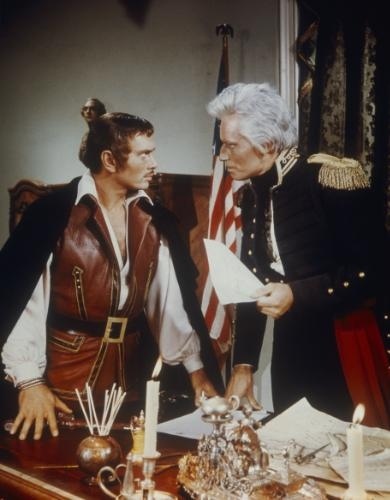
History of the World According to the Movies: Part 40 – The American Civil War: The North

Image

As far as American Civil War movies go, Spielberg’s Lincoln from 2012 is one of the best as well as brings the beloved 16th president to life in a way nobody else has ever seen before which gave Daniel Day Lewis a well deserved Oscar for his performance. Sally Field and Tommy Lee Jones performed superbly as Mary Todd Lincoln and Thaddeus Stevens as well. Sure there may be some minor inaccuracies in this but the overall spirit rings true in almost every way. Still, perhaps the biggest historic atrocity about this film is that it lost to Argo at the Academy Awards. I totally love this film which is like historical C-SPAN but fun.

The American Civil War wasn’t much better in the North at first since they had a series of terrible generals who Abraham Lincoln had to select because he couldn’t find anyone else. However, once there were generals like Grant, Sherman, Sheridan, Chamberlain, and Thomas who won battles, then he focused his attention to them. In 1861, the primary reason for the North fighting this war was to save the union through any means necessary even if it meant not freeing a single slave. But once slaves began to flock to Union troops seeing them as liberators, Lincoln would later issue his Emancipation Proclamation the next year which called for slaves in areas controlled by the Confederacy to be forever free as of 1863. Then you have the battle of Gettysburg and the Gettysburg address. In 1865, the 13th Amendment was passed which abolished slavery once and for all. Still, national unity and freeing slaves weren’t the only things that the North one on. They also had factories, a strong centralized government, large populations, a good navy, good diplomatic ties, and a strong skilled leader in President Abraham Lincoln. Of course, despite a lot of these things, sometimes the North tends to be seen as the villain in Civil War movies which kind of give many inaccurate impressions of them. Still, there are plenty of historical errors relating to the Civil War North which I shall list accordingly.

Francis Preston Blair Sr. was a nice looking old man in 1865 with a full head of hair. (Unlike the Hal Holbrook portrayal in Lincoln, the real Blair kind of resembled some undead monster you’d see in a zombie film rising from his grave. Also, he had been bald since he was a young man. I’ll forgive Spielberg on this one. Elizabeth Keckley doesn’t look like the Gloria Reuben’s portrayal in Lincoln either according to her photograph, but we’re not sure when her picture was taken.)

Union soldiers took aim by standing forward with their left foot. (They would usually step back with their right foot bringing it behind their left. Stepping forward would desecrate the line according to 19th century warfare.)

Joshua Chamberlain died at 83. (He was 85.)

Thomas Chamberlain was an everyman who fitted throughout the Confederate camps and made friends with whomever he met at Gettysburg. (There’s no historical basis of this.)

There were no black Union soldiers involved in the Battle of the Crater. (They were heavily involved in this battle.)

Union officers drank Don Perignon champagne. (This brand wasn’t around until 1921 or sold until 1936.)

Union officers used “at ease.” (This command didn’t exist in the Civil War. It would’ve been “at rest” or “in place rest.”)

Union General Charles Garrison Harker was in South Carolina at the same time as the 54th Massachusetts. (He was part of the Army of the Cumberland and was fighting in the Tullahoma Campaign in Tennessee. Also, unlike his portrayal in Glory which has him as a man in his forties, he was only 25 at the time.)

Union Army sergeant insignias were sewn onto a blue cloth backing all at once. (This is common among Civil War reenactors. Yet, during the Civil War, the stripes of the era were individual stripes which had to be sewn on one by one.)

Union volunteer cavalry at Shiloh also served at Gettysburg. (The cavalry that served in Shiloh were in the Battle of Vicksburg which was being fought around the same time as Gettysburg. Those at Gettysburg were in Virginia during the Battle of Shiloh. No volunteer cavalry could be present in both battles.)

Secretary of State William Seward was patronizing and dismissive toward Lincoln. (By 1864, he was practically in love with the man, but not in a gay way. Also, Lincoln would sometimes go to Seward’s house for dinner and an evening of laughs, songs, and wine.)

There were black Union soldiers at Fort Monroe at the arrival of the Confederate Peace Commission. (Black soldiers greeting Confederate envoys, what could possibly go wrong with that?)

The Capitol Dome was gray in 1865. (It had always been white since its completion in 1863.)

Andrew Johnson last served in the US Senate in 1861. (He last served in 1862 before being appointed as military governor of Tennessee.)

Only one Connecticut representative voted for the 13th Amendment. (All four representatives did.)

Every seat in Congress was occupied during the vote on the 13th Amendment. (At least 18 were left empty which would’ve belonged to the states that seceded.)

Copperheads were peaceful people who just didn’t like war. (Actually they were the antiwar Northern faction of the Democratic Party who wanted immediate peace with the Confederacy. While the War Democrats didn’t care for Lincoln, they supported the Union war effort anyway. The Copperhead Peace Democrats, on the other hand, were more radical in their virulent racist, hatred, and demonization of Lincoln, as well as sympathy for the Confederacy. And some of their rhetoric is just so vile with so many n-words that it’s too offensive to quote {well, you can watch the scene in Lincoln with the introduction of Fernando Wood, but it’s pretty tame. Still, he was a notorious Copperhead who called for New York City’s secession in the war’s beginning}. Sure they opposed the draft, emancipation, and suspension of habeas corpus, but they weren’t pacifists or Quakers {who were deeply anti-slavery and supported the Underground Railroad}. They were an organized political movement with political aims to chiefly undermine the Union war effort and fed off defeatism. Nobody knows how large it was. But it wasn’t uncommon for Copperheads to coordinate their operations with the Confederate government to create havoc on the Union home front. There was also Copperhead agitation behind the New York City Draft Riots in July of 1863 which was the war’s largest mob action with 120 killed, including 11 lynched black men. They also had support and funds by the Confederate government pertaining to actions and schemes like: overthrowing Lincoln, tried to stage a secession of the Midwest, organized killings of Union soldiers in southern Illinois, etc. In short, Copperheads were traitors who make modern day Tea Party Republicans look benign in comparison.)

Abolitionists staged violent insurrections against those who attacked their opinions during the war. (While mobbing was quite common before and during the Civil War, not a single instance involved abolitionists attacking individuals of opposing opinions. That was not how abolitionists behaved. Yes, there was John Brown’s raid on Harper’s Ferry but he was trying to arm blacks to rise against slave owners, which is another matter entirely. Also, no Copperhead was attacked in upstate New York during that time either. Still, abolitionists often were targets of mobs with pre-Civil War numbers as 73 in North and 19 in the South, many at abolitionist presses. Abolitionists have also been subject to numerous beatings as well as tar and featherings, and even murder, which were well known in Lincoln’s time. In fact, Lincoln’s first major political speech centered on the mob attack and murder of abolitionist editor Elijah Lovejoy in 1837.)

The dome of the US Capitol was completed by 1861. (It was finished in 1863.)

Union soldiers were flogged as punishment. (Since Colonel Shaw was a by-the-book man, no one in the 54th Massachusetts would’ve never gotten whipped {nor would Shaw order it} since flogging was banned in 1861. However, since slaves were often flogged, it kind of serves a purpose in Glory to have Private Tripp punished this way even if it was out of Shaw’s character to give such an order. Still, there were harsh punishments like being “spread eagled” on the spare wheel of an artillery limber which would’ve broken a man’s back.)

Colonel James Montgomery was a marauding racist and former slaveholder who made use of free slaves to pillage and burn towns. (Yes, he did pillage and burn but he was a staunch abolitionist in the vein of John Brown whose methods actually came from his days as an anti-slavery partisan during Bleeding Kansas. Also, he most likely didn’t own slaves at all.)

During his raid, Benjamin Grierson decided a deliberate retreat than to risk slaughtering Mississippi schoolboys. (This may not have happened. Yet, there’s a similar incident in the Battle of New Market with the Virginia Military Institute student body.)

White Union soldiers were thuggish and venal who tend to wonder why they’re in the army or why there was even a war going on. (I’m sure that many Confederate soldiers were like this, too, especially towards the end of the war when they started deserting the Army while Sherman’s Army marched to the sea. According to TTI: “Desertion was a serious problem in the South; by 1863 men were deserting faster than new recruits could be conscripted to replace them, and by war’s end over three-quarters of the Confederate army was AWOL. Entire Confederate divisions existed solely on paper, their men and command structure having walked out en masse, stealing as much equipment as they could carry. The most notable incidence of desertion was probably Confederate general Pemberton’s army, paroled after the surrender at Vicksburg. Mustered with 30,000 men, a month later fewer than 1,500 of them were left to report for duty, the rest having simply changed back into civilian clothes and gone home.”)

The Union Army had integrated regiments. (Blacks served in all black regiments but they were under the command of white officers but that’s as integrated as you’re going to get. Yet, white regiments did have black civilians working for them for a time though.)

White Union spies sometimes used blackface and pretended to be slaves in the South. (Many of them just used actual slaves mostly. Also, those posing as slaves were usually black to begin with.)

A 304th regiment existed in the Union Army. (No state assigned regimental numbers above the 100s.)

Benjamin Grierson’s raid consisted of the 1st Illinois, 1st Michigan, and the 2nd Iowa Cavalry regiments. (It was composed of the 6th and 7th Illinois and the 2nd Iowa Cavalry. Also the 1st Michigan served in the Army of the Potomac in 1863 so its presence would’ve been more appropriate for Gettysburg not Vicksburg.)

After laying mines in the Confederate trenches, Union soldiers lay in formation waiting to charge after they went off. (Union troops would’ve waited in their trenches because there would’ve been no open ground where they could lay in formation, they would’ve been hit by debris in the explosion, and the Confederates would’ve seen them getting out and lying in wait.)

The US Secret Service was around during the Civil War. (It was formed in July of 1865.)

The 116th Pennsylvania led the Irish Brigades charge at Maryes Heights. (It was the 28th Massachusetts.)

The 116th Pennsylvania had a green flag. (It was the only Irish Brigade regiment that didn’t. Theirs had the State of Pennsylvania. Also, before the Battle of Fredericksburg only the 28th Massachusetts had the famous green Irish Brigade flags. Most regiments received the green flags by General T.F. Maegher days after the battle. )

The 20th Maine charged independently at Fredericksburg. (No Union regiment charged at the Confederate position without supporting regiments around it during the battle.)

Union forces used the Gatling gun during the Civil War. (It wasn’t patented until 1865 and the US military didn’t adopt it formally until 1866.)

St. Clair Augustine Mulholland was a Lieutenant Colonel during the Battle of Fredericksburg. (He was a major and a commander of the 116th Pennsylvania which was part of Maegher’s brigade, not the brigade in total. Also, Maegher made his charge on horseback not on foot, and did not “protect the rear.”)

Brigadier General Thomas R. R. Cobb commanded an Irish regiment. (He commanded the Irish Brigade.)

Irish Union soldiers didn’t know what they were fighting for. (There are historical documents in their own eloquent words of why they as immigrants believed they ought to fight for the Union. Of course, many were drafted like Gangs of New York implies but there were plenty of Irish immigrants who did fight voluntarily as well.)

Ulysses S. Grant and William Tecumseh Sherman were warmongers who pressured Abraham Lincoln to punish Robert E. Lee and Jefferson Davis. (Actually Grant and Sherman would’ve wished nothing of the sort. Sure they got a lot of men killed and destroyed a lot of property but they considered such destruction as part of their duty as generals. Yet, once their enemies surrendered, they turned out to be very okay guys more interested in healing national ties than settling scores.)

Private Buster Kilrain was a grumpy Irishman from the 20th Maine demoted for drunkenness as well as delivered a very poignant speech at the Battle of Gettysburg. (This character from the movie Gettysburg is totally made up which is why his name isn’t on the 20th Maine monument at Little Round Top. The photo used to represent him in the opening credits was nothing more than an unknown ordinary Union soldier. However, there’s a cacophony of gullible individuals demand to know why that is on their trips to Gettysburg, which annoys the piss out of the tour guides in the process. )

Alexander H. Coffrot nervously voted for the 13th Amendment. (He was a pallbearer at Lincoln’s funeral so he was more than a simple political pawn to the White House.)

General Philip Sheridan commanded the Army of the Potomac. (He was the Commanding General of the Army of the Shenandoah. George Meade was commanded the Army of the Potomac during the last two years of the Civil War.)

Union cavalrymen always knew how to take care of their horses. (The Union Army actually lost more horses rendered unstable or even dead to sickness, exhaustion, etc. than to actual combat. While many volunteers in the first two years of the Civil War were from the farm, it wasn’t unusual for urban volunteers and  later conscripts to be assigned to cavalry units. So it’s possible that many Northern cavalrymen had no idea hot to take care of a horse because city horses were owned by commercial firms {like cabbies or wagoners} so many urbanites never learned how since horse care was left up to the professionals.)

Ulysses S. Grant:

Ulysses S. Grant was a four-star general in 1865. (He was a Lieutenant General which is a three star rank. However, many people believe that Lieutenant General is a four star rank anyway, which it’s not. Grant wouldn’t become a four-star general until 1866. Then again he was the first four star general this nation has had.)

Ulysses S. Grant swore and used firearms on a habitual basis. (He never used profanity and had an aversion to firearms {only using them when he needed to}.)

Ulysses S. Grant was a butcher who was willing to shed more lives because he could. (Though Grant’s strategy may be cold hearted, it worked and he wasn’t afraid to take advantage of having a superior numbers. Not to mention, he did feel the carnage deeply and was said to have wept after the first day of Wilderness. Then again, haven’t all generals done this even during the Civil War? At least Grant won battles and wasn’t a chickenshit unlike some of his counterparts. And by that time Lincoln was fed up with chickenshit generals.)

Ulysses S. Grant graduated at the bottom of his class. (He graduated 21st out of 39 in his class in 1843.)

Ulysses S. Grant was a short, coarse, rough man usually scowling as well as a drinker and smoker. (He was of average height in his era and “a man whose values and character often avoided the pitfalls that often face those who are given military and political blood and was painfully alive to every form of human suffering,” according to the site on his tomb. He was also a very creative strategist, a tough calm and collected leader, as well as was very nice to his adversaries who were willing to surrender. Also, he was an avid horse lover and once had a soldier beaten for mistreating one. Not to mention, he was a man of great humility as well as deeply respected by those who knew him {even by those who surrendered to him}, which was why he was so popular at the time of his death. Still, yes, he did smoke and was his tobacco habit that would kill him. As for his drinking, he probably wasn’t a drunk and more of a man who couldn’t hold his liquor.)

Ulysses S. Grant arrogantly and casually walked around the room smoking a big cigar during the surrender at Appomattox Courthouse. (Grant may not have been one of the most formal men but he treated Appomattox with the utmost dignity and sensitivity for his defeated foe. Not so in Birth of a Nation.)

William Tecumseh Sherman:

William Tecumseh Sherman was a monster who burned down Southern towns for no reason. (The reason why Sherman was burning down areas of the South had to do with the strategy of total war which meant destroying resources and bringing the war to civilians so the South would be scrambling and have low morale and arguably his strategy worked. Not to mention, Sherman didn’t take delight doing any of that. He also had a reputation for leniency and mercy, regularly permitting defeated enemies to retrieve their belongings and go home without further incident.)

William Tecumseh Sherman burned Atlanta in September in 1864 and at night. (He burned down Atlanta two months later. Yet at that time, retreating Confederate troops were torching ammunition dumps to keep the Union army from capturing them. However, the fire wouldn’t have been as spectacular as it was on Gone with the Wind.)

General Winfield Scott:

General Winfield Scott was in command at the Battle of Gettysburg. (The commander of Union forces was General George Meade. By Gettysburg, Scott had been retired from the army for over a year.)

General Winfield Scott was a buffoon over confident of a quick victory in the North. (He was one of the few people who knew the Civil War would be long, costly, and bloody. He also might’ve been taller than Lincoln at 6’ 5.” Not usually portrayed as such in movies.)

General Winfield Scott was in charge of the Union Army until after the end of the American Civil War. (He resigned in November in 1861 and was succeeded by a series of generals over the course of the war until Lincoln settled on  Ulysses S. Grant. If this were true, it might’ve saved Lincoln a lot of headache and he’d probably not appoint men like George B. McClellan, Joseph Hooker, Ambrose Burnside, Henry W. Halleck, Irvin McDowell, John Pope, and George Meade {though he was actually quite decent and won Gettysburg}. Yet, you don’t see this in They Died with Their Boots on.)

Thaddeus Stevens:

Thaddeus Stevens had a black live-in girlfriend. (He had a black housekeeper he was close to, but we’re not sure whether they were lovers or not. Still, he never married.)

Thaddeus Stevens disavowed his conviction that blacks were equal in all things in front of the House floor. (He didn’t, nor was his speech a decisive moment. Still, as far as historical inaccuracies go, Spielberg rates pretty low and actually tries to be historically correct. Also, in regards to historical accuracy in Civil War movies, Lincoln ranks pretty high on the list.)

Abraham Lincoln:

Abraham Lincoln was an unambitious man who didn’t want to get into politics, and was called Abe. (Lincoln hated to be called Abe. As a politician, Lincoln combined his policy substance and electioneering skills and knew how to play the game. Lincoln also had plenty of ambitions of his own such as to leave the log cabin and never look back, to marry a woman who could speak French and had attended finishing school, to send his son to Exeter prep school and Harvard. His law partner William Herndon called him, “a little engine that knew no rest.”)

Abraham Lincoln was wrong to suspend habeas corpus and use his war powers. (Contrary to Copperhead, Lincoln only briefly suspended habeas corpus in Maryland to prevent insurrection and secession simply because having the state go would have Washington D.C. surrounded by the Confederacy. Most arrests in the North during the war mostly consisted of  insurrectionary acts like blockade running, gun running and desertion. And mostly to protect enlistment and conscription. Newspapers were suppressed but only for a short time but reopened acting through the War Department and the Copperhead press remained more or less intact and left alone throughout the war even as they advocated for Lincoln’s assassination. Oh, and Lincoln believed that the Emancipation Proclamation was totally constitutional.)

Abraham Lincoln had a deep and sonorous baritone voice. (His voice was a high pitched nasal tenor.)

Abraham Lincoln wasn’t offended by profanity and wouldn’t be upset for people swearing in front of his kids. (Though he was all right with the occasional swear word now and then as well as cursing in extreme frustration {which he probably did a lot himself during the war}, he was known to be very offended by profanity going so far as to rebuke generals in the field for cursing in his presence. Nevertheless, it’s highly unlikely he would’ve tolerated Preston Blair’s swearing in front of Tad.)

Abraham Lincoln managed to get the 13th Amendment passed in Congress mostly by his own efforts. (It was actually due to the work of black and women activists who managed to send a 400,000 signature petition organized by the Women’s Loyal League {headed by Susan B. Anthony and Elizabeth Cady Stanton}. Also, Frederick Douglass should deserve considerable credit as well. Yet, as Lincoln notes, had Lincoln pressed Congress to pass the 13th Amendment, most of their efforts would’ve come to naught.)

William Henry Harrison’s portrait hung in Abraham Lincoln’s oval office. (It never did.)

Union soldiers could memorize the Gettysburg Address in Abraham Lincoln’s time. (The Gettysburg Address didn’t enter into the national vocabulary until the early 20th century. The chances of any Union soldier memorizing this speech, black or white, would’ve been far remote. Still, in Spielberg’s Lincoln, this is forgivable.)

Abraham Lincoln’s face was on coins during his lifetime. (It was on a $10 bill not coins. He didn’t appear on a coin until after his death with his first appearance being on a fourth series 50 cent piece.)

Abraham Lincoln was a homespun folk hero not fond of getting into fights or engaging in low brow humor. (TTI says he’s known for inventing the chokeslam as well as wrestled in his youth and nearly fought in a duel. As for low brown humor, Lincoln was notorious for these kind of jokes as seen in Lincoln. Folksy family friendly folk hero my ass.)

Mrs. Bixby’s five sons who served in the Union Army were all killed in the Civil War, which Abraham Lincoln wrote a letter for. (The Bixby legend is a myth plain and simple. Besides, Lincoln may not have written the Bixby letter himself {his secretary John Hay seems like a likely candidate}. Still, Mrs. Bixby only lost two sons in battle while her other boys survived the war with two being captured {one possibly deserting to the enemy} and one going AWOL. Bixby herself was said to be a Confederate sympathizer and had been described by her contemporaries as a madam and “untrustworthy and as bad as she could be.” It’s possible that she may have even been a con artist who exaggerated her claims for financial compensation. Still, this letter seems to have some prominence as setting up the plot in Saving Private Ryan.)

Abraham Lincoln sent an emissary to the Dakota Territory in order to negotiate a treaty with the Sioux which included a $130,000 payment for the tribe in gold. (Lincoln had bigger things to worry about than hostile Indian tribes.)

Abraham Lincoln arrived riding among piles and piles in a war torn battlefield after the fall of Petersburg and Richmond. (He was actually greeted by hundreds of ecstatic freed slaves.)

Mary Todd Lincoln:

Mary Todd Lincoln was a crazy bitch and there wasn’t much love between her and her husband. (Yes, she was feisty and had her moments as well as had a tendency to be misunderstood, but she was hardly as unpleasant as most film adaptations depict her with the exception of Spielberg’s Lincoln. The reason why she’s depicted like that is because Hollywood mostly likes to depict Abraham Lincoln as an unambitious man who had no interest in politics which is also inaccurate, thus, it’s up to Mary to push him into it so Abe could become president. As with the Lincolns’ marriage, Lincoln often said happily of her, “My wife is as handsome as when she was a girl, and I…fell in love with her; and what is more, I have never fallen out.” Sure Abe and Mary didn’t have an easy life together but their marriage was anything but loveless. And as with the craziness, her mental state began to deteriorate after Lincoln’s assassination and the death of their son Tad. Mary Lincoln may not have been the crazy bitch depicted in earlier film adaptations, but she was much misunderstood.)

Mary Todd Lincoln attended debates in the House of Representatives. (She didn’t nor would she make a scene in public. As a woman, she’d also be scorned at the time for sitting in the House Gallery.)

Mary Todd Lincoln berated Thaddeus Stevens for his investigation into her lavish expenses. (She would’ve never made a scene like that.)

Tad Lincoln:

Alexander Gardiner sent fragile one-of-a-kind plates to Tad Lincoln. (He would never do such thing since Tad had once ruined several images by locking the developer in a closet.)

Tad Lincoln was a normal 11-year-old boy in 1865. (He had a very serious speech impediment to the point that only his closest teachers and family could understand him {he also had speech therapy to overcome this as a teenager}. Based on photographs, he may have had a cleft lip or cleft palate. It’s also said he had such uneven teeth that he had such difficulty chewing food, his meals had to be specially prepared. He also didn’t attend school until after his father’s death. Still, Lincoln portrays him as a normal kid because most children with Tad’s condition have usually gone through surgery and therapy by 11 years old anyway these days. So to find a white 11 year old American child with a cleft palate and speech impediment like Tad’s would’ve been extremely difficult, if not impossible. Yet, other than that, Tad was mostly a normal kid albeit rather impulsive and unrestrained that many of his numerous tutors quit in frustration. But that had more to do with his parents not being disciplinarians.)

Tad Lincoln’s uniformed was of a Union Lieutenant Colonel. (In 1863, Edwin Stanton “commissioned” Tad as an artillery 2nd lieutenant.)

54th Massachusetts Regiment:

Colonel Robert Gould Shaw asked who would carry the colors if they should fall during the assault on Fort Wagner. (It was General Strong who asked the question and it was Shaw who volunteered to carry them.)

Most of the Massachusetts 54th consisted of ex-slaves. (Actually most of that regiment was made up of free blacks at least initially. Most of the original soldiers in the 54th Massachusetts could read and write and one of their privates was a doctor {today, he would’ve been commissioned a captain though}. Glory just used the Massachusetts 54th as a way to tell the story of black soldiers and sailors during the Civil War who were mostly ex-slaves, some even a few months or days before they joined up.)

Sergeant William H. Carney took up the flag and never let it touch the ground during the battle of Fort Wagner, a battle in which he later died in. (He survived the battle despite being wounded a few times. Not to mention, he would later become the first black recipient of the Congressional Medal of Honor for his heroic actions 37 years later in 1900. His expy Tripp in Glory doesn’t survive Fort Wagner though. But like the Denzel Washington character in the film, he was indeed a former slave.)

Colonel Robert Gould Shaw was thrown in a mass grave with everything on him minus his shoes. (According to Confederate General James Hagood, Shaw’s body was stripped and robbed before being thrown in the grave. Of course, you can’t have this in Glory.)

Colonel Robert Gould Shaw was eager to be the CO of the 54th Massachusetts. (He was actually very reluctant but he soon came to respect them as fine soldiers. Still, unlike Glory says, the pay boycott depicted was actually his idea.)

Robert Gould Shaw received the request to be Colonel of the 54th Massachusetts at a Boston party and accepted it immediately. (He didn’t receive it at a party nor did he accept it right away. He actually refused it twice since he felt himself unworthy. He eventually accepted it after his friend and future brother-in-law Charles Russell Lowell {who commanded the 2nd Massachusetts cavalry which had 5 companies of Californians} talked him into it.)

Colonel Robert Gould Shaw died falling into a parapet. (He actually made it to the top of the hill and his body fell into the fort. Other than where his body fell, his death scene in Glory is mostly accurate.)

Over half of the 54th Massachusetts regiment was lost during the assault at Fort Wagner. (Official records state that 54th sustained 272 casualties which closer to 40% of its force and of these only 116 were fatalities which is under one fifth of the men who stormed the fort. If the 156 soldiers that were captured are included {which is rather likely they didn’t survive capture since most black Union troops didn’t}, it would bring the total to over half. In any event, these heavy casualties and the regiment was widely viewed as having performed bravely indeed.)

The 54th Massachusetts was raised and trained in the fall of 1862. (It formed in March of 1863 just four months before Fort Wagner. However, they also saw action on James Island two days before the Fort Wagner attack.)

The 54th Massachusetts didn’t survive without Colonel Robert Shaw. (It actually continued to see action in Olustee, Florida in February 1864, Honey Hill, South Carolina in November 1864, and Boykin’s Mill, South Carolina in April 1865.)

Robert Gould Shaw was Governor Andrew’s first choice to lead the 54th Massachusetts. (Shaw wasn’t but he was probably the best choice.)

New York Draft Riots:

Bill the Butcher was a dangerous man who was around during the New York Draft Riots. (Actually he died eight years before the riots happened and his name was William Poole not Bill Cutting. And contrary to Gangs of New York, it’s not known killed anyone though he was murdered and owned a butcher shop. Sorry, Martin Scorsese.)

Irish immigrants were drafted into the Union Army after they just left the boat. (I’m not sure that newly arrived immigrants were draft targets at the time but it’s in Gangs of New York.)

The Chinese had their own communities and venues in 1860s New York City. (Yes, there were Chinese living in New York as early as the 1840s but significant Chinese emigration to New York didn’t begin until 1869.)

John F. Schermerhorn was alive during the New York Draft Riots. (He died in 1851.)

US Navy vessels were fired at New York City during the draft riots. (Sorry, Martin Scorsese, but this never happened.)

Working class Irish immigrants in New York City rioted in response to the draft of 1863 because they didn’t want blacks taking their jobs and social space as well as wanted no part in the war to free slaves. They also were a rather rowdy bunch who turned on each other and mostly destroyed property. (It was also because Democratic propaganda in New York City stirred their racial hatreds with antiwar and antiblack sentiments. And contrary to what Gangs of New York said, the toll was not that high. Also, there were plenty of Irish immigrants who fought for the North during the Civil War and some of the guys who tried to clamp down on the riots were Irish themselves. And there were no riots in the Five Points area of New York.)

Hell-Cat Maggie was around during the New York Draft Riots. (She was around during the 1840s. However, her character on Gangs of New York is more of a composite of other female fighters.)

George Armstrong Custer:

George Armstrong Custer was given a medal for his actions during the Civil War. (He wasn’t given any decoration though he did receive honorary brevet promotions for gallantry. Only the newly developed, “Medal of Honor” was awarded in the US at the time, which Custer never won. However, his brother Thomas was one of the only three Civil War soldiers along with 16 others since them to receive it twice. Still, despite media portrayals, Custer was no idiot. Also, the Confederacy didn’t use decoration either but only added a few names to a “roll of honor.” Not to mention, they didn’t use the Southern Cross which was a memorial recognition created by the United Daughters of the Confederacy in the 1890s.)

History of the World According to the Movies: Part 39 – The American Civil War: The South

Image

No movie perhaps shows the American Civil War in the view of the South like Gone of the Wind, or at least one that is relatively fair enough to be seen as one of the greatest films of all time. Of course, this movie does tend to be rather racist in regards to the portrayal of black people but so did many films around 1939. However, though Scarlett O’Hara and Rhett Butler are fictional characters, there were many people just like them during the Civil War with these two being featured as the flawed and relateable human beings they are as played by Vivien Leigh and Clark Gable. Not to mention, this film shows how much the South changed in the course of these critical four years. Though this is a flawed and romanticized historical interpretation of the Civil War and Reconstruction in the South, this is a classic that still flourishes and entertains.

For the next few posts in my movie history series, I’m going to cover films pertaining to the American Civil War. Two of these would feature photos of movies that I adore like Gone with the Wind and Lincoln. One will feature a movie which is historically significant in the history of film but one I sincerely despise because of its blatantly racist connotations and its message of racial hatred like Birth of a Nation. Nevertheless, the American Civil War may be a four year conflict but it’s one of the nastiest wars in American history that tore the US apart as well as families, towns, and even governments with implications that will not only have an impact on the United States as a nation (which you will get plenty of opinions on no matter where you are) but will also have ramifications worldwide, especially in how people fight wars in general (it’s not called the first modern war for nothing). The American Civil War is perhaps one of the bloodiest wars in American history in that it killed more Americans than any other war before or since as well as wiped out 2-5% of the US population at the time, and left many more impoverished, displaced, maimed, and traumatized. It was the first time waged in the battlefields and won in the factories as well as the introduction of the first military medical corps, war trenches, veterans organizations, and government involvement with the military dead. It was a war in which weapons like submarines, metal warships, repeating rifles, and others. It was also a war where many aspects like cavalry, Napoleonic battle tactics, wooden warships, cannon balls, and other things would become obsolete. However, many Civil War movies do tend to get things wrong like having soldiers using the wrong guns of the period or wearing the wrong kind of uniforms. Sometimes they tend to downplay the main cause of this conflict in the first place which was slavery.

Of course, as I said in the my post about the antebellum years, slavery was a major cause to why the American Civil War broke out or at least the expansion of it and the fact that Southern states wanted the whole country to recognize it but the North didn’t want that. Abraham Lincoln’s election of 1860 caused South Carolina to secede from the Union along with others from that time to early 1861. By 1861, these states eleven states formed the Confederacy and elected Mississippi politician Jefferson Davis as its first president. That April, the Confederates would fire upon Fort Sumter in South Carolina which kicked off the American Civil War as we know it. Of course, the South did luck out at first with good generals like Robert E. Lee, Stonewall Jackson, James Longstreet, and others. But things started taking a turn in the South such as Jefferson Davis’ propensity to pick generals he liked (instead of good ones), heavy losses that couldn’t be replaced, economic problems, limited industry, Northern blockades, and other things like Sherman’s march to the sea, Lee’s mistake at Gettysburg, and Grant’s victory at Vicksburg, the Confederacy would soon be doomed to defeat by 1865. Towards the end, the Confederacy had endured a great deal of destruction and suffered greatly in morale. Union capture of Richmond as well as Lee’s surrender would bring an end to the Confederacy as we know it. Still, there’s a lot of things movies get wrong about the Civil War in the South which I shall list accordingly.

The Southern whites during the Civil War just wanted to live in peace. (So they can continue owning slaves and expand into Latin America and the Caribbean.)

It wasn’t unusual late in the Civil war to see well-dressed Southern ladies having tea and slaves picking cotton. (This would’ve been highly unusual at this point in the war especially in 1864-1865.)

The Confederate Home Guard was a brutal organization which went around killing indiscriminately and torturing women. (Their main job was to return escaped slaves to their masters and sending deserters back to Confederate lines but they could certainly be this, especially towards the end of the war when Confederate morale was low. Still, it’s complicated.)

Confederate deserters were nice law abiding people worried about their starving families. (Many of them became mountain outlaws and some banded with Union guerrillas to plunder farms and towns.)

The Confederate flag was always used by the Confederacy during the Civil War. (Actually it was the “stars and bars” flag which looked very different. The Confederate flag came later.)

The Cherokee sided with the Confederates during the Civil War due to their mistreatment on the Trail of Tears. (Actually they fought on both sides for even though they were slave owners, many remembered they were forced out of a Southern state by a Southern president. Some volunteered to go to Oklahoma and supported the removal while others opposed it and were forced off. Even Indians weren’t that stupid to attribute the atrocities to just the North.)

Confederate soldiers wore gray uniforms. (Well, though the Union Army uniforms tend to be accurately depicted for the most part in movies, Confederate uniforms not so much. Also, early in the war there were Confederate units in blue and Union units in gray. Still, most Confederate soldiers usually wore what they had on at the time since many Confederates couldn’t produce or afford gray. And even soldiers who wore grey uniforms, each one varied considerably in hue.)

W. P Inman ditched the Confederate Army because of a serious injury in a calamitous battle. (It was actually for “cowardly desertion at his post.” Oh, and he signed an oath of allegiance to the US in December of 1864 in East Tennessee. Still, unlike what Cold Mountain says, Inman might’ve deserted multiple times.)

W. P. Inman’s wife was Ada Monroe and his daughter was named Grace. (Her name was Margaret Henson and his daughter’s name was Willie Ida. Still, Grace is a better name for your daughter.)

The South seceded from the Union over states’ rights. (Yes, if that includes the right to own slaves and treat black people as property. Yet, the South also wanted slavery to be recognized in the Northern states which opposed it. Also, until the Civil War Southern presidents and lawmakers dominated the federal government.)

Confederate soldiers were heroic and respectable men. Confederate officers were gentlemen while enlisted men were tough, had thicker accents, and were very loyal to their officers. (Yes, there were some noble Confederates, most of them would be all right as long as they weren’t against a black regiment.)

Confederate soldiers were superior to their Union counterparts in every way such as braver, more clever, more noble, and more tragic. (Ulysses S. Grant didn’t win the Battle of Vicksburg on significant numbers alone but on creative and innovative strategy. He also did a lot of things in battles that haven’t been done before as well as is sometimes referred to as a 20th century general. However, Hollywood and a lot of people tend to forget this and other battles. Still, the Confederate soldiers were no more superior than their Union counterparts, especially when it came to the treatment of blacks.)

The Confederate soldiers were nobly fighting for freedom. (Actually they were fighting for the freedom to subjugate black people under involuntary servitude under one of the most inhumane institutions known to history. I’m talking about slavery folks.)

Slavery had nothing to do with the Confederate cause. (It had everything to do with the Confederate cause and why the Southern states seceded from the Union. To quote from Confederate vice-president Alexander Stephens, “Our new government [the C.S.A.] is founded upon exactly the opposite idea; its foundations are laid, its corner- stone rests, upon the great truth that the negro is not equal to the white man; that slavery — subordination to the superior race — is his natural and normal condition. This, our new government, is the first, in the history of the world, based upon this great physical, philosophical, and moral truth.” Pretty sums the whole thing up.)

Virginia regiments fought at Little Round Top. (No Virginia regiment fought there.)

Many Irish in the South sided with the Confederacy. (The Confederacy had some company sized Irish units while the Union Army of the Potomac had an Irish brigade. Gods and Generals exaggerates the Irish Confederate presence a bit. Oh, and there was at least one ethnically European {mostly Irish} regiment from every Confederate state fighting for the Union.)

People from the Southern Appalachian Mountains were Confederate diehards. (People from this area have often been portrayed this way. However, Appalachia was strongly pro-Union during the American Civil War {so much that West Virginia formed their own state} and many of these areas suffered in retaliation from the Confederacy. The reason why Appalachia was such a pro-Union hotbed was because the mountainous topography separated them from the government seats which prevented them from using plantations as a means of income. Most of the trade and transport in Appalachia came from Northern states like Pennsylvania, Maryland, and Ohio. Thus, many areas in this region didn’t have as strong a loyalty to the state’s government as when they seceded. Because of economic and social differences, West Virginia pushed to have its own state as early 1820, yet secession just gave them an opportunity to do so. Other factors contributing to Appalachian Unionism included religious differences, class differences, and ethnic differences, which have not all been forgotten either.)

12lb Brooke guns were used as Confederate field pieces. (There’s no such thing as a 12lb Brooke gun nor were these guns ever used for field artillery. Brooke guns were used in the Confederate Navy and in some forts.)

Generals Stonewall Jackson and Robert E. Lee were bearded at the start of the Civil War. (Both grew beards later on in the war. Also, Lee didn’t get his signature look until he served as Jefferson Davis’ military adviser. Before that, he had dark hair going gray with a 1850s military style mustache. As for Jackson, he had a well-known disinterest for personal grooming and appearance but he was clean shaven at the start of the war.)

Confederate General Sibley’s units consisted entirely of infantry. (They consisted entirely of cavalry units and a single battalion of artillery. No Confederate infantry was used in the New Mexico campaign.)

Andersonville accepted prisoners in 1862. (It didn’t accept prisoners until 1864 and only took enlisted men. Yet, Libby Prison in Richmond would, which took officers.)

The Confederate 3rd Army regiment served in the 1862 invasion of New Mexico. (The Confederates deployed the 2nd, 4th, 5th, and 7th regiments of the Texas Mounted Rifles and some unnumbered territorial groups. There was no 3rd Confederate regiment of any sort there. Though there was a 3rd U. S. Cavalry on the Union side.)

The Confederate government sent agitators to the American West to incite Indian tribes against the Federal Government to draw troops away from battle in the East. (The Confederacy didn’t need to do this since the Western Indian tribes were agitated enough to fight the white guys already. Also, it probably wouldn’t have done much good since the Union Army was several times bigger than the Confederate Army throughout the Civil War. Besides, Sherman was more successful drawing Confederate troops away from battle through his March to the Sea.)

The Confederates were more Christian than those in the North. (Both sides were about equal in religious fervency.)

Virginia was one of the most pro-secessionist states in the Confederacy. (Remember that there was a group of Virginians who wanted to get out of there that they formed their own state. Also, there were so many Anti-Confederates in Richmond that the whole city was placed on martial law for a time. Not to mention, perhaps one of the only reasons why the Confederates picked Richmond as its capital was to keep halfheartedly-Confederate Virginia in the Confederacy.)

The Swangers were named Esco and Sally. (These people were real but their names were John and Margaret Steven Swanger.)

Pickett’s charge at Gettysburg was made during the morning. (It was made at 2 o’clock in the afternoon.)

Only the Confederates supported slavery. (There were many in the Union who did and there were four Union states that allowed it.)

Robert E. Lee:

Robert E. Lee’s surrender meant that the Civil War was over in Georgia as well as everywhere else. (The surrender of the Army of Northern Virginia had no effect on Georgia. In fact, Georgia State troops didn’t surrender until almost a month after Lee {due to slow communication}. The surrender of General Kirby Smith at Galveston, Texas on May 26, 1865, is considered the end of the Civil War.)

Southern Slaves:

It wasn’t unusual for a Southern slave to turn down his chance of freedom or turn against his or her master. (Actually few slaves would turn down such offers because many slaves given the chance to do either usually did {Some of Jefferson Davis’ slaves helped spy for the Union}.)

Many Southern slaves tended to remain loyal to their masters during the Civil War. (Really? So why were so many slaves willing to join the Union Army when they arrived in their neck of the woods?)

Though they did desire freedom at some future date, many slaves were genuinely happy with their lot in life as well as faithful and supportive to their beloved masters and the cause of the Confederacy. (What kind of racist bullshit is this, Hollywood? Sure there may have been some slaves who remained faithful to their masters, but this didn’t consist of the majority. Rather most slaves were so committed to gaining their own freedom that many were willing to offer their services to the Union without making a fuss. Also, many ex-slaves ended up taking arms against their own masters. Oh, and during the war, slaves were defecting from their masters in droves. At least Gone with the Wind gets the defection part right, sort of but not too much.)

A. P Hill:

A.P. Hill was a Brigadier General during the Battle of Chancellorsville. (He had been a Major General for over a year at this point.)

J. E. B. Stuart:

J. E. B. Stuart’s wife was Kit Carson Holliday. (Her name was Flora Cooke. Seriously, Hollywood, why would anyone want to name their daughter after a noted frontiersman like Kit Carson {who was real, by the way but a man}? Still, it’s in The Santa Fe Trail.)

J. E. B. Stuart’s cavalry adventure was a major impediment for Robert E. Lee at Gettysburg depriving him of information and cavalry support. (The Confederate cavalry was mainly used for raiding, not scouting. Though Lee rebuked Stuart, it wasn’t over leaving him blind in enemy country. The Confederate Army mainly relied on individual horsemen and overly-informative Union newspapers as intelligence sources. Thus, Stuart’s absence wasn’t of great importance to the battle of Gettysburg as Lee’s poor decision making was {and General James Longstreet knew it}. Still, many historians and Lost Cause advocates made Stuart’s supposed culpability a part of popular history which is why it’s in Gettysburg.)

The 5th Georgia Cavalry served with General J.E.B. Stuart. (They served exclusively in the Western Theater during the Civil War while Stuart was at Gettysburg.)

John Bell Hood:

When John Bell Hood was a Lieutenant General, he had both legs. (By the time he had this rank, he had already lost his leg at the Battle of Chickamauga and an arm at Gettysburg in 1863. Also, he never served in Louisiana during the war but lived and died in New Orleans after the war was over.)

Alexander Stephens:

Alexander Stephens was respectful to black Union soldiers. (He may have been nice the black Union soldiers as he was in Lincoln but he may not have had much choice. He’s also said to be nice to his slaves that many stayed with him as paid servants after the war {one served as his pallbearer} as well as campaigned for better treatment of slaves in general. However, he was a noted white supremacist and avid supporter of slavery {though he didn’t see it as a reason to mistreat or denigrate black people}. Even more interesting is that he was friends with Abraham Lincoln before the Civil War which Lincoln hints at when the 16th president calls him “Alex.”)

Thomas Jonathan “Stonewall” Jackson:

Stonewall Jackson favored an eventual abolition of slavery in the South. (There’s no historical evidence he believed this. Still, the first Confederate general to even consider freeing his slaves in order to have them fight against the North was Patrick Cleburne known as “the Stonewall of the West” in early 1864 when Jackson was long dead.)

Stonewall Jackson’s cook was a freed man. (He was a slave.)

General Stonewall Jackson’s men carried him on a stretcher which they dropped because of gun fire. (They dropped him because they slipped in the mud, not due to gunfire.)

Stonewall Jackson called his black cook, “Mr. Lewis.” (A lot of people in the South wouldn’t address black people this way at the time.)

Stonewall Jackson was a saint. (He was a religious man, but he had his flaws and eccentricities. However, he owned slaves, had a Christian Fundamentalist streak that contributed to his military prowess, as well as had a zealotry and causal disregard for human life, which made him so disturbing. Can’t have that in Gods and Generals.)

History of the World According to the Movies: Part 38 – The Antebellum Years

Image

2013’s 12 Years a Slave is one of the few movies out there that tells the truth about an issue which defined this era in 19th Century America. This film was based on a true story about a free northern black man named Solomon Northup who was kidnapped and forced to be a slave for twelve years. It’s Oscar for Best Picture was most deserved and I think this will be shown in schools for generations to come.

The Antebellum age in American history is one of great growth and great division. It is a time in America when the first factories, canals, and railroads were built in the North which was dominated by industry and urbanization generating great wealth for the country. In the South cotton was king thanks to the cotton gin but this also led to a demand in slave labor. By the 18th century, it was believed slavery would be on its way out but that was until industrialization which led to more slave families being divided and sold further South in the name of supplying the raw materials for the Northern factories. Slaves had been against their lot in life from the very beginning but the Antebellum years were a time when American slavery was at its worst as well as when the American economy was at its most slave dependent (and not many Americans realize this. Still, to say that slavery was on it’s way out in the 1860s is absurd). Also, before the Civil War, king cotton and slavery helped make the American South the richest and most powerful region in the United States with Mississippi having the most American millionaires. However, many Northern abolitionists started to take notice on how cruel and unusual slavery really was as well as against the very values our nation was built on. Tensions between the pro-slavery Southerners and the abolitionists would continue until things turned to a head in the 1860s with the outbreak of Civil War. Westward Expansion was also happening at this time with the US gaining it’s present geographical shape in the 1850s, thanks to a series of territorial acquisitions, Manifest Destiny, and the Mexican American War. Yet, as new states were added to the Union, the question on whether slavery should be allowed was becoming more controversial than ever before. There aren’t a lot of movies made in this era but those available still have their share of inaccuracies which I shall list.

The Old South:

A Southern aristocrat could be child of a slave and not even know it. (If you were a child of slaves, you would’ve known it and would not have been raised as a member of the Southern aristocracy. If you had a slave mother, you would’ve been raised a slave end of story. Still, if you could pass for white you’d probably figure out that your dad was a plantation owner. Yet, there’s a romantic 1957 film in which Yvonne de Carlo’s character was raised as a Southern Belle {which would never have happened nor would she have been involved in a romantic relationship with her new owner played by Clark Gable [which would’ve been anything but]}.)

Solomon Northup had two kids when he was kidnapped. (He had 3. Also, unlike 12 Years a Slave, he worked as a carpenter and was an amateur violinist not a professional. Not to mention, his family did know what happened to him since one of the barge sailors had helped Northup post a letter telling them he’d been kidnapped into slavery but didn’t know where he was. His family would spend years undergoing a complicated and legal process to get him home. Not only that, but Northup had contracted smallpox on the barge from a guy named Robert {who died en route} with his face being permanently scarred afterwards. Of course, you couldn’t have that happen so the black Steve McQueen {the black British director} had Robert stabbed instead. Still, the sailors on Northup’s barge didn’t rape anybody because that was considered vandalism and property destruction.)

William Ford was a hypocrite who contradicted his Christian sermons among his slaves’ agonizing screams. (Northup had a lot of kind words for him but said he was just a product of his environment. Then again, he did sell him to Tibeats who later sold him to Epps and these men were worse people in real life.  Still, Ford have to convince his brother-in-law Tibeats not to kill Northup saying he had nothing to gain from it. Yet, this didn’t stop Tibeats from chasing Northup with an axe on his plantation. As for Epps, well, this guy had a habit of chasing and whipping his slaves for no good reason.)

Solomon Northup cheated on his wife during his 12 years as a slave. (There’s no evidence he did though since he was a devout Christian, he didn’t mention it. Still, chances are he probably did.)

Patsey asked Solomon Northup to end her life. (No, she didn’t. It was actually Mrs. Epps who did according to his autobiography. What Patsey really wanted to do was run away and escape. Also, she didn’t talk over tea with Mrs. Shaw.)

Antebellum plantation homes were heated by cast iron stoves. (They were heated by wood burning fireplaces through chimneys at each end of the house.)

Slave owners were benevolent to their slaves. (Then why were there so many runaways and rebellions before the Civil War then? Sure there may have been some nice masters but slavery was a dehumanizing institution so the quality of one’s master shouldn’t even matter here. In America, slaves had no rights and were considered property, not people. They also worked longer days, more days, and more of their life.)

There was a genteel old South in slavery days. (Say that to Frederick Douglass and he’d be quick to tell you his life story which was anything but genteel. He should know for he grew up as a slave in Maryland.)

In early America before the 19th century, only the Southern colonies owned slaves. (People owned slaves in the North as well but not to the extent as Southern planters did. Also, until after the Revolution, slavery was legal in all the colonies.)

Plantation owners never had sex with their slaves. (Sexual relationships between slaves and their white owners were very common but most of them weren’t consensual. Also, Jefferson definitely had children with one of his slaves and there is living proof {like DNA in his black descendants}. Not to mention, Frederick Douglass always said that his father was a white man {most likely his first owner Captain Anthony} and most African Americans have at least one white ancestor in their gene pools {this is according to Dr. Henry Louis Gates}.)

Slave owners forced their slaves to fight each other in Mandingo fighting. (Slavery was a brutal institution but there’s no evidence that Mandingo fighting was ever a thing. Sorry, Quentin Tarantino.)

No slaves rebelled against their masters. (Have you ever heard about Nat Turner, Hollywood? Also, plantation owners worried constantly about their slaves rising up against them. Still, slavery resistance took many forms like day-to-day resistance, economic bargaining, running away, maroonage, and outright rebellions.)

Southern Belles were always lovely and kind women with all the traits of a proper Southern lady. (Gone with the Wind may not be right about slavery, but it certainly is about Southern belles who were more or less trained to not care about people and merely become pretty dolls devoid of personal wishes or emotion that are supposed to attract husbands. Scarlett O’Hara certainly fits this with all its implications. Yet, in movies based in the South, they’re seen as love interests.)

Plantation mistresses were saintly women whose hard work never toiled their health. (The job of plantation mistress was so rigorous and demanding that many women checked out of the process altogether opting instead for a life of smelling salts and reclining on fainting couches.)

Black slaves were child like and devoted to their masters. (This may be the case sometimes but this wasn’t characteristic of all black slaves or black people in general. However, slaves didn’t serve their masters out of loyalty but mostly out of fear. Also, slaves who had the opportunity to escape the plantation usually did.)

Most slaves were field laborers or household servants. (Much of the labor performed by slaves required high skill levels and careful, painstaking effort. Masters relied on some slaves for skilled craftsmanship as well as to manage others.)

House slaves led easier lives while field slaves bore the brunt of slavery’s brutality. (House slaves didn’t have it any easier than the other slaves nor did slaves who worked at trades.)

Masters treated their slaves like members of the family. (Oh, please, most slaves were more likely treated as objects or livestock, even if they were members of the master’s family {I’m not making this up}. Slavery was a brutal institution which kept a large group of people from being treated as the human beings they were.)

Slavery was a dying institution by the American Civil War. (It was anything but. Rather it was thriving more than ever before thanks to King Cotton as an economic system and as a means of racial control.)

There was no slavery in mountainous North Carolina. (Oh, yes, there was just not as much as in other areas.)

Abolitionism:

The 19th century abolitionists weren’t racists. (For their time, but in regards to nowadays, certainly for they consider whites superior to blacks. Of course, Frederick Douglass was one of the few abolitionist who wouldn’t be considered racist mostly because he was black, considered himself biracial, and married a white woman.)

John Brown was crazy. (As a religious fanatic and believer in the emancipation of slavery through any means, then yes. As a homicidal maniac, then probably not.)

John Quincy Adams had an African violet from West Africa in his greenhouse. (African violets were first documented in 1891 and weren’t imported until a few years later. Oh, and they’re only found around the border region of Tanzania and Kenya which is in East Africa. Most African slaves {including those from the Amistad} were from West Africa and John Quincy Adams died in 1848. Thus, neither Cinque nor Adams would’ve ever seen this flower or know anything of its existence.)

Martin Van Buren replaced Judge Judson with Judge Coglin. (He actually didn’t do this but he did write a letter to Judson asking him to send the slaves back to Cuba. He had a boat waiting to take the slaves immediately which would moot any appeal the abolitionists might’ve made. Yet, this was seen as interference with the court system and it may have been a minor reason why Van Buren lost the 1840 election to a slave owner.)

Judge Coglin ordered Ruiz and Montes arrested as part of his verdict in the Amistad case. (The abolitionist lawyers already charged them with assaulting their clients. They were eventually convicted and sentenced to prison while the main case was pending.)

Northerners weren’t racist. (Racism was pretty much universal in 19th century America for a long time. Still, just because there were people who didn’t believe in slavery didn’t mean that they wanted blacks to have equal rights or have non WASP Europeans immigrate to the country. Northern states also had their share of racist laws preventing blacks from exercising their rights as citizens as well as lynch mobs and race riots. Not to mention, its industrial economy depended on raw materials from the South which made slavery a highly contentious issue in the North. Still, when it was still legal, Northern cities earned a lot of money from the slave trade.)

John Brown had a beard during Bleeding Kansas. (He did wear one years later.)

After John Brown was hanged, a Army officer next to him said, “So perish all such enemies of the Union.” (The guy’s name was Colonel J. T. L. Preston of the Virginia Military Institute who actually said, “So perish all such enemies of Virginia, all such enemies of the Union, all such foes of the human race.”)

John Brown said his last words from the gallows. (He said nothing on the gallows but he did leave a note to the prison guard that said, “I, John Brown, am now quite certain that the crimes of this guilty land will never be purged away but with blood.” )

Texas War of Independence:

The Texans just wanted their freedom from the Mexicans. (They also wanted to continue to own slaves and the Mexican government wanted to outlaw this practice. Of course, the Mexican government wanted them to convert to Catholicism and the white Texans didn’t want to do that which is understandable. They also disagreed on civil law, education, and taxation which the American Texans also thought irreconcilable. Also, not all the Texans were whites that came from the United States either.)

The Alamo had a curved roof at the time of battle. (The roof had crumbled due to neglect and was only restored in 1912.)

The Texans in the Texas War of Independence called themselves Texans. (They called themselves Texian until Texas became independent in 1836.)

Davy Crockett wore his coonskin cap at the Alamo. (He didn’t. Oh, and his original cap was made out of wildcat fur.)

In 1836, Sam Houston arrived in San Antonio accompanied by a large entourage. (He usually traveled accompanied by just an aide. Also, he was never in San Antonio during the Texas Revolution.)

During the Battle of the Alamo, all the women and children were evacuated from the fort. (All except Suzannah and Angelina Dickinson who were the wife and daughter of Major William Barret Travis’ aide Lt. Almaron Dickinson.)

General Antonio Lopez de Santa Anna had a lot of artillery shells to spare during the siege at the Alamo. (Had he as much artillery as he did in the John Wayne film, the Alamo would’ve been reduced to rubble and the whole battle would’ve been over in minutes.)

The massacre of James Walter Fanin’s men from Goliad happened before the fall of the Alamo. (It happened three weeks after the Alamo fell.)

James Bowie was wounded and confined to a bed during part of the siege of the Alamo. (He actually spent the entire siege there suffering from typhoid or TB. Still, there have been various accounts about his death but there’s a good chance he actually was stabbed by bayonets after firing his pistols while reaching for his big ass knife. Nevertheless, there’s good evidence he was the hero at the Alamo and not Crockett.)

The Alamo had upper windows during the siege. (They weren’t installed until 15 years after the battle. Also, the Alamo didn’t have its famous hump by then either.)

William Travis and Susannah Dickenson were cousins. (They weren’t related. Also, she was 15 with black hair and had a 15 month old daughter.)

James Bowie’s wife died during the Alamo siege. (She died from cholera 2 ½ years before the battle.)

The final Battle at the Alamo took place during the day. (It started before dawn when the defenders were sleeping. It was all but finished at dawn.)

Sam Houston gave William Barrett Travis orders to hold off the Mexican army before he could build one. (Houston actually sent Bowie to the Alamo to burn it down and retreat to Gonzales, Texas. Travis was sent by Col. Neill in charge of San Antonio while he went on a 20 day furlough to be with his family. Bowie and Travis ignored his order though it was Bowie’s idea to stay and fortify the Alamo.)

Captain Seguin returned to the Alamo to bury the bodies of the Texan defenders. (General Santa Anna had all their bodies burned after the battle and their ashes were left on the pyres. It was these ashes, Seguin placed in a coffin and buried.)

Jim Bowie’s boozing and carousing caused him to lose command of the Alamo. (Yes, Bowie was known to do these things because he was never demoted for them. Also, drinking was a common thing in militaries at this time. Still, Bowie never took orders from Travis since the two of them shared command {since Bowie was elected as militia leader while Travis was head of the volunteer cavalry}. )

Lieutenant Colonel William Barrett Travis questioned Jim Bowie’s allegiance all because he married into Mexican aristocracy. (Yes, Bowie did marry into Mexican aristocracy and acquired a lot of land because of it. However, it would be ridiculous for Travis to doubt his loyalty because Bowie was one of the rebellion’s best known firebrands who had just taken San Antonio from the Mexicans.)

Lieutenant Colonel William Barrett Travis was killed while defending the gate of the Alamo with only his sword near the end of the assault. (Travis actually died early in the assault by falling backward from the wall with a bullet to the head.)

When Davy Crockett was mortally wounded at the Alamo, he managed to blow up the powder magazine. (Crockett didn’t do this. However, Alamo defender Robert Evans tried but was shot dead during his unsuccessful attempt. Also, Crockett was shot after surrendering to Santa Anna’s men {but his death is hotly debated}.)

Lieutenant Colonel William Barrett Travis was married during the siege of the Alamo. (He was divorced in 1836 due to the fact that he deserted his family.)

Davy Crockett died at the Alamo while fighting by getting impaled by a Mexican soldier. (According to Mexican accounts {if we are to believe them}, particularly the diary of Mexican officer José Enrique de la Peña, Crockett surrendered and was taken prisoner by Santa Anna. He was tortured and killed with six other prisoners though General Manuel Castrillon tried to intercede with Santa Anna to spare Crockett’s life. Santa Anna vowed to take no prisoners and executed Crockett with the other survivors. Nevertheless, Santa Anna scandalized many Mexican officers by doing this. Still, Crockett’s death is up for debate because Santa Anna would’ve boasted about executing him and they guy says he died during the action.)

Only white Texans were among the Texas rebels. (Hispanic Tejanos fought in the rebellion, too like Captain Juan Seguin who played a vital role at the Alamo.)

Davy Crockett played a key role in defending the Alamo. (Most historians say that he didn’t and may have been killed early in the battle.)

Davy Crockett died as a POW for Santa Anna. (It’s very likely he did but we’re not exactly sure how he died. Still, this scene was a reason why many people weren’t happy with the 2004 Alamo film.)

Jim Bowie invented the Bowie knife. (No, he didn’t but it helped make him a frontier legend after a celebrated fight in Mississippi where he fatally stabbed an opponent twice with it despite being twice shot and stabbed 3 times himself. In some ways, this pitch kind of puts George Foreman and his grill to shame. Still, it’s unknown whether he fought another knife duel which he didn’t need to since he already had the knife and PR.)

There were 185 defenders at the Alamo. (There were 250.)

Jim Bowie had a six barreled gun. (No, he didn’t but he did have that big ass knife that bears his name.)

Davy Crockett had a thing with Lady Flaca and went hunting with his men near the Alamo. (Neither of these happened.)

Lieutenant William Travis didn’t draw a line in the stand with a sword when he made his famous speech. (There is some first hand testimony saying he did from the two Alamo survivors. Yet, it’s very likely this is a legend.)

There were no survivors at the Alamo. (There were 17 Alamo survivors including Susannah Dickenson and her daughter, a black slave, and 14 pro-Texan Hispanics.)

Manifest Destiny:

The Confederate States and the Transcontinental Railroad were around in 1850. (Both weren’t around until the 1860s. Also, contrary to what The Legend of Zorro says, California would get its first railroad in 1856.)

The US possessed the Oregon Territory and the Louisiana Territory in 1788. (The US would receive both in the 19th century.)

Captain Harry Love was a psychotic killer. (He was actually a California Ranger and a Mexican American War veteran doing his job which was to hunt down the Five Joaquin gang that included Three Finger Jack and Joaquin Murieta, which he killed in a shootout. He took Three Finger Jack’s hand and Murieta’s head as proof the deed had been done {not as a trophy}.)

Brigham Young and Joseph Smith weren’t polygamists. (They were contrary to what the Tyrone Power biopic about Brigham Young says. Also, they didn’t have nice to things to say about black people either.)

Yuma Territorial prison was around in 1843. (Arizona was a part of Mexico then, so there was no Yuma Prison until 1876. It wouldn’t be part of the US until 1848.)

People who found gold managed to strike it rich during the California Gold Rush. (The people who actually managed to strike it rich were the people who actually mined the miners, particularly when it came to inventing something miners can use. Levi Strauss came up with blue jeans and actually made a fortune this way.)

The Santa Fe Railroad was built in the 1850s. (According to Imdb: “The original company was the Atchison and Topeka Railroad Company chartered in 1859. Although one of the original destinations of the railroad, “Santa Fe” was not added to the name of the company until 1863, well after the setting of the movie. Further, contrary to what is shown, initial track laying did not begin until 1868. “)

General Winfield Scott was a Lieutenant General during the Mexican War. (He was a major general and wouldn’t ascend to the rank until 1856 becoming the first American to do so since George Washington to hold it.)

Brigham Young and Joseph Smith claimed to be gods of the earth. (Neither of them did nor were they considered such by any of their followers.)

Brigham Young was British. (He was born in Vermont.)

The Nauvoo Expositor was torched by a mob. (It was ordered to be destroyed by a city council and it was done in a peaceful manner.)

Edgar Allan Poe:

Edgar Allan Poe had never written any sailor stories. (He wrote quite a few including “MS. Found in a Bottle,” “A Descent into the Maelstrom,” “The Murders in the Rue Morgue,” and “The Narrative of Arthur Gordon Pym,” among others (including “King Pest” and a brief sequence in “The Premature Burial”).)

Edgar Allan Poe was hunting a serial killer in Baltimore during the last days of his life. (He had been hospitalized four days before he was found dead on a Baltimore park bench on October 7, 1849. Still, alcoholism probably had nothing to do with it.)

Edgar Allan Poe was an alcoholic. (He’s said to be in his early biography, but it was written by a guy who despised him {his literary executor Rufus Griswold}, which was denounced by people who knew the guy personally {and to this day, we’re not sure what’s true about his life and what’s not, well, some of the content anyway. But it’s very well established that Poe was a posthumous victim of character assassination.}. However, his death may not have been attributed to alcoholism. Most people who knew Poe didn’t think he had any problems with substance abuse. Sure he drank during difficult times in his life, but he also could do without booze for several months. Still, possible causes of Poe’s death may be delirium tremens, heart disease, epilepsy, syphilis, meningeal inflammation, cholera, rabies, or cooping {basically being unwillingly forced to vote for a particular candidate [sometimes several times over] and being killed for not complying. I mean he was found on an Election Day}. So there were plenty of things that could kill you in the 19th century. Not to mention, he was treated at a for-profit hospital at the time of his death where he was confined to a prison like room and wasn’t allowed visitors. And that the physician attending him was the only one with him at the time, but we’re not sure if he’s even trustworthy because he kept changing his story in later years. He even altered the dates. Poe’s death certificate and medical records have also been lost.)

Edgar Allan Poe was unable to make money from writing full time. (Well, to be fair, writing certainly didn’t make Poe rich, mostly because the US didn’t have any copyright protection system at the time and that it’s tough getting published anyway. Also, lack of a central bank in the day made people’s finances very unstable. However, he was able to secure a variety of writing positions in his lifetime for various journals and magazines where he contributed a lot of articles. It also helped that Poe had a wide writing range producing poems, book reviews, short stories, and critiques. Hell, he even had his short stories released as a book collection as well as a considerable following. He also moved around a lot and while his home in Baltimore doesn’t look like much, his last residence in Philadelphia on the other hand is considerably nicer. Poe even had a cottage in Fordham section of the Bronx during his final years. So while Poe may have struggled economically, he wasn’t in the poorhouse. Of course, what hampered him economically wasn’t his personal life in as much it was the fact that Poe’s stories received a lot of negative reviews from other authors mostly because Poe basically wrote highly negative reviews about theirs. This was at a time when reviews were usually expected to be positive since they were hired to “sell” books. Poe just couldn’t stand to “sell” books he thought were bad.)

Edgar Allan Poe owned slaves. (His foster family did. But contrary to a silent film, Poe himself didn’t mainly because of his economic situation. And the fact he spent considerable time in his adult years in places where slavery was illegal. But there’s a silent film that depicts him as owning one.)

Edgar Allan Poe spent much of his life in Baltimore. (He only lived in Baltimore for 2 years in the 1830s and died there. Actually, Poe was born in Boston, grew up in Richmond, and spend a good chunk of his literary career in Philadelphia and New York.)

Abraham Lincoln:

Abraham Lincoln was a vampire hunter. (Oh, please dear God, no.)

Abraham Lincoln had a decent relationship with his dad. (He had a better relationship with his wife and in-laws than with his old man as an adult. Actually after his mother’s death, Lincoln’s relationship with his father had deteriorated {though he did continue to support and visit him as an adult}. His father wasn’t even invited to Lincoln’s own wedding or even met Mary or their kids. Nor for that matter did Lincoln attend his dad’s funeral or visit him on his death bed saying “Say to him that if we could meet now, it is doubtful whether it would not be more painful than pleasant; but that if it be his lot to go now, he will soon have a joyous meeting with many loved ones gone before; and where the rest of us, through the help of God, hope ere-long to join them.” According to biographer David Herbert Donald, “In all his published writings, and indeed, even in reports of hundreds of stories and conversations, he had not one favorable word to say about his father.” Yet, he and his dad seemed to be on rosy terms in Abe Lincoln of Illinois.)

Abraham Lincoln made his House Divided speech during the Lincoln-Douglas debates. (He actually made them when he accepted the Republican Party’s nomination for Senate from Illinois.)

The Armstrong case took place in 1837. (It took place in 1858, a few years before Lincoln would be elected president and at the time known as “the guy who debated Stephen Douglas.” He was 49 years old at the time.)

“Battle Cry of Freedom,” “Rally Around the Flag,” and “Battle Hymn of the Republic” were songs played during Lincoln’s presidential election in 1860. (They were American Civil War songs written in the 1860s.)

Abraham Lincoln met Joshua Speed in New Salem, Illinois. (They met in Springfield.)

Abraham Lincoln’s first love was Ann Rutledge. (This is widely believed but there’s no evidence to support that they were anything more than friends {but even so, he might’ve been willing to marry her}. Same goes for his relationship with his roommate Joshua Speed {for all those who think Lincoln was gay, yet understand sharing a bed was what roommates did in the 19th century regardless of sexual orientation. Besides, the Lincolns had absolutely no trouble consummating their marriage since their son Robert was born almost exactly nine months after their wedding}. Also, Ann died at 22 not 19. Still, his first love would more likely be Mary Owens but their relationship ended with a mutual breakup {yet most people have never heard of her}. Nevertheless, the Ann Rutledge story seems to be popular in Lincoln biopics since her untimely death gives an ideal Victorian death scene.)

Abraham Lincoln jilted Mary Todd at the altar. (They did call off their engagement in 1841 but there was no jilting involved. They did get back together as history shows.)

The Lincoln and Douglas debates were about an argument pertaining to secession and slavery. (It was an argument about slavery. And he was already the Republican nominee for Senate by that time.)

Joshua Speed died before Abraham Lincoln. (Speed outlived Lincoln by decades.)

Abraham Lincoln was just a simple country lawyer before his presidency. (He was a man of political ambitions as well as ably and profitably represented the Illinois Central Railroad and the Rock Island Bridge Co. {which would build the first railroad bridge over the Mississippi River}. Had he not tried to seek office or compelled to speak out against the pro-slavery Kansas-Nebraska Act in 1854 before running for the U.S. Senate, Lincoln would’ve remained a full-time lawyer and earned fame and fortune at the bar.)

Martin Van Buren:

Martin Van Buren was nominated by the Democrats for the 1840 presidential election in 1839. (Well, not in an official stance.)

Martin Van Buren was photographed during his presidency. (The earliest photo of him that exists is from 1845. Still, the first president to be photographed while in office was James K. Polk in 1849 {though William Henry Harrison may have been in 1841}.)

Davy Crockett:

Davy Crockett was the first modern American celebrity to bore everyone silly moaning about his fame. (Actually he courted fame and was a swaggering braggart, not a soft spoken wry adventurer like in the Billy Bob Thornton portrayal.)

Davy Crockett fought the British during the War of 1812. (There’s nowhere in his biographies that indicate he participated in any battles against British troops.)

Other:

Gen. Philip Sheridan was the head of West Point during Custer’s time there. (Sheridan was never head of West Point and was nine years older than Custer as well as only a first lieutenant when the Civil War began.)

The Whig Party was around in 1832. (It was formed in 1836.)

At least one Pinckney family member served in Congress during the Amistad case. (No member of the Pinckney family was holding office at the time.)

Robert E. Lee was in uniform during the capture of John Brown. (He had been on leave when he was suddenly called back to duty. Thus, during John Brown’s capture, he was in civilian clothes. Also, he  didn’t sport that Civil War signature look then either. Nevertheless, his troops at Harper’s Ferry were marines not army.)

“Beautiful Dreamer” came out in the 1850s. (It wasn’t written until 1864.)

Joseph Smith got to trial. (He was murdered by a mob of 200 people and was willing to turn himself in to prevent a battle between the mobs and the persecuted Mormons. Yet, the Mormons didn’t flee when Joseph Smith was killed and left Illinois for Utah 2 years after his death.)

West Virginia was a separate state in this era. (It would become a state in 1863 when it split from Virginia to join the Union.)

Early American congressmen and senators didn’t carry guns in the US Capitol. (They did. Also, you won’t believe how many guys in congress got into duels in Washington DC during that time.)

“In God We Trust” was on silver coins during the 1850s. (It wasn’t put on coins until 1867.)

Artillery at Harper’s Ferry was pulled by 4 horse teams. (Artillery pieces were pulled by 6 horse teams until the Civil War.)

J. E. B. Stuart’s first assignment after West Point was the 2nd Cavalry. (It was the U. S. Mounted Rifles in Texas followed by the 1st Cavalry.)

The Armory at Harper’s Ferry just consisted of an arsenal where John Brown was. (From Imdb: “The Federal Armory at Harpers Ferry was actually a complex of manufacturing, storage, and office buildings. During the fighting, John Brown’s force finally took refuge in the Fire House, one of the smallest of the buildings on the Armory grounds. The Fire House was built of brick but had three large wooden doors through which the firefighting equipment could move. “)

Stephen Foster’s wife was from the South. (She was from Pittsburgh like he was.)

Martin Van Buren was a well known politician in the 1820’s. (It would’ve been impossible for a 12 year old boy in New Hampshire to carry the name of the 8th president of the United States since during the 1820s, he was an obscure politician and a relative unknown and of no particular consequence to anyone outside New York.)

The slave trade was legal in the US by the 1850s. (It had been abolished in 1807.)

History of the World According to the Movies: Part 37 – The Birth of the American Nation

Image

Who would’ve thought Ramses II and Moses from The Ten Commandments would be together again to fight the Battle of New Orleans together in the 1958 film The Buccaneer? Of course, if there are any movies based in this era, this movie and it’s 1938 premake with Frederich March, are probably the best you’re ever going to get in terms of historical accuracy. Still, Yul Brynner’s character is a French pirate named Jean Lafitte whose services were vital to Charlton Heston’s Andrew Jackson (which is well cast despite the hilariously botched make up job) winning the Battle of New Orleans. Had Lafitte had not intervened, the British might’ve won and American history would’ve taken a very different direction.

While there aren’t many movies made covering the US between the end of the American Revolution and the War of 1812 (and the ones we do have tend to be rather inaccurate), these years tend to be trying years for the new United States (yet, why Hollywood doesn’t do many movies on these years I have no idea since there’s much creative potential). In the 1780s, the US was under the system of government known as the Articles of Confederation, which was a loose set of rules for the nation that wasn’t very effective, which was shown by Shay’s Rebellion in Massachusetts. So the summer 1787, a bunch of delegates gathered in Philadelphia to draft a new constitution with a stronger federal government which the United States pretty much runs on today. In 1789, George Washington would be elected America’s first president (in a modern sense) who would set precedents in the American presidency which are still followed today as well as Alexander Hamilton’s financial system. Still, this is an era when the US comes into its own as a nation with things like the XYZ Affair, the Whiskey Rebellion, clashing with the Barbary pirates, the Louisiana Purchase, the Lewis and Clark Expedition, Marbury vs. Madison, and finally, the War of 1812. Yet, many of these subjects don’t have their own movies to them for some reason. Yet, ones that do have a lot of inaccuracies in them which is a shame because this is a very important time in American history and knowledge of it shouldn’t be confined to an American classroom.

Articles of Confederation Years:

Thomas Jefferson’s daughter Martha was in her 20s when she and her family arrived in Paris. (She was 12 years old in 1785. Ironically, in Jefferson in Paris she’s played by Gwyneth Paltrow while in 1776, her mother is played by Blythe Danner {Danner and Paltrow are mother and daughter in real life}. )

Thomas Jefferson was willing to break his vow of never remarrying by hitching up with Maria Cosway. (Make no mistake, Jefferson did have an affair {or a romance} with Maria Cosway and did invite her to Virginia, but there’s no record that he ever proposed to her. Also, Maria Cosway had a husband who Jefferson also invited to Virginia as well.)

Sally Hemings was in her twenties when she began her sexual relationship with Thomas Jefferson. (She was 14 while Jefferson was 44 {yes, these are the right ages and a bit creepy} but since she’s played by 23 year old Thandie Newton in Jefferson in Paris, we’ll allow that. No one wants to see Jefferson sleep with a teenager, even though he actually did.)

Thomas Jefferson witnessed the first Mongolfier balloon ascent. (The Mongolfiers launched their first balloon in 1783. Jefferson was in Paris between 1785 and 1789.)

Sally Hemings was pregnant while in Paris. (She had her first child after she and the Jeffersons returned to America.)

Federalist Era:

Alexander Hamilton was a wizened old fox. (At times he could be loyal, brilliant, and arrogant. Also, he died at 49. Not to mention, he saw George Washington as a father figure.)

Alexander Hamilton drew up his financial plan for the US during his affair with Maria Reynolds. (He banged Reynolds after he drew up his plan.)

Alexander Hamilton toyed around with Maria Reynolds only because his wife was out of town. (He barely missed an opportunity for sex from anyone.)

Jack o’ lanterns adorned American homes in the 1790s. (Carving pumpkins weren’t commonplace in the US until the wave of Irish immigrants in the 1840s.)

The New York Police Department existed in the 1790s. (It was founded in 1844 and first issued the dark blue uniforms in 1853.)

New York City was the capital of New York in 1799. (New York’s capital was moved to Albany in 1797.)

The Presidential residence in Washington D. C. was called the “White House” in 1806. (The earliest reference of the President’s house called “The White House” was in 1811. At this time, it was mostly known as “The Executive Mansion.”)

Monticello was in tip top shape at this time. (The Monticello you see today looked nowhere near like it did during Jefferson’s lifetime. Jefferson never finished its construction and it was a mess by the time he died in 1826. Actually the Monticello you see today was more of the work of historical renovators which was completed in 1954.)

There were no slaves in Washington at this time. (Blacks slaves served as footmen in the White House at this time.)

Lewis and Clark Expedition:

William Clark and Sacajawea had a romantic relationship during the Lewis and Clark Expedition. (No such relationship ever took place. For one, Sacajawea was already married {and heavily pregnant with her son Jean Baptiste for part of the trip} and Clark was engaged. Second, her husband was also an important member for he was the only one who understood his wife and was happy to give his assistance. And it was him Lewis and Clark actually hired as an interpreter who agreed to go only if his pregnant wife tagged along with him and it was a good thing she did. Third, do you think Clark would be that stupid?)

Sacajawea was promised to Toussaint Charbonneau and had no baby during the Lewis and Clark Expedition. (She was married to Charbonneau and would have a son named Jean Baptiste during the trip. Furthermore, her accompaniment was a stipulation by Charbonneau himself who agreed to go along with Lewis and Clark as long as he brought her with him.)

Sacajawea met Thomas Jefferson. (They never met each other because Sacajawea was never in Washington or Monticello.)

Lewis and Clark didn’t get along with each other during the expedition. (They got along splendidly and had no problems sharing overall command. Also, Lewis never threatened to have William Clark court-martialed. They faced many problems during the expedition but fighting over romance wasn’t one of them.)

William Clark got into a knife-fight with Charbonneau. (This never happened, nor would anyone in the expedition come at each other with knives.)

Toussaint Charbonneau was a jealous husband as well as a complete villain of a man. (He was actually a very nice guy eager to help Lewis and Clark with his assistance. Also, he was a very important member of the group who was one of the reasons why Sacajawea was so helpful to the group {since the Corps of Discovery only had two guys who spoke French.})

Sacajawea accompanied William Clark back to Washington D. C. (Her and Clark’s relationship was no more than professional {though he did help support her kids} and she didn’t accompany him back to Washington. Still, Hollywood, why do you make up these romances that never existed?)

There were no black guys in the Lewis and Clark Expedition. (William Clark brought his slave and manservant York with him who the Indians treated with respect and wonder {since they never saw a black man before}. Still, he could’ve been played by Sidney Poitier in The Far Horizons.)

William Clark and Meriwether Lewis had the hots for the same girl named Julia Hancock. (Lewis had no interest in Clark’s fiancée. Besides, she was only 14 at the beginning of the expedition which was rather creepy since Clark was 33.)

Lewis and Clark had adversarial relations with most of the Indian tribes they encountered during their expedition and killed a dozen Indians in one attack. (They were on friendly terms with many of the Indian tribes they encountered {save the Blackfeet}, much due to the services of Sacajawea and her baby son Jean Baptiste. And the only Indians that were killed during the trip were a couple of teenage Blackfeet during the return.)

Lewis and Clark lost several men during their expedition due to Indian attacks. (They only lost one guy during the whole trip to a ruptured appendix {which really couldn’t be treated}. No one in Lewis and Clark’s team was ever killed in an Indian attack during the whole expedition which is a truly remarkable feat.)

Lewis and Clark saw the Grand Tetons during their famous expedition. (They never saw these mountains in Wyoming.)

War of 1812:

The Mississippi Valley escaped British Conquest during the War of 1812 largely because of Jean Lafitte’s longings for an American belle. (Actually the Battle of New Orleans was fought two weeks after the War of 1812 but the Treaty of Ghent had no bearings on the New Orleans crisis there {since the British had considered the Louisiana purchase invalid anyway}. Had the British won, treaty or no treaty, North America would’ve looked very different than it does today, and Chicago and St. Louis may as well have been part of Canada. Still, Lafitte’s motives were more about getting his brother Pierre out of British custody from a New Orleans jail than anything. This explains why he was willing to help Andrew Jackson when the latter captured his men in exchange for services and munitions. Jackson had little choice but to give Lafitte’s men a full pardon due to steady pressure from the leading citizens and Lafitte’s personal appeal.)

Andrew Jackson gave Lafitte and his brother orders to clear out in an hour after one of his men sunk an American ship. (Lafitte and his men actually ended up receiving a full pardon by President Madison for his services as well as Jackson’s warm public thanks. Still, the love stories in the movies about Lafitte are 100% made up.)

The Americans were outnumbered by the British during the Battle of New Orleans. (Both sides were about even.)

Tennessee sharpshooters caused the majority of British casualties in the Battle of New Orleans. (Most of the British casualties were due to American cannons.)

Louisiana Governor William Claiborne was sympathetic for the Baratarians’ plight. (He was only willing to accept Jean Lafitte services in exchange for Pierre Lafitte’s release because he was desperate for allies. He was actually against Lafitte’s cooperation.)

Governor Claiborne’s house slave Cato fought on the Americans’ side during the Battle of New Orleans. (Slaves were forbidden to fight on the American side during the War of 1812 for fear they’d turn their guns against their masters. However, resident free blacks in New Orleans did fight on the American side, in compliance with Andrew Jckson’s orders.)

Jean Lafitte was willing to join Andrew Jackson’s forces over democratic idealism. (It was actually because Jackson had took 80 of his men hostage {including his other brother, Dominique You} and that Jackson needed Lafitte’s munition supply. Nevertheless, the Baratarians’ services were vital to American success during the Battle of New Orleans.)

Dominique You and Jean Lafitte weren’t related to each other. (They were brothers, but movies don’t point this out.)

Jean Lafitte had a romance with Governor Claiborne’s daughter Annette and was willing to find a better line of work to win her over. (Claiborne did leave descendants but I’m sure Annette Claiborne didn’t exist. Also, even if she did, her dad wouldn’t want her to date a French pirate like Jean Lafitte. Also, Lafitte never gave up his profession and died in 1826.)

The American militia in New Orleans was quickly raised and the defensive line of the Rodriguez Canal was built only when the British threatened the city. (The defenses at the Rodriguez Canal were constructed only in the course of a week while Andrew Jackson used martial law to raise several militia units and had almost 4,000 reinforcements. Also, unlike what 1958 film The Buccaneer says, the Americans weren’t standing behind a flimsy wall but high and solid fortifications.)

Andrew Jackson used delaying tactics to slow down the British advance at the Battle of New Orleans. (Jackson was an aggressive man who later attacked a man who tried to assassinate him while he was president. He would’ve done no such thing and led his troops in an immediate attack, taking the exhausted British by surprise and staged an artillery duel several days later.)

Andrew Jackson never swore. (It’s said when he died, his pet parrot had to be removed from his funeral. Still, Charlton Heston’s portrayal of Andrew Jackson is almost dead on.)

The rich citizens in New Orleans refused to pay taxes because no one wanted to pay them in a war that was being lost. (The French and the Spanish residents of New Orleans refused to pay taxes because they had little interest in following the American government’s laws.)

Andrew Jackson had a heart condition. (Well, The Buccaneer points this out. However, while Jackson wasn’t the healthiest specimen, he had been in a duel in which he dealt with a bullet in the chest. It would remain with him for the rest of his life.)

Andrew Jackson knew which direction the British were coming during the Battle of New Orleans. (He didn’t so he spread his forces over a wide area to cover all possible approaches.)

History of the World According to the Movies: Part 36 – The American Revolution

Image

Of course, I couldn’t do a post on the American Revolution without posting a picture from the 2000 film The Patriot in which Mel Gibson plays a simple family man who kicks Great Britain’s ass and all the British soldiers are stand-ins for the Nazis. This movie covers the Revolutionary War in the South which is much more complicated and brutal than the movie portrays. Also, there’s no way Mel Gibson’s character would have black workers toiling at his plantation. That’s just not possible. Not to mention, Banastre Tarleton and Lord Cornwallis weren’t that bad guys either.

Anyone who lives in the United States knows that the American Revolution is a pivotal point in American history, even though it’s not as important anywhere else. Of course, if you want to know why we entered into this war with Great Britain, look no further than the French and Indian War which the colonists fought on the British side so some of them could move out west to places like Pittsburgh or some where. I mean if the French won, I would’ve written this article in French and be a Canadian citizen. Still, after the war ended in 1763, Indian Wars against Pontiac led to the Prohibition line of 1763 across the Appalachian Mountains. Then you have Britain in debt which led to the Stamp Act, Townsend Acts, Boston Massacre, Boston Tea Party, the Intolerable Acts, and before you know it, the shot heard around the world at Lexington and Concord. Thus, the American Revolution has begun which leads to other events like The Battle of Bunker Hill (should be the Battle of Breed’s Hill), the Declaration of Independence, Washington Crossing the Delaware, Saratoga, Valley Forge, and finally Cornwallis’ Surrender at Yorktown. There are quite a few movies made in this time, which have quite a few historical errors in them of which I shall list.

Road to Revolution:

The American Revolution was fought over taxes. (It was fought over being taxed but without being able to send representative to Parliament. However, little did they know about how many people were unrepresented in Britain. Also, they didn’t like being treated as a colony.)

The Liberty Tree was full of leaves during the Boston Tea Party. (The Boston Tea Party took place in December.)

Paul Revere shouted “The redcoats are coming!” during his ride. (He said “The regulars are coming!” which doesn’t seem to have the same gist to it. Also, he wasn’t the only rider and didn’t make it to Concord.)

The American Revolution:

George Washington:

George Washington was pessimistic about his army’s progress by the spring of 1776. (Actually he was a little more hopeful. Despondence didn’t set in until seven weeks after the Declaration of Independence came out.)

Benjamin Tallmadge:

Major Benjamin Tallmadge and Major John Andre had a long and deep friendship. (Yes, they had some kind of friendship but it wasn’t for the longer term. Also, Andre knew he was a goner anyway. Still, Tallmadge did nothing to save Andre’s life nor did Andre save Tallmadge’s. Not to mention, Tallmadge was never a spy out of uniform and was much more ruthless nor was above employing brutal methods to accomplish his own ends unlike his expy in The Scarlet Coat.)

Francis Marion:

Francis Marion was a forward-thinking family man during the Revolution who defeats countless Brits single-handedly. (In reality, Francis Marion was a slave-owning serial rapist who didn’t get married until after the war {to his cousin} and he also killed Cherokees for fun. In Hollywood terms, this would make the real Francis Marion truly undesirable for any Hollywood film adaptation because who wants to see a movie where the hero rapes his slaves and takes great sport in killing Indians? As for defeating countless Brits singlehandedly, how can you manage that with a musket? Also, why would any Southern man hire black workers for wages? That’s as impossible as them working voluntarily. How could a black person voluntarily work on a South Carolina plantation during the American Revolution, really?)

Henry Lee:

Henry Lee was known as “Lighthorse Harry” Lee throughout the American Revolution. (He didn’t get the nickname until 1778.)

The Mohawk Valley:

Fighting in the Mohawk Valley was mostly Indians vs. settlers. (The British soldiers played a much bigger role. Also, the Continental Army and local militias raided and destroyed Iroquois settlements in the region. So maybe the Iroquois had some reason to get pissed off and attack settlers.)

The Battle of Oriskany was an American victory. (Nearly half of the American forces were killed, wounded, or forced to retreat and it led to lifting the siege at Fort Stanwix two days later because the militia could no longer do so. However, this happened in 1777 not 1781.)

Fort Stanwix and the Mohawk Valley were of no strategic importance whatsoever. (The events in the Mohawk Valley and Fort Stanwix would later lead to Saratoga, which would be a turning point in the American Revolution.)

William Caldwell was killed on the Mohawk Valley assault. (He lived to fight on the British side during the War of 1812.)

Banastre Tarleton:

Lieutenant Colonel Banastre Tarleton wore a red uniform. (He was a Dragoon and his legion wore green. Still, love the Jason Isaacs portrayal though I prefer him as Lucius Malfoy with his pimp cane wand and blond hair.)

Banastre Tarleton burned down a colonial church full of villagers during the Revolutionary War. (There’s no evidence he did such a thing or that any other commander during the American Revolution did either {though Oliver Cromwell did burn a church full of people in Ireland and the Nazis staged a similar massacre in France}. And unlike what The Patriot tells you, he did survive the war and went on to have a political career. Still, was an asshole though for he supported slavery. Nevertheless, he had a bad reputation for his men slaughtering colonial prisoners at Waxhaw, though we’re not sure if he was directly responsible but the massacre wasn’t a premeditated thing. He also burned colonial homes and execute suspected guerillas but that’s about it. If he had burned a church full of people, we would’ve known about it. Also, the Loyalists were much worse in their brutality toward the Patriots {who were happy to return the favor}.)

Charles Cornwallis:

Lord General Charles Cornwallis was present at the Battle of Cowpens. (He wasn’t.)

Lord General Charles Cornwallis held the colonists in open contempt and disdain. (He was a Whig who was sympathetic to the colonials as well as an MP who voted on their behalf several times before the war. He was just fighting for his country.)

Lord General Charles Cornwallis was a rather older man during the American Revolution. (He was only in his forties and six years younger than George Washington.)

Benjamin Franklin:

Benjamin Franklin was an abolitionist during the American Revolution. (He wasn’t until after the war but he did become president of the Pennsylvania Abolition Society in 1785.)

Benjamin Franklin was a pervert. (Yes, he had a racy side which does show in his writings. However, in 1776, he was quite an angry man who was out to even the score with a British government that had hauled him before the Privy Council in 1774 and called him a liar and a thief.)

John Adams:

John Adams sent for Martha Jefferson to visit her husband in Philadelphia while Thomas struggled writing the Declaration of Independence. (Sure Jefferson was deeply worried about Martha during the times he struggled writing the Declaration of Independence, yet his wife was at Monticello too ill and depressed even to write him a letter {due to suffered a miscarriage and a bout of gestational diabetes}, let alone visit him in Philadelphia. Still, Jefferson could’ve used some other alternative to fuel his sexual frustrations like many slave owners did at the time {Jefferson included}. However, Mrs. Mary Norris Dickinson was present in Philadelphia at the time but she’s absent from 1776 mostly because the Dickinsons’ marriage was more egalitarian and not bound by gender stereotypes {which is kind of a shame that it wasn’t included}.)

John Adams was an obnoxious and disliked person in the Continental Congress. (This is based on Adams’ self-description from 1822 but David McCullough and Gary Wills say that no one viewed him this way and much of Congress actually had a lot of respect for him. John Dickinson was actually advocating an unpopular position in 1776, according to them. Still, he was kind of a brilliant and abrasive guy who hated to shut up but missed his wife during that time {yet they did flirt passionately in their letters}.)

John Adams hated Richard Henry Lee and liked Benjamin Franklin. (He actually admired and respected Lee but disliked Franklin.)

Thomas Jefferson:

Thomas Jefferson resolved to free his slaves in 1776. (He never did except for a few after his death 50 years later. Also, he would have children by one of them later on in his life.)

Thomas Jefferson was so anxious to get home during the independence debate was because he needed to get laid. (No, it was because his wife was extremely ill at the time from a miscarriage.)

Thomas Jefferson was a sex addict. (No, he may have been a guy on the Autism spectrum who may have slept with his slaves but he was no sex addict. But we understand he did have his needs.)

Thomas Jefferson cut out his antislavery paragraph from the Declaration of Independence over Edward Rutledge’s speech about how both north and south were equally responsible for it while John Adams defended him. (Actually, the paragraph was more on the slave trade, not slavery. Still, while Adams did defend him, Jefferson cut it because due to objections from Georgia and South Carolina while some northern states were uneasy on the subject.)

John Dickinson:

John Dickinson was a loyalist. (He wasn’t at all since he had been anti-British before the Revolution with his Letters of a Pennsylvanian Farmer as well as fight against the Brits in the militia as a private and brigadier general. He just didn’t think 1776 was a good time to declare it since the government structure was too uncertain and that the Americans had no European allies. Also, he wasn’t at the Continental Congress when independence was being debated and voted upon. Still, he was a pacifist Quaker who objected to revolution, not a loyalist Tory {or a Nixon clone as he is in 1776}.)

John Dickinson resigned from Congress without signing the Declaration of Independence. (He didn’t resign but he did leave without signing. However, he was on the committee to draft the Articles of Confederation.)

John Paul Jones:

John Paul Jones spoke in an American accent. (He born and grew up in Scotland. Seriously, his biopic casting would’ve been more accurate if he was played by Sean Connery, not Robert Stack. )

John Paul Jones only had two vessels in his squadron of privateers. (He actually had four. His Captain Landais of the Alliance just didn’t want to obey Jones’ orders and regularly ignored them mostly because he felt he should’ve been in command.)

John Paul Jones ordered Commodore Hopkins to the Bahamas. (He sent him to the Virginia coast but Hopkins went to the Bahamas anyway attacking the islands for military supplies. He was later court-martialed for this and other questions regarding his command. I guess being one of the first US officers to be court martialed doesn’t look good for one’s resume.)

Captain Pearson knew that John Paul Jones was in his vicinity. (He knew there was a raiding force in the area. However, he mistook Jones’ fleet was a Royal Navy squadron. This allowed Jones to get close to the Serapis before the sea battle began.)

John Paul Jones refused to accept Captain Pearson’s sword during the latter’s surrender. (Jones actually accepted Pearson’s sword after the battle but returned it a few days later.)

Richard Henry Lee:

Richard Henry Lee was a giggling buffoon who made endless puns with his own name and didn’t have any idea about American independence. (He was the second most powerful orator in the Continental Congress after John Adams who supported independence the moment he entered Congress. Also, he was an intense, high minded, and humorless Puritan who would’ve certainly hated his portrayal in 1776.)

Richard Henry Lee was governor of Virginia. (He never served as governor. His cousin Henry Lee was {who ended up fathering a future Civil War general}.)

Caesar Rodney:

Caesar Rodney was short. (He’s famously depicted as tall.)

Caesar Rodney had a small patch covering his cheek. (During 1776, Caesar Rodney was suffering from skin cancer which would later kill him 9 years later {at 56 being 47 in 1776}. However, by that time, he was actually missing half his face due to 18th century surgery and cauterization treatments. He kept the afflicted area under wraps under a green kerchief wrapped around his head. Still, despite this and asthma, he managed to ride eighty miles during a thunderstorm. However, he was absent from Congress in 1776 because he trying to stiffen the spines of his fellows Delawareans.)

James Wilson:

James Wilson was a timid fool who only voted for independence because he didn’t want the notoriety of turning it down. (He was a shrewd and contentious lawyer from Pennsylvania perhaps the greatest intellect in America after James Madison. Also, he was staunchly committed to independence from the beginning but delayed his vote until he checked with his constituents to make sure they agreed with him. Contrary to 1776, he wasn’t a judge at the time and the swing vote for independence was a guy name John Morton who’s absent from the film. Still, Wilson’s portrayal in 1776 is as about accurate as it could be at the time.)

Robert Livingston:

Robert Livingston was an utter twit. (This man would go on to negotiate the Louisiana Purchase in 1803.)

Edward Rutledge:

Edward Rutledge was in his forties in 1776. (He was only 26 and the youngest delegate. In 1776, he’s played by a 40ish Jack Cullum.)

Lewis Morris:

Lewis Morris was an idiot who willingly abstained his vote until his sons enlisted. (He wasn’t in Philadelphia to vote on Independence because he was serving as Brigadier general in his local New York militia. Also, he was very pro-independence as well as later signed the Declaration of Independence months after the vote.)

Lewis Morris had 12 children in which 4 of the oldest boys fought in the Revolution. (He had 10 kids and his 3 oldest sons fought.)

War in the South:

The French only fought in the Battle of Yorktown as colonial allies. (They arrived in 1778.)

Slavery was practically nonexistent in Revolutionary South Carolina and not particularly bad anyway. (South Carolina was one of the biggest pro-slavery states in the Union for much of American history {it was the first state to secede from the Union after Lincoln’s election in 1860}. And, yes, it was one of the most inhumane institutions ever in existence in America. I mean the US became bitterly divided and fought a whole war over it. Also, read Frederick Douglass’ autobiography in which he talks about all kinds of childhood horrors and how his struggle to be free took up most of it.)

The Battle of Guilford Courthouse was colonial victory during the American Revolution. (It was actually ah heavy loss.)

Most of the South was pro-patriot during the Revolutionary War. (There were significant factions in the South that remained Loyalist.)

The Battle of Cowpens was a mostly infantry affair that resulted in heavy American losses. (It was a cavalry battle lasting less than an hour which resulted in only 12 Americans getting killed.)

Americans of all stripes took up arms out of patriotism during the American Revolution. (Well, maybe but it took some congressional measures to keep them in the Continental Army which wasn’t an easy task since it had few resources and more Americans served in militias. Some also served for money and or because they had nowhere else to. And not everyone in the colonies supported independence either.)

British soldiers were mostly responsible for the atrocities in the South during the Revolutionary War. (Loyalists and Patriot Americans were and many used the war as an excuse to settle old scores. However, in Hollywood, the Patriots are the good guys, and the Loyalists mostly don’t exist.)

Declaration of Independence:

30-35 delegates of the Continental Congress were present in 1776. (65 delegates were but 1776 was adapted from a musical so the reduction kind of made sense.)

The debate over American Independence boiled down to the argument of the phrasing of the Declaration and whether slaver ought to be legal. (As with the slavery question, the issue very well could’ve been debated but it wasn’t the point in which the issue of independence hinged at least for the Continental Congress. Yet, since many of the Revolutionary leaders were slave owners {I’m talking to you, Jefferson}, they kind of passed the buck to the next generation by silent agreement. As with independence, they already voted in favor of independence before making changes to the Declaration.)

The anti-independence faction in Congress were filled with “conservatives.” (There were no conservatives in Congress at this time since every delegate was liberal in the classical sense in English 18th century politics. To be a conservative at the time, you would have to be vehemently pro-monarchist and have found the idea of an unauthorized congress distasteful no matter what they were discussing. Also, the left-right spectrum wouldn’t exist until the French Revolution.)

The vote on independence came on July 4, 1776 when the Declaration of Independence was signed. (It was on July 2. Some historians believed the Declaration of Independence was actually signed on August 2, {though most of the delegates signed it at different times}. Also, John Hancock was the only person to sign it on July 4.)

There was a mandate for a unanimous vote for independence. (There wasn’t but rather an understanding that a less than unanimous vote risked the fatal split of the colonies, especially if the delegates were from Pennsylvania which is why it’s known as the Keystone State and why a keystone is used as a state highway logo.)

Miscellaneous:

During the American Revolution, both sides spoke in British accents. (Yes, but not in the British accents we know today. British accents have changed considerably since the nineteenth century and American accents have changed very little. And since there was no recording equipment at the time, we can’t really know for sure how they talked.)

Colonial soldiers saluted by placing their hands on their hats. (It actually consisted of taking off one’s hat, lowering it to the side, and putting it on again.)

The Founding Fathers were all God-fearing Christians. (Christians, yes, but they were also secularists and some had rather unconventional ideas about religion. Still, most of them did go to church and certainly weren’t atheists.)

Revolutionary soldiers wore blue uniforms. (This is true only near the end of the war and mostly among the officers. Most Continental soldiers wore whatever they had on or their militia uniform if they were in one. This is played to a lesser extent than the Confederates wearing grey uniforms though.)

The statue of King George III in New York City was of dark lead. (It was painted in gold according to a Continental army lieutenant.)

The Bonhomme Richard sank immediately after the battle with the Serapis while it was being pumped out during the action. (It actually sank late the next day after the battle in a failed attempt at repairs begun after the surrender since the men couldn’t be spared during the fight and the extent of damage couldn’t be fully judged during the chaos.)

American marksmanship was not only key to American victory during the American Revolution, but also to the vote of American independence. (No, I don’t think so. This is a myth. Besides, muskets had terrible aim.)

Samuel Chase, John Adams, and Benjamin Franklin were sent to a training camp in New Brunswick, New Jersey which George Washington reported as full of disorder and prostitutes. (They probably didn’t make such a visit. Also, Continental army training camps in 1776? Still, at least Washington’s view on camp followers is accurate in 1776. Also, New Brunswick did have that reputation for debauchery back then despite being the home of today’s Rutgers University.)

The attack of Whitehaven was a smooth operation. (It was far from it. The second boat sent during the attack did very little and its crew might’ve spent the attack in the Whitehaven pub {which would’ve made for a very funny scene}. Whitehaven’s fortifications had no troops {but housed a couple of caretakers} since the town was too cheap to pay for them and there was no confrontation with the townspeople. Also, only one of the 200 vessels docked there were burned since the attackers didn’t have enough oil to set the rest alight.)

American militiamen reloaded their guns very speedily and efficiently in combat. (They were notoriously slow reloading in combat due to lack of training, practice, and experience. The British, however, were well trained in this procedure.)

Continental soldiers were always ragged and hungry. (Sometimes but not all the time.)

The Americans won the Revolutionary war with frontier savvy and guerilla tactics. (We forget the British had as much guerilla chops as the colonies as well as Indian allies, even the guy who wrote the book on being an army ranger fought for the British. Ordinary pitched battles and European allies helped the Americans win.)

The stars and stripes was adopted in 1781. (It was adopted in June 1777.)

The Founding Fathers kept a secret treasure trove. (Several Founding Fathers were Freemasons but no, they didn’t put a treasure map on the Declaration of Independence.)

Charles Carroll of Carrollton was a Freemason. (He wasn’t.)

Ethan Allen took Fort Ticonderoga in 1776. (He took it in 1775.)

History of the World According to the Movies: Part 35 – Colonial America

Image

Of course, no post on Colonial America will be complete without a picture from The Crucible with Daniel Day Lewis and Joan Allen as the Proctors. Still, Daniel Day Lewis is much too hot to play John Proctor since the real guy was a much older and heavier man who had a much larger family. Elizabeth Proctor was also significantly older but not much. Still, John Proctor never recanted and never had an affair with Abigail Williams.

The United States hasn’t had a long history yet there are plenty of movies recalling it nevertheless. What was once seen as untamed wilderness by the Jamestown explorers would later become set for a world power status by the 20th century. Of course, for many people outside the US, the movies are a way to learn about American history. For Americans, the movies are a way to remember it. Still, these don’t all consist of cowboy movies or Civil War pictures. Yet, this is a nation which many believed was founded on the basis of life, liberty, and the pursuit of happiness as said in the Declaration of Independence. Few may not know that the US was once a colony of Great Britain or that certain events in American history didn’t even happen like the Mexican American War and the War of 1812 since much of Europe was fighting Napoleon a the time. In fact, not many people in Britain know much about the War of 1812 and they fought it, which is just as well because the Battle of New Orleans was a pretty humiliating defeat for them. Still, at least everyone remembers the American Civil War whether they like it or not as well as cowboys.

Of course, during the Age of Sail and the Cavalier Years, the world saw the rise of what would become a new country: America. However, under this time, the future nation would consist of 13 British colonies along the East coast. Of course, this is the time of the Pilgrims arriving in Massachusetts in pursuit of religious freedom and celebrating the first Thanksgiving with the Indians. You also have the Puritans who came for religious freedom as well as set up their own theocracy and later hunt witches. Still, when it comes to movies set in Colonial America, you’re mostly going to have it set in Massachusetts which will usually revolve around the Salem witch trials despite the fact that it didn’t cover most of colonial American history. Of course, from Hollywood, you won’t find out about things like New York being taken away from the Indians by the Dutch and later by the English, the infamous slave trade from the memoirs of Oladauh Equiano, the rise of Virginia growing tobacco, Indian Wars, a tale of a drag queen in colonial New Jersey, the founding of Georgia as a colony of debtors, and the one time George Washington accidentally started a world war after a diplomatic misadventure in Western Pennsylvania due to his inability to understand French or Native American languages. However, what does get into the movies, there is a potential for a great deal of inaccuracies which I shall list accordingly.

Plymouth Colony:

The Pilgrims landed in Plymouth Rock. (No, they landed in what is now Provincetown at first, but later landed in Plymouth near an abandoned Indian village they specifically chose as a landing place, but there was no rock.)

The Mayflower established the first settlement in New England. (George Popham had founded a colony along the coast of present day Maine in 1607 with 120 others. However, it failed within the year due to family changes in leadership ranks and most of the colonists got fed up and returned to England. Still, Wikipedia does have pictures of the map and the site. Nevertheless, compared to the Pilgrims, the Popham settlers were wimps.)

John Alden was a ships’ carpenter. (He was a cooper {barrel guy} and came on the Mayflower as a crew hire who later decided to stay, but he wasn’t a Separatist.)

Most on board the Mayflower came to America for religious freedom. (Yes, but the Pilgrims also came because they didn’t want their kids to grow up Dutch nor live in a land where other people could practice their religion just as freely {like Catholics, Jews, and atheists}. Some came as crewmembers and others to help provide governance for the colony. Also, many servants came along as well. Nevertheless, the Pilgrims who were religious Separatists consisted of 56% of the passengers and crew.)

John Alden and Priscilla Mullins met on the Mayflower. (Maybe but they wouldn’t get married until two years later. However, Myles Standish was probably not interested in her at the time since his wife was on board. Yet, the love triangle between Standish and Alden may have arisen that they were likely roommates and that Priscilla Mullins was the only single woman in Plymouth Colony of marriageable age at the time {but Alden and Standish probably weren’t the only guys competing for her affections. Still, it was probably her choice to marry Alden since she didn’t have any family left at Plymouth Colony and that he was close to her own age}. However, Standish isn’t known to take it personally.)

Dorothy Bradford had an affair with Captain Christopher Jones, which was why she threw herself over the ship and drowned. (There’s no evidence that Captain Jones and Mrs. Bradford had an affair {though Spencer Tracy and Gene Tierney did during the making of Plymouth Adventure}. However, the Mayflower had already landed when she drowned while her husband was on an expedition. Also, she’s said to have slipped over the side, which probably was an accident, not suicide. Still, she probably drowned because she probably couldn’t swim and there was no one else who could’ve saved her since most people didn’t know how to swim in those days. Still, William and Dorothy Bradford did have a 3 year old son who went with them who’s absent in Plymouth Adventure.)

Prior to the Pilgrims’ arrival, no white person had ever set foot in New England. (Actually there had never been a successful settlement in New England until that time. However, there had been several English expeditions as well as an attempted settlement in Maine that failed. One of these was led by Captain John Smith himself {yes, that John Smith from Pocahontas}. Not only that, but Squanto was kidnapped during a couple of these, lived in Europe for nearly 14 years, was trained as an interpreter, and had his whole hometown wiped out by European diseases. He crossed the Atlantic six times in his life.)

Puritan Massachusetts:

In Puritan Massachusetts, a pregnant woman caught in adultery would be put in prison until the child was born then subject to public humiliation, ostracism, divorce, as well as be made to wear a scarlet letter A for the rest of her life. Also, she was allowed to fight for her child’s custody and keep the father’s identity a secret. (Actually Hester Prynne got off pretty easy with the Puritan Massachusetts equivalent of a slap on the wrist even though people who committed adultery did have to wear letters on their clothes but it was AD not an A. They also could be fined, beaten, branded, imprisoned, or banished from Massachusetts Bay. The most severe punishment for adultery in Puritan Massachusetts was death by hanging but it wasn’t always applied. Had Hester Prynne received the traditional punishment, there probably wouldn’t be a story like The Scarlet Letter.)

Salem Witch Trials:

Witches were burned at Salem during the trials. (Actually those who were executed in the Salem Witch Trials were those who accused of witchcraft who asserted their innocence but were found guilty anyway. All but one were hanged and one was crushed. Also, only 20 accused witches were executed. Those who admitted guilt didn’t face execution for they remained to name names.)

The accusers during the Salem witch trials were a dozen teenage girls. (Yes, but they also included men and adult women including Tituba’s husband John Indian {absent from the film}, Ann Putnam Sr., and Sarah Bibber as well as more in Andover, where the number of accused exceeded those of any town including Salem Village.)

A goat got into another person’s garden which caused tempers flaring during the Salem witch accusations. (This happened three years before and the animal was a pig getting into the Nurse’s family fields with Rebecca Nurse making an outburst at the neighbor. He died of a stroke a few months later. This incident was used at the trial to convict Rebecca Nurse of witchcraft.)

The judges during the Salem Witch Trials were Thomas Danforth, John Hathorne (ancestor of Nathaniel Hawthorne and the main reason for his name change), and Samuel Sewall. (The panel consisted of William Stoughton, Nathaniel Saltonstall, Wait Winthrop, Bartholomew Gedney, Samuel Sewall, John Hathorne, Jonathan Corwin and Peter Sergeant. Thomas Danforth was the Deputy Governor and a member of the Governor’s Council but he did preside on a few occasions. However, William Stougton did become Lieutenant Governor and Chief Magistrate. Saltonstall had to quit early. Still, Hathorne, Gedney, and Corwin were the primary magistrate who took the depositions at Ingersoll’s tavern.)

Rebecca Nurse, Martha Corey, and John Proctor were hanged for witchcraft around the same time all reciting the Lord’s Prayer. (They were hanged separately in 1692 with Nurse in July, Proctor in August, and Corey in September. Also, the person hung while reciting the Lord’s Prayer was the Rev. George Burroughs causing a stir in Salem because it was believed a witch couldn’t’ say the Lord’s Prayer without making a mistake. Proctor is also said to do the same.)

The witch hysteria didn’t die out in Salem in 1692 as more and more people refused to save themselves by giving false confessions. (The opposite was true. According to Margo Burns: “more and more people were giving false confessions and four women actually pled guilty to the charges. Some historians claim that this was because it became apparent that confession would save one from the noose, but there is evidence that the Court was planning to execute the confessors as well. What ended the trials was the intervention of Governor William Phips. Contrary to what Phips told the Crown in England, he was not off in Maine fighting the Indians in King William’s War through that summer, since he attended governor’s council meetings regularly that summer, which were also attended by the magistrates. But public opinion of the trials did take a turn. There were over two hundred people in prison when the general reprieve was given, but they were not released until they paid their prison fees. Neither did the tide turn when Rev. Hale’s wife was accused, as the play claims, by Abigail Williams (it was really a young woman named Mery Herrick), nor when the mother-in-law of Magistrate Jonathan Corwin was accused — although the “afflicted” did start accusing a lot more people far and wide to the point of absurdity, including various people around in other Massachusetts towns whom they had never laid eyes on, including notable people such as the famous hero Capt. John Alden (who escaped after being arrested).”)

The Salem Witch Trials were a landmark event in world history. (Only in American history. Witch trials were already happening all over Europe which killed way more people.)

The Salem Witch Trials were confined to Salem, Massachusetts. (It started with Salem but it extended to the Northeast Massachusetts area.)

Abigail Williams:

Abigail Williams and her friends were teenagers in 1692. (They were pre-teens while some were older. However, Abigail was 11 or 12 at the time and so was Betty Parris and Ann Putnam Jr..)

Abigail Williams was Reverend Parris’ niece. (There’s no genealogical evidence to prove that they were related. It’s possible she may have been a household servant. Yet, it was also customary for orphans without surviving family to live with the local minister. Still, most historians think her motivation for testifying was due to her wanting more attention since she was a “poor relation” to the Parris family with no marital prospects {she’d get no dowry}.)

Abigail Williams worked for the Proctors. (She never did, but maybe for the Parrises.)

Abigail Williams was Elizabeth Proctor’s first accuser. (It’s said Ann Putnam Jr. was. Mercy Lewis and Mary Warren also accused her as well.)

Abigail Williams was the ring leader in the Salem accusers. (She’s considered this. However, Ann Putnam Jr. was the most active whose name appeared 400 times in the court documents. Actually many of those involved with the Putnams had some relationship with the accused, accusers, and afflicted girls. In fact, many of the accused previously had disputes with the family. Not to mention, Ann Putnam Jr.’s court performances were notorious as the “star” witness in the trials.)

Abigail Williams stole £31 of Rev. Samuel Parris’ cash in order to flee to Barbados. (She would never have been able to get that kind of money since Rev. Parris earned £33 for his annual salary in cash. Still, we don’t know what happened to her though it’s said she died young.)

Abigail Williams and Betty Parris were the only two children in the Parris household. (Betty had an older brother and younger sister who also lived with them.)

Abigail Williams started the Salem Witch Trial hysteria just to get John Proctor’s wife bumped off. (For one, there’s no evidence that Abigail knew the Proctors and certainly didn’t have an affair with John {since she was a child at the time}. It’s more likely she just an attention seeking teen who acted out and was accused of witchcraft herself. More likely she accused someone else to take the heat off herself. And though she was the first accuser at the Witch Trials, she wasn’t much of a ringleader.)

Betty Parris:

Betty Parris participate in the proceedings at Salem. (She was shuffled off to live with Stephen Sewall’s family in Salem Town soon after the hysteria broke.)

Betty Parris’ mother was dead by 1692. (Her mother would die in 1696 so she was very much alive during the Salem witch trials. The Parrises also had two other children at the time.)

Tituba:

Tituba was black using Caribbean voodoo magic. (She may have been a Chrsitianized Indian using European white magic at the instruction of her English neighbors and married.)

Tituba led a wild dancing rite in the woods which Rev. Parris stumbled upon. (There’s no historical evidence of this, though she did bake a strange cake after the girls were afflicted {but at a neighbor’s suggestion} which led to her to being charged with witchcraft. She also dabbled in fortune telling and other non-Puritan activities.)

John Proctor:

John Proctor cheated on his wife Elizabeth with Abigail Williams. Not only, that he and his wife also tried to stop the witch craze that wreaked Salem, Massachusetts. (Actually, he was good to his wife, and even if he wasn’t he wouldn’t go for Abigail Williams who was 11 at the time of the Salem Witch Trials. As for the Proctors’ fate, he was hanged way before the Salem witch craze ended and Elizabeth only escaped because she was pregnant. She was released when the craze ended. Also, contrary to what the movies say, some of the witches hung at Salem were men, not women.)

John Proctor was accused of witchcraft for ditching Abigail Williams. (They never had an affair nor is there evidence Abigail knew the Proctors. Still, he was more of a victim of town rivalries than a scorned lover. Also, while Abigail was his chief accuser it was over him and his wife sending specters to torment them {as well as defending his wife}. Not to mention, Elizabeth’s grandmother was a Quaker midwife also suspected of witchcraft. His former servant Mary Warren {who had second thoughts before being accused herself for defending the Proctors} and Mary Walcott also accused him.)

John Proctor was hanged after Giles Corey was pressed. (He was hanged before.)

John and Elizabeth Proctor were a couple in their thirties with two young sons. (He was 60 while she was 41 {though she was pregnant during the trial}, and she was his third wife. They also had about five living children at the time with the oldest being seventeen. John had a 33 year old son living with him from his first marriage as well as three others from his second {one of whom was married at the time}. In the movie The Crucible, John is played by Daniel Day Lewis who was a rather young man.)

John Proctor was a farmer. (He was a successful farmer and a tavern keeper whose interests were diametrically opposed to the old established elite of Salem Village. Also, he lived between Salem Village and Salem Town.)

John Proctor confessed to being a witch during his trial. (He maintained his innocence throughout. Yet, another accused man whose wife was also accused did recant. His name was Samuel Wardwell of Andover.)

John Proctor didn’t believe in witchcraft. (We’re not sure if he did or not. He just didn’t believe in the afflicted girls and thought they should’ve been suspected of witchcraft themselves instead of pointing fingers at respectable people like his wife.)

John and Elizabeth Proctor were the only people in their family accused of witchcraft. (Their two oldest children were accused as well along with John’s oldest son Benjamin from his first marriage, and John’s daughter Elizabeth Very from his second marriage. Elizabeth’s sister, brother-in-law, and sister-in-law were also among the accused.)

John Proctor was thin and rather attractive. (He was a large and aging man seen as a good businessman, fearless, bold, and impulsive. Yet, he’s played by Daniel Day Lewis in the 1996 film The Crucible. If he wanted to resemble the real man at the time, he’d have to age 30 years and gain 50 pounds.)

Giles Corey:

Giles Corey was executed for refusing to name a witness. (He was accused of witchcraft and refused to enter a plea which held up the proceedings {since the law required it}. Also, he wasn’t as much executed as tortured to death by being pressed by stones in order to try to force him to enter a plea so the trial could proceed. Still, he probably figured out he was going to be executed if he was tried at all so he didn’t enter a plea to protect his kids from being disinherited {despite deeding the property to most of his children anyway}.)

The Putnam Family:

Ann Putnam’s daughter was Ruth and was the only child to survive infancy from the family. (It was also Ann. Arthur Miller changed it to Ruth to avoid confusion despite that the mother was referred to as “Ann Putnam Senior” while the daughter was known as “Ann Putnam Junior.” Also, the Putnams had 6 living children by 1692 with Ann Jr. being the oldest while Ann Sr. was pregnant at the time. However, Ann Sr. and her sister lost a fair number of kids in comparison while the Nurse family lost remarkably few. Still, Mr. and Mrs. Putnam would eventually have 10 children who’d survive them.)

Ann Putnam Jr. was the first afflicted with a sleep they couldn’t wake from. (Abigail Williams and Betty Parris were the first two girls who became afflicted. But their afflictions consisted of violent physical fits.)

Colonial Pennsylvania:

Benjamin Franklin discovered electricity while he was flying his kite during a thunderstorm. (Benjamin Franklin didn’t discover electricity but he did discover that electricity came from lightning and he wasn’t the only one to determine that. As for his kite flying in a storm, we’re not sure if that even happened. Or whether he flew it or made his son William fly the kite instead. If he flew it himself, it’s highly unlikely that the visible lightning struck the key or else Franklin would’ve gotten killed {though it doesn’t stop cartoons showing him getting electrocuted this way}. Though to be fair, it wasn’t uncommon for 18th century scientists to conduct life-threatening experiments like this. How Franklin made his discovery was observing the kite strings repelling each other and deduced that the Leyden jar attached to them was being charged.Thus, he determined that the lightning had negatively charged the key and the Leyden jar. However, this is based on legend as well as notes from an experiment that Franklin proposed in 1752 though it’s very plausible he would’ve done this. We just don’t have a verified record on whether he did or not. And we know that similar experiments were conducted in France and Russia with the latter case resulting in a fatality.)

Ben Franklin was a middle aged bachelor. (He had a common-law wife and three kids, one of whom became a Loyalist. But since Ben and Me perpetuated the kite myth, I list this as well. Hell, he may have had his son William fly the kite in the storm.)

William Penn was a saint. (Sure he was a Quaker who tried to co-exist with the Indians. Yet, he actually managed to piss off the settlers in what is now Delaware that they created the colony which bore the name of the future state. Pennsylvania wasn’t just a haven for religious freedom but also a profitable venture for himself and his family who managed to run it into Revolutionary times. Oh, and he called the Catholic Church “the Whore of Babylon” and Puritans as “hypocrites and revelers of God.” Not to mention, he prohibited swearing, lying, gambling, masks, theater, and drunkenness in his colony as well as grew more Puritanical later in life.)

Colonial Life:

Young courting men were sewn into bundling bags while the parents usually slept in a different room as the youngsters. (It was usually the girl who was sewn into the chastity straightjacket and the parents slept in the same room as the courting youngsters. Yet, even having parents sleep in the same room as you didn’t always kill the mood since as many as 1/3 of colonial brides were pregnant at the altar.)

Young unmarried people kissed in public in the 18th century. (They didn’t.)

English colonists lived in log cabins. (It was introduced by Swedish immigrants in the 1770s. Most English colonists lived in frame houses.)

The blunderbuss was a colonist’s weapon of choice. (They usually used matchlock and flintlock muskets.)

Most men wore wigs in Colonial America. (Wigs were very expensive and not many could afford one. Also, many aristocratic men preferred to arrange their own hair and powered. Still, only 5% of colonists wore wigs.)

History of the World According to the Movies: Part 34 – Life in Cavalier Europe

Image

I don’t think my movie history series of the Cavalier years could be complete without a picture from Stanley Kubrick’s 1975 Barry Lyndon. Sure it was a commercial flop with mixed reviews upon its release but I think its price tag was worth the effort to bring the 18th century to life like never before. In many ways, this is an underrated masterpiece of scenery and costume porn which should live throughout the ages. If you haven’t watched this, you certainly should go on Netflix and rent this one. I guarantee watching this movie is well worth your time.

The Cavalier years in Europe were an eventful time in other European countries. You had the rise of the Netherlands which was a haven for religious freedom, tulips, trade, and painting by Rembrandt, Rubens, and Vermeer. You have Vasa Sweden, a dominant European power at the time with one of the biggest screwed up royal families at the time, wars with Russia, and Queen Christina. In Denmark, you have King Christian VII a crazy asshole king who married King George III’s sister who like to dress in guys clothes and sleep with the Danish king’s chief minister. Of course, you also have Germany with its divided little city states which was home to Johann Sebastian Bach and other great German composers of that time. Then you have Italy which invented opera and other musical concepts we use today like writing music on paper, constructed many ornate buildings that defined architecture of the period, and also produced many great artists all the same. Nevertheless, you had the extraordinary Casanova who trotted the continent as well as changed jobs at the same frequency he changed women. Still, there are plenty of things the films in set in this era get wrong, which I shall list accordingly.

Denmark:

The Danish royal court spoke Danish during the 18th century. (The court language at the Danish court was German. Danish was referred to as, “the people’s language.”)

Princess Caroline Matilda (sister of King George III) met King Christian VII while he was relieving himself against a tree. (According to one historian, their first meeting was seen as “exceedingly romantic” to the point where Christian “committed a number of awful breaches of etiquette by embracing and kissing her repeatedly in the presence of the whole Court.” Of course, she was 15 while he was 17 and they were engaged already. Also, Christian VII would later get tired of her.)

King Christian VII’s main vice was excessive masturbation. (Christian VII’s excesses also included drink, sado-masochism, handsome young men and prostitutes, most famously Støvlet-Cathrine, or Catherine-of-the-Boots. Also, he had a brutally abusive upbringing at the hands of his guardian complete with regular beatings that had him writing on the floor in agony. Still, he was plagued by severe mental illness throughout his life, which would make his brother-in-law King George III sane by comparison {but at least George was a nicer guy crazy or not}.)

Johann Struensee and Queen Caroline Matilda bonded over their shared passion of Enlightenment ideas. (There’s scant evidence of intellectualism in Caroline Matilda’s biographies. Yet, Struensee was a free-thinker.)

Queen Caroline Matilda and Johann Struensee’s relationship was a pure and charming romance. (Contrary to the Danish film A Royal Affair, there was gossip Struensee was also having an affair with one of Caroline Matilda’s ladies-in-waiting at the same time named Elisabeth von Eyden.)

Copenhagen was shocked by Queen Caroline Matilda’s extramarital affair with her husband’s chief minister. (The Danish court was more outraged by Caroline Matilda’s habit for transvestitism than her extramarital affair {because she lived in the 18th century and the Danish court thought the concept of spouses loving each other was appallingly bourgeois}. Also, she was actually more sturdily built than she appeared in A Royal Affair.)

Johann Struensee encouraged King Christian VII’s carousing and whoring. (He actually advised the king to improve his marriage with his wife.)

Vasa Sweden:

Queen Christina of Sweden gave up the throne for love. (She gave it up because she wanted to convert to Catholicism {illegal in Sweden at the time} and there was a growing discontent in her arbitrary and wasteful ways. She was also known to have granted tons of ennoblements and suffered many nervous breakdowns. Still, as far as her appearance goes, she was butch and ugly and had traditionally male-like mannerisms, interests, and way of dressing as well as might have been biologically intersex. But she’s played by Greta Garbo.)

Queen Christina’s abdication was a spur of the moment decision. (She had prepared for it long in advance in order to ensure a smooth transition and as little fuss as possible. She then left the country out of conviction, not romantic infatuation. Still, Christina was a relatively sane, competent, and eccentric female ruler in a dynasty filled with nutjobs. Also, she actually technically king of Sweden.)

The Netherlands:

Jan Vermeer never painted his wife. (He did paint her and while she was pregnant {well, it’s sometimes said but opinions from art historians differ whether she was or if 17th century Dutch fashions made women look that way}.)

Jan Vermeer used a camera obscura to produce arrestingly lifelike scenes. (There’s no physical documentary evidence he did and art historians argued over this.)

Jan Vermeer used his lover as a model in Girl with a Pearl Earring. (He may have used his 12-year-old daughter for this painting and the emotional affair between him and Griet probably never happened.)

Girl with a Pearl Earring was considered obscene in its day. (At most it would’ve been subtly sensual in an era when people like Rembrandt and Rubens were painting full on nudes.)

William of Orange was King of Holland. (He was Stadhouder of the Seven Netherlands, never King of Holland. Yet, he would later become King of England though.)

The Young Woman with a Water Pitcher was painted in 1665. (It was painted in 1662-1663.)

Spain:

The Spanish Inquisition examined Francisco Goya’s “Los Caprichos” etchings in 1792. (Goya created these etchings in 1797.)

Divided Germany:

“Music for the Royal Fireworks” was played in 1671. (Handel composed the piece in 1749.)

William Friedermann Bach competed against Louis Marchand and died a young man. (Actually his dad Johann Sebastian Bach competed against Marchand. Also, William Friedermann Bach lived around 1710-1784 which means he was in his seventies when he died.)

Ludwig van Beethoven had his first public recital when he was 12 and his dad said he was 9. (He was 8 and his dad said he was 6.)

Ludwig van Beethoven was humiliated for a poor performance as well as beaten by his dad. (His dad never humiliated him in public. Also, if he had beaten Beethoven for anything, it was probably because he was a drunk. Still, as the oldest surviving child, Beethoven had to take care of his younger siblings at a young age because of his dad’s alcoholism and his mothers death when he was 16. He started out as a musician by giving piano lessons.)

The Scientific Revolution:

Most European scientists weren’t superstitious and believed in rational thought. (Isaac Newton experimented with alchemy and so did his peers. Also, he wrote a great deal about religion, too.)

Casanova:

Casanova was one of the biggest skirt chaser extraordinaire of his day. (Casanova was also a deacon, lawyer, military officer, writer, violinist, con man, pimp, gourmand, dancer, businessman, diplomat, spy, politician, medic, social philosopher, cabalist, librarian, and playwright. He was a man of far reaching intellect and curiosity as well as a devout Catholic who believed in the power of prayer, ironically. Not to mention, he also gambled as well as had sex with numerous women but he also respected them as people and believed in sexual consent. However, his sexual behavior wasn’t much out of norm, especially in the world he lived in. As for his looks, he more likely resembled Adrien Brody {a more appropriate casting choice historically and personally speaking} than Heath Ledger {who actually portrayed him, cute but not someone you’d want to play the kind of guy Casanova was}. Then again, between Casanova and Adrien Brody, Brody is more likely the hotter one of the two.)

Casanova had sex with 3,800 women. (His memoirs recorded sex between 122-136 women along with several men. From losing his virginity at 16 to his death at 73, this would mean 3 lovers a year. Quite chaste for the 18th century.)

Casanova fell afoul of the Inquisition for having a passionate affair with a nun. (It was more over him spreading heretical ideas about astrology and the Cabbalah. Still, he probably wished the Inquisition could’ve tried to nail him on banging a nun. However, when it came to sexual indiscretions, the Inquisition didn’t give a shit.)

Casanova believed in women’s education. (From The Guardian: “Casanova’s interest in women’s liberation seems to have extended mostly to liberating their bosoms from their bodices.” In other words, he believed women were entitled to as much sexual fulfillment as men {and said that most of his sexual pleasure comes from her enjoyment, which was unheard of at the time}. Though he did value a woman’s intelligence {also praising their wit and brains as well as beauty} and never judged her sexual behavior. As to women’s education, I believe his editor Jean Laforgue might’ve added it in a version of the guy’s memoirs.)

Casanova lost interest in women who yielded to him. (He was a man who rekindled affairs with past flames and kept lively and affectionate correspondences with past loves well into his old age. He was even happy to meet his love children.)

Casanova was an irresistible seducer who never fell in love with any of his conquests. (He did have many meaningless hookups but he fell deeply in love with many of the women he met, though not always succeeding in winning their hearts.)

Cavalier Life:

Sword fighting could happen at any place and at any time for any reason and would go on for a long time until one of the combatants was killed or injured. (To quote Stewart Granger from Scaramouche, “Mr. President, the deputy from Soissons will be absent from this assembly… permanently” or “3 to 6 months or so says the doctor.”)

Protestant countries became more prosperous because of their work ethic. (Actually, it had more to do with the fact that Protestant nations were more or less compelled to become more secular and religiously tolerant than the Catholic ones, especially in the Netherlands. Also, they were near a coastline and had widespread trading economies, colonies, urbanization, constitutional monarchies, and the incident with the Spanish Armada which deprived Spain of its superpower status. Still, there were plenty of scientists and engineers living in Catholic countries at that time as well and weren’t being persecuted by the Inquisition either. France was also a world power as well and Spain still had a large empire.)

Belgium existed in the 18th century. (The Kingdom of Belgium didn’t exist until 1830.)

Straight men in the 18th century never wore makeup. (Aristocratic men did and wore wigs and elaborate clothing, too. As TTI said, “they’re hyper-heterosexuals whose feminine mannerisms are supposedly a way of attracting women.” Yet, the only guys who were makeup in history movies on this era are suspected to be gay with the exception to Barry Lyndon.)

People ate grapes in the 1600s northern Europe. (They wouldn’t even be eating them in Paris.)

The causes of the Seven Years War aren’t well known to historians. (Prussia had invaded a rich region in Austria 16 years before in the War of the Austrian Succession, which Austria wanted back. Meanwhile Great Britain and France were feuding over some disputed territory in North America as well as India. Nevertheless, though American schoolchildren may not know much about Prussia and Austria’s situation, they would definitely know the situation between Britain and France, especially if they lived in Southwestern Pennsylvania, where the whole thing started with the involvement of a twenty-two year old Virginia militia Colonel named George Washington.)

Champagne was consumed in wide champagne saucers during the 18th century. (It would’ve been consumed from tall conical glasses. This glass design wasn’t invented until 1850.)

People ate with four point forks during the 17th century. (They were invented in the 18th century.)

Musketeers never used muskets. (They did, but only in battle.)

Wigs were never vermin infested. (They were vermin magnets and attracted lice. Some of those women’s wigs were styled with lard, starch, and powder applied over cage frames and horsehair pads.)

18th century noblewomen had outrageous wigs. (They were even more outrageous since some of them could have birdcages in them, complete with actual birds. Still, I can understand why films made in the 18th century usually kind of down play these looks for good reason since these wigs were ridiculous.)

“Amazing Grace” was an 18th century hymn. (The tune we know today was composed in the 19th century, though the lyrics existed in the 1790s. Thus, in Amazing Grace, the eponymous song wouldn’t be sung back then like we would. But this inaccuracy is justified. )

Dresses had very modest cleavage or none at all. (17th and 18th century fashions were obsessed with cleavage and pushed up boobs. For a brief period in the 18th century, it wasn’t uncommon for some women in the French court to expose one breast completely to look fashionable.)

Churchmen and Jesuits were corrupt and evil. (Sure the Catholic Church and other established churches were corrupt, but clergymen at the time had human failings like anyone else.)

Chandeliers always existed for the swashbuckling hero to swing on during a fight scene or to drop down on his enemy.
Thrown swords always hit their targets. (Odds of this working 100% of the time are impossible.)

Good sword fighting consisted with two combatants to hit each other’s weapons with an impressive clang. (Sorry, Errol Flynn and other sword fighters, but real cavaliers didn’t fight that way in duels. Real sword fights were much more gory and violent usually resulting in nasty bloody wounds or body parts being chopped off. If anyone from Hollywood would face a real swordsman from that era, he’d be dead. Still, using moves in a sword fight from an Errol Flynn movie would basically render a sword useless as well as cause extreme stress to the blade. Basil Rathbone, Cornel Wilde, and Tyrone Power’s fights onscreen were notable exceptions of real life sword fighting minus the blood since they were skilled swordsmen in real life.)

A sword fight indoors usually destroyed an entire room.

Great historical actions such as wars were decisively influenced by the love affairs of certain characters. (I doubt that many great historical actions were decisively influenced by love affairs of historical personalities. Kings and royals, may be but nobles, not so much.)

Little boys never wore dresses. (Uh, there’s some picture of a 18th century French prince wearing one just like his mother and sister. Besides, these were the days that boys didn’t wear pants until they were potty trained. Yet, little boys in movies set during this period are usually wearing pants.)

Highwaymen were dashing and debonair gentlemen thieves of armed robbery. (Yes, highwaymen were the rock stars of their day alongside pirates, but they tended to be romanticized since they road on horses, and therefore were considered a cut above common bandits. Their executions tended to attract large crowds. Still, most of these guys weren’t nice people at all.)

Master swordsmen also took gymnastics and choreography lessons.

All swashbuckling heroes fell for high-born women of quality able to generate a lot of chemistry and belligerent sexual tension.

Weapons laden dirigibles existed during the 17th century. (Seriously? Why do you have these in a Three Musketeers movie, Hollywood? The Mongolfier brothers wouldn’t be born for another century.)

Elderly men could survive with a gaping hole in their chests and let doctors stick their mucky fingers in it during the 17th century. (This is probably not possible and very disgusting. Still, in these days surgery was dangerous, violent, and performed by barbers.Physicians would usually reserve their skills for more genteel treatments.)

Europeans ate pineapples during the 17th century. (Pineapples were used as decoration at this time because refrigeration would basically rot them out since transportation by boat usually took a month or more.)

Tobacco was only seen as a recreational drug. (It was also seen as a health cure in Europe at this time, kind of like medicinal marijuana.)

The waltz was a popular European dance in the 18th century. (Only a century later. Back then, it was a highly scandalous European dance in the same way twerking would be considered today.)

Soldiers tossed away ramrods once they were done with them. (No soldier would do such a thing because they would need this after firing to reload. In the days of single shot firearms, only an idiot would do this deliberately.)

History of the World According to the Movies: Part 33 – Cavalier European Empires

Image

The Scarlet Empress from 1934. Sure it does detail the story of young Catherine the Great quite accurately to the point she had many lovers as well as a husband who wouldn’t have sex with her. However, Catherine the Great didn’t just sleep her way to the top nor did she get by just on her looks as depicted in this film. Nor was she a naive princess trapped in a frightening castle in Moscow but a palace in Saint Petersburg that she’d feel more at home. Also, she didn’t look anything like Marlene Dietrich (since she had lost her looks, youth, and even her health by that point) though she was German. Nevertheless, this film less of a historical biopic and more of an excuse for Josef von Sternberg to make a film with scary S&M scenes because the Hays Code wouldn’t allow that.

While most movies of the Cavalier Era in Europe are set in Great Britain and France, they weren’t the only countries in which things were happening. It was also an age of European Empires in which three European entities were scrambling to take over places on their own continent (like splitting Poland three ways). These countries are Russia, Austria, and Prussia who at one time were homes of a few of the most famous enlightened absolute monarchs of all time. You have Russia, which was involved in a power struggle after the death of Ivan the Terrible (with a short rule of Boris Godunov), the rise of the Romanov Czars, an undertaking of modernization under Peter the Great (who was willing to cut guys’ beards off), as well as the rule of Catherine the Great. You have Austria, home of the Hapsburg royal family that had produced Empress Maria Theresa and Emperor Joseph II as well as Mozart and one of the most infamous female serial killers of all time. Then you have Prussia a new country in Europe home to one of the most formidable militaries in Europe as with its best monarch being a Pan-European and anti-statist King Frederick the Great (but you wouldn’t know it from the films made by his embarrassing fans, the Nazis who make him out as some kind of proto-Hitler). Nevertheless, movies about this era in these countries tend to get a lot of stuff wrong, which I shall show you.

Czarist Russia:

During the troubled year of 1612, Polish troops were thrown back from Moscow. (They held the city for two years only to be expelled by Kuzma Minin and Dmitrty Pozharsky.)

Eighteenth century Russia’s capital was Moscow which was a primitive place as shown by the monstrosity décor of the palace. (Actually, the capital in eighteenth century Russia was St. Petersburg and would remain so until the Russian Revolution. Also, the Winter Palace was built in the classical style of architecture.)

Catherine the Great was a gorgeous vixen who relied on her beauty and wiles to win influence and become Empress of Russia. (Catherine the Great looked nothing like Marlene Dietrich and didn’t sleep her way to the top either even though she did have lovers but this could be explained by the fact she was married to a total idiot who wouldn’t sleep with her and was under tremendous pressure to produce an heir, at least in her early years. In other words, her initial reason for taking lovers was to save her own ass. But many of these guys filled other roles in her life besides boy toys and lasted for quite some time {or power but many of her lovers did help Russia and remained loyal to her at least as her subjects}. Three of them fathered her children; one helped her develop rapport with key military regiments which would help stage a coup that made her empress. Another served as a political confidante. However, Catherine the Great wasn’t an attractive woman and she made her way to the top not by her looks and sexuality, but by her brains, courage, character and magnificence {since she lost her looks, youth, and health by the time she became Empress. Still, it was her brains that impressed the likes of men such as King Frederick the Great of Prussia and she was pen pals with Voltaire.)

Catherine the Great was a girly girl who aspired to be a toe-dancer. (She was a tomboy with an avid personality and love of deep thoughts who at fourteen said, “I am a philosopher,” and wrote a long treatise to prove it. Also, she was large, boisterous, and slightly walleyed. Not to mention, she really liked to read as a way to escape her misery from court life during her marriage developing her political skills to counteract with the vicious intrigues threatening to ensnare her.)

Empress Elizabeth was a tyrannical bitch as well as frumpy and old. (She wasn’t a nice lady but she was able to seize her throne in a military coup in 1641. Yet, she was considered very attractive and tall despite her malice, spite, vengefulness, vanity, and a deep and pervasive fearfulness. However, this woman was one of Catherine the Great’s role models as well as principal mentor who taught her everything that she needed to know about being the Empress of Russia. Like Catherine, she also had many lovers.)

Empress Elizabeth’s reign was filled with mass fetish torture. (Her reign was quite merciful despite being kind of tyrannical bitch. Seems Sternberg has a thing for S&M torture and probably used young Catherine the Great as an excuse.)

Count Alexei Razumovsky was a moody pretty boy with wild hair and eye makeup who fell in love with the future Catherine the Great at first sight. (He was actually Empress Elizabeth’s lover {or secret husband} and looked more like you’d imagine a typical Republican Congressman {interestingly the guy who played this man in The Scarlet Empress was future Republican Congressman John Lodge}, especially after a long lunch. Well, maybe Empress Elizabeth liked him for his personality.)

Grigori Orlov killed Czar Peter III. (His brother Alexei is the most likely suspect {you could also said he was the original “Scarface” since it was his nickname}. Also, she plotted her takeover with lots of supporters and the coup to overthrow Peter III was planned months in advance.)

Nikolai Ilyich was Catherine the Great’s chancellor in 1763. (It was actually Nikita Ivanovich Panin.)

Alexei Chernoff was a fiance to one of Catherine the Great’s ladies in waiting as well as her lover in 1763 who slept his way to be commander of the palace guard. (Her lover at the time was Grigori Orlov. Chernoff is fictional.)

Catherine the Great exiled people to the Crimea in the 1760s. (She didn’t have Crimea annexed until 1783. However, she did exile people to Siberia.)

Catherine the Great ordered her husband’s murder. (There’s no evidence she ordered her husband Peter III’s assassination, though she may have been complicit. Yet, she did order Ivan VI’s yet he was trying to stage a coup against her and was mentally unstable anyway due to his solitary confinement since he was a baby {but he would’ve been a bad Czar anyway, even as a figurehead}.)

It was through discovering her own sexuality in which Catherine the Great became a political sophisticate. (No, she was already a very intelligent political sophisticate before she lost her virginity and it wasn’t to some random guardsman.)

Catherine the Great had one son by 1763. (She had given birth to three by this time while only her two sons by then {her daughter died at two}. She may have had a daughter by Orlov who may have married a guy named Klinger but historians aren’t so sure. Then again, her son by Orlov was never publicly acknowledged until after her death {though everyone knew already}.)

Grigory Orlov had a mustache. (His portrait depicts him clean shaven.)

Catherine the Great didn’t care for the peasants and serfs. (She tried to institute some reforms for the serfs and peasants but whatever she did wasn’t going to make them happy or win favor with the nobles who supported her. Also, she owed her throne to the support of the nobility so doing anything to benefit the serfs wasn’t going to help her.)

Elizaveta Alexeievna (a. k. a. Princess Tarakanoff or Princess Cockroach) was a real princess as well as a threat to Catherine the Great. (She claimed to be an illegitimate daughter of Empress Elizabeth but we’re not sure where she really came from or that she was anything other than a pretender. Yet, at one time she did travel Western Europe and was a mistress to an Austrian count. She was also known by other names.)

Alexei Orlov betrayed Catherine the Great for Princess Tarakanoff. (He never betrayed Catherine and it’s actually said that he actually seduced and lured the pretender, arrested her, and brought her to Russia where she was imprisoned until her death from tuberculosis. Still, it’s said Empress Catherine the Great had to deal with about 26 pretenders to the throne.)

Catherine the Great had blond hair. (She had dark hair but in movies, she’s depicted as blond.)

Catherine the Great and Peter III had an initially happy marriage. (If this was the case, Catherine would never have to take lovers. Her marriage to then Grand Duke Peter was actually doomed from the start more or less because she was still a virgin by her tenth wedding anniversary. Also, they loathed each other and their 17 year marriage was never consummated.)

Catherine the Great first met her husband shortly before she married him. (She first met him when she was ten years old and instantly detested him though she married him six years later after arriving in Russia the year before.)

Catherine the Great was reluctant to overthrow her husband. (She was all for it for she had nothing but contempt for him since had been humiliated and exploited by him for years and he became increasingly hostile to her. Also, he threatened to expel her to a convent after Empress Elizabeth died, which made Catherine all the more fearful of him. Still, her life as Peter III’s wife was perhaps one of the darkest episodes of her life.)

Catherine the Great overthrew her husband by having him killed. (She actually had him arrested and forced him to abdicate. It’s highly unlikely she had ordered him killed, but she was certainly the mastermind in overthrowing him along with the nobility, Orthodox Church, and the military who’ve all been alienated by his policies. Besides, she staged bloodless coup when he was out of town at the time.)

Peter III was highly abusive or downright insane. (He actually was more of an Germanophile willing to end a war against his idol Frederick the Great without consulting anyone as well as highly immature and had crazy manchild tendencies {as far as Catherine’s memoirs were concerned}. Nevertheless, he had no common sense a whole different kind of idiocy. Still, he was a complete asshole nevertheless and had no affinity for Russian culture.)

Catherine the Great was faithful to her husband until the very end. (She had been faithful to him during the first ten years but she had taken three lovers in the last seven years mostly out of necessity. Yet, it’s present in The Rise of Catherine the Great.)

Hapsburg Austria-Hungary:

Antonio Salieri was Mozart’s sworn enemy who was jealous of his talent and had him poisoned. (Actually though Salieri wasn’t the kind of composer Mozart was, he was considered a fantastic composer sort of like Evegeni Malkin to Sidney Crosby in the classical music world. Also, Mozart probably died from a long term illness, not poison and was probably not buried in a mass grave at least at first. As with Mozart and Salieri’s relationship, well, they were friends and collaborators as well as respected each other for their talents and attended each other’s performances {Salieri even attended Mozart’s funeral and gave his son free music lessons}. The perception of the two as rivals was created to show the competing musical giants of Germany and Italy who were the most dominant classical music nations of the nineteenth century {and maybe Russian writer Alexander Pushkin}. Actually Amadeus gets a lot of things wrong on Mozart’s life such as his relationship with his mother-in-law, who commissioned the Requiem Mass and who finished it, and how he was buried.)

Antonio Salieri tried to sabotage Wolfgang Amadeus Mozart’s career. (Salieri did not such thing and actually respected Mozart as a musician and a composer. They may have been competing for jobs but they also encouraged each other. Their rival was mostly professional. Mozart even wrote that Salieri even enjoyed of The Magic Flute and this opera was his choice to be performed in Vienna when could’ve easily selected his own music.)

Wolfgang Amadeus Mozart was a arrogant and eccentric filthy-minded manchild. (Yes, he was known for crass scatological humor and pranks as well as would’ve given the fluffiest wig to write the score of South Park: the Musical in the 18th century. However, he was probably as much of a manchild as you’d expect any guy in his twenties {who only told his toilet jokes around close friends and family}. Still, he was a serious composer who knew how to behave himself in public since he had been performing from a very young age. He was also a loving and faithful husband to Constanze as well as there for her when she suffered from a near-fatal illness. Also, he wasn’t an alcoholic by 18th century standards. Still, Amadeus does get right how annoying he was since Joseph Haydn once saw him making 100 enemies at a single party.)

Wolfgang Amadeus Mozart was in court service throughout the 1780s. (He wasn’t offered an official position in Vienna until 1787.)

Wolfgang Amadeus Mozart collapsed at the premiere of The Magic Flute. (He had been sick for some time but no, he didn’t collapse because he conducted several performances afterward until he was unable to get out of bed.)

Wolfgang Amadeus Mozart was buried in a pauper’s grave. (Yes, he died in debt but by the time of his death, he was making 10,000 florins a year putting him in the top 5% of the population in Vienna. Also, his operas were huge successes. Of course, this myth results from a mistranslation since the German words for “communal” and “common” were similar. Still, he was buried in a common grave, which is more to say “not a fancy one” as middle class people of his day. Nevertheless, it was quite common for many people in the 18th century to be buried in plots they didn’t own {especially middle class people in Vienna like Mozart}, from which they were eventually dug up to make space for others. This explains why Mozart’s remains were never found. So he wasn’t buried in a ditch, more like he was put in a regular grave, dug up ten years later, and moved but the guys doing the moving forgot where they put them. Uh, maybe it would’ve been better off if he was buried in a ditch.)

Wolfgang Amadeus Mozart was buried in torrential rain. (He was buried in fair weather.)

Wolfgang Amadeus Mozart and his wife Constanze had a troubled marriage. (Sure Mozart wasn’t the best husband and had an annoying personality. However, he and Constanze had a happy marriage with two sons who survived into adulthood {though their folks weren’t initially thrilled of the match}. Yet, their courtship didn’t go smoothly nor was it love at first sight when they met at least on his part {he was 21 and she was 15}. Interestingly, Mozart was initially in love with her sister Aloysia who rejected him and married another man. Still, Constanze was actually a trained musician from a musical family who played a role in her husband’s career and financially savvy enough to make herself financially secure or even well-off after Mozart’s death.)

Wolfgang Amadeus Mozart and Constanze had only one son. (They actually had six kids but only two sons survived infancy.)

As an adult, Wolfgang Amadeus Mozart begged his dad for money and was unable to impress him. (Actually Leopold Mozart bragged about his son in letters on how much money his son was making so he wasn’t an under appreciated artist who suffered all his life. Cracked.com says he was more like a Michael Bolton of the 1700s who was a popular artist with some huge hits but not seen as a huge deal.)

Antonio Salieri commissioned the Requiem Mass as well as dressed up as Mozart’s dead father to freak him out and helped Mozart finish it. (Actually it was Count Walsegg-Stuppach who commissioned the Requiem Mass because he wanted to commemorate his dead wife and secretly wanted to claim the music as his own {though we’re not sure Mozart knew his identity}. And it was Franz Xaver Süssmayr who helped Mozart finished it.)

Don Giovanni and The Marriage of Figaro were flops. (Contrary to what Amadeus says, they were both sensational hits audiences just couldn’t get enough of. In fact, Emperor Joseph II had to restrict encores for The Marriage of Figaro just after its first three performances.)

Antonio Salieri was a celibate bachelor all his life. (He had a wife and eight kids as well as at least one mistress. So he probably didn’t make a pact with God to give his chastity.)

Constanze Mozart left for a spa with her son once her husband became seriously ill. (Despite suffering from poor health herself and having two young children, Constanze would never have left her sick husband for a spa. She and her sister were actually with Mozart on his deathbed the whole time. However, she didn’t go to his funeral since she was said to be too grief-stricken to attend.)

Constanze Mozart didn’t have a love of music. (She was a trained musician from a musical family like Mozart himself. Also, one of Mozart’s letters say that she actually loved his music and wanted him to write some of it down. Still, she fell in love with him through his music, not his fart jokes.)

Vienna high society was familiar with Johann Sebastian Bach’s music during the 1780s. (Wolfgang Amadeus Mozart did know about Bach since he was friends with the composer’s son. However, no one else in Vienna or anywhere would’ve known about Bach’s music until Felix Mendelssohn rediscovered him which was 40 years after Mozart’s death. Heck, Bach wasn’t known as a composer during his lifetime, just simple church organist who was very good at his job. Not to mention, composing came with his job as it was.)

Catarina Cavalieri slept with Wolfgang Amadeus Mozart in order to get the lead singing role in the premiere of the The Abduction from the Seraglio. (Mozart did give her the part of the lead in The Abduction from the Seraglio in July of 1782 but she didn’t have to seduce him to get the role since he had written the previous year to his dad that he “never had relations of that sort with any woman.” Also, he had a girlfriend at the time who he’d later marry {and remain faithful to for the rest of his life, especially in a period when promiscuity was open and more widely accepted}. Still, it’s more likely Cavalieri actually slept with Salieri to get the role if she had to at all {though it’s more likely she got the part because she was just a good opera singer though she was Salieri’s student}. This is because she was generally known to be Salieri’s mistress who was with him as his date during the premiere of The Magic Flute {and Mozart wrote of picking them up on the way to the performance}.)

Antonio Salieri used his influence to prevent Wolfgang Amadeus Mozart from getting a job to teach the Princess of Württemberg. (Mozart did apply for the position but Salieri got the gig instead mostly because of his reputation as a singing teacher. However, there were other Italian composers in Emperor Joseph II’s court scheming to prevent Mozart from advancing his career because he was their competition. Still, Salieri’s music was more in a tradition of German composers at that time.)

Mozart wrote most of his compositions in the first draft. (He revised his music like most composers did. This was a 19th century theory.)

Wolfgang Amadeus Mozart was right handed. (He was left handed.)

Countess Elizabeth Bathory was innocent of any murders she allegedly committed and was really a kind and loving mother and ruler who was in the wrong place at the wrong time as well as a victim of the malicious slanders of greedy noblemen. (This woman was nicknamed “The Blood Countess” and was the most prolific female serial killer in history. She’s believed to be responsible for torturing hundreds of young women to death {about 650 to be exact}, though there was only enough evidence to convict 80 of them {still putting many of her male counterparts to shame}. Over 300 witnesses testified that young women would regularly enter her castle and only their corpses would come out, which was backed up by physical evidence and the presence of horribly, mutilated dead, dying, and imprisoned girls found at her arrest. As for being a ruler, she didn’t have any land, power, or direct power after her husband died since her son had inherited the family’s estate while their oldest daughter acted as regent while he was a minor. Thus, Bathory was technically powerless and this was the reason why the Hapsburg Empire waited about a decade between the crimes being first reported and launching an investigation. Still, her family’s influence kept her from being put on trial and they put her on house arrest for the rest of her life {her accomplices were}.)

Countess Elizabeth Bathory was spied on by monks. (She was a member of the Lutheran church and her crimes were reported there. Saying that she was a victim by some Catholic Church conspiracy is completely bogus. Still, the Bathorys weren’t on good terms with the Hapsburgs, though they were a powerful family.)

Countess Elizabeth Bathory killed several young women in order to stay young and beautiful while she was in power. (For God’s sake, she wasn’t in power at the time. Also, killing people in order to remain young and beautiful is a lame motive. Nevertheless, she’s said to have suffered from some mental illness as well as been exposed to incredible violence which her family condoned. Her husband might’ve taught her new torture methods or may not have known anything about her crimes since they were done in his absence {though he wasn’t a nice guy either}.)

Countess Elizabeth Bathory had an affair with Caravaggio. (She didn’t.)

Countess Elizabeth Bathory Bathory bathed in blood. (Bathing in blood isn’t easily achievable since it clots within 5 to 8 minutes. No witness accounts of Bathory bloodbaths exist.)

Baron von Munchausen had a mustache and/or beard. (He was a real person though he sometimes stretched the truth but his portrait doesn’t reveal any facial hair on him though. Nevertheless, 18th century gentlemen were usually clean shaven, Baron von Munchausen included.)

Prussia:

Prussian officers wore mustaches in the 18th century. (Only Hussar light cavalry officers did at the time. Facial hair had fallen out of fashion for gentlemen from the late 17th century to the early 19th century.)

Frederick the Great wasn’t above using conscription to supply his armies once he ran out of men. (Most rulers used conscription at this time. It wasn’t unusual among most European nations at the time.)

Frederick the Great said, “L’audace, l’audace. Toujours l’audace!” (Historians mostly attribute this quote to French Revolutionary Danton.)

Frederick the Great was a proto-Hitler. (Really? Uh, someone must’ve seen too many Nazi propaganda films {where Frederick the Great would most likely appear in film wise}. However, when it comes to famous figures, he’s probably has one of the most embarrassing fandoms ever {Nazis and German imperialists that love to invoke his name in order to justify their ruthless realpolitik}. Sure he was ruthless absolutist monarch of a militarist kingdom, but to consider him a proto-Hitler is absolutely absurd. In fact, he would’ve personally loathed Nazis. He was devout Francophile {and disdained German culture, nationalism, and tradition} who imposed religious toleration and social welfare policies for veterans. He helped weed out many of the archaic and unjust practices that oppressed his people. He was very interested in the arts, sciences and philosophy. And even when he invaded certain entities, it was mostly for resources and he knew when to quit. Also, he might’ve been gay since he didn’t show any interest in women despite being married {there were gay rumors about him during his own lifetime}.)

Frederick the Great spoke German. (He most often spoke French because he was a Francophile and abhorred German culture.)

History of the World According to the Movies: Part 32 – 18th Century Georgian Great Britain

Image

This is from The Madness of King George from 1994 when King George III suffered from his first bout of madness (or porphyria) from 1787 to 1788. I’ve heard this is a shining example of a film from that time period with Nigel Hawthorne and Helen Mirren. However, before she became known to Americans for playing the current Queen Elizabeth II, Helen Mirren played George III’s distressed Queen Charlotte (who has a city named after her in North Carolina). Still, this movie shows that even Kings in 18th century Georgian Great Britain didn’t always get the best medical care so you could can figure out how everyone else got treated.

On the death of Queen Anne in 1714, the House of Stuart would eventually come to an end and since 56 of the Stuart heirs were Catholic, they were ultimately disqualified and the throne went to an obscure Stuart Protestant relation named Elector George of Hanover, kicking off the Hanover Dynasty, which would end with Queen Victoria (well, as far as the name goes since practically every British Monarch from King George I is technically from this House). From 1714 to 1837, this would be known as the Georgian Era since the first four Hanover monarchs were all named George. A lot happens under this time such as the Hanover-Stuart Wars with Bonnie Prince Charlie, the French and Indian War, the American Revolution, the Napoleonic Wars, and the War of 1812. Of course other than the ones Americans participated in, the British were very much victors since the 18th century was a good time to be a Brit (well, sort of). Nevertheless, it’s around this time when Britain drastically expands its empire as well as becomes a constitutional monarchy (mainly because George I didn’t show much interest running Britain so he appointed a prime minster). In Hollywood, this is an era of men wearing tights, powdered wigs, and women donning big dresses like you like you see in movies about the American Revolution. Also, you have the gentry and aristocrats with their lovely English countryside estates. Not to mention, you even have some adaptations from Georgian literature as well. Still, there are a number of things Hollywood gets wrong of this era which I should list.

Hanover-Stuart Wars:

Rob Roy MacGregor was a heroic man of impeccable honor. (He was a murderer and a cattle thief. Also, he had an anti-Whig attitude, attacked a kirk at Arngask during a service, stealing the congregation’s bibles, and forcing its members to strip naked. Still, while Braveheart may have its historical inaccuracies, at least it manages to get good reviews, accolades, and classic status. Rob Roy gets none.)

Rob Roy MacGregor was a cuddly pacifist. (In his own words he’s quoted as saying, “never desired a more pleasant and satisfying breakfast any morning than to see a Whig’s house in flames.” Sorry, but he wasn’t like Liam Neeson portrayed him.)

Mary MacGregor was raped and impregnated by Archibald Cunningham to provoke Rob Roy. (Archibald Cunningham was a fictional character. However, there was a legend about Mary getting raped but it was by John Grahame but historians doubt that such sexual violence ever took place. Yet, if it did, she certainly didn’t get pregnant by it since she wasn’t at the time {though she would have Robin Og four years later in 1716}. So perhaps such pregnancy was possible assuming Mary MacGregor was a whale or an elephant, biologically speaking. Not to mention, Rob Roy once took Grahame prisoner but treated him well. If Grahame raped Mary, Rob Roy may not have been so friendly.)

John Grahame and Archibald Cunningham stole the £1,000 given to Rob Roy MacGregor by the Marquis de Montrose in 1712. (Montrose provided Rob Roy £1,000 annually from 1702 to 1712. As for the theft, one Rob Roy’s men may have been responsible, perhaps even Rob Roy himself despite his honest reputation.)

Bonnie Prince Charlie:

Bonnie Prince Charlie had a Scottish accent. (He grew up in France so thus, would’ve had a French accent.)

Bonnie Prince Charlie was a heroic man for Scotland. (He’s more or less seen as a hero because he was a convenient symbol for a lost cause than his actual behavior and some of his followers deserved more of a reputation than he did. He lived his life in the French court and behaved like a typical French noble. He was adulterous and drank in despair as well as was a guy who really should’ve been pitied more than anything.)

Bonnie Prince Charlie’s relationship with Clementina Walkinshaw was romantic. (Their relationship was said to be rather abusive but it’s unconfirmed, though they’d have a daughter together.)

Georgian Britain:

Dick Turpin:

Dick Turpin had a horse named Black Bess and died by a gunshot in the English countryside. (Actually he never had a horse named Black Bess and he was hung {for stealing horses} after his mailman turned him in to the authorities while he was imprisoned for stealing chickens from a farmer. Also, he was no saint by any means since he was a poacher, burglar, horse thief and murderer.)

Belle and Davinier (a mixed race couple of the 18th century between biracial daughter of an Admiral {who was the Strom Thurmond of his day} and his slave and a French servant of her uncle, made into a movie in 2013):

Dido Elizabeth Belle married John Davinier when her uncle Lord Mansfield was still alive. (She married Davinier after Lord Mansfield died and there’s no evidence that Davinier and Mansfield ever met.)

Dido Elizabeth Belle received a generous sum of money after her father Admiral Lindsay died. (Contrary to Belle, she got nothing. Her uncle left her with a substantial sum but not with the kind of money that would attract gold-diggers. Belle just makes her much richer than she would’ve been just to have gold diggers around.)

Dido Elizabeth Belle was brought up as an aristocratic lady who wasn’t allowed to dine formally with guests. (Yes, she was treated as a member of the family but unlike what Belle shows, she was also responsible for looking after the dairy and poultry.)

John Davinier was a lawyer and apprentice to Lord Mansfield. (He was described as a servant perhaps to the second Lord Mansfield around the time he married Dido. He’d later become a gentleman with Dido’s inherited income.)

Georgiana Cavendish, Duchess of Devonshire:

Duchess Georgiana of Devonshire was a small and skinny woman. (She was tall, big boned, and red hair. Also, she had rapid weight fluctuations throughout her life because of her wild living and poor eating habits. In The Duchess she’s played by Keira Knightley who’s small by comparison.)

Duchess Georgiana of Devonshire was a proper lady. (She was more of a party girl notorious for her reckless living, but she was also an enthusiast on politics as well as campaigner, fashion icon, chemist, talented author, and mineral scientist. She was a fierce intelligent woman, a genuine effective power broker, and her role in politics was no small achievement considering that women wouldn’t get the vote until over a century later. Still, she did have an out of wedlock daughter to a future British Prime Minister who’s associated with Earl Grey tea. Nevertheless, her worst vice was her gambling addiction which resulted in incredible debts that plagued her throughout her life and make even Wall Street investors blush. She would conceal or lie about them constantly as well as borrowed money from exasperated friends and rarely paid them back. )

Duchess Georgiana was outraged when she found out about her husband’s affair with her best friend. (She may have wanted a fairy tale marriage and might’ve been upset about the Duke sleeping with her best friend Bess Foster. Yet, she wasn’t naive about the existence or popularity of mistresses or extramarital affairs. To her, these things were normal since she grew up in nobility since they didn’t marry for love or companionship in those days {though Georgiana’s parents were an exception, however}. Besides, she was willing to let Lady Bess live with her because she was emotionally dependent on her. They would be in this one true threesome for twenty-five years {though no party was exactly faithful}. Yet, Keira Knightley’s Georgiana seems to have grown up under a rock somewhere. )

Duchess Georgiana took up with Charles Grey after she had been severely provoked by her husband and he was the only lover she had. (This wasn’t the case. Also, though Charles Grey was the love of Georgiana’s life, she also had other boyfriends before and after him. The Duke of Dorset, a notoriously handsome playboy was one of them.)

Charles Grey, 2nd Earl Grey:

Charles Grey was young man about to attend Cambridge in 1774 and participated in the wager among the young ladies and other young men at a foot race around that time. And this was where he met seventeen-year old Georgiana, the future Duchess of Devonshire. (Charles wouldn’t have been about to attend Cambridge in 1774 because he was ten years old. He may have been about to attend Eton instead because he was a child. So why a seventeen year old girl would be interested in a guy who’s supposed to be ten? Also, Charles and Georgiana first met each other when he was 23 and she was 30, which was after her marriage to the Duke of Devonshire and his election into Parliament.)

William Cavendish, Duke of Devonshire:

William Cavendish, Duke of Devonshire raped his wife Georgiana in which they conceived a son. (Despite how The Duchess would imply, this never happened since the Duke was never an abusive man. It’s very likely that Georgiana and the Duke conceived their son through consensual sex since she had been suffering from several miscarriages and two daughters prior. Not only that, but the Duke of Devonshire was 26 when he married 17-year-old Georgiana {giving them a nine year age difference like my parents} yet he’s played by Ralph Fiennes.)

Lady Bess Foster:

Lady Bess Foster hooked up with the Duke of Devonshire to get her kids back. (Her sons remained in Ireland during the majority of their childhood and adolescence but they did visit her and were on good terms with Georgiana’s children as well as their various legitimate and illegitimate half-siblings. Thus, there’s no evidence her sons lived at Devonshire as little children or that she took up with the Duke to gain custody.)

Lady Bess Foster was a loving and faithful mistress to the Duke of Devonshire. (True, she probably did love him but he wasn’t the only guy she slept with. She was banging all kinds of guys while she was supposed to be tutoring the Duke’s illegitimate daughter Charlotte, which led to their break up and her affair with the Duke of Richmond, hoping he’d marry her. However, it’s not until after Richmond dumped her and Georgiana’s death do she and the Duke of Devonshire get back together. Still, their short marriage did scandalize the town back in the early 1800s.)

Lady Bess Foster was a romantic, self-sacrificing woman wronged by fate who lived devoting herself to Georgiana and ultimately her true love the Duke of Devonshire. (From what Amanda Foreman says in her biography of Georgiana, Lady Bess was a calculating, affective, insincere woman who only cared about herself. She may have cared about the Duke and Duchess of Devonshire but her affections would only last as far as her financial security did {meaning she was a gold digger, folks}. Oh, and she was more or less wronged by the consequences of her own actions.)

John Thomas Foster:

John Thomas Foster beat his wife with a stick. (He was an asshole but he was never a wife beater. What John Foster did to his wife Lady Bess was take away their kids, desert her, and leave her without a penny.)

King George III:

King George III managed to mysteriously recover from his madness in 1789. (Yes, but he would later suffer madness episodes in 1804 and is said to become permanently insane by 1811 which did lead to his son becoming regent and him spending the rest of his life at Windsor Castle. It also destroyed his family. Unlike the end of The Madness of King George, the story of his madness doesn’t really have a happy ending.)

King George III suffered from mental illness. (He went nuts later in life. He might have suffered from the genetic blood disorder porphyria or just plain dementia. Still, whatever it was, his doctors weren’t much help.)

King George III was a tyrant king. (Contrary to what American Revolutionary films say, he wasn’t nor was he responsible for all those bad policies which led to the American Revolution {except maybe the military response to the Boston Tea Party}. Rather they were the work of the British Parliament who basically ran the government because George III was a constitutional monarch. But the colonists usually blamed him because he was head of state at the time and they probably didn’t know who the prime minister was anyway {making him a convenient scapegoat}. Nevertheless, the British see him as one of the country’s better monarchs since he didn’t do anything embarrassing {unlike his son George IV} and was a fundamentally decent man. Not to mention, Britain was probably better off keeping him on the throne even after he went nuts within the last decade of his life. Still, American school children seemed to be lied to about George III’s so-called tyranny to this day despite for saying this to John Adams: “I was the last person to consent to the separation [of America and Britain], but I will be the first to accept the friendship of the United States as an independent power.” He was also a great admirer of George Washington and was reputed to say after the war that if Washington retired, “he will be the greatest man in the world.”)

Queen Charlotte:

Queen Charlotte was determined to do what it took to make George III well. (She was a submissive and obedient wife who became despondent and depressed at the first signs of her husband’s illness. Still, Charlotte, North Carolina is named after her.)

King George IV:

Robert Burt married George IV and Maria Fitzherbert in secret was only paid £10 for it. (He received £500 and a never-fulfilled promise of appointment as royal chaplain. George IV’s marriage was invalid because he married without his dad’s consent and Maria was Catholic {and British royals still can’t marry Catholics to this day}.)

George IV was a dirt bag prince who was reveled in his dad’s deteriorating mental state that he did what he could to connive politicians into becoming regent and rule in his dad’s place. (Yes, he wanted to be regent as well as didn’t get along with his dad. Yet, he also had genuine concern for his father despite his ardent desire to finally exercise some real power.)

King George IV was a universally beloved if not particularly intellectual figure. (He’s actually a highly controversial figure seen as a principal liar, cad, and scoundrel by many Englishmen. Also, he wasn’t Prince Regent during the French Revolution, but between 1811-1820 contrary to what’s seen in The Scarlet Pimpernel films. Still, he wasn’t stupid. Yet, this is what a friend said about him, “A more contemptible, cowardly, selfish, unfeeling dog does not exist….There have been good and wise kings but not many of them…and this I believe to be one of the worst.” )

King William IV:

Prince William, Duke of Clarence was a member of the House of Commons. (He wouldn’t have been allowed to serve but he was a member of the House of Lords starting 1789 where he did speak against the abolition of the slave trade. Also, he was King George III’s son and would become King William IV after his father and brother had passed. However, he did threaten his dad that he’d run for the House of Commons though in order to become a duke like his brothers.)

Prince William, Duke of Clarence wagered his black coachman against William Wilberforce at a card game in 1782. (It’s unlikely he owned any domestic servants at the time since slavery was virtually eliminated in England with Somerset’s Case of 1772. Also, he was serving in the Royal Navy at the time {interestingly, George Washington had endorsed a plot to capture him in New York}.)

James Maclaine and William Plunket (highwaymen):

James Maclaine was rescued in a Knightsbridge jail by William Plunket during a robbery but they ended up in Newgate Prison in which they bought their way out with a ruby Plunkett swallowed. (Actually the two got started after Maclaine lost his fortune at a gaming table during a masquerade in which he and Plunket donned Venetian masks and held up a farmer. Before that, Irishman Maclaine only managed patchy career as a grocer while Plunket was an apothecary.)

James Maclaine was captured while trying to save a noblewoman. (He was caught while selling stolen clothes in which he accidentally gave his real name and address to the shopkeeper.)

William Plunket rode up at the last minute to save his pale James Maclaine before he was hung. (This didn’t happen since Maclaine was hanged in 1750. Also, Plunket probably knew such effort would’ve been for naught since the authorities would’ve apprehended him on the spot. Plunket was never apprehended. Of course, you can’t have Plunket leave his pal alone to hang, would you?)

Other:

William Pitt the Younger was an atheist. (He was a member of the Church of England and his affiliation wasn’t just in name only.)

Barbara Spooner was William Wilberforce’s passionate intellectual equal. (Maybe, but she was timid and a poor hostess yet Wilberforce was kind of an introvert so they were a love match despite their eighteen year age difference.)

The Earl of Rochester was a young, flamboyant, and mischievous man in the 1740s. (The Earl of Rochester at the time was Henry Hyde who was a former Tory MP in his 70s with an interest in opera. Still, he wouldn’t look like a young Alan Cumming at the time.)

Miscellaneous:

British officers toasted the King while sitting at the beginning of a meal. (They always stood to toast the king until William IV’s ascension in 1830.)

Most non-whites in 18th century London were slaves. (There was a long-established non-white presence in London during the 18th century which consisted of 3% of the city’s population with many well-integrated and free.)

18th century English aristocratic men were openly homosexual. (Some maybe, but not all of them. Also, all of the Georgian kings were exclusively straight as far as the historical record goes. Still, even if a male 18th century aristocrat was gay, he wouldn’t be open about it.)

18th century England was an idyllic place with immaculately clean homes. (It was a smelly, grubby, and uncomfortable place where even the grandest homes were not too far from squalor. Also, the people inside of them weren’t too clean themselves.)

George Fox lived in the late 18th century. (His dates are 1624-1691.)

Criminals could escape the London sewers in the 18th century. (London didn’t have a sewer system at this time.)

Early 18th century British troops used socket bayonets. (They used plug types.)

18th century Highland cattle were brown. (They would’ve been black at the time.)

British soldiers were referred to as “redcoats” during the 18th century. (They wouldn’t be referred to this until 1870.)

It wasn’t uncommon for British troops to run free-for-all across the battlefield. (The British had a highly disciplined and well trained army at this time when cohesion of troops was important. Also, a bayonet charge would consist of slowly marching toward the enemy in a double time quick step {like a jog} until a few yards away. Then they would go full speed ahead.)

Higher ranked British officers would stand in the front lines with the full battalion during battle. (Any British officer above a captain would’ve been on horseback and were definitely on the front lines during an attack.)

People in 18th century Great Britain had representation in Parliament. (Little did the colonists know that many of the British in their own country had taxation without representation {or at least adequate compared to what was laid out in the US constitution}. This is the case because there were plenty of people in the country that couldn’t vote or hold office {property owning white Protestant males} or had parliamentary districts which didn’t reflect to population changes {which is where “rotten borough” comes in}.)

Banastre Tarleton was in the House of Commons in 1782. (He was on parole after a disastrous performance in Virginia so he couldn’t have debated negotiations with Americans. Also, he entered the House of Commons in 1784. Also, Tarleton was never a lord but a baronet.)

The Duke of Cumberland was on the House of Commons. (He was a duke and a king’s son, so no.)

William Pitt the Younger and Charles Fox sided with each other after the French Revolution. (They were both Whigs but Fox supported it while Pitt was against it. Also unlike in Amazing Grace, Fox was ten years older than Pitt and was in his mid-thirties when the latter became prime minister.)

John Newton was aged blind man who confessed about his involvement to William Wilberforce shortly after the latter got married in 1797. (He had already written about it in a book published 9 years earlier.)

Maria Fitzherbert was a divorcee. (She was a widow when she met George IV. The biggest strike against her was that she was Catholic.)

William Pitt the Younger arranged the marriage between George IV and Caroline of Brunswick. (He probably helped but it was more or less the idea of George’s family.)

History of the World According to the Movies: Part 31 – Stuart Great Britain

Image

Perhaps no other movie defines the nastiness of Stuart Great Britain like 1970’s Cromwell, which pertains to the English Civil War. Plus, it’s kind of interesting to see the two leads played by guys who went on to play Albus Dumbledore and Obi Wan Kenobi. Still, for a British filmmaker to make a movie covering a war in which both sides are hardly noble will ensue in some unfortunate implications, especially one showing Cromwell in a positive light and played by an Irishman. Also, Cromwell should be wearing bright red.

While 17th century France was a playground for gallant swashbuckling cavaliers, fair noble ladies, and intellectuals, Great Britain is a very different story, especially since it was under a dynasty that started out as the royal family of Scotland after the death of Queen Elizabeth I. Sure like France, Britain was on its way up in the world with colonization, science, and what not, but the 17th century weren’t happy times for the country since it, almost had its government blown up by a group of Catholic terrorists, got embroiled in a nasty civil war between king and Parliament, beheaded its own king, went eleven years under a theocratic military dictatorship which banned Christmas, had an outbreak of plague and a great fire in London, deposed another king after he reigned for 3 years in favor of his daughter and son-in-law in the Netherlands, and that pretty much sums it up for you. Still, there’s a reason why movies set in the 17th century usually take place in France and not in Great Britain. While you can always root for the French musketeers, you couldn’t say the same about the cavaliers under King Charles I who were fighting for a king who was just after power. Nor could you root for the Puritan Roundheads under Oliver Cromwell who banned Christmas and was responsible for the deaths of thousands of Irish Catholics (explaining why he’s so reviled in Ireland to this day). Still, what movies we have on the Stuart Era do contain their share of inaccuracies which I shall list.

King James I:

King James I spoke in an English accent. (He was Scottish and his mother was Mary, Queen of Scots.)

Gunpowder Plot:

Guy Fawkes was a doomed moral victor and tragic hero who died striking a blow for freedom. (Despite what V for Vendetta told you, he was a terrorist in the Gunpowder Plot who tried to blow up Parliament because they wanted to replace the Protestant monarchy with a Catholic one and were unsuccessful. Yet, he was never a member of the core conspiracy and mainly recruited for his Catholic fervor as a mercenary in Spain as well as his explosives expertise. But he was one of the first to join despite not being the mastermind. Also, the Gunpowder Plot did more harm to English Catholics than good. Interestingly, the guy who turned him in was Catholic as well for he was told not to come to Parliament by one of his conspirators who was his brother-in-law.)

English Civil Wars:

Matthew Hopkins:

Matthew Hopkins was a Witchfinder General who was relentlessly pursued to death by Richard Marshall. (Richard Marshall was a fictional character. However, it was the gentry, the clergy, the magistrates who are said to undermine his work in the law and were in pursuit of Hopkins throughout his murderous career. Also, contrary to his Vincent Price portrayal {which is very appropriate} he was in his twenties at the time, not 56 as Price was at the time {still, I can’t blame the casting director on that choice}. Not only that but he was never even sanctioned to perform his witch hunting duties.)

Matthew Hopkins got one woman to confess to a black cat and a stoat. (He got woman to confess to having a polecat called Newes, a fat spaniel with no legs named Jarmara, a greyhound with an ox head that could turn itself into a headless 4-year-old child named Vinegar Tom, and various others including Elemanzer, Pyewacket, Grizzell and Greedigut names Hopkins claimed, “which no mortal could invent.” Obviously has never met Sarah Palin’s kids.)

Matthew Hopkins was axed to death by Richard Marshall. (He died of tuberculosis in 1647 at his Essex home but you wouldn’t want that in Witchfinder General. And he was no older than 25.)

Oliver Cromwell:

Oliver Cromwell and Henry Ireton were among the five members of Parliament who King Charles I tried to arrest when he entered the House of Commons. Cromwell stayed in his seat and defied the king. (The members who King Charles I tried to arrest were John Pym, John Hampden, Denzil Holles {great name}, William Strode, and Sir Arthur Hesilrige. Not only that, but Cromwell wasn’t present at Parliament at the time and didn’t meet Henry Ireton until two years later at the Battle of Edgehill. Also, Ireton wasn’t an MP.)

Oliver Cromwell planned to move to America in 1640. (He planned a trip to America but it was axed six years earlier.)

Oliver Cromwell suggested to Charles I that he believed England should have a democracy. (He made no such suggesting to King Charles I. Also, they only met once when King Charles I was under house arrest on the Isle of Wight in 1648 at a time when king, Parliament and army were trying in vain to hammer out a constitutional settlement. Not to mention, Cromwell disagreed with army radicals demanding universal manhood suffrage back in the 1640s and ruled Great Britain as a military dictator. Nevertheless, interestingly in the 1970 film Cromwell, they’re portrayed by Richard Harris and Sir Alec Guinness, which is kind of awesome in itself. Also kind of ironic that Richard Harris was a strong Irish Catholic, a casting decision that would make the real Oliver Cromwell roll in his grave.)

Oliver Cromwell was a colonel at the Battle of Edgehill in 1642. (He was only a captain.)

Oliver Cromwell said this soldier’s prayer, “O Lord, Thou knowest how busy I must be this day. If I forget Thee, do not forget me.” (It was said by Royalist Sir Jacob Astley. But since Richard Harris played Cromwell and has a nice voice, you can easily see why he says this in his 1970 biopic.)

Oliver Cromwell was commander-in-chief of the Parliamentary forces while Sir Thomas Fairfax was his subordinate. (Fairfax was “Lord General” {commander-in-chief} of the New Model Army during the English Civil War. Cromwell was one of the few politicians to retain a military command while the New Model Army was set up and was “Lieutenant-General” as well as commanded the cavalry. So this was the other way around.)

Oliver Cromwell personally arrested King Charles I at Oxford. (King Charles I surrendered to the Scottish army and was only handed to Parliament some time later on ransom of £400,000. He was seized by New Model Army troops led by Cornet Joyce and taken to Hampton Court Palace. There, he escaped again and ended up surrendering to the Parliamentary Governor on the Isle of Wight. It was there he struck a second deal with the Scottish and started the Second Civil War. Also, he and Cromwell only met once.)

Oliver Cromwell brought troops into the House of Commons and declared a majority. (This is reminiscent of Pride’s Purge of 1648 in which troops under Colonel Thomas Pride refused entry to those MPs he deemed unsuitable. Cromwell was away at the time and it’s unclear how much he knew about this in advance. The MPs left after the Purge were known as the Rump Parliament.)

Oliver Cromwell dismissed the idea of becoming king instantly since he thought it was absurd for what he fought for. (He was immediately reluctant to accept an offer of kingship but took the idea seriously as Parliament thought it vital. He turned it down after several weeks of negotiations since the army was opposed to it.)

After Charles I is executed and he was offered the crown, Oliver Cromwell told the Rump Parliament they had six years to form a new government. (They had four years by this time; since Cromwell was offered the crown eight years after Charles I was executed.)

Oliver Cromwell became “Lord Protector” in 1651. (He didn’t become this until 1653.)

Oliver Cromwell didn’t have warts on his face. (He did since he coined the term, “warts and all.” Yet, even he’s seen much more attractive with his Richard Harris portrayal.)

Oliver Cromwell was for the common man who believed in universal public education. (He suppressed groups who spoke out for the rights of the common man {like the Levellers and the Diggers} during the English Civil War {and some of the Levellers allied with the Royalists}. He also despised the Irish and Catholics like a lot good Puritans. Also, he was a military dictator, though he broke absolute monarchy in Great Britain, turned it into a major world power, and helped lay the foundations for modern Parliamentary Democracy though his vindication is relatively recent in Great Britain.)

Oliver Cromwell was pro-king in 1640 before he saw gold on the altar of his church. (He didn’t like King Charles I for various reasons but he was reluctant to rebel.)

Oliver Cromwell spent six years on his farm between the Second and Third English Civil War. (He was slaughtering Irish Catholics at the time.)

Oliver Cromwell and Thomas Fairfax were best friends until Fairfax worried that King Charles I wasn’t getting a fair trial. (Fairfax did step out at King Charles I’s trial but there was no falling out between him and Cromwell until the latter had Farifax’s son-in-law arrested a few weeks before Cromwell’s death. In fact he remained Lord General of the Commonwealth forces until 1650 when he didn’t want to pre-emptively attack Scotland in fear he’d get mooned. Also, Fairfax and Cromwell didn’t reconcile at the latter’s deathbed.)

Oliver Cromwell lived in Cambridge around 1640. (He lived in Ely from 1636-1647, not Cambridge.)

Oliver Cromwell presented motion in Parliament demanding the Earl of Strafford’s death for misleading the king. (The Earl of Strafford was already impeached on charges of treason with his trial lasting for seven weeks. Strafford was able to successfully defend himself against any charge presented to him in court. Also, it was John Pym who proposed a bill of attainer for Strafford’s death, not Cromwell.)

After the Battle of Edgehill, Oliver Cromwell returned to Cambridge to create his New Model Army. (He actually returned to Cambridge to develop his disciplined Ironsides cavalry. And while the New Model Army was based on many of his ideas, Sir Thomas Fairfax was actually in charge with Cromwell as his lieutenant-general.)

Oliver Cromwell was a driven and ruthless man filled with religious zeal whose conscience forced him into a course he didn’t wish when circumstances intervene. (Sure he was a ruthless man filled with religious zeal, but his character and religious views also lead him to his darker actions during the Second English Civil War and in Ireland, which is the reason as an Irish Catholic, I don’t really have much love for this man.)

Oliver Cromwell ended up creating his own military dictatorship called the Protectorate because it was forced by the incompetence and greed of the Rump Parliament which was a benevolent dictatorship providing schools and universities as well as a proud, prosperous, God-fearing nation. (Uh, his dismissal of the Rump Parliament had more to do with his growing unhappiness with the lack of progress made and dismissed it by force. However, he didn’t set up the Protectorate until after setting up a religious assembly to run the country {which failed to work together and ultimately dismissed itself}. Still, he never promised to provide schools and universities but the country was at peace and did prosper, yet it was not much of a benevolent dictatorship as Richard Harris put it in the 1970 film {just ask the Irish or anyone who knows he banned theater, sport, and Christmas}.)

Roundheads:

The Roundhead New Model Army wore black and gold hopped coats. (They wore red coats since they were the original “red coats.” British soldiers would be known as “red coats” ever since.)

The Roundheads were significantly outnumbered by the Royalists at the Battle of Naseby in June 1645. (This was the other way around with the Roundheads outnumbering Royalists 2-t0-1.)

Oliver Cromwell Jr. was killed during the Battle of Naseby in 1645. (He died of smallpox while in garrison at Newport Pagnell.)

The Rump Parliament was dissolved after Oliver Cromwell was offered the crown. (He dissolved the Rump Parliament before becoming leader of the British Protectorate, which was before he was offered the crown.)

John Pym was pronounced dead in 1646. (He died in 1643.)

Roundheads wore red sashes. (Royalists had red sashes. Roundheads had tawny or blue ones.)

Denzil Holles was Speaker of the House of Commons. (He never was.)

Sir Thomas Fairfax:

Thomas Fairfax voted in Parliament in 1647. (He became a Member of Parliament in 1654.)

Thomas Fairfax was present at King Charles I’s trial. (He wasn’t but his wife Anne was before being forcibly removed after telling the court what she thought of them.)

Thomas Fairfax was addressed as Lord Fairfax throughout the English Civil Wars. (He didn’t become a Baron until 1648. Before then, he was addressed as “Sir.”)

Henry Ireton:

Henry Ireton was among the delegation of MPs who offered Oliver Cromwell the crown. (Cromwell wasn’t offered the crown until near the end of his life in 1657. By that time, his son-in-law Ireton had been dead for six years. Not only that, but Ireton was never an MP.)

Henry Ireton was Oliver Cromwell’s cousin who was a sanctimonious Puritan bigot and a terrible general. (He was Cromwell’s son-in-law and no bigot to say the least {at least by 17th century standards}. He was also a moderate and a talented general.)

Robert Devereux, 3rd Earl of Essex (not to confuse with Elizabeth I’s boy toy who was his dad):

The Earl of Essex led the Parliamentarian forces at the Battle of Edgehill who agreed on a parley with the Royalists to start the battle at 9 am. Yet, an anxious Oliver Cromwell orders the first shot. (Essex did command the battle but it started at 3pm and it was him who gave the  order to fire. Also, Cromwell was late for the battle and only had command of 60 horsemen out of 13,000 men.)

Royalists:

The Battle of Edgehill was a Royalist victory. (The outcome was inconclusive with about 1500 combined losses, which ended on the second day.)

“Behold the head of a traitor!” was said after Charles I was beheaded. (They weren’t, especially by the executioner who wished to remain anonymous.)

Queen Henrietta Maria was a scheming Lady Macbeth type woman who was in a half-hearted struggle against her husband. (She was a French Catholic Queen of England and sister of Louis XIII who wasn’t popular with many of her Protestant subjects thinking that Charles I was trying to re-Catholicize the English church {he mostly wanted power though and refused to compromise}. Still, he really loved and accepted his wife and though Protestant, was not nearly the religious bigot Cromwell and his Puritans ended up as {at least Charles I never made bloodthirsty raids on Ireland and Scotland who hate Cromwell to this day}. Oh, he did? Crap.)

Thomas Wentworth, Earl of Strafford:

The Earl of Strafford advised King Charles I against recalling Parliament to fund a military campaign in Northern Scotland. (Strafford actually advised King Charles I to do this.)

The Earl of Strafford and Queen Henrietta Maria plead with King Charles I to arrest those in Parliament who gave Charles I  a list of grievances for the king to address in order to finance the conflict. (It’s unlikely this happened  since King Charles I didn’t arrest anyone. He just shut Parliament down. Yet, he had to recall Parliament a short time later to ask for more money after his army was defeated by the Scots.)

King Charles I:

King Charles I was brought to trial for planning another English Civil War. (The Second English Civil War was fought and he was only put on trial after his second defeat. Also, the Parliamentarians kind of expected this to happen and acted accordingly.)

King Charles I had light hair. (Portraits depict him having darker hair. Yet, like Sir Alec Guinness, he wasn’t a physically impressive man)

King Charles I was tried by the House of Commons. (He was tried by the Rump Parliament that remained after “Pride’s Purge.” )

Parliament questioned the witnesses in front of King Charles I during his trial. (King Charles I was only present during the first few days of his trial which consisted of questioning the king of the charges. He was dismissed from Court before the trial actually took place.)

King Charles I was a weak-willed and indecisive man strongly influenced by his counselors and his strong-willed wife. Furthermore, he saw himself as a man chosen by God to and driven to do anything to preserve the dignity of the position because he couldn’t compromise. (Sure this makes a sympathetic Sir Alec Guinness portrayal but it’s not the King Charles I known to history. Sure he believed God chose him to be king and that he was a polite family man of good moral character. However, this guy believed in the divine right of kings to rule and was absolutely pissed off when Parliament tried to exact more power to him in exchange for finances. He tried to work around it by levying fines himself in a very unpopular move between 1629-1640. Also, he tried to impose religious uniformity on the Scottish church causing them to rebel as well as married a French Catholic princess he faithfully loved. Not to mention, other monarchs have compromised with Parliament including his old man James I who also believed in the divine right of kings. Charles I didn’t believe he had any need to compromise and thought he was only answerable to God. Also, he’s one of those reasons why the monarch isn’t allowed to enter the House of Commons in Great Britain today. King Charles I may not have been as bad as some history books say but he was anything but weak-willed and indecisive as well as greedy for power {though unlike his dad, didn’t understand how power actually worked}.)

Sir Edward Hyde:

Sir Edward Hyde was knighted by 1641. (He wasn’t a peer until 1661.)

Sir Edward Hyde testified against King Charles I. (He turned against the king, but never gave testimony at his trial. In fact, he was out of the country at the time.)

Sir Edward Hyde notified the five members of Parliament of King Charles I’s intention to arrest them with 500 men. All but Oliver Cromwell (It was Lady Carlisle who was John Pym’s lover and Queen Henrietta Maria’s friend who notified the the members. Also, Cromwell wasn’t even one of the five MPs with an arrest warrant so he couldn’t make his stand as seen in the 1970 film. Still, King Charles I sent 400 soldiers after the five MPs not 100 and by that time they had already fled. Charles I then pursued them into the city of London but fled the capital with his family after he failed to find them.)

Restoration:

King Charles II:

Charles II was impotent. (He was anything but since he was a known womanizer who fathered at least 14 kids with seven mistresses.)

King Charles II was a fun loving and sophisticated king who brought back the good things in life after the Puritan excesses of Cromwell’s republic and the bloody civil wars. (Maybe, but he was also a diehard absolutist {though this kind of runs in his family}, amazingly unprincipled, and more willing to forsake freedom of religion than Cromwell {as per agreement with the Scots in the later civil wars}. While in actual power, he was inept in actual government and brought England to the nadir of its strength in two disastrous wars against a nation that had sheltered him in exile {France}. Also, was miserable in war and his all his attempts to get the crown back by force failed so he didn’t become king until Parliament asked him to come back. Still, he was nice to his wife and mistresses. As for Cromwell’s republic, it was more of a theocratic military dictatorship than anything.)

King Charles II loved his King Charles spaniels. (Yes, but they weren’t referred to as King Charles spaniels at the time.)

John Wilmot, Earl of Rochester:

John Wilmot, Earl of Rochester and Elizabeth Barry were lovers in an exclusive relationship. (Yes, they were lovers for five years and had a daughter together but the Earl of Rochester was also happily married with three legitimate children {though he had plenty on the side}. Barry also had affairs with other men and had another daughter with Rochester’s friend George Etheridge.)

John Wilmot, Earl of Rochester’s nose fell off as a result of syphilis. (Syphilis or not, his nose didn’t fall off. It’s generally thought he died from alcoholism and STDs though one person theorizes he suffered from Bright’s disease. However, he may not have converted to Christianity on his deathbed, since this tidbit is disputed by scholars on accuracy.)

Nell Gwynn:

Nell Gwynn became a British actress after taking up with King Charles II. (She was already a noted theater personality before she met the Merry Monarch.)

Nell Gwynn seduced Charles II into banning women roles being played by men in 1660. (She was ten years old at the time and wouldn’t meet Charles II until eight years later. Thus, there was no way this would’ve happened.)

Edward Kynaston:

Edward  Kynaston was reduced to playing bawdy songs in drag at music halls after a short career in the limelight on the stage as a female impersonator. This was because a law was passed in 1660 that forbade men from playing women’s roles. (Yes, this guy was a real female impersonator in the limelight when the days of men playing women came to an end. And yes, men couldn’t play women’s roles for a time after 1660. However, though he lost his career of playing women’s roles, he ended up becoming just as successful playing men {including Othello} as well as married and had children. So he actually didn’t become unemployable contrary to Stage Beauty {unlike some of his peers so his fall may be forgiven}. Also, I don’t think music halls came around until the 1830s.)

Edward Kynaston was a lover of the George Villiers, the Duke of Buckingham. (There were rumors and lampoons, but we’re not sure if any of that was true. Yet, he’s said to be sexually ambiguous.)

Edward Kynaston’s dresser Maria Hughes ended up becoming one of the first actresses in Great Britain under “Margaret Hughes” who he later fell in love with. (Contrary to Stage Beauty,  the only person Kynaston and Margaret Hughes may have known in real life was Margaret’s patron Sir Charles Sedley, whom she was said to be his lover {as well as rumored to be sleeping with Charles II}. However, Margaret Hughes was probably her real name and she wasn’t Kynaston’s dresser nor lover. Her great love was King Charles II’s cousin, Prince Rupert on the Rhine {known for taking his poodle into battle} and she would have a daughter by him as well as remain with him for the rest of his life.)

Elizabeth Barry:

Elizabeth Barry was a struggling an untalented actress until she met John Wilmot, Earl of Rochester who coached her. (This is a myth written by Edward Curll famous for his inaccurate biographies. She was already established actress in both comedy and tragedy and she wasn’t considered an attractive woman. Still, she did receive acting lessons from the Earl of Rochester for two years before becoming his mistress.)

King James II:

James II was a cruel tyrant. (He’s more or less seen now as a stupid, stubborn man with an exaggerated sense of his own rights. Of course, being openly Catholic and having a healthy son by his second wife didn’t help his case with the British. Also, he was in favor of religious toleration among all Christians, which was a rather progressive policy in Europe at the time but this was one of reasons why the mainstream Anglicans hated him and wanted him deposed {because they thought such policy would make England and Scotland officially Catholic}. Nevertheless, New York {city and state} was named after this guy.)

James II was king in 1690. (He had been deposed by then by his daughter and son-in-law during the Glorious Revolution.)

Other:

Saint Paul’s Cathedral was designed during the Great Plague in the 17th century. (It wasn’t built until after the Great Fire of London in 1666.)

The Earl of Essex and the Earl of Manchester sat in the House of Commons. (They sat in the House of Lords, which would prohibit them from sitting in the House of Commons.)